EP1605305A1 - Development processing apparatus for silver halide color paper and method for processing silver halide color paper - Google Patents
Development processing apparatus for silver halide color paper and method for processing silver halide color paper Download PDFInfo
- Publication number
- EP1605305A1 EP1605305A1 EP05012329A EP05012329A EP1605305A1 EP 1605305 A1 EP1605305 A1 EP 1605305A1 EP 05012329 A EP05012329 A EP 05012329A EP 05012329 A EP05012329 A EP 05012329A EP 1605305 A1 EP1605305 A1 EP 1605305A1
- Authority
- EP
- European Patent Office
- Prior art keywords
- processing
- solution
- light
- sensitive material
- tank
- Prior art date
- Legal status (The legal status is an assumption and is not a legal conclusion. Google has not performed a legal analysis and makes no representation as to the accuracy of the status listed.)
- Withdrawn
Links
- 238000012545 processing Methods 0.000 title claims abstract description 362
- -1 silver halide Chemical class 0.000 title claims abstract description 82
- 229910052709 silver Inorganic materials 0.000 title claims abstract description 80
- 239000004332 silver Substances 0.000 title claims abstract description 80
- 238000011161 development Methods 0.000 title claims abstract description 62
- 238000000034 method Methods 0.000 title claims abstract description 44
- 239000000463 material Substances 0.000 claims abstract description 153
- 238000004061 bleaching Methods 0.000 claims abstract description 85
- 239000000243 solution Substances 0.000 description 211
- SQGYOTSLMSWVJD-UHFFFAOYSA-N silver(1+) nitrate Chemical compound [Ag+].[O-]N(=O)=O SQGYOTSLMSWVJD-UHFFFAOYSA-N 0.000 description 76
- 239000000839 emulsion Substances 0.000 description 63
- 230000018109 developmental process Effects 0.000 description 54
- 239000003795 chemical substances by application Substances 0.000 description 47
- 239000010410 layer Substances 0.000 description 46
- 239000003381 stabilizer Substances 0.000 description 45
- 150000001875 compounds Chemical class 0.000 description 38
- 229910001961 silver nitrate Inorganic materials 0.000 description 38
- XLYOFNOQVPJJNP-UHFFFAOYSA-N water Substances O XLYOFNOQVPJJNP-UHFFFAOYSA-N 0.000 description 34
- 238000007789 sealing Methods 0.000 description 33
- BQCADISMDOOEFD-UHFFFAOYSA-N Silver Chemical compound [Ag] BQCADISMDOOEFD-UHFFFAOYSA-N 0.000 description 30
- 229910001868 water Inorganic materials 0.000 description 30
- 235000002639 sodium chloride Nutrition 0.000 description 26
- FAPWRFPIFSIZLT-UHFFFAOYSA-M Sodium chloride Chemical compound [Na+].[Cl-] FAPWRFPIFSIZLT-UHFFFAOYSA-M 0.000 description 24
- 239000012487 rinsing solution Substances 0.000 description 22
- 239000002904 solvent Substances 0.000 description 20
- 238000011144 upstream manufacturing Methods 0.000 description 17
- 206010070834 Sensitisation Diseases 0.000 description 16
- 239000003755 preservative agent Substances 0.000 description 16
- 230000008313 sensitization Effects 0.000 description 16
- 239000003446 ligand Substances 0.000 description 15
- 239000000203 mixture Substances 0.000 description 15
- IOLCXVTUBQKXJR-UHFFFAOYSA-M potassium bromide Chemical compound [K+].[Br-] IOLCXVTUBQKXJR-UHFFFAOYSA-M 0.000 description 14
- 230000001235 sensitizing effect Effects 0.000 description 14
- 108010010803 Gelatin Proteins 0.000 description 13
- 239000000975 dye Substances 0.000 description 13
- 229920000159 gelatin Polymers 0.000 description 13
- 239000008273 gelatin Substances 0.000 description 13
- 235000019322 gelatine Nutrition 0.000 description 13
- 235000011852 gelatine desserts Nutrition 0.000 description 13
- 238000002360 preparation method Methods 0.000 description 13
- 230000002335 preservative effect Effects 0.000 description 13
- 229920005989 resin Polymers 0.000 description 13
- 239000011347 resin Substances 0.000 description 13
- 239000002253 acid Substances 0.000 description 12
- 230000008901 benefit Effects 0.000 description 12
- KRKNYBCHXYNGOX-UHFFFAOYSA-N citric acid Chemical compound OC(=O)CC(O)(C(O)=O)CC(O)=O KRKNYBCHXYNGOX-UHFFFAOYSA-N 0.000 description 12
- 238000001035 drying Methods 0.000 description 12
- 239000007788 liquid Substances 0.000 description 12
- 150000003839 salts Chemical class 0.000 description 12
- 239000011780 sodium chloride Substances 0.000 description 12
- 238000005406 washing Methods 0.000 description 12
- 229910052751 metal Inorganic materials 0.000 description 10
- 239000002184 metal Substances 0.000 description 10
- 239000000126 substance Substances 0.000 description 10
- 239000002699 waste material Substances 0.000 description 10
- KWYUFKZDYYNOTN-UHFFFAOYSA-M Potassium hydroxide Chemical compound [OH-].[K+] KWYUFKZDYYNOTN-UHFFFAOYSA-M 0.000 description 9
- 239000000872 buffer Substances 0.000 description 9
- 230000006866 deterioration Effects 0.000 description 9
- NLKNQRATVPKPDG-UHFFFAOYSA-M potassium iodide Chemical compound [K+].[I-] NLKNQRATVPKPDG-UHFFFAOYSA-M 0.000 description 9
- VEXZGXHMUGYJMC-UHFFFAOYSA-M Chloride anion Chemical compound [Cl-] VEXZGXHMUGYJMC-UHFFFAOYSA-M 0.000 description 8
- XEEYBQQBJWHFJM-UHFFFAOYSA-N Iron Chemical compound [Fe] XEEYBQQBJWHFJM-UHFFFAOYSA-N 0.000 description 8
- WCUXLLCKKVVCTQ-UHFFFAOYSA-M Potassium chloride Chemical compound [Cl-].[K+] WCUXLLCKKVVCTQ-UHFFFAOYSA-M 0.000 description 8
- 239000007844 bleaching agent Substances 0.000 description 8
- 238000005282 brightening Methods 0.000 description 8
- 239000011248 coating agent Substances 0.000 description 8
- 238000000576 coating method Methods 0.000 description 8
- 230000000052 comparative effect Effects 0.000 description 8
- PCHJSUWPFVWCPO-UHFFFAOYSA-N gold Chemical compound [Au] PCHJSUWPFVWCPO-UHFFFAOYSA-N 0.000 description 8
- 229910052741 iridium Inorganic materials 0.000 description 8
- GKOZUEZYRPOHIO-UHFFFAOYSA-N iridium atom Chemical compound [Ir] GKOZUEZYRPOHIO-UHFFFAOYSA-N 0.000 description 8
- BWHMMNNQKKPAPP-UHFFFAOYSA-L potassium carbonate Chemical compound [K+].[K+].[O-]C([O-])=O BWHMMNNQKKPAPP-UHFFFAOYSA-L 0.000 description 8
- QGZKDVFQNNGYKY-UHFFFAOYSA-N Ammonia Chemical compound N QGZKDVFQNNGYKY-UHFFFAOYSA-N 0.000 description 7
- KCXVZYZYPLLWCC-UHFFFAOYSA-N EDTA Chemical compound OC(=O)CN(CC(O)=O)CCN(CC(O)=O)CC(O)=O KCXVZYZYPLLWCC-UHFFFAOYSA-N 0.000 description 7
- 230000006870 function Effects 0.000 description 7
- 238000013508 migration Methods 0.000 description 7
- 230000005012 migration Effects 0.000 description 7
- QTBSBXVTEAMEQO-UHFFFAOYSA-N Acetic acid Chemical compound CC(O)=O QTBSBXVTEAMEQO-UHFFFAOYSA-N 0.000 description 6
- WMFOQBRAJBCJND-UHFFFAOYSA-M Lithium hydroxide Chemical compound [Li+].[OH-] WMFOQBRAJBCJND-UHFFFAOYSA-M 0.000 description 6
- 239000004698 Polyethylene Substances 0.000 description 6
- CDBYLPFSWZWCQE-UHFFFAOYSA-L Sodium Carbonate Chemical compound [Na+].[Na+].[O-]C([O-])=O CDBYLPFSWZWCQE-UHFFFAOYSA-L 0.000 description 6
- HEMHJVSKTPXQMS-UHFFFAOYSA-M Sodium hydroxide Chemical compound [OH-].[Na+] HEMHJVSKTPXQMS-UHFFFAOYSA-M 0.000 description 6
- 239000002738 chelating agent Substances 0.000 description 6
- 238000011109 contamination Methods 0.000 description 6
- 239000010931 gold Substances 0.000 description 6
- 229910052737 gold Inorganic materials 0.000 description 6
- RAXXELZNTBOGNW-UHFFFAOYSA-N imidazole Natural products C1=CNC=N1 RAXXELZNTBOGNW-UHFFFAOYSA-N 0.000 description 6
- 238000003672 processing method Methods 0.000 description 6
- 239000004065 semiconductor Substances 0.000 description 6
- 238000003756 stirring Methods 0.000 description 6
- 229910052717 sulfur Inorganic materials 0.000 description 6
- XFXPMWWXUTWYJX-UHFFFAOYSA-N Cyanide Chemical compound N#[C-] XFXPMWWXUTWYJX-UHFFFAOYSA-N 0.000 description 5
- PQUCIEFHOVEZAU-UHFFFAOYSA-N Diammonium sulfite Chemical compound [NH4+].[NH4+].[O-]S([O-])=O PQUCIEFHOVEZAU-UHFFFAOYSA-N 0.000 description 5
- VTLYFUHAOXGGBS-UHFFFAOYSA-N Fe3+ Chemical compound [Fe+3] VTLYFUHAOXGGBS-UHFFFAOYSA-N 0.000 description 5
- GRYLNZFGIOXLOG-UHFFFAOYSA-N Nitric acid Chemical compound O[N+]([O-])=O GRYLNZFGIOXLOG-UHFFFAOYSA-N 0.000 description 5
- KJTLSVCANCCWHF-UHFFFAOYSA-N Ruthenium Chemical compound [Ru] KJTLSVCANCCWHF-UHFFFAOYSA-N 0.000 description 5
- NINIDFKCEFEMDL-UHFFFAOYSA-N Sulfur Chemical compound [S] NINIDFKCEFEMDL-UHFFFAOYSA-N 0.000 description 5
- 239000003513 alkali Substances 0.000 description 5
- 150000001412 amines Chemical class 0.000 description 5
- 230000015572 biosynthetic process Effects 0.000 description 5
- 239000000460 chlorine Substances 0.000 description 5
- 229910052801 chlorine Inorganic materials 0.000 description 5
- 239000013078 crystal Substances 0.000 description 5
- 238000007598 dipping method Methods 0.000 description 5
- 150000002500 ions Chemical class 0.000 description 5
- 229910021645 metal ion Inorganic materials 0.000 description 5
- 238000002156 mixing Methods 0.000 description 5
- 230000003595 spectral effect Effects 0.000 description 5
- 239000011593 sulfur Substances 0.000 description 5
- 239000004094 surface-active agent Substances 0.000 description 5
- 238000012360 testing method Methods 0.000 description 5
- 101100221809 Neurospora crassa (strain ATCC 24698 / 74-OR23-1A / CBS 708.71 / DSM 1257 / FGSC 987) cpd-7 gene Proteins 0.000 description 4
- 239000004677 Nylon Substances 0.000 description 4
- KYQCOXFCLRTKLS-UHFFFAOYSA-N Pyrazine Chemical compound C1=CN=CC=N1 KYQCOXFCLRTKLS-UHFFFAOYSA-N 0.000 description 4
- JUJWROOIHBZHMG-UHFFFAOYSA-N Pyridine Chemical compound C1=CC=NC=C1 JUJWROOIHBZHMG-UHFFFAOYSA-N 0.000 description 4
- 229910052794 bromium Inorganic materials 0.000 description 4
- 238000006243 chemical reaction Methods 0.000 description 4
- 235000015165 citric acid Nutrition 0.000 description 4
- 230000000694 effects Effects 0.000 description 4
- 229920001971 elastomer Polymers 0.000 description 4
- 238000009472 formulation Methods 0.000 description 4
- 229910052740 iodine Inorganic materials 0.000 description 4
- 229910052742 iron Inorganic materials 0.000 description 4
- 229920001778 nylon Polymers 0.000 description 4
- 150000007524 organic acids Chemical class 0.000 description 4
- 230000003647 oxidation Effects 0.000 description 4
- 238000007254 oxidation reaction Methods 0.000 description 4
- 150000004989 p-phenylenediamines Chemical class 0.000 description 4
- 229920000573 polyethylene Polymers 0.000 description 4
- 229910000027 potassium carbonate Inorganic materials 0.000 description 4
- 235000011181 potassium carbonates Nutrition 0.000 description 4
- 239000001103 potassium chloride Substances 0.000 description 4
- 235000011164 potassium chloride Nutrition 0.000 description 4
- 239000005060 rubber Substances 0.000 description 4
- 229910052707 ruthenium Inorganic materials 0.000 description 4
- GEHJYWRUCIMESM-UHFFFAOYSA-L sodium sulfite Chemical compound [Na+].[Na+].[O-]S([O-])=O GEHJYWRUCIMESM-UHFFFAOYSA-L 0.000 description 4
- UWRBFYBQPCJRRL-UHFFFAOYSA-N 3-[bis(carboxymethyl)amino]propanoic acid Chemical compound OC(=O)CCN(CC(O)=O)CC(O)=O UWRBFYBQPCJRRL-UHFFFAOYSA-N 0.000 description 3
- VHUUQVKOLVNVRT-UHFFFAOYSA-N Ammonium hydroxide Chemical compound [NH4+].[OH-] VHUUQVKOLVNVRT-UHFFFAOYSA-N 0.000 description 3
- LSNNMFCWUKXFEE-UHFFFAOYSA-M Bisulfite Chemical compound OS([O-])=O LSNNMFCWUKXFEE-UHFFFAOYSA-M 0.000 description 3
- XEKOWRVHYACXOJ-UHFFFAOYSA-N Ethyl acetate Chemical compound CCOC(C)=O XEKOWRVHYACXOJ-UHFFFAOYSA-N 0.000 description 3
- MHAJPDPJQMAIIY-UHFFFAOYSA-N Hydrogen peroxide Chemical compound OO MHAJPDPJQMAIIY-UHFFFAOYSA-N 0.000 description 3
- DGAQECJNVWCQMB-PUAWFVPOSA-M Ilexoside XXIX Chemical compound C[C@@H]1CC[C@@]2(CC[C@@]3(C(=CC[C@H]4[C@]3(CC[C@@H]5[C@@]4(CC[C@@H](C5(C)C)OS(=O)(=O)[O-])C)C)[C@@H]2[C@]1(C)O)C)C(=O)O[C@H]6[C@@H]([C@H]([C@@H]([C@H](O6)CO)O)O)O.[Na+] DGAQECJNVWCQMB-PUAWFVPOSA-M 0.000 description 3
- 229910021639 Iridium tetrachloride Inorganic materials 0.000 description 3
- 229920000106 Liquid crystal polymer Polymers 0.000 description 3
- 239000004977 Liquid-crystal polymers (LCPs) Substances 0.000 description 3
- 239000004721 Polyphenylene oxide Substances 0.000 description 3
- 239000004734 Polyphenylene sulfide Substances 0.000 description 3
- 239000004743 Polypropylene Substances 0.000 description 3
- OFOBLEOULBTSOW-UHFFFAOYSA-N Propanedioic acid Natural products OC(=O)CC(O)=O OFOBLEOULBTSOW-UHFFFAOYSA-N 0.000 description 3
- 229910021607 Silver chloride Inorganic materials 0.000 description 3
- ULUAUXLGCMPNKK-UHFFFAOYSA-N Sulfobutanedioic acid Chemical compound OC(=O)CC(C(O)=O)S(O)(=O)=O ULUAUXLGCMPNKK-UHFFFAOYSA-N 0.000 description 3
- 235000010724 Wisteria floribunda Nutrition 0.000 description 3
- 230000001133 acceleration Effects 0.000 description 3
- 239000000654 additive Substances 0.000 description 3
- 230000000996 additive effect Effects 0.000 description 3
- XYXNTHIYBIDHGM-UHFFFAOYSA-N ammonium thiosulfate Chemical compound [NH4+].[NH4+].[O-]S([O-])(=O)=S XYXNTHIYBIDHGM-UHFFFAOYSA-N 0.000 description 3
- 230000000844 anti-bacterial effect Effects 0.000 description 3
- 239000007864 aqueous solution Substances 0.000 description 3
- 125000003118 aryl group Chemical group 0.000 description 3
- 229960005261 aspartic acid Drugs 0.000 description 3
- 125000004429 atom Chemical group 0.000 description 3
- 239000002585 base Substances 0.000 description 3
- 229910021538 borax Inorganic materials 0.000 description 3
- 229940125782 compound 2 Drugs 0.000 description 3
- 230000000994 depressogenic effect Effects 0.000 description 3
- 238000011033 desalting Methods 0.000 description 3
- 230000001627 detrimental effect Effects 0.000 description 3
- 238000007599 discharging Methods 0.000 description 3
- 239000012153 distilled water Substances 0.000 description 3
- 150000002344 gold compounds Chemical class 0.000 description 3
- ZBKIUFWVEIBQRT-UHFFFAOYSA-N gold(1+) Chemical class [Au+] ZBKIUFWVEIBQRT-UHFFFAOYSA-N 0.000 description 3
- 150000004820 halides Chemical class 0.000 description 3
- 150000002443 hydroxylamines Chemical class 0.000 description 3
- 229910017604 nitric acid Inorganic materials 0.000 description 3
- 230000003287 optical effect Effects 0.000 description 3
- 229910052762 osmium Inorganic materials 0.000 description 3
- SYQBFIAQOQZEGI-UHFFFAOYSA-N osmium atom Chemical compound [Os] SYQBFIAQOQZEGI-UHFFFAOYSA-N 0.000 description 3
- 229920001955 polyphenylene ether Polymers 0.000 description 3
- 229920006380 polyphenylene oxide Polymers 0.000 description 3
- 229920000069 polyphenylene sulfide Polymers 0.000 description 3
- 239000004800 polyvinyl chloride Substances 0.000 description 3
- 229920000915 polyvinyl chloride Polymers 0.000 description 3
- 239000011148 porous material Substances 0.000 description 3
- 239000000047 product Substances 0.000 description 3
- 230000009467 reduction Effects 0.000 description 3
- 230000005070 ripening Effects 0.000 description 3
- 238000004062 sedimentation Methods 0.000 description 3
- ADZWSOLPGZMUMY-UHFFFAOYSA-M silver bromide Chemical compound [Ag]Br ADZWSOLPGZMUMY-UHFFFAOYSA-M 0.000 description 3
- HKZLPVFGJNLROG-UHFFFAOYSA-M silver monochloride Chemical compound [Cl-].[Ag+] HKZLPVFGJNLROG-UHFFFAOYSA-M 0.000 description 3
- 239000011734 sodium Substances 0.000 description 3
- 229910052708 sodium Inorganic materials 0.000 description 3
- 229910000029 sodium carbonate Inorganic materials 0.000 description 3
- 235000017550 sodium carbonate Nutrition 0.000 description 3
- 235000010339 sodium tetraborate Nutrition 0.000 description 3
- 150000003568 thioethers Chemical class 0.000 description 3
- LWIHDJKSTIGBAC-UHFFFAOYSA-K tripotassium phosphate Chemical compound [K+].[K+].[K+].[O-]P([O-])([O-])=O LWIHDJKSTIGBAC-UHFFFAOYSA-K 0.000 description 3
- VKZRWSNIWNFCIQ-WDSKDSINSA-N (2s)-2-[2-[[(1s)-1,2-dicarboxyethyl]amino]ethylamino]butanedioic acid Chemical compound OC(=O)C[C@@H](C(O)=O)NCCN[C@H](C(O)=O)CC(O)=O VKZRWSNIWNFCIQ-WDSKDSINSA-N 0.000 description 2
- HXMRAWVFMYZQMG-UHFFFAOYSA-N 1,1,3-triethylthiourea Chemical compound CCNC(=S)N(CC)CC HXMRAWVFMYZQMG-UHFFFAOYSA-N 0.000 description 2
- ALAVMPYROHSFFR-UHFFFAOYSA-N 1-methyl-3-[3-(5-sulfanylidene-2h-tetrazol-1-yl)phenyl]urea Chemical compound CNC(=O)NC1=CC=CC(N2C(=NN=N2)S)=C1 ALAVMPYROHSFFR-UHFFFAOYSA-N 0.000 description 2
- XNCSCQSQSGDGES-UHFFFAOYSA-N 2-[2-[bis(carboxymethyl)amino]propyl-(carboxymethyl)amino]acetic acid Chemical compound OC(=O)CN(CC(O)=O)C(C)CN(CC(O)=O)CC(O)=O XNCSCQSQSGDGES-UHFFFAOYSA-N 0.000 description 2
- DMQQXDPCRUGSQB-UHFFFAOYSA-N 2-[3-[bis(carboxymethyl)amino]propyl-(carboxymethyl)amino]acetic acid Chemical compound OC(=O)CN(CC(O)=O)CCCN(CC(O)=O)CC(O)=O DMQQXDPCRUGSQB-UHFFFAOYSA-N 0.000 description 2
- XWSGEVNYFYKXCP-UHFFFAOYSA-N 2-[carboxymethyl(methyl)amino]acetic acid Chemical compound OC(=O)CN(C)CC(O)=O XWSGEVNYFYKXCP-UHFFFAOYSA-N 0.000 description 2
- NLXLAEXVIDQMFP-UHFFFAOYSA-N Ammonia chloride Chemical compound [NH4+].[Cl-] NLXLAEXVIDQMFP-UHFFFAOYSA-N 0.000 description 2
- PAYRUJLWNCNPSJ-UHFFFAOYSA-N Aniline Chemical compound NC1=CC=CC=C1 PAYRUJLWNCNPSJ-UHFFFAOYSA-N 0.000 description 2
- CIWBSHSKHKDKBQ-JLAZNSOCSA-N Ascorbic acid Chemical compound OC[C@H](O)[C@H]1OC(=O)C(O)=C1O CIWBSHSKHKDKBQ-JLAZNSOCSA-N 0.000 description 2
- 101100065878 Caenorhabditis elegans sec-10 gene Proteins 0.000 description 2
- OYPRJOBELJOOCE-UHFFFAOYSA-N Calcium Chemical compound [Ca] OYPRJOBELJOOCE-UHFFFAOYSA-N 0.000 description 2
- 229920000049 Carbon (fiber) Polymers 0.000 description 2
- XXAXVMUWHZHZMJ-UHFFFAOYSA-N Chymopapain Chemical compound OC1=CC(S(O)(=O)=O)=CC(S(O)(=O)=O)=C1O XXAXVMUWHZHZMJ-UHFFFAOYSA-N 0.000 description 2
- IAZDPXIOMUYVGZ-UHFFFAOYSA-N Dimethylsulphoxide Chemical compound CS(C)=O IAZDPXIOMUYVGZ-UHFFFAOYSA-N 0.000 description 2
- YCKRFDGAMUMZLT-UHFFFAOYSA-N Fluorine atom Chemical compound [F] YCKRFDGAMUMZLT-UHFFFAOYSA-N 0.000 description 2
- YLQBMQCUIZJEEH-UHFFFAOYSA-N Furan Chemical compound C=1C=COC=1 YLQBMQCUIZJEEH-UHFFFAOYSA-N 0.000 description 2
- AEMRFAOFKBGASW-UHFFFAOYSA-N Glycolic acid Chemical compound OCC(O)=O AEMRFAOFKBGASW-UHFFFAOYSA-N 0.000 description 2
- FYYHWMGAXLPEAU-UHFFFAOYSA-N Magnesium Chemical compound [Mg] FYYHWMGAXLPEAU-UHFFFAOYSA-N 0.000 description 2
- TWRXJAOTZQYOKJ-UHFFFAOYSA-L Magnesium chloride Chemical compound [Mg+2].[Cl-].[Cl-] TWRXJAOTZQYOKJ-UHFFFAOYSA-L 0.000 description 2
- QPCDCPDFJACHGM-UHFFFAOYSA-N N,N-bis{2-[bis(carboxymethyl)amino]ethyl}glycine Chemical compound OC(=O)CN(CC(O)=O)CCN(CC(=O)O)CCN(CC(O)=O)CC(O)=O QPCDCPDFJACHGM-UHFFFAOYSA-N 0.000 description 2
- FZRKAZHKEDOPNN-UHFFFAOYSA-N Nitric oxide anion Chemical compound O=[N-] FZRKAZHKEDOPNN-UHFFFAOYSA-N 0.000 description 2
- 229910019142 PO4 Inorganic materials 0.000 description 2
- PCNDJXKNXGMECE-UHFFFAOYSA-N Phenazine Natural products C1=CC=CC2=NC3=CC=CC=C3N=C21 PCNDJXKNXGMECE-UHFFFAOYSA-N 0.000 description 2
- BUGBHKTXTAQXES-UHFFFAOYSA-N Selenium Chemical compound [Se] BUGBHKTXTAQXES-UHFFFAOYSA-N 0.000 description 2
- ABBQHOQBGMUPJH-UHFFFAOYSA-M Sodium salicylate Chemical compound [Na+].OC1=CC=CC=C1C([O-])=O ABBQHOQBGMUPJH-UHFFFAOYSA-M 0.000 description 2
- QAOWNCQODCNURD-UHFFFAOYSA-N Sulfuric acid Chemical compound OS(O)(=O)=O QAOWNCQODCNURD-UHFFFAOYSA-N 0.000 description 2
- YTPLMLYBLZKORZ-UHFFFAOYSA-N Thiophene Chemical compound C=1C=CSC=1 YTPLMLYBLZKORZ-UHFFFAOYSA-N 0.000 description 2
- GWEVSGVZZGPLCZ-UHFFFAOYSA-N Titan oxide Chemical compound O=[Ti]=O GWEVSGVZZGPLCZ-UHFFFAOYSA-N 0.000 description 2
- HCHKCACWOHOZIP-UHFFFAOYSA-N Zinc Chemical compound [Zn] HCHKCACWOHOZIP-UHFFFAOYSA-N 0.000 description 2
- 239000006096 absorbing agent Substances 0.000 description 2
- 230000002378 acidificating effect Effects 0.000 description 2
- 150000007513 acids Chemical class 0.000 description 2
- 229910021529 ammonia Inorganic materials 0.000 description 2
- SWLVFNYSXGMGBS-UHFFFAOYSA-N ammonium bromide Chemical compound [NH4+].[Br-] SWLVFNYSXGMGBS-UHFFFAOYSA-N 0.000 description 2
- 230000002421 anti-septic effect Effects 0.000 description 2
- XNSQZBOCSSMHSZ-UHFFFAOYSA-K azane;2-[2-[bis(carboxylatomethyl)amino]ethyl-(carboxymethyl)amino]acetate;iron(3+) Chemical compound [NH4+].[Fe+3].[O-]C(=O)CN(CC([O-])=O)CCN(CC([O-])=O)CC([O-])=O XNSQZBOCSSMHSZ-UHFFFAOYSA-K 0.000 description 2
- 239000003899 bactericide agent Substances 0.000 description 2
- QRUDEWIWKLJBPS-UHFFFAOYSA-N benzotriazole Chemical compound C1=CC=C2N[N][N]C2=C1 QRUDEWIWKLJBPS-UHFFFAOYSA-N 0.000 description 2
- 239000012964 benzotriazole Substances 0.000 description 2
- 229910052793 cadmium Inorganic materials 0.000 description 2
- BDOSMKKIYDKNTQ-UHFFFAOYSA-N cadmium atom Chemical compound [Cd] BDOSMKKIYDKNTQ-UHFFFAOYSA-N 0.000 description 2
- 239000011575 calcium Substances 0.000 description 2
- 229910052791 calcium Inorganic materials 0.000 description 2
- ZCCIPPOKBCJFDN-UHFFFAOYSA-N calcium nitrate Chemical compound [Ca+2].[O-][N+]([O-])=O.[O-][N+]([O-])=O ZCCIPPOKBCJFDN-UHFFFAOYSA-N 0.000 description 2
- 239000004917 carbon fiber Substances 0.000 description 2
- 150000004649 carbonic acid derivatives Chemical class 0.000 description 2
- 229940125904 compound 1 Drugs 0.000 description 2
- 229940125898 compound 5 Drugs 0.000 description 2
- 239000000470 constituent Substances 0.000 description 2
- 238000005520 cutting process Methods 0.000 description 2
- 230000003111 delayed effect Effects 0.000 description 2
- 239000006185 dispersion Substances 0.000 description 2
- DEFVIWRASFVYLL-UHFFFAOYSA-N ethylene glycol bis(2-aminoethyl)tetraacetic acid Chemical compound OC(=O)CN(CC(O)=O)CCOCCOCCN(CC(O)=O)CC(O)=O DEFVIWRASFVYLL-UHFFFAOYSA-N 0.000 description 2
- 239000000835 fiber Substances 0.000 description 2
- 239000010419 fine particle Substances 0.000 description 2
- 229910052731 fluorine Inorganic materials 0.000 description 2
- 239000011737 fluorine Substances 0.000 description 2
- 239000007789 gas Substances 0.000 description 2
- 239000003365 glass fiber Substances 0.000 description 2
- 229940093915 gynecological organic acid Drugs 0.000 description 2
- 229910052736 halogen Inorganic materials 0.000 description 2
- 150000002367 halogens Chemical class 0.000 description 2
- RUTXIHLAWFEWGM-UHFFFAOYSA-H iron(3+) sulfate Chemical compound [Fe+3].[Fe+3].[O-]S([O-])(=O)=O.[O-]S([O-])(=O)=O.[O-]S([O-])(=O)=O RUTXIHLAWFEWGM-UHFFFAOYSA-H 0.000 description 2
- VCJMYUPGQJHHFU-UHFFFAOYSA-N iron(3+);trinitrate Chemical compound [Fe+3].[O-][N+]([O-])=O.[O-][N+]([O-])=O.[O-][N+]([O-])=O VCJMYUPGQJHHFU-UHFFFAOYSA-N 0.000 description 2
- 229910000360 iron(III) sulfate Inorganic materials 0.000 description 2
- QTWZICCBKBYHDM-UHFFFAOYSA-N leucomethylene blue Chemical compound C1=C(N(C)C)C=C2SC3=CC(N(C)C)=CC=C3NC2=C1 QTWZICCBKBYHDM-UHFFFAOYSA-N 0.000 description 2
- XGZVUEUWXADBQD-UHFFFAOYSA-L lithium carbonate Chemical compound [Li+].[Li+].[O-]C([O-])=O XGZVUEUWXADBQD-UHFFFAOYSA-L 0.000 description 2
- 229910052808 lithium carbonate Inorganic materials 0.000 description 2
- KWGKDLIKAYFUFQ-UHFFFAOYSA-M lithium chloride Chemical compound [Li+].[Cl-] KWGKDLIKAYFUFQ-UHFFFAOYSA-M 0.000 description 2
- 239000011777 magnesium Substances 0.000 description 2
- 229910052749 magnesium Inorganic materials 0.000 description 2
- 238000004519 manufacturing process Methods 0.000 description 2
- 230000007246 mechanism Effects 0.000 description 2
- SCWKACOBHZIKDI-UHFFFAOYSA-N n-[3-(5-sulfanylidene-2h-tetrazol-1-yl)phenyl]acetamide Chemical compound CC(=O)NC1=CC=CC(N2C(N=NN2)=S)=C1 SCWKACOBHZIKDI-UHFFFAOYSA-N 0.000 description 2
- MGFYIUFZLHCRTH-UHFFFAOYSA-N nitrilotriacetic acid Chemical compound OC(=O)CN(CC(O)=O)CC(O)=O MGFYIUFZLHCRTH-UHFFFAOYSA-N 0.000 description 2
- 229910052757 nitrogen Inorganic materials 0.000 description 2
- 235000005985 organic acids Nutrition 0.000 description 2
- 150000002894 organic compounds Chemical class 0.000 description 2
- 229960003330 pentetic acid Drugs 0.000 description 2
- 235000021317 phosphate Nutrition 0.000 description 2
- 150000003013 phosphoric acid derivatives Chemical class 0.000 description 2
- SIOXPEMLGUPBBT-UHFFFAOYSA-N picolinic acid Chemical compound OC(=O)C1=CC=CC=N1 SIOXPEMLGUPBBT-UHFFFAOYSA-N 0.000 description 2
- 229920001707 polybutylene terephthalate Polymers 0.000 description 2
- 229920013716 polyethylene resin Polymers 0.000 description 2
- 229920001155 polypropylene Polymers 0.000 description 2
- 229920002635 polyurethane Polymers 0.000 description 2
- 239000004814 polyurethane Substances 0.000 description 2
- FGIUAXJPYTZDNR-UHFFFAOYSA-N potassium nitrate Chemical compound [K+].[O-][N+]([O-])=O FGIUAXJPYTZDNR-UHFFFAOYSA-N 0.000 description 2
- ZJEFVRRDAORHKG-UHFFFAOYSA-M potassium;2-hydroxy-5-sulfobenzoate Chemical compound [K+].OC1=CC=C(S(O)(=O)=O)C=C1C([O-])=O ZJEFVRRDAORHKG-UHFFFAOYSA-M 0.000 description 2
- 230000008569 process Effects 0.000 description 2
- UMJSCPRVCHMLSP-UHFFFAOYSA-N pyridine Natural products COC1=CC=CN=C1 UMJSCPRVCHMLSP-UHFFFAOYSA-N 0.000 description 2
- 150000003242 quaternary ammonium salts Chemical class 0.000 description 2
- YGSDEFSMJLZEOE-UHFFFAOYSA-N salicylic acid Chemical class OC(=O)C1=CC=CC=C1O YGSDEFSMJLZEOE-UHFFFAOYSA-N 0.000 description 2
- 229910052711 selenium Inorganic materials 0.000 description 2
- 239000011669 selenium Substances 0.000 description 2
- 230000035945 sensitivity Effects 0.000 description 2
- 229920002050 silicone resin Polymers 0.000 description 2
- 229920002379 silicone rubber Polymers 0.000 description 2
- 239000004945 silicone rubber Substances 0.000 description 2
- JHJLBTNAGRQEKS-UHFFFAOYSA-M sodium bromide Chemical compound [Na+].[Br-] JHJLBTNAGRQEKS-UHFFFAOYSA-M 0.000 description 2
- VWDWKYIASSYTQR-UHFFFAOYSA-N sodium nitrate Chemical compound [Na+].[O-][N+]([O-])=O VWDWKYIASSYTQR-UHFFFAOYSA-N 0.000 description 2
- 239000001488 sodium phosphate Substances 0.000 description 2
- 159000000000 sodium salts Chemical class 0.000 description 2
- 235000010265 sodium sulphite Nutrition 0.000 description 2
- 239000004328 sodium tetraborate Substances 0.000 description 2
- QHFDHWJHIAVELW-UHFFFAOYSA-M sodium;4,6-dioxo-1h-1,3,5-triazin-2-olate Chemical class [Na+].[O-]C1=NC(=O)NC(=O)N1 QHFDHWJHIAVELW-UHFFFAOYSA-M 0.000 description 2
- 239000007787 solid Substances 0.000 description 2
- 125000001424 substituent group Chemical group 0.000 description 2
- 229920002803 thermoplastic polyurethane Polymers 0.000 description 2
- 238000012546 transfer Methods 0.000 description 2
- 229910052725 zinc Inorganic materials 0.000 description 2
- 239000011701 zinc Substances 0.000 description 2
- PSXYODYDDXADMZ-UHFFFAOYSA-N (6-oxo-1,7-dihydropurin-2-yl)carbamic acid Chemical class C(=O)(O)NC=1NC(C=2NC=NC=2N=1)=O PSXYODYDDXADMZ-UHFFFAOYSA-N 0.000 description 1
- BJEPYKJPYRNKOW-REOHCLBHSA-N (S)-malic acid Chemical compound OC(=O)[C@@H](O)CC(O)=O BJEPYKJPYRNKOW-REOHCLBHSA-N 0.000 description 1
- JLHMJWHSBYZWJJ-UHFFFAOYSA-N 1,2-thiazole 1-oxide Chemical class O=S1C=CC=N1 JLHMJWHSBYZWJJ-UHFFFAOYSA-N 0.000 description 1
- LDCVDPZJBPISOC-UHFFFAOYSA-N 1,3-dichloro-5-hydroxy-1,3,5-triazinane Chemical compound ON1CN(Cl)CN(Cl)C1 LDCVDPZJBPISOC-UHFFFAOYSA-N 0.000 description 1
- KAQHBFSHYDWZHI-UHFFFAOYSA-N 1-(4-amino-3-methylphenyl)pyrrolidin-3-ol Chemical compound C1=C(N)C(C)=CC(N2CC(O)CC2)=C1 KAQHBFSHYDWZHI-UHFFFAOYSA-N 0.000 description 1
- AOSFMYBATFLTAQ-UHFFFAOYSA-N 1-amino-3-(benzimidazol-1-yl)propan-2-ol Chemical compound C1=CC=C2N(CC(O)CN)C=NC2=C1 AOSFMYBATFLTAQ-UHFFFAOYSA-N 0.000 description 1
- MRHCHKRKUVXUGE-UHFFFAOYSA-N 1-methyl-3-[2-(5-sulfanylidene-2h-tetrazol-1-yl)phenyl]urea Chemical compound CNC(=O)NC1=CC=CC=C1N1C(=S)N=NN1 MRHCHKRKUVXUGE-UHFFFAOYSA-N 0.000 description 1
- BAXOFTOLAUCFNW-UHFFFAOYSA-N 1H-indazole Chemical compound C1=CC=C2C=NNC2=C1 BAXOFTOLAUCFNW-UHFFFAOYSA-N 0.000 description 1
- SUVZGLSQFGNBQI-UHFFFAOYSA-N 2,5-bis(sulfanyl)hexanedioic acid Chemical compound OC(=O)C(S)CCC(S)C(O)=O SUVZGLSQFGNBQI-UHFFFAOYSA-N 0.000 description 1
- JBAITADHMBPOQQ-UHFFFAOYSA-N 2-(1h-benzimidazol-2-yl)-1,3-thiazole Chemical compound C1=CSC(C=2NC3=CC=CC=C3N=2)=N1 JBAITADHMBPOQQ-UHFFFAOYSA-N 0.000 description 1
- QADPIHSGFPJNFS-UHFFFAOYSA-N 2-(1h-benzimidazol-2-ylmethyl)-1,3-thiazole Chemical compound N=1C2=CC=CC=C2NC=1CC1=NC=CS1 QADPIHSGFPJNFS-UHFFFAOYSA-N 0.000 description 1
- WFXLRLQSHRNHCE-UHFFFAOYSA-N 2-(4-amino-n-ethylanilino)ethanol Chemical compound OCCN(CC)C1=CC=C(N)C=C1 WFXLRLQSHRNHCE-UHFFFAOYSA-N 0.000 description 1
- GJMFIOIYHBJNOY-UHFFFAOYSA-N 2-(4-amino-n-methylanilino)ethanol Chemical compound OCCN(C)C1=CC=C(N)C=C1 GJMFIOIYHBJNOY-UHFFFAOYSA-N 0.000 description 1
- KEUINZODFNIHAN-UHFFFAOYSA-N 2-(hydroxyamino)ethane-1,1-disulfonic acid Chemical compound ONCC(S(O)(=O)=O)S(O)(=O)=O KEUINZODFNIHAN-UHFFFAOYSA-N 0.000 description 1
- PDHFSBXFZGYBIP-UHFFFAOYSA-N 2-[2-(2-hydroxyethylsulfanyl)ethylsulfanyl]ethanol Chemical compound OCCSCCSCCO PDHFSBXFZGYBIP-UHFFFAOYSA-N 0.000 description 1
- JVXHQHGWBAHSSF-UHFFFAOYSA-L 2-[2-[bis(carboxylatomethyl)amino]ethyl-(carboxylatomethyl)amino]acetate;hydron;iron(2+) Chemical compound [H+].[H+].[Fe+2].[O-]C(=O)CN(CC([O-])=O)CCN(CC([O-])=O)CC([O-])=O JVXHQHGWBAHSSF-UHFFFAOYSA-L 0.000 description 1
- GRUVVLWKPGIYEG-UHFFFAOYSA-N 2-[2-[carboxymethyl-[(2-hydroxyphenyl)methyl]amino]ethyl-[(2-hydroxyphenyl)methyl]amino]acetic acid Chemical compound C=1C=CC=C(O)C=1CN(CC(=O)O)CCN(CC(O)=O)CC1=CC=CC=C1O GRUVVLWKPGIYEG-UHFFFAOYSA-N 0.000 description 1
- KTQCHMZJQMPWHW-UHFFFAOYSA-N 2-[2-amino-5-(diethylamino)phenyl]ethanol Chemical compound CCN(CC)C1=CC=C(N)C(CCO)=C1 KTQCHMZJQMPWHW-UHFFFAOYSA-N 0.000 description 1
- RNMCCPMYXUKHAZ-UHFFFAOYSA-N 2-[3,3-diamino-1,2,2-tris(carboxymethyl)cyclohexyl]acetic acid Chemical compound NC1(N)CCCC(CC(O)=O)(CC(O)=O)C1(CC(O)=O)CC(O)=O RNMCCPMYXUKHAZ-UHFFFAOYSA-N 0.000 description 1
- JKFYKCYQEWQPTM-UHFFFAOYSA-N 2-azaniumyl-2-(4-fluorophenyl)acetate Chemical compound OC(=O)C(N)C1=CC=C(F)C=C1 JKFYKCYQEWQPTM-UHFFFAOYSA-N 0.000 description 1
- DILXLMRYFWFBGR-UHFFFAOYSA-N 2-formylbenzene-1,4-disulfonic acid Chemical compound OS(=O)(=O)C1=CC=C(S(O)(=O)=O)C(C=O)=C1 DILXLMRYFWFBGR-UHFFFAOYSA-N 0.000 description 1
- NEAQRZUHTPSBBM-UHFFFAOYSA-N 2-hydroxy-3,3-dimethyl-7-nitro-4h-isoquinolin-1-one Chemical class C1=C([N+]([O-])=O)C=C2C(=O)N(O)C(C)(C)CC2=C1 NEAQRZUHTPSBBM-UHFFFAOYSA-N 0.000 description 1
- IQMGXSMKUXLLER-UHFFFAOYSA-N 2-hydroxy-5-sulfobenzoic acid;sodium Chemical compound [Na].OC(=O)C1=CC(S(O)(=O)=O)=CC=C1O IQMGXSMKUXLLER-UHFFFAOYSA-N 0.000 description 1
- MGADZUXDNSDTHW-UHFFFAOYSA-N 2H-pyran Chemical compound C1OC=CC=C1 MGADZUXDNSDTHW-UHFFFAOYSA-N 0.000 description 1
- ALYHIRRZMINDCI-UHFFFAOYSA-N 3-(4-amino-n-ethyl-3-methylanilino)propan-1-ol Chemical compound OCCCN(CC)C1=CC=C(N)C(C)=C1 ALYHIRRZMINDCI-UHFFFAOYSA-N 0.000 description 1
- UZEGQEQFRRYLRK-UHFFFAOYSA-N 3-sulfinobenzoic acid Chemical compound OC(=O)C1=CC=CC(S(O)=O)=C1 UZEGQEQFRRYLRK-UHFFFAOYSA-N 0.000 description 1
- MWVTWFVJZLCBMC-UHFFFAOYSA-N 4,4'-bipyridine Chemical compound C1=NC=CC(C=2C=CN=CC=2)=C1 MWVTWFVJZLCBMC-UHFFFAOYSA-N 0.000 description 1
- YSWBFLWKAIRHEI-UHFFFAOYSA-N 4,5-dimethyl-1h-imidazole Chemical compound CC=1N=CNC=1C YSWBFLWKAIRHEI-UHFFFAOYSA-N 0.000 description 1
- UZGJDRQTHZVKRJ-UHFFFAOYSA-N 4-(4-amino-3-methyl-n-propylanilino)butanamide Chemical compound NC(=O)CCCN(CCC)C1=CC=C(N)C(C)=C1 UZGJDRQTHZVKRJ-UHFFFAOYSA-N 0.000 description 1
- NEOLPILWCFQCPC-UHFFFAOYSA-N 4-(4-amino-n-ethyl-3-methylanilino)butan-1-ol Chemical compound OCCCCN(CC)C1=CC=C(N)C(C)=C1 NEOLPILWCFQCPC-UHFFFAOYSA-N 0.000 description 1
- XBTWVJKPQPQTDW-UHFFFAOYSA-N 4-n,4-n-diethyl-2-methylbenzene-1,4-diamine Chemical compound CCN(CC)C1=CC=C(N)C(C)=C1 XBTWVJKPQPQTDW-UHFFFAOYSA-N 0.000 description 1
- QNGVNLMMEQUVQK-UHFFFAOYSA-N 4-n,4-n-diethylbenzene-1,4-diamine Chemical compound CCN(CC)C1=CC=C(N)C=C1 QNGVNLMMEQUVQK-UHFFFAOYSA-N 0.000 description 1
- FFAJEKUNEVVYCW-UHFFFAOYSA-N 4-n-ethyl-4-n-(2-methoxyethyl)-2-methylbenzene-1,4-diamine Chemical compound COCCN(CC)C1=CC=C(N)C(C)=C1 FFAJEKUNEVVYCW-UHFFFAOYSA-N 0.000 description 1
- PZBQVZFITSVHAW-UHFFFAOYSA-N 5-chloro-2h-benzotriazole Chemical compound C1=C(Cl)C=CC2=NNN=C21 PZBQVZFITSVHAW-UHFFFAOYSA-N 0.000 description 1
- LRUDIIUSNGCQKF-UHFFFAOYSA-N 5-methyl-1H-benzotriazole Chemical compound C1=C(C)C=CC2=NNN=C21 LRUDIIUSNGCQKF-UHFFFAOYSA-N 0.000 description 1
- OKEZAUMKBWTTCR-UHFFFAOYSA-N 5-methyl-2-[4-[2-[4-(5-methyl-1,3-benzoxazol-2-yl)phenyl]ethenyl]phenyl]-1,3-benzoxazole Chemical compound CC1=CC=C2OC(C3=CC=C(C=C3)C=CC3=CC=C(C=C3)C=3OC4=CC=C(C=C4N=3)C)=NC2=C1 OKEZAUMKBWTTCR-UHFFFAOYSA-N 0.000 description 1
- RLYUNPNLXMSXAX-UHFFFAOYSA-N 5-methylthiazole Chemical compound CC1=CN=CS1 RLYUNPNLXMSXAX-UHFFFAOYSA-N 0.000 description 1
- AOCDQWRMYHJTMY-UHFFFAOYSA-N 5-nitro-2h-benzotriazole Chemical compound C1=C([N+](=O)[O-])C=CC2=NNN=C21 AOCDQWRMYHJTMY-UHFFFAOYSA-N 0.000 description 1
- XPAZGLFMMUODDK-UHFFFAOYSA-N 6-nitro-1h-benzimidazole Chemical compound [O-][N+](=O)C1=CC=C2N=CNC2=C1 XPAZGLFMMUODDK-UHFFFAOYSA-N 0.000 description 1
- GFFGJBXGBJISGV-UHFFFAOYSA-N Adenine Chemical compound NC1=NC=NC2=C1N=CN2 GFFGJBXGBJISGV-UHFFFAOYSA-N 0.000 description 1
- 229930024421 Adenine Natural products 0.000 description 1
- IVRMZWNICZWHMI-UHFFFAOYSA-N Azide Chemical compound [N-]=[N+]=[N-] IVRMZWNICZWHMI-UHFFFAOYSA-N 0.000 description 1
- 241000894006 Bacteria Species 0.000 description 1
- CPELXLSAUQHCOX-UHFFFAOYSA-M Bromide Chemical compound [Br-] CPELXLSAUQHCOX-UHFFFAOYSA-M 0.000 description 1
- UXVMQQNJUSDDNG-UHFFFAOYSA-L Calcium chloride Chemical compound [Cl-].[Cl-].[Ca+2] UXVMQQNJUSDDNG-UHFFFAOYSA-L 0.000 description 1
- ZAMOUSCENKQFHK-UHFFFAOYSA-N Chlorine atom Chemical compound [Cl] ZAMOUSCENKQFHK-UHFFFAOYSA-N 0.000 description 1
- JPVYNHNXODAKFH-UHFFFAOYSA-N Cu2+ Chemical compound [Cu+2] JPVYNHNXODAKFH-UHFFFAOYSA-N 0.000 description 1
- FEWJPZIEWOKRBE-JCYAYHJZSA-N Dextrotartaric acid Chemical compound OC(=O)[C@H](O)[C@@H](O)C(O)=O FEWJPZIEWOKRBE-JCYAYHJZSA-N 0.000 description 1
- 229920001174 Diethylhydroxylamine Polymers 0.000 description 1
- QXNVGIXVLWOKEQ-UHFFFAOYSA-N Disodium Chemical compound [Na][Na] QXNVGIXVLWOKEQ-UHFFFAOYSA-N 0.000 description 1
- 229920002943 EPDM rubber Polymers 0.000 description 1
- 229920000181 Ethylene propylene rubber Polymers 0.000 description 1
- DBVJJBKOTRCVKF-UHFFFAOYSA-N Etidronic acid Chemical compound OP(=O)(O)C(O)(C)P(O)(O)=O DBVJJBKOTRCVKF-UHFFFAOYSA-N 0.000 description 1
- 229920002449 FKM Polymers 0.000 description 1
- 244000043261 Hevea brasiliensis Species 0.000 description 1
- OAKJQQAXSVQMHS-UHFFFAOYSA-N Hydrazine Chemical compound NN OAKJQQAXSVQMHS-UHFFFAOYSA-N 0.000 description 1
- 229910021578 Iron(III) chloride Inorganic materials 0.000 description 1
- 241000102542 Kara Species 0.000 description 1
- WTDRDQBEARUVNC-LURJTMIESA-N L-DOPA Chemical class OC(=O)[C@@H](N)CC1=CC=C(O)C(O)=C1 WTDRDQBEARUVNC-LURJTMIESA-N 0.000 description 1
- FFEARJCKVFRZRR-BYPYZUCNSA-N L-methionine Chemical compound CSCC[C@H](N)C(O)=O FFEARJCKVFRZRR-BYPYZUCNSA-N 0.000 description 1
- 229910021380 Manganese Chloride Inorganic materials 0.000 description 1
- GLFNIEUTAYBVOC-UHFFFAOYSA-L Manganese chloride Chemical compound Cl[Mn]Cl GLFNIEUTAYBVOC-UHFFFAOYSA-L 0.000 description 1
- CERQOIWHTDAKMF-UHFFFAOYSA-N Methacrylic acid Chemical compound CC(=C)C(O)=O CERQOIWHTDAKMF-UHFFFAOYSA-N 0.000 description 1
- 101100460719 Mus musculus Noto gene Proteins 0.000 description 1
- HCMVSLMENOCDCK-UHFFFAOYSA-N N#C[Fe](C#N)(C#N)(C#N)(C#N)C#N Chemical compound N#C[Fe](C#N)(C#N)(C#N)(C#N)C#N HCMVSLMENOCDCK-UHFFFAOYSA-N 0.000 description 1
- PRXDZLWELBVSMX-UHFFFAOYSA-N N#C[Ru](C#N)(C#N)(C#N)(C#N)C#N Chemical compound N#C[Ru](C#N)(C#N)(C#N)(C#N)C#N PRXDZLWELBVSMX-UHFFFAOYSA-N 0.000 description 1
- IGSBYLVSOWFBKT-UHFFFAOYSA-N N1=NN=C(C=C1)NC(=C(C=1C(=CC=CC1)S(=O)(=O)O)NC1=NN=NC=C1)C1=CC=CC=C1 Chemical class N1=NN=C(C=C1)NC(=C(C=1C(=CC=CC1)S(=O)(=O)O)NC1=NN=NC=C1)C1=CC=CC=C1 IGSBYLVSOWFBKT-UHFFFAOYSA-N 0.000 description 1
- 229910002651 NO3 Inorganic materials 0.000 description 1
- NHNBFGGVMKEFGY-UHFFFAOYSA-N Nitrate Chemical compound [O-][N+]([O-])=O NHNBFGGVMKEFGY-UHFFFAOYSA-N 0.000 description 1
- 229920000459 Nitrile rubber Polymers 0.000 description 1
- IOVCWXUNBOPUCH-UHFFFAOYSA-M Nitrite anion Chemical compound [O-]N=O IOVCWXUNBOPUCH-UHFFFAOYSA-M 0.000 description 1
- ZCQWOFVYLHDMMC-UHFFFAOYSA-N Oxazole Chemical compound C1=COC=N1 ZCQWOFVYLHDMMC-UHFFFAOYSA-N 0.000 description 1
- 239000002033 PVDF binder Substances 0.000 description 1
- 239000004952 Polyamide Substances 0.000 description 1
- 239000005062 Polybutadiene Substances 0.000 description 1
- 229920002873 Polyethylenimine Polymers 0.000 description 1
- WTKZEGDFNFYCGP-UHFFFAOYSA-N Pyrazole Chemical compound C=1C=NNC=1 WTKZEGDFNFYCGP-UHFFFAOYSA-N 0.000 description 1
- CZPWVGJYEJSRLH-UHFFFAOYSA-N Pyrimidine Chemical compound C1=CN=CN=C1 CZPWVGJYEJSRLH-UHFFFAOYSA-N 0.000 description 1
- 239000012327 Ruthenium complex Substances 0.000 description 1
- 229910021612 Silver iodide Inorganic materials 0.000 description 1
- UIIMBOGNXHQVGW-DEQYMQKBSA-M Sodium bicarbonate-14C Chemical compound [Na+].O[14C]([O-])=O UIIMBOGNXHQVGW-DEQYMQKBSA-M 0.000 description 1
- DWAQJAXMDSEUJJ-UHFFFAOYSA-M Sodium bisulfite Chemical compound [Na+].OS([O-])=O DWAQJAXMDSEUJJ-UHFFFAOYSA-M 0.000 description 1
- KDYFGRWQOYBRFD-UHFFFAOYSA-N Succinic acid Natural products OC(=O)CCC(O)=O KDYFGRWQOYBRFD-UHFFFAOYSA-N 0.000 description 1
- QAOWNCQODCNURD-UHFFFAOYSA-L Sulfate Chemical compound [O-]S([O-])(=O)=O QAOWNCQODCNURD-UHFFFAOYSA-L 0.000 description 1
- LSNNMFCWUKXFEE-UHFFFAOYSA-N Sulfurous acid Chemical compound OS(O)=O LSNNMFCWUKXFEE-UHFFFAOYSA-N 0.000 description 1
- YSMRWXYRXBRSND-UHFFFAOYSA-N TOTP Chemical compound CC1=CC=CC=C1OP(=O)(OC=1C(=CC=CC=1)C)OC1=CC=CC=C1C YSMRWXYRXBRSND-UHFFFAOYSA-N 0.000 description 1
- FEWJPZIEWOKRBE-UHFFFAOYSA-N Tartaric acid Natural products [H+].[H+].[O-]C(=O)C(O)C(O)C([O-])=O FEWJPZIEWOKRBE-UHFFFAOYSA-N 0.000 description 1
- 239000004809 Teflon Substances 0.000 description 1
- 229920006362 Teflon® Polymers 0.000 description 1
- FZWLAAWBMGSTSO-UHFFFAOYSA-N Thiazole Chemical compound C1=CSC=N1 FZWLAAWBMGSTSO-UHFFFAOYSA-N 0.000 description 1
- ZMZDMBWJUHKJPS-UHFFFAOYSA-M Thiocyanate anion Chemical compound [S-]C#N ZMZDMBWJUHKJPS-UHFFFAOYSA-M 0.000 description 1
- GSEJCLTVZPLZKY-UHFFFAOYSA-N Triethanolamine Chemical compound OCCN(CCO)CCO GSEJCLTVZPLZKY-UHFFFAOYSA-N 0.000 description 1
- SLINHMUFWFWBMU-UHFFFAOYSA-N Triisopropanolamine Chemical compound CC(O)CN(CC(C)O)CC(C)O SLINHMUFWFWBMU-UHFFFAOYSA-N 0.000 description 1
- 229920004695 VICTREX™ PEEK Polymers 0.000 description 1
- BZHJMEDXRYGGRV-UHFFFAOYSA-N Vinyl chloride Chemical compound ClC=C BZHJMEDXRYGGRV-UHFFFAOYSA-N 0.000 description 1
- 101100187345 Xenopus laevis noto gene Proteins 0.000 description 1
- HOYCYNOHMMPVGH-UHFFFAOYSA-N [1-(4-amino-3-methylphenyl)pyrrolidin-3-yl]methanol Chemical compound C1=C(N)C(C)=CC(N2CC(CO)CC2)=C1 HOYCYNOHMMPVGH-UHFFFAOYSA-N 0.000 description 1
- SJOOOZPMQAWAOP-UHFFFAOYSA-N [Ag].BrCl Chemical compound [Ag].BrCl SJOOOZPMQAWAOP-UHFFFAOYSA-N 0.000 description 1
- KJSBBMGOSZQGIZ-UHFFFAOYSA-H [Au+3].[Au+3].[O-]S([O-])(=S)=S.[O-]S([O-])(=S)=S.[O-]S([O-])(=S)=S Chemical class [Au+3].[Au+3].[O-]S([O-])(=S)=S.[O-]S([O-])(=S)=S.[O-]S([O-])(=S)=S KJSBBMGOSZQGIZ-UHFFFAOYSA-H 0.000 description 1
- FZQSLXQPHPOTHG-UHFFFAOYSA-N [K+].[K+].O1B([O-])OB2OB([O-])OB1O2 Chemical compound [K+].[K+].O1B([O-])OB2OB([O-])OB1O2 FZQSLXQPHPOTHG-UHFFFAOYSA-N 0.000 description 1
- 229960000643 adenine Drugs 0.000 description 1
- 238000013019 agitation Methods 0.000 description 1
- 150000001298 alcohols Chemical class 0.000 description 1
- 229910001963 alkali metal nitrate Inorganic materials 0.000 description 1
- 229940045714 alkyl sulfonate alkylating agent Drugs 0.000 description 1
- 150000008052 alkyl sulfonates Chemical class 0.000 description 1
- QWCKQJZIFLGMSD-UHFFFAOYSA-N alpha-aminobutyric acid Chemical class CCC(N)C(O)=O QWCKQJZIFLGMSD-UHFFFAOYSA-N 0.000 description 1
- BJEPYKJPYRNKOW-UHFFFAOYSA-N alpha-hydroxysuccinic acid Natural products OC(=O)C(O)CC(O)=O BJEPYKJPYRNKOW-UHFFFAOYSA-N 0.000 description 1
- 235000019270 ammonium chloride Nutrition 0.000 description 1
- XGGLLRJQCZROSE-UHFFFAOYSA-K ammonium iron(iii) sulfate Chemical compound [NH4+].[Fe+3].[O-]S([O-])(=O)=O.[O-]S([O-])(=O)=O XGGLLRJQCZROSE-UHFFFAOYSA-K 0.000 description 1
- 150000003863 ammonium salts Chemical class 0.000 description 1
- SOIFLUNRINLCBN-UHFFFAOYSA-N ammonium thiocyanate Chemical compound [NH4+].[S-]C#N SOIFLUNRINLCBN-UHFFFAOYSA-N 0.000 description 1
- 239000003242 anti bacterial agent Substances 0.000 description 1
- 239000002518 antifoaming agent Substances 0.000 description 1
- 229940121375 antifungal agent Drugs 0.000 description 1
- 239000003429 antifungal agent Substances 0.000 description 1
- 125000005228 aryl sulfonate group Chemical group 0.000 description 1
- 235000010323 ascorbic acid Nutrition 0.000 description 1
- 239000011668 ascorbic acid Substances 0.000 description 1
- 229960005070 ascorbic acid Drugs 0.000 description 1
- IRERQBUNZFJFGC-UHFFFAOYSA-L azure blue Chemical compound [Na+].[Na+].[Na+].[Na+].[Na+].[Na+].[Na+].[Na+].[Al+3].[Al+3].[Al+3].[Al+3].[Al+3].[Al+3].[S-]S[S-].[O-][Si]([O-])([O-])[O-].[O-][Si]([O-])([O-])[O-].[O-][Si]([O-])([O-])[O-].[O-][Si]([O-])([O-])[O-].[O-][Si]([O-])([O-])[O-].[O-][Si]([O-])([O-])[O-] IRERQBUNZFJFGC-UHFFFAOYSA-L 0.000 description 1
- 230000033228 biological regulation Effects 0.000 description 1
- 238000005422 blasting Methods 0.000 description 1
- 238000000071 blow moulding Methods 0.000 description 1
- 238000007664 blowing Methods 0.000 description 1
- 150000001642 boronic acid derivatives Chemical class 0.000 description 1
- 229940006460 bromide ion Drugs 0.000 description 1
- HJJVPARKXDDIQD-UHFFFAOYSA-N bromuconazole Chemical compound ClC1=CC(Cl)=CC=C1C1(CN2N=CN=C2)OCC(Br)C1 HJJVPARKXDDIQD-UHFFFAOYSA-N 0.000 description 1
- 230000003139 buffering effect Effects 0.000 description 1
- KDYFGRWQOYBRFD-NUQCWPJISA-N butanedioic acid Chemical compound O[14C](=O)CC[14C](O)=O KDYFGRWQOYBRFD-NUQCWPJISA-N 0.000 description 1
- 229920005549 butyl rubber Polymers 0.000 description 1
- 239000006227 byproduct Substances 0.000 description 1
- 239000001110 calcium chloride Substances 0.000 description 1
- 229910001628 calcium chloride Inorganic materials 0.000 description 1
- RLDQYSHDFVSAPL-UHFFFAOYSA-L calcium;dithiocyanate Chemical compound [Ca+2].[S-]C#N.[S-]C#N RLDQYSHDFVSAPL-UHFFFAOYSA-L 0.000 description 1
- 125000004432 carbon atom Chemical group C* 0.000 description 1
- 150000001728 carbonyl compounds Chemical class 0.000 description 1
- 230000008859 change Effects 0.000 description 1
- ZUIVNYGZFPOXFW-UHFFFAOYSA-N chembl1717603 Chemical compound N1=C(C)C=C(O)N2N=CN=C21 ZUIVNYGZFPOXFW-UHFFFAOYSA-N 0.000 description 1
- 239000003638 chemical reducing agent Substances 0.000 description 1
- 229940126214 compound 3 Drugs 0.000 description 1
- 238000000748 compression moulding Methods 0.000 description 1
- 150000004696 coordination complex Chemical class 0.000 description 1
- 229920001577 copolymer Polymers 0.000 description 1
- 229910001431 copper ion Inorganic materials 0.000 description 1
- 238000005260 corrosion Methods 0.000 description 1
- 230000007797 corrosion Effects 0.000 description 1
- 239000008367 deionised water Substances 0.000 description 1
- 229910021641 deionized water Inorganic materials 0.000 description 1
- 238000013461 design Methods 0.000 description 1
- 150000004985 diamines Chemical class 0.000 description 1
- FVCOIAYSJZGECG-UHFFFAOYSA-N diethylhydroxylamine Chemical compound CCN(O)CC FVCOIAYSJZGECG-UHFFFAOYSA-N 0.000 description 1
- 238000009792 diffusion process Methods 0.000 description 1
- ZPWVASYFFYYZEW-UHFFFAOYSA-L dipotassium hydrogen phosphate Chemical compound [K+].[K+].OP([O-])([O-])=O ZPWVASYFFYYZEW-UHFFFAOYSA-L 0.000 description 1
- 235000019797 dipotassium phosphate Nutrition 0.000 description 1
- 229910000396 dipotassium phosphate Inorganic materials 0.000 description 1
- BNIILDVGGAEEIG-UHFFFAOYSA-L disodium hydrogen phosphate Chemical compound [Na+].[Na+].OP([O-])([O-])=O BNIILDVGGAEEIG-UHFFFAOYSA-L 0.000 description 1
- 235000019800 disodium phosphate Nutrition 0.000 description 1
- 229910000397 disodium phosphate Inorganic materials 0.000 description 1
- JIJSGQYJSRWCLG-UHFFFAOYSA-L disodium;2-[hydroxy(2-sulfonatoethyl)amino]ethanesulfonate Chemical compound [Na+].[Na+].[O-]S(=O)(=O)CCN(O)CCS([O-])(=O)=O JIJSGQYJSRWCLG-UHFFFAOYSA-L 0.000 description 1
- UQGFMSUEHSUPRD-UHFFFAOYSA-N disodium;3,7-dioxido-2,4,6,8,9-pentaoxa-1,3,5,7-tetraborabicyclo[3.3.1]nonane Chemical compound [Na+].[Na+].O1B([O-])OB2OB([O-])OB1O2 UQGFMSUEHSUPRD-UHFFFAOYSA-N 0.000 description 1
- SRPOMGSPELCIGZ-UHFFFAOYSA-N disulfino carbonate Chemical compound OS(=O)OC(=O)OS(O)=O SRPOMGSPELCIGZ-UHFFFAOYSA-N 0.000 description 1
- WBZKQQHYRPRKNJ-UHFFFAOYSA-L disulfite Chemical compound [O-]S(=O)S([O-])(=O)=O WBZKQQHYRPRKNJ-UHFFFAOYSA-L 0.000 description 1
- PCAXGMRPPOMODZ-UHFFFAOYSA-N disulfurous acid, diammonium salt Chemical compound [NH4+].[NH4+].[O-]S(=O)S([O-])(=O)=O PCAXGMRPPOMODZ-UHFFFAOYSA-N 0.000 description 1
- 239000013013 elastic material Substances 0.000 description 1
- 239000003995 emulsifying agent Substances 0.000 description 1
- 238000005516 engineering process Methods 0.000 description 1
- 238000003912 environmental pollution Methods 0.000 description 1
- 238000001704 evaporation Methods 0.000 description 1
- 230000008020 evaporation Effects 0.000 description 1
- 239000004744 fabric Substances 0.000 description 1
- 229910001447 ferric ion Inorganic materials 0.000 description 1
- 150000002244 furazanes Chemical class 0.000 description 1
- 238000009499 grossing Methods 0.000 description 1
- 125000005842 heteroatom Chemical group 0.000 description 1
- 125000000623 heterocyclic group Chemical class 0.000 description 1
- ZECOZQHKQDLCBT-IRTUOLCXSA-H hexasodium;2-[[4-[bis(2-hydroxyethyl)amino]-6-[4-[(e)-2-[4-[[4-[bis(2-hydroxyethyl)amino]-6-(2,5-disulfonatoanilino)-1,3,5-triazin-2-yl]amino]-2-sulfonatophenyl]ethenyl]-3-sulfonatoanilino]-1,3,5-triazin-2-yl]amino]benzene-1,4-disulfonate Chemical compound [Na+].[Na+].[Na+].[Na+].[Na+].[Na+].N=1C(NC=2C(=CC=C(C=2)S([O-])(=O)=O)S([O-])(=O)=O)=NC(N(CCO)CCO)=NC=1NC(C=C1S([O-])(=O)=O)=CC=C1\C=C\C(C(=C1)S([O-])(=O)=O)=CC=C1NC(N=C(N=1)N(CCO)CCO)=NC=1NC1=CC(S([O-])(=O)=O)=CC=C1S([O-])(=O)=O ZECOZQHKQDLCBT-IRTUOLCXSA-H 0.000 description 1
- 238000009775 high-speed stirring Methods 0.000 description 1
- 229940042795 hydrazides for tuberculosis treatment Drugs 0.000 description 1
- 150000003840 hydrochlorides Chemical class 0.000 description 1
- ZMZDMBWJUHKJPS-UHFFFAOYSA-N hydrogen thiocyanate Natural products SC#N ZMZDMBWJUHKJPS-UHFFFAOYSA-N 0.000 description 1
- XLYOFNOQVPJJNP-UHFFFAOYSA-M hydroxide Chemical compound [OH-] XLYOFNOQVPJJNP-UHFFFAOYSA-M 0.000 description 1
- 125000002887 hydroxy group Chemical group [H]O* 0.000 description 1
- WTNULKDCIHSVKN-UHFFFAOYSA-N imidazo[1,2-a]pyridin-2-ol Chemical compound C1=CC=CC2=NC(O)=CN21 WTNULKDCIHSVKN-UHFFFAOYSA-N 0.000 description 1
- 150000002460 imidazoles Chemical class 0.000 description 1
- NBZBKCUXIYYUSX-UHFFFAOYSA-N iminodiacetic acid Chemical compound OC(=O)CNCC(O)=O NBZBKCUXIYYUSX-UHFFFAOYSA-N 0.000 description 1
- 230000006872 improvement Effects 0.000 description 1
- 238000011065 in-situ storage Methods 0.000 description 1
- 238000010348 incorporation Methods 0.000 description 1
- 239000004615 ingredient Substances 0.000 description 1
- 150000002484 inorganic compounds Chemical class 0.000 description 1
- 229910010272 inorganic material Inorganic materials 0.000 description 1
- 238000011835 investigation Methods 0.000 description 1
- 229920000554 ionomer Polymers 0.000 description 1
- 150000002504 iridium compounds Chemical class 0.000 description 1
- RBTARNINKXHZNM-UHFFFAOYSA-K iron trichloride Chemical compound Cl[Fe](Cl)Cl RBTARNINKXHZNM-UHFFFAOYSA-K 0.000 description 1
- 229920003049 isoprene rubber Polymers 0.000 description 1
- ZLTPDFXIESTBQG-UHFFFAOYSA-N isothiazole Chemical compound C=1C=NSC=1 ZLTPDFXIESTBQG-UHFFFAOYSA-N 0.000 description 1
- CTAPFRYPJLPFDF-UHFFFAOYSA-N isoxazole Chemical compound C=1C=NOC=1 CTAPFRYPJLPFDF-UHFFFAOYSA-N 0.000 description 1
- BEJNERDRQOWKJM-UHFFFAOYSA-N kojic acid Chemical compound OCC1=CC(=O)C(O)=CO1 BEJNERDRQOWKJM-UHFFFAOYSA-N 0.000 description 1
- 229960004705 kojic acid Drugs 0.000 description 1
- WZNJWVWKTVETCG-UHFFFAOYSA-N kojic acid Natural products OC(=O)C(N)CN1C=CC(=O)C(O)=C1 WZNJWVWKTVETCG-UHFFFAOYSA-N 0.000 description 1
- 239000004816 latex Substances 0.000 description 1
- 229920000126 latex Polymers 0.000 description 1
- 229940057995 liquid paraffin Drugs 0.000 description 1
- 229910003002 lithium salt Inorganic materials 0.000 description 1
- 159000000002 lithium salts Chemical class 0.000 description 1
- 230000005923 long-lasting effect Effects 0.000 description 1
- 239000000314 lubricant Substances 0.000 description 1
- 229910001629 magnesium chloride Inorganic materials 0.000 description 1
- 239000000696 magnetic material Substances 0.000 description 1
- 238000012423 maintenance Methods 0.000 description 1
- VZCYOOQTPOCHFL-UPHRSURJSA-N maleic acid Chemical compound OC(=O)\C=C/C(O)=O VZCYOOQTPOCHFL-UPHRSURJSA-N 0.000 description 1
- 239000011976 maleic acid Substances 0.000 description 1
- 239000001630 malic acid Substances 0.000 description 1
- 235000011090 malic acid Nutrition 0.000 description 1
- 239000011565 manganese chloride Substances 0.000 description 1
- 235000002867 manganese chloride Nutrition 0.000 description 1
- 229940099607 manganese chloride Drugs 0.000 description 1
- 235000013372 meat Nutrition 0.000 description 1
- 239000012528 membrane Substances 0.000 description 1
- 150000002739 metals Chemical class 0.000 description 1
- 229930182817 methionine Natural products 0.000 description 1
- IUELRVAIJCOPFL-UHFFFAOYSA-N n-(4-amino-3-methylphenyl)pyrrolidine-3-carboxamide Chemical compound C1=C(N)C(C)=CC(NC(=O)C2CNCC2)=C1 IUELRVAIJCOPFL-UHFFFAOYSA-N 0.000 description 1
- NPKFETRYYSUTEC-UHFFFAOYSA-N n-[2-(4-amino-n-ethyl-3-methylanilino)ethyl]methanesulfonamide Chemical compound CS(=O)(=O)NCCN(CC)C1=CC=C(N)C(C)=C1 NPKFETRYYSUTEC-UHFFFAOYSA-N 0.000 description 1
- HFWWEMPLBCKNNM-UHFFFAOYSA-N n-[bis(hydroxyamino)methyl]hydroxylamine Chemical class ONC(NO)NO HFWWEMPLBCKNNM-UHFFFAOYSA-N 0.000 description 1
- YZMHQCWXYHARLS-UHFFFAOYSA-N naphthalene-1,2-disulfonic acid Chemical class C1=CC=CC2=C(S(O)(=O)=O)C(S(=O)(=O)O)=CC=C21 YZMHQCWXYHARLS-UHFFFAOYSA-N 0.000 description 1
- 229920003052 natural elastomer Polymers 0.000 description 1
- 229920001194 natural rubber Polymers 0.000 description 1
- 230000003472 neutralizing effect Effects 0.000 description 1
- 229940005654 nitrite ion Drugs 0.000 description 1
- 125000004433 nitrogen atom Chemical group N* 0.000 description 1
- 229910000510 noble metal Inorganic materials 0.000 description 1
- 150000007530 organic bases Chemical class 0.000 description 1
- 239000013110 organic ligand Substances 0.000 description 1
- FWFGVMYFCODZRD-UHFFFAOYSA-N oxidanium;hydrogen sulfate Chemical compound O.OS(O)(=O)=O FWFGVMYFCODZRD-UHFFFAOYSA-N 0.000 description 1
- 150000002923 oximes Chemical class 0.000 description 1
- 125000004430 oxygen atom Chemical group O* 0.000 description 1
- JRKICGRDRMAZLK-UHFFFAOYSA-L persulfate group Chemical group S(=O)(=O)([O-])OOS(=O)(=O)[O-] JRKICGRDRMAZLK-UHFFFAOYSA-L 0.000 description 1
- 150000002989 phenols Chemical class 0.000 description 1
- 125000004437 phosphorous atom Chemical group 0.000 description 1
- 229910052698 phosphorus Inorganic materials 0.000 description 1
- 229920003023 plastic Polymers 0.000 description 1
- 229920000233 poly(alkylene oxides) Polymers 0.000 description 1
- 229920001084 poly(chloroprene) Polymers 0.000 description 1
- 229920001467 poly(styrenesulfonates) Polymers 0.000 description 1
- 229920002647 polyamide Polymers 0.000 description 1
- 229920006122 polyamide resin Polymers 0.000 description 1
- 229920000768 polyamine Polymers 0.000 description 1
- 229920002857 polybutadiene Polymers 0.000 description 1
- 229920001225 polyester resin Polymers 0.000 description 1
- 239000004645 polyester resin Substances 0.000 description 1
- 239000004848 polyfunctional curative Substances 0.000 description 1
- 229920000642 polymer Polymers 0.000 description 1
- 229920000306 polymethylpentene Polymers 0.000 description 1
- 239000011116 polymethylpentene Substances 0.000 description 1
- 229920001296 polysiloxane Polymers 0.000 description 1
- 229920002981 polyvinylidene fluoride Polymers 0.000 description 1
- 239000001267 polyvinylpyrrolidone Substances 0.000 description 1
- 229920000036 polyvinylpyrrolidone Polymers 0.000 description 1
- 235000013855 polyvinylpyrrolidone Nutrition 0.000 description 1
- XAEFZNCEHLXOMS-UHFFFAOYSA-M potassium benzoate Chemical compound [K+].[O-]C(=O)C1=CC=CC=C1 XAEFZNCEHLXOMS-UHFFFAOYSA-M 0.000 description 1
- 235000015497 potassium bicarbonate Nutrition 0.000 description 1
- 239000011736 potassium bicarbonate Substances 0.000 description 1
- 229910000028 potassium bicarbonate Inorganic materials 0.000 description 1
- DJEHXEMURTVAOE-UHFFFAOYSA-M potassium bisulfite Chemical compound [K+].OS([O-])=O DJEHXEMURTVAOE-UHFFFAOYSA-M 0.000 description 1
- 229940099427 potassium bisulfite Drugs 0.000 description 1
- 235000010259 potassium hydrogen sulphite Nutrition 0.000 description 1
- TYJJADVDDVDEDZ-UHFFFAOYSA-M potassium hydrogencarbonate Chemical compound [K+].OC([O-])=O TYJJADVDDVDEDZ-UHFFFAOYSA-M 0.000 description 1
- RWPGFSMJFRPDDP-UHFFFAOYSA-L potassium metabisulfite Chemical compound [K+].[K+].[O-]S(=O)S([O-])(=O)=O RWPGFSMJFRPDDP-UHFFFAOYSA-L 0.000 description 1
- 229940043349 potassium metabisulfite Drugs 0.000 description 1
- 235000010263 potassium metabisulphite Nutrition 0.000 description 1
- 235000010333 potassium nitrate Nutrition 0.000 description 1
- 239000004323 potassium nitrate Substances 0.000 description 1
- FRMWBRPWYBNAFB-UHFFFAOYSA-M potassium salicylate Chemical compound [K+].OC1=CC=CC=C1C([O-])=O FRMWBRPWYBNAFB-UHFFFAOYSA-M 0.000 description 1
- BHZRJJOHZFYXTO-UHFFFAOYSA-L potassium sulfite Chemical compound [K+].[K+].[O-]S([O-])=O BHZRJJOHZFYXTO-UHFFFAOYSA-L 0.000 description 1
- 235000019252 potassium sulphite Nutrition 0.000 description 1
- PPFPHVRWTXBQIJ-UHFFFAOYSA-L potassium;gold(1+);dithiocyanate Chemical compound [K+].[Au+].[S-]C#N.[S-]C#N PPFPHVRWTXBQIJ-UHFFFAOYSA-L 0.000 description 1
- 238000001556 precipitation Methods 0.000 description 1
- 230000002265 prevention Effects 0.000 description 1
- 238000007639 printing Methods 0.000 description 1
- 239000011241 protective layer Substances 0.000 description 1
- PBMFSQRYOILNGV-UHFFFAOYSA-N pyridazine Chemical compound C1=CC=NN=C1 PBMFSQRYOILNGV-UHFFFAOYSA-N 0.000 description 1
- 238000011084 recovery Methods 0.000 description 1
- 230000002787 reinforcement Effects 0.000 description 1
- 238000011160 research Methods 0.000 description 1
- 229910052703 rhodium Inorganic materials 0.000 description 1
- 239000010948 rhodium Substances 0.000 description 1
- MHOVAHRLVXNVSD-UHFFFAOYSA-N rhodium atom Chemical compound [Rh] MHOVAHRLVXNVSD-UHFFFAOYSA-N 0.000 description 1
- 230000000630 rising effect Effects 0.000 description 1
- CVHZOJJKTDOEJC-UHFFFAOYSA-N saccharin Chemical compound C1=CC=C2C(=O)NS(=O)(=O)C2=C1 CVHZOJJKTDOEJC-UHFFFAOYSA-N 0.000 description 1
- 150000003870 salicylic acids Chemical class 0.000 description 1
- 239000003566 sealing material Substances 0.000 description 1
- 239000010865 sewage Substances 0.000 description 1
- 238000004904 shortening Methods 0.000 description 1
- 229940045105 silver iodide Drugs 0.000 description 1
- HRZFUMHJMZEROT-UHFFFAOYSA-L sodium disulfite Chemical compound [Na+].[Na+].[O-]S(=O)S([O-])(=O)=O HRZFUMHJMZEROT-UHFFFAOYSA-L 0.000 description 1
- 235000010267 sodium hydrogen sulphite Nutrition 0.000 description 1
- 229940001584 sodium metabisulfite Drugs 0.000 description 1
- 235000010262 sodium metabisulphite Nutrition 0.000 description 1
- 235000010344 sodium nitrate Nutrition 0.000 description 1
- 239000004317 sodium nitrate Substances 0.000 description 1
- 229940006186 sodium polystyrene sulfonate Drugs 0.000 description 1
- 229960004025 sodium salicylate Drugs 0.000 description 1
- VGTPCRGMBIAPIM-UHFFFAOYSA-M sodium thiocyanate Chemical compound [Na+].[S-]C#N VGTPCRGMBIAPIM-UHFFFAOYSA-M 0.000 description 1
- AKHNMLFCWUSKQB-UHFFFAOYSA-L sodium thiosulfate Chemical compound [Na+].[Na+].[O-]S([O-])(=O)=S AKHNMLFCWUSKQB-UHFFFAOYSA-L 0.000 description 1
- PODWXQQNRWNDGD-UHFFFAOYSA-L sodium thiosulfate pentahydrate Chemical compound O.O.O.O.O.[Na+].[Na+].[O-]S([S-])(=O)=O PODWXQQNRWNDGD-UHFFFAOYSA-L 0.000 description 1
- 235000019345 sodium thiosulphate Nutrition 0.000 description 1
- RILRIYCWJQJNTJ-UHFFFAOYSA-M sodium;3-carboxy-4-hydroxybenzenesulfonate Chemical compound [Na+].OC(=O)C1=CC(S([O-])(=O)=O)=CC=C1O RILRIYCWJQJNTJ-UHFFFAOYSA-M 0.000 description 1
- KVCGISUBCHHTDD-UHFFFAOYSA-M sodium;4-methylbenzenesulfonate Chemical compound [Na+].CC1=CC=C(S([O-])(=O)=O)C=C1 KVCGISUBCHHTDD-UHFFFAOYSA-M 0.000 description 1
- GGCZERPQGJTIQP-UHFFFAOYSA-N sodium;9,10-dioxoanthracene-2-sulfonic acid Chemical compound [Na+].C1=CC=C2C(=O)C3=CC(S(=O)(=O)O)=CC=C3C(=O)C2=C1 GGCZERPQGJTIQP-UHFFFAOYSA-N 0.000 description 1
- 239000007779 soft material Substances 0.000 description 1
- 239000011343 solid material Substances 0.000 description 1
- 238000001179 sorption measurement Methods 0.000 description 1
- 230000006641 stabilisation Effects 0.000 description 1
- 238000011105 stabilization Methods 0.000 description 1
- 230000000087 stabilizing effect Effects 0.000 description 1
- 229920003048 styrene butadiene rubber Polymers 0.000 description 1
- 235000000346 sugar Nutrition 0.000 description 1
- 150000008163 sugars Chemical class 0.000 description 1
- LSNNMFCWUKXFEE-UHFFFAOYSA-L sulfite Chemical class [O-]S([O-])=O LSNNMFCWUKXFEE-UHFFFAOYSA-L 0.000 description 1
- 125000004434 sulfur atom Chemical group 0.000 description 1
- 150000003467 sulfuric acid derivatives Chemical class 0.000 description 1
- 239000002344 surface layer Substances 0.000 description 1
- 238000004381 surface treatment Methods 0.000 description 1
- 230000008961 swelling Effects 0.000 description 1
- 239000011975 tartaric acid Substances 0.000 description 1
- 235000002906 tartaric acid Nutrition 0.000 description 1
- 229910052714 tellurium Inorganic materials 0.000 description 1
- PORWMNRCUJJQNO-UHFFFAOYSA-N tellurium atom Chemical compound [Te] PORWMNRCUJJQNO-UHFFFAOYSA-N 0.000 description 1
- 235000010296 thiabendazole Nutrition 0.000 description 1
- 150000003567 thiocyanates Chemical class 0.000 description 1
- YODZTKMDCQEPHD-UHFFFAOYSA-N thiodiglycol Chemical compound OCCSCCO YODZTKMDCQEPHD-UHFFFAOYSA-N 0.000 description 1
- 229930192474 thiophene Natural products 0.000 description 1
- DHCDFWKWKRSZHF-UHFFFAOYSA-L thiosulfate(2-) Chemical compound [O-]S([S-])(=O)=O DHCDFWKWKRSZHF-UHFFFAOYSA-L 0.000 description 1
- 150000004764 thiosulfuric acid derivatives Chemical class 0.000 description 1
- 150000003585 thioureas Chemical class 0.000 description 1
- JOXIMZWYDAKGHI-UHFFFAOYSA-N toluene-4-sulfonic acid Chemical class CC1=CC=C(S(O)(=O)=O)C=C1 JOXIMZWYDAKGHI-UHFFFAOYSA-N 0.000 description 1
- VZCYOOQTPOCHFL-UHFFFAOYSA-N trans-butenedioic acid Natural products OC(=O)C=CC(O)=O VZCYOOQTPOCHFL-UHFFFAOYSA-N 0.000 description 1
- 229910001428 transition metal ion Inorganic materials 0.000 description 1
- 150000003852 triazoles Chemical class 0.000 description 1
- WUUHFRRPHJEEKV-UHFFFAOYSA-N tripotassium borate Chemical compound [K+].[K+].[K+].[O-]B([O-])[O-] WUUHFRRPHJEEKV-UHFFFAOYSA-N 0.000 description 1
- 235000019798 tripotassium phosphate Nutrition 0.000 description 1
- 229910000404 tripotassium phosphate Inorganic materials 0.000 description 1
- BYGOPQKDHGXNCD-UHFFFAOYSA-N tripotassium;iron(3+);hexacyanide Chemical compound [K+].[K+].[K+].[Fe+3].N#[C-].N#[C-].N#[C-].N#[C-].N#[C-].N#[C-] BYGOPQKDHGXNCD-UHFFFAOYSA-N 0.000 description 1
- BSVBQGMMJUBVOD-UHFFFAOYSA-N trisodium borate Chemical compound [Na+].[Na+].[Na+].[O-]B([O-])[O-] BSVBQGMMJUBVOD-UHFFFAOYSA-N 0.000 description 1
- USRVXGDNCVIPSX-UHFFFAOYSA-J trisodium dioxido-bis(sulfanylidene)-lambda6-sulfane gold(1+) Chemical compound [Na+].[Na+].[Na+].[Au+].[O-]S([O-])(=S)=S.[O-]S([O-])(=S)=S USRVXGDNCVIPSX-UHFFFAOYSA-J 0.000 description 1
- RYFMWSXOAZQYPI-UHFFFAOYSA-K trisodium phosphate Chemical compound [Na+].[Na+].[Na+].[O-]P([O-])([O-])=O RYFMWSXOAZQYPI-UHFFFAOYSA-K 0.000 description 1
- 235000019801 trisodium phosphate Nutrition 0.000 description 1
- 229910000406 trisodium phosphate Inorganic materials 0.000 description 1
- 239000012463 white pigment Substances 0.000 description 1
- 229940089401 xylon Drugs 0.000 description 1
Images


Classifications
-
- G—PHYSICS
- G03—PHOTOGRAPHY; CINEMATOGRAPHY; ANALOGOUS TECHNIQUES USING WAVES OTHER THAN OPTICAL WAVES; ELECTROGRAPHY; HOLOGRAPHY
- G03C—PHOTOSENSITIVE MATERIALS FOR PHOTOGRAPHIC PURPOSES; PHOTOGRAPHIC PROCESSES, e.g. CINE, X-RAY, COLOUR, STEREO-PHOTOGRAPHIC PROCESSES; AUXILIARY PROCESSES IN PHOTOGRAPHY
- G03C7/00—Multicolour photographic processes or agents therefor; Regeneration of such processing agents; Photosensitive materials for multicolour processes
- G03C7/30—Colour processes using colour-coupling substances; Materials therefor; Preparing or processing such materials
- G03C7/407—Development processes or agents therefor
-
- G—PHYSICS
- G03—PHOTOGRAPHY; CINEMATOGRAPHY; ANALOGOUS TECHNIQUES USING WAVES OTHER THAN OPTICAL WAVES; ELECTROGRAPHY; HOLOGRAPHY
- G03C—PHOTOSENSITIVE MATERIALS FOR PHOTOGRAPHIC PURPOSES; PHOTOGRAPHIC PROCESSES, e.g. CINE, X-RAY, COLOUR, STEREO-PHOTOGRAPHIC PROCESSES; AUXILIARY PROCESSES IN PHOTOGRAPHY
- G03C5/00—Photographic processes or agents therefor; Regeneration of such processing agents
- G03C5/26—Processes using silver-salt-containing photosensitive materials or agents therefor
Definitions
- the present invention relates to an apparatus for development processing silver halide color paper and a method for processing silver halide color paper (hereinafter also referred to merely as "color paper") and, in particular, to a space-saving apparatus and method for development processing, which enables short-time processing of color paper with maintaining both the quality of finished print obtained by the processing and processing adaptability of the photographic processing solutions.
- minilabo an automatic developing machine
- photographing media which are brought to a camera store to produce color prints include not only silver salt photographic films but electronic image-recording media recorded by using a digital camera as well. Therefore, a service giving a "simple and rapid" impression has become necessary for making new customers to feel familiar.
- JP-A-7-234488 discloses a technique of shortening the time for a light-sensitive material to be conveyed outside the processing tanks by connecting light-sensitive material-conveying passages between each of the developing, bleach-fixing and rinsing tanks with a micro-gap and a liquid leakage-proof nozzle, and it is shown that a light-sensitive material containing a specific magenta coupler can be processed in 63 seconds at the shortest.
- JP-A-6-130617 discloses a rapidly processing apparatus wherein more space saving can be attained by providing a liquid leakage-proof nozzle between each of the processing tanks on the above-described passage for conveying a light-sensitive material to thereby directly connect the processing tanks to each other and providing the processing tanks in a vertical relation with each other.
- the technique disclosed in the above mentioned JP-A-7-234488 can be applied to only a limited light-sensitive material, and has a problem with respect to maintenance of the gas-touched nozzle due to the micro-gap structure formed between the tanks.
- the amount of waste, solid or liquid is desirably minimized and, if possible, reduced to zero.
- an amount of overflow should be reduced during the processing and, therefore, the amount of a replenisher should be reduced.
- the bleach-fixing replenisher is replenished in an amount of as small as 35 mL per m 2 of the light-sensitive material.
- the replenishing amount is preferably more reduced.
- the invention has been completed with the above-mentioned background, and its object is to provide a processing apparatus for silver halide color paper which can provide a customer visiting a minilabo with both finished prints with a satisfactory image quality and "simple and rapid" impression.
- an object of the invention is to provide a processing apparatus for processing silver halide color paper and a method for processing silver halide color paper which (a) realizes rapid processing permitting to hand over finished prints to a customer on the spot, (b) requires only a small area allowable for a minilabo to install it, (c) ensures enough stability of processing solutions not to suffer deterioration of the processing solutions even during non-busy seasons, (d) constantly maintains image quality at a normal level, and (e) enables to reduce the sum of the amount of bleaching solution.
- the processing apparatus and the processing method of the invention is characterized in that, in view of the processing steps, a bleach-fixing step is conducted subsequent to a color development processing, followed by a processing with a processing solution having a fixing ability (a fixing solution or a bleach-fixing solution), i.e., processing is conducted so that the processing with a bleaching solution and the processing with a fixing solution (or a bleach-fixing solution) are separately conducted (also referred to as "separate-type bleach-fixing), that, in view of the method of conveying a light-sensitive material, a conveying system is employed wherein a passage for a light-sensitive material sealed without contacting air (in a solution-tight state) is provided between a processing tank containing the bleaching solution and a processing tank containing the solution having a fixing ability so that a light-sensitive material can pass through the passage, with the light-sensitive material being conveyed from one tank to the other in the solution, and that the processing apparatus has a structure which permits the above-menti
- the apparatus and the method of the invention can exhibit the various effects of solving the problems to be described below due to the above-mentioned characteristics.
- the processing apparatus of the invention is an apparatus to be applied to processing step wherein the bleaching processing is conducted subsequent to the color development processing, followed by the processing with a processing solution having a fixing ability (a fixing solution or a bleach-fixing solution).
- the processing step is a separate type bleach-fix processing step wherein the processing with the bleaching solution and the processing with the fixing solution are separated from each other.
- the apparatus is an apparatus which employs a system wherein a passage for a light-sensitive material sealed without contacting air (in a solution-tight state) is provided between the tank containing the bleaching solution and the tank containing the solution having a fixing ability, and the light-sensitive material is conveyed from one processing to the other processing tank.
- the processing apparatus of the invention is a processing apparatus having the structure and the conveying mechanism permitting the above-mentioned processing step and the conveying system.
- the processing method of the invention has the characteristic feature with respect to processing steps that processing with a processing solution having a fixing ability (fixing solution or bleach-fixing solution) is conducted after conducting color development processing and bleaching processing.
- This processing step is a separate type bleach-fixing step wherein processing with a bleaching solution is separated from processing with a fixing solution.
- the processing method of the invention has the characteristic feature that the light-sensitive material is conveyed in the solution without contacting air between the bleaching processing and the processing with a solution having a fixing ability.
- a functional disposition realizing the above-mentioned step and the conveying system can be made by disposing, in the processing apparatus of the invention, the processing tank containing the bleaching solution and the processing tank containing the solution having a fixing ability in a vertical relation with each other (i.e., the processing tank containing the bleaching solution is disposed on the processing tank containing the solution having a fixing ability).
- This disposition also serves to more reduce the floor area of the apparatus, thus being advantageous.
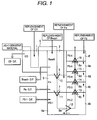
- FIG. 1 A typical embodiment of the development processing apparatus of the invention is described below by reference to Figs. 1 to 7.
- members are designated by member numbers
- processing tanks and processing solutions are designated by their names
- common members processing tanks and processing solutions being designated by common member numbers, processing tank names and processing solution names.
- a color developing tank 1 designated by CD, containing a color developer, a bleaching tank 2, designated by Bleach, containing a bleaching solution, a fixing tank 3, designated by Fix, containing a fixing solution, and a sequence of 6 rinsing tanks 4a to 4f respectively containing the first to the sixth rinsing solutions supplied in a countercurrent cascade manner and designated by Ps-1 to Ps-6 are disposed as shown in the drawing.
- the color developing tank 1, the bleaching tank 2, the fixing tank 3 and the sixth rinsing tank 4f are to be respectively replenished with a color developing replenisher, a bleaching replenisher, a fixing replenisher and a rinsing replenisher as designated by framed letters.
- Each of the color developing tank 1, the bleaching tank 2h, the fixing tank 3 and the first rinsing tank 4a is provided with a discharging means for discharging an overflow (O.F.) of each processing solution as designated by CD O.F., Bleach O.F., Fix O.F. or PS-1 O.F.
- a discharging means for discharging an overflow (O.F.) of each processing solution as designated by CD O.F., Bleach O.F., Fix O.F. or PS-1 O.F.
- the rinsing solution is moved in the countercurrent manner shown by the dotted arrows from the sixth rinsing tank 4f to the first rinsing tank 4a with conducting rising processing in each rinsing tank, and finally reaches the first rinsing tank 4a and then discharged as a rinse overflow PS-1 O.F.
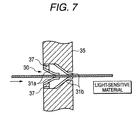
- the light-sensitive material designated by the framed letters is introduced into the color developing tank 1 along the light-sensitive material-conveying passage shown by the solid line and, after development processing, is introduced into the bleaching tank 2 along the passage 5 in the air to conduct bleaching processing. Subsequently, the light-sensitive material is conveyed to the fixing tank 3 through the passage 6 in the solution sealed without contacting air (in a solution-tight state) by a single blade 10, which permits to pass the light-sensitive material, provided between the bleaching tank 2 and the fixing tank 3.
- the light-sensitive material having been subjected to the fixing processing in the fixing tank is conveyed to the first rinsing tank 4a through the passage 7 in the solution sealed by a single blade 11 so that the light-sensitive material can pass therethrough and provided between the fixing tank 3 and the first rinsing tank 4a.
- the light-sensitive material is rinsed in the first rinsing tank 4a, then conveyed to the second rinsing tank 4b through the passage 8a in the solution sealed by a single blade 12 so that the light-sensitive material can pass therethrough and provided between the first rinsing tank 4a and the second rinsing tank 4b.
- the light-sensitive material is conveyed from the second rinsing tank 4b through the sixth rinsing tank 4f through the passages 8b to 8e in the solution sealed by the blades 13 to 16, during which rinsing is conducted.
- the whole dipprocessing steps for the light-sensitive material is completed in the sixth rinsing tank 4f, and the light-sensitive material is introduced into a drying step not shown to give finished color photograph (usually color print).
- the double blades serve to provide a higher level of solution-tightness and can reduce the amount of the upstream solution entrained to the downstream solution.
- the phrase "passage sealed without contacting air (in a solution-tight state) which permits to pass the light-sensitive material" as used herein means, as is described hereinabove, a passage having a shutting ability which permits to pass a slight amount of the upstream solution through the gap of the sealing member such as a blade or other shutting means having the same shutting function.
- it is a passage which, when the solution pressure on the upstream side of the blade is higher than the solution pressure on the downstream side, permits migration of the solution through the blade in proportion to the pressure difference and, when the solution pressure on the upstream side and the solution pressure on the downstream side are the same, does not permit migration of the solution through the gap of the sealing member except for upon passage of the light-sensitive material (web).
- the slit which is provided in the tank wall and forms the passage for the light-sensitive material is shut up by the adjacent facing blades or by the one-piece blade and the tank wall surface adjacent to each other, and migration of the solution does not occur.
- an appropriate conveying means for example, driving rollers such as conveyor rollers and nip rollers, facing free rollers and free rollers provided in a zigzag configuration is provided in the conveying passage in the solution.
- the color developing tank 21 containing the color developer designated by CD is divided into two tanks 21a and 21b via the passage 25a in the solution sealed without contacting air (in a solution-tight state) by the single blade 29a and is disposed on the bleaching tank 22. Further, a conveying passage 25b sealed by a single blade 29b is formed between the color developing tank 21b and the bleaching tank 22. With the vertical disposition of the color developing tanks 21a and 21b, the bleaching tank 22 and the fixing tank 23 as described above, the first rinsing tank 24a is disposed under the second rinsing tank 24b, thus the first rinsing tank 24a to the sixth rinsing tank 24f being disposed in a vertical configuration.
- blades 24a to 24f for the tank-to-tank passage of the light-sensitive material single blades are used. Other constitution is the same as described with respect to Fig. 1. Even when member numbers for respective constituent members are different from the member numbers for constituent members used in Fig. 1, corresponding members exert the same functions, thus descriptions therefor being omitted. Also, flow of the processing of the light-sensitive material, addition of a replenisher, and discharge of an overflow are the same as those with respect to the development processing apparatus shown in Fig. 1, thus descriptions therefor being omitted.
- the apparatus of this embodiment is more excellent than the apparatus shown in Fig. 1 in that, since the color developing tank is directly connected to the bleaching tank by the passage sealed by the blade in place of conveyance in the air, the apparatus of this embodiment depresses air oxidation, shortens the processing time and reduces the area for placing the processing apparatus.
- both apparatuses meat the requirements specified in the invention, and detailed descriptions to be given hereinafter apply to all apparatuses of the invention including these two apparatuses.
- the blades for providing the passage in the solution for the light-sensitive material between the processing solutions are described below.
- the blades are fit to the passage so that the tip portions thereof come into close contact with each other when no light-sensitive material is passed therethrough.
- the tip portions are press-opened upon entering of the light-sensitive material.
- the blades preferably have a base portion to be fit to the passage and a free end (also referred to as "tip portion") having a thickness gradually reduced toward the tip, though the thickness may be about the same from the base portion to the tip portion.
- the average oblique angle of the blade to the surface of the light-sensitive material is generally from about 10 to about 70°, particularly preferably from about 20 to 45°.
- the length of the blade from the base portion to the tip is preferably from 10 to 50 mm, particularly preferably from 15 to 25 mm.
- the length of the tip portions in contact with each other of a pair of blades provided in a facing disposition, when no light-sensitive material passes therethrough, is from about 1 to 10 mm, particularly from about 2 to 5 mm. This serves to ensure close contact of the tip portions of the blades when no light-sensitive material passes therethrough and effectively prevent migration of each processing solution. In addition, the amount of each processing solution entrained upon passage of the light-sensitive material can be minimized.
- Figs. 3 to 7 show various embodiments of the blades to be used for such purpose which, however, do not limit the use of other blades or other sealing means having the same function in the invention.
- Fig. 3 is a cross-sectional view of the conveying passage in the solution showing the state wherein a pair of single blades are provided on the wall surface of the processing tank to form the conveying passage in the solution.
- a slit 33 is provided so that the light-sensitive material can migrate in the conveying direction shown by the arrow from the processing tank on the upstream side (left side of the tank wall 32) to the processing tank on the downstream side (right side of the tank wall 32).
- the cross section of the tank wall 32 on the upstream tank side is in an oblique shape with respect to the passage so as to form an opening on the upstream side, and a pair of blades 31 are fixed on the oblique surfaces of the passage so that the free end pieces of the blades contact with each other on the downstream side and sandwich the light-sensitive material upon passage thereof.
- a pair of blades 31 contact with each other directly or via a light-sensitive material (or a conveyor belt) to form a sealing means 30 which prevents the processing solution of the upstream side tank and the processing solution of the downstream side tank from contacting with each other.
- the development processing solution when the development processing solution is out of operation, migration of the processing solution of the upstream side tank to the downstream side is stopped.
- the light-sensitive material is passed through the facing free ends of the blades in a state of occluding the upstream side processing solution in the light-sensitive layer thereof, which causes contamination of the downstream side processing solution with the upstream side processing solution...
- the degree..of this contamination is a degree at which the advantages of the invention can be maintained, thus the sealing system using the blades being preferred as a sealing means for realizing the invention.
- Fig. 4 is a cross-sectional view showing another embodiment of the sealing means.
- a single blade 31 is used.
- the blade is not paired and, on the other side of the passage for the light-sensitive material, one side of the light-sensitive material (or a guide film) is in contact with the tank wall 32, and the other side is in contact with the free end of the blade 31, thus a sealing means being formed by such structure.
- the slit end portion on the downstream side of the tank wall 32 in contact with the light-sensitive material (or the guide film) has a round portion 32a not to form scratches on the light-sensitive material.
- Fig. 5 is a cross-sectional view of the conveying passage in the solution showing another embodiment of a sealing means using double blades 31a and 31b as a sealing means 30.
- the tank wall 34 are formed oblique planes with respect to the passage for the light-sensitive material at two positions in the positional relation shown, and each of a pair of double blades 31a and a pair of double blades 31b are fixed with the free end of each blades being on the downstream side and the light-sensitive material being contacted with the blades vertically.
- a two-stage sealing means 30 which comprises the first sealing for sealing from the processing solution of the upstream tank by the free ends of a pair of the blades 31a and the light-sensitive material and the second sealing for sealing the processing solution of the downstream tank from the processing solution of the upstream tank having passed through the first sealing.
- Fig. 6 is a cross-sectional view of the conveying passage in the solution showing another embodiment of a sealing means using double blades 31a and 31b as a sealing means 30 in a manner different from that in Fig. 5.
- the tank wall 35 are formed oblique planes with respect to the passage for the light-sensitive material at two positions in the positional relation shown, and each of a pair of double blades 31a and a pair of double blades 31b are fixed with the free end of each blades being on the downstream side as is the same with the sealing means shown in Fig. 5.
- fine pores 37 are formed so that the processing solution confined in the space between the first sealing and the second sealing can go back to the upstream side tank. Therefore, when the water pressure in the middle portion between the first sealing and the second sealing becomes high, the processing solution in the middle portion goes back to the upstream side to prevent contamination of the processing solution on the downstream side.
- the embodiment shown in Fig. 7 is functionally the same as that shown in Fig. 6 in that the liquid pressure of the processing solution confined between the first sealing and the second sealing of the sealing means 30 using the double blades 31a and 31b is adjusted but, in the sealing system shown by Fig. 7, fine pores 37 are formed so that the processing solution confined between the first sealing and the second sealing can go back to the tank on the upstream side.
- the water pressure in the middle portion between the first sealing and the second sealing becomes high, the processing solution in the middle portion goes back to the upstream side to prevent contamination on the downstream side.
- Other functions are also the same as those described with respect to the double-blade type sealing portion shown by Fig. 6.
- any material may be used that does not exert detrimental effects on each processing solution.
- elastic materials such as various rubbers exemplified by natural rubber, chloroprene rubber, nitrile rubber, butyl rubber, fluorine-containing rubber, isoprene rubber, butadiene rubber, styrene-butadiene rubber, ethylene-propylene rubber and silicone rubber and soft resins exemplified by polyurethane, soft polyvinyl chloride, polyethylene, polypropylene, ionomer resin, fluorine-containing resin and silicone resin.
- polyurethane is preferred in view of durability and resistance against leakage of solution.
- the closely contacting force between the blades is given by the elastic force of the blade, and it is possible to compound a magnetic material in the tip portion of the blade (for example, like a rubber magnet) to generate an attraction force between the tip portions and give or increase the closely contacting force.
- a magnetic material in the tip portion of the blade for example, like a rubber magnet
- the inside surface of the blade may be subjected to a smoothing treatment or a surface treatment of coating a lubricant such as silicone or Teflon on the inside of the blade in the case where scratches are not negligible or where the rubbing resistance is intended to be reduced.
- the linear velocity of the conveyance of the light-sensitive material in the development processing apparatus of the invention is preferably 100 mm/sec or less, more preferably from 20 mm/sec to 80 mm/sec, particularly preferably from 25 mm/sec to 60 mm/sec.
- conveyance in the development processing apparatus for color paper there are two types: one being a type of conducting development processing after cutting color paper into pieces of final size (sheet type conveyance); and the other being a type of cutting into pieces of the final size after conducting the processing (cine type). Since the cine type conveyance produces about 2-mm waste of the light-sensitive material between images, the sheet type conveyance is preferred.
- the color paper to be subjected to the development processing apparatus of the invention may be either sheet-shaped or roll-shaped.
- a roller-conveying system is employed in an apparatus for processing sheet-shaped color paper, and any of publicly related systems such as a roller-conveying system, a belt-conveying system and a leader-conveying system wherein a leader is attached to the tip of a roll may be employed in an apparatus for processing roll-shaped paper.
- Preferred materials for the tanks such as the processing tanks and temperature-controlling tanks include modified PPO (modified polyphenylene oxide) and modified PPE (modified polyphenylene ether) resin.
- the modified PPO is exemplified by NORIL manufactured by GE Plastics Co.
- the modified PPE is exemplified by XYLON manufactured by Asahi Kasei corp. and UPIACE manufactured by Mitsubishi Gas Chemical Co., Inc.
- These materials are also appropriate for portions to be possibly in contact with the processing solution, such as a processing rack and a crossover.
- resins such as PVC (polyvinyl chloride), PP (polypropylene), PE (polyethylene) and TPX (polymethylpentene) are appropriate. Also, these materials can be used for other parts to be in contact with the processing solution. Additionally, PE resin is also preferred as a material for a replenisher tank to be made by blow molding.
- resins such as PA (polyamide), PBT (polybutylene terephthalate), UHMPE (ultra-high-molecular polyethylene), PPS (polyphenylene sulfide) and LCP (wholly aromatic polyester resin; liquid crystal polymer) are appropriate.
- PA polyamide
- PBT polybutylene terephthalate
- UHMPE ultra-high-molecular polyethylene
- PPS polyphenylene sulfide
- LCP whole aromatic polyester resin; liquid crystal polymer
- the PA resin is a polyamide resin such as 66 nylon, 12 nylon and 6 nylon, and those which contain glass fibers or carbon fibers are resistant against the swelling by the processing solution, thus being usable.
- high molecular products such as MC nylon and compression moldings can be used without a reinforcement by the fibers.
- UHMPE resin non-reinforced products are suited, with HI-ZEX MILLION manufactured by Mitsui Chemicals, NEWLIGHT manufactured by Saxin Corporation and SUNFINE manufactured by Asahi Kasei Chemicals Corp. being appropriate.
- the molecular weight thereof is preferably 1,000,000 or more, more preferably from 1,000,000 to 5,000,000.
- LCP resin examples which are reinforced by glass fibers or carbon fibers are preferred.
- LCP resin includes VICTREX manufactured by ICI Japan, ECONOL manufactured by Sumitomo Chemical, XYDER manufactured by Nihon Sekiyu K.K. and VECTRA manufactured by Polyplastics.
- the material for the belt is preferably an ultra-high strong polyethylene fibers described in Japanese Patent Application No. H-2-276886 or a polyvinylidene fluoride resin.
- foamed vinyl chloride resin foamed silicone resin
- foamed urethane resin includes RUBICELL manufactured by Toyo Polymer Co., Ltd.
- EPDM rubber As materials for joints of piping and joints of agitation jet pipe and for rubbery members such as a sealing material, EPDM rubber, silicone rubber and VITON rubber are preferred.
- the processing steps are characterized in that the bleaching processing is conducted subsequent to the color development, then processing with a processing solution having a fixing ability (a fixing solution or a bleach-fixing solution) is conducted.
- a processing solution having a fixing ability a fixing solution or a bleach-fixing solution
- the processing wherein the processing with a bleaching solution and the processing with a fixing solution are separately conducted (also referred to as "separate type bleach-fixing") is applied to light-sensitive materials for photographic use such as color negative films and has been used for processing color paper before year 1971 using a red prussiate-containing bleaching solution.
- processing of color paper has been changed to a bleach-fix processing since year 1971 using a bleaching agent of an iron ethylenediaminetetraacetate complex, and the separate type bleach-fix processing has become old-fashioned.
- the separate type bleach-fix processing which is not being used at present in the development processing of color paper placed in the world market is applied to silver halide type color paper, and it has been found that exhaustion of both the bleaching solution and the fixing solution is extremely reduced and that both the bleaching time and the fixing time can be remarkably shortened and, in addition, that the processing solutions suffer less exhaustion with time even in non-busy seasons, thus development processing works being stably conducted. Further, there have been found advantages that the size of the processing apparatus can be reduced because of the shortened processing time, that the consumption amount of the processing solution can be reduced owing to the low exhaustion, and that the processing cost can be reduced.
- a further advantage of the invention is also based on employment of the system of conveying a light-sensitive material in the solution between processing tanks by providing a passage for the light-sensitive material sealed without contacting air (in a solution-tight state) which permits passage of the light-sensitive material from the processing tank containing the bleaching solution and the processing tank containing the solution having a fixing ability.
- conveyance of the light-sensitive material between the processing tanks is conducted by once taking the light-sensitive material out of the preceding processing tank and conveying the light-sensitive material in the air to the next tank.
- JP-A-7-234488 describes a development processing apparatus having a passage for a light-sensitive material sealed with blades.
- the passage for the light-sensitive material has a zone where the light-sensitive material is in contact with the air, and is not solution-tight. Therefore, the advantages of the invention can not be obtained by the apparatus described therein.
- the development apparatus of the invention enables one to shorten the sum of the bleaching processing time and the time of processing with a solution having a fixing ability as short as 12 seconds or shorter by the rapid processing based on both the separate type processing system of using a bleaching solution and a solution having a fixing ability and the conveyance system of passing the light-sensitive material through the passage sealed without contacting air .(in a solution-tight state) between the both tanks.
- the processing time can be reduced to 10 seconds or shorter, preferably 6 seconds or shorter. As to the limit of the shortened processing time, about 2 seconds are seemed to be the limit with respect to the bleaching time and the fixing time.
- the processing time is not limited on the shorter side.
- a further advantage of the invention provided by the combination of the separate type processing wherein the bleach processing is combined with the processing with a solution having a fixing ability is that both the amount of replenisher for the bleach processing and the amount of replenisher for the solution having a fixing ability can be reduced.
- This replenisher amount-reducing advantage may be attributed to that, since silver potential of the bleaching solution can be made higher than that of the bleach-fixing solution, there can be obtained a higher bleaching activity which serves to reduce the amount of consumed bleaching agent in proportion to the difference of the potential, and that exhaustion of the solution having a fixing ability by contamination with the bleaching solution is reduced, which serves to reduce the amount of consumed fixing agent in proportion to the difference in degree of exhaustion.
- a smaller amount of the replenisher leads to reduction in the amount of waste liquid discharged by overflow. Since it is only the waste liquid discharged from the bleach-fixing system that is a thick waste liquid discharged from the processing of color paper (a waste liquid from color development processing being in many cases substantially at a negligible level), it provides a great advantage that the waste liquid problem within the minilabo can be solved by entrusting a processing agent supplier to send back and process the waste liquid synchronously with the recovery of the containers for the processing agents. (In the processing of color paper, a rinse overflow is also discharged. However, it is an aqueous solution containing components at a concentration of a much lower level, and hence a discharging method that can be employed in the minilabo can be selected. For example, it can be discharged to the sewage system after, as needed, recovering silver by adjustment of pH though depending upon conditions of local regulations.
- the color development processing to which the concentrated bleaching composition of the invention is applied comprises a color developing step, a bleaching step, a fixing step, a rinsing or water-washing step and a drying step.
- the processing solution in the fixing step may be a processing solution having a fixing ability such as a bleach-fixing solution as well as the fixing solution.
- a passage for a light-sensitive material sealed without contacting air (in a solution-tight state), through which the light-sensitive material can pass is provided between the bleaching step and the fixing step, and the light-sensitive material is conveyed through the passage in the solution between the processing tanks.
- conveying passages for the light-sensitive material between other steps are not limited to the type of conveyance in the solution, and a conveyance type of conveying the light-sensitive material - in the air, which thus requires an air time, may be employed.
- the passages for the light-sensitive material in the whole dipping step of from the color developing step to the final rinsing step are preferably passages in the solution.
- an auxiliary step such as an intermediate rinsing step, an intermediate water-washing step and a neutralizing step between the steps of dipping the light-sensitive material in the processing solutions.
- an image-stabilizing bath may be provided between the rinsing or water-washing step and the drying step for the purpose of stabilizing an image.
- the replenishing amount of the color developer is preferably from 10 to 200 ml, more preferably from 15 to 150 ml, most preferably from 20 to 90 ml, per m 2 of the light-sensitive material.
- the replenishing amount of the bleaching solution and that of the fixing solution can be reduced, and is preferably from 5 to 30 ml, more preferably from 5 to 20 ml, most preferably from 5 to 15 ml, per m 2 of the light-sensitive material.
- the replenishing amount of the rinsing solution or washing water to the rinsing tank is preferably from 50 ml to 200 ml as the whole rinsing solution and, in the case of employing a multi-tank constitution as in the embodiment shown by Figs. 1 and 2, a replenishing manner is suited wherein the final tank is replenished with the above-mentioned amount of the rinsing solution or washing water to cause overflow from the first rinsing tank according to the countercurrent cascade system.
- the color developing period is preferably 200 seconds or shorter, more preferably 120 seconds or shorter, still more preferably from 6 seconds to 80 seconds.
- the bleaching period is 100 seconds or shorter, preferably 30 seconds or shorter, more preferably 15 seconds or shorter, still more preferably 10 seconds or shorter, further still more preferably from 2 seconds to 10 seconds, most preferably from 2 seconds to 8 seconds.
- the fixing period is 150 seconds or shorter, preferably 60 seconds or shorter, more preferably 40 seconds or shorter, still more preferably 30 seconds or shorter, further still more preferably 20 seconds or shorter, most preferably from 2 seconds to 10 seconds.
- the sum of the bleaching period and the fixing period is preferably within the aforementioned range, preferably 12 seconds or shorter, more preferably 10 seconds or shorter, still more preferably from 2 seconds to 6 seconds.
- the rinsing or water-washing period is preferably 90 seconds or shorter, more preferably 60 seconds or shorter, still more preferably from 3 seconds to 30 seconds including the case of the multi-tank constitution being employed.
- the temperature of the processing solutions in the color developing step, bleaching step, fixing step and rinsing step is generally from 30 to 40°C. However, it is also an embodiment of the invention to conduct an accelerated processing at an elevated temperature of from 38 to 60°C, more preferably from 40 to 50°C.
- the processing period of each step means a period of from dipping of the light-sensitive material into the processing solution of the step to dipping of the light-sensitive material into the processing solution of the next step.
- the processing period is a sum of the period of the light-sensitive material being dipped in the processing solution of the processing step and the period of the light-sensitive material being moved from the processing tank toward the processing solution of the next processing step in the air (so-called air time).
- the dipping period of the bleaching step coincides with the processing period.
- the rinsing or water-washing period means the period of from entering of the light-sensitive material into the rinsing tank or the water-washing tank to entering of the light-sensitive material into the drying step.
- the amount of the rinsing solution can be determined from a wide range depending upon various conditions such as characteristics of the light-sensitive material (determined by, for example, materials used such as couplers), uses thereof, temperature of the rinsing solution (washing water), number (step number) of the rinsing solution (washing water), and the like.
- characteristics of the light-sensitive material determined by, for example, materials used such as couplers
- temperature of the rinsing solution washing water
- number (step number) of the rinsing solution washing water
- the relation between the number of tanks containing the rinsing solution (tanks containing the washing water) in the multi-step countercurrent system and the amount of water can be determined according to the method described in Journal of the Society of Motion Picture and Television Engineers, vol.64, pp.248-253 (the May number, 1955).
- the step number in the multi-step countercurrent system is preferably from 3 to 10, particularly preferably from 3 to 5.
- the multi-step countercurrent system serves to greatly reduce the amount of the rinsing solution and, since bacteria propagate to cause such problems as that a generated float deposits onto the light-sensitive material due to an increase in the residence time of water within the tank.
- a rinsing solution containing an antibacterial and antifungal agent to be described hereinafter.
- the color paper having been subjected to development processing is subjected to the after-treatment such as the drying step.
- the drying step it is possible to absorb water by a squeeze roller or cloth immediately after development processing (rinsing step) in view of reducing the amount of water to be brought into the image membrane of color paper. Also, it is naturally possible to accelerate drying by raising the temperature or change the form of a blowing nozzle to strengthen the drying air. Further, as is described inJP-A-3-157650, drying can be accelerated by adjusting the blasting angle of the drying air or selecting the manner of removing the discharged air.
- a tank solution in the processing tank and a replenisher to be added to the processing tank are inclusively referred to as processing solutions (for example, a color developing replenisher being included in a color developer) unless it is necessary to specially distinguish them from each other.
- the color developer contains a color developing agent.
- color developing agent examples include related aromatic primary amine color developing agents, in particular, p-phenylenediamine derivatives. Typical examples thereof are illustrated below which, however, do not limit the invention in any way.
- illustrative compounds 5), 6), 7), 8) and 12) are particularly preferred, with illustrative compound 5) and 8) being more preferred.
- these p-phenylenediamine derivatives are usually in the form of salts such as sulfates, hydrochlorides, sulfites, naphthalenedisulfonates or p-toluenesulfonates.
- the color developing agent is added so that the concentration of the color developing agent in the color developer becomes 2 mmols to 200 mmols, preferably 6 mmols to 100 mmols, more preferably 10 mmols to 40 mmols, per L of the developer.
- the organic preservative includes all compounds that can reduce, when added to the color developer, deterioration rate of the aromatic primary amine color developing agent. That is, the organic preservative is a compound having the function of preventing air oxidation of the color developing agent.
- Particularly effective organic preservatives include hydroxylamines, hydroxamic acids, hydrazides, phenols, ⁇ -hydroxyketones, ⁇ -aminoketones, sugars, monoamines, diamines, polyamines, quaternary ammonium salts, nitroxy radicals, alcohols, oximes, diamide comounds and ring-fused amines.
- JP-A-63-4235 JP-A-63-30845, JP-A-63-21647, TP-A-63-44655, JP-A-63-53551, JP-A-63-43140, JP-A-63-56654, JP-A-63-58346, JP-A-63-43138, JP-A-63-146041, JP-A-63-44657, JP-A-63-44656, US Patent Nos. 3,615,503 and 2,494,903, JP-A-52-143020 and JP-B-48-30496.
- alkanolamines such as triethanolamine and triisopropanolamine, substituted or unsubstituted dialkylhydroxylamines such as disulfoethylhydroxylamine and diethylhydroxylamine, or aromatic polyhydjroxy compounds may be added.
- hydroxylamine derivatives are described in detail in JP-A-1-97953, JP-A-1-186939, JP-A-1-186940 and JP-A-1 187557.
- addition of both the hydroxylamine derivative and an amine is, in some cases, effective in the point of improving stability of color developer and stability upon continuous processing.
- Examples of the amine include cyclic amines as described in JP-A-63-239447, amines as described in JP-A-63-128340 and amines as described in JP-A-1-186939, JP-A-1-187557.
- the amount of the preservative in the processing solution varies depending upon kind of the preservative, but the preservative is added so that the concentration thereof in a solution to be used becomes 1 mmol to 200 mmols, preferably 10 mmols to 100 mmols, per L of the developer.
- a chloride ion may be added, as needed, to the color developer for color paper.
- the color developer commonly contains chloride ion in a concentration of from 3.5x10 -2 to 1.5x10 -1 mol/L. Chloride ion is usually released into the developer as a by-product of development and, in many cases, a replenishing developer does not contain the chloride ion.
- the light-sensitive material to be the object of the invention is color paper, it is not necessary to incorporate chloride ion in the color developer, but the solution may contain bromide ion in a concentration of 1.0x10 -3 mol/L or less.
- chloride-supplying substance examples include sodium chloride, potassium chloride, ammonium chloride, lithium chloride, magnesium chloride, manganese chloride and calcium chloride. Of these, sodium chloride and potassium chloride are preferably used.
- the pH of the color developer is preferably from 9.0 to 12.0, and the pH of the color developing replenisher is preferably from 9.0 to 13.5. Further, the pH of the color developer is more preferably from 9.0 to 10.5, and the pH of the color developing replenisher is preferably from 9.0 to 12.0. Therefore, an alkali agent, a buffer agent and, as needed, an acid agent may be added so as to maintain the pH level.
- buffer agents for the purpose of maintaining the pH at the above-mentioned level.
- the buffer agent to be used include carbonates, phosphates, borates, tetraborates, hydroxybenzoates, glycynates, N,N-dimethylglycynates, leucinates, norleucinates, guaninates, 3,4-dihydroxyphenylalaninates, alaninates, aminobutyrates, 2-amiao-2-methyl-1,3-propanediol salts, valinates, prolynates, trishydroxyaminomethane salts and lysinates.
- carbonates, phosphates, tetraborates and hydroxybenzoates have the advantages that they are excellent in the buffering ability in the higher pH region of 9.0 or more in pH, that, when added to the color developer, they do not exert detrimental influences on photographic properties (e.g., fog), and that they are inexpensive. Thus, it is particularly preferred to use these buffer agents.
- the buffer agent include sodium carbonate, potassium carbonate, sodium bicarbonate, potassium bicarbonate, trisodium phosphate, tripotassium phosphate, disodium phosphate, dipotassium phosphate, sodium borate, potassium borate, sodium tetraborate (borax), potassium tetraborate, sodium o-hydroxybenzoate (sodium salicylate), potassium o-hydroxybenzoate, sodium 5-sulfo-2-hydroxybenzoate (sodium 5-sulfosalicylate) and potassium 5-sulfo-2-hydroxybenzoate (potassium 5-sulfosalicylate).
- the buffer agents are not limited only to these compounds.
- the buffer agent is not a component which reacts to be consumed, the addition amount thereof is determined so that the concentration thereof becomes 0.01 to 2 mols, preferably 0.1 to 0.5 mol, per L of the color developer.
- chelating agents which function both as agents for preventing-precipitation of calcium or magnesium and as agents for improving stability of the color developer.
- various chelating agents which function both as agents for preventing-precipitation of calcium or magnesium and as agents for improving stability of the color developer.
- chelating agents include nitrilotriacetic acid, diethylenetriaminepentaacetic acid, ethylenediaminetetraacetic acid, N,N,N-trimethylenephosphonic acid, ethylenediamine-N,N,N',N'-tetramethylenesulfonic acid, trans-cyclohexanediaminetetraacertic acid, 1,2-diaminopropane-tetraacetic acid, glycol ether diaminetetraacetic acid, ethylenediamine-o-hydroxyphenylacetic acid, ethylenediaminedisuccinic acid (SS enantiomer), N-(2-carboxylatoethyl)-L-aspartic acid,
- chelating agents may be used in combination of two or more thereof as needed.
- the amount of the chelating agent is an amount which is sufficient to mask the metal ions in the color developer.
- the chelating agent is added so that the amount becomes about 0.1 g to about 10 g per L of the color developer.
- any development accelerator there may be added, for example, thioether compounds described in JP-B-37-16088, p-phenylenediamine compounds described in JP-A-52-49829, quaternary ammonium salts described in JP-A-50-137726, amine compounds described in US Patent No. 2,494,903, polyalkylene oxides described in JP-B-42-25201, 10-henyl-3-pyrazolidones or imidazoles as needed.
- the addition amounts thereof are determined so that the concentration of the accelerator becomes 0.001 to 0.2 mol, preferably 0.01 to 0.05 mol, per L of the developer and the replenisher prepared from processing agents.
- any antifoggant in addition to the aforementioned halide ion may be added, as needed, any antifoggant in addition to the aforementioned halide ion.
- the organic antifoggant include nitrogen-containing hetero ring compounds such as benzotriazole, 6-nitrobenzimidazole, 5-nitroisoindazole, 5-methylbenzotriazole, 5-nitrobenzotriazole, 5-chloro-benzotriazole, 2-thiazolyl-benzimidazole, 2-thiazolylmethyl-benzimidazole, indazole, hydroxyazaindolizine and adenine.
- various surfactants such as alkylsulfonates, arylsulfonates, aliphatic carboxylates and aromatic carboxylates.
- the addition amount of the surfactant is determined so that the concentration of the surfactant becomes 0.0001 to 0.2 mol, preferably 0.001 to 0.05 mol, per L of the color developer and the replenisher prepared from the processing agents.
- a fluorescent brightening agent may be used as needed.
- a bis(triazinylamino)stilbenesulfonic acid compound is preferred.
- bis(triazinylamino)stilbenesulfonic acid compound related or commercially available bisaminostilbene series fluorescent brightening agents may be used.
- the related bis(triazinylamino)stilbenesulfonic acid compounds to be preferably used include those compounds which are described in JP-A-6-329936, JP-A-7-140625 and JP-A-10-140849.
- any of related bleaching agents may be used.
- organic complex salts of iron (III) e.g., complex salts of aminopolycarboxylic acids
- organic acids such as citric acid, tartaric acid and malic acid, persulfates and hydrogen peroxide are preferred.
- organic complex salts of iron(III) are particularly preferred in view of rapid processing and prevention of environmental pollution.
- useful aminopolycarboxylic acids (or salts thereof) for forming the organic complex salts of iron(III) include biodegradable ones such as ethylenediaminedisucinic acid (SS enantiomer), N-(2-carboxylatoethyl)-L-aspartic acid, ⁇ -alaninediacetic acid and methyliminodiacetic acid as well as ethylenediaminetetraacetic acid, diethylenetriaminepentaacetic acid, 1,3-diaminopropanetetraacetic acid, propylenediaminetetraacetic acid, nitrilotriacetic acid, cyclohexanediaminetetraacetic acid, iminodiacetic acid and glycol ether diaminetetraacetic acid.
- biodegradable ones such as ethylenediaminedisucinic acid (SS enantiomer), N-(2-
- These compounds may be in any form of sodium salt, potassium salt, lithium salt and ammonium salt.
- ethylenediaminedisuccinic acid (SS enantiomer), N-(2-carboxylatoethyl)-L-aspartic acid, ⁇ -alaninediacetic acid, ethylenediaminetetraacetic acid, 1,3-diaminopropanetetraacetic acid and methyliminodiacetic acid are preferred because the iron(III) complex salts thereof provide good photographic properties.
- Ir(III) ion complex salts may be used in the form of complex salt or may be formed in situ in the solution by using a ferric salt such as ferric sulfate, ferric chloride, ferric nitrate, ammonium ferric sulfate or ferric sulfate and a chelating agent such as an aminopolycarboxylic acid. It is also possible to use the chelating agent in an amount more than is necessary for forming the ferric ion complex salt. Of the iron complex salts, aminopolycarboxylic acid-iron complex salts are preferred.
- the concentration of the bleaching agent in the bleaching solution is determined to be from 0.01 to 1.0 mol/liter, preferably from 0.03 to 0.80 mol/liter, more preferably from 0.05 to 0.70 mol/liter, still more preferably from 0.07 to 0.50 mol/liter.
- the bleaching solution preferably contains various related organic acids (e.g., glycolic acid, succinic acid, maleic acid, malonic acid, citric acid and sulfosuccinic acid), organic bases (e.g., imidazole and dimethylimidazole), compounds represented by the general formula (A-a) described in JP-A-9-211819 including 2-picolinic acid and compounds represented by the general formula (B-b) described in the same official gazette including kojic acid.
- the addition amount of the compound is determined so that concentration of the compound in the prepared processing solution becomes preferably from 0.005 to 3.0 mols per liter, preferably from 0.05 to 1.5 mols per liter.
- an alkali metal nitrate such as potassium nitrate or sodium nitrate is preferred because it serves to prevent corrosion of a metal-made member.
- the addition amount is determined so that the concentration of the nitrate in the prepared processing solution becomes from 0.005 to 3.0 mols per liter, more preferably from 0.05 to 1.5 mols per liter.
- an alkali halide such as potassium chloride, potassium bromide, sodium chloride or sodium bromide is preferred because it serves to enhance the bleaching activity.
- the addition amount is determined so that the concentration of the alkali halide in the prepared processing solution becomes from 0.005 to 3.0 mols per liter, more preferably from 0.05 to 1.5 mols per liter.
- the pH region of the bleaching solution to be used in the invention is preferably from 2 to 8, more preferably from 3 to 7, most preferably from 4 to 6. If the pH value is less than this, there results deterioration of the solution and acceleration of conversion of a cyan dye to its leuco form whereas, if the pH value is higher than this, there results a delayed silver removal and a tendency to generate stains.
- For the purpose of adjusting the pH there may be added, as needed, acetic acid or an organic acid having been described hereinbefore, and the aforementioned alkali such as potassium hydroxide, sodium hydroxide, lithium hydroxide, lithium carbonate, sodium carbonate or potassium carbonate, or an acidic or alkaline buffer agent.
- a fixing solution As the processing solution having a fixing ability, there are illustrated a fixing solution and a bleach-fixing solution. They are inclusively described below, provided that description on a bleaching component in the bleach-fixing solution having been already given with respect to the foregoing bleaching solution is not repeated.
- Compounds to be used as a fixing component in the fixing solution and the bleach-fixing solution are related fixing chemicals, i.e., water-soluble silver halide-dissolving agents such as thiosulfates (e.g., sodium thiosulfate and ammonium thiosulfate), thiocyanates (e.g., sodium thiocyanate and ammonium thiocyanate), thioether compounds (e.g., ethylenebisthioglycolic acid and 3,6-dithia-1,8-octanediol), and thioureas. These may be used independently or in combination of two or more thereof.
- water-soluble silver halide-dissolving agents such as thiosulfates (e.g., sodium thiosulfate and ammonium thiosulfate), thiocyanates (e.g., sodium thiocyanate and ammonium thiocyanate), thioether
- the concentration of the fixing chemical in the fixing solution and the bleach-fixing solution is preferably from 0.3 to 3 mols, more preferably from 0.5 to 2.0 mols, per mol of the prepared solution.
- the pH region of the fixing solution and the bleach-fixing solution to be used in the invention is preferably from 3 to 9, more preferably from 4 to 8. If the pH value is less than this, there results deterioration of the solution and acceleration of conversion of a cyan dye to its leuco form though silver-removing ability is improved whereas, if the pH value is higher than this, there results a delayed silver removal and a tendency to generate stains.
- For the purpose of adjusting the pH there may be added, as needed, acetic acid or an organic acid having been described hereinbefore, and the aforementioned alkali such as potassium hydroxide, sodium hydroxide, lithium hydroxide, lithium carbonate, sodium carbonate or potassium carbonate, or an acidic or alkaline buffer agent.
- the fixing solution and the bleach-fixing solution preferably contain, as a preservative, a sulfite (e.g., sodium sulfite, a compound capable of releasing sulfite ion such as potassium sulfite or ammonium sulfite), a bisulfite (e.g., ammonium bisulfite, sodium bisulfite or potassium bisulfite) or a metabisulfite (e.g., potassium metabisulfite, sodium metabisulfite or ammonium metabisulfite) and an arylsulfinic acid such as p-toluenesulfinic acid or m-carboxybenzenesulfinic acid.
- a sulfite e.g., sodium sulfite, a compound capable of releasing sulfite ion such as potassium sulfite or ammonium sulfite
- a bisulfite e.g., ammoni
- ascorbic acid Ascorbic acid, a carbonyl-bisulfite addition product or a carbonyl compound may be added as well as the above-mentioned compounds.
- the color photographic light-sensitive material to which the invention is applied is color paper, i.e., color photographic paper.
- This light-sensitive material comprises a support having provided thereon at least one light-sensitive layer.
- a typical example thereof is a silver halide photographic light-sensitive material comprising a support having provided thereon at least one light-sensitive layer comprising a plurality of silver halide emulsion layers substantially different in color sensitivity.
- a reflective support is generally used, on which a red-sensitive layer, a green-sensitive layer and a blue-sensitive layer are provided in this order from the far side with respect to the support.
- the silver halide emulsion cubic crystal emulsions of silver chloride grains or silver chlorobromide grains containing chloride in a high content are used.
- the light-sensitive silver halide to be used for the light-sensitive material of the invention preferably comprises crystalline cubic or tetradecahedral grains substantially having a (100) face or a (111) face (these grains may have round tops or may have a higher face), grains having octahedral crystal lattice or tabular grains having a (100) face or a (111) face as a main face and having an aspect ratio of 2 or more.
- the aspect ratio is a value obtained by dividing the equivalent circular diameter for the projected area of the grain by the thickness of the grain.
- tabular grains whose main face comprises a (100) face or a (111) face
- cubic grains are most preferred.
- the size of the grain is preferably 0.5 ⁇ m or less, more preferably 0.4 ⁇ m or less, in terms of the length of the cube.
- the silver halide emulsion to be used in the invention an emulsion containing silver halide grains with a specific silver halide composition is used.
- the content of silver chloride must be 90 mol % or more, and is preferably 93 mol % or more, still more preferably 95 mol % or more.
- the content of silver bromide, which serves to provide contrasty image and excellent latent image stability, is preferably from 0.1 to 7 mol %, more preferably from 0.5 to 5 mol %.
- the content of silver iodide which gives a high sensitivity in high intensity exposure and gives a contrasty image, is preferably from 0.02 to 1 mol %, more preferably from 0.05 to 0.50 mol %, most preferably from 0.07 to 0.40 mol %.
- the silver halide grains of the invention are preferably silver iodobromochloride grains, with silver iodobromochloride grains of the above-mentioned halogen composition being still more preferred.
- the silver halide emulsion to be used in the invention preferably contains iridium.
- a 6-ligand-coordinated complex having 6 ligands and containing iridium as a center metal is preferred in order to uniformly introduce into silver halide crystals.
- One preferred embodiment of iridium to be used in the invention is a 6-ligand-coordinated complex wherein Ir is a center atom having Cl, Br or I as ligand. In this case, Cl, Br or I may be co-present. Incorporation of the 6-ligand-coordinated complex wherein Ir is a center atom having Cl, Br or I as ligand in the silver bromide-containing phase is particularly preferred for obtaining a contrasty gradation by high intensity exposure.
- the above-mentioned iridium complex is incorporated within silver halide grains preferably by adding the complex directly to a reaction solution upon formation of silver halide grains or by adding to an aqueous solution of halide for forming silver halide grains or to other solution to thereby add the complex to a grain-forming reaction solution. It is also preferred to conduct physical ripening with fine particles wherein the iridium complex is previously incorporated to thereby incorporate the iridium complex in the silver halide grains. Further, these methods may be combined to incorporate the complex in silver halide grains.
- 6-ligand complexes which contain Ir as the central metal and wherein all of 6 ligands comprise Cl, Br or I are preferably incorporated in the portion where the concentration of silver bromide is maximal.
- the optimal amount of the metal complex can vary depending upon the size of silver halide grains in which the complex is to be incorporated, but the complex is used in an amount of preferably from 5x10 -10 mol to 1x10 -7 mol, more preferably from 2x10 -10 mol to 8x10 -8 mol, particularly preferably from 5x10 -10 mol to 5x10 -8 mol, per mol of silver during formation of the grains.
- the interior and/or the surface of silver halide grains can be doped with other metal ion than iridium or rhodium.
- metal ion transition metal ions are preferred.
- an ion of iron, ruthenium, osmium, lead, cadmium or zinc is preferred.
- these metal ions are more preferably used as 6-ligand-coordinated octahedral complexes having ligands.
- cyanide ion, halide ion, thiocyanide ion, hydroxide ion, peroxide ion, azide ion, nitrite ion, water, ammonia, nitrosyl ion or thionitrosyl ion is preferably used.
- These ions may preferably be coordinated to any ion of the above-mentioned iron, ruthenium, osmium, lead, cadmium and zinc. It is also preferred to use plural kinds of ligands in one complex molecule.
- an organic compound may be used as a ligand, and preferred examples thereof include chained compounds containing 5 .or .less carbon atoms and/or 5- or 6-membered hetero ring compounds. More preferred organic compounds are those compounds which have a nitrogen atom, a phosphorus atom, an oxygen atom or a sulfur atom within molecule as an atom which coordinates to the metal. Particularly preferred are furan, thiophene, oxazole, isoxazole, thiazole, isothiazole, imidazole, pyrazole, triazole, furazane, pyran, pyridine, pyridazine, pyrimidine and pyrazine. Further, those compounds wherein these compounds constitute a fundamental skeleton and a substituent or substituents are introduced to the skeleton are also preferred.
- a preferred combination of the metal ion and the ligand is a combination of iron ion or ruthenium ion and cyanide ion.
- cyanide ion is preferably the majority of the ligands coordinated to the central metal of iron or ruthenium, with the rest coordination sites preferably being occupied by thiocyan, ammonia, water, nitrosil ion, dimethylsulfoxide, pyridine, pyrazine or 4,4'-bipyridine.
- cyanide ion to form hexacyano-iron complex or a hexacyano-ruthenium complex.
- These complexes containing cyanide ion as ligand is added in an amount of preferably from 1x10 -8 mol to 1x10 -2 mol, most preferably from 1x10 -6 mol to 5x10 -4 mol, per mol of silver during formation of the grains.
- ruthenium or osmium it is preferred to have nitrosyl ion, thionitrosyl ion or water molecule and chloride ion at the same time as ligands.
- pentachloronitrosyl complexes pentachlorothionitrosyl complexes or pentachloroaqua complexes, with hexachloro complexes being also preferred to form.
- These complexes are added in an amount of from 1x10 -10 mol to 1x10 -6 mol, more preferably from 1x10 -9 mol to 1x10 -6 mol, per mol of silver during formation of grains.
- spectrally sensitizing dyes to be used for spectral sensitization in green or red region of the light-sensitive silver halide emulsion for use in the invention there are illustrated, for example, those which are described in F.M.Harmer, Heterocyclic compounds-Cyanine dyes and related compounds, John Wiley % Sons (New York, London), 1964.
- specific examples of the compounds and spectrally sensitizing methods those which are described in the foregoing JP-A-62-215272, p.22, right and upper column - p.38 are preferably employed.
- the spectrally sensitizing dyes described in JP-A-3-123340 are extremely preferred in view of stability, strength of adsorption and temperature dependence of exposure.
- the silver halide emulsion to be processed in the development processing apparatus of the invention is preferably subjected to the gold sensitization related in the art.
- various inorganic gold compounds, gold(I) complexes having inorganic ligands and gold(I) complexes having organic ligands can be utilized.
- the gold compound there may be used chloroauric acid or the salt thereof and, as the gold(I) complex having inorganic ligands, there may be used gold(I) dithiocyanate compounds such as potassium gold(I) dithiocyanate or gold dithiosulfate compounds such as trisodium gold(I) dithiosulfate.
- colloidal gold sulfide It is also possible to use colloidal gold sulfide. Processes for producing it are described in Research Disclosure, 37154, Solid State Ionics, vol.79, pp.60-66 (1995), and Compt. Rend. Hebt. Seances Acad. Sci. Sect. B, vol.263, p.1328 (1966). It is described in the above-mentioned Reserch Disclosure to use thiocyanate ion upon production of colloidal gold sulfide. However, thioether compounds such as methionine and thiodiethanol may be used instead.
- the gold sensitization may be combined with other sensitizing method such as sulfur sensitization, selenium sensitization, tellurium sensitization or reduction sensitization or with a noble metal sensitization using other compound than the gold compound. Particularly, it is proffered to be combined with sulfur sensitization and selenium sensitization.
- a general-purpose printer may be used as a printer for preparing print by development processing using the development processing apparatus of the invention.
- the paper is also adapted to a scan exposure system using a cathode ray tube (CRT) in addition to the print system using an ordinary negative printer.
- CTR cathode ray tube
- the cathode ray tube exposure apparatus is simple and compact and is less costly.
- adjustment of optical axis or color is easy.
- various light-emitting bodies capable of emitting light in the spectral region may be used as the cathode ray tube to be used for imagewise exposure.
- a red light-emitting body a green light-emitting body and a blue light-emitting body, or two or more thereof, may be used.
- the spectral region is not limited to the red, green and blue, and a fluorescent body emitting light in the region of yellow, orange, violet or infrared may also be used.
- a cathode ray tube emitting white light by mixing these light-emitting bodies is often employed.
- the light-sensitive material to be processed in the development processing apparatus of the invention is preferably exposed by a digital scan-exposing system using a monochromatic high density light from, for example, a as laser, a light-emitting diode, -a semiconductor laser or a second harmonic-generating light source (SHG) wherein a solid-state laser using a semiconductor laser as an exciting light source is combined with non-linear optical crystals.
- a semiconductor laser or a second harmonic-generating light source (SHG) wherein a semiconductor laser or a solid-state laser is combined with non-linear optical crystals.
- At least one light source for exposure is preferably the semiconductor laser.
- processing materials and processing methods described in JP-A-2-207250, p.26, right and lower column, line I to p.34, right and upper column, line 9, and JP-A-4-97355, p.5, left and upper column, line 17 to p.18, right and lower column, line 20 can preferably be applied to the processing of the light-sensitive material of the invention.
- High silver chloride-content cubic grains were prepared by simultaneously adding silver nitrate and sodium chloride to a deionized distilled water containing deionized gelatin under stirring. During this preparation step, Cs 2 [OsCl 5 (NO)] was added from the point where addition of silver nitrate reached 60% to the point where addition of silver nitrate reached 80%. Potassium bromide (1.5 mol % per mol of finished silver halide) and K 4 [Fe(CN) 6 ] were added from the point where addition of silver nitrate reached 80% to the point where addition of silver nitrate reached 90%.
- K 2 [IrCl 6 ] was added from the point where addition of silver nitrate reached 83% to the point where addition of silver nitrate reached 88%.
- K 2 [IrCl 5 (H 2 O)] and K[IrCl 4 (H 2 O) 2 ] were added from the point where addition of silver nitrate reached 92% to the point where addition of silver nitrate reached 98%.
- Potassium iodide (0.27 mol % per mol of finished silver halide) was added under vigorous stirring at the point where addition of silver nitrate reached 94%.
- the thus-obtained emulsion grains were mono-disperse cubic silver iodobromochloride grains of 0.54 ⁇ m in side length and 8.5% in coefficient of variation. After subjecting this emulsion to a desalting treatment by sedimentation, gelatin, compounds Ab-1, Ab-2, Ab-3 and calcium nitrate were added, followed by re-dispersing the mixture.
- the re-dispersed emulsion was dissolved at 40 °C, and sensitizing dyes S-1, S-2 and S-3 of the invention were added thereto so as to obtain optimum spectral sensitization. Subsequently, sodium benzenethiosulfate, a sulfur sensitizing agent of triethylthiourea, and a gold sensitizing agent of compound-1 were added to the emulsion, followed by ripening to attain optimum chemical sensitization.
- emulsion BH-1 1-(5-methylureidophenyl)-5-mereaptotetrazole, compound-2 and a compound represented by compound-3 wherein a major component is mainly 2 or 3 in the number of repeating unit (the end groups X1 and X2 being hydroxyl groups), compound-4 and potassium bromide were added to the emulsion to complete chemical ripening.
- the thus-obtained emulsion was referred to as emulsion BH-1.
- Emulsion grains were obtained in the same manner as in preparation of emulsion BH-1 except for changing temperature and adding rate in the step of simultaneously adding and mixing silver nitrate and sodium chloride and changing the amounts of various metal complexes added during the addition of silver nitrate and sodium chloride.
- the resulting emulsion grains were mono-disperse cubic silver iodobromochloride grains of 0.44 ⁇ m in side length and 9.5% in coefficient of variation.
- An emulsion BL-1 was prepared in the same manner as with BH-1 except for changing the amounts of various compounds added after re-dispersing of the emulsion.
- High silver chloride-content cubic grains were prepared by simultaneously adding silver nitrate and sodium chloride to a deionized distilled water containing deionized gelatin under stirring. During this preparation step, K 4 [Ru(CN) 6 ] was added from the point where addition of silver nitrate reached 80% to the point where addition of silver nitrate reached 90%. Potassium bromide (2 mol % per mol of finished silver halide) was added from the point where addition of silver nitrate reached 80% to the point where addition of silver nitrate reached 100%.
- K 2 [IrCl 6 ] and K2[RhBr5(H2O)] were added from the point where addition of silver nitrate reached 83% to the point where addition of silver nitrate reached 88%.
- Potassium iodide (0.1 mol %) was added under vigorous stirring at the point where addition of silver nitrate reached 90%.
- K 2 [IrCl 5 (H 2 O)] and K[IrCl 4 (H 2 O) 2 ] were added from the point where addition of silver nitrate reached 92% to the point where silver nitrate reached 98%.
- the thus-obtained emulsion grains were mono-disperse cubic silver iodobromochloride grains of 0.42 ⁇ m in side length and 8.0% in coefficient of variation. This emulsion was subjected to the same desalting treatment by sedimentation and re-dispersing.
- the resulting emulsion was dissolved at 40 °C, and sodium benzenethiosulfate, p-glutaramidophenyldisulfide, a sulfur sensitizing agent of sodium thiosulfate pentahydrate and a gold sensitizing agent of (bis(1,4,5-trimethyl-1,2,4-triazolium-3-thiolato) aurate (I) tetrafluoroborate) were added thereto and ripened so as to obtain optimum chemical sensitization.
- emulsion GH-1 1-(3-acetamidophenyl)-5-mercaptotetrazole, 1-(5-methylureidophenyl)-5-mercaptotetrazole, compound-2, compound-4 and potassium bromide were added to the emulsion. Further, in the course of the emulsion-preparing step, sensitizing dyes S-4, S-5, S-6 and S-7 were added to conduct spectral sensitization. The thus-obtained emulsion was referred to as emulsion GH-1.
- Emulsion grains were obtained in the same manner as in preparation of emulsion GH-1 except for changing temperature and adding rate in the step of simultaneously adding and mixing silver nitrate and sodium chloride and changing the amounts of various metal complexes added during the addition of silver nitrate and sodium chloride.
- the resulting emulsion grains were mono-disperse cubic silver iodobromochloride grains of 0.35 ⁇ m in side length and 9.8% in coefficient of variation.
- An emulsion GL-1 was prepared in the same manner as with GH-1 except for changing the amounts of various compounds added after re-dispersing of the emulsion.
- High silver chloride-content cubic grains were prepared by simultaneously adding silver nitrate and sodium chloride to a deionized distilled water containing deionized gelatin under stirring. During this preparation step, Cs 2 [OsCl 5 (NO)] was added from the point where addition of silver nitrate reached 60% to the point where addition of silver nitrate reached 80%. K 4 [Ru(CN) 6 ] was added from the point where addition of silver nitrate reached 80% to the point where addition of silver nitrate reached 90%. Potassium bromide (1.3 mol % per mol of finished silver halide) was added from the point where addition of silver nitrate reached 80% to the point where addition of silver nitrate reached 100%.
- K 2 [IrCl 5 (5-methylthiazole)] was added from the point where addition of silver nitrate reached 83% to the point where addition of silver nitrate reached 88%.
- Potassium iodide (0.05 mol %) was added under vigorous stirring at the point where addition of silver nitrate reached 88%.
- K 2 [IrCl 5 (H 2 O)] and K[IrCl 4 (H 2 O) 2 ] were added a the point where addition of silver nitrate reached 92% to the point where addition of silver nitrate reached 98%.
- the thus-obtained emulsion grains were mono-disperse cubic silver iodobromochloride grains of 0.39 ⁇ m in side length and 10% in coefficient of variation.
- the resultant emulsion was subjected to the same desalting treatment by sedimentation and re-dispersing as described hereinbefore.
- emulsion RH-1 The thus-obtained emulsion was referred to as emulsion RH-1.
- Emulsion grains were obtained in the same manner as in preparation of emulsion RH-1 except for changing temperature and adding rate in the step of simultaneously adding and mixing silver nitrate and sodium chloride and changing the amounts of various metal complexes added during the addition of silver nitrate and sodium chloride.
- the resulting emulsion grains were mono-disperse cubic silver iodobromochloride grains of 0.29 ⁇ m in side length and 9.9% in coefficient of variation.
- An emulsion RL-1 was prepared in the same manner as with RH-1 except for changing the amounts of various compounds added after re-dispersing of the emulsion.
- the emulsion dispersion A was mixed with the emulsions BH-1 and B1-1 to dissolve, and a coating solution for the first layer having the formulation described hereinafter was prepared.
- the amount of emulsion is in terms of silver amount.
- Coating solutions for the second to seventh layers were prepared in the same manner as with the coating solution for the first layer.
- sodium salt of 1-hydroxy-3,5-dichloro-s-triazine (H-1), (H-2) or (H-3) was used
- Compounds Ab-1, Ab-2 and Ab-3 were added to each layer in total amounts of 15.0 mg/m 2 , 60.0 mg/m 2 , 5.0 mg/m 2 and 10.0 mg/m 2 , respectively.
- 1-(3-Methylureidophenyl)-5-mercaptotetrazole was added to the second layer, the fourth layer and the sixth layer in amounts of 0.2 mg/m 2 , 0.2 mg/m 2 and 0.6 mg/m 2 , respectively.
- 4-Hydroxy-6-methyl-1,3,3a,7-tetrazaindene was added to the blue-sensitive emulsion layer and the green-sensitive emulsion layer in amounts of 1x10 -4 mol and 2x10 -4 mol per mol of silver halide, respectively.
- a methacrylic acid/butyl acrylate copolymer latex (1:1 in weight ratio; average molecular weight: 200000 to 400000).
- Disodium catechol-3,5-disulfonate was added to the second layer, the fourth layer and the sixth layer in an amount of 6 mg/m 2 , 6 mg/m 2 and 18 mg/m 2 , respectively.
- Sodium polystyrenesulfonate was added, as needed, to each layer for adjusting the viscosity of each coating solution. Also, in order to prevent irradiation, the following dyes (coating amounts being shown in parentheses) were added.
- each layer was shown below. Numerals represent coating amounts (g/m 2 ). The amount of silver halide emulsion is represented in terms of the amount of coated silver.
- sample 001 The thus-prepared sample was referred to as sample 001.
- the sample 001 was formed into a roll of 127mm in width, and was exposed to a standard photographic image using Digital Minilabo Frontier 340 (manufactured by Fuji Photo Film Co., Ltd.). Then, continuous processing (running test) of the sample was conducted according to the following processing steps till the volume of the color developing replenisher became twice the volume of the color developing tank, provided that Frontier 340 (made by Fuji Photo Film Co., Ltd.) was modified so that the conveying speed of the processor provided the following processing periods and that the tank constitution was as shown in Fig. 1.
- Formulation of each processing solution is as follows. [Color developer] [Tank soln.] [Replenisher] Water 800 mL 800 mL Fluorescent brightening agent (FL-1) 4.0 g 9.0 g Residual color-reducing agent (SR-1) 3.0 g 8.0 g Sodium p-toluenesulfonate 10.0 g 10.0 g Ethylenediaminetetraacetic acid 4.0 g 4.0 g Sodium sulfite 0.10 g 0.10 g Potassium chloride 10.0 g - Sodium 4,5-dihydroxybenzene1,3-disulfonate 0.50 g 0.50 g Disodium-N,N-bis(sulfonatoethyl)Hydroxylamine 8.5 g 14.0 g 4-Amino-3-methyl-N-ethyl-N( ⁇ -methanesulfonamidoethyl)aniline 3/2 sulfate
- the tank formed by combining the bleaching tank and the fixing tank is a tank containing the related bleach-fixing solution and, as a starting solution, a 1:1 mixture of the above-mentioned bleaching solution and the fixing solution was used. Also, as to replenishment of the bleach-fixing solution, the above-mentioned bleaching replenisher and the fixing replenisher were separately introdued.
- each processing solution is as follows. [Color developer] [Tank soln.] [Replenisher] same as above same as above [Bleach-fixing solution in tank] Water 600 mL Citric acid 19.2 g Sulfosuccinic acid 19.4 g Iron(III) ammonium ethylene- diaminetetraacetate 47.0 g Ethylenediaminetetraacetic acid 2.8 g Nitric acid (67%) 17.5 g m-Carboxysulfinic acid 9.3 g Ammonium bromide 50.0 g Thioammonium sulfate (70%) 0.3 mol Ammonium sulfite 40.0 g Water to make the total 1000 mL pH (25°C, adjusted with nitric acid and aqueous ammonia) 6.00 [Bleach-fixing replenisher] [Bleaching part] same as the above-described bleaching replenisher [Fixing part] same as the above-described fixing replenisher (The bleaching part and
- Example 2 was prepared in the same manner in Example 1 except for changing the bleaching time of 6 sec in development processing test to 5 sec.
- Example 2 was compared with Comparative Example 1 and Comparative Example 2 in the same way. The result was the same as in the Example I, and any difference could not seen in the result of the invention between the bleaching time of 6 sec and 5 sec in development processing test.
- the apparatus and method of the invention for processing silver halide color paper wherein the processing with the bleaching solution and the processing with the solution having a fixing ability are separated from each other, and the light-sensitive material is conveyed in the solution without contacting air between the both processings (a) realizes rapid processing permitting to hand over finished prints to a customer on the spot, (b) reduces the size of the processing apparatus thereby requiring only a small area allowable for a minilabo to install it, (c) ensures enough stability of processing solutions not to suffer deterioration of the processing solutions even during non-busy seasons because air oxidation of the fixing solution is depressed and deterioration with time due to contamination of processing solutions is reduced, and, therefore, (d) constantly maintains image quality at a normal level. Further, the method of the invention (e) enables to reduce the sum of the amount of bleaching solution and the amount of the processing solution having a fixing ability so much that the discharge amount of waste liquid of the photographic processing can be reduced.
Landscapes
- Physics & Mathematics (AREA)
- General Physics & Mathematics (AREA)
- Photographic Processing Devices Using Wet Methods (AREA)
Abstract
Description
wherein the second processing tank and the third processing tank are provided in a vertical positional relationship with each other.
wherein a sum of a processing time for processing with the bleaching solution and a processing time for processing with the solution having the fixing ability is 12 seconds or shorter.
wherein the sum is 10 seconds or shorter.
wherein a sum of a processing time of the processing with the bleaching solution and a processing time of the processing with the solution having the fixing ability is 12 seconds or shorter.
wherein the sum is 10 seconds or shorter.
wherein a sum of an amount of a bleaching replenisher to be replenished into a bleaching tank and an amount of a replenisher having a fixing ability to be replenished into a processing tank for the solution having the fixing ability is 35 mL or less per m2 of a color paper.
wherein these compounds constitute a fundamental skeleton and a substituent or substituents are introduced to the skeleton are also preferred.

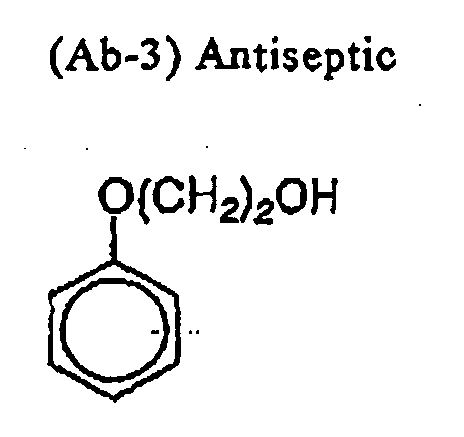
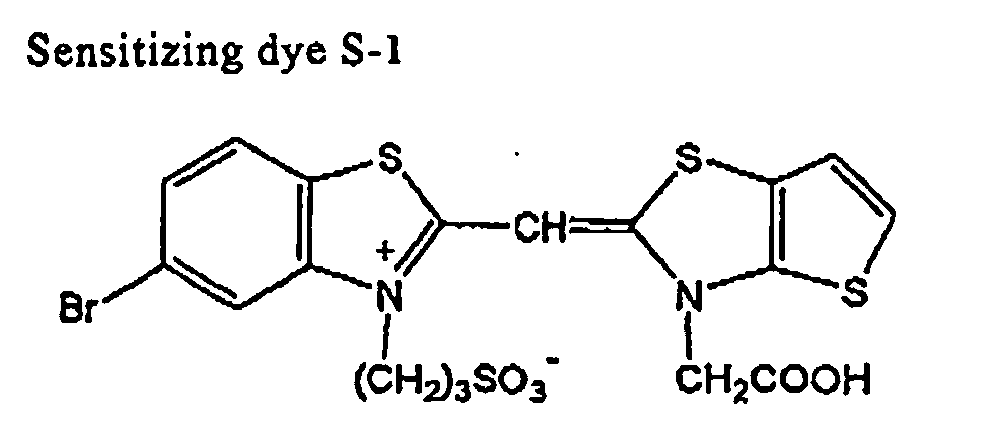
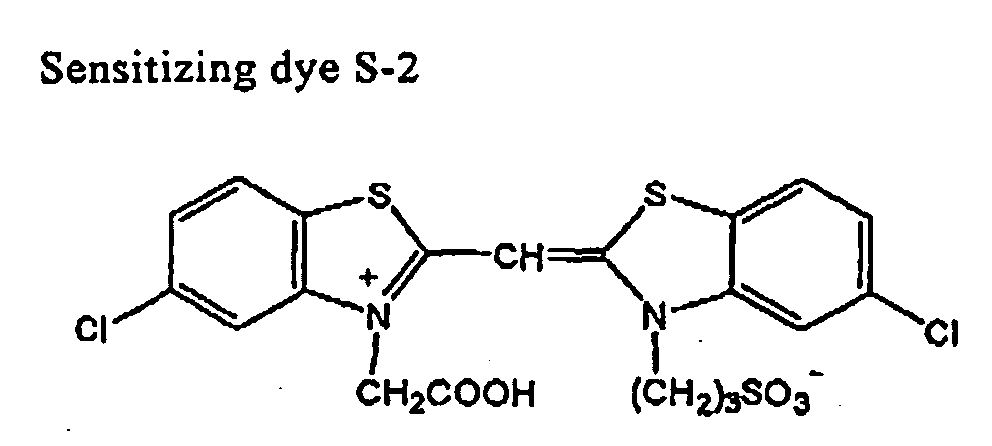


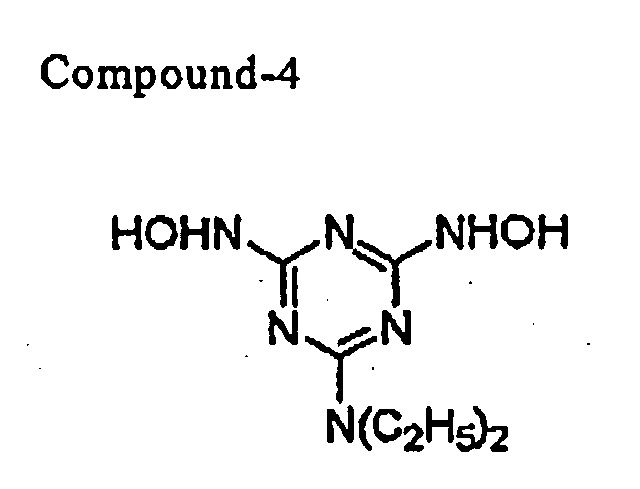


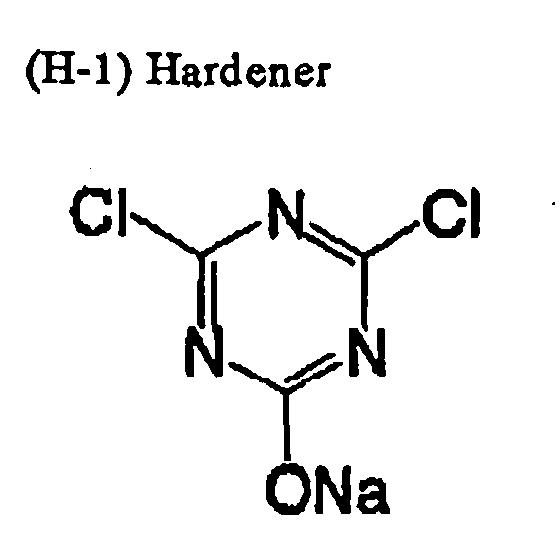


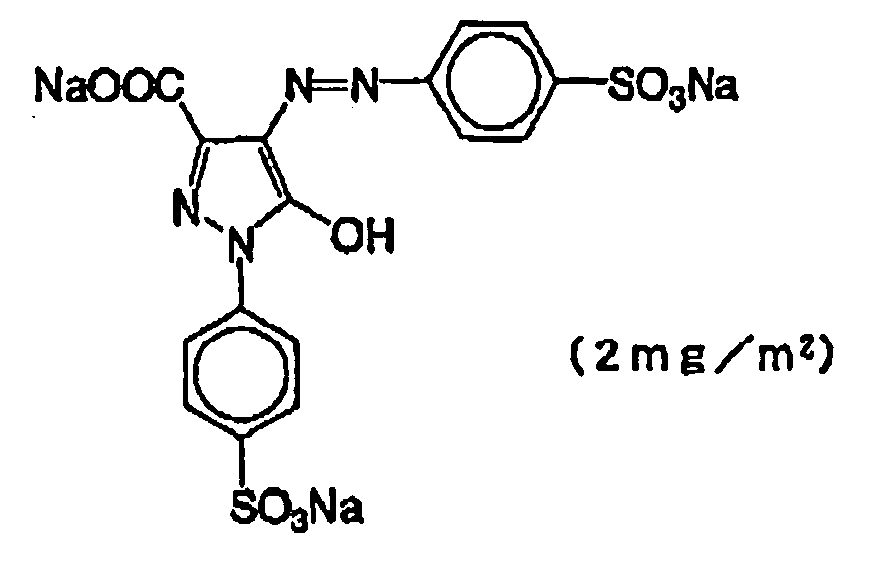


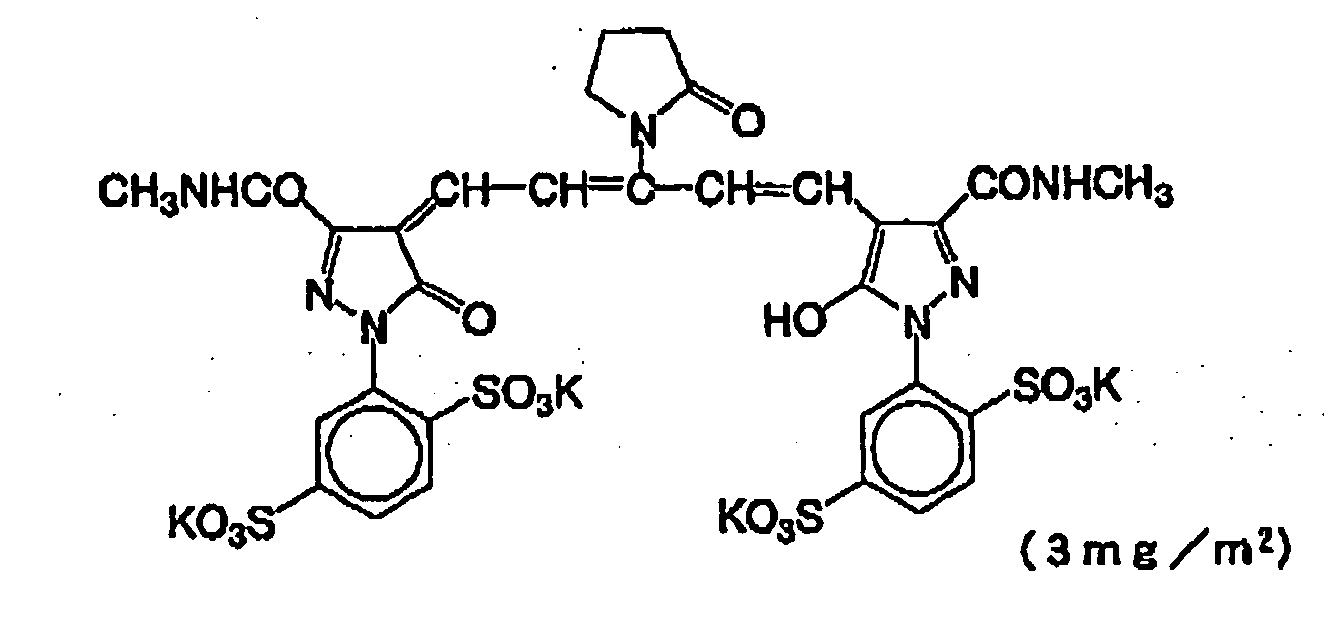
| First layer (blue light-sensitive emulsion layer) | |
| Emulsion (5:5 (in molar ratio of silver) mixture of BH-1 and BL-1) | 0.16 |
| Gelatin | 1.32 |
| Yellow coupler (EX-Y) | 0.34 |
| Color image stabilizing agent (Cpd-1) | 0.01 |
| Color image stabilizing agent (Cpd-2) | 0.01 |
| Color image stabilizing agent (Cpd-8) | 0.08 |
| Color image stabilizing agent (Cpd-18) | 0.01 |
| Color image stabilizing agent (Cpd-19) | 0.02 |
| Color image stabilizing agent (Cpd-20) | 0.15 |
| Color image stabilizing agent (Cpd-21) | 0.01 |
| Color image stabilizing agent (Cpd-23) | 0.15 |
| Additive (ExC-1) | 0.001 |
| Color image stabilizing agent (UV-A) | 0.01 |
| Solvent (Solv-4) | 0.23 |
| Solvent (Solv-6) | 0.04 |
| Solvent (Solv-9) | 0.23 |
| Second layer (color mixing-preventing layer) | |
| Gelatin | 0.78 |
| Color mixing-preventing agent (Cpd-4) | 0.05 |
| Color mixing-preventing agent (Cpd-12) | 0.01 |
| Color image stabilizing agent (Cpd-5) | 0.006 |
| Color image stabilizing agent (Cpd-6) | 0.05 |
| Color image stabilizing agent (UV-A) | 0.06 |
| Color image stabilizing agent (Cpd-7) | 0.006 |
| Antiseptic (Cpd-24) | 0.006 |
| Solvent (Solv-1) | 0.06 |
| Solvent (Solv-2) | 0.06 |
| Solvent (Solv-5) | 0.07 |
| Solvent (Solv-8) | 0.07 |
| Third layer (green light-sensitive emulsion layer) | |
| Emulsion (1:3 (in molar ratio of silver) mixture of GH-1 and GL-1) | 0.12 |
| Gelatin | 0.95 |
| Magenta coupler (EX-M) | 0.12 |
| UV ray-absorbing agent (UV-A) | 0.03 |
| Color image stabilizing agent (Cpd-2) | 0.01 |
| Color image stabilizing agent (Cpd-6) | 0.008 |
| Color image stabilizing agent (Cpd-7) | 0.005 |
| Color image stabilizing agent (Cpd-8) | 0.01 |
| Color image stabilizing agent (Cpd-9) | 0.01 |
| Color image stabilizing agent (Cpd-10) | 0.005 |
| Color image stabilizing agent (Cpd-11) | 0.0001 |
| Color image stabilizing agent (Cpd-20) | 0.01 |
| Solvent (Solv-3) | 0.06 |
| Solvent (Solv-4) | 0.12 |
| Solvent (Solv-6) | 0.05 |
| Solvent (Solv-9) | 0.16 |
| Fourth layer (color mixing-preventing layer) | |
| Gelatin | 0.65 |
| Color mixing-preventing agent (Cpd-4) | 0.04 |
| Color mixing-preventing agent (Cpd-12) | 0.01 |
| Color image stabilizing agent (Cpd-5) | 0.005 |
| Color image stabilizing agent (Cpd-6) | 0.04 |
| Color image stabilizing agent (UV-A) | 0.05 |
| Color image stabilizing agent (Cpd-7) | 0.005 |
| Antiseptic (Cpd-24) | 0.005 |
| Solvent (Solv-1) | 0.05 |
| Solvent (Solv-2) | 0.05 |
| Solvent (Solv-5) | 0.06 |
| Solvent (Solv-8) | 0.06 |
| Fifth layer (red light-sensitive emulsion layer) | |
| Emulsion (4:6 (in molar ratio of silver) mixture of RH-1 and RL-1) | 0.10 |
| Gelatin | 1.11 |
| Cyan coupler (ExC-1) | 0.11 |
| Cyan coupler (ExC-2) | 0.01 |
| Cyan coupler (ExC-3) | 0.04 |
| Color image stabilizing agent (Cpd-1) | 0.03 |
| Color image stabilizing agent (Cpd-7) | 0.01 |
| Color image stabilizing agent (Cpd-9) | 0.04 |
| Color image stabilizing agent (Cpd-10) | 0.001 |
| Color image stabilizing agent (Cpd-14) | 0.001 |
| Color image stabilizing agent (Cpd-15) | 0.18 |
| Color image stabilizing agent (Cpd-16) | 0.002 |
| Color image stabilizing agent (Cpd-17) | 0.001 |
| Color image stabilizing agent (Cpd-18) | 0.05 |
| Color image stabilizing agent (Cpd-19) | 0.04 |
| Color image stabilizing agent (UV-5) | 0.10 |
| Solvent (Solv-5) | 0.19 |
| Sixth layer (UV ray-absorbing layer) | |
| Gelatin | 0.34 |
| UV ray-absorbing agent (UV-B) | 0.24 |
| Compound (S1-4) | 0.0015 |
| Solvent (Solv-7) | 0.11 |
| Seventh layer (protective layer) | |
| Gelatin | 0.82 |
| Additive (Cpd-22) | 0.03 |
| Liquid paraffin | 0.02 |
| Surfactant (Cpd-13) | 0.02 |


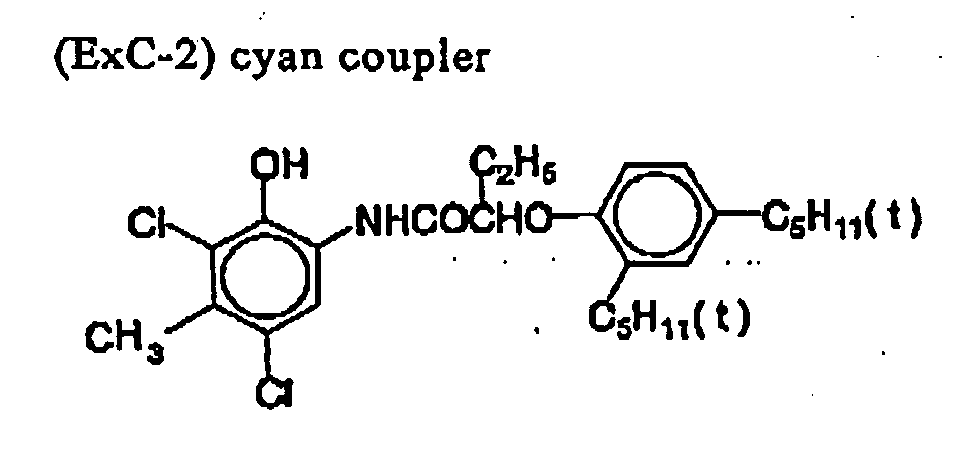

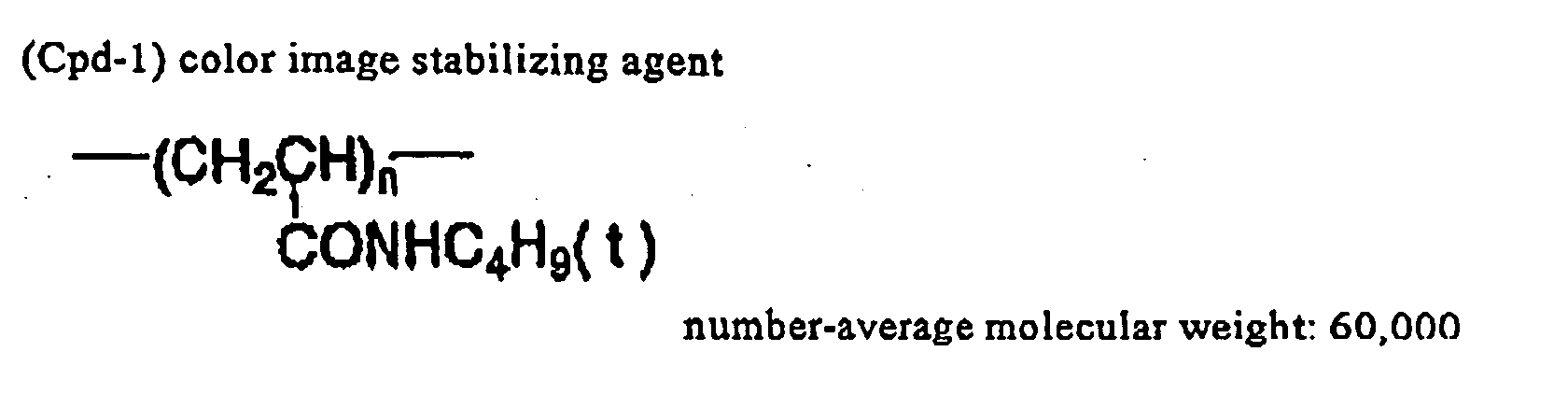


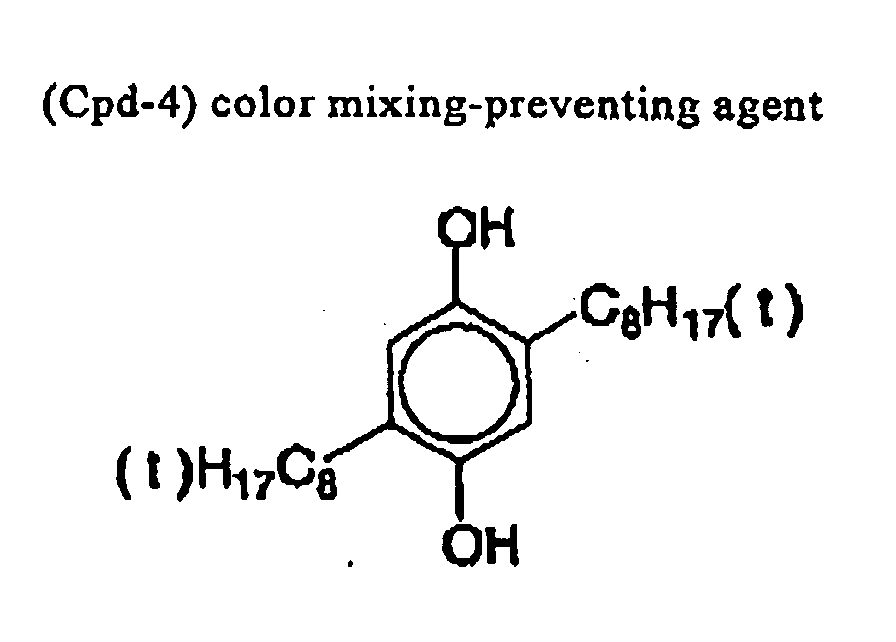


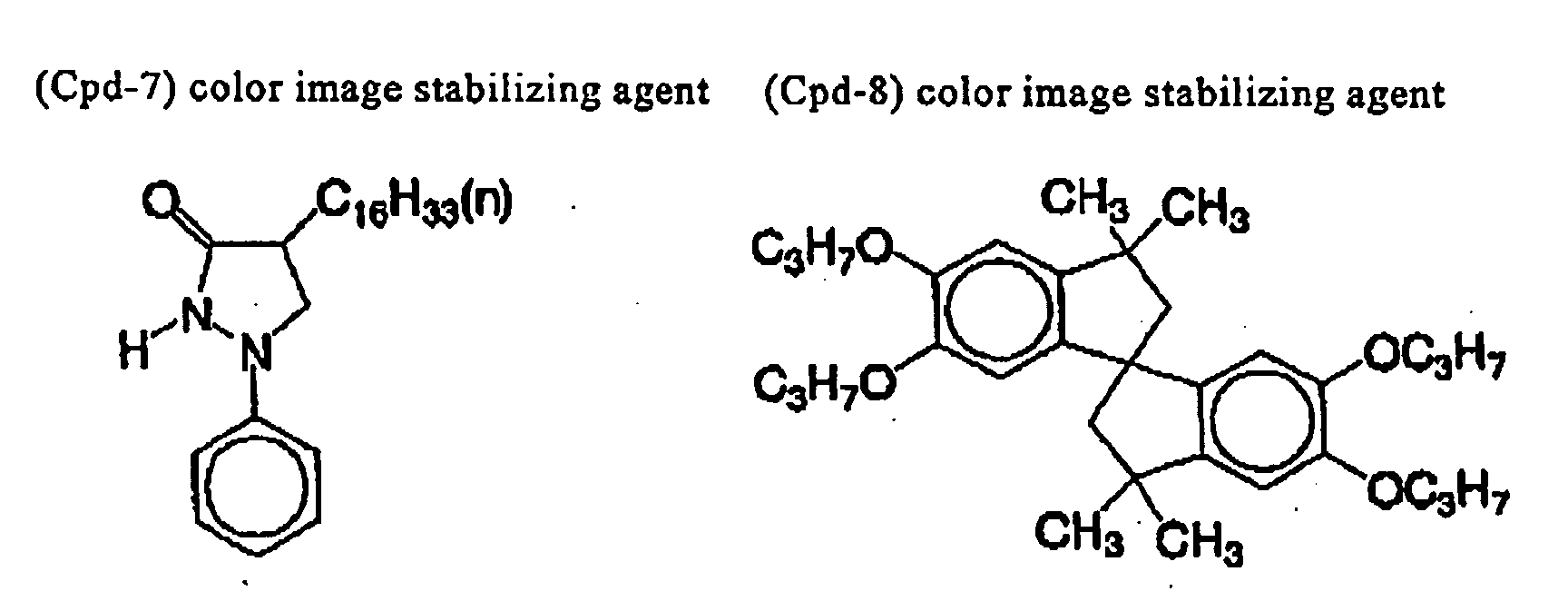


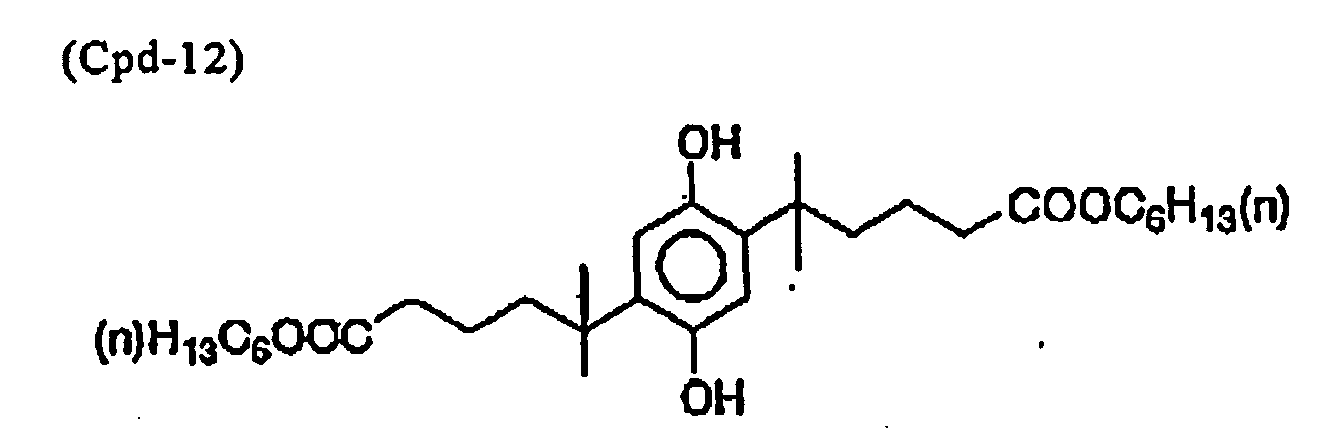
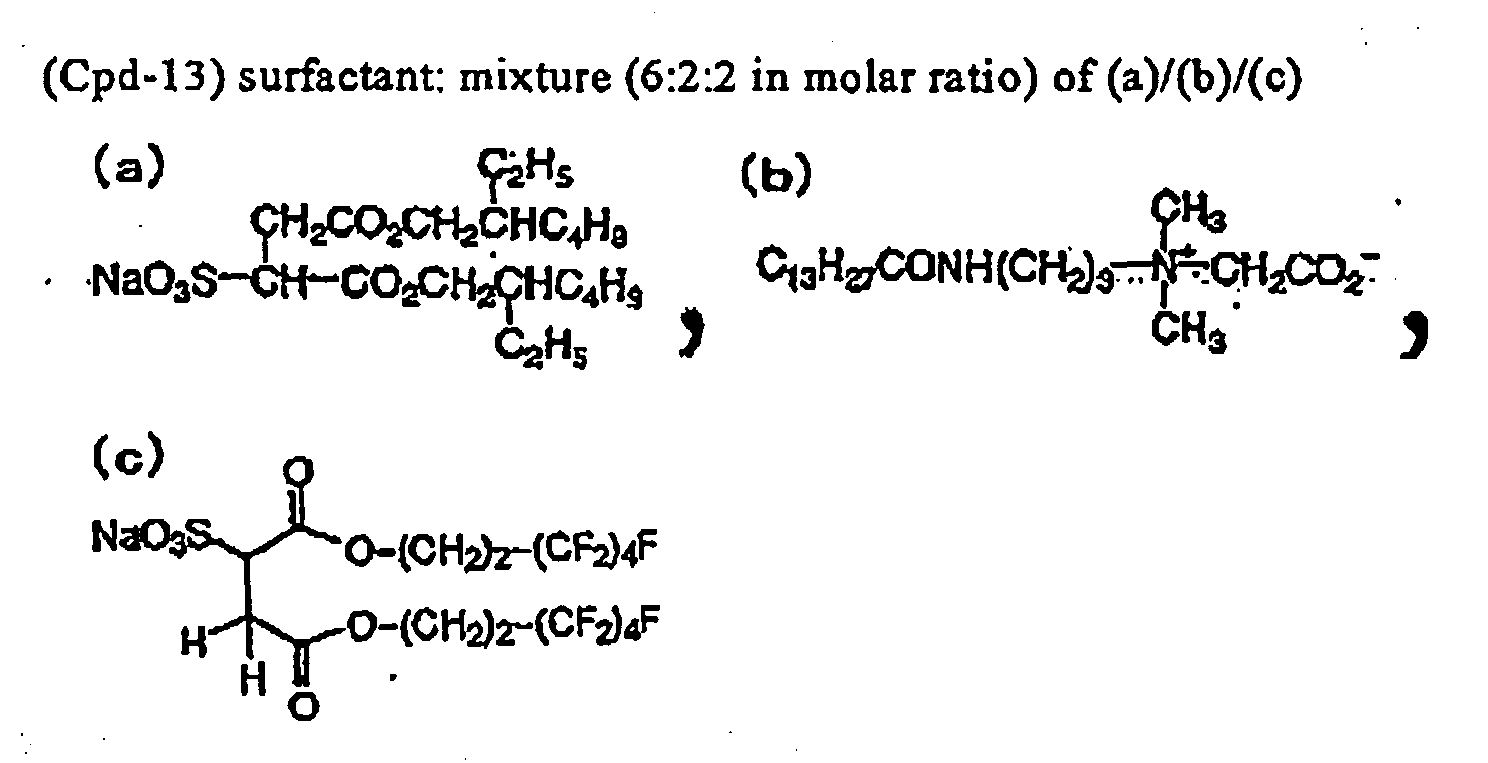
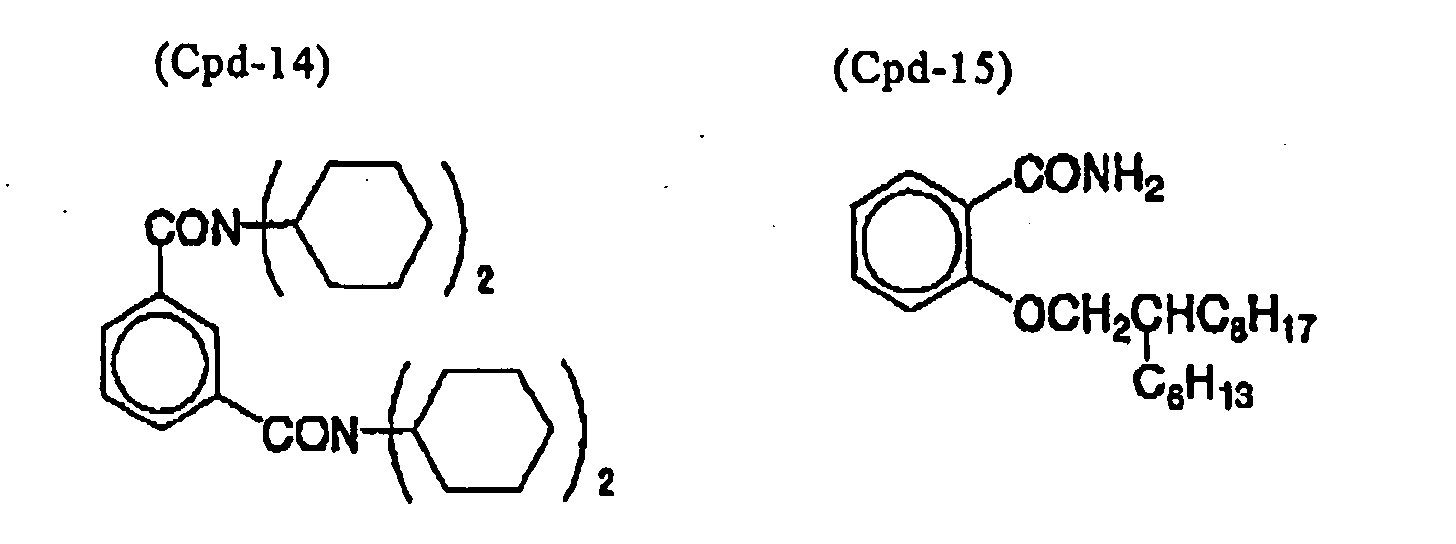
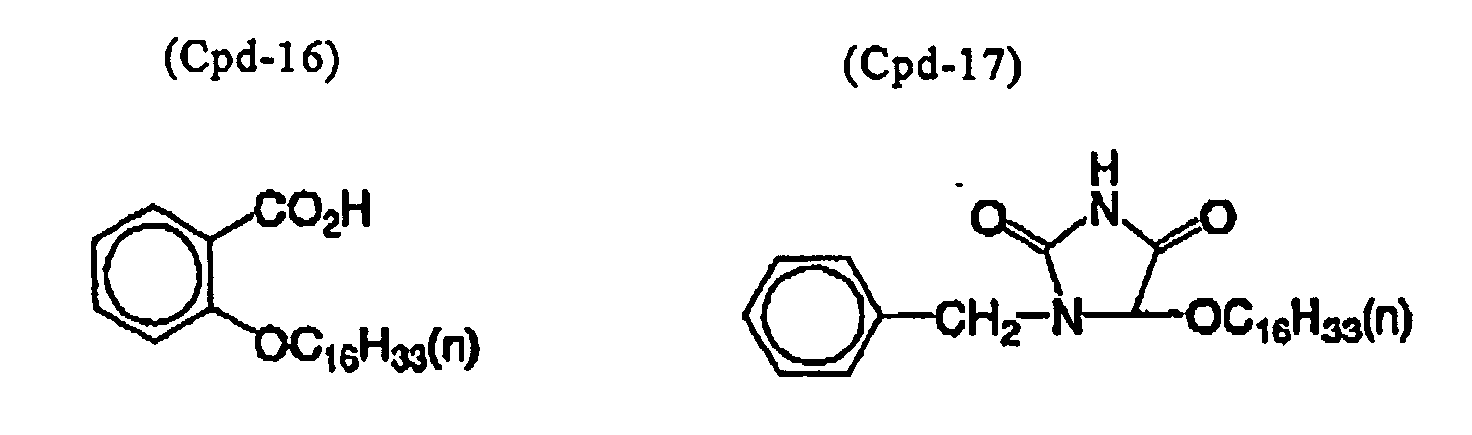

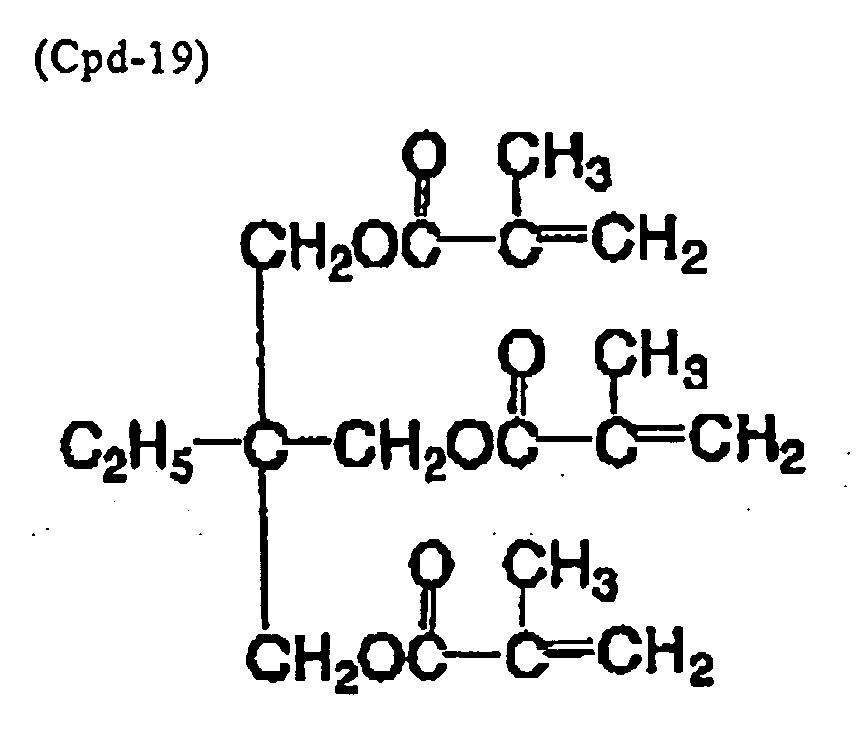

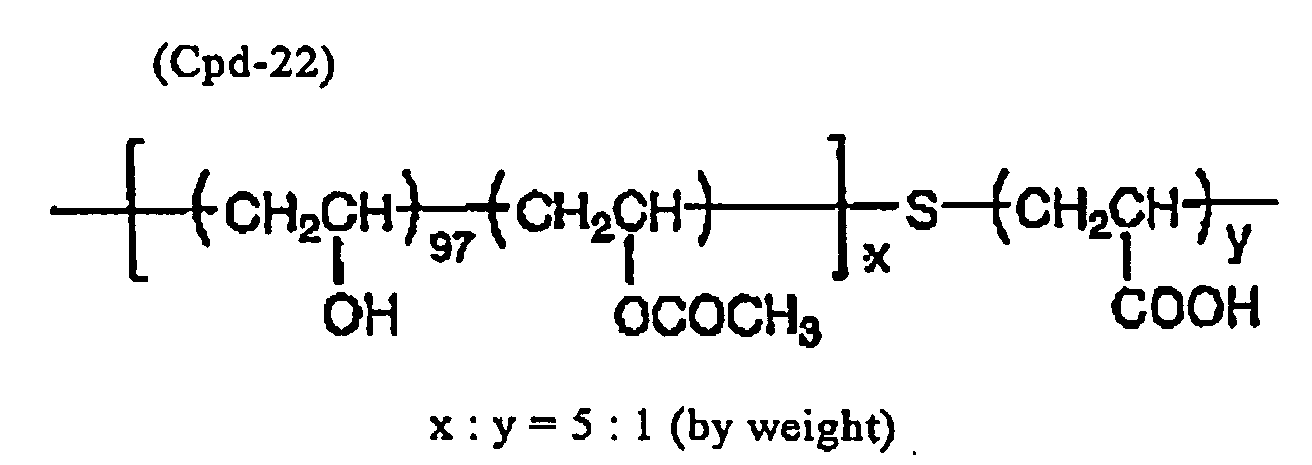
KAYARAD DPCA-30 manufactured by Nihon Kayakiu K.K.


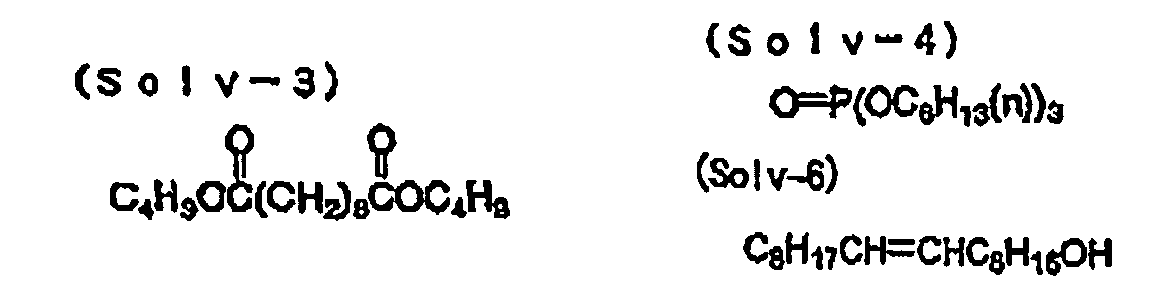

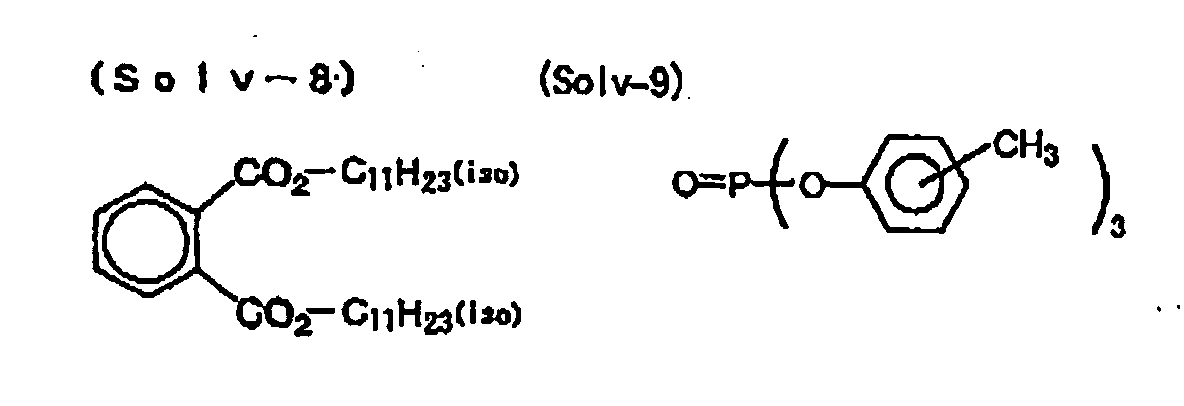


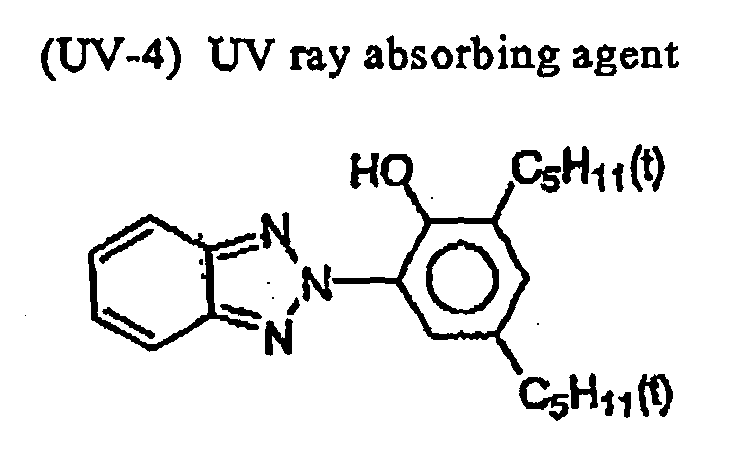

UV-B: a mixture of UV-1/UV-3/UV-4/UV-5=1/3/5/1 (by weight)
| Processing step | Temperature | Time | Replenishing Amount |
| Color development | 45.0° | 12 | 30 mL |
| Bleaching | 45.0° | 6 | 10 mL |
| Fixing | 40.0° | 3 | 10 |
| Rinsing | |||
| 1 | 45.0° | 3 sec | - |
| | 45.0° | 3 sec | - |
| | 45.0°C | 1.5 sec | - |
| | 45.0°C | 1.5 sec | - |
| | 45.0°C | 1.5 sec | - |
| | 45.0°C | 1.5 sec | 80 mL |
| Drying | 80°C | ||
| Notes *replenishing amount per m2 of light-sensitive material **Rinsing was conducted in a 4-tank countercurrent manner of from (1) to (6). |
| [Color developer] | [Tank soln.] | [Replenisher] |
| Water | 800 mL | 800 mL |
| Fluorescent brightening agent (FL-1) | 4.0 g | 9.0 g |
| Residual color-reducing agent (SR-1) | 3.0 g | 8.0 g |
| Sodium p-toluenesulfonate | 10.0 g | 10.0 g |
| Ethylenediaminetetraacetic acid | 4.0 g | 4.0 g |
| Sodium sulfite | 0.10 g | 0.10 g |
| Potassium chloride | 10.0 g | - |
| | 0.50 g | 0.50 g |
| Disodium-N,N-bis(sulfonatoethyl)Hydroxylamine | 8.5 g | 14.0 g |
| 4-Amino-3-methyl-N-ethyl-N(β-methanesulfonamidoethyl) | 7.0 g | 17.5 g |
| Potassium carbonate | 26.3 g | 26.3 g |
| Water to make the total | 1000 mL | 1000 mL |
| pH (25°C, adjusted with | ||
| sulfuric acid and KOH) | 10.25 | 13.0 |
| [Bleaching solution] | [Tank soln.] | [Replenisher] |
| Water | 800 mL | 600 mL |
| Citric acid | 19.2 g | 67.2 g |
| Sulfosuccinic acid | 19.4 g | 67.9 g |
| Iron(III) ammonium ethylene-Diaminetetraacetate | 47.0 g | 164.5 g |
| Ethylenediaminetetraacetic acid | 1.4 g | 4.9 g |
| Nitric acid (67%) | 17.5 g | 61.3 g |
| m-Carboxysulfinic acid | 9.3 g | 32.6 g |
| Ammonium bromide | 50.0 g | 150.0 g |
| Water to make the total | 1000 mL | 1000 mL |
| pH (25°C, adjusted with nitric acid and aqueous ammonia) | 5.00 | 2.00 |
| [Fixing solution] | [Tank soln.] | [Replenisher] |
| Water | 800 mL | 600 mL |
| Ammonium thiosulfate (70%) | 0.3 mol | 1.05 mol |
| Ethylenediaminetetraacetic acid | 1.4 g | 4.9 g |
| Ammonium sulfite | 40.0 g | 140.0 g |
| Water to make the total | 1000 mL | 1000 mL |
| pH (25°C, adjusted with nitric acid and aqueous ammonia) | 6.00 | 6.50 |
| [Rinsing solution] | [Tank soln.] | [Replenisher] |
| Chlorinated sodium isocyanurate | 0.02 g | 0.02 g |
| Deionized water (conductivity: 5 µs/cm or less) | 1000 mL | 1000 mL |
| pH (25°C) | 6.5 | 6.5 |

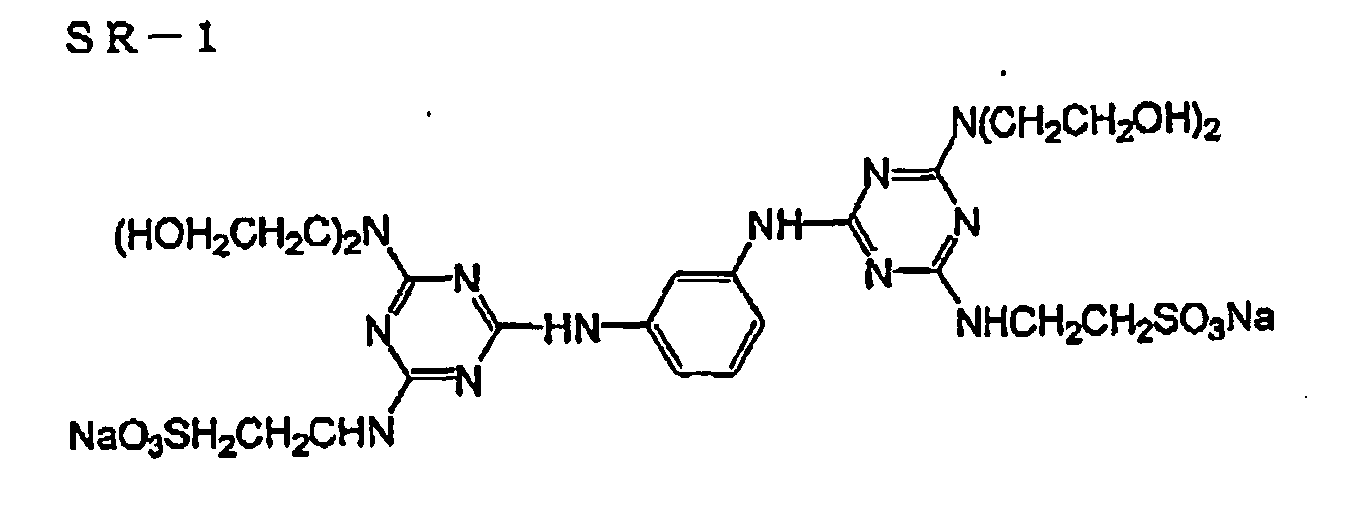
| Processing Step | Temp. | Time | Replenishing Amount | |
| Color develop-ment | 45.0° | 12 | 30 mL | |
| Bleach-fixing | 45.0°C | 8 | Bleaching part | 10 |
| Fixing part | ||||
| 10 | ||||
| Rinsing | ||||
| 1 | 45.0° | 3 sec | - | |
| | 45.0° | 3 sec | - | |
| | 45.0° | 3 sec | - | |
| | 45.0° | 3 sec | 175 mL | |
| Drying | 80°C | |||
| Note *replenishing amount per m2 of light-sensitive material **Rinsing was conducted in a 4-tank countercurrent manner of from (1) to (4). |
| [Color developer] | [Tank soln.] | [Replenisher] |
| same as above | same as above | |
| [Bleach-fixing solution in tank] | ||
| Water | 600 mL | |
| Citric acid | 19.2 g | |
| Sulfosuccinic acid | 19.4 g | |
| Iron(III) ammonium ethylene- diaminetetraacetate | 47.0 g | |
| Ethylenediaminetetraacetic acid | 2.8 g | |
| Nitric acid (67%) | 17.5 g | |
| m-Carboxysulfinic acid | 9.3 g | |
| Ammonium bromide | 50.0 g | |
| Thioammonium sulfate (70%) | 0.3 mol | |
| Ammonium sulfite | 40.0 g | |
| Water to make the total | 1000 mL | |
| pH (25°C, adjusted with nitric acid and aqueous ammonia) | 6.00 | |
| [Bleach-fixing replenisher] | [Bleaching part] | |
| same as the above-described bleaching replenisher | ||
| [Fixing part] | ||
| same as the above-described fixing replenisher | ||
| (The bleaching part and the fixing part are separately directly introduced into the bleach-fixing tank and mixed within the tank.) | ||
| [Rinsing solution] | [Tank soln.] | [Replenisher] |
| same as above | same as above |
| Processor | Bleach-fixing Step | Bleach-fixing Step | Bleaching Step + Fixing Step |
| Note | Comparative Example 1 | Comparative Example 2 | Example 1 (Present Invention) |
| Amount of residual silver (µg/cm2) | 4.3 | 5.0 | 0.3 |
| Concentration of ammonium sulfite (g/l) in rinsing | 0.1 | 0.1 | 4.2 |
| Minimum yellow density | 0.087 | 0.090 | 0.055 |
Claims (10)
- A development processing apparatus for a silver halide color paper, comprising:wherein the passage is sealed while the passage allows to pass the light-sensitive material, and the light-sensitive material is conveyed in a solution without contacting air through the passage between the second processing tank and the third processing tank.a first processing tank for processing a light-sensitive material with a color developer;a second processing tank for successively processing the light-sensitive material with a bleaching solution;a third processing tank for successively processing the light-sensitive material with a solution having a fixing ability; anda passage between the second processing tank and the third processing tank,
- The development processing apparatus according to claim 1,
wherein the second processing tank and the third processing tank are provided in a vertical positional relationship with each other. - The development processing apparatus according to claim 1,
wherein a sum of a processing time for processing with the bleaching solution and a processing time for processing with the solution having the fixing ability is 12 seconds or shorter. - The development processing apparatus according to claim 3,
wherein the sum is 10 seconds or shorter. - The development processing apparatus according to claim 1, further comprising:wherein the passage is sealed while the passage allows to pass the light-sensitive material, and the light-sensitive material is conveyed in a solution without contacting air through the passage.a fourth processing tank for processing the light-sensitive material with a rinse solution; anda passage between each adjacent two of the first processing tank, the second processing tank, the third processing tank and the fourth processing tank,
- A method for processing a silver halide color paper using a development processing apparatus for a silver halide color paper according to claim 1.
- A method for processing a silver halide color paper comprising:wherein the light-sensitive material is conveyed in a solution without contacting air between the processing with the bleaching solution and the processing with the solution having the fixing ability, andsubjecting a light-sensitive material to processing with a color developer;subjecting the light-sensitive material to processing with a bleaching solution; andsubjecting the light-sensitive material to processing with a solution having a fixing ability,
wherein a sum of a processing time of the processing with the bleaching solution and a processing time of the processing with the solution having the fixing ability is 12 seconds or shorter. - The method according to claim 7,
wherein the sum is 10 seconds or shorter. - The method according to claim 7,
wherein a sum of an amount of a bleaching replenisher to be replenished into a bleaching tank and an amount of a replenisher having a fixing ability to be replenished into a processing tank for the solution having the fixing ability is 35 mL or less per m2 of a color paper. - The method according to claim 7,
wherein the sum of the amount of the bleaching replenisher and the amount of the replenisher having the fixing ability is 25 mL or less per m2 of a color paper.
Applications Claiming Priority (4)
| Application Number | Priority Date | Filing Date | Title |
|---|---|---|---|
| JP2004169815 | 2004-06-08 | ||
| JP2004169814 | 2004-06-08 | ||
| JP2004169815 | 2004-06-08 | ||
| JP2004169814 | 2004-06-08 |
Publications (1)
| Publication Number | Publication Date |
|---|---|
| EP1605305A1 true EP1605305A1 (en) | 2005-12-14 |
Family
ID=34937315
Family Applications (1)
| Application Number | Title | Priority Date | Filing Date |
|---|---|---|---|
| EP05012329A Withdrawn EP1605305A1 (en) | 2004-06-08 | 2005-06-08 | Development processing apparatus for silver halide color paper and method for processing silver halide color paper |
Country Status (2)
| Country | Link |
|---|---|
| US (1) | US20050271383A1 (en) |
| EP (1) | EP1605305A1 (en) |
Citations (5)
| Publication number | Priority date | Publication date | Assignee | Title |
|---|---|---|---|---|
| US3379113A (en) * | 1965-06-23 | 1968-04-23 | Fuji Photo Film Co Ltd | Method and apparatus for processing light-sensitive elements |
| FR2424569A1 (en) * | 1978-04-24 | 1979-11-23 | Kodak Pathe | Photographic developing process - has processing liquids in adjacent compartments of box separated by immiscible inert liq. |
| JPH03121453A (en) * | 1989-10-04 | 1991-05-23 | Fuji Photo Film Co Ltd | Method for processing silver halide photographic sensitive material |
| US5108878A (en) * | 1990-02-07 | 1992-04-28 | Fuji Photo Film Co., Ltd. | Method for processing silver halide photosensitive material |
| US5888707A (en) * | 1996-11-25 | 1999-03-30 | Agfa-Gevaert | Method of processing photographic material |
-
2005
- 2005-06-08 EP EP05012329A patent/EP1605305A1/en not_active Withdrawn
- 2005-06-08 US US11/147,244 patent/US20050271383A1/en not_active Abandoned
Patent Citations (5)
| Publication number | Priority date | Publication date | Assignee | Title |
|---|---|---|---|---|
| US3379113A (en) * | 1965-06-23 | 1968-04-23 | Fuji Photo Film Co Ltd | Method and apparatus for processing light-sensitive elements |
| FR2424569A1 (en) * | 1978-04-24 | 1979-11-23 | Kodak Pathe | Photographic developing process - has processing liquids in adjacent compartments of box separated by immiscible inert liq. |
| JPH03121453A (en) * | 1989-10-04 | 1991-05-23 | Fuji Photo Film Co Ltd | Method for processing silver halide photographic sensitive material |
| US5108878A (en) * | 1990-02-07 | 1992-04-28 | Fuji Photo Film Co., Ltd. | Method for processing silver halide photosensitive material |
| US5888707A (en) * | 1996-11-25 | 1999-03-30 | Agfa-Gevaert | Method of processing photographic material |
Non-Patent Citations (1)
| Title |
|---|
| PATENT ABSTRACTS OF JAPAN vol. 015, no. 331 (P - 1241) 22 August 1991 (1991-08-22) * |
Also Published As
| Publication number | Publication date |
|---|---|
| US20050271383A1 (en) | 2005-12-08 |
Similar Documents
| Publication | Publication Date | Title |
|---|---|---|
| EP0366954A2 (en) | Method for processing a silver halide color photosensitive material | |
| EP1605305A1 (en) | Development processing apparatus for silver halide color paper and method for processing silver halide color paper | |
| US6479229B2 (en) | Silver halide color photographic material and development processing method of the same | |
| US7351522B2 (en) | Concentrated processing composition for silver halide color paper and method of processing | |
| US6569610B2 (en) | Method for processing silver halide color photosensitive material | |
| US7118850B2 (en) | Color developer replenisher and concentrated composition for color photographic material | |
| EP0293011B1 (en) | Method of processing silver halide color photographic photosensitive material | |
| EP1383002B1 (en) | Concentrated composition of blix solution for silver halide color photographic photosensitive materials | |
| US5039599A (en) | Method for processing silver halide color photographic materials where the bleach-fixing bath has a specific open area value | |
| JP2005316251A (en) | Concentrated bleaching composition for silver halide color photographic sensitive material and processing method | |
| JP2006023722A (en) | Method for processing silver halide color paper | |
| JP2006023723A (en) | Development processing apparatus for silver halide color paper | |
| JP2652677B2 (en) | Processing method of silver halide color photographic light-sensitive material | |
| JP2006220821A (en) | Development processing equipment for silver halide color paper | |
| US6653059B2 (en) | Liquid processing composition for color development of silver halide color photographic material and development processing method | |
| EP1742106A1 (en) | Bleach concentrate composition for silver halide color- photographic materials, one-part type concentrate composition for replenishment color developers, and method of processing | |
| JP2005316252A (en) | One-part concentrated composition for color development replenisher for color photographic sensitive material and processing method | |
| US5738978A (en) | Method for processing silver halide color photographic material and processing composition therefor | |
| JP3901527B2 (en) | Dense processing composition for photographic color development and method for preparing color developer | |
| JP2006189531A (en) | Bleaching solution composition for silver halide color paper, and processing method using the same | |
| JP2006251372A (en) | Processing composition for replenisher of silver halide color paper and processing method using the same | |
| JP2007101680A (en) | Additive agent for water washing alternative stabilizer | |
| JP2004012840A (en) | Method for forming image | |
| JPH06208213A (en) | Treatment of silver halide color photosensitive material | |
| JP2005099262A (en) | Photosensitive material development processing equipment |
Legal Events
| Date | Code | Title | Description |
|---|---|---|---|
| PUAI | Public reference made under article 153(3) epc to a published international application that has entered the european phase |
Free format text: ORIGINAL CODE: 0009012 |
|
| AK | Designated contracting states |
Kind code of ref document: A1 Designated state(s): AT BE BG CH CY CZ DE DK EE ES FI FR GB GR HU IE IS IT LI LT LU MC NL PL PT RO SE SI SK TR |
|
| AX | Request for extension of the european patent |
Extension state: AL BA HR LV MK YU |
|
| 17P | Request for examination filed |
Effective date: 20060308 |
|
| AKX | Designation fees paid |
Designated state(s): AT BE BG CH CY CZ DE DK EE ES FI FR GB GR HU IE IS IT LI LT LU MC NL PL PT RO SE SI SK TR |
|
| RAP1 | Party data changed (applicant data changed or rights of an application transferred) |
Owner name: FUJIFILM CORPORATION |
|
| 17Q | First examination report despatched |
Effective date: 20120116 |
|
| STAA | Information on the status of an ep patent application or granted ep patent |
Free format text: STATUS: THE APPLICATION IS DEEMED TO BE WITHDRAWN |
|
| 18D | Application deemed to be withdrawn |
Effective date: 20120530 |