EP1605080A2 - Polymer Yarn for Industrial Fabric Application and Industrial Fabric - Google Patents
Polymer Yarn for Industrial Fabric Application and Industrial Fabric Download PDFInfo
- Publication number
- EP1605080A2 EP1605080A2 EP05102899A EP05102899A EP1605080A2 EP 1605080 A2 EP1605080 A2 EP 1605080A2 EP 05102899 A EP05102899 A EP 05102899A EP 05102899 A EP05102899 A EP 05102899A EP 1605080 A2 EP1605080 A2 EP 1605080A2
- Authority
- EP
- European Patent Office
- Prior art keywords
- yarn
- fabric
- yarns
- weft
- phase
- Prior art date
- Legal status (The legal status is an assumption and is not a legal conclusion. Google has not performed a legal analysis and makes no representation as to the accuracy of the status listed.)
- Granted
Links
Images


Classifications
-
- D—TEXTILES; PAPER
- D02—YARNS; MECHANICAL FINISHING OF YARNS OR ROPES; WARPING OR BEAMING
- D02G—CRIMPING OR CURLING FIBRES, FILAMENTS, THREADS, OR YARNS; YARNS OR THREADS
- D02G3/00—Yarns or threads, e.g. fancy yarns; Processes or apparatus for the production thereof, not otherwise provided for
- D02G3/22—Yarns or threads characterised by constructional features, e.g. blending, filament/fibre
- D02G3/40—Yarns in which fibres are united by adhesives; Impregnated yarns or threads
- D02G3/402—Yarns in which fibres are united by adhesives; Impregnated yarns or threads the adhesive being one component of the yarn, i.e. thermoplastic yarn
-
- D—TEXTILES; PAPER
- D02—YARNS; MECHANICAL FINISHING OF YARNS OR ROPES; WARPING OR BEAMING
- D02G—CRIMPING OR CURLING FIBRES, FILAMENTS, THREADS, OR YARNS; YARNS OR THREADS
- D02G3/00—Yarns or threads, e.g. fancy yarns; Processes or apparatus for the production thereof, not otherwise provided for
- D02G3/44—Yarns or threads characterised by the purpose for which they are designed
- D02G3/447—Yarns or threads for specific use in general industrial applications, e.g. as filters or reinforcement
-
- Y—GENERAL TAGGING OF NEW TECHNOLOGICAL DEVELOPMENTS; GENERAL TAGGING OF CROSS-SECTIONAL TECHNOLOGIES SPANNING OVER SEVERAL SECTIONS OF THE IPC; TECHNICAL SUBJECTS COVERED BY FORMER USPC CROSS-REFERENCE ART COLLECTIONS [XRACs] AND DIGESTS
- Y10—TECHNICAL SUBJECTS COVERED BY FORMER USPC
- Y10T—TECHNICAL SUBJECTS COVERED BY FORMER US CLASSIFICATION
- Y10T428/00—Stock material or miscellaneous articles
- Y10T428/29—Coated or structually defined flake, particle, cell, strand, strand portion, rod, filament, macroscopic fiber or mass thereof
- Y10T428/2913—Rod, strand, filament or fiber
Definitions
- the present invention relates to yarns made of polymeric material for use in industrial fabrics.
- Industrial fabrics are typically but not exclusively made of a woven structure using polymer yarns in the weft and warp direction.
- To improve the smoothness and the printability of a paper sheet produced on a papermaking fabric it is desirable to increase the smoothness and the contact area of the paper contacting surface of the papermaking fabric.
- Especially for high speed applications it is further desirable to increase the smoothness of the wear side of the papermaking fabric in order to improve the aerodynamic performance of the fabric.
- the smoothness of the paper contacting surface can be improved by increasing the yarn density resulting in increased manufacturing costs and reduced permeability of the fabric.
- the smoothness can be improved by using profiled monofilament yarns having flat surface.
- the flat shaped yarns e.g. as warp yarns in float weave designs
- the flat warp yarns provide greater surface contact area. It has been found that for many application the gain in contact area by using such flat yarns is not sufficient.
- graphic and fine paper grades it would be desirable to bring the weft yarns as well as the warp yarns into the paper contacting surface of the papermaking fabric to increase the contact area and the smoothness of the fabric to a sufficient level.
- a yarn for an industrial fabric Such an industrial fabric will be subjected to a maximum heat set temperature during production.
- the yarn according to the invention is made from polymeric material.
- the polymeric material includes a first phase having a melting temperature and a second phase having a melting temperature.
- the melting temperature of the second phase is equal or less the maximum heat set temperature and the melting temperature of the first phase is higher than the maximum heat set temperature.
- the idea of the invention is to provide a yarn having the ability for controllable deformation when subjected to mechanical tension and thermal heat, as is the case during heat set treatment for industrial fabrics.
- the yarn according to the invention is therefore made from a polymeric material including two different phases which have two different melting points wherein the melting temperature of the second phase is equal or less than the maximum heat set temperature and wherein the melting temperature of the first phase is higher than the maximum heat set temperature.
- the second phase takes over the part that the yarn softens during heat set treatment and the first phase take over the part that the yarn does not melt. Therefore by combining a first and second polymeric phase according to the invention a yarn is provided which softens during the heat set treatment and becomes very deformable without melting.
- the yarns according to the invention are e.g. weft yarns of a woven industrial fabric and if the warp yarns of the fabric are made from standard yarn material, during heat set treatment the harder warp yarns can compress the softer and deformable weft yarns resulting in a crimp interchange between the warps and the wefts leading to a reduction of the warp knuckles giving a fabric with enhanced surface smoothness.
- Typical maximum heat set temperatures are in the range of 90°C to 260°C.
- the industrial fabric will be operated on e.g. a papermaking machine at a maximum operation temperature. Therefore according to a preferred embodiment of the invention the melting temperature of the second phase is higher than the maximum operating temperature.
- the polymeric material is a polymer blend wherein the first phase includes a first polymer component and wherein the second phase includes a second polymer component and wherein the first and the second polymer component are at least substantially immiscible.
- immiscible polymer compounds most of the properties, e.g. the melting temperature of each polymer compound, will be maintained substantially.
- first and the second phase are of the same material and differ in their state of aggregation.
- the maximum operation temperature for an industrial fabric is less than 90°C or less 120°C.
- maximum heat set temperatures are in the ranges as follows: Forming fabrics: 170°C to 190°C, typically 180°C to 185°C Press fabrics: 160°C to 185°C, typically 160°C to 165°C Dryer fabrics: 180°C to 220°C, typically 190°C Therefore the melting temperature of the second phase / second polymer component is in the range of 120°C to 220°C, preferably in the range of 160°C to 220°C.
- a fabric will be subjected to a heat set treatment with a maximum temperature of 190°C and will be operated at a maximum operation temperature of 120°C. Therefore the melting temperature of the second phase of a yarn according to the invention must be lower than 190°C and higher than 120°C. The melting temperature of the first phase of this yarn is more than 190°C.
- the melting temperature of the second phase / second polymer component is at least 30°C lower than the melting temperature of the first phase / first polymer component.
- the melting temperature of the second phase / second polymer component is at least 80°C lower than the melting temperature of the first phase / first polymer component.
- the melting temperature of the second phase / second polymer component is typically between 100°C and 110°C lower than the melting temperature of the first phase / first polymer component.
- first component includes any of the following either alone or blended: homepolymers and copolymers of the polyesters, homepolymers and copolymers of polyamides, PPS.
- the first component includes PET.
- the second component includes any of the following either alone or blended: polyolefins, polyamides, fluoropolymers.
- the second component includes Polyolefins.
- yarns according to the invention showing the best deformability at the heat set temperature for which they are designed is a blend including between 51% and 99% by weight, preferably between 60% and 95% by weight, of the first component and between 49% and 1% by weight, preferably between 5% and 40% by weight, of the second component.
- the polymer blend may be necessary to incorporate at least one suitable compatibilizer.
- a suitable compatibilizer e.g. mechanical properties, e.g. toughness of the yarn produced can be reduced.
- the so called "die swell" during extrusion can increase which effects the controllability of the extruded yarn diameter. Therefore according to a further preferred embodiment the polymer blend includes at least one suitable compatibilizer.
- the at least one compatibilizer is included in an amount of 0,01% to 10% by weight, preferably in an amount of 0,1 to 5% by weight.
- compatibilizer suitable for the polymer blend according to the invention.
- at least one compatibilizer is a physical compatibilizer.
- a physical compatibilizer is based on the principle that components of the compatibilizer are miscible which each component / phase of the blend. Thus the compatibilizer is acting as a polymeric surfactant.
- the physical compatibilizer is any of the following: Ethylene Methyl Acrylate Copolymer (EMA), Ethylene Butyl Acrylate Copolymer (EBA).
- EMA Ethylene Methyl Acrylate Copolymer
- EBA Ethylene Butyl Acrylate Copolymer
- the blend includes the polymer components PE and PET and the compatibilizer EMA.
- the ethylene component of the compatibilizer is miscible with PE and the methacrylate component of the compatibilizer is miscible with PET.
- a suitable compatibilizer also can be a reactive compatibilizer. This method of compatibilization relies e.g. on the chemical reaction between the functional group that is grafted onto the PE and the end groups of the PET. This results in the in-situ formation of a PET/PE copolymer which then acts as a physical compatibilizer for the blend.
- the suitable reactive compatibilizer can be any of the following: Ethylene -g- Maleic Anhydride Copolymers, Ethylene - g- Glycidal Methacrylate.
- the polymer blend can include at least one suitable stabilizer.
- a stabilizer for example is added to design yarns with the ability to withstand severe conditions as high temperature and / or high humidity.
- the at least one stabilizer is a hydrolysis stabilizer. Hydrolysis stabilizers are added to the blend to generate yarns for the use under high humidity conditions.
- the hydrolysis stabilizer can be a carbodiimide compound either monomeric, polymeric or a combination.
- the at least one stabilizer can be an anti-oxidation stabilizer.
- Anti-oxidation stabilizers are added to the blend to generate yarns for the use under high temperature conditions.
- the at least one stabilizer is included in an amount of 0,1% to 10% by weight, preferably in an amount of 0,5 to 5% by weight.
- a yarn for use in an industrial fabric preferably a woven fabric, which has a tensile elongation of at least 10% at 1,75 grams per denier (gpd).
- a woven fabric at least in part comprising yarns having a tensile elongation of at least 10% at 1,75 grams per denier has improved properties in regard to surface smoothness and wear resistance.
- the tensile elongation at 1,75 grams per denier is between 15% and 30%.
- the yarn has a elongation at yield point 1 which is greater than 5% and / or a elongation at yield point 2 which is greater than 20%.
- the yarn according to the invention preferably is a monofilament yarn but also can be a multifilament yarn.
- the yarn according to the invention has a diameter in the range of 0,20mm to 2,0mm, preferable in the range of 0,4mm to 1,0mm. These diameters are suitable for most of the different types of papermakers fabrics.
- the shape of the yarn is round or profiled e.g. with chamfered edges.
- an industrial fabric comprising a set of weft yarns and a set of warp yarns, where in the warp yarns and the weft yarns are interwoven to form a specific weave design, and wherein tension has been applied to said weft yarns or said warp yarns during a heat set treatment, has improved surface smoothness and wear resistance if at least one of said yarns of said fabric not have been tensioned during heat set treatment has an enhanced crimp level of at least 0,5% compared to the corresponding yarn of a reference fabric, wherein said reference fabric has the same weave design as said fabric, wherein all weft and warp yarns of said reference fabric have the same diameter as said weft and warp yarns of said fabric, wherein said reference fabric has been manufactured under the same conditions as said fabric, and wherein said corresponding not tensioned yarn of said reference fabric is made from PET based polymeric material.
- a fabric comprising yarns which haven't been tensioned during heat set treatment and which have after heat set treatment an enhanced crimp level of at least 0,5% compared to yarns made from PET having the same position in a reference fabric as said yarns in said fabric, wherein said reference fabric being identical in all features and in manufacturing as said fabric according to the invention except that said similar / corresponding yarns are made from PET, said non tensioned yarns and said tensioned yarns of said fabric lie more together in one common plane of said fabric compared to the yarns in the reference fabric.
- At least some of said yarns not being tensioned during heat set treatment have the enhanced crimp level compared to said corresponding yarns in said reference fabric.
- all of said yarns no tension has been applied to during heat set treatment have the enhanced crimp level.
- said non tensioned yarns are weft yarns.
- the enhanced level of crimp is at least 1,0%, preferably at least 1,5%, most preferably in the range of 1,5% to 2,5%. It has been found that with increasing crimp level the smoothness of the fabric increases. Further it has been found that an optimum in smoothness is achieved if the crimp level of said non tensioned yarns during heat set treatment is in the range of 1,5% and 2,5%.
- Typical heat set conditions are:
- the paper contacting surface has an enhanced smoothness over the paper contacting surfaces of prior art papermaking fabrics leading to less sheet marking if the ratio of crimp level of the warp yarns to the crimp level of the weft yarns is as low as possible.
- an industrial fabric having a set of weft yarns and a set of warp yarns.
- the warp yarns and the weft yarns are interwoven with each other and have a crimp level after heat set treatment.
- a tension in the range of 1 kN/m to 6kN/m, preferably 1,5kN/m to 5kN/m and a temperature in the range of 90°C to 260°C, preferably 160°C to 220°C has been applied to the warp yarns.
- At least one warp yarn and at least one weft yarn have a crimp level ratio which is less than 4, wherein the crimp level for each yarn is the difference of the length along the crimped line of the yarn and the length along the straight line of the yarn divided through the length along the straight line of the yarn.
- the second aspect of the invention will be explained by way of example as follows: During heat set treatment tension and temperature is applied to the warp yarns. At least some of the weft yarns are made from a material which softens at the maximum heat set temperature and therefore is very deformable at the maximum heat set temperature. Further the warp yarns are made from a material which softens less than the weft yarns at the maximum heat set temperature. The fact that the weft yarns are made from the material which softens more during heat set treatment than the warp yarns allows the harder warp yarns to compress the softer weft yarns reducing the warp knuckles leading to a smoother fabric.
- the ratio of the crimp level of at least one warp yarn to the crimp level of at least one weft yarn is less than 3,5, preferably less than 3,0, most preferably less than 2.
- an industrial fabric including at least in part yarns made from a polymeric material, wherein the industrial fabric has been subjected to a heat set temperature during production, wherein the polymeric material includes a first phase and a second phase, and wherein the melting temperature of the second phase is equal or less than the heat set temperature and wherein the melting temperature of the first phase is higher than the heat set temperature.
- the yarns made of polymeric material having two phases are weft and / or warp yarns.
- the industrial fabric is a papermaking fabric, preferably a forming or a dryer fabric.
- the dryer fabric has an air permeability in the range from 50 to 200cfm, preferably in the range from 75 to 150cfm.
- the set of wet yarns comprises first and second weft yarns, wherein said first weft yarns are disposed over said second weft yarns and wherein said warp yarns weave over two consecutive fist weft yarns before weaving under one second weft yarn. It has been found by the applicant that a weave design according to this embodiment has improved surface smoothness.
- said first weft yarns are in offset position relative to said second weft yarns.
- adjacent warp yarns weave in offset position relative to each other over said two consecutive first weft yarns, wherein the offset position of said adjacent warp yarns preferably is at least one first weft yarn.
- the weave design comprise per weave repeat four warp yarns and four first and four second weft yarns.
- composition Reference Sample 1 Sample 2 Sample 3 Sample 4 Component 1 100% PET 98% PET 95% PET 91 % PET 87,3% PET Component 2 --- 2% PE 5% PE 5% PE 5% PE Additive 1 --- --- 1 % Anti-Oxidant 0,5% Anti-Oxidant Additive 2 --- --- --- 3% Compatibilizer 3% Compatibilizer Additive 3 --- --- --- 1,2% Hydrolysis stabilizer Melting temp. phase 1 [°C] 253 253 253 253 253 253 Melting temp.
- phase 2 [°C] --- 120 120 120 120 120 120 120 120 120 120 120 120 120 Tenacity [gpd] 2,9 3,1 2,9 2,8 3,1 Elongation at break [%] 45 47 46 54 45 Young's Modulus [gpd] 72 71 70 63 60 Shrinkage [%] 15 15,8 17 12 11 Strength retained [%] after hydrolysis at 140°C, 24hours 69 63 38 30 85 Strength retained [%] after dry heat at 204°C, 24hours 46 44 51 54 80
- Table 1 is showing a comparison between a standard PET monofilament yarn (Reference) and monofilament yarns according to the invention (Sample 1 to Sample 4) having the same yarn diameter (0,7mm) as the reference yarn.
- the yarns of samples 1 to 4 have two melting temperatures.
- a melting temperature of the first phase which is at 253°C and a melting temperature of 120°C of the second phase. Therefore the yarn according to the invention has a melting temperature (120°C) which is in the temperature range of typical heat set treatments (90°C to 220°C) and a melting temperature which is higher than the heat set temperature.
- Sample 1 to 4 are made from a polymer blend including the polymer components PET and PE, wherein the first phase is formed by the PET polymer component and the second phase is formed by the PE polymer component.
- PET and PE are immiscible polymers and therefore generate a blend with two phases.
- sample 1,2 and 4 have approximately the same mechanical properties as the reference sample.
- Sample 1 has the same degradation resistance as the reference sample.
- samples 3 and 4 include 3% of a compatibilizer.
- sample 3 further includes 1% of an anti -oxidation stabilizer. As can be seen the strength retained after dry heat treatment is increased to 54%.
- sample 4 further includes a hydrolysis stabilizer in an amount of 1,2%. As can be seen from table 1 sample 4 has the best dry heat and wet heat resistance behaviour.
- Figure 1 shows a photograph of the paper contacting surface of a dryer fabric 1 made from standard yarn material and a photograph of the paper contacting surface of a dryer fabric 10 made from yarn material according to the invention.
- both fabrics 1, 10 have the same weave design and that the weft and the warp yarns of both fabrics have the same diameter. Further both fabrics are manufactured identically at least in terms of the heat set treatment which had been performed applying a tension in the range of 1,5kN/m to 5kN/m to the warp yarns with a temperature in the range of 170°C to 220°C.
- Figure 1 a shows the paper contacting surface 2 of the fabric 1 having warp 3 and weft 4 yarns made from 100% PET.
- Figure 1 b shows the paper contacting surface 11 of the fabric 10 having warp yarns 12 made from 100% PET and having weft yarns 13 made from a PET-PE polymer blend according to the invention.
- the weft yarns 4 of the fabric 1 substantially extend in a straight line having a low crimp level. Measurement have shown a crimp level in the 4% range. In contrast thereto the warp yarns 3 have a high crimp level which is approximately 19%. Therefore the paper contacting surface of the dryer fabric 1 only has a contact area of 22% (grey coloured) as shown in Figure 2 a. further the crimp level ratio of warp yarn to weft yarn is 4,75.
- the weft yarns 13 of the fabric 10 extend in a crimped line having a high crimp level compared with the crimp level of the weft yarns 4 according to Figure 1 a. Measurement have shown a crimp level of the wefts 13 is in the 5,5% range. Further the warp yarns 12 have a lower crimp level than the warp yarns 3 of the dryer fabric 1. The crimp level of the warps 12 is approximately 10%. Therefore the paper contacting surface of the dryer fabric 10 has an enhanced contact area 14 of 30% (grey coloured) as shown in Figure 2 b compared to the contact area 5 of the dryer fabric 1 which is 22% (grey coloured) as shown in Figure 2 a. According to the invention the crimp level ratio of warp yarn to weft yarn is 1,8.
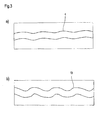
- Figure 3 shows the difference in crimp level between a weft yarn 13 of the dryer fabric 10 according to the invention and a weft yarn 4 of the standard dryer fabric 1.
- a weft yarn of a fabric according to the invention can have a crimp level in the range of 5,0% to 7,0%, typically in the range of 5,5% to 6,5%, depending on the specific weave design, the yarn diameter and the heat set conditions.
- the weft yarns 13 of the fabric 10 has a crimp level of 6,0%.
- a weft yarn of a fabric known in the art can have a crimp level in the range of 3,5% to 5,5%, typically in the range of 4,0% to 5,0%, depending on the specific weave design, the yarn diameter and the heat set conditions.
- the weft yarns 4 of the fabric 1 has a crimp level of 4,0%.
- the weft yarns of a fabric according to the invention has an enhanced crimp level of at least 0,5%, preferably at least 1,0%, most preferably at least 1,5% and prefered in the range of 1,5% to 2,5%.
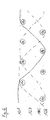
- FIG 4 shows the weave design of fabrics 1 and 10 in warp yarn direction.
- the weave design will be discussed by reference numbers of fabric 10.
- Fabric 10 comprises first weft yarns 13a, 13b, 13c, 13d and second weft yarns 13e, 13f, 13g and 13h.
- the first weft yarns 13a, 13b, 13c, 13d are disposed over said second weft yarns 13e, 13f, 13g and 13h. Further first weft yarns 13a, 13b, 13c, 13d are in offset position relative to second weft yarns 13e, 13f, 13g and 13h.
- warp yarns 12A, 12B, 12C and 12D weave over two consecutive first weft yarns before weaving under one second weft yarn.
- warp yarn 12B (dashed line) weaves over consecutive first weft yarns 13a and 13b before weaving under second weft yarn 13h.
- adjacent warp yarns weave in offset position relative to each other over said two consecutive first weft yarns, wherein the offset position is defined by one first weft yarn.
- warp yarn 12B weaves over first weft yarns 13a and 13b, wherein adjacent warp yarn 12C (dash dotted line) weaves over first weft yarns 13b and 13c. Therefore the offset between warp yarn 12B and Warp yarn 12C is defined by one first weft yarn.
- the weave repeat comprises four warp yarns 12A to 12D and four first weft yarns 13a, 13b, 13c, 13d and four second weft yarns 13e, 13f, 13g 13h.
Landscapes
- Engineering & Computer Science (AREA)
- Mechanical Engineering (AREA)
- Textile Engineering (AREA)
- Paper (AREA)
- Woven Fabrics (AREA)
Abstract
Description
- tension selected from the range of 1 kN/m to 6kN/m,
- temperature with a maximum temperature selected from the range of 90°C to 260°C.
| Composition | Reference | Sample 1 | | | |
| Component 1 | 100% PET | 98% PET | 95% PET | 91 | 87,3 |
| Component | |||||
| 2 | --- | 2% PE | 5% PE | 5% PE | 5% PE |
| Additive 1 | --- | --- | --- | 1 % Anti-Oxidant | 0,5 |
| Additive | |||||
| 2 | --- | --- | --- | 3 | 3 |
| Additive | |||||
| 3 | --- | --- | --- | --- | 1,2% Hydrolysis stabilizer |
| Melting temp. phase 1 [°C] | 253 | 253 | 253 | 253 | 253 |
| Melting temp. phase 2 [°C] | --- | 120 | 120 | 120 | 120 |
| Tenacity [gpd] | 2,9 | 3,1 | 2,9 | 2,8 | 3,1 |
| Elongation at break [%] | 45 | 47 | 46 | 54 | 45 |
| Young's Modulus [gpd] | 72 | 71 | 70 | 63 | 60 |
| Shrinkage [%] | 15 | 15,8 | 17 | 12 | 11 |
| Strength retained [%] after hydrolysis at 140°C, 24hours | 69 | 63 | 38 | 30 | 85 |
| Strength retained [%] after dry heat at 204°C, 24hours | 46 | 44 | 51 | 54 | 80 |
- Figure 1
- shows a comparison between the paper contacting surface of a dryer fabric made from standard yarn material and a dryer fabric made from yarn material according to the invention,
- Figure 2
- shows the difference in contact area between the dryer fabric according to the invention and a standard dryer fabric,
- Figure 3
- shows the difference in crimp level between the dryer fabric according to the invention and a standard dryer fabric,
- Figure 4
- shows a preferred weave design in warp yarn direction of a fabric for use with the yarns according to the invention.
Claims (49)
- Yarn for an industrial fabric, said fabric will be subjected to heat set treatment during manufacture, the yarn is made from polymeric material, said polymeric material includes a first phase having a melting temperature and a second phase having a melting temperature,
characterized in that the melting temperature of the second phase is equal or less the maximum heat set temperature and that the melting temperature of the first phase is higher than the maximum heat set temperature. - Yarn according to claim 1,
characterized in that the maximum heat set temperature is selected from the range of 90°C and 260°C. - Yarn according to claim 1 or 2,
characterized in that the industrial fabric will be operated at a maximum operation temperature, wherein the melting temperature of the second phase is higher than the maximum operation temperature. - Yarn according to one of the preceding claims,
characterized in that second phase is an amorphous phase and that the melting temperature of the amorphous second phase is a softening temperature. - Yarn according to one of the preceding claims,
characterized in that the polymeric material is a polymer blend wherein the first phase includes a first polymer component and wherein the second phase includes a second polymer component and wherein the first and the second polymer component are substantially immiscible. - Yarn according to one of the preceding claims,
characterized in that the melting temperature of the second phase / second polymer component is in the range of 120°C to 220°C, preferably in the range of 160°C to 220°C. - Yarn according to one of the preceding claims ,
characterized in that the melting temperature of the second phase / second polymer component is at least 30°C lower than the melting temperature of the first phase / first polymer component. - Yarn according to claim 7 ,
characterized in that the melting temperature of the second phase / second polymer component is at least 80°C lower than the melting temperature of the first phase / first polymer component. - Yarn according to claim 7 or 8,
characterized in that the melting temperature of the second phase / second polymer component is typically between 100°C and 110°C lower than the melting temperature of the first phase / first polymer component. - Yarn according to one of the preceding claims,
characterized in that the first component includes any of the following either alone or blended: homepolymers and copolymers of the polyesters, homepolymers and copolymers of polyamides, PPS. - Yarn according to claim 10,
characterized in that the first component includes PET. - Yarn according to one of the preceding claims,
characterized in that the second component includes any of the following either alone or blended: polyolefins, polyamides, fluoropolymers. - Yarn according to one of the preceding claims,
characterized in that the blend includes between 51% and 99% by weight, preferably between 60% and 95% by weight, of the first component and between 49% and 1% by weight, preferably between 5% and 40% by weight, of the second component. - Yarn according to one of the preceding claims,
characterized in that the polymer blend comprises at least one suitable compatibilizer. - Yarn according to claim 14,
characterized in that the at least one compatibilizer is included in an amount of 0,01% to 10% by weight, preferably in an amount of 0,1 to 5% by weight. - Yarn according to one of the preceding claims,
characterized in that the at least one compatibilizer is a physical compatibilizer. - Yarn according to claim 16,
characterized in that the physical compatibilizer is any of the following: Ethylene Methyl Acrylate Copolymer (EMA), Ethylene Butyl Acrylate Copolymer. - Yarn according to one of the preceding claims,
characterized in that the at least one compatibilizer is a reactive compatibilizer. - Yarn according to claim 18,
characterized in that the reactive compatibilizer is any of the following: Ethylene -g- Maleic Anhydride Copolymers, Ethylene - g- Glycidal Methacrylate. - Yarn according to one of the preceding claims,
characterized in that the polymer blend comprises at least one suitable stabilizer. - Yarn according to claim 20,
characterized in that the at least one stabilizer is included in an amount of 0,1 % to 10% by weight, preferably in an amount of 0,5 to 5% by weight. - Yarn according to claim 20 or 21,
characterized in that the at least one stabilizer is a hydrolysis stabilizer. - Yarn according claim 22,
characterized in that the hydrolysis stabilizer is a carbodiimide compound. - Yarn according to claim 20 or 21,
characterized in that the at least one stabilizer is an anti-oxidation stabilizer. - Yarn for an industrial fabric,
characterized in that the yarn has a tensile elongation of at least 10% at 1,75 grams per denier (gpd). - Yarn for an industrial fabric according to one of the claims 1 to 25.
- Yarn according to one of the preceding claims,
characterized in that the yarn material has a elongation at yield point 1 which is greater than 5% and / or a elongation at yield point 2 which is greater than 20%. - Yarn according to one of the preceding claims,
characterized in that the yarn is a monofilament yarn. - Yarn according to one of the preceding claims,
characterized in that the yarn is a multifilament yarn. - Yarn according to one of the preceding claims,
characterized in that the yarn has a diameter in the range of 0,20mm to 2,0mm, preferable in the range of 0,4mm to 1,0mm. - Yarn according to one of the preceding claims,
characterized in that the shape of the yarn is round or profiled e.g. with chamfered edges. - Process of making a yarn according to one of the preceding claims.
- Industrial fabric comprising a set of weft yarns and a set of warp yarns wherein the warp yarns and the weft yarns are interwoven to form a specific weave design,
characterized in that at least one of said weft yarns and / or one of said warp yarns of said fabric has an enhanced level of crimp of at least 0,5% compared to the corresponding weft yarn and / or warp yarn of a reference fabric, wherein said reference fabric having the same weave design as said fabric, wherein all weft and warp yarns of said reference fabric having the same diameter as the weft and warp yarns of said fabric, wherein said reference fabric has been manufactured under the same conditions as said fabric, and wherein said corresponding weft and / or warp yarns of said reference fabric are made from PET based polymeric material. - Industrial fabric according to claim 33,
characterized in that the enhanced level of crimp is at least 1,0%, preferably at least 1,5%, most preferably in the range of 1,5% to 2,5%. - Industrial fabric according to claim 33 or 34,
characterized in that during production said fabric and said reference fabric have been subjected to heat set treatment, wherein during heat set treatment tension selected from the range of 1 kN/m to 6kN/m and temperature with a maximum temperature selected from the range of 90°C to 260°C has been applied. - Industrial fabric having a set of weft yarns and a set of warp yarns wherein the warp yarns and the weft yarns are interwoven with each other having a crimp level after heat set treatment, wherein during heat set treatment a tension of 1 kN/m to 6kN/m, preferably 1,5kN/m to 5kN/m and a temperature of 90°C to 260°C, preferably 160°C to 220°C has been applied,
characterized in that at least one warp yarn of the warp yarn set and at least one weft yarn of the weft yarn set have a crimp level ratio which is less than 4, wherein the crimp level for each yarn is the difference of the length along the crimped line of the yarn and the length along the straight line of the yarn divided through the length along the straight line of the yarn. - Industrial fabric according to claim 36,
characterized in that the ratio of the crimp level of at least one warp yarn to the crimp level of at least one weft yarn is less than 3,5, preferably less than 3,0, most preferably less than 2. - Industrial fabric according to at least one of the claims 33 to 37, wherein at least one of said weft and / or warp yarns is made from a polymer blend, wherein said polymer blend includes a first polymer component and a second polymer component,
characterized in that the first and the second polymer component are immiscible, and that the second polymer component has a melting temperature being equal or less than the maximum heat set temperature and that first polymer component has a melting temperature being higher than the maximum heat set temperature. - Industrial fabric according to claim38,
characterized in that the maximum heat set temperature is selected from the range of 90°C and 260°C. - Industrial fabric according to claim 38 or 39,
characterized in that the polymer blend yarns are weft and / or warp yarns. - Industrial fabric according to one of the claims 38 to 40,
characterized in that polymer blend yarns have been pulled during heat set treatment resulting in a crimp level in the range of 4,0% to 6,5%, preferably in the range of 4,5% to 6,0%. - Industrial fabric according to one of the claims 38 to 41,
characterized in that the industrial fabric is a papermaking fabric, preferably a forming or a dryer fabric or a base of a press fabric. - Industrial fabric according to one of the claims 38 to 42,
characterized in that the dryer fabric has an air permeability in the range from 50 to 200cfm, preferably in the range from 75 to 150cfm. - Industrial fabric according to one of the claims 33 to 43,
characterized in that said set of wet yarns comprises first and second weft yarns, said first weft yarns being disposed over said second weft yarns and wherein said warp yarns weave over two consecutive fist weft yarns before weaving under one second weft yarn. - Industrial fabric according to claim 44,
characterized in that said first weft yarns are in offset position relative to said second weft yarns. - Industrial fabric according to claim 44 or 45,
characterized in that adjacent warp yarns weave in offset position relative to each other over said two consecutive first weft yarns. - Industrial fabric according to claim 46,
characterized in that said offset position of said adjacent warp yarns is at least one first weft yarn. - Industrial fabric according to one of the claims 44 to 47,
characterized in that the weave repeat comprises four warp yarns and four first and four second weft yarns. - Industrial fabric according to one of the claims 44 to 48,
characterized in that the weft yarns have the enhanced level of crimp.
Applications Claiming Priority (4)
| Application Number | Priority Date | Filing Date | Title |
|---|---|---|---|
| US850684 | 2004-05-21 | ||
| US10/850,684 US20050260912A1 (en) | 2004-05-21 | 2004-05-21 | Mechanically and thermally responsive polymer yarn for industrial fabric application |
| US10/986,167 US20050260409A1 (en) | 2004-05-21 | 2004-11-12 | Mechanically and thermally responsive polymer yarn for industrial fabric application and industrial fabric |
| US986167 | 2004-11-12 |
Publications (3)
| Publication Number | Publication Date |
|---|---|
| EP1605080A2 true EP1605080A2 (en) | 2005-12-14 |
| EP1605080A3 EP1605080A3 (en) | 2006-02-22 |
| EP1605080B1 EP1605080B1 (en) | 2008-04-02 |
Family
ID=34939253
Family Applications (1)
| Application Number | Title | Priority Date | Filing Date |
|---|---|---|---|
| EP05102899A Revoked EP1605080B1 (en) | 2004-05-21 | 2005-04-13 | Woven papermaking fabric |
Country Status (5)
| Country | Link |
|---|---|
| US (1) | US20050260409A1 (en) |
| EP (1) | EP1605080B1 (en) |
| AT (1) | ATE391198T1 (en) |
| DE (1) | DE602005005737T2 (en) |
| ES (1) | ES2303184T3 (en) |
Families Citing this family (7)
| Publication number | Priority date | Publication date | Assignee | Title |
|---|---|---|---|---|
| AT501362B1 (en) * | 2004-12-13 | 2008-03-15 | Eybl Internat Ag | FOLDABLE TEXTILE KNITWEAR |
| CN1883438A (en) * | 2005-06-21 | 2006-12-27 | 香港理工大学 | Temperature-responsive smart facial mask and preparation method thereof |
| US7721769B2 (en) * | 2007-01-19 | 2010-05-25 | Voith Patent Gmbh | Paper machine fabric with trapezoidal shaped filaments |
| US20090075543A1 (en) * | 2007-09-17 | 2009-03-19 | Voith Patent Gmbh | Malleable polymer monofilament for industrial fabrics |
| US20090311529A1 (en) * | 2008-06-16 | 2009-12-17 | Voith Patent Gmbh | High tenacity thermoplastic polyurethane monofilament and process for manufacturing the same |
| US8025969B2 (en) * | 2008-10-21 | 2011-09-27 | Voith Paper Holding Gmbh & Co. Kg | PET yarns with improved loop tensile properties |
| EP3068619A4 (en) | 2013-11-14 | 2017-07-05 | Georgia-Pacific Consumer Products LP | Soft, absorbent sheets having high absorbency and high caliper, and methods of making soft, absorbent sheets |
Family Cites Families (17)
| Publication number | Priority date | Publication date | Assignee | Title |
|---|---|---|---|---|
| FR2364284A1 (en) * | 1976-09-10 | 1978-04-07 | Payen & Cie L | PROCESS FOR THE MANUFACTURE OF A RIGID SLITTED SHAFT AND SHOES THUS REALIZED |
| US4467839A (en) * | 1981-04-28 | 1984-08-28 | Scapa Inc. | Papermakers fabric using differential melt yarns |
| US4876774A (en) * | 1982-09-30 | 1989-10-31 | Allied-Signal Inc. | Method for preparing heat set fabrics |
| GB2221477C (en) * | 1988-08-31 | 2009-08-27 | Philip John Poole | Window blinds |
| ATE120244T1 (en) * | 1988-09-23 | 1995-04-15 | Amoco Corp | POLYESTER/POLYPROPYLENE BLENDED YARN AND CARPET BASE FABRIC WOVEN THEREOF. |
| US5108827A (en) * | 1989-04-28 | 1992-04-28 | Fiberweb North America, Inc. | Strong nonwoven fabrics from engineered multiconstituent fibers |
| US5593768A (en) * | 1989-04-28 | 1997-01-14 | Fiberweb North America, Inc. | Nonwoven fabrics and fabric laminates from multiconstituent fibers |
| CA2111172A1 (en) * | 1993-09-23 | 1995-03-24 | Dennis S. Everhart | Nonwoven fabric formed from alloy fibers |
| DE4404507A1 (en) * | 1994-02-12 | 1995-08-17 | F & W Tech Faeden Gmbh | Longer life, dimensionally stable press felt effectively drying paper |
| JP2878590B2 (en) * | 1994-04-07 | 1999-04-05 | フジコピアン株式会社 | Ink ribbon fabric |
| US5477891A (en) * | 1994-07-08 | 1995-12-26 | Benesi; Steve C. | Woven filter fabric |
| GB9604602D0 (en) * | 1996-03-04 | 1996-05-01 | Jwi Ltd | Composite papermaking fabric with paired weft binder yarns |
| US6117548A (en) * | 1998-12-18 | 2000-09-12 | Glen Raven Mills, Inc. | Self-coating composite stabilizing yarn |
| US6423409B2 (en) * | 1998-12-18 | 2002-07-23 | Glen Raven, Inc. | Self-coating composite stabilizing yarn |
| JP3441069B2 (en) * | 1999-05-27 | 2003-08-25 | 旭化成株式会社 | Sewing thread |
| AU2000260242A1 (en) * | 2000-07-25 | 2002-02-05 | Asahi Kasei Kabushiki Kaisha | Stretchable high-density woven fabric |
| US6828261B2 (en) * | 2002-07-19 | 2004-12-07 | Astenjohnson, Inc. | Polymer alloys including two or more components with differing melting points, filaments made thereof, and fabrics made therefrom |
-
2004
- 2004-11-12 US US10/986,167 patent/US20050260409A1/en not_active Abandoned
-
2005
- 2005-04-13 ES ES05102899T patent/ES2303184T3/en not_active Expired - Lifetime
- 2005-04-13 EP EP05102899A patent/EP1605080B1/en not_active Revoked
- 2005-04-13 DE DE602005005737T patent/DE602005005737T2/en not_active Revoked
- 2005-04-13 AT AT05102899T patent/ATE391198T1/en not_active IP Right Cessation
Also Published As
| Publication number | Publication date |
|---|---|
| EP1605080B1 (en) | 2008-04-02 |
| ES2303184T3 (en) | 2008-08-01 |
| DE602005005737T2 (en) | 2009-05-07 |
| US20050260409A1 (en) | 2005-11-24 |
| EP1605080A3 (en) | 2006-02-22 |
| DE602005005737D1 (en) | 2008-05-15 |
| ATE391198T1 (en) | 2008-04-15 |
Similar Documents
| Publication | Publication Date | Title |
|---|---|---|
| US20070130696A1 (en) | Mechanically and thermally responsive polymer yarn for industrial fabric application | |
| CN102317518B (en) | Woven fabric | |
| US5985450A (en) | Striated monofilaments useful in the formation of papermaking belts | |
| JP4762529B2 (en) | Industrial two-layer fabric | |
| WO2008073301A2 (en) | Machine side layer weave design for composite forming fabrics | |
| JP4481765B2 (en) | Industrial two-layer fabric | |
| EP1605080B1 (en) | Woven papermaking fabric | |
| US4489125A (en) | Batt-on-mesh press felt having increased abrasion resistance, batt retention and dimensional stability | |
| AU2002352212B2 (en) | Method for making propylene monofilaments, propylene monofilaments and their use | |
| CA2357712A1 (en) | Press fabric for pulp machine | |
| US20090075543A1 (en) | Malleable polymer monofilament for industrial fabrics | |
| CA2527135C (en) | Polyamide filament and industrial fabric using the polyamide filament | |
| AU5453698A (en) | Polyester fiber with improved abrasion resistance | |
| US5405685A (en) | Papermachine clothing | |
| WO2014139847A1 (en) | Monofilament yarn for a paper machine clothing fabric | |
| WO2002036869A1 (en) | Tuck woven composite fiber net and formed article using the same | |
| JP4841410B2 (en) | Industrial double-layer fabric with longitudinal grooves | |
| JP4263343B2 (en) | Novel plastic fabric and method for producing the same | |
| CA2134542C (en) | Papermakers fabric of polyphthalamide monofilament | |
| WO2016166916A1 (en) | Method for manufacturing thinned plain weave or leno weave fabric | |
| JP3433280B2 (en) | Dryer canvas for papermaking | |
| JP2646456B2 (en) | Light weight fabric and method for producing the same | |
| KR101266878B1 (en) | Woven fabric for airbags | |
| KR960705105A (en) | Papermaking machine dryer fabric | |
| JP2008138309A (en) | Industrial double-layer fabric with longitudinal grooves |
Legal Events
| Date | Code | Title | Description |
|---|---|---|---|
| PUAI | Public reference made under article 153(3) epc to a published international application that has entered the european phase |
Free format text: ORIGINAL CODE: 0009012 |
|
| AK | Designated contracting states |
Kind code of ref document: A2 Designated state(s): AT BE BG CH CY CZ DE DK EE ES FI FR GB GR HU IE IS IT LI LT LU MC NL PL PT RO SE SI SK TR |
|
| AX | Request for extension of the european patent |
Extension state: AL BA HR LV MK YU |
|
| PUAL | Search report despatched |
Free format text: ORIGINAL CODE: 0009013 |
|
| AK | Designated contracting states |
Kind code of ref document: A3 Designated state(s): AT BE BG CH CY CZ DE DK EE ES FI FR GB GR HU IE IS IT LI LT LU MC NL PL PT RO SE SI SK TR |
|
| AX | Request for extension of the european patent |
Extension state: AL BA HR LV MK YU |
|
| RAP1 | Party data changed (applicant data changed or rights of an application transferred) |
Owner name: VOITH PATENT GMBH |
|
| 17P | Request for examination filed |
Effective date: 20060822 |
|
| AKX | Designation fees paid |
Designated state(s): AT BE BG CH CY CZ DE DK EE ES FI FR GB GR HU IE IS IT LI LT LU MC NL PL PT RO SE SI SK TR |
|
| 17Q | First examination report despatched |
Effective date: 20061116 |
|
| RTI1 | Title (correction) |
Free format text: WOVEN PAPERMAKING FABRIC |
|
| GRAP | Despatch of communication of intention to grant a patent |
Free format text: ORIGINAL CODE: EPIDOSNIGR1 |
|
| GRAS | Grant fee paid |
Free format text: ORIGINAL CODE: EPIDOSNIGR3 |
|
| GRAA | (expected) grant |
Free format text: ORIGINAL CODE: 0009210 |
|
| AK | Designated contracting states |
Kind code of ref document: B1 Designated state(s): AT BE BG CH CY CZ DE DK EE ES FI FR GB GR HU IE IS IT LI LT LU MC NL PL PT RO SE SI SK TR |
|
| REG | Reference to a national code |
Ref country code: GB Ref legal event code: FG4D |
|
| REG | Reference to a national code |
Ref country code: IE Ref legal event code: FG4D Ref country code: CH Ref legal event code: EP |
|
| REF | Corresponds to: |
Ref document number: 602005005737 Country of ref document: DE Date of ref document: 20080515 Kind code of ref document: P |
|
| REG | Reference to a national code |
Ref country code: SE Ref legal event code: TRGR |
|
| PGFP | Annual fee paid to national office [announced via postgrant information from national office to epo] |
Ref country code: ES Payment date: 20080529 Year of fee payment: 4 |
|
| REG | Reference to a national code |
Ref country code: ES Ref legal event code: FG2A Ref document number: 2303184 Country of ref document: ES Kind code of ref document: T3 |
|
| PGFP | Annual fee paid to national office [announced via postgrant information from national office to epo] |
Ref country code: AT Payment date: 20080515 Year of fee payment: 4 |
|
| PG25 | Lapsed in a contracting state [announced via postgrant information from national office to epo] |
Ref country code: SI Free format text: LAPSE BECAUSE OF FAILURE TO SUBMIT A TRANSLATION OF THE DESCRIPTION OR TO PAY THE FEE WITHIN THE PRESCRIBED TIME-LIMIT Effective date: 20080402 |
|
| PGFP | Annual fee paid to national office [announced via postgrant information from national office to epo] |
Ref country code: FI Payment date: 20080514 Year of fee payment: 4 |
|
| PG25 | Lapsed in a contracting state [announced via postgrant information from national office to epo] |
Ref country code: BG Free format text: LAPSE BECAUSE OF FAILURE TO SUBMIT A TRANSLATION OF THE DESCRIPTION OR TO PAY THE FEE WITHIN THE PRESCRIBED TIME-LIMIT Effective date: 20080702 Ref country code: PT Free format text: LAPSE BECAUSE OF FAILURE TO SUBMIT A TRANSLATION OF THE DESCRIPTION OR TO PAY THE FEE WITHIN THE PRESCRIBED TIME-LIMIT Effective date: 20080903 |
|
| PG25 | Lapsed in a contracting state [announced via postgrant information from national office to epo] |
Ref country code: MC Free format text: LAPSE BECAUSE OF NON-PAYMENT OF DUE FEES Effective date: 20080430 Ref country code: PL Free format text: LAPSE BECAUSE OF FAILURE TO SUBMIT A TRANSLATION OF THE DESCRIPTION OR TO PAY THE FEE WITHIN THE PRESCRIBED TIME-LIMIT Effective date: 20080402 |
|
| ET | Fr: translation filed | ||
| PG25 | Lapsed in a contracting state [announced via postgrant information from national office to epo] |
Ref country code: IS Free format text: LAPSE BECAUSE OF FAILURE TO SUBMIT A TRANSLATION OF THE DESCRIPTION OR TO PAY THE FEE WITHIN THE PRESCRIBED TIME-LIMIT Effective date: 20080802 |
|
| PLBI | Opposition filed |
Free format text: ORIGINAL CODE: 0009260 |
|
| PG25 | Lapsed in a contracting state [announced via postgrant information from national office to epo] |
Ref country code: EE Free format text: LAPSE BECAUSE OF FAILURE TO SUBMIT A TRANSLATION OF THE DESCRIPTION OR TO PAY THE FEE WITHIN THE PRESCRIBED TIME-LIMIT Effective date: 20080402 Ref country code: CZ Free format text: LAPSE BECAUSE OF FAILURE TO SUBMIT A TRANSLATION OF THE DESCRIPTION OR TO PAY THE FEE WITHIN THE PRESCRIBED TIME-LIMIT Effective date: 20080402 Ref country code: LT Free format text: LAPSE BECAUSE OF FAILURE TO SUBMIT A TRANSLATION OF THE DESCRIPTION OR TO PAY THE FEE WITHIN THE PRESCRIBED TIME-LIMIT Effective date: 20080402 Ref country code: DK Free format text: LAPSE BECAUSE OF FAILURE TO SUBMIT A TRANSLATION OF THE DESCRIPTION OR TO PAY THE FEE WITHIN THE PRESCRIBED TIME-LIMIT Effective date: 20080402 |
|
| PLAX | Notice of opposition and request to file observation + time limit sent |
Free format text: ORIGINAL CODE: EPIDOSNOBS2 |
|
| 26 | Opposition filed |
Opponent name: TAMFELT PMC OYJ ABP Effective date: 20081229 Opponent name: WEAVEXX CORPORATION Effective date: 20090102 Opponent name: ASTENJOHNSON, INC. Effective date: 20081229 |
|
| PG25 | Lapsed in a contracting state [announced via postgrant information from national office to epo] |
Ref country code: SK Free format text: LAPSE BECAUSE OF FAILURE TO SUBMIT A TRANSLATION OF THE DESCRIPTION OR TO PAY THE FEE WITHIN THE PRESCRIBED TIME-LIMIT Effective date: 20080402 Ref country code: BE Free format text: LAPSE BECAUSE OF FAILURE TO SUBMIT A TRANSLATION OF THE DESCRIPTION OR TO PAY THE FEE WITHIN THE PRESCRIBED TIME-LIMIT Effective date: 20080402 Ref country code: RO Free format text: LAPSE BECAUSE OF FAILURE TO SUBMIT A TRANSLATION OF THE DESCRIPTION OR TO PAY THE FEE WITHIN THE PRESCRIBED TIME-LIMIT Effective date: 20080402 |
|
| PGFP | Annual fee paid to national office [announced via postgrant information from national office to epo] |
Ref country code: SE Payment date: 20080513 Year of fee payment: 4 |
|
| PG25 | Lapsed in a contracting state [announced via postgrant information from national office to epo] |
Ref country code: IE Free format text: LAPSE BECAUSE OF NON-PAYMENT OF DUE FEES Effective date: 20080414 |
|
| NLR1 | Nl: opposition has been filed with the epo |
Opponent name: WEAVEXX CORPORATION Opponent name: TAMFELT PMC OYJ ABP Opponent name: ASTENJOHNSON, INC. |
|
| PLBB | Reply of patent proprietor to notice(s) of opposition received |
Free format text: ORIGINAL CODE: EPIDOSNOBS3 |
|
| PG25 | Lapsed in a contracting state [announced via postgrant information from national office to epo] |
Ref country code: CY Free format text: LAPSE BECAUSE OF FAILURE TO SUBMIT A TRANSLATION OF THE DESCRIPTION OR TO PAY THE FEE WITHIN THE PRESCRIBED TIME-LIMIT Effective date: 20080402 |
|
| REG | Reference to a national code |
Ref country code: CH Ref legal event code: PL |
|
| EUG | Se: european patent has lapsed | ||
| GBPC | Gb: european patent ceased through non-payment of renewal fee |
Effective date: 20090413 |
|
| NLV4 | Nl: lapsed or anulled due to non-payment of the annual fee |
Effective date: 20091101 |
|
| REG | Reference to a national code |
Ref country code: FR Ref legal event code: ST Effective date: 20091231 |
|
| PG25 | Lapsed in a contracting state [announced via postgrant information from national office to epo] |
Ref country code: AT Free format text: LAPSE BECAUSE OF NON-PAYMENT OF DUE FEES Effective date: 20090413 Ref country code: FI Free format text: LAPSE BECAUSE OF NON-PAYMENT OF DUE FEES Effective date: 20090413 Ref country code: LI Free format text: LAPSE BECAUSE OF NON-PAYMENT OF DUE FEES Effective date: 20090430 Ref country code: CH Free format text: LAPSE BECAUSE OF NON-PAYMENT OF DUE FEES Effective date: 20090430 |
|
| PG25 | Lapsed in a contracting state [announced via postgrant information from national office to epo] |
Ref country code: NL Free format text: LAPSE BECAUSE OF NON-PAYMENT OF DUE FEES Effective date: 20091101 |
|
| RDAF | Communication despatched that patent is revoked |
Free format text: ORIGINAL CODE: EPIDOSNREV1 |
|
| PG25 | Lapsed in a contracting state [announced via postgrant information from national office to epo] |
Ref country code: GB Free format text: LAPSE BECAUSE OF NON-PAYMENT OF DUE FEES Effective date: 20090413 Ref country code: FR Free format text: LAPSE BECAUSE OF NON-PAYMENT OF DUE FEES Effective date: 20091222 |
|
| PGFP | Annual fee paid to national office [announced via postgrant information from national office to epo] |
Ref country code: FR Payment date: 20080526 Year of fee payment: 4 |
|
| REG | Reference to a national code |
Ref country code: ES Ref legal event code: FD2A Effective date: 20090414 |
|
| RDAG | Patent revoked |
Free format text: ORIGINAL CODE: 0009271 |
|
| STAA | Information on the status of an ep patent application or granted ep patent |
Free format text: STATUS: PATENT REVOKED |
|
| PG25 | Lapsed in a contracting state [announced via postgrant information from national office to epo] |
Ref country code: HU Free format text: LAPSE BECAUSE OF FAILURE TO SUBMIT A TRANSLATION OF THE DESCRIPTION OR TO PAY THE FEE WITHIN THE PRESCRIBED TIME-LIMIT Effective date: 20081003 Ref country code: LU Free format text: LAPSE BECAUSE OF NON-PAYMENT OF DUE FEES Effective date: 20080413 Ref country code: ES Free format text: LAPSE BECAUSE OF NON-PAYMENT OF DUE FEES Effective date: 20090414 |
|
| 27W | Patent revoked |
Effective date: 20100408 |
|
| PG25 | Lapsed in a contracting state [announced via postgrant information from national office to epo] |
Ref country code: TR Free format text: LAPSE BECAUSE OF FAILURE TO SUBMIT A TRANSLATION OF THE DESCRIPTION OR TO PAY THE FEE WITHIN THE PRESCRIBED TIME-LIMIT Effective date: 20080402 |
|
| PGFP | Annual fee paid to national office [announced via postgrant information from national office to epo] |
Ref country code: DE Payment date: 20100430 Year of fee payment: 6 |
|
| PG25 | Lapsed in a contracting state [announced via postgrant information from national office to epo] |
Ref country code: GR Free format text: LAPSE BECAUSE OF FAILURE TO SUBMIT A TRANSLATION OF THE DESCRIPTION OR TO PAY THE FEE WITHIN THE PRESCRIBED TIME-LIMIT Effective date: 20080703 |
|
| PG25 | Lapsed in a contracting state [announced via postgrant information from national office to epo] |
Ref country code: SE Free format text: LAPSE BECAUSE OF NON-PAYMENT OF DUE FEES Effective date: 20090414 |
|
| PGFP | Annual fee paid to national office [announced via postgrant information from national office to epo] |
Ref country code: IT Payment date: 20080430 Year of fee payment: 4 |
|
| REG | Reference to a national code |
Ref country code: SE Ref legal event code: ECNC |