EP1605044A2 - Marker for detecting mesenchymal stem cell and method of distinguishing mesenchymal stem cell using the marker - Google Patents
Marker for detecting mesenchymal stem cell and method of distinguishing mesenchymal stem cell using the marker Download PDFInfo
- Publication number
- EP1605044A2 EP1605044A2 EP04715524A EP04715524A EP1605044A2 EP 1605044 A2 EP1605044 A2 EP 1605044A2 EP 04715524 A EP04715524 A EP 04715524A EP 04715524 A EP04715524 A EP 04715524A EP 1605044 A2 EP1605044 A2 EP 1605044A2
- Authority
- EP
- European Patent Office
- Prior art keywords
- gene
- seq
- homo sapiens
- mrna
- sequence listing
- Prior art date
- Legal status (The legal status is an assumption and is not a legal conclusion. Google has not performed a legal analysis and makes no representation as to the accuracy of the status listed.)
- Withdrawn
Links
Images


Classifications
-
- C—CHEMISTRY; METALLURGY
- C12—BIOCHEMISTRY; BEER; SPIRITS; WINE; VINEGAR; MICROBIOLOGY; ENZYMOLOGY; MUTATION OR GENETIC ENGINEERING
- C12N—MICROORGANISMS OR ENZYMES; COMPOSITIONS THEREOF; PROPAGATING, PRESERVING, OR MAINTAINING MICROORGANISMS; MUTATION OR GENETIC ENGINEERING; CULTURE MEDIA
- C12N15/00—Mutation or genetic engineering; DNA or RNA concerning genetic engineering, vectors, e.g. plasmids, or their isolation, preparation or purification; Use of hosts therefor
- C12N15/09—Recombinant DNA-technology
-
- C—CHEMISTRY; METALLURGY
- C12—BIOCHEMISTRY; BEER; SPIRITS; WINE; VINEGAR; MICROBIOLOGY; ENZYMOLOGY; MUTATION OR GENETIC ENGINEERING
- C12N—MICROORGANISMS OR ENZYMES; COMPOSITIONS THEREOF; PROPAGATING, PRESERVING, OR MAINTAINING MICROORGANISMS; MUTATION OR GENETIC ENGINEERING; CULTURE MEDIA
- C12N15/00—Mutation or genetic engineering; DNA or RNA concerning genetic engineering, vectors, e.g. plasmids, or their isolation, preparation or purification; Use of hosts therefor
- C12N15/09—Recombinant DNA-technology
- C12N15/11—DNA or RNA fragments; Modified forms thereof; Non-coding nucleic acids having a biological activity
- C12N15/113—Non-coding nucleic acids modulating the expression of genes, e.g. antisense oligonucleotides; Antisense DNA or RNA; Triplex- forming oligonucleotides; Catalytic nucleic acids, e.g. ribozymes; Nucleic acids used in co-suppression or gene silencing
- C12N15/1138—Non-coding nucleic acids modulating the expression of genes, e.g. antisense oligonucleotides; Antisense DNA or RNA; Triplex- forming oligonucleotides; Catalytic nucleic acids, e.g. ribozymes; Nucleic acids used in co-suppression or gene silencing against receptors or cell surface proteins
-
- C—CHEMISTRY; METALLURGY
- C07—ORGANIC CHEMISTRY
- C07K—PEPTIDES
- C07K14/00—Peptides having more than 20 amino acids; Gastrins; Somatostatins; Melanotropins; Derivatives thereof
- C07K14/435—Peptides having more than 20 amino acids; Gastrins; Somatostatins; Melanotropins; Derivatives thereof from animals; from humans
- C07K14/46—Peptides having more than 20 amino acids; Gastrins; Somatostatins; Melanotropins; Derivatives thereof from animals; from humans from vertebrates
- C07K14/47—Peptides having more than 20 amino acids; Gastrins; Somatostatins; Melanotropins; Derivatives thereof from animals; from humans from vertebrates from mammals
-
- C—CHEMISTRY; METALLURGY
- C07—ORGANIC CHEMISTRY
- C07K—PEPTIDES
- C07K16/00—Immunoglobulins [IG], e.g. monoclonal or polyclonal antibodies
- C07K16/18—Immunoglobulins [IG], e.g. monoclonal or polyclonal antibodies against material from animals or humans
-
- C—CHEMISTRY; METALLURGY
- C12—BIOCHEMISTRY; BEER; SPIRITS; WINE; VINEGAR; MICROBIOLOGY; ENZYMOLOGY; MUTATION OR GENETIC ENGINEERING
- C12Q—MEASURING OR TESTING PROCESSES INVOLVING ENZYMES, NUCLEIC ACIDS OR MICROORGANISMS; COMPOSITIONS OR TEST PAPERS THEREFOR; PROCESSES OF PREPARING SUCH COMPOSITIONS; CONDITION-RESPONSIVE CONTROL IN MICROBIOLOGICAL OR ENZYMOLOGICAL PROCESSES
- C12Q1/00—Measuring or testing processes involving enzymes, nucleic acids or microorganisms; Compositions therefor; Processes of preparing such compositions
- C12Q1/68—Measuring or testing processes involving enzymes, nucleic acids or microorganisms; Compositions therefor; Processes of preparing such compositions involving nucleic acids
- C12Q1/6876—Nucleic acid products used in the analysis of nucleic acids, e.g. primers or probes
- C12Q1/6881—Nucleic acid products used in the analysis of nucleic acids, e.g. primers or probes for tissue or cell typing, e.g. human leukocyte antigen [HLA] probes
-
- C—CHEMISTRY; METALLURGY
- C12—BIOCHEMISTRY; BEER; SPIRITS; WINE; VINEGAR; MICROBIOLOGY; ENZYMOLOGY; MUTATION OR GENETIC ENGINEERING
- C12Q—MEASURING OR TESTING PROCESSES INVOLVING ENZYMES, NUCLEIC ACIDS OR MICROORGANISMS; COMPOSITIONS OR TEST PAPERS THEREFOR; PROCESSES OF PREPARING SUCH COMPOSITIONS; CONDITION-RESPONSIVE CONTROL IN MICROBIOLOGICAL OR ENZYMOLOGICAL PROCESSES
- C12Q2600/00—Oligonucleotides characterized by their use
- C12Q2600/158—Expression markers
Definitions
- the present invention relates to detection and separation/distinguishment of mesenchymal stem cells; particularly, a gene marker for detecting mesenchymal stem cells and a polypeptide marker for detecting mesenchymal stem cells used for detecting, separating/distinguishing mesenchymal stem cells; and a method for detecting and distinguishing mesenchymal stem cells by using the markers.
- Mesenchymal stem cells exist in the bone marrow, etc., of mammals, and are known as multipotent stem cells which differentiate into adipocytes, chondrocytes, and osteocytes. Due to their multipotency in differentiation, mesenchymal stem cells draw attention as xenograft, homograft and autograft materials for regenerative medicine of many tissues, such as bone, cartilage, tendon, muscle, fat, and periodontal tissue (Gene & Medicine, Vol. 4, No. 2 (2000) p58-61). A general statement as to the present condition and prospect of study of mesenchymal stem cells has been issued recently, and there is a report concerning collection and culture of mesenchymal stem cells (Experimental Medicine, Vol. 19, No.
- 2000-217576 discloses a method for differentiating a multipotential mesenchymal stem cell into adipocytes, which includes incubation of the mulitpotential mesenchymal stem cell in the presence of prolactin or a substance with an equivalent effect, respectively.
- the present inventors previously found that it is possible to proliferate mesenchymal stem cells remarkably rapidly while maintaining their differentiation capacity, by culturing mesenchymal stem cells in the presence of extracellular matrix of basement membrane, or in a medium containing a fibroblast growth factor (FGF), etc., and disclosed a culturing method capable of obtaining significantly larger amount of mesenchymal stem cells than a conventional culturing method (Japanese Laid-Open Patent Application No. 2003-52360).
- FGF fibroblast growth factor
- the present inventors disclosed a method for separating and collecting mesenchymal stem cells from oral tissues, in order to conduct separation and collection being safe for a collected parent body and easy for collecting, upon collecting mesenchymal stem cells (Japanese Laid-Open Patent Application No. 2003-52365).
- mesenchymal stem cells draw attention as xenograft, homograft and autograft materials for regenerative medicine of many tissues, such as bone, cartilage, tendon, muscle, fat, periodontaltissue, because of their multipotency in differentiation.
- mesenchymal stem cells In order to use mesenchymal stem cells for regenerative medicine of tissues, it is necessary to collect the stem cells from body tissues first, to proliferate them, and to further differentiate and proliferate them to prepare a tissue.
- Mesenchymal stem cells exist in the bone marrow and periosteum, and it is necessary to develop a method for collecting mesenchymal stem cells from these tissues safely and easily for the practical use of these cells in tissue regenerative medicine.
- mesenchymal stem cells for the practical use of mesenchymal stem cells in tissue regenerative medicine, it is necessary to develop a technique for securing a sufficient amount of mesenchymal stem cells. In order to do this, it is important to develop a technique for culturing and proliferating the collected mesenchymal stem cells while maintaining their differentiation capacity.
- the present inventors have developed the method for conducting separation and collection being safe for a collected parent body and easy for collecting, upon collecting mesenchymal stem cells. Further, the present inventors have developed a method for explosively proliferating mesenchymal stem cells while maintaining their differentiation capacity by culturingmesenchymal stem cells in the presence of extracellular matrix of basement membrane, or in a medium containing a fibroblast growth factor (FGF), etc.
- FGF fibroblast growth factor
- mesenchymal stem cells marker genes that characterize the cells have not been identified conventionally. Therefore, for the purpose of practical use of mesenchymal stem cells in regenerative medicine, the identification of marker genes that characterize mesenchymal stem cells, and the development of a method for detecting, and separating/distinguishing mesenchymal stem cells are important problems to be solved.
- the present invention provides a gene marker for detecting mesenchymal stem cells and a polypeptide marker for detecting mesenchymal stem cells used for detecting and distinguishing mesenchymal stem cells; a primer for PCR amplification for detecting the gene marker; and a method for detecting and distinguishing mesenchymal stem cells by using the markers and the primer.
- the present inventors compared the expression of various genes in mesenchymal stem cells, and searched for a gene which can serve as a marker. As a result, the present inventors found that there was a difference between fibroblasts and mesenchymal stem cells in the expression levels of 13 genes shown in the sequence listing, and the genes were expressed specifically in mesenchymal stem cells, and that the genes could serve as a marker for detecting mesenchymal stem cells. The present invention has been thus completed.
- the present invention comprises a probe for detecting mesenchymal stem cell marker genes, and a PCR primer for amplifying the genes in test cell upon detecting the mesenchymal stem cell gene markers.
- the present invention comprises a polypeptide marker for detecting mesenchymal stem cells comprising a polypeptide wherein the mesenchymal stem cell marker gene of the present invention is expressed, and an antibody for detecting the polypeptide marker, which specifically binds to the polypeptide marker.
- the present invention comprises a method for distinguishing and separating mesenchymal stem cells using the probe for detecting mesenchymal stem cell marker genes, and the antibody which specifically binds to the polypeptide marker.
- mesenchymal stem cells are capable of differentiating into many tissues such as bone, cartilage, tendon, fat, skeletal muscle, cardiac muscle, blood vessel, nerve, etc., and are significantly expected as cells for regenerative medicine.
- marker genes that characterize mesenchymal stem cells have not been identified. Therefore, the present inventors have conducted a keen search for identifying marker genes that characterize mesenchymal stem cells.
- the search comprises the following steps: proliferating mesenchymal stem cells with the method, previously developed by the present inventors, wherein mesenchymal stem cells derived from bone marrow are cultured in the presence of FGF, etc., thereby explosively proliferating the cells while maintaining their differentiation capacity; culturing the mesenchymal stem cells obtained by this method and human fibroblasts in the presence of FGF; extracting mRNA from the cultured cells; by using the mRNA as a template and a DNA chip (Incyte) as a probe, comparing the genes expressed in human-derived mesenchymal stem cells and fibroblasts by DNA microarray technology.
- a DNA chip Incyte
- 87 genes (29 genes exhibiting high expression and 58 genes exhibiting low expression in mesenchymal stem cells) exhibited a difference, of three-fold or more, in expression levels.
- Total RNAs were extracted from mesenchymal stem cells derived from 3 individuals and fibroblasts derived from 3 individuals, and by using them as a template, the expression levels of the above-mentioned 87 genes were examined by semiquantitative RT-PCR. As a result, most genes exhibited no difference in the expression levels.
- differences in the expression were considered to be caused by individual differences, because differences in the expression levels were observed between mesenchymal stem cells, or fibroblasts, from different individuals.
- the present invention specifically comprises: a gene marker for detecting a mesenchymal stem cell which is a gene having a base sequence shown in SEQ ID NO: 1, 2, 4, 6, 7, 9, 10, 11, 12, 14, 15, 17, 19 or 46 in the sequence listing ("1"), a gene marker for detecting a mesenchymal stem cell which is a gene of INTEGRIN, ALPHA 6 (ITGA6), MRNA (NM_000210); a gene of SOLUTE CARRIER FAMILY 20 (PHOSPHATE TRANSPORTER), MEMBER 1 (NM_005415); a gene of RIBONUCLEOTIDE REDUCTASE M2 POLYPEPTIDE (RRM2), MRNA (NM_001034); a gene of FOLLISTATIN (FST), TRANSCRIPT VARIANT FST317, MRNA (NM_006350); a gene of SPROUTY (DROSOPHILA) HOMOLOG 2 (SPRY2), MRNA (NM_005842); a gene of RAB3B, M
- CEREVISIAE CEREVISIAE 5 (CE) (NM_006739); a gene of THYROID HORMONE RECEPTOR INTERACTOR 13 (TRIP13), MRNA (NM_004237); a gene of KINESIN-LIKE 6 (MITOTIC CENTROMERE-ASSOCIATED KINESIN) (K) (NM_006845); a gene of CYCLIN-DEPENDENT KINASE INHIBITOR 3 (CDK2-ASSOCIATED DUAL (NM_005192); a gene of CHROMOSOME CONDENSATION PROTEIN G (HCAP-G), MRNA (NM_022346); a gene of CDC28 PROTEIN KINASE 1 (CKS1), MRNA (NM_001826); a gene of PROTEIN REGULATOR OF CYTOKINESIS 1 (PRC1), MRNA (NM_003981); a gene of CELL DIVISION CYCLE 2, G1 TO S AND G2 TO M (CDC2), M
- CEREVISIAE, HOMOLOG (CD) (NM_001255); a gene of LIKELY ORTHOLOG OF MATERNAL EMBRYONIC LEUCINE ZIPPER KINAS (NM_014791); a gene of MINICHROMOSOME MAINTENANCE DEFICIENT (S.
- CEREVISIAE CEREVISIAE 7 (M) (NM_005916); a gene of CYCLINA2 (CCNA2), MRNA (NM_001237); a gene of THYMIDINE KINASE 1, SOLUBLE (TK1), MRNA (NM_003258); or a gene of cyclin-dependent kinase inhibitor 2A (melanoma, p16, inhibits CDK4) (CDKN2A), mRNA (NM_000077) ("2”), a gene marker for detecting a mesenchymal stem cell which is a gene of EGF-containing fibulin-like extracellular matrix protein 1 (NM_018894); a gene of Human insulin-like growth factor binding protein 5 (IGFBP5) mRNA (AU132011); a gene of Homo sapiens clone 24775 mRNA sequence (AA402981); proteoglycan 1, secretory granule (AV734015); a gene of insulin-like growth factor binding protein 5 (AA
- CEREVISIAE 7 (M) (NM_005916); a gene of HOMO SAPIENS DYNEIN, CYTOPLASMIC, INTERMEDIATE POLYPEPTIDE 1 (DNCI1), M (NM_004411); a gene of HUMAN MRNA FOR PROTEIN GENE PRODUCT (PGP) 9.5.
- X04741 a gene of HOMO SAPIENS RAD51-INTERACTING PROTEIN (PIR51), MRNA (NM_006479); a gene of HOMO SAPIENS BACULOVIRAL IAP REPEAT-CONTAINING 5 (SURVIVIN) (BIRC5), MR (NM_001168); a gene of HOMO SAPIENS UDP-N-ACETYL-ALPHA-D-GALACTOSAMINE:POLYPEPTIDE N-ACETYLGAL (NM_004482); a gene of HOMO SAPIENS CYCLIN B1 (CCNB1), MRNA (NM_031966); a gene of HOMO SAPIENS FLAP STRUCTURE-SPECIFIC ENDONUCLEASE 1 (FEN1), MRNA (NM_004111); a gene of HOMO SAPIENS SERINE/THREONINE KINASE 15 (STK15), MRNA (NM_003600); a gene of HOMO SAPIENS MAD2
- the present invention also comprises: a method for distinguishing a mesenchymal stem cell wherein expression of the mesenchymal stem cell marker gene according to any one of "1” to “9” in a test cell is detected ("18"), the method for distinguishing a mesenchymal stem cell according to “18", wherein the expression of the mesenchymal stem cell marker gene is detected by using Northern blotting ("19"), the method for distinguishingamesenchymal stem cell according to "18”, wherein the expression of the mesenchymal stem cell marker gene is detected by using the probe for detecting a mesenchymal stem cell marker gene according to "10” or “11” (“20”), the method for distinguishing a mesenchymal stem cell according to "18”, wherein the expression of the mesenchymal stem cell marker gene is detected by using the microarray or the DNA chip for detecting a mesenchymal stem cell marker gene according to "12” or “13” (“21”), a method for distinguishing a mesenchy
- the present invention further comprises: an RT-PCR primer for amplifying a mesenchymal stem cell marker gene which comprises a sense primer having a base sequence shown in SEQ ID NO: 20 in the sequence listing, and an antisense primer having a base sequence shown in SEQ ID NO: 21 in the sequence listing; a sense primer having a base sequence shown in SEQ ID NO: 22 in the sequence listing, and an antisense primer having a base sequence shown in SEQ ID NO: 23 in the sequence listing; a sense primer having a base sequence shown in SEQ ID NO: 24 in the sequence listing, and an antisense primer having a base sequence shown in SEQ ID NO: 25 in the sequence listing; a sense primer having a base sequence shown in SEQ ID NO: 26 in the sequence listing, and an antisense primer having a base sequence shown in SEQ ID NO: 27 in the sequence listing; a sense primer having a base sequence shown in SEQ ID NO: 28 in the sequence listing, and an antisense primer having a base sequence shown in SEQ ID NO: 29
- the present invention still further comprises: the method for distinguishing a mesenchymal stem cell according to "18", wherein a gene in a test cell is amplified by using at least one pair of primers comprising the sense primer and the antisense primer according to any one of "24” to “26", and the amplified gene is detected by using the probe for detecting a mesenchymal stem cell marker gene according to "10" or "11” ("27"), a method for distinguishing a mesenchymal stem cell, wherein expression of a mesenchymal stem cell marker polypeptide in a test cell is detected by using the antibody according to any one of "15” to "17” ("28”), a method for distinguishing a mesenchymal stem cell, wherein expression of one or more genes in a group of mesenchymal stem cell marker genes comprising SEQ ID NOs: 1, 11 and 19 in the sequence listing, and expression of one or more genes in a group of mesenchymal stem cell marker genes comprising SEQ ID NOs
- the present invention comprises distinguishing mesenchymal stem cells by detecting the expression of a marker gene for detecting mesenchymal stem cells or a marker polypeptide for detecting mesenchymal stem cells, which are expressed specifically in mesenchymal stem cells.
- a gene which can serve as a gene marker for detecting mesenchymal stem cells is a gene having a base sequence shown in SEQ ID NO: 1, 2, 4, 6, 7, 9, 10, 11, 12, 14, 15, 17 or 19 in the sequence listing.
- a polypeptide which serves as a polypeptide marker for detecting mesenchymal stem cells is a polypeptide having an amino acid sequence shown in SEQ ID NO: 3, 5, 8, 13, 16 or 18 in the sequence listing.
- genes shown in SEQ ID NOs: 1, 2, 4, 6, 7, 9, 10, 11, 12, 14, 15, 17, 19 and 46 in the sequence listing are genes of [serine (or cysteine) proteinase inhibitor], [adrenomedullin], [apolopoprotein D], [collagenase type XV alpha 1], [CUG triplet repeat RNA binding protein2], [dermatopontin], [isocitrate dehydrogenase 2], [major histocompatibility complex class2, DR beta 3], [protein tyrosine kinase 7], [Sam68-like phosphotyrosine protein], [C-type lectin superfamily member 2], [matrix metalloprotease 1], [tissue factor pathway inhibitor 2], [major histocompatibility complex DR alpha], respectively.
- the DNA sequence information of the marker genes for detecting mesenchymal stem cells of the present invention can be approached in NCBI gene database with Accession Nos. AI133613(SEQ ID NO: 1), NM_001124(SEQ ID NO: 2), NM_001647(SEQ IDNO: 4), L01697(SEQIDNO: 6), U69546 (SEQ ID NO: 7), AW016451(SEQ ID NO: 9), AL545953(SEQ ID NO: 10), BF732822(SEQ ID NO: 11), AL157486(SEQ ID NO: 12), AA112001(SEQ ID NO: 14), XM_006626(SEQ ID NO: 15), NM_002421(SEQ ID NO: 17), AL550357(SEQ ID NO: 19), and BF795929(SEQ ID NO: 46), respectively.
- genes which are confirmed in the present invention that they exhibit higher expression in mesenchymal stem cells than in fibroblasts the following is exemplified:
- a gene marker for detecting mesenchymal stem cells which is: a gene of INTEGRIN, ALPHA 6 (ITGA6), MRNA (NM_000210); a gene of SOLUTE CARRIER FAMILY 20 (PHOSPHATE TRANSPORTER), MEMBER 1 (NM_005415) ; a gene of RIBONUCLEOTIDE REDUCTASE M2 POLYPEPTIDE (RRM2), MRNA(NM_001034); a gene of FOLLISTATIN (FST), TRANSCRIPT VARIANT FST317, MRNA (NM_006350); a gene of SPROUTY (DROSOPHILA) HOMOLOG 2 (SPRY2), MRNA (NM_005842); a gene of RAB3B, MEMBER RAS ONCOGENE FAMILY (RAB3B), MRNA (NM_002867): a gene of SOLUTE CARRIER FAMILY 2 (FACILITATED GLUCOSE TRANSPORTER) (NM_006516);
- CEREVISIAE CEREVISIAE 5 (CE) (NM_006739); a gene of THYROID HORMONE RECEPTOR INTERACTOR 13 (TRIP13), MRNA (NM_004237); a gene of KINESIN-LIKE 6 (MITOTIC CENTROMERE-ASSOCIATED KINESIN) (K) (NM_006845); a gene of CYCLIN-DEPENDENT KINASE INHIBITOR 3 (CDK2-ASSOCIATED DUAL (NM_005192); a gene of CHROMOSOME CONDENSATION PROTEIN G (HCAP-G), MRNA (NM_022346); a gene of CDC28 PROTEINKINASE 1 (CKS1), MRNA (NM_001826); agene of PROTEIN REGULATOR OF CYTOKINESIS 1 (PRC1), MRNA (NM_003981); a gene of CELL DIVISIONCYCLE 2, G1 TO SANDG2 TOM (CDC2), M
- CEREVISIAE, HOMOLOG (CD) (NM_001255): a gene of LIKELY ORTHOLOG OF MATERNAL EMBRYONIC LEUCINE ZIPPER KINAS (NM_014791); a gene of MINICHROMOSOME MAINTENANCE DEFICIENT (S.
- CEREVISIAE CEREVISIAE 7 (M) (NM_005916); a gene of CYCLINA2 (CCNA2), MRNA (NM_001237); a gene of THYMIDINE KINASE 1, SOLUBLE (TK1), MRNA (NM_003258); or a gene of cyclin-dependent kinase inhibitor 2A (melanoma, p16, inhibits CDK4) (CDKN2A), mRNA (NM_000077).
- a gene of EGF-containing fibulin-like extracellular matrix protein 1 (NM_018894); a gene of Human insulin-like growth factor binding protein 5 (IGFBP5) mRNA (AU132011); a gene of Homo sapiens clone 24775 mRNA sequence (AA402981); proteoglycan 1, secretory granule (AV734015); a gene of insulin-like growth factor binding protein 5 (AA374325); a gene of solute carrier family 21 (organic anion transporter), member 3 (AF085224); a gene of transglutaminase 2 (C polypeptide, protein-glutamine-gamma-glutamyl transferase) (AL552373); a gene of coagulation factor II (thrombin) receptor (M62424); a gene of plasminogen activator, urokinase (NM_002658); a gene of tissue inhibitor of metalloproteinase 3 (Sorsby fundus dystrophy, pseudo
- a gene of HOMO SAPIENS WNT INHIBITORY FACTOR-1 WIF-1
- MRNA MRNA
- NM_007191 a gene of HOMO SAPIENS HYPOTHETICAL PROTEIN FLJ11175 (FLJ11175), MRNA(NM_018349); a gene of HOMO SAPIENS RHO GDP DISSOCIATION INHIBITOR (GDI) BETA (ARHGDIB), MRNA (NM_001175): a gene of HOMO SAPIENS POTASSIUM INTERMEDIATE/SMALL CONDUCTANCE CALCIUM-ACTIVATE(NM_021614); a gene of HOMO SAPIENS NUCLEAR FACTOR (ERYTHROID-DERIVED 2)-LIKE 3 (NFE2L3), MRNA (NM_004289); a gene of HOMO SAPIENS GS3955 PROTEIN (GS3955), MRNA (NM_021643); a gene of HOMO SAPIENS CDNA 3' END
- HOMO SAPIENS RESERVED KCNK12
- MRNA MRNA
- UBIQUITIN-CONJUGATING ENZYME E2C UBE2C
- MRNA NM_007019
- a gene of HOMO SAPIENS MRNA; CDNA DKFZP434F2322 (FROM CLONE DKFZP434F2322) /CDS UNKNOWN /GB (AL133105); a gene of HOMO SAPIENS, CLONE MGC:9549 IMAGE:3857382, MRNA, COMPLETE CDS /C
- X04741 a gene of HOMO SAPIENS RAD51-INTERACTING PROTEIN (PIR51), MRNA (NM_006479); a gene of HOMO SAPIENS BACULOVIRAL IAP REPEAT-CONTAINING 5 (SURVIVIN) (BIRC5), MR (NM_001168); a gene of HOMO SAPIENS UDP-N-ACETYL-ALPHA-D-GALACTOSAMINE: POLYPEPTIDE N-ACETYLGAL (NM_004482); a gene of HOMO SAPIENS CYCLIN B1 (CCNB1), MRNA (NM_031966); a gene of HOMO SAPIENS FLAP STRUCTURE-SPECIFIC ENDONUCLEASE 1 (FEN1), MRNA (NM_004111); a gene of HOMO SAPIENS SERINE/THREONINE KINASE 15 (STK15), MRNA (NM_003600); a gene of HOMO SAPIENS MAD2
- a gene of HOMO SAPIENS HYPOTHETICAL PROTEIN FLJ10604 FLJ10604
- MRNA(NM_018154) MRNA(NM_018154); a gene of HOMO SAPIENS RIBONUCLEASE HI, LARGE SUBUNIT (RNASEHI), MRNA (NM_006397); a gene of HOMO SAPIENS ANILLIN (DROSOPHILA SCRAPS HOMOLOG), ACTIN BINDING PROTEIN (NM_018685); a gene of HOMO SAPIENS H4 HISTONE FAMILY, MEMBER G (H4FG), MRNA (NM_003542); a gene of HOMO SAPIENS G PROTEIN-COUPLED RECEPTOR 37 (ENDOTHELIN RECEPTOR TYPE B-(NM_005302) HOMO SAPIENS UBIQUITIN CARRIER PROTEIN (E2-EPF), MRNA (NM_014501); a gene of HOMO SAPIENS, SIMILAR TO T
- genes which are confirmed in the present invention that they exhibit no or extremely lower expression in mesenchymal stem cells than in fibroblasts the following is exemplified:
- a gene marker for detecting mesenchymal stem cells which is: a gene of HOMO SAPIENS PROTEASOME (PROSOME, MACROPAIN) 26S SUBUNIT, ATPASE, 5 (PS) (NM_002805); a gene of HOMO SAPIENS EUKARYOTIC TRANSLATION INITIATION FACTOR 4 GAMMA, 2 (EIF4G) (NM_001418); a gene of HOMO SAPIENS DIHYDROPYRIMIDINASE-LIKE 3 (DPYSL3), MRNA) (NM_001387); a gene of HOMO SAPIENS ADAPTOR-RELATED PROTEIN COMPLEX 1, SIGMA 2 SUBUNIT (AP1S2) (NM_003916); a gene of HOMO SAPIENS PLECTIN 1, INTERMEDIATE FILAMENT BINDING PROTEIN, 500 KD (P) (NM_000445); a gene of HOMO SAPIENS HETEROGENEOUS NUCLEAR RIB
- known methods for detecting gene expression can be used to detect the expression of the mesenchymal stem cell marker gene of the present invention.
- Northern blotting can be used to detect the expression of the mesenchymal stem cell marker gene of the present invention.
- a probe having a DNA sequence which hybridizes with a DNA sequence of the mesenchymal stem cell gene marker of the present invention under a stringent condition in order to detect and distinguish mesenchymal stem cells by the gene marker of the present invention.
- known methods can be appropriately used.
- the detection of mesenchymal stem cells is conducted by the following process: constructing a DNA probe with appropriate length from a DNA sequence of a gene marker shown in the sequence listing; labeling the probe appropriately by fluorescent labeling, etc.; hybridizing the probe with a test substance.
- the DNA probe it is possible to use a probe for detecting mesenchymal stem cell marker genes comprising whole or part of an antisense strand of the base sequence of the gene marker of the present invention shown in the sequence listing.
- the probe can be used also in a form of a microarray or a DNA chip for detecting marker genes, wherein at least one of the probes is immobilized.
- the condition for the base sequence of the present invention "to hybridize with a DNA sequence of a marker gene for detecting mesenchymal stem cells under a stringent condition" is exemplified by hybridization at 42°C, and washing treatment at 42°C with buffer solution containing 1 ⁇ SSC (0.15 M NaCl, 0.015 M sodium citrate), and 0.1% SDS (sodium dodecyl sulfate), and more preferably exemplified by hybridization at 65°C, and washing treatment at 65°C with buffer solution containing 0.1 ⁇ SSC, and 0.1% SDS.
- buffer solution containing 1 ⁇ SSC 0.15 M NaCl, 0.015 M sodium citrate
- SDS sodium dodecyl sulfate
- an antibody induced by the polypeptide of the protein and specifically binds to the polypeptide can be used in the present invention.
- the antibody include monoclonal and polyclonal antibodies.
- the antibody can be constructed by ordinary methods with the polypeptide marker of the present invention as an antigen.
- immunoassay methods using known antibodies can be used. As for such immunoassay methods, known immunoassay methods such as RIA, ELISA, and fluorescent antibody method are exemplified.
- a marker gene for detecting mesenchymal stem cells and/or a marker polypeptide for detecting mesenchymal stem cells in a test cell by using the probe for detecting mesenchymal stem cells of the present invention and/or the antibody for detecting mesenchymal stem cells of the present invention, and to separate and obtain mesenchymal stem cells.
- quantitative or semiquantitative PCR can be used to amplify the gene of the test cell.
- RT-PCR reverse transcription PCR
- primers comprising a sense primer and an antisense primer for amplifying a marker gene for detecting mesenchymal stem cells of the present invention are used.
- Examples of the primers for amplifying a marker gene for detecting mesenchymal stem cells of the present invention include: a sense primer having a base sequence shown in SEQ ID NO: 20 in the sequence listing, and an antisense primer having a base sequence shown in SEQ ID NO: 21 in the sequence listing; a sense primer having a base sequence shown in SEQ ID NO: 22 in the sequence listing, and an antisense primer having a base sequence shown in SEQ ID NO: 23 in the sequence listing; a sense primer having a base sequence shown in SEQ ID NO: 24 in the sequence listing, and an antisense primer having a base sequence shown in SEQ ID NO: 25 in the sequence listing; a sense primer having a base sequence shown in SEQ ID NO: 26 in the sequence listing, and an antisense primer having a base sequence shown in SEQ ID NO: 27 in the sequence listing; a sense primer having a base sequence shown in SEQ ID NO: 28 in the sequence listing, and an antisense primer having a base sequence shown in SEQ ID NO: 29
- Examples of the primers for amplifying a marker gene for detecting mesenchymal stem cells of the present invention further include: a real time PCR primer for amplifying a mesenchymal stem cell marker gene which comprises a sense primer having a base sequence shown in SEQ ID NO: 47 in the sequence listing, and an antisense primer having a base sequence shown in SEQ ID NO: 48 in the sequence listing; a sense primer having a base sequence shown in SEQ ID NO: 49 in the sequence listing, and an antisense primer having a base sequence shown in SEQ ID NO: 50 in the sequence listing; a sense primer having a base sequence shown in SEQ ID NO: 51 in the sequence listing, and an antisense primer having a base sequence shown in SEQ ID NO: 52 in the sequence listing; a sense primer having a base sequence shown in SEQ ID NO: 53 in the sequence listing, and an antisense primer having a base sequence shown in SEQ ID NO: 54 in the sequence listing; a sense primer having a base sequence shown in SEQ ID NO:
- Examples of the primers for amplifying a marker gene for detectingmesenchymal stem cells of the present invention further include: an RT-PCR primer for amplifying a mesenchymal stem cell marker gene which comprises a sense primer having a base sequence shown in SEQ ID NO: 71 in the sequence listing, and an antisense primer having a base sequence shown in SEQ ID NO: 72 in the sequence listing; a sense primer having a base sequence shown in SEQ ID NO: 73 in the sequence listing, and an antisense primer having a base sequence shown in SEQ ID NO: 74 in the sequence listing; a sense primer having a base sequence shown in SEQ ID NO: 75 in the sequence listing, and an antisense primer having a base sequence shown in SEQ ID NO: 76 in the sequence listing; a sense primer having a base sequence shown in SEQ ID NO: 77 in the sequence listing, and an antisense primer having a base sequence shown in SEQ ID NO: 78 in the sequence listing; a sense primer having a base sequence shown in S
- a gene in a test cell is amplified by using at least one pair of primers comprising the sense primer and the antisense primer mentioned above, and the amplified gene is detected by using the probe for detecting mesenchymal stem cell marker genes of the present invention.
- genes for detecting mesenchymal stem cells of the present invention some genes exhibit specifically high expression and some genes exhibit specifically low expression in mesenchymal stem cells. By detecting the expressions of these genes in combination, accuracy in detecting mesenchymal stem cells can be improved.
- genes exhibiting specifically high expression in mesenchymal stem cells include a mesenchymal stem cell marker gene comprising SEQ ID NOs: 1, 11 and 19 in the sequence listing, and those of genes exhibiting specifically low expression in mesenchymal stem cells include a mesenchymal stem cell marker gene comprising SEQ ID NOs: 2, 4, 6, 7, 9, 10, 12, 14, 15, 17 and 46 in the sequence listing.
- the mesenchymal stem cell marker gene confirmed in the present invention is also exemplified. Therefore, by combining the expression of one or more genes from each gene group, mesenchymal stem cells can be distinguished with more improved detection accuracy.
- mesenchymal stem cells can be labeled and separated by known methods.
- a fluorescent antibody method is exemplified.
- the labeling of undifferentiated hemopoietic cells by the fluorescent antibody method can be conducted by: fluorescently labeling an antibody that specifically binds to the polypeptide marker for detecting mesenchymal stem cells of the present invention, and labeling mesenchymal stem cells by binding the antibody to mesenchymal stem cells expressing an antigen (direct fluorescent antibody method); or binding the unlabeled specific antibody of the present invention to a mesenchymal stem cell expressing an antigen, and then, by binding a labeled secondary antibody (anti-immunoglobulin antibody), labeling mesenchymal stem cells (indirect fluorescent antibody method). Subsequently, the labeled mesenchymal stem cells are separated and collected.
- the probe for detecting mesenchymal stem cell marker genes used for detecting and distinguishing mesenchymal stem cells of the present invention can be commercialized as a kit for distinguishing mesenchymal stem cells in which they are included.
- Human mesenchymal stem cells and human fibroblasts were cultured at 37°C in a Dalbecco's modified Eagle's medium (low glucose) (Sigma) supplemented with 10% fetal calf serum and 1 ng/ml bFGF.
- Each gene was amplified with Advantage 2 PCR enzyme system (Clontech) using the amplified cDNA as a template. The reaction was conducted in 30 cycles, and each cycle included denaturation at 94°C for 30 seconds and annealing at 68°C for 1 minute.
- the primer sequences of each gene used for amplification are tabulated in Table 1.
- the amplified genes were separated by electrophoresis using 1% agarose gel, and detected by ethidium bromide staining.
- RNAs were extracted from mesenchymal stem cells derived from 3 individuals and fibroblasts derived from 3 individuals, and by using them as a template, the expression levels of the above-mentioned 87 genes were examined by semiquantitative RT-PCR. As a result, most genes exhibited no difference in the expression levels. In addition, there were many cases wherein differences in the expression were considered to be caused by individual differences, because differences in the expression levels were observed between mesenchymal stem cells, or fibroblasts, from different individuals (Fig. 1).
- adrenomedullin SEQ ID NO: 2
- apolipoprotein D SEQ ID NO: 4
- collagenase type XV alpha 1 SEQ ID NO: 6
- CUG triplet repeat RNA binding protein SEQ ID NO: 7
- dermatopontin protein SEQ ID NO: 9
- isocitrate dehydrogenase 2 SEQ ID NO: 10
- tyrosine kinase 7 SEQ ID NO: 12
- Sam68-like phosphotyrosine protein SEQ ID NO: 14
- C-type lectin superfamily member 2 SEQ ID NO: 15
- matrix metalloprotease 1 SEQ ID NO: 17
- the expressions of the gene marker of the present invention in human mesenchymal stem cells and human fibroblasts were measured in the same manner as in Example 1.
- the primers for RT-PCR and for real time PCR, and probes for real time PCR used are shown in Table 2.
- Fig. 5 The expression state of mRNA level in mesenchymal stem cells and human fibroblasts are shown in Fig. 5.
- each gene marker of the present invention in human mesenchymal stem cells and human fibroblasts were measured in the same manner as in Example 1.
- the sense and antisense primers for RT-PCR used are shown in SEQ ID NOs: 71 to 116 in the sequence listing.
- the expression state of genes in mesenchymal stem cells and human fibroblasts are shown in Figs. 9 and 10.
- the expression ratio, mesenchymal stem cell/fibroblast, is shown in Table 3.
- CEREVISIAE 5.6 THYROID HORMONE RECEPTOR INTERACTOR 13 (TRIP13), MRNA 5.5 KINESIN-LIKE 6 (MITOTIC CENTROMERE-ASSOCIATED KINESIN) 5.5 CYCLIN-DEPENDENT KINASE INHIBITOR 3 5.4 CHROMOSOME CONDENSATION PROTEIN G (HCAP-G), MRNA 5.2 CDC28 PROTEIN KINASE 1 (CKS1), MRNA 5.2 PROTEIN REGULATOR OF CYTOKINESIS 1 (PRC1), MRNA 5.2 CELL DIVISION CYCLE 2, G1 TO S AND G2 TO M (CDC2), MRNA 5.2 CDC20 (CELL DIVISION CYCLE 20, S.
- CEREVISIAE HOMOLOG
- the expressions of the gene marker of the present invention in human mesenchymal stem cells and human fibroblasts were measured in the same manner as in Example 1.
- the expression ratio, mesenchymal stem cell/fibroblast is shown in Table 4.
- (Mesenchymal stem cells/fibroblasts) (Gene name) 8.9 EGF-containing fibulin-like extracellular matrix protein 1 8.4 Human insulin-like growth factor binding protein 5 (IGFBP5) mRNA 7.7 Homo sapiens clone 24775 mRNA sequence 7 "proteoglycan 1, secretory granule” 6.8 insulin-like growth factor binding protein 5 6.7 "solute carrier family 21 (organic anion transporter), member 3" 6.5 "transglutaminase 2 (C polypeptide,proteinglutamine-gamma-glutamyl transferase)” 5.8 coagulation factor II (thrombin) receptor 5.6 "plasminogen activator, urokinase” 5.5 "tissue inhibitor of metalloprotein
- CEREVISIAE CEREVISIAE 7 (M" 5.0 "GI
- the expression of the gene marker of the present invention in human mesenchymal stem cells and human fibroblasts was measured in the same manner as in Example 1.
- the expression ratio, mesenchymal stem cell/fibroblast, is shown in Table 5.
- "-" indicates that the gene exhibits no or extremely low expression in mesenchymal stem cells.
- Example 8 Changes in the expression of each gene in differentiation induction of mesenchymal stem cells
- mesenchymal stem cells draw attention as xenograft, homograft and autograft materials for regenerative medicine of many tissues .
- mesenchymal stem cells draw attention as xenograft, homograft and autograft materials for regenerative medicine of many tissues .
- Marker genes which characterize mesenchymal stem cells are identified in the present invention, and as a result, it becomes possible to detect and distinguish mesenchymal stem cells easily and assuredly, and thereby substantial contribution to the practical use of mesenchymal stem cells in regenerative medicine is expected.
Landscapes
- Life Sciences & Earth Sciences (AREA)
- Chemical & Material Sciences (AREA)
- Health & Medical Sciences (AREA)
- Organic Chemistry (AREA)
- Genetics & Genomics (AREA)
- Engineering & Computer Science (AREA)
- Zoology (AREA)
- Molecular Biology (AREA)
- Wood Science & Technology (AREA)
- Proteomics, Peptides & Aminoacids (AREA)
- Biophysics (AREA)
- General Health & Medical Sciences (AREA)
- Biochemistry (AREA)
- Biotechnology (AREA)
- Bioinformatics & Cheminformatics (AREA)
- Biomedical Technology (AREA)
- General Engineering & Computer Science (AREA)
- Microbiology (AREA)
- Physics & Mathematics (AREA)
- Immunology (AREA)
- Medicinal Chemistry (AREA)
- Analytical Chemistry (AREA)
- Gastroenterology & Hepatology (AREA)
- Toxicology (AREA)
- Plant Pathology (AREA)
- Cell Biology (AREA)
- Measuring Or Testing Involving Enzymes Or Micro-Organisms (AREA)
- Micro-Organisms Or Cultivation Processes Thereof (AREA)
- Medicines Containing Material From Animals Or Micro-Organisms (AREA)
- Preparation Of Compounds By Using Micro-Organisms (AREA)
- Peptides Or Proteins (AREA)
Abstract
The present invention provides a marker for detecting,
separating/distinguishing a mesenchymal stem cell and a method
for detecting, separating/distinguishing a mesenchymal stem
cell by using the marker. A gene shown in the sequence listing
is expressed specifically in a mesenchymal stem cell. The
present invention comprises use of the gene as a marker for
detecting mesenchymal stem cells. In addition, the present
invention comprises a probe for detecting the mesenchymal stem
cell marker gene and a PCR primer for amplifying the gene in
a test cell in detecting the mesenchymal stem cell gene marker,
and further comprises a polypeptide marker for detecting
mesenchymal stem cells comprising a polypeptide wherein the
mesenchymal stem cell marker gene of the present invention is
expressed, an antibody for detecting the polypeptide marker which
specifically binds to the polypeptide marker, and still further,
a method for distinguishing and separating a mesenchymal stem
cell by using a probe for detecting the mesenchymal stem cell
marker gene, and an antibody which specifically binds to a
polypeptide marker.
Description
The present invention relates to detection and
separation/distinguishment of mesenchymal stem cells;
particularly, a gene marker for detecting mesenchymal stem cells
and a polypeptide marker for detecting mesenchymal stem cells
used for detecting, separating/distinguishing mesenchymal stem
cells; and a method for detecting and distinguishing mesenchymal
stem cells by using the markers.
Mesenchymal stem cells exist in the bone marrow, etc.,
of mammals, and are known as multipotent stem cells which
differentiate into adipocytes, chondrocytes, and osteocytes.
Due to their multipotency in differentiation, mesenchymal stem
cells draw attention as xenograft, homograft and autograft
materials for regenerative medicine of many tissues, such as
bone, cartilage, tendon, muscle, fat, and periodontal tissue
(Gene & Medicine, Vol. 4, No. 2 (2000) p58-61). A general
statement as to the present condition and prospect of study of
mesenchymal stem cells has been issued recently, and there is
a report concerning collection and culture of mesenchymal stem
cells (Experimental Medicine, Vol. 19, No. 3 (February issue)
2001, p350-356). Further, it has been reported that mesenchymal
stem cells also exist in an adipose tissue (Tissue Engineering,
P. A. Zuk et al., Multilineage cells from human adipose tissue:
implications for cell-based therapies. 7: 211-228, 2001).
In recent years, some patent applications relating to
culture, differentiation, etc. , of mesenchymal stem cells have
been published. For instance, Published Japanese Translation
of PCT International Publication No. 11-506610 discloses a
composition and method for maintaining the viability of human
mesenchymal precursor cells in a serum-free environment;
Published Japanese Translation of PCT International Publication
No. 10-512756 discloses a method comprising contacting the
mesenchymal stem cells with a bioactive factor, such as
osteoinductive factor, adjunct factor for differentiation,
chondroinductive factor which comprise prostaglandin, ascorbic
acid, collagenous extracellular matrix, etc. , in order to induce
differentiation of mesenchymal stem cells; Japanese Laid-Open
Patent Application No. 2000-217576 discloses a method for
differentiating a multipotential mesenchymal stem cell into
adipocytes, which includes incubation of the mulitpotential
mesenchymal stem cell in the presence of prolactin or a substance
with an equivalent effect, respectively.
The present inventors previously found that it is possible
to proliferate mesenchymal stem cells remarkably rapidly while
maintaining their differentiation capacity, by culturing
mesenchymal stem cells in the presence of extracellular matrix
of basement membrane, or in a medium containing a fibroblast
growth factor (FGF), etc., and disclosed a culturing method
capable of obtaining significantly larger amount of mesenchymal
stem cells than a conventional culturing method (Japanese
Laid-Open Patent Application No. 2003-52360). In addition, the
present inventors disclosed a method for separating and
collecting mesenchymal stem cells from oral tissues, in order
to conduct separation and collection being safe for a collected
parent body and easy for collecting, upon collecting mesenchymal
stem cells (Japanese Laid-Open Patent Application No.
2003-52365).
Recently, with the development of regenerative medicine,
mesenchymal stem cells draw attention as xenograft, homograft
and autograft materials for regenerative medicine of many tissues,
such as bone, cartilage, tendon, muscle, fat, periodontaltissue,
because of their multipotency in differentiation. In order to
use mesenchymal stem cells for regenerative medicine of tissues,
it is necessary to collect the stem cells from body tissues first,
to proliferate them, and to further differentiate and proliferate
them to prepare a tissue. Mesenchymal stem cells exist in the
bone marrow and periosteum, and it is necessary to develop a
method for collecting mesenchymal stem cells from these tissues
safely and easily for the practical use of these cells in tissue
regenerative medicine. In addition, for the practical use of
mesenchymal stem cells in tissue regenerative medicine, it is
necessary to develop a technique for securing a sufficient amount
of mesenchymal stem cells. In order to do this, it is important
to develop a technique for culturing and proliferating the
collected mesenchymal stem cells while maintaining their
differentiation capacity.
As stated above, the present inventors have developed the
method for conducting separation and collection being safe for
a collected parent body and easy for collecting, upon collecting
mesenchymal stem cells. Further, the present inventors have
developed a method for explosively proliferating mesenchymal
stem cells while maintaining their differentiation capacity by
culturingmesenchymal stem cells in the presence of extracellular
matrix of basement membrane, or in a medium containing a
fibroblast growth factor (FGF), etc. However, for the purpose
of practical use of the cultured and proliferated mesenchymal
stem cells in regenerative medicine, it is necessary to confirm
that the cultured cells are mesenchymal stem cells, and to develop
a method for detecting and distinguishing the mesenchymal stem
cells. As for mesenchymal stem cells, marker genes that
characterize the cells have not been identified conventionally.
Therefore, for the purpose of practical use of mesenchymal stem
cells in regenerative medicine, the identification of marker
genes that characterize mesenchymal stem cells, and the
development of a method for detecting, and
separating/distinguishing mesenchymal stem cells are important
problems to be solved.
The present invention provides a gene marker for detecting
mesenchymal stem cells and a polypeptide marker for detecting
mesenchymal stem cells used for detecting and distinguishing
mesenchymal stem cells; a primer for PCR amplification for
detecting the gene marker; and a method for detecting and
distinguishing mesenchymal stem cells by using the markers and
the primer.
In order to find a gene which can serve as a marker for
detecting mesenchymal stem cells, the present inventors compared
the expression of various genes in mesenchymal stem cells, and
searched for a gene which can serve as a marker. As a result,
the present inventors found that there was a difference between
fibroblasts and mesenchymal stem cells in the expression levels
of 13 genes shown in the sequence listing, and the genes were
expressed specifically in mesenchymal stem cells, and that the
genes could serve as a marker for detecting mesenchymal stem
cells. The present invention has been thus completed. The
present invention comprises a probe for detecting mesenchymal
stem cell marker genes, and a PCR primer for amplifying the genes
in test cell upon detecting the mesenchymal stem cell gene markers.
Further, the present invention comprises a polypeptide marker
for detecting mesenchymal stem cells comprising a polypeptide
wherein the mesenchymal stem cell marker gene of the present
invention is expressed, and an antibody for detecting the
polypeptide marker, which specifically binds to the polypeptide
marker. Still further, the present invention comprises a method
for distinguishing and separating mesenchymal stem cells using
the probe for detecting mesenchymal stem cell marker genes, and
the antibody which specifically binds to the polypeptide marker.
The process of the completion of the present invention
is as follows: among various stem cells, mesenchymal stem cells
are capable of differentiating into many tissues such as bone,
cartilage, tendon, fat, skeletal muscle, cardiac muscle, blood
vessel, nerve, etc., and are significantly expected as cells
for regenerative medicine. However, marker genes that
characterize mesenchymal stem cells have not been identified.
Therefore, the present inventors have conducted a keen search
for identifying marker genes that characterize mesenchymal stem
cells. In brief, the search comprises the following steps:
proliferating mesenchymal stem cells with the method, previously
developed by the present inventors, wherein mesenchymal stem
cells derived from bone marrow are cultured in the presence of
FGF, etc., thereby explosively proliferating the cells while
maintaining their differentiation capacity; culturing the
mesenchymal stem cells obtained by this method and human
fibroblasts in the presence of FGF; extracting mRNA from the
cultured cells; by using the mRNA as a template and a DNA chip
(Incyte) as a probe, comparing the genes expressed in
human-derived mesenchymal stem cells and fibroblasts by DNA
microarray technology.
Among 9400 genes, 63 genes exhibited significantly high
expression, and 141 genes exhibited significantly low expression
in mesenchymal stem cells. Among them, 87 genes (29 genes
exhibiting high expression and 58 genes exhibiting low expression
in mesenchymal stem cells) exhibited a difference, of three-fold
or more, in expression levels. Total RNAs were extracted from
mesenchymal stem cells derived from 3 individuals and fibroblasts
derived from 3 individuals, and by using them as a template,
the expression levels of the above-mentioned 87 genes were
examined by semiquantitative RT-PCR. As a result, most genes
exhibited no difference in the expression levels. In addition,
there were many cases wherein differences in the expression were
considered to be caused by individual differences, because
differences in the expression levels were observed between
mesenchymal stem cells, or fibroblasts, from different
individuals.
There were 3 genes (tissue factor pathway inhibitor 2,
major histocompatibility complex class2 DR beta 3, serine (or
cysteine) proteinase inhibitor) whose high expression in
mesenchymal stem cells was confirmed by RT-PCR, and 10 genes
(matrixmetalloprotease1, collagenase type XV alpha, CUG triplet
repeat RNA binding protein, dermatopontin, protein tyrosine
kinase 7, isocitrate dehydrogenase 2, Sam68-like
phosphotyrosine protein, C-type lectin superfamily member 2,
adrenomedullin, apolopoprotein D) whose low expression in
mesenchymal stem cells was confirmed by RT-PCR. By measuring
the expression levels of these 13 genes, it has become possible
to identify mesenchymal stem cells, which are difficult to be
determined, in a short time and at a low cost. In addition,
as a result of gene search in the present invention, many genes
exhibiting differences in the expression levels between
mesenchymal stem cells, or fibroblasts, have been confirmed.
These genes serve as a gene marker for detecting mesenchymal
stem cells, and can be used for detecting mesenchymal stem cells
as microarray, DNA chip or the like by constructing a probe for
detecting genes.
The present invention specifically comprises: a gene
marker for detecting a mesenchymal stem cell which is a gene
having a base sequence shown in SEQ ID NO: 1, 2, 4, 6, 7, 9,
10, 11, 12, 14, 15, 17, 19 or 46 in the sequence listing ("1"),
a gene marker for detecting a mesenchymal stem cell which is
a gene of INTEGRIN, ALPHA 6 (ITGA6), MRNA (NM_000210); a gene
of SOLUTE CARRIER FAMILY 20 (PHOSPHATE TRANSPORTER), MEMBER 1
(NM_005415); a gene of RIBONUCLEOTIDE REDUCTASE M2 POLYPEPTIDE
(RRM2), MRNA (NM_001034); a gene of FOLLISTATIN (FST), TRANSCRIPT
VARIANT FST317, MRNA (NM_006350); a gene of SPROUTY (DROSOPHILA)
HOMOLOG 2 (SPRY2), MRNA (NM_005842); a gene of RAB3B, MEMBER
RAS ONCOGENE FAMILY (RAB3B), MRNA (NM_002867); a gene of SOLUTE
CARRIER FAMILY 2 (FACILITATED GLUCOSE TRANSPORTER) (NM_006516);
a gene of INTERLEUKIN 13 RECEPTOR, ALPHA 2 (IL13RA2), MRNA
(NM_000640); a gene of SERINE/THREONINE KINASE 12 (STK12), MRNA
(NM_004217) ; a gene of MINICHROMOSOME MAINTENANCE DEFICIENT (S.
CEREVISIAE) 5 (CE) (NM_006739); a gene of THYROID HORMONE
RECEPTOR INTERACTOR 13 (TRIP13), MRNA (NM_004237); a gene of
KINESIN-LIKE 6 (MITOTIC CENTROMERE-ASSOCIATED KINESIN) (K)
(NM_006845); a gene of CYCLIN-DEPENDENT KINASE INHIBITOR 3
(CDK2-ASSOCIATED DUAL (NM_005192); a gene of CHROMOSOME
CONDENSATION PROTEIN G (HCAP-G), MRNA (NM_022346); a gene of
CDC28 PROTEIN KINASE 1 (CKS1), MRNA (NM_001826); a gene of PROTEIN
REGULATOR OF CYTOKINESIS 1 (PRC1), MRNA (NM_003981); a gene of
CELL DIVISION CYCLE 2, G1 TO S AND G2 TO M (CDC2), MRNA (NM_001786);
a gene of CDC20 (CELL DIVISION CYCLE 20, S. CEREVISIAE, HOMOLOG)
(CD) (NM_001255); a gene of LIKELY ORTHOLOG OF MATERNAL EMBRYONIC
LEUCINE ZIPPER KINAS (NM_014791); a gene of MINICHROMOSOME
MAINTENANCE DEFICIENT (S. CEREVISIAE) 7 (M) (NM_005916); a gene
of CYCLINA2 (CCNA2), MRNA (NM_001237); a gene of THYMIDINE KINASE
1, SOLUBLE (TK1), MRNA (NM_003258); or a gene of cyclin-dependent
kinase inhibitor 2A (melanoma, p16, inhibits CDK4) (CDKN2A),
mRNA (NM_000077) ("2"), a gene marker for detecting a mesenchymal
stem cell which is a gene of EGF-containing fibulin-like
extracellular matrix protein 1 (NM_018894); a gene of Human
insulin-like growth factor binding protein 5 (IGFBP5) mRNA
(AU132011); a gene of Homo sapiens clone 24775 mRNA sequence
(AA402981); proteoglycan 1, secretory granule (AV734015); a gene
of insulin-like growth factor binding protein 5 (AA374325); a
gene of solute carrier family 21 (organic anion transporter),
member 3 (AF085224) ; a gene of transglutaminase 2 (C polypeptide,
protein-glutamine-gamma-glutamyl transferase) (AL552373); a
gene of coagulation factor II (thrombin) receptor (M62424); a
gene of plasminogen activator, urokinase (NM_002658); a gene
of tissue inhibitor of metalloproteinase 3 (Sorsby fundus
dystrophy, pseudoinflammatory) (W96324); a gene of matrix Gla
protein (BF668572); a gene of B-cell CLL/lymphoma 1 (Z23022);
a gene of CD74 antigen (invariant polypeptide of major
histocompatibility complex, class II antigen-associated)
(BG333618); a gene of adducin 3 (gamma) (AL135243); a gene of
solute carrier family 16 (monocarboxylic acid transporters),
member 4 (NM_004696); a gene of protein S (alpha) (NM_000313);
a gene of phosphatidylinositol (4,5) bisphosphate 5-phosphatase
homolog; phosphatidylinositol polyphosphate 5-phosphatase type
IV (AF187891); a gene of progesterone membrane binding protein
(BE858855); a gene of brain-derived neurotrophic factor
(X60201); or a gene of apolipoprotein E (BF967316) ("3"), a gene
marker for detecting a mesenchymal stem cell which is a gene
of HOMO SAPIENS WNT INHIBITORY FACTOR-1 (WIF-1),
MRNA(NM_007191); a gene of HOMO SAPIENS HYPOTHETICAL PROTEIN
FLJ11175 (FLJ11175), MRNA (NM_018349); a gene of HOMO SAPIENS
RHO GDP DISSOCIATION INHIBITOR (GDI) BETA (ARHGDIB), MRNA
(NM_001175); a gene of HOMO SAPIENS POTASSIUM INTERMEDIATE/SMALL
CONDUCTANCE CALCIUM-ACTIVATE (NM_021614); a gene of HOMO SAPIENS
NUCLEAR FACTOR (ERYTHROID-DERIVED 2)-LIKE 3 (NFE2L3), MRNA
(NM_004289); a gene of HOMO SAPIENS GS3955 PROTEIN (GS3955),
MRNA (NM_021643); a gene of HOMO SAPIENS CDNA 3' END SIMILAR
TO SIMILAR TO GLYCOPROTEIN MUC18 (AA302605); a gene of HOMO
SAPIENS HYPOTHETICAL PROTEIN FLJ21841 (FLJ21841), MRNA
(NN_024609); a gene of HOMO SAPIENS ZINC FINGER PROTEIN 185 (LIM
DOMAIN) (ZNF185), MRNA (NK_007150); a gene of SC1 = PUTATIVE
TRANS-ACTING FACTOR INVOLVED IN CELL CYCLE CONTROL [HUMAN, MRNA,
24] (S53374); a gene of HOMO SAPIENS NADH DEHYDROGENASE
(UBIQUINONE) 1 ALPHA SUBCOMPLEX, 8 (19K) (NM_014222); a gene
of HOMO SAPIENS HOMOLOG OF YEAST MCM10; HYPOTHETICAL PROTEIN
PR02249 (PRO2) (NK_018518); a gene of HOMO SAPIENS COLLAGEN,
TYPE VII, ALPHA 1 (EPIDERMOLYSIS BULLOSA, DYSTRO (NM_000094);
a gene of HOMO SAPIENS AUTOCRINE MOTILITY FACTOR RECEPTOR (AMFR),
MRNA (NM_001144); a gene of HOMO SAPIENS CLONE 24421 MRNA SEQUENCE
/CDS = UNKNOWN /GB = AF070641 /GI = 3283914 /UG = (AF070641);
a gene of HOMO SAPIENS MRNA; a gene of CDNA DKFZP586E1621 (FROM
CLONE DKFZP586E1621) /CDS = UNKNOWN /GB (AL080235) ("4"), a gene
marker for detecting a mesenchymal stem cell which is a gene
of HOMO SAPIENS RESERVED (KCNK12), MRNA (NK_022055); a gene of
HOMO SAPIENS UBIQUITIN-CONJUGATING ENZYME E2C (UBE2C), MRNA
(NM_007019); a gene of HOMO SAPIENS CDNA FLJ10517 FIS, CLONE
NT2RP2000812 /CDS = (61,918) /GB = AK001379 /G (AK001379); a
gene of HOMO SAPIENS CARTILAGE LINKING PROTEIN 1 (CRTL1), MRNA
(NM_001884); a gene of HOMO SAPIENS MRNA; CDNA DKFZP434F2322
(FROM CLONE DKFZP434F2322) /CDS = UNKNOWN /GB (AL133105); a gene
of HOMO SAPIENS, CLONE MGC:9549 IMAGE:3857382, MRNA, COMPLETE
CDS /CDS = (92,1285) /G (BC012453); a gene of HOMO SAPIENS
HYPOTHETICAL PROTEIN DKFZP586J1119 (DKFZP586J1119), MRNA
(NK_032270); a gene of HOMO SAPIENS GLIA MATURATION FACTOR, GAMMA
(GMFG), MRNA (NM_004877); a gene of HOMO SAPIENS CDNA: FLJ23095
FIS, CLONE LNG07413 /CDS = UNKNOWN /GB = AK026748 /GI = 10
(AK026748); a gene of HOMO SAPIENS HYPOTHETICAL PROTEIN
DKFZP762E1312 (DKFZP762E1312), MRNA (NM_018410); a gene of HOMO
SAPIENS IROQUOIS-CLASS HOMEODOMAIN PROTEIN (IRX-2A), MRNA
(NM_005853); or a gene of HOMO SAPIENS HYPOTHETICAL PROTEIN
FLJ10540 (FLJ10540), MRNA (NK_018131) ("5"), a gene marker for
detecting a mesenchymal stem cell which is a gene of HOMO SAPIENS
MRNA; CDNA DKFZP434C1915 (FROM CLONE DKFZP434C1915); PARTIAL
CDS /C (AL137698); a gene of HOMO SAPIENS MINICHROMOSOME
MAINTENANCE DEFICIENT (S. CEREVISIAE) 7 (M) (NM_005916); a gene
of HOMO SAPIENS DYNEIN, CYTOPLASMIC, INTERMEDIATE POLYPEPTIDE
1 (DNCI1), M (NM_004411); a gene of HUMAN MRNA FOR PROTEIN GENE
PRODUCT (PGP) 9.5. (X04741); a gene of HOMO SAPIENS
RAD51-INTERACTING PROTEIN (PIR51), MRNA (NM_006479); a gene of
HOMO SAPIENS BACULOVIRAL IAP REPEAT-CONTAINING 5 (SURVIVIN)
(BIRC5), MR (NM_001168); a gene of HOMO SAPIENS
UDP-N-ACETYL-ALPHA-D-GALACTOSAMINE:POLYPEPTIDE N-ACETYLGAL
(NM_004482); a gene of HOMO SAPIENS CYCLIN B1 (CCNB1), MRNA
(NM_031966); a gene of HOMO SAPIENS FLAP STRUCTURE-SPECIFIC
ENDONUCLEASE 1 (FEN1), MRNA (NM_004111); a gene of HOMO SAPIENS
SERINE/THREONINE KINASE 15 (STK15), MRNA (NM_003600); a gene
of HOMO SAPIENS MAD2 (MITOTIC ARREST DEFICIENT, YEAST,
HOMOLOG)-LIKE 1 (MA) (NM_002358); a gene of HOMO SAPIENS
NUCLEOLAR PROTEIN ANKT (ANKT), MRNA (NM_018454); a gene of HOMO
SAPIENS HSPC150 PROTEIN SIMILAR TO UBIQUITIN-CONJUGATING ENZYME
(H) (NM_014176); a gene of HOMO SAPIENS CYTOCHROME P450 RETINOID
METABOLIZING PROTEIN (P450RAI-2), (NM_019885); a gene of HOMO
SAPIENS NIMA (NEVER IN MITOSIS GENE A)-RELATED KINASE 2 (NEK2),
MR (NM_002497); a gene of HOMO SAPIENS BONE MORPHOGENETIC PROTEIN
4 (BMP4), MRNA (NM_001202); a gene of HOMO SAPIENS CDNA FLJ10674
FIS, CLONE NT2RP2006436 /CDS = UNKNOWN /GB = AK001536 /GI
(AK001536); or a gene of HOMO SAPIENS CENTROMERE PROTEIN A (17
KD) (CENPA), MRNA (NM_001809) ("6"), a gene marker for detecting
a mesenchymal stem cell which is a gene of HOMO SAPIENS MRNA;
CDNA DKFZP564P116 (FROM CLONE DKFZP564P116) /CDS = UNKNOWN /GB
= A (AL049338); a gene of HOMO SAPIENS TTK PROTEIN KINASE (TTK),
MRNA (NM_003318); a gene of HOMO SAPIENS KARYOPHERIN ALPHA 2
(RAG COHORT 1, IMPORTIN ALPHA 1) (KPNA (NM_002266); a gene of
HOMO SAPIENS POLYMERASE (DNA DIRECTED), THETA (POLQ), MRNA
(NM_006596); a gene of HOMO SAPIENS ETS VARIANT GENE 5
(ETS-RELATED MOLECULE) (ETV5), MRNA (NM_004454); a gene of HOMO
SAPIENS TRANSFORMING, ACIDIC COILED-COIL CONTAINING PROTEIN 3
(TAG) (NM_006342); a gene of HOMO SAPIENS KINESIN-LIKE 1 (KNSL1),
MRNA (NM_004523); a gene of HOMO SAPIENS CENTROMERE PROTEIN E
(312 KD) (CENPE), MRNA (NM_001813); a gene of HOMO SAPIENS CDNA,
3' END /CLONE = IMAGE:1651289 /CLONE_END = 3' /GB = AI12
(AI123815); a gene of HOMO SAPIENS DISTAL-LESS HOMEO BOX 5 (DLX5),
MRNA (NM_005221); a gene of HOMO SAPIENS V-MYB AVIAN
MYELOBLASTOSIS VIRAL ONCOGENE HOMOLOG-LIKE 2 (NM_002466); or
a gene of HOMO SAPIENS SERUM DEPRIVATION RESPONSE
(PHOSPHATIDYLSERINE-BINDING PRO (NM_004657) ("7"), a gene
marker for detecting a mesenchymal stem cell which is a gene
of HOMO SAPIENS HYPOTHETICAL PROTEIN FLJ10604 (FLJ10604), MRNA
(NM_018154); a gene of HOMO SAPIENS RIBONUCLEASE HI, LARGE
SUBUNIT (RNASEHI), MRNA (NM_006397); a gene of HOMO SAPIENS
ANILLIN (DROSOPHILA SCRAPS HOMOLOG), ACTIN BINDING PROTEIN
(NM_018685); a gene of HOMO SAPIENS H4 HISTONE FAMILY, MEMBER
G (H4FG), MRNA (NM_003542); a gene of HOMO SAPIENS G
PROTEIN-COUPLED RECEPTOR 37 (ENDOTHELIN RECEPTOR TYPE
B-(NM_005302) HOMO SAPIENS UBIQUITIN CARRIER PROTEIN (E2-EPF),
MRNA (NM_014501); a gene of HOMO SAPIENS, SIMILAR TO TUMOR
DIFFERENTIALLY EXPRESSED 1, CLONE IMAGE:3639252, (BC007375);
a gene of HOMO SAPIENS HYPOTHETICAL PROTEIN MGC2577 (MGC2577),
MRNA (NM_031299); a gene of HOMO SAPIENS HYPOTHETICAL PROTEIN
FLJ13912 (FLJ13912), MRNA (NM_022770); a gene of HOMO SAPIENS
ANNEXIN A3 (ANXA3), MRNA (NM_005139); a gene of HOMO SAPIENS
STATHMIN 1/ONCOPROTEIN 18 (STMN1), MRNA (NM_005563) HOMO SAPIENS,
SIMILAR TO RIBOSOMAL PROTEIN L39, CLONE MGC:20168 IMAGE:4555759,
M (BC012328); or a gene of HOMO SAPIENS POLO (DROSOPHIA)-LIKE
KINASE (PLK), MRNA (NM_005030) ("8"), a gene marker for detecting
a mesenchymal stem cell which is a gene of HOMO SAPIENS PROTEASOME
(PROSOME, MACROPAIN) 26S SUBUNIT, ATPASE, 5 (PS) (NM_002805);
a gene of HOMO SAPIENS EUKARYOTIC TRANSLATION INITIATION FACTOR
4 GAMMA, 2 (EIF4G) (NM_001418); a gene of HOMO SAPIENS
DIHYDROPYRIMIDINASE-LIKE 3 (DPYSL3), MRNA) (NM_001387); a gene
of HOMO SAPIENS ADAPTOR-RELATED PROTEIN COMPLEX 1, SIGMA 2
SUBUNIT (AP1S2) (NM_003916); a gene of HOMO SAPIENS PLECTIN 1,
INTERMEDIATE FILAMENT BINDING PROTEIN, 500 KD (P) (NM_000445);
a gene of HOMO SAPIENS HETEROGENEOUS NUCLEAR RIBONUCLEOPROTEIN
U (SCAFFOLD ATTAC (NM_031844); a gene of HOMO SAPIENS
HYPOTHETICAL PROTEIN MGC5306 (MGC5306), MRNA (NM_024116); a gene
of HOMO SAPIENS MHC CLASS I POLYPEPTIDE-RELATED SEQUENCE A (MICA),
MRNA (NM_000247); a gene of HOMO SAPIENS PROTEIN ASSOCIATED WITH
PRK1 (AWP1), MRNA (NM_019006); a gene of HOMO SAPIENS
PROGESTERONE RECEPTOR MEMBRANE COMPONENT 2 (PGRMC2), MRNA
(NM_006320); a gene of HOMO SAPIENS POLYGLUTAMINE BINDING PROTEIN
1 (PQBP1), MRNA (NM_005710); a gene of HOMO SAPIENS
S-ADENOSYLMETHIONINE DECARBOXYLASE 1 (AMD1), MRNA (NM_001634);
HOMO SAPIENS INTERFERON-INDUCED, HEPATITIS C-ASSOCIATED
MICROTUBULAR AG (NM_006417); a gene of HOMO SAPIENS PROTEIN
KINASE, AMP-ACTIVATED, GAMMA 1 NON-CATALYTIC SUBUN (NM_002733);
HOMO SAPIENS PROCOLLAGEN-PROLINE, 2-OXOGLUTARATE 4-DIOXYGENASE
(PROLINE (NM_004199); a gene of HOMO SAPIENS ENDOTHELIAL
DIFFERENTIATION, LYSOPHOSPHATIDICACIDG-PROTE (NM_012152); or
a gene of HOMO SAPIENS KIAA0127 GENE PRODUCT (KIAA0127), MRNA
(NM_014755) ("9"), a probe for detecting a mesenchymal stem cell
marker gene having a DNA sequence which hybridizes with the marker
gene for detecting a mesenchymal stem cell according to any one
of "1" to "9" under a stringent condition ("10"), the probe for
detecting a mesenchymal stem cell marker gene according to "10" ,
which comprises whole or part of an antisense strand of the base
sequence according to any one of "1" to "9" ("11"), a microarray
or a DNA chip for detecting a mesenchymal stem cell marker gene,
wherein at least one of the DNA according to "10" or "11" is
immobilized ("12"), the microarray or the DNA chip for detecting
a mesenchymal stem cell marker gene according to "12", wherein
a probe for detecting two or more genes in a group of genes having
a base sequence shown in SEQ ID NO: 1, 2, 4, 6, 7, 9, 10, 11,
12, 14, 15, 17, 19 or 46 in the sequence listing and a group
of the genes according to any one of "2" to "9" is immobilized
("13"), a polypeptide marker for detecting a mesenchymal stem
cell which is a polypeptide having an amino acid sequence shown
in SEQ ID NO: 3, 5, 8, 13, 16 or 18 in the sequence listing ("14"),
an antibody which is induced by using the polypeptide according
to "14" and which specifically binds to the polypeptide ("15"),
the antibody according to "15", which is a monoclonal antibody
("16"), and the antibody according to "15" , which is a polyclonal
antibody ("17").
The present invention also comprises: a method for
distinguishing a mesenchymal stem cell wherein expression of
the mesenchymal stem cell marker gene according to any one of
"1" to "9" in a test cell is detected ("18"), the method for
distinguishing a mesenchymal stem cell according to "18", wherein
the expression of the mesenchymal stem cell marker gene is
detected by using Northern blotting ("19"), the method for
distinguishingamesenchymal stem cell according to "18", wherein
the expression of the mesenchymal stem cell marker gene is
detected by using the probe for detecting a mesenchymal stem
cell marker gene according to "10" or "11" ("20"), the method
for distinguishing a mesenchymal stem cell according to "18",
wherein the expression of the mesenchymal stem cell marker gene
is detected by using the microarray or the DNA chip for detecting
a mesenchymal stem cell marker gene according to "12" or "13"
("21"), a method for distinguishing a mesenchymal stem cell,
wherein the detection of the expression of the mesenchymal stem
cell marker gene according to any one of "18" to "21" comprises
use of quantitative or semiquantitative PCR ("22"), and the
method for distinguishing a mesenchymal stem cell according to
"22", wherein the use of quantitative or semiquantitative PCR
is RT-PCR method ("23").
The present invention further comprises: an RT-PCR primer
for amplifying a mesenchymal stem cell marker gene which
comprises a sense primer having a base sequence shown in SEQ
ID NO: 20 in the sequence listing, and an antisense primer having
a base sequence shown in SEQ ID NO: 21 in the sequence listing;
a sense primer having a base sequence shown in SEQ ID NO: 22
in the sequence listing, and an antisense primer having a base
sequence shown in SEQ ID NO: 23 in the sequence listing; a sense
primer having a base sequence shown in SEQ ID NO: 24 in the sequence
listing, and an antisense primer having a base sequence shown
in SEQ ID NO: 25 in the sequence listing; a sense primer having
a base sequence shown in SEQ ID NO: 26 in the sequence listing,
and an antisense primer having a base sequence shown in SEQ ID
NO: 27 in the sequence listing; a sense primer having a base
sequence shown in SEQ ID NO: 28 in the sequence listing, and
an antisense primer having a base sequence shown in SEQ ID NO:
29 in the sequence listing; a sense primer having a base sequence
shown in SEQ ID NO: 30 in the sequence listing, and an antisense
primer having a base sequence shown in SEQ ID NO: 31 in the sequence
listing; a sense primer having a base sequence shown in SEQ ID
NO: 32 in the sequence listing, and an antisense primer having
a base sequence shown in SEQ ID NO: 33 in the sequence listing;
a sense primer having a base sequence shown in SEQ ID NO: 34
in the sequence listing, and an antisense primer having a base
sequence shown in SEQ ID NO: 35 in the sequence listing; a sense
primer having a base sequence shown in SEQ ID NO: 36 in the sequence
listing, and an antisense primer having a base sequence shown
in SEQ ID NO: 37 in the sequence listing; a sense primer having
a base sequence shown in SEQ ID NO: 38 in the sequence listing,
and an antisense primer having a base sequence shown in SEQ ID
NO: 39 in the sequence listing; a sense primer having a base
sequence shown in SEQ ID NO: 40 in the sequence listing, and
an antisense primer having a base sequence shown in SEQ ID NO:
41 in the sequence listing; a sense primer having a base sequence
shown in SEQ ID NO: 42 in the sequence listing, and an antisense
primer having a base sequence shown in SEQ ID NO: 43 in the sequence
listing; or a sense primer having a base sequence shown in SEQ
ID NO: 44 in the sequence listing, and an antisense primer having
a base sequence shown in SEQ ID NO: 45 in the sequence listing
("24"), a real time PCR primer for amplifying a mesenchymal stem
cell marker gene which comprises a sense primer having a base
sequence shown in SEQ ID NO: 47 in the sequence listing, and
an antisense primer having a base sequence shown in SEQ ID NO:
48 in the sequence listing; a sense primer having a base sequence
shown in SEQ ID NO: 49 in the sequence listing, and an antisense
primer having a base sequence shown in SEQ ID NO: 50 in the sequence
listing; a sense primer having a base sequence shown in SEQ ID
NO: 51 in the sequence listing, and an antisense primer having
a base sequence shown in SEQ ID NO: 52 in the sequence listing;
a sense primer having a base sequence shown in SEQ ID NO: 53
in the sequence listing, and an antisense primer having a base
sequence shown in SEQ ID NO: 54 in the sequence listing; a sense
primer having a base sequence shown in SEQ ID NO: 55 in the sequence
listing, and an antisense primer having a base sequence shown
in SEQ ID NO: 56 in the sequence listing; a sense primer having
a base sequence shown in SEQ ID NO: 57 in the sequence listing,
and an antisense primer having a base sequence shown in SEQ ID
NO: 58 in the sequence listing; a sense primer having a base
sequence shown in SEQ ID NO: 59 in the sequence listing, and
an antisense primer having a base sequence shown in SEQ ID NO:
60 in the sequence listing; a sense primer having a base sequence
shown in SEQ ID NO: 61 in the sequence listing, and an antisense
primer having a base sequence shown in SEQ ID NO: 62 in the sequence
listing; a sense primer having a base sequence shown in SEQ ID
NO: 63 in the sequence listing, and an antisense primer having
a base sequence shown in SEQ ID NO: 64 in the sequence listing;
a sense primer having a base sequence shown in SEQ ID NO: 65
in the sequence listing, and an antisense primer having a base
sequence shown in SEQ ID NO: 66 in the sequence listing; a sense
primer having a base sequence shown in SEQ ID NO: 67 in the sequence
listing, and an antisense primer having a base sequence shown
in SEQ ID NO: 68 in the sequence listing; or a sense primer having
a base sequence shown in SEQ ID NO: 69 in the sequence listing,
and an antisense primer having a base sequence shown in SEQ ID
NO: 70 in the sequence listing ("25"), and an RT-PCR primer for
amplifying a mesenchymal stem cell marker gene which comprises
a sense primer having a base sequence shown in SEQ ID NO: 71
in the sequence listing, and an antisense primer having a base
sequence shown in SEQ ID NO: 72 in the sequence listing; a sense
primer having a base sequence shown in SEQ ID NO: 73 in the sequence
listing, and an antisense primer having a base sequence shown
in SEQ ID NO: 74 in the sequence listing; a sense primer having
a base sequence shown in SEQ ID NO: 75 in the sequence listing,
and an antisense primer having a base sequence shown in SEQ ID
NO: 76 in the sequence listing; a sense primer having a base
sequence shown in SEQ ID NO: 77 in the sequence listing, and
an antisense primer having a base sequence shown in SEQ ID NO:
78 in the sequence listing; a sense primer having a base sequence
shown in SEQ ID NO: 79 in the sequence listing, and an antisense
primer having a base sequence shown in SEQ ID NO: 80 in the sequence
listing; a sense primer having a base sequence shown in SEQ ID
NO: 81 in the sequence listing, and an antisense primer having
a base sequence shown in SEQ ID NO: 82 in the sequence listing;
a sense primer having a base sequence shown in SEQ ID NO: 83
in the sequence listing, and an antisense primer having a base
sequence shown in SEQ ID NO: 84 in the sequence listing; a sense
primer having a base sequence shown in SEQ ID NO: 85 in the sequence
listing, and an antisense primer having a base sequence shown
in SEQ ID NO: 86 in the sequence listing; a sense primer having
a base sequence shown in SEQ ID NO: 87 in the sequence listing,
and an antisense primer having a base sequence shown in SEQ ID
NO: 88 in the sequence listing; a sense primer having a base
sequence shown in SEQ ID NO: 89 in the sequence listing, and
an antisense primer having a base sequence shown in SEQ ID NO:
90 in the sequence listing; a sense primer having a base sequence
shown in SEQ ID NO: 91 in the sequence listing, and an antisense
primer having a base sequence shown in SEQ ID NO: 92 in the sequence
listing; a sense primer having a base sequence shown in SEQ ID
NO: 93 in the sequence listing, and an antisense primer having
a base sequence shown in SEQ ID NO: 94 in the sequence listing;
a sense primer having a base sequence shown in SEQ ID NO: 95
in the sequence listing, and an antisense primer having a base
sequence shown in SEQ ID NO: 96 in the sequence listing; a sense
primer having a base sequence shown in SEQ ID NO: 97 in the sequence
listing, and an antisense primer having a base sequence shown
in SEQ ID NO: 98 in the sequence listing; a sense primer having
a base sequence shown in SEQ ID NO: 99 in the sequence listing,
and an antisense primer having a base sequence shown in SEQ ID
NO: 100 in the sequence listing; a sense primer having a base
sequence shown in SEQ ID NO: 101 in the sequence listing, and
an antisense primer having a base sequence shown in SEQ ID NO:
102 in the sequence listing; a sense primer having a base sequence
shown in SEQ ID NO: 103 in the sequence listing, and an antisense
primer having a base sequence shown in SEQ ID NO: 104 in the
sequence listing; a sense primer having a base sequence shown
in SEQ ID NO: 105 in the sequence listing, and an antisense primer
having a base sequence shown in SEQ ID NO: 106 in the sequence
listing; a sense primer having a base sequence shown in SEQ ID
NO: 107 in the sequence listing, and an antisense primer having
a base sequence shown in SEQ ID NO: 108 in the sequence listing;
a sense primer having a base sequence shown in SEQ ID NO: 109
in the sequence listing, and an antisense primer having a base
sequence shown in SEQ ID NO: 110 in the sequence listing; a sense
primer having a base sequence shown in SEQ ID NO: 111 in the
sequence listing, and an antisense primer having a base sequence
shown in SEQ ID NO: 112 in the sequence listing; a sense primer
having a base sequence shown in SEQ ID NO: 113 in the sequence
listing, and an antisense primer having a base sequence shown
in SEQ ID NO: 114 in the sequence listing; or a sense primer
having a base sequence shown in SEQ ID NO: 115 in the sequence
listing, and an antisense primer having a base sequence shown
in SEQ ID NO: 116 in the sequence listing ("26").
The present invention still further comprises: the method for
distinguishing a mesenchymal stem cell according to "18", wherein
a gene in a test cell is amplified by using at least one pair
of primers comprising the sense primer and the antisense primer
according to any one of "24" to "26", and the amplified gene
is detected by using the probe for detecting a mesenchymal stem
cell marker gene according to "10" or "11" ("27"), a method for
distinguishing a mesenchymal stem cell, wherein expression of
a mesenchymal stem cell marker polypeptide in a test cell is
detected by using the antibody according to any one of "15" to
"17" ("28"), a method for distinguishing a mesenchymal stem cell,
wherein expression of one or more genes in a group of mesenchymal
stem cell marker genes comprising SEQ ID NOs: 1, 11 and 19 in
the sequence listing, and expression of one or more genes in
a group of mesenchymal stem cell marker genes comprising SEQ
ID NOs: 2, 4, 6, 7, 9, 10, 12, 14, 15 and 17 in the sequence
listing, in a test cell, are evaluated in combination ("29"),
a method for distinguishing and separating a mesenchymal stem
cell, wherein expression of a marker gene for detecting a
mesenchymal stem cell and/or a marker polypeptide for detecting
a mesenchymal stem cell in a test cell is detected by using the
probe for detecting a mesenchymal stem cell marker gene according
to "10" or "11" and/or the antibody according to any one of "15"
to "17", and the distinguished mesenchymal stem cell is separated
("30"), the method for distinguishing and separating a
mesenchymal stem cell according to "30" , wherein a mesenchymal
stem cell in a test cell is labeled by a fluorescent antibody
method using the antibody according to any one of "15" to "17",
and the labeled mesenchymal stem cell is separated ("31"), and
a kit for distinguishing a mesenchymal stem cell which comprises
at least one of the probe for detecting a mesenchymal stem cell
marker gene according to "10" or "11", the microarray or the
DNA chip for detecting a mesenchymal stem cell marker gene
according to "12" or "13" in which the probe is immobilized,
and the antibody according to any one of "15" to "17" ("32").
The present invention comprises distinguishing
mesenchymal stem cells by detecting the expression of a marker
gene for detecting mesenchymal stem cells or a marker polypeptide
for detecting mesenchymal stem cells, which are expressed
specifically in mesenchymal stem cells. In the present
invention, a gene which can serve as a gene marker for detecting
mesenchymal stem cells is a gene having a base sequence shown
in SEQ ID NO: 1, 2, 4, 6, 7, 9, 10, 11, 12, 14, 15, 17 or 19
in the sequence listing.
Further, in the present invention, a polypeptide which
serves as a polypeptide marker for detecting mesenchymal stem
cells is a polypeptide having an amino acid sequence shown in
SEQ ID NO: 3, 5, 8, 13, 16 or 18 in the sequence listing.
The genes shown in SEQ ID NOs: 1, 2, 4, 6, 7, 9, 10, 11,
12, 14, 15, 17, 19 and 46 in the sequence listing are genes of
[serine (or cysteine) proteinase inhibitor], [adrenomedullin],
[apolopoprotein D], [collagenase type XV alpha 1], [CUG triplet
repeat RNA binding protein2], [dermatopontin], [isocitrate
dehydrogenase 2], [major histocompatibility complex class2, DR
beta 3], [protein tyrosine kinase 7], [Sam68-like
phosphotyrosine protein], [C-type lectin superfamily member 2],
[matrix metalloprotease 1], [tissue factor pathway inhibitor
2], [major histocompatibility complex DR alpha], respectively.
The DNA sequence information of the marker genes for
detecting mesenchymal stem cells of the present invention can
be approached in NCBI gene database with Accession Nos.
AI133613(SEQ ID NO: 1), NM_001124(SEQ ID NO: 2), NM_001647(SEQ
IDNO: 4), L01697(SEQIDNO: 6), U69546 (SEQ ID NO: 7), AW016451(SEQ
ID NO: 9), AL545953(SEQ ID NO: 10), BF732822(SEQ ID NO: 11),
AL157486(SEQ ID NO: 12), AA112001(SEQ ID NO: 14), XM_006626(SEQ
ID NO: 15), NM_002421(SEQ ID NO: 17), AL550357(SEQ ID NO: 19),
and BF795929(SEQ ID NO: 46), respectively.
In addition, as genes which are confirmed in the present
invention that they exhibit higher expression in mesenchymal
stem cells than in fibroblasts, the following is exemplified:
A gene marker for detecting mesenchymal stem cells which
is: a gene of INTEGRIN, ALPHA 6 (ITGA6), MRNA (NM_000210); a
gene of SOLUTE CARRIER FAMILY 20 (PHOSPHATE TRANSPORTER), MEMBER
1 (NM_005415) ; a gene of RIBONUCLEOTIDE REDUCTASE M2 POLYPEPTIDE
(RRM2), MRNA(NM_001034); a gene of FOLLISTATIN (FST), TRANSCRIPT
VARIANT FST317, MRNA (NM_006350); a gene of SPROUTY (DROSOPHILA)
HOMOLOG 2 (SPRY2), MRNA (NM_005842); a gene of RAB3B, MEMBER
RAS ONCOGENE FAMILY (RAB3B), MRNA (NM_002867): a gene of SOLUTE
CARRIER FAMILY 2 (FACILITATED GLUCOSE TRANSPORTER) (NM_006516);
a gene of INTERLEUKIN 13 RECEPTOR, ALPHA 2 (IL13RA2), MRNA
(NM_000640); a gene of SERINE/THREONINE KINASE 12 (STK12), MRNA
(NM_004217); a gene of MINICHROMOSOME MAINTENANCE DEFICIENT (S.
CEREVISIAE) 5 (CE) (NM_006739); a gene of THYROID HORMONE
RECEPTOR INTERACTOR 13 (TRIP13), MRNA (NM_004237); a gene of
KINESIN-LIKE 6 (MITOTIC CENTROMERE-ASSOCIATED KINESIN) (K)
(NM_006845); a gene of CYCLIN-DEPENDENT KINASE INHIBITOR 3
(CDK2-ASSOCIATED DUAL (NM_005192); a gene of CHROMOSOME
CONDENSATION PROTEIN G (HCAP-G), MRNA (NM_022346); a gene of
CDC28 PROTEINKINASE 1 (CKS1), MRNA (NM_001826); agene of PROTEIN
REGULATOR OF CYTOKINESIS 1 (PRC1), MRNA (NM_003981); a gene of
CELL DIVISIONCYCLE 2, G1 TO SANDG2 TOM (CDC2), MRNA (NM_001786) ;
a gene of CDC20 (CELL DIVISION CYCLE 20, S. CEREVISIAE, HOMOLOG)
(CD) (NM_001255): a gene of LIKELY ORTHOLOG OF MATERNAL EMBRYONIC
LEUCINE ZIPPER KINAS (NM_014791); a gene of MINICHROMOSOME
MAINTENANCE DEFICIENT (S. CEREVISIAE) 7 (M) (NM_005916); a gene
of CYCLINA2 (CCNA2), MRNA (NM_001237); a gene of THYMIDINE KINASE
1, SOLUBLE (TK1), MRNA (NM_003258); or a gene of cyclin-dependent
kinase inhibitor 2A (melanoma, p16, inhibits CDK4) (CDKN2A),
mRNA (NM_000077).
A gene of EGF-containing fibulin-like extracellular
matrix protein 1 (NM_018894); a gene of Human insulin-like growth
factor binding protein 5 (IGFBP5) mRNA (AU132011); a gene of
Homo sapiens clone 24775 mRNA sequence (AA402981); proteoglycan
1, secretory granule (AV734015); a gene of insulin-like growth
factor binding protein 5 (AA374325); a gene of solute carrier
family 21 (organic anion transporter), member 3 (AF085224); a
gene of transglutaminase 2 (C polypeptide,
protein-glutamine-gamma-glutamyl transferase) (AL552373); a
gene of coagulation factor II (thrombin) receptor (M62424); a
gene of plasminogen activator, urokinase (NM_002658); a gene
of tissue inhibitor of metalloproteinase 3 (Sorsby fundus
dystrophy, pseudoinflammatory) (W96324); a gene of matrix Gla
protein (BF668572); a gene of B-cell CLL/lymphoma 1(Z23022);
a gene of CD74 antigen (invariant polypeptide of major
histocompatibility complex, class II antigen-associated)
(BG333618); a gene of adducin 3 (gamma) (AL135243); a gene of
solute carrier family 16 (monocarboxylic acid transporters),
member 4 (NM_004696); a gene of protein S (alpha)(NM_000313);
a gene of phosphatidylinositol (4,5) bisphosphate 5-phosphatase
homolog; phosphatidylinositol polyphosphate 5-phosphatase type
IV(AF187891); a gene of progesterone membrane binding protein
(BE858855); a gene of brain-derived neurotrophic factor
(X60201); or a gene of apolipoprotein E (BF967316).
A gene of HOMO SAPIENS WNT INHIBITORY FACTOR-1 (WIF-1),
MRNA (NM_007191); a gene of HOMO SAPIENS HYPOTHETICAL PROTEIN
FLJ11175 (FLJ11175), MRNA(NM_018349); a gene of HOMO SAPIENS
RHO GDP DISSOCIATION INHIBITOR (GDI) BETA (ARHGDIB), MRNA
(NM_001175): a gene of HOMO SAPIENS POTASSIUM INTERMEDIATE/SMALL
CONDUCTANCE CALCIUM-ACTIVATE(NM_021614); a gene of HOMO SAPIENS
NUCLEAR FACTOR (ERYTHROID-DERIVED 2)-LIKE 3 (NFE2L3), MRNA
(NM_004289); a gene of HOMO SAPIENS GS3955 PROTEIN (GS3955),
MRNA (NM_021643); a gene of HOMO SAPIENS CDNA 3' END SIMILAR
TO SIMILAR TO GLYCOPROTEIN MUC18 (AA302605); a gene of HOMO
SAPIENS HYPOTHETICAL PROTEIN FLJ21841 (FLJ21841), MRNA
(NM_024609); a gene of HOMO SAPIENS ZINC FINGER PROTEIN 185 (LIM
DOMAIN) (ZNF185), MRNA (NM_007150); a gene of SC1 = PUTATIVE
TRANS-ACTING FACTOR INVOLVED IN CELL CYCLE CONTROL [HUMAN, MRNA,
24] (S53374); a gene of HOMO SAPIENS NADH DEHYDROGENASE
(UBIQUINONE) 1 ALPHA SUBCOMPLEX, 8 (19K) (NM_014222); a gene
of HOMO SAPIENS HOMOLOG OF YEAST MCM10; HYPOTHETICAL PROTEIN
PRO2249 (PRO2) (NM_018518); a gene of HOMO SAPIENS COLLAGEN,
TYPE VII, ALPHA 1 (EPIDERMOLYSIS BULLOSA, DYSTRO (NM_000094);
a gene of HOMO SAPIENS AUTOCRINE MOTILITY FACTOR RECEPTOR (AMFR),
MRNA (NM_001144); a gene of HOMO SAPIENS CLONE 24421 MRNA SEQUENCE
/CDS = UNKNOWN /GB = AF070641 /GI = 3283914 /UG = (AF070641);
a gene of HOMO SAPIENS MRNA; a gene of CDNA DKFZP586E1621 (FROM
CLONE DKFZP586E1621) /CDS = UNKNOWN /GB(AL080235).
Ageneof HOMO SAPIENS RESERVED (KCNK12), MRNA (NM_022055);
a gene of HOMO SAPIENS UBIQUITIN-CONJUGATING ENZYME E2C (UBE2C),
MRNA (NM_007019); a gene of HOMO SAPIENS CDNA FLJ10517 FIS, CLONE
NT2RP2000812 /CDS = (61,918) /GB = AK001379 /G(AK001379); a gene
of HOMO SAPIENS CARTILAGE LINKING PROTEIN 1 (CRTL1), MRNA
(NM_001884); a gene of HOMO SAPIENS MRNA; CDNA DKFZP434F2322
(FROM CLONE DKFZP434F2322) /CDS = UNKNOWN /GB (AL133105); a gene
of HOMO SAPIENS, CLONE MGC:9549 IMAGE:3857382, MRNA, COMPLETE
CDS /CDS = (92,1285) /G (BC012453); a gene of HOMO SAPIENS
HYPOTHETICAL PROTEIN DKFZP586J1119 (DKFZP586J1119), MRNA
(NM_032270); a gene of HOMO SAPIENS GLIAMATURATION FACTOR, GAMMA
(GMFG), MRNA (NM_004877); a gene of HOMO SAPIENS CDNA: FLJ23095
FIS, CLONE LNG07413 /CDS = UNKNOWN /GB = AK026748 /GI = 10
(AK026748); a gene of HOMO SAPIENS HYPOTHETICAL PROTEIN
DKFZP762E1312 (DKFZP762E1312), MRNA (NM_018410); a gene of HOMO
SAPIENS IROQUOIS-CLASS HOMEODOMAIN PROTEIN (IRX-2A), MRNA
(NM_005853); or a gene of HOMO SAPIENS HYPOTHETICAL PROTEIN
FLJ10540 (FLJ10540), MRNA (NM_018131).
A gene of HOMO SAPIENS MRNA; CDNA DKFZP434C1915 (FROM CLONE
DKFZP434C1915); PARTIAL CDS /C (AL137698); a gene of HOMO SAPIENS
MINICHROMOSOME MAINTENANCE DEFICIENT (S. CEREVISIAE) 7 (M)
(NM_005916); a gene of HOMO SAPIENS DYNEIN, CYTOPLASMIC,
INTERMEDIATE POLYPEPTIDE 1 (DNCI1), M (NM_004411); a gene of
HUMAN MRNA FOR PROTEIN GENE PRODUCT (PGP) 9.5. (X04741); a gene
of HOMO SAPIENS RAD51-INTERACTING PROTEIN (PIR51), MRNA
(NM_006479); a gene of HOMO SAPIENS BACULOVIRAL IAP
REPEAT-CONTAINING 5 (SURVIVIN) (BIRC5), MR (NM_001168); a gene
of HOMO SAPIENS UDP-N-ACETYL-ALPHA-D-GALACTOSAMINE:
POLYPEPTIDE N-ACETYLGAL (NM_004482); a gene of HOMO SAPIENS
CYCLIN B1 (CCNB1), MRNA (NM_031966); a gene of HOMO SAPIENS FLAP
STRUCTURE-SPECIFIC ENDONUCLEASE 1 (FEN1), MRNA (NM_004111); a
gene of HOMO SAPIENS SERINE/THREONINE KINASE 15 (STK15), MRNA
(NM_003600); a gene of HOMO SAPIENS MAD2 (MITOTIC ARREST
DEFICIENT, YEAST, HOMOLOG)-LIKE 1 (MA) (NM_002358); a gene of
HOMO SAPIENS NUCLEOLAR PROTEIN ANKT (ANKT), MRNA (NM_018454);
a gene of HOMO SAPIENS HSPC150 PROTEIN SIMILAR TO
UBIQUITIN-CONJUGATING ENZYME (H) (NM_014176); a gene of HOMO
SAPIENS CYTOCHROME P450 RETINOID METABOLIZING PROTEIN
(P450RAI-2), (NM_019885); a gene of HOMO SAPIENS NIMA (NEVER
IN MITOSIS GENE A)-RELATED KINASE 2 (NEK2), MR (NM_002497); a
gene of HOMO SAPIENS BONE MORPHOGENETIC PROTEIN 4 (BMP4), MRNA
(NM_001202); a gene of HOMO SAPIENS CDNA FLJ10674 FIS, CLONE
NT2RP2006436 /CDS = UNKNOWN /GB = AK001536 /GI (AK001536); or
a gene of HOMO SAPIENS CENTROMERE PROTEIN A (17 KD) (CENPA),
MRNA (NM_001809).
A gene of HOMO SAPIENS MRNA; CDNA DKFZP564P116 (FROM CLONE
DKFZP564P116) /CDS = UNKNOWN /GB = A (AL049338); a gene of HOMO
SAPIENS TTK PROTEIN KINASE (TTK), MRNA (NM_003318); a gene of
HOMO SAPIENS KARYOPHERIN ALPHA 2 (RAG COHORT 1, IMPORTIN ALPHA
1) (KPNA (NM_002266); a gene of HOMO SAPIENS POLYMERASE (DNA
DIRECTED), THETA (POLQ), MRNA (NM_006596); a gene of HOMO SAPIENS
ETS VARIANT GENE 5 (ETS-RELATED MOLECULE) (ETV5), MRNA
(NM_004454); a gene of HOMO SAPIENS TRANSFORMING, ACIDIC
COILED-COIL CONTAINING PROTEIN 3 (TAC) (NM_006342); a gene of
HOMO SAPIENS KINESIN-LIKE 1 (KNSL1), MRNA (NM_004523); a gene
of HOMO SAPIENS CENTROMERE PROTEIN E (312 KD) (CENPE), MRNA
(NM_001813); a gene of HOMO SAPIENS CDNA, 3' END /CLONE =
IMAGE: 1651289 /CLONE_END = 3' /GB = AI12 (AI123815) ; a gene of
HOMO SAPIENS DISTAL-LESS HOMEO BOX 5 (DLX5), MRNA (NM_005221);
a gene of HOMO SAPIENS V-MYB AVIAN MYELOBLASTOSIS VIRAL ONCOGENE
HOMOLOG-LIKE 2 (NM_002466); or a gene of HOMO SAPIENS SERUM
DEPRIVATION RESPONSE (PHOSPHATIDYLSERINE-BINDING PRO
(NM_004657).
A gene of HOMO SAPIENS HYPOTHETICAL PROTEIN FLJ10604
(FLJ10604), MRNA(NM_018154); a gene of HOMO SAPIENS RIBONUCLEASE
HI, LARGE SUBUNIT (RNASEHI), MRNA (NM_006397); a gene of HOMO
SAPIENS ANILLIN (DROSOPHILA SCRAPS HOMOLOG), ACTIN BINDING
PROTEIN (NM_018685); a gene of HOMO SAPIENS H4 HISTONE FAMILY,
MEMBER G (H4FG), MRNA (NM_003542); a gene of HOMO SAPIENS G
PROTEIN-COUPLED RECEPTOR 37 (ENDOTHELIN RECEPTOR TYPE
B-(NM_005302) HOMO SAPIENS UBIQUITIN CARRIER PROTEIN (E2-EPF),
MRNA (NM_014501); a gene of HOMO SAPIENS, SIMILAR TO TUMOR
DIFFERENTIALLY EXPRESSED 1, CLONE IMAGE:3639252, (BC007375);
a gene of HOMO SAPIENS HYPOTHETICAL PROTEIN MGC2577 (MGC2577),
MRNA(NM_031299); a gene of HOMO SAPIENS HYPOTHETICAL PROTEIN
FLJ13912 (FLJ13912), MRNA (NM_022770); a gene of HOMO SAPIENS
ANNEXIN A3 (ANXA3), MRNA (NM_005139); a gene of HOMO SAPIENS
STATHMIN1/ONCOPROTEIN 18 (STMN1), MRNA (NM_005563) HOMO SAPIENS,
SIMILAR TO RIBOSOMAL PROTEIN L39,CLONE MGC:20168IMAGE:4555759,
M(BC012328); a gene of HOMO SAPIENS POLO (DROSOPHIA)-LIKE KINASE
(PLK), MRNA (NM_005030).
Further, as genes which are confirmed in the present
invention that they exhibit no or extremely lower expression
in mesenchymal stem cells than in fibroblasts, the following
is exemplified:
A gene marker for detecting mesenchymal stem cells which
is: a gene of HOMO SAPIENS PROTEASOME (PROSOME, MACROPAIN) 26S
SUBUNIT, ATPASE, 5 (PS) (NM_002805); a gene of HOMO SAPIENS
EUKARYOTIC TRANSLATION INITIATION FACTOR 4 GAMMA, 2 (EIF4G)
(NM_001418); a gene of HOMO SAPIENS DIHYDROPYRIMIDINASE-LIKE
3 (DPYSL3), MRNA) (NM_001387); a gene of HOMO SAPIENS
ADAPTOR-RELATED PROTEIN COMPLEX 1, SIGMA 2 SUBUNIT (AP1S2)
(NM_003916); a gene of HOMO SAPIENS PLECTIN 1, INTERMEDIATE
FILAMENT BINDING PROTEIN, 500 KD (P) (NM_000445); a gene of HOMO
SAPIENS HETEROGENEOUS NUCLEAR RIBONUCLEOPROTEIN U (SCAFFOLD
ATTAC (NM_031844); a gene of HOMO SAPIENS HYPOTHETICAL PROTEIN
MGC5306 (MGC5306), MRNA (NM_024116); a gene of HOMO SAPIENS MHC
CLASS I POLYPEPTIDE-RELATED SEQUENCE A (MICA), MRNA (NM_000247);
a gene of HOMO SAPIENS PROTEIN ASSOCIATED WITH PRK1 (AWP1), MRNA
(NM_019006); a gene of HOMO SAPIENS PROGESTERONE RECEPTOR
MEMBRANE COMPONENT 2 (PGRMC2), MRNA (NM_006320); a gene of HOMO
SAPIENS POLYGLUTAMINE BINDING PROTEIN 1 (PQBP1), MRNA
(NM_005710); a gene of HOMO SAPIENS S-ADENOSYLMETHIONINE
DECARBOXYLASE 1 (AMD1), MRNA (NM_001634); HOMO SAPIENS
INTERFERON-INDUCED, HEPATITIS C-ASSOCIATED MICROTUBULAR AG
(NM_006417); a gene of HOMO SAPIENS PROTEINKINASE, AMP-ACTIVATED,
GAMMA 1 NON-CATALYTIC SUBUN (NM_002733); HOMO SAPIENS
PROCOLLAGEN-PROLINE, 2-OXOGLUTARATE 4-DIOXYGENASE (PROLINE
(NM_004199); a gene of HOMO SAPIENS ENDOTHELIAL DIFFERENTIATION,
LYSOPHOSPHATIDIC ACID G-PROTE (NM_012152);or a gene of HOMO
SAPIENS KIAA0127 GENE PRODUCT (KIAA0127), MRNA(NM_014755).
In the present invention, known methods for detecting gene
expression can be used to detect the expression of the mesenchymal
stem cell marker gene of the present invention. For example,
Northern blotting can be used to detect the expression of the
mesenchymal stem cell marker gene of the present invention. In
addition, it is possible to use a probe having a DNA sequence
which hybridizes with a DNA sequence of the mesenchymal stem
cell gene marker of the present invention under a stringent
condition in order to detect and distinguish mesenchymal stem
cells by the gene marker of the present invention. For the
detection of mesenchymal stem cells by using the probe, known
methods can be appropriately used. For instance, the detection
of mesenchymal stem cells is conducted by the following process:
constructing a DNA probe with appropriate length from a DNA
sequence of a gene marker shown in the sequence listing; labeling
the probe appropriately by fluorescent labeling, etc.;
hybridizing the probe with a test substance. As the DNA probe,
it is possible to use a probe for detecting mesenchymal stem
cell marker genes comprising whole or part of an antisense strand
of the base sequence of the gene marker of the present invention
shown in the sequence listing. The probe can be used also in
a form of a microarray or a DNA chip for detecting marker genes,
wherein at least one of the probes is immobilized.
In the construction of the DNA probe mentioned above, the
condition for the base sequence of the present invention "to
hybridize with a DNA sequence of a marker gene for detecting
mesenchymal stem cells under a stringent condition" is
exemplified by hybridization at 42°C, and washing treatment at
42°C with buffer solution containing 1 × SSC (0.15 M NaCl, 0.015
M sodium citrate), and 0.1% SDS (sodium dodecyl sulfate), and
more preferably exemplified by hybridization at 65°C, and washing
treatment at 65°C with buffer solution containing 0.1 × SSC,
and 0.1% SDS. There are various factors other than the
temperature conditions mentioned above that affect the
hybridization stringency and those skilled in the art can
actualize the same stringency as that of the hybridization
referred to in the above by appropriately combining various
factors.
Further, when detecting the polypeptide marker for
detecting mesenchymal stem cells of the present invention, an
antibody induced by the polypeptide of the protein and
specifically binds to the polypeptide can be used in the present
invention. Examples of the antibody include monoclonal and
polyclonal antibodies. The antibody can be constructed by
ordinary methods with the polypeptide marker of the present
invention as an antigen. In order to detect the expression of
the marker polypeptide for detecting mesenchymal stem cells of
the present invention in a test cell by using the antigen of
the present invention, immunoassay methods using known
antibodies can be used. As for such immunoassay methods, known
immunoassay methods such as RIA, ELISA, and fluorescent antibody
method are exemplified.
In the present invention, it is possible to detect and
distinguish the expression of a marker gene for detecting
mesenchymal stem cells and/or a marker polypeptide for detecting
mesenchymal stem cells in a test cell by using the probe for
detecting mesenchymal stem cells of the present invention and/or
the antibody for detecting mesenchymal stem cells of the present
invention, and to separate and obtain mesenchymal stem cells.
When detecting a marker gene for detecting mesenchymal stem cells
in a test cell, quantitative or semiquantitative PCR can be used
to amplify the gene of the test cell. RT-PCR (reverse
transcription PCR) can be used as the PCR. When conducting the
PCR, primers comprising a sense primer and an antisense primer
for amplifying a marker gene for detecting mesenchymal stem cells
of the present invention are used.
Examples of the primers for amplifying a marker gene for
detecting mesenchymal stem cells of the present invention
include: a sense primer having a base sequence shown in SEQ ID
NO: 20 in the sequence listing, and an antisense primer having
a base sequence shown in SEQ ID NO: 21 in the sequence listing;
a sense primer having a base sequence shown in SEQ ID NO: 22
in the sequence listing, and an antisense primer having a base
sequence shown in SEQ ID NO: 23 in the sequence listing; a sense
primer having a base sequence shown in SEQ ID NO: 24 in the sequence
listing, and an antisense primer having a base sequence shown
in SEQ ID NO: 25 in the sequence listing; a sense primer having
a base sequence shown in SEQ ID NO: 26 in the sequence listing,
and an antisense primer having a base sequence shown in SEQ ID
NO: 27 in the sequence listing; a sense primer having a base
sequence shown in SEQ ID NO: 28 in the sequence listing, and
an antisense primer having a base sequence shown in SEQ ID NO:
29 in the sequence listing; a sense primer having a base sequence
shown in SEQ ID NO: 30 in the sequence listing, and an antisense
primer having a base sequence shown in SEQ ID NO: 31 in the sequence
listing; a sense primer having a base sequence shown in SEQ ID
NO: 32 in the sequence listing, and an antisense primer having
a base sequence shown in SEQ ID NO: 33 in the sequence listing;
a sense primer having a base sequence shown in SEQ ID NO: 34
in the sequence listing, and an antisense primer having a base
sequence shown in SEQ ID NO: 35 in the sequence listing; a sense
primer having a base sequence shown in SEQ ID NO: 36 in the sequence
listing, and an antisense primer having a base sequence shown
in SEQ ID NO: 37 in the sequence listing; a sense primer having
a base sequence shown in SEQ ID NO: 38 in the sequence listing,
and an antisense primer having a base sequence shown in SEQ ID
NO: 39 in the sequence listing; a sense primer having a base
sequence shown in SEQ ID NO: 40 in the sequence listing, and
an antisense primer having a base sequence shown in SEQ ID NO:
41 in the sequence listing; a sense primer having a base sequence
shown in SEQ ID NO: 42 in the sequence listing, and an antisense
primer having a base sequence shown in SEQ ID NO: 43 in the sequence
listing; or a sense primer having a base sequence shown in SEQ
ID NO: 44 in the sequence listing, and an antisense primer having
a base sequence shown in SEQ ID NO: 45 in the sequence listing.
Examples of the primers for amplifying a marker gene for
detecting mesenchymal stem cells of the present invention further
include: a real time PCR primer for amplifying a mesenchymal
stem cell marker gene which comprises a sense primer having a
base sequence shown in SEQ ID NO: 47 in the sequence listing,
and an antisense primer having a base sequence shown in SEQ ID
NO: 48 in the sequence listing; a sense primer having a base
sequence shown in SEQ ID NO: 49 in the sequence listing, and
an antisense primer having a base sequence shown in SEQ ID NO:
50 in the sequence listing; a sense primer having a base sequence
shown in SEQ ID NO: 51 in the sequence listing, and an antisense
primer having a base sequence shown in SEQ ID NO: 52 in the sequence
listing; a sense primer having a base sequence shown in SEQ ID
NO: 53 in the sequence listing, and an antisense primer having
a base sequence shown in SEQ ID NO: 54 in the sequence listing;
a sense primer having a base sequence shown in SEQ ID NO: 55
in the sequence listing, and an antisense primer having a base
sequence shown in SEQ ID NO: 56 in the sequence listing; a sense
primer having a base sequence shown in SEQ ID NO: 57 in the sequence
listing, and an antisense primer having a base sequence shown
in SEQ ID NO: 58 in the sequence listing; a sense primer having
a base sequence shown in SEQ ID NO: 59 in the sequence listing,
and an antisense primer having a base sequence shown in SEQ ID
NO: 60 in the sequence listing; a sense primer having a base
sequence shown in SEQ ID NO: 61 in the sequence listing, and
an antisense primer having a base sequence shown in SEQ ID NO:
62 in the sequence listing; a sense primer having a base sequence
shown in SEQ ID NO: 63 in the sequence listing, and an antisense
primer having a base sequence shown in SEQ ID NO: 64 in the sequence
listing; a sense primer having a base sequence shown in SEQ ID
NO: 65 in the sequence listing, and an antisense primer having
a base sequence shown in SEQ ID NO: 66 in the sequence listing;
a sense primer having a base sequence shown in SEQ ID NO: 67
in the sequence listing, and an antisense primer having a base
sequence shown in SEQ ID NO: 68 in the sequence listing; or a
sense primer having a base sequence shown in SEQ ID NO: 69 in
the sequence listing, and an antisense primer having a base
sequence shown in SEQ ID NO: 70 in the sequence listing.
Examples of the primers for amplifying a marker gene for
detectingmesenchymal stem cells of the present invention further
include: an RT-PCR primer for amplifying a mesenchymal stem cell
marker gene which comprises a sense primer having a base sequence
shown in SEQ ID NO: 71 in the sequence listing, and an antisense
primer having a base sequence shown in SEQ ID NO: 72 in the sequence
listing; a sense primer having a base sequence shown in SEQ ID
NO: 73 in the sequence listing, and an antisense primer having
a base sequence shown in SEQ ID NO: 74 in the sequence listing;
a sense primer having a base sequence shown in SEQ ID NO: 75
in the sequence listing, and an antisense primer having a base
sequence shown in SEQ ID NO: 76 in the sequence listing; a sense
primer having a base sequence shown in SEQ ID NO: 77 in the sequence
listing, and an antisense primer having a base sequence shown
in SEQ ID NO: 78 in the sequence listing; a sense primer having
a base sequence shown in SEQ ID NO: 79 in the sequence listing,
and an antisense primer having a base sequence shown in SEQ ID
NO: 80 in the sequence listing; a sense primer having a base
sequence shown in SEQ ID NO: 81 in the sequence listing, and
an antisense primer having a base sequence shown in SEQ ID NO:
82 in the sequence listing; a sense primer having a base sequence
shown in SEQ ID NO: 83 in the sequence listing, and an antisense
primer having a base sequence shown in SEQ ID NO: 84 in the sequence
listing; a sense primer having a base sequence shown in SEQ ID
NO: 85 in the sequence listing, and an antisense primer having
a base sequence shown in SEQ ID NO: 86 in the sequence listing;
a sense primer having a base sequence shown in SEQ ID NO: 87
in the sequence listing, and an antisense primer having a base
sequence shown in SEQ ID NO: 88 in the sequence listing; a sense
primer having a base sequence shown in SEQ ID NO: 89 in the sequence
listing, and an antisense primer having a base sequence shown
in SEQ ID NO: 90 in the sequence listing; a sense primer having
a base sequence shown in SEQ ID NO: 91 in the sequence listing,
and an antisense primer having a base sequence shown in SEQ ID
NO: 92 in the sequence listing; a sense primer having a base
sequence shown in SEQ ID NO: 93 in the sequence listing, and
an antisense primer having a base sequence shown in SEQ ID NO:
94 in the sequence listing; a sense primer having a base sequence
shown in SEQ ID NO: 95 in the sequence listing, and an antisense
primer having a base sequence shown in SEQ ID NO: 96 in the sequence
listing; a sense primer having a base sequence shown in SEQ ID
NO: 97 in the sequence listing, and an antisense primer having
a base sequence shown in SEQ ID NO: 98 in the sequence listing;
a sense primer having a base sequence shown in SEQ ID NO: 99
in the sequence listing, and an antisense primer having a base
sequence shown in SEQ ID NO: 100 in the sequence listing; a sense
primer having a base sequence shown in SEQ ID NO: 101 in the
sequence listing, and an antisense primer having a base sequence
shown in SEQ ID NO: 102 in the sequence listing; a sense primer
having a base sequence shown in SEQ ID NO: 103 in the sequence
listing, and an antisense primer having a base sequence shown
in SEQ ID NO: 104 in the sequence listing; a sense primer having
a base sequence shown in SEQ ID NO: 105 in the sequence listing,
and an antisense primer having a base sequence shown in SEQ ID
NO: 106 in the sequence listing; a sense primer having a base
sequence shown in SEQ ID NO: 107 in the sequence listing, and
an antisense primer having a base sequence shown in SEQ ID NO:
108 in the sequence listing; a sense primer having a base sequence
shown in SEQ ID NO: 109 in the sequence listing, and an antisense
primer having a base sequence shown in SEQ ID NO: 110 in the
sequence listing; a sense primer having a base sequence shown
in SEQ ID NO: 111 in the sequence listing, and an antisense primer
having a base sequence shown in SEQ ID NO: 112 in the sequence
listing; a sense primer having a base sequence shown in SEQ ID
NO: 113 in the sequence listing, and an antisense primer having
a base sequence shown in SEQ ID NO: 114 in the sequence listing;
or a sense primer having a base sequence shown in SEQ ID NO:
115 in the sequence listing, and an antisense primer having a
base sequence shown in SEQ ID NO: 116 in the sequence listing.
In order to distinguish mesenchymal stem cells in the
present invention, a gene in a test cell is amplified by using
at least one pair of primers comprising the sense primer and
the antisense primer mentioned above, and the amplified gene
is detected by using the probe for detecting mesenchymal stem
cell marker genes of the present invention.
With regard to the marker genes for detecting mesenchymal
stem cells of the present invention, some genes exhibit
specifically high expression and some genes exhibit specifically
low expression in mesenchymal stem cells. By detecting the
expressions of these genes in combination, accuracy in detecting
mesenchymal stem cells can be improved. Examples of genes
exhibiting specifically high expression in mesenchymal stem
cells include a mesenchymal stem cell marker gene comprising
SEQ ID NOs: 1, 11 and 19 in the sequence listing, and those of
genes exhibiting specifically low expression in mesenchymal stem
cells include a mesenchymal stem cell marker gene comprising
SEQ ID NOs: 2, 4, 6, 7, 9, 10, 12, 14, 15, 17 and 46 in the sequence
listing. The mesenchymal stem cell marker gene confirmed in
the present invention is also exemplified. Therefore, by
combining the expression of one or more genes from each gene
group, mesenchymal stem cells can be distinguished with more
improved detection accuracy.
In order to detect the expression of a mesenchymal stem
cell marker polypeptide in a test cell by a fluorescent antibody
method using the antibody of the present invention, and to
distinguish and separate mesenchymal stem cells, mesenchymal
stem cells can be labeled and separated by known methods. As
for the labeling method, for instance, a fluorescent antibody
method is exemplified. The labeling of undifferentiated
hemopoietic cells by the fluorescent antibody method can be
conducted by: fluorescently labeling an antibody that
specifically binds to the polypeptide marker for detecting
mesenchymal stem cells of the present invention, and labeling
mesenchymal stem cells by binding the antibody to mesenchymal
stem cells expressing an antigen (direct fluorescent antibody
method); or binding the unlabeled specific antibody of the
present invention to a mesenchymal stem cell expressing an
antigen, and then, by binding a labeled secondary antibody
(anti-immunoglobulin antibody), labeling mesenchymal stem
cells (indirect fluorescent antibody method). Subsequently,
the labeled mesenchymal stem cells are separated and collected.
The probe for detecting mesenchymal stem cell marker genes
used for detecting and distinguishing mesenchymal stem cells
of the present invention, the microarray or the DNA chip for
detecting mesenchymal stem cell marker genes in which the probe
is immobilized, and the antibody for detecting mesenchymal stem
cells of the present invention can be commercialized as a kit
for distinguishing mesenchymal stem cells in which they are
included.
The present invention is described below more specifically
with reference to Examples, however, the technical scope of the
present invention is not limited to these exemplification.
Human mesenchymal stem cells and human fibroblasts were
cultured at 37°C in a Dalbecco's modified Eagle's medium (low
glucose) (Sigma) supplemented with 10% fetal calf serum and 1
ng/ml bFGF.
Total RNA was extracted from each cell in one 10 cm-dish
by using TRIZOL reagent (Invitrogen), and then mRNA was purified
by using micro poly (A) purist (Ambion) to conduct DNA microarray
(Incyte Genomics: Kurabo Life Array analysis service; Lot. No.
KL01081). The DNA microarray analysis was commissioned to
Kurabo.
Total RNA was extracted from each cell by using TRIZOL
reagent (Invitrogen), and then cDNA was synthesized by conducting
a reverse transcription reaction at 42°C for 50 minutes with
SuperScript first-strand synthesis system for RT-PCR
(Invitrogen) using 1 mg each of total RNA as a template. Each
gene was amplified with Advantage 2 PCR enzyme system (Clontech)
using the amplified cDNA as a template. The reaction was
conducted in 30 cycles, and each cycle included denaturation
at 94°C for 30 seconds and annealing at 68°C for 1 minute. The
primer sequences of each gene used for amplification are
tabulated in Table 1. The amplified genes were separated by
electrophoresis using 1% agarose gel, and detected by ethidium
bromide staining.
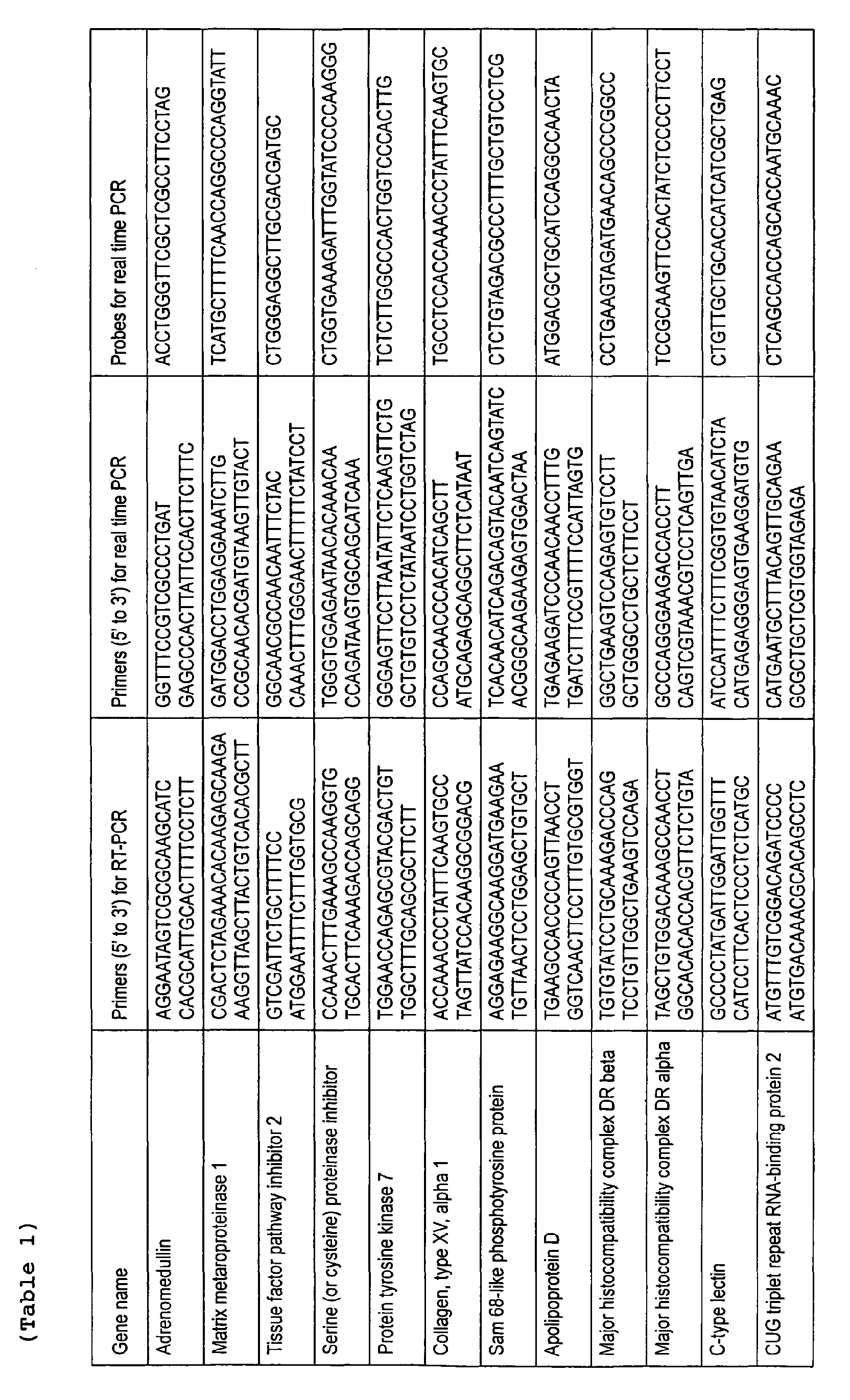
As a result of DNA microarray, it was revealed that 63
out of 9400 genes exhibited significantly higher expression,
and 141 out of 9400 genes exhibited significantly lower
expression in mesenchymal stem cells than in fibroblasts.
Significant differences were not observed in other genes. Among
87 genes which exhibited a difference of three-fold or more,
29 genes exhibited higher expression and 58 genes exhibited lower
expression in mesenchymal stem cells.
Total RNAs were extracted from mesenchymal stem cells
derived from 3 individuals and fibroblasts derived from 3
individuals, and by using them as a template, the expression
levels of the above-mentioned 87 genes were examined by
semiquantitative RT-PCR. As a result, most genes exhibited no
difference in the expression levels. In addition, there were
many cases wherein differences in the expression were considered
to be caused by individual differences, because differences in
the expression levels were observed between mesenchymal stem
cells, or fibroblasts, from different individuals (Fig. 1).
The following 3 genes were confirmed to exhibit high
expression in mesenchymal stem cells by RT-PCR: serine (or
cysteine) proteinase inhibitor (SEQ ID NO: 1 in the sequence
listing), major histocompatibility complex class2 DR beta 3 (SEQ
ID NO: 11), and tissue factor pathway inhibitor 2 (SEQ ID NO:
19) (Fig. 2).
In addition, the following 10 genes were confirmed to
exhibit low expression in mesenchymal stem cells by RT-PCR:
adrenomedullin (SEQ ID NO: 2), apolipoprotein D (SEQ ID NO:
4), collagenase type XV alpha 1 (SEQ ID NO: 6), CUG triplet repeat
RNA binding protein (SEQ ID NO: 7), dermatopontin protein (SEQ
ID NO: 9), isocitrate dehydrogenase 2 (SEQ ID NO: 10), tyrosine
kinase 7 (SEQ ID NO: 12), Sam68-like phosphotyrosine protein
(SEQ ID NO: 14), C-type lectin superfamily member 2 (SEQ ID NO:
15), and matrix metalloprotease 1 (SEQ ID NO: 17) (Fig. 3).
Further, with regard to the 13 genes, the expression levels were
confirmed by semiquantitative RT-PCR using total RNA extracted
from mesenchymal stem cells derived from 7 individuals and
fibroblasts derived from 4 individuals as a template (Fig. 4).
The expressions of the gene marker of the present invention
in human mesenchymal stem cells and human fibroblasts were
measured in the same manner as in Example 1. The primers for
RT-PCR and for real time PCR, and probes for real time PCR used
are shown in Table 2.
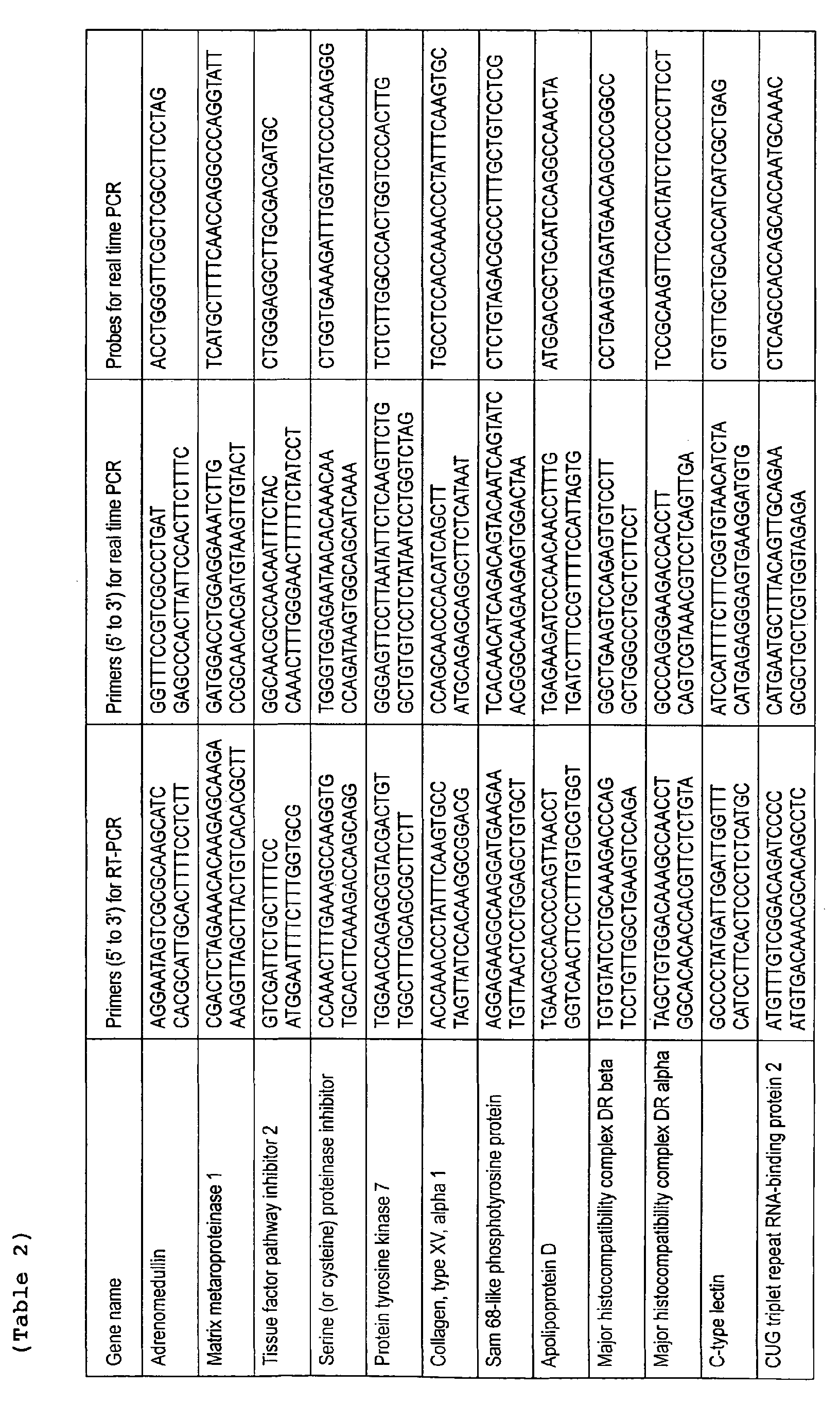
The expression state of mRNA level in mesenchymal stem
cells and human fibroblasts are shown in Fig. 5. The relative
expression state of mRNA level in mesenchymal stem cells and
human fibroblasts are shown in Figs. 6, 7, and 8.
The expressions of each gene marker of the present
invention in human mesenchymal stem cells and human fibroblasts
were measured in the same manner as in Example 1. The sense
and antisense primers for RT-PCR used are shown in SEQ ID NOs:
71 to 116 in the sequence listing. The expression state of genes
in mesenchymal stem cells and human fibroblasts are shown in
Figs. 9 and 10. The expression ratio, mesenchymal stem
cell/fibroblast, is shown in Table 3.
| MSC/fibroblast | Gene name |
| 11.6 | NTEGRIN, ALPHA 6 (ITGA6), MRNA |
| 8.7 | SOLUTE CARRIER FAMILY 20 (PHOSPHATE TRANSPORTER), MEMBER 1 |
| 7.8 | RIBONUCLEOTIDE REDUCTASE M2 POLYPEPTIDE (RRM2), MRNA |
| 7.6 | FOLLISTATIN (FST), TRANSCRIPT VARIANT FST317, MRNA |
| 7.3 | SPROUTY (DROSOPHILA) HOMOLOG 2 (SPRY2), MRNA |
| 6.9 | RAB3B, MEMBER RAS ONCOGENE FAMILY (RAB3B), MRNA |
| 6.5 | SOLUTE CARRIER FAMILY 2 (FACILITATED GLUCOSE TRANSPORTER) |
| 6.1 | INTERLEUKIN 13 RECEPTOR, ALPHA 2 (IL13RA2), MRNA |
| 5.9 | SERINE/THREONINE KINASE 12 (STK12), MRNA |
| 5.7 | MINICHROMOSOME MAINTENANCE DEFICIENT (S. CEREVISIAE) |
| 5.6 | THYROID HORMONE RECEPTOR INTERACTOR 13 (TRIP13), MRNA |
| 5.5 | KINESIN-LIKE 6 (MITOTIC CENTROMERE-ASSOCIATED KINESIN) |
| 5.5 | CYCLIN-DEPENDENT KINASE INHIBITOR 3 |
| 5.4 | CHROMOSOME CONDENSATION PROTEIN G (HCAP-G), MRNA |
| 5.2 | CDC28 PROTEIN KINASE 1 (CKS1), MRNA |
| 5.2 | PROTEIN REGULATOR OF CYTOKINESIS 1 (PRC1), MRNA |
| 5.2 | CELL DIVISION CYCLE 2, G1 TO S AND G2 TO M (CDC2), MRNA |
| 5.2 | CDC20 (CELL DIVISION CYCLE 20, S. CEREVISIAE, HOMOLOG) (CD |
| 5.1 | LIKELY ORTHOLOG OF MATERNAL EMBRYONIC LEUCINE ZIPPER KINAS |
| 5.1 | MINICHROMOSOME MAINTENANCE DEFICIENT (S. CEREVISIAE) 7 |
| 4.9 | YCLIN A2 (CCNA2), MRNA |
| 3.6 | THYMIDINE KINASE 1, SOLUBLE (TK1), MRNA |
| 0.6 | cyclin-dependent kinase inhibitor 2A (melanoma, p16, inhibits CDK4) (CDKN2A), mRNA |
The expressions of the gene marker of the present invention
in human mesenchymal stem cells and human fibroblasts were
measured in the same manner as in Example 1. The expression
ratio, mesenchymal stem cell/fibroblast, is shown in Table 4.
| (Mesenchymal stem cells/fibroblasts) | (Gene name) |
| 8.9 | EGF-containing fibulin-like extracellular matrix protein 1 |
| 8.4 | Human insulin-like growth factor binding protein 5 (IGFBP5) mRNA |
| 7.7 | Homo sapiens clone 24775 mRNA sequence |
| 7 | "proteoglycan 1, secretory granule" |
| 6.8 | insulin-like growth factor binding protein 5 |
| 6.7 | "solute carrier family 21 (organic anion transporter), member 3" |
| 6.5 | "transglutaminase 2 (C polypeptide,proteinglutamine-gamma-glutamyl transferase)" |
| 5.8 | coagulation factor II (thrombin) receptor |
| 5.6 | "plasminogen activator, urokinase" |
| 5.5 | "tissue inhibitor of metalloproteinase 3 (Sorsby fundus dystrophy, pseudoinflammatory)" |
| 5.1 | matrix Gla protein |
| 4.6 | B-cell CLL/lymphoma 1 |
| 4.6 | "CD74 antigen (invariant polypeptide of major histocompatibility complex, class II antigen-associated)" |
| 4.2 | adducin 3 (gamma) |
| 4.2 | "solute carrier family 16 (monocarboxylic acid transporters), member 4" |
| 3.4 | protein S (alpha) |
| 3.3 | "phosphatidylinositol (4,5) bisphosphate 5-phosphatase homolog; phosphatidylinositol |
| polyphosphate 5-phosphatase type IV" | |
| 3.2 | progesterone membrane binding protein |
| 3.2 | brain-derived neurotrophic factor |
| 3 | apolipoprotein E |
| 38.5 | "GI|6005949|REF|NM_007191.1| HOMO SAPIENS WNT INHIBITORY FACTOR-1 (WIF-1), MRNA" |
| 12.7 | "GI|8922916|REF|NM_018349.1| HOMO SAPIENS HYPOTHETICAL PROTEIN FLJ11175 (FLJ11175), MRNA" . |
| 11.2 | "GI|10835001|REF|NM_001175.1| HOMO SAPIENS RHO GDP DISSOCIATION INHIBITOR (GDI) BETA (ARHGDIB), MRNA" |
| 10.3 | "GI|11055973|REF|NM_021614.1| HOMO SAPIENS POTASSIUM INTERMEDIATE/SMALL CONDUCTANCE CALCIUM-ACTIVATE" |
| 8.7 | "GI|5731346|REF|NM_004289.3| HOMO SAPIENS NUCLEAR FACTOR (ERYTHROID-DERIVED 2)-LIKE 3 (NFE2L3), MRNA" |
| 7.6 | "GI|11056053|REF|NM_021643.1| HOMO SAPIENS GS3955 PROTEIN (GS3955), MRNA" |
| 7.5 | "EST10324 ADIPOSE TISSUE, WHITE I HOMO SAPIENS CDNA 3' END SIMILAR TO SIMILAR TO GLYCOPROTEIN MUC18," |
| 6.6 | "GI|13375818|REF|NM_024609.1| HOMO SAPIENS HYPOTHETICAL PROTEIN FLJ21841 (FLJ21841), MRNA" |
| 6.5 | "GI|6005971|REF|NM_007150.1| HOMO SAPIENS ZINC FINGER PROTEIN 185 (LIM DOMAIN) (ZNF185), MRNA" |
| 6.5 | "GNL|UG|HS#S2334464 SC1=PUTATIVE TRANS-ACTING FACTOR INVOLVED IN CELL CYCLE CONTROL [HUMAN, MRNA, 24" |
| 6.4 | "GI|7657368|REF|NM_014222.1| HOMO SAPIENS NADH DEHYDROGENASE (UBIQUINONE) 1 ALPHA SUBCOMPLEX, 8 (19K" |
| 6.3 | "GI|8924142|REF|NM_018518.1| HOMO SAPIENS HOMOLOG OF YEAST MCM10; HYPOTHETICAL PROTEIN PRO2249 (PRO2" |
| 6.2 | "GI|4502960|REF|NM_000094.1| HOMO SAPIENS COLLAGEN, TYPE VII, ALPHA 1 (EPIDERMOLYSIS BULLOSA, DYSTRO" |
| 6.2 | "GI|4502074|REF|NM_001144.1| HOMO SAPIENS AUTOCRINE MOTILITY FACTOR RECEPTOR (AMFR), MRNA" |
| 6.2 | GNL|UG|HS#S1090551 HOMO SAPIENS CLONE 24421 MRNA SEQUENCE /CDS=UNKNOWN /GB=AF070641 /GI=3283914 /UG= |
| 6.2 | GNL|UG|HS#S1570341 HOMO SAPIENS MRNA; CDNA DKFZP586E1621 (FROM CLONE DKFZP586E1621) /CDS=UNKNOWN /GB |
| 6.1 | "GI|11545760|REF|NM_022055.1| HOMO SAPIENS RESERVED (KCNK12), MRNA" |
| 6.0 | "GI|5902145|REF|NM_007019.1| HOMO SAPIENS UBIQUITIN-CONJUGATING ENZYME E2C (UBE2C), MRNA" |
| 5.9 | "GNL|UG|HS#S1970614 HOMO SAPIENS CDNA FLJ10517 FIS, CLONE |
| NT2RP2000812 /CDS=(61,918) /GB=AK001379 /G" | |
| 5.8 | "GI|4503052|REF|NM_001884.1| HOMO SAPIENS CARTILAGE LINKING PROTEIN 1 (CRTL1), MRNA" |
| 5.8 | GNL|UG|HS#S1972520 HOMO SAPIENS MRNA; CDNA DKFZP434F2322 (FROM CLONE DKFZP434F2322) /CDS=UNKNOWN /GB |
| 5.7 | "GNL|UG|HS#S3837475 HOMO SAPIENS, CLONE MGC:9549 IMAGE:3857382, MRNA, COMPLETE CDS /CDS=(92,1285) /G" |
| 5.4 | "GI|14150008|REF|NM_032270.1| HOMO SAPIENS HYPOTHETICAL PROTEIN DKFZP586J1119 (DKFZP586J1119), MRNA" |
| 5.4 | "GI|4758439|REF|NM_004877.1| HOMO SAPIENS GLIA MATURATION FACTOR, GAMMA (GMFG), MRNA" |
| 5.4 | "GNL|UG|HS#S2654530 HOMO SAPIENS CDNA: FLJ23095 FIS, CLONE LNG07413 /CDS=UNKNOWN /GB=AK026748 /GI=10" |
| 5.3 | "GI|8922180|REF|NM-018410.1| HOMO SAPIENS HYPOTHETICAL PROTEIN DKFZP762E1312 (DKFZP762E1312), MRNA" |
| 5.3 | "GI|5031806|REF|NM_005853.1| HOMO SAPIENS IROQUOIS-CLASS HOMEODOMAIN PROTEIN (IRX-2A), MRNA" |
| 5.2 | "GI|8922501|REF|NM_018131.1| HOMO SAPIENS HYPOTHETICAL PROTEIN FLJ10540 (FLJ10540), MRNA" |
| 5.1 | "GNL|UG|HS#S1972896 HOMO SAPIENS MRNA; CDNA DKFZP434C1915 (FROM CLONE DKFZP434C1915); PARTIAL CDS /C" |
| 5.1 | "GI|14149622|REF|NM_005916.1| HOMO SAPIENS MINICHROMOSOME MAINTENANCE DEFICIENT (S. CEREVISIAE) 7 (M" |
| 5.0 | "GI|4758177|REF|NM_004411.1| HOMO SAPIENS DYNEIN, CYTOPLASMIC, INTERMEDIATE POLYPEPTIDE 1 (DNCI1), M" |
| 5.0 | HUMAN MRNA FOR PROTEIN GENE PRODUCT (PGP) 9.5. |
| 5.0 | "GI|5453903|REF|NM_006479.1| HOMO SAPIENS RAD51-INTERACTING PROTEIN (PIR51), MRNA" |
| 4.9 | "GI|4502144|REF|NM_001168.1| HOMO SAPIENS BACULOVIRAL IAP REPEAT-CONTAINING 5 (SURVIVIN) (BIRC5), MR" |
| 4.9 | "GI|9945386|REF|NM_004482.2| HOMO SAPIENS UDP-N-ACETYL-ALPHA -D-GALACTOSAMINE:POLYPEPTIDE N-ACETYLGAL" |
| 4.9 | "GI|14327895|REF|NM_031966.1| HOMO SAPIENS CYCLIN B1 (CCNB1), MRNA" |
| 4.8 | "GI|6325465|REF|NM_004111.3| HOMO SAPIENS FLAP STRUCTURE-SPECIFIC ENDONUCLEASE 1 (FEN1), MRNA" |
| 4.8 | "GI|4507274|REF|NM_003600.1| HOMO SAPIENS SERINE/THREONINE KINASE 15 (STK15), MRNA" |
| 4.8 | "GI|6466452|REF|NM_002358.2| HOMO SAPIENS MAD2 (MITOTIC ARREST DEFICIENT, YEAST, HOMOLOG)-LIKE 1 (MA" |
| 4.7 | "GI|15421859|REF|NM_018454.2| HOMO SAPIENS NUCLEOLAR PROTEIN ANKT (ANKT), MRNA" |
| 4.7 | "GI|7661807|REF|NM_014176.1| HOMO SAPIENS HSPC150 PROTEIN SIMILAR TO UBIQUITIN-CONJUGATING ENZYME (H" |
| 4.7 | "GI|9845284|REF|NM_019885.1| HOMO SAPIENS CYTOCHROME P450 RETINOID METABOLIZING PROTEIN (P450RAI-2)," |
| 4.7 | "GI|4505372|REF|NM_002497.1| HOMO SAPIENS NIMA (NEVER IN MITOSIS GENE A)-RELATED KINASE 2 (NEK2), MR" |
| 4.7 | "GI|4502422|REF|NM_001202.1| HOMO SAPIENS BONE MORPHOGENETIC PROTEIN 4 (BMP4), MRNA" |
| 4.7 | "GNL|UG|HS#S1970775 HOMO SAPIENS CDNA FLJ10674 FIS, CLONE NT2RP2006436 /CDS=UNKNOWN /GB=AK001536/GI" |
| 4.7 | "GI|4585861|REF|NM_001809.2| HOMO SAPIENS CENTROMERE PROTEIN A (17KD) (CENPA), MRNA" |
| 4.6 | GNL|UG|HS#S1368141 HOMO SAPIENS MRNA; CDNA DKFZP564P116 (FROM CLONE DKFZP564P116) /CDS=UNKNOWN /GB=A |
| 4.6 | "GI|4507718|REF|NM_003318.1| HOMO SAPIENS TTK PROTEIN KINASE (TTK), MRNA" |
| 4.6 | "GI|4504896|REF|NM_002266.1| HOMO SAPIENS KARYOPHERIN ALPHA 2 (RAG COHORT 1, IMPORTIN ALPHA 1) (KPNA" |
| 4.6 | "GI|5729983|REF|NM_006596.1| HOMO SAPIENS POLYMERASE (DNA |
| DIRECTED), THETA (POLQ), MRNA" | |
| 4.5 | "GI|4758315|REF|NM_004454.1| HOMO SAPIENS ETS VARIANT GENE 5 (ETS-RELATED MOLECULE) (ETV5), MRNA" |
| 4.5 | "HOMO SAPIENS TRANSFORMING, ACIDIC COILED-COIL CONTAINING PROTEIN 3 (TAC" |
| 4.5 | "HOMO SAPIENS KINESIN-LIKE 1 (KNSL1), MRNA" |
| 4.5 | "HOMO SAPIENS CENTROMERE PROTEIN E (312KD) (CENPE), MRNA" |
| 4.5 | "HOMO SAPIENS CDNA, 3' END /CLONE=IMAGE:1651289 /CLONE_END=3' /GB=AI12" |
| 4.4 | "HOMO SAPIENS DISTAL-LESS HOMEO BOX 5 (DLX5), MRNA" |
| 4.4 | "HOMO SAPIENS V-MYB AVIAN MYELOBLASTOSIS VIRAL ONCOGENE HOMOLOG-LIKE 2 " |
| 4.4 | "HOMO SAPIENS SERUM DEPRIVATION RESPONSE (PHOSPHATIDYLSERINE -BINDING PRO" |
| 4.4 | "HOMO SAPIENS HYPOTHETICAL PROTEIN FLJ10604 (FLJ10604), MRNA" |
| 4.4 | "HOMO SAPIENS RIBONUCLEASE HI, LARGE SUBUNIT (RNASEHI), MRNA |
| 4.4 | "HOMO SAPIENS ANILLIN (DROSOPHILA SCRAPS HOMOLOG), ACTIN BINDING PROTEIN" |
| 4.4 | "HOMO SAPIENS H4 HISTONE FAMILY, MEMBER G (H4FG), MRNA" |
| 4.3 | "HOMO SAPIENS G PROTEIN-COUPLED RECEPTOR 37 (ENDOTHELIN RECEPTOR TYPE B-" |
| 4.3 | "HOMO SAPIENS UBIQUITIN CARRIER PROTEIN (E2-EPF), MRNA" |
| 4.3 | "HOMO SAPIENS, SIMILAR TO TUMOR DIFFERENTIALLY EXPRESSED 1, CLONE IMAGE:3639252, " |
| 4.2 | "HOMO SAPIENS HYPOTHETICAL PROTEIN MGC2577 (MGC2577), MRNA" |
| 4.2 | "HOMO SAPIENS HYPOTHETICAL PROTEIN FLJ13912 (FLJ13912), MRNA" |
| 4.2 | "HOMO SAPIENS ANNEXIN A3 (ANXA3), MRNA" |
| 4.2 | "HOMO SAPIENS STATHMIN 1/ONCOPROTEIN 18 (STMN1), MRNA" |
| 4.2 | "GNL|UG|HS#S3837587 HOMO SAPIENS, SIMILAR TO RIBOSOMAL PROTEIN L39, CLONE MGC:20168 IMAGE:4555759, M" |
| 4.2 | "HOMO SAPIENS POLO (DROSOPHIA)-LIKE KINASE (PLK), MRNA" |
The expression of the gene marker of the present invention
in human mesenchymal stem cells and human fibroblasts was
measured in the same manner as in Example 1. The expression
ratio, mesenchymal stem cell/fibroblast, is shown in Table 5.
In the table, "-" indicates that the gene exhibits no or extremely
low expression in mesenchymal stem cells.
| (Mesenchymal stem cells/fibroblasts) | (Gene name) |
| -53.576 | "HOMO SAPIENS PROTEASOME (PROSOME, MACROPAIN) 26S SUBUNIT, ATPASE, 5 (PS" |
| -45.692 | "HOMO SAPIENS EUKARYOTIC TRANSLATION INITIATION FACTOR 4 GAMMA, 2 (EIF4G" |
| -27.6354 | "HOMO SAPIENS DIHYDROPYRIMIDINASE-LIKE 3 (DPYSL3), MRNA" |
| -20.5446 | "HOMO SAPIENS ADAPTOR-RELATED PROTEIN COMPLEX 1, SIGMA 2 SUBUNIT (AP1S2)" |
| -19.5809 | "HOMO SAPIENS PLECTIN 1, INTERMEDIATE FILAMENT BINDING PROTEIN, 500KD P" |
| -16.9025 | "HOMO SAPIENS HETEROGENEOUS NUCLEAR RIBONUCLEOPROTEIN U (SCAFFOLD ATTAC" |
| -14.97 | "HOMO SAPIENS HYPOTHETICAL PROTEIN MGC5306 (MGC5306), MRNA" |
| -14.6106 | "HOMO SAPIENS MHC CLASS I POLYPEPTIDE-RELATED SEQUENCE A (MICA), MRNA" |
| -13.8886 | "HOMO SAPIENS PROTEIN ASSOCIATED WITH PRK1 (AWP1), MRNA" |
| -13.6578 | "HOMO SAPIENS PROGESTERONE RECEPTOR MEMBRANE COMPONENT 2 (PGRMC2), MRNA" |
| -11.4783 | "HOMO SAPIENS POLYGLUTAMINE BINDING PROTEIN 1 (PQBP1), MRNA" |
| -10.2392 | "HOMO SAPIENS S-ADENOSYLMETHIONINE DECARBOXYLASE 1 (AMD1), MRNA" |
| -9.9506 | "HOMO SAPIENS INTERFERON-INDUCED, HEPATITIS C-ASSOCIATED MICROTUBULARAG" |
| -9.2594 | "HOMO SAPIENS PROTEIN KINASE, AMP-ACTIVATED, GAMMA 1 NON-CATALYTIC SUBUN" |
| -7.518 | "HOMO SAPIENS PROCOLLAGEN-PROLINE, 2-OXOGLUTARATE 4-DIOXYGENASE (PROLINE" |
| -6.0365 | "HOMO SAPIENS ENDOTHELIAL DIFFERENTIATION, LYSOPHOSPHATIDIC ACID G-PROTE" |
| -5.4442 | "HOMO SAPIENS KIAA0127 GENE PRODUCT (KIAA0127), MRNA"*" |
The expression of mesenchymal stem cell DR in human cells
was measured with flow cytometry. The results are shown in Fig.
11.
The changes in the expression of each gene in
differentiation induction of mesenchymal stem cells were
measured by using RT-PCR in the same manner as in Example 1.
The expressions of each gene in differentiation induction of
osteoblasts are shown in Figs. 12 to 16.
Recently, with the development of regenerative medicine,
mesenchymal stem cells draw attention as xenograft, homograft
and autograft materials for regenerative medicine of many tissues .
In order to use mesenchymal stem cells for regenerative medicine
of tissues, it is necessary to develop techniques for securing
a sufficient amount of mesenchymal stem cells, and to confirm
that the cultured cells are mesenchymal stem cells, and a method
for detecting and distinguishing the mesenchymal stem cells
becomes important. It is also helpful for separating
mesenchymal stem cells from a group of many kinds of cells by
using antibodies, etc. Marker genes which characterize
mesenchymal stem cells are identified in the present invention,
and as a result, it becomes possible to detect and distinguish
mesenchymal stem cells easily and assuredly, and thereby
substantial contribution to the practical use of mesenchymal
stem cells in regenerative medicine is expected.
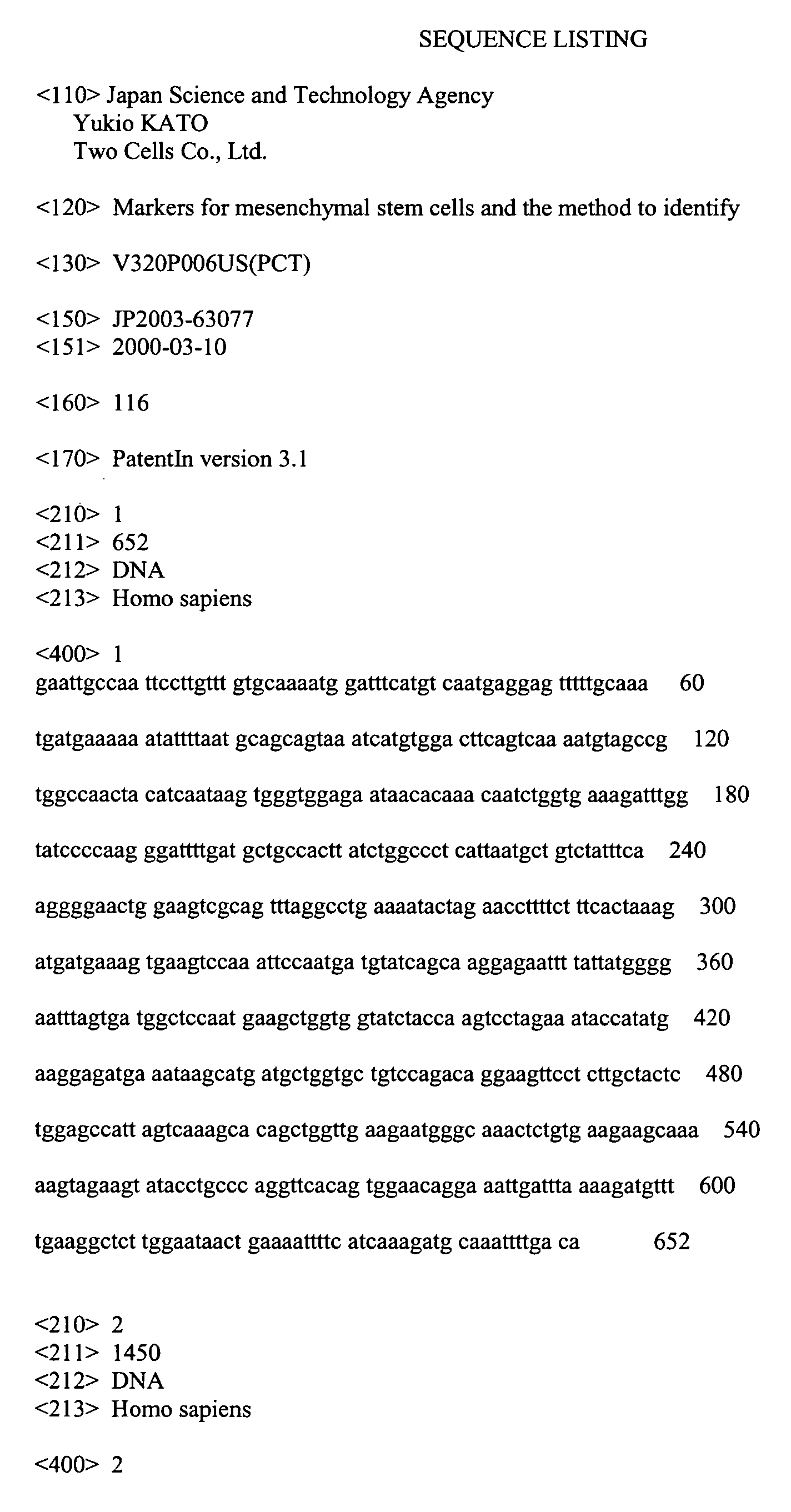


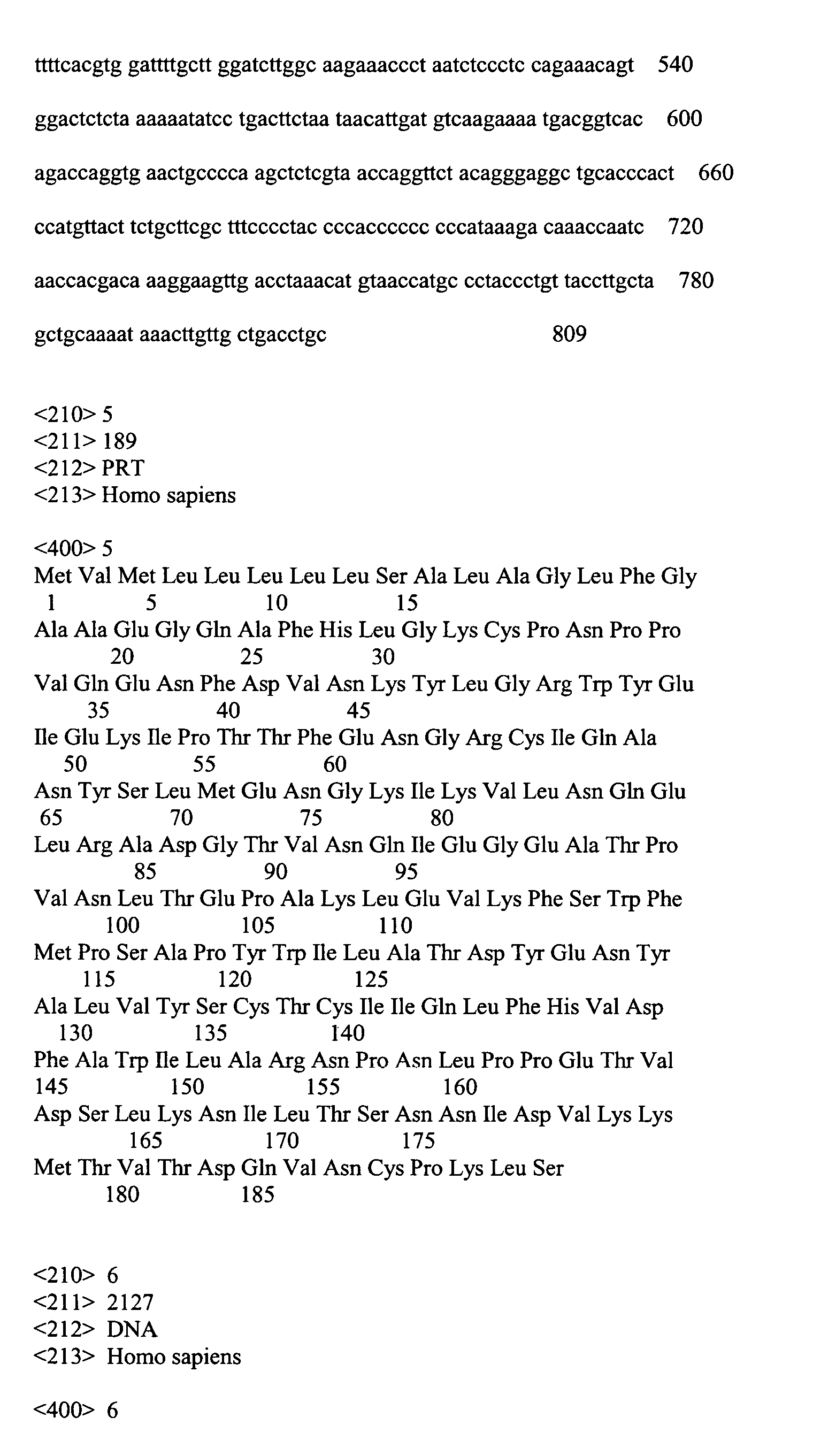

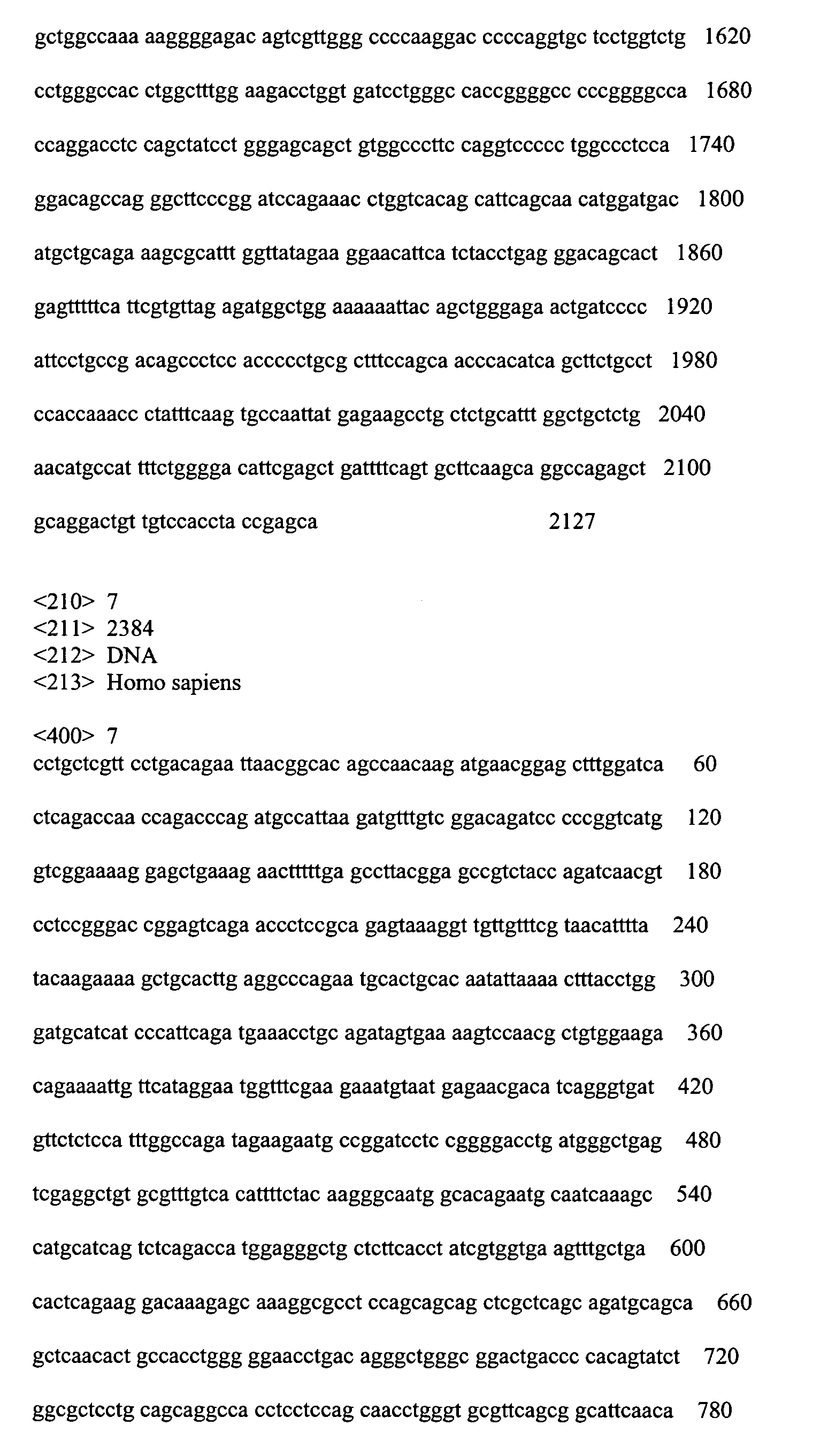
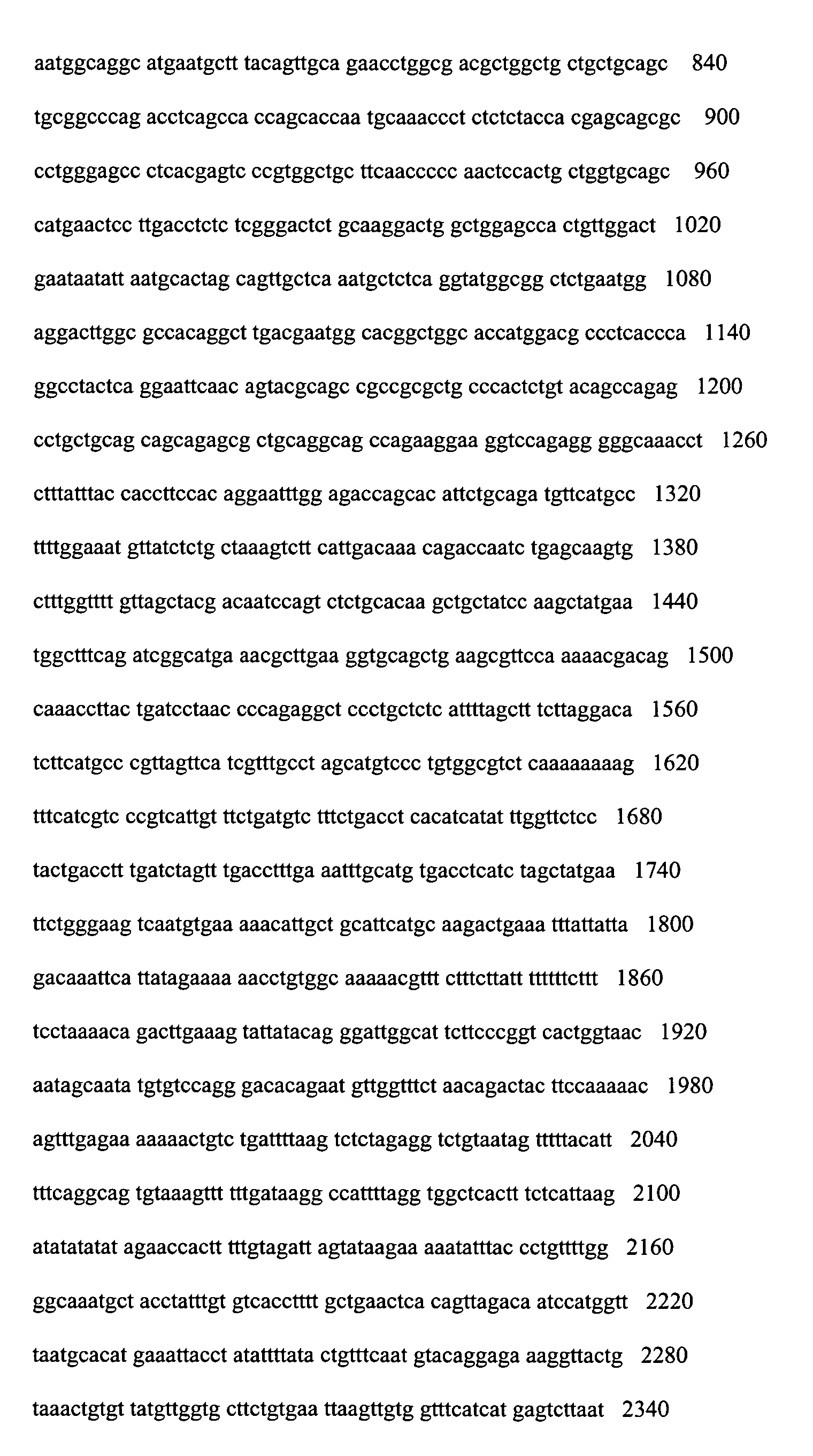
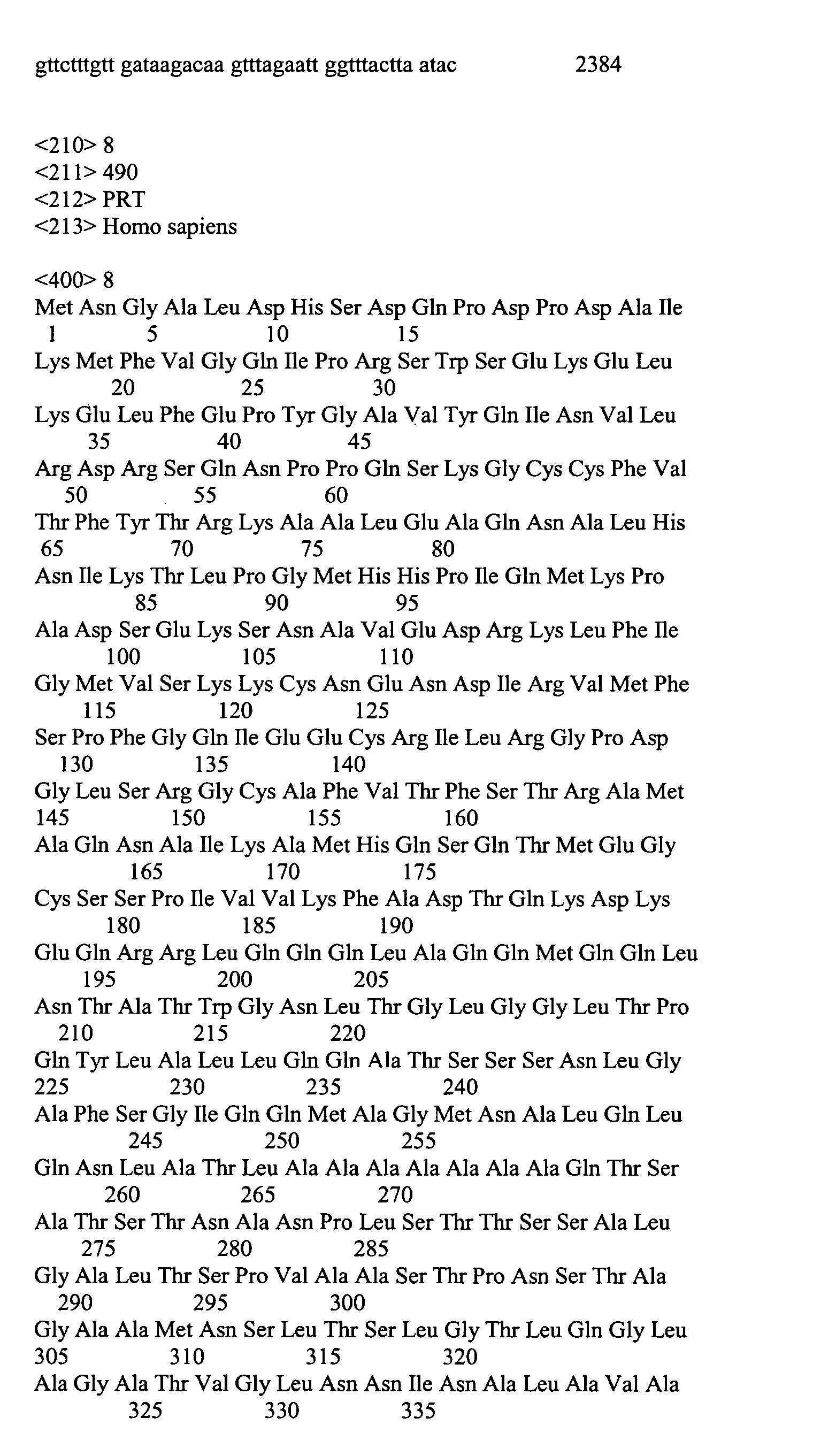
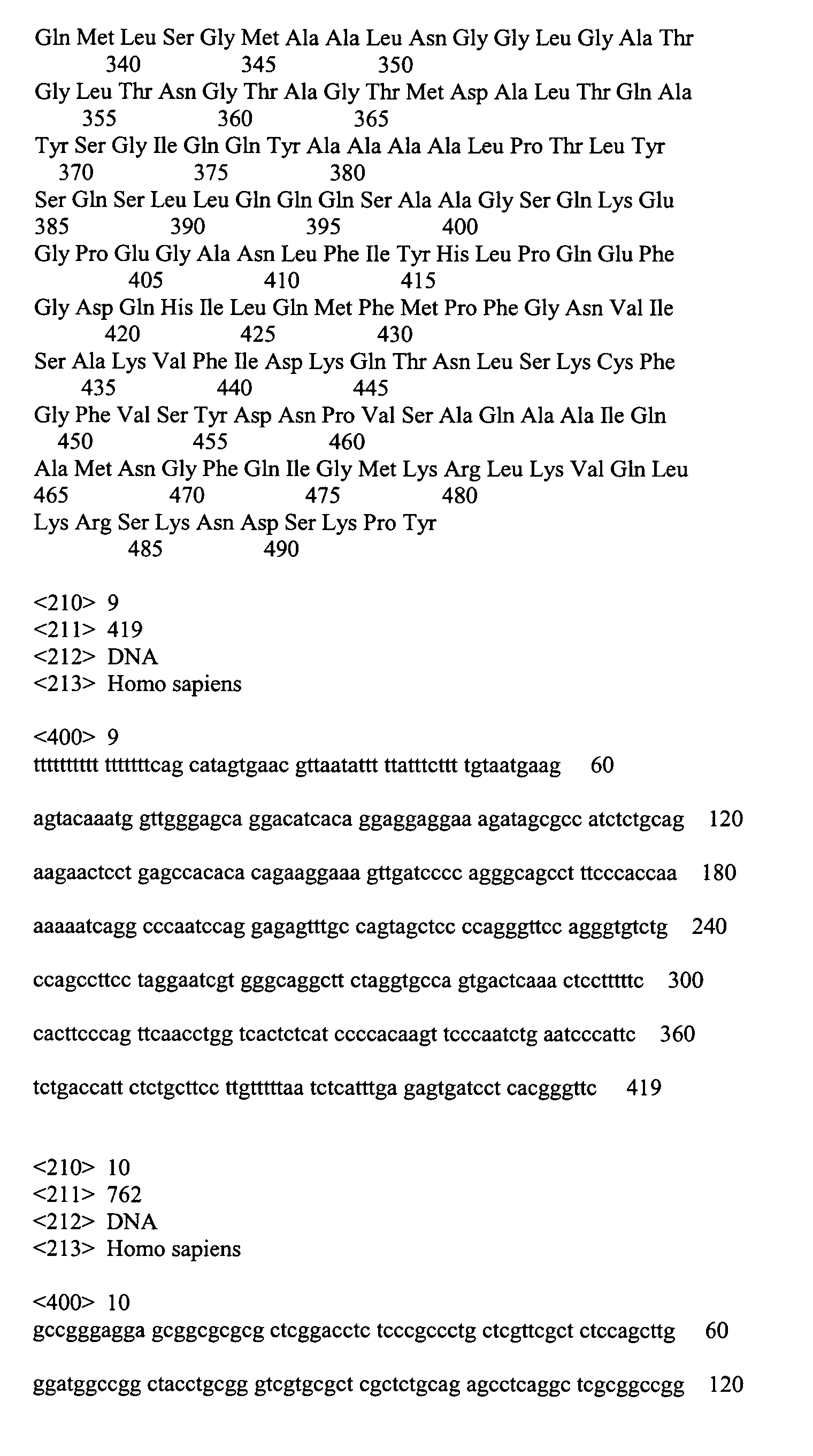
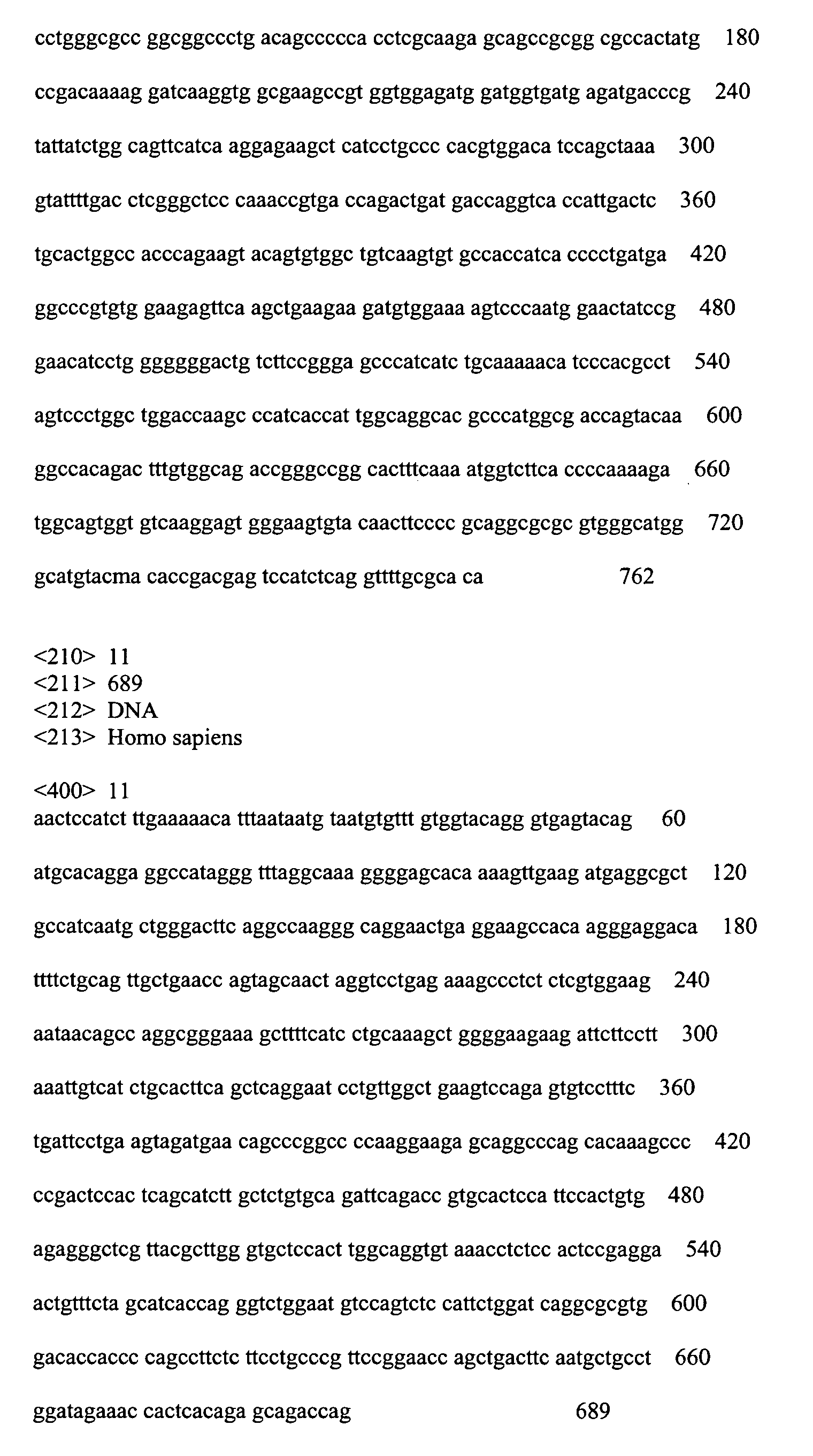


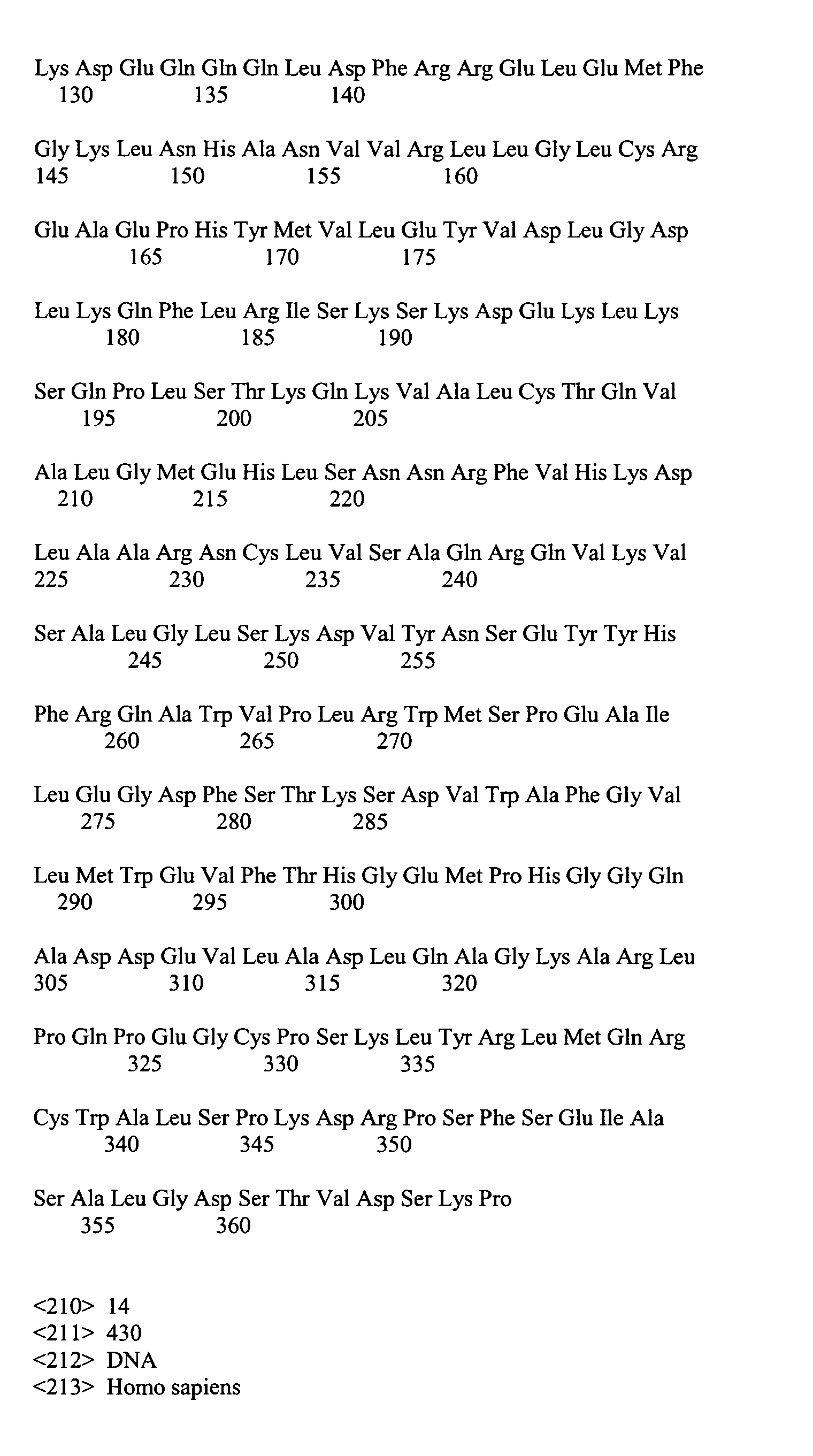


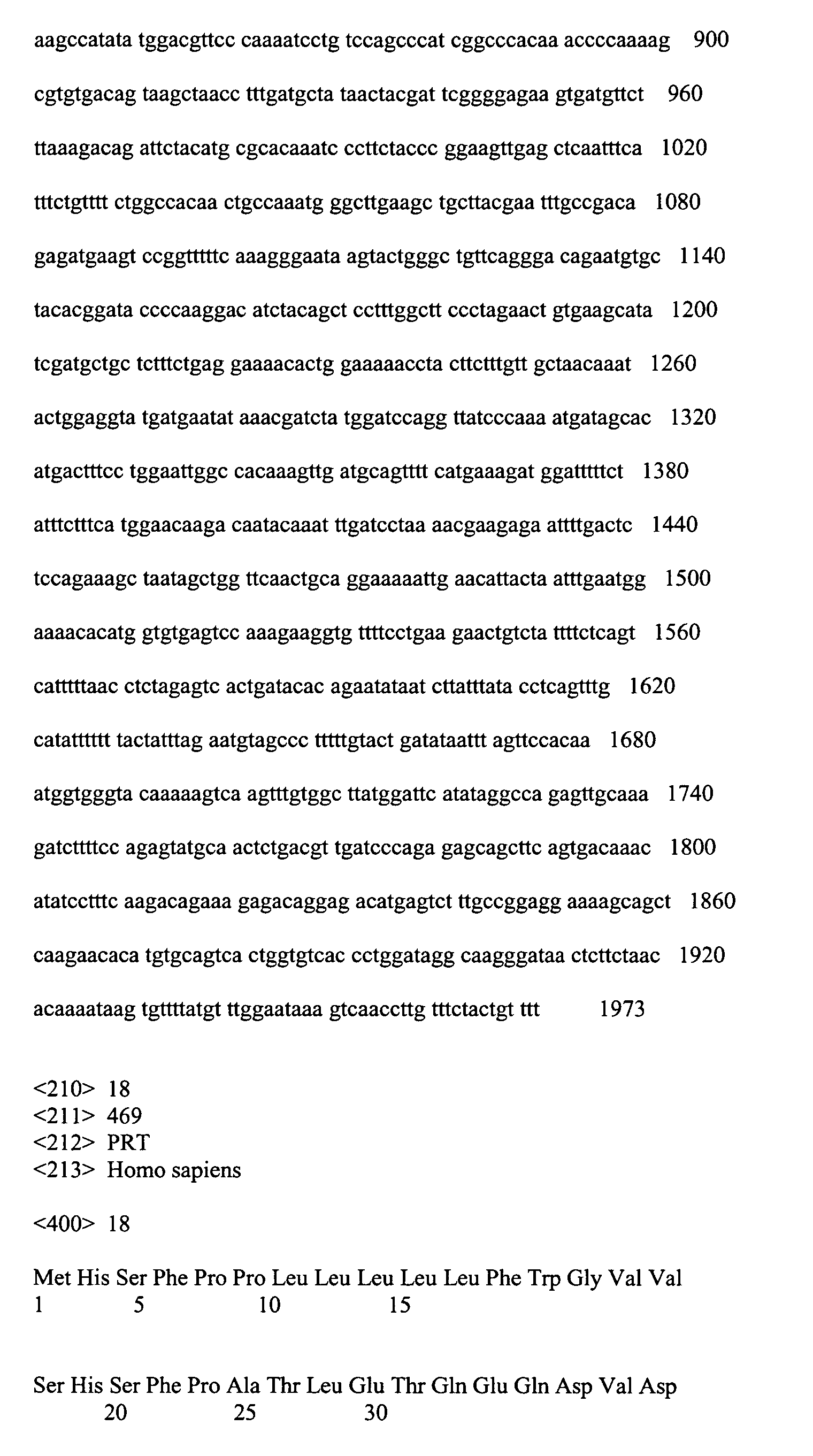

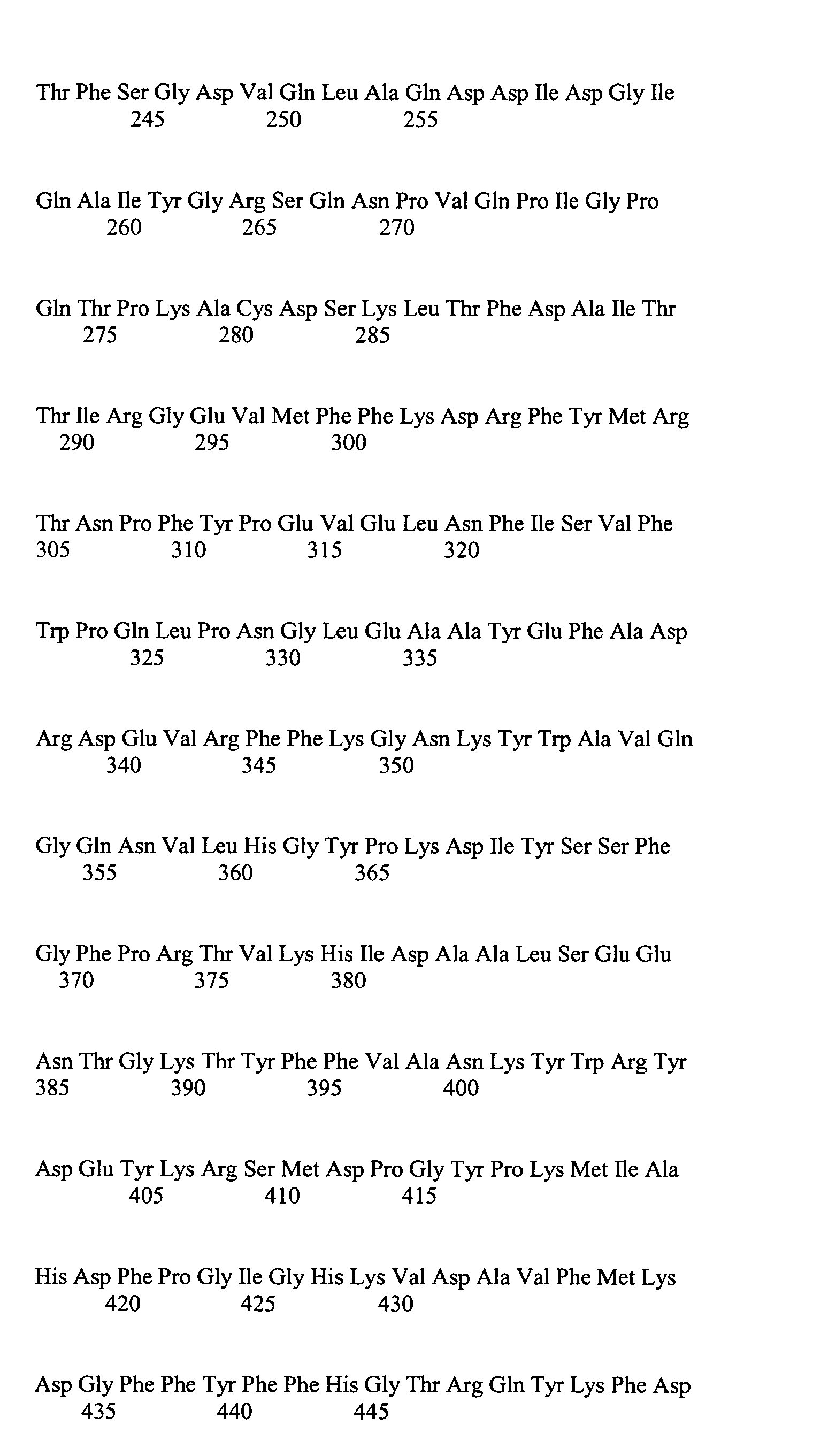


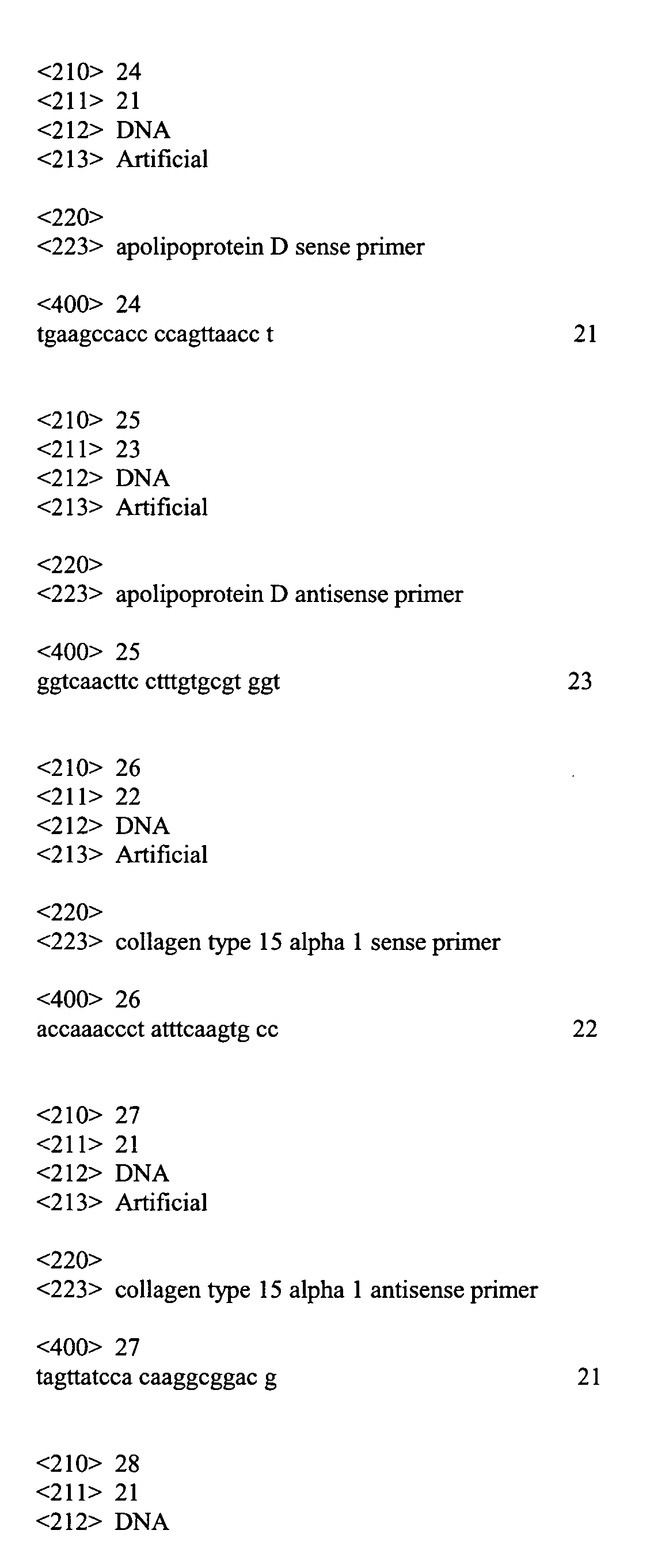
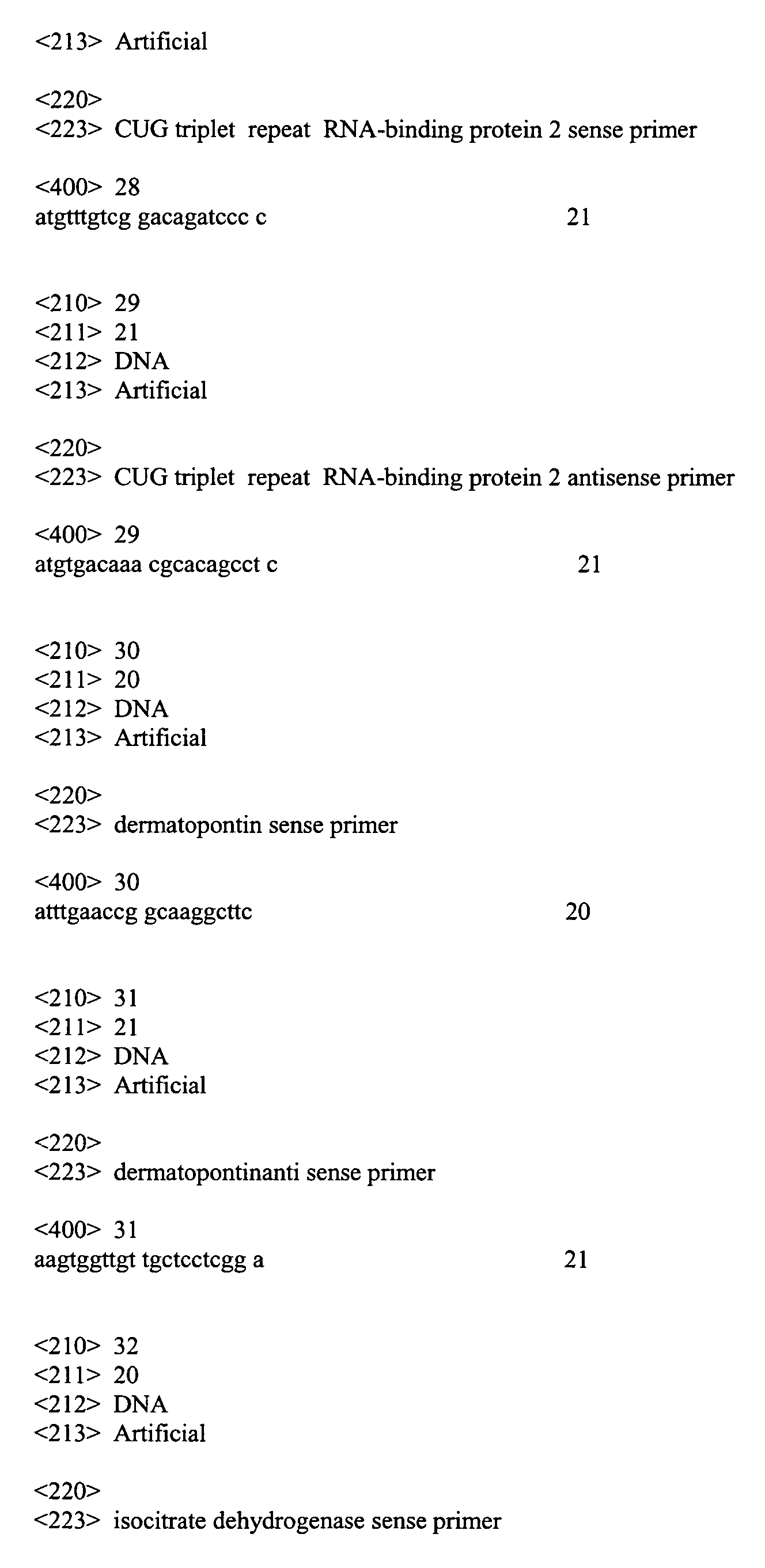
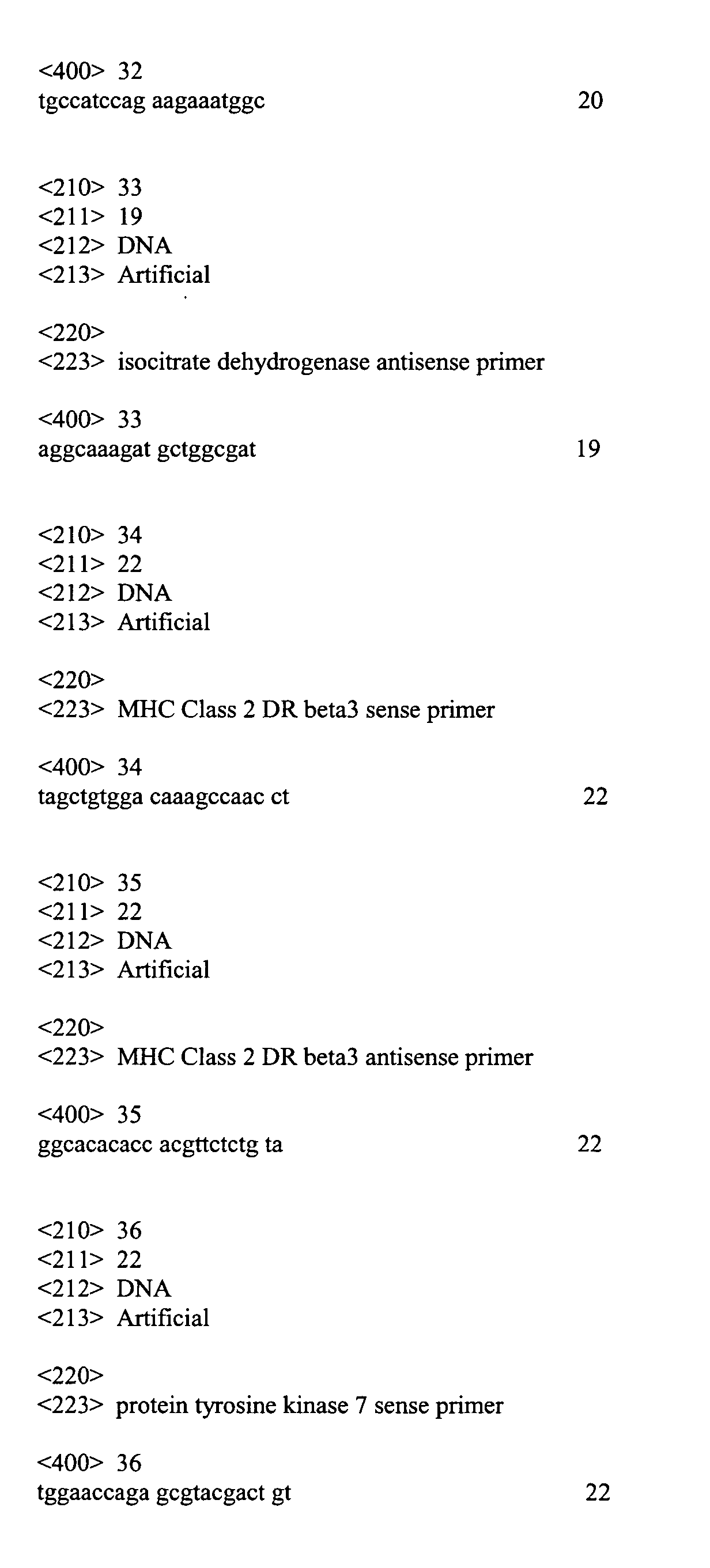
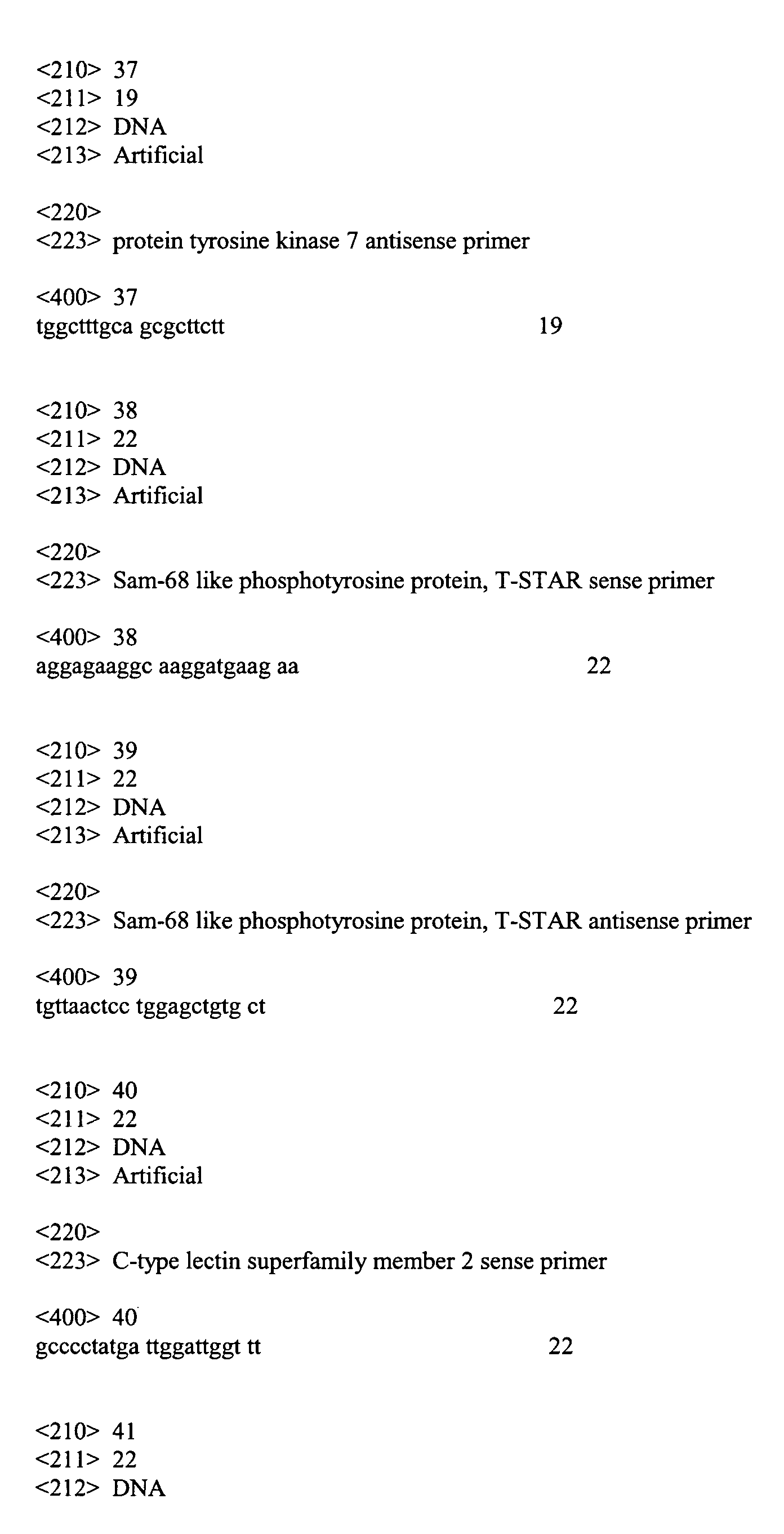


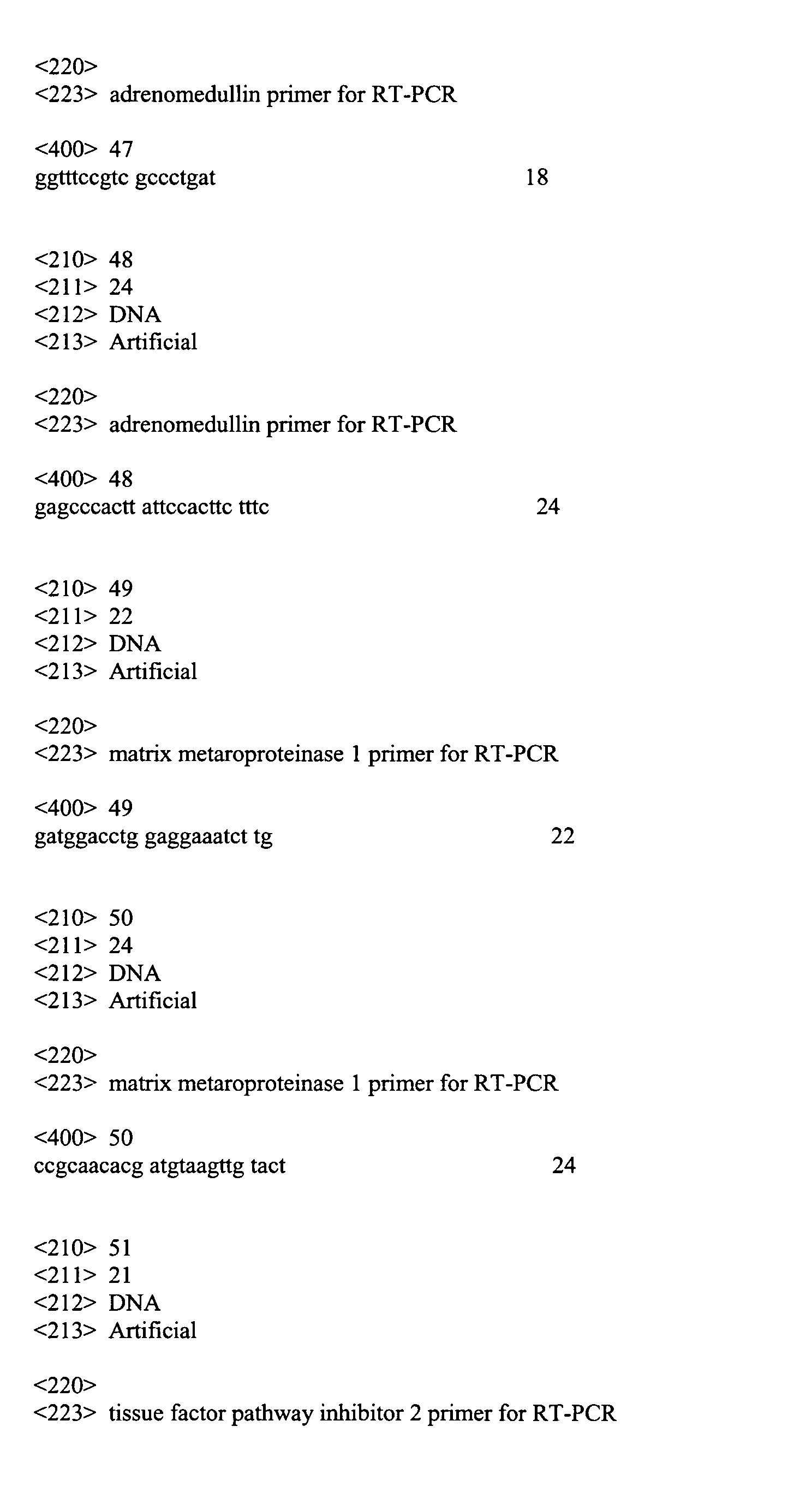
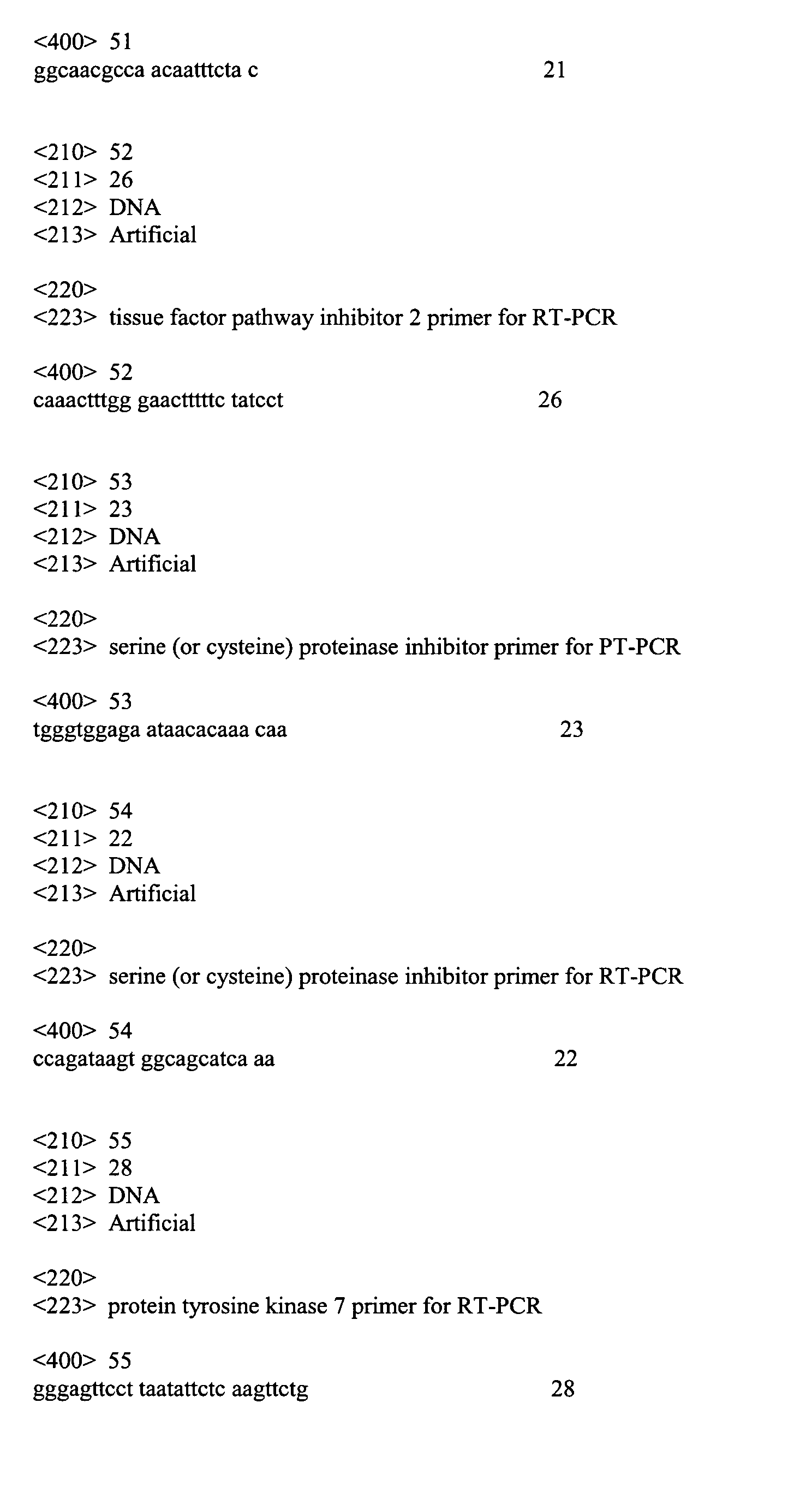
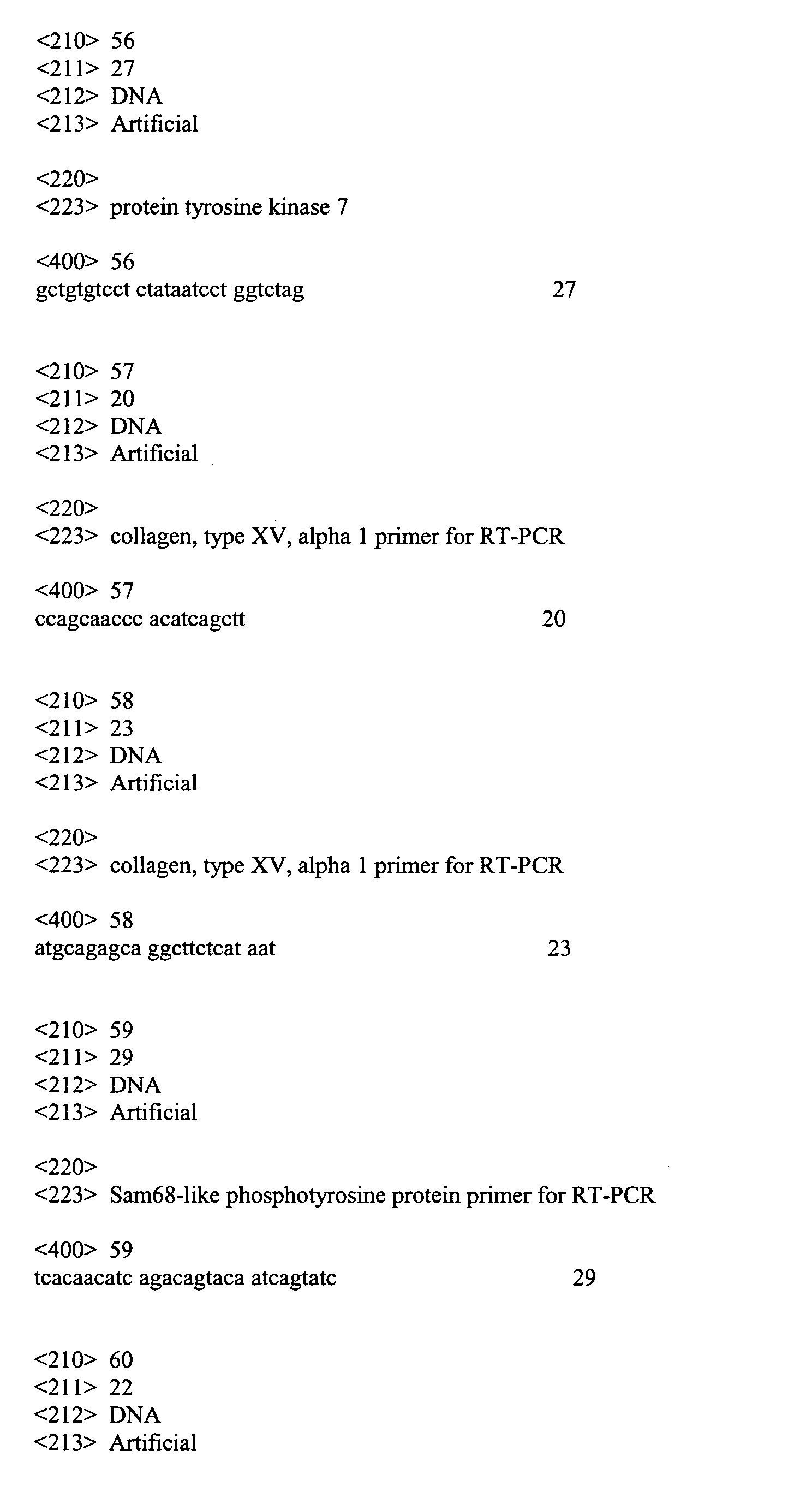
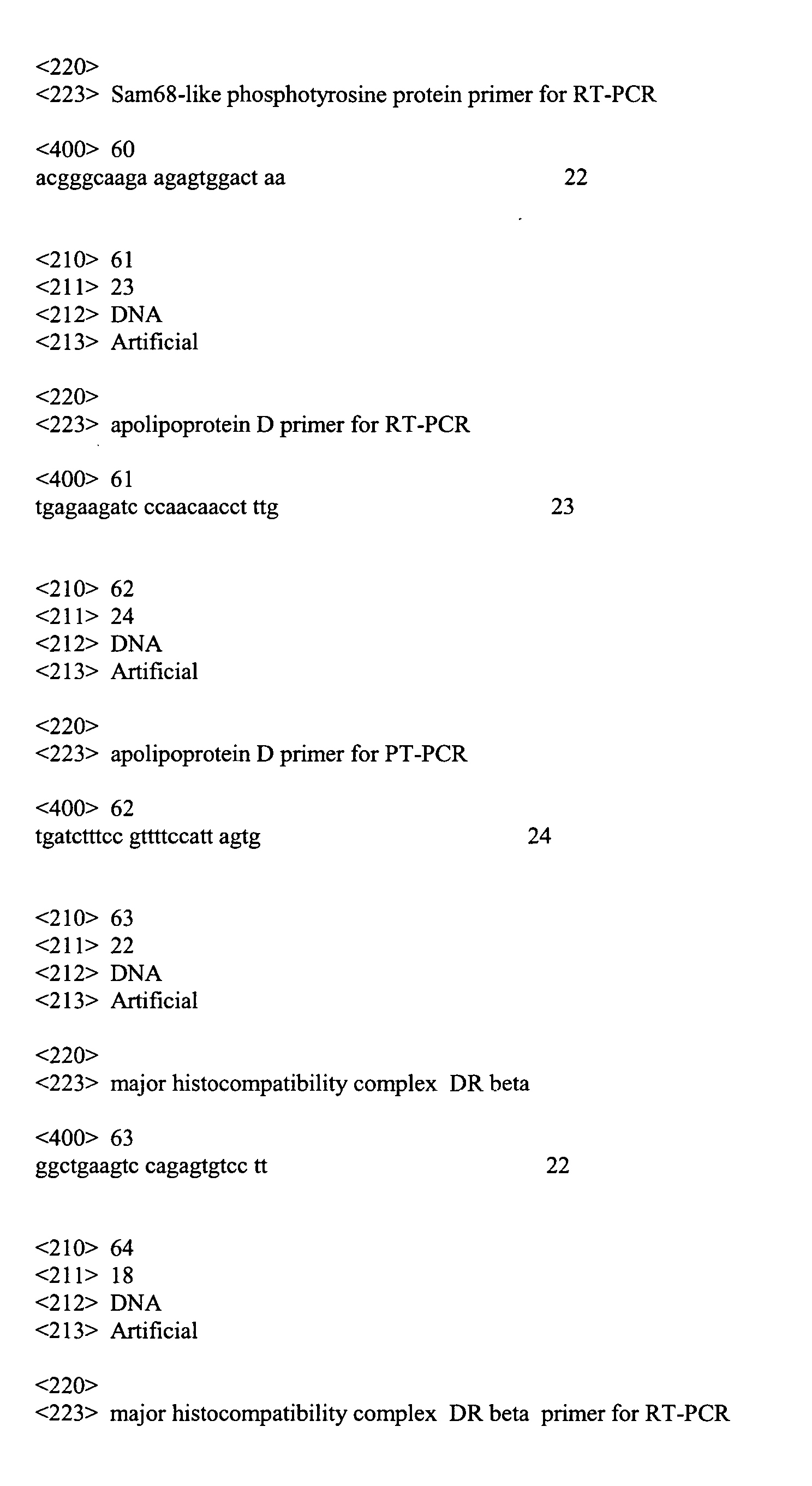


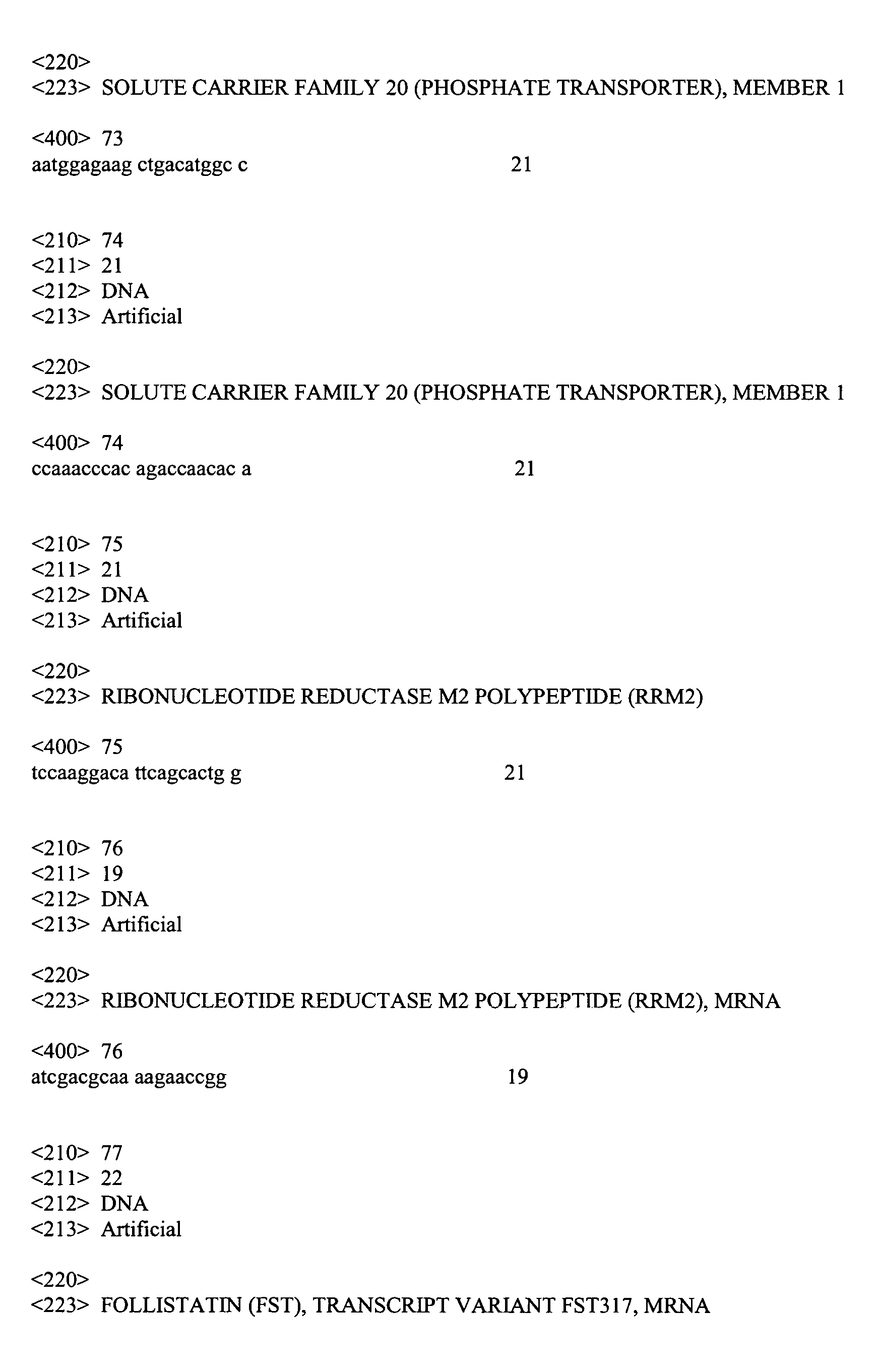


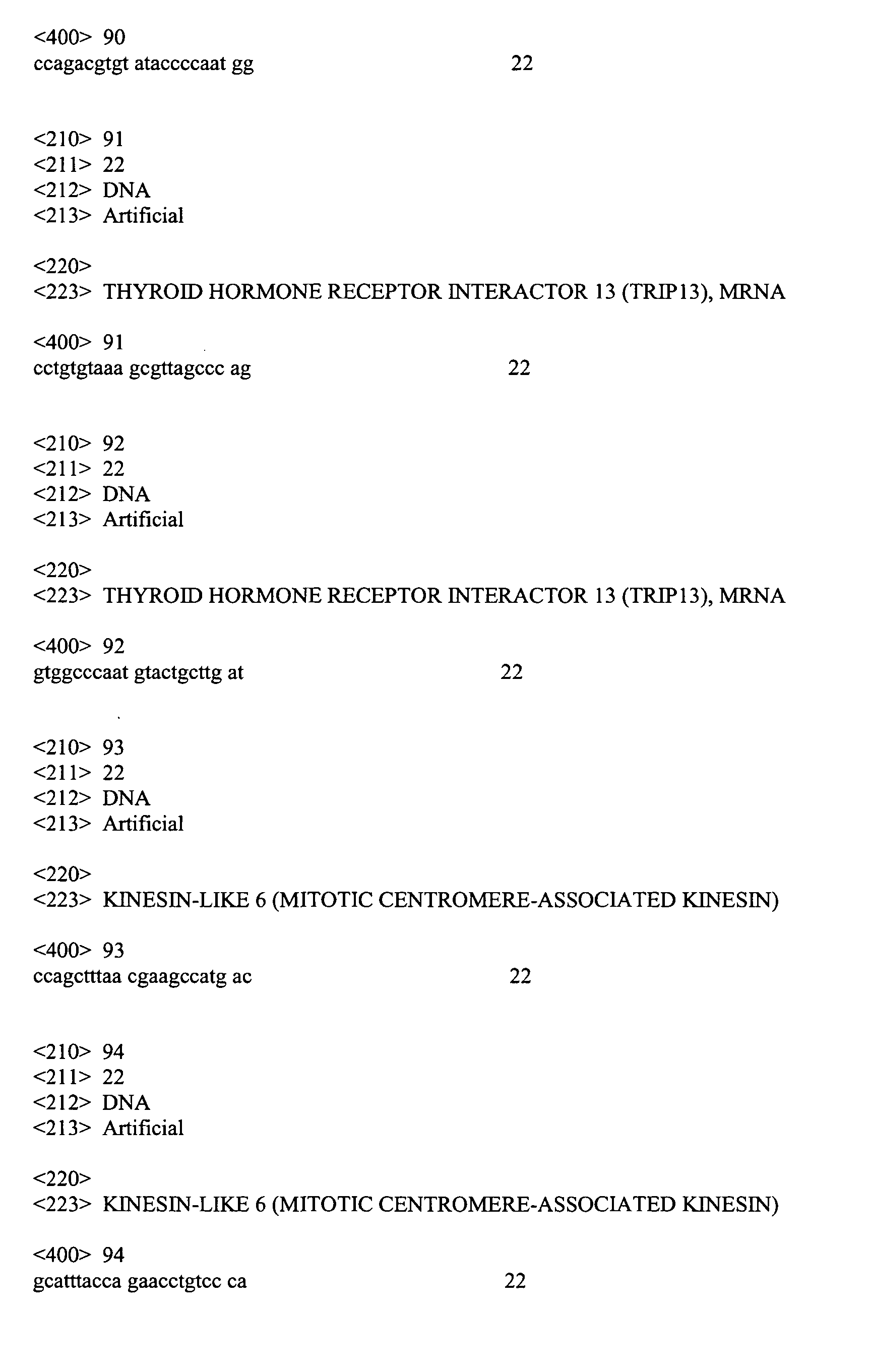
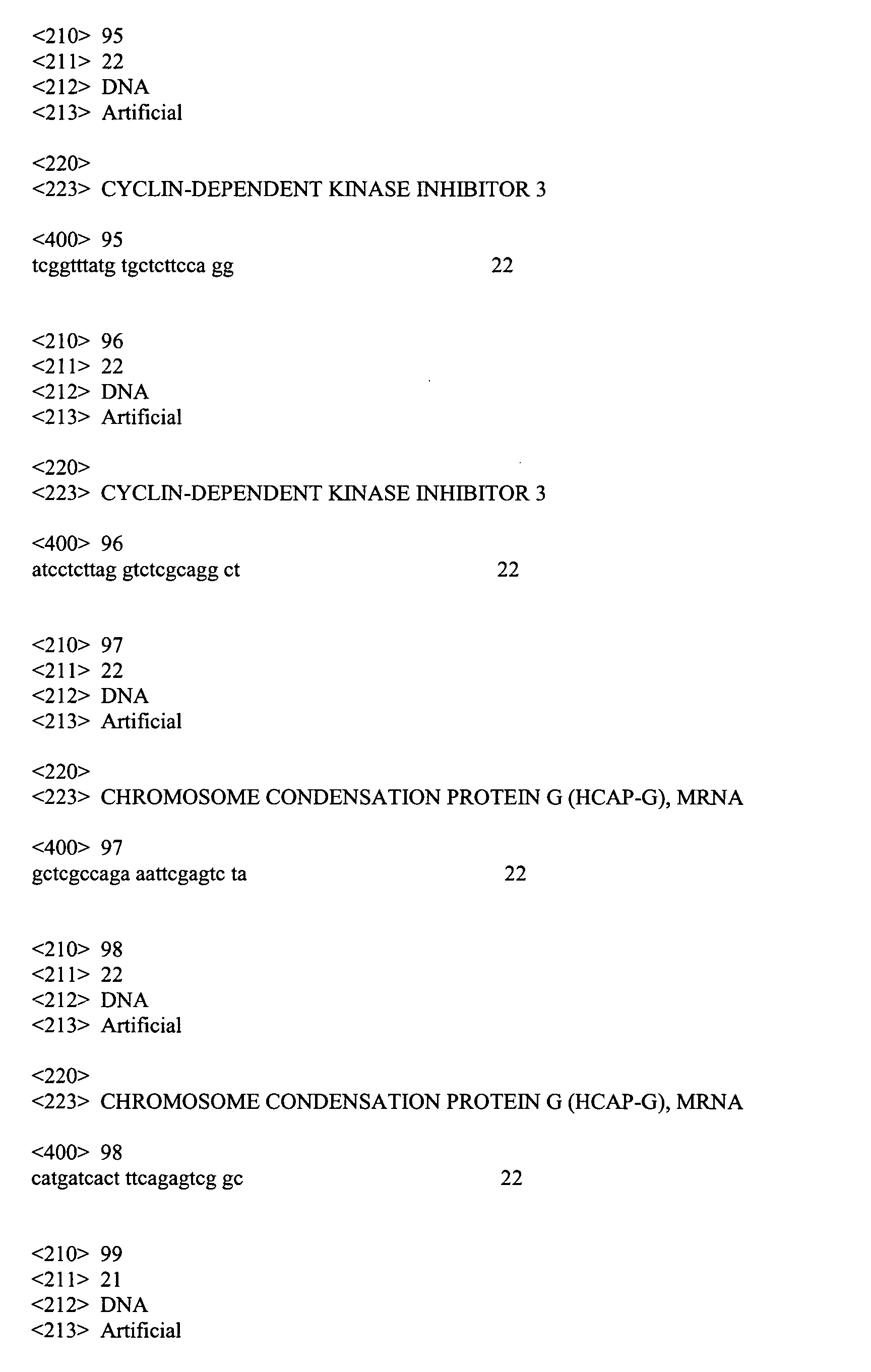


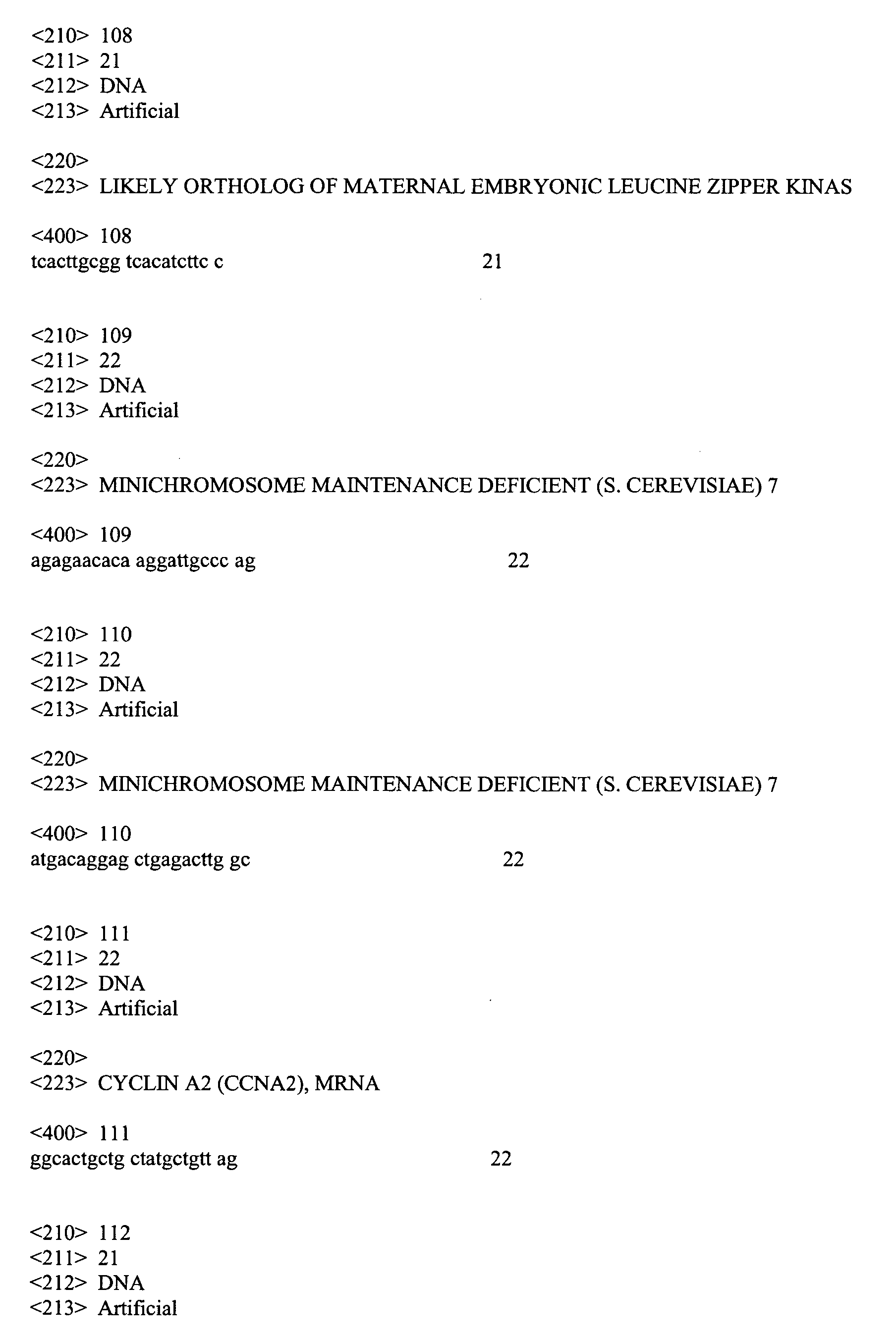

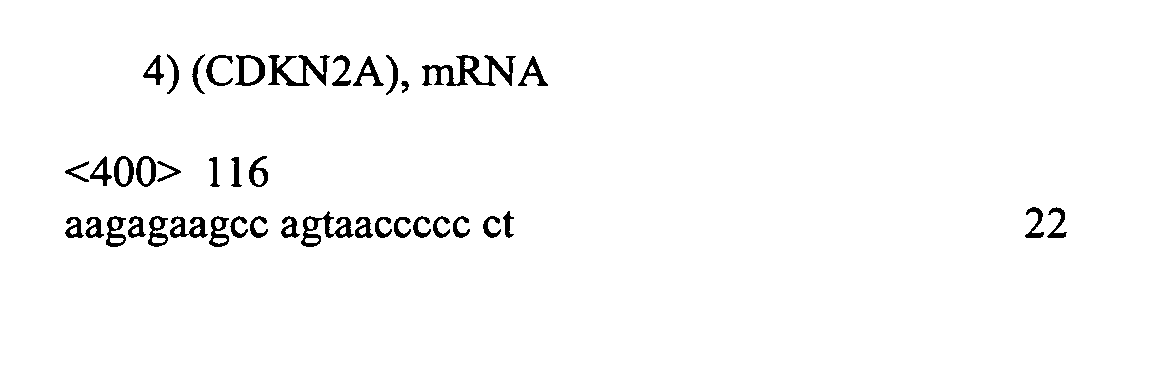
Claims (32)
- A gene marker for detecting a mesenchymal stem cell which is a gene having a base sequence shown in SEQ ID NO: 1, 2, 4, 6, 7, 9, 10, 11, 12, 14, 15, 17, 19 or 46 in the sequence listing.
- A gene marker for detecting a mesenchymal stem cell which is a gene of INTEGRIN, ALPHA 6 (ITGA6), MRNA (NM_000210); a gene of SOLUTE CARRIER FAMILY 20 (PHOSPHATE TRANSPORTER), MEMBER 1 (NM_005415); a gene of RIBONUCLEOTIDE REDUCTASE M2 POLYPEPTIDE (RRM2), MRNA(NM_001034); a gene of FOLLISTATIN(FST), TRANSCRIPT VARIANT FST317, MRNA (NM_006350); a gene of SPROUTY (DROSOPHILA) HOMOLOG 2 (SPRY2), MRNA (NM_005842); a gene of RAB3B, MEMBER RAS ONCOGENE FAMILY (RAB3B), MRNA (NM_002867); a gene of SOLUTE CARRIER FAMILY 2 (FACILITATED GLUCOSE TRANSPORTER) (NM_006516); a gene of INTERLEUKIN 13 RECEPTOR, ALPHA 2 (IL13RA2), MRNA (NM_000640); a gene of SERINE/THREONINE KINASE 12 (STK12), MRNA (NM_004217); a gene of MINICHROMOSOME MAINTENANCE DEFICIENT (S. CEREVISIAE) 5 (CE) (NM_006739); a gene of THYROID HORMONE RECEPTOR INTERACTOR 13 (TRIP13), MRNA (NM_004237); a gene of KINESIN-LIKE 6 (MITOTIC CENTROMERE-ASSOCIATED KINESIN) (K) (NM_006845); a gene of CYCLIN-DEPENDENT KINASE INHIBITOR 3 (CDK2-ASSOCIATED DUAL (NM_005192); a gene of CHROMOSOME CONDENSATION PROTEIN G (HCAP-G), MRNA (NM_022346); a gene of CDC28 PROTEIN KINASE 1 (CKS1), MRNA (NM_001826); a gene of PROTEIN REGULATOR OF CYTOKINESIS 1 (PRC1), MRNA (NM_003981); a gene of CELL DIVISION CYCLE 2, G1 TO S AND G2 TOM (CDC2), MRNA (NM_001786); a gene of CDC20 (CELL DIVISION CYCLE 20, S. CEREVISIAE, HOMOLOG) (CD) (NM_001255); a gene of LIKELY ORTHOLOG OF MATERNAL EMBRYONIC LEUCINE ZIPPER KINAS (NM_014791); a gene of MINICHROMOSOME MAINTENANCE DEFICIENT (S. CEREVISIAE) 7 (M) (NM_005916); a gene of CYCLINA2 (CCNA2), MRNA (NM_001237); a gene of THYMIDINE KINASE 1, SOLUBLE (TK1), MRNA (NM_003258); or a gene of cyclin-dependent kinase inhibitor 2A (melanoma, p16, inhibits CDK4) (CDKN2A), mRNA (NM_000077).
- A gene marker for detecting a mesenchymal stem cell which is a gene of EGF-containing fibulin-like extracellular matrix protein 1 (NM_018894); a gene of Human insulin-like growth factor binding protein 5 (IGFBP5) mRNA (AU132011); a gene of Homo sapiens clone 24775 mRNA sequence (AA402981); proteoglycan 1, secretory granule (AV734015); a gene of insulin-like growth factor binding protein 5 (AA374325); a gene of solute carrier family 21 (organic anion transporter), member 3 (AF085224); a gene of transglutaminase 2 (C polypeptide, protein-glutamine-gamma-glutamyl transferase) (AL552373); a gene of coagulation factor II (thrombin) receptor (M62424); a gene of plasminogen activator, urokinase (NM_002658); a gene of tissue inhibitor of metalloproteinase 3 (Sorsby fundus dystrophy, pseudoinflammatory) (W96324); a gene of matrix Gla protein (BF668572); a gene of B-cell CLL/lymphoma 1 (Z23022); a gene of CD74 antigen (invariant polypeptide of major histocompatibility complex, class II antigen-associated) (BG333618); a gene of adducin 3 (gamma) (AL135243); a gene of solute carrier family 16 (monocarboxylic acid transporters), member 4 (NM_004696); a gene of protein S (alpha) (NM_000313); a gene of phosphatidylinositol (4,5) bisphosphate 5-phosphatase homolog; phosphatidylinositol polyphosphate 5-phosphatase type IV (AF187891); a gene of progesterone membrane binding protein (BE858855); a gene of brain-derived neurotrophic factor (X60201); or a gene of apolipoprotein E (BF967316).
- A gene marker for detecting a mesenchymal stem cell which is a gene of HOMO SAPIENS WNT INHIBITORY FACTOR-1 (WIF-1), MRNA(NM_007191); a gene of HOMO SAPIENS HYPOTHETICAL PROTEIN FLJ11175 (FLJ11175), MRNA (NM_018349): a gene of HOMO SAPIENS RHO GDP DISSOCIATION INHIBITOR (GDI) BETA (ARHGDIB), MRNA (NM_001175); a gene of HOMO SAPIENS POTASSIUM INTERMEDIATE/SMALL CONDUCTANCE CALCIUM-ACTIVATE (NM_021614); a gene of HOMO SAPIENS NUCLEAR FACTOR (ERYTHROID-DERIVED 2)-LIKE 3 (NFE2L3), MRNA (NM_004289); a gene of HOMO SAPIENS GS3955 PROTEIN (GS3955), MRNA (NM_021643); a gene of HOMO SAPIENS CDNA 3' END SIMILAR TO SIMILAR TO GLYCOPROTEIN MUC18 (AA302605); a gene of HOMO SAPIENS HYPOTHETICAL PROTEIN FLJ21841 (FLJ21841), MRNA (NM_024609); a gene of HOMO SAPIENS ZINC FINGER PROTEIN 185 (LIM DOMAIN) (ZNF185), MRNA (NK_007150); a gene of SC1 = PUTATIVE TRANS-ACTING FACTOR INVOLVED IN CELL CYCLE CONTROL [HUMAN, MRNA, 24] (S53374); a gene of HOMO SAPIENS NADH DEHYDROGENASE (UBIQUINONE) 1 ALPHA SUBCOMPLEX, 8 (19K) (NM_014222); a gene of HOMO SAPIENS HOMOLOG OF YEAST MCM10; HYPOTHETICAL PROTEIN PRO2249 (PRO2) (NM_018518); a gene of HOMO SAPIENS COLLAGEN, TYPE VII, ALPHA 1 (EPIDERMOLYSIS BULLOSA, DYSTRO (NM_000094); a gene of HOMO SAPIENS AUTOCRINE MOTILITY FACTOR RECEPTOR (AMFR), MRNA (NM_001144); a gene of HOMO SAPIENS CLONE 24421 MRNA SEQUENCE /CDS = UNKNOWN /GB = AF070641 /GI = 3283914 /UG = (AF070641); a gene of HOMO SAPIENS MRNA; a gene of CDNA DKFZP586E1621 (FROM CLONE DKFZP586E1621) /CDS = UNKNOWN /GB (AL080235).
- A gene marker for detecting a mesenchymal stem cell which is a gene of HOMO SAPIENS RESERVED (KCNK12), MRNA (NM_022055); a gene of HOMO SAPIENS UBIQUITIN-CONJUGATING ENZYME E2C (UBE2C), MRNA (NM_007019); a gene of HOMO SAPIENS CDNA FLJ10517 FIS, CLONE NT2RP2000812 /CDS = (61,918) /GB = AK001379 /G (AK001379); a gene of HOMO SAPIENS CARTILAGE LINKING PROTEIN 1 (CRTL1), MRNA (NM_001884); a gene of HOMO SAPIENS MRNA; CDNA DKFZP434F2322 (FROM CLONE DKFZP434F2322) /CDS = UNKNOWN /GB (AL133105); a gene of HOMO SAPIENS, CLONE MGC:9549 IMAGE:3857382, MRNA, COMPLETE CDS /CDS = (92,1285) /G (BC012453); a gene of HOMO SAPIENS HYPOTHETICAL PROTEIN DKFZP586J1119 (DKFZP586J1119), MRNA (NM_032270); a gene of HOMO SAPIENS GLIA MATURATION FACTOR, GAMMA (GMFG), MRNA (NM_004877); a gene of HOMO SAPIENS CDNA: FLJ23095 FIS, CLONE LNG07413 /CDS = UNKNOWN /GB = AK026748 /GI = 10 (AK026748); a gene of HOMO SAPIENS HYPOTHETICAL PROTEIN DKFZP762E1312 (DKFZP762E1312), MRNA (NM_018410); a gene of HOMO SAPIENS IROQUOIS-CLASS HOMEODOMAIN PROTEIN (IRX-2A), MRNA (NM_005853); or a gene of HOMO SAPIENS HYPOTHETICAL PROTEIN FLJ10540 (FLJ10540), MRNA (NM_018131).
- A gene marker for detecting a mesenchymal stem cell which is a gene of HOMO SAPIENS MRNA; CDNA DKFZP434C1915 (FROM CLONE DKFZP434C1915); PARTIAL CDS /C (AL137698); a gene of HOMO SAPIENS MINICHROMOSOME MAINTENANCE DEFICIENT (S. CEREVISIAE) 7 (M) (NM_005916); a gene of HOMO SAPIENS DYNEIN, CYTOPLASMIC, INTERMEDIATE POLYPEPTIDE 1 (DNCI1), M (NM_004411); a gene of HUMAN MRNA FOR PROTEIN GENE PRODUCT (PGP) 9.5. (X04741); a gene of HOMO SAPIENS RAD51-INTERACTING PROTEIN (PIR51), MRNA (NM_006479); a gene of HOMO SAPIENS BACULOVIRAL IAP REPEAT-CONTAINING 5 (SURVIVIN) (BIRC5), MR (NM_001168); a gene of HOMO SAPIENS UDP-N-ACETYL-ALPHA-D-GALACTOSAMINE:POLYPEPTIDE N-ACETYLGAL (NM_004482); a gene of HOMO SAPIENS CYCLIN B1 (CCNB1), MRNA (NM_031966); a gene of HOMO SAPIENS FLAP STRUCTURE-SPECIFIC ENDONUCLEASE 1 (FEN1), MRNA (NM_004111); a gene of HOMO SAPIENS SERINE/THREONINE KINASE 15 (STK15), MRNA (NM_003600); a gene of HOMO SAPIENS MAD2 (MITOTIC ARREST DEFICIENT, YEAST, HOMOLOG)-LIKE 1 (MA) (NM_002358); a gene of HOMO SAPIENS NUCLEOLAR PROTEIN ANKT (ANKT), MRNA (NM_018454); a gene of HOMO SAPIENS HSPC150 PROTEIN SIMILAR TO UBIQUITIN-CONJUGATING ENZYME (H) (NM_014176); a gene of HOMO SAPIENS CYTOCHROME P450 RETINOID METABOLIZING PROTEIN (P450RAI-2), (NM_019885); a gene of HOMO SAPIENS NIMA (NEVER IN MITOSIS GENE A)-RELATED KINASE 2 (NEK2), MR (NM_002497); a gene of HOMO SAPIENS BONE MORPHOGENETIC PROTEIN 4 (BMP4), MRNA (NM_001202); a gene of HOMO SAPIENS CDNA FLJ10674 FIS, CLONE NT2RP2006436 /CDS = UNKNOWN /GB = AK001536 /GI (AK001536); or a gene of HOMO SAPIENS CENTROMERE PROTEIN A (17 KD) (CENPA), MRNA (NM_001809).
- A gene marker for detecting a mesenchymal stem cell which is a gene of HOMO SAPIENS MRNA; CDNA DKFZP564P116 (FROM CLONE DKFZP564P116) /CDS = UNKNOWN /GB = A (AL049338); a gene of HOMO SAPIENS TTK PROTEIN KINASE (TTK), MRNA (NM_003318); a gene of HOMO SAPIENS KARYOPHERIN ALPHA 2 (RAG COHORT 1, IMPORTIN ALPHA 1) (KPNA (NM_002266); a gene of HOMO SAPIENS POLYMERASE (DNA DIRECTED), THETA (POLQ), MRNA (NM_006596); a gene of HOMO SAPIENS ETS VARIANT GENE 5 (ETS-RELATED MOLECULE) (ETV5), MRNA (NM_004454); a gene of HOMO SAPIENS TRANSFORMING, ACIDIC COILED-COIL CONTAINING PROTEIN 3 (TAC) (NM_006342); a gene of HOMO SAPIENS KINESIN-LIKE 1 (KNSL1), MRNA (NM_004523); a gene of HOMO SAPIENS CENTROMERE PROTEIN E (312 KD) (CENPE), MRNA (NM_001813); a gene of HOMO SAPIENS CDNA, 3' END /CLONE = IMAGE: 1651289 /CLONE_END = 3' /GB = AI12 (AI123815); a gene of HOMO SAPIENS DISTAL-LESS HOMEO BOX 5 (DLX5), MRNA (NM_005221); a gene of HOMO SAPIENS V-MYB AVIAN MYELOBLASTOSIS VIRAL ONCOGENE HOMOLOG-LIKE 2 (NM_002466); or a gene of HOMO SAPIENS SERUM DEPRIVATION RESPONSE (PHOSPHATIDYLSERINE-BINDING PRO (NM_004657).
- A gene marker for detecting a mesenchymal stem cell which is a gene of HOMO SAPIENS HYPOTHETICAL PROTEIN FLJ10604 (FLJ10604), MRNA(NM_018154); ageneof HOMO SAPIENS RIBONUCLEASE HI, LARGE SUBUNIT (RNASEHI), MRNA (NM_006397); a gene of HOMO SAPIENS ANILLIN (DROSOPHILA SCRAPS HOMOLOG), ACTIN BINDING PROTEIN (NM_018685); a gene of HOMO SAPIENS H4 HISTONE FAMILY, MEMBER G (H4FG), MRNA (NM_003542); a gene of HOMO SAPIENS G PROTEIN-COUPLED RECEPTOR 37 (ENDOTHELIN RECEPTOR TYPE B-(NM_005302) HOMO SAPIENS UBIQUITIN CARRIER PROTEIN (E2-EPF), MRNA (NM_014501); a gene of HOMO SAPIENS, SIMILAR TO TUMOR DIFFERENTIALLY EXPRESSED 1, CLONE IMAGE:3639252, (BC007375); a gene of HOMO SAPIENS HYPOTHETICAL PROTEIN MGC2577 (MGC2577), MRNA (NM_031299); a gene of HOMO SAPIENS HYPOTHETICAL PROTEIN FLJ13912 (FLJ13912), MRNA (NM_022770); a gene of HOMO SAPIENS ANNEXIN A3 (ANXA3), MRNA (NM_005139); a gene of HOMO SAPIENS STATHMIN 1/ONCOPROTEIN 18 (STMN1), MRNA (NM_005563) HOMO SAPIENS, SIMILAR TO RIBOSOMAL PROTEINL39, CLONEMGC: 20168 IMAGE: 4555759, M (BC012328); or a gene of HOMO SAPIENS POLO (DROSOPHIA)-LIKE KINASE (PLK), MRNA (NM_005030).
- A gene marker for detecting a mesenchymal stem cell which is a gene of HOMO SAPIENS PROTEASOME (PROSOME, MACROPAIN) 26S SUBUNIT, ATPASE, 5 (PS) (NM_002805); a gene of HOMO SAPIENS EUKARYOTIC TRANSLATION INITIATION FACTOR 4 GAMMA, 2 (EIF4G) (NM_001418); a gene of HOMO SAPIENS DIHYDROPYRIMIDINASE-LIKE 3 (DPYSL3), MRNA) (NM_001387); a gene of HOMO SAPIENS ADAPTOR-RELATED PROTEIN COMPLEX 1, SIGMA 2 SUBUNIT (AP1S2) (NM_003916); a gene of HOMO SAPIENS PLECTIN 1, INTERMEDIATE FILAMENT BINDING PROTEIN, 500 KD (P) (NM_000445); a gene of HOMO SAPIENS HETEROGENEOUS NUCLEAR RIBONUCLEOPROTEIN U (SCAFFOLD ATTAC (NM_031844); a gene of HOMO SAPIENS HYPOTHETICAL PROTEIN MGC5306 (MGC5306), MRNA (NM_024116); a gene of HOMO SAPIENS MHC CLASS I POLYPEPTIDE-RELATED SEQUENCE A (MICA), MRNA (NM_000247); a gene of HOMO SAPIENS PROTEIN ASSOCIATED WITH PRK1 (AWP1), MRNA (NM_019006); a gene of HOMO SAPIENS PROGESTERONE RECEPTOR MEMBRANE COMPONENT 2 (PGRMC2), MRNA (NM_006320); a gene of HOMO SAPIENS POLYGLUTAMINE BINDING PROTEIN 1 (PQBP1), MRNA (NM_005710); a gene of HOMO SAPIENS S-ADENOSYLMETHIONINE DECARBOXYLASE 1 (AMD1), MRNA (NM_001634); HOMO SAPIENS INTERFERON-INDUCED, HEPATITIS C-ASSOCIATED MICROTUBULAR AG (NM_006417); a gene of HOMO SAPIENS PROTEINKINASE, AMP-ACTIVATED, GAMMA 1 NON-CATALYTIC SUBUN (NM_002733); HOMO SAPIENS PROCOLLAGEN-PROLINE, 2-OXOGLUTARATE 4-DIOXYGENASE (PROLINE (NM_004199); a gene of HOMO SAPIENS ENDOTHELIAL DIFFERENTIATION, LYSOPHOSPHATIDIC ACID G-PROTE (NM_012152); or a gene of HOMO SAPIENS KIAA0127 GENE PRODUCT (KIAA0127), MRNA (NM_014755).
- A probe for detecting a mesenchymal stem cell marker gene having a DNA sequence which hybridizes with the marker gene for detecting a mesenchymal stem cell according to any one of claims 1 to 9 under a stringent condition.
- The probe for detecting a mesenchymal stem cell marker gene according to claim 10, which comprises whole or part of an antisense strand of the base sequence according to any one of claims 1 to 9.
- A microarray or a DNA chip for detecting a mesenchymal stem cell marker gene, wherein at least one of the DNA according to claim 10 or 11 is immobilized.
- The microarray or the DNA chip for detecting a mesenchymal stem cell marker gene according to claim 12, wherein a probe for detecting two or more genes in a group of genes having a base sequence shown in SEQ ID NO: 1, 2, 4, 6, 7, 9, 10, 11, 12, 14, 15, 17, 19 or 46 in the sequence listing and a group of the genes according to any one of claims 2 to 9 is immobilized.
- A polypeptide marker for detecting a mesenchymal stem cell which is a polypeptide having an amino acid sequence shown in SEQ ID NO: 3, 5, 8, 13, 16 or 18 in the sequence listing.
- An antibody which is induced by using the polypeptide according to claim 14 and which specifically binds to the polypeptide.
- The antibody according to claim 15, which is a monoclonal antibody.
- The antibody according to claim 15, which is a polyclonal antibody.
- A method for distinguishing a mesenchymal stem cell wherein expression of the mesenchymal stem cell marker gene according to any one of claims 1 to 9 in a test cell is detected.
- The method for distinguishing a mesenchymal stem cell according to claim 18, wherein the expression of the mesenchymal stem cell marker gene is detected by using Northern blotting.
- The method for distinguishing a mesenchymal stem cell according to claim 18, wherein the expression of the mesenchymal stem cell marker gene is detected by using the probe for detecting a mesenchymal stem cell marker gene according to claim 10 or 11.
- The method for distinguishing a mesenchymal stem cell according to claim 18, wherein the expression of the mesenchymal stem cell marker gene is detected by using the microarray or the DNA chip for detecting a mesenchymal stem cell marker gene according to claim 12 or 13.
- A method for distinguishing a mesenchymal stem cell, wherein the detection of the expression of the mesenchymal stem cell marker gene according to any one of claims 18 to 21 comprises use of quantitative or semiquantitative PCR.
- The method for distinguishing a mesenchymal stem cell according to claim 22, wherein the use of quantitative or semiquantitative PCR is RT-PCR method.
- An RT-PCR primer for amplifying a mesenchymal stem cell marker gene which comprises a sense primer having a base sequence shown in SEQ ID NO: 20 in the sequence listing, and an antisense primer having a base sequence shown in SEQ ID NO: 21 in the sequence listing; a sense primer having a base sequence shown in SEQ ID NO: 22 in the sequence listing, and an antisense primer having a base sequence shown in SEQ ID NO: 23 in the sequence listing; a sense primer having a base sequence shown in SEQ ID NO: 24 in the sequence listing, and an antisense primer having a base sequence shown in SEQ ID NO: 25 in the sequence listing; a sense primer having a base sequence shown in SEQ ID NO: 26 in the sequence listing, and an antisense primer having a base sequence shown in SEQ ID NO: 27 in the sequence listing; a sense primer having a base sequence shown in SEQ ID NO: 28 in the sequence listing, and an antisense primer having a base sequence shown in SEQ ID NO: 29 in the sequence listing; a sense primer having a base sequence shown in SEQ ID NO: 30 in the sequence listing, and an antisense primer having a base sequence shown in SEQ ID NO: 31 in the sequence listing; a sense primer having a base sequence shown in SEQ ID NO: 32 in the sequence listing, and an antisense primer having a base sequence shown in SEQ ID NO: 33 in the sequence listing; a sense primer having a base sequence shown in SEQ ID NO: 34 in the sequence listing, and an antisense primer having a base sequence shown in SEQ ID NO: 35 in the sequence listing; a sense primer having a base sequence shown in SEQ ID NO: 36 in the sequence listing, and an antisense primer having a base sequence shown in SEQ ID NO: 37 in the sequence listing; a sense primer having a base sequence shown in SEQ ID NO: 38 in the sequence listing, and an antisense primer having a base sequence shown in SEQ ID NO: 39 in the sequence listing; a sense primer having a base sequence shown in SEQ ID NO: 40 in the sequence listing, and an antisense primer having a base sequence shown in SEQ ID NO: 41 in the sequence listing; a sense primer having a base sequence shown in SEQ ID NO: 42 in the sequence listing, and an antisense primer having a base sequence shown in SEQ ID NO: 43 in the sequence listing; or a sense primerhaving a base sequence shown in SEQ ID NO: 44 in the sequence listing, and an antisense primer having a base sequence shown in SEQ ID NO: 45 in the sequence listing.
- A real time PCR primer for amplifyirig a mesenchymal stem cell marker gene which comprises a sense primer having a base sequence shown in SEQ ID NO: 47 in the sequence listing, and an antisense primer having a base sequence shown in SEQ ID NO: 48 in the sequence listing; a sense primer having a base sequence shown in SEQ ID NO: 49 in the sequence listing, and an antisense primer having a base sequence shown in SEQ ID NO: 50 in the sequence listing; a sense primer having a base sequence shown in SEQ ID NO: 51 in the sequence listing, and an antisense primer having a base sequence shown in SEQ ID NO: 52 in the sequence listing; a sense primer having a base sequence shown in SEQ ID NO: 53 in the sequence listing, and an antisense primer having a base sequence shown in SEQ ID NO: 54 in the sequence listing; a sense primer having a base sequence shown in SEQ ID NO: 55 in the sequence listing, and an antisense primer having a base sequence shown in SEQ ID NO: 56 in the sequence listing; a sense primer having a base sequence shown in SEQ ID NO: 57 in the sequence listing, and an antisense primer having a base sequence shown in SEQ ID NO: 58 in the sequence listing; a sense primer having a base sequence shown in SEQ ID NO: 59 in the sequence listing, and an antisense primer having a base sequence shown in SEQ ID NO: 60 in the sequence listing; a sense primer having a base sequence shown in SEQ ID NO: 61 in the sequence listing, and an antisense primer having a base sequence shown in SEQ ID NO: 62 in the sequence listing; a sense primer having a base sequence shown in SEQ ID NO: 63 in the sequence listing, and an antisense primer having a base sequence shown in SEQ ID NO: 64 in the sequence listing; a sense primer having a base sequence shown in SEQ ID NO: 65 in the sequence listing, and an antisense primer having a base sequence shown in SEQ ID NO: 66 in the sequence listing; a sense primer having a base sequence shown in SEQ ID NO: 67 in the sequence listing, and an antisense primer having a base sequence shown in SEQ ID NO: 68 in the sequence listing; or a sense primer having a base sequence shown in SEQ ID NO: 69 in the sequence listing, and an antisense primer having a base sequence shown in SEQ ID NO: 70 in the sequence listing.
- An RT-PCR primer for amplifying a mesenchymal stem cell marker gene which comprises a sense primer having a base sequence shown in SEQ ID NO: 71 in the sequence listing, and an antisense primer having a base sequence shown in SEQ ID NO: 72 in the sequence listing; a sense primer having a base sequence shown in SEQ ID NO: 73 in the sequence listing, and an antisense primer having a base sequence shown in SEQ ID NO: 74 in the sequence listing; a sense primer having a base sequence shown in SEQ ID NO: 75 in the sequence listing, and an antisense primer having a base sequence shown in SEQ ID NO: 76 in the sequence listing; a sense primer having a base sequence shown in SEQ ID NO: 77 in the sequence listing, and an antisense primer having a base sequence shown in SEQ ID NO: 78 in the sequence listing; a sense primer having a base sequence shown in SEQ ID NO: 79 in the sequence listing, and an antisense primer having a base sequence shown in SEQ ID NO: 80 in the sequence listing; a sense primer having a base sequence shown in SEQ ID NO: 81 in the sequence listing, and an antisense primer having a base sequence shown in SEQ ID NO: 82 in the sequence listing; a sense primer having a base sequence shown in SEQ ID NO: 83 in the sequence listing, and an antisense primer having a base sequence shown in SEQ ID NO: 84 in the sequence listing; a sense primer having a base sequence shown in SEQ ID NO: 85 in the sequence listing, and an antisense primer having a base sequence shown in SEQ ID NO: 86 in the sequence listing; a sense primer having a base sequence shown in SEQ ID NO: 87 in the sequence listing, and an antisense primer having a base sequence shown in SEQ ID NO: 88 in the sequence listing; a sense primer having a base sequence shown in SEQ ID NO: 89 in the sequence listing, and an antisense primer having a base sequence shown in SEQ ID NO: 90 in the sequence listing; a sense primer having a base sequence shown in SEQ ID NO: 91 in the sequence listing, and an antisense primer having a base sequence shown in SEQ ID NO: 92 in the sequence listing; a sense primer having a base sequence shown in SEQ ID NO: 93 in the sequence listing, and an antisense primer having a base sequence shown in SEQ ID NO: 94 in the sequence listing; a sense primer having a base sequence shown in SEQ ID NO: 95 in the sequence listing, and an antisense primer having a base sequence shown in SEQ ID NO: 96 in the sequence listing; a sense primer having a base sequence shown in SEQ ID NO: 97 in the sequence listing, and an antisense primer having a base sequence shown in SEQ ID NO: 98 in the sequence listing; a sense primer having a base sequence shown in SEQ ID NO: 99 in the sequence listing, and an antisense primer having a base sequence shown in SEQ ID NO: 100 in the sequence listing; a sense primer having a base sequence shown in SEQ ID NO: 101 in the sequence listing, and an antisense primer having a base sequence shown in SEQ ID NO: 102 in the sequence listing; a sense primer having a base sequence shown in SEQ ID NO: 103 in the sequence listing, and an antisense primer having a base sequence shown in SEQ ID NO: 104 in the sequence listing; a sense primer having a base sequence shown in SEQ ID NO: 105 in the sequence listing, and an antisense primer having a base sequence shown in SEQ ID NO: 106 in the sequence listing; a sense primer having a base sequence shown in SEQ ID NO: 107 in the sequence listing, and an antisense primer having a base sequence shown in SEQ ID NO: 108 in the sequence listing; a sense primer having a base sequence shown in SEQ ID NO: 109 in the sequence listing, and an antisense primer having a base sequence shown in SEQ ID NO: 110 in the sequence listing; a sense primer having a base sequence shown in SEQ ID NO: 111 in the sequence listing, and an antisense primer having a base sequence shown in SEQ ID NO: 112 in the sequence listing; a sense primer having a base sequence shown in SEQ ID NO: 113 in the sequence listing, and an antisense primer having a base sequence shown in SEQ ID NO: 114 in the sequence listing; or a sense primer having a base sequence shown in SEQ ID NO: 115 in the sequence listing, and an antisense primer having a base sequence shown in SEQ ID NO: 116 in the sequence listing.
- The method for distinguishing a mesenchymal stem cell according to claim 18, wherein a gene in a test cell is amplified by using at least one pair of primers comprising the sense primer and the antisense primer according to any one of claims 24 to 26, and the amplified gene is detected by using the probe for detecting a mesenchymal stem cell marker gene according to claim 10 or 11.
- A method for distinguishing a mesenchymal stem cell, wherein expression of a mesenchymal stem cell marker polypeptide in a test cell is detected by using the antibody according to any one of claims 15 to 17.
- A method for distinguishing a mesenchymal stem cell, wherein expression of one or more genes in a group of mesenchymal stem cell marker genes comprising SEQ ID NOs: 1, 11 and 19 in the sequence listing, and expression of one or more genes in a group of mesenchymal stem cell marker genes comprising SEQ ID NOs: 2, 4, 6, 7, 9, 10, 12, 14, 15 and 17 in the sequence listing, in a test cell, are evaluated in combination.
- A method for distinguishing and separating a mesenchymal stem cell, wherein expression of a marker gene for detecting a mesenchymal stem cell and/or a marker polypeptide for detecting a mesenchymal stem cell in a test cell is detected by using the probe for detecting a mesenchymal stem cell marker gene according to claim 10 or 11 and/or the antibody according to any one of claims 15 to 17, and the distinguished mesenchymal stem cell is separated.
- The method for distinguishing and separating a mesenchymal stem cell according to claim 30, wherein a mesenchymal stem cell in a test cell is labeled by a fluorescent antibody method using the antibody according to any one of claims 15 to 17, and the labeled mesenchymal stem cell is separated.
- A kit for distinguishing a mesenchymal stem cell which comprises at least one of the probe for detecting a mesenchymal stem cell marker gene according to claim 10 or 11, the microarray or the DNA chip for detecting a mesenchymal stem cell marker gene according to claim 12 or 13 in which the probe is immobilized, and the antibody according to any one of claims 15 to 17.
Priority Applications (1)
| Application Number | Priority Date | Filing Date | Title |
|---|---|---|---|
| EP07017847A EP1860186B1 (en) | 2003-03-10 | 2004-02-27 | Method for distinguishing mesenchymal stem cells using different markers |
Applications Claiming Priority (3)
| Application Number | Priority Date | Filing Date | Title |
|---|---|---|---|
| JP2003063077 | 2003-03-10 | ||
| JP2003063077 | 2003-03-10 | ||
| PCT/JP2004/002457 WO2004081174A2 (en) | 2003-03-10 | 2004-02-27 | Marker for detecting mesenchymal stem cell and method of distinguishing mesenchymal stem cell using the marker |
Related Child Applications (1)
| Application Number | Title | Priority Date | Filing Date |
|---|---|---|---|
| EP07017847A Division EP1860186B1 (en) | 2003-03-10 | 2004-02-27 | Method for distinguishing mesenchymal stem cells using different markers |
Publications (2)
| Publication Number | Publication Date |
|---|---|
| EP1605044A2 true EP1605044A2 (en) | 2005-12-14 |
| EP1605044A4 EP1605044A4 (en) | 2006-12-06 |
Family
ID=32984419
Family Applications (2)
| Application Number | Title | Priority Date | Filing Date |
|---|---|---|---|
| EP07017847A Expired - Lifetime EP1860186B1 (en) | 2003-03-10 | 2004-02-27 | Method for distinguishing mesenchymal stem cells using different markers |
| EP04715524A Withdrawn EP1605044A4 (en) | 2003-03-10 | 2004-02-27 | MARKER FOR DETECTION OF MESENCHYMAL STEM CELL AND METHOD FOR DISTINGUISHING MESENCHYMAL STEM CELL USING A MARKER |
Family Applications Before (1)
| Application Number | Title | Priority Date | Filing Date |
|---|---|---|---|
| EP07017847A Expired - Lifetime EP1860186B1 (en) | 2003-03-10 | 2004-02-27 | Method for distinguishing mesenchymal stem cells using different markers |
Country Status (9)
| Country | Link |
|---|---|
| US (1) | US20060166214A1 (en) |
| EP (2) | EP1860186B1 (en) |
| JP (1) | JP2004290189A (en) |
| KR (1) | KR100818689B1 (en) |
| CN (2) | CN101265503A (en) |
| AT (1) | ATE488588T1 (en) |
| AU (1) | AU2004219820B2 (en) |
| DE (1) | DE602004030172D1 (en) |
| WO (1) | WO2004081174A2 (en) |
Cited By (15)
| Publication number | Priority date | Publication date | Assignee | Title |
|---|---|---|---|---|
| EP1870455A4 (en) * | 2005-03-31 | 2010-01-20 | Two Cells Co Ltd | Method for distinguishing mesenchymal stem cell using molecular marker and use thereof |
| US11608486B2 (en) | 2015-07-02 | 2023-03-21 | Terumo Bct, Inc. | Cell growth with mechanical stimuli |
| US11613727B2 (en) | 2010-10-08 | 2023-03-28 | Terumo Bct, Inc. | Configurable methods and systems of growing and harvesting cells in a hollow fiber bioreactor system |
| US11624046B2 (en) | 2017-03-31 | 2023-04-11 | Terumo Bct, Inc. | Cell expansion |
| US11629332B2 (en) | 2017-03-31 | 2023-04-18 | Terumo Bct, Inc. | Cell expansion |
| US11634677B2 (en) | 2016-06-07 | 2023-04-25 | Terumo Bct, Inc. | Coating a bioreactor in a cell expansion system |
| US11667876B2 (en) | 2013-11-16 | 2023-06-06 | Terumo Bct, Inc. | Expanding cells in a bioreactor |
| US11667881B2 (en) | 2014-09-26 | 2023-06-06 | Terumo Bct, Inc. | Scheduled feed |
| US11685883B2 (en) | 2016-06-07 | 2023-06-27 | Terumo Bct, Inc. | Methods and systems for coating a cell growth surface |
| US11795432B2 (en) | 2014-03-25 | 2023-10-24 | Terumo Bct, Inc. | Passive replacement of media |
| US11965175B2 (en) | 2016-05-25 | 2024-04-23 | Terumo Bct, Inc. | Cell expansion |
| US12043823B2 (en) | 2021-03-23 | 2024-07-23 | Terumo Bct, Inc. | Cell capture and expansion |
| US12152699B2 (en) | 2022-02-28 | 2024-11-26 | Terumo Bct, Inc. | Multiple-tube pinch valve assembly |
| US12234441B2 (en) | 2017-03-31 | 2025-02-25 | Terumo Bct, Inc. | Cell expansion |
| USD1099116S1 (en) | 2022-09-01 | 2025-10-21 | Terumo Bct, Inc. | Display screen or portion thereof with a graphical user interface for displaying cell culture process steps and measurements of an associated bioreactor device |
Families Citing this family (42)
| Publication number | Priority date | Publication date | Assignee | Title |
|---|---|---|---|---|
| EP1878789A4 (en) * | 2005-04-14 | 2008-08-27 | Japan As Represented By Genera | FAT DERIVED FROM PREPELLENT CELL AND USE THEREOF |
| US20060246498A1 (en) * | 2005-04-28 | 2006-11-02 | Ramot At Tel Aviv University Ltd. | HNRPLL polypeptides, polynucleotides encoding same and compositions and methods of using same |
| JP4958094B2 (en) * | 2005-09-22 | 2012-06-20 | 国立大学法人広島大学 | Homogeneity identification method of mesenchymal stem cells, homogeneous mesenchymal stem cells obtained by using the method |
| NZ569236A (en) | 2005-12-08 | 2012-06-29 | Medarex Inc | Human monoclonal antibodies to protein tyrosine kinase 7 (PTK7) and their use |
| WO2007085266A1 (en) * | 2006-01-30 | 2007-08-02 | Dako Denmark A/S | High-speed quantification of antigen specific t-cells in whole blood by flow cytometry |
| JP2008092919A (en) * | 2006-10-16 | 2008-04-24 | Hiroshima Univ | Use of detection markers for lesion mesenchymal stem cells |
| US7838234B2 (en) * | 2007-01-30 | 2010-11-23 | Pharmacyclics, Inc. | Methods for determining cancer resistance to histone deacetylase inhibitors |
| EP2155782A2 (en) | 2007-03-26 | 2010-02-24 | Dako Denmark A/S | Mhc peptide complexes and uses thereof in infectious diseases |
| KR100888924B1 (en) | 2007-06-04 | 2009-03-16 | 주식회사 제이비줄기세포연구소 | Differentiation method of human cord blood-derived mesenchymal stem cells and fibroblasts |
| WO2009003493A2 (en) | 2007-07-03 | 2009-01-08 | Dako Denmark A/S | Mhc multimers, methods for their generation, labeling and use |
| WO2009039854A2 (en) | 2007-09-27 | 2009-04-02 | Dako Denmark A/S | Mhc multimers in tuberculosis diagnostics, vaccine and therapeutics |
| WO2009076638A2 (en) * | 2007-12-13 | 2009-06-18 | Robert Bradbury | Compositions and methods relating to characterization and therapeutic application of pristine stem cells |
| DK2254592T3 (en) | 2008-02-28 | 2019-09-09 | Dako Denmark As | MHC multimers for Borrelia diagnostics and disease |
| WO2010009735A2 (en) * | 2008-07-23 | 2010-01-28 | Dako Denmark A/S | Combinatorial analysis and repair |
| GB0817244D0 (en) * | 2008-09-20 | 2008-10-29 | Univ Cardiff | Use of a protein kinase inhibitor to detect immune cells, such as T cells |
| US11992518B2 (en) | 2008-10-02 | 2024-05-28 | Agilent Technologies, Inc. | Molecular vaccines for infectious disease |
| WO2010037402A1 (en) | 2008-10-02 | 2010-04-08 | Dako Denmark A/S | Molecular vaccines for infectious disease |
| JP2010189302A (en) * | 2009-02-17 | 2010-09-02 | Hiroshima Univ | Therapeutic agent for disease related to morbid mesenchymal stem cell and use of detective marker for mesenchymal stem cell |
| PE20160507A1 (en) * | 2009-07-14 | 2016-05-20 | Scripps Research Inst | DIFFERENTIATION OF MESENCHYMAL STEM CELLS |
| ES2384790B1 (en) * | 2010-12-10 | 2013-05-20 | Instituto De Salud Carlos Iii | MESENQUIMAL MOTHER CELLS ISOLATED FROM PERIPHERAL BLOOD. |
| ES2726530T3 (en) | 2011-03-16 | 2019-10-07 | Univ Tohoku | Probe to analyze biological tissue and method to use it |
| KR101374247B1 (en) | 2011-09-23 | 2014-03-13 | 가톨릭대학교기술지주 주식회사 | SPREX(Sequence Specific Primer Refractory Extension)-DNA chip kit for high resolution detection of MICA allele |
| JP6468843B2 (en) * | 2012-02-17 | 2019-02-13 | ザ スキーペンズ アイ リサーチ インスティチュート | Phenotypic profile of human retinal progenitor cells |
| EP2841564B1 (en) * | 2012-04-24 | 2018-03-07 | Stemlab, S.A. | Composition and method of stem cells for preservervation of cardiac tissue |
| CN102732633B (en) * | 2012-07-06 | 2014-02-26 | 广州好芝生物科技有限公司 | Detection primer for human IDH (isocitrate dehydrogenase) gene mutation and reagent kit |
| CN102925579B (en) * | 2012-11-16 | 2014-12-17 | 上海赛安医学检验所有限公司 | Quick detection method for IDH2 gene mutation |
| JP6461606B2 (en) | 2013-02-01 | 2019-01-30 | 国立大学法人東北大学 | Method for separating cells from living tissue |
| GB201310354D0 (en) * | 2013-06-11 | 2013-07-24 | Ge Healthcare Uk Ltd | Method for cell differentiation |
| JP6339814B2 (en) * | 2014-02-05 | 2018-06-06 | 株式会社島津製作所 | Cancer metastasis marker and analysis method thereof |
| CN106471371B (en) * | 2014-12-05 | 2018-05-04 | 宣捷生物科技股份有限公司 | Method for differentiating mesenchymal stem cells |
| CN104844705B (en) * | 2015-01-30 | 2018-08-03 | 暨南大学 | Application of KCTD12 protein in cell cycle regulation |
| CN104655857B (en) * | 2015-02-10 | 2017-05-31 | 南京大学 | The quantitative detecting method of polyphosphate in a kind of microbial cell |
| US10539553B2 (en) | 2015-03-17 | 2020-01-21 | National Institute Of Advanced Industrial Science And Technology | Method and kit for detecting stem cell |
| CN105018524B (en) * | 2015-07-13 | 2020-03-27 | 广州赛琅生物技术有限公司 | Preparation method and kit of human stem cell with prolonged cell life and enhanced hemangioblast capacity |
| CN106771256B (en) * | 2017-01-23 | 2019-02-01 | 福建医科大学 | Skeletal muscle tissue frozen section myosin ATPase stain method |
| EP3591037A4 (en) * | 2017-03-03 | 2020-11-11 | Rohto Pharmaceutical Co., Ltd. | MESENCHYMAL STEM CELLS AND THERAPEUTIC AGENT FOR LIVER DISEASE |
| CR20210160A (en) * | 2017-04-10 | 2021-04-26 | Immatics Biotechnologies Gmbh | PEPTIDES AND COMBINATIONS OF THE SAME FOR USE IN IMMUNOTHERAPY AGAINST VARIOUS TYPES OF CANCER (DIVISIONAL APPLICATION 2019-0508) |
| WO2020127222A2 (en) | 2018-12-17 | 2020-06-25 | Immudex Aps | Panel comprising borrelia mhc multimers |
| PL241520B1 (en) * | 2020-03-27 | 2022-10-17 | Polski Bank Komorek Macierzystych Spolka Akcyjna | Application of the gene panel to determine the teratogenic potential of mesenchymal and perinatal cells |
| JP2023552808A (en) * | 2020-12-07 | 2023-12-19 | サムスン ライフ パブリック ウェルフェア ファウンデーション | Method for selecting mesenchymal stem cells with improved self-maintaining ability, and mesenchymal stem cells selected thereby |
| WO2023052820A1 (en) * | 2021-09-30 | 2023-04-06 | Polski Bank Komórek Macierzystych S.A. | Expression analysis of a specific gene pool to determine whether the population of adipose tissue-derived mesenchymal cells (at-msc) selected for clinical application can undergo a transformation into neoplastic cells |
| CN114622019A (en) * | 2022-03-23 | 2022-06-14 | 新乡医学院 | Application of BIRC5 gene as osteogenic differentiation inhibitor of human bone marrow mesenchymal stem cells |
Family Cites Families (8)
| Publication number | Priority date | Publication date | Assignee | Title |
|---|---|---|---|---|
| US5340739A (en) * | 1988-07-13 | 1994-08-23 | Brigham & Women's Hospital | Hematopoietic cell specific transcriptional regulatory elements of serglycin and uses thereof |
| AU5436998A (en) * | 1996-11-15 | 1998-06-03 | Osiris Therapeutics, Inc. | MSC-megakaryocyte precursor composition and method of isolating MSCs asso ciated with isolated megakaryocytes by isolating megakaryocytes |
| WO1999041381A1 (en) | 1998-02-13 | 1999-08-19 | Peter Sonderegger | Neuroserpin |
| EP1285057B1 (en) * | 2000-04-28 | 2006-05-31 | Children's Medical Center Corporation | Isolation of mesenchymal stem cells and use thereof |
| AU2001264559A1 (en) * | 2000-06-05 | 2001-12-17 | Avalon Pharmaceuticals | Cancer gene determination and therapeutic screening using signature gene sets |
| AU2126502A (en) * | 2000-10-03 | 2002-04-15 | Gene Logic, Inc. | Gene expression profiles in granulocytic cells |
| JP2003052365A (en) * | 2001-08-20 | 2003-02-25 | Japan Science & Technology Corp | Isolation of mesenchymal stem cells from mammals and methods for using the same |
| EP1288293A1 (en) * | 2001-08-30 | 2003-03-05 | Norio Sakuragawa | Human neural stem cells originated from human amniotic mesenchymal cell layer |
-
2004
- 2004-02-27 CN CNA200810081304XA patent/CN101265503A/en active Pending
- 2004-02-27 WO PCT/JP2004/002457 patent/WO2004081174A2/en not_active Ceased
- 2004-02-27 AU AU2004219820A patent/AU2004219820B2/en not_active Ceased
- 2004-02-27 CN CNA2004800075500A patent/CN1761749A/en active Pending
- 2004-02-27 EP EP07017847A patent/EP1860186B1/en not_active Expired - Lifetime
- 2004-02-27 AT AT07017847T patent/ATE488588T1/en not_active IP Right Cessation
- 2004-02-27 DE DE602004030172T patent/DE602004030172D1/en not_active Expired - Lifetime
- 2004-02-27 US US10/548,681 patent/US20060166214A1/en not_active Abandoned
- 2004-02-27 KR KR1020057016952A patent/KR100818689B1/en not_active Expired - Fee Related
- 2004-02-27 EP EP04715524A patent/EP1605044A4/en not_active Withdrawn
- 2004-03-10 JP JP2004067037A patent/JP2004290189A/en active Pending
Cited By (27)
| Publication number | Priority date | Publication date | Assignee | Title |
|---|---|---|---|---|
| US9234897B2 (en) | 2005-03-31 | 2016-01-12 | Two Cells Co., Ltd | Method for distinguishing mesenchymal stem cell using molecular marker and use thereof |
| EP1870455A4 (en) * | 2005-03-31 | 2010-01-20 | Two Cells Co Ltd | Method for distinguishing mesenchymal stem cell using molecular marker and use thereof |
| US11613727B2 (en) | 2010-10-08 | 2023-03-28 | Terumo Bct, Inc. | Configurable methods and systems of growing and harvesting cells in a hollow fiber bioreactor system |
| US11773363B2 (en) | 2010-10-08 | 2023-10-03 | Terumo Bct, Inc. | Configurable methods and systems of growing and harvesting cells in a hollow fiber bioreactor system |
| US11746319B2 (en) | 2010-10-08 | 2023-09-05 | Terumo Bct, Inc. | Customizable methods and systems of growing and harvesting cells in a hollow fiber bioreactor system |
| US11708554B2 (en) | 2013-11-16 | 2023-07-25 | Terumo Bct, Inc. | Expanding cells in a bioreactor |
| US11667876B2 (en) | 2013-11-16 | 2023-06-06 | Terumo Bct, Inc. | Expanding cells in a bioreactor |
| US11795432B2 (en) | 2014-03-25 | 2023-10-24 | Terumo Bct, Inc. | Passive replacement of media |
| US12065637B2 (en) | 2014-09-26 | 2024-08-20 | Terumo Bct, Inc. | Scheduled feed |
| US11667881B2 (en) | 2014-09-26 | 2023-06-06 | Terumo Bct, Inc. | Scheduled feed |
| US11608486B2 (en) | 2015-07-02 | 2023-03-21 | Terumo Bct, Inc. | Cell growth with mechanical stimuli |
| US11965175B2 (en) | 2016-05-25 | 2024-04-23 | Terumo Bct, Inc. | Cell expansion |
| US11634677B2 (en) | 2016-06-07 | 2023-04-25 | Terumo Bct, Inc. | Coating a bioreactor in a cell expansion system |
| US11999929B2 (en) | 2016-06-07 | 2024-06-04 | Terumo Bct, Inc. | Methods and systems for coating a cell growth surface |
| US11685883B2 (en) | 2016-06-07 | 2023-06-27 | Terumo Bct, Inc. | Methods and systems for coating a cell growth surface |
| US12077739B2 (en) | 2016-06-07 | 2024-09-03 | Terumo Bct, Inc. | Coating a bioreactor in a cell expansion system |
| US11629332B2 (en) | 2017-03-31 | 2023-04-18 | Terumo Bct, Inc. | Cell expansion |
| US11624046B2 (en) | 2017-03-31 | 2023-04-11 | Terumo Bct, Inc. | Cell expansion |
| US12359170B2 (en) | 2017-03-31 | 2025-07-15 | Terumo Bct, Inc. | Expanding cells in a bioreactor |
| US11702634B2 (en) | 2017-03-31 | 2023-07-18 | Terumo Bct, Inc. | Expanding cells in a bioreactor |
| US12662653B2 (en) | 2017-03-31 | 2026-06-23 | Terumo Bct, Inc. | Cell expansion |
| US12570960B2 (en) | 2017-03-31 | 2026-03-10 | Terumo Bct, Inc. | Expanding cells in a bioreactor |
| US12234441B2 (en) | 2017-03-31 | 2025-02-25 | Terumo Bct, Inc. | Cell expansion |
| US12043823B2 (en) | 2021-03-23 | 2024-07-23 | Terumo Bct, Inc. | Cell capture and expansion |
| US12209689B2 (en) | 2022-02-28 | 2025-01-28 | Terumo Kabushiki Kaisha | Multiple-tube pinch valve assembly |
| US12152699B2 (en) | 2022-02-28 | 2024-11-26 | Terumo Bct, Inc. | Multiple-tube pinch valve assembly |
| USD1099116S1 (en) | 2022-09-01 | 2025-10-21 | Terumo Bct, Inc. | Display screen or portion thereof with a graphical user interface for displaying cell culture process steps and measurements of an associated bioreactor device |
Also Published As
| Publication number | Publication date |
|---|---|
| EP1860186A3 (en) | 2008-03-12 |
| JP2004290189A (en) | 2004-10-21 |
| EP1860186B1 (en) | 2010-11-17 |
| US20060166214A1 (en) | 2006-07-27 |
| AU2004219820A1 (en) | 2004-09-23 |
| WO2004081174A2 (en) | 2004-09-23 |
| DE602004030172D1 (en) | 2010-12-30 |
| EP1605044A4 (en) | 2006-12-06 |
| KR100818689B1 (en) | 2008-04-02 |
| AU2004219820B2 (en) | 2008-06-12 |
| EP1860186A2 (en) | 2007-11-28 |
| WO2004081174A3 (en) | 2004-12-02 |
| ATE488588T1 (en) | 2010-12-15 |
| CN1761749A (en) | 2006-04-19 |
| CN101265503A (en) | 2008-09-17 |
| KR20050115278A (en) | 2005-12-07 |
Similar Documents
| Publication | Publication Date | Title |
|---|---|---|
| AU2004219820B2 (en) | Marker for detecting mesenchymal stem cell and method of distinguishing mesenchymal stem cell using the marker | |
| KR101287600B1 (en) | Prognostic Genes for Early Breast Cancer and Prognostic Model for Early Breast Cancer Patients | |
| Gaide Chevronnay et al. | Spatiotemporal coupling of focal extracellular matrix degradation and reconstruction in the menstrual human endometrium | |
| EP2663650B1 (en) | Methods for predicting the outcome of a cancer in a patient by analysing gene expression | |
| Jansen et al. | Serial analysis of gene expression in differentiated cultures of human epidermal keratinocytes | |
| CN110157794A (en) | Application of the long-chain non-coding RNA NONHSAT005760.2 as diagnosing osteoporosis marker | |
| CN111154863B (en) | Application of lncRNA in the preparation of products for diagnosis and/or treatment of osteoarthritis | |
| KR100947738B1 (en) | Skin Aging Diagnostic Kit and How to Diagnose Skin Aging | |
| Monticone et al. | Gene expression profile of human bone marrow stromal cells determined by restriction fragment differential display analysis | |
| KR101641920B1 (en) | Nucleic acid aptamer specifically binding to EpCAM and their uses | |
| CN105288659B (en) | The application of TENM1 gene and its expression product in diagnosis and treatment papillary adenocarcinoma | |
| JP2008178403A (en) | Genetic markers for detecting cells such as mesenchymal stem cells | |
| CN115011681B (en) | Marker molecule related to hypertrophic cardiomyopathy and application of marker molecule in diagnosis of hypertrophic cardiomyopathy | |
| CA2433436A1 (en) | Gene expression profiles associated with osteoblast differentiation | |
| EP3009521B1 (en) | Marker for detecting proliferation and treatment capacities of adipose-derived stem cell cultured in medium containing egf or bfgf, and use thereof | |
| CN105597109B (en) | Molecular markers for diagnosis and treatment of primary osteosarcoma | |
| JP4540948B2 (en) | Method for identifying and separating mesenchymal stem cells using differentiation markers | |
| KR101777590B1 (en) | Detection markers of proliferation and therapeutic potency of adipocyte-derived stem cells cultured in media containing EGF or bFGF, and use thereof | |
| KR101231297B1 (en) | Method and kit for diagnosis of skin aging | |
| CN112501304A (en) | Application of miRNA-424 as pituitary tumor diagnosis marker | |
| KR102897614B1 (en) | Novel MFSD7-ATP5l fusion gene and uses thereof | |
| CN103275979B (en) | MicroRNA (Ribose Nucleic Acid) marker for detecting breast cancer and application thereof in kit | |
| CN108753978A (en) | Application, kit and the detection method of lung cancer for prognosis novel molecular marker non-coding RNA LINC01124 | |
| CN108486241A (en) | Serum messenger RNA biomarker, primer sets and application for diagnosing recurrent miscarriage and kit | |
| CN107435073A (en) | Mir 3613 and its ripe miRNA new application |
Legal Events
| Date | Code | Title | Description |
|---|---|---|---|
| PUAI | Public reference made under article 153(3) epc to a published international application that has entered the european phase |
Free format text: ORIGINAL CODE: 0009012 |
|
| 17P | Request for examination filed |
Effective date: 20051003 |
|
| AK | Designated contracting states |
Kind code of ref document: A2 Designated state(s): AT BE BG CH CY CZ DE DK EE ES FI FR GB GR HU IE IT LI LU MC NL PT RO SE SI SK TR |
|
| AX | Request for extension of the european patent |
Extension state: AL LT LV MK |
|
| DAX | Request for extension of the european patent (deleted) | ||
| A4 | Supplementary search report drawn up and despatched |
Effective date: 20061103 |
|
| 17Q | First examination report despatched |
Effective date: 20070313 |
|
| STAA | Information on the status of an ep patent application or granted ep patent |
Free format text: STATUS: THE APPLICATION IS DEEMED TO BE WITHDRAWN |
|
| 18D | Application deemed to be withdrawn |
Effective date: 20070925 |