EP1605031A2 - Kaltfließverbessererzusammensetzung in naphthalinarmen Solvent Naphtha - Google Patents
Kaltfließverbessererzusammensetzung in naphthalinarmen Solvent Naphtha Download PDFInfo
- Publication number
- EP1605031A2 EP1605031A2 EP05011442A EP05011442A EP1605031A2 EP 1605031 A2 EP1605031 A2 EP 1605031A2 EP 05011442 A EP05011442 A EP 05011442A EP 05011442 A EP05011442 A EP 05011442A EP 1605031 A2 EP1605031 A2 EP 1605031A2
- Authority
- EP
- European Patent Office
- Prior art keywords
- composition according
- component
- weight
- vinyl
- solvent naphtha
- Prior art date
- Legal status (The legal status is an assumption and is not a legal conclusion. Google has not performed a legal analysis and makes no representation as to the accuracy of the status listed.)
- Withdrawn
Links
Classifications
-
- C—CHEMISTRY; METALLURGY
- C10—PETROLEUM, GAS OR COKE INDUSTRIES; TECHNICAL GASES CONTAINING CARBON MONOXIDE; FUELS; LUBRICANTS; PEAT
- C10L—FUELS NOT OTHERWISE PROVIDED FOR; NATURAL GAS; SYNTHETIC NATURAL GAS OBTAINED BY PROCESSES NOT COVERED BY SUBCLASSES C10G OR C10K; LIQUIFIED PETROLEUM GAS; USE OF ADDITIVES TO FUELS OR FIRES; FIRE-LIGHTERS
- C10L10/00—Use of additives to fuels or fires for particular purposes
- C10L10/14—Use of additives to fuels or fires for particular purposes for improving low temperature properties
-
- C—CHEMISTRY; METALLURGY
- C10—PETROLEUM, GAS OR COKE INDUSTRIES; TECHNICAL GASES CONTAINING CARBON MONOXIDE; FUELS; LUBRICANTS; PEAT
- C10L—FUELS NOT OTHERWISE PROVIDED FOR; NATURAL GAS; SYNTHETIC NATURAL GAS OBTAINED BY PROCESSES NOT COVERED BY SUBCLASSES C10G OR C10K; LIQUIFIED PETROLEUM GAS; USE OF ADDITIVES TO FUELS OR FIRES; FIRE-LIGHTERS
- C10L1/00—Liquid carbonaceous fuels
- C10L1/10—Liquid carbonaceous fuels containing additives
- C10L1/14—Organic compounds
- C10L1/143—Organic compounds mixtures of organic macromolecular compounds with organic non-macromolecular compounds
-
- C—CHEMISTRY; METALLURGY
- C10—PETROLEUM, GAS OR COKE INDUSTRIES; TECHNICAL GASES CONTAINING CARBON MONOXIDE; FUELS; LUBRICANTS; PEAT
- C10L—FUELS NOT OTHERWISE PROVIDED FOR; NATURAL GAS; SYNTHETIC NATURAL GAS OBTAINED BY PROCESSES NOT COVERED BY SUBCLASSES C10G OR C10K; LIQUIFIED PETROLEUM GAS; USE OF ADDITIVES TO FUELS OR FIRES; FIRE-LIGHTERS
- C10L10/00—Use of additives to fuels or fires for particular purposes
- C10L10/14—Use of additives to fuels or fires for particular purposes for improving low temperature properties
- C10L10/16—Pour-point depressants
-
- C—CHEMISTRY; METALLURGY
- C10—PETROLEUM, GAS OR COKE INDUSTRIES; TECHNICAL GASES CONTAINING CARBON MONOXIDE; FUELS; LUBRICANTS; PEAT
- C10L—FUELS NOT OTHERWISE PROVIDED FOR; NATURAL GAS; SYNTHETIC NATURAL GAS OBTAINED BY PROCESSES NOT COVERED BY SUBCLASSES C10G OR C10K; LIQUIFIED PETROLEUM GAS; USE OF ADDITIVES TO FUELS OR FIRES; FIRE-LIGHTERS
- C10L1/00—Liquid carbonaceous fuels
- C10L1/10—Liquid carbonaceous fuels containing additives
- C10L1/14—Organic compounds
- C10L1/16—Hydrocarbons
- C10L1/1608—Well defined compounds, e.g. hexane, benzene
-
- C—CHEMISTRY; METALLURGY
- C10—PETROLEUM, GAS OR COKE INDUSTRIES; TECHNICAL GASES CONTAINING CARBON MONOXIDE; FUELS; LUBRICANTS; PEAT
- C10L—FUELS NOT OTHERWISE PROVIDED FOR; NATURAL GAS; SYNTHETIC NATURAL GAS OBTAINED BY PROCESSES NOT COVERED BY SUBCLASSES C10G OR C10K; LIQUIFIED PETROLEUM GAS; USE OF ADDITIVES TO FUELS OR FIRES; FIRE-LIGHTERS
- C10L1/00—Liquid carbonaceous fuels
- C10L1/10—Liquid carbonaceous fuels containing additives
- C10L1/14—Organic compounds
- C10L1/16—Hydrocarbons
- C10L1/1616—Hydrocarbons fractions, e.g. lubricants, solvents, naphta, bitumen, tars, terpentine
-
- C—CHEMISTRY; METALLURGY
- C10—PETROLEUM, GAS OR COKE INDUSTRIES; TECHNICAL GASES CONTAINING CARBON MONOXIDE; FUELS; LUBRICANTS; PEAT
- C10L—FUELS NOT OTHERWISE PROVIDED FOR; NATURAL GAS; SYNTHETIC NATURAL GAS OBTAINED BY PROCESSES NOT COVERED BY SUBCLASSES C10G OR C10K; LIQUIFIED PETROLEUM GAS; USE OF ADDITIVES TO FUELS OR FIRES; FIRE-LIGHTERS
- C10L1/00—Liquid carbonaceous fuels
- C10L1/10—Liquid carbonaceous fuels containing additives
- C10L1/14—Organic compounds
- C10L1/18—Organic compounds containing oxygen
- C10L1/182—Organic compounds containing oxygen containing hydroxy groups; Salts thereof
- C10L1/1822—Organic compounds containing oxygen containing hydroxy groups; Salts thereof hydroxy group directly attached to (cyclo)aliphatic carbon atoms
- C10L1/1824—Organic compounds containing oxygen containing hydroxy groups; Salts thereof hydroxy group directly attached to (cyclo)aliphatic carbon atoms mono-hydroxy
-
- C—CHEMISTRY; METALLURGY
- C10—PETROLEUM, GAS OR COKE INDUSTRIES; TECHNICAL GASES CONTAINING CARBON MONOXIDE; FUELS; LUBRICANTS; PEAT
- C10L—FUELS NOT OTHERWISE PROVIDED FOR; NATURAL GAS; SYNTHETIC NATURAL GAS OBTAINED BY PROCESSES NOT COVERED BY SUBCLASSES C10G OR C10K; LIQUIFIED PETROLEUM GAS; USE OF ADDITIVES TO FUELS OR FIRES; FIRE-LIGHTERS
- C10L1/00—Liquid carbonaceous fuels
- C10L1/10—Liquid carbonaceous fuels containing additives
- C10L1/14—Organic compounds
- C10L1/18—Organic compounds containing oxygen
- C10L1/182—Organic compounds containing oxygen containing hydroxy groups; Salts thereof
- C10L1/183—Organic compounds containing oxygen containing hydroxy groups; Salts thereof at least one hydroxy group bound to an aromatic carbon atom
- C10L1/1832—Organic compounds containing oxygen containing hydroxy groups; Salts thereof at least one hydroxy group bound to an aromatic carbon atom mono-hydroxy
-
- C—CHEMISTRY; METALLURGY
- C10—PETROLEUM, GAS OR COKE INDUSTRIES; TECHNICAL GASES CONTAINING CARBON MONOXIDE; FUELS; LUBRICANTS; PEAT
- C10L—FUELS NOT OTHERWISE PROVIDED FOR; NATURAL GAS; SYNTHETIC NATURAL GAS OBTAINED BY PROCESSES NOT COVERED BY SUBCLASSES C10G OR C10K; LIQUIFIED PETROLEUM GAS; USE OF ADDITIVES TO FUELS OR FIRES; FIRE-LIGHTERS
- C10L1/00—Liquid carbonaceous fuels
- C10L1/10—Liquid carbonaceous fuels containing additives
- C10L1/14—Organic compounds
- C10L1/18—Organic compounds containing oxygen
- C10L1/185—Ethers; Acetals; Ketals; Aldehydes; Ketones
- C10L1/1857—Aldehydes; Ketones
-
- C—CHEMISTRY; METALLURGY
- C10—PETROLEUM, GAS OR COKE INDUSTRIES; TECHNICAL GASES CONTAINING CARBON MONOXIDE; FUELS; LUBRICANTS; PEAT
- C10L—FUELS NOT OTHERWISE PROVIDED FOR; NATURAL GAS; SYNTHETIC NATURAL GAS OBTAINED BY PROCESSES NOT COVERED BY SUBCLASSES C10G OR C10K; LIQUIFIED PETROLEUM GAS; USE OF ADDITIVES TO FUELS OR FIRES; FIRE-LIGHTERS
- C10L1/00—Liquid carbonaceous fuels
- C10L1/10—Liquid carbonaceous fuels containing additives
- C10L1/14—Organic compounds
- C10L1/18—Organic compounds containing oxygen
- C10L1/192—Macromolecular compounds
- C10L1/195—Macromolecular compounds obtained by reactions involving only carbon-to-carbon unsaturated bonds
- C10L1/196—Macromolecular compounds obtained by reactions involving only carbon-to-carbon unsaturated bonds derived from monomers containing a carbon-to-carbon unsaturated bond and a carboxyl group or salts, anhydrides or esters thereof homo- or copolymers of compounds having one or more unsaturated aliphatic radicals each having one carbon bond to carbon double bond, and at least one being terminated by a carboxyl radical or of salts, anhydrides or esters thereof
- C10L1/1963—Macromolecular compounds obtained by reactions involving only carbon-to-carbon unsaturated bonds derived from monomers containing a carbon-to-carbon unsaturated bond and a carboxyl group or salts, anhydrides or esters thereof homo- or copolymers of compounds having one or more unsaturated aliphatic radicals each having one carbon bond to carbon double bond, and at least one being terminated by a carboxyl radical or of salts, anhydrides or esters thereof mono-carboxylic
-
- C—CHEMISTRY; METALLURGY
- C10—PETROLEUM, GAS OR COKE INDUSTRIES; TECHNICAL GASES CONTAINING CARBON MONOXIDE; FUELS; LUBRICANTS; PEAT
- C10L—FUELS NOT OTHERWISE PROVIDED FOR; NATURAL GAS; SYNTHETIC NATURAL GAS OBTAINED BY PROCESSES NOT COVERED BY SUBCLASSES C10G OR C10K; LIQUIFIED PETROLEUM GAS; USE OF ADDITIVES TO FUELS OR FIRES; FIRE-LIGHTERS
- C10L1/00—Liquid carbonaceous fuels
- C10L1/10—Liquid carbonaceous fuels containing additives
- C10L1/14—Organic compounds
- C10L1/18—Organic compounds containing oxygen
- C10L1/192—Macromolecular compounds
- C10L1/195—Macromolecular compounds obtained by reactions involving only carbon-to-carbon unsaturated bonds
- C10L1/197—Macromolecular compounds obtained by reactions involving only carbon-to-carbon unsaturated bonds derived from monomers containing a carbon-to-carbon unsaturated bond and an acyloxy group of a saturated carboxylic or carbonic acid
- C10L1/1973—Macromolecular compounds obtained by reactions involving only carbon-to-carbon unsaturated bonds derived from monomers containing a carbon-to-carbon unsaturated bond and an acyloxy group of a saturated carboxylic or carbonic acid mono-carboxylic
-
- C—CHEMISTRY; METALLURGY
- C10—PETROLEUM, GAS OR COKE INDUSTRIES; TECHNICAL GASES CONTAINING CARBON MONOXIDE; FUELS; LUBRICANTS; PEAT
- C10L—FUELS NOT OTHERWISE PROVIDED FOR; NATURAL GAS; SYNTHETIC NATURAL GAS OBTAINED BY PROCESSES NOT COVERED BY SUBCLASSES C10G OR C10K; LIQUIFIED PETROLEUM GAS; USE OF ADDITIVES TO FUELS OR FIRES; FIRE-LIGHTERS
- C10L1/00—Liquid carbonaceous fuels
- C10L1/10—Liquid carbonaceous fuels containing additives
- C10L1/14—Organic compounds
- C10L1/18—Organic compounds containing oxygen
- C10L1/192—Macromolecular compounds
- C10L1/198—Macromolecular compounds obtained otherwise than by reactions involving only carbon-to-carbon unsaturated bonds homo- or copolymers of compounds having one or more unsaturated aliphatic radicals, each having only one carbon to carbon double bond, and at least one being terminated by an acyloxy radical of a saturated carboxylic acid, of carbonic acid
- C10L1/1981—Condensation polymers of aldehydes or ketones
-
- C—CHEMISTRY; METALLURGY
- C10—PETROLEUM, GAS OR COKE INDUSTRIES; TECHNICAL GASES CONTAINING CARBON MONOXIDE; FUELS; LUBRICANTS; PEAT
- C10L—FUELS NOT OTHERWISE PROVIDED FOR; NATURAL GAS; SYNTHETIC NATURAL GAS OBTAINED BY PROCESSES NOT COVERED BY SUBCLASSES C10G OR C10K; LIQUIFIED PETROLEUM GAS; USE OF ADDITIVES TO FUELS OR FIRES; FIRE-LIGHTERS
- C10L1/00—Liquid carbonaceous fuels
- C10L1/10—Liquid carbonaceous fuels containing additives
- C10L1/14—Organic compounds
- C10L1/18—Organic compounds containing oxygen
- C10L1/192—Macromolecular compounds
- C10L1/198—Macromolecular compounds obtained otherwise than by reactions involving only carbon-to-carbon unsaturated bonds homo- or copolymers of compounds having one or more unsaturated aliphatic radicals, each having only one carbon to carbon double bond, and at least one being terminated by an acyloxy radical of a saturated carboxylic acid, of carbonic acid
- C10L1/1985—Macromolecular compounds obtained otherwise than by reactions involving only carbon-to-carbon unsaturated bonds homo- or copolymers of compounds having one or more unsaturated aliphatic radicals, each having only one carbon to carbon double bond, and at least one being terminated by an acyloxy radical of a saturated carboxylic acid, of carbonic acid polyethers, e.g. di- polygylcols and derivatives; ethers - esters
-
- C—CHEMISTRY; METALLURGY
- C10—PETROLEUM, GAS OR COKE INDUSTRIES; TECHNICAL GASES CONTAINING CARBON MONOXIDE; FUELS; LUBRICANTS; PEAT
- C10L—FUELS NOT OTHERWISE PROVIDED FOR; NATURAL GAS; SYNTHETIC NATURAL GAS OBTAINED BY PROCESSES NOT COVERED BY SUBCLASSES C10G OR C10K; LIQUIFIED PETROLEUM GAS; USE OF ADDITIVES TO FUELS OR FIRES; FIRE-LIGHTERS
- C10L1/00—Liquid carbonaceous fuels
- C10L1/10—Liquid carbonaceous fuels containing additives
- C10L1/14—Organic compounds
- C10L1/22—Organic compounds containing nitrogen
- C10L1/222—Organic compounds containing nitrogen containing at least one carbon-to-nitrogen single bond
- C10L1/2222—(cyclo)aliphatic amines; polyamines (no macromolecular substituent 30C); quaternair ammonium compounds; carbamates
-
- C—CHEMISTRY; METALLURGY
- C10—PETROLEUM, GAS OR COKE INDUSTRIES; TECHNICAL GASES CONTAINING CARBON MONOXIDE; FUELS; LUBRICANTS; PEAT
- C10L—FUELS NOT OTHERWISE PROVIDED FOR; NATURAL GAS; SYNTHETIC NATURAL GAS OBTAINED BY PROCESSES NOT COVERED BY SUBCLASSES C10G OR C10K; LIQUIFIED PETROLEUM GAS; USE OF ADDITIVES TO FUELS OR FIRES; FIRE-LIGHTERS
- C10L1/00—Liquid carbonaceous fuels
- C10L1/10—Liquid carbonaceous fuels containing additives
- C10L1/14—Organic compounds
- C10L1/22—Organic compounds containing nitrogen
- C10L1/222—Organic compounds containing nitrogen containing at least one carbon-to-nitrogen single bond
- C10L1/224—Amides; Imides carboxylic acid amides, imides
-
- C—CHEMISTRY; METALLURGY
- C10—PETROLEUM, GAS OR COKE INDUSTRIES; TECHNICAL GASES CONTAINING CARBON MONOXIDE; FUELS; LUBRICANTS; PEAT
- C10L—FUELS NOT OTHERWISE PROVIDED FOR; NATURAL GAS; SYNTHETIC NATURAL GAS OBTAINED BY PROCESSES NOT COVERED BY SUBCLASSES C10G OR C10K; LIQUIFIED PETROLEUM GAS; USE OF ADDITIVES TO FUELS OR FIRES; FIRE-LIGHTERS
- C10L1/00—Liquid carbonaceous fuels
- C10L1/10—Liquid carbonaceous fuels containing additives
- C10L1/14—Organic compounds
- C10L1/22—Organic compounds containing nitrogen
- C10L1/234—Macromolecular compounds
- C10L1/236—Macromolecular compounds obtained by reactions involving only carbon-to-carbon unsaturated bonds derivatives thereof
- C10L1/2364—Macromolecular compounds obtained by reactions involving only carbon-to-carbon unsaturated bonds derivatives thereof homo- or copolymers derived from unsaturated compounds containing amide and/or imide groups
Definitions
- the present invention relates to compositions comprising a Cold flow improver for mineral oils or mineral oil distillates dissolved in naphthalene-lean solvent naphtha (SN), and a solubilizer included.
- SN naphthalene-lean solvent naphtha
- SN is a product obtained from the refining of crude oil. It is generally a fraction with the following typical characteristics: Density at 15 ° C (according to ASTM D1298) 0.86-0.905 g / ml Initial boiling point (according to AST> M D1078) 150 ° C Boiling ends (according to ASTM D1078) 305 ° C Color according to Saybolt (according to ASTM D156) +25 to +30 Doctor Test (according to ASTM D235) negative Pensky Closed Flash Test (to ASTM D93) 40 ° C - 100 ° C Aromatic content (HPLC) > 90% by weight
- SN had so far a high naphthalene content, at 10 and more could be percent by weight. Since naphthalene is suspected carcinogenic To be, the compositions containing more than 1 wt .-% naphthalene with regard to their possible carcinogenic properties Classified. This has the consequence that SN with low Naphthalene will be produced.
- SN is a common solvent for middle distillate cold flow improvers. So revealed for example EP-A-0 733 694 middle distillate cold flow improver compositions, in addition to alcohols and the Cold flow improvers also contain SN.
- Another object of the invention is the use of aliphatic or alicyclic C 1 - to C 22 alcohols, cycloaliphatic hydrocarbons or monocyclic aromatic hydrocarbons as a solubilizer and pour point depressant in solutions of solvent naphtha with less than 1 wt .-% naphthalene content and middle distillate cold flow improvers.
- the invention further provides a process for the preparation of solutions of middle distillate cold flow improvers in solvent naphtha containing less than 1% by weight of naphthalene by mixing the mixture of these two ingredients with a solubilizing additive selected from aliphatic or alicyclic C 1 to C 22 Alcohols, cycloaliphatic hydrocarbons and monocyclic aromatic hydrocarbons.
- a solubilizing additive selected from aliphatic or alicyclic C 1 to C 22 Alcohols, cycloaliphatic hydrocarbons and monocyclic aromatic hydrocarbons.
- Another object of the invention is the use of solutions of middle distillate Kaltf thoroughlyverêtern in solvent naphtha with less than 1 wt .-% naphthalene, containing aliphatic or alicyclic C 1 - to C 22 alcohols, cycloaliphatic hydrocarbons or monocyclic aromatic hydrocarbons, as cold additives in Middle distillates, biofuel oils or mixtures thereof.
- component C) of the composition according to the invention is preferably monohydric alcohols.
- the hydrocarbon radicals of the alcohols 1 to 12, in particular 1 to 10 Carbon atoms on.
- the hydrocarbon radicals are aliphatic or alicyclic.
- suitable alcohols are methanol, ethanol, 2-ethylhexanol and Cyclohexanol.
- constituent C) to cycloaliphatic hydrocarbons are mono- or polycyclic Hydrocarbons that are not aromatic.
- the cycloaliphatic compounds may be saturated or unsaturated. They preferably comprise 4 to 18, in particular 6 to 12 carbon atoms. You can use substituents like for example, amino, carboxy, keto or aldehyde groups wear. exemplary may be mentioned here cyclohexane, norbornane, norbornene and derivatives thereof become.
- constituent C) to monocyclic aromatic compounds can be substituents like For example, hydroxyl, amino, carboxy, keto or aldehyde groups carry.
- substituents like For example, hydroxyl, amino, carboxy, keto or aldehyde groups carry.
- the isomeric nonylphenols, hydroxybenzenes and Salicylaldehyde carry.
- cold flow improvers examples include polar compounds which have a Effecting paraffin dispersion (paraffin dispersants), alkylphenol-aldehyde resins, polymeric cold flow improvers and oil-soluble amphiphiles.
- suitable cold flow improvers are polymers which contain from 10 to 40% by weight of vinyl acetate and from 60 to 90% by weight of ethylene.
- ethylene / vinyl acetate / vinyl 2-ethylhexanoate terpolymers, ethylene / vinyl acetate / vinyl neononanoate terpolymers and / or ethylene / vinyl acetate / vinyl neodecanoate terpolymers are used as constituent B).
- the terpolymers of vinyl 2-ethylhexanoate, vinyl neononanoate or vinyl neodecanoate contain, in addition to ethylene, 8 to 40% by weight of vinyl acetate and 1 to 40% by weight of the particular long-chain vinyl ester.
- copolymers contain, in addition to ethylene and 10 to 40 wt .-% vinyl acetate and / or 1 to 40 wt .-% vinyl esters of C 6 to C 12 carboxylic acids, in particular Neononanklarevinylester, vinyl neodecanoate or 2-Ethylhexanklarevinylester, even 0.5 to 20 Wt .-% of olefin having 3 to 10 carbon atoms such as isobutylene, diisobutylene, propylene, methylpentene or norbornene.
- paraffin dispersants are preferably low molecular weight or polymeric, oil-soluble compounds having ionic or polar groups, e.g. Amine salts, imides and / or amides.
- Particularly preferred paraffin dispersants contain reaction products of secondary fatty amines with 8 to 36 carbon atoms, especially dicocosfettamine, ditallow fatty amine and distearylamine.
- Paraffindispergatoren by reaction of aliphatic or aromatic amines, preferably long-chain aliphatic amines, with aliphatic or aromatic mono-, di-, tri- or tetracarboxylic acids or their Anhydrides can be obtained (see US 4 211 534).
- paraffin dispersants are Copolymers of maleic anhydride and ⁇ , ⁇ -unsaturated compounds, the optionally with primary and / or secondary monoalkylamines and / or Aliphatic alcohols can be reacted (see EP-A-0 154 177), which Reaction products of alkenyl spiro-bis-lactones with amines (see EP-A-0 413 279 B1) and, according to EP-A-0 606 055 A2, reaction products of terpolymers based on ⁇ , ⁇ -unsaturated dicarboxylic anhydrides, ⁇ , ⁇ -unsaturated compounds and Polyoxyalkylene ethers of lower unsaturated alcohols.
- esters are also suitable. These esters are derived from polyols with 3 or more OH groups, in particular of glycerol, trimethylolpropane, Pentaerythritol and the accessible from condensation oligomers with 2 to 10 monomer units such as e.g. Polyglycerol.
- the polyols are generally 1 to 100 mol of alkylene oxide, preferably 3 to 70, in particular 5 to 50 mol of alkylene oxide reacted per mole of polyol.
- Preferred alkylene oxides are ethylene oxide, propylene oxide and butylene oxide. The alkoxylation is carried out by known methods.
- the fatty acids which are suitable for the esterification of the alkoxylated polyols preferably 8 to 50, in particular 12 to 30, especially 16 to 26 C-atoms.
- Suitable fatty acids are, for example, lauric, tridecane, myristic, pentadecane, Palmitic, margarine, stearic, isostearic, arachinic and behenic, oil and Erucic acid, palmitoleic, myristolein, ricinoleic acid, as well as from natural fats and Oils derived fatty acid mixtures. Contain preferred fatty acid mixtures more than 50% fatty acids with at least 20 carbon atoms.
- the esterification can also proceed of reactive derivatives of fatty acids such as esters with lower alcohols (e.g. Methyl or ethyl ester) or anhydrides.
- polybasic carboxylic acids dimer fatty acids, alkenylsuccinic acids and aromatic polycarboxylic acids and derivatives thereof such as anhydrides and C 1 - to C 5 -esters.
- Alkenylsuccinic acids and their derivatives with alkyl radicals having 8 to 200, in particular 10 to 50, carbon atoms are preferred. Examples are dodecenyl, octadecenyl and poly (isobutenyl) succinic anhydride.
- the polybasic carboxylic acids are preferably used to lower levels of up to 30 mol%, preferably 1 to 20 mol%, in particular 2 to 10 mol%.
- Ester and fatty acid are used for esterification based on the content Hydroxyl groups on the one hand and carboxyl groups on the other hand in a ratio of 1.5: 1 used to 1: 1.5, preferably 1.1: 1 to 1: 1.1, in particular equimolar.
- the paraffin dispersing effect is particularly pronounced when combined with a Acid excess of up to 20 mol%, especially up to 10 mol%, especially up to to 5 mol% is worked.
- the esterification is carried out by conventional methods. Has proven particularly useful the reaction of polyol with fatty acid, optionally in the presence of catalysts such as para-toluenesulfonic acid, C 2 - to C 50 -alkylbenzenesulfonic acids, methanesulfonic acid or acidic ion exchangers.
- catalysts such as para-toluenesulfonic acid, C 2 - to C 50 -alkylbenzenesulfonic acids, methanesulfonic acid or acidic ion exchangers.
- the separation of the water of reaction can be carried out by distillation by direct condensation or preferably by azeotropic distillation in the presence of organic solvents, in particular aromatic solvents such as toluene, xylene or higher boiling mixtures such as ®Shellsol A, Shellsol B, Shellsol AB or solvent naphtha or naphthalene ( ⁇ 1 wt .-%) variants of the solvent naphtha take place.
- organic solvents in particular aromatic solvents such as toluene, xylene or higher boiling mixtures such as ®Shellsol A, Shellsol B, Shellsol AB or solvent naphtha or naphthalene ( ⁇ 1 wt .-%) variants of the solvent naphtha take place.
- the esterification is preferably carried out completely, ie for the esterification 1.0 to 1.5 moles of fatty acid are used per mole of hydroxyl groups.
- the acid number of the esters is generally below 15 mg KOH / g, preferably
- paraffin dispersants suitable as component B) are prepared by reacting compounds containing an acyl group with an amine.
- This amine is a compound of the formula NR 6 R 7 R 8 , in which R 6 , R 7 and R 8 may be identical or different, and at least one of these groups is C 8 -C 36 -alkyl, C 6 - C 36 -cycloalkyl, C 8 -C 36 -alkenyl, in particular C 12 -C 24 -alkyl, C 12 -C 24 -alkenyl or cyclohexyl, and the other groups are either hydrogen, C 1 -C 36 -alkyl, C 2 -C 36 alkenyl, cyclohexyl, or a group of the formulas - (AO) x -E or - (CH 2 ) n -NYZ, where A is an ethylene or propylene group, x is a number from 1 to 50, E Is H, C 1 -C 30
- Alkylphenol-aldehyde resins are also suitable as constituent B).
- Alkylphenol-aldehyde resins are known in principle and, for example, in Römpp Chemie Lexikon, 9th edition, Thieme Verlag 1988-92, Volume 4, p 3351ff. described.
- the alkyl or alkenyl radicals of the alkylphenol have 6-24, preferably 8-22, in particular 9-18, carbon atoms. They may be linear or preferably branched, wherein the branch may contain secondary as well as tertiary structural elements.
- alkylphenol-aldehyde resin may also contain up to 20 mole% of phenol units and / or alkylphenols with short alkyl chains such as butylphenol. For the alkylphenol-aldehyde resin, the same or different alkylphenols may be used.
- the aldehyde in the alkylphenol-aldehyde resin has 1 to 10, preferably 1 to 4 Carbon atoms and may carry other functional groups. He is preferably a aliphatic aldehyde, most preferably it is formaldehyde.
- the molecular weight of the alkylphenol-aldehyde resins is preferably 350-10,000, in particular 400-5000 g / mol. This preferably corresponds to one Condensation degree n from 3 to 40, in particular from 4 to 20. Prerequisite in this case, that the resins are oil-soluble.
- the preparation of the alkylphenol-aldehyde resins is carried out in a known manner basic catalysis, resulting in resol-type condensation products, or by acid catalysis to produce novolac-type condensation products.
- the condensates obtained according to both types are for the invention Compositions suitable.
- the condensation is in the presence of acid catalysts.
- alkylphenol-aldehyde resins For the preparation of the alkylphenol-aldehyde resins, an alkylphenol having 6-24, preferably 8-22, in particular 9-18, C atoms per alkyl group, or mixtures thereof and at least one aldehyde reacted with each other, wherein per mol Alkylphenol compound about 0.5 to 2 mol, preferably 0.7 to 1.3 mol and In particular, equimolar amounts of aldehyde can be used.
- Suitable alkylphenols are in particular n- and iso-hexylphenol, n- and isoctylphenol, n- and iso-nonylphenol, n- and iso-decylphenol, n- and iso-dodecylphenol, tetradecylphenol, hexadecylphenol, octadecylphenol, eicosylphenol, tripropenylphenol, tetrapropenylphenol and polyols (isobutenyl) phenol -C 24th
- the alkylphenols are preferably para-substituted.
- the alkylphenols can have a or more alkyl radicals. Preferably, they are at most 5 mol%, in particular at most 20 mol% and especially at most 40 mol% with more than substituted an alkyl group. Preferably carry at most 40 mol%, in particular at most 20 mol% of the alkylphenols used in the ortho position an alkyl radical.
- the alkylphenols ortho to the hydroxyl group are not tertiary Substituted alkyl groups.
- the aldehyde may be a mono- or dialdehyde and other functional groups like -COOH.
- Particularly suitable aldehydes are formaldehyde, acetaldehyde, Butyraldehyde, glutardialdehyde and glyoxylic acid, preferred is formaldehyde.
- the Formaldehyde may be in the form of paraformaldehyde or in the form of a preferably 20 - 40 wt .-% aqueous formalin solution can be used. It can too corresponding amounts of trioxane are used.
- comb polymers are used as constituent B) in a further embodiment of the invention.
- This term refers to polymers in which hydrocarbon radicals having at least 8, in particular at least 10, carbon atoms are bonded to a polymer backbone.
- they are homopolymers whose alkyl side chains contain at least 8 and in particular at least 10 carbon atoms.
- at least 20%, preferably at least 30% of the monomers have side chains (compare Comb-like Polymers-Structure and Properties, NA Platé and VP Shibaev, J. Polym, Sci Macromolecular Revs 1974, 8, 117 ff).
- Suitable comb polymers are, for example, fumarate / vinyl acetate copolymers (cf., EP 0 153 176 A1), copolymers of a C 6 -C 24 - ⁇ -olefin and an NC 6 -C 22 -alkylmaleimide (compare EP-A-0 320,766), further esterified olefin / maleic anhydride copolymers, polymers and copolymers of ⁇ -olefins, and esterified copolymers of styrene and maleic anhydride.
- fumarate / vinyl acetate copolymers cf., EP 0 153 176 A1
- copolymers of a C 6 -C 24 - ⁇ -olefin and an NC 6 -C 22 -alkylmaleimide compare EP-A-0 320,766
- further esterified olefin / maleic anhydride copolymers polymers
- Component A is low-naphthalene SN. It preferably contains less than 1, in particular not more than 0.1,% by weight of naphthalene.
- the aromatic content of the SN is preferably more than 90% by weight, in particular more than 95% by weight. Its boiling range is preferably between 160 and 230 ° C.
- the composition according to the invention preferably contains 1-80% by weight of constituent B), 0.1-5% by weight of constituent C) and constituent A) ad 100% by weight.
- the composition comprises the components A), B), and C), and optionally other ingredients, the middle distillates usually total less than 1, in particular not more than 0.1% by weight Naphthalene.
- the inventive Compositions contain other ingredients, the middle distillates usually added.
- Such components are for example Dewaxing aids, corrosion inhibitors, antioxidants, lubricity additives, Sludge inhibitors, dehazers and additives to lower the cloud point.
- Table 3 shows the results of the PP determination obtained with the middle distillate cold flow improvers indicated in Table 1 in the SN grades indicated in Table 2.
- Pour Points (PP) without the addition of ingredient C) Middle distillate cold flow improvers PP in SN200 [° C] Optical assessment PP in A150 ND [° C] Optical assessment PP in K150 ND [° C] Optical assessment PP in A100 [° C] Optical assessment A1 9 Clear liquid 27 Not flowable 18 Not flowable 12 Clear liquid A2 15 Clear liquid 24 Not flowable 24 Not flowable 15 Clear liquid A3 12 Clear liquid 21 Not flowable 27 Not flowable 9 Clear liquid A4 12 Clear liquid 24 Not flowable 21 Not flowable 12 Clear liquid A5 3 Clear liquid 9 Clear liquid 9 Clear liquid 12 Clear liquid A6 3 Clear liquid 12 Clear liquid 9 Clear liquid 9 Clear liquid 9 Clear liquid 9 Clear liquid 12 Clear liquid A6 3 Clear liquid 12 Clear liquid 9 Clear liquid 9 Clear liquid 9 Clear liquid A7 42 Homogeneous cloudy 48 Not flowable 45 Not flowable 48 Not flowable
- Table 4 shows the pour point results obtained with various components C) in Solvent Naphtha A150 ND. Pour Point Effectiveness of Various Constituents C) Constituent A was always SN A150 ND middle distillate Pour point in ° C with the following components C cold flow improvers without methanol cyclohexanol nonylphenol salicylaldehyde A1 27 9 12 9 15 A2 24 12 15 12 6 A3 21 9 9 12 12 A4 24 9 15 6 15 A5 9 3 6 3 6 A6 12 6 3 3 6 A7 48 39 42 36 42 A8 36 27 27 24 27 A9 18 9 6 6 9 A10 15 3 0 -3 3 A11 24 15 12 12 15
Landscapes
- Chemical & Material Sciences (AREA)
- Oil, Petroleum & Natural Gas (AREA)
- Engineering & Computer Science (AREA)
- Organic Chemistry (AREA)
- Combustion & Propulsion (AREA)
- Chemical Kinetics & Catalysis (AREA)
- General Chemical & Material Sciences (AREA)
- Liquid Carbonaceous Fuels (AREA)
Abstract
Description
| Dichte bei 15°C (nach ASTM D1298) | 0,86 - 0,905 g/ml |
| Siedeanfang (nach AST>M D1078) | 150°C |
| Siedeende (nach ASTM D1078) | 305°C |
| Farbe nach Saybolt (nach ASTM D156) | +25 bis +30 |
| Doctor Test (nach ASTM D235) | negativ |
| Pensky Closed Flash Test (nach ASTM D93) | 40°C - 100°C |
| Aromatengehalt (HPLC) | > 90 Gew.-% |

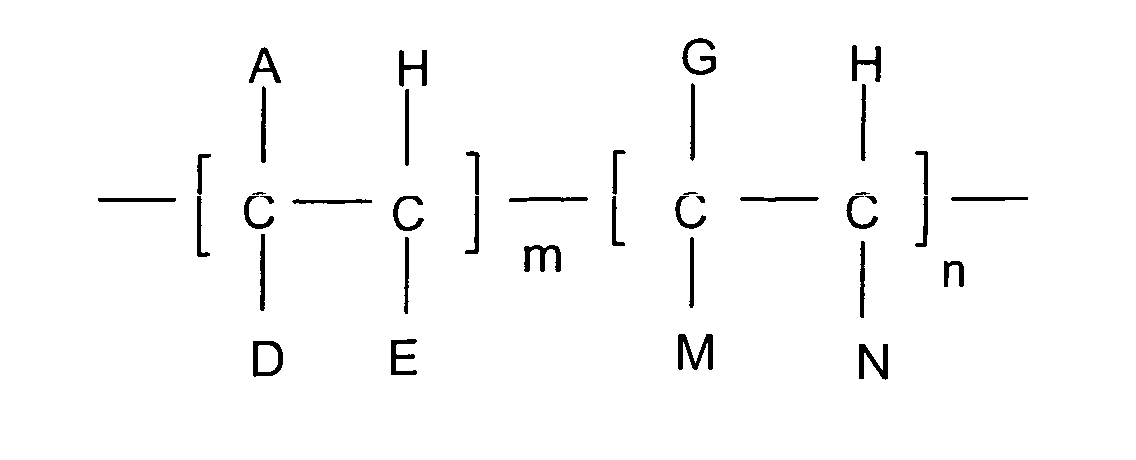
- A
- R', COOR', OCOR', R"-COOR' oder OR';
- D
- H, CH3, A oder R;
- E
- H oder A;
- G
- H, R", R"-COOR', einen Arylrest oder einen heterocyclischen Rest;
- M
- H, COOR", OCOR", OR" oder COOH;
- N
- H, R", COOR", OCOR, COOH oder einen Arylrest;
- R'
- eine Kohlenwasserstoffkette mit 8-150 Kohlenstoffatomen;
- R"
- eine Kohlenwasserstoffkette mit 1 bis 10 Kohlenstoffatomen;
- m
- eine Zahl zwischen 0,4 und 1,0; und
- n
- eine Zahl zwischen 0 und 0,6.
Vorzugsweise enthält die erfindungsgemäße Zusammensetzung 1 - 80 Gew.-% des Bestandteils B), 0,1 bis 5 Gew.-% des Bestandteils C) und den Bestandteil A) ad 100 Gew.-%.
| Charakterisierung der Kaltfließverbesserer | |||
| Bezeichnung | Art | Viskosität V(140) [mPas] | Verzweigungsgrad CH3 / 100 CH2 |
| A1 | MSA-co-C14-α-Olefin (1:1) amidiert mit C12-Amin | 5 | -- |
| A2 | MSA-co-C14/16-α-Olefin (1:0,5:0,5) mit C16-Amin umgesetzt | 30 | -- |
| A3 | MSA-co-C16-α-Olefin (1:1) | 15 | -- |
| A4 | MSA-co-C12/14-α-Olefin (1:0,5:0,5), verestert mit C18-α-Amin | 20 | -- |
| A5 | 13,6 Mol-% Vinylacetat | 130 | 3,7 |
| A6 | 13,7 Mol-% Vinylacetat 1,4 Mol-% Neodecansäurevinylester | 105 | 5,3 |
| A7 | 30 Mol-% Neodecansäurevinylester | 250 | 2,5 |
| A8 | 20 Mol-% Vinylacetat, 4 Mol-% Olefin | 350 | 8,5 |
| A9 | 30,5 Mol-% Vinylacetat, 7 Mol-% Neodecansäurevinylester | 170 | 4,3 |
| A10 | 21,3 Mol-% Vinylacetat, 9,2 Mol-% Neodecansäurevinylester | 105 | -- |
| A11 | 19,5 Mol-% Vinylacetat, 13 Mol-% Neodecansäurevinylester + A1 | 90 | -- |
| Charakterisierung der SN-Qualitäten | ||||
| Naphthalingehalt | Siedebereich [°C] | Flammpunkt | Aromatengehalt | |
| SN200 (Vergleich) | 6 - 8 % | 180 - 215 | 61 °C | 90 % |
| A 150 | < 1 % | 180 - 202 | > 62°C | 97 % |
| K 150 ND | < 1 % | 180-210 | 63°C | 99 % |
| A 100 | < 0,1 % | 164 - 185 | 40°C | 99 % |
| Pour Points (PP) ohne Zusatz von Bestandteil C) | ||||||||
| Mitteldestillat-Kaltfließverbesserer | PP in SN200 [°C] | Optische Beurteilung | PP in A150 ND [°C] | Optische Beurteilung | PP in K150 ND [°C] | Optische Beurteilung | PP in A100 [°C] | Optische Beurteilung |
| A1 | 9 | Klare Flüssigkeit | 27 | Nicht fließfähig | 18 | Nicht fließfähig | 12 | Klare Flüssigkeit |
| A2 | 15 | Klare Flüssigkeit | 24 | Nicht fließfähig | 24 | Nicht fließfähig | 15 | Klare Flüssigkeit |
| A3 | 12 | Klare Flüssigkeit | 21 | Nicht fließfähig | 27 | Nicht fließfähig | 9 | Klare Flüssigkeit |
| A4 | 12 | Klare Flüssigkeit | 24 | Nicht fließfähig | 21 | Nicht fließfähig | 12 | Klare Flüssigkeit |
| A5 | 3 | Klare Flüssigkeit | 9 | Klare Flüssigkeit | 9 | Klare Flüssigkeit | 12 | Klare Flüssigkeit |
| A6 | 3 | Klare Flüssigkeit | 12 | Klare Flüssigkeit | 9 | Klare Flüssigkeit | 9 | Klare Flüssigkeit |
| A7 | 42 | Homogen trübe | 48 | Nicht fließfähig | 45 | Nicht fließfähig | 48 | Nicht fließfähig |
| A8 | 27 | Homogen trübe | 36 | Nicht fließfähig | 39 | Nicht fließfähig | 33 | Nicht fließfähig |
| A9 | 9 | Klare Flüssigkeit | 18 | Nicht fließfähig | 24 | Nicht fließfähig | 21 | Nicht fließfähig |
| A10 | 0 | Klare Flüssigkeit | 15 | Nicht fließfähig | 15 | Nicht fließfähig | 12 | Nicht fließfähig |
| A11 | 15 | Klare Flüssigkeit | 24 | Nicht fließfähig | 27 | Nicht fließfähig | 21 | Nicht fließfähig |
| Pour Point-Wirksamkeit verschiedener Bestandteile C) Bestandteil A war stets SN A150 ND | |||||
| Mitteldestillat- | Pour Point in °C mit folgenden Bestandteilen C | ||||
| Kaltfließverbesserer | ohne | Methanol | Cyclohexanol | Nonylphenol | Salicylaldehyd |
| A1 | 27 | 9 | 12 | 9 | 15 |
| A2 | 24 | 12 | 15 | 12 | 6 |
| A3 | 21 | 9 | 9 | 12 | 12 |
| A4 | 24 | 9 | 15 | 6 | 15 |
| A5 | 9 | 3 | 6 | 3 | 6 |
| A6 | 12 | 6 | 3 | 3 | 6 |
| A7 | 48 | 39 | 42 | 36 | 42 |
| A8 | 36 | 27 | 27 | 24 | 27 |
| A9 | 18 | 9 | 6 | 6 | 9 |
| A10 | 15 | 3 | 0 | -3 | 3 |
| A11 | 24 | 15 | 12 | 12 | 15 |
Claims (13)
- Zusammensetzung, enthaltendA) Solvent Naphtha mit einem Naphthalingehalt von weniger als 1 Gew.-%,B) einen Mitteldestillat-Kaltfließverbesserer undC) ein lösevermittelndes Additiv, ausgewählt aus aliphatischen oder alicyclischen C1- bis C22-Alkoholen, cycloaliphatischen Kohlenwasserstoffen und monocyclischen aromatischen Kohlenwasserstoffen.
- Zusammensetzung nach Anspruch 1, worin Bestandteil C) ein einwertiger Alkohol ist.
- Zusammensetzung nach Anspruch 1 und/oder 2, worin Bestandteil C) Methanol, Ethanol, 2-Ethylhexanol und/oder Cyclohexanol ist.
- Zusammensetzung nach Anspruch 1, worin Bestandteil C) ein mono- oder polycyclischer Kohlenwasserstoff mit 6 bis 12 Kohlenstoffatomen ist.
- Zusammensetzung nach Anspruch 4, worin Bestandteil C) Cyclohexan, Norbornan oder Norbornen ist.
- Zusammensetzung nach Anspruch 1, worin Bestandteil C) eines der isomeren Nonylphenole, Hydroxybenzole und/oder Salicylaldehyd ist.
- Zusammensetzung nach einem oder mehreren der Ansprüche 1 bis 6, worin Bestandteil B) ein Polymer mit 10 bis 40 Gew.-% Vinylacetat und 60 bis 90 Gew.-% Ethylen ist.
- Zusammensetzung nach einem oder mehreren der Ansprüche 1 bis 6, worin Bestandteil B) ein Ethylen/Vinylacetat/Vinyl-2-ethylhexanoat-Terpolymer, Ethylen/Vinylacetat/Neononansäurevinylester-Terpolymer und/oder Ethylen-Vinylacetat/Neodecansäurevinylester-Terpolymer ist.
- Zusammensetzung nach einem oder mehreren der Ansprüche 1 bis 6, worin Bestandteil B) ein Copolymer ist, das neben Ethylen und 10 bis 40 Gew.-% Vinylacetat und/oder 1 bis 40 Gew.-% Vinylester von C6 bis C12-Carbonsäuren noch 0,5 bis 20 Gew.-% Olefin mit 3 bis 10 C-Atomen enthält.
- Zusammensetzung nach einem oder mehreren der Ansprüche 1 bis 6, worin Bestandteil B ein Aminsalz, Imid oder Amid aus sekundären Fettaminen mit 8 bis 36 C-Atomen ist.
- Zusammensetzung nach einem oder mehreren der Ansprüche 1 bis 10, worin Bestandteil A) Solvent Naphtha mit höchstens 0,1 Gew.-% Naphthalingehalt ist.
- Zusammensetzung nach einem oder mehreren der Ansprüche 1 bis 10, worin Bestandteil A) Solvent Naphtha mit mehr als 90 Gew.-% Aromatengehalt ist.
- Verwendung von Lösungen von Mitteldestillat-Kaltfließverbesserern in Solvent Naphtha mit weniger als 1 Gew.-% Naphthalingehalt, enthaltend aliphatische oder alicyclische C1- bis C22-Alkohole, cycloaliphatische Kohlenwasserstoffe oder monocyclische aromatische Kohlenwasserstoffe, als Kälteadditive in Mitteldestillaten, Biobrennstoffölen oder deren Mischungen.
Applications Claiming Priority (2)
| Application Number | Priority Date | Filing Date | Title |
|---|---|---|---|
| DE102004028495 | 2004-06-11 | ||
| DE102004028495A DE102004028495B4 (de) | 2004-06-11 | 2004-06-11 | Kaltfließverbessererzusammensetzungen in naphthalinarmem Solvent Naphtha |
Publications (2)
| Publication Number | Publication Date |
|---|---|
| EP1605031A2 true EP1605031A2 (de) | 2005-12-14 |
| EP1605031A3 EP1605031A3 (de) | 2009-06-03 |
Family
ID=34936983
Family Applications (1)
| Application Number | Title | Priority Date | Filing Date |
|---|---|---|---|
| EP05011442A Withdrawn EP1605031A3 (de) | 2004-06-11 | 2005-05-27 | Kaltfließverbessererzusammensetzung in naphthalinarmen Solvent Naphtha |
Country Status (6)
| Country | Link |
|---|---|
| US (1) | US20050274064A1 (de) |
| EP (1) | EP1605031A3 (de) |
| JP (1) | JP4926415B2 (de) |
| CA (1) | CA2509679C (de) |
| DE (1) | DE102004028495B4 (de) |
| NO (1) | NO20052809L (de) |
Cited By (5)
| Publication number | Priority date | Publication date | Assignee | Title |
|---|---|---|---|---|
| EP1857531A1 (de) * | 2006-05-16 | 2007-11-21 | Clariant International Ltd. | Zusammensetzung von Brennstoffölen |
| WO2008113757A1 (de) * | 2007-03-22 | 2008-09-25 | Basf Se | Mischung aus kaltfliessverbesserern und aminen |
| WO2009150145A1 (en) * | 2008-06-12 | 2009-12-17 | Basf Se | Use of solubilizers for homogenizing additive concentrates |
| CN103305294A (zh) * | 2012-03-12 | 2013-09-18 | 罗星健 | 一种高效节能的车用甲醇汽油添加剂 |
| WO2024061760A1 (de) * | 2022-09-23 | 2024-03-28 | Basf Se | Verminderung der kristallisation von paraffinen in kraftstoffen |
Family Cites Families (16)
| Publication number | Priority date | Publication date | Assignee | Title |
|---|---|---|---|---|
| US2651616A (en) * | 1948-01-13 | 1953-09-08 | Shell Dev | Lithium hydroxy stearate grease compositions |
| US3883318A (en) * | 1972-08-24 | 1975-05-13 | Exxon Research Engineering Co | Hydrogenated alkyl aromatics as petroleum distillate fuel cold flow improvers |
| US4211534A (en) * | 1978-05-25 | 1980-07-08 | Exxon Research & Engineering Co. | Combination of ethylene polymer, polymer having alkyl side chains, and nitrogen containing compound to improve cold flow properties of distillate fuel oils |
| US4210424A (en) * | 1978-11-03 | 1980-07-01 | Exxon Research & Engineering Co. | Combination of ethylene polymer, normal paraffinic wax and nitrogen containing compound (stabilized, if desired, with one or more compatibility additives) to improve cold flow properties of distillate fuel oils |
| DE3405843A1 (de) * | 1984-02-17 | 1985-08-29 | Bayer Ag, 5090 Leverkusen | Copolymere auf basis von maleinsaeureanhydrid und (alpha), (beta)-ungesaettigten verbindungen, ein verfahren zu ihrer herstellung und ihre verwendung als paraffininhibitoren |
| EP0153177B1 (de) * | 1984-02-21 | 1991-11-06 | Exxon Research And Engineering Company | Mitteldestillat-Zusammensetzungen mit Fliesseigenschaften bei Kälte |
| US4569679A (en) * | 1984-03-12 | 1986-02-11 | Exxon Research & Engineering Co. | Additive concentrates for distillate fuels |
| DE3742630A1 (de) * | 1987-12-16 | 1989-06-29 | Hoechst Ag | Polymermischungen fuer die verbesserung der fliessfaehigkeit von mineraloeldestillaten in der kaelte |
| DE3926992A1 (de) * | 1989-08-16 | 1991-02-21 | Hoechst Ag | Verwendung von umsetzungsprodukten von alkenylspirobislactonen und aminen als paraffindispergatoren |
| DE4036226A1 (de) * | 1990-11-14 | 1992-05-21 | Basf Ag | Erdoelmitteldestillate mit verbesserten fliesseigenschaften in der kaelte |
| ES2110124T3 (es) * | 1993-01-06 | 1998-02-01 | Clariant Gmbh | Termopolimeros a base de anhidridos de acidos carboxilicos alfa,beta-insaturados, de compuestos alfa,beta-insaturados y de polioxialquileneteres de alcoholes inferiores insaturados. |
| GB9501370D0 (en) * | 1995-01-24 | 1995-03-15 | Exxon Chemical Patents Inc | Additive concentrate |
| DE19700159A1 (de) * | 1997-01-07 | 1998-07-09 | Clariant Gmbh | Verbesserung der Fließfähigkeit von Mineralölen und Mineralöldestillaten unter Verwendung von Alkylphenol-Aldehydharzen |
| GB9707367D0 (en) * | 1997-04-11 | 1997-05-28 | Exxon Chemical Patents Inc | Improved oil compositions |
| US6761745B2 (en) * | 2000-01-24 | 2004-07-13 | Angelica Hull | Method of reducing the vapor pressure of ethanol-containing motor fuels for spark ignition combustion engines |
| DE10245737C5 (de) * | 2002-10-01 | 2011-12-08 | Clariant Produkte (Deutschland) Gmbh | Verfahren zur Herstellung von Additivmischungen für Mineralöle und Mineralöldestillate |
-
2004
- 2004-06-11 DE DE102004028495A patent/DE102004028495B4/de not_active Expired - Fee Related
-
2005
- 2005-05-27 EP EP05011442A patent/EP1605031A3/de not_active Withdrawn
- 2005-06-09 JP JP2005169482A patent/JP4926415B2/ja not_active Expired - Fee Related
- 2005-06-10 US US11/149,674 patent/US20050274064A1/en not_active Abandoned
- 2005-06-10 NO NO20052809A patent/NO20052809L/no not_active Application Discontinuation
- 2005-06-10 CA CA2509679A patent/CA2509679C/en not_active Expired - Fee Related
Cited By (5)
| Publication number | Priority date | Publication date | Assignee | Title |
|---|---|---|---|---|
| EP1857531A1 (de) * | 2006-05-16 | 2007-11-21 | Clariant International Ltd. | Zusammensetzung von Brennstoffölen |
| WO2008113757A1 (de) * | 2007-03-22 | 2008-09-25 | Basf Se | Mischung aus kaltfliessverbesserern und aminen |
| WO2009150145A1 (en) * | 2008-06-12 | 2009-12-17 | Basf Se | Use of solubilizers for homogenizing additive concentrates |
| CN103305294A (zh) * | 2012-03-12 | 2013-09-18 | 罗星健 | 一种高效节能的车用甲醇汽油添加剂 |
| WO2024061760A1 (de) * | 2022-09-23 | 2024-03-28 | Basf Se | Verminderung der kristallisation von paraffinen in kraftstoffen |
Also Published As
| Publication number | Publication date |
|---|---|
| NO20052809L (no) | 2005-12-12 |
| DE102004028495B4 (de) | 2007-08-30 |
| CA2509679C (en) | 2013-07-16 |
| JP4926415B2 (ja) | 2012-05-09 |
| EP1605031A3 (de) | 2009-06-03 |
| US20050274064A1 (en) | 2005-12-15 |
| JP2005350675A (ja) | 2005-12-22 |
| CA2509679A1 (en) | 2005-12-11 |
| DE102004028495A1 (de) | 2006-01-05 |
| NO20052809D0 (no) | 2005-06-10 |
Similar Documents
| Publication | Publication Date | Title |
|---|---|---|
| EP1458837B1 (de) | Schwefelarme mineraloldestillate mit verbesserten kälteeigenschaften, umfassend einen ester eines alkoxylierten polyols und ein copolymer aus ethylen und ungesättigten estern | |
| DE102007028305A1 (de) | Detergenzadditive enthaltende Mineralöle mit verbesserter Kältefließfähigkeit | |
| EP1380634B1 (de) | Oxidationsstabilisierte Schmieradditive für hochentschwefelte Brennstofföle | |
| EP1801187B1 (de) | Detergenzadditive enthaltende Mineralöle mit verbesserter Kältefliessfähigkeit | |
| WO2008155088A1 (de) | Detergenzadditive enthaltende mineralöle mit verbesserter kältefliessfähigkeit | |
| EP1446464B1 (de) | Additive für schwefelarme mineralöldestillate, umfassend einen ester eines alkoxylierten polyols und ein alkylphenol-aldehydharz | |
| WO2008155090A1 (de) | Detergenzadditive enthaltende mineralöle mit verbesserter kältefliessfähigkeit | |
| EP2162515A1 (de) | Detergenzadditive enthaltende mineralöle mit verbesserter kältefliessfähigkeit | |
| DE102004028495B4 (de) | Kaltfließverbessererzusammensetzungen in naphthalinarmem Solvent Naphtha | |
| EP1380633B1 (de) | Verwendung von öligen Flüssigkeiten zur Verbesserung der Oxidationsstabilität der Brennstofföle | |
| DE69505683T2 (de) | Oelzusaetze, zusammensetzungen und polymeren zur hinein verwendung | |
| EP4127107B1 (de) | Zusammensetzungen und verfahren zur dispergierung von paraffinen in schwefelarmen brennstoffölen | |
| DE102004024532B4 (de) | Demulgatoren für Mischungen aus Mitteldestillaten mit Brennstoffölen pflanzlichen oder tierischen Ursprungs und Wasser | |
| EP1874899A1 (de) | Turbinenkraftstoffzusammensetzungen mit verbesserten kälteeigenschaften | |
| DE102005045134B4 (de) | Alkylphenol-Aldehydharze, diese enthaltende Zusammensetzungen zu Verbesserung der Kältefließfähigkeit und Schmierfähigkeit von Brennstoffölen sowie deren Verwendung | |
| DE102004002080B4 (de) | Demulgatoren für Mischungen aus Mitteldestillaten mit Brennstoffölen pflanzlichen oder tierischen Ursprungs und Wasser | |
| DE10252973A1 (de) | Oxidationsstabilisierte Schmieradditive für hochentschwefelte Brennstofföle | |
| DE102005061465A1 (de) | Detergenzadditive enthaltende Mineralöle mit verbesserter Kältefließfähigkeit | |
| DE10252972A1 (de) | Oxidationsstabilisierte ölige Flüssigkeiten auf Basis pflanzlicher oder tierischer Öle |
Legal Events
| Date | Code | Title | Description |
|---|---|---|---|
| PUAI | Public reference made under article 153(3) epc to a published international application that has entered the european phase |
Free format text: ORIGINAL CODE: 0009012 |
|
| AK | Designated contracting states |
Kind code of ref document: A2 Designated state(s): AT BE BG CH CY CZ DE DK EE ES FI FR GB GR HU IE IS IT LI LT LU MC NL PL PT RO SE SI SK TR |
|
| AX | Request for extension of the european patent |
Extension state: AL BA HR LV MK YU |
|
| RAP1 | Party data changed (applicant data changed or rights of an application transferred) |
Owner name: CLARIANT PRODUKTE (DEUTSCHLAND) GMBH |
|
| PUAL | Search report despatched |
Free format text: ORIGINAL CODE: 0009013 |
|
| AK | Designated contracting states |
Kind code of ref document: A3 Designated state(s): AT BE BG CH CY CZ DE DK EE ES FI FR GB GR HU IE IS IT LI LT LU MC NL PL PT RO SE SI SK TR |
|
| AX | Request for extension of the european patent |
Extension state: AL BA HR LV MK YU |
|
| RIC1 | Information provided on ipc code assigned before grant |
Ipc: C10L 10/14 20060101ALI20090428BHEP Ipc: C10L 1/236 20060101ALI20090428BHEP Ipc: C10L 1/224 20060101ALI20090428BHEP Ipc: C10L 1/198 20060101ALI20090428BHEP Ipc: C10L 1/192 20060101ALI20090428BHEP Ipc: C10L 1/185 20060101ALI20090428BHEP Ipc: C10L 1/183 20060101ALI20090428BHEP Ipc: C10L 1/182 20060101ALI20090428BHEP Ipc: C10L 1/18 20060101ALI20090428BHEP Ipc: C10L 1/16 20060101ALI20090428BHEP Ipc: C10L 1/14 20060101AFI20050919BHEP |
|
| 17P | Request for examination filed |
Effective date: 20091203 |
|
| AKX | Designation fees paid |
Designated state(s): AT BE BG CH CY CZ DE DK EE ES FI FR GB GR HU IE IS IT LI LT LU MC NL PL PT RO SE SI SK TR |
|
| 17Q | First examination report despatched |
Effective date: 20110221 |
|
| STAA | Information on the status of an ep patent application or granted ep patent |
Free format text: STATUS: THE APPLICATION HAS BEEN WITHDRAWN |
|
| 18W | Application withdrawn |
Effective date: 20131210 |