EP1604879A2 - Braking force control apparatus and method for automotive vehicle - Google Patents
Braking force control apparatus and method for automotive vehicle Download PDFInfo
- Publication number
- EP1604879A2 EP1604879A2 EP05012242A EP05012242A EP1604879A2 EP 1604879 A2 EP1604879 A2 EP 1604879A2 EP 05012242 A EP05012242 A EP 05012242A EP 05012242 A EP05012242 A EP 05012242A EP 1604879 A2 EP1604879 A2 EP 1604879A2
- Authority
- EP
- European Patent Office
- Prior art keywords
- vehicle
- cornering
- section
- time
- braking force
- Prior art date
- Legal status (The legal status is an assumption and is not a legal conclusion. Google has not performed a legal analysis and makes no representation as to the accuracy of the status listed.)
- Granted
Links
Images




Classifications
-
- B—PERFORMING OPERATIONS; TRANSPORTING
- B60—VEHICLES IN GENERAL
- B60T—VEHICLE BRAKE CONTROL SYSTEMS OR PARTS THEREOF; BRAKE CONTROL SYSTEMS OR PARTS THEREOF, IN GENERAL; ARRANGEMENT OF BRAKING ELEMENTS ON VEHICLES IN GENERAL; PORTABLE DEVICES FOR PREVENTING UNWANTED MOVEMENT OF VEHICLES; VEHICLE MODIFICATIONS TO FACILITATE COOLING OF BRAKES
- B60T8/00—Arrangements for adjusting wheel-braking force to meet varying vehicular or ground-surface conditions, e.g. limiting or varying distribution of braking force
- B60T8/17—Using electrical or electronic regulation means to control braking
- B60T8/1755—Brake regulation specially adapted to control the stability of the vehicle, e.g. taking into account yaw rate or transverse acceleration in a curve
-
- B—PERFORMING OPERATIONS; TRANSPORTING
- B60—VEHICLES IN GENERAL
- B60T—VEHICLE BRAKE CONTROL SYSTEMS OR PARTS THEREOF; BRAKE CONTROL SYSTEMS OR PARTS THEREOF, IN GENERAL; ARRANGEMENT OF BRAKING ELEMENTS ON VEHICLES IN GENERAL; PORTABLE DEVICES FOR PREVENTING UNWANTED MOVEMENT OF VEHICLES; VEHICLE MODIFICATIONS TO FACILITATE COOLING OF BRAKES
- B60T2201/00—Particular use of vehicle brake systems; Special systems using also the brakes; Special software modules within the brake system controller
- B60T2201/16—Curve braking control, e.g. turn control within ABS control algorithm
Definitions
- the present invention relates to braking force control apparatus and method for an automotive vehicle which enable the vehicle to perform a stable cornering.
- a Japanese Patent Application First Publication (Tokkai) Heisei 2-171373 published on July 3, 1990 exemplifies a first previously proposed vehicular braking force control apparatus which has a purpose of securing a stability of a vehicular cornering.
- this first previously proposed braking force control apparatus as a traction control, with an acceleration slip of a driven wheel detected, the acceleration slip is not merely suppressed but a vehicular cornering state variable is detected from a driving state of the vehicle, in a case where the detected cornering state variable approaches to a predetermined braking operation threshold value which has a predetermined margin for a cornering limit state variable up to which the vehicle is enabled to travel stably, a target deceleration required to maintain a stable cornering of the vehicle is calculated, and a braking force to achieve the target deceleration is provided for the vehicle.
- a pump-up system which includes a liquid pressure brake actuator in which a motor pump is equipped as a pressure generating source of the liquid pressure brake apparatus, a time is required from a time at which the braking force control is started to be operated to a time at which the motor pump is operated and a brake liquid pressure is raised within each of wheel cylinders. Therefore, an initial responsive characteristic becomes delayed.
- a second previously proposed vehicular braking force control apparatus as disclosed in a Japanese Patent Application First Publication (Tokkai) No. 2001-63541 published on March 13, 2001 has been proposed in which a technique of a pre-pressure application is used.
- an object of the present invention to provide braking force control apparatus and method for an automotive vehicle which can perform the braking force control for the cornering stability and can improve the initial (control) responsive characteristic.
- a braking force control apparatus for an automotive vehicle, comprising: a cornering stability control section that calculates a target deceleration required to maintain a vehicular stability cornering when determining that a cornering state variable of the vehicle is in excess of a braking operation threshold value which has a slight margin for a limit cornering state variable up to which the vehicle is enabled to travel stably and provides a braking force in accordance with the target deceleration for the vehicle; and a cornering limit estimating section that estimates whether the cornering state variable of the vehicle is in excess of the braking operation threshold value after a predetermined delay time is elapsed from a present time, the cornering stability control section being configured to start a provision of the braking force for the vehicle when the cornering limit estimating section estimates that the cornering state variable of the vehicle is in excess of the braking operation threshold value after the predetermined delay time is elapsed from the present time.
- a braking force control method for an automotive vehicle comprising: calculating a target deceleration required to maintain a vehicular stability cornering, and in accordance with which a braking force is provided when determining that a cornering state variable of the vehicle is in excess of a braking operation threshold value which has a slight margin for a limit cornering state variable up to which the vehicle is enabled to travel stably; estimating whether the cornering state variable of the vehicle is in excess of the braking operation threshold value after a predetermined delay time is elapsed from a present time; and starting to provide the braking force for the vehicle when estimating that the cornering state variable of the vehicle is in excess of the braking operation threshold value after the predetermined time is elapsed from the present time.
- an initial response characteristic of control is improved and it becomes possible for the vehicle to be decelerated to the vehicle speed at which the vehicle can stably be cornered.
- Fig.1 is a schematic view representing a system configuration of a braking force control apparatus for an automotive vehicle in a first preferred embodiment according to the present invention.
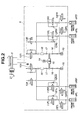
- Fig. 2 is a schematic view representing a system configuration of a liquid pressure system in the braking force control apparatus in the first embodiment shown in Fig. 1.
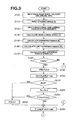
- Fig. 3 is a part of a processing flow executed by a COP controller shown in Fig. 1.
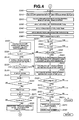
- Fig. 4 is a part of a processing flow executed by the COP controller shown in Fig. 1.
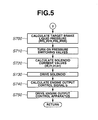
- Fig. 5 is a part of a processing flow executed by the COP controller shown in Fig. 1.
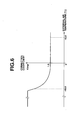
- Fig. 6 is a graph representing a relationship between an external (vehicular outside) temperature and its correction coefficient.
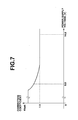
- Fig. 7 is a graph representing a graph representing a relationship between a power supply voltage and its correction coefficient.
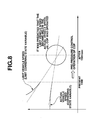
- Fig. 8 is an example of a timing chart for explaining an operation of the braking force control apparatus in the first embodiment.
- Fig. 9 is an example of a timing chart for explaining an operation of the braking force control apparatus in the first embodiment.
- Fig. 10 is an example of a timing chart for explaining an operation of the braking force control apparatus in the first embodiment.
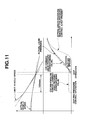
- Fig. 11 is an example of a timing chart for explaining an operation of the braking force control apparatus in the first embodiment.
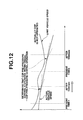
- Fig. 12 is an example of a timing chart for explaining an operation of the braking force control apparatus in the first embodiment.
- Fig. 13 is a processing flow executed by the COP controller in a case of the braking force control apparatus in a second preferred embodiment according to the present invention.
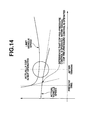
- Fig. 14 is an example of a timing chart for explaining an operation of the braking force control apparatus in the second embodiment shown in Fig. 13.
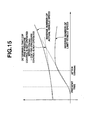
- Fig. 15 is an example of a timing chart for explaining an operation of the braking force control apparatus in the second embodiment shown in Fig. 13.
- Fig. 1 shows a first preferred embodiment of a braking force control apparatus for an automotive vehicle according to the present invention.
- road wheel velocities of front and rear respective road wheels are detected by means of road wheel velocity sensors 1.
- Detection signals of road wheel velocity sensors 1 are inputted to a controller 5.
- Various detection signals from an acceleration sensor 2 to detect vehicular longitudinal and lateral accelerations, a steering angle sensor 3 to detect a steering angle of a steering wheel of the vehicle, a switch group of brake switch, pressure switch, and accelerator switch, and a liquid pressure sensor to detect the liquid pressure of each wheel cylinder are inputted to controller 5.
- Controller 5 performs a calculation processing on the basis of various input signals from each sensor and switches and outputs control signals to a brake control unit 6 which adjusts the brake pressure for front and rear road wheels and to an engine output adjuster 7 to adjust an engine output.
- a reference numeral 21 denotes a brake pedal and a reference numeral 8 denotes a master cylinder.
- reference numerals of 9FL, 9FR, 9RL, and 9RR denote wheel cylinders of a liquid pressure brake unit installed on respective road wheels FL, FR, RL, and RR.
- Pressure switching valves and other valves intervened between master cylinder 8 and wheel cylinders 9FL, 9FR, 9RL, and 9RR are controlled so that, irrespective of the brake operations of the driver, the braking liquid pressure of each wheel cylinder can be increased, held, and decreased.
- master cylinder 8 is linked to front left and rear right wheel cylinders 9FL, 9RR via normal open type pressure switching valve 10A and normal open type inlet solenoid valves 11FL, 11RR.
- Master cylinder 8 is linked to front right and rear left wheel cylinders 9FR, 9RL via normal open type inlet solenoid valves 11FR, 11RL.
- Return check valves 12FR, 12RL are disposed on respective inlet solenoid valves 11FR, 11RL for returning the braking liquid pressures of respective wheel cylinders 9FR, 9RL to master cylinder 8.
- master cylinder 8 is linked to a downstream side (wheel cylinder side) of pressure switching valve 10A via normal close type pressure switching valve 13A and linked to a downstream side (wheel cylinder side) of pressure switching valve 10B via normal close type pressure switching valve 13B.
- a common pump 15 is intervened between pressure switching valves 10A and 13A and between switching control valves 10B and 13B with pressure switching valves 13A and 13B as a suction side. This pump 15 is driven by an electric motor 14.
- An inlet valve 16 is interposed at a suction side of pump 15 to block a revere flow of the sucked fluid and an outlet valve 17 is interposed at a drain (discharge) side of pump 15 to block a reverse flow of the discharged fluid.
- a damper chamber 18 is disposed in series with outlet valve 17 to suppress a ripple of liquid pressure drained from pump 15.
- Front left and rear right wheel cylinders 9FL, 9RR are linked to a downstream side (pump side) of pressure switching valve 13A via normal close type outlet solenoid valves 19FL, 19RR.
- Front right and rear left wheel cylinders 9FR, 9RL are linked to the downstream side (pump side) of pressure switching valve 13B via normal close type outlet solenoid valves 19FR, 19RL.
- Reservoirs 20, 20 are disposed to temporarily store the braking liquid pressures from wheel cylinders 9FR, 9RL on upstream sides of outlet solenoid valves 19FL, 19RR (pressure switching valve 13A side) and upstream sides of outlet solenoid valves 19FR, 19RL (pressure switching valve 13B side) in order to effectively perform this pressure decrease with high accuracy during the pressure decrease of each wheel cylinder 9FR, 9RL.
- brake control unit 6 when brake control unit 6 supplies a normal braking liquid pressure in accordance with the brake operation of the driver to respective wheel cylinders via pressure switching valves 10A, 10B, and inlet solenoid valves 11FL, 11RR when pressure switching valves 10A, 10B, pressure switching valves 13A, 13B, inlet solenoid valves 11FL, 11RR, and outlet solenoid valves 19FL, 19RR are in a non-power supply state.
- engine output control apparatus 7 of engine shown in Fig. 1 is constructed to output an engine output by adjusting the opening angle of, for example, a throttle valve.
- Controller 5 includes: a COP (an abbreviation for a Cornering Over-speed Prevention) controller 30 constituting a cornering stability control section; and another braking force control section 40 which performs a braking control by means of another brake control such as a TCS (Traction Control System) control, ACC (Adaptive Cruise Control)(or Inter-vehicle distance control), or other braking force control section (refer to Fig. 1).
- COP controller 30 includes: a cornering state detecting section 30A, a cornering limit calculating section 30B, COP processing section 30C, a pre-pressure processing section 30D, and a braking pressure control section 30E.
- COP controller 30 inputs road wheel velocities VFL, VFR, VRL, and VRR for the respective road wheel velocity sensors 1. It is noted that FL denotes a front left road wheel, FR denotes a front rear road wheel, RL denotes a rear left road wheel, and RR denotes a rear right road wheel.
- COP controller 30 inputs a steering wheel angle ⁇ .
- COP controller 30 inputs vehicular longitudinal and lateral accelerations DDX and DDY.
- COP controller 30 calculates a vehicle body velocity V from respective road wheel velocities VFL, VFR, VRL, VRR, and vehicle body longitudinal acceleration and the routine goes to a step S150.
- COP controller 30 derives a limit cornering radius RL at the present vehicle body speed V from vehicle body speed V.
- the above-described limit vehicle body lateral acceleration DDY1 may be varied in accordance with a slip rate of the respective road wheels.
- COP controller 30 derives limit cornering speed VL at the present cornering radius R and the routine goes to a step S180.
- VL ⁇ (R • DDY1)
- limit vehicle body lateral acceleration DDY1 at the above-described limit vehicle body lateral acceleration DDY1 may be varied in accordance with the slip rate of each road wheel.
- steps S100 through S150 constitute cornering state detecting section 30A and steps S100 through S150 constitute cornering limit calculating section 30B.
- a cornering stability control hereinafter, also called, COP
- step S190 COP controller 30 resets a COP pre-pressure operation flag PRE-FLG to " 0 ". Then, the routine goes to a step S200. It is noted that this COP pre-pressure operation flag PRE-FLG is set at a step S460 in a case where the pre-pressure control is operated, is reset at step S190 when COP is operated, or reset at step a S560 when set time ⁇ t is elapsed.
- COP controller 30 calculates a target deceleration X"cop for COP on the basis of vehicle body speed (velocity) V, limit vehicle body speed (velocity) VL, cornering radius R, and limit cornering (turning) radius RL.
- COP controller 30 determines whether a predetermined time ⁇ t is elapsed from a start of a COP pre-pressure control (or a preliminary brake control). In this embodiment, COP controller 30 determines whether a count value of a counter Nc becomes equal to or smaller than " 0 ".
- step S210 If predetermined time ⁇ t is elapsed (Yes at step S210), target deceleration X"pre of COP pre-pressure control is reset to " 0 " (at a step S240) and the routine goes to a step S250. On the other hand, if predetermined time ⁇ t is not elapsed (No) at step S210, the routine goes to a step S220 at which the value of counter Nc is counted down (decremented) by one. Then, the routine goes to a step S230. At step S230, COP controller 30 compares target deceleration X"pre with target deceleration X"cop for COP.
- step S240 If a magnitude of target deceleration X"cop is larger than that of target deceleration X"cop for COP, the routine goes to step S240 at which target deceleration X"pre of the pre-pressure control is reset to " 0 ". Thereafter, the routine goes to S250. If X"cop ⁇ X"pre (No) at step S230, the routine goes to step S250.
- COP controller 30 calculates a time variation rate d(kVL)/dt of braking operation threshold value kVL and the routine goes to a step S320.
- a difference between the present braking operation threshold value and the braking operation threshold value before one control period is calculated. If the control period is sufficiently short, a weighting using the further previous values may be calculated. In addition, a, so-called, low pass filter may alternatively be applied thereto.
- COP controller 30 calculates variation rate dV/dt of actual vehicle speed V.
- COP controller 30 inputs an external (vehicular outside) air temperature Temp at step S330.
- power supply voltage Vbatt is inputted which supplies an electric power to brake control unit 6.
- a manipulated variable Bp of brake pedal 21 is inputted and the routine goes to a step S360.
- a master cylinder liquid pressure is used as brake manipulated variable Bp.
- COP controller 30 inputs operation flag fL to determine whether the other braking force control section 40 such as an automatic inter-vehicle distance control apparatus (so-called, ACC (Adaptive Cruise Control)) is activated to provide the braking force for the vehicle and the routine goes to a step S370.
- ACC Automatic Inter-vehicle distance control apparatus
- COP controller 30 determines whether brake pedal 21 is operated depending upon whether present master cylinder liquid pressure Bp is in excess of a predetermined value kb.
- This liquid pressure kb is a minimum liquid pressure that is detectable that the brake liquid is filled within master cylinder 8 but may be the liquid pressure having a margin by a value at which an influence of noise is not affected in a case where an erroneous operation of the liquid pressure sensor occurs due to the noise in the liquid pressure sensor.
- the determination of whether brake pedal 21 is operated may be carried out by means of a well known brake lamp switch. If brake pedal 21 is operated (Yes) at step S370, the pre-pressure control of COP is not carried out. Then, the routine goes to a step S600 at which target deceleration X"pre for the COP pre-pressure control is reset to " 0 " and the present routine is returned to the start position. On the other hand, if COP controller 30 determines that the operation of brake pedal 21 is not carried out, the routine goes to a step S380.
- COP controller 30 determines whether operation flag fL inputted at step S360 is in an ON state or not. If operation flag fL is ON (Yes), the pre-pressure control for COP is not carried out. Then, the routine goes to step S600. On the other hand, if COP controller 30 determines that operation flag fL is in an OFF state, in other words, other braking force control section 40 is not operated, the routine goes to a step 390.
- COP controller 30 determines whether COP pre-pressure operation flag PRE-FLG is zero or not. If operation flag PRE-FLG is in the zero state, the pre-pressure control of COP is not yet carried out and the routine goes to a step S400. If the pre-pressure control is being operated (No) at step 390, the routine goes to a step S490.
- COP controller 30 calculates time ⁇ t for COP pre-pressure control to be previously operated before the operation of COP and the routine goes to a step S410.
- This time ⁇ t corresponds to a delay time and is set to a time sufficient for the wheel cylinder pressures to be raised without delay.
- a time for the brake liquid to be filled in each wheel cylinder with an initial target deceleration X"pre of COP pre-pressure control as a command value a time for each wheel cylinder to be filled within the brake liquid pressure is measured. This time is, in this embodiment, ⁇ t - init.
- Time ⁇ t of pre-pressure control is a time after a correction by the vehicular outside (external) air temperature inputted at step S330 and the correction by the power supply voltage inputted at step S340.
- Correction coefficients prescribed by maps shown in Figs. 6 and 7 are provided for vehicular outside air (external) temperature and power supply voltage.
- the correction is carried out by multiplying correction coefficients Ktmp, Kbatt by ⁇ t-init.
- the correction is carried out by multiplying ( ⁇ t -init) by these correction coefficients Ktmp and Kbatt.
- Vehicular outside temperature coefficient of correction coefficient Ktmp is determined on the basis of a viscosity with a temperature of the brake fluid as a function.
- Correction coefficient Kbatt is determined on the basis of a driving resistance of such as the motor.
- COP controller 30 calculates braking operation threshold value kVLp after time ⁇ t and the routine goes to a step S420.
- step S420 actual vehicle speed Vp after time ⁇ t is calculated on the basis of the following equation and the routine goes to a step S430.
- Vp V + dV/dt x ⁇ t
- COP controller 30 determines whether an absolute value of the variation speed of the braking operation threshold value is in excess of a certain threshold value dVlim. This is because, in a case where the vehicle is traveling maintaining the vicinity to the braking operation threshold value of COP, frequent repetitive ON and OFF of COP pre-pressure control is prevented.
- step S600 If the absolute value of the variation speed of the control operation threshold value is smaller than dVlim, the pre-pressure control is not operated and the routine goes to step S600. On the other hand, if the variation speed of the braking operation threshold value is equal to or larger than dVlim, the routine goes to a step S440.
- COP controller 30 determines whether the absolute value of steering angle
- COP controller 30 determines that it is necessary to operate the pre-pressure control of COP and the routine goes to S460. If COP controller 30 determines that it is not necessary to operate the pre-pressure control and the routine goes to step S600. Then, the pre-pressure control is not operated and the routine is returned to the start position.
- COP controller 30 sets COP pre-pressure operation flag PRE-FLG to " 1 " . Then, at a step S470, COP controller 30 sets X"preinit as an initial value to target deceleration X"pre of pre-pressure control and the routine goes to a step S480. It is noted that steps S310 through S450 constitute a cornering limit estimating section (means). At step S480, COP controller 30 stores the count value of counter Nc and the routine goes to a step S580 (the explanation after step S580 will be described later).
- step S490 COP controller 30 calculates after what second it is predicted that the COP is operated (the vehicle speed is in excess of braking operation threshold value) from the present step in the present vehicular state from the variation rate d(kVL)/dt of braking operation threshold value kVL and the variation rate dV/dt of actual vehicle speed. Then, the routine goes to a step 500. This calculated time is assumed to be ⁇ tp. This time ⁇ tp is determined on the basis of the following equation.
- COP controller 30 compares the above-derived Np with the present Nc.
- Np ⁇ Nc at step S500 it is a case where the COP is operated at a time earlier than initially predicted time ⁇ t and the routine goes to a step S510.
- COP controller 30 corrects target deceleration X"pre of the pre-pressure control.
- the routine goes to a step S540.
- target deceleration X"pre is enlarged in accordance with a relationship between Nc and Np, the routine goes to a step S520.
- a command value (controlled variable) of a pre-pressure application becomes large.
- a pressure boosting speed becomes fast. That is to say, a drive current of motor 14 becomes large and it becomes possible to quickly fill the brake liquid into each wheel cylinder.
- X"pre X"pre + k1 x (Nc - Np)/Np, wherein k1 denotes a weighting coefficient.
- k1 denotes a weighting coefficient.
- target deceleration X"pre is in excess of a limiter X"premax
- target deceleration is changed to the value of limiter X"premax.
- This limiter X"premax is a value corresponding to a maximum deceleration having a magnitude to be estimated that the deceleration is not felt by the driver.
- COP controller 30 determines whether the magnitude of each wheel cylinder liquid pressure Pw (or wheel cylinder liquid pressure estimated value) generated by the pre-pressure control is larger than a set value Pmax*. If the wheel cylinder liquid pressure generated according to the pre-pressure control (or wheel cylinder liquid pressure estimated value) is larger than Pmax* (Yes) at step S580, the routine goes to step S590 at which target deceleration X"pre of the pre-pressure control is reset to initial value of X"preinit.
- This set value Pmax* is a liquid pressure value at which a brake pad of each brake unit is contacted with a rotor without transmission of a force. It is noted that the liquid pressure of each brake unit is made equal to each other.
- COP controller 30 performs the select high between COP target deceleration X"cop with target deceleration X"pre of the pre-pressure control and calculates final target deceleration X", and the routine goes to a step S700 in Fig. 5.
- COP controller 30 determines each target brake liquid pressure of front left and right and rear left and right road wheels to obtain target deceleration X".
- all pressure switching valves 10A, 10B, 13A, 13B are turned to ON.
- COP controller 30 calculates a drive variable of motor 14 and current values of respective solenoids and outputs drive commands to brake control unit 6 at step S730.
- COP controller 30 calculates an engine output control signal to obtain target deceleration X" if pre-pressure control operation flag PRE-FLG is turned off. For example, in a case where the engine output is controlled by means of a throttle opening angle, a target throttle opening angle is determined with a relationship between the deceleration obtained by the brake taken into consideration and engine output control apparatus 7 is driven at step S300. In the above-described example, the throttle (valve) is driven.
- the pre-pressure control is carried out.
- the threshold value for the start of the pre-pressure is not simply set for brake operation threshold value kVL but delay time ⁇ t is supposed which can be secured for the aimed pre-pressure to be transferred to the COP.
- delay time ⁇ t is supposed which can be secured for the aimed pre-pressure to be transferred to the COP.
- the pre-pressure control of COP is operated at an earlier timing by ⁇ t than a timing at which COP is stably started to be operated irrespective of the cornering state or target cornering state independently of the cornering state at that time and a target cornering state.
- the brake liquid is stored in the wheel cylinders of the respective road wheels and a liquid pressure responsive characteristic at an initial time of the COP operation is remarkably improved.
- Fig. 9 shows an example of the timing chart of the control based on the first preferred embodiment.
- a controlled variable of the COP pre-pressure control is enlarged so that a pressure boosting speed in the pre-pressure control of COP (or a flow speed of the brake liquid) becomes large (fast), as shown in an example of a timing chart of Fig. 10.
- COP is operated after time ⁇ t from the calculated value of the limit cornering state variable, its variation speed, the actual cornering state variable, and its variation speed at that timing. For example, however, in a case where the variation speed of the limit cornering state variable becomes larger (faster) than that at the start time of the COP pre-pressure control, COP is operated at an earlier timing than the time passage of ⁇ t. Because of this, there is often a case where the actual cornering state variable of the vehicle is in excess of the braking operation threshold value having the slight margin for the limit cornering state variable.
- the command liquid pressure is set to small during an ordinary COP pre-pressure control.
- a drive current of pump-motor 14 is set to be small so that low noise and low power consumption are achieved.
- the braking force of pump motor 14 is generated at minimum only if an abrupt pre-pressure application needs to be achieved so that it is possible to increase a pre-pressure effect. That is to say, a compatibility between the low noise and an improvement of the responsive characteristic can be achieved.
- a maximum value of the brake pressure during the pre-pressure control until COP is operated is a liquid pressure that the vehicle driver does not feel the deceleration, as shown in an example of the timing chart of Fig. 11. That is to say, a timing at which the deceleration should naturally be generated is when COP is operated at a time at which the actual cornering state variable of the vehicle is in excess of the braking operation threshold value and is approaching to the limit cornering state. If, during the pre-pressure control, the deceleration such that the driver feels the deceleration is generated, a, so-called, earlier operation sensation is supposed to be given to the driver. However, in this embodiment, it becomes possible to raise the liquid pressure of each wheel cylinder instantaneously at the required timing as described above without giving the driver an unpleasant feeling such that the braking control is operated at the earlier timing by time ⁇ t.
- a minimum liquid pressure at which each brake pad can be determined to be contacted with the corresponding rotor is generated at a time point at which COP is operated. That is to say, conventionally, the reason that a dead time (delay time) ⁇ t from a time at which COP is started to be operated is generated is that a time lag for the brake liquid to be filled in each wheel cylinder is present from a time at which pump motor 14 is activated to a time at which each brake pad is contacted with the corresponding rotor.
- the deceleration to be felt by the driver is generated from the timing at which the COP is operated and each pad can assuredly be contacted with the corresponding rotor and the liquid pressure can be raised instantaneously without time delay at a timing (a time point at which the target cornering state variable is intersected with the actual state variable) at which the deceleration of the COP naturally should be generated without feeling of the earlier operation sensation by the driver.
- the pre-pressure control is not activated during the operation of brake pedal 21 by a vehicle driver. It is noted that the pre-pressure control may be stopped in a case where brake pedal 21 is manipulated during the operation of the pre-pressure control. That is to say, since, during the operation of brake pedal 21, the liquid pressure is applied to the wheel cylinders, it is not necessary to operate the pre-pressure control of COP. Therefore, the number of times the actuator is operated can unnecessarily be prevented from increasing due to a non-operation of the pre-pressure control. In addition, an unpleasant feeling which is given to the driver during the operation (or manipulation) of brake pedal 21 due to the pre-pressure control operation for COP can effectively be prevented.
- the pre-pressure for COP is not operated in a case where the other braking force control section is activated in which the liquid pressure is provided for the wheel cylinders to perform the braking force control. That is to say, in a case where another braking force automatic providing apparatus is activated, the liquid pressure is applied to the respective wheel cylinders so that it is not necessary to operate the pre-pressure control for COP.
- the pre-pressure control since the pre-pressure control is not operated, the pre-pressure control of COP is not unnecessarily operated and is not interfered with the other braking force control. Consequently, a stable management of the braking force control can be achieved.
- the pre-pressure control for COP is not activated. That is to say, in a case where the vehicle is cornering in the vicinity to the COP operation threshold value, the target cornering state variable approaches to the actual cornering state variable. Hence, there is a possibility that the pre-pressure control of COP repeats the operation(ON)/non-operation (OFF). However, in this embodiment, in a case where the target cornering state variable is moderately shifted in the vicinity to the braking operation threshold value, the pre-pressure control of COP is not operated. Hence, the repetitive occurrences of activation (ON) and deactivation (OFF) of COP pre-pressure control can be prevented.
- the pre-pressure control of COP is not operated. That is to say, when the vehicle is running on a straight line or almost running on a straight line travel, a straight running state is maintained while the driver gives a minute corrective steering to the steering wheel of the vehicle. In the vicinity to a steering neutral point, a steering reactive force is small and a steering speed of the corrective steering often becomes instantaneously large.
- the above-described time ⁇ t becomes larger (longer).
- the external (vehicular outside) temperature becomes low, a viscosity of a brake liquid becomes high. A time it takes to apply the liquid pressure to each wheel cylinder becomes long.
- time ⁇ t is constant, in an extremely low temperature region, at the COP operation timing, the liquid pressure is not raised to a desired wheel cylinder liquid pressure.
- time ⁇ t becomes long.
- the pre-pressure control is operated at the earlier timing.
- the above-described time ⁇ t is made larger (longer). That is to say, in a case where the power supply voltage is low, the current to drive pump motor 14 tends to become insufficient. As compared with a high power supply voltage, a time it takes to apply the liquid pressure to wheel cylinders becomes longer than the case where the power supply voltage is high. Hence, in a case where time ⁇ t is constant, the liquid pressure may not be raised to a desired wheel cylinder liquid pressure at the COP operation timing in a low voltage power supply region. In this embodiment, however, as the power supply voltage becomes lower, time ⁇ t becomes larger (longer). In other words, at the earlier timing, the pre-pressure control for COP is operated. Thus, the sufficient pre-pressure application can be achieved during the COP operation even if the power supply voltage is low.
- the pre-pressure control is carried out when it is predicted that the cornering state after time ⁇ t approaches to the limit cornering state and is in excess of braking operation threshold value and the control is transferred to COP control at a stage at which the cornering state of the vehicle is actually in excess of the braking operation threshold value.
- the present invention is not limit to this. For example, at a stage at which it is predicted that the cornering state of the vehicle approaches to the limit cornering state after time ⁇ t and becomes in excess of the braking operation threshold value, COP control may be started without execution of the pre-pressure control. Even in this case, in a case where it is estimated that the cornering state of the vehicle is not in excess of the braking operation threshold value after the time passage of ⁇ t, COP control is stopped.
- braking operation threshold value kVL is used as the limit cornering state variable and the actual vehicle speed is used as the actual cornering state variable.
- the present invention is not limited to this. These may be determined by obtaining the vehicular cornering state using at least one of a vehicular yaw angle, a yaw rate, a yaw acceleration, a roll angle, a roll rate, a roll acceleration, a longitudinal-and-lateral G (Gravity), the cornering radius, the steering angle, a steering angular velocity, and a traffic lane information by means of a road recognition system such as a camera, a navigation system, and a road infrastructure.
- a road recognition system such as a camera, a navigation system, and a road infrastructure.
- a strong filter may be applied to each parameter of COP pre-pressure control or a pre-pressure logic intervention may be stopped in order to prevent the erroneous operation of COP pre-pressure control due to noises of control variables.
- a basic structure of the second embodiment is generally the same as in the first preferred embodiment.
- the processing of pre-pressure control portion in COP control section 30 (refer to Fig. 4) is different.
- the same step numbers are assigned.
- the contents of processing as steps S310, S320, S410 through S430, S450, and S490 are different.
- the following processing is carried out when determining whether the cornering state variable after time ⁇ t is in excess of braking operation threshold value kVL. That is to say, COP controller 30 calculates inverse number kVLinvp of braking operation threshold value kVL after time ⁇ t on the basis of the following equation and the routine goes to a step S1430.
- COP controller 30 calculates an inverse number Vinvp after time ⁇ t using the following equation and the routine goes to a step S1430.
- Vinvp Vinv + d(Vinv)/dt x ⁇ t
- COP controller 30 determines whether an absolute value of variation speed d(kVin)/dt of the inverse number of braking operation threshold value kVL is in excess of certain value dVimin.
- COP controller 30 determines whether the absolute value of variation speed d(kVinv)/dt of the inverse number of braking operation threshold value kVL is in excess of certain value dVimin. This serves to prevent the frequent repetition of COP pre-pressure control between ON state and OFF state in a case where the vehicle is traveling maintaining in the vicinity to the operation threshold value of COP. On the other hand, if
- the limit cornering state variable up to which the vehicle can stably be traveled often indicates a value corresponding to an infinity when the vehicle is traveling on the straight road such as the limit cornering vehicle speed.
- the limit cornering state variable after ⁇ t is estimated using such a limit cornering state variable is largely varied when the vehicle is transferred to the slight cornering state from the straight run state.
- the thereafter limit cornering state variable variation cannot highly accurately be predicted as shown in Fig. 14.
- the limit cornering state variable becomes a value increased from zero as shown in Fig. 15 using the inverse number as described in the preferred embodiment. It becomes possible to predict accurately the limit cornering state variable after time ⁇ t through a simple prediction technique such as a linear approximation. In addition, since the limit cornering state variable does not become infinity (if a denominator becomes zero, an infinity is resulted), a gradient of the limit cornering state variable is not discontinued when a limiter is used. In this region, the accurate prediction can be achieved.
- the pre-pressure control corresponds to the preliminary brake control.
Landscapes
- Engineering & Computer Science (AREA)
- Transportation (AREA)
- Mechanical Engineering (AREA)
- Regulating Braking Force (AREA)
- Control Of Driving Devices And Active Controlling Of Vehicle (AREA)
Abstract
Description
Claims (21)
- A braking force control apparatus for an automotive vehicle, comprising:a cornering stability control section (30) that calculates a target deceleration (X"cop) required to maintain a vehicular stability cornering when determining that a cornering state variable (V) of the vehicle is in excess of a braking operation threshold value (kVL) which has a slight margin for a limit cornering state variable (VL) up to which the vehicle is enabled to travel stably and provides a braking force in accordance with the target deceleration for the vehicle; and a cornering limit estimating section (S310 through S450) that estimates whether the cornering state variable of the vehicle(Vp) is in excess of the braking operation threshold value (kVLp) after a predetermined delay time is elapsed from a present time, the cornering stability control section being configured to start a provision of the braking force for the vehicle when the cornering limit estimating section estimates that the cornering state variable of the vehicle (Vp) is in excess of the braking operation threshold value (kVLp) after the predetermined delay time is elapsed from the present time.
- A braking force control apparatus for an automotive vehicle as claimed in claim 1, wherein the cornering stability control section provides a braking pressure in accordance with the target deceleration for a wheel cylinder (9FL, 9RR, 9RL, 9FR) provided on each road wheel of the vehicle to provide the braking force for the vehicle and wherein the cornering stability control section comprises a preliminary brake control section (S460 through S480, S580 through S250, S700 through S750, S300 through S570) that provides a predetermined braking pressure for each wheel cylinder at least one of until the predetermined delay time is elapsed and until an actual cornering state variable of the vehicle is determined to be in excess of the braking operation threshold value when the cornering limit estimating section estimates that the cornering state variable of the vehicle is in excess of the braking operation threshold value.
- A braking force control apparatus for an automotive vehicle as claimed in either claim 1 or 2, wherein the braking force control apparatus further comprises a limit arrival time estimating section (S490) that estimates an arrival estimating time (Δtp) from the present time to a time at which the cornering state variable of the vehicle is in excess of the braking operation threshold value and wherein the preliminary brake control section (S510) enlarges a controlled variable of the preliminary brake control to provide the braking pressure when determining (S500) that the cornering state variable of the vehicle is in excess of the braking threshold value at an earlier time than a time passage of the predetermined delay time from a start of a preliminary braking on the basis of an estimation result of the limit arrival time estimating section.
- A braking force control apparatus for an automotive vehicle as claimed in either claim 2 or 3, wherein the cornering limit estimating section(S1450) estimates whether the cornering state variable of the vehicle is in excess of the braking operation threshold value after the predetermined time is elapsed from the present time on the basis of an inverse number (Vinv) of the cornering state variable and the inverse number (kVinv) of the braking operation threshold value.
- A braking force control apparatus for an automotive vehicle as claimed in any one of the preceding claim 1 through 4, wherein a maximum value(P"premax) of a control pressure in the preliminary brake control section has a magnitude at which a vehicle driver does not feel the deceleration.
- A braking force control apparatus for an automotive vehicle as claimed in any one of the preceding claims 1 through 5, a maximum value (Pmax*) of a control pressure in the preliminary brake control section is a liquid pressure by which a brake pad of a brake unit for each road wheel is only contacted with a rotor without transmitting a force.
- A braking force control apparatus for an automotive vehicle as claimed in any one of the preceding claims 1 through 6, wherein the preliminary brake control section (S370, S600) stops the provision of the braking force for the vehicle when determining that a brake operation by a vehicle driver is carried out.
- A braking force control apparatus for an automotive vehicle as claimed in any one of the preceding claims 1 through 7, wherein the braking force control apparatus further comprises another braking force control section (40) that provides the braking force for the vehicle irrespective of an braking operation by a vehicle driver, the other braking force control section being another than the cornering stability control section, and the preliminary brake control section (S380, S600) stops a provision of the braking pressure when determining that the braking force is provided for the vehicle by the other braking force control section.
- A braking force control apparatus for an automotive vehicle as claimed in any one of the preceding claims 1 through 8, wherein the preliminary brake control section (S430, S600) stops a provision of the braking pressure when determining that a variation speed (dkVLp) of the limit cornering state variable is equal to or below a predetermined variation speed (dVlim).
- A braking force control apparatus for an automotive vehicle as claimed in any one of the preceding claims 1 through 9, wherein the preliminary braking control section (S440, S600) stops a provision of the braking pressure when determining that an absolute value of a vehicular steering angle(||) is equal to or narrower than a predetermined steering angle (lim).
- A braking force control apparatus for an automotive vehicle as claimed in any one of the preceding claims 1 through 10, wherein the predetermined delay time is varied in accordance with an external air temperature of the vehicle and, as the external air temperature becomes lower, the predetermined delay time becomes longer.
- A braking force control apparatus for an automotive vehicle as claimed in any one of the preceding claims 1 through 11, wherein the cornering stability control section comprises an actuator (14) which is driven by an electric power supply, the predetermined delay time is varied in accordance with the power supply, and wherein as a voltage of the power supply becomes lower, the predetermined delay time becomes longer.
- A braking force control apparatus for an automotive vehicle as claimed in any one of the preceding claims 2 through 12, wherein the cornering stability control section comprises: a cornering state detecting section (30A, S100 through S150) that calculates a present cornering radius (R) on the basis of a present vehicle body speed (V) and a present vehicle body lateral acceleration (DDY); and a cornering limit calculating section (30B, S160, S170) that calculates a limit cornering vehicle speed (VL) on the basis of the present cornering radius and a limit vehicle body lateral acceleration (DDY1) determined according to the vehicle.
- A braking force control apparatus for an automotive vehicle as claimed in any one of the preceding claims 2 through 13, wherein the cornering stability control section comprises: a cornering stability control operation determining section(S180) that determines whether a cornering stability control should be operated depending upon whether the vehicle body speed (V) is higher than the braking operation threshold value (kVL) which is slightly smaller than the limit cornering speed(VL); and a target deceleration calculating section (S200) that calculates the target deceleration (X"cop) for the cornering stability control on the basis of the vehicle body speed (V), the cornering radius (R), and a limit cornering radius (RL) when the cornering stability control operation determining section (S180) determines that the cornering stability control should be operated; and a time passage calculating section (S210) that determines whether the predetermined time (Δt) is elapsed from a start of the preliminary brake control; a final target deceleration determining section (S250) that determines a final deceleration (X") by determining one of the target deceleration (X"cop) for the cornering stability control and the target deceleration (X"pre) for the preliminary brake control, which is larger than the other, when the time passage calculating section (S210) determines that the predetermined time (Δt) is elapsed.
- A braking force control apparatus for an automotive vehicle as claimed in any one of the preceding claims 1 through 14, wherein the cornering stability control section comprises: a preliminary brake control operation determining section (S390) that determines whether the preliminary brake control is being operated; a delay time calculating section(S400) that sets the predetermined delay time (Δt) which is a sufficient time for the brake liquid to be filled within each wheel cylinder and a wheel cylinder liquid pressure is raised without delay when the preliminary brake control operation determining section (S390) determines that the preliminary brake control is not being operated; a brake operation threshold value calculating section (S410) that calculates the brake operation threshold value after the predetermined delay time (Δt) (kVLp) on the basis of the braking operation threshold value, a time differentiation of the braking operation threshold value multiplied by the predetermined time delay; and an actual vehicle speed calculating section (S420) that calculates an actual vehicle speed (Vp) after the predetermined delay time (Δt) on the basis of the present vehicle speed (V), a time differentiation of the present vehicle speed, and the predetermined delay time.
- A braking force control apparatus for an automotive vehicle as claimed in any one of the preceding claims 1 through 15, wherein the cornering stability control section comprises: a limit cornering estimating section (S450) that determines whether the preliminary brake control should be operated depending on whether the vehicle speed (Vp) after the predetermined time (Δt) is in excess of the braking operation threshold value (kVLp); and a target deceleration calculating section (S470) that sets the target deceleration (X"pre) for the preliminary brake control as an initial value (X"preinit) when the limit cornering estimating section (S450) determines that the preliminary brake control should be operated determining that the vehicle speed (Vp) after the predetermined delay time (Δt) is in excess of the braking operation threshold value (kVLp).
- A braking force control apparatus for an automotive vehicle as claimed in any one of the preceding claims 1 through 16, wherein the cornering stability control section comprises: a limit arrival time estimating section (S490) that predictably calculates an arrival estimating time (Δtp) from the present time it is predicted that the cornering stability control is operated from a time variation rate (d(kVL)/dt) of the braking operation threshold value (kVL) and a variation rate (dV/dt) of the actual vehicle speed (V), when the preliminary brake control operation determining section (S390) determines that the preliminary brake control is being operated.
- A braking force control apparatus for an automotive vehicle as claimed in any one of the preceding claims 1 through 17, wherein the cornering stability control section further comprises a first comparing section (S500) that compares Np which is a division of the arrival estimating time (Δtp) by a control period with Nc which is a division of the predetermined delay time (Δt) by the control period and a target deceleration correcting section (S570) that corrects the target deceleration (X"pre) for the preliminary brake control to be enlarged on the basis of one control period previous target deceleration and a difference between the arrival estimating time (Δtp) and the predetermined delay time (Δt) when a comparison result of the first comparing section(S500) is Np < Nc.
- A braking force control apparatus for an automotive vehicle as claimed in any one of the preceding claims 1 through 18, wherein the cornering stability control section further comprises a second comparing section (S520) that determines whether the target deceleration (X"pre) for the preliminary brake control is in excess of a limiter (X"premax), the target deceleration (X"pre) is changed to limiter(X"premax) which is a value corresponding to a maximum deceleration which is estimated for a vehicle driver not to feel the deceleration when a comparison result of the second comparing section (S520) is that the target deceleration for the preliminary brake control is smaller than the limiter.
- A braking force control apparatus for an automotive vehicle as claimed in any one of the preceding claims 1 through 19, wherein the cornering stability control section further comprises: a predetermined time passage determining section (S550) that determines whether the predetermined delay time (Δt) is elapsed from a time at which the preliminary brake control is started; a liquid pressure determining section (S580) that determines whether a wheel cylinder liquid pressure (Pw) generated by the preliminary brake control is larger than a set value(Pmax*), the set value (Pmax*) being a liquid pressure value by which a brake pad of a brake unit for each road wheel is only contacted with a rotor without transmitting a force, when the predetermined time passage determining section (S550) determines that the predetermined delay time (Δt) is not elapsed; and a resetting section (S590) that resets target deceleration (X"pre) for the preliminary brake control to the initial pressure (X"preinit) when the liquid pressure determining section (S580) determines that each wheel cylinder liquid pressure (Pw) is larger than the set value (Pmax*) and wherein, after executions by the liquid pressure determining section and the resetting section, a control is transferred to the final target deceleration determining section(S250).
- A braking force control method for an automotive vehicle, comprising:calculating a target deceleration (X"cop) required to maintain a vehicular stability cornering, and in accordance with which a braking force is provided when determining that a cornering state variable (V) of the vehicle is in excess of a braking operation threshold value (kVL) which has a slight margin for a limit cornering state variable (VL) up to which the vehicle is enabled to travel stably;estimating whether the cornering state variable of the vehicle (Vp) is in excess of the braking operation threshold value (kVLp) after a predetermined delay time (Δt) is elapsed from a present time; andstarting to provide the braking force for the vehicle when estimating that the cornering state variable of the vehicle (Vp) is in excess of the braking operation threshold value (kVLp) after the predetermined time is elapsed from the present time.
Applications Claiming Priority (2)
| Application Number | Priority Date | Filing Date | Title |
|---|---|---|---|
| JP2004171547A JP4457762B2 (en) | 2004-06-09 | 2004-06-09 | Vehicle braking force control device |
| JP2004171547 | 2004-06-09 |
Publications (3)
| Publication Number | Publication Date |
|---|---|
| EP1604879A2 true EP1604879A2 (en) | 2005-12-14 |
| EP1604879A3 EP1604879A3 (en) | 2006-04-26 |
| EP1604879B1 EP1604879B1 (en) | 2009-12-09 |
Family
ID=34937290
Family Applications (1)
| Application Number | Title | Priority Date | Filing Date |
|---|---|---|---|
| EP05012242A Expired - Lifetime EP1604879B1 (en) | 2004-06-09 | 2005-06-07 | Braking force control apparatus and method for automotive vehicle |
Country Status (5)
| Country | Link |
|---|---|
| US (1) | US7252346B2 (en) |
| EP (1) | EP1604879B1 (en) |
| JP (1) | JP4457762B2 (en) |
| CN (1) | CN100364825C (en) |
| DE (1) | DE602005018129D1 (en) |
Families Citing this family (21)
| Publication number | Priority date | Publication date | Assignee | Title |
|---|---|---|---|---|
| JP4246084B2 (en) * | 2004-02-17 | 2009-04-02 | 日産自動車株式会社 | Vehicle travel control device |
| JP4615899B2 (en) * | 2004-06-07 | 2011-01-19 | 日産自動車株式会社 | Vehicle turning control device |
| JP5336052B2 (en) * | 2007-05-28 | 2013-11-06 | 株式会社デンソー | Cruise control device, program, and target vehicle speed setting method |
| CN101918265B (en) * | 2008-03-10 | 2014-01-29 | 本田技研工业株式会社 | Rear wheel steering vehicle |
| DE102008014771A1 (en) * | 2008-03-18 | 2009-09-24 | Wabco Gmbh | Adaptive cruise control |
| JP5313577B2 (en) * | 2008-07-23 | 2013-10-09 | 住友重機械工業株式会社 | Injection molding machine and control method thereof |
| FR2937936B1 (en) * | 2008-11-03 | 2011-09-02 | Valeo Vision Sas | DRIVING ASSISTANCE METHOD FOR MOTOR VEHICLE |
| US8515625B2 (en) * | 2008-12-16 | 2013-08-20 | Toyota Jidosha Kabushiki Kaisha | Vehicle behavior controlling apparatus |
| JP5471429B2 (en) * | 2009-12-25 | 2014-04-16 | 株式会社アドヴィックス | VEHICLE STOP CONTROL DEVICE AND VEHICLE STOP CONTROL METHOD |
| GB2477341A (en) * | 2010-02-01 | 2011-08-03 | Gm Global Tech Operations Inc | A method of estimating a cornering limit of a vehicle |
| DE102011010286A1 (en) | 2011-02-03 | 2012-08-09 | GM Global Technology Operations LLC (n. d. Gesetzen des Staates Delaware) | Method for estimating curved limit range of motor vehicle, involves detecting vehicle operating conditions and yaw rate of vehicle, and detecting transverse acceleration of vehicle |
| US20150224978A1 (en) * | 2012-07-26 | 2015-08-13 | Toyota Jidosha Kabushiki Kaisha | Braking/driving force control device |
| CN105142995B (en) * | 2013-04-23 | 2017-08-25 | 丰田自动车株式会社 | Speed controller |
| JP6354692B2 (en) * | 2015-07-24 | 2018-07-11 | 株式会社アドヴィックス | Brake control device for vehicle |
| JP6484828B2 (en) * | 2015-12-21 | 2019-03-20 | パナソニックIpマネジメント株式会社 | Speed control device for electric vehicle |
| CN105882640B (en) * | 2016-05-17 | 2022-06-24 | 法法汽车(中国)有限公司 | Vehicle control method and device |
| US20180290638A1 (en) * | 2017-04-11 | 2018-10-11 | Delphi Technologies, Inc. | Automated vehicle open-loop brake control system |
| CN108162949B (en) * | 2017-12-28 | 2020-05-26 | 天津清智科技有限公司 | Method for judging fault of automobile brake solenoid valve |
| CN109703566B (en) * | 2018-12-29 | 2021-08-03 | 百度在线网络技术(北京)有限公司 | Speed control instruction processing method and vehicle |
| CN111497802B (en) * | 2019-01-31 | 2021-08-17 | 宏碁股份有限公司 | Brake control method, brake system and vehicle |
| CN116698457B (en) * | 2023-08-07 | 2023-10-20 | 合肥威艾尔智能技术有限公司 | Driving operation stability evaluation method based on big data |
Family Cites Families (13)
| Publication number | Priority date | Publication date | Assignee | Title |
|---|---|---|---|---|
| JP2600876B2 (en) * | 1988-12-26 | 1997-04-16 | 日産自動車株式会社 | Vehicle turning control device |
| JPH0516699A (en) | 1991-07-11 | 1993-01-26 | Matsushita Electric Ind Co Ltd | Safe traveling device |
| JP3927265B2 (en) * | 1996-11-18 | 2007-06-06 | トヨタ自動車株式会社 | Automatic braking control device for vehicle |
| JP3687322B2 (en) * | 1998-02-02 | 2005-08-24 | 日産自動車株式会社 | Temperature compensation device for preload control in vehicle behavior control device |
| JP2001063541A (en) * | 1999-08-30 | 2001-03-13 | Unisia Jecs Corp | Brake control device |
| US6212465B1 (en) | 1999-12-22 | 2001-04-03 | Visteon Global Technologies Inc. | Method and system for controlling vehicle speed based on vehicle yaw rate and yaw acceleration |
| JP2001310721A (en) * | 2000-04-26 | 2001-11-06 | Fuji Heavy Ind Ltd | Vehicle braking force control device |
| JP2001310719A (en) * | 2000-04-27 | 2001-11-06 | Nissan Motor Co Ltd | Lane departure prevention device |
| JP3824049B2 (en) * | 2000-10-19 | 2006-09-20 | 三菱ふそうトラック・バス株式会社 | Vehicle behavior control device |
| DE10054647A1 (en) * | 2000-11-03 | 2002-05-08 | Daimler Chrysler Ag | Procedure for regulating driving stability |
| DE10160048B4 (en) * | 2000-12-30 | 2005-09-15 | Robert Bosch Gmbh | System and method for monitoring the cornering behavior of a motor vehicle |
| JP4058932B2 (en) * | 2001-10-25 | 2008-03-12 | トヨタ自動車株式会社 | Brake control device for vehicle |
| JP3758586B2 (en) | 2002-02-27 | 2006-03-22 | 日産自動車株式会社 | Vehicle travel control device |
-
2004
- 2004-06-09 JP JP2004171547A patent/JP4457762B2/en not_active Expired - Lifetime
-
2005
- 2005-05-27 US US11/138,312 patent/US7252346B2/en not_active Expired - Fee Related
- 2005-06-06 CN CNB2005100755746A patent/CN100364825C/en not_active Expired - Fee Related
- 2005-06-07 EP EP05012242A patent/EP1604879B1/en not_active Expired - Lifetime
- 2005-06-07 DE DE602005018129T patent/DE602005018129D1/en not_active Expired - Lifetime
Also Published As
| Publication number | Publication date |
|---|---|
| JP4457762B2 (en) | 2010-04-28 |
| CN100364825C (en) | 2008-01-30 |
| CN1721243A (en) | 2006-01-18 |
| US20050275285A1 (en) | 2005-12-15 |
| EP1604879B1 (en) | 2009-12-09 |
| US7252346B2 (en) | 2007-08-07 |
| EP1604879A3 (en) | 2006-04-26 |
| JP2005349910A (en) | 2005-12-22 |
| DE602005018129D1 (en) | 2010-01-21 |
Similar Documents
| Publication | Publication Date | Title |
|---|---|---|
| EP1604879B1 (en) | Braking force control apparatus and method for automotive vehicle | |
| JP3800007B2 (en) | Braking control device | |
| KR102164130B1 (en) | Method and system for avoiding a collision in connection with vehicles | |
| US8712664B2 (en) | Vehicle control apparatus | |
| US7587267B2 (en) | Vehicle speed control apparatus | |
| US7866427B2 (en) | Vehicle multi-stage integrated brake assist for a collision preparation system | |
| US6405121B2 (en) | Control of incompatible torque requests in vehicle speed control | |
| EP1616764A2 (en) | Turning motion control for vehicle | |
| JP4581653B2 (en) | Vehicle turning control device | |
| WO2008001874A1 (en) | Vehicle deceleration controller | |
| JP2009227266A (en) | Braking force control device for vehicle | |
| JP4615899B2 (en) | Vehicle turning control device | |
| WO2021145390A1 (en) | Braking control device | |
| JP2005053384A (en) | Collision avoidance system | |
| US7568773B2 (en) | Brake fluid pressure controller for vehicle | |
| JP4352864B2 (en) | Vehicle turning control device | |
| JP6337865B2 (en) | Vehicle stop control device | |
| JP5195344B2 (en) | Braking device and braking method | |
| JP5195345B2 (en) | Braking device and braking method | |
| JP2006281935A (en) | Vehicle turning control device | |
| US7822525B2 (en) | Travel control device and travel control method | |
| JP4604994B2 (en) | Vehicle braking force control device | |
| JP2006231941A (en) | Slipping state acquisition device of vehicle, traction control device of vehicle using slipping state acquisition device and antiskid control device | |
| JP4752261B2 (en) | Vehicle turning control device | |
| JPH115523A (en) | Vehicle behavior control device |
Legal Events
| Date | Code | Title | Description |
|---|---|---|---|
| PUAI | Public reference made under article 153(3) epc to a published international application that has entered the european phase |
Free format text: ORIGINAL CODE: 0009012 |
|
| 17P | Request for examination filed |
Effective date: 20050607 |
|
| AK | Designated contracting states |
Kind code of ref document: A2 Designated state(s): AT BE BG CH CY CZ DE DK EE ES FI FR GB GR HU IE IS IT LI LT LU MC NL PL PT RO SE SI SK TR |
|
| AX | Request for extension of the european patent |
Extension state: AL BA HR LV MK YU |
|
| PUAL | Search report despatched |
Free format text: ORIGINAL CODE: 0009013 |
|
| AK | Designated contracting states |
Kind code of ref document: A3 Designated state(s): AT BE BG CH CY CZ DE DK EE ES FI FR GB GR HU IE IS IT LI LT LU MC NL PL PT RO SE SI SK TR |
|
| AX | Request for extension of the european patent |
Extension state: AL BA HR LV MK YU |
|
| AKX | Designation fees paid |
Designated state(s): DE FR GB |
|
| GRAP | Despatch of communication of intention to grant a patent |
Free format text: ORIGINAL CODE: EPIDOSNIGR1 |
|
| GRAS | Grant fee paid |
Free format text: ORIGINAL CODE: EPIDOSNIGR3 |
|
| GRAA | (expected) grant |
Free format text: ORIGINAL CODE: 0009210 |
|
| AK | Designated contracting states |
Kind code of ref document: B1 Designated state(s): DE FR GB |
|
| REG | Reference to a national code |
Ref country code: GB Ref legal event code: FG4D |
|
| REF | Corresponds to: |
Ref document number: 602005018129 Country of ref document: DE Date of ref document: 20100121 Kind code of ref document: P |
|
| PLBE | No opposition filed within time limit |
Free format text: ORIGINAL CODE: 0009261 |
|
| STAA | Information on the status of an ep patent application or granted ep patent |
Free format text: STATUS: NO OPPOSITION FILED WITHIN TIME LIMIT |
|
| 26N | No opposition filed |
Effective date: 20100910 |
|
| REG | Reference to a national code |
Ref country code: FR Ref legal event code: PLFP Year of fee payment: 11 |
|
| PGFP | Annual fee paid to national office [announced via postgrant information from national office to epo] |
Ref country code: GB Payment date: 20150603 Year of fee payment: 11 Ref country code: DE Payment date: 20150602 Year of fee payment: 11 |
|
| PGFP | Annual fee paid to national office [announced via postgrant information from national office to epo] |
Ref country code: FR Payment date: 20150608 Year of fee payment: 11 |
|
| REG | Reference to a national code |
Ref country code: DE Ref legal event code: R119 Ref document number: 602005018129 Country of ref document: DE |
|
| GBPC | Gb: european patent ceased through non-payment of renewal fee |
Effective date: 20160607 |
|
| REG | Reference to a national code |
Ref country code: FR Ref legal event code: ST Effective date: 20170228 |
|
| PG25 | Lapsed in a contracting state [announced via postgrant information from national office to epo] |
Ref country code: FR Free format text: LAPSE BECAUSE OF NON-PAYMENT OF DUE FEES Effective date: 20160630 Ref country code: DE Free format text: LAPSE BECAUSE OF NON-PAYMENT OF DUE FEES Effective date: 20170103 |
|
| PG25 | Lapsed in a contracting state [announced via postgrant information from national office to epo] |
Ref country code: GB Free format text: LAPSE BECAUSE OF NON-PAYMENT OF DUE FEES Effective date: 20160607 |