EP1602641A1 - Bis(3-amino-4-hydroxyphenyl)adamantane derivatives and process for production thereof - Google Patents
Bis(3-amino-4-hydroxyphenyl)adamantane derivatives and process for production thereof Download PDFInfo
- Publication number
- EP1602641A1 EP1602641A1 EP04714876A EP04714876A EP1602641A1 EP 1602641 A1 EP1602641 A1 EP 1602641A1 EP 04714876 A EP04714876 A EP 04714876A EP 04714876 A EP04714876 A EP 04714876A EP 1602641 A1 EP1602641 A1 EP 1602641A1
- Authority
- EP
- European Patent Office
- Prior art keywords
- bis
- amino
- adamantane
- hydroxyphenyl
- group
- Prior art date
- Legal status (The legal status is an assumption and is not a legal conclusion. Google has not performed a legal analysis and makes no representation as to the accuracy of the status listed.)
- Withdrawn
Links
- 0 CC(CC(C*1)C2)CC2C1(C(CC1N)C=CC1O)C(CC1N)=CCC1O Chemical compound CC(CC(C*1)C2)CC2C1(C(CC1N)C=CC1O)C(CC1N)=CCC1O 0.000 description 4
- LUJMNPDYROMXLC-UHFFFAOYSA-N COC(CC1)CCC1C(CC(C1)C2)(CC1C1)CC21C(CC1)CCC1[O](C)=C Chemical compound COC(CC1)CCC1C(CC(C1)C2)(CC1C1)CC21C(CC1)CCC1[O](C)=C LUJMNPDYROMXLC-UHFFFAOYSA-N 0.000 description 1
- WEYKHOAZFNQUHJ-UHFFFAOYSA-N NC(CC(CC1)C(CC(C2)C3)(CC2C2)CC32C(CCC2O)CC2N)C1O Chemical compound NC(CC(CC1)C(CC(C2)C3)(CC2C2)CC32C(CCC2O)CC2N)C1O WEYKHOAZFNQUHJ-UHFFFAOYSA-N 0.000 description 1
Classifications
-
- C—CHEMISTRY; METALLURGY
- C07—ORGANIC CHEMISTRY
- C07C—ACYCLIC OR CARBOCYCLIC COMPOUNDS
- C07C215/00—Compounds containing amino and hydroxy groups bound to the same carbon skeleton
- C07C215/74—Compounds containing amino and hydroxy groups bound to the same carbon skeleton having hydroxy groups and amino groups bound to carbon atoms of six-membered aromatic rings of the same carbon skeleton
- C07C215/76—Compounds containing amino and hydroxy groups bound to the same carbon skeleton having hydroxy groups and amino groups bound to carbon atoms of six-membered aromatic rings of the same carbon skeleton of the same non-condensed six-membered aromatic ring
- C07C215/80—Compounds containing amino and hydroxy groups bound to the same carbon skeleton having hydroxy groups and amino groups bound to carbon atoms of six-membered aromatic rings of the same carbon skeleton of the same non-condensed six-membered aromatic ring containing at least two amino groups bound to the carbon skeleton
-
- C—CHEMISTRY; METALLURGY
- C07—ORGANIC CHEMISTRY
- C07C—ACYCLIC OR CARBOCYCLIC COMPOUNDS
- C07C215/00—Compounds containing amino and hydroxy groups bound to the same carbon skeleton
- C07C215/74—Compounds containing amino and hydroxy groups bound to the same carbon skeleton having hydroxy groups and amino groups bound to carbon atoms of six-membered aromatic rings of the same carbon skeleton
- C07C215/76—Compounds containing amino and hydroxy groups bound to the same carbon skeleton having hydroxy groups and amino groups bound to carbon atoms of six-membered aromatic rings of the same carbon skeleton of the same non-condensed six-membered aromatic ring
-
- H—ELECTRICITY
- H05—ELECTRIC TECHNIQUES NOT OTHERWISE PROVIDED FOR
- H05K—PRINTED CIRCUITS; CASINGS OR CONSTRUCTIONAL DETAILS OF ELECTRIC APPARATUS; MANUFACTURE OF ASSEMBLAGES OF ELECTRICAL COMPONENTS
- H05K3/00—Apparatus or processes for manufacturing printed circuits
- H05K3/22—Secondary treatment of printed circuits
- H05K3/28—Applying non-metallic protective coatings
-
- C—CHEMISTRY; METALLURGY
- C07—ORGANIC CHEMISTRY
- C07C—ACYCLIC OR CARBOCYCLIC COMPOUNDS
- C07C2603/00—Systems containing at least three condensed rings
- C07C2603/56—Ring systems containing bridged rings
- C07C2603/58—Ring systems containing bridged rings containing three rings
- C07C2603/70—Ring systems containing bridged rings containing three rings containing only six-membered rings
- C07C2603/74—Adamantanes
-
- H—ELECTRICITY
- H05—ELECTRIC TECHNIQUES NOT OTHERWISE PROVIDED FOR
- H05K—PRINTED CIRCUITS; CASINGS OR CONSTRUCTIONAL DETAILS OF ELECTRIC APPARATUS; MANUFACTURE OF ASSEMBLAGES OF ELECTRICAL COMPONENTS
- H05K3/00—Apparatus or processes for manufacturing printed circuits
- H05K3/22—Secondary treatment of printed circuits
- H05K3/28—Applying non-metallic protective coatings
- H05K3/285—Permanent coating compositions
-
- H—ELECTRICITY
- H05—ELECTRIC TECHNIQUES NOT OTHERWISE PROVIDED FOR
- H05K—PRINTED CIRCUITS; CASINGS OR CONSTRUCTIONAL DETAILS OF ELECTRIC APPARATUS; MANUFACTURE OF ASSEMBLAGES OF ELECTRICAL COMPONENTS
- H05K3/00—Apparatus or processes for manufacturing printed circuits
- H05K3/46—Manufacturing multilayer circuits
- H05K3/4644—Manufacturing multilayer circuits by building the multilayer layer by layer, i.e. build-up multilayer circuits
- H05K3/4673—Application methods or materials of intermediate insulating layers not specially adapted to any one of the previous methods of adding a circuit layer
- H05K3/4676—Single layer compositions
Definitions
- the present invention relates to novel bis(3-amino-4-hydroxy)adamantane derivatives and to a process for producing the same. More particularly, the invention relates to novel bis(3-amino-4-hydroxy)adamantane derivatives which are excellent in terms of heat resistance, mechanical characteristics, electric characteristics, physical properties, etc. and which may be used as a starting material for producing polybenzoxazole that is useful for, for example, interlayer insulating film or protective film for use in semiconductor devices, interlayer insulating film for use in multilayer wiring boards, cover coating of flexible printed circuits, or a liquid crystal alignment layer, and to a process for producing the same at high efficiency.
- a bis(o-aminophenol) compound is reacted with an aromatic dicarboxylic acid or an acid component containing an amide-formable derivative, thereby forming a polybenzoxazole.
- Polybenzoxazole is known to form an interlayer insulating film or surface-protective film for use in multi-layer wiring boards, etc. (see, for example, Japanese Patent Application Laid-Open (kokai) Nos. 2002-275264 and 5-102125).
- adamantane is a highly symmetric, stable compound by virtue of the structure thereof in which four cyclohexane rings are fused to form a cage-like skeleton.
- Adamantane exhibits low dielectric constant, which is characteristic to alicyclic compounds, and adamantane derivatives exhibit various functions. Therefore, adamantane and derivatives thereof are known to be useful sources for producing drugs, high-performance industrial materials, etc.
- optical elements such as optical disk substrates, optical fiber, and lenses from these compounds having optical characteristics and heat resistance (see, for example, Japanese Patent Application Laid-Open ( kokai ) Nos. 6-305044 and 9-302077).
- the present invention has been made under such circumstances, and an object of the present invention is to provide a compound which is excellent in terms of heat resistance, mechanical characteristics, electric characteristics, physical properties, etc. and which provides a novel material useful for, for example, interlayer insulating film or protective film for use in semiconductor devices, interlayer insulating film for use in multilayer wiring boards, cover coating in flexible printed circuits, or a liquid crystal alignment layer.
- the present inventors have carried out extensive studies on the compound capable of providing a novel material useful in the aforementioned applications, paying special attention to the adamantane skeleton, and have found that a certain class of bis(3-amino-4-hydroxyphenyl)adamantane derivatives having a specified structure, which are novel compounds and have never been disclosed in literature, can readily form polybenzoxazole, which is suitable for the aforementioned applications.
- the present invention has been accomplished on the basis of this finding.
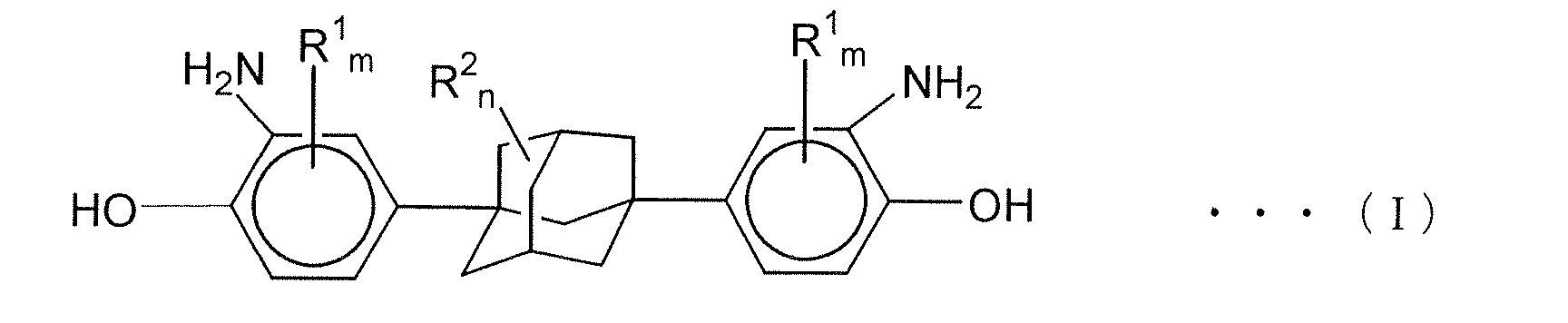
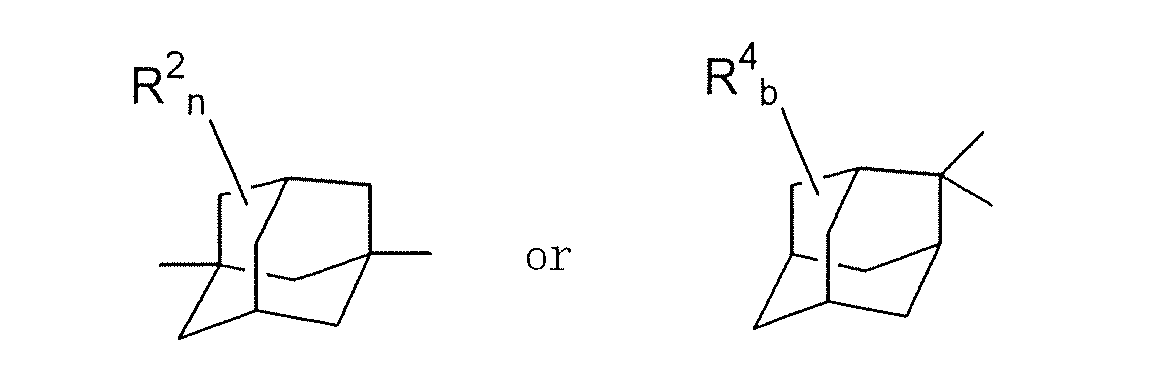
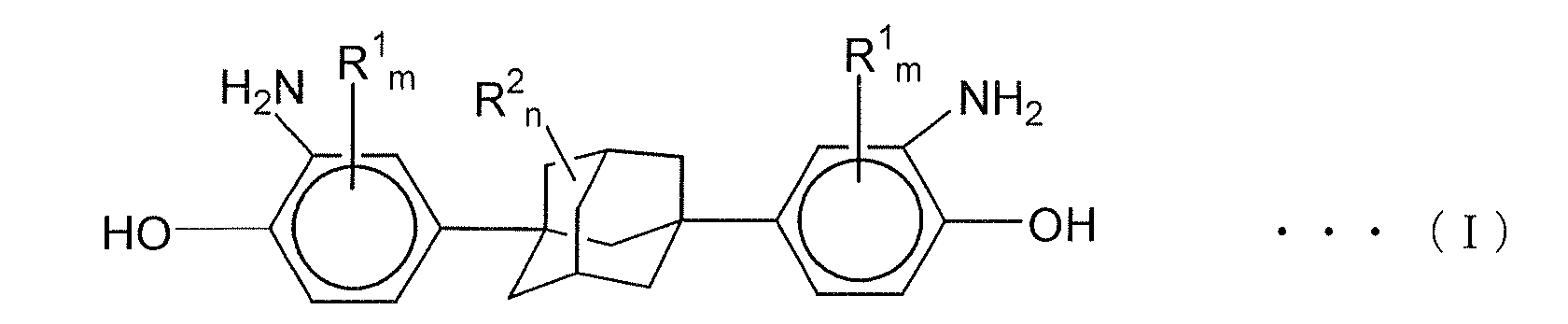
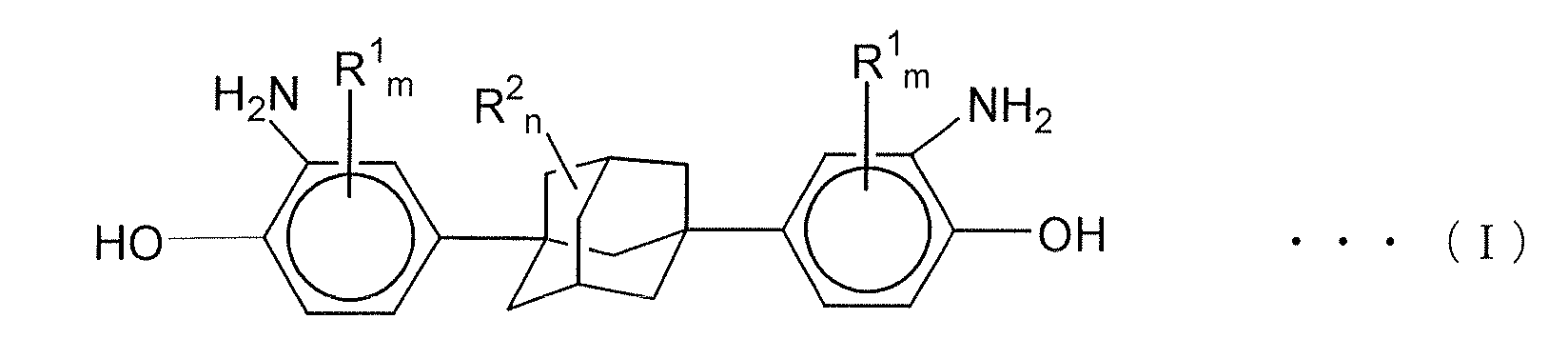
- the present invention provides a 1,3-bis(3-amino-4-hydroxyphenyl)adamantane derivative characterized by having a structure represented by formula (I) : (wherein each of R 1 and R 2 represents a halogen atom, a hydroxyl group, a C1-C10 alkyl group, a C1-C10 alkoxyl group, a carboxyl group, or an alkoxycarbonyl group having a C1-C10 alkyl group; m is an integer of 0 to 3; n is an integer of 0 to 14; when m is 2 or more, a plurality of R 1 s may be identical to or different from one another; and when n is 2 or more, a plurality of R 2 s may be identical to or different from one another; with the proviso that the case where the following three conditions are met is excluded: R 2 is methyl and present at a bridgehead; m is 0; and n is 2).
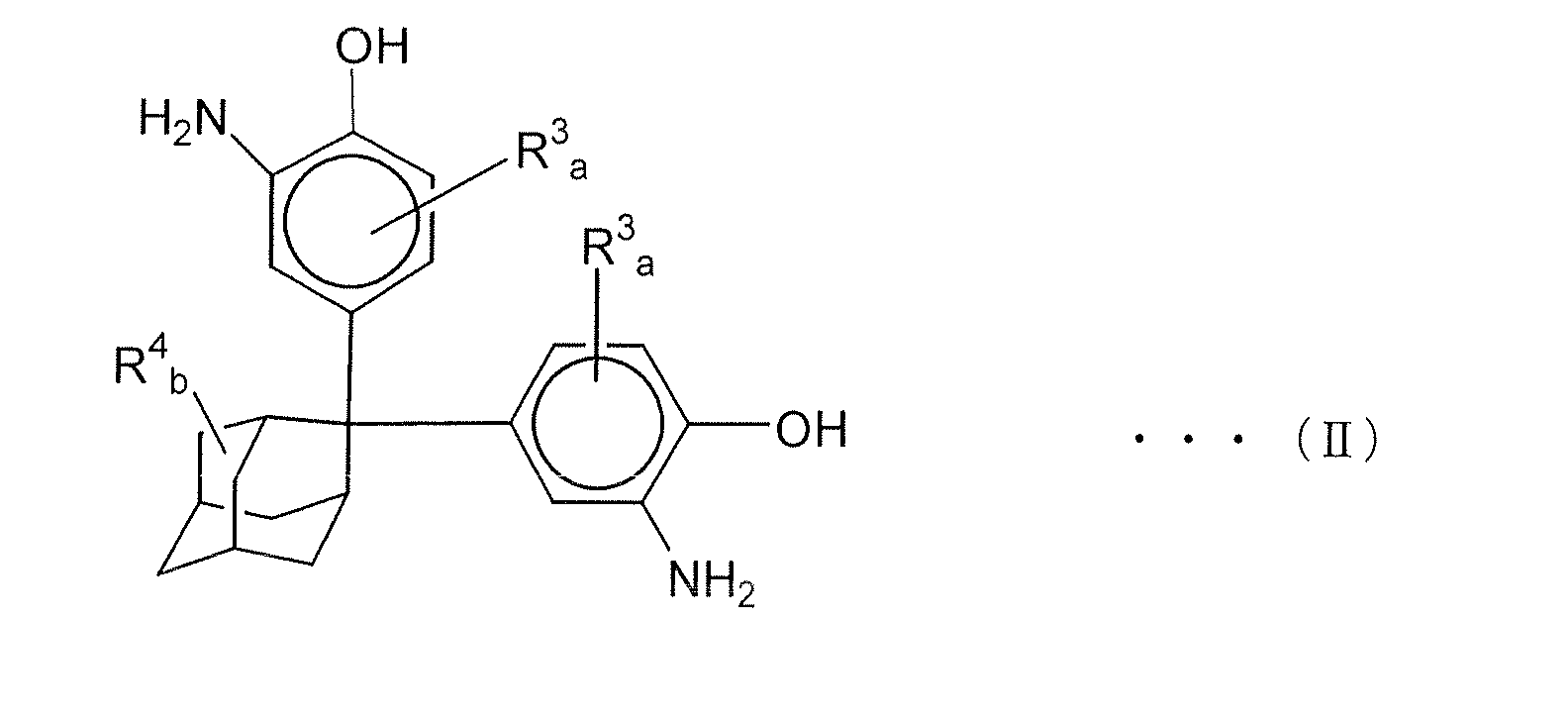
- the present invention also provides a 2,2-bis(3-amino-4-hydroxyphenyl)adamantane derivative characterized by having a structure represented by formula (II): (wherein each of R 3 and R 4 represents a halogen atom, a hydroxyl group, a C1-C10 alkyl group, a C1-C10 alkoxyl group, a carboxyl group, or an alkoxycarbonyl group having a C1-C10 alkyl group; a is an integer of 0 to 3; b is an integer of 0 to 14; when a is 2 or more, a plurality of R 3 s may be identical to or different from one another; and when b is 2 or more, a plurality of R 4 s may be identical to or different from one another).
- the present invention also provides a process for producing a 1,3-bis(3-amino-4-hydroxyphenyl)adamantane derivative represented by formula (I): (wherein R 1 , R 2 , m, and n have the same meanings as defined above, with the proviso that the case where the following three conditions are met is excluded: R 2 is methyl and present at a bridgehead; m is 0; and n is 2), characterized in that the process comprises performing nitration of a 1,3-bis(4-hydroxyphenyl)adamantane derivative represented by formula (III): (wherein R 1 , R 2 , m, and n have the same meanings as defined above, with the proviso that the case where the following three conditions are met is excluded: R 2 is methyl and present at a bridgehead; m is 0; and n is 2), and reducing the nitration product.
- formula (I) wherein R 1 , R 2 , m, and n have the
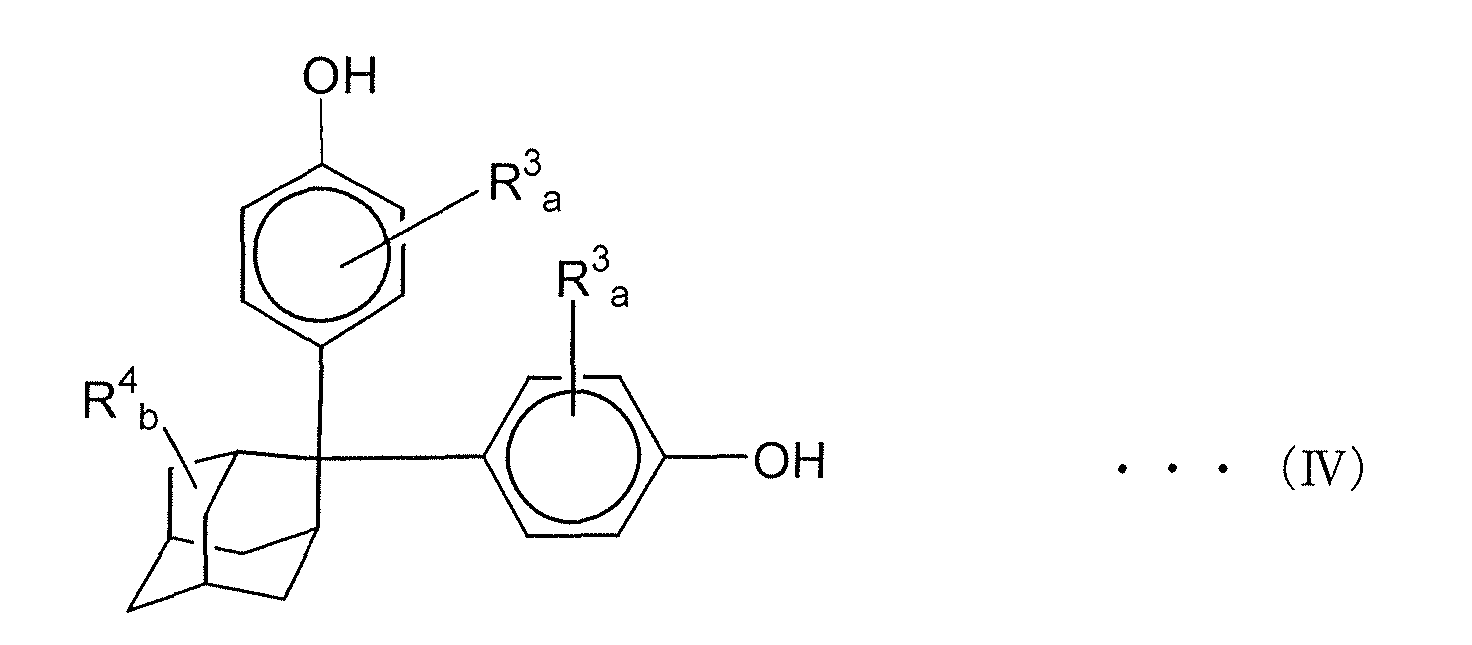
- the present invention also provides a process for producing a 2,2-bis(3-amino-4-hydroxyphenyl)adamantane derivative represented by formula (II): (wherein R 3 , R 4 , a, and b have the same meanings as defined above), characterized in that the process comprises performing nitration of a 2,2-bis(4-hydroxyphenyl)adamantane derivative represented by formula (IV): (wherein R 3 , R 4 , a, and b have the same meanings as defined above), and reducing the nitration product.
- the bis(3-amino-4-hydroxyphenyl)adamantane derivative of the present invention includes two modes; adamantane derivative I and adamantane derivative II.
- the adamantane derivative I of the present invention is a 1,3-bis(3-amino-4-hydroxyphenyl)adamantane derivative, which is a novel compound and has never been disclosed in literature, having a structure represented by (I).
- each of R 1 and R 2 represents a halogen atom, a hydroxyl group, a C1-C10 alkyl group, a C1-C10 alkoxyl group, a carboxyl group, or an alkoxycarbonyl group having a C1-C10 alkyl group.
- the halogen atom includes fluorine, chlorine, bromine, and iodine.
- the C1-C10 alkyl group may be linear, branched, or cyclic, and may have an appropriate substituent such as a halogen atom.
- alkyl groups examples include methyl, ethyl, n-propyl, isopropyl, butyl groups, pentyl groups, hexyl groups, octyl groups, decyl groups, cyclopentyl, cyclohexyl, trifluoromethyl, and perfluoroethyl.
- alkyl groups in the C1-C10 alkyl groups and in the alkoxycarbonyl groups having a C1-C10 alkyl group are the same as described above.
- m is an integer of 0 to 3; n is an integer of 0 to 14; when m is 2 or more, a plurality of R 1 s may be identical to or different from one another; and when n is 2 or more, a plurality of R 2 s may be identical to or different from one another; with the proviso that the case where the following three conditions are met is excluded: R 2 is methyl and present at a bridgehead; m is 0; and n is 2.
- the adamantane derivative II of the present invention is a 2,2-bis(3-amino-4-hydroxyphenyl)adamantane derivative, which is a novel compound and has never been disclosed in literature, having a structure represented by (II).
- each of R 3 and R 4 represents a halogen atom, a hydroxyl group, a C1-C10 alkyl group, a C1-C10 alkoxyl group, a carboxyl group, or an alkoxycarbonyl group having a C1-C10 alkyl group.
- R 3 and R 4 are the same as described in relation to R 1 and R 2 in formula (I).
- a is an integer of 0 to 3; b is an integer of 0 to 14; when a is 2 or more, a plurality of R 3 s may be identical to or different from one another; and when b is 2 or more, a plurality of R 4 s may be identical to or different from one another.
- 1,3-bis(3-amino-4-hydroxyphenyl)adamantane derivatives represented by formula (I) include 1,3-bis(3-amino-4-hydroxyphenyl)adamantane, 1,3-bis(3-amino-4-hydroxy-5-methylphenyl)adamantane, 1,3-bis(3-amino-4-hydroxy-5-ethylphenyl)adamantane, 1,3-bis(3-amino-4-hydroxy-5-methoxyphenyl)adamantane, 1,3-bis(3-amino-4-hydroxy-5-ethoxyphenyl)adamantane, 1,3-bis(3-amino-4-hydroxy-5-fluorophenyl)adamantane, 1,3-bis(3-amino-4-hydroxy-5-trifluoromethylphenyl)adamantane, 1,3-bis(3-amino-4-hydroxy-5-perfluoroethylphenyl)adamant
- Examples of 2,2-bis(3-amino-4-hydroxyphenyl)adamantane derivatives represented by formula (II) include 2,2-bis(3-amino-4-hydroxyphenyl)adamantane, 2,2-bis(3-amino-4-hydroxy-5-methylphenyl)adamantane, 2,2-bis(3-amino-4-hydroxy-5-ethylphenyl)adamantane, 2,2-bis(3-amino-4-hydroxy-5-methoxyphenyl)adamantane, 2,2-bis(3-amino-4-hydroxy-5-ethoxyphenyl)adamantane, 2,2-bis(3-amino-4-hydroxy-5-fluorophenyl)adamantane, 2,2-bis(3-amino-4-hydroxy-5-trifluoromethylphenyl)adamantane, 2,2-bis(3-amino-4-hydroxy-5-perfluoroethylphenyl)adamantane, 2,2-bis(
- adamantane derivatives I and II of the present invention may be produced through, for example, the following procedure.
- 1,3-bis(3-amino-4-hydroxyphenyl)adamantane derivatives represented by formula (I), which are adamantane derivatives I of the present invention may be produced by performing nitration of a 1,3-bis(4-hydroxyphenyl)adamantane derivative represented by formula (III): (wherein R 1 , R 2 , m, and n have the same meanings as defined above, with the proviso that the case where the following three conditions are met is excluded: R 2 is methyl and present at a bridgehead; m is 0; and n is 2), and reducing the nitration product.
- 2,2-Bis(3-amino-4-hydroxyphenyl)adamantane derivatives represented by formula (II), which are adamantane derivatives II of the present invention, may be produced by performing nitration of a 2,2-bis(4-hydroxyphenyl)adamantane derivative represented by formula (IV): (wherein R 3 , R 4 , a, and b have the same meanings as defined above), and reducing the nitration product.
- nitration is generally performed by use of an agent for nitration such as nitric acid in a solvent, for example, a dehydrating solvent such as acetic anhydride or propionic anhydride and, in accordance with needs, at least one optional solvent selected from among ether solvents such as diethyl ether, tetrahydrofuran, and dioxane; aliphatic hydrocarbon solvents such as hexane, heptane, and octane; and aromatic hydrocarbon solvents such as benzene, toluene, and xylene.
- a solvent for example, a dehydrating solvent such as acetic anhydride or propionic anhydride and, in accordance with needs, at least one optional solvent selected from among ether solvents such as diethyl ether, tetrahydrofuran, and dioxane; aliphatic hydrocarbon solvents such as hexane, heptane, and oct
- reaction conditions are as follows: reaction temperature: generally -78 to 100°C, preferably 0°C to room temperature; reaction pressure: generally 0.1 to 10 MPa, preferably ambient pressure; and reaction time: generally 1 to 24 hours, preferably 2 to 6 hours.
- concentration of starting material and a concentration equal to or lower than the solubility (saturated). Generally, a concentration of about 0.1 to 1.0 mol/L is appropriate.
- a 1,3-bis(4-hydroxy-3-nitrophenyl)adamantane derivative is produced from a 1,3-bis(4-hydroxyphenyl)adamantane derivative represented by formula (III), and a 2,2-bis(4-hydroxy-3-nitrophenyl)adamantane derivative is produced from a 2,2-bis(4-hydroxyphenyl)adamantane derivative represented by (IV).
- the nitration product is added to an appropriate solvent and reduced by use of a reducing agent such as hydrogen gas in the presence of a reduction catalyst.
- Examples of the solvent employed in the reduction include alcohol solvents such as methanol, ethanol, propanol, and butanol; ether solvents such as diethyl ether, tetrahydrofuran, and dioxane; aliphatic hydrocarbon solvents such as hexane, heptane, and octane; and aromatic hydrocarbon solvents such as benzene, toluene, and xylene. These solvents may be used singly or in combination of two or more species.
- Examples of the reduction catalyst include palladium/carbon (Pd/C) and metal (nickel, platinum, etc.)-on-carrier (alumina, silica, zeolite, ZSM-5, MCM-41, etc.). Generally, hydrogen gas is employed as a reducing agent.
- reaction temperature generally -78 to 100°C, preferably 0°C to room temperature
- reaction pressure generally 0.1 to 10 MPa, preferably ambient pressure
- reaction time generally 1 to 48 hours, preferably 10 to 30 hours.
- concentration of starting material and a concentration equal to or lower than the solubility (saturated). Generally, a concentration of about 0.1 to 1.0 mol/L is appropriate.
- nitro groups are converted to amino groups, whereby adamantane derivatives I and II of the present invention can be produced.
- 1,3-bis(4-hydroxyphenyl)adamantane derivatives and 2,2-bis(4-hydroxyphenyl)adamantane derivatives, serving as starting materials may be produced through a known method.
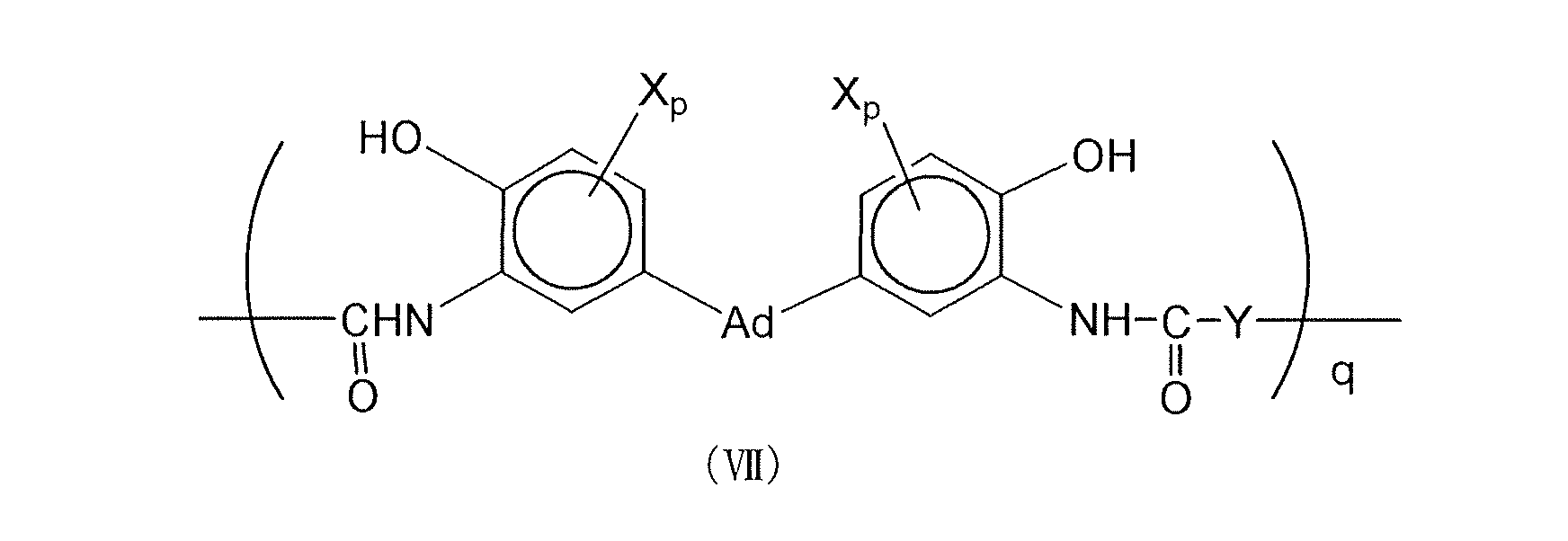
- the bis(3-amino-4-hydroxyphenyl)adamantane derivative of the present invention is reacted with, for example, a dicarboxylic acid, to thereby form a polybenzoxazole according to the following reaction scheme (A):
- A represents a divalent adamantane residue represented by the following formula:
- Y represents a dicarboxylic acid residue
- p is m or a
- q represents a polymerization degree
- R 1 , R 2 , R 3 , R 4 , m, n, a, and b have the same meanings as defined above).
- reaction scheme (A) the bis(3-amino-4-hydroxyphenyl)adamantane derivative (V) of the present invention is reacted with a dicarboxylic acid (VI), to thereby form a polyhydroxyamide (VII). Through subsequent heating, a polybenzoxazole (VIII) is formed.
- the aforementioned dicarboxylic acid (VI) may be aliphatic, alicyclic, or aromatic.
- the aliphatic dicarboxylic acid include oxalic acid, malonic acid, succinic acid, adipic acid, and pimelic acid.
- the alicyclic dicarboxylic acid include 1,2-cyclopentanedicarboxylic acid, and 1,2-, 1,3-, and 1,4-cyclohexanedicarboxylic acids.
- aromatic dicarboxylic acid examples include isophthalic acid, 4-fluoroisophthalic acid, 4-chloroisophthalic acid, 4-methylisophthalic acid, 2,4,5,6-tetrafluoroisophthalic acid, 5-fluoroisophthalic acid, 5-trifluoromethylisophthalic acid, 5-trifluoromethoxyisophthalic acid, terephthalic acid, 2-fluoroterephthalic acid, 2-chloroterephthalic acid, 2-methylterephthalic acid, 2,3,5,6-tetrafluoroterephthalic acid, 2,2-bis(4-carboxyphenyl)propane, 2,2-bis(4-carboxyphenyl)hexafluoropropane, 4,4'-phenyldicarboxylic acid, 2,2'-bis(trifluoromethyl)-4,4'-biphenyldicarboxylic acid, 4,4'-diphenyl ether dicarboxylic acid, 3,3'-diphenyl ether dicar
- An amide-formable derivative may also employed as the aforementioned dicarboxylic acid.
- Examples of the amide-formable derivative include dicarboxylic acid dihalides and active esters between dicarboxylic acid and hydroxybenzotriazole.
- a varnish prepared by dissolving a polyhydroxyamide (VII) serving as a precursor in a solvent is applied to form a coating film, followed by heating, whereby polybenzoxazole (VIII) film is formed.
- the thus-formed polybenzoxazole film is excellent in heat resistance, mechanical characteristics, electric characteristics, physical properties, etc., and is useful for, for example, interlayer insulating film or protective film for use in semiconductor devices, interlayer insulating film for use in multilayer wiring boards, cover coating in flexible printed circuits, or liquid crystal alignment layer.
- the bis(3-amino-4-hydroxyphenyl)adamantane derivative of the present invention may be used as optical materials including optical fiber, optical waveguide, and optical disks.
- the derivative of the present invention may also be a candidate for an drug intermediate, a coating additive (e.g., heat resistance enhancer), a resin additive (e.g., heat resistance enhancer), etc.
- the filtrate was concentrated under reduced pressure, and methanol/diethyl ether solution (ratio by mass: 20/80) (1,000 mL) was added to the obtained residue.
- the mixture was stirred at room temperature for 30 minutes, whereby the solid was washed.
- the mixture was subjected to filtration with suction, followed by washing with diethyl ether (200 mL).
- Methanol/diethyl ether solution (ratio by mass: 20/80) (200 mL) was added to the solid, followed by stirring at room temperature for 30 minutes.
- the mixture was subjected to filtration with suction, and the solid was washed with methanol/diethyl ether solution (ratio by mass: 10/90) (100 mL).
- reaction mixture was fed to ice water (900 mL), and the formed organic layer is separated and concentrated, to thereby yield 273 g of a crude product.
- Methanol 900 mL was added to the crude product, to thereby form a suspension.
- the suspension was refluxed for 20 minutes, followed by washing and cooling to 40°C.
- the mixture was subjected to filtration with suction and washing with methanol (500 mL).
- the thus-obtained solid was dried under reduced pressure, to thereby yield 191 g (465 mmol) of 2,2-bis(4-hydroxy-3-nitrophenyl)adamantane as yellow powder (yield: 83%).
- the present invention can provide a novel bis(3-amino-4-hydroxyphenyl)adamantane derivative which is excellent in terms of heat resistance, mechanical characteristics, electric characteristics, physical properties, etc. and which provides a source for polybenzoxazole useful for, for example, interlayer insulating film or protective film for use in semiconductor devices, interlayer insulating film for use in multilayer wiring boards, cover coating in flexible printed circuits, or a liquid crystal alignment layer.
Landscapes
- Chemical & Material Sciences (AREA)
- Organic Chemistry (AREA)
- Engineering & Computer Science (AREA)
- Manufacturing & Machinery (AREA)
- Microelectronics & Electronic Packaging (AREA)
- Organic Low-Molecular-Weight Compounds And Preparation Thereof (AREA)
- Low-Molecular Organic Synthesis Reactions Using Catalysts (AREA)
- Polyamides (AREA)
Abstract


Description

(2) The present invention also provides a 2,2-bis(3-amino-4-hydroxyphenyl)adamantane derivative characterized by having a structure represented by formula (II):

(3) The present invention also provides a process for producing a 1,3-bis(3-amino-4-hydroxyphenyl)adamantane derivative represented by formula (I):

(4) The present invention also provides a process for producing a 2,2-bis(3-amino-4-hydroxyphenyl)adamantane derivative represented by formula (II):





a, and b have the same meanings as defined above).
Nuclear magnetic resonance (NMR):DMSO-d6
1H-NMR(500MHz): 1.69 to 2.18(m,14H,a-e), 4.36 (br-s,4H,NH2), 6.40 (dd, J=2. 1Hz, 8 . 2Hz, 2H, g or h or k), 6. 56 (d, J=8 . 2Hz, 2H, g or h or k), 6. 65 (d, J=2.1Hz, 2H, g or h or k), 8.70(br-s,2H,OH)
13C-NMR (1.26MHz) : 29.21(c), 35.65(e), 36.07(a), 42.36(b), 49.53(d), 111.50(g or h or k), 112.55(g or h or k), 113.94(g or h or k), 135.78(j), 141.89(f and i)

Nuclear magnetic resonance (NMR):CDCl3
1H-NMR(500MHz): 1.73~1.95(m, 12H,i-k), 3.19(s,2H,b), 7.07(d,J=9.0Hz, 2H, b), 7.61 (d, J=2.3Hz, J=9.0Hz, 2H, c), 8. 08 (d, J=2. 3Hz, 2H, e)
13C-NMR(126MHz): 27.20(h or j), 31.93(j or h), 32.88 (i or k), 37.55(k or i), 49.45(g), 120.61(b or c or e), 121.89(b or c or e), 133.71(a or d or f), 135.28(b or c or e), 140.16(a or d or f), 152.82 (a or d or f)

Nuclear magnetic resonance (NMR):CDCl3/DMSO-d6
1H-NMR(50OMHz): 1.63 to 2.05(m,12H, i-k), 3.00(s,2H,h), 3.87(br-s,4H,NH2), 6.51 to 6.55(m,4H,b or c or e), 6.67(s,2H,b or c or e), 8.35(br-s,2H,OH)
13C-NMR(126MHz) : 26.17(h or j), 30.54(j or h), 32.21 (i or k),36.82 (k or i), 47.75(g), 111.83(b or c or e), 113.45(b or c or e), 113.99(b or c or e), 133.77(a or d or f), 139.52 (a or d or f), 140.11(a or d or f)

Claims (4)
- A 1,3-bis(3-amino-4-hydroxyphenyl)adamantane derivative characterized by having a structure represented by formula (I):(wherein each of R1 and R2 represents a halogen atom, a hydroxyl group, a C1-C10 alkyl group, a C1-C10 alkoxyl group, a carboxyl group, or an alkoxycarbonyl group having a C1-C10 alkyl group; m is an integer of 0 to 3; n is an integer of 0 to 14; when m is 2 or more, a plurality of R1s may be identical to or different from one another; and when n is 2 or more, a plurality of R2s may be identical to or different from one another; with the proviso that the case where the following three conditions are met is excluded: R2 is methyl and present at a bridgehead; m is 0; and n is 2).
- A 2,2-bis(3-amino-4-hydroxyphenyl)adamantane derivative characterized by having a structure represented by formula (II):(wherein each of R3 and R4 represents a halogen atom, a hydroxyl group, a C1-C10 alkyl group, a C1-C10 alkoxyl group, a carboxyl group, or an alkoxycarbonyl group having a C1-C10 alkyl group; a is an integer of 0 to 3; b is an integer of 0 to 14; when a is 2 or more, a plurality of R3s may be identical to or different from one another; and when b is 2 or more, a plurality of R4s may be identical to or different from one another).

- A process for producing a 1,3-bis(3-amino-4-hydroxyphenyl)adamantane derivative represented by formula (I) :(wherein each of R1 and R2 represents a halogen atom, a hydroxyl group, a C1-C10 alkyl group, a C1-C10 alkoxyl group, a carboxyl group, or an alkoxycarbonyl group having a C1-C10 alkyl group; m is an integer of 0 to 3; n is an integer of 0 to 14; when m is 2 or more, a plurality of R1s may be identical to or different from one another; and when n is 2 or more, a plurality of R2s may be identical to or different from one another; with the proviso that the case where the following three conditions are met is excluded: R2 is methyl and present at a bridgehead; m is 0; and n is 2), characterized in that the process comprises performing nitration of a 1,3-bis(4-hydroxyphenyl)adamantane derivative represented by formula (III):
 (wherein R1, R2, m, and n have the same meanings as defined above, with the proviso that the case where the following three conditions are met is excluded: R2 is methyl and present at a bridgehead; m is 0; and n is 2), and reducing the nitration product.
- A process for producing a 2,2-bis(3-amino-4-hydroxyphenyl)adamantane derivative represented by formula (II):(wherein each of R3 and R4 represents a halogen atom, a hydroxyl group, a C1-C10 alkyl group, a C1-C10 alkoxyl group, a carboxyl group, or an alkoxycarbonyl group having a C1-C10 alkyl group; a is an integer of 0 to 3; b is an integer of 0 to 14; when a is 2 or more, a plurality of R3s may be identical to or different from one another; and when b is 2 or more, a plurality of R4s may be identical to or different from one another), characterized in that the process comprises performing nitration of a 2,2-bis(4-hydroxyphenyl)adamantane derivative represented by formula (IV):
 (wherein R3, R4, a, and b have the same meanings as defined above), and reducing the nitration product.
Applications Claiming Priority (3)
| Application Number | Priority Date | Filing Date | Title |
|---|---|---|---|
| JP2003056780A JP4204880B2 (en) | 2003-03-04 | 2003-03-04 | Bis (3-amino-4-hydroxyphenyl) adamantane derivative and method for producing the same |
| JP2003056780 | 2003-03-04 | ||
| PCT/JP2004/002280 WO2004078701A1 (en) | 2003-03-04 | 2004-02-26 | Bis(3-amino-4-hydroxyphenyl)adamantane derivatives and process for production thereof |
Publications (2)
| Publication Number | Publication Date |
|---|---|
| EP1602641A1 true EP1602641A1 (en) | 2005-12-07 |
| EP1602641A4 EP1602641A4 (en) | 2007-10-17 |
Family
ID=32958718
Family Applications (1)
| Application Number | Title | Priority Date | Filing Date |
|---|---|---|---|
| EP04714876A Withdrawn EP1602641A4 (en) | 2003-03-04 | 2004-02-26 | BIS (3-AMINO-4-HYDROXYPHENYL) ADAMANTANE DERIVATIVES AND PROCESS FOR PRODUCING THE SAME |
Country Status (6)
| Country | Link |
|---|---|
| US (1) | US7423180B2 (en) |
| EP (1) | EP1602641A4 (en) |
| JP (1) | JP4204880B2 (en) |
| KR (1) | KR20060002791A (en) |
| TW (1) | TW200500326A (en) |
| WO (1) | WO2004078701A1 (en) |
Cited By (1)
| Publication number | Priority date | Publication date | Assignee | Title |
|---|---|---|---|---|
| EP1953181A4 (en) * | 2005-09-21 | 2011-08-31 | Sumitomo Bakelite Co | RESIN COMPOSITION, VARNISH, RESIN FILM, AND SEMICONDUCTOR DEVICE |
Families Citing this family (11)
| Publication number | Priority date | Publication date | Assignee | Title |
|---|---|---|---|---|
| EP1711550B1 (en) * | 2003-12-23 | 2010-12-01 | Silecs OY | Adamantyl monomers and polymers for low-k-dielectric applications |
| JP2010168591A (en) * | 2004-03-04 | 2010-08-05 | Sumitomo Bakelite Co Ltd | Benzoxazole resin precursor, polybenzoxazole resin, resin film and semiconductor device |
| JP2006008642A (en) * | 2004-06-29 | 2006-01-12 | Sumitomo Bakelite Co Ltd | Aminophenol compound, thermosetting compound and method for producing the same |
| JP4617903B2 (en) * | 2004-10-28 | 2011-01-26 | 住友ベークライト株式会社 | Bisaminophenol compounds |
| KR101142998B1 (en) | 2004-12-20 | 2012-05-08 | 재단법인서울대학교산학협력재단 | Organic insulator, thin film transistor array panel comprising the organic insulator and manufacturing method thereof |
| JP4876496B2 (en) * | 2005-02-28 | 2012-02-15 | 住友ベークライト株式会社 | Aromatic compounds and their derivatives |
| JP4815884B2 (en) * | 2005-06-08 | 2011-11-16 | 住友ベークライト株式会社 | Biadamantane tetraphenol derivative |
| JP2007063202A (en) * | 2005-08-31 | 2007-03-15 | Sumitomo Bakelite Co Ltd | Bisaminophenol compound |
| JP2007186493A (en) * | 2005-12-14 | 2007-07-26 | Sumitomo Bakelite Co Ltd | Bisaminophenol compound |
| JP5061459B2 (en) * | 2005-12-26 | 2012-10-31 | 住友ベークライト株式会社 | Tetrakisaminophenol compound |
| EP3061742A1 (en) * | 2013-10-25 | 2016-08-31 | Mitsubishi Gas Chemical Company, Inc. | 1,3-bis(hydroxyphenyl)-5-ethyladamantane compound and method for production thereof, and aromatic polycarbonate resin and method for production thereof |
Family Cites Families (6)
| Publication number | Priority date | Publication date | Assignee | Title |
|---|---|---|---|---|
| FR2399454A1 (en) * | 1977-08-05 | 1979-03-02 | France Etat | Polybenzoxazole-imide(s) based on adamantane - prepd. from bis-imide(s) and bis-(ortho-hydroxyamines) |
| EP0536070B1 (en) * | 1991-10-04 | 1998-05-27 | Rhodia Chimie | Tungsten carbide based material, catalyst and useful process for the hydrogenation of nitro or nitroso aromatic derivatives using this catalyst |
| JP3901302B2 (en) | 1997-10-02 | 2007-04-04 | 日本化薬株式会社 | Process for producing bis (3-nitro-4-hydroxyphenyl) s |
| JP2002173470A (en) * | 2000-09-27 | 2002-06-21 | Nippon Kayaku Co Ltd | 9,9-bis(3-nitro-4-hydroxyphenyl)fluorene and method for producing the same |
| JP2002265422A (en) * | 2001-03-13 | 2002-09-18 | Nippon Kayaku Co Ltd | Method for producing 1,1-bis(4-hydroxy-3-nitrophenyl) cycloalkanes |
| JP2004018593A (en) | 2002-06-13 | 2004-01-22 | Hitachi Chemical Dupont Microsystems Ltd | Polybenzoxazole precursor, photosensitive resin composition and electronic component |
-
2003
- 2003-03-04 JP JP2003056780A patent/JP4204880B2/en not_active Expired - Fee Related
-
2004
- 2004-02-26 WO PCT/JP2004/002280 patent/WO2004078701A1/en not_active Ceased
- 2004-02-26 EP EP04714876A patent/EP1602641A4/en not_active Withdrawn
- 2004-02-26 US US10/547,553 patent/US7423180B2/en not_active Expired - Fee Related
- 2004-02-26 KR KR1020057016380A patent/KR20060002791A/en not_active Ceased
- 2004-03-03 TW TW093105574A patent/TW200500326A/en unknown
Cited By (2)
| Publication number | Priority date | Publication date | Assignee | Title |
|---|---|---|---|---|
| EP1953181A4 (en) * | 2005-09-21 | 2011-08-31 | Sumitomo Bakelite Co | RESIN COMPOSITION, VARNISH, RESIN FILM, AND SEMICONDUCTOR DEVICE |
| US8178631B2 (en) | 2005-09-21 | 2012-05-15 | Sumitomo Bakelite Company, Ltd. | Resin composition, varnish, resin film and semiconductor device |
Also Published As
| Publication number | Publication date |
|---|---|
| US20060161016A1 (en) | 2006-07-20 |
| WO2004078701A1 (en) | 2004-09-16 |
| KR20060002791A (en) | 2006-01-09 |
| JP4204880B2 (en) | 2009-01-07 |
| TW200500326A (en) | 2005-01-01 |
| EP1602641A4 (en) | 2007-10-17 |
| US7423180B2 (en) | 2008-09-09 |
| JP2004262889A (en) | 2004-09-24 |
Similar Documents
| Publication | Publication Date | Title |
|---|---|---|
| US7423180B2 (en) | Bis(3-amino-4-hydroxyphenyl)adamantane derivatives and process for production thereof | |
| TWI486335B (en) | Base generator | |
| JP2010184898A (en) | Dodecahydro-1,4:5,8-dimethanoanthracene-9,10-dione-2,3,6,7-tetracarboxylic acid-2,3:6,7-dianhydrides, dodecahydro-1,4:5,8-dimethanoanthracene-9,10-dione-2,3,6,7-tetracarboxylic acid tetraesters and method for producing the same | |
| CN114249892B (en) | Polyimide precursor resin and preparation method and application thereof | |
| JP7096931B2 (en) | Fluorinated amide compounds, fluorinated nitrogen-containing heterocyclic compounds and fluorinated compounds | |
| JP2003183387A (en) | Fluorine-containing alicylic diamine and polymer using the same | |
| CN117843632B (en) | Diamine compound, polyimide acid, polyimide, preparation method and application thereof | |
| CN115583928A (en) | Preparation method of phthalic anhydride derivative | |
| CN116478098A (en) | Polyimide precursor, polyimide and its preparation method and application | |
| CN100376544C (en) | Insulation material monomer in aluminum and copper technology | |
| CN111393379A (en) | Diamine compound and photosensitive resin | |
| KR100586107B1 (en) | Flexible metal thin film laminated film containing polyimide flexible insulating film | |
| TW202248191A (en) | Meta-ester aromatic diamines, method for producing same, and polyimide having said meta-ester aromatic diamines as raw material | |
| JP3831301B2 (en) | Fluorine-containing compound, fluorinated cyanoaryl ether polymer and cross-linked product thereof | |
| JP2013159557A (en) | Method for producing dinitro compound | |
| KR102938836B1 (en) | Spirobisindane diamine derivative having crosslinkable vinyl group and low dielectric polyimide | |
| JP7736301B2 (en) | Meta-ester aromatic diamines, their production method, and polyimides made from these meta-ester aromatic diamines | |
| KR102676871B1 (en) | Novel diamine-based compound, manufacturing method thereof, polyamide-based compound, polybenzoxazole film and flexible device | |
| KR20080044904A (en) | Soluble transparent polybenzoxazole precursor, polypolybenzoxazole and preparation method thereof | |
| CN110452251A (en) | A kind of anhydride compounds and the preparation method and application thereof | |
| KR100584953B1 (en) | Flexible metal thin film laminate film including poly (amide-imide) flexible insulating film | |
| CN116332781A (en) | Diamine compound and preparation method thereof, polymer formed from diamine compound and use thereof | |
| JP2002173470A (en) | 9,9-bis(3-nitro-4-hydroxyphenyl)fluorene and method for producing the same | |
| WO2023022123A1 (en) | Fluorine-containing polyamide compound and fluorine-containing polybenzoxazole | |
| TW202610966A (en) | Compounds and methods for manufacturing compounds |
Legal Events
| Date | Code | Title | Description |
|---|---|---|---|
| PUAI | Public reference made under article 153(3) epc to a published international application that has entered the european phase |
Free format text: ORIGINAL CODE: 0009012 |
|
| 17P | Request for examination filed |
Effective date: 20050829 |
|
| AK | Designated contracting states |
Kind code of ref document: A1 Designated state(s): AT BE BG CH CY CZ DE DK EE ES FI FR GB GR HU IE IT LI LU MC NL PT RO SE SI SK TR |
|
| AX | Request for extension of the european patent |
Extension state: AL LT LV MK |
|
| RBV | Designated contracting states (corrected) |
Designated state(s): AT BE BG CH CY CZ DE DK EE ES FI FR GB GR HU IE IT LI LU MC NL PT RO SE SI SK TR |
|
| DAX | Request for extension of the european patent (deleted) | ||
| RBV | Designated contracting states (corrected) |
Designated state(s): BE DE FR GB |
|
| A4 | Supplementary search report drawn up and despatched |
Effective date: 20070914 |
|
| STAA | Information on the status of an ep patent application or granted ep patent |
Free format text: STATUS: THE APPLICATION HAS BEEN WITHDRAWN |
|
| 18W | Application withdrawn |
Effective date: 20080104 |