EP1601164B1 - WEB service application protocol and SOAP processing model - Google Patents
WEB service application protocol and SOAP processing model Download PDFInfo
- Publication number
- EP1601164B1 EP1601164B1 EP05104031A EP05104031A EP1601164B1 EP 1601164 B1 EP1601164 B1 EP 1601164B1 EP 05104031 A EP05104031 A EP 05104031A EP 05104031 A EP05104031 A EP 05104031A EP 1601164 B1 EP1601164 B1 EP 1601164B1
- Authority
- EP
- European Patent Office
- Prior art keywords
- service
- wsap
- request
- state
- identifier
- Prior art date
- Legal status (The legal status is an assumption and is not a legal conclusion. Google has not performed a legal analysis and makes no representation as to the accuracy of the status listed.)
- Expired - Lifetime
Links
Images




Classifications
-
- G—PHYSICS
- G06—COMPUTING OR CALCULATING; COUNTING
- G06F—ELECTRIC DIGITAL DATA PROCESSING
- G06F15/00—Digital computers in general; Data processing equipment in general
- G06F15/16—Combinations of two or more digital computers each having at least an arithmetic unit, a program unit and a register, e.g. for a simultaneous processing of several programs
-
- H—ELECTRICITY
- H04—ELECTRIC COMMUNICATION TECHNIQUE
- H04L—TRANSMISSION OF DIGITAL INFORMATION, e.g. TELEGRAPHIC COMMUNICATION
- H04L67/00—Network arrangements or protocols for supporting network services or applications
- H04L67/01—Protocols
- H04L67/10—Protocols in which an application is distributed across nodes in the network
- H04L67/1095—Replication or mirroring of data, e.g. scheduling or transport for data synchronisation between network nodes
-
- G—PHYSICS
- G06—COMPUTING OR CALCULATING; COUNTING
- G06Q—INFORMATION AND COMMUNICATION TECHNOLOGY [ICT] SPECIALLY ADAPTED FOR ADMINISTRATIVE, COMMERCIAL, FINANCIAL, MANAGERIAL OR SUPERVISORY PURPOSES; SYSTEMS OR METHODS SPECIALLY ADAPTED FOR ADMINISTRATIVE, COMMERCIAL, FINANCIAL, MANAGERIAL OR SUPERVISORY PURPOSES, NOT OTHERWISE PROVIDED FOR
- G06Q30/00—Commerce
- G06Q30/06—Buying, selling or leasing transactions
- G06Q30/0601—Electronic shopping [e-shopping]
-
- H—ELECTRICITY
- H04—ELECTRIC COMMUNICATION TECHNIQUE
- H04L—TRANSMISSION OF DIGITAL INFORMATION, e.g. TELEGRAPHIC COMMUNICATION
- H04L67/00—Network arrangements or protocols for supporting network services or applications
- H04L67/01—Protocols
- H04L67/02—Protocols based on web technology, e.g. hypertext transfer protocol [HTTP]
-
- H—ELECTRICITY
- H04—ELECTRIC COMMUNICATION TECHNIQUE
- H04L—TRANSMISSION OF DIGITAL INFORMATION, e.g. TELEGRAPHIC COMMUNICATION
- H04L67/00—Network arrangements or protocols for supporting network services or applications
- H04L67/50—Network services
- H04L67/56—Provisioning of proxy services
-
- H—ELECTRICITY
- H04—ELECTRIC COMMUNICATION TECHNIQUE
- H04L—TRANSMISSION OF DIGITAL INFORMATION, e.g. TELEGRAPHIC COMMUNICATION
- H04L67/00—Network arrangements or protocols for supporting network services or applications
- H04L67/50—Network services
- H04L67/56—Provisioning of proxy services
- H04L67/568—Storing data temporarily at an intermediate stage, e.g. caching
Definitions
- the invention relates generally to computer systems and networks, and more particularly to web services.
- Such resources and data include services and data maintained locally, and data maintained on corporate networks and other remotely accessible sites including intranets and the internet.
- web services The concept of web services is generally directed to providing a computing service to clients via protocols and standards that are cross-platform in nature.
- web services provides the basic tools for wiring the nodes of a distributed application together, regardless of the type of platform on which the requesting client is running.
- various platform-independent mechanisms and protocols that facilitate the exchange of network information are becoming commonplace in web services, including HTTP (HyperText Transfer Protocol), XML (extensible Markup Language), XML Schema, and SOAP (Simple Object Access Protocol) XML.
- Traditional web services in which businesses, organizations, and other providers offer services to users and applications, are presently based on these standards.
- a web service can represent other types of resources, such as hardware devices, databases and the like.
- the protocols by which web services exchange data with a client allow a client to send a message to a server port (e.g., URI) corresponding to the service and receive a message back at the client, in a manner agreed on according to a contract provided by the web service.
- a server port e.g., URI
- the client needs to send its messages through the service's URI, even though the service itself may be built from separate entities, whereby communication through the service's URI becomes a potential bottleneck.
- US 2002/0029256 A1 discloses an XML-based template language for devices and services.
- a unique identifier that identifies a service definition is used that refers to the format of a uniform resource identifier (URI).
- a service definition includes a service type identifier, definition of the service state table, definition of the service command set, the service control protocol and service control protocol declaration.
- the service state table represents a current state of the service.
- a rehydrator is a module that exposes a suitable API to applications and either invokes commands on a service or queries the state of that service, or receives and responds to events. The primary job of the rehydrator is to map between API calls and the service control protocol sequence that invokes the command.
- EP 1 249 765 A1 discloses a method for providing personalized services allowing the personalization of service behavior.
- the present invention provides a method, system and mechanism including a web services application protocol (WSAP), that, among other things, formally represents the state and behavior of a service via a port, (e.g., URI), whereby the entities in a service may be contacted directly for interaction.
- WSAP describes the behaviors of a web service in a formalized manner, e.g., with each behavior of a service having its own port.
- the WSAP protocol also facilitates the usage of intermediaries by defining shared semantics on verbs, which identify what a message is, what the processing of message is, and how it affects the state / behavior of the receiver. Further, the ordering of messages and operations provides context to what is occurring.
- WSAP allows the service to give each behavior / state its own port, (e.g., an identity such as URI).
- the client can communicate directly with the logical entity within the service that controls the behavior / state.
- a web service that provides access to a storage device such as a hard disk drive.
- the client would send the file handle to the file system.
- an arbiter service returns a URI to another logical entity (another service) of the web service that provides access to the behavior (the operation to perform) on the appropriate state (the data).
- the client would receive a port for writing (e.g., using a suitable XML schema) to allowed locations on the storage medium itself, and another port for reading from the storage medium, without again going through the arbiter.
- a read operation corresponds to one behavior of a storage medium, and thus may have a different URI from a write operation, which corresponds to another behavior.
- this model of data access is more efficient than going to a file system controller for each operation, particularly if the file system would otherwise be a bottleneck.
- WSAP messages use shared semantics that describe what can be done on the interaction point.
- the semantics comprise shared message verbs that are separate from the (possibly proprietary) message details, allowing any arbitrary intermediary to observe, to a known extent, what is taking place, while leaving the message contents secure.
- Message ordering can also serve to provide context to an observer.
- each service may define which WSAP operations it accepts, and in which order.
- the communication with each port ordinarily identifies the behavior that is being requested, since each behavior may be assigned its own port.
- an intermediary can process exchanged messages to add value to communications. For example, when it is known from the requested operation type and/or known URI that a message will not change the state of a resource, an intermediary such as a cache service can safely read data from its own cache to satisfy the request, rather than invalidate the cache and pass the message (to another service) to access other storage media.
- the intermediate cache service need only know the operation type from the protocol's semantics, or the URI if known to be to a read-only service, and not the internal contents of the message, which may remain secure, (and indeed may have been encrypted via another intermediary service).
- Examples of such read-like operations in WSAP in which no state changes are involved include operations referred to using the shared semantics of QUERY or GET. Such operations each have the characteristic of being safe, essentially meaning read-only access is sufficient to satisfy the operation request, and idempotent, essentially meaning that the same operation can be repeated indefinitely without changing state.
- a cache is only one example of such an intermediary, and an intermediary can be any other service as appropriate, e.g., a load balancer, data compressor, replication service, encryption/decryption mechanism, and so forth.
- a SOAP processing model defines how to compose multiple web services to run in parallel or sequentially.
- the model allows the implementation of several services, such as the SOAP-aware serializer, to serialize or deserialize the header and body of a given SOAP message concurrently. This allows services that depend upon parts of the SOAP envelope to unblock whenever a header that a service cares about is available. Note that when two communicating parties are co-located, e.g., on the same device, the forwarding and transport services do not serialize the SOAP envelope for performance reasons.
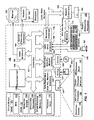
- FIGURE 1 illustrates an example of a suitable computing system environment 100 on which the invention may be implemented.
- the computing system environment 100 is only one example of a suitable computing environment and is not intended to suggest any limitation as to the scope of use or functionality of the invention. Neither should the computing environment 100 be interpreted as having any dependency or requirement relating to any one or combination of components illustrated in the exemplary operating environment 100.
- the invention is operational with numerous other general purpose or special purpose computing system environments or configurations.
- Examples of well known computing systems, environments, and/or configurations that may be suitable for use with the invention include, but are not limited to: personal computers, server computers, hand-held or laptop devices, tablet devices, multiprocessor systems, microprocessor-based systems, set top boxes, programmable consumer electronics, network PCs, minicomputers, mainframe computers, distributed computing environments that include any of the above systems or devices, and the like.
- the invention may be described in the general context of computer-executable instructions, such as program modules, being executed by a computer.
- program modules include routines, programs, objects, components, data structures, and so forth, which perform particular tasks or implement particular abstract data types.
- the invention may also be practiced in distributed computing environments where tasks are performed by remote processing devices that are linked through a communications network.
- program modules may be located in local and/or remote computer storage media including memory storage devices.
- an exemplary system for implementing the invention includes a general purpose computing device in the form of a computer 110.
- Components of the computer 110 may include, but are not limited to, a processing unit 120, a system memory 130, and a system bus 121 that couples various system components including the system memory to the processing unit 120.
- the system bus 121 may be any of several types of bus structures including a memory bus or memory controller, a peripheral bus, and a local bus using any of a variety of bus architectures.
- such architectures include Industry Standard Architecture (ISA) bus, Micro Channel Architecture (MCA) bus, Enhanced ISA (EISA) bus, Video Electronics Standards Association (VESA) local bus, and Peripheral Component Interconnect (PCI) bus also known as Mezzanine bus.
- ISA Industry Standard Architecture
- MCA Micro Channel Architecture
- EISA Enhanced ISA
- VESA Video Electronics Standards Association
- PCI Peripheral Component Interconnect
- the computer 110 typically includes a variety of computer-readable media.
- Computer-readable media can be any available media that can be accessed by the computer 110 and includes both volatile and nonvolatile media, and removable and non-removable media.
- Computer-readable media may comprise computer storage media and communication media.
- Computer storage media includes volatile and nonvolatile, removable and non-removable media implemented in any method or technology for storage of information such as computer-readable instructions, data structures, program modules or other data.
- Computer storage media includes, but is not limited to, RAM, ROM, EEPROM, flash memory or other memory technology, CD-ROM, digital versatile disks (DVD) or other optical disk storage, magnetic cassettes, magnetic tape, magnetic disk storage or other magnetic storage devices, or any other medium which can be used to store the desired information and which can accessed by the computer 110.
- Communication media typically embodies computer-readable instructions, data structures, program modules or other data in a modulated data signal such as a carrier wave or other transport mechanism and includes any information delivery media.
- modulated data signal means a signal that has one or more of its characteristics set or changed in such a manner as to encode information in the signal.
- communication media includes wired media such as a wired network or direct-wired connection, and wireless media such as acoustic, RF, infrared and other wireless media. Combinations of the any of the above should also be included within the scope of computer-readable media.
- the system memory 130 includes computer storage media in the form of volatile and/or nonvolatile memory such as read only memory (ROM) 131 and random access memory (RAM) 132.
- ROM read only memory
- RAM random access memory
- BIOS basic input/output system
- RAM 132 typically contains data and/or program modules that are immediately accessible to and/or presently being operated on by processing unit 120.
- FIG. 1 illustrates operating system 134, application programs 135, other program modules 136 and program data 137.
- the computer 110 may also include other removable/non-removable, volatile/nonvolatile computer storage media.
- FIG. 1 illustrates a hard disk drive 141 that reads from or writes to non-removable, nonvolatile magnetic media, a magnetic disk drive 151 that reads from or writes to a removable, nonvolatile magnetic disk 152, and an optical disk drive 155 that reads from or writes to a removable, nonvolatile optical disk 156 such as a CD ROM or other optical media.
- removable/non-removable, volatile/nonvolatile computer storage media that can be used in the exemplary operating environment include, but are not limited to, magnetic tape cassettes, flash memory cards, digital versatile disks, digital video tape, solid state RAM, solid state ROM, and the like.
- the hard disk drive 141 is typically connected to the system bus 121 through a non-removable memory interface such as interface 140, and magnetic disk drive 151 and optical disk drive 155 are typically connected to the system bus 121 by a removable memory interface, such as interface 150.
- hard disk drive 141 is illustrated as storing operating system 144, application programs 145, other program modules 146 and program data 147. Note that these components can either be the same as or different from operating system 134, application programs 135, other program modules 136, and program data 137. Operating system 144, application programs 145, other program modules 146, and program data 147 are given different numbers herein to illustrate that, at a minimum, they are different copies.
- a user may enter commands and information into the computer 110 through input devices such as a tablet, or electronic digitizer, 164, a microphone 163, a keyboard 162 and pointing device 161, commonly referred to as mouse, trackball or touch pad.
- Other input devices not shown in FIG. 1 may include a joystick, game pad, satellite dish, scanner, or the like.
- a user input interface 160 that is coupled to the system bus, but may be connected by other interface and bus structures, such as a parallel port, game port or a universal serial bus (USB).
- a monitor 191 or other type of display device is also connected to the system bus 121 via an interface, such as a video interface 190.
- the monitor 191 may also be integrated with a touch-screen panel or the like. Note that the monitor and/or touch screen panel can be physically coupled to a housing in which the computing device 110 is incorporated, such as in a tablet-type personal computer. In addition, computers such as the computing device 110 may also include other peripheral output devices such as speakers 195 and printer 196, which may be connected through an output peripheral interface 194 or the like.
- the computer 110 may operate in a networked environment using logical connections to one or more remote computers, such as a remote computer 180.
- the remote computer 180 may be a personal computer, a server, a router, a network PC, a peer device or other common network node, and typically includes many or all of the elements described above relative to the computer 110, although only a memory storage device 181 has been illustrated in FIG. 1.
- the logical connections depicted in FIG. 1 include a local area network (LAN) 171 and a wide area network (WAN) 173, but may also include other networks.
- LAN local area network
- WAN wide area network
- Such networking environments are commonplace in offices, enterprise-wide computer networks, intranets and the Internet.
- the computer system 110 may comprise source machine from which data is being migrated, and the remote computer 180 may comprise the destination machine.
- source and destination machines need not be connected by a network or any other means, but instead, data may be migrated via any media capable of being written by the source platform and read by the destination platform or platforms.
- the computer 110 When used in a LAN networking environment, the computer 110 is connected to the LAN 171 through a network interface or adapter 170. When used in a WAN networking environment, the computer 110 typically includes a modem 172 or other means for establishing communications over the WAN 173, such as the Internet.
- the modem 172 which may be internal or external, may be connected to the system bus 121 via the user input interface 160 or other appropriate mechanism.
- program modules depicted relative to the computer 110, or portions thereof may be stored in the remote memory storage device.
- FIG. 1 illustrates remote application programs 185 as residing on memory device 181. It will be appreciated that the network connections shown are exemplary and other means of establishing a communications link between the computers may be used.
- a basic programming primitive is a lightweight port, comprising an unordered collection of messages that can be used to store state and effect communication. Items are stored by reference, and ports support (at least) two primitive operations: Post() and Get(). Posting an item, such as a class instance, buffers the reference and returns immediately. Retrieving an item based on a supplied key can block if no item with the key has been posted by the remote service.
- ports can be used directly by services, they are typically used within the context of a port collection that associates a specific message type with each port in the collection. Port collections can be created with a fixed or a dynamic set of supported message types depending on the flexibility needed, but from a programmer's point of view, a port collection is simply a typed port.
- service code can implement critical sections and complicated I/O protocols and produce a very concurrent processing model.
- the present invention is, in part, directed towards a protocol (web services application protocol, or WSAP) for communicating with a web service, in which a client consumer requests a server provider to perform some service for the client, and provide the client with an appropriate response.
- a protocol web services application protocol, or WSAP
- the general web service model is not limited to a server running software for a client, but applies to any resource that a client wants to access, e.g., the uniform service model supported by WSAP can be used to model files, devices, services, and people.
- hardware may be componentized to an extent, and in many ways will be virtually indistinguishable from software-oriented web services, in that a user may select a set of hardware components and interconnect them to perform a computing task. As long as each device obeys the communication protocols, (and the appropriate amount of bandwidth is available), virtually any authorized device will be able to communicate with another device to use its resources.
- FIG. 2 represents an architecture 200 comprising web client code 202 (e.g., which may be the computer system 110 of FIG. 1) communicating with a web service 204 via WSAP messages communicated within a SOAP (simple object access protocol) envelope.
- Web client code 202 e.g., which may be the computer system 110 of FIG. 1
- WSAP simple object access protocol
- the identity of a service is described by a named port, (e.g., a URI), and the state of a service is typically described by an XML schema.
- the service may be local (within the same machine as the client code) or may be a remote resource such as a server or a hardware device.
- WSAP defines, semantically, what a web service does, while the SOAP processing model defines how to compose multiple web services to run in parallel or sequentially, and may be used in accordance with the present invention to compose internal services to a computing device in a manner that is substantially identical to external web services, e.g., via in-memory non-XML serialized data.
- WSAP-capable services operate by offering a contract in response to a contract request, as represented in FIG. 2 by the web service contract request 206 and contract offering 208.
- a port is exposed to the client corresponding to a LOOKUP operation, as described below.
- binding list information is provided with the response 208, e.g., as an identifier / port that corresponds to an array of key/value pairs that "instance" the contract, as described below.
- Services are not required to implement WSAP operations other than the LOOKUP operation, although when the semantics of an interaction is compatible with a WSAP operation, the WSAP service should implement the WSAP operation.
- the service author may map any interaction or service functionality using WSAP verbs and representations. Not all WSAP verbs have to be used for a particular service, but instead a subset may be used, depending on the scenario.
- WSAP is a SOAP-based protocol useful in a distributed computing environment that defines a web service in terms of identity, state, and a set of operations that can be used according to the behavior of the service. This effectively enables services and their state to be operated upon in a consistent and observable manner.
- a behavioral web service is an abstract notion of a process that has an identity and a behavior. This concept is abstract in the sense that it can apply to many different application models and namespaces.
- WSAP defines one such application model which has been designed to scale to the Internet at large, but many other application models are possible.
- identity in WSAP is similar to that of a resource identified by a URI in the traditional web model, namely anything that has identity.
- identity is to enable a service to differentiate itself from other services that may exist within the same namespace.
- scope of WSAP web services may be the Internet, which means that DNS or IP is the naming authority for the URI "authority" component, although in more a limited scope such as within a device or limited network, another naming authority is feasible.
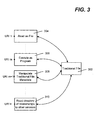
- Each WSAP web service has a unique identity, such as a URI as exemplified in FIG. 3.
- a URI such as on the web
- no semantic knowledge is obtained based on the URI alone, and similarly, a relationship (e.g., a containment relationship) between two WSAP web services cannot be deduced from their URIs.
- URIs may be either relative or absolute. If a URI is relative then its base is determined by XML Base.
- WSAP does not place any limit on the length of a URI, and thus any WSAP receiver needs to be able to handle the length of any URI that it publishes; WSAP implementations should be able to deal with URIs of at least two kilobytes in length.
- a service can be implemented in any number of ways, as long as it conforms to the contract it claims to implement.
- a contract is a service like essentially everything else, whereby contracts are identified by ports (e.g., URIs) and can be operated on as any other service, according to its contract.
- behavior is based on how a service interacts with its environment in terms of the sequence of message types that it generates and accepts.
- Behavior enables a service to differentiate its particular behavior from the behavior of other services that may exist within the same namespace, and behavior is relative to the set of possible behaviors defined for a particular namespace in which the service is defined.
- behavior is a distributed state machine exposed by the service.
- behavior augments the current web model for identifying resources.
- Two services need to have compatible behaviors to communicate; that is, they must compose. If the behavior of a service is not known by another service, this implies that the two services cannot interact, which is similar to the Web model of a resource wherein a URI cannot be dereferenced because the mechanism for doing so is unknown to the holder of that URI.
- any data, whether it is metadata or data, is represented as a service. That is, rather than exposing the same collection of data (such as a file) as a single entity that can be read or executed, the file is exposed as different services with different contracts.
- FIG. 3 illustrates the notion of uniqueness in identity and behavior through a traditional file's data 302 exposed as a set of services with different behaviors, with each service having its own URI.
- among the services corresponding to the behaviors of a file include a read service 304, an execute service 306, a metadata manipulation service 308 and a service for reading a directory of this file's relationships to other services 310.
- any other behavior with respect to a file e.g., write
- Exposing a file as a set of services, each with its own URI, provides significant benefits over a traditional model in which a file is accessed via the file system by its returned handle after opening. For example, with the present invention, once the URI to the media service is known, operations to the file may be performed via an appropriate service, eliminating the need to keep going through a file system to do something with the file data. This is particularly beneficial in distributed computing environments, where, for example, a file system may be on some distant server and/or may be a bottleneck that can be avoided via the present invention.
- a primary purpose of WSAP is to provide an application-level protocol framework that resolves what a WSAP web service is and how it is identified, what the behavior of a WSAP web service is and how it communicates with other WSAP web services, and how a WSAP web service relates to other WSAP services and to other resources in general.
- the framework provided by WSAP via a set of message operations and exchange patterns, intentionally constrains the notion of a behavioral web service in terms of identity and behavior, but it does not constrain it in terms of structure or complexity.
- WSAP web services can be used in many diverse application contexts. For example, in addition to the concept of a file as a service as shown in the example of FIG.
- a behavioral web service has the notion of a service state, sometimes referred to as a "service value.” More particularly, WSAP message operations may involve the exchange of serialized state that represents parts or subparts of a service, (but not the WSAP service itself). The serialized state of a service is called the service value, as opposed to the behavior which represents the service type.
- a service can have any value that is allowed by the behavior of the service, and that value may change over time.
- WSAP operates on services, and employs a service representation, which represents the serialized state of a service.
- a service may have zero or more possible representations, that is, it is possible for a service not to have any representations.
- WSAP operations may involve the exchange of service representations, but not the exchange of services themselves.
- a service representation may change over time and may vary as a function of the conditions that led the representation to be generated. Applications interact through the exchange of representations, not through the exchange of services.
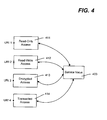
- FIG. 4 shows a service value 403, in which the service value can be any data (e.g., state data of the file), such as database data, alphanumeric data, an image of a house, or an image of a flower.
- the same service value can be represented as different services with different ways of interacting. As described above, because different behaviors are modeled as separate services, properties that affect behavior, such as access rights and properties of the communication, can result in different services.
- a file system is one example of an entity that contains multiple "views" of data, that is, files, including metadata (such as filename, length, owner, and access permissions) and data (such as the file contents).
- metadata such as filename, length, owner, and access permissions
- data such as the file contents
- the view of a file depends on the access permissions of the entity that opens the file, and indeed, the behavior of a read-only file differs from the behavior of a read-write file.
- a file system is easily modeled as a set of behavioral services.
- WSAP defines a set of message operations with associated semantics. Each message operation comprises a set of messages of specific types that are exchanged between the two communicating parties.
- WSAP builds on the definition of a behavioral web service in which the framework for determining identity and behavior is defined in terms of a shared set of message operations and message exchange patterns.
- WSAP message operations are defined by the client code 202 (FIG. 2), typically an application program, wherein an operation involves exchanging messages of specific types using one of the message exchange patterns defined by WSAP, as described below with respect to FIGS. 5 and 6.
- client code 202 typically an application program
- ports provide synchronization through communication
- SOAP provides a processing model for messages exchanged between services.
- a goal of WSAP is to provide a common application-layer foundation for defining web services and their interactions.
- SOAP is designed to support multiple application models, and applications are free to use the full spectrum of the SOAP extensibility model.
- one intent of WSAP is to define an application model that is generally useful for a large variety of decentralized applications.
- Another goal of WSAP is to enable a high degree of interoperability, leading to a potential increase in usefulness of the overall system.
- WSAP defines a web service application model based on a set of common message operations.
- WSAP defines an overall structure and semantics of operations with familiar-sounding names such as LOOKUP, QUERY, INSERT, UPDATE, DELETE, GET, and DROP, whereby individual services can inherit from these operations while preserving support for late binding.
- capital letters are ordinarily used herein for WSAP operations, to differentiate the WSAP operations from traditional verbs, but there is no requirement that the operations use capital letters, and further, that other or differently-named sets of WSAP operations are feasible, and services can define their own additional operations as desired.
- LOOKUP provides information about a service in the form of a contract, which GET and QUERY can be used to retrieve current state of the service.
- CREATE and DROP operations can create and delete services, and so on, as described below.
- Most of the operations are polymorphic over the particular shape of a message, so that individual services can tailor the structure of a messages to the shape of the service.
- the soap Body element of an INSERT request message defined by a directory service is different from an INSERT request message defined by a loader service, but they both follow the same basic semantics.
- WSAP message operations can be thought of as mini-contracts that can be composed into more complex contracts. This allows applications to combine message operations into sequences that suit their particular needs and thereby build more complex services.
- the WSAP operations themselves can be composed and/or ordered to define more complex behaviors for a service.
- a service may be defined as accepting a QUERY operation followed by an UPDATE operation; (QUERY and UPDATE operations are described below).
- a URI can thus represent a sequence of WSAP operations, meaning that the URI itself can represent a single behavior or a complex behavior.
- contracts can be used to great advantage to achieve desired composability.
- WSAP operations have properties that allow intermediaries such as a cache service, a load balancer service, a data compression service, a replication service, an encryption / decryption service, and so on to process messages.
- Two such properties that qualify a WSAP operation include whether an operation is "safe" and/or "idempotent.”
- An operation is idempotent when the result of a successful execution is independent of the number of times the operation is executed.
- An operation is safe if its semantics are limited to read-only access to the resource to which it is applied. Note that a safe operation is idempotent by definition, however the reverse is not true, and thus read-only operations are both safe and idempotent. Further, note that these qualifiers apply to an operation, not a particular implementation of that operation.
- an intermediary service can process exchanged messages to add value to communications.
- an intermediary such as a cache.
- the client connects to a service that provides access to data, and in response the client receives a URI to the cache.
- the cache need know nothing about the contents of the data, e.g., how it is internally formatted, whether it is encrypted, and so forth, but does know from the requested operation type that processing the message will not change the state of the underlying resource behind the cache.
- the cache service can safely read data from its own cache storage to satisfy any GET and/or QUERY requests.
- the cache service can pass the message to the appropriate URI, or alternatively, the client can use the different URI to change state, in which event the cache service will be notified that some part of it is invalid.
- WSAP operations are based on two message exchange patterns, namely one-way and request-response, with support for intermediate responses before the arrival of the final response. While WSAP messages could potentially be carried over a multicast-enabled infrastructure, the semantics of the WSAP message operations are that of a point-to-point communication. Note that WSAP describes the behavior of a web service in a formalized manner, which is a major difference between WSAP and other protocols.
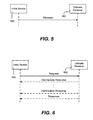
- FIGS. 5 and 6 represent the WSAP operations using one-way and request-response message exchange patterns, respectively.
- both the sender and receiver are named WSAP services (e.g., via a URL). Note that this differs from client/server protocols such as HTTP, in which only the target resource of the request is named.
- the one-way message exchange pattern is represented in FIG. 5, and comprises a message sent from an initial sender to an ultimate receiver through zero or more intermediaries. Note that if a one-way message results in the generation of a SOAP fault (described below), no SOAP Fault message is returned to the initial sender.
- the request-response message exchange pattern is represented in FIG. 6, and comprises a request message sent from an initial sender to an ultimate receiver through zero or more intermediaries, followed by zero or more interim responses sent from the ultimate receiver to the initial sender of the request, also through zero or more intermediaries.
- This message exchange pattern there are no time constraints imposed on this message exchange pattern, and operations that support this message exchange pattern can be used in both synchronous and asynchronous communication models.
- a request message results in the generation of a SOAP fault as described below, a SOAP Fault message is returned to the initial sender, however if a response message results in the generation of a SOAP fault, a SOAP fault is generated, but the SOAP fault is not sent to the responder.
- a WSAP operation includes a set of message types carried as SOAP Body contents, the behavior of these message types, and the semantics implied by invoking the operation.
- a WSAP message type can be composed with an openended number of SOAP features, typically expressed as SOAP header blocks. Examples of such features include but are not limited to security, routing, and reliability.
- C# class (used in some cases like an IRP data structure) represents a SOAP envelope in one implementation:
- Handling a SOAP envelope involves message generation, message exchange, and message parsing.
- the portHeader port is used by intermediaries in a SOAP processing group to exchange serialize-able or strictly internal header constructs.
- the second port, portBody stores the body of the message.
- the use of ports inside this container allows concurrent and thread-safe manipulation of the SOAP envelope.
- a strict pipeline model or stack-based model (which often has problems handling interactions between SOAP header blocks and/or the SOAP body) is not required.
- An advantage of the WSAP-based implementation of the SOAP processing model is that it matches the inherent support in SOAP for concurrent processing of a SOAP message. Via the ports, which correspond to behaviors, the implementation facilitates the concurrent processing of messages by several services.
- a SOAP-aware serializer may serialize or deserialize the header and body of a given SOAP message concurrently with other service operations. This allows services that depend upon parts of the SOAP envelope to unblock whenever a header that the service cares about is available.
- the SOAP deserialization itself is not atomic due to this concurrent parsing design. For better performance, the forwarding and transport services never serialize the SOAP envelope if two communicating parties are co-located.
- SOAP faults generated by WSAP applications need to include a SOAP Action element information item whose value reflects the SOAP fault with a value of the S:Envelope/S:Body/S:Fault/S:Code/S:Value. In general, there are individual actions per fault.
- WSAP message types can be identified. Intermediaries and other SOAP nodes that do not care about the specific type of a SOAP Body, or that cannot see the contents of the SOAP Body (e.g., if it has been encrypted) can use the SOAP Action element information item, for example, as carried by WS-Addressing.
- the WSAP operations define unique Action values.
- SOAP nodes that do care about the specific type of the SOAP Body can use the type of the XML Expanded Name of the outermost element information item of the SOAP Body.
- WSAP defines a set of abstract element information items that need to be substituted for message types defined by the application.
- SOAP fault codes For SOAP faults, the model is similar but the use of SOAP fault codes provides an added level of inspectability in that intermediaries and other SOAP nodes that do not care about the details of the SOAP fault can inspect the SOAP fault codes.
- the exposure of state enables less traditional operations such as caching and replication as well as a uniform publication/subscription (pub/sub) model that can be applied consistently to all services.
- This has been used to build generic applications that can test, monitor, and manage services within a distributed operating system nodes and across nodes.
- Sessions are also modeled as services in WSAP, wherein session management refers to differentiating between value states according to the caller.
- HTTP cookies are often used to personalize Web pages according to the user across independent HTTP operations.
- a problem with cookies, however, is that the state and possibly behavior of a service depends on the value of a cookie, which is inconsistent with the behavioral web service model.
- WSAP models a session as another service, rather than using session identifiers or cookies to identify a session, the session is a service with state and behavior, just like any other service that is created, operated on, and terminated.
- services can relate to one another in ways that do not involve the actual exchange of WSAP messages.
- Examples of such relationships include (but are not limited to) a security policy that describes a set of services as belonging to the same security group, and a management statement that describes how a set of services are administered by a particular party.
- the descriptions refer to a set of services, but the description does not involve any actual communication between the involved services. However, it is still important to capture the relationships, even though no explicit WSAP messages are being exchanged.
- services are created by other services. More particularly, services can be created using the CREATE operation, which creates a new service by copying an existing service.
- a newly created service has the service behavior and service value of a creating service, that is, the service that accepts the CREATE operation acts as a template for the value of the newly created service.
- the CREATE request may contain additional state that is used to initialize the newly created service. This enables services to be initialized with otherwise immutable state.
- the CREATE request may contain state that modifies the copied state of the newly created service according to the shape of the service. It is feasible to name the proposed endpoint as part of the CREATE request or have the creating service provide the name. Note that legacy services may be exposed as web services without directly being created as a web service.
- a service that supports the CREATE operation can create services of a specific behavior. Any service may support the CREATE operation and thus may support the creation of as many behaviors as desired. Because WSAP operations are associated with explicit services, the CREATE operation is a request for the targeted service to create a new service. The CREATE operation does not create the targeted service itself.
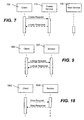
- FIG. 7 represents how the CREATE operation can cause one or more dependent services to be created.
- the CREATE operation creates a single service via a create sequence followed by explicit initialization.
- the client 702 initiates a CREATE operation with a service 710 that handles such operations.
- the CREATE request contains a contract for the type of service to be created.
- Creating a service includes allocating a URI for the service and associating the service with a given behavior.
- additional message operations may involve changing the service value according to the structure of the service, and/or associating the new service with other services through relationships, access control, or other mechanisms.
- the response contains an instanced contract that contains the URI of the newly created service 720.
- the service can be operated on according to its behavior and relationships to other services as appropriate.
- the service can be associated with a security policy by manipulating the services that handle such policies.
- the following data structure contains the SOAP Body contents of a sample CREATE operation.
- the request is defined by the service; the response uses a convenience type defined for empty responses:
- FIG. 8 is a sequence diagram that exemplifies the creation of two services.
- the client 802 initiates a CREATE operation with a service 810 (Create Service A) that handles such operations.
- the operation request contains a contract for the type of service to be created.
- the Create Service A service 810 initiates another CREATE operation against Create Service B (labeled 812 in FIG. 8) to create another new service 824, Service B.
- the Create Service B service 812 sends a create response to the Create Service A service 810, which in turn sends a create response to the client 802.
- the create response sent by the Create Service A service 810 contains an instanced contract that contains the URIs of the two newly created services 822 and 824.
- WSAP provides no inherent guarantees that the services are created within a transaction context. Such guarantees can be provided by augmenting the behavior of the services with transaction support.
- a contract is typically serialized as an XML document, although this is not required.
- the contract itself is a service, and as such, the contract is identified by a URI and can be operated on according to its contract, just as any other service.
- a service may have the URI of another service but not its contract, which is required for the two services to communicate.
- the WSAP protocol requires that every service support the LOOKUP operation, which enables a service to ask another service for its contract and thereby to determine the behavior of a service:
- Property Sheet for LOOKUP Property Value MEP Request-Response Request Action http://abc/def/ghij/10/wsap/lookuprequest Response Action http://abc/def/ghij/10/wsap/lookupresponse Safe Yes Idempotent Yes
- FIG. 9 shows a sample sequence illustrating the LOOKUP operation between a client 902 and a service 920.
- the lookup response contains a URI of the contract, which as mentioned above is also a service, although it would be feasible to return the contract itself.
- LOOKUP returns a URI to a document that contains the serialization of the contract/protocol.
- a contract not only defines the order of the messages, but also defines the interaction points, represented by ports with URIS, on which the messages are exchanged. Further, that document, plus a BindingList, which is an array of key/value pairs, are used to "instance" the contract document. This allows generic names to be replaced by the true values at runtime, and allows relationships between instances of services to be determined at runtime, providing a reflective capability between instances of services. Contracts / binding lists thus enable the management of dependencies in a distributed setting, and at the same time, specify required services at startup.
- the WSAP protocol defines two operations, named GET and QUERY. While both operations are safe and idempotent, a difference between a GET and a QUERY operation is that as described below, the QUERY request contains a structured query, whereas a GET request is an application-independent request for a snapshot of the current state of the service. As a result, a QUERY request requires specific schema knowledge about the service being queried, whereas a GET request does not. A consequence of this difference is that a QUERY request contains parameters that are not part of the name of the service (the structured query) whereas a GET request provides the parameters that identify the service as part of the name of the service.
- WSAP supports structured identifiers as well as opaque identifiers, and enables mapping between such solutions. This is because depending on the context of their use, there are advantages to either one. More particularly, in naming services, there is a tension between using structured names such as queries and semantically opaque names such as URIs. For example, consider an example service identified as "http://example.com/people" that can provide a structured representation of names of people. A particular person can be referred to in at least three different ways, namely as a structured query, as an unstructured query encoded in the URI query component, or as an opaque identifier that is part of the URI path component. A structured query issued against the service requires knowledge about the structure of the service in order to refer to any particular person, as shown in the following example of a structured query issued against the example service "http://example.com/people"
- an unstructured query encoded as a non-opaque part of the URI query component would typically use URI HTML form encoding.
- This model requires knowledge about the set of name-value pairs, but it does not require structured knowledge about the particular service in order to compose a URI that encodes these name-value pairs.
- the following example shows such an unstructured query encoded as a name-value pair in the URI query component:
- An opaque identifier that is part of the URI path component does not reveal that the actual resolution may involve a query.
- the only thing that the client needs to know is how to resolve the identifier, in this case by using HTTP.
- the following example shows such an opaque identifier, which does not express any part of the query:
- the query parameters can be strongly typed.
- the structured query becomes part of the identifier for the person. This means that any entity that whoever wants to refer to that person needs to use and also understand that particular structured name. Structured names that identify other things will have different shapes which also require special knowledge in order to use. In some cases this works well, particularly when the user is expected to operate on the data. However, because special knowledge is required, scalability can quickly become a problem, because it is difficult to deploy a notion of a name outside the group that has specific knowledge about that particular shape of names.
- the query solution requires knowledge of the structure of the query, while the unstructured encoded query and opaque solutions provide gradually less information.
- the unstructured encoded query can be used if there are certain keywords that can be made public, especially if it helps to decrease the number of URIs that must be mapped.
- the unstructured encoded query solution is the most commonly used type of identifier on the Web today, but it is very difficult to encode structured data in a URI. Furthermore, data encoded as part of a URI is inherently public to the infrastructure, which makes it harder to deal with security-related issues for any data that is part of the identifier.
- the opaque identifier solution does not support a query interface unless a model exists for mapping a query to that identifier. If the structure of a query is known only to a portion of the potential users of the service (e.g., for privacy or other reasons), this can be done by exposing none or a restricted part of the structured data by using the unstructured encoded query solution or the opaque identifier solution.
- the GET operation can be used to retrieve the serialized value state of a service, and has the following properties: Property Sheet for GET Property Value MEP Request-Response Request Action http://abc/def/ghij/10/wsap/getrequest Response Action http://abc/def/ghij/10/wsap/getresponse Safe Yes Idempotent Yes
- the following table contains the SOAP Body contents of a sample GET operation.
- the request is defined by WSAP;
- the response is defined by the service:
- QUERY requests can in some cases be mapped to a GET operation, as for example, such a mapping effectively provides an identifier for a particular query. For example, this provided benefits when the same query occurs in many different contexts, or when a URI reference is needed in order to introduce caching.
- FIG. 10 shows a sample sequence illustrating mapping from QUERY to GET.
- the QUERY response contains the URI for service B which can provide the same result as the QUERY against A. Note that the mapping can be done by any service, and does not have to be related to the service against which the QUERY is targeted.
- the QUERY operation also can be used to query for the serialized value state of a service, and has the following properties: Property Sheet for QUERY Property Value MEP Request-Response Request Action http://abc/def/ghij/10/wsap/queryrequest Response Action http://abc/def/ghij/10/wsap/queryresponse Safe Yes Idempotent Yes
- a cache service knows that a QUERY or a GET request does not change state. As a result, the cache can continue to provide state data in response to such requests indefinitely unless and until an operation that changes state is detected.
- WSAP In addition to state retrieval, WSAP enables the state of services to be updated using INSERT, UPDATE, and DELETE operations. These operations apply only to the value of a service; they do not create or terminate services.
- the data structure of a WSAP service is defined by the service as a function of its behavior.
- the INSERT, UPDATE, and DELETE operations require the requestor to have knowledge about this structure in order to affect the value of the service, similar to QUERY.
- the INSERT, UPDATE, and DELETE operations are defined in the abstract so that they can be tailored to individual services.
- the value included in the INSERT request is added to the service value.
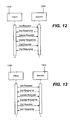
- the result of an INSERT operation can be detected by looking at the difference between a GET operation issued before the INSERT operation and a GET operation issued after the INSERT operation, as generally represented in the message sequence diagram of FIG. 11.
- the client 1102 receives the state data from the service 1120 before the insert operation, and receives updated state data upon the next request following the insert operation.
- the INSERT operation can be used to add serialized value state to the service as described via the following properties: Property Sheet for INSERT Property Value MEP Request-Response Request Action http://abc/def/ghij/10/wsap/insertrequest Response Action http://abc/def/ghij/10/wsap/insertresponse Safe No Idempotent No
- the following table contains the SOAP Body contents of a sample INSERT operation.
- the request is defined by WSAP; the response is defined by the service.
- the example does not indicate any ordering of where the data is to be inserted, however applications may define their schemas to accommodate ordering constraints:
- a service may enable the INSERT, UPDATE, and DELETE operations to identify specific locations where the operation is to be performed, for example, using an XPath expression.
- the same general observation characteristics apply when the value of a service is modified using the DELETE operation, in which the part of the service value that is identified in the DELETE request is deleted. Assuming a service is being observed in isolation, the result of a DELETE operation can be detected by looking at the difference between a GET operation issued before the DELETE operation and a GET operation issued after the DELETE operation, as generally represented in FIG. 12.
- a DELETE request is defined by the service; the response uses a convenience type defined for empty responses:
- the part of the service value identified in the UPDATE request is replaced with the value included in the UPDATE request.
- the UPDATE operation is similar to DELETE followed by INSERT if seen within a transaction context. That is, UPDATE succeeds only if the existing service value is successfully modified as described by the UPDATE operation.
- the result of an UPDATE operation can in isolation be detected by looking at the difference between a GET operation issued before the UPDATE operation and a GET operation issued after the UPDATE operation, as generally represented in FIG. 13.
- the UPDATE operation is used to update existing value state, and has the following properties: Property Sheet for UPDATE Property Value MEP Request-Response Request Action http://abc/def/ghij/10/wsap/updaterequest Response Action http://abc/def/ghij/10/wsap/updateresponse Safe No Idempotent No
- the following table contains the SOAP Body contents of a sample UPDATE operation. Both the request and the response verb are defined by WSAP; as with requests, the body of the SOAP envelope contains a service-defined response element.
- WSAP provides a replication model that enables a service to be synchronized with another service.
- the replicated service performs the same operation or operations on the replicating service as are performed on the replicated service.
- REPLICATE, SUBSCRIBE, CANCELREPLICATE and UNSUBSCRIBE manipulate the state of subscriber lists. Since WSAP exposes state, subscriber lists may be kept in another WSAP service (e.g., a subscribeHelper). The main WSAP service sends Insert/Delete requests as appropriate upon receiving SUBSCRIBE, REPLICATE, CANCELREPLICATE and UNSUBSCRIBE requests. In the LOOKUP response on the main service, in the bindings, the helper is identified, which allows third parties to capture the entire state of the service. This, the entire state, including subscription lists, is visible if represented by a URI. Note that by separating subscriptions on their own state, a third party may notify subscribers of a service going away and being resurrected with a different URI.
- a third party may notify subscribers of a service going away and being resurrected with a different URI.
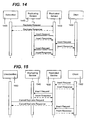
- the replicated service 1430 will perform an INSERT operation on the replicating service 1440.
- the semantics of the WSAP replication model differ from the WSAP notification model (described below), which does not require the service to perform any action on receiving a NOTIFY message.
- the REPLICATE operation can be used to replicate a service or part of a service.
- the behavior of the replication is described by a contract included in the request.
- the following table sets forth the properties for the REPLICATE operation: Property Sheet for REPLICATE Property Value MEP Request-Response Request Action http://abc/def/ghij/10/wsap/replicaterequest Response Action http://abc/def/ghij/10/wsap/replicateresponse Safe No Idempotent Yes
- the following table sets forth contains the SOAP Body contents of a sample REPLICATE operation.
- the request is defined by WSAP; the response is defined by the service.
- the response is a convenience type defined for empty responses:
- Replication is initiated by issuing a REPLICATE operation, which contains a contract that describes the replication model to be used.
- the replicated service may support a replication model that only replicates state additions through the INSERT operation. If as in this example the replicating service is only interested in INSERT operations, it indicates so by referring to that replication contract in the REPLICATE operation. If the REPLICATE request is accepted, then the replicated service transfers its current state as a set of INSERT operations against the replicating service.
- the subscribing service 1450 may be different from the replicating service 1440.
- the replicating service may already exist and have a certain state. Depending on the replication contract, this state may or may not be overridden when replication begins. In the above example where the replication contract only allows INSERT operations, then the replicated state will add to the existing state of the replicating service.
- the replication contract may in some cases terminate by itself, the replication may be limited by an expiration time, or it may continue to replicate the state indefinitely. In one implementation, the expiration may be determined as part of the contract, however it alternatively may be provided as a value parameter.
- the replication also may be explicitly terminated using the CANCELREPLICATION operation.
- a sample sequence diagram for the CANCELREPLICATION operation is shown in FIG. 15. As can be seen, the initial insert request from the client 1502 is received at the replicated service 1530 and replicated to the replicating service 1540. If an unsubscriber service 1552 requests a CANCELREPLICATE operation, the established replication is explicitly terminated. In the example of FIG. 15, no further insert requests from the client 1502 will be replicated by the replicated service 1530 to the replicating service 1540.
- the following table contains the SOAP Body contents of a sample CANCELREPLICATE operation.
- the response uses a convenience type defined for empty responses:
- WSAP defines a simple event notification model that is based on a NOTIFY operation, which reports that a state change has occurred, but does not reveal the circumstance under which the state change occurred.
- the semantics of the event notification model differ from the replication model, in which the replicating service changes state as a result of the messages sent from the replicated service.
- the subscriber is not required to perform any action upon receiving a NOTIFY message. As a result, any action the subscriber does take is based solely on its own semantics and not those of the event notification source.
- NOTIFY operations are subscribed for and thus may expire, which may be part of the contract may be set via a value parameter.
- the NOTIFY operation is part of the WSAP notification model, can be used to issue an event notification, and has the following properties: Property Sheet for NOTIFY Property Value MEP One-way Request Action http://abc/def/ghij/10/wsap/notify Safe Yes Idempotent Yes
- the follwing table contains the SOAP Body contents of a sample NOTIFY operation:
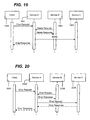
- FIG. 16 shows the SUBSCRIBE operation related to NOTIFY, in which a subscriber 1650 issues a request to an event source 1670.
- the request comprises a query that identifies the parts of the event notification source for which the subscriber is interested in seeing state changes. If the SUBSCRIBE operation is accepted, the event notification source 1670 initiates a NOTIFY operation that indicates the current state of the source. After this initial NOTIFY operation, the event notification source issues new NOTIFY operations whenever the state of the event notification source appropriately changes. Because the contract that describes the behavior of an event notification source is independent of the application semantics, it is entirely defined by WSAP.
- the SUBSCRIBE operation thus is used to subscribe to changes in the state of a service, and has the following properties: Property Sheet for SUBSCRIBE Property Value MEP Request-Response Request Action http://abc/def/ghij/10/wsap/subscriberequest Response Action http://abc/def/ghij/10/wsap/subscriberesponse Safe No Idempotent No
- the following table contains the SOAP Body contents of a sample SUBSCRIBE operation.
- the request is defined by WSAP;
- the response is defined by the service.
- the response is a convenience type defined for empty responses:
- the subscription may be limited by an expiration time, similar to the replication model. Similarly, the subscription can be terminated at any time using an UNSUBSCRIBE operation, as represented in FIG. 17, wherein an unsubscriber 1752 sends and UNSUBSCRIBE operation to the event source to cancel further notifications.
- the UNSUBSCRIBE operation that cancels a subscription has the following properties: Property Sheet for UNSUBSCRIBE Property Value MEP Request-Response Request Action http://abc/def/ghij/10/wsap/unsubscriberequest Response Action http://abc/def/ghij/10/wsap/unsubscriberesponse Safe No Idempotent No
- the following table contains the SOAP Body contents of a sample UNSUBSCRIBE operation.
- the request is defined by WSAP;
- the response is defined by the service.
- the response is a convenience type defined for empty responses:
- the WSAP event notification model is a traditional push model wherein event notifications are pushed from the source to the sink.
- a buffering intermediary in the message path it is possible to convert the push model into a pull model, which provides off-line support for event notification sinks.
- a service may be terminated by having the behavior of the service describe a finite set of messages that the service can send or receive.
- the service When the service has fulfilled its contract, it terminates, and whatever resources it consumed can be recovered.
- WSAP defines a DROP operation, whereby a service that accepts DROP as part of its contract may be explicitly terminated.
- DROP can be simple as in FIG. 18, or complex, as described below with reference to FIG. 20.
- the DROP operation has the following properties: Property Sheet for DROP Property Value MEP Request-Response Request Action http://abc/def/ghij/10/wsap/droprequest Response Action http://abc/def/ghij/10/wsap/dropresponse Safe No Idempotent No
- the following table contains the SOAP Body contents of a sample DROP operation.
- the request is defined by WSAP; the response uses a convenience type defined for empty responses:
- the targeted service may perform some additional cleanup such as unregistering from a directory service or sending out a final event notification. Such cleanup is performed before the DROP operation is completed, as represented by the DELETE request and NOTIFY operation in FIG. 19.
- a complex service termination represented in FIG. 20, multiple related services are terminated as a set. This can happen if the relationship between the services is such that they cannot exist independently.
- WSAP provides no inherent guarantees that all services are terminated within a transaction context. Such guarantees can be provided by augmenting the behavior of the services with transaction support.
- WSAP allows services to be restartable and dynamically load balanced, since it allows state at different sites to be captured and recreated. This can be used to implement transactions, load balance and or do live version updates to keep uptime to a maximum.
- a service of type T having URI A.
- another service can get data from A (e.g., via a GET request), look up A (e.g., via a LOOKUP request) to obtain its dependencies), and Drop A.
- A e.g., via a LOOKUP request
- Drop A e.g., DELETE and INSERT
Landscapes
- Engineering & Computer Science (AREA)
- Computer Networks & Wireless Communication (AREA)
- Signal Processing (AREA)
- Business, Economics & Management (AREA)
- Theoretical Computer Science (AREA)
- Finance (AREA)
- Accounting & Taxation (AREA)
- Physics & Mathematics (AREA)
- General Physics & Mathematics (AREA)
- Marketing (AREA)
- Computer Hardware Design (AREA)
- Development Economics (AREA)
- Economics (AREA)
- Strategic Management (AREA)
- General Business, Economics & Management (AREA)
- Software Systems (AREA)
- General Engineering & Computer Science (AREA)
- Information Transfer Between Computers (AREA)
- Information Retrieval, Db Structures And Fs Structures Therefor (AREA)
- Facsimiles In General (AREA)
- Jib Cranes (AREA)
- Management, Administration, Business Operations System, And Electronic Commerce (AREA)
Applications Claiming Priority (2)
| Application Number | Priority Date | Filing Date | Title |
|---|---|---|---|
| US856399 | 2004-05-27 | ||
| US10/856,399 US7895262B2 (en) | 2004-05-27 | 2004-05-27 | Web service application protocol and SOAP processing model |
Publications (2)
| Publication Number | Publication Date |
|---|---|
| EP1601164A1 EP1601164A1 (en) | 2005-11-30 |
| EP1601164B1 true EP1601164B1 (en) | 2007-10-03 |
Family
ID=34939835
Family Applications (1)
| Application Number | Title | Priority Date | Filing Date |
|---|---|---|---|
| EP05104031A Expired - Lifetime EP1601164B1 (en) | 2004-05-27 | 2005-05-13 | WEB service application protocol and SOAP processing model |
Country Status (7)
| Country | Link |
|---|---|
| US (1) | US7895262B2 (cg-RX-API-DMAC7.html) |
| EP (1) | EP1601164B1 (cg-RX-API-DMAC7.html) |
| JP (1) | JP4993876B2 (cg-RX-API-DMAC7.html) |
| KR (1) | KR101109251B1 (cg-RX-API-DMAC7.html) |
| CN (1) | CN1703048B (cg-RX-API-DMAC7.html) |
| AT (1) | ATE375060T1 (cg-RX-API-DMAC7.html) |
| DE (1) | DE602005002679T2 (cg-RX-API-DMAC7.html) |
Families Citing this family (40)
| Publication number | Priority date | Publication date | Assignee | Title |
|---|---|---|---|---|
| US8516054B2 (en) * | 2000-12-20 | 2013-08-20 | Aurea Software, Inc. | Message handling |
| US8301800B1 (en) | 2002-07-02 | 2012-10-30 | Actional Corporation | Message processing for distributed computing environments |
| US8849892B2 (en) * | 2004-06-10 | 2014-09-30 | Verizon Patent And Licensing Inc. | Method and system for brokering messages in a distributed system |
| US8533229B2 (en) * | 2004-06-16 | 2013-09-10 | Salesforce.Com, Inc. | Soap-based web services in a multi-tenant database system |
| EP1641272A1 (en) * | 2004-09-17 | 2006-03-29 | Korea Electronics Technology Institute | Method for deleting user metadata managed by a TV-Anytime metadata server using an SOAP operation |
| US7617481B2 (en) * | 2004-11-30 | 2009-11-10 | Avanade Holdings Llc | Prescriptive architecture for application development |
| US8191078B1 (en) | 2005-03-22 | 2012-05-29 | Progress Software Corporation | Fault-tolerant messaging system and methods |
| US20060230118A1 (en) * | 2005-04-12 | 2006-10-12 | Digi Chain Information Co., Ltd. | Share memory service system and method of web service oriented applications |
| US8301720B1 (en) * | 2005-07-18 | 2012-10-30 | Progress Software Corporation | Method and system to collect and communicate problem context in XML-based distributed applications |
| US8745252B2 (en) * | 2005-09-21 | 2014-06-03 | Sap Ag | Headers protocol for use within a web services message processing runtime framework |
| US7761533B2 (en) * | 2005-09-21 | 2010-07-20 | Sap Ag | Standard implementation container interface for runtime processing of web services messages |
| US20070106804A1 (en) * | 2005-11-10 | 2007-05-10 | Iona Technologies Inc. | Method and system for using message stamps for efficient data exchange |
| US7533111B2 (en) * | 2005-12-30 | 2009-05-12 | Microsoft Corporation | Using soap messages for inverse query expressions |
| US7710958B2 (en) | 2006-01-20 | 2010-05-04 | Iona Technologies Limited | Method for recoverable message exchange independent of network protocols |
| US8996482B1 (en) | 2006-02-10 | 2015-03-31 | Amazon Technologies, Inc. | Distributed system and method for replicated storage of structured data records |
| US8447829B1 (en) | 2006-02-10 | 2013-05-21 | Amazon Technologies, Inc. | System and method for controlling access to web services resources |
| US7599861B2 (en) | 2006-03-02 | 2009-10-06 | Convergys Customer Management Group, Inc. | System and method for closed loop decisionmaking in an automated care system |
| US7809663B1 (en) | 2006-05-22 | 2010-10-05 | Convergys Cmg Utah, Inc. | System and method for supporting the utilization of machine language |
| US8379830B1 (en) | 2006-05-22 | 2013-02-19 | Convergys Customer Management Delaware Llc | System and method for automated customer service with contingent live interaction |
| US7653881B2 (en) | 2006-06-19 | 2010-01-26 | Microsoft Corporation | Failure handling and debugging with causalities |
| US7664997B2 (en) * | 2006-06-19 | 2010-02-16 | Microsoft Corporation | Failure handling and debugging with causalities |
| WO2008097912A2 (en) * | 2007-02-06 | 2008-08-14 | Progress Software Corporation | Event-based process configuration |
| US9009234B2 (en) | 2007-02-06 | 2015-04-14 | Software Ag | Complex event processing system having multiple redundant event processing engines |
| US8276115B2 (en) * | 2007-02-06 | 2012-09-25 | Progress Software Corporation | Automated construction and deployment of complex event processing applications and business activity monitoring dashboards |
| US7979896B2 (en) * | 2007-04-20 | 2011-07-12 | Microsoft Corporation | Authorization for access to web service resources |
| US8141151B2 (en) * | 2007-08-30 | 2012-03-20 | International Business Machines Corporation | Non-intrusive monitoring of services in a service-oriented architecture |
| US8868532B2 (en) | 2008-08-08 | 2014-10-21 | Microsoft Corporation | Message exchange pattern rendezvous abstraction |
| JP4401425B1 (ja) * | 2008-09-18 | 2010-01-20 | 株式会社三菱東京Ufj銀行 | サービス処理装置、システム、プログラム及び記録媒体 |
| JP4336735B1 (ja) * | 2008-09-18 | 2009-09-30 | 株式会社三菱東京Ufj銀行 | サービス処理装置、システム、プログラム及び記録媒体 |
| WO2010054062A2 (en) | 2008-11-05 | 2010-05-14 | Savvion Inc. | Software with improved view of a business process |
| JP2010146324A (ja) * | 2008-12-19 | 2010-07-01 | Sharp Corp | 定型書式データ管理サーバ装置、定型文書作成システム |
| US9015136B2 (en) * | 2010-01-22 | 2015-04-21 | Microsoft Technology Licensing, Llc | Storing temporary state data in separate containers |
| CN102387203B (zh) * | 2011-10-21 | 2014-06-04 | 南京邮电大学 | 一种物联网中基于soap协议的多播应用方法 |
| US9256462B2 (en) | 2012-02-17 | 2016-02-09 | Microsoft Technology Licensing, Llc | Contextually interacting with applications |
| US9747563B2 (en) | 2013-11-27 | 2017-08-29 | University-Industry Cooperation Group Of Kyung Hee University | Apparatus and method for matching large-scale biomedical ontologies |
| GB201603785D0 (en) | 2016-03-04 | 2016-04-20 | Microsoft Technology Licensing Llc | Communication system |
| US11074050B2 (en) * | 2016-11-14 | 2021-07-27 | Siemens Aktiengesellschaft | Composing an application using a plurality of distributed interaction patterns |
| WO2019133684A1 (en) * | 2017-12-29 | 2019-07-04 | DMAI, Inc. | System and method for personalized and adaptive application management |
| CN110535793A (zh) * | 2018-05-25 | 2019-12-03 | 微软技术许可有限责任公司 | 分布式系统的消息全序机制 |
| CN111861383A (zh) * | 2020-06-29 | 2020-10-30 | 国网河北省电力有限公司景县供电分公司 | 一种线上居家办公安全平台 |
Family Cites Families (6)
| Publication number | Priority date | Publication date | Assignee | Title |
|---|---|---|---|---|
| US6910068B2 (en) | 1999-06-11 | 2005-06-21 | Microsoft Corporation | XML-based template language for devices and services |
| EP1249765A1 (en) | 2001-04-12 | 2002-10-16 | Alcatel | Personalized service |
| JP4127497B2 (ja) * | 2002-09-27 | 2008-07-30 | 富士フイルム株式会社 | ディジタル・サービス・システム |
| US7200657B2 (en) * | 2002-10-01 | 2007-04-03 | International Business Machines Corporation | Autonomic provisioning of network-accessible service behaviors within a federated grid infrastructure |
| US7607136B2 (en) * | 2003-10-28 | 2009-10-20 | Hewlett-Packard Development Company, L.P. | Method and apparatus for interfacing with a distributed computing service |
| US7418501B2 (en) * | 2004-04-30 | 2008-08-26 | International Business Machines Corporation | Dynamic extension of network-accessible services |
-
2004
- 2004-05-27 US US10/856,399 patent/US7895262B2/en not_active Expired - Fee Related
-
2005
- 2005-05-13 EP EP05104031A patent/EP1601164B1/en not_active Expired - Lifetime
- 2005-05-13 AT AT05104031T patent/ATE375060T1/de not_active IP Right Cessation
- 2005-05-13 DE DE602005002679T patent/DE602005002679T2/de not_active Expired - Lifetime
- 2005-05-25 JP JP2005152313A patent/JP4993876B2/ja not_active Expired - Fee Related
- 2005-05-26 KR KR1020050044386A patent/KR101109251B1/ko not_active Expired - Fee Related
- 2005-05-27 CN CN2005100758674A patent/CN1703048B/zh not_active Expired - Fee Related
Also Published As
| Publication number | Publication date |
|---|---|
| KR20060046184A (ko) | 2006-05-17 |
| JP2005339555A (ja) | 2005-12-08 |
| DE602005002679D1 (de) | 2007-11-15 |
| CN1703048B (zh) | 2011-10-12 |
| KR101109251B1 (ko) | 2012-01-30 |
| EP1601164A1 (en) | 2005-11-30 |
| JP4993876B2 (ja) | 2012-08-08 |
| DE602005002679T2 (de) | 2008-07-24 |
| CN1703048A (zh) | 2005-11-30 |
| US20050267772A1 (en) | 2005-12-01 |
| ATE375060T1 (de) | 2007-10-15 |
| US7895262B2 (en) | 2011-02-22 |
Similar Documents
| Publication | Publication Date | Title |
|---|---|---|
| EP1601164B1 (en) | WEB service application protocol and SOAP processing model | |
| US20240223653A1 (en) | Network operating system | |
| US7917584B2 (en) | Gesture-based collaboration | |
| TWI405091B (zh) | 用於跨不同應用程式架構之資料服務的電腦系統及電腦可實施方法 | |
| Qu et al. | Implementation of an enterprise-level groupware system based on J2EE platform and WebDAV protocol | |
| Harris et al. | Lightweight object-oriented shared variables for cluster computing in Java | |
| Sollins | Extending the Network Abstraction to an Information |
Legal Events
| Date | Code | Title | Description |
|---|---|---|---|
| PUAI | Public reference made under article 153(3) epc to a published international application that has entered the european phase |
Free format text: ORIGINAL CODE: 0009012 |
|
| AK | Designated contracting states |
Kind code of ref document: A1 Designated state(s): AT BE BG CH CY CZ DE DK EE ES FI FR GB GR HU IE IS IT LI LT LU MC NL PL PT RO SE SI SK TR |
|
| AX | Request for extension of the european patent |
Extension state: AL BA HR LV MK YU |
|
| 17P | Request for examination filed |
Effective date: 20060330 |
|
| AKX | Designation fees paid |
Designated state(s): AT BE BG CH CY CZ DE DK EE ES FI FR GB GR HU IE IS IT LI LT LU MC NL PL PT RO SE SI SK TR |
|
| GRAP | Despatch of communication of intention to grant a patent |
Free format text: ORIGINAL CODE: EPIDOSNIGR1 |
|
| RAP1 | Party data changed (applicant data changed or rights of an application transferred) |
Owner name: MICROSOFT CORPORATION |
|
| GRAS | Grant fee paid |
Free format text: ORIGINAL CODE: EPIDOSNIGR3 |
|
| GRAA | (expected) grant |
Free format text: ORIGINAL CODE: 0009210 |
|
| AK | Designated contracting states |
Kind code of ref document: B1 Designated state(s): AT BE BG CH CY CZ DE DK EE ES FI FR GB GR HU IE IS IT LI LT LU MC NL PL PT RO SE SI SK TR |
|
| REG | Reference to a national code |
Ref country code: GB Ref legal event code: FG4D |
|
| REG | Reference to a national code |
Ref country code: CH Ref legal event code: EP |
|
| REG | Reference to a national code |
Ref country code: IE Ref legal event code: FG4D |
|
| REF | Corresponds to: |
Ref document number: 602005002679 Country of ref document: DE Date of ref document: 20071115 Kind code of ref document: P |
|
| NLV1 | Nl: lapsed or annulled due to failure to fulfill the requirements of art. 29p and 29m of the patents act | ||
| REG | Reference to a national code |
Ref country code: CH Ref legal event code: PL |
|
| PG25 | Lapsed in a contracting state [announced via postgrant information from national office to epo] |
Ref country code: LI Free format text: LAPSE BECAUSE OF FAILURE TO SUBMIT A TRANSLATION OF THE DESCRIPTION OR TO PAY THE FEE WITHIN THE PRESCRIBED TIME-LIMIT Effective date: 20071003 Ref country code: SE Free format text: LAPSE BECAUSE OF FAILURE TO SUBMIT A TRANSLATION OF THE DESCRIPTION OR TO PAY THE FEE WITHIN THE PRESCRIBED TIME-LIMIT Effective date: 20080103 Ref country code: NL Free format text: LAPSE BECAUSE OF FAILURE TO SUBMIT A TRANSLATION OF THE DESCRIPTION OR TO PAY THE FEE WITHIN THE PRESCRIBED TIME-LIMIT Effective date: 20071003 Ref country code: CH Free format text: LAPSE BECAUSE OF FAILURE TO SUBMIT A TRANSLATION OF THE DESCRIPTION OR TO PAY THE FEE WITHIN THE PRESCRIBED TIME-LIMIT Effective date: 20071003 Ref country code: ES Free format text: LAPSE BECAUSE OF FAILURE TO SUBMIT A TRANSLATION OF THE DESCRIPTION OR TO PAY THE FEE WITHIN THE PRESCRIBED TIME-LIMIT Effective date: 20080114 |
|
| PG25 | Lapsed in a contracting state [announced via postgrant information from national office to epo] |
Ref country code: PT Free format text: LAPSE BECAUSE OF FAILURE TO SUBMIT A TRANSLATION OF THE DESCRIPTION OR TO PAY THE FEE WITHIN THE PRESCRIBED TIME-LIMIT Effective date: 20080303 Ref country code: BG Free format text: LAPSE BECAUSE OF FAILURE TO SUBMIT A TRANSLATION OF THE DESCRIPTION OR TO PAY THE FEE WITHIN THE PRESCRIBED TIME-LIMIT Effective date: 20080103 Ref country code: LT Free format text: LAPSE BECAUSE OF FAILURE TO SUBMIT A TRANSLATION OF THE DESCRIPTION OR TO PAY THE FEE WITHIN THE PRESCRIBED TIME-LIMIT Effective date: 20071003 Ref country code: IS Free format text: LAPSE BECAUSE OF FAILURE TO SUBMIT A TRANSLATION OF THE DESCRIPTION OR TO PAY THE FEE WITHIN THE PRESCRIBED TIME-LIMIT Effective date: 20080203 Ref country code: PL Free format text: LAPSE BECAUSE OF FAILURE TO SUBMIT A TRANSLATION OF THE DESCRIPTION OR TO PAY THE FEE WITHIN THE PRESCRIBED TIME-LIMIT Effective date: 20071003 |
|
| PG25 | Lapsed in a contracting state [announced via postgrant information from national office to epo] |
Ref country code: AT Free format text: LAPSE BECAUSE OF FAILURE TO SUBMIT A TRANSLATION OF THE DESCRIPTION OR TO PAY THE FEE WITHIN THE PRESCRIBED TIME-LIMIT Effective date: 20071003 |
|
| ET | Fr: translation filed | ||
| PG25 | Lapsed in a contracting state [announced via postgrant information from national office to epo] |
Ref country code: DK Free format text: LAPSE BECAUSE OF FAILURE TO SUBMIT A TRANSLATION OF THE DESCRIPTION OR TO PAY THE FEE WITHIN THE PRESCRIBED TIME-LIMIT Effective date: 20071003 Ref country code: CZ Free format text: LAPSE BECAUSE OF FAILURE TO SUBMIT A TRANSLATION OF THE DESCRIPTION OR TO PAY THE FEE WITHIN THE PRESCRIBED TIME-LIMIT Effective date: 20071003 |
|
| PLBE | No opposition filed within time limit |
Free format text: ORIGINAL CODE: 0009261 |
|
| STAA | Information on the status of an ep patent application or granted ep patent |
Free format text: STATUS: NO OPPOSITION FILED WITHIN TIME LIMIT |
|
| PG25 | Lapsed in a contracting state [announced via postgrant information from national office to epo] |
Ref country code: BE Free format text: LAPSE BECAUSE OF FAILURE TO SUBMIT A TRANSLATION OF THE DESCRIPTION OR TO PAY THE FEE WITHIN THE PRESCRIBED TIME-LIMIT Effective date: 20071003 Ref country code: RO Free format text: LAPSE BECAUSE OF FAILURE TO SUBMIT A TRANSLATION OF THE DESCRIPTION OR TO PAY THE FEE WITHIN THE PRESCRIBED TIME-LIMIT Effective date: 20071003 Ref country code: SK Free format text: LAPSE BECAUSE OF FAILURE TO SUBMIT A TRANSLATION OF THE DESCRIPTION OR TO PAY THE FEE WITHIN THE PRESCRIBED TIME-LIMIT Effective date: 20071003 |
|
| 26N | No opposition filed |
Effective date: 20080704 |
|
| PG25 | Lapsed in a contracting state [announced via postgrant information from national office to epo] |
Ref country code: MC Free format text: LAPSE BECAUSE OF NON-PAYMENT OF DUE FEES Effective date: 20080531 |
|
| PG25 | Lapsed in a contracting state [announced via postgrant information from national office to epo] |
Ref country code: EE Free format text: LAPSE BECAUSE OF FAILURE TO SUBMIT A TRANSLATION OF THE DESCRIPTION OR TO PAY THE FEE WITHIN THE PRESCRIBED TIME-LIMIT Effective date: 20071003 Ref country code: GR Free format text: LAPSE BECAUSE OF FAILURE TO SUBMIT A TRANSLATION OF THE DESCRIPTION OR TO PAY THE FEE WITHIN THE PRESCRIBED TIME-LIMIT Effective date: 20080104 |
|
| PG25 | Lapsed in a contracting state [announced via postgrant information from national office to epo] |
Ref country code: IE Free format text: LAPSE BECAUSE OF NON-PAYMENT OF DUE FEES Effective date: 20080513 |
|
| PG25 | Lapsed in a contracting state [announced via postgrant information from national office to epo] |
Ref country code: SI Free format text: LAPSE BECAUSE OF FAILURE TO SUBMIT A TRANSLATION OF THE DESCRIPTION OR TO PAY THE FEE WITHIN THE PRESCRIBED TIME-LIMIT Effective date: 20071003 |
|
| PG25 | Lapsed in a contracting state [announced via postgrant information from national office to epo] |
Ref country code: CY Free format text: LAPSE BECAUSE OF FAILURE TO SUBMIT A TRANSLATION OF THE DESCRIPTION OR TO PAY THE FEE WITHIN THE PRESCRIBED TIME-LIMIT Effective date: 20071003 |
|
| PG25 | Lapsed in a contracting state [announced via postgrant information from national office to epo] |
Ref country code: FI Free format text: LAPSE BECAUSE OF FAILURE TO SUBMIT A TRANSLATION OF THE DESCRIPTION OR TO PAY THE FEE WITHIN THE PRESCRIBED TIME-LIMIT Effective date: 20071003 |
|
| PG25 | Lapsed in a contracting state [announced via postgrant information from national office to epo] |
Ref country code: LU Free format text: LAPSE BECAUSE OF NON-PAYMENT OF DUE FEES Effective date: 20080513 Ref country code: HU Free format text: LAPSE BECAUSE OF FAILURE TO SUBMIT A TRANSLATION OF THE DESCRIPTION OR TO PAY THE FEE WITHIN THE PRESCRIBED TIME-LIMIT Effective date: 20080404 |
|
| PG25 | Lapsed in a contracting state [announced via postgrant information from national office to epo] |
Ref country code: TR Free format text: LAPSE BECAUSE OF FAILURE TO SUBMIT A TRANSLATION OF THE DESCRIPTION OR TO PAY THE FEE WITHIN THE PRESCRIBED TIME-LIMIT Effective date: 20071003 |
|
| REG | Reference to a national code |
Ref country code: DE Ref legal event code: R082 Ref document number: 602005002679 Country of ref document: DE Representative=s name: GRUENECKER, KINKELDEY, STOCKMAIR & SCHWANHAEUS, DE |
|
| REG | Reference to a national code |
Ref country code: GB Ref legal event code: 732E Free format text: REGISTERED BETWEEN 20150115 AND 20150121 |
|
| REG | Reference to a national code |
Ref country code: DE Ref legal event code: R082 Ref document number: 602005002679 Country of ref document: DE Representative=s name: GRUENECKER PATENT- UND RECHTSANWAELTE PARTG MB, DE Effective date: 20150126 Ref country code: DE Ref legal event code: R081 Ref document number: 602005002679 Country of ref document: DE Owner name: MICROSOFT TECHNOLOGY LICENSING, LLC, REDMOND, US Free format text: FORMER OWNER: MICROSOFT CORP., REDMOND, WASH., US Effective date: 20150126 |
|
| REG | Reference to a national code |
Ref country code: FR Ref legal event code: TP Owner name: MICROSOFT TECHNOLOGY LICENSING, LLC, US Effective date: 20150724 |
|
| REG | Reference to a national code |
Ref country code: FR Ref legal event code: PLFP Year of fee payment: 12 |
|
| REG | Reference to a national code |
Ref country code: FR Ref legal event code: PLFP Year of fee payment: 13 |
|
| REG | Reference to a national code |
Ref country code: FR Ref legal event code: PLFP Year of fee payment: 14 |
|
| PGFP | Annual fee paid to national office [announced via postgrant information from national office to epo] |
Ref country code: DE Payment date: 20200428 Year of fee payment: 16 Ref country code: FR Payment date: 20200414 Year of fee payment: 16 |
|
| PGFP | Annual fee paid to national office [announced via postgrant information from national office to epo] |
Ref country code: IT Payment date: 20200414 Year of fee payment: 16 Ref country code: GB Payment date: 20200506 Year of fee payment: 16 |
|
| REG | Reference to a national code |
Ref country code: DE Ref legal event code: R079 Ref document number: 602005002679 Country of ref document: DE Free format text: PREVIOUS MAIN CLASS: H04L0029080000 Ipc: H04L0065000000 |
|
| REG | Reference to a national code |
Ref country code: DE Ref legal event code: R119 Ref document number: 602005002679 Country of ref document: DE |
|
| GBPC | Gb: european patent ceased through non-payment of renewal fee |
Effective date: 20210513 |
|
| PG25 | Lapsed in a contracting state [announced via postgrant information from national office to epo] |
Ref country code: GB Free format text: LAPSE BECAUSE OF NON-PAYMENT OF DUE FEES Effective date: 20210513 Ref country code: DE Free format text: LAPSE BECAUSE OF NON-PAYMENT OF DUE FEES Effective date: 20211201 |
|
| PG25 | Lapsed in a contracting state [announced via postgrant information from national office to epo] |
Ref country code: FR Free format text: LAPSE BECAUSE OF NON-PAYMENT OF DUE FEES Effective date: 20210531 |
|
| PG25 | Lapsed in a contracting state [announced via postgrant information from national office to epo] |
Ref country code: IT Free format text: LAPSE BECAUSE OF NON-PAYMENT OF DUE FEES Effective date: 20200513 |
|
| PG25 | Lapsed in a contracting state [announced via postgrant information from national office to epo] |
Ref country code: IT Free format text: LAPSE BECAUSE OF NON-PAYMENT OF DUE FEES Effective date: 20210513 |