EP1600829A2 - Architecture hybride de commande a agents multiples - Google Patents
Architecture hybride de commande a agents multiples Download PDFInfo
- Publication number
- EP1600829A2 EP1600829A2 EP05017303A EP05017303A EP1600829A2 EP 1600829 A2 EP1600829 A2 EP 1600829A2 EP 05017303 A EP05017303 A EP 05017303A EP 05017303 A EP05017303 A EP 05017303A EP 1600829 A2 EP1600829 A2 EP 1600829A2
- Authority
- EP
- European Patent Office
- Prior art keywords
- agent
- architecture according
- control
- network
- agents
- Prior art date
- Legal status (The legal status is an assumption and is not a legal conclusion. Google has not performed a legal analysis and makes no representation as to the accuracy of the status listed.)
- Withdrawn
Links
Images







Classifications
-
- G—PHYSICS
- G05—CONTROLLING; REGULATING
- G05B—CONTROL OR REGULATING SYSTEMS IN GENERAL; FUNCTIONAL ELEMENTS OF SUCH SYSTEMS; MONITORING OR TESTING ARRANGEMENTS FOR SUCH SYSTEMS OR ELEMENTS
- G05B19/00—Programme-control systems
- G05B19/02—Programme-control systems electric
- G05B19/418—Total factory control, i.e. centrally controlling a plurality of machines, e.g. direct or distributed numerical control [DNC], flexible manufacturing systems [FMS], integrated manufacturing systems [IMS] or computer integrated manufacturing [CIM]
- G05B19/41865—Total factory control, i.e. centrally controlling a plurality of machines, e.g. direct or distributed numerical control [DNC], flexible manufacturing systems [FMS], integrated manufacturing systems [IMS] or computer integrated manufacturing [CIM] characterised by job scheduling, process planning, material flow
-
- G—PHYSICS
- G05—CONTROLLING; REGULATING
- G05B—CONTROL OR REGULATING SYSTEMS IN GENERAL; FUNCTIONAL ELEMENTS OF SUCH SYSTEMS; MONITORING OR TESTING ARRANGEMENTS FOR SUCH SYSTEMS OR ELEMENTS
- G05B13/00—Adaptive control systems, i.e. systems automatically adjusting themselves to have a performance which is optimum according to some preassigned criterion
-
- G—PHYSICS
- G05—CONTROLLING; REGULATING
- G05B—CONTROL OR REGULATING SYSTEMS IN GENERAL; FUNCTIONAL ELEMENTS OF SUCH SYSTEMS; MONITORING OR TESTING ARRANGEMENTS FOR SUCH SYSTEMS OR ELEMENTS
- G05B13/00—Adaptive control systems, i.e. systems automatically adjusting themselves to have a performance which is optimum according to some preassigned criterion
- G05B13/02—Adaptive control systems, i.e. systems automatically adjusting themselves to have a performance which is optimum according to some preassigned criterion electric
- G05B13/0265—Adaptive control systems, i.e. systems automatically adjusting themselves to have a performance which is optimum according to some preassigned criterion electric the criterion being a learning criterion
-
- G—PHYSICS
- G05—CONTROLLING; REGULATING
- G05B—CONTROL OR REGULATING SYSTEMS IN GENERAL; FUNCTIONAL ELEMENTS OF SUCH SYSTEMS; MONITORING OR TESTING ARRANGEMENTS FOR SUCH SYSTEMS OR ELEMENTS
- G05B19/00—Programme-control systems
- G05B19/02—Programme-control systems electric
- G05B19/18—Numerical control [NC], i.e. automatically operating machines, in particular machine tools, e.g. in a manufacturing environment, so as to execute positioning, movement or co-ordinated operations by means of programme data in numerical form
- G05B19/414—Structure of the control system, e.g. common controller or multiprocessor systems, interface to servo, programmable interface controller
- G05B19/4148—Structure of the control system, e.g. common controller or multiprocessor systems, interface to servo, programmable interface controller characterised by using several processors for different functions, distributed (real-time) systems
-
- G—PHYSICS
- G06—COMPUTING OR CALCULATING; COUNTING
- G06N—COMPUTING ARRANGEMENTS BASED ON SPECIFIC COMPUTATIONAL MODELS
- G06N5/00—Computing arrangements using knowledge-based models
- G06N5/04—Inference or reasoning models
- G06N5/043—Distributed expert systems; Blackboards
-
- G—PHYSICS
- G05—CONTROLLING; REGULATING
- G05B—CONTROL OR REGULATING SYSTEMS IN GENERAL; FUNCTIONAL ELEMENTS OF SUCH SYSTEMS; MONITORING OR TESTING ARRANGEMENTS FOR SUCH SYSTEMS OR ELEMENTS
- G05B2219/00—Program-control systems
- G05B2219/30—Nc systems
- G05B2219/33—Director till display
- G05B2219/33055—Holon, agent executes task and cooperates with other, distributed control
-
- G—PHYSICS
- G05—CONTROLLING; REGULATING
- G05B—CONTROL OR REGULATING SYSTEMS IN GENERAL; FUNCTIONAL ELEMENTS OF SUCH SYSTEMS; MONITORING OR TESTING ARRANGEMENTS FOR SUCH SYSTEMS OR ELEMENTS
- G05B2219/00—Program-control systems
- G05B2219/30—Nc systems
- G05B2219/33—Director till display
- G05B2219/33068—CCP coordination cooperation protocol, make optimal decisions with other agents
-
- G—PHYSICS
- G05—CONTROLLING; REGULATING
- G05B—CONTROL OR REGULATING SYSTEMS IN GENERAL; FUNCTIONAL ELEMENTS OF SUCH SYSTEMS; MONITORING OR TESTING ARRANGEMENTS FOR SUCH SYSTEMS OR ELEMENTS
- G05B2219/00—Program-control systems
- G05B2219/30—Nc systems
- G05B2219/33—Director till display
- G05B2219/33073—Ion control agent has communication, database, suggestion, decision, action, detect
-
- G—PHYSICS
- G05—CONTROLLING; REGULATING
- G05B—CONTROL OR REGULATING SYSTEMS IN GENERAL; FUNCTIONAL ELEMENTS OF SUCH SYSTEMS; MONITORING OR TESTING ARRANGEMENTS FOR SUCH SYSTEMS OR ELEMENTS
- G05B2219/00—Program-control systems
- G05B2219/30—Nc systems
- G05B2219/33—Director till display
- G05B2219/33277—Distributed system with host as leader, host with multiple of agents
-
- Y—GENERAL TAGGING OF NEW TECHNOLOGICAL DEVELOPMENTS; GENERAL TAGGING OF CROSS-SECTIONAL TECHNOLOGIES SPANNING OVER SEVERAL SECTIONS OF THE IPC; TECHNICAL SUBJECTS COVERED BY FORMER USPC CROSS-REFERENCE ART COLLECTIONS [XRACs] AND DIGESTS
- Y02—TECHNOLOGIES OR APPLICATIONS FOR MITIGATION OR ADAPTATION AGAINST CLIMATE CHANGE
- Y02P—CLIMATE CHANGE MITIGATION TECHNOLOGIES IN THE PRODUCTION OR PROCESSING OF GOODS
- Y02P90/00—Enabling technologies with a potential contribution to greenhouse gas [GHG] emissions mitigation
- Y02P90/02—Total factory control, e.g. smart factories, flexible manufacturing systems [FMS] or integrated manufacturing systems [IMS]
Definitions
- This invention generally relates to real-time, knowledge-based control of both small-scale systems and large-scale systems. More particularly, this invention relates to computer-based control of systems distributed in space and/or time that are composed of components whose logical (set-based) and evolution (continuum-based) behaviors are controlled by a collection of agents.
- This invention provides general purpose methods for incremental, reactive construction of the composed system through on-line generation of software by each agent. The generated software governs individual agent behavior and provides near-optimal compliance with declared logical and evolution constraints on local and global system goals, sensor values, and performance characteristics.
- Computer-controlled systems are collections of components used either to advise humans in executing their control responsibilities or to autonomously execute appropriate control actions. Computer-controlled systems may also have a combination of both advisory components and autonomous components.
- Typical components of distributed, real-time computer-controlled systems include computers, communication networks, software, sensors (analog-to-digital transducers), and actuators (digital-to-analog transducers).
- Systems are controlled to achieve desired high-level event-based goals (such as safety goals or quality goals) often expressed as rules of desired behavior and are controlled to achieve desired low-level evolution-based goals (such as accurate rate of change of angular position or precision control of displacement velocity) often expressed as differential or difference equations.
- the invention improves over the current technology through the generation of control software that meets declared constraints.
- the technology is based on rigorous mathematical results that establish that the approach is sound (will not prove a theorem that contradicts assertions in the knowledge base) and complete (will prove theorems that generate actions to cause the system state to reach (within declared closeness criteria) any point that is in the range of points described by the knowledge base).
- This formal theoretical result, and the practical implementation of the result in the invention enables the incremental construction of large-scale, distributed, real-time control systems from trusted components.
- the invention enables inclusion of that component in a larger system, without repeating the previous experiments.
- the invention enables reliable implementation of a wider variability in system parameters.
- MAHCA Multiple-Agent Hybrid Control Architecture
- MAHCA provides technology for flexible implementations of heterogeneous systems which substantially expand on the capabilities of real-time control architectures envisioned by the National Institute of Standards and Technology (NIST) and the National Aeronautics and Space Administration (NASA) in "NASA/NBS Standard Reference Model for Telerobot Control System Architecture (NASREM),” NIST (formerly NBS) Technical Note 1235, April 1989.
- NIST National Institute of Standards and Technology
- NASA National Aeronautics and Space Administration
- the NASREM experimentation-based architecture represents the most logical arrangement of tools for experimental development of intelligent, real-time, computer-controlled systems.
- the NASREM architecture has been one of the most widely implemented architectures for large-scale systems and was the starting, point for real-time, component-based control research being conducted by the Department of Defense. NASREM has several very useful features including:
- An object of the invention is to provide a general-purpose architecture for incremental construction of provably-correct, near-optimal systems for real-time control of small-scale and large-scale systems which may be nonlinear, time-varying, and distributed in time and space.
- This invention provides a computationally-feasible method for implementation of closed-loop, near-optimal, autonomous control of nonlinear, real-time distributed processes by first proving that a near-optimal solution of system descriptions exists and then generating control automata that achieve near-optimal performance in spite of certain system nonlinearities, disturbances, uncertainties, and changes over time.
- Another object of this invention is to construct a clausal language that enables declarations of both logical and evolution constraints on behavior of the hybrid system.
- This declarative approach to system composition permits complex systems to be defined in terms of relationships between interacting components of subsystems.
- a software and hardware engineering tool in the form of an architecture and methodology for building and synchronizing operation of nonlinear, large-scale real-time systems that may be distributed in time or space by implementing on-line integration of heterogeneous components, including both logical and evolution components and legacy or new components.
- This engineering tool achieves flexible, on-line integration of heterogeneous components through generation of automata that comply with declarations of system behavior. These automata are executed by local agents in a network of agents to support incremental expansion of system functionality and scalability of system operation in space and time.
- This engineering tool includes a basic architecture for an individual agent and a basic architecture for a network of agents.
- the tool includes a modular set of capabilities that have already been applied to a wide variety of distributed, real-time applications and are provided as an initial set of engineering capabilities for design, analysis, and implementation of hybrid systems.
- the MAHCA provides a multilevel architecture for design and implementation of layers of agents, software applications, database systems, wide-area and local-area communication networks, sensors, actuators, and physical network components.
- MAHCA also provides an architecture for a multiple-agent logical communication network, operating over the multilayer architecture, for synchronization of the operation of distributed processes.
- MAHCA can be configured to support cooperative and noncooperative strategies of behaviors between individual components and aggregation and disaggregation of system behaviors.
- the network of agents At the top level of MAHCA is the network of agents.
- This network of agents can be considered to be a cooperative operating system that provides reactive support for synchronization ofheterogeneous components through reactive, on-line code generation that complies with restrictions of the current system state.
- Heterogeneous components can be distributed in time to operate at multiple time scales and can be distributed in space to operate at multiple locations.
- Local component behavior is controlled by a local agent to meet locally-defined optimality criteria, globally-defined optimality criteria, logical constraints on local behavior, local constraints on component evolution, global constraints on continuity, and the local and global system state as captured in the hybrid system state for the local agent. Evolution of the global system behavior is emergent from the control behaviors of local agents and the evolution of components whose behavior is controlled by local agents.
- the next level of MAHCA is the application layer whose high-level logical interfaces are synchronized by the network of agents.
- a single-agent in the network, or a collection of multiple-agents, can be configured to accommodate synchronization of one or more evolution processes with the high-level logic of other processes in the application or set of applications being controlled.
- the next level of MAHCA is the database layer whose inputs and outputs are nominally controlled by the application layer, but individual agents can be configured to directly control database operations.
- the next level of MAHCA is the network controller and scheduler level which implements the communications protocols for transmission of messages across the logic communications network.
- the lowest layer of MAHCA is the physical network layer. This layer contains the hardware of the transmission and receiving equipment and the transmission media being used for local-area networks and wide-area networks. This is also the layer for sensors and actuators for real-time control applications.
- MAHCA provides over experimentation-based architectures such as NASREM is the substantial reduction in experiments needed to perform verification, validation, and accreditation of new components in an implementation architecture. This is achieved through on-line generation of automata to reactively synchronize distributed processes. The reactive synchronization is achieved through a proof process that ensures compliance with declared system behaviors. These behaviors can include the logical assertions associated with safety and quality constraints as well as the evolution assertions associated with performance and precision constraints.
- MAHCA has several very useful features including:
- MAHCA can be configured to either strictly mimic operation of general-purpose, real-time (or non-real-time) architectures or to have the built-in flexibility to incrementally improve on fixed architectures. It can thus include legacy systems in larger systems and support incremental expansion of functionality.
- a most important improvement that MAHCA has over existing architectures for real-time systems is the ability to achieve high-safety, high-assurance operation at less cost through on-line generation of near-optimal solutions that are provably correct in accordance with the hybrid system models and current system inputs.
- Figure 1a shows the overall layered architecture 10 of a network or collection of networks, such as the National Information Infrastructure, denoting the structure of higher-layer components, normally implemented in software, and lower-level components, normally implemented in hardware connecting MAHCA.
- the lowest layer of the architecture is always implemented in hardware.
- MAHCA functions as real-time "middleware" to synchronize distributed legacy or new applications.
- MAHCA is a collection of multiple agents in a logical agent network 11 that synchronizes systems behaviors implemented through a conventional multi-layered structure 12 of distributed applications, such as client-server applications for multimedia processes, preferably including an application layer, a multimedia database system layer, a network controller and scheduler layer, and a physical communication network layer.
- This flexible structure provides an open architecture for synchronization of heterogeneous distributed processes.
- the multi-layered structure 12 of distributed applications is a convenient model of many distributed process applications such as manufacturing, telecommunications, federal and state governments, military command, and control, banking, and medical processes.
- the collection of multiple agents 11 implements the hybrid systems control paradigm which permits complex distributed real-time processes to be conveniently controlled through the synchronization of activities of system components.
- Equational Reactive Inferencing implemented by MAHCA provides for on-line implementation of a new paradigm for computer-based-control of hybrid systems which first proves that a solution exists for the current control problem and then either generates control automata from the results of a successful proof process or reacts to repair failure modes of an unsuccessful proof process in accordance with approved relaxation criteria.
- This proof process supports two degrees of freedom: (1) a logical degree of freedom that supports off-line adjustment of the high-level semantics of the problem statement by the designer or user as well as on-line adjustment of the logical constraints through strictly syntactic transformations; and (2) an evolution degree of freedom that supports explicit declaration of evolution relationships appropriate for achieving precision results around fixed operating points.
- the open architecture is based upon message passing between agents in a multiple-agent network and Equational Reactive Inferencing.
- MAHCA is implemented as a hierarchy of software and hardware components 12 whose topology changes over time through addition of new components and deletion of old components.
- the addition and deletion of components is synchronized through creation and deletion of agents in the logic agent network.
- the architecture supports flexible construction of templates of generic domain models and reference architectures for product lines of applications and the specialization of these domain models and reference architectures to specific domain models and application architectures for specific applications.
- the computational model eases verification, validation, and accreditation of compositions of system components through reductions in the number of experiments necessary to achieve a degree of trust in system performance. This reduction in experiments is made possible through a provably correct generation of automata to integrate component operations so that experiments already performed to achieve trust in individual components do not have to be repeated for the composed system.
- the demand of an active agent A i is given by a continuous function D i , D i : M ⁇ T ⁇ R + where T is the real line (time-space) and R + is the positive real line.
- a point p in the manifold M is represented by a data structure of the form: p(id, proc(proc_data), sim(sim_data), in(synch_data), mp(mult_data))
- id is an identifier taking values in a finite set ID
- proc() is a relation characterizing distributed interactive simulation (DIS) processes status which depends on a list of parameters labeled proc_data, whose parameters define the load and timing characteristics of the process involved (note that each existing simulation process will normally have different data structures)
- sim() is a relation that captures attributes of the multimedia process being represented which depends on a list of parameters labeled sim_data which characterize constraint instances, at that point, of the process being represented at a level of abstraction compatible with the logic agent network 11.
- in() is a relation carrying synchronization information of the logic agent network 11 with respect to the hierarchical organization of Figure 1a. Specifically, it characterizes the protocol at the operation point. This includes information such as priority level, connectivity, and time constants.
- the relation mp() carries multiplicity information, that is, it represents the level of network usability at this point.
- the associated parameter list mult_data is composed of statistical parameters reflecting the network's load.
- the parameter lists in the data structure of the points of manifold M can be composed of integers (such as the number of users), reals (such as traffic loads), and discrete values (such as process identifiers or switches). They characterize the status of the network and the active processes. Computing the evolution of these parameters over time is the central task of MAHCA.
- the dynamics of the logic agent network 11 is characterized by certain trajectories on the manifold M. These trajectories characterize the flow of information through the network and its status.
- a generator for the demand functions is defined: ⁇ D i (p, t)
- D i (p, t) F i (C i u , D, ⁇ i ) (p, t)
- F i is a smooth function
- D is the vector of demand functions
- C i u is the unsatisfied demand function
- ⁇ i is the command action issued by the i-th agent.
- a manifold M is a topological space (with topology ⁇ ) composed of three items:
- the generic definition of the manifold M is customized to a control system application.
- the points of M have a definite structure (see expression (2)) whose structure is characterized by the intervals of values of the parameters in the lists proc_data, sim_data, synch_data, and mult_data. The number of these parameters equals k. "Knowledge" about these parameters is incorporated into the model by defining a topology ⁇ on R k .
- the open sets in ⁇ are constructed from the clauses encoding known facts about the parameters.
- the topology ⁇ of manifold M is defined in terms of ⁇ as follows: For each open set W in ⁇ , such that W ⁇ V j ⁇ R k , the set ⁇ j -1 (W) must be in ⁇ . These sets form a basis for ⁇ so that U M if and only if for each p ⁇ U there is a neighborhood of this form contained in U; that is, there is W ⁇ U j such that p ⁇ ⁇ j -1 (W) U, with ⁇ j : U j ⁇ V j a chart containing p.
- F p be the space of realvalued smooth functions f defined near a point p in manifold M.
- f and g functions in F p .
- Derivations define vector fields on manifold M and a class of associated integral curves.
- C is a smooth curve on manifold M parameterized by ⁇ : I ⁇ M, with I a subinterval of R.
- p (p 1 , ..., p k )
- An equivalence relation on curves in M is introduced as the basis of the definition of tangent vectors at a point in manifold M. Let p ⁇ M.
- a tangent vector to [ ⁇ ] is a derivation v
- a vector field on manifold M is an assignment of a derivation v to each point of M : v
- vector fields are expressed in local coordinates.
- the tangent vector is expressed in terms of the chosen local coordinates, this definition is independent of the chosen local coordinates.
- each command issued by the DIS controller is implemented as a vector field in manifold M.
- Each agent in the controller constructs its command field as a combination of "primitive" predefined vector fields. Since the chosen topology for manifold M, topology ⁇ , is not metrizable, given an initial condition, a unique solution to equation (7) cannot be guaranteed in the classical sense. However, they have solutions in a class of continuous trajectories in M called relaxed curves. In this class, the solutions to equation (7) are unique. The basic characteristics of relaxed curves as they apply to process control formulation and implementation are discussed later. For describing some properties of relaxed curves as they relate to the DIS processor model and control, the concept of flows in M must be introduced.
- Agent i has a set of primitive actions: [v i,j
- j 1, ..., n i , v i,j
- p ⁇ TM p , for each p ⁇ M] Agent i schedules during the interval [t, t+ ⁇ ) one or more of these actions and determines the fraction ⁇ i,j (p, t) of ⁇ that action v i,j must be executed as a function of the current service request S ri (t, p) and the demand of the active agents in the logic agent network D(p, t) [D 1 (p, t), ..., D N(t) (p, t)].
- Figure 1b conceptually illustrates a schedule of actions involving three primitives.
- Figure 1b shows an individual agent in the logic agent network 11 shown in Figure 1a, which executes a schedule of infinitesimal actions that alter the flow associated with the agent.
- Each individual agent is built to apply declarative Knowledge, written in Equational Logic Language, such that the controlled system follows a continuous trajectory (the flow ⁇ i 13 associated with actions of agent i) which is a near-optimal path compared to the actual optimal path for meeting system goals.
- the Equational Logic Language format is merely a restricted version of the more general Horn clause format.
- the flow ⁇ i 13 associated with actions of a local agent i will change over an interval ⁇ 18 at times n j in accordance with the actions taken at times t nj and lasting for intervals of time ⁇ i,nj .
- the actions generated by MAHCA maintain the state of the system on a near-optimal trajectory over the time interval.
- Global synchronization over longer time intervals is achieved through on-line generation of automata that react to deviations from optimality to take appropriate actions to return the state of the system to the near-optimal path.
- This on-line generation process is accomplished by calculating an affine connection for a Finsler manifold associated with the system.
- the affine connection enables parallel transport of the global final goal condition back to the current instance along the optimal path and the generation of current actions to move, in a near-optimal fashion, the state of the system from its current state to the final goal state.
- Flow ⁇ i 13 given by equation (10) characterizes the evolution of the process as viewed by agent i.
- p 16 associated with the flow ⁇ i 13 is obtained by differentiation and the flow generation identity in equation (8).
- p 16 applied at p 14 is proportional to v i
- p 16 [v i,n1 , [v i,n2 , v i,n3 ]] where [.,.] is the Lie bracket.
- the Lie bracket is defined as follows: Let v, w be derivations on manifold M and let f be any real valued smooth function f: M ⁇ R.
- the unsatisfied demand function of agent i is given by: where t - is the end point of the previous update interval, S ri is the service request function to agent i, and Q i,k is a multiplier determining how much of the current demand of agent k is allocated to agent i. This allocation is determined from the characteristics of the process both agents are controlling and from the process description encoded in the agent's Knowledge Base. The actual request for service from agent k to agent i is thus the term Q i,k ⁇ D k (p, t - ).
- agent k is controlling the process if Q i,k ⁇ 0.
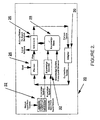
- Equational Reactive Inferencing the MAHCA computational model, is implemented in each agent through a set of standard components shown in Figure 2.
- the MAHCA is a collection of agents; Figure 2 shows the components of a single agent.
- a single agent 20 consists of six components: Knowledge-base Builder 22 (which supports manual input from users), Planner 24, Inferencer 26, Knowledge Base 28, Adapter 30, and Knowledge Decoder 32 (which supports automatic input from other agents).
- the computational model uses points in a carrier manifold to capture current system state and achieves near-optimal results by chattering between controls as the system state evolves.
- the near-optimal controls needed are algebraically represented by the Christoffel symbols of an affine connection.
- the Knowledge-base Builder 22 is a tool that takes a block-diagram representation of system declarations and places the constraints in Equational Logic Language format.
- the Planner 24 generates a statement representing the desired behavior of the system as an existentially quantified logic expression herein referred to as the behavior statement.
- the Inferencer 26 determines whether this statement is a theorem currently active in the Knowledge Base 28.
- the current theory is the set of active clauses in the Knowledge Base with their current instantiations. If the behavior statement logically follows from the current status of the Knowledge Base 28, the Inferencer 26 generates, as a side effect of proving this behavior statement to be true, the current control action schedule.
- the Knowledge Base 28 stores the requirements of operations or processes controlled by the agent. It also encodes system constraints, interagent protocols and constraints, sensory data, operational and logic principles, and a set of primitive inference operations defined in the domain of equational terms.
- the Inferencer 26 transmits the failed terms to the Adapter 30 for replacement or modification.
- the Knowledge Decoder 32 translates data from the other agents and incorporates them into the Knowledge Base 28 of the agent.
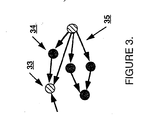
- the preferred embodiments use a set of individual agents as defined in Figure 2 to build a network of cooperating control agents.
- the network can be arranged as a hierarchy, but it is more generally arranged as a directed graph of relationships between agents.
- the current network of cooperating control agents includes declarative controller agents 34, boundary controller agents 33, and communications paths 35.
- An agent can be configured as a boundary controller agent 33 that interfaces with users or with other major components in a complex architecture, or a single agent can be configured as a declarative controller agent 34 that interacts with boundary controller agents 33 and other declarative controller agents in the domain of the component being controlled.
- the logic network of agents passes messages along established communications paths 35.
- Figure 4 shows a evolution of a network of agents having both permanent agents and temporary agents.
- the network may evolve over time t to t + ⁇ through activation of new agents and deactivation of old agents.
- Each individual agent takes local actions in accordance with global and local constraints, local sensor inputs, and inputs from connected agents.
- a network of cooperating control agents implements local control actions to synchronize attainment of global goals.
- Local agents implement local optimality criteria, which can use the same optimality strategies (Min-Max, Team, Pareto, Stakelberg, or Nash) or different optimality strategies, but must all comply with global optimality criteria and global conservation laws (balancing constraints). Synchrony is achieved and maintained through use of individual agent reactivity to maintain phase coherence for values of shared data elements that have global application (i.e., agents react to achieve agreement based on each agent complying with global conservation laws or global criteria).
- the logic agent network consists of permanent agents performing persistent tasks and temporary agents performing transient tasks linked by active links 48.
- Network evolution consists of spawning new agents 44 and deactivating old agents 42 and deactivating links 46 as required to take appropriate actions so that the flow associated with the current system state and current agent actions follows a near-optimal path.
- Two results of this feature of the MAHCA are: (1) support for gradual construction and enhancement of large systems; and (2) support for implementation of a continuum hierarchy for real-time systems whose engineering design supports partitioning of system functions into a hierarchy according to time scales or displacement scales of the system.
- the multiple-agent hybrid control architecture supports autonomous creation of a new agent 44 at time t + ⁇ . Spawning a new agent supports temporary accommodation of transient tasks by temporary agents or changing of system topology for a longer period through creation of permanent agents. During evolution, the architecture supports autonomous deactivation of an old agent 42 and links 46 from agent 40. Deactivation of an old agent supports system modification to end processes that are no longer needed.
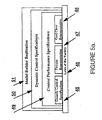
- Figure 5a shows details of Knowledge Base 28 shown in Figure 2 arranged as a set of equational-relational clauses. Equational-relational clauses are used to declare both logical and evolution constraints on system evolution.
- the Knowledge Base has underlying Laws of the Variety 45, Generic Control Specifications 46, Process Representation 47, Goal Class Representation 48, Control Performance Specifications 49, Dynamic Control Specifications 50, and Model Builder Realization 51 arranged in a nested hierarchy. This arrangement of domain Knowledge is the means whereby more complex descriptions of system performance requirements are created from elemental algebraic declarations. Declarations can be written as equational-relational clauses in Equational Logic Language.
- the bottom of this hierarchy contains the Laws of the Variety 45 equations that characterize the algebraic and topological structures of the manifold M. These are expressed the terms of relational forms. From the algebraic point of view, they model an algebraic equational variety. Modeling the manifold as an equational variety captures the state dynamics of the simulations involved in a DIS process in terms of equational clauses that MAHCA can reason about.
- the Knowledge Base of each agent in MAHCA contains a copy of this Knowledge; however, during operation the corresponding clauses will be in a different instantiation status because they depend on sensory data.
- the Generic Control Specifications 46 are the next level of the hierarchy.
- the Generic Control Specifications 46 are clauses expressing general desired behaviors of the system. They include statements about stability, complexity, and robustness that are generic to the class of declarative rational controllers. Generic Control Specifications 46 are constructed by combining Laws of the Variety in the Equational Logic Language format.
- the Process Representation 47 is given by clauses characterizing the dynamic behavior and structure of the process, which may include sensors and actuators. These clauses are written as conservation principles for the dynamic behavior and as invariance principles for the structure.
- the Goal Class Representation 48 contains clauses characterizing sets of desirable operation points in the domain (points in the manifold M). These clauses are expressed as soft constraints; that is, constraints that can be violated for finite intervals of time. They express the ultimate purpose of the controller but not its behavior over time. The goal clauses are agent dependent. Goal Class Representation clauses are also constructed by combining Laws of the Variety in the Equational Logic Language format.
- Control Performance Specifications 49 contain clauses used for expressing problem-dependent and agent-dependent criteria and constraints.
- Control Performance Specification clauses comprise the next layer in the Knowledge Base nested hierarchy. They include generic constraints such as speed and time of response, and qualitative properties of state trajectories.
- Control Performance Specification clauses are also constructed by combining Laws of the Variety in the Equational Logic Language format.
- Dynamic Control Specifications 50 are clauses whose bodies are modified as a function of the sensor and goal commands. Dynamic Control Specification clauses comprise the next layer in the Knowledge Base nested hierarchy. Dynamic Control Specification clauses are constructed by combining Laws of the Variety in the Equational Logic Language format.
- Model Builder Realization 51 contain clauses that constitute a recipe for building a procedural model (automaton) for generating a variable instantiation and theorem proving. Model Builder Realization 51 clauses constitute the top layer in the Knowledge Base hierarchy.
- Figure 5b shows a basic element of a single-agent Knowledge Base 28 as shown in Figure 2 as an equational-relational clause.
- Clauses stored in the Knowledge Base of an agent are used to generate automata that comply with the set of logical and evolution constraints on system behavior.
- the Equational-Relational Clause 52 is the elemental unit of Knowledge concerning system behavior.
- the syntax of an elemental equational-relational clause is the syntax of a Horn clause. That is, the clause has the syntax: a Head 53, implication function (IF) 54, and Body 56.
- the Knowledge Base consists of a set of equational first-order logic clauses with second-order extensions.
- the syntax of clauses is similar to the ones in the Prolog language.
- Each clause is of the form: Head ⁇ Body where Head 53 is a functional form p(x 1 ,...,x n ) 58 taking values in the binary set [true, false] with x 1 , x 2 , ..., x n variables or parameters in the domain D of the controller.
- the variables appearing in the clause head are assumed to be universally quantified.
- the symbol ⁇ stands for logical implication function (IF) 54.
- the Body 56 of a clause is a disjunction 62 of subbodies 60, where each subbody is a conjunction 66 of logical terms 64.
- Each logical term is an equation 68, an order 70, or a name 72.
- the conjunction of terms, e i has the form: e 1 ⁇ e 2 ⁇ ... ⁇ e m where ⁇ is the logical "and" 66.
- Each term in equation (17) is a relational form.
- a relational form is one of the following: an equational form, an inequational form, a covering form, or a clause head. The logical value of each of these forms is either true or false.
- S 1 The generic structure of a relational form is given in Table 1.
- a polynomic form v is an object of the form: where ⁇ . is the free monoid generated by the variable symbols ⁇ x 1 , ..., x n ⁇ under juxtaposition.
- the term (v, ⁇ ) is called the coefficient of v at ⁇ ⁇ ⁇ . .
- the coefficients of a polynomial form v take values in the domain of definition of the clauses. This domain will be described shortly.
- Equation (16) and (17) The logical interpretation of equations (16) and (17) is that the Head is true if the conjunction of the terms of the Body are jointly true for instances of the variables in the clause head.
- the domain in which the variables in a clause head take values is the manifold M.
- Manifold M is contained in the Cartesian product: M ⁇ G ⁇ S ⁇ X ⁇ A where G is the space of goals, S is the space of sensory data, X is the space of controller states, and A is the space of control actions.
- G, S, X, and A are manifolds themselves whose topological structure is defined by specification clauses in the Knowledge Base.
- the closed-loop behavior which will be defined later in terms of a variational formulation, is characterized by continuous curves with values in manifold M. This continuity condition is central, because it is equivalent to requiring the system to look for actions that make the closed loop behavior satisfy the requirements.
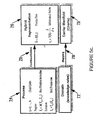
- Figure 5c shows a process 74 is embedded in a hybrid representation 76 via a continualization 75 algorithm.
- the algorithm constructs an invariant mapping 78 from the domain 77 into carrier manifold 79.
- the equational-relational clauses that are domain (knowledge rules) 77 that declare Knowledge in the domain of the Knowledge Base have a one-to-one mapping 78 with charts (open sets) 79 in the carrier manifold.
- This is facilitated by a memory map design for enabling the affine connection to be implemented for real time processes by arranging adjacent charts of an atlas of the manifold, through which a geodesic carrying the connection passes, to be close in memory access.
- the memory map design contains specialized datatypes classified according to the closeness of memory location access.
- the Knowledge Base organization shown in Figure 5a provides the hierarchy of declarations from elemental Laws of the Variety to the level of building domain models.
- the Knowledge Base organization also supports continualization of discrete processes for inclusion in the optimization framework. This approach is also applicable for general discrete processes (e.g., sorting and traveling salesman problems).
- the embedding of procedures in continuum representations is a fundamental step in applying a unified representation of system state to develop a functional that can be used to determine the near-optimal path.
- the first equational term relates the unsatisfied demand for agent i at the current time to the unsatisfied demand in the past and the net current demand of the other agents connected to i on i.
- the last term of the rule implements recursion.
- Invariance principles are one or more clauses establishing constants of motion in a general sense. These principles include stationarity, which plays a pivotal role in the formulation of the theorems proved by the architecture, and geodesics.
- invariant principles specify quality response requirements. That is, they specify levels of performance as a function of traffic load that the system must satisfy.
- the importance of invariance principles lies in the reference they provide for the detection of unexpected events. For example, in a DIS process, the update time after a request is serviced is constant, under normal operating conditions. An equational clause that states this invariance has a ground form that is constant; deviation from this value represents deviation from normality.
- Constraint principles are clauses representing engineering limits to actuators or sensors and, most importantly, behavioral policies. For instance, in a DIS process, the characteristics of the speed of response of the values controlling the input flow size or the speed of access are given by empirical graphs (e.g., byte number vs. velocity, with traffic volume as a parameter) stored in the system relational base. Another example in this application is given by the clauses that define the lifting strategy for embedding discrete varying trajectories into manifold M (interpolation rules). The clause Knowledge Base is organized in a nested hierarchical structure as previously shown in Figure 5a.
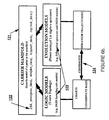
- Figure 6a shows actions performed by individual agents to synchronize distributed, real-time systems. Actions are performed by automata created by each agent in compliance with constraints contained in the equational-relational clauses and with input from sensors and from other agents in the logic agent network. A single agent generates automata through performing transformations on points in a carrier manifold. This figure shows the data flow resulting from single-agent components performing appropriate transformations on points in a carrier manifold. The data flow diagram shows how the system can be state updated each time the Knowledge Base is updated 80 using inputs from users, inputs from other agents in the logic agent network, current agent state 118 from the previous decision cycle, or sensed results from actions taken in the previous decision cycle.
- the state of the system is maintained in values of a point in the carrier manifold, which has both logical and evolution attributes.
- the data flow diagram of a single agent indicates how values of points in the carrier manifold are changed in extracting an automaton that complies with logical and evolution constraints at each update interval.
- the data flow diagram shows the architecture of the instantiation of a plan 84 is achieved by the Planner 24 shown in Figure 2 through term unification 82 of current updates 80 in the Knowledge Base 86 (also shown in as reference numeral 28 in Figure 2) with item potentials constructed by the Adapter 30 shown in Figure 2 from failure terms 102 received from the Inferencer 26 shown in Figure 2.
- Active relations 88 are the result of receiving the behavior criterion from the Planner 24 shown in Figure 2 and applying relaxation principles to construct relaxation criterion.
- the canonical equation 92 is the result of applying the Levi-Civita connection principle to the relaxed criterion (using linearize, equationalize, guarding, and freeze 90) to build a dynamic programming equation, which is the action equation.
- the inference automaton is constructed 96 using an inference blueprint constructor (deduction and evolution transitions output relation) 94.
- An inference procedure (unitary prefix loop decomposition trimmer) 98 is then used to construct an automaton. If the inference automaton execution 100 fails to meet the goal criterion, then the failure terms 102 are sent to the Adapter 30 shown in Figure 2 where syntactic rules for relaxation (commutator rule deactivation relaxation) 104 are applied to perform adaptation 106.
- the plan terms are reformulated 110 as potentials using a Lagrangian constructor 108 and sent to the Planner 24 shown in Figure 2 for instantiation 84 as a reactive loop 120 to correct for system failure. If the execution 100 of the inference automaton constructed meets the near-optimality constrains of the goal criterion, then command actions are output 112, interagent requests are output 114, and the system state is updated 116 as a normal reactive loop 118.
- the set of individual (infinitesimal) actions over an execution interval of an individual agent are normally identified, selected, and executed through the execution loop (normal reaction loop) 118.
- the execution loop of the MAHCA for an individual agent is the means whereby smooth conformance with both logical and evolution constraints of system behavior for an individual agent for local constraints is achieved.
- the set of actions implemented over a set of action intervals by the agents of a logic agent network is the means whereby smooth conformance with both logic and evolution constraints of system behaviors for multiple time scales and multiple displacement distances is achieved for distributed systems.
- the clauses in the Knowledge Base of an individual agent are corrected for failure in accordance with rules for syntactic relaxation of constraints.
- a set of individual (infinitesimal) actions over an execution interval of an individual agent are then identified, selected, and executed through the reactive loop to correct for failure (failure loop) 120.
- the failure loop of the MAHCA is the means whereby robust implementation of both logical and evolution degrees of freedom in the architecture is achieved. Allowable relaxation criteria for logic constraints such as safety and quality constraints are supported in a common framework for relaxation of precision performance criteria of evolution constraints. These allowable degrees of freedom operate at the local level to support robust control of individual nonlinear processes and at the global level to support robust control of large-scale, distributed systems.
- the embedding of logic constraints in continuum representations is a fundamental step in applying a unified representation of system state to develop a functional which can be used to determine the near-optimal path.
- the carrier manifold is the means for forming a unified declaration of system state (status) which includes both logic and evolution parameters.
- the logical Lagrangian (equation 20)) is the means whereby the logical constraints and evolution constraints are embedded in a continuum representation of system behavior.
- the Knowledge Decoder 32 shown in Figure 2 functions to place discrete and evolution values for user inputs, sensor inputs, and inputs from other agents in a continuum representation -- the logical Lagrangian.
- Figure 6b shows the carrier manifold as the mathematical entity whereby a unified model of system state is constructed and in which the invariant transformations necessary for system solution are performed.
- MAHCA rests on the application of the calculus of variations in a new manner.
- the symbolic formulas for controls which are generated by automata constructed by individual agents can be viewed as formulas for the coefficients of a Cartan connection on an appropriate Finsler manifold associated with a parametric calculus of variations formulation of the optimal control problem.
- the carrier manifold 121 is the MAHCA version of the appropriate Finsler manifold.
- the carrier manifold 121 is the foundational mathematical entity for unification of logical, geometric, and evolution constrains on system behavior.
- a point p 122 in the carrier manifold has both logical and evolution parameters as previously described in expression (2). While conventional system representations split system models into logic models and evolution models 123, the Kohn-Nerode definition of continuity 124 of process models supports the use of the carrier manifold to achieve an amalgamation of logic and evolution models into a continuum representation.
- Figure 7 shows the basic method of operation of the MAHCA as the creation of the next automaton given the current set of system goals, the current set of logical and evolution constraints on system behavior, the current set of inputs from user(s), and the current set of sensor values. These parameters are all declared and appear as equational-relational clauses to the Inferencer 26 shown in Figure 2. This figure shows the sequence of operations taken by the Inferencer to generate an automaton that provides near-optimal actions for achieving system goals while complying with logical and evolution constraints and current system inputs.
- the Inferencer takes a theorem from the Planner 24 shown in Figure 2 and either produces an automaton that performs the near-optimal actions in terms of a cost function or produces the failure terms so the Adapter 30 shown in Figure 2 can provide relaxed criteria to the Planner 24 shown in Figure 2 for construction of a new theorem.
- the hybrid control system architecture and Inferencer operation result in generation of automata that execute actions to follow a near-optimal path to reach the goal criterion.
- the relaxed criterion 126 is the result of receiving the behavior criterion 125 from the Planner 24 shown in Figure 2 and applying the relaxation principle 146.
- the dynamic programming equation 127 which is the action equation, is the result of applying the Levi-Civita connection principle 144 to the relaxed criterion 126.
- the canonical equation 128 is constructed from the dynamic programming equation 127 using an inference blueprint constructor 142.
- the inference automaton 130 is constructed from the canonical equation 128 using an automata constructor 140.
- An inference procedure (unitary prefix loop decomposition trimmer) 98 shown in Figure 6a is then used to construct an automaton. If the automata execution 138 of the inference automaton 130 constructed fails to meet the goal criterion 134, then the failure terms and agent status are sent to the Adapter 30 shown in Figure 2 where syntactic rules for relaxation are applied to perform adaptation. If the execution 138 of the inference automaton constructed will successfully 136 meet the near-optimality constraints of the goal criterion, then command actions are output 132, interagent requests are output, and the system state is updated as a normal reactive loop.
- the function of theorem Planner 24 shown in Figure 2, which is domain-specific, is to generate, for each update interval, a symbolic statement of the desired behavior of the system, as viewed by the agent (e.g., agent i) throughout the interval.
- the theorem statement that it generates has the following form: Given a set of primitive actions, there exists control schedule v i
- p (G i ( ⁇ , p))) ⁇ d ⁇ i (p, d ⁇ ) subject to the following constraints: G i (S i , ⁇ i (t + ⁇ , p)) G(t, X i )
- L i is called the local relaxed Lagrangian of the system as viewed
- This function which maps the Cartesian product of the state and control spaces into the real line with the topology defined by the clauses in the Knowledge Base, captures the dynamics, constraints, and requirements of the system as viewed by agent i.
- the relaxed Lagrangian function L i is a continuous projection in the topology defined by the Knowledge Base in the coordinates of the i-th agent of the global Lagrangian function L that characterizes the system as a whole.
- Equation (21) which is taken from equation (15), p ⁇ M represents the state of the process under control as viewed by the agent and G i is the parallel transport operator bringing the goal to the current interval.
- the operator G i is constructed by lifting the composite flow (see equation (10)) to the manifold.
- the composite flow and the action schedule are determined once the fraction function (measure) ⁇ i is known, and this function is the result of the optimization equations (20) and (21).
- the action schedule is constructed as a linear combination of primitive actions (see equation (12)).
- Equation (21) constitute the three constraints imposed in the relaxed optimization problem solved by the agent.
- the first constraint is the local goal constraint expressing the general value of the state at the end of the current interval.
- the second constraint represents the constraints imposed on the agent by the other agents in the network.
- the third constraint indicates that d ⁇ i ( ⁇ ) is a probability measure.
- the optimization problem stated in equations (20) and (21) is a convex optimization problem. This is important because it guarantees that if a solution exists, it is unique, and also, it guarantees the computational effectiveness of the inference method that the agent uses for proving the theorem.
- d ⁇ i ( ⁇ ) in equation (20) is a Radon probability measure on the set of primitive command or control actions that the agent can execute for the interval [t, t+ ⁇ ). It measures, for the interval, the percentage of time to be spent in each of the primitive actions.
- the central function of the control agent is to determine this mixture of actions for each control interval. This function is carried out by each agent by inferring from the current status of the Knowledge Base whether a solution of the optimization problem stated by the current theorem exists, and, if so, to generate corresponding actions and state updates.
- the function under the integral in equation (20) includes a term, referred to as the "catch-all" potential, which is not associated with any clause in the Knowledge Base 28 shown in Figure 2. Its function is to measure unmodelled dynamic events. This monitoring function is carried out by the Adapter 30 shown in Figure 2, which implements a generic commutator principle similar to the Lie bracket discussed previously. Under this principle, if the value of the catch-all potential is empty, the current theorem statement adequately models the status of the system. On the other hand, if the theorem fails, meaning that there is a mismatch between the current statement of the theorem and system status, the catch-all potential carries the equational terms of the theorem that caused the failure.
- the new potential symbol and tuning constraints are sent to the Planner 24 shown in Figure 2 which generates a modified local criterion and goal constraint.
- the new theorem, thus constructed, represents adapted behavior of the system. This is the essence of reactive structural adaptation in this model.
- Synchronization is achieved through generation of automata whose actions apply: (1) the Kohn-Nerode definition of continuity for hybrid systems which is the basis for creation of a unified statement of hybrid system state and for determining when evolution of the system state violates topological continuity constraints, causing the proof procedure to fail and requiring reaction to restore continuity, and (2) the Kohn-Nerode-James optimality result to select appropriate chattering combination of individual (infinitesimal) actions to achieve near-optimal performance.
- the smooth and near-optimal synchronization of actions to control distributed processes subject to both logical and evolution constraints in order to achieve satisfaction of global and local goals is the primary result of applying the hybrid control architecture. Since the MAHCA is effective for near-optimal control of dynamic distributed processes, it is also appropriate for near-optimal solution of static systems.
- Figure 8 shows a process of achieving a near-optimal solution of a hybrid system problem i 156 through chattering between individual actions.
- Figure 8 illustrates the relations between the primitive actions v i 146 and the fraction ⁇ i 152 of ⁇ 150 for which they are active in the interval [t, t+ ⁇ ) 148, 154.
- Chattering refers to switching between infinitesimal control actions v i 146 at subintervals ⁇ i 152 of the update interval ⁇ 150.
- Agent actions are taken for a finite interval of time ⁇ 150 appropriate for each agent.
- the automata that execute near-optimal actions are updated for each interval.
- the Adapter 30 shown in Figure 2 of each controller agent provides the system with a generic and computationally effective means to recover from failures or unpredictable events.
- Theorem failures are symptoms of mismatches between what the agent thinks the system looks like and what it really looks like.
- the adaptation clause incorporates Knowledge into the agent's Knowledge Base which represents a recovery strategy.
- the Inferencer discussed next, effects this strategy as part of its normal operation.
- the Inferencer 26 shown in Figure 2 is an on-line equational theorem prover.
- the class of theorems it can prove are represented by statements of the form of equations (20) and (21), expressed by an existentially quantified conjunction of equational terms of the form: ⁇ Z
- W 1 (Z, p) rel 1 V 1 (Z, p) ⁇ ... ⁇ W n (Z, p) rel n V n (Z, p) where Z is a tuple of variables each taking values in the domain D, p is a list of parameters in D G ⁇ S ⁇ X ⁇ A (i.e.
- more than one partial order relation may appear.
- at least one of the terms is a partial order relation that defines a complete lattice on the algebra; that corresponds to the optimization problem. This lattice has a minimum element if the optimization problem has a minimum.
- the Inferencer determines whether the statement logically follows from the clauses in the Knowledge Base, and if so, as a side effect of the proof, generates a non-empty subset of tuples with entries in D giving values to Z. These entries determine the agent's actions. Thus, a side effect is instantiation of the agent's decision variables.
- ⁇ is a set of primitive unary operations ⁇ v i ⁇ .
- Each v i maps the semiring algebra, whose members are power series involving the composition of operators, on Z to itself v i : D ⁇ Z ⁇ ⁇ D ⁇ Z ⁇
- These operators are characterized by axioms in the Knowledge Base, and are process dependent.
- the implemented inference principle can be stated as follows: Let ⁇ be the set of clauses in the Knowledge Base. Let ⁇ represent implication. Proving the theorem means to show that it logically follows from ⁇ , i.e., ⁇ ⁇ theorem The proof is accomplished by sequences of applications of the following inference axioms:
- Each inference operator transforms a relational term into another relational term.
- the Inferencer applies sequences of inference operators on the equational terms of the theorem until these terms are reduced to either a set of ground equations of the form of equation (27), or it determines that no such ground form exists.
- Z i ⁇ ⁇ 1 , ⁇ i ⁇ D The mechanism by which the Inferencer carries out the procedure described above is by building a procedure for variable goal instantiation: a locally finite automaton (referred to as the Proof Automaton). This important feature is unique to our approach. The proof procedure is customized to the particular theorem statement and Knowledge Base instance it is currently handling.
- Figure 9 shows a conceptual structure of a proof automaton describing sequences of actions that are possible for the automaton constructed by the Inferencer 26 shown in Figure 2 and further detailed in Figure 7.
- Agents achieve optimal control over an interval by chattering between infinitesimal actions which are chosen from a finite set of alternatives. Infinitesimal actions are followed over subintervals of the action update interval ⁇ 150 shown in Figure 8.
- Actions are implemented by proof automata generated as a side-result of proving that a near-optimal solution to the control problem can be achieved.
- the initial state 160 represents the equations 158 associated with the theorem.
- each following state 162, 164 corresponds to a derived equational form of the theorem through the application of a chain of inference rules a i , b i , c i , d i , e i to the initial state that is represented by the path
- Each edge in the automaton corresponds to one of the possible inferences.
- a state is terminal if its equational form is a tautology, or it corresponds to a canonical form whose solution form is stored in the Knowledge Base.
- the function of the complete partial order term, present in the conjunction of each theorem provable by the Inferencer, is to provide a guide for constructing the proof automaton. This is done by transforming the equational terms of the theorem into a canonical fixed point equation, called the Kleene-Schutzenberger Equation (KSE), which constitutes a blueprint for the construction of the proof automaton. This fixed point coincides with the solution of the optimization problem formulated in equations (20) and (21), when it has a solution.
- KSE Kleene-Schutzenberger Equation
- KSE The general form of KSE is: Z ⁇ E(p) ⁇ Z + T(p)
- E is a square matrix, with each entry a rational form constructed from the basis of inference operators described above, and T is a vector of equational forms from the Knowledge Base.
- Each non-empty entry, E ij , in E corresponds to the edge in the proof automaton connecting states i and j.
- the binary operator between E(p) and Z represents the "apply inference to" operator. Terminal states are determined by the non-empty terms of T.
- the p terms are custom parameter values in the inference operator terms in E( ⁇ ).
- the construction of the automaton is carried out from the canonical equation and not by a non-deterministic application of the inference rules.
- This approach reduces the computational complexity of the canonical equation (low polynomic) and is far better than applying the inference rules directly (exponential).
- This "divide and conquer" procedure implements the recursive decomposition of the automaton into a cascade of parallel unitary (one initial and one terminal state) automata. Each of the resulting automata on this decomposition is executed independently of the others.
- the behavior of the resulting network of automata is identical with the behavior obtained from the original automaton, but with feasible time complexity.
- the Inferencer 26 shown in Figure 2 for each control agent fulfills two functions: generating a proof for the system behavior theorem of each agent generated by the Planner (equations (20) and (21)) and functioning as the central element in the Knowledge Decoder. Its function for proving the behavior theorem will now be described. Later, its function as part of the Knowledge Decoder will be shown.
- equations (20) and (21) To show how the Inferencer is used to prove the Planner theorem, equations (20) and (21), first this theorem is transformed into a pattern of the equation form (22). Since equations (20) and (21) formulate a convex optimization problem, a necessary and sufficient condition for optimality is provided by the following dynamic programming formulation: In expression (29), the function V i , called the optimal cost-to-go function, characterizes minimality starting from any arbitrary point inside the current interval. The second equation is the corresponding Hamilton-Jacobi-Bellman equation for the problem stated in equations (20) and (21), where is the Hamiltonian of the relaxed problem. This formulation provides the formal coupling between deductive theorem proving and optimal control theory.
- the Inferencer allows the real-time optimal solution of the formal control problem resulting in intelligent distributed real-time control of the multiple-agent system.
- the central idea for inferring a solution to equation (29) is to expand the cost-to-go function V(.,.) in a rational power series V in the algebra D ⁇ (Y, ⁇ ) ⁇
- Replacing V for V i in the second equation in expression (29) gives two items: a set of polynomic equations for the coefficients of V and a partial order expression for representing the optimality. Because of the convexity and rationality of V , the number of equations needed to characterize the coefficients of V is finite.
- the resulting string of conjunctions of coefficient equations and the optimality partial order expression are in equation form (22).
- Step 1 Load current theorem equations (20) and (21); Step 2: Transform theorem to equational form (22) via equation (29); and Step 3: Execute proof according to chart shown in Figure 7, which was described previously. If the theorem logically follows from the Knowledge Base (i.e., it is true), the Inferencer procedure will terminate on step 3 with actions ⁇ i (). If the theorem does not logically follow from the Knowledge Base, the Adapter 30 shown in Figure 2 is activated, and the theorem is modified by the theorem Planner 24 shown in Figure 2 according to the strategy outlined above. This mechanism is the essence of reactivity in the agent. Because of relaxation and convexity, this mechanism ensures that the controllable set of the domain is strictly larger than the mechanism without this correction strategy.
- the Knowledge Decoder 32 shown in Figure 2 translates Knowledge data from the network into the agent's Knowledge Base by updating the inter-agent specification clauses of the Knowledge Base. These clauses characterize the second constraint in expression (29). Specifically, they express the constraints imposed by the rest of the network on each agent. They also characterize global-to-local transformations. Finally, they provide the rules for building generalized multipliers for incorporating the inter-agent constraints into a complete unconstrained criterion, which is then used to build the cost-to-go function for the nonlinear optimization problem in the first equation in expression (29).
- a generalized multiplier is an operator that transforms a constraint into a potential term. This potential is then incorporated into the original Lagrangian which now accounts explicitly for the constraint.
- the Knowledge Decoder 32 shown in Figure 2 has a built-in inferencer used to infer the structure of the multiplier and transformations by a procedure similar to the one described for equation (14). Specifically, the multiplier and transformations are expanded in a rational power series in the algebra defined in equation (30). Then the necessary conditions for duality are used to determine the conjunctions of equational forms and a partial order expression needed to construct a theorem of the form of equation (22) whose proof generates a multiplier for adjoining the constraint to the Lagrangian of the agent as another potential.
- the invariant embedding equation has the same structure as the dynamic programming equation given in equation (29), but using the global criterion and global Hamiltonians instead of the corresponding local ones.
- the local-to-global transformations are obtained by inverting the global-to-local transformations obtained by expressing the invariant embedding equation as an equational theorem of the form of equation (22). These inverses exist because of convexity of the relaxed Lagrangian and the rationality of the power series.
- Figure 10 shows the functionality of the Knowledge Decoder 32 shown in Figure 2 of each agent in terms of what it does.
- the multiplier described above has the effect of aggregating the rest of the system and the other agents into an equivalent companion system 167 and companion agent 168 through system interaction and agent interaction 169, respectively, as viewed by the current agent 165.
- the aggregation model shown in Figure 10 describes how each agent 166 perceives the rest of the network. This unique feature allows characterization of the scalability of the architecture in a unique manner. Namely in order to determine computational complexity of an application, consider only the agent 166 with the highest complexity (i.e., the local agent with the most complex criterion) and its companion 168.
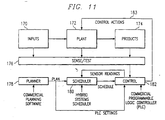
- Figure 11 shows an example of applying the MAHCA to planning, scheduling, and control of a discrete manufacturing plant 172.
- a logic agent network 11 as shown in Figure 1 can synchronize the logical operation of event-based components with the evolution operation of continuum-based components such as repair of failed schedules 180 to synchronize execution of the output of high-level discrete-manufacturing planning functions 178 in order to achieve near-optimal schedules of actions to be executed by programmable logic controllers (PLCs) 182.
- PLCs programmable logic controllers
- Scheduler 180 being a single agent acting as the hybrid system scheduler "glue" between the high-level Planner 178 and the low-level Control 182 implemented using conventional commercial planning software and commercial programmable logic controllers or as a multiple-agent system with the Planner, Scheduler, and Controller implemented as agents.
- the Control 182 interfaces into the physical plant through Sense/Test 176 components which detect the state of the Plant 172, the Inputs 170 and the Products 174.
- the Control directs the operation of the Plant through control actions 183.
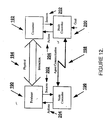
- Figure 12 shows an example of a two-agent multiple-agent network for a discrete manufacturing plant such as the one shown in Figure 11.
- a producer 190, node controller agent. 196, and a consumer 192 node controller agent 200 can be used to produce and repair near-optimal schedules of work cell actions to synchronize execution of production requests in accordance with established priorities and production constraints. This synchronization is accomplished by having the system goal introduced into the consumer node controller agent 200 which passes messages via agent communication 198 to the producer node controller agent 196.
- Agents sense the state of the producer 190 and consumer 192 using sensors 202 and change the state of the system using commanded actions 204.
- Producer and consumer interactions are constrained by physical interaction 194. Actions produced by the two-agent network synchronize the operation of the plant.
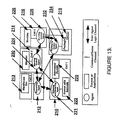
- Figure 13 shows an example of a five-agent multiple-agent network for a discrete manufacturing application such as the one shown on Figure 11.
- a multiple-agent network (as shown in Figures 1 and 7) can be configured to synchronize five cells for control of a discrete manufacturing plant.
- Figure 13 illustrates MAHCA with five Permanent Agents controlling a manufacturing process for producing molded plastic products. The plant is composed of five functional cells:
- the MAHCA framework is capable of causing conventional procedures to run faster by transforming those functions into representations suitable for parallel solution.
- continualization is a symbolic algorithm for transforming a discrete process with a differential equation, whose solution contains the values computed by the process.
- Continualization is a generic procedure that replaces an executing reduced instruction set computer (RISC) procedure with solving a differential equation whose solution at selected sampling points coincides with output values of the procedures.
- RISC reduced instruction set computer
- the key element of the algorithm is a generic method for coding recursion into evolution of ordinary differential equations.
- the second key is to regard the program as a set of constraints, and to regard executing the program to termination as finding a near-optimal solution to a corresponding Lagrangian problem on a Finsler manifold determined by the constraints.
- each individual digital instruction of the original program codes as an infinitesimal generator of a vector field on the manifold.
- the near-optimal chattering solution that gives the digital solution is a chattering combination of these vector fields.
- the chattering can be done in any order, which means that each digital instruction vector field gets attention during a certain portion of the chatter, but the order does not matter. This is a source of extreme parallelism in this continuous execution of digital programs.
- the chatters are found via the connection coefficients of the Cartan connection of the manifold. This can be used to accelerate virtually any digital program, and applies also to perpetual processes with slight modifications.
- the Lagrangian problem formulation is the MAHCA formulation
- the Finsler space is the MAHCA carrier manifold
- the infinitesimals are computed as in MAHCA.
- Each MAHCA agent can speed up an individual procedure and a network of agents can speed up an ensemble of procedures.
- the multiple-agent hybrid control architecture can be used for intelligent, real-time control of distributed, nonlinear processes and real-time control of conventional functions.
- This invention may, of course, be carried out in specific ways other than those set forth here without departing from the spirit and essential characteristics of the invention. Therefore, the presented embodiments should be considered in all respects as illustrative and not restrictive, and all modifications falling within the meaning and equivalency range of the appended claims are intended to be embraced therein.
Landscapes
- Engineering & Computer Science (AREA)
- Physics & Mathematics (AREA)
- General Physics & Mathematics (AREA)
- Artificial Intelligence (AREA)
- Automation & Control Theory (AREA)
- Software Systems (AREA)
- Evolutionary Computation (AREA)
- Theoretical Computer Science (AREA)
- General Engineering & Computer Science (AREA)
- Manufacturing & Machinery (AREA)
- Medical Informatics (AREA)
- Computer Vision & Pattern Recognition (AREA)
- Health & Medical Sciences (AREA)
- Quality & Reliability (AREA)
- Data Mining & Analysis (AREA)
- Computing Systems (AREA)
- Mathematical Physics (AREA)
- Computational Linguistics (AREA)
- Human Computer Interaction (AREA)
- Management, Administration, Business Operations System, And Electronic Commerce (AREA)
- Multi Processors (AREA)
- Pharmaceuticals Containing Other Organic And Inorganic Compounds (AREA)
- Stored Programmes (AREA)
- Feedback Control In General (AREA)
Applications Claiming Priority (3)
| Application Number | Priority Date | Filing Date | Title |
|---|---|---|---|
| US564008 | 1990-08-07 | ||
| US08/564,008 US6088689A (en) | 1995-11-29 | 1995-11-29 | Multiple-agent hybrid control architecture for intelligent real-time control of distributed nonlinear processes |
| EP96942095A EP0864120B1 (fr) | 1995-11-29 | 1996-11-27 | Architecture hybride de commande a agents multiples |
Related Parent Applications (1)
| Application Number | Title | Priority Date | Filing Date |
|---|---|---|---|
| EP96942095A Division EP0864120B1 (fr) | 1995-11-29 | 1996-11-27 | Architecture hybride de commande a agents multiples |
Publications (2)
| Publication Number | Publication Date |
|---|---|
| EP1600829A2 true EP1600829A2 (fr) | 2005-11-30 |
| EP1600829A3 EP1600829A3 (fr) | 2008-03-12 |
Family
ID=24252795
Family Applications (2)
| Application Number | Title | Priority Date | Filing Date |
|---|---|---|---|
| EP96942095A Expired - Lifetime EP0864120B1 (fr) | 1995-11-29 | 1996-11-27 | Architecture hybride de commande a agents multiples |
| EP05017303A Withdrawn EP1600829A3 (fr) | 1995-11-29 | 1996-11-27 | Architecture hybride de commande a agents multiples |
Family Applications Before (1)
| Application Number | Title | Priority Date | Filing Date |
|---|---|---|---|
| EP96942095A Expired - Lifetime EP0864120B1 (fr) | 1995-11-29 | 1996-11-27 | Architecture hybride de commande a agents multiples |
Country Status (8)
| Country | Link |
|---|---|
| US (1) | US6088689A (fr) |
| EP (2) | EP0864120B1 (fr) |
| JP (1) | JP2000501531A (fr) |
| KR (1) | KR19990071859A (fr) |
| AT (1) | ATE304188T1 (fr) |
| AU (1) | AU717675B2 (fr) |
| DE (1) | DE69635162T2 (fr) |
| WO (1) | WO1997020258A1 (fr) |
Cited By (1)
| Publication number | Priority date | Publication date | Assignee | Title |
|---|---|---|---|---|
| RU2485583C1 (ru) * | 2012-01-25 | 2013-06-20 | Федеральное государственное военное образовательное учреждение высшего профессионального образования Военная академия Ракетных войск стратегического назначения имени Петра Великого МО РФ | Устройство для моделирования многоканальных преобразователей |
Families Citing this family (135)
| Publication number | Priority date | Publication date | Assignee | Title |
|---|---|---|---|---|
| US5802511A (en) * | 1996-01-02 | 1998-09-01 | Timeline, Inc. | Data retrieval method and apparatus with multiple source capability |
| US6023694A (en) * | 1996-01-02 | 2000-02-08 | Timeline, Inc. | Data retrieval method and apparatus with multiple source capability |
| US6631382B1 (en) | 1996-01-02 | 2003-10-07 | Timeline, Inc. | Data retrieval method and apparatus with multiple source capability |
| US8983889B1 (en) | 1996-03-25 | 2015-03-17 | Martin L. Stoneman | Autonomous humanoid cognitive systems |
| WO1997036247A1 (fr) * | 1996-03-25 | 1997-10-02 | Stoneman Martin L | Systemes de decision autonomes |
| US7885912B1 (en) | 1996-03-25 | 2011-02-08 | Stoneman Martin L | Humanoid machine systems, methods, and ontologies |
| US6230066B1 (en) * | 1998-09-08 | 2001-05-08 | Ford Global Technologies, Inc. | Simultaneous manufacturing and product engineering integrated with knowledge networking |
| US7779015B2 (en) | 1998-12-18 | 2010-08-17 | Microsoft Corporation | Logging and analyzing context attributes |
| US7046263B1 (en) | 1998-12-18 | 2006-05-16 | Tangis Corporation | Requesting computer user's context data |
| US7231439B1 (en) | 2000-04-02 | 2007-06-12 | Tangis Corporation | Dynamically swapping modules for determining a computer user's context |
| US7225229B1 (en) | 1998-12-18 | 2007-05-29 | Tangis Corporation | Automated pushing of computer user's context data to clients |
| US6801223B1 (en) | 1998-12-18 | 2004-10-05 | Tangis Corporation | Managing interactions between computer users' context models |
| US8181113B2 (en) | 1998-12-18 | 2012-05-15 | Microsoft Corporation | Mediating conflicts in computer users context data |
| US6747675B1 (en) * | 1998-12-18 | 2004-06-08 | Tangis Corporation | Mediating conflicts in computer user's context data |
| US9183306B2 (en) | 1998-12-18 | 2015-11-10 | Microsoft Technology Licensing, Llc | Automated selection of appropriate information based on a computer user's context |
| US6842877B2 (en) | 1998-12-18 | 2005-01-11 | Tangis Corporation | Contextual responses based on automated learning techniques |
| US6513046B1 (en) | 1999-12-15 | 2003-01-28 | Tangis Corporation | Storing and recalling information to augment human memories |
| US8225214B2 (en) | 1998-12-18 | 2012-07-17 | Microsoft Corporation | Supplying enhanced computer user's context data |
| US7107539B2 (en) | 1998-12-18 | 2006-09-12 | Tangis Corporation | Thematic response to a computer user's context, such as by a wearable personal computer |
| US6920616B1 (en) | 1998-12-18 | 2005-07-19 | Tangis Corporation | Interface for exchanging context data |
| US6791580B1 (en) | 1998-12-18 | 2004-09-14 | Tangis Corporation | Supplying notifications related to supply and consumption of user context data |
| EP1045304A1 (fr) * | 1999-04-16 | 2000-10-18 | Martine Naillon | Procédé de pilotage d'un processus décisionnel lors de la poursuite d'un but dans un domaine d'application déterminé, tel qu'économique, technique organisationnel ou analogue et système pour la mise en oeuvre du procédé |
| US6789054B1 (en) * | 1999-04-25 | 2004-09-07 | Mahmoud A. Makhlouf | Geometric display tools and methods for the visual specification, design automation, and control of adaptive real systems |
| US6556211B2 (en) | 1999-06-02 | 2003-04-29 | Punch Software, Llc | Method for constructing architectural models including scaled surface textures |
| US6404424B1 (en) * | 1999-06-02 | 2002-06-11 | Punch Software, Llc | Method for constructing architectural models including scaled surface textures |
| DE19935318A1 (de) * | 1999-07-28 | 2001-02-08 | Schneider Automation Gmbh | Produktionssystem |
| US6826518B1 (en) * | 1999-09-20 | 2004-11-30 | Ut-Battelle, Llc | Method for distributed agent-based non-expert simulation of manufacturing process behavior |
| US20020069134A1 (en) * | 1999-11-01 | 2002-06-06 | Neal Solomon | System, method and apparatus for aggregation of cooperative intelligent agents for procurement in a distributed network |
| US20020046157A1 (en) * | 1999-11-01 | 2002-04-18 | Neal Solomon | System, method and apparatus for demand-initiated intelligent negotiation agents in a distributed network |
| US20020055903A1 (en) * | 1999-11-01 | 2002-05-09 | Neal Solomon | System, method, and apparatus for a cooperative communications network |
| US20030074301A1 (en) * | 1999-11-01 | 2003-04-17 | Neal Solomon | System, method, and apparatus for an intelligent search agent to access data in a distributed network |
| US20020023164A1 (en) * | 2000-01-28 | 2002-02-21 | Lahr Nils B. | Method and apparatus for client-side authentication and stream selection in a content distribution system |
| US6587844B1 (en) * | 2000-02-01 | 2003-07-01 | At&T Corp. | System and methods for optimizing networks of weighted unweighted directed graphs |
| WO2001075676A2 (fr) | 2000-04-02 | 2001-10-11 | Tangis Corporation | Sollicitation d'informations fondee sur un contexte d'utilisateur d'ordinateur |
| US7464153B1 (en) | 2000-04-02 | 2008-12-09 | Microsoft Corporation | Generating and supplying user context data |
| US6947917B1 (en) * | 2000-04-14 | 2005-09-20 | Honeywell International Inc. | Advanced recipe—a knowledge based information system for production processes |
| EP1295185B9 (fr) * | 2000-06-29 | 2005-01-05 | Aspen Technology, Inc. | Procede informatique et appareil de contrainte d'un approximateur non lineaire d'un processus empirique |
| US6782372B1 (en) * | 2000-09-28 | 2004-08-24 | Sandia Corporation | Latent effects decision analysis |
| US20020054130A1 (en) | 2000-10-16 | 2002-05-09 | Abbott Kenneth H. | Dynamically displaying current status of tasks |
| EP1199678A1 (fr) * | 2000-10-17 | 2002-04-24 | Martine Naillon | Procédé de pilotago de processus décisionnel lors de la poursuite d'un but dans un domaine d'application déterminé, tel qu'économique, technique, organistionnel ou analogue |
| EP1202141B1 (fr) * | 2000-10-30 | 2007-12-12 | Siemens Aktiengesellschaft | Procédé pour la réduction des automates à états finis et support lisible sur ordinateur correspondant |
| RU2194302C2 (ru) * | 2001-02-22 | 2002-12-10 | Карандин Василий Николаевич | Ячейка матричного коммутатора с потоковой настройкой |
| US7277832B2 (en) * | 2001-05-04 | 2007-10-02 | Bigwood Technology, Inc. | Dynamical method for obtaining global optimal solution of general nonlinear programming problems |
| DE10125610A1 (de) * | 2001-05-25 | 2002-12-12 | Siemens Ag | Verfahren und Computersystem zur Durchführung einer Simulation |
| US7009610B1 (en) | 2001-10-25 | 2006-03-07 | Keeley Thomas M | Computer program and related data processing methods for use in knowledge enhanced electronic logic |
| US7039623B1 (en) | 2001-10-25 | 2006-05-02 | Keeley Thomas M | Computer program and data structure for use in knowledge enhance electronic logic |
| US7159208B2 (en) * | 2001-10-25 | 2007-01-02 | Keeley Thomas M | Programming toolkit for use in the development of knowledge enhanced electronic logic programs |
| US7275048B2 (en) * | 2001-10-30 | 2007-09-25 | International Business Machines Corporation | Product support of computer-related products using intelligent agents |
| GB2384580A (en) * | 2001-12-14 | 2003-07-30 | Empiricom Technologies Ltd | Knowledge acquisition in expert systems |
| US20030188040A1 (en) * | 2002-03-29 | 2003-10-02 | International Business Machines Corporation | Software agent hosting environment with extensible middleware integration |
| KR20040097368A (ko) * | 2002-04-18 | 2004-11-17 | 사르노프 코포레이션 | 애드-혹 네트워킹된 센서들 및 프로토콜들을 제공하기위한 방법 및 장치 |
| US6839660B2 (en) * | 2002-04-22 | 2005-01-04 | Csi Technology, Inc. | On-line rotating equipment monitoring device |
| US7475107B2 (en) * | 2002-07-08 | 2009-01-06 | Electronic Evidence Discovery, Inc. | System and method for managing distributed computer processes |
| US7370072B2 (en) * | 2002-07-08 | 2008-05-06 | Electronic Evidence Discovery, Inc. | System and method for collecting electronic evidence data |
| TWI233008B (en) * | 2002-09-30 | 2005-05-21 | Tokyo Electron Ltd | Method and apparatus for the monitoring and control of a semiconductor manufacturing process |
| US7437703B2 (en) * | 2002-10-25 | 2008-10-14 | Sap Ag | Enterprise multi-agent software system with services able to call multiple engines and scheduling capability |
| US7640291B2 (en) * | 2002-12-16 | 2009-12-29 | Rockwell Automation Technologies, Inc. | Agent-equipped controller having data table interface between agent-type programming and non-agent-type programming |
| US7266426B2 (en) * | 2002-12-16 | 2007-09-04 | Rockwell Automation Technologies, Inc. | Autonomous control unit-based control system capable of active diagnostics |
| US7228187B2 (en) * | 2002-12-16 | 2007-06-05 | Rockwell Automation Technologies, Inc. | System and method for interfacing multi-agent system |
| US7721218B2 (en) * | 2003-03-31 | 2010-05-18 | International Business Machines Corporation | Mechanism for intelligent user interface presentation of a software agent |
| US7124119B2 (en) * | 2003-03-31 | 2006-10-17 | International Business Machines Corporation | Communication between intelligent agents and humans in a distributed system environment |
| US7925984B2 (en) * | 2003-03-31 | 2011-04-12 | International Business Machines Corporation | Remote configuration of intelligent software agents |
| US7647327B2 (en) | 2003-09-24 | 2010-01-12 | Hewlett-Packard Development Company, L.P. | Method and system for implementing storage strategies of a file autonomously of a user |
| US7512581B2 (en) * | 2003-10-09 | 2009-03-31 | Keeley Thomas M | Electronic circuit implementing knowledge enhanced electronic logic solutions |
| DE102004016580B4 (de) * | 2004-03-31 | 2008-11-20 | Nec Europe Ltd. | Verfahren zur Übertragung von Daten in einem Ad Hoc Netzwerk oder einem Sensornetzwerk |
| US20050234696A1 (en) * | 2004-04-15 | 2005-10-20 | The University Of Chicago | Automated agent-based method for identifying infrastructure interdependencies |
| KR100607141B1 (ko) * | 2004-05-12 | 2006-08-01 | 한국생산기술연구원 | 개방형 분산처리구조의 로봇 제어 시스템 |
| KR100559251B1 (ko) * | 2004-05-12 | 2006-03-15 | 한국생산기술연구원 | 개방형 인터넷망 기반의 로봇 개발을 위한 분산소프트웨어 통합서비스방법 |
| US7440933B2 (en) * | 2004-06-18 | 2008-10-21 | International Business Machines Corporation | Method for facilitating problem resolution |
| US7823169B1 (en) | 2004-10-28 | 2010-10-26 | Wheeler Thomas T | Performing operations by a first functionality within a second functionality in a same or in a different programming language |
| US8266631B1 (en) | 2004-10-28 | 2012-09-11 | Curen Software Enterprises, L.L.C. | Calling a second functionality by a first functionality |
| US7774789B1 (en) | 2004-10-28 | 2010-08-10 | Wheeler Thomas T | Creating a proxy object and providing information related to a proxy object |
| US20090018698A1 (en) * | 2004-11-26 | 2009-01-15 | Electronics And Telecommunications Research Instit | Robot system based on network and execution method of that system |
| US7861212B1 (en) | 2005-03-22 | 2010-12-28 | Dubagunta Saikumar V | System, method, and computer readable medium for integrating an original application with a remote application |
| US8578349B1 (en) | 2005-03-23 | 2013-11-05 | Curen Software Enterprises, L.L.C. | System, method, and computer readable medium for integrating an original language application with a target language application |
| US7685528B2 (en) * | 2005-06-08 | 2010-03-23 | Keeley Thomas M | Programming toolkit with aligning clipper windows for use in the development of knowledge enhanced electronic programs |
| US7644048B2 (en) * | 2005-10-28 | 2010-01-05 | General Dynamics Advanced Information Systems, Inc. | System, method and software for cognitive automation |
| EP1793243A1 (fr) * | 2005-12-05 | 2007-06-06 | Leica Geosystems AG | Procédé destiné à la résolution d'une ambiguïté de phase |
| US7810140B1 (en) | 2006-05-23 | 2010-10-05 | Lipari Paul A | System, method, and computer readable medium for processing a message in a transport |
| US7844759B1 (en) | 2006-07-28 | 2010-11-30 | Cowin Gregory L | System, method, and computer readable medium for processing a message queue |
| US8787210B2 (en) | 2006-09-15 | 2014-07-22 | Itron, Inc. | Firmware download with adaptive lost packet recovery |
| US7843834B2 (en) | 2006-09-15 | 2010-11-30 | Itron, Inc. | Use of minimal propagation delay path to optimize a mesh network |
| US9131117B2 (en) * | 2006-09-18 | 2015-09-08 | Telcordia Technologies, Inc. | Optimal content distribution in video-on-demand tree networks |
| US8132179B1 (en) | 2006-12-22 | 2012-03-06 | Curen Software Enterprises, L.L.C. | Web service interface for mobile agents |
| US8423496B1 (en) | 2006-12-22 | 2013-04-16 | Curen Software Enterprises, L.L.C. | Dynamic determination of needed agent rules |
| US7660780B1 (en) | 2006-12-22 | 2010-02-09 | Patoskie John P | Moving an agent from a first execution environment to a second execution environment |
| US7860517B1 (en) | 2006-12-22 | 2010-12-28 | Patoskie John P | Mobile device tracking using mobile agent location breadcrumbs |
| US7702602B1 (en) * | 2006-12-22 | 2010-04-20 | Hauser Robert R | Moving and agent with a canonical rule from one device to a second device |
| US7698243B1 (en) * | 2006-12-22 | 2010-04-13 | Hauser Robert R | Constructing an agent in a first execution environment using canonical rules |
| US9311141B2 (en) | 2006-12-22 | 2016-04-12 | Callahan Cellular L.L.C. | Survival rule usage by software agents |
| US7949626B1 (en) | 2006-12-22 | 2011-05-24 | Curen Software Enterprises, L.L.C. | Movement of an agent that utilizes a compiled set of canonical rules |
| US8200603B1 (en) | 2006-12-22 | 2012-06-12 | Curen Software Enterprises, L.L.C. | Construction of an agent that utilizes as-needed canonical rules |
| US7702603B1 (en) * | 2006-12-22 | 2010-04-20 | Hauser Robert R | Constructing an agent that utilizes a compiled set of canonical rules |
| US7660777B1 (en) * | 2006-12-22 | 2010-02-09 | Hauser Robert R | Using data narrowing rule for data packaging requirement of an agent |
| US7702604B1 (en) * | 2006-12-22 | 2010-04-20 | Hauser Robert R | Constructing an agent that utilizes supplied rules and rules resident in an execution environment |
| US7664721B1 (en) * | 2006-12-22 | 2010-02-16 | Hauser Robert R | Moving an agent from a first execution environment to a second execution environment using supplied and resident rules |
| US7970724B1 (en) | 2006-12-22 | 2011-06-28 | Curen Software Enterprises, L.L.C. | Execution of a canonical rules based agent |
| US7801710B2 (en) * | 2007-09-28 | 2010-09-21 | Rockwell Automation Technologies, Inc. | Simulation controls for model variability and randomness |
| US20090089031A1 (en) * | 2007-09-28 | 2009-04-02 | Rockwell Automation Technologies, Inc. | Integrated simulation of controllers and devices |
| US20090089234A1 (en) * | 2007-09-28 | 2009-04-02 | Rockwell Automation Technologies, Inc. | Automated code generation for simulators |
| US8069021B2 (en) * | 2007-09-28 | 2011-11-29 | Rockwell Automation Technologies, Inc. | Distributed simulation and synchronization |
| US20090089029A1 (en) * | 2007-09-28 | 2009-04-02 | Rockwell Automation Technologies, Inc. | Enhanced execution speed to improve simulation performance |
| US8548777B2 (en) * | 2007-09-28 | 2013-10-01 | Rockwell Automation Technologies, Inc. | Automated recommendations from simulation |
| US8146899B2 (en) | 2008-01-22 | 2012-04-03 | Exmark Manufacturing Company, Incorporated | Isolation system for a seat or the like, and vehicle incorporating same |
| US8538901B2 (en) | 2010-02-05 | 2013-09-17 | Toyota Motor Engineering & Manufacturing North America, Inc. | Method for approximation of optimal control for nonlinear discrete time systems |
| US8655461B2 (en) * | 2010-05-25 | 2014-02-18 | Siemens Product Lifecycle Management Software Inc. | Method, system, and non-transitory computer readable storage medium for generating code for a closed-loop controller |
| US9342695B2 (en) * | 2012-10-02 | 2016-05-17 | Mordecai Barkan | Secured automated or semi-automated systems |
| US11188652B2 (en) | 2012-10-02 | 2021-11-30 | Mordecai Barkan | Access management and credential protection |
| US8898218B2 (en) * | 2013-02-01 | 2014-11-25 | Introspective Power, Inc. | Generic distributed processing for multi-agent systems |
| US9843631B2 (en) * | 2013-06-26 | 2017-12-12 | Amazon Technologies, Inc. | Producer system selection |
| EP3158408A4 (fr) | 2014-06-20 | 2017-05-10 | Atigeo Corp. | Commande distribuée coopérative de systèmes cibles |
| US20170271984A1 (en) | 2016-03-04 | 2017-09-21 | Atigeo Corp. | Using battery dc characteristics to control power output |
| KR102237654B1 (ko) | 2016-04-28 | 2021-04-09 | 베리톤 알파, 인코포레이티드 | 타겟 시스템들을 제어하기 위한 예측 사용 |
| US10303131B2 (en) | 2016-05-13 | 2019-05-28 | Veritone Alpha, Inc. | Using sensor data to assist in controlling a target system by modeling the functionality of the target system |
| US10394205B2 (en) | 2016-11-29 | 2019-08-27 | Virtual Peaker, Inc. | Systems and methods for real-time control |
| CN108536972B (zh) * | 2018-04-13 | 2022-02-01 | 中国人民解放军陆军装甲兵学院 | 基于自适应智能体的复杂系统可靠性仿真方法及系统 |
| US10833799B2 (en) | 2018-05-31 | 2020-11-10 | Itron Global Sarl | Message correction and dynamic correction adjustment for communication systems |
| US10666076B1 (en) | 2018-08-14 | 2020-05-26 | Veritone Alpha, Inc. | Using battery state excitation to control battery operations |
| CN109271371B (zh) * | 2018-08-21 | 2022-02-11 | 广东工业大学 | 一种基于Spark的分布式多层大数据分析处理模型 |
| US10452045B1 (en) | 2018-11-30 | 2019-10-22 | Veritone Alpha, Inc. | Controlling ongoing battery system usage while repeatedly reducing power dissipation |
| US10816949B1 (en) | 2019-01-22 | 2020-10-27 | Veritone Alpha, Inc. | Managing coordinated improvement of control operations for multiple electrical devices to reduce power dissipation |
| US11097633B1 (en) | 2019-01-24 | 2021-08-24 | Veritone Alpha, Inc. | Using battery state excitation to model and control battery operations |
| US11644806B1 (en) | 2019-01-24 | 2023-05-09 | Veritone Alpha, Inc. | Using active non-destructive state excitation of a physical system to model and control operations of the physical system |
| US11069926B1 (en) * | 2019-02-14 | 2021-07-20 | Vcritonc Alpha, Inc. | Controlling ongoing battery system usage via parametric linear approximation |
| US11407327B1 (en) | 2019-10-17 | 2022-08-09 | Veritone Alpha, Inc. | Controlling ongoing usage of a battery cell having one or more internal supercapacitors and an internal battery |
| CN110738377B (zh) * | 2019-10-25 | 2021-11-30 | 中国南方电网有限责任公司 | 含风电竞标的日前市场出清方法、装置、计算机设备 |
| US11321104B2 (en) | 2020-03-30 | 2022-05-03 | Bank Of America Corporation | Cognitive automation platform for customized interface generation |
| CN112637120B (zh) * | 2020-11-16 | 2022-04-19 | 鹏城实验室 | 一种多智能体系统一致性控制方法、终端及存储介质 |
| WO2022212916A1 (fr) * | 2021-04-01 | 2022-10-06 | Giant.Ai, Inc. | Architectures de calcul hybrides à processeurs spécialisés pour coder/décoder des représentations latentes pour commander des systèmes mécaniques dynamiques |
| US11892809B2 (en) | 2021-07-26 | 2024-02-06 | Veritone, Inc. | Controlling operation of an electrical grid using reinforcement learning and multi-particle modeling |
| CN114995301B (zh) * | 2022-04-24 | 2024-08-02 | 西安交通大学 | 一种基于分派规则的产线分布式调度方法及系统 |
| CN115840426B (zh) * | 2022-11-15 | 2024-05-14 | 华东交通大学 | 一种基于事件的多智能体系统主动抗扰一致性控制方法 |
| CN119364380B (zh) * | 2024-10-22 | 2025-12-16 | 杭州东方通信软件技术有限公司 | 一种基于智能体系统的实体网络的建模方法和装置 |
| CN120722856B (zh) * | 2025-06-27 | 2025-12-23 | 江西省宏瑞兴科技股份有限公司 | 一种覆铜板胶水混制控制方法及系统 |
| CN121050398B (zh) * | 2025-11-05 | 2026-02-13 | 浙江大学 | 基于工业领域多角色具身智能体的生产控制方法及系统 |
Family Cites Families (6)
| Publication number | Priority date | Publication date | Assignee | Title |
|---|---|---|---|---|
| US4803641A (en) * | 1984-06-06 | 1989-02-07 | Tecknowledge, Inc. | Basic expert system tool |
| US4658370A (en) * | 1984-06-07 | 1987-04-14 | Teknowledge, Inc. | Knowledge engineering tool |
| US5659668A (en) * | 1993-09-30 | 1997-08-19 | Sanyo Electric Co., Ltd. | Knowledge base constructing system |
| CA2119085C (fr) * | 1994-03-15 | 2002-01-15 | Deborah L. Pinard | Systeme de communication adaptatif |
| US5612866A (en) * | 1994-06-24 | 1997-03-18 | Integrated Systems, Inc. | Code generation system to construct an asynchronous real-time controller for a real-time system |
| US5831853A (en) * | 1995-06-07 | 1998-11-03 | Xerox Corporation | Automatic construction of digital controllers/device drivers for electro-mechanical systems using component models |
-
1995
- 1995-11-29 US US08/564,008 patent/US6088689A/en not_active Expired - Lifetime
-
1996
- 1996-11-27 EP EP96942095A patent/EP0864120B1/fr not_active Expired - Lifetime
- 1996-11-27 DE DE69635162T patent/DE69635162T2/de not_active Expired - Fee Related
- 1996-11-27 WO PCT/US1996/019073 patent/WO1997020258A1/fr not_active Ceased
- 1996-11-27 JP JP9520695A patent/JP2000501531A/ja active Pending
- 1996-11-27 EP EP05017303A patent/EP1600829A3/fr not_active Withdrawn
- 1996-11-27 AU AU11258/97A patent/AU717675B2/en not_active Ceased
- 1996-11-27 AT AT96942095T patent/ATE304188T1/de not_active IP Right Cessation
- 1996-11-27 KR KR1019980704143A patent/KR19990071859A/ko not_active Ceased
Non-Patent Citations (7)
| Title |
|---|
| KOHN W ET AL: "Hybrid systems as finsler manifold: Finite State Control as Approximation toConnections" LECTURE NOTES IN COMPUTER SCIENCE, SPRINGER VERLAG, BERLIN, DE, vol. 999, 1995, pages 294-321, XP009093851 ISSN: 0302-9743 * |
| KOHN W ET AL: "Multiple agent autonomous hybrid control systems" PROCEEDINGS OF THE 31ST IEEE CONFERENCE ON DECISION AND CONTROL (CAT. NO.92CH3229-2) IEEE NEW YORK, NY, USA, 1992, pages 2956-2966 vol., XP002465659 ISBN: 0-7803-0872-7 * |
| KOHN W ET AL: "Multiple agent hybrid control: carrier manifolds and chattering approximations to optimal control" PROCEEDINGS OF THE 33RD IEEE CONFERENCE ON DECISION AND CONTROL (CAT. NO.94CH3460-3) IEEE NEW YORK, NY, USA, vol. 4, 1994, pages 4221-4227 vol., XP002465661 ISBN: 0-7803-1968-0 * |
| KOHN W: "Declarative multiplexed rational controllers" PROCEEDINGS. 5TH IEEE INTERNATIONAL SYMPOSIUM ON INTELLIGENT CONTROL 1990 (CAT. NO.90TH0333-5) IEEE COMPUT. SOC. PRESS LOS ALAMITOS, CA, USA, 1990, pages 794-804 vol.2, XP002465662 ISBN: 0-8186-2108-7 * |
| TSYBATOV V ET AL: "A general modeling tool for hybrid systems" PROCEEDINGS IEEE/IFAC JOINT SYMPOSIUM ON COMPUTER-AIDED CONTROL SYSTEM DESIGN (CAT. NO.94TH0619-7) IEEE NEW YORK, NY, USA, 1994, pages 321-326, XP002465664 ISBN: 0-7803-1800-5 * |
| WESTHEAD M D: "Robust intelligent control through the use of a behaviour based control paradigm" IEE COLLOQUIUM ON ADVANCES IN THE APPLICATION OF ROBUST CONTROLLERS' (DIGEST NO.1993/220) IEE LONDON, UK, 1993, pages 6/1-6, XP002465663 * |
| XIAOLIN GE ET AL: "Distributed intelligent control theory of hybrid systems" PROCEEDINGS OF THE FIFTH ANNUAL CONFERENCE ON AI, SIMULATION, AND PLANNING IN HIGH AUTONOMY SYSTEMS. DISTRIBUTED INTERACTIVE SIMULATION ENVIRONMENTS IEEE COMPUT. SOC. PRESS LOS ALAMITOS, CA, USA, 1994, pages 12-15, XP002465660 ISBN: 0-8186-6440-1 * |
Cited By (1)
| Publication number | Priority date | Publication date | Assignee | Title |
|---|---|---|---|---|
| RU2485583C1 (ru) * | 2012-01-25 | 2013-06-20 | Федеральное государственное военное образовательное учреждение высшего профессионального образования Военная академия Ракетных войск стратегического назначения имени Петра Великого МО РФ | Устройство для моделирования многоканальных преобразователей |
Also Published As
| Publication number | Publication date |
|---|---|
| DE69635162T2 (de) | 2006-06-29 |
| JP2000501531A (ja) | 2000-02-08 |
| WO1997020258A1 (fr) | 1997-06-05 |
| EP0864120A1 (fr) | 1998-09-16 |
| KR19990071859A (ko) | 1999-09-27 |
| US6088689A (en) | 2000-07-11 |
| EP0864120A4 (fr) | 2000-08-09 |
| AU1125897A (en) | 1997-06-19 |
| EP1600829A3 (fr) | 2008-03-12 |
| ATE304188T1 (de) | 2005-09-15 |
| EP0864120B1 (fr) | 2005-09-07 |
| AU717675B2 (en) | 2000-03-30 |
| DE69635162D1 (de) | 2005-10-13 |
Similar Documents
| Publication | Publication Date | Title |
|---|---|---|
| EP0864120B1 (fr) | Architecture hybride de commande a agents multiples | |
| AU762880B2 (en) | Multiple-agent hybrid control architecture for intelligent real-time control of distributed nonlinear processes | |
| Kress-Gazit et al. | Where's waldo? sensor-based temporal logic motion planning | |
| Nerode et al. | Multiple agent hybrid control architecture | |
| Censi | A mathematical theory of co-design | |
| Kohn et al. | Multiple agent autonomous hybrid control systems | |
| Vernadat | CIMOSA-A European Development for Enterprise Integration Part 2 Enterprise Modelling | |
| Oztemel | Intelligent manufacturing systems | |
| Sorouri et al. | Software composition and distributed operation scheduling in modular automated machines | |
| Guo et al. | Hierarchical motion planning under probabilistic temporal tasks and safe-return constraints | |
| Simão et al. | Holonic control metamodel | |
| AU744460B2 (en) | Multiple-agent hybrid control architecture | |
| AU739208B2 (en) | Multiple-agent hybrid control architecture | |
| CA2235973C (fr) | Architecture hybride de commande a agents multiples | |
| Daoui et al. | Exact decomposition approaches for Markov decision processes: A survey | |
| Kohn et al. | A hybrid systems approach to computer-aided control engineering | |
| Mallozzi et al. | Correct-by-construction design of contextual robotic missions using contracts | |
| Brusaferri et al. | Model Predictive Control in Discrete Manufacturing Shopfloors | |
| Larocque et al. | Sampling-based motion planning with μ-calculus specifications without steering | |
| Kohn et al. | Scalable Data and Sensor Fusion Through Optimal Solutions of Multiple Agent Systems | |
| Tzakova et al. | Combined approach for development of cyber-physical systems based on IEC 61512 and IEC 61499 standards | |
| Kruger | The development and evaluation of an Erlang control system for reconfigurable manufacturing systems | |
| Huff | Model-based control strategies for reconfigurable manufacturing systems | |
| CN116872201A (zh) | 一种支持机器人决策重用的行为树建模方法、装置及设备 | |
| Harmon | A DECENTRALIZED DISTRIBUTED BLACKBOARD SYSTEM |
Legal Events
| Date | Code | Title | Description |
|---|---|---|---|
| PUAI | Public reference made under article 153(3) epc to a published international application that has entered the european phase |
Free format text: ORIGINAL CODE: 0009012 |
|
| 17P | Request for examination filed |
Effective date: 20050809 |
|
| AC | Divisional application: reference to earlier application |
Ref document number: 0864120 Country of ref document: EP Kind code of ref document: P |
|
| AK | Designated contracting states |
Kind code of ref document: A2 Designated state(s): AT BE CH DE DK ES FI FR GB GR IE IT LI LU MC NL PT SE |
|
| AX | Request for extension of the european patent |
Extension state: AL LT LV RO SI |
|
| RIN1 | Information on inventor provided before grant (corrected) |
Inventor name: JAMES, JOHN Inventor name: NERODE, ANIL Inventor name: KOHN, WOLF |
|
| PUAL | Search report despatched |
Free format text: ORIGINAL CODE: 0009013 |
|
| AK | Designated contracting states |
Kind code of ref document: A3 Designated state(s): AT BE CH DE DK ES FI FR GB GR IE IT LI LU MC NL PT SE |
|
| AX | Request for extension of the european patent |
Extension state: AL LT LV RO SI |
|
| 17Q | First examination report despatched |
Effective date: 20080804 |
|
| AKX | Designation fees paid |
Designated state(s): AT BE CH DE DK ES FI FR GB GR IE IT LI LU MC NL PT SE |
|
| STAA | Information on the status of an ep patent application or granted ep patent |
Free format text: STATUS: THE APPLICATION IS DEEMED TO BE WITHDRAWN |
|
| 18D | Application deemed to be withdrawn |
Effective date: 20090217 |