EP1599841B1 - Bidirektionale ausbreitung in einem kurven-netzwerk - Google Patents
Bidirektionale ausbreitung in einem kurven-netzwerk Download PDFInfo
- Publication number
- EP1599841B1 EP1599841B1 EP04717365A EP04717365A EP1599841B1 EP 1599841 B1 EP1599841 B1 EP 1599841B1 EP 04717365 A EP04717365 A EP 04717365A EP 04717365 A EP04717365 A EP 04717365A EP 1599841 B1 EP1599841 B1 EP 1599841B1
- Authority
- EP
- European Patent Office
- Prior art keywords
- curves
- intermediary
- curve
- associative
- instructions
- Prior art date
- Legal status (The legal status is an assumption and is not a legal conclusion. Google has not performed a legal analysis and makes no representation as to the accuracy of the status listed.)
- Expired - Lifetime
Links
Images


Classifications
-
- G—PHYSICS
- G06—COMPUTING OR CALCULATING; COUNTING
- G06T—IMAGE DATA PROCESSING OR GENERATION, IN GENERAL
- G06T17/00—Three-dimensional [3D] modelling for computer graphics
- G06T17/30—Polynomial surface description
-
- G—PHYSICS
- G06—COMPUTING OR CALCULATING; COUNTING
- G06T—IMAGE DATA PROCESSING OR GENERATION, IN GENERAL
- G06T19/00—Manipulating three-dimensional [3D] models or images for computer graphics
- G06T19/20—Editing of three-dimensional [3D] images, e.g. changing shapes or colours, aligning objects or positioning parts
-
- G—PHYSICS
- G06—COMPUTING OR CALCULATING; COUNTING
- G06T—IMAGE DATA PROCESSING OR GENERATION, IN GENERAL
- G06T2219/00—Indexing scheme for manipulating 3D models or images for computer graphics
- G06T2219/20—Indexing scheme for editing of 3D models
- G06T2219/2021—Shape modification
Definitions
- This invention relates in general to the area of computer graphics and in particular to the area of curve connection, editing and manipulation.
- the computer has greatly affected essentially all forms of information management, including the graphical editing and computer aided design and drafting (CAD) tools.
- CAD computer aided design and drafting
- Three dimensional geometric modeling programs can generate a scene or part which can comprise one or more constituent 3D solid shapes.
- a scene featuring a simple table would comprise a solid shape for each leg of the table, as well as a solid shape for a flat table top.
- the geometric modeling computer program typically has an executable object used to define and generate each solid shape.
- the object for each solid shape can have several components, the components being a combination of executable code and data structure.
- a boundary representation (“B-rep") component includes a data structure describing the geometry and topology data for the solid shape (e.g., length, width, depth, and coordinates of the solid part).
- the executable object for each solid shape has not only a boundary representation component, but also a history or creation component, referred to herein as a "feature tree," which includes a data structure reflecting how a solid shape has been created. That is, the feature tree includes data which indicates an order or chronological sequence of steps employed to construct the solid shape. For a simple solid block, for example, the history may indicate that the solid block began as a simple two dimensional rectangle that was extruded into a third dimension.
- U.S. patent 5,894,310 discloses solid shapes having various other components in addition to boundary representation and historical components: a visual component; a physical component; a functional component; and a behavioral component.
- U.S. patent 6,392,645 describes a method of converting between a feature-based data structure and a direct-face data structure in graphical modeling.
- the feature-based parametric modeling technique re-evaluates the entire solid shape, e.g., goes through the entire CGS feature tree in order to revise the part in accordance with the change. For example, if the user wanted to lengthen the table top of the table described above, another solid shape would be added adjacent to the previous stable top. In so adding another solid shape corresponding to the increased length of the table top, another step is added to the CSG history. Alternatively, the user may modify the 2D profile of the table top and let the program to re-evaluate the solid shape of the table.
- Construction of surfaces involves setting up networks of connected curves that are interpolated by the surfaces.
- the surface shape is manipulated by modifying the surface or, in some systems, the underlying curves.
- curves are created sequentially, with curves occurring later in the model referencing geometry from curves earlier in the model. Associative relationships update the curves, ensuring geometric connectivity when upstream curves are changed.
- the order in which the curves are related is implicitly defined by their position in the associative tree. The curves higher up in the tree drive the downstream curves.
- An upstream curve cannot be edited by connecting to a downstream curve, as that would create associative dependency loops.
- the software will automatically hide downstream geometry during editing of upstream curves, resulting in "the user losing the context of his changes.
- curves are grouped into curve networks that have local relationships.
- the relation of the curve network to entities outside of the group is similar to the above behavior.
- curves within a network can be simultaneously edited, there are similar limitations when relating to geometry outside the curve network.
- the curves in a model have no explicit or implicit ordering.
- the curves do not have any relationships to each other but for their geometric connectivity. Curves are connected by snapping the geometry to significant points on other curves without creating relationships. Editing of a curve does not automatically update connected curves, resulting in adjacent curves disconnecting. All curves have to be individually modified to ensure geometric connectivity.
- the preferred embodiment provides a system, method, and computer program product for performing edits on related curves by automatically defining an associative entity that is upstream of either curve being connected.
- the connecting entity is called an 'intermediary'.
- FIGURE 1 depicts an exemplary curve dependency network in accordance with a preferred embodiment
- FIGURE 2 depicts an exemplary curve and surface graphic in accordance with a preferred embodiment
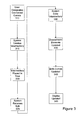
- FIGURE 3 depicts a flowchart of a process in accordance with a preferred embodiment.
- FIGURES 1 through 3 discussed below, and the various embodiments used to describe the principles of the present invention in this patent document are by way of illustration only and should not be construed in any way to limit the scope of the invention. Those skilled in the art will understand that the principles of the present invention may be implemented in any suitably arranged device. The numerous innovative teachings of the present application will be described with particular reference to the presently preferred embodiment.
- a feature tree contains sequential lists of features, states, or events relating to a graphical element or elements.
- upstream refers to features, states, or events which have a chronologically earlier position in the feature tree
- downstream refers to features, states, or events which have a chronologically later position in the feature tree.
- dependent tree refers to the tree of features, states, or events which are downstream in the feature tree, as later events are naturally dependent on earlier events.
- the preferred embodiment provides a system, method, and computer program product for performing edits on related curves by automatically defining an associative entity that is upstream of either curve being connected.
- the connecting entity is called an "intermediary.”
- intermediary When creating a connection between curves, irrespective of where they appear in the associative tree, their geometry is made dependent on a common intermediary that is placed upstream of both curves in the tree. With this structure, both curves are related to the intermediary but retain all the properties of being connected to each other. Any edit performed to either curve is redirected through the intermediary such that both curves are simultaneously modified, providing the user with bi-directional propagation of edits. The user does not need to keep track of the order that the curves were related.
- the intermediaries update in an intelligent manner when a set of connected curves are updated. All the intermediaries that are involved with the set of curves are solved simultaneously to ensure that curve properties (such as planarity, rigidity and shape edit behavior) are retained. Solving the intermediaries simultaneously ensures that the curves will all remain connected when any edit is performed. Note that this can be a complex and interdependent process when planar curves are involved and the user desires to keep their planarity. In this case, special solutions must be found that allow the plane positions to "float" to achieve a solution that is desirable given the constraints.
- the concept of bi-directional propagation can be extended from the preferred positional connectivity to higher order relationships such as tangent, perpendicular and curvature continuity.
- the intermediary in such cases will provide appropriate editable properties that all related curves will react to.
- the tangent intermediary will provide a 'direction' property that connected curves will use to maintain mutual tangency. Any modification of the end orientation of one of the curves will modify the direction of the intermediary. When all related curves update, they will have maintained the tangency property.
- Figure 1 shows relationships between points on exemplary curves
- Figure 2 shows the exemplary curves and surface corresponding to the points of Figure 1.
- Figures 1 and 2 should be referenced together in the following example:
- FIG. 1 In Figure 1 , four intermediaries (Int 1 thru Int 4) connect a set of six curves.
- the arrows describe the directed relationships from surfaces to curves to the intermediaries.
- the system of the preferred embodiment will actually perform all positional changes on Int 1.
- the change in Int 1 will propagate to C.endpoint.second and H.endpoint.first.
- the user can modify either C.endpoint.second or H. endpoint.first based on his design edit context, and all curves at Int 1 will stay connected.
- Int 3 is defined as being at parameter 0.32 on curve B. In this case, Int 3 only drives the end of curve E.
- the preferred embodiment achieves its advantages while continuing to use an associative, history-based framework.
- the curves being connected continue to retain their positions in the history tree. For example, when two curves, at different points in the history tree, are connected, they are made dependent on a common entity, called 'intermediary', so that they will interpolate the intermediary. The intermediary occurs earlier than either curve in the associative graph.
- bidirectionality is derived by indirection to the common intermediary. Intermediaries are only modified either by user editing a curve or as part of a solve that modifies a group of related intermediaries to move in a desired fashion.
- the above restriction means that the intermediary will not change during an update of the dependent curves and thus prevents cyclic dependency.
- the user can edit a curve that occurs later in history than the curve to which it is connected. Changing the downstream curve will modify the intermediary's position and the upstream curve will update interpolate the intermediary. In effect, it will remain connected to the downstream curve being modified.
- Figure 3 shows a flowchart of a process in accordance with the preferred embodiment.
- a user is working within a graphic editing system in which a plurality of curves have already been defined, as these steps are within the knowledge of those of skill in the art.
- the user first operates the graphic system to designate a point at which two existing curves are connected (step 310).
- the user can also designate multiple initial points on the curves to connect.
- each curve is associated with a common associative history tree. Note that this selection can also be performed with an automated system.
- the system will create an intermediary (step 315), which is placed in to the associative history tree at a point upstream of either of the selected curves (step 320).
- the system can receive edits initiated manually by the user (step 325), or automatic edits from other processes.
- the system treats this as an edit of the intermediary, and edits the intermediary instead (step 330).
- the change will update all of the downstream elements in the history tree (step 335). As such, both connected curves are updated (step 340).
- machine usable mediums include: nonvolatile, hard-coded type mediums such as read only memories (ROMs) or erasable, electrically programmable read only memories (EEPROMs), user-recordable type mediums such as floppy disks, hard disk drives and compact disk read only memories (CD-ROMs) or digital versatile disks (DVDs), and transmission type mediums such as digital and analog communication links.
- ROMs read only memories
- EEPROMs electrically programmable read only memories
- user-recordable type mediums such as floppy disks, hard disk drives and compact disk read only memories (CD-ROMs) or digital versatile disks (DVDs
- transmission type mediums such as digital and analog communication links.
Landscapes
- Engineering & Computer Science (AREA)
- Physics & Mathematics (AREA)
- General Physics & Mathematics (AREA)
- Computer Graphics (AREA)
- Software Systems (AREA)
- Theoretical Computer Science (AREA)
- Architecture (AREA)
- Computer Hardware Design (AREA)
- General Engineering & Computer Science (AREA)
- Mathematical Analysis (AREA)
- Algebra (AREA)
- Mathematical Optimization (AREA)
- Mathematical Physics (AREA)
- Pure & Applied Mathematics (AREA)
- Geometry (AREA)
- Processing Or Creating Images (AREA)
- Image Generation (AREA)
- Numerical Control (AREA)
- Structure Of Belt Conveyors (AREA)
- Semiconductor Integrated Circuits (AREA)
- Aiming, Guidance, Guns With A Light Source, Armor, Camouflage, And Targets (AREA)
Claims (10)
- Verfahren zum Durchführen von grafischen Bearbeitungsschritten, das Folgendes umfasst:Empfangen einer Auswahl einer ersten und einer zweiten Kurve (310), die mit einem assoziativen Verlaufsbaum assoziiert sind,Erstellen eines intermediären Elements (315), das der ersten und der zweiten Kurve entspricht,Einfügen des intermediären Elements in den assoziativen Verlaufsbaum (320) an einer Stelle vor der ersten und der zweiten Kurve,Durchführen der entsprechenden Bearbeitungsschritte an dem intermediären Element (320), wenn die erste oder die zweite Kurve bearbeitet wird (325), undAktualisieren der ersten und der zweiten Kurve (340) zum Interpolieren des intermediären Elements.
- Datenverarbeitungssystem mit zumindest einem Prozessor und zugänglichem Speicher, das Folgendes umfasst:Mittel zum Empfangen einer Auswahl einer ersten und einer zweiten Kurve, die zu einem assoziativen Verlaufsbaum gehören,Mittel zum Erstellen eines intermediären Elements, das der ersten und der zweiten Kurve entspricht,Mittel zum Einfügen des intermediären Elements in den assoziativen Verlaufsbaum an einer Stelle vor der ersten und der zweiten Kurve,Mittel zum Durchführen der entsprechenden Bearbeitungsschritte an dem intermediären Element (320), wenn die erste oder die zweite Kurve bearbeitet wird (325), undMittel zum Aktualisieren der ersten und der zweiten Kurve (340) zum Interpolieren des intermediären Elements.
- Computerprogrammprodukt, das greifbar in einem computerlesbaren Medium ausgeführt ist und Folgendes umfasst:Anweisungen zum Empfangen einer Auswahl einer ersten und einer zweiten Kurve, die mit einem assoziativen Verlaufsbaum assoziiert sind,Anweisungen zum Erstellen eines intermediären Elements, das der ersten und der zweiten Kurve entspricht,Anweisungen zum Einfügen des intermediären Elements in den assoziativen Verlaufsbaum an einer Stelle vor der ersten und der zweiten Kurve,Anweisungen zum Durchführen der entsprechenden Bearbeitungsschritte an dem intermediären Element (320), wenn die erste oder die zweite Kurve bearbeitet wird (325), undAnweisungen zum Aktualisieren der ersten und der zweiten Kurve (340) zum Interpolieren des intermediären Elements.
- Verfahren nach Anspruch 1, das des Weiteren das Empfangen einer Anweisung, die erste Kurve zu bearbeiten, und das Bearbeiten des intermediären Elements umfasst,
oder System nach Anspruch 2, das des Weiteren Mittel zum Empfangen einer Anweisung, die erste Kurve zu bearbeiten, und zum Bearbeiten des intermediären Elements umfasst, oder
Produkt nach Anspruch 3, das des Weiteren Anweisungen zum Empfangen einer Anweisung, die erste Kurve zu bearbeiten, und zum Bearbeiten des intermediären Elements umfasst. - Verfahren nach Anspruch 1, das des Weiteren das Aktualisieren des assoziativen Verlaufsbaums umfasst, wenn das intermediäre Element bearbeitet worden ist, oder
System nach Anspruch 2, das des Weiteren Mittel zum Aktualisieren des assoziativen Verlaufsbaums nach dem Bearbeiten des intermediären Elements umfasst, oder
Produkt nach Anspruch 3, das des Weiteren Anweisungen zum Aktualisieren des assoziativen Verlaufsbaums nach dem Bearbeiten des intermediären Elements umfasst. - Verfahren nach Anspruch 1 oder System nach Anspruch 2 oder Computerprogrammprodukt nach Anspruch 3, bei dem die erste und die zweite Kurve eine grafische Fläche bilden.
- Verfahren nach Anspruch 1 oder System nach Anspruch 2 oder Computerprogrammprodukt nach Anspruch 3, bei dem das intermediäre Element infolge einer Bearbeitung der ersten oder der zweiten Kurve automatisch bearbeitet wird.
- Verfahren nach Anspruch 1, das des Weiteren das Empfangen von Benutzereingaben zur Auswahl der ersten und der zweiten Kurve umfasst, oder
System nach Anspruch 2, das des Weiteren Mittel zum Empfangen von Benutzereingaben zur Auswahl der ersten und der zweiten Kurve umfasst, oder
Produkt nach Anspruch 3, das des Weiteren Anweisungen zum Empfangen von Benutzereingaben zur Auswahl der ersten und der zweiten Kurve umfasst. - Verfahren nach Anspruch 1, das des Weiteren das Anzeigen eines Bildes für einen Benutzer umfasst, welches der ersten und der zweiten Kurve entspricht, oder
System nach Anspruch 2, das des Weiteren Mittel für das Anzeigen eines Bildes für einen Benutzer umfasst, welches der ersten und der zweiten Kurve entspricht, oder
Produkt nach Anspruch 3, das des Weiteren Anweisungen für das Anzeigen eines Bildes für einen Benutzer umfasst, welches der ersten und der zweiten Kurve entspricht. - Verfahren nach Anspruch 1 zum Durchführen von grafischen Bearbeitungsschritten, bei dem die zweite Kurve in dem assoziativen Verlaufsbaum nach der ersten Kurve auftritt und
welches das Durchführen entsprechender Bearbeitungsschritte an der ersten Kurve umfasst, wenn die zweite Kurve bearbeitet wird.
Applications Claiming Priority (3)
| Application Number | Priority Date | Filing Date | Title |
|---|---|---|---|
| US10/382,358 US7106331B2 (en) | 2003-03-05 | 2003-03-05 | Bi-directional propagation in a curve network |
| US382358 | 2003-03-05 | ||
| PCT/US2004/006525 WO2004079664A1 (en) | 2003-03-05 | 2004-03-04 | Bi-directional propagation in a curve network |
Publications (2)
| Publication Number | Publication Date |
|---|---|
| EP1599841A1 EP1599841A1 (de) | 2005-11-30 |
| EP1599841B1 true EP1599841B1 (de) | 2010-02-24 |
Family
ID=32926883
Family Applications (1)
| Application Number | Title | Priority Date | Filing Date |
|---|---|---|---|
| EP04717365A Expired - Lifetime EP1599841B1 (de) | 2003-03-05 | 2004-03-04 | Bidirektionale ausbreitung in einem kurven-netzwerk |
Country Status (7)
| Country | Link |
|---|---|
| US (1) | US7106331B2 (de) |
| EP (1) | EP1599841B1 (de) |
| JP (1) | JP4464394B2 (de) |
| KR (1) | KR101037253B1 (de) |
| AT (1) | ATE459064T1 (de) |
| DE (1) | DE602004025675D1 (de) |
| WO (1) | WO2004079664A1 (de) |
Families Citing this family (1)
| Publication number | Priority date | Publication date | Assignee | Title |
|---|---|---|---|---|
| US9330204B2 (en) * | 2009-05-29 | 2016-05-03 | Siemens Product Lifecycle Management Software Inc. | CAD system and method for wireframe coupling |
Family Cites Families (7)
| Publication number | Priority date | Publication date | Assignee | Title |
|---|---|---|---|---|
| US5913051A (en) | 1992-10-09 | 1999-06-15 | Texas Instruments Incorporated | Method of simultaneous simulation of a complex system comprised of objects having structure state and parameter information |
| GB9302450D0 (en) | 1993-02-08 | 1993-03-24 | Ibm | Cumputer aided design system |
| US5894310A (en) | 1996-04-19 | 1999-04-13 | Visionary Design Systems, Inc. | Intelligent shapes for authoring three-dimensional models |
| US6670961B2 (en) * | 1998-06-01 | 2003-12-30 | Autodesk, Inc. | Method and apparatus for enhanced connectors and connection manager |
| US6559860B1 (en) * | 1998-09-29 | 2003-05-06 | Rockwell Software Inc. | Method and apparatus for joining and manipulating graphical objects in a graphical user interface |
| TW417080B (en) * | 1998-12-21 | 2001-01-01 | Acer Comm & Multimedia Inc | Display with automatic resolution adjustment |
| US6392645B1 (en) | 1999-03-15 | 2002-05-21 | Alventive Inc. | Three dimensional geometric modeling system |
-
2003
- 2003-03-05 US US10/382,358 patent/US7106331B2/en not_active Expired - Lifetime
-
2004
- 2004-03-04 AT AT04717365T patent/ATE459064T1/de not_active IP Right Cessation
- 2004-03-04 DE DE602004025675T patent/DE602004025675D1/de not_active Expired - Lifetime
- 2004-03-04 EP EP04717365A patent/EP1599841B1/de not_active Expired - Lifetime
- 2004-03-04 WO PCT/US2004/006525 patent/WO2004079664A1/en not_active Ceased
- 2004-03-04 JP JP2006509056A patent/JP4464394B2/ja not_active Expired - Fee Related
- 2004-03-04 KR KR1020057016523A patent/KR101037253B1/ko not_active Expired - Fee Related
Also Published As
| Publication number | Publication date |
|---|---|
| ATE459064T1 (de) | 2010-03-15 |
| US20040174383A1 (en) | 2004-09-09 |
| KR101037253B1 (ko) | 2011-05-26 |
| JP4464394B2 (ja) | 2010-05-19 |
| JP2006520505A (ja) | 2006-09-07 |
| WO2004079664A1 (en) | 2004-09-16 |
| US7106331B2 (en) | 2006-09-12 |
| KR20050109531A (ko) | 2005-11-21 |
| DE602004025675D1 (de) | 2010-04-08 |
| EP1599841A1 (de) | 2005-11-30 |
Similar Documents
| Publication | Publication Date | Title |
|---|---|---|
| Zheng et al. | A New Approach for Direct Manipulation of Free‐Form Curve | |
| EP1808814B1 (de) | Umschlagsdeformation mittels unterteilten Oberflächen | |
| Yoon et al. | Sweep‐based freeform deformations | |
| US8525838B2 (en) | Associative fillet | |
| Lin et al. | Adaptive patch-based mesh fitting for reverse engineering | |
| KR101810663B1 (ko) | 비정형 슬라브 부재의 bim 데이터 변환장치 및 그 방법 | |
| Liu et al. | Three-dimensional (3D) CAD model lightweight scheme for large-scale assembly and simulation | |
| CN112231901A (zh) | 一种t样条曲面的偏置计算方法 | |
| Tan et al. | A generative design method based on spline scanning for additive manufacturing | |
| EP1599841B1 (de) | Bidirektionale ausbreitung in einem kurven-netzwerk | |
| Shelden | Information modelling as a paradigm shift | |
| Engleitner et al. | Lofting with patchwork B-splines | |
| US20140324394A1 (en) | Curves in a variational system | |
| Maza et al. | Generation of quadrilateral meshes on free-form surfaces | |
| JP5538526B2 (ja) | ワイヤフレーム結合のためのcadシステム、方法、プログラムおよび記録媒体 | |
| Guiqing et al. | 3D discrete clothoid splines | |
| CN118172505A (zh) | 虚拟仿真巷道三维建模方法、装置、设备、介质和产品 | |
| Alsayed Ahmad et al. | CAD reconstruction of watertight surface meshes using polycube parameterization and subdivision surfaces | |
| Bhooshan et al. | Morph & Slerp | |
| JP2006520504A (ja) | 編集プロセスにおける曲線の形状保持のためのシステムと方法 | |
| Lin et al. | An optimisation algorithm for reducing the number of turns on space-filling curve toolpath for sculptured surface milling | |
| Alciatore et al. | Importing and reshaping digitized data for use in rapid prototyping: a system for sculpting polygonal mesh surfaces | |
| Wang | Robust Geometry Kernel and UI for Handling Non-orientable 2-Mainfolds | |
| Nasri et al. | Feature curves with cross curvature control on catmull-clark subdivision surfaces | |
| Claes et al. | Turning the approximating catmull-clark subdivision scheme into a locally interpolating surface modeling tool |
Legal Events
| Date | Code | Title | Description |
|---|---|---|---|
| PUAI | Public reference made under article 153(3) epc to a published international application that has entered the european phase |
Free format text: ORIGINAL CODE: 0009012 |
|
| 17P | Request for examination filed |
Effective date: 20050921 |
|
| AK | Designated contracting states |
Kind code of ref document: A1 Designated state(s): AT BE BG CH CY CZ DE DK EE ES FI FR GB GR HU IE IT LI LU MC NL PL PT RO SE SI SK TR |
|
| AX | Request for extension of the european patent |
Extension state: AL LT LV MK |
|
| DAX | Request for extension of the european patent (deleted) | ||
| 17Q | First examination report despatched |
Effective date: 20080523 |
|
| RAP1 | Party data changed (applicant data changed or rights of an application transferred) |
Owner name: SIEMENS PRODUCT LIFECYCLE MANAGEMENT SOFTWARE INC. |
|
| GRAP | Despatch of communication of intention to grant a patent |
Free format text: ORIGINAL CODE: EPIDOSNIGR1 |
|
| GRAS | Grant fee paid |
Free format text: ORIGINAL CODE: EPIDOSNIGR3 |
|
| GRAA | (expected) grant |
Free format text: ORIGINAL CODE: 0009210 |
|
| AK | Designated contracting states |
Kind code of ref document: B1 Designated state(s): AT BE BG CH CY CZ DE DK EE ES FI FR GB GR HU IE IT LI LU MC NL PL PT RO SE SI SK TR |
|
| REG | Reference to a national code |
Ref country code: GB Ref legal event code: FG4D |
|
| REG | Reference to a national code |
Ref country code: CH Ref legal event code: EP |
|
| REG | Reference to a national code |
Ref country code: IE Ref legal event code: FG4D |
|
| REF | Corresponds to: |
Ref document number: 602004025675 Country of ref document: DE Date of ref document: 20100408 Kind code of ref document: P |
|
| REG | Reference to a national code |
Ref country code: NL Ref legal event code: VDEP Effective date: 20100224 |
|
| PG25 | Lapsed in a contracting state [announced via postgrant information from national office to epo] |
Ref country code: PT Free format text: LAPSE BECAUSE OF FAILURE TO SUBMIT A TRANSLATION OF THE DESCRIPTION OR TO PAY THE FEE WITHIN THE PRESCRIBED TIME-LIMIT Effective date: 20100625 |
|
| PG25 | Lapsed in a contracting state [announced via postgrant information from national office to epo] |
Ref country code: FI Free format text: LAPSE BECAUSE OF FAILURE TO SUBMIT A TRANSLATION OF THE DESCRIPTION OR TO PAY THE FEE WITHIN THE PRESCRIBED TIME-LIMIT Effective date: 20100224 Ref country code: SI Free format text: LAPSE BECAUSE OF FAILURE TO SUBMIT A TRANSLATION OF THE DESCRIPTION OR TO PAY THE FEE WITHIN THE PRESCRIBED TIME-LIMIT Effective date: 20100224 Ref country code: PL Free format text: LAPSE BECAUSE OF FAILURE TO SUBMIT A TRANSLATION OF THE DESCRIPTION OR TO PAY THE FEE WITHIN THE PRESCRIBED TIME-LIMIT Effective date: 20100224 Ref country code: AT Free format text: LAPSE BECAUSE OF FAILURE TO SUBMIT A TRANSLATION OF THE DESCRIPTION OR TO PAY THE FEE WITHIN THE PRESCRIBED TIME-LIMIT Effective date: 20100224 |
|
| PG25 | Lapsed in a contracting state [announced via postgrant information from national office to epo] |
Ref country code: ES Free format text: LAPSE BECAUSE OF FAILURE TO SUBMIT A TRANSLATION OF THE DESCRIPTION OR TO PAY THE FEE WITHIN THE PRESCRIBED TIME-LIMIT Effective date: 20100604 Ref country code: MC Free format text: LAPSE BECAUSE OF NON-PAYMENT OF DUE FEES Effective date: 20100331 Ref country code: NL Free format text: LAPSE BECAUSE OF FAILURE TO SUBMIT A TRANSLATION OF THE DESCRIPTION OR TO PAY THE FEE WITHIN THE PRESCRIBED TIME-LIMIT Effective date: 20100224 Ref country code: SE Free format text: LAPSE BECAUSE OF FAILURE TO SUBMIT A TRANSLATION OF THE DESCRIPTION OR TO PAY THE FEE WITHIN THE PRESCRIBED TIME-LIMIT Effective date: 20100224 Ref country code: RO Free format text: LAPSE BECAUSE OF FAILURE TO SUBMIT A TRANSLATION OF THE DESCRIPTION OR TO PAY THE FEE WITHIN THE PRESCRIBED TIME-LIMIT Effective date: 20100224 Ref country code: BE Free format text: LAPSE BECAUSE OF FAILURE TO SUBMIT A TRANSLATION OF THE DESCRIPTION OR TO PAY THE FEE WITHIN THE PRESCRIBED TIME-LIMIT Effective date: 20100224 Ref country code: CY Free format text: LAPSE BECAUSE OF FAILURE TO SUBMIT A TRANSLATION OF THE DESCRIPTION OR TO PAY THE FEE WITHIN THE PRESCRIBED TIME-LIMIT Effective date: 20100224 Ref country code: EE Free format text: LAPSE BECAUSE OF FAILURE TO SUBMIT A TRANSLATION OF THE DESCRIPTION OR TO PAY THE FEE WITHIN THE PRESCRIBED TIME-LIMIT Effective date: 20100224 Ref country code: GR Free format text: LAPSE BECAUSE OF FAILURE TO SUBMIT A TRANSLATION OF THE DESCRIPTION OR TO PAY THE FEE WITHIN THE PRESCRIBED TIME-LIMIT Effective date: 20100525 |
|
| REG | Reference to a national code |
Ref country code: CH Ref legal event code: PL |
|
| PG25 | Lapsed in a contracting state [announced via postgrant information from national office to epo] |
Ref country code: BG Free format text: LAPSE BECAUSE OF FAILURE TO SUBMIT A TRANSLATION OF THE DESCRIPTION OR TO PAY THE FEE WITHIN THE PRESCRIBED TIME-LIMIT Effective date: 20100524 Ref country code: CZ Free format text: LAPSE BECAUSE OF FAILURE TO SUBMIT A TRANSLATION OF THE DESCRIPTION OR TO PAY THE FEE WITHIN THE PRESCRIBED TIME-LIMIT Effective date: 20100224 Ref country code: SK Free format text: LAPSE BECAUSE OF FAILURE TO SUBMIT A TRANSLATION OF THE DESCRIPTION OR TO PAY THE FEE WITHIN THE PRESCRIBED TIME-LIMIT Effective date: 20100224 |
|
| PLBE | No opposition filed within time limit |
Free format text: ORIGINAL CODE: 0009261 |
|
| STAA | Information on the status of an ep patent application or granted ep patent |
Free format text: STATUS: NO OPPOSITION FILED WITHIN TIME LIMIT |
|
| PG25 | Lapsed in a contracting state [announced via postgrant information from national office to epo] |
Ref country code: DK Free format text: LAPSE BECAUSE OF FAILURE TO SUBMIT A TRANSLATION OF THE DESCRIPTION OR TO PAY THE FEE WITHIN THE PRESCRIBED TIME-LIMIT Effective date: 20100224 Ref country code: IE Free format text: LAPSE BECAUSE OF NON-PAYMENT OF DUE FEES Effective date: 20100304 |
|
| 26N | No opposition filed |
Effective date: 20101125 |
|
| PG25 | Lapsed in a contracting state [announced via postgrant information from national office to epo] |
Ref country code: CH Free format text: LAPSE BECAUSE OF NON-PAYMENT OF DUE FEES Effective date: 20100331 Ref country code: LI Free format text: LAPSE BECAUSE OF NON-PAYMENT OF DUE FEES Effective date: 20100331 |
|
| PG25 | Lapsed in a contracting state [announced via postgrant information from national office to epo] |
Ref country code: IT Free format text: LAPSE BECAUSE OF FAILURE TO SUBMIT A TRANSLATION OF THE DESCRIPTION OR TO PAY THE FEE WITHIN THE PRESCRIBED TIME-LIMIT Effective date: 20100224 |
|
| PG25 | Lapsed in a contracting state [announced via postgrant information from national office to epo] |
Ref country code: DE Free format text: LAPSE BECAUSE OF NON-PAYMENT OF DUE FEES Effective date: 20111001 |
|
| PG25 | Lapsed in a contracting state [announced via postgrant information from national office to epo] |
Ref country code: HU Free format text: LAPSE BECAUSE OF FAILURE TO SUBMIT A TRANSLATION OF THE DESCRIPTION OR TO PAY THE FEE WITHIN THE PRESCRIBED TIME-LIMIT Effective date: 20100825 Ref country code: LU Free format text: LAPSE BECAUSE OF NON-PAYMENT OF DUE FEES Effective date: 20100304 |
|
| PG25 | Lapsed in a contracting state [announced via postgrant information from national office to epo] |
Ref country code: TR Free format text: LAPSE BECAUSE OF FAILURE TO SUBMIT A TRANSLATION OF THE DESCRIPTION OR TO PAY THE FEE WITHIN THE PRESCRIBED TIME-LIMIT Effective date: 20100224 |
|
| REG | Reference to a national code |
Ref country code: FR Ref legal event code: PLFP Year of fee payment: 12 |
|
| PGFP | Annual fee paid to national office [announced via postgrant information from national office to epo] |
Ref country code: GB Payment date: 20150312 Year of fee payment: 12 Ref country code: FR Payment date: 20150311 Year of fee payment: 12 |
|
| PGFP | Annual fee paid to national office [announced via postgrant information from national office to epo] |
Ref country code: DE Payment date: 20150513 Year of fee payment: 12 |
|
| REG | Reference to a national code |
Ref country code: DE Ref legal event code: R119 Ref document number: 602004025675 Country of ref document: DE |
|
| GBPC | Gb: european patent ceased through non-payment of renewal fee |
Effective date: 20160304 |
|
| REG | Reference to a national code |
Ref country code: FR Ref legal event code: ST Effective date: 20161130 |
|
| PG25 | Lapsed in a contracting state [announced via postgrant information from national office to epo] |
Ref country code: FR Free format text: LAPSE BECAUSE OF NON-PAYMENT OF DUE FEES Effective date: 20160331 Ref country code: GB Free format text: LAPSE BECAUSE OF NON-PAYMENT OF DUE FEES Effective date: 20160304 |
|
| PG25 | Lapsed in a contracting state [announced via postgrant information from national office to epo] |
Ref country code: DE Free format text: LAPSE BECAUSE OF NON-PAYMENT OF DUE FEES Effective date: 20161001 |