EP1599768B1 - Procede et dispositif pour simuler des processus de separation controles par transfert de matiere et de chaleur - Google Patents
Procede et dispositif pour simuler des processus de separation controles par transfert de matiere et de chaleur Download PDFInfo
- Publication number
- EP1599768B1 EP1599768B1 EP04709208A EP04709208A EP1599768B1 EP 1599768 B1 EP1599768 B1 EP 1599768B1 EP 04709208 A EP04709208 A EP 04709208A EP 04709208 A EP04709208 A EP 04709208A EP 1599768 B1 EP1599768 B1 EP 1599768B1
- Authority
- EP
- European Patent Office
- Prior art keywords
- film
- core
- equation system
- mass
- transfer
- Prior art date
- Legal status (The legal status is an assumption and is not a legal conclusion. Google has not performed a legal analysis and makes no representation as to the accuracy of the status listed.)
- Revoked
Links
Images
Classifications
-
- G—PHYSICS
- G05—CONTROLLING; REGULATING
- G05B—CONTROL OR REGULATING SYSTEMS IN GENERAL; FUNCTIONAL ELEMENTS OF SUCH SYSTEMS; MONITORING OR TESTING ARRANGEMENTS FOR SUCH SYSTEMS OR ELEMENTS
- G05B17/00—Systems involving the use of models or simulators of said systems
- G05B17/02—Systems involving the use of models or simulators of said systems electric
Definitions
- the present invention relates to a method and apparatus for simulating material and heat transfer controlled separation processes, in particular phase transitions with chemical-physical relationships between multiple phases, as is the case for example in multi-component separation processes such as extractions, rectifications absorptions or in reactors.
- the invention finds particular application in the field of modeling bulk and packing columns.
- the Stefan-Maxwell equation is suitable for describing a multicomponent diffusion. They include the influence of the diffusion of several components.
- the Stefan-Maxwell equations (or Maxwell-Stefan equations) form a nonlinear, implicit equation system with special properties. These equations are partial differential equations, whereby for ⁇ components only ⁇ -1 equations are linearly independent. For the limiting case of infinitely large mass transfer surfaces, the solution of the equation system goes into the thermodynamic equilibrium, while for simple conditions, for example equimolar mass transfer, simpler models such as Fick's law are obtained.
- the theoretical advantage of Fick's law which is significant for simulation practice, lies in the fact that that the equations in the passing streams are explicit.
- the known methods for solving the coupled material and heat transfer are constructed such that corrections to the simple equations are made for a more exact description. This applies in particular to all those models with which packed columns can be simulated and designed.
- the known simulation methods with the so-called equilibrium devices fail in principle in all technical devices and applications that are material transfer limited.
- Examples thereof are distillation columns (in particular in the fields of reactive distillation and distillation of far-boiling mixtures), absorption and desorption columns, membrane contactors (for example as Ab or Desorptionstitleor), scrubbers (Venturi or spray scrubber), evaporators (for example, thin-film and short-path evaporator for the separation of monomers Polymers) and capacitors (for example, condensation from an inert gas stream) or multiphase reactors (bubble columns, jet loops).
- a method and a device for simulating material- and heat transfer-controlled separation processes with the features of claim 1 and of claim 16 are proposed according to the invention. Accordingly, the simulation is carried out using a known core-film approach for describing a taking place at a phase interface material and heat exchange, wherein for solving a suitable differential equation system, in particular based on the Stefan-Maxwell equation, a discretization of a considered transition segment the core-film approach.
- a device according to the invention is in particular a computer-aided simulator.
- a computer program with program code or program code means and a computer-readable data carrier medium with a computer program having the features of claim 31 or claim 32 are claimed.
- the invention is the technical implementation of a boundary value task for a partial differential equation system, wherein one of the integration variables is the height coordinate of the apparatus in the one-phase flow direction and the other integration variables are in the direction of mass and heat exchange between the respective phases.
- This differential equation system is solvable, for example, by means of an adaptive method, as used in diffusion processes.
- methods are used which lead to a system of equations corresponding in structure to the above-mentioned countercurrent equilibrium columns. This is the case, for example, if for the solution the differential equations in the flow direction a difference method is used, such as the Euler method (1st order) or the trapezoidal rule (2nd order) or a higher-order method (eg the Simpson rule).
- a difference method such as the Euler method (1st order) or the trapezoidal rule (2nd order) or a higher-order method (eg the Simpson rule).
- These segments in turn contain partial differential equations with respect to the coordinates in the direction of the exchange between the different phases.
- these differential equations are also solved by means of difference methods.
- film segments As a result of this discretization, further elements are obtained, which according to the invention are referred to as film segments.
- ordinary linear differential equations result in the direction of mass transfer between the two phases, which are explicitly in the transient mass flows. In all other cases, these are implicit equations concerning the transient mass flows.
- the invention makes possible an implicit solution of a differential equation system, in particular the Stefan-Maxwell equations, without the disadvantages associated with the simplifications known from the prior art.
- the method according to the invention ensures consideration of additional processes which influence the mass transfer, such as rapid chemical reactions or electroneutrality in electrolytic reactions.
- the invention is also suitable for carrying out a modeling of apparatus with any number of phases and different phase combinations (eg liquid / liquid extractions, steam / liquid / liquid rectifications or solid / liquid reactors).
- an additional discretization of the films takes place in the diffusion direction. This allows a very detailed simulation of the process flows in the mass transfer over phase boundaries, wherein prevalent in the core phases convective mass transfer and in the films diffusive mass transfer.
- the 2-film theory, the penetration theory or the surface renewal theory is used to estimate the film thickness for the mass transfer in the film.
- the mass transfer coefficients can be determined, for example, for bulk, packing or tray columns according to correlations known in the literature. A correlation of this kind is described for example in: Onda, K., Takeuchi, H., and Okumoto, Y. "Mass Transfer Coefficients Between Gas and Liquid Phases in Packed Columns," J. Chem. Eng., Japan, 1, (1968) p. 56 ,
- the diffusion coefficients can be determined by equations known in the literature, for example from Wilke-Chang or Nernst. In modeling a process, knowledge of the effective area available for mass transfer (between phases) is relevant.
- the effective mass transfer area can also be determined by means of correlations. Frequently, in the mass transfer correlations, in addition to the correlations for the mass transfer coefficient, a correlation is also given for the effective mass transfer area (see, for example, Onda et al., 1968).
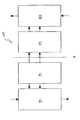
- the single FIGURE shows a highly schematic representation of a transition region according to the invention.
- This transition region 10 extends over a phase boundary P which separates two phases.
- a respective core phase K1 or K2 and a film segment F1 and F2 assigned to the respective core phase K1, K2 and adjacent to the phase boundary P are defined.
- the core phases, any number of heat and mass flows can be added or subtracted.
- the film thicknesses of the films F1, F2 can optionally be specified or determined from correlations of measured mass transfer coefficients and diffusion coefficients. Correlations can be used, for example, for bubble columns or different packages, such as structured packages or random packings. Similarly, the effective mass transfer area can be calculated via correlations.
- the discretization of the films proves to be particularly advantageous when the discretization points or so-called support points (ie the distances of the discrete division) are closer to the core phase and to the phase boundary, since the strongest changes generally occur there.
- the film thickness is also used to calculate the hold-up of the film for reactions, ie the volume which is available in the film for the reaction and thus for the residence time, used.
- the heat transfer across the film can be optionally calculated by taking into account thermal conduction in the film or by using a heat transfer coefficient which can be estimated, for example, by the Chilton-Colburn analogy.
- the present invention a simple and effective computer-aided simulation of material transfer-controlled separation processes is made possible, which provides very accurate results with comparatively low computational intensity.
- the invention is particularly suitable for simulating the processes in columns and for the modeling of columns, especially packed and packed columns. Both absorption (gas / liquid phases) and extractions (liquid / liquid phases) and multiphases can be easily simulated and modeled, with chemical reactions (equilibrium reactions, kinetically controlled reactions) occurring in the (core) and film) phases, and thus influence mass and energy balances, can be taken into account.
Landscapes
- Physics & Mathematics (AREA)
- General Physics & Mathematics (AREA)
- Engineering & Computer Science (AREA)
- Automation & Control Theory (AREA)
- Physical Or Chemical Processes And Apparatus (AREA)
- Management, Administration, Business Operations System, And Electronic Commerce (AREA)
- Heat-Exchange Devices With Radiators And Conduit Assemblies (AREA)
- Treatment Of Fiber Materials (AREA)
Claims (33)
- Procédé destiné à simuler des processus de séparation contrôlés par transfert de matière et de chaleur au moyen d'une approche noyau-film servant à décrire un échange se produisant au niveau d'une limite de phase (P), et consistant à réaliser une discrétisation d'une zone de transfert (10) considérée de l'approche noyau-film pour résoudre itérativement un système implicite d'équations différentielles approprié, cette opération donnant un système d'équations aux différences.
- Procédé selon la revendication 1 comportant les étapes suivantes:- déterminer une zone de transfert (10) s'étendant au-delà d'une limite de phase (P),- définir au moins deux phases noyau (K1, K2) avec les films (F1, F2) correspondants dans la zone de transfert (10),- discrétiser des phases noyau (K1, K2) avec les films (F1, F2) correspondants en segments de transfert dans le sens d'écoulement des phases noyau,- résoudre itérativement le système implicite d'équations aux différences.
- Procédé selon la revendication 1 ou 2, dans lequel une discrétisation supplémentaire des films (F1, F2) a lieu dans le sens de la diffusion.
- Procédé selon la revendication 2, dans lequel une épaisseur des films (F1, F2) est déterminée à partir de corrélations pour le coefficient de transfert de matière et le coefficient de diffusion.
- Procédé selon la revendication 2, dans lequel l'évaluation de l'épaisseur de film pour le transfert de matière dans le film fait appel à la théorie des deux films, à la théorie de la pénétration ou à la théorie du renouvellement de surface.
- Procédé selon l'une des revendications 1 à 5, dans lequel le segment de transition est un segment de transfert de matière et/ou de chaleur.
- Procédé selon l'une des revendications précédentes, dans lequel le système d'équations différentielles contient les équations de Stefan-Maxwell.
- Procédé selon l'une des revendications précédentes, dans lequel la discrétisation a lieu dans le sens d'écoulement et/ou dans le sens de diffusion avec des pas de discrétisation fins pour des changements d'état importants et avec des pas de discrétisation grossiers pour les petits changements d'état.
- Procédé selon l'une des revendications précédentes, dans lequel la résolution du système d'équations différentielles met en oeuvre une méthode d'intégration d'ordre 1, par ex. la méthode d'Euler.
- Procédé selon l'une des revendications 1 à 8, dans lequel la résolution du système d'équations différentielles met en oeuvre une méthode d'intégration d'ordre 2, par ex. la règle du trapèze.
- Procédé selon l'une des revendications 1 à 8, dans lequel la résolution du système d'équations différentielles met en oeuvre une méthode d'intégration d'ordre n, par ex. la règle de Simpson.
- Procédé selon l'une des revendications précédentes, dans lequel l'approche noyau-film correspond à la théorie des deux films.
- Procédé selon l'une des revendications précédentes, dans lequel des réactions dans les phases noyau et film sont prises en compte par l'intermédiaire de bilans massiques et/ou énergétiques.
- Procédé selon l'une des revendications précédentes, dans lequel la résolution itérative du système d'équations aux différences met en oeuvre la méthode de Newton.
- Procédé selon l'une des revendications précédentes, pour lequel une surface de transfert de matière est déterminée au moyen de corrélations.
- Dispositif destiné à simuler des processus de séparation contrôlés approche transfert de matière et de chaleur au moyen d'une préparation noyau-film servant à décrire un échange se produisant au niveau d'une limite de phase (P),comportant une unité de calcul, une unité d'entrée et une unité d'affichage, une résolution itérative étant obtenue pour un système d'équations aux différences établi à partir d'un système implicite d'équations différentielles approprié sur la base d'une discrétisation d'une zone de transfert (10) considérée de l'approche noyau-film.
- Dispositif selon la revendication 16, faisant intervenir une définition d'une zone de transfert (10) s'étendant au-delà d'une limite de phase (P), une définition d'au moins deux phases noyau (K1, K2) avec les films (F1, F2) correspondants dans la zone de transfert (10), une discrétisation en segments de transfert des phases noyau (K1, K2) avec les films (F1, F2) correspondants dans le sens d'écoulement des phases noyau, et une résolution itérative du système implicite d'équations aux différences.
- Dispositif selon la revendication 16 ou 17, dans lequel une discrétisation supplémentaire des films (F1, F2) a lieu dans le sens de la diffusion.
- Dispositif selon la revendication 17, dans lequel une épaisseur des films (F1, F2) est déterminée à partir de corrélations pour le coefficient de transfert de matière et le coefficient de diffusion.
- Dispositif selon la revendication 17, dans lequel l'évaluation de l'épaisseur de film pour le transfert de matière dans le film fait appel à la théorie des deux films, à la théorie de la pénétration ou à la théorie du renouvellement de surface.
- Dispositif selon l'une des revendications 16 à 20, dans lequel le segment de transition est un segment de transfert de matière et/ou de chaleur.
- Dispositif selon l'une des revendications 16 à 21, dans lequel le système d'équations différentielles contient les équations de Stefan-Maxwell.
- Dispositif selon l'une des revendications 16 à 22, dans lequel la discrétisation a lieu dans le sens d'écoulement et/ou dans le sens de diffusion avec des pas de discrétisation fins pour des changements d'état importants et avec des pas de discrétisation grossiers pour les petits changements d'état.
- Dispositif selon l'une des revendications 16 à 23, dans lequel la résolution du système d'équations différentielles met en oeuvre une méthode d'intégration d'ordre 1, par ex. la méthode d'Euler.
- Dispositif selon l'une des revendications 16 à 23, dans lequel la résolution du système d'équations différentielles met en oeuvre une méthode d'intégration d'ordre 2, par ex. la règle du trapèze.
- Dispositif selon l'une des revendications 16 à 23, dans lequel la résolution du système d'équations différentielles met en oeuvre une méthode d'intégration d'ordre n, par ex. la règle de Simpson.
- Dispositif selon l'une des revendications 16 bis 26, dans lequel l'approche noyau-film correspond à la théorie des deux films.
- Dispositif selon l'une des revendications 16 à 27, dans lequel des réactions dans les phases noyau et film sont prises en compte par l'intermédiaire de bilans massiques et/ou énergétiques.
- Dispositif selon l'une des revendications 16 à 28, dans lequel la résolution itérative du système d'équations aux différences met en oeuvre la méthode de Newton.
- Dispositif selon l'une des revendications 16 à 29, dans lequel une surface de transfert de matière est déterminée au moyen de corrélations.
- Programme d'ordinateur comportant un code qui, lors du déroulement du programme sur un système informatique approprié, exécute un procédé selon l'une des revendications 1 à 15.
- Produit doté d'un programme d'ordinateur comportant un code qui, lors du déroulement du programme sur un système informatique approprié, exécute un procédé selon l'une des revendications 1 à 15.
- Support de données pouvant être lu par un ordinateur et sur lequel est enregistré un programme d'ordinateur, ledit programme comportant des moyens de code qui, lors du déroulement du programme sur un système informatique approprié, exécutent un procédé selon l'une des revendications 1 à 15.
Applications Claiming Priority (3)
| Application Number | Priority Date | Filing Date | Title |
|---|---|---|---|
| DE10307233A DE10307233A1 (de) | 2003-02-14 | 2003-02-14 | Verfahren und Vorrichtung zur Simulation von stoffübergangskontrollierten Trennprozessen |
| DE10307233 | 2003-02-14 | ||
| PCT/EP2004/001162 WO2004072742A1 (fr) | 2003-02-14 | 2004-02-09 | Procede et dispositif pour simuler des processus de separation controles par transfert de matiere et de chaleur |
Publications (2)
| Publication Number | Publication Date |
|---|---|
| EP1599768A1 EP1599768A1 (fr) | 2005-11-30 |
| EP1599768B1 true EP1599768B1 (fr) | 2007-10-10 |
Family
ID=32748011
Family Applications (1)
| Application Number | Title | Priority Date | Filing Date |
|---|---|---|---|
| EP04709208A Revoked EP1599768B1 (fr) | 2003-02-14 | 2004-02-09 | Procede et dispositif pour simuler des processus de separation controles par transfert de matiere et de chaleur |
Country Status (8)
| Country | Link |
|---|---|
| US (1) | US20050288912A1 (fr) |
| EP (1) | EP1599768B1 (fr) |
| JP (1) | JP2006514882A (fr) |
| AT (1) | ATE375534T1 (fr) |
| CA (1) | CA2515959A1 (fr) |
| DE (2) | DE10307233A1 (fr) |
| DK (1) | DK1599768T3 (fr) |
| WO (1) | WO2004072742A1 (fr) |
Families Citing this family (4)
| Publication number | Priority date | Publication date | Assignee | Title |
|---|---|---|---|---|
| FR2880967A1 (fr) * | 2005-01-14 | 2006-07-21 | Alfa Laval Vicarb Sa | Optimisation d'une reaction chimique dans un reacteur ouvert du type a plaques |
| US8197700B2 (en) * | 2005-12-30 | 2012-06-12 | Saudi Arabian Oil Company | Computational method for sizing three-phase separators |
| US10238992B2 (en) | 2016-05-03 | 2019-03-26 | Saudi Arabian Oil Company | Processes for analysis and optimization of multiphase separators, particularly in regard to simulated gravity separation of immiscible liquid dispersions |
| JP7301443B2 (ja) * | 2017-12-22 | 2023-07-03 | グローバル・ライフ・サイエンシズ・ソリューションズ・ユーエスエー・エルエルシー | 濾過プロセスに関する方法、装置、システム及びコンピュータプログラムプロダクト |
-
2003
- 2003-02-14 DE DE10307233A patent/DE10307233A1/de not_active Withdrawn
-
2004
- 2004-02-09 JP JP2005518662A patent/JP2006514882A/ja active Pending
- 2004-02-09 WO PCT/EP2004/001162 patent/WO2004072742A1/fr not_active Ceased
- 2004-02-09 DE DE502004005199T patent/DE502004005199D1/de not_active Revoked
- 2004-02-09 AT AT04709208T patent/ATE375534T1/de not_active IP Right Cessation
- 2004-02-09 EP EP04709208A patent/EP1599768B1/fr not_active Revoked
- 2004-02-09 DK DK04709208T patent/DK1599768T3/da active
- 2004-02-09 CA CA002515959A patent/CA2515959A1/fr not_active Abandoned
-
2005
- 2005-08-12 US US11/202,333 patent/US20050288912A1/en not_active Abandoned
Also Published As
| Publication number | Publication date |
|---|---|
| DE10307233A1 (de) | 2004-08-26 |
| US20050288912A1 (en) | 2005-12-29 |
| DK1599768T3 (da) | 2008-01-28 |
| WO2004072742A1 (fr) | 2004-08-26 |
| DE502004005199D1 (de) | 2007-11-22 |
| CA2515959A1 (fr) | 2004-08-26 |
| EP1599768A1 (fr) | 2005-11-30 |
| JP2006514882A (ja) | 2006-05-18 |
| ATE375534T1 (de) | 2007-10-15 |
Similar Documents
| Publication | Publication Date | Title |
|---|---|---|
| Kucka et al. | On the modelling and simulation of sour gas absorption by aqueous amine solutions | |
| Kjelstrup et al. | Non-equilibrium thermodynamics for engineers | |
| Zong et al. | Modeling surfactant-laden droplet dynamics by lattice Boltzmann method | |
| Ng et al. | Chemical product design: Advances in and proposed directions for research and teaching | |
| Sposini et al. | First passage statistics for diffusing diffusivity | |
| Nuchitprasittichai et al. | An algorithm to determine sample sizes for optimization with artificial neural networks | |
| Zhao et al. | Fluctuation-driven dynamics in nanoscale thin-film flows: physical insights from numerical investigations | |
| EP1599768B1 (fr) | Procede et dispositif pour simuler des processus de separation controles par transfert de matiere et de chaleur | |
| Coveney | Fundamentals of Phase Separation in Polymer Blend Thin Films | |
| Ng et al. | Chemical product design: advances in research and teaching | |
| Krishna | Highlighting diffusional coupling effects in ternary liquid extraction and comparisons with distillation | |
| EP0460037A1 (fr) | Systeme de diagnostic et de regulation de colonnes de rectification a l'aide d'un modele. | |
| Barosan et al. | Application of mortar elements to diffuse-interface methods | |
| Gómez-Siurana et al. | Spreadsheet to illustrate the application of relaxation methods for multicomponent distillation separations | |
| Castrellón et al. | Using process simulators in the study, design, and control of distillation columns for undergraduate chemical engineering courses | |
| Wankat | Teaching separations: why, what, when, and how | |
| Raab | Separation of a highly nonideal mixture for solvent recovery | |
| Lorenz et al. | Plant-wide Process Improvement in Cooperation of Mathematical Optimization using the MIPT Algorithm in ChemCADTM | |
| Hraste | Trends in Chemical Engineering Education | |
| Bonart | Simulation and control of droplets and films on surfaces | |
| Peters et al. | Membrane process design using residue curve maps | |
| Gakingo et al. | Modelling of the overall volumetric mass transfer coefficient measured by the dynamic method in gas-liquid-liquid systems | |
| Heida | Modeling multiphase flow in porous media with an application to permafrost soil | |
| Asprion | True and apparent components in reactive systems | |
| Adeloye et al. | Application of Hengstebeck's Model in Multicomponent Crude Oil Distillation Design |
Legal Events
| Date | Code | Title | Description |
|---|---|---|---|
| PUAI | Public reference made under article 153(3) epc to a published international application that has entered the european phase |
Free format text: ORIGINAL CODE: 0009012 |
|
| 17P | Request for examination filed |
Effective date: 20050914 |
|
| AK | Designated contracting states |
Kind code of ref document: A1 Designated state(s): AT BE BG CH CY CZ DE DK EE ES FI FR GB GR HU IE IT LI LU MC NL PT RO SE SI SK TR |
|
| AX | Request for extension of the european patent |
Extension state: AL LT LV MK |
|
| DAX | Request for extension of the european patent (deleted) | ||
| GRAP | Despatch of communication of intention to grant a patent |
Free format text: ORIGINAL CODE: EPIDOSNIGR1 |
|
| GRAS | Grant fee paid |
Free format text: ORIGINAL CODE: EPIDOSNIGR3 |
|
| GRAA | (expected) grant |
Free format text: ORIGINAL CODE: 0009210 |
|
| AK | Designated contracting states |
Kind code of ref document: B1 Designated state(s): AT BE BG CH CY CZ DE DK EE ES FI FR GB GR HU IE IT LI LU MC NL PT RO SE SI SK TR |
|
| REG | Reference to a national code |
Ref country code: GB Ref legal event code: FG4D Free format text: NOT ENGLISH |
|
| REG | Reference to a national code |
Ref country code: CH Ref legal event code: EP |
|
| REG | Reference to a national code |
Ref country code: IE Ref legal event code: FG4D Free format text: LANGUAGE OF EP DOCUMENT: GERMAN |
|
| REF | Corresponds to: |
Ref document number: 502004005199 Country of ref document: DE Date of ref document: 20071122 Kind code of ref document: P |
|
| REG | Reference to a national code |
Ref country code: DK Ref legal event code: T3 |
|
| GBT | Gb: translation of ep patent filed (gb section 77(6)(a)/1977) |
Effective date: 20080107 |
|
| RAP2 | Party data changed (patent owner data changed or rights of a patent transferred) |
Owner name: BASF SE |
|
| NLV1 | Nl: lapsed or annulled due to failure to fulfill the requirements of art. 29p and 29m of the patents act | ||
| PG25 | Lapsed in a contracting state [announced via postgrant information from national office to epo] |
Ref country code: ES Free format text: LAPSE BECAUSE OF FAILURE TO SUBMIT A TRANSLATION OF THE DESCRIPTION OR TO PAY THE FEE WITHIN THE PRESCRIBED TIME-LIMIT Effective date: 20080121 Ref country code: SE Free format text: LAPSE BECAUSE OF FAILURE TO SUBMIT A TRANSLATION OF THE DESCRIPTION OR TO PAY THE FEE WITHIN THE PRESCRIBED TIME-LIMIT Effective date: 20080110 Ref country code: NL Free format text: LAPSE BECAUSE OF FAILURE TO SUBMIT A TRANSLATION OF THE DESCRIPTION OR TO PAY THE FEE WITHIN THE PRESCRIBED TIME-LIMIT Effective date: 20071010 |
|
| PG25 | Lapsed in a contracting state [announced via postgrant information from national office to epo] |
Ref country code: BG Free format text: LAPSE BECAUSE OF FAILURE TO SUBMIT A TRANSLATION OF THE DESCRIPTION OR TO PAY THE FEE WITHIN THE PRESCRIBED TIME-LIMIT Effective date: 20080110 Ref country code: PT Free format text: LAPSE BECAUSE OF FAILURE TO SUBMIT A TRANSLATION OF THE DESCRIPTION OR TO PAY THE FEE WITHIN THE PRESCRIBED TIME-LIMIT Effective date: 20080310 |
|
| REG | Reference to a national code |
Ref country code: IE Ref legal event code: FD4D |
|
| ET | Fr: translation filed | ||
| PLBI | Opposition filed |
Free format text: ORIGINAL CODE: 0009260 |
|
| PLBI | Opposition filed |
Free format text: ORIGINAL CODE: 0009260 |
|
| PG25 | Lapsed in a contracting state [announced via postgrant information from national office to epo] |
Ref country code: CZ Free format text: LAPSE BECAUSE OF FAILURE TO SUBMIT A TRANSLATION OF THE DESCRIPTION OR TO PAY THE FEE WITHIN THE PRESCRIBED TIME-LIMIT Effective date: 20071010 |
|
| PLAX | Notice of opposition and request to file observation + time limit sent |
Free format text: ORIGINAL CODE: EPIDOSNOBS2 |
|
| 26 | Opposition filed |
Opponent name: PROCESS SYSTEMS ENTERPRISE LTD. Effective date: 20080707 Opponent name: LINDE AKTIENGESELLSCHAFT Effective date: 20080709 |
|
| 26 | Opposition filed |
Opponent name: LINDE AKTIENGESELLSCHAFT Effective date: 20080709 Opponent name: ASPEN TECHNOLOGY, INC. Effective date: 20080710 Opponent name: PROCESS SYSTEMS ENTERPRISE LTD. Effective date: 20080707 |
|
| PG25 | Lapsed in a contracting state [announced via postgrant information from national office to epo] |
Ref country code: SK Free format text: LAPSE BECAUSE OF FAILURE TO SUBMIT A TRANSLATION OF THE DESCRIPTION OR TO PAY THE FEE WITHIN THE PRESCRIBED TIME-LIMIT Effective date: 20071010 Ref country code: RO Free format text: LAPSE BECAUSE OF FAILURE TO SUBMIT A TRANSLATION OF THE DESCRIPTION OR TO PAY THE FEE WITHIN THE PRESCRIBED TIME-LIMIT Effective date: 20071010 |
|
| BERE | Be: lapsed |
Owner name: BASF A.G. Effective date: 20080228 |
|
| REG | Reference to a national code |
Ref country code: CH Ref legal event code: PL |
|
| PG25 | Lapsed in a contracting state [announced via postgrant information from national office to epo] |
Ref country code: MC Free format text: LAPSE BECAUSE OF NON-PAYMENT OF DUE FEES Effective date: 20080228 Ref country code: LI Free format text: LAPSE BECAUSE OF NON-PAYMENT OF DUE FEES Effective date: 20080229 Ref country code: CH Free format text: LAPSE BECAUSE OF NON-PAYMENT OF DUE FEES Effective date: 20080229 Ref country code: IE Free format text: LAPSE BECAUSE OF FAILURE TO SUBMIT A TRANSLATION OF THE DESCRIPTION OR TO PAY THE FEE WITHIN THE PRESCRIBED TIME-LIMIT Effective date: 20071010 |
|
| PLAF | Information modified related to communication of a notice of opposition and request to file observations + time limit |
Free format text: ORIGINAL CODE: EPIDOSCOBS2 |
|
| PG25 | Lapsed in a contracting state [announced via postgrant information from national office to epo] |
Ref country code: EE Free format text: LAPSE BECAUSE OF FAILURE TO SUBMIT A TRANSLATION OF THE DESCRIPTION OR TO PAY THE FEE WITHIN THE PRESCRIBED TIME-LIMIT Effective date: 20071010 Ref country code: GR Free format text: LAPSE BECAUSE OF FAILURE TO SUBMIT A TRANSLATION OF THE DESCRIPTION OR TO PAY THE FEE WITHIN THE PRESCRIBED TIME-LIMIT Effective date: 20080111 |
|
| PG25 | Lapsed in a contracting state [announced via postgrant information from national office to epo] |
Ref country code: FI Free format text: LAPSE BECAUSE OF FAILURE TO SUBMIT A TRANSLATION OF THE DESCRIPTION OR TO PAY THE FEE WITHIN THE PRESCRIBED TIME-LIMIT Effective date: 20071010 Ref country code: BE Free format text: LAPSE BECAUSE OF NON-PAYMENT OF DUE FEES Effective date: 20080228 |
|
| PLBB | Reply of patent proprietor to notice(s) of opposition received |
Free format text: ORIGINAL CODE: EPIDOSNOBS3 |
|
| PG25 | Lapsed in a contracting state [announced via postgrant information from national office to epo] |
Ref country code: AT Free format text: LAPSE BECAUSE OF NON-PAYMENT OF DUE FEES Effective date: 20080209 |
|
| PG25 | Lapsed in a contracting state [announced via postgrant information from national office to epo] |
Ref country code: SI Free format text: LAPSE BECAUSE OF FAILURE TO SUBMIT A TRANSLATION OF THE DESCRIPTION OR TO PAY THE FEE WITHIN THE PRESCRIBED TIME-LIMIT Effective date: 20071010 |
|
| PG25 | Lapsed in a contracting state [announced via postgrant information from national office to epo] |
Ref country code: CY Free format text: LAPSE BECAUSE OF FAILURE TO SUBMIT A TRANSLATION OF THE DESCRIPTION OR TO PAY THE FEE WITHIN THE PRESCRIBED TIME-LIMIT Effective date: 20071010 |
|
| PGFP | Annual fee paid to national office [announced via postgrant information from national office to epo] |
Ref country code: DK Payment date: 20100211 Year of fee payment: 7 |
|
| PGFP | Annual fee paid to national office [announced via postgrant information from national office to epo] |
Ref country code: FR Payment date: 20100223 Year of fee payment: 7 Ref country code: IT Payment date: 20100220 Year of fee payment: 7 |
|
| PGFP | Annual fee paid to national office [announced via postgrant information from national office to epo] |
Ref country code: DE Payment date: 20100219 Year of fee payment: 7 Ref country code: GB Payment date: 20100202 Year of fee payment: 7 |
|
| PG25 | Lapsed in a contracting state [announced via postgrant information from national office to epo] |
Ref country code: LU Free format text: LAPSE BECAUSE OF NON-PAYMENT OF DUE FEES Effective date: 20080209 Ref country code: HU Free format text: LAPSE BECAUSE OF FAILURE TO SUBMIT A TRANSLATION OF THE DESCRIPTION OR TO PAY THE FEE WITHIN THE PRESCRIBED TIME-LIMIT Effective date: 20080411 |
|
| PG25 | Lapsed in a contracting state [announced via postgrant information from national office to epo] |
Ref country code: TR Free format text: LAPSE BECAUSE OF FAILURE TO SUBMIT A TRANSLATION OF THE DESCRIPTION OR TO PAY THE FEE WITHIN THE PRESCRIBED TIME-LIMIT Effective date: 20071010 |
|
| RDAF | Communication despatched that patent is revoked |
Free format text: ORIGINAL CODE: EPIDOSNREV1 |
|
| RDAG | Patent revoked |
Free format text: ORIGINAL CODE: 0009271 |
|
| STAA | Information on the status of an ep patent application or granted ep patent |
Free format text: STATUS: PATENT REVOKED |
|
| 27W | Patent revoked |
Effective date: 20101024 |
|
| GBPR | Gb: patent revoked under art. 102 of the ep convention designating the uk as contracting state |
Effective date: 20101024 |