EP1599027B1 - Gerät und Verfahren zum Vermindern von Rauschschätzungsfehlern bei DSL Kommunikation - Google Patents
Gerät und Verfahren zum Vermindern von Rauschschätzungsfehlern bei DSL Kommunikation Download PDFInfo
- Publication number
- EP1599027B1 EP1599027B1 EP05076297A EP05076297A EP1599027B1 EP 1599027 B1 EP1599027 B1 EP 1599027B1 EP 05076297 A EP05076297 A EP 05076297A EP 05076297 A EP05076297 A EP 05076297A EP 1599027 B1 EP1599027 B1 EP 1599027B1
- Authority
- EP
- European Patent Office
- Prior art keywords
- noise
- receiver
- dsl
- communication session
- transmitter
- Prior art date
- Legal status (The legal status is an assumption and is not a legal conclusion. Google has not performed a legal analysis and makes no representation as to the accuracy of the status listed.)
- Ceased
Links
- 238000004891 communication Methods 0.000 title claims description 53
- 238000000034 method Methods 0.000 title claims description 28
- 238000012549 training Methods 0.000 claims description 38
- 230000001419 dependent effect Effects 0.000 claims description 35
- 238000005259 measurement Methods 0.000 description 16
- 230000005540 biological transmission Effects 0.000 description 5
- 238000010586 diagram Methods 0.000 description 4
- 230000000694 effects Effects 0.000 description 2
- 230000000977 initiatory effect Effects 0.000 description 2
- 238000012546 transfer Methods 0.000 description 2
- 238000011144 upstream manufacturing Methods 0.000 description 2
- 230000004913 activation Effects 0.000 description 1
- 238000012937 correction Methods 0.000 description 1
- 125000004122 cyclic group Chemical group 0.000 description 1
- 230000007812 deficiency Effects 0.000 description 1
- 238000005516 engineering process Methods 0.000 description 1
- 238000011022 operating instruction Methods 0.000 description 1
- 238000012545 processing Methods 0.000 description 1
- 238000007493 shaping process Methods 0.000 description 1
Images

Classifications
-
- H—ELECTRICITY
- H04—ELECTRIC COMMUNICATION TECHNIQUE
- H04M—TELEPHONIC COMMUNICATION
- H04M11/00—Telephonic communication systems specially adapted for combination with other electrical systems
- H04M11/06—Simultaneous speech and data transmission, e.g. telegraphic transmission over the same conductors
- H04M11/062—Simultaneous speech and data transmission, e.g. telegraphic transmission over the same conductors using different frequency bands for speech and other data
Definitions
- the present invention is directed, in general, to communications and, more specifically, to a method for reducing noise estimation error during a digital subscriber line (DSL) communication session and a DSL modem incorporating the same.
- DSL digital subscriber line
- DSL Digital Subscriber Line
- POTS Plain Old Telephone Service
- An Asymmetric Digital Subscriber Line is one type of DSL in which data is received (“downloaded” or “downstreamed”) from the CO to the CPE at a higher rate than it is transmitted (“uploaded” or “upstreamed”) from the CPE to the CO.
- the downstream rate for example, may be between 32 kbps and 16 Mbps, and the upstream rate may be between 32kbps and 1.5 Mbps.
- an ADSL communication channel includes up to 224 subchannels of frequencies, or tones, for sending data downstream and up to 64 tones for sending data upstream.
- An ADSL communications session typically begins when a CPE modem, or simply "transmitter,” initiates communication with a CO modem, or “receiver.” After initiating, the transmitter and receiver engage in a training period where channel quality is measured and parameters such as communication rate, channel identification and error correction techniques are established.
- the receiver determines a frequency-dependent SNR for the channel.
- the receiver performs bit allocation based on the measured SNR for each tone or sub-channel. The receiver allocates bits to each tone to provide a desired margin between signal and noise during actual communication of user data between the modems (sometimes colloquially referred to as "showtime"). Those tones subject to lower SNR are assigned fewer bits, while those tones having a higher SNR are assigned more bits.
- the receiver often miscalculates and/or underestimates the actual noise that will be present during showtime.
- the mis-estimation by the receiver could be due to several factors including underestimation of echo interference due to transmission from the receiver, mis-estimation of coding gain, etc.
- This mis-estimation causes the receiver to overestimate the actual SNR resulting in the ADSL connection overestimating the data rate during the SNR measurement phase than the receiver can provide for a given (or required) steady-state margin during showtime.
- the receiver's steady state margin drops from the estimated (unreal) value obtained during the SNR measurement phase.
- the transmitter does not have the ability or control to correct or avoid the noise mis-estimation by the receiver. Additionally, the noise mis-estimation by the receiver could be exacerbated due to signal shaping used by the transmitter causing the receiver to "overload" tones that are most sensitive and/or susceptible to the mis-estimation described above.
- US patent application 5852630 describes a DSL communications device which has a memory associated with a receiver section for storing precoder coefficients, so that at a later time, the device may initiate a warm start activation sequence wherein the last know channel parameters are used to train the equalizer. this significantly reduces the amount cf equalizer training required by eliminating the requirement that the aforementioned coefficients be transferred between DSL devices.
- US patent no. 6633545 describes a system for determining the data rate capacity of a digital subscriber line. The system comprises a number of subscribers coupled to a communication server using twisted pair subscriber lines, whereby a memory coupled to the server stores attenuation and noise information for the subscriber lines which a processor uses for determining the data rate capacity of the subscriber lines.
- US patent application 2001/0036237 describes a method for processing data received from a communications channel in finite precision arithmetic applications.
- the present invention addresses the above-discussed deficiencies of the prior art by introducing the broad concept of deliberately injecting noise in the frequency domain during the training period, such that the noise margin at the receiver more closely resembles that of the substantive communication session once the noise is removed and the margin equalization process is completed at the receiver.
- the present invention at the transmitter, intelligently injects synthetic noise at designated frequencies. Synthetic noise is a generated artificial noise as compared to actual noise present on a DSL communication channel. By intelligently adding the synthetic noise during the training period and then terminating the noise addition during showtime, mis-estimations that may have occurred are almost certainly compensated.
- the synthetic noise may be added by the transmitter during the SNR measurement phase of the training period.
- the present invention therefore, advantageously reduces the effect of (reduces) noise estimation error and, in some embodiments, may completely overcome the noise estimation error.
- Margin equalization includes moving a bit (equivalent to three decibels, or dB) or a portion of a bit (less than three dB) from one frequency or frequencies to another frequency or frequencies to provide a more uniform steady-state margin distribution across all of the frequencies. Moving a bit and a portion of a bit are commonly referred to as bitswapping and power transfer, respectively.
- the present invention provides a apparatus and method as set forth in the claims.
- the training signal represents a standard training signal that satisfies ITU-T Recommendations for DSL transceivers. More specifically, the training signal may satisfy ITU-T Recommendation G.992.1 for ADSL transceivers. Accordingly, the power level of the training signal is set at a standard value.
- the training signal is sent from a DSL transmitter to a DSL receiver during the SNR measurement phase.
- the frequencies comprising the DSL training signal are illustrated as 32 separate tones.
- Tones 20-22 include the synthetic noise injected by the transmitter during the SNR measurement phase to reduce noise mis-estimation and SNR overestimation by the receiver. As illustrated, eight decibels, three decibels and one decibel of synthetic noise have been added to Tones 20, 21 and 22, respectively.
- the synthetic noise added to each of Tones 20-22 is dependent on that particular tone (frequency-dependent synthetic noise).
- the magnitude of the synthetic noise and the tones in which the synthetic noise is applied may vary. In some embodiments, the synthetic noise may only be added to a single tone.
- the DSL receiver With the added synthetic noise, the DSL receiver will allocate fewer bits to Tones 20-22 to ensure a given steady-state margin for these tones during showtime. Thus, after the transmitter stops injecting the noise, a higher margin will occur on Tones 20-22 during showtime. For example, if a desired steady-state margin at showtime is six decibels, then the Tones 20, 21 and 22, will have 14, 9, and 4 decibels respectively of excess margin in addition to the given performance margin. This will allow more bits to be sent across Tones 20-22. Accordingly, the DSL transmitter, by injecting the frequency-dependent synthetic noise, can control bit allocation through SNR during the SNR measurement and, ultimately, margin distribution during showtime.
- the DSL receiver can utilize the excess margins provided by the said method at Tones 20-22 for margin equalization. For example, through bitswapping, the DSL receiver may move two bits to Tone 20 and one bit to Tone 21 from another tone or tones that are below the six decibel margin. Furthermore, through power transfer, the DSL receiver may move the remaining one bit of extra capacity from Tones 20-21 and the one bit from Tone 22 to another tone or tones that are below the six decibel margin. Accordingly, the DSL receiver can perform margin equalization independent of the DSL transmitter. As noted previously, every bit requires approximately three decibels of SNR. Equivalently, every bit corresponds to approximately 3 decibels of margin.
- Determining to add the synthetic noise to Tones 20, 21 and 22 may be based on empirical studies. Data associated with the studies may be stored in a memory associated with the DSL transmitter and accessed during the SNR measurement phase. The studies may reveal which tones are more susceptible to an error in noise estimation during showtime. Accordingly, the synthetic noise may be added to those susceptible tones to ensure a steady-margin during showtime. Alternatively, the synthetic noise may be added to those tones that are not susceptible to the noise mis-estimation to ensure an excess margin at showtime that can then be used for margin equalization. In some embodiments, the magnitude of the synthetic noise may correlate to an amount of energy of actual noise that has reduced the steady-state margin during showtime of prior DSL communication sessions.
- FIGURE 2 illustrated is a block diagram of one embodiment of a system for reducing noise estimation error during a DSL communication session, generally designated 200, constructed according to the principles of the present invention.
- the system 200 includes a memory 220, a noise injector 240 and a receiver identifier 260.
- the system 200 is associated with a DSL transmitter at a customer's premise that initiates the DSL communication session.
- the DSL transmitter may be located at the CO.
- the DSL communications session may be an ADSL communications session.
- the system 200 may be implemented as a sequence of operating instructions operating on general purpose hardware, as dedicated hardware or as a combination thereof.
- the memory 220 is configured to contain data regarding frequency-dependent line noise experienced during a prior DSL communication session.
- the prior DSL communication session was a single session between the DSL CPE transmitter and a DSL receiver at the CO.
- the data represents multiple prior communication sessions between the DSL transmitter and the DSL receiver.
- the data may represent an amount of margin drop for at least one tone during showtime of a prior communication session.
- the margin drop may be empirically determined under specific loop conditions against the DSL receiver.
- Identity of the DSL receiver can be determined during the training period between the DSL transmitter and receiver. More specifically, the identity of the DSL receiver can be determined during the SNR measurement phase of the training period.
- the stored data may cover each frequency in a band of the DSL communication session.
- this does not necessarily imply that synthetic noise will be added to each frequency.
- the data may provide that no synthetic noise is added to certain frequencies.
- the noise injector 240 coupled to the memory 220, is configured to employ the data to introduce frequency-dependent synthetic noise during the training period of the DSL communication session.
- the frequency-dependent synthetic noise is a predetermined amount of noise on pre-selected frequencies of a training signal that is used to calculate the SNR.
- the DSL receiver under-utilizes the set of frequencies with the frequency-dependent synthetic noise while allocating bits as usual to frequencies absent the frequency-dependent synthetic noise.
- the DSL transmitter can stop injecting the frequency-dependent synthetic noise.
- One skilled in the art will understand how synthetic noise is injected on designated frequencies.
- the receiver identifier 260 coupled to the noise injector, is configured to make an identification of the DSL receiver during the training period and select the data based on the identification.
- the receiver identifier 260 may identify the receiver based on previous connections with the DSL receiver.
- the receiver identifier 260 may interpret an identifying signal sent from the DSL receiver to the DSL transmitter to identify the DSL receiver.
- the receiver identifier 260 may include a table and employ the identifying signal with the table to identify the DSL receiver.
- the receiver identifier 260 may also be coupled to the memory 220 and employ data stored in the memory 220 to identify the DSL receiver.
- One skilled in the art will understand the operation and configuration of the receiver identifier 260.
- FIGURE 3 illustrated is a flow diagram of one embodiment of a method of reducing noise estimation error during a DSL communication session, generally designated 300, constructed according to the principles of the present invention.
- the method 300 begins in a step 305 with a transmitter initiating a DSL communication session.
- an identification of a receiver is made in a step 310.
- the receiver may be identified during the training period between the transmitter and the receiver. Both the transmitter and the receiver employ DSL technology. In one embodiment, the transmitter and receiver are ADSL modems. The identification may be based on techniques well known to one skilled in the art.
- the data represents frequency-dependent noise estimation error experienced during showtime of a prior DSL communication session between the transmitter and the identified receiver.
- the data may be based on multiple prior DSL communication sessions there between.
- the data is retrieved in a step 330.
- the data may be stored in a memory associated with the transmitter and retrieved therefrom.
- the transmitter may be CPE.
- the data covers each frequency in a band of a DSL communication session.
- the data is employed to introduce frequency-dependent synthetic noise during the training period of the DSL communication session in a step 340. In some embodiments, this may occur during the SNR measurement phase of the training period.
- the frequency-dependent synthetic noise may span several adjacent frequencies in a band of the DSL communication session. Additionally, the frequency-dependent synthetic noise may have a magnitude at a particular frequency sufficient to accommodate an integer number of additional bits at that particular frequency.
- introducing the frequency-dependent synthetic noise is stopped after a bit-allocation phase of the training period ends in a step 350. Accordingly, the magnitude of the frequency-dependent synthetic noise can be advantageously employed for margin equalization during showtime.
- the method 300 ends in a step 360.
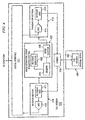
- FIGURE 4 illustrated is a DSL modem 410 incorporating the system of FIGURE 2 or the method of FIGURE 3 , together with a DSL 440 to a central office 480 having another DSL modem 490.
- the DSL modem 410 includes a digital interface 411, a transmitter section 413, a receiver section 416, a hybrid 419 and a system to reduce noise estimation error, 420.
- the DSL modem 410 is configured to communicate with the central office DSL modem 490 over the DSL 440.
- the DSL modem 410 is CPE.
- the DSL modem 410 and the central office DSL modem 490 are Asymmetric DSL (ADSL) modems.
- the transmitter i.e., 410 is a CO and the receiver i.e., 480 is a CPE.
- the DSL 440 and the DSL modem 490 are conventional components well known in the art.
- the digital interface 411, the transmitter section 413, the receiver section 416 and the hybrid 417 are common components typical included within a conventional DSL modem.
- the digital interface 411 processes digital data for transmission to the central office DSL modem 490 and digital data that was received from the central office DSL modem 490.
- the digital data for transmission may be received from a computer associated with the DSL modem 410.
- the transmitter section 413 receives and processes the digital data for transmission to the central office DSL modem 490.
- the transmitter section includes components typically associated with transmitting digital data by a DSL modem.
- the transmitter section 413 may include a scrambler that receives data from the digital interface 411, an encoder, an interleaver, a bit distributor, a mapper, a gain element, an inverse fast Fourier transform block and a cyclic extension block.
- the transmitter section 413 includes digital-to-analog converter (DAC) 414 and a transmitter front end 415 that interfaces with the hybrid 419.
- DAC digital-to-analog converter
- the transmitter section 413 is configured to convert the digital data to analog data for transmission to the central office DSL modem 490 via the hybrid 419.
- the hybrid 419 provides an interface for the transmitter section 413 and the receiver section 416 with the DSL 440.
- the receiver section 416 is configured opposite the transmitter section 413. In other words, the receiver section 416 converts analog data received from the central office DSL modem 490 to digital data.
- the receiver section 416 receives the analog data via the hybrid 419.
- the receiver section 416 typically includes a receiver front end 417 that interfaces with the hybrid 419 and an analog-to-digital converter (ADC) 418. Additionally, the receiver section 416 may include a time equalizer, a fast Fourier transform block, a frequency equalizer, a demapper, a deinterleaver, a decoder and a descrambler that provides the digital data to the digital interface 411.
- ADC analog-to-digital converter
- the system to reduce noise estimation error 420 coupled to the transmitter section 413, is configured to reduce noise estimation error during a DSL communication session.
- the system to reduce noise estimation error 420 may be implemented in the transmitter section 413.
- the system to reduce noise estimation error 420 includes a memory 424, a noise injector 426 and a receiver identifier 428.
- the system to reduce noise estimation error 420 is also coupled to the receiver section 416 to receive data from the central office DSL modem 490 regarding a previous communication session. In this manner, the data is automatically loaded into the memory 424.
- the system to reduce noise estimation error 420 may not be coupled to the receiver section 416 and the data may be loaded manually to the memory 424.
- the memory 424, the noise injector 426 and the receiver identifier 428 are configured and operate similar to the memory 220, the noise injector 240 and the receiver identifier 260 of FIGURE 2 .
- the memory 424 is configured to contain data regarding frequency-dependent noise estimation error experienced during a prior DSL communication session.
- the noise injector 426, coupled to the memory 424, is configured to employ the data to introduce frequency-dependent synthetic noise during the training period of the DSL communication session.
- the noise injector 426 injects the frequency-dependent synthetic noise after the DAC converter 414.
- the noise injector 426 may inject the frequency-dependent synthetic noise before the DAC 414 (digital synthetic noise).
- the frequency-dependent synthetic noise may be introduced during the SNR measurement phase of the training period.
- the present invention injects frequency-dependent synthetic noise during the training period of a DSL communications session. This may occur during the SNR measurement phase of the training period.
- the excess margin created by the injecting allows a DSL transmitter to control bit allocation through SNR during showtime.
- the frequency-dependent synthetic noise provides a higher SNR or higher margins at designated frequencies that the DSL receiver can utilize for margin equalization.
- the present invention can be employed within the present standards for DSL communications.
Landscapes
- Engineering & Computer Science (AREA)
- Computer Networks & Wireless Communication (AREA)
- Signal Processing (AREA)
- Telephonic Communication Services (AREA)
Claims (10)
- Ein Verfahren (300) der Abnahme von Rauschschätzungsfehler in einem Empfänger während einer digitalen DSL-Kommunikation zwischen einem Sender und dem Empfänger, bestehend aus:dem Retrieval (330) von Daten in Bezug auf frequenz-abhängigen Leitungsrausch, der während einer vorherigen DSL-Kommunikation erfährt worden ist; und dadurch gekennzeichnet:der Gebrauch von den o.g. Daten, um zum Sender frequenzabhängiger synthetischer Rausch während einer Ausbildungszeit der o.g. DSL-Kommunikation einzusetzen (340), wobei der o.g. Rauschschätzungsfehler Empfängerabhängig ist.
- Der Verfahren (300) nach Anspruch 1, dazu bestehend aus:der Sperrung (350) des o.g. Rausches nach einer Bitzuweisungsphase der o.g. Ausbildungszeit zu Ende ist.
- Der Verfahren (300) nach Ansprüchen 1 oder 2, wobei der o.g. Gebrauch den frequenz-abhängigen synthetischen Rausch veranlasst, den Wert bei einer bestimmten Frequenz oder einer Gruppe von Frequenzen genug für die Einrichtung von einer geraden Zahl von zusätzlichen Bits zu haben, welcher Wert einer vorherbestimmten Menge von dem Margenüberschuss in Dezibel bei der o.g. bestimmten Frequenz oder Gruppe von Frequenzen entspricht.
- Der Verfahren (300) nach Ansprüchen 1 - 3, wobei der Verfahren dazu besteht aus:der Bezeichnung (310) vom Empfänger während der o.g. Ausbildungszeit; undder Auswahl (320) von den o.g. Daten nach der o.g. Bezeichnung.
- Der Verfahren (300) nach Ansprüchen 1 - 4, wobei die o.g. Daten jede Frequenz in einem Band der o.g. DSL-Kommunikation einschliesst, und die o.g. DSL-Kommunikation ist eine asymmetrische DSL-Kommunikation.
- Der Verfahren (300) nach Ansprüchen 1 - 5, wobei der o.g. frequenz-abhängige synthetische Rausch mehrere angrenzende Frequenzen in einem Band von der o.g. DSL-Kommunikation einschliesst.
- Der Verfahren (300) nach Ansprüchen 1 - 6, wobei der o.g. Verfahren in dem Equipmentmodem des Kundenbetriebsgebäudes realisiert wird.
- Eine Anlage (420), um Rauschschätzungsfehler in einem Empfänger während einer DSL-Kommunikation zwischen einem Sender und dem Empfänger zu vermindern, bestehend aus:einem konfigurierten Speicher (424), der in Zusammenhang mit dem Sender steht, um die Daten bezüglich frequenz-abhängigen Leitungsrausches zu enthalten, der während einer früheren DSL-Kommunikation erfährt wird; und dadurch gekennzeichnetein Rauscheinspritz (426) gekoppelt zum o.g. Speicher und konfiguriert, um die Daten zu benutzen, um der frequenz-abhängige synthetische Rausch zu dem Sender während einer Ausbildungszeit der o.g. DSL-Kommunikation einzusetzen, wobei der Räuschschätzungsfehler Empfängerabhängig ist.
- Die Anlage (420) nach Anspruch 8, wobei die o.g. Anlage dazu einschliesst, einen Empfängerbezeichner (428) gekoppelt zum o.g. Rauscheinspritzer (426) und konfiguriert, um eine Bezeichnung eines Empfängers (490) während der o.g. Ausbildingszeit zu machen und die o.g. Daten bezüglich der o.g. Bezeichnung zu wählen.
- Ein digitaler DSL-modem (410) bestehend aus:einer Digitalschnittstelle (411);einem Sender gekoppelt zu der Digitalschnittstelle (411) und mit einem Digital-Analog-Wandler (414);einem Hybrid (419) gekoppelt zu dem Sender (413) und koppelbar zu einem DSL für Komminikation mit einem Empfänger; dadurch gekennzeichnet, dass der o.g. Modem dazu besteht auseinem Speicher (424) in Verbindung mit dem Sender, der konfiguriert wird, um Daten in Bezug auf frequenz-abhangigen Leitungsrausch zu behalten, welcher während einer vorhergehenden DSL-Kommunikation erfährt wird; undeinem Rauscheinspritz (426) gekoppelt zum o.g. Speicher (424) und konfiguriert, um die o.g. Daten für die Einführung von frequenz-abhängigen synthetischen Rausch zum Sender während eine Ausbildungszeit einer DSL-Kommunikation zwischen dem Sender und dem Empfänger zu benutzen, um der Rauschschätzungsfehler in dem Empfänger während der o.g. DSL-Kommunikation zu vermindern, wobei der Rauschschätzungsfehler Empfänger-abhängig ist.
Applications Claiming Priority (2)
| Application Number | Priority Date | Filing Date | Title |
|---|---|---|---|
| US10/847,275 US20050254562A1 (en) | 2004-05-17 | 2004-05-17 | System and method to reduce noise estimation error during a digital subscriber line communication session and digital subscriber line modem incorporating the same |
| US847275 | 2004-05-17 |
Publications (2)
| Publication Number | Publication Date |
|---|---|
| EP1599027A1 EP1599027A1 (de) | 2005-11-23 |
| EP1599027B1 true EP1599027B1 (de) | 2012-02-22 |
Family
ID=34938322
Family Applications (1)
| Application Number | Title | Priority Date | Filing Date |
|---|---|---|---|
| EP05076297A Ceased EP1599027B1 (de) | 2004-05-17 | 2005-05-17 | Gerät und Verfahren zum Vermindern von Rauschschätzungsfehlern bei DSL Kommunikation |
Country Status (2)
| Country | Link |
|---|---|
| US (1) | US20050254562A1 (de) |
| EP (1) | EP1599027B1 (de) |
Families Citing this family (4)
| Publication number | Priority date | Publication date | Assignee | Title |
|---|---|---|---|---|
| ATE399403T1 (de) * | 2004-09-23 | 2008-07-15 | Alcatel Lucent | Sender eines mehrträgermodems der die übertragungsqualität absichtlich vermindert um die stabilität des betriebs zu verbessern. |
| US8599936B2 (en) * | 2006-08-30 | 2013-12-03 | At&T Intellectual Property I, L.P. | Code violation generator and methods of generating code violations |
| US8238450B2 (en) * | 2009-01-30 | 2012-08-07 | Futurewei Technologies Inc. | Dynamic transmitter noise level adjustment for digital subscriber line systems |
| WO2013123964A1 (en) * | 2012-02-20 | 2013-08-29 | Nokia Siemens Networks Oy | Method and device for data processing in a digital subscriber line environment |
Family Cites Families (11)
| Publication number | Priority date | Publication date | Assignee | Title |
|---|---|---|---|---|
| US5852630A (en) * | 1997-07-17 | 1998-12-22 | Globespan Semiconductor, Inc. | Method and apparatus for a RADSL transceiver warm start activation procedure with precoding |
| JP3480313B2 (ja) * | 1998-05-26 | 2003-12-15 | 富士通株式会社 | ディジタル加入者線伝送方法及びxDSL装置 |
| DE69935410T2 (de) * | 1998-12-24 | 2007-11-29 | Xerox Corp. | Verfahren und Anordnung zur Rauschimpulsverringerung in einem Signalverarbeitungssystem |
| GB9828441D0 (en) * | 1998-12-24 | 1999-02-17 | Xerox Corp | Method and apparatus for reducing impulse noise in a signal processing system |
| US6633545B1 (en) * | 1999-07-30 | 2003-10-14 | Cisco Technology, Inc. | System and method for determining the data rate capacity of digital subscriber lines |
| AU2755401A (en) * | 1999-12-30 | 2001-07-16 | Bandspeed, Inc. | Approach for processing data received from a communications channel |
| US6819716B1 (en) * | 2000-04-04 | 2004-11-16 | Nortel Networks Limited | System, device, and method for time-domain equalizer training using injected out-of-band noise |
| JP3586661B2 (ja) * | 2001-04-18 | 2004-11-10 | 日本電気通信システム株式会社 | 通信システム及びそれに用いる背景雑音キャンセル方法 |
| US7154912B2 (en) * | 2001-08-14 | 2006-12-26 | The Directv Group, Inc. | System and method for provisioning broadband service in a PPPoE network using a list of stored domain names |
| US7184467B2 (en) * | 2001-12-27 | 2007-02-27 | Texas Instruments Incorporated | Method to mitigate effects of ISDN off/on transitions in ADSL |
| US7305357B2 (en) * | 2002-01-24 | 2007-12-04 | Shaw Cablesystems, G.P. | Method and system for providing and controlling delivery of content on-demand over a cable television network and a data network |
-
2004
- 2004-05-17 US US10/847,275 patent/US20050254562A1/en not_active Abandoned
-
2005
- 2005-05-17 EP EP05076297A patent/EP1599027B1/de not_active Ceased
Also Published As
| Publication number | Publication date |
|---|---|
| US20050254562A1 (en) | 2005-11-17 |
| EP1599027A1 (de) | 2005-11-23 |
Similar Documents
| Publication | Publication Date | Title |
|---|---|---|
| US9130654B2 (en) | Performance customization system and process for optimizing xDSL performance | |
| US7356049B1 (en) | Method and apparatus for optimization of channel capacity in multi-line communication systems using spectrum management techniques | |
| EP2283639B1 (de) | Dynamische sender geräuschpegelanpassung für digitale teilnehmerleitungssysteme | |
| CN103004099B (zh) | 一种降低数字用户线路干扰的方法、装置和系统 | |
| JP2005278150A (ja) | チャネル状態モデルを使用してビットローディングを行うデジタル加入者回線モデム | |
| JP2005278150A5 (de) | ||
| JP2008516474A (ja) | デジタル契約者ラインベースサービスを最適化するシステム、および方法 | |
| CN101272160A (zh) | Dsl参考虚拟噪声的确定方法及装置、配置方法及系统 | |
| US20090141823A1 (en) | Power Reduction For Digital Subscriber Line | |
| US8654866B2 (en) | Method and apparatus for optimizing dynamic range in DMT modems | |
| US20060062288A1 (en) | Short loop ADSL power spectral density management | |
| US8369391B2 (en) | Method and arrangement in a digital subscriber line system | |
| US7778346B2 (en) | Upstream power cutback | |
| EP1599027B1 (de) | Gerät und Verfahren zum Vermindern von Rauschschätzungsfehlern bei DSL Kommunikation | |
| US7839919B2 (en) | Adjusting transmit power spectra of transceiver devices in a communications network | |
| CN102292970B (zh) | 在甚高速数字用户线路上配置虚拟噪声参数 | |
| US7362798B1 (en) | Method for transmitting data to be transmitted using a subscriber modem | |
| EP2451121A1 (de) | Verfahren und system zur voreinschätzung der maximalen bandbreite einer teilnehmerleitung in einer digitalen teilnehmerschleife | |
| CN106134170B (zh) | 动态线路管理系统 | |
| JP2003516655A (ja) | 加入者モデムを用いて伝送データを伝送する方法 | |
| US8917863B2 (en) | Method and device for data processing in a digital subscriber line environment | |
| CN102100048A (zh) | 用于数据处理的方法和设备以及包括该设备的通信系统 | |
| CN101453242A (zh) | Dsl参考虚拟噪声的确定方法及装置、配置方法及系统 | |
| CN100563116C (zh) | 利用第二代甚高速数字用户线传输信号的方法及系统 | |
| EP2146496B1 (de) | Verfahren und Vorrichtung zur Datenverarbeitung und Kommunikationssystem mit einer derartigen Vorrichtung |
Legal Events
| Date | Code | Title | Description |
|---|---|---|---|
| PUAI | Public reference made under article 153(3) epc to a published international application that has entered the european phase |
Free format text: ORIGINAL CODE: 0009012 |
|
| AK | Designated contracting states |
Kind code of ref document: A1 Designated state(s): AT BE BG CH CY CZ DE DK EE ES FI FR GB GR HU IE IS IT LI LT LU MC NL PL PT RO SE SI SK TR |
|
| AX | Request for extension of the european patent |
Extension state: AL BA HR LV MK YU |
|
| 17P | Request for examination filed |
Effective date: 20060523 |
|
| AKX | Designation fees paid |
Designated state(s): DE FR GB |
|
| 17Q | First examination report despatched |
Effective date: 20060628 |
|
| 17Q | First examination report despatched |
Effective date: 20060628 |
|
| GRAP | Despatch of communication of intention to grant a patent |
Free format text: ORIGINAL CODE: EPIDOSNIGR1 |
|
| GRAS | Grant fee paid |
Free format text: ORIGINAL CODE: EPIDOSNIGR3 |
|
| GRAA | (expected) grant |
Free format text: ORIGINAL CODE: 0009210 |
|
| AK | Designated contracting states |
Kind code of ref document: B1 Designated state(s): DE FR GB |
|
| REG | Reference to a national code |
Ref country code: GB Ref legal event code: FG4D |
|
| REG | Reference to a national code |
Ref country code: DE Ref legal event code: R096 Ref document number: 602005032753 Country of ref document: DE Effective date: 20120419 |
|
| PLBE | No opposition filed within time limit |
Free format text: ORIGINAL CODE: 0009261 |
|
| STAA | Information on the status of an ep patent application or granted ep patent |
Free format text: STATUS: NO OPPOSITION FILED WITHIN TIME LIMIT |
|
| 26N | No opposition filed |
Effective date: 20121123 |
|
| REG | Reference to a national code |
Ref country code: DE Ref legal event code: R097 Ref document number: 602005032753 Country of ref document: DE Effective date: 20121123 |
|
| REG | Reference to a national code |
Ref country code: FR Ref legal event code: PLFP Year of fee payment: 12 |
|
| REG | Reference to a national code |
Ref country code: FR Ref legal event code: PLFP Year of fee payment: 13 |
|
| REG | Reference to a national code |
Ref country code: FR Ref legal event code: PLFP Year of fee payment: 14 |
|
| PGFP | Annual fee paid to national office [announced via postgrant information from national office to epo] |
Ref country code: DE Payment date: 20200417 Year of fee payment: 16 Ref country code: FR Payment date: 20200421 Year of fee payment: 16 |
|
| PGFP | Annual fee paid to national office [announced via postgrant information from national office to epo] |
Ref country code: GB Payment date: 20200429 Year of fee payment: 16 |
|
| REG | Reference to a national code |
Ref country code: DE Ref legal event code: R119 Ref document number: 602005032753 Country of ref document: DE |
|
| GBPC | Gb: european patent ceased through non-payment of renewal fee |
Effective date: 20210517 |
|
| PG25 | Lapsed in a contracting state [announced via postgrant information from national office to epo] |
Ref country code: GB Free format text: LAPSE BECAUSE OF NON-PAYMENT OF DUE FEES Effective date: 20210517 Ref country code: DE Free format text: LAPSE BECAUSE OF NON-PAYMENT OF DUE FEES Effective date: 20211201 |
|
| PG25 | Lapsed in a contracting state [announced via postgrant information from national office to epo] |
Ref country code: FR Free format text: LAPSE BECAUSE OF NON-PAYMENT OF DUE FEES Effective date: 20210531 |