EP1598712B1 - Verfahren und Vorrichtung zur Steuerung eines biologischen Verfahren zur Abwasserbehandlung - Google Patents
Verfahren und Vorrichtung zur Steuerung eines biologischen Verfahren zur Abwasserbehandlung Download PDFInfo
- Publication number
- EP1598712B1 EP1598712B1 EP05010111.2A EP05010111A EP1598712B1 EP 1598712 B1 EP1598712 B1 EP 1598712B1 EP 05010111 A EP05010111 A EP 05010111A EP 1598712 B1 EP1598712 B1 EP 1598712B1
- Authority
- EP
- European Patent Office
- Prior art keywords
- concentration
- dissolved oxygen
- waste waters
- ammonia nitrogen
- dosp
- Prior art date
- Legal status (The legal status is an assumption and is not a legal conclusion. Google has not performed a legal analysis and makes no representation as to the accuracy of the status listed.)
- Expired - Lifetime
Links
Images
Classifications
-
- G—PHYSICS
- G05—CONTROLLING; REGULATING
- G05B—CONTROL OR REGULATING SYSTEMS IN GENERAL; FUNCTIONAL ELEMENTS OF SUCH SYSTEMS; MONITORING OR TESTING ARRANGEMENTS FOR SUCH SYSTEMS OR ELEMENTS
- G05B13/00—Adaptive control systems, i.e. systems automatically adjusting themselves to have a performance which is optimum according to some preassigned criterion
- G05B13/02—Adaptive control systems, i.e. systems automatically adjusting themselves to have a performance which is optimum according to some preassigned criterion electric
- G05B13/0265—Adaptive control systems, i.e. systems automatically adjusting themselves to have a performance which is optimum according to some preassigned criterion electric the criterion being a learning criterion
- G05B13/0275—Adaptive control systems, i.e. systems automatically adjusting themselves to have a performance which is optimum according to some preassigned criterion electric the criterion being a learning criterion using fuzzy logic only
-
- C—CHEMISTRY; METALLURGY
- C02—TREATMENT OF WATER, WASTE WATER, SEWAGE, OR SLUDGE
- C02F—TREATMENT OF WATER, WASTE WATER, SEWAGE, OR SLUDGE
- C02F2209/00—Controlling or monitoring parameters in water treatment
- C02F2209/22—O2
-
- C—CHEMISTRY; METALLURGY
- C02—TREATMENT OF WATER, WASTE WATER, SEWAGE, OR SLUDGE
- C02F—TREATMENT OF WATER, WASTE WATER, SEWAGE, OR SLUDGE
- C02F3/00—Biological treatment of water, waste water, or sewage
Definitions
- the present invention relates in general to management of the biological process in waste water purifying plants and, in particular, a method and a device for continuous controlling the supply of oxygen in waste waters flowing in an oxidation tank.
- waste water purifying plants the main phase of treatment is represented by the biological process.
- the waste waters are made to flow in a large tank (several hundreds or thousands of cubic meters) containing a specific quantity of micro-organisms (bacteria, protozoa, etc.) which perform degradation of pollutants.
- the principal phase of the biological treatment is aerobic, and it is consequently necessary to maintain a correct concentration of oxygen in the waste water in order to guarantee optimal operating conditions for the micro-organisms.
- This is obtained by supplying oxygen continuously (oxygen can be supplied by blowing air, blowing pure oxygen, remixing the sewage, etc.) to the waste water present inside the tank.
- oxygen can be supplied by blowing air, blowing pure oxygen, remixing the sewage, etc.
- This supply must be delivered in a particularly homogeneous way and in sufficient quantity to allow correct implementation of the purifying process.
- the supply of oxygen has a considerable influence on various aspects of the treatment, such as the removal of nitrogen, the sedimentation of sludge, and the formation and/or growth of filamentous micro-organisms.
- the cost of energy for supplying oxygen through blown air is one of the major cost items in the management of a waste water purifying plant.
- regulation of the air fed to the biological treatment tank is generally based on detection of the concentration of dissolved oxygen (DO) in the waste water present in the treatment tank.
- DO dissolved oxygen
- the control system used consequently acts directly on the compressors (or machinery used to blow air) or on appropriate devices (such as valves) in order to vary or interrupt the air flow.
- one of the limits of PID controllers in this type of application depends on the process conditions, in which there are considerable variations in both the short and the long term and which have particular influence on the concentration of dissolved oxygen. Moreover, in particular conditions, there can be very wide fluctuations with respect to the set point.
- the efficiency of the biological process is compromised under various aspects. Firstly, the differences between the effective amount of oxygen required and the amount provided instantly are in any case counter-productive. In fact, if too little oxygen is supplied, the aerobic process is slowed down, while an excessive concentration of dissolved oxygen can, for example, have a negative influence on the efficiency of the denitrification process. Secondly, high fluctuations with respect to the pre-established set point make the purifying process instable due to the continuous and rapid variations in the concentration of dissolved oxygen to which the biomass is subjected.
- EP-A1-1376276 discloses a system for controlling the treatment of waste waters according to the preamble of claim 1.
- a neural network and a back-propagation algorithm are used to control variable factors of the water, such as dissolved oxygen (DO), as a function of the characteristics of the water flowing into an exhalation tank.
- DO dissolved oxygen
- An air control valve is operated by the control system in order to regulate the value of the dissolved oxygen in the treated water.
- a particutarly important aspect is represented by the waste of energy which occurs when the quantity of blown air is greater than the effective requirement. This aspect becomes more important if we consider the usual practice of maintaining high set points with regard to the concentration of dissolved oxygen, i.e., values suitable only when operating in the worst operating conditions, as it is in any case deemed that an excess supply of air is safer than a shortage in supply.
- the general object of the present invention is to propose a method and a device which allow optimization of the supply of air to the aerobic treatment process for waste waters in a purifying plant.
- a specific object of the present invention is to reduce treatment costs correlated principally to the supply of oxygen through blowing air, preventing, above all, an excess supply.
- Another specific object of the present invention is to guarantee process stability, notwithstanding the variability of the characteristics and of the parameters which influence the treatment.
- a further specific object of the present invention is to maintain adequate treatment efficiency at all times.
- the first control level modifies the set point of the concentration of dissolved oxygen in the waste waters as a function of at least the value of concentration of ammonia nitrogen detected in the waste waters and of at least a desired value for the concentration of ammonia nitrogen.
- Calculation of a new set point for the concentration of dissolved oxygen is implemented very frequently with respect to the dynamics of the processes in play, for example, at least every 10-20 minutes, so as to guarantee substantially continuous control of the process also for variations in the parameters that can occur in the short term.
- the first level of control uses fuzzy logic rules, through which membership functions are expressed at least for the difference between detected and desired value of the concentration of ammonia nitrogen, membership functions are expressed at least for the variation speed of the concentration of ammonia nitrogen and membership functions are expressed at least for the percentage variation of the set point for the concentration of dissolved oxygen.
- At least a second control level is provided to modify in a substantially continuous way the flow rate of air blown into the oxidation tank as a function of the set point of the concentration of dissolved oxygen calculated in a substantially continuous way by the first control level and of the value effectively detected for the concentration of dissolved oxygen in the waste waters.
- fuzzy logic rules express membership functions at least for the difference between detected value and set point of the concentration of dissolved oxygen, membership functions at least for the variation speed of the concentration of dissolved oxygen and membership functions at least for the variation of the flow rate of air blown into the tank.
- the invention also relates to a device for continuously controlling the aerobic biological treatment of waste waters according to claim 8.
- fuzzy logic rules also facilitates control for experts in the environmental field without requiring particular know-how in the field of control systems.
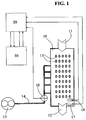
- the diagram in Figure 1 shows a tank 10 including at least one inlet 11 for inflowing waste water and one or more outlets 12 for outflowing waste water. Pressurized air is blown into the tank 10, and consequently into the waste water travelling therethrough, by a network of nozzles 13 fed by a main duct 14. Air is blown into the duct 14 by at least one compressor or fan 15 and the flow rate of the air to the network of nozzles 13 is regulated by at least one regulation device 16.
- Detectors are provided for the process parameters, in particular at least one sensor 17 to measure the concentration of ammonia nitrogen in the waste water and at least one sensor 18 to measure the concentration of dissolved oxygen in the waste water.
- the signals representing the values acquired on-line by the detectors 17 and 18 are sent to a unit 20 for the management of input and output signals to and from the control unit 30.
- the control unit 30 is, for example, composed of a computer programmed to perform all the instructions required to implement the fuzzy logic rules used in the process control, including transformation (defuzzification) of the results obtained by applying the fuzzy logic rules to control values and/or signals destined to be sent to the regulation device 16.
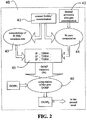
- a first control level or module 40 which receives an input value 41 corresponding to the concentration of ammonia nitrogen detected by the sensor 17 and a pre-established value 42 corresponding to the concentration of ammonia nitrogen desired.
- the first value 41 is used to calculate the variation rate of the concentration of ammonia nitrogen along a pre-established time interval (block 43), and both values 41 and 42 are used to calculate the percentage error between the desired value and the value effectively detected (block 44).
- the results of the calculations performed in the blocks 43 and 44 are presented as input parameters to a program 45 which uses the fuzzy logic rules to calculate any variation in the percentage of the DOSP (Dissolved Oxygen Set Point), compared to the previously calculated value.
- DOSP Dissolved Oxygen Set Point
- MacVicar-Whelan rule bases are, for example, used.
- An example of a rule of this type applied in this context could be:
- the membership functions can, for example, be defined on the basis of Gaussian, trapezoidal or similar functions.
- the fuzzy logic rules implemented in the program 45 can, for example, express membership functions for the difference between the detected and desired value of the concentration of ammonia nitrogen, membership functions for the variation speed of the concentration of ammonia nitrogen, and membership functions for the percentage variation of the set point of the concentration of dissolved oxygen.
- the percentage value output from the program 45, together with the previous DOSP f value, is used to calculate the new set point value DOSP n for the concentration of dissolved oxygen (block 46) which will be used as the basis for varying the supply of air in the waste water flowing inside the tank 10.
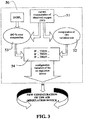
- the DOSP n value output from the first level 40 is input into a second level or module 50 represented in Figure 3 .
- the module 50 also receives an input value 51 corresponding to the current concentration of dissolved oxygen detected by the sensor 18.
- the value 51 is used to calculate the variation rate of the concentration of dissolved oxygen along a pre-established time interval (block 52).
- the DOSP n value is used together with the value 51 to calculate the percentage error between the DOSP n value and the value effectively detected (block 53).
- the signal corresponding to this value is then transmitted to the regulation device 16 through the unit 20 dedicated to management of the input and output signals of the unit 30 ( Figure 1 ).
- MacVicar-Whelan type fuzzy logic base rules are, for example, used.
- An example of a rule of this type applied in this context could be:
- membership functions can, for example, be defined on the basis of Gaussian, trapezoidal or similar functions.
- the fuzzy logic rules implemented in the program 54 can, for example, express membership functions for the difference between the detected value and the calculated set point of the concentration of dissolved oxygen, membership functions for the variation speed of the concentration of dissolved oxygen, and membership functions for the variation of the air flow.
- a control system according to the present invention was experimented in a plant which on average treats 85,000 m 3 /day of waste waters prevalently of domestic origin.
- the compartment in which the aerobic purifying process takes place is composed of four tanks in parallel.
- One of the tanks was subjected to control by a device according to the present invention, while in the other three tanks the existing system was left, i.e. a system with a PID controller with a fixed set point with regard to the concentration of dissolved oxygen.
- the air feed system is composed of three centrifugal compressors, each having a maximum flow rate of 12,100 Nm 3 /hour, with a controlled valve for each tank, for separate regulation of the air flow.
- Management is, in this case, performed by a PID controller provided to maintain the pressure in the air circuit at a pre-established constant value (generally of 4.8 m H 2 O).
- Two oxygen sensors were installed in proximity to the outlet of each tank and the current value of the concentration of dissolved oxygen is calculated as an average of the measurements detected by each of the two sensors.
- the value detected for the concentration of dissolved oxygen is input into the PID controller.
- This controller has the task of maintaining this value as close as possible to the set point pre-established for the concentration of dissolved oxygen in a specific tank, in particular acting on a controlled valve associated with the corresponding tank.
- the control according to the present invention was instead applied calculating the set point for the concentration of dissolved oxygen every 15 minutes.
- the rate of variation of the concentration of ammonia nitrogen is calculated on the values relative to the last 30 minutes, while the rate of variation of the concentration of dissolved oxygen is calculated on the basis of the values relative to the last 12 minutes.
- the variation of the position of the controlled valve is calculated every minute.
- the sensors for detecting the concentration of ammonia nitrogen and the concentration of dissolved oxygen are products identified by the trade names FILTRAX, AMTAX and ANALON DO-1 produced by the company DR LANGE s.r.l. of Rozzano (MI).
- Interface between the sensors and the control logic is obtained using STAR-OHF (32 bit CPU), ADA and DOB boards produced by the company SDI AUTOMAZIONE INDUSTRIALE of Trezzano sul Naviglio (MI).
- the concentration of ammonia was found to vary by approximately 0 to approximately 10 mg N/litre over the course of one day, while with the controller of the present invention concentrations varying from 4.3 to 8.9 mg N/litre were detected.
- the value of difference between the maximum and minimum concentration of ammonia nitrogen with the controller according to the present invention is approximately 6.5 mg N/litre, while with convention controllers the mean value calculated is approximately 9.9 mg N/litre.
- a reduction of the amplitude of fluctuation of approximately 34% is obtained, which is a considerable improvement both as regards process efficiency, as extreme situations of poor or complete nitrification must be avoided, and as regards stability on a daily scale.
- the mean values were of approximately 1.3 mg N/litre with conventional controllers and of approximately 5.2 mg N/litre with a controller according to the present invention.
- the control produced according to the present invention with variable set point for the concentration of dissolved oxygen, maintains the value of concentration of ammonia nitrogen stable close to the desired level, therefore without requesting a pointless supply of air with consequent waste of energy.
- the controller according to the present invention ensures that the concentration of dissolved oxygen present in the waste waters regularly follows the variation of the set point, with limited fluctuations, while with conventional controllers fluctuations much higher than the fixed set point occur.
- the maximum difference between the effective value measured for the concentration of dissolved oxygen and the set point was 0.5 mg N/litre, while for conventional controllers it was 0.86 mgN/litre.
Landscapes
- Engineering & Computer Science (AREA)
- Artificial Intelligence (AREA)
- Software Systems (AREA)
- Physics & Mathematics (AREA)
- Health & Medical Sciences (AREA)
- Mathematical Physics (AREA)
- Fuzzy Systems (AREA)
- Computer Vision & Pattern Recognition (AREA)
- Evolutionary Computation (AREA)
- Medical Informatics (AREA)
- General Physics & Mathematics (AREA)
- Automation & Control Theory (AREA)
- Feedback Control In General (AREA)
- Activated Sludge Processes (AREA)
Claims (14)
- Verfahren zur kontinuierlichen Steuerung der aeroben biologischen Behandlung von Abwässern in einer Reinigungsanlage, wobei die kontinuierlich in einen Oxidationsbehälter (10) fließenden Abwässer einer Belüftung durch das Einblasen von Druckluft unterzogen werden, wobei die Strömungsgeschwindigkeit der in das Abwasser eingeblasenen Luft im Wesentlichen kontinuierlich durch mindestens eine erste Steuerebene (40) reguliert wird, die im Wesentlichen kontinuierlich den Sollwert der Konzentration von gelöstem Sauerstoff (DOSP) in den Abwässern modifiziert, dadurch gekennzeichnet, dass die erste Steuerebene (40) Fuzzy-Logik-Regeln verwendet, um jeden neuen Sollwert der Konzentration von gelöstem Sauerstoff (DOSP) als eine Funktion von mindestens dem Wert der Konzentration von Ammoniumstickstoff, welche in den Abwässern gemessen wird, und von mindestens einem gewünschten Wert für die Konzentration von Ammoniumstickstoff zu bestimmen.
- Vorrichtung gemäß Anspruch 1, wobei mindestens die Werte der Konzentration von Ammoniumstickstoff und der Konzentration von gelöstem Sauerstoff (DOSP) in den Abwässern gemessen werden.
- Verfahren gemäß Anspruch 1, wobei die erste Steuerebene (40) den Sollwert der Konzentration von gelöstem Sauerstoff (DOSP) in den Abwässern als eine Funktion von mindestens dem Wert der Konzentration von Ammoniumstickstoff, welche in den Abwässern gemessen wird, und mindestens von dem vorher festgesetzten Wert für die Konzentration von Ammoniumstickstoff modifiziert.
- Verfahren gemäß Anspruch 1, wobei die Fuzzy-Logik-Regeln Zugehörigkeitsfunktionen mindestens für die Differenz zwischen dem gemessenen und dem gewünschten Wert der Konzentration von Ammoniumstickstoff, Zugehörigkeitsfunktionen mindestens für die Änderungsgeschwindigkeit der Konzentration von Ammoniumstickstoff und Zugehörigkeitsfunktionen mindestens für die prozentuale Veränderung des Sollwertes für die Konzentration von gelöstem Sauerstoff (DOSP) ausdrücken.
- Verfahren gemäß Anspruch 1, wobei mindestens eine zweite Steuerebene (50) bereitgestellt ist, um die Strömungsgeschwindigkeit der in die Abwässer geblasenen Luft in einer im Wesentlichen kontinuierlichen Weise als eine Funktion des Sollwertes der Konzentration von gelöstem Sauerstoff (DOSP), die in einer im Wesentlichen kontinuierlichen Weise durch die erste Steuerebene (40) berechnet wird, und des Wertes, welcher für die Konzentration von gelöstem Sauerstoff (DO) in den Abwässern gemessen wird, zu modifizieren.
- Verfahren gemäß Anspruch 5, wobei die zweite Steuerebene (50) Fuzzy-Logik-Regeln verwendet.
- Verfahren gemäß Anspruch 6, wobei die Fuzzy-Logik-Regeln Zugehörigkeitsfunktionen mindestens für die Differenz zwischen dem gemessenen Wert und dem Sollwert der Konzentration von gelöstem Sauerstoff (DOSP), Zugehörigkeitsfunktionen mindestens für die Änderungsgeschwindigkeit der Konzentration von gelöstem Sauerstoff (DO) und Zugehörigkeitsfunktionen mindestens für die Veränderung der Strömungsgeschwindigkeit der in die Abwässer geblasenen Luft ausdrücken.
- Vorrichtung für die kontinuierliche Steuerung der aeroben biologischen Behandlung von Abwässern in einer Reinigungsanlage, umfassend mindestens ein erstes System (13, 14, 15, 16) zum Einblasen von Druckluft in die Abwässer, welche kontinuierlich in einen Oxidationsbehälter (10) fließen, und Steuerungsmittel (20, 30) zum Verändern, in einer im Wesentlichen kontinuierlichen Weise, der Strömungsgeschwindigkeit der in die Abwässer geblasenen Luft, wobei die Steuerungsmittel (20, 30) mindestens ein erstes Steuermodul (40) umfassen, welches im Wesentlichen kontinuierlich den Sollwert der Konzentration von gelöstem Sauerstoff (DOSP) in den Abwässern modifiziert, dadurch gekennzeichnet, dass das erste Steuermodul (40) mindestens eine Verarbeitungseinheit umfasst, die mit Fuzzy-Logik-Regeln programmiert ist, um jeden neuen Sollwert der Konzentration von gelöstem Sauerstoff (DOSP) als eine Funktion von mindestens dem Wert der Konzentration von Ammoniumstickstoff, welche in den Abwässern gemessen wird, und von mindestens einem gewünschten Wert für die Konzentration von Ammoniumstickstoff zu bestimmen.
- Vorrichtung gemäß Anspruch 8, wobei Mittel (17, 18) bereitgestellt sind, um mindestens die Werte relativ zu der Konzentration von Ammoniumstickstoff und zu der Konzentration von gelöstem Sauerstoff (DO) in den Abwässern zu messen.
- Vorrichtung gemäß Anspruch 8, wobei das erste Steuermodul (40) programmiert ist, um den Sollwert der Konzentration von gelöstem Sauerstoff (DOSP) in den Abwässern als eine Funktion von mindestens dem Wert, welcher für die Konzentration von Ammoniumstickstoff gemessen wird, und von dem vorher festgesetzten Wert für die Konzentration von Ammoniumstickstoff in den Abwässern zu modifizieren.
- Vorrichtung gemäß Anspruch 8, wobei die Fuzzy-Logik-Regeln Zugehörigkeitsfunktionen mindestens für die Differenz zwischen dem gemessenen und dem gewünschten Wert der Konzentration von Ammoniumstickstoff, Zugehörigkeitsfunktionen mindestens für die Änderungsgeschwindigkeit der Konzentration von Ammoniumstickstoff und Zugehörigkeitsfunktionen mindestens für die prozentuale Veränderung des Sollwertes der Konzentration von gelöstem Sauerstoff (DOSP) ausdrücken.
- Vorrichtung gemäß Anspruch 8, wobei die Steuerungsmittel (20, 30) mindestens ein zweites Steuermodul (50) umfassen, um die Strömungsgeschwindigkeit der in die Abwässer geblasenen Luft in einer im Wesentlichen kontinuierlichen Weise als eine Funktion des Sollwertes der Konzentration von gelöstem Sauerstoff (DOSP), welche in einer im Wesentlichen kontinuierlichen Weise durch das erste Steuermodul (40) berechnet wird, und des Wertes, welcher effektiv von der Konzentration von gelöstem Sauerstoff (DO) in den Abwässern gemessen wird, zu modifizieren.
- Vorrichtung gemäß Anspruch 12, wobei das zweite Steuermodul (50) mindestens eine Verarbeitungseinheit umfasst, die mit Fuzzy-Logik-Regeln programmiert ist.
- Vorrichtung gemäß Anspruch 13, wobei die Fuzzy-Logik-Regeln Zugehörigkeitsfunktionen mindestens für die Differenz zwischen dem gemessenen Wert und dem Sollwert der Konzentration von gelöstem Sauerstoff (DOSP), Zugehörigkeitsfunktionen mindestens für die Änderungsgeschwindigkeit der Konzentration von gelöstem Sauerstoff (DO) und Zugehörigkeitsfunktionen mindestens für die Veränderung der Strömungsgeschwindigkeit der in die Abwässer geblasenen Luft ausdrücken.
Applications Claiming Priority (2)
| Application Number | Priority Date | Filing Date | Title |
|---|---|---|---|
| ITMI20040977 | 2004-05-17 | ||
| ITMI20040977 ITMI20040977A1 (it) | 2004-05-17 | 2004-05-17 | Mertodo e dispositivo per il controllo del processo biologico in impianti di depurazione |
Publications (2)
| Publication Number | Publication Date |
|---|---|
| EP1598712A1 EP1598712A1 (de) | 2005-11-23 |
| EP1598712B1 true EP1598712B1 (de) | 2016-08-31 |
Family
ID=34979668
Family Applications (1)
| Application Number | Title | Priority Date | Filing Date |
|---|---|---|---|
| EP05010111.2A Expired - Lifetime EP1598712B1 (de) | 2004-05-17 | 2005-05-10 | Verfahren und Vorrichtung zur Steuerung eines biologischen Verfahren zur Abwasserbehandlung |
Country Status (2)
| Country | Link |
|---|---|
| EP (1) | EP1598712B1 (de) |
| IT (1) | ITMI20040977A1 (de) |
Families Citing this family (2)
| Publication number | Priority date | Publication date | Assignee | Title |
|---|---|---|---|---|
| ES2323257B1 (es) * | 2007-11-30 | 2010-04-20 | Mondragon Sistemas E Informacion, S.Coop | Sistema de control automatico avanzado de una planta depuradora de aguas residuales. |
| ITRM20130346A1 (it) * | 2013-06-17 | 2014-12-18 | Chemitec S R L | Metodo ed apparato di controllo di un processo di trattamento biologico di acque reflue di origine civile |
Family Cites Families (1)
| Publication number | Priority date | Publication date | Assignee | Title |
|---|---|---|---|---|
| KR100456413B1 (ko) * | 2002-06-21 | 2004-11-10 | 에치투엘 주식회사 | 신경회로망 및 역전파 알고리즘에 의한 하폐수처리인공지능제어 시스템 및 방법 |
-
2004
- 2004-05-17 IT ITMI20040977 patent/ITMI20040977A1/it unknown
-
2005
- 2005-05-10 EP EP05010111.2A patent/EP1598712B1/de not_active Expired - Lifetime
Non-Patent Citations (1)
| Title |
|---|
| None * |
Also Published As
| Publication number | Publication date |
|---|---|
| EP1598712A1 (de) | 2005-11-23 |
| ITMI20040977A1 (it) | 2004-08-17 |
Similar Documents
| Publication | Publication Date | Title |
|---|---|---|
| Chen et al. | Smart energy savings for aeration control in wastewater treatment | |
| Baeza et al. | Improving the nitrogen removal efficiency of an A2/O based WWTP by using an on-line knowledge based expert system | |
| CN107986428B (zh) | 一种污水处理精确曝气方法 | |
| SE437257B (sv) | Sett att styra en anaerob process for rening av avloppsvatten | |
| CN102863074A (zh) | 一种城市污水厂鼓风曝气系统智能控制方法 | |
| CN202758178U (zh) | 一种智能动态曝气控制系统 | |
| CN117105461A (zh) | 基于机器学习的大数据污水预测处理方法 | |
| CN105540829B (zh) | 用于污水处理设施的调节设备和方法 | |
| Zhao et al. | A novel control strategy for improved nitrogen removal in an alternating activated sludge process—Part I. Process analysis | |
| Piotrowski et al. | Mixed integer nonlinear optimization of biological processes in wastewater sequencing batch reactor | |
| Ruano et al. | An advanced control system for nitrogen removal and energy consumption optimization in full-scale wastewater treatment plants | |
| Sorensen et al. | Optimization of a nitrogen‐removing biological wastewater treatment plant using on‐line measurements | |
| Phuc et al. | Robust control synthesis for the activated sludge process | |
| JP4188200B2 (ja) | プラントワイド最適プロセス制御装置 | |
| Huang et al. | A hierarchical intelligent control strategy for greenhouse gas reduction in wastewater treatment process of paper mill | |
| CN107555590A (zh) | 一种多点组合式精确曝气控制方法 | |
| Ribes et al. | Widening the applicability of most-open-valve (MOV) strategy for aeration control at full scale WWTPs by combining fuzzy-logic control and knowledge-based rules | |
| Swarnalatha | Simulation and Analysis of Ammonium-Based Aeration Control Strategies to Enhance Efficiency in Wastewater Treatment Plant | |
| Show et al. | Optimization of denitrification carbon source, nitrification aeration and coagulants dosing with artificial intelligence in full-scale municipal wastewater treatment | |
| Husin et al. | Neural network ammonia-based aeration control for activated sludge process wastewater treatment plant | |
| EP1598712A1 (de) | Verfahren und Vorrichtung zur Steuerung eines biologischen Verfahren zur Abwasserbehandlung | |
| WO1998003434A1 (fr) | Dispositif de regulation de la concentration d'oxygene dissous d'une cuve d'aeration, de regulation de la temperature de ladite cuve, de regulation du debit d'eau brute pour obtenir une surface liquide homogene et equipement de traitement d'eaux usees utilise dans le procede de traitement par boues activees | |
| Nam et al. | On‐line integrated control system for an industrial activated sludge process | |
| Hirsch et al. | Supervisory control system for adaptive phase and work cycle management of sequencing wastewater treatment plant | |
| JP2002219481A (ja) | 曝気槽の溶存酸素濃度の制御装置 |
Legal Events
| Date | Code | Title | Description |
|---|---|---|---|
| PUAI | Public reference made under article 153(3) epc to a published international application that has entered the european phase |
Free format text: ORIGINAL CODE: 0009012 |
|
| AK | Designated contracting states |
Kind code of ref document: A1 Designated state(s): AT BE BG CH CY CZ DE DK EE ES FI FR GB GR HU IE IS IT LI LT LU MC NL PL PT RO SE SI SK TR |
|
| AX | Request for extension of the european patent |
Extension state: AL BA HR LV MK YU |
|
| 17P | Request for examination filed |
Effective date: 20060515 |
|
| AKX | Designation fees paid |
Designated state(s): AT BE BG CH CY CZ DE DK EE ES FI FR GB GR HU IE IS IT LI LT LU MC NL PL PT RO SE SI SK TR |
|
| 17Q | First examination report despatched |
Effective date: 20080225 |
|
| GRAP | Despatch of communication of intention to grant a patent |
Free format text: ORIGINAL CODE: EPIDOSNIGR1 |
|
| RIC1 | Information provided on ipc code assigned before grant |
Ipc: C02F 3/00 20060101ALN20160119BHEP Ipc: G05B 13/02 20060101AFI20160119BHEP |
|
| INTG | Intention to grant announced |
Effective date: 20160222 |
|
| GRAR | Information related to intention to grant a patent recorded |
Free format text: ORIGINAL CODE: EPIDOSNIGR71 |
|
| GRAS | Grant fee paid |
Free format text: ORIGINAL CODE: EPIDOSNIGR3 |
|
| GRAA | (expected) grant |
Free format text: ORIGINAL CODE: 0009210 |
|
| RIC1 | Information provided on ipc code assigned before grant |
Ipc: C02F 3/00 20060101ALN20160711BHEP Ipc: G05B 13/02 20060101AFI20160711BHEP |
|
| INTG | Intention to grant announced |
Effective date: 20160721 |
|
| AK | Designated contracting states |
Kind code of ref document: B1 Designated state(s): AT BE BG CH CY CZ DE DK EE ES FI FR GB GR HU IE IS IT LI LT LU MC NL PL PT RO SE SI SK TR |
|
| REG | Reference to a national code |
Ref country code: CH Ref legal event code: EP Ref country code: GB Ref legal event code: FG4D |
|
| REG | Reference to a national code |
Ref country code: IE Ref legal event code: FG4D |
|
| REG | Reference to a national code |
Ref country code: DE Ref legal event code: R096 Ref document number: 602005050098 Country of ref document: DE |
|
| REG | Reference to a national code |
Ref country code: AT Ref legal event code: REF Ref document number: 825498 Country of ref document: AT Kind code of ref document: T Effective date: 20161015 |
|
| REG | Reference to a national code |
Ref country code: LT Ref legal event code: MG4D |
|
| REG | Reference to a national code |
Ref country code: NL Ref legal event code: MP Effective date: 20160831 |
|
| REG | Reference to a national code |
Ref country code: AT Ref legal event code: MK05 Ref document number: 825498 Country of ref document: AT Kind code of ref document: T Effective date: 20160831 |
|
| PG25 | Lapsed in a contracting state [announced via postgrant information from national office to epo] |
Ref country code: LT Free format text: LAPSE BECAUSE OF FAILURE TO SUBMIT A TRANSLATION OF THE DESCRIPTION OR TO PAY THE FEE WITHIN THE PRESCRIBED TIME-LIMIT Effective date: 20160831 Ref country code: FI Free format text: LAPSE BECAUSE OF FAILURE TO SUBMIT A TRANSLATION OF THE DESCRIPTION OR TO PAY THE FEE WITHIN THE PRESCRIBED TIME-LIMIT Effective date: 20160831 |
|
| PG25 | Lapsed in a contracting state [announced via postgrant information from national office to epo] |
Ref country code: SE Free format text: LAPSE BECAUSE OF FAILURE TO SUBMIT A TRANSLATION OF THE DESCRIPTION OR TO PAY THE FEE WITHIN THE PRESCRIBED TIME-LIMIT Effective date: 20160831 Ref country code: NL Free format text: LAPSE BECAUSE OF FAILURE TO SUBMIT A TRANSLATION OF THE DESCRIPTION OR TO PAY THE FEE WITHIN THE PRESCRIBED TIME-LIMIT Effective date: 20160831 Ref country code: AT Free format text: LAPSE BECAUSE OF FAILURE TO SUBMIT A TRANSLATION OF THE DESCRIPTION OR TO PAY THE FEE WITHIN THE PRESCRIBED TIME-LIMIT Effective date: 20160831 Ref country code: ES Free format text: LAPSE BECAUSE OF FAILURE TO SUBMIT A TRANSLATION OF THE DESCRIPTION OR TO PAY THE FEE WITHIN THE PRESCRIBED TIME-LIMIT Effective date: 20160831 Ref country code: GR Free format text: LAPSE BECAUSE OF FAILURE TO SUBMIT A TRANSLATION OF THE DESCRIPTION OR TO PAY THE FEE WITHIN THE PRESCRIBED TIME-LIMIT Effective date: 20161201 |
|
| PG25 | Lapsed in a contracting state [announced via postgrant information from national office to epo] |
Ref country code: RO Free format text: LAPSE BECAUSE OF FAILURE TO SUBMIT A TRANSLATION OF THE DESCRIPTION OR TO PAY THE FEE WITHIN THE PRESCRIBED TIME-LIMIT Effective date: 20160831 Ref country code: EE Free format text: LAPSE BECAUSE OF FAILURE TO SUBMIT A TRANSLATION OF THE DESCRIPTION OR TO PAY THE FEE WITHIN THE PRESCRIBED TIME-LIMIT Effective date: 20160831 |
|
| REG | Reference to a national code |
Ref country code: FR Ref legal event code: PLFP Year of fee payment: 13 |
|
| PG25 | Lapsed in a contracting state [announced via postgrant information from national office to epo] |
Ref country code: PT Free format text: LAPSE BECAUSE OF FAILURE TO SUBMIT A TRANSLATION OF THE DESCRIPTION OR TO PAY THE FEE WITHIN THE PRESCRIBED TIME-LIMIT Effective date: 20170102 Ref country code: DK Free format text: LAPSE BECAUSE OF FAILURE TO SUBMIT A TRANSLATION OF THE DESCRIPTION OR TO PAY THE FEE WITHIN THE PRESCRIBED TIME-LIMIT Effective date: 20160831 Ref country code: PL Free format text: LAPSE BECAUSE OF FAILURE TO SUBMIT A TRANSLATION OF THE DESCRIPTION OR TO PAY THE FEE WITHIN THE PRESCRIBED TIME-LIMIT Effective date: 20160831 Ref country code: BE Free format text: LAPSE BECAUSE OF FAILURE TO SUBMIT A TRANSLATION OF THE DESCRIPTION OR TO PAY THE FEE WITHIN THE PRESCRIBED TIME-LIMIT Effective date: 20160831 Ref country code: BG Free format text: LAPSE BECAUSE OF FAILURE TO SUBMIT A TRANSLATION OF THE DESCRIPTION OR TO PAY THE FEE WITHIN THE PRESCRIBED TIME-LIMIT Effective date: 20161130 Ref country code: SK Free format text: LAPSE BECAUSE OF FAILURE TO SUBMIT A TRANSLATION OF THE DESCRIPTION OR TO PAY THE FEE WITHIN THE PRESCRIBED TIME-LIMIT Effective date: 20160831 Ref country code: CZ Free format text: LAPSE BECAUSE OF FAILURE TO SUBMIT A TRANSLATION OF THE DESCRIPTION OR TO PAY THE FEE WITHIN THE PRESCRIBED TIME-LIMIT Effective date: 20160831 |
|
| REG | Reference to a national code |
Ref country code: DE Ref legal event code: R097 Ref document number: 602005050098 Country of ref document: DE |
|
| PLBE | No opposition filed within time limit |
Free format text: ORIGINAL CODE: 0009261 |
|
| STAA | Information on the status of an ep patent application or granted ep patent |
Free format text: STATUS: NO OPPOSITION FILED WITHIN TIME LIMIT |
|
| 26N | No opposition filed |
Effective date: 20170601 |
|
| PG25 | Lapsed in a contracting state [announced via postgrant information from national office to epo] |
Ref country code: LU Free format text: LAPSE BECAUSE OF NON-PAYMENT OF DUE FEES Effective date: 20170531 Ref country code: SI Free format text: LAPSE BECAUSE OF FAILURE TO SUBMIT A TRANSLATION OF THE DESCRIPTION OR TO PAY THE FEE WITHIN THE PRESCRIBED TIME-LIMIT Effective date: 20160831 |
|
| REG | Reference to a national code |
Ref country code: CH Ref legal event code: PL |
|
| PG25 | Lapsed in a contracting state [announced via postgrant information from national office to epo] |
Ref country code: MC Free format text: LAPSE BECAUSE OF FAILURE TO SUBMIT A TRANSLATION OF THE DESCRIPTION OR TO PAY THE FEE WITHIN THE PRESCRIBED TIME-LIMIT Effective date: 20160831 |
|
| REG | Reference to a national code |
Ref country code: IE Ref legal event code: MM4A |
|
| PG25 | Lapsed in a contracting state [announced via postgrant information from national office to epo] |
Ref country code: CH Free format text: LAPSE BECAUSE OF NON-PAYMENT OF DUE FEES Effective date: 20170531 Ref country code: LI Free format text: LAPSE BECAUSE OF NON-PAYMENT OF DUE FEES Effective date: 20170531 |
|
| PG25 | Lapsed in a contracting state [announced via postgrant information from national office to epo] |
Ref country code: LU Free format text: LAPSE BECAUSE OF NON-PAYMENT OF DUE FEES Effective date: 20170510 |
|
| PG25 | Lapsed in a contracting state [announced via postgrant information from national office to epo] |
Ref country code: IE Free format text: LAPSE BECAUSE OF NON-PAYMENT OF DUE FEES Effective date: 20170510 |
|
| REG | Reference to a national code |
Ref country code: FR Ref legal event code: PLFP Year of fee payment: 14 |
|
| PG25 | Lapsed in a contracting state [announced via postgrant information from national office to epo] |
Ref country code: IT Free format text: LAPSE BECAUSE OF NON-PAYMENT OF DUE FEES Effective date: 20170510 |
|
| PG25 | Lapsed in a contracting state [announced via postgrant information from national office to epo] |
Ref country code: HU Free format text: LAPSE BECAUSE OF FAILURE TO SUBMIT A TRANSLATION OF THE DESCRIPTION OR TO PAY THE FEE WITHIN THE PRESCRIBED TIME-LIMIT; INVALID AB INITIO Effective date: 20050510 |
|
| PG25 | Lapsed in a contracting state [announced via postgrant information from national office to epo] |
Ref country code: CY Free format text: LAPSE BECAUSE OF NON-PAYMENT OF DUE FEES Effective date: 20160831 |
|
| PG25 | Lapsed in a contracting state [announced via postgrant information from national office to epo] |
Ref country code: TR Free format text: LAPSE BECAUSE OF FAILURE TO SUBMIT A TRANSLATION OF THE DESCRIPTION OR TO PAY THE FEE WITHIN THE PRESCRIBED TIME-LIMIT Effective date: 20160831 |
|
| PG25 | Lapsed in a contracting state [announced via postgrant information from national office to epo] |
Ref country code: IS Free format text: LAPSE BECAUSE OF FAILURE TO SUBMIT A TRANSLATION OF THE DESCRIPTION OR TO PAY THE FEE WITHIN THE PRESCRIBED TIME-LIMIT Effective date: 20161231 |
|
| PGFP | Annual fee paid to national office [announced via postgrant information from national office to epo] |
Ref country code: DE Payment date: 20210526 Year of fee payment: 17 Ref country code: FR Payment date: 20210421 Year of fee payment: 17 |
|
| PGFP | Annual fee paid to national office [announced via postgrant information from national office to epo] |
Ref country code: GB Payment date: 20210512 Year of fee payment: 17 |
|
| REG | Reference to a national code |
Ref country code: DE Ref legal event code: R119 Ref document number: 602005050098 Country of ref document: DE |
|
| GBPC | Gb: european patent ceased through non-payment of renewal fee |
Effective date: 20220510 |
|
| PG25 | Lapsed in a contracting state [announced via postgrant information from national office to epo] |
Ref country code: FR Free format text: LAPSE BECAUSE OF NON-PAYMENT OF DUE FEES Effective date: 20220531 |
|
| PG25 | Lapsed in a contracting state [announced via postgrant information from national office to epo] |
Ref country code: GB Free format text: LAPSE BECAUSE OF NON-PAYMENT OF DUE FEES Effective date: 20220510 Ref country code: DE Free format text: LAPSE BECAUSE OF NON-PAYMENT OF DUE FEES Effective date: 20221201 |