EP1598325A1 - Proton-conductive and electron-conductive ceramic - Google Patents
Proton-conductive and electron-conductive ceramic Download PDFInfo
- Publication number
- EP1598325A1 EP1598325A1 EP03703365A EP03703365A EP1598325A1 EP 1598325 A1 EP1598325 A1 EP 1598325A1 EP 03703365 A EP03703365 A EP 03703365A EP 03703365 A EP03703365 A EP 03703365A EP 1598325 A1 EP1598325 A1 EP 1598325A1
- Authority
- EP
- European Patent Office
- Prior art keywords
- proton
- hydrogen
- electron
- molar ratio
- conductivity
- Prior art date
- Legal status (The legal status is an assumption and is not a legal conclusion. Google has not performed a legal analysis and makes no representation as to the accuracy of the status listed.)
- Granted
Links
Images



Classifications
-
- C—CHEMISTRY; METALLURGY
- C04—CEMENTS; CONCRETE; ARTIFICIAL STONE; CERAMICS; REFRACTORIES
- C04B—LIME, MAGNESIA; SLAG; CEMENTS; COMPOSITIONS THEREOF, e.g. MORTARS, CONCRETE OR LIKE BUILDING MATERIALS; ARTIFICIAL STONE; CERAMICS; REFRACTORIES; TREATMENT OF NATURAL STONE
- C04B35/00—Shaped ceramic products characterised by their composition; Ceramics compositions; Processing powders of inorganic compounds preparatory to the manufacturing of ceramic products
- C04B35/50—Shaped ceramic products characterised by their composition; Ceramics compositions; Processing powders of inorganic compounds preparatory to the manufacturing of ceramic products based on rare-earth compounds
-
- B—PERFORMING OPERATIONS; TRANSPORTING
- B01—PHYSICAL OR CHEMICAL PROCESSES OR APPARATUS IN GENERAL
- B01D—SEPARATION
- B01D71/00—Semi-permeable membranes for separation processes or apparatus characterised by the material; Manufacturing processes specially adapted therefor
- B01D71/02—Inorganic material
- B01D71/024—Oxides
- B01D71/0271—Perovskites
-
- C—CHEMISTRY; METALLURGY
- C01—INORGANIC CHEMISTRY
- C01B—NON-METALLIC ELEMENTS; COMPOUNDS THEREOF; METALLOIDS OR COMPOUNDS THEREOF NOT COVERED BY SUBCLASS C01C
- C01B3/00—Hydrogen; Gaseous mixtures containing hydrogen; Separation of hydrogen from mixtures containing it; Purification of hydrogen; Reversible storage of hydrogen
- C01B3/50—Separation of hydrogen or hydrogen-containing gases from gaseous mixtures, e.g. purification
- C01B3/501—Separation of hydrogen or hydrogen-containing gases from gaseous mixtures, e.g. purification by diffusion
- C01B3/503—Separation of hydrogen or hydrogen-containing gases from gaseous mixtures, e.g. purification by diffusion characterised by membranes
-
- C—CHEMISTRY; METALLURGY
- C01—INORGANIC CHEMISTRY
- C01B—NON-METALLIC ELEMENTS; COMPOUNDS THEREOF; METALLOIDS OR COMPOUNDS THEREOF NOT COVERED BY SUBCLASS C01C
- C01B3/00—Hydrogen; Gaseous mixtures containing hydrogen; Separation of hydrogen from mixtures containing it; Purification of hydrogen; Reversible storage of hydrogen
- C01B3/50—Separation of hydrogen or hydrogen-containing gases from gaseous mixtures, e.g. purification
- C01B3/501—Separation of hydrogen or hydrogen-containing gases from gaseous mixtures, e.g. purification by diffusion
- C01B3/503—Separation of hydrogen or hydrogen-containing gases from gaseous mixtures, e.g. purification by diffusion characterised by membranes
- C01B3/505—Membranes containing palladium
-
- C—CHEMISTRY; METALLURGY
- C04—CEMENTS; CONCRETE; ARTIFICIAL STONE; CERAMICS; REFRACTORIES
- C04B—LIME, MAGNESIA; SLAG; CEMENTS; COMPOSITIONS THEREOF, e.g. MORTARS, CONCRETE OR LIKE BUILDING MATERIALS; ARTIFICIAL STONE; CERAMICS; REFRACTORIES; TREATMENT OF NATURAL STONE
- C04B35/00—Shaped ceramic products characterised by their composition; Ceramics compositions; Processing powders of inorganic compounds preparatory to the manufacturing of ceramic products
- C04B35/01—Shaped ceramic products characterised by their composition; Ceramics compositions; Processing powders of inorganic compounds preparatory to the manufacturing of ceramic products based on oxide ceramics
-
- C—CHEMISTRY; METALLURGY
- C04—CEMENTS; CONCRETE; ARTIFICIAL STONE; CERAMICS; REFRACTORIES
- C04B—LIME, MAGNESIA; SLAG; CEMENTS; COMPOSITIONS THEREOF, e.g. MORTARS, CONCRETE OR LIKE BUILDING MATERIALS; ARTIFICIAL STONE; CERAMICS; REFRACTORIES; TREATMENT OF NATURAL STONE
- C04B35/00—Shaped ceramic products characterised by their composition; Ceramics compositions; Processing powders of inorganic compounds preparatory to the manufacturing of ceramic products
- C04B35/01—Shaped ceramic products characterised by their composition; Ceramics compositions; Processing powders of inorganic compounds preparatory to the manufacturing of ceramic products based on oxide ceramics
- C04B35/48—Shaped ceramic products characterised by their composition; Ceramics compositions; Processing powders of inorganic compounds preparatory to the manufacturing of ceramic products based on oxide ceramics based on zirconium or hafnium oxides, zirconates, zircon or hafnates
-
- H—ELECTRICITY
- H01—ELECTRIC ELEMENTS
- H01B—CABLES; CONDUCTORS; INSULATORS; SELECTION OF MATERIALS FOR THEIR CONDUCTIVE, INSULATING OR DIELECTRIC PROPERTIES
- H01B1/00—Conductors or conductive bodies characterised by the conductive materials; Selection of materials as conductors
- H01B1/06—Conductors or conductive bodies characterised by the conductive materials; Selection of materials as conductors mainly consisting of other non-metallic substances
- H01B1/12—Conductors or conductive bodies characterised by the conductive materials; Selection of materials as conductors mainly consisting of other non-metallic substances organic substances
- H01B1/122—Ionic conductors
-
- H—ELECTRICITY
- H01—ELECTRIC ELEMENTS
- H01M—PROCESSES OR MEANS, e.g. BATTERIES, FOR THE DIRECT CONVERSION OF CHEMICAL ENERGY INTO ELECTRICAL ENERGY
- H01M4/00—Electrodes
- H01M4/86—Inert electrodes with catalytic activity, e.g. for fuel cells
- H01M4/90—Selection of catalytic material
- H01M4/9016—Oxides, hydroxides or oxygenated metallic salts
- H01M4/9025—Oxides specially used in fuel cell operating at high temperature, e.g. SOFC
- H01M4/9033—Complex oxides, optionally doped, of the type M1MeO3, M1 being an alkaline earth metal or a rare earth, Me being a metal, e.g. perovskites
-
- H—ELECTRICITY
- H01—ELECTRIC ELEMENTS
- H01M—PROCESSES OR MEANS, e.g. BATTERIES, FOR THE DIRECT CONVERSION OF CHEMICAL ENERGY INTO ELECTRICAL ENERGY
- H01M8/00—Fuel cells; Manufacture thereof
- H01M8/10—Fuel cells with solid electrolytes
- H01M8/12—Fuel cells with solid electrolytes operating at high temperature, e.g. with stabilised ZrO2 electrolyte
- H01M8/1213—Fuel cells with solid electrolytes operating at high temperature, e.g. with stabilised ZrO2 electrolyte characterised by the electrode/electrolyte combination or the supporting material
-
- H—ELECTRICITY
- H01—ELECTRIC ELEMENTS
- H01M—PROCESSES OR MEANS, e.g. BATTERIES, FOR THE DIRECT CONVERSION OF CHEMICAL ENERGY INTO ELECTRICAL ENERGY
- H01M8/00—Fuel cells; Manufacture thereof
- H01M8/10—Fuel cells with solid electrolytes
- H01M8/12—Fuel cells with solid electrolytes operating at high temperature, e.g. with stabilised ZrO2 electrolyte
- H01M8/124—Fuel cells with solid electrolytes operating at high temperature, e.g. with stabilised ZrO2 electrolyte characterised by the process of manufacturing or by the material of the electrolyte
- H01M8/1246—Fuel cells with solid electrolytes operating at high temperature, e.g. with stabilised ZrO2 electrolyte characterised by the process of manufacturing or by the material of the electrolyte the electrolyte consisting of oxides
-
- B—PERFORMING OPERATIONS; TRANSPORTING
- B01—PHYSICAL OR CHEMICAL PROCESSES OR APPARATUS IN GENERAL
- B01D—SEPARATION
- B01D2325/00—Details relating to properties of membranes
- B01D2325/26—Electrical properties
-
- C—CHEMISTRY; METALLURGY
- C01—INORGANIC CHEMISTRY
- C01B—NON-METALLIC ELEMENTS; COMPOUNDS THEREOF; METALLOIDS OR COMPOUNDS THEREOF NOT COVERED BY SUBCLASS C01C
- C01B2203/00—Integrated processes for the production of hydrogen or synthesis gas
- C01B2203/04—Integrated processes for the production of hydrogen or synthesis gas containing a purification step for the hydrogen or the synthesis gas
- C01B2203/0405—Purification by membrane separation
-
- C—CHEMISTRY; METALLURGY
- C01—INORGANIC CHEMISTRY
- C01B—NON-METALLIC ELEMENTS; COMPOUNDS THEREOF; METALLOIDS OR COMPOUNDS THEREOF NOT COVERED BY SUBCLASS C01C
- C01B2203/00—Integrated processes for the production of hydrogen or synthesis gas
- C01B2203/04—Integrated processes for the production of hydrogen or synthesis gas containing a purification step for the hydrogen or the synthesis gas
- C01B2203/0405—Purification by membrane separation
- C01B2203/041—In-situ membrane purification during hydrogen production
-
- C—CHEMISTRY; METALLURGY
- C04—CEMENTS; CONCRETE; ARTIFICIAL STONE; CERAMICS; REFRACTORIES
- C04B—LIME, MAGNESIA; SLAG; CEMENTS; COMPOSITIONS THEREOF, e.g. MORTARS, CONCRETE OR LIKE BUILDING MATERIALS; ARTIFICIAL STONE; CERAMICS; REFRACTORIES; TREATMENT OF NATURAL STONE
- C04B2235/00—Aspects relating to ceramic starting mixtures or sintered ceramic products
- C04B2235/02—Composition of constituents of the starting material or of secondary phases of the final product
- C04B2235/30—Constituents and secondary phases not being of a fibrous nature
- C04B2235/32—Metal oxides, mixed metal oxides, or oxide-forming salts thereof, e.g. carbonates, nitrates, (oxy)hydroxides, chlorides
- C04B2235/3205—Alkaline earth oxides or oxide forming salts thereof, e.g. beryllium oxide
- C04B2235/3213—Strontium oxides or oxide-forming salts thereof
-
- C—CHEMISTRY; METALLURGY
- C04—CEMENTS; CONCRETE; ARTIFICIAL STONE; CERAMICS; REFRACTORIES
- C04B—LIME, MAGNESIA; SLAG; CEMENTS; COMPOSITIONS THEREOF, e.g. MORTARS, CONCRETE OR LIKE BUILDING MATERIALS; ARTIFICIAL STONE; CERAMICS; REFRACTORIES; TREATMENT OF NATURAL STONE
- C04B2235/00—Aspects relating to ceramic starting mixtures or sintered ceramic products
- C04B2235/02—Composition of constituents of the starting material or of secondary phases of the final product
- C04B2235/30—Constituents and secondary phases not being of a fibrous nature
- C04B2235/32—Metal oxides, mixed metal oxides, or oxide-forming salts thereof, e.g. carbonates, nitrates, (oxy)hydroxides, chlorides
- C04B2235/3205—Alkaline earth oxides or oxide forming salts thereof, e.g. beryllium oxide
- C04B2235/3215—Barium oxides or oxide-forming salts thereof
-
- C—CHEMISTRY; METALLURGY
- C04—CEMENTS; CONCRETE; ARTIFICIAL STONE; CERAMICS; REFRACTORIES
- C04B—LIME, MAGNESIA; SLAG; CEMENTS; COMPOSITIONS THEREOF, e.g. MORTARS, CONCRETE OR LIKE BUILDING MATERIALS; ARTIFICIAL STONE; CERAMICS; REFRACTORIES; TREATMENT OF NATURAL STONE
- C04B2235/00—Aspects relating to ceramic starting mixtures or sintered ceramic products
- C04B2235/02—Composition of constituents of the starting material or of secondary phases of the final product
- C04B2235/30—Constituents and secondary phases not being of a fibrous nature
- C04B2235/32—Metal oxides, mixed metal oxides, or oxide-forming salts thereof, e.g. carbonates, nitrates, (oxy)hydroxides, chlorides
- C04B2235/3224—Rare earth oxide or oxide forming salts thereof, e.g. scandium oxide
- C04B2235/3225—Yttrium oxide or oxide-forming salts thereof
-
- C—CHEMISTRY; METALLURGY
- C04—CEMENTS; CONCRETE; ARTIFICIAL STONE; CERAMICS; REFRACTORIES
- C04B—LIME, MAGNESIA; SLAG; CEMENTS; COMPOSITIONS THEREOF, e.g. MORTARS, CONCRETE OR LIKE BUILDING MATERIALS; ARTIFICIAL STONE; CERAMICS; REFRACTORIES; TREATMENT OF NATURAL STONE
- C04B2235/00—Aspects relating to ceramic starting mixtures or sintered ceramic products
- C04B2235/02—Composition of constituents of the starting material or of secondary phases of the final product
- C04B2235/30—Constituents and secondary phases not being of a fibrous nature
- C04B2235/32—Metal oxides, mixed metal oxides, or oxide-forming salts thereof, e.g. carbonates, nitrates, (oxy)hydroxides, chlorides
- C04B2235/3224—Rare earth oxide or oxide forming salts thereof, e.g. scandium oxide
- C04B2235/3227—Lanthanum oxide or oxide-forming salts thereof
-
- C—CHEMISTRY; METALLURGY
- C04—CEMENTS; CONCRETE; ARTIFICIAL STONE; CERAMICS; REFRACTORIES
- C04B—LIME, MAGNESIA; SLAG; CEMENTS; COMPOSITIONS THEREOF, e.g. MORTARS, CONCRETE OR LIKE BUILDING MATERIALS; ARTIFICIAL STONE; CERAMICS; REFRACTORIES; TREATMENT OF NATURAL STONE
- C04B2235/00—Aspects relating to ceramic starting mixtures or sintered ceramic products
- C04B2235/02—Composition of constituents of the starting material or of secondary phases of the final product
- C04B2235/30—Constituents and secondary phases not being of a fibrous nature
- C04B2235/32—Metal oxides, mixed metal oxides, or oxide-forming salts thereof, e.g. carbonates, nitrates, (oxy)hydroxides, chlorides
- C04B2235/3224—Rare earth oxide or oxide forming salts thereof, e.g. scandium oxide
- C04B2235/3229—Cerium oxides or oxide-forming salts thereof
-
- C—CHEMISTRY; METALLURGY
- C04—CEMENTS; CONCRETE; ARTIFICIAL STONE; CERAMICS; REFRACTORIES
- C04B—LIME, MAGNESIA; SLAG; CEMENTS; COMPOSITIONS THEREOF, e.g. MORTARS, CONCRETE OR LIKE BUILDING MATERIALS; ARTIFICIAL STONE; CERAMICS; REFRACTORIES; TREATMENT OF NATURAL STONE
- C04B2235/00—Aspects relating to ceramic starting mixtures or sintered ceramic products
- C04B2235/02—Composition of constituents of the starting material or of secondary phases of the final product
- C04B2235/30—Constituents and secondary phases not being of a fibrous nature
- C04B2235/32—Metal oxides, mixed metal oxides, or oxide-forming salts thereof, e.g. carbonates, nitrates, (oxy)hydroxides, chlorides
- C04B2235/3289—Noble metal oxides
-
- C—CHEMISTRY; METALLURGY
- C04—CEMENTS; CONCRETE; ARTIFICIAL STONE; CERAMICS; REFRACTORIES
- C04B—LIME, MAGNESIA; SLAG; CEMENTS; COMPOSITIONS THEREOF, e.g. MORTARS, CONCRETE OR LIKE BUILDING MATERIALS; ARTIFICIAL STONE; CERAMICS; REFRACTORIES; TREATMENT OF NATURAL STONE
- C04B2235/00—Aspects relating to ceramic starting mixtures or sintered ceramic products
- C04B2235/70—Aspects relating to sintered or melt-casted ceramic products
- C04B2235/74—Physical characteristics
- C04B2235/76—Crystal structural characteristics, e.g. symmetry
- C04B2235/768—Perovskite structure ABO3
-
- C—CHEMISTRY; METALLURGY
- C04—CEMENTS; CONCRETE; ARTIFICIAL STONE; CERAMICS; REFRACTORIES
- C04B—LIME, MAGNESIA; SLAG; CEMENTS; COMPOSITIONS THEREOF, e.g. MORTARS, CONCRETE OR LIKE BUILDING MATERIALS; ARTIFICIAL STONE; CERAMICS; REFRACTORIES; TREATMENT OF NATURAL STONE
- C04B2235/00—Aspects relating to ceramic starting mixtures or sintered ceramic products
- C04B2235/70—Aspects relating to sintered or melt-casted ceramic products
- C04B2235/96—Properties of ceramic products, e.g. mechanical properties such as strength, toughness, wear resistance
-
- Y—GENERAL TAGGING OF NEW TECHNOLOGICAL DEVELOPMENTS; GENERAL TAGGING OF CROSS-SECTIONAL TECHNOLOGIES SPANNING OVER SEVERAL SECTIONS OF THE IPC; TECHNICAL SUBJECTS COVERED BY FORMER USPC CROSS-REFERENCE ART COLLECTIONS [XRACs] AND DIGESTS
- Y02—TECHNOLOGIES OR APPLICATIONS FOR MITIGATION OR ADAPTATION AGAINST CLIMATE CHANGE
- Y02E—REDUCTION OF GREENHOUSE GAS [GHG] EMISSIONS, RELATED TO ENERGY GENERATION, TRANSMISSION OR DISTRIBUTION
- Y02E60/00—Enabling technologies; Technologies with a potential or indirect contribution to GHG emissions mitigation
- Y02E60/30—Hydrogen technology
- Y02E60/50—Fuel cells
-
- Y—GENERAL TAGGING OF NEW TECHNOLOGICAL DEVELOPMENTS; GENERAL TAGGING OF CROSS-SECTIONAL TECHNOLOGIES SPANNING OVER SEVERAL SECTIONS OF THE IPC; TECHNICAL SUBJECTS COVERED BY FORMER USPC CROSS-REFERENCE ART COLLECTIONS [XRACs] AND DIGESTS
- Y02—TECHNOLOGIES OR APPLICATIONS FOR MITIGATION OR ADAPTATION AGAINST CLIMATE CHANGE
- Y02P—CLIMATE CHANGE MITIGATION TECHNOLOGIES IN THE PRODUCTION OR PROCESSING OF GOODS
- Y02P70/00—Climate change mitigation technologies in the production process for final industrial or consumer products
- Y02P70/50—Manufacturing or production processes characterised by the final manufactured product
Definitions
- the present invention relates to mixed proton-electron conducting ceramic which has proton and electron as conductive species simultaneously.
- the present inventors have been devoted themselves to proceeding with the development on mixed proton-electron conducting ceramic for many years. And, they came to know that it is possible to obtain mixed proton-electron conducting ceramic having both proton and electron as conductive species simultaneously in a case that it is a metallic oxide having a perovskite type structure; and it includes at least one member selected from the group consisting of chromium (Cr), manganese (Mn), iron (Fe), cobalt (Co), nickel (Ni) and ruthenium (Ru) in a range of from 0.01 or more to 0.8 or less by molar ratio when a molar-ratio sum of metals constituting this is taken as 2, they confirmed it with tests, and they completed the present invention.
- Cr chromium
- Mn manganese
- Fe iron
- Co cobalt
- Ni nickel
- Ru ruthenium
- mixed proton-electron conducting ceramic according to the present invention is:
- proton conductivity and electron conductivity are demonstrated while having proton and electron as conductive species simultaneously in a high-temperature region. This is confirmed by tests.
- the high-temperature region it is possible to exemplify 400-700 °C approximately in general, especially, 700-1,200 °C.
- Fig. 1 is a conceptual diagram of a testing apparatus used in examples.
- Fig. 2 is a conceptual diagram having proton conductivity and electron conductivity.
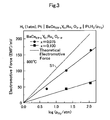
- Fig. 3 is a graph for illustrating the results of electromotive forces of a hydrogen concentration cell.
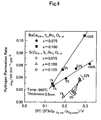
- Fig. 4 is a graph for illustrating relationships between electromotive force and hydrogen permeation rate.
- Fig. 5 is a graph for illustrating X-ray diffraction on a sample.
- a mixed proton-electron conducting ceramic according to the present invention is a metallic oxide having a perovskite type structure, and is one which includes at least one member selected from the group consisting of chromium (Cr), manganese (Mn), iron (Fe), cobalt (Co), nickel (Ni) and ruthenium (Ru) in a range of from 0.01 or more to 0.8 or less by molar ratio when a molar-ratio sum of metals constituting the metallic oxide is taken as 2, and which has proton conductivity and electron conductivity.
- Cr chromium
- Mn manganese
- Fe iron
- Co cobalt
- Ni nickel
- Ru ruthenium
- At least one element selected from the group consisting of chromium (Cr), manganese (Mn), iron (Fe), cobalt (Co), nickel (Ni) and ruthenium (Ru) (hereinafter might be referred to as a dopant element according to the present invention) is included in a range of from 0.01 or more to 0.8 or less by molar ratio.
- a molar ratio of the dopant element according to the present invention is too less, it is less likely to obtain electron conductivity in addition to objective proton conductivity.
- a molar ratio of the dopant element is too much, the other elements decrease relatively so that not only it is less likely to obtain objective proton conductivity and electron conductivity but also sinterability might degrade further or chemical stability and mechanical strength tends to degrade depending on service conditions.
- the dopant element according to the present invention it is possible to exemplify 0.01 or more, 0.015 or more, or 0.02 or more, by molar ratio, on the lower-limit side, further, it is possible to exemplify 0. 025 or more, or 0. 03 or more.
- the dopant element according to the present invention it is possible to exemplify 0.7 or less, 0.6 or less, or 0.5 or less, by molar ratio, on the upper-limit side combinable with the aforementioned lower limits, further, it is possible to exemplify 0.47 or less, 0.45 or less, or 0.43 or less, furthermore, it is possible to exemplify 0.4 or less, 0.35 or less, or 0.3 or less.
- the dopant element is ruthenium whose price is high, it is possible to exemplify 0.5 or less by molar ratio, considering industrial availableness in which cost is imperative. Moreover, when the dopant element is cobalt, iron, and the like, which are more cost-competitive than ruthenium, it is possible to exemplify 0.75 or less, or 0.8 or less, by molar ratio.
- a perovskite type structure is expressed by a general formula ABO 3 . It is possible to employ a mode which includes at least one member selected from the group consisting of chromium (Cr), manganese (Mn), iron (Fe), cobalt (Co), nickel (Ni) and ruthenium (Ru) in a range of from 0.01 or more to 0.8 or less by molar ratio when a sum of a molar ratio of the A-site element and a molar ratio of the B-site element is taken as 2.
- Cr chromium
- Mn manganese
- Fe iron
- Co cobalt
- Ni nickel
- Ru ruthenium
- At least one member selected from the group consisting of chromium (Cr), manganese (Mn), iron (Fe), cobalt (Co), nickel (Ni) and ruthenium (Ru) is a transition metal, and it can mainly function as a dopant to the B-site. By means of this, it is possible to let it give electron conductivity in addition to proton conductivity.
- both proton conductivity and electron conductivity being obtainable in a high-temperature region means that said ceramic has hydrogen permeability, as described later.
- the perovskite type structure is kept stably. Specifically, even when oxygen changes considerably, like deficiency and so on, in the general formula ABO 3 , the perovskite type structure is kept stably.
- the oxygen deficiency is expressed by ⁇ , and is a value which changes depending on the A-site element and the B-site element (including an element of B' and an element of B" described later) as well as constituent elements, the service temperatures and the oxygen partial pressure in atmosphere.
- the mixed proton-electron conducting ceramic can be metallic oxidation ceramic having a perovskite type structure expressed by a general formula ABO 3- ⁇ .
- a dopant element selected from the group consisting of chromium (Cr), manganese (Mn), iron (Fe), cobalt (Co), nickel (Ni) and ruthenium (Ru) in a range of from 0.01 or more to 0.8 or less by molar ratio when a sum of a molar ratio of the A-site element and a molar ratio of the B-site element is taken as 2 in the general formula ABO 3 .
- At least one member selected from the group consisting of chromium (Cr), manganese (Mn), iron (Fe), cobalt (Co), nickel (Ni) and ruthenium (Ru), it is possible to exemplify 0.01 or more, 0.015 or more, or 0.02 or more, by molar ratio, further, it is possible to exemplify 0.025 or more, or 0.03 or more.
- a dopant element that is, at least one member selected from the group consisting of chromium (Cr), manganese (Mn), iron (Fe), cobalt (Co), nickel (Ni) and ruthenium (Ru), it is possible to exemplify 0.7 or less, 0.6 or less, or 0.5 or less, by molar ratio, further, it is possible to exemplify 0.47 or less, or 0.45 or less, or 0.43 or less furthermore, it is possible to exemplify 0.4 or less, 0.35 or less, or 0.3 or less.
- Cr chromium
- Mn manganese
- Fe iron
- Co cobalt
- Ni nickel
- Ru ruthenium
- the sum of the A-site molar ratio and the B-site molar ratio is considered a datum, because the fact that, even if the proportion of the A-site molar ratio to the B-site molar ratio is changed more or less, when the sum is 2, both proton conductivity and electron conductivity are obtainable is taken into account.
- the value of (A-site molar ratio/B-site molar ratio) it can be within a range of 0.8-1.2. Alternatively, it can be within a range of 0.9-1.1, or within a range of 0.95-1.05.
- the mixed proton-electron conducting ceramic according to the present invention it is possible to employ a mode which includes zirconium (Zr) in a proportion of 0.005 or more, or 0.01 or more, by molar ratio, when a sum of molar ratios of metals constituting the metallic oxide is taken as 2, that is, when a sum of the A-site molar ratio and the B-site molar ratio is taken as 2.
- Zr zirconium
- Zirconium can function as the B-site element, and the zirconium content shall not surpass the B-site molar ratio.
- Zirconium is such that the mechanical strength improvement and chemical stability improvement of ceramic can be expected.
- a molar ratio of zirconium can be a proportion of 0.01 or more and 0.99 or less.
- a lower-limit-side molar ratio of zirconium it is possible to exemplify 0.012 or more, 0.015 or more, 0.02 or more, 0.025 or more, 0.03 or more, or 0.04 or more, according to needs.
- an upper-limit-side molar ratio of zirconium combinable with the aforementioned lower limits it is possible to exemplify 0.99 or less, 0.97 or less, 0.95 or less, 0.90 or less, 0.85 or less, 0.80 or less, or 0.7 or less, according to needs.
- High-temperature type proton conducting ceramic can be generally expressed with a composition of a chemical formula A 1+a B 1-a-b B' b O 3- ⁇ .
- the mixed proton-electron conducting ceramic according to the present invention can be expressed with a composition of a chemical formula A 1+a B 1-a-b-c B' b B" c O 3- ⁇ .
- the B-site element includes a B element in the aforementioned chemical formula, and additionally includes a B' element and a B" element.
- A can be at least one member selected from the group consisting of calcium (Ca), strontium (Sr) and barium (Ba). a satisfies a condition, 0.8 ⁇ (1+a)/(1-a) ⁇ 1.2.
- B can be at least one member selected from the group consisting of cerium (Ce), zirconium (Zr) and titanium (Ti).
- Ce cerium
- Zr zirconium
- Ti titanium
- Zr zirconium
- B' can be at least one member selected from the group consisting of aluminum (A1), scandium (Sc), gallium (Ga), yttrium (Y), indium (In) and an element which belongs to the lanthanide series and whose atomic number is 59-71.
- a lanthanide-series element it is possible to exemplify at least one member selected from the group consisting of praseodymium (Pr) with atomic number 59, neodymium (Nd) with atomic number 60, gadolinium (Gd) with atomic number 64, ytterbium (Yb) with atomic number 70, samarium (Sm) with atomic number 62, europium (Eu) with atomic number 63 and terbium (Tb) with atomic number 65.
- the B' element is one for mainly letting proton exist in said ceramic.
- the B' element mainly accomplishes a role of making an oxygen vacancy (a site in which no oxygen exists, though oxygen should be present) in crystal lattices.
- a range of b can be 0 or more and 0.5 or less. Note that, as for the lower limit of b, a molar ratio of the B' element, it is possible to exemplify 0.01, 0.05, 0.1, or 0.2, according to needs. As for the upper limit of b, it is possible to exemplify 0.48, 0.45, 0.4, 0.3, or 0.2, according to needs.
- B" can be at least one member, a transition metal, selected from the group consisting of chromium (Cr), manganese (Mn), iron (Fe), cobalt (Co), nickel (Ni) and ruthenium (Ru).
- the B" element is mainly effective for giving electron conductivity in addition to proton conductivity, and accordingly it is possible to demonstrate hydrogen permeability.
- a range of c, a molar ratio of the B" element can be 0.01 or more and 0.8 or less. Note that, as for the lower limit of c, it is possible to select it appropriately, and it is possible to exemplify 0.015, 0.02, or 0.05, according to needs.
- the mixed proton-electron conducting ceramic according to the present invention is a metallic oxide having a perovskite type structure.
- the catalytic metal layer it can be disposed on either one of the anode side and cathode side, or on both of them.
- the catalytic metal layer it can include at least one member selected from the group consisting of platinum, palladium, rhodium, silver and gold.
- the mixed proton-electron conducting ceramic according to the present invention it is possible to exemplify a mode in which an electrode layer for applying voltage is laminated on at least one of its front surface and rear surface.
- the reaction-activity facilitation in the electrode layer it can be shared with the catalytic metal layer, and can include at least one member selected from the group consisting of platinum, palladium, rhodium, silver and gold.
- its thickness is not limited in particular, but can be selected appropriately, like thin films, thick films, thick layers, and the like.
- a thickness of the mixed proton-electron conducting ceramic according to the present invention it depends on the composition, whether said ceramic is used independently, or whether said ceramic is turned into a thin-film shape and is then held on a support having gas permeability in a thin-film shape.
- the thickness it is possible to exemplify 0.1 ⁇ m, 0.5 ⁇ m, or 1 ⁇ m, as the lower limit, in general, as for the upper limit, it is possible to exemplify 10 mm, 20 mm, 40 mm, or the like. For instance, it is possible to exemplify 1-500 ⁇ m, 5-200 ⁇ m, or 10-100 ⁇ m. However, it is not limited to these at all.
- CVD chemical vapor deposition
- plasma thermal spraying method in which a raw material powder is melted instantaneously, using a thermal source by means of plasma, and is sprayed onto a substrate to form a coated film.
- the present example is directed to a barium-cerium-yttrium-ruthenium-oxygen-based metallic oxide. That is, it is directed to mixed proton-electron conducting ceramic expressed by a chemical formula, BaCe 0.9-x Y 0.1 R x O 3- ⁇ .
- the B element is cerium (Ce).
- the B' element is yttrium (Y), and the molar ratio b of the B' element is 0.1.
- Ruthenium is a transition metal which undergoes valence change with ease.
- B' and B" are those which substitute for the B-site element partially.
- the molar ratio of the oxygen deficient amount ⁇ it falls in a range of -0.5 or more and +0.5 or less, in general, however, it is not limited to this at all.
- the following respective powders barium carbonate (BaCO 3 , 99. 99% purity), cerium oxide (CeO 3 , 99.9% purity), yttrium oxide (Y 2 O 3 , 99.9% purity) and ruthenium oxide (RuO 3 , 99.9% purity), were used, as starting raw material powders. These starting raw material powders were weighed in predetermined proportions. The weighed starting raw materials were wet mixed in a mortar made of agate using ethanol, thereby forming a mixture powder. Thereafter, the ethanol was evaporated off from the mixture powder. The mixture powder was formed with a forming die (metallic die) by pressurizing, thereby forming a formed body.
- a forming die metallic die
- the formed body was calcined at 1,400 °C in air for 10 hours. Thereafter, the calcined formed body was pulverized in a mortar made of agate. Further, using ethanol as a dispersant, it was pulverized with a planetary ball mill made of zirconia (165 rpm) for 1-2 hours, thereby forming a powder. Thereafter, ethanol was evaporated by an infrared ray lamp in a draft, and the powder was dried in a 125 °C vacuum drying machine for a day or more. The thus obtained powder was formed with another forming die (metallic die), thereby obtaining a disk-shaped green compact.
- the compact was pressurized by a rubber pressing method with a hydrostatic pressure (pressurizing force: 300 MPa), thereby forming a pressurized body.
- the pressurized body was sintered by heating it to and held it at 1, 650 °C in an air atmosphere for 10 hours. Thus, a sample was formed.
- an electromotive force of a hydrogen concentration cell was measured, using an apparatus shown in Fig. 1.
- a disk-pelletized sample 10 whose diameter was about 13 mm and thickness was 0. 5 mm was used.
- a platinum paste was coated onto both opposite end surfaces of the sample 10, and was baked at 900 °C for 1 hour, and accordingly porous platinum layers 12 (porous catalytic metal layers) were formed on both opposite end surfaces of the sample 10.
- the sample 10 was held between an axial end 16a of a first ceramic pipe (alumina) 16 and an axial end 18a of a second ceramic pipe 18 (alumina) by way of ring-shaped seals 14 made of glass, as shown in Fig. 1.
- a first chamber 16d and a second chamber 18d whose partition wall was the sample 10 were formed.
- the first ceramic pipe 16 has a first gas inlet port 16b, a first gas outlet port 16c, and the first chamber 16d.
- a first gas supply pipe (alumina) 20 is placed in the first gas inlet port 16b.
- the second ceramic pipe 18 has a second gas inlet port 18b, a second gas outlet port 18c, and the second chamber 18d.
- a second gas supply pipe (alumina) 22 is placed in the second gas inlet port 18b.
- a heating unit 28 is disposed around the sample 10.
- a leakage test (temperature: 800 °C) for confirming that the sample 10 does not have mechanical gas permeability in the thickness-wise direction was carried out.
- argon was introduced into the second chamber 18d as a carrier gas, and simultaneously helium (pressure: 1 atm, 1 atm ⁇ 1,013 hPa) was introduced into the first chamber 16d, and outlet gases, which were discharged through the second gas outlet port 18c connected with the argon-side second chamber 18d, were checked by gas chromatography, thereby confirming that helium did not leak into said outlet gases.
- helium pressure: 1 atm, 1 atm ⁇ 1,013 hPa
- R represents the gas constant.
- T represents a temperature (K).
- F represents the Faraday constant.
- P H2 (anode) represents an anode-side (first chamber 16d) hydrogen partial pressure.
- P H2 (cathode) represents a cathode-side (second chamber 18d) hydrogen partial pressure.
- the pellet-shaped sample 10 (0.5 mm thickness and 13 mm diameter) was used, and simultaneously lead wires 24, 26 were electrically connected with the front and rear platinum layers 12 of the sample 10. Further, 1-atm hydrogen gas was introduced into the first chamber 16d side, the anode side, as a reference gas for the hydrogen concentration cell. A mixture gas, in which an argon gas and hydrogen were mixed in a predetermined ratio using a gas mixer, was introduced into the second chamber 18d, the cathode side. And, the hydrogen partial pressure in the cathode-side second chamber 18d was measured by gas chromatography. Regarding the generated electromotive force, an electromotive force was measured with an electrometer after confirming that the electromotive force became stabilized.
- Fig. 2 illustrates a concept that an electrolyte has electron conductivity in addition to having proton conductivity.
- an electrolyte a sample
- the reaction H 2 ⁇ 2H + + 2e -
- Fig. 3 illustrates the measurement results on the electromotive force of the hydrogen concentration cell (sample temperature: 800°C).
- the horizontal axis of Fig. 3 represents the logarithm of the cathode-side hydrogen partial pressure.
- the vertical axis of Fig. 3 represents the electromotive force.
- the characteristic line S1 represents the theoretical electromotive force calculated by the Nernst equation based on the hydrogen pressure difference in between the anode side and the cathode side.
- the mixed proton-electron conducting ceramic expressed by the chemical formula, BaCe 0.9-x Y 0.1 Ru x O 3- ⁇
- the mixed proton-electron conducting ceramic is expressed by a chemical formula, BaCe 0.8 Y 0.1 Ru 0.1 O 3- ⁇
- the mixed proton-electron conducting ceramic is expressed by a chemical formula, BaCe 0.825 Y 0.1 Ru 0.075 O 3- ⁇ .
- the electromotive force of the hydrogen concentration cell follows the theoretical electromotive force based on the Nernst equation.
- the electromotive force of the hydrogen concentration cell should be lower than the theoretical electromotive force based on the Nernst equation.
- a hydrogen permeation test was carried out. In this instance, no voltage was applied to the platinum layers 12. And, predetermined-partial-pressure hydrogen gases (pressures: 1 atm, 0.22 atm, 0.05 atm, and 0.01 atm) were introduced into the first chamber 16d, a hydrogen supply side (anode side), through the first gas supply pipe 20.
- the hydrogen gases supplied to the hydrogen supply side (anode side) are those in which water vapor was contained through a bubbler. The water vapor was contained in order to prevent the sample from being exposed to an excessive reducing atmosphere.
- argon containing water vapor was introduced into the second chamber 18d, a hydrogen-permeation side (cathode side), through the second gas supply pipe 22.
- V Vg ⁇ (c/100) ⁇ ⁇ (273.15 + 25) / (273.15 + T) ⁇ ⁇ (1/S) (ml ⁇ min -1 ⁇ cm -2 )
- Vg a flow volume (ml ⁇ min -1 ) of an outlet gas (carrier gas + generated hydrogen amount)
- T room temperature (°C)
- c represents a hydrogen concentration (%)
- S represents a hydrogen permeation area of a sample, that is, a projected area of the front-side platinum layer 12 and an area in which a hydrogen gas contacts with one of the opposite sides of the sample.
- the hydrogen concentration of the hydrogen gas introducing into the hydrogen supply side it was set at 1% (0.01 atm), 5% (0.05 atm), 22% (0.22 atm), and 100% (1 atm).
- the hydrogen concentration of the hydrogen gas introducing into the hydrogen supply side it was set at 1% (0.01 atm), 5% (0.05 atm), 22% (0.22 atm), and 100% (1 atm).
- Fig.4 illustrates the measurement results.
- the horizontal axis of Fig. 4 represents being equivalent to the electromotive force based on the Nernst equation.
- the vertical axis of Fig. 4 represents the hydrogen permeation rate per unit time ⁇ unit area.
- the hydrogen concentrations of hydrogen gas introduced into the hydrogen supply side are specified.
- the hydrogen permeation rate was 0. 02 ml ⁇ min -1 ⁇ cm -2 or more.
- a current density it is equivalent to about 15 mA/cm 2 .
- the respective characteristic lines shown in Fig. 4 have linearity, it is understood that the measurement plotted points are on straight lines.
- the plotted points being on the straight lines mean a hydrogen permeation phenomenon based on electrochemical permeation, that is, mixed proton-electron conductivity, not gas permeation (gas leakage) from the open pores of the sample.
- the hydrogen permeation rate should fundamentally be in proportion to the hydrogen partial pressure supplied to the anode side (when the hydrogen permeation amount is small).
- the hydrogen permeation rate when the hydrogen concentration of gas supplied to the anode side was at 1% was 1/3 approximately with respect to the hydrogen permeation rate in the case where the hydrogen gas whose hydrogen concentration was at 100% was used, as shown in the measurement results illustrated in Fig. 4. Therefore, the hydrogen permeation rate according to the present example results from electrochemical hydrogen permeation, not mechanical gas permeation based on the open pores of the sample. Note that it is confirmed by SEM observation that no open pores communicating in the thickness-wise direction of the sample are formed, as described above.
- the electric conductivity ⁇ was measured by an alternate-current two-terminal method.
- the measurement temperature was set at 800 °C, and it was measured in a hydrogen gas humidified by 17.0 °C saturated water vapor.
- Example No. 1 As aforementioned, in accordance with Example No. 1, it was possible to provide mixed proton-electron conducting ceramic which has both proton conductivity and electron conductivity, and which can permeate hydrogen.
- the stability of the mixed proton-electron conducting ceramic according to the present invention was examined.
- a sample formed of this ceramic was undergone exposure at a high temperature (800 °C) in a hydrogen atmosphere for 3 hours.
- X-ray diffraction patterns of the sample before and after exposing it to the hydrogen atmosphere (reducing atmosphere) were measured.
- Fig. 5 illustrates the measurement results. As shown in Fig.
- the mixed proton-electron conducting ceramic according to the present example is expressed by a chemical formula, SrZr 0.825 Y 0.1 Ru 0.075 O 3- ⁇ .
- SrZr 0.825 Y 0.1 Ru 0.075 O 3- ⁇ the mixed proton-electron conducting ceramic according to the present example is expressed by a chemical formula, SrZr 0.825 Y 0.1 Ru 0.075 O 3- ⁇ .
- the molar ratio of ruthenium is 0.075.
- the mixed proton-electron conducting ceramic is expressed by a chemical formula, SrZr 0.8 Y 0.1 Ru 0.1 O 3- ⁇ .
- the molar ratio of ruthenium is 0.100.
- the mixed proton-electron conducting ceramic is expressed by a chemical formula, SrZr 0.775 Y 0.1 Ru 0.125 O 3- ⁇ .
- a sum of the molar ratios of the metals constituting the ceramic is taken as 2, the molar ratio of ruthenium is 0.125.
- Example No. 2 the following respective powders, strontium carbonate (SrCO 3 , 99.99% purity), zirconium oxide (ZrO 2 , 99.9% purity), yttrium oxide (Y 2 O 3 , 99.9% purity) and ruthenium oxide (RuO 3 , 99.9% purity), were used, as starting raw material powders.
- a disk-shaped green compact was formed in the same procedures as the aforementioned example (calcination temperature: 1,350 °C, and calcination time: 10 hours) basically. Further, the green compact was pressurized by a rubber pressing method with a hydrostatic pressure (pressurizing force: 300 MPa), thereby forming a pressurized body. The pressurized body was sintered by heating it to and held it at 1,700°C in an air atmosphere for 10 hours. Thus, a sample was formed. The thickness of the sample was 0.5 mm, and the diameter was 13 mm.
- the hydrogen permeability was measured in the same manner as described above. In this instance, no voltage is applied to the platinum layers 12.
- the measurement results are illustrated in Fig. 4.
- the hydrogen permeation rate was about 0.035-0.040 ml ⁇ min -1 ⁇ cm -2 .
- the hydrogen permeation rate was about 0.01-0.02 ml ⁇ min -1 ⁇ cm -2 approximately.
- Example No. 2 it was possible to provide mixed proton-electron conducting ceramic which has both proton conductivity and electron conductivity, and which can permeate hydrogen.
- the mixed proton-electron conducting ceramic according to the present example is expressed by a chemical formula, SrCe 0.95 Ru 0.05 O 3- ⁇ .
- the molar ratio of ruthenium is 0.05.
- the mixed proton-electron conducting ceramic according to the present example is expressed by a chemical formula, SrCe 0.9 Ru 0.1 O 3- ⁇ .
- the molar ratio of ruthenium is 0.10.
- the mixed proton-electron conducting ceramic according to the present example is expressed by a chemical formula, SrCe 0.85 Ru 0.15 O 3- ⁇ .
- the molar ratio of ruthenium is 0.15.
- Example No. 3 the following respective powders, strontium carbonate (SrCO 3 , 99.99% purity), cerium oxide (CeO 2 , 99.9% purity) and ruthenium oxide (RuO 3 , 99.9% purity), were used, as starting raw material powders. And, a disk-shaped green compact was formed in the same procedures as the aforementioned example (calcination temperature: 1,200°C, and calcination time: 10 hours) basically. Further, the green compact was pressurized by a rubber pressing method with a hydrostatic pressure (pressurizing force: 200 MPa), thereby forming a pressurized body. The pressurized body was sintered by heating it to and held it at 1,550-1,600°C in an air atmosphere for 10 hours. Thus, a sample was formed. The thickness of the sample was adapted to 0.5 mm, and the diameter was adapted to 13 mm.
- the present invention is not one which is limited to the aforementioned examples alone, but is one which can be carried out by appropriately performing modifications within a range not deviating from the gist.
- the modes of the invention, the examples, the phrases set forth in the drawings, the data, and even a part of them, are those which can be set forth in the claims.
- the mixed proton-electron conducting ceramic according to the present invention has the mixed conductivity of proton together with electron, it can be utilized for hydrogen-permeating apparatuses, such as hydrogen permeation membranes. Further, by utilizing the mixed proton-electron conductivity, it can be utilized for membrane reactor vessels, which carry out hydrogen elimination and/or hydrogen addition.
Landscapes
- Chemical & Material Sciences (AREA)
- Engineering & Computer Science (AREA)
- Organic Chemistry (AREA)
- Materials Engineering (AREA)
- Manufacturing & Machinery (AREA)
- Ceramic Engineering (AREA)
- Chemical Kinetics & Catalysis (AREA)
- General Chemical & Material Sciences (AREA)
- Structural Engineering (AREA)
- Electrochemistry (AREA)
- Inorganic Chemistry (AREA)
- Combustion & Propulsion (AREA)
- Life Sciences & Earth Sciences (AREA)
- Sustainable Development (AREA)
- Sustainable Energy (AREA)
- Composite Materials (AREA)
- Physics & Mathematics (AREA)
- Spectroscopy & Molecular Physics (AREA)
- Conductive Materials (AREA)
- Fuel Cell (AREA)
- Compositions Of Oxide Ceramics (AREA)
- Separation Using Semi-Permeable Membranes (AREA)
Abstract
Description
Claims (6)
- Mixed proton-electron conducting ceramic being a metallic oxide having a perovskite type structure, the mixed proton-electron conducting ceramic being characterized in that it includes at least one member selected from the group consisting of chromium (Cr), manganese (Mn), iron (Fe), cobalt (Co), nickel (Ni) and ruthenium (Ru) in a range of from 0.01 or more to 0.8 or less by molar ratio when a molar-ratio sum of metals constituting the metallic oxide is taken as 2; and it has proton conductivity and electron conductivity.
- In claim 1, the mixed proton-electron conducting ceramic being characterized in that it has proton conductivity and electron conductivity being characterized in that it is expressed by a general formula ABO3; and the aforementioned sum is a sum of a molar ratio of the A-site element and a molar ratio of the B-site element.
- In claim 1 or claim 2, the mixed proton-electron conducting ceramic being characterized in that it further includes zirconium (Zr) in a proportion of 0.005 or more by molar ratio.
- In claim 3, the mixed proton-electron conducting ceramic being characterized in that it includes zirconium (Zr) in a proportion of 0.005 or more and 0.99 or less by molar ratio.
- In claim 1, the mixed proton-electron conducting ceramic being characterized in that it has a composition of a chemical formula A1+aB1-a-b-cB'bB"cO3-α : wherein
A: at least one member selected from the group consisting of calcium (Ca), strontium (Sr) and barium (Ba);
a satisfies a condition, 0.8 ≦ (1+a)/(1-a) ≦ 1.2;
B: at least one member selected from the group consisting of cerium (Ce), zirconium (Zr) and titanium (Ti);
B': at least one member selected from the group consisting of aluminum (A1), scandium (Sc), gallium (Ga), yttrium (Y), indium (In) and a metallic element which belongs to the lanthanide series and whose atomic number is 59-71;
a range of b is 0 or more and 0.5 or less;
B": at least one member selected from the group consisting of chromium (Cr), manganese (Mn), iron (Fe), cobalt (Co), nickel (Ni) and ruthenium (Ru); and
a range of c is 0.01 or more and 0.8 or less. - In claim 1, the mixed proton-electron conducting ceramic being characterized in that it has proton conductivity and electron conductivity in a state that no voltage is applied.
Applications Claiming Priority (1)
| Application Number | Priority Date | Filing Date | Title |
|---|---|---|---|
| PCT/JP2003/002008 WO2004074205A1 (en) | 2003-02-24 | 2003-02-24 | Proton-conductive and electron-conductive ceramic |
Publications (3)
| Publication Number | Publication Date |
|---|---|
| EP1598325A1 true EP1598325A1 (en) | 2005-11-23 |
| EP1598325A4 EP1598325A4 (en) | 2007-08-01 |
| EP1598325B1 EP1598325B1 (en) | 2014-04-09 |
Family
ID=32894260
Family Applications (1)
| Application Number | Title | Priority Date | Filing Date |
|---|---|---|---|
| EP03703365.1A Expired - Lifetime EP1598325B1 (en) | 2003-02-24 | 2003-02-24 | Proton-conductive and electron-conductive ceramic |
Country Status (4)
| Country | Link |
|---|---|
| US (1) | US20060157674A1 (en) |
| EP (1) | EP1598325B1 (en) |
| JP (1) | JP4330151B2 (en) |
| WO (1) | WO2004074205A1 (en) |
Cited By (4)
| Publication number | Priority date | Publication date | Assignee | Title |
|---|---|---|---|---|
| WO2008123484A1 (en) * | 2007-03-27 | 2008-10-16 | Toyota Jidosha Kabushiki Kaisha | Proton conductor, electrochemical cell and method of manufacturing proton conductor |
| EP1730749A4 (en) * | 2004-03-05 | 2008-12-03 | Ceramatec Inc | Ceramic mixed protonic/electronic conducting membranes for hydrogen separation |
| US8012380B2 (en) | 2004-03-05 | 2011-09-06 | Ceramatec, Inc. | Proton conducting ceramic membranes for hydrogen separation |
| DE112007000467B4 (en) * | 2006-02-28 | 2013-04-11 | Toyota Jidosha K.K. | Proton conducting electrolyte and electrochemical cell using the same |
Families Citing this family (7)
| Publication number | Priority date | Publication date | Assignee | Title |
|---|---|---|---|---|
| JP5138876B2 (en) * | 2005-07-19 | 2013-02-06 | 住友電気工業株式会社 | Oxide proton conductive membrane and hydrogen permeable structure including the same |
| JP5414143B2 (en) * | 2006-06-21 | 2014-02-12 | 出光興産株式会社 | Method for producing sulfide solid electrolyte |
| JP5091433B2 (en) * | 2006-06-29 | 2012-12-05 | 三井金属鉱業株式会社 | Solid oxide fuel cell and manufacturing method thereof |
| JP4882806B2 (en) * | 2007-03-07 | 2012-02-22 | トヨタ自動車株式会社 | Proton conducting electrolyte and electrochemical cell using the same |
| US8932781B2 (en) * | 2008-10-30 | 2015-01-13 | Georgia Tech Research Corporation | Chemical compositions, methods of making the chemical compositions, and structures made from the chemical compositions |
| JPWO2018123897A1 (en) * | 2016-12-27 | 2019-10-31 | 国立大学法人名古屋大学 | Composite material |
| CN114829003A (en) * | 2020-01-07 | 2022-07-29 | 株式会社村田制作所 | Hydrocarbon reforming catalyst and hydrocarbon reforming apparatus |
Family Cites Families (12)
| Publication number | Priority date | Publication date | Assignee | Title |
|---|---|---|---|---|
| JPS5738325A (en) * | 1980-08-15 | 1982-03-03 | Teijin Ltd | Metallic oxide composite body and separation of oxygen |
| JP3152789B2 (en) | 1993-02-26 | 2001-04-03 | 京セラ株式会社 | Conductive ceramics |
| DE4406276B4 (en) * | 1993-02-26 | 2007-10-11 | Kyocera Corp. | Electrically conductive ceramic material |
| US5821185A (en) * | 1994-01-14 | 1998-10-13 | Eltron Research, Inc. | Solid state proton and electron mediating membrane and use in catalytic membrane reactors |
| US6037514A (en) | 1994-01-14 | 2000-03-14 | Eltron Research, Inc. | Solid state proton and electron mediating membrane and use in catalytic membrane reactors |
| ID20211A (en) | 1997-04-29 | 1998-10-29 | Praxair Technology Inc | HYDROGEN PRODUCTION METHOD USING SOLID ELECTROLITE MEMBRANE |
| DE19744316C2 (en) * | 1997-10-08 | 2000-09-21 | Univ Karlsruhe | Oxygen sensitive resistance material |
| CA2298850A1 (en) | 1999-02-17 | 2000-08-17 | Matsushita Electric Industrial Co., Ltd. | Mixed ionic conductor and device using the same |
| JP4608047B2 (en) * | 1999-02-17 | 2011-01-05 | パナソニック株式会社 | Mixed ionic conductor and device using the same |
| EP1095914A3 (en) | 1999-10-25 | 2003-04-16 | Nippon Steel Corporation | Ceramic composition, composite material, composite material production method, porous body, oxygen separator, and chemical reactor |
| US6517693B2 (en) * | 2000-02-14 | 2003-02-11 | Matsushita Electric Industrial Co., Ltd. | Ion conductor |
| WO2003033431A1 (en) | 2001-10-15 | 2003-04-24 | Nippon Steel Corporation | Porcelain composition, composite material comprising catalyst and ceramic, film reactor, method for producing synthetic gas, apparatus for producing synthetic gas and method for activating catalyst |
-
2003
- 2003-02-24 WO PCT/JP2003/002008 patent/WO2004074205A1/en not_active Ceased
- 2003-02-24 JP JP2004568500A patent/JP4330151B2/en not_active Expired - Lifetime
- 2003-02-24 EP EP03703365.1A patent/EP1598325B1/en not_active Expired - Lifetime
- 2003-02-24 US US10/546,891 patent/US20060157674A1/en not_active Abandoned
Cited By (5)
| Publication number | Priority date | Publication date | Assignee | Title |
|---|---|---|---|---|
| EP1730749A4 (en) * | 2004-03-05 | 2008-12-03 | Ceramatec Inc | Ceramic mixed protonic/electronic conducting membranes for hydrogen separation |
| US8012380B2 (en) | 2004-03-05 | 2011-09-06 | Ceramatec, Inc. | Proton conducting ceramic membranes for hydrogen separation |
| DE112007000467B4 (en) * | 2006-02-28 | 2013-04-11 | Toyota Jidosha K.K. | Proton conducting electrolyte and electrochemical cell using the same |
| US8603699B2 (en) | 2006-02-28 | 2013-12-10 | Toyota Jidosha Kabushiki Kaisha | Proton conducting electrolyte and electrochemical cell using same |
| WO2008123484A1 (en) * | 2007-03-27 | 2008-10-16 | Toyota Jidosha Kabushiki Kaisha | Proton conductor, electrochemical cell and method of manufacturing proton conductor |
Also Published As
| Publication number | Publication date |
|---|---|
| EP1598325B1 (en) | 2014-04-09 |
| EP1598325A4 (en) | 2007-08-01 |
| JP4330151B2 (en) | 2009-09-16 |
| WO2004074205A1 (en) | 2004-09-02 |
| JPWO2004074205A1 (en) | 2006-06-01 |
| US20060157674A1 (en) | 2006-07-20 |
Similar Documents
| Publication | Publication Date | Title |
|---|---|---|
| US8932781B2 (en) | Chemical compositions, methods of making the chemical compositions, and structures made from the chemical compositions | |
| US5273628A (en) | Mixed ionic-electronic conductors for oxygen separation and electrocatalysis | |
| US20100015014A1 (en) | Mixed Ionic and Electronic Conducting Membrane | |
| Dippon et al. | Exploring electronic conduction through BaCexZr0. 9− xY0. 1O3− d proton-conducting ceramics | |
| Gür et al. | A new class of oxygen selective chemically driven nonporous ceramic membranes. Part I. A-site doped perovskites | |
| JP4583810B2 (en) | Proton conductive ceramics and method for producing the same | |
| Zhu et al. | A mixed electronic and protonic conducting hydrogen separation membrane with asymmetric structure | |
| EP1730327B1 (en) | Steam electrolysis | |
| Serra et al. | IT-SOFC supported on mixed oxygen ionic-electronic conducting composites | |
| US8337939B2 (en) | Method of processing a ceramic layer and related articles | |
| EP1598325B1 (en) | Proton-conductive and electron-conductive ceramic | |
| US20250046825A1 (en) | Electrode and Electrochemical Cell | |
| Wang et al. | Stability and oxygen permeation behavior of Ce0. 8Sm0. 2O2− δ–La0. 8Sr0. 2CrO3− δ composite membrane under large oxygen partial pressure gradients | |
| KR100354727B1 (en) | Solid electrolyte membrane with mechanically-enhancing and porous catalytically enhancing constituents | |
| CN100537470C (en) | Ion conductor | |
| Ramasamy et al. | Phase interaction and distribution in mixed ionic electronic conducting ceria‐spinel composites | |
| Jeon et al. | Oxygen permeation through dense La0. 1Sr0. 9Co0. 8Fe0. 2O3− δ perovskite membranes: Catalytic effect of porous La0. 1Sr0. 9Co0. 8Fe0. 2O3− δ layers | |
| JP2016016389A (en) | Oxygen permeable membrane and reformer | |
| JPWO2004074175A1 (en) | Hydrogen gas separator | |
| JP6986126B2 (en) | Oxygen permeable membrane, its manufacturing method, and reformer | |
| Radenahmad et al. | Electrochemical performance of a novel proton conducting electrolyte-based IT-SOFC | |
| Park et al. | The oxygen-permeation property of doped-zirconia membrane at high temperature and in reduced condition | |
| CN105580176A (en) | Compositions for anodes of fuel cells | |
| Kaleva et al. | Preparation and microstructure of ZrO2-and LaGaO3-based high-porosity ceramics | |
| HK40092151A (en) | Electrode and electrochemical cell |
Legal Events
| Date | Code | Title | Description |
|---|---|---|---|
| PUAI | Public reference made under article 153(3) epc to a published international application that has entered the european phase |
Free format text: ORIGINAL CODE: 0009012 |
|
| 17P | Request for examination filed |
Effective date: 20050923 |
|
| AK | Designated contracting states |
Kind code of ref document: A1 Designated state(s): AT BE BG CH CY CZ DE DK EE ES FI FR GB GR HU IE IT LI LU MC NL PT SE SI SK TR |
|
| AX | Request for extension of the european patent |
Extension state: AL LT LV MK RO |
|
| DAX | Request for extension of the european patent (deleted) | ||
| RAP1 | Party data changed (applicant data changed or rights of an application transferred) |
Owner name: TYK CORPORATION |
|
| A4 | Supplementary search report drawn up and despatched |
Effective date: 20070629 |
|
| RIC1 | Information provided on ipc code assigned before grant |
Ipc: C04B 35/48 20060101ALI20070626BHEP Ipc: C04B 35/50 20060101ALI20070626BHEP Ipc: C04B 35/01 20060101AFI20040907BHEP |
|
| 17Q | First examination report despatched |
Effective date: 20120329 |
|
| GRAP | Despatch of communication of intention to grant a patent |
Free format text: ORIGINAL CODE: EPIDOSNIGR1 |
|
| INTG | Intention to grant announced |
Effective date: 20130918 |
|
| GRAS | Grant fee paid |
Free format text: ORIGINAL CODE: EPIDOSNIGR3 |
|
| GRAA | (expected) grant |
Free format text: ORIGINAL CODE: 0009210 |
|
| AK | Designated contracting states |
Kind code of ref document: B1 Designated state(s): DE FR GB |
|
| RBV | Designated contracting states (corrected) |
Designated state(s): DE FR GB |
|
| REG | Reference to a national code |
Ref country code: GB Ref legal event code: FG4D |
|
| REG | Reference to a national code |
Ref country code: DE Ref legal event code: R096 Ref document number: 60345972 Country of ref document: DE Effective date: 20140522 |
|
| REG | Reference to a national code |
Ref country code: DE Ref legal event code: R097 Ref document number: 60345972 Country of ref document: DE |
|
| PLBE | No opposition filed within time limit |
Free format text: ORIGINAL CODE: 0009261 |
|
| STAA | Information on the status of an ep patent application or granted ep patent |
Free format text: STATUS: NO OPPOSITION FILED WITHIN TIME LIMIT |
|
| 26N | No opposition filed |
Effective date: 20150112 |
|
| REG | Reference to a national code |
Ref country code: DE Ref legal event code: R097 Ref document number: 60345972 Country of ref document: DE Effective date: 20150112 |
|
| REG | Reference to a national code |
Ref country code: FR Ref legal event code: PLFP Year of fee payment: 14 |
|
| REG | Reference to a national code |
Ref country code: FR Ref legal event code: PLFP Year of fee payment: 15 |
|
| PGFP | Annual fee paid to national office [announced via postgrant information from national office to epo] |
Ref country code: FR Payment date: 20170220 Year of fee payment: 15 Ref country code: DE Payment date: 20170227 Year of fee payment: 15 |
|
| PGFP | Annual fee paid to national office [announced via postgrant information from national office to epo] |
Ref country code: GB Payment date: 20170221 Year of fee payment: 15 |
|
| REG | Reference to a national code |
Ref country code: DE Ref legal event code: R119 Ref document number: 60345972 Country of ref document: DE |
|
| GBPC | Gb: european patent ceased through non-payment of renewal fee |
Effective date: 20180224 |
|
| REG | Reference to a national code |
Ref country code: FR Ref legal event code: ST Effective date: 20181031 |
|
| PG25 | Lapsed in a contracting state [announced via postgrant information from national office to epo] |
Ref country code: DE Free format text: LAPSE BECAUSE OF NON-PAYMENT OF DUE FEES Effective date: 20180901 |
|
| PG25 | Lapsed in a contracting state [announced via postgrant information from national office to epo] |
Ref country code: GB Free format text: LAPSE BECAUSE OF NON-PAYMENT OF DUE FEES Effective date: 20180224 Ref country code: FR Free format text: LAPSE BECAUSE OF NON-PAYMENT OF DUE FEES Effective date: 20180228 |