EP1598278A1 - Collapsible folded box - Google Patents
Collapsible folded box Download PDFInfo
- Publication number
- EP1598278A1 EP1598278A1 EP04425358A EP04425358A EP1598278A1 EP 1598278 A1 EP1598278 A1 EP 1598278A1 EP 04425358 A EP04425358 A EP 04425358A EP 04425358 A EP04425358 A EP 04425358A EP 1598278 A1 EP1598278 A1 EP 1598278A1
- Authority
- EP
- European Patent Office
- Prior art keywords
- container
- blank
- walls
- bottom wall
- lateral walls
- Prior art date
- Legal status (The legal status is an assumption and is not a legal conclusion. Google has not performed a legal analysis and makes no representation as to the accuracy of the status listed.)
- Withdrawn
Links
- 230000002787 reinforcement Effects 0.000 claims description 17
- 239000000463 material Substances 0.000 claims description 8
- 239000004743 Polypropylene Substances 0.000 claims description 4
- 230000001413 cellular effect Effects 0.000 claims description 4
- -1 polypropylene Polymers 0.000 claims description 4
- 229920001155 polypropylene Polymers 0.000 claims description 4
- 239000004033 plastic Substances 0.000 description 4
- 238000003466 welding Methods 0.000 description 2
- 238000004026 adhesive bonding Methods 0.000 description 1
- 230000015572 biosynthetic process Effects 0.000 description 1
- 238000010276 construction Methods 0.000 description 1
- 230000006378 damage Effects 0.000 description 1
- 235000013399 edible fruits Nutrition 0.000 description 1
- 235000012055 fruits and vegetables Nutrition 0.000 description 1
- 230000037431 insertion Effects 0.000 description 1
- 238000003780 insertion Methods 0.000 description 1
- 238000004519 manufacturing process Methods 0.000 description 1
- 238000004806 packaging method and process Methods 0.000 description 1
- 239000000123 paper Substances 0.000 description 1
- 239000002985 plastic film Substances 0.000 description 1
- 235000013311 vegetables Nutrition 0.000 description 1
Images

Classifications
-
- B—PERFORMING OPERATIONS; TRANSPORTING
- B65—CONVEYING; PACKING; STORING; HANDLING THIN OR FILAMENTARY MATERIAL
- B65D—CONTAINERS FOR STORAGE OR TRANSPORT OF ARTICLES OR MATERIALS, e.g. BAGS, BARRELS, BOTTLES, BOXES, CANS, CARTONS, CRATES, DRUMS, JARS, TANKS, HOPPERS, FORWARDING CONTAINERS; ACCESSORIES, CLOSURES, OR FITTINGS THEREFOR; PACKAGING ELEMENTS; PACKAGES
- B65D5/00—Rigid or semi-rigid containers of polygonal cross-section, e.g. boxes, cartons or trays, formed by folding or erecting one or more blanks made of paper
- B65D5/42—Details of containers or of foldable or erectable container blanks
- B65D5/44—Integral, inserted or attached portions forming internal or external fittings
- B65D5/46—Handles
- B65D5/46008—Handles formed separately from the container body
- B65D5/46024—Straps used as handles with anchoring elements fixed in slots
-
- B—PERFORMING OPERATIONS; TRANSPORTING
- B65—CONVEYING; PACKING; STORING; HANDLING THIN OR FILAMENTARY MATERIAL
- B65D—CONTAINERS FOR STORAGE OR TRANSPORT OF ARTICLES OR MATERIALS, e.g. BAGS, BARRELS, BOTTLES, BOXES, CANS, CARTONS, CRATES, DRUMS, JARS, TANKS, HOPPERS, FORWARDING CONTAINERS; ACCESSORIES, CLOSURES, OR FITTINGS THEREFOR; PACKAGING ELEMENTS; PACKAGES
- B65D5/00—Rigid or semi-rigid containers of polygonal cross-section, e.g. boxes, cartons or trays, formed by folding or erecting one or more blanks made of paper
- B65D5/36—Rigid or semi-rigid containers of polygonal cross-section, e.g. boxes, cartons or trays, formed by folding or erecting one or more blanks made of paper specially constructed to allow collapsing and re-erecting without disengagement of side or bottom connections
-
- B—PERFORMING OPERATIONS; TRANSPORTING
- B65—CONVEYING; PACKING; STORING; HANDLING THIN OR FILAMENTARY MATERIAL
- B65D—CONTAINERS FOR STORAGE OR TRANSPORT OF ARTICLES OR MATERIALS, e.g. BAGS, BARRELS, BOTTLES, BOXES, CANS, CARTONS, CRATES, DRUMS, JARS, TANKS, HOPPERS, FORWARDING CONTAINERS; ACCESSORIES, CLOSURES, OR FITTINGS THEREFOR; PACKAGING ELEMENTS; PACKAGES
- B65D5/00—Rigid or semi-rigid containers of polygonal cross-section, e.g. boxes, cartons or trays, formed by folding or erecting one or more blanks made of paper
- B65D5/36—Rigid or semi-rigid containers of polygonal cross-section, e.g. boxes, cartons or trays, formed by folding or erecting one or more blanks made of paper specially constructed to allow collapsing and re-erecting without disengagement of side or bottom connections
- B65D5/3607—Rigid or semi-rigid containers of polygonal cross-section, e.g. boxes, cartons or trays, formed by folding or erecting one or more blanks made of paper specially constructed to allow collapsing and re-erecting without disengagement of side or bottom connections formed by folding or erecting a single blank
- B65D5/3635—Rigid or semi-rigid containers of polygonal cross-section, e.g. boxes, cartons or trays, formed by folding or erecting one or more blanks made of paper specially constructed to allow collapsing and re-erecting without disengagement of side or bottom connections formed by folding or erecting a single blank by folding-up portions connected to a central panel from all sides to form a container body
- B65D5/3678—Rigid or semi-rigid containers of polygonal cross-section, e.g. boxes, cartons or trays, formed by folding or erecting one or more blanks made of paper specially constructed to allow collapsing and re-erecting without disengagement of side or bottom connections formed by folding or erecting a single blank by folding-up portions connected to a central panel from all sides to form a container body collapsed along median lines of two opposite sides and the central panel
-
- B—PERFORMING OPERATIONS; TRANSPORTING
- B65—CONVEYING; PACKING; STORING; HANDLING THIN OR FILAMENTARY MATERIAL
- B65D—CONTAINERS FOR STORAGE OR TRANSPORT OF ARTICLES OR MATERIALS, e.g. BAGS, BARRELS, BOTTLES, BOXES, CANS, CARTONS, CRATES, DRUMS, JARS, TANKS, HOPPERS, FORWARDING CONTAINERS; ACCESSORIES, CLOSURES, OR FITTINGS THEREFOR; PACKAGING ELEMENTS; PACKAGES
- B65D5/00—Rigid or semi-rigid containers of polygonal cross-section, e.g. boxes, cartons or trays, formed by folding or erecting one or more blanks made of paper
- B65D5/42—Details of containers or of foldable or erectable container blanks
- B65D5/44—Integral, inserted or attached portions forming internal or external fittings
- B65D5/441—Reinforcements
- B65D5/443—Integral reinforcements, e.g. folds, flaps
-
- B—PERFORMING OPERATIONS; TRANSPORTING
- B65—CONVEYING; PACKING; STORING; HANDLING THIN OR FILAMENTARY MATERIAL
- B65D—CONTAINERS FOR STORAGE OR TRANSPORT OF ARTICLES OR MATERIALS, e.g. BAGS, BARRELS, BOTTLES, BOXES, CANS, CARTONS, CRATES, DRUMS, JARS, TANKS, HOPPERS, FORWARDING CONTAINERS; ACCESSORIES, CLOSURES, OR FITTINGS THEREFOR; PACKAGING ELEMENTS; PACKAGES
- B65D5/00—Rigid or semi-rigid containers of polygonal cross-section, e.g. boxes, cartons or trays, formed by folding or erecting one or more blanks made of paper
- B65D5/42—Details of containers or of foldable or erectable container blanks
- B65D5/44—Integral, inserted or attached portions forming internal or external fittings
- B65D5/46—Handles
- B65D5/46072—Handles integral with the container
- B65D5/4608—Handgrip holes
Definitions
- the container of the invention is usefully applied in particular, but not only, for containing foodstuffs and the like; given its characteristics, the container is suitable for use both domestically and commercially.
- Soft bags however exhibit the typical drawbacks of non-rigid containers: for example, they do not offer adequate protection to the products they contain, especially if these products, for example fruit or vegetables, are easily perishable. Bags do not enable perishables to be stacked tidily therein, and they also do not afford easy access to their contents. Also, they have the drawback of being fairly unstable when placed on chairs or in the boot of a vehicle, and break easily when the products contained therein are bulky.
- the main aim of the present invention is to provide a container which is reusable, which solves the problems exhibits by flexible containers and which occupies a limited space when not in use.
- An advantage of the invention is that it provides a container which is easy and economical to realise, despatch and stock.
- a further advantage of the invention is that it provides, when needed, a big space for containing goods.
- a further advantage of the invention is that it provides a container which is easily transportable by hand by a user.
- the container 2 of the invention is realised from a blank 1 which is flat and made of a cardboard sheet, covered in plastic, or a plastic sheet or other materials, of known type and suitable for the purpose.
- a sheet of cellular polypropylene is used, as this type of material, apart from being considerably flexible and resistant, can be easily heat-welded with considerable advantages both during construction of the container and, as will better emerge herein below, during the phases of its use and re-use.
- cellular polypropylene sheets are used which have a thickness comprised between 5 and 8 millimetres.
- the container has a parallelpiped shape which is superiorly open and defined by a bottom wall 50 and lateral walls 51, 52, 53, 54 and 55 of rectangular shape.
- all the walls are of the same height and opposite walls 53 and 54 (long walls) are longer than opposite walls 51 and 52 (short walls).
- the external dimensions of the container can be various; a preferred embodiment is a parallelepiped container of size 50x30x25 cm, but this is in no way a constraint on size.
- the scored blank 1 comprises external cut-lines which define the shape of the flat blank.
- the blank also includes scored fold-lines 11, 12, 13, 14, along which the blank is folded when the container is to be assembled, so that is assumes the parallelpiped shape of the container.
- the internal fold lines connect a part of the blank destined to define the bottom wall 50 of the container with the parts of the blank that are destined to define the four lateral walls 51, 52, 53, 54.
- the blank 1 comprises four connection flaps 61, 62, 63, 64, each of which is connected to one of the sides of the opposite two lateral walls 51 and 52, precisely to the short walls of the blank 1, i.e. it is made together with the same lateral wall from which it is divided by a fold line.
- connection flaps 61, 62, 63, 64 are folded on the adjacent side of the remaining lateral walls 52 and 54, to which they are solidly connected in order to obtain a parallelepiped shape which is no longer openable.
- This type of connection flap which can obviously be alternatively connected to the long walls of the blank 1, are in common use in blanks 1 used for making parallelepiped packaging.
- the blank 1 further comprises four reinforcement flaps 41, 42, 43, 44, each of which is connected to one of the lateral walls 51, 52, 53 and 54 on the opposite side to the side in which each lateral wall is connected to the bottom wall 50, i.e. on the upper free side of each lateral wall.
- each reinforcement flap is made on the same lateral wall from which it is separated by a fold line.
- each reinforcement flap is folded and solidly connected as a reinforcement on the external edge of the relative lateral wall.
- the blank 1 also comprises a halfway fold line 3 which crosses the whole blank 1 in the direction of the larger side of the bottom wall 50.
- the blank 1 also comprises four fold lines 31, 32, 33, 34 which are inclined by 45° and which each depart from a corner of the bottom wall 50 and terminate at the halfway fold line 3. These inclined fold lines 31, 32, 33, 34 intersect the halfway fold line 3 at a distance from the side of the bottom wall 50 which is equal to half the length of the lateral wall connected to the side. In figure 1 these fold lines, which are normal fold lines, have been evidenced using a thicker line to distinguish them from the others.
- the container further comprises means for gripping, of known type, which have the function of enabling the container to be easily lifted.
- the means for gripping are connected to the container or are afforded therein in proximity of reinforcements exhibited on the external side of each lateral wall.
- At least a pair of slots are afforded in the opposite lateral walls 53 and 54; preferably two pairs of slots are afforded, respectively 71a, 71b, 72a, 72b.
- Each slot is afforded, on the relative lateral wall, at a distance from the free edge of the lateral wall (i.e. from the opposite edge to the edge connected to the bottom wall 50) which is at least equal to the width of the relative reinforcement flap 43, 44; the slots of each pair of slots are basically cuts made parallel to the fold line 3 and are preferably afforded in a straight direction which is perpendicular to the fold line 3.
- Each pair of slots is equipped with a handle, respectively 71 and 72, which is realised with a ribbon of flexible material; after the formation of the container, each of the ends of a handle is threaded into a slot and is folded upon itself so that it is wound around the reinforcement located superiorly of the slot.
- a plastic material is used in order that the folded edges of the belt can be welded by heat-welding, thus fixing the ribbon about the reinforcement.
- the lateral short walls 51 and 52 afford a pair of openings 73 and 74 cut into the walls with a closed cut line, the parts defined internally of the wall being thrown away.
- the dimensions of these openings are such as to enable the fingers of hands to be inserted into them.
- the openings 73 and 74 are made at a distance from the upper edge of the wall (i.e. the opposite edge to the edge connected to the bottom wall 50) which is at least equal to the width of the relative reinforcement flap 41 and 42.
- a parallelpiped container 2 is formed with an open top, suitable for containing a considerable quantity of goods which are protected by the rigid walls of the container.
- the container can be easily gripped either by insertion of the hands into the slots 73 and 74, or by gripping the handles 71 and 72.
- the container completely and stably formed, can however be compacted down to reduce its overall volume if, for example, it is to be transported or stocked.
- the first phase of which is illustrated in figure 3 it is sufficient to exert a slight pressure from outside on the bottom wall 50 and the short lateral walls.
- the short walls will fold inwardly along the fold line 3, while the fold lines 31, 32, 33 and 34 will fold towards the inside, creating, on the bottom wall 50, two opposite recesses internally of which the lateral walls 51 and 52 fold and fall.
- the handles 71 and 72 can easily be contained internally of the folded container.
- the folded container assumes a volume which is a parallelepiped, with the base thereof equal to a long lateral wall, having a thickness which is about the same as four times the thickness of the sheet of material the blank is made of.
- the thickness of the compacted container is about 2.5 or 3 centimetres, compared with the open container size of about 20-30 cm; the compacted container is therefore reduced tenfold in size. Obviously these proportions vary according to the thickness of the blank sheet used and the external dimensions which are required for the container.
- the main if not the only use of the container is to replace and improve on the "classic" plastic shopping bag usually provided by supermarkets and used for shopping.
- the user receives a container which has the functionality of a box, and even has handles for its transportation. Once used, the container, differently to a normal box, be compacted down and stored, having a very small volume.
- Another considerable advantage is that the bottom of the container is formed by a single element, and not parts which are glued together or jointed. The bottom is also connected to the external walls without any gluing, which makes the whole container more sturdy as breakages in its lower parts are unlikely.
- the material preferably used i.e. cellular polypropylene, has advantages during the making of the box but is also notably resistant even after much folding, so it is possible to refold it many times along lines 3, 31, 32, 33, 34, which therefore behave like as series of hinges which the walls or container parts are rotated.
- the box can therefore be used many times over, without the material used in its manufacture breaking or getting damaged.
Landscapes
- Engineering & Computer Science (AREA)
- Mechanical Engineering (AREA)
- Cartons (AREA)
Abstract
The container is realised from a flat blank (1) which comprises external cut
lines which define the shape thereof, and internal fold lines (11,12, 13, 14)
which connect a rectangular bottom wall (50) of the container with four lateral
walls (51, 52, 53, 54) thereof, and which can be folded to bring the blank (1)
into a box shape. A halfway fold line (3) wholly crosses the blank across a
larger dimension of the bottom wall (50) thereof, and four fold lines (31, 32,
33, 34), inclined by 45°, each depart from a corner of the bottom wall (50) and
terminate on the halfway fold line (50).
Description
- The container of the invention is usefully applied in particular, but not only, for containing foodstuffs and the like; given its characteristics, the container is suitable for use both domestically and commercially.
- For the transport and exposition of foodstuffs, in particular perishables such as fruit and vegetables, wooden crates are often used, as are cardboard boxes, though less regularly because once emptied they are quite space-consuming and are frequently sent off for destruction. This happens especially when the boxes arrive at the final consumer, who does not use them because he or she prefers the usual and well known containers constituted by paper or plastic bags, or canvas bags. Very often, in fact, because of their mass and the rarity of their being re-used, the consumer prefers to leave the box which originally contained the goods at the retailer's, preferring to carry the goods home in the above-mentioned bags. This choice is because bags once emptied are extremely small, i.e. there is a significant difference between their sizes when full and when empty.
- Soft bags however exhibit the typical drawbacks of non-rigid containers: for example, they do not offer adequate protection to the products they contain, especially if these products, for example fruit or vegetables, are easily perishable. Bags do not enable perishables to be stacked tidily therein, and they also do not afford easy access to their contents. Also, they have the drawback of being fairly unstable when placed on chairs or in the boot of a vehicle, and break easily when the products contained therein are bulky.
- The main aim of the present invention is to provide a container which is reusable, which solves the problems exhibits by flexible containers and which occupies a limited space when not in use.
- An advantage of the invention is that it provides a container which is easy and economical to realise, despatch and stock.
- A further advantage of the invention is that it provides, when needed, a big space for containing goods.
- A further advantage of the invention is that it provides a container which is easily transportable by hand by a user.
- These aims and more besides are all attained by the invention as it is characterised in the appended claims.
- Further characteristics and advantages of the present invention will better emerge from the detailed description that follows of a preferred but non-exclusive embodiment of the invention, illustrated purely by way of nonlimiting example in the accompanying figures of the drawings, in which:
- figure 1 is a plan view of a scored blank from which the container is composed;
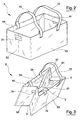
- figure 2 is a perspective view of the container in an open configuration;
- figure 3 is a perspective view of the container in a partially folded configuration.
-
- The
container 2 of the invention is realised from a blank 1 which is flat and made of a cardboard sheet, covered in plastic, or a plastic sheet or other materials, of known type and suitable for the purpose. In particular in the preferred embodiment a sheet of cellular polypropylene is used, as this type of material, apart from being considerably flexible and resistant, can be easily heat-welded with considerable advantages both during construction of the container and, as will better emerge herein below, during the phases of its use and re-use. Normally, though not exclusively, cellular polypropylene sheets are used which have a thickness comprised between 5 and 8 millimetres. - Once formed, the container has a parallelpiped shape which is superiorly open and defined by a
bottom wall 50 andlateral walls opposite walls 53 and 54 (long walls) are longer thanopposite walls 51 and 52 (short walls). - The external dimensions of the container can be various; a preferred embodiment is a parallelepiped container of size 50x30x25 cm, but this is in no way a constraint on size.
- The scored blank 1 comprises external cut-lines which define the shape of the flat blank. The blank also includes scored fold-
lines bottom wall 50 of the container with the parts of the blank that are destined to define the fourlateral walls - The blank 1 comprises four
connection flaps lateral walls lateral walls - The blank 1 further comprises four
reinforcement flaps lateral walls bottom wall 50, i.e. on the upper free side of each lateral wall. In this case too each reinforcement flap is made on the same lateral wall from which it is separated by a fold line. - When the container is formed each reinforcement flap is folded and solidly connected as a reinforcement on the external edge of the relative lateral wall. The blank 1 also comprises a
halfway fold line 3 which crosses the whole blank 1 in the direction of the larger side of thebottom wall 50. The blank 1 also comprises fourfold lines bottom wall 50 and terminate at thehalfway fold line 3. Theseinclined fold lines halfway fold line 3 at a distance from the side of thebottom wall 50 which is equal to half the length of the lateral wall connected to the side. In figure 1 these fold lines, which are normal fold lines, have been evidenced using a thicker line to distinguish them from the others. - The container further comprises means for gripping, of known type, which have the function of enabling the container to be easily lifted. The means for gripping are connected to the container or are afforded therein in proximity of reinforcements exhibited on the external side of each lateral wall.
- In particular, to realise a type of means for gripping, at least a pair of slots are afforded in the opposite
lateral walls relative reinforcement flap fold line 3 and are preferably afforded in a straight direction which is perpendicular to thefold line 3. - Each pair of slots is equipped with a handle, respectively 71 and 72, which is realised with a ribbon of flexible material; after the formation of the container, each of the ends of a handle is threaded into a slot and is folded upon itself so that it is wound around the reinforcement located superiorly of the slot. For realising the handles, preferably a plastic material is used in order that the folded edges of the belt can be welded by heat-welding, thus fixing the ribbon about the reinforcement. Thus by gripping the container by the
handles 71 and 72 and lifting it, the weight of the container is unloaded onto the reinforced zone of the wall, considerably reducing the danger of breakage of the edge of the walls. - To realise another type of means for gripping, the lateral
short walls openings openings relative reinforcement flap openings - Once the blank 1 has been realised, for example as illustrated in figure 1, the
fold lines handles 71 and 72 are threaded into the relative slots and the superposed ends are welded to the ribbon so as to wrap around the edge of the wall. Thus aparallelpiped container 2 is formed with an open top, suitable for containing a considerable quantity of goods which are protected by the rigid walls of the container. The container can be easily gripped either by insertion of the hands into theslots handles 71 and 72. - The container, completely and stably formed, can however be compacted down to reduce its overall volume if, for example, it is to be transported or stocked. To do this, the first phase of which is illustrated in figure 3, it is sufficient to exert a slight pressure from outside on the
bottom wall 50 and the short lateral walls. The short walls will fold inwardly along thefold line 3, while thefold lines bottom wall 50, two opposite recesses internally of which thelateral walls handles 71 and 72 can easily be contained internally of the folded container. - In this way, the folded container assumes a volume which is a parallelepiped, with the base thereof equal to a long lateral wall, having a thickness which is about the same as four times the thickness of the sheet of material the blank is made of. The thickness of the compacted container is about 2.5 or 3 centimetres, compared with the open container size of about 20-30 cm; the compacted container is therefore reduced tenfold in size. Obviously these proportions vary according to the thickness of the blank sheet used and the external dimensions which are required for the container.
- The main if not the only use of the container is to replace and improve on the "classic" plastic shopping bag usually provided by supermarkets and used for shopping. The user receives a container which has the functionality of a box, and even has handles for its transportation. Once used, the container, differently to a normal box, be compacted down and stored, having a very small volume. Another considerable advantage is that the bottom of the container is formed by a single element, and not parts which are glued together or jointed. The bottom is also connected to the external walls without any gluing, which makes the whole container more sturdy as breakages in its lower parts are unlikely.
- The material preferably used, i.e. cellular polypropylene, has advantages during the making of the box but is also notably resistant even after much folding, so it is possible to refold it many times along
lines
Claims (7)
- A container with foldable rigid walls, of a type made using a flat blank (1) comprising: external cut lines defining an unfolded shape of the blank (1); internal fold lines (11, 12, 13, 14) which connect a part of the blank (1), destined to define a rectangular bottom wall (50) of the container (2), respectively with parts of the blank (1) destined to defme four lateral walls (51, 52, 53, 54) of the container (2), which four lateral walls (51, 52, 53, 54) are foldable to form the container (2) from the blank (1), characterised in that it comprises: a halfway fold line (3) which crosses the whole blank (1) in a direction corresponding to a larger dimension of the bottom wall (50); it comprises four fold lines (31, 32, 33, 34) inclined by 45°, each of which departs from a corner of the bottom wall (50) and terminates on the halfway fold line (3).
- The container of claim 1, characterised in that: the blank (1) comprises four reinforcement flaps (41, 42, 43, 44), each of which is connected to one of the lateral walls (51, 52, 53, 54) on an opposite side of the lateral walls (51, 52, 53, 54) to a side at which each of the lateral walls (51, 52, 53, 54) is connected to the bottom wall (50); on forming the container the reinforcement flaps (41, 42, 43, 44) are folded and solidly connected as a reinforcement on a relative lateral wall (51, 52, 53, 54); the container comprising means for gripping of known type and connected to the container in proximity of the reinforcement flaps (41, 42, 43, 44), which means for gripping enable the container to be lifted with ease.
- The container of claim 1, characterised in that the blank (1) comprises four connection flaps (61, 62, 63, 64), each of which is connected to one side of two opposite walls of the lateral walls (51 and 52), each of which connection flaps (61, 62, 63, 64) folds onto a side which is adjacent thereto of remaining lateral walls (53 and 54), and is solidly connected thereto.
- The container of claim 2, characterised in that the means for gripping comprise: at least a pair of slots (71a, 71b and 72a, 72b), each of which is afforded in one of two of the opposite lateral walls (53 and 54) at a distance from the edge of a lateral wall which is opposite to an edge thereof connected to the bottom wall (50), which distance is at least equal to a width of the relative reinforcement flap (43, 44); at least one handle (71, 72), made with a ribbon of flexible material having ends thereof each threaded in a slot of the pair of slots and folded around the reinforcement, meeting the relative ribbon after threading and wrapping around the reinforcement.
- The container of claim 2, characterised in that the means for gripping comprise at least a pair of apertures (73 and 74), each afforded in one of two opposite lateral walls (51 and 52), at a distance from an edge of the lateral wall (51 and 52) which edge is opposite an edge thereof connected to the bottom wall (50), which distance is at least equal to a width of a relative reinforcement flap (41, 42).
- The container of claim 1, characterised in that the blank (1) is made from a sheet of cellular polypropylene.
- The container of claim 1, characterised in that the walls of the container are rectangular and define a parallelepiped container which is superiorly open.
Priority Applications (1)
| Application Number | Priority Date | Filing Date | Title |
|---|---|---|---|
| EP04425358A EP1598278A1 (en) | 2004-05-19 | 2004-05-19 | Collapsible folded box |
Applications Claiming Priority (1)
| Application Number | Priority Date | Filing Date | Title |
|---|---|---|---|
| EP04425358A EP1598278A1 (en) | 2004-05-19 | 2004-05-19 | Collapsible folded box |
Publications (1)
| Publication Number | Publication Date |
|---|---|
| EP1598278A1 true EP1598278A1 (en) | 2005-11-23 |
Family
ID=34932505
Family Applications (1)
| Application Number | Title | Priority Date | Filing Date |
|---|---|---|---|
| EP04425358A Withdrawn EP1598278A1 (en) | 2004-05-19 | 2004-05-19 | Collapsible folded box |
Country Status (1)
| Country | Link |
|---|---|
| EP (1) | EP1598278A1 (en) |
Cited By (2)
| Publication number | Priority date | Publication date | Assignee | Title |
|---|---|---|---|---|
| GB2477193A (en) * | 2010-01-15 | 2011-07-27 | Nico Arvanitis | Foldable child carrier |
| US20150144684A1 (en) * | 2013-11-28 | 2015-05-28 | Ming Fuk LEUNG | Storage box |
Citations (10)
| Publication number | Priority date | Publication date | Assignee | Title |
|---|---|---|---|---|
| GB223400A (en) * | 1923-10-20 | 1924-10-23 | Rowland Hunt | An improved folding box or carton |
| CH118574A (en) * | 1926-04-09 | 1927-05-02 | A & E Langenbach | Flat basket. |
| GB374970A (en) * | 1931-09-04 | 1932-06-23 | Harold Thomas William Gough | An improvement in quick fitting collapsible cardboard boxes |
| US1976530A (en) * | 1933-02-21 | 1934-10-09 | Cons Paper Company | Delivery container |
| FR2141582A1 (en) * | 1971-06-17 | 1973-01-26 | Beghin Groupe Kaysersber | |
| US3945561A (en) * | 1973-10-01 | 1976-03-23 | Societe Anonyme dite: Cartonneries de la Lys "ONDULYS" | Cardboard carton |
| US4006670A (en) * | 1974-12-20 | 1977-02-08 | International Paper Company | Method and apparatus for forming a collapsed box |
| FR2527554A2 (en) * | 1974-07-26 | 1983-12-02 | Adine Sa Cartonnages | Light perishable packing case - has inclined end wall top edges and side wall flaps fold inside to form acute closed V section lip |
| US4801080A (en) * | 1986-11-19 | 1989-01-31 | Deutchcube, Inc. | Ice cream carton |
| FR2639615A1 (en) * | 1988-11-25 | 1990-06-01 | Propy Delta Sa | Box for leaktight packaging with internal or external locking with incorporated retractable handle |
-
2004
- 2004-05-19 EP EP04425358A patent/EP1598278A1/en not_active Withdrawn
Patent Citations (10)
| Publication number | Priority date | Publication date | Assignee | Title |
|---|---|---|---|---|
| GB223400A (en) * | 1923-10-20 | 1924-10-23 | Rowland Hunt | An improved folding box or carton |
| CH118574A (en) * | 1926-04-09 | 1927-05-02 | A & E Langenbach | Flat basket. |
| GB374970A (en) * | 1931-09-04 | 1932-06-23 | Harold Thomas William Gough | An improvement in quick fitting collapsible cardboard boxes |
| US1976530A (en) * | 1933-02-21 | 1934-10-09 | Cons Paper Company | Delivery container |
| FR2141582A1 (en) * | 1971-06-17 | 1973-01-26 | Beghin Groupe Kaysersber | |
| US3945561A (en) * | 1973-10-01 | 1976-03-23 | Societe Anonyme dite: Cartonneries de la Lys "ONDULYS" | Cardboard carton |
| FR2527554A2 (en) * | 1974-07-26 | 1983-12-02 | Adine Sa Cartonnages | Light perishable packing case - has inclined end wall top edges and side wall flaps fold inside to form acute closed V section lip |
| US4006670A (en) * | 1974-12-20 | 1977-02-08 | International Paper Company | Method and apparatus for forming a collapsed box |
| US4801080A (en) * | 1986-11-19 | 1989-01-31 | Deutchcube, Inc. | Ice cream carton |
| FR2639615A1 (en) * | 1988-11-25 | 1990-06-01 | Propy Delta Sa | Box for leaktight packaging with internal or external locking with incorporated retractable handle |
Cited By (4)
| Publication number | Priority date | Publication date | Assignee | Title |
|---|---|---|---|---|
| GB2477193A (en) * | 2010-01-15 | 2011-07-27 | Nico Arvanitis | Foldable child carrier |
| GB2477192A (en) * | 2010-01-15 | 2011-07-27 | Nico Arvanitis | Foldable child carrier |
| US20150144684A1 (en) * | 2013-11-28 | 2015-05-28 | Ming Fuk LEUNG | Storage box |
| US9169036B2 (en) * | 2013-11-28 | 2015-10-27 | Ming Fuk LEUNG | Storage box |
Similar Documents
| Publication | Publication Date | Title |
|---|---|---|
| CN110127161B (en) | Storage and transport box and method for storing and transporting box once or more | |
| US4378905A (en) | Carton with strap handle and blank for forming same | |
| EP1206393B1 (en) | Shipper and display carton | |
| CN101253098B (en) | Octagonal bulk bin with self-locking webbed bottom flaps | |
| US20020070145A1 (en) | Shipper and display carton | |
| US7837089B2 (en) | Bulk material box | |
| KR101126340B1 (en) | Packing box enabling to pile up | |
| MX2007001569A (en) | Two piece carton. | |
| CN101184671B (en) | Reamed paper shipping and display container | |
| US6427906B2 (en) | Collapsible box | |
| KR101735937B1 (en) | Packaging box | |
| EP1598278A1 (en) | Collapsible folded box | |
| AU2019448160A1 (en) | Carton having major flap overlap | |
| GB2115383A (en) | Carton having a handle | |
| HU220283B (en) | Bottle carrier for bottles | |
| GB2478518A (en) | Easy to erect cardboard box suitable for stacking | |
| EP2429923B1 (en) | Pizza packaging | |
| EP1671887A1 (en) | A reinforced crate container made from a flat blank | |
| KR20090035172A (en) | Packaging box with one handle | |
| JPS5834009Y2 (en) | Assembling paper carton | |
| JP2513687Y2 (en) | Box with handle | |
| EP3697698B1 (en) | Wrap around package | |
| KR200216877Y1 (en) | Folder type box | |
| PL202148B1 (en) | Folding chest | |
| KR970004141Y1 (en) | Folding Carrying Container |
Legal Events
| Date | Code | Title | Description |
|---|---|---|---|
| PUAI | Public reference made under article 153(3) epc to a published international application that has entered the european phase |
Free format text: ORIGINAL CODE: 0009012 |
|
| AK | Designated contracting states |
Kind code of ref document: A1 Designated state(s): AT BE BG CH CY CZ DE DK EE ES FI FR GB GR HU IE IT LI LU MC NL PL PT RO SE SI SK TR |
|
| AX | Request for extension of the european patent |
Extension state: AL HR LT LV MK |
|
| AKX | Designation fees paid | ||
| REG | Reference to a national code |
Ref country code: DE Ref legal event code: 8566 |
|
| STAA | Information on the status of an ep patent application or granted ep patent |
Free format text: STATUS: THE APPLICATION IS DEEMED TO BE WITHDRAWN |
|
| 18D | Application deemed to be withdrawn |
Effective date: 20060524 |