EP1594331A1 - Verfahren zur endgerätunterstützten koordinierten Vermeidung von Interferenzen in OFDM Mobilkommunikationssysteme - Google Patents
Verfahren zur endgerätunterstützten koordinierten Vermeidung von Interferenzen in OFDM Mobilkommunikationssysteme Download PDFInfo
- Publication number
- EP1594331A1 EP1594331A1 EP05008972A EP05008972A EP1594331A1 EP 1594331 A1 EP1594331 A1 EP 1594331A1 EP 05008972 A EP05008972 A EP 05008972A EP 05008972 A EP05008972 A EP 05008972A EP 1594331 A1 EP1594331 A1 EP 1594331A1
- Authority
- EP
- European Patent Office
- Prior art keywords
- time
- terminal
- frequency
- base station
- communication
- Prior art date
- Legal status (The legal status is an assumption and is not a legal conclusion. Google has not performed a legal analysis and makes no representation as to the accuracy of the status listed.)
- Granted
Links
Images


Classifications
-
- H—ELECTRICITY
- H04—ELECTRIC COMMUNICATION TECHNIQUE
- H04W—WIRELESS COMMUNICATION NETWORKS
- H04W16/00—Network planning, e.g. coverage or traffic planning tools; Network deployment, e.g. resource partitioning or cells structures
-
- Y—GENERAL TAGGING OF NEW TECHNOLOGICAL DEVELOPMENTS; GENERAL TAGGING OF CROSS-SECTIONAL TECHNOLOGIES SPANNING OVER SEVERAL SECTIONS OF THE IPC; TECHNICAL SUBJECTS COVERED BY FORMER USPC CROSS-REFERENCE ART COLLECTIONS [XRACs] AND DIGESTS
- Y02—TECHNOLOGIES OR APPLICATIONS FOR MITIGATION OR ADAPTATION AGAINST CLIMATE CHANGE
- Y02D—CLIMATE CHANGE MITIGATION TECHNOLOGIES IN INFORMATION AND COMMUNICATION TECHNOLOGIES [ICT], I.E. INFORMATION AND COMMUNICATION TECHNOLOGIES AIMING AT THE REDUCTION OF THEIR OWN ENERGY USE
- Y02D30/00—Reducing energy consumption in communication networks
- Y02D30/70—Reducing energy consumption in communication networks in wireless communication networks
Definitions
- the present invention relates to wireless communications systems, and more particularly, to a method for terminal assisted coordinated interference avoidance in digital radio communication systems employing multiple sub-carriers.
- Communication systems employing many sub-carriers, such as those that employ OFDM technology are currently used for the transmission of high-speed digital radio and television signals, e.g. Digital Audio Broadcasting (DAB) and Digital Video Broadcasting Terrestrial transmission mode (DVB-T) systems.
- DAB Digital Audio Broadcasting
- DVD-T Digital Video Broadcasting Terrestrial transmission mode
- OFDM has become a widely accepted standard high bit rate transmission technique for the realization of wide-band air interfaces for wireless access to current local area networks (LAN), e.g. HiperLAN and IEEE WLAN standard systems.
- LAN local area networks
- 3GPP 3 rd Generation Partnership Project
- OFDM is sometimes called multi-carrier or discrete multi-tone modulation where the transmitted data is split into a number of parallel data streams, each one used to modulate a separate sub-carrier.
- the broadband radio channel is subdivided into a plurality of narrow-band sub-channels or sub-carriers being independently modulated with e.g. QPSK, 16 QAM, 64 QAM or higher modulation order allowing higher data rate per sub-carrier.
- a wireless communication system supporting a wireless communication service comprises a radio access network communicating via an air interface with the user terminals. More particularly, the radio access network comprises a plurality of base stations controlled by a radio network controller (RNC), the base stations being in charge of communicating with the user terminals which are located inside their cell service area.
- RNC radio network controller
- the user terminal roams from one origin cell area to a destination cell area.
- a common CS (circuit-switched) or PS (packet-switched) service can substantially deteriorate due to neighbor cell interference.
- so called “soft handover” methods have been developed.
- a "handover" process begins, by which the terminal releases the origin serving channels and continues communicating with the destination base station.
- a soft handover procedure is used in which the user terminal establishes a communication channel with multiple base stations serving that overlapping area.
- a terminal served by the origin base station, approaches said base stations cell boundary, it measures the strongest interfering neighboring cell and after reporting gets allocated from the RNC via the base station an additional (different) code for that destination base station.
- the information then goes from the RNC over both (or more) base stations to the terminal and is combined there after demodulation and despreading.
- a soft handover system and method for a multiple sub-carrier communication system is described in European Patent Application EP 0 902 551.
- the soft handover system provides for synchronized multiple sub-carrier transmission such that the delay differences between the multiple sub-carrier transmissions from the different base stations arriving at the mobile unit are within a guard time.
- the mobile unit receives, in such soft handover state, downlink signals with identical data content from the different base stations.
- the object is achieved, according to the invention, by a method for terminal assisted coordinated interference avoidance according to claim 1, a mobile radio network according to claim 12 and a network element according to claim 14.
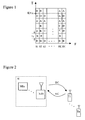
- Fig. 1 shows an example of conventional sub-carrier mapping to user channels into an OFDM time-frequency grid.
- Fig. 2 illustrates a block diagram of a conventional OFDM mobile communications system including the network and the user terminals.
- Fig. 3 shows a method for terminal assisted coordinated interference avoidance according to the invention.
- Fig. 4 shows an exemplary time-frequency pattern, consisting of a number of different frequency sub-bands that change over the time, which can be assigned to a terminal for coordinated interference avoidance according to the invention.
- Fig. 5 shows exemplary time-frequency patterns, allocating the same sub-carriers over the time, which can be assigned to a terminal for coordinated interference avoidance according to the invention.
- Figure 1 shows an exemplary allocation of sub-carriers S1 to SN to four user channels A, B, C and D in the OFDM time-frequency (T-F) grid.
- OFDM offers the possibility to flexibly allocate one or more sub-carriers S1 to SN to one user or one logical channel A, B, C or D to control the data rate for this user channel. Since this can change also over time in a TDMA system (e.g. with a change period of K symbol periods Ts e.g. a period of 2ms), we have a 2-dimensional resource allocation grid, hereinafter referred as T-F grid, as indicated in Figure 1.
- T-F grid 2-dimensional resource allocation grid
- time-frequency grid locations may not be available for data transmission, because they are used for carrying pilot or signaling information. User assignment of remaining locations can be done based on frequency or time or a combination of both.
- Figure 2 shows a block diagram of a mobile communications system in which a mobile radio network N, including a plurality of network elements NE1 to NEn, and a plurality of user terminals T1 to Tn exchange data information via an air interface downlink channel DC and an uplink channel UC using multi-carrier modulation schemes, at least in the downlink, such as OFDM.
- the network elements NE1 to NEn can be for example base stations, radio network controllers, core network switches, or any other communication elements which are generally used for wireless mobile communications.
- Figure 3 illustrates a method for terminal assisted coordinated interference avoidance according to the invention in a "soft handover-like" scenario comprising a terminal T moving from a first cell service area C1, covered by a first network element NE1, to a service overlapping "soft handover" region SHO, in which a second cell service area C2, covered by a neighbor network element NE2, is also available.
- the service overlapping soft handover region SHO is located close to the cell border.
- Both network elements NE1 and NE2 which communicate via the air interface with terminal T will be hereinafter referred to as base stations and the network element NE3 in charge or supervising said base stations will be hereinafter referred as the radio network controller.
- the network N OFDM communication channel is designed so that pilot and, if needed, also signaling information channels can be received by the terminal T in parallel. This is achieved by assigning to each cell C1 and C2 pilots and, if needed, signaling in an interleaving non-overlapping manner, with pilot and signaling symbols having higher energy as the data.
- the terminal T can thus receive at least two pilot channels and, if needed, also two signaling channels in parallel, one for each cell service area overlapping in the soft handover region SHO.
- the terminal T receives two pilot and possibly two signaling channels, one from the origin base station NE1 and another from the neighbor base station NE2.
- the possibility to additionally receive two signaling channels in parallel is only needed if the terminal needs to communicate with the origin base station (NE1) and interfering base station (NE2) in parallel. This would be necessary in case the origin base station (NE1) and interfering base station (NE2) negotiate and decide alone without a radio network controller (NE3) about reservation and assignment of the time-frequency group for communication between the base stations and the terminal T.
- NE1 and NE2 negotiate and decide alone without a radio network controller (NE3) about reservation and assignment of the time-frequency group for communication between the base stations and the terminal T.
- the mobile radio network N partitions the OFDM T-F grid in a number of orthogonal, non-overlapping T-F patterns and combines them in a number of T-F groups, i.e., each T-F group consisting of a number of T-F patterns.
- the mobile radio network N also assigns each terminal one of said T-F groups for communication. Lets assume, for example, that the terminal T of figure 3 is scheduled on a determined T-F group.
- the terminal T When the terminal T moves to the cell border, inside the "soft handover" region SHO, it measures the pilot signal from the interfering neighbor base stations in that area and signals to the mobile radio network N information about the strength of reception from these and its origin base stations NE1 and NE2. Based on that information, the mobile radio network N tries to reserve and/or assign to terminal (T) the same T-F group in the origin base station NE1 and at least one of the interfering base stations NE2 involved in the interference scenario with the terminal T. For the reservation and assignment of the T-F group, the mobile radio network N takes into account factors such as the available T-F patterns or T-F groups, load situation in all involved cells, the service type, priority and quality of service the terminal is receiving from the network. It is therefore also possible that based on the available time-frequency patterns a new time-frequency group may be constructed and afterwards reserved.
- the mobile radio network N may decide to coordinate interference by reducing the power transmitted by the interfering base stations NE2 in the T-F group associated to the terminal T, so that interference is sufficiently reduced.
- the power will be reduced in the interfering base stations, for the reserved T-F group, to a level in which no substantial interference for the reception of data from the origin base station NE1 is created or just reduced to zero. Since in this T-F group the main interference came from the neighbor base stations NE2, said power reduction improves the signal-to-interference ratio (SIR) so that, even at the "soft handover" region SHO, i.e. at the cell border or beyond, the terminal T can be served only by the origin base station NE1.
- the neighbor base stations NE2 can still use this T-F group to schedule other terminals in their cells C2 but only with reduced power. These could be, e.g. terminals near to said base station antennas (in the inner circle of the cell C2) that strongly receive the signals from that base station NE2.
- the time-frequency pattern or time-frequency group assignments to these terminals are periodically changed, e.g. every change period of a number K of OFDM symbols, in a random or pseudo random manner. This shapes the produced inter-cell interference more evenly over all time frequency patterns.
- the T-F groups that are used for terminals in uncoordinated transmissions may be constructed in different cells differently, that is, comprising different time-frequency patterns. Thus usage of one uncoordinated group e.g. in a cell C1 affects only few time-frequency patterns of another uncoordinated group in the neighborcell C2.
- An important advantage of the method according to the invention is that it allows the origin base station NE1 alone to schedule the packets for the terminal T, so that the same data does not need to be transmitted from the radio network controller NE3 to other base stations NE2 in order to serve the terminal T as was done in the first soft handover-like method. Further, since no other base station besides the origin base station NE1 is involved in the transmission of data packets to terminal T, this allows that efficient fast automated repeat request (ARQ) mechanisms such as hybrid automated repeat request (HARQ), which allows the receiver to inform the transmitter that certain packets were either not received or corrupted, can be used for retransmission of said corrupted packets from the origin base station NE1 to the terminal T.
- ARQ fast automated repeat request
- HARQ hybrid automated repeat request
- Fig. 4 shows one out of 15 possible T-F patterns in which the OFDM T-F grid can be partitioned, consisting of 15 different sub-carrier frequency sub-bands FS1 to FS15, each sub-band having 40 sub-carriers, and in which the frequency sub-bands are changed over the time.
- T-F patterns can be grouped to form a T-F group which can be assigned to a terminal T for communication with the mobile radio network N in a coordinated interference avoidance scenario according to the invention.
- Fig. 5 shows another possibility of partitioning the OFDM T-F grid according to the invention.
- the figure shows two FP1 and FP2 out of 16 possible T-F patterns allocating always the same sub-carrier frequency sub-bands over the time. Because of the constant allocation of frequency sub-bands over the time these T-F patterns can be denoted just as frequency patterns.
- the pilot and signaling information can be placed every 12 th sub-carrier such as on the numbers 0, 12, 24, 36, 48, 60, 72 etc. up to 696. So, for example, every even OFDM symbol the sub-carriers 0, 24, 48, 72 etc. carry pilot information and the others 12, 36, 60, etc. signaling information while every odd OFDM symbol the sub-carriers 12, 36, 60, etc. carry pilot information and the others 0, 24, 48, etc. the signaling.
- a neighboring cell say C2
- the pilot/signaling sub-carriers are shifted by one in the frequency direction such as 1, 13, 25, 37, 49, 61, 73, etc. up to 697. This configuration allows 12 shifts until the original locations are reached again.
- 12 different interleaving non-overlapping pilot/signaling patterns are possible and can be distributed in an area so that neighboring cells never use the same pilot/signaling sub-carriers.
- 16 frequency patterns FP1 to FP16 can be defined consisting of 44 sub-carriers each.
- the 44 sub-carriers can be placed, for example, in 11 frequency strips FPnS1 to FPnS11 spread across the frequency axis while each strip FPnSn contains 4 adjacent sub-carriers as indicated in Figure 5.
- Each basic frequency pattern occupies the same locations in all cells independent of the cell specific pilot pattern and further contains sufficient place in each pattern to accommodate for the specific sending cell pilot positions leaving at least always the basic number of time-frequency locations for the basic channel data rate of 480 complex sub-carrier symbols of such a pattern, so a basic Frequency pattern gets no interference from the sending cell pilots and just interference from neighboring cells with different pilot pattern and only maximally as much as amounts to the overhead place of 4 sub-carriers x 12 OFDM symbols left for sending pilot locations i.e. the difference between the total place of the Frequency pattern (44x12) and the basic number of time-frequency locations (40x12) for the basic channel data rate.
- Said frequency patterns can be grouped in T-F groups which can be assigned to a terminal T for communication with the mobile radio network N.
- An advantage of the use of frequency patterns according to the invention is that, the base stations NE1 and NE2 do not need to be time synchronized, since the frequency pattern usage and the method for coordinated interference avoidance is not connected to a time-frame structure e.g. as shown in Figure 4. This is a very desirable feature since time synchronization of all base stations in a mobile radio network N is a substantial effort that is now advantageously avoided.
- means to carry out the coordinated interference avoidance method herein described can be located anywhere in the mobile radio network N, that is, in a network element NE such as a base station or a radio network controller or by means of a radio resource manager entity, inside or outside the network elements NE, said means being implemented in a hardware and/or software form.
- a network element NE such as a base station or a radio network controller or by means of a radio resource manager entity, inside or outside the network elements NE, said means being implemented in a hardware and/or software form.
Landscapes
- Engineering & Computer Science (AREA)
- Computer Networks & Wireless Communication (AREA)
- Signal Processing (AREA)
- Mobile Radio Communication Systems (AREA)
Priority Applications (1)
| Application Number | Priority Date | Filing Date | Title |
|---|---|---|---|
| EP05008972A EP1594331B1 (de) | 2004-05-04 | 2005-04-23 | Verfahren zur endgerätunterstützten koordinierten Vermeidung von Interferenzen in einem Funkkommunikationssystem |
Applications Claiming Priority (3)
| Application Number | Priority Date | Filing Date | Title |
|---|---|---|---|
| EP04291153 | 2004-05-04 | ||
| EP04291153A EP1594330A1 (de) | 2004-05-04 | 2004-05-04 | Verfahren zum endgeräteuntertützten koordinierten Funkdienst und zur Vermeidung von Interferenz in OFDM Mobilkommunikationssysteme |
| EP05008972A EP1594331B1 (de) | 2004-05-04 | 2005-04-23 | Verfahren zur endgerätunterstützten koordinierten Vermeidung von Interferenzen in einem Funkkommunikationssystem |
Publications (2)
| Publication Number | Publication Date |
|---|---|
| EP1594331A1 true EP1594331A1 (de) | 2005-11-09 |
| EP1594331B1 EP1594331B1 (de) | 2008-04-23 |
Family
ID=35445891
Family Applications (1)
| Application Number | Title | Priority Date | Filing Date |
|---|---|---|---|
| EP05008972A Expired - Lifetime EP1594331B1 (de) | 2004-05-04 | 2005-04-23 | Verfahren zur endgerätunterstützten koordinierten Vermeidung von Interferenzen in einem Funkkommunikationssystem |
Country Status (1)
| Country | Link |
|---|---|
| EP (1) | EP1594331B1 (de) |
Cited By (3)
| Publication number | Priority date | Publication date | Assignee | Title |
|---|---|---|---|---|
| US7860452B2 (en) | 2007-02-13 | 2010-12-28 | Samsung Electronics Co., Ltd. | Method of assigning carrier for mitigating inter-cell interference in fixed relay based communication system |
| US20170374556A1 (en) * | 2010-03-31 | 2017-12-28 | Sony Corporation | Method of interference avoidance and base station |
| CN111684835A (zh) * | 2018-02-06 | 2020-09-18 | 华为技术有限公司 | 反馈信息的指示方法及装置 |
Citations (4)
| Publication number | Priority date | Publication date | Assignee | Title |
|---|---|---|---|---|
| GB2358326A (en) * | 2000-01-11 | 2001-07-18 | Fujitsu Ltd | Selection of soft handoff method in cellular mobile communications networks |
| US20020102941A1 (en) * | 2001-01-31 | 2002-08-01 | Nokia Mobile Phones Ltd. | Measurement method and device for activating interfrequency handover in a wireless telecommunication network |
| US6456847B1 (en) * | 1998-12-11 | 2002-09-24 | Nokia Mobile Phones Ltd. | Timing of handover |
| US20020147017A1 (en) * | 2000-12-15 | 2002-10-10 | Xiaodong Li | Multi-carrier communications with adaptive cluster configuration and switching |
-
2005
- 2005-04-23 EP EP05008972A patent/EP1594331B1/de not_active Expired - Lifetime
Patent Citations (4)
| Publication number | Priority date | Publication date | Assignee | Title |
|---|---|---|---|---|
| US6456847B1 (en) * | 1998-12-11 | 2002-09-24 | Nokia Mobile Phones Ltd. | Timing of handover |
| GB2358326A (en) * | 2000-01-11 | 2001-07-18 | Fujitsu Ltd | Selection of soft handoff method in cellular mobile communications networks |
| US20020147017A1 (en) * | 2000-12-15 | 2002-10-10 | Xiaodong Li | Multi-carrier communications with adaptive cluster configuration and switching |
| US20020102941A1 (en) * | 2001-01-31 | 2002-08-01 | Nokia Mobile Phones Ltd. | Measurement method and device for activating interfrequency handover in a wireless telecommunication network |
Cited By (4)
| Publication number | Priority date | Publication date | Assignee | Title |
|---|---|---|---|---|
| US7860452B2 (en) | 2007-02-13 | 2010-12-28 | Samsung Electronics Co., Ltd. | Method of assigning carrier for mitigating inter-cell interference in fixed relay based communication system |
| US20170374556A1 (en) * | 2010-03-31 | 2017-12-28 | Sony Corporation | Method of interference avoidance and base station |
| US10362486B2 (en) * | 2010-03-31 | 2019-07-23 | Sony Corporation | Method of interference avoidance and base station |
| CN111684835A (zh) * | 2018-02-06 | 2020-09-18 | 华为技术有限公司 | 反馈信息的指示方法及装置 |
Also Published As
| Publication number | Publication date |
|---|---|
| EP1594331B1 (de) | 2008-04-23 |
Similar Documents
| Publication | Publication Date | Title |
|---|---|---|
| EP1594330A1 (de) | Verfahren zum endgeräteuntertützten koordinierten Funkdienst und zur Vermeidung von Interferenz in OFDM Mobilkommunikationssysteme | |
| US7636334B2 (en) | Method for inter-cell interference coordination with power planning for OFDM mobile communication system | |
| US6407993B1 (en) | Flexible two-way telecommunication system | |
| US7773947B2 (en) | Method for terminal-assisted interference control in a multi-carrier mobile communication system | |
| EP2207396B1 (de) | Restriktive Wiederverwendung für ein drahtloses Kommunikationssystem | |
| KR100909522B1 (ko) | 무선 통신 시스템에서 주파수 재사용을 통해 역방향 링크에대한 소프트 핸드오프를 제공하는 방법 및 장치 | |
| US7257406B2 (en) | Restrictive reuse set management | |
| EP2373077A1 (de) | Verfahren und Funkbasisstation zur effektiven Spektrumsverwendung | |
| US20070223606A1 (en) | Method and apparatus for interference mitigation in an ofdma-based communication system | |
| EP1931089B1 (de) | Funkkommunikationsgerät und Funkkommunikationsverfahren | |
| KR20050028354A (ko) | 직교 주파수 분할 다중 방식을 사용하는 이동 통신시스템에서 동적 채널 할당 시스템 및 방법 | |
| EP3454618A1 (de) | Verfahren und vorrichtung zur zuweisung einer steuerkanalressource eines relaisknotens in einem backhaul-unterrahmen | |
| JP4912878B2 (ja) | Ofdmaシステムおよび方法 | |
| US20090069020A1 (en) | Dynamic On-Off Spectrum Access Scheme to Enhance Spectrum Efficiency | |
| KR20050057674A (ko) | 무선 시스템 자원 관리를 위한 방법 | |
| GB2427792A (en) | Resource allocation in a Communication System using OFDMA. | |
| Harada et al. | Dynamic parameter controlled orthogonal frequency and time division multiple access | |
| EP1594331B1 (de) | Verfahren zur endgerätunterstützten koordinierten Vermeidung von Interferenzen in einem Funkkommunikationssystem | |
| KR20060056212A (ko) | 직교 주파수 다중 접속 방식의 무선 통신 방법 및 시스템 | |
| HK1140618A (en) | Restrictive reuse for a wireless communication system | |
| HK1098906B (en) | Restrictive reuse for a wireless communication system | |
| HK1112144A (en) | Handover of user equipment |
Legal Events
| Date | Code | Title | Description |
|---|---|---|---|
| PUAI | Public reference made under article 153(3) epc to a published international application that has entered the european phase |
Free format text: ORIGINAL CODE: 0009012 |
|
| 17P | Request for examination filed |
Effective date: 20050621 |
|
| AK | Designated contracting states |
Kind code of ref document: A1 Designated state(s): AT BE BG CH CY CZ DE DK EE ES FI FR GB GR HU IE IS IT LI LT LU MC NL PL PT RO SE SI SK TR |
|
| AX | Request for extension of the european patent |
Extension state: AL BA HR LV MK YU |
|
| AKX | Designation fees paid |
Designated state(s): AT BE BG CH CY CZ DE DK EE ES FI FR GB GR HU IE IS IT LI LT LU MC NL PL PT RO SE SI SK TR |
|
| RAP1 | Party data changed (applicant data changed or rights of an application transferred) |
Owner name: ALCATEL LUCENT |
|
| GRAP | Despatch of communication of intention to grant a patent |
Free format text: ORIGINAL CODE: EPIDOSNIGR1 |
|
| GRAS | Grant fee paid |
Free format text: ORIGINAL CODE: EPIDOSNIGR3 |
|
| GRAA | (expected) grant |
Free format text: ORIGINAL CODE: 0009210 |
|
| AK | Designated contracting states |
Kind code of ref document: B1 Designated state(s): AT BE BG CH CY CZ DE DK EE ES FI FR GB GR HU IE IS IT LI LT LU MC NL PL PT RO SE SI SK TR |
|
| REG | Reference to a national code |
Ref country code: GB Ref legal event code: FG4D |
|
| REG | Reference to a national code |
Ref country code: CH Ref legal event code: EP |
|
| REF | Corresponds to: |
Ref document number: 602005006190 Country of ref document: DE Date of ref document: 20080605 Kind code of ref document: P |
|
| REG | Reference to a national code |
Ref country code: IE Ref legal event code: FG4D Free format text: LANGUAGE OF EP DOCUMENT: FRENCH |
|
| PG25 | Lapsed in a contracting state [announced via postgrant information from national office to epo] |
Ref country code: SI Free format text: LAPSE BECAUSE OF FAILURE TO SUBMIT A TRANSLATION OF THE DESCRIPTION OR TO PAY THE FEE WITHIN THE PRESCRIBED TIME-LIMIT Effective date: 20080423 |
|
| NLV1 | Nl: lapsed or annulled due to failure to fulfill the requirements of art. 29p and 29m of the patents act | ||
| ET | Fr: translation filed | ||
| PG25 | Lapsed in a contracting state [announced via postgrant information from national office to epo] |
Ref country code: PT Free format text: LAPSE BECAUSE OF FAILURE TO SUBMIT A TRANSLATION OF THE DESCRIPTION OR TO PAY THE FEE WITHIN THE PRESCRIBED TIME-LIMIT Effective date: 20080923 Ref country code: NL Free format text: LAPSE BECAUSE OF FAILURE TO SUBMIT A TRANSLATION OF THE DESCRIPTION OR TO PAY THE FEE WITHIN THE PRESCRIBED TIME-LIMIT Effective date: 20080423 Ref country code: ES Free format text: LAPSE BECAUSE OF FAILURE TO SUBMIT A TRANSLATION OF THE DESCRIPTION OR TO PAY THE FEE WITHIN THE PRESCRIBED TIME-LIMIT Effective date: 20080803 Ref country code: FI Free format text: LAPSE BECAUSE OF FAILURE TO SUBMIT A TRANSLATION OF THE DESCRIPTION OR TO PAY THE FEE WITHIN THE PRESCRIBED TIME-LIMIT Effective date: 20080423 Ref country code: BG Free format text: LAPSE BECAUSE OF FAILURE TO SUBMIT A TRANSLATION OF THE DESCRIPTION OR TO PAY THE FEE WITHIN THE PRESCRIBED TIME-LIMIT Effective date: 20080723 |
|
| PG25 | Lapsed in a contracting state [announced via postgrant information from national office to epo] |
Ref country code: AT Free format text: LAPSE BECAUSE OF FAILURE TO SUBMIT A TRANSLATION OF THE DESCRIPTION OR TO PAY THE FEE WITHIN THE PRESCRIBED TIME-LIMIT Effective date: 20080423 Ref country code: MC Free format text: LAPSE BECAUSE OF NON-PAYMENT OF DUE FEES Effective date: 20080430 Ref country code: PL Free format text: LAPSE BECAUSE OF FAILURE TO SUBMIT A TRANSLATION OF THE DESCRIPTION OR TO PAY THE FEE WITHIN THE PRESCRIBED TIME-LIMIT Effective date: 20080423 |
|
| PG25 | Lapsed in a contracting state [announced via postgrant information from national office to epo] |
Ref country code: IS Free format text: LAPSE BECAUSE OF FAILURE TO SUBMIT A TRANSLATION OF THE DESCRIPTION OR TO PAY THE FEE WITHIN THE PRESCRIBED TIME-LIMIT Effective date: 20080823 |
|
| PG25 | Lapsed in a contracting state [announced via postgrant information from national office to epo] |
Ref country code: SE Free format text: LAPSE BECAUSE OF FAILURE TO SUBMIT A TRANSLATION OF THE DESCRIPTION OR TO PAY THE FEE WITHIN THE PRESCRIBED TIME-LIMIT Effective date: 20080723 Ref country code: LT Free format text: LAPSE BECAUSE OF FAILURE TO SUBMIT A TRANSLATION OF THE DESCRIPTION OR TO PAY THE FEE WITHIN THE PRESCRIBED TIME-LIMIT Effective date: 20080423 Ref country code: EE Free format text: LAPSE BECAUSE OF FAILURE TO SUBMIT A TRANSLATION OF THE DESCRIPTION OR TO PAY THE FEE WITHIN THE PRESCRIBED TIME-LIMIT Effective date: 20080423 Ref country code: DK Free format text: LAPSE BECAUSE OF FAILURE TO SUBMIT A TRANSLATION OF THE DESCRIPTION OR TO PAY THE FEE WITHIN THE PRESCRIBED TIME-LIMIT Effective date: 20080423 Ref country code: CZ Free format text: LAPSE BECAUSE OF FAILURE TO SUBMIT A TRANSLATION OF THE DESCRIPTION OR TO PAY THE FEE WITHIN THE PRESCRIBED TIME-LIMIT Effective date: 20080423 |
|
| PG25 | Lapsed in a contracting state [announced via postgrant information from national office to epo] |
Ref country code: SK Free format text: LAPSE BECAUSE OF FAILURE TO SUBMIT A TRANSLATION OF THE DESCRIPTION OR TO PAY THE FEE WITHIN THE PRESCRIBED TIME-LIMIT Effective date: 20080423 Ref country code: RO Free format text: LAPSE BECAUSE OF FAILURE TO SUBMIT A TRANSLATION OF THE DESCRIPTION OR TO PAY THE FEE WITHIN THE PRESCRIBED TIME-LIMIT Effective date: 20080423 Ref country code: BE Free format text: LAPSE BECAUSE OF FAILURE TO SUBMIT A TRANSLATION OF THE DESCRIPTION OR TO PAY THE FEE WITHIN THE PRESCRIBED TIME-LIMIT Effective date: 20080423 |
|
| PLBE | No opposition filed within time limit |
Free format text: ORIGINAL CODE: 0009261 |
|
| STAA | Information on the status of an ep patent application or granted ep patent |
Free format text: STATUS: NO OPPOSITION FILED WITHIN TIME LIMIT |
|
| 26N | No opposition filed |
Effective date: 20090126 |
|
| PG25 | Lapsed in a contracting state [announced via postgrant information from national office to epo] |
Ref country code: IE Free format text: LAPSE BECAUSE OF NON-PAYMENT OF DUE FEES Effective date: 20080423 |
|
| PG25 | Lapsed in a contracting state [announced via postgrant information from national office to epo] |
Ref country code: IT Free format text: LAPSE BECAUSE OF FAILURE TO SUBMIT A TRANSLATION OF THE DESCRIPTION OR TO PAY THE FEE WITHIN THE PRESCRIBED TIME-LIMIT Effective date: 20080423 |
|
| REG | Reference to a national code |
Ref country code: CH Ref legal event code: PL |
|
| PG25 | Lapsed in a contracting state [announced via postgrant information from national office to epo] |
Ref country code: LI Free format text: LAPSE BECAUSE OF NON-PAYMENT OF DUE FEES Effective date: 20090430 Ref country code: CH Free format text: LAPSE BECAUSE OF NON-PAYMENT OF DUE FEES Effective date: 20090430 |
|
| PG25 | Lapsed in a contracting state [announced via postgrant information from national office to epo] |
Ref country code: CY Free format text: LAPSE BECAUSE OF FAILURE TO SUBMIT A TRANSLATION OF THE DESCRIPTION OR TO PAY THE FEE WITHIN THE PRESCRIBED TIME-LIMIT Effective date: 20080423 Ref country code: HU Free format text: LAPSE BECAUSE OF FAILURE TO SUBMIT A TRANSLATION OF THE DESCRIPTION OR TO PAY THE FEE WITHIN THE PRESCRIBED TIME-LIMIT Effective date: 20081024 Ref country code: LU Free format text: LAPSE BECAUSE OF NON-PAYMENT OF DUE FEES Effective date: 20080423 |
|
| PG25 | Lapsed in a contracting state [announced via postgrant information from national office to epo] |
Ref country code: TR Free format text: LAPSE BECAUSE OF FAILURE TO SUBMIT A TRANSLATION OF THE DESCRIPTION OR TO PAY THE FEE WITHIN THE PRESCRIBED TIME-LIMIT Effective date: 20080423 |
|
| PG25 | Lapsed in a contracting state [announced via postgrant information from national office to epo] |
Ref country code: GR Free format text: LAPSE BECAUSE OF FAILURE TO SUBMIT A TRANSLATION OF THE DESCRIPTION OR TO PAY THE FEE WITHIN THE PRESCRIBED TIME-LIMIT Effective date: 20080724 |
|
| REG | Reference to a national code |
Ref country code: GB Ref legal event code: 732E Free format text: REGISTERED BETWEEN 20130926 AND 20131002 |
|
| REG | Reference to a national code |
Ref country code: FR Ref legal event code: GC Effective date: 20131018 |
|
| REG | Reference to a national code |
Ref country code: FR Ref legal event code: RG Effective date: 20141016 |
|
| REG | Reference to a national code |
Ref country code: FR Ref legal event code: PLFP Year of fee payment: 11 |
|
| REG | Reference to a national code |
Ref country code: FR Ref legal event code: CA Effective date: 20150521 |
|
| REG | Reference to a national code |
Ref country code: FR Ref legal event code: CA Effective date: 20150521 |
|
| REG | Reference to a national code |
Ref country code: FR Ref legal event code: PLFP Year of fee payment: 12 |
|
| REG | Reference to a national code |
Ref country code: FR Ref legal event code: PLFP Year of fee payment: 13 |
|
| REG | Reference to a national code |
Ref country code: FR Ref legal event code: PLFP Year of fee payment: 14 |
|
| REG | Reference to a national code |
Ref country code: DE Ref legal event code: R082 Ref document number: 602005006190 Country of ref document: DE Representative=s name: LOUIS POEHLAU LOHRENTZ PATENTANWAELTE PARTNERS, DE Ref country code: DE Ref legal event code: R082 Ref document number: 602005006190 Country of ref document: DE Representative=s name: LOUIS, POEHLAU, LOHRENTZ, DE Ref country code: DE Ref legal event code: R081 Ref document number: 602005006190 Country of ref document: DE Owner name: NOKIA TECHNOLOGIES OY, FI Free format text: FORMER OWNER: ALCATEL LUCENT, PARIS, FR |
|
| REG | Reference to a national code |
Ref country code: GB Ref legal event code: 732E Free format text: REGISTERED BETWEEN 20200402 AND 20200408 |
|
| P01 | Opt-out of the competence of the unified patent court (upc) registered |
Effective date: 20230527 |
|
| PGFP | Annual fee paid to national office [announced via postgrant information from national office to epo] |
Ref country code: GB Payment date: 20240229 Year of fee payment: 20 |
|
| PGFP | Annual fee paid to national office [announced via postgrant information from national office to epo] |
Ref country code: FR Payment date: 20240308 Year of fee payment: 20 |
|
| PGFP | Annual fee paid to national office [announced via postgrant information from national office to epo] |
Ref country code: DE Payment date: 20240306 Year of fee payment: 20 |
|
| REG | Reference to a national code |
Ref country code: DE Ref legal event code: R071 Ref document number: 602005006190 Country of ref document: DE |
|
| REG | Reference to a national code |
Ref country code: GB Ref legal event code: PE20 Expiry date: 20250422 |
|
| PG25 | Lapsed in a contracting state [announced via postgrant information from national office to epo] |
Ref country code: GB Free format text: LAPSE BECAUSE OF EXPIRATION OF PROTECTION Effective date: 20250422 |