EP1593665A1 - Method for producing aromatic diamine derivative - Google Patents
Method for producing aromatic diamine derivative Download PDFInfo
- Publication number
- EP1593665A1 EP1593665A1 EP04705890A EP04705890A EP1593665A1 EP 1593665 A1 EP1593665 A1 EP 1593665A1 EP 04705890 A EP04705890 A EP 04705890A EP 04705890 A EP04705890 A EP 04705890A EP 1593665 A1 EP1593665 A1 EP 1593665A1
- Authority
- EP
- European Patent Office
- Prior art keywords
- group
- aromatic diamine
- aromatic
- formula
- diamine derivative
- Prior art date
- Legal status (The legal status is an assumption and is not a legal conclusion. Google has not performed a legal analysis and makes no representation as to the accuracy of the status listed.)
- Withdrawn
Links
Classifications
-
- C—CHEMISTRY; METALLURGY
- C07—ORGANIC CHEMISTRY
- C07C—ACYCLIC OR CARBOCYCLIC COMPOUNDS
- C07C209/00—Preparation of compounds containing amino groups bound to a carbon skeleton
- C07C209/62—Preparation of compounds containing amino groups bound to a carbon skeleton by cleaving carbon-to-nitrogen, sulfur-to-nitrogen, or phosphorus-to-nitrogen bonds, e.g. hydrolysis of amides, N-dealkylation of amines or quaternary ammonium compounds
-
- C—CHEMISTRY; METALLURGY
- C07—ORGANIC CHEMISTRY
- C07C—ACYCLIC OR CARBOCYCLIC COMPOUNDS
- C07C211/00—Compounds containing amino groups bound to a carbon skeleton
- C07C211/43—Compounds containing amino groups bound to a carbon skeleton having amino groups bound to carbon atoms of six-membered aromatic rings of the carbon skeleton
- C07C211/54—Compounds containing amino groups bound to a carbon skeleton having amino groups bound to carbon atoms of six-membered aromatic rings of the carbon skeleton having amino groups bound to two or three six-membered aromatic rings
Definitions
- the present invention relates to a novel method for producing an aromatic diamine derivative; and more particularly to a method for producing an aromatic diamine derivative which is applied as a charge transport material of an electrophotographic photoconductor or as an organic electroluminescent device material.
- Aromatic diamine compounds have been applied as a charge transport material of an electrophotographic photoconductor or as an organic electroluminescent (EL) device material. Particularly in the case where an aromatic diamine compound is applied as an organic EL device material, when the device material does not have a high glass transition temperature, the resultant organic EL device fails to exhibit heat resistance. Therefore, many attempts have been made to develop an aromatic diamine derivative containing in the molecule thereof a large number of aromatic rings (e.g., benzene rings or heterocyclic rings).
- an aromatic diamine derivative containing in the molecule thereof a large number of aromatic rings exhibits very poor solubility in a solvent.
- Such low solubility raises problems, including precipitation of diamine molecules in a solvent during the course of reaction, and limited reaction yield.
- the following reaction is difficult to progress, because of the presence of a large number of intramolecular aromatic rings, which cause the raw materials and reaction intermediates to exhibit low solubility.
- An aromatic diamine derivative is known to be produced through a reaction pathway applying a raw material such as ⁇ -naphthylamine, ⁇ -naphthylamine, 4-aminodiphenyl, or benzidine, which compounds are known to exhibit mutagenicity. Production of these compounds, which are designated "specified chemical substances," is prohibited in Japan, and therefore demand has arisen for a production method which does not apply such a compound as a raw material or an intermediate.
- International Application PCT/JP02/02132 describes, as an example of such a production method, a method for producing an aromatic amine by reacting an aromatic amine having an arylalkyl group (e.g., a benzyl group) with an aromatic halide, without using a raw material or intermediate which may exhibit mutagenicity as described above.
- an aromatic amine having an arylalkyl group e.g., a benzyl group
- reaction requires a reduction reaction (e.g., hydrogenation) upon elimination of an arylalkyl group, which often causes reduction of an aromatic ring (i.e., a side reaction).
- a reduction reaction e.g., hydrogenation
- an object of the present invention is to provide a method for producing an aromatic diamine derivative which is useful as a charge transport material of an electrophotographic photoconductor or as an organic EL device material, and which can be produced at high yield in an efficient manner.
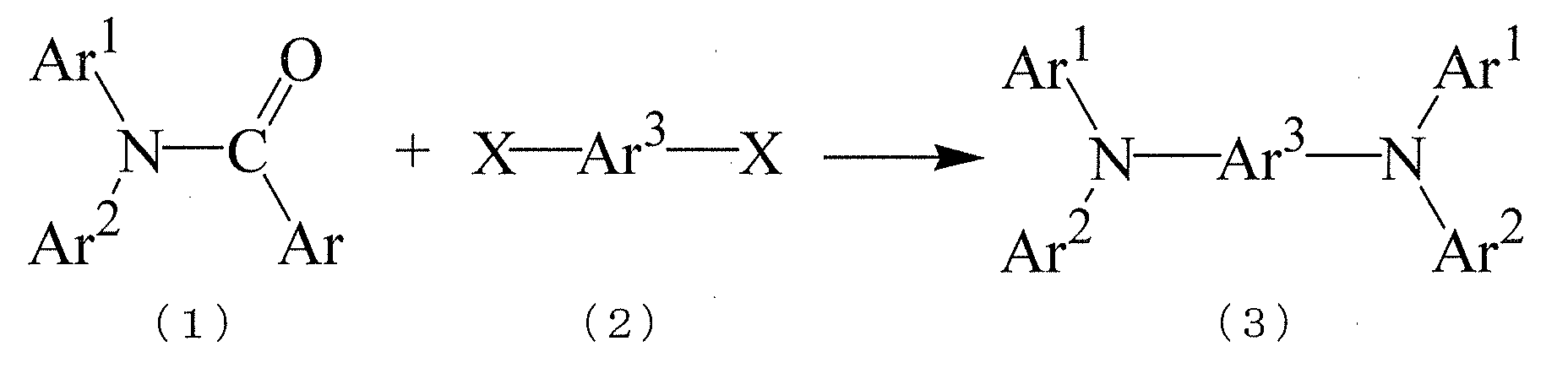
- the present invention provides a method for producing an aromatic diamine derivative represented by the following formula (3), which method comprises reacting an aromatic amide represented by the following formula (1) with an aromatic halide represented by the following formula (2): (wherein Ar represents a substituted or unsubstituted aryl group having 6 to 30 ring carbon atoms, or a substituted or unsubstituted heteroaryl group having 5 to 30 ring carbon atoms; each of Ar 1 and Ar 2 represents a substituted or unsubstituted aryl group having 6 to 30 ring carbon atoms, or a substituted or unsubstituted heteroaryl group having 5 to 30 ring carbon atoms; Ar 3 represents a substituted or unsubstituted arylene group having 6 to 30 ring carbon atoms, or a substituted or unsubstituted heteroarylene group having 5 to 30 ring carbon atoms; and X represents a halogen atom).
- Ar represents a substituted or unsubstituted aryl group having 6 to 30 ring carbon atoms, or a substituted or unsubstituted heteroaryl group having 5 to 30 ring carbon atoms.
- the aryl group include a phenyl group, a biphenylyl group, a terphenylyl group, a naphthyl group, an anthranyl group, a phenanthryl group, a pyrenyl group, a chrysenyl group, and a fluoranthenyl group.
- heteroaryl group examples include a pyrrolyl group, a furanyl group, a thiophenyl group, a triazole group, an oxadiazole group, a pyridyl group, and a pyrimidyl group.
- a phenyl group, a biphenylyl group, and a naphthyl group are particularly preferred.
- each of Ar 1 and Ar 2 represents a substituted or unsubstituted aryl group having 6 to 30 ring carbon atoms, or a substituted or unsubstituted heteroaryl group having 5 to 30 ring carbon atoms.
- the aryl group include a phenyl group, a biphenylyl group, a terphenylyl group, a naphthyl group, an anthranyl group, a phenanthryl group, a pyrenyl group, a chrysenyl group, and a fluoranthenyl group.
- heteroaryl group examples include a pyrrolyl group, a furanyl group, a thiophenyl group, a triazolyl group, an oxadiazolyl group, a pyridyl group, and a pyrimidyl group.
- a phenyl group, a biphenylyl group, and a naphthyl group are particularly preferred.
- Ar 3 represents a substituted or unsubstituted arylene group having 6 to 30 ring carbon atoms, or a substituted or unsubstituted heteroarylene group having 5 to 30 ring carbon atoms.
- the arylene group include a phenylene group, a biphenylene group, a terphenylene group, a naphthylene group, an anthranylene group, a phenanthrylene group, a pyrenylene group, a chrysenylene group, and a fluoranthenylene group.
- heteroarylene group examples include a pyrrolylene group, a furanylene group, a thiophenylene group, a triazolene group, an oxadiazolene group, a pyridylene group, and a pyrimidylene group.
- a phenylene group, a biphenylene group, and a naphthylene group are particularly preferred.
- substituent(s) present in Ar and Ar 1 to Ar 3 include an aryl group having 5 to 30 ring carbon atoms, a C1-C12 alkyl or alkoxy group, and an amino group substituted by an aryl group having 5 to 30 ring carbon atoms.
- Examples of the C1-C12 alkyl group include a methyl group, an ethyl group, an n-propyl group, an i-propyl group, an n-butyl group, an s-butyl group, a t-butyl group, an n-pentyl group, a cyclopentyl group, an n-hexyl group, a cyclohexyl group, and an adamantyl group.
- Examples of the C1-C12 alkoxy group include a methoxy group, an ethoxy group, an n-propyloxy group, an i-propyloxy group, an n-butyloxy group, an s-butyloxy group, a t-butyloxy group, an n-pentyloxy group, a cyclopentyloxy group, an n-hexyloxy group, a cyclohexyloxy group, and an adamantyloxy group.
- the number of substituent(s) present in each of Ar 1 to Ar 3 is preferably 0 to 4.
- X represents a halogen atom.
- the halogen atom include iodine, bromine, chlorine, and fluorine, with iodine and bromine being particularly preferred.
- the production method of the present invention is useful for the case where the total number of a benzene ring(s) and/or a heterocyclic ring(s) contained in an aromatic diamine derivative represented by formula (3) is 8 or more, particularly for the case where the total number is 10 or more.
- an aromatic amide represented by formula (1) is reacted with an aromatic halide represented by formula (2) in the presence of a catalyst formed of a transition metal compound.
- transition metal examples include Mn, Fe, Co, Ni, Cu, Pd, Mo, Rh, Ru, V, Cr, Pt, Ir, and Zn.
- Ni, Pd, Pt, Zn, and Cu are preferred, with Cu being more preferred.
- transition metal compound examples include fine powder of the transition metal, a halide of the transition metal, an oxide of the transition metal, and a chalcogenide compound of the transition metal, with a halide of the transition metal being preferred.
- halide examples include a fluoride, a chloride, a bromide, and an iodide, with a bromide and an iodide being particularly preferred.
- a zero-valent or monovalent transition metal compound is preferably applied.
- the amount of the catalyst to be added is generally 0.01 to 1 equivalent, preferably 0.1 to 0.5 equivalents, with respect to the aforementioned aromatic halide.
- reaction between the aromatic amide represented by formula (1) and the aromatic halide represented by formula (2) is carried out in the presence of a base.
- the base to be applied is preferably a hydroxide or salt of an alkali metal or alkaline earth metal.
- hydroxides and salts a hydroxide, a carbonate, a hydrogencarbonate, and an acetate are preferred, with a hydroxide, which is a strong base, being more preferred.
- the amount of the base to be added is generally 2 to 5 equivalents, preferably 2 to 3 equivalents, with respect to the aforementioned aromatic halide.
- the reaction solvent applied during the course of reaction between the aromatic amide represented by formula (1) and the aromatic halide represented by formula (2) is preferably a hydrocarbon compound, since this reaction requires high-temperature heating in the presence of a strong base.
- a solvent having a high boiling point is preferably applied.
- the solvent which may be applied include xylene, decalin, dioxane, dimethylformamide (DMF), and dimethyl sulfoxide (DMSO), with xylene and decalin being preferred.
- such a solvent is preferably subjected to dehydration or inert gas replacement.
- Dehydration or inert gas replacement of the solvent can be performed by means of a technique which is generally applied for organic synthesis.
- a desiccant such as calcium chloride may be added to the solvent, or the solvent may be subjected to distillation in the presence of calcium hydride or metallic sodium under a stream of, for example, nitrogen or argon.
- the temperature of the above-described reaction is generally room temperature to 150°C, preferably 100 to 150°C.
- the reaction time is 1 to 48 hours, preferably 6 to 18 hours.
- the reaction process (including preparation of a catalyst) is preferably carried out in an inert gas atmosphere.
- Examples of the aromatic amide represented by formula (1), which is applied in the production method of the present invention, include N,N-di-(4-biphenylyl)benzamide, N-(1-naphthyl)-N-phenylbenzamide, N-(2-naphthyl)-N-phenylbenzamide, and N-(1-naphthyl)-N-(4-biphenylyl)benzamide.
- Examples of the aromatic halide represented by formula (2), which is applied in the production method of the present invention, include 4,4'-diiodobiphenyl, 1,4-diiodobenzene, 4,4"-diiodo-p-terphenyl, 4,4'-dibromobiphenyl, 1,4-dibromobenzene, and 4,4"-dibromo-p-terphenyl.
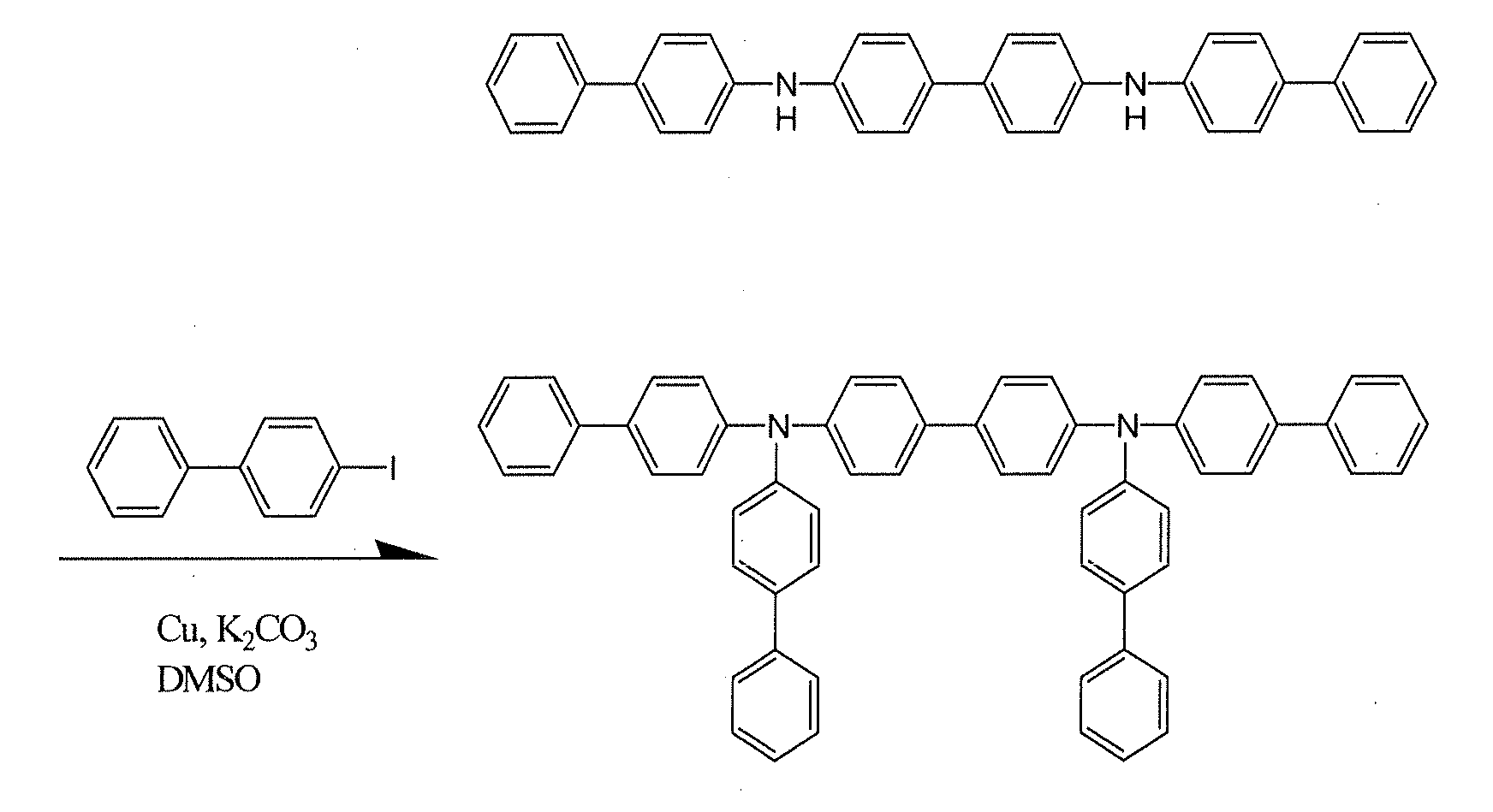
- Examples of the aromatic diamine derivative represented by formula (3), which is produced through the production method of the present invention, include N,N,N',N'-tetra(4-biphenylyl)benzidine and N,N'-di(1-naphthyl)-N,N'-diphenyl-4,4'-benzidine.
- the aromatic diamine derivative produced through the production method of the present invention is useful as a charge transport material of an electrophotographic photoconductor or as an organic EL device material.
- the resultant reaction mixture was transferred to a separatory funnel, and dichloromethane (100 mL) was added to the mixture, to thereby dissolve the precipitate in the mixture.
- dichloromethane 100 mL was added to the mixture, to thereby dissolve the precipitate in the mixture.
- the resultant organic layer was dried over anhydrous potassium carbonate.
- the potassium carbonate was separated through filtration, and the solvent of the resultant organic layer was removed through evaporation.
- Toluene (200 mL) and ethanol (40 mL) were added to the resultant residue, and the resultant mixture was heated to 80°C, with a drying tube being used, to thereby completely dissolve the residue in the mixture. Thereafter, the mixture was allowed to stand for 12 hours, and was gradually cooled to room temperature for recrystallization.
- xylene (20 mL) was added through the rubber septum by use of a syringe, the flask was placed in an oil bath, and the resultant mixture was gradually heated to 140°C under stirring. After the mixture was stirred at 140°C for six hours, the flask was removed from the oil bath, and was allowed to stand at room temperature for 12 hours.
- the thus-precipitated product was completely dissolved in dichloromethane (50 mL), and the resultant solution was transferred to a separatory funnel. After the solution was washed with saturated brine (50 mL), the thus-separated organic layer was dried over anhydrous potassium carbonate. After filtration of the organic layer, the solvent was removed through evaporation, and toluene (150 mL) and ethanol (50 mL) were added to the resultant residue. The resultant mixture was heated to 80°C, with a drying tube being used, to thereby dissolve the precipitate in the mixture, followed by gradual cooling to room temperature.
- N,N,N',N'-tetra(4-iphenylyl)benzidine was subjected to measurement in terms of NMR (nuclear magnetic resonance spectrometry), FD-MS (field desorption mass spectrometry), and HPLC (high-performance liquid chromatography).
- the measurement results are as follows. NMR: ⁇ 90 MHz 7.1-7.8 (44H, m) FD-MS: 792, 396 HPLC: chemical purity of 99.6% or more The overall reaction yield was found to be 73%.
- the flask was placed in an oil bath, and the resultant mixture was gradually heated to 120°C under stirring. Seven hours later, the flask was removed from the oil bath, whereby the reaction was completed. Thereafter, the flask was allowed to stand in an argon atmosphere for 12 hours.
- the resultant reaction mixture was transferred to a separatory funnel, and dichloromethane (300 mL) was added to the mixture, to thereby dissolve the precipitate in the mixture.
- dichloromethane 300 mL was added to the mixture, to thereby dissolve the precipitate in the mixture.
- the resultant organic layer was dried over anhydrous potassium carbonate.
- the potassium carbonate was separated through filtration, and the solvent of the resultant organic layer was removed through evaporation.
- Toluene (200 mL) and ethanol (40 mL) were added to the resultant residue, and the resultant mixture was heated to 80°C, with a drying tube being used, to thereby completely dissolve the residue in the mixture. Thereafter, the mixture was allowed to stand for 12 hours, and was gradually cooled to room temperature for recrystallization.
- N,N-di-(4-biphenylyl)-benzylamine obtained above in (1) (1.35 g) and palladium-activated carbon (product of Wako Pure Chemical Industries, Ltd., palladium content: 10 wt.%) (135 mg) were placed in a 300-mL one-neck flask, and chloroform (100 mL) and ethanol (20 mL) were added to the flask, followed by dissolution of these materials in the solvents.
- the resultant solution was transferred to a separatory funnel, and the solution was washed with a saturated aqueous solution of sodium hydrogencarbonate (50 mL). Thereafter, the resultant organic layer was separated, and dried over anhydrous potassium carbonate. After filtration of the organic layer, the solvent was removed through evaporation, and toluene (50 mL) was added to the resultant residue for recrystallization. The thus-precipitated crystals were separated through filtration, and then dried under vacuum at 50°C, to thereby yield 0.99 g of di-4-biphenylylamine.
- the thus-precipitated product was completely dissolved in dichloromethane (500 mL), and the resultant solution was transferred to a separatory funnel. After the solution was washed with saturated brine (100 mL), the thus-separated organic layer was dried over anhydrous potassium carbonate. After filtration of the organic layer, the solvent was removed through evaporation, and toluene (150 mL) and ethanol (50 mL) were added to the resultant residue. The resultant mixture was heated to 80°C, with a drying tube being used, to thereby dissolve the precipitate in the mixture, followed by gradual cooling to room temperature.
- N,N,N',N'-tetra(4-biphenylyl) benzidine was subjected to measurement in terms of NMR, FD-MS, and HPLC.
- the measurement results are as follows. NMR: ⁇ 90 MHz 7.1-7.8 (44H, m) FD-MS: 792, 396 HPLC: chemical purity of 99.5% or more The overall reaction yield was found to be 63%.
- the flask was placed in an oil bath, and the resultant mixture was gradually heated to 120°C under stirring. Seven hours later, the flask was removed from the oil bath, whereby the reaction was completed. Thereafter, the flask was allowed to stand in an argon atmosphere for 12 hours.
- the resultant reaction mixture was transferred to a separatory funnel, and dichloromethane (300 mL) was added to the mixture, to thereby dissolve the precipitate in the mixture.
- dichloromethane 300 mL was added to the mixture, to thereby dissolve the precipitate in the mixture.
- the resultant organic layer was dried over anhydrous potassium carbonate.
- the potassium carbonate was separated through filtration, and the solvent of the resultant organic layer was removed through evaporation.
- Toluene (200 mL) and ethanol (40 mL) were added to the resultant residue, and the resultant mixture was heated to 80°C, with a drying tube being used, to thereby completely dissolve the residue in the mixture. Thereafter, the mixture was allowed to stand for 12 hours, and was gradually cooled to room temperature for recrystallization.
- Example 1 (2) The procedure of Example 1 (2) was repeated, except that the N,N-di-(4-biphenylyl)benzamide (1.00 g) was replaced by the N,N-di-(4-biphenylyl)acetamide obtained above in (1) (0.85 g), to thereby yield 0.38 g of N,N,N',N'-tetra(4-biphenylyl)benzidine.
- N,N,N',N'-tetra(4-biphenylyl) benzidine was subjected to measurement in terms of NMR, FD-MS, and HPLC.
- the measurement results are as follows. NMR: ⁇ 90 MHz 7.1-7.8 (44H, m) FD-MS: 792, 396 HPLC: chemical purity of 99.3% or more The overall reaction yield was found to be 5%.
- the method of the present invention can produce, at high yield in an efficient manner, an aromatic diamine derivative which is useful as a charge transport material of an electrophotographic photoconductor or as an organic electroluminescent device material.
Landscapes
- Chemical & Material Sciences (AREA)
- Organic Chemistry (AREA)
- Organic Low-Molecular-Weight Compounds And Preparation Thereof (AREA)
- Low-Molecular Organic Synthesis Reactions Using Catalysts (AREA)
Abstract

Description
FD-MS: 792, 396
HPLC: chemical purity of 99.6% or more
The overall reaction yield was found to be 73%.
NMR: δ 90 MHz 7.1-7.8 (44H, m)
FD-MS: 792, 396
HPLC: chemical purity of 99.5% or more
The overall reaction yield was found to be 63%.
NMR: δ 90 MHz 7.1-7.8 (44H, m)
FD-MS: 792, 396
HPLC: chemical purity of 99.3% or more
The overall reaction yield was found to be 5%.
Claims (9)
- A method for producing an aromatic diamine derivative represented by formula (3), which method comprises reacting an aromatic amide represented by formula (1) with an aromatic halide represented by formula (2):(wherein Ar represents a substituted or unsubstituted aryl group having 6 to 30 ring carbon atoms, or a substituted or unsubstituted heteroaryl group having 5 to 30 ring carbon atoms; each of Ar1 and Ar2 represents a substituted or unsubstituted aryl group having 6 to 30 ring carbon atoms, or a substituted or unsubstituted heteroaryl group having 5 to 30 ring carbon atoms; Ar3 represents a substituted or unsubstituted arylene group having 6 to 30 ring carbon atoms, or a substituted or unsubstituted heteroarylene group having 5 to 30 ring carbon atoms; and X represents a halogen atom).

- A method for producing an aromatic diamine derivative as described in claim 1, wherein the aromatic diamine derivative represented by formula (3) contains a benzene ring(s) and/or a heterocyclic ring(s) in the total number of 8 or more.
- A method for producing an aromatic diamine derivative as described in claim 1, wherein the aromatic amide represented by formula (1) is reacted with an aromatic halide represented by formula (2) in the presence of a catalyst composed of a transition metal compound.
- A method for producing an aromatic diamine derivative as described in claim 3, wherein the transition metal compound is a copper compound.
- A method for producing an aromatic diamine derivative as described in claim 1, wherein the aromatic amide represented by formula (1) is reacted with an aromatic halide represented by formula (2) in the presence of a base composed of a hydroxide.
- A method for producing an aromatic diamine derivative as described in claim 5, wherein the hydroxide is an alkali metal hydroxide and/or an alkaline earth metal hydroxide.
- A method for producing an aromatic diamine derivative as described in claim 1, wherein reaction is performed in a hydrocarbon compound serving as a reaction solvent.
- A method for producing an aromatic diamine derivative as described in claim 1, wherein the aromatic diamine compound serves as a charge transport material for use in an electrophotographic photoconductor.
- A method for producing an aromatic diamine derivative as described in claim 1, wherein the aromatic diamine compound serves as an organic electroluminescent device material.
Applications Claiming Priority (3)
| Application Number | Priority Date | Filing Date | Title |
|---|---|---|---|
| JP2003032052A JP3768196B2 (en) | 2003-02-10 | 2003-02-10 | Method for producing aromatic diamine derivative |
| JP2003032052 | 2003-02-10 | ||
| PCT/JP2004/000774 WO2004069785A1 (en) | 2003-02-10 | 2004-01-28 | Method for producing aromatic diamine derivative |
Publications (2)
| Publication Number | Publication Date |
|---|---|
| EP1593665A1 true EP1593665A1 (en) | 2005-11-09 |
| EP1593665A4 EP1593665A4 (en) | 2007-04-04 |
Family
ID=32844327
Family Applications (1)
| Application Number | Title | Priority Date | Filing Date |
|---|---|---|---|
| EP04705890A Withdrawn EP1593665A4 (en) | 2003-02-10 | 2004-01-28 | PROCESS FOR PRODUCING AROMATIC DIAMINE DERIVATIVE |
Country Status (7)
| Country | Link |
|---|---|
| US (1) | US7321066B2 (en) |
| EP (1) | EP1593665A4 (en) |
| JP (1) | JP3768196B2 (en) |
| KR (1) | KR20050099995A (en) |
| CN (1) | CN100340540C (en) |
| TW (1) | TW200503992A (en) |
| WO (1) | WO2004069785A1 (en) |
Cited By (6)
| Publication number | Priority date | Publication date | Assignee | Title |
|---|---|---|---|---|
| EP2455362A1 (en) * | 2005-11-28 | 2012-05-23 | GTX, Inc. | Nuclear receptor binding agents |
| US8546451B2 (en) | 2005-11-28 | 2013-10-01 | Gtx, Inc. | Estrogen receptor ligands and methods of use thereof |
| US8637706B2 (en) | 2005-11-28 | 2014-01-28 | Gtx, Inc. | Nuclear receptor binding agents |
| US9409856B2 (en) | 2005-11-28 | 2016-08-09 | Gtx, Inc. | Estrogen receptor ligands and methods of use thereof |
| US9427418B2 (en) | 2009-02-23 | 2016-08-30 | Gtx, Inc. | Estrogen receptor ligands and methods of use thereof |
| US9624161B2 (en) | 2009-02-23 | 2017-04-18 | Gtx, Inc. | Estrogen receptor ligands and methods of use thereof |
Families Citing this family (6)
| Publication number | Priority date | Publication date | Assignee | Title |
|---|---|---|---|---|
| JP4784402B2 (en) * | 2006-06-06 | 2011-10-05 | 東ソー株式会社 | Catalyst for producing arylamines and method for producing arylamines using the same |
| CN100404501C (en) * | 2006-09-04 | 2008-07-23 | 上海氯碱化工股份有限公司 | Disulfonated aromatic diamine and preparation method thereof |
| WO2011093056A1 (en) * | 2010-01-26 | 2011-08-04 | 保土谷化学工業株式会社 | Compound with triphenylamine structure, and organic electroluminescent element |
| KR101671277B1 (en) * | 2015-05-08 | 2016-11-01 | 머티어리얼사이언스 주식회사 | The method for manufacturing compound for organic electroluminescent device |
| WO2016182269A1 (en) * | 2015-05-08 | 2016-11-17 | 머티어리얼사이언스 주식회사 | Method for preparing compound for organic electroluminescent device |
| CN106946865B (en) * | 2017-03-04 | 2019-04-05 | 长春海谱润斯科技有限公司 | A kind of aromatic amine derivant and its preparation method and application |
Family Cites Families (12)
| Publication number | Priority date | Publication date | Assignee | Title |
|---|---|---|---|---|
| DE1056619B (en) * | 1956-11-29 | 1959-05-06 | Bayer Ag | Process for the preparation of 4-nitro-diarylamines |
| DE3620639A1 (en) | 1986-06-20 | 1987-12-23 | Bayer Ag | Process for the preparation of 4-nitrodiphenylamines |
| JPH07107931B2 (en) * | 1987-06-26 | 1995-11-15 | キヤノン株式会社 | Photoelectric conversion device manufacturing method |
| JP3643789B2 (en) * | 1993-09-29 | 2005-04-27 | 出光興産株式会社 | p-Phenylenediamine derivatives |
| US5550290A (en) * | 1993-10-13 | 1996-08-27 | Mita Industrial Co. Ltd. | Benzidine derivative and electrophotosensitive material using the same |
| DE69412567T2 (en) * | 1993-11-01 | 1999-02-04 | Hodogaya Chemical Co., Ltd., Tokio/Tokyo | Amine compound and electroluminescent device containing it |
| US5648542A (en) * | 1996-02-29 | 1997-07-15 | Xerox Corporation | Arylamine processes |
| US5648539A (en) * | 1996-02-29 | 1997-07-15 | Xerox Corporation | Low temperature arylamine processes |
| US5929281A (en) * | 1996-04-19 | 1999-07-27 | Tosoh Corporation | Process for producing heterocyclic aromatic amine or arylamine |
| JPH1024059A (en) * | 1996-07-12 | 1998-01-27 | Marubishi:Kk | Belt set for sleeping comfort on vehicle |
| JP4313916B2 (en) * | 1999-01-08 | 2009-08-12 | オリヱント化学工業株式会社 | Method for producing triarylamine dimer |
| DE60003470T2 (en) | 1999-01-08 | 2004-05-06 | Orient Chemical Industries, Ltd. | Process for the preparation of a triarylamine dimer |
-
2003
- 2003-02-10 JP JP2003032052A patent/JP3768196B2/en not_active Expired - Fee Related
-
2004
- 2004-01-28 WO PCT/JP2004/000774 patent/WO2004069785A1/en not_active Ceased
- 2004-01-28 KR KR1020057014653A patent/KR20050099995A/en not_active Ceased
- 2004-01-28 EP EP04705890A patent/EP1593665A4/en not_active Withdrawn
- 2004-01-28 CN CNB2004800039260A patent/CN100340540C/en not_active Expired - Fee Related
- 2004-01-28 US US10/544,764 patent/US7321066B2/en not_active Expired - Fee Related
- 2004-02-05 TW TW093102675A patent/TW200503992A/en unknown
Cited By (7)
| Publication number | Priority date | Publication date | Assignee | Title |
|---|---|---|---|---|
| EP2455362A1 (en) * | 2005-11-28 | 2012-05-23 | GTX, Inc. | Nuclear receptor binding agents |
| US8546451B2 (en) | 2005-11-28 | 2013-10-01 | Gtx, Inc. | Estrogen receptor ligands and methods of use thereof |
| US8637706B2 (en) | 2005-11-28 | 2014-01-28 | Gtx, Inc. | Nuclear receptor binding agents |
| US9051267B2 (en) | 2005-11-28 | 2015-06-09 | Gtx, Inc. | Estrogen receptor ligands and methods of use thereof |
| US9409856B2 (en) | 2005-11-28 | 2016-08-09 | Gtx, Inc. | Estrogen receptor ligands and methods of use thereof |
| US9427418B2 (en) | 2009-02-23 | 2016-08-30 | Gtx, Inc. | Estrogen receptor ligands and methods of use thereof |
| US9624161B2 (en) | 2009-02-23 | 2017-04-18 | Gtx, Inc. | Estrogen receptor ligands and methods of use thereof |
Also Published As
| Publication number | Publication date |
|---|---|
| US20060063952A1 (en) | 2006-03-23 |
| EP1593665A4 (en) | 2007-04-04 |
| TW200503992A (en) | 2005-02-01 |
| JP3768196B2 (en) | 2006-04-19 |
| CN1753860A (en) | 2006-03-29 |
| WO2004069785A1 (en) | 2004-08-19 |
| KR20050099995A (en) | 2005-10-17 |
| US7321066B2 (en) | 2008-01-22 |
| JP2004262768A (en) | 2004-09-24 |
| CN100340540C (en) | 2007-10-03 |
Similar Documents
| Publication | Publication Date | Title |
|---|---|---|
| US7321066B2 (en) | Method for producing aromatic diamine derivative | |
| US7250532B2 (en) | Method for producing aromatic amino compound | |
| EP2415752B1 (en) | Aromatic amine derivative and organic electroluminescent element using same | |
| JP5164902B2 (en) | Method for synthesizing 9-aryl-10-iodoanthracene derivative and method for synthesizing luminescent material | |
| WO2007032131A1 (en) | Process for producing aromatic compound and aromatic compound obtained by the process | |
| JPH09323958A (en) | Production of triarylamine and arylamine | |
| JPH07126226A (en) | Benzidine compound | |
| CN102239141A (en) | Aromatic amine derivative and organic electroluminescent element using same | |
| CN102089282A (en) | Carbazole derivative, light-emitting element material, light-emitting element, and light-emitting device | |
| WO2018205919A1 (en) | Method for synthesizing silodosin and intermediate thereof | |
| JP3549555B2 (en) | Novel pyrene derivative and method for producing the same | |
| CN107312013B (en) | General formula compound and application of organic electroluminescence | |
| JP4795463B2 (en) | Novel benzo [c] phenanthrene compound and organic light-emitting device having the same | |
| JP5651483B2 (en) | Method for producing aromatic amino compound | |
| JP4480827B2 (en) | Method for producing triarylamine derivative | |
| JP2014025011A (en) | Arylamine polymer, and production method and application of the same | |
| JP2003055320A (en) | Method for producing aromatic diamine derivative | |
| CN106795094B (en) | Preparation method of compound for organic electroluminescent device | |
| CN100410232C (en) | Preparation method of aromatic diamine derivative | |
| KR20040072203A (en) | Process of preparing aromatic diamine derivatives | |
| JPH083122A (en) | Hexamine compound | |
| JP5401007B2 (en) | Aromatic amine compounds, light-emitting elements, light-emitting devices, electronic equipment | |
| CN113620861B (en) | Organic electroluminescent compound and preparation method and application thereof | |
| JPWO2019177049A1 (en) | Method for producing aniline derivative | |
| JP2020535297A (en) | Polymers, coating compositions containing them, and organic light emitting devices using them. |
Legal Events
| Date | Code | Title | Description |
|---|---|---|---|
| PUAI | Public reference made under article 153(3) epc to a published international application that has entered the european phase |
Free format text: ORIGINAL CODE: 0009012 |
|
| 17P | Request for examination filed |
Effective date: 20050714 |
|
| AK | Designated contracting states |
Kind code of ref document: A1 Designated state(s): AT BE BG CH CY CZ DE DK EE ES FI FR GB GR HU IE IT LI LU MC NL PT RO SE SI SK TR |
|
| AX | Request for extension of the european patent |
Extension state: AL LT LV MK |
|
| DAX | Request for extension of the european patent (deleted) | ||
| A4 | Supplementary search report drawn up and despatched |
Effective date: 20070306 |
|
| RIC1 | Information provided on ipc code assigned before grant |
Ipc: C07C 209/62 20060101AFI20040825BHEP |
|
| 17Q | First examination report despatched |
Effective date: 20080926 |
|
| STAA | Information on the status of an ep patent application or granted ep patent |
Free format text: STATUS: THE APPLICATION HAS BEEN WITHDRAWN |
|
| 18W | Application withdrawn |
Effective date: 20090121 |