EP1593286B1 - Erhöhtes benutzerprivatleben für mobilstationspositionsdienstleistungen - Google Patents
Erhöhtes benutzerprivatleben für mobilstationspositionsdienstleistungen Download PDFInfo
- Publication number
- EP1593286B1 EP1593286B1 EP04711904.5A EP04711904A EP1593286B1 EP 1593286 B1 EP1593286 B1 EP 1593286B1 EP 04711904 A EP04711904 A EP 04711904A EP 1593286 B1 EP1593286 B1 EP 1593286B1
- Authority
- EP
- European Patent Office
- Prior art keywords
- privacy
- location
- mobile station
- user
- control system
- Prior art date
- Legal status (The legal status is an assumption and is not a legal conclusion. Google has not performed a legal analysis and makes no representation as to the accuracy of the status listed.)
- Expired - Lifetime
Links
- 238000000034 method Methods 0.000 claims description 87
- 238000004891 communication Methods 0.000 claims description 59
- 230000004044 response Effects 0.000 claims description 40
- 238000012545 processing Methods 0.000 claims description 22
- 238000013500 data storage Methods 0.000 claims description 9
- 230000000737 periodic effect Effects 0.000 claims description 6
- 230000003213 activating effect Effects 0.000 claims 1
- 238000007726 management method Methods 0.000 description 14
- 230000006870 function Effects 0.000 description 13
- 238000010586 diagram Methods 0.000 description 7
- 238000012986 modification Methods 0.000 description 5
- 230000004048 modification Effects 0.000 description 5
- 230000008569 process Effects 0.000 description 3
- 238000005516 engineering process Methods 0.000 description 2
- 230000003993 interaction Effects 0.000 description 2
- 238000012795 verification Methods 0.000 description 2
- 238000013459 approach Methods 0.000 description 1
- 230000003190 augmentative effect Effects 0.000 description 1
- 230000005540 biological transmission Effects 0.000 description 1
- 238000004590 computer program Methods 0.000 description 1
- 230000006872 improvement Effects 0.000 description 1
- 238000005259 measurement Methods 0.000 description 1
- 238000012360 testing method Methods 0.000 description 1
- 230000036962 time dependent Effects 0.000 description 1
Images



Classifications
-
- H—ELECTRICITY
- H04—ELECTRIC COMMUNICATION TECHNIQUE
- H04W—WIRELESS COMMUNICATION NETWORKS
- H04W8/00—Network data management
- H04W8/02—Processing of mobility data, e.g. registration information at HLR [Home Location Register] or VLR [Visitor Location Register]; Transfer of mobility data, e.g. between HLR, VLR or external networks
- H04W8/08—Mobility data transfer
- H04W8/16—Mobility data transfer selectively restricting mobility data tracking
-
- H—ELECTRICITY
- H04—ELECTRIC COMMUNICATION TECHNIQUE
- H04W—WIRELESS COMMUNICATION NETWORKS
- H04W12/00—Security arrangements; Authentication; Protecting privacy or anonymity
- H04W12/08—Access security
- H04W12/082—Access security using revocation of authorisation
-
- H—ELECTRICITY
- H04—ELECTRIC COMMUNICATION TECHNIQUE
- H04W—WIRELESS COMMUNICATION NETWORKS
- H04W12/00—Security arrangements; Authentication; Protecting privacy or anonymity
- H04W12/08—Access security
- H04W12/084—Access security using delegated authorisation, e.g. open authorisation [OAuth] protocol
-
- H—ELECTRICITY
- H04—ELECTRIC COMMUNICATION TECHNIQUE
- H04W—WIRELESS COMMUNICATION NETWORKS
- H04W8/00—Network data management
- H04W8/02—Processing of mobility data, e.g. registration information at HLR [Home Location Register] or VLR [Visitor Location Register]; Transfer of mobility data, e.g. between HLR, VLR or external networks
- H04W8/08—Mobility data transfer
- H04W8/10—Mobility data transfer between location register and external networks
-
- H—ELECTRICITY
- H04—ELECTRIC COMMUNICATION TECHNIQUE
- H04W—WIRELESS COMMUNICATION NETWORKS
- H04W8/00—Network data management
- H04W8/02—Processing of mobility data, e.g. registration information at HLR [Home Location Register] or VLR [Visitor Location Register]; Transfer of mobility data, e.g. between HLR, VLR or external networks
- H04W8/08—Mobility data transfer
- H04W8/14—Mobility data transfer between corresponding nodes
Definitions
- This invention relates to the field of location services for mobile devices, and more particularly to enhanced user control of privacy policy for responses to location requests.
- LCS Location services
- Mobile Stations wireless digital communication devices
- Three exemplary LCS references are: 3rd Generation Partnership Project (3GPP), Technical Specification Group (TSG) Services and System Aspects , Functional stage 2 (SA2) description of LCS, Release 6, (3GPP TS 23.271 V6.0.0), June, 2002; Technical Document (TD) S2-022360, 3GPP TSG-SA2 Meeting #26, Toronto, Canada, August 19-23, 2002; and 3rd Generation Partnership Project (3GPP), Technical Specification Group (TSG) Services and System Aspects, Functional stage 2 (SA2) description of LCS, Release 6, (3GPP TS 23.271 V6.3.0), March, 2003.
- the references are referred to hereinafter as 3GPP-R1, 3GPP-R2, and 3GPP-R3 respectively.
- References 3GPP-R1 and 3GPP-R3 describe a functional model of an entire LCS system, including sections relating to user privacy.
- Reference 3GPP-R2 describes a network element, referred to as a Privacy Profile Register (PPR), that maintains the LCS privacy information of subscribers and that facilitates corresponding privacy functions.
- PPR Privacy Profile Register
- GPS Global Positioning System
- PDM Position Determination module
- LCS privacy policy information is very limited and inflexible using existing LCS privacy methods wherein user privacy is managed by a service provided network.
- various classes of requestor clients are defined by the service provider, and a user privacy profile, such as the PPR referred to above, based on these classes is established when the user initiates service.
- the privacy profile designates certain requestor classes that have unrestricted access to the user location, and other requestor classes that have restricted access. Such restrictions may, for example, include an automatic denial of LCS information to specific restricted classes.
- the restrictions may also include a requirement that the user be notified and (optionally) approve LCS access requests by requestors from specified restricted classes.
- privacy profile modifications may only be effected by modifying the service agreement between the provider and the user.
- an additional modification option is effected by disabling the PDM.
- the present disclosure is directed to a method and apparatus for LCS privacy management within a Mobile Station.
- the present disclosure enables convenient and flexible LCS control by a Mobile Station user.
- the present disclosure relates to a method and apparatus for providing the geographical location of a wireless mobile station, and more particularly to methods and apparatus for providing enhanced user control of privacy policies that supervise responses to requests for location information. These requests are hereinafter referred to as location requests or, equivalently, as position requests.
- a privacy control system for a Mobile Station comprises a Privacy Engine, a Position Determination Module (PDM), and a User Interface.
- the Privacy Engine is a software module that controls the responses of the Mobile Station to location requests.
- the Privacy Engine further includes a Privacy Policy.
- the Privacy Policy includes Privacy Classes for classifying location requestors and their associated location requests, and Privacy Rules for determining the response to location requests for each Privacy Class.
- a Privacy Class is defined by a list of location requestors and applications.
- the location requestors and applications may be individually specified, or grouped into categories or types, based on identifying information such as a URL, an Internet domain, or other data that may be supplied with a position request.
- a location request is classified according to the location requestor. Location requests can thereby be assigned to a Privacy Class based on information provided with the location request. Examples of Privacy Classes include, without limitation: a default Privacy Class for unknown or undeclared location request applications and requestor identities not specifically included in any other class; a default Privacy Class for trusted location request applications and requestor identities not specifically included in any other class; and user specified classes including location request applications and requestor identities identified by a URL or other identification data that may be provided with position request data.
- Each Privacy Class has an associated set of Privacy Rules for determining the response of the Privacy Engine to location requests. Examples include, without limitation: a rule specifying unrestricted access; a rule for default denial of access; a rule for access contingent on user notification and required approval; a rule for access with user notification but without required approval; a rule for access denial during user-selected time periods; a rule for access only for a defined approximation of location; etc.
- the Privacy Policy, the Privacy Classes, and the Privacy Rules determine how the Privacy Engine responds to each and all location requests.
- the Privacy Policy for a specific Mobile Station may be controlled or modified by the user via the User Interface in the Mobile Station.
- the User Interface comprises a user interface having suitable input means such as a stylus, pointing device or keypad.
- the Privacy Policy is controlled via a network application that connects to the Mobile Station through a wireless data network.
- Privacy Policy may be controlled by an application residing in a local device, such as a laptop computer or personal digital assistant, wherein the device is operatively connected to the Mobile Station.
- the Mobile Station's Privacy Engine including an initial Privacy Policy, may be received by ( i.e., downloaded to) the Mobile Station via a wireless data network.
- FIGURE 1 shows a block diagram of a wireless communication device and wireless communication system that can be adapted for use with the present inventive concept.
- a Mobile Station 102 comprising a User Interface 106, a Wireless Network Communication Module 112, an Applications block 114, a Local Communication Module 118, a Privacy Engine 120, a Position Determination Module 122, and Other Modules 124.
- the Wireless Network Communication Module 112 provides a wireless data connectivity between the Mobile Station 102 and external data networks 110.
- the external data networks 110 may comprise a variety of network systems.
- an external data network may comprise wireless service provider network.
- an external data network may be an Internet Service Provider that provides a connection to receive and transmit data between the Mobile Station and the Internet.
- the external data networks 110 comprise any data system capable of transmitting and receiving data to and from a Mobile Station using wireless communication.
- the Wireless Network Communication Module 112 is also operatively coupled to the Applications block 114 and the Privacy Engine 120. The Wireless Communication Module 112 receives and transmits data from the Application block 114 and the Privacy Engine 120.
- the Applications block 114 comprises location applications that may require a position estimate of the Mobile Station. These location applications may be MS resident, which do not need interaction with the network, or may involve interaction with a location server in the network (e.g. module 108) and therefore act as a location client.
- the Applications block 114 also comprises other applications relating to network data communications and other functions of Mobile Station. Examples of such applications include, without limitation: email clients, web browsers, ftp clients, and other software applications for receiving or downloading data, data files and software instructions to the Mobile Station 102.
- the Applications block 114 is coupled to the Wireless Communication Module 112 to receive and transmit data and thereby communicate with the external data networks 110.
- the Applications block 114 is also operatively coupled to the User Interface 106 to receive and transmit data for user operation and communication with various applications.
- the Applications block 114 is further operatively coupled to the Privacy Engine 120 to receive and transmit data.
- data may comprise location request and response data.
- data may also comprise received or downloaded software instructions to create, modify, and implement functions and capabilities of the Privacy Engine 120.
- data to create, modify or implement functions of the Privacy Engine may be received directly from the Wireless Communication Module 112, which is also operatively coupled to the Privacy Engine 120 to receive and transmit data.
- data to create, modify or implement functions of the Privacy Engine may be received and executed by components of the Mobile Station not shown in FIGURE 1 .
- Such components are well known to those skilled in the communications arts, and may, for example, comprise Application Specific Integrated Circuits (ASICs), Application Programming Interfaces (API), Random Access Memory (RAM), Read Only Memory (ROM), etc.
- ASICs Application Specific Integrated Circuits
- API Application Programming Interfaces
- RAM Random Access Memory
- ROM Read Only Memory
- Exemplary methods and systems for downloading and executing applications in Mobile Stations via wireless networks are described by Lundblade, et al., "Safe Application Distribution and Execution in a Wireless Environment," U.S. Patent Application Publication No. US 2002/0183056 A1, Dec. 5, 2002 .
- the Local Communication Module 118 provides a means for optionally receiving and transmitting data between the Mobile Station 102 and an external local applications module 116.
- the external local applications module 116 resides on a locally connected device such a personal computer, laptop, or personal digital assistant.
- the Module 118 provides connectivity to the locally connected device.
- the Local Communication Module 118 is also operatively coupled to the Privacy Engine 120 to receive and transmit data. Such data may include software instructions that create, modify, and implement the functions and capabilities of the Privacy Engine 120.
- these data may include input and output data for location applications (applications requiring location data) that are running on a separate device such as a laptop that is connected to the MS via infrared, Bluetooth, USB cable, or other means that are distinct from the network connectivity provided by the Wireless Communication module 112. Routing these location data to the Privacy Engine 120 facilitates privacy management for location requests by local applications as described hereinbelow.
- location applications applications requiring location data
- a separate device such as a laptop that is connected to the MS via infrared, Bluetooth, USB cable, or other means that are distinct from the network connectivity provided by the Wireless Communication module 112. Routing these location data to the Privacy Engine 120 facilitates privacy management for location requests by local applications as described hereinbelow.
- the Privacy Engine 120 is coupled to the elements 112, 114, and 118 to receive and transmit data.
- the Privacy Engine 120 is also coupled to receive and transmit data with the User Interface 106, the Position Determination Module 122, and the Other Modules 124.
- the functions and operation of the Privacy Engine 120 are specified hereinbelow.
- the User Interface 106 provides a means for a Mobile Station user to receive information from, provide instructions to, and operate the applications and functions embodied in the Applications block 114 and the Privacy Engine 120.
- the User Interface 106 may, for example, comprise a graphical user interface and suitable input means such as a touch screen, pointing device or keypad.
- the User Interface 106 may also comprise means to transmit and receive sounds, voice commands, or any other means for receiving information from, providing instructions to, and operating the software modules, applications and digital devices coupled to the Mobile Station 102.
- the Position Determination Module (PDM) 122 generates data that represents the location of the Mobile Station 102.
- PDM Position Determination Module
- One well known example of a suitable PDM employs a Global Positioning System (GPS) device or method.
- GPS Global Positioning System
- the current teachings comprehend the utilization of any PDM having a capability for providing position or location data to the Mobile Station 102.
- the PDM may employ such well known positioning methods as assisted GPS (AGPS), Advanced Forward Link Trilateration (AFLT), Time of Arrival (TOA), Enhanced Observed Time Difference (E-OTD), positioning based on identifying the wireless communication cells within which the MS is operating (cell-based positioning), etc. These methods are well known to persons skilled in the communication arts and do not require description herein.
- the Other Modules block 124 represents software modules and hardware components for implementing or augmenting functions of the Mobile Station. These software modules and hardware components may, for example, include Application Specific Integrated Circuits (ASICs), Application Programming Interfaces (API), Random Access Memory (RAM), Read Only Memory (ROM), a Subscriber Identity Module (SIM) or Universal Subscriber Identity Module (USIM), a camera, etc. Although the connections for the Other Modules block 124 are not shown in FIGURE 1 , persons skilled in the art will readily understand how the modules and components in the Other Modules block 124 are operably coupled within the Mobile Station as required for functionality.
- ASICs Application Specific Integrated Circuits
- API Application Programming Interfaces
- RAM Random Access Memory
- ROM Read Only Memory
- SIM Subscriber Identity Module
- USB Universal Subscriber Identity Module
- a Privacy Management Server 104 comprises a Software application that is connected to the external data networks 110 to receive and transmit data.
- the Privacy Management Server 104 is coupled to the external data networks 110 to exchange data with the Wireless Network Communication Module 112.
- the Privacy Management Server 104 communicates with the Privacy Engine 120 via the external data networks 110 and the Wireless Network Communication Module 112.
- the Privacy Management Server 104 may receive and transmit data to the Network Applications block 114 via the external data networks 110 and the Wireless Network Communication Module 112.
- Data conveyed between the Privacy Management Server 104, the Network Applications block 114, and the Privacy Engine 120 may include software instructions that create, modify, and implement the functions or capabilities of the Privacy Engine 120.
- data conveyed between the Privacy Management Server 104 and the Privacy Engine 120 via the Communication Module 112 may include software instructions that create, modify, and implement the functions and capabilities of the Privacy Engine 120.
- data conveyed between the Privacy Management Server 104 and the elements comprising the Mobile Station 102 may be used to create, modify or implement software modules within the Mobile Station 102 that facilitate or relate to LCS and privacy management.
- the Location Request Application block 108 of FIGURE 1 represents Location Request Applications connected via the external data networks 110 to receive and transmit data to the Mobile Station 102.
- Location Request Applications 108 is coupled, via the external data network 110 and the Wireless Network Communication Module 112, to receive and transmit data to the Privacy Engine 120.
- the transmission and reception of Position Request and position reply data between the Location Request Applications block 108 and the Privacy Engine 120 is described hereinbelow.
- the Privacy Engine 120 is a software module that performs operations to control the responses of the Mobile Station to requests for location information. These requests are herein referred to as location requests or, equivalently, as position requests.
- the Privacy Engine further includes a Privacy Policy.
- the Privacy Policy is a component of the Privacy Engine that includes Privacy Classes for classifying location requestors and their associated location requests, and Privacy Rules for determining the response to location requests for each Privacy Class.
- a Privacy Class is defined by a list of location requestors and applications.
- the location requestors and applications may be individually specified, or grouped into categories or types, based on identifying information such as a URL, an Internet domain, or other data which may be supplied with a position request.
- a location request is classified according to the location requestor. Location requests can thereby be assigned to a Privacy Class based on information provided with the location request. Examples of Privacy Classes include, without limitation: a default Privacy Class for unknown or undeclared location request applications and requestor identities not specifically included in any other class; a default Privacy Class for trusted location request applications and requestor identities not specifically included in any other class; and user specified classes including location request applications and requestor identities identified by a URL or other identification data that may be provided with position request data.
- Each Privacy Class has a related set of Privacy Rules for determining the response of the Privacy Engine to location requests. Examples include, without limitation: a rule specifying unrestricted access; a rule specifying default denial of access; a rule specifying access contingent on user notification and required approval; a rule specifying access with user notification but without required approval; a rule specifying access denial during user-selected time periods; a rule specifying access only for a defined approximation of location; etc.
- the Privacy Policy, the included Privacy Classes, and the included Privacy Rules determine how the Privacy Engine responds to each and all location requests.
- a Mobile Station without user privacy control can be initially provided with software modules to implement Enhanced User Privacy for Mobile Station LCS by receiving or downloading data from a network server.
- the software data and instructions for installing and operatively implementing the Privacy Engine 120 ( FIGURE 1 ), including an initial Privacy Policy, can be received or downloaded to the Mobile Station 102 from a network server (for example, the Privacy Management Server 104 of FIGURE 1 , or other network servers not shown) via the Wireless Communication Module 112.
- Receiving and installing the received or downloaded data may be performed by a browser or other component in the Network Applications module 114 or by components included in the Other Modules 124.
- the Mobile Station includes a software platform to assist interfacing applications to the Mobile Station, such as the Binary Runtime Environment for WirelessTM (BREW) software developed by QUALCOMM Incorporated, headquartered in San Diego, California.
- BREW Binary Runtime Environment for WirelessTM
- the Privacy Policy and other Mobile Station software modules and components can also be received or downloaded from a network server as described above.
- the user may update the Privacy Policy using the wireless network connection.
- the user may also update the Privacy Policy using the User Interface 106.
- the user may update the Privacy Policy by inputting data using an external local application (as represented by External Local Applications block 116) connected via the Local Communication Module 118.
- the user may input user-specific Privacy Policy data using an removable data storage device (not shown in FIGURE 1 ).
- User-specific Privacy Policy data include Privacy Classes and Privacy Rules that may be selected, modified or created according to the requirements or preferences of the mobile station user.
- the Mobile Station 102 is provided by the manufacturer or service provider with an initial or default Privacy Engine that includes a generic Privacy Policy.
- the generic Privacy Policy is then customized by the user to include user-specific Privacy Classes and Privacy Rules by one or more of the following methods: 1) downloading user-specific Privacy Policy data from a network; 2) inputting user-specific Privacy Policy data using the User Interface; 3) using an external local application in a locally connected device to input user-specific Privacy Policy data; or 4) using a removable data storage device to input previously stored user-specific Privacy Policy data.
- An exemplary implementation of removable data storage devices such as Subscriber Identity Modules, Universal Subscriber Identity Modules or Removable Identity Modules, is described hereinbelow.
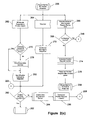
- FIGURES 2(a)-2(d) illustrate a unified flow-chart diagram for an exemplary method of Enhanced User Privacy for use in Mobile Station LCS.
- Flow connections between FIGURES 2(a) and 2(b) are represented by the elements 214, 220, 230, and 232.
- flow connections between FIGURES 2(a) and 2(c) are represented by the elements 202, 208 and 223.
- Flow connection between FIGURES 2(b) and 2(c) is represented by the element 258.
- Flow connections between FIGURES 2(b) and 2(d) are represented by the elements 214 and 246.
- Flow connection between FIGURES 2(c) and 2(d) is represented by the element 246.
- the element 202 in FIGURE 2(a) represents a state during which the Privacy Engine 120 ( FIGURE 1 ) awaits reception of a request for location data information (i.e., a position request).
- the Privacy Engine 120 receives a position request via the data connections described hereinabove with reference to FIGURE 1 .
- the Position Request data may comprise any of the following information: 1) network address and type of Location Request Application; 2) requestor category (e.g., emergency service, commercial service, individual person); 3) requestor identity, if applicable; 4) code word or digital certificate for verification of requestor identity ; 5) requested Quality of Service (QoS).
- Position Request data such as, for example, geographical area information, user information, requestor information, coordinate system, etc., as may be required to implement other embodiments.
- a Position Request Counter is initialized to a value of zero.
- the value zero represents the case where only one Position Request has been received. If subsequent Position Requests are received while a first Position Request is being processed, the Position Request Counter is incremented and decremented as described hereinbelow.
- the purpose of the Position Request Counter is for management of multiple concurrent position requests.
- the element 208 represents a flow connection from FIGURE 2(c) .
- Position Request data will be processed by the inventive method subsequent to a STEP 286 of FIGURE 2(c) via the flow connection 208 only if a subsequent Position Request is received while a prior Position Request is being processed.
- the Privacy Engine 120 invokes a selected Privacy Policy that assigns a Privacy Class to the Position Request received during STEP 204 (or via the element 208).
- the Privacy Policy comprises a list for assigning Privacy Classes to Position Requests, and Privacy Rules for decisions based on the assigned Privacy Classes.
- the Privacy Engine 120 may optionally invoke the Applications module 114 the Other Modules 124, or Mobile Station modules and components not shown in the Figure, to perform classification of the Position Request data.
- a network application may be invoked to verify digital certificate data.
- the Position Request data are evaluated to determine whether the Position Request is an Emergency Service Request.
- an Emergency Service Request shall override the Privacy Policy, and position data shall be returned to the requestor as expeditiously as possible.
- the method proceeds via the flow connection 214 to a STEP 256 ( FIGURE 2(b) ) to bypass the Privacy Policy and the expedite response.
- the method proceeds to a STEP 216.
- the Position Request data are evaluated to determine if there are other requirements that necessitate overriding the Privacy Policy. For example, certain countries may require an override for requests originating from law enforcement or other government agencies. If an override is required, the method proceeds via the flow connection 214 to the STEP 256 to expedite processing. If an override is not required, the method proceeds to a STEP 218.
- the Privacy Engine 120 invokes the Privacy Policy to determine whether the Position Request should be denied based on the rules associated with the Privacy Class assigned to the request. Denial of a request position information may be determined based upon a plurality of criteria. In a first example, the request may be denied because the requestor is a commercial entity, and the assigned Privacy Class for commercial entities specifies automatic denial. In a second example, the request may be denied because the requestor identity is a private individual who has been placed in a Privacy Class with a rule specifying automatic denial.
- the request may be denial because the Position Request data does not include a digital certificate or password that verifies identify of the requestor, and the default Privacy Class for this category includes a rule specifying automatic denial.
- the user may have chosen to designate that all Position Requests, other than those related to emergency services, be placed in a Privacy Class specifying automatic denial during specified time periods. It will be obvious to those skilled in the wireless communications art that many other examples are comprehended within the scope of the present teachings.
- the method proceeds to a STEP 222 whereat a denial of service message is transmitted to a Location Request Application.
- the STEP 222 may also be implemented via flow connection 220 following STEPS 238 or 242 of FIGURE 2(b) .
- the inventive method proceeds to a STEP 282 of FIGURE 2(c) via the process flow connection 223.
- the method checks the Position Request Counter to determine whether additional position requests are queued before either returning to the idle state process STEP 202, or executing further process steps.
- a Privacy Policy is invoked at a STEP 224 to determine whether user notification is required. If user notification is determined not to be required at the STEP 224, the inventive method proceeds via the flow connection 230 to a STEP 250 of FIGURE 2(b) for further processing. This is described in more detail below in regard to the description of FIGURE 2(b) .
- the User Interface 106 may employ a sound, image, vibration, or other means to alert the user that a Position Request has been granted, and graphical, text, or audible display or other presentation may be used to convey information relating to the Position Request, such as requestor category, requestor identity, and/or requested QoS.
- the Privacy Engine 120 invokes the Privacy Policy to determine if the Position Request requires user response in addition to user notification. If not, then the inventive method proceeds via flow connection 230 to the STEP 250 of FIGURE 2(b) for further processing. If a user response is required, then a timed wait for user response is initiated at a STEP 232.
- FIGURE 2(b) is a continuation of the unified flow diagram of FIGURE 2 (a)-2 (c) , proceeding from the STEP 232 (timed wait for user response).
- STEPS 234, 236, and 238 represent possible events that may terminate the timed wait period at the STEP 232.
- the STEP 240 represents an event that may occur during the timed wait period at the STEP 232.
- the STEP 242 invokes the Privacy Policy to determine if an absence of user response requires denial. If an absence of user response requires denial, then the inventive method proceeds via the flow connection 220 to the STEP 222 (shown in FIGURE 2(a) ). If absence of user response does not require denial, then the method proceeds to the STEP 250 for further processing.
- the new Position Request is evaluated to determine whether the request is an Emergency Service Request. For an Emergency Service Request the method proceeds via the flow connection 246 to a STEP 288 ( FIGURE 2(d) ). At the STEP 288 the Position Request Counter is incremented and the method proceeds to a STEP 290. At the STEP 290 the processing for the prior Position Request is suspended and placed in a queue for subsequent processing, as explained hereinbelow. In another embodiment (not shown) the method may instead abort processing of the prior Position Request at the STEP 290. In yet another embodiment (not shown), means are provided to enable the PD module 122 ( FIGURE 1 ) to process a plurality of simultaneous requests.
- the method proceeds to the STEP 256 ( FIGURE 2(b) ) via the flow connection 214 for expedited processing of the Emergency Service Request. If the new request is not an emergency request, the method proceeds directly from the STEP 244 to a STEP 248 ( FIGURE 2(b) ).
- the Position Request Counter is incremented.
- the method then proceeds to a STEP 260 and the new Position Request data are transferred to queuing.
- the method places the new Position Request data into a data queue.
- the inventive method returns to the STEP 232, and awaits a response from the user.
- additional steps may be inserted and implemented prior to the STEP 248 for the purpose of deciding whether the new Position Request should be denied instead of queued.
- a request that stipulates an unacceptable QoS may be denied at once rather than placed in queue.
- the STEP 250 may be entered from any of the STEPS 234, 242, or (via flow connection 230) the STEP 228 ( FIGURE 2(a) ).
- Position Request data designating QoS are compared with Privacy Rules that apply for the current Position Request.
- QoS may represent the accuracy of position data to be returned to the Location Request Application.
- the position data may comprise latitude and longitude coordinate data in conjunction with QoS data representing the accuracy of the position estimate. If the QoS specified by the Position Request data complies with limits specified by the Privacy Rules applicable for the present Position Request, the method proceeds to a STEP 256.
- the QoS data are modified for compliance in a STEP 252 before further processing at the STEP 256. Further discussion to clarify the purpose and use of QoS specifications will be given in the Exemplary Applications section described hereinbelow.
- the method activates the PD module 122 ( FIGURE 1 ) in order to retrieve position data in accordance with Position Request data and current Privacy Policy specifications.
- the method may implement STEP 256 via the flow connection 214, following from the STEPS 212, 216 ( FIGURE 2(a) ) or the STEP 290 ( FIGURE 2(d) ).
- the method then proceeds to a STEP 258.
- the method performs a timed wait for the PDM 122 response.
- FIGURE 2(c) is a continuation of the unified flow diagram of FIGURE 2 , proceeding from the timed wait at the STEP 258 ( FIGURE 2(b) (timed wait for PDM response).
- the STEPS 262 and 264 represent events that may terminate the timed wait period of the STEP 258.
- the STEP 266 also represents an event that may occur during the timed wait period at the STEP 258.
- the method proceeds from the STEP 262 to a decision STEP 270. If the timed wait of the STEP 258 "times-out", i.e., is terminated by the event represented at the STEP 264, (Time Out), the method proceeds from the STEP 264 to a STEP 272 and an error message is transmitted to the Location Request Application. In alternative embodiment (not shown), position information previously stored may be transmitted in place of an error message. Following the STEP 272, the method proceeds to a STEP 282 to test for pending position requests in the new position request queue.
- STEP 266 Possible Arrival of New Position Request During Wait
- new Position Request data is received by the Privacy Engine 120 ( FIGURE 1 ).
- STEP 268 the new Position Request is evaluated to determine whether the request is an Emergency Service Request. For an Emergency Service Request the method proceeds via the flow connection 246 to a STEP 288 ( FIGURE 2(d) ) for subsequent processing steps as described hereinabove. If the new request is not an emergency request, the method proceeds directly from the STEP 268 to a STEP 274.
- the method increments the Position Request Counter.
- the method places new Position Request data into a data queue.
- the method returns to the STEP 258 to continue to perform a timed wait for PDM response.
- the method proceeds from the STEP 258 to the STEP 262 as shown in FIGURE 2(c) .
- PDM data are transferred from the PDM 122 at the STEP 262, to the Privacy Engine 120.
- the PDM data comprise position coordinate data and QoS data.
- PDM data designating QoS are compared with Privacy Rules relating to the Privacy Class of the current Position Request.
- QoS may represent an estimated accuracy of PDM position coordinate data to be returned to the Location Request Application.
- the PDM data may comprise latitude and longitude data in conjunction with QoS data representing the accuracy of the position estimate. If the QoS of the PDM data complies with limits specified by the Privacy Rules relating to the Privacy Class of the current Position Request, the methods proceeds to a STEP 280 for further processing. If the QoS specified by the PDM data do not comply with Privacy Policy limits for the present instance, then the QoS data are modified for compliance at a STEP 276. After the position estimate is reformatted at the STEP 276, the method proceeds to the STEP 280. More detailed description of the purpose and use of QoS specifications is provided below in the Exemplary Applications section.
- the PDM data are transmitted to the Location Request Application at the STEP 280.
- the method then proceeds to the STEP 282, whereat the Position Request Counter is interrogated to determine if new Position Requests are pending. If the counter value is determined to be zero, indicating that no pending requests are present, then the method returns to the wait state 202 ( FIGURE 2(a) ). If the counter value is an integer greater than zero, then the method proceeds to a STEP 284. At the STEP 284, new Position Request data are retrieved from the new Position Request data queue.
- the method then proceeds to a STEP 286, whereat the Position Request Counter is decremented.
- the method then proceeds (via the flow connection 208) to the STEP 210 ( FIGURE 2(a) ) to further process new Position Request data.
- user configurable Privacy Classes and properties or rules appertaining thereto, can be defined.
- user configurability may be effected via data connections between the Privacy Engine 120 and the User Interface 106, the Privacy Management Server 104 (or other network servers not shown in the Figures), or the External Local Applications 116.
- secure means may comprise methods and means for providing secure digital communication, use of passwords, digital certificates, and other well known identity verification and authentication methods.
- 064 Privacy Classes may include, without limitation, the following types:
- Each Privacy Class may include, without limitation, the following Privacy Rules:
- the Mobile Station 102 may include a Subscriber Identity Module (SIM), a Universal Subscriber Identity Module (USIM) or a Removable User Identity Module (RUIM).
- SIM, USIM and RUIM devices are removable storage components for Mobile Stations that enable secure storage of user-specific information.
- the SIM, USIM or RUIM device may be included in the Other Modules block 112.
- user-specific Privacy Policy data are stored in the SIM, USIM or RUIM device.
- the devices are operatively coupled to the Privacy Engine 120 (connection not shown in FIGURE 1 ), and the user-specific Privacy Policy data are transmitted to the Privacy Engine 120 for implementation of the Privacy Engine 120 operations described hereinabove.
- User-specific Privacy Policy data are also received from the Privacy Engine for storage. This occurs when the Privacy Policy data are initially received for storage by the SIM, USIM or RUIM device, and when the data are changed or updated. When the SIM, USIM or RUIM is removed from the Mobile Station 102, the user-specific Privacy Policy information may then be advantageously deleted automatically from the Privacy Engine 120.
- SIM, USIM or RUIM devices for removable storage of user-specific data in Mobile Stations is well known to persons skilled in the communication arts.
- SIM devices Standards for implementation of SIM devices are described in the reference 3rd Generation Partnership Project (3GPP), Technical Specification (TS) Group Terminals, Subscriber Identity Module Application Programming Interface (SIM API), Stage 1, Release 1999, (3GPP TS 02.19 V8.0.0), June, 2001.
- 3GPP 3rd Generation Partnership Project
- TS Technical Specification
- SIM API Subscriber Identity Module Application Programming Interface
- Stage 1 Release 1999 3GPP TS 02.19 V8.0.0
- 3GPP TS 02.19 V8.0.0 3rd Generation Partnership Project
- This reference is hereby referenced for teachings relating to implementation of SKI devices. It will also be obvious to persons skilled in the art that the present teachings encompass embodiments wherein other removable storage devices (such as smart cards or memory sticks) are included in a Mobile Station and used in conjunction with the Privacy Engine for storage of user-specific Privacy Policy data.
- the disclosure also includes the method STEPS of any of the foregoing embodiments synthesized as digital logic in an integrated circuit, such as a Field Programmable Gate Array, or Programmable Logic Array, or other integrated circuits that can be fabricated or modified to embody computer program instructions.
- an integrated circuit such as a Field Programmable Gate Array, or Programmable Logic Array, or other integrated circuits that can be fabricated or modified to embody computer program instructions.
- the Mobile Station 102 in accordance with the present teachings may include, without limitation: wireless telephone, a personal digital assistant with wireless communication capability, a laptop with wireless communication capability, and any other mobile digital device for personal communication via wireless connection.
Landscapes
- Engineering & Computer Science (AREA)
- Computer Security & Cryptography (AREA)
- Computer Networks & Wireless Communication (AREA)
- Signal Processing (AREA)
- Databases & Information Systems (AREA)
- Mobile Radio Communication Systems (AREA)
- Telephonic Communication Services (AREA)
- Telephone Function (AREA)
Claims (30)
- Ein Privatsphärenkontrollsystem zum Einsatz in einer Mobilstation (102), wobei die Mobilstation (102) mit einem drahtlosen Kommunikationssystem kommuniziert und wobei das Privatsphärenkontrollsystem geographische Standortinformationen bereitstellt, verbunden mit der Mobilstation (102), aufweisend:a) eine Privatsphäreneinheit (120), eine Privatsphärenrichtlinienkomponente beinhaltend, die über zumindest eine Privatsphärenregel verfügt, wobei die Privatsphäreneinheit (120) Standortanfragen empfängt, zugehörig zu dem geographischen Standort von der Mobilstation, erzeugt durch einen Standortanforderer, außerhalb der Mobilstation (102), und bestimmt, ob die Standortanfrage abgewiesen werden sollte, zumindest zum Teil basierend auf der zumindest einen Privatsphärenregel; undb) ein Positionsbestimmungsmodul (122), wirksam verbunden mit und reagierend auf die Privatsphäreneinheit (120), wobei das Positionsbestimmungsmodul (122) Schätzungen von dem geographischen Standort von der Mobilstation (102) an die Privatsphäreneinheit (120) bereitstellt;wobei die Privatsphäreneinheit (120)selektiv das Positionsbestimmungsmodul (122) aktiviert, in Übereinstimmung mit der Privatsphärenrichtlinienkomponente, um die geographischen Standortschätzungen von dem Positionsbestimmungsmodul (122) zu empfangen, undauf die Standortanfragen antwortet, durch Verarbeiten der Standortschätzungen, undAntwortnachrichten bereitstellt, in Übereinstimmung mit der Privatsphärenrichtlinienkomponente.
- Das Privatsphärenkontrollsystem nach Anspruch 1, wobei das Positionsbestimmungsmodul (122) betrieben wird gemäß einem oder mehreren von den folgenden Verfahren:globales Ortungssystem, unterstütztes globales Ortungssystem, weiterentwickelte Vorwärtsverbindungs-Trilateration, Ankunftszeit, erweiterter beobachteter Zeitunterschied und Ortung, basierend auf Identifizierung von drahtlosen Kommunikationszellen, innerhalb derer die Mobilstation (120) betrieben wird.
- Das Privatsphärenkontrollsystem nach Anspruch 1, weiter aufweisend, ein Drahtlosnetzwerk-Kommunikationsmodul (112) betriebsfähig verbunden mit der Privatsphäreneinheit (120) und mit dem drahtlosen Kommunikationssystem, wobei das Drahtlosnetzwerk-Kommunikationsmodul (112) konfiguriert ist, die Standortanfragen von dem drahtlosen Kommunikationssystem zu empfangen und die Antwortnachrichten an das drahtlose Kommunikationssystem zu übertragen, und weiter konfiguriert ist, Daten und Softwareanweisungen von dem drahtlosen Kommunikationssystem zu empfangen und Daten und Softwareanweisungen an das drahtlose Kommunikationssystem zu übertragen.
- Das Privatsphärenkontrollsystem nach Anspruch 3, wobei die Privatsphäreneinheit (120) Software aufweist, die von dem drahtlosen Kommunikationssystem heruntergeladen wird.
- Das Privatsphärenkontrollsystem nach Anspruch 3, wobei die Privatsphäreneinheit (120) mit Softwareaktualisierungen modifiziert wird, heruntergeladen von dem drahtlosen Kommunikationssystem.
- Das Privatsphärenkontrollsystem nach Anspruch 3, wobei die Privatsphärenrichtlinie Software aufweist, die von dem drahtlosen Kommunikationssystem heruntergeladen wird.
- Das Privatsphärenkontrollsystem nach Anspruch 3, wobei die Privatsphärenrichtlinie mit Aktualisierungen modifiziert wird, heruntergeladen von dem drahtlosen Kommunikationssystem.
- Das Privatsphärenkontrollsystem nach Anspruch 7, wobei die Aktualisierungen benutzerspezifische Privatsphärenrichtlinien-Daten beinhalten.
- Das Privatsphärenkontrollsystem nach Anspruch 3, wobei die Standortanfrage empfangen wird von einer externen Anwendung, betriebsfähig verbunden mit dem drahtlosen Kommunikationssystem.
- Das Privatsphärenkontrollsystem nach Anspruch 1, weiter aufweisend ein lokales Kommunikationsmodul (118), betriebsfähig verbunden mit der Privatsphäreneinheit (120) und mit externen lokalen Anwendungen (116), wobei das lokale Kommunikationsmodul (118) konfiguriert ist, die externen Standortanfragen von den externen lokalen Anwendungen (116) zu empfangen und die Antwortnachrichten zu den externen lokalen Anwendungen (116) zu übertragen und weiter konfiguriert ist, Daten und Softwareanweisungen von den externen lokalen Anwendungen (116) zu empfangen und Daten und Softwareanweisungen zu den externen lokalen Anwendungen (116) zu übertragen.
- Das Privatsphärenkontrollsystem nach Anspruch 10, wobei die Privatsphäreneinheit (120) Software aufweist, die heruntergeladen wird von einer externen lokalen Anwendung (116).
- Das Privatsphärenkontrollsystem nach Anspruch 10, wobei die Privatsphäreneinheit (120) modifiziert wird mit Softwareaktualisierungen durch Softwareanweisungen, heruntergeladen von einer externen lokalen Anwendung (116).
- Das Privatsphärenkontrollsystem nach Anspruch 10, wobei die Privatsphärenrichtlinie Software aufweist, die von einer externen lokalen Anwendung heruntergeladen wird.
- Das Privatsphärenkontrollsystem nach Anspruch 10, wobei die Privatsphärenrichtlinie modifiziert ist mit Aktualisierungen, heruntergeladen von einer externen lokalen Anwendung (116).
- Das Privatsphärenkontrollsystem nach Anspruch 14, wobei die Aktualisierungen benutzerspezifische Privatsphärenrichtlinien-Daten beinhalten.
- Das Privatsphärenkontrollsystem nach Anspruch 10, wobei die Standortanfrage empfangen wird von einer externen lokalen Anwendung (116).
- Das Privatsphärenkontrollsystem nach Anspruch 1, weiter aufweisend eine Benutzerschnittstelle (106), betriebsfähig verbunden mit der Privatsphäreneinheit (120), wobei die Benutzerschnittstelle (106) konfiguriert ist, Eingabe von einem Benutzer zu empfangen und wobei die Benutzereingabe verwendet wird, die Privatsphärenrichtlinie mit Aktualisierungen zu modifizieren.
- Das Privatsphärenkontrollsystem nach Anspruch 17, wobei die Aktualisierungen benutzerspezifische Privatsphärenrichtlinien-Daten beinhalten.
- Das Privatsphärenkontrollsystem nach Anspruch 17, wobei die Benutzerschnittstelle (106) dem Benutzer Benachrichtigungen über Standortanfragen bereitstellt, in Übereinstimmung mit der Privatsphärenrichtlinie und wobei die Benutzerschnittstelle (106) konfiguriert ist, Antworten von dem Benutzer zu empfangen, reagierend auf die Standortanfragebenachrichtigungen.
- Das Privatsphärenkontrollsystem nach Anspruch 19, wobei die Privatsphärenrichtlinie eine Vielzahl von Privatsphärenklassen beinhaltet, wobei die Privatsphärenklassen die Standortanfragen, empfangen von der Privatsphäreneinheit (120), klassifizieren und wobei die Privatsphärenrichtlinie weiter Privatsphärenregeln beinhaltet, die Antworten auf die Standortanfragen für jede Privatsphärenklasse bestimmen, und wobei die Privatsphärenregeln zumindest eine von den folgenden Regeln beinhalten:a) eine Regel, Standardannahme oder Abweisung von einer Standortanfrage erfordernd;b) eine Regel, Benutzerbenachrichtigung über eine Standortanfrage erfordernd;c) eine Regel, Benutzerbenachrichtigung erfordernd, basierend auf einer angeforderten Servicequalität;d) eine Regel, Benutzerbenachrichtigung erfordernd, basierend darauf, ob die Standortanfrage periodisch ist, oder auf Verlangen initiiert wird;e) eine Regel, Benutzerbenachrichtigung erfordernd, basierend auf einem Zeitpunkt des Auftretens von der Standortanfrage;f) eine Regel, die einen Anzeigemodus spezifiziert, der für Benutzerbenachrichtigung verwendet werden soll;g) eine Regel, die einen Genauigkeitsbereich von der Standortschätzung spezifiziert, die bereitgestellt werden soll;h) eine Regel, Standardhandhabung von einer Antwortnachricht erfordernd, wenn der Benutzer nicht auf eine Benutzerbenachrichtigung antwortet; undi) eine Regel, die Antwortnachrichthandhabung spezifiziert, basierend auf dem gegenwärtigen Standort von der Mobilstation.
- Das Privatsphärenkontrollsystem nach Anspruch 1, weiter aufweisend ein entfernbares Datenspeicherendgerät, wobei das Datenspeicherendgerät betriebsfähig verbunden ist mit der Privatsphäreneinheit (120) und wobei das entfernbare Datenspeicherendgerät konfiguriert ist zu empfangen, speichern und übertragen von benutzerspezifischen Privatsphärenrichtlinien-Daten.
- Das Privatsphärenkontrollsystem nach Anspruch 21, wobei das entfernbare Datenspeicherendgerät ein Teilnehmeridentitäsmodul aufweist.
- Das Privatsphärenkontrollsystem nach Anspruch 21, wobei das entfernbare Datenspeicherendgerät ein universelles Teilnehmeridentitäsmodul aufweist.
- Das Privatsphärenkontrollsystem nach Anspruch 21, wobei das entfernbare Datenspeicherendgerät ein entfernbares Benutzeridentitätsmodul aufweist.
- Ein Verfahren zum Bereitstellen von Privatsphärenkontrolle von der geographischen Standortinformation in einer Mobilstation (102), wobei die Mobilstation (102) mit einem drahtlosen Kommunikationssystem kommuniziert und wobei die Mobilstation (102) eine Privatsphäreneinheit (120) beinhaltet, Softwareanweisungen aufweisend, wobei die Privatsphäreneinheitsoftwareanweisungen auch Privatsphärenrichtlinienanweisungen beinhalten, die über zumindest eine Privatsphärenregel verfügen, und wobei die Mobilstation (102) weiter ein Positionsbestimmungsmodul (122) beinhaltet, das in der Lage ist, geographische Standortschätzungen von der Mobilstation (102) bereitzustellen; das Verfahren die Schritte aufweisend:a) Empfangen (204) von Standortanfragen für einen gegenwärtigen geographischen Standort von der Mobilstation (102) von einem Standortanforderer außerhalb der Mobilstation (102);b) Verarbeiten der Standortanfragen in Übereinstimmung mit den Privatsphäreneinheitsoftwareanweisungen, wobei das Verarbeiten der Standortanfragen beinhaltet, Bestimmen, ob die Standortanfrage abgewiesen werden sollte, zumindest zum Teil basierend auf der zumindest einen Privatsphärenregel;c) selektives Aktivieren des Positionsbestimmungsmoduls (122), in Übereinstimmung mit der Privatsphärenrichtlinienkomponente zum Erhalten von geographischen Standortschätzungen von der Mobilstation (102);d) Verarbeiten der geographischen Standortschätzungen in Übereinstimmung mit den Standortanfragen, den Privatsphäreneinheitsoftwareanweisungen und den Privatsphärenregeln; unde) selektives Bereitstellen von Antwortnachrichten, reagierend auf die Standortanfragen, in Übereinstimmung mit den Privatsphäreneinheitsoftwareanweisungen, den Standortschätzungen und den Privatsphärenregeln.
- Das Privatsphärenkontrollverfahren nach Anspruch 25, wobei der Schritt b) zum Verarbeiten der Standortanfragen weiter beinhaltet, einen Schritt zum Verarbeiten von Notfallstandortanfragen durch Überschreiben der Privatsphärenrichtlinienanweisungen, um Notfallantwortnachrichten bereitzustellen.
- Das Privatsphärenkontrollverfahren nach Anspruch 26, wobei der Schritt b) zum Verarbeiten der Standortanfragen beinhaltet, Verarbeiten einer Vielzahl von gleichzeitigen Standortanfragen.
- Das Privatsphärenkontrollverfahren nach Anspruch 27, wobei anhängige Standortanfragen ausgesetzt werden, während die Notfallstandortanfragen verarbeitet werden.
- Das Privatsphärenkontrollverfahren nach Anspruch 25, weiter aufweisend einen Schritt zum Benachrichtigen eines Benutzers über Standortanfragen.
- Das Privatsphärenkontrollverfahren nach Anspruch 29, wobei die Privatsphärenrichtlinienanweisungen Privatsphärenklassen beinhalten zum Klassifizieren der Standortanfragen, die während des Schrittes a) empfangen wurden, und wobei die Privatsphärenrichtlinienanweisungen Privatsphärenregeln beinhalten zum Bestimmen einer Antwort auf die Standortanfragen für jede Privatsphärenklasse und wobei die Privatsphärenregeln zumindest eine von den folgenden Regeln beinhalten:a) eine Regel, Standardannahme oder Abweisung von einer Standortanfrage erfordernd;b) eine Regel, Benutzerbenachrichtigung über eine Standortanfrage erfordernd;c) eine Regel, Benutzerbenachrichtigung erfordernd, basierend auf einer angeforderten Servicequalität;d) eine Regel, Benutzerbenachrichtigung erfordernd, basierend darauf, ob die Standortanfrage periodisch ist, oder auf Verlangen initiiert wird;e) eine Regel, Benutzerbenachrichtigung erfordernd, basierend auf einem Zeitpunkt des Auftretens von der Standortanfrage;f) eine Regel, die einen Anzeigemodus spezifiziert, der für Benutzerbenachrichtigung verwendet werden soll;g) eine Regel, die einen Genauigkeitsbereich von der Standortschätzung spezifiziert, die bereitgestellt werden soll;h) eine Regel, Standardhandhabung von einer Antwortnachricht erfordernd, wenn der Benutzer nicht auf eine Benutzerbenachrichtigung antwortet; undi) eine Regel, die Antwortnachrichthandhabung spezifiziert, basierend auf dem gegenwärtigen Standort von der Mobilstation.
Priority Applications (4)
| Application Number | Priority Date | Filing Date | Title |
|---|---|---|---|
| EP15190174.1A EP2991391A1 (de) | 2003-02-14 | 2004-02-17 | Verbesserte benutzerprivatsphäre für mobilstationspositionsdienstleistungen |
| EP19211733.1A EP3637810A1 (de) | 2003-02-14 | 2004-02-17 | Verbesserte benutzerprivatsphäre für mobilstationspositionsdienstleistungen |
| EP18207273.6A EP3462758B1 (de) | 2003-02-14 | 2004-02-17 | Erhöhtes benutzerprivatleben für mobilstationspositionsdienstleistungen |
| EP16164898.5A EP3059988A1 (de) | 2003-02-14 | 2004-02-17 | Verbesserte benutzerprivatsphäre für mobilstationspositionsdienstleistungen |
Applications Claiming Priority (7)
| Application Number | Priority Date | Filing Date | Title |
|---|---|---|---|
| US44756303P | 2003-02-14 | 2003-02-14 | |
| US447563P | 2003-02-14 | ||
| US49076503P | 2003-07-28 | 2003-07-28 | |
| US490765P | 2003-12-12 | ||
| US779109 | 2004-02-13 | ||
| US10/779,109 US7088237B2 (en) | 2003-02-14 | 2004-02-13 | Enhanced user privacy for mobile station location services |
| PCT/US2004/004670 WO2004075594A1 (en) | 2003-02-14 | 2004-02-17 | Enhanced user privacy for mobile station location services |
Related Child Applications (6)
| Application Number | Title | Priority Date | Filing Date |
|---|---|---|---|
| EP19211733.1A Division EP3637810A1 (de) | 2003-02-14 | 2004-02-17 | Verbesserte benutzerprivatsphäre für mobilstationspositionsdienstleistungen |
| EP16164898.5A Division EP3059988A1 (de) | 2003-02-14 | 2004-02-17 | Verbesserte benutzerprivatsphäre für mobilstationspositionsdienstleistungen |
| EP16164898.5A Division-Into EP3059988A1 (de) | 2003-02-14 | 2004-02-17 | Verbesserte benutzerprivatsphäre für mobilstationspositionsdienstleistungen |
| EP15190174.1A Division EP2991391A1 (de) | 2003-02-14 | 2004-02-17 | Verbesserte benutzerprivatsphäre für mobilstationspositionsdienstleistungen |
| EP15190174.1A Division-Into EP2991391A1 (de) | 2003-02-14 | 2004-02-17 | Verbesserte benutzerprivatsphäre für mobilstationspositionsdienstleistungen |
| EP18207273.6A Division EP3462758B1 (de) | 2003-02-14 | 2004-02-17 | Erhöhtes benutzerprivatleben für mobilstationspositionsdienstleistungen |
Publications (2)
| Publication Number | Publication Date |
|---|---|
| EP1593286A1 EP1593286A1 (de) | 2005-11-09 |
| EP1593286B1 true EP1593286B1 (de) | 2016-11-02 |
Family
ID=32913027
Family Applications (5)
| Application Number | Title | Priority Date | Filing Date |
|---|---|---|---|
| EP15190174.1A Withdrawn EP2991391A1 (de) | 2003-02-14 | 2004-02-17 | Verbesserte benutzerprivatsphäre für mobilstationspositionsdienstleistungen |
| EP18207273.6A Expired - Lifetime EP3462758B1 (de) | 2003-02-14 | 2004-02-17 | Erhöhtes benutzerprivatleben für mobilstationspositionsdienstleistungen |
| EP19211733.1A Withdrawn EP3637810A1 (de) | 2003-02-14 | 2004-02-17 | Verbesserte benutzerprivatsphäre für mobilstationspositionsdienstleistungen |
| EP04711904.5A Expired - Lifetime EP1593286B1 (de) | 2003-02-14 | 2004-02-17 | Erhöhtes benutzerprivatleben für mobilstationspositionsdienstleistungen |
| EP16164898.5A Withdrawn EP3059988A1 (de) | 2003-02-14 | 2004-02-17 | Verbesserte benutzerprivatsphäre für mobilstationspositionsdienstleistungen |
Family Applications Before (3)
| Application Number | Title | Priority Date | Filing Date |
|---|---|---|---|
| EP15190174.1A Withdrawn EP2991391A1 (de) | 2003-02-14 | 2004-02-17 | Verbesserte benutzerprivatsphäre für mobilstationspositionsdienstleistungen |
| EP18207273.6A Expired - Lifetime EP3462758B1 (de) | 2003-02-14 | 2004-02-17 | Erhöhtes benutzerprivatleben für mobilstationspositionsdienstleistungen |
| EP19211733.1A Withdrawn EP3637810A1 (de) | 2003-02-14 | 2004-02-17 | Verbesserte benutzerprivatsphäre für mobilstationspositionsdienstleistungen |
Family Applications After (1)
| Application Number | Title | Priority Date | Filing Date |
|---|---|---|---|
| EP16164898.5A Withdrawn EP3059988A1 (de) | 2003-02-14 | 2004-02-17 | Verbesserte benutzerprivatsphäre für mobilstationspositionsdienstleistungen |
Country Status (10)
| Country | Link |
|---|---|
| US (1) | US7088237B2 (de) |
| EP (5) | EP2991391A1 (de) |
| JP (2) | JP4638408B2 (de) |
| KR (1) | KR101042823B1 (de) |
| BR (2) | BR122017022365B1 (de) |
| ES (1) | ES2614105T3 (de) |
| HK (1) | HK1225892A1 (de) |
| HU (1) | HUE030670T2 (de) |
| MX (1) | MXPA05008633A (de) |
| WO (1) | WO2004075594A1 (de) |
Families Citing this family (128)
| Publication number | Priority date | Publication date | Assignee | Title |
|---|---|---|---|---|
| EP1266321A4 (de) | 2000-02-25 | 2003-05-21 | Telecomm Systems Inc | Kurznachrichten mit vorbezahlung |
| US7522911B2 (en) | 2000-04-11 | 2009-04-21 | Telecommunication Systems, Inc. | Wireless chat automatic status tracking |
| US7110773B1 (en) | 2000-04-11 | 2006-09-19 | Telecommunication Systems, Inc. | Mobile activity status tracker |
| US7853272B2 (en) | 2001-12-21 | 2010-12-14 | Telecommunication Systems, Inc. | Wireless network tour guide |
| US7392132B2 (en) * | 2002-06-14 | 2008-06-24 | Matsushita Electric Industrial Co., Ltd. | Position notifying device |
| CN1784910B (zh) * | 2003-03-14 | 2011-05-25 | 北方电讯网络有限公司 | 在无线通信网络中使用有关位置业务是紧急相关位置业务还是执法相关位置业务的指示来提供位置业务 |
| US9351139B2 (en) * | 2003-03-14 | 2016-05-24 | Microsoft Technology Licensing, Llc | Location information for a mobile station |
| WO2005019998A2 (en) * | 2003-08-15 | 2005-03-03 | Boston Communications Group, Inc. | Subscriber management and accounting using event detection in a wireless device |
| GB0424052D0 (en) * | 2004-10-29 | 2004-12-01 | Nortel Networks Ltd | Improvements in or relating to internet protocol (IP) location, privacy and presence |
| US20060099970A1 (en) * | 2004-11-10 | 2006-05-11 | Morgan Scott D | Method and system for providing a log of mobile station location requests |
| FI20050357A0 (fi) * | 2005-04-07 | 2005-04-07 | Risto Kalevi Savolainen | Matkapäätelaitteen tarkan sijainnin määrittäminen, menetelmä ja laite |
| KR100767419B1 (ko) * | 2005-04-30 | 2007-10-18 | 엘지전자 주식회사 | 사용자 위치 기반의 위치정보 서비스를 제공하는 단말기 및 그 제공 방법 |
| EP1982282A1 (de) * | 2006-01-27 | 2008-10-22 | Koninklijke Philips Electronics N.V. | Vorrichtung und vorrichtung zur überwachung von gesundheitsdaten |
| US9848081B2 (en) | 2006-05-25 | 2017-12-19 | Celltrust Corporation | Dissemination of real estate information through text messaging |
| EP3023894B1 (de) * | 2006-05-25 | 2017-11-22 | CellTrust Corporation | Verfahren zur sicheren verwaltung mobiler informationen |
| US8280359B2 (en) | 2006-05-25 | 2012-10-02 | Celltrust Corporation | Methods of authorizing actions |
| US8965416B2 (en) | 2006-05-25 | 2015-02-24 | Celltrust Corporation | Distribution of lottery tickets through mobile devices |
| US8225380B2 (en) | 2006-05-25 | 2012-07-17 | Celltrust Corporation | Methods to authenticate access and alarm as to proximity to location |
| US9572033B2 (en) | 2006-05-25 | 2017-02-14 | Celltrust Corporation | Systems and methods for encrypted mobile voice communications |
| US8260274B2 (en) | 2006-05-25 | 2012-09-04 | Celltrust Corporation | Extraction of information from e-mails and delivery to mobile phones, system and method |
| US10049077B2 (en) * | 2006-06-30 | 2018-08-14 | Intel Corporation | Handheld device for elderly people |
| GB2443232A (en) * | 2006-10-09 | 2008-04-30 | Symbian Software Ltd | Providing privacy in mobile location |
| US7974235B2 (en) | 2006-11-13 | 2011-07-05 | Telecommunication Systems, Inc. | Secure location session manager |
| CN201041855Y (zh) * | 2007-03-20 | 2008-03-26 | 富士康(昆山)电脑接插件有限公司 | 电连接器端子 |
| US8655719B1 (en) * | 2007-07-25 | 2014-02-18 | Hewlett-Packard Development Company, L.P. | Mediating customer-driven exchange of access to personal data for personalized merchant offers |
| US8756318B1 (en) * | 2007-10-09 | 2014-06-17 | Microsoft Corporation | Software deployment using client location |
| US20090106815A1 (en) * | 2007-10-23 | 2009-04-23 | International Business Machines Corporation | Method for mapping privacy policies to classification labels |
| KR101086452B1 (ko) * | 2007-12-05 | 2011-11-25 | 한국전자통신연구원 | 등급별 프라이버시 정책을 갖는 아이덴터티 관리 시스템 및그 방법 |
| CA2711278A1 (en) | 2008-01-03 | 2009-07-09 | Stanley Young | Monitoring a mobile device |
| US8258942B1 (en) | 2008-01-24 | 2012-09-04 | Cellular Tracking Technologies, LLC | Lightweight portable tracking device |
| US8335500B2 (en) | 2008-02-29 | 2012-12-18 | Research In Motion Limited | Notification of access control request and explanation indicative of the access control request on a communication device |
| US8839460B2 (en) * | 2008-03-07 | 2014-09-16 | Qualcomm Incorporated | Method for securely communicating information about the location of a compromised computing device |
| US8850568B2 (en) * | 2008-03-07 | 2014-09-30 | Qualcomm Incorporated | Method and apparatus for detecting unauthorized access to a computing device and securely communicating information about such unauthorized access |
| AU2009228017A1 (en) | 2008-03-28 | 2009-10-01 | Celltrust Corporation | Systems and methods for secure short messaging service and multimedia messaging service |
| US8924552B2 (en) | 2008-05-12 | 2014-12-30 | Telefonaktiebolaget L M Ericsson (Publ) | Remote and local compound device capabilities synchronization method and system |
| US8548428B2 (en) | 2009-01-28 | 2013-10-01 | Headwater Partners I Llc | Device group partitions and settlement platform |
| US8406748B2 (en) | 2009-01-28 | 2013-03-26 | Headwater Partners I Llc | Adaptive ambient services |
| US8391834B2 (en) | 2009-01-28 | 2013-03-05 | Headwater Partners I Llc | Security techniques for device assisted services |
| US8626115B2 (en) | 2009-01-28 | 2014-01-07 | Headwater Partners I Llc | Wireless network service interfaces |
| US8402111B2 (en) | 2009-01-28 | 2013-03-19 | Headwater Partners I, Llc | Device assisted services install |
| US8832777B2 (en) | 2009-03-02 | 2014-09-09 | Headwater Partners I Llc | Adapting network policies based on device service processor configuration |
| US8275830B2 (en) | 2009-01-28 | 2012-09-25 | Headwater Partners I Llc | Device assisted CDR creation, aggregation, mediation and billing |
| US8589541B2 (en) | 2009-01-28 | 2013-11-19 | Headwater Partners I Llc | Device-assisted services for protecting network capacity |
| US8635335B2 (en) | 2009-01-28 | 2014-01-21 | Headwater Partners I Llc | System and method for wireless network offloading |
| US8346225B2 (en) | 2009-01-28 | 2013-01-01 | Headwater Partners I, Llc | Quality of service for device assisted services |
| US8583781B2 (en) | 2009-01-28 | 2013-11-12 | Headwater Partners I Llc | Simplified service network architecture |
| US8107973B1 (en) * | 2008-08-07 | 2012-01-31 | At&T Mobility Ii Llc | Class structured location based services |
| US20100077484A1 (en) * | 2008-09-23 | 2010-03-25 | Yahoo! Inc. | Location tracking permissions and privacy |
| TWI418193B (zh) * | 2009-01-06 | 2013-12-01 | Univ Nat Taiwan Science Tech | 移動終端管理系統及方法,及其電腦程式產品 |
| US10237757B2 (en) | 2009-01-28 | 2019-03-19 | Headwater Research Llc | System and method for wireless network offloading |
| US10200541B2 (en) | 2009-01-28 | 2019-02-05 | Headwater Research Llc | Wireless end-user device with divided user space/kernel space traffic policy system |
| US10779177B2 (en) | 2009-01-28 | 2020-09-15 | Headwater Research Llc | Device group partitions and settlement platform |
| US10841839B2 (en) | 2009-01-28 | 2020-11-17 | Headwater Research Llc | Security, fraud detection, and fraud mitigation in device-assisted services systems |
| US9954975B2 (en) | 2009-01-28 | 2018-04-24 | Headwater Research Llc | Enhanced curfew and protection associated with a device group |
| US9955332B2 (en) | 2009-01-28 | 2018-04-24 | Headwater Research Llc | Method for child wireless device activation to subscriber account of a master wireless device |
| US9557889B2 (en) | 2009-01-28 | 2017-01-31 | Headwater Partners I Llc | Service plan design, user interfaces, application programming interfaces, and device management |
| US9571559B2 (en) | 2009-01-28 | 2017-02-14 | Headwater Partners I Llc | Enhanced curfew and protection associated with a device group |
| US12388810B2 (en) | 2009-01-28 | 2025-08-12 | Headwater Research Llc | End user device that secures an association of application to service policy with an application certificate check |
| US12166596B2 (en) | 2009-01-28 | 2024-12-10 | Disney Enterprises, Inc. | Device-assisted services for protecting network capacity |
| US10798252B2 (en) | 2009-01-28 | 2020-10-06 | Headwater Research Llc | System and method for providing user notifications |
| US9565707B2 (en) | 2009-01-28 | 2017-02-07 | Headwater Partners I Llc | Wireless end-user device with wireless data attribution to multiple personas |
| US9706061B2 (en) | 2009-01-28 | 2017-07-11 | Headwater Partners I Llc | Service design center for device assisted services |
| US12389218B2 (en) | 2009-01-28 | 2025-08-12 | Headwater Research Llc | Service selection set publishing to device agent with on-device service selection |
| US11218854B2 (en) | 2009-01-28 | 2022-01-04 | Headwater Research Llc | Service plan design, user interfaces, application programming interfaces, and device management |
| US10783581B2 (en) | 2009-01-28 | 2020-09-22 | Headwater Research Llc | Wireless end-user device providing ambient or sponsored services |
| US10064055B2 (en) | 2009-01-28 | 2018-08-28 | Headwater Research Llc | Security, fraud detection, and fraud mitigation in device-assisted services systems |
| US10264138B2 (en) | 2009-01-28 | 2019-04-16 | Headwater Research Llc | Mobile device and service management |
| US12452377B2 (en) | 2009-01-28 | 2025-10-21 | Headwater Research Llc | Service design center for device assisted services |
| US9980146B2 (en) | 2009-01-28 | 2018-05-22 | Headwater Research Llc | Communications device with secure data path processing agents |
| US9647918B2 (en) | 2009-01-28 | 2017-05-09 | Headwater Research Llc | Mobile device and method attributing media services network usage to requesting application |
| US10248996B2 (en) | 2009-01-28 | 2019-04-02 | Headwater Research Llc | Method for operating a wireless end-user device mobile payment agent |
| US9392462B2 (en) | 2009-01-28 | 2016-07-12 | Headwater Partners I Llc | Mobile end-user device with agent limiting wireless data communication for specified background applications based on a stored policy |
| US10715342B2 (en) | 2009-01-28 | 2020-07-14 | Headwater Research Llc | Managing service user discovery and service launch object placement on a device |
| US10484858B2 (en) | 2009-01-28 | 2019-11-19 | Headwater Research Llc | Enhanced roaming services and converged carrier networks with device assisted services and a proxy |
| US10326800B2 (en) | 2009-01-28 | 2019-06-18 | Headwater Research Llc | Wireless network service interfaces |
| US11973804B2 (en) | 2009-01-28 | 2024-04-30 | Headwater Research Llc | Network service plan design |
| US11985155B2 (en) | 2009-01-28 | 2024-05-14 | Headwater Research Llc | Communications device with secure data path processing agents |
| US12432130B2 (en) | 2009-01-28 | 2025-09-30 | Headwater Research Llc | Flow tagging for service policy implementation |
| US9270559B2 (en) | 2009-01-28 | 2016-02-23 | Headwater Partners I Llc | Service policy implementation for an end-user device having a control application or a proxy agent for routing an application traffic flow |
| US10057775B2 (en) | 2009-01-28 | 2018-08-21 | Headwater Research Llc | Virtualized policy and charging system |
| US9858559B2 (en) | 2009-01-28 | 2018-01-02 | Headwater Research Llc | Network service plan design |
| US10492102B2 (en) | 2009-01-28 | 2019-11-26 | Headwater Research Llc | Intermediate networking devices |
| US12543031B2 (en) | 2009-01-28 | 2026-02-03 | Headwater Research Llc | Adapting network policies based on device service processor configuration |
| US9572019B2 (en) | 2009-01-28 | 2017-02-14 | Headwater Partners LLC | Service selection set published to device agent with on-device service selection |
| US9578182B2 (en) | 2009-01-28 | 2017-02-21 | Headwater Partners I Llc | Mobile device and service management |
| US8644173B1 (en) * | 2009-01-30 | 2014-02-04 | Sprint Communications Company L.P | Managing requests in a wireless system |
| US8265595B1 (en) * | 2009-01-30 | 2012-09-11 | Sprint Communications Company L.P. | Managing application permissions on a mobile device |
| US8380219B1 (en) * | 2009-03-24 | 2013-02-19 | Sprint Communications Company L.P. | Controlling an amount of information disclosed by a position-determining system |
| US20110034182A1 (en) * | 2009-08-05 | 2011-02-10 | Oto Technologies, Llc | Geographic messaging using location-identified access points |
| US8787935B2 (en) * | 2009-09-24 | 2014-07-22 | Sprint Communications Company L.P. | Location request authorization for communication devices |
| US8588752B2 (en) * | 2009-10-10 | 2013-11-19 | Mitel Networks Corporation | System and method for creation and management of location information |
| US9361631B2 (en) | 2010-01-06 | 2016-06-07 | Ghostery, Inc. | Managing and monitoring digital advertising |
| CA2787935C (en) | 2010-02-01 | 2016-09-13 | Loc-Aid Technologies, Inc. | System and method for location privacy and location information management over wireless systems |
| US9299255B2 (en) * | 2010-03-04 | 2016-03-29 | Verizon Telematics Inc. | Method and system for providing location information of a vehicle to a user device |
| EP2553877A2 (de) * | 2010-04-02 | 2013-02-06 | InterDigital Patent Holdings, Inc. | Verfahren zur richtlinienverwaltung |
| US8964052B1 (en) * | 2010-07-19 | 2015-02-24 | Lucasfilm Entertainment Company, Ltd. | Controlling a virtual camera |
| US8106819B1 (en) * | 2010-12-30 | 2012-01-31 | Cellco Partnership | Optimizing performance of multiple location based service applications that are running either alone or simultaneously on a wireless device |
| US20120222083A1 (en) * | 2011-02-28 | 2012-08-30 | Nokia Corporation | Method and apparatus for enforcing data privacy |
| US9014632B2 (en) * | 2011-04-29 | 2015-04-21 | Here Global B.V. | Obtaining vehicle traffic information using mobile bluetooth detectors |
| US8996688B2 (en) | 2011-05-31 | 2015-03-31 | Nokia Corporation | Method and apparatus for monitoring and controlling data sharing |
| KR101147687B1 (ko) * | 2011-06-20 | 2012-05-22 | 연세대학교 산학협력단 | 이웃 정보 제공 방법 및 이웃 위치 정보 생성 방법 |
| KR101285394B1 (ko) * | 2011-08-24 | 2013-08-23 | 주식회사 팬택 | 휴대 단말 시스템의 대기 상태에서의 퍼미션 제어 장치 |
| WO2013030626A1 (en) * | 2011-08-31 | 2013-03-07 | Nokia Corporation | Method and apparatus for privacy policy management |
| EP2769560B1 (de) * | 2011-10-17 | 2019-07-17 | Nokia Technologies Oy | Automatisches verfahren zur personalisierten datenschutzempfehlung im zusammenhang mit der position |
| DE102011084878A1 (de) * | 2011-10-20 | 2013-04-25 | Continental Teves Ag & Co. Ohg | Verfahren und Vorrichtung zur Unschärfestellung einer Positionsinformation und/oder davon abgeleiteter Informationen |
| US8929854B2 (en) * | 2011-10-27 | 2015-01-06 | Telecommunication Systems, Inc. | Emergency text messaging |
| KR101326345B1 (ko) | 2011-10-31 | 2013-11-11 | 에스케이씨앤씨 주식회사 | 근접 통신에 의한 동의절차를 이용한 정보 제공방법 및 시스템 |
| US20130111545A1 (en) * | 2011-11-02 | 2013-05-02 | Alcatel-Lucent Usa Inc. | Privacy Management for Subscriber Data |
| US8646032B2 (en) | 2011-12-30 | 2014-02-04 | Nokia Corporation | Method and apparatus providing privacy setting and monitoring user interface |
| WO2013101215A1 (en) * | 2011-12-30 | 2013-07-04 | Intel Corporation | Cloud based real time app privacy dashboard |
| US9721105B2 (en) * | 2012-01-18 | 2017-08-01 | Nokia Technologies Oy | Method and apparatus for generating privacy ratings for applications |
| US9081986B2 (en) | 2012-05-07 | 2015-07-14 | Nokia Technologies Oy | Method and apparatus for user information exchange |
| US9277364B2 (en) | 2012-06-25 | 2016-03-01 | Nokia Technologies Oy | Methods and apparatus for reporting location privacy |
| US10291492B2 (en) | 2012-08-15 | 2019-05-14 | Evidon, Inc. | Systems and methods for discovering sources of online content |
| US9817997B2 (en) | 2014-12-18 | 2017-11-14 | Banjo, Inc. | User-generated content permissions status analysis system and method |
| US9043329B1 (en) | 2013-12-19 | 2015-05-26 | Banjo, Inc. | Dynamic event detection system and method |
| US10360352B2 (en) | 2012-10-02 | 2019-07-23 | Banjo, Inc. | System and method for event-based vehicle operation |
| US9934368B2 (en) | 2012-10-02 | 2018-04-03 | Banjo, Inc. | User-generated content permissions status analysis system and method |
| US9652525B2 (en) | 2012-10-02 | 2017-05-16 | Banjo, Inc. | Dynamic event detection system and method |
| US10789594B2 (en) | 2013-01-31 | 2020-09-29 | Moshir Vantures, Limited, LLC | Method and system to intelligently assess and mitigate security risks on a mobile device |
| WO2014159862A1 (en) | 2013-03-14 | 2014-10-02 | Headwater Partners I Llc | Automated credential porting for mobile devices |
| EP2784714B1 (de) * | 2013-03-28 | 2021-04-28 | Alcatel Lucent | Beschränkung des Zugriffs auf Ressourcen und sensiblen Daten einer Datenverarbeitungseinrichtung |
| US9408047B2 (en) | 2013-10-10 | 2016-08-02 | Telecommunication Systems, Inc. | Read acknowledgement interoperability for text messaging and IP messaging |
| US9473883B2 (en) | 2014-05-31 | 2016-10-18 | Apple Inc. | Location service authorization and indication |
| CN104581625B (zh) * | 2014-11-12 | 2018-04-24 | 华中科技大学 | 一种基于粒度控制的位置隐私保护方法和系统 |
| WO2016168125A1 (en) | 2015-04-11 | 2016-10-20 | Ghostery, Inc. | Methods, apparatus, and systems for providing notice of digital tracking technologies in mobile apps on mobile devices, and for recording user consent in connection with same |
| US9591443B2 (en) | 2015-06-01 | 2017-03-07 | Apple Inc. | Location service management |
| CN111447546A (zh) * | 2019-03-01 | 2020-07-24 | 维沃移动通信有限公司 | 一种位置服务的控制方法和通信单元 |
Citations (3)
| Publication number | Priority date | Publication date | Assignee | Title |
|---|---|---|---|---|
| WO2002060191A2 (en) * | 2000-11-10 | 2002-08-01 | Motorola Inc. | Method and apparatus for providing location information |
| WO2002093877A1 (en) * | 2001-05-15 | 2002-11-21 | Nokia Corporation | Context sensitive web services |
| US6505048B1 (en) * | 1999-12-30 | 2003-01-07 | Samsung Electronics Co., Ltd. | Location privacy feature for wireless mobile stations and method of operation |
Family Cites Families (21)
| Publication number | Priority date | Publication date | Assignee | Title |
|---|---|---|---|---|
| US5555376A (en) * | 1993-12-03 | 1996-09-10 | Xerox Corporation | Method for granting a user request having locational and contextual attributes consistent with user policies for devices having locational attributes consistent with the user request |
| US6072396A (en) * | 1994-12-30 | 2000-06-06 | Advanced Business Sciences | Apparatus and method for continuous electronic monitoring and tracking of individuals |
| JP3347003B2 (ja) * | 1996-11-26 | 2002-11-20 | シャープ株式会社 | 無線端末装置 |
| US6904110B2 (en) * | 1997-07-31 | 2005-06-07 | Francois Trans | Channel equalization system and method |
| US6313786B1 (en) | 1998-07-02 | 2001-11-06 | Snaptrack, Inc. | Method and apparatus for measurement processing of satellite positioning system (SPS) signals |
| US6167255A (en) * | 1998-07-29 | 2000-12-26 | @Track Communications, Inc. | System and method for providing menu data using a communication network |
| US6360102B1 (en) * | 1998-09-10 | 2002-03-19 | Ericsson Inc. | System and method for defining a subscriber location privacy profile |
| JP2000194993A (ja) * | 1998-12-25 | 2000-07-14 | Equos Research Co Ltd | 移動体の位置提供方法及びその装置 |
| US6311069B1 (en) * | 1999-03-18 | 2001-10-30 | Ericsson Inc. | System and method for alerting a mobile subscriber being positioned |
| US7093286B1 (en) * | 1999-07-23 | 2006-08-15 | Openwave Systems Inc. | Method and system for exchanging sensitive information in a wireless communication system |
| US7076255B2 (en) * | 2000-04-05 | 2006-07-11 | Microsoft Corporation | Context-aware and location-aware cellular phones and methods |
| US7225460B2 (en) * | 2000-05-09 | 2007-05-29 | International Business Machine Corporation | Enterprise privacy manager |
| AU2001285069A1 (en) * | 2000-08-22 | 2002-03-04 | Ericsson Inc. | Methods, mobile user terminals, and systems for controlling access to mobile user terminal location information |
| US6944679B2 (en) * | 2000-12-22 | 2005-09-13 | Microsoft Corp. | Context-aware systems and methods, location-aware systems and methods, context-aware vehicles and methods of operating the same, and location-aware vehicles and methods of operating the same |
| JP2002245077A (ja) * | 2001-02-14 | 2002-08-30 | Hitachi Ltd | 情報配信サービスシステムおよび移動体データ送受信装置 |
| US7203752B2 (en) * | 2001-02-16 | 2007-04-10 | Openwave Systems Inc. | Method and system for managing location information for wireless communications devices |
| WO2002087188A1 (en) * | 2001-04-19 | 2002-10-31 | Nokia Corporation | Method and system for privacy preferences management using a synchronisation protocol |
| US6594483B2 (en) * | 2001-05-15 | 2003-07-15 | Nokia Corporation | System and method for location based web services |
| US7363043B2 (en) | 2001-05-18 | 2008-04-22 | Southwest Research Institute | Passive GSM-based self-locating device |
| US7099663B2 (en) | 2001-05-31 | 2006-08-29 | Qualcomm Inc. | Safe application distribution and execution in a wireless environment |
| JP4552366B2 (ja) * | 2001-07-09 | 2010-09-29 | 日本電気株式会社 | 移動携帯端末、位置検索システム及びその位置検索方法並びにそのプログラム |
-
2004
- 2004-02-13 US US10/779,109 patent/US7088237B2/en not_active Expired - Lifetime
- 2004-02-17 ES ES04711904.5T patent/ES2614105T3/es not_active Expired - Lifetime
- 2004-02-17 KR KR1020057015010A patent/KR101042823B1/ko not_active Expired - Fee Related
- 2004-02-17 HU HUE04711904A patent/HUE030670T2/en unknown
- 2004-02-17 EP EP15190174.1A patent/EP2991391A1/de not_active Withdrawn
- 2004-02-17 EP EP18207273.6A patent/EP3462758B1/de not_active Expired - Lifetime
- 2004-02-17 EP EP19211733.1A patent/EP3637810A1/de not_active Withdrawn
- 2004-02-17 BR BR122017022365-8A patent/BR122017022365B1/pt active IP Right Grant
- 2004-02-17 EP EP04711904.5A patent/EP1593286B1/de not_active Expired - Lifetime
- 2004-02-17 WO PCT/US2004/004670 patent/WO2004075594A1/en not_active Ceased
- 2004-02-17 JP JP2006503644A patent/JP4638408B2/ja not_active Expired - Fee Related
- 2004-02-17 BR BRPI0407473A patent/BRPI0407473B1/pt active IP Right Grant
- 2004-02-17 EP EP16164898.5A patent/EP3059988A1/de not_active Withdrawn
- 2004-02-17 MX MXPA05008633A patent/MXPA05008633A/es active IP Right Grant
-
2010
- 2010-09-13 JP JP2010204484A patent/JP5301511B2/ja not_active Expired - Fee Related
-
2016
- 2016-12-08 HK HK16113994.1A patent/HK1225892A1/en unknown
Patent Citations (3)
| Publication number | Priority date | Publication date | Assignee | Title |
|---|---|---|---|---|
| US6505048B1 (en) * | 1999-12-30 | 2003-01-07 | Samsung Electronics Co., Ltd. | Location privacy feature for wireless mobile stations and method of operation |
| WO2002060191A2 (en) * | 2000-11-10 | 2002-08-01 | Motorola Inc. | Method and apparatus for providing location information |
| WO2002093877A1 (en) * | 2001-05-15 | 2002-11-21 | Nokia Corporation | Context sensitive web services |
Also Published As
| Publication number | Publication date |
|---|---|
| HUE030670T2 (en) | 2017-05-29 |
| EP2991391A1 (de) | 2016-03-02 |
| KR101042823B1 (ko) | 2011-06-20 |
| EP3059988A1 (de) | 2016-08-24 |
| HK1088165A1 (en) | 2006-10-27 |
| WO2004075594A1 (en) | 2004-09-02 |
| MXPA05008633A (es) | 2005-12-06 |
| BRPI0407473A (pt) | 2006-02-07 |
| US7088237B2 (en) | 2006-08-08 |
| HK1225892A1 (en) | 2017-09-15 |
| KR20050098936A (ko) | 2005-10-12 |
| EP1593286A1 (de) | 2005-11-09 |
| BR122017022365B1 (pt) | 2019-05-07 |
| JP4638408B2 (ja) | 2011-02-23 |
| EP3637810A1 (de) | 2020-04-15 |
| JP2006518162A (ja) | 2006-08-03 |
| JP5301511B2 (ja) | 2013-09-25 |
| EP3462758A1 (de) | 2019-04-03 |
| EP3462758B1 (de) | 2022-09-28 |
| JP2011082971A (ja) | 2011-04-21 |
| US20040176104A1 (en) | 2004-09-09 |
| BRPI0407473B1 (pt) | 2018-11-06 |
| ES2614105T3 (es) | 2017-05-29 |
Similar Documents
| Publication | Publication Date | Title |
|---|---|---|
| EP1593286B1 (de) | Erhöhtes benutzerprivatleben für mobilstationspositionsdienstleistungen | |
| US7054648B2 (en) | Location privacy proxy server and method in a telecommunication network | |
| US7000116B2 (en) | Password value based on geographic location | |
| US20190075117A1 (en) | Method for serving location information access requests | |
| US8613109B2 (en) | Method and apparatus for providing mobile social networking privacy | |
| US20060099970A1 (en) | Method and system for providing a log of mobile station location requests | |
| EP1233632A1 (de) | Verfahren und System zur Bereitstellung von Diensten | |
| US9860693B2 (en) | Method and apparatus for sending a request to locate an individual via a text message | |
| CN100551116C (zh) | 用于具有移动台的定位服务隐私管理的系统、方法和装置 | |
| KR20050096114A (ko) | 통신 장치로의 액세스를 위한 분산 권한부여를 위한 시스템및 방법 | |
| EP1440382B9 (de) | Verfahren und gerät zur steuerung von einem benutzer in einem netzwerk bereitgestellten informationen | |
| HK1088165B (en) | System, method, and apparatus for location services privacy management with a mobile station | |
| KR100719142B1 (ko) | 위치에 따라 비밀번호가 가변되는 이동통신 단말 및 그제어 방법, 이를 위한 위치기반 가변 비밀번호 설정 시스템 | |
| KR100575793B1 (ko) | 익명을 이용한 이동통신 단말기 인증 시스템 및 방법 |
Legal Events
| Date | Code | Title | Description |
|---|---|---|---|
| PUAI | Public reference made under article 153(3) epc to a published international application that has entered the european phase |
Free format text: ORIGINAL CODE: 0009012 |
|
| 17P | Request for examination filed |
Effective date: 20050824 |
|
| AK | Designated contracting states |
Kind code of ref document: A1 Designated state(s): AT BE BG CH CY CZ DE DK EE ES FI FR GB GR HU IE IT LI LU MC NL PT RO SE SI SK TR |
|
| AX | Request for extension of the european patent |
Extension state: AL LT LV MK |
|
| DAX | Request for extension of the european patent (deleted) | ||
| 17Q | First examination report despatched |
Effective date: 20071213 |
|
| REG | Reference to a national code |
Ref country code: DE Ref legal event code: R079 Ref document number: 602004050207 Country of ref document: DE Free format text: PREVIOUS MAIN CLASS: H04Q0007380000 Ipc: H04W0008160000 |
|
| GRAP | Despatch of communication of intention to grant a patent |
Free format text: ORIGINAL CODE: EPIDOSNIGR1 |
|
| RIC1 | Information provided on ipc code assigned before grant |
Ipc: H04W 8/16 20090101AFI20160613BHEP |
|
| INTG | Intention to grant announced |
Effective date: 20160630 |
|
| GRAS | Grant fee paid |
Free format text: ORIGINAL CODE: EPIDOSNIGR3 |
|
| GRAA | (expected) grant |
Free format text: ORIGINAL CODE: 0009210 |
|
| AK | Designated contracting states |
Kind code of ref document: B1 Designated state(s): AT BE BG CH CY CZ DE DK EE ES FI FR GB GR HU IE IT LI LU MC NL PT RO SE SI SK TR |
|
| REG | Reference to a national code |
Ref country code: GB Ref legal event code: FG4D |
|
| REG | Reference to a national code |
Ref country code: AT Ref legal event code: REF Ref document number: 842916 Country of ref document: AT Kind code of ref document: T Effective date: 20161115 Ref country code: CH Ref legal event code: EP |
|
| REG | Reference to a national code |
Ref country code: IE Ref legal event code: FG4D |
|
| REG | Reference to a national code |
Ref country code: DE Ref legal event code: R096 Ref document number: 602004050207 Country of ref document: DE |
|
| REG | Reference to a national code |
Ref country code: NL Ref legal event code: FP |
|
| REG | Reference to a national code |
Ref country code: FR Ref legal event code: PLFP Year of fee payment: 14 |
|
| REG | Reference to a national code |
Ref country code: AT Ref legal event code: MK05 Ref document number: 842916 Country of ref document: AT Kind code of ref document: T Effective date: 20161102 |
|
| PG25 | Lapsed in a contracting state [announced via postgrant information from national office to epo] |
Ref country code: SE Free format text: LAPSE BECAUSE OF FAILURE TO SUBMIT A TRANSLATION OF THE DESCRIPTION OR TO PAY THE FEE WITHIN THE PRESCRIBED TIME-LIMIT Effective date: 20161102 Ref country code: GR Free format text: LAPSE BECAUSE OF FAILURE TO SUBMIT A TRANSLATION OF THE DESCRIPTION OR TO PAY THE FEE WITHIN THE PRESCRIBED TIME-LIMIT Effective date: 20170203 |
|
| REG | Reference to a national code |
Ref country code: ES Ref legal event code: FG2A Ref document number: 2614105 Country of ref document: ES Kind code of ref document: T3 Effective date: 20170529 Ref country code: HU Ref legal event code: AG4A Ref document number: E030670 Country of ref document: HU |
|
| PG25 | Lapsed in a contracting state [announced via postgrant information from national office to epo] |
Ref country code: PT Free format text: LAPSE BECAUSE OF FAILURE TO SUBMIT A TRANSLATION OF THE DESCRIPTION OR TO PAY THE FEE WITHIN THE PRESCRIBED TIME-LIMIT Effective date: 20170302 Ref country code: AT Free format text: LAPSE BECAUSE OF FAILURE TO SUBMIT A TRANSLATION OF THE DESCRIPTION OR TO PAY THE FEE WITHIN THE PRESCRIBED TIME-LIMIT Effective date: 20161102 Ref country code: BE Free format text: LAPSE BECAUSE OF NON-PAYMENT OF DUE FEES Effective date: 20170228 |
|
| PG25 | Lapsed in a contracting state [announced via postgrant information from national office to epo] |
Ref country code: EE Free format text: LAPSE BECAUSE OF FAILURE TO SUBMIT A TRANSLATION OF THE DESCRIPTION OR TO PAY THE FEE WITHIN THE PRESCRIBED TIME-LIMIT Effective date: 20161102 Ref country code: RO Free format text: LAPSE BECAUSE OF FAILURE TO SUBMIT A TRANSLATION OF THE DESCRIPTION OR TO PAY THE FEE WITHIN THE PRESCRIBED TIME-LIMIT Effective date: 20161102 Ref country code: CZ Free format text: LAPSE BECAUSE OF FAILURE TO SUBMIT A TRANSLATION OF THE DESCRIPTION OR TO PAY THE FEE WITHIN THE PRESCRIBED TIME-LIMIT Effective date: 20161102 Ref country code: SK Free format text: LAPSE BECAUSE OF FAILURE TO SUBMIT A TRANSLATION OF THE DESCRIPTION OR TO PAY THE FEE WITHIN THE PRESCRIBED TIME-LIMIT Effective date: 20161102 Ref country code: DK Free format text: LAPSE BECAUSE OF FAILURE TO SUBMIT A TRANSLATION OF THE DESCRIPTION OR TO PAY THE FEE WITHIN THE PRESCRIBED TIME-LIMIT Effective date: 20161102 |
|
| REG | Reference to a national code |
Ref country code: DE Ref legal event code: R097 Ref document number: 602004050207 Country of ref document: DE |
|
| PG25 | Lapsed in a contracting state [announced via postgrant information from national office to epo] |
Ref country code: BG Free format text: LAPSE BECAUSE OF FAILURE TO SUBMIT A TRANSLATION OF THE DESCRIPTION OR TO PAY THE FEE WITHIN THE PRESCRIBED TIME-LIMIT Effective date: 20170202 Ref country code: BE Free format text: LAPSE BECAUSE OF FAILURE TO SUBMIT A TRANSLATION OF THE DESCRIPTION OR TO PAY THE FEE WITHIN THE PRESCRIBED TIME-LIMIT Effective date: 20161102 |
|
| PLBE | No opposition filed within time limit |
Free format text: ORIGINAL CODE: 0009261 |
|
| STAA | Information on the status of an ep patent application or granted ep patent |
Free format text: STATUS: NO OPPOSITION FILED WITHIN TIME LIMIT |
|
| PG25 | Lapsed in a contracting state [announced via postgrant information from national office to epo] |
Ref country code: MC Free format text: LAPSE BECAUSE OF FAILURE TO SUBMIT A TRANSLATION OF THE DESCRIPTION OR TO PAY THE FEE WITHIN THE PRESCRIBED TIME-LIMIT Effective date: 20161102 |
|
| REG | Reference to a national code |
Ref country code: CH Ref legal event code: PL |
|
| 26N | No opposition filed |
Effective date: 20170803 |
|
| PG25 | Lapsed in a contracting state [announced via postgrant information from national office to epo] |
Ref country code: LI Free format text: LAPSE BECAUSE OF NON-PAYMENT OF DUE FEES Effective date: 20170228 Ref country code: CH Free format text: LAPSE BECAUSE OF NON-PAYMENT OF DUE FEES Effective date: 20170228 |
|
| REG | Reference to a national code |
Ref country code: IE Ref legal event code: MM4A |
|
| PG25 | Lapsed in a contracting state [announced via postgrant information from national office to epo] |
Ref country code: SI Free format text: LAPSE BECAUSE OF FAILURE TO SUBMIT A TRANSLATION OF THE DESCRIPTION OR TO PAY THE FEE WITHIN THE PRESCRIBED TIME-LIMIT Effective date: 20161102 |
|
| PG25 | Lapsed in a contracting state [announced via postgrant information from national office to epo] |
Ref country code: LU Free format text: LAPSE BECAUSE OF NON-PAYMENT OF DUE FEES Effective date: 20170217 |
|
| REG | Reference to a national code |
Ref country code: FR Ref legal event code: PLFP Year of fee payment: 15 |
|
| PG25 | Lapsed in a contracting state [announced via postgrant information from national office to epo] |
Ref country code: IE Free format text: LAPSE BECAUSE OF NON-PAYMENT OF DUE FEES Effective date: 20170217 |
|
| PG25 | Lapsed in a contracting state [announced via postgrant information from national office to epo] |
Ref country code: CY Free format text: LAPSE BECAUSE OF NON-PAYMENT OF DUE FEES Effective date: 20161102 |
|
| PG25 | Lapsed in a contracting state [announced via postgrant information from national office to epo] |
Ref country code: TR Free format text: LAPSE BECAUSE OF FAILURE TO SUBMIT A TRANSLATION OF THE DESCRIPTION OR TO PAY THE FEE WITHIN THE PRESCRIBED TIME-LIMIT Effective date: 20161102 |
|
| PGFP | Annual fee paid to national office [announced via postgrant information from national office to epo] |
Ref country code: FR Payment date: 20230109 Year of fee payment: 20 Ref country code: FI Payment date: 20230127 Year of fee payment: 20 Ref country code: ES Payment date: 20230303 Year of fee payment: 20 |
|
| PGFP | Annual fee paid to national office [announced via postgrant information from national office to epo] |
Ref country code: IT Payment date: 20230210 Year of fee payment: 20 Ref country code: HU Payment date: 20230125 Year of fee payment: 20 Ref country code: GB Payment date: 20230111 Year of fee payment: 20 Ref country code: DE Payment date: 20230111 Year of fee payment: 20 |
|
| PGFP | Annual fee paid to national office [announced via postgrant information from national office to epo] |
Ref country code: NL Payment date: 20230117 Year of fee payment: 20 |
|
| REG | Reference to a national code |
Ref country code: DE Ref legal event code: R071 Ref document number: 602004050207 Country of ref document: DE |
|
| REG | Reference to a national code |
Ref country code: NL Ref legal event code: MK Effective date: 20240216 |
|
| REG | Reference to a national code |
Ref country code: ES Ref legal event code: FD2A Effective date: 20240226 |
|
| REG | Reference to a national code |
Ref country code: GB Ref legal event code: PE20 Expiry date: 20240216 |
|
| PG25 | Lapsed in a contracting state [announced via postgrant information from national office to epo] |
Ref country code: ES Free format text: LAPSE BECAUSE OF EXPIRATION OF PROTECTION Effective date: 20240218 |
|
| PG25 | Lapsed in a contracting state [announced via postgrant information from national office to epo] |
Ref country code: ES Free format text: LAPSE BECAUSE OF EXPIRATION OF PROTECTION Effective date: 20240218 Ref country code: GB Free format text: LAPSE BECAUSE OF EXPIRATION OF PROTECTION Effective date: 20240216 |