EP1591913A2 - Verfahren und System, um ein Dokument zum Drucken vorzubereiten - Google Patents
Verfahren und System, um ein Dokument zum Drucken vorzubereiten Download PDFInfo
- Publication number
- EP1591913A2 EP1591913A2 EP05103319A EP05103319A EP1591913A2 EP 1591913 A2 EP1591913 A2 EP 1591913A2 EP 05103319 A EP05103319 A EP 05103319A EP 05103319 A EP05103319 A EP 05103319A EP 1591913 A2 EP1591913 A2 EP 1591913A2
- Authority
- EP
- European Patent Office
- Prior art keywords
- page
- run list
- association
- document
- annotation
- Prior art date
- Legal status (The legal status is an assumption and is not a legal conclusion. Google has not performed a legal analysis and makes no representation as to the accuracy of the status listed.)
- Withdrawn
Links
Images







Classifications
-
- G—PHYSICS
- G06—COMPUTING OR CALCULATING; COUNTING
- G06F—ELECTRIC DIGITAL DATA PROCESSING
- G06F40/00—Handling natural language data
- G06F40/10—Text processing
- G06F40/103—Formatting, i.e. changing of presentation of documents
- G06F40/106—Display of layout of documents; Previewing
-
- G—PHYSICS
- G06—COMPUTING OR CALCULATING; COUNTING
- G06F—ELECTRIC DIGITAL DATA PROCESSING
- G06F40/00—Handling natural language data
- G06F40/10—Text processing
- G06F40/166—Editing, e.g. inserting or deleting
- G06F40/169—Annotation, e.g. comment data or footnotes
Definitions
- the present invention relates to a method, and a system therefor, for preparing a multiple-page document for printing on a printing system, wherein pages of the document are converted from page description language (PDL) files to an output file for printing on the printing system, and annotations may be made to a page and be made visible to a user.
- PDL page description language
- Printing engines such as laser printers, plotters, and other printing systems produce an image or "visual representation" on a sheet of paper or the like.
- a printing engine can print dots on a piece of paper corresponding to the information of a bitmap (or pixelmap where a pixelmap is characterized as having a depth of two or more bits) which forms an input for the printing engine.
- a bitmap (or bitmap file) forms a digital representation of the visual representation of the page to be printed.
- a printing system creates a visual representation by printing an array of pixels arranged in rows and columns from the bitmap.
- Such a printing engine may be used to produce books, newspapers, pamphlets, posters and other single and multi-page printed matter.
- the printing press advantageously prints multiple pages of printed matter at the same time onto a single sheet.
- other systems used for printing multiple pages at the same time include e.g. image setters and plate setters.
- a runlist module is used for providing PDL objects in display order with layout.
- the individual pages may be arranged in one or more multiple-page sheets.
- Each sheet includes a layout of pages that may be ordered or otherwise optimised to facilitate post-printing processes.
- the layout of the sheet may be arranged such that individual pages are in sequence when folding occurs.
- the multiple-page sheet may hold for instance 4, 8, 16 etc. pages.
- the data for the pages are conventionally contained in page description language files (PDL).
- PDL page description language files
- the pages may have been e.g. produced by a Page Layout application such as Quark Express, InDesign etc., the data having been put in a page description language file (PDL).
- a page description language (PDL) is a high level language for describing objects to be displayed by an output system.
- Each PDL file may describe one or more pages.
- Such files form the input for the method of the invention, and the system and apparatus in accordance with the invention.
- Conversion means that produce a bitmap output file in response to a number of page description language input files are widely used.
- Such a conversion means has a means (e.g. an interface) for receiving page description data in the form of a number of PDL files.
- the conversion means interprets the data contained in the PDL files, renders objects within the data into bitmap(s), and after all objects for the sheet are rendered, sends the bitmap file to a printing engine which prints the sheet.
- the PDL files are representative of the various pages (or sub-pages) of content to be displayed on a given sheet.
- a PDL file sent to a conversion means specifies objects to be displayed and related information.
- a PostScript object can, for example, include a pattern of pixels to be displayed, or it can reference an outline curve defining in mathematical terms a shape to be marked. The object may also include other rasterizing information such as font and size.
- the layout information describes how the pages are to be arranged to achieve the desired output result.
- Examples of PDL are PDF and Postscript.
- the pages are set in a particular order which is determined by a run list, i.e. page 1, 2, 3, 4 etc. In a run list the pages are set in sequence.
- the system and method may be arranged in several manners, but for all systems and methods it holds that it is important that the final print of the pages is correct and errors are corrected.
- systems comprise means to view pages before they are printed and means, called an annotator in this document, to make annotations to pages, such as "remove this or that typing error, increase contrast, etc.”, in short, remarks that relate to the pages by which one may notice errors on a page or in respect of a page, or suggest improvements.
- annotations may relate to a particular part of the page (such as for instance removal of typing errors) or to the page as a whole (such a lay-out, or position in the book). Such improvements, error removal are then to be implemented in or with respect to the page.
- annotations could be changed by the person making the corrections, for instance adding his/her own comments to the already made annotations, e.g. "Corrections are done”. That is far from fail safe, once the corrector starts to add comments to the already made comments, it often and easily becomes confusing. It is not always clear who made which comments when and what actions have been taken, and if so, whether they are correct.
- AcrobatTM 6 from Adobe, annotations can be made to a document, and can be made visible to a user; this is disclosed by B. Zipper in: "Acrobat 6: long-awaited features for professional publishers", Seybold Report Analyzing Publishing Techniques, [Online] vol. 3, no. 1, 2003, XP002299455 US ISSN: 1533-9211 Retrieved from the Internet: URL:http://www.seyboldreports.com/TSR/free/0301/acrobat_6.html [retrieved on 2004-10-05].
- the present invention is a method for preparing a document for printing as claimed in independent claim 1.
- the invention also includes a system for preparing a document for printing as claimed in independent claim 9.
- Preferred embodiments of the invention are set out in the dependent claims.
- a method in accordance with the invention is implemented by a computer program as claimed in claim 7.
- the invention also includes a computer readable medium comprising program code adapted to perform such a method, as claimed in claim 8.
- a system in accordance with the invention preferably comprises a run list module for making a run list, a document page associator for generating a document page association when an annotation is made to a page, the document page association linking the document page and the annotation, and a run list associator for generating a run list association at a run list position, linking the run list position and the annotation.
- the run list associator is arranged such that a run list association at a run list position is removed when for the document page at the said run list position a new document page association is made.
- the run list associator is arranged for generating a run list association if and when a document page having a document page association is removed from a run list position at the run list.
- the system comprises an indicator to indicate to a user the existence of a run list association when a page is viewed.
- the run list associator is arranged such that, when a document page is copied from a source position of the run list to a target position on the run list, in case the source position has a run list association to an annotation, the run list association of the source position is kept, any existing run list association of the target position is removed and a run list association is created linking the target position and the annotation.
- the run list associator is arranged such that, when a document page is copied from a source position of the run list to a target position on the run list, in case the copied document page has a document page association, a run list association for the source position is generated, any existing run list association of the target position is removed and the document page association is maintained linking the document page and the annotation.
- a document page association is a link between an annotation and a page within a document. Using such a link any user may find and view the annotation(s) starting from a particular page within a document.
- the document page association comprises e.g. the document name and the page number of the page within the document and often also the position within the page.
- corrections are usually made to the page (typing errors removed, settings changed etc. whatever the content of the comments was).
- the operator preferably removes the document page from the run list, makes the requested amendments and then usually replaces it at the same position on the run list.
- this will often be the case it is remarked that this should not be considered a restriction on the scope of the invention since the relevant page could be returned at a different position on the run list, as will be explained later with reference to examples, and also, that pages from one document may be swapped with pages from another document etc. Also it is mentioned that an "operator" may "correct" the page.
- this "correction” nor “operator” is to be considered as a restriction, it may be a 'novel version' of the page rather than a corrected version that is replaced, and also it may be someone else than an operator which supplies the "corrected or novel” version. If the annotation is for instance "this page shows a photo of mr X, replace it by a photo of mrs. Y as used yesterday in document XYZ", than the "amendment”, is not a correction on the content of the photo but a novel version. The photo of mrs. Y may in fact originate from a different document.
- a run list association is created when a page is removed, a run list association being a link between an annotation and the relevant run list position.
- a run list association comprises e.g. amongst others the run list position, e.g. "position 5".
- the information relating to the content of the page i.e. the comments such as "change color setting, remove typing error etc.
- the run list association is linked via the run list association to the position in the run list.
- the operator transfers the page back to the run list.
- the person who has suggested the amendments to be made can look at the amended page and review the run list association to check whether or not the correct changes to the page have been made. If the user wishes to make further remarks, a new annotation is made. In a particular embodiment of the invention, when this happens, the run list association is removed, and so basically the starting position is again reached. This enables an easy way of checking whether or not the correct changes have been made. In most circumstances this works satisfactorily.
- the run list association is preferably removed. This ensures that the run list association always comprises the latest version of document associations. So when one checks whether or not the correct amendments have been made, this is restricted to the last set of instructions, i.e. that what the operator was supposed to have corrected. This adds clarity to the checking process.
- Annotations may be related to the content or lay-out of the page, and for such annotations the above steps (in the method) respectively means (in the system) provide an easy and reliable method and system.
- the corresponding run list associations are preferably removed.
- an 'annotator' and 'visualizer' and 'associator' etc. is to be broadly understood and to comprise e.g. any piece of hard-ware (such a associator, visualizer, annotator), any circuit or sub-circuit designed for making an annotation, for visualizing an annotation, for making an association between a run list and an annotation, or between a document page and an annotation etc.
- the invention is also embodied in any computer program comprising program code means for performing a method in accordance with the invention when said program is run on a computer as well as in any computer program product comprising program code means stored on a computer readable medium for performing a method in accordance with the invention when said program is run on a computer.
- Figs. 11A to 11D illustrate swapping of pages.
- Figure 1 illustrates schematically a system and a method and method for printing computer generated images.
- Computer generated images means within the concept of the invention simply that the input file(s) and the output file are in the form of a digital file.
- the original images may be photo's, text, articles, pages of a book, pamphlet etc. without being restricted to such examples.
- FIG. 1 schematically indicates the flow of data, and several elements of the system, which correspond to the different steps in the method.
- Figure 1 as well as figure 2 illustrate by means of an example. It is specifically mentioned that the different steps of the methods and systems illustrated in figures 1 and 2, going beyond those described as forming part of the invention, should not be misconstrued to mean restrictions in the scope of protection.
- a means or module may be any piece of hard- or soft-ware or combination thereof to perform the indicated function, within the flow the flow of data and files.
- the different modules and method steps are indicated and/or discussed separate from each other for clarity sake, this is not to be restrictively interpreted as signifying that such modules are physically separate elements (although they might be).
- the modules will be in the form of a program codes operated within a computer workstation. Such a computer workstation itself may be a single apparatus, but also form part of a network, or even be distributed in separate locations, for instance when files are sent over an internal network or even over internet between systems or systems.
- An input of PDL files for a number of pages is via an interface 42 received by a central frame 1, which comprises a CPU (central processing unit) 3 and a memory 4.
- a run list is made for the PDL pages in or by runlist module 5, this provides PDL objects in display order with layout, imposition module 6 assembles and impositions the PDL objects into a PDL sheet file and impositions the object on the sheet, creating a PDL sheet file.
- Rendering module 7 transform the PDL sheet file into a bitmap (BM) sheet. This forms the output of the conversion means.
- the BM output file(s) are then sent to a printing engine 9 (via output 8) where the sheet or sheets are printed.
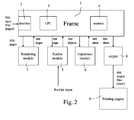
- Fig. 2 illustrates another example of a system and method.
- the rendering module is now placed (seen in the flow of data) before the run list module. Rendering is done page per page, independent on the imposition.
- the two different figures are given by means of example to indicate possible arrangements for or within a system or method.
- Fig. 3 illustrates a part of the system and method as illustrated in figure 1, namely the part comprising the input and the run list module.
- the system comprises a communication means 31, comprising a means, such as a display panel to make a page 32 visible to a user.
- the system comprises means to make an annotation 33 to the page 32. Examples of such means are, at the hardware side, a desk board or a mouse, and computer software to enable annotations to be made.
- the present invention aims to provide a relatively simple system and method which provides for an easy and reliable check.
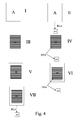
- Figure 4 illustrates a number of images or sub-images.
- An image as shown in I denotes an empty position in the run list, with neither a document page or a run list association.
- An image as shown in II denotes a run list position, without a document page, but with a run list association RLA.
- position n, m denotes the nth respectively mth position on the run list.
- An arrow denotes a change. When at either side of the arrow the same run list position (i.e.
- An image as shown in III denotes a document page.
- VI denotes a document page with a document page association DPA, linking the document page to an annotation ann.
- V denotes a run list position, without a run list association, with a document page without a document page association, VI a run list position with a document page with a document page association.
- the document page association DPA associates (links) the document page to the annotation (in the figures indicated with ann), a run list association associates (links) a run list position with an annotation ann.
- RLA a user may find the annotation(s) (ann) to the document page or to the position on the run list respectively.
- document page associations DPA's are, when a page document is removed from a run list position, converted into run list associations RLA's, and novel DPA's replace existing RLA's, and that in such manner that a user can keep an easy track of changes.
- FIG 5A A first step is explained in figure 5A.
- a document page association DPA is made between the document page and the annotation.
- the document page association DPA is schematically indicated by the hooked arrow, the content of the annotation by 'ann'.
- the content may for instance be "change letter type from type A to B".
- the run list association RLA links the run list position n, on which there is now in fact no page, to information (the annotations ann) which are in practice at this stage superfluous if one only looks at the run list position n and the RLA and the annotations at that stage.
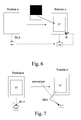
- FIG. 6 illustrates placing back of the amended document page 32' at the same position in the run list.
- the run list position itself was empty (left hand side of the figure) but did have a run list association to the annotations "ann".
- the amended document page, which does not have a document page association is positioned back on the run list position.
- the existing run list association is maintained.
- the amended page 32' wherein the letter type is changed from type A to type B
- a run list association RLA to the annotations 'ann' made in respect of the original unamended page 32, which annotations reads "change letter type from type A to type B".
- the system and method in accordance with the invention preferably comprises means, in the system, and a corresponding method step by which, when viewing the page on the display screen, an indication Ic is given that there is a run list association to the present run list position.
- Figure 7 illustrates what happens when a new annotation is made: the run list association is removed and a document page association is made, in effect returning to the right hand side of figure 5A, but this time with the new annotations.
- the run list association at the run list source position (position n) is kept or created, because of the rules that if a document page is removed from a run list position with a run list association, the run list association is kept (see also fig 10), and if a document with a document page association is removed a run list association is created (see fig. 5B).
- the method can be embodied in a manual manner, i.e. a method in which a page document association is, when a page document is removed from the run list 'translated' into a run list association manually, i.e. by the operator, or automatically, i.e. each time a page document is removed the switch page document association-run list association is done, or in a semi-automatic manner, i.e. when a page document is removed the user is given the choice to create a run list association or not.
- a manual manner i.e. a method in which a page document association is, when a page document is removed from the run list 'translated' into a run list association manually, i.e. by the operator, or automatically, i.e. each time a page document is removed the switch page document association-run list association is done, or in a semi-automatic manner, i.e. when a page document is removed the user is given the choice to create a run list association or not.
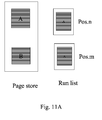
- Figure 11A to 11D illustrate swapping of pages.
- Fig. 11A In the initial situation (Fig. 11A) all pages are placed in the run list, however pages A and B are in the wrong order. Page A is in position 1, whereas it should be in position 2 and vice versa. The operator should swap them. The user finds fault with the position of the pages A and B, and adds remarks to each page, he/she states "this should be page m" on page A (in the figure indicated by the square with ⁇ m), and "this should be page n" ( ⁇ n) on page B. For each of these annotations document pages annotations are established (fig. 11B). The operator then moves page A on position m (Fig. 11C), in accordance with the content of the annotation.
- a run list association is created for run list position n (in accordance with the scheme as schematically shown in fig. 9), linking the run list position to the annotation. Thereafter the operator places page B on position n. Since the page (page A) being placed has a document page association, the run list association on position n is removed. The annotation on position n now reads "this should be page n" ( ⁇ n), the annotation on position m now reads "this should be page m" ( ⁇ m). The correct annotations are now at the correct run list position and the user can easily check that indeed the correct swap of pages has been performed.
Landscapes
- Engineering & Computer Science (AREA)
- Theoretical Computer Science (AREA)
- Health & Medical Sciences (AREA)
- Artificial Intelligence (AREA)
- Audiology, Speech & Language Pathology (AREA)
- Computational Linguistics (AREA)
- General Health & Medical Sciences (AREA)
- Physics & Mathematics (AREA)
- General Engineering & Computer Science (AREA)
- General Physics & Mathematics (AREA)
- Document Processing Apparatus (AREA)
Priority Applications (1)
| Application Number | Priority Date | Filing Date | Title |
|---|---|---|---|
| EP05103319A EP1591913A2 (de) | 2004-04-26 | 2005-04-25 | Verfahren und System, um ein Dokument zum Drucken vorzubereiten |
Applications Claiming Priority (3)
| Application Number | Priority Date | Filing Date | Title |
|---|---|---|---|
| EP04101717 | 2004-04-26 | ||
| EP04101717 | 2004-04-26 | ||
| EP05103319A EP1591913A2 (de) | 2004-04-26 | 2005-04-25 | Verfahren und System, um ein Dokument zum Drucken vorzubereiten |
Publications (1)
| Publication Number | Publication Date |
|---|---|
| EP1591913A2 true EP1591913A2 (de) | 2005-11-02 |
Family
ID=35445664
Family Applications (1)
| Application Number | Title | Priority Date | Filing Date |
|---|---|---|---|
| EP05103319A Withdrawn EP1591913A2 (de) | 2004-04-26 | 2005-04-25 | Verfahren und System, um ein Dokument zum Drucken vorzubereiten |
Country Status (1)
| Country | Link |
|---|---|
| EP (1) | EP1591913A2 (de) |
-
2005
- 2005-04-25 EP EP05103319A patent/EP1591913A2/de not_active Withdrawn
Similar Documents
| Publication | Publication Date | Title |
|---|---|---|
| EP2482198B1 (de) | System und Verfahren zur Identifikation von Zeilenbrüchen | |
| US6480866B2 (en) | Method and apparatus to facilitate creation of documents from individual pages | |
| US6839149B2 (en) | Preparation of production data for a print job using a still image proxy of a page description language image file | |
| EP0887746A2 (de) | Seitenumbruch in einem Rasterbildprozessor | |
| US20060045596A1 (en) | Method arrangement and computer software for the printing of a separator sheet by means of an electrophotographic printer or copier | |
| EP2575024B1 (de) | Druckdatenverarbeitungsvorrichtung, Druckdatenverarbeitungsverfahren, Drucksystem und Programm, Seitendatenerzeugungsvorrichtung und Rasterungsverarbeitungsvorrichtung | |
| US7710590B2 (en) | Automatic maintenance of page attribute information in a workflow system | |
| US8045198B2 (en) | System and method for processing a change history of a PDF file | |
| US7852498B2 (en) | Post-printing process support system, post-printing process support program, and post-printing process support method | |
| JP7224856B2 (ja) | 画像生成装置、画像生成方法、及びプログラム | |
| US20070263240A1 (en) | Image-Forming Apparatus, Image-Forming Control Method, Image-Forming Control Program Storage Medium, Image-Forming Control Data Signal, And Image-Forming Control Apparatus | |
| US20050243358A1 (en) | Method and system for preparing a document for printing | |
| CN103034990B (zh) | 出版物校验的方法和装置 | |
| US20110157634A1 (en) | Printing process device, printing process method, and computer readable storage medium storing printing process program | |
| EP1591913A2 (de) | Verfahren und System, um ein Dokument zum Drucken vorzubereiten | |
| US6216142B1 (en) | Desk top publishing method of laying parts on leaf pattern and method of displaying leaf pattern | |
| CN101346715B (zh) | 处理标记文档的方法和设备 | |
| US20250165925A1 (en) | Proofreading assistance method and proofreading assistance system | |
| JP4442634B2 (ja) | 画像処理装置 | |
| JP4321596B2 (ja) | 画像処理装置 | |
| KR100582342B1 (ko) | 인쇄용 전자 문서와 그 생성 방법 및 기록 매체 | |
| JP2001287420A (ja) | 印刷装置 | |
| Foltinek | An overview of cross-platform document technology | |
| MacKay | Quality control and checking of electronically submitted papers to accelerator conferences | |
| Parsons et al. | The 2002 PDF Workflow Shootout And Usage Survey. |
Legal Events
| Date | Code | Title | Description |
|---|---|---|---|
| PUAI | Public reference made under article 153(3) epc to a published international application that has entered the european phase |
Free format text: ORIGINAL CODE: 0009012 |
|
| AK | Designated contracting states |
Kind code of ref document: A2 Designated state(s): AT BE BG CH CY CZ DE DK EE ES FI FR GB GR HU IE IS IT LI LT LU MC NL PL PT RO SE SI SK TR |
|
| AX | Request for extension of the european patent |
Extension state: AL BA HR LV MK YU |
|
| RAP1 | Party data changed (applicant data changed or rights of an application transferred) |
Owner name: AGFA GRAPHICS N.V. |
|
| STAA | Information on the status of an ep patent application or granted ep patent |
Free format text: STATUS: THE APPLICATION IS DEEMED TO BE WITHDRAWN |
|
| 18D | Application deemed to be withdrawn |
Effective date: 20081031 |