EP1591763A1 - Capacitance temperature sensor and temperature measuring device - Google Patents
Capacitance temperature sensor and temperature measuring device Download PDFInfo
- Publication number
- EP1591763A1 EP1591763A1 EP05009236A EP05009236A EP1591763A1 EP 1591763 A1 EP1591763 A1 EP 1591763A1 EP 05009236 A EP05009236 A EP 05009236A EP 05009236 A EP05009236 A EP 05009236A EP 1591763 A1 EP1591763 A1 EP 1591763A1
- Authority
- EP
- European Patent Office
- Prior art keywords
- oxygen
- capacitance
- isotope
- single crystal
- temperature
- Prior art date
- Legal status (The legal status is an assumption and is not a legal conclusion. Google has not performed a legal analysis and makes no representation as to the accuracy of the status listed.)
- Withdrawn
Links
- QVGXLLKOCUKJST-NJFSPNSNSA-N oxygen-18 atom Chemical group [18O] QVGXLLKOCUKJST-NJFSPNSNSA-N 0.000 claims abstract description 60
- 239000013078 crystal Substances 0.000 claims abstract description 43
- VEALVRVVWBQVSL-UHFFFAOYSA-N strontium titanate Chemical compound [Sr+2].[O-][Ti]([O-])=O VEALVRVVWBQVSL-UHFFFAOYSA-N 0.000 claims abstract description 39
- MYMOFIZGZYHOMD-UHFFFAOYSA-N Dioxygen Chemical compound O=O MYMOFIZGZYHOMD-UHFFFAOYSA-N 0.000 claims abstract description 35
- 239000003989 dielectric material Substances 0.000 claims abstract description 7
- 238000010438 heat treatment Methods 0.000 claims description 8
- 238000006467 substitution reaction Methods 0.000 claims description 7
- 238000005530 etching Methods 0.000 claims description 5
- PCHJSUWPFVWCPO-UHFFFAOYSA-N gold Chemical compound [Au] PCHJSUWPFVWCPO-UHFFFAOYSA-N 0.000 claims description 5
- 229910052737 gold Inorganic materials 0.000 claims description 5
- 239000010931 gold Substances 0.000 claims description 5
- 238000004519 manufacturing process Methods 0.000 claims description 5
- RYGMFSIKBFXOCR-UHFFFAOYSA-N Copper Chemical compound [Cu] RYGMFSIKBFXOCR-UHFFFAOYSA-N 0.000 claims description 4
- 229910052802 copper Inorganic materials 0.000 claims description 4
- 239000010949 copper Substances 0.000 claims description 4
- 230000005291 magnetic effect Effects 0.000 claims description 4
- 239000000203 mixture Substances 0.000 claims description 3
- 238000000034 method Methods 0.000 claims 4
- 238000000151 deposition Methods 0.000 claims 1
- 230000035945 sensitivity Effects 0.000 description 38
- 239000000463 material Substances 0.000 description 10
- 230000000694 effects Effects 0.000 description 5
- 230000010287 polarization Effects 0.000 description 5
- NBIIXXVUZAFLBC-UHFFFAOYSA-N Phosphoric acid Chemical compound OP(O)(O)=O NBIIXXVUZAFLBC-UHFFFAOYSA-N 0.000 description 4
- 238000005520 cutting process Methods 0.000 description 4
- 230000005621 ferroelectricity Effects 0.000 description 3
- 239000000523 sample Substances 0.000 description 3
- VYZAMTAEIAYCRO-UHFFFAOYSA-N Chromium Chemical compound [Cr] VYZAMTAEIAYCRO-UHFFFAOYSA-N 0.000 description 2
- 229910000147 aluminium phosphate Inorganic materials 0.000 description 2
- 229910052804 chromium Inorganic materials 0.000 description 2
- 239000011651 chromium Substances 0.000 description 2
- 230000007547 defect Effects 0.000 description 2
- 238000007493 shaping process Methods 0.000 description 2
- 229910052709 silver Inorganic materials 0.000 description 2
- 239000004332 silver Substances 0.000 description 2
- 238000001771 vacuum deposition Methods 0.000 description 2
- 238000009529 body temperature measurement Methods 0.000 description 1
- 230000007423 decrease Effects 0.000 description 1
- 230000001419 dependent effect Effects 0.000 description 1
- 239000003302 ferromagnetic material Substances 0.000 description 1
- 238000012986 modification Methods 0.000 description 1
- 230000004048 modification Effects 0.000 description 1
- 239000004065 semiconductor Substances 0.000 description 1
Images




Classifications
-
- G—PHYSICS
- G01—MEASURING; TESTING
- G01K—MEASURING TEMPERATURE; MEASURING QUANTITY OF HEAT; THERMALLY-SENSITIVE ELEMENTS NOT OTHERWISE PROVIDED FOR
- G01K7/00—Measuring temperature based on the use of electric or magnetic elements directly sensitive to heat ; Power supply therefor, e.g. using thermoelectric elements
- G01K7/006—Measuring temperature based on the use of electric or magnetic elements directly sensitive to heat ; Power supply therefor, e.g. using thermoelectric elements using superconductive elements
-
- G—PHYSICS
- G01—MEASURING; TESTING
- G01K—MEASURING TEMPERATURE; MEASURING QUANTITY OF HEAT; THERMALLY-SENSITIVE ELEMENTS NOT OTHERWISE PROVIDED FOR
- G01K7/00—Measuring temperature based on the use of electric or magnetic elements directly sensitive to heat ; Power supply therefor, e.g. using thermoelectric elements
- G01K7/34—Measuring temperature based on the use of electric or magnetic elements directly sensitive to heat ; Power supply therefor, e.g. using thermoelectric elements using capacitative elements
- G01K7/343—Measuring temperature based on the use of electric or magnetic elements directly sensitive to heat ; Power supply therefor, e.g. using thermoelectric elements using capacitative elements the dielectric constant of which is temperature dependant
Definitions
- the present invention relates to a capacitance temperature sensor in which temperature is measured by detecting capacitance of a parallel plate condenser which comprises a dielectric material comprising strontium titanate single crystal, and a temperature measuring device using the capacitance temperature sensor.
- STO Bulk single crystal strontium titanate
- US Patent 3,649,891 discloses use of a ferroelectric material as a capacitance temperature sensor.
- Bulk single crystal STO exhibits a high dielectric constant at low temperatures as mentioned above and thus is an extremely useful dielectric material for superconducting devices or semiconductor devices which are used at low temperatures.
- a capacitance temperature sensor made of a ferroelectric material as disclosed in the related art has been commercialized, but its sensitivity and absolute sensitivity are as low as 20 pF/K and 0.02, respectively. Such a capacitance temperature sensor is thus disadvantageous in that its precision in temperature measurement is low.
- the present invention relates to the following (1) to (5).
- % as used herein means “% by weight”.
- a capacitance temperature sensor having a high dielectric constant at low temperatures when strontium titanate single crystal in which 30% or less of oxygen-16 is substituted with oxygen-18 isotope is used, a capacitance temperature sensor having a high dielectric constant at low temperatures can be obtained.
- a capacitance temperature sensor having a dielectric constant of 50,000 or more, and hence a quantum-paraelectricity at a temperature of 4.2 K and hence no residual polarization and a one-to-one relationship between the capacitance measured and the temperature can be obtained.
- Fig. 1 shows a process for preparing the capacitance temperature sensor according to the first embodiment of the present invention.
- the strontium titanate single crystal has a low dielectric constant layer formed on the surface thereof by lattice defect developed in the stage of cutting, shaping or growth. Therefore, the low dielectric constant layer is removed, e.g., by etching strontium titanate single crystal having a thickness of 200 ⁇ m with phosphoric acid or chemically etching a layer stressed by cutting or the like to reduce the thickness thereof to 100 ⁇ m. Thereafter, 30% or less, e.g., 26%, of oxygen-16 in the strontium titanate single crystal is substituted with oxygen-18 isotope.
- the lower limit of the substituted amount is not limited, but it is preferably more than 0%.
- the substitution of oxygen-16 with oxygen-18 isotope is carried out by enclosing oxygen-18 isotope and the strontium titanate single crystal in a sealed vessel, and then subjecting the mixture to heat treatment at a temperature as high as 600°C to 1,000°C.
- the substituted amount of oxygen-16 with oxygen-18 isotope depends on the time for the heat treatment.
- the material is subjected to heat treatment in vacuo for a long time, e.g., at 1,050°C for 30 days.
- vacuum deposition is carried out to form a copper film on the material, e.g., at a thickness of 100 nm or more.
- gold is vacuum-deposited on the material, e.g., at a thickness of 100 nm or more, to form an electrode to obtain a capacitance temperature sensor comprising a quantum paraelectric parallel-plate condenser.
- chromium can also be used instead of silver or gold.
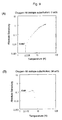
- Fig. 2 shows substitution effect on the dielectric constant of the capacitance temperature sensor in which oxygen-16 in the strontium titanate single crystal is substituted with oxygen-18 isotope.
- Fig. 2(A) shows temperature dependency of the dielectric constant when the substitution amount of oxygen-18 isotope is 0%, i.e., oxygen-16 is not substituted with oxygen-18 isotope.
- Fig. 2(B) shows temperature dependency of the dielectric constant when the substituted amount of oxygen-18 isotope is 26%.
- the dielectric constant is about 20,000 at a temperature of 2.2 K, which shows a quantum-paraelectricity in which the dielectric constant saturates within an extremely low range.
- Fig. 3 shows enhancement of the sensitivity S of the capacitance temperature sensor in which oxygen-16 in the strontium titanate single crystal is substituted with oxygen-18 isotope.
- Fig. 3(A) shows the sensitivity S when the substituted amount of oxygen-18 isotope is 0%.
- Fig. 3(B) shows the sensitivity S when the substituted amount of oxygen-18 isotope is 26%.
- the sensitivity S in Fig. 3(A) in which the substituted amount of oxygen-18 isotope is 0% is 3.1 pF/K at 2.2 K
- the sensitivity S in Fig. 3(B) in which the substituted amount of oxygen-18 isotope is 26% is 32 pF/K, which shows that the sensitivity is improved.
- Fig. 4 shows enhancement of the absolute sensitivity Sd of a capacitance temperature sensor in which oxygen-16 in the strontium titanate single crystal is substituted with oxygen-18 isotope.
- Fig. 4(A) shows the absolute sensitivity Sd when the substituted amount of oxygen-18 isotope is 0%.
- Fig. 4(B) shows the absolute sensitivity Sd when the substituted amount of oxygen-18 isotope is 26%.
- the absolute sensitivity Sd in Fig. 4(A) in which the substituted amount of oxygen-18 isotope is 0% is 0.007 at 2.2 K
- the absolute sensitivity Sd in Fig. 4(B) in which the substituted amount of oxygen-18 isotope is 26% is 0.022, which is at least 3 times as high as the absolute sensitivity Sd in Fig. 4(A), which shows that the temperature can be measured at high accuracy.
- the high sensitivity is obtained in a quantum paraelectric material and influence by residual polarization is not affected so that the capacitance temperature sensor in Fig. 4(B) can be used as an absolute thermometer.
- Fig. 5 shows constitution of a temperature measuring device comprising the capacitance temperature sensor according to the first embodiment of the present invention.
- the reference numeral 1 indicates a low temperature vessel
- the reference numeral 2 indicates a capacitance temperature sensor comprising a parallel plate condenser provided in an object to be measured (not shown) disposed in the low temperature vessel 1
- the reference numeral 3 indicates a low temperature probe
- the reference numeral 4 indicates a meter, such as an LCR meter and a capacitance bridge, for measuring capacitance of the capacitance temperature sensor
- the reference numeral 5 indicates an apparatus for determining the temperature from the capacitance measured, such as a personal computer.
- the capacitance is preferably measured in the magnetic field because it is not affected by the magnetic field.
- Fig. 6 shows a process for preparing a capacitance temperature sensor according to the second embodiment of the present invention.
- Strontium titanate single crystal has a low dielectric constant layer formed on the surface thereof by lattice defect developed in the stage of cutting, shaping or growth. Therefore, the low dielectric constant layer is removed, e.g., by etching strontium titanate single crystal having a thickness of 200 ⁇ m with phosphoric acid or chemically etching a layer stressed by cutting or the like to reduce the thickness thereof to 100 ⁇ m. Thereafter, 35% to 50%, e.g., 38%, of oxygen-16 in the strontium titanate single crystal is substituted with oxygen-18 isotope.
- the substitution of oxygen-16 with oxygen-18 isotope is carried out by enclosing oxygen-18 isotope and the strontium titanate single crystal in a sealed vessel, and then subjecting the mixture to heat treatment at a temperature as high as 600°C to 1,000°C.
- the substituted amount of oxygen-16 with oxygen-18 isotope depends on the time for the heat treatment.
- the material is subjected to heat treatment in vacuo for a long time, e.g., at 1,050°C for 30 days.
- vacuum deposition is carried out to form a copper film on the material, e.g., at a thickness of 100 nm or more.
- gold is vacuum-deposited on the material, e.g., at a thickness of 100 nm or more, to form an electrode to obtain a capacitance temperature sensor comprising a quantum paraelectric parallel-plate condenser.
- chromium can also be used instead of silver or gold.
- Fig. 7 shows substitution effect on the dielectric constant of the capacitance temperature sensor in which oxygen-16 in the strontium titanate single crystal is substituted with oxygen-18 isotope.
- Fig. 7(A) shows temperature dependency of the dielectric constant when the substituted amount of oxygen-18 isotope is 0%.
- Fig. 7(B) shows temperature dependency of the dielectric constant when the substituted amount of oxygen-18 isotope is 38%.
- Fig. 7(A) shows quantum-paraelectricity while Fig. 7(B) shows ferroelectricity.
- the dielectric constant is about 20,000 or more at a temperature of 2.2 K, which shows a quantum-paraelectricity in which the dielectric constant saturates within an extremely low range.
- Fig. 8 shows enhancement of the sensitivity S of the capacitance temperature sensor in which oxygen-16 in the strontium titanate single crystal is substituted with oxygen-18 isotope.
- Fig. 8(A) shows the sensitivity S when the substituted amount of oxygen-18 isotope is 0%.
- Fig. 8(B) shows the sensitivity S when the substituted amount of oxygen-18 isotope is 38%.
- the sensitivity S in Fig. 8(B) in which the substituted amount of oxygen-18 isotope is 0% is 3.1 pF/K at 2.2 K
- the sensitivity S in Fig. 8(B) in which the substituted amount of oxygen-18 isotope is 38% is as high as 500 pF/K, which shows that the sensitivity is remarkably improved.
- Fig. 9 shows enhancement of the absolute sensitivity Sd of the capacitance temperature sensor in which oxygen-16 in the strontium titanate single crystal is substituted with oxygen-18 isotope.
- Fig. 9(A) shows the absolute sensitivity Sd when the substituted amount of oxygen-18 isotope is 0%.
- Fig. 9(B) shows the absolute sensitivity Sd when the substituted amount of oxygen-18 isotope is 38%.
- the absolute sensitivity Sd in Fig. 9(A) in which the substituted amount of oxygen-18 isotope is 0% is 0.007 at 2.2 K
- the absolute sensitivity Sd in Fig. 9(B) in which the substituted amount of oxygen-18 isotope is 38% is 0.095, which is at least 10 times as high as the absolute sensitivity Sd in Fig. 9(A), which shows that the temperature can be measured at high accuracy.
- the capacitance temperature sensor in Fig. 9(B) has remarkably high sensitivity, although showing residual polarization.
- the constitution of the temperature measuring device comprising a capacitance temperature sensor according to the second embodiment of the present invention is the same as that shown in Fig. 5 and is omitted.
Landscapes
- Physics & Mathematics (AREA)
- General Physics & Mathematics (AREA)
- Engineering & Computer Science (AREA)
- Power Engineering (AREA)
- Fixed Capacitors And Capacitor Manufacturing Machines (AREA)
- Crystals, And After-Treatments Of Crystals (AREA)
Abstract
A capacitance temperature sensor in which temperature is measured by detecting capacitance of a parallel plate condenser which comprises a dielectric material comprising strontium titanate single crystal in which (a) 30% by weight or less of oxygen-16 or (b) 30% by weight to 50% by weight of oxygen-16 is substituted with oxygen-18 isotope.
Description
- The present invention relates to a capacitance temperature sensor in which temperature is measured by detecting capacitance of a parallel plate condenser which comprises a dielectric material comprising strontium titanate single crystal, and a temperature measuring device using the capacitance temperature sensor.
- Bulk single crystal strontium titanate (hereinafter referred to as "STO") is known as a quantum paraelectric material and its dielectric constant is 20,000 or more at 4.2 K. The dielectric constant of the bulk single crystal strontium titanate depends on bias and stress and decreases according to them.
- US Patent 3,649,891 discloses use of a ferroelectric material as a capacitance temperature sensor.
- Bulk single crystal STO exhibits a high dielectric constant at low temperatures as mentioned above and thus is an extremely useful dielectric material for superconducting devices or semiconductor devices which are used at low temperatures.
- On the other hand, when a ferromagnetic material is used as a capacitance temperature sensor as disclosed in the related art, temperature change causes residual polarization. As a result, hysteresis appears, making it impossible to obtain a capacitance temperature sensor having a one-to-one relationship between the temperature and the capacitance measured.
- Further, a capacitance temperature sensor made of a ferroelectric material as disclosed in the related art has been commercialized, but its sensitivity and absolute sensitivity are as low as 20 pF/K and 0.02, respectively. Such a capacitance temperature sensor is thus disadvantageous in that its precision in temperature measurement is low.
- An object of the present invention is to provide a capacitance temperature sensor having a high dielectric constant at low temperatures, no residual polarization, a high temperature sensitivity (S = ΔC/ΔT), a high absolute sensitivity (Sd = (T/C) ΔC/ΔT) and an excellent temperature resolution, wherein the capacitance temperature sensor comprises a quantum paraelectric parallel-plate condenser comprising strontium titanate single crystal in which 30% by weight or less of oxygen-16 is substituted with oxygen-18 isotope.
- Another object of the present invention is to provide a capacitance temperature sensor having a high dielectric constant at low temperatures, a high temperature sensitivity (S = ΔC/ΔT), a high absolute sensitivity (Sd = (T/C) ΔC/ΔT) and an excellent temperature resolution, wherein the capacitance temperature sensor comprises a ferroelectric parallel-plate condenser comprising strontium titanate single crystal in which 35% by weight to 50% by weight of oxygen-16 is substituted with oxygen-18 isotope.
- The above and related objectives are solved by the capacitance temperature sensors according to
claim 1 or 2. Improvements and further aspects of the invention are disclosed in the dependent claims, the description and the figures. - The present invention relates to the following (1) to (5).
- (1) A capacitance temperature sensor in which temperature is measured by detecting capacitance of a parallel plate condenser which comprises a dielectric material comprising strontium titanate single crystal in which 30% by weight or less of oxygen-16 is substituted with oxygen-18 isotope.
- (2) A capacitance temperature sensor in which temperature is measured by detecting capacitance of a parallel plate condenser which comprises a dielectric material comprising strontium titanate single crystal in which 30% by weight to 50% by weight of oxygen-16 is substituted with oxygen-18 isotope.
- (3) Preferably, a temperature measuring device which comprises the capacitance temperature sensor according to (1) or (2), a meter for measuring capacitance of the capacitance temperature sensor, and an apparatus for determining the temperature from the measured capacitance.
- (4) Preferably, the temperature measuring device according to (3), wherein the meter is a capacitance bridge.
- (5) Preferably, the temperature measuring device according to (3) or (4), wherein the temperature is measured in the magnetic field.
-
- The following figures refer to non-limiting embodiments according to the invention
- Fig. 1 shows a process for preparing a capacitance temperature sensor according to a first embodiment of the present invention.
- Fig. 2 shows substitution effects on the dielectric constant of the capacitance temperature sensor when oxygen-16 in the strontium titanate single crystal is substituted with oxygen-18 isotope according to the first embodiment of the present invention.
- Fig. 3 shows enhancement of the sensitivity S of the capacitance temperature sensor when oxygen-16 in the strontium titanate single crystal is substituted with oxygen-18 isotope according to the first embodiment of the present invention.
- Fig. 4 shows enhancement of the absolute sensitivity Sd of the capacitance temperature sensor when oxygen-16 in the strontium titanate single crystal is substituted with oxygen-18 isotope according to the first embodiment of the present invention.
- Fig. 5 shows constitution of a temperature measuring device comprising the capacitance temperature sensor according to the first embodiment of the present invention.
- Fig. 6 shows a process for preparing a capacitance temperature sensor according to a second embodiment of the present invention;
- Fig. 7 shows effect effects on the dielectric constant of the capacitance temperature sensor when oxygen-16 in the strontium titanate single crystal is substituted with oxygen-18 isotope according to the second embodiment of the present invention.
- Fig. 8 shows enhancement of the sensitivity S of the capacitance temperature sensor when oxygen-16 in the strontium titanate single crystal is substituted with oxygen-18 isotope according to the second embodiment of the present invention.
- Fig. 9 shows enhancement of the absolute sensitivity Sd of the capacitance temperature sensor when oxygen-16 in the strontium titanate single crystal is substituted with oxygen-18 isotope according to the second embodiment of the present invention.
-
- Unless otherwise indicated, "%" as used herein means "% by weight".
- In accordance with the present invention, when strontium titanate single crystal in which 30% or less of oxygen-16 is substituted with oxygen-18 isotope is used, a capacitance temperature sensor having a high dielectric constant at low temperatures can be obtained. In particular, when strontium titanate single crystal in which 26% of oxygen-16 is substituted with oxygen-18 isotope is used, a capacitance temperature sensor having a dielectric constant of 50,000 or more, and hence a quantum-paraelectricity at a temperature of 4.2 K and hence no residual polarization and a one-to-one relationship between the capacitance measured and the temperature can be obtained.
- The first embodiment of the present invention is described hereinafter in connection with Figs. 1 to 5.
- Fig. 1 shows a process for preparing the capacitance temperature sensor according to the first embodiment of the present invention.
- The strontium titanate single crystal has a low dielectric constant layer formed on the surface thereof by lattice defect developed in the stage of cutting, shaping or growth. Therefore, the low dielectric constant layer is removed, e.g., by etching strontium titanate single crystal having a thickness of 200 µm with phosphoric acid or chemically etching a layer stressed by cutting or the like to reduce the thickness thereof to 100 µm. Thereafter, 30% or less, e.g., 26%, of oxygen-16 in the strontium titanate single crystal is substituted with oxygen-18 isotope. The lower limit of the substituted amount is not limited, but it is preferably more than 0%. The substitution of oxygen-16 with oxygen-18 isotope is carried out by enclosing oxygen-18 isotope and the strontium titanate single crystal in a sealed vessel, and then subjecting the mixture to heat treatment at a temperature as high as 600°C to 1,000°C. The substituted amount of oxygen-16 with oxygen-18 isotope depends on the time for the heat treatment. Thereafter, in order to diffuse oxygen-18 isotope in the sample, the material is subjected to heat treatment in vacuo for a long time, e.g., at 1,050°C for 30 days. Thereafter, vacuum deposition is carried out to form a copper film on the material, e.g., at a thickness of 100 nm or more. Thereafter, gold is vacuum-deposited on the material, e.g., at a thickness of 100 nm or more, to form an electrode to obtain a capacitance temperature sensor comprising a quantum paraelectric parallel-plate condenser. Also, chromium can also be used instead of silver or gold.
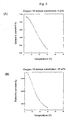
- Fig. 2 shows substitution effect on the dielectric constant of the capacitance temperature sensor in which oxygen-16 in the strontium titanate single crystal is substituted with oxygen-18 isotope.
- Fig. 2(A) shows temperature dependency of the dielectric constant when the substitution amount of oxygen-18 isotope is 0%, i.e., oxygen-16 is not substituted with oxygen-18 isotope. Fig. 2(B) shows temperature dependency of the dielectric constant when the substituted amount of oxygen-18 isotope is 26%.
- As can be seen in these drawings, both two characteristic curves show quantum-paraelectricity.
- Regarding the temperature dependency of the dielectric constant in Fig. 2(A), the dielectric constant is about 20,000 at a temperature of 2.2 K, which shows a quantum-paraelectricity in which the dielectric constant saturates within an extremely low range.
- On the other hand,, regarding the temperature dependency of the dielectric constant in Fig. 2(B), wherein 26% of oxygen-16 in the strontium titanate single crystal is substituted with oxygen-18, the dielectric constant exceeds 50,000 at 2.2 K, which shows that the quantum-paraelectricity is maintained. The parallel-plate capacitance C is calculated from dielectric constant "εrεo", electrode area "A" and thickness "t" using the equation "C = εrεoA/t" wherein εo is the dielectric constant of vacuum.
- The performance of a capacitance temperature sensor is normally evaluated by a change of capacitance of the element per K at arbitrary temperature (sensitivity) (S = ΔC/ΔT) and a value obtained by dividing the sensitivity by the capacitance and multiplying the quotient by the temperature (absolute temperature) (Sd = (T/C) ΔC/ΔT).
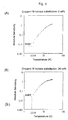
- Fig. 3 shows enhancement of the sensitivity S of the capacitance temperature sensor in which oxygen-16 in the strontium titanate single crystal is substituted with oxygen-18 isotope.
- Fig. 3(A) shows the sensitivity S when the substituted amount of oxygen-18 isotope is 0%. Fig. 3(B) shows the sensitivity S when the substituted amount of oxygen-18 isotope is 26%.
- As can be seen in these drawings, the sensitivity S in Fig. 3(A) in which the substituted amount of oxygen-18 isotope is 0% is 3.1 pF/K at 2.2 K, whereas the sensitivity S in Fig. 3(B) in which the substituted amount of oxygen-18 isotope is 26% is 32 pF/K, which shows that the sensitivity is improved.
- Fig. 4 shows enhancement of the absolute sensitivity Sd of a capacitance temperature sensor in which oxygen-16 in the strontium titanate single crystal is substituted with oxygen-18 isotope.
- Fig. 4(A) shows the absolute sensitivity Sd when the substituted amount of oxygen-18 isotope is 0%. Fig. 4(B) shows the absolute sensitivity Sd when the substituted amount of oxygen-18 isotope is 26%.
- As can be seen in these drawings, the absolute sensitivity Sd in Fig. 4(A) in which the substituted amount of oxygen-18 isotope is 0% is 0.007 at 2.2 K, whereas the absolute sensitivity Sd in Fig. 4(B) in which the substituted amount of oxygen-18 isotope is 26% is 0.022, which is at least 3 times as high as the absolute sensitivity Sd in Fig. 4(A), which shows that the temperature can be measured at high accuracy. As a result, it is shown that the high sensitivity is obtained in a quantum paraelectric material and influence by residual polarization is not affected so that the capacitance temperature sensor in Fig. 4(B) can be used as an absolute thermometer.
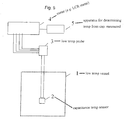
- Fig. 5 shows constitution of a temperature measuring device comprising the capacitance temperature sensor according to the first embodiment of the present invention.
- In Fig. 5, the
reference numeral 1 indicates a low temperature vessel; the reference numeral 2 indicates a capacitance temperature sensor comprising a parallel plate condenser provided in an object to be measured (not shown) disposed in thelow temperature vessel 1; thereference numeral 3 indicates a low temperature probe; the reference numeral 4 indicates a meter, such as an LCR meter and a capacitance bridge, for measuring capacitance of the capacitance temperature sensor; and thereference numeral 5 indicates an apparatus for determining the temperature from the capacitance measured, such as a personal computer. - In general, the capacitance is preferably measured in the magnetic field because it is not affected by the magnetic field.
- The second embodiment of the present invention will be described in connection with Figs. 6 to 9.
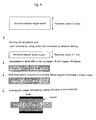
- Fig. 6 shows a process for preparing a capacitance temperature sensor according to the second embodiment of the present invention.
- Strontium titanate single crystal has a low dielectric constant layer formed on the surface thereof by lattice defect developed in the stage of cutting, shaping or growth. Therefore, the low dielectric constant layer is removed, e.g., by etching strontium titanate single crystal having a thickness of 200 µm with phosphoric acid or chemically etching a layer stressed by cutting or the like to reduce the thickness thereof to 100 µm. Thereafter, 35% to 50%, e.g., 38%, of oxygen-16 in the strontium titanate single crystal is substituted with oxygen-18 isotope. The substitution of oxygen-16 with oxygen-18 isotope is carried out by enclosing oxygen-18 isotope and the strontium titanate single crystal in a sealed vessel, and then subjecting the mixture to heat treatment at a temperature as high as 600°C to 1,000°C. The substituted amount of oxygen-16 with oxygen-18 isotope depends on the time for the heat treatment. Thereafter, in order to diffuse oxygen-18 isotope in the sample, the material is subjected to heat treatment in vacuo for a long time, e.g., at 1,050°C for 30 days. Thereafter, vacuum deposition is carried out to form a copper film on the material, e.g., at a thickness of 100 nm or more. Thereafter, gold is vacuum-deposited on the material, e.g., at a thickness of 100 nm or more, to form an electrode to obtain a capacitance temperature sensor comprising a quantum paraelectric parallel-plate condenser. Also, chromium can also be used instead of silver or gold.
- Fig. 7 shows substitution effect on the dielectric constant of the capacitance temperature sensor in which oxygen-16 in the strontium titanate single crystal is substituted with oxygen-18 isotope.
- Fig. 7(A) shows temperature dependency of the dielectric constant when the substituted amount of oxygen-18 isotope is 0%. Fig. 7(B) shows temperature dependency of the dielectric constant when the substituted amount of oxygen-18 isotope is 38%.
- As can be seen in these drawings, Fig. 7(A) shows quantum-paraelectricity while Fig. 7(B) shows ferroelectricity.
- Regarding the temperature dependency of the dielectric constant in Fig. 7(A), the dielectric constant is about 20,000 or more at a temperature of 2.2 K, which shows a quantum-paraelectricity in which the dielectric constant saturates within an extremely low range.
- On the other hand,, regarding the temperature dependency of the dielectric constant in Fig. 7(B) in which 38% of oxygen-16 in the strontium titanate single crystal is substituted with oxygen-18 isotope, the dielectric constant exceeds 100,000 at 2.2 K, which shows that the capacitance temperature sensor has ferroelectricity.
- Fig. 8 shows enhancement of the sensitivity S of the capacitance temperature sensor in which oxygen-16 in the strontium titanate single crystal is substituted with oxygen-18 isotope.
- Fig. 8(A) shows the sensitivity S when the substituted amount of oxygen-18 isotope is 0%. Fig. 8(B) shows the sensitivity S when the substituted amount of oxygen-18 isotope is 38%.
- As can be seen in these drawings, the sensitivity S in Fig. 8(B) in which the substituted amount of oxygen-18 isotope is 0% is 3.1 pF/K at 2.2 K, whereas the sensitivity S in Fig. 8(B) in which the substituted amount of oxygen-18 isotope is 38% is as high as 500 pF/K, which shows that the sensitivity is remarkably improved.
- Fig. 9 shows enhancement of the absolute sensitivity Sd of the capacitance temperature sensor in which oxygen-16 in the strontium titanate single crystal is substituted with oxygen-18 isotope.
- Fig. 9(A) shows the absolute sensitivity Sd when the substituted amount of oxygen-18 isotope is 0%. Fig. 9(B) shows the absolute sensitivity Sd when the substituted amount of oxygen-18 isotope is 38%.
- As can be seen in these drawings, the absolute sensitivity Sd in Fig. 9(A) in which the substituted amount of oxygen-18 isotope is 0% is 0.007 at 2.2 K, whereas the absolute sensitivity Sd in Fig. 9(B) in which the substituted amount of oxygen-18 isotope is 38% is 0.095, which is at least 10 times as high as the absolute sensitivity Sd in Fig. 9(A), which shows that the temperature can be measured at high accuracy. As a result, since ferroelectricity is exhibited, the capacitance temperature sensor in Fig. 9(B) has remarkably high sensitivity, although showing residual polarization.
- The constitution of the temperature measuring device comprising a capacitance temperature sensor according to the second embodiment of the present invention is the same as that shown in Fig. 5 and is omitted.
- While the invention has been described in detail and with reference to specific embodiments thereof, it will be apparent to one skill in the art that various changes and modifications can be made therein without departing from the spirit and scope thereof. All references cited herein are incorporated in their entirety.
- This application is based on Japanese patent application No. 2004-132133 filed on April 27, 2004, the entire contents of which are incorporated hereinto by reference.
Claims (10)
- A capacitance temperature sensor (5) in which temperature is measured by detecting capacitance of a parallel plate condenser which comprises a dielectric material comprising strontium titanate single crystal in which 30% by weight or less of oxygen-16 is substituted with oxygen-18 isotope.
- A capacitance temperature (5) in which temperature is measured by detecting capacitance of a parallel plate condenser which comprises a dielectric material comprising strontium titanate single crystal in which 30% by weight to 50% by weight of oxygen-16 is substituted with oxygen-18 isotope.
- A temperature measuring device which comprises the capacitance temperature sensor (5) according to claim 1 or 2, a mater (4) for measuring capacitance of the capacitance temperature sensor, and an apparatus (5) for determining the temperature from the measured capacitance.
- The temperature measuring device according to claim 3, wherein the meter (4) is a capacitance bridge.
- The temperature measuring device according to claim 3 or 4, wherein the temperature is measured in the magnetic field.
- Process for preparing a capacitance temperature sensor including the steps:providing a strontium titanate single crystal;etching the strontium titanate single crystal;substituting 50 % by weight, or less, of oxygen-16 in the strontium titanate single crystal with oxygen-18 isotope by diffusing oxygen-18 isotope in said single crystal;forming at least one copper layer on said single crystal; anddepositing at least one gold layer on said at least one copper layer to form electrodes.
- Process according to claim 6, whereby the substitution of oxygen-16 with oxygen-18 isotope is carried out by enclosing oxygen-18 isotope and the single crystal in a vessel, and then subjecting the mixture to a heat treatment at a temperature as high as 600°C to 1000°C.
- Process according to claim 7, whereby the heat treatment is carried out in vacuum for about 30 days.
- Process according to any one of claims 6 to 8, whereby 30 % by weight, or less, of oxygen-16 in the strontium titanate single crystal are substituted with oxygen-18 isotope.
- Process according to any one of claims 6 to 8, whereby 30 % by weight to 50% by weight of oxygen-16 in the strontium titanate single crystal are substituted with oxygen-18 isotope.
Applications Claiming Priority (2)
| Application Number | Priority Date | Filing Date | Title |
|---|---|---|---|
| JP2004132133A JP4528943B2 (en) | 2004-04-27 | 2004-04-27 | Capacitance temperature sensor and temperature measuring device |
| JP2004132133 | 2004-04-27 |
Publications (1)
| Publication Number | Publication Date |
|---|---|
| EP1591763A1 true EP1591763A1 (en) | 2005-11-02 |
Family
ID=34935831
Family Applications (1)
| Application Number | Title | Priority Date | Filing Date |
|---|---|---|---|
| EP05009236A Withdrawn EP1591763A1 (en) | 2004-04-27 | 2005-04-27 | Capacitance temperature sensor and temperature measuring device |
Country Status (3)
| Country | Link |
|---|---|
| US (1) | US7134785B2 (en) |
| EP (1) | EP1591763A1 (en) |
| JP (1) | JP4528943B2 (en) |
Families Citing this family (9)
| Publication number | Priority date | Publication date | Assignee | Title |
|---|---|---|---|---|
| JP5439025B2 (en) * | 2009-05-11 | 2014-03-12 | 株式会社日立製作所 | Dielectric element and method for producing dielectric element |
| US8636407B2 (en) | 2010-02-17 | 2014-01-28 | United States Of America As Represented By The Administrator Of The National Aeronautics And Space Administration | Wireless temperature sensor having no electrical connections and sensing method for use therewith |
| FR2985309B1 (en) * | 2012-01-02 | 2014-01-24 | Commissariat Energie Atomique | CAPACITIVE TEMPERATURE SENSOR COMPRISING TWO CAPACITORS ON A VOLTAGE DIVIDER BRIDGE |
| US9329153B2 (en) | 2013-01-02 | 2016-05-03 | United States Of America As Represented By The Administrator Of The National Aeronautics And Space Administration | Method of mapping anomalies in homogenous material |
| CN105593654B (en) * | 2013-09-25 | 2018-09-21 | 3M创新有限公司 | Composition, device and method for condenser type temperature sensing |
| US9515243B2 (en) | 2014-12-22 | 2016-12-06 | Infineon Technologies Ag | Temperature sensor |
| US10254177B2 (en) | 2016-09-14 | 2019-04-09 | Nxp B.V. | Temperature-to-digital converter |
| KR102521613B1 (en) * | 2018-05-04 | 2023-04-13 | 엘지이노텍 주식회사 | Control circuit of liquid lens, camera module and controlling method for liquid lens |
| TWI776371B (en) * | 2020-01-30 | 2022-09-01 | 漢辰科技股份有限公司 | Method for controlling wafer temperature in an ion implantation system having an ion implanter and a processing station, non-transitory computer-readable storage medium storing one or more programs and ion implantation system |
Citations (1)
| Publication number | Priority date | Publication date | Assignee | Title |
|---|---|---|---|---|
| US3649891A (en) * | 1970-06-18 | 1972-03-14 | Corning Glass Works | Capacitive cryogenic thermometer |
Family Cites Families (15)
| Publication number | Priority date | Publication date | Assignee | Title |
|---|---|---|---|---|
| JPS6054724B2 (en) * | 1979-05-30 | 1985-12-02 | 松下電器産業株式会社 | Temperature sensor and its manufacturing method |
| JPS5685818A (en) * | 1979-12-17 | 1981-07-13 | Seiko Instr & Electronics | Monocrsytalline condenser |
| US4545254A (en) * | 1984-06-01 | 1985-10-08 | Ceramphysics, Inc. | Materials and methods for pressure and temperature sensors at cryogenic temperatures |
| US5021981A (en) * | 1988-12-22 | 1991-06-04 | North Carolina State University | Thermal memory cell and thermal system evaluation |
| US5434742A (en) * | 1991-12-25 | 1995-07-18 | Hitachi, Ltd. | Capacitor for semiconductor integrated circuit and method of manufacturing the same |
| FI92441C (en) * | 1992-04-01 | 1994-11-10 | Vaisala Oy | Electronic impedance sensor for measuring physical quantities, in particular temperature, and method of manufacturing that sensor |
| GB9217436D0 (en) * | 1992-08-17 | 1992-09-30 | De Beers Ind Diamond | Diamond temperature sensor |
| US6954235B1 (en) * | 1993-06-30 | 2005-10-11 | The United States Of America As Represented By The Secretary Of The Navy | Silicon-on-sapphire display apparatus and method of fabricating same |
| US6297527B1 (en) * | 1999-05-12 | 2001-10-02 | Micron Technology, Inc. | Multilayer electrode for ferroelectric and high dielectric constant capacitors |
| US20040047910A1 (en) * | 2000-07-07 | 2004-03-11 | Christian Beckett | Suppository and composition comprising at least one polyethylene glycol |
| JP2002090228A (en) * | 2000-09-19 | 2002-03-27 | Japan Atom Energy Res Inst | Sensor and measurement device for detecting changes in temperature gradient |
| CA2360312A1 (en) * | 2000-10-30 | 2002-04-30 | National Research Council Of Canada | Novel gate dielectric |
| JP3661850B2 (en) * | 2001-04-25 | 2005-06-22 | 富士通株式会社 | Semiconductor device and manufacturing method thereof |
| JP2003209266A (en) * | 2001-08-31 | 2003-07-25 | Kanagawa Acad Of Sci & Technol | Dielectric constant changing method, optical variable capacitor, ultraviolet sensor and magnetic sensor using the method |
| US7042230B1 (en) * | 2005-02-28 | 2006-05-09 | Alain Izadnegahdar | Multi-parameter sensing system |
-
2004
- 2004-04-27 JP JP2004132133A patent/JP4528943B2/en not_active Expired - Lifetime
-
2005
- 2005-04-26 US US11/114,110 patent/US7134785B2/en not_active Expired - Lifetime
- 2005-04-27 EP EP05009236A patent/EP1591763A1/en not_active Withdrawn
Patent Citations (1)
| Publication number | Priority date | Publication date | Assignee | Title |
|---|---|---|---|---|
| US3649891A (en) * | 1970-06-18 | 1972-03-14 | Corning Glass Works | Capacitive cryogenic thermometer |
Non-Patent Citations (2)
| Title |
|---|
| TAKASHIMA H ET AL: "Influence of a degraded SrTiO3 layer at the YBa2Cu3O7-delta?SrTiO3 interface on the dielectric behavior at cryogenic temperature", April 2005, CRYOGENICS, BUTTERWORTH SCIENTIFIC, GUILDFORD, GB, PAGE(S) 300-303, ISSN: 0011-2275, XP004783068 * |
| TAKASHIMA H ET AL: "Influence of a degraded SrTiO3 layer at the YBa2Cu3O7-delta?SrTiO3 interface on the dielectric behavior at cryogenic temperature", CRYOGENICS, BUTTERWORTH SCIENTIFIC, GUILDFORD, GB, vol. 45, no. 4, April 2005 (2005-04-01), pages 300 - 303, XP004783068, ISSN: 0011-2275 * |
Also Published As
| Publication number | Publication date |
|---|---|
| JP2005315661A (en) | 2005-11-10 |
| US7134785B2 (en) | 2006-11-14 |
| US20050238081A1 (en) | 2005-10-27 |
| JP4528943B2 (en) | 2010-08-25 |
Similar Documents
| Publication | Publication Date | Title |
|---|---|---|
| Krishnan et al. | Thermal expansion of crystals: international series in the science of the solid state | |
| US10794775B2 (en) | Method and apparatus for in situ calibration of a thermometer | |
| US10495526B2 (en) | Method and apparatus for calibrating a thermometer in situ | |
| ATE540308T1 (en) | METHOD AND APPARATUS FOR MEASURING THE COMPOSITION AND OTHER PROPERTIES OF THIN FILM | |
| EP2395660A1 (en) | MEMS resonators | |
| US7134785B2 (en) | Capacitance temperature sensor and temperature measuring device | |
| CN104321874B (en) | Sensor arrangement consisting of carrier substrate and ferroelectric layer and method for producing and using the sensor arrangement | |
| US3649891A (en) | Capacitive cryogenic thermometer | |
| Gräbner et al. | Simultaneous measurement of strain and temperature with two resistive strain gauges made from different materials | |
| Kreider et al. | Thin-film resistance thermometers on silicon wafers | |
| Yeung et al. | Micro-pressure sensors made of indium tin oxide thin films | |
| Zhang et al. | Calibration-free low-drift MEMS piezoelectric accelerometer for high-temperature vibration monitoring | |
| Tiwary et al. | An electrical method for the measurement of thermal expansion of thin films | |
| US6771083B1 (en) | Poole-frenkel piezoconductive element and sensor | |
| Kumar et al. | A capacitive pressure gauge as a reliable transfer pressure standard | |
| Kumar | Studies on pressure and temperature dependent dielectric properties of lead magnesium niobate-lead titanate binary relaxor to use as a pressure sensing material | |
| JP2006234574A (en) | Capacitance thermometer | |
| Uchino et al. | Pressure gauge using relaxor ferroelectrics | |
| Brand et al. | Dielectric Low Temperature Thermometer for Use in High Magnetic Fields. I. KCl: Li | |
| Kim et al. | Birefringence study of the freezing mechanism of lanthanum-modified lead zirconate titanate relaxor ferroelectrics | |
| JPH03225215A (en) | Method for measuring film thickness | |
| Kumar | Studies on Pressure Dependent Dielectric Properties of Lead Magnesium Niobate-Lead Titanate-Lead Magnesium Tungstate Relaxor | |
| JP4686759B2 (en) | Capacitance thermometer | |
| Smith et al. | Pressure and temperature dependence of the static dielectric constant of KBr | |
| Vorobets et al. | Measurement of air humidity inside electronic devices |
Legal Events
| Date | Code | Title | Description |
|---|---|---|---|
| PUAI | Public reference made under article 153(3) epc to a published international application that has entered the european phase |
Free format text: ORIGINAL CODE: 0009012 |
|
| AK | Designated contracting states |
Kind code of ref document: A1 Designated state(s): AT BE BG CH CY CZ DE DK EE ES FI FR GB GR HU IE IS IT LI LT LU MC NL PL PT RO SE SI SK TR |
|
| AX | Request for extension of the european patent |
Extension state: AL BA HR LV MK YU |
|
| AKX | Designation fees paid | ||
| STAA | Information on the status of an ep patent application or granted ep patent |
Free format text: STATUS: THE APPLICATION IS DEEMED TO BE WITHDRAWN |
|
| 18D | Application deemed to be withdrawn |
Effective date: 20060503 |
|
| REG | Reference to a national code |
Ref country code: DE Ref legal event code: 8566 |