US3649891A - Capacitive cryogenic thermometer - Google Patents
Capacitive cryogenic thermometer Download PDFInfo
- Publication number
- US3649891A US3649891A US47334A US3649891DA US3649891A US 3649891 A US3649891 A US 3649891A US 47334 A US47334 A US 47334A US 3649891D A US3649891D A US 3649891DA US 3649891 A US3649891 A US 3649891A
- Authority
- US
- United States
- Prior art keywords
- glass
- strontium titanate
- temperature
- oxide
- thermometer
- Prior art date
- Legal status (The legal status is an assumption and is not a legal conclusion. Google has not performed a legal analysis and makes no representation as to the accuracy of the status listed.)
- Expired - Lifetime
Links
- 239000011521 glass Substances 0.000 claims abstract description 34
- VEALVRVVWBQVSL-UHFFFAOYSA-N strontium titanate Chemical compound [Sr+2].[O-][Ti]([O-])=O VEALVRVVWBQVSL-UHFFFAOYSA-N 0.000 claims abstract description 26
- 239000011159 matrix material Substances 0.000 claims abstract description 12
- 238000010438 heat treatment Methods 0.000 claims description 9
- 239000000463 material Substances 0.000 claims description 9
- 239000002019 doping agent Substances 0.000 claims description 8
- XHCLAFWTIXFWPH-UHFFFAOYSA-N [O-2].[O-2].[O-2].[O-2].[O-2].[V+5].[V+5] Chemical compound [O-2].[O-2].[O-2].[O-2].[O-2].[V+5].[V+5] XHCLAFWTIXFWPH-UHFFFAOYSA-N 0.000 claims description 5
- 239000005354 aluminosilicate glass Substances 0.000 claims description 5
- 238000011065 in-situ storage Methods 0.000 claims description 5
- BPUBBGLMJRNUCC-UHFFFAOYSA-N oxygen(2-);tantalum(5+) Chemical compound [O-2].[O-2].[O-2].[O-2].[O-2].[Ta+5].[Ta+5] BPUBBGLMJRNUCC-UHFFFAOYSA-N 0.000 claims description 5
- 229910001936 tantalum oxide Inorganic materials 0.000 claims description 5
- 229910001935 vanadium oxide Inorganic materials 0.000 claims description 5
- 229910000416 bismuth oxide Inorganic materials 0.000 claims description 4
- TYIXMATWDRGMPF-UHFFFAOYSA-N dibismuth;oxygen(2-) Chemical compound [O-2].[O-2].[O-2].[Bi+3].[Bi+3] TYIXMATWDRGMPF-UHFFFAOYSA-N 0.000 claims description 4
- 229910000484 niobium oxide Inorganic materials 0.000 claims description 4
- URLJKFSTXLNXLG-UHFFFAOYSA-N niobium(5+);oxygen(2-) Chemical compound [O-2].[O-2].[O-2].[O-2].[O-2].[Nb+5].[Nb+5] URLJKFSTXLNXLG-UHFFFAOYSA-N 0.000 claims description 4
- 239000005385 borate glass Substances 0.000 claims description 2
- 239000005365 phosphate glass Substances 0.000 claims description 2
- 239000003989 dielectric material Substances 0.000 abstract description 11
- 230000003247 decreasing effect Effects 0.000 abstract description 4
- 230000035945 sensitivity Effects 0.000 abstract description 4
- 239000003990 capacitor Substances 0.000 abstract description 3
- 239000000203 mixture Substances 0.000 abstract description 3
- 230000007423 decrease Effects 0.000 abstract description 2
- 229910002370 SrTiO3 Inorganic materials 0.000 abstract 1
- 229910002367 SrTiO Inorganic materials 0.000 description 3
- 239000013078 crystal Substances 0.000 description 3
- VYPSYNLAJGMNEJ-UHFFFAOYSA-N Silicium dioxide Chemical compound O=[Si]=O VYPSYNLAJGMNEJ-UHFFFAOYSA-N 0.000 description 2
- 230000015572 biosynthetic process Effects 0.000 description 2
- 238000000576 coating method Methods 0.000 description 2
- 239000004020 conductor Substances 0.000 description 2
- 230000000694 effects Effects 0.000 description 2
- 229910052734 helium Inorganic materials 0.000 description 2
- 239000001307 helium Substances 0.000 description 2
- SWQJXJOGLNCZEY-UHFFFAOYSA-N helium atom Chemical compound [He] SWQJXJOGLNCZEY-UHFFFAOYSA-N 0.000 description 2
- 238000000034 method Methods 0.000 description 2
- 239000010955 niobium Substances 0.000 description 2
- BASFCYQUMIYNBI-UHFFFAOYSA-N platinum Chemical compound [Pt] BASFCYQUMIYNBI-UHFFFAOYSA-N 0.000 description 2
- BTBUEUYNUDRHOZ-UHFFFAOYSA-N Borate Chemical compound [O-]B([O-])[O-] BTBUEUYNUDRHOZ-UHFFFAOYSA-N 0.000 description 1
- 229910019142 PO4 Inorganic materials 0.000 description 1
- 229910001260 Pt alloy Inorganic materials 0.000 description 1
- RTAQQCXQSZGOHL-UHFFFAOYSA-N Titanium Chemical compound [Ti] RTAQQCXQSZGOHL-UHFFFAOYSA-N 0.000 description 1
- 238000007792 addition Methods 0.000 description 1
- PNEYBMLMFCGWSK-UHFFFAOYSA-N aluminium oxide Inorganic materials [O-2].[O-2].[O-2].[Al+3].[Al+3] PNEYBMLMFCGWSK-UHFFFAOYSA-N 0.000 description 1
- 229910000323 aluminium silicate Inorganic materials 0.000 description 1
- 229910052797 bismuth Inorganic materials 0.000 description 1
- JCXGWMGPZLAOME-UHFFFAOYSA-N bismuth atom Chemical compound [Bi] JCXGWMGPZLAOME-UHFFFAOYSA-N 0.000 description 1
- 238000009529 body temperature measurement Methods 0.000 description 1
- 238000010790 dilution Methods 0.000 description 1
- 239000012895 dilution Substances 0.000 description 1
- HNPSIPDUKPIQMN-UHFFFAOYSA-N dioxosilane;oxo(oxoalumanyloxy)alumane Chemical compound O=[Si]=O.O=[Al]O[Al]=O HNPSIPDUKPIQMN-UHFFFAOYSA-N 0.000 description 1
- 239000006066 glass batch Substances 0.000 description 1
- JUWSSMXCCAMYGX-UHFFFAOYSA-N gold platinum Chemical compound [Pt].[Au] JUWSSMXCCAMYGX-UHFFFAOYSA-N 0.000 description 1
- BDAGIHXWWSANSR-NJFSPNSNSA-N hydroxyformaldehyde Chemical compound O[14CH]=O BDAGIHXWWSANSR-NJFSPNSNSA-N 0.000 description 1
- 239000007788 liquid Substances 0.000 description 1
- 238000004519 manufacturing process Methods 0.000 description 1
- 238000005259 measurement Methods 0.000 description 1
- 229910052751 metal Inorganic materials 0.000 description 1
- 239000002184 metal Substances 0.000 description 1
- NBIIXXVUZAFLBC-UHFFFAOYSA-K phosphate Chemical compound [O-]P([O-])([O-])=O NBIIXXVUZAFLBC-UHFFFAOYSA-K 0.000 description 1
- 239000010452 phosphate Substances 0.000 description 1
- 229910052697 platinum Inorganic materials 0.000 description 1
- 229910052761 rare earth metal Inorganic materials 0.000 description 1
- 229910001404 rare earth metal oxide Inorganic materials 0.000 description 1
- 150000002910 rare earth metals Chemical class 0.000 description 1
- 238000003303 reheating Methods 0.000 description 1
- 239000000377 silicon dioxide Substances 0.000 description 1
- 229910052712 strontium Inorganic materials 0.000 description 1
- CIOAGBVUUVVLOB-UHFFFAOYSA-N strontium atom Chemical compound [Sr] CIOAGBVUUVVLOB-UHFFFAOYSA-N 0.000 description 1
- 229910000018 strontium carbonate Inorganic materials 0.000 description 1
- 238000004861 thermometry Methods 0.000 description 1
Images


Classifications
-
- H—ELECTRICITY
- H01—ELECTRIC ELEMENTS
- H01G—CAPACITORS; CAPACITORS, RECTIFIERS, DETECTORS, SWITCHING DEVICES, LIGHT-SENSITIVE OR TEMPERATURE-SENSITIVE DEVICES OF THE ELECTROLYTIC TYPE
- H01G7/00—Capacitors in which the capacitance is varied by non-mechanical means; Processes of their manufacture
- H01G7/04—Capacitors in which the capacitance is varied by non-mechanical means; Processes of their manufacture having a dielectric selected for the variation of its permittivity with applied temperature
-
- G—PHYSICS
- G01—MEASURING; TESTING
- G01K—MEASURING TEMPERATURE; MEASURING QUANTITY OF HEAT; THERMALLY-SENSITIVE ELEMENTS NOT OTHERWISE PROVIDED FOR
- G01K7/00—Measuring temperature based on the use of electric or magnetic elements directly sensitive to heat ; Power supply therefor, e.g. using thermoelectric elements
- G01K7/34—Measuring temperature based on the use of electric or magnetic elements directly sensitive to heat ; Power supply therefor, e.g. using thermoelectric elements using capacitative elements
- G01K7/343—Measuring temperature based on the use of electric or magnetic elements directly sensitive to heat ; Power supply therefor, e.g. using thermoelectric elements using capacitative elements the dielectric constant of which is temperature dependant
Definitions
- a capacitive device suitable for use in cryogenic temperature measuring is made from a composition in which strontium titanate, SrTiO has been controllably crystallized in a glass matrix.
- a capacitive device having this type of dielectric material is particularly useful in measuring cryogenic temperatures in that the dielectric constant of such a dielectric material decreases smoothly with decreasing temperature, varies linearly with temperature over a suitable portion of the range thereof, and possesses a large sensitivity in the cryogenic temperature range.
- ATTORNEY 1. Field of Invention
- This invention relates to cryogenic temperature measuring; devices having large sensitivity to temperature changes at least! as low as 0.l K. and up to 65 K. More specifically, this in-; vention relates to a capacitive thermometer wherein the; dielectric material is formed of strontium titanate, SrTiO crystallized in alumino-silicate glass.
- thermometers that is, resistance thermometers
- Resistance thermometers which display useful sensitivities in the cryogenic temperature range do not follow a well-defined mathematical law and so must be calibrated point-by-point, rather than at just two points.
- 'Ihei resistance thermometers by virtue of the fact that they are resistive, are self-heating thereby increasing the temperature,. and this self-heating usually increases with decreasing tem-: perature.
- resistance thermometers are seriously; affected by magnetic fields resulting from the well known Hall 1 effect and so are not reliable for use in or around magnetic? fields, such as may be generated by superconducting magnets.
- resistance thermometers are so-called for lead; devices, 2 current and 2 voltage, some varieties of which have polarity.
- this invention comprises a capacitive device for use in cryogenic temperature-determining apparatus, said device having a dielectric material that has dielectric constant changes with temperature changes at temperatures within the cryogenic temperature range.
- the invention comprises a plurality of electrically conductive layers each separated from adjacent layers by a dielectric material made of glass from which strontium titanate in combination with other dopants has been i controllably crystallized, and input and output terminals each respectively connected to two of said electrically conducting layers, each of the remaining conducting layers being connected to one or the other of said terminals.
- FIG. 3 is s graphical representation similar to that of FIG. 2 showing in more detail the temperature range of l.7 K. to 7" K.
- FIG. 4 is a graphical representation similar to that of FIG. 2 showing in more detail the temperature range of 0.1 K. to 2.25 K.
- Electrodes 10 and 16 are formed of ribbon or wire in electrical contact with the opposite edges of the conducting strips 11 and 12 respectively.
- Any known multilayer-capacitor fabrication technique may be used in the practice of this invention, and it will be obvious that the resulting devices are not to be limited to any particular number of cofiductingstrips but may comprise a plurality of alternate conducting strips with individual leads or terminals appropriately attached, adjacent strips being separated by the interposed dielectric layers.
- the devices in which there are several electrically conducting layers, two of said layers being connected respectively to input and output terminals, the remaining electrically conducting layers each may be connected alternately or otherwise to one or the other of said terminals.
- strontium titanate is the major crystallized phase that will result. It is to be understood that said glass can be heat treated prior to use in or formation of an ultimate device, or such device may be formed using the glass and thereafter be TABLE I SIOz Nb O V105 T3205 BIzOs AlzO
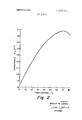
- FIG. 2 is a graphical representation showing the relation subjected to heat treatment whereby the strontium titanate is between temperature in degrees Kelvin and the capacitance in crystallized in situ. Small additions of rare-earth oxides such as nanofarads of the device made in accordance with the pracniobium oxide, tantalum oxide, vanadium oxide and bismuth tice of this invention. W.
- Suitable glasses for forming the glass matrix of the present invention may be alumino-silicate, borate, phosphate, or germanite glasses.
- Table I represents examples of compositions on a batch basis in percent by weight which, when heat treated as herein set forth, provide dielectric material comprising strontium titanate crystals in a glass matrix suitable for the purposes of the rs tist qtipm
- a specific example of a capacitive cryogenic thermometer follows. A glass batch in percent by weight comprising 68.4 percent strontium titanate, SrTiO 0.6 percent strontium carbonate, SrCO 20.0 percent silica, SiO 10.0 percent alumina, Al O and 1.0 percent niobia Nb O was melted in a platinum crucible at 1,650 C. to form a glass. Strontium titanate was then crystallized from the above formed glass by heat treating for approximately 2 hours at l 100 C.
- a 51 layer capacitive sensor measuring approximately 6X2Xl mm. was fabricated using this material as the dielectric.
- Gold-platinum alloy conductive material films or coatings were interposed between dielectric layers to form electrodes.
- the capacitancetemperature characteristics and power dissipation characteristics of this sensor from 1.7 K. to 80 K. were measured in a conventional helium cryostat.
- a conventional He -He dilution refrigerator was used to measure these characteristics between 0.1" K. and 25 K.-The results of these measurements are shown plotted in FIGS. 2, 3 and 4, and from these curves it can be seen that this type of sensor has a smooth capacitance vs. temperature behavior over the range of 65 K. down to at least 0.10" K.
- this type of sensor has substantially a linear capacitance to temperature behavior from l.l K. to 6.5 K. as illustrated in FIG. 3.
- the sensor is extremely sensitive over the range 0.l0 K. to 60 I(., being of the order of 200 picofarads per degree, and is most sensitive over the linear range, l.l K. to 6.5 K. Because capacitance bridges can resolve capacitance to, 10.05 picofarads at the nanofarad level, which is applicable to the above described sensor, temperature can be measured with this sensor to an accuracy of 10.25 millidegree Kelvin in the linear range.
- the efi'ect of a magnetic field on temperature measurement using this sensor was measured by immersing a conventional 100 kilogauss superconducting magnet in a bath of liquid helium at 42 K. The sensor was positioned within the magnetic field of the magnet, and the capacitance was measured as a,
- a capacitive device comprising a dielectric layer formed of a material consisting of a glass matrix, 0 to 5 percent by weight of at least one dopant, and crystalline strontium titanate, said material being formed from a glass containing at least 50 percent by weight of strontium titanate from and within which glass at least a portion of said strontium titanate is crystallized by heat treatment of said glass,
- capacitance of said device being a determinable and measureable function of temperature.
- the capacitive device of claim '1 wherein the dopants are selected from the group consisting of tantalum oxide, bismuth oxide, vanadium oxide and niobium oxide.
- the capacitive device of claim 1 having more than two electrically conductive members, each said member being separated from a djacent members b one said dielectric layer.
- said glass matrix consists of a glass selected from the group consisting of alumino-silicate glass, borate glass, phosphate glass and germanite glass.
- a capacitive cryogenic thermometer comprising a plurality of electrically conductive members
- a dielectric layer disposed between adjacent conductive members and being formed of material consisting of a glass matrix, 0 to 5 percent by weight of at least one dopant selected from the group consisting of tantalum oxide, bismuth oxide, vanadium oxide, and niobium oxide, and crystalline strontium titanate, said material being formed from a glass containing at least 50 percent by weight of strontium titanate from and within which glass at least a portion of said strontium titanate is crystallized by heat treatment of said glass, and terminal means connected to said members, the capacitance of said thermometer being a function of temperature whereby temperature is determined by measuring the capacitance thereof.
- thermometer of claim 6 wherein said glass matrix consists of alumino-silicate glass.
- thermometer of claim 7 wherein said strontium titanate is crystallized in situ.
Landscapes
- Engineering & Computer Science (AREA)
- Power Engineering (AREA)
- Microelectronics & Electronic Packaging (AREA)
- Physics & Mathematics (AREA)
- General Physics & Mathematics (AREA)
- Glass Compositions (AREA)
Abstract
A capacitive device suitable for use in cryogenic temperature measuring. The dielectric material used in the capacitor is made from a composition in which strontium titanate, SrTiO3, has been controllably crystallized in a glass matrix. A capacitive device having this type of dielectric material is particularly useful in measuring cryogenic temperatures in that the dielectric constant of such a dielectric material decreases smoothly with decreasing temperature, varies linearly with temperature over a suitable portion of the range thereof, and possesses a large sensitivity in the cryogenic temperature range.
Description
United States Patent Lawless 1 Mar. 14, 1972 [54] CAPACITIVE CRYOGENIC 3,293,077 12/1966 Kaiser ..3l7l258 X THERMOMETER I Primary Examiner-E. A. Goldberg [72] Inventor: Lawless Commgi Att0rneyC|arence R. Patty, Jr. and Walter S. Zebrowski [73] Assignee: Corning Glass Works, Corning, N.Y. [5 ABST CT [22] Filed: June 18, 1970 Appl. No.: 47,334
References Cited UNITED STATES PATENTS Walker ..3 17/261 Herczog ..317/258 A capacitive device suitable for use in cryogenic temperature measuring. The dielectric material used in the capacitor is made from a composition in which strontium titanate, SrTiO has been controllably crystallized in a glass matrix. A capacitive device having this type of dielectric material is particularly useful in measuring cryogenic temperatures in that the dielectric constant of such a dielectric material decreases smoothly with decreasing temperature, varies linearly with temperature over a suitable portion of the range thereof, and possesses a large sensitivity in the cryogenic temperature range.
8 Claims, 4 Drawing Figures PATENTEDMARM I972 SHEET 2 BF 3 2 ic. x
TEMPERATURE, K.
Fig. 2
'INVENTOR. Willi am N. Lawless A/EZEW" ATTORNEY PATENTEDMARM I972 SHEET 3 [IF 3 INVENTOR. William N. Lawless BY M42;
ATTORNEY 1. Field of Invention This invention relates to cryogenic temperature measuring; devices having large sensitivity to temperature changes at least! as low as 0.l K. and up to 65 K. More specifically, this in-; vention relates to a capacitive thermometer wherein the; dielectric material is formed of strontium titanate, SrTiO crystallized in alumino-silicate glass.
2. Background of the Invention The conventional cryogenic thermometers, that is, resistance thermometers, have several characteristics that tend to degrade the accuracy of the thermometers or make their use difficult or both. Resistance thermometers which display useful sensitivities in the cryogenic temperature range do not follow a well-defined mathematical law and so must be calibrated point-by-point, rather than at just two points. 'Ihei resistance thermometers, by virtue of the fact that they are resistive, are self-heating thereby increasing the temperature,. and this self-heating usually increases with decreasing tem-: perature. In addition, resistance thermometers are seriously; affected by magnetic fields resulting from the well known Hall 1 effect and so are not reliable for use in or around magnetic? fields, such as may be generated by superconducting magnets. Finally, resistance thermometers are so-called for lead; devices, 2 current and 2 voltage, some varieties of which have polarity.
SUMMARY OF THE INVENTION Therefore, it is an object of this invention to provide a device sensitive to temperature changes suitable for use as a cryogenic temperature-measuring device and which overcomes all of the aforementioned disadvantages.
Briefly, this invention comprises a capacitive device for use in cryogenic temperature-determining apparatus, said device having a dielectric material that has dielectric constant changes with temperature changes at temperatures within the cryogenic temperature range. The invention comprises a plurality of electrically conductive layers each separated from adjacent layers by a dielectric material made of glass from which strontium titanate in combination with other dopants has been i controllably crystallized, and input and output terminals each respectively connected to two of said electrically conducting layers, each of the remaining conducting layers being connected to one or the other of said terminals.
BRIEF DESCRIPTION OF THE DRAWINGS SrTiOs SrCO FIG. 3 is s graphical representation similar to that of FIG. 2 showing in more detail the temperature range of l.7 K. to 7" K.
FIG. 4 is a graphical representation similar to that of FIG. 2 showing in more detail the temperature range of 0.1 K. to 2.25 K.
10, of a dielectric made in accordance with this invention, thin strips, coatings, or films 11 and 12 of metal or other electrically conducting material in contact with the opposite faces of the layers 10, and leads l4 and 16. Leads 14 and 16 are formed of ribbon or wire in electrical contact with the opposite edges of the conducting strips 11 and 12 respectively. Any known multilayer-capacitor fabrication technique may be used in the practice of this invention, and it will be obvious that the resulting devices are not to be limited to any particular number of cofiductingstrips but may comprise a plurality of alternate conducting strips with individual leads or terminals appropriately attached, adjacent strips being separated by the interposed dielectric layers. Thus, the devices in which there are several electrically conducting layers, two of said layers being connected respectively to input and output terminals, the remaining electrically conducting layers each may be connected alternately or otherwise to one or the other of said terminals.
I have discovered a family of dielectric materials suitable for low-temperature thermometry, resulting from the dielectric constant having a strong temperature dependence below approximately K. These materials are strontium titanatecontaining glasses from which the strontium titanate, for ex ample pervoskite strontium titanate, has been controllably crystallized, and results in a body, composed of a multiplicity of uniform very fine grain crystals substantially homogenouslydispersed in a glassy matrix and forming a large proportion thereof. I have found that such materials can be obtained when at least 50 percent by weight of strontium titanate, including 0 to 5 percent by weight of dopants, is melted into a glass, and that a low-temperature ferroelectric strontium titanate can be subsequently crystallized in this glass upon reheating between 800 C. and l,300 C., for a time period of at least 1 hour at 800 C. and at least /2 minute at l,300 C. A more complete discussion of a suitable heat treatment process used for the formation of crystals may be found in the A. I-Ierczog and S. D. Stookey patent, US. Pat. No. 3,195,030 which is incorporated herein by reference. With proper heat treatment, strontium titanate is the major crystallized phase that will result. It is to be understood that said glass can be heat treated prior to use in or formation of an ultimate device, or such device may be formed using the glass and thereafter be TABLE I SIOz Nb O V105 T3205 BIzOs AlzO FIG. 2 is a graphical representation showing the relation subjected to heat treatment whereby the strontium titanate is between temperature in degrees Kelvin and the capacitance in crystallized in situ. Small additions of rare-earth oxides such as nanofarads of the device made in accordance with the pracniobium oxide, tantalum oxide, vanadium oxide and bismuth tice of this invention. W.
oxide up to 5 percent by weight may be made. Such dopants In FIG. 1 is shown a capacitive device comprising t'hmayers tend to stabilize the titanate phase and yield a smooth dielectric constant vs. temperature relationship. Suitable glasses for forming the glass matrix of the present invention may be alumino-silicate, borate, phosphate, or germanite glasses.
Table I represents examples of compositions on a batch basis in percent by weight which, when heat treated as herein set forth, provide dielectric material comprising strontium titanate crystals in a glass matrix suitable for the purposes of the rs tist qtipm A specific example of a capacitive cryogenic thermometer follows. A glass batch in percent by weight comprising 68.4 percent strontium titanate, SrTiO 0.6 percent strontium carbonate, SrCO 20.0 percent silica, SiO 10.0 percent alumina, Al O and 1.0 percent niobia Nb O was melted in a platinum crucible at 1,650 C. to form a glass. Strontium titanate was then crystallized from the above formed glass by heat treating for approximately 2 hours at l 100 C. A 51 layer capacitive sensor measuring approximately 6X2Xl mm. was fabricated using this material as the dielectric. Gold-platinum alloy conductive material films or coatings were interposed between dielectric layers to form electrodes. The capacitancetemperature characteristics and power dissipation characteristics of this sensor from 1.7 K. to 80 K. were measured in a conventional helium cryostat. A conventional He -He dilution refrigerator was used to measure these characteristics between 0.1" K. and 25 K.-The results of these measurements are shown plotted in FIGS. 2, 3 and 4, and from these curves it can be seen that this type of sensor has a smooth capacitance vs. temperature behavior over the range of 65 K. down to at least 0.10" K. Furthermore, this type of sensor has substantially a linear capacitance to temperature behavior from l.l K. to 6.5 K. as illustrated in FIG. 3. In addition, the sensor is extremely sensitive over the range 0.l0 K. to 60 I(., being of the order of 200 picofarads per degree, and is most sensitive over the linear range, l.l K. to 6.5 K. Because capacitance bridges can resolve capacitance to, 10.05 picofarads at the nanofarad level, which is applicable to the above described sensor, temperature can be measured with this sensor to an accuracy of 10.25 millidegree Kelvin in the linear range.
The efi'ect of a magnetic field on temperature measurement using this sensor was measured by immersing a conventional 100 kilogauss superconducting magnet in a bath of liquid helium at 42 K. The sensor was positioned within the magnetic field of the magnet, and the capacitance was measured as a,
magnetic field was slowly increased up to I00 kilogauss. There was no effect of the magnetic field on the measured suring frequency of l kilohertz and a measuring voltage of 10 miliivolts (RMS) self-heating at 4.2 K. was typically 1 microwatt and increases with decreasing temperature.
Although the present invention has been described with respect to specific examples, it is not intended that such specific examples be limiting upon the scope of the invention except insofar as is set forth in the following claims.
I claim:
1. A capacitive device comprising a dielectric layer formed of a material consisting of a glass matrix, 0 to 5 percent by weight of at least one dopant, and crystalline strontium titanate, said material being formed from a glass containing at least 50 percent by weight of strontium titanate from and within which glass at least a portion of said strontium titanate is crystallized by heat treatment of said glass,
electrically conductive members disposed adjacent each side of said layer, and
terminal means connected to said members, the
capacitance of said device being a determinable and measureable function of temperature.
2. The capacitive device of claim '1 wherein the dopants are selected from the group consisting of tantalum oxide, bismuth oxide, vanadium oxide and niobium oxide.
3. The capacitive device of claim 1 having more than two electrically conductive members, each said member being separated from a djacent members b one said dielectric layer.
4. The capacitive device of claim wherein said glass matrix consists of a glass selected from the group consisting of alumino-silicate glass, borate glass, phosphate glass and germanite glass.
5. The capacitive device of claim 1 wherein said strontium titanate is crystalized in situ.
6. A capacitive cryogenic thermometer comprising a plurality of electrically conductive members,
a dielectric layer disposed between adjacent conductive members and being formed of material consisting of a glass matrix, 0 to 5 percent by weight of at least one dopant selected from the group consisting of tantalum oxide, bismuth oxide, vanadium oxide, and niobium oxide, and crystalline strontium titanate, said material being formed from a glass containing at least 50 percent by weight of strontium titanate from and within which glass at least a portion of said strontium titanate is crystallized by heat treatment of said glass, and terminal means connected to said members, the capacitance of said thermometer being a function of temperature whereby temperature is determined by measuring the capacitance thereof.
7. The thermometer of claim 6 wherein said glass matrix consists of alumino-silicate glass.
8. The thermometer of claim 7 wherein said strontium titanate is crystallized in situ.
UNITED STATES PATENT OFFICE CERTIFICATE OF CORRECTION Patent No. 3, 49, 9 D d March 1-, 97
Inventor(5) William N.' LBJ/11883 It is certified that error appears in the above-identified patent and that said Letters Patent are hereby corrected as shown below:
Signed and sealed this 17th day'of October 1972.
( SEAL) Attes t:
EDWARD M.FLETCHER,JR. I ROBERT GOTTSCHALK Attesting Officer Commissioner of Patents FORM PO-lOSO (10-69) USCOMM'DC 60375-P69 fi U.S, GOVERNMENT PRINTING OFFICE: I969 O-366-334 UNTTED STATES PATENT eTTTcE (IERHMCATE @F QQRREQTWN Patent No. 39 4- 9 9 D d March 4-9 972 Inventor(g) William N Lawless It is certified that error appears in the above-identified patent and that said Letters Patent are hereby corrected as shown below:
(SEAL) Attest:
EDWARD MJLE'IGHER .ZI'Ra ROBERT GOTTSCHALK Attesting Officer Commissioner of Patents iiM PO-IOSO (10-69) USCOMM-DC 6O376-P69 U.S. GOVERNMENT PRINTING OFFICE: I969 O-366-33d
Claims (7)
- 2. The capacitive device of claim 1 wherein the dopants are selected from the group consisting of tantalum oxide, bismuth oxide, vanadium oxide and niobium oxide.
- 3. The capacitive device of claim 1 having more than two electrically conductive members, each said member being separated from adjacent members by one saId dielectric layer.
- 4. The capacitive device of claim 1 wherein said glass matrix consists of a glass selected from the group consisting of alumino-silicate glass, borate glass, phosphate glass and germanite glass.
- 5. The capacitive device of claim 1 wherein said strontium titanate is crystalized in situ.
- 6. A capacitive cryogenic thermometer comprising a plurality of electrically conductive members, a dielectric layer disposed between adjacent conductive members and being formed of material consisting of a glass matrix, 0 to 5 percent by weight of at least one dopant selected from the group consisting of tantalum oxide, bismuth oxide, vanadium oxide, and niobium oxide, and crystalline strontium titanate, said material being formed from a glass containing at least 50 percent by weight of strontium titanate from and within which glass at least a portion of said strontium titanate is crystallized by heat treatment of said glass, and terminal means connected to said members, the capacitance of said thermometer being a function of temperature whereby temperature is determined by measuring the capacitance thereof.
- 7. The thermometer of claim 6 wherein said glass matrix consists of alumino-silicate glass.
- 8. The thermometer of claim 7 wherein said strontium titanate is crystallized in situ.
Applications Claiming Priority (1)
| Application Number | Priority Date | Filing Date | Title |
|---|---|---|---|
| US4733470A | 1970-06-18 | 1970-06-18 |
Publications (1)
| Publication Number | Publication Date |
|---|---|
| US3649891A true US3649891A (en) | 1972-03-14 |
Family
ID=21948370
Family Applications (1)
| Application Number | Title | Priority Date | Filing Date |
|---|---|---|---|
| US47334A Expired - Lifetime US3649891A (en) | 1970-06-18 | 1970-06-18 | Capacitive cryogenic thermometer |
Country Status (1)
| Country | Link |
|---|---|
| US (1) | US3649891A (en) |
Cited By (17)
| Publication number | Priority date | Publication date | Assignee | Title |
|---|---|---|---|---|
| US3950586A (en) * | 1967-11-17 | 1976-04-13 | National Research Development Corporation | Electrical insulator materials for use in micro-circuit construction |
| US4396721A (en) * | 1981-08-05 | 1983-08-02 | Lawless William N | Glass ceramic materials having controllable temperature coefficients of dielectric constant |
| US4545254A (en) * | 1984-06-01 | 1985-10-08 | Ceramphysics, Inc. | Materials and methods for pressure and temperature sensors at cryogenic temperatures |
| US4599677A (en) * | 1984-06-01 | 1986-07-08 | Lawless William N | Capacitive energy storage device for use at cryogenic temperatures |
| US5140300A (en) * | 1988-10-24 | 1992-08-18 | Sharp Kabushiki Kaisha | Superconductive magneto-resistive device comprising laminated superconductive ceramic films |
| US5407276A (en) * | 1992-08-17 | 1995-04-18 | Jones; Barbara L. | Diamond temperature and radiation sensor |
| US5483414A (en) * | 1992-04-01 | 1996-01-09 | Vaisala Oy | Electrical impedance detector for measurement of physical quantities, in particular of temperature |
| US6242714B1 (en) * | 1998-09-02 | 2001-06-05 | Mayekawa Mfg. Co., Ltd. | Noncontact article temperature measuring device for food |
| US6411491B2 (en) | 1997-06-05 | 2002-06-25 | Ceramphysics, Inc. | Capacitive energy storage device and method of producing the same |
| US6690567B1 (en) * | 2002-09-26 | 2004-02-10 | Ceramphysics, Inc. | Capacitive energy storage device |
| US20050238081A1 (en) * | 2004-04-27 | 2005-10-27 | National Institute Of Advanced Industrial Science And Technology | Capacitance temperature sensor and temperature measuring device |
| JP2006234574A (en) * | 2005-02-24 | 2006-09-07 | National Institute Of Advanced Industrial & Technology | Capacitance thermometer |
| JP2007120948A (en) * | 2005-10-25 | 2007-05-17 | National Institute Of Advanced Industrial & Technology | Capacitance thermometer |
| JP2008151617A (en) * | 2006-12-15 | 2008-07-03 | National Institute Of Advanced Industrial & Technology | Capacitance thermometer |
| US20090323765A1 (en) * | 2008-06-25 | 2009-12-31 | Ngk Spark Plug Co., Ltd. | Temperature sensor |
| US20130020540A1 (en) * | 2010-04-09 | 2013-01-24 | Nippon Electric Glass Co., Ltd | Material for light reflective substrate, light reflective substrate and light emitting device using the same |
| US9515243B2 (en) | 2014-12-22 | 2016-12-06 | Infineon Technologies Ag | Temperature sensor |
Citations (3)
| Publication number | Priority date | Publication date | Assignee | Title |
|---|---|---|---|---|
| US2736080A (en) * | 1956-02-28 | walker etal | ||
| US3195030A (en) * | 1964-06-26 | 1965-07-13 | Corning Glass Works | Glass and methods of devitrifying same and making a capacitor therefrom |
| US3293077A (en) * | 1964-06-29 | 1966-12-20 | Ibm | Microelectronic capacitor material and method of fabrication |
-
1970
- 1970-06-18 US US47334A patent/US3649891A/en not_active Expired - Lifetime
Patent Citations (3)
| Publication number | Priority date | Publication date | Assignee | Title |
|---|---|---|---|---|
| US2736080A (en) * | 1956-02-28 | walker etal | ||
| US3195030A (en) * | 1964-06-26 | 1965-07-13 | Corning Glass Works | Glass and methods of devitrifying same and making a capacitor therefrom |
| US3293077A (en) * | 1964-06-29 | 1966-12-20 | Ibm | Microelectronic capacitor material and method of fabrication |
Cited By (22)
| Publication number | Priority date | Publication date | Assignee | Title |
|---|---|---|---|---|
| US3950586A (en) * | 1967-11-17 | 1976-04-13 | National Research Development Corporation | Electrical insulator materials for use in micro-circuit construction |
| US4396721A (en) * | 1981-08-05 | 1983-08-02 | Lawless William N | Glass ceramic materials having controllable temperature coefficients of dielectric constant |
| US4545254A (en) * | 1984-06-01 | 1985-10-08 | Ceramphysics, Inc. | Materials and methods for pressure and temperature sensors at cryogenic temperatures |
| US4599677A (en) * | 1984-06-01 | 1986-07-08 | Lawless William N | Capacitive energy storage device for use at cryogenic temperatures |
| US5140300A (en) * | 1988-10-24 | 1992-08-18 | Sharp Kabushiki Kaisha | Superconductive magneto-resistive device comprising laminated superconductive ceramic films |
| US5483414A (en) * | 1992-04-01 | 1996-01-09 | Vaisala Oy | Electrical impedance detector for measurement of physical quantities, in particular of temperature |
| US5407276A (en) * | 1992-08-17 | 1995-04-18 | Jones; Barbara L. | Diamond temperature and radiation sensor |
| US6411491B2 (en) | 1997-06-05 | 2002-06-25 | Ceramphysics, Inc. | Capacitive energy storage device and method of producing the same |
| US6242714B1 (en) * | 1998-09-02 | 2001-06-05 | Mayekawa Mfg. Co., Ltd. | Noncontact article temperature measuring device for food |
| US6690567B1 (en) * | 2002-09-26 | 2004-02-10 | Ceramphysics, Inc. | Capacitive energy storage device |
| US20050238081A1 (en) * | 2004-04-27 | 2005-10-27 | National Institute Of Advanced Industrial Science And Technology | Capacitance temperature sensor and temperature measuring device |
| EP1591763A1 (en) * | 2004-04-27 | 2005-11-02 | National Institute of Advanced Industrial Science and Technology | Capacitance temperature sensor and temperature measuring device |
| US7134785B2 (en) * | 2004-04-27 | 2006-11-14 | National Institute Of Advanced Industrial Science And Technology | Capacitance temperature sensor and temperature measuring device |
| JP2006234574A (en) * | 2005-02-24 | 2006-09-07 | National Institute Of Advanced Industrial & Technology | Capacitance thermometer |
| JP2007120948A (en) * | 2005-10-25 | 2007-05-17 | National Institute Of Advanced Industrial & Technology | Capacitance thermometer |
| JP2008151617A (en) * | 2006-12-15 | 2008-07-03 | National Institute Of Advanced Industrial & Technology | Capacitance thermometer |
| US20090323765A1 (en) * | 2008-06-25 | 2009-12-31 | Ngk Spark Plug Co., Ltd. | Temperature sensor |
| US8702305B2 (en) * | 2008-06-25 | 2014-04-22 | Ngk Spark Plug Co., Ltd. | Temperature sensor |
| US20130020540A1 (en) * | 2010-04-09 | 2013-01-24 | Nippon Electric Glass Co., Ltd | Material for light reflective substrate, light reflective substrate and light emitting device using the same |
| US20150378056A1 (en) * | 2010-04-09 | 2015-12-31 | Nippon Electric Glass Co., Ltd. | Material for light reflective substrate, light reflective substrate and light emitting device using the same |
| US9515243B2 (en) | 2014-12-22 | 2016-12-06 | Infineon Technologies Ag | Temperature sensor |
| US10670474B2 (en) | 2014-12-22 | 2020-06-02 | Infineon Technologies Ag | Temperature sensor |
Similar Documents
| Publication | Publication Date | Title |
|---|---|---|
| Valasek | Piezo-electric activity of Rochelle salt under various conditions | |
| Rao et al. | Dielectric properties of alkaline earth fluoride single crystals | |
| Lawless | A Low Temperature Glass‐Ceramic Capacitance Thermometer | |
| Parker | Static dielectric constant of rutile (ti o 2), 1.6-1060 k | |
| Glass | Dielectric, Thermal, and Pyroelectric Properties of Ferroelectric LiTa O 3 | |
| Angert et al. | Ferroelectric phase transition temperatures of KTiOPO4 crystals grown from self‐fluxes | |
| Ord et al. | The Field‐Dependence of the Dielectric Constant during the Anodic Oxidation of Tantalum, Niobium, and Tungsten | |
| Wójcik et al. | Electrical properties of lead iron niobate PFN | |
| US3816750A (en) | Pyroelectric detector | |
| Loiacono et al. | Dielectric, pyroelectric, and thermal properties of LiNH4SO4 and LiND4SO4 | |
| Hollander Jr et al. | Dielectric Properties of Single‐Crystal Nonstoichiometric Rutile (TiO2) | |
| Lang et al. | Pyroelectric thermometer for use at low temperatures | |
| Nomura et al. | Dielectric relaxation and thermal stimulated current in (K3/4Bi1/4)(Zn1/6Nb5/6) O3 and its solid solutions | |
| Rao et al. | Dielectric dispersion and its temperature variation in calcite single crystals | |
| US7134785B2 (en) | Capacitance temperature sensor and temperature measuring device | |
| Lawless et al. | Studies of a Glass‐Ceramic Capacitance Thermometer between 0.025 and 2.4 K | |
| Lawless et al. | Further studies of the T3/2 specific heat term in ferroelectrics at low temperatures | |
| Snider et al. | Atomic Heats of Normal and Superconducting Thallium | |
| Lawless | Capacitive-Thermometry Characteristics of a Titanate Glass-Ceramic at Low Temperatures | |
| Braunstein et al. | Dipole correlations in TeO2-WO3 glass | |
| PULVARI | Effect of impurities on electrical solid‐state properties of barium titanate | |
| Bunting et al. | Properties of beryllium-barium titanate dielectrics | |
| Anderson et al. | Prediction of the Stability of Thin-film Resistors | |
| Nåvik | The ionic conductivity in silicon oxide films | |
| US3621343A (en) | Polar vapor sensing means |
Legal Events
| Date | Code | Title | Description |
|---|---|---|---|
| AS | Assignment |
Owner name: CIBA CORNING DIAGNOSTICS CORP., MEDFIELD, MASSACHU Free format text: ASSIGNMENT OF ASSIGNORS INTEREST.;ASSIGNOR:CORNING GLASS WORKS, A BUSINESS CORP. OF NEW YORK;REEL/FRAME:004480/0063 Effective date: 19851115 |
|
| AS | Assignment |
Owner name: CIBA CORNING DIAGNOSTICS CORP., MEDFIELD, MASSACHU Free format text: ASSIGNMENT OF ASSIGNORS INTEREST.;ASSIGNOR:CORNING GLASS WORKS;REEL/FRAME:004483/0427 Effective date: 19851105 |