EP1591563A1 - Tin-containing plating bath - Google Patents
Tin-containing plating bath Download PDFInfo
- Publication number
- EP1591563A1 EP1591563A1 EP04704363A EP04704363A EP1591563A1 EP 1591563 A1 EP1591563 A1 EP 1591563A1 EP 04704363 A EP04704363 A EP 04704363A EP 04704363 A EP04704363 A EP 04704363A EP 1591563 A1 EP1591563 A1 EP 1591563A1
- Authority
- EP
- European Patent Office
- Prior art keywords
- tin
- plating bath
- sulfonic acid
- acid
- salts
- Prior art date
- Legal status (The legal status is an assumption and is not a legal conclusion. Google has not performed a legal analysis and makes no representation as to the accuracy of the status listed.)
- Granted
Links
Images

Classifications
-
- C—CHEMISTRY; METALLURGY
- C25—ELECTROLYTIC OR ELECTROPHORETIC PROCESSES; APPARATUS THEREFOR
- C25D—PROCESSES FOR THE ELECTROLYTIC OR ELECTROPHORETIC PRODUCTION OF COATINGS; ELECTROFORMING; APPARATUS THEREFOR
- C25D3/00—Electroplating: Baths therefor
- C25D3/02—Electroplating: Baths therefor from solutions
- C25D3/30—Electroplating: Baths therefor from solutions of tin
- C25D3/32—Electroplating: Baths therefor from solutions of tin characterised by the organic bath constituents used
-
- C—CHEMISTRY; METALLURGY
- C25—ELECTROLYTIC OR ELECTROPHORETIC PROCESSES; APPARATUS THEREFOR
- C25D—PROCESSES FOR THE ELECTROLYTIC OR ELECTROPHORETIC PRODUCTION OF COATINGS; ELECTROFORMING; APPARATUS THEREFOR
- C25D3/00—Electroplating: Baths therefor
- C25D3/02—Electroplating: Baths therefor from solutions
- C25D3/56—Electroplating: Baths therefor from solutions of alloys
- C25D3/60—Electroplating: Baths therefor from solutions of alloys containing more than 50% by weight of tin
-
- H—ELECTRICITY
- H10—SEMICONDUCTOR DEVICES; ELECTRIC SOLID-STATE DEVICES NOT OTHERWISE PROVIDED FOR
- H10W—GENERIC PACKAGES, INTERCONNECTIONS, CONNECTORS OR OTHER CONSTRUCTIONAL DETAILS OF DEVICES COVERED BY CLASS H10
- H10W72/00—Interconnections or connectors in packages
- H10W72/01—Manufacture or treatment
- H10W72/012—Manufacture or treatment of bump connectors, dummy bumps or thermal bumps
- H10W72/01231—Manufacture or treatment of bump connectors, dummy bumps or thermal bumps using blanket deposition
- H10W72/01233—Manufacture or treatment of bump connectors, dummy bumps or thermal bumps using blanket deposition in liquid form, e.g. spin coating, spray coating or immersion coating
- H10W72/01235—Manufacture or treatment of bump connectors, dummy bumps or thermal bumps using blanket deposition in liquid form, e.g. spin coating, spray coating or immersion coating by plating, e.g. electroless plating or electroplating
Definitions
- the present invention relates to a tin or tin alloy plating bath containing an aliphatic sulfonic acid as a base acid.
- Tin or tin alloy plating baths containing an organic sulfonic acid as a base acid are widely used because of easy wastewater disposal and high solubility of tin salts.
- organic sulfonic acids usable as such base acids include methanesulfonic acid, ethanesulfonic acid, propanesulfonic acid and like alkanesulfonic acids; 2-hydroxyethanesulfonic acid, 2-hydroxypropanesulfonic acid and like alkanolsulfonic acids; and p -phenolsulfonic acid and like aromatic sulfonic acids.
- Japanese Unexamined Patent Publication No. 204252/1998 points out that in a process comprising oxidizing an alkyl mercaptan with hydrogen peroxide, reaction intermediate residues such as disulfide contaminate the product (see paragraph 5).
- This publication discloses that a high-purity alkanesulfonic acid or alkanolsulfonic acid can be produced in high yield and low cost by reacting an alkyl mercaptan such as methyl mercaptan, ethyl mercaptan or 2-mercaptoethanol with hydrogen peroxide by a process comprising the following steps: feeding an aqueous solution of at least 50 wt.% hydrogen peroxide in an excess of the stoichiometrically required amount into a reaction vessel; continuously supplying thereto an alkyl mercaptan at a temperature as low as or lower than 50°C; allowing the reaction mixture to mature for about 3 to 20 hours; subjecting the reaction mixture to distillation at boiling under atmospheric pressure; and
- This method produces a high-purity alkanesulfonic acid by reacting an alkyl mercaptan with hydrogen peroxide, the method using peroxide in an excess of the stoichiometrically required amount, controlling the reaction temperature to a low temperature, comprising a maturing period, and further using a combination of complicated treatments such as distillation at atmospheric pressure and anion exchange treatment.
- the publication shows that the obtained high-purity alkanesulfonic acid can be esterified with (meth)acrylic acid and used as a reactive emulsifier.
- the publication further discloses that homopolymers of an alkanesulfonic acid or copolymers of an alkanesulfonic acid with a vinyl monomer can be used as flocculants, dispersants, thickeners and the like for various purposes, and are also useful as additives for tin plating baths, solder plating baths, etc. (see paragraph 2 of the publication).
- Japanese Unexamined Patent Publication No. 2001-64249 describes oxidation of thiol (alkyl mercaptan), hydrolysis of halogenated alkyl sulfonyl, and oxidation of dimethyl disulfide as conventional methods for producing alkanesulfonic acids (see paragraph 3).
- the publication discloses a purification method comprising bringing an aqueous solution of an alkanesulfonic acid obtained by such a conventional method into contact with a basic anion exchange resin to mainly reduce the sulfuric acid content of the alkanesulfonic acid.
- alkanesulfonic acids particularly methansulfonic acid
- sulfuric acid contained as an impurity adversely affects such plating.
- the publication then states that the sulfuric acid content of alkanesulfonic acid can be greatly reduced by bringing the alkanesulfonic acid into contact with a basic anion exchange resin (see paragraphs 2 to 5 of the publication).
- a primary object of the invention is to provide a tin or tin alloy plating bath capable of forming a plating film with excellent properties by further considering the correlation between the purity of an aliphatic sulfonic acid contained as a base acid in a tin or tin alloy plating bath and the properties of the obtained plating film.
- the inventors of the present invention conducted extensive research and found that although aliphatic sulfonic acids such as alkanesulfonic acids contain, as impurities, various sulfur-containing compounds depending on the production method, only specific components such as ⁇ -chlorodimethylsulfone and dimethyldisulfide among such sulfur-containing compounds adversely affect the plating properties, and sulfur-containing compounds other than these specific components, such as dimethylsulfone, do not affect the plating properties.
- the inventors further found that by subjecting a commercially available alkanesulfonic acid to a specific purification/separation process such as concentration under reduced pressure, specific sulfur-containing compounds that adversely affect the plating properties can be effectively removed; and when the resulting purified alkanesulfonic acid is used not as an additive but as a base acid in a tin or tin alloy plating bath, the plating film has greatly improved reflowability, appearance, etc.; and thereby accomplished the present invention.
- a specific purification/separation process such as concentration under reduced pressure
- the present invention provides the following tin-containing plating baths:
- the tin-containing plating bath of the invention contains as a plating metal component a soluble stannous salt alone, or a soluble stannous salt together with at least one soluble salt selected from the group consisting of copper salts, bismuth salts, silver salts, indium salts, zinc salts, nickel salts, cobalt salts and antimony salts, and contains as a base acid at least one aliphatic sulfonic acid selected from the group consisting of alkanesulfonic acids and alkanolsulfonic acids.
- alkanesulfonic acids usable as base acids
- examples of usable alkanesulfonic acid are those represented by the formula C n H 2n+1 SO 3 H (for example, n is 1 to 11).
- Specific examples of such alkanesulfonic acids include methansulfonic acid, ethanesulfonic acid, 1-propanesulfonic acid, 2-propanesulfonic acid, 1-butanesulfonic acid, 2-butanesulfonic acid, pentanesulfonic acid and the like.
- alkanolsulfonic acid examples include 2-hydroxyethane-1-sulfonic acid (isethionic acid), 2-hydroxypropane-1-sulfonic acid (2-propanolsulfonic acid), 2-hydroxybutane-1-sulfonic acid, 2-hydroxypentane-1-sulfonic acid, 1-hydroxypropane-2-sulfonic acid, 3-hydroxypropane-1-sulfonic acid, 4-hydroxybutane-1-sulfonic acid, 2-hydroxyhexane-1-sulfonic acid and the like.
- a representative example of such alkanolsulfonic acids is 2-hydroxyethane-1-sulfonic acid.
- alkanesulfonic acids and alkanolsulfonic acids can be used singly or mixture of two or more kinds.
- alkanesulfonic acids are preferable and methanesulfonic acid is particularly preferable.
- a known method for producing an aliphatic carboxylic acid for use as the base acid, and in particular, an alkanesulfonic acid comprises subjecting an alkyl mercaptan to wet oxidation (for example, an oxidation method using chlorine and water, or hydrogen peroxide).
- an alkyl mercaptan for example, an oxidation method using chlorine and water, or hydrogen peroxide.
- dimethyldisulfide may be generated in the intermediate reaction stage.
- the above-mentioned Japanese Unexamined Patent Publication No. 204252/1998 also mentions the presence of reaction intermediate residues such as disulfides (see paragraph 5 of the publication).
- unreacted dialkyldisulfide may remain in the product.
- the product methane sulfonic acid when dimethyldisulfide is subjected to wet oxidation, a minute amount of unreacted dimethyldisulfide may remain in the product methane sulfonic acid.
- the product aliphatic sulfonic acid may contain minute amounts of various halogen- and sulfur-containing compounds as impurities. Wet oxidation of alkyl mercaptan using chlorine and water is also likely to have similar problems.
- aliphatic sulfonic acids may contain various sulfur-containing compounds depending on the production method.
- the present inventors extracted with dichloromethane impurities contained in an unpurified aliphatic sulfonic acid and subjected the obtained mixture of impurities to liquid chromatography to identify the isolates using various analytical instruments. Subsequently, the inventors added minute amounts of these isolates to a newly purified aliphatic sulfonic acid and prepared tin or tin alloy plating baths containing as a base acid an aliphatic sulfonic acid containing these isolates as impurities to investigate the properties of the obtained plating films. As a result, the inventors drew the following noteworthy conclusion: among sulfur-containing compounds contained as impurities, while some components adversely affect the plating properties, others have no such adverse effects.
- the inventors identified the two groups of components that are different in their influence on plating properties and found that the components that have adverse effects have a common feature. More specifically, the inventors found that among sulfur-containing compounds contained as impurities, compounds (A) having a sulfur atom(s) with an oxidation number of +4 or less in the molecule and compounds (B) having a sulfur atom(s) and a chlorine atom(s) in the molecule in particular adversely affect the properties of the plating films obtained from tin or tin alloy plating baths.
- the present invention it is necessary to use as a base acid an aliphatic sulfonic acid purified in such a manner that the total content of compound(s) (A) having a sulfur atom(s) with an oxidation number of +4 or less in the molecule and compound(s) (B) having a sulfur atom(s) and a chlorine atom(s) in the molecule is zero or minute. It is preferable that the total content of the above compounds (A) and (B) in the purified aliphatic sulfonic acid be less than 200 ppm, calculated as the concentration in the plating bath.
- the obtained tin or tin alloy plating film has excellent properties, particularly in terms of reflowability and film appearance.
- compound(s) (A) having a sulfur atom(s) with an oxidation number of +4 or less in the molecule specifically means compound(s) having sulfur atom(s) other than in its maximum oxidation state, i.e., sulfur atoms not having a complete octet structure.
- sulfur-containing compounds include compound (1) represented by the following formula (a) and compound (2) represented by the following formula (b).
- Aliphatic sulfonic acids may contain not only the above-mentioned impurities but also compounds having a sulfur atom(s) in its maximum oxidation state, such as dimethylsulfone. However, such compounds do not adversely affect the plating properties. Furthermore, aliphatic sulfonic acids may contain various other kinds of impurities depending on the production method.
- the content of the impurities consisting of compound(s) (A) having a sulfur atom(s) with an oxidation number of +4 or less in the molecule and compound(s) (B) having a sulfur atom(s) and a chlorine atom(s) in the molecule is zero, i.e., unmeasurable using various analytical instruments.
- the compounds may be contained in minute amounts so long as they do not adversely affect tin or tin alloy plating properties, in particular, reflowability and appearance of the plating film.
- the permissible content varies depending on the kind of impurity.
- ⁇ -chlorodimethylsulfone has the strongest adverse effects on plating films
- ⁇ -methylsulfonyl- ⁇ , ⁇ -dichlorodimethylsulfone is the second worst, while dimethyldisulfide and S -methyl methanethiosulfonate tend to have less adverse effects than these compounds.
- Specific permissible contents are preferably such that the permissible content of dimethyldisulfide is less than 200 ppm, and that of S -methyl methanethiosulfonate is less than 4 ppm, and those of ⁇ -chlorodimethylsulfone and ⁇ -methylsulfonyl- ⁇ , ⁇ -dichlorodimethylsulfone are each less than 4 ppm.
- a purified aliphatic sulfonic acid can be produced by removing, from an aliphatic sulfonic acid, compound(s) (A) having a sulfur atom(s) with an oxidation number of +IV or less in the molecule and compound(s) (B) having a sulfur atom(s) and a chlorine atom(s) in the molecule using a method such as concentration under reduced pressure, solid phase extraction or like treatment.
- reduced pressure concentration is a treatment of concentrating a raw aliphatic sulfonic acid solution by heating under reduced pressure.
- Preferable reduced pressure conditions vary depending on the kind of aliphatic sulfonic acid, such as methanesulfonic acid, 2-hydroxyethanesulfonic acid or the like.
- the pressure may be about 0.13 to 6.6 kPa, and preferably about 0.66 to 3.9 kPa.
- the heating conditions under reduced pressure also vary somewhat depending on the kind of aliphatic sulfonic acid.
- the temperature may be about 50 to 100°C.
- the purification may be carried out while gradually increasing the temperature or while maintaining a suitable heating temperature.
- the duration of reduced pressure concentration is generally about 1 to 10 hours, and preferably about 3 to 8 hours.
- the concentration time may be appropriately shortened or extended according to the kind of aliphatic sulfonic acid.
- solutions usable for the raw aliphatic sulfonic acid solution are commercially available aliphatic sulfonic acid solutions, concentrates thereof obtained by appropriate preliminary concentration by heating under atmospheric pressure, and the like.
- Solid phase extraction is a treatment of bringing an aliphatic sulfonic acid solution into contact with an adsorbent to remove impurities from the aliphatic sulfonic acid solution.
- Examples of usable adsorbents include known adsorbents such as activated carbon, silica gel, activated alumina, activated clays, zeolites, porous polymers and the like.
- Examples of usable activated carbon are any kinds of carbon having been subjected to carbonization and activation steps.
- a representative example of a porous polymer is a porous polymer comprising a copolymer of styrene and divinylbenzene as a matrix. Examples of commercially available such products include Amberlite (product of Supelco Inc.).
- Such adsorbents are high surface area porous solids having many fine pores in the nanometer size range.
- Solid phase extraction may be carried out by a process comprising: preliminarily washing an adsorbent with methanol, ion-exchanged water or the like; packing the adsorbent into a standing column; and adding an aliphatic sulfonic acid solution dropwise to the column at an appropriate flow rate so as to allow the impurities and the like contained in the raw aliphatic sulfonic acid solution to adsorb on the adsorbent, thereby removing the impurities from the aliphatic sulfonic acid solution to give a purified aliphatic sulfonic acid of high purity.
- the flow rate of the aliphatic sulfonic acid solution in the column may be suitably adjusted according to the kind of aliphatic sulfonic acid, the kind of adsorbent as a stationary phase, the amounts used, etc.
- the solid phase extraction treatment can be repeated several times.
- the same or different kinds of adsorbents may be used.
- it is possible to conduct a two-step extraction comprising a first step in which an aliphatic sulfonic acid solution is added dropwise to a column containing an organic adsorbent porous polymer, and a second step in which the aliphatic sulfonic acid solution obtained in the first step is added dropwise to a column containing the same type of porous polymer.
- a multiple-step extraction may be conducted.
- a 2-step extraction comprising a first step in which an aliphatic sulfonic acid solution is added dropwise to a column containing an inorganic adsorbent such as activated carbon or silica gel, and a second step in which the aliphatic sulfonic acid solution obtained in the first step is added dropwise to a column containing a porous polymer, and, if necessary, further conduct a multiple-step extraction.
- an inorganic adsorbent such as activated carbon or silica gel
- the aliphatic sulfonic acid solution may be subjected to a combination of concentration under reduced pressure and solid phase extraction.
- extraction may be conducted by adding the obtained aliphatic sulfonic acid solution dropwise to a column containing an adsorbent, or vice versa. That is, an aliphatic sulfonic acid solution obtained by solid phase extraction may be subjected to concentration under reduced pressure.
- the solid phase extraction treatment as a whole may be carried out before or after the reduced pressure concentration, or the reduced pressure concentration treatment may be interpolated therebetween (i.e., solid phase extraction ⁇ reduced pressure concentration ⁇ solid phase extraction).
- Japanese Unexamined Patent Publication No. 2001-64249 describes a method of reducing the sulfonic acid content of an alkanesulfonic acid using an anion exchange resin comprising a polymer matrix and a tertiary ammonium salt or like functional group introduced into the matrix. This method is clearly different from the above method using an adsorbent in terms of the target substance to be removed.
- the tin-containing plating bath of the invention is a tin plating bath containing as a plating metal component a stannous salt alone or a lead-free tin alloy plating bath containing as a plating metal component a mixture of a soluble stannous salt and at least one soluble salt selected from the group consisting of copper salts, bismuth salts, silver salts, indium salts, zinc salts, nickel salts, cobalt salts and antimony salts.
- tin electroplating baths essentially contain a soluble stannous salt and an aliphatic sulfonic acid as a base acid, and may further contain various additives such as antioxidants, stabilizers, surfactants, brighteners, semibrighteners, pH adjusting agents, and the like, if necessary.
- Tin alloy electroplating baths are lead-free plating baths which essentially contain a metal component comprising a soluble stannous salt and at least one soluble salt selected from the group consisting of copper salts, bismuth salts, silver salts, indium salts, zinc salts, nickel salts, cobalt salts and antimony salts, and an aliphatic sulfonic acid as a base acid, and may further contain, if necessary, stabilizers or the like for purposes such as preventing bath decomposition and promoting codeposition of tin and other metal(s) and various additives similar to those used in the tin plating bath.
- soluble stannous salts include stannous salts of organic sulfonic acids such as methanesulfonic acid, ethanesulfonic acid, 2-propanolsulfonic acid, sulfosuccinic acid, p -phenolsulfonic acid and the like; stannous fluoroborate, stannous sulfate, stannous oxide, stannous chloride, sodium stannate, potassium stannate, and the like.
- organic sulfonic acids such as methanesulfonic acid, ethanesulfonic acid, 2-propanolsulfonic acid, sulfosuccinic acid, p -phenolsulfonic acid and the like
- stannous fluoroborate stannous sulfate, stannous oxide, stannous chloride, sodium stannate, potassium stannate, and the like.
- salts usable as soluble salts of a specific metal other than lead that forms an alloy with tin are organic salts and inorganic salts that generate metal ions such as Cu + , Cu 2+ , Ag + , Bi 3+ , In 3+ , Zn 2+ , Ni 2+ , Co 2+ , Co 3+ and Sb 3+ in the bath.
- Such soluble salts can be used singly or mixture of two or more kinds.
- examples of soluble copper salts include copper sulfate, copper chloride, copper oxide, copper carbonate, copper acetate, copper pyrophosphate, copper oxalate and the like.
- examples of soluble silver salts include silver salts of organic sulfonic acids, such as silver methanesulfonate, silver ethanesulfonate and silver 2-propanolsulfonate; and silver cyanide, silver fluoroborate, silver sulfate, silver sulfite, silver carbonate, silver sulfosuccinate, silver nitrate, silver citrate, silver tartrate, silver gluconate, silver oxalate, silver oxide, silver acetate and the like.
- Examples of soluble bismuth salts include bismuth sulfate, bismuth oxide, bismuth chloride, bismuth bromide, bismuth nitrate, bismuth salts of organic sulfonic acids, bismuth sulfosuccinate, and the like.
- Examples of soluble indium salts include indium chloride, indium oxide, indium salts of organic sulfonic acids, and the like.
- Examples of zinc salts include zinc chloride, zinc sulfate, zinc oxide, zinc salts of organic sulfonic acids, zinc sulfosuccinate, and the like.
- Examples of usable nickel salts include nickel sulfate, nickel chloride, nickel ammonium sulfate, nickel oxide, nickel acetate, and nickel salts of organic sulfonic acids.
- Examples of soluble cobalt salts include cobalt sulfate, cobalt chloride, cobalt salts of organic sulfonic acids, and the like.
- Examples of soluble antimony salts include antimony chloride, antimony fluoroborate, antimony salts of organic sulfonic acids, and the like.
- the soluble stannous salt content in the tin electroplating bath is preferably about 1 to 200 g/l, and more preferably about 3 to 100 g/l, calculated as Sn 2+ ion content.
- the soluble stannous salt content in the tin alloy electroplating bath is preferably about 1 to 200 g/l, calculated as Sn 2+ ion content, and the content of other soluble metal salt(s) is about 0.1 to 100 g/l, calculated as metal component content. It is particularly preferable that the soluble stannous salt content is about 3 to 100 g/l, calculated as Sn 2+ ion content, and the content of other soluble metal salt(s) is about 0.5 to 50 g/l, calculated as metal component content.
- the concentration of at least one aliphatic sulfonic acid selected from the group consisting of alkanesulfonic acids and alkanolsulfonic acids in the tin or tin alloy plating bath is preferably about 1 to 500 g/l, and particularly preferably about 1 to 200 g/l.
- the tin or tin alloy plating bath of the invention may be used in any pH range, acidic to neutral or alkaline.
- Sn 2+ in a plating bath is stable in acidic conditions and tends to be unstable in near neutral conditions. Therefore, when the plating bath is used in the near neutral pH range, the use of a complexing agent is effective in stabilizing Sn 2+ at the neutral range and thereby prevents the formation of white precipitates, bath decomposition, etc.
- Examples of usable complexing agents include oxycarboxylic acids, polycarboxylic acids, monocarboxylic acids, salts of such acids, and the like.
- Specific examples include gluconic acid, citric acid, glucoheptonic acid, gluconolactone, glucoheptlactone, formic acid, acetic acid, propionic acid, butyric acid, ascorbic acid, oxalic acid, malonic acid, succinic acid, glycolic acid, malic acid, tartaric acid, diglycolic acid, salts of such acids, and the like.
- gluconic acid, citric acid, glucoheptonic acid, gluconolactone, glucoheptlactone, and salts of these acids are preferable.
- Such complexing agents can be used singly or mixture of two or more kinds.
- the concentration of complexing agent in the tin or tin alloy plating bath is not particularly limited but usually preferably about 1 to 20 mol/l.
- Antioxidants are used to prevent the oxidation of Sn 2+ in the bath.
- examples of usable antioxidants include hypophosphorous acid and salts thereof, ascorbic acid and salts thereof, hydroquinone, catechol, resorcin, phloroglucinol, cresolsulfonic acid and salts thereof, phenolsulfonic acid and salts thereof, catecholsulfonic acid and salts thereof, hydroquinone sulfonic acid and salts thereof, hydrazine and the like.
- Such antioxidants can be used singly or as a mixture of two or more kinds.
- the concentration of antioxidant in the tin or tin alloy plating bath is not particularly limited but usually preferably about 0.01 to 20 g/l.
- Stabilizers may be used particularly for stabilizing the tin alloy plating bath or preventing the tin alloy plating bath from decomposing and for promoting codeposition of tin and other metals.
- Known stabilizers such as thioureas, thiosulfates, sulfites, thioglycol, thioglycolic acid, thioglycol polyethoxylate, acetylcysteine and like sulfur-containing compounds, cyanides, citric acid and like oxycarboxylic acids are usable.
- Such stabilizers can be used singly or mixture of two or more kinds.
- the concentration of stabilizer in the tin alloy plating bath is not particularly limited but is usually preferably about 0.01 to 100 g/l.
- Surfactants contribute to improve the appearance, grain fineness, smoothness, adherence, etc., of the plating film.
- examples of usable surfactants include various surfactants such as known nonionic surfactants, anionic surfactants, amphoteric surfactants, cationic surfactants, and the like.
- anionic surfactants include alkylsulfates, polyoxyethylenealkyl ether sulfates, polyoxyethylenealkylphenyl ether sulfates, alkylbenzenesulfonates, alkylnaphthalenesulfonates, and the like.
- cationic surfactants include mono/di/tri alkylamine salts, dimethyldialkylammonium salts, trimethylalkylammonium salts, and the like.
- nonionic surfactants include those obtained by addition condensation of about 2 to 300 moles of ethylene oxide (EO) and/or propylene oxide (PO) with a compound such as a C 1 -C 20 alkanol, phenol, naphthol, bisphenols, C 1 -C 25 alkylphenol, arylalkylphenol, C 1 -C 25 alkylnaphthol, C 1 -C 25 alkoxylated phosphoric acid (salts thereof), sorbitan ester, polyalkylene glycol, C 1 -C 22 aliphatic amide and the like.
- EO ethylene oxide
- PO propylene oxide
- amphoteric surfactants include carboxybetaine, sulfobetaine, imidazoline betaine, aminocarboxylic acids and the like.
- Such surfactants can be used singly or mixture of two or more kinds.
- concentration of surfactant in the tin or tin alloy plating bath is not particularly limited, but is usually preferably about 0.01 to 50 g/l.
- useful brighteners and semibrighteners include benzaldehyde, o -chlorobenzaldehyde, 2,4,6-trichlorobenzaldehyde, m -chlorobenzaldehyde, p -nitrobenzaldehyde, p -hydroxybenzaldehyde, furfural, 1-naphthaldehyde, 2-naphthaldehyde, 2-hydroxy-1-naphthaldehyde, 3-acenaphthaldehyde, benzylideneacetone, pyridydeneacetone, furfurylideneacetone, cinnamaldehyde, anisaldehyde, salicylaldehyde, crotonaldehyde, acrolein, glutaraldehyde, paraldehyde, vanillin and like aldehydes; benzothiazole, 2-methylbenzothiazole, 2-aminobenzothiazole, 2-mercap
- Such brighteners and semibrighteners can be used singly or mixture of two or more kinds according to the required state of the plating film.
- concentration of brightener and semibrightener in the tin or tin alloy plating bath is not particularly limited, but is usually preferably about 0.01 to 100 g/l.
- Examples of usable pH adjusting agents include hydrochloric acid, sulfuric acid and like acids; and aqueous ammonia, potassium hydroxide, sodium hydroxide and like bases.
- Formic acid, acetic acid, propionic acid and like monocarboxylic acids; boric acids; phosphoric acids; oxalic acid, succinic acid and like dicarboxylic acids; and lactic acid, tartaric acid and like oxycarboxylic acids are also effective.
- conductive salts examples include sodium salts, potassium salts, magnesium salts, ammonium salts and amine salts of sulfuric acid, hydrochloric acid, phosphoric acid, sulfamic acid, and sulfonic acid. Some of the above pH adjusting agents can be used also as conductive salts.
- the conductive salt content is usually be about 0 to 100 g/l.
- the tin plating bath and tin alloy plating bath of the invention can be used for any plating methods such as barrel plating, rack plating, high-speed continuous plating, rackless plating and the like.
- the conditions for electroplating using the tin plating bath and tin alloy plating bath of the invention can be suitably decided.
- the bath temperature may be about 0°C or higher, and is preferably about 10 to 50°C.
- the cathode current density may be about 0.001 to 100 A/ dm 2 , and preferably about 0.01 to 30 A/dm 2 .
- the tin plating bath and tin alloy plating bath of the invention can also be used for electroless plating.
- excellent reflowability and plating appearance can be imparted to the tin plating film or tin alloy plating film, compared to plating baths using conventional aliphatic sulfonic acids.
- the use of complexing agents such as thioureas in the electroless plating baths is useful for promoting the substitution reaction with a substrate metal such as copper or copper alloy.
- the tin plating bath and tin alloy plating bath of the invention contain as a base acid a purified aliphatic sulfonic acid with an extremely low content of specific impurities, so that the plating film formed using such a plating bath has excellent reflowability and appearance.
- the purified aliphatic sulfonic acid with an extremely low content of specific impurities used in the plating bath of the invention can be obtained by a comparatively easy purification method such as reduced pressure concentration or solid phase extraction, without the need of complicated purification steps as described in Japanese Unexamined Patent Publication No. 204252/1998, and is obtainable using a highly industrially advantageous method.
- tin plating bath or tin alloy plating bath of the invention is used to form a bump on a printed circuit board, TAB (Tape Automated Bonding Carrier) or the like, an appropriate mushroom-shaped bump can be formed smoothly instead of a long ridged bump that may impede high-density circuit formation.
- the tin plating bath and tin alloy plating bath of the invention are suitably applicable, for example, to semiconductor devices, printed circuit boards, flexible printed circuit boards, film carriers, connectors, switches, resistors, variable resistors, condensers, filters, inductors, thermistors, quartz resonators, lead wires, and like electronic parts when a tin plating film or a tin alloy plating film is formed thereon.
- Unpurified alkanesulfonic acids contain minute amounts of various sulfur-containing compounds as impurities. Isolation/identification tests for such sulfur-containing compounds are described. To examine the influence of these sulfur-containing compounds on plating film appearance, the isolated sulfur-containing compounds were added in minute amounts to tin plating baths and tin alloy plating baths containing as a base acid a purified alkanesulfonic acid obtained by reduced pressure concentration, and these results are also described.
- Purification Example 1 is an example of reduced pressure concentration
- Purification Examples 2 and 3 are examples of solid phase extraction using an organic polymer as an adsorbent
- Purification Example 4 is an example of solid phase extraction using activated carbon as an adsorbent
- Purification Example 5 is an example of 2-step solid phase extraction using an organic polymer as an adsorbent
- Purification Example 6 is an example of 2-step solid phase extraction using activated carbon as an adsorbent
- Purification Examples 7 and 8 are examples of 2-step purification using a combination of reduced pressure concentration and solid phase extraction.
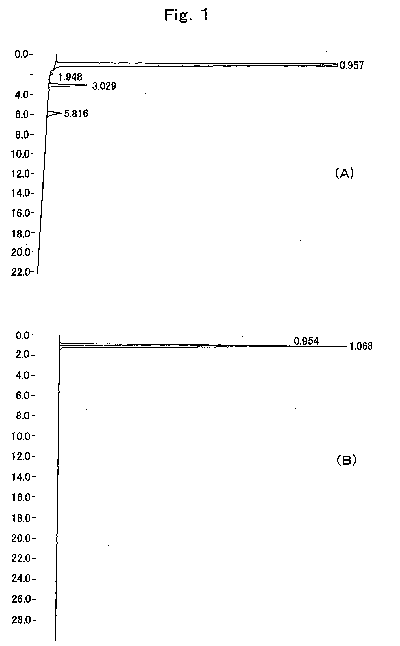
- Unpurified methanesulfonic acid solution and purified methanesulfonic acid solution were analyzed by high performance liquid chromatography, using Purification Example 2 by solid phase extraction as a representative example.
- Fig. 1A is a chromatogram of unpurified methanesulfonic acid solution.
- Fig. 1B is a chromatogram of purified methanesulfonic acid solution.
- the starting unpurified methanesulfonic acid solution shows absorption peaks at retention times of 3.029 and 5.816 as shown in Fig. 1A, but these two absorption peaks almost disappear in the purified methanesulfonic acid solution obtained in Purification Example 2 as shown in Fig. 1B.
- the results confirm that impurities were effectively removed from the starting solution and methanesulfonic acid was highly purified by solid extraction.
- the components of the absorption peaks which almost disappeared have not been accurately identified, the components are presumed to be sulfur-containing compounds because the absorption peaks are at positions similar to those where many sulfur-containing compounds show their peaks.
- tin plating baths and tin alloy plating baths containing high-purity methanesulfonic acids obtained in Purification Examples 1 to 8 were prepared as shown below.
- a blank example using methanesulfonic acid not having been subjected to the separation/purification, and an example using methanesulfonic acid having been subjected to reduced pressure concentration at room temperature without heating are shown as Comparative Examples.
- Tin plating baths were prepared according to the following formulations: [Tin plating bath for evaluating reflowability] Stannous chloride (as Sn 2+ ) 50 g/l Methanesulfonic acid of Purification Example 1 50 g/l Antioxidant Small quantity Nonionic surfactant Small quantity [Tin plating bath for evaluating plating film appearance] Stannous chloride (as Sn 2+ ) 80 g/l Methanesulfonic acid of Purification Example 1 150 g/l Antioxidant Small quantity Nonionic surfactant Small quantity
- ascorbic acid, catechol, hydroquinone or the like may be contained as an oxidant in an amount of about 1 to 10 g/l, and an ethylene oxide adduct of a C 1 -C 20 alkanol, phenol, naphthol, C 1 -C 25 alkylphenol, C 1 -C 22 aliphatic amine or the like may be contained as a nonionic surfactant in an amount of about 1 to 10 g/l (the same applied to the Examples and Comparative Examples below).
- Tin plating baths were prepared using the same components and contents as in Example 1 except that the methanesulfonic acid obtained in Purification Example 2 was used in place of that obtained in Purification Example 1.
- Tin plating baths were prepared using the same components and contents as in Example 1 except that the methanesulfonic acid obtained in Purification Example 3 was used in place of that obtained in Purification Example 1.
- Tin plating baths were prepared using the same components and contents as in Example 1 except that the methanesulfonic acid obtained in Purification Example 4 was used in place of that obtained in Purification Example 1.
- Tin plating baths were prepared using the same components and contents as in Example 1 except that the methanesulfonic acid obtained in Purification Example 5 was used in place of that obtained in Purification Example 1.
- Tin plating baths were prepared using the same components and contents as in Example 1 except that the methanesulfonic acid obtained in Purification Example 6 was used in place of that obtained in Purification Example 1.
- Tin plating baths were prepared using the same components and contents as in Example 1 except that the methanesulfonic acid obtained in Purification Example 7 was used in place of that obtained in Purification Example 1.
- Tin plating baths were prepared using the same components and contents as in Example 1 except that the methanesulfonic acid obtained in Purification Example 8 was used in place of that obtained in Purification Example 1.
- Tin-copper alloy plating baths were prepared according to the following formulations: [Tin-copper alloy plating bath for evaluating reflowability] Stannous sulfate (as Sn 2+ ) 50 g/l Copper sulfate (as Cu 2+ ) 5 g/l Methanesulfonic acid of Purification Example 7 50 g/l Antioxidant Small quantity Nonionic surfactant Small quantity Stabilizer Small quantity [Tin-copper alloy plating bath for evaluating plating film appearance] Stannous sulfate (as Sn 2+ ) 80 g/l Copper sulfate (as Cu 2+ ) 8 g/l Methanesulfonic acid of Purification Example 7 150 g/l Antioxidant Small quantity Nonionic surfactant Small quantity Stabilizer Small quantity
- antioxidants and nonionic surfactants in the above plating baths are the same as described for the tin plating baths.
- a stabilizer is used for allowing the codeposition of tin and copper to smoothly proceed.
- Thioureas, nonionic surfactants e.g., ethylene oxide adducts of laurylamine
- nonionic surfactants e.g., ethylene oxide adducts of laurylamine
- Tin-copper alloy plating baths were prepared using the same components and contents as in Example 9 except that the methanesulfonic acid obtained in Purification Example 8 was used in place of that obtained in Purification Example 7.
- Tin-copper alloy plating baths were prepared using the same components and contents as in Example 9 except that the methanesulfonic acid obtained in Purification Example 1 was used in place of that obtained in Purification Example 7.
- a tin-bismuth alloy plating bath was prepared according to the following formulation: Stannous sulfate (as Sn 2+ ) 80 g/l Bismuth sulfate (as Bi 3+ ) 8 g/l Methanesulfonic acid of Purification Example 1 150 g/l Antioxidant Small quantity Nonionic surfactant Small quantity Stabilizer Small quantity
- antioxidant and nonionic surfactant in the above plating bath are the same as described for the tin plating bath.
- a stabilizer is used for allowing the codeposition of tin and bismuth to smoothly proceed.
- sulfur-containing compounds such as thioureas are usable.
- a tin-silver alloy plating bath was prepared according to the following formulation: Stannous chloride (as Sn 2+ ) 80 g/l Silver nitrate (as Ag + (metal silver)) 8 g/l Methanesulfonic acid of Purification Example 1 150 g/l Antioxidant Small quantity Nonionic surfactant Small quantity Stabilizer Small quantity
- antioxidant and nonionic surfactant in the above plating bath are the same as described for the tin plating bath.
- a stabilizer is used for allowing the codeposition of tin and silver to smoothly proceed.
- sulfur-containing compounds such as thioureas, thioglycol, thioglycolic acid, sulfite, and thiosulfate are usable.
- a tin-bismuth alloy plating bath was prepared using the same components and contents as in Example 12 except that the methanesulfonic acid obtained in Purification Example 7 was used in place of that obtained in Purification Example 1.
- a tin-bismuth alloy plating bath was prepared using the same components and contents as in Example 12 except that the methanesulfonic acid obtained in Purification Example 8 was used in place of that obtained in Purification Example 1.
- a tin-silver alloy plating bath was prepared using the same components and contents as in Example 13 except that the methanesulfonic acid obtained in Purification Example 7 was used in place of that obtained in Purification Example 1.
- a tin-silver alloy plating bath was prepared using the same components and contents as in Example 13 except that the methanesulfonic acid obtained in Purification Example 8 was used in place of that obtained in Purification Example 1.
- Tin plating baths were prepared using the same components and contents as in Example 1 except that a commercially available unpurified methanesulfonic acid was used as is in place of that obtained in Purification Example 1.
- Tin plating baths were prepared using the same components and contents as in Example 1 except that a methanesulfonic acid having been subjected to reduced pressure concentration at room temperature without heating was used in place of that obtained in Purification Example 1.
- Tin-copper alloy plating baths were prepared using the same components and contents as in Example 9 except that a commercially available unpurified methanesulfonic acid was used as is in place of that obtained in Purification Example 7.
- a tin-bismuth alloy plating bath was prepared using the same components and contents as in Example 12 except that a commercially available unpurified methanesulfonic acid was used as is in place of that obtained in Purification Example 1.
- a tin-bismuth alloy plating bath was prepared using the same components and contents as in Example 12 except that a methanesulfonic acid having been subjected to reduced pressure concentration at room temperature without heating was used in place of that obtained in Purification Example 1.
- a tin-silver alloy plating bath was prepared using the same components and contents as in Example 13 except that a commercially available unpurified methanesulfonic acid was used as is in place of that obtained in Purification Example 1.
- electroplating was performed at a bath temperature of 30°C and a cathode current density of 20 A/dm 2 to produce a tin plating film or a tin-copper alloy plating film with a film thickness of 5 ⁇ m on a Cu substrate.
- test samples coated with plating films were allowed to stand on a hot plate at 300°C for 60 seconds and the plating film appearance was observed with the naked eye to evaluate reflowability of the plating films according to the following criteria:
- the plating films of Examples 1 to 10 were evaluated as A to B, i.e., excellent results in reflowability, while the plating films of Comparative Examples 1 to 3 were C to D.
- Reflowability tests are usually conducted at 260°C or slightly higher for about 10 seconds.
- more severe conditions than such conditions i.e., conditions under which discoloration and wrinkles easily occur on plating films were used. Therefore, discoloration and wrinkles seem to have occurred on the plating films in Comparative Examples 1 and 2 using a conventional methanesulfonic acid not having been subjected to the separation/purification of the invention.
- the plating films had no wrinkles and generally had good luster, despite of these severe conditions.
- a comparison of Examples 1 to 6 with Comparative Example 1 confirms that when an alkanesulfonic acid having been subjected to the separation/purification of the invention is used in tin plating baths, reflowability is greatly improved compared to no such a separation/purification.
- a comparison of Examples 9 to 10 with Comparative Example 2 confirms that the separation/purification of the invention contributes to the improvement of reflowability also in tin alloy plating baths.
- a comparison of Example 1 with Comparative Example 2 confirms that when an alkanesulfonic acid is concentrated under reduced pressure, it is important to concentrate while heating, in terms of enhancement of reflowability.
- a comparison of Examples 1 to 6 with Examples 7 and 8 reveals that reflowability is more effectively improved by combining reduced pressure concentration and solid phase separation, compared to performing only one of these treatments.
- the results reveal that tin plating baths and tin alloy plating baths containing an alkanesulfonic acid having been subjected to the separation/purification of the invention as a base acid are clearly superior to those containing an alkanesulfonic acid not having been subjected to the separation/purification, in terms of improvement of reflowability of the obtained plating film. Therefore, when the tin plating film or tin alloy plating film obtained using the plating bath of the invention is used in electronic parts or the like, reliability of the plating film can be remarkably enhanced, compared to conventional means.
- electroplating was carried out under the conditions shown below to form a tin plating film or a tin alloy plating film with a film thickness of 10 ⁇ m on a copper leadframe.
- the state of the plating film on the lead ends was observed with a magnifying glass and the generation of nonuniformity of the plating film over the entire leadframe was observed with the naked eye to evaluate the quality of the plating film appearance.
- the plating film appearance was evaluated according to the following criteria:
- the plating films of Examples 1 to 17 were evaluated as A to B, i.e., excellent results in film appearance, while the plating films of Comparative Examples 1 and 3 to 6 were C.
- Electroplating is usually performed at a cathode current density of about 10 to 20 A/dm 2 .
- a cathode current density of about 10 to 20 A/dm 2 .
- more severe conditions under which burning and nonuniformity of the plating film easily occur were used by increasing the cathode current density to a density of 40 to 50 A/dm 2 . Therefore, burning seems to have occurred in Comparative Examples 1 and 3 to 6 using a conventional methanesulfonic acid not having been subjected to the separation/purification of the invention.
- nonuniformity of the plating film was not observed and generally no burning was observed, despite of the severe conditions.
- a comparison of Examples 1 and 2 to 7 with Comparative Example 1 confirms that when an alkanesulfonic acid having been subjected to the separation/purification of the invention is used in tin plating baths, film appearance is greatly improved compared to no separation/purification.
- a comparison of Examples 10 to 11 with Comparative Example 3 confirms that the alkanesulfonic acid having been subjected to the separation/purification of the invention contributes also to the improvement of film appearance using tin-copper alloy plating baths.
- alkanesulfonic acid having been subjected to the separation/purification of the invention contributes to the improvement of plating film appearance using tin-bismuth alloy plating baths (a comparison of Examples 12 and 15 with Comparative Example 4), and tin-silver alloy plating baths (a comparison of Examples 13 and 17 with Comparative Example 6).
- Example 12 and Comparative Example 5 confirms that when an alkanesulfonic acid solution is concentrated under reduced pressure, it is important to concentrate while heating, to enhance film appearance.
- a comparison of Examples 1, 2 to 6 and 11 to 13 with Examples 7 to 10 and 14 to 17 reveals that film appearance is more effectively improved by combining reduced pressure concentration and solid phase separation, compared to performing only one of these treatments.
- plating films can be improved in terms of appearance, reflowability, etc.
- a 100 ml quantity of a commercially available methanesulfonic acid solution was extracted with 300 ml of dichloromethane and the dichloromethane was then removed from the extract using an evaporator. Subsequently, extraction and solvent removal were repeated several times to give a water-containing mixture of impurities. To remove water from the impurities, 30 ml of dichloromethane was added and 5 g of sodium sulfate was added. The supernatant was decantated and the solvent was removed using an evaporator to give a mixture of impurities.
- the isolates were identified using various analytical instruments, such as 13 C-NMR, 1 H-NMR, IR, GC-MS, MS, and elemental analysis.
- the concentration of dimethylsulfone (5) In the light of the concentration of dimethylsulfone (5), the concentration of ⁇ -chlorodimethylsulfone (3) and the concentration of ⁇ -methylsulfonyl- ⁇ , ⁇ -dichlorodimethylsulfone (4) are presumed to be 1.2 ppm and 2.5 ppm, respectively.
- the concentration of dimethyldisulfide (1) seems to be similar to that of dimethylsulfone (5).
- a tin plating bath, a tin-bismuth alloy plating bath, and a tin-silver alloy plating bath are each described below.
- a tin plating bath of the following formulation was prepared.
- Stannous chloride (as Sn 2+ ) 60 g/l Methanesulfonic acid of Purification Example 1
- Nonionic surfactant 10 g/l
- Anionic surfactant Small quantity Antioxidant Small quantity
- bisphenol polyethoxylate was used as a nonionic surfactant.
- About 2 g/l of sodium dibutylnaphthalene sulfonate was used as an anionic surfactant, and about 1 g/l of ascorbic acid was used as an antioxidant.
- one of the sulfur-containing compounds (1) to (5) isolated in the above test was independently added and similarly a mixture of sulfur-containing compounds (3) and (4) in a weight ratio of 1:1 was added to such a tin plating bath.
- concentrations of the sulfur-containing compounds added to the plating baths were varied from 0 to 5 ppm (increasing by 1 ppm each time), and 10 ppm, 50 ppm, 100 ppm to 200 ppm.
- tin plating films were formed to a thickness of 10 ⁇ m on a Cu leadframe at a bath temperature of 40°C, a cathode current density of 20 A/dm 2 , and a cathode rocking rate of 6 m/min.
- the obtained plating films were evaluated in a manner similar to the Test Example of evaluating the plating film appearance. That is, the state of deposited plating on the lead ends was observed with a magnifying glass and the generation of nonuniformity of the plating film over the entire leadframe was observed with the naked eye to evaluate the quality of the plating film appearance.
- the film appearance was evaluated according to the following criteria:
- Compound (1) is dimethyldisulfide
- compound (2) is S -methyl methanethiosulfonate
- compound (3) is ⁇ -chlorodimethylsulfone
- compound (4) is ⁇ -methylsulfonyl- ⁇ , ⁇ -dichlorodimethylsulfone
- compound (5) is dimethylsulfone.
- dimethyldisulfide (1) at a concentration of 200 ppm was evaluated as C in film appearance and the same compound at a concentration of 100 ppm (i.e., at a concentration of 100 ppm or more but less than 200 ppm) was evaluated as B.
- dimethylsulfone (5) clearly confirms that dimethyldisulfide (1) adversely affects plating properties.
- the results reveal that the permissible concentrations of compounds (2) to (4) in the plating bath are lower than that of dimethyldisulfide (1), and compounds (2) to (4) adversely affect plating properties, even when present in an amount only slightly more than a minute amount in the bath.
- the results confirm that in a tin plating bath containing methanesulfonic acid as a base acid, not all the sulfur-containing compounds that are present as impurities in methanesulfonic acid adversely affect plating properties; compounds such as dimethylsulfone (5) do not adversely affect plating properties, and only specific compounds adversely affect plating properties.
- the compounds that adversely affect plating properties are compounds (1) to (4), which are, importantly, found to be compounds having a sulfur atom(s) with an oxidation number of +4 or less in the molecule or compounds having a sulfur atom(s) and a chlorine atom(s) in the molecule.
- the degree of influence on plating properties varies among compounds (1) to (4).
- the permissible concentration of compound (1) is presumed to be less than 200 ppm, and those of compounds (3) and (4) less than 4 ppm.
- the results confirm that when, instead of a single component, two or more components are present together in the bath, a synergistic effect tends to accelerate the degradation of plating properties.
- the total permissible concentration is presumed to be less than 2 ppm.
- a tin-bismuth alloy plating bath of the following formulation was prepared.
- Stannous sulfate (as Sn 2+ ) 80 g/l Bismuth sulfate (as Bi 3+ ) 8 g/l Methanesulfonic acid of Purification Example 1 150 g/l Nonionic surfactant Small quantity Antioxidant Small quantity
- sulfur-containing compounds (1) to (5) isolated in the above test were added to such tin-bismuth alloy plating baths under the same conditions as for the above-mentioned tin plating bath, and the appearance of the electrodeposited films were evaluated. More specifically, sulfur-containing compounds (1) to (5) were added at varying concentrations from 0 ppm to 200 ppm to the plating bath singly or in combination, and tin-bismuth alloy plating films were formed on a Cu leadframe under the same electroplating conditions as for the tin plating bath to evaluate the appearance of the electrodeposited films. The evaluation criteria were the same as for the tin plating bath.
- the results reveal an important point: also in a tin-bismuth alloy plating bath containing methanesulfonic acid as a base acid, not all the sulfur-containing compounds that are present as impurities in the methanesulfonic acid adversely affect plating properties; compounds such as dimethylsulfone (5) do not adversely affect plating properties, while compounds having a sulfur atom(s) with an oxidation number of +4 or less in the molecule and compounds having a sulfur atom(s) and a chlorine atom(s) in the molecule adversely affect plating properties.
- the results confirm that in a tin-bismuth alloy plating bath, the permissible concentrations of compounds (1) to (4), i.e., compounds that adversely affect plating properties, are higher than those in the tin plating bath.
- Compound (1) was evaluated as C in appearance at a concentration of 200 ppm in the tin plating bath but was evaluated as B at the same concentration in the tin-bismuth alloy plating bath, so that there is a possibility that it may be evaluated as B even at a concentration higher than 200 ppm.
- Compound (4) was evaluated as C in appearance at a concentration of 10 ppm in the tin plating bath but was evaluated as B at the same concentration in the tin-bismuth alloy plating bath, so that there is a possibility that it may be evaluated as B even at a concentration higher than 10 ppm. Thus it was confirmed that the permissible concentrations of these compounds in the tin-bismuth alloy plating bath are higher than in the tin plating bath.
- tin-bismuth alloy plating baths have higher resistance to degradation of plating properties than tin plating baths, so that even when a tin-bismuth alloy plating bath has a higher concentration of impurities than a tin plating bath, adverse effects on plating properties less readily occur.
- a tin-silver alloy plating bath of the following formulation was prepared.
- Stannous sulfate (as Sn 2+ ) 80 g/l Silver nitrate (as Ag + ) 8 g/l Methanesulfonic acid of Purification Example 1
- nonionic surfactant and antioxidant used in the above tin-silver alloy plating bath were the same as in the tin-bismuth alloy plating bath.
- Thioglycol polyethoxylate was used as a stabilizer.
- Sulfur-containing compounds (1) to (5) isolated in the above test were added to such tin-silver alloy baths under the same conditions as for the tin plating bath, and the appearance of the electrodeposited films were evaluated. More specifically, sulfur-containing compounds (1) to (5) were added at varying concentrations from 0 ppm to 200 ppm to the plating bath singly or in combination, and tin-silver alloy plating films were formed on a Cu leadframe under the same electroplating conditions as for the tin plating bath to evaluate the appearance of the electrodeposited films. The evaluation criteria were the same as for the tin plating bath.
- the results reveal an important point: also in a tin-silver alloy plating bath containing methanesulfonic acid as a base acid, not all the sulfur-containing compounds that are present as impurities in methanesulfonic acid adversely affect plating properties; compounds such as dimethylsulfone (5) do not adversely affect plating properties, and only the compounds having a sulfur atom(s) with an oxidation number of +4 or less in the molecule and compounds having a sulfur atom(s) and a chlorine atom(s) in the molecule adversely affect plating properties.
- the tin-silver alloy plating bath tends to have higher resistance to the degradation of plating properties than the tin plating bath but have lower resistance than the tin-bismuth alloy plating bath. Therefore, it seems that even when a tin-silver alloy plating bath has a higher concentration of impurities, adverse effects on plating properties less readily occur, compared to a tin plating bath, but are prone to occur than in a tin-bismuth alloy plating bath.
Landscapes
- Chemical & Material Sciences (AREA)
- Engineering & Computer Science (AREA)
- Chemical Kinetics & Catalysis (AREA)
- Electrochemistry (AREA)
- Materials Engineering (AREA)
- Metallurgy (AREA)
- Organic Chemistry (AREA)
- Electroplating And Plating Baths Therefor (AREA)
Abstract
Description
a mixture of a soluble stannous salt and at least one soluble salt selected from the group consisting of copper salts, bismuth salts, silver salts, indium salts, zinc salts, nickel salts, cobalt salts and antimony salts; and
the aliphatic sulfonic acid being a purified aliphatic sulfonic acid in which the total amount of a sulfur-containing compound or compounds having one or more sulfur atoms with an oxidation number of +4 or less in the molecule and a sulfur-containing compound or compounds having one or more sulfur atoms and one or more chlorine atoms in the molecule is a minute amount or less.
at least two sulfur-containing compounds selected from the group consisting of dimethyldisulfide, S-methyl methanethiosulfonate, α-chlorodimethylsulfone and α-methylsulfonyl-α,α-dichlorodimethylsulfone are present in the plating bath; and
the total content of the sulfur-containing compounds in the plating bath is less than 2 ppm.



| * Before purification | ||||||
| PKNO | TIME | AREA | HEIGHT | MK | IDNO | CONC |
| 1 | 0.957 | 120935 | 11207 | 92.5134 | ||
| 2 | 1.948 | 465 | 40 | 0.3557 | ||
| 4 | 3.029 | 5829 | 553 | V | 4.4587 | |
| 8 | 5.816 | 3493 | 207 | 2.6722 | ||
| TOTAL | 130722 | 12008 | 100 |
| * After purification | ||||||
| PKNO | TIME | AREA | HEIGHT | MK | IDNO | CONC |
| 2 | 0.954 | 16818 | 3194 | V | 45.5893 | |
| 3 | 1.068 | 20073 | 4880 | SV | 54.4107 | |
| TOTAL | 36891 | 8073 | 100 |
| [Tin plating bath for evaluating reflowability] | |
| Stannous chloride (as Sn2+) | 50 g/l |
| Methanesulfonic acid of Purification Example 1 | 50 g/l |
| Antioxidant | Small quantity |
| Nonionic surfactant | Small quantity |
| [Tin plating bath for evaluating plating film appearance] | |
| Stannous chloride (as Sn2+) | 80 g/l |
| Methanesulfonic acid of Purification Example 1 | 150 g/l |
| Antioxidant | Small quantity |
| Nonionic surfactant | Small quantity |
| [Tin-copper alloy plating bath for evaluating reflowability] | |
| Stannous sulfate (as Sn2+) | 50 g/l |
| Copper sulfate (as Cu2+) | 5 g/l |
| Methanesulfonic acid of Purification Example 7 | 50 g/l |
| Antioxidant | Small quantity |
| Nonionic surfactant | Small quantity |
| Stabilizer | Small quantity |
| [Tin-copper alloy plating bath for evaluating plating film appearance] | |
| Stannous sulfate (as Sn2+) | 80 g/l |
| Copper sulfate (as Cu2+) | 8 g/l |
| Methanesulfonic acid of Purification Example 7 | 150 g/l |
| Antioxidant | Small quantity |
| Nonionic surfactant | Small quantity |
| Stabilizer | Small quantity |
| Stannous sulfate (as Sn2+) | 80 g/l |
| Bismuth sulfate (as Bi3+) | 8 g/l |
| Methanesulfonic acid of Purification Example 1 | 150 g/l |
| Antioxidant | Small quantity |
| Nonionic surfactant | Small quantity |
| Stabilizer | Small quantity |
| Stannous chloride (as Sn2+) | 80 g/l |
| Silver nitrate (as Ag+(metal silver)) | 8 g/l |
| Methanesulfonic acid of Purification Example 1 | 150 g/l |
| Antioxidant | Small quantity |
| Nonionic surfactant | Small quantity |
| Stabilizer | Small quantity |
| Examples | Comparative Examples | ||||||||||||
| 1 | 2 | 3 | 4 | 5 | 6 | 7 | 8 | 9 | 10 | 1 | 2 | 3 | |
| Reflowability | B | B | B | B | B | B | A | A | B | A | C | D | C |
| Sn bath | Sn-Cu bath | Sn-Bi bath | Sn-Ag bath | |
| Bath temperature (°C) | 30 | 30 | 30 | 30 |
| Current density (A/dm2) | 40 | 30 | 40 | 30 |


P&T-GC/MS:ms 94,79,61,45
1H-NMR (ppm): 2.709 (s, 3H, -SO2CH3), 3.315 (s, 3H, -SCH3)
IR (cm-1) : 1134.1 (s, R-SO2-R), 1305.7 (m, R-SO2-R), 1330.8 (m, -S- CH3), 1410.0 (w, -S-CH3)
1H-NMR (ppm): 3.054 (s, 3H, -SO2CH3), 4.447 (s, 2H, -CH2Cl)
IR (cm-1) : 761.8 (s, -CH2-Cl), 1120.6 (s, R-SO2-R), 1245.9 (m, -CH2-Cl), 1313.4 (s, R-SO2-R)
GC/MS:ms 128, 113, 93, 79, 63, 49
Elemental analysis (C,H): (C2H5SO2Cl) C:18.89%, H:3.48%
1H-NMR (ppm): 2.920 (s, 3H, -SO2CH3), 3.369 (s, 3H, -SOCH3),
13C-NMR (ppm): 36.873, 39.832, 105.880
IR (cm-1) : 1083.9 (s, -SOCH3), 1147.6 (s, R-SO2-R), 1321.1 (s, R-SO2-R), 1332.7 (m, -SOCH3)
Elemental analysis (C,H,N,S,O):
(C3H6S2O3Cl2) C:16.20%, H:2.56%, S:29.86%, O:21.54%
1H-NMR (ppm): 2.991 (s, 3H, -SO2CH3)
IR (cm-1): 1136.0 (s, R-SO2-R), 1298.0 (s, R-SO2-R)
| Stannous chloride (as Sn2+) | 60 g/l |
| Methanesulfonic acid of Purification Example 1 | 106 g/l |
| Nonionic surfactant | 10 g/l |
| Anionic surfactant | Small quantity |
| Antioxidant | Small quantity |
| (5) | (1) | (2) | (3) | (4) | (3)+(4) | |
| 0 ppm | A | A | A | A | A | A |
| 1 ppm | A | A | A | A | A | B |
| 2 ppm | A | A | B | B | B | C |
| 3 ppm | A | A | B | B | B | C |
| 4 ppm | A | A | C | C | C | C |
| 5 ppm | A | A | C | C | C | C |
| 10 ppm | A | A | C | C | C | C |
| 50 ppm | A | A | C | C | C | C |
| 100 ppm | A | B | C | C | C | C |
| 200 ppm | A | C | C | C | C | C |
| Stannous sulfate (as Sn2+) | 80 g/l |
| Bismuth sulfate (as Bi3+) | 8 g/l |
| Methanesulfonic acid of Purification Example 1 | 150 g/l |
| Nonionic surfactant | Small quantity |
| Antioxidant | Small quantity |
| (5) | (1) | (2) | (3) | (4) | (3)+(4) | |
| 0 ppm | A | A | A | A | A | A |
| 5 ppm | A | A | A | A | A | B |
| 10 ppm | A | A | A | A | B | C |
| 50 ppm | A | A | B | B | C | C |
| 100 ppm | A | A | C | C | C | C |
| 200 ppm | A | B | C | C | C | C |
| Stannous sulfate (as Sn2+) | 80 g/l |
| Silver nitrate (as Ag+) | 8 g/l |
| Methanesulfonic acid of Purification Example 1 | 150 g/l |
| Stabilizer | 40 g/l |
| Nonionic surfactant | Small quantity |
| Antioxidant | Small quantity |
| (5) | (1) | (2) | (3) | (4) | (3)+(4) | |
| 0 ppm | A | A | A | A | A | A |
| 5 ppm | A | A | A | A | A | C |
| 10 ppm | A | A | B | B | B | C |
| 50 ppm | A | A | C | C | C | C |
| 100 ppm | A | A | C | C | C | C |
| 200 ppm | A | B | C | C | C | C |
Claims (13)
- A tin-containing plating bath comprising:(a) a soluble stannous salt, or
a mixture of a soluble stannous salt and at least one soluble salt selected from the group consisting of copper salts, bismuth salts, silver salts, indium salts, zinc salts, nickel salts, cobalt salts and antimony salts; and(b) at least one aliphatic sulfonic acid selected from the group consisting of alkanesulfonic acids and alkanolsulfonic acids,
the aliphatic sulfonic acid being a purified aliphatic sulfonic acid in which the total amount of a sulfur-containing compound or compounds having one or more sulfur atoms with an oxidation number of +4 or less in the molecule and a sulfur-containing compound or compounds having one or more sulfur atoms and one or more chlorine atoms in the molecule is a minute amount or less. - The tin-containing plating bath according to claim 1 wherein the compound having sulfur atoms with an oxidation number of +4 or less in the molecule is dimethyldisulfide, and whose content in the plating bath is less than 200 ppm.
- The tin-containing plating bath according to claim 1 wherein the compound having a sulfur atom with an oxidation number of +4 or less in the molecule is S-methyl methanethiosulfonate, and whose content in the plating bath is less than 4 ppm.
- The tin-containing plating bath according to claim 1 wherein the compound having a sulfur atom and a chlorine atom in the molecule is α-chlorodimethylsulfone, and whose content in the plating bath is less than 4 ppm.
- The tin-containing plating bath according to claim 1 wherein the compound having sulfur atoms and chlorine atoms in the molecules is α-methylsulfonyl-α,α-dichlorodimethylsulfone, and whose content in the plating bath is less than 4 ppm.
- The tin-containing plating bath according to claim 1 wherein the compounds having one or more sulfur atoms with an oxidation number of +4 or less in the molecule are dimethyldisulfide and S-methyl methanethiosulfonate, and the compounds having one or more sulfur atoms and one or more chlorine atoms in the molecule are α-chlorodimethylsulfone and α-methylsulfonyl-α,α-dichlorodimethylsulfone;
at least two sulfur-containing compounds selected from the group consisting of dimethyldisulfide, S-methyl methanethiosulfonate, α-chlorodimethylsulfone and α-methylsulfonyl-α,α-dichlorodimethylsulfone are present in the plating bath; and
the total content of the sulfur-containing compounds in the plating bath is less than 2 ppm. - The tin-containing plating bath according to claim 1 wherein the purified aliphatic sulfonic acid is one obtained by purifying an aliphatic sulfonic acid which has been produced by subjecting alkyl mercaptan or dialkyldisulfide to wet oxidation or by hydrolyzing an alkylsulfonyl halide.
- The tin-containing plating bath according to claim 1 wherein the purified aliphatic sulfonic acid is one obtained by subjecting an aliphatic sulfonic acid to concentration under reduced pressure while heating.
- The tin-containing plating bath according to claim 1 wherein the purified aliphatic sulfonic acid is one obtained by subjecting an aliphatic sulfonic acid to solid phase extraction in which the aliphatic sulfonic acid is brought into contact with an adsorbent.
- The tin-containing plating bath according to claim 9 wherein the purified aliphatic sulfonic acid is one obtained by subjecting an aliphatic sulfonic acid to solid phase extraction at least twice, using the same or different kinds of adsorbents.
- The tin-containing plating bath according to claim 1 wherein the purified aliphatic sulfonic acid is one obtained by subjecting an aliphatic sulfonic acid to a combination of concentration under reduced pressure and solid phase extraction.
- The tin-containing plating bath according to claim 1 wherein the alkanesulfonic acid is methanesulfonic acid.
- A bump-forming method comprising forming a bump with the use of the plating bath of claim 1.
Applications Claiming Priority (5)
| Application Number | Priority Date | Filing Date | Title |
|---|---|---|---|
| JP2003015562 | 2003-01-24 | ||
| JP2003015562 | 2003-01-24 | ||
| JP2003432338A JP4441726B2 (en) | 2003-01-24 | 2003-12-26 | Method for producing tin or tin alloy aliphatic sulfonic acid plating bath |
| JP2003432338 | 2003-12-26 | ||
| PCT/JP2004/000524 WO2004065663A1 (en) | 2003-01-24 | 2004-01-22 | Tin-containing plating bath |
Publications (3)
| Publication Number | Publication Date |
|---|---|
| EP1591563A1 true EP1591563A1 (en) | 2005-11-02 |
| EP1591563A4 EP1591563A4 (en) | 2006-04-05 |
| EP1591563B1 EP1591563B1 (en) | 2018-04-04 |
Family
ID=32775187
Family Applications (1)
| Application Number | Title | Priority Date | Filing Date |
|---|---|---|---|
| EP04704363.3A Expired - Lifetime EP1591563B1 (en) | 2003-01-24 | 2004-01-22 | Tin-containing plating bath |
Country Status (6)
| Country | Link |
|---|---|
| US (1) | US20060113006A1 (en) |
| EP (1) | EP1591563B1 (en) |
| JP (1) | JP4441726B2 (en) |
| KR (1) | KR101045189B1 (en) |
| TW (1) | TW200422439A (en) |
| WO (1) | WO2004065663A1 (en) |
Cited By (10)
| Publication number | Priority date | Publication date | Assignee | Title |
|---|---|---|---|---|
| WO2006108476A3 (en) * | 2005-04-12 | 2007-05-31 | Schloetter Fa Dr Ing Max | Electrolyte and method for depositing tin bismuth alloy layers |
| WO2007060078A1 (en) * | 2005-11-23 | 2007-05-31 | Robert Bosch Gmbh | Method for producing a layer on a metal element, which layer is capable of contact |
| US20070199827A1 (en) * | 2004-08-10 | 2007-08-30 | Dipsol Chemicals Co., Ltd. | Method for electroplating with tin-zinc alloy |
| EP1961840A1 (en) * | 2007-02-14 | 2008-08-27 | Umicore Galvanotechnik GmbH | Copper-tin electrolyte and method for depositing bronze layers |
| DE102008032398A1 (en) * | 2008-07-10 | 2010-01-14 | Umicore Galvanotechnik Gmbh | Improved copper-tin electrolyte and process for depositing bronze layers |
| US20110214994A1 (en) * | 2010-03-02 | 2011-09-08 | C. Uyemura & Co., Ltd | Pretreating agent for electroplating, pretreatment method for electroplating, and electroplating method |
| EP3178969A4 (en) * | 2014-08-08 | 2017-12-27 | Okuno Chemical Industries Co. Ltd | Copper-tin alloy plating bath |
| WO2019133305A1 (en) * | 2017-12-28 | 2019-07-04 | Lam Research Corporation | Removal of electroplating bath additives |
| WO2019154681A1 (en) | 2018-02-07 | 2019-08-15 | Basf Se | Process for the manufacturing of alkanesulfonic acids |
| CN111812229A (en) * | 2020-06-19 | 2020-10-23 | 广电计量检测(合肥)有限公司 | An analytical method for the determination of 2-methylbenzothiazole in soil/sediment by gas chromatography-mass spectrometry |
Families Citing this family (35)
| Publication number | Priority date | Publication date | Assignee | Title |
|---|---|---|---|---|
| AU2004239226B2 (en) * | 2003-05-12 | 2009-04-23 | Arkema Inc. | High purity electrolytic sulfonic acid solutions |
| JP4605359B2 (en) * | 2004-10-20 | 2011-01-05 | 石原薬品株式会社 | Lead-free acid tin-bismuth alloy electroplating bath |
| SE0403042D0 (en) * | 2004-12-14 | 2004-12-14 | Polymer Kompositer I Goeteborg | Improved stabilization and performance of autocatalytic electroless process |
| US7713859B2 (en) * | 2005-08-15 | 2010-05-11 | Enthone Inc. | Tin-silver solder bumping in electronics manufacture |
| JP5158303B2 (en) * | 2006-04-14 | 2013-03-06 | 上村工業株式会社 | Tin electroplating bath, tin plating film, tin electroplating method and electronic device component |
| WO2008100648A1 (en) * | 2007-02-13 | 2008-08-21 | Arkema Inc. | High speed tin plating process |
| US8012886B2 (en) * | 2007-03-07 | 2011-09-06 | Asm Assembly Materials Ltd | Leadframe treatment for enhancing adhesion of encapsulant thereto |
| JP4632186B2 (en) * | 2007-08-01 | 2011-02-16 | 太陽化学工業株式会社 | Tin electrolytic plating solution for electronic parts, tin electrolytic plating method for electronic parts and tin electrolytic plated electronic parts |
| US9175400B2 (en) * | 2009-10-28 | 2015-11-03 | Enthone Inc. | Immersion tin silver plating in electronics manufacture |
| US8795836B2 (en) * | 2010-03-03 | 2014-08-05 | Ppg Industries Ohio, Inc | Electrodepositable coating composition comprising a bismuth salt and a stabilizing compound |
| EP2476779B1 (en) * | 2011-01-13 | 2013-03-20 | Atotech Deutschland GmbH | Immersion tin or tin alloy plating bath with improved removal of cupurous ions |
| EP2481835B1 (en) * | 2011-01-28 | 2013-09-11 | Atotech Deutschland GmbH | Autocatalytic plating bath composition for deposition of tin and tin alloys |
| US9017528B2 (en) | 2011-04-14 | 2015-04-28 | Tel Nexx, Inc. | Electro chemical deposition and replenishment apparatus |
| US9005409B2 (en) | 2011-04-14 | 2015-04-14 | Tel Nexx, Inc. | Electro chemical deposition and replenishment apparatus |
| KR101346021B1 (en) * | 2011-12-09 | 2013-12-31 | 주식회사 엠에스씨 | Method for producing Sn-Ag alloy plating solution and the Plating solution thereby |
| KR101342408B1 (en) * | 2012-06-22 | 2013-12-17 | 김동현 | Method for producing sn-ag alloy plating solution |
| EP2740820A1 (en) * | 2012-12-04 | 2014-06-11 | Dr.Ing. Max Schlötter GmbH & Co. KG | Electrolyte and process for the separation of solderable layers |
| US20150122662A1 (en) * | 2013-11-05 | 2015-05-07 | Rohm And Haas Electronic Materials Llc | Plating bath and method |
| US9303329B2 (en) | 2013-11-11 | 2016-04-05 | Tel Nexx, Inc. | Electrochemical deposition apparatus with remote catholyte fluid management |
| JP6411943B2 (en) * | 2014-05-26 | 2018-10-24 | 株式会社荏原製作所 | Substrate electrolytic treatment apparatus and paddle used for the substrate electrolytic treatment apparatus |
| TWI588292B (en) * | 2014-10-24 | 2017-06-21 | 國立高雄應用科技大學 | Tin/silver colloid nanoparticle, and its manufacturing method and application |
| WO2016152986A1 (en) * | 2015-03-26 | 2016-09-29 | 三菱マテリアル株式会社 | Plating solution using ammonium salt |
| JP6631349B2 (en) * | 2015-03-26 | 2020-01-15 | 三菱マテリアル株式会社 | Plating solution using ammonium salt |
| EP3199666B1 (en) * | 2016-01-29 | 2018-09-26 | ATOTECH Deutschland GmbH | Aqueous indium or indium alloy plating bath and process for deposition of indium or an indium alloy |
| US10879156B2 (en) | 2016-03-08 | 2020-12-29 | Washington State University | Mitigation of whisker growth in tin coatings by alloying with indium |
| US20170321340A1 (en) * | 2016-03-08 | 2017-11-09 | Washington State University | Method of electroplating tin films with indium using an alkanesulfonic acid based electrolyte |
| US9809892B1 (en) * | 2016-07-18 | 2017-11-07 | Rohm And Haas Electronic Materials Llc | Indium electroplating compositions containing 1,10-phenanthroline compounds and methods of electroplating indium |
| JP6818520B2 (en) * | 2016-11-11 | 2021-01-20 | ローム・アンド・ハース電子材料株式会社 | Barrel plating or high-speed rotary plating method using neutral tin plating solution |
| US10186456B2 (en) | 2017-04-20 | 2019-01-22 | Taiwan Semiconductor Manufacturing Company, Ltd. | Methods for forming contact plugs with reduced corrosion |
| US10141225B2 (en) | 2017-04-28 | 2018-11-27 | Taiwan Semiconductor Manufacturing Company, Ltd. | Metal gates of transistors having reduced resistivity |
| US11686007B2 (en) * | 2017-12-18 | 2023-06-27 | New Mexico Tech University Research Park Corporation | Tin-indium alloy electroplating solution |
| DE102018208116A1 (en) * | 2018-05-23 | 2019-11-28 | Aurubis Stolberg Gmbh & Co. Kg | Copper tape for making electrical contacts and method of making a copper tape and connectors |
| JP7121390B2 (en) * | 2018-08-21 | 2022-08-18 | ディップソール株式会社 | Tin alloy electroplating bath and plating method using the same |
| KR20220125608A (en) | 2021-03-05 | 2022-09-14 | 주식회사 엠에스씨 | Method for manufacturing tin-based plating solution for solder bumps and tin-based plating solution for solder bumps manufactured thereby |
| CN114059115B (en) * | 2021-12-20 | 2024-10-15 | 中国计量大学 | Tin-antimony electroplating solution and preparation method thereof |
Family Cites Families (16)
| Publication number | Priority date | Publication date | Assignee | Title |
|---|---|---|---|---|
| US4599149A (en) * | 1981-09-11 | 1986-07-08 | Learonal, Inc. | Process for electroplating tin, lead and tin-lead alloys and baths therefor |
| US5066367B1 (en) * | 1981-09-11 | 1993-12-21 | I. Nobel Fred | Limiting tin sludge formation in tin or tin/lead electroplating solutions |
| US5094726B1 (en) * | 1981-09-11 | 1993-12-21 | I. Nobel Fred | Limiting tin sludge formation in tin or tin/lead electroplating solutions |
| US4871429A (en) * | 1981-09-11 | 1989-10-03 | Learonal, Inc | Limiting tin sludge formation in tin or tin/lead electroplating solutions |
| US4565609A (en) * | 1983-12-22 | 1986-01-21 | Learonal, Inc. | Bath and process for plating tin, lead and tin-lead alloys |
| US4617097A (en) * | 1983-12-22 | 1986-10-14 | Learonal, Inc. | Process and electrolyte for electroplating tin, lead or tin-lead alloys |
| US4717460A (en) * | 1983-12-22 | 1988-01-05 | Learonal, Inc. | Tin lead electroplating solutions |
| US4701244A (en) * | 1983-12-22 | 1987-10-20 | Learonal, Inc. | Bath and process for electroplating tin, lead and tin/alloys |
| US4565610A (en) * | 1983-12-22 | 1986-01-21 | Learonal, Inc. | Bath and process for plating lead and lead/tin alloys |
| US5583253A (en) * | 1991-03-27 | 1996-12-10 | Henderson; Phyllis A. | Method of preparing purified alkanesulfonic acid |
| JPH0864601A (en) * | 1994-08-24 | 1996-03-08 | Fujitsu Ltd | Method of forming solder bumps |
| JP3981430B2 (en) * | 1997-01-20 | 2007-09-26 | 株式会社Adeka | Process for producing pure alkanesulfonic acid |
| DE19854428A1 (en) * | 1998-11-25 | 2000-05-31 | Basf Ag | Process for the preparation of alkanesulfonic acids |
| FR2796941B1 (en) * | 1999-07-27 | 2001-09-14 | Atofina | PURIFICATION OF ALKANESULFONIC ACIDS |
| US6322686B1 (en) * | 2000-03-31 | 2001-11-27 | Shipley Company, L.L.C. | Tin electrolyte |
| DE60113333T2 (en) * | 2000-07-01 | 2006-07-06 | Shipley Co., L.L.C., Marlborough | Metal alloy compositions and associated plating methods |
-
2003
- 2003-12-26 JP JP2003432338A patent/JP4441726B2/en not_active Expired - Lifetime
-
2004
- 2004-01-20 TW TW093101599A patent/TW200422439A/en not_active IP Right Cessation
- 2004-01-22 EP EP04704363.3A patent/EP1591563B1/en not_active Expired - Lifetime
- 2004-01-22 KR KR1020057013578A patent/KR101045189B1/en not_active Expired - Lifetime
- 2004-01-22 US US10/542,029 patent/US20060113006A1/en not_active Abandoned
- 2004-01-22 WO PCT/JP2004/000524 patent/WO2004065663A1/en not_active Ceased
Cited By (14)
| Publication number | Priority date | Publication date | Assignee | Title |
|---|---|---|---|---|
| US20070199827A1 (en) * | 2004-08-10 | 2007-08-30 | Dipsol Chemicals Co., Ltd. | Method for electroplating with tin-zinc alloy |
| EP1811063A4 (en) * | 2004-08-10 | 2009-03-04 | Dipsol Chem | ETAN-ZINC ALLOY GALVANOPLASTY METHOD |
| WO2006108476A3 (en) * | 2005-04-12 | 2007-05-31 | Schloetter Fa Dr Ing Max | Electrolyte and method for depositing tin bismuth alloy layers |
| WO2007060078A1 (en) * | 2005-11-23 | 2007-05-31 | Robert Bosch Gmbh | Method for producing a layer on a metal element, which layer is capable of contact |
| EP1961840A1 (en) * | 2007-02-14 | 2008-08-27 | Umicore Galvanotechnik GmbH | Copper-tin electrolyte and method for depositing bronze layers |
| DE102008032398A1 (en) * | 2008-07-10 | 2010-01-14 | Umicore Galvanotechnik Gmbh | Improved copper-tin electrolyte and process for depositing bronze layers |
| US20110214994A1 (en) * | 2010-03-02 | 2011-09-08 | C. Uyemura & Co., Ltd | Pretreating agent for electroplating, pretreatment method for electroplating, and electroplating method |
| EP3178969A4 (en) * | 2014-08-08 | 2017-12-27 | Okuno Chemical Industries Co. Ltd | Copper-tin alloy plating bath |
| WO2019133305A1 (en) * | 2017-12-28 | 2019-07-04 | Lam Research Corporation | Removal of electroplating bath additives |
| US10711366B2 (en) | 2017-12-28 | 2020-07-14 | Lam Research Corporation | Removal of electroplating bath additives |
| US11280022B2 (en) | 2017-12-28 | 2022-03-22 | Lam Research Corporation | Removal of electroplating bath additives |
| WO2019154681A1 (en) | 2018-02-07 | 2019-08-15 | Basf Se | Process for the manufacturing of alkanesulfonic acids |
| US11247967B2 (en) | 2018-02-07 | 2022-02-15 | Basf Se | Process for the manufacturing of alkanesulfonic acids |
| CN111812229A (en) * | 2020-06-19 | 2020-10-23 | 广电计量检测(合肥)有限公司 | An analytical method for the determination of 2-methylbenzothiazole in soil/sediment by gas chromatography-mass spectrometry |
Also Published As
| Publication number | Publication date |
|---|---|
| JP2004244719A (en) | 2004-09-02 |
| JP4441726B2 (en) | 2010-03-31 |
| EP1591563B1 (en) | 2018-04-04 |
| KR101045189B1 (en) | 2011-06-28 |
| KR20050092132A (en) | 2005-09-20 |
| EP1591563A4 (en) | 2006-04-05 |
| US20060113006A1 (en) | 2006-06-01 |
| WO2004065663A1 (en) | 2004-08-05 |
| TW200422439A (en) | 2004-11-01 |
| TWI363814B (en) | 2012-05-11 |
Similar Documents
| Publication | Publication Date | Title |
|---|---|---|
| EP1591563B1 (en) | Tin-containing plating bath | |
| KR100885648B1 (en) | Tin plating | |
| EP0770711B1 (en) | Sn-Bi alloy-plating bath and method for forming plated Sn-Bi alloy film | |
| US5674374A (en) | Sn-Bi alloy-plating bath and plating method using the same | |
| EP1138805A2 (en) | Tin electolyte | |
| JP3782869B2 (en) | Tin-silver alloy plating bath | |
| JP5150016B2 (en) | Tin or tin alloy plating bath and barrel plating method using the plating bath | |
| CA2036222C (en) | Plating compositions and processes | |
| JP6432667B2 (en) | Tin alloy plating solution | |
| KR20070021972A (en) | Tin Electroplating Solution and Tin Electroplating Method | |
| EP1696052A2 (en) | Improved acid electrolytes | |
| JP3632499B2 (en) | Tin-silver alloy electroplating bath | |
| KR20010040038A (en) | Alloy composition and plating method | |
| US20060065538A1 (en) | Alloy composition and plating method | |
| JPH0813185A (en) | Low melting point tin alloy plating bath | |
| JP4332667B2 (en) | Tin and tin alloy plating bath | |
| EP1116804B1 (en) | Tin-indium alloy electroplating solution | |
| JP4605359B2 (en) | Lead-free acid tin-bismuth alloy electroplating bath | |
| JPH0483894A (en) | Tin, lead or tin-lead alloy plating bath | |
| JP3655388B2 (en) | Non-acid bath for tin plating and tin-lead alloy plating, and plating method using the plating bath | |
| JP4632027B2 (en) | Lead-free tin-silver alloy or tin-copper alloy electroplating bath | |
| JP2006052421A (en) | Lead-free tin-bismuth alloy electroplating bath | |
| WO2002055763A1 (en) | Whisker-free tin or tin alloy plating solution, plating film and plated article | |
| US11060200B2 (en) | Tin alloy plating solution | |
| WO2018142776A1 (en) | Tin alloy plating solution |
Legal Events
| Date | Code | Title | Description |
|---|---|---|---|
| PUAI | Public reference made under article 153(3) epc to a published international application that has entered the european phase |
Free format text: ORIGINAL CODE: 0009012 |
|
| 17P | Request for examination filed |
Effective date: 20050714 |
|
| AK | Designated contracting states |
Kind code of ref document: A1 Designated state(s): AT BE BG CH CY CZ DE DK EE ES FI FR GB GR HU IE IT LI LU MC NL PT RO SE SI SK TR |
|
| AX | Request for extension of the european patent |
Extension state: AL LT LV MK |
|
| A4 | Supplementary search report drawn up and despatched |
Effective date: 20060222 |
|
| RIC1 | Information provided on ipc code assigned before grant |
Ipc: C25D 3/60 20060101AFI20040928BHEP Ipc: C25D 3/32 20060101ALI20060216BHEP |
|
| DAX | Request for extension of the european patent (deleted) | ||
| RBV | Designated contracting states (corrected) |
Designated state(s): DE FR |
|
| 17Q | First examination report despatched |
Effective date: 20061218 |
|
| GRAP | Despatch of communication of intention to grant a patent |
Free format text: ORIGINAL CODE: EPIDOSNIGR1 |
|
| INTG | Intention to grant announced |
Effective date: 20171027 |
|
| GRAS | Grant fee paid |
Free format text: ORIGINAL CODE: EPIDOSNIGR3 |
|
| RAP1 | Party data changed (applicant data changed or rights of an application transferred) |
Owner name: MITSUBISHI MATERIALS CORPORATION Owner name: ISHIHARA CHEMICAL CO., LTD. Owner name: DAIWA FINE CHEMICALS CO., LTD. |
|
| RIN1 | Information on inventor provided before grant (corrected) |
Inventor name: YOSHIMOTO, MASAKAZU, DAIWA FINE CHEMICALS CO.,LTD. Inventor name: EIKAWA, MASAHIRO, ISHIHARA CHEMICAL CO., LTD. Inventor name: OBATA, KEIGO, DAIWA FINE CHEMICALS CO., LTD. Inventor name: UCHIDA, EI, ISHIHARA CHEMICAL CO., LTD. Inventor name: KOHINATA, MASAYOSHI, SANDA PLANT OF MITSUBISHI MAT Inventor name: TSUJI, KIYOTAKA, ISHIHARA CHEMICAL CO., LTD. Inventor name: MASUDA, AKIHIRO, SANDA PLANT OF MITSUBISHI MATERI Inventor name: ORI, KEIJI, ISHIHARA CHEMICAL CO., LTD. |
|
| RIN1 | Information on inventor provided before grant (corrected) |
Inventor name: UCHIDA, EI, ISHIHARA CHEMICAL CO., LTD. Inventor name: MASUDA, AKIHIRO, SANDA PLANT OF MITSUBISHI MATERI Inventor name: ORI, KEIJI, ISHIHARA CHEMICAL CO., LTD. Inventor name: YOSHIMOTO, MASAKAZU, DAIWA FINE CHEMICALS CO.,LTD. Inventor name: EIKAWA, MASAHIRO, ISHIHARA CHEMICAL CO., LTD. Inventor name: KOHINATA, MASAYOSHI, SANDA PLANT OF MITSUBISHI MAT Inventor name: TSUJI, KIYOTAKA, ISHIHARA CHEMICAL CO., LTD. Inventor name: OBATA, KEIGO, DAIWA FINE CHEMICALS CO., LTD. |
|
| GRAA | (expected) grant |
Free format text: ORIGINAL CODE: 0009210 |
|
| AK | Designated contracting states |
Kind code of ref document: B1 Designated state(s): DE FR |
|
| REG | Reference to a national code |
Ref country code: DE Ref legal event code: R096 Ref document number: 602004052542 Country of ref document: DE |
|
| REG | Reference to a national code |
Ref country code: DE Ref legal event code: R097 Ref document number: 602004052542 Country of ref document: DE |
|
| PLBE | No opposition filed within time limit |
Free format text: ORIGINAL CODE: 0009261 |
|
| STAA | Information on the status of an ep patent application or granted ep patent |
Free format text: STATUS: NO OPPOSITION FILED WITHIN TIME LIMIT |
|
| RIC2 | Information provided on ipc code assigned after grant |
Ipc: C25D 3/32 20060101ALI20060216BHEP Ipc: C25D 3/60 20060101AFI20040928BHEP |
|
| 26N | No opposition filed |
Effective date: 20190107 |
|
| PGFP | Annual fee paid to national office [announced via postgrant information from national office to epo] |
Ref country code: FR Payment date: 20230123 Year of fee payment: 20 |
|
| PGFP | Annual fee paid to national office [announced via postgrant information from national office to epo] |
Ref country code: DE Payment date: 20230117 Year of fee payment: 20 |
|
| REG | Reference to a national code |
Ref country code: DE Ref legal event code: R071 Ref document number: 602004052542 Country of ref document: DE |