EP1591486A1 - Thermoplastic polyester resin composition and molded article - Google Patents
Thermoplastic polyester resin composition and molded article Download PDFInfo
- Publication number
- EP1591486A1 EP1591486A1 EP04708443A EP04708443A EP1591486A1 EP 1591486 A1 EP1591486 A1 EP 1591486A1 EP 04708443 A EP04708443 A EP 04708443A EP 04708443 A EP04708443 A EP 04708443A EP 1591486 A1 EP1591486 A1 EP 1591486A1
- Authority
- EP
- European Patent Office
- Prior art keywords
- weight
- polyester
- resin composition
- parts
- block copolymer
- Prior art date
- Legal status (The legal status is an assumption and is not a legal conclusion. Google has not performed a legal analysis and makes no representation as to the accuracy of the status listed.)
- Granted
Links
Classifications
-
- C—CHEMISTRY; METALLURGY
- C08—ORGANIC MACROMOLECULAR COMPOUNDS; THEIR PREPARATION OR CHEMICAL WORKING-UP; COMPOSITIONS BASED THEREON
- C08L—COMPOSITIONS OF MACROMOLECULAR COMPOUNDS
- C08L67/00—Compositions of polyesters obtained by reactions forming a carboxylic ester link in the main chain; Compositions of derivatives of such polymers
-
- C—CHEMISTRY; METALLURGY
- C08—ORGANIC MACROMOLECULAR COMPOUNDS; THEIR PREPARATION OR CHEMICAL WORKING-UP; COMPOSITIONS BASED THEREON
- C08L—COMPOSITIONS OF MACROMOLECULAR COMPOUNDS
- C08L67/00—Compositions of polyesters obtained by reactions forming a carboxylic ester link in the main chain; Compositions of derivatives of such polymers
- C08L67/04—Polyesters derived from hydroxycarboxylic acids, e.g. lactones
-
- C—CHEMISTRY; METALLURGY
- C08—ORGANIC MACROMOLECULAR COMPOUNDS; THEIR PREPARATION OR CHEMICAL WORKING-UP; COMPOSITIONS BASED THEREON
- C08K—Use of inorganic or non-macromolecular organic substances as compounding ingredients
- C08K5/00—Use of organic ingredients
- C08K5/04—Oxygen-containing compounds
- C08K5/13—Phenols; Phenolates
-
- C—CHEMISTRY; METALLURGY
- C08—ORGANIC MACROMOLECULAR COMPOUNDS; THEIR PREPARATION OR CHEMICAL WORKING-UP; COMPOSITIONS BASED THEREON
- C08K—Use of inorganic or non-macromolecular organic substances as compounding ingredients
- C08K5/00—Use of organic ingredients
- C08K5/04—Oxygen-containing compounds
- C08K5/15—Heterocyclic compounds having oxygen in the ring
- C08K5/151—Heterocyclic compounds having oxygen in the ring having one oxygen atom in the ring
- C08K5/1515—Three-membered rings
-
- C—CHEMISTRY; METALLURGY
- C08—ORGANIC MACROMOLECULAR COMPOUNDS; THEIR PREPARATION OR CHEMICAL WORKING-UP; COMPOSITIONS BASED THEREON
- C08K—Use of inorganic or non-macromolecular organic substances as compounding ingredients
- C08K5/00—Use of organic ingredients
- C08K5/16—Nitrogen-containing compounds
- C08K5/29—Compounds containing one or more carbon-to-nitrogen double bonds
-
- C—CHEMISTRY; METALLURGY
- C08—ORGANIC MACROMOLECULAR COMPOUNDS; THEIR PREPARATION OR CHEMICAL WORKING-UP; COMPOSITIONS BASED THEREON
- C08K—Use of inorganic or non-macromolecular organic substances as compounding ingredients
- C08K5/00—Use of organic ingredients
- C08K5/36—Sulfur-, selenium-, or tellurium-containing compounds
-
- C—CHEMISTRY; METALLURGY
- C08—ORGANIC MACROMOLECULAR COMPOUNDS; THEIR PREPARATION OR CHEMICAL WORKING-UP; COMPOSITIONS BASED THEREON
- C08L—COMPOSITIONS OF MACROMOLECULAR COMPOUNDS
- C08L67/00—Compositions of polyesters obtained by reactions forming a carboxylic ester link in the main chain; Compositions of derivatives of such polymers
- C08L67/02—Polyesters derived from dicarboxylic acids and dihydroxy compounds
-
- C—CHEMISTRY; METALLURGY
- C08—ORGANIC MACROMOLECULAR COMPOUNDS; THEIR PREPARATION OR CHEMICAL WORKING-UP; COMPOSITIONS BASED THEREON
- C08L—COMPOSITIONS OF MACROMOLECULAR COMPOUNDS
- C08L79/00—Compositions of macromolecular compounds obtained by reactions forming in the main chain of the macromolecule a linkage containing nitrogen with or without oxygen or carbon only, not provided for in groups C08L61/00 - C08L77/00
Definitions
- the present invention relates to a molded article of an aromatic polyester block copolymer- series resin, which is excellent in hydrolysis resistance, heat resistance, and yellowing resistance, and to polyester based thermoplastic resin composition used thereof.
- a polyester block copolymer obtained from a block copolymerization of a lactone to an aromatic polyester has excellent rubber property, heat resistance, weathering resistance, and so on.
- the performances thereof to keep a stretch level at breakage when exposed to a high temperature for a long period of time (heat resistance durability) and to keep a stretch level at breakage when exposed to a high humidity for a long period of time are often insufficient, thus, if exposed to a high temperature or a high humidity for a long period of time, the stretch level at breakage, etc. may decrease considerably.
- JP 04-206949 A (Claims 1 to 4, paragraphs 0017, 0019 to 0024, and 0027 to 0029, and Examples 1 to 4) discloses a polyester based thermoplastic resin composition
- a polyester based thermoplastic resin composition comprising 100 parts by weight of a polyester block copolymer obtained by reacting a polyethylene terephthalate and a lactone and additionally comprising (a) 0.05 to 5 parts by weight of a metal salt of an organic carboxylic acid, (b) 0.05 to 5 parts by weight of an epoxy compound including at least a tri- or polyfunctional epoxy compound, and (c) 0. 05 to 10 parts by weight of a polycarbodiimide.
- the disclosed composition is poor in flexibility, which gives rise to a problem of limitation on its use as an elastomer.
- JP 05-302022 A (Claim 1, and paragraphs 0023, 0025, and 0028) discloses a polyester copolymer composition
- a polyester block copolymer composition comprising a polyester block copolymer obtained by reacting a crystalline aromatic polyester and 5 to 80 parts by weight per the total copolymer of a lactone, 0.01 to 20 parts by weight of a mono- or polyfunctional epoxy compound, and 0.001 to 1 part by weight of a carbodiimide-denatured (or carbodiimide-modified) isocyanate compound.
- a carbodiimide-denatured or carbodiimide-modified
- An object of the present invention is to extremely improve hydrolysis resistance, heat resistance, and yellowing resistance of a molded article of an aromatic polyester block copolymer-series resin.
- the inventors of the present invention found that blending a polycarbodiimide compound and an epoxy compound with an aromatic polyester block copolymer having a low terminal carboxyl group content is effective to improve hydrolysis resistance, and further found that employing both a sulfur-series antioxidant and a phenol-series antioxidant with the polycarbodiimide compound and the epoxy compound additionally realizes excellent yellowing resistance and heat resistance, thus reaching the present invention.
- the present invention is aimed to achieve an extreme improvement in heat resistance, yellowing resistance, and hydrolysis resistance, by using a polycarbodiimide compound, an epoxy compound, and other specific antioxidants in combination with an aromatic polyester block copolymer having a low terminal carboxyl group content.
- the means for achieving the object is a combination of specific compounds, which differs from the prior art.
- thermoplastic resin composition comprising:
- a polyester based thermoplastic resin composition according to the first aspect of the present invention, which further comprises 100 to 200 parts by weight of an aromatic polyester (F) relative to (or based on) 100 parts by weight of the polyester block copolymer (A).
- a polyester based thermoplastic resin composition according to the first or second aspect of the present invention, which further comprises 0.1 to 3 parts by weight of a metal salt of an organic carboxylic acid (or a metal organic carboxylate) (G) relative to (or based on) 100 parts by weight of the polyester block copolymer (A).
- thermoplastic aromatic polyester (a) is a polybutylene terephthalate.
- a polyester based thermoplastic resin composition according to any one of the first to fourth aspects of the present invention, in which a main raw material (or main material) of the polycarbodiimide compound (B) comprises at least one member selected from the group consisting of 4,4'-methylenebis(cyclohexylisocyanate), isophorone diisocyanate, and tetramethylxylylene diisocyanate.
- a polyester based thermoplastic resin composition according to any one of the first to fifth aspects of the present invention, characterized in that the bifunctional or polyfunctional epoxy compound (C) comprises at least a glycidyl ester.
- a polyester based thermoplastic resin composition according to any one of the first to sixth aspects of the present invention, characterized in that the weight ratio of the phenol-series antioxidant (D) relative to the sulfur-series antioxidant (E) [(D)/(E)] is 60/40 to 10/90.
- a molded article of an aromatic polyester block copolymer-series resin which is formed from the polyester based thermoplastic resin composition recited in any one of the first to seventh aspect of the present invention.
- Polyester block copolymer (A) Polyester block copolymer (A)
- the polyester block copolymer (A) (component (or ingredient) (A)) used in the present invention is obtained by a block copolymerization of a lactone (b) with a thermoplastic aromatic polyester (a).
- the thermoplastic aromatic polyester (a) in the present invention mainly comprises a polymer having an ester bond, which mainly has a hydroxyl group at a molecular terminal, and comprises a small amount of a polymer which has a carboxyl group at a molecular terminal.
- the thermoplastic aromatic polyester (a) includes a polyester having a melting point of 160°C or more, preferably 180 to 260°C when formed at a high polymerization level.
- the polyester used as a material for molding has the number average molecular weight (Mn) of preferably 5, 000 or more, more preferably 10,000 or more, by GPC measurement (standard PMMA conversion).
- the thermoplastic aromatic polyester (a) has an acid number of 0.5 to 7 mg-KOH/g, preferably 1.0 to 5 mg-KOH/g, more preferably 1.0 to 3.0 mg-KOH/g. If the acid number thereof is so much lower than the above range, the effect of adding the polycarbodiimide compound (B) and the epoxy compound (C) is weakened, while if the acid number thereof is so much higher than the above range, hydrolysis resistance is deteriorated.
- thermoplastic aromatic polyester (a) The acid component (or ingredient) constituting the thermoplastic aromatic polyester (a) will be listed below.
- the acid component constituting the thermoplastic aromatic polyester (a) includes mainly an aromatic dicarboxylic acid.
- the aromatic dicarboxylic acid includes, for example, terephthalic acid, isophthalic acid, 2,6-naphthalenedicarboxylic acid, biphenyldicarboxylic acid, etc. and esters thereof.
- the aromatic dicarboxylic acid is preferably terephthalic acid, and may be a mixture of terephthalic acid and a small amount of isophthalic acid, etc.
- an aliphatic dicarboxylic acid having 2 to 40 carbon atoms is preferably a saturated aliphatic dicarboxylic acid, including, for example, succinic acid, glutaric acid, adipic acid, azelaic acid, sebacic acid, dodecanoic diacid, dimer acid, etc. and esters thereof.
- a cycloaliphatic (or alicyclic) dicarboxylic acid is preferably a saturated cycloaliphatic dicarboxylic acid, including, for example, 1,4-cyclohexanedicarboxylic acid, etc. and esters thereof.
- the acid component constituting the thermoplastic aromatic polyester (a) mainly includes an aromatic dicarboxylic acid.
- the total content of the aliphatic dicarboxylic acid and the cycloaliphatic dicarboxylic acid is 0 to 40 mol%, preferably 0 to 20 mol% in the total dicarboxylic acid component.
- glycol component (or ingredient) constituting the thermoplastic aromatic polyester (a) will be listed below.
- An aliphatic diol is preferably a saturated aliphatic diol, including, for example, 1,4-butanediol, 1,3-butanediol, 1,2-butanediol, ethylene glycol, 1,2-propanediol, 1,3-propanediol, 1,5-pentanediol, 3-methyl-1,5-pentanediol, 1,9-nonanediol, 1,6-hexanediol, neopentyl glycol, polymethylene glycol, etc.
- a cycloaliphatic diol is preferably a saturated cycloaliphatic diol, including, for example, 1,4-cyclohexanediol, 1,4-cyclohexanedimethanol, 2,2-bis(4-hydroxyethoxycyclohexyl)propane, an adduct of hydrogenated bisphenol A and an alkylene oxide such as ethylene oxide or propylene oxide, etc.
- an aromatic diol examples include resorcinol, naphthalenediol, 2,2-bis(4-hydroxyphenyl)propane, and an adduct of bisphenol A and an alkylene oxide such as ethylene oxide or propylene oxide, including, for example, 2,2-bis(4-hydroxyethoxyphenyl)propane, 2,2-bis(4-hydroxydiethoxyphenyl)propane, 2,2-bis(4-hydroxytriethoxyphenyl)propane, 2,2-bis(4-hydroxypolyethoxyphenyl)propane, etc.
- the diol component constituting the thermoplastic aromatic polyester (a) mainly includes an aliphatic diol.
- the total content of the cycloaliphatic diol and the aromatic diol in the total diol component is 0 to 40 mol%, preferably 0 to 20 mol%.
- a butylene terephthalate unit is preferably included in 70 mol% or more, from the viewpoint of crystallinity, heat resistance, or costs for source materials.
- examples of the lactone include ⁇ -caprolactone, methylated ( ⁇ -caprolactone) (e.g., 2-methyl, 4-methyl, and 4,4'-dimethyl), ⁇ -valerolactone, methylated ( ⁇ -valerolactone), ⁇ -propiolactone.
- ⁇ -caprolactone is the most preferable from the viewpoint of costs.
- the above lactone components may be used in combination of two or more thereof.
- the copolymerization ratio of the thermoplastic aromatic polyester (a) relative to the lactone (b) [(a)/(b)] is 97/3 to 50/50, particularly preferably 90/10 to 55/45 in weight ratio.
- the thermoplastic aromatic polyester and the lactone may be reacted with each other by heating and mixing, optionally, with a catalyst.
- polyester block copolymer (A) may be added a branched component such as the following polycarboxylic acid or polyol when the lactone (b) are block copolymerized with the aromatic polyester (a).
- the branched component include a polycarboxylic acid capable of forming a trifunctional or tetrafunctinal ester that is an aliphatic, cycloaliphatic, or aromatic compound such as tricarballylic acid (propanetricarboxylic acid), butanetetracarboxlylic acid, hydrogenated trimellitic acid, trimelissic acid, trimellitic acid, or pyromellitic acid; and/or a polyol capable of forming a trifunctional or tetrafunctinal ester such as glycerin, trimethylolpropane, or pentaerythritol.
- the amount of each branched component to be copolymerized may be 1. 0 mol% or less, preferably 0.5 mol% or
- the polyester block copolymer (A) may be used alone or as a mixture of two or more.
- the polyester block copolymer (A) used in the present invention has a terminal carboxyl group content of 5 mg-KOH/g or less, preferably 3 mg-KOH/g or less. If the terminal carboxyl group content is over 5 mg-KOH/g, the extreme improvement in hydrolysis resistance, which is one of the major effects according to the present invention, will not be achieved.
- the polyester block copolymer (A) has a bending modulus of 10 to 1,300 MPa, preferably 50 to 1,000 MPa, and more preferably 50 to 700 MPa.
- the polyester block copolymer (A) used in the present invention preferably has a number average molecular weight of 5,000 or more, more preferably 10,000 or more, by GPC measurement (PMMA conversion). If the molecular weight is lower than the above range, it is difficult to use the copolymer as a molding material, and the meaning of applying the present invention is little.
- the polycarbodiimide compound is a compound having at least two carbodiimide bonds in the molecule.
- the polycarbodiimide compound preferably has an average degree of polymerization of 2 to 30. If the average degree of polymerization is less than 2, the problems such as bleed out are likely to occur, while if the average degree of polymerization is over 30, the problems such as dispersibility on kneading occur, thus such ranges are not preferable.
- the polycarbodiimide compound is preferably a polycarbodiimide obtained by reaction of a diisocyanate compound such as an aromatic diisocyanate compound, an cycloaliphatic diisocyanate compound, or an aliphatic diisocyanate compound.
- a diisocyanate compound such as an aromatic diisocyanate compound, an cycloaliphatic diisocyanate compound, or an aliphatic diisocyanate compound.
- diisocyanate compound examples include 1,3,5-isopropyl-2,4-diisocyanatebenzene, naphthalene--1,5-diisocyanate, 2,4-diisocyanato-3,5-diethyltoluene, 4,4'-methylenebis(2,6-diethylphenylisocyanate), 4,4'-methylenebis(2-ethyl-6-methylphenylisocyanate), 4,4'-methylenebis(2-isopropyl-6-methylphenylisocyanate), 4,4'-methylenebis(2,6-diisopropylphenylisocyanate), 4,4'-methylenebis(cyclohexylisocyanate), 4,4'-methylenebis(2-ethyl-6-methylcyclohexylisocyanate), isophorone diisocyanate, and tetramethylxylylene diisocyanate.
- diisocyanate compounds may be used alone or in combination of two or more.
- Preferable are 4,4'-methylenebis(cyclohexylisocyanate), isophorone diisocyanate, and tetramethylxylylene diisocyanate.
- Particularly preferable polycarbodiimide compound is a polycarbodiimide compound obtained by reaction using any one or more of 4,4'-methylenebis(cyclohexylisocyanate), isophorone diisocyanate, or tetramethylxylylene diisocyanate as main raw materials.
- the polycarbodiimide compound may have a terminal sealed with a primary amine, secondary amine, carboxylic acid, anhydride, or monoisocyanate.
- monoisocyanate examples include n-butyl isocyanate, tert-butyl isocyanate, isobutyl isocyanate, ethyl isocyanate, n-propyl isocyanate, cyclohexyl isocyanate, and n-octadecyl isocyanate. Those may be used alone or in combination of two or more.
- the bifunctional or polyfunctional epoxy compound (C) ((C) component (or ingredient)) used in the present invention may be used alone or as a mixture of two or more. At least one of the bifunctional or polyfunctional epoxy compound (C) comprises a glycidyl ester-based one, including diglycidyl phthalate, diglycidyl methyltetrahydrophthalate, diglycidyl terephthalate, di-or triglycidyl trimellitate, diglycidyl dimerate, etc.
- a bifunctional or polyfunctional glycidyl ester in which the above-described polycarboxylic acid forms a cyclic structure, including, for example, diglycidyl cyclohexanedicarboxylate, etc.
- the bifunctional or polyfunctional epoxy compound as an optional component, other than the above-described glycidyl ester-based compound as the essential component, is not particularly limited to a specific one, and preferably a cycloaliphatic epoxy-based compound from the viewpoint of heat discoloration resistance, etc.
- the cycloaliphatic epoxy-series compound includes CELLOXIDE 2021P, CELLOXIDE 2081, CELLOXIDE 2083, CELLOXIDE 2085, EPOLEAD GT300, and EPOLEAD GT400 (all trademarks) (all available from Daicel Chemical Industries, Ltd.).
- the bifunctional or polyfunctional epoxy compound (C) has an epoxy number of 50 to 500 equivalent, preferably 100 to 300 equivalent/kg.
- the amount of the above polycarbodiimide (B) to be added is 0.05 to 5 parts by weight, preferably 0.3 to 3 parts by weight, and more preferably 0.5 to 2 parts by weight per 100 parts by weight of the polyester block copolymer (A). If the amount of the polycarbodiimide (B) to be added is much lower than the above range, the hydrolysis resistance effect is weakened, while if much higher, the effect is little and the function as a polyester block copolymer is deteriorated.
- the amount of the bifunctional or polyfunctional epoxy compound (C) to be added is 0.05 to 5 parts by weight per 100 parts by weight of the polyester block copolymer (A). If the amount of the epoxy compound (C) to be added is much lower than the above range, the synergistic effect with the polycarbodiimide compound (B) is poor, while if much higher, the stability in the melting (or fluxing) point and flowability is deteriorated.
- the blending ratio (weight ratio) of the polycarbodiimide compound (B) relative to the epoxy compound (C) ((B)/(C)) is preferably 95/5 to 45/55. If the blending ratio is lower than or out of the above ratio, the effect on improving hydrolysis resistance is insufficient, while if much higher than the above range, the effect on improving hydrolysis resistance is poor and other performance deterioration, for example, stretching level deterioration is emphasized, which is not preferable.
- the phenol-series antioxidant (D) (component (or ingredient) D) used in the present invention includes a hindered phenol compound.
- Preferred examples of the phenol-series antioxidant (D) include 2,6-di-t-butyl-p-cresol, 2,2'-methylene-bis-(4-methyl-6-di-t-butylphenol), 4,4'-thiobis(3-methyl-t-butylphenol), 1,1,3-tris(2-methyl-4-hydroxy-5-t-butylphenyl)butane, pentaerythrityl-tetrakis[3-(3,5-di-t-butyl-4-hydroxyphenyl) propionate], octadecyl-3-(3,5-di-t-butyl-4-hydroxyphenyl)propionate, 3,9-bis ⁇ 2-[3(3-t-butyl-4-hydroxy-5-methylphenyl)propio nyloxyl-1,1-dimethylethyl)-2,4,8,10-tetraoxaspiro[5,5] undecane.
- preferable examples are 3,9-bis ⁇ 2-[3(3-t-butyl-4-hydroxy-5-methylphenyl)propio nyloxyl-1,1-dimethylethyl)-2,4,8,10-tetraoxaspiro[5,5] undecane.
- Those phenol-series antioxidants may be used alone or in combination of two or more.
- the blending amount of the phenol-series antioxidant is necessarily 0.01 to 0.5 part by weight, preferably 0.1 to 0.3 part by weight relative to 100 parts by weight of the polyester block copolymer composition. If the amount is less than 0.01 part by weight, improvement effect on heat resistance is poor, while if the amount is over 0.5 part by weight, further improvement effect on heat resistance will not be desired.
- sulfur-series antioxidant (E) component (or ingredient) (E) used in the present invention
- examples of the sulfur-series antioxidant (E) (component (or ingredient) (E)) used in the present invention include dilaulyl 3,3'-thio-dipropionate, dimyristyl 3,3'-thio-dipropionate, distearyl 3,3'-thio-dipropionate, and pentaerythritol tetrakis(3-laulyl thio-propionate). Of those, particularly preferable is pentaerythritol tetrakis(3-laulyl thio-propionate).
- the sulfur-series antioxidant (E) may be used alone or in combination of two or more.
- the blending amount of the sulfur-series antioxidant (E) is necessarily 0.01 to 0.5 part by weight, preferably 0.1 to 0.3 part by weight relative to 100 parts by weight of the polyester block copolymer composition. If the amount is less than 0.01 part by weight, the improvement effect on heat resistance is poor, while if the amount is over 0.5 part by weight, the improvement effect on heat resistance will not be desired and the hydrolysis resistance is deteriorated on the contrary.
- the phenol-series antioxidant (D) and the sulfur-series antioxidant (E) exhibit excellent yellowing resistance in combination, and are the essential components of the resin composition of the present invention.
- the blending ratio (weight ratio) of the phenol-series antioxidant (D) relative to the sulfur-series antioxidant (E) ((D)/(E)) is preferably 60/40 to 10/90, more preferably 50/50 to 20/80.
- an aromatic polyester (F) may optionally be added, for increasing shock resistant strength of the polyester block copolymer (A).
- the aromatic polyester (F) used in the present invention includes a thermoplastic aromatic polyester, and particularly a polyester, which has an aromatic dicarboxylic acid as a major dicarboxylic acid component and also has an aliphatic diol having 2 to 10 carbon atoms as a major diol component.
- the polyester comprises preferably 80 mol% or more, more preferably 90 mol% or more of the aromatic dicarboxylic acid component in the total carboxylic acid component.
- the diol component includes preferably 80 mol% or more, more preferably 90 mol% or more of the aliphatic diol having 2 to 10 carbon atoms in the total diol component.
- the dicarboxylic acid component includes the compounds exemplified for the above-described thermoplastic aromatic polyester (a).
- Examples of the aliphatic diol having 2 to 10 carbon atoms include an aliphatic diol such as ethylene glycol, trimethylene glycol, tetramethylene glycol, hexamethylene glycol, or neopentyl glycol; and a cycloaliphatic diol such as 1,4-cyclohexanedimethanol.
- the aliphatic diol and cycloaliphatic diol may be used alone or in combination of two or more.
- Examples of a glycol other than the aliphatic diol having 2 to 10 carbon atoms include p,p'-dihydroxyethoxy bisphenol A and polyoxyethylene glycol.
- the thermoplastic aromatic polyester preferably includes a polyester having ethylene terephthalate, trimethylene terephthalate, tetramethylene terephthalate, ethylene-2,6-naphthalene dicarboxylate, or tetramethylene-2,6-naphthalene dicarboxylate as a main repeat unit.
- the main repeat unit refers to a unit existing at least 80 mol% in all repeat units.
- More preferable thermoplastic aromatic polyester is preferably a polyester having ethylene terephthalate, or trimethylene terephthalate, tetramethylene terephthalate as a main repeat unit. Of those, a polyester having tetramethylene terephthalate as a main repeat unit is the most preferable.
- thermoplastic aromatic polyester (F) used in the present invention has a terminal carboxyl group content of 5 mg-KOH/g or less, preferably 3 mg-KOH/g or less, more preferably 1 mg-KOH/g or less.
- thermoplastic aromatic polyester (F) used in the present invention may be the above thermoplastic aromatic polyester (a) having the above terminal carboxyl group content.
- the metal salt of an organic carboxylic acid (G) used in the present invention is added as a crystal nucleus agent.
- Specific examples thereof include metal salts of stearic acid, sebacic acid, palmitic acid, montanic acid, dimer acid, trimer acid, and benzoic acid.
- Metal salts of an aliphatic carboxylic acid are preferable. Examples of the metal include sodium, potassium, and calcium. Sodium montanate is particularly preferable.
- These metal salts of organic carboxylic acids may be used alone or in combination of two or more.
- the amount of the metal salt (G) to be added is 0.05 to 5 parts by weight, preferably 0.1 to 3 parts by weight relative to 100 parts by weight of the polyester block copolymer (A). If the amount of the metal salt (G) to be added is lower than the above range, the crystallization is insufficient and insufficiently promoted, thereby deteriorating the moldability. While, if over the above range, the stretch level at breakage decreases and hydrolysis resistance is poor.
- thermoplastic resin composition of the present invention may be further blended with various stabilizers other than the above described, a phosphorous-series (or phosphorous based) antioxidant, a light stabilizer, and a heavy metal deactivator, and further with a reinforcement such as glass fiber, an inorganic filler, an organic pigment, carbon black, a flame-retardant, a flame-retardant adjuvant , a nucleator (or a nucleating agent) other than the above described, a lubricant, etc.
- a phosphorous-series (or phosphorous based) antioxidant such as glass fiber, an inorganic filler, an organic pigment, carbon black, a flame-retardant, a flame-retardant adjuvant , a nucleator (or a nucleating agent) other than the above described, a lubricant, etc.
- the polyester based thermoplastic resin composition of the present invention may be used as molding materials for injection molded articles, extrusion molding articles, blow molding articles, etc. and films, etc. , that are excellent in hydrolysis resistance, heat resistance, and yellowing resistance.
- the method for mixing the above polyester based thermoplastic resin composition to react the terminal carboxyl group of the polyester block copolymer (A) with the polycarbodiimide compound (B) or the bifunctional or polyfunctional epoxy compound (C) is not particularly limited provided that it is a method for mixing and heating the composition to melt in uniform, and is preferably a method using an extruder, etc.
- the reaction temperature is, for example, an extrusion temperature of 200 to 280°C, preferably 220 to 270°C.
- the reaction time is, for example, a retention time of 0.5 to 5 minutes, preferably 1 to 3 minutes.
- Number average molecular weight (Mn) The values were obtained by GPC measurement and the standard PMMA conversion.
- the GPC measurement was carried out using columns: Shodex GPC HFIP-800P, HFIP-805P, HFIP-804P and HFIP-803P (all available from Showa Denko K.K.) and a detector: RID-6A (available from Shimadzu Corporation) at a column temperature of 50°C using an eluent of hexafluoroisopropanol at a flow rate of 1.0 ml/min.
- Terminal carboxyl group content (referred as [COOH] in Table 1): A sample was dried under reduced pressure at 100°C for 20 hours, and then weighed out 1.0 g. The dried sample was dissolved in 50 g of benzyl alcohol at 160°C with heating. After water-cooling, 50 g of chloroform was added to the solution, followed by mixing. Subsequently, titration using phenolphthalein as an indicator was carried out using a 1/10N KOH-ethanol solution. Three appropriate time points from 10 to 30 minutes were taken as a time for dissolution, and the value at 0 minute was extrapolated. Then by subtracting the separately determined acid number for a mixed solution of benzyl alcohol and chloroform from the value at 0 minute, the value as an acid number was obtained (unit: mg-KOH/g).
- Hue The yellow index (YI) value was obtained using a color difference meter: ⁇ -90 (available from Nippon Denshoku Industries Co., Ltd.).
- thermoplastic aromatic polyester (a) polybutylene phthalate consisting of a butylene phthalate unit in 100% (commercially available product, melting point: 225°C, acid number: 4.0 mg-KOH/g) was used.
- lactone (b) commercially available ⁇ -caprolactone distilled under reduced pressure (acid number: 0.1 mg-KOH/g) was used.
- polyester block copolymer (I) (abbreviated name: PBT-PCL(I)) had an acid number of 7.0 mg-KOH/g, a molecular weight of 36,000, and a melting point of 205°C.
- thermoplastic aromatic polyester (a) polybutylene phthalate which consisted of a butylene phthalate unit in 100% (commercially available product, melting point: 225°C, acid number: 2.0 mg(KOH)/g) dried at 1 torr for 1 hour at 150°C (moisture content: 100 ppm) was used.
- the obtained polyester block copolymer (II) (abbreviated name: PBT-PCL(II)) had an acid number of 1. 9 mg-KOH/g, a molecular weight of 37,000, and a melting point of 205°C.
- thermoplastic aromatic polyester (a) polybutylene phthalate which consisted of a butylene phthalate unit in 100% (commercially available product, melting point: 225°C, acid number: 0.7 mg-KOH/g) dried at 1 torr for 1 hour at 150°C (moisture content: 100 ppm) and, as the lactone (b), commercially available ⁇ -caprolactone distilled under reduced pressure (acid number: 0.1 mg-KOH/g, moisture content: 70 ppm) were used.
- the obtained polyester block copolymer (III) (abbreviated name: PBT-PCL(III)) had an acid number of 0.5 mg-KOH/g, a molecular weight of 38,000, and a melting point of 203°C.
- Polyester based thermoplastic resin compositions were manufactured using the various polyester block copolymers (A) manufactured as described above, and test pieces below were molded from the obtained polyester based thermoplastic resin compositions to determine physical properties thereof.
- test piece for stretch properties followed JIS (Japanese Industrial Standards) 2nd specimen.
- Stretch properties (stretch strength and stretch level at breakage): The stretch properties were evaluated in accordance with JIS K7133.
- the yellowing resistance was evaluated by measuring hue changes in a pellet for molding which was heat-treated at 160°C for 240 hours with the use of a color difference meter: ⁇ -90 (available from Nippon Denshoku Industries Co. , Ltd.) to determine a yellow index (YI) value.
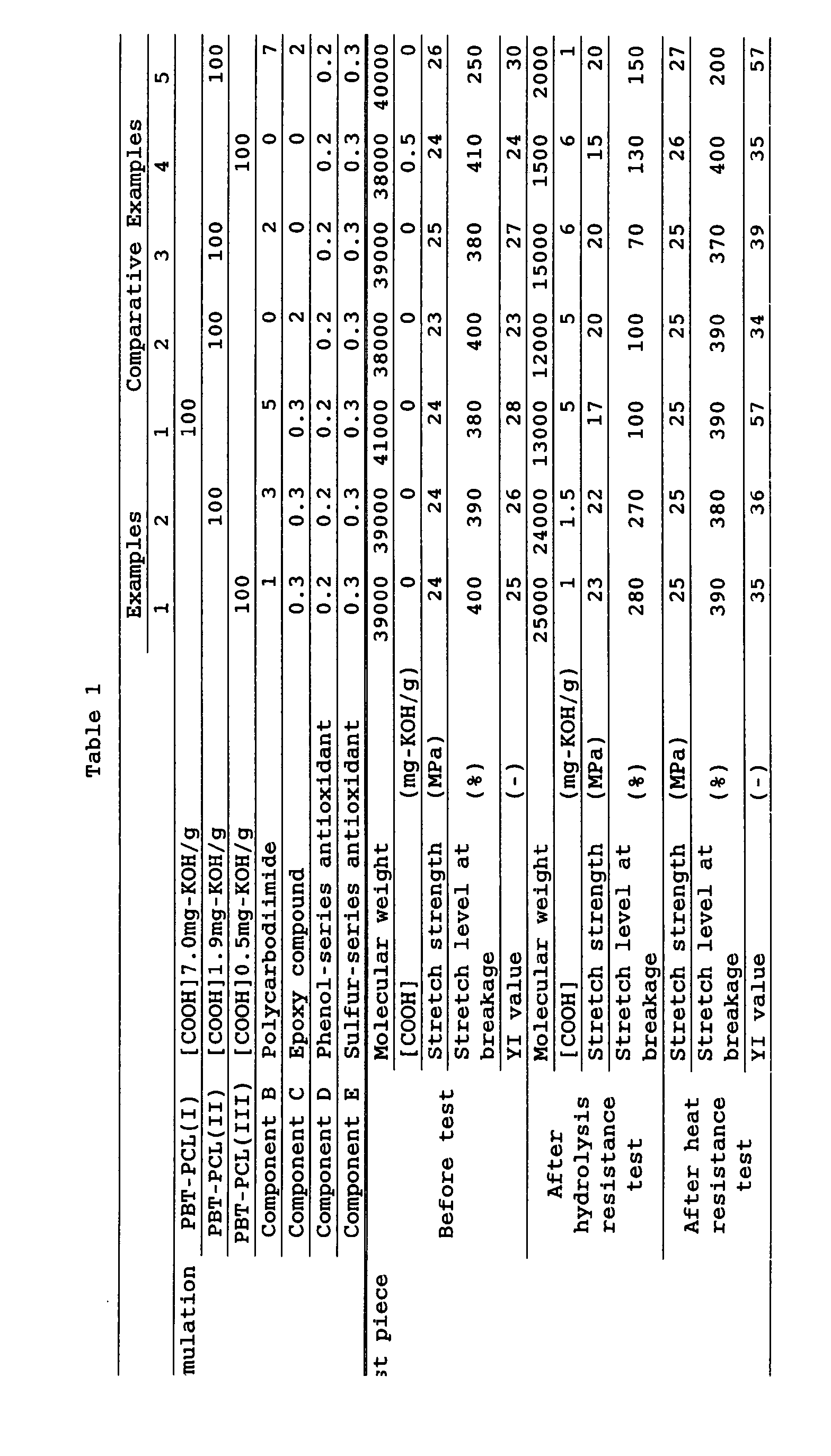
- the components (A) to (E) were mixed uniformly in variable ratios shown in Table 1 (unit: part by weight) by a V-shape blender.
- the obtainedmixture was melt-kneaded at a barrel temperature of 250°C by a biaxial extruder having a diameter of 20 mm, and the kneaded matter was extruded from the die to give a thread, and the thread was cooled and cut to obtain a pellet for molding.
- the pellet was molded using an injection molding apparatus having a clumping force of 80 ton-f and being equipped with a mold for a physical test, under a molding condition of a cylinder temperature of 240°C, a die temperature of 40°C, injection pressure of 600 kg/cm 2 , cooling time of 30 seconds, and total time for one cycle of 60 seconds.
- the improvement effect on hydrolysis resistance is little even if the phenol-series antioxidant and the sulfur-series antioxidant are blended (see Comparative Examples 2 to 4).
- composition using the polybutylene terephthalate having a low terminal carboxyl group content essential to the present invention and comprising the polycarbodiimide compound, the phenol-series antioxidant, and the sulfur-series antioxidant outstandingly improves in hydrolysis resistance and heat resistance (see Examples 1 and 2).
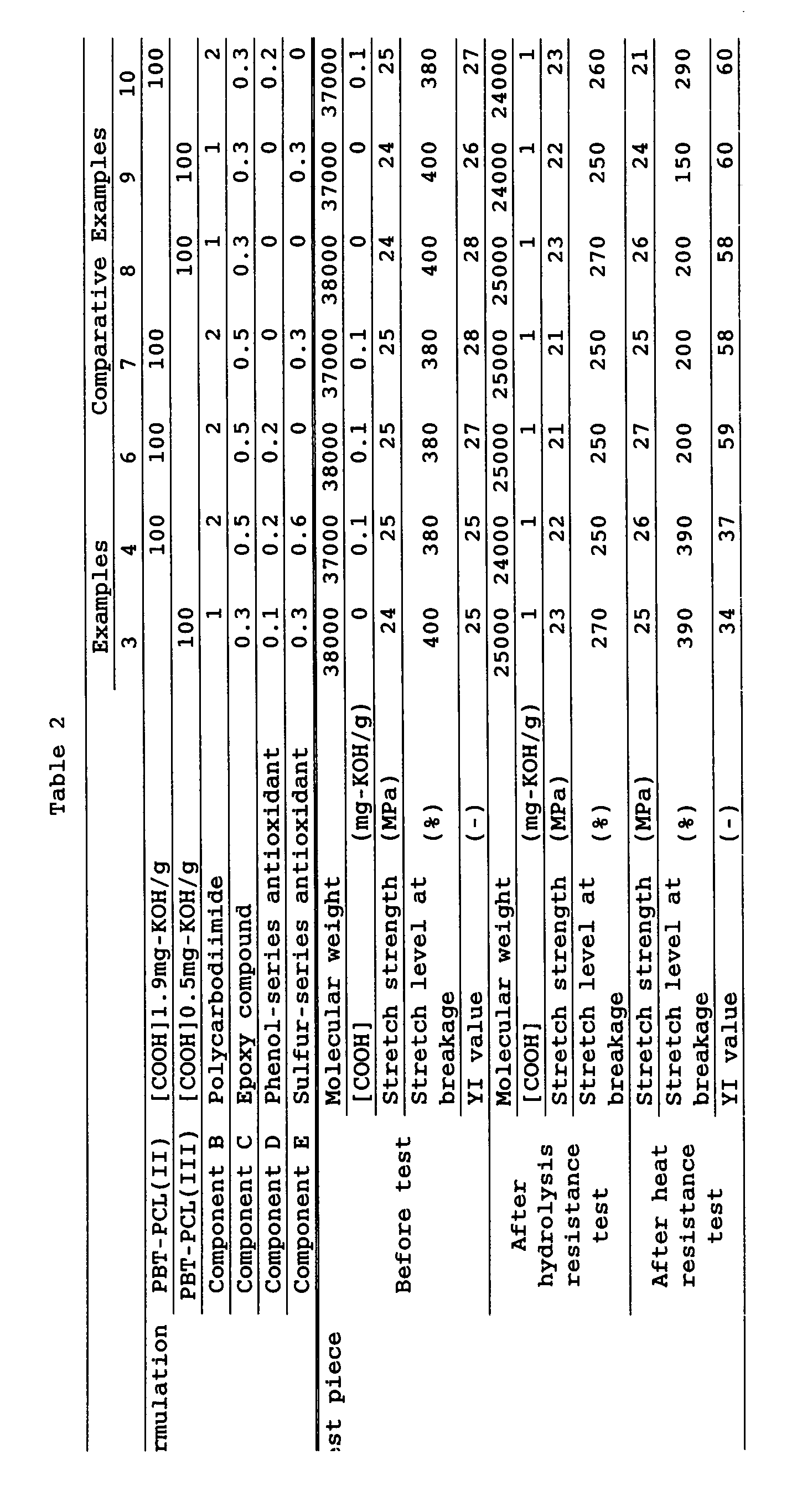
- polyester copolymer compositions were synthesized in a similar manner as in the above examples, and tests for hydrolysis resistance and heat resistance were carried out on the compositions consisted in the blending ratio shown in Table 2. The results are shown in Table 2.
- composition of the present invention shows remarkably improved values for both hydrolysis resistance and heat resistance (Example 3 and 4). While, the compositions lacking in a part of the constitution of the present invention show low improvement effects on hydrolysis resistance and heat resistance. In particular, after the heat treatment or the hydrolysis test, the stretch level at breakage thereof is low and the YI value is outstandingly increased (Comparative Examples 6 to 10).
- thermoplastic resin composition of the present invention is excellent in both hydrolysis resistance and heat resistance, and thus preferably used as an industrial resin. Especially, because the present composition is excellent in heat resistance and unlikely to cause hue changes, the composition may be preferably used as an extremely improved resin in hydrolysis resistance under conditions of high temperature or/and high humidity in the resin molded product subjected to color matching.
- the polyester based thermoplastic resin composition of the present invention may be used as molding materials such as injection molded articles, extrusion molded articles, blow molded articles, film, etc. Because the composition is excellent in hydrolysis resistance, heat resistance, and yellowing resistance and unlikely to cause hue changes, it can be preferable used as an industrial resin composition or/and a molded article made thereof which requires especially under conditions of high temperature or/and high humidity.
Landscapes
- Chemical & Material Sciences (AREA)
- Health & Medical Sciences (AREA)
- Chemical Kinetics & Catalysis (AREA)
- Medicinal Chemistry (AREA)
- Polymers & Plastics (AREA)
- Organic Chemistry (AREA)
- Compositions Of Macromolecular Compounds (AREA)
Abstract
Description
Claims (8)
- A polyester based thermoplastic resin composition comprising:100 parts by weight of a polyester block copolymer (A) which is a reaction product of a thermoplastic aromatic polyester (a) and a lactone (b) and has a terminal carboxyl group content of less than 5 mg-KOH/g as an acid number;0.05 to 5 parts by weight of a polycarbodiimide compound (B);0.05 to 5 parts by weight of a bifunctional or polyfunctional epoxy compound (C);0.01 to 0.5 part by weight of a phenol-series antioxidant (D); and0.01 to 0.5 part by weight of a sulfur-series antioxidant (E).
- A polyester based thermoplastic resin composition according to Claim 1, which further comprises 100 to 200 parts by weight of an aromatic polyester (F) relative to 100 parts by weight of the polyester block copolymer (A).
- A polyester based thermoplastic resin composition according to Claim 1 or 2, which further comprises 0.1 to 3 parts by weight of a metal salt of an organic carboxylic acid (G) relative to 100 parts by weight of the polyester block copolymer (A).
- A polyester based thermoplastic resin composition according to any one of Claims 1 to 3, wherein the thermoplastic aromatic polyester (a) is a polybutylene terephthalate.
- A polyester based thermoplastic resin composition according to any one of Claims 1 to 4, wherein a main raw material of the polycarbodiimide compound (B) comprises at least one member selected from the group consisting of 4,4'-methylenebis(cyclohexylisocyanate), isophorone diisocyanate, and tetramethylxylylene diisocyanate.
- A polyester based thermoplastic resin composition according to any one of Claims 1 to 5, wherein the bifunctional or polyfunctional epoxy compound (C) comprises at least a glycidyl ester.
- A polyester based thermoplastic resin composition according to any one of Claims 1 to 6, wherein the weight ratio of the phenol-series antioxidant (D) relative to the sulfur-series antioxidant (E) [(D)/(E)] is 60/40 to 10/90.
- A molded article of an aromatic polyester block copolymer-series resin, which is formed from the polyester based thermoplastic resin composition recited in any one of Claims 1 to 7.
Applications Claiming Priority (3)
| Application Number | Priority Date | Filing Date | Title |
|---|---|---|---|
| JP2003030146 | 2003-02-06 | ||
| JP2003030146A JP3939255B2 (en) | 2003-02-06 | 2003-02-06 | Polyester thermoplastic resin composition and molded article |
| PCT/JP2004/001183 WO2004069929A1 (en) | 2003-02-06 | 2004-02-05 | Thermoplastic polyester resin composition and molded article |
Publications (3)
| Publication Number | Publication Date |
|---|---|
| EP1591486A1 true EP1591486A1 (en) | 2005-11-02 |
| EP1591486A4 EP1591486A4 (en) | 2006-02-08 |
| EP1591486B1 EP1591486B1 (en) | 2006-08-30 |
Family
ID=32844260
Family Applications (1)
| Application Number | Title | Priority Date | Filing Date |
|---|---|---|---|
| EP04708443A Expired - Lifetime EP1591486B1 (en) | 2003-02-06 | 2004-02-05 | Thermoplastic polyester resin composition and molded article |
Country Status (10)
| Country | Link |
|---|---|
| US (1) | US20060252864A1 (en) |
| EP (1) | EP1591486B1 (en) |
| JP (1) | JP3939255B2 (en) |
| KR (1) | KR20050107411A (en) |
| CN (1) | CN1717452A (en) |
| CA (1) | CA2515350A1 (en) |
| DE (1) | DE602004002193T2 (en) |
| MY (1) | MY135984A (en) |
| TW (1) | TW200422348A (en) |
| WO (1) | WO2004069929A1 (en) |
Cited By (2)
| Publication number | Priority date | Publication date | Assignee | Title |
|---|---|---|---|---|
| EP2727950A1 (en) * | 2012-11-02 | 2014-05-07 | Rhein Chemie Rheinau GmbH | Method for drying of plastics on the basis of polyester resins |
| EP3431538A1 (en) * | 2017-07-17 | 2019-01-23 | LANXESS Deutschland GmbH | Compositions containing polymeric carbodiimide, epoxide and polyester-based polymers, their preparation and use |
Families Citing this family (13)
| Publication number | Priority date | Publication date | Assignee | Title |
|---|---|---|---|---|
| WO2007072642A1 (en) * | 2005-12-21 | 2007-06-28 | Daicel Chemical Industries, Ltd. | Polyester resin composition and molded body |
| JP5259926B2 (en) * | 2006-03-02 | 2013-08-07 | 花王株式会社 | Method for producing polylactic acid resin composition |
| EP2011827A4 (en) * | 2006-03-24 | 2010-12-15 | Daicel Chem | POLYESTER RESIN COMPOSITION AND MOLDED BODY |
| JP5329826B2 (en) * | 2008-03-03 | 2013-10-30 | ユニチカ株式会社 | Biodegradable polyester resin composition and molded article comprising the same |
| CN101733925B (en) * | 2009-10-26 | 2012-07-04 | 申达集团有限公司 | Method for preparing polyester film for photovoltaic cell backplane |
| CN102372909A (en) * | 2010-08-18 | 2012-03-14 | 东丽纤维研究所(中国)有限公司 | Hydrolysis-resistant polyester and preparation method thereof |
| RU2629934C2 (en) * | 2012-03-20 | 2017-09-05 | 3Б Фибрегласс СПРЛ | Two-component lubricate composition for coating of fiberglass and composite material reinforced with indicated fiberglass |
| CN103087301B (en) * | 2013-01-22 | 2015-05-13 | 金发科技股份有限公司 | Copolyester, preparation method and application thereof |
| WO2016133056A1 (en) * | 2015-02-16 | 2016-08-25 | 東洋紡株式会社 | Infrared light-permeable polyester resin composition |
| WO2017038864A1 (en) * | 2015-09-03 | 2017-03-09 | ウィンテックポリマー株式会社 | Poly(butylene terephthalate) resin composition |
| WO2018143479A1 (en) * | 2017-02-06 | 2018-08-09 | ウィンテックポリマー株式会社 | Production method of thermoplastic aromatic polyester resin composition |
| CN113652189B (en) * | 2017-06-09 | 2023-12-01 | 东洋纺Mc株式会社 | Sealing resin composition |
| TWI760875B (en) * | 2020-10-05 | 2022-04-11 | 財團法人工業技術研究院 | Copolymer and method of manufacturing the same |
Family Cites Families (9)
| Publication number | Priority date | Publication date | Assignee | Title |
|---|---|---|---|---|
| JPS50160362A (en) * | 1974-06-18 | 1975-12-25 | ||
| JPS58162654A (en) * | 1982-03-19 | 1983-09-27 | Toyobo Co Ltd | Polyester-type block copolymer composition |
| JPH06172507A (en) * | 1990-06-14 | 1994-06-21 | Sekisui Chem Co Ltd | Copolyester and its composition |
| JPH05302022A (en) * | 1992-04-27 | 1993-11-16 | Toray Ind Inc | Polyester-polyester block copolymer composition |
| DE4215609A1 (en) * | 1992-05-12 | 1993-11-18 | Huels Chemische Werke Ag | Thermoplastic multilayer composites |
| JP3345514B2 (en) * | 1994-07-07 | 2002-11-18 | 日本合成化学工業株式会社 | Polyetherester block copolymer composition |
| EP0763567A4 (en) * | 1995-03-10 | 1999-12-15 | Kanegafuchi Chemical Ind | POLYETHYLENE TEREPHTHALATE FLAME RETARDANT RESIN COMPOSITIONS |
| JP2000191891A (en) * | 1998-12-24 | 2000-07-11 | Du Pont Toray Co Ltd | Polyester elastomer resin composition |
| TW585880B (en) * | 1999-08-05 | 2004-05-01 | Daicel Chem | Process for producing polyester block copolymer |
-
2003
- 2003-02-06 JP JP2003030146A patent/JP3939255B2/en not_active Expired - Fee Related
-
2004
- 2004-02-05 US US10/544,495 patent/US20060252864A1/en not_active Abandoned
- 2004-02-05 KR KR1020057014430A patent/KR20050107411A/en not_active Abandoned
- 2004-02-05 MY MYPI20040341A patent/MY135984A/en unknown
- 2004-02-05 CA CA002515350A patent/CA2515350A1/en not_active Abandoned
- 2004-02-05 EP EP04708443A patent/EP1591486B1/en not_active Expired - Lifetime
- 2004-02-05 DE DE602004002193T patent/DE602004002193T2/en not_active Expired - Lifetime
- 2004-02-05 CN CNA2004800015266A patent/CN1717452A/en active Pending
- 2004-02-05 WO PCT/JP2004/001183 patent/WO2004069929A1/en not_active Ceased
- 2004-02-06 TW TW093102714A patent/TW200422348A/en unknown
Cited By (7)
| Publication number | Priority date | Publication date | Assignee | Title |
|---|---|---|---|---|
| EP2727950A1 (en) * | 2012-11-02 | 2014-05-07 | Rhein Chemie Rheinau GmbH | Method for drying of plastics on the basis of polyester resins |
| EP3431538A1 (en) * | 2017-07-17 | 2019-01-23 | LANXESS Deutschland GmbH | Compositions containing polymeric carbodiimide, epoxide and polyester-based polymers, their preparation and use |
| EP3431539A1 (en) * | 2017-07-17 | 2019-01-23 | LANXESS Deutschland GmbH | Compositions containing polymeric carbodiimide, epoxide and polyester-based polymers, their preparation and use |
| WO2019016143A1 (en) * | 2017-07-17 | 2019-01-24 | Lanxess Deutschland Gmbh | COMPOSITIONS CONTAIN POLYMERIC CARBODIIMIDE, EPOXY AND POLYESTER-BASED POLYMERS, THEIR PREPARATION AND USE |
| CN109265994A (en) * | 2017-07-17 | 2019-01-25 | 朗盛德国有限责任公司 | Composition, its production containing polymerization carbodiimide, epoxide and the polymer based on polyester and application thereof |
| PH12018000199A1 (en) * | 2017-07-17 | 2019-03-18 | Lanxess Deutschland Gmbh | Compositions containing polymeric carbodiimide, epoxide and polyester-based polymers, their production and use |
| CN109265994B (en) * | 2017-07-17 | 2021-11-02 | 朗盛德国有限责任公司 | Composition containing polymeric carbodiimides, epoxy compounds and polyester-based polymers, production thereof and use thereof |
Also Published As
| Publication number | Publication date |
|---|---|
| US20060252864A1 (en) | 2006-11-09 |
| EP1591486A4 (en) | 2006-02-08 |
| KR20050107411A (en) | 2005-11-11 |
| MY135984A (en) | 2008-07-31 |
| JP3939255B2 (en) | 2007-07-04 |
| DE602004002193T2 (en) | 2006-12-28 |
| DE602004002193D1 (en) | 2006-10-12 |
| EP1591486B1 (en) | 2006-08-30 |
| TW200422348A (en) | 2004-11-01 |
| CN1717452A (en) | 2006-01-04 |
| JP2004262969A (en) | 2004-09-24 |
| CA2515350A1 (en) | 2004-08-19 |
| WO2004069929A1 (en) | 2004-08-19 |
Similar Documents
| Publication | Publication Date | Title |
|---|---|---|
| EP1591486B1 (en) | Thermoplastic polyester resin composition and molded article | |
| US20100324220A1 (en) | Resin composition and molded article | |
| CN110366578B (en) | Polyester elastomer resin composition with improved mold contamination | |
| EP3415564B1 (en) | Polyester elastomer resin composition having excellent grease resistance | |
| JP3618679B2 (en) | Polyester block copolymer composition | |
| JPWO2018174129A1 (en) | Polyester elastomer resin composition | |
| JP2020073658A (en) | Polyester resin composition being flexible and excellent in adhesion | |
| US20210115247A1 (en) | Thermoplastic polyester elastomer resin composition for resin belt materials, and molded resin belt | |
| KR101823721B1 (en) | Polyester resin composition for electrical / electronic part-sealing material, sealed product and production method therefor | |
| KR20180129438A (en) | Polyester based resin composition and molded article prepared therefrom | |
| WO2016076136A1 (en) | Polyester resin composition having flexibility and high fluidity | |
| KR20150135294A (en) | Ester-type resin composition, method for producing said ester-type resin composition, and molded article produced using said ester-type resin | |
| JPH11236493A (en) | Polyester resin composition and manufacturing method | |
| KR20170070419A (en) | Thermoplastic elastomer copolymer, thermoplastic resin composition comprising the same and molded article comprising the same | |
| JP6864161B1 (en) | Polybutylene terephthalate resin composition | |
| JP5772445B2 (en) | Inorganic reinforced polyester resin composition and molded article comprising the same | |
| JP7842975B2 (en) | Thermoplastic polyester elastomers, resin compositions containing such elastomers, and molded articles obtained therefrom. | |
| JP7737641B1 (en) | Flame-retardant resin composition using biomass-derived polyester elastomer | |
| EP4321575A1 (en) | Flame-retardant thermoplastic polyester elastomer resin composition and molded article obtained therefrom | |
| JPH02252753A (en) | Polyester ester elastomer composition | |
| JP2000239506A (en) | Copolyester resin composition | |
| WO2024176874A1 (en) | Polyester elastomer resin composition | |
| WO2019098602A1 (en) | Resin blend composition and resin molded article comprising same | |
| JPH03185050A (en) | Resin composition |
Legal Events
| Date | Code | Title | Description |
|---|---|---|---|
| PUAI | Public reference made under article 153(3) epc to a published international application that has entered the european phase |
Free format text: ORIGINAL CODE: 0009012 |
|
| 17P | Request for examination filed |
Effective date: 20050804 |
|
| AK | Designated contracting states |
Kind code of ref document: A1 Designated state(s): AT BE BG CH CY CZ DE DK EE ES FI FR GB GR HU IE IT LI LU MC NL PT RO SE SI SK TR |
|
| AX | Request for extension of the european patent |
Extension state: AL LT LV MK |
|
| RIC1 | Information provided on ipc code assigned before grant |
Ipc: C08L 79/00 20060101ALI20051212BHEP Ipc: C08L 67/00 20060101AFI20040824BHEP Ipc: C08K 5/29 20060101ALI20051212BHEP Ipc: C08K 5/1515 20060101ALI20051212BHEP Ipc: C08K 5/13 20060101ALI20051212BHEP Ipc: C08K 5/098 20060101ALI20051212BHEP Ipc: C08K 5/36 20060101ALI20051212BHEP |
|
| A4 | Supplementary search report drawn up and despatched |
Effective date: 20051223 |
|
| GRAP | Despatch of communication of intention to grant a patent |
Free format text: ORIGINAL CODE: EPIDOSNIGR1 |
|
| DAX | Request for extension of the european patent (deleted) | ||
| RBV | Designated contracting states (corrected) |
Designated state(s): DE FR GB IT |
|
| GRAS | Grant fee paid |
Free format text: ORIGINAL CODE: EPIDOSNIGR3 |
|
| GRAA | (expected) grant |
Free format text: ORIGINAL CODE: 0009210 |
|
| AK | Designated contracting states |
Kind code of ref document: B1 Designated state(s): DE FR GB IT |
|
| PG25 | Lapsed in a contracting state [announced via postgrant information from national office to epo] |
Ref country code: IT Free format text: LAPSE BECAUSE OF FAILURE TO SUBMIT A TRANSLATION OF THE DESCRIPTION OR TO PAY THE FEE WITHIN THE PRESCRIBED TIME-LIMIT;WARNING: LAPSES OF ITALIAN PATENTS WITH EFFECTIVE DATE BEFORE 2007 MAY HAVE OCCURRED AT ANY TIME BEFORE 2007. THE CORRECT EFFECTIVE DATE MAY BE DIFFERENT FROM THE ONE RECORDED. Effective date: 20060830 |
|
| REG | Reference to a national code |
Ref country code: GB Ref legal event code: FG4D |
|
| REF | Corresponds to: |
Ref document number: 602004002193 Country of ref document: DE Date of ref document: 20061012 Kind code of ref document: P |
|
| ET | Fr: translation filed | ||
| PLBE | No opposition filed within time limit |
Free format text: ORIGINAL CODE: 0009261 |
|
| STAA | Information on the status of an ep patent application or granted ep patent |
Free format text: STATUS: NO OPPOSITION FILED WITHIN TIME LIMIT |
|
| 26N | No opposition filed |
Effective date: 20070531 |
|
| PGFP | Annual fee paid to national office [announced via postgrant information from national office to epo] |
Ref country code: FR Payment date: 20100223 Year of fee payment: 7 Ref country code: IT Payment date: 20100213 Year of fee payment: 7 |
|
| PGFP | Annual fee paid to national office [announced via postgrant information from national office to epo] |
Ref country code: DE Payment date: 20100211 Year of fee payment: 7 Ref country code: GB Payment date: 20100202 Year of fee payment: 7 |
|
| GBPC | Gb: european patent ceased through non-payment of renewal fee |
Effective date: 20110205 |
|
| REG | Reference to a national code |
Ref country code: FR Ref legal event code: ST Effective date: 20111102 |
|
| REG | Reference to a national code |
Ref country code: DE Ref legal event code: R119 Ref document number: 602004002193 Country of ref document: DE Effective date: 20110901 |
|
| PG25 | Lapsed in a contracting state [announced via postgrant information from national office to epo] |
Ref country code: FR Free format text: LAPSE BECAUSE OF NON-PAYMENT OF DUE FEES Effective date: 20110228 |
|
| PG25 | Lapsed in a contracting state [announced via postgrant information from national office to epo] |
Ref country code: GB Free format text: LAPSE BECAUSE OF NON-PAYMENT OF DUE FEES Effective date: 20110205 |
|
| PG25 | Lapsed in a contracting state [announced via postgrant information from national office to epo] |
Ref country code: DE Free format text: LAPSE BECAUSE OF NON-PAYMENT OF DUE FEES Effective date: 20110901 |
|
| PG25 | Lapsed in a contracting state [announced via postgrant information from national office to epo] |
Ref country code: IT Free format text: LAPSE BECAUSE OF NON-PAYMENT OF DUE FEES Effective date: 20110205 |