EP1590447B1 - Stammgesteuerte promotoren von pflanzeneigenen abwehrkräften und deren verwendung bei der gewebespezifischen expression in monokotyledonen pflanzen - Google Patents
Stammgesteuerte promotoren von pflanzeneigenen abwehrkräften und deren verwendung bei der gewebespezifischen expression in monokotyledonen pflanzen Download PDFInfo
- Publication number
- EP1590447B1 EP1590447B1 EP04700209A EP04700209A EP1590447B1 EP 1590447 B1 EP1590447 B1 EP 1590447B1 EP 04700209 A EP04700209 A EP 04700209A EP 04700209 A EP04700209 A EP 04700209A EP 1590447 B1 EP1590447 B1 EP 1590447B1
- Authority
- EP
- European Patent Office
- Prior art keywords
- nucleic acid
- promoter
- expression
- stem
- plant
- Prior art date
- Legal status (The legal status is an assumption and is not a legal conclusion. Google has not performed a legal analysis and makes no representation as to the accuracy of the status listed.)
- Expired - Lifetime
Links
Images






Classifications
-
- C—CHEMISTRY; METALLURGY
- C07—ORGANIC CHEMISTRY
- C07K—PEPTIDES
- C07K14/00—Peptides having more than 20 amino acids; Gastrins; Somatostatins; Melanotropins; Derivatives thereof
- C07K14/415—Peptides having more than 20 amino acids; Gastrins; Somatostatins; Melanotropins; Derivatives thereof from plants
-
- C—CHEMISTRY; METALLURGY
- C12—BIOCHEMISTRY; BEER; SPIRITS; WINE; VINEGAR; MICROBIOLOGY; ENZYMOLOGY; MUTATION OR GENETIC ENGINEERING
- C12N—MICROORGANISMS OR ENZYMES; COMPOSITIONS THEREOF; PROPAGATING, PRESERVING, OR MAINTAINING MICROORGANISMS; MUTATION OR GENETIC ENGINEERING; CULTURE MEDIA
- C12N15/00—Mutation or genetic engineering; DNA or RNA concerning genetic engineering, vectors, e.g. plasmids, or their isolation, preparation or purification; Use of hosts therefor
- C12N15/09—Recombinant DNA-technology
- C12N15/63—Introduction of foreign genetic material using vectors; Vectors; Use of hosts therefor; Regulation of expression
- C12N15/79—Vectors or expression systems specially adapted for eukaryotic hosts
- C12N15/82—Vectors or expression systems specially adapted for eukaryotic hosts for plant cells, e.g. plant artificial chromosomes (PACs)
- C12N15/8216—Methods for controlling, regulating or enhancing expression of transgenes in plant cells
- C12N15/8222—Developmentally regulated expression systems, tissue, organ specific, temporal or spatial regulation
- C12N15/8223—Vegetative tissue-specific promoters
- C12N15/8226—Stem-specific, e.g. including tubers, beets
-
- C—CHEMISTRY; METALLURGY
- C12—BIOCHEMISTRY; BEER; SPIRITS; WINE; VINEGAR; MICROBIOLOGY; ENZYMOLOGY; MUTATION OR GENETIC ENGINEERING
- C12N—MICROORGANISMS OR ENZYMES; COMPOSITIONS THEREOF; PROPAGATING, PRESERVING, OR MAINTAINING MICROORGANISMS; MUTATION OR GENETIC ENGINEERING; CULTURE MEDIA
- C12N15/00—Mutation or genetic engineering; DNA or RNA concerning genetic engineering, vectors, e.g. plasmids, or their isolation, preparation or purification; Use of hosts therefor
- C12N15/09—Recombinant DNA-technology
- C12N15/63—Introduction of foreign genetic material using vectors; Vectors; Use of hosts therefor; Regulation of expression
- C12N15/79—Vectors or expression systems specially adapted for eukaryotic hosts
- C12N15/82—Vectors or expression systems specially adapted for eukaryotic hosts for plant cells, e.g. plant artificial chromosomes (PACs)
- C12N15/8216—Methods for controlling, regulating or enhancing expression of transgenes in plant cells
- C12N15/8237—Externally regulated expression systems
- C12N15/8238—Externally regulated expression systems chemically inducible, e.g. tetracycline
Definitions
- the present invention relates to the fields of plant functional genomics, molecular biology and genetic engineering, and specifically to selective regulation of gene expression in plants.
- the present invention relates to novel isolated nucleic acids having promoters capable of conferring stem-regulated expression and operable in plant defense.
- the promoters may be used in monocots, including polyploid species, to direct stem-regulated or defense-inducible expression of a heterologous gene.
- Sugarcane is considered as one of the major worldwide crop for sugar supply with a net value of $20 billion per year. This crop could benefit from biotechnology approaches to engineer plants for disease, pest and herbicide resistance as well as improved sugar yield.
- biotechnology approaches to engineer plants for disease, pest and herbicide resistance as well as improved sugar yield.
- sugarcane specific technologies such as genes and promoters that are functional in sugarcane.
- the selection of a promoter is often a critical factor in determining when and where within the plant the gene of interest is expressed.
- Promoters that have been isolated so far from sugarcane correspond to two polyubiquitin genes and confer constitutive gene expression in non-host plants such as rice ( Wei et al., 1999, J. Plant Physiol. 155:513-519 ; Wei et al., 2003, J. Plant Physiol.160:1241-1251 ).
- Constitutive promoters may be suitable for the production of a desired protein in large quantities in all tissues of the plant throughout development.
- the energy requirements for high level constitutive production of the protein are often so great that other normal plant growth processes are compromised.
- expression of a protein in a non-tissue specific manner as directed by a constitutively active promoter has often resulted in slow-growing or dwarfed plants.
- Tissue-specific promoters are capable of selectively expressing an introduced gene in desired tissues.
- Tissue-specific promoters may also be inducible, e.g. activated by internal or external agents such as phytohormones or defense inducing agents.
- Restricting expression of the target protein to a particular tissue or organ or to specific events triggered when the plant is challenged with an external agent may be desirable to minimize possible toxic effects of some 'agronomic' gene products and to optimize overall plant growth and production.
- promoter function varies from species to species. Thus it is essential to have promoters which are expressed specifically in target tissues of specific plants in order to genetically engineer plants.
- promoters are currently being used for tissue-specific, heterologous gene expression in monocots.
- the promoter regions from genes coding for hydrolases ( ⁇ -glucanase), cysteine protease inhibitors (cystatin-1)or glucosidases ( ⁇ -glucosidase) have been used to direct germination-specific expression of a heterologous DNA sequence in transgenic barley cells and kernels ( Wolf, 1992, Mol. Gen. Genet. 234:33-42 ; Jensen et al., 1996, Proc. Natl. Acad. Sci. USA 93:3487-3491 ; Mikkonen et al., 1996, Plant Mol. Biol.
- the promoter for the glutamine synthetase gene has been also used to drive tissue-specific expression within the developing kernels of transgenic maize plants ( Muhitch et al., 2002, Plant Science 163:865-872 ).
- Xylem- and phloem-specific promoters that are active in rice have also been reported, including the rice tungro baciliform virus and peroxidase gene promoters ( Yin et al., 1997, Plant Journal 12:1178-1188 ; Ito et al., 2000, Plant Science 155:85-100 ); however it is not clear whether these promoters are active in other monocots, such as maize, sorghum and sugarcane. Furthermore, none of the above reported promoters are stem-regulated, which may be significant for crops such as sugarcane where the stem holds a large portion of the commercial value of the plant.
- the present invention provides regulatory sequences which direct stem-regulated or defense-inducible expression and include novel promoters from stem-expressed defense-inducible gene designated jasmonate-induced protein (JAS).
- the subject promoters may have specific advantages over the currently available tissue-specific promoters in their enhanced specificity in regulating gene expression in stem tissues and in response to induction by external stimuli such as plant defense-inducing agents.
- the subject promoters may be very useful in strategies aimed at altering carbon metabolism in the sucrose accumulating tissues, and for driving expression of insecticidal proteins in sugarcane. These promoters may also be applied to the development of improved pest and disease tolerant rice plants.
- the present invention is directed to isolated nucleic acids including promoters operable primarily in the stem or in response to stimulation by defense-inducing agents.
- the subject promoters hybridize under stringent conditions to a promoter isolated from sugarcane, designated the JAS promoter, which promoter has the nucleotide sequence as set forth in SEQ ID NO:1
- the subject isolated nucleic acids include promoters which direct stem-regulated or defense-inducible expression and have a sequence identity (sequence similarity) of at least90% when compared to the nucleotide sequence of the JAS promoter as set forth in SEQ ID NO: 1. Promoters of the present invention may also have a sequence identity of at least 95%, or at least 98% when compared to the JAS promoter of SEQ ID NO: 1.
- the present invention is directed to an isolated nucleic acid having a promoter which directs stem-regulated or defense-inducible expression, which promoter has the nucleotide sequence as set forth in SEQ ID NO:1.
- the present invention may be directed to cells and plants transformed with an expression vector including an isolated nucleic acid having a promoter which directs stem-regulated or defense-inducible expression, including an JAS promoter, and the progeny generated from such transformed plants.
- the plant may be a monocot, such as maize, rice, sugarcane or sorghum.
- the promoters of the present invention are useful in the construction of expression cassettes which include, in the 5' to 3' direction, a promoter which directs stem-regulated or defense-inducible expression such as the JAS promoter, a heterologous gene or a coding sequence, or sequence complementary to a native plant gene under control of the promoter, and a 3' termination sequence.
- a promoter which directs stem-regulated or defense-inducible expression such as the JAS promoter, a heterologous gene or a coding sequence, or sequence complementary to a native plant gene under control of the promoter, and a 3' termination sequence.
- Such an expression cassette may be incorporated into a variety of autonomously replicating vectors in order to construct an expression vector.
- the subject JAS promoter may be derived from restriction endonuclease or exonuclease digestion of isolated JAS genomic clones.
- the known nucleotide or amino acid sequence of the coding region of a gene of the jasmonate-induced protein gene family is aligned to the nucleic acid or deduced amino acid sequence of an isolated stem-regulated genomic clone and the 5' flanking sequence (i.e., sequence upstream from the translational start codon of the coding region) of the isolated JAS genomic clone is located.
- the present invention is directed to other promoter sequences which correspond to the same gene, i.e., a homolog, in other plant species.
- such related sequences which direct stem-regulated or defense-inducible expression must have at least 90% sequence identity on a nucleotide level to the nucleotide sequence (-2686 to -1) as set forth in FIGURE 1 (SEQ ID NO:1).
- the present invention therefore contemplates nucleic acid sequences which differ in one or more positions in comparison with SEQ ID NO:1 so long as such sequence corresponds to a promoter which directs stem-regulated or defense-inducible expression.
- Promoter sequences of the present invention may also be described in terms of percent homology or identity on a nucleotide level to the nucleotide sequence -2686 to -1 depicted in FIGURE 1 (SEQ ID NO:1).
- SEQ ID NO:1 The nucleotide sequence -2686 to -1 depicted in FIGURE 1 (SEQ ID NO:1).
- There are a number of computer programs that compare and align nucleic acid sequences which one skilled in the art may use for purposes of determining sequence identity (sequence similarity).
- an isolated nucleic acid having a promoter which directs stem-regulated or defense-inducible expression has a sequence identity (sequence similarity) of at least 90%when compared to the nucleotide sequence of the JAS promoter as set forth in SEQ ID NO:1.
- an isolated nucleic acid including a promoter which directs stem-regulated expression has a sequence identity (sequence similarity) of about 90% or greater when compared to the sequence of the JAS promoter as set forth in SEQ ID NO:1.
- Sequences similar to a subject promoter may be identified by database searches using the promoter or elements thereof as the query sequence using the Gapped BLAST algorithm ( Altschul et al., 1997 Nucl. Acids Res. 25:3389-3402 ) with the BLOSUM62 Matrix, a gap cost of 11 and persistence cost of 1 per residue and an E value of 10.
- Two sequences may be compared with either ALIGN (Global alignment) or LALIGN (Local homology alignment) in the FASTA suite of applications ( Pearson and Lipman, 1988 Proc. Nat. Acad. Sci. 85:2444-24448 ; Pearson, 1990 Methods in Enzymology 183:63-98 ) with the BLOSUM50 matrix and gap penalties of -16, -4.
- Nucleic acid molecules corresponding to promoters of the present invention may be obtained by using the subject 2,686 kb JAS promoter of SEQ ID NO: 1 or a portion thereof (including fragments) or complements thereof as a probe and hybridizing with a nucleic acid molecule(s) from any higher plant.
- Nucleic acid molecules hybridizing to the 3.012 kb JAS promoter or a portion thereof can be isolated, e.g., from genomic libraries by techniques well known in the art.
- Promoter fragments homologous to JAS may also be isolated by applying a nucleic acid amplification technique such as the polymerase chain reaction (PCR) using as primers oligonucleotides derived from sequence set forth in SEQ ID NO:1.
- PCR polymerase chain reaction
- reporter genes exemplified by chloramphenicol acetyl transferase and ⁇ -glucuronidase (GUS) are commonly used to assess transcriptional and translational competence of chimeric nucleic acids. Standard assays are available to sensitively detect the reporter enzyme in a transgenic organism.
- the GUS gene is useful as a reporter of promoter activity in transgenic plants because of the high stability of the enzyme in plant cells, the lack of intrinsic GUS activity in higher plants and availability of a quantitative fluorimetric assay and a histochemical localization technique.
- Jefferson et al. (1987) (EMBO J. 6: 3901-3907 ) have established standard procedures for biochemical and histochemical detection of GUS activity in plant tissues. Biochemical assays are performed by mixing plant tissue lysates with 4-methylumbelliferyl- ⁇ -D-glucuronide, a fluorimetric substrate for GUS, incubating one hour at 37°C, and then measuring the fluorescence of the resulting 4-methyl-umbelliferone.
- Histochemical localization for GUS activity is determined by incubating plant tissue samples in 5-bromo-4-chloro-3-indolyl-glucuronide (X-Gluc) for about 18 hours at 37°C and observing the staining pattern of X-Gluc.
- X-Gluc 5-bromo-4-chloro-3-indolyl-glucuronide
- the construction of such expression cassettes allows definition of specific regulatory sequences and demonstrates that these sequences can direct expression of heterologous genes, or coding sequences in a stem-regulated or defense-inducible manner.
- the present invention provides expression cassettes including sequences of a promoter which directs stem-regulated or defense-inducible expression including the JAS promoter which are operably linked to a heterologous gene such as a sugar transport gene or sugar accumulation gene.
- a heterologous gene such as a sugar transport gene or sugar accumulation gene.
- sugar transport genes useful for practicing the present invention include sucrose transporters and other monosaccharide and disaccharide transporters. Such sugar transporter genes have been isolated and characterized from sugarcane and other plant species. Their nucleotide coding sequences as well as methods of isolating such coding sequences are disclosed in the published literature and are widely available to those of skill in the art.
- the expression cassettes of the present invention may be constructed by ligating a subject promoter such as the JAS promoter or part thereof to the coding sequence of a heterologous gene.
- the juxtaposition of these sequences may be accomplished in a variety of ways.
- the sequence order is in a 5' to 3' direction and includes an JAS promoter and coding sequence of a heterologous gene.
- the sequence order in a 5' to 3' direction is an JAS promoter, a coding sequence and a termination sequence which includes a polyadenylation site.
- restriction or deletion fragments that contain a subject promoter TATA box are ligated in a forward orientation to a promoterless heterologous gene or coding sequence such as the coding sequence of GUS.
- promoters of the present invention and parts thereof may be provided by other means, for example chemical or enzymatic synthesis.
- a transgenic sugarcane line may be produced with enhanced bioinsecticidal activity for protection against stem boring insects, which are the most destructive pests.
- Expression of the bioinsecticidal protein may be induced in this case by the application of a defense inducing agent such jasmonic acid.
- a plant cell according to the invention may be used in a method of cosuppressing a gene which is native to a plant which includes transforming a plant cell with an expression vector having an JAS promoter or part thereof, operably linked to a nucleic acid sequence coding for the native plant gene.
- levels of endogenous product of the native plant gene are reduced through the mechanism known as cosuppression.
- levels of a product of a sucrose synthesis gene or defense gene may be by transforming a plant with an expression vector including a subject promoter or part thereof, operably linked to a nucleic acid sequence coding for a sucrose accumulating gene or defense gene native to the plant.
- stem tissues and embryonic calli are particle bombarded using the gene gun/biolistic approach as described in ( Klein et al. (1987) Nature, 327; 70 ).
- Other well-known methods are available to insert the expression cassettes of the present invention into plant cells. Such alternative methods include electroporation, chemically-induced DNA uptake, and use of viruses or pollen as vectors.
- the tumor inducing genes have been deleted and the functions of the vir region are utilized to transfer foreign DNA bordered by the T-DNA border sequences.
- the T-region also contains a selectable marker for antibiotic resistance, and a multiple cloning site for inserting sequences for transfer.
- Such engineered strains are known as "disarmed" A. tumefaciens strains, and allow the efficient transfer of sequences bordered by the T-region into the nuclear genome of plants.
- RNA gel blot analysis may be used to assess transcription if appropriate nucleotide probes are available. If antibodies to the polypeptide encoded by the heterologous gene are available, Western analysis and immunohistochemical localization may be used to assess the production and localization of the polypeptide. Depending upon the heterologous gene, appropriate biochemical assays may be used.
- transgenic plants or progeny of these plants containing the expression cassettes of the invention Both monocot and dicot plants are contemplated.
- Plant cells may be transformed with the expression cassettes by any of the plant transformation methods described above.
- the transformed plant cell usually in the form of a callus culture, leaf disk, explant or whole plant (via Agrobacterium-mediated transformation or gene gun particle bombardment) may be regenerated into a complete transgenic plant by methods well-known to one of ordinary skill in the art (e.g., Horsh et al., 1985).
- the transgenic plant is sugarcane, rice, maize, sorghum or other monocot plant. Because progeny of transformed plants inherit the expression cassettes, seeds or cuttings from the transformed plants may be used to maintain the transgenic line.
- a cDNA library representing stem mRNA was constructed and screened by differential hybridization.
- Total RNAs and poly(A)+ RNAs were prepared using the RNeasy kit and Oligotex kit from Qiagen, respectively.
- the SMART PCR cDNA library construction kit (BDBiosciences Clontech) was selected since this technology utilizes a unique SMART oligonucleotide (cap finder) in the first strand cDNA synthesis followed by a long distance PCR (LD PCR) amplification to generate high yields of full-length ds cDNAs.
- LD PCR long distance PCR
- a pooled sample consisting of 100 ng of each of stem top, mid and bottom poly(A)+ RNAs was used for the preparation of first strand cDNAs which were then selected to synthesize ds cDNAs by LD PCR.
- the sizes of ds cDNA ranged from 300 bp to 6 kb.
- the ds cDNA sample was subjected to gel fractionation and the agarose gel slice containing 500 bp to 3 kb was excised and purified.
- This selected cDNA fraction was cloned into pCR2.1 vector (TA cloning kit, Invitrogen) using DH10B Escherichia coli bacterial cells for transformation. The ampicillin-resistant and white colonies were picked and archived in 384-well microtiter plates. A total of 13,824 cDNA clones (archived in thirty six 384-well microtiter plates) were obtained. About 100 clones were randomly picked, and DNA preparations were made and tested by restriction analysis to reveal insert sizes of 300 bp to 1500 bp.
- the macroarray analysis of the potential stem-specific CAN clones was followed by a focused microarray analyis.
- a DNA microarray including the panel of the 188 stem-specific cDNA clones initially identified by the macroarray analysis along with 63 additional cDNA clones was constructed to provide a sensitive assessment of their differential RNA expression profiles.
- Amplified PCR products for the 251 cDNAs were printed in duplicate on glass microscope slides using a gridding robot from Genemachines.
- the resulting microarray was probed with fluorescently labeled cDNAs synthesized from 1.mu.g of total amplified RNA (MessageAmp aRNA kit from Ambion for RNA amplification).
- One cDNA probe (e.g.
- stem RNA is labeled with one dye (Cy5), and the second (e.g. leaf or root RNA) with another dye (Cy3) using the 3DNA Array 350RP expression array detection kit of Genisphere and based on the two-color fluorescent hybridization microarray system developed by Brown and colleagues at Stanford ( Derisi et al. 1996 Science 278:680-686 ).
- the two probes labeled with distinct dyes were hybridized simultaneously to a single DNA array to allow for comparison of two different RNA populations or internal standardization. Hybridization was detected and quantified with a confocal laser scanner (Affynetrix) that captures the image of the emission wavelength of each dye.
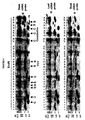
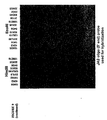
- FIGURE 5 A combined image of the microarray hybridized with fluorescent probes representing stem RNA and leaf RNA is shown in FIGURE 5 .
- the resulting digital data was analyzed with the GenePix analysis software (Axon) and GeneSpring analysis software (Silicon Genetics).
- FIGURE 6 shows a scatter plot representation of the RNA expression levels of the 251 cDNA clones of the microarray after hybridization with probes from stem and leaf RNAs. Each '+' symbol represents a cDNA.
- the normalized abundance of each cDNA derived from stem RNA (Cy5) (y axis) was plotted vs that derived from leaf RNA (Cy3) (x axis). Data were normalized using the endogenous constitutive gene ubiquitin.
- the central magenta line indicates equal hybridization of both Cy5 and Cy3 probes.
- the outer magenta line indicates expression levels of genes that are two-fold up or down.
- the expression patterns of four selected cDNAs that were upregulated at least two-fold in the microarray analysis were further assessed by real-time quantitative PCR (RT-PCR).
- the four cDNAs include OMT, JAS clone 20F18, JAS clone 6H10 and SSIP.
- the real-time RT-PCR approach allows the identification of false positives obtained through the microarray analysis as well as the differentiation between members of multigene families.
- RNA (2.mu.g) was extracted from sugarcane stem, leaf or root and the corresponding cDNA templates were generated through RT-PCR using the TaqMan reverse transcription kit (Applied Biosystems). PCR was then performed using the cDNA templates and primers that are specific to the cDNAs of OMT, JAS, SSIP and ubiquitin (endogenous control). Primers were designed by the Primer Express software (Applied Biosystems) and labeled with the fluorescent SYBR Green 1 dye that binds to double-stranded DNA (SYBR Green PCR master mix; Applied Biosystems).
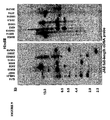
- RNA gel blot analysis was performed using total RNA (12.mu.g) from stem, leaf or root and radioactive probes specific to OMT, SSIP , JAS clone 20F18 and ubiquitin. Hybridization signals were recorded with a Fujix BAS 2000 phosphoimager. The data were analyzed using MacBas software. The hybridization signal for each sample was quantitated and adjusted for loading by virtue of hybridization to a ubiquitin cDNA probe. The quantitative accumulation of OMT, JAS and SSIP was determined and compared to that of the constitutive ubiquitin gene (See FIGURE 8 ). All 3 cDNAs were highly expressed only in stem.
- Table 2 Upregulation of JAS and SSIP in Stem Tissue Gene Microarray fold increase (stem v. leaf) RT-PCR fold change RNA gel blot fold change Stem v. leaf Stem v. root Stem v. leaf Stem v. root JAS 3.6 1.6 1.3 1.3 1.4 SSIP 5.2 1.0 1.0 4.5 5.7
- the 251 cDNA clones used for microarray analysis in Example 1 were further used to assess the effects of defense-inducing agents on the expression of the stem-specific genes.
- BAC sugarcane bacteriophage lambda
- BAC library filters were probed using a full-length JAS cDNA probe.
- Three screening were performed to select genomic clones exhibiting strong hybridization to JAS cDNA.
- Phage DNA was isolated from 13 candidate JAS genomic clones and digested with restriction endonucleases (EcoRI and HindIII) prior to DNA gel blot analysis.
- DNA gel blot analysis revealed common restriction fragments containing the JAS gene. This indicated that the 13 JAS clones were most likely representative of a single JAS locus.
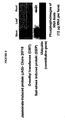
- FIGURE 11A shows a gel of the primary PCR products of the JAS BAC clone 159E16. PCR was conducted using an adapter primer and a 3' primer specific to the JAS 5' UTR.
- FIGURE 11B shows a gel blot of PCR products probed using a JAS oligo specific to the 5'UTR of JAS.
- the JAS promoter was thus identified and sequenced to reveal a 2.686 kb promoter fragment (See FIGURE 1 and SEQ ID NO:1.)
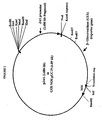
- a sugarcane expression vector was produced by cloning either the JAS promoter into a pUC19 GUS reporter vector to produce the pJAS::GUSpUC19 vector. (See FIGURE 2 .) Specifically, the 35S promoter normally found in pUC19 GUS was replaced with a JAS promoter at the corresponding XbaI and NcoI restriction sites to create a translational fusion with the GUS reporter DNA.
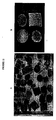
- embryonic calli of sugarcane cultivar CP72-1210 were transformed with pOMT::GUSpUC vectors using gene gun/biolistic-mediated transfer ( Irvine and Mirkov, 1997 Sugar Journal 60:25-29 ; Inglebrecht et al, 1999 Plant Physiol. 119;1187-1197 ). Histochemical localization of GUS expression was determined using 5-bromo-4-chloro-3-indoyl glucuronide. (See FIGURE 12A .) Intense GUS staining was observed in the stem nodal area and vascular bundles. (See FIGURE 12B .)
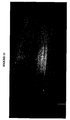
- Embryonic rice calli (Taipei 309) were transformed with pOMT:pUCpCambia using Agrobacterium tumefaciens EHA 105 (Aldemita and Hodges 1996). Histochemical analysis of transformed clones showed intense GUS staining in the stem vascular bundles. (See FIGURE 13 .)
Landscapes
- Health & Medical Sciences (AREA)
- Genetics & Genomics (AREA)
- Life Sciences & Earth Sciences (AREA)
- Chemical & Material Sciences (AREA)
- Engineering & Computer Science (AREA)
- Organic Chemistry (AREA)
- Biomedical Technology (AREA)
- Biotechnology (AREA)
- General Engineering & Computer Science (AREA)
- Zoology (AREA)
- Wood Science & Technology (AREA)
- Bioinformatics & Cheminformatics (AREA)
- Biochemistry (AREA)
- Biophysics (AREA)
- Molecular Biology (AREA)
- General Health & Medical Sciences (AREA)
- Physics & Mathematics (AREA)
- Plant Pathology (AREA)
- Microbiology (AREA)
- Cell Biology (AREA)
- Gastroenterology & Hepatology (AREA)
- Botany (AREA)
- General Chemical & Material Sciences (AREA)
- Proteomics, Peptides & Aminoacids (AREA)
- Medicinal Chemistry (AREA)
- Breeding Of Plants And Reproduction By Means Of Culturing (AREA)
- Micro-Organisms Or Cultivation Processes Thereof (AREA)
Claims (22)
- Eine isolierte Nukleinsäure umfassend einen Promotor, der eine Sequenz der SEQ ID NO: 1 hat, wobei der Promotor Stamm-spezifische Promotoraktivität hat.
- Eine isolierte Nukleinsäure umfassend einen Promotor, der eine Sequenzidentität von mindestens 90 % mit SEQ ID NO: 1 hat, wobei der Promotor Stamm-spezifische Promotoraktivität hat.
- Eine isolierte Nukleinsäure umfassend einen JAS-Promotor, der eine Sequenz der SEQ ID NO: 1 hat und eine exogene Nukleinsäure, wobei der JAS-Promotor dazu dient die Stamm-spezifische Expression oder die Transkription der exogenen Nukleinsäure zu steuern.
- Die Nukleinsäure nach Anspruch 3, wobei der JAS-Promotor ferner dazu dient eine hochregulierte Stamm-spezifische Expression oder Transkription in der Anwesenheit eines Abwehr-induzicrenden Mittels zu steuern.
- Ein Expressionsvektor umfassend in einer 5' nach 3'-Richtung:einen JAS-Promotor, der die Sequenz der SEQ ID NO: 1 hat,eine exogene Nukleinsäure undeine 3'-'Terminationssequenz.
- Der Expressionsvektor nach Anspruch 5, wobei die exogene Nukleinsäure ein Transgen umfasst.
- Eine Pflanzenzelle umfassend einen Expressionsvektor, der
einen JAS-Promotor, der die Sequenz der SEQ ID NO: 1 hat,
eine exogene Nukleinsäure und
eine 3'-Terminationssequenz hat. - Die Pflanzenzelle nach Anspruch 7, wobei die exogene Nukleinsäure den Kohlenstoff-Metabolismus in der Pflanzenzelle verändert wenn sie exprimiert oder transkribiert wird.
- Die Pflanzenzelle nach Anspruch 7 oder die Pflanzenzelle nach Anspruch 10, wobei die exogene Nukleinsäure ein Insektizid, das gegen mindestens ein Stamm-bohrendes Insekt wirksam ist, codiert.
- Eine Pflanze umfassen d eine Expressionsvektor, der
einen JAS-Promotor, der eine Sequenz der SEQ ID NO: 1 hat,
eine exogene Nukleinsäure und
eine 3'-Terminationssequenz, hat, wobei die Expression der exogenen Nukleinsäuresequenz Stamm-spezifisch ist. - Die Pflanze nach Anspruch 10, wobei die Expression der exogenen Nucleinsäure hochreguliert ist durch die Anwesenheit eines Abwehr-induzierenden Mittels.
- Die Pflanze nach Anspruch 10, wobei die exogene Nukleinsäure den Kohlenstoff-Metabolismus in der Pflanzenzelle verändert, wenn sie exprimiert oder transkribiert wird.
- Die Pflanze nach Anspruch 10, wobei die Pflanze eine Monokotyledone ist.
- Die Pflanze nach Anspruch 10, wobei die Pflanze ausgewählt ist aus der Gruppe bestehend aus: Zuckerrohr, Sorghum, Reis, Mais und jede Hybride davon.
- Eine bakteriell Zelle umfassend einen Expressionsvektor, der
einen JAS-Promotor, der eine Sequenz der SEQ ID NO: 1 hat,
eine exogene Nucleinsäure und
eine 3'-Terminationssequenz, hat. - Ein Verfahren zur Einführung Stamm-spezifischer Expression einer Nukleinsäure in einer Pflanze umfassend:Bereitstellen einer Expressionsnukleinsäure, die einen JAS-Promotor, der die Sequenz der (SEQ ID NO: 1 hat, eine exogene Nukleinsäure und eine 3'-Terminationssequenz hat und Transformieren einer Pflanze mit der Expressionsnukleinsäure, wobei die Expression der exogenen Nukleinsäure Stamm-spezifisch ist.
- Das Verfahren nach Anspruch 16, ferner umfassend Bereitstellen der Expressionsnukleinsäure in einem Expressionsvektor.
- Das Verfahren nach Anspruch 16, wobei das Transformieren ferner eine Gene 18. Das Verfahren nach Anspruch 16, wobei umfasst.
- Das Verfahren nach Anspruch 16, wobei das Transformieren ferner eine Agrobakteriumvermittelte Transformation umfasst.
- Das Verfahren nach Anspruch 16, ferner umfassend Transformieren eines embryonalen Kallus.
- Das Verfahren nach Anspruch 20, ferner umfassend Regenerieren einer Pflanze aus dem embryonalen Kallus.
- Das Verfahren nach Anspruch 16, ferner umfassend Transformieren einer Pflanzenzelle.
Applications Claiming Priority (3)
| Application Number | Priority Date | Filing Date | Title |
|---|---|---|---|
| US43797403P | 2003-01-03 | 2003-01-03 | |
| US437974P | 2003-01-03 | ||
| PCT/US2004/000115 WO2004062366A2 (en) | 2003-01-03 | 2004-01-05 | Stem-regulated, plant defense promoter and uses thereof in tissue-specific expression in monocots |
Publications (3)
| Publication Number | Publication Date |
|---|---|
| EP1590447A2 EP1590447A2 (de) | 2005-11-02 |
| EP1590447A4 EP1590447A4 (de) | 2009-01-14 |
| EP1590447B1 true EP1590447B1 (de) | 2012-03-14 |
Family
ID=32713258
Family Applications (1)
| Application Number | Title | Priority Date | Filing Date |
|---|---|---|---|
| EP04700209A Expired - Lifetime EP1590447B1 (de) | 2003-01-03 | 2004-01-05 | Stammgesteuerte promotoren von pflanzeneigenen abwehrkräften und deren verwendung bei der gewebespezifischen expression in monokotyledonen pflanzen |
Country Status (5)
| Country | Link |
|---|---|
| US (3) | US7253276B2 (de) |
| EP (1) | EP1590447B1 (de) |
| AT (1) | ATE549397T1 (de) |
| BR (1) | BRPI0406620A (de) |
| WO (1) | WO2004062366A2 (de) |
Families Citing this family (99)
| Publication number | Priority date | Publication date | Assignee | Title |
|---|---|---|---|---|
| EP1288302A1 (de) * | 2001-08-28 | 2003-03-05 | Monsanto UK Ltd. | Regulatorische Sequenzen aus Reis für die Genexpression in definierten Geweben von Weizen |
| US20060247197A1 (en) | 2004-10-04 | 2006-11-02 | Van De Craen Marc | Method for down-regulating gene expression in fungi |
| EP1807520B1 (de) | 2004-10-25 | 2012-07-25 | Devgen NV | Rna-konstrukte |
| EP2348115A3 (de) | 2006-01-12 | 2012-01-18 | deVGen N.V. | Verfahren auf Basis transgener Pflanzen für Pflanzenschädlinge mit RNAi |
| EP2245167A1 (de) * | 2008-02-05 | 2010-11-03 | Pioneer Hi-Bred International Inc. | Blatt- und halm-bevorzugter promotor aus mais |
| WO2010045679A1 (en) * | 2008-10-20 | 2010-04-29 | The University Of Queensland | Transcriptional control elements and uses therefor |
| CN107090453A (zh) * | 2010-05-10 | 2017-08-25 | 德克萨斯A&M大学系统 | 用在植物中表达基因产物的组合物、生物体、体系和方法 |
| CN104244705B (zh) | 2012-01-27 | 2018-05-22 | 德克萨斯A&M大学系统 | 病原体抗性的柑橘组合物、生物体、系统和方法 |
| US9284575B2 (en) | 2012-03-06 | 2016-03-15 | Duke University | Synthetic regulation of gene expression |
| US20130247252A1 (en) * | 2012-03-19 | 2013-09-19 | The Texas A&M University System | Compositions, organisms, systems, and methods for expressing a gene product in plants |
| BR112014025983A2 (pt) | 2012-04-20 | 2018-07-03 | Futuragene Israel Ltd | molécula de ácido ribonucleico, dsrna, vetor, célula hospedeira, tecido vegetal, ácido nucleico e métodos de produção de plantas e de inibição de infestação de pragas |
| BR112014026363A2 (pt) | 2012-04-23 | 2017-06-27 | Futuragene Israel Ltd | molécula de ácido ribonucleico, dsrna, vetor, célula hospedeira, tecido vegetal, ácido nucleico isolado, método de produção de planta resistente a pragas e método de inibição de infestação de pragas |
| US11871901B2 (en) | 2012-05-20 | 2024-01-16 | Cilag Gmbh International | Method for situational awareness for surgical network or surgical network connected device capable of adjusting function based on a sensed situation or usage |
| CN104903449A (zh) | 2012-10-03 | 2015-09-09 | 富优基尼以色列股份有限公司 | 瘿蜂防治剂 |
| CN103014062A (zh) * | 2013-01-10 | 2013-04-03 | 淮阴师范学院 | 一种水稻OsICE1基因双元载体及其应用方法 |
| BR112016020879A2 (pt) | 2014-03-10 | 2018-01-23 | Texas A & M Univ Sys | composições, organismos, sistemas e métodos para expressar um produto gênico em plantas |
| US11504192B2 (en) | 2014-10-30 | 2022-11-22 | Cilag Gmbh International | Method of hub communication with surgical instrument systems |
| IL272713B2 (en) | 2017-09-18 | 2024-10-01 | Futuragene Israel Ltd | Tissue-specific expression control of della polypeptides |
| US11911045B2 (en) | 2017-10-30 | 2024-02-27 | Cllag GmbH International | Method for operating a powered articulating multi-clip applier |
| US11510741B2 (en) | 2017-10-30 | 2022-11-29 | Cilag Gmbh International | Method for producing a surgical instrument comprising a smart electrical system |
| US11564756B2 (en) | 2017-10-30 | 2023-01-31 | Cilag Gmbh International | Method of hub communication with surgical instrument systems |
| US11801098B2 (en) | 2017-10-30 | 2023-10-31 | Cilag Gmbh International | Method of hub communication with surgical instrument systems |
| US11311342B2 (en) | 2017-10-30 | 2022-04-26 | Cilag Gmbh International | Method for communicating with surgical instrument systems |
| US11291510B2 (en) | 2017-10-30 | 2022-04-05 | Cilag Gmbh International | Method of hub communication with surgical instrument systems |
| US10959744B2 (en) | 2017-10-30 | 2021-03-30 | Ethicon Llc | Surgical dissectors and manufacturing techniques |
| US11317919B2 (en) | 2017-10-30 | 2022-05-03 | Cilag Gmbh International | Clip applier comprising a clip crimping system |
| US12096916B2 (en) | 2017-12-28 | 2024-09-24 | Cilag Gmbh International | Method of sensing particulate from smoke evacuated from a patient, adjusting the pump speed based on the sensed information, and communicating the functional parameters of the system to the hub |
| US11529187B2 (en) | 2017-12-28 | 2022-12-20 | Cilag Gmbh International | Surgical evacuation sensor arrangements |
| US11903601B2 (en) | 2017-12-28 | 2024-02-20 | Cilag Gmbh International | Surgical instrument comprising a plurality of drive systems |
| US11109866B2 (en) | 2017-12-28 | 2021-09-07 | Cilag Gmbh International | Method for circular stapler control algorithm adjustment based on situational awareness |
| US10892995B2 (en) | 2017-12-28 | 2021-01-12 | Ethicon Llc | Surgical network determination of prioritization of communication, interaction, or processing based on system or device needs |
| US20190201112A1 (en) | 2017-12-28 | 2019-07-04 | Ethicon Llc | Computer implemented interactive surgical systems |
| US11696760B2 (en) | 2017-12-28 | 2023-07-11 | Cilag Gmbh International | Safety systems for smart powered surgical stapling |
| US20190201113A1 (en) | 2017-12-28 | 2019-07-04 | Ethicon Llc | Controls for robot-assisted surgical platforms |
| US11896443B2 (en) | 2017-12-28 | 2024-02-13 | Cilag Gmbh International | Control of a surgical system through a surgical barrier |
| US11818052B2 (en) | 2017-12-28 | 2023-11-14 | Cilag Gmbh International | Surgical network determination of prioritization of communication, interaction, or processing based on system or device needs |
| US11464559B2 (en) | 2017-12-28 | 2022-10-11 | Cilag Gmbh International | Estimating state of ultrasonic end effector and control system therefor |
| US12458351B2 (en) | 2017-12-28 | 2025-11-04 | Cilag Gmbh International | Variable output cartridge sensor assembly |
| US11147607B2 (en) | 2017-12-28 | 2021-10-19 | Cilag Gmbh International | Bipolar combination device that automatically adjusts pressure based on energy modality |
| US11937769B2 (en) | 2017-12-28 | 2024-03-26 | Cilag Gmbh International | Method of hub communication, processing, storage and display |
| US11857152B2 (en) | 2017-12-28 | 2024-01-02 | Cilag Gmbh International | Surgical hub spatial awareness to determine devices in operating theater |
| US20190206569A1 (en) | 2017-12-28 | 2019-07-04 | Ethicon Llc | Method of cloud based data analytics for use with the hub |
| US11666331B2 (en) | 2017-12-28 | 2023-06-06 | Cilag Gmbh International | Systems for detecting proximity of surgical end effector to cancerous tissue |
| US11896322B2 (en) | 2017-12-28 | 2024-02-13 | Cilag Gmbh International | Sensing the patient position and contact utilizing the mono-polar return pad electrode to provide situational awareness to the hub |
| US11423007B2 (en) | 2017-12-28 | 2022-08-23 | Cilag Gmbh International | Adjustment of device control programs based on stratified contextual data in addition to the data |
| US11969216B2 (en) | 2017-12-28 | 2024-04-30 | Cilag Gmbh International | Surgical network recommendations from real time analysis of procedure variables against a baseline highlighting differences from the optimal solution |
| US10758310B2 (en) | 2017-12-28 | 2020-09-01 | Ethicon Llc | Wireless pairing of a surgical device with another device within a sterile surgical field based on the usage and situational awareness of devices |
| US11602393B2 (en) | 2017-12-28 | 2023-03-14 | Cilag Gmbh International | Surgical evacuation sensing and generator control |
| US20190201090A1 (en) | 2017-12-28 | 2019-07-04 | Ethicon Llc | Capacitive coupled return path pad with separable array elements |
| US11559307B2 (en) | 2017-12-28 | 2023-01-24 | Cilag Gmbh International | Method of robotic hub communication, detection, and control |
| US11166772B2 (en) | 2017-12-28 | 2021-11-09 | Cilag Gmbh International | Surgical hub coordination of control and communication of operating room devices |
| US11419630B2 (en) | 2017-12-28 | 2022-08-23 | Cilag Gmbh International | Surgical system distributed processing |
| US11589888B2 (en) | 2017-12-28 | 2023-02-28 | Cilag Gmbh International | Method for controlling smart energy devices |
| US11832840B2 (en) | 2017-12-28 | 2023-12-05 | Cilag Gmbh International | Surgical instrument having a flexible circuit |
| US11744604B2 (en) | 2017-12-28 | 2023-09-05 | Cilag Gmbh International | Surgical instrument with a hardware-only control circuit |
| US11659023B2 (en) | 2017-12-28 | 2023-05-23 | Cilag Gmbh International | Method of hub communication |
| US11786251B2 (en) | 2017-12-28 | 2023-10-17 | Cilag Gmbh International | Method for adaptive control schemes for surgical network control and interaction |
| US11389164B2 (en) | 2017-12-28 | 2022-07-19 | Cilag Gmbh International | Method of using reinforced flexible circuits with multiple sensors to optimize performance of radio frequency devices |
| US12062442B2 (en) | 2017-12-28 | 2024-08-13 | Cilag Gmbh International | Method for operating surgical instrument systems |
| US11864728B2 (en) | 2017-12-28 | 2024-01-09 | Cilag Gmbh International | Characterization of tissue irregularities through the use of mono-chromatic light refractivity |
| BR112020013021A2 (pt) | 2017-12-28 | 2020-11-24 | Ethicon Llc | ajuste de uma função do dispositivo cirúrgico com base em reconhecimento situacional |
| US11633237B2 (en) | 2017-12-28 | 2023-04-25 | Cilag Gmbh International | Usage and technique analysis of surgeon / staff performance against a baseline to optimize device utilization and performance for both current and future procedures |
| US11257589B2 (en) | 2017-12-28 | 2022-02-22 | Cilag Gmbh International | Real-time analysis of comprehensive cost of all instrumentation used in surgery utilizing data fluidity to track instruments through stocking and in-house processes |
| US11832899B2 (en) | 2017-12-28 | 2023-12-05 | Cilag Gmbh International | Surgical systems with autonomously adjustable control programs |
| US11026751B2 (en) | 2017-12-28 | 2021-06-08 | Cilag Gmbh International | Display of alignment of staple cartridge to prior linear staple line |
| US11786245B2 (en) | 2017-12-28 | 2023-10-17 | Cilag Gmbh International | Surgical systems with prioritized data transmission capabilities |
| US11678881B2 (en) | 2017-12-28 | 2023-06-20 | Cilag Gmbh International | Spatial awareness of surgical hubs in operating rooms |
| US11998193B2 (en) | 2017-12-28 | 2024-06-04 | Cilag Gmbh International | Method for usage of the shroud as an aspect of sensing or controlling a powered surgical device, and a control algorithm to adjust its default operation |
| US11612408B2 (en) | 2017-12-28 | 2023-03-28 | Cilag Gmbh International | Determining tissue composition via an ultrasonic system |
| US11058498B2 (en) | 2017-12-28 | 2021-07-13 | Cilag Gmbh International | Cooperative surgical actions for robot-assisted surgical platforms |
| US11076921B2 (en) | 2017-12-28 | 2021-08-03 | Cilag Gmbh International | Adaptive control program updates for surgical hubs |
| US11612444B2 (en) | 2017-12-28 | 2023-03-28 | Cilag Gmbh International | Adjustment of a surgical device function based on situational awareness |
| US11304699B2 (en) | 2017-12-28 | 2022-04-19 | Cilag Gmbh International | Method for adaptive control schemes for surgical network control and interaction |
| US12127729B2 (en) | 2017-12-28 | 2024-10-29 | Cilag Gmbh International | Method for smoke evacuation for surgical hub |
| US11969142B2 (en) | 2017-12-28 | 2024-04-30 | Cilag Gmbh International | Method of compressing tissue within a stapling device and simultaneously displaying the location of the tissue within the jaws |
| US11376002B2 (en) | 2017-12-28 | 2022-07-05 | Cilag Gmbh International | Surgical instrument cartridge sensor assemblies |
| US11304763B2 (en) | 2017-12-28 | 2022-04-19 | Cilag Gmbh International | Image capturing of the areas outside the abdomen to improve placement and control of a surgical device in use |
| WO2019133144A1 (en) | 2017-12-28 | 2019-07-04 | Ethicon Llc | Detection and escalation of security responses of surgical instruments to increasing severity threats |
| US11540855B2 (en) | 2017-12-28 | 2023-01-03 | Cilag Gmbh International | Controlling activation of an ultrasonic surgical instrument according to the presence of tissue |
| US11132462B2 (en) | 2017-12-28 | 2021-09-28 | Cilag Gmbh International | Data stripping method to interrogate patient records and create anonymized record |
| US12376855B2 (en) | 2017-12-28 | 2025-08-05 | Cilag Gmbh International | Safety systems for smart powered surgical stapling |
| US11202570B2 (en) | 2017-12-28 | 2021-12-21 | Cilag Gmbh International | Communication hub and storage device for storing parameters and status of a surgical device to be shared with cloud based analytics systems |
| US11311306B2 (en) | 2017-12-28 | 2022-04-26 | Cilag Gmbh International | Surgical systems for detecting end effector tissue distribution irregularities |
| US11324557B2 (en) | 2017-12-28 | 2022-05-10 | Cilag Gmbh International | Surgical instrument with a sensing array |
| US20190201039A1 (en) | 2017-12-28 | 2019-07-04 | Ethicon Llc | Situational awareness of electrosurgical systems |
| US11559308B2 (en) | 2017-12-28 | 2023-01-24 | Cilag Gmbh International | Method for smart energy device infrastructure |
| US12396806B2 (en) | 2017-12-28 | 2025-08-26 | Cilag Gmbh International | Adjustment of a surgical device function based on situational awareness |
| US11576677B2 (en) | 2017-12-28 | 2023-02-14 | Cilag Gmbh International | Method of hub communication, processing, display, and cloud analytics |
| US10918310B2 (en) | 2018-01-03 | 2021-02-16 | Biosense Webster (Israel) Ltd. | Fast anatomical mapping (FAM) using volume filling |
| US11571234B2 (en) | 2017-12-28 | 2023-02-07 | Cilag Gmbh International | Temperature control of ultrasonic end effector and control system therefor |
| US12303159B2 (en) | 2018-03-08 | 2025-05-20 | Cilag Gmbh International | Methods for estimating and controlling state of ultrasonic end effector |
| US11259830B2 (en) | 2018-03-08 | 2022-03-01 | Cilag Gmbh International | Methods for controlling temperature in ultrasonic device |
| US11701162B2 (en) | 2018-03-08 | 2023-07-18 | Cilag Gmbh International | Smart blade application for reusable and disposable devices |
| US11707293B2 (en) | 2018-03-08 | 2023-07-25 | Cilag Gmbh International | Ultrasonic sealing algorithm with temperature control |
| US11090047B2 (en) | 2018-03-28 | 2021-08-17 | Cilag Gmbh International | Surgical instrument comprising an adaptive control system |
| US11589865B2 (en) | 2018-03-28 | 2023-02-28 | Cilag Gmbh International | Methods for controlling a powered surgical stapler that has separate rotary closure and firing systems |
| US11298129B2 (en) | 2019-02-19 | 2022-04-12 | Cilag Gmbh International | Method for providing an authentication lockout in a surgical stapler with a replaceable cartridge |
| US11751872B2 (en) | 2019-02-19 | 2023-09-12 | Cilag Gmbh International | Insertable deactivator element for surgical stapler lockouts |
| CA3147875A1 (en) | 2019-07-19 | 2021-01-28 | Flagship Pioneering Innovations Vi, Llc | Recombinase compositions and methods of use |
Family Cites Families (8)
| Publication number | Priority date | Publication date | Assignee | Title |
|---|---|---|---|---|
| ATE112314T1 (de) | 1988-05-17 | 1994-10-15 | Lubrizol Genetics Inc | Pflanzliches ubiquitinpromotorsystem. |
| US5641876A (en) | 1990-01-05 | 1997-06-24 | Cornell Research Foundation, Inc. | Rice actin gene and promoter |
| US5712112A (en) | 1992-11-04 | 1998-01-27 | National Science Council Of R.O.C. | Gene expression system comprising the promoter region of the alpha-amylase genes |
| JPH10189762A (ja) * | 1996-12-20 | 1998-07-21 | Nec Corp | 半導体装置およびその製造方法 |
| US6451604B1 (en) | 1999-06-04 | 2002-09-17 | Genesis Research & Development Corporation Limited | Compositions affecting programmed cell death and their use in the modification of forestry plant development |
| AU6795000A (en) * | 1999-08-18 | 2001-03-13 | Curagen Corporation | Defense-related signaling genes and methods of use |
| AUPQ262599A0 (en) * | 1999-09-02 | 1999-09-23 | University Of Queensland, The | Gene expression |
| US6359196B1 (en) | 1999-09-23 | 2002-03-19 | Finn Lok | Germination-specific plant promoters |
-
2004
- 2004-01-05 US US10/751,550 patent/US7253276B2/en not_active Expired - Fee Related
- 2004-01-05 WO PCT/US2004/000115 patent/WO2004062366A2/en not_active Ceased
- 2004-01-05 AT AT04700209T patent/ATE549397T1/de active
- 2004-01-05 EP EP04700209A patent/EP1590447B1/de not_active Expired - Lifetime
- 2004-01-05 BR BR0406620-0A patent/BRPI0406620A/pt not_active Application Discontinuation
-
2006
- 2006-07-14 US US11/487,008 patent/US7754946B2/en not_active Expired - Fee Related
-
2009
- 2009-06-25 US US12/491,502 patent/US20100011460A1/en not_active Abandoned
Also Published As
| Publication number | Publication date |
|---|---|
| US7754946B2 (en) | 2010-07-13 |
| US20050034192A1 (en) | 2005-02-10 |
| US20100011460A1 (en) | 2010-01-14 |
| WO2004062366A2 (en) | 2004-07-29 |
| WO2004062366A3 (en) | 2005-08-18 |
| EP1590447A4 (de) | 2009-01-14 |
| US7253276B2 (en) | 2007-08-07 |
| BRPI0406620A (pt) | 2005-12-06 |
| EP1590447A2 (de) | 2005-11-02 |
| ATE549397T1 (de) | 2012-03-15 |
| US20070016979A1 (en) | 2007-01-18 |
Similar Documents
| Publication | Publication Date | Title |
|---|---|---|
| US7754946B2 (en) | Stem-regulated, plant defense promoter and uses thereof in tissue-specific expression in monocots | |
| US7973217B2 (en) | Stem-regulated, plant defense promoter and uses thereof in tissue-specific expression in monocots | |
| CA2350843C (en) | Root cortex specific gene promoter | |
| AU772908B2 (en) | Maize promoters | |
| EP1133556B1 (de) | Wurzelspezifische promotoren und ihre anwendung | |
| EP1015556A1 (de) | Stress-geschützte transgene pflanzen | |
| AU2010201471A1 (en) | Cambium/xylem-preferred promoters and uses thereof | |
| Chatthai et al. | Functional analysis of a Douglas-fir metallothionein-like gene promoter: transient assays in zygotic and somatic embryos and stable transformation in transgenic tobacco | |
| US6518484B2 (en) | Promoter system of plant translationally controlled tumor protein gene | |
| US7276596B2 (en) | Promoter from maize invertase inhibitor gene | |
| US7084323B1 (en) | Stress-protected transgenic plants | |
| Damaj et al. | Stem-regulated, plant defense promoter and uses thereof in tissue-specific expression in monocots | |
| Mirkov et al. | Stem-regulated, plant defense promoter and uses thereof in tissue-specific expression in monocots | |
| WO2000012713A1 (en) | Plant promoter sequence and uses therefor | |
| Jones | Partial characterization of a putative transcriptional regulator of the 4CL1 gene |
Legal Events
| Date | Code | Title | Description |
|---|---|---|---|
| PUAI | Public reference made under article 153(3) epc to a published international application that has entered the european phase |
Free format text: ORIGINAL CODE: 0009012 |
|
| 17P | Request for examination filed |
Effective date: 20050728 |
|
| AK | Designated contracting states |
Kind code of ref document: A2 Designated state(s): AT BE BG CH CY CZ DE DK EE ES FI FR GB GR HU IE IT LI LU MC NL PT RO SE SI SK TR |
|
| AX | Request for extension of the european patent |
Extension state: AL LT LV MK |
|
| DAX | Request for extension of the european patent (deleted) | ||
| A4 | Supplementary search report drawn up and despatched |
Effective date: 20081211 |
|
| 17Q | First examination report despatched |
Effective date: 20090417 |
|
| GRAJ | Information related to disapproval of communication of intention to grant by the applicant or resumption of examination proceedings by the epo deleted |
Free format text: ORIGINAL CODE: EPIDOSDIGR1 |
|
| GRAP | Despatch of communication of intention to grant a patent |
Free format text: ORIGINAL CODE: EPIDOSNIGR1 |
|
| GRAP | Despatch of communication of intention to grant a patent |
Free format text: ORIGINAL CODE: EPIDOSNIGR1 |
|
| GRAS | Grant fee paid |
Free format text: ORIGINAL CODE: EPIDOSNIGR3 |
|
| GRAA | (expected) grant |
Free format text: ORIGINAL CODE: 0009210 |
|
| AK | Designated contracting states |
Kind code of ref document: B1 Designated state(s): AT BE BG CH CY CZ DE DK EE ES FI FR GB GR HU IE IT LI LU MC NL PT RO SE SI SK TR |
|
| REG | Reference to a national code |
Ref country code: GB Ref legal event code: FG4D |
|
| REG | Reference to a national code |
Ref country code: AT Ref legal event code: REF Ref document number: 549397 Country of ref document: AT Kind code of ref document: T Effective date: 20120315 Ref country code: CH Ref legal event code: EP |
|
| REG | Reference to a national code |
Ref country code: IE Ref legal event code: FG4D |
|
| REG | Reference to a national code |
Ref country code: DE Ref legal event code: R096 Ref document number: 602004036880 Country of ref document: DE Effective date: 20120510 |
|
| REG | Reference to a national code |
Ref country code: NL Ref legal event code: VDEP Effective date: 20120314 |
|
| PG25 | Lapsed in a contracting state [announced via postgrant information from national office to epo] |
Ref country code: GR Free format text: LAPSE BECAUSE OF FAILURE TO SUBMIT A TRANSLATION OF THE DESCRIPTION OR TO PAY THE FEE WITHIN THE PRESCRIBED TIME-LIMIT Effective date: 20120615 Ref country code: FI Free format text: LAPSE BECAUSE OF FAILURE TO SUBMIT A TRANSLATION OF THE DESCRIPTION OR TO PAY THE FEE WITHIN THE PRESCRIBED TIME-LIMIT Effective date: 20120314 |
|
| REG | Reference to a national code |
Ref country code: AT Ref legal event code: MK05 Ref document number: 549397 Country of ref document: AT Kind code of ref document: T Effective date: 20120314 |
|
| PG25 | Lapsed in a contracting state [announced via postgrant information from national office to epo] |
Ref country code: CY Free format text: LAPSE BECAUSE OF FAILURE TO SUBMIT A TRANSLATION OF THE DESCRIPTION OR TO PAY THE FEE WITHIN THE PRESCRIBED TIME-LIMIT Effective date: 20120314 |
|
| PG25 | Lapsed in a contracting state [announced via postgrant information from national office to epo] |
Ref country code: CZ Free format text: LAPSE BECAUSE OF FAILURE TO SUBMIT A TRANSLATION OF THE DESCRIPTION OR TO PAY THE FEE WITHIN THE PRESCRIBED TIME-LIMIT Effective date: 20120314 Ref country code: BE Free format text: LAPSE BECAUSE OF FAILURE TO SUBMIT A TRANSLATION OF THE DESCRIPTION OR TO PAY THE FEE WITHIN THE PRESCRIBED TIME-LIMIT Effective date: 20120314 Ref country code: SE Free format text: LAPSE BECAUSE OF FAILURE TO SUBMIT A TRANSLATION OF THE DESCRIPTION OR TO PAY THE FEE WITHIN THE PRESCRIBED TIME-LIMIT Effective date: 20120314 Ref country code: SI Free format text: LAPSE BECAUSE OF FAILURE TO SUBMIT A TRANSLATION OF THE DESCRIPTION OR TO PAY THE FEE WITHIN THE PRESCRIBED TIME-LIMIT Effective date: 20120314 Ref country code: EE Free format text: LAPSE BECAUSE OF FAILURE TO SUBMIT A TRANSLATION OF THE DESCRIPTION OR TO PAY THE FEE WITHIN THE PRESCRIBED TIME-LIMIT Effective date: 20120314 Ref country code: RO Free format text: LAPSE BECAUSE OF FAILURE TO SUBMIT A TRANSLATION OF THE DESCRIPTION OR TO PAY THE FEE WITHIN THE PRESCRIBED TIME-LIMIT Effective date: 20120314 |
|
| PG25 | Lapsed in a contracting state [announced via postgrant information from national office to epo] |
Ref country code: SK Free format text: LAPSE BECAUSE OF FAILURE TO SUBMIT A TRANSLATION OF THE DESCRIPTION OR TO PAY THE FEE WITHIN THE PRESCRIBED TIME-LIMIT Effective date: 20120314 Ref country code: PT Free format text: LAPSE BECAUSE OF FAILURE TO SUBMIT A TRANSLATION OF THE DESCRIPTION OR TO PAY THE FEE WITHIN THE PRESCRIBED TIME-LIMIT Effective date: 20120716 |
|
| PLBE | No opposition filed within time limit |
Free format text: ORIGINAL CODE: 0009261 |
|
| STAA | Information on the status of an ep patent application or granted ep patent |
Free format text: STATUS: NO OPPOSITION FILED WITHIN TIME LIMIT |
|
| PG25 | Lapsed in a contracting state [announced via postgrant information from national office to epo] |
Ref country code: NL Free format text: LAPSE BECAUSE OF FAILURE TO SUBMIT A TRANSLATION OF THE DESCRIPTION OR TO PAY THE FEE WITHIN THE PRESCRIBED TIME-LIMIT Effective date: 20120314 Ref country code: DK Free format text: LAPSE BECAUSE OF FAILURE TO SUBMIT A TRANSLATION OF THE DESCRIPTION OR TO PAY THE FEE WITHIN THE PRESCRIBED TIME-LIMIT Effective date: 20120314 Ref country code: AT Free format text: LAPSE BECAUSE OF FAILURE TO SUBMIT A TRANSLATION OF THE DESCRIPTION OR TO PAY THE FEE WITHIN THE PRESCRIBED TIME-LIMIT Effective date: 20120314 |
|
| 26N | No opposition filed |
Effective date: 20121217 |
|
| PG25 | Lapsed in a contracting state [announced via postgrant information from national office to epo] |
Ref country code: IT Free format text: LAPSE BECAUSE OF FAILURE TO SUBMIT A TRANSLATION OF THE DESCRIPTION OR TO PAY THE FEE WITHIN THE PRESCRIBED TIME-LIMIT Effective date: 20120314 |
|
| REG | Reference to a national code |
Ref country code: DE Ref legal event code: R097 Ref document number: 602004036880 Country of ref document: DE Effective date: 20121217 |
|
| PG25 | Lapsed in a contracting state [announced via postgrant information from national office to epo] |
Ref country code: ES Free format text: LAPSE BECAUSE OF FAILURE TO SUBMIT A TRANSLATION OF THE DESCRIPTION OR TO PAY THE FEE WITHIN THE PRESCRIBED TIME-LIMIT Effective date: 20120625 |
|
| PG25 | Lapsed in a contracting state [announced via postgrant information from national office to epo] |
Ref country code: BG Free format text: LAPSE BECAUSE OF FAILURE TO SUBMIT A TRANSLATION OF THE DESCRIPTION OR TO PAY THE FEE WITHIN THE PRESCRIBED TIME-LIMIT Effective date: 20120614 |
|
| PG25 | Lapsed in a contracting state [announced via postgrant information from national office to epo] |
Ref country code: MC Free format text: LAPSE BECAUSE OF NON-PAYMENT OF DUE FEES Effective date: 20130131 |
|
| REG | Reference to a national code |
Ref country code: CH Ref legal event code: PL |
|
| REG | Reference to a national code |
Ref country code: IE Ref legal event code: MM4A |
|
| PG25 | Lapsed in a contracting state [announced via postgrant information from national office to epo] |
Ref country code: LI Free format text: LAPSE BECAUSE OF NON-PAYMENT OF DUE FEES Effective date: 20130131 Ref country code: CH Free format text: LAPSE BECAUSE OF NON-PAYMENT OF DUE FEES Effective date: 20130131 |
|
| PG25 | Lapsed in a contracting state [announced via postgrant information from national office to epo] |
Ref country code: IE Free format text: LAPSE BECAUSE OF NON-PAYMENT OF DUE FEES Effective date: 20130105 |
|
| PG25 | Lapsed in a contracting state [announced via postgrant information from national office to epo] |
Ref country code: TR Free format text: LAPSE BECAUSE OF FAILURE TO SUBMIT A TRANSLATION OF THE DESCRIPTION OR TO PAY THE FEE WITHIN THE PRESCRIBED TIME-LIMIT Effective date: 20120314 |
|
| PG25 | Lapsed in a contracting state [announced via postgrant information from national office to epo] |
Ref country code: HU Free format text: LAPSE BECAUSE OF FAILURE TO SUBMIT A TRANSLATION OF THE DESCRIPTION OR TO PAY THE FEE WITHIN THE PRESCRIBED TIME-LIMIT; INVALID AB INITIO Effective date: 20040105 Ref country code: LU Free format text: LAPSE BECAUSE OF NON-PAYMENT OF DUE FEES Effective date: 20130105 |
|
| REG | Reference to a national code |
Ref country code: FR Ref legal event code: PLFP Year of fee payment: 13 |
|
| REG | Reference to a national code |
Ref country code: FR Ref legal event code: PLFP Year of fee payment: 14 |
|
| REG | Reference to a national code |
Ref country code: FR Ref legal event code: PLFP Year of fee payment: 15 |
|
| PGFP | Annual fee paid to national office [announced via postgrant information from national office to epo] |
Ref country code: DE Payment date: 20190115 Year of fee payment: 16 Ref country code: GB Payment date: 20190109 Year of fee payment: 16 Ref country code: FR Payment date: 20190125 Year of fee payment: 16 |
|
| REG | Reference to a national code |
Ref country code: DE Ref legal event code: R119 Ref document number: 602004036880 Country of ref document: DE |
|
| GBPC | Gb: european patent ceased through non-payment of renewal fee |
Effective date: 20200105 |
|
| PG25 | Lapsed in a contracting state [announced via postgrant information from national office to epo] |
Ref country code: FR Free format text: LAPSE BECAUSE OF NON-PAYMENT OF DUE FEES Effective date: 20200131 Ref country code: GB Free format text: LAPSE BECAUSE OF NON-PAYMENT OF DUE FEES Effective date: 20200105 Ref country code: DE Free format text: LAPSE BECAUSE OF NON-PAYMENT OF DUE FEES Effective date: 20200801 |