EP1589123A1 - Casting steel having high strength and low thermal expansion - Google Patents
Casting steel having high strength and low thermal expansion Download PDFInfo
- Publication number
- EP1589123A1 EP1589123A1 EP02741429A EP02741429A EP1589123A1 EP 1589123 A1 EP1589123 A1 EP 1589123A1 EP 02741429 A EP02741429 A EP 02741429A EP 02741429 A EP02741429 A EP 02741429A EP 1589123 A1 EP1589123 A1 EP 1589123A1
- Authority
- EP
- European Patent Office
- Prior art keywords
- thermal expansion
- strength
- low
- cast steel
- temperature
- Prior art date
- Legal status (The legal status is an assumption and is not a legal conclusion. Google has not performed a legal analysis and makes no representation as to the accuracy of the status listed.)
- Granted
Links
Classifications
-
- C—CHEMISTRY; METALLURGY
- C22—METALLURGY; FERROUS OR NON-FERROUS ALLOYS; TREATMENT OF ALLOYS OR NON-FERROUS METALS
- C22C—ALLOYS
- C22C30/00—Alloys containing less than 50% by weight of each constituent
-
- C—CHEMISTRY; METALLURGY
- C21—METALLURGY OF IRON
- C21D—MODIFYING THE PHYSICAL STRUCTURE OF FERROUS METALS; GENERAL DEVICES FOR HEAT TREATMENT OF FERROUS OR NON-FERROUS METALS OR ALLOYS; MAKING METAL MALLEABLE, e.g. BY DECARBURISATION OR TEMPERING
- C21D9/00—Heat treatment, e.g. annealing, hardening, quenching or tempering, adapted for particular articles; Furnaces therefor
- C21D9/40—Heat treatment, e.g. annealing, hardening, quenching or tempering, adapted for particular articles; Furnaces therefor for rings; for bearing races
-
- C—CHEMISTRY; METALLURGY
- C22—METALLURGY; FERROUS OR NON-FERROUS ALLOYS; TREATMENT OF ALLOYS OR NON-FERROUS METALS
- C22C—ALLOYS
- C22C38/00—Ferrous alloys, e.g. steel alloys
- C22C38/002—Ferrous alloys, e.g. steel alloys containing In, Mg, or other elements not provided for in one single group C22C38/001 - C22C38/60
-
- C—CHEMISTRY; METALLURGY
- C22—METALLURGY; FERROUS OR NON-FERROUS ALLOYS; TREATMENT OF ALLOYS OR NON-FERROUS METALS
- C22C—ALLOYS
- C22C38/00—Ferrous alloys, e.g. steel alloys
- C22C38/02—Ferrous alloys, e.g. steel alloys containing silicon
-
- C—CHEMISTRY; METALLURGY
- C22—METALLURGY; FERROUS OR NON-FERROUS ALLOYS; TREATMENT OF ALLOYS OR NON-FERROUS METALS
- C22C—ALLOYS
- C22C38/00—Ferrous alloys, e.g. steel alloys
- C22C38/04—Ferrous alloys, e.g. steel alloys containing manganese
-
- C—CHEMISTRY; METALLURGY
- C22—METALLURGY; FERROUS OR NON-FERROUS ALLOYS; TREATMENT OF ALLOYS OR NON-FERROUS METALS
- C22C—ALLOYS
- C22C38/00—Ferrous alloys, e.g. steel alloys
- C22C38/08—Ferrous alloys, e.g. steel alloys containing nickel
-
- C—CHEMISTRY; METALLURGY
- C22—METALLURGY; FERROUS OR NON-FERROUS ALLOYS; TREATMENT OF ALLOYS OR NON-FERROUS METALS
- C22C—ALLOYS
- C22C38/00—Ferrous alloys, e.g. steel alloys
- C22C38/18—Ferrous alloys, e.g. steel alloys containing chromium
- C22C38/40—Ferrous alloys, e.g. steel alloys containing chromium with nickel
-
- C—CHEMISTRY; METALLURGY
- C22—METALLURGY; FERROUS OR NON-FERROUS ALLOYS; TREATMENT OF ALLOYS OR NON-FERROUS METALS
- C22C—ALLOYS
- C22C38/00—Ferrous alloys, e.g. steel alloys
- C22C38/18—Ferrous alloys, e.g. steel alloys containing chromium
- C22C38/40—Ferrous alloys, e.g. steel alloys containing chromium with nickel
- C22C38/52—Ferrous alloys, e.g. steel alloys containing chromium with nickel with cobalt
-
- C—CHEMISTRY; METALLURGY
- C22—METALLURGY; FERROUS OR NON-FERROUS ALLOYS; TREATMENT OF ALLOYS OR NON-FERROUS METALS
- C22C—ALLOYS
- C22C38/00—Ferrous alloys, e.g. steel alloys
- C22C38/60—Ferrous alloys, e.g. steel alloys containing lead, selenium, tellurium, or antimony, or more than 0.04% by weight of sulfur
-
- F—MECHANICAL ENGINEERING; LIGHTING; HEATING; WEAPONS; BLASTING
- F05—INDEXING SCHEMES RELATING TO ENGINES OR PUMPS IN VARIOUS SUBCLASSES OF CLASSES F01-F04
- F05C—INDEXING SCHEME RELATING TO MATERIALS, MATERIAL PROPERTIES OR MATERIAL CHARACTERISTICS FOR MACHINES, ENGINES OR PUMPS OTHER THAN NON-POSITIVE-DISPLACEMENT MACHINES OR ENGINES
- F05C2201/00—Metals
- F05C2201/02—Light metals
- F05C2201/021—Aluminium
-
- F—MECHANICAL ENGINEERING; LIGHTING; HEATING; WEAPONS; BLASTING
- F05—INDEXING SCHEMES RELATING TO ENGINES OR PUMPS IN VARIOUS SUBCLASSES OF CLASSES F01-F04
- F05C—INDEXING SCHEME RELATING TO MATERIALS, MATERIAL PROPERTIES OR MATERIAL CHARACTERISTICS FOR MACHINES, ENGINES OR PUMPS OTHER THAN NON-POSITIVE-DISPLACEMENT MACHINES OR ENGINES
- F05C2201/00—Metals
- F05C2201/02—Light metals
- F05C2201/028—Magnesium
-
- F—MECHANICAL ENGINEERING; LIGHTING; HEATING; WEAPONS; BLASTING
- F05—INDEXING SCHEMES RELATING TO ENGINES OR PUMPS IN VARIOUS SUBCLASSES OF CLASSES F01-F04
- F05C—INDEXING SCHEME RELATING TO MATERIALS, MATERIAL PROPERTIES OR MATERIAL CHARACTERISTICS FOR MACHINES, ENGINES OR PUMPS OTHER THAN NON-POSITIVE-DISPLACEMENT MACHINES OR ENGINES
- F05C2201/00—Metals
- F05C2201/04—Heavy metals
- F05C2201/0403—Refractory metals, e.g. V, W
- F05C2201/0406—Chromium
-
- F—MECHANICAL ENGINEERING; LIGHTING; HEATING; WEAPONS; BLASTING
- F05—INDEXING SCHEMES RELATING TO ENGINES OR PUMPS IN VARIOUS SUBCLASSES OF CLASSES F01-F04
- F05C—INDEXING SCHEME RELATING TO MATERIALS, MATERIAL PROPERTIES OR MATERIAL CHARACTERISTICS FOR MACHINES, ENGINES OR PUMPS OTHER THAN NON-POSITIVE-DISPLACEMENT MACHINES OR ENGINES
- F05C2201/00—Metals
- F05C2201/04—Heavy metals
- F05C2201/0433—Iron group; Ferrous alloys, e.g. steel
- F05C2201/0436—Iron
-
- F—MECHANICAL ENGINEERING; LIGHTING; HEATING; WEAPONS; BLASTING
- F05—INDEXING SCHEMES RELATING TO ENGINES OR PUMPS IN VARIOUS SUBCLASSES OF CLASSES F01-F04
- F05C—INDEXING SCHEME RELATING TO MATERIALS, MATERIAL PROPERTIES OR MATERIAL CHARACTERISTICS FOR MACHINES, ENGINES OR PUMPS OTHER THAN NON-POSITIVE-DISPLACEMENT MACHINES OR ENGINES
- F05C2201/00—Metals
- F05C2201/04—Heavy metals
- F05C2201/0433—Iron group; Ferrous alloys, e.g. steel
- F05C2201/0448—Steel
- F05C2201/0451—Cast steel
-
- F—MECHANICAL ENGINEERING; LIGHTING; HEATING; WEAPONS; BLASTING
- F05—INDEXING SCHEMES RELATING TO ENGINES OR PUMPS IN VARIOUS SUBCLASSES OF CLASSES F01-F04
- F05C—INDEXING SCHEME RELATING TO MATERIALS, MATERIAL PROPERTIES OR MATERIAL CHARACTERISTICS FOR MACHINES, ENGINES OR PUMPS OTHER THAN NON-POSITIVE-DISPLACEMENT MACHINES OR ENGINES
- F05C2201/00—Metals
- F05C2201/04—Heavy metals
- F05C2201/0433—Iron group; Ferrous alloys, e.g. steel
- F05C2201/0466—Nickel
-
- F—MECHANICAL ENGINEERING; LIGHTING; HEATING; WEAPONS; BLASTING
- F05—INDEXING SCHEMES RELATING TO ENGINES OR PUMPS IN VARIOUS SUBCLASSES OF CLASSES F01-F04
- F05C—INDEXING SCHEME RELATING TO MATERIALS, MATERIAL PROPERTIES OR MATERIAL CHARACTERISTICS FOR MACHINES, ENGINES OR PUMPS OTHER THAN NON-POSITIVE-DISPLACEMENT MACHINES OR ENGINES
- F05C2251/00—Material properties
- F05C2251/04—Thermal properties
Definitions
- This invention relates to a high-Ni and low-thermal expansion cast steel having an excellent high-temperature strength and good oxidation resistance, and to ring-shaped components for use as blade rings and seal ring retainers of gas turbines which are formed of such a high-strength and low-thermal expansion cast steel.
- Invar alloy castings importance is usually attached to an average coefficient of thermal expansion in a relatively low temperature region extending from ordinary temperature to about 200°C.
- these Invar alloy castings have excellent low-thermal expansion properties in a low temperature region of the order of 200°C.
- Invar alloy castings are unsuitable because the clearances between blades and blade rings and between seal fins and seal ring retainers change considerably as a result of a rapid increase in coefficient of thermal expansion.
- Invar alloy cannot be used in applications requiring both a low coefficient of thermal expansion and high strength, such as ring-shaped components for use as blade rings and seal ring retainers of gas turbines.
- the Ni content is as low as 28.0-32.0%, but a large amount of Co is added in the range of 8.0-18.0%.
- its average coefficient of thermal expansion in a temperature range of 30°C to 500°C shows a low value of not greater than 7.5 x 10 -6 /°C.
- this alloy does not contain any element that serves to improve high-temperature strength and oxidation resistance at 500°C, and is hence unable to achieve high strength at a high temperature of the order of 500°C.
- the alloy described in Japanese Patent Laid-Open No. 60255/'88 contains 29-33% of Ni and 4.5-6.5% of Co. However, owing to a low Ni content, its average coefficient of thermal expansion up to a high temperature of the order of 500°C is unsatisfactorily high. Moreover, 1.0 to 2.7% of C is added in order to improve machinability with importance attached to machining accuracy, so that a large amount of spheroidal graphite is precipitated. Not only the precipitation of a large amount of spheroidal graphite causes a reduction in strength on the other hand, but also the addition of a large amount of C increases the coefficient of thermal expansion up to a high temperature (500°C).
- An object of the present invention is to provide a cast steel that has both a low average coefficient of thermal expansion in a temperature range of 20°C to 500°C and high strength and good oxidation resistance at about 500°C, which are required for ring-shaped components for use as blade rings and seal ring retainers of gas turbines, and that is hence suitable for the formation of ring-shaped components for use as blade rings and seal ring retainers of gas turbines.
- the present inventors made investigations on various alloying elements and their contents.
- the present invention relates to a high-strength and low-thermal expansion cast steel comprising, on a mass percentage basis relative to the mass of the alloy, 0.1 to 0.8% of C, 0.1 to 1.0% of Si, 0.1 to 1.0% of Mn, 0.01 to 0.1% of S, greater than 40% and up to 50% of Ni, not greater than 4% (inclusive of 0%) of Co, greater than 1.5% and up to 4% of Cr, 0.01 to 0.1% of Al, and 0.001 to 0.1% of Mg, the remainder being substantially Fe.
- This high-strength and low-thermal expansion cast steel is preferably characterized in that its average coefficient of thermal expansion in a temperature range of 20°C to 500°C is not greater than 10.5 x 10 -6 /°C.
- the aforesaid high-strength and low-thermal expansion cast steel is preferably characterized in that its 0.2% yield strength at 500°C is not less than 120 MPa and, furthermore, its oxidation weight gain after heating at 500°C for 100 hours is not greater than 10 g/m 2 .
- the aforesaid high-strength and low-thermal expansion cast steel may be used for the formation of ring-shaped components for use as blade rings and seal ring retainers of gas turbines.
- the most striking feature of the present invention is a chemical composition which exhibits excellent low-thermal expansion properties even in a high-temperature region up to 500°C and, moreover, shows a low coefficient of thermal expansion and an excellent strength even at temperatures of the order of 500°C.
- Various elements specified in the present invention and their content ranges are described below. In the present invention, the contents of various elements are expressed as mass percentages based on the mass of the alloy, unless otherwise stated.
- C has the effect of passing into solid solution in the matrix of an alloy and thereby increasing the strength of the alloy. If the content of C is less than 0.1%, its strength-increasing effect will be insufficient. If the content of C is greater than 0.8%, not only the coefficient of thermal expansion of the alloy cast steel will be increased, but also its strength will be reduced owing to an increase of precipitated graphite. Consequently, the content of C is preferably in the range of 0.1 to 0.8%.
- the content of Si is preferably in the range of 0.1 to 1.0%.
- Mn is added in order to improve deoxidation properties and castability. Accordingly, the content of Mn needs to be at least 0.1%. However, if Mn is added in an amount exceeding 1.0%, the coefficient of thermal expansion will be increased. Consequently, the content of Mn is preferably in the range of 0.1 to 1.0%.
- S combines with Mg to form MgS, plays a role in inoculation by forming nuclei for spheroidal graphite, and is hence effective in suppressing a reduction in strength.
- the content of S is less than 0.01%, no nuclei for spheroidal graphite will be formed and graphite will precipitate preferentially at grain boundaries, resulting in a markedly reduction in strength. Accordingly, the lower limit of S needs to be 0.01%.
- the content of S is preferably in the range of 0.01 to 0.1%.
- Ni greater than 40% and up to 50%
- Ni is the most important element for controlling the coefficient of thermal expansion in the present invention. As the content of Ni increases, the oxidation resistance of the alloy is improved. On the other hand, if the content of Ni is 40% or less, the magnetic transformation point will be reduced and, therefore, the average coefficient of thermal expansion in a temperature range of 20°C to 500°C will become excessively high. Consequently, if a cast steel having a Ni content of 40% or less is used in applications requiring low-thermal expansion properties up to 500°C, such as ring-shaped components for use as blade rings and seal ring retainers of gas turbines, the clearances between blades and blade rings and between seal fins and seal ring retainers will change considerably to cause a deterioration in performance.
- the content of Ni exceeds 50%, the magnetic transformation point will exceed 500°C and, moreover, the average coefficient of thermal expansion in a temperature range of 20°C to the magnetic transformation point will be greatly increased. Consequently, if a cast steel having a Ni content of greater than 50% is used in applications requiring low-thermal expansion properties up to 500°C, such as ring-shaped components for use as blade rings and seal ring retainers of gas turbines, the clearances of ring-shaped components between blades and blade rings of gas turbines and between seal fins and seal ring retainers will change considerably to cause a deterioration in performance. Accordingly, the content of Ni is preferably greater than 40% and up to 50%.
- Co is an element contributing to a reduction in coefficient of thermal expansion, and Co is more effective than Ni in reducing the coefficient of thermal expansion.
- the content of Co is preferably not greater than 4%.
- Cr is the element which is most effective for the improvement of high-temperature strength and oxidation resistance in the cast steel of the present invention.
- high-temperature strength if a cast steel having a Cr content of 1.5% or less is used in applications requiring high strength in a high-temperature region of the order of 500°C, such as ring-shaped components for use as blade rings and seal ring retainers of gas turbines, the high-temperature strength will be insufficient and, therefore, their long-term exposure to a high temperature will cause a considerable deformation. As a result, the clearances between blades and blade rings and between seal fins and seal ring retainers will change considerably to cause a deterioration in performance.
- Cr needs to be added in an amount of greater than 1.5%.
- the average coefficient of thermal expansion in a temperature range of 20°C to 500°C will be greatly increased. Consequently, if such a cast steel is used in applications requiring low-thermal expansion properties up to 500°C, such as ring-shaped components for use as blade rings and seal ring retainers of gas turbines, the clearances between blades and blade rings and between seal fins and seal ring retainers will change considerably to cause a deterioration in performance.
- the content of Cr is preferably greater than 1.5% and up to 4%.
- Mg is added for the purpose of inoculation for graphite, it has the effect of cooperating with S and A1 to suppress a reduction in strength.
- Mg either alone or in a form combined with S (i.e., MgS), provides nuclei for the precipitation of spheroidal graphite and is very effective in suppressing the preferential grain boundary precipitation of graphite which is responsible for a marked reduction in strength.
- Mg needs to be added in an amount of at least 0.001%.
- the content of Mg exceeds 0.1%, it will form a large amount of MgO type inclusions and produce casting defects, resulting in the possibility that the castability of the alloy may be detracted from. Accordingly, the content of Mg is preferably in the range of 0.001 to 0.1%.
- Al is added for the purpose of deoxidation, it has the effect of cooperating with S and Mg to suppress a reduction in strength. If the content of Al is less than 0.01%, its deoxidizing effect will be insufficient and, therefore, Mg serving to provide nuclei for spheroidal graphite will combine with O. This not only inhibits its inoculating effect on graphite, but also accelerates the grain boundary precipitation of graphite, resulting in a marked reduction in the ordinary-temperature and high-temperature strength of the alloy. However, if the content of Al exceeds 0.1%, a large amount of inclusions will undesirably be formed to produce a lot of casting defects. Accordingly, the content of Al is preferably in the range of 0.01 to 0.1%.
- the high-strength and low-thermal expansion cast steel of the present invention is preferably characterized in that its average coefficient of thermal expansion in a temperature range of 20°C to 500°C is not greater than 10.5 x 10 -6 /°C, its 0.2% yield strength at 500°C is not less than 120 MPa, and its oxidation weight gain after heating at 500°C for 100 hours is not greater than 10 g/m 2 .
- its average coefficient of thermal expansion in a temperature range of 20°C to 500°C is not greater than 10.5 x 10 -6 /°C
- its 0.2% yield strength at 500°C is not less than 120 MPa
- its oxidation weight gain after heating at 500°C for 100 hours is not greater than 10 g/m 2 .
- the aforesaid ring-shaped components for use as blade rings and seal ring retainers of gas turbines include three types: those having a service temperature of principally 200°C or less, those which can withstand service at temperatures up to 350°C, and those which can withstand service at temperatures up to 500°C.
- the clearances between blades and blade rings and between seal fins and seal ring retainers should be kept almost constant in any service temperature range, and it is also desirable that the clearances between blades and blade rings and between seal fins and seal ring retainers are small.
- These requirements can be satisfactorily met when the average coefficient of thermal expansion in a temperature range of 20°C to 500°C is not greater than 10.5 x 10 -6 /°C. Accordingly, it is specified in the present invention that its average coefficient of thermal expansion in a temperature range of 20°C to 500°C should preferably be not greater than 10.5 x 10 -6 /°C.
- the low-thermal expansion properties specified in the present invention as characterized in that the average coefficient of thermal expansion in a temperature range of 20°C to 500°C is preferably not greater than 10.5 x 10 -6 /°C, are achieved, such an alloy can also be satisfactorily applied to ring-shaped components for use as blade rings and seal ring retainers of gas turbines which have a service temperature of 200°C or 350°C.
- the high-strength and low-thermal expansion cast steel of the present invention is used in applications such as ring-shaped components for use as blade rings and seal ring retainers of gas turbines which are used in a high-temperature region of the order of 500°C, it exhibits a sufficiently high strength.
- the aforesaid ring-shaped components for use as blade rings and seal ring retainers of gas turbines are liable to plastic deformation or creep deformation when the temperature has risen to 500°C, and their long-term exposure to a high temperature may cause a change in clearance and lead to a risk of contact. For this reason, high strength (yield strength) is required. Accordingly, it is specified in the present invention that its 0.2% yield strength at 500°C should be not less than 120 MPa.
- the high-strength and low-thermal expansion cast steel of the present invention When the high-strength and low-thermal expansion cast steel of the present invention is used in applications such as ring-shaped components for use as blade rings and seal ring retainers of gas turbines which are used in a high-temperature region of the order of 500°C, a small oxidation weight gain is particularly desired in addition to the above-described requirements for low-thermal expansion and high-strength properties.
- oxide scale is formed on the surface by heating and maintaining them at 500°C. It is required that such oxide scale is stable, dense, and hard to peel off.
- the present inventors have found that, if the oxidation weight gain of an alloy after being subjected to an oxidation resistance test by heating at 500°C for 100 hours is not greater than 10 g/m 2 , the alloy has sufficient oxidation resistance and the problem of clearances between blades and blade rings and between seal fins and seal ring retainers can be controlled. Accordingly, the present inventors have specified that its oxidation weight gain after heating at 500°C for 100 hours should preferably be not greater than 10 g/m 2 .
- the high-strength and low-thermal expansion cast steel of the present invention exhibits excellent low-thermal expansion properties even in a temperature region up to 500°C and, moreover, shows an excellent strength at temperatures of the order of 500°C. Consequently, it is particularly desirable to use the high-strength and low-thermal expansion cast steel of the present invention for the formation of ring-shaped components for use as blade rings and seal ring retainers of gas turbines, because a change in clearances between blades and blade rings and between seal fins and seal ring retainers can be suppressed.
- the high-strength and low-thermal expansion cast steel of the present invention has been described above in connection with ring-shaped components for use as blade rings and seal ring retainers of gas turbines.
- the high-strength and low-thermal expansion cast steel of the present invention may also be used in other applications requiring low-thermal expansion properties up to 500°C and high strength in a high-temperature region of the order of 500°C, such as seal rings and bolts.
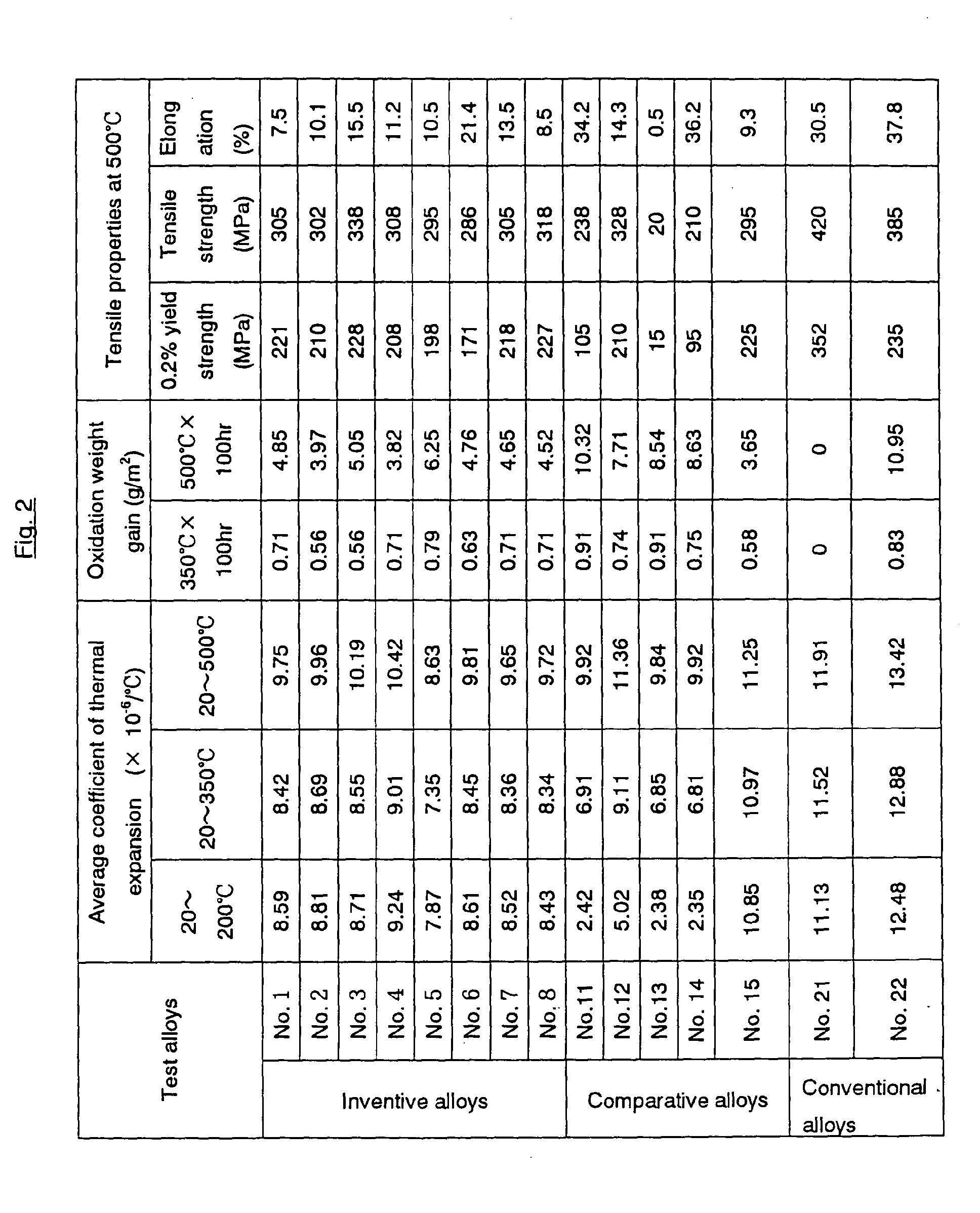
- inventive alloy cast steels Nos. 1-8 each of inventive alloy cast steels Nos. 1-8, comparative alloy cast steels Nos. 11-15, and conventional alloy cast steels Nos. 21 and 22 was melted in a weight of 10 kg. The resulting melt was poured into a sand mold measuring about 100 mm x 100 mm x 100 mm, and solidified by cooling in the mold. Their chemical compositions are shown in Table 1.
- the prepared comparative alloy cast steel No. 11 is an alloy having a lower Ni content and no Cr addition, as compared with the inventive alloy cast steels.
- No. 12 has a lower Ni content as compared with the inventive alloy cast steels.
- No. 14 has no Cr addition as compared with the inventive alloy cast steels.
- No. 15 has a higher Ni content as compared with the inventive alloy cast steels.
- No. 13 has lower Al and Mg contents as compared with the inventive alloy cast steels.
- Conventional alloy cast steel No. 21 corresponds to SCS1 and No. 22 corresponds to SCPH21.
- Specimen materials were obtained from the prepared alloy cast steels.
- each specimen material was heat-treated by holding it at 700°C for 3 hours and then air-cooling it.
- conventional alloy cast steel No. 21 corresponding to SCS1 the specimen material was quenched by holding it at 980°C for 1 hour and then oil-cooling it, and subsequently tempered by holding it at 700°C for 2 hours and then air-cooling it.
- alloy cast steel No. 22 corresponding to SCPH21 the specimen material was quenched by holding it at 950°C for 1 hour and then oil-cooling it, and subsequently tempered by holding it at 700°C for 2 hours and then air-cooling it.
- an average coefficient of thermal expansion For the measurement of an average coefficient of thermal expansion, a specimen having a diameter of 5 mm and a length of 20 mm was measured with a differential thermal dilatometer. Thus, the average coefficients of thermal expansion in several temperature ranges extending from 20°C to the indicated temperature were determined.
- a tension test at 500°C was carried out by preparing a specimen having a parallel-portion length of 25.4 mm and a parallel-portion diameter of 6.35 mm according to an ASTM standard.
- An oxidation resistance test was carried out by heating a specimen having a diameter of 10 mm and a length of 15 mm in air at 350°C or 500°C for 100 hours, and determining a weight change per unit surface area (i.e., an oxidation weight gain) from the difference in the weight of the specimen before and after the test.
- a weight change per unit surface area i.e., an oxidation weight gain
- conventional alloys No. 21 (corresponding to SCS1) and No. 22 (corresponding to SCPH21) show a high value of 11.9 x 10 -6 /°C and 13.6 x 10 -6 /°C, respectively.
- inventive alloy cast steels exhibit low thermal expansion up to 500°C and has an excellent strength in a temperature region of the order of 500°C, they are most suitable for the formation of ring-shaped components for use as blade rings and seal ring retainers of gas turbines.
- the alloys of the present invention can combine desirable properties including an excellent high-temperature strength at 500°C and low thermal expansion in a temperature range of 20°C to 500°C, and are hence most suitable for the formation of ring-shaped components for use as blade rings and seal ring retainers of gas turbines.
Landscapes
- Chemical & Material Sciences (AREA)
- Engineering & Computer Science (AREA)
- Materials Engineering (AREA)
- Mechanical Engineering (AREA)
- Metallurgy (AREA)
- Organic Chemistry (AREA)
- Physics & Mathematics (AREA)
- Thermal Sciences (AREA)
- Crystallography & Structural Chemistry (AREA)
- Gasket Seals (AREA)
- Turbine Rotor Nozzle Sealing (AREA)
- Heat Treatment Of Articles (AREA)
Abstract
Description
P: ≤ 0.01%
Ca: ≤ 0.02%
Mo: ≤ 1.0%
W: ≤ 1.0%
Cu: ≤ 1.0%

Claims (6)
- A high-strength and low-thermal expansion cast steel comprising, on a mass percentage basis, 0.1 to 0.8% of C, 0.1 to 1.0% of Si, 0.1 to 1.0% of Mn, 0.01 to 0.1% of S, greater than 40% and up to 50% of Ni, not greater than 4% (inclusive of 0%) of Co, greater than 1.5% and up to 4% of Cr, 0.01 to 0.1% of Al, and 0.001 to 0.1% of Mg, the remainder being substantially Fe.
- A high-strength and low-thermal expansion cast steel as claimed in claim 1 wherein its average coefficient of thermal expansion in a temperature range of 20°C to 500°C is not greater than 10.5 x 10⁻⁶/°C.
- A high-strength and low-thermal expansion cast steel as claimed in claim 1 wherein its 0.2% yield strength at 500°C is not less than 120 MPa.
- A high-strength and low-thermal expansion cast steel as claimed in claim 1 wherein its oxidation weight gain after heating at 500°C for 100 hours is not greater than 10 g/m2.
- A ring-shaped component for use as a blade ring of a gas turbine, the component being formed of a high-strength and low-thermal expansion cast steel as claimed in claim 1.
- A ring-shaped component for use as a seal ring retainer of a gas turbine, the component being formed of a high-strength and low-thermal expansion cast steel as claimed in claim 1.
Applications Claiming Priority (1)
| Application Number | Priority Date | Filing Date | Title |
|---|---|---|---|
| PCT/JP2002/006883 WO2004005565A1 (en) | 2001-01-05 | 2002-07-08 | Casting steel having high strength and low thermal expansion |
Publications (3)
| Publication Number | Publication Date |
|---|---|
| EP1589123A1 true EP1589123A1 (en) | 2005-10-26 |
| EP1589123A4 EP1589123A4 (en) | 2005-11-30 |
| EP1589123B1 EP1589123B1 (en) | 2006-09-20 |
Family
ID=32448959
Family Applications (1)
| Application Number | Title | Priority Date | Filing Date |
|---|---|---|---|
| EP02741429A Expired - Lifetime EP1589123B1 (en) | 2002-07-08 | 2002-07-08 | Casting steel having high strength and low thermal expansion |
Country Status (4)
| Country | Link |
|---|---|
| EP (1) | EP1589123B1 (en) |
| CA (1) | CA2458508C (en) |
| DE (1) | DE60214909T2 (en) |
| WO (1) | WO2004005565A1 (en) |
Families Citing this family (2)
| Publication number | Priority date | Publication date | Assignee | Title |
|---|---|---|---|---|
| DE102007025758A1 (en) * | 2007-06-01 | 2008-12-04 | Mahle International Gmbh | seal |
| RU2755784C1 (en) * | 2020-12-02 | 2021-09-21 | Общество с ограниченной ответственностью Научно-производственный центр «ЛИНВАР» | Foundry invar alloy based on iron |
Family Cites Families (8)
| Publication number | Priority date | Publication date | Assignee | Title |
|---|---|---|---|---|
| JPH0692722B2 (en) * | 1985-09-18 | 1994-11-16 | 京セラ株式会社 | Ceramic rotor |
| JP2594441B2 (en) * | 1987-07-16 | 1997-03-26 | 日本鋳造株式会社 | Method for producing free-cutting high-temperature low-thermal-expansion cast alloy |
| JP2968430B2 (en) * | 1994-02-17 | 1999-10-25 | 山陽特殊製鋼株式会社 | High strength low thermal expansion alloy |
| JPH08100242A (en) * | 1994-09-30 | 1996-04-16 | Hitachi Metals Ltd | Alloy wire with high strength, high toughness and low thermal expansion and its production |
| TW389794B (en) * | 1995-01-23 | 2000-05-11 | Daido Steel Co Ltd | High strength, low thermal expansion alloy wire and method of making the wire |
| US6142731A (en) * | 1997-07-21 | 2000-11-07 | Caterpillar Inc. | Low thermal expansion seal ring support |
| JP3381845B2 (en) * | 1999-07-08 | 2003-03-04 | 日立金属株式会社 | Low thermal expansion cast steel with excellent machinability |
| JP4768919B2 (en) * | 2001-01-05 | 2011-09-07 | 日立金属株式会社 | Ring shape parts for gas turbine blade rings and seal ring retaining rings made of high strength low thermal expansion cast steel and high strength low thermal expansion cast steel |
-
2002
- 2002-07-08 EP EP02741429A patent/EP1589123B1/en not_active Expired - Lifetime
- 2002-07-08 WO PCT/JP2002/006883 patent/WO2004005565A1/en not_active Ceased
- 2002-07-08 CA CA002458508A patent/CA2458508C/en not_active Expired - Fee Related
- 2002-07-08 DE DE60214909T patent/DE60214909T2/en not_active Expired - Lifetime
Also Published As
| Publication number | Publication date |
|---|---|
| DE60214909D1 (en) | 2006-11-02 |
| EP1589123B1 (en) | 2006-09-20 |
| CA2458508C (en) | 2007-09-18 |
| WO2004005565A1 (en) | 2004-01-15 |
| CA2458508A1 (en) | 2004-01-15 |
| DE60214909T2 (en) | 2007-09-06 |
| EP1589123A4 (en) | 2005-11-30 |
Similar Documents
| Publication | Publication Date | Title |
|---|---|---|
| US5298093A (en) | Duplex stainless steel having improved strength and corrosion resistance | |
| US20020110476A1 (en) | Heat and corrosion resistant cast stainless steels with improved high temperature strength and ductility | |
| EP0384433B1 (en) | Ferritic heat resisting steel having superior high-temperature strength | |
| EP0828010B1 (en) | High strength and high-toughness heat-resistant cast steel | |
| JP4825886B2 (en) | Ferritic spheroidal graphite cast iron | |
| US6846368B2 (en) | Casting steel having high strength and low thermal expansion | |
| JP2000273570A (en) | Cast steel for pressure vessel and production of pressure vessel using the same | |
| KR100435324B1 (en) | Cast iron with improved oxidation resistance at high temperature | |
| EP1589123B1 (en) | Casting steel having high strength and low thermal expansion | |
| JP2776103B2 (en) | Ni-W alloy with excellent corrosion resistance and wear resistance | |
| JPH06287667A (en) | Heat resistant cast co-base alloy | |
| KR102758321B1 (en) | Heat resistant alloy material and elastic member processed and shaped from the material | |
| JPH1096038A (en) | High Cr austenitic heat-resistant alloy | |
| JPH07300643A (en) | Heat resistant cast Co base alloy | |
| JP3375001B2 (en) | Austenitic heat-resistant cast steel with excellent castability and machinability and exhaust system parts made of it | |
| US3740212A (en) | Oxidation resistant austenitic ductile nickel chromium iron | |
| JPH06228713A (en) | Austenitic heat resistant cast steel excellent in strength at high temperature and machinability and exhaust system parts using same | |
| CN115354224A (en) | Material and preparation method of high-toughness, high-strength, low-temperature resistant low-alloy steel | |
| JPH1036944A (en) | Martensitic heat resistant steel | |
| WO2008111717A1 (en) | Fe based alloy having corrosion resistance and abrasion resistance and preparation method thereof | |
| CN112391585A (en) | Aluminum-iron alloy with at least two phases | |
| JPH06228712A (en) | Austenitic heat resistant cast steel excellent in strength at high temperature and machinability and exhaust system parts using same | |
| JPS59159976A (en) | Heat-resistant alloy for metallic mold for molding | |
| JP2721723B2 (en) | Heat-resistant cast alloy for gas turbine blades | |
| JP2025153642A (en) | High Ni alloy steel |
Legal Events
| Date | Code | Title | Description |
|---|---|---|---|
| PUAI | Public reference made under article 153(3) epc to a published international application that has entered the european phase |
Free format text: ORIGINAL CODE: 0009012 |
|
| 17P | Request for examination filed |
Effective date: 20030711 |
|
| AK | Designated contracting states |
Kind code of ref document: A1 Designated state(s): CH DE FR GB LI |
|
| A4 | Supplementary search report drawn up and despatched |
Effective date: 20051018 |
|
| RIC1 | Information provided on ipc code assigned before grant |
Ipc: 7C 22C 38/52 B Ipc: 7C 22C 38/00 B Ipc: 7C 22C 30/00 A Ipc: 7C 22C 38/60 B Ipc: 7C 22C 38/40 B |
|
| GRAP | Despatch of communication of intention to grant a patent |
Free format text: ORIGINAL CODE: EPIDOSNIGR1 |
|
| GRAS | Grant fee paid |
Free format text: ORIGINAL CODE: EPIDOSNIGR3 |
|
| GRAA | (expected) grant |
Free format text: ORIGINAL CODE: 0009210 |
|
| AK | Designated contracting states |
Kind code of ref document: B1 Designated state(s): CH DE FR GB LI |
|
| PG25 | Lapsed in a contracting state [announced via postgrant information from national office to epo] |
Ref country code: CH Free format text: LAPSE BECAUSE OF FAILURE TO SUBMIT A TRANSLATION OF THE DESCRIPTION OR TO PAY THE FEE WITHIN THE PRESCRIBED TIME-LIMIT Effective date: 20060920 Ref country code: LI Free format text: LAPSE BECAUSE OF FAILURE TO SUBMIT A TRANSLATION OF THE DESCRIPTION OR TO PAY THE FEE WITHIN THE PRESCRIBED TIME-LIMIT Effective date: 20060920 |
|
| REG | Reference to a national code |
Ref country code: GB Ref legal event code: FG4D |
|
| REG | Reference to a national code |
Ref country code: CH Ref legal event code: EP |
|
| REF | Corresponds to: |
Ref document number: 60214909 Country of ref document: DE Date of ref document: 20061102 Kind code of ref document: P |
|
| REG | Reference to a national code |
Ref country code: CH Ref legal event code: PL |
|
| ET | Fr: translation filed | ||
| PLBE | No opposition filed within time limit |
Free format text: ORIGINAL CODE: 0009261 |
|
| STAA | Information on the status of an ep patent application or granted ep patent |
Free format text: STATUS: NO OPPOSITION FILED WITHIN TIME LIMIT |
|
| 26N | No opposition filed |
Effective date: 20070621 |
|
| GBPC | Gb: european patent ceased through non-payment of renewal fee |
Effective date: 20070708 |
|
| PG25 | Lapsed in a contracting state [announced via postgrant information from national office to epo] |
Ref country code: GB Free format text: LAPSE BECAUSE OF NON-PAYMENT OF DUE FEES Effective date: 20070708 |
|
| REG | Reference to a national code |
Ref country code: DE Ref legal event code: R082 Ref document number: 60214909 Country of ref document: DE Representative=s name: PATENTANWAELTE HENKEL, BREUER & PARTNER, DE Ref country code: DE Ref legal event code: R081 Ref document number: 60214909 Country of ref document: DE Owner name: MITSUBISHI HITACHI POWER SYSTEMS, LTD., YOKOHA, JP Free format text: FORMER OWNERS: HITACHI METALS, LTD., TOKIO/TOKYO, JP; MITSUBISHI HEAVY INDUSTRIES, LTD., TOKYO, JP Ref country code: DE Ref legal event code: R081 Ref document number: 60214909 Country of ref document: DE Owner name: HITACHI METALS, LTD., JP Free format text: FORMER OWNERS: HITACHI METALS, LTD., TOKIO/TOKYO, JP; MITSUBISHI HEAVY INDUSTRIES, LTD., TOKYO, JP Ref country code: DE Ref legal event code: R082 Ref document number: 60214909 Country of ref document: DE Representative=s name: PATENTANWAELTE HENKEL, BREUER & PARTNER MBB, DE |
|
| REG | Reference to a national code |
Ref country code: FR Ref legal event code: PLFP Year of fee payment: 15 |
|
| REG | Reference to a national code |
Ref country code: FR Ref legal event code: TQ Owner name: HITACHI METALS, LTD. Effective date: 20170106 Ref country code: FR Ref legal event code: TQ Owner name: MITSUBISHI HITACHI POWER SYSTEMS, LTD., JP Effective date: 20170106 |
|
| REG | Reference to a national code |
Ref country code: FR Ref legal event code: PLFP Year of fee payment: 16 |
|
| REG | Reference to a national code |
Ref country code: FR Ref legal event code: PLFP Year of fee payment: 17 |
|
| PGFP | Annual fee paid to national office [announced via postgrant information from national office to epo] |
Ref country code: FR Payment date: 20190619 Year of fee payment: 18 |
|
| PG25 | Lapsed in a contracting state [announced via postgrant information from national office to epo] |
Ref country code: FR Free format text: LAPSE BECAUSE OF NON-PAYMENT OF DUE FEES Effective date: 20200731 |
|
| REG | Reference to a national code |
Ref country code: DE Ref legal event code: R081 Ref document number: 60214909 Country of ref document: DE Owner name: MITSUBISHI POWER, LTD., JP Free format text: FORMER OWNERS: HITACHI METALS, LTD., TOKIO/TOKYO, JP; MITSUBISHI HITACHI POWER SYSTEMS, LTD., YOKOHAMA, KANAGAWA, JP |
|
| PGFP | Annual fee paid to national office [announced via postgrant information from national office to epo] |
Ref country code: DE Payment date: 20210608 Year of fee payment: 20 |
|
| REG | Reference to a national code |
Ref country code: DE Ref legal event code: R071 Ref document number: 60214909 Country of ref document: DE |