EP1588916A1 - Dispositif et procédé de montage d'un soufflet sur un servomoteur pneumatique d'assistance de freinage pour véhicule automobile - Google Patents
Dispositif et procédé de montage d'un soufflet sur un servomoteur pneumatique d'assistance de freinage pour véhicule automobile Download PDFInfo
- Publication number
- EP1588916A1 EP1588916A1 EP05007171A EP05007171A EP1588916A1 EP 1588916 A1 EP1588916 A1 EP 1588916A1 EP 05007171 A EP05007171 A EP 05007171A EP 05007171 A EP05007171 A EP 05007171A EP 1588916 A1 EP1588916 A1 EP 1588916A1
- Authority
- EP
- European Patent Office
- Prior art keywords
- bellows
- servomotor
- cone
- chimney
- rear end
- Prior art date
- Legal status (The legal status is an assumption and is not a legal conclusion. Google has not performed a legal analysis and makes no representation as to the accuracy of the status listed.)
- Granted
Links
- 238000000034 method Methods 0.000 title claims abstract description 6
- 238000003780 insertion Methods 0.000 claims description 7
- 230000037431 insertion Effects 0.000 claims description 7
- 230000006835 compression Effects 0.000 claims description 2
- 238000007906 compression Methods 0.000 claims description 2
- 238000007789 sealing Methods 0.000 description 5
- 238000005192 partition Methods 0.000 description 4
- 239000006096 absorbing agent Substances 0.000 description 1
- 230000000295 complement effect Effects 0.000 description 1
- 230000003247 decreasing effect Effects 0.000 description 1
- 239000000428 dust Substances 0.000 description 1
- 230000000694 effects Effects 0.000 description 1
- 239000013013 elastic material Substances 0.000 description 1
- 238000001914 filtration Methods 0.000 description 1
- 239000012530 fluid Substances 0.000 description 1
- 239000007788 liquid Substances 0.000 description 1
- 239000000463 material Substances 0.000 description 1
- 239000012528 membrane Substances 0.000 description 1
- 239000002184 metal Substances 0.000 description 1
- 239000003380 propellant Substances 0.000 description 1
- 239000004576 sand Substances 0.000 description 1
Images

Classifications
-
- B—PERFORMING OPERATIONS; TRANSPORTING
- B60—VEHICLES IN GENERAL
- B60T—VEHICLE BRAKE CONTROL SYSTEMS OR PARTS THEREOF; BRAKE CONTROL SYSTEMS OR PARTS THEREOF, IN GENERAL; ARRANGEMENT OF BRAKING ELEMENTS ON VEHICLES IN GENERAL; PORTABLE DEVICES FOR PREVENTING UNWANTED MOVEMENT OF VEHICLES; VEHICLE MODIFICATIONS TO FACILITATE COOLING OF BRAKES
- B60T13/00—Transmitting braking action from initiating means to ultimate brake actuator with power assistance or drive; Brake systems incorporating such transmitting means, e.g. air-pressure brake systems
- B60T13/10—Transmitting braking action from initiating means to ultimate brake actuator with power assistance or drive; Brake systems incorporating such transmitting means, e.g. air-pressure brake systems with fluid assistance, drive, or release
- B60T13/24—Transmitting braking action from initiating means to ultimate brake actuator with power assistance or drive; Brake systems incorporating such transmitting means, e.g. air-pressure brake systems with fluid assistance, drive, or release the fluid being gaseous
- B60T13/46—Vacuum systems
- B60T13/52—Vacuum systems indirect, i.e. vacuum booster units
Definitions
- the subject of the invention is a pneumatic servomotor for assisting braking for a motor vehicle. More particularly, the invention object a bellows mounted on a rear end of the servomotor. The invention particularly relates to a noise filter mounted at the location of this bellows. Another subject of the invention is a device for mounting a bellows on the rear end of the servomotor. The subject of the invention is also a process mounting the bellows on the rear end of the servomotor using the device of the invention.
- the invention aims to reduce noise emanating from the booster during a braking, the noises being in particular due to air aspirations to the location of said servomotor.
- the invention also aims to facilitate a mounting a bellows on a servomotor.
- An additional goal of the invention is to increase a lifetime of the noise filter, particularly in protecting the filter from dirt that could get into the servomotor.
- a pneumatic brake booster generally a housing with a sheet metal wall, containing a chamber variable volume front, separate from a rear chamber, also variable volume by a partition formed by a waterproof membrane and flexible and a rigid skirt plate.
- the rigid skirt drives a piston tire bearing, via a push rod, on a primary piston of a master cylinder of a hydraulic braking circuit.
- the front chamber placed on the side of the master cylinder, is connected pneumatically to a vacuum source.
- the back bedroom opposite the front chamber and placed on the side of a brake control, is connected pneumatically, in a controlled manner by a valve, to a source of propellant fluid.
- the front and rear chambers are connected between they, while the rear chamber is insulated from the pressure atmospheric.
- When braking first isolate the front chamber by relative to the rear chamber, then air is admitted into the rear chamber.
- This air intake has the effect of propelling the partition.
- the skirt rigid then drives the pneumatic piston, which itself drives the piston primary of the master cylinder via the push rod.
- the driver actuates the servomotor via a rod mounted in a hub mounted slidably at the location of the the rear end of the servomotor.
- hub we mean a piece cylindrical mechanics, mounted in another larger room, in the occurrence the rear end of the servomotor, and mounted coaxially on an axis, in this case the control rod.
- the rear end of the Servomotor is formed by a cylindrical chimney.
- the control rod is for example actuated by the driver via a pedal of brake. The control rod is then pushed inside the servomotor, in the direction of the front chamber of the servomotor.
- the actuator chimney is opening outwards, way to accommodate the hub. Also, it is known to have a bellows, the rear end of the servomotor, in order to protect the interior of the housing of the dirt servomotor. A first end of the bellows is mounted on the control rod, while a second end is climb on the chimney. When the control rod slides in the hub, the bellows accompanies said rod.
- the filter is arranged inside the bellows.
- Inside bellows means internal volume delimited by a bellows wall.
- the bellows is generally made of flexible elastic material, such as rubber. The bellows is therefore impervious to pollution, unlike the filter in which pollution can interfere.
- an annular filter mounted in the bellows at a front end of said bellows.
- the filter thus arranged, is less subject to pollution, since it is protected by the bellows made of rubber.
- a connection between the control rod and one end back of the bellows is airtight, prohibiting any air passages or dirt.
- An air inlet is provided at the point of connection between the front end of the bellows and the rear end of the servomotor: The entrance of air at the point of contact between the bellows and the rear end of the servomotor is equivalent to the existing frontal air intake in the state of the technical.
- the invention proposes a mounting device for facilitating said mounting and decreasing a assembly time.
- the device is provided with three distinct parts.
- a first part, or hood, is mounted on the rear end of the rod control.
- the end The rear of the hood is shaped so that it can easily penetrate inside a second part of this mounting device.
- the second part of the mounting device is an expandable clip.
- the hood must be able to penetrate the clamp by the narrowest end of the clamp, by spreading the walls of said clamp.
- the clamp is housed at inside a third part of the device.
- the third part of the device also comprises a housing in which the bellows is mounted. A rear end of the bellows is fixed on the narrower end of the clamp. A front end of said bellows, opens outward from the third part.
- Such a mounting device ensures a good positioning bellows on the servomotor.
- the extensible clip allows to center the third part'of the device in relation to the servomotor, and the third part allows, it, the centering of the bellows.
- the mounting of the front and rear ends of the bellows on the servomotor is simultaneous. Such a device makes it possible to optimize a time of mounting the bellows on the servomotor.
- the present invention mainly relates to a bellows intended for be mounted on a front end of a chimney of a servomotor pneumatic brake assist device for a motor vehicle, characterized in that it comprises an annular noise filter arranged inside the bellows at a front end of said bellows.
- the invention also relates to a bellows, characterized in that an inner wall of said bellows comprises a labyrinth.
- the present invention also relates to a servomotor, characterized in that it comprises a sealing ring arranged between a inner wall of the chimney and an outer wall of the hub, the end before the bellows being fixed on the ring.
- the present invention also relates to a servomotor, characterized in that the front end of the bellows is snapped onto the Ring.
- the present invention also relates to a servomotor, characterized in that it comprises an air inlet arranged at the location of the front end of the bellows.
- the present invention also relates to a device, characterized in that the flexible clamp initially has a conical shape, one end conical being integral with the bellows, the conical end being able to move away at the passage of the introduction cone.
- the present invention also relates to a device, characterized in that a contour of the front end of the bellows follows a front end bellows support.
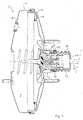
- FIG. 1 shows a servomotor 1.
- a servomotor comprises a rigid casing 2 forming a housing 7.
- a rear end housing 7 forms a cylindrical chimney 3.
- a movable partition 4 delimits a rear chamber 5 and a front chamber 6 inside the housing 7.
- the Rear rooms 5 and 6 before have variable and complementary volumes.
- the movable partition 4 is secured to a cylindrical hub 8 slidably mounted to inside the chimney 3.
- a sealing ring 9 is mounted between a outer wall 10 of the hub 8 and an inner wall 11 of the chimney 3, so to guarantee a seal between the hub 8 and the chimney 3.
- a rod of control 12 is movably mounted inside the hub 8.
- a rear end 14 of the bellows 13 is secured to the rod of 12.
- a front end 15 of the bellows 13 is integral with the 9.
- a shape of the front end 15 of the bellows 13 is as it can snap on a protuberance of the sealing ring 9.
- An annular filter 16 is mounted inside the bellows, at the location of its front end. Also, when the bellows is mounted on the servomotor 1, the filter 16 is protected by the bellows 13.
- FIG. 2 an enlargement of FIG. the location of the bellows 13.
- An air inlet A is provided at the location of the the front end 15 of the bellows 13.
- the connection between the bellows 13 and the sealing ring 9 is flexible, to allow a passage of air from the outside of the servomotor inwards.
- the bellows 13 is moreover provided with a labyrinth 17.
- Labyrinth 17 means a series of fins or grooves formed on an inner wall 18 of the bellows 13.
- wall internal 18 bellows 13 means wall directed towards the hub 8.
- the labyrinth 17 makes it possible to increase a filtering of dirt.
- dirt has penetrated inside the bellows 13, they are trapped in the labyrinth 17. The risk of dirt getting into the servomotor 1.
- the bellows 13 of the invention can be mounted easily on a servomotor 1 by means of a mounting device 100 of the invention.
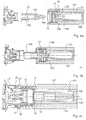
- an extensible clamp 101 is shown belonging to the device 100, in two different configurations.
- the clamp 101 is in a rest position.
- rest position we means a position in which a front end 102 of the clamp 101 has a diameter strictly less than a rear end 103 of the clamp 101.
- the clamp 101 is in the separated position, that is to say that the front end 102 has a diameter equivalent to the diameter of the end
- the gripper 101 is thus an extensible flexible gripper. Flexibility of the clamp 101 makes it possible to penetrate inside said clamp 101 a piece having a diameter greater than the rest diameter of the front end 102.
- FIGS. 4a, 4b and 4c three steps of a method of mounting the bellows 13 on a servomotor 1 using the device 100 of the invention.
- An introduction cone 104 of the mounting device 100 is mounted on the control rod 12 of the booster.
- the introductory cone 104 has a housing 105, at a forward end, for receive the control rod 12.
- a rear end 106 of the cone introduction 104 has a generally conical shape.
- a bellows support 107 of the mounting device 100 is provided with the place of a front end, a first housing 108 in which is mounted the bellows 13.
- the front end 15 of the bellows 13 opens to outside the housing 108.
- the rear end 14 of the bellows 13 is secured of the front end 102 of the clamp 101.
- the clamp 101 is itself housed at inside a second housing 109 formed in a rear portion of the support 107.
- the rear end 14 of the bellows 13 is provided with an orifice 20 allowing the control rod to pass through.
- the most extreme end narrow 102 of the clamp 101 is integral with the rear end 14 of the bellows 13 through the orifice 20.
- the introduction cone 104 of the device 100 passes through the bellows 13 from one side to the other, so that the conical end 106 of the introduction cone 104 is introduced into the extensible gripper 101.
- the cone of introduction 106 is able to spread the walls of the clamp 101 at the location of the front end 102.
- the insertion cone 104 is still introduced into the interior of clamp 101 until, as shown in FIG. 4c, the conical end 106 of the introduction cone abuts against a internal wall 110 of the rear end 103 of the clamp 101.
- the bellows is brought to the chimney 3.
- the rear end 14 of the bellows 13 is brought to the control rod 12.
- the protuberance 19 extends radially projecting on the control rod. Once the protuberance 19 has passed through the orifice 20 of the front end 14 of the bellows 13, front end 14 can no longer slide along the control rod 12.
- the front end 15 of the bellows 13 is snapped onto the ring 9.
- a front end 111 of the bellows support 107 is chamfered, so as to follow an outer contour of the end before the bellows 13.
- the front end 111 of the bellows support 107 is able to compress the front end 15 of the bellows 13 against the ring 9, so as to engage the bellows 13 on the ring 9.
Landscapes
- Engineering & Computer Science (AREA)
- Transportation (AREA)
- Mechanical Engineering (AREA)
- Braking Systems And Boosters (AREA)
- Diaphragms And Bellows (AREA)
- Sealing Devices (AREA)
Abstract
Description
- un boítier de servomoteur, une extrémité arrière du boítier étant munie d'une cheminée cylindrique,
- un moyeu cylindrique monté coulissant dans la cheminée,
- une tige de commande montée mobile dans le moyeu,
- un soufflet, solidaire par une extrémité avant de la cheminée cylindrique, et par une extrémité arrière à la tige de commande,
- un filtre antibruit,
- une pince extensible, dont une première extrémité est solidaire d'une extrémité arrière du soufflet,
- un support du soufflet, muni d'un premier logement dans lequel est logé le soufflet, et d'un second dans lequel est logée la pince extensible,
- un cône d'introduction destiné à être monté sur une extrémité arrière libre de la tige de commande, une extrémité conique du cône d'introduction étant apte à traverser le soufflet depuis son extrémité avant jusqu'à son extrémité arrière.
- introduire le cône d'introduction sur l'extrémité libre de la tige de commande,
- amener le support de soufflet muni du soufflet et de la pince flexible jusqu'au cône d'introduction, de manière à introduire le cône d'introduction dans le support de soufflet, jusqu'à la pince flexible et à loger la cheminée dans le soufflet,
- encliqueter l'extrémité avant du soufflet sur l'extrémité arrière de la cheminée par compression de l'extrémité avant du support de soufflet sur le servomoteur,
- retirer le support de soufflet, la pince flexible et le cône d'introduction en maintenant l'extrémité avant du soufflet sur la cheminée.
- Figure 1 : Une représentation d'un servomoteur muni d'un soufflet et d'un filtre de l'invention ;
- Figure 2 : Une représentation du servomoteur de l'invention, à l'endroit d'une extrémité arrière ;
- Figures 3 (a et b) : Une représentation d'une pièce appartenant à un dispositif de montage d'un soufflet de l'invention ;
- Figures 4 (a, b, c) : Une représentation de trois étapes de montage d'un soufflet sur un servomoteur au moyen d'un dispositif de montage de l'invention.
Claims (4)
- Dispositif (100) de montage d'un soufflet sur une cheminée (3) cylindrique d'un servomoteur (1) dans laquelle est logée un moyeu (8) cylindrique et une tige (12) de commande, caractérisé en ce qu'il comporteune pince (10) extensible, dont une première extrémité (102) est solidaire d'une extrémité arrière (14) du soufflet,un support (107) du soufflet, muni d'un premier logement (108) dans lequel est logé le soufflet, et d'un second logement (109) dans lequel est logé la pince extensible,un cône d'introduction (104) destiné à être monté sur une extrémité libre de la tige de commande, une extrémité conique (106) du cône d'introduction étant apte à traverser le soufflet depuis son extrémité avant (15) jusqu'à son extrémité arrière.
- Dispositif selon la revendication 1, caractérisé en ce que la pince flexible a initialement une forme conique, une extrémité conique étant solidaire du soufflet, l'extrémité conique étant apte à s'écarter au passage du cône d'introduction.
- Dispositif selon l'une des revendications 1 ou 2, caractérisé en ce qu'un contour de l'extrémité avant du soufflet suit une extrémité avant (111) du support de soufflet.
- Procédé de montage d'un soufflet sur la cheminée du servomoteur au moyen du dispositif selon l'une des revendications 1 à 3, caractérisé en ce qu'il comprend les étapes suivantes consistant à :introduire le cône d'introduction (104) sur l'extrémité libre de la tige (12) de commande,amener le support (107) de soufflet muni du soufflet (13) et de la pince (101) flexible jusqu'au cône d'introduction, de manière à introduire le cône d'introduction dans le support de soufflet, jusqu'à la pince flexible et à loger la cheminée (3) dans le soufflet,encliqueter l'extrémité avant (15) du soufflet sur l'extrémité arrière de la cheminée par compression de l'extrémité avant du support de soufflet sur le servomoteur,retirer le support de soufflet, la pince flexible et le cône d'introduction en maintenant l'extrémité avant du soufflet sur la cheminée.
Applications Claiming Priority (2)
| Application Number | Priority Date | Filing Date | Title |
|---|---|---|---|
| FR0404243A FR2869380B1 (fr) | 2004-04-21 | 2004-04-21 | Servomoteur pneumatique d'assistance de freinage pour vehicule automobile, dispositiif et procede de montage d'un soufflet sur un servomoteur |
| FR0404243 | 2004-04-21 |
Publications (2)
| Publication Number | Publication Date |
|---|---|
| EP1588916A1 true EP1588916A1 (fr) | 2005-10-26 |
| EP1588916B1 EP1588916B1 (fr) | 2007-07-18 |
Family
ID=34934680
Family Applications (1)
| Application Number | Title | Priority Date | Filing Date |
|---|---|---|---|
| EP05007171A Expired - Lifetime EP1588916B1 (fr) | 2004-04-21 | 2005-04-01 | Dispositif et procédé de montage d'un soufflet sur un servomoteur pneumatique d'assistance de freinage pour véhicule automobile |
Country Status (4)
| Country | Link |
|---|---|
| EP (1) | EP1588916B1 (fr) |
| AT (1) | ATE367296T1 (fr) |
| DE (1) | DE602005001647T2 (fr) |
| FR (1) | FR2869380B1 (fr) |
Cited By (1)
| Publication number | Priority date | Publication date | Assignee | Title |
|---|---|---|---|---|
| CN111819128A (zh) * | 2018-03-07 | 2020-10-23 | 蒂森克虏伯普利斯坦股份公司 | 将套筒安装在转向传动装置上的方法 |
Citations (5)
| Publication number | Priority date | Publication date | Assignee | Title |
|---|---|---|---|---|
| DE3924672A1 (de) * | 1989-07-26 | 1991-01-31 | Teves Gmbh Alfred | Unterdruckkraftverstaerker |
| US5031507A (en) * | 1989-07-19 | 1991-07-16 | Alfred Teves Gmbh | Vacuum brake force booster with booster-side valve air intake |
| DE4027562A1 (de) * | 1990-08-31 | 1992-03-05 | Teves Gmbh Alfred | Unterdruck-bremskraftverstaerker |
| DE10022383A1 (de) * | 2000-05-08 | 2001-11-29 | Guenther Schulz | Vorrichtung zum Aufziehen von Dichtungsringen auf Rohrenden |
| US20030097744A1 (en) * | 2001-11-26 | 2003-05-29 | Douglas Rullmann | Systems and methods for applying ring shaped seal members |
-
2004
- 2004-04-21 FR FR0404243A patent/FR2869380B1/fr not_active Expired - Fee Related
-
2005
- 2005-04-01 EP EP05007171A patent/EP1588916B1/fr not_active Expired - Lifetime
- 2005-04-01 DE DE602005001647T patent/DE602005001647T2/de not_active Expired - Lifetime
- 2005-04-01 AT AT05007171T patent/ATE367296T1/de not_active IP Right Cessation
Patent Citations (5)
| Publication number | Priority date | Publication date | Assignee | Title |
|---|---|---|---|---|
| US5031507A (en) * | 1989-07-19 | 1991-07-16 | Alfred Teves Gmbh | Vacuum brake force booster with booster-side valve air intake |
| DE3924672A1 (de) * | 1989-07-26 | 1991-01-31 | Teves Gmbh Alfred | Unterdruckkraftverstaerker |
| DE4027562A1 (de) * | 1990-08-31 | 1992-03-05 | Teves Gmbh Alfred | Unterdruck-bremskraftverstaerker |
| DE10022383A1 (de) * | 2000-05-08 | 2001-11-29 | Guenther Schulz | Vorrichtung zum Aufziehen von Dichtungsringen auf Rohrenden |
| US20030097744A1 (en) * | 2001-11-26 | 2003-05-29 | Douglas Rullmann | Systems and methods for applying ring shaped seal members |
Cited By (1)
| Publication number | Priority date | Publication date | Assignee | Title |
|---|---|---|---|---|
| CN111819128A (zh) * | 2018-03-07 | 2020-10-23 | 蒂森克虏伯普利斯坦股份公司 | 将套筒安装在转向传动装置上的方法 |
Also Published As
| Publication number | Publication date |
|---|---|
| EP1588916B1 (fr) | 2007-07-18 |
| DE602005001647T2 (de) | 2008-04-10 |
| FR2869380A1 (fr) | 2005-10-28 |
| FR2869380B1 (fr) | 2006-08-11 |
| DE602005001647D1 (de) | 2007-08-30 |
| ATE367296T1 (de) | 2007-08-15 |
Similar Documents
| Publication | Publication Date | Title |
|---|---|---|
| EP0777049B1 (fr) | Dispositif de raccordement de pompe | |
| FR2551009A1 (fr) | Amplificateur de force de freinage a depression | |
| FR2489437A1 (fr) | Amplificateur de force commande mecaniquement, notamment pour installations de freinage hydraulique | |
| FR2511447A1 (fr) | Dispositif d'assistance a depression | |
| EP1588916B1 (fr) | Dispositif et procédé de montage d'un soufflet sur un servomoteur pneumatique d'assistance de freinage pour véhicule automobile | |
| EP0045233B1 (fr) | Maître-cylindre de freinage | |
| FR2935943A1 (fr) | Dispositif de freinage pour vehicule automobile, comportant un amplificateur de freinage comprenant deux chambres soumises a la depression | |
| EP0368691B1 (fr) | Dispositif de commande d'un servomoteur d'assistance, notamment pour système de freinage de véhicule automobile | |
| EP0632771B1 (fr) | Servomoteur pneumatique | |
| EP1346895B1 (fr) | Servomoteur pneumatique comportant des sièges décalés, des clapets d'admission et de rééquilibrage | |
| FR2843351A1 (fr) | Servomoteur d'assistance pneumatique au freinage et systeme comportant un maitre-cylindre solidarise a un tel servomoteur | |
| EP0728088B1 (fr) | Servomoteur pneumatique a fonctionnement silencieux | |
| EP1507692B1 (fr) | Servomoteur comportant un element flottant porteur de sieges de clapet decales | |
| EP0030197A1 (fr) | Générateur de pression hydraulique | |
| FR2706543A1 (fr) | Dispositif de commande pneumatique à charge réduite. | |
| EP0614428B1 (fr) | Servomoteur d'assistance au freinage | |
| EP1597127B1 (fr) | Dispositif de commande de frein | |
| EP1361127A1 (fr) | Servomoteur pneumatique comportant des clapets tubulaires d'admission et de rééquilibrage | |
| FR2765173A1 (fr) | Maitre-cylindre a reaction hydraulique dynamique et a piston flottant | |
| FR2714876A1 (fr) | Servomoteur pneumatique d'assistance au freinage, à fonctionnement silencieux. | |
| FR2776608A1 (fr) | Dispositif d'asservissement, notamment de servofrein | |
| FR2939862A1 (fr) | Dispositif de raccordement etanche d'un embout sur une paroi d'une structure etanche | |
| FR3067424B1 (fr) | Commande pour vehicule automobile equipee d’un systeme d’etancheite comprenant une mise a l’air protegee | |
| FR2926528A1 (fr) | Dispositif de protection etanche d'un equipement loge dans le compartiment moteur d'un vehicule automobile et amplificateur d'effort de freinage muni d'un tel dispositif | |
| EP0368701B2 (fr) | Système de freinage hydraulique assisté, et servomoteur d'assistance et valve de commande adaptes a un tel système |
Legal Events
| Date | Code | Title | Description |
|---|---|---|---|
| PUAI | Public reference made under article 153(3) epc to a published international application that has entered the european phase |
Free format text: ORIGINAL CODE: 0009012 |
|
| AK | Designated contracting states |
Kind code of ref document: A1 Designated state(s): AT BE BG CH CY CZ DE DK EE ES FI FR GB GR HU IE IS IT LI LT LU MC NL PL PT RO SE SI SK TR |
|
| AX | Request for extension of the european patent |
Extension state: AL BA HR LV MK YU |
|
| 17P | Request for examination filed |
Effective date: 20060426 |
|
| AKX | Designation fees paid |
Designated state(s): AT BE BG CH CY CZ DE DK EE ES FI FR GB GR HU IE IS IT LI LT LU MC NL PL PT RO SE SI SK TR |
|
| GRAP | Despatch of communication of intention to grant a patent |
Free format text: ORIGINAL CODE: EPIDOSNIGR1 |
|
| GRAS | Grant fee paid |
Free format text: ORIGINAL CODE: EPIDOSNIGR3 |
|
| GRAA | (expected) grant |
Free format text: ORIGINAL CODE: 0009210 |
|
| AK | Designated contracting states |
Kind code of ref document: B1 Designated state(s): AT BE BG CH CY CZ DE DK EE ES FI FR GB GR HU IE IS IT LI LT LU MC NL PL PT RO SE SI SK TR |
|
| REG | Reference to a national code |
Ref country code: GB Ref legal event code: FG4D Free format text: NOT ENGLISH |
|
| REG | Reference to a national code |
Ref country code: CH Ref legal event code: EP |
|
| REF | Corresponds to: |
Ref document number: 602005001647 Country of ref document: DE Date of ref document: 20070830 Kind code of ref document: P |
|
| GBT | Gb: translation of ep patent filed (gb section 77(6)(a)/1977) |
Effective date: 20070815 |
|
| REG | Reference to a national code |
Ref country code: IE Ref legal event code: FG4D Free format text: LANGUAGE OF EP DOCUMENT: FRENCH |
|
| PG25 | Lapsed in a contracting state [announced via postgrant information from national office to epo] |
Ref country code: ES Free format text: LAPSE BECAUSE OF FAILURE TO SUBMIT A TRANSLATION OF THE DESCRIPTION OR TO PAY THE FEE WITHIN THE PRESCRIBED TIME-LIMIT Effective date: 20071029 Ref country code: PT Free format text: LAPSE BECAUSE OF FAILURE TO SUBMIT A TRANSLATION OF THE DESCRIPTION OR TO PAY THE FEE WITHIN THE PRESCRIBED TIME-LIMIT Effective date: 20071218 Ref country code: NL Free format text: LAPSE BECAUSE OF FAILURE TO SUBMIT A TRANSLATION OF THE DESCRIPTION OR TO PAY THE FEE WITHIN THE PRESCRIBED TIME-LIMIT Effective date: 20070718 Ref country code: BG Free format text: LAPSE BECAUSE OF FAILURE TO SUBMIT A TRANSLATION OF THE DESCRIPTION OR TO PAY THE FEE WITHIN THE PRESCRIBED TIME-LIMIT Effective date: 20071018 Ref country code: FI Free format text: LAPSE BECAUSE OF FAILURE TO SUBMIT A TRANSLATION OF THE DESCRIPTION OR TO PAY THE FEE WITHIN THE PRESCRIBED TIME-LIMIT Effective date: 20070718 Ref country code: IS Free format text: LAPSE BECAUSE OF FAILURE TO SUBMIT A TRANSLATION OF THE DESCRIPTION OR TO PAY THE FEE WITHIN THE PRESCRIBED TIME-LIMIT Effective date: 20071118 Ref country code: LT Free format text: LAPSE BECAUSE OF FAILURE TO SUBMIT A TRANSLATION OF THE DESCRIPTION OR TO PAY THE FEE WITHIN THE PRESCRIBED TIME-LIMIT Effective date: 20070718 |
|
| NLV1 | Nl: lapsed or annulled due to failure to fulfill the requirements of art. 29p and 29m of the patents act | ||
| PG25 | Lapsed in a contracting state [announced via postgrant information from national office to epo] |
Ref country code: AT Free format text: LAPSE BECAUSE OF FAILURE TO SUBMIT A TRANSLATION OF THE DESCRIPTION OR TO PAY THE FEE WITHIN THE PRESCRIBED TIME-LIMIT Effective date: 20070718 Ref country code: PL Free format text: LAPSE BECAUSE OF FAILURE TO SUBMIT A TRANSLATION OF THE DESCRIPTION OR TO PAY THE FEE WITHIN THE PRESCRIBED TIME-LIMIT Effective date: 20070718 |
|
| REG | Reference to a national code |
Ref country code: IE Ref legal event code: FD4D |
|
| PG25 | Lapsed in a contracting state [announced via postgrant information from national office to epo] |
Ref country code: DK Free format text: LAPSE BECAUSE OF FAILURE TO SUBMIT A TRANSLATION OF THE DESCRIPTION OR TO PAY THE FEE WITHIN THE PRESCRIBED TIME-LIMIT Effective date: 20070718 Ref country code: GR Free format text: LAPSE BECAUSE OF FAILURE TO SUBMIT A TRANSLATION OF THE DESCRIPTION OR TO PAY THE FEE WITHIN THE PRESCRIBED TIME-LIMIT Effective date: 20071019 |
|
| PLBE | No opposition filed within time limit |
Free format text: ORIGINAL CODE: 0009261 |
|
| STAA | Information on the status of an ep patent application or granted ep patent |
Free format text: STATUS: NO OPPOSITION FILED WITHIN TIME LIMIT |
|
| PG25 | Lapsed in a contracting state [announced via postgrant information from national office to epo] |
Ref country code: CZ Free format text: LAPSE BECAUSE OF FAILURE TO SUBMIT A TRANSLATION OF THE DESCRIPTION OR TO PAY THE FEE WITHIN THE PRESCRIBED TIME-LIMIT Effective date: 20070718 Ref country code: IE Free format text: LAPSE BECAUSE OF FAILURE TO SUBMIT A TRANSLATION OF THE DESCRIPTION OR TO PAY THE FEE WITHIN THE PRESCRIBED TIME-LIMIT Effective date: 20070718 Ref country code: SK Free format text: LAPSE BECAUSE OF FAILURE TO SUBMIT A TRANSLATION OF THE DESCRIPTION OR TO PAY THE FEE WITHIN THE PRESCRIBED TIME-LIMIT Effective date: 20070718 |
|
| 26N | No opposition filed |
Effective date: 20080421 |
|
| PG25 | Lapsed in a contracting state [announced via postgrant information from national office to epo] |
Ref country code: RO Free format text: LAPSE BECAUSE OF FAILURE TO SUBMIT A TRANSLATION OF THE DESCRIPTION OR TO PAY THE FEE WITHIN THE PRESCRIBED TIME-LIMIT Effective date: 20070718 Ref country code: SE Free format text: LAPSE BECAUSE OF FAILURE TO SUBMIT A TRANSLATION OF THE DESCRIPTION OR TO PAY THE FEE WITHIN THE PRESCRIBED TIME-LIMIT Effective date: 20071018 |
|
| BERE | Be: lapsed |
Owner name: ROBERT BOSCH G.M.B.H. Effective date: 20080430 |
|
| PG25 | Lapsed in a contracting state [announced via postgrant information from national office to epo] |
Ref country code: MC Free format text: LAPSE BECAUSE OF NON-PAYMENT OF DUE FEES Effective date: 20080430 |
|
| PG25 | Lapsed in a contracting state [announced via postgrant information from national office to epo] |
Ref country code: EE Free format text: LAPSE BECAUSE OF FAILURE TO SUBMIT A TRANSLATION OF THE DESCRIPTION OR TO PAY THE FEE WITHIN THE PRESCRIBED TIME-LIMIT Effective date: 20070718 |
|
| PG25 | Lapsed in a contracting state [announced via postgrant information from national office to epo] |
Ref country code: BE Free format text: LAPSE BECAUSE OF NON-PAYMENT OF DUE FEES Effective date: 20080430 |
|
| PG25 | Lapsed in a contracting state [announced via postgrant information from national office to epo] |
Ref country code: SI Free format text: LAPSE BECAUSE OF FAILURE TO SUBMIT A TRANSLATION OF THE DESCRIPTION OR TO PAY THE FEE WITHIN THE PRESCRIBED TIME-LIMIT Effective date: 20070718 |
|
| PG25 | Lapsed in a contracting state [announced via postgrant information from national office to epo] |
Ref country code: CY Free format text: LAPSE BECAUSE OF FAILURE TO SUBMIT A TRANSLATION OF THE DESCRIPTION OR TO PAY THE FEE WITHIN THE PRESCRIBED TIME-LIMIT Effective date: 20070718 |
|
| REG | Reference to a national code |
Ref country code: CH Ref legal event code: PL |
|
| PG25 | Lapsed in a contracting state [announced via postgrant information from national office to epo] |
Ref country code: LI Free format text: LAPSE BECAUSE OF NON-PAYMENT OF DUE FEES Effective date: 20090430 Ref country code: CH Free format text: LAPSE BECAUSE OF NON-PAYMENT OF DUE FEES Effective date: 20090430 |
|
| PG25 | Lapsed in a contracting state [announced via postgrant information from national office to epo] |
Ref country code: HU Free format text: LAPSE BECAUSE OF FAILURE TO SUBMIT A TRANSLATION OF THE DESCRIPTION OR TO PAY THE FEE WITHIN THE PRESCRIBED TIME-LIMIT Effective date: 20080119 Ref country code: LU Free format text: LAPSE BECAUSE OF NON-PAYMENT OF DUE FEES Effective date: 20080401 |
|
| PG25 | Lapsed in a contracting state [announced via postgrant information from national office to epo] |
Ref country code: TR Free format text: LAPSE BECAUSE OF FAILURE TO SUBMIT A TRANSLATION OF THE DESCRIPTION OR TO PAY THE FEE WITHIN THE PRESCRIBED TIME-LIMIT Effective date: 20070718 |
|
| PG25 | Lapsed in a contracting state [announced via postgrant information from national office to epo] |
Ref country code: IT Free format text: LAPSE BECAUSE OF NON-PAYMENT OF DUE FEES Effective date: 20080430 |
|
| PGFP | Annual fee paid to national office [announced via postgrant information from national office to epo] |
Ref country code: FR Payment date: 20140416 Year of fee payment: 10 |
|
| REG | Reference to a national code |
Ref country code: FR Ref legal event code: ST Effective date: 20151231 |
|
| PG25 | Lapsed in a contracting state [announced via postgrant information from national office to epo] |
Ref country code: FR Free format text: LAPSE BECAUSE OF NON-PAYMENT OF DUE FEES Effective date: 20150430 |
|
| PGFP | Annual fee paid to national office [announced via postgrant information from national office to epo] |
Ref country code: GB Payment date: 20160422 Year of fee payment: 12 |
|
| PGFP | Annual fee paid to national office [announced via postgrant information from national office to epo] |
Ref country code: DE Payment date: 20160628 Year of fee payment: 12 |
|
| REG | Reference to a national code |
Ref country code: DE Ref legal event code: R119 Ref document number: 602005001647 Country of ref document: DE |
|
| GBPC | Gb: european patent ceased through non-payment of renewal fee |
Effective date: 20170401 |
|
| PG25 | Lapsed in a contracting state [announced via postgrant information from national office to epo] |
Ref country code: DE Free format text: LAPSE BECAUSE OF NON-PAYMENT OF DUE FEES Effective date: 20171103 |
|
| PG25 | Lapsed in a contracting state [announced via postgrant information from national office to epo] |
Ref country code: GB Free format text: LAPSE BECAUSE OF NON-PAYMENT OF DUE FEES Effective date: 20170401 |