EP1587979B1 - Manufacturing process of a composite nonwoven and installation for carrying out said process - Google Patents
Manufacturing process of a composite nonwoven and installation for carrying out said process Download PDFInfo
- Publication number
- EP1587979B1 EP1587979B1 EP04701612A EP04701612A EP1587979B1 EP 1587979 B1 EP1587979 B1 EP 1587979B1 EP 04701612 A EP04701612 A EP 04701612A EP 04701612 A EP04701612 A EP 04701612A EP 1587979 B1 EP1587979 B1 EP 1587979B1
- Authority
- EP
- European Patent Office
- Prior art keywords
- fibres
- web
- lower web
- composite
- process according
- Prior art date
- Legal status (The legal status is an assumption and is not a legal conclusion. Google has not performed a legal analysis and makes no representation as to the accuracy of the status listed.)
- Expired - Lifetime
Links
Images
Classifications
-
- D—TEXTILES; PAPER
- D04—BRAIDING; LACE-MAKING; KNITTING; TRIMMINGS; NON-WOVEN FABRICS
- D04H—MAKING TEXTILE FABRICS, e.g. FROM FIBRES OR FILAMENTARY MATERIAL; FABRICS MADE BY SUCH PROCESSES OR APPARATUS, e.g. FELTS, NON-WOVEN FABRICS; COTTON-WOOL; WADDING ; NON-WOVEN FABRICS FROM STAPLE FIBRES, FILAMENTS OR YARNS, BONDED WITH AT LEAST ONE WEB-LIKE MATERIAL DURING THEIR CONSOLIDATION
- D04H5/00—Non woven fabrics formed of mixtures of relatively short fibres and yarns or like filamentary material of substantial length
- D04H5/02—Non woven fabrics formed of mixtures of relatively short fibres and yarns or like filamentary material of substantial length strengthened or consolidated by mechanical methods, e.g. needling
- D04H5/03—Non woven fabrics formed of mixtures of relatively short fibres and yarns or like filamentary material of substantial length strengthened or consolidated by mechanical methods, e.g. needling by fluid jet
-
- D—TEXTILES; PAPER
- D04—BRAIDING; LACE-MAKING; KNITTING; TRIMMINGS; NON-WOVEN FABRICS
- D04H—MAKING TEXTILE FABRICS, e.g. FROM FIBRES OR FILAMENTARY MATERIAL; FABRICS MADE BY SUCH PROCESSES OR APPARATUS, e.g. FELTS, NON-WOVEN FABRICS; COTTON-WOOL; WADDING ; NON-WOVEN FABRICS FROM STAPLE FIBRES, FILAMENTS OR YARNS, BONDED WITH AT LEAST ONE WEB-LIKE MATERIAL DURING THEIR CONSOLIDATION
- D04H1/00—Non-woven fabrics formed wholly or mainly of staple fibres or like relatively short fibres
- D04H1/40—Non-woven fabrics formed wholly or mainly of staple fibres or like relatively short fibres from fleeces or layers composed of fibres without existing or potential cohesive properties
- D04H1/42—Non-woven fabrics formed wholly or mainly of staple fibres or like relatively short fibres from fleeces or layers composed of fibres without existing or potential cohesive properties characterised by the use of certain kinds of fibres insofar as this use has no preponderant influence on the consolidation of the fleece
- D04H1/425—Cellulose series
-
- D—TEXTILES; PAPER
- D04—BRAIDING; LACE-MAKING; KNITTING; TRIMMINGS; NON-WOVEN FABRICS
- D04H—MAKING TEXTILE FABRICS, e.g. FROM FIBRES OR FILAMENTARY MATERIAL; FABRICS MADE BY SUCH PROCESSES OR APPARATUS, e.g. FELTS, NON-WOVEN FABRICS; COTTON-WOOL; WADDING ; NON-WOVEN FABRICS FROM STAPLE FIBRES, FILAMENTS OR YARNS, BONDED WITH AT LEAST ONE WEB-LIKE MATERIAL DURING THEIR CONSOLIDATION
- D04H1/00—Non-woven fabrics formed wholly or mainly of staple fibres or like relatively short fibres
- D04H1/40—Non-woven fabrics formed wholly or mainly of staple fibres or like relatively short fibres from fleeces or layers composed of fibres without existing or potential cohesive properties
- D04H1/42—Non-woven fabrics formed wholly or mainly of staple fibres or like relatively short fibres from fleeces or layers composed of fibres without existing or potential cohesive properties characterised by the use of certain kinds of fibres insofar as this use has no preponderant influence on the consolidation of the fleece
- D04H1/4374—Non-woven fabrics formed wholly or mainly of staple fibres or like relatively short fibres from fleeces or layers composed of fibres without existing or potential cohesive properties characterised by the use of certain kinds of fibres insofar as this use has no preponderant influence on the consolidation of the fleece using different kinds of webs, e.g. by layering webs
-
- D—TEXTILES; PAPER
- D04—BRAIDING; LACE-MAKING; KNITTING; TRIMMINGS; NON-WOVEN FABRICS
- D04H—MAKING TEXTILE FABRICS, e.g. FROM FIBRES OR FILAMENTARY MATERIAL; FABRICS MADE BY SUCH PROCESSES OR APPARATUS, e.g. FELTS, NON-WOVEN FABRICS; COTTON-WOOL; WADDING ; NON-WOVEN FABRICS FROM STAPLE FIBRES, FILAMENTS OR YARNS, BONDED WITH AT LEAST ONE WEB-LIKE MATERIAL DURING THEIR CONSOLIDATION
- D04H1/00—Non-woven fabrics formed wholly or mainly of staple fibres or like relatively short fibres
- D04H1/40—Non-woven fabrics formed wholly or mainly of staple fibres or like relatively short fibres from fleeces or layers composed of fibres without existing or potential cohesive properties
- D04H1/44—Non-woven fabrics formed wholly or mainly of staple fibres or like relatively short fibres from fleeces or layers composed of fibres without existing or potential cohesive properties the fleeces or layers being consolidated by mechanical means, e.g. by rolling
- D04H1/46—Non-woven fabrics formed wholly or mainly of staple fibres or like relatively short fibres from fleeces or layers composed of fibres without existing or potential cohesive properties the fleeces or layers being consolidated by mechanical means, e.g. by rolling by needling or like operations to cause entanglement of fibres
- D04H1/492—Non-woven fabrics formed wholly or mainly of staple fibres or like relatively short fibres from fleeces or layers composed of fibres without existing or potential cohesive properties the fleeces or layers being consolidated by mechanical means, e.g. by rolling by needling or like operations to cause entanglement of fibres by fluid jet
-
- D—TEXTILES; PAPER
- D04—BRAIDING; LACE-MAKING; KNITTING; TRIMMINGS; NON-WOVEN FABRICS
- D04H—MAKING TEXTILE FABRICS, e.g. FROM FIBRES OR FILAMENTARY MATERIAL; FABRICS MADE BY SUCH PROCESSES OR APPARATUS, e.g. FELTS, NON-WOVEN FABRICS; COTTON-WOOL; WADDING ; NON-WOVEN FABRICS FROM STAPLE FIBRES, FILAMENTS OR YARNS, BONDED WITH AT LEAST ONE WEB-LIKE MATERIAL DURING THEIR CONSOLIDATION
- D04H1/00—Non-woven fabrics formed wholly or mainly of staple fibres or like relatively short fibres
- D04H1/40—Non-woven fabrics formed wholly or mainly of staple fibres or like relatively short fibres from fleeces or layers composed of fibres without existing or potential cohesive properties
- D04H1/44—Non-woven fabrics formed wholly or mainly of staple fibres or like relatively short fibres from fleeces or layers composed of fibres without existing or potential cohesive properties the fleeces or layers being consolidated by mechanical means, e.g. by rolling
- D04H1/46—Non-woven fabrics formed wholly or mainly of staple fibres or like relatively short fibres from fleeces or layers composed of fibres without existing or potential cohesive properties the fleeces or layers being consolidated by mechanical means, e.g. by rolling by needling or like operations to cause entanglement of fibres
- D04H1/498—Non-woven fabrics formed wholly or mainly of staple fibres or like relatively short fibres from fleeces or layers composed of fibres without existing or potential cohesive properties the fleeces or layers being consolidated by mechanical means, e.g. by rolling by needling or like operations to cause entanglement of fibres entanglement of layered webs
-
- D—TEXTILES; PAPER
- D04—BRAIDING; LACE-MAKING; KNITTING; TRIMMINGS; NON-WOVEN FABRICS
- D04H—MAKING TEXTILE FABRICS, e.g. FROM FIBRES OR FILAMENTARY MATERIAL; FABRICS MADE BY SUCH PROCESSES OR APPARATUS, e.g. FELTS, NON-WOVEN FABRICS; COTTON-WOOL; WADDING ; NON-WOVEN FABRICS FROM STAPLE FIBRES, FILAMENTS OR YARNS, BONDED WITH AT LEAST ONE WEB-LIKE MATERIAL DURING THEIR CONSOLIDATION
- D04H13/00—Other non-woven fabrics
-
- D—TEXTILES; PAPER
- D04—BRAIDING; LACE-MAKING; KNITTING; TRIMMINGS; NON-WOVEN FABRICS
- D04H—MAKING TEXTILE FABRICS, e.g. FROM FIBRES OR FILAMENTARY MATERIAL; FABRICS MADE BY SUCH PROCESSES OR APPARATUS, e.g. FELTS, NON-WOVEN FABRICS; COTTON-WOOL; WADDING ; NON-WOVEN FABRICS FROM STAPLE FIBRES, FILAMENTS OR YARNS, BONDED WITH AT LEAST ONE WEB-LIKE MATERIAL DURING THEIR CONSOLIDATION
- D04H5/00—Non woven fabrics formed of mixtures of relatively short fibres and yarns or like filamentary material of substantial length
- D04H5/02—Non woven fabrics formed of mixtures of relatively short fibres and yarns or like filamentary material of substantial length strengthened or consolidated by mechanical methods, e.g. needling
Definitions
- the invention relates to a manufacturing process of a composite nonwoven composed of two webs, respectively, a lower web comprising long artificial and/or synthetic fibres and an upper web comprising short natural fibres. It also relates to an installation for carrying out of said process.
- the process of the invention is especially represented in connection with the manufacturing of moisturized wipes.
- These towels have achieved a great success among the general public and have several important applications especially in the field of hygiene as wiping towels.
- These towels are in fact used as hygiene articles for a baby or an adult, but also as a disinfectant product e.g. for bathrooms and sanitary appliances.
- the towels are subjected to an embossing treatment i.e, to a treatment allowing obtaining, at the surface of the towel, an embossed and hollow design.
- this treatment allows enhancing the design of the towel, but also and most of all, by increasing the specific surface, increasing the wiping capacity.
- an objective of the invention is to reduce the manufacturing cost of this kind of an article by limiting at the maximum, even by eliminating, the usage of viscose fibres.
- a first solution to this problem is to put, on a carded web based on synthetic fibres, a paper of the "toilet paper” kind called “tissue” i.e. a finished paper.
- the paper consisting exclusively of cellulose fibres, is set on a carded web made up of polyester, polypropylene or viscose fibres or a mixture of said fibres, then the paper fibres and those of the web are interlaced with water jets. Then the composite is dried before being reeled up.
- the paper of the "tissue” type is a finished paper, manufactured separately on another machine which, of course, generates a manufacturing cost. Furthermore, the paper fibres which have already been dried, thus have a limited wettability so that, in order to be able to interlace them with the fibres making up the lower web, it is necessary to extend the hydration step by multiplying the number of treatments by water jets i.e. the number of the injectors, which, on the one hand increases the equipment investments and on the other hand the energy consumption and thus the cost of the process.
- the second technique that has been proposed did not allow solving the cost problem.
- This technique consists of setting, on a card web, not a finished paper of the "tissue” kind, but cellulose fibres directly by air method, by a process known by the name "air laid". Even if the used cellulose fibres have not been transformed to be present in the form of paper, these individualized fibres have, however, first had to go through a physical-chemical treatment allowing them to be dispersed into the air. Furthermore, this treatment changes considerably the wettability of the fibres so that the interlacing by water jets is difficult to carry out, having as a result a product which tends to delaminate. Finally, the installations for carrying out the "air laid" process are very expensive.
- this document describes a sandwich structure composed of two outer webs of the card web or "spunbond" type comprising long synthetic fibres, the size of which is between 30 and 100 mm, and of an inner web comprising celluloses fibres, the size of which is between 1 and 8 mm.
- the cellulose fibres of the inner web are set on the lower web, either by dry method i.e. in the form of a paper or a "tissue" already manufactured, or by air method.
- This third process has the same cost disadvantages as the previous processes, to which the cost of the second outer layer may be added.
- the document WO 01/53590 describes a manufacturing process of a nonwoven consisting of two webs, an upper web and a lower web, respectively.
- the upper web is a web of short fibres of the cellulose fibre type, deposited by the wet or aeraulic method of production on a lower web, consisting of continuous filaments of the "spunbond" type.
- the filament denier used in the lower web is less than 1,5, advantageously between 0,5 and 1,2 dtex. Moreover, the mass of the lower web is inferior to 25 g/m 2 .
- the document US-A-5 151 320 describes also a manufacturing process of a composite consisting of a lower web in form of a "spunbond" and at least one upper web obtained by wet-laid method, that is to say by the wet method of production.
- the Applicant has developed a new process allowing reducing considerably the manufacturing costs of composite nonwovens, in which a carded lower web based on long synthetic fibres in associated to an upper web based on short natural fibres, consisting, on line, in preparing then setting the upper web directly on the lower web already formed or being formed, by wet method, according to a conventional paper-making technique.
- the invention relates to a manufacturing process of a composite nonwoven composed of two webs, respectively, a lower web comprising long artificial and/or synthetic fibres, the size of which is between 15 and 80 mm and an upper web comprising short natural fibres, the size of which is between 0.5 and 8 mm.
- This process is characterized, on-line, by:
- artificial and/or synthetic fibres denotes the fibres chosen from the group comprising, among the artificial fibres, the viscose fibres, and among the synthetic fibres, the polyester, polypropylene, polyamide, polyacrylic, polyvinyl alcohol and polyethylene fibres, as such or as a mixture.
- the main advantage of the process of the invention consists in using short natural fibres, not transformed or treated, especially cellulose fibres that are dispersed directly into the water by conventional paper-making technology.
- the dispersion of the fibres into the water during several minutes gives them plastic properties allowing optimising the efficiency of interlacing by water jets as the dispersion is put on the lower web. It follows that the number of injectors necessary for the bonding is limited, which thus reduces the material investments as well as the energy consumption.
- the number of water jets is between 2 and 12, each water jet being equipped with perforated plates, each one of them comprising one or two rows of holes having a diameter of between 80 and 160 micrometers, the holes of each row being spaced 0.4 - 1.8 mm apart and the rows themselves being spaced 0.5 - 2 mm apart, each injector being supplied with water at a pressure of between 20 and 140 bars.
- the used short natural fibres are in practice cellulose fibres, which can correspond to any paper-making fibres such as e.g. those based on deciduous or coniferous fibres such as beech, birch, pine, red cedar fibres, this list not being exhaustive.
- the fibres of the upper web are formed by the cellulose fibres for example based on red cedar, the concentration of which in the aqueous dispersion is between 0.5 and 10 g/l, advantageously between 4 and 7 g/l.
- the upper web may further contain synthetic fibres having at the most 50 % by weight of the web, advantageously between 20 and 40 %.
- fibres of this type When fibres of this type are incorporated in the upper web, their length is between 3 and 8 mm.
- the upper web has between 30 and 70 % by weight of the composite, advantageously at least 50 %.
- the lower web is a carded web.
- the lower web can be formed on-line or be manufactured beforehand off-line.
- the lower web is formed on-line, it is pre-bonded, especially by water jets, before coating it with the aqueous dispersion and this in a manner that reinforces the resistance of the said lower web.
- the lower web represents between 30 and 70 % by weight of the composite.
- the denier of the fibres making up the lower web is superior or equal to 1,7 dtex.
- the lower web has a mass at least of 25 g/m 2 .
- the drying step can be preceded by an embossing step of the composite allowing increasing its thickness, but also enhancing its visual appearance.
- the embossing is carried out by maintaining the composite on a cylinder, the surface of which has an embossed design and hollows and by injecting water under a heavy pressure on the outer surface of the nonwoven, the excess water being eliminated by suction inside the cylinder.
- This embossing step is carried out before drying so as to benefit from the plasticity of the fibres in a wet state.
- This embossing step is favoured by the presence of a carded lower web for and behalf of the prior art spunbond webs, especially those disclosed in the documents WO 01/53590 or US-A-5 151 320 .
- the composite, embossed or not is subjected to a mechanical softening treatment by one of the processes known by an expert of the CLUPAK, SUPATEX, SANFOR or MICREX type.
- the nonwovens made with the process of the invention have several advantages. First of all, they are very economic and very absorbent considering the high proportion of natural cellulose fibres representing from 30 to 70 % by weight of the composite. Further, they are very regular due to the wet laid method technology of paper production used for the formation of the upper web. Furthermore, they are very resistant because of the presence of the long fibres in the lower web. Further, the combination of natural fibres and synthetic and/or artificial fibres makes the product both comfortable and stable. Finally, the embossing step able to be inserted before the drying step, possibly combined with the mechanical softening treatment, gives the product an appearance and a textile touch especially attractive to the consumer.
- the nonwovens manufactured according to the process of the invention can not only be used as moisturized towels, especially as wiping towels, but also as tablecloth and table napkins, bath towels, wall covering, upholstery of vehicles, depilatory strips, bags for siccative products, gloves, embroidery, cloths and wiping of printing works.
- the invention also relates to an installation for carrying out the previously described process.
- the installation comprises:
- the conveyor is in the form of a metallic or synthetic conveyor perforated in such a way that it allows water to pass therethrough by suction due to suction boxes placed under the said conveyor.
- the bonding means by water jets are in the form of several hydraulic injectors provided with perforated plates, each of them comprising one or two rows of holes having a diameter of between 80 and 160 micrometers, the holes of each row being spaced 0.4 - 1.8 mm apart and the rows themselves being spaced 0.5 - 2 mm apart, the measures being taken from axle to axle.
- the number of injectors is between 2 and 12, each injector being supplied by water at a pressure of between 20 and 140 bars. Beyond this limit, the obtained products cannot be used as towels.
- the installation further comprises manufacturing means of the said web placed upstream of the conveyor.
- the installation comprises, between the manufacturing means of the lower web and the conveyor, a hydraulic pre-bonding unit having a pre-wetting ramp of the web and a support cylinder around which are placed the hydraulic injectors.
- the manufacturing means of the lower web are in the form of a card followed or not by a spreader-coater.
- the installation comprises, before the drying unit, a hydraulic embossing calendar consisting of a suction roll coated with a wire, the surface of which has an embossed design and hollows, the said roll being associated with the hydraulic injectors provided around its surface and equipped with perforated plates of the same kind as those previously described.
- the installation also has, before the reel-up, a softening device.
- the drying means are in the form of a cylinder through which hot air passes.
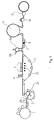
- the figure 1 is a scheme of the installation of the invention incorporating an embossing means and a softening means.
- a web of 25 g/m 2 is produced, which comprises 80 % of polyester fibres having a length of 38 mm and 1,7 dtex and 20 % of viscose fibres having a length of 38 mm and 1,7 dtex on a card (1) at a speed of 120 meters per minute.
- the web thus formed on-line is transferred on a hydraulic pre-bonding unit (2) comprising a pre-wetting ramp of the web (2a) and a support roll (2b) around which are placed two hydraulic injectors (2c). These injectors are provided with perforated plates (not represented) comprising a row of holes, the diameter of which is 100 micrometers and distance between centres 1 mm.
- the first injector is supplied with water at a pressure of 40 bars and the second with water at a pressure of 60 bars.
- the web thus strengthened is then transferred on a metallic conveyor (3) above which is placed a head box of the paper-making type (4).
- a fibre suspension is prepared, which comprises 40 % of paper-making cellulose fibres of the "Red Cedar” type having a length of about 5 mm, 40 % of paper-making fibres of the "deciduous” type having a length of about 2 mm and 20 % of artificial cellulose fibres having a length of 5 mm and 1,7 dtex dispersed into water, the concentration of which is 5g/liter.
- the fibres of the upper web are then entangled with those of the lower web by means of five hydraulic injectors (5), placed on the conveyor (3) after the head box (4) and supplied with water at respective pressures of 40, 50, 50, 50 and 60 bars.
- the first injector is equipped with a perforated plate provided with 2 rows of holes having a diameter of 100 micrometers, spaced 1 mm apart, the distance between the rows of holes being 1 mm.
- the four following injectors are equipped with a perforated plate provided with only one row of holes having a diameter of 100 micrometers, spaced 0.5 mm apart.
- the composite is then transferred on a "hydraulic embossing calendar" (6) consisting of a suction roll (6a) around which are placed two hydraulic injectors (6b). These injectors are each provided with a perforated plate with two rows of holes having a diameter of 120 micrometers spaced 0,8 mm apart on each row, the rows themselves being spaced 1 mm apart, the injectors being connected to a hydraulic pump delivering water at a pressure of 140 bars.
- the roll is coated with a bronze wire manufactured with coarse wires, the diameter of which is 1 mm, having a surface in the form of waves made up of hollows and bumps.
- the composite is then transferred on a conveyor (7) under which is placed a suction box (8) connected to a vacuum generator supplying with a 4,5 meter water column a depression, which eliminates practically all the water between the fibres.
- the composite is dried by means of a roll, the diameter of which is 2.8 meters, with hot air going therethrough, the temperature of which is 140°C (9).
- a softening device "Clupak” (10) is set up before the roll before the reel-up (11).
Landscapes
- Engineering & Computer Science (AREA)
- Textile Engineering (AREA)
- Mechanical Engineering (AREA)
- Nonwoven Fabrics (AREA)
- Physical Or Chemical Processes And Apparatus (AREA)
- Lock And Its Accessories (AREA)
- Valve-Gear Or Valve Arrangements (AREA)
- Valve Device For Special Equipments (AREA)
- Treatments For Attaching Organic Compounds To Fibrous Goods (AREA)
- Treatment Of Fiber Materials (AREA)
Abstract
Description
- The invention relates to a manufacturing process of a composite nonwoven composed of two webs, respectively, a lower web comprising long artificial and/or synthetic fibres and an upper web comprising short natural fibres. It also relates to an installation for carrying out of said process.
- In the rest of the description, the process of the invention is especially represented in connection with the manufacturing of moisturized wipes. These towels have achieved a great success among the general public and have several important applications especially in the field of hygiene as wiping towels. These towels are in fact used as hygiene articles for a baby or an adult, but also as a disinfectant product e.g. for bathrooms and sanitary appliances. In some cases, the towels are subjected to an embossing treatment i.e, to a treatment allowing obtaining, at the surface of the towel, an embossed and hollow design. In fact, this treatment allows enhancing the design of the towel, but also and most of all, by increasing the specific surface, increasing the wiping capacity.
- Most of the towels on the market today consist of carded viscose fibres, possibly as a mixture with synthetic fibres of polyester or polypropylene. However, the high manufacturing cost of the viscose fibres, used because of their absorbing properties, has direct repercussion on the price of the final towel making it an expensive article for the general public.
- In other words, an objective of the invention is to reduce the manufacturing cost of this kind of an article by limiting at the maximum, even by eliminating, the usage of viscose fibres.
- A first solution to this problem is to put, on a carded web based on synthetic fibres, a paper of the "toilet paper" kind called "tissue" i.e. a finished paper. In practice, the paper, consisting exclusively of cellulose fibres, is set on a carded web made up of polyester, polypropylene or viscose fibres or a mixture of said fibres, then the paper fibres and those of the web are interlaced with water jets. Then the composite is dried before being reeled up.
- The obtained composite is still expensive to be manufactured, especially for the following reasons. First of all, the paper of the "tissue" type is a finished paper, manufactured separately on another machine which, of course, generates a manufacturing cost. Furthermore, the paper fibres which have already been dried, thus have a limited wettability so that, in order to be able to interlace them with the fibres making up the lower web, it is necessary to extend the hydration step by multiplying the number of treatments by water jets i.e. the number of the injectors, which, on the one hand increases the equipment investments and on the other hand the energy consumption and thus the cost of the process.
- The second technique that has been proposed did not allow solving the cost problem. This technique consists of setting, on a card web, not a finished paper of the "tissue" kind, but cellulose fibres directly by air method, by a process known by the name "air laid". Even if the used cellulose fibres have not been transformed to be present in the form of paper, these individualized fibres have, however, first had to go through a physical-chemical treatment allowing them to be dispersed into the air. Furthermore, this treatment changes considerably the wettability of the fibres so that the interlacing by water jets is difficult to carry out, having as a result a product which tends to delaminate. Finally, the installations for carrying out the "air laid" process are very expensive.
- These two techniques are again used in the document
US-A-6 110 848 . To be more precise, this document describes a sandwich structure composed of two outer webs of the card web or "spunbond" type comprising long synthetic fibres, the size of which is between 30 and 100 mm, and of an inner web comprising celluloses fibres, the size of which is between 1 and 8 mm. In the described process, the cellulose fibres of the inner web are set on the lower web, either by dry method i.e. in the form of a paper or a "tissue" already manufactured, or by air method. This third process has the same cost disadvantages as the previous processes, to which the cost of the second outer layer may be added. - The document
WO 01/53590 - In practice, the filament denier used in the lower web is less than 1,5, advantageously between 0,5 and 1,2 dtex. Moreover, the mass of the lower web is inferior to 25 g/m2.
- The document
US-A-5 151 320 describes also a manufacturing process of a composite consisting of a lower web in form of a "spunbond" and at least one upper web obtained by wet-laid method, that is to say by the wet method of production. - The inconvenience of this type of structure is that it limits the composition of the lower web to the use of synthetic fibres especially of the polypropylene type. Moreover, the very low plasticity of the spunbond type lower web prohibits subjecting the towel to an embossing treatment due to the bad elasticity of the fibres.
- The Applicant has developed a new process allowing reducing considerably the manufacturing costs of composite nonwovens, in which a carded lower web based on long synthetic fibres in associated to an upper web based on short natural fibres, consisting, on line, in preparing then setting the upper web directly on the lower web already formed or being formed, by wet method, according to a conventional paper-making technique.
- To be more precise, the invention relates to a manufacturing process of a composite nonwoven composed of two webs, respectively, a lower web comprising long artificial and/or synthetic fibres, the size of which is between 15 and 80 mm and an upper web comprising short natural fibres, the size of which is between 0.5 and 8 mm.
- This process is characterized, on-line, by:
- carding the lower web of said artificial and/or synthetic fibres having a length between 15 and 80 mm, and a dtex degree of at least 1,7 dtex,
- prebonding said lower web,
- dispersing said natural fibres having a length between 0.5 and 8 mm into water to form an aqueous dispersion,
- laying the aqueous dispersion on the carded lower web to form the upper web,
- filtering the excess water through the tower web,
- interlacing the fibres of the upper web with the fibres of the lower web with water jets,
- drying and reeling up the obtained composite nonwoven.
- In the rest of the description, the expression "artificial and/or synthetic fibres" denotes the fibres chosen from the group comprising, among the artificial fibres, the viscose fibres, and among the synthetic fibres, the polyester, polypropylene, polyamide, polyacrylic, polyvinyl alcohol and polyethylene fibres, as such or as a mixture.
- In other words, the main advantage of the process of the invention consists in using short natural fibres, not transformed or treated, especially cellulose fibres that are dispersed directly into the water by conventional paper-making technology.
- Further, the dispersion of the fibres into the water during several minutes gives them plastic properties allowing optimising the efficiency of interlacing by water jets as the dispersion is put on the lower web. It follows that the number of injectors necessary for the bonding is limited, which thus reduces the material investments as well as the energy consumption. In practice, the number of water jets is between 2 and 12, each water jet being equipped with perforated plates, each one of them comprising one or two rows of holes having a diameter of between 80 and 160 micrometers, the holes of each row being spaced 0.4 - 1.8 mm apart and the rows themselves being spaced 0.5 - 2 mm apart, each injector being supplied with water at a pressure of between 20 and 140 bars.
- As already indicated, the used short natural fibres are in practice cellulose fibres, which can correspond to any paper-making fibres such as e.g. those based on deciduous or coniferous fibres such as beech, birch, pine, red cedar fibres, this list not being exhaustive.
- In an advantageous embodiment, the fibres of the upper web are formed by the cellulose fibres for example based on red cedar, the concentration of which in the aqueous dispersion is between 0.5 and 10 g/l, advantageously between 4 and 7 g/l.
- However, according to the applications considered for reinforcing or modifying the mechanical properties of the composite, the upper web may further contain synthetic fibres having at the most 50 % by weight of the web, advantageously between 20 and 40 %.
- When fibres of this type are incorporated in the upper web, their length is between 3 and 8 mm.
- In practice, the upper web has between 30 and 70 % by weight of the composite, advantageously at least 50 %.
- According to another characteristic of the invention, the lower web is a carded web.
- The lower web can be formed on-line or be manufactured beforehand off-line.
- In the embodiment according to which the lower web is formed on-line, it is pre-bonded, especially by water jets, before coating it with the aqueous dispersion and this in a manner that reinforces the resistance of the said lower web.
- In practice, the lower web represents between 30 and 70 % by weight of the composite.
- In an advantageous embodiment, the denier of the fibres making up the lower web is superior or equal to 1,7 dtex. Also, the lower web has a mass at least of 25 g/m2.
- According to another characteristic of the invention, excess of water coming from the aqueous dispersion of natural fibres, as it is put on the lower web, is filtered through the lower web.
- In an advantageous embodiment, the drying step can be preceded by an embossing step of the composite allowing increasing its thickness, but also enhancing its visual appearance. In practice, the embossing is carried out by maintaining the composite on a cylinder, the surface of which has an embossed design and hollows and by injecting water under a heavy pressure on the outer surface of the nonwoven, the excess water being eliminated by suction inside the cylinder. This embossing step is carried out before drying so as to benefit from the plasticity of the fibres in a wet state. This embossing step is favoured by the presence of a carded lower web for and behalf of the prior art spunbond webs, especially those disclosed in the documents
WO 01/53590 US-A-5 151 320 . - In another embodiment, after drying and before the reel-up, the composite, embossed or not, is subjected to a mechanical softening treatment by one of the processes known by an expert of the CLUPAK, SUPATEX, SANFOR or MICREX type.
- The nonwovens made with the process of the invention have several advantages. First of all, they are very economic and very absorbent considering the high proportion of natural cellulose fibres representing from 30 to 70 % by weight of the composite. Further, they are very regular due to the wet laid method technology of paper production used for the formation of the upper web. Furthermore, they are very resistant because of the presence of the long fibres in the lower web. Further, the combination of natural fibres and synthetic and/or artificial fibres makes the product both comfortable and stable. Finally, the embossing step able to be inserted before the drying step, possibly combined with the mechanical softening treatment, gives the product an appearance and a textile touch especially attractive to the consumer.
- Thus, the nonwovens manufactured according to the process of the invention can not only be used as moisturized towels, especially as wiping towels, but also as tablecloth and table napkins, bath towels, wall covering, upholstery of vehicles, depilatory strips, bags for siccative products, gloves, embroidery, cloths and wiping of printing works.
- The invention also relates to an installation for carrying out the previously described process.
- In a particular embodiment, the installation comprises:
- a carding unit for forming a lower web of said artificial and/or synthetic fibres having a length between 15 and 80 mm, and a dtex degree of at least 1,7 dtex,
- a conveyor for transporting a carded lower web,
- a head box set above the conveyor and intended to contain an aqueous dispersion comprising the natural fibres having a length between 0.5 and 8 mm,
- suction means set under the conveyor and intended to eliminate the excess water as the aqueous dispersion is put on the lower web,
- bonding means by water jets placed above the conveyor and downstream of the head box, intended to interlace the fibres of the upper web with those of the lower web,
- drying means of the composite placed downstream of the conveyor, and
- reeling means of the dry composite.
- In practice, the conveyor is in the form of a metallic or synthetic conveyor perforated in such a way that it allows water to pass therethrough by suction due to suction boxes placed under the said conveyor.
- The bonding means by water jets are in the form of several hydraulic injectors provided with perforated plates, each of them comprising one or two rows of holes having a diameter of between 80 and 160 micrometers, the holes of each row being spaced 0.4 - 1.8 mm apart and the rows themselves being spaced 0.5 - 2 mm apart, the measures being taken from axle to axle. In practice, the number of injectors is between 2 and 12, each injector being supplied by water at a pressure of between 20 and 140 bars. Beyond this limit, the obtained products cannot be used as towels.
- In the embodiment, according to which the lower web is formed on-line, the installation further comprises manufacturing means of the said web placed upstream of the conveyor.
- In this hypothesis, the installation comprises, between the manufacturing means of the lower web and the conveyor, a hydraulic pre-bonding unit having a pre-wetting ramp of the web and a support cylinder around which are placed the hydraulic injectors.
- In practice, the manufacturing means of the lower web are in the form of a card followed or not by a spreader-coater.
- Moreover and in another advantageous embodiment, the installation comprises, before the drying unit, a hydraulic embossing calendar consisting of a suction roll coated with a wire, the surface of which has an embossed design and hollows, the said roll being associated with the hydraulic injectors provided around its surface and equipped with perforated plates of the same kind as those previously described.
- For softening the obtained composite, the installation also has, before the reel-up, a softening device.
- Moreover and in practice, the drying means are in the form of a cylinder through which hot air passes.
- The invention and the advantages which stem therefrom will become clear from the example of the embodiment supported by the appended figure.
- The figure 1 is a scheme of the installation of the invention incorporating an embossing means and a softening means.
- A web of 25 g/m2 is produced, which comprises 80 % of polyester fibres having a length of 38 mm and 1,7 dtex and 20 % of viscose fibres having a length of 38 mm and 1,7 dtex on a card (1) at a speed of 120 meters per minute.
- The web thus formed on-line is transferred on a hydraulic pre-bonding unit (2) comprising a pre-wetting ramp of the web (2a) and a support roll (2b) around which are placed two hydraulic injectors (2c). These injectors are provided with perforated plates (not represented) comprising a row of holes, the diameter of which is 100 micrometers and distance between
centres 1 mm. The first injector is supplied with water at a pressure of 40 bars and the second with water at a pressure of 60 bars. The web thus strengthened is then transferred on a metallic conveyor (3) above which is placed a head box of the paper-making type (4). - In the head box, a fibre suspension is prepared, which comprises 40 % of paper-making cellulose fibres of the "Red Cedar" type having a length of about 5 mm, 40 % of paper-making fibres of the "deciduous" type having a length of about 2 mm and 20 % of artificial cellulose fibres having a length of 5 mm and 1,7 dtex dispersed into water, the concentration of which is 5g/liter.
- These fibres are then put on the lower web already pre-bonded so that the upper web is formed. An assembly of suction boxes (12), placed under the conveyor, allow eliminating the excess water after deposit of the fibres. This water is recycled and reused for manufacturing of the aqueous solution. The fibres of the upper web are then entangled with those of the lower web by means of five hydraulic injectors (5), placed on the conveyor (3) after the head box (4) and supplied with water at respective pressures of 40, 50, 50, 50 and 60 bars. The first injector is equipped with a perforated plate provided with 2 rows of holes having a diameter of 100 micrometers, spaced 1 mm apart, the distance between the rows of holes being 1 mm. The four following injectors are equipped with a perforated plate provided with only one row of holes having a diameter of 100 micrometers, spaced 0.5 mm apart.
- The composite is then transferred on a "hydraulic embossing calendar" (6) consisting of a suction roll (6a) around which are placed two hydraulic injectors (6b). These injectors are each provided with a perforated plate with two rows of holes having a diameter of 120 micrometers spaced 0,8 mm apart on each row, the rows themselves being spaced 1 mm apart, the injectors being connected to a hydraulic pump delivering water at a pressure of 140 bars. The roll is coated with a bronze wire manufactured with coarse wires, the diameter of which is 1 mm, having a surface in the form of waves made up of hollows and bumps.
- The composite is then transferred on a conveyor (7) under which is placed a suction box (8) connected to a vacuum generator supplying with a 4,5 meter water column a depression, which eliminates practically all the water between the fibres.
- Then the composite is dried by means of a roll, the diameter of which is 2.8 meters, with hot air going therethrough, the temperature of which is 140°C (9).
- A softening device "Clupak" (10) is set up before the roll before the reel-up (11).
Claims (18)
- A manufacturing process of a composite nonwoven composed of two webs, respectively, a lower web comprising long artificial and/or synthetic fibres, and an upper web comprising short natural fibres, characterized, on-line, by:- carding the lower web of said artificial and/or synthetic fibres having a length between 15 and 80 mm, and a dtex degree of at least 1,7 dtex,- prebonding said lower web,- dispersing said natural fibres having a length between 0.5 and 8 mm into water to form an aqueous dispersion,- laying the aqueous dispersion on the carded lower web to form the upper web,- filtering the excess water through the lower web,- interlacing the fibres of the upper web with the fibres of the lower web with water jets,- drying and reeling up the obtained composite nonwoven.
- A process according to claim 1, characterized in that the artificial or synthetic fibres are chosen from the group comprising the viscose, polyester, polypropylene, polyamide, polyacrylic, polyvinyl alcohol and polyethylene fibres, as such or as a mixture.
- A process according to claim 1, characterized in that the mass of the lower web is at least 25 g/m2.
- A process according to claim 1, characterized in that the interlacing of the fibres of the upper web with the fibres of the lower web is obtained by water jets, the number of which is between 2 and 12, each water jet being equipped with perforated plates, each of them comprising one or two rows of holes having a diameter of between 80 and 160 micrometers, the holes of each row being spaced 0.4 - 1.8 mm apart and the rows themselves being spaced 0.5 - 2mm apart, each injector being supplied with water at a pressure of between 20 and 140 bars.
- A process according to claim 1, characterized in that the lower web is pre-bonded by means of water jets.
- A process according to claim 1, characterized in that the lower web makes up between 30 and 70% by weight of the composite.
- A process according to claim 1, characterized in that the natural fibres are cellulose fibres.
- A process according to claim 1, characterized in that the upper web further contains synthetic fibres making up at least 50 % by weight of the web.
- A process according to claim 1, characterized in that the upper web makes up between 30 and 70 % by weight of the composite.
- A process according to claim 1, characterized in that the fibres of the upper web are exclusively cellulose fibres, the concentration of the said fibres in the aqueous dispersion being between 0.5 and 10 g/l.
- A process according to claim 1, characterized in that before drying, the composite is subjected to an embossing step.
- A process according to claim 1, characterized in that before reeling up, the composite is subjected to a softening step.
- An installation for carrying out the process object of one of the claims 1 to 12 for manufacturing a composite support composed of two webs, respectively, a lower web comprising long artificial and/or synthetic fibres, and an upper web comprising short natural fibres, characterized by :- a carding unit for forming a lower web of said artificial and/or synthetic fibres having a length between 15 and 80 mm, and a dtex degree of at least 1,7 dtex,- a conveyor (3) for transporting a carded lower web,- a head box (4) set above the conveyor (3) and intended to contain an aqueous dispersion comprising the natural fibres having a length between 0.5 and 8 mm,- suction means set under the conveyor (3) and intended to eliminate the excess water as the aqueous dispersion is put on the lower web,- bonding means by water jets (5) placed above the conveyor and downstream of the head box (4), intended to interlace the fibres of the upper web with those of the lower web,- drying means (9) of the composite placed downstream of the conveyor (3), and- reeling means (11) of the dry composite.
- An installation for manufacturing a composite support according to claim 13, characterized in that it comprises bonding means by water jets (5) in form of several hydraulic injectors provided with perforated plates, each of them comprising one or two rows of holes having a diameter of between 80 and 160 micrometers, the holes of each row being spaced 0,4 - 1,8 mm apart and the rows themselves being spaced 0.5 - 2 mm apart, the number of injectors being between 2 and 12 and supplied at a pressure of between 20 and 140 bars.
- An installation for manufacturing a composite support according to claim 14. characterized in that it comprises manufacturing means (1) of the lower web placed upstream of the conveyor (3).
- An installation for manufacturing a composite support according to claim 15, characterized in that it comprises, between the manufacturing means of the lower web (1) and the conveyor (3), a hydraulic pre-bonding unit (2) comprising a pre-wetting ramp of the web (2a) and a support roll (2b), around which are placed the hydraulic injectors (2c).
- An installation for manufacturing a composite support according to claim 13, characterized in that it comprises, before the drying unit (9), a hydraulic embossing calendar (6) consisting of a suction roll (6a) coated with a wire, the surface of which has an embossed design and hollows, the said roll being associated with hydraulic injectors (6b) placed around its surface.
- An installation for manufacturing a composite support according to claim 13. characterized in that it also has, prior to the reel-up (11), a softening device (10).
Applications Claiming Priority (3)
| Application Number | Priority Date | Filing Date | Title |
|---|---|---|---|
| FR0300328 | 2003-01-14 | ||
| FR0300328A FR2849869B1 (en) | 2003-01-14 | 2003-01-14 | METHOD FOR MANUFACTURING A COMPOSITE NON-WOVEN FABRIC AND INSTALLATION FOR CARRYING OUT SAID METHOD |
| PCT/FI2004/000017 WO2004063451A1 (en) | 2003-01-14 | 2004-01-13 | Manufacturing process of a composite nonwoven and installation for carrying out said process |
Publications (2)
| Publication Number | Publication Date |
|---|---|
| EP1587979A1 EP1587979A1 (en) | 2005-10-26 |
| EP1587979B1 true EP1587979B1 (en) | 2007-08-29 |
Family
ID=32524878
Family Applications (1)
| Application Number | Title | Priority Date | Filing Date |
|---|---|---|---|
| EP04701612A Expired - Lifetime EP1587979B1 (en) | 2003-01-14 | 2004-01-13 | Manufacturing process of a composite nonwoven and installation for carrying out said process |
Country Status (12)
| Country | Link |
|---|---|
| US (1) | US7484276B2 (en) |
| EP (1) | EP1587979B1 (en) |
| JP (1) | JP4855922B2 (en) |
| CN (1) | CN100457997C (en) |
| AT (1) | ATE371761T1 (en) |
| DE (1) | DE602004008578T2 (en) |
| DK (1) | DK1587979T3 (en) |
| ES (1) | ES2293205T3 (en) |
| FR (1) | FR2849869B1 (en) |
| PT (1) | PT1587979E (en) |
| RU (1) | RU2331724C2 (en) |
| WO (1) | WO2004063451A1 (en) |
Families Citing this family (31)
| Publication number | Priority date | Publication date | Assignee | Title |
|---|---|---|---|---|
| ES2526210T3 (en) * | 2007-02-15 | 2015-01-08 | Suominen Corporation | Hydraulic embossing of a double-sided nonwoven fibrous veil |
| EP2152217B1 (en) * | 2007-05-30 | 2014-11-12 | Sca Hygiene Products AB | Non-woven material for use as a body facing sheet in an absorbent article |
| US8250719B2 (en) * | 2009-03-03 | 2012-08-28 | The Clorox Company | Multiple layer absorbent substrate and method of formation |
| MX2013003809A (en) * | 2010-10-05 | 2013-06-28 | Nahum Shpak | Plant growth medium. |
| JP5822560B2 (en) * | 2011-06-29 | 2015-11-24 | ユニチカ株式会社 | Method for producing polyamide film |
| CN102501392A (en) * | 2011-11-21 | 2012-06-20 | 成都彩虹环保科技有限公司 | Composite material processing equipment |
| CN102493125A (en) * | 2011-11-21 | 2012-06-13 | 成都彩虹环保科技有限公司 | Composite material processing equipment |
| EP2844793B1 (en) * | 2012-05-03 | 2018-09-19 | Essity Hygiene and Health Aktiebolag | Method of producing a hydroentangled nonwoven material |
| TW201420054A (en) * | 2012-11-21 | 2014-06-01 | Kang Na Hsiung Entpr Co Ltd | Hygroscopic non-woven fabric and fabricating method thereof |
| US9394637B2 (en) | 2012-12-13 | 2016-07-19 | Jacob Holm & Sons Ag | Method for production of a hydroentangled airlaid web and products obtained therefrom |
| TW201508118A (en) * | 2013-08-30 | 2015-03-01 | Kang Na Hsiung Entpr Co Ltd | Nonwoven paper towel and its method for making the same |
| WO2015176063A1 (en) | 2014-05-16 | 2015-11-19 | First Quality Tissue, Llc | Flushable wipe and method of forming the same |
| DE202014102656U1 (en) | 2014-06-06 | 2015-09-14 | Autefa Solutions Germany Gmbh | embosser |
| CN104233627A (en) * | 2014-09-22 | 2014-12-24 | 杭州诺邦无纺股份有限公司 | Special microneedle high-pressure spunlacing plate for mimic enzyme biological protection spunlaced material |
| DE102015111340A1 (en) * | 2015-07-14 | 2017-01-19 | TRüTZSCHLER GMBH & CO. KG | Plant and method for producing a multi-layer nonwoven fabric from at least one unconsolidated batt |
| JP6189394B2 (en) * | 2015-10-16 | 2017-08-30 | ユニ・チャーム株式会社 | Manufacturing method of nonwoven fabric with uneven pattern |
| US20170356109A1 (en) * | 2016-06-10 | 2017-12-14 | Welspun India Limited | Top Sheet for Personal Care Product |
| JP6902341B2 (en) * | 2016-09-15 | 2021-07-14 | 日本製紙クレシア株式会社 | Manufacturing method of composite non-woven fabric and its manufacturing equipment |
| JP6462758B2 (en) * | 2017-04-19 | 2019-01-30 | ユニ・チャーム株式会社 | Spunlace nonwoven fabric |
| CN109338785A (en) * | 2018-11-10 | 2019-02-15 | 长沙云聚汇科技有限公司 | A kind of nonwoven paper cloth processing unit (plant) |
| ES2953571T3 (en) * | 2019-01-08 | 2023-11-14 | Andritz Perfojet Sas | Installation and production procedure of nonwoven fabrics |
| DE102020100472A1 (en) * | 2020-01-10 | 2021-07-15 | Andritz Küsters Gmbh | Method for producing a composite nonwoven web and apparatus for producing a composite nonwoven web |
| DE102020122864A1 (en) * | 2020-01-10 | 2021-07-15 | Trützschler GmbH & Co Kommanditgesellschaft | Plant and process for the production of a single or multi-layer fleece |
| CN111996681B (en) * | 2020-08-24 | 2022-09-27 | 中国农业科学院麻类研究所 | Production equipment of agricultural plant fiber membrane |
| DE102021104974B3 (en) * | 2021-03-02 | 2022-06-09 | Andritz Küsters Gmbh | Assembly of a device, method and device for producing a composite nonwoven web |
| DE102021107902A1 (en) * | 2021-03-29 | 2022-09-29 | Andritz Küsters Gmbh | Plant for consolidating at least one wet-laid or dry-laid fiber layer to form a fleece web, with a conveyor that includes a circulating belt with an upper run, on which the at least one fiber layer can be placed and displaced in a production direction |
| DE102021107901A1 (en) * | 2021-03-29 | 2022-09-29 | Andritz Küsters Gmbh | Plant and method for bonding layers comprising fibers to form a non-woven web |
| DE102021107900B4 (en) | 2021-03-29 | 2023-02-02 | Andritz Küsters Gmbh | Plant for consolidating layers comprising fibers to form a fleece web |
| CN114318681B (en) * | 2021-12-31 | 2024-01-12 | 嘉善庆华卫生复合材料有限公司 | Production process of dry-wet combined sanitary composite material core layer |
| CN117364346A (en) * | 2023-10-31 | 2024-01-09 | 江苏弘正扬瑞新材料有限公司 | Online production process of AB-surface spunlaced nonwoven fabric |
| DE102024100755A1 (en) * | 2024-01-11 | 2025-07-17 | Trützschler Group SE | Process and plant for producing a two-layer nonwoven |
Family Cites Families (26)
| Publication number | Priority date | Publication date | Assignee | Title |
|---|---|---|---|---|
| DE1288056B (en) * | 1956-06-06 | 1969-01-30 | Johnson & Johnson, New Brunswick, N.J. (V.St.A.) | Device for producing a flexible, textile, non-woven fibrous web |
| US3042576A (en) * | 1957-06-17 | 1962-07-03 | Chicopee Mfg Corp | Method and apparatus for producing nonwoven fibrous sheets |
| JPH04247208A (en) * | 1991-02-01 | 1992-09-03 | Japan Vilene Co Ltd | Filter for range hoods |
| US5151320A (en) * | 1992-02-25 | 1992-09-29 | The Dexter Corporation | Hydroentangled spunbonded composite fabric and process |
| EP0560556B1 (en) * | 1992-03-12 | 1997-10-01 | Oji Paper Co., Ltd. | Process for producing wiping nonwoven fabric |
| US6207602B1 (en) * | 1994-11-23 | 2001-03-27 | Bba Nonwovens Simpsonville, Inc. | Nonwoven fabrics and fabric laminates from multiconstituent polyolefin fibers |
| US6022818A (en) * | 1995-06-07 | 2000-02-08 | Kimberly-Clark Worldwide, Inc. | Hydroentangled nonwoven composites |
| FR2752248B1 (en) * | 1996-08-09 | 1998-09-25 | Lystil Sa | ABSORBENT NONWOVEN COMPLEX MATERIAL HAVING A FLEXIBLE FACE AND A ROUGH FACE, AND METHOD FOR OBTAINING SAME |
| JPH11117163A (en) * | 1997-10-15 | 1999-04-27 | Unitika Ltd | Heat resistant nonwoven fabric and its production |
| SE9703886L (en) * | 1997-10-24 | 1999-04-25 | Sca Hygiene Paper Ab | Method of making a nonwoven material and made according to the method |
| JP3400702B2 (en) * | 1997-12-26 | 2003-04-28 | ユニ・チャーム株式会社 | Nonwoven fabric manufacturing method |
| FR2781818B1 (en) * | 1998-07-31 | 2000-09-01 | Icbt Perfojet Sa | PROCESS FOR THE PRODUCTION OF A COMPLEX NON-WOVEN MATERIAL AND NEW TYPE OF MATERIAL THUS OBTAINED |
| JP3712330B2 (en) * | 1999-03-17 | 2005-11-02 | 三菱製紙株式会社 | Non-woven wipes and non-woven fabrics for cleaning printing press blankets |
| DE19938809A1 (en) * | 1999-08-19 | 2001-02-22 | Fleissner Maschf Gmbh Co | Manufacture of absorbent non-woven for absorbing and holding liquids, consist of wood pulp fibers carried on support layer by initial deposition of micro-fibers on support layer |
| FR2799214B1 (en) * | 1999-10-05 | 2001-11-16 | Icbt Perfojet Sa | PROCESS FOR THE PRODUCTION OF NONWOVEN TABLECLOTHS WHICH COHESION IS OBTAINED BY THE ACTION OF FLUID JETS |
| US6893522B1 (en) * | 1999-10-05 | 2005-05-17 | Polymer Group, Inc. | High bulk non-woven composite fabric |
| FR2803604B1 (en) * | 2000-01-11 | 2002-03-08 | Icbt Perfojet Sa | PROCESS FOR THE PRODUCTION OF A COMPLEX NONWOVEN MATERIAL AND NEW TYPE OF MATERIAL THUS OBTAINED |
| JP2003520307A (en) * | 2000-01-19 | 2003-07-02 | アールストローム ウィンザー ロックス エルエルシー | Nonwoven laminated wipe product and method of manufacturing the same |
| DE10008746A1 (en) * | 2000-02-24 | 2001-08-30 | Fleissner Maschf Gmbh Co | Method and device for producing composite nonwovens by means of hydrodynamic needling |
| MXPA03003769A (en) * | 2000-11-10 | 2003-07-28 | Kimberly Clark Co | Hydroentangled nonwoven composite structures containing recycled synthetic fibrous materials. |
| JP3703711B2 (en) * | 2000-11-27 | 2005-10-05 | ユニ・チャーム株式会社 | Non-woven fabric manufacturing method and manufacturing apparatus |
| US20030207636A1 (en) * | 2001-01-05 | 2003-11-06 | Nataraj Gosavi | Nonwoven laminate wiping product and proces for its manufacture |
| IL156862A0 (en) * | 2001-01-12 | 2004-02-08 | Polymer Group Inc | A nonwoven hydroentangled fabric and methods and apparatus for producing the same |
| US6381817B1 (en) * | 2001-03-23 | 2002-05-07 | Polymer Group, Inc. | Composite nonwoven fabric |
| US6739023B2 (en) * | 2002-07-18 | 2004-05-25 | Kimberly Clark Worldwide, Inc. | Method of forming a nonwoven composite fabric and fabric produced thereof |
| US7432219B2 (en) * | 2003-10-31 | 2008-10-07 | Sca Hygiene Products Ab | Hydroentangled nonwoven material |
-
2003
- 2003-01-14 FR FR0300328A patent/FR2849869B1/en not_active Expired - Fee Related
-
2004
- 2004-01-13 AT AT04701612T patent/ATE371761T1/en active
- 2004-01-13 PT PT04701612T patent/PT1587979E/en unknown
- 2004-01-13 US US10/541,872 patent/US7484276B2/en not_active Expired - Fee Related
- 2004-01-13 JP JP2006500152A patent/JP4855922B2/en not_active Expired - Fee Related
- 2004-01-13 DE DE602004008578T patent/DE602004008578T2/en not_active Expired - Lifetime
- 2004-01-13 WO PCT/FI2004/000017 patent/WO2004063451A1/en not_active Ceased
- 2004-01-13 EP EP04701612A patent/EP1587979B1/en not_active Expired - Lifetime
- 2004-01-13 CN CNB2004800022185A patent/CN100457997C/en not_active Expired - Fee Related
- 2004-01-13 RU RU2005125721/12A patent/RU2331724C2/en not_active IP Right Cessation
- 2004-01-13 ES ES04701612T patent/ES2293205T3/en not_active Expired - Lifetime
- 2004-01-13 DK DK04701612T patent/DK1587979T3/en active
Also Published As
| Publication number | Publication date |
|---|---|
| DE602004008578D1 (en) | 2007-10-11 |
| DK1587979T3 (en) | 2007-12-27 |
| FR2849869A1 (en) | 2004-07-16 |
| US20070000107A1 (en) | 2007-01-04 |
| DE602004008578T2 (en) | 2008-05-21 |
| RU2005125721A (en) | 2006-01-27 |
| PT1587979E (en) | 2007-11-20 |
| FR2849869B1 (en) | 2005-09-09 |
| ATE371761T1 (en) | 2007-09-15 |
| RU2331724C2 (en) | 2008-08-20 |
| WO2004063451A1 (en) | 2004-07-29 |
| ES2293205T3 (en) | 2008-03-16 |
| CN100457997C (en) | 2009-02-04 |
| US7484276B2 (en) | 2009-02-03 |
| CN1738936A (en) | 2006-02-22 |
| JP2006517263A (en) | 2006-07-20 |
| JP4855922B2 (en) | 2012-01-18 |
| EP1587979A1 (en) | 2005-10-26 |
Similar Documents
| Publication | Publication Date | Title |
|---|---|---|
| US7484276B2 (en) | Process for manufacturing a composite nonwoven and installation for carrying out the process | |
| US10259192B2 (en) | Cotendered nonwoven/pulp fabric and method for making the same | |
| JP4546010B2 (en) | Method for producing non-woven fabric and plant for carrying it out and non-woven fabric so obtained | |
| TWI622682B (en) | Nonwoven fabric and its making method and use | |
| CN100379919C (en) | Method for manufacturing composite non-woven fabric and novel fabric obtained thereby | |
| EP2705186B1 (en) | Method of producing a hydroentangled nonwoven material | |
| EP4077786B1 (en) | Nonwoven web and methods to prepare the web | |
| US20030207636A1 (en) | Nonwoven laminate wiping product and proces for its manufacture | |
| CN110468502B (en) | Preparation method of water-soluble vinylon fiber spunlaced nonwoven fabric | |
| CN112746395A (en) | Long-net-shaped online spun-bonded spunlace composite non-woven fabric and preparation method thereof | |
| CN219010626U (en) | Water-jet nonwoven fabric, composite nonwoven fabric and sanitary absorbent product | |
| US20040255440A1 (en) | Three-dimensionally imaged personal wipe | |
| CN114481444A (en) | Spunlace non-woven fabrics, composite non-woven fabrics and sanitary absorbent products | |
| WO2005059216A2 (en) | Embossed and three-dimensionally imaged non-woven fabrics | |
| EP1261768A1 (en) | Nonwoven laminate wiping product and process for its manufacture | |
| JP2023006231A (en) | Composite nonwoven fabric and method for manufacturing the same | |
| CA3168461C (en) | Nonwoven web and methods to prepare the web | |
| CN214736520U (en) | Spunlace composite non-woven fabric with high liquid absorption and high friction force | |
| JP2023114129A (en) | COMPOSITE NONWOVEN FABRIC AND METHOD FOR MANUFACTURING THE SAME | |
| HK1209465B (en) | Hydroformed composite nonwoven | |
| WO2007042082A1 (en) | Disposable wiping article and its manufacturing process |
Legal Events
| Date | Code | Title | Description |
|---|---|---|---|
| PUAI | Public reference made under article 153(3) epc to a published international application that has entered the european phase |
Free format text: ORIGINAL CODE: 0009012 |
|
| 17P | Request for examination filed |
Effective date: 20050711 |
|
| AK | Designated contracting states |
Kind code of ref document: A1 Designated state(s): AT BE BG CH CY CZ DE DK EE ES FI FR GB GR HU IE IT LI LU MC NL PT RO SE SI SK TR |
|
| AX | Request for extension of the european patent |
Extension state: AL LT LV MK |
|
| DAX | Request for extension of the european patent (deleted) | ||
| GRAC | Information related to communication of intention to grant a patent modified |
Free format text: ORIGINAL CODE: EPIDOSCIGR1 |
|
| GRAP | Despatch of communication of intention to grant a patent |
Free format text: ORIGINAL CODE: EPIDOSNIGR1 |
|
| GRAS | Grant fee paid |
Free format text: ORIGINAL CODE: EPIDOSNIGR3 |
|
| GRAA | (expected) grant |
Free format text: ORIGINAL CODE: 0009210 |
|
| RAP1 | Party data changed (applicant data changed or rights of an application transferred) |
Owner name: AHLSTROM CORPORATION |
|
| AK | Designated contracting states |
Kind code of ref document: B1 Designated state(s): AT BE BG CH CY CZ DE DK EE ES FI FR GB GR HU IE IT LI LU MC NL PT RO SE SI SK TR |
|
| REG | Reference to a national code |
Ref country code: GB Ref legal event code: FG4D |
|
| REG | Reference to a national code |
Ref country code: CH Ref legal event code: EP |
|
| REG | Reference to a national code |
Ref country code: IE Ref legal event code: FG4D |
|
| REF | Corresponds to: |
Ref document number: 602004008578 Country of ref document: DE Date of ref document: 20071011 Kind code of ref document: P |
|
| REG | Reference to a national code |
Ref country code: PT Ref legal event code: SC4A Free format text: AVAILABILITY OF NATIONAL TRANSLATION Effective date: 20071107 |
|
| REG | Reference to a national code |
Ref country code: SE Ref legal event code: TRGR |
|
| REG | Reference to a national code |
Ref country code: DK Ref legal event code: T3 |
|
| REG | Reference to a national code |
Ref country code: CH Ref legal event code: NV Representative=s name: BOVARD AG PATENTANWAELTE |
|
| REG | Reference to a national code |
Ref country code: ES Ref legal event code: FG2A Ref document number: 2293205 Country of ref document: ES Kind code of ref document: T3 |
|
| ET | Fr: translation filed | ||
| PG25 | Lapsed in a contracting state [announced via postgrant information from national office to epo] |
Ref country code: GR Free format text: LAPSE BECAUSE OF FAILURE TO SUBMIT A TRANSLATION OF THE DESCRIPTION OR TO PAY THE FEE WITHIN THE PRESCRIBED TIME-LIMIT Effective date: 20071130 |
|
| PG25 | Lapsed in a contracting state [announced via postgrant information from national office to epo] |
Ref country code: RO Free format text: LAPSE BECAUSE OF FAILURE TO SUBMIT A TRANSLATION OF THE DESCRIPTION OR TO PAY THE FEE WITHIN THE PRESCRIBED TIME-LIMIT Effective date: 20070829 |
|
| PLBE | No opposition filed within time limit |
Free format text: ORIGINAL CODE: 0009261 |
|
| STAA | Information on the status of an ep patent application or granted ep patent |
Free format text: STATUS: NO OPPOSITION FILED WITHIN TIME LIMIT |
|
| 26N | No opposition filed |
Effective date: 20080530 |
|
| PG25 | Lapsed in a contracting state [announced via postgrant information from national office to epo] |
Ref country code: MC Free format text: LAPSE BECAUSE OF NON-PAYMENT OF DUE FEES Effective date: 20080131 |
|
| PG25 | Lapsed in a contracting state [announced via postgrant information from national office to epo] |
Ref country code: IE Free format text: LAPSE BECAUSE OF NON-PAYMENT OF DUE FEES Effective date: 20080114 Ref country code: EE Free format text: LAPSE BECAUSE OF FAILURE TO SUBMIT A TRANSLATION OF THE DESCRIPTION OR TO PAY THE FEE WITHIN THE PRESCRIBED TIME-LIMIT Effective date: 20070829 |
|
| PG25 | Lapsed in a contracting state [announced via postgrant information from national office to epo] |
Ref country code: SI Free format text: LAPSE BECAUSE OF FAILURE TO SUBMIT A TRANSLATION OF THE DESCRIPTION OR TO PAY THE FEE WITHIN THE PRESCRIBED TIME-LIMIT Effective date: 20070829 |
|
| PG25 | Lapsed in a contracting state [announced via postgrant information from national office to epo] |
Ref country code: CY Free format text: LAPSE BECAUSE OF FAILURE TO SUBMIT A TRANSLATION OF THE DESCRIPTION OR TO PAY THE FEE WITHIN THE PRESCRIBED TIME-LIMIT Effective date: 20070829 |
|
| PG25 | Lapsed in a contracting state [announced via postgrant information from national office to epo] |
Ref country code: BG Free format text: LAPSE BECAUSE OF FAILURE TO SUBMIT A TRANSLATION OF THE DESCRIPTION OR TO PAY THE FEE WITHIN THE PRESCRIBED TIME-LIMIT Effective date: 20071129 |
|
| PG25 | Lapsed in a contracting state [announced via postgrant information from national office to epo] |
Ref country code: HU Free format text: LAPSE BECAUSE OF FAILURE TO SUBMIT A TRANSLATION OF THE DESCRIPTION OR TO PAY THE FEE WITHIN THE PRESCRIBED TIME-LIMIT Effective date: 20080301 Ref country code: LU Free format text: LAPSE BECAUSE OF NON-PAYMENT OF DUE FEES Effective date: 20080113 |
|
| REG | Reference to a national code |
Ref country code: CH Ref legal event code: PFA Owner name: AHLSTROM CORPORATION Free format text: AHLSTROM CORPORATION#ETELAEESPLANADI 14#00130 HELSINKI (FI) -TRANSFER TO- AHLSTROM CORPORATION#ETELAEESPLANADI 14#00130 HELSINKI (FI) |
|
| PGFP | Annual fee paid to national office [announced via postgrant information from national office to epo] |
Ref country code: GB Payment date: 20131227 Year of fee payment: 11 Ref country code: PT Payment date: 20131227 Year of fee payment: 11 Ref country code: DK Payment date: 20131227 Year of fee payment: 11 Ref country code: SK Payment date: 20131227 Year of fee payment: 11 |
|
| PGFP | Annual fee paid to national office [announced via postgrant information from national office to epo] |
Ref country code: FI Payment date: 20131227 Year of fee payment: 11 |
|
| PGFP | Annual fee paid to national office [announced via postgrant information from national office to epo] |
Ref country code: BE Payment date: 20140127 Year of fee payment: 11 Ref country code: NL Payment date: 20140108 Year of fee payment: 11 Ref country code: DE Payment date: 20140131 Year of fee payment: 11 Ref country code: CZ Payment date: 20140102 Year of fee payment: 11 Ref country code: CH Payment date: 20140127 Year of fee payment: 11 Ref country code: SE Payment date: 20140109 Year of fee payment: 11 |
|
| PGFP | Annual fee paid to national office [announced via postgrant information from national office to epo] |
Ref country code: AT Payment date: 20131227 Year of fee payment: 11 Ref country code: ES Payment date: 20140120 Year of fee payment: 11 Ref country code: IT Payment date: 20140121 Year of fee payment: 11 Ref country code: FR Payment date: 20131223 Year of fee payment: 11 Ref country code: TR Payment date: 20140108 Year of fee payment: 11 |
|
| PG25 | Lapsed in a contracting state [announced via postgrant information from national office to epo] |
Ref country code: BE Free format text: LAPSE BECAUSE OF NON-PAYMENT OF DUE FEES Effective date: 20150131 |
|
| REG | Reference to a national code |
Ref country code: PT Ref legal event code: MM4A Free format text: LAPSE DUE TO NON-PAYMENT OF FEES Effective date: 20150713 |
|
| PG25 | Lapsed in a contracting state [announced via postgrant information from national office to epo] |
Ref country code: CZ Free format text: LAPSE BECAUSE OF NON-PAYMENT OF DUE FEES Effective date: 20150113 |
|
| REG | Reference to a national code |
Ref country code: DE Ref legal event code: R119 Ref document number: 602004008578 Country of ref document: DE |
|
| REG | Reference to a national code |
Ref country code: NL Ref legal event code: V1 Effective date: 20150801 |
|
| REG | Reference to a national code |
Ref country code: CH Ref legal event code: PL |
|
| REG | Reference to a national code |
Ref country code: DK Ref legal event code: EBP Effective date: 20150131 |
|
| REG | Reference to a national code |
Ref country code: SE Ref legal event code: EUG |
|
| REG | Reference to a national code |
Ref country code: AT Ref legal event code: MM01 Ref document number: 371761 Country of ref document: AT Kind code of ref document: T Effective date: 20150113 |
|
| GBPC | Gb: european patent ceased through non-payment of renewal fee |
Effective date: 20150113 |
|
| PG25 | Lapsed in a contracting state [announced via postgrant information from national office to epo] |
Ref country code: NL Free format text: LAPSE BECAUSE OF NON-PAYMENT OF DUE FEES Effective date: 20150801 |
|
| REG | Reference to a national code |
Ref country code: SK Ref legal event code: MM4A Ref document number: E 3064 Country of ref document: SK Effective date: 20150113 |
|
| PG25 | Lapsed in a contracting state [announced via postgrant information from national office to epo] |
Ref country code: CH Free format text: LAPSE BECAUSE OF NON-PAYMENT OF DUE FEES Effective date: 20150131 Ref country code: FI Free format text: LAPSE BECAUSE OF NON-PAYMENT OF DUE FEES Effective date: 20150113 Ref country code: LI Free format text: LAPSE BECAUSE OF NON-PAYMENT OF DUE FEES Effective date: 20150131 Ref country code: DE Free format text: LAPSE BECAUSE OF NON-PAYMENT OF DUE FEES Effective date: 20150801 Ref country code: GB Free format text: LAPSE BECAUSE OF NON-PAYMENT OF DUE FEES Effective date: 20150113 Ref country code: SK Free format text: LAPSE BECAUSE OF NON-PAYMENT OF DUE FEES Effective date: 20150113 Ref country code: PT Free format text: LAPSE BECAUSE OF NON-PAYMENT OF DUE FEES Effective date: 20150713 |
|
| REG | Reference to a national code |
Ref country code: FR Ref legal event code: ST Effective date: 20150930 |
|
| PG25 | Lapsed in a contracting state [announced via postgrant information from national office to epo] |
Ref country code: SE Free format text: LAPSE BECAUSE OF NON-PAYMENT OF DUE FEES Effective date: 20150114 Ref country code: FR Free format text: LAPSE BECAUSE OF NON-PAYMENT OF DUE FEES Effective date: 20150202 Ref country code: AT Free format text: LAPSE BECAUSE OF NON-PAYMENT OF DUE FEES Effective date: 20150113 |
|
| PG25 | Lapsed in a contracting state [announced via postgrant information from national office to epo] |
Ref country code: IT Free format text: LAPSE BECAUSE OF NON-PAYMENT OF DUE FEES Effective date: 20150113 |
|
| PG25 | Lapsed in a contracting state [announced via postgrant information from national office to epo] |
Ref country code: DK Free format text: LAPSE BECAUSE OF NON-PAYMENT OF DUE FEES Effective date: 20150131 |
|
| REG | Reference to a national code |
Ref country code: ES Ref legal event code: FD2A Effective date: 20160930 |
|
| PG25 | Lapsed in a contracting state [announced via postgrant information from national office to epo] |
Ref country code: ES Free format text: LAPSE BECAUSE OF NON-PAYMENT OF DUE FEES Effective date: 20150114 |
|
| PG25 | Lapsed in a contracting state [announced via postgrant information from national office to epo] |
Ref country code: TR Free format text: LAPSE BECAUSE OF NON-PAYMENT OF DUE FEES Effective date: 20150113 |