EP1584804A2 - Exhaust gas throttle valve for engines - Google Patents
Exhaust gas throttle valve for engines Download PDFInfo
- Publication number
- EP1584804A2 EP1584804A2 EP05007815A EP05007815A EP1584804A2 EP 1584804 A2 EP1584804 A2 EP 1584804A2 EP 05007815 A EP05007815 A EP 05007815A EP 05007815 A EP05007815 A EP 05007815A EP 1584804 A2 EP1584804 A2 EP 1584804A2
- Authority
- EP
- European Patent Office
- Prior art keywords
- exhaust gas
- valve body
- throttle valve
- valve
- center axis
- Prior art date
- Legal status (The legal status is an assumption and is not a legal conclusion. Google has not performed a legal analysis and makes no representation as to the accuracy of the status listed.)
- Granted
Links
Images



Classifications
-
- F—MECHANICAL ENGINEERING; LIGHTING; HEATING; WEAPONS; BLASTING
- F02—COMBUSTION ENGINES; HOT-GAS OR COMBUSTION-PRODUCT ENGINE PLANTS
- F02D—CONTROLLING COMBUSTION ENGINES
- F02D9/00—Controlling engines by throttling air or fuel-and-air induction conduits or exhaust conduits
- F02D9/04—Controlling engines by throttling air or fuel-and-air induction conduits or exhaust conduits concerning exhaust conduits
-
- F—MECHANICAL ENGINEERING; LIGHTING; HEATING; WEAPONS; BLASTING
- F01—MACHINES OR ENGINES IN GENERAL; ENGINE PLANTS IN GENERAL; STEAM ENGINES
- F01N—GAS-FLOW SILENCERS OR EXHAUST APPARATUS FOR MACHINES OR ENGINES IN GENERAL; GAS-FLOW SILENCERS OR EXHAUST APPARATUS FOR INTERNAL-COMBUSTION ENGINES
- F01N13/00—Exhaust or silencing apparatus characterised by constructional features
- F01N13/009—Exhaust or silencing apparatus characterised by constructional features having two or more separate purifying devices arranged in series
- F01N13/0097—Exhaust or silencing apparatus characterised by constructional features having two or more separate purifying devices arranged in series the purifying devices are arranged in a single housing
-
- F—MECHANICAL ENGINEERING; LIGHTING; HEATING; WEAPONS; BLASTING
- F01—MACHINES OR ENGINES IN GENERAL; ENGINE PLANTS IN GENERAL; STEAM ENGINES
- F01N—GAS-FLOW SILENCERS OR EXHAUST APPARATUS FOR MACHINES OR ENGINES IN GENERAL; GAS-FLOW SILENCERS OR EXHAUST APPARATUS FOR INTERNAL-COMBUSTION ENGINES
- F01N3/00—Exhaust or silencing apparatus having means for purifying, rendering innocuous, or otherwise treating exhaust
- F01N3/02—Exhaust or silencing apparatus having means for purifying, rendering innocuous, or otherwise treating exhaust for cooling, or for removing solid constituents of, exhaust
- F01N3/021—Exhaust or silencing apparatus having means for purifying, rendering innocuous, or otherwise treating exhaust for cooling, or for removing solid constituents of, exhaust by means of filters
- F01N3/023—Exhaust or silencing apparatus having means for purifying, rendering innocuous, or otherwise treating exhaust for cooling, or for removing solid constituents of, exhaust by means of filters using means for regenerating the filters, e.g. by burning trapped particles
- F01N3/0231—Exhaust or silencing apparatus having means for purifying, rendering innocuous, or otherwise treating exhaust for cooling, or for removing solid constituents of, exhaust by means of filters using means for regenerating the filters, e.g. by burning trapped particles using special exhaust apparatus upstream of the filter for producing nitrogen dioxide, e.g. for continuous filter regeneration systems [CRT]
-
- F—MECHANICAL ENGINEERING; LIGHTING; HEATING; WEAPONS; BLASTING
- F01—MACHINES OR ENGINES IN GENERAL; ENGINE PLANTS IN GENERAL; STEAM ENGINES
- F01N—GAS-FLOW SILENCERS OR EXHAUST APPARATUS FOR MACHINES OR ENGINES IN GENERAL; GAS-FLOW SILENCERS OR EXHAUST APPARATUS FOR INTERNAL-COMBUSTION ENGINES
- F01N3/00—Exhaust or silencing apparatus having means for purifying, rendering innocuous, or otherwise treating exhaust
- F01N3/02—Exhaust or silencing apparatus having means for purifying, rendering innocuous, or otherwise treating exhaust for cooling, or for removing solid constituents of, exhaust
- F01N3/021—Exhaust or silencing apparatus having means for purifying, rendering innocuous, or otherwise treating exhaust for cooling, or for removing solid constituents of, exhaust by means of filters
- F01N3/023—Exhaust or silencing apparatus having means for purifying, rendering innocuous, or otherwise treating exhaust for cooling, or for removing solid constituents of, exhaust by means of filters using means for regenerating the filters, e.g. by burning trapped particles
- F01N3/0235—Exhaust or silencing apparatus having means for purifying, rendering innocuous, or otherwise treating exhaust for cooling, or for removing solid constituents of, exhaust by means of filters using means for regenerating the filters, e.g. by burning trapped particles using exhaust gas throttling means
-
- F—MECHANICAL ENGINEERING; LIGHTING; HEATING; WEAPONS; BLASTING
- F01—MACHINES OR ENGINES IN GENERAL; ENGINE PLANTS IN GENERAL; STEAM ENGINES
- F01N—GAS-FLOW SILENCERS OR EXHAUST APPARATUS FOR MACHINES OR ENGINES IN GENERAL; GAS-FLOW SILENCERS OR EXHAUST APPARATUS FOR INTERNAL-COMBUSTION ENGINES
- F01N3/00—Exhaust or silencing apparatus having means for purifying, rendering innocuous, or otherwise treating exhaust
- F01N3/08—Exhaust or silencing apparatus having means for purifying, rendering innocuous, or otherwise treating exhaust for rendering innocuous
- F01N3/10—Exhaust or silencing apparatus having means for purifying, rendering innocuous, or otherwise treating exhaust for rendering innocuous by thermal or catalytic conversion of noxious components of exhaust
- F01N3/105—General auxiliary catalysts, e.g. upstream or downstream of the main catalyst
- F01N3/106—Auxiliary oxidation catalysts
-
- F—MECHANICAL ENGINEERING; LIGHTING; HEATING; WEAPONS; BLASTING
- F01—MACHINES OR ENGINES IN GENERAL; ENGINE PLANTS IN GENERAL; STEAM ENGINES
- F01N—GAS-FLOW SILENCERS OR EXHAUST APPARATUS FOR MACHINES OR ENGINES IN GENERAL; GAS-FLOW SILENCERS OR EXHAUST APPARATUS FOR INTERNAL-COMBUSTION ENGINES
- F01N9/00—Electrical control of exhaust gas treating apparatus
- F01N9/002—Electrical control of exhaust gas treating apparatus of filter regeneration
-
- F—MECHANICAL ENGINEERING; LIGHTING; HEATING; WEAPONS; BLASTING
- F01—MACHINES OR ENGINES IN GENERAL; ENGINE PLANTS IN GENERAL; STEAM ENGINES
- F01N—GAS-FLOW SILENCERS OR EXHAUST APPARATUS FOR MACHINES OR ENGINES IN GENERAL; GAS-FLOW SILENCERS OR EXHAUST APPARATUS FOR INTERNAL-COMBUSTION ENGINES
- F01N2250/00—Combinations of different methods of purification
- F01N2250/02—Combinations of different methods of purification filtering and catalytic conversion
-
- F—MECHANICAL ENGINEERING; LIGHTING; HEATING; WEAPONS; BLASTING
- F01—MACHINES OR ENGINES IN GENERAL; ENGINE PLANTS IN GENERAL; STEAM ENGINES
- F01N—GAS-FLOW SILENCERS OR EXHAUST APPARATUS FOR MACHINES OR ENGINES IN GENERAL; GAS-FLOW SILENCERS OR EXHAUST APPARATUS FOR INTERNAL-COMBUSTION ENGINES
- F01N2260/00—Exhaust treating devices having provisions not otherwise provided for
- F01N2260/10—Exhaust treating devices having provisions not otherwise provided for for avoiding stress caused by expansions or contractions due to temperature variations
-
- F—MECHANICAL ENGINEERING; LIGHTING; HEATING; WEAPONS; BLASTING
- F01—MACHINES OR ENGINES IN GENERAL; ENGINE PLANTS IN GENERAL; STEAM ENGINES
- F01N—GAS-FLOW SILENCERS OR EXHAUST APPARATUS FOR MACHINES OR ENGINES IN GENERAL; GAS-FLOW SILENCERS OR EXHAUST APPARATUS FOR INTERNAL-COMBUSTION ENGINES
- F01N2390/00—Arrangements for controlling or regulating exhaust apparatus
-
- F—MECHANICAL ENGINEERING; LIGHTING; HEATING; WEAPONS; BLASTING
- F01—MACHINES OR ENGINES IN GENERAL; ENGINE PLANTS IN GENERAL; STEAM ENGINES
- F01N—GAS-FLOW SILENCERS OR EXHAUST APPARATUS FOR MACHINES OR ENGINES IN GENERAL; GAS-FLOW SILENCERS OR EXHAUST APPARATUS FOR INTERNAL-COMBUSTION ENGINES
- F01N2390/00—Arrangements for controlling or regulating exhaust apparatus
- F01N2390/04—Arrangements for controlling or regulating exhaust apparatus using electropneumatic components
-
- F—MECHANICAL ENGINEERING; LIGHTING; HEATING; WEAPONS; BLASTING
- F01—MACHINES OR ENGINES IN GENERAL; ENGINE PLANTS IN GENERAL; STEAM ENGINES
- F01N—GAS-FLOW SILENCERS OR EXHAUST APPARATUS FOR MACHINES OR ENGINES IN GENERAL; GAS-FLOW SILENCERS OR EXHAUST APPARATUS FOR INTERNAL-COMBUSTION ENGINES
- F01N2430/00—Influencing exhaust purification, e.g. starting of catalytic reaction, filter regeneration, or the like, by controlling engine operating characteristics
- F01N2430/08—Influencing exhaust purification, e.g. starting of catalytic reaction, filter regeneration, or the like, by controlling engine operating characteristics by modifying ignition or injection timing
- F01N2430/085—Influencing exhaust purification, e.g. starting of catalytic reaction, filter regeneration, or the like, by controlling engine operating characteristics by modifying ignition or injection timing at least a part of the injection taking place during expansion or exhaust stroke
-
- F—MECHANICAL ENGINEERING; LIGHTING; HEATING; WEAPONS; BLASTING
- F02—COMBUSTION ENGINES; HOT-GAS OR COMBUSTION-PRODUCT ENGINE PLANTS
- F02D—CONTROLLING COMBUSTION ENGINES
- F02D9/00—Controlling engines by throttling air or fuel-and-air induction conduits or exhaust conduits
- F02D9/04—Controlling engines by throttling air or fuel-and-air induction conduits or exhaust conduits concerning exhaust conduits
- F02D9/06—Exhaust brakes
-
- Y—GENERAL TAGGING OF NEW TECHNOLOGICAL DEVELOPMENTS; GENERAL TAGGING OF CROSS-SECTIONAL TECHNOLOGIES SPANNING OVER SEVERAL SECTIONS OF THE IPC; TECHNICAL SUBJECTS COVERED BY FORMER USPC CROSS-REFERENCE ART COLLECTIONS [XRACs] AND DIGESTS
- Y02—TECHNOLOGIES OR APPLICATIONS FOR MITIGATION OR ADAPTATION AGAINST CLIMATE CHANGE
- Y02T—CLIMATE CHANGE MITIGATION TECHNOLOGIES RELATED TO TRANSPORTATION
- Y02T10/00—Road transport of goods or passengers
- Y02T10/10—Internal combustion engine [ICE] based vehicles
- Y02T10/40—Engine management systems
Definitions
- the present invention relates to a structure of an exhaust gas throttle valve provided in the exhaust system of an engine, such as a throttle valve disposed on the downstream of a device for purifying the exhaust gases of a diesel engine or an exhaust brake valve for assisting the braking force during the deceleration operation of a vehicle.
- DPF diesel particulate filter
- the DPF usually comprises a ceramic body such as porous cordierite in which a number of fine passages are formed in the axial direction, the inlets and outlets of the neighboring passages being alternately closed.
- the exhaust gases of the diesel engine flow toward the downstream passing through the porous ceramic walls between the neighboring passages whereby the particulate matter in the form of fine particles is trapped.
- the so-called continuously regenerating DPF is drawing attention in recent years.
- an oxidizing catalyst is disposed on the upstream of the DPF, the unburned components in the exhaust gases are oxidized to elevate the temperature of the exhaust gases, thereby to continuously oxidize and remove the particulate matter trapped by the DPF for preventing the choke of the DPF and regenerating the DPF while the engine is in operation.
- the exhaust gases In order for the catalyst in the continuously regenerating DPF to be activated and favorably regenerated, the exhaust gases must have been heated to an activating temperature that makes the catalyst to activate, i.e., must have been heated to not lower than about 350°C. During the low-load operation of the diesel engine where the fuel is injected in small amounts, however, the temperature of the exhaust gases becomes considerably low. If this operating condition continues for extended periods of time, the temperature of the catalyst becomes lower than the activating temperature, and the particulate matter deposits on the DPF. Even in the continuously regenerating DPF, too, therefore, the particulate matter must often be removed by activating the catalyst by intentionally elevating the temperature of the exhaust gases.
- forced regeneration The above regeneration of the continuously regenerating DPF is hereinafter referred to as forced regeneration.
- the fuel is fed to the exhaust system by such means as post-injection to inject the fuel in the exhaust stroke of the engine to elevate the temperature of the exhaust gases, and is oxidized and burned in the catalyst.
- means for more elevating the temperature of the exhaust gases by providing an exhaust gas throttle valve on the downstream of the continuously regenerating DPF and squeezing the exhaust passage when the forced regeneration is to be executed, as disclosed in, for example, JP-A-2003-343287.
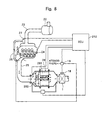
- a diesel engine having an exhaust gas throttle valve disposed on the downstream of the continuously regenerating DPF will be described with reference to a schematic diagram of Fig. 8, and a concrete constitution of the exhaust gas throttle valve will be described with reference to Fig. 7.
- the air is fed into the cylinders of a diesel engine body through an air cleaner 22 and an intake pipe 23.
- the fuel is injected into the cylinders from the fuel injection nozzles 24 at the end of the compression stroke, mixed with the compressed air, and burns in the cylinders to produce the power.
- the exhaust gases after burned are discharged into an exhaust pipe 25 and are partly recirculated into the intake pipe 23 through an EGR passage 26.
- the recirculation purposes chiefly for preventing the generation of NOx, and the amount of the exhaust gases recirculated is controlled by an EGR valve 27.
- a continuously regenerating DPF 28 equipped with a ceramic DPF 281 and an oxidizing catalyst 282 disposed on the upstream side.
- an exhaust gas throttle valve 1 operated by a fluid pressure actuator 18.
- the oxidizing catalyst 282 is activated when the temperature of the exhaust gases from the diesel engine is not lower than a predetermined value, and the particulate matter trapped and deposited on the DPF 281 is oxidized with oxygen in the exhaust gases and is removed due to the exhaust gases elevated at a high temperature by the oxidizing action.
- the temperature of the exhaust gases drops, the activity of the oxidizing catalyst 282 drops, and the particulate matter is trapped and deposits in increased amounts.
- the amount of deposition exceeds a predetermined amount, the temperature of the exhaust gases is elevated by such means as feeding the additional fuel by post-injection from the fuel injection nozzle 24 to perform forced regeneration of the DPF.
- the above control operation is executed by an instruction from an ECU 210 depending upon a pressure differential before and after the DPF 281, a temperature thereof, an engine rotational speed, etc.
- a operation is conducted to strongly squeeze the flow of the exhaust gases by decreasing the opening degree of the exhaust gas throttle valve 1 disposed on the downstream of the continuously regenerating DPF 28. This prevents the radiation of heat from the continuously regenerating DPF 28, the heat is retained therein, an increased load torque is exerted on the engine due to an increase in the engine exhaust gas pressure, the temperature of the exhaust gases is further elevated, and the oxidizing catalyst 282 is sufficiently activated to promote the regeneration of the DPF 281.
- the exhaust gas throttle valve 1 is squeezed, the operation of the diesel engine is seriously affected.
- the forced regeneration which uses the exhaust gas throttle valve 1 in combination is so set as to be executed only when the vehicle is brought into a halt and the engine is in an idling state.
- the device for purifying the exhaust gases with the exhaust gas throttle valve 1 disposed on the downstream of the continuously regenerating DPF 28.
- the exhaust gas throttle valve 1 may be disposed on the upstream side as disclosed in JP-A-2003-343287 mentioned above.
- the exhaust gas throttle valve 1 is constituted as a butterfly valve arranged in an exhaust gas passage 2 of a valve casing 3.
- Insertion holes 8 for a valve shaft 5 are perforated in the walls of the exhaust gas passage 2, and both ends of the valve shaft 5 are fitted and supported therein via bushes.
- An intermediate portion of the valve shaft 5 penetrating through the exhaust gas passage 2 has a diameter greater than that at both ends thereof, and its upper portion is cut to form a flat surface over the whole width of the exhaust gas passage 2. Therefore, flanges 51 are formed among the intermediate portion of the valve shaft 5 and both ends thereof. Further, edge portions 9 are formed on the wall of the passage at positions where the insertion holes 8 for the valve shaft 5 are opened in the exhaust gas passage 2.
- Aplate-like valve body 4 of the butterfly valve is secured by bolts 6 to the flat surface of the intermediate portion of the valve shaft 5.
- the valve body 4 is of an elliptic shape close to a circular shape on a plan view, and the circumferential portion thereof comes nearly in agreement with the tubular wall of the exhaust gas passage 2 when the valve is closed. This figure illustrates fully opened state of the valve.
- the valve shaft 5 is turned by, for example, about 75 degrees by a link 7 coupled to the hydraulic pressure actuator to bring the circumferential portion of the valve body 4 close to the tubular wall of the exhaust gas passage 2.
- the exhaust gas passage 2 is not completely closed even when the valve is at the fully closed position; i.e., a small gap is maintained between the circumferential portion of the valve body 4 and the tubular wall of the exhaust gas passage 2 enabling the diesel engine to be operated at the time when the DPF is to be forcibly regenerated.
- Such exhaust gas throttle valve is used not only in combination with the continuously regenerating DPF but also as an exhaust brake valve as has been traditionally used, as disclosed in JP-A-11-257104. That is, many heavy duty trucks mounting diesel engines and having large gross vehicle weights are equipped with an exhaust brake valve of a similar constitution which works to greatly squeeze the exhaust gas during the deceleration, so that the load torque that acts on the diesel engines increases to assist the braking force during the deceleration of the vehicles for safety.
- the particulate matter tapped by the continuously regenerating DPF can be effectively oxidized and removed by elevating the temperature of the exhaust gases by injecting the additional fuel in combination with the use of the exhaust gas throttle valve.
- the exhaust gas throttle valve provided in the exhaust pipe is exposed to the exhaust gases of high temperatures at all times and its constituent parts undergo the thermal expansion.
- the additional fuel is oxidized and burns in the exhaust system, whereby the temperature of the exhaust gases becomes higher than that of when the diesel engine is ordinarily operated.
- the particulate matter deposited on the DPF burns. Accordingly, the temperature on the downstream of the continuously regenerating DPF is further elevated and sometimes exceeds 600°C . Therefore, a very large quantity of heat affects on the exhaust gas throttle valve disposed on the downstream of the continuously regenerating DPF, and the thermal expansion of the constituent parts becomes to a serious degree.
- the exhaust gas pressure increases on the upstream of the exhaust gas throttle valve.
- the high pressure exhaust gas vigorously flows out through the gap between the circumferential portion of the valve body of the exhaust gas throttle valve and the tubular wall of the exhaust gas passage, so that a large noise is made from the circumference of the exhaust gas throttle valve accompanied by a pressure drop of the exhaust gas.
- the noise can be decreased considerably in case that the continuously regenerating DPF exists on the downstream of the exhaust gas throttle valve.
- the exhaust gas throttle valve is disposed at the downstream of the continuously regenerating DPF, however, a decrease in the noise by the continuously regenerating DPF cannot be expected.
- the amounts of thermal expansion taking place in the each constituent parts of the exhaust gas throttle valve is not same amounts. That is, the exhaust gases of high temperatures are flowing at all times around the valve body of the exhaust gas throttle valve, on the other hand, the atmosphere of normal temperature is existing on the outer side of the valve body in which the exhaust gas passage is formed. Therefore, even if they are made of the same material, there exists a difference in the amount of thermal expansion due to a difference in the temperature and, hence, the gap between the circumferential portion of the valve body and the tubular wall of the exhaust gas passage gradually decreases with an increase in the temperature of the exhaust gases. If the valve body is designed to be brought close to the tubular wall of the exhaust gas passage to decrease the noise, theybecome in contact together (so-called biting) when they are thermally expanded, and the valve body may be stuck.
- the exhaust gas throttle valve When the diesel engine is normally operating, the exhaust gas throttle valve must be maintained fully opened.
- the center axis of rotation of the valve shaft to which the valve body is attached is set to be deviated from the center axis of the exhaust gas passage, so that the total force based on the pressure of the exhaust gases exerts on the valve body at all times in a direction for the valve to be opened.
- the pressure center of the exhaust gases exerting on the valve body is at a point where the valve body intersects the center axis of the exhaust gas passage, i.e., almost the central point of the elliptic shape of the valve body.
- the valve body is fixed to the valve shaft in a manner where the central point thereof is slightly deviated from the center axis of rotation.
- the gap between circumferential portion of the valve body and the edge portions where the valve shaft insertion holes are opened in the exhaust gas passage becomes different on both sides of the center axis of rotation; i.e., the gap becomes narrow on the side where there exists the center point of the valve body.
- the present invention relates to an exhaust gas throttle valve in which the center axis of rotation of the valve shaft to which the valve body is attached is set being deviated from the center axis of the exhaust gas passage, so that the total force based on the pressure of the exhaust gas exerts on the valve body of the exhaust gas throttle valve in a direction in which it opens at all times.
- the purpose of the present invention are to prevent the valve body from coming in contact with the tubular wall of the exhaust gas passage even in case the exhaust gas throttle valve is thermally expanded due to the exhaust gases of high temperatures and to avoid such an occurrence that the valve body is stuck and becomes incapable of operating.
- the valve stick problem exists not only in the exhaust gas throttle valve which is combined with the continuously regenerating DPF but also in the exhaust gas throttle valve which is provided as an exhaust brake.
- the present invention is concerned with an exhaust gas throttle valve disposed in the exhaust system of an engine, comprising, a valve casing having an exhaust gas passage of a circular shape in cross section through which the exhaust gases flow, an insertion hole of a substantially circular shape in cross section formed in the wall portion of said exhaust gas passage, a rotary valve shaft fitted into said insertion hole and is penetrating through said exhaust gas passage, the center axis of rotation of said valve shaft is set at a position deviated from the center axis of said exhaust gas passage, and, a valve body attached to said valve shaft having a recessed portion formed in said valve body by cutting the surface of said valve body at a position facing the edge portion where said insertion hole is opened in said exhaust gas passage, said recessed portion being formed in the circumferential portion of said valve body on the side of said center axis of said exhaust gas passage beyond said center axis of rotation.
- the center axis of rotation of the valve shaft is set to a position deviated from the center axis of the exhaust gas passage so that the torque acts in a direction for the exhaust gas throttle valve to be opened when the diesel engine is normally operating.
- the exhaust gas throttle valve is such that the center of the elliptic valve body is fixed at a position deviated from the center axis of rotation, and the gap between the circumferential portion of the valve body and the tubular wall of the exhaust gas passage becomes different on both sides of the center axis of rotation.
- two recessed portions are symmetrically formed in the circumferential portion of the valve body.
- they are formed by cutting the surface of the valve body at positions facing the edge portions where the insertion holes for the valve shaft are opened in the exhaust gas passage on the side where the gap becomes smaller, i.e., on the side of the center axis of the exhaust gas passage beyond the center axis of rotation.
- the distance between a point on circumferential portion of the valve body and the opposing tubular wall of the exhaust gas passage becomes smaller as the point on circumferential portion approaches the center axis of rotation.
- the position of the recessed portion is the one where the distance becomes the smallest between the circumferential portion and the edge portion throughout the whole circumference of the valve body, and is, hence, the position where the valve body and the edge portions become most likely to come in contact with each other in case the exhaust gas throttle valve is thermally expanded due to the exhaust gases of a high temperature.
- recessed portions are formed in these positions to increase the gap and, hence, to avoid the probability of contact caused by the thermal expansion.
- the recessed portions are so shaped that the depth is a maximum at points where the circumferential portion of the valve body faces the edge portions.
- communication holes may be perforated in the valve body on the side opposite to the center axis of the gas flow passage with the center axis of rotation as a center.
- the exhaust gas flow passage can be maintained when the valve is closed, even when the gap as a whole is decreased between the circumferential portion of the valve body and the tubular wall of the exhaust gas passage.
- a large quantity of heat is exerted on the exhaust gas throttle valve at the time of forced regeneration when the exhaust gas throttle valve is used in combination with the device for purifying the exhaust gases, that has a catalyst and a diesel particulate filter for trapping the particulate matter in the exhaustgases.
- the exhaust gas throttle valve of the present invention as the exhaust gas throttle valve for a diesel engine equipped with the device for purifying the exhaust gases.
- the invention exhibits the effect more efficiently when the exhaust gas throttle valve is disposed on the downstream of the device for purifying the exhaust gases.
- the exhaust gas throttle valve according to the present invention can be adopted as an exhaust brake valve disposed in the exhaust system of the engine, that is used in heavy duty vehicles and that is so operated as to decrease the opening degree during the deceleration operation of the vehicle.
- the exhaust brake valve too, is thermally expanding due to the exhaust gases of high temperatures.
- the present invention can be applied to the exhaust brake value to avoid the stick caused by the thermal expansion.
- the exhaust gas throttle valve illustrated in Figs. 1 and 2 is a butterfly valve arranged in a valve casing 3 in which an exhaust gas passage 2 is formed, like the one shown in Fig. 7.
- a valve shaft 5 to which a valve body 4 is attached has a shape which is the same as that of the valve shaft of Fig. 7, and has both end portions thereof fitted into insertion holes 8 formed in the valve casing 3.
- a valve shaft 5 has an intermediate flat surface to where the valve body 4 is fixed, and further has flange portions 51 among the flat surface and both endportions thereof. Portions where the insertion holes 8 are opened in the exhaust gas passage 2 for inserting the valve shaft 5, are forming edge portions 9.
- Figs. 1 and 2 are views illustrating a state where the exhaust gas throttle valve is fully opened.
- valve body When the DPF is being forcibly regenerated, the temperature of the exhaust gases is elevated by burning the additional fuel, and the valve body is brought to a closed position depending upon the operating conditions.
- a hydraulic pressure actuator equipped with, for example, a cylinder-piston mechanism.
- a compressed air or the like is introduced into the hydraulic pressure actuator to turn the valve shaft 5.
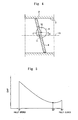
- the center axis 12 of rotation of the valve shaft 5 is set at a position separated away from a point C at which the center axis 13 of the exhaust gas passage 2 intersects the valve body 4, i.e., is set at a position separated away from a center point of the elliptic shape of the valve body 4. That is, referring to Fig. 4, the center axis 12 of rotation of the valve shaft 5 passes through a position offset from the enter axis 13 of the exhaust gas passage by a distance E. The total force of the exhaust gas pressure exerts on the point C at where the center axis 13 of the passage intersects the valve body 4. Being offset, therefore, a torque due to the exhaust gas pressure acts on the valve body 4 in a direction in which it opens.
- the exhaust gas throttle valve is automatically opened even if it is closed due to some cause while the diesel engine is in normal operation.
- the offset E is enlarged in Fig. 4 for easy comprehension, the offset amount in practice is as small as about 1/20 to about 1/40 of the diameter of the exhaust gas passage 2.
- the valve body 4 Upon setting the center axis 12 of rotation of the valve shaft 5 being offset from the center axis 13 of the exhaust gas passage 2 as described above, the valve body 4 is attached to the valve shaft 5 in a manner that the center point C of the elliptic shape is at a position separated away from the center axis 12 of rotation by the offset amount.
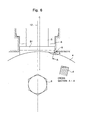
- the distance between the circumferential portion of the valve body 4 and the edge portions 9 formed at portions where the insertion holes 8 for the valve shaft are opened in the exhaust gas passage 2 differs on both sides of the center axis 12 of rotation. Namely, as illustrated in detail in Fig. 6, the gap becomes narrower on the side where the center point C of the valve body 4 exists.
- the gap between the valve body 4 and the tubular wall of the exhaust gas passage 2 must be decreased as small as possible.
- three communication holes 10 are perforated in the valve body 4. When the exhaust gas throttle valve is closed, most of the exhaust gases flow through the communication holes 10. The communication holes 10 are perforated near the central portion of the valve body 4 and have passage areas enough to flow. Therefore, very decreased noise generates when the exhaust gas throttle valve is closed as compared to that of when the exhaust gases flow only around the valve body 4.
- the edge portion 9 is formed on the tubular wall of a circular shape, so the distance (gap) between the circumferential portion and the edge portion 9, generally, varies as illustrated in Fig. 5 (though it may differ depending upon the thickness of the valve body 4) , as the valve body 4 rotates from the fully opened position to the fully closed position, and the distance becomes aminimumnear the fully closed position. Between both sides of the center axis 12 of rotation as described above, the distance is shorter on the side of the center point C of the valve body 4.
- recessed portions 11 are formed in the surface of the valve body 4 at the above positions.
- the recessed portions increase the distance between the edge portions 9 and the circumferential portions of the valve body 4, avoiding the contact between the two and avoiding the biting despite they have been thermally expanded.
- the recessed portions 11 are formed at positions where the contact is most likely to occur due to the thermal expansion. If the contact does not take place at these portions, then, the contact will not take place at any other circumferential portions.
- Fig. 3 illustrates the shape of the valve body 4 embodying the present invention.
- the valve body 4 has two holes 52 for inserting the mounting bolts 6 on the center axis 12 of rotation of the valve shaft 5 and, further, has three communication holes 10 perforated therein for discharging the exhaust gases when it is closed.
- Symbol C represents a center point of the valve body 4 of an elliptic shape and through which the center axis 13 of the exhaust gas passage 2 passes.
- the area of the hatched portion on the right side of the center axis 12 of rotation is greater than the area of the left side and, therefore, the pressure of the exhaust gases gives a torque to the valve body 4 in a direction in which it opens.
- the recessed portions 11 are formed at two symmetrical positions in the circumferential portion on the right side of the center axis 12 where the center axis 13 of the exhaust gas passage 2 exists.
- Fig. 6 illustrates, on an enlarged scale, the valve body 4 mounted on the rotary shaft 5 and the vicinities of the edge portions 9 where the insertion holes 8 are opened.
- the recessed portions 11 are formed by cutting the surface of the valve body 4 by using, for example, a circular tool, and have such a shape that they become the deepest at positions where the gap is a minimumbetween the circumferential portion and the edge portions 9, i.e., the circumferential portion becomes the deepest at positions facing the edge portions 9.
- the valve body 4 is not cut by the whole thickness thereof but its circumferential portion is left. When the exhaust gas throttle valve is closed, therefore, the exhaust gases do not flow through these gaps in increased amounts despite of forming the recessed portions 11.
Landscapes
- Engineering & Computer Science (AREA)
- Chemical & Material Sciences (AREA)
- Combustion & Propulsion (AREA)
- Mechanical Engineering (AREA)
- General Engineering & Computer Science (AREA)
- Materials Engineering (AREA)
- Health & Medical Sciences (AREA)
- Chemical Kinetics & Catalysis (AREA)
- Toxicology (AREA)
- Control Of Throttle Valves Provided In The Intake System Or In The Exhaust System (AREA)
- Processes For Solid Components From Exhaust (AREA)
- Exhaust Gas After Treatment (AREA)
- Filtering Of Dispersed Particles In Gases (AREA)
- Exhaust Silencers (AREA)
Abstract
Description
a valve casing having an exhaust gas passage of a circular shape in cross section through which the exhaust gases flow,
an insertion hole of a substantially circular shape in cross section formed in the wall portion of said exhaust gas passage,
a rotary valve shaft fitted into said insertion hole and is penetrating through said exhaust gas passage, the center axis of rotation of said valve shaft is set at a position deviated from the center axis of said exhaust gas passage, and,
a valve body attached to said valve shaft having a recessed portion formed in said valve body by cutting the surface of said valve body at a position facing the edge portion where said insertion hole is opened in said exhaust gas passage, said recessed portion being formed in the circumferential portion of said valve body on the side of said center axis of said exhaust gas passage beyond said center axis of rotation.
Claims (6)
- An exhaust gas throttle valve disposed in the exhaust system of an engine, comprising,
a valve casing (3) having an exhaust gas passage (2) of a circular shape in cross section through which the exhaust gases flow,
an insertion hole (8) of a circular shape in cross section formed in the wall portion of said exhaust gas passage (2),
a rotary valve shaft (5) fitted into said insertion hole (8) and is penetrating through said exhaust gas passage (2), the center axis (12) of rotation of said valve shaft (5) is set at a position deviated from the center axis (13) of said exhaust gas passage (2), and,
a plate-like valve body (4) attached to said valve shaft (5) having recessed portions (11) symmetrically formed in said valve body (4) by cutting the surface of said valve body (4) at positions facing the edge portions (9) where said insertion hole (8) is opened in said exhaust gas passage (2) , said recessed portions (11) being formed in the circumferential portion of said valve body (4) on the side of said center axis (13) of said exhaust gas passage (2) beyond said center axis (12) of rotation. - Exhaust gas throttle valve according to claim 1, characterized in that said recessed portions (11) are so shaped that the depth is a maximum at points where the circumferential portion of said valve body faces said edge portions (9).
- Exhaust gas throttle valve according to claim 1 or 2, characterized in that communication holes (10) are perforated in said valve body (4) on the side opposite to said center axis (13) of the gas flow passage (2) with said center axis (12) of rotation as a center.
- Exhaust gas throttle valve according to at least one of claims 1-3, characterized in that said engine is a diesel engine, a device for purifying the exhaust gas is disposed in the exhaust gas system thereof, the device for purifying the exhaust gases having a catalyst and a diesel particulate filter for trapping the particulate matter in the exhaust gases, and the exhaust gas throttle valve is so operated that its opening degree is decreased when the particulate matter deposited on the diesel particulate filter is to be oxidized and removed for regeneration.
- An exhaust gas throttle valve according to claim 4, wherein said exhaust gas throttle valve is disposed on the downstream of said device for purifying the exhaust gases.
- An exhaust gas throttle valve according to any of the preceding claims, wherein said engine is mounted on a vehicle, and said exhaust gas throttle valve is so operated that is opening degree decreases during the deceleration operation of the vehicle.
Applications Claiming Priority (2)
| Application Number | Priority Date | Filing Date | Title |
|---|---|---|---|
| JP2004114981A JP2005299457A (en) | 2004-04-09 | 2004-04-09 | Engine exhaust throttle valve |
| JP2004114981 | 2004-04-09 |
Publications (3)
| Publication Number | Publication Date |
|---|---|
| EP1584804A2 true EP1584804A2 (en) | 2005-10-12 |
| EP1584804A3 EP1584804A3 (en) | 2010-05-19 |
| EP1584804B1 EP1584804B1 (en) | 2011-09-14 |
Family
ID=34909530
Family Applications (1)
| Application Number | Title | Priority Date | Filing Date |
|---|---|---|---|
| EP05007815A Expired - Lifetime EP1584804B1 (en) | 2004-04-09 | 2005-04-08 | Exhaust gas throttle valve for engines |
Country Status (4)
| Country | Link |
|---|---|
| US (1) | US7406823B2 (en) |
| EP (1) | EP1584804B1 (en) |
| JP (1) | JP2005299457A (en) |
| CN (1) | CN100430585C (en) |
Families Citing this family (31)
| Publication number | Priority date | Publication date | Assignee | Title |
|---|---|---|---|---|
| DE102006008346B4 (en) * | 2006-02-21 | 2008-06-19 | J. Eberspächer GmbH & Co. KG | Throttle arrangement and exhaust system equipped with it |
| WO2007119379A1 (en) | 2006-03-15 | 2007-10-25 | Aisan Kogyo Kabushiki Kaisha | Exhaust pressure control valve |
| US20100219363A1 (en) * | 2006-08-14 | 2010-09-02 | Borgwarner Inc. | Low force anti sticking throttle valve |
| JP2009041419A (en) | 2007-08-08 | 2009-02-26 | Aisan Ind Co Ltd | Exhaust throttle valve |
| JP5006740B2 (en) * | 2007-09-13 | 2012-08-22 | ヤンマー株式会社 | Black smoke purification device for diesel engine |
| US7628250B2 (en) * | 2007-11-21 | 2009-12-08 | Emcon Technologies Llc | Passive valve assembly for vehicle exhaust system |
| AT506338A1 (en) * | 2008-02-04 | 2009-08-15 | Man Nutzfahrzeuge Oesterreich | METHOD FOR REGENERATING A PARTICULATE FILTER ARRANGED IN THE EXHAUST GAS TRAY OF A VEHICLE DIESEL ENGINE |
| US20100025146A1 (en) * | 2008-07-31 | 2010-02-04 | Shu-Li Ho | Baffle plate operating mechanism for muffler |
| US20100034049A1 (en) * | 2008-08-06 | 2010-02-11 | Nicholas William Ferri | Adjustable Diffusing Coal Valve |
| CN102472204B (en) | 2009-07-07 | 2014-03-05 | 三菱电机株式会社 | Exhaust gas recirculation valve |
| DE102009051098A1 (en) * | 2009-10-28 | 2011-05-05 | J. Eberspächer GmbH & Co. KG | Screening unit for exhaust system of internal-combustion engine, particularly of motor vehicle, has tubing section, from which exhaust gas is disposed in mainstream direction |
| JP5440385B2 (en) * | 2010-05-25 | 2014-03-12 | いすゞ自動車株式会社 | Exhaust gas purification system |
| CN103003601B (en) | 2010-06-29 | 2015-04-01 | 三菱电机株式会社 | Step type valve |
| DE102011100756B3 (en) * | 2011-05-06 | 2012-08-02 | Voith Patent Gmbh | Turbine plant for the benefit of energy from ocean waves |
| US20130000298A1 (en) * | 2011-06-29 | 2013-01-03 | Caterpillar Inc. | Exhaust gas recirculation valve for internal combustion engine |
| CN103615326B (en) * | 2013-11-29 | 2016-02-24 | 东风小康汽车有限公司重庆分公司 | car auxiliary brake exhaust butterfly valve |
| CN103615325B (en) * | 2013-11-29 | 2016-03-23 | 东风小康汽车有限公司重庆分公司 | Engine exhaust and brake butterfly valve |
| CN104564360A (en) * | 2014-11-21 | 2015-04-29 | 桂林新艺制冷设备有限责任公司 | Brake butterfly valve |
| JP6464860B2 (en) * | 2015-03-23 | 2019-02-06 | 株式会社デンソー | Exhaust gas recirculation device |
| JP6354724B2 (en) * | 2015-10-02 | 2018-07-11 | 株式会社デンソー | Intake control device |
| JP6768427B2 (en) * | 2016-06-01 | 2020-10-14 | 愛三工業株式会社 | Double eccentric valve |
| CN106870069B (en) * | 2017-02-09 | 2019-12-10 | 重庆长安汽车股份有限公司 | Silencer pneumatic valve assembly |
| DE102018210407A1 (en) * | 2018-06-26 | 2020-01-02 | Bayerische Motoren Werke Aktiengesellschaft | Improvement of a filter effect of a particle filter for a motor vehicle |
| CN109184879B (en) * | 2018-11-19 | 2019-10-29 | 吉利汽车研究院(宁波)有限公司 | A kind of engine exhaust silencing means |
| US11002166B2 (en) * | 2019-05-17 | 2021-05-11 | Ford Global Technologies, Llc | Methods and systems for an active exhaust valve |
| US10920695B1 (en) * | 2019-09-05 | 2021-02-16 | Ford Global Technologies, Llc | Methods and systems for regeneration of an exhaust aftertreatment device |
| US11680503B2 (en) | 2021-03-16 | 2023-06-20 | Ford Global Technologies, Llc | Exhaust sound tuning system and method |
| CN113279843A (en) * | 2021-05-31 | 2021-08-20 | 一汽解放汽车有限公司 | Aftertreatment system, vehicle, and control method for vehicle |
| CN115750805A (en) * | 2021-09-03 | 2023-03-07 | 广州汽车集团股份有限公司 | Exhaust valve, exhaust device and automobile |
| US12584558B2 (en) * | 2023-08-03 | 2026-03-24 | Woodward, Inc. | Hybrid butterfly-ball flow control valve |
| JP7777164B2 (en) * | 2024-03-25 | 2025-11-27 | 本田技研工業株式会社 | Gas Recovery Device |
Citations (1)
| Publication number | Priority date | Publication date | Assignee | Title |
|---|---|---|---|---|
| JP2003343287A (en) | 2002-05-27 | 2003-12-03 | Mitsubishi Fuso Truck & Bus Corp | Exhaust emission control device for internal combustion engine |
Family Cites Families (16)
| Publication number | Priority date | Publication date | Assignee | Title |
|---|---|---|---|---|
| US3381935A (en) * | 1962-09-10 | 1968-05-07 | Ford Motor Co | Butterfly valve |
| US3391756A (en) * | 1967-09-25 | 1968-07-09 | Svenska Flaektfabriken Ab | Damper for regulating the flow of a gaseous medium |
| JPH01127942A (en) | 1987-11-13 | 1989-05-19 | Mitsubishi Electric Corp | Dewdrop predicting device |
| JPH01187326A (en) * | 1988-01-18 | 1989-07-26 | Kubota Ltd | Air fuel mixer for gas engine |
| JPH01127942U (en) * | 1988-02-23 | 1989-08-31 | ||
| DE4337097C2 (en) * | 1992-11-02 | 1996-03-14 | Toyota Motor Co Ltd | Supporting structure for a ceramic throttle valve assembly |
| US5355673A (en) * | 1992-11-18 | 1994-10-18 | Sterling Robert E | Exhaust valve |
| US5406790A (en) * | 1992-12-11 | 1995-04-18 | Toyota Jidosha Kabushiki Kaisha | Exhaust gas purification device for an engine |
| JP2606154Y2 (en) * | 1993-01-27 | 2000-09-25 | ボッシュ ブレーキ システム株式会社 | Butterfly valve |
| JPH11132060A (en) * | 1997-10-27 | 1999-05-18 | Jidosha Kiki Co Ltd | Exhaust brake device and exhaust brake control |
| DE19812089C1 (en) * | 1998-03-19 | 1999-06-10 | Daimler Chrysler Ag | Intake for multiple cylinder internal combustion engine |
| JP2000002125A (en) * | 1998-06-16 | 2000-01-07 | Bosch Braking Systems Co Ltd | Exhaust shutter valve for diesel engine |
| JP2000170551A (en) * | 1998-12-04 | 2000-06-20 | Bosch Braking Systems Co Ltd | Exhaust brake valve device |
| WO2002068807A1 (en) * | 2001-02-26 | 2002-09-06 | Mitsubishi Jidosha Kogyo Kabushiki Kaisha | Exhaust gas purifier for internal combustion engines |
| JP3812653B2 (en) * | 2002-01-17 | 2006-08-23 | 三菱自動車工業株式会社 | Exhaust gas purification device for vehicle internal combustion engine |
| JP4333289B2 (en) * | 2003-09-03 | 2009-09-16 | いすゞ自動車株式会社 | Exhaust gas purification system |
-
2004
- 2004-04-09 JP JP2004114981A patent/JP2005299457A/en active Pending
-
2005
- 2005-04-07 CN CNB2005100638742A patent/CN100430585C/en not_active Expired - Fee Related
- 2005-04-08 EP EP05007815A patent/EP1584804B1/en not_active Expired - Lifetime
- 2005-04-08 US US11/101,605 patent/US7406823B2/en not_active Expired - Fee Related
Patent Citations (1)
| Publication number | Priority date | Publication date | Assignee | Title |
|---|---|---|---|---|
| JP2003343287A (en) | 2002-05-27 | 2003-12-03 | Mitsubishi Fuso Truck & Bus Corp | Exhaust emission control device for internal combustion engine |
Also Published As
| Publication number | Publication date |
|---|---|
| JP2005299457A (en) | 2005-10-27 |
| EP1584804A3 (en) | 2010-05-19 |
| CN1680702A (en) | 2005-10-12 |
| US20060048505A1 (en) | 2006-03-09 |
| US7406823B2 (en) | 2008-08-05 |
| EP1584804B1 (en) | 2011-09-14 |
| CN100430585C (en) | 2008-11-05 |
Similar Documents
| Publication | Publication Date | Title |
|---|---|---|
| US7406823B2 (en) | Exhaust gas throttle valve for engines | |
| EP1582708B1 (en) | Device for purifying the exhaust gases of diesel engines | |
| EP1939422B1 (en) | Exhaust gas purifier for diesel engine | |
| US6829891B2 (en) | Exhaust emission control device and method of controlling exhaust emission | |
| CN100572768C (en) | Emission control system | |
| US20110011060A1 (en) | Exhaust Cooling Module for SCR Catalysts | |
| JP2011174467A (en) | Exhaust valve actuation system for diesel particulate filter regeneration | |
| US20100154412A1 (en) | Apparatus and method for providing thermal management of a system | |
| JP4396383B2 (en) | Diesel engine exhaust gas aftertreatment device | |
| JP5075981B2 (en) | Exhaust device for vehicle exhaust line | |
| CN101903623B (en) | Thermal Energy Conservation Devices for Exhaust Gas Purification Plants | |
| JP4375086B2 (en) | Engine exhaust throttle valve operating device | |
| JP4412049B2 (en) | Diesel engine exhaust gas aftertreatment device | |
| JP3867096B1 (en) | Exhaust purification device and PM continuous regeneration system | |
| JP4701622B2 (en) | Diesel engine exhaust gas aftertreatment device | |
| JP2011226356A (en) | Exhaust emission control device of diesel engine | |
| JP2010112281A (en) | Exhaust emission control method and device of diesel internal combustion engine | |
| JP6568372B2 (en) | Exhaust purification equipment | |
| JP2006242175A (en) | PM continuous regeneration apparatus and PM continuous regeneration method | |
| JP2009091930A (en) | Exhaust braking device of vehicle | |
| US20100083642A1 (en) | Exhaust gas purification device, manufacturing method thereof, and manufacturing device thereof | |
| CN120159577B (en) | Integrated nano-coated composite regenerative particulate filter for special diesel engines | |
| JP2017129019A (en) | Manual regeneration of particulate filter | |
| JP2005155534A (en) | Exhaust temperature raising device for internal combustion engine | |
| DE102018114753A1 (en) | Emission control system for internal combustion engine |
Legal Events
| Date | Code | Title | Description |
|---|---|---|---|
| PUAI | Public reference made under article 153(3) epc to a published international application that has entered the european phase |
Free format text: ORIGINAL CODE: 0009012 |
|
| AK | Designated contracting states |
Kind code of ref document: A2 Designated state(s): AT BE BG CH CY CZ DE DK EE ES FI FR GB GR HU IE IS IT LI LT LU MC NL PL PT RO SE SI SK TR |
|
| AX | Request for extension of the european patent |
Extension state: AL BA HR LV MK YU |
|
| PUAL | Search report despatched |
Free format text: ORIGINAL CODE: 0009013 |
|
| AK | Designated contracting states |
Kind code of ref document: A3 Designated state(s): AT BE BG CH CY CZ DE DK EE ES FI FR GB GR HU IE IS IT LI LT LU MC NL PL PT RO SE SI SK TR |
|
| AX | Request for extension of the european patent |
Extension state: AL BA HR LV MK YU |
|
| 17P | Request for examination filed |
Effective date: 20100622 |
|
| RIC1 | Information provided on ipc code assigned before grant |
Ipc: F02D 9/04 20060101AFI20101115BHEP |
|
| AKX | Designation fees paid |
Designated state(s): AT BE BG CH CY CZ DE DK EE ES FI FR GB GR HU IE IS IT LI LT LU MC NL PL PT RO SE SI SK TR |
|
| GRAP | Despatch of communication of intention to grant a patent |
Free format text: ORIGINAL CODE: EPIDOSNIGR1 |
|
| GRAS | Grant fee paid |
Free format text: ORIGINAL CODE: EPIDOSNIGR3 |
|
| GRAA | (expected) grant |
Free format text: ORIGINAL CODE: 0009210 |
|
| AK | Designated contracting states |
Kind code of ref document: B1 Designated state(s): DE FR GB |
|
| REG | Reference to a national code |
Ref country code: GB Ref legal event code: FG4D |
|
| REG | Reference to a national code |
Ref country code: DE Ref legal event code: R096 Ref document number: 602005029971 Country of ref document: DE Effective date: 20111201 |
|
| PLBE | No opposition filed within time limit |
Free format text: ORIGINAL CODE: 0009261 |
|
| STAA | Information on the status of an ep patent application or granted ep patent |
Free format text: STATUS: NO OPPOSITION FILED WITHIN TIME LIMIT |
|
| 26N | No opposition filed |
Effective date: 20120615 |
|
| REG | Reference to a national code |
Ref country code: DE Ref legal event code: R097 Ref document number: 602005029971 Country of ref document: DE Effective date: 20120615 |
|
| PGFP | Annual fee paid to national office [announced via postgrant information from national office to epo] |
Ref country code: FR Payment date: 20140409 Year of fee payment: 10 |
|
| REG | Reference to a national code |
Ref country code: FR Ref legal event code: ST Effective date: 20151231 |
|
| PG25 | Lapsed in a contracting state [announced via postgrant information from national office to epo] |
Ref country code: FR Free format text: LAPSE BECAUSE OF NON-PAYMENT OF DUE FEES Effective date: 20150430 |
|
| PGFP | Annual fee paid to national office [announced via postgrant information from national office to epo] |
Ref country code: DE Payment date: 20160405 Year of fee payment: 12 Ref country code: GB Payment date: 20160406 Year of fee payment: 12 |
|
| REG | Reference to a national code |
Ref country code: DE Ref legal event code: R119 Ref document number: 602005029971 Country of ref document: DE |
|
| GBPC | Gb: european patent ceased through non-payment of renewal fee |
Effective date: 20170408 |
|
| PG25 | Lapsed in a contracting state [announced via postgrant information from national office to epo] |
Ref country code: DE Free format text: LAPSE BECAUSE OF NON-PAYMENT OF DUE FEES Effective date: 20171103 |
|
| PG25 | Lapsed in a contracting state [announced via postgrant information from national office to epo] |
Ref country code: GB Free format text: LAPSE BECAUSE OF NON-PAYMENT OF DUE FEES Effective date: 20170408 |