EP1583752B1 - Cyclization process for substituted benzothiazole derivatives - Google Patents
Cyclization process for substituted benzothiazole derivatives Download PDFInfo
- Publication number
- EP1583752B1 EP1583752B1 EP03799511A EP03799511A EP1583752B1 EP 1583752 B1 EP1583752 B1 EP 1583752B1 EP 03799511 A EP03799511 A EP 03799511A EP 03799511 A EP03799511 A EP 03799511A EP 1583752 B1 EP1583752 B1 EP 1583752B1
- Authority
- EP
- European Patent Office
- Prior art keywords
- sup
- lower alkyl
- formula
- hydrogen
- accordance
- Prior art date
- Legal status (The legal status is an assumption and is not a legal conclusion. Google has not performed a legal analysis and makes no representation as to the accuracy of the status listed.)
- Expired - Lifetime
Links
- 0 *c1c2nc(N*)[s]c2c(*)c(*)c1* Chemical compound *c1c2nc(N*)[s]c2c(*)c(*)c1* 0.000 description 2
Classifications
-
- C—CHEMISTRY; METALLURGY
- C07—ORGANIC CHEMISTRY
- C07D—HETEROCYCLIC COMPOUNDS
- C07D277/00—Heterocyclic compounds containing 1,3-thiazole or hydrogenated 1,3-thiazole rings
- C07D277/60—Heterocyclic compounds containing 1,3-thiazole or hydrogenated 1,3-thiazole rings condensed with carbocyclic rings or ring systems
- C07D277/62—Benzothiazoles
- C07D277/68—Benzothiazoles with hetero atoms or with carbon atoms having three bonds to hetero atoms with at the most one bond to halogen, e.g. ester or nitrile radicals, directly attached in position 2
- C07D277/82—Nitrogen atoms
-
- A—HUMAN NECESSITIES
- A61—MEDICAL OR VETERINARY SCIENCE; HYGIENE
- A61P—SPECIFIC THERAPEUTIC ACTIVITY OF CHEMICAL COMPOUNDS OR MEDICINAL PREPARATIONS
- A61P25/00—Drugs for disorders of the nervous system
-
- C—CHEMISTRY; METALLURGY
- C07—ORGANIC CHEMISTRY
- C07D—HETEROCYCLIC COMPOUNDS
- C07D417/00—Heterocyclic compounds containing two or more hetero rings, at least one ring having nitrogen and sulfur atoms as the only ring hetero atoms, not provided for by group C07D415/00
- C07D417/02—Heterocyclic compounds containing two or more hetero rings, at least one ring having nitrogen and sulfur atoms as the only ring hetero atoms, not provided for by group C07D415/00 containing two hetero rings
- C07D417/04—Heterocyclic compounds containing two or more hetero rings, at least one ring having nitrogen and sulfur atoms as the only ring hetero atoms, not provided for by group C07D415/00 containing two hetero rings directly linked by a ring-member-to-ring-member bond
Definitions
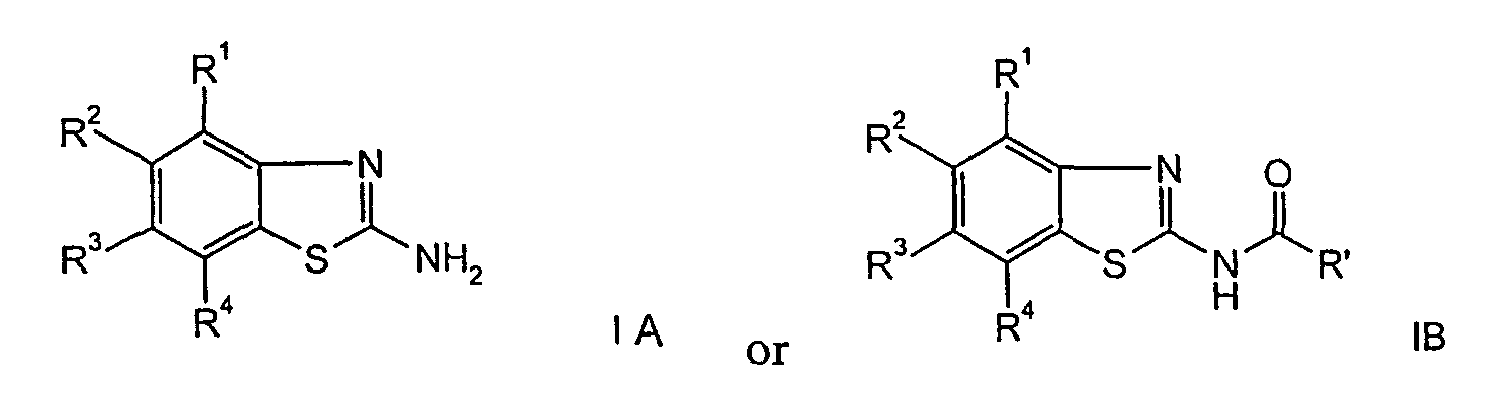
- the present invention relates to an improved cyclization process for the preparation of benzothiazoles of formula wherein
- the compounds of formula I are known compounds, described in WO 01/97786.
- the compounds of formula IA may be used as intermediates for the preparation of compounds of formula IB, which compounds are pharmaceutically active as adenosine receptor ligands.
- the compounds of formula IB may be used in the control or prevention of illnesses based on the modulation of the adenosine system, such as Alzheimer's disease, Parkinson's disease, neuroprotection, schizophrenia, anxiety, pain, respiration deficits, depression, asthma, allergic responses, hypoxia, ischaemia, seizure and substance abuse.
- compounds of the present invention may be useful as sedatives, muscle relaxants, antipsychotics, antiepileptics, anticonvulsants and cardioprotective agents.
- the most preferred indications in accordance with the present invention are those, which base on the A 2A receptor antagonistic activity and which include disorders of the central nervous system, for example the treatment or prevention of certain depressive disorders, neuroprotection and Parkinson's disease.
- the compounds are further useful in the treatment of diabetes mellitus, obesity and ADHD (attention deficit hyperactivity disorder).
- lower alkyl denotes a saturated straight- or branched-chain alkyl group containing from 1 to 6 carbon atoms, for example, methyl, ethyl, propyl, isopropyl, n-butyl, i-butyl, 2-butyl, t-butyl and the like.
- Preferred lower alkyl groups are groups with 1 - 4 carbon atoms.
- halogen denotes chlorine, iodine, fluorine and bromine.
- lower alkoxy denotes a group wherein the alkyl residues are as defined above, and which is attached via an oxygen atom.
- heteroaryl denotes the following group: pyrrol-1-yl, tetrazolyl, imidazol-1 or 2-yl, pyrazol-1-yl, pyridin-1, 2, 3 or 4-yl, pyrazinyl, pyrimidinyl, pyridazinyl, isothiazolyl, isoxazolyl, thienyl or furyl;
- five or six membered non aromatic heterocyclyl denotes the following groups: pyrrolidinyl, hydro-pyranyl, imidazolidinyl, pyrazolidinyl, piperidinyl, piperazinyl, morpholinyl, thiomorpholinyl, thiomorpholin-1,1-dioxo or thiomorpholin-1-oxo.
- aryl denotes phenyl, benzyl or naphthyl.
- pharmaceutically acceptable acid addition salts embraces salts with inorganic and organic acids, such as hydrochloric acid, nitric acid, sulfuric acid, phosphoric acid, citric acid, formic acid, fumaric acid, maleic acid, acetic acid, succinic acid, tartaric acid, methane-sulfonic acid, p-toluenesulfonic acid and the like.
- EP 282971 Another way to amino-benzothiazoles is described in EP 282971 as follows: It has been shown that this reaction step often leads to amino-benzothiazoles in low yields due to competing reactions.
- EP 529 600 describes a process for preparation of amino-benzothiazoles comprising the following step:
- reaction variants conducted according to literature precedent, such as Br 2 /CHCl 3 or AcOH, I 2 /MeOH or SOCl 2 /CHCl 3 are often not suitable for the preparation of amino-benzothiazoles, especially in large amounts.
- DMSO dimethyl sulphate
- HBr may be used in any form, including gaseous, or for example in form of an in situ prepared bromide salt and a strong acid. Suitable is HBr-AcOH, since this represents a convenient form of 'liquid' concentrated HBr.
- a solvent for example, CH 2 Cl 2 , CH 3 CN, THF, AcOH or EtOAc.
- Preferred solvents are AcOH or EtOAc.
- the aminobenzothiazole IA or the corresponding benzamide of formula IB is then purified by liberating it from the crude HBr-salt. This is dissolved in ethanol, diluted with water and heated to 55 °C. The obtained solution is basified with aqueous ammonia to pH 9-10, forming a suspension which is stirred and allowed to cool to RT overnight (16 h). The products are filtered and washed portionwise with aqueous ethanol and then dried for 24 h at 45 °C. Yield ⁇ 90 %.
- the compounds of formula IA may then used for the preparation of end-products of formula IB as described in the following scheme: This reaction is described in more detail in WO 01/97786.
- the starting compounds of formulas II and III may be prepared as described in the above scheme:
- Compounds of formula III may be prepared as follows: A compound of formula IV is dissolved in sulphuric acid, maintaining a temperature between 0-10 °C. The obtained solution is cooled to ca. -5°C. In a separate flask, nitric acid is added to sulphuric acid and precooled to ca. 10 °C. This mixture is then added the above solution within 1 h ensuring that the temperature remained ⁇ 0 °C.
- the reaction mixture is quenched into ice and to the aqueous solution aqueous ammonia is added.
- the suspension is diluted with water and stirred at RT for 0.2 h before being filtered.
- the obtained product of formula V is washed with water and dried.
- This compound is then suspended in methanol and dichloromethane is added to generate a solution.
- Pd-C is added and the reduction is commenced at RT under hydrogen with stirring.
- the reaction is complete after 1.5 h.
- the mixture is filtered, the residue is rinsed with MeOH and the filtrate is concentrated under reduced pressure. Water is added and the resulting suspension is heated again to 60 °C to remove residual MeOH.
- the obtained product of formula VI is filtered, washed with aqueous MeOH and dried.
- Ammonium thiocyanate is dissolved in acetone at RT and benzoyl chloride is added to create PhCONCS in situ .
- the reaction mixture is heated to reflux and then treated with a warm solution of a compound of formula VI in acetone over 0.25 h. After 2.5h, the solvent is removed by distillation at ambient pressure with the continuous addition of water. After cooling the suspension to RT, the product of formula III is filtered, washed with water and dried.
- the product was washed portionwise with 190 ml ethyl acetate.
- the aminobenzothiazole was purified by liberating it from the undried crude HBr-salt. This was dissolved in 450 ml ethanol, diluted with 600 ml water and heated to 55 °C.
- the red solution was basified with 50 ml 25 % aqueous ammonia to pH 9-10, forming a suspension which was stirred and allowed to cool to RT overnight (16 h).
- the product was filtered and washed portionwise with 140 ml 50 % aqueous ethanol and then dried for 24 h at 45 °C/l mb.
- N-ethyldiisopropylamine 42 g, 321 mmol
- the reaction mixture was stirred at RT overnight ( ⁇ 17 h).
- the contents were heated to reflux ( ⁇ 60 °C) and 300 ml water were added whilst maintaining ca. constant volume throughout a distillation process until the internal temperature reached 90 °C. Once all the water was added, heating was increased to 110 °C and a total of 280 ml of distillate was collected. A further 320 ml water was added in one portion and the temperature was increased to 120 °C whereby the internal and distillate temperature rose to ⁇ 70 °C.
Landscapes
- Chemical & Material Sciences (AREA)
- Organic Chemistry (AREA)
- Health & Medical Sciences (AREA)
- Medicinal Chemistry (AREA)
- Pharmacology & Pharmacy (AREA)
- Biomedical Technology (AREA)
- Neurology (AREA)
- Neurosurgery (AREA)
- Chemical Kinetics & Catalysis (AREA)
- General Chemical & Material Sciences (AREA)
- Engineering & Computer Science (AREA)
- Nuclear Medicine, Radiotherapy & Molecular Imaging (AREA)
- Bioinformatics & Cheminformatics (AREA)
- Life Sciences & Earth Sciences (AREA)
- Animal Behavior & Ethology (AREA)
- General Health & Medical Sciences (AREA)
- Public Health (AREA)
- Veterinary Medicine (AREA)
- Thiazole And Isothizaole Compounds (AREA)
- Pharmaceuticals Containing Other Organic And Inorganic Compounds (AREA)
- Nitrogen And Oxygen Or Sulfur-Condensed Heterocyclic Ring Systems (AREA)
- Plural Heterocyclic Compounds (AREA)
Abstract
Description
- The present invention relates to an improved cyclization process for the preparation of benzothiazoles of formula

- R1, R2 and R3
- are independently from each other hydrogen, lower alkyl, lower alkoxy or halogen;
- R4
- is hydrogen, lower alkyl, lower alkyloxy, halogen,
or is a five or six membered non aromatic heterocyclyl group, unsubstituted or substituted by lower alkyl or an oxo-group, or is
-NR5R6, wherein R5 and R5 are independently from each other hydrogen, lower alkyl, -C(O)-lower alkyl, -(CH2)nO-lower alkyl or benzyl, optionally substituted by lower alkyl, or is a
five or six membered heteroaryl group; - R1 and R2 or R2 and R3
- may form together with the corresponding carbon atoms a ring containing -O-CH2-O- or -CH=CH-CH=CH-;
- R
- is hydrogen or -C(O)R';
- R'
- is a five or six membered non aromatic heterocyclyl group, five or six membered heteroaryl group or is aryl, which rings may be substituted by the groups, selected from lower alkyl, halogen-lower alkyl, lower alkoxy, cyano, nitro, -C(O)H, -C(O)OH or by pyrrolidin-1-yl-methyl;
- n
- is 1 to 4;
- The compounds of formula I are known compounds, described in WO 01/97786.
- The object of the present invention is a cyclization process for the preparation of benzothiazole derivatives of formula I for R = hydrogen (formula IA) and for R = -C(O)R' (formula IB), in good yields and with minimal sideproducts.
- They are important in the regulation of many aspects of cellular metabolism and in the modulation of different central nervous system activities. The compounds of formula IB may be used in the control or prevention of illnesses based on the modulation of the adenosine system, such as Alzheimer's disease, Parkinson's disease, neuroprotection, schizophrenia, anxiety, pain, respiration deficits, depression, asthma, allergic responses, hypoxia, ischaemia, seizure and substance abuse. Furthermore, compounds of the present invention may be useful as sedatives, muscle relaxants, antipsychotics, antiepileptics, anticonvulsants and cardioprotective agents. The most preferred indications in accordance with the present invention are those, which base on the A2A receptor antagonistic activity and which include disorders of the central nervous system, for example the treatment or prevention of certain depressive disorders, neuroprotection and Parkinson's disease. The compounds are further useful in the treatment of diabetes mellitus, obesity and ADHD (attention deficit hyperactivity disorder).
- As used herein, the term "lower alkyl" denotes a saturated straight- or branched-chain alkyl group containing from 1 to 6 carbon atoms, for example, methyl, ethyl, propyl, isopropyl, n-butyl, i-butyl, 2-butyl, t-butyl and the like. Preferred lower alkyl groups are groups with 1 - 4 carbon atoms.
- The term "halogen" denotes chlorine, iodine, fluorine and bromine.
- The term "lower alkoxy" denotes a group wherein the alkyl residues are as defined above, and which is attached via an oxygen atom.
- The term "five or six membered heteroaryl" denotes the following group: pyrrol-1-yl, tetrazolyl, imidazol-1 or 2-yl, pyrazol-1-yl, pyridin-1, 2, 3 or 4-yl, pyrazinyl, pyrimidinyl, pyridazinyl, isothiazolyl, isoxazolyl, thienyl or furyl;
- The term "five or six membered non aromatic heterocyclyl" denotes the following groups: pyrrolidinyl, hydro-pyranyl, imidazolidinyl, pyrazolidinyl, piperidinyl, piperazinyl, morpholinyl, thiomorpholinyl, thiomorpholin-1,1-dioxo or thiomorpholin-1-oxo.
- The term "aryl" denotes phenyl, benzyl or naphthyl.
- The term "pharmaceutically acceptable acid addition salts" embraces salts with inorganic and organic acids, such as hydrochloric acid, nitric acid, sulfuric acid, phosphoric acid, citric acid, formic acid, fumaric acid, maleic acid, acetic acid, succinic acid, tartaric acid, methane-sulfonic acid, p-toluenesulfonic acid and the like.
- In general, the preparation of compounds of formula I, wherein R is hydrogen, is well known. For example, in WO 01/97786 the following process is described:

- 1 HR4, Pd(OAc)2, BDCP, K3PO4, DME (ethylene glycol dimethyl ether), 80 °C/24h/90 %;
- 2 H2, Pd-C, EtOH/CH2Cl2, RT/12h/95 %;
- 3 PhCONCS, acetone, RT/30min/95 % and NaOMe, MeOH, RT/2h/90 %;
- 4 SOCl2, 55 °C/10min/75 %;
- It has been shown that most of starting marterials and the ligand are very expensive and only available in small quantities, and the cyclization step could not be scaled up without resorting to chromatography.
Another way to amino-benzothiazoles is described in EP 282971 as follows:
EP 529 600 describes a process for preparation of amino-benzothiazoles comprising the following step:
- It has been shown that the reaction variants, conducted according to literature precedent, such as Br2/CHCl3 or AcOH, I2/MeOH or SOCl2/CHCl3 are often not suitable for the preparation of amino-benzothiazoles, especially in large amounts.
- Due to the relative high electron density within the amino-substituted phenyl ring in some specific cases required for the present purposes, competing reactions on this ring before or after cyclization always occurred to a certain extents. Other approaches such as the use of aq NH4Br and H2SO4 (EP 529600) or treating the aniline directly with NaSCN/Br2/ AcOH (Synthesis, 970, 31, 2000) failed to offer any improvement.
- A more subtle way of activating the thione sulphur atom was found in the acid catalyzed transfer oxidation of thioureas with DMSO (J. Heterocyclic Chem., 63, 37, 2000). But in the absence of suitable trapping agents a dimerization reaction took place to give undesired iminothiadiazoles.
- All methods, described in the literature, do not give the desired end products of formula IA and IB in good yields without unpredictable side products.
- In order to overcome this problem, it has been found that the treatment of compounds of formulas


- As a sulphoxide, for example, DMSO is suitable, since it is commercially available, cheap and non-toxic.
- HBr may be used in any form, including gaseous, or for example in form of an in situ prepared bromide salt and a strong acid. Suitable is HBr-AcOH, since this represents a convenient form of 'liquid' concentrated HBr.
- As a solvent may be used, for example, CH2Cl2, CH3CN, THF, AcOH or EtOAc. Preferred solvents are AcOH or EtOAc.
In more detail, the reactions may be described as follows:
- Furthermore, it has been shown that the treatment of a thiourea of formulas II or III with DMSO/HBr/AcOH delivered the desired product of formula IA or IB (yield: ~60 - 80 %), but always accompanied by unpredictable amounts of iminothiazoles (~5 - 25 %). The formation of the side product was attributed to the partial solubility of the protonated thioureas of formula II or III in hot AcOH. Aqueous HBr was also effective, but induced some thiourea-urea transformation. Two equivalents of HBr was necessary for complete conversion in the cases where a basic unit was attached to the aryl-ring. The reaction proceeded best at >70 °C, but was rapid and fairly exothermic at this temperature. The starting material quickly dissolved upon DMSO addition and the product almost completely precipitated immediately thereafter.
- It has been found that after cooling and filtration, the benzothiazoles of formulas IA or IB may be isolated in good purity. By conducting the reaction entirely in EtOAc, the problem of competitive dimerization was finally overcome since the HBr-salts of both reactant and product were barely soluble in this solvent thus averting all further side reactions.
- The compounds of formula IA may then used for the preparation of end-products of formula IB as described in the following scheme:

The starting compounds of formulas II and III may be prepared as described in the above scheme:
A compound of formula IV is dissolved in sulphuric acid, maintaining a temperature between 0-10 °C. The obtained solution is cooled to ca. -5°C. In a separate flask, nitric acid is added to sulphuric acid and precooled to ca. 10 °C. This mixture is then added the above solution within 1 h ensuring that the temperature remained <0 °C. The reaction mixture is quenched into ice and to the aqueous solution aqueous ammonia is added. The suspension is diluted with water and stirred at RT for 0.2 h before being filtered. The obtained product of formula V is washed with water and dried. This compound is then suspended in methanol and dichloromethane is added to generate a solution. Pd-C is added and the reduction is commenced at RT under hydrogen with stirring. The reaction is complete after 1.5 h. The mixture is filtered, the residue is rinsed with MeOH and the filtrate is concentrated under reduced pressure. Water is added and the resulting suspension is heated again to 60 °C to remove residual MeOH. The obtained product of formula VI is filtered, washed with aqueous MeOH and dried. - Ammonium thiocyanate is dissolved in acetone at RT and benzoyl chloride is added to create PhCONCS in situ. The reaction mixture is heated to reflux and then treated with a warm solution of a compound of formula VI in acetone over 0.25 h. After 2.5h, the solvent is removed by distillation at ambient pressure with the continuous addition of water. After cooling the suspension to RT, the product of formula III is filtered, washed with water and dried.
- The benzoylthiourea of formula III is suspended in methanol at RT and sodium methoxide is added over 0.75 h. The suspension is stirred for 2.75 h. The reaction mixture is cooled to ~0 °C and stirred for 1 h before being filtered. The obtained product of formula II is washed with methanol and dried. The further conversion of compounds of formula III to IB and II to IA is described above.
The following examples are described to illustrate the present invention without limiting it: -

The dark brown reaction mixture was then worked up in a conventional manner (70 g, ~95 %).
The crude product was sufficiently pure to be used directly in the next step. -
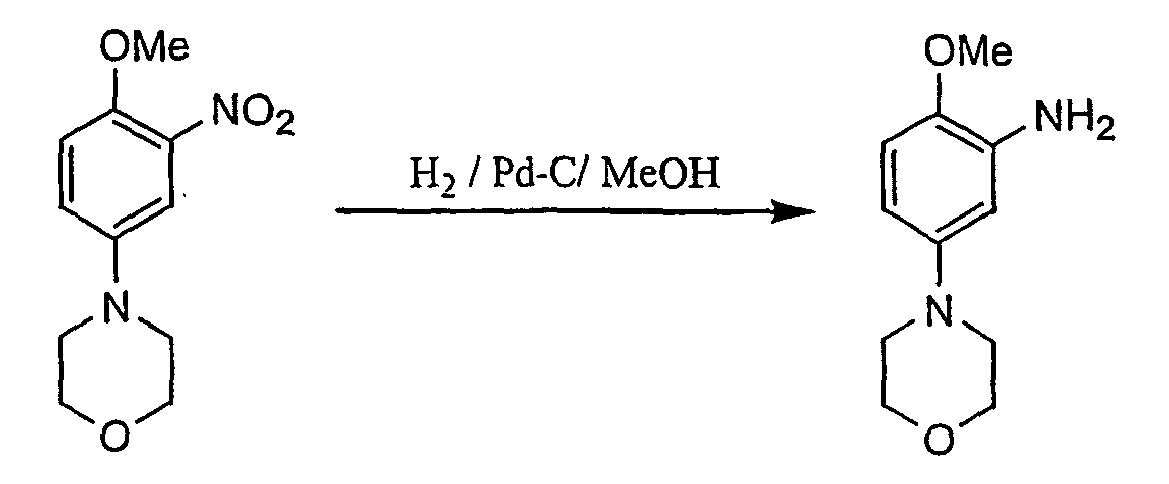
32.8 g (93 %). -
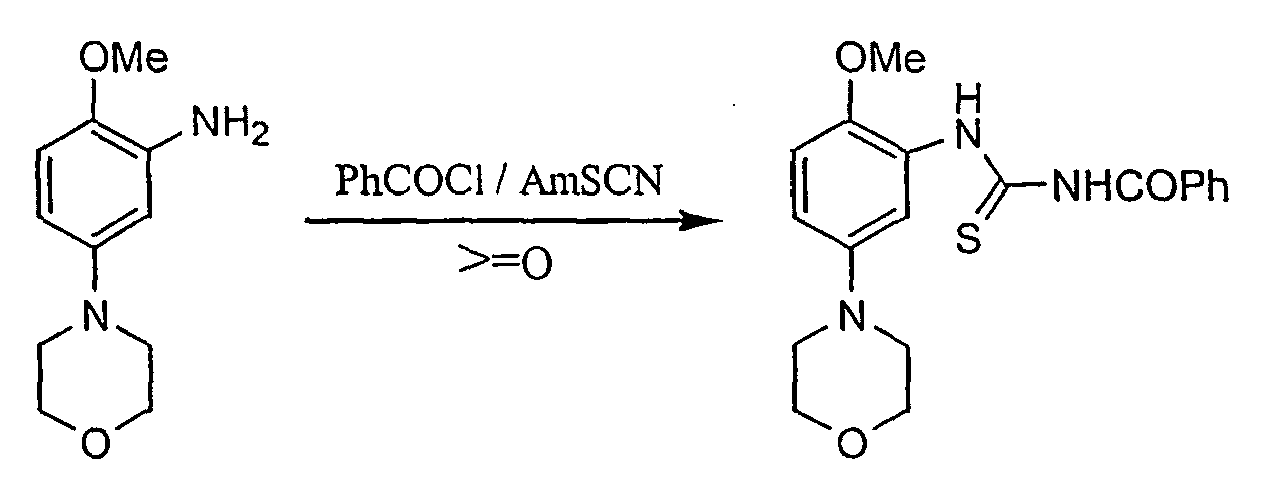
The heating was continued for 2.5 h. The work-up was carried out in conventional manner. The crude product was sufficiently pure to be used directly in the next step. 54.8 g (94 %). -

148.7 g (97 %). -

45.1 g (90 %)
1H-NMR: (400 MHz, CDCl3): δ = 3.05 (m, 4H), 3.86 (m, 4H), 3.95 (s, 3H), 5.14 (bs, 2H), 6.73 (d, 2H), 6.78 (d, 2H).
MS: 266 (M + H+). -

Yield: 30.4 g (86 % from amine). -

ES-MS m/e (%): 342 (M+H+, 100). - In an analogous manner there were obtained:
-

-

ES-MS m/e (%): 508 (M+H+, 100). -
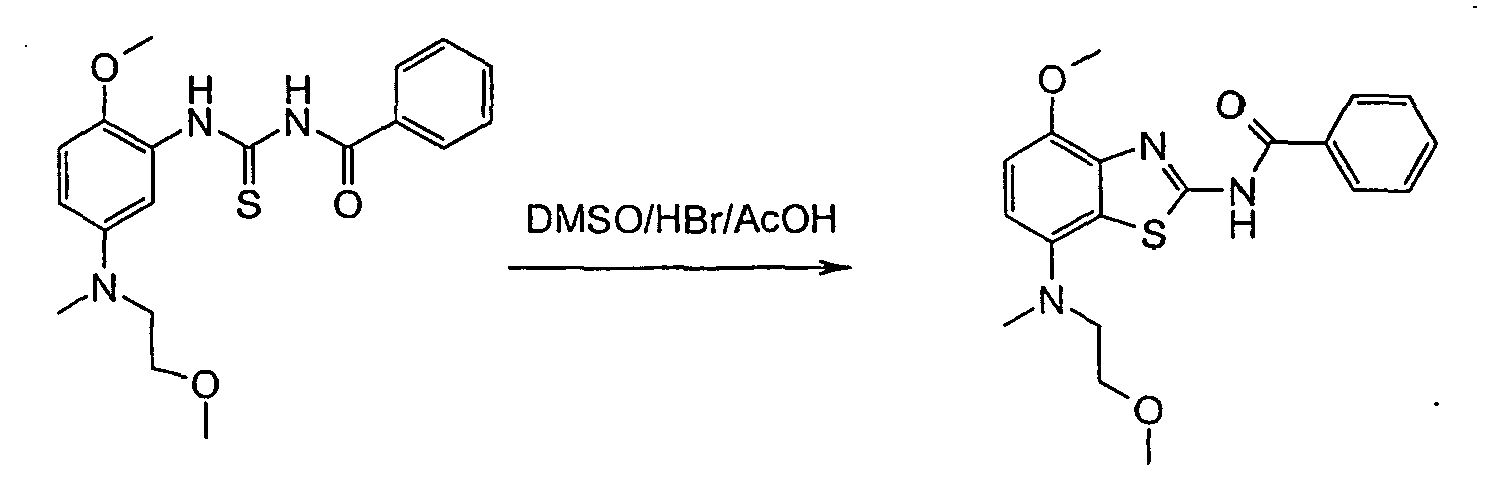
ES-MS m/e (%): 372 (M+H+, 100). -

ES-MS m/e (%): 268 (M+H+, 100). -

1H-NMR (400 MHz, DMSO-d 6 ): δ = 2.31 (s, 3H, CH3), 7.00 (d, 1H, ArH-5), 7.21 (d, 1H, ArH-4), 7.31 (bs, 2H, NH2), 7.44 (s, 1H, ArH-7).
MS: 165 (M + H+). -

1H-NMR: (400 MHz, DMSO-d 6 ): δ = 1.74 (m, 4H), 2.68 (m, 1H), 3.45 (m, 2H), 3.82 (s, 3H), 3.95 (m, 2H), 6.84 (d, 2H), 6.89 (d, 2H), 7.62 (bs, 1H).
MS: 265 (M + H+). -

MS: 269 (M + H+). -

MS: 269 (M + H+). -

MS: 283 (M + H+). -

MS: 283 (M + H+). -

1H-NMR (400 MHz, DMSO-d 6 ): δ = 2.67 (s, 3H, CH3), 7.36 (d, 1H), 7.59 (m, 2H), 7.70 (m, 1H), 8.14 (d, 1H), 8.18 (m, 2H), 13.4 (bs, 1H).
MS: 314 (M + H+), 336 (M + Na+). -

1H-NMR: (400 MHz, CDCl3): δ = 3.08 (m, 4H), 3.80 (s, 3H), 3.86 (m, 4H), 6.73 (d, 2H), 6.83 (d, 2H), 7.44 (m, 2H), 7.56 (m, 1H), 7.88 (d, 2H).
MS: 370 (M + H+), 392 (M + Na+). -

MS: 315 (M + H+). -

1H-NMR: (400 MHz, DMSO-d 6 ): δ = 7.60 (m, 3H), 7.67 (m, 2H), 7.93 (d, 1H), 7.99 (d, 1H), 8.10 (m, 2H), 8.18 (m, 2H), 13.0 (bs, 1H).
MS: 305 (M + H+).

Claims (8)
- A process for preparation of amino substituted benzothiazole derivatives of formula I
 R1, R2 and R3 are independently from each other hydrogen, lower alkyl, lower alkoxy or halogen;R4 is hydrogen, lower alkyl, lower alkyloxy, halogen,
or is a five or six membered non aromatic heterocyclyl group, unsubstituted or substituted by lower alkyl or an oxo-group, or is
-NR5R6, wherein R5 and R5 are independently from each other hydrogen, lower alkyl, -C(O)-lower alkyl, -(CH2)nO-lower alkyl or benzyl, optionally substituted by lower alkyl, or is a
five or six membered heteroaryl group;R1 and R2 or R2 and R3 may form together with the corresponding carbon atoms a ring containing -O-CH2-O- or -CH=CH-CH=CH-;R is hydrogen or -C(O)R';R' is a five or six membered non aromatic heterocyclyl group, five or six membered heteroaryl group or is aryl, which rings may be substituted by the groups, selected from lower alkyl, halogen-lower alkyl, lower alkoxy, cyano, nitro, -C(O)H, -C(O)OH or by pyrrolidin-1-yl-methyl;n is 1 to 4;the term "lower" denotes a group containing from 1 to 6 carbon atoms;
the term "five or six membered heteroaryl" denotes the following group: pyrrol-1-yl, tetrazolyl, imidazol-1 or 2-yl, pyrazol-1-yl), pyridin-1, 2, 3 or 4-yl, pyrazinyl, pyrimidinyl, pyridazinyl, isothiazolyl, isoxazolyl, thienyl or furyl;
the term "five or six membered non aromatic heterocyclyl" denotes the following groups: pyrrolidinyl, hydro-pyranyl, imidazolidinyl, pyrazolidinyl, piperidinyl, piperazinyl, morpholinyl, thiomorpholinyl, thiomorpholin-1,1-dioxo or thiomorpholin-1-oxo;
the term "aryl" denotes phenyl, benzyl or naphthyl;
and their pharmaceutically acceptable salts,
wherein the cyclization is carried out by the treatment of a compound of formula

- The process in accordance with claim 1, wherein the sulphoxide is dimethyl sulphoxide.
- The process in accordance with claim 1, wherein HBr is an in situ prepared bromide salt and a strong acid.
- The process in accordance with claim 3, wherein the in situ prepared bromide salt and the strong acid is HBr-AcOH.
- The process in accordance with claim 1, wherein the solvent is CH2Cl2, CH3CN, THF, AcOH or EtOAc.
- The process in accordance with claim 5, wherein the solvent is AcOH or EtOAc.
- The process in accordance with claims 1, wherein a compound of formula II or III is suspended in a solvent and then treated with HBr and a sulphoxide.
- The process in accordance with claim 7, wherein to a suspension of a compound of formula II or III in ethyl acetate or acetic acid is added hydrogen bromide in acetic acid and then dimethylsulfoxide is added.
Priority Applications (1)
| Application Number | Priority Date | Filing Date | Title |
|---|---|---|---|
| EP03799511A EP1583752B1 (en) | 2003-01-07 | 2003-12-29 | Cyclization process for substituted benzothiazole derivatives |
Applications Claiming Priority (4)
| Application Number | Priority Date | Filing Date | Title |
|---|---|---|---|
| EP03000048 | 2003-01-07 | ||
| EP03000048 | 2003-01-07 | ||
| PCT/EP2003/014928 WO2004060879A2 (en) | 2003-01-07 | 2003-12-29 | Cyclization process for substituted benzothiazole derivatives |
| EP03799511A EP1583752B1 (en) | 2003-01-07 | 2003-12-29 | Cyclization process for substituted benzothiazole derivatives |
Publications (2)
| Publication Number | Publication Date |
|---|---|
| EP1583752A2 EP1583752A2 (en) | 2005-10-12 |
| EP1583752B1 true EP1583752B1 (en) | 2006-08-16 |
Family
ID=32695583
Family Applications (1)
| Application Number | Title | Priority Date | Filing Date |
|---|---|---|---|
| EP03799511A Expired - Lifetime EP1583752B1 (en) | 2003-01-07 | 2003-12-29 | Cyclization process for substituted benzothiazole derivatives |
Country Status (15)
| Country | Link |
|---|---|
| US (1) | US7087761B2 (en) |
| EP (1) | EP1583752B1 (en) |
| JP (1) | JP4381311B2 (en) |
| KR (1) | KR100712747B1 (en) |
| CN (1) | CN100420678C (en) |
| AT (1) | ATE336486T1 (en) |
| AU (1) | AU2003300234A1 (en) |
| CA (1) | CA2512361A1 (en) |
| DE (1) | DE60307682T2 (en) |
| DK (1) | DK1583752T3 (en) |
| ES (1) | ES2270167T3 (en) |
| IL (1) | IL169368A (en) |
| MX (1) | MXPA05007387A (en) |
| TW (1) | TWI284127B (en) |
| WO (1) | WO2004060879A2 (en) |
Families Citing this family (10)
| Publication number | Priority date | Publication date | Assignee | Title |
|---|---|---|---|---|
| CA2543707A1 (en) | 2003-10-31 | 2005-05-19 | Takeda Pharmaceutical Company Limited | Nitrogen-containing fused heterocyclic compounds |
| US7429589B2 (en) * | 2006-04-27 | 2008-09-30 | Hoffmann-La Roche Inc. | Mono-nitration of aromatic compounds via nitrate salts |
| DE602007010664D1 (en) | 2006-09-04 | 2010-12-30 | Univ Dundee | P53 ACTIVATING BENZOYL HYDROGEN AND BENZOYLTHINE OXYGEN COMPOUNDS |
| US8779154B2 (en) * | 2006-09-26 | 2014-07-15 | Qinglin Che | Fused ring compounds for inflammation and immune-related uses |
| WO2008052930A2 (en) * | 2006-11-03 | 2008-05-08 | F. Hoffmann-La Roche Ag | Preparation of 4-alk0xy-7- (tetrahydropyran-4-yl) benzothiazol-2-amine derivatives |
| US7902248B2 (en) * | 2006-12-14 | 2011-03-08 | Hoffmann-La Roche Inc. | Oxime glucokinase activators |
| FR2930552B1 (en) * | 2008-04-24 | 2012-10-12 | Centre Nat Rech Scient | N-ACYLTHIOUREES AND N-ACYLUREES INHIBITORS OF THE HEDGEHOG PROTEIN SIGNALING PATHWAY |
| GB0909912D0 (en) | 2009-06-09 | 2009-07-22 | Univ Dundee | Compounds |
| CN102391207B (en) * | 2011-07-26 | 2014-04-09 | 贵州大学 | N-(2-(substituted benzo- thiazole-2- amino formacyl) -phenyl group) - benzamide, as well as preparation method and usages thereof |
| GB201416754D0 (en) | 2014-09-23 | 2014-11-05 | Mission Therapeutics Ltd | Novel compounds |
Family Cites Families (20)
| Publication number | Priority date | Publication date | Assignee | Title |
|---|---|---|---|---|
| CH505543A (en) | 1968-11-01 | 1971-04-15 | Ciba Geigy Ag | Pesticides |
| NL7109150A (en) | 1970-07-06 | 1972-01-10 | ||
| US4028374A (en) * | 1975-11-03 | 1977-06-07 | Morton-Norwich Products, Inc. | Antibacterial thiocyanatobenzothiazoles |
| DE2656468A1 (en) | 1976-12-14 | 1978-06-15 | Boehringer Mannheim Gmbh | N- (BENZTHIAZOL-2-YL) -OXAMID ACID DERIVATIVES AND METHOD FOR THE PRODUCTION THEREOF |
| KR930005004B1 (en) | 1985-04-15 | 1993-06-11 | 쟈안센 파아마슈우티카 엔. 부이. | Process for preparing substituted N-[(4-piperidinyl) alkyl] bicyclic condensed oxazolamines and thiazoleamines |
| US4826860A (en) | 1987-03-16 | 1989-05-02 | Warner-Lambert Company | Substituted 2-aminobenzothiazoles and derivatives useful as cerebrovascular agents |
| FI91859C (en) | 1987-06-17 | 1994-08-25 | Eisai Co Ltd | Analogue method for the preparation of an active benzothiazole derivative as an antiallergic agent |
| IL90337A0 (en) | 1988-05-24 | 1989-12-15 | Pfizer | Aromatic and heterocyclic carboxamide derivatives as antineoplastic agents |
| WO1990015801A1 (en) | 1989-06-22 | 1990-12-27 | Pfizer Inc. | Substituted sulfonamides and related compounds in the treatment of asthma, arthritis and related diseases |
| DE59005183D1 (en) | 1989-11-10 | 1994-05-05 | Agrolinz Agrarchemikalien | Process for the production of pure, asymmetrically disubstituted ureas. |
| DE59207481D1 (en) | 1991-08-30 | 1996-12-12 | Hoechst Ag | Process for the preparation of 2-aminobenzothiazoles |
| PT604657E (en) | 1992-05-21 | 2000-04-28 | Otsuka Pharma Co Ltd | DERIVED FROM PHOSPHONIC DIESTER |
| FR2753970B1 (en) | 1996-10-01 | 1998-10-30 | Synthelabo | N- (BENZOTHIAZOL-2-YL) PIPERIDINE-1-ETHANAMINE DERIVATIVES, THEIR PREPARATION AND THEIR THERAPEUTIC APPLICATION |
| JPH11130761A (en) | 1997-10-24 | 1999-05-18 | Otsuka Pharmaceut Co Ltd | Benzothiazole derivative |
| CA2309319A1 (en) | 1997-11-10 | 1999-05-20 | Bristol-Myers Squibb Company | Benzothiazole protein tyrosine kinase inhibitors |
| WO1999037630A1 (en) | 1998-01-23 | 1999-07-29 | Versicor, Inc. | Oxazolidinone combinatorial libraries, compositions and methods of preparation |
| WO2000018767A2 (en) | 1998-09-30 | 2000-04-06 | Neurogen Corporation | 2-piperazino alkylamino benzoazole derivatives: dopamine receptor subtype specific ligands |
| UA71587C2 (en) | 1998-11-10 | 2004-12-15 | Шерінг Акцієнгезелльшафт | Anthranilic acid amides and use thereof as medicaments |
| IL133680A0 (en) | 1999-09-10 | 2001-04-30 | Can Fite Technologies Ltd | Pharmaceutical compositions comprising an adenosine receptor agonist or antagonist |
| NZ522928A (en) | 2000-06-21 | 2005-05-27 | F | Benzothiazole derivatives |
-
2003
- 2003-12-22 US US10/743,613 patent/US7087761B2/en not_active Expired - Fee Related
- 2003-12-29 AU AU2003300234A patent/AU2003300234A1/en not_active Abandoned
- 2003-12-29 EP EP03799511A patent/EP1583752B1/en not_active Expired - Lifetime
- 2003-12-29 AT AT03799511T patent/ATE336486T1/en active
- 2003-12-29 DE DE60307682T patent/DE60307682T2/en not_active Expired - Lifetime
- 2003-12-29 CN CNB2003801084061A patent/CN100420678C/en not_active Expired - Fee Related
- 2003-12-29 ES ES03799511T patent/ES2270167T3/en not_active Expired - Lifetime
- 2003-12-29 TW TW092137300A patent/TWI284127B/en not_active IP Right Cessation
- 2003-12-29 JP JP2004564226A patent/JP4381311B2/en not_active Expired - Lifetime
- 2003-12-29 WO PCT/EP2003/014928 patent/WO2004060879A2/en not_active Ceased
- 2003-12-29 KR KR1020057012640A patent/KR100712747B1/en not_active Expired - Fee Related
- 2003-12-29 CA CA002512361A patent/CA2512361A1/en not_active Abandoned
- 2003-12-29 MX MXPA05007387A patent/MXPA05007387A/en active IP Right Grant
- 2003-12-29 DK DK03799511T patent/DK1583752T3/en active
-
2005
- 2005-06-23 IL IL169368A patent/IL169368A/en not_active IP Right Cessation
Also Published As
| Publication number | Publication date |
|---|---|
| WO2004060879A3 (en) | 2004-11-18 |
| IL169368A (en) | 2010-05-31 |
| AU2003300234A1 (en) | 2004-07-29 |
| WO2004060879A2 (en) | 2004-07-22 |
| MXPA05007387A (en) | 2005-09-12 |
| JP2006513228A (en) | 2006-04-20 |
| TWI284127B (en) | 2007-07-21 |
| DE60307682D1 (en) | 2006-09-28 |
| US7087761B2 (en) | 2006-08-08 |
| ATE336486T1 (en) | 2006-09-15 |
| JP4381311B2 (en) | 2009-12-09 |
| CN100420678C (en) | 2008-09-24 |
| AU2003300234A8 (en) | 2004-07-29 |
| KR100712747B1 (en) | 2007-04-30 |
| DE60307682T2 (en) | 2007-09-06 |
| CN1738808A (en) | 2006-02-22 |
| EP1583752A2 (en) | 2005-10-12 |
| DK1583752T3 (en) | 2006-12-27 |
| CA2512361A1 (en) | 2004-07-22 |
| KR20050091061A (en) | 2005-09-14 |
| US20040138465A1 (en) | 2004-07-15 |
| TW200424184A (en) | 2004-11-16 |
| ES2270167T3 (en) | 2007-04-01 |
| IL169368A0 (en) | 2007-07-04 |
Similar Documents
| Publication | Publication Date | Title |
|---|---|---|
| CA2038203C (en) | Process for the preparation of chlorothiazole derivatives | |
| DE69913047T2 (en) | Process for the preparation of benzamide derivatives | |
| CN116987112B (en) | Improved process for preparing aminopyrimidine derivatives | |
| JP5727482B2 (en) | Synthesis of neurostimulatory piperazine | |
| JP6811717B2 (en) | Methods for the preparation of topiroxostat and its intermediates | |
| ZA200209664B (en) | IL-8 Receptor Antagonists. | |
| US20040138465A1 (en) | Cyclization process for substituted benzothiazole derivatives | |
| Sugimoto et al. | Activation of dithiocarbamate by 2-halothiazolium salts | |
| JP4949590B2 (en) | Method for producing aniline compound | |
| CN110267937B (en) | Method for producing organic iodinated compound by one-pot method | |
| KR101941794B1 (en) | Aminosulfonyl compound, preparation method therefor and use thereof | |
| JP7532420B2 (en) | Alternative method for preparing 4-phenyl-5-alkoxycarbonyl-2-thiazol-2-yl-1,4-dihydropyrimidin-6-yl]methyl]-3-oxo-5,6,8,8a-tetrahydro-1H-imidazo[1,5-a]pyrazin-2-yl]-carboxylic acid | |
| CN108191849B (en) | Preparation method of anti-epidermal growth factor receptor drug resistance mutation inhibitor, related intermediate and application | |
| Saari et al. | A convenient synthesis of nitro‐substituted 1, 2‐benzisothiazol‐3 (2H)‐one 1, 1‐dioxides (nitrosaccharins) | |
| Petrov et al. | Synthesis of 2, 4 (1 H, 3 H)-quinazolinedione and 3-substituted 2, 4 (1 H, 3 H)-quinazolinediones | |
| EP1928869B1 (en) | Chemical process | |
| JP4232211B2 (en) | Method for producing 3,4-dihydrocarbostyrils | |
| CN117285468A (en) | Preparation method of Ensitrelivir intermediate | |
| PL209913B1 (en) | New derivatives of 1, 1-dioxo-4H-1, 5, 2-benzo [f] ditiazepin and the manner of their production | |
| JPS62192361A (en) | Pyrazole compound and production thereof | |
| MXPA00002695A (en) | Method for the synthesis of quinoline derivatives | |
| HK1018060B (en) | Process for the preparation of heteroarylcarboxylic amides and esters | |
| JPS62106087A (en) | Production of 2-aminobenzothiazole | |
| HK1018060A1 (en) | Process for the preparation of heteroarylcarboxylic amides and esters | |
| CZ290353B6 (en) | Process for preparing an intermediate for production of antidiabetic |
Legal Events
| Date | Code | Title | Description |
|---|---|---|---|
| PUAI | Public reference made under article 153(3) epc to a published international application that has entered the european phase |
Free format text: ORIGINAL CODE: 0009012 |
|
| 17P | Request for examination filed |
Effective date: 20050808 |
|
| AK | Designated contracting states |
Kind code of ref document: A2 Designated state(s): AT BE BG CH CY CZ DE DK EE ES FI FR GB GR HU IE IT LI LU MC NL PT RO SE SI SK TR |
|
| AX | Request for extension of the european patent |
Extension state: AL LT LV MK |
|
| GRAP | Despatch of communication of intention to grant a patent |
Free format text: ORIGINAL CODE: EPIDOSNIGR1 |
|
| DAX | Request for extension of the european patent (deleted) | ||
| GRAS | Grant fee paid |
Free format text: ORIGINAL CODE: EPIDOSNIGR3 |
|
| GRAA | (expected) grant |
Free format text: ORIGINAL CODE: 0009210 |
|
| AK | Designated contracting states |
Kind code of ref document: B1 Designated state(s): AT BE BG CH CY CZ DE DK EE ES FI FR GB GR HU IE IT LI LU MC NL PT RO SE SI SK TR |
|
| PG25 | Lapsed in a contracting state [announced via postgrant information from national office to epo] |
Ref country code: RO Free format text: LAPSE BECAUSE OF FAILURE TO SUBMIT A TRANSLATION OF THE DESCRIPTION OR TO PAY THE FEE WITHIN THE PRESCRIBED TIME-LIMIT Effective date: 20060816 Ref country code: SK Free format text: LAPSE BECAUSE OF FAILURE TO SUBMIT A TRANSLATION OF THE DESCRIPTION OR TO PAY THE FEE WITHIN THE PRESCRIBED TIME-LIMIT Effective date: 20060816 Ref country code: CZ Free format text: LAPSE BECAUSE OF FAILURE TO SUBMIT A TRANSLATION OF THE DESCRIPTION OR TO PAY THE FEE WITHIN THE PRESCRIBED TIME-LIMIT Effective date: 20060816 Ref country code: SI Free format text: LAPSE BECAUSE OF FAILURE TO SUBMIT A TRANSLATION OF THE DESCRIPTION OR TO PAY THE FEE WITHIN THE PRESCRIBED TIME-LIMIT Effective date: 20060816 Ref country code: FI Free format text: LAPSE BECAUSE OF FAILURE TO SUBMIT A TRANSLATION OF THE DESCRIPTION OR TO PAY THE FEE WITHIN THE PRESCRIBED TIME-LIMIT Effective date: 20060816 |
|
| REG | Reference to a national code |
Ref country code: GB Ref legal event code: FG4D |
|
| REG | Reference to a national code |
Ref country code: CH Ref legal event code: EP |
|
| REG | Reference to a national code |
Ref country code: IE Ref legal event code: FG4D |
|
| REF | Corresponds to: |
Ref document number: 60307682 Country of ref document: DE Date of ref document: 20060928 Kind code of ref document: P |
|
| REG | Reference to a national code |
Ref country code: HU Ref legal event code: AG4A Ref document number: E000653 Country of ref document: HU |
|
| PG25 | Lapsed in a contracting state [announced via postgrant information from national office to epo] |
Ref country code: BG Free format text: LAPSE BECAUSE OF FAILURE TO SUBMIT A TRANSLATION OF THE DESCRIPTION OR TO PAY THE FEE WITHIN THE PRESCRIBED TIME-LIMIT Effective date: 20061116 Ref country code: SE Free format text: LAPSE BECAUSE OF FAILURE TO SUBMIT A TRANSLATION OF THE DESCRIPTION OR TO PAY THE FEE WITHIN THE PRESCRIBED TIME-LIMIT Effective date: 20061116 |
|
| REG | Reference to a national code |
Ref country code: DK Ref legal event code: T3 |
|
| PG25 | Lapsed in a contracting state [announced via postgrant information from national office to epo] |
Ref country code: MC Free format text: LAPSE BECAUSE OF NON-PAYMENT OF DUE FEES Effective date: 20061231 |
|
| PG25 | Lapsed in a contracting state [announced via postgrant information from national office to epo] |
Ref country code: PT Free format text: LAPSE BECAUSE OF FAILURE TO SUBMIT A TRANSLATION OF THE DESCRIPTION OR TO PAY THE FEE WITHIN THE PRESCRIBED TIME-LIMIT Effective date: 20070116 |
|
| ET | Fr: translation filed | ||
| REG | Reference to a national code |
Ref country code: ES Ref legal event code: FG2A Ref document number: 2270167 Country of ref document: ES Kind code of ref document: T3 |
|
| PLBE | No opposition filed within time limit |
Free format text: ORIGINAL CODE: 0009261 |
|
| STAA | Information on the status of an ep patent application or granted ep patent |
Free format text: STATUS: NO OPPOSITION FILED WITHIN TIME LIMIT |
|
| 26N | No opposition filed |
Effective date: 20070518 |
|
| PG25 | Lapsed in a contracting state [announced via postgrant information from national office to epo] |
Ref country code: GR Free format text: LAPSE BECAUSE OF FAILURE TO SUBMIT A TRANSLATION OF THE DESCRIPTION OR TO PAY THE FEE WITHIN THE PRESCRIBED TIME-LIMIT Effective date: 20061117 |
|
| PG25 | Lapsed in a contracting state [announced via postgrant information from national office to epo] |
Ref country code: EE Free format text: LAPSE BECAUSE OF FAILURE TO SUBMIT A TRANSLATION OF THE DESCRIPTION OR TO PAY THE FEE WITHIN THE PRESCRIBED TIME-LIMIT Effective date: 20060816 |
|
| PG25 | Lapsed in a contracting state [announced via postgrant information from national office to epo] |
Ref country code: LU Free format text: LAPSE BECAUSE OF NON-PAYMENT OF DUE FEES Effective date: 20061229 Ref country code: TR Free format text: LAPSE BECAUSE OF FAILURE TO SUBMIT A TRANSLATION OF THE DESCRIPTION OR TO PAY THE FEE WITHIN THE PRESCRIBED TIME-LIMIT Effective date: 20060816 |
|
| PG25 | Lapsed in a contracting state [announced via postgrant information from national office to epo] |
Ref country code: CY Free format text: LAPSE BECAUSE OF FAILURE TO SUBMIT A TRANSLATION OF THE DESCRIPTION OR TO PAY THE FEE WITHIN THE PRESCRIBED TIME-LIMIT Effective date: 20060816 |
|
| PGFP | Annual fee paid to national office [announced via postgrant information from national office to epo] |
Ref country code: AT Payment date: 20101122 Year of fee payment: 8 Ref country code: IE Payment date: 20101126 Year of fee payment: 8 |
|
| PGFP | Annual fee paid to national office [announced via postgrant information from national office to epo] |
Ref country code: IT Payment date: 20101213 Year of fee payment: 8 Ref country code: GB Payment date: 20101123 Year of fee payment: 8 |
|
| PGFP | Annual fee paid to national office [announced via postgrant information from national office to epo] |
Ref country code: NL Payment date: 20111220 Year of fee payment: 9 Ref country code: FR Payment date: 20111205 Year of fee payment: 9 Ref country code: DK Payment date: 20111124 Year of fee payment: 9 Ref country code: ES Payment date: 20111215 Year of fee payment: 9 Ref country code: HU Payment date: 20111124 Year of fee payment: 9 Ref country code: CH Payment date: 20111026 Year of fee payment: 9 |
|
| PGFP | Annual fee paid to national office [announced via postgrant information from national office to epo] |
Ref country code: DE Payment date: 20111230 Year of fee payment: 9 |
|
| PGFP | Annual fee paid to national office [announced via postgrant information from national office to epo] |
Ref country code: BE Payment date: 20120103 Year of fee payment: 9 |
|
| REG | Reference to a national code |
Ref country code: IE Ref legal event code: MM4A |
|
| PG25 | Lapsed in a contracting state [announced via postgrant information from national office to epo] |
Ref country code: IE Free format text: LAPSE BECAUSE OF NON-PAYMENT OF DUE FEES Effective date: 20111229 |
|
| BERE | Be: lapsed |
Owner name: F. *HOFFMANN-LA ROCHE A.G. Effective date: 20121231 |
|
| REG | Reference to a national code |
Ref country code: NL Ref legal event code: V1 Effective date: 20130701 |
|
| REG | Reference to a national code |
Ref country code: CH Ref legal event code: PL |
|
| REG | Reference to a national code |
Ref country code: AT Ref legal event code: MM01 Ref document number: 336486 Country of ref document: AT Kind code of ref document: T Effective date: 20121229 |
|
| REG | Reference to a national code |
Ref country code: DK Ref legal event code: EBP |
|
| GBPC | Gb: european patent ceased through non-payment of renewal fee |
Effective date: 20121229 |
|
| REG | Reference to a national code |
Ref country code: FR Ref legal event code: ST Effective date: 20130830 |
|
| PG25 | Lapsed in a contracting state [announced via postgrant information from national office to epo] |
Ref country code: BE Free format text: LAPSE BECAUSE OF NON-PAYMENT OF DUE FEES Effective date: 20121231 |
|
| REG | Reference to a national code |
Ref country code: DE Ref legal event code: R119 Ref document number: 60307682 Country of ref document: DE Effective date: 20130702 |
|
| PG25 | Lapsed in a contracting state [announced via postgrant information from national office to epo] |
Ref country code: LI Free format text: LAPSE BECAUSE OF NON-PAYMENT OF DUE FEES Effective date: 20121231 Ref country code: NL Free format text: LAPSE BECAUSE OF NON-PAYMENT OF DUE FEES Effective date: 20130701 Ref country code: DE Free format text: LAPSE BECAUSE OF NON-PAYMENT OF DUE FEES Effective date: 20130702 Ref country code: CH Free format text: LAPSE BECAUSE OF NON-PAYMENT OF DUE FEES Effective date: 20121231 Ref country code: AT Free format text: LAPSE BECAUSE OF NON-PAYMENT OF DUE FEES Effective date: 20121229 Ref country code: HU Free format text: LAPSE BECAUSE OF NON-PAYMENT OF DUE FEES Effective date: 20121230 |
|
| PG25 | Lapsed in a contracting state [announced via postgrant information from national office to epo] |
Ref country code: FR Free format text: LAPSE BECAUSE OF NON-PAYMENT OF DUE FEES Effective date: 20130102 Ref country code: GB Free format text: LAPSE BECAUSE OF NON-PAYMENT OF DUE FEES Effective date: 20121229 |
|
| PG25 | Lapsed in a contracting state [announced via postgrant information from national office to epo] |
Ref country code: IT Free format text: LAPSE BECAUSE OF NON-PAYMENT OF DUE FEES Effective date: 20121229 |
|
| PG25 | Lapsed in a contracting state [announced via postgrant information from national office to epo] |
Ref country code: DK Free format text: LAPSE BECAUSE OF NON-PAYMENT OF DUE FEES Effective date: 20130102 |
|
| REG | Reference to a national code |
Ref country code: ES Ref legal event code: FD2A Effective date: 20140307 |
|
| PG25 | Lapsed in a contracting state [announced via postgrant information from national office to epo] |
Ref country code: ES Free format text: LAPSE BECAUSE OF NON-PAYMENT OF DUE FEES Effective date: 20121230 |