EP1582528A1 - Process for producing phosphoroamidite - Google Patents
Process for producing phosphoroamidite Download PDFInfo
- Publication number
- EP1582528A1 EP1582528A1 EP03777243A EP03777243A EP1582528A1 EP 1582528 A1 EP1582528 A1 EP 1582528A1 EP 03777243 A EP03777243 A EP 03777243A EP 03777243 A EP03777243 A EP 03777243A EP 1582528 A1 EP1582528 A1 EP 1582528A1
- Authority
- EP
- European Patent Office
- Prior art keywords
- group
- carbon atoms
- general formula
- substituted
- represented
- Prior art date
- Legal status (The legal status is an assumption and is not a legal conclusion. Google has not performed a legal analysis and makes no representation as to the accuracy of the status listed.)
- Withdrawn
Links
- 0 *c1nnn[n]1 Chemical compound *c1nnn[n]1 0.000 description 3
Classifications
-
- C—CHEMISTRY; METALLURGY
- C07—ORGANIC CHEMISTRY
- C07H—SUGARS; DERIVATIVES THEREOF; NUCLEOSIDES; NUCLEOTIDES; NUCLEIC ACIDS
- C07H1/00—Processes for the preparation of sugar derivatives
-
- C—CHEMISTRY; METALLURGY
- C07—ORGANIC CHEMISTRY
- C07H—SUGARS; DERIVATIVES THEREOF; NUCLEOSIDES; NUCLEOTIDES; NUCLEIC ACIDS
- C07H19/00—Compounds containing a hetero ring sharing one ring hetero atom with a saccharide radical; Nucleosides; Mononucleotides; Anhydro-derivatives thereof
- C07H19/02—Compounds containing a hetero ring sharing one ring hetero atom with a saccharide radical; Nucleosides; Mononucleotides; Anhydro-derivatives thereof sharing nitrogen
- C07H19/04—Heterocyclic radicals containing only nitrogen atoms as ring hetero atom
- C07H19/06—Pyrimidine radicals
- C07H19/073—Pyrimidine radicals with 2-deoxyribosyl as the saccharide radical
-
- C—CHEMISTRY; METALLURGY
- C07—ORGANIC CHEMISTRY
- C07H—SUGARS; DERIVATIVES THEREOF; NUCLEOSIDES; NUCLEOTIDES; NUCLEIC ACIDS
- C07H19/00—Compounds containing a hetero ring sharing one ring hetero atom with a saccharide radical; Nucleosides; Mononucleotides; Anhydro-derivatives thereof
- C07H19/02—Compounds containing a hetero ring sharing one ring hetero atom with a saccharide radical; Nucleosides; Mononucleotides; Anhydro-derivatives thereof sharing nitrogen
- C07H19/04—Heterocyclic radicals containing only nitrogen atoms as ring hetero atom
- C07H19/16—Purine radicals
- C07H19/173—Purine radicals with 2-deoxyribosyl as the saccharide radical
Definitions
- the present invention relates to a method for preparing phosphoroamidite. More specifically, the invention relates to a reaction activator that is developed for enhancing the selectivity for generation of phosphoroamidite by reducing the amount of the generated by-product comprising triphosphite represented by the general formula [5], in preparation of phosphoroamidite represented by the general formula [4], wherein R 1 represents an alkyl group having 1 to 4 carbon atoms, an alkyl group having 1 to 4 carbon atoms substituted by a cyano group or an alkyl group having 1 to 4 carbon atoms substituted by a silyl group; R 2 represents an amino group substituted by an alkyl group having 2 to 5 carbon atoms or an alicyclic amino group having 4 to 7 carbon atoms; R 4 represents a protecting group of a hydroxyl group; R 5 represents a hydrogen atom, a halogen atom, an alkyl group having 1 to 4 carbon atoms or a substituted hydroxyl group; and B
- Phosphoroamidites can heretofore be synthesized by a method as described in, for example, Nucleic Acids Res, 12, p. 4051 (1984) [or Nucleic Acids Res, 18, p. 177 (1987)] comprising reacting phosphorodiamidite with a hydroxyl group of nucleoside using a tetrazole reagent as a reaction activator.
- impurities generated by the reaction are analyzed in detail. Of major impurities, a decomposed product caused by water can be decreased by reducing the amount of water in the reaction system. However, it is difficult to decrease the by-product generated by an action of an activator used for the reaction.
- an over-reaction product (triphosphite represented by the general formula [5a]) is generated by further reacting phosphoroamidite represented by the general formula [4a] to be targeted with a raw material nucleoside represented by the general formula [3a].
- a mixture ratio is described as low, i.e., 1% (NMR analysis result), whereas it is required to be further decreased for the purpose of medical supplies such as antisense drugs or the like.
- Phosphoroamidites are unstable so that it is difficult to do purification. Accordingly, it is necessary to reduce the by-product in a reaction step.
- tetrazole is originally developed for the purpose of synthesis of triphosphite such as oligomer so that the reaction reaching triphosphite represented by the general formula [5a] from phosphoroamidite represented by the general formula [4a] is very fast.
- triphosphite represented by the general formula [5a] from phosphoroamidite represented by the general formula [4a] is very fast.
- tetrazole is the mostly used activator for the synthesis of oligomer.
- 5-(4-nitrophenyl)tetrazole reported in this report is designed to greatly exceed the reaction rate of tetrazole.
- oligomer i.e., triphosphite
- phenyltetrazole was also exemplified as an activator for the triphosphite synthesis in the drawing.
- an evaluation of its activity was of no value as it had a bad solubility. It failed to find its usefulness as an activator capable of selectively synthesizing phosphoroamidite.
- an object of the present invention is to provide a method for preparing phosphoroamidite in which the side reaction is effectively small.
- the present invention is specified by the matters described in the following (1) to (5).
- Examples of an alkyl group having 1 to 4 carbon atoms substituted by a cyano group include, though not restricted to, a 2-cyanoethyl group, a 2-cyanopropyl group, a 2-cyanocyclopropyl group, a 2-cyanobutyl group, a 2-cyano-2-methylpropyl group and the like.
- Examples of an alkyl group having 1 to 4 carbon atoms substituted by a silyl group in R 1 include, though not restricted to, a 2-trimethylsilylethyl group, a 2-trimethylsilylpropyl group, a 2-trimethylsilylbutyl group, a 2-trimethylsilyl-2-methylpropyl group, a 2-triethylsilylethyl group, a 2-triethylsilylpropyl group, a 2-triethylsilylbutyl group, a 2-triethylsilyl-2-methylpropyl group, a 2-triisopropylbutyl group, a 2-triisopropylsilyl-2-methylpropyl group, a 2-triisopropylsilylethyl group, a 2-triisopropylsilylpropyl group, a 2-triisopropylsilylethyl group, a 2-triisopropylsilylprop
- Examples of an amino group substituted by an alkyl group having 2 to 5 carbon atoms in R 2 include, though not restricted to, a diethylamino group, an ethyl(isopropyl)amino group, a di(n-propyl)amino group, a diisopropylamino group, a dicyclopropylamino group, a di(n-butyl)amino group, a di(sec-butyl)amino group, a di(isobutyl)amino group, a di(tert-butyl)amino group, a di(n-pentyl)amino group, a di(isopentyl)amino group, a di(neopentyl)amino group, a dicyclopentyl amino group and the like.
- Examples of an alicyclic amino group having 4 to 7 carbon atoms in R 2 include, though not restricted to, a pyrrolidino group, a 2-methylpyrrolidino group, a 2,4-dimethylpyrrolidino group, a piperidino group, a heptamethyleneimino group and the like.
- a substitute tetrazole represented by the general formula [2] or the like as an alicyclic alkyl group having 1 to 6 carbon atoms in R 3 , there can be exemplified, for example, a cyclopropyl group, a cyclobutyl group, a cyclopentyl group, a cyclohexyl group and the like.
- An aryl group substituted by an alkyl group having 1 to 4 carbon atoms in R 3 represents an aryl group substituted by a methyl group, an ethyl group, an n-propyl group, an isopropyl group, an n-butyl group, a sec-butyl group, an isobutyl group or a tert-butyl group, and examples thereof include, though not restricted to, a 2-methylphenyl group, a 2-ethylphenyl group, a 2-isopropylphenyl group, a 2-(2-butyl)phenyl group, a 2-(tert-butyl)phenyl group, a 3-methylphenyl group, a 3-ethylphenyl group, a 3-isopropylphenyl group, a 3-(2-butyl)phenyl group, a 3-(tert-butyl)phenyl group, a 4-methyl phenyl group, a 4-eth
- Examples of an unsubstituted aryl group in R 3 include, though not restricted to, a phenyl group, a 2-furfuryl group, a 3-furfuryl group, a 2-thiophenyl group, a 3-thiophenyl group and the like.
- 5-phenyl-1H-tetrazole is particularly preferable for a substituted tetrazole represented by the general formula [2]. This substituted tetrazole may be added to the reaction with a base as a salt or may be added as it is.
- a base forming a salt is preferably an organic base, and examples thereof includes, though not restricted to, tertiary amines such as triethylamine, ethyldiisopropylamine, tri(n-butyl)amine, 1-methylpiperidine, 1-methylpyrrolidine and the like or secondary amines such as diethylamine, diisopropylamine, di(n-butyl)amine, pyrrolidine, piperidine and the like.
- tertiary amines such as triethylamine, ethyldiisopropylamine, tri(n-butyl)amine, 1-methylpiperidine, 1-methylpyrrolidine and the like
- secondary amines such as diethylamine, diisopropylamine, di(n-butyl)amine, pyrrolidine, piperidine and the like.
- examples of a protecting group of a hydroxyl group in R 4 include alkyl groups such as a methyl group, an ethyl group, an isopropyl group, an n-butyl group, an i-butyl group, a t-butyl group, a pentyl group, a benzyl group, a 2-methoxybenzyl group, a 3-methoxybenzyl group, a 4-methoxybenzyl group, a 2-methylbenzyl group, a 3-methylbenzyl group, a 4-methylbenzyl group, a methoxyethyl group, an ethoxyethyl group, a benzyloxymethyl group, a benzyloxyethyl group, an acetoxymethyl group, an acetoxyethyl group, a benzoyloxymethyl group, a benzoyloxyethyl group, a methoxyethyl group, an ethoxyeth
- a halogen atom in R 5 represents a fluorine atom, a chlorine atom, a bromine atom or an iodine atom.
- Examples of an alkyl group having 1 to 4 carbon atoms in R 5 include a methyl group, an ethyl group, an n-propyl group, an isopropyl group, a cylcopropyl group, an n-butyl group, a sec-butyl group, an isobutyl group, a tert-butyl group and the like.
- a substituted hydroxyl group in R 5 represents a hydroxyl group substituted by a substituent capable of being a protecting group of a hydroxyl group in general such as carboxylic acid ester, sulfonate ester, ether, urethane, a silyl group and the like.
- Examples of a protecting group of a hydroxyl group include alkyl groups such as a methyl group, an ethyl group, an isopropyl group, an n-butyl group, an i-butyl group, a t-butyl group, a pentyl group, a benzyl group, a 2-methoxybenzyl group, a 3-methoxybenzyl group, a 4-methoxybenzyl group, a 2-methylbenzyl group, a 3-methylbenzyl group, a 4-methylbenzyl group, a methoxyethyl group, an ethoxyethyl group, a benzyloxymethyl group, a benzyloxyethyl group, an acetoxymethyl group, an acetoxyethyl group, a benzoyloxymethyl group, a benzoyloxymethyl group, a benzoyloxyethyl group, a methoxyethoxyethy
- Examples of a substituted hydroxyl group in R 5 include a methoxy group, an ethoxy group, an isopropyloxy group, an n-butyloxy group, an i-butyloxy group, a t-butyloxy group, a pentyloxy group, a benzyloxy group, a 2-methoxybenzyloxy group, a 3-methoxybenzyloxy group, a 4-methoxybenzyloxy group, a 2-methylbenzyloxy group, a 3-methylbenzyloxy group, a 4-methylbenzyloxy group, a methoxyethyloxy group, an ethoxyethyloxy group, a benzyloxymethoxy group, a benzyloxyethoxy group, an acetoxymethoxy group, an acetoxyethoxy group, a benzoyloxymethoxy group, a benzoyloxyethoxy group, a methoxyethoxyeth
- a nucleic acid base in B may be a natural or unnatural nucleic acid base and examples thereof include, though not restricted to, a 1-thymine group, a 1-cytosine group, a 9-adenine group, a 9-guanine group, a 1-uracil group, a 5-fluoro-1-uracil group, a 5-trifluoro-1-thymine group, a 5-methyl-1-cytosine group, a 6-chloro-9-purine group, a 2,6-diamino-9-purine group, a 7-adenine group, a 7-guanine group, an 8-bromo-9-adenine group, an 8-bromo-9-guanine group, a 2-amino-9-purine group, an 8-aza-9-adenine group, an 8-aza-9-guanine group, an 8-deaza-9-adenine group, an 8-deaza-9-guanine group and the like.
- a protected nucleic acid base in B either of a natural or unnatural nucleic acid base may be protected.
- the protected nucleic acid base is not particularly restricted as far as it can be usually used as a protecting group.
- a protecting group include an acetyl group, an isobutyryl group, a benzoyl group, a dimethylamino methylidyne group, a dibutylamino methylidyne group, a palmitoyl group, a benzyloxyacetyl group and the like.
- Examples of a protected nucleic acid base include an N4-benzoyl-1-cytosine group, an N4-acetyl-1-cytosine group, an N6-benzoyl-9-adenine group, an N2-isobutyryl-9-guanine group and the like.
- a reaction solvent used in the method of the present invention is not particularly restricted as far as it does not influence on the reaction.
- the reaction solvent is preferably an aprotic solvent other than alcohols. Examples thereof include acetonitrile, dichloromethane, chloroform, THF, dimethoxyethane, ethyl acetate, butyl acetate, hexane, cyclohexane, toluene and the like.
- the mixed solvents thereof can also be used.
- a reaction temperature can be from -30°C to the boiling point of a solvent in use. In particular, it is preferably from -10°C to 40°C.
- the amount of a reagent used is not particularly restricted as far as it does not influence on the work-up procedure. Considering the economical efficiency, the amount is preferably from 0.8 to 1.5 equivalent based on the molar amount of a raw material.
- the amount of a reaction activator used is preferably from 0.01 to 2 equivalents based on the molar amount of a raw material.
- the amount of from 0.1 to 1.5 equivalent is particularly preferable.
- the reaction solution was analyzed according to the high performance liquid chromatography (reverse phase column, eluent: water/acetonitrile 5/5 (TEAA 250 mM), detection wavelength: 254 nm). As a result, the yield was 97%.
- the reaction selectivity (HPLC area % of the entitled compound / HPLC area % of the by-product) represented by the ratio of the entitled compound to the by-product represented by the general formula [5b] was 451, wherein R 1 represents a 2-cyanoethyl group; R 4 represents a 4,4'-dimethoxytrityl group; R 5 represents a hydrogen atom; and B represents 1-thimine.
- the reaction was conducted in the same manner as in Example 1, except that 0.024 g of tetrazole (0.1 equivalent to the molar number of a raw material: Comparative Example 1) and 0.068 g of pyridinium trifluoroacetate (0.1 equivalent to the molar number of a raw material: Comparative Example 2) were respectively used, instead of 5-phenyl-1 H-tetrazole.
- the reaction solution after 8 or 24 hours was analyzed according to the high performance liquid chromatography (reverse phase column, eluent: water/acetonitrile 5/5 (TEAA 250 mM), detection wavelength: 254 nm). The results are shown in Table 1.
- the reaction selectivity is the ratio of HPLC area % of the entitled compound to HPLC area % of the by-product represented by the general formula [5b] (HPLC area % of the entitled compound / HPLC area % of the by-product represented by the general formula [5b]).
- R 1 represents a 2-cyanoethyl group
- R 4 represents a 4,4'-dimethoxytrityl group
- R 5 represents a hydrogen atom
- B represents 1-thymine.
- the reaction solution was analyzed according to the high performance liquid chromatography (reverse phase column, eluent: water/acetonitrile 5/5 (TEAA 250 mM), detection wavelength: 254 nm). As a result, the yield was 96%.
- the reaction selectivity (HPLC area % of the entitled compound / HPLC area % of the by-product) represented by the ratio of the entitled compound to the by-product represented by the general formula [5c] was 152, wherein R 1 represents a 2-cyanoethyl group; R 4 represents a 4,4'-dimethoxytrityl group; R 5 represents a hydrogen atom; and B represents N6-benzoyl-9-adenine.
- the reaction was conducted in the same manner as in Example 2, except that the equivalent of 5-phenyl-1H-tetrazole was changed. 0.04 g of 5-phenyl-1 H-tetrazole (0.1 equivalent to the molar number of a raw material) was used and the resulting mixture was stirred for 24 hours.
- the reaction solution was analyzed according to the high performance liquid chromatography (reverse phase column, eluent: water/acetonitrile 5/5 (TEAA 250 mM), detection wavelength: 254 nm). As a result, the yield was 99%.
- the reaction selectivity (HPLC area % of the entitled compound / HPLC area % of the by-product) represented by the ratio of the entitled compound to the by-product represented by the general formula [5c] was 699.
- the reaction was conducted in the same manner as in Example 2, except that the equivalent of 5-phenyl-1 H-tetrazole was changed. 0.22 g of 5-phenyl-1 H-tetrazole (0.5 equivalent to the molar number of a raw material) was used and the resulting mixture was stirred for 8 hours.
- the reaction solution was analyzed according to the high performance liquid chromatography (reverse phase column, eluent: water/acetonitrile 5/5 (TEAA 250 mM), detection wavelength: 254 nm). As a result, the yield was 99%.
- the reaction selectivity (HPLC area % of the entitled compound / HPLC area % of the by-product) represented by the ratio of the entitled compound to the by-product represented by the general formula [5c] was 785.
- Example 3 The reaction was conducted in the same manner as in Example 2, except that 0.256 g of tetrazole (1.2 equivalent to the molar number of a raw material: Comparative Example 3), 0.707 g of pyridinium trifluoroacetate (1.2 equivalent to the molar number of a raw material. Comparative Example 4) and 0.689 g of 5-(4-nitrophenyl)-1H-tetrazole (1.2 equivalent to the molar number of a raw material: Comparative Example 5) were respectively used, instead of 5-phenyl-1 H-tetrazole.
- the reaction was conducted in the same manner as in Example 4, except that 0.107 g of tetrazole (0.5 equivalent to the molar number of a raw material: Comparative Example 6), 0.295 g of pyridinium trifluoroacetate (0.5 equivalent to the molar number of a raw material: Comparative Example 7) and 0.291 g of 5-(4-nitrophenyl)-1H-tetrazole (0.5 equivalent to the molar number of a raw material: Comparative Example 8) were respectively used, instead of 5-phenyl-1 H-tetrazole.
- the reaction selectivity is the ratio of HPLC area % of the entitled compound to HPLC area % of the by-product represented by the general formula [5c] (HPLC area % of the entitled compound / HPLC area % of the by-product represented by the general formula [5c]).
- the reaction solution was analyzed according to the high performance liquid chromatography (reverse phase column, eluent: water/acetonitrile 4/6 (TEAA 62.5 mM), detection wavelength: 254 nm). As a result, the yield was 99%.
- the reaction selectivity (HPLC area % of the entitled compound / HPLC area % of the by-product) represented by the ratio of the entitled compound to the by-product represented by the general formula [5d] was 284, wherein R 1 represents a 2-cyanoethyl group; R 4 represents a 4,4'-dimethoxytrityl group; R 5 represents a hydrogen atom; and B represents N4-benzoyl-1-cytosine.
- the reaction selectivity is the ratio of HPLC area % of the entitled compound to HPLC area % of the by-product represented by the general formula [5d] (HPLC area % of the entitled compound / HPLC area % of the by-product represented by the general formula [5d]).
- R 1 represents a 2-cyanoethyl group
- R 4 represents a 4,4'-dimethoxytrityl group
- R 5 represents a hydrogen atom
- B represents N4-benzoyl-1-cytosine.
Landscapes
- Chemical & Material Sciences (AREA)
- Organic Chemistry (AREA)
- Engineering & Computer Science (AREA)
- Health & Medical Sciences (AREA)
- Biochemistry (AREA)
- Biotechnology (AREA)
- General Health & Medical Sciences (AREA)
- Genetics & Genomics (AREA)
- Molecular Biology (AREA)
- Life Sciences & Earth Sciences (AREA)
- Plural Heterocyclic Compounds (AREA)
- Low-Molecular Organic Synthesis Reactions Using Catalysts (AREA)
- Saccharide Compounds (AREA)
Abstract
The present invention provides high purity phosphoroamidite products by
reducing the amount of impurities of triphosphite which has been additionally produced
according to the conventional technique.
Phosphoroamidites can be obtained with high purity such that the excess
reaction is suppressed by using a reaction activator hardly generating triphosphite.
According to the present invention, phosphoroamides can be obtained with high
purity, which has heretofore been difficult to suppress the generation of impurities of
triphosphite.
Description
The present invention relates to a method for preparing phosphoroamidite.
More specifically, the invention relates to a reaction activator that is developed for
enhancing the selectivity for generation of phosphoroamidite by reducing the amount of
the generated by-product comprising triphosphite represented by the general formula [5],
in preparation of phosphoroamidite represented by the general formula [4],
 wherein R1 represents an alkyl group having 1 to 4 carbon atoms, an alkyl group
having 1 to 4 carbon atoms substituted by a cyano group or an alkyl group having 1 to 4
carbon atoms substituted by a silyl group; R2 represents an amino group substituted by
an alkyl group having 2 to 5 carbon atoms or an alicyclic amino group having 4 to 7
carbon atoms; R4 represents a protecting group of a hydroxyl group; R5 represents a
hydrogen atom, a halogen atom, an alkyl group having 1 to 4 carbon atoms or a
substituted hydroxyl group; and B represents a nucleic acid base or a protected nucleic
acid base,
wherein R1 represents an alkyl group having 1 to 4 carbon atoms, an alkyl group
having 1 to 4 carbon atoms substituted by a cyano group or an alkyl group having 1 to 4
carbon atoms substituted by a silyl group; R2 represents an amino group substituted by
an alkyl group having 2 to 5 carbon atoms or an alicyclic amino group having 4 to 7
carbon atoms; R4 represents a protecting group of a hydroxyl group; R5 represents a
hydrogen atom, a halogen atom, an alkyl group having 1 to 4 carbon atoms or a
substituted hydroxyl group; and B represents a nucleic acid base or a protected nucleic
acid base,
 wherein R1, R4 and R5 represent the same as those described above.
In recent years, with the process of genome-based drug discovery, antisense
DNA drugs and the like have been rapidly developed. The demand for DNA oligomer as
a raw material and phosphoroamidites as a raw material of oligomer has become higher.
In order to use phosphoroamidites for the purpose of medical supplies, it needs to
manufacture products with very high purity.
Phosphoroamidites can heretofore be synthesized by a method as described in,
for example, Nucleic Acids Res, 12, p. 4051 (1984) [or Nucleic Acids Res, 18, p. 177
(1987)] comprising reacting phosphorodiamidite with a hydroxyl group of nucleoside
using a tetrazole reagent as a reaction activator. In this report, impurities generated by
the reaction are analyzed in detail. Of major impurities, a decomposed product caused
by water can be decreased by reducing the amount of water in the reaction system.
However, it is difficult to decrease the by-product generated by an action of an activator
used for the reaction. As shown in the formula 1,
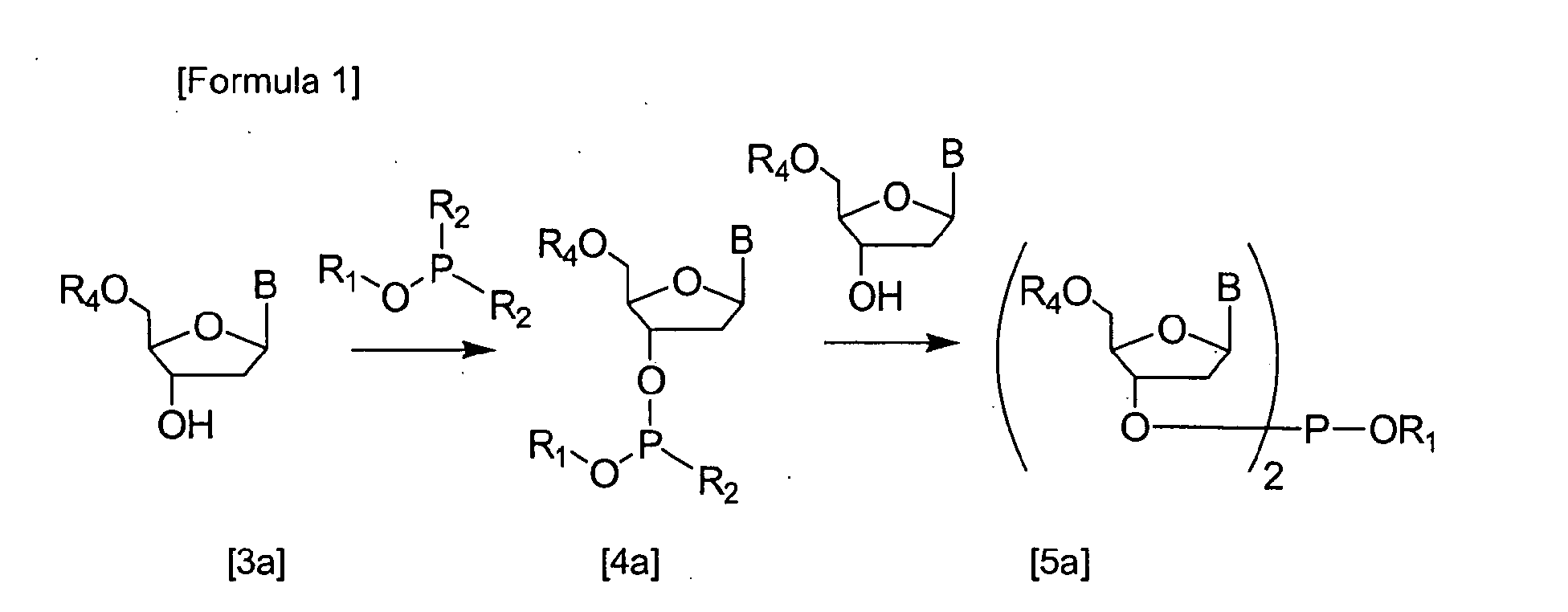 wherein R1 represents a methyl group or a cyanoethyl group; R2 represents a
diisopropylamino group; R4 represents a 4,4'-dimethoxytrityl group; and B represents a
1-thymine group,
wherein R1 represents a methyl group or a cyanoethyl group; R2 represents a
diisopropylamino group; R4 represents a 4,4'-dimethoxytrityl group; and B represents a
1-thymine group,
an over-reaction product (triphosphite represented by the general formula [5a]) is generated by further reacting phosphoroamidite represented by the general formula [4a] to be targeted with a raw material nucleoside represented by the general formula [3a]. A mixture ratio is described as low, i.e., 1% (NMR analysis result), whereas it is required to be further decreased for the purpose of medical supplies such as antisense drugs or the like. Phosphoroamidites are unstable so that it is difficult to do purification. Accordingly, it is necessary to reduce the by-product in a reaction step. As described in US Patent No. 4,415,732, tetrazole is originally developed for the purpose of synthesis of triphosphite such as oligomer so that the reaction reaching triphosphite represented by the general formula [5a] from phosphoroamidite represented by the general formula [4a] is very fast. At present, tetrazole is the mostly used activator for the synthesis of oligomer.
an over-reaction product (triphosphite represented by the general formula [5a]) is generated by further reacting phosphoroamidite represented by the general formula [4a] to be targeted with a raw material nucleoside represented by the general formula [3a]. A mixture ratio is described as low, i.e., 1% (NMR analysis result), whereas it is required to be further decreased for the purpose of medical supplies such as antisense drugs or the like. Phosphoroamidites are unstable so that it is difficult to do purification. Accordingly, it is necessary to reduce the by-product in a reaction step. As described in US Patent No. 4,415,732, tetrazole is originally developed for the purpose of synthesis of triphosphite such as oligomer so that the reaction reaching triphosphite represented by the general formula [5a] from phosphoroamidite represented by the general formula [4a] is very fast. At present, tetrazole is the mostly used activator for the synthesis of oligomer.
In a method described in Org. Process Res. Dev. 4, p. 175 (2000) or
WO99/62922, in order to overcome such a defect of high cost of tetrazole,
pyridine-trifluoro acetate is used. However, as the usefulness of oligomer synthesis like
tetrazole is described, the formation potential of triphosphite is high.
For the purpose of use in oligomer synthesis, many activators for replacing
tetrazole have been reported. However, in order to conduct the oligomer synthesis in a
solid phase synthesis, it was required to form triphosphite in a short time if at all possible.
From such an aspect, its purpose was different from a selective synthesis of
phosphoroamidite. Namely, in order to prepare phosphoroamidite represented by the
general formula [4a], it was required to decrease the amount of by-product of
triphosphite represented by the general formula [5a] so that these methods are not
appropriate. A typical example has been described in Tetrahedron Lett. (24), p. 3171
(1983). 5-(4-nitrophenyl)tetrazole reported in this report is designed to greatly exceed
the reaction rate of tetrazole. Thus, oligomer, i.e., triphosphite, is quite efficiently formed.
Furthermore, phenyltetrazole was also exemplified as an activator for the triphosphite
synthesis in the drawing. However, there was a determination describing that an
evaluation of its activity was of no value as it had a bad solubility. It failed to find its
usefulness as an activator capable of selectively synthesizing phosphoroamidite.
In this manner, an activator capable of selectively synthesizing
phosphoroamidite represented by the general formula [4a] while hardly capable of
proceeding the reaction to triphosphite represented by the general formula [5a] has not
been developed.
In consideration of the conventional problems, an object of the present invention
is to provide a method for preparing phosphoroamidite in which the side reaction is
effectively small.
In order to achieve the above object, as a result of an extensive study, the
present inventors have found that 5-phenyltetrazole has generated phosphoroamidite
with a good selectivity. Thus, the present invention has been completed.
That is, the present invention is specified by the matters described in the
following (1) to (5).
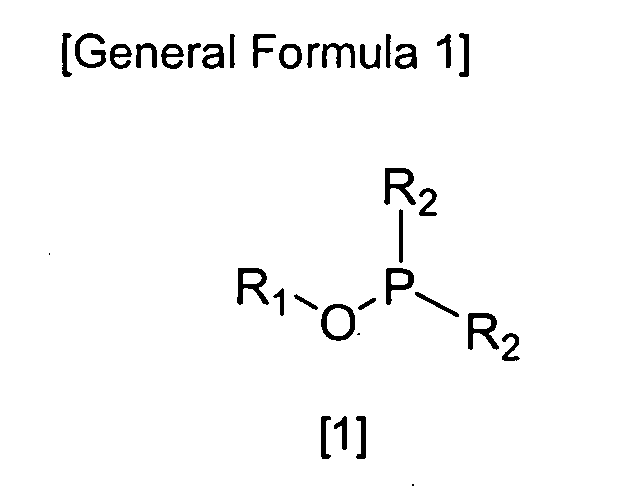
wherein a substituted tetrazole represented by the general formula [2] is used as a reaction activator,
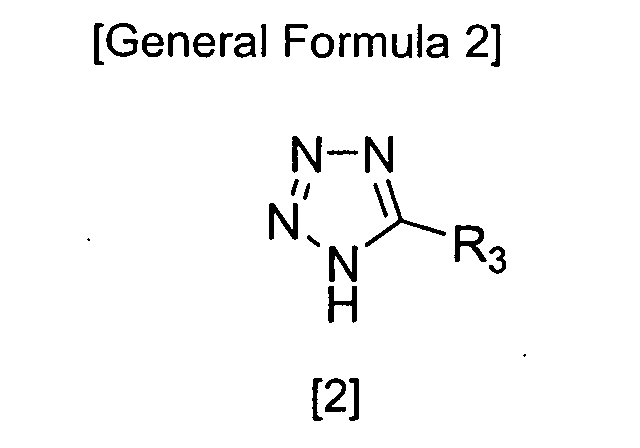
when phosphoroamidite represented by the general formula [4] is synthesized by using a nucleoside derivative represented by the general formula [3] as a raw material,


According to the present invention, it has become possible to prepare high
purity phosphoroamidites effectively, as compared to the conventional process, by using
a method capable of mass production.
The present invention will be described in more detail below.
In the phosphoroamidite represented by the general formula [1] or the like, as an
alkyl group having 1 to 4 carbon atoms in R1, there can be exemplified, for example, a
methyl group, an ethyl group, an n-propyl group, an isopropyl group, a cyclopropyl group,
an n-butyl group, a sec-butyl group, an isobutyl group, a tert-butyl group and the like.
Examples of an alkyl group having 1 to 4 carbon atoms substituted by a cyano group
include, though not restricted to, a 2-cyanoethyl group, a 2-cyanopropyl group, a
2-cyanocyclopropyl group, a 2-cyanobutyl group, a 2-cyano-2-methylpropyl group and
the like. Examples of an alkyl group having 1 to 4 carbon atoms substituted by a silyl
group in R1 include, though not restricted to, a 2-trimethylsilylethyl group, a
2-trimethylsilylpropyl group, a 2-trimethylsilylbutyl group, a
2-trimethylsilyl-2-methylpropyl group, a 2-triethylsilylethyl group, a 2-triethylsilylpropyl
group, a 2-triethylsilylbutyl group, a 2-triethylsilyl-2-methylpropyl group, a
2-triisopropylbutyl group, a 2-triisopropylsilyl-2-methylpropyl group, a
2-triisopropylsilylethyl group, a 2-triisopropylsilylpropyl group, a 2-triisopropylsilylbutyl
group, a 2-triisopropylsilyl-2-methylpropyl group, a 2-isopropylbutyl group, a
2-triisopropylsilyl-2-methylpropyl group, a 2-(tert-butylmethylsilyl)ethyl group, a
2-(tert-butyldimethylsilyl)propyl group, a 2-(tert-butyldimethylsilyl)butyl group, a
2-(tert-butyldimethylsilyl)-2-methylpropyl group and the like. Examples of an amino
group substituted by an alkyl group having 2 to 5 carbon atoms in R2 include, though not
restricted to, a diethylamino group, an ethyl(isopropyl)amino group, a di(n-propyl)amino
group, a diisopropylamino group, a dicyclopropylamino group, a di(n-butyl)amino group,
a di(sec-butyl)amino group, a di(isobutyl)amino group, a di(tert-butyl)amino group, a
di(n-pentyl)amino group, a di(isopentyl)amino group, a di(neopentyl)amino group, a
dicyclopentyl amino group and the like. Examples of an alicyclic amino group having 4 to
7 carbon atoms in R2 include, though not restricted to, a pyrrolidino group, a
2-methylpyrrolidino group, a 2,4-dimethylpyrrolidino group, a piperidino group, a
heptamethyleneimino group and the like.
In a substitute tetrazole represented by the general formula [2] or the like, as an
alicyclic alkyl group having 1 to 6 carbon atoms in R3, there can be exemplified, for
example, a cyclopropyl group, a cyclobutyl group, a cyclopentyl group, a cyclohexyl
group and the like. An aryl group substituted by an alkyl group having 1 to 4 carbon
atoms in R3 represents an aryl group substituted by a methyl group, an ethyl group, an
n-propyl group, an isopropyl group, an n-butyl group, a sec-butyl group, an isobutyl
group or a tert-butyl group, and examples thereof include, though not restricted to, a
2-methylphenyl group, a 2-ethylphenyl group, a 2-isopropylphenyl group, a
2-(2-butyl)phenyl group, a 2-(tert-butyl)phenyl group, a 3-methylphenyl group, a
3-ethylphenyl group, a 3-isopropylphenyl group, a 3-(2-butyl)phenyl group, a
3-(tert-butyl)phenyl group, a 4-methyl phenyl group, a 4-ethylphenyl group, a
4-isopropylphenyl group, a 4-(2-butyl)phenyl group, a 4-(tert-butyl)phenyl group, a
2,6-dimethylphenyl group, a 2,6-diethylphenyl group, a 2,6-diisopropylphenyl group, a
2,6-bis(2-butyl)phenyl group, a 2,6-bis(tert-butyl)phenyl group, a 3-methyl-2-furfuryl
group, a 3-ethyl-2-furfuryl group, a 3-isopropyl-2-furfuryl group, a 3-(2-butyl)-2-furfuryl
group, a 3-(tert-butyl)-2-furfuryl group, a 4-methyl-2-furfuryl group, a 4-ethyl-2-furfuryl
group, a 4-isopropyl-2-furfuryl group, a 4-(2-butyl)-2-furfuryl group, a
4-(tert-butyl)-2-furfuryl group, a 3,5-dimethyl-2-furfuryl group and the like. Examples of
an unsubstituted aryl group in R3 include, though not restricted to, a phenyl group, a
2-furfuryl group, a 3-furfuryl group, a 2-thiophenyl group, a 3-thiophenyl group and the
like. 5-phenyl-1H-tetrazole is particularly preferable for a substituted tetrazole
represented by the general formula [2]. This substituted tetrazole may be added to the
reaction with a base as a salt or may be added as it is. A base forming a salt is preferably
an organic base, and examples thereof includes, though not restricted to, tertiary amines
such as triethylamine, ethyldiisopropylamine, tri(n-butyl)amine, 1-methylpiperidine,
1-methylpyrrolidine and the like or secondary amines such as diethylamine,
diisopropylamine, di(n-butyl)amine, pyrrolidine, piperidine and the like.
In a nucleoside derivative represented by the general formula [3], examples of a
protecting group of a hydroxyl group in R4 include alkyl groups such as a methyl group,
an ethyl group, an isopropyl group, an n-butyl group, an i-butyl group, a t-butyl group, a
pentyl group, a benzyl group, a 2-methoxybenzyl group, a 3-methoxybenzyl group, a
4-methoxybenzyl group, a 2-methylbenzyl group, a 3-methylbenzyl group, a
4-methylbenzyl group, a methoxyethyl group, an ethoxyethyl group, a benzyloxymethyl
group, a benzyloxyethyl group, an acetoxymethyl group, an acetoxyethyl group, a
benzoyloxymethyl group, a benzoyloxyethyl group, a methoxyethoxyethyl group, a
propargyl group, an allyl group and the like or an alkyl group further having a substitute at
the alkyl group; aryl groups such as a phenyl group, a 2-methoxyphenyl group, a
3-methoxyphenyl group, a 4-methoxyphenyl group, a 4-phenylphenyl group, a
2-pyridinyl group, a 3-pyridinyl group, a 4-pyridinyl group and the like; acyl groups such
as a formyl group, an acetyl group, a propionyl group, a benzoyl group, a
2-methoxybenzoyl group, a 3-methoxybenzoyl group, a 4-methoxybenzoyl group, a
2-methylbenzoyl group, a 3-methylbenzoyl group, a 4-methylbenzoyl group, a
2-nitrobenzoyl group, a 3-nitrobenzoyl group, a 4-nitrobenzoyl group, a 4-phenylbenzoyl
group, a 2-chlorobenzoyl group, a 3-chlorobenzoyl group, a 4-chlorobenzoyl group and
the like; urethane groups such as an aminocarbonyl group, a dimethylaminocarbonyl
group, a methylaminocarbonyl group, an ethylaminocarbonyl group, a
diethylaminocarbonyl group, a phenylaminocarbonyl group and the like; sulfonate
groups such as a methanesulfonyl group, an ethanesulfonyl group, a benzenesulfonyl
group, a 2-methylbenzenesulfonyl group, a 3-methylbenzenesulfonyl group, a
4-methylbenzenesulfonyl group, a trifluoromethanesulfonyl group, a
trichloromethanesulfonyl group and the like; silyl groups such as a trimethylsilyl group, a
triethylsilyl group, a t-butyldimethylsilyl group, a t-butyldiphenylsilyl group and the like;
and trityl groups such as a trityl group, a 4-methoxytrityl group, a 4,4'-dimethoxytrityl
group and the like.
A halogen atom in R5 represents a fluorine atom, a chlorine atom, a bromine
atom or an iodine atom. Examples of an alkyl group having 1 to 4 carbon atoms in R5
include a methyl group, an ethyl group, an n-propyl group, an isopropyl group, a
cylcopropyl group, an n-butyl group, a sec-butyl group, an isobutyl group, a tert-butyl
group and the like.
A substituted hydroxyl group in R5 represents a hydroxyl group substituted by a
substituent capable of being a protecting group of a hydroxyl group in general such as
carboxylic acid ester, sulfonate ester, ether, urethane, a silyl group and the like.
Examples of a protecting group of a hydroxyl group include alkyl groups such as a methyl
group, an ethyl group, an isopropyl group, an n-butyl group, an i-butyl group, a t-butyl
group, a pentyl group, a benzyl group, a 2-methoxybenzyl group, a 3-methoxybenzyl
group, a 4-methoxybenzyl group, a 2-methylbenzyl group, a 3-methylbenzyl group, a
4-methylbenzyl group, a methoxyethyl group, an ethoxyethyl group, a benzyloxymethyl
group, a benzyloxyethyl group, an acetoxymethyl group, an acetoxyethyl group, a
benzoyloxymethyl group, a benzoyloxyethyl group, a methoxyethoxyethyl group, a
propargyl group, an allyl group and the like or an alkyl group further having a substitute at
the alkyl group; aryl groups such as a phenyl group, a 2-methoxyphenyl group, a
3-methoxyphenyl group, a 4-methoxyphenyl group, a 4-phenylphenyl group, a
2-pyridinyl group, a 3-pyridinyl group, a 4-pyridinyl group and the like; acyl groups such
as a formyl group, an acetyl group, a propionyl group, a benzoyl group, a
2-methoxybenzoyl group, a 3-methoxybenzoyl group, a 4-methoxybenzoyl group, a
2-methylbenzoyl group, a 3-methylbenzoyl group, a 4-methylbenzoyl group, a
2-nitrobenzoyl group, a 3-nitrobenzoyl group, a 4-nitrobenzoyl group, a 4-phenylbenzoyl
group, a 2-chlorobenzoyl group, a 3-chlorobenzoyl group, a 4-chlorobenzoyl group and
the like; urethane groups such as an aminocarbonyl group, a dimethylaminocarbonyl
group, a methylaminocarbonyl group, an ethylaminocarbonyl group, a
diethylaminocarbonyl group, a phenylaminocarbonyl group and the like; sulfonate
groups such as a methanesulfonyl group, an ethanesulfonyl group, a benzenesulfonyl
group, a 2-methylbenzenesulfonyl group, a 3-methylbenzenesulfonyl group, a
4-methylbenzenesulfonyl group, a trifluoromethanesulfonyl group, a
trichloromethanesulfonyl group and the like; silyl groups such as a trimethylsilyl group, a
triethylsilyl group, a t-butyldimethylsilyl group, a t-butyldiphenylsilyl group and the like.
Examples of a substituted hydroxyl group in R5 include a methoxy group, an
ethoxy group, an isopropyloxy group, an n-butyloxy group, an i-butyloxy group, a
t-butyloxy group, a pentyloxy group, a benzyloxy group, a 2-methoxybenzyloxy group, a
3-methoxybenzyloxy group, a 4-methoxybenzyloxy group, a 2-methylbenzyloxy group, a
3-methylbenzyloxy group, a 4-methylbenzyloxy group, a methoxyethyloxy group, an
ethoxyethyloxy group, a benzyloxymethoxy group, a benzyloxyethoxy group, an
acetoxymethoxy group, an acetoxyethoxy group, a benzoyloxymethoxy group, a
benzoyloxyethoxy group, a methoxyethoxyethoxy group, a propargyloxy group, an
allyloxy group, a phenyloxy group, a 2-methoxyphenyloxy group, a 3-methoxyphenyloxy
group, a 4-methoxyphenyloxy group, a 4-phenylphenyloxy group, a 2-pyridinyloxy group,
a 3-pyridinyloxy group, a 4-pyridinyloxy group, a formyloxy group, an acetyloxy group, a
propionyloxy group, a benzoyloxy group, a 2-methoxybenzoyloxy group, a
3-methoxybenzoyloxy group, a 4-methoxybenzoyloxy group, a 2-methylbenzoyloxy
group, a 3-methylbenzoyloxy group, a 4-methylbenzoyloxy group, a 2-nitrobenzoyloxy
group, a 3-nitrobenzoyloxy group, a 4-nitrobenzoyloxy group, a 4-phenylbenzoyloxy
group, a 2-chlorobenzoyloxy group, a 3-chlorobenzoyloxy group, a 4-chlorobenzoyloxy
group, an aminocarbonyloxy group, a dimethylaminocarbonyloxy group, a
methylaminocarbonyloxy group, an ethylaminocarbonyloxy group, a
diethylaminocarbonyloxy group, a phenylaminocarbonyloxy group, a
methanesulfonyloxy group, an ethanesulfonyloxy group, a benzenesulfonyloxy group, a
2-methylbenzenesulfonyloxy group, a 3-methylbenzenesulfonyloxy group, a
4-methylbenzenesulfonyloxy group, a trifluoromethanesulfonyloxy group, a
trichloromethanesulfonyloxy group, a trimethylsilyloxy group, a triethylsilyloxy group, a
t-butyldimethylsilyloxy group, a t-butyldiphenylsilyloxy group and the like.
A nucleic acid base in B may be a natural or unnatural nucleic acid base and
examples thereof include, though not restricted to, a 1-thymine group, a 1-cytosine group,
a 9-adenine group, a 9-guanine group, a 1-uracil group, a 5-fluoro-1-uracil group, a
5-trifluoro-1-thymine group, a 5-methyl-1-cytosine group, a 6-chloro-9-purine group, a
2,6-diamino-9-purine group, a 7-adenine group, a 7-guanine group, an
8-bromo-9-adenine group, an 8-bromo-9-guanine group, a 2-amino-9-purine group, an
8-aza-9-adenine group, an 8-aza-9-guanine group, an 8-deaza-9-adenine group, an
8-deaza-9-guanine group and the like.
For a protected nucleic acid base in B, either of a natural or unnatural nucleic
acid base may be protected. The protected nucleic acid base is not particularly restricted
as far as it can be usually used as a protecting group. Examples of a protecting group
include an acetyl group, an isobutyryl group, a benzoyl group, a dimethylamino
methylidyne group, a dibutylamino methylidyne group, a palmitoyl group, a
benzyloxyacetyl group and the like. Examples of a protected nucleic acid base include
an N4-benzoyl-1-cytosine group, an N4-acetyl-1-cytosine group, an
N6-benzoyl-9-adenine group, an N2-isobutyryl-9-guanine group and the like.
A reaction solvent used in the method of the present invention is not particularly
restricted as far as it does not influence on the reaction. The reaction solvent is
preferably an aprotic solvent other than alcohols. Examples thereof include acetonitrile,
dichloromethane, chloroform, THF, dimethoxyethane, ethyl acetate, butyl acetate,
hexane, cyclohexane, toluene and the like. The mixed solvents thereof can also be
used.
In the method of the present invention, a reaction temperature can be from
-30°C to the boiling point of a solvent in use. In particular, it is preferably from -10°C to
40°C.
The amount of a reagent used is not particularly restricted as far as it does not
influence on the work-up procedure. Considering the economical efficiency, the amount
is preferably from 0.8 to 1.5 equivalent based on the molar amount of a raw material.
The amount of a reaction activator used is preferably from 0.01 to 2 equivalents
based on the molar amount of a raw material. The amount of from 0.1 to 1.5 equivalent
is particularly preferable.
The present invention is described specifically below by way of Examples.
However, the present invention is not restricted to these Examples.
2.0 g of 5'-O-(4,4'-dimethoxytrityl)thymidine (containing 0.5 equivalent of
4-methyl-2-pentanone) was mixed with 10 mL of dehydrated acetonitrile and 1.22 g of
2-cyanoethyl N,N,N',N'-tetraisopropylphosphorodiamidite (1.2 equivalent to the molar
number of a raw material) was dropped to a suspension stirred at a room temperature,
followed by further stirring. Then, 0.05 g of 5-phenyl-1 H-tetrazole (0.1 equivalent to the
molar number of a raw material) was added thereto and the resulting mixture was stirred
at a room temperature for 8 hours.
The reaction solution was analyzed according to the high performance liquid
chromatography (reverse phase column, eluent: water/acetonitrile 5/5 (TEAA 250 mM),
detection wavelength: 254 nm). As a result, the yield was 97%. The reaction selectivity
(HPLC area % of the entitled compound / HPLC area % of the by-product) represented
by the ratio of the entitled compound to the by-product represented by the general
formula [5b] was 451,
 wherein R1 represents a 2-cyanoethyl group; R4 represents a
4,4'-dimethoxytrityl group; R5 represents a hydrogen atom; and B represents 1-thimine.
wherein R1 represents a 2-cyanoethyl group; R4 represents a
4,4'-dimethoxytrityl group; R5 represents a hydrogen atom; and B represents 1-thimine.
The reaction was conducted in the same manner as in Example 1, except that
0.024 g of tetrazole (0.1 equivalent to the molar number of a raw material: Comparative
Example 1) and 0.068 g of pyridinium trifluoroacetate (0.1 equivalent to the molar
number of a raw material: Comparative Example 2) were respectively used, instead of
5-phenyl-1 H-tetrazole. The reaction solution after 8 or 24 hours was analyzed according
to the high performance liquid chromatography (reverse phase column, eluent:
water/acetonitrile 5/5 (TEAA 250 mM), detection wavelength: 254 nm). The results are
shown in Table 1.
| Example 1 | Comparative Example 1 | Comparative Example 2 | |
| Reaction Selectivity (after 8 hours) | 451 | 265 | 281 |
| Yield (%, after 8 hours) | 94 | 94 | 64 |
| Reaction Selectivity (after 24 hours) | - | - | 192 |
| Yield (%, after 24 hours) | - | - | 82 |
In the above Table 1, the reaction selectivity is the ratio of HPLC area % of the
entitled compound to HPLC area % of the by-product represented by the general formula
[5b] (HPLC area % of the entitled compound / HPLC area % of the by-product
represented by the general formula [5b]). In the formula [5b] of the by-product, R1
represents a 2-cyanoethyl group, R4 represents a 4,4'-dimethoxytrityl group, R5
represents a hydrogen atom and B represents 1-thymine.
2.0 g of 5'-O-(4,4'-dimethoxytrityl)-N6-benzoyl-2'-deoxyadenosine was mixed
with 10 mL of dehydrated acetonitrile and 1.10 g of 2-cyanoethyl
N,N,N',N'-tetraisopropylphosphorodiamidite (1.2 equivalent to the molar number of a raw
material) was dropped to a suspension stirred at a room temperature, followed by further
stirring. Then, 0.53 g of 5-phenyl-1H-tetrazole (1.2 equivalent to the molar number of a
raw material) was added thereto and the resulting mixture was stirred at a room
temperature for 2 hours.
The reaction solution was analyzed according to the high performance liquid
chromatography (reverse phase column, eluent: water/acetonitrile 5/5 (TEAA 250 mM),
detection wavelength: 254 nm). As a result, the yield was 96%. The reaction selectivity
(HPLC area % of the entitled compound / HPLC area % of the by-product) represented
by the ratio of the entitled compound to the by-product represented by the general
formula [5c] was 152,
 wherein R1 represents a 2-cyanoethyl group; R4 represents a
4,4'-dimethoxytrityl group; R5 represents a hydrogen atom; and B represents
N6-benzoyl-9-adenine.
wherein R1 represents a 2-cyanoethyl group; R4 represents a
4,4'-dimethoxytrityl group; R5 represents a hydrogen atom; and B represents
N6-benzoyl-9-adenine.
Further, the reaction solution after 96 hours was analyzed. As a result, the yield
was 99% and the reaction selectivity was 187.
The reaction was conducted in the same manner as in Example 2, except that
the equivalent of 5-phenyl-1H-tetrazole was changed. 0.04 g of 5-phenyl-1 H-tetrazole
(0.1 equivalent to the molar number of a raw material) was used and the resulting mixture
was stirred for 24 hours.
The reaction solution was analyzed according to the high performance liquid
chromatography (reverse phase column, eluent: water/acetonitrile 5/5 (TEAA 250 mM),
detection wavelength: 254 nm). As a result, the yield was 99%. The reaction selectivity
(HPLC area % of the entitled compound / HPLC area % of the by-product) represented
by the ratio of the entitled compound to the by-product represented by the general
formula [5c] was 699.
The reaction was conducted in the same manner as in Example 2, except that
the equivalent of 5-phenyl-1 H-tetrazole was changed. 0.22 g of 5-phenyl-1 H-tetrazole
(0.5 equivalent to the molar number of a raw material) was used and the resulting mixture
was stirred for 8 hours.
The reaction solution was analyzed according to the high performance liquid
chromatography (reverse phase column, eluent: water/acetonitrile 5/5 (TEAA 250 mM),
detection wavelength: 254 nm). As a result, the yield was 99%. The reaction selectivity
(HPLC area % of the entitled compound / HPLC area % of the by-product) represented
by the ratio of the entitled compound to the by-product represented by the general
formula [5c] was 785.
The reaction was conducted in the same manner as in Example 2, except that
0.256 g of tetrazole (1.2 equivalent to the molar number of a raw material: Comparative
Example 3), 0.707 g of pyridinium trifluoroacetate (1.2 equivalent to the molar number of
a raw material. Comparative Example 4) and 0.689 g of 5-(4-nitrophenyl)-1H-tetrazole
(1.2 equivalent to the molar number of a raw material: Comparative Example 5) were
respectively used, instead of 5-phenyl-1 H-tetrazole. The reaction solution after 96 hours
was analyzed according to the high performance liquid chromatography (reverse phase
column, eluent: water/acetonitrile 5/5 (TEAA 250 mM), detection wavelength: 254 nm).
The results are shown in Table 2.
| Example 2 | Comparative Example 3 | Comparative Example 4 | Comparative Example 5 | |
| Reaction Selectivity | 187 | 49 | 91 | 9 |
| Yield (%) | 99 | 99 | 92 | 79 |
The reaction was conducted in the same manner as in Example 4, except that
0.107 g of tetrazole (0.5 equivalent to the molar number of a raw material: Comparative
Example 6), 0.295 g of pyridinium trifluoroacetate (0.5 equivalent to the molar number of
a raw material: Comparative Example 7) and 0.291 g of 5-(4-nitrophenyl)-1H-tetrazole
(0.5 equivalent to the molar number of a raw material: Comparative Example 8) were
respectively used, instead of 5-phenyl-1 H-tetrazole. The reaction solution after 96 hours
was analyzed according to the high performance liquid chromatography (reverse phase
column, eluent: water/acetonitrile 5/5 (TEAA 250 mM), detection wavelength: 254 nm).
The results are shown in Table 3.
| Example 4 | Comparative Example 6 | Comparative Example 7 | Comparative Example 8 | |
| Reaction Selectivity | 785 | 101 | 39 | 153 |
| Yield (%) | 99 | 99 | 92 | 98 |
In the above Table 3, the reaction selectivity is the ratio of HPLC area % of the
entitled compound to HPLC area % of the by-product represented by the general formula
[5c] (HPLC area % of the entitled compound / HPLC area % of the by-product
represented by the general formula [5c]).
2.0 g of 5'-O-(4,4'-dimethoxytrityl)-N4-benzoyl-2'-deoxycytidine was mixed with
10 mL of dehydrated acetonitrile and 1.14 g of 2-cyanoethyl
N,N,N',N'-tetraisopropylphosphorodiamidite (1.2 equivalent to the molar number of a raw
material) was dropped to a suspension stirred at a room temperature, followed by further
stirring. Then, 0.185 g of 5-phenyl-1 H-tetrazole (0.4 equivalent to the molar number of a
raw material) was added thereto and the resulting mixture was stirred at a room
temperature for 5 hours.
The reaction solution was analyzed according to the high performance liquid
chromatography (reverse phase column, eluent: water/acetonitrile 4/6 (TEAA 62.5 mM),
detection wavelength: 254 nm). As a result, the yield was 99%. The reaction selectivity
(HPLC area % of the entitled compound / HPLC area % of the by-product) represented
by the ratio of the entitled compound to the by-product represented by the general
formula [5d] was 284,
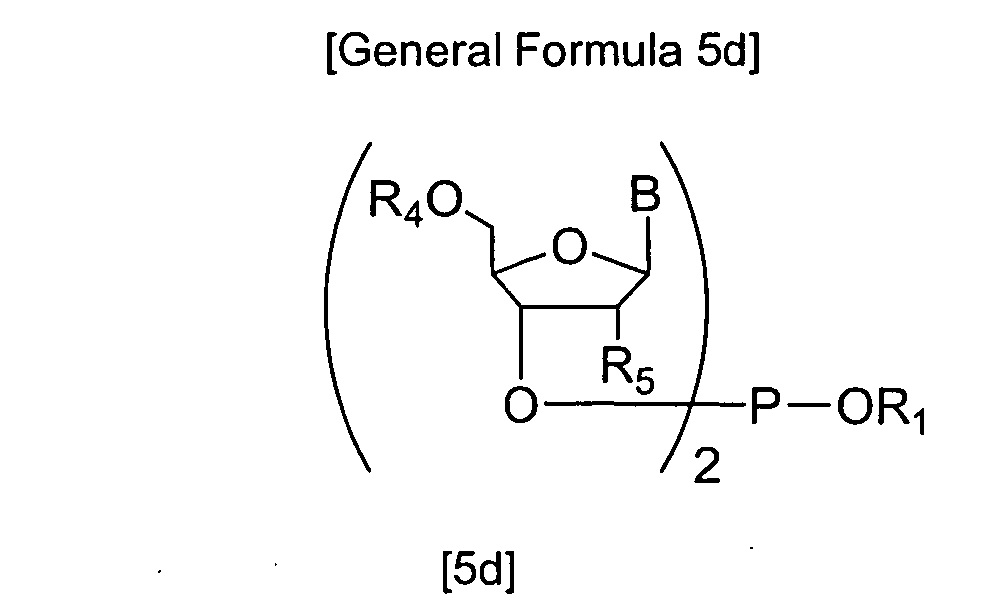 wherein R1 represents a 2-cyanoethyl group; R4 represents a
4,4'-dimethoxytrityl group; R5 represents a hydrogen atom; and B represents
N4-benzoyl-1-cytosine.
wherein R1 represents a 2-cyanoethyl group; R4 represents a
4,4'-dimethoxytrityl group; R5 represents a hydrogen atom; and B represents
N4-benzoyl-1-cytosine.
The reaction was conducted in the same manner as in Example 5, except that
0.088 g of tetrazole (0.4 equivalent to the molar number of a raw material: Comparative
Example 9) and 0.244 g of pyridinium trifluoroacetate (0.4 equivalent to the molar
number of a raw material: Comparative Example 10) were respectively used, instead of
5-phenyl-1 H-tetrazole. The reaction solution after 5 hours was analyzed according to the
high performance liquid chromatography (reverse phase column, eluent:
water/acetonitrile 4/6 (TEAA 62.5 mM), detection wavelength: 254 nm). The results are
shown in Table 4.
| Example 5 | Comparative Example 9 | Comparative Example 10 | |
| Reaction Selectivity (after 5 hours) | 284 | 177 | 117 |
| Yield (%, after 5 hours) | 99 | 97 | 92 |
The reaction selectivity is the ratio of HPLC area % of the entitled compound to
HPLC area % of the by-product represented by the general formula [5d] (HPLC area %
of the entitled compound / HPLC area % of the by-product represented by the general
formula [5d]). In the formula [5d] of the by-product, R1 represents a 2-cyanoethyl group,
R4 represents a 4,4'-dimethoxytrityl group, R5 represents a hydrogen atom and B
represents N4-benzoyl-1-cytosine.
Claims (5)
- A method for preparing phosphoroamidite with a reagent of a compound represented by the general formula [1],wherein R1 represents an alkyl group having 1 to 4 carbon atoms, an alkyl group having 1 to 4 carbon atoms substituted by a cyano group or an alkyl group having 1 to 4 carbon atoms substituted by a silyl group; and R2 represents an amino group substituted by an alkyl group having 2 to 5 carbon atoms or an alicyclic amino group having 4 to 7 carbon atoms,

wherein a substituted tetrazole represented by the general formula [2] is used as a reaction activator,wherein R3 represents an alicyclic alkyl group having 1 to 6 carbon atoms, an aryl group substituted by an alkyl group having 1 to 4 carbon atoms or an unsubstituted aryl group.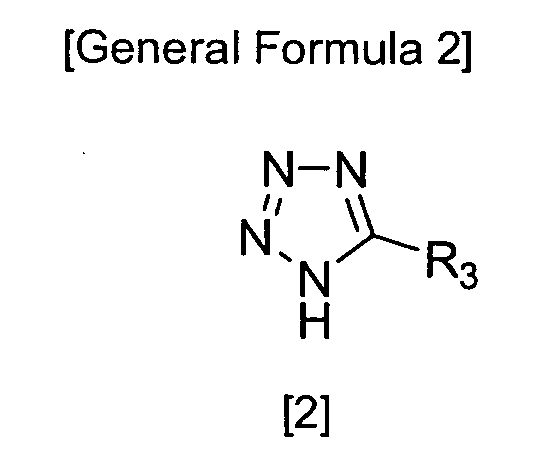
- The preparation method according to claim 1, wherein phosphoroamidite represented by the general formula [4] is synthesized by using a nucleoside derivative represented by the general formula [3] as a raw material,wherein R4 represents a protecting group of a hydroxyl group; R5 represents a hydrogen atom, a halogen atom, an alkyl group having 1 to 4 carbon atoms or a substituted hydroxyl group; and B represents a nucleic acid base or a protected nucleic acid base,
 wherein R1, R2, R4, R5 and B represent the same as those described above.
- The preparation method according to claim 1 or 2, wherein R3 in the general formula [2] is a phenyl group.
- The preparation method according to any one of claims 1 to 3, wherein, in the general formula [1], R1 is a cyanoethyl group and R2 is a diisopropylamino group.
- The preparation method according to any one of claims 2 to 4, wherein, in the general formulae [3] and [4], R4 is a 4,4'-dimethoxytrityl group, R5 is a hydrogen atom and B is a 1-thymine group, an N4-benzoyl-1-cytosine group, an N6-benzoyl-9-adenine group or an N2-isobutyryl-9-guanine group.
Applications Claiming Priority (3)
| Application Number | Priority Date | Filing Date | Title |
|---|---|---|---|
| JP2002357209 | 2002-12-09 | ||
| JP2002357209 | 2002-12-09 | ||
| PCT/JP2003/015529 WO2004052908A1 (en) | 2002-12-09 | 2003-12-04 | Process for producing phosphoroamidite |
Publications (2)
| Publication Number | Publication Date |
|---|---|
| EP1582528A1 true EP1582528A1 (en) | 2005-10-05 |
| EP1582528A4 EP1582528A4 (en) | 2006-01-11 |
Family
ID=32500844
Family Applications (1)
| Application Number | Title | Priority Date | Filing Date |
|---|---|---|---|
| EP03777243A Withdrawn EP1582528A4 (en) | 2002-12-09 | 2003-12-04 | Process for producing phosphoroamidite |
Country Status (6)
| Country | Link |
|---|---|
| US (1) | US20060069248A1 (en) |
| EP (1) | EP1582528A4 (en) |
| JP (1) | JPWO2004052908A1 (en) |
| KR (1) | KR20050083983A (en) |
| CN (1) | CN1723216A (en) |
| WO (1) | WO2004052908A1 (en) |
Families Citing this family (1)
| Publication number | Priority date | Publication date | Assignee | Title |
|---|---|---|---|---|
| JP7452549B2 (en) * | 2019-10-18 | 2024-03-19 | 富士フイルム和光純薬株式会社 | Phosphoramidite activator |
Family Cites Families (5)
| Publication number | Priority date | Publication date | Assignee | Title |
|---|---|---|---|---|
| US4415732A (en) * | 1981-03-27 | 1983-11-15 | University Patents, Inc. | Phosphoramidite compounds and processes |
| JPS6270391A (en) * | 1985-09-25 | 1987-03-31 | Nippon Zeon Co Ltd | Method for producing protected oligonucleotides |
| JPH0613545B2 (en) * | 1986-09-04 | 1994-02-23 | 有機合成薬品工業株式会社 | Nucleoside phosphorothioit and its synthetic method |
| US5278302A (en) * | 1988-05-26 | 1994-01-11 | University Patents, Inc. | Polynucleotide phosphorodithioates |
| US6274725B1 (en) * | 1998-06-02 | 2001-08-14 | Isis Pharmaceuticals, Inc. | Activators for oligonucleotide synthesis |
-
2003
- 2003-12-04 CN CNA2003801054386A patent/CN1723216A/en active Pending
- 2003-12-04 JP JP2004558410A patent/JPWO2004052908A1/en active Pending
- 2003-12-04 WO PCT/JP2003/015529 patent/WO2004052908A1/en not_active Ceased
- 2003-12-04 EP EP03777243A patent/EP1582528A4/en not_active Withdrawn
- 2003-12-04 KR KR1020057009309A patent/KR20050083983A/en not_active Ceased
- 2003-12-04 US US10/535,277 patent/US20060069248A1/en not_active Abandoned
Also Published As
| Publication number | Publication date |
|---|---|
| US20060069248A1 (en) | 2006-03-30 |
| EP1582528A4 (en) | 2006-01-11 |
| CN1723216A (en) | 2006-01-18 |
| JPWO2004052908A1 (en) | 2006-04-13 |
| WO2004052908A1 (en) | 2004-06-24 |
| KR20050083983A (en) | 2005-08-26 |
Similar Documents
| Publication | Publication Date | Title |
|---|---|---|
| JP4402454B2 (en) | Method for producing LNA phosphoramidite | |
| CN112533892A (en) | Alkoxyphenyl derivative, nucleoside protector and nucleotide protector, method for producing oligonucleotide, and method for removing substituent | |
| EP2537839B1 (en) | B-dihydrofuran deriving compound, method for producing b-dihydrofuran deriving compound or b-tetrahydrofuran deriving compound, b -glycoside compound, method for producing b-glycoside compound, and method for producing 4'-ethynyl d4t and analogue compounds thereof | |
| US20060069248A1 (en) | Process for producing phosphoroamidite | |
| JP7298866B2 (en) | Solid phase carrier for nucleic acid synthesis and method for producing nucleic acid using the same | |
| EP1634882A1 (en) | Inosine derivative and process for producing the same | |
| EP2053054B1 (en) | Method for introducing nucleic-acid-protecting group | |
| EP0906327B1 (en) | Intermediates for oligonucleotide synthesis | |
| CN111434663B (en) | Entecavir intermediate and synthesis method thereof, and synthesis method of entecavir | |
| CA2554618A1 (en) | Ribonucleic acid compound and method of liquid-phase synthesis of oligonucleic acid compound | |
| EP1258489B1 (en) | Method for purifying 5'-protected thymidines | |
| CA2135854A1 (en) | Process for preparing azt and derivatives thereof | |
| KR100448211B1 (en) | Process for the preparation of cytidine derivatives | |
| JP3985103B2 (en) | Novel complex and method for synthesizing oligonucleotide | |
| JP4424900B2 (en) | Method for purifying 5'-O-substituted thymidine | |
| JP3294594B2 (en) | Method for producing vinylpyrimidine | |
| KR20060047970A (en) | 1-α-halo-2,2-difluoro-2-deoxy-D-ribofuranose derivative and preparation method thereof | |
| JP4071991B2 (en) | Purification method and novel derivative of 5'-protected thymidines | |
| EP4563570A1 (en) | Alkyl halide, alkylating agent using same, and method for producing derivative of nucleoside | |
| WO1997006179A1 (en) | Process for producing azido nucleoside derivatives | |
| WO2021177123A1 (en) | Artificial nucleic acid | |
| CN118076620A (en) | Method for producing 2' modified pyrimidine nucleoside | |
| JP2004203819A (en) | Method for manufacturing n4-acylcytidine derivative | |
| JP2006248956A (en) | Trityl type compound | |
| JP2003073395A (en) | Isolation and purification of n-acylated purine nucleoside derivative |
Legal Events
| Date | Code | Title | Description |
|---|---|---|---|
| PUAI | Public reference made under article 153(3) epc to a published international application that has entered the european phase |
Free format text: ORIGINAL CODE: 0009012 |
|
| 17P | Request for examination filed |
Effective date: 20050629 |
|
| AK | Designated contracting states |
Kind code of ref document: A1 Designated state(s): AT BE BG CH CY CZ DE DK EE ES FI FR GB GR HU IE IT LI LU MC NL PT RO SE SI SK TR |
|
| A4 | Supplementary search report drawn up and despatched |
Effective date: 20051124 |
|
| STAA | Information on the status of an ep patent application or granted ep patent |
Free format text: STATUS: THE APPLICATION IS DEEMED TO BE WITHDRAWN |
|
| 18D | Application deemed to be withdrawn |
Effective date: 20060831 |