EP1582257A1 - Novel solid acid catalyst - Google Patents
Novel solid acid catalyst Download PDFInfo
- Publication number
- EP1582257A1 EP1582257A1 EP03741118A EP03741118A EP1582257A1 EP 1582257 A1 EP1582257 A1 EP 1582257A1 EP 03741118 A EP03741118 A EP 03741118A EP 03741118 A EP03741118 A EP 03741118A EP 1582257 A1 EP1582257 A1 EP 1582257A1
- Authority
- EP
- European Patent Office
- Prior art keywords
- organic
- cation
- sheet
- metal oxide
- acid catalyst
- Prior art date
- Legal status (The legal status is an assumption and is not a legal conclusion. Google has not performed a legal analysis and makes no representation as to the accuracy of the status listed.)
- Withdrawn
Links
Images

Classifications
-
- B—PERFORMING OPERATIONS; TRANSPORTING
- B01—PHYSICAL OR CHEMICAL PROCESSES OR APPARATUS IN GENERAL
- B01J—CHEMICAL OR PHYSICAL PROCESSES, e.g. CATALYSIS OR COLLOID CHEMISTRY; THEIR RELEVANT APPARATUS
- B01J37/00—Processes, in general, for preparing catalysts; Processes, in general, for activation of catalysts
- B01J37/30—Ion-exchange
-
- B—PERFORMING OPERATIONS; TRANSPORTING
- B01—PHYSICAL OR CHEMICAL PROCESSES OR APPARATUS IN GENERAL
- B01J—CHEMICAL OR PHYSICAL PROCESSES, e.g. CATALYSIS OR COLLOID CHEMISTRY; THEIR RELEVANT APPARATUS
- B01J23/00—Catalysts comprising metals or metal oxides or hydroxides, not provided for in group B01J21/00
- B01J23/002—Mixed oxides other than spinels, e.g. perovskite
-
- B—PERFORMING OPERATIONS; TRANSPORTING
- B01—PHYSICAL OR CHEMICAL PROCESSES OR APPARATUS IN GENERAL
- B01J—CHEMICAL OR PHYSICAL PROCESSES, e.g. CATALYSIS OR COLLOID CHEMISTRY; THEIR RELEVANT APPARATUS
- B01J23/00—Catalysts comprising metals or metal oxides or hydroxides, not provided for in group B01J21/00
- B01J23/16—Catalysts comprising metals or metal oxides or hydroxides, not provided for in group B01J21/00 of arsenic, antimony, bismuth, vanadium, niobium, tantalum, polonium, chromium, molybdenum, tungsten, manganese, technetium or rhenium
- B01J23/20—Vanadium, niobium or tantalum
-
- C—CHEMISTRY; METALLURGY
- C07—ORGANIC CHEMISTRY
- C07C—ACYCLIC OR CARBOCYCLIC COMPOUNDS
- C07C67/00—Preparation of carboxylic acid esters
- C07C67/08—Preparation of carboxylic acid esters by reacting carboxylic acids or symmetrical anhydrides with the hydroxy or O-metal group of organic compounds
-
- B—PERFORMING OPERATIONS; TRANSPORTING
- B01—PHYSICAL OR CHEMICAL PROCESSES OR APPARATUS IN GENERAL
- B01J—CHEMICAL OR PHYSICAL PROCESSES, e.g. CATALYSIS OR COLLOID CHEMISTRY; THEIR RELEVANT APPARATUS
- B01J2235/00—Indexing scheme associated with group B01J35/00, related to the analysis techniques used to determine the catalysts form or properties
- B01J2235/15—X-ray diffraction
-
- B—PERFORMING OPERATIONS; TRANSPORTING
- B01—PHYSICAL OR CHEMICAL PROCESSES OR APPARATUS IN GENERAL
- B01J—CHEMICAL OR PHYSICAL PROCESSES, e.g. CATALYSIS OR COLLOID CHEMISTRY; THEIR RELEVANT APPARATUS
- B01J2523/00—Constitutive chemical elements of heterogeneous catalysts
-
- B—PERFORMING OPERATIONS; TRANSPORTING
- B01—PHYSICAL OR CHEMICAL PROCESSES OR APPARATUS IN GENERAL
- B01J—CHEMICAL OR PHYSICAL PROCESSES, e.g. CATALYSIS OR COLLOID CHEMISTRY; THEIR RELEVANT APPARATUS
- B01J35/00—Catalysts, in general, characterised by their form or physical properties
- B01J35/60—Catalysts, in general, characterised by their form or physical properties characterised by their surface properties or porosity
- B01J35/61—Surface area
- B01J35/613—10-100 m2/g
-
- B—PERFORMING OPERATIONS; TRANSPORTING
- B01—PHYSICAL OR CHEMICAL PROCESSES OR APPARATUS IN GENERAL
- B01J—CHEMICAL OR PHYSICAL PROCESSES, e.g. CATALYSIS OR COLLOID CHEMISTRY; THEIR RELEVANT APPARATUS
- B01J35/00—Catalysts, in general, characterised by their form or physical properties
- B01J35/60—Catalysts, in general, characterised by their form or physical properties characterised by their surface properties or porosity
- B01J35/61—Surface area
- B01J35/615—100-500 m2/g
Definitions
- the present invention relates to a novel solid acid catalyst obtained by using anion nano-sheet comprising lamellar metal oxide layers of titanium niobate containing alkali metal ion as a starting material, changing said sheet to a proton exchanger, cation exchanging said proton exchanger with organic amine or organic ammonium, removing said layers so as to prepare a colloidal solution, then re-coagulating and proton exchanging said colloidal solution by prepared protonic acid, wherein a Ti/Nb atomic ratio z is in the range of 1.1 ⁇ z ⁇ 1.5.
- solid acid catalysts such as zeolite or perfluorosulfonic acid resin are paid attention from the view point that the recovery from a reaction system and reuse are easy, and a "super acid catalyst" characterizing by loading pentafluorophenylbis(trifuril)methane (C 6 F 5 CHTf 2 to polystyrene resin is proposed as a solid catalyst which progresses organic reaction effectively (Ishihara, K; Hasegawa, A; Yamamoto, H. Angew. Chem. Int. Ed. 2001, 40, 4077., Document 1).
- the subject of the present invention is to provide a high effective solid acid catalyst which is active than the proposed solid acid catalyst mentioned above using a polyanion nano-sheet having alkali metal cation between layers, in particular, using a lamellar metal oxide containing titanium, niobium and alkali metal.
- a lamellar metal oxide containing titanium, niobium and alkali metal in which blending ratio of titanium a niobium is changed is synthesized, then the resulting lamellar metal oxide is cation exchanged with organic amine or organic ammonium and layers are re-laminated.
- Two dimensional re-coagulated sheet is prepared by adding acid and a liquid esterfication reaction is tried using said two dimensional re-coagulated sheet, and it is confirmed that very activated solid acid catalyst can be obtained at Ti/Nb ratio z is 1 ⁇ z ⁇ 1.5, especially at z is 1.2 ⁇ z ⁇ 1.4, thus the subject of the present invention is dissolved.
- the first one of the present invention is, (1) a solid acid catalyst represented by HTi x Nb y O 5 , wherein x is 1.1 ⁇ x ⁇ 1.2 and y is 0.9>y>0.8, having a Ti/Nb atomic ratio z of 1 ⁇ z ⁇ 1.5, obtained by proton changing of alkali metal cation of cation changeable lamellar metal oxide in which polyanion nano-sheet comprising lamellar metal oxide layers of titanium niobate lying alkali metal cation between are regularly laminated by inorganic acid or organic acid adjusted to 0.0001M to 1M, delaminating said laminated layers temporarily by inserting cation selected from the group consisting of organic amine or organic ammonium between layers of proton exchangers, preparing an aqueous colloidal solution comprising metal oxide sheets to which said organic amine or organic ammonium is absorbed, then proton exchanging said organic amine or organic ammonium by adding inorganic acid or organic acid adjusted to 0.0001M to 1M to
- the first one of the present invention is (2) the solid acid catalyst of (1), wherein a Ti/Nb atomic ratio z is 1.2 ⁇ z ⁇ 1.4, more desirably the first one of the present invention is (3) the solid acid catalyst of (1) or (2), wherein organic amine or organic ammonium is at least one selected from the group consisting of ethylamine, propylamine or tetrabutylammonium.
- the first one of the present invention is (4) the solid acid catalyst of (1), (2) or (3), wherein the surface area of coagulated titanium niobate nano-sheet is 10 times or more to the surface area of cation changeable lamellar metal oxide proton exchanger and is in the range from 60m 2 g -1 to 150 m 2 g -1 .
- the second one of the present invention is an ester dehydration condensation catalyst composed of the solid acid catalyst of (1) to (4).
- Powder mixture of K 2 CO 3 , TiO 2 , Nb 2 O 5 is prepared by substance ratio 1.1:1.1:0.9, and lamellar metal oxide K 1.1 Ti 1.1 Nb 0.9 O 5 is obtained by calcination of the mixture in air at 800°C for 12 hours.
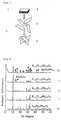
- the powder X-ray diffraction spectrum of K 1.1 Ti 1.1 Nb 0.9 O 5 is shown in Fig.2.
- the surface area of K 1.1 Ti 1.1 Nb 0.9 O 5 powder is 1m 2 g -1 .
- Powder of lamellar metal oxide proton exchanger of H 1.1 Ti 1.1 Nb 0.9 O 5 is obtained by dispersing 2g of K 1.1 Ti 1.1 Nb 0.9 O 5 powder in 200mL of 1M nitric acid and penetrated for 14 hours then filtrated. 2g of H 1.1 Ti 1.1 Nb 0.9 O 5 powder is dispersed in 150mL of distilled water and add 15% aqueous solution of tetrabutylammonium hydroxide and bring the pH of the aqueous solution to 8-11 and stirred. During the stirring, pH of aqueous solution is maintained 8-11 by adding 15wt% of aqueous solution of tetrabutylammonium hydroxide.
- Powder mixture of K 2 CO 3 , TiO 2 , Nb 2 O 5 is prepared by substance ratio 1.15:1.15:0.85, and lamellar metal oxide K 1.15 Ti 1.15 Nb 0.85 O 5 is obtained by calcination of the mixture in air at 800°C for 12 hours.
- the powder X-ray diffraction spectrum of K 1.15 Ti 1.1 Nb 0.85 O 5 is shown in Fig.2.
- the surface area of K 1.15 Ti 1.15 Nb 0.85 O 5 powder is 1m 2 g -1 .
- Powder of lamellar metal oxide proton exchanger of H 1.15 Ti 1.15 Nb 0.85 O 5 is obtained by dispersing 2g of K 1.15 Ti 1.15 Nb 0.85 O 5 powder in 200mL of 1M nitric acid and penetrated for 14 hours then filtrated.
- 2g of H 1.1 Ti 1.1 Nb 0.9 O 5 powder is dispersed in 150mL of distilled water and add 15wt% aqueous solution of tetrabutylammonium hydroxide and bring the pH of the aqueous solution to 8-11 and stirred. During the stirring, pH of aqueous solution is maintained 8-11 by adding 15wt% of aqueous solution of tetrabutylammonium hydroxide.
- H 1.15 Ti 1.15 Nb 0.85 O 5 sheet coagulation is vacuumed for 1 hour at 150°C, poured into mixed solution of 0.1mol of acetic acid and 0.1 mol of ethyl alcohol under argon gas atmosphere, stirred for 6 hours at 70°C, and amount of generation of ethyl acetate formed by acid catalyst reaction is measured by a gas chromatography. Amount of ethyl acetate formed by 6 hours reaction is shown in Fig.3. It is understood that the generating speed of ethyl acetate in H 1.15 Ti 1.15 Nb 0.85 O 5 sheet coagulation is approximately 1.3times larger than that of H 1.0 Ti 1.0 Nb 10 O 5 .
- Powder mixture of K 2 CO 3 , TiO 2 , Nb 2 O 5 is prepared by substance ratio 1.2:1.2:0.8 is prepared, and lamellar metal oxide K 1.15 Ti 1.15 Nb 0.85 O 5 is obtained by calcination of the mixture in air at 800°C for 12 hours.
- the powder X-ray diffraction spectrum of K 1.15 Ti 1.15 Nb 0.85 O 5 is shown in Fig.2.
- the surface area of K 1.2 Ti 1.2 Nb 0.8 O 5 powder is 1m 2 g -1 .
- Powder of lamellar metal oxide proton exchanger of H 1.15 Ti 1.15 Nb 0.85 O 5 is obtained by dispersing 2g of K 1.2 Ti 1.2 Nb 0.8 O 5 powder in 200mL of 1M nitric acid and penetrated for 14 hours then filtrated. 2g of H 1.2 Ti 1.2 Nb 0.8 O 5 powder is dispersed in 150mL of distilled water and add 15wt% aqueous solution of tetrabutylammonium hydroxide and bring the pH of the aqueous solution to 8-11 and stirred. During the stirring, pH of aqueous solution is maintained to 8-11 by adding 15wt% of aqueous solution of tetrabutylammonium hydroxide.
- Powder mixture of K 2 CO 3 , TiO 2 , Nb 2 O 5 is prepared by substance ratio 1.0:1.0:1.0, and lamellar metal oxide K 1.0 Ti 1.0 Nb 1.0 O 5 is obtained by calcination of the mixture in air at 800°C for 12 hours.
- the powder X-ray diffraction spectrum of K 1.0 Ti 1.0 Nb 1.0 O 5 is shown in Fig.2.
- the surface area of K 1.0 Ti 1.0 Nb 1.0 O 5 powder is 1m 2 g -1 .
- Powder of lamellar metal oxide proton exchanger of H 1.0 Ti 1.0 Nb 1.0 O 5 is obtained by dispersing 2g of K 1.0 Ti 1.0 Nb 1.0 O 5 powder in 200mL of 1M nitric acid and penetrated for 14 hours then filtrated. 2g of H 1.0 Ti 1.0 Nb 1.0 O 5 powder is dispersed in 150mL of distilled water and add 15wt% aqueous solution of tetrabutylammonium hydroxide and bring the pH of the aqueous solution to 8-11 and stirred. During the stirring, pH of aqueous solution is maintained 8-11 by adding 15wt% of aqueous solution of tetrabutylammonium hydroxide.
- the powder X-ray diffraction spectrum of K 1.25 Ti 1.25 Nb 0.75 O 5 is shown in Fig.2.
- the peak of impurity originated from K 3 Ti 5 NbO 5 at whole range becomes large, while the peak of KTiNbO 5 is confirmed to become small.
- the surface area of K 1.25 Ti 1.25 Nb 0.75 O 5 powder is 1m 2 g -1 .
- Powder of lamellar metal oxide proton exchanger of H 1.25 Ti 1.25 Nb 0.75 O 5 is obtained by dispersing 2g of K 1.25 Ti 1.25 Nb 0.75 O 5 powder in 200mL of 1M nitric acid and penetrated for 14 days then filtrated. 2g of H 1.25 Ti 1.25 Nb 0.75 O 5 powder is dispersed in 150mL of distilled water and add 15wt% aqueous solution of tetrabutylammonium hydroxide and bring the pH of the aqueous solution to 8-11 and stirred. During the stirring, pH of aqueous solution is maintained 8-11 by adding 15wt% of aqueous solution of tetrabutylammonium hydroxide.
- the present invention provides the excellent effect that a solid acid catalyst which is usable for the catalyst of dehydration reaction by controlling Ti/Nb atom ratio z and number of Ti contained in titanium niobate nano-sheet coagulation. Further, these are usable as the base material with possibilities, from the view point that the multi functionality of catalyst can be easily designed by embellishing polyanion nano-sheet with different kinds of metal ion or cationic complex.
Landscapes
- Chemical & Material Sciences (AREA)
- Organic Chemistry (AREA)
- Engineering & Computer Science (AREA)
- Materials Engineering (AREA)
- Chemical Kinetics & Catalysis (AREA)
- Catalysts (AREA)
- Organic Low-Molecular-Weight Compounds And Preparation Thereof (AREA)
- Low-Molecular Organic Synthesis Reactions Using Catalysts (AREA)
Abstract
Description
Claims (5)
- A solid acid catalyst represented by HTixNbyO5, wherein x is 1.1<x<1.2 and y is 0.9>y>0.8, having a Ti/Nb atomic ratio z of 1<z<1.5, obtainable by proton changing an alkali metal cation of a cation changeable lamellar metal oxide in which a polyanion nano-sheet comprising lamellar metal oxide layers of titanium niobate having an alkali metal cation between the layers are laminated by inorganic acid or organic acid adjusted to 0.0001M to 1M,
delaminating said laminated layers temporarily by inserting a cation chosen from organic amine or organic ammonium between the layers,
preparing an aqueous colloidal solution comprising the metal oxide sheets to which the organic amine or organic ammonium is absorbed,
then proton exchanging the organic amine or organic ammonium by adding an inorganic acid or an organic acid adjusted to 0.0001M to 1M and simultaneously coagulating on a titanium niobate nano-sheet. - A solid acid catalyst according to claim 1, wherein the Ti/Nb atomic ratio z is 1.2<z<1.4.
- A solid acid catalyst according to claim 1 or 2, wherein organic amine or inorganic ammonium is at least one chosen from ethylamine, propylamine and tetrabutylammonium.
- A solid acid catalyst according to any of claims 1 to 3, wherein the surface area of coagulated titanium niobate nano-sheet is at least 10 times that of the cation changeable lamellar metal oxide proton exchanger, and is in the range from 60m2g-1 to 150 m2g-1.
- An ester dehydration condensation catalyst comprising the solid acid catalyst according to any preceding claim.
Applications Claiming Priority (3)
| Application Number | Priority Date | Filing Date | Title |
|---|---|---|---|
| JP2002340340 | 2002-11-25 | ||
| JP2002340340A JP4807919B2 (en) | 2002-11-25 | 2002-11-25 | New solid acid catalyst |
| PCT/JP2003/007614 WO2004047982A1 (en) | 2002-11-25 | 2003-06-16 | Novel solid acid catalyst |
Publications (2)
| Publication Number | Publication Date |
|---|---|
| EP1582257A1 true EP1582257A1 (en) | 2005-10-05 |
| EP1582257A4 EP1582257A4 (en) | 2010-04-28 |
Family
ID=32375818
Family Applications (1)
| Application Number | Title | Priority Date | Filing Date |
|---|---|---|---|
| EP03741118A Withdrawn EP1582257A4 (en) | 2002-11-25 | 2003-06-16 | NEW CATALYST OF SOLID ACID |
Country Status (4)
| Country | Link |
|---|---|
| US (1) | US8323611B2 (en) |
| EP (1) | EP1582257A4 (en) |
| JP (1) | JP4807919B2 (en) |
| WO (1) | WO2004047982A1 (en) |
Cited By (1)
| Publication number | Priority date | Publication date | Assignee | Title |
|---|---|---|---|---|
| WO2006048180A1 (en) * | 2004-10-29 | 2006-05-11 | Companhia Brasileira De Metalurgia E Mineracao | Porous niobic acid catalyst |
Families Citing this family (6)
| Publication number | Priority date | Publication date | Assignee | Title |
|---|---|---|---|---|
| JP4559871B2 (en) * | 2005-02-10 | 2010-10-13 | 花王株式会社 | Solid acid catalyst and method for producing nitrile compound using solid acid catalyst |
| JP4806770B2 (en) * | 2006-03-01 | 2011-11-02 | 国立大学法人 東京大学 | Solid acid catalyst |
| JP4996167B2 (en) * | 2006-08-09 | 2012-08-08 | 花王株式会社 | Method for producing aliphatic carboxylic acid amide |
| JP2008311223A (en) * | 2007-05-17 | 2008-12-25 | Tokyo Univ Of Science | Oxygen reduction electrode catalyst, oxygen reduction electrode using the same, and battery |
| TW201100460A (en) * | 2009-03-18 | 2011-01-01 | Saudi Basic Ind Corp | Process for making thermoplastic polyesters |
| JP5963000B2 (en) * | 2013-03-14 | 2016-08-03 | 株式会社豊田中央研究所 | Exhaust gas purification catalyst, method for producing the same, and exhaust gas purification method using the same |
Family Cites Families (1)
| Publication number | Priority date | Publication date | Assignee | Title |
|---|---|---|---|---|
| WO2002020157A2 (en) | 2000-09-07 | 2002-03-14 | Showa Denko K. K. | Heteropolyacid catalyst for producing lower aliphatic carboxylic acid ester |
-
2002
- 2002-11-25 JP JP2002340340A patent/JP4807919B2/en not_active Expired - Fee Related
-
2003
- 2003-06-16 EP EP03741118A patent/EP1582257A4/en not_active Withdrawn
- 2003-06-16 WO PCT/JP2003/007614 patent/WO2004047982A1/en not_active Ceased
- 2003-06-16 US US10/533,567 patent/US8323611B2/en not_active Expired - Fee Related
Cited By (1)
| Publication number | Priority date | Publication date | Assignee | Title |
|---|---|---|---|---|
| WO2006048180A1 (en) * | 2004-10-29 | 2006-05-11 | Companhia Brasileira De Metalurgia E Mineracao | Porous niobic acid catalyst |
Also Published As
| Publication number | Publication date |
|---|---|
| US20060058186A1 (en) | 2006-03-16 |
| EP1582257A4 (en) | 2010-04-28 |
| US8323611B2 (en) | 2012-12-04 |
| JP4807919B2 (en) | 2011-11-02 |
| JP2004174295A (en) | 2004-06-24 |
| WO2004047982A1 (en) | 2004-06-10 |
Similar Documents
| Publication | Publication Date | Title |
|---|---|---|
| Lan et al. | Versatile synthesis of mesoporous crystalline TiO2 materials by monomicelle assembly | |
| Li et al. | Chromium‐doped nickel oxide and nickel nitride mediate selective electrocatalytic oxidation of sterol intermediates coupled with H2 evolution | |
| Feng et al. | Using MOF-808 as a promising support to immobilize Ru for selective hydrogenation of levulinic acid to γ-valerolactone | |
| CN109267095B (en) | Novel nickel phosphide catalyst and preparation method thereof | |
| CN110433860B (en) | A kind of three-dimensional non-penetrating phosphomolybdate-based copper crystalline catalytic material and preparation method thereof | |
| Zou et al. | Single-phase proton-and electron-conducting Ag-organic coordination polymers for efficient CO2 electroreduction | |
| US8323611B2 (en) | Solid acid catalyst | |
| CN114606511B (en) | Preparation method and electrocatalytic application of MOF@LDH composite material | |
| CN102139914B (en) | Method for preparing calcium titanate nanoparticles | |
| CN103203231A (en) | In situ controllable synthesis method for hydrotalcite-supported Pd nano crystal catalysts with different morphologies and application of hydrotalcite-supported Pd nano crystal catalysts in catalysis of Heck reaction | |
| Beere et al. | Achieving favourable oxygen electrocatalytic activity with compositionally complex metal molybdates | |
| KR101836678B1 (en) | Preparing method of catalyst comprising PtIr/Titanium suboxide for cathode of unitized regenerative fuel cell | |
| Xie et al. | Metallic CoNi nanoparticles anchored on heteroatom-doped carbon/MnO nanowires for improved catalytic performance | |
| CN121108517B (en) | Double-morphology boron-containing Zn/Cu metal organic framework composite material and preparation and application thereof | |
| Chen et al. | Spin-polarized electron transfer in chiral tartaric acid-engineered Ni (OH) 2 unlocks NiOOH activation for urea electrooxidation | |
| CN114920222B (en) | High-entropy metal phosphide FeCoNiCrMnP x Is prepared by the preparation method of (2) | |
| CN113830836A (en) | Preparation method of pyrochlore type nitrogen-doped multi-element metal oxide | |
| CN114907419A (en) | Silver-titanium dissimilar metal cluster compound and room temperature macroscopic quantity synthesis method thereof | |
| CN119114162B (en) | Heterogeneous metal photocatalyst and preparation method and application thereof | |
| CN118598195B (en) | Preparation of multi-active-site germanium tungstic acid-based crystal material and photocatalytic hydrogen production application thereof | |
| CN119684623B (en) | Preparation method and application of a topological star-shaped nano hollow reactor | |
| KR102905105B1 (en) | Method for preparing platinum-doped CaTiO3 perovskite catalyst and the catalyst prepared by the method | |
| CN111826679B (en) | Preparation method and electrocatalysis application of chitosan/ordered mesoporous carbon electrode material | |
| CN121394436A (en) | Dysprosium-doped platinum-based catalyst and preparation method and application thereof | |
| KR100792619B1 (en) | Method for preparing ionic liquid / aluminum hydroxide composite and mesoporous alumina |
Legal Events
| Date | Code | Title | Description |
|---|---|---|---|
| PUAI | Public reference made under article 153(3) epc to a published international application that has entered the european phase |
Free format text: ORIGINAL CODE: 0009012 |
|
| 17P | Request for examination filed |
Effective date: 20050617 |
|
| AK | Designated contracting states |
Kind code of ref document: A1 Designated state(s): AT BE BG CH CY CZ DE DK EE ES FI FR GB GR HU IE IT LI LU MC NL PT RO SE SI SK TR |
|
| RBV | Designated contracting states (corrected) |
Designated state(s): DE FR GB |
|
| RIC1 | Information provided on ipc code assigned before grant |
Ipc: C07C 67/08 20060101ALI20100223BHEP Ipc: B01J 37/30 20060101ALI20100223BHEP Ipc: B01J 23/20 20060101AFI20040616BHEP Ipc: C07C 69/14 20060101ALI20100223BHEP |
|
| A4 | Supplementary search report drawn up and despatched |
Effective date: 20100326 |
|
| 17Q | First examination report despatched |
Effective date: 20110131 |
|
| GRAP | Despatch of communication of intention to grant a patent |
Free format text: ORIGINAL CODE: EPIDOSNIGR1 |
|
| INTG | Intention to grant announced |
Effective date: 20141118 |
|
| STAA | Information on the status of an ep patent application or granted ep patent |
Free format text: STATUS: THE APPLICATION IS DEEMED TO BE WITHDRAWN |
|
| 18D | Application deemed to be withdrawn |
Effective date: 20150331 |