EP1582247B1 - Filtervorrichtung - Google Patents
Filtervorrichtung Download PDFInfo
- Publication number
- EP1582247B1 EP1582247B1 EP04388020A EP04388020A EP1582247B1 EP 1582247 B1 EP1582247 B1 EP 1582247B1 EP 04388020 A EP04388020 A EP 04388020A EP 04388020 A EP04388020 A EP 04388020A EP 1582247 B1 EP1582247 B1 EP 1582247B1
- Authority
- EP
- European Patent Office
- Prior art keywords
- filter element
- valve structure
- filter device
- lid
- filter
- Prior art date
- Legal status (The legal status is an assumption and is not a legal conclusion. Google has not performed a legal analysis and makes no representation as to the accuracy of the status listed.)
- Expired - Lifetime
Links
- 239000007788 liquid Substances 0.000 claims description 72
- 238000001914 filtration Methods 0.000 claims description 13
- 239000007787 solid Substances 0.000 claims description 6
- 238000007789 sealing Methods 0.000 claims description 4
- 230000000295 complement effect Effects 0.000 claims 3
- 230000008878 coupling Effects 0.000 claims 3
- 238000010168 coupling process Methods 0.000 claims 3
- 238000005859 coupling reaction Methods 0.000 claims 3
- 239000007921 spray Substances 0.000 claims 1
- 238000005507 spraying Methods 0.000 description 8
- 230000002093 peripheral effect Effects 0.000 description 7
- 239000004033 plastic Substances 0.000 description 7
- 229920003023 plastic Polymers 0.000 description 7
- 239000003795 chemical substances by application Substances 0.000 description 5
- 238000004140 cleaning Methods 0.000 description 5
- 239000012530 fluid Substances 0.000 description 5
- 239000002184 metal Substances 0.000 description 5
- 238000000034 method Methods 0.000 description 5
- 231100001261 hazardous Toxicity 0.000 description 3
- 230000000717 retained effect Effects 0.000 description 3
- 230000000903 blocking effect Effects 0.000 description 2
- 239000000417 fungicide Substances 0.000 description 2
- 238000000465 moulding Methods 0.000 description 2
- 239000002245 particle Substances 0.000 description 2
- 239000000575 pesticide Substances 0.000 description 2
- 238000010276 construction Methods 0.000 description 1
- 238000005516 engineering process Methods 0.000 description 1
- 230000000855 fungicidal effect Effects 0.000 description 1
- 238000004519 manufacturing process Methods 0.000 description 1
- 239000000463 material Substances 0.000 description 1
- 230000000630 rising effect Effects 0.000 description 1
- 238000003892 spreading Methods 0.000 description 1
- 231100000331 toxic Toxicity 0.000 description 1
- 230000002588 toxic effect Effects 0.000 description 1
- XLYOFNOQVPJJNP-UHFFFAOYSA-N water Substances O XLYOFNOQVPJJNP-UHFFFAOYSA-N 0.000 description 1
Images




Classifications
-
- B—PERFORMING OPERATIONS; TRANSPORTING
- B01—PHYSICAL OR CHEMICAL PROCESSES OR APPARATUS IN GENERAL
- B01D—SEPARATION
- B01D29/00—Filters with filtering elements stationary during filtration, e.g. pressure or suction filters, not covered by groups B01D24/00 - B01D27/00; Filtering elements therefor
- B01D29/11—Filters with filtering elements stationary during filtration, e.g. pressure or suction filters, not covered by groups B01D24/00 - B01D27/00; Filtering elements therefor with bag, cage, hose, tube, sleeve or like filtering elements
- B01D29/13—Supported filter elements
- B01D29/23—Supported filter elements arranged for outward flow filtration
-
- B—PERFORMING OPERATIONS; TRANSPORTING
- B01—PHYSICAL OR CHEMICAL PROCESSES OR APPARATUS IN GENERAL
- B01D—SEPARATION
- B01D29/00—Filters with filtering elements stationary during filtration, e.g. pressure or suction filters, not covered by groups B01D24/00 - B01D27/00; Filtering elements therefor
- B01D29/96—Filters with filtering elements stationary during filtration, e.g. pressure or suction filters, not covered by groups B01D24/00 - B01D27/00; Filtering elements therefor in which the filtering elements are moved between filtering operations; Particular measures for removing or replacing the filtering elements; Transport systems for filters
-
- B—PERFORMING OPERATIONS; TRANSPORTING
- B01—PHYSICAL OR CHEMICAL PROCESSES OR APPARATUS IN GENERAL
- B01D—SEPARATION
- B01D35/00—Filtering devices having features not specifically covered by groups B01D24/00 - B01D33/00, or for applications not specifically covered by groups B01D24/00 - B01D33/00; Auxiliary devices for filtration; Filter housing constructions
- B01D35/14—Safety devices specially adapted for filtration; Devices for indicating clogging
- B01D35/153—Anti-leakage or anti-return valves
-
- B—PERFORMING OPERATIONS; TRANSPORTING
- B01—PHYSICAL OR CHEMICAL PROCESSES OR APPARATUS IN GENERAL
- B01D—SEPARATION
- B01D35/00—Filtering devices having features not specifically covered by groups B01D24/00 - B01D33/00, or for applications not specifically covered by groups B01D24/00 - B01D33/00; Auxiliary devices for filtration; Filter housing constructions
- B01D35/16—Cleaning-out devices, e.g. for removing the cake from the filter casing or for evacuating the last remnants of liquid
-
- B—PERFORMING OPERATIONS; TRANSPORTING
- B01—PHYSICAL OR CHEMICAL PROCESSES OR APPARATUS IN GENERAL
- B01D—SEPARATION
- B01D2201/00—Details relating to filtering apparatus
- B01D2201/04—Supports for the filtering elements
- B01D2201/0415—Details of supporting structures
-
- B—PERFORMING OPERATIONS; TRANSPORTING
- B01—PHYSICAL OR CHEMICAL PROCESSES OR APPARATUS IN GENERAL
- B01D—SEPARATION
- B01D2201/00—Details relating to filtering apparatus
- B01D2201/16—Valves
- B01D2201/165—Multi-way valves
-
- B—PERFORMING OPERATIONS; TRANSPORTING
- B01—PHYSICAL OR CHEMICAL PROCESSES OR APPARATUS IN GENERAL
- B01D—SEPARATION
- B01D2201/00—Details relating to filtering apparatus
- B01D2201/30—Filter housing constructions
- B01D2201/301—Details of removable closures, lids, caps, filter heads
Definitions
- the present invention is related a filter device for filtering a liquid, as defined in the preamble of claim 1.
- the filter device is adapted to be connected to piping or tubing for conveying liquid to the filter device and then from the filter device.
- One advantageous use of the filter device of the present invention is for the continuous filtering of a liquid to be distributed on a field, such a pesticides or fungicides, using a mobile agricultural sprayer.
- the filter device may, however, also find use within alternative areas of technology.
- a related filter device is disclosed in US 1 613 166 , and this known filter device has a casing with a bottom end and an upper open end, and a cover releasably covering the upper end of the casing.
- the casing has a liquid inlet which is connected to the high pressure side of a piping, and which is arranged at the upper end of the casing.
- a hollow tubular filter element with perforations forming a mesh-like filter medium filters liquid flowing through the filter device, and extends from the liquid inlet to the bottom end of the casing.
- a liquid outlet is arranged at about half the distance between the upper end and the bottom end, and liquid entering the filter device flows centrally into the filter element at an open end thereof, partially along the axial passage therein, and then radially outwards into an annular space between the filter element and the casing, from where the filtered liquid is discharged through the liquid outlet.
- the known filter device also has an annular valve structure adapted for blocking the liquid inlet.
- the valve structure is arranged at the upper end of the casing above the filter element and is directly coupled to the cover such that the liquid inlet becomes automatically blocked when the cover is turned for removal thereof to prevent inadvertent discharge of liquid through the upper end of the casing during removal and cleaning of the filter element.
- the known filter devices involve the problem that the filter element is not readily accessible when the cover has been removed for replacement or cleaning of the filter element, the user having to introduce his fingers deep into the casing to get a grip on the filter element.
- the known filter devices may involve a safety risk. This is particularly the case when, depending on the arrangement of the discharge tubing, the casing is filled entirely with liquid, i.e. such that the liquid is at the level of the lid, when the liquid inlet is blocked.
- US 3 476 251 and US 2 751 930 discloses a fluid filter and valve construction which involves a safety risk In that the user may inadvertently remove the casing lid without having blocked the liquid inlet.
- US 4,615,812 discloses a fluid containing system, as in a filter, for toxic or hazardous fluids is provided with rotatable base seals that can be alternatively positioned to permit the flow of fluids from the filter supply line, passing through the filter or, alternatively, the filter supply line can be shut to prevent fluid leakage when the filter is removed.
- the liquid outlet is arranged at the bottom end of the casing whereby it is possible to completely drain the casing when the outlet is connected to a suctioning pump which normally acts to convey the liquid to be filtered through the filter device.
- the filter element is connected to the lid in such a manner that the filter element is automatically removed from the casing when the lid is removed.
- the valve structure is automatically moved to a second position blocking the liquid inlet when the lid is manipulated, that is, during the process where the user disengages the lid from the casing with the aim of removing the lid therefrom for removal and cleaning of the filter element.
- the lid is rotated for release from the casing, and is coupled to the valve structure via the filter element extending between the lid and the valve structure, the valve structure being rotatable about the same axis as the lid, whereby rotation of the lid brings about a corresponding rotation of the filter element and, hence, the rotation of the valve structure required to move the valve structure from the first position to the second position.
- valve structure has separate chambers communicating with the inlet and outlet, respectively, thereby providing a valve structure that may be manufactured easily in a molding process.
- Fig. 1 a shows a filter device according to the invention generally designated reference numeral 10.
- the filter device 10 is primarily but not exclusively intended for use on a ground traveling agricultural sprayer carrying a container or tank for a liquid, such as a pesticide or a fungicide, a pump and spraying nozzles for distributing the liquid on a field.
- a liquid such as a pesticide or a fungicide
- a pump and spraying nozzles for distributing the liquid on a field.
- Such liquid agricultural spraying agents are often hazardous in the sense that direct contact with the skin of a person should be avoided, and the liquid in the tank usually contains solid matter that must be removed to prevent damage to the pump.
- the filter device 10 is coupled by suitable tubing to the tank and to the pump, such that the liquid drawn from the tank by the pump is filtered by the filter device 10, passed through the pump, and then delivered to the spraying nozzles.
- the filter device 10 comprises a metal or plastics casing or receptacle 20 having an essentially cylindrical wall portion, the casing 20 having an open upper end 23 and a lower end 24 defined by a bowl-shaped part.
- the cylindrical wall extends along the longitudinal axis of the filter device 10. It will be understood that the filter device 10 preferably is to be operated in a position essentially as shown, i.e. in a vertical position with the lower or bottom end 23 facing directly downwards, although the casing may be held slightly inclined.
- a base part 18 may be provided for securing the filter device 10 to the frame of the agricultural sprayer, this frame usually being the frame of a tractor or the frame of a trailer drawn by a tractor and carrying the tank for the liquid spraying agent, the pump, and a spraying boom carrying the liquid nozzles for spreading the spraying agent on a field.
- the casing has a height of about 50 cm and a diameter of about 16 cm.
- the filter device 10 has a removable metal or plastics lid or cover 60 which is adapted to sealingly close the upper end 23 of the casing 20.
- the lid 60 is manually operable by means of a handle 62, and a number of projecting lugs 68 on the lid 60 cooperate with a corresponding number of open-ended slits 22 extending in a spiral-like manner along a part of the periphery of the casing 20 and adapted to receive a respective lug 68 in a press-fitting manner to securely lock the lid 60 to the casing 20.
- the casing 20 has two opposed openings defined by a respective stud or boss 25, 27 carrying a connecting piece 25', 27' by which the filter device 10 is coupled to the agricultural sprayer tubing.
- stud 25 is preferably connected to a suctioning pump while stud 27 is connected to the tank holding the liquid spraying agent to be filtered by the filter device 10.
- a first pressure sensor device 14 may be arranged in the casing 20 wall to detect the liquid pressure within the casing 20, suitable wiring being provided for reporting the detected pressure to the operator of the agricultural sprayer.
- the filter device 10 will be described in the context of the aforementioned preferred use where liquid from the tank enters the filter device 10 through stud 27.
- the liquid is directed to flow in the axial direction of the filter device 10 towards the upper end 23 closed by the lid 60, then to flow through a mesh like filtering medium of a filter element inside the casing 20 and then to flow downwards in the axial direction of the filter device 10 towards the stud 25.
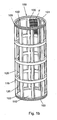
- Fig. 1b shows a filter element 100 to be located within the casing 20 to provide for a filtering of the liquid spraying agent.
- the filter element 100 is a molded stable and rigid structure having a cylindrical contour and comprising a plurality of annular ribs 115 molded integrally with number of longitudinally extending ribs 120 to define a rigid support for a metal or plastics mesh-like filtering medium F (only shown schematically in an upper region of the filter element 100 for the sake of clarity) which spans the interspaces between adjacent annular ribs 115 and adjacent longitudinal ribs 120.
- annular rib 115 At the upper end 101 of the filter element 100, an uppermost annular rib 115 has a peripheral groove 106, and the annular rib 115 at the lower end 103 of the filter element 100 has a similar peripheral groove 102. Offset by 90° in the peripheral direction are inwardly projecting longitudinal projections 130 formed along selected ones of the longitudinal ribs 120. In the shown embodiment every second one of the longitudinal ribs 120 are provided with such projections 130.
- liquid flows axially into the interior of the filter element 100 at the bottom 110 thereof towards the upper end and radially out of the filter element 100 through the mesh-like filtering medium F.
- any solid matter above a certain grain size in the liquid is retained by and normally also deposited on the filtering medium F.
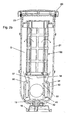
- Fig. 2a is a central cross-sectional view of the filter device 10 showing the filter element 100 removably mounted therein in proper position ready for use wherein an annular space S extends around the filter element 100.
- the lid 60 seals the upper end 23 of the casing 20 and provides a closure 61 for the upper end 101 of the filter element 100. Specifically, a flat surface 61 of the lid 60 bears against the uppermost annular rib 115 of the filter element 100, and an annular depending wall 65 on the lid 60 seals against an O-ring mounted in the peripheral groove 106 of the filter element 100 such that liquid flowing through the filter device 10 will always pass through the filtering medium F.
- the filter device 10 has a metal or plastics valve structure generally designated 30 by means of which the filter device 10 may selectively be put in two different positions, a first one where the filter device 10 communicates with the pump through stud 25 and with the tank holding the liquid through stud 27, and a second one wherein both studs 25, 27 are blocked such that the interior of the casing 20 does not communicate with the exterior.
- the valve structure 30 has an entry port and an exit port, and liquid enters the valve structure 30 through the entry port and eventually flows through the exit port of the valve structure 30.
- the valve structure 30 supports the filter element 100 at the bottom end 103 thereof, an intermediate carrier body 70 to be discussed below being arranged between the valve structure 30 and the filter element 100, with an O-ring mounted in the lowermost peripheral groove 102 of the filter element 100 sealing against the carrier body 70.
- Fig. 2a shows the first position of the valve structure 30, in which liquid is allowed to flow along the path through the filter device 10 indicated by the arrows.
- Fig. 2b shows a cross-section of the filter device of fig. 1 a as seen along direction B-B in fig. 2a .
- the drawing shows the entry port 45 of the valve structure 30, as well as a wall 37 which defines an annular channel or passage 34 within the valve structure 30.
- the annular passage 34 communicates with the exit port of the valve structure 30, the exit port being located opposite entry port 45.
- the entry port 45 is aligned with stud 27, and the exit port is aligned with stud 25 to provide for a direct flow there-between in the general direction indicated by line 26.
- a pressure sensor 14' may be arranged in stud 27, and this sensor may cooperate with sensor 14 mounted in casing wall 21 to allow the user to monitor a pressure difference, and the hence the efficiency of the filter element 100.
- valve structure 30 In operation, with the valve structure 30 in the first position, liquid enters casing 20 at stud 27, passes through valve structure 30, where the liquid is redirected by wall 37 to flow upwards into the interior of filter element 100, passes through the filter medium F into an annular space S between the filter element 100 and the casing 20, then flows into the annular passage 34, and exits filter device 10 at stud 25.
- studs 25 and 27 preferably define coinciding flow axes, as indicated by reference numeral 26.
- the valve structure 30 is mounted so as to be rotatable about the longitudinal axis 2 of the filter device 10, whereby the valve structure 30 may be rotated about axis 2 from the first position to the second position, preferably by an angle close to 90°, or at least to an extend where the entry port 45 and the exit port of the valve structure 30 are no longer aligned with the corresponding one of the studs 25, 27, such that no liquid may flow into or out of the filter device 10 through any of the two studs 25, 27.
- This is of particular advantage in agricultural sprayers where a high liquid pressure typically reigns in the tubing on both connecting sides of the filter device, even when the pump has been stopped.
- the valve structure 30 is rotatably supported at the lower end 24 of the casing 20, preferably by a pin 19 extending into the bowl-shaped part 24 from the base part 18.
- the casing 20 is provided with sealing means 80, 82 bearing against the outer surface of outer wall 32 of the valve structure 30 such that the valve structure 30 provides the only effective passage into and out from the filter device 10.
- the pin 19 may be accessible for a user and have a key allowing for the user to manually rotate the valve structure 30 for service or repair.
- the pin 19 may be coupled to a motor whereby the position of the valve structure 30 may be remote-controlled. However, as will be explained below, this is not the way the valve structure 30 is normally operated.
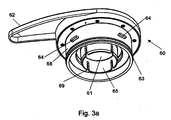
- Fig. 3a shows the lid 60 in greater details, as seen from below.
- the lid 60 has an outer peripheral wall 68 with an O-ring received in a peripheral groove 63 sealing the lid 60 against the inside surface of the cylindrical wall 21 of casing 20.
- Depending inner wall 65 which is sized to fit into the interior of the filter element 100 is formed with a plurality of elongated slits 69, each designed to receive an upper part of one of the inwardly directed projections 130 of the filter element 100 upon proper alignment thereof.
- the projections 130 may engage the slits 69 in a press-fitting manner to provide for a releasable connection between the lid 60 and the filter element 100.
- Fig. 3b shows the carrier body 70 supported by the valve structure 30.
- the features of this metal or plastics carrier body 70 to be discussed below may be incorporated in the valve structure 30 proper in the sense that the carrier body 70 does not need to be a separate component, although this is presently preferred with the view of manufacturing the valve structure in a simple plastics molding process.
- Carrier body 70 is an annular structure with a central annular wall 73 adapted to rest on top of the upright wall 37 of the valve structure 30.
- the wall 73 has a plurality of recesses 74 adapted to receive a corresponding number of lugs 38 (see fig.
- the carrier body 70 moreover has an annular channel 79 defined by an inner upright wall 71 and an outer upright wall 75. This annular channel 79 is adapted to receive the lower end 103 of the filter element 100 such that the aforementioned O-ring in groove 102 of the filter element 100 seals against the outer upright wall 75.
- the inner upright wall has a plurality of elongated slits 78, corresponding in number and arrangement to the inwardly directed projections 130 on filter element 100 whereby the carrier body 70 upon proper alignment of the filter element 100 will lock the filter element 70 against any rotation with respect to the carrier body 70 and hence with respect to the valve structure 30.
- the engagement of the filter element 100 with the carrier body 70 is such that the carrier body 70 remains in place on the valve structure 30 when the filter element 100 is moved axially upwards for replacement; the carrier body 70 may be secured to the valve structure 30 by any conventional means, even by a press-fit between the carrier body 70 and the valve structure 30.
- any rotation of the lid 60 about longitudinal axis 2 will impart a corresponding rotation of the filter element 100, the carrier body 70, and hence the valve structure 30 about the axis 2.
- lid 60 is rotated, normally by a user gripping handle 62, for the purpose of gaining access to the interior of casing 20 for replacement or cleaning of the filter element 100 and/or the inside of the casing 20. It will be understood that the inverse process takes place when the lid 60 is reapplied to the casing and rotated about axis 2 so as to lock the lid 60 to the casing 20 and bring the filter device 10 to the operational state where the valve structure 30 is in the aforementioned first position illustrated in figs. 2a and 2b .
- any rotation of the lid 60 will bring about a corresponding rotation of the valve structure 30 about the axis 2, and vice versa, through a corresponding rotation of the filter element 100. Accordingly, when the lid 60 is rotated, the valve structure 30 will rotate from the first position towards the second position wherein the outlet stud 25 is closed, and inlet stud 27 is closed thereby effectively preventing any liquid from rising up into the casing 20.
- the engagement of the lid 60 with the upper part 23 of the casing 20 is so designed that the valve structure 30 reaches its second position before the lid 60 may be removed, and before the seal between the lid 60 and the casing 20 is released.
- the user changing the filter element 100 is at no risk of being hit by any of the hazardous liquid normally flowing through the filter device 10, since no such liquid under pressure is ejected from the casing 20 when the lid 60 is removed. It is noted that this rotational movement of the lid 60 through an angle of typically 90°, or about 90°, causes the lugs 64 on the lid 60 to disengage the open-ended slits 22 such that the lid may be pulled up and away from the casing 20.
- the filter element 100 may be removed together with the lid 60 for replacement or cleaning. If the filter element 100 is to be cleaned, such as by using running water, a press-fit may be preferred since this may effectively allow the user to carry out this operation without touching the filter element 100. However, it may be preferred to remove the filter element 100 from the carrier body 70 in a separate operation.
- Fig. 4a shows the valve structure 30 in more details.
- An outer wall 32 defines the outer contour of the integrally molded valve structure 30, and this contour may be generally spherical to allow for a good seal between the valve structure 30 and the inside of the casing 20.
- Centrally within the valve structure is a tubular upright structure defined by a cylindrical and semicylindrical wall 37 which together with a wall 34' divides the valve structure 30 into two separate internal valve chambers, a first one X having the inlet port 45 and communicating with the inside of filter element 100 as has been described, and a second one Y having the aforementioned exit port shown by reference numeral 40 and communicating with the space within casing 20 outside the filter element 100.
- Fig. 4b shows the flat bottom wall 31 of valve structure 30 as viewed from below, and shows a recess 31' which pin 19 is adapted to engage for the purpose of transmitting rotational movement thereof to the valve structure 30.
- a drain may be formed in the bottom wall 31 for draining liquid in the casing 20 when performing service on the valve structure 30.
- Fig. 4c is a cross-sectional view along line A-A in fig. 4b and showing the aforementioned two valve chambers in more details, including the annular passage 34 which extends around the wall 37 from a low-depth area above inlet port 45 where the bottom surface of the passage 34 is defined by the wall 34' to an area at the exit port 40 where the bottom surface of the passage 34 is defined by the bottom wall 31 of the valve structure 30.
- FIG. 4d is a sectional view along line B-B in fig. 4c and shows how passage 34 is delimited on the one hand by inner surface 33 of wall 32 and on the other hand by the outer surface of wall 37.
- Fig. 4e is a sectional view along line C-C in fig. 4c and shows the valve structure 30 in further details.
- Fig. 4a and also fig. 4d and 4e , show two opposed recesses 32' formed in the outer wall 32 of the valve structure 30.
- the purpose of these recesses 32' is merely to save weight by locally reducing the thickness of wall 32, and thus the amount of plastics material used for making the valve structure 30.
- valve structure 30 should be configured accordingly to allow for a desired flow of the liquid through the filter device 10.
- a preferred embodiment where liquid flows from the inside of the hollow filter element 100 to the outside has been described, an alternative mode of operation of the filter device 10 is possible wherein liquid flows from the outside of the hollow filter element 100 and into the inside thereof through filter medium F. Stud 25 would then serve as an inlet stud while stud 27 would serve as an outlet stud.
- the filter element 100 may comprise a flap-like valve 110 or a similar device allowing liquid loaded with solid particles to flow into the interior of the filter element 100 in the axial direction but closing to maintain any solid particles retained by the filtering medium F within the filter element 100 when the liquid ceases to flow and the filter element 100 is removed from the carrier body 70.
- Fig. 5a shows a filter element 100' with such a flap-like valve 110 including two plate-like flaps 110', 110" pivotally connected two a bar 130 extending across the lower end 103 of the filter element 100' and shown in the closed position of the valve 110 wherein any collected solid matter within the filter element 100' will be retained wherein on the upper surface of the flaps 110', 110".
- the two flaps 110', 110" will turn upwards about bar 130 to a position wherein they extend parallel or essentially parallel with each other and with the longitudinal axis of the filter element 100', i.e. the longitudinal axis 2 of the filter device.
- the flap-like valve 110 may be configured to open automatically by the flaps 110', 110" engaging portions of the carrier body 70 or other areas of the filter device 10 when the filter element 100 is received within the casing 20, or the valve 110 may be configured so as to open upon a liquid being forced through the filter device 10.
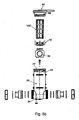
- Fig. 5b shows an alternative embodiment of the filter device 10 wherein the carrier body 70' is specifically adapted so as to open the valve 110 when the filter element 100' is placed on top of the carrier body 70'.
- This drawing also shows the helically extending slits 22 receiving the lugs 68 on lid 60 so as to maintain the lid 60 in place.
Landscapes
- Chemical & Material Sciences (AREA)
- Chemical Kinetics & Catalysis (AREA)
- Filtration Of Liquid (AREA)
Claims (16)
- Filtervorrichtung (10), insbesondere zum Gebrauch in einer landwirtschaftlichen Sprüheinrichtung, mit
einem Gehäuse (20) mit einem unteren Ende (24) und einem oberen offenen Ende (23), einem Flüssigkeitseinlass (27) und einem Flüssigkeitsauslass (25),
einem drehbaren Deckel (60) zum lösbaren Abdecken des Gehäuses (20) an dem oberen Ende (23),
einem Ventilaufbau (30), der zwischen einer ersten Position, in der der Flüssigkeitseinlass (27) offen ist, und einer zweiten Position beweglich ist, in der der Flüssigkeitseinlass (27) versperrt ist,
einem Filterelement (100), das ein maschenartiges Filtermittel (F) aufweist und lösbar innerhalb des Gehäuses (20) angeordnet ist,
wobei der Ventilaufbau (30) an dem unteren Ende (24) angeordnet ist,
wobei der Ventilaufbau (30) um eine Achse (2), die sich zwischen dem oberen Ende (23) und dem unteren Ende (24) erstreckt, zwischen der ersten Position und der zweiten Position des Ventilaufbaus (30) drehbar ist,
wobei der Flüssigkeitseinlass (27) an dem unteren Ende (24) angeordnet ist, und
wobei das Filterelement (100) zwischen dem Ventilaufbau (30) und dem Deckel (60) angeordnet ist,
gekennzeichnet dadurch, dass
das Filterelement (100) zum Filtern einer Flüssigkeit dient, die von dem Flüssigkeitseinlass (27) über einen Raum S zwischen dem Filterelement (100) und dem Gehäuse (20) zu dem Flüssigkeitsauslass (25) strömt,
durch eine Kopplungseinrichtung zwischen dem Deckel (60) und dem Filterelement (100) zum Antreiben des Filterelements (100), damit es sich bei einer Drehung des Deckels dreht, und
durch eine Kopplungseinrichtung zwischen dem Filterelement (100) und dem Ventilaufbau (30) zum Antreiben des Ventilaufbaus (30), damit er sich bei einer Drehung des Filterelements (100) dreht. - Filtervorrichtung (10) gemäß Anspruch 1, die Dichtungen (102, 106) aufweist, um das Filterelement (100) gegen den Ventilaufbau (30) bzw. den Deckel (60) abzudichten.
- Filtervorrichtung (10) gemäß Anspruch 1 oder 2, wobei der Flüssigkeitsauslass (25) an dem unteren Ende (24) des Gehäuses (20) angeordnet ist.
- Filtervorrichtung (10) gemäß Anspruch 3, wobei der Ventilaufbau (30) aufgebaut ist, um den Flüssigkeitsauslass (25) in der zweiten Position des Ventilaufbaus (30) zu versperren.
- Filtervorrichtung (10) gemäß einem der vorangehenden Ansprüche, wobei der Deckel (60) angepasst ist, das Gehäuse (20) durch Drehung des Deckels (60) um die Achse (2) in Eingriff zu bringen und zu lösen.
- Filtervorrichtung (10) gemäß einem der vorangehenden Ansprüche, wobei das Filterelement (100) lösbar an den Deckel (60) und/oder den Ventilaufbau (30) gekoppelt ist.
- Filtervorrichtung (10) gemäß einem der vorangehenden Ansprüche, wobei das Filterelement (100) ein unteres Ende (103) und ein oberes Ende (101) aufweist und einen im Wesentlichen steifen verlängerten Aufbau (115, 120) aufweist, der das maschenartige Filtermittel (F) stützt,
wobei das Filterelement (100) einen inneren Axialströmungsdurchgang aufweist, in dem die Flüssigkeit strömt. - Filtervorrichtung (10) gemäß dem vorangehenden Anspruch, wobei das Filterelement (100) im Wesentlichen rohrförmig ist und wobei die Filtervorrichtung (10) einen ringförmigen Raum (S) zwischen dem Filterelement (100) und dem Gehäuse (20) aufweist.
- Filtervorrichtung gemäß Anspruch 7 oder 8, wobei der Ventilaufbau (30) eine Kammer (X) mit einer Eintrittsöffnung (45) aufweist, die bei der ersten Position des Ventilaufbaus (30) mit dem Flüssigkeitseinlass (27) und dem inneren Durchgang des Filterelements (100) in Verbindung steht.
- Filtervorrichtung gemäß Anspruch 8 und 9, wobei der Ventilaufbau (30) eine zweite Kammer (Y) mit einem Austrittsanschluss (40) aufweist, die bei der ersten Position des Ventilaufbaus (30) mit dem Flüssigkeitsauslass (25) und mit dem Raum (S) in Verbindung steht.
- Filtervorrichtung gemäß einem der vorangehenden Ansprüche, wobei das Filterelement (100) bei seinem unteren Ende (103) ein Filterelementventil (110) zum Zurückhalten gesammelter Feststoffe innerhalb des Filterelements (100) beim Entfernen des Filterelements (100) aus dem Gehäuse (20) aufweist, wobei sich das Ventil (110) beim Entfernen des Filterelements (100) aus dem Gehäuse schließt und wobei das Ventil (110) bei der Verwendung der Filtervorrichtung (10) geöffnet ist.
- Filtervorrichtung gemäß einem der vorangehenden Ansprüche, wobei der Deckel (60) einen Griff (62) aufweist.
- Filtervorrichtung gemäß einem der vorangehenden Ansprüche, wobei die Kopplungseinrichtung bei dem Filterelement (100) und dem Deckel (60) komplementäre Eingriffseinrichtungen (130, 69) aufweist und das Filterelement (100) und der Ventilaufbau (30) komplementäre Eingriffseinrichtungen (130, 78) aufweisen, wobei eine Drehung des Deckels (60) eine Drehung des Filterelements (100) und des Ventilaufbaus (30) bewirkt.
- Filtervorrichtung gemäß dem vorangehenden Anspruch, wobei die komplementären Eingriffseinrichtungen aus Schlitzen und Vorsprüngen ausgewählt sind.
- Filtervorrichtung gemäß einem der vorangehenden Ansprüche, wobei der Deckel nur entfernbar ist, wenn der Flüssigkeitseinlass gesperrt ist.
- Landwirtschaftliche Sprüheinrichtung mit einem Rahmen, einem Tank für die zu verteilende Flüssigkeit, einem Sprühausleger, der Auslassdüsen trägt, und einer Filtervorrichtung gemäß einem der vorangehenden Ansprüche, wobei die Filtervorrichtung (10) einerseits über den Flüssigkeitseinlass (27) der Filtervorrichtung (10) an den Tank gekoppelt ist und andererseits über den Flüssigkeitsauslass (25) der Filtervorrichtung (10) an die Pumpe gekoppelt ist.
Priority Applications (2)
| Application Number | Priority Date | Filing Date | Title |
|---|---|---|---|
| DE602004018608T DE602004018608D1 (de) | 2004-03-18 | 2004-03-18 | Filtervorrichtung |
| EP04388020A EP1582247B1 (de) | 2004-03-18 | 2004-03-18 | Filtervorrichtung |
Applications Claiming Priority (1)
| Application Number | Priority Date | Filing Date | Title |
|---|---|---|---|
| EP04388020A EP1582247B1 (de) | 2004-03-18 | 2004-03-18 | Filtervorrichtung |
Publications (2)
| Publication Number | Publication Date |
|---|---|
| EP1582247A1 EP1582247A1 (de) | 2005-10-05 |
| EP1582247B1 true EP1582247B1 (de) | 2008-12-24 |
Family
ID=34878350
Family Applications (1)
| Application Number | Title | Priority Date | Filing Date |
|---|---|---|---|
| EP04388020A Expired - Lifetime EP1582247B1 (de) | 2004-03-18 | 2004-03-18 | Filtervorrichtung |
Country Status (2)
| Country | Link |
|---|---|
| EP (1) | EP1582247B1 (de) |
| DE (1) | DE602004018608D1 (de) |
Cited By (2)
| Publication number | Priority date | Publication date | Assignee | Title |
|---|---|---|---|---|
| US9140398B2 (en) | 2010-04-02 | 2015-09-22 | Pentair Flow Technologies, Llc | Air aspiration device |
| CN106594798A (zh) * | 2015-10-05 | 2017-04-26 | 安萨尔多能源瑞士股份公司 | 用于燃烧室的阻尼器组件 |
Families Citing this family (5)
| Publication number | Priority date | Publication date | Assignee | Title |
|---|---|---|---|---|
| DE202016101656U1 (de) * | 2016-03-24 | 2017-06-27 | Cbi-Industrietechnik Gmbh | Heizölfiltereinsatz mit Bajonettverschluss |
| KR102208764B1 (ko) * | 2018-10-12 | 2021-01-28 | 동진아이엠테크(주) | 해수 스트레이너 |
| DE102020211335A1 (de) | 2020-09-09 | 2022-03-10 | Continental Teves Ag & Co. Ohg | Filterelement, insbesondere für Kraftfahrzeugbremsanlagen |
| CN115040917B (zh) * | 2022-06-20 | 2023-11-03 | 爱景节能科技(上海)有限公司 | 一种用于压缩机的回油过滤器 |
| CN117101228A (zh) * | 2023-08-29 | 2023-11-24 | 大连诚泽检测有限公司 | 一种棉海蜇的胶原蛋白提取与分离装置 |
Citations (2)
| Publication number | Priority date | Publication date | Assignee | Title |
|---|---|---|---|---|
| US3476251A (en) * | 1966-05-04 | 1969-11-04 | Marvel Eng Co | Filter and housing structure |
| US4615812A (en) * | 1984-10-26 | 1986-10-07 | Metro-Line Industries, Inc. | Filter housing for closed fluid circulating system |
Family Cites Families (2)
| Publication number | Priority date | Publication date | Assignee | Title |
|---|---|---|---|---|
| US1617048A (en) * | 1926-06-05 | 1927-02-08 | Boston Auto Gage Company | Strainer |
| US2751930A (en) * | 1952-08-08 | 1956-06-26 | Unifilter Company | Integral fluid filter and valve construction |
-
2004
- 2004-03-18 EP EP04388020A patent/EP1582247B1/de not_active Expired - Lifetime
- 2004-03-18 DE DE602004018608T patent/DE602004018608D1/de not_active Expired - Lifetime
Patent Citations (2)
| Publication number | Priority date | Publication date | Assignee | Title |
|---|---|---|---|---|
| US3476251A (en) * | 1966-05-04 | 1969-11-04 | Marvel Eng Co | Filter and housing structure |
| US4615812A (en) * | 1984-10-26 | 1986-10-07 | Metro-Line Industries, Inc. | Filter housing for closed fluid circulating system |
Cited By (3)
| Publication number | Priority date | Publication date | Assignee | Title |
|---|---|---|---|---|
| US9140398B2 (en) | 2010-04-02 | 2015-09-22 | Pentair Flow Technologies, Llc | Air aspiration device |
| CN106594798A (zh) * | 2015-10-05 | 2017-04-26 | 安萨尔多能源瑞士股份公司 | 用于燃烧室的阻尼器组件 |
| CN106594798B (zh) * | 2015-10-05 | 2020-07-07 | 安萨尔多能源瑞士股份公司 | 用于燃烧室的阻尼器组件 |
Also Published As
| Publication number | Publication date |
|---|---|
| DE602004018608D1 (de) | 2009-02-05 |
| EP1582247A1 (de) | 2005-10-05 |
Similar Documents
| Publication | Publication Date | Title |
|---|---|---|
| US6874641B2 (en) | Hydrodynamic bearing | |
| US11642683B2 (en) | Powered liquid sprayer | |
| US8640972B2 (en) | Sprayer having spray solution agitation system | |
| US9044763B2 (en) | Yard and garden chemical dispenser | |
| EP3290358B1 (de) | Mehrzweckwassertank | |
| US20080202997A1 (en) | Debris bag for a swimming pool cleaning apparatus | |
| US20050205485A1 (en) | Filter device | |
| JP2011005456A (ja) | フィルタ装置 | |
| EP1582247A1 (de) | Filtervorrichtung | |
| US10822248B1 (en) | Water filtration device and method for re-circulating filtered water in decorative waterways | |
| CN112638820A (zh) | 用于闭环液体分配系统的带阀连接器 | |
| US5465875A (en) | Closed transfer devices for agricultural chemicals and the like | |
| JP4969539B2 (ja) | フィルタ装置およびフィルタ | |
| KR101927112B1 (ko) | 농약 분무차량의 약액장치 | |
| JP2002034423A (ja) | 薬液噴霧車 | |
| US20050205486A1 (en) | Filter device | |
| US20110290708A1 (en) | Aquarium filtering system comprising a filter assembly detachably connectable to a distribution housing | |
| EP0558546B1 (de) | Versorgungskappen für behälter | |
| GB2512385A (en) | Tank connector, filter and manifold assembly and method | |
| US8048301B2 (en) | Device for treating a fluid | |
| JP2011079100A (ja) | フィルタ装置 | |
| EP1576996A1 (de) | Filtervorrichtung | |
| KR101955589B1 (ko) | 여과장치를 구비한 원거리 방제기 | |
| KR200376081Y1 (ko) | 지하수의 모래 여과기 | |
| CA2462064A1 (en) | Holding tank cleaning device |
Legal Events
| Date | Code | Title | Description |
|---|---|---|---|
| PUAI | Public reference made under article 153(3) epc to a published international application that has entered the european phase |
Free format text: ORIGINAL CODE: 0009012 |
|
| AK | Designated contracting states |
Kind code of ref document: A1 Designated state(s): AT BE BG CH CY CZ DE DK EE ES FI FR GB GR HU IE IT LI LU MC NL PL PT RO SE SI SK TR |
|
| AX | Request for extension of the european patent |
Extension state: AL LT LV MK |
|
| 17P | Request for examination filed |
Effective date: 20060315 |
|
| AKX | Designation fees paid |
Designated state(s): DE FR GB IT |
|
| GRAP | Despatch of communication of intention to grant a patent |
Free format text: ORIGINAL CODE: EPIDOSNIGR1 |
|
| GRAS | Grant fee paid |
Free format text: ORIGINAL CODE: EPIDOSNIGR3 |
|
| GRAJ | Information related to disapproval of communication of intention to grant by the applicant or resumption of examination proceedings by the epo deleted |
Free format text: ORIGINAL CODE: EPIDOSDIGR1 |
|
| GRAL | Information related to payment of fee for publishing/printing deleted |
Free format text: ORIGINAL CODE: EPIDOSDIGR3 |
|
| 17Q | First examination report despatched |
Effective date: 20060601 |
|
| GRAP | Despatch of communication of intention to grant a patent |
Free format text: ORIGINAL CODE: EPIDOSNIGR1 |
|
| GRAC | Information related to communication of intention to grant a patent modified |
Free format text: ORIGINAL CODE: EPIDOSCIGR1 |
|
| GRAC | Information related to communication of intention to grant a patent modified |
Free format text: ORIGINAL CODE: EPIDOSCIGR1 |
|
| GRAS | Grant fee paid |
Free format text: ORIGINAL CODE: EPIDOSNIGR3 |
|
| GRAF | Information related to payment of grant fee modified |
Free format text: ORIGINAL CODE: EPIDOSCIGR3 |
|
| GRAA | (expected) grant |
Free format text: ORIGINAL CODE: 0009210 |
|
| AK | Designated contracting states |
Kind code of ref document: B1 Designated state(s): DE FR GB IT |
|
| REG | Reference to a national code |
Ref country code: GB Ref legal event code: FG4D |
|
| REF | Corresponds to: |
Ref document number: 602004018608 Country of ref document: DE Date of ref document: 20090205 Kind code of ref document: P |
|
| PLBE | No opposition filed within time limit |
Free format text: ORIGINAL CODE: 0009261 |
|
| STAA | Information on the status of an ep patent application or granted ep patent |
Free format text: STATUS: NO OPPOSITION FILED WITHIN TIME LIMIT |
|
| 26N | No opposition filed |
Effective date: 20090925 |
|
| REG | Reference to a national code |
Ref country code: FR Ref legal event code: PLFP Year of fee payment: 13 |
|
| REG | Reference to a national code |
Ref country code: DE Ref legal event code: R082 Ref document number: 602004018608 Country of ref document: DE Representative=s name: TBK, DE Ref country code: DE Ref legal event code: R081 Ref document number: 602004018608 Country of ref document: DE Owner name: SA EXEL INDUSTRIES, FR Free format text: FORMER OWNER: HARDI INTERNATIONAL A/S, TAASTRUP, DK |
|
| REG | Reference to a national code |
Ref country code: FR Ref legal event code: TP Owner name: EXEL INDUSTRIES S.A., FR Effective date: 20161019 |
|
| REG | Reference to a national code |
Ref country code: FR Ref legal event code: PLFP Year of fee payment: 14 |
|
| REG | Reference to a national code |
Ref country code: GB Ref legal event code: 732E Free format text: REGISTERED BETWEEN 20170202 AND 20170208 |
|
| REG | Reference to a national code |
Ref country code: FR Ref legal event code: PLFP Year of fee payment: 15 |
|
| PGFP | Annual fee paid to national office [announced via postgrant information from national office to epo] |
Ref country code: GB Payment date: 20220316 Year of fee payment: 19 Ref country code: DE Payment date: 20220307 Year of fee payment: 19 |
|
| PGFP | Annual fee paid to national office [announced via postgrant information from national office to epo] |
Ref country code: IT Payment date: 20220308 Year of fee payment: 19 Ref country code: FR Payment date: 20220331 Year of fee payment: 19 |
|
| REG | Reference to a national code |
Ref country code: DE Ref legal event code: R119 Ref document number: 602004018608 Country of ref document: DE |
|
| GBPC | Gb: european patent ceased through non-payment of renewal fee |
Effective date: 20230318 |
|
| PG25 | Lapsed in a contracting state [announced via postgrant information from national office to epo] |
Ref country code: GB Free format text: LAPSE BECAUSE OF NON-PAYMENT OF DUE FEES Effective date: 20230318 |
|
| PG25 | Lapsed in a contracting state [announced via postgrant information from national office to epo] |
Ref country code: GB Free format text: LAPSE BECAUSE OF NON-PAYMENT OF DUE FEES Effective date: 20230318 Ref country code: FR Free format text: LAPSE BECAUSE OF NON-PAYMENT OF DUE FEES Effective date: 20230331 Ref country code: DE Free format text: LAPSE BECAUSE OF NON-PAYMENT OF DUE FEES Effective date: 20231003 |
|
| PG25 | Lapsed in a contracting state [announced via postgrant information from national office to epo] |
Ref country code: IT Free format text: LAPSE BECAUSE OF NON-PAYMENT OF DUE FEES Effective date: 20230318 |