EP1580820B1 - Method of manufacturing multilayer ceramic device - Google Patents
Method of manufacturing multilayer ceramic device Download PDFInfo
- Publication number
- EP1580820B1 EP1580820B1 EP20050006136 EP05006136A EP1580820B1 EP 1580820 B1 EP1580820 B1 EP 1580820B1 EP 20050006136 EP20050006136 EP 20050006136 EP 05006136 A EP05006136 A EP 05006136A EP 1580820 B1 EP1580820 B1 EP 1580820B1
- Authority
- EP
- European Patent Office
- Prior art keywords
- ceramic
- multilayer ceramic
- partial pressure
- manufacturing
- oxygen partial
- Prior art date
- Legal status (The legal status is an assumption and is not a legal conclusion. Google has not performed a legal analysis and makes no representation as to the accuracy of the status listed.)
- Expired - Lifetime
Links
- 239000000919 ceramic Substances 0.000 title claims description 63
- 238000004519 manufacturing process Methods 0.000 title claims description 24
- QVGXLLKOCUKJST-UHFFFAOYSA-N atomic oxygen Chemical compound [O] QVGXLLKOCUKJST-UHFFFAOYSA-N 0.000 claims description 48
- 239000001301 oxygen Substances 0.000 claims description 48
- 229910052760 oxygen Inorganic materials 0.000 claims description 48
- XLYOFNOQVPJJNP-UHFFFAOYSA-N water Chemical compound O XLYOFNOQVPJJNP-UHFFFAOYSA-N 0.000 claims description 41
- RYGMFSIKBFXOCR-UHFFFAOYSA-N Copper Chemical compound [Cu] RYGMFSIKBFXOCR-UHFFFAOYSA-N 0.000 claims description 33
- 229910052802 copper Inorganic materials 0.000 claims description 33
- 239000010949 copper Substances 0.000 claims description 33
- 238000005238 degreasing Methods 0.000 claims description 28
- 229910052751 metal Inorganic materials 0.000 claims description 26
- 239000002184 metal Substances 0.000 claims description 26
- UFHFLCQGNIYNRP-UHFFFAOYSA-N Hydrogen Chemical compound [H][H] UFHFLCQGNIYNRP-UHFFFAOYSA-N 0.000 claims description 25
- 239000001257 hydrogen Substances 0.000 claims description 25
- 229910052739 hydrogen Inorganic materials 0.000 claims description 25
- 238000000034 method Methods 0.000 claims description 23
- 239000002994 raw material Substances 0.000 claims description 23
- 239000007789 gas Substances 0.000 claims description 22
- 239000012700 ceramic precursor Substances 0.000 claims description 19
- 239000011230 binding agent Substances 0.000 claims description 11
- 238000010494 dissociation reaction Methods 0.000 claims description 11
- 230000005593 dissociations Effects 0.000 claims description 11
- 239000002243 precursor Substances 0.000 claims description 11
- 229910052451 lead zirconate titanate Inorganic materials 0.000 claims description 7
- HFGPZNIAWCZYJU-UHFFFAOYSA-N lead zirconate titanate Chemical compound [O-2].[O-2].[O-2].[O-2].[O-2].[Ti+4].[Zr+4].[Pb+2] HFGPZNIAWCZYJU-UHFFFAOYSA-N 0.000 claims description 7
- 238000010438 heat treatment Methods 0.000 claims description 4
- 239000011261 inert gas Substances 0.000 claims description 4
- 239000010410 layer Substances 0.000 description 96
- OKTJSMMVPCPJKN-UHFFFAOYSA-N Carbon Chemical compound [C] OKTJSMMVPCPJKN-UHFFFAOYSA-N 0.000 description 22
- 229910052799 carbon Inorganic materials 0.000 description 22
- 230000008569 process Effects 0.000 description 16
- 238000010304 firing Methods 0.000 description 14
- 239000000203 mixture Substances 0.000 description 14
- 230000000052 comparative effect Effects 0.000 description 13
- 229910010293 ceramic material Inorganic materials 0.000 description 9
- WABPQHHGFIMREM-UHFFFAOYSA-N lead(0) Chemical compound [Pb] WABPQHHGFIMREM-UHFFFAOYSA-N 0.000 description 7
- 230000008018 melting Effects 0.000 description 7
- 238000002844 melting Methods 0.000 description 7
- IJGRMHOSHXDMSA-UHFFFAOYSA-N Atomic nitrogen Chemical compound N#N IJGRMHOSHXDMSA-UHFFFAOYSA-N 0.000 description 5
- BERDEBHAJNAUOM-UHFFFAOYSA-N copper(i) oxide Chemical compound [Cu]O[Cu] BERDEBHAJNAUOM-UHFFFAOYSA-N 0.000 description 5
- 239000007772 electrode material Substances 0.000 description 5
- 230000002093 peripheral effect Effects 0.000 description 5
- 230000009467 reduction Effects 0.000 description 5
- QPLDLSVMHZLSFG-UHFFFAOYSA-N Copper oxide Chemical compound [Cu]=O QPLDLSVMHZLSFG-UHFFFAOYSA-N 0.000 description 4
- 239000005751 Copper oxide Substances 0.000 description 4
- 229910000431 copper oxide Inorganic materials 0.000 description 4
- 230000007423 decrease Effects 0.000 description 4
- 238000009792 diffusion process Methods 0.000 description 4
- 238000007254 oxidation reaction Methods 0.000 description 4
- KDLHZDBZIXYQEI-UHFFFAOYSA-N Palladium Chemical compound [Pd] KDLHZDBZIXYQEI-UHFFFAOYSA-N 0.000 description 3
- 239000000463 material Substances 0.000 description 3
- 230000003647 oxidation Effects 0.000 description 3
- 230000000630 rising effect Effects 0.000 description 3
- 239000010936 titanium Substances 0.000 description 3
- XKRFYHLGVUSROY-UHFFFAOYSA-N Argon Chemical compound [Ar] XKRFYHLGVUSROY-UHFFFAOYSA-N 0.000 description 2
- 229910000881 Cu alloy Inorganic materials 0.000 description 2
- 229910002115 bismuth titanate Inorganic materials 0.000 description 2
- 239000011575 calcium Substances 0.000 description 2
- 150000001875 compounds Chemical class 0.000 description 2
- 238000007796 conventional method Methods 0.000 description 2
- 238000000354 decomposition reaction Methods 0.000 description 2
- PCHJSUWPFVWCPO-UHFFFAOYSA-N gold Chemical compound [Au] PCHJSUWPFVWCPO-UHFFFAOYSA-N 0.000 description 2
- 229910052737 gold Inorganic materials 0.000 description 2
- 239000010931 gold Substances 0.000 description 2
- 239000007791 liquid phase Substances 0.000 description 2
- 150000002736 metal compounds Chemical class 0.000 description 2
- 229910052757 nitrogen Inorganic materials 0.000 description 2
- 230000001590 oxidative effect Effects 0.000 description 2
- RVTZCBVAJQQJTK-UHFFFAOYSA-N oxygen(2-);zirconium(4+) Chemical compound [O-2].[O-2].[Zr+4] RVTZCBVAJQQJTK-UHFFFAOYSA-N 0.000 description 2
- 229910052719 titanium Inorganic materials 0.000 description 2
- 229910001928 zirconium oxide Inorganic materials 0.000 description 2
- OYPRJOBELJOOCE-UHFFFAOYSA-N Calcium Chemical compound [Ca] OYPRJOBELJOOCE-UHFFFAOYSA-N 0.000 description 1
- 239000004215 Carbon black (E152) Substances 0.000 description 1
- 239000005749 Copper compound Substances 0.000 description 1
- 239000001856 Ethyl cellulose Substances 0.000 description 1
- ZZSNKZQZMQGXPY-UHFFFAOYSA-N Ethyl cellulose Chemical compound CCOCC1OC(OC)C(OCC)C(OCC)C1OC1C(O)C(O)C(OC)C(CO)O1 ZZSNKZQZMQGXPY-UHFFFAOYSA-N 0.000 description 1
- CERQOIWHTDAKMF-UHFFFAOYSA-M Methacrylate Chemical compound CC(=C)C([O-])=O CERQOIWHTDAKMF-UHFFFAOYSA-M 0.000 description 1
- BQCADISMDOOEFD-UHFFFAOYSA-N Silver Chemical compound [Ag] BQCADISMDOOEFD-UHFFFAOYSA-N 0.000 description 1
- GWEVSGVZZGPLCZ-UHFFFAOYSA-N Titan oxide Chemical compound O=[Ti]=O GWEVSGVZZGPLCZ-UHFFFAOYSA-N 0.000 description 1
- RTAQQCXQSZGOHL-UHFFFAOYSA-N Titanium Chemical compound [Ti] RTAQQCXQSZGOHL-UHFFFAOYSA-N 0.000 description 1
- YPQJHZKJHIBJAP-UHFFFAOYSA-N [K].[Bi] Chemical compound [K].[Bi] YPQJHZKJHIBJAP-UHFFFAOYSA-N 0.000 description 1
- 230000009471 action Effects 0.000 description 1
- 239000000654 additive Substances 0.000 description 1
- 230000000996 additive effect Effects 0.000 description 1
- 229910052786 argon Inorganic materials 0.000 description 1
- 229910052788 barium Inorganic materials 0.000 description 1
- DSAJWYNOEDNPEQ-UHFFFAOYSA-N barium atom Chemical compound [Ba] DSAJWYNOEDNPEQ-UHFFFAOYSA-N 0.000 description 1
- JRPBQTZRNDNNOP-UHFFFAOYSA-N barium titanate Chemical compound [Ba+2].[Ba+2].[O-][Ti]([O-])([O-])[O-] JRPBQTZRNDNNOP-UHFFFAOYSA-N 0.000 description 1
- 229910002113 barium titanate Inorganic materials 0.000 description 1
- 239000010953 base metal Substances 0.000 description 1
- 229910052797 bismuth Inorganic materials 0.000 description 1
- JCXGWMGPZLAOME-UHFFFAOYSA-N bismuth atom Chemical compound [Bi] JCXGWMGPZLAOME-UHFFFAOYSA-N 0.000 description 1
- FSAJRXGMUISOIW-UHFFFAOYSA-N bismuth sodium Chemical compound [Na].[Bi] FSAJRXGMUISOIW-UHFFFAOYSA-N 0.000 description 1
- 230000005587 bubbling Effects 0.000 description 1
- 229910052791 calcium Inorganic materials 0.000 description 1
- 239000003990 capacitor Substances 0.000 description 1
- 150000004649 carbonic acid derivatives Chemical class 0.000 description 1
- 239000003985 ceramic capacitor Substances 0.000 description 1
- 230000008859 change Effects 0.000 description 1
- 238000006243 chemical reaction Methods 0.000 description 1
- 150000001880 copper compounds Chemical class 0.000 description 1
- KRFJLUBVMFXRPN-UHFFFAOYSA-N cuprous oxide Chemical compound [O-2].[Cu+].[Cu+] KRFJLUBVMFXRPN-UHFFFAOYSA-N 0.000 description 1
- 230000003247 decreasing effect Effects 0.000 description 1
- 230000006866 deterioration Effects 0.000 description 1
- 239000003989 dielectric material Substances 0.000 description 1
- 239000002270 dispersing agent Substances 0.000 description 1
- 238000006073 displacement reaction Methods 0.000 description 1
- 230000000694 effects Effects 0.000 description 1
- 229920001249 ethyl cellulose Polymers 0.000 description 1
- 235000019325 ethyl cellulose Nutrition 0.000 description 1
- -1 for example Substances 0.000 description 1
- 239000000446 fuel Substances 0.000 description 1
- 229930195733 hydrocarbon Natural products 0.000 description 1
- 150000002430 hydrocarbons Chemical class 0.000 description 1
- 150000004679 hydroxides Chemical class 0.000 description 1
- 238000002347 injection Methods 0.000 description 1
- 239000007924 injection Substances 0.000 description 1
- 239000011810 insulating material Substances 0.000 description 1
- 239000011229 interlayer Substances 0.000 description 1
- 238000003475 lamination Methods 0.000 description 1
- 229910052745 lead Inorganic materials 0.000 description 1
- 229910044991 metal oxide Inorganic materials 0.000 description 1
- 150000004706 metal oxides Chemical class 0.000 description 1
- 238000001465 metallisation Methods 0.000 description 1
- 229910000510 noble metal Inorganic materials 0.000 description 1
- 150000003891 oxalate salts Chemical class 0.000 description 1
- TWNQGVIAIRXVLR-UHFFFAOYSA-N oxo(oxoalumanyloxy)alumane Chemical compound O=[Al]O[Al]=O TWNQGVIAIRXVLR-UHFFFAOYSA-N 0.000 description 1
- YEXPOXQUZXUXJW-UHFFFAOYSA-N oxolead Chemical compound [Pb]=O YEXPOXQUZXUXJW-UHFFFAOYSA-N 0.000 description 1
- 229910052763 palladium Inorganic materials 0.000 description 1
- 239000004014 plasticizer Substances 0.000 description 1
- 230000004044 response Effects 0.000 description 1
- 238000005488 sandblasting Methods 0.000 description 1
- VSZWPYCFIRKVQL-UHFFFAOYSA-N selanylidenegallium;selenium Chemical compound [Se].[Se]=[Ga].[Se]=[Ga] VSZWPYCFIRKVQL-UHFFFAOYSA-N 0.000 description 1
- 229910052709 silver Inorganic materials 0.000 description 1
- 239000004332 silver Substances 0.000 description 1
- 238000004544 sputter deposition Methods 0.000 description 1
- 229910052712 strontium Inorganic materials 0.000 description 1
- CIOAGBVUUVVLOB-UHFFFAOYSA-N strontium atom Chemical compound [Sr] CIOAGBVUUVVLOB-UHFFFAOYSA-N 0.000 description 1
- 238000009423 ventilation Methods 0.000 description 1
- NWONKYPBYAMBJT-UHFFFAOYSA-L zinc sulfate Chemical compound [Zn+2].[O-]S([O-])(=O)=O NWONKYPBYAMBJT-UHFFFAOYSA-L 0.000 description 1
- 229910052726 zirconium Inorganic materials 0.000 description 1
Images

Classifications
-
- B—PERFORMING OPERATIONS; TRANSPORTING
- B32—LAYERED PRODUCTS
- B32B—LAYERED PRODUCTS, i.e. PRODUCTS BUILT-UP OF STRATA OF FLAT OR NON-FLAT, e.g. CELLULAR OR HONEYCOMB, FORM
- B32B18/00—Layered products essentially comprising ceramics, e.g. refractory products
-
- C—CHEMISTRY; METALLURGY
- C04—CEMENTS; CONCRETE; ARTIFICIAL STONE; CERAMICS; REFRACTORIES
- C04B—LIME, MAGNESIA; SLAG; CEMENTS; COMPOSITIONS THEREOF, e.g. MORTARS, CONCRETE OR LIKE BUILDING MATERIALS; ARTIFICIAL STONE; CERAMICS; REFRACTORIES; TREATMENT OF NATURAL STONE
- C04B35/00—Shaped ceramic products characterised by their composition; Ceramics compositions; Processing powders of inorganic compounds preparatory to the manufacturing of ceramic products
- C04B35/01—Shaped ceramic products characterised by their composition; Ceramics compositions; Processing powders of inorganic compounds preparatory to the manufacturing of ceramic products based on oxide ceramics
- C04B35/48—Shaped ceramic products characterised by their composition; Ceramics compositions; Processing powders of inorganic compounds preparatory to the manufacturing of ceramic products based on oxide ceramics based on zirconium or hafnium oxides, zirconates, zircon or hafnates
- C04B35/49—Shaped ceramic products characterised by their composition; Ceramics compositions; Processing powders of inorganic compounds preparatory to the manufacturing of ceramic products based on oxide ceramics based on zirconium or hafnium oxides, zirconates, zircon or hafnates containing also titanium oxides or titanates
- C04B35/491—Shaped ceramic products characterised by their composition; Ceramics compositions; Processing powders of inorganic compounds preparatory to the manufacturing of ceramic products based on oxide ceramics based on zirconium or hafnium oxides, zirconates, zircon or hafnates containing also titanium oxides or titanates based on lead zirconates and lead titanates, e.g. PZT
-
- C—CHEMISTRY; METALLURGY
- C04—CEMENTS; CONCRETE; ARTIFICIAL STONE; CERAMICS; REFRACTORIES
- C04B—LIME, MAGNESIA; SLAG; CEMENTS; COMPOSITIONS THEREOF, e.g. MORTARS, CONCRETE OR LIKE BUILDING MATERIALS; ARTIFICIAL STONE; CERAMICS; REFRACTORIES; TREATMENT OF NATURAL STONE
- C04B35/00—Shaped ceramic products characterised by their composition; Ceramics compositions; Processing powders of inorganic compounds preparatory to the manufacturing of ceramic products
- C04B35/622—Forming processes; Processing powders of inorganic compounds preparatory to the manufacturing of ceramic products
- C04B35/626—Preparing or treating the powders individually or as batches ; preparing or treating macroscopic reinforcing agents for ceramic products, e.g. fibres; mechanical aspects section B
- C04B35/63—Preparing or treating the powders individually or as batches ; preparing or treating macroscopic reinforcing agents for ceramic products, e.g. fibres; mechanical aspects section B using additives specially adapted for forming the products, e.g.. binder binders
- C04B35/638—Removal thereof
-
- H—ELECTRICITY
- H10—SEMICONDUCTOR DEVICES; ELECTRIC SOLID-STATE DEVICES NOT OTHERWISE PROVIDED FOR
- H10N—ELECTRIC SOLID-STATE DEVICES NOT OTHERWISE PROVIDED FOR
- H10N30/00—Piezoelectric or electrostrictive devices
- H10N30/01—Manufacture or treatment
- H10N30/05—Manufacture of multilayered piezoelectric or electrostrictive devices, or parts thereof, e.g. by stacking piezoelectric bodies and electrodes
- H10N30/053—Manufacture of multilayered piezoelectric or electrostrictive devices, or parts thereof, e.g. by stacking piezoelectric bodies and electrodes by integrally sintering piezoelectric or electrostrictive bodies and electrodes
-
- C—CHEMISTRY; METALLURGY
- C04—CEMENTS; CONCRETE; ARTIFICIAL STONE; CERAMICS; REFRACTORIES
- C04B—LIME, MAGNESIA; SLAG; CEMENTS; COMPOSITIONS THEREOF, e.g. MORTARS, CONCRETE OR LIKE BUILDING MATERIALS; ARTIFICIAL STONE; CERAMICS; REFRACTORIES; TREATMENT OF NATURAL STONE
- C04B2235/00—Aspects relating to ceramic starting mixtures or sintered ceramic products
- C04B2235/65—Aspects relating to heat treatments of ceramic bodies such as green ceramics or pre-sintered ceramics, e.g. burning, sintering or melting processes
- C04B2235/656—Aspects relating to heat treatments of ceramic bodies such as green ceramics or pre-sintered ceramics, e.g. burning, sintering or melting processes characterised by specific heating conditions during heat treatment
-
- C—CHEMISTRY; METALLURGY
- C04—CEMENTS; CONCRETE; ARTIFICIAL STONE; CERAMICS; REFRACTORIES
- C04B—LIME, MAGNESIA; SLAG; CEMENTS; COMPOSITIONS THEREOF, e.g. MORTARS, CONCRETE OR LIKE BUILDING MATERIALS; ARTIFICIAL STONE; CERAMICS; REFRACTORIES; TREATMENT OF NATURAL STONE
- C04B2235/00—Aspects relating to ceramic starting mixtures or sintered ceramic products
- C04B2235/65—Aspects relating to heat treatments of ceramic bodies such as green ceramics or pre-sintered ceramics, e.g. burning, sintering or melting processes
- C04B2235/658—Atmosphere during thermal treatment
- C04B2235/6582—Hydrogen containing atmosphere
-
- C—CHEMISTRY; METALLURGY
- C04—CEMENTS; CONCRETE; ARTIFICIAL STONE; CERAMICS; REFRACTORIES
- C04B—LIME, MAGNESIA; SLAG; CEMENTS; COMPOSITIONS THEREOF, e.g. MORTARS, CONCRETE OR LIKE BUILDING MATERIALS; ARTIFICIAL STONE; CERAMICS; REFRACTORIES; TREATMENT OF NATURAL STONE
- C04B2235/00—Aspects relating to ceramic starting mixtures or sintered ceramic products
- C04B2235/65—Aspects relating to heat treatments of ceramic bodies such as green ceramics or pre-sintered ceramics, e.g. burning, sintering or melting processes
- C04B2235/658—Atmosphere during thermal treatment
- C04B2235/6583—Oxygen containing atmosphere, e.g. with changing oxygen pressures
- C04B2235/6584—Oxygen containing atmosphere, e.g. with changing oxygen pressures at an oxygen percentage below that of air
-
- C—CHEMISTRY; METALLURGY
- C04—CEMENTS; CONCRETE; ARTIFICIAL STONE; CERAMICS; REFRACTORIES
- C04B—LIME, MAGNESIA; SLAG; CEMENTS; COMPOSITIONS THEREOF, e.g. MORTARS, CONCRETE OR LIKE BUILDING MATERIALS; ARTIFICIAL STONE; CERAMICS; REFRACTORIES; TREATMENT OF NATURAL STONE
- C04B2235/00—Aspects relating to ceramic starting mixtures or sintered ceramic products
- C04B2235/65—Aspects relating to heat treatments of ceramic bodies such as green ceramics or pre-sintered ceramics, e.g. burning, sintering or melting processes
- C04B2235/658—Atmosphere during thermal treatment
- C04B2235/6588—Water vapor containing atmospheres
-
- C—CHEMISTRY; METALLURGY
- C04—CEMENTS; CONCRETE; ARTIFICIAL STONE; CERAMICS; REFRACTORIES
- C04B—LIME, MAGNESIA; SLAG; CEMENTS; COMPOSITIONS THEREOF, e.g. MORTARS, CONCRETE OR LIKE BUILDING MATERIALS; ARTIFICIAL STONE; CERAMICS; REFRACTORIES; TREATMENT OF NATURAL STONE
- C04B2235/00—Aspects relating to ceramic starting mixtures or sintered ceramic products
- C04B2235/70—Aspects relating to sintered or melt-casted ceramic products
- C04B2235/72—Products characterised by the absence or the low content of specific components, e.g. alkali metal free alumina ceramics
- C04B2235/721—Carbon content
-
- C—CHEMISTRY; METALLURGY
- C04—CEMENTS; CONCRETE; ARTIFICIAL STONE; CERAMICS; REFRACTORIES
- C04B—LIME, MAGNESIA; SLAG; CEMENTS; COMPOSITIONS THEREOF, e.g. MORTARS, CONCRETE OR LIKE BUILDING MATERIALS; ARTIFICIAL STONE; CERAMICS; REFRACTORIES; TREATMENT OF NATURAL STONE
- C04B2237/00—Aspects relating to ceramic laminates or to joining of ceramic articles with other articles by heating
- C04B2237/30—Composition of layers of ceramic laminates or of ceramic or metallic articles to be joined by heating, e.g. Si substrates
- C04B2237/32—Ceramic
- C04B2237/34—Oxidic
- C04B2237/345—Refractory metal oxides
- C04B2237/346—Titania or titanates
-
- C—CHEMISTRY; METALLURGY
- C04—CEMENTS; CONCRETE; ARTIFICIAL STONE; CERAMICS; REFRACTORIES
- C04B—LIME, MAGNESIA; SLAG; CEMENTS; COMPOSITIONS THEREOF, e.g. MORTARS, CONCRETE OR LIKE BUILDING MATERIALS; ARTIFICIAL STONE; CERAMICS; REFRACTORIES; TREATMENT OF NATURAL STONE
- C04B2237/00—Aspects relating to ceramic laminates or to joining of ceramic articles with other articles by heating
- C04B2237/30—Composition of layers of ceramic laminates or of ceramic or metallic articles to be joined by heating, e.g. Si substrates
- C04B2237/40—Metallic
- C04B2237/407—Copper
-
- H—ELECTRICITY
- H10—SEMICONDUCTOR DEVICES; ELECTRIC SOLID-STATE DEVICES NOT OTHERWISE PROVIDED FOR
- H10N—ELECTRIC SOLID-STATE DEVICES NOT OTHERWISE PROVIDED FOR
- H10N30/00—Piezoelectric or electrostrictive devices
- H10N30/50—Piezoelectric or electrostrictive devices having a stacked or multilayer structure
Definitions
- the present invention relates to a method of manufacturing a multilayer ceramic device such as a multilayer piezoelectric device in which, for example, ceramic layers and internal electrode layers are alternately stacked.
- the use of copper oxide instead of copper metal as the raw material of the internal electrode layers has been proposed (for example, refer to Japanese Unexamined Patent Application Publication Nos. 2003-234258 and 2003-243742 ).
- the degreasing step can be performed in an oxidizing atmosphere, so residual carbon can be preferably reduced.
- copper oxide must be reduced after the degreasing step, and at this time, the volume of the internal electrode layers is reduced to cause cracks.
- the use of a copper alloy for the internal electrode layers has been proposed (for example, refer to Japanese Unexamined Patent Application Publication No. Sho 62-210611 ).
- the copper alloy has large resistivity, and is expensive.
- the number of layers increases mainly in multilayer ceramic capacitors; however, in recent years, it has been considered to increase the number of layers in multilayer ceramic actuators using a lead-based piezoelectric ceramic material which draw attention as electronic components of fast-response fuel injection control systems for next-generation vehicle engines.
- the number of layers reach several hundreds, and large actuators with a size of approximately 10 mm ⁇ 10 mm ⁇ 40 mm (height) are required.
- the oxygen partial pressure is high at a temperature ranging from 100°C to 400°C.
- the volume of layers expands by the oxidation of copper to cause cracks.
- 0.01 ppm to 1000 ppm of hydrogen is contained in the reducing atmosphere, so when a laminate is large, and the number of layers to be degreased increases, at the early stage and the middle stage of degreasing, the oxygen partial pressure is slightly insufficient, so that residual carbon can increase in the interior of the laminate.
- a multilayer ceramic device such as a multilayer piezoelectric device capable of obtaining a superior multilayer ceramic device even if the number of layers increases or even if the multilayer ceramic device is upsized.
- a method of manufacturing a multilayer ceramic device comprises the step of: degreasing a laminate by heating in which ceramic precursor layers including a raw material of a ceramic layer and internal electrode precursor layers including copper metal as a raw material of an internal electrode layer are alternately stacked, wherein an atmospheric gas including an inert gas and 7 mol% to 50 mol% of water vapor is used to perform the step in an oxygen partial pressure atmosphere according to the relation: Kp 2 ⁇ 10 15 ⁇ p(O 2 ) ⁇ (25331 ⁇ Kp) 2/3 (Formula 1) wherein p(O 2 ) represents an oxygen partial pressure; Kp represents the water dissociation equilibrium constant; and the pressure unit is Pa, and wherein the step is performed at 550°C to 600°C.
- the oxygen partial pressure is preferably within a range shown in Formula 2 is Kp 2 ⁇ 10 16 ⁇ p(O 2 ) ⁇ (25331 ⁇ Kp) 2/3 (Formula 2) (In Formula 2, p(O 2 ) represents an oxygen partial pressure; Kp represents the water dissociation equilibrium constant; and the pressure unit is Pa.)
- the manufacturing method is preferable in the case where a raw material of lead, for example, a raw material of lead zirconate titanate is included as the raw material of the ceramic layer, and the case where a multilayer ceramic device in which the ceramic layer has a thickness of 5 times to 200 times larger than the thickness of the interlayer electrode layer, or a multilayer ceramic device with a volume of 20 mm 3 or more is manufactured.
- the manufacturing method is preferable in the case where a multilayer piezoelectric device is manufactured.
- a multilayer ceramic device In the method of manufacturing a multilayer ceramic device according to the invention, 7 mol% to 50 mol% of water vapor is included in the atmospheric gas to adjust the oxygen partial pressure within a range shown in Formula 1, so the oxidation of copper metal and the occurrence of cracks can be prevented. Moreover, residual carbon can be reduced, and the melting of the internal electrode layer can be prevented. Therefore, a large multilayer ceramic device in which the thickness of the ceramic layer is 5 times to 200 times larger than the thickness of the internal electrode layer, or its volume is 20 mm 3 or more can be manufactured, and superior properties can be obtained.
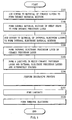
- FIG. 1 shows steps in a method of manufacturing a multilayer ceramic device according to an embodiment of the invention.
- a ceramic containing a complex oxide with a perovskite structure which includes lead such as lead zirconate titanate is used to manufacture a multilayer ceramic device in which ceramic layers 11 and internal electrode layers 12 are alternately stacked as shown in FIG.2 is described in detail.
- a binder is added to the raw material to form a ceramic material mixture (step S101).
- the raw material of the ceramic layers 11 for example, oxides including an element constituting the ceramic layers 11 or compounds such as carbonates, oxalates or hydroxides which can become oxides including the element by firing are used.
- the ceramic layers 11 including lead zirconate titanate as materials of lead (Pb), titanium (Ti) and zirconium (Zr), lead oxide (PbO), titanium oxide (TiO 2) and zirconium oxide (ZrO 2 ) which include Pb, Ti and Zr, respectively, or compounds which can become the oxides by firing are prepared.
- the ceramic material mixture is formed in a sheet shape to form a ceramic precursor layer (step S102).
- step S103 copper metal is prepared, and a binder is added to the raw material to form an internal electrode material mixture.
- the raw material of the internal electrode layers 12 only copper metal can be used, or a mixture of copper metal and any other material can be used.
- the other material for example, copper oxide or an organic copper compound which becomes copper metal after firing, metal except for copper metal, or a metal oxide or an organic metal compound which becomes the metal after firing is used.
- an additive such as a dispersant, a plasticizer, a dielectric material or an insulating material may be added to the internal electrode material mixture.
- the internal electrode material mixture is screen-printed on the ceramic precursor layer to form an internal electrode precursor layer (step S104).
- a plurality of ceramic precursor layers on which the internal electrode precursor layer is formed are stacked to form a laminate in which the ceramic precursor layers and the internal electrode precursor layers are alternately stacked (step S105).
- the laminate is heated to perform a degreasing process for decomposing and removing the binder (step S106).
- the degreasing process is performed at 550°C to 600°C in an oxygen partial pressure atmosphere according to Formula 1 through using an atmospheric gas which includes an inert gas such as nitrogen (N 2 ) or argon (Ar) and 7 mol% to 50 mol% of water vapor, and, if necessary, hydrogen.
- N 2 nitrogen
- Ar argon
- Kp 2 ⁇ 10 15 ⁇ p(O 2 ) ⁇ (25331 ⁇ Kp) 2/3 In Formula 1, p(O 2 ) represents an oxygen partial pressure, and Kp represents the water dissociation equilibrium constant.
- the pressure unit is Pa.
- the water vapor has a function of reacting with hydrocarbon or carbon which is a residual carbon component to accelerate the decomposition and removal of residual carbon.
- hydrocarbon or carbon which is a residual carbon component to accelerate the decomposition and removal of residual carbon.
- the amount of water vapor is 7 mol% or more, because when the amount is less than 7 mol%, the binder is not sufficiently decomposed and removed, thereby the residual carbon increases, and in particular, when the number of the ceramic layers 11 or the size of the ceramic layers 11 is large, the amount of residual carbon in the interior of the laminate increases. Moreover, the amount of water vapor is 50 mol% or less, because when the amount is larger than 50 mol%, copper metal included in the internal electrode precursor layers is easily converted to copper (I) oxide (Cu 2 O), and copper (I) oxide can diffuse into the ceramic layers 11 at 680°C or more to cause deterioration in properties.
- the water vapor has functions of producing oxygen by dissociation equilibrium shown in Formulas 4 and 5, and preventing a change in oxygen partial pressure, even if the concentration of hydrogen increases.
- (Formula 4) H 2 O ⁇ H 2 +(1/2)O 2 (Formula 5) Kp ⁇ p(O 2 ) 1/2 ⁇ p(H 2 ) ⁇ /p(H 2 O) (In Formula 5, Kp represents the water dissociation equilibrium constant; p(O 2 represents an oxygen partial pressure; p(H 2 ) represents a hydrogen partial pressure; and p(H 2 O) represents a water vapor partial pressure.)
- the oxygen partial pressure in the degreasing process is adjusted within an extremely low range through the use of the water dissociation equilibrium.
- the oxygen partial pressure is adjusted through the use of the water dissociation equilibrium, because when the concentration of oxygen is high, copper metal included in the raw material of the internal electrode layer 12 is oxidized to expand, thereby to cause cracks, and it is extremely difficult to control the oxygen partial pressure at a low level through using oxygen as an atmospheric gas.
- the oxygen partial pressure is more preferably within a range shown in Formula 2. It is because when the oxygen partial pressure is low, lead included in the ceramic precursor layer is reduced, thereby lead metal is easily produced, and as a result, the properties of the ceramic material can decline, or lead metal may react with copper metal included in the internal electrode precursor layer to be melted or cut.
- Formula 2 Kp 2 ⁇ 10 16 ⁇ p(O 2 ) ⁇ (25331 ⁇ Kp) 2/3 (In Formula 2, p(O 2 ) represents an oxygen partial pressure, and Kp represents the water dissociation equilibrium constant. The pressure unit is Pa.
- hydrogen also has a function of removing residual carbon, so hydrogen can be used together with water vapor as the atmospheric gas.
- the oxygen partial pressure may decline to increase residual carbon, or lead included in the ceramic precursor layer may be easily reduced, so it is preferable that hydrogen is not used.
- the temperature in the degreasing process is not higher than 600°C, because when the temperature exceeds 600°C, a lead-based ceramic material starts to be sintered, so the lead-based ceramic material is densified to block a ventilation path, and thereby to interfere with the decomposition and volatilization of the binder.
- the laminate is fired to form a sintered laminate in which the ceramic layers 11 and the internal electrode layers 12 are alternately stacked (step S107).
- the firing temperature is higher than the temperature in the degreasing process, and less than the melting point of copper metal, 1083°C, and the firing temperature is preferably 1050°C or less, and more preferably 1000°C or less.
- the oxygen partial pressure is controlled so as not to oxidize copper metal included in the internal electrode precursor layer and not to reduce lead included in the ceramic precursor layer.
- an end surface of the sintered laminate is polished by, for example, barreling, sandblasting or the like, and a terminal electrode 13 is formed through sputtering metal such as gold.
- metal such as gold or an oxide or an organic metal compound which becomes the metal after firing is mixed with a binder to form a terminal electrode material mixture, and the terminal electrode material mixture is printed or transferred to be baked, thereby the terminal electrode 13 is formed (step S108). Thereby, the multilayer ceramic device can be obtained.
- the atmospheric gas including 7 mol% to 50 mol% of water vapor is used, and the degreasing process is performed in an oxygen partial pressure atmosphere of p(O 2 ) ⁇ (25331 ⁇ Kp) 2/3 (pressure unit: Pa), so the oxidization of copper metal, the occurrence of cracks and the diffusion of copper into the ceramic layers 11 can be prevented. Moreover, residual carbon can be reduced, and the reduction of lead in the ceramic layers 11 and the melting of the internal electrode layers 12 can be prevented.
- the thickness of the ceramic layer 11 means the thickness of one ceramic layer 11 sandwiched between the internal electrode layers 12, and the thickness of the internal electrode layer 12 means the thickness of one internal electrode layer 12 sandwiched between the ceramic layers 11.
- a sintered laminate including the ceramic layers 11 which contained a lead-based perovskite complex oxide including lead zirconate titanate and the internal electrode layers 12 which contained copper metal was formed as each of Examples 1 through 8.
- a methacrylate-based binder was added to the raw material of the ceramic layers 11 to form a mixture (step S101), and then the mixture was formed in a sheet shape to form the ceramic precursor layer (step S102).
- step S103 As the raw material of the internal electrode layer 12, copper metal was prepared, and an ethyl cellulose-based binder was added to copper metal to form a mixture (step S103), and the mixture was screen-printed on the ceramic precursor layer to form the internal electrode precursor layer (step S104).
- step S105 After 360 ceramic precursor layers on which the internal electrode precursor layer was formed were stacked, and they were pressure-bonded, they were cut so as to have a 8 mm ⁇ 8 mm cross section to which the normal is in a stacking direction (step S105).
- the laminate was inserted into a tubular furnace made of aluminum oxide to perform a degreasing process by heating (step S106).
- the heating conditions after the laminate was heated at a temperature rising rate of 3.3°C/min from a room temperature to 200°C, a temperature rising rate of 0.3°C/min from 200°C to 400°C, and a temperature rising rate of 1.0°C/min from 400°C to 550°C, and the laminate was kept at 550°C for 48 hours, the laminate was cooled at a temperature decreasing rate of 3.3°C/min.
- An atmospheric gas formed through bubbling nitrogen or a mixture gas of nitrogen and hydrogen into water of which the temperature was maintained at a predetermined temperature to saturate water vapor was,inserted into the furnace.
- Example 1 the amount of water vapor and the amount of hydrogen were changed as shown in Table 1, thereby the oxygen partial pressure in the furnace was adjusted as shown in Table 1.
- the amount of water vapor was adjusted through changing the temperature of water.
- the oxygen partial pressure shown in Table 1 (the pressure unit: Pa) was an ⁇ value in the case where the oxygen partial pressure was represented by Kp 2 ⁇ ⁇ , and a ⁇ value in the case of the oxygen partial pressure was represented by ( ⁇ ⁇ Kp) 2/3 .
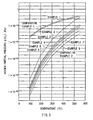
- FIG. 3 shows the oxygen partial pressure in each example.
- Example 8 the internal electrode layers 12 were partially formed in a spherical shape. The results are shown in Table 1.
- Comparative Example 1 in which the amount of water vapor was larger than 50 mol%, no crack occurred in the degreased laminate; however, excessive diffusion of copper into the ceramic layer 11 was observed in the sintered laminate. Moreover, in Comparative Example 2 in which the amount of water vapor was less than 7 mol%, the amount of residual carbon in the degreased laminate was large, and the melting of copper out of the internal electrode layer 12 was observed in the sintered laminate. Further, in Comparative Examples 3 and 4 in which the oxygen partial pressure was higher, cracks occurred in the degreased laminate.
- Example 2 it was obvious from a comparison between Examples 2 and 5 through 8 that in Examples 2, and 5 through 7 in which the concentration of hydrogen in the atmospheric gas was 0 molppm to 10 molppm, no problem was observed after degreasing or firing; however, in Example 8 in which the concentration of hydrogen in the atmospheric gas was 100molppm, and the oxygen partial pressure was less than Kp 2 ⁇ 10 6 Pa, the reduction of lead was observed in the ceramic precursor layer after degreasing, and thereby the internal electrode layer 12 was slightly formed in a spherical shape after firing.
- the invention is not limited to the embodiment and the examples, and can be variously modified.
- the case where the lead-based perovskite complex oxide including lead zirconate titanate is used is described; however, the invention can be applied to the case where any other lead-based perovskite complex oxide including lead niobate magnesate or the like is used.
- any other component such as lead niobate or lead zincate may be included.
- calcium (Ca), strontium (Sr), barium (Ba) or the like may substitute for a part of lead, and various sub-components may be added.
- the case where the lead-based perovskite complex oxide is used is described; however, the invention can be applied to the case where the ceramic layer 11 is formed of any other ceramic material not including lead.
- the ceramic material for example, a ceramic material including barium titanate, a bismuth layer structured oxide, sodium bismuth titanate or potassium bismuth titanate is cited.
- the invention can be widely applied to the fields of multilayer capacitors, multilayer piezoelectric devices and the like, and the invention is specifically suitable for manufacturing multilayer actuators.
Landscapes
- Engineering & Computer Science (AREA)
- Chemical & Material Sciences (AREA)
- Ceramic Engineering (AREA)
- Manufacturing & Machinery (AREA)
- Materials Engineering (AREA)
- Structural Engineering (AREA)
- Organic Chemistry (AREA)
- Inorganic Chemistry (AREA)
- Composite Materials (AREA)
- Ceramic Capacitors (AREA)
- Fixed Capacitors And Capacitor Manufacturing Machines (AREA)
Description
- The present invention relates to a method of manufacturing a multilayer ceramic device such as a multilayer piezoelectric device in which, for example, ceramic layers and internal electrode layers are alternately stacked.
- In recent years, in the technical field of electronic components using ceramic, the number of layers in the electronic components has increased in order to meet a demand for higher performance. However, when the number of layers increases, the amount of internal electrode layers increases, so when the internal electrode layers are made of a noble metal such as palladium (Pd) or silver (Ag), their manufacturing cost increases. Therefore, the use of a lower-cost base metal such as copper has been contemplated.
- In
US 2002 / 0098333 A1 a method of manufacturing a multilayer ceramic device is disclosed where the electrode layers contain copper. The latter is enabled by a debindering process. - However, copper is very prone to be oxidized, so when a degreasing step for removing a binder is preformed in an oxidizing atmosphere at the time of manufacturing, copper oxide is produced, thereby the volume of the internal electrode layers expands to cause cracks in lamination. Moreover, although it can be considered that the degreasing step is performed in a reducing atmosphere so as not to oxidize copper; the binder may not be sufficiently decomposed in the reducing atmosphere, thereby carbon remains in the internal electrode layers to cause a decline in properties.
- As a method of overcoming such problems, for example, the use of copper oxide instead of copper metal as the raw material of the internal electrode layers has been proposed (for example, refer to
Japanese Unexamined Patent Application Publication Nos. 2003-234258 2003-243742 Japanese Unexamined Patent Application Publication No. Sho 62-210611 - Therefore, a method of degreasing in a reducing atmosphere including water vapor introduced into an inert gas has been proposed (for example, refer to
Japanese Unexamined Patent Application Publication Nos. Hei 4-317309 Hei 5-90066 - Conventionally the number of layers increases mainly in multilayer ceramic capacitors; however, in recent years, it has been considered to increase the number of layers in multilayer ceramic actuators using a lead-based piezoelectric ceramic material which draw attention as electronic components of fast-response fuel injection control systems for next-generation vehicle engines. In the case of the actuators, the number of layers reach several hundreds, and large actuators with a size of approximately 10 mm × 10 mm × 40 mm (height) are required.
- In a conventional method described in
Japanese Unexamined Patent Application Publication No. Hei 4-317309 Japanese Unexamined Patent Application Publication No. Hei 5-90066 - In view of the foregoing, it is an object of the invention to provide a method of manufacturing a multilayer ceramic device such as a multilayer piezoelectric device capable of obtaining a superior multilayer ceramic device even if the number of layers increases or even if the multilayer ceramic device is upsized.
- A method of manufacturing a multilayer ceramic device according to the invention comprises the step of: degreasing a laminate by heating in which ceramic precursor layers including a raw material of a ceramic layer and internal electrode precursor layers including copper metal as a raw material of an internal electrode layer are alternately stacked, wherein an atmospheric gas including an inert gas and 7 mol% to 50 mol% of water vapor is used to perform the step in an oxygen partial pressure atmosphere according to the relation:
Kp2 × 1015 ≦ p(O2) ≦ (25331 × Kp)2/3 (Formula 1)
wherein p(O2) represents an oxygen partial pressure; Kp represents the water dissociation equilibrium constant; and the pressure unit is Pa, and wherein the step is performed at 550°C to 600°C. - No hydrogen is preferably mixed with the atmospheric gas. Moreover, the oxygen partial pressure is preferably within a range shown in Formula 2 is
Kp2 × 1016 ≦ p(O2) ≦ (25331 × Kp)2/3 (Formula 2)
(InFormula 2, p(O2) represents an oxygen partial pressure; Kp represents the water dissociation equilibrium constant; and the pressure unit is Pa.) - Moreover, the manufacturing method is preferable in the case where a raw material of lead, for example, a raw material of lead zirconate titanate is included as the raw material of the ceramic layer, and the case where a multilayer ceramic device in which the ceramic layer has a thickness of 5 times to 200 times larger than the thickness of the interlayer electrode layer, or a multilayer ceramic device with a volume of 20 mm3 or more is manufactured. In particular, the manufacturing method is preferable in the case where a multilayer piezoelectric device is manufactured.
- In the method of manufacturing a multilayer ceramic device according to the invention, 7 mol% to 50 mol% of water vapor is included in the atmospheric gas to adjust the oxygen partial pressure within a range shown in Formula 1, so the oxidation of copper metal and the occurrence of cracks can be prevented. Moreover, residual carbon can be reduced, and the melting of the internal electrode layer can be prevented. Therefore, a large multilayer ceramic device in which the thickness of the ceramic layer is 5 times to 200 times larger than the thickness of the internal electrode layer, or its volume is 20 mm3 or more can be manufactured, and superior properties can be obtained.
- In particular, when no hydrogen is mixed with the atmospheric gas, or when the oxygen partial pressure is within a range shown in
Formula 2, residual carbon can be further reduced, and the reduction of lead in the ceramic precursor layer can be prevented. - Other and further objects, features and advantages of the invention will appear more fully from the following description.
-
-
FIG. 1 is a flow chart showing a method of manufacturing a multilayer ceramic device according to an embodiment of the invention; -
FIG. 2 is a sectional view of an example of a multilayer ceramic device manufactured by the manufacturing method shown inFIG. 1 ; and -
FIG. 3 is a plot showing an oxygen partial pressure in a degreasing process in each example. - A preferred embodiment will be described in detail below referring to the accompanying drawings.
-
FIG. 1 shows steps in a method of manufacturing a multilayer ceramic device according to an embodiment of the invention. In the embodiment, for example, the case where a ceramic containing a complex oxide with a perovskite structure which includes lead such as lead zirconate titanate is used to manufacture a multilayer ceramic device in whichceramic layers 11 andinternal electrode layers 12 are alternately stacked as shown inFIG.2 is described in detail. - At first, after a raw material of the
ceramic layers 11 is prepared, and the raw material is weighed according to a target composition, a binder is added to the raw material to form a ceramic material mixture (step S101). As the raw material of theceramic layers 11, for example, oxides including an element constituting theceramic layers 11 or compounds such as carbonates, oxalates or hydroxides which can become oxides including the element by firing are used. For example, in the case where theceramic layers 11 including lead zirconate titanate is formed, as materials of lead (Pb), titanium (Ti) and zirconium (Zr), lead oxide (PbO), titanium oxide (TiO2) and zirconium oxide (ZrO2) which include Pb, Ti and Zr, respectively, or compounds which can become the oxides by firing are prepared. - Next, the ceramic material mixture is formed in a sheet shape to form a ceramic precursor layer (step S102).
- Moreover, as a raw material of the
internal electrode layers 12, copper metal is prepared, and a binder is added to the raw material to form an internal electrode material mixture (step S103). As the raw material of theinternal electrode layers 12, only copper metal can be used, or a mixture of copper metal and any other material can be used. As the other material, for example, copper oxide or an organic copper compound which becomes copper metal after firing, metal except for copper metal, or a metal oxide or an organic metal compound which becomes the metal after firing is used. Further, an additive such as a dispersant, a plasticizer, a dielectric material or an insulating material may be added to the internal electrode material mixture. - Next, for example, the internal electrode material mixture is screen-printed on the ceramic precursor layer to form an internal electrode precursor layer (step S104). A plurality of ceramic precursor layers on which the internal electrode precursor layer is formed are stacked to form a laminate in which the ceramic precursor layers and the internal electrode precursor layers are alternately stacked (step S105).
- After that, the laminate is heated to perform a degreasing process for decomposing and removing the binder (step S106). The degreasing process is performed at 550°C to 600°C in an oxygen partial pressure atmosphere according to Formula 1 through using an atmospheric gas which includes an inert gas such as nitrogen (N2) or argon (Ar) and 7 mol% to 50 mol% of water vapor, and, if necessary, hydrogen.
(Formula 1)
Kp2 × 1015 ≦ p(O2) ≦ (25331 × Kp)2/3
(InFormula 1, p(O2) represents an oxygen partial pressure, and Kp represents the water dissociation equilibrium constant. The pressure unit is Pa.) - As shown in
Formula 3, the water vapor has a function of reacting with hydrocarbon or carbon which is a residual carbon component to accelerate the decomposition and removal of residual carbon.
(Formula 3)
CmHn+mH2O→mCO+{(n+2m)/2}H2
C+H2O→CO+H2
(InFormula 3, m and n are positive integers.) - The amount of water vapor is 7 mol% or more, because when the amount is less than 7 mol%, the binder is not sufficiently decomposed and removed, thereby the residual carbon increases, and in particular, when the number of the
ceramic layers 11 or the size of theceramic layers 11 is large, the amount of residual carbon in the interior of the laminate increases. Moreover, the amount of water vapor is 50 mol% or less, because when the amount is larger than 50 mol%, copper metal included in the internal electrode precursor layers is easily converted to copper (I) oxide (Cu2O), and copper (I) oxide can diffuse into theceramic layers 11 at 680°C or more to cause deterioration in properties. - The water vapor has functions of producing oxygen by dissociation equilibrium shown in
Formulas
(Formula 4)
H2O⇔H2+(1/2)O2
(Formula 5)
Kp = {p(O2)1/2 × p(H2)}/p(H2O)
(InFormula 5, Kp represents the water dissociation equilibrium constant; p(O2 represents an oxygen partial pressure; p(H2) represents a hydrogen partial pressure; and p(H2O) represents a water vapor partial pressure.) - In other words, the oxygen partial pressure in the degreasing process is adjusted within an extremely low range through the use of the water dissociation equilibrium. Thus, the oxygen partial pressure is adjusted through the use of the water dissociation equilibrium, because when the concentration of oxygen is high, copper metal included in the raw material of the
internal electrode layer 12 is oxidized to expand, thereby to cause cracks, and it is extremely difficult to control the oxygen partial pressure at a low level through using oxygen as an atmospheric gas. - At this time, when hydrogen is used as an atmospheric gas, by the law of mass action, in
Formula 4, a reaction of not dissociating water progresses, thereby the oxygen partial pressure declines, so in order to increase the oxygen partial pressure as high as possible, it is preferable not to use hydrogen. In the case where hydrogen is not used, hydrogen in the atmospheric gas is produced only by the dissociation of water vapor, so a formula p(H2)=2×p(O2) is derived fromFormula 4. Therefore,Formula 6 is derived fromFormula 5.
(Formula 6)
Kp = 2p(O2)3/2/p(H2O)
p(O2)3/2 = 0.5 × p(H2O) × Kp
- Thus, as described above, when the maximum amount of water vapor is 50 mol%, p(H2O) at this time is 0.5 × 101325 (Pa), so the maximum value P(O2)max of the oxygen partial pressure in the case where hydrogen is not used is as shown in
Formula 7, thereby the upper limit ofFormula 1 is derived.
(Formula 7)
p(O2)3/2 max = 0.5 × 0.5 × 101325 × Kp = 25331 × Kp
p(O2)max = (25331 × Kp)2/3
(InFormula 7, the pressure unit is Pa.) - Moreover, the oxygen partial pressure is more preferably within a range shown in
Formula 2. It is because when the oxygen partial pressure is low, lead included in the ceramic precursor layer is reduced, thereby lead metal is easily produced, and as a result, the properties of the ceramic material can decline, or lead metal may react with copper metal included in the internal electrode precursor layer to be melted or cut.
(Formula 2)
Kp2 × 1016 ≦ p(O2) ≦ (25331 × Kp)2/3
(InFormula 2, p(O2) represents an oxygen partial pressure, and Kp represents the water dissociation equilibrium constant. The pressure unit is Pa.) - Further, hydrogen also has a function of removing residual carbon, so hydrogen can be used together with water vapor as the atmospheric gas. However, when the amount of hydrogen is large, the oxygen partial pressure may decline to increase residual carbon, or lead included in the ceramic precursor layer may be easily reduced, so it is preferable that hydrogen is not used.
- The temperature in the degreasing process is not higher than 600°C, because when the temperature exceeds 600°C, a lead-based ceramic material starts to be sintered, so the lead-based ceramic material is densified to block a ventilation path, and thereby to interfere with the decomposition and volatilization of the binder.
- After performing the degreasing process, the laminate is fired to form a sintered laminate in which the
ceramic layers 11 and the internal electrode layers 12 are alternately stacked (step S107). The firing temperature is higher than the temperature in the degreasing process, and less than the melting point of copper metal, 1083°C, and the firing temperature is preferably 1050°C or less, and more preferably 1000°C or less. In a firing atmosphere, the oxygen partial pressure is controlled so as not to oxidize copper metal included in the internal electrode precursor layer and not to reduce lead included in the ceramic precursor layer. - After firing, an end surface of the sintered laminate is polished by, for example, barreling, sandblasting or the like, and a
terminal electrode 13 is formed through sputtering metal such as gold. Alternatively, metal such as gold or an oxide or an organic metal compound which becomes the metal after firing is mixed with a binder to form a terminal electrode material mixture, and the terminal electrode material mixture is printed or transferred to be baked, thereby theterminal electrode 13 is formed (step S108). Thereby, the multilayer ceramic device can be obtained. - Thus, in the embodiment, the atmospheric gas including 7 mol% to 50 mol% of water vapor is used, and the degreasing process is performed in an oxygen partial pressure atmosphere of p(O2)≦ (25331 × Kp)2/3 (pressure unit: Pa), so the oxidization of copper metal, the occurrence of cracks and the diffusion of copper into the
ceramic layers 11 can be prevented. Moreover, residual carbon can be reduced, and the reduction of lead in theceramic layers 11 and the melting of the internal electrode layers 12 can be prevented. - In particular, in the embodiment, in the case of manufacturing a large multilayer ceramic device in which the thickness of the
ceramic layer 11 is 5 times to 200 times larger than the thickness of theinternal electrode layer 12, or the volume of the multilayer ceramic device is 20 mm3 or more, or a multilayer piezoelectric device which is desired to have such a large size, a large effect can be obtained, and superior properties can be obtained. In addition, the thickness of theceramic layer 11 means the thickness of oneceramic layer 11 sandwiched between the internal electrode layers 12, and the thickness of theinternal electrode layer 12 means the thickness of oneinternal electrode layer 12 sandwiched between the ceramic layers 11. - Moreover, when no hydrogen is mixed with the atmospheric gas in the degreasing process, or when the oxygen partial pressure is within a range of Kp2 × 1016≦ p(O2) (pressure unit: Pa), residual carbon can be further reduced, and in the degreasing process, the reduction of lead included in the ceramic precursor layer can be prevented.
- Next, specific examples will be described below.
(Examples 1 through 8, wherein Examples 1, 2 and 6 are embodiments of the present invention and Examples 3-5, 7 and 8 are Comparative Examples) - A sintered laminate including the
ceramic layers 11 which contained a lead-based perovskite complex oxide including lead zirconate titanate and the internal electrode layers 12 which contained copper metal was formed as each of Examples 1 through 8. At first, after the raw material of theceramic layers 11 was prepared, and weighed, a methacrylate-based binder was added to the raw material of theceramic layers 11 to form a mixture (step S101), and then the mixture was formed in a sheet shape to form the ceramic precursor layer (step S102). - As the raw material of the
internal electrode layer 12, copper metal was prepared, and an ethyl cellulose-based binder was added to copper metal to form a mixture (step S103), and the mixture was screen-printed on the ceramic precursor layer to form the internal electrode precursor layer (step S104). Next, after 360 ceramic precursor layers on which the internal electrode precursor layer was formed were stacked, and they were pressure-bonded, they were cut so as to have a 8 mm × 8 mm cross section to which the normal is in a stacking direction (step S105). - Next, the laminate was inserted into a tubular furnace made of aluminum oxide to perform a degreasing process by heating (step S106). As the heating conditions, after the laminate was heated at a temperature rising rate of 3.3°C/min from a room temperature to 200°C, a temperature rising rate of 0.3°C/min from 200°C to 400°C, and a temperature rising rate of 1.0°C/min from 400°C to 550°C, and the laminate was kept at 550°C for 48 hours, the laminate was cooled at a temperature decreasing rate of 3.3°C/min. An atmospheric gas formed through bubbling nitrogen or a mixture gas of nitrogen and hydrogen into water of which the temperature was maintained at a predetermined temperature to saturate water vapor was,inserted into the furnace.
- At that time, in Examples 1 through 8, the amount of water vapor and the amount of hydrogen were changed as shown in Table 1, thereby the oxygen partial pressure in the furnace was adjusted as shown in Table 1. The amount of water vapor was adjusted through changing the temperature of water. The oxygen partial pressure shown in Table 1 (the pressure unit: Pa) was an α value in the case where the oxygen partial pressure was represented by Kp2 × α, and a β value in the case of the oxygen partial pressure was represented by (β × Kp)2/3. Moreover,
FIG. 3 shows the oxygen partial pressure in each example. - The appearance of the degreased laminate was visually observed to check the presence or the absence of cracks. Moreover, the amounts of residual carbon in an internal portion and a peripheral portion of the laminate were analyzed. The peripheral portion indicated a region within 1/4 of a side, that is, 2 mm inside from the periphery of a cross section to which the normal was in a stacking direction, and the internal portion indicated a region inside the peripheral portion. As a result, no cracks occurred in all of Examples 1 through 8, and the amount of residual carbon was sufficiently low. However, in Example 8, lead was reduced, thereby lead metal was slightly observed in the ceramic precursor layer. The obtained results are shown in Table 1.
- After that, the degreased laminate was fired at 950°C for two hours in an oxygen partial pressure atmosphere in which copper metal was not oxidized and lead was not reduced to obtain a sintered laminate. When the firing state of the obtained sintered laminate was observed, there was no problem in Examples 1 through 7; however, in Example 8, the internal electrode layers 12 were partially formed in a spherical shape. The results are shown in Table 1.
- As Comparative Examples 1 and 2 relative to Examples 1 through 8, sintered laminates were formed as in the case of Examples 1 through 8, except that the amount of water vapor and the amount of hydrogen in the atmospheric gas used in the degreasing process were changed as shown in Table 1, and the oxygen partial pressure in the furnace was changed as shown in Table 1. Moreover, as Comparative Examples 3 and 4 relative to Examples 1 through 8, laminates were formed, and the degreasing process was performed as in the case of Examples 1 through 8, except that the degreasing process was performed in air, or at an oxygen partial pressure of 1 Pa through using oxygen as an atmospheric gas. As in the case of Examples 1 through 8, the degreased laminates of Comparative Examples 1 through 4 and the sintered laminate of Comparative Examples 1 through 4 were observed. The results are shown in Table 1. After degreasing, cracks occurred in the laminates of Comparative Examples 3 and 4, so the laminates were not fired.
[Table 1] DEGREASING CONDITIONS AFTER DEGREASING AFTER FIRING ATMOSPHERIC GAS OXYGEN PARTIAL PRESSURE (Pa) AMOUNT OF RESIDUAL CARBON (ppm) CRACKS PROBLEM PROBLEM WATER VAPOR
(mol%)HYDROGEN
(ppm)Kp2×α
(β×Kp)2/3INTERNAL PORTION PERIPHERAL PORTION α β EXAMPLE 1 47 0 > 1016 2.4×10⁴ 130 120 NOT OCCURRED - - EXAMPLE 2 7 0 >1016 4×10³ 140 130 NOT OCCURRED - - EXAMPLE 3 47 1 1011 <10-3 110 100 NOT OCCURRED - - EXAMPLE 4 20 1 1010 <10-4 140 120 NOT OCCURRED - - EXAMPLE 5 7 1 109 < 10-6 180 150 NOT OCCURRED - - EXAMPLE 6 7 0.001 1015 <4×10³ 160 140 NOT OCCURRED - - EXAMPLE 7 7 10 107 < 10-9 150 140 NOT OCCURRED - - EXAMPLE 8 7 100 105 <10-12 170 160 NOT OCCURRED LEAD WAS SLIGHTLY REDUCED PAPTIALY FORMED IN SPHERICAL SHAPE COMPARATIVE EXAMPLE 1 57 0 > 1016 3.0×10⁴ 120 100 NOT OCCURRED - EXCESSIVE DIFFUSION OF COPPER COMPARATIVE EXAMPLE 2 3 1 109 <10-7 1130 380 NOT OCCURRED AMOUNT OF RESIDUAL CARBON WAS LARGE MELTING OF COPPER COMPARATIVE EXAMPLE 3 IN AIR 100 100 OCCURRED CRACKS OCCURED NOT FIRED COMPARATIVE EXAMPLE 4 OXYGEN PARTIAL PRESSURE OF 1 Pa - - OCCURRED CRACKS OCCURED NOT FIRED - As shown in Table 1, in Examples 1 through 8, no crack was observed in the degreased laminates, and the amount of residual carbon was sufficiently low. Moreover, in the sintered laminates in Examples 1 through 8, the diffusion of copper into the
ceramic layer 11 or the melting of copper out of theinternal electrode layer 12 was not observed. - On the other hand, in Comparative Example 1 in which the amount of water vapor was larger than 50 mol%, no crack occurred in the degreased laminate; however, excessive diffusion of copper into the
ceramic layer 11 was observed in the sintered laminate. Moreover, in Comparative Example 2 in which the amount of water vapor was less than 7 mol%, the amount of residual carbon in the degreased laminate was large, and the melting of copper out of theinternal electrode layer 12 was observed in the sintered laminate. Further, in Comparative Examples 3 and 4 in which the oxygen partial pressure was higher, cracks occurred in the degreased laminate. - In other words, it was found out that in the case where an atmospheric gas including 7 mol% to 50 mol% of water vapor was used, and the degreasing process was performed in an oxygen partial pressure atmosphere of p(O2) ≦ (25331 × Kp)2/3 (pressure unit: Pa), even if the number of layers was as many as 360 layers, the oxidation of copper metal included in the internal electrode precursor layer could be prevented, thereby the occurrence of cracks could be prevented, and residual carbon could be reduced, and the melting of an internal electrode could be prevented.
- Moreover, it was obvious from a comparison between Examples 2 and 5 through 8 that in Examples 2, and 5 through 7 in which the concentration of hydrogen in the atmospheric gas was 0 molppm to 10 molppm, no problem was observed after degreasing or firing; however, in Example 8 in which the concentration of hydrogen in the atmospheric gas was 100molppm, and the oxygen partial pressure was less than Kp2 × 106 Pa, the reduction of lead was observed in the ceramic precursor layer after degreasing, and thereby the
internal electrode layer 12 was slightly formed in a spherical shape after firing. - In other words, it was found out that when no hydrogen or 10 molppm or less of hydrogen was mixed with the atmospheric gas, or when the oxygen partial pressure was Kp2 × 106 Pa or more, the reduction of lead included in the ceramic precursor layer could be prevented.
- Although the invention is described referring to the embodiment and the examples, the invention is not limited to the embodiment and the examples, and can be variously modified. For example, in the embodiment and the examples, the case where the lead-based perovskite complex oxide including lead zirconate titanate is used is described; however, the invention can be applied to the case where any other lead-based perovskite complex oxide including lead niobate magnesate or the like is used. Moreover, in addition to lead zirconate titanate, any other component such as lead niobate or lead zincate may be included. Further, calcium (Ca), strontium (Sr), barium (Ba) or the like may substitute for a part of lead, and various sub-components may be added.
- Moreover, in the embodiment and the examples, the case where the lead-based perovskite complex oxide is used is described; however, the invention can be applied to the case where the
ceramic layer 11 is formed of any other ceramic material not including lead. As the ceramic material, for example, a ceramic material including barium titanate, a bismuth layer structured oxide, sodium bismuth titanate or potassium bismuth titanate is cited. - The invention can be widely applied to the fields of multilayer capacitors, multilayer piezoelectric devices and the like, and the invention is specifically suitable for manufacturing multilayer actuators.
Claims (8)
- A method of manufacturing a multilayer ceramic device, comprising the step of:degreasing a laminate for removing a binder by heating in which ceramic precursor layers including a raw material of a ceramic layer and internal electrode precursor layers including copper metal as a raw material of an internal electrode layer are alternately stacked,wherein an atmospheric gas including an inert gas and 7 mol% to 50 mol% of water vapor is used to perform the step in an oxygen partial pressure atmosphere according to the relation :
Kp2 × 1015 ≦ p(O2) ≦ (25331 × Kp)2/3 (Formula 1)
wherein p(O2) represents an oxygen partial pressure; Kp represents the water dissociation equilibrium constant; and the pressure unit is Pa, and wherein the step is performed at 550°C to 600°C. - A method of manufacturing a multilayer ceramic device according to claim 1, wherein
hydrogen is not mixed with the atmospheric gas. - A method of manufacturing a multilayer ceramic device according to any one of claims 1 through 2, wherein
the step is performed in an oxygen partial pressure atmosphere according to the relation:
Kp2 × 1016 < p(O2) ≦ (25331 × Kp)2/3 (Formula 2)
wherein p(O2) represents an oxygen partial pressure; Kp represents the water dissociation equilibrium constant, and the pressure unit is Pa. - A method of manufacturing a multilayer ceramic device according to any one of claims 1 through 3, wherein
the ceramic precursor layers include a raw material of lead as the raw material of the ceramic layer. - A method of manufacturing a multilayer ceramic device according to claim 4, wherein
the ceramic precursor layers include a raw material of lead zirconate titanate as the raw material of the ceramic layer. - A method of manufacturing a multilayer ceramic device,
wherein a multilayer ceramic device in which a ceramic layer has a thickness of 5 times to 200 times larger than the thickness of the internal electrode layer is manufactured through a method according to any one of claims 1 through 5. - A method of manufacturing a multilayer ceramic device,
wherein a multilayer ceramic device with a volume of 20 mm3 or more is manufactured through a method according to any one of claims 1 through 6. - A method of manufacturing a multilayer ceramic device,
wherein a multilayer piezoelectric device is manufactured through a method according to any one of claims 1 through 7.
Applications Claiming Priority (2)
| Application Number | Priority Date | Filing Date | Title |
|---|---|---|---|
| JP2004092817A JP4028508B2 (en) | 2004-03-26 | 2004-03-26 | Manufacturing method of multilayer ceramic element |
| JP2004092817 | 2004-03-26 |
Publications (2)
| Publication Number | Publication Date |
|---|---|
| EP1580820A1 EP1580820A1 (en) | 2005-09-28 |
| EP1580820B1 true EP1580820B1 (en) | 2009-01-07 |
Family
ID=34858514
Family Applications (1)
| Application Number | Title | Priority Date | Filing Date |
|---|---|---|---|
| EP20050006136 Expired - Lifetime EP1580820B1 (en) | 2004-03-26 | 2005-03-21 | Method of manufacturing multilayer ceramic device |
Country Status (5)
| Country | Link |
|---|---|
| US (1) | US20050213283A1 (en) |
| EP (1) | EP1580820B1 (en) |
| JP (1) | JP4028508B2 (en) |
| CN (1) | CN1674176A (en) |
| DE (1) | DE602005012169D1 (en) |
Cited By (1)
| Publication number | Priority date | Publication date | Assignee | Title |
|---|---|---|---|---|
| CN108461293A (en) * | 2018-04-09 | 2018-08-28 | 广东风华高新科技股份有限公司 | A kind of manufacturing method of ceramic capacitor |
Families Citing this family (11)
| Publication number | Priority date | Publication date | Assignee | Title |
|---|---|---|---|---|
| JP2007266289A (en) * | 2006-03-28 | 2007-10-11 | Tdk Corp | Laminated ceramic electronic component, and its manufacturing method |
| EP2053030B1 (en) * | 2006-08-18 | 2011-10-12 | Murata Manufacturing Co. Ltd. | Process for production of formed ceramic bodies |
| KR101061421B1 (en) | 2009-03-24 | 2011-09-01 | 한국표준과학연구원 | Precursor purity measurement method for semiconductor manufacturing process |
| CN103650081B (en) * | 2011-08-05 | 2017-08-22 | 株式会社村田制作所 | The manufacture method of ceramic electronic components |
| JP2012178584A (en) * | 2012-04-23 | 2012-09-13 | Tdk Corp | Laminated piezoelectric element |
| US9324931B2 (en) | 2013-05-14 | 2016-04-26 | Tdk Corporation | Piezoelectric device |
| US20140339458A1 (en) * | 2013-05-14 | 2014-11-20 | Tdk Corporation | Piezoelectric ceramic and piezoelectric device containing the same |
| CN103822921B (en) * | 2014-01-13 | 2016-08-31 | 贵州正业工程技术投资有限公司 | A kind of method measuring electronic ceramics product binder removal effect |
| JP2018037473A (en) * | 2016-08-30 | 2018-03-08 | 株式会社村田製作所 | Multilayer ceramic capacitor |
| JP7578511B2 (en) * | 2021-03-02 | 2024-11-06 | Tdk株式会社 | Multilayer Capacitors |
| CN114804837A (en) * | 2022-03-14 | 2022-07-29 | 中国电子科技集团公司第四十三研究所 | Multilayer tungsten metalized alumina special-shaped piece for HTCC and preparation method thereof |
Family Cites Families (8)
| Publication number | Priority date | Publication date | Assignee | Title |
|---|---|---|---|---|
| JPS59995A (en) * | 1982-06-16 | 1984-01-06 | 富士通株式会社 | Method of producing copper conductor multilayer structure |
| US4661315A (en) * | 1986-02-14 | 1987-04-28 | Fine Particle Technology Corp. | Method for rapidly removing binder from a green body |
| US4994436A (en) * | 1989-03-10 | 1991-02-19 | American Air Liquide | Process for safely destroying organic binders in ceramic components during the firing process |
| JP3794562B2 (en) * | 1999-11-01 | 2006-07-05 | Tdk株式会社 | Multilayer ceramic electronic components |
| EP1240675B1 (en) * | 1999-12-16 | 2010-09-15 | Epcos Ag | Intermediate product for piezoelectric component |
| JP4225033B2 (en) * | 2001-12-14 | 2009-02-18 | 株式会社日本自動車部品総合研究所 | Ceramic laminate and manufacturing method thereof |
| JP3884669B2 (en) * | 2002-04-05 | 2007-02-21 | 株式会社デンソー | Method for manufacturing ceramic laminate |
| DE10345500B4 (en) * | 2003-09-30 | 2015-02-12 | Epcos Ag | Ceramic multilayer component |
-
2004
- 2004-03-26 JP JP2004092817A patent/JP4028508B2/en not_active Expired - Fee Related
-
2005
- 2005-03-15 US US11/079,600 patent/US20050213283A1/en not_active Abandoned
- 2005-03-21 EP EP20050006136 patent/EP1580820B1/en not_active Expired - Lifetime
- 2005-03-21 DE DE200560012169 patent/DE602005012169D1/en not_active Expired - Lifetime
- 2005-03-28 CN CNA2005100624665A patent/CN1674176A/en active Pending
Cited By (2)
| Publication number | Priority date | Publication date | Assignee | Title |
|---|---|---|---|---|
| CN108461293A (en) * | 2018-04-09 | 2018-08-28 | 广东风华高新科技股份有限公司 | A kind of manufacturing method of ceramic capacitor |
| CN108461293B (en) * | 2018-04-09 | 2020-10-09 | 广东风华高新科技股份有限公司 | Method for manufacturing ceramic capacitor |
Also Published As
| Publication number | Publication date |
|---|---|
| JP2005285806A (en) | 2005-10-13 |
| DE602005012169D1 (en) | 2009-02-26 |
| CN1674176A (en) | 2005-09-28 |
| EP1580820A1 (en) | 2005-09-28 |
| US20050213283A1 (en) | 2005-09-29 |
| JP4028508B2 (en) | 2007-12-26 |
Similar Documents
| Publication | Publication Date | Title |
|---|---|---|
| US11710601B2 (en) | Ceramic electronic device and manufacturing method of the same | |
| EP1887638B1 (en) | Piezoelectric element | |
| EP1382587B1 (en) | Piezoelectric porcelain and method for preparation thereof, and piezoelectric element | |
| EP1580820A1 (en) | Method of manufacturing multilayer ceramic device | |
| US20120180310A1 (en) | Ceramic Multi-Layer Component And Method For The Production Thereof | |
| JP2007258280A (en) | Multilayer piezoelectric element | |
| JP2004517024A (en) | Piezoelectric ceramic material, method for producing the same, and electric ceramic multilayer structural member | |
| KR20080003742A (en) | Piezoelectric ceramic composition and its manufacturing method and piezoelectric element, piezoelectric element manufacturing method | |
| JP2019186396A (en) | Multilayer ceramic capacitor and manufacturing method thereof | |
| EP2181976B1 (en) | Piezoelectric ceramic composition and laminated piezoelectric element | |
| JP4066432B2 (en) | Manufacturing method of laminated piezoelectric ceramic element | |
| US6972060B2 (en) | Method for producing stacked ceramic body | |
| KR102825270B1 (en) | Method for manufacturing a multilayer piezoelectric element including internal electrodes | |
| JP3969594B2 (en) | Piezoelectric element and manufacturing method thereof | |
| JPH08167536A (en) | Method for manufacturing copper internal electrode multilayer ceramic capacitor | |
| JP2008147497A (en) | Method for manufacturing laminated ceramic element | |
| JP2007227483A (en) | Laminated ceramic element manufacturing method | |
| JP3586258B2 (en) | Manufacturing method of multilayer ceramic electronic component | |
| US20080245991A1 (en) | Nickel-Molybdenum-Doped Lead Zirconate Titanate, Method for the Production of a Piezoceramic Component Using Said Lead Zirconate Titanate, and Use of the Piezoceramic Component | |
| JP2003217965A (en) | Manufacturing method of multilayer ceramic electronic component | |
| JP4735837B2 (en) | Method for manufacturing multilayer piezoelectric element and multilayer piezoelectric element | |
| CN115605970B (en) | capacitor | |
| JP2007080948A (en) | Manufacturing method of laminated ceramic element | |
| JP2007227482A (en) | Laminated ceramic element manufacturing method, and setter | |
| JP4930676B2 (en) | Piezoelectric ceramic composition, multilayer piezoelectric element, and method for producing multilayer piezoelectric element |
Legal Events
| Date | Code | Title | Description |
|---|---|---|---|
| PUAI | Public reference made under article 153(3) epc to a published international application that has entered the european phase |
Free format text: ORIGINAL CODE: 0009012 |
|
| AK | Designated contracting states |
Kind code of ref document: A1 Designated state(s): AT BE BG CH CY CZ DE DK EE ES FI FR GB GR HU IE IS IT LI LT LU MC NL PL PT RO SE SI SK TR |
|
| AX | Request for extension of the european patent |
Extension state: AL BA HR LV MK YU |
|
| 17P | Request for examination filed |
Effective date: 20060203 |
|
| AKX | Designation fees paid |
Designated state(s): DE FR IT |
|
| GRAP | Despatch of communication of intention to grant a patent |
Free format text: ORIGINAL CODE: EPIDOSNIGR1 |
|
| GRAS | Grant fee paid |
Free format text: ORIGINAL CODE: EPIDOSNIGR3 |
|
| GRAA | (expected) grant |
Free format text: ORIGINAL CODE: 0009210 |
|
| AK | Designated contracting states |
Kind code of ref document: B1 Designated state(s): DE FR IT |
|
| REF | Corresponds to: |
Ref document number: 602005012169 Country of ref document: DE Date of ref document: 20090226 Kind code of ref document: P |
|
| PLBE | No opposition filed within time limit |
Free format text: ORIGINAL CODE: 0009261 |
|
| STAA | Information on the status of an ep patent application or granted ep patent |
Free format text: STATUS: NO OPPOSITION FILED WITHIN TIME LIMIT |
|
| 26N | No opposition filed |
Effective date: 20091008 |
|
| REG | Reference to a national code |
Ref country code: FR Ref legal event code: ST Effective date: 20091130 |
|
| PG25 | Lapsed in a contracting state [announced via postgrant information from national office to epo] |
Ref country code: FR Free format text: LAPSE BECAUSE OF NON-PAYMENT OF DUE FEES Effective date: 20091123 |
|
| PG25 | Lapsed in a contracting state [announced via postgrant information from national office to epo] |
Ref country code: IT Free format text: LAPSE BECAUSE OF FAILURE TO SUBMIT A TRANSLATION OF THE DESCRIPTION OR TO PAY THE FEE WITHIN THE PRESCRIBED TIME-LIMIT Effective date: 20090107 |
|
| PGFP | Annual fee paid to national office [announced via postgrant information from national office to epo] |
Ref country code: DE Payment date: 20230131 Year of fee payment: 19 |
|
| REG | Reference to a national code |
Ref country code: DE Ref legal event code: R119 Ref document number: 602005012169 Country of ref document: DE |
|
| PG25 | Lapsed in a contracting state [announced via postgrant information from national office to epo] |
Ref country code: DE Free format text: LAPSE BECAUSE OF NON-PAYMENT OF DUE FEES Effective date: 20241001 |
|
| PG25 | Lapsed in a contracting state [announced via postgrant information from national office to epo] |
Ref country code: DE Free format text: LAPSE BECAUSE OF NON-PAYMENT OF DUE FEES Effective date: 20241001 |