EP1580045A1 - Upper mount - Google Patents
Upper mount Download PDFInfo
- Publication number
- EP1580045A1 EP1580045A1 EP03812360A EP03812360A EP1580045A1 EP 1580045 A1 EP1580045 A1 EP 1580045A1 EP 03812360 A EP03812360 A EP 03812360A EP 03812360 A EP03812360 A EP 03812360A EP 1580045 A1 EP1580045 A1 EP 1580045A1
- Authority
- EP
- European Patent Office
- Prior art keywords
- suspension
- side member
- fluid
- sealed space
- upper mount
- Prior art date
- Legal status (The legal status is an assumption and is not a legal conclusion. Google has not performed a legal analysis and makes no representation as to the accuracy of the status listed.)
- Withdrawn
Links
Images


Classifications
-
- B—PERFORMING OPERATIONS; TRANSPORTING
- B60—VEHICLES IN GENERAL
- B60G—VEHICLE SUSPENSION ARRANGEMENTS
- B60G17/00—Resilient suspensions having means for adjusting the spring or vibration-damper characteristics, for regulating the distance between a supporting surface and a sprung part of vehicle or for locking suspension during use to meet varying vehicular or surface conditions, e.g. due to speed or load
- B60G17/02—Spring characteristics, e.g. mechanical springs and mechanical adjusting means
- B60G17/027—Mechanical springs regulated by fluid means
-
- B—PERFORMING OPERATIONS; TRANSPORTING
- B60—VEHICLES IN GENERAL
- B60G—VEHICLE SUSPENSION ARRANGEMENTS
- B60G17/00—Resilient suspensions having means for adjusting the spring or vibration-damper characteristics, for regulating the distance between a supporting surface and a sprung part of vehicle or for locking suspension during use to meet varying vehicular or surface conditions, e.g. due to speed or load
- B60G17/02—Spring characteristics, e.g. mechanical springs and mechanical adjusting means
- B60G17/027—Mechanical springs regulated by fluid means
- B60G17/0272—Mechanical springs regulated by fluid means the mechanical spring being a coil spring
-
- B—PERFORMING OPERATIONS; TRANSPORTING
- B60—VEHICLES IN GENERAL
- B60G—VEHICLE SUSPENSION ARRANGEMENTS
- B60G15/00—Resilient suspensions characterised by arrangement, location or type of combined spring and vibration damper, e.g. telescopic type
- B60G15/02—Resilient suspensions characterised by arrangement, location or type of combined spring and vibration damper, e.g. telescopic type having mechanical spring
- B60G15/06—Resilient suspensions characterised by arrangement, location or type of combined spring and vibration damper, e.g. telescopic type having mechanical spring and fluid damper
-
- B—PERFORMING OPERATIONS; TRANSPORTING
- B60—VEHICLES IN GENERAL
- B60G—VEHICLE SUSPENSION ARRANGEMENTS
- B60G15/00—Resilient suspensions characterised by arrangement, location or type of combined spring and vibration damper, e.g. telescopic type
- B60G15/02—Resilient suspensions characterised by arrangement, location or type of combined spring and vibration damper, e.g. telescopic type having mechanical spring
- B60G15/06—Resilient suspensions characterised by arrangement, location or type of combined spring and vibration damper, e.g. telescopic type having mechanical spring and fluid damper
- B60G15/067—Resilient suspensions characterised by arrangement, location or type of combined spring and vibration damper, e.g. telescopic type having mechanical spring and fluid damper characterised by the mounting on the vehicle body or chassis of the spring and damper unit
-
- B—PERFORMING OPERATIONS; TRANSPORTING
- B60—VEHICLES IN GENERAL
- B60G—VEHICLE SUSPENSION ARRANGEMENTS
- B60G2202/00—Indexing codes relating to the type of spring, damper or actuator
- B60G2202/30—Spring/Damper and/or actuator Units
- B60G2202/31—Spring/Damper and/or actuator Units with the spring arranged around the damper, e.g. MacPherson strut
- B60G2202/312—The spring being a wound spring
-
- B—PERFORMING OPERATIONS; TRANSPORTING
- B60—VEHICLES IN GENERAL
- B60G—VEHICLE SUSPENSION ARRANGEMENTS
- B60G2202/00—Indexing codes relating to the type of spring, damper or actuator
- B60G2202/30—Spring/Damper and/or actuator Units
- B60G2202/32—The spring being in series with the damper and/or actuator
-
- B—PERFORMING OPERATIONS; TRANSPORTING
- B60—VEHICLES IN GENERAL
- B60G—VEHICLE SUSPENSION ARRANGEMENTS
- B60G2202/00—Indexing codes relating to the type of spring, damper or actuator
- B60G2202/40—Type of actuator
- B60G2202/41—Fluid actuator
- B60G2202/413—Hydraulic actuator
-
- B—PERFORMING OPERATIONS; TRANSPORTING
- B60—VEHICLES IN GENERAL
- B60G—VEHICLE SUSPENSION ARRANGEMENTS
- B60G2204/00—Indexing codes related to suspensions per se or to auxiliary parts
- B60G2204/10—Mounting of suspension elements
- B60G2204/12—Mounting of springs or dampers
- B60G2204/128—Damper mount on vehicle body or chassis
-
- B—PERFORMING OPERATIONS; TRANSPORTING
- B60—VEHICLES IN GENERAL
- B60G—VEHICLE SUSPENSION ARRANGEMENTS
- B60G2206/00—Indexing codes related to the manufacturing of suspensions: constructional features, the materials used, procedures or tools
- B60G2206/01—Constructional features of suspension elements, e.g. arms, dampers, springs
- B60G2206/90—Maintenance
- B60G2206/91—Assembly procedures
- B60G2206/911—Assembly procedures using a modification kit
-
- B—PERFORMING OPERATIONS; TRANSPORTING
- B60—VEHICLES IN GENERAL
- B60G—VEHICLE SUSPENSION ARRANGEMENTS
- B60G2500/00—Indexing codes relating to the regulated action or device
- B60G2500/30—Height or ground clearance
Definitions
- the present invention relates to an upper mount (including the concept of an upper sheet) interposed between a body and a suspension of a vehicle, and more particularly to a novel upper mount with which a vehicle height can be adjusted through a simple operation in the vehicle using a pressure of a fluid such as oil and air.
- a vehicle can move at a high speed with respect to a road surface, its tires are in contact with the road surface after all no matter how fast the vehicle is intended to move.
- running stability namely, to maintain high stability, it is necessary to interpose suspensions between a body and the tires that are in direct contact with the road surface so that impacts received by the tires from the road surface can be absorbed by the suspensions, to keep the body stable while restraining the impacts to the utmost from being transmitted to the side of the body, and to improve suspension performance as well in accordance with improvements in engine performance.
- lowdown whichmeans enhancing stylishness (dressing up) by reducing a vehicle height as is the case with racing cars. According to the law as well, it is acceptable to reduce the vehicle height to some extent. Therefore, various forms of lowdown measures have been taken, including making appropriate improvements on vehicular suspensions sold by auto manufacturers and exchanging suspensions. These measures can be taken because respective auto manufacturers and automotive parts suppliers are actively engaged in the production and distribution of lowdown parts. Further, some suspensions mounted to vehicles are endowed themselves with a vehicle height adjusting function.
- FIG. 3 separately shows, as to one conventional example of such a suspension, an upper mount mounted to an uppermost portion of the suspension.
- the upper mount which is mounted to the uppermost portion of the suspension and serves to fix the suspension to a body h, is denoted by a.
- Respective portions of the suspension are denoted by b to g.
- a bump rubber is denoted by b.
- a helper spring which is used accessorily to adjust a spring rate, namely, as a subsidiary spring for a later-described spring, is denoted by c.
- a spring which absorbs an impact received by a tire from a road surface, is denoted by d.
- a shock absorber which serves to quickly control an oscillation resulting from a reaction caused at the moment when the spring d absorbs an impact, is denoted by e.
- a spring seat is denoted by f and referred to also as a lower seat.
- the spring seat can be increased or reduced in height by being screwed, unscrewed, or the like. More specifically, the vehicle height can be reduced (subjected to lowdown) as the spring seat f is raised.
- a shell case is denoted by g. Although bottom strike tends to occur when the shock absorber fully contracts, the shell case g serves to soften an impact caused at that moment.
- the body is denoted by h.
- the shock absorber and the spring may be integrated with each other (as shown in FIG. 3) or separated from each other.
- the suspension may be of various types including an air cushion type and an air suspension type.
- suspensions of the air suspension type have been drawing attention as those adapted for lowdown.
- the suspensions of the air suspension type are classified into those of an air bag type and those of a composite type.
- the suspensions of the screw-driven vehicle height adjusting type and the air cushion type have a drawback in that the vehicle body may unavoidably scratch a road surface or the like.
- the vehicle height can be reduced or increased at any desired time by, for example, adjusting air or the like to be supplied to suspensions such as air bags using a dedicated device (air device), which is composed of an air tank, an air compressor, an air controller, and the like, or a dedicated device (hydraulic device), which is composed of an oil tank, an oil compressor, an oil controller, and the like.
- a dedicated device air device
- air controller air controller
- hydroaulic device which is composed of an oil tank, an oil compressor, an oil controller, and the like.
- suspensions make it possible to reduce the vehicle height in traveling on a highway or the like, and to increase the vehicle height in a situation where the vehicle body is assumed to scratch a road surface or the like, for example, when the vehicle enters an open road, is being put into a garage, or drops in at a filling station to be refueled, and can therefore be regarded as being considerably superior.
- each of those of the air suspension type requires, in addition to a suspension such as an air bag or the like, a dedicated device composed of an air tank, an air compressor, an air controller, and the like
- each of those of the oil suspension type requires, in addition to a suspension, a dedicated device (hydraulic device) composed of an oil tank, an oil compressor, an oil controller, and the like.
- an air pressure or an oil pressure is constantly applied to each of the existing suspensions of the air suspension type and the oil suspension type.
- an O-ring or the like falls off. Accordingly, air in, for example, an air bag or the like leaks out, and the suspension is crushed.
- the suspension is thus crushed, the vehicle height is thereby reduced further as a matter of course.
- the suspension is of a springless type, the vehicle height may be reduced until the body scratches a road surface. If this sort of trouble happens while a vehicle is traveling at a high speed on an expressway or the like, it follows not only that the vehicle brings about an accident but also that many other vehicles may be involved in the accident to cause a major catastrophe.
- the conventional lowdown art is generally structured to adjust a vehicle height by changing a length of the suspension, and the length of the suspension changes due to a change in the vehicle height, which affects the state or characteristic of the suspension. Therefore, in order to maintain high stability (running stability) after lowdown as well, it is not sufficient to use a suspension adapted for lowdown.
- Other suspension-related mechanisms, parts, and the like to be used, for example, mechanisms, parts, and the like for fixing the suspension to tires, must also be adapted for lowdown. This also constitutes a factor in an increased lowdown cost.
- an on-vehicle fluid pressure device e.g., a hydraulic device
- a dedicated fluid pressure mechanism such as an air device, a hydraulic device, or the like
- an upper mount of claim 1 including a body-side member fixed to a body and a suspension-side member fixed to a suspension is characterized in: that the suspension-side member is formed slidably mounted to the body-side member with a sealed space formed between the suspension-side member and the body-side member; that the body-side member is provided with a fluid passage hole for supplying a fluid to the sealed space from outside and another fluid passage hole for discharging the fluid from the sealed space; and that a spacing from the body-side member to the suspension-side member is widened by supplying the fluid to the sealed space so that a vehicle height can be increased.
- the vehicle height when the spacing between the body-side member and the suspension-side member of the upper mount is widened by supplying a fluid (e.g., oil) into the sealed space from the fluid passage hole against the weight of the body side, the vehicle height can be increased by an amount corresponding to the increase in width.
- a fluid e.g., oil
- the fluid when the fluid is supplied to the upper mount according to the present invention, it is supplied simply to the sealed space between the body-side member and the suspension-side member. Therefore, no influence is exerted on the performance and characteristic intrinsic to the suspension to be mounted.
- the present invention is suitable for any type of suspension. There is no possibility that running stability decreases due to lowdown, and there is no need to change the characteristic or performance of the suspension or replace relevant mechanisms including a mechanism for mounting the suspension to tires. This also constitutes a factor in a reduced lowdown cost.
- the upper mount of claim 2 is characterized in having a stopper for limiting a spacing from the body-side member to the suspension-side member to a certain value.
- the spacing from the body-side member to the suspension-side member can be limited to the certain value by the stopper. Therefore, the change range of a vehicle height (stroke) can be defined as a predetermined length.
- the upper mount of claim 3 is characterized in that the fluid is supplied to the sealed space from a pump of a fluid pressure mechanism built in the vehicle through the fluid passage hole via a fluid pipe having an electromagnetic valve, and in that the fluid in the sealed space is caused to flow backward to the pump from the fluid passage hole through the fluid pipe.
- the vehicle height can be adjusted by operating the electromagnetic valve utilizing the fluid pressure mechanism built in the vehicle, and no dedicated fluid pressure mechanism for vehicle height adjustment is required.
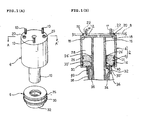
- FIGS. 1(A) and 1 (B) show one embodiment of an upper mount of the present invention.
- FIG. 1(A) is an exploded perspective view.
- FIG. 1(B) is a longitudinal sectional view taken along a line A-A' in FIG. 1(A)
- FIG. 2 is a view showing a hydraulic mechanism as a fluid pressure mechanism that supplies the upper mount with oil as a fluid.
- the upper mount which is composed of a body-side member 4 and a suspension-side member 6, is denoted by 2.
- the body-side member 4 is fixed to a body 8.
- the body-side member 4 has an outer tube portion 14 and an inner tube portion 16.
- the outer tube portion 14 protrudes vertically downwards from a peripheral edge of a disc portion 12 as the upper face of the body-side member 4.
- the inner tube portion 16 is formed inside the outer tube portion 14, protruding concentrically therewith and vertically downwards from a face of the disc portion 12.
- the disc portion 12 is provided with two oil passage holes (which correspond to fluid passage holes in the claims) 18 communicating with a space between the outer tube portion 14 and the inner tube portion 16.
- Each of pipe couplers for fixing pipes 22 communicating with the oil passage holes 18 is denoted by 20.
- the suspension-side member 6 is doughnut-shaped and thus advantageous in being reduced in thickness and being coupled to a spring.
- An outer diameter of the suspension-side member 6 is slightly smaller than an inner diameter of the outer tube portion 14 of the body-side member 4, and an inner diameter of the suspension-side member 6 is slightly larger than an outer diameter of the inner tube portion 16.
- the suspension-side member 6 is slidably fitted in a region between the outer tube portion 14 and the inner tube portion 16.
- Airtightness maintaining ring-shaped packing materials (O-rings) which are provided respectively on an outer peripheral face and an inner peripheral face of the suspension-side member 6 and serve to maintain airtightness in a sealed space 28 formed between the suspension-side member 6 and the body-side member 4, are denoted by 26, 26'.
- Waste entry preventing ring-shaped packing materials which are provided slightly lower than the airtightness maintaining ring-shaped packing materials 26, 26' on the outer and inner peripheral faces of the suspension-side member 6 and serve to prevent waste from entering the sealed space 28 from the outside, are denoted by 30, 30'.
- a suspension mounting tube provided cylindrically on a lower face of the suspension-side member 6 is denoted by 32.
- the suspension mounting tube 32 has a diameter that is larger than the outer diameter of the inner tube portion 16 of the suspension-side member 6 by an appropriate value.
- a suspension mounting thread 34 is formed on an inner peripheral face of the suspension mounting tube 32.
- a stopper for the suspension-side member 6 is denoted by 36.
- This stopper which is intended to ensure sliding movements of the suspension-side member 6 between the outer tube portion 14 and the inner tube portion 16 of the body-side member 4, is fixed on the inner tube portion 16 at a position barely inside the space 28 and defines a moving stroke of the suspension-side member 6 as a predetermined distance.
- the suspension-side member 6 is movable between a position where its upper face is in contact with the disc portion 12 of the body-side member 4 and a position where its lower face is engaged with the stopper 36.
- This moving stroke is set in advance to, for example, 10 cm.
- This moving stroke directly represents a range allowing to change the height of a vehicle (vehicle height changing range).
- a tubular mounting portion forming an upper end portion of a suspension (not shown) is denoted by 38.
- a mounted screw 40 which is screwed into the suspension mounting thread groove 34 in the inner peripheral face of the suspension mounting tube 32, is formed on an upper outer peripheral face of the mounting portion 38.
- the suspension By screwing the screw 40 into the thread 34, the suspension (not shown) is fixed to the suspension-side member 6 of the upper mount 2. It is not absolutely necessary to fix the suspension to the suspension-side member 6 of the upper mount 2 in this manner. Any means is employable as long as it is high in strength and slack-free.
- the suspension fixed to the suspension-side member 6 of the upper mount 2 may be of any type, no concrete example thereof is mentioned above.
- the suspension of the type shown in FIG. 3 may be used.
- the upper mount 2 shown in FIG. 1 is used instead of an upper mount a.
- the suspension-side member 6 has a doughnut-like contour and the inner tube portion 16 of the body-side member 4 is slidably fitted in a center hole of the suspension-side member 6.
- this construction is not indispensable.
- the suspension-side member may assume, for example, a disc-like shape instead of a doughnut-like shape and be slidably mounted in a state of being fitted in the tubular body-side member.
- the suspension-side member 6 may be made of a metal with a thickness of, for example, several millimeters and assume a doughnut-like shape when viewed from above, but be so formed as to have an inner tube portion and an outer tube portion as is the case with the inner tube portion 16 and the outer tube portion 14 of the body-side member 4.
- an upper end portion of a coil spring of a suspension may be fitted between the inner tube portion and the outer tube portion.
- the suspension-side member 6 may assume various forms.
- a power steering drive mechanism as a hydraulic mechanism for steering drive is employed as the hydraulic mechanism.
- a power steering tank in which hydraulic oil is stored, is denoted by 50.
- a power steering pump which supplies a steering mechanism (not shown) with oil from the tank 50 by applying a required pressure, is denoted by 52.
- Pipes connecting the steering mechanism and the pump 52 together are denoted by 54, 56.
- a pipe branching off from one of the pipes 54, 56, namely, the pipe 54 is denoted by 58.
- a leading end of the pipe 58 is so fixed to the pipe coupler 20 as to communicate with one of the oil passage holes 18 of the upper mount 2.
- the pipe 58 serves as a passage for supplying oil from the power steering pump 52 to the upper mount 2.
- An electromagnetic valve mounted to the pipe 58 is denoted by 60.
- the electromagnetic valve 60 can be controlled to be opened and closed by a switch (not shown) that is provided at an operable position in, for example, a driver seat.
- the pipe 62 serves as a passage for causing oil in the sealed space 28 of the upper mount 2 to flow backward to the power steering pump 52.
- the power steering hydraulic mechanism is utilized as a fluid pressure mechanism for supplying the sealed space 28 with oil as a fluid.
- Another hydraulic mechanism may be utilized instead or provided independently from the power steering hydraulic mechanism.
- a fluid pressure mechanism utilizing air as a fluid instead of oil may be employed.
- the electromagnetic valve 60 When the vehicle is in the normal state, the electromagnetic valve 60 is kept closed. In this state, no oil is supplied from the power steering pump 52 to the upper mount 2, and the weight of the vehicle (the weight of the body side) is applied to the suspension-side member 6 via the body-side member 4 of the upper mount 2. Thus, due to the weight, oil in the sealed space 28 of the upper mount 2 has been discharged to the pump 52 through the pipe 62. Therefore, there is no sealed space 28 (whose volume is substantially 0) and the disc portion 12 of the body-side member 4 is in contact with the suspension-side member 6. In this state, the vehicle height is at its minimum. For instance, the height of the vehicle above the ground is at its minimum.
- the vehicle runs on a road whose road surface is not or hardly bumpy or stepped, for example, on an expressway or a highway.
- the degree of deterioration in the sealed-state maintaining portion is lower than that of an air suspension type or an oil suspension type, and prolongation of life is made possible.
- the vehicle height is increased.
- the electromagnetic valve 60 is opened, oil is supplied, owing to a pressure acting against the weight of the vehicle, from the power steering pump 52 into the sealed space 28 of the upper mount 2 through the pipes 54, 58. Consequently, the sealed space 28 is enlarged, the spacing between the disc portion 12 of the body-side member 4 of the upper mount 2 and the suspension-side member 6 is widened, and the vehicle height is increased. This operation of increasing the vehicle height is stopped when the suspension-side member 6 is engaged with the stopper 36.
- the vehicle height is increased by a stroke of the suspension-side member 6. If the stroke is 10 cm for example, the vehicle height is 10 cm higher than a vehicle height at the time when the vehicle is in the lowdown state (a minimum height above the ground).
- the vehicle height is increased by opening the electromagnetic valve 60 in advance, whereby it is possible to prevent the vehicle body from encountering a trouble of scratching the road surface.
- the vehicle height is reduced as described in (1) by closing the electromagnetic valve 60 through an operation of the switch.
- the present invention described above makes it possible to provide an upper mount that utilizes an existing fluid pressure device (e.g., a power steering hydraulic device) without using a dedicated fluid pressure mechanism such as an air device, a hydraulic device, or the like, and that allows a vehicle height to be increased or reduced at any time without affecting suspension performance at all.
- an existing fluid pressure device e.g., a power steering hydraulic device
- a dedicated fluid pressure mechanism such as an air device, a hydraulic device, or the like
Landscapes
- Engineering & Computer Science (AREA)
- Mechanical Engineering (AREA)
- Vehicle Body Suspensions (AREA)
Abstract
An upper mount (2) with which a vehicle height can be increased
and reduced at any time using a vehicle-mounted existing fluid device
(hydraulic device, for example) without using a dedicated fluid
pressure mechanism such as a pneumatic device and without affecting
suspension performance at all. The upper mount (2) is composed of
a body-side member (4) fixed to a body (8) and a suspension-side
member (6) fixed to (an upper end portion (38) of) a suspension.
The suspension-side member (6) is slidably installed to the body-side
member (4) with a sealed space (28) formed between both members.
Fluid passage holes (oil passage holes) (18, 18) are made in the
body-side member (4) from the outside. When fluid is supplied to
the sealed space (28), the spacing between the suspension-side member
(6) and the body-side member (4) is widened and a vehicle height
can be increased.
Description
The present invention relates to an upper mount (including
the concept of an upper sheet) interposed between a body and a
suspension of a vehicle, and more particularly to a novel upper
mount with which a vehicle height can be adjusted through a simple
operation in the vehicle using a pressure of a fluid such as oil
and air.
Although only about a century has passed since vehicles came
to the world, their performances have undergone striking
developments in the meantime. For instance, the development of
engine performance is remarkable. Thus, in spite of the fact that
vehicles in early days ran at several dozen km/h, even average
passenger cars can nowadays run at 150 to 180 km/h.
However, it is not only engines that have developed. Other
respective vehicular parts have also undergone marked developments.
In particular, suspension performance has also undergone marked
developments. This is because there is a demand to maintain high
stability (running stability) despite speedup resulting from
improvements in engine performance, and enhancement of suspension
performance is required to meet that demand.
In other words, although a vehicle can move at a high speed
with respect to a road surface, its tires are in contact with the
road surface after all no matter how fast the vehicle is intended
to move. To ensure running stability, namely, to maintain high
stability, it is necessary to interpose suspensions between a body
and the tires that are in direct contact with the road surface so
that impacts received by the tires from the road surface can be
absorbed by the suspensions, to keep the body stable while restraining
the impacts to the utmost from being transmitted to the side of
the body, and to improve suspension performance as well in accordance
with improvements in engine performance.
Therefore, vehicles sold by auto manufacturers are superior
not only in engine performance but also in suspension performance
and exhibit high stability.
Incidentally, quite a few car enthusiasts do what is called
lowdown, whichmeans enhancing stylishness (dressing up) by reducing
a vehicle height as is the case with racing cars. According to the
law as well, it is acceptable to reduce the vehicle height to some
extent. Therefore, various forms of lowdown measures have been taken,
including making appropriate improvements on vehicular suspensions
sold by auto manufacturers and exchanging suspensions. These
measures can be taken because respective auto manufacturers and
automotive parts suppliers are actively engaged in the production
and distribution of lowdown parts. Further, some suspensions
mounted to vehicles are endowed themselves with a vehicle height
adjusting function.
FIG. 3 separately shows, as to one conventional example of
such a suspension, an upper mount mounted to an uppermost portion
of the suspension. Referring to FIG. 3, the upper mount, which is
mounted to the uppermost portion of the suspension and serves to
fix the suspension to a body h, is denoted by a.
Respective portions of the suspension are denoted by b to g.
A bump rubber is denoted by b. Although bottom strike tends to occur
when a later-described shock absorber fully contracts, the bump
rubber b serves to soften an impact caused at that moment. A helper
spring, which is used accessorily to adjust a spring rate, namely,
as a subsidiary spring for a later-described spring, is denoted
by c. A spring, which absorbs an impact received by a tire from
a road surface, is denoted by d. A shock absorber, which serves
to quickly control an oscillation resulting from a reaction caused
at the moment when the spring d absorbs an impact, is denoted by
e.
A spring seat is denoted by f and referred to also as a lower
seat. In the case of, for example, a suspension of a screw-driven
vehicle height adjusting type, the spring seat can be increased
or reduced in height by being screwed, unscrewed, or the like. More
specifically, the vehicle height can be reduced (subjected to
lowdown) as the spring seat f is raised. A shell case is denoted
by g. Although bottom strike tends to occur when the shock absorber
fully contracts, the shell case g serves to soften an impact caused
at that moment. The body is denoted by h.
In the case of the suspension of the screw-drivenvehicle height
adjusting type, the shock absorber and the spring may be integrated
with each other (as shown in FIG. 3) or separated from each other.
The suspension may be of various types including an air cushion
type and an air suspension type.
Especially in these days, suspensions of the air suspension
type have been drawing attention as those adapted for lowdown. The
suspensions of the air suspension type are classified into those
of an air bag type and those of a composite type. There are suspensions
of an oil suspension type as well.
By the way, all the conventional suspensions endowed with the
vehicle height adjusting function have unignorable drawbacks.
First of all, in the case of suspensions of the screw-driven vehicle
height adjusting type as shown in FIG. 3 and those of the air cushion
type, the adjustment of a vehicle height requires opening a hood
or removing tires, and a driver cannot increase or reduce the vehicle
height while remaining in a driver seat.
Thus, there is a drawback in that once a vehicle has undergone
lowdown, it must remain in that state wherever it goes. The present
law permits performing lowdown to a certain height. This guarantees
safety in traveling on highways and the like. However, a body of
the vehicle may scratch a road surface or the like when the vehicle
passes a greatly stepped spot while traveling on an open road, being
put into a garage, dropping in at a filling station to be refueled,
or the like.
Accordingly, the suspensions of the screw-driven vehicle
height adjusting type and the air cushion type have a drawback in
that the vehicle body may unavoidably scratch a road surface or
the like.
On the other hand, in the case of those of the air suspension
type or the oil suspension type, the vehicle height can be reduced
or increased at any desired time by, for example, adjusting air
or the like to be supplied to suspensions such as air bags using
a dedicated device (air device), which is composed of an air tank,
an air compressor, an air controller, and the like, or a dedicated
device (hydraulic device), which is composed of an oil tank, an
oil compressor, an oil controller, and the like. Thus, these
suspensions make it possible to reduce the vehicle height in traveling
on a highway or the like, and to increase the vehicle height in
a situation where the vehicle body is assumed to scratch a road
surface or the like, for example, when the vehicle enters an open
road, is being put into a garage, or drops in at a filling station
to be refueled, and can therefore be regarded as being considerably
superior.
However, each of those of the air suspension type requires,
in addition to a suspension such as an air bag or the like, a dedicated
device composed of an air tank, an air compressor, an air controller,
and the like, and each of those of the oil suspension type requires,
in addition to a suspension, a dedicated device (hydraulic device)
composed of an oil tank, an oil compressor, an oil controller, and
the like. Thus, they have an unignorable drawback in considerable
expensiveness.
Furthermore, an air pressure or an oil pressure is constantly
applied to each of the existing suspensions of the air suspension
type and the oil suspension type. In quite a few cases, therefore,
an O-ring or the like falls off. Accordingly, air in, for example,
an air bag or the like leaks out, and the suspension is crushed.
When the suspension is thus crushed, the vehicle height is thereby
reduced further as a matter of course. Especially in the case where
the suspension is of a springless type, the vehicle height may be
reduced until the body scratches a road surface. If this sort of
trouble happens while a vehicle is traveling at a high speed on
an expressway or the like, it follows not only that the vehicle
brings about an accident but also that many other vehicles may be
involved in the accident to cause a major catastrophe.
As described hitherto, the conventional lowdown art is
generally structured to adjust a vehicle height by changing a length
of the suspension, and the length of the suspension changes due
to a change in the vehicle height, which affects the state or
characteristic of the suspension. Therefore, in order to maintain
high stability (running stability) after lowdown as well, it is
not sufficient to use a suspension adapted for lowdown. Other
suspension-related mechanisms, parts, and the like to be used, for
example, mechanisms, parts, and the like for fixing the suspension
to tires, must also be adapted for lowdown. This also constitutes
a factor in an increased lowdown cost.
It is therefore an object of the present invention to provide
an upper mount that utilizes an on-vehicle fluid pressure device
(e.g., a hydraulic device) without using a dedicated fluid pressure
mechanism such as an air device, a hydraulic device, or the like,
and that allows a vehicle height to be increased or reduced at any
time without affecting suspension performance at all.
To attain the above object, an upper mount of claim 1 including
a body-side member fixed to a body and a suspension-side member
fixed to a suspension is characterized in: that the suspension-side
member is formed slidably mounted to the body-side member with a
sealed space formed between the suspension-side member and the
body-side member; that the body-side member is provided with a fluid
passage hole for supplying a fluid to the sealed space from outside
and another fluid passage hole for discharging the fluid from the
sealed space; and that a spacing from the body-side member to the
suspension-side member is widened by supplying the fluid to the
sealed space so that a vehicle height can be increased.
Thus, according to the upper mount of claim 1 described above,
when the spacing between the body-side member and the suspension-side
member of the upper mount is widened by supplying a fluid (e.g.,
oil) into the sealed space from the fluid passage hole against the
weight of the body side, the vehicle height can be increased by
an amount corresponding to the increase in width.
When the fluid is stopped frombeing supplied against the weight
of the body side, the fluid in the sealed space is discharged from
the sealed space to the outside through the fluid passage hole due
to the weight of the body side, and the spacing from the body-side
member to the suspension-side member is reduced. Consequently, it
is possible to reduce a vehicle height, that is, to realize a lowdown
state.
In a normal lowdown state, there is no fluid (e.g., oil) in
the sealed space, and no fluid pressure is applied to the
suspension-side member and the body-side member. Accordingly, a
degree of deterioration caused in a sealed- state maintaining portion
(e.g., an O-ring or the like) through constant application of a
pressure can be drastically reduced in comparison with a suspension
of an air suspension type to which a pressure is continuously applied
in the normal state, or the like. As a result, prolongation of life
is made possible. Thus, the degree of deterioration is lower than
that of the suspension of the air suspension type, and prolongation
of life is made possible.
Moreover, when the fluid is supplied to the upper mount
according to the present invention, it is supplied simply to the
sealed space between the body-side member and the suspension-side
member. Therefore, no influence is exerted on the performance and
characteristic intrinsic to the suspension to be mounted. Thus,
the present invention is suitable for any type of suspension. There
is no possibility that running stability decreases due to lowdown,
and there is no need to change the characteristic or performance
of the suspension or replace relevant mechanisms including a
mechanism for mounting the suspension to tires. This also
constitutes a factor in a reduced lowdown cost.
In the upper mount according to claim 1, the upper mount of
claim 2 is characterized in having a stopper for limiting a spacing
from the body-side member to the suspension-side member to a certain
value.
Thus, according to the upper mount of claim 2, the spacing
from the body-side member to the suspension-side member can be limited
to the certain value by the stopper. Therefore, the change range
of a vehicle height (stroke) can be defined as a predetermined length.
In the upper mount according to claim 1 or 2, the upper mount
of claim 3 is characterized in that the fluid is supplied to the
sealed space from a pump of a fluid pressure mechanism built in
the vehicle through the fluid passage hole via a fluid pipe having
an electromagnetic valve, and in that the fluid in the sealed space
is caused to flow backward to the pump from the fluid passage hole
through the fluid pipe.
Thus, according to the upper mount of claim 3, the vehicle
height can be adjusted by operating the electromagnetic valve
utilizing the fluid pressure mechanism built in the vehicle, and
no dedicated fluid pressure mechanism for vehicle height adjustment
is required.
Therefore, the price required in carrying out lowdown while
enabling vehicle height adjustment can be remarkably reduced in
comparison with the case of an air suspension or an oil suspension.
The following description will be made based on an embodiment
illustrating the details of the present invention. FIGS. 1(A) and
1 (B) show one embodiment of an upper mount of the present invention.
FIG. 1(A) is an exploded perspective view. FIG. 1(B) is a
longitudinal sectional view taken along a line A-A' in FIG. 1(A)
FIG. 2 is a view showing a hydraulic mechanism as a fluid pressure
mechanism that supplies the upper mount with oil as a fluid.
First, the embodiment of the upper mount of the present
invention will be described with reference to FIGS. 1(A) and 1(B) .
The upper mount, which is composed of a body-side member 4
and a suspension-side member 6, is denoted by 2. The body-side member
4 is fixed to a body 8. A plurality of screws, which are so fixed
to the body-side member 4 as to be protruded vertically from its
upper face in order to fix the body-side member 4 to the body 8,
are denoted by 10, 10.
The body-side member 4 has an outer tube portion 14 and an
inner tube portion 16. The outer tube portion 14 protrudes vertically
downwards from a peripheral edge of a disc portion 12 as the upper
face of the body-side member 4. The inner tube portion 16 is formed
inside the outer tube portion 14, protruding concentrically
therewith and vertically downwards from a face of the disc portion
12. The disc portion 12 is provided with two oil passage holes (which
correspond to fluid passage holes in the claims) 18 communicating
with a space between the outer tube portion 14 and the inner tube
portion 16. Each of pipe couplers for fixing pipes 22 communicating
with the oil passage holes 18 is denoted by 20.
The suspension-side member 6 is doughnut-shaped and thus
advantageous in being reduced in thickness and being coupled to
a spring. An outer diameter of the suspension-side member 6 is
slightly smaller than an inner diameter of the outer tube portion
14 of the body-side member 4, and an inner diameter of the
suspension-side member 6 is slightly larger than an outer diameter
of the inner tube portion 16. The suspension-side member 6 is
slidably fitted in a region between the outer tube portion 14 and
the inner tube portion 16. Airtightness maintaining ring-shaped
packing materials (O-rings), which are provided respectively on
an outer peripheral face and an inner peripheral face of the
suspension-side member 6 and serve to maintain airtightness in a
sealed space 28 formed between the suspension-side member 6 and
the body-side member 4, are denoted by 26, 26'. Waste entry
preventing ring-shaped packing materials (O-rings), which are
provided slightly lower than the airtightness maintaining
ring-shaped packing materials 26, 26' on the outer and inner
peripheral faces of the suspension-side member 6 and serve to prevent
waste from entering the sealed space 28 from the outside, are denoted
by 30, 30'.
A suspension mounting tube provided cylindrically on a lower
face of the suspension-side member 6 is denoted by 32. The suspension
mounting tube 32 has a diameter that is larger than the outer diameter
of the inner tube portion 16 of the suspension-side member 6 by
an appropriate value. A suspension mounting thread 34 is formed
on an inner peripheral face of the suspension mounting tube 32.
A stopper for the suspension-side member 6 is denoted by 36.
This stopper, which is intended to ensure sliding movements of the
suspension-side member 6 between the outer tube portion 14 and the
inner tube portion 16 of the body-side member 4, is fixed on the
inner tube portion 16 at a position barely inside the space 28 and
defines a moving stroke of the suspension-side member 6 as a
predetermined distance. Thus, the suspension-side member 6 is
movable between a position where its upper face is in contact with
the disc portion 12 of the body-side member 4 and a position where
its lower face is engaged with the stopper 36. This moving stroke
is set in advance to, for example, 10 cm. This moving stroke directly
represents a range allowing to change the height of a vehicle (vehicle
height changing range).
A tubular mounting portion forming an upper end portion of
a suspension (not shown) is denoted by 38. A mounted screw 40, which
is screwed into the suspension mounting thread groove 34 in the
inner peripheral face of the suspension mounting tube 32, is formed
on an upper outer peripheral face of the mounting portion 38. By
screwing the screw 40 into the thread 34, the suspension (not shown)
is fixed to the suspension-side member 6 of the upper mount 2. It
is not absolutely necessary to fix the suspension to the
suspension-side member 6 of the upper mount 2 in this manner. Any
means is employable as long as it is high in strength and slack-free.
Since the suspension fixed to the suspension-side member 6
of the upper mount 2 may be of any type, no concrete example thereof
is mentioned above. For example, the suspension of the type shown
in FIG. 3 may be used. Needless to say, however, the upper mount
2 shown in FIG. 1 is used instead of an upper mount a.
In this embodiment, the suspension-side member 6 has a
doughnut-like contour and the inner tube portion 16 of the body-side
member 4 is slidably fitted in a center hole of the suspension-side
member 6. However, this construction is not indispensable. For
example, the suspension-side member may assume, for example, a
disc-like shape instead of a doughnut-like shape and be slidably
mounted in a state of being fitted in the tubular body-side member.
Furthermore, the suspension-side member 6 may be made of a
metal with a thickness of, for example, several millimeters and
assume a doughnut-like shape when viewed from above, but be so formed
as to have an inner tube portion and an outer tube portion as is
the case with the inner tube portion 16 and the outer tube portion
14 of the body-side member 4. In this case, an upper end portion
of a coil spring of a suspension may be fitted between the inner
tube portion and the outer tube portion. In this manner, the
suspension-side member 6 may assume various forms.
Next, the hydraulic mechanism will be described with reference
to FIG. 2. In this embodiment, a power steering drive mechanism
as a hydraulic mechanism for steering drive is employed as the
hydraulic mechanism. A power steering tank, in which hydraulic oil
is stored, is denoted by 50. A power steering pump, which supplies
a steering mechanism (not shown) with oil from the tank 50 by applying
a required pressure, is denoted by 52. Pipes connecting the steering
mechanism and the pump 52 together are denoted by 54, 56. A pipe
branching off from one of the pipes 54, 56, namely, the pipe 54
is denoted by 58. A leading end of the pipe 58 is so fixed to the
pipe coupler 20 as to communicate with one of the oil passage holes
18 of the upper mount 2. The pipe 58 serves as a passage for supplying
oil from the power steering pump 52 to the upper mount 2.
An electromagnetic valve mounted to the pipe 58 is denoted
by 60. The electromagnetic valve 60 can be controlled to be opened
and closed by a switch (not shown) that is provided at an operable
position in, for example, a driver seat. A pipe, which is so fixed
at one end thereof to the pipe coupler 20 as to communicate with
the other oil passage hole 18 of the upper mount 2 and is connected
at the other end thereof to the power steering pump 52, is denoted
by 62. The pipe 62 serves as a passage for causing oil in the sealed
space 28 of the upper mount 2 to flow backward to the power steering
pump 52.
In this embodiment, the power steering hydraulic mechanism
is utilized as a fluid pressure mechanism for supplying the sealed
space 28 with oil as a fluid. However, this is not obligatory.
Another hydraulic mechanism may be utilized instead or provided
independently from the power steering hydraulic mechanism.
Alternatively, a fluid pressure mechanism utilizing air as a fluid
instead of oil may be employed.
Next, an operation of the upper mount 2 will be described.
When the vehicle is in the normal state, the electromagnetic
valve 60 is kept closed. In this state, no oil is supplied from
the power steering pump 52 to the upper mount 2, and the weight
of the vehicle (the weight of the body side) is applied to the
suspension-side member 6 via the body-side member 4 of the upper
mount 2. Thus, due to the weight, oil in the sealed space 28 of
the upper mount 2 has been discharged to the pump 52 through the
pipe 62. Therefore, there is no sealed space 28 (whose volume is
substantially 0) and the disc portion 12 of the body-side member
4 is in contact with the suspension-side member 6. In this state,
the vehicle height is at its minimum. For instance, the height of
the vehicle above the ground is at its minimum.
In this normal state, the vehicle runs on a road whose road
surface is not or hardly bumpy or stepped, for example, on an
expressway or a highway.
As described above, when the vehicle is in the normal lowdown
state, there is no fluid (e.g., oil) in the sealed space, and no
fluid pressure is applied to the suspension-side member or the
body-side member of the upper mount 2. Accordingly, a degree of
deterioration caused in a sealed-state maintaining portion (e.g.,
an O-ring or the like) through constant application of a pressure
can be drastically reduced in comparison with a case where a pressure
is continuously applied in the normal state. As a result,
prolongation of life is made possible.
Thus, the degree of deterioration in the sealed-state
maintaining portion is lower than that of an air suspension type
or an oil suspension type, and prolongation of life is made possible.
When the electromagnetic valve 60 is opened by operating the
switch, the vehicle height is increased. In other words, when the
electromagnetic valve 60 is opened, oil is supplied, owing to a
pressure acting against the weight of the vehicle, from the power
steering pump 52 into the sealed space 28 of the upper mount 2 through
the pipes 54, 58. Consequently, the sealed space 28 is enlarged,
the spacing between the disc portion 12 of the body-side member
4 of the upper mount 2 and the suspension-side member 6 is widened,
and the vehicle height is increased. This operation of increasing
the vehicle height is stopped when the suspension-side member 6
is engaged with the stopper 36.
Through this operation, the vehicle height is increased by
a stroke of the suspension-side member 6. If the stroke is 10 cm
for example, the vehicle height is 10 cm higher than a vehicle height
at the time when the vehicle is in the lowdown state (a minimum
height above the ground).
Thus, when the vehicle is about to run on a road having
considerably bumpy or greatly stepped road surface or when the vehicle
must pass through a considerably bumpy or greatly stepped spot to
be refueled at a filling station, to be parked in a parking lot
or the like, or to be put into a garage, the vehicle height is increased
by opening the electromagnetic valve 60 in advance, whereby it is
possible to prevent the vehicle body from encountering a trouble
of scratching the road surface.
In returning the vehicle to the normal state, the vehicle height
is reduced as described in (1) by closing the electromagnetic valve
60 through an operation of the switch.
The present invention described above makes it possible to
provide an upper mount that utilizes an existing fluid pressure
device (e.g., a power steering hydraulic device) without using a
dedicated fluid pressure mechanism such as an air device, a hydraulic
device, or the like, and that allows a vehicle height to be increased
or reduced at any time without affecting suspension performance
at all.
Claims (3)
- An upper mount comprising a body-side member fixed to a body and a suspension-side member fixed to a suspension, characterized in that:the suspension-side member is formed in a doughnut-like shape and slidably mounted to the body-side member with a sealed space formed between the suspension-side member and the body-side member;the body-side member is provided with at least one fluidpassage hole for supplying a fluid to the sealed space from outside and at least another fluid passage hole for discharging the fluid from the sealed space; anda spacing of the sealed space of the suspension-side member is made changeable by supplying the fluid to the sealed space.
- An upper mount according to claim 1, characterized in that a stopper that makes the spacing of the sealed space constant is provided on the body-side member.
- An upper mount according to claim 1 or 2, characterized in that the fluid is supplied to the sealed space from a fluid pressure mechanism provided in a vehicle through the one fluid passage hole via a fluid pipe due to a pump operation performed by opening an electromagnetic valve, and in that the fluid in the sealed space is caused to flow backward to the fluid pressure mechanism from the another fluid passage hole by closing the electromagnetic valve.
Applications Claiming Priority (3)
| Application Number | Priority Date | Filing Date | Title |
|---|---|---|---|
| JP2002348105 | 2002-11-29 | ||
| JP2002348105A JP2004181995A (en) | 2002-11-29 | 2002-11-29 | Upper mount |
| PCT/JP2003/015340 WO2004050396A1 (en) | 2002-11-29 | 2003-12-01 | Upper mount |
Publications (2)
| Publication Number | Publication Date |
|---|---|
| EP1580045A1 true EP1580045A1 (en) | 2005-09-28 |
| EP1580045A4 EP1580045A4 (en) | 2006-08-30 |
Family
ID=32462902
Family Applications (1)
| Application Number | Title | Priority Date | Filing Date |
|---|---|---|---|
| EP03812360A Withdrawn EP1580045A4 (en) | 2002-11-29 | 2003-12-01 | Upper mount |
Country Status (7)
| Country | Link |
|---|---|
| US (1) | US20060012137A1 (en) |
| EP (1) | EP1580045A4 (en) |
| JP (1) | JP2004181995A (en) |
| KR (1) | KR20050085205A (en) |
| CN (1) | CN1717341A (en) |
| AU (1) | AU2003302655A1 (en) |
| WO (1) | WO2004050396A1 (en) |
Cited By (2)
| Publication number | Priority date | Publication date | Assignee | Title |
|---|---|---|---|---|
| EP1864836A3 (en) * | 2006-06-08 | 2008-01-09 | Audi Ag | Device for height adjustment of the superstructure of motor vehicles |
| EP2119580A1 (en) * | 2008-05-15 | 2009-11-18 | Paioli S.p.A. | Shock absorber for vehicles, particularly for motorcycle-like vehicles and the like |
Families Citing this family (9)
| Publication number | Priority date | Publication date | Assignee | Title |
|---|---|---|---|---|
| US7857325B2 (en) * | 2005-12-16 | 2010-12-28 | Srats, Inc. | Adjustable-height suspension system |
| DE102007048784B3 (en) * | 2007-10-10 | 2009-04-23 | Zf Friedrichshafen Ag | Strut mounts |
| JP2011031824A (en) * | 2009-08-05 | 2011-02-17 | Atsushi Sakamoto | Vehicle height adjusting device |
| US9180747B2 (en) * | 2013-10-14 | 2015-11-10 | Agco Corporation | System and method of adjusting the chassis height of a machine |
| US9296273B2 (en) | 2013-10-14 | 2016-03-29 | Agco Corporation | Machine suspension and height adjustment |
| CA2875251A1 (en) * | 2013-12-18 | 2015-06-18 | Dallas Smith Corp. | Suspension for a multiple height vehicle |
| JP6358217B2 (en) * | 2015-09-29 | 2018-07-18 | コニカミノルタ株式会社 | Image forming system and image forming apparatus |
| CN206141253U (en) * | 2016-09-21 | 2017-05-03 | 比亚迪股份有限公司 | Car connection seat and suspension |
| FR3061087B1 (en) * | 2016-12-28 | 2019-08-09 | Renault S.A.S | HYDRAULIC FLOAT CONTROL DEVICE FOR MOTOR VEHICLE AND SUSPENSION AND DAMPING SYSTEM COMPRISING SUCH A DEVICE |
Family Cites Families (24)
| Publication number | Priority date | Publication date | Assignee | Title |
|---|---|---|---|---|
| US3123349A (en) * | 1964-03-03 | Hydraulic leveling device with integrated automatic control | ||
| US2965391A (en) * | 1958-12-11 | 1960-12-20 | Gen Motors Corp | Two-position air suspension control valve |
| US3000400A (en) * | 1959-02-27 | 1961-09-19 | Gen Motors Corp | Dual height leveling valve for vehicle air suspension |
| GB881114A (en) * | 1959-08-28 | 1961-11-01 | Dewandre Co Ltd C | Improvements in or relating to air suspension systems for vehicles |
| US3150867A (en) * | 1962-07-13 | 1964-09-29 | Gilbert H Droegkamp | Combination shock absorber and selflevelling device |
| NL137412C (en) * | 1964-09-24 | |||
| US3524657A (en) * | 1968-09-27 | 1970-08-18 | Gen Motors Corp | Vehicle suspension system including composite spring assembly |
| DE1901795A1 (en) * | 1969-01-15 | 1970-08-13 | Langen & Co | Suspension device for vehicles with automatic load balancing |
| US3599954A (en) * | 1969-10-08 | 1971-08-17 | Gen Motors Corp | Compound vacuum spring |
| JPS5465923A (en) * | 1977-11-07 | 1979-05-28 | Nissan Motor Co Ltd | Hydropneumatic suspension apparatus |
| JPS5830811A (en) * | 1981-07-13 | 1983-02-23 | Toyota Motor Corp | Vehicle suspension with car height adjuster |
| JPS58407A (en) * | 1981-09-14 | 1983-01-05 | Honda Motor Co Ltd | Rear wheel height adjustment and suspension system |
| JPS58136506A (en) * | 1982-02-09 | 1983-08-13 | Showa Mfg Co Ltd | vehicle height adjustment device |
| JPS58149814A (en) * | 1982-02-27 | 1983-09-06 | Nissan Motor Co Ltd | Car-height adjusting device |
| DE3223195A1 (en) * | 1982-06-22 | 1983-12-22 | Audi Nsu Auto Union Ag, 7107 Neckarsulm | Apparatus for adjusting the vertical position of the body of a motor vehicle |
| JPS6118912U (en) * | 1984-07-09 | 1986-02-03 | 富士重工業株式会社 | Automotive hydraulic vehicle height adjustment device |
| JPS61159208U (en) * | 1985-03-27 | 1986-10-02 | ||
| JPS6327738U (en) * | 1986-08-06 | 1988-02-23 | ||
| JPH0260736U (en) * | 1988-10-27 | 1990-05-07 | ||
| JPH0732835A (en) * | 1993-07-20 | 1995-02-03 | Showa:Kk | Vehicle height adjustment device |
| US5556082A (en) * | 1993-12-07 | 1996-09-17 | Showa Corporation | Cushion unit |
| JP3489647B2 (en) * | 1996-11-13 | 2004-01-26 | 日野自動車株式会社 | Vehicle height adjustment device |
| JP2003205722A (en) * | 2002-01-15 | 2003-07-22 | Masaaki Aoki | Car-height adjuster and automobile using the same |
| JP2003291620A (en) * | 2002-04-02 | 2003-10-15 | Masaaki Aoki | Car height adjusting device |
-
2002
- 2002-11-29 JP JP2002348105A patent/JP2004181995A/en active Pending
-
2003
- 2003-12-01 WO PCT/JP2003/015340 patent/WO2004050396A1/en not_active Ceased
- 2003-12-01 EP EP03812360A patent/EP1580045A4/en not_active Withdrawn
- 2003-12-01 CN CNA2003801042069A patent/CN1717341A/en active Pending
- 2003-12-01 AU AU2003302655A patent/AU2003302655A1/en not_active Abandoned
- 2003-12-01 KR KR1020057009699A patent/KR20050085205A/en not_active Withdrawn
- 2003-12-01 US US10/534,757 patent/US20060012137A1/en not_active Abandoned
Cited By (2)
| Publication number | Priority date | Publication date | Assignee | Title |
|---|---|---|---|---|
| EP1864836A3 (en) * | 2006-06-08 | 2008-01-09 | Audi Ag | Device for height adjustment of the superstructure of motor vehicles |
| EP2119580A1 (en) * | 2008-05-15 | 2009-11-18 | Paioli S.p.A. | Shock absorber for vehicles, particularly for motorcycle-like vehicles and the like |
Also Published As
| Publication number | Publication date |
|---|---|
| KR20050085205A (en) | 2005-08-29 |
| US20060012137A1 (en) | 2006-01-19 |
| AU2003302655A1 (en) | 2004-06-23 |
| WO2004050396A1 (en) | 2004-06-17 |
| CN1717341A (en) | 2006-01-04 |
| EP1580045A4 (en) | 2006-08-30 |
| JP2004181995A (en) | 2004-07-02 |
Similar Documents
| Publication | Publication Date | Title |
|---|---|---|
| EP1580045A1 (en) | Upper mount | |
| US20130313792A1 (en) | Shock absorber for vehicle | |
| US20170241504A1 (en) | Damping air spring with dynamically variable orifice | |
| CA2980741C (en) | Damping air spring and shock absorber combination for heavy-duty vehicle axle/suspension systems | |
| US20020038929A1 (en) | Shock absorber | |
| CN108290469B (en) | Damping air spring with stepped openings | |
| US20200039310A1 (en) | Damping air spring with variable piston volume | |
| WO2012033990A1 (en) | Air spring for a heavy-duty vehicle with damping features | |
| MX2015001762A (en) | Cylinder shock assembly. | |
| WO2019222447A1 (en) | Damping air spring with substantially fixed volume | |
| US20190337349A1 (en) | Pneumatic control system for vehicles and other loaded structures | |
| CN102056755A (en) | Adjustable height suspension system | |
| US6988577B2 (en) | Safety arrangement for a motor vehicle | |
| US10843520B2 (en) | Heavy-duty vehicle axle/suspension system with optimized damping | |
| US11897307B1 (en) | Trailer suspension | |
| US7334801B2 (en) | Automated vehicle suspension system | |
| US6988754B1 (en) | Vehicle bumper | |
| JP2001503702A (en) | Shock absorber for vehicle wheel suspension | |
| US6206154B1 (en) | Axle pivoting controller and hydraulic cylinder for industrial vehicles | |
| KR20020045826A (en) | Shock absorber for automobiles | |
| CN115107431B (en) | Suspension device and vehicle | |
| US20250198479A1 (en) | Valve seat for damper with externally mounted valve | |
| KR100461403B1 (en) | hydraulic drive tire | |
| Sainsbury | Air suspension for road vehicles | |
| KR20030033878A (en) | Shock absorber of vehicle |
Legal Events
| Date | Code | Title | Description |
|---|---|---|---|
| PUAI | Public reference made under article 153(3) epc to a published international application that has entered the european phase |
Free format text: ORIGINAL CODE: 0009012 |
|
| 17P | Request for examination filed |
Effective date: 20050615 |
|
| AK | Designated contracting states |
Kind code of ref document: A1 Designated state(s): AT BE BG CH CY CZ DE DK EE ES FI FR GB GR HU IE IT LI LU MC NL PT RO SE SI SK TR |
|
| AX | Request for extension of the european patent |
Extension state: AL LT LV MK |
|
| DAX | Request for extension of the european patent (deleted) | ||
| A4 | Supplementary search report drawn up and despatched |
Effective date: 20060731 |
|
| 17Q | First examination report despatched |
Effective date: 20080611 |
|
| STAA | Information on the status of an ep patent application or granted ep patent |
Free format text: STATUS: THE APPLICATION IS DEEMED TO BE WITHDRAWN |
|
| 18D | Application deemed to be withdrawn |
Effective date: 20080701 |