EP1580037A1 - Pneumatic radial tire - Google Patents
Pneumatic radial tire Download PDFInfo
- Publication number
- EP1580037A1 EP1580037A1 EP05002804A EP05002804A EP1580037A1 EP 1580037 A1 EP1580037 A1 EP 1580037A1 EP 05002804 A EP05002804 A EP 05002804A EP 05002804 A EP05002804 A EP 05002804A EP 1580037 A1 EP1580037 A1 EP 1580037A1
- Authority
- EP
- European Patent Office
- Prior art keywords
- weight
- tire
- parts
- pneumatic radial
- radial tire
- Prior art date
- Legal status (The legal status is an assumption and is not a legal conclusion. Google has not performed a legal analysis and makes no representation as to the accuracy of the status listed.)
- Granted
Links
- 229920001971 elastomer Polymers 0.000 claims abstract description 59
- 239000005060 rubber Substances 0.000 claims abstract description 59
- 239000000203 mixture Substances 0.000 claims abstract description 35
- 241000254043 Melolonthinae Species 0.000 claims abstract description 27
- 238000012856 packing Methods 0.000 claims description 17
- 238000005096 rolling process Methods 0.000 abstract description 22
- VYPSYNLAJGMNEJ-UHFFFAOYSA-N Silicium dioxide Chemical compound O=[Si]=O VYPSYNLAJGMNEJ-UHFFFAOYSA-N 0.000 description 27
- 239000011324 bead Substances 0.000 description 24
- 239000006229 carbon black Substances 0.000 description 18
- NINIDFKCEFEMDL-UHFFFAOYSA-N Sulfur Chemical compound [S] NINIDFKCEFEMDL-UHFFFAOYSA-N 0.000 description 15
- 229910052717 sulfur Inorganic materials 0.000 description 15
- 239000011593 sulfur Substances 0.000 description 15
- 230000007423 decrease Effects 0.000 description 14
- 239000000377 silicon dioxide Substances 0.000 description 13
- 238000004073 vulcanization Methods 0.000 description 10
- 238000012360 testing method Methods 0.000 description 9
- XLOMVQKBTHCTTD-UHFFFAOYSA-N Zinc monoxide Chemical compound [Zn]=O XLOMVQKBTHCTTD-UHFFFAOYSA-N 0.000 description 8
- 230000000052 comparative effect Effects 0.000 description 8
- 244000043261 Hevea brasiliensis Species 0.000 description 7
- 239000006087 Silane Coupling Agent Substances 0.000 description 7
- 229920003052 natural elastomer Polymers 0.000 description 7
- 229920001194 natural rubber Polymers 0.000 description 7
- 229920002857 polybutadiene Polymers 0.000 description 6
- 239000000126 substance Substances 0.000 description 5
- 235000021355 Stearic acid Nutrition 0.000 description 4
- 239000003963 antioxidant agent Substances 0.000 description 4
- 238000013329 compounding Methods 0.000 description 4
- 239000000945 filler Substances 0.000 description 4
- 238000000034 method Methods 0.000 description 4
- QIQXTHQIDYTFRH-UHFFFAOYSA-N octadecanoic acid Chemical compound CCCCCCCCCCCCCCCCCC(O)=O QIQXTHQIDYTFRH-UHFFFAOYSA-N 0.000 description 4
- OQCDKBAXFALNLD-UHFFFAOYSA-N octadecanoic acid Natural products CCCCCCCC(C)CCCCCCCCC(O)=O OQCDKBAXFALNLD-UHFFFAOYSA-N 0.000 description 4
- 239000008117 stearic acid Substances 0.000 description 4
- 239000011787 zinc oxide Substances 0.000 description 4
- 239000005062 Polybutadiene Substances 0.000 description 3
- 238000005299 abrasion Methods 0.000 description 3
- 230000003078 antioxidant effect Effects 0.000 description 3
- 239000010692 aromatic oil Substances 0.000 description 3
- 239000003795 chemical substances by application Substances 0.000 description 3
- 238000011156 evaluation Methods 0.000 description 3
- 239000000463 material Substances 0.000 description 3
- 238000000465 moulding Methods 0.000 description 3
- XAGFODPZIPBFFR-UHFFFAOYSA-N aluminium Chemical compound [Al] XAGFODPZIPBFFR-UHFFFAOYSA-N 0.000 description 2
- 229910052782 aluminium Inorganic materials 0.000 description 2
- 150000001875 compounds Chemical class 0.000 description 2
- 230000003247 decreasing effect Effects 0.000 description 2
- 238000004898 kneading Methods 0.000 description 2
- IUJLOAKJZQBENM-UHFFFAOYSA-N n-(1,3-benzothiazol-2-ylsulfanyl)-2-methylpropan-2-amine Chemical compound C1=CC=C2SC(SNC(C)(C)C)=NC2=C1 IUJLOAKJZQBENM-UHFFFAOYSA-N 0.000 description 2
- ZZMVLMVFYMGSMY-UHFFFAOYSA-N 4-n-(4-methylpentan-2-yl)-1-n-phenylbenzene-1,4-diamine Chemical compound C1=CC(NC(C)CC(C)C)=CC=C1NC1=CC=CC=C1 ZZMVLMVFYMGSMY-UHFFFAOYSA-N 0.000 description 1
- OKTJSMMVPCPJKN-UHFFFAOYSA-N Carbon Chemical compound [C] OKTJSMMVPCPJKN-UHFFFAOYSA-N 0.000 description 1
- 235000010678 Paulownia tomentosa Nutrition 0.000 description 1
- 240000002834 Paulownia tomentosa Species 0.000 description 1
- 239000004902 Softening Agent Substances 0.000 description 1
- 230000032683 aging Effects 0.000 description 1
- WNROFYMDJYEPJX-UHFFFAOYSA-K aluminium hydroxide Chemical compound [OH-].[OH-].[OH-].[Al+3] WNROFYMDJYEPJX-UHFFFAOYSA-K 0.000 description 1
- 230000008859 change Effects 0.000 description 1
- 230000006835 compression Effects 0.000 description 1
- 238000007906 compression Methods 0.000 description 1
- 239000007822 coupling agent Substances 0.000 description 1
- 238000006073 displacement reaction Methods 0.000 description 1
- 239000004744 fabric Substances 0.000 description 1
- 230000002349 favourable effect Effects 0.000 description 1
- 239000000446 fuel Substances 0.000 description 1
- 230000020169 heat generation Effects 0.000 description 1
- 230000001050 lubricating effect Effects 0.000 description 1
- 239000003921 oil Substances 0.000 description 1
- 238000011056 performance test Methods 0.000 description 1
- 229920001195 polyisoprene Polymers 0.000 description 1
- 239000010734 process oil Substances 0.000 description 1
- 238000012545 processing Methods 0.000 description 1
- 230000009467 reduction Effects 0.000 description 1
- 230000003014 reinforcing effect Effects 0.000 description 1
- 230000004044 response Effects 0.000 description 1
- 238000007790 scraping Methods 0.000 description 1
- 230000001953 sensory effect Effects 0.000 description 1
- 229920003048 styrene butadiene rubber Polymers 0.000 description 1
- 239000000454 talc Substances 0.000 description 1
- 229910052623 talc Inorganic materials 0.000 description 1
- 238000009864 tensile test Methods 0.000 description 1
- 239000012936 vulcanization activator Substances 0.000 description 1
- 229910052725 zinc Inorganic materials 0.000 description 1
Images

Classifications
-
- B—PERFORMING OPERATIONS; TRANSPORTING
- B60—VEHICLES IN GENERAL
- B60C—VEHICLE TYRES; TYRE INFLATION; TYRE CHANGING; CONNECTING VALVES TO INFLATABLE ELASTIC BODIES IN GENERAL; DEVICES OR ARRANGEMENTS RELATED TO TYRES
- B60C15/00—Tyre beads, e.g. ply turn-up or overlap
- B60C15/06—Flipper strips, fillers, or chafing strips and reinforcing layers for the construction of the bead
-
- B—PERFORMING OPERATIONS; TRANSPORTING
- B60—VEHICLES IN GENERAL
- B60C—VEHICLE TYRES; TYRE INFLATION; TYRE CHANGING; CONNECTING VALVES TO INFLATABLE ELASTIC BODIES IN GENERAL; DEVICES OR ARRANGEMENTS RELATED TO TYRES
- B60C15/00—Tyre beads, e.g. ply turn-up or overlap
- B60C15/06—Flipper strips, fillers, or chafing strips and reinforcing layers for the construction of the bead
- B60C15/0603—Flipper strips, fillers, or chafing strips and reinforcing layers for the construction of the bead characterised by features of the bead filler or apex
- B60C15/0607—Flipper strips, fillers, or chafing strips and reinforcing layers for the construction of the bead characterised by features of the bead filler or apex comprising several parts, e.g. made of different rubbers
-
- B—PERFORMING OPERATIONS; TRANSPORTING
- B60—VEHICLES IN GENERAL
- B60C—VEHICLE TYRES; TYRE INFLATION; TYRE CHANGING; CONNECTING VALVES TO INFLATABLE ELASTIC BODIES IN GENERAL; DEVICES OR ARRANGEMENTS RELATED TO TYRES
- B60C15/00—Tyre beads, e.g. ply turn-up or overlap
- B60C15/06—Flipper strips, fillers, or chafing strips and reinforcing layers for the construction of the bead
- B60C2015/0614—Flipper strips, fillers, or chafing strips and reinforcing layers for the construction of the bead characterised by features of the chafer or clinch portion, i.e. the part of the bead contacting the rim
-
- Y—GENERAL TAGGING OF NEW TECHNOLOGICAL DEVELOPMENTS; GENERAL TAGGING OF CROSS-SECTIONAL TECHNOLOGIES SPANNING OVER SEVERAL SECTIONS OF THE IPC; TECHNICAL SUBJECTS COVERED BY FORMER USPC CROSS-REFERENCE ART COLLECTIONS [XRACs] AND DIGESTS
- Y02—TECHNOLOGIES OR APPLICATIONS FOR MITIGATION OR ADAPTATION AGAINST CLIMATE CHANGE
- Y02T—CLIMATE CHANGE MITIGATION TECHNOLOGIES RELATED TO TRANSPORTATION
- Y02T10/00—Road transport of goods or passengers
- Y02T10/80—Technologies aiming to reduce greenhouse gasses emissions common to all road transportation technologies
- Y02T10/86—Optimisation of rolling resistance, e.g. weight reduction
-
- Y—GENERAL TAGGING OF NEW TECHNOLOGICAL DEVELOPMENTS; GENERAL TAGGING OF CROSS-SECTIONAL TECHNOLOGIES SPANNING OVER SEVERAL SECTIONS OF THE IPC; TECHNICAL SUBJECTS COVERED BY FORMER USPC CROSS-REFERENCE ART COLLECTIONS [XRACs] AND DIGESTS
- Y10—TECHNICAL SUBJECTS COVERED BY FORMER USPC
- Y10T—TECHNICAL SUBJECTS COVERED BY FORMER US CLASSIFICATION
- Y10T152/00—Resilient tires and wheels
- Y10T152/10—Tires, resilient
- Y10T152/10495—Pneumatic tire or inner tube
- Y10T152/10819—Characterized by the structure of the bead portion of the tire
- Y10T152/10828—Chafer or sealing strips
-
- Y—GENERAL TAGGING OF NEW TECHNOLOGICAL DEVELOPMENTS; GENERAL TAGGING OF CROSS-SECTIONAL TECHNOLOGIES SPANNING OVER SEVERAL SECTIONS OF THE IPC; TECHNICAL SUBJECTS COVERED BY FORMER USPC CROSS-REFERENCE ART COLLECTIONS [XRACs] AND DIGESTS
- Y10—TECHNICAL SUBJECTS COVERED BY FORMER USPC
- Y10T—TECHNICAL SUBJECTS COVERED BY FORMER US CLASSIFICATION
- Y10T152/00—Resilient tires and wheels
- Y10T152/10—Tires, resilient
- Y10T152/10495—Pneumatic tire or inner tube
- Y10T152/10819—Characterized by the structure of the bead portion of the tire
- Y10T152/10846—Bead characterized by the chemical composition and or physical properties of elastomers or the like
Definitions
- the present invention relates to a pneumatic radial tire.
- Rolling resistance of a tire is largely affected by energy loss, which accompanies repeated deformation while running. Consequently, in order to reduce rolling resistance, for example, a tire structure is suggested, in which the rubber for the tread, which has the highest contribution rate (about 34 %) for reducing rolling resistance, is composed of two layers, the inner layer being made of compound rubber having small energy loss and the outer layer being made of compound rubber having excellent gripping performance.
- the tread contributes largely to reducing rolling resistance
- the tread also contributes largely to abrasion resistance, performance on snow and performance on wet surfaces.
- reduction of rolling resistance is often in antinomy with such running performance. Therefore, there is the problem that by reducing rolling resistance, running performance tends to be lost.
- the object of the present invention is to provide a pneumatic radial tire, in which rolling resistance is reduced and durability is improved without losing toe-chip resistance when assembling the rim.
- the present invention relates to a pneumatic radial tire having a chafer comprising a rubber composition which has complex modulus of 9 to 13 MPa measured under conditions of temperature of 70°C, frequency of 10 Hz and dynamic strain of ⁇ 2 %, loss tangent of 0.08 to 0.11 and tensile elongation at break of at least 230 % measured according to JIS-K6251.
- the pneumatic radial tire preferably further has a sidewall packing comprising a rubber composition having elastic modulus at 100 % elongation of 2.3 to 5 MPa measured according to JIS-K6251.
- the pneumatic radial tire is preferably used for heavy load vehicles.
- Fig. 1 is a cross-sectional view of the bead of a tire in one embodiment of the present invention.
- Fig. 1 is a cross-sectional view of the bead of a tire in one embodiment of the present invention.
- the bead is composed of bead core 1; bead apex 2, which is tapered from the bead core toward the outside of the tire radius direction; sidewall packing 3, which is tapered from bead apex 2 toward the outside of the tire radius direction; carcass ply 4, which is folded around the bead core from the inside of the tire axial direction toward the outside; cord reinforcing layer 5, which surrounds carcass ply 4; outer sidewall 6, which forms the outer surface of the tire; ply edge cover 7, which is positioned at the inside of the tire axial direction between sidewall packing 3 and outer sidewall 6 and covers the outer end of the folded portion of carcass ply 4; inner sidewall 8, which is provided outside of ply edge cover 7; and chafer 9, which surrounds the area where the bead contacts with rim J to suitably protect the bead from contact friction with the rim.
- chafer 9 and sidewall packing 3 are composed of a specific rubber composition.
- the chafer rubber composition of the present invention has complex modulus (E*) of at least 9 MPa, preferably at least 10 MPa measured under the conditions of temperature of 70 °C, frequency of 10 Hz and dynamic strain of ⁇ 2 %.
- E* complex modulus
- E* is less than 9 MPa, the binding force of the bead weakens and durability of the bead becomes poor.
- E* is at most 13 MPa, preferably at most 12.5 MPa.
- E* is more than 13 MPa, tensile elongation at break decreases and the toe tends to chip when assembling the rim.
- the above E* can be achieved by compounding 5 to 50 parts by weight of silica based on 100 parts by weight of a rubber component containing 40 to 70 % by weight of polybutadiene rubber.
- the chafer rubber composition of the present invention has loss tangent (tan ⁇ ) of at least 0.08, preferably at least 0.085 measured under the above conditions.
- tan ⁇ is less than 0.08, preventing decrease of tensile elongation at break while keeping the complex modulus in the above range is difficult.
- tan ⁇ is preferably at most 0.11, preferably at most 0.10.
- tan ⁇ is more than 0.11, rolling resistance cannot be reduced much.
- the above tan ⁇ can be achieved by compounding 5 to 50 parts by weight of silica based on 100 parts by weight of a rubber component containing 40 to 70 % by weight of polybutadiene rubber.
- the chafer rubber composition of the present invention has tensile elongation at break of at least 230 %, preferably at least 240 % measured according to JKS-K6251.
- tensile elongation at break is less than 230 %, toe-chip resistance becomes poor.
- the above tensile elongation at break can be achieved by compounding 5 to 50 parts by weight of silica based on 100 parts by weight of the rubber component containing 40 to 70 % by weight of polybutadiene rubber.
- the chafer rubber composition of the present invention preferably contains a blend of natural rubber and polybutadiene rubber as the rubber component and the amount of polybutadiene rubber in the rubber component is 40 to 70 parts by weight. This is because such a composition is suitable for achieving the above E* and tan ⁇ while maintaining tensile elongation at break of at least 230 %.
- the chafer rubber composition of the present invention preferably further contains carbon black as a filler.
- the nitrogen-adsorbing specific surface area (N 2 SA) of the carbon black is preferably at least 60 m 2 /g, more preferably at least 70m 2 /g. When N 2 SA is less than 60 m 2 /g, elongation tends to decrease. In addition, N 2 SA is preferably at most 100 m 2 /g, more preferably at most 90 m 2 /g. When N 2 SA is more than 100 m 2 /g, low heat generating properties tend to become poor.
- the content of the carbon black is preferably at least 30 parts by weight, more preferably at least 40 parts by weight, based on 100 parts by weight of the rubber component.
- the content of carbon black is preferably at most 80 parts by weight, more preferably at most 70 parts by weight.
- the content of carbon black is more than 80 parts by weight, low heat generating properties tend to become poor.
- the chafer rubber composition of the present invention preferably further contains silica as a filler.
- the content of silica is preferably at least 5 parts by weight, more preferably at least 10 parts by weight, based on 100 parts by weight of the rubber component. When the content of silica is less than 5 parts by weight, balance in hardness and elongation tends to become poor. Also, the content of silica is preferably at most 50 parts by weight, more preferably at most 45 parts by weight. When the content of silica is more than 50 parts by weight, abrasion caused by friction with the rim tends to become large.
- the chafer rubber composition of the present invention preferably contains a silane coupling agent together with the above silica.
- the coupling agent is Si266 available from Degussa Co.
- the content of the silane coupling agent is preferably 3 to 20 parts by weight based on 100 parts by weight of the silica.
- the content of the silane coupling agent is less than 3 parts by weight, decrease in viscosity of the kneaded rubber is insufficient and processing tends to become difficult.
- the content of the silane coupling agent is more than 20 parts by weight, costs tend to become high as the silane coupling agent is expensive.
- the chafer rubber composition of the present invention can contain sulfur as a vulcanizing agent.
- the content of sulfur is preferably 1.2 to 3 parts by weight based on 100 parts by weight of the rubber component.
- the content of sulfur is less than 1.2 parts by weight, deformation against compression tends to be large.
- the content of sulfur is more than 3 parts by weight, change in properties after aging tend to become large and toe-chip tends to occur.
- the chafer rubber composition of the present invention can contain compounding agents that are commonly used in a rubber composition for a tire such as oil, wax, an antioxidant and a vulcanization accelerator.
- the sidewall packing rubber composition of the present invention preferably has complex modulus (M100) at 100 % elongation of at least 2.3 MPa, more preferably at least 2.5 MPa measured according to JIS-K6251.
- M100 complex modulus
- M100 is less than 2.3 MPa, bead durability tends to decrease.
- M 100 is more preferably at most 5 MPa.
- M100 is more than 5 MPa, balance of hardness with the other members is lost and steering stability tends to decrease.
- the sidewall packing rubber composition of the present invention preferably has complex modulus (E*) of 3 to 6 MPa measured under the conditions of temperature of 70°C, frequency of 10 Hz and dynamic strain of ⁇ 2 %.
- E* complex modulus
- the sidewall packing rubber composition of the present invention can contain natural rubber (NR), polyisoprene rubber, polybutadiene rubber (BR) and styrene-butadiene copolymer rubber as the rubber component.
- NR natural rubber
- BR polybutadiene rubber
- styrene-butadiene copolymer rubber a rubber component from the viewpoint that low heat generating properties are excellent.
- the sidewall packing rubber composition of the present invention preferably further contains carbon black as a filler.
- the nitrogen-adsorbing specific surface area (N 2 SA) of the carbon black is preferably at least 20 m 2 /g, more preferably at least 30 m 2 /g.
- N 2 SA is less than 20 m 2 /g, elongation decreases and tire durability tends to decrease.
- N 2 SA is preferably at most 70 m 2 /g, more preferably at most 60 m 2 /g.
- N 2 SA is more than 70 m 2 /g, low heat generating properties tend to become poor.
- the content of the carbon black is preferably 30 to 60 parts by weight based on 100 parts by weight of the rubber component.
- the content of the carbon black is less than 30 parts by weight, the rubber composition becomes soft and durability tends to decrease.
- the content of the carbon black is more than 60 parts by weight, low heat generating properties tend to become poor.
- the sidewall packing rubber composition of the present invention can further contain sulfur as a vulcanizing agent.
- the content of the sulfur is preferably 2 to 4 parts by weight based on 100 parts by weight of the rubber component.
- the content of sulfur is less than 2 parts by weight, the rubber composition becomes soft and durability tends to decrease.
- the content is more than 4 parts by weight, the rubber composition becomes hard and running performance tends to decrease.
- the sidewall packing rubber composition of the present invention can contain a softening agents such as aromatic oil, vulcanization activators such as stearic acid and zinc oxide, vulcanization accelerators, antioxidants and fillers such as silica, aluminum hydroxide and talc.
- a softening agents such as aromatic oil, vulcanization activators such as stearic acid and zinc oxide, vulcanization accelerators, antioxidants and fillers such as silica, aluminum hydroxide and talc.
- the pneumatic radial tire of the present invention is prepared by the usual method using the chafer rubber composition and the sidewall packing rubber composition. That is, the rubber compositions obtained by mixing the above components are extruded into the chafer and the sidewall packing of a tire in an unvulcanized state and molded by the usual method on a tire molding machine to form an unvulcanized tire. Then, the unvulcanized tire is heated and pressurized in a vulcanizer to obtain a pneumatic radial tire.
- the pneumatic radial tire of the present invention is used as a heavy load tire for heavy vehicles such as trucks and buses.
- the materials other than sulfur and the vulcanization accelerator were kneaded at 150°C for 5 minutes using a Banbury mixer according to the composition shown in Table 1. Then, sulfur and the vulcanization accelerator were added thereto and kneading was conducted at 90°C for 5 minutes using an open roll. The obtained kneaded article was formed into a chafer using a tire molding machine (chafer rubbers A to E).
- a B C D E Composition (parts by weight) NR 50 40 50 40 50 BR 50 60 50 60 50 Carbon black 1 - 65 40 70 - Carbon black 2 50 - - - 60 Silica 10 - - - - Silane coupling agent 1 - - - - - Antioxidant 3 3 3 3 3 Stearic acid 2 2 2 2 2 Zinc oxide 3 3 3 3 Sulfur 1.7 1 1.7 1.7 3 Vulcanization accelerator 2.5 2.5 2.5 2.5 2.5 2.5 2.5 2.5 2.5 2.5 2.5 2.5 2.5 2.5 2.5 2.5 2.5 2.5 2.5 2.5 2.5 2.5 2.5 2.5 2.5 2.5 2.5 2.5 2.5 2.5 2.5 2.5 2.5 2.5 2.5 2.5 2.5 2.5 2.5 2.5 2.5 2.5 2.5 2.5 2.5 2.5 2.5 2.5 2.5 2.5 2.5 2.5 2.5 2.5 2.5 2.5 2.5 2.5 2.5 2.5 2.5 2.5 2.5 2.5 2.5 2.5 2.5 2.5 2.5 2.5 2.5 2.5 2.5 2.5 2.5 2.5 2.5 2.5 2.5 2.5 2.5 2.5 2.5 2.5 2.5 2.5 2.5 2.5 2.5 2.5 2.5 2.5 2.5 2.5 2.5 2.5 2.5 2.5 2.5 2.5 2.5 2.5 2.5 2.5 2.5 2.5 2.5 2.5 2.5 2.5 2.5 2.5 2.5 2.5 2.5 2.5 2.5 2.5 2.5 2.5 2.5 2.5 2.5
- the materials other than sulfur and the vulcanization accelerator were kneaded at 150°C for 5 minutes using a Banbury mixer according to the composition shown in Table 2. Then, sulfur and the vulcanization accelerator were added thereto and kneading was conducted at 90°C for 5 minutes using an open roll.
- the obtained article was formed into a sidewall packing using a tire molding machine (sidewall packing rubbers A' to C').
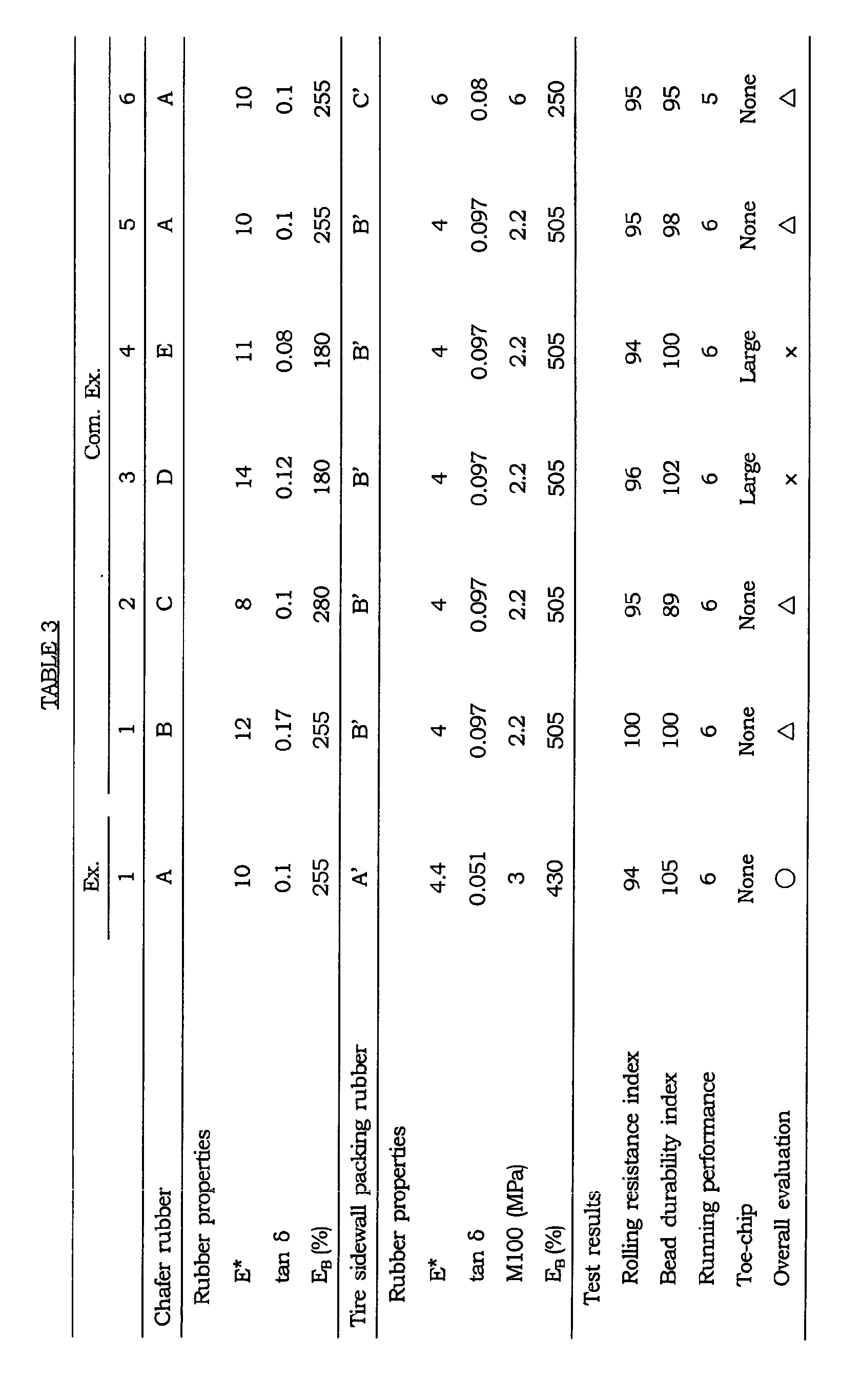
- the chafer rubber and sidewall packing rubber obtained by the above method were used in the combinations shown in Table 3 to prepare a 11R22.514P.R. size radial tire for heavy load vehicles.
- the conditions for vulcanization of the tire were temperature of 150 °C and time of 35 minutes.
- a strip sample of a width of 4 mm, length of 30 mm and thickness of 1.5 mm was clipped out respectively from the chafer and the sidewall of the sample tire. Then, the complex modulus (E*) and loss tangent (tan ⁇ ) of the sample were measured under the conditions of temperature of 70°C, frequency of 10 Hz and dynamic strain of ⁇ 2 % using a viscoelasticity spectrometer available from Iwamoto Corporation.
- Each tire was attached to a regular rim (22.5 ⁇ 8.25, 15° drop center rim) and the rolling resistance of the tire was measured under the conditions of inner pressure of 700 kPa, speed of 80 km/h and load of 24.52 kN using a rolling resistance testing machine.
- the measured values were shown as an index based on Comparative Example 1 as 100 (standard). The smaller the index is the lower the rolling resistance, thus being favorable.
- the sample tire was attached to a regular rim (22.5 ⁇ 8.25, 15° drop center rim) at regular inner pressure (784 kPa). Then, the tire was run in a drum tester under the conditions of test load of 88 KN (three-times the standard maximum load) and test speed of 20 km/h. The distance at which the bead suffered visually recognizable damage was measured. The measured value was shown as an index based on Comparative Example 1 as 100 (standard). The larger the index is the better the bead durability.
- the sample tire was attached to the front wheels of a 2-D ⁇ 4 10 ton test vehicle and properties such as riding comfort, steering response, stiffness and grip were evaluated by sensory evaluation by the driver on a scale of 1 to 10 based on Comparative Example 1 as 6 (standard). The higher the rating is the better the running performance.
- Rim assembling and rim releasing test of the sample tire to and from a 8.25 ⁇ 22.5 size aluminum wheel rim was conducted using a rim assembling machine (hydraulic tire changer) to examine presence of toe-chip.
- the aluminum wheel rim that was used had a wom-out flange with surface scraping.
- the bead of the sample tire was coated thinly in advance with lubricating paste, which was later wiped off with cloth.
- Comparative Example 1 in which using chafer rubber B having large tan ⁇ was used, rolling resistance was reduced.
- Comparative Example 2 in which chafer rubber C having small E* was used, bead durability decreased.
- Comparative Examples 3 and 4 in which chafer rubbers D and E respectively having small E B are used, toe-chip resistance decreased.
- rolling resistance of a pneumatic radial tire can be reduced and durability can be improved without losing abrasion resistance, running performance such as performance on snow and performance on wet roads and toe-chip resistance when assembling the rim.
Landscapes
- Engineering & Computer Science (AREA)
- Mechanical Engineering (AREA)
- Tires In General (AREA)
Abstract
Description
| A | B | C | D | E | |
| Composition (parts by weight) | |||||
| NR | 50 | 40 | 50 | 40 | 50 |
| BR | 50 | 60 | 50 | 60 | 50 |
| Carbon black 1 | - | 65 | 40 | 70 | - |
| Carbon black 2 | 50 | - | - | - | 60 |
| Silica | 10 | - | - | - | - |
| Silane coupling agent | 1 | - | - | - | - |
| Antioxidant | 3 | 3 | 3 | 3 | 3 |
| Stearic acid | 2 | 2 | 2 | 2 | 2 |
| Zinc oxide | 3 | 3 | 3 | 3 | 3 |
| Sulfur | 1.7 | 1 | 1.7 | 1.7 | 3 |
| Vulcanization accelerator | 2.5 | 2.5 | 2.5 | 2.5 | 2.5 |
| A' | B' | C' | |
| Composition (parts by weight) | |||
| NR | 100 | 100 | 100 |
| Carbon black 1 | - | 50 | - |
| Carbon black 3 | 50 | - | 50 |
| Aromatic oil | - | 5 | 5 |
| Stearic acid | 2 | 2 | 2 |
| | 6 | 6 | 6 |
| Sulfur | 2.5 | 2.5 | 4.5 |
| Vulcanization accelerator | 0.5 | 1 | 1 |
Claims (4)
- A pneumatic radial tire having a chafer comprising a rubber composition having complex modulus of 9 to 13 MPa measured under conditions of temperature of 70°C, frequency of 10 Hz and dynamic strain of ± 2 %, loss tangent of 0.08 to 0.11 and tensile elongation at break of at least 230 % measured according to JIS-K6251.
- The pneumatic radial tire of Claim 1, further having a sidewall packing comprising a rubber composition having elastic modulus at 100 % elongation of 2.3 to 5 MPa measured according to JIS-K6251.
- The pneumatic radial tire of Claim 1, which is used for a heavy load vehicle.
- The pneumatic radial tire of Claim 2, which is used for a heavy load vehicle.
Applications Claiming Priority (2)
| Application Number | Priority Date | Filing Date | Title |
|---|---|---|---|
| JP2004091826 | 2004-03-26 | ||
| JP2004091826A JP4351566B2 (en) | 2004-03-26 | 2004-03-26 | Pneumatic radial tire |
Publications (2)
| Publication Number | Publication Date |
|---|---|
| EP1580037A1 true EP1580037A1 (en) | 2005-09-28 |
| EP1580037B1 EP1580037B1 (en) | 2006-08-23 |
Family
ID=34858494
Family Applications (1)
| Application Number | Title | Priority Date | Filing Date |
|---|---|---|---|
| EP20050002804 Expired - Lifetime EP1580037B1 (en) | 2004-03-26 | 2005-02-10 | Pneumatic radial tire |
Country Status (4)
| Country | Link |
|---|---|
| US (1) | US7040369B2 (en) |
| EP (1) | EP1580037B1 (en) |
| JP (1) | JP4351566B2 (en) |
| DE (1) | DE602005000079T2 (en) |
Cited By (7)
| Publication number | Priority date | Publication date | Assignee | Title |
|---|---|---|---|---|
| EP1707402A1 (en) * | 2005-03-28 | 2006-10-04 | Sumitomo Rubber Industries, Ltd. | Radial tire reducing the rolling resistance having a breaker cushion or a side wall insert comprising a rubber composition containing as reinforcing filler a blend of carbon black and silica. |
| EP2052878A1 (en) | 2007-10-26 | 2009-04-29 | The Goodyear Tire & Rubber Company | Tire with resistance to rim slip |
| CN107020894A (en) * | 2016-02-02 | 2017-08-08 | 住友橡胶工业株式会社 | Pneumatic tire |
| CN107042734A (en) * | 2016-02-02 | 2017-08-15 | 住友橡胶工业株式会社 | Pneumatic tire |
| CN110001308A (en) * | 2017-12-22 | 2019-07-12 | 东洋橡胶工业株式会社 | Pneumatic tire |
| CN113543988A (en) * | 2019-03-01 | 2021-10-22 | 住友橡胶工业株式会社 | Pneumatic tire |
| WO2025061235A1 (en) * | 2023-09-18 | 2025-03-27 | Continental Reifen Deutschland Gmbh | Vehicle tyre having a rubber rim strip, vehicle wheel comprising the vehicle tyre, and use of a rubber rim strip |
Families Citing this family (24)
| Publication number | Priority date | Publication date | Assignee | Title |
|---|---|---|---|---|
| JP4843454B2 (en) * | 2005-11-08 | 2011-12-21 | 住友ゴム工業株式会社 | Heavy duty tire |
| JP2007186550A (en) * | 2006-01-11 | 2007-07-26 | Sumitomo Rubber Ind Ltd | Tire side portion reinforcing rubber composition and run flat tire |
| JP5134249B2 (en) * | 2006-02-07 | 2013-01-30 | 住友ゴム工業株式会社 | Run flat tire |
| CN101522442B (en) * | 2006-09-27 | 2012-07-04 | 东洋橡胶工业株式会社 | Pneumatic tire |
| WO2008038462A1 (en) | 2006-09-27 | 2008-04-03 | Toyo Tire & Rubber Co., Ltd. | Pneumatic tire |
| US8424578B2 (en) | 2006-10-11 | 2013-04-23 | Toyo Tire & Rubber Co., Ltd. | Pneumatic tire |
| CN101535064B (en) | 2006-10-11 | 2012-04-04 | 东洋橡胶工业株式会社 | Pneumatic tire |
| JP4928391B2 (en) * | 2007-09-04 | 2012-05-09 | 住友ゴム工業株式会社 | Heavy duty tire |
| JP5201941B2 (en) * | 2007-10-19 | 2013-06-05 | 株式会社ブリヂストン | Pneumatic radial tire for heavy loads |
| JP4493712B2 (en) * | 2007-12-05 | 2010-06-30 | 住友ゴム工業株式会社 | Rubber composition for tire |
| KR101472597B1 (en) * | 2008-08-07 | 2014-12-15 | 스미도모 고무 고교 가부시기가이샤 | tire |
| CN101654531A (en) * | 2008-08-20 | 2010-02-24 | 住友橡胶工业株式会社 | Rubber composition for chafer |
| JP5031000B2 (en) * | 2008-08-20 | 2012-09-19 | 住友ゴム工業株式会社 | Rubber composition for chafer |
| US8539999B2 (en) * | 2008-12-16 | 2013-09-24 | The Goodyear Tire & Rubber Company | Tire with chafer |
| JP5232324B1 (en) | 2012-01-20 | 2013-07-10 | 住友ゴム工業株式会社 | Rubber composition for tire inner layer and pneumatic tire |
| CN103804724B (en) | 2012-11-08 | 2018-01-12 | 住友橡胶工业株式会社 | Rubber composition and pneumatic tire |
| JP5727988B2 (en) * | 2012-11-08 | 2015-06-03 | 住友ゴム工業株式会社 | Bead apex, sidewall packing, base tread or breaker cushion rubber composition and pneumatic tire |
| US9023928B2 (en) | 2012-11-08 | 2015-05-05 | Sumitomo Rubber Industries, Ltd. | Rubber compositions for bead apex, sidewall packing, base tread, breaker cushion, steel cord topping, strip adjacent to steel cords, tie gum, and sidewall, and pneumatic tires |
| BR102013028645A2 (en) | 2012-11-08 | 2016-06-21 | Sumitomo Rubber Ind | tread rubber and pneumatic composition |
| JP5806191B2 (en) * | 2012-11-12 | 2015-11-10 | 住友ゴム工業株式会社 | Pneumatic tire |
| JP2015129239A (en) | 2014-01-08 | 2015-07-16 | 住友ゴム工業株式会社 | pneumatic tire |
| DE102016209325A1 (en) * | 2016-05-30 | 2017-11-30 | Zf Friedrichshafen Ag | Test system for testing the rolling resistance of at least one vehicle tire and a method for testing the rolling resistance of the vehicle tire |
| EP3868578B1 (en) * | 2018-10-16 | 2025-12-03 | Sumitomo Rubber Industries, Ltd. | Tire |
| JP7224196B2 (en) * | 2019-02-01 | 2023-02-17 | 住友ゴム工業株式会社 | Rubber composition for tread and pneumatic tire |
Citations (3)
| Publication number | Priority date | Publication date | Assignee | Title |
|---|---|---|---|---|
| EP0422605A2 (en) * | 1989-10-11 | 1991-04-17 | The Yokohama Rubber Co., Ltd. | Pneumatic tire for passenger car |
| US5033524A (en) * | 1988-08-18 | 1991-07-23 | Bridgestone Corporation | Tire with three elastomeric protective layers located in the bead portion of the tire |
| EP1125976A1 (en) * | 2000-02-16 | 2001-08-22 | Sumitomo Rubber Industries Ltd. | Chafer rubber composition, and heavy duty pneumatic tyre using the chafer rubber composition |
Family Cites Families (7)
| Publication number | Priority date | Publication date | Assignee | Title |
|---|---|---|---|---|
| JPH01159142A (en) | 1987-12-12 | 1989-06-22 | Mazda Motor Corp | Bent pipe assembling device |
| US5023292A (en) * | 1989-09-29 | 1991-06-11 | Uniroyal Chemical Company, Inc. | Tire compounds |
| JPH07315015A (en) | 1994-05-26 | 1995-12-05 | Bridgestone Corp | Pneumatic tire |
| JPH09302149A (en) | 1996-05-10 | 1997-11-25 | Bridgestone Corp | Pneumatic tire |
| JP3410684B2 (en) * | 1999-06-29 | 2003-05-26 | 住友ゴム工業株式会社 | Tubeless tire |
| JP4567180B2 (en) | 2000-12-18 | 2010-10-20 | 住友ゴム工業株式会社 | Heavy duty tire |
| JP2004106796A (en) * | 2002-09-20 | 2004-04-08 | Sumitomo Rubber Ind Ltd | Rubber composition and pneumatic tire |
-
2004
- 2004-03-26 JP JP2004091826A patent/JP4351566B2/en not_active Expired - Fee Related
-
2005
- 2005-02-10 EP EP20050002804 patent/EP1580037B1/en not_active Expired - Lifetime
- 2005-02-10 DE DE200560000079 patent/DE602005000079T2/en not_active Expired - Lifetime
- 2005-02-18 US US11/060,793 patent/US7040369B2/en not_active Expired - Fee Related
Patent Citations (3)
| Publication number | Priority date | Publication date | Assignee | Title |
|---|---|---|---|---|
| US5033524A (en) * | 1988-08-18 | 1991-07-23 | Bridgestone Corporation | Tire with three elastomeric protective layers located in the bead portion of the tire |
| EP0422605A2 (en) * | 1989-10-11 | 1991-04-17 | The Yokohama Rubber Co., Ltd. | Pneumatic tire for passenger car |
| EP1125976A1 (en) * | 2000-02-16 | 2001-08-22 | Sumitomo Rubber Industries Ltd. | Chafer rubber composition, and heavy duty pneumatic tyre using the chafer rubber composition |
Cited By (12)
| Publication number | Priority date | Publication date | Assignee | Title |
|---|---|---|---|---|
| EP1707402A1 (en) * | 2005-03-28 | 2006-10-04 | Sumitomo Rubber Industries, Ltd. | Radial tire reducing the rolling resistance having a breaker cushion or a side wall insert comprising a rubber composition containing as reinforcing filler a blend of carbon black and silica. |
| US7893147B2 (en) | 2005-03-28 | 2011-02-22 | Sumitomo Rubber Industries, Ltd. | Radial tire |
| EP2052878A1 (en) | 2007-10-26 | 2009-04-29 | The Goodyear Tire & Rubber Company | Tire with resistance to rim slip |
| CN107020894A (en) * | 2016-02-02 | 2017-08-08 | 住友橡胶工业株式会社 | Pneumatic tire |
| CN107042734A (en) * | 2016-02-02 | 2017-08-15 | 住友橡胶工业株式会社 | Pneumatic tire |
| CN107042734B (en) * | 2016-02-02 | 2020-08-28 | 住友橡胶工业株式会社 | Pneumatic tire |
| CN107020894B (en) * | 2016-02-02 | 2020-11-06 | 住友橡胶工业株式会社 | Pneumatic tires |
| CN110001308A (en) * | 2017-12-22 | 2019-07-12 | 东洋橡胶工业株式会社 | Pneumatic tire |
| CN110001308B (en) * | 2017-12-22 | 2021-03-30 | 东洋橡胶工业株式会社 | Pneumatic tire |
| CN113543988A (en) * | 2019-03-01 | 2021-10-22 | 住友橡胶工业株式会社 | Pneumatic tire |
| CN113543988B (en) * | 2019-03-01 | 2023-09-22 | 住友橡胶工业株式会社 | pneumatic tires |
| WO2025061235A1 (en) * | 2023-09-18 | 2025-03-27 | Continental Reifen Deutschland Gmbh | Vehicle tyre having a rubber rim strip, vehicle wheel comprising the vehicle tyre, and use of a rubber rim strip |
Also Published As
| Publication number | Publication date |
|---|---|
| JP4351566B2 (en) | 2009-10-28 |
| EP1580037B1 (en) | 2006-08-23 |
| DE602005000079D1 (en) | 2006-10-05 |
| US20050211362A1 (en) | 2005-09-29 |
| JP2005271857A (en) | 2005-10-06 |
| DE602005000079T2 (en) | 2007-01-04 |
| US7040369B2 (en) | 2006-05-09 |
Similar Documents
| Publication | Publication Date | Title |
|---|---|---|
| US7040369B2 (en) | Pneumatic radial tire | |
| US9132698B2 (en) | Rubber composition for studless tire and studless tire using the same | |
| EP1752491B1 (en) | Pneumatic tire with sidewall component containing high strength glass bubbles | |
| US20010018944A1 (en) | Chafer rubber composition, and heavy duty pneumatic tire using the chafer rubber composition | |
| US5718782A (en) | Truck tire with cap/base construction tread | |
| US5843249A (en) | Truck tire with cap/base construction tread | |
| KR101654942B1 (en) | Pneumatic tire | |
| US20020036043A1 (en) | Runflat tire having a rubberized insert containing 1,6-bis(N,N'-dibenzylthiocarbamoyldithio)-hexane | |
| JP5364259B2 (en) | tire | |
| JP4602718B2 (en) | Rubber composition for tire sidewall and pneumatic tire | |
| JP4187855B2 (en) | Pneumatic tire | |
| US5772807A (en) | Truck tire with thread of rib/groove configuration | |
| JP2006062379A (en) | Pneumatic tire | |
| EP4074520B1 (en) | Tire | |
| EP4523926A1 (en) | Tire for heavy load | |
| JP7188117B2 (en) | Rubber composition for tires | |
| US7615590B2 (en) | Rubber composition for clinch and pneumatic tire using the same | |
| JP5089855B2 (en) | Rubber composition for tire sidewall and pneumatic tire | |
| EP4338979B1 (en) | Pneumatic tire | |
| WO2010137143A1 (en) | Tire | |
| EP2730608A1 (en) | Tire with chafer and sidewall | |
| EP2995472B1 (en) | Pneumatic tire | |
| US20230112118A1 (en) | Pneumatic tire | |
| JP4566788B2 (en) | Pneumatic tires for passenger cars | |
| JP2025001801A (en) | Cap tread rubber |
Legal Events
| Date | Code | Title | Description |
|---|---|---|---|
| PUAI | Public reference made under article 153(3) epc to a published international application that has entered the european phase |
Free format text: ORIGINAL CODE: 0009012 |
|
| AK | Designated contracting states |
Kind code of ref document: A1 Designated state(s): AT BE BG CH CY CZ DE DK EE ES FI FR GB GR HU IE IS IT LI LT LU MC NL PL PT RO SE SI SK TR |
|
| AX | Request for extension of the european patent |
Extension state: AL BA HR LV MK YU |
|
| 17P | Request for examination filed |
Effective date: 20050907 |
|
| GRAP | Despatch of communication of intention to grant a patent |
Free format text: ORIGINAL CODE: EPIDOSNIGR1 |
|
| AKX | Designation fees paid |
Designated state(s): DE FR GB |
|
| GRAS | Grant fee paid |
Free format text: ORIGINAL CODE: EPIDOSNIGR3 |
|
| GRAA | (expected) grant |
Free format text: ORIGINAL CODE: 0009210 |
|
| AK | Designated contracting states |
Kind code of ref document: B1 Designated state(s): DE FR GB |
|
| REG | Reference to a national code |
Ref country code: GB Ref legal event code: FG4D |
|
| REF | Corresponds to: |
Ref document number: 602005000079 Country of ref document: DE Date of ref document: 20061005 Kind code of ref document: P |
|
| ET | Fr: translation filed | ||
| PLBE | No opposition filed within time limit |
Free format text: ORIGINAL CODE: 0009261 |
|
| STAA | Information on the status of an ep patent application or granted ep patent |
Free format text: STATUS: NO OPPOSITION FILED WITHIN TIME LIMIT |
|
| 26N | No opposition filed |
Effective date: 20070524 |
|
| PGFP | Annual fee paid to national office [announced via postgrant information from national office to epo] |
Ref country code: GB Payment date: 20150204 Year of fee payment: 11 |
|
| REG | Reference to a national code |
Ref country code: FR Ref legal event code: PLFP Year of fee payment: 12 |
|
| GBPC | Gb: european patent ceased through non-payment of renewal fee |
Effective date: 20160210 |
|
| REG | Reference to a national code |
Ref country code: FR Ref legal event code: PLFP Year of fee payment: 13 |
|
| PG25 | Lapsed in a contracting state [announced via postgrant information from national office to epo] |
Ref country code: GB Free format text: LAPSE BECAUSE OF NON-PAYMENT OF DUE FEES Effective date: 20160210 |
|
| REG | Reference to a national code |
Ref country code: FR Ref legal event code: PLFP Year of fee payment: 14 |
|
| PGFP | Annual fee paid to national office [announced via postgrant information from national office to epo] |
Ref country code: DE Payment date: 20211230 Year of fee payment: 18 |
|
| PGFP | Annual fee paid to national office [announced via postgrant information from national office to epo] |
Ref country code: FR Payment date: 20230110 Year of fee payment: 19 |
|
| P01 | Opt-out of the competence of the unified patent court (upc) registered |
Effective date: 20230510 |
|
| REG | Reference to a national code |
Ref country code: DE Ref legal event code: R119 Ref document number: 602005000079 Country of ref document: DE |
|
| PG25 | Lapsed in a contracting state [announced via postgrant information from national office to epo] |
Ref country code: DE Free format text: LAPSE BECAUSE OF NON-PAYMENT OF DUE FEES Effective date: 20230901 |
|
| PG25 | Lapsed in a contracting state [announced via postgrant information from national office to epo] |
Ref country code: FR Free format text: LAPSE BECAUSE OF NON-PAYMENT OF DUE FEES Effective date: 20240229 |
|
| PG25 | Lapsed in a contracting state [announced via postgrant information from national office to epo] |
Ref country code: FR Free format text: LAPSE BECAUSE OF NON-PAYMENT OF DUE FEES Effective date: 20240229 |