EP1579841B1 - Kosmetische Zusammensetzung enthaltend konkave Partikel - Google Patents
Kosmetische Zusammensetzung enthaltend konkave Partikel Download PDFInfo
- Publication number
- EP1579841B1 EP1579841B1 EP20050290411 EP05290411A EP1579841B1 EP 1579841 B1 EP1579841 B1 EP 1579841B1 EP 20050290411 EP20050290411 EP 20050290411 EP 05290411 A EP05290411 A EP 05290411A EP 1579841 B1 EP1579841 B1 EP 1579841B1
- Authority
- EP
- European Patent Office
- Prior art keywords
- composition according
- group
- ranging
- weight
- particles
- Prior art date
- Legal status (The legal status is an assumption and is not a legal conclusion. Google has not performed a legal analysis and makes no representation as to the accuracy of the status listed.)
- Expired - Lifetime
Links
Images
Classifications
-
- A—HUMAN NECESSITIES
- A61—MEDICAL OR VETERINARY SCIENCE; HYGIENE
- A61Q—SPECIFIC USE OF COSMETICS OR SIMILAR TOILETRY PREPARATIONS
- A61Q1/00—Make-up preparations; Body powders; Preparations for removing make-up
- A61Q1/12—Face or body powders for grooming, adorning or absorbing
-
- A—HUMAN NECESSITIES
- A61—MEDICAL OR VETERINARY SCIENCE; HYGIENE
- A61K—PREPARATIONS FOR MEDICAL, DENTAL OR TOILETRY PURPOSES
- A61K8/00—Cosmetics or similar toiletry preparations
- A61K8/02—Cosmetics or similar toiletry preparations characterised by special physical form
-
- A—HUMAN NECESSITIES
- A61—MEDICAL OR VETERINARY SCIENCE; HYGIENE
- A61K—PREPARATIONS FOR MEDICAL, DENTAL OR TOILETRY PURPOSES
- A61K8/00—Cosmetics or similar toiletry preparations
- A61K8/02—Cosmetics or similar toiletry preparations characterised by special physical form
- A61K8/11—Encapsulated compositions
-
- A—HUMAN NECESSITIES
- A61—MEDICAL OR VETERINARY SCIENCE; HYGIENE
- A61K—PREPARATIONS FOR MEDICAL, DENTAL OR TOILETRY PURPOSES
- A61K8/00—Cosmetics or similar toiletry preparations
- A61K8/18—Cosmetics or similar toiletry preparations characterised by the composition
- A61K8/19—Cosmetics or similar toiletry preparations characterised by the composition containing inorganic ingredients
- A61K8/26—Aluminium; Compounds thereof
-
- A—HUMAN NECESSITIES
- A61—MEDICAL OR VETERINARY SCIENCE; HYGIENE
- A61K—PREPARATIONS FOR MEDICAL, DENTAL OR TOILETRY PURPOSES
- A61K8/00—Cosmetics or similar toiletry preparations
- A61K8/18—Cosmetics or similar toiletry preparations characterised by the composition
- A61K8/72—Cosmetics or similar toiletry preparations characterised by the composition containing organic macromolecular compounds
- A61K8/84—Cosmetics or similar toiletry preparations characterised by the composition containing organic macromolecular compounds obtained by reactions otherwise than those involving only carbon-carbon unsaturated bonds
- A61K8/89—Polysiloxanes
- A61K8/891—Polysiloxanes saturated, e.g. dimethicone, phenyl trimethicone, C24-C28 methicone or stearyl dimethicone
-
- A—HUMAN NECESSITIES
- A61—MEDICAL OR VETERINARY SCIENCE; HYGIENE
- A61Q—SPECIFIC USE OF COSMETICS OR SIMILAR TOILETRY PREPARATIONS
- A61Q1/00—Make-up preparations; Body powders; Preparations for removing make-up
- A61Q1/02—Preparations containing skin colorants, e.g. pigments
- A61Q1/08—Preparations containing skin colorants, e.g. pigments for cheeks, e.g. rouge
-
- A—HUMAN NECESSITIES
- A61—MEDICAL OR VETERINARY SCIENCE; HYGIENE
- A61Q—SPECIFIC USE OF COSMETICS OR SIMILAR TOILETRY PREPARATIONS
- A61Q1/00—Make-up preparations; Body powders; Preparations for removing make-up
- A61Q1/02—Preparations containing skin colorants, e.g. pigments
- A61Q1/10—Preparations containing skin colorants, e.g. pigments for eyes, e.g. eyeliner, mascara
-
- A—HUMAN NECESSITIES
- A61—MEDICAL OR VETERINARY SCIENCE; HYGIENE
- A61Q—SPECIFIC USE OF COSMETICS OR SIMILAR TOILETRY PREPARATIONS
- A61Q17/00—Barrier preparations; Preparations brought into direct contact with the skin for affording protection against external influences, e.g. sunlight, X-rays or other harmful rays, corrosive materials, bacteria or insect stings
- A61Q17/04—Topical preparations for affording protection against sunlight or other radiation; Topical sun tanning preparations
-
- A—HUMAN NECESSITIES
- A61—MEDICAL OR VETERINARY SCIENCE; HYGIENE
- A61Q—SPECIFIC USE OF COSMETICS OR SIMILAR TOILETRY PREPARATIONS
- A61Q19/00—Preparations for care of the skin
- A61Q19/08—Anti-ageing preparations
-
- A—HUMAN NECESSITIES
- A61—MEDICAL OR VETERINARY SCIENCE; HYGIENE
- A61K—PREPARATIONS FOR MEDICAL, DENTAL OR TOILETRY PURPOSES
- A61K2800/00—Properties of cosmetic compositions or active ingredients thereof or formulation aids used therein and process related aspects
- A61K2800/40—Chemical, physico-chemical or functional or structural properties of particular ingredients
- A61K2800/41—Particular ingredients further characterized by their size
- A61K2800/412—Microsized, i.e. having sizes between 0.1 and 100 microns
Definitions
- the subject of the present invention is a cosmetic composition, in particular in the form of a compact powder, comprising concave particles and platelet-shaped particles.
- the subject of the invention is also a process for making up or caring for keratinous substances of a human being, such as the skin, the hair, the nails, and more particularly the skin, comprising the application of the composition to keratin materials.
- the composition according to the invention may be a makeup or skin care composition and may be in the form of a blush, an eyeshadow, a powder for the face, a foundation, a product concealer, a body make-up product, a facial care product, a body care product, an antisolar product. More particularly, the invention relates to a foundation composition.
- the makeup powders generally comprise, on the one hand, a pulverulent phase comprising in particular pigments and fillers and, on the other hand, a fatty phase as a binder comprising fatty substances, intended to give the finished product a certain density, to give a softness and an emollient property to the makeup product and to promote its adhesion to the skin.
- compositions such as foundations, eye shadows or blushes are in the form of a compact powder, generally comprising a fatty phase, called a binder, and a powdery phase comprising in particular pigments and / or pearlescent agents. and / or charges.
- compact powders raises many difficulties because the final composition must be sufficiently homogeneous and compact to avoid fragmentation caused in particular by shocks.
- the compact powder must also have good sampling ability to allow the user to apply the composition on keratin materials, especially on the skin.
- nacres are commonly used as coloring matter in make-up products.
- the nacres are generally in the form of platelets and, because of their shape and size, cause a brake when applying the makeup to the skin thus making the application of the product unpleasant for the user and not promoting the good spread of the product on the skin in a uniform way.
- EP-A-0 445 785 discloses particles of barium sulfate, and compositions comprising them
- the object of the present invention is therefore to provide a makeup composition containing platelet-shaped particles and spreading easily, with a good slipperiness, on keratin materials, in particular on the skin, and when is in the form of compact powder, which can be easily disintegrated with the finger or with a sponge.
- composition is obtained by combining with the particles in the form of platelets concave particles in the form of portions of hollow spheres made of an organosilicone material.
- the composition then has a good sliding facilitating a good distribution of the product on the surface of the skin and thus to obtain a uniformly distributed makeup on the skin.
- the composition when the composition is in the form of compact powder, has good disintegration properties allowing the user to easily take the finger or sponge the necessary amount of product to wear makeup.
- the subject of the invention is a cosmetic composition, in particular in the form of a compact powder, comprising a powdery phase, the powdery phase comprising concave particles in the form of portions of hollow spheres consisting of an organosilicone material and particles platelet-shaped.
- the subject of the invention is also a cosmetic process for makeup or non-therapeutic treatment of keratinous substances, in particular the skin, comprising the application to keratinous substances, in particular to the skin, of a composition as defined above.
- composition according to the invention comprises concave particles. These particles therefore have a surface having an internal rounding.
- the concave particles are particles of hollow sphere portions made of an organosilicone material.
- Said concave particles advantageously have a mean diameter ranging from 0.05 ⁇ m to 10 ⁇ m.
- the portions of hollow spheres used in the composition according to the invention may have the form of truncated hollow spheres, having a single orifice communicating with their central cavity, and having a cross section in the form of horseshoe or arch.
- the organosilicon material is a cross-linked polysiloxane of three-dimensional structure; it preferably comprises, or even consists of, units of formula (I): SiO 2 and of formula (II): R 1 SiO 1.5 wherein R 1 denotes an organic group having a carbon atom directly attached to the silicon atom.
- the organic group may be a reactive organic group, a non-reactive organic group, and preferably a non-reactive organic group.
- the non-reactive organic group may be a C 1 -C 4 alkyl group, especially a methyl, ethyl, propyl, butyl group, or a phenyl group, and preferably a methyl group.
- the reactive organic group may be an epoxy group, a (meth) acryloxy group, an alkenyl group, a mercaptoalkyl, aminoalkyl, haloalkyl group, a glyceroxy group, a ureido group, a cyano group.
- the reactive organic group may be an epoxy group, a (meth) acryloxy group, an alkenyl group, a mercaptoalkyl, aminoalkyl group.
- the reactive organic group generally comprises from 2 to 6 carbon atoms, especially from 2 to 4 carbon atoms.
- epoxy group there may be mentioned a 2-glycidoxyethyl group, a 3-glycidoxypropyl group, a 2- (3,4-epoxycyclohexyl) propyl group.
- (meth) acryloxy group there may be mentioned a 3-methacryloxypropyl group, a 3-acryloxypropyl group.
- alkenyl group there may be mentioned a vinyl, allyl, isopropenyl group.
- mercaptoalkyl group there may be mentioned a mercaptopropyl, mercaptoethyl group.
- aminoalkyl group there may be mentioned a 3- (2-aminoethyl) aminopropyl group, a 3-aminopropyl group, a N, N-dimethylaminopropyl group.
- Haloalkyl is 3-chloropropyl, trifluoropropyl.
- glyceroxy group there may be mentioned a 3-glyceroxypropyl group, a 2-glyceroxyethyl group.
- ureido group there may be mentioned a 2-ureidoethyl group.
- cyano group there may be mentioned a cyanopropyl, cyanoethyl group.
- R 1 denotes a methyl group.
- the organosilicone material comprises the units (I) and (II) in a molar ratio of unit (I) / unit (II) ranging from 30/70 to 50/50, preferably ranging from 35/65 to 45/55.
- Step (a) corresponds to a hydrolysis reaction and step (b) corresponds to a condensation reaction.
- the molar ratio of the compound (III) to the compound (IV) is usually 30/70 to 50/50, preferably 35/65 to 45/45, and is preferably 40/60.
- the weight ratio of water to total of compounds (III) and (IV) is preferably from 10/90 to 70/30.
- the order of introduction of the compounds (III) and (IV) generally depends on their rate of hydrolysis.
- the temperature of the hydrolysis reaction is generally from 0 to 40 ° C and usually does not exceed 30 ° C to avoid premature condensation of the compounds.
- C 1 -C 4 alkoxy group there may be mentioned methoxy, ethoxy;
- alkoxyethoxy group containing a C 1 -C 4 alkoxy group mention may be made of methoxyethoxy and butoxyethoxy groups;
- C 2 -C 4 alkoxy group there may be mentioned acetoxy, propioxy groups;
- N, N-dilakylamino group containing a C 1 -C 4 alkyl group there may be mentioned dimethylamino groups, diethylamino;
- a halogen atom mention may be made of chlorine and bromine atoms.
- the compound of formula (III) is chosen from tetramethoxysilane, tetraethoxysilane, tetrabutoxysilane, trimethoxyethoxysilane, tributoxyethoxysilane, tetraacetoxysilane, tetrapropioxysilane, tetraacetoxysilane, tetra (dimethylamino) silane, tetra (diethylamino) silane, silane tetraol, chlorosilane triol, dichlorodisilanol, tetrachlorosilane, chlorotrihydrogensilane.
- the compound of formula (III) is chosen from tetramethoxysilane, tetraethoxysilane and tetrabutoxysilane, and mixtures thereof.
- the compound of formula (III) leads after the polymerization reaction to the formation of units of formula (I).
- the compound of formula (IV) leads after the polymerization reaction to the formation of units of formula (II).
- the group R in the compound of formula (IV) has the meaning as described for the group R 1 for the compound of formula (II).
- Examples of compounds of formula (IV) having a non-reactive organic group R include methyltrimethoxysilane, ethyltriethoxysilane, propyltributoxysilane, butyltributoxysilane, phenyltrimethoxyethoxysilane, methyl tributoxyethoxysilane, methyltriacetoxysilane, methyltripropioxysilane, methyltriacetoxysilane, methyltri (dimethylamino) silane, methyltri (diethylamino) silane, methylsilane triol, methylchlorodisilanol, methyltrichlorosilane, methyltrihydrogensilane.
- the compound of formula (IV) having a reactive organic group R is chosen from silanes having an epoxy group, silanes having a (meth) acryloxy group, silanes having an alkenyl group, silanes having a mercapto group, silanes having an aminoalkyl group.
- Examples of compounds (III) and (IV) preferred for the practice of this invention are tetraethoxysilane and methyltrimethoxysilane, respectively.
- basic catalysts - such as sodium hydroxide, potassium hydroxide, sodium carbonate, sodium hydrogencarbonate, or amines (such as ammonia) can be used independently.
- the surfactant used is preferably a nonionic or anionic surfactant or a mixture of both.
- Sodium dodecylbenzenesulfonate can be used as anionic surfactant.
- the end of the hydrolysis is marked by the disappearance of products (III) and (IV), insoluble in water, and obtaining a homogeneous liquid layer.
- the condensation step (b) may use the same catalyst as the hydrolysis step or another catalyst selected from those mentioned above.
- a suspension in water of fine organosilicone particles is obtained which may optionally subsequently be separated from their medium.
- the process described above may therefore comprise an additional filtration step, for example on a membrane filter, of the product resulting from step (b), optionally followed by a centrifugation step of the filtrate intended to separate the particles from the medium. liquid, then a drying step of the particles.
- Other separation methods can of course be employed.
- the particles obtained (or the spheres) preferably have an average diameter ranging from 0.05 to 10 ⁇ m.
- a rather basic pH and a cold introduction of the polymerization catalyst into the mixture resulting from step (a) will lead to portions of hollow spheres in the form of "bowls" with a rounded bottom while a rather acid pH, and a dropwise introduction of the mixture from step (a) into the hot polymerization catalyst will result in hollow sphere portions having a horseshoe-shaped cross-section.
- portions of hollow spheres in the form of "bowls” are used. These can be obtained as described in the application JP-2003 128,788 . Portions of horseshoe-shaped hollow spheres are also described in the application JP-A-2000-191789 .
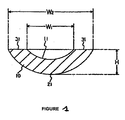
- the accompanying figure illustrates a concave particle of bowl-shaped sphere portions in cross-section.
- these concave portions are formed (in longitudinal section) of a small internal arc (11), a large external arc (21) and segments (31) which connect the ends of the respective arcs, the width (W1) between the two ends of the small inner arc (11) ranging from 0.01 to 8 ⁇ m, preferably from 0.02 to 6 ⁇ m on average, the width (W2) between the ends of the large external arc (21) ranging from 0.05 to 10 ⁇ m, preferably from 0.06 to 8 ⁇ m on average and the height (H) of the large external arc (21) from 0.015 at 8 ⁇ m, preferably from 0.03 to 6 ⁇ m on average.
- the dimensions mentioned above are obtained by calculating the average of the dimensions of one hundred selected particles on an image obtained with a scanning electron microscope.
- the concave particles in particular the particles of portions of hollow spheres, can be present in the composition according to the invention, in particular in the compact powder, in a content ranging from 0.01% to 50% by weight, relative to the total weight of the composition, preferably ranging from 0.1% to 30% by weight, and preferably ranging from 1% to 15% by weight.
- wafer particles whose shape is characterized by three dimensions: a length, a width and a height, also called thickness, whose ratio of the largest dimension to the thickness is greater or equal to 5.
- the wafer-shaped particles may be parallelepipedal (rectangular or square), disc (circular) or ellipsoidal (oval).
- the platelets may be chosen from platelets of mineral material.
- the platelets can be chosen from platelets of mica, sericite, glass (especially calcium borosilicate), silica, aluminum oxide, barium sulfate.
- the wafers may be surface treated, in particular covered by a layer of metal or metal oxide.
- metal mention may be made of silver, aluminum, chromium, nickel, molybdenum, gold, copper, tin, magnesium and their mixtures (alloys). Silver, chromium, nickel, molybdenum and mixtures thereof are preferably used.
- metal oxide mention may be made of titanium dioxide, iron oxides, zinc oxide, chromium oxide, and preferably titanium dioxide.
- the platelets may also be surface-treated with a hydrophobic treatment agent.
- the hydrophobic treatment agent may be chosen from silicones such as methicones, dimethicones and perfluoroalkylsilanes; fatty acids such as stearic acid; metallic soaps such as aluminum dimyristate, hydrogenated tallow glutamate aluminum salt, perfluoroalkyl phosphates, perfluoroalkyl silanes, perfluoroalkyl silazanes, hexafluoropropylene polyoxides, polyorganosiloxanes comprising perfluoroalkyl perfluoropolyether groups, amines; N-acyl amino acids or their salts; lecithin, isopropyl trisostearyl titanate, and mixtures thereof.
- silicones such as methicones, dimethicones and perfluoroalkylsilanes
- fatty acids such as stearic acid
- metallic soaps such as aluminum dimyristate, hydrogenated tallow glutamate aluminum salt, perfluor
- the N-acyl amino acids may comprise an acyl group having from 8 to 22 carbon atoms, for example a 2-ethyl hexanoyl, caproyl, lauroyl, myristoyl, palmitoyl, stearoyl or cocoyl group.
- the salts of these compounds may be aluminum, magnesium, calcium, zirconium, zin, sodium or potassium salts.
- the amino acid can be for example lysine, glutamic acid, alanine
- alkyl mentioned in the compounds mentioned above denotes in particular an alkyl group having from 1 to 30 carbon atoms, preferably having from 5 to 16 carbon atoms.
- Hydrophobic treated pigments are described in particular in the application EP-A-1086683 .
- Platelets may also be flat fibers.
- fiber is meant an object of length L and diameter D such that L is much greater than D, where D is the diameter of the circle in which the section (cross section) of the fiber is inscribed.
- the ratio UD (or form factor) is chosen in the range from 5 to 2500, preferably from 5 to 500, and more preferably from 5 to 150.
- flat fiber is meant a fiber whose cross section (section perpendicular to the axis of the direction of the length of the fiber) has a greater length L1 and a shorter length L2 (L2 corresponds to the thickness of the fiber) such that L1 / L2 (the ratio L1 / L2 is still called flattening factor) is greater than or equal to 4, preferably greater than 7.
- L1 / L2 ranges from 4 to 15, preferably from 6 to 12, and preferably 7 to 10.
- the cross section of the fiber has a flat shape.
- the greatest length L1 and the smallest length L2 respectively define axes X1, X2 such that the axis X1 is substantially perpendicular to the axis X2.
- the largest length L1 corresponds to the diameter D of the fiber as mentioned above.
- the flat fibers may be in the form of ribbon or tagliatelle.
- the flat fibers may in particular have a cross section of substantially rectangular, ovoid or ellipsoidal shape.
- the fibers that can be used in the composition of the invention may be fibers of synthetic, organic origin, and more particularly synthetic polymer fibers. They may be short or long, unitary (or monofilament) or organized, for example, braided (or multi-filament), hollow or solid, preferably solid.
- each filament can be of different chemical composition and have a different color: thereby obtaining multifilament fibers having different colors. In particular, their ends are blunt and / or polished to avoid injury.
- the flat fibers are insoluble in water.
- the flat fiber can be twisted along the axis of the length L of the fiber. When the flat fiber is not twisted, it has a color in a certain angle of view, outside this angle the fiber is transparent or white. The flat twisted fiber has a color regardless of the angle of observation.
- the fibers have a length ranging from 1 ⁇ m to 10 mm, preferably from 0.1 mm to 5 mm and better still from 0.3 mm to 3.5 mm.
- Their cross-section can be in a circle with a diameter ranging from 2 nm to 500 ⁇ m, preferably ranging from 100 nm to 100 ⁇ m and better still from 1 ⁇ m to 70 ⁇ m.
- the weight or titer of the fibers is often given in denier or decitex and represents the weight in gram for 9 km of yarn.
- the fibers according to the invention have a title chosen in the range from 0.15 to 30 denier and better from 0.18 to 18 denier.
- the fibers may be fibers of rayon, polyamide (nylon), viscose, acetate, especially rayon acetate, poly (p-phenylene terephthalamide) (or aramid), in particular Kevlar®, of acrylic polymer, especially of polymethyl methacrylate or of 2-hydroxyethyl polymethacrylate, polyolefin and in particular polyethylene or polypropylene, polytetrafluoroethylene (such as Teflon®), polyvinyl chloride or vinylidene, polyvinylidene fluoride, polyvinyl alcohol, polyacrylonitrile, polyurethane, polyesters such as polyethylene terephthalates, polyethylene naphthalates, polycarbonate.
- rayon rayon
- polyamide rayon
- poly (p-phenylene terephthalamide) or aramid
- Kevlar® of acrylic polymer, especially of polymethyl methacrylate or of 2-hydroxyethyl polymethacrylate, polyolefin and in particular polyethylene or
- flat fibers with a multilayer structure comprising alternating layers of polymers chosen from polyesters and acrylic polymers.
- polyamides such as those described in the documents EP-A-6921217 , EP-A-686858 and US Patent 5472798 .
- Such fibers are sold under the names "Morphotex”, “Teijin Tetron Morphotex” by the company Teijin.
- the platelets may be present in the composition according to the invention in a content ranging from 1 to 99% by weight, relative to the total weight of the composition, preferably ranging from 5% to 90%, and preferably ranging from 10% to 80% by weight.
- the platelet-shaped particles and the concave particles are present in the composition according to the invention in a content such that the platelet / particle-shaped particle weight ratio ranges from 1 to 100, preferably from 2 to 75, and preferably ranges from 5 to 50.
- the concave particles of portions of hollow spheres are present in the composition according to the invention in a content ranging from 1% to 50% by weight, relative to the total weight of the concave particles and the platelet-shaped particles, preferably ranging from 2% to 45% by weight, and preferably ranging from 5% to 40% by weight.
- composition according to the invention may comprise an additional dyestuff, different from the platelets described above, and may in particular be chosen from pigments and flakes.
- pigments it is necessary to include particles of any shape, white or colored, mineral or organic, insoluble in the physiological medium, intended to color the composition.
- the pigments may be white or colored, mineral and / or organic.
- titanium dioxide optionally surface-treated, zirconium oxide or cerium oxides, and oxides of zinc, iron (black, yellow or red) or chromium, the violet of manganese, ultramarine blue, chromium hydrate and ferric blue, metallic powders such as aluminum powder, copper powder.
- organic pigments mention may be made of carbon black, D & C type pigments, and lacquers based on cochineal carmine, barium, strontium, calcium, aluminum.
- the pigments may be present in the composition in a content ranging from 0.1% to 15% by weight, relative to the weight of the composition, preferably ranging from 0.5% to 12% by weight, and preferably ranging from 1% to % to 10% by weight.
- composition according to the invention in particular the compact powder, may advantageously comprise a liquid fatty phase (liquid at room temperature (25 ° C.)), called usually binder.
- This liquid fatty phase may comprise an oil usually used in compact powders.
- the oil may be chosen from the oils conventionally used as binder in compact powders. Among the additional oils that may be used, mention may be made of mink oil, turtle oil, soybean oil, reason seed oil, sesame oil, corn oil, and oil.
- rapeseed sunflower oil, cottonseed oil, avocado oil, olive oil, castor oil, jojoba oil, peanut oil; hydrocarbon oils, such as paraffin oils, squalane, petroleum jelly, polydecene; fatty esters, such as isopropyl myristate, isopropyl palmitate, butyl stearate, isodecyl stearate, hexyl laurate, isononyl isononanoate, 2-ethylhexyl palmitate , 2-hexyl-decyl laurate, 2-octyl-decyl palmitate, myristate or 2-octyl-dodecyl lactate, 2-diethylhexyl succinate, diisostearyl malate, glycerin triisostearate or diglycerin; silicone oils such as polymethylsiloxanes, polymethylphenylsiloxanes, polysiloxanes modified with fatty acids
- the liquid fatty phase may be present in a content ranging from 0.1% to 13% by weight, relative to the total weight of the composition, preferably ranging from 0.1% to 10% by weight, and preferably ranging from 0% to 10% by weight. , 1% to 8% by weight.
- composition according to the invention in particular the compact powder, may also comprise additional charges different from the platelets described above.
- fillers it is necessary to include colorless or white particles, mineral or synthetic, insoluble in the medium of the composition regardless of the temperature at which the composition is manufactured.
- the additional fillers may be inorganic or organic, in particular of spherical or oblong shape, irrespective of the crystallographic form (for example sheet, cubic, hexagonal, orthorhombic, etc.). Mention may be made of talc, mica, silica, kaolin, polyamide (Nylon®), poly- ⁇ -alanine and polyethylene powders, polyurethane powders, tetrafluoroethylene polymer powders (Teflon®), lauroyl-lysine, starch, boron nitride, polymeric hollow microspheres such as those of polyvinylidene chloride / acrylonitrile such as Expancel® (Nobel Industrie), acrylic acid copolymers, silicone resin microbeads (Toshiba Tospearls®, for example), elastomeric polyorganosiloxane particles, precipitated calcium carbonate, magnesium carbonate and hydrocyanate, hydroxyapatite, hollow silica microspheres, glass
- the additional fillers may be present in the composition in a content ranging from 0.1% to 90% by weight, relative to the total weight of the composition, preferably ranging from 1% to 80% by weight, and preferably ranging from % to 70% by weight.
- composition may contain other usual cosmetic ingredients that may be chosen in particular from antioxidants, perfumes, preservatives, neutralizers, surfactants, waxes, sunscreens, vitamins, moisturizers, self-tanning compounds, anti-wrinkle active ingredients.
- composition according to the invention may be an anhydrous composition, that is to say a composition containing less than 2% by weight of water, or even less than 0.5% of water, in particular water-free. water not being added during the preparation of the composition but corresponding to the residual water provided by the mixed ingredients.
- the composition can be prepared by mixing the ingredients of the powder phase (organosilicone particles, fillers and pigments) and then adding the fatty phase with stirring, the mixture then being crushed, sieved, then poured into a cup and compacted.
- the mixture of the pulverulent phase and the crushed and sieved fat phase is compacted using a press, in particular by applying a pressure ranging from 0.5 MPa to 10 MPa, and preferably ranging from 1 MPa to 5 MPa. .
- the composition thus obtained is in the form of a compact powder.
- a compact powder having the following composition was prepared:
- composition was prepared by mixing all the powders and then adding the binder (oils), this mixture being then ground and sieved until a homogeneous mixture. 14 g of this mixture is placed in a cup and then pressed under a pressure of 2 MPa.
- a compact powder has thus been obtained which is easily disintegrated with the aid of a sponge and the extracted powder slides and spreads well on the skin, with gentleness, and makes it possible to obtain a very covering make-up.
- the probe of the apparatus moves while rubbing in the layer of the mixture deposited on the glass slide
- the average value of the dynamic coefficient of friction is calculated as the average of the values measured between the second and the fifth successive passage of the probe on the same sample.
- mixtures B, C, D and E containing from 5 to 40% of organosilicone particles have a lower coefficient of friction than mixtures A and F.
- the mixture of mica platelets and particles organosilicone has greater sliding properties than those of each of the particles used alone.
Landscapes
- Health & Medical Sciences (AREA)
- Life Sciences & Earth Sciences (AREA)
- Animal Behavior & Ethology (AREA)
- General Health & Medical Sciences (AREA)
- Public Health (AREA)
- Veterinary Medicine (AREA)
- Birds (AREA)
- Epidemiology (AREA)
- Dermatology (AREA)
- Gerontology & Geriatric Medicine (AREA)
- Chemical & Material Sciences (AREA)
- Inorganic Chemistry (AREA)
- Cosmetics (AREA)
- Compositions Of Macromolecular Compounds (AREA)
Claims (58)
- Kosmetische Zusammensetzung, umfassend eine pulverförmige Phase, wobei die pulverförmige Phase konkave Partikel in Form von Abschnitten von Hohlkugeln und Partikel in Form von Plättchen umfasst, dadurch gekennzeichnet, dass die Partikel in Form von Abschnitten von Hohlkugeln aus einem siliciumorganischen Material bestehen.
- Zusammensetzung nach dem vorhergehenden Anspruch, dadurch gekennzeichnet, dass die Partikel einen mittleren Durchmesser im Bereich zwischen 0,05 und 10 µm aufweisen.
- Zusammensetzung nach Anspruch 1 oder 2, dadurch gekennzeichnet, dass die Partikel aus Abschnitten von Hohlkugeln einen hufeisenförmigen Querschnitt oder einen bogenförmigen Querschnitt aufweisen.
- Zusammensetzung nach Anspruch 1, 2 oder 3, dadurch gekennzeichnet, dass das siliciumorganische Material ein vernetztes Polysiloxan mit dreidimensionaler Struktur ist, umfassend oder bestehend aus Einheiten mit der Formel (I): SiO2 und mit der Formel (II): R1SiO1,5,
wobei R1 eine organische Gruppe bezeichnet, die ein Kohlenstoffatom aufweist, das direkt an das Siliciumatom gebunden ist. - Zusammensetzung nach dem vorhergehenden Anspruch, dadurch gekennzeichnet, dass die organische Gruppe eine reaktionsfähige organische Gruppe, eine nicht reaktionsfähige organische Gruppe und bevorzugt eine nicht reaktionsfähige organische Gruppe ist.
- Zusammensetzung nach Anspruch 5, dadurch gekennzeichnet, dass die nicht reaktionsfähige organische Gruppe eine C1-C4-Alkylgruppe oder eine Phenylgruppe sein kann.
- Zusammensetzung nach Anspruch 5 oder 6, dadurch gekennzeichnet, dass die nicht reaktionsfähige organische Gruppe eine Methylgruppe ist.
- Zusammensetzung nach Anspruch 5, dadurch gekennzeichnet, dass die reaktionsfähige organische Gruppe aus einer Epoxygruppe, einer (Meth)acryloxygruppe, einer Alkenylgruppe, einer Mercaptoalkyl-, einer Aminoalkyl-, einer Halogenoalkylgruppe, einer Glyceroxygruppe, einer Ureidogruppe, einer Cyanogruppe ausgewählt ist.
- Zusammensetzung nach Anspruch 5 oder 8, dadurch gekennzeichnet, dass die reaktionsfähige organische Gruppe aus einer Epoxygruppe, einer (Meth)acryloxygruppe, einer Alkenylgruppe, einer Mercaptoalkyl-, einer Aminoalkylgruppe ausgewählt ist.
- Zusammensetzung nach Anspruch 4, dadurch gekennzeichnet, dass R1 eine Methylgruppe bezeichnet.
- Zusammensetzung nach einem der vorhergehenden Ansprüche, dadurch gekennzeichnet, dass das siliciumorganische Material die Einheiten (I) und (II) in einem Molverhältnis Einheit (I)/Einheit (II) im Bereich von 30/70 bis 50/50, bevorzugt im Bereich von 35/65 bis 45/55 umfasst.
- Zusammensetzung nach einem der vorhergehenden Ansprüche, dadurch gekennzeichnet, dass die siliciumorganischen Partikel gemäß einem Verfahren erhalten werden können, umfassend:(a) Einführen in ein wässriges Medium in Gegenwart mindestens eines Hydrolysekatalysators und gegebenenfalls mindestens eines grenzflächenaktiven Stoffs, einer Verbindung (III) mit der Formel SiX4 und einer Verbindung (IV) mit der Formel RSiY3, wobei X und Y unabhängig voneinander eine C1-C4-Alkoxygruppe, eine Alkoxyethoxygruppe, die eine C1-C4-Alkoxygruppe enthält, eine C2-C4-Acyloxygruppe, eine N,N-Dialkylaminogruppe, die eine C1-C4-Alkylgruppe enthält, eine Hydroxylgruppe, ein Halogenatom oder ein Wasserstoffatom bezeichnen, und R eine organische Gruppe bezeichnet, die ein Kohlenstoffatom umfasst, das direkt an das Siliciumatom gebunden ist; und(b) Inkontaktbringen des aus Schritt (a) resultierenden Gemischs mit einer wässrigen Lösung, die mindestens einen Polymerisationskatalysator und gegebenenfalls mindestens einen grenzflächenaktiven Stoff enthält, bei einer Temperatur im Bereich zwischen 30 und 85 °C für mindestens zwei Stunden.
- Zusammensetzung nach dem vorhergehenden Anspruch, dadurch gekennzeichnet, dass in Schritt (a) das Molverhältnis der Verbindung (III) zur Verbindung (IV) im Bereich von 30/70 bis 50/50, bevorzugt im Bereich von 35/65 bis 45/45 und vorzugsweise bei 40/60 liegt.
- Zusammensetzung nach Anspruch 12 oder 13, dadurch gekennzeichnet, dass das Gewichtsverhältnis des Wassers zur Gesamtheit der Verbindungen (III) und (IV) in Schritt (a) im Bereich von 10/90 bis 70/30 liegt.
- Zusammensetzung nach Anspruch 12, dadurch gekennzeichnet, dass die organische Gruppe eine reaktionsfähige organische Gruppe, eine nicht reaktionsfähige organische Gruppe und bevorzugt eine nicht reaktionsfähige organische Gruppe ist.
- Zusammensetzung nach Anspruch 12, dadurch gekennzeichnet, dass die nicht reaktionsfähige organische Gruppe eine C1-C4-Alkylgruppe oder eine Phenylgruppe sein kann.
- Zusammensetzung nach Anspruch 12 oder 16, dadurch gekennzeichnet, dass die nicht reaktionsfähige organische Gruppe eine Methylgruppe ist.
- Zusammensetzung nach Anspruch 15, dadurch gekennzeichnet, dass die reaktionsfähige organische Gruppe aus einer Epoxygruppe, einer (Meth)acryloxygruppe, einer Alkenylgruppe, einer Mercaptoalkyl-, einer Aminoalkyl-, einer Halogenoalkylgruppe, einer Glyceroxygruppe, einer Ureidogruppe, einer Cyanogruppe ausgewählt ist.
- Zusammensetzung nach Anspruch 15 oder 18, dadurch gekennzeichnet, dass die reaktionsfähige organische Gruppe aus einer Epoxygruppe, einer (Meth)acryloxygruppe, einer Alkenylgruppe, einer Mercaptoalkyl-, einer Aminoalkylgruppe ausgewählt ist.
- Zusammensetzung nach Anspruch 12, dadurch gekennzeichnet, dass R eine Methylgruppe bezeichnet.
- Zusammensetzung nach einem der Ansprüche 12 bis 20, dadurch gekennzeichnet, dass der Hydrolysekatalysator und der Polymerisationskatalysator unabhängig aus Natriumhydroxid, Kaliumhydroxid, Natriumcarbonat, Natriumhydrogencarbonat, Ammoniak, Trimethylamin, Triethylamin, Tetramethylammoniumhydroxid, Citronensäure, Essigsäure, Methansulfonsäure, p-Toluolsulfonsäure, Dodecylbenzolsulfonsäure, Dodecylsulfonsäure, Chlorwasserstoffsäure, Schwefelsäure, Phosphorsäure ausgewählt ist.
- Zusammensetzung nach einem der vorhergehenden Ansprüche, dadurch gekennzeichnet, dass die konkaven Partikel (im Längsschnitt) aus einem inneren kleinen Bogen (11), einem äußeren großen Bogen (21) und Segmenten (31) gebildet werden, die jeweils die Enden der Bögen verbinden, wobei die Breite (W1) zwischen den beiden Enden des inneren kleinen Bogens (11) im Mittel im Bereich von 0,01 bis 8 µm, bevorzugt von 0,02 bis 6 µm liegt, die Breite (W2) zwischen den beiden Enden des äußeren großen Bogens (21) im Mittel im Bereich von 0,05 bis 10 µm, bevorzugt von 0,06 bis 8 µm liegt und die Höhe (H) des äußeren großen Bogens (21) im Mittel im Bereich von 0,015 bis 8 µm, bevorzugt von 0,03 bis 6 µm liegt.
- Zusammensetzung nach einem der vorhergehenden Ansprüche, dadurch gekennzeichnet, dass die konkaven Partikel in einem Anteil im Bereich von 0,01 Gew.-% bis 50 Gew.-%, bezogen auf das Gesamtgewicht der Zusammensetzung, bevorzugt im Bereich von 0,1 Gew.-% bis 30 Gew.-%, und vorzugsweise im Bereich von 1 Gew.-% bis 15 Gew.-% vorhanden sind.
- Zusammensetzung nach einem der vorhergehenden Ansprüche, dadurch gekennzeichnet, dass die Partikel in Form von Plättchen Partikel sind, die eine größere Abmessung und eine Dicke aufweisen, so dass das Verhältnis der größten Abmessung zur Dicke größer oder gleich 5 ist.
- Zusammensetzung nach einem der vorhergehenden Ansprüche, dadurch gekennzeichnet, dass die Plättchen aus Plättchen aus mineralischen Materialien ausgewählt sind.
- Zusammensetzung nach einem der vorhergehenden Ansprüche, dadurch gekennzeichnet, dass die Plättchen aus Glimmer-, Sericit-, Glas-, Siliciumdioxid-, Aluminiumoxid-, Bariumsulfatplättchen ausgewählt sind.
- Zusammensetzung nach einem der vorhergehenden Ansprüche, dadurch gekennzeichnet, dass die Plättchen mit einer Metall- oder Metalloxidschicht bedeckt sind.
- Zusammensetzung nach dem vorhergehenden Anspruch, dadurch gekennzeichnet, dass das Metall aus Silber, Aluminium, Chrom, Nickel, Molybdän, Gold, Kupfer, Zinn, Magnesium und deren Gemischen ausgewählt ist.
- Zusammensetzung nach Anspruch 27, dadurch gekennzeichnet, dass das Metalloxid aus Titandioxid, Eisenoxiden, Zinkoxid, Chromoxid und deren Gemischen ausgewählt ist.
- Zusammensetzung nach Anspruch 27, dadurch gekennzeichnet, dass das Metalloxid Titandioxid ist.
- Zusammensetzung nach einem der Ansprüche 1 bis 23, dadurch gekennzeichnet, dass die Plättchen flache Fasern sind.
- Zusammensetzung nach dem vorhergehenden Anspruch, dadurch gekennzeichnet, dass die flachen Fasern eine Länge L und einen Durchmesser D aufweisen, so dass L/D aus dem Bereich von 5 bis 2.500, bevorzugt von 5 bis 500 und besser von 5 bis 150 ausgewählt ist.
- Zusammensetzung nach Anspruch 31 oder 32, dadurch gekennzeichnet, dass die Fasern einen Querschnitt, enthalten in einem Kreis mit einem Durchmesser im Bereich von 2 nm bis 500 µm, bevorzugt von 100 nm bis 100 µm und besser von 1 µm bis 70 µm aufweisen.
- Zusammensetzung nach einem der Ansprüche 31 bis 33, dadurch gekennzeichnet, dass die flachen Fasern eine Länge L im Bereich von 1 µm bis 10 mm, bevorzugt von 0,1 mm bis 5 mm und besser von 0,3 mm bis 3,5 mm aufweisen.
- Zusammensetzung nach einem der Ansprüche 31 bis 34, dadurch gekennzeichnet, dass die flachen Fasern einen Querschnitt aufweisen, der eine größere Länge L1 und eine kleinere Länge L2 aufweist, so dass L1/L2 größer als 4, bevorzugt größer als 7 ist.
- Zusammensetzung nach dem vorhergehenden Anspruch, dadurch gekennzeichnet, dass L1/L2 im Bereich von 4 bis 15, bevorzugt von 6 bis 12 und besser von 7 bis 10 liegt.
- Zusammensetzung nach einem der Ansprüche 31 bis 36, dadurch gekennzeichnet, dass die flachen Fasern einen rechteckigen, eiförmigen oder ellipsenförmigen Querschnitt aufweisen.
- Zusammensetzung nach einem der Ansprüche 31 bis 37, dadurch gekennzeichnet, dass die flachen Fasern die Form eines Bandes oder von Tagliatelle aufweisen.
- Zusammensetzung nach einem der Ansprüche 31 bis 38, dadurch gekennzeichnet, dass die flachen Fasern einen Titer aufweisen, der aus dem Bereich von 0,15 bis 30 Denier und besser 0,18 bis 18 Denier ausgewählt ist.
- Zusammensetzung nach einem der Ansprüche 31 bis 39, dadurch gekennzeichnet, dass die flachen Fasern Polymerfasern sind.
- Zusammensetzung nach einem der Ansprüche 31 bis 40, dadurch gekennzeichnet, dass die flachen Fasern aus Rayonfasern, Polyamidfasern, Viskosefasern, Acetatfasern, insbesondere Rayonacetatfasern, Poly-(p-phenylenterephthalamid)fasern, Acrylpolymerfasern, insbesondere Polymethylmethacrylatfasern oder Poly-2-hydroxyethylmethacrylatfasern, Polyolefinfasern und insbesondere Polyethylenfasern oder Polypropylenfasern, Polytetrafluorethylenfasern, Polyvinylchloridfasern oder Polyvinylidenchloridfasern, Polyvinylidenfluoridfasern,
Polyvinylalkoholfasern, Polyacrylnitrilfasern, Polyurethanfasern, Polyesterfasern, wie Polyethylenterephthalatfasern, Polyethylennaphthalatfasern, Polycarbonatfasern ausgewählt sind. - Zusammensetzung nach einem der Ansprüche 31 bis 41, dadurch gekennzeichnet, dass die flachen Fasern aus den Fasern mit Mehrschichtstruktur mit alternierenden Polymerschichten, ausgewählt aus Polyestern, Acrylpolymeren, Polyamiden, ausgewählt sind.
- Zusammensetzung nach einem der vorhergehenden Ansprüche, dadurch gekennzeichnet, dass die Partikel in Form von Plättchen in einem Anteil im Bereich von 1 bis 99 Gew.-%, bezogen auf das Gesamtgewicht der Zusammensetzung, bevorzugt im Bereich von 5 Gew.-% bis 90 Gew.-% und vorzugsweise im Bereich von 10 Gew.-% bis 80 Gew.-% vorhanden sind.
- Zusammensetzung nach einem der vorhergehenden Ansprüche, dadurch gekennzeichnet, dass die Partikel in Form von Plättchen und die konkaven Partikel in einem Anteil vorhanden sind, so dass das Gewichtsverhältnis von Partikeln mit Plättchenform/konkaven Partikeln im Bereich von 1 bis 100, bevorzugt im Bereich von 2 bis 75 und vorzugsweise im Bereich von 5 bis 50 liegt.
- Zusammensetzung nach einem der vorhergehenden Ansprüche, dadurch gekennzeichnet, dass die konkaven Partikel in einem Anteil vorhanden sind, der im Bereich von 1 Gew.-% bis 50 Gew.-%, bezogen auf das Gesamtgewicht der konkaven Partikel und der Partikel in Form von Plättchen, bevorzugt im Bereich von 2 Gew.-% bis 45 Gew.-% und vorzugsweise im Bereich von 5 bis 40 Gew.-% liegt.
- Zusammensetzung nach einem der vorhergehenden Ansprüche, dadurch gekennzeichnet, dass sie einen zusätzlichen pulverförmigen Farbstoff umfasst, der von den Plättchen verschieden und aus Pigmenten und Flitterchen ausgewählt ist.
- Zusammensetzung nach dem vorhergehenden Anspruch, dadurch gekennzeichnet, dass die Pigmente aus Titandioxid, Zirconiumoxid, Ceroxid, Zinkoxiden, Eisenoxiden, Chromoxid, Manganviolett, Ultramarinblau, Chromhydrat, Eisenblau, Aluminiumpulver, Kupferpulver, Kohleschwarz, D&C-Pigmenten, Lacken ausgewählt sind.
- Zusammensetzung nach Anspruch 46 oder 47, dadurch gekennzeichnet, dass die Pigmente in einem Anteil im Bereich von 0,1 Gew.-% bis 15 Gew.-%, bezogen auf das Gesamtgewicht der Zusammensetzung, bevorzugt im Bereich von 0,5 Gew.-% bis 12 Gew.-% und vorzugsweise im Bereich von 1 Gew.-% bis 10 Gew.-% vorhanden sind.
- Zusammensetzung nach einem der vorhergehenden Ansprüche, dadurch gekennzeichnet, dass sie einen zusätzlichen Füllstoff umfasst, der verschieden von den Plättchen ist.
- Zusammensetzung nach dem vorhergehenden Anspruch, dadurch gekennzeichnet, dass der zusätzliche Füllstoff aus Talkum, Glimmer, Siliciumdioxid, Kaolin, Polyamidpulvern, Poly-beta-alaninpulvern, Polyethylenpulvern, Polyurethanpulvern, Tetrafluorethylenpolymerpulvern, Lauroyllysin, Stärke, Bornitrid, Polymermikrohohlkugeln, Siliconharzmikrokügelchen, elastomeren Polyorganosiloxanpartikeln, gefälltem Calciumcarbonat, Magnesiumcarbonat und Magnesiumhydrocarbonat, Hydroxyapatit, Siliciumdioxid-Mikrohohlkugeln, Mikrokapseln aus Glas oder Keramik, von organischen Carbonsäuren mit 8 bis 22 Kohlenstoffatomen abgeleiteten Metallseifen ausgewählt ist.
- Zusammensetzung nach Anspruch 49 oder 50, dadurch gekennzeichnet, dass die zusätzlichen Füllstoffe in einem Anteil im Bereich von 0,1 Gew.-% bis 90 Gew.-%, bezogen auf das Gesamtgewicht der Zusammensetzung, bevorzugt im Bereich von 1 Gew.-% bis 80 Gew.-% und vorzugsweise im Bereich von 5 Gew.-% bis 70 Gew.-% vorhanden sind.
- Zusammensetzung nach einem der vorhergehenden Ansprüche, dadurch gekennzeichnet, dass sie eine flüssige Fettphase umfasst.
- Zusammensetzung nach dem vorhergehenden Anspruch, dadurch gekennzeichnet, dass die flüssige Fettphase ein Öl umfasst, das aus Nerzöl, Schildkrötenöl, Sojaöl, Traubenkernöl, Sesamöl, Maisöl, Rapsöl, Sonnenblumenöl, Baumwollsamenöl, Avocadoöl, Olivenöl, Ricinusöl, Jojobaöl, Erdnussöl, Paraffinölen, Squalan, Vaseline, Polydecen, Isopropylmyristat, Isopropylpalmitat, Butylstearat, Isodecylstearat, Hexyllaurat, Isononylisononanoat, 2-Ethylhexylpalmitat, 2-Hexyldecyllaurat, 2-Octyldecylpalmitat, 2-Octyldodecylmyristat oder -lactat, 2-Diethylhexylsuccinat, Diisostearylmalat, Glycerin- oder Diglycerintriisostearat, Siliconölen, fluorierten Siliconen, perfluorierten Ölen, Ölsäure, Linolsäure, Linolensäure, Cetanol, Oleylalkohol ausgewählt ist.
- Zusammensetzung nach Anspruch 52 oder 53, dadurch gekennzeichnet, dass die flüssige Fettphase in einem Anteil im Bereich von 0,1 Gew.-% bis 13 Gew.-%, bezogen auf das Gesamtgewicht der Zusammensetzung, bevorzugt im Bereich von 0,1 Gew.-% bis 10 Gew.-% und vorzugsweise im Bereich von 0,1 Gew.-% bis 8 Gew.-% vorhanden ist.
- Zusammensetzung nach einem der vorhergehenden Ansprüche, dadurch gekennzeichnet, dass sie einen kosmetischen Bestandteil umfasst, der aus Wachsen, Konservierungsmitteln, kosmetischen Wirkstoffen, Hydratisierungsmitteln, UV-Filtern, Verdickungsmitteln, Wasser, grenzflächenaktiven Stoffen und Parfums ausgewählt ist.
- Zusammensetzung nach einem der vorhergehenden Ansprüche, dadurch gekennzeichnet, dass sie in Form von Kompaktpuder vorliegt.
- Zusammensetzung nach einem der vorhergehenden Ansprüche, dadurch gekennzeichnet, dass die Zusammensetzung in Form von Wangenrouge, Lidschatten, Gesichtspuder, Make-up, eines Produkts gegen Augenringe, eines Produkts zum Schminken des Körpers, eines Produkts zur Gesichtspflege, eines Produkts zur Körperpflege und eines Sonnenschutzprodukts vorliegt.
- Kosmetisches Verfahren zum Schminken oder zur nichttherapeutischen Behandlung von Keratinsubstanzen, insbesondere der Haut, umfassend das Aufbringen auf die Keratinsubstanzen, insbesondere auf die Haut, einer Zusammensetzung nach einem der vorhergehenden Ansprüche.
Applications Claiming Priority (2)
| Application Number | Priority Date | Filing Date | Title |
|---|---|---|---|
| FR0450563A FR2867676B1 (fr) | 2004-03-22 | 2004-03-22 | Composition cosmetique comprenant des particules concaves |
| FR0450563 | 2004-03-22 |
Publications (2)
| Publication Number | Publication Date |
|---|---|
| EP1579841A1 EP1579841A1 (de) | 2005-09-28 |
| EP1579841B1 true EP1579841B1 (de) | 2012-11-14 |
Family
ID=34855225
Family Applications (1)
| Application Number | Title | Priority Date | Filing Date |
|---|---|---|---|
| EP20050290411 Expired - Lifetime EP1579841B1 (de) | 2004-03-22 | 2005-02-23 | Kosmetische Zusammensetzung enthaltend konkave Partikel |
Country Status (4)
| Country | Link |
|---|---|
| EP (1) | EP1579841B1 (de) |
| JP (2) | JP4324574B2 (de) |
| ES (1) | ES2399754T3 (de) |
| FR (1) | FR2867676B1 (de) |
Cited By (1)
| Publication number | Priority date | Publication date | Assignee | Title |
|---|---|---|---|---|
| WO2020231036A1 (ko) * | 2019-05-15 | 2020-11-19 | ㈜아모레퍼시픽 | 개선된 피지 흡유능을 갖는 자외선 차단용 화장료 조성물 |
Families Citing this family (30)
| Publication number | Priority date | Publication date | Assignee | Title |
|---|---|---|---|---|
| FR2886939B1 (fr) * | 2005-06-09 | 2007-08-24 | Oreal | Composition cosmetique contenant des particules siliconees |
| US8440763B2 (en) | 2005-06-09 | 2013-05-14 | L'oreal S.A. | Cosmetic composition comprising silicone particles |
| WO2007057997A1 (ja) | 2005-11-15 | 2007-05-24 | Pola Chemical Industries Inc. | 有機無機複合粉体、その製造方法、及び前記粉体を含有する組成物 |
| FR2894815B1 (fr) * | 2005-12-21 | 2009-07-10 | Oreal | Composition cosmetique comprenant des particules concaves et un dispersant, procedes et utilisations |
| FR2908655B1 (fr) * | 2006-11-21 | 2009-02-06 | Oreal | Utilisation comme actif deodorant de particules concaves ou annulaires de materiau silicone; procede de traitement des odeurs corporelles |
| JP4931242B2 (ja) * | 2007-11-07 | 2012-05-16 | 竹本油脂株式会社 | 着色有機シリコーン微粒子の製造方法 |
| FR2929111B1 (fr) * | 2008-04-01 | 2010-04-30 | Oreal | Composition cosmetique sous forme de poudre compacte comprenant une charge et un liant polaire. |
| FR2929122B1 (fr) * | 2008-04-01 | 2010-03-26 | Oreal | Composition cosmetique sous forme de poudre compacte comprenant une faible quantite de talc. |
| CN102065823B (zh) * | 2008-05-16 | 2015-11-25 | 雅芳产品公司 | 用于提供超疏水性的组合物 |
| US8003120B2 (en) * | 2008-10-22 | 2011-08-23 | Elc Management Llc | Powder makeup compositions and methods |
| JP5177755B2 (ja) * | 2008-12-18 | 2013-04-10 | 竹本油脂株式会社 | ダイラタンシー性組成物 |
| WO2014102863A1 (ja) | 2012-12-26 | 2014-07-03 | 三好化成株式会社 | 表面処理した化粧料用板状粉体及びこれを配合した固形粉末化粧料 |
| CN104411285B (zh) | 2012-12-26 | 2017-07-18 | 三好化成株式会社 | 表面处理粉体以及掺合了该粉体的化妆品 |
| FR3011740B1 (fr) | 2013-10-11 | 2015-10-23 | Oreal | Composition cosmetique de revetement des fibres keratiniques |
| FR3011741B1 (fr) | 2013-10-11 | 2015-10-23 | Oreal | Composition cosmetique de revetement des fibres keratiniques |
| FR3030263A1 (fr) | 2014-12-18 | 2016-06-24 | Oreal | Composition comprenant des particules polymeres, une huile hydrocarbonee et une resine siliconee, et procede la mettant en oeuvre |
| FR3048179B1 (fr) | 2016-02-29 | 2019-08-23 | L'oreal | Composition comprenant un alkylether de polysaccharide alkyle et des huiles siliconees ou fluorees incompatibles et procede la mettant en oeuvre |
| FR3048178A1 (fr) | 2016-02-29 | 2017-09-01 | Oreal | Composition comprenant un alkylether de polysaccharide et des huiles incompatibles et procede la mettant en oeuvre |
| US11622929B2 (en) | 2016-03-08 | 2023-04-11 | Living Proof, Inc. | Long lasting cosmetic compositions |
| FR3067595B1 (fr) | 2017-06-15 | 2020-01-17 | L'oreal | Emulsion eau-dans-huile a base de charges non epaississantes non interferentielles, d’une huile non volatile, d’un polymere filmogene hydrophobe, d’un elastomere de silicone emulsionnant et de pigments |
| EP3681920B1 (de) | 2017-09-13 | 2025-06-25 | Living Proof, Inc. | Kosmetische zusammensetzungen mit langzeitwirkung |
| EP3681921A2 (de) | 2017-09-13 | 2020-07-22 | Living Proof, Inc. | Farbschutzmittelzusammensetzungen |
| AU2018370210B2 (en) | 2017-11-20 | 2024-09-26 | Living Proof, Inc. | Properties for achieving long-lasting cosmetic performance |
| EP3784711A1 (de) | 2018-04-27 | 2021-03-03 | Living Proof, Inc. | Kosmetische zusammensetzungen mit langzeitwirkung |
| FR3130133B1 (fr) | 2021-12-09 | 2023-11-24 | Oreal | Composition comprenant une association d’esters de polyglycérol et une charge |
| FR3131529B1 (fr) | 2021-12-31 | 2025-04-18 | Oreal | Kit de personnalisation d’une composition cosmétique |
| FR3141063A1 (fr) | 2022-10-21 | 2024-04-26 | L'oreal | Composition cosmétique semi-solide végane |
| EP4510996A1 (de) | 2022-07-14 | 2025-02-26 | L'oreal | Vegane halbfeste kosmetische zusammensetzung |
| FR3138312A1 (fr) | 2022-07-29 | 2024-02-02 | L'oreal | Composition anhydre solide comprenant de l’ethylcellulose, un alkylbenzoate, une huile siliconee phenylee et procede la mettant en oeuvre |
| FR3145092A1 (fr) | 2023-01-19 | 2024-07-26 | L'oreal | Procédé de traitement de fibres kératineuses comprenant l’application de carbonate de guanidine, d’hydroxyde de métal alcalin et/ou alcalino-terreux et de triglycéride d'acide gras (en c6-c16) |
Family Cites Families (4)
| Publication number | Priority date | Publication date | Assignee | Title |
|---|---|---|---|---|
| US5171572A (en) * | 1990-03-07 | 1992-12-15 | Kao Corporation | Barium sulfate and cosmetic compositions comprising same |
| BR9804597A (pt) * | 1998-11-10 | 2000-05-30 | Cosmeticos Natural Ind Com | Composição cosmética sob a forma de pó. |
| JP2000191789A (ja) * | 1998-12-28 | 2000-07-11 | Takemoto Oil & Fat Co Ltd | 有機シリコ―ン微粒子、その製造方法、有機シリコ―ン微粒子から成る高分子材料用改質剤及び化粧品原料 |
| JP3701016B2 (ja) * | 2001-10-30 | 2005-09-28 | 竹本油脂株式会社 | 有機シリコーン微粒子、有機シリコーン微粒子の製造方法、高分子材料用改質剤及び化粧品原料 |
-
2004
- 2004-03-22 FR FR0450563A patent/FR2867676B1/fr not_active Expired - Lifetime
-
2005
- 2005-02-23 ES ES05290411T patent/ES2399754T3/es not_active Expired - Lifetime
- 2005-02-23 EP EP20050290411 patent/EP1579841B1/de not_active Expired - Lifetime
- 2005-03-16 JP JP2005076027A patent/JP4324574B2/ja not_active Expired - Lifetime
-
2008
- 2008-09-17 JP JP2008238570A patent/JP2009062374A/ja not_active Withdrawn
Cited By (1)
| Publication number | Priority date | Publication date | Assignee | Title |
|---|---|---|---|---|
| WO2020231036A1 (ko) * | 2019-05-15 | 2020-11-19 | ㈜아모레퍼시픽 | 개선된 피지 흡유능을 갖는 자외선 차단용 화장료 조성물 |
Also Published As
| Publication number | Publication date |
|---|---|
| FR2867676B1 (fr) | 2006-06-02 |
| JP2005272466A (ja) | 2005-10-06 |
| FR2867676A1 (fr) | 2005-09-23 |
| EP1579841A1 (de) | 2005-09-28 |
| JP4324574B2 (ja) | 2009-09-02 |
| JP2009062374A (ja) | 2009-03-26 |
| ES2399754T3 (es) | 2013-04-03 |
Similar Documents
| Publication | Publication Date | Title |
|---|---|---|
| EP1579841A1 (de) | Kosmetische Zusammensetzung enthaltend konkave Partikel | |
| EP1579849B1 (de) | Kosmetische Zusammensetzungen enthaltend konkave Partikel | |
| EP2231109B1 (de) | Kosmetisches verfahren, bei dem eine zusammensetzung aus einem siloxanharz und einem flüchtigen lösungsmittel auf kohlenwasserstoffbasis verwendet wird | |
| US20050220741A1 (en) | Cosmetic composition comprising concave particles | |
| EP3468671B1 (de) | Kosmetische zusammensetzung mit mindestens einem silikon-polyurethan-polymer und einem silikonharz | |
| CA2380793A1 (fr) | Produit de maquillage bicouche contenant un pigment goniochromatique et un pigment monocolore et kit de maquillage contenant ce produit | |
| CA2268458A1 (fr) | Composition a application topique contenant un copolymere d'olefines a cristallisation controlee et utilisation d'un tel copolymere pour la fabrication de compositions a application topique | |
| FR2789311A1 (fr) | Utilisation de particules d'un organopolysiloxane hydrophile dans une composition de maquillage ou de soin resistante a l'eau | |
| EP1559393B1 (de) | Kosmetische Kompaktpuderzusammenstzung | |
| FR3058888A1 (fr) | Composition filmogene a base de pullulan, et ses utilisations dans des compositions cosmetiques pour le maquillage et/ou le soin des matieres keratiniques, de la peau et des levres | |
| WO2010109545A1 (en) | Powder composition containing fusiform particles for cosmetic use | |
| EP1351664B1 (de) | Kosmetikzusammensetzung mit salbenartiger bis puderartiger textur | |
| WO2002017861A1 (fr) | Composition cosmetique mate comprenant une huile hydrocarbonee non volatile et une phase particulaire inerte | |
| EP1405625B1 (de) | Kosmetische Zusammensetzung enthaltend Öle, ein rheologisches Mittel und eine Teilchenphase | |
| FR2915374A1 (fr) | Composition cosmetique sous forme de poudre | |
| FR2858214A1 (fr) | Produit cosmetique bicouche, ses utilisations et kit de maquillage contenant ce produit | |
| FR2870114A1 (fr) | Poudre cosmetique comprenant un organopolysiloxane elastomere | |
| US20050220740A1 (en) | Cosmetic composition comprising concave particles | |
| FR2870115A1 (fr) | Poudre cosmetique comprenant une poudre acrylique | |
| FR2785184A1 (fr) | Composition cosmetique a application topique, contenant au moins une poly(cycloolefine) amorphe ou un melange de poly(cycloolefines) amorphes, et leurs utilisations | |
| FR2870116A1 (fr) | Poudre cosmetique comprenant du sulfate de baryum | |
| FR2867677A1 (fr) | Stick cosmetique comprenant un agent structurant et des particules concaves | |
| EP1655019A1 (de) | Organopolysiloxan-Elastomer enthaltendes kosmetisches Puder | |
| FR2856921A1 (fr) | Composition cosmetique comprenant des particules poreuses et une huile non volatile | |
| JP2013539745A (ja) | 皮膚の欠陥を隠すための美容方法 |
Legal Events
| Date | Code | Title | Description |
|---|---|---|---|
| PUAI | Public reference made under article 153(3) epc to a published international application that has entered the european phase |
Free format text: ORIGINAL CODE: 0009012 |
|
| AK | Designated contracting states |
Kind code of ref document: A1 Designated state(s): AT BE BG CH CY CZ DE DK EE ES FI FR GB GR HU IE IS IT LI LT LU MC NL PL PT RO SE SI SK TR |
|
| AX | Request for extension of the european patent |
Extension state: AL BA HR LV MK YU |
|
| 17P | Request for examination filed |
Effective date: 20060328 |
|
| AKX | Designation fees paid |
Designated state(s): AT BE BG CH CY CZ DE DK EE ES FI FR GB GR HU IE IS IT LI LT LU MC NL PL PT RO SE SI SK TR |
|
| 17Q | First examination report despatched |
Effective date: 20111025 |
|
| REG | Reference to a national code |
Ref country code: DE Ref legal event code: R079 Ref document number: 602005036956 Country of ref document: DE Free format text: PREVIOUS MAIN CLASS: A61K0007020000 Ipc: A61K0008891000 |
|
| GRAP | Despatch of communication of intention to grant a patent |
Free format text: ORIGINAL CODE: EPIDOSNIGR1 |
|
| RIC1 | Information provided on ipc code assigned before grant |
Ipc: A61K 8/891 20060101AFI20120723BHEP Ipc: A61Q 1/12 20060101ALI20120723BHEP |
|
| GRAS | Grant fee paid |
Free format text: ORIGINAL CODE: EPIDOSNIGR3 |
|
| GRAA | (expected) grant |
Free format text: ORIGINAL CODE: 0009210 |
|
| AK | Designated contracting states |
Kind code of ref document: B1 Designated state(s): AT BE BG CH CY CZ DE DK EE ES FI FR GB GR HU IE IS IT LI LT LU MC NL PL PT RO SE SI SK TR |
|
| REG | Reference to a national code |
Ref country code: GB Ref legal event code: FG4D Free format text: NOT ENGLISH |
|
| REG | Reference to a national code |
Ref country code: AT Ref legal event code: REF Ref document number: 583571 Country of ref document: AT Kind code of ref document: T Effective date: 20121115 Ref country code: CH Ref legal event code: EP |
|
| REG | Reference to a national code |
Ref country code: IE Ref legal event code: FG4D Free format text: LANGUAGE OF EP DOCUMENT: FRENCH |
|
| REG | Reference to a national code |
Ref country code: DE Ref legal event code: R096 Ref document number: 602005036956 Country of ref document: DE Effective date: 20130110 |
|
| REG | Reference to a national code |
Ref country code: ES Ref legal event code: FG2A Ref document number: 2399754 Country of ref document: ES Kind code of ref document: T3 Effective date: 20130403 |
|
| REG | Reference to a national code |
Ref country code: NL Ref legal event code: VDEP Effective date: 20121114 |
|
| REG | Reference to a national code |
Ref country code: AT Ref legal event code: MK05 Ref document number: 583571 Country of ref document: AT Kind code of ref document: T Effective date: 20121114 |
|
| REG | Reference to a national code |
Ref country code: LT Ref legal event code: MG4D |
|
| PG25 | Lapsed in a contracting state [announced via postgrant information from national office to epo] |
Ref country code: SE Free format text: LAPSE BECAUSE OF FAILURE TO SUBMIT A TRANSLATION OF THE DESCRIPTION OR TO PAY THE FEE WITHIN THE PRESCRIBED TIME-LIMIT Effective date: 20121114 Ref country code: LT Free format text: LAPSE BECAUSE OF FAILURE TO SUBMIT A TRANSLATION OF THE DESCRIPTION OR TO PAY THE FEE WITHIN THE PRESCRIBED TIME-LIMIT Effective date: 20121114 Ref country code: FI Free format text: LAPSE BECAUSE OF FAILURE TO SUBMIT A TRANSLATION OF THE DESCRIPTION OR TO PAY THE FEE WITHIN THE PRESCRIBED TIME-LIMIT Effective date: 20121114 |
|
| PG25 | Lapsed in a contracting state [announced via postgrant information from national office to epo] |
Ref country code: GR Free format text: LAPSE BECAUSE OF FAILURE TO SUBMIT A TRANSLATION OF THE DESCRIPTION OR TO PAY THE FEE WITHIN THE PRESCRIBED TIME-LIMIT Effective date: 20130215 Ref country code: SI Free format text: LAPSE BECAUSE OF FAILURE TO SUBMIT A TRANSLATION OF THE DESCRIPTION OR TO PAY THE FEE WITHIN THE PRESCRIBED TIME-LIMIT Effective date: 20121114 Ref country code: PL Free format text: LAPSE BECAUSE OF FAILURE TO SUBMIT A TRANSLATION OF THE DESCRIPTION OR TO PAY THE FEE WITHIN THE PRESCRIBED TIME-LIMIT Effective date: 20121114 Ref country code: CY Free format text: LAPSE BECAUSE OF FAILURE TO SUBMIT A TRANSLATION OF THE DESCRIPTION OR TO PAY THE FEE WITHIN THE PRESCRIBED TIME-LIMIT Effective date: 20121114 Ref country code: PT Free format text: LAPSE BECAUSE OF FAILURE TO SUBMIT A TRANSLATION OF THE DESCRIPTION OR TO PAY THE FEE WITHIN THE PRESCRIBED TIME-LIMIT Effective date: 20130314 |
|
| PG25 | Lapsed in a contracting state [announced via postgrant information from national office to epo] |
Ref country code: AT Free format text: LAPSE BECAUSE OF FAILURE TO SUBMIT A TRANSLATION OF THE DESCRIPTION OR TO PAY THE FEE WITHIN THE PRESCRIBED TIME-LIMIT Effective date: 20121114 |
|
| PG25 | Lapsed in a contracting state [announced via postgrant information from national office to epo] |
Ref country code: BG Free format text: LAPSE BECAUSE OF FAILURE TO SUBMIT A TRANSLATION OF THE DESCRIPTION OR TO PAY THE FEE WITHIN THE PRESCRIBED TIME-LIMIT Effective date: 20130214 Ref country code: DK Free format text: LAPSE BECAUSE OF FAILURE TO SUBMIT A TRANSLATION OF THE DESCRIPTION OR TO PAY THE FEE WITHIN THE PRESCRIBED TIME-LIMIT Effective date: 20121114 Ref country code: CZ Free format text: LAPSE BECAUSE OF FAILURE TO SUBMIT A TRANSLATION OF THE DESCRIPTION OR TO PAY THE FEE WITHIN THE PRESCRIBED TIME-LIMIT Effective date: 20121114 Ref country code: EE Free format text: LAPSE BECAUSE OF FAILURE TO SUBMIT A TRANSLATION OF THE DESCRIPTION OR TO PAY THE FEE WITHIN THE PRESCRIBED TIME-LIMIT Effective date: 20121114 Ref country code: SK Free format text: LAPSE BECAUSE OF FAILURE TO SUBMIT A TRANSLATION OF THE DESCRIPTION OR TO PAY THE FEE WITHIN THE PRESCRIBED TIME-LIMIT Effective date: 20121114 |
|
| PG25 | Lapsed in a contracting state [announced via postgrant information from national office to epo] |
Ref country code: NL Free format text: LAPSE BECAUSE OF FAILURE TO SUBMIT A TRANSLATION OF THE DESCRIPTION OR TO PAY THE FEE WITHIN THE PRESCRIBED TIME-LIMIT Effective date: 20121114 Ref country code: RO Free format text: LAPSE BECAUSE OF FAILURE TO SUBMIT A TRANSLATION OF THE DESCRIPTION OR TO PAY THE FEE WITHIN THE PRESCRIBED TIME-LIMIT Effective date: 20121114 |
|
| BERE | Be: lapsed |
Owner name: L'OREAL Effective date: 20130228 |
|
| PLBE | No opposition filed within time limit |
Free format text: ORIGINAL CODE: 0009261 |
|
| STAA | Information on the status of an ep patent application or granted ep patent |
Free format text: STATUS: NO OPPOSITION FILED WITHIN TIME LIMIT |
|
| PG25 | Lapsed in a contracting state [announced via postgrant information from national office to epo] |
Ref country code: MC Free format text: LAPSE BECAUSE OF NON-PAYMENT OF DUE FEES Effective date: 20130228 |
|
| REG | Reference to a national code |
Ref country code: CH Ref legal event code: PL |
|
| 26N | No opposition filed |
Effective date: 20130815 |
|
| PG25 | Lapsed in a contracting state [announced via postgrant information from national office to epo] |
Ref country code: LI Free format text: LAPSE BECAUSE OF NON-PAYMENT OF DUE FEES Effective date: 20130228 Ref country code: CH Free format text: LAPSE BECAUSE OF NON-PAYMENT OF DUE FEES Effective date: 20130228 |
|
| REG | Reference to a national code |
Ref country code: IE Ref legal event code: MM4A |
|
| REG | Reference to a national code |
Ref country code: DE Ref legal event code: R097 Ref document number: 602005036956 Country of ref document: DE Effective date: 20130815 |
|
| PG25 | Lapsed in a contracting state [announced via postgrant information from national office to epo] |
Ref country code: IE Free format text: LAPSE BECAUSE OF NON-PAYMENT OF DUE FEES Effective date: 20130223 Ref country code: BE Free format text: LAPSE BECAUSE OF NON-PAYMENT OF DUE FEES Effective date: 20130228 |
|
| PG25 | Lapsed in a contracting state [announced via postgrant information from national office to epo] |
Ref country code: TR Free format text: LAPSE BECAUSE OF FAILURE TO SUBMIT A TRANSLATION OF THE DESCRIPTION OR TO PAY THE FEE WITHIN THE PRESCRIBED TIME-LIMIT Effective date: 20121114 |
|
| PG25 | Lapsed in a contracting state [announced via postgrant information from national office to epo] |
Ref country code: LU Free format text: LAPSE BECAUSE OF NON-PAYMENT OF DUE FEES Effective date: 20130223 Ref country code: HU Free format text: LAPSE BECAUSE OF FAILURE TO SUBMIT A TRANSLATION OF THE DESCRIPTION OR TO PAY THE FEE WITHIN THE PRESCRIBED TIME-LIMIT; INVALID AB INITIO Effective date: 20050223 |
|
| REG | Reference to a national code |
Ref country code: FR Ref legal event code: PLFP Year of fee payment: 12 |
|
| PG25 | Lapsed in a contracting state [announced via postgrant information from national office to epo] |
Ref country code: IS Free format text: LAPSE BECAUSE OF FAILURE TO SUBMIT A TRANSLATION OF THE DESCRIPTION OR TO PAY THE FEE WITHIN THE PRESCRIBED TIME-LIMIT Effective date: 20121114 |
|
| REG | Reference to a national code |
Ref country code: FR Ref legal event code: PLFP Year of fee payment: 13 |
|
| REG | Reference to a national code |
Ref country code: FR Ref legal event code: PLFP Year of fee payment: 14 |
|
| PGFP | Annual fee paid to national office [announced via postgrant information from national office to epo] |
Ref country code: ES Payment date: 20240305 Year of fee payment: 20 |
|
| PGFP | Annual fee paid to national office [announced via postgrant information from national office to epo] |
Ref country code: DE Payment date: 20231228 Year of fee payment: 20 Ref country code: GB Payment date: 20240108 Year of fee payment: 20 |
|
| PGFP | Annual fee paid to national office [announced via postgrant information from national office to epo] |
Ref country code: IT Payment date: 20240111 Year of fee payment: 20 Ref country code: FR Payment date: 20240103 Year of fee payment: 20 |
|
| REG | Reference to a national code |
Ref country code: DE Ref legal event code: R071 Ref document number: 602005036956 Country of ref document: DE |
|
| REG | Reference to a national code |
Ref country code: ES Ref legal event code: FD2A Effective date: 20250228 |
|
| REG | Reference to a national code |
Ref country code: GB Ref legal event code: PE20 Expiry date: 20250222 |
|
| PG25 | Lapsed in a contracting state [announced via postgrant information from national office to epo] |
Ref country code: ES Free format text: LAPSE BECAUSE OF EXPIRATION OF PROTECTION Effective date: 20250224 |
|
| PG25 | Lapsed in a contracting state [announced via postgrant information from national office to epo] |
Ref country code: GB Free format text: LAPSE BECAUSE OF EXPIRATION OF PROTECTION Effective date: 20250222 |