EP1579597B1 - Vorrichtung und verfahren zur verwendung van strahlformung und sende-diversität mit geschlossenem regelkreis in einem mehrfachstrahl-antennensystem - Google Patents
Vorrichtung und verfahren zur verwendung van strahlformung und sende-diversität mit geschlossenem regelkreis in einem mehrfachstrahl-antennensystem Download PDFInfo
- Publication number
- EP1579597B1 EP1579597B1 EP03773006A EP03773006A EP1579597B1 EP 1579597 B1 EP1579597 B1 EP 1579597B1 EP 03773006 A EP03773006 A EP 03773006A EP 03773006 A EP03773006 A EP 03773006A EP 1579597 B1 EP1579597 B1 EP 1579597B1
- Authority
- EP
- European Patent Office
- Prior art keywords
- beamforming
- signals
- information
- antenna
- adjusting
- Prior art date
- Legal status (The legal status is an assumption and is not a legal conclusion. Google has not performed a legal analysis and makes no representation as to the accuracy of the status listed.)
- Expired - Lifetime
Links
Images


Classifications
-
- H—ELECTRICITY
- H04—ELECTRIC COMMUNICATION TECHNIQUE
- H04B—TRANSMISSION
- H04B7/00—Radio transmission systems, i.e. using radiation field
- H04B7/02—Diversity systems; Multi-antenna system, i.e. transmission or reception using multiple antennas
- H04B7/04—Diversity systems; Multi-antenna system, i.e. transmission or reception using multiple antennas using two or more spaced independent antennas
- H04B7/0408—Diversity systems; Multi-antenna system, i.e. transmission or reception using multiple antennas using two or more spaced independent antennas using two or more beams, i.e. beam diversity
-
- H—ELECTRICITY
- H04—ELECTRIC COMMUNICATION TECHNIQUE
- H04B—TRANSMISSION
- H04B7/00—Radio transmission systems, i.e. using radiation field
- H04B7/02—Diversity systems; Multi-antenna system, i.e. transmission or reception using multiple antennas
- H04B7/04—Diversity systems; Multi-antenna system, i.e. transmission or reception using multiple antennas using two or more spaced independent antennas
- H04B7/06—Diversity systems; Multi-antenna system, i.e. transmission or reception using multiple antennas using two or more spaced independent antennas at the transmitting station
- H04B7/0613—Diversity systems; Multi-antenna system, i.e. transmission or reception using multiple antennas using two or more spaced independent antennas at the transmitting station using simultaneous transmission
- H04B7/0615—Diversity systems; Multi-antenna system, i.e. transmission or reception using multiple antennas using two or more spaced independent antennas at the transmitting station using simultaneous transmission of weighted versions of same signal
-
- H—ELECTRICITY
- H04—ELECTRIC COMMUNICATION TECHNIQUE
- H04B—TRANSMISSION
- H04B7/00—Radio transmission systems, i.e. using radiation field
- H04B7/02—Diversity systems; Multi-antenna system, i.e. transmission or reception using multiple antennas
- H04B7/04—Diversity systems; Multi-antenna system, i.e. transmission or reception using multiple antennas using two or more spaced independent antennas
- H04B7/06—Diversity systems; Multi-antenna system, i.e. transmission or reception using multiple antennas using two or more spaced independent antennas at the transmitting station
- H04B7/0613—Diversity systems; Multi-antenna system, i.e. transmission or reception using multiple antennas using two or more spaced independent antennas at the transmitting station using simultaneous transmission
- H04B7/0615—Diversity systems; Multi-antenna system, i.e. transmission or reception using multiple antennas using two or more spaced independent antennas at the transmitting station using simultaneous transmission of weighted versions of same signal
- H04B7/0617—Diversity systems; Multi-antenna system, i.e. transmission or reception using multiple antennas using two or more spaced independent antennas at the transmitting station using simultaneous transmission of weighted versions of same signal for beam forming
-
- H—ELECTRICITY
- H04—ELECTRIC COMMUNICATION TECHNIQUE
- H04B—TRANSMISSION
- H04B7/00—Radio transmission systems, i.e. using radiation field
- H04B7/02—Diversity systems; Multi-antenna system, i.e. transmission or reception using multiple antennas
- H04B7/04—Diversity systems; Multi-antenna system, i.e. transmission or reception using multiple antennas using two or more spaced independent antennas
- H04B7/06—Diversity systems; Multi-antenna system, i.e. transmission or reception using multiple antennas using two or more spaced independent antennas at the transmitting station
- H04B7/0613—Diversity systems; Multi-antenna system, i.e. transmission or reception using multiple antennas using two or more spaced independent antennas at the transmitting station using simultaneous transmission
- H04B7/0615—Diversity systems; Multi-antenna system, i.e. transmission or reception using multiple antennas using two or more spaced independent antennas at the transmitting station using simultaneous transmission of weighted versions of same signal
- H04B7/0619—Diversity systems; Multi-antenna system, i.e. transmission or reception using multiple antennas using two or more spaced independent antennas at the transmitting station using simultaneous transmission of weighted versions of same signal using feedback from receiving side
- H04B7/0621—Feedback content
- H04B7/0634—Antenna weights or vector/matrix coefficients
Definitions
- the invention relates generally to wireless communication transceivers and, more particularly, to wireless communication transceivers that utilize a multi-beam antenna system.
- Advanced downlink beamforming techniques are particularly important in Third and Future Generation Cellular Communication Systems due to asymmetric services present in such communication systems.
- FIGURE 1 illustrates situations where beam pointing errors will occur.
- Adaptive antenna arrays have been used successfully in GSM and TDMA systems, as reported in [1].
- the aim in an adaptive antenna array system is to replace the conventional sector antenna by two or more closely spaced antenna elements.
- the key idea in antenna array systems is to direct the radiated energy from the array to the specified user of interest, while at the same time the antenna array system seeks to minimize the interference to other users.
- Such strategies have been shown in GSM and TDMA systems to yield improved performance, measured in increased system capacity and/or increased range, as reported in [1].
- results show that the performance gain obtained by an advanced antenna system could be substantial compared to an ordinary sector covering system.
- adaptive antenna systems are grouped into two categories: a) fixed-beam systems, where radiated energies are directed to a number of fixed directions; and b) adaptive systems, where the radiated energy is directed towards any desired location.
- Frequency Division Duplex (FDD) mode of communication such as WCDMA-FDD
- the uplink data from mobile to base station
- the downlink data from base station to mobile
- the frequency gap between uplink and downlink almost surely ensures different fading channel realizations.
- the angle of arrivals and angle of departures of the signals are reasonably the same, the channel attenuations on every uplink and downlink path are not.
- Time varying multipath fading seriously degrades the quality of the received signals in many wireless communication environments.
- One method that mitigates the effects of deep fades and provides reliable communications is the introduction of redundancy (diversity) in the transmitted signals.
- the added redundancy can take place in the temporal or the spatial domain.
- Temporal diversity is implemented using channel coding and interleaving, while spatial diversity is achieved by transmitting the signals on spatially separated antennas or using differently polarized antennas. Such strategies ensure independent fading on each antenna.
- Spatial transmit diversity can be subdivided into closed loop or open loop transmit diversity modes, depending on whether or not feedback information is transmitted from the receiver back to the transmitter.
- the 3 rd Generation Partnership Project, Release 99 mandates that all mobile user equipment must support transmit diversity using two transmit diversity antennas.
- One open loop mode and two closed loop modes must be supported for the downlink dedicated physical channels.
- Open loop transmit diversity employs a space time block coding transmit diversity (STTD).
- STTD space time block coding transmit diversity
- the STTD encoding is applied on blocks of four consecutive channel bits.
- the mobile user equipment does not transmit any feedback information back to the transmitting diversity antennas.
- the spread and scrambled signal is subject to phase (in Mode 1), or phase and amplitude (in Mode 2) adjustments prior to transmission on two antennas.
- the antenna weights are determined by the mobile user and transmitted to the base station via the FeedBack Information (FBI). Transmit diversity in these two modes can be seen as a beamforming method, where the beamforming weights at the base station are determined by each and every mobile user.
- FBI FeedBack Information
- Closed loop transmit diversity schemes attempt to adjust the phases and amplitudes of the transmitted signals on the diversity antennas by using feedback information from each mobile user. Such strategy does not consider the overall system optimality, since the transmit diversity signals are radiated in the entire cell causing interference to other users.
- transmit antennas are separated by more than half a wavelength, then grating lobes are generated. These grating lobes can be viewed as a form of a beam pointing error.
- adaptive antenna systems are capable of steering the radiated energy towards (or from) the desired user, while at the same time minimizing the interference to other users, as reported in [1].
- the major drawback of such strategy is the beam pointing error problem, which usually becomes more severe when the mobile users move from one fixed beam to the next.
- a single antenna array employing open loop polarization transmit diversity on a single beam employing open loop polarization transmit diversity on a single beam.
- the two symbols generated from the space-time block coder are each transmitted on a different polarized antenna element.
- a conventional Bartlett (phase rotating) beamformer is used to direct the energy in the desired user's location.
- a WCDMA link simulation involving a moving mobile and a fixed beam antenna system is presented.
- the base station decides from uplink measurements a set of two beams to transmit for the downlink.
- the base station then transmits the same symbols on different beams and in different time intervals. Equal amounts of power on each beam are used. Thus, the channel conditions are not matched, which implies that more power may be transmitted than necessary. If the angular spread of the mobile user is located within the beamwidth of the first downlink beam, then the power in the second beam will be degraded and at the same time additional interference to other users within the cell will be introduced.
- An antenna array with antenna weights determined by feedback signalling with or without the aid of uplink measurements In [6], downlink beamforming using a single antenna array forming two beams towards each mobile user is presented. Open loop transmit diversity signalling is used per beam. The antenna weights forming the first beam are determined by uplink measurements, while the antenna weights forming the second beam are computed by the mobile and transmitted to the base station. In [6], an alternative beamforming method is proposed, where a single beam is directed towards the mobile and the angle of departure of the beam is determined by the mobile user. In [7], an antenna array is proposed at the base station and the antenna weights are determined by the mobiles and transmitted to the base station by feedback signalling. Knowledge of the multi-element array structure for every base station is crucial. Thus, the base station antenna system design on every site must be known to every mobile user. Changes in the standards are required to accommodate these methods. If a mobile user dictates the antenna weights to be used for transmission, then the overall system optimality can be compromised.
- a diversity antenna array with antenna weights determined by feedback signalling Recently there have been proposals to the 3GPP to standardize transmit diversity methods for four transmit antennas.
- One contribution has been the eigenbeamformer reported in [8], where the mobile user determines the optimal antenna weight by performing an eigendecomposition of the channel matrix.
- the optimal antenna weight vector is given by the principal eigenvector.
- the eigenvectors corresponding to the two or more largest eigenvalues are fed back on a slow basis, i.e. the update of these vectors is done during several frames in WCDMA.
- On a fast level e.g. slot by slot, the best weight at this particular fading pattern is chosen. Since the scheme is proposed to be mandatory in the terminal, each mobile terminal must implement the computationally expensive eigendecomposition algorithm. Since the feedback format must be standardized, this method is not adaptable to cover more or less antenna elements than the proposed four.
- WO-A-0169814 discloses a downlink transmit diversity beamforming system using two arrays to produce at least two beams to a mobile user.
- the base station uses both information from the mobile user via closed loop feedback information and open loop information for downlink transmission from the base station.
- the beam pointing error problem can be alleviated if data to a specific mobile is radiated using more than one downlink beam.
- the signal on each beam is also adjusted such that the received signals at each mobile can be coherently combined, thus minimizing the total transmit power while at the same time avoiding beam pointing errors. This is accomplished by combining beamforming and closed loop transmit diversity signalling.
- FIGURE 2 diagrammatically illustrates pertinent portions of exemplary embodiments of a wireless communication transceiver apparatus with a multi-beam antenna system according to the invention.
- Examples of the transceiver apparatus of FIGURE 2 include base stations for use in cellular communication systems.
- the transceiver apparatus can communicate with mobile communication stations via a wireless communication link illustrated generally at 21.
- the transceiver apparatus of FIGURE 2 uses multiple antenna beams to transmit information to a mobile station (MS).
- MS mobile station
- the transceiver of FIGURE 2 combines the downlink beamforming principles of conventional adaptive antenna systems with the feedback signaling of conventional closed loop transmit diversity systems to obtain improved performance relative to conventional adaptive antenna systems.
- the antenna structure 22 of FIGURE 2 can implement, for example, a conventional fixed multi-bema antenna system.
- a beam pattern determiner 23 can use conventional techniques to determine the necessary downlink beam forming parameters, for example the number of beams, and other beamforming information such as antenna weights. These downlink beamforming parameters can be determined, for example, in response to conventionally available uplink measurement information. As one example, the beam pattern determiner 23 can select those beams which exhibit the strongest uplink power and/or quality measurements.
- Information indicative of the number of beams is provided at 28 to a plurality of signal dividers 24, each of which receives a data signal from a respective one of K users. The data received by the dividers 24 can be, for example, spread and scrambled data associated with CDMA or WCDMA communication.
- the dividers 24 divide each incoming user data stream according to the number of beams selected by the beam pattern determiner 23. For example, if two beams are indicated at 28, then each divider 24 divides its associated input data stream into two identical output data streams, each of which is in turn identical to the input data stream.
- each divider 24 also referred to herein as beam signals
- the data streams output by each divider 24 are input to a corresponding phase/amplitude adjuster 25.
- Each phase/amplitude adjuster 25 can use conventional techniques to make desired phase and/or amplitude adjustments in any of the beam signals that it receives.
- the phase/amplitude adjusters 25 perform their phase/amplitude adjustment operations in response to beam signal weights (also referred to herein as beam weights) received from the mobile station(s) for which the K user data streams are intended.
- the phase/amplitude adjustment enables the mobile station(s) to coherently combine the signals received from the transceiver of FIGURE 2.
- Each mobile station can use conventional techniques to calculate the beam signal weights for the beam signals associated therewith.
- the mobile station can use any orthogonal channel to calculate the beam signal weights, for example S-CPICH (Secondary Comment PIlot CHannel).
- the beam signal weights calculated by the mobile station can be transmitted from the mobile station to the transceiver of FIGURE 2 using conventional techniques, for example, the FBI (FeedBack Indicator) or FSM (Feedback Signaling Message) used in conventional WCDMA systems.
- the phase and/or amplitude-adjusted beam signals produced by the phase/amplitude adjusters 25 are input to a beamformer/combiner 26 which can use conventional beamforming and combining techniques to produce at 27 conventionally-formatted antenna signaling which can be used to operate a conventional multi-beam antenna system (included within antenna structure 22) for downlink transmission.
- the beamforming operations of beamformer/combiner 26 are performed in response to the beamforming information 20, for example antenna weights, produced by beam pattern determiner 23.
- FIGURE 3 diagrammatically illustrates pertinent portions of exemplary embodiments of the transceiver of FIGURE 2 in more detail.
- data is received from a single user and is divided into two beam signals.
- the beam weights (complex beam weights w 1 and w 2 in this example) used by phase/amplitude adjusters 25 (multipliers in this example) are received from the user's mobile station, and the antenna weights used by beamformer 1 ( w 1,1 , w 1,2 , w 1,3 and w 1,4 ) and beamformer 2 ( w 2,1 , w 2,2 , w 2,3 and w 2,4 ) are provided by the beam pattern determiner 23.
- Each beamformer applies four antenna weights to its associated phase/amplitude-adjusted beam signal, one antenna weight for each antenna.
- the four phase/amplitude-adjusted, antenna-weighted beam signals produced by each beamformer are combined (at summing modes 33), respectively, with the corresponding signals produced by the other beamformer.
- the left and right subscripts in the antenna weights designate the associated beam and the associated antenna, respectively.
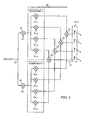
- FIGURE 4 diagrammatically illustrates pertinent portions of further exemplary embodiments of the transceiver apparatus of FIGURE 2.
- FIGURE 4 illustrates an example of K users.
- the user data streams are each divided into two beam signals, one for each of two beams.
- the outputs of each of the phase/amplitude adjusters 25 are switched at 41 to each of four combiners 43, whose respective outputs are applied to a conventional beamforming network.
- FIGURE 5 illustrates exemplary operations which can be performed by the embodiments of FIGURES 2-4.
- the uplink measurement information and the closed loop transmit diversity feedback information from the mobile station(s) are received at 51. Thereafter at 52, the number of beams is determined based on the uplink measurement information.
- each user data stream is divided into a number of beam signals equal to the selected number of beams.
- one or more of the beam signals are adjusted as directed by the closed loop transmit diversity feedback information received from the mobile station(s), resulting in an adjusted set of beam signals.
- the antenna weights are determined.
- beamforming is performed in response to the antenna weights and the adjusted set of beam signals.
- the present invention has the advantage of radiating the energy in certain directions (beamforming), which insures less interference to users located in other directions.
- standard transmit diversity methods transmit energy, for example, through the entire cell. Due to the fact that the downlink beamforming weights are designed and selected by the transceiver that is performing the downlink transmission, and not by the individual mobile stations which are receiving the transmissions, the following advantages are obtained: system capacity, i.e. the number of users that the system can ultimately accommodate, is improved; system throughput, i.e. the total amount of data that the communication system can handle, is improved; because signals from multiple beams can be coherently combined at the mobile station(s), power consumption, i.e.
- the least amount of output power required to satisfy the requested QoS is improved; cell coverage, i.e. ability to meet the demands from users far away from the downlink transceiver, is improved; and link quality, i.e. the ability to ensure that mobile users receive acceptable QoS, is improved.
- the invention also provides an exemplary advantage in that closed loop transmit diversity signaling together with closed loop power control are exploited to monitor the quality of the physical layer signals and adjust the quality of the link. Also, the additional gain obtained by combining two downlink beams does not disadvantageously increase the level of interference to other users. In fact, in some embodiments, the average interference to other users is actually reduced, depending on the location of the other users.
Landscapes
- Engineering & Computer Science (AREA)
- Computer Networks & Wireless Communication (AREA)
- Signal Processing (AREA)
- Mobile Radio Communication Systems (AREA)
- Radio Transmission System (AREA)
- Variable-Direction Aerials And Aerial Arrays (AREA)
Claims (21)
- Vorrichtung zur Unterstützung drahtloser Abwärtsverbindungskommunikation an drahtlose mobile Kommunikationsstationen über ein Mehrstrahl-Antennensystem, die aufweist:einen Eingang zum Empfangen eines Datenstroms der einer drahtlosen mobilen Kommunikationsstation zugeordnet ist;einen mit dem Eingang gekoppelten Teiler (24) zur Erzeugung einer Menge von Strahlsignalen aus dem Datenstrom:dadurch gekennzeichnet, daß sie ferner folgendes umfaßt:einen mit dem Teiler (24) gekoppelten Regler (25) zum Empfangen der Strahlsignale, einschliessend:einen Eingang zum Empfangen von Sendediversity-Rückkopplungsinformation, die über eine drahtlose Kommunikationsverbindung von der drahtlosen mobilen Kommunikationsstation bereitgestellt wird.Mittel zur Regelung mindestens eines der Strahlsignale auf der Grundlage der Rückkopplungsinformation, um eine geregelte Menge von Strahlsignalen zu erzeugen: undeine Strahlformungseinheit (26), die mit dem Regler (25) gekoppelt ist, um von dort die geregelte Menge von Strahlsignalen zu empfangen, einschliessend:einen Eingang zum Empfangen von Strahlformungs-Steuerungsinformation auf der Grundlage von Aufwärtsverbindungsmessungen,Mittel zur Erzeugung von Antenneninformation für das Mehrstrahl-Antennensystem als Antwort auf die geregelte Menge von Strahlsignalen und die Strahlformungs-Steuerungsinformation,einen Ausgang (27) zum Übergeben der Antenneninformation an das Mehrstrahl-Antennensystem, so daß der Datenstrom unter Verwendung von mehr als einem Abwärtsverbindungsstrahl abgestrahlt werden kann.
- Vorrichtung nach Anspruch 1, wobei Regler zur Phasenregelung des mindestens einen Strahlsignals dient.
- Vorrichtung nach Anspruch 2, wobei der Regler ferner zur Amplitudenregelung des mindestens einen Strahlsignals dient.
- Vorrichtung nach Anspruch 1, wobei der Regler zur Amplitudenregelung des mindestens einen Strahlsignals dient.
- Vorrichtung nach Anspruch 1 die eine Strahlungsdiagramm-Bestimmungseinrichtung (23) einschließt zum Bestimmen einer Anzahl von Strahlen in einem Strahlungsdiagramm, das durch das Mehrstrahl-Antennensystem implementiert werden soll, wobei die Strahlungsdiagramm-Bestimmungseinrichtung mit dem Teiler (24) gekoppelt ist, um Strahlenanzahl-Information, die die Anzahl von Strahlen angibt, an diesen zu übergeben, wobei der Teiler (24) als Antwort auf die Strahlenanzahl-Information die Menge von Strahlsignalen mit einer Anzahl an Strahlsignalen versieht, die gleich der Anzahl von Strahlen ist.
- Vorrichtung nach Anspruch 5, wobei die Strahlungsdiagramm-Bestimmungseinrichtung (23) ferner mit dem Eingang der Strahlformungseinheit (26) gekoppelt ist, um die Strahlformungs-Steuerunasinformation an diese zu übergeben.
- Vorrichtung nach Anspruch 6, wobei die Strahlungsdiagramm-Bestimmungseinrichtung (23) einen Eingang zum Empfangen von Messungsinformation einschließt, die von einer drahtlosen Kommunikationsverbindung bezogen wird, wobei die Strahlungsdiagramm-Bestimmungseinrichtung (23) als Antwort auf die Messungsinformation die Anzahl von Strahlen bestimmt und die Strahlformungs-Steuerungsinformation bereitstellt.
- Vorrichtung nach Anspruch 1, wobei die Strahlformungs-Steuerungsinformation Antennen-Wichtungsfaktoren aufweist.
- Vorrichtung nach Anspruch 1, die in einer WCDMA-Basisstation bereitgestellt wird und wobei die Rückkopplungsinformation durch die drahtlose mobile Kommunikationsstation entweder unter Verwendung von FBI oder von FSM bereitgestellt wird.
- Vorrichtung nach Anspruch 1, wobei die Strahlformungseinheit ferner folgendes einschließt:eine Vielzahl von Strahlformern, um jeweils die Strahlsignale der geregelten Menge von Strahlsignalen zu empfangen, wobei jeder Strahlformer betriebsfähig ist zur Erzeugung einer Vielzahl von Strahlformer-Ausgangssignalen als Antwort auf das zugeordnete Strahlsignal und die Strahlformungs-Steuerungsinformation, undeinen mit den Strahlformern gekoppelten Kombinator zum Kombinieren der Vielzahlen von Strahlformer-Ausgangssignalen, um die Antenneninformation zu erzeugen.
- Vorrichtung nach Anspruch 1. wobei die Strahlformungseinheit eine Vielzahl von Kombinatoren aufweist, wobei jeder Kombinator jedes Strahlsignal der geregelten Menge von Strahlsignalen empfängt, jeder Kombinator als Antwort auf die empfangenen Strahlsignale ein entsprechendes Kombinator-Ausgangssignal erzeugt, die Strahlformungseinheit ein mit den Kombinatoren gekoppeltes Strahlformungs-Netzwerk einschließt und als Antwort auf die Kombinator-Ausgangssignale die Antenneninformation erzeugt.
- Vorrichtung nach Anspruch 1, wobei der Regler einen Multiplizierer aufweist und die Rückkopplungsinformation komplexe Strahl-Wichtungsfaktoren aufweist.
- Vorrichtung nach Anspruch 1 mit einer Vielzahl der Eingänge, einer Vielzahl der Teiler und einer Vielzahl der Regler, wobei jeder Teiler mit einem entsprechenden der Eingänge gekoppelt ist, jeder Regler mit einem entsprechenden der Teiler gekoppelt ist und jede Strahlformungseinheit mit einem entsprechenden der Regler gekoppelt ist.
- Verfahren zum Bewirken drahtloser Abwärtsverbindungskommunikation an eine drahtlose mobile Kommunikationsstation über ein Mehrstrahl-Antennensystem, das die folgende Schritte umfasst:Empfangen eines Datenstroms, der der drahtlosen mobilen Kommunikationsstation zugeordnet ist:Erzeugen einer Menge von Strahlsignalen aus dem Datenstrom: undgekennzeichnet durch:Regeln mindestens eines der Strahlsignale auf der Grundlage der Rückkopplungsinformation, die über eine drahtlose Kommunikationsverbindung von der drahtlosen mobilen Kommunikationsstation empfangen wird, um eine geregelte Menge von Strahlsignalen zu erzeugen:Verwenden der geregelten Menge von Strahlsignalen, um eine Strahlformungsoperation durchzuführen, mit den Schritten: Kombinieren der geregelten Menge von Strahlsignalen mit Strahlformungs-Steuerungsinformation: undals Antwort auf die Strahlformungsoperation. Betreiben des Mehrstrahl-Antennensystems für eine drahtlose Abwärtsverbindungskommunikation des Datenstroms die mehr als einen Abwärtsverbindungsstrahl zu der drahtlosen mobilen Kommunikationsstation verwenden kann.
- Verfahren nach Anspruch 14, wobei der Regelschritt entweder Phasenregeln oder Amplitudenregeln des mindestens einen Strahlsignals einschließt.
- Verfahren nach Anspruch 14, wobei der Regelschritt Phasenregeln und Amplitudenregeln des mindestens einen Strahlsignals einschließt.
- Verfahren nach Anspruch 14 mit dem Schritt: Bestimmen einer Anzahl von Strahlen in einem Strahlungsdiagramm, das durch das Mehrstrahl-Antennensystem implementiert werden soll, wobei der Erzeugungsschritt den Schritt des Versehens der Menge von Strahlsignalen einschließt mit einer Anzahl an Strahlsignalen, die gleich der Anzahl von Strahlen ist.
- Verfahren nach Anspruch 17, wobei der Bestimmungsschritt die folgenden Schritte einschließt: Bestimmen der Anzahl von Strahlen als Antwort auf Messungsinformation, die von einer drahtlosen Kommunikationsverbindung bezogen wird, und Bereitstellen der Strahlformungs-Steuerungsinformation als Antwort auf die Messungsinformation.
- Verfahren nach Anspruch 18, wobei die Messungsinformation entweder Aufwärtsverbindungs-Leistungsmessungsinformation oder Aufwärtsverbindungs-Qualitätsmessungsinformation aufweist.
- Verfahren nach Anspruch 14 mit dem Schritt des Übertragens der Rückkopplungsinformation durch die drahtlose mobile Kommunikationsstation über eine drahtlose WCDMA-Kommunikationsverbindung entweder unter Verwendung von FBI oder FSM.
- Verfahren nach Anspruch 14. wobei der Regelschritt den Schritt des Multiplizierens des mindestens einen Strahlsignals mit einem komplexen Strahl-Wichtungsfaktor einschließt.
Applications Claiming Priority (3)
| Application Number | Priority Date | Filing Date | Title |
|---|---|---|---|
| US10/328,723 US7151951B2 (en) | 2002-12-23 | 2002-12-23 | Using beamforming and closed loop transmit diversity in a multi-beam antenna system |
| US328723 | 2002-12-23 | ||
| PCT/SE2003/001773 WO2004057775A1 (en) | 2002-12-23 | 2003-11-14 | Using beamforming and closed loop transmit diversity in a multi-beam antenna system |
Publications (2)
| Publication Number | Publication Date |
|---|---|
| EP1579597A1 EP1579597A1 (de) | 2005-09-28 |
| EP1579597B1 true EP1579597B1 (de) | 2006-06-21 |
Family
ID=32594560
Family Applications (1)
| Application Number | Title | Priority Date | Filing Date |
|---|---|---|---|
| EP03773006A Expired - Lifetime EP1579597B1 (de) | 2002-12-23 | 2003-11-14 | Vorrichtung und verfahren zur verwendung van strahlformung und sende-diversität mit geschlossenem regelkreis in einem mehrfachstrahl-antennensystem |
Country Status (12)
| Country | Link |
|---|---|
| US (1) | US7151951B2 (de) |
| EP (1) | EP1579597B1 (de) |
| JP (1) | JP4451789B2 (de) |
| KR (1) | KR101101057B1 (de) |
| CN (1) | CN100574146C (de) |
| AT (1) | ATE331347T1 (de) |
| AU (1) | AU2003279666A1 (de) |
| BR (1) | BRPI0317530B1 (de) |
| CA (1) | CA2507640C (de) |
| DE (1) | DE60306430T2 (de) |
| RU (1) | RU2321950C2 (de) |
| WO (1) | WO2004057775A1 (de) |
Families Citing this family (91)
| Publication number | Priority date | Publication date | Assignee | Title |
|---|---|---|---|---|
| KR100585726B1 (ko) * | 2003-09-03 | 2006-06-07 | 엘지전자 주식회사 | 이동 단말의 어레이 안테나 빔 형성 방법 및 장치 |
| WO2005034406A2 (en) * | 2003-09-25 | 2005-04-14 | Interdigital Technology Corporation | Method and system for enhancing reception of wireless communication signals |
| US7720509B2 (en) * | 2003-10-02 | 2010-05-18 | Toshiba America Research, Inc. | Harmonized adaptive arrays |
| US7206608B1 (en) * | 2003-11-06 | 2007-04-17 | Nortel Networks Limited | System and method for scheduling transmission from multiple-beam transmitters |
| KR100981554B1 (ko) | 2003-11-13 | 2010-09-10 | 한국과학기술원 | 다중 송수신 안테나들을 구비하는 이동통신시스템에서,송신 안테나들을 그룹핑하여 신호를 전송하는 방법 |
| KR101019521B1 (ko) * | 2003-12-31 | 2011-03-07 | 지티이 코포레이션 | 어레이 안테나 전송링크의 조정장치 및 방법 |
| US20060035608A1 (en) * | 2004-08-11 | 2006-02-16 | Interdigital Technology Corporation | Method and system for using angular hopping in wireless communication systems |
| US7492829B2 (en) * | 2004-09-10 | 2009-02-17 | Intel Corporation | Closed loop feedback in MIMO systems |
| US7539253B2 (en) * | 2004-09-10 | 2009-05-26 | Intel Corporation | Interpolation in channel state feedback |
| US7715806B2 (en) * | 2004-10-06 | 2010-05-11 | Broadcom Corporation | Method and system for diversity processing including using dedicated pilot method for closed loop |
| US7643839B2 (en) * | 2004-10-06 | 2010-01-05 | Broadcom Corporation | Method and system for diversity processing |
| US7139328B2 (en) * | 2004-11-04 | 2006-11-21 | Motorola, Inc. | Method and apparatus for closed loop data transmission |
| US8130862B2 (en) | 2004-11-16 | 2012-03-06 | Intellectual Ventures Holding 40 Llc | Precoding system and method for multi-user transmission in multiple antenna wireless systems |
| JP4536733B2 (ja) | 2004-12-28 | 2010-09-01 | 富士通株式会社 | 無線通信システム |
| AU2004326239B2 (en) * | 2004-12-30 | 2009-11-26 | Telefonaktiebolaget Lm Ericsson (Publ). | An antenna device for a radio base station in a cellular telephony system |
| US8483200B2 (en) * | 2005-04-07 | 2013-07-09 | Interdigital Technology Corporation | Method and apparatus for antenna mapping selection in MIMO-OFDM wireless networks |
| EP1722583A1 (de) * | 2005-05-11 | 2006-11-15 | Siemens Aktiengesellschaft | Beam-Hopping in einem Funkkommunikationssystem |
| KR101012553B1 (ko) | 2006-02-02 | 2011-02-07 | 후지쯔 가부시끼가이샤 | 무선 전송 방법과 무선 송신기 및 무선 수신기 |
| EP1843485B1 (de) | 2006-03-30 | 2016-06-08 | Sony Deutschland Gmbh | MIMO Raummultiplexsystem mit einer dynamischen Fähigkeit zum selektieren einer Antennenstrahlkombination. |
| US20070242666A1 (en) * | 2006-04-13 | 2007-10-18 | Alcatel | Apparatus for managing requests for data in a communication network |
| US8542589B2 (en) | 2006-06-05 | 2013-09-24 | Qualcomm Incorporated | Method and apparatus for providing beamforming feedback in wireless communication systems |
| CN101090286A (zh) * | 2006-06-12 | 2007-12-19 | 清华大学 | 无线系统、基站装置及终端装置 |
| US20080248802A1 (en) * | 2007-04-09 | 2008-10-09 | Tzero Technologies, Inc. | Antenna pattern selection within a wireless network |
| EP1998470B1 (de) * | 2007-05-29 | 2017-02-22 | Samsung Electronics Co., Ltd. | Vorrichtung und Verfahren zur Strahlformung in einem drahtlosen MIMO-Kommunikationssystem |
| US9002300B2 (en) * | 2010-09-30 | 2015-04-07 | Broadcom Corporation | Method and system for time division duplexing (TDD) in a 60 GHZ distributed communication system |
| US8942646B2 (en) * | 2010-09-30 | 2015-01-27 | Broadcom Corporation | Method and system for a 60 GHz communication device comprising multi-location antennas for pseudo-beamforming |
| US8165595B2 (en) * | 2008-01-25 | 2012-04-24 | Samsung Electronics Co., Ltd. | System and method for multi-stage antenna training of beamforming vectors |
| RU2380799C1 (ru) * | 2008-08-22 | 2010-01-27 | Дмитрий Витальевич Татарников | Компактная антенна круговой поляризации с расширенной полосой частот |
| KR101231912B1 (ko) * | 2008-08-26 | 2013-02-08 | 삼성전자주식회사 | 빔 포밍 벡터의 반복적 갱신 방법 및 이를 지원하는 송신기 |
| WO2010024539A2 (en) * | 2008-08-26 | 2010-03-04 | Electronics And Telecommunications Research Institute | Method and transmitter for iteratively modifying beamforming vector |
| JP5256955B2 (ja) * | 2008-09-12 | 2013-08-07 | 富士通株式会社 | 制御方法、通信特性制御方法、基地局装置、及び移動局装置 |
| FR2954631B1 (fr) | 2009-12-21 | 2012-08-10 | Canon Kk | Procede et dispositif de configuration en boucle fermee d'un reseau d'antenne |
| US9806789B2 (en) | 2010-04-06 | 2017-10-31 | Samsung Electronics Co., Ltd. | Apparatus and method for spatial division duplex (SDD) for millimeter wave communication system |
| PH12013500795A1 (en) | 2010-12-17 | 2013-06-17 | Ericsson Telefon Ab L M | Beamforming method, apparatus for polarized antenna array and radio communication device and system thereof |
| KR20120086201A (ko) * | 2011-01-25 | 2012-08-02 | 한국전자통신연구원 | 복편파 안테나 및 이를 이용한 신호 송수신 방법 |
| US8981993B2 (en) * | 2011-04-27 | 2015-03-17 | Telefonaktiebolaget L M Ericsson (Publ) | Beamforming methods and apparatuses |
| EP2702699A1 (de) * | 2011-04-27 | 2014-03-05 | Fujitsu Limited | Drahtlose kommunikation mit kooperierenden zellen |
| KR101950778B1 (ko) * | 2011-08-16 | 2019-02-21 | 삼성전자주식회사 | 빔 포밍 기반의 무선통신시스템에서 다중 안테나 전송을 지원하기 위한 장치 및 방법 |
| BR112013008172A2 (pt) * | 2012-04-20 | 2016-06-21 | Huawei Tech Co Ltd | antena, estação base e método de processamento de feixe |
| KR20130127347A (ko) | 2012-05-10 | 2013-11-22 | 삼성전자주식회사 | 아날로그 및 디지털 하이브리드 빔포밍을 통한 통신 방법 및 장치 |
| US8811522B2 (en) | 2012-05-29 | 2014-08-19 | Magnolia Broadband Inc. | Mitigating interferences for a multi-layer MIMO system augmented by radio distribution network |
| US8644413B2 (en) | 2012-05-29 | 2014-02-04 | Magnolia Broadband Inc. | Implementing blind tuning in hybrid MIMO RF beamforming systems |
| US8767862B2 (en) | 2012-05-29 | 2014-07-01 | Magnolia Broadband Inc. | Beamformer phase optimization for a multi-layer MIMO system augmented by radio distribution network |
| US8837650B2 (en) | 2012-05-29 | 2014-09-16 | Magnolia Broadband Inc. | System and method for discrete gain control in hybrid MIMO RF beamforming for multi layer MIMO base station |
| US8971452B2 (en) | 2012-05-29 | 2015-03-03 | Magnolia Broadband Inc. | Using 3G/4G baseband signals for tuning beamformers in hybrid MIMO RDN systems |
| US8619927B2 (en) | 2012-05-29 | 2013-12-31 | Magnolia Broadband Inc. | System and method for discrete gain control in hybrid MIMO/RF beamforming |
| US8842765B2 (en) | 2012-05-29 | 2014-09-23 | Magnolia Broadband Inc. | Beamformer configurable for connecting a variable number of antennas and radio circuits |
| US8861635B2 (en) | 2012-05-29 | 2014-10-14 | Magnolia Broadband Inc. | Setting radio frequency (RF) beamformer antenna weights per data-stream in a multiple-input-multiple-output (MIMO) system |
| US9154204B2 (en) | 2012-06-11 | 2015-10-06 | Magnolia Broadband Inc. | Implementing transmit RDN architectures in uplink MIMO systems |
| US8797969B1 (en) | 2013-02-08 | 2014-08-05 | Magnolia Broadband Inc. | Implementing multi user multiple input multiple output (MU MIMO) base station using single-user (SU) MIMO co-located base stations |
| US9343808B2 (en) | 2013-02-08 | 2016-05-17 | Magnotod Llc | Multi-beam MIMO time division duplex base station using subset of radios |
| US8989103B2 (en) | 2013-02-13 | 2015-03-24 | Magnolia Broadband Inc. | Method and system for selective attenuation of preamble reception in co-located WI FI access points |
| US9155110B2 (en) | 2013-03-27 | 2015-10-06 | Magnolia Broadband Inc. | System and method for co-located and co-channel Wi-Fi access points |
| US20140226740A1 (en) | 2013-02-13 | 2014-08-14 | Magnolia Broadband Inc. | Multi-beam co-channel wi-fi access point |
| US8774150B1 (en) | 2013-02-13 | 2014-07-08 | Magnolia Broadband Inc. | System and method for reducing side-lobe contamination effects in Wi-Fi access points |
| US9100968B2 (en) | 2013-05-09 | 2015-08-04 | Magnolia Broadband Inc. | Method and system for digital cancellation scheme with multi-beam |
| CN103547341B (zh) * | 2013-06-08 | 2016-03-09 | 华为技术有限公司 | 传输导频信号的方法、基站和用户设备 |
| US9425882B2 (en) | 2013-06-28 | 2016-08-23 | Magnolia Broadband Inc. | Wi-Fi radio distribution network stations and method of operating Wi-Fi RDN stations |
| US8995416B2 (en) | 2013-07-10 | 2015-03-31 | Magnolia Broadband Inc. | System and method for simultaneous co-channel access of neighboring access points |
| US8824596B1 (en) | 2013-07-31 | 2014-09-02 | Magnolia Broadband Inc. | System and method for uplink transmissions in time division MIMO RDN architecture |
| US9497781B2 (en) | 2013-08-13 | 2016-11-15 | Magnolia Broadband Inc. | System and method for co-located and co-channel Wi-Fi access points |
| US9088898B2 (en) | 2013-09-12 | 2015-07-21 | Magnolia Broadband Inc. | System and method for cooperative scheduling for co-located access points |
| US9060362B2 (en) | 2013-09-12 | 2015-06-16 | Magnolia Broadband Inc. | Method and system for accessing an occupied Wi-Fi channel by a client using a nulling scheme |
| US9172454B2 (en) | 2013-11-01 | 2015-10-27 | Magnolia Broadband Inc. | Method and system for calibrating a transceiver array |
| US8891598B1 (en) | 2013-11-19 | 2014-11-18 | Magnolia Broadband Inc. | Transmitter and receiver calibration for obtaining the channel reciprocity for time division duplex MIMO systems |
| US8942134B1 (en) | 2013-11-20 | 2015-01-27 | Magnolia Broadband Inc. | System and method for selective registration in a multi-beam system |
| US8929322B1 (en) * | 2013-11-20 | 2015-01-06 | Magnolia Broadband Inc. | System and method for side lobe suppression using controlled signal cancellation |
| US9014066B1 (en) | 2013-11-26 | 2015-04-21 | Magnolia Broadband Inc. | System and method for transmit and receive antenna patterns calibration for time division duplex (TDD) systems |
| US9294177B2 (en) | 2013-11-26 | 2016-03-22 | Magnolia Broadband Inc. | System and method for transmit and receive antenna patterns calibration for time division duplex (TDD) systems |
| US9042276B1 (en) | 2013-12-05 | 2015-05-26 | Magnolia Broadband Inc. | Multiple co-located multi-user-MIMO access points |
| WO2015096081A1 (zh) * | 2013-12-26 | 2015-07-02 | 华为技术有限公司 | 一种处理数据的方法、装置及系统 |
| US9100154B1 (en) | 2014-03-19 | 2015-08-04 | Magnolia Broadband Inc. | Method and system for explicit AP-to-AP sounding in an 802.11 network |
| US9172446B2 (en) | 2014-03-19 | 2015-10-27 | Magnolia Broadband Inc. | Method and system for supporting sparse explicit sounding by implicit data |
| US9271176B2 (en) | 2014-03-28 | 2016-02-23 | Magnolia Broadband Inc. | System and method for backhaul based sounding feedback |
| WO2015192361A1 (zh) * | 2014-06-19 | 2015-12-23 | 华为技术有限公司 | 一种基站及波束覆盖方法 |
| WO2016141975A1 (en) * | 2015-03-10 | 2016-09-15 | Telefonaktiebolaget Lm Ericsson (Publ) | Uncertainty dependent beamforming configuration control |
| US10321460B1 (en) | 2015-07-09 | 2019-06-11 | Sprint Communications Company L.P. | Orthogonal frequency division multiplexing (OFDM) transmit protocol selection based on a feedback loop lag condition |
| US9780853B2 (en) | 2016-02-19 | 2017-10-03 | Elwha Llc | Receiver configured to provide a channel capacity that exceeds a saturation channel capacity |
| US9800310B2 (en) * | 2016-02-19 | 2017-10-24 | Elwha Llc | Transmitter configured to provide a channel capacity that exceeds a saturation channel capacity |
| US10236947B2 (en) | 2016-02-19 | 2019-03-19 | Elwha Llc | System with transmitter and receiver configured to provide a channel capacity that exceeds a saturation channel capacity |
| US10236955B2 (en) | 2016-02-19 | 2019-03-19 | Elwha Llc | System with transmitter and receiver remote from one another and configured to provide a channel capacity that exceeds a saturation channel capacity |
| CN107852397B (zh) * | 2016-03-14 | 2020-12-04 | 诺资有限公司 | 使用选择矩阵进行天线相位校准的混合波束形成天线阵列 |
| EP3503428B1 (de) * | 2016-09-19 | 2025-11-05 | Guangdong Oppo Mobile Telecommunications Corp., Ltd. | Signalübertragungsvorrichtung und -verfahren |
| EP4030636A3 (de) * | 2016-09-21 | 2022-09-21 | Telefonaktiebolaget LM Ericsson (publ) | Strahlformung von strahlen |
| US10277269B2 (en) * | 2016-12-09 | 2019-04-30 | The Boeing Company | Phased array beam tracking using beam gain coding |
| CN106851846A (zh) * | 2017-01-23 | 2017-06-13 | 深圳市金立通信设备有限公司 | 一种控制信息发送方法、基站、用户设备及系统 |
| JP7088631B2 (ja) * | 2017-03-06 | 2022-06-21 | 株式会社Nttドコモ | 送受信装置 |
| CN107396377B (zh) * | 2017-07-03 | 2019-09-06 | 工业和信息化部电信研究院 | 一种评估天线波束赋形提升无线通信容量的方法 |
| CN111183593B (zh) * | 2017-10-02 | 2022-10-18 | 联想(新加坡)私人有限公司 | 上行链路功率控制 |
| US11601172B2 (en) * | 2018-06-20 | 2023-03-07 | Airsfan Ip Holdco Llc | Technique for controlling a beam pattern employed by an antenna apparatus |
| EP3706326B1 (de) * | 2019-03-05 | 2024-02-21 | Hitachi Energy Ltd | Kommunikationsvorrichtung zur kommunikation zwischen einem leistungsausrüstungssteuergerät und leistungsausrüstungsvorrichtungen |
Family Cites Families (28)
| Publication number | Priority date | Publication date | Assignee | Title |
|---|---|---|---|---|
| US5634199A (en) * | 1993-04-14 | 1997-05-27 | Stanford University | Method of subspace beamforming using adaptive transmitting antennas with feedback |
| US5434578A (en) * | 1993-10-22 | 1995-07-18 | Westinghouse Electric Corp. | Apparatus and method for automatic antenna beam positioning |
| US5463400A (en) * | 1994-06-30 | 1995-10-31 | Motorola, Inc. | Method and apparatus for synchronizing to a multi-beam satellite TDMA communication system |
| US6101399A (en) * | 1995-02-22 | 2000-08-08 | The Board Of Trustees Of The Leland Stanford Jr. University | Adaptive beam forming for transmitter operation in a wireless communication system |
| FI105430B (fi) * | 1995-05-24 | 2000-08-15 | Nokia Networks Oy | Tukiasemalaitteisto sekä menetelmä antennikeilan suuntaamiseksi |
| US5680142A (en) * | 1995-11-07 | 1997-10-21 | Smith; David Anthony | Communication system and method utilizing an antenna having adaptive characteristics |
| IL120574A (en) * | 1996-05-17 | 2002-09-12 | Motorala Ltd | Method and devices for transmitter path weights |
| RU2160452C2 (ru) * | 1996-06-27 | 2000-12-10 | Голик Александр Михайлович | Интеллектуальная многоканальная радиоэлектронная система |
| US6094165A (en) * | 1997-07-31 | 2000-07-25 | Nortel Networks Corporation | Combined multi-beam and sector coverage antenna array |
| US6108323A (en) * | 1997-11-26 | 2000-08-22 | Nokia Mobile Phones Limited | Method and system for operating a CDMA cellular system having beamforming antennas |
| US6377558B1 (en) * | 1998-04-06 | 2002-04-23 | Ericsson Inc. | Multi-signal transmit array with low intermodulation |
| RU2141706C1 (ru) * | 1998-07-06 | 1999-11-20 | Военная академия связи | Способ и устройство адаптивной пространственной фильтрации сигналов |
| US6400780B1 (en) | 1998-11-06 | 2002-06-04 | Lucent Technologies Inc. | Space-time diversity for wireless systems |
| US6587446B2 (en) * | 1999-02-11 | 2003-07-01 | Qualcomm Incorporated | Handoff in a wireless communication system |
| US6421528B1 (en) * | 1999-04-29 | 2002-07-16 | Hughes Electronics Corp. | Satellite transmission system with adaptive transmission loss compensation |
| US6075484A (en) * | 1999-05-03 | 2000-06-13 | Motorola, Inc. | Method and apparatus for robust estimation of directions of arrival for antenna arrays |
| US6778507B1 (en) * | 1999-09-01 | 2004-08-17 | Qualcomm Incorporated | Method and apparatus for beamforming in a wireless communication system |
| US6480524B1 (en) * | 1999-09-13 | 2002-11-12 | Nortel Networks Limited | Multiple beam antenna |
| JP4303373B2 (ja) * | 1999-09-14 | 2009-07-29 | 株式会社日立コミュニケーションテクノロジー | 無線基地局装置 |
| SG80071A1 (en) * | 1999-09-24 | 2001-04-17 | Univ Singapore | Downlink beamforming method |
| US6901062B2 (en) | 1999-12-01 | 2005-05-31 | Kathrein-Werke Kg | Adaptive antenna array wireless data access point |
| US6320540B1 (en) * | 1999-12-07 | 2001-11-20 | Metawave Communications Corporation | Establishing remote beam forming reference line |
| EP1266463B1 (de) | 2000-03-15 | 2006-06-21 | Nokia Corporation | Verfahren und vorrichtung für sende-diversity |
| US6473467B1 (en) | 2000-03-22 | 2002-10-29 | Qualcomm Incorporated | Method and apparatus for measuring reporting channel state information in a high efficiency, high performance communications system |
| DE60021772T2 (de) * | 2000-04-07 | 2006-04-20 | Nokia Corp. | Verfahren und vorrichtung zur übertragung mit mehreren antennen |
| CN1161907C (zh) * | 2001-07-20 | 2004-08-11 | 华为技术有限公司 | 无线通信系统下行反馈多天线发射方法与装置 |
| CA2466922A1 (en) * | 2001-11-09 | 2003-05-15 | Ems Technologies, Inc. | Beamformer for multi-beam broadcast antenna |
| US7065131B2 (en) * | 2002-01-31 | 2006-06-20 | Intel Corporation | Processor and method for weight detection in a closed loop diversity mode WCDMA system |
-
2002
- 2002-12-23 US US10/328,723 patent/US7151951B2/en not_active Expired - Lifetime
-
2003
- 2003-11-14 RU RU2005123400/09A patent/RU2321950C2/ru active
- 2003-11-14 DE DE60306430T patent/DE60306430T2/de not_active Expired - Lifetime
- 2003-11-14 JP JP2004562170A patent/JP4451789B2/ja not_active Expired - Fee Related
- 2003-11-14 AT AT03773006T patent/ATE331347T1/de not_active IP Right Cessation
- 2003-11-14 WO PCT/SE2003/001773 patent/WO2004057775A1/en not_active Ceased
- 2003-11-14 BR BRPI0317530A patent/BRPI0317530B1/pt active IP Right Grant
- 2003-11-14 CN CNB2003801074089A patent/CN100574146C/zh not_active Expired - Lifetime
- 2003-11-14 EP EP03773006A patent/EP1579597B1/de not_active Expired - Lifetime
- 2003-11-14 AU AU2003279666A patent/AU2003279666A1/en not_active Abandoned
- 2003-11-14 KR KR1020057011541A patent/KR101101057B1/ko not_active Expired - Fee Related
- 2003-11-14 CA CA2507640A patent/CA2507640C/en not_active Expired - Fee Related
Also Published As
| Publication number | Publication date |
|---|---|
| RU2321950C2 (ru) | 2008-04-10 |
| JP4451789B2 (ja) | 2010-04-14 |
| CA2507640C (en) | 2014-01-28 |
| CN100574146C (zh) | 2009-12-23 |
| DE60306430D1 (de) | 2006-08-03 |
| BRPI0317530B1 (pt) | 2016-10-18 |
| KR20050084437A (ko) | 2005-08-26 |
| US7151951B2 (en) | 2006-12-19 |
| DE60306430T2 (de) | 2007-01-11 |
| US20040121810A1 (en) | 2004-06-24 |
| CN1732636A (zh) | 2006-02-08 |
| KR101101057B1 (ko) | 2011-12-29 |
| BR0317530A (pt) | 2005-11-22 |
| AU2003279666A1 (en) | 2004-07-14 |
| JP2006512001A (ja) | 2006-04-06 |
| WO2004057775A1 (en) | 2004-07-08 |
| RU2005123400A (ru) | 2006-01-27 |
| ATE331347T1 (de) | 2006-07-15 |
| HK1088448A1 (zh) | 2006-11-03 |
| CA2507640A1 (en) | 2004-07-08 |
| EP1579597A1 (de) | 2005-09-28 |
Similar Documents
| Publication | Publication Date | Title |
|---|---|---|
| US7151951B2 (en) | Using beamforming and closed loop transmit diversity in a multi-beam antenna system | |
| EP1920577B1 (de) | Verfahren und system zum partitionieren einer antennengruppe und zum anwenden von mechanismen für mehrere eingänge und mehrere ausgänge und strahlformung | |
| EP1685661B1 (de) | Verfahren und vorrichtung für ein mehrstrahl-antennensystem | |
| EP1330050B1 (de) | Verfahren und einrichtung zum abwärts-rückkopplungs-mehrfachantennensenden in drahtlosen kommunikationssystemen | |
| US8891647B2 (en) | System and method for user specific antenna down tilt in wireless cellular networks | |
| US7200368B1 (en) | Transmit diversity method and system | |
| US7095987B2 (en) | Method and apparatus for received uplinked-signal based adaptive downlink diversity within a communication system | |
| EP3185437B1 (de) | Verfahren zur bestimmung des gewichts zur strahlformung in einem drahtloskommunikationssystem und vorrichtung dafür | |
| EP1334573B1 (de) | Verfahren, vorrichtungen und telekommunikationsnetzwerk zum regeln der antennengewichte eines transceivers | |
| EP2939479B1 (de) | Steuerungsverfahren und -vorrichtung der uplink-leistung in einem auf strahlformung basierenden drahtlosen kommunikationssystem | |
| US9160427B1 (en) | Transmit diversity with formed beams in a wireless communications system using a common pilot channel | |
| KR101500026B1 (ko) | 다중 안테나 빔 형성 셀룰러 네트워크의 성능 향상 | |
| US20070099578A1 (en) | Pre-coded diversity forward channel transmission system for wireless communications systems supporting multiple MIMO transmission modes | |
| US20050286650A1 (en) | Apparatus and method for providing transmit diversity in a mobile communication system using multiple antennas | |
| US6731954B1 (en) | Method of improving radio connection quality | |
| US6865377B1 (en) | Combined open and closed loop beam forming in a multiple array radio communication system | |
| KR20180065554A (ko) | 무선 통신 시스템에서 빔포밍을 수행하는 방법 및 이를 위한 장치 | |
| HK1088448B (en) | Using beamforming and closed loop transmit diversity in a multi-beam antenna system | |
| Hämäläinen et al. | Multichannel Adaptive Beamforming | |
| HK1100794B (en) | Method and apparatus for multi-beam antenna system |
Legal Events
| Date | Code | Title | Description |
|---|---|---|---|
| PUAI | Public reference made under article 153(3) epc to a published international application that has entered the european phase |
Free format text: ORIGINAL CODE: 0009012 |
|
| 17P | Request for examination filed |
Effective date: 20050725 |
|
| AK | Designated contracting states |
Kind code of ref document: A1 Designated state(s): AT BE BG CH CY CZ DE DK EE ES FI FR GB GR HU IE IT LI LU MC NL PT RO SE SI SK TR |
|
| AX | Request for extension of the european patent |
Extension state: AL LT LV MK |
|
| GRAP | Despatch of communication of intention to grant a patent |
Free format text: ORIGINAL CODE: EPIDOSNIGR1 |
|
| RTI1 | Title (correction) |
Free format text: APPARATUS AND METHOD FOR USING BEAMFORMING AND CLOSED LOOP TRANSMIT DIVERSITY IN A MULTI-BEAM ANTENNA SYSTEM |
|
| DAX | Request for extension of the european patent (deleted) | ||
| GRAS | Grant fee paid |
Free format text: ORIGINAL CODE: EPIDOSNIGR3 |
|
| GRAA | (expected) grant |
Free format text: ORIGINAL CODE: 0009210 |
|
| AK | Designated contracting states |
Kind code of ref document: B1 Designated state(s): AT BE BG CH CY CZ DE DK EE ES FI FR GB GR HU IE IT LI LU MC NL PT RO SE SI SK TR |
|
| PG25 | Lapsed in a contracting state [announced via postgrant information from national office to epo] |
Ref country code: FI Free format text: LAPSE BECAUSE OF FAILURE TO SUBMIT A TRANSLATION OF THE DESCRIPTION OR TO PAY THE FEE WITHIN THE PRESCRIBED TIME-LIMIT Effective date: 20060621 Ref country code: IT Free format text: LAPSE BECAUSE OF FAILURE TO SUBMIT A TRANSLATION OF THE DESCRIPTION OR TO PAY THE FEE WITHIN THE PRESCRIBED TIME-LIMIT;WARNING: LAPSES OF ITALIAN PATENTS WITH EFFECTIVE DATE BEFORE 2007 MAY HAVE OCCURRED AT ANY TIME BEFORE 2007. THE CORRECT EFFECTIVE DATE MAY BE DIFFERENT FROM THE ONE RECORDED. Effective date: 20060621 Ref country code: RO Free format text: LAPSE BECAUSE OF FAILURE TO SUBMIT A TRANSLATION OF THE DESCRIPTION OR TO PAY THE FEE WITHIN THE PRESCRIBED TIME-LIMIT Effective date: 20060621 Ref country code: LI Free format text: LAPSE BECAUSE OF FAILURE TO SUBMIT A TRANSLATION OF THE DESCRIPTION OR TO PAY THE FEE WITHIN THE PRESCRIBED TIME-LIMIT Effective date: 20060621 Ref country code: SI Free format text: LAPSE BECAUSE OF FAILURE TO SUBMIT A TRANSLATION OF THE DESCRIPTION OR TO PAY THE FEE WITHIN THE PRESCRIBED TIME-LIMIT Effective date: 20060621 Ref country code: AT Free format text: LAPSE BECAUSE OF FAILURE TO SUBMIT A TRANSLATION OF THE DESCRIPTION OR TO PAY THE FEE WITHIN THE PRESCRIBED TIME-LIMIT Effective date: 20060621 Ref country code: CZ Free format text: LAPSE BECAUSE OF FAILURE TO SUBMIT A TRANSLATION OF THE DESCRIPTION OR TO PAY THE FEE WITHIN THE PRESCRIBED TIME-LIMIT Effective date: 20060621 Ref country code: CH Free format text: LAPSE BECAUSE OF FAILURE TO SUBMIT A TRANSLATION OF THE DESCRIPTION OR TO PAY THE FEE WITHIN THE PRESCRIBED TIME-LIMIT Effective date: 20060621 Ref country code: BE Free format text: LAPSE BECAUSE OF FAILURE TO SUBMIT A TRANSLATION OF THE DESCRIPTION OR TO PAY THE FEE WITHIN THE PRESCRIBED TIME-LIMIT Effective date: 20060621 Ref country code: SK Free format text: LAPSE BECAUSE OF FAILURE TO SUBMIT A TRANSLATION OF THE DESCRIPTION OR TO PAY THE FEE WITHIN THE PRESCRIBED TIME-LIMIT Effective date: 20060621 Ref country code: NL Free format text: LAPSE BECAUSE OF FAILURE TO SUBMIT A TRANSLATION OF THE DESCRIPTION OR TO PAY THE FEE WITHIN THE PRESCRIBED TIME-LIMIT Effective date: 20060621 |
|
| REG | Reference to a national code |
Ref country code: GB Ref legal event code: FG4D |
|
| REG | Reference to a national code |
Ref country code: CH Ref legal event code: EP |
|
| REG | Reference to a national code |
Ref country code: IE Ref legal event code: FG4D |
|
| REF | Corresponds to: |
Ref document number: 60306430 Country of ref document: DE Date of ref document: 20060803 Kind code of ref document: P |
|
| REG | Reference to a national code |
Ref country code: DE Ref legal event code: R096 Ref document number: 60306430 Country of ref document: DE Effective date: 20060803 |
|
| PG25 | Lapsed in a contracting state [announced via postgrant information from national office to epo] |
Ref country code: DK Free format text: LAPSE BECAUSE OF FAILURE TO SUBMIT A TRANSLATION OF THE DESCRIPTION OR TO PAY THE FEE WITHIN THE PRESCRIBED TIME-LIMIT Effective date: 20060921 Ref country code: SE Free format text: LAPSE BECAUSE OF FAILURE TO SUBMIT A TRANSLATION OF THE DESCRIPTION OR TO PAY THE FEE WITHIN THE PRESCRIBED TIME-LIMIT Effective date: 20060921 |
|
| PG25 | Lapsed in a contracting state [announced via postgrant information from national office to epo] |
Ref country code: ES Free format text: LAPSE BECAUSE OF FAILURE TO SUBMIT A TRANSLATION OF THE DESCRIPTION OR TO PAY THE FEE WITHIN THE PRESCRIBED TIME-LIMIT Effective date: 20061002 |
|
| PG25 | Lapsed in a contracting state [announced via postgrant information from national office to epo] |
Ref country code: IE Free format text: LAPSE BECAUSE OF NON-PAYMENT OF DUE FEES Effective date: 20061114 |
|
| PG25 | Lapsed in a contracting state [announced via postgrant information from national office to epo] |
Ref country code: PT Free format text: LAPSE BECAUSE OF FAILURE TO SUBMIT A TRANSLATION OF THE DESCRIPTION OR TO PAY THE FEE WITHIN THE PRESCRIBED TIME-LIMIT Effective date: 20061121 |
|
| PG25 | Lapsed in a contracting state [announced via postgrant information from national office to epo] |
Ref country code: MC Free format text: LAPSE BECAUSE OF NON-PAYMENT OF DUE FEES Effective date: 20061130 |
|
| NLV1 | Nl: lapsed or annulled due to failure to fulfill the requirements of art. 29p and 29m of the patents act | ||
| REG | Reference to a national code |
Ref country code: CH Ref legal event code: PL |
|
| ET | Fr: translation filed | ||
| PLBE | No opposition filed within time limit |
Free format text: ORIGINAL CODE: 0009261 |
|
| STAA | Information on the status of an ep patent application or granted ep patent |
Free format text: STATUS: NO OPPOSITION FILED WITHIN TIME LIMIT |
|
| 26N | No opposition filed |
Effective date: 20070322 |
|
| REG | Reference to a national code |
Ref country code: DE Ref legal event code: R097 Ref document number: 60306430 Country of ref document: DE Effective date: 20070322 |
|
| PG25 | Lapsed in a contracting state [announced via postgrant information from national office to epo] |
Ref country code: GR Free format text: LAPSE BECAUSE OF FAILURE TO SUBMIT A TRANSLATION OF THE DESCRIPTION OR TO PAY THE FEE WITHIN THE PRESCRIBED TIME-LIMIT Effective date: 20060922 |
|
| PG25 | Lapsed in a contracting state [announced via postgrant information from national office to epo] |
Ref country code: EE Free format text: LAPSE BECAUSE OF FAILURE TO SUBMIT A TRANSLATION OF THE DESCRIPTION OR TO PAY THE FEE WITHIN THE PRESCRIBED TIME-LIMIT Effective date: 20060621 Ref country code: BG Free format text: LAPSE BECAUSE OF FAILURE TO SUBMIT A TRANSLATION OF THE DESCRIPTION OR TO PAY THE FEE WITHIN THE PRESCRIBED TIME-LIMIT Effective date: 20060921 |
|
| PG25 | Lapsed in a contracting state [announced via postgrant information from national office to epo] |
Ref country code: LU Free format text: LAPSE BECAUSE OF NON-PAYMENT OF DUE FEES Effective date: 20061114 Ref country code: TR Free format text: LAPSE BECAUSE OF FAILURE TO SUBMIT A TRANSLATION OF THE DESCRIPTION OR TO PAY THE FEE WITHIN THE PRESCRIBED TIME-LIMIT Effective date: 20060621 Ref country code: HU Free format text: LAPSE BECAUSE OF FAILURE TO SUBMIT A TRANSLATION OF THE DESCRIPTION OR TO PAY THE FEE WITHIN THE PRESCRIBED TIME-LIMIT Effective date: 20061222 |
|
| PG25 | Lapsed in a contracting state [announced via postgrant information from national office to epo] |
Ref country code: CY Free format text: LAPSE BECAUSE OF FAILURE TO SUBMIT A TRANSLATION OF THE DESCRIPTION OR TO PAY THE FEE WITHIN THE PRESCRIBED TIME-LIMIT Effective date: 20060621 |
|
| REG | Reference to a national code |
Ref country code: FR Ref legal event code: PLFP Year of fee payment: 13 |
|
| REG | Reference to a national code |
Ref country code: FR Ref legal event code: PLFP Year of fee payment: 14 |
|
| REG | Reference to a national code |
Ref country code: FR Ref legal event code: PLFP Year of fee payment: 15 |
|
| PGFP | Annual fee paid to national office [announced via postgrant information from national office to epo] |
Ref country code: GB Payment date: 20201127 Year of fee payment: 18 Ref country code: FR Payment date: 20201125 Year of fee payment: 18 Ref country code: IT Payment date: 20201123 Year of fee payment: 18 |
|
| GBPC | Gb: european patent ceased through non-payment of renewal fee |
Effective date: 20211114 |
|
| PG25 | Lapsed in a contracting state [announced via postgrant information from national office to epo] |
Ref country code: GB Free format text: LAPSE BECAUSE OF NON-PAYMENT OF DUE FEES Effective date: 20211114 |
|
| PG25 | Lapsed in a contracting state [announced via postgrant information from national office to epo] |
Ref country code: FR Free format text: LAPSE BECAUSE OF NON-PAYMENT OF DUE FEES Effective date: 20211130 |
|
| PG25 | Lapsed in a contracting state [announced via postgrant information from national office to epo] |
Ref country code: IT Free format text: LAPSE BECAUSE OF NON-PAYMENT OF DUE FEES Effective date: 20211114 |
|
| PGFP | Annual fee paid to national office [announced via postgrant information from national office to epo] |
Ref country code: DE Payment date: 20221125 Year of fee payment: 20 |
|
| P01 | Opt-out of the competence of the unified patent court (upc) registered |
Effective date: 20230517 |
|
| REG | Reference to a national code |
Ref country code: DE Ref legal event code: R071 Ref document number: 60306430 Country of ref document: DE |