EP1578985B1 - Bande de biodetection de lactate - Google Patents
Bande de biodetection de lactate Download PDFInfo
- Publication number
- EP1578985B1 EP1578985B1 EP02790638A EP02790638A EP1578985B1 EP 1578985 B1 EP1578985 B1 EP 1578985B1 EP 02790638 A EP02790638 A EP 02790638A EP 02790638 A EP02790638 A EP 02790638A EP 1578985 B1 EP1578985 B1 EP 1578985B1
- Authority
- EP
- European Patent Office
- Prior art keywords
- strip
- lactate
- electrode
- silver
- layer
- Prior art date
- Legal status (The legal status is an assumption and is not a legal conclusion. Google has not performed a legal analysis and makes no representation as to the accuracy of the status listed.)
- Expired - Lifetime
Links
- JVTAAEKCZFNVCJ-UHFFFAOYSA-M Lactate Chemical compound CC(O)C([O-])=O JVTAAEKCZFNVCJ-UHFFFAOYSA-M 0.000 title claims description 60
- BQCADISMDOOEFD-UHFFFAOYSA-N Silver Chemical compound [Ag] BQCADISMDOOEFD-UHFFFAOYSA-N 0.000 claims description 30
- 229910052709 silver Inorganic materials 0.000 claims description 30
- 239000004332 silver Substances 0.000 claims description 30
- OKTJSMMVPCPJKN-UHFFFAOYSA-N Carbon Chemical compound [C] OKTJSMMVPCPJKN-UHFFFAOYSA-N 0.000 claims description 28
- 239000010439 graphite Substances 0.000 claims description 26
- 229910002804 graphite Inorganic materials 0.000 claims description 26
- 102000004190 Enzymes Human genes 0.000 claims description 18
- 108090000790 Enzymes Proteins 0.000 claims description 18
- 108010073450 Lactate 2-monooxygenase Proteins 0.000 claims description 13
- 239000012528 membrane Substances 0.000 claims description 13
- 230000000694 effects Effects 0.000 claims description 9
- 229910021607 Silver chloride Inorganic materials 0.000 claims description 8
- HKZLPVFGJNLROG-UHFFFAOYSA-M silver monochloride Chemical compound [Cl-].[Ag+] HKZLPVFGJNLROG-UHFFFAOYSA-M 0.000 claims description 8
- 238000001514 detection method Methods 0.000 claims description 6
- 239000004677 Nylon Substances 0.000 claims description 4
- 239000012491 analyte Substances 0.000 claims description 4
- 229920001778 nylon Polymers 0.000 claims description 4
- 229920000915 polyvinyl chloride Polymers 0.000 claims description 3
- 239000004800 polyvinyl chloride Substances 0.000 claims description 3
- -1 potassium ferricyanide Chemical compound 0.000 claims description 3
- KTWOOEGAPBSYNW-UHFFFAOYSA-N ferrocene Chemical compound [Fe+2].C=1C=C[CH-]C=1.C=1C=C[CH-]C=1 KTWOOEGAPBSYNW-UHFFFAOYSA-N 0.000 claims description 2
- 229920000728 polyester Polymers 0.000 claims description 2
- 239000000243 solution Substances 0.000 description 21
- 238000012360 testing method Methods 0.000 description 17
- 239000008280 blood Substances 0.000 description 15
- 210000004369 blood Anatomy 0.000 description 15
- 238000000034 method Methods 0.000 description 11
- 238000005259 measurement Methods 0.000 description 8
- 238000001727 in vivo Methods 0.000 description 6
- 239000000758 substrate Substances 0.000 description 6
- 150000001875 compounds Chemical class 0.000 description 5
- 238000000338 in vitro Methods 0.000 description 5
- 238000002360 preparation method Methods 0.000 description 5
- RLFWWDJHLFCNIJ-UHFFFAOYSA-N 4-aminoantipyrine Chemical compound CN1C(C)=C(N)C(=O)N1C1=CC=CC=C1 RLFWWDJHLFCNIJ-UHFFFAOYSA-N 0.000 description 4
- 238000002405 diagnostic procedure Methods 0.000 description 4
- 239000012530 fluid Substances 0.000 description 4
- 239000008363 phosphate buffer Substances 0.000 description 4
- 239000003146 anticoagulant agent Substances 0.000 description 3
- 238000003556 assay Methods 0.000 description 3
- 230000010354 integration Effects 0.000 description 3
- 239000000463 material Substances 0.000 description 3
- 238000007639 printing Methods 0.000 description 3
- 239000011550 stock solution Substances 0.000 description 3
- 239000000126 substance Substances 0.000 description 3
- 239000004094 surface-active agent Substances 0.000 description 3
- 208000035473 Communicable disease Diseases 0.000 description 2
- 108010093096 Immobilized Enzymes Proteins 0.000 description 2
- 102000003855 L-lactate dehydrogenase Human genes 0.000 description 2
- 108700023483 L-lactate dehydrogenases Proteins 0.000 description 2
- JVTAAEKCZFNVCJ-REOHCLBHSA-N L-lactic acid Chemical compound C[C@H](O)C(O)=O JVTAAEKCZFNVCJ-REOHCLBHSA-N 0.000 description 2
- DFPAKSUCGFBDDF-UHFFFAOYSA-N Nicotinamide Chemical compound NC(=O)C1=CC=CN=C1 DFPAKSUCGFBDDF-UHFFFAOYSA-N 0.000 description 2
- LCTONWCANYUPML-UHFFFAOYSA-M Pyruvate Chemical compound CC(=O)C([O-])=O LCTONWCANYUPML-UHFFFAOYSA-M 0.000 description 2
- 238000002835 absorbance Methods 0.000 description 2
- 229940127219 anticoagulant drug Drugs 0.000 description 2
- 239000012736 aqueous medium Substances 0.000 description 2
- 239000011230 binding agent Substances 0.000 description 2
- HVYWMOMLDIMFJA-DPAQBDIFSA-N cholesterol Chemical compound C1C=C2C[C@@H](O)CC[C@]2(C)[C@@H]2[C@@H]1[C@@H]1CC[C@H]([C@H](C)CCCC(C)C)[C@@]1(C)CC2 HVYWMOMLDIMFJA-DPAQBDIFSA-N 0.000 description 2
- 230000015271 coagulation Effects 0.000 description 2
- 238000005345 coagulation Methods 0.000 description 2
- 238000004891 communication Methods 0.000 description 2
- 239000012153 distilled water Substances 0.000 description 2
- 238000005516 engineering process Methods 0.000 description 2
- 239000000203 mixture Substances 0.000 description 2
- 238000012544 monitoring process Methods 0.000 description 2
- 230000003287 optical effect Effects 0.000 description 2
- 235000010482 polyoxyethylene sorbitan monooleate Nutrition 0.000 description 2
- 229920000053 polysorbate 80 Polymers 0.000 description 2
- 239000000047 product Substances 0.000 description 2
- 238000003908 quality control method Methods 0.000 description 2
- 238000007650 screen-printing Methods 0.000 description 2
- 230000035945 sensitivity Effects 0.000 description 2
- XLYOFNOQVPJJNP-UHFFFAOYSA-N water Chemical compound O XLYOFNOQVPJJNP-UHFFFAOYSA-N 0.000 description 2
- KCALAFIVPCAXJI-UHFFFAOYSA-N 1,10-phenanthroline-5,6-dione Chemical compound C1=CC=C2C(=O)C(=O)C3=CC=CN=C3C2=N1 KCALAFIVPCAXJI-UHFFFAOYSA-N 0.000 description 1
- POAOYUHQDCAZBD-UHFFFAOYSA-N 2-butoxyethanol Chemical compound CCCCOCCO POAOYUHQDCAZBD-UHFFFAOYSA-N 0.000 description 1
- HFGHRUCCKVYFKL-UHFFFAOYSA-N 4-ethoxy-2-piperazin-1-yl-7-pyridin-4-yl-5h-pyrimido[5,4-b]indole Chemical compound C1=C2NC=3C(OCC)=NC(N4CCNCC4)=NC=3C2=CC=C1C1=CC=NC=C1 HFGHRUCCKVYFKL-UHFFFAOYSA-N 0.000 description 1
- 206010053567 Coagulopathies Diseases 0.000 description 1
- WQZGKKKJIJFFOK-GASJEMHNSA-N Glucose Natural products OC[C@H]1OC(O)[C@H](O)[C@@H](O)[C@@H]1O WQZGKKKJIJFFOK-GASJEMHNSA-N 0.000 description 1
- 108010050375 Glucose 1-Dehydrogenase Proteins 0.000 description 1
- 102000001554 Hemoglobins Human genes 0.000 description 1
- 108010054147 Hemoglobins Proteins 0.000 description 1
- 102000004895 Lipoproteins Human genes 0.000 description 1
- 108090001030 Lipoproteins Proteins 0.000 description 1
- JLTDJTHDQAWBAV-UHFFFAOYSA-N N,N-dimethylaniline Chemical compound CN(C)C1=CC=CC=C1 JLTDJTHDQAWBAV-UHFFFAOYSA-N 0.000 description 1
- 206010028980 Neoplasm Diseases 0.000 description 1
- 102000003992 Peroxidases Human genes 0.000 description 1
- QVGXLLKOCUKJST-UHFFFAOYSA-N atomic oxygen Chemical compound [O] QVGXLLKOCUKJST-UHFFFAOYSA-N 0.000 description 1
- JXLHNMVSKXFWAO-UHFFFAOYSA-N azane;7-fluoro-2,1,3-benzoxadiazole-4-sulfonic acid Chemical compound N.OS(=O)(=O)C1=CC=C(F)C2=NON=C12 JXLHNMVSKXFWAO-UHFFFAOYSA-N 0.000 description 1
- 230000008033 biological extinction Effects 0.000 description 1
- 230000015572 biosynthetic process Effects 0.000 description 1
- 230000017531 blood circulation Effects 0.000 description 1
- 238000010241 blood sampling Methods 0.000 description 1
- 239000006227 byproduct Substances 0.000 description 1
- 238000011088 calibration curve Methods 0.000 description 1
- 201000011510 cancer Diseases 0.000 description 1
- 230000023852 carbohydrate metabolic process Effects 0.000 description 1
- 235000021256 carbohydrate metabolism Nutrition 0.000 description 1
- 229910052799 carbon Inorganic materials 0.000 description 1
- 230000000747 cardiac effect Effects 0.000 description 1
- 230000003197 catalytic effect Effects 0.000 description 1
- 238000006555 catalytic reaction Methods 0.000 description 1
- 238000001311 chemical methods and process Methods 0.000 description 1
- 239000003153 chemical reaction reagent Substances 0.000 description 1
- 235000012000 cholesterol Nutrition 0.000 description 1
- 230000035602 clotting Effects 0.000 description 1
- 239000002131 composite material Substances 0.000 description 1
- 239000004020 conductor Substances 0.000 description 1
- 238000005859 coupling reaction Methods 0.000 description 1
- 230000003247 decreasing effect Effects 0.000 description 1
- 230000007812 deficiency Effects 0.000 description 1
- 238000007865 diluting Methods 0.000 description 1
- 230000007613 environmental effect Effects 0.000 description 1
- 238000006911 enzymatic reaction Methods 0.000 description 1
- 239000000945 filler Substances 0.000 description 1
- 239000007789 gas Substances 0.000 description 1
- 239000008103 glucose Substances 0.000 description 1
- 230000034659 glycolysis Effects 0.000 description 1
- 238000005534 hematocrit Methods 0.000 description 1
- 230000002209 hydrophobic effect Effects 0.000 description 1
- 230000000984 immunochemical effect Effects 0.000 description 1
- 238000011534 incubation Methods 0.000 description 1
- 208000015181 infectious disease Diseases 0.000 description 1
- 230000000977 initiatory effect Effects 0.000 description 1
- 208000014674 injury Diseases 0.000 description 1
- 229940116871 l-lactate Drugs 0.000 description 1
- 239000007788 liquid Substances 0.000 description 1
- 238000012423 maintenance Methods 0.000 description 1
- 239000011159 matrix material Substances 0.000 description 1
- 229960003966 nicotinamide Drugs 0.000 description 1
- 235000005152 nicotinamide Nutrition 0.000 description 1
- 239000011570 nicotinamide Substances 0.000 description 1
- 229930027945 nicotinamide-adenine dinucleotide Natural products 0.000 description 1
- BOPGDPNILDQYTO-NNYOXOHSSA-N nicotinamide-adenine dinucleotide Chemical compound C1=CCC(C(=O)N)=CN1[C@H]1[C@H](O)[C@H](O)[C@@H](COP(O)(=O)OP(O)(=O)OC[C@@H]2[C@H]([C@@H](O)[C@@H](O2)N2C3=NC=NC(N)=C3N=C2)O)O1 BOPGDPNILDQYTO-NNYOXOHSSA-N 0.000 description 1
- 230000004768 organ dysfunction Effects 0.000 description 1
- 229910052760 oxygen Inorganic materials 0.000 description 1
- 239000001301 oxygen Substances 0.000 description 1
- 230000005298 paramagnetic effect Effects 0.000 description 1
- 239000002245 particle Substances 0.000 description 1
- 108040007629 peroxidase activity proteins Proteins 0.000 description 1
- 238000000053 physical method Methods 0.000 description 1
- 229920000767 polyaniline Polymers 0.000 description 1
- 229920000128 polypyrrole Polymers 0.000 description 1
- 229920000036 polyvinylpyrrolidone Polymers 0.000 description 1
- 230000035484 reaction time Effects 0.000 description 1
- 208000023504 respiratory system disease Diseases 0.000 description 1
- 239000003381 stabilizer Substances 0.000 description 1
- 239000012086 standard solution Substances 0.000 description 1
- 238000001356 surgical procedure Methods 0.000 description 1
- 238000010998 test method Methods 0.000 description 1
- 239000012085 test solution Substances 0.000 description 1
- 229940126585 therapeutic drug Drugs 0.000 description 1
- 230000002537 thrombolytic effect Effects 0.000 description 1
- 238000012549 training Methods 0.000 description 1
- 238000012546 transfer Methods 0.000 description 1
- 230000008733 trauma Effects 0.000 description 1
- 238000010200 validation analysis Methods 0.000 description 1
- 229920002554 vinyl polymer Polymers 0.000 description 1
Images
Definitions
- the invention relates to a lactate biosensing strip for the measurement of lactate solution.
- Clinical laboratories offer a wide range of automated systems for high-volume testing and analytical support in a well controlled, high quality environment. However, clinical laboratories can not provide the immediate results needed to properly treat trauma and multi organ dysfunction/failure patients.
- tests can be classified as: 1) in vitro, which is performed at the bedside; 2) ex vivo or para vivo, which is performed at wrist-side; and 3) in vivo, which is performed inside the patient.
- Such tests offer indirect cost efficiencies and savings such as reduced labor costs, decreased blood identification and transport errors, and reduced patient complications.
- In vitro or bedside devices are used typically in several departments of the hospital including intensive care units; operating rooms; emergency departments (ER); interventional departments; general patient care departments; and outpatient surgery and ambulatory care units.
- In vitro diagnostic tests offer a wide range of diagnostic tests, similar to the clinical laboratory.
- In vitro diagnostic test systems typically are not connected on-line to the patient and require an operator for blood sampling.
- diagnostic test in the diagnostic market include arterial blood gases, blood chemistries, blood glucose, coagulation, drugs-of abuse testing, hemoglobin, hematocrit, infectious diseases, and therapeutic drug monitoring.
- Other categories include cancer markers, cardiac markers, cholesterol detection, immunodiagnostics, infectious disease detection, lactate, and thrombolytic monitoring.
- Ex vivo diagnostics use external sensors for on-line real-time testing with little to no blood loss. Typically, sampled blood flows through a closed system to minimize blood contact. Ex vivo systems minimize problems associated with in vivo sensors, including clotting, inaccuracy, calibration drift, and an inability to recalibrate once in the patient.
- U.S. Pat. No. 5,505,828 discloses an exemplary ex vivo system.
- Ex vivo and in vivo diagnostics can reduce quality control and information integration errors that occur with clinical or in vitro tests.
- Quality control errors are commonly due to operator errors, not instrument errors or device failures.
- Exemplary errors include inappropriate specimen volume, inaccurate calibration, use of deteriorated test strips, inadequate validation, insufficient instrument maintenance, bad timing of the test procedure, and use of the wrong materials.
- Clinical information system integration allows test data collected at the bedside to be put directly into the patient record. This improves the efficiency of the patient management process, allowing the integration of the laboratory's information system and clinical information systems, providing a "seamless" flow of all types of patient information..
- Lactate is the byproduct of carbohydrate metabolism and product of glycolysis (pyrovate) is converted into lactate under an aerobic condition i.e. deficiency of oxygen in cells. Lactate estimations are therefore important in respiratory disorder, heart ailment, labor deseases etc. normal concentration of lactate in human blood is in the range of 1.2 to 2.7mM.
- Procedure for lactate determination for example, has employed a variety of chemical and physical technique.
- Traditional assay involves chemical treatment of lactate in human blood and thereby converting it into colour products which can be measured spectrophotometrically, the methods consists in reacting the blood under test with enzyme namely lactate dehydrogenise (LDH).
- LDH lactate dehydrogenise
- absorbance at 340nm is measured due to the NADH formation, it becomes a measurement of lactate originally present in blood.
- US Patent 6,117,290 discloses an on-line lactate sensor arrangement.
- the sensor arrangement includes a lactate sensor, a catheter for withdrawing a test sample, and a first fluid flow line provided fluid communication between the lactate sensor and the catheter.
- the sensor arrangement also includes a source of sensor calibration and anticoagulant solution, and second fluid flow line providing fluid communication between the source of sensor calibration and anticoagulant solution and the lactate sensor.
- Asha Chaubey et al disclose in Electrochimica Acta Vol 46, 723 - 729 (2000) the immobilization of lactate dehydrogenase on electrochemically prepared polypyrrole polyvinyl sulphonate composite films. The response time reported is about 40 seconds and a shelf life of about 2 weeks under refrigerated conditions.
- Asha Chaubey et al Analyticla Chimica Acta Vol 49, 98 - 103, 2000
- the linearity of response is shown from 0.1mM to 1mM lactate concentration with a shelf life of about 3 weeks under refrigerated conditions. It is preferable to obtain sensors with longer shelf life and shorter response time.
- US 5,820,551 discloses a sensor system for detecting a current representative of a compound in a liquid mixture.
- the system features a strip comprising an active electrode and a reference electrode.
- the active electrode is preferably formed of carbon and it further comprises an enzyme and a mediator compound.
- US 5,707,502 discloses a sensor for measuring for measuring the concentration of an analyte in a solution.
- the sensor comprises a substrate layer, an electrode layer, an immobilized enzyme layer and a hydrophobic layer.
- US 5,707,502 does not disclose the use of an electron mediator for transferring electrodes from the enzyme catalyzed reaction to the electrode layer.
- WO 99/19507 discloses a biosensor based on an enzymatic reaction, wherein the enzyme layer, which together with a conductive element forms an electrode, comprises an enzyme (such as glucose dehydrogenase), a nicotinamide cofactor (such as NAD), and a mediator (such as 1,10-phenanthroline quinone) along with other components (such as binders, fillers and stabilizers).
- an enzyme such as glucose dehydrogenase
- a nicotinamide cofactor such as NAD
- mediator such as 1,10-phenanthroline quinone
- the main object of this invention is to provide a novel lactate biosensing strip for the measurement of lactate in aqueous medium.
- a further object of this invention is an assay, which can be performed without the need for elaborate preliminary treatment of blood sample.
- Another object of this invention is to provide a lactate biosensing strip, which has a high activity of 75%.
- Still another object of this invention is to provide a lactate-sensing strip, which is capable for providing a reading at site.
- Lactate biosensing strips have many advantages over traditional methods, such as fast response, small size convenience, specificity of response, lack of need of any sample preparation, low cost and high sensitivity of measurement.
- the main advantage of this sensor over the traditional method is sample operation it can be done by ordinary person.
- the present invention provides a lactate biosensing strip for use in the assay of lactate in a sample, said sensor comprising a dry strip sensor of an electrically conducting material having at least:
- a lactate biosensing strip comprising
- the electrically insulated base support used is made of polyvinyl chloride.
- the distance between the silver layers is in the range of 0.5 to 1mm
- the thickness of each silver layer is in the range of 15 to 25 microns.
- the electron mediator layer comprises a layer of potassium ferricyanide or ferrocene.
- the hydrophilic membrane is made of nylon or polyester.
- the working zone are of electrode is a target area used for dispensing the analyte sample
- the connecting terminal zone area of electrode is an area used for the connectivity of electrode to an electrometer
- the lactate biosensing strip of the invention shows an activity of 75% and a response time for lactate detection is in the range of 30 to 40 seconds.
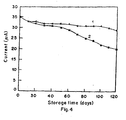
- the shelf life of the strip of the invention is about 4 months under refrigerated conditions. Under ambient conditions (25 to 30°C) the shelf life of the biosensing strip is seen to be about 2 months.
- the strip of the invention is disposable.
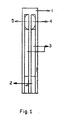
- the invention comprises an electrically insulated base support (1) for supporting an electrode assembly (2), (3), (4) and (5).
- the electrode assembly comprises two electrode systems, a working electrode system (2), (3) and (5) consisting of a silver layer with a graphite layer deposited thereon and an enzyme and mediator layer adsorbed in the inorganic matrix.
- the other electrode assembly comprises a reference electrode comprising a silver layer partly deposited with a graphite layer and a silver/silver chloride layer thereon.
- Figure 1 shows the PVC sheet (i) which comprises the supporting substrate for the electrode.
- Conducting silver tracking (ii) is the screen-printed conducting graphite layer onto the surface of conducting silver tracking (iii) for the connection of the sensor to read out apparatus.
- the target area consists of the working electrode (iv) and the reference electrode (v) applies to the end of tracking by screen-printing.
- An insulated layer is applied over the printed electrode to give them protection; the mass can be coated with one or more legends.
- the conducting graphite track (ii) does not extend to the complete length of the silver track and the reference electrode.
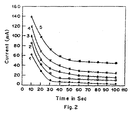
- the strip was used to detect currents when the lactate solutions were used in concentrations of 1 to 8mM.
- the current measured for each of the concentrations was measured and plotted in Figure 2.
- curve (1) is the response curve for 1mM lactate solution
- curve (2) is for 2mM solution
- curve (3) is for 4mM solution
- curve (4) is for 6mM solution
- curve (5) is for 8mM solution.
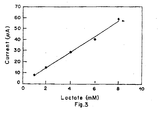
- the sensitivity of the system in terms of the response time to attain a stable current value was determined by analyzing the strip time variation of current. This comprised initiating current measurement from the time fo putting the drop of standard test solution on the strip to the time when the current asymptotically reaches a stable value. It was observed (Figure 3) that the current attains the stable value in 30 to 40 seconds.
- the invention also provides a process for producing a lactate sensor strip which comprise in forming a first and second electrode on a substrate by applying a layer of silver for each of said electrodes in said electrode, applying a layer graphite on the handling zone of said second electrode to silver chloride, applying a mediator and enzyme on the graphite layer of the working zone of the first electrode.
- An outer hydrophilic membrane is applied zone of said first electrode.
- the silver layers and the graphite layers are preferably applied by the step of screen-printing.
- the main feature of this invention is that the sensor is a dry strip sensor. It is found that a similar mix of reagents employed in a wet sensor system did not give good result across a desired range of detectable lactate concentration.
- This invention comprises a substrate for supporting an electrode assembly said electrode assembly comprising two electrode systems, one working electrode and another one as a reference electrode supported on said substrate and disposed in a spaced relationship to each other.
- the lactate sensing strip comprising of a substrate for supporting a first or working electrode and second or reference electrode, said electrode disposed in a spaced relationship to each other.
- the first electrode is a working electrode and has a terminal extending in to a working zone through a handling zone.
- the second electrode is a reference electrode and has a terminal extending in to a working zone through a handling zone. In both cases, the respective terminals are of a material different to the base conducting layer of said first and second electrodes.
- lactate oxidase is mixed in a phosphate buffer, then proper amount of this solution is injected onto a preprinted working electrode. This solution is allowed to dry in allow temperature, followed by
- the working and reference electrode each comprise a base conducting layer of silver material along the handling and working zone.
- a graphite layer is deposited on the silver layer of the working electrode and extends to the terminal; the graphite layer is applied on the handling zone of the reference electrode and extends to the terminal.
- Ag/AgCl is deposited on the target area of the reference electrode.
- Working electrode comprising conducting surface carrying mediator compound and lactate oxidase enzyme. Mediator compound transfer electrodes from the enzyme to the electrode, when such catalytic activity takes place.
- a hydrophilic membrane must be provided on the working zone of said electrode. It appears that the surfactant serves to break up the lipoprotein complex of blood and lactate is then oxidized to the pyruvate by the lactate oxidase.
- the mediator compound is electrochemically reduced at the electrode producing a current measurable at the electrode, which current is relative to the activity of the lactate oxidize and hence the amount of lactate present in the sample this current is generated through a serious of coupled reactions L-Lactate+LOD (ox) ----------------- Pyruvate +LOD (red) LOD (red) +Me (ox) ----------------- LOD (ox) + Me (re)
- the redox mediator is oxidized at the base electrode and the current proportional to the lactate concentration.
- the current can be measured by any conventional electronic system.
- lactate oxidase solution (2 ⁇ L) containing 2U of lactate oxidase was physically adsorbed on the mediator mixed graphite electrode strip and was kept over night to dry at 25°C.
- the dry strip electrode was covered with a hydrophilic nylon membrane. Before the membrane was applied, it was placed in 10% surfactant (Tween 80) solution in distilled water for some time the dried membrane was then fixed over the strip.
- Stock lactate solution 10 mM was prepared in 0.1M phosphate buffer. Standard solutions of 2 mM, 4 mM, 6 mM and 8 mM were prepared by diluting the stock solution with phosphate buffer.
- lactate oxidase converts 1-lactate to pyruvate and H 2 O 2 .
- H 2 O 2 is subsequently converted into a colored dye by peroxidase in the presence of 4-amino antipyrine (4AAP) and dimethylaniline(DMA).
- the dye absorbs at 565 nm at the light path of 1 cm.
- the enzyme activity of immobilized LOD on the working graphite strip was found to be 75%.
- the lactate biosensing strip comprising enzyme(LOD) immobilized on graphite as working electrode and Ag/AgCl reference electrode is connected to the input of the electrometer was polarized at a bias voltage of 0.4V for the measurement of amperometric calibration response to lactate (1-8 mM)( Figure 2).
- a maximum current of 60 ⁇ A was obtained for 8 mM lactate solution above which no significant change in current could be observed.
- the response time for lactate solution (1-8 mM) was found to be 40 seconds for each concentration of lactate ( Figure 3). Results were found to be reproducible to within 5%. Following principle was involved in the amperometric measutrements.
Landscapes
- Measuring Or Testing Involving Enzymes Or Micro-Organisms (AREA)
Claims (15)
- Bande de biodétection de lactate comprenant un support de base isolé électriquement (1), une paire de première et deuxième couches d'argent (2) déposées par dessus, séparées par un espace approprié entre les deux dites couches, une paire de couches de graphite, chacune de ladite paire de couches de graphite étant déposée sur une couche d'argent respective et étant connectée électriquement à ladite couche d'argent respective (2), la première couche d'argent étant couverte entièrement par la couche de graphite respective, la deuxième couche d'argent étant couverte partiellement en son milieu par la couche de graphite respective après avoir laissé la zone de la borne de connexion et la zone de travail découvertes, la zone de travail découverte de ladite deuxième couche d'électrode en argent étant déposée avec du chlorure d'argent (4), la lactate oxydase étant déposée avec un médiateur sur la zone de travail de la couche de graphite couvrant la première couche d'argent (5), ladite couche d'argent/de chlorure d'argent formant l'électrode de référence (4) et l'enzyme avec la couche de médiateur formant l'électrode de travail (5) étant supportées sur ledit support (1).
- Bande de biodétection selon la revendication 1, dans laquelle la zone de travail de l'électrode de référence et l'électrode de travail sont couvertes par une membrane hydrophile.
- Bande de biodétection selon la revendication 1, dans laquelle le support de base isolé électriquement utilisé est fabriqué en chlorure de polyvinyle.
- Bande de biodétection selon la revendication 1, dans laquelle la distance entre les couches d'argent se situe dans la plage de 0,5 à 1 mm.
- Bande de biodétection selon la revendication 1, dans laquelle l'épaisseur de chaque couche d'argent est située dans la plage de 15 à 25 microns.
- Bande de biodétection selon la revendication 1, dans laquelle le médiateur électronique utilisé est choisi entre le ferricyanure de potassium et le ferrocène.
- Bande de biodétection selon la revendication 2, dans laquelle la membrane hydrophile utilisée est faite de nylon ou de polyester.
- Bande de biodétection selon la revendication 1, dans laquelle la zone de travail d'une électrode est une zone cible utilisée pour répartir l'échantillon d'analyte.
- Bande de biodétection selon la revendication 1, dans laquelle l'activité enzymatique de la lactate oxydase dans la bande est située dans la plage allant de 70 à 80 %.
- Bande de biodétection selon la revendication 1, dans laquelle le temps de réponse pour la détection du lactate se situe dans la plage allant de 30 à 40 secondes.
- Bande de biodétection selon la revendication 1, dans laquelle la réponse linéaire ampérométrique à la concentration en lactate est située dans la plage allant de 2 à 8 mM.
- Bande de biodétection selon la revendication 1, dans laquelle la durée de vie en pot de la bande de biodétection est d'environ 4 mois dans des conditions réfrigérées.
- Bande de biodétection selon la revendication 1, dans laquelle la durée de vie en pot de la bande de biodétection est d'environ 2 mois à une température située dans la plage allant de 20 à 30°C.
- Bande de biodétection selon la revendication 1, dans laquelle la bande est jetable.
- Bande de biodétection selon la revendication 1, dans laquelle la borne de connexion de l'électrode est une zone utilisée pour connecter une électrode à un électromètre.
Applications Claiming Priority (1)
| Application Number | Priority Date | Filing Date | Title |
|---|---|---|---|
| PCT/IB2002/005679 WO2004058993A1 (fr) | 2002-12-31 | 2002-12-31 | Bande de biodetection de lactate |
Publications (2)
| Publication Number | Publication Date |
|---|---|
| EP1578985A1 EP1578985A1 (fr) | 2005-09-28 |
| EP1578985B1 true EP1578985B1 (fr) | 2007-10-31 |
Family
ID=34362325
Family Applications (1)
| Application Number | Title | Priority Date | Filing Date |
|---|---|---|---|
| EP02790638A Expired - Lifetime EP1578985B1 (fr) | 2002-12-31 | 2002-12-31 | Bande de biodetection de lactate |
Country Status (6)
| Country | Link |
|---|---|
| EP (1) | EP1578985B1 (fr) |
| JP (1) | JP2006512572A (fr) |
| AT (1) | ATE377089T1 (fr) |
| AU (1) | AU2002368513A1 (fr) |
| CA (1) | CA2512281C (fr) |
| DE (1) | DE60223295T2 (fr) |
Families Citing this family (2)
| Publication number | Priority date | Publication date | Assignee | Title |
|---|---|---|---|---|
| FI20061064A0 (fi) * | 2006-06-19 | 2006-12-01 | Valtion Teknillinen | Uudet ohutkalvorakenteet |
| JP2010230369A (ja) * | 2009-03-26 | 2010-10-14 | Ryukoku Univ | 電極構造及び当該電極構造の製造方法並びに電気化学センサ |
-
2002
- 2002-12-31 EP EP02790638A patent/EP1578985B1/fr not_active Expired - Lifetime
- 2002-12-31 AU AU2002368513A patent/AU2002368513A1/en not_active Abandoned
- 2002-12-31 JP JP2004563410A patent/JP2006512572A/ja active Pending
- 2002-12-31 DE DE60223295T patent/DE60223295T2/de not_active Expired - Fee Related
- 2002-12-31 AT AT02790638T patent/ATE377089T1/de not_active IP Right Cessation
- 2002-12-31 CA CA2512281A patent/CA2512281C/fr not_active Expired - Fee Related
Non-Patent Citations (1)
| Title |
|---|
| None * |
Also Published As
| Publication number | Publication date |
|---|---|
| ATE377089T1 (de) | 2007-11-15 |
| JP2006512572A (ja) | 2006-04-13 |
| EP1578985A1 (fr) | 2005-09-28 |
| CA2512281A1 (fr) | 2004-07-15 |
| DE60223295T2 (de) | 2008-07-31 |
| AU2002368513A1 (en) | 2004-07-22 |
| DE60223295D1 (de) | 2007-12-13 |
| CA2512281C (fr) | 2010-03-30 |
Similar Documents
| Publication | Publication Date | Title |
|---|---|---|
| EP0406304B1 (fr) | Procede et appareil d'analyse diagnostique amperometrique | |
| JP4418435B2 (ja) | 電気化学的バイオセンサー | |
| US6413411B1 (en) | Method and apparatus for amperometric diagnostic analysis | |
| US5108564A (en) | Method and apparatus for amperometric diagnostic analysis | |
| Magner | Trends in electrochemical biosensors | |
| US20040219624A1 (en) | Methods and devices for use in analyte concentration determination assays | |
| US20070131548A1 (en) | Disposable urea sensor and system for determining creatinine and urea nitrogen-to-creatinine ratio in a single device | |
| HK1002833B (en) | Method and apparatus for amperometric diagnostic analysis | |
| US5876952A (en) | Non-invasive glucose biosensor: determination of glucose in urine | |
| US20030146111A1 (en) | Enzymatic-electrochemical measuring device | |
| Dong et al. | Advancements in amperometric biosensing instruments for creatinine detection: A critical review | |
| US20070205114A1 (en) | Method of detecting biosensor filling | |
| CA2512279C (fr) | Procede de preparation de bande de biodetection de lactate | |
| US7319018B2 (en) | Lactate biosensing strip with two electrodes | |
| Davis | Advances in biomedical sensor technology: a review of the 1985 patent literature | |
| EP1578985B1 (fr) | Bande de biodetection de lactate | |
| US7364873B2 (en) | Method for manufacture of lactate biosensing strip | |
| US10329684B2 (en) | Method for forming an optical test sensor | |
| US5741709A (en) | Multiple injection analysis | |
| RU2049991C1 (ru) | Способ определения метаболитов в биологических жидкостях, активный элемент для его осуществления | |
| Chen et al. | Disposable glucose test strip for whole blood with integrated sensing/diffusion-limiting layer | |
| Newman et al. | Biosensors for monitoring glucose | |
| WO2024086700A1 (fr) | Capture et utilisation de résultats pour dosages de diagnostic par l'intermédiaire de dispositifs de points de collecte utilisant des dispositifs mobiles | |
| URU et al. | AN OVERVIEW OF PYRUVATE BIOSENSORS |
Legal Events
| Date | Code | Title | Description |
|---|---|---|---|
| PUAI | Public reference made under article 153(3) epc to a published international application that has entered the european phase |
Free format text: ORIGINAL CODE: 0009012 |
|
| 17P | Request for examination filed |
Effective date: 20050726 |
|
| AK | Designated contracting states |
Kind code of ref document: A1 Designated state(s): AT BE BG CH CY CZ DE DK EE ES FI FR GB GR IE IT LI LU MC NL PT SE SI SK TR |
|
| AX | Request for extension of the european patent |
Extension state: AL LT LV MK RO |
|
| DAX | Request for extension of the european patent (deleted) | ||
| GRAP | Despatch of communication of intention to grant a patent |
Free format text: ORIGINAL CODE: EPIDOSNIGR1 |
|
| GRAS | Grant fee paid |
Free format text: ORIGINAL CODE: EPIDOSNIGR3 |
|
| GRAA | (expected) grant |
Free format text: ORIGINAL CODE: 0009210 |
|
| AK | Designated contracting states |
Kind code of ref document: B1 Designated state(s): AT BE BG CH CY CZ DE DK EE ES FI FR GB GR IE IT LI LU MC NL PT SE SI SK TR |
|
| REG | Reference to a national code |
Ref country code: GB Ref legal event code: FG4D |
|
| REG | Reference to a national code |
Ref country code: IE Ref legal event code: FG4D |
|
| REG | Reference to a national code |
Ref country code: CH Ref legal event code: EP |
|
| REF | Corresponds to: |
Ref document number: 60223295 Country of ref document: DE Date of ref document: 20071213 Kind code of ref document: P |
|
| NLV1 | Nl: lapsed or annulled due to failure to fulfill the requirements of art. 29p and 29m of the patents act | ||
| PG25 | Lapsed in a contracting state [announced via postgrant information from national office to epo] |
Ref country code: SE Free format text: LAPSE BECAUSE OF FAILURE TO SUBMIT A TRANSLATION OF THE DESCRIPTION OR TO PAY THE FEE WITHIN THE PRESCRIBED TIME-LIMIT Effective date: 20080131 Ref country code: NL Free format text: LAPSE BECAUSE OF FAILURE TO SUBMIT A TRANSLATION OF THE DESCRIPTION OR TO PAY THE FEE WITHIN THE PRESCRIBED TIME-LIMIT Effective date: 20071031 Ref country code: LI Free format text: LAPSE BECAUSE OF FAILURE TO SUBMIT A TRANSLATION OF THE DESCRIPTION OR TO PAY THE FEE WITHIN THE PRESCRIBED TIME-LIMIT Effective date: 20071031 Ref country code: CH Free format text: LAPSE BECAUSE OF FAILURE TO SUBMIT A TRANSLATION OF THE DESCRIPTION OR TO PAY THE FEE WITHIN THE PRESCRIBED TIME-LIMIT Effective date: 20071031 Ref country code: ES Free format text: LAPSE BECAUSE OF FAILURE TO SUBMIT A TRANSLATION OF THE DESCRIPTION OR TO PAY THE FEE WITHIN THE PRESCRIBED TIME-LIMIT Effective date: 20080211 |
|
| REG | Reference to a national code |
Ref country code: CH Ref legal event code: PL |
|
| PG25 | Lapsed in a contracting state [announced via postgrant information from national office to epo] |
Ref country code: BG Free format text: LAPSE BECAUSE OF FAILURE TO SUBMIT A TRANSLATION OF THE DESCRIPTION OR TO PAY THE FEE WITHIN THE PRESCRIBED TIME-LIMIT Effective date: 20080131 Ref country code: PT Free format text: LAPSE BECAUSE OF FAILURE TO SUBMIT A TRANSLATION OF THE DESCRIPTION OR TO PAY THE FEE WITHIN THE PRESCRIBED TIME-LIMIT Effective date: 20080331 Ref country code: SI Free format text: LAPSE BECAUSE OF FAILURE TO SUBMIT A TRANSLATION OF THE DESCRIPTION OR TO PAY THE FEE WITHIN THE PRESCRIBED TIME-LIMIT Effective date: 20071031 |
|
| PG25 | Lapsed in a contracting state [announced via postgrant information from national office to epo] |
Ref country code: AT Free format text: LAPSE BECAUSE OF FAILURE TO SUBMIT A TRANSLATION OF THE DESCRIPTION OR TO PAY THE FEE WITHIN THE PRESCRIBED TIME-LIMIT Effective date: 20071031 |
|
| ET | Fr: translation filed | ||
| PG25 | Lapsed in a contracting state [announced via postgrant information from national office to epo] |
Ref country code: CZ Free format text: LAPSE BECAUSE OF FAILURE TO SUBMIT A TRANSLATION OF THE DESCRIPTION OR TO PAY THE FEE WITHIN THE PRESCRIBED TIME-LIMIT Effective date: 20071031 Ref country code: MC Free format text: LAPSE BECAUSE OF NON-PAYMENT OF DUE FEES Effective date: 20071231 Ref country code: DK Free format text: LAPSE BECAUSE OF FAILURE TO SUBMIT A TRANSLATION OF THE DESCRIPTION OR TO PAY THE FEE WITHIN THE PRESCRIBED TIME-LIMIT Effective date: 20071031 |
|
| PG25 | Lapsed in a contracting state [announced via postgrant information from national office to epo] |
Ref country code: SK Free format text: LAPSE BECAUSE OF FAILURE TO SUBMIT A TRANSLATION OF THE DESCRIPTION OR TO PAY THE FEE WITHIN THE PRESCRIBED TIME-LIMIT Effective date: 20071031 Ref country code: BE Free format text: LAPSE BECAUSE OF FAILURE TO SUBMIT A TRANSLATION OF THE DESCRIPTION OR TO PAY THE FEE WITHIN THE PRESCRIBED TIME-LIMIT Effective date: 20071031 |
|
| PLBE | No opposition filed within time limit |
Free format text: ORIGINAL CODE: 0009261 |
|
| STAA | Information on the status of an ep patent application or granted ep patent |
Free format text: STATUS: NO OPPOSITION FILED WITHIN TIME LIMIT |
|
| 26N | No opposition filed |
Effective date: 20080801 |
|
| PG25 | Lapsed in a contracting state [announced via postgrant information from national office to epo] |
Ref country code: IE Free format text: LAPSE BECAUSE OF NON-PAYMENT OF DUE FEES Effective date: 20071231 |
|
| PGFP | Annual fee paid to national office [announced via postgrant information from national office to epo] |
Ref country code: DE Payment date: 20080627 Year of fee payment: 6 |
|
| PGFP | Annual fee paid to national office [announced via postgrant information from national office to epo] |
Ref country code: FR Payment date: 20080627 Year of fee payment: 6 |
|
| PGFP | Annual fee paid to national office [announced via postgrant information from national office to epo] |
Ref country code: GB Payment date: 20080626 Year of fee payment: 6 |
|
| PG25 | Lapsed in a contracting state [announced via postgrant information from national office to epo] |
Ref country code: GR Free format text: LAPSE BECAUSE OF FAILURE TO SUBMIT A TRANSLATION OF THE DESCRIPTION OR TO PAY THE FEE WITHIN THE PRESCRIBED TIME-LIMIT Effective date: 20080201 Ref country code: EE Free format text: LAPSE BECAUSE OF FAILURE TO SUBMIT A TRANSLATION OF THE DESCRIPTION OR TO PAY THE FEE WITHIN THE PRESCRIBED TIME-LIMIT Effective date: 20071031 |
|
| PG25 | Lapsed in a contracting state [announced via postgrant information from national office to epo] |
Ref country code: FI Free format text: LAPSE BECAUSE OF FAILURE TO SUBMIT A TRANSLATION OF THE DESCRIPTION OR TO PAY THE FEE WITHIN THE PRESCRIBED TIME-LIMIT Effective date: 20071031 |
|
| PG25 | Lapsed in a contracting state [announced via postgrant information from national office to epo] |
Ref country code: CY Free format text: LAPSE BECAUSE OF FAILURE TO SUBMIT A TRANSLATION OF THE DESCRIPTION OR TO PAY THE FEE WITHIN THE PRESCRIBED TIME-LIMIT Effective date: 20071031 |
|
| GBPC | Gb: european patent ceased through non-payment of renewal fee |
Effective date: 20081231 |
|
| PG25 | Lapsed in a contracting state [announced via postgrant information from national office to epo] |
Ref country code: LU Free format text: LAPSE BECAUSE OF NON-PAYMENT OF DUE FEES Effective date: 20071231 Ref country code: IT Free format text: LAPSE BECAUSE OF NON-PAYMENT OF DUE FEES Effective date: 20071231 |
|
| PG25 | Lapsed in a contracting state [announced via postgrant information from national office to epo] |
Ref country code: TR Free format text: LAPSE BECAUSE OF FAILURE TO SUBMIT A TRANSLATION OF THE DESCRIPTION OR TO PAY THE FEE WITHIN THE PRESCRIBED TIME-LIMIT Effective date: 20071031 |
|
| REG | Reference to a national code |
Ref country code: FR Ref legal event code: ST Effective date: 20090831 |
|
| PG25 | Lapsed in a contracting state [announced via postgrant information from national office to epo] |
Ref country code: DE Free format text: LAPSE BECAUSE OF NON-PAYMENT OF DUE FEES Effective date: 20090701 |
|
| PG25 | Lapsed in a contracting state [announced via postgrant information from national office to epo] |
Ref country code: GB Free format text: LAPSE BECAUSE OF NON-PAYMENT OF DUE FEES Effective date: 20081231 |
|
| PGFP | Annual fee paid to national office [announced via postgrant information from national office to epo] |
Ref country code: IT Payment date: 20080626 Year of fee payment: 6 |
|
| PGRI | Patent reinstated in contracting state [announced from national office to epo] |
Ref country code: IT Effective date: 20110616 |
|
| PGRI | Patent reinstated in contracting state [announced from national office to epo] |
Ref country code: IT Effective date: 20110616 |
|
| PG25 | Lapsed in a contracting state [announced via postgrant information from national office to epo] |
Ref country code: FR Free format text: LAPSE BECAUSE OF NON-PAYMENT OF DUE FEES Effective date: 20081231 |