EP1577758A2 - Benutzerschnittstellen und Software-Wiederverwendung in Modellbasierte Software-Systemen - Google Patents
Benutzerschnittstellen und Software-Wiederverwendung in Modellbasierte Software-Systemen Download PDFInfo
- Publication number
- EP1577758A2 EP1577758A2 EP05005655A EP05005655A EP1577758A2 EP 1577758 A2 EP1577758 A2 EP 1577758A2 EP 05005655 A EP05005655 A EP 05005655A EP 05005655 A EP05005655 A EP 05005655A EP 1577758 A2 EP1577758 A2 EP 1577758A2
- Authority
- EP
- European Patent Office
- Prior art keywords
- pattern
- business
- data
- instructions
- signature
- Prior art date
- Legal status (The legal status is an assumption and is not a legal conclusion. Google has not performed a legal analysis and makes no representation as to the accuracy of the status listed.)
- Ceased
Links
Images

Classifications
-
- G—PHYSICS
- G06—COMPUTING OR CALCULATING; COUNTING
- G06F—ELECTRIC DIGITAL DATA PROCESSING
- G06F8/00—Arrangements for software engineering
- G06F8/30—Creation or generation of source code
- G06F8/36—Software reuse
Definitions
- the present invention relates to model based software systems, and in particular, user interfaces and the reuse of software in such model based systems.
- Model based software solutions involve approaches and implementations in which every significant part of a software development lifecycle is modeled as data and persisted with capabilities that enable a user to perform various steps in the software development lifecycle.
- This data modeling requires a high level of specialization, and is usually carried out just before the start of coding.
- the modeled data is persisted and can be used by downstream processes thereby ensuring that all relevant data that is captured by upstream processes are used in downstream processes without any significant loss of information.
- the traditional approach to data modeling involves an understanding of the system in its entirety including all the data dependencies between various entities in the system.
- a schema designer who models data requires detailed information on the various business processes addressed by the system and the various constituents of the system. For example, the designer requires information in terms of the entities that need to be stored in the system and their relationship with other data that are to be stored in the system. The data types and sizes of those entities also need to be stored.
- the granularity of data captured in a model based environment depends on the extent that the model is used. For example, if the functional requirements are captured at a very granular level. it will enable a designer to implement these requirements with the exact business logic as envisioned by a requirements engineer.
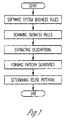
- One embodiment of the invention describes a method comprising: providing a set of business rules for a software system; scanning said set of business rules; forming a first pattern signature based on said scanning; and determining if said pattern signature is present in other portions of said software system.
- a second embodiment of the invention describes method comprising: capturing user interface data from business documents; mapping user interface elements to said business documents, and forming a data model for said business documents; wherein said business documents are represented by business objects; and wherein said business documents from which said interface data is acquired is represented by interface business objects.
- a third embodiment describes a computer readable medium comprising instructions available thereon for executing a method comprising: receiving a set of business rules for a software system; scanning said set of business rules; forming a first pattern signature based on said scanning; and determining if said pattern signature is present in other portions of said software system.
- Yet another embodiment describes a computer readable medium comprising instructions available thereon for executing a method comprising: capturing user interface data from business documents; mapping user interface elements to said business documents, and forming a data model for said business documents; wherein said business documents are represented by business objects; and wherein said business documents from which said interface data is acquired is represented by interface business objects.
- FIG. 1 is a flow chart of an embodiment of the invention.
- FIG. 2 illustrates a computer system that may be used in connection with the present invention.
- Any software solution is a collection of user interfaces between a user and a repository where the user's data are stored. These interfaces could be displays, reports, and/or devices such as scanners and readers.
- Any such interface can be visualized as a business document with a header section that uniquely identifies the business document.
- a business document further has various sections each of which captures related data at various stages in the lifecycle of the business document.
- Such business documents also refer to other documents for information relating to certain key data items in the document. These could be references to the external documents or data copied from the relevant business documents.
- the usual approach of designing user interfaces is to capture data for an underlying business in various stages. Each stage adds value to the data that has been already captured. At each of these stages the data captured has direct relevance to the business document that has been considered for automation.
- a user interface will normally have several types of elements.
- There are single instance user interface elements such as edit controls, check boxes and text areas.
- sets of single instance data items are present as elements, some or all of which could be applicable for the instance of the business document. These can be incorporated as a group of check boxes.
- Non-editable user elements that reflect the various business states in which a document can exist at any point in time. These are typically incorporated as display only controls. And there are links to other user interfaces that reflect the references to other business documents that could be referred to for additional information. These may be incorporated as hyperlinks or command buttons that invoke other user interfaces by passing the required context information. Lastly, there are reference data items that reflect data that are copied from other business documents and are displayed in the user interface. These are incorporated as display only controls in the user interface.
- a business object represents the business document
- an interface business object refers to the business documents from where the information is acquired.
- Both business objects and interface business objects have data segments that refer to the various sections of business documents and related business documents.
- Each data segment has a unique identifier which uniquely identifies an instance of data in the data segment.
- a hierarchy of data segments can also be established. This can be accomplished by specifying a parent segment to each data segment.
- a data item of a data segment could be owned by the data segment itsclf or be present as a reference to another interface business object, a data segment, or a data item.
- factors that affect such a business object hierarchy are as follows. First, every collection of related user interfaces will form a business object. Second, every related collection of referred user interfaces will form an interface business object. Third, every section in the user interface is a data segment. Fourth, any list of values is a data segment from an interface business object. Fifth, any display only field that displays data from other collections is not stored as data but refers to the corresponding data in the interface business objects. Recording the corresponding interface business object, segment, and data items will depict such relations.
- a database schema can be derived out of this structure of business objects and interface business objects.
- the physical represcntation of this embodiment is as follows. Every data segment is represented as database tables, and each of these tables has a primary key formed by the identifier that is a part of the segment and the identifiers of its parent segments. Foreign keys are identified for any data items that refer to interface business objects. Every data segment of an interface business object can be represented as database views or database stored procedures. The data items of the data segment are columns for the corresponding database tables. The data items of the interface business objects will be the columns of the corresponding database views or the parameters of the database stored procedures used for integration.
- This embodiment directly attempts to arrive at a fairly comprehensive database schema that can be further refined for any specific database requirements such as audit trail and concurrency control implications.
- This embodiment provides a direct relationship of the schema to the user interface, an intuitive approach to database design that enables a high level of consistency with the user interface, and a quick first cut schema to facilitate overall understanding of the business functionality,
- every function in the system has a set of business rules, and a group of business rules is associated with a particular action performed by an end user. These groups can be completely or partially used as part of another task. Identifying this set of business rules is the challenge for the design engineer.
- each distinct action is considered.
- a sequential scan is made from the first business rule to the lost business rule. As the scan progresses the system forms a pattern signature that uniquely identifies the business rules encountered so far in the sequence. The result is that at the end of this step, each action will have a pattern signature associated with it.
- each task is again considered.
- a scan is made through the pattern signature to identify if any part of the signature occurs in the pattern signature of the other actions. If such an occurrence is made then the subset is identified as a pattern and recorded separately along with its occurrences.
- a designer then analyzes this data, and identifies the best possible reuse(s).
- a designer may want to maximize business rule reuse by selecting a pattern with the maximum size, irrespective of its occurrences. The advantage of this approach is that the designer can identify bigger chunks of business logic that can be implemented across the system.
- a designer may choose to maximize occurrence reuse by selecting patterns that cover the maximum number of actions. This embodiment permits a designer to reduce design effort by spreading the effort over a greater number of tasks. Since the reuse is high with this embodiment, adequate care could be exercised in designing for such patterns.
- a designer could maximize the total number of business rules that need not be designed for as a result of pattern reuse. This embodiment ensures that the maximum amount of patterns that can be reused has been extracted thereby reducing the overall design effort.
- various aspects may be considered before finally arriving at the patterns whose reuses are to be adopted.
- One such consideration is that as a pattern size is reduced, the reuse of that pattern becomes trivial. That is to say, certain business rules repeat in all actions and are trivial in nature. These should be reused only if it gives a significant benefit for the designers. Reusing patterns that have a negligible business rule count could result in a design overhead that would impact the overall size and effectiveness of the solution.
- the description of the business rule is considered. First, the white spaces and special characters other than numerical operators are removed. The actions are then analyzed and pattern signatures formed for every action. Then once the pattern signature is formed, the reuse identification process is similar to that of the embodiment of the first approach.
- the advantage of this approach is that it relies on the content of the business rule rather than the identifier of the business rule. While in all likelihood this will be a more time consuming process as the operations have to be carried out on the business rule descriptions (rather than just the identifiers), the result may be more effective than that obtained from the other approach (since it is based on the description which by design holds more information).
- the approach a user adopts depends on the user's needs and the satisfaction level he obtains in analyzing the reuse in each of the approaches. The process flow is illustrated in FIG. 1.
- a specification repository captures extensive information on the interfaces and sequence of actions that are needed at different layers. This is a humungous task when there is a need to develop and deploy software systems that involve hundreds of business components and/or functions. This embodiment then abstracts interfaces and action sequences based on the expected response of the system. This abstraction is based on the study of different user actions and the expected behavior of the system in response, and also the participating user interface elements. The expected response of the system is captured as a set of specification data for each action.
- Each user action is associated with the user interface information that influences the behavior, and each user action is modeled as a different variety of action based on the expected behavior of the system. For example, a user interaction may be modeled as a document fetch type if the action requires that the system take a key element from the user interface and come up with all information pertaining to that particular business document.
- the designer specifies the type of user action, the user interface controls that are involved in this action, and the expected behavior of the system.
- the expected response of the system is specified as binary logic (Yes / No) to a variety of questions ( e . g ., whether refresh is required, related combo to be filled, etc.) This information is stored in the model.
- Design generators then use this model information to generate the service interfaces and method interfaces, and invoking back end objects interfaces also, to generate the sequence of these method calls.
- a facility is provided to override these interfaces to do a dataset reduction of the interface elements of the methods.
- the design generators take care of passing the appropriate parameters across the different layers.
- FIG. 2 is an overview diagram of hardware and operating environment in conjunction with which embodiments of the invention may be practiced.
- the description of FIG. 2 is intended to provide a brief, general description of suitable computer hardware and a suitable computing environment in conjunction with which the invention may be implemented.
- the invention is described in the general context of computer-executable instructions, such us program modules. being executed by a computer, such as a personal computer.
- program modules include routines, programs, objects, components, data structures, etc., that perform particular tasks or implement particular abstract data types.
- the invention may be practiced with other computer system configurations, including hand-held devices, multiprocessor systems, microprocessor-based or programmable consumer electronics, network PCS, minicomputers, mainframe computers, and the like.
- the invention may also be practiced in distributed computer environments where tasks are performed by 1/ 0 remote processing devices that are linked through a communications network.
- program modules may be located in both local and remote memory storage devices.
- a hardware and operating environment is provided that is applicable to any of the servers and/or remote clients used in the invention.
- one embodiment of the hardware and operating environment includes a general purpose computing device in the form of a computer 20 (e . g ., a personal computer, workstation, or server), including one or more processing units 21, a system memory 22, and a system bus 23 that operatively couples various system components including the system memory 22 to the processing unit 21.
- a computer 20 e . g ., a personal computer, workstation, or server
- processing units 21 e. g ., a personal computer, workstation, or server
- system bus 23 that operatively couples various system components including the system memory 22 to the processing unit 21.
- the processor of computer 20 comprises a single central-processing unit (CPU), or a plurality of processing units, commonly referred to as a multiprocessor or parallel-processor environment.
- CPU central-processing unit
- computer 20 is a conventional computer, a distributed computer, or any other type of computer.
- the system bus 23 can be any of several types of bus structures including a memory bus or memory controller, a peripheral bus, and a local bus using any of a variety of bus architectures.
- the system memory can also be referred to as simply the memory, and, in some embodiments, includes read-only memory (ROM) 24 and random-access memory (RAM) 25.
- ROM read-only memory
- RAM random-access memory
- a basic input/output system (BIOS) program 26 containing the basic routines that help to transfer information between elements within the computer 20, such as during start-up, may be stored in ROM 24.
- the computer 20 further includes a hard disk drive 27 for reading from and writing to a hard disk, not shown, a magnetic disk drive 28 for reading from or writing to a removable magnetic disk 29, and an optical disk drive 30 for reading from or writing to a removable optical disk 31 such as a CD ROM or other optical media.
- a hard disk drive 27 for reading from and writing to a hard disk, not shown
- a magnetic disk drive 28 for reading from or writing to a removable magnetic disk 29
- an optical disk drive 30 for reading from or writing to a removable optical disk 31 such as a CD ROM or other optical media.
- the hard disk drive 27, magnetic disk drive 28, and optical disk drive 30 couple with a hard disk drive interface 32, a magnetic disk drive interface 33, and an optical disk drive interface 34, respectively.
- the drives and their associated computer-readable media provide non volatile storage of computer-readable instructions, data structures, program modules and other data for the computer 20. It should be appreciated by those skilled in the art that any type of computer-readable media which can store data that is accessible by a computer, such as magnetic cassettes, flash memory cards, digital video disks, Bemoulli cartridges, random access memories (RAMs), read only memories (RON[s), redundant arrays of independent disks (e.g., RAID storage devices) and the like, can be used in the exemplary operating environment.
- a plurality of program modules can be stored on the hard disk, magnetic disk 29, optical disk 31, ROM 24, or RAM 25, including an operating system 35, one or more application programs 36, other program modules 37, and program data 38.
- a plug in containing a security transmission engine for the present invention can be resident on any one or number of these computer-readable media.
- a user may enter commands and information into computer 20 through input devices such as a keyboard 40 and pointing device 42.
- Other input devices can include a microphone, joystick, game pad, satellite dish, scanner, or the like.
- These other input devices are often connected to the processing unit 21 through a serial port interface 46 that is coupled to the system bus 23, but can be connected by other interfaces, such as a parallel port, game port, or a universal serial bus (USB).
- a monitor 47 or other type of display device can also be connected to the system bus 23 via an interface, such as a video adapter 48.
- the monitor 40 can display a graphical user interface for the user.
- computers typically include other peripheral output devices (not shown), such as speakers and printers.
- the computer 20 may operate in a networked environment using logical conncctions to one or more remote computers or servers, such as remote computer 49. These logical connections are achieved by a communication device coupled to or a part of the computer 20; the invention is not limited to a particular type of communications device.
- the remote computer 49 can be another computer, a server, a router, a network PC, a client, a peer device or other common network node, and typically includes many or all of the elements described above I/0 relative to the computer 20, although only a memory storage device 50 has been illustrated.
- the logical connections depicted in FIG. 2 include a local area network (LAN) 51 and/or a wide area network (WAN) 52.
- LAN local area network
- WAN wide area network
- the computer 20 When used in a LAN-networking environment, the computer 20 is connected to the LAN 51 through a network interface or adapter 53, which is one type of communications device.
- the computer 20 when used in a WAN-networking environment, the computer 20 typically includes a modem 54 (another type of communications device) or any other type of communications device, e.g., a wireless transceiver, for establishing communications over the wide-area network 52, such as the internet.
- the modem 54 which may be intemal or extemal, is connected to the system bus 23 via the serial port interface 46.
- program modules depicted relative to the computer 20 can be stored in the remote memory storage device 50 of remote computer, or server 49.
- network connections shown are exemplary and other means of, and communications devices for, establishing a communications link between the computers may be used including hybrid fiber-coax connections, T1-T3 lines, DSL's, OC-3 and/or OC-12, TCP/IP, microwave, wireless application protocol, and any other electronic media through any suitable switches, routers, outlets and power lines, as the same are known and understood by one of ordinary skill in the art.
Landscapes
- Engineering & Computer Science (AREA)
- Software Systems (AREA)
- General Engineering & Computer Science (AREA)
- Theoretical Computer Science (AREA)
- Physics & Mathematics (AREA)
- General Physics & Mathematics (AREA)
- Stored Programmes (AREA)
- Information Retrieval, Db Structures And Fs Structures Therefor (AREA)
Applications Claiming Priority (8)
| Application Number | Priority Date | Filing Date | Title |
|---|---|---|---|
| US55308904P | 2004-03-15 | 2004-03-15 | |
| US55308804P | 2004-03-15 | 2004-03-15 | |
| US55309104P | 2004-03-15 | 2004-03-15 | |
| US553091P | 2004-03-15 | ||
| US553088P | 2004-03-15 | ||
| US553089P | 2004-03-15 | ||
| US11/065,007 US8307339B2 (en) | 2004-03-15 | 2005-02-24 | Software reuse in model based software systems |
| US65007 | 2005-02-24 |
Publications (2)
| Publication Number | Publication Date |
|---|---|
| EP1577758A2 true EP1577758A2 (de) | 2005-09-21 |
| EP1577758A3 EP1577758A3 (de) | 2007-04-25 |
Family
ID=34841899
Family Applications (1)
| Application Number | Title | Priority Date | Filing Date |
|---|---|---|---|
| EP05005655A Ceased EP1577758A3 (de) | 2004-03-15 | 2005-03-15 | Benutzerschnittstellen und Software-Wiederverwendung in modellbasierten Software-Systemen |
Country Status (2)
| Country | Link |
|---|---|
| US (3) | US8307339B2 (de) |
| EP (1) | EP1577758A3 (de) |
Families Citing this family (14)
| Publication number | Priority date | Publication date | Assignee | Title |
|---|---|---|---|---|
| US8799448B2 (en) * | 2006-12-20 | 2014-08-05 | Microsoft Corporation | Generating rule packs for monitoring computer systems |
| US9182981B2 (en) * | 2009-11-23 | 2015-11-10 | University Of Washington | Systems and methods for implementing pixel-based reverse engineering of interface structure |
| US8516011B2 (en) | 2010-10-28 | 2013-08-20 | Microsoft Corporation | Generating data models |
| US9262158B2 (en) * | 2010-12-13 | 2016-02-16 | Microsoft Technology Licensing, Llc | Reverse engineering user interface mockups from working software |
| CN104424159A (zh) * | 2013-09-04 | 2015-03-18 | 上海复旦微电子集团股份有限公司 | 软件项目文档生成方法和软件项目文档生成器 |
| US9940581B2 (en) | 2013-11-20 | 2018-04-10 | International Business Machines Corporation | Ontology-aided business rule extraction using machine learning |
| US9563419B2 (en) * | 2014-02-20 | 2017-02-07 | International Business Machines Corporation | Managing deployment of application pattern based applications on runtime platforms |
| US9952857B2 (en) | 2015-10-05 | 2018-04-24 | International Business Machines Corporation | Cross-validation based code feature tagging |
| WO2017136367A1 (en) * | 2016-02-01 | 2017-08-10 | Microsoft Technology Licensing, Llc | Recall service for productivity applications |
| US11494832B2 (en) | 2018-11-09 | 2022-11-08 | Honeywell International Inc. | Systems and methods for securely creating a listing of equipment on an equipment online marketplace platform |
| US11640630B2 (en) | 2018-11-09 | 2023-05-02 | Honeywell International Inc. | Systems and methods for verifying identity of a user on an equipment online marketplace platform |
| US12067601B2 (en) | 2018-11-09 | 2024-08-20 | Honeywell International Inc. | Systems and methods for generating a digital identity of equipment on an equipment online marketplace platform |
| US11704118B2 (en) | 2021-08-19 | 2023-07-18 | International Business Machines Corporation | Application modernization |
| US20230185692A1 (en) * | 2021-12-14 | 2023-06-15 | John D. Campbell | Highly Tested Systems |
Citations (1)
| Publication number | Priority date | Publication date | Assignee | Title |
|---|---|---|---|---|
| WO2000031626A1 (en) | 1998-11-19 | 2000-06-02 | Netron Inc. | Method of identifying recurring code constructs |
Family Cites Families (38)
| Publication number | Priority date | Publication date | Assignee | Title |
|---|---|---|---|---|
| JPS60179797A (ja) * | 1983-10-27 | 1985-09-13 | 日本電気株式会社 | パタンマツチング装置 |
| US4956791A (en) * | 1988-11-14 | 1990-09-11 | International Business Machines Corp. | Merging pattern-matching networks including retes |
| JP2797698B2 (ja) * | 1990-11-14 | 1998-09-17 | 株式会社日立製作所 | ソフトウェア再利用支援方法 |
| US5189709A (en) * | 1991-08-26 | 1993-02-23 | The United States Of America As Represented By The United States National Aeronautics And Space Administration | Dynamic pattern matcher using incomplete data |
| US5632022A (en) * | 1991-11-13 | 1997-05-20 | The United States Of America As Represented By The Administrator Of The National Aeronautics And Space Administration | Encyclopedia of software components |
| US5677997A (en) * | 1993-02-11 | 1997-10-14 | Talatik; Kirit K. | Method and apparatus for automated conformance and enforcement of behavior in application processing systems |
| SE504147C2 (sv) * | 1994-10-19 | 1996-11-25 | Marlene Sandberg | Blöja eller liknande hygienprodukt, innefattande en absorptionskropp med en urtagning, som består av en central del och från dennas kant i olika riktningar utskjutande kanaler |
| US5724589A (en) * | 1995-10-13 | 1998-03-03 | Borland International, Inc. | Development system with a property-method-event programming model for developing context-free reusable software components |
| US6122757A (en) * | 1997-06-27 | 2000-09-19 | Agilent Technologies, Inc | Code generating system for improved pattern matching in a protocol analyzer |
| US6243851B1 (en) * | 1998-03-27 | 2001-06-05 | Xilinx, Inc. | Heterogeneous method for determining module placement in FPGAs |
| US6023271A (en) * | 1998-06-11 | 2000-02-08 | Sun Microsystems, Inc. | Framework for binding data viewers/data manipulation with one to many objects through introspection |
| US6427230B1 (en) * | 1998-11-09 | 2002-07-30 | Unisys Corporation | System and method for defining and managing reusable groups software constructs within an object management system |
| US6292938B1 (en) * | 1998-12-02 | 2001-09-18 | International Business Machines Corporation | Retargeting optimized code by matching tree patterns in directed acyclic graphs |
| US6346945B1 (en) * | 1998-12-28 | 2002-02-12 | Klocwork Solutions | Method and apparatus for pattern-based flowcharting of source code |
| US6748588B1 (en) * | 1999-03-31 | 2004-06-08 | Microsoft Corporation | One-pass greedy-pattern-matching finite-state-machine code generation |
| US6381743B1 (en) * | 1999-03-31 | 2002-04-30 | Unisys Corp. | Method and system for generating a hierarchial document type definition for data interchange among software tools |
| US6289513B1 (en) * | 1999-06-01 | 2001-09-11 | Isaac Bentwich | Interactive application generation and text processing |
| US6343372B1 (en) * | 1999-06-11 | 2002-01-29 | Lucent Technologies Inc. | Methods and apparatus for generating a verified algorithm for transforming a program from a first form to a second form |
| US6678882B1 (en) * | 1999-06-30 | 2004-01-13 | Qwest Communications International Inc. | Collaborative model for software systems with synchronization submodel with merge feature, automatic conflict resolution and isolation of potential changes for reuse |
| US6601234B1 (en) * | 1999-08-31 | 2003-07-29 | Accenture Llp | Attribute dictionary in a business logic services environment |
| US6851105B1 (en) * | 1999-10-05 | 2005-02-01 | Borland Software Corporation | Method and system for generating, applying, and defining a pattern |
| SG102555A1 (en) * | 1999-11-25 | 2004-03-26 | Kim Seng Holdings Pte Ltd | Method for using a data flow net to specify and assemble computer software |
| WO2001082072A1 (en) * | 2000-04-21 | 2001-11-01 | Togethersoft Corporation | Methods and systems for generating source code for object-oriented elements |
| US7322024B2 (en) * | 2002-03-18 | 2008-01-22 | Logiclibrary, Inc. | Generating reusable software assets from distributed artifacts |
| US7149734B2 (en) * | 2001-07-06 | 2006-12-12 | Logic Library, Inc. | Managing reusable software assets |
| US7631299B2 (en) * | 2002-01-24 | 2009-12-08 | Computer Sciences Corporation | System for modifying software using reusable software components |
| US7117484B2 (en) * | 2002-04-16 | 2006-10-03 | International Business Machines Corporation | Recursive use of model based test generation for middleware validation |
| US7096200B2 (en) * | 2002-04-23 | 2006-08-22 | Microsoft Corporation | System and method for evaluating and enhancing source anonymity for encrypted web traffic |
| US20030233631A1 (en) * | 2002-06-13 | 2003-12-18 | Ambrose Curry | Web services development method |
| US8682636B2 (en) * | 2002-08-30 | 2014-03-25 | Sap Ag | Non-client-specific testing of applications |
| US7412658B2 (en) * | 2002-11-14 | 2008-08-12 | Sap Ag | Modeling system for graphic user interface |
| US8676853B2 (en) * | 2003-02-27 | 2014-03-18 | Hewlett-Packard Development Company, L.P. | System and method for software reuse |
| US7730446B2 (en) * | 2003-03-12 | 2010-06-01 | Microsoft Corporation | Software business process model |
| US7461385B2 (en) * | 2003-05-06 | 2008-12-02 | Qad Corporation | Method for establishing a new user interface via an intermingled user interface |
| US7197740B2 (en) * | 2003-09-05 | 2007-03-27 | Sap Aktiengesellschaft | Pattern-based software design |
| US7398512B2 (en) * | 2003-12-02 | 2008-07-08 | Hewlett-Packard Development Company, L.P. | Method, system, and software for mapping and displaying process objects at different levels of abstraction |
| US7685563B2 (en) * | 2004-03-01 | 2010-03-23 | Microsoft Corporation | Reusable customized project system |
| US7562347B2 (en) * | 2004-11-04 | 2009-07-14 | Sap Ag | Reusable software components |
-
2005
- 2005-02-24 US US11/065,007 patent/US8307339B2/en active Active
- 2005-03-15 EP EP05005655A patent/EP1577758A3/de not_active Ceased
-
2008
- 2008-09-26 US US12/238,463 patent/US8572563B2/en active Active
- 2008-09-26 US US12/238,469 patent/US20090024980A1/en not_active Abandoned
Patent Citations (1)
| Publication number | Priority date | Publication date | Assignee | Title |
|---|---|---|---|---|
| WO2000031626A1 (en) | 1998-11-19 | 2000-06-02 | Netron Inc. | Method of identifying recurring code constructs |
Also Published As
| Publication number | Publication date |
|---|---|
| US8572563B2 (en) | 2013-10-29 |
| US20090024980A1 (en) | 2009-01-22 |
| US8307339B2 (en) | 2012-11-06 |
| US20050203942A1 (en) | 2005-09-15 |
| EP1577758A3 (de) | 2007-04-25 |
| US20090024657A1 (en) | 2009-01-22 |
Similar Documents
| Publication | Publication Date | Title |
|---|---|---|
| US8572563B2 (en) | User interfaces and software reuse in model based software systems | |
| US8819619B2 (en) | Method and system for capturing user interface structure in a model based software system | |
| EP2667306B1 (de) | Softwaresystem-Testschnittstelle | |
| US7480893B2 (en) | Rule-based system and method for checking compliance of architectural analysis and design models | |
| Mateescu et al. | Adaptation of service protocols using process algebra and on-the-fly reduction techniques | |
| Di Lucca et al. | WARE: A tool for the reverse engineering of web applications | |
| Van Der Aalst | Woflan: a Petri-net-based workflow analyzer | |
| US6314434B1 (en) | Structured data management system and computer-readable method for storing structured data management program | |
| US6928393B2 (en) | Method and system for supporting negative testing in combinatorial test case generators | |
| US7278135B2 (en) | Method and system for generating an efficient test suite from a domain description with given constraints | |
| EP2228726B1 (de) | Procédé et système de modelage de tâches d'applications de téléphones mobiles | |
| Sun et al. | Operation context and context-based operational transformation | |
| JP5745932B2 (ja) | グラフデータに写像の像であるオブジェクトに対する操作を反映する方法、プログラム、および、システム | |
| Dehlinger et al. | Plfaultcat: A product-line software fault tree analysis tool | |
| Trainer et al. | Bridging the gap between technical and social dependencies with Ariadne | |
| Mitchell et al. | Modeling runtime behavior in framework-based applications | |
| Chaturvedi et al. | Web service slicing: Intra and inter-operational analysis to test changes | |
| JP2012064129A (ja) | 複数アプリケーションのgui統合方法 | |
| Wang et al. | Integrated modelling of business process models and business rules: a research agenda | |
| CN120407261A (zh) | 基于大语言模型的故障问题分析方法、装置、设备及介质 | |
| CN118796203A (zh) | 代码生成方法、装置、电子设备、产品及存储介质 | |
| CN112181511B (zh) | 一种可执行的情报分析流交互配置生成方法 | |
| US20250362995A1 (en) | Log data condensation for interoperability with language models | |
| Cosma et al. | Understanding the impact of distribution in object-oriented distributed systems using structural program dependencies | |
| Dumitru Maroz | Dynamic report generation for Pentesting |
Legal Events
| Date | Code | Title | Description |
|---|---|---|---|
| PUAI | Public reference made under article 153(3) epc to a published international application that has entered the european phase |
Free format text: ORIGINAL CODE: 0009012 |
|
| AK | Designated contracting states |
Kind code of ref document: A2 Designated state(s): AT BE BG CH CY CZ DE DK EE ES FI FR GB GR HU IE IS IT LI LT LU MC NL PL PT RO SE SI SK TR |
|
| AX | Request for extension of the european patent |
Extension state: AL BA HR LV MK YU |
|
| RTI1 | Title (correction) |
Free format text: USER INTERFACES AND SOFTWARE REUSE IN MODEL-BASED SOFTWARE SYSTEMS |
|
| PUAL | Search report despatched |
Free format text: ORIGINAL CODE: 0009013 |
|
| AK | Designated contracting states |
Kind code of ref document: A3 Designated state(s): AT BE BG CH CY CZ DE DK EE ES FI FR GB GR HU IE IS IT LI LT LU MC NL PL PT RO SE SI SK TR |
|
| AX | Request for extension of the european patent |
Extension state: AL BA HR LV MK YU |
|
| 17P | Request for examination filed |
Effective date: 20071010 |
|
| AKX | Designation fees paid |
Designated state(s): AT BE BG CH CY CZ DE DK EE ES FI FR GB GR HU IE IS IT LI LT LU MC NL PL PT RO SE SI SK TR |
|
| 17Q | First examination report despatched |
Effective date: 20080117 |
|
| APBK | Appeal reference recorded |
Free format text: ORIGINAL CODE: EPIDOSNREFNE |
|
| APBN | Date of receipt of notice of appeal recorded |
Free format text: ORIGINAL CODE: EPIDOSNNOA2E |
|
| APAF | Appeal reference modified |
Free format text: ORIGINAL CODE: EPIDOSCREFNE |
|
| APBT | Appeal procedure closed |
Free format text: ORIGINAL CODE: EPIDOSNNOA9E |
|
| STAA | Information on the status of an ep patent application or granted ep patent |
Free format text: STATUS: THE APPLICATION HAS BEEN REFUSED |
|
| 18R | Application refused |
Effective date: 20130923 |