EP1577438A1 - Copolymer latex for noncontact coating and composition comprising the same, and coated paper and method for production thereof - Google Patents
Copolymer latex for noncontact coating and composition comprising the same, and coated paper and method for production thereof Download PDFInfo
- Publication number
- EP1577438A1 EP1577438A1 EP03782871A EP03782871A EP1577438A1 EP 1577438 A1 EP1577438 A1 EP 1577438A1 EP 03782871 A EP03782871 A EP 03782871A EP 03782871 A EP03782871 A EP 03782871A EP 1577438 A1 EP1577438 A1 EP 1577438A1
- Authority
- EP
- European Patent Office
- Prior art keywords
- mass
- paper
- coating
- amount
- monomer
- Prior art date
- Legal status (The legal status is an assumption and is not a legal conclusion. Google has not performed a legal analysis and makes no representation as to the accuracy of the status listed.)
- Withdrawn
Links
Images

Classifications
-
- D—TEXTILES; PAPER
- D21—PAPER-MAKING; PRODUCTION OF CELLULOSE
- D21H—PULP COMPOSITIONS; PREPARATION THEREOF NOT COVERED BY SUBCLASSES D21C OR D21D; IMPREGNATING OR COATING OF PAPER; TREATMENT OF FINISHED PAPER NOT COVERED BY CLASS B31 OR SUBCLASS D21G; PAPER NOT OTHERWISE PROVIDED FOR
- D21H19/00—Coated paper; Coating material
- D21H19/10—Coatings without pigments
- D21H19/14—Coatings without pigments applied in a form other than the aqueous solution defined in group D21H19/12
- D21H19/20—Coatings without pigments applied in a form other than the aqueous solution defined in group D21H19/12 comprising macromolecular compounds obtained by reactions only involving carbon-to-carbon unsaturated bonds
-
- D—TEXTILES; PAPER
- D21—PAPER-MAKING; PRODUCTION OF CELLULOSE
- D21H—PULP COMPOSITIONS; PREPARATION THEREOF NOT COVERED BY SUBCLASSES D21C OR D21D; IMPREGNATING OR COATING OF PAPER; TREATMENT OF FINISHED PAPER NOT COVERED BY CLASS B31 OR SUBCLASS D21G; PAPER NOT OTHERWISE PROVIDED FOR
- D21H19/00—Coated paper; Coating material
- D21H19/36—Coatings with pigments
-
- C—CHEMISTRY; METALLURGY
- C08—ORGANIC MACROMOLECULAR COMPOUNDS; THEIR PREPARATION OR CHEMICAL WORKING-UP; COMPOSITIONS BASED THEREON
- C08F—MACROMOLECULAR COMPOUNDS OBTAINED BY REACTIONS ONLY INVOLVING CARBON-TO-CARBON UNSATURATED BONDS
- C08F236/00—Copolymers of compounds having one or more unsaturated aliphatic radicals, at least one having two or more carbon-to-carbon double bonds
- C08F236/02—Copolymers of compounds having one or more unsaturated aliphatic radicals, at least one having two or more carbon-to-carbon double bonds the radical having only two carbon-to-carbon double bonds
- C08F236/04—Copolymers of compounds having one or more unsaturated aliphatic radicals, at least one having two or more carbon-to-carbon double bonds the radical having only two carbon-to-carbon double bonds conjugated
-
- D—TEXTILES; PAPER
- D21—PAPER-MAKING; PRODUCTION OF CELLULOSE
- D21H—PULP COMPOSITIONS; PREPARATION THEREOF NOT COVERED BY SUBCLASSES D21C OR D21D; IMPREGNATING OR COATING OF PAPER; TREATMENT OF FINISHED PAPER NOT COVERED BY CLASS B31 OR SUBCLASS D21G; PAPER NOT OTHERWISE PROVIDED FOR
- D21H5/00—Special paper or cardboard not otherwise provided for
- D21H5/0005—Processes or apparatus specially adapted for applying liquids or other fluent materials to finished paper or board, e.g. impregnating, coating
- D21H5/0042—Processes or apparatus specially adapted for applying liquids or other fluent materials to finished paper or board, e.g. impregnating, coating by pouring or allowing to flow in a continuous stream onto the surface, the entire stream being carried away by the paper
- D21H5/0045—Falling curtain method
-
- D—TEXTILES; PAPER
- D21—PAPER-MAKING; PRODUCTION OF CELLULOSE
- D21H—PULP COMPOSITIONS; PREPARATION THEREOF NOT COVERED BY SUBCLASSES D21C OR D21D; IMPREGNATING OR COATING OF PAPER; TREATMENT OF FINISHED PAPER NOT COVERED BY CLASS B31 OR SUBCLASS D21G; PAPER NOT OTHERWISE PROVIDED FOR
- D21H19/00—Coated paper; Coating material
- D21H19/36—Coatings with pigments
- D21H19/38—Coatings with pigments characterised by the pigments
- D21H19/40—Coatings with pigments characterised by the pigments siliceous, e.g. clays
-
- D—TEXTILES; PAPER
- D21—PAPER-MAKING; PRODUCTION OF CELLULOSE
- D21H—PULP COMPOSITIONS; PREPARATION THEREOF NOT COVERED BY SUBCLASSES D21C OR D21D; IMPREGNATING OR COATING OF PAPER; TREATMENT OF FINISHED PAPER NOT COVERED BY CLASS B31 OR SUBCLASS D21G; PAPER NOT OTHERWISE PROVIDED FOR
- D21H19/00—Coated paper; Coating material
- D21H19/36—Coatings with pigments
- D21H19/44—Coatings with pigments characterised by the other ingredients, e.g. the binder or dispersing agent
- D21H19/56—Macromolecular organic compounds or oligomers thereof obtained by reactions only involving carbon-to-carbon unsaturated bonds
- D21H19/58—Polymers or oligomers of diolefins, aromatic vinyl monomers or unsaturated acids or derivatives thereof
-
- D—TEXTILES; PAPER
- D21—PAPER-MAKING; PRODUCTION OF CELLULOSE
- D21H—PULP COMPOSITIONS; PREPARATION THEREOF NOT COVERED BY SUBCLASSES D21C OR D21D; IMPREGNATING OR COATING OF PAPER; TREATMENT OF FINISHED PAPER NOT COVERED BY CLASS B31 OR SUBCLASS D21G; PAPER NOT OTHERWISE PROVIDED FOR
- D21H21/00—Non-fibrous material added to the pulp, characterised by its function, form or properties; Paper-impregnating or coating material, characterised by its function, form or properties
- D21H21/50—Non-fibrous material added to the pulp, characterised by its function, form or properties; Paper-impregnating or coating material, characterised by its function, form or properties characterised by form
- D21H21/52—Additives of definite length or shape
-
- D—TEXTILES; PAPER
- D21—PAPER-MAKING; PRODUCTION OF CELLULOSE
- D21H—PULP COMPOSITIONS; PREPARATION THEREOF NOT COVERED BY SUBCLASSES D21C OR D21D; IMPREGNATING OR COATING OF PAPER; TREATMENT OF FINISHED PAPER NOT COVERED BY CLASS B31 OR SUBCLASS D21G; PAPER NOT OTHERWISE PROVIDED FOR
- D21H23/00—Processes or apparatus for adding material to the pulp or to the paper
- D21H23/02—Processes or apparatus for adding material to the pulp or to the paper characterised by the manner in which substances are added
- D21H23/22—Addition to the formed paper
- D21H23/46—Pouring or allowing the fluid to flow in a continuous stream on to the surface, the entire stream being carried away by the paper
- D21H23/48—Curtain coaters
-
- D—TEXTILES; PAPER
- D21—PAPER-MAKING; PRODUCTION OF CELLULOSE
- D21H—PULP COMPOSITIONS; PREPARATION THEREOF NOT COVERED BY SUBCLASSES D21C OR D21D; IMPREGNATING OR COATING OF PAPER; TREATMENT OF FINISHED PAPER NOT COVERED BY CLASS B31 OR SUBCLASS D21G; PAPER NOT OTHERWISE PROVIDED FOR
- D21H23/00—Processes or apparatus for adding material to the pulp or to the paper
- D21H23/02—Processes or apparatus for adding material to the pulp or to the paper characterised by the manner in which substances are added
- D21H23/22—Addition to the formed paper
- D21H23/50—Spraying or projecting
Definitions
- the present invention relates to a copolymer latex for non-contact coating, a composition containing the same, a coated paper and a process for producing the same. More specifically, it relates to a copolymer latex that is suitable for a non-contact coating method, such as curtain coating and spray coating, and is capable of forming a coated paper excellent in surface strength, water-resistant strength and printing gloss, a composition containing the same, a coated paper that can be obtained by using the composition with good runnability, and a process for producing the same.
- a non-contact coating method such as curtain coating and spray coating
- the coated paper of the present invention can be widely used in paper industry, printing industry and the like.
- the present invention can also be used in an offset printing paper (such as high-speed offset printing paper), a gravure printing paper, a letterpress paper, an ink-jet paper, an electrophotographic paper, a fine art paper, a magazine cover paper, a frontispieces paper, a poster paper, a catalog paper, a calendar paper, a brochure paper, a magazine paper, a magazine color page paper, a leaflet paper, a picture postcard paper, a card paper and the like.
- coated paper having coated thereon a coating liquid (coating composition for paper) mainly containing a white pigment, such as kaolin and calcium carbonate, and an aqueous binder is produced.
- a coating liquid coating composition for paper
- a white pigment such as kaolin and calcium carbonate
- an aqueous binder is produced.
- the coated paper is currently produced by coating mainly with a blade coater, a gate roll coater and a metering size press.
- non-contact coating method such as curtain coating and spray coating
- the coating liquid is not penetrated into the base paper, and the coated layer becomes bulky.
- the spray coating and the like which are non-contact coating methods
- paper suffers no stress and is prevented from being broken even upon high-speed coating, and thus thin base paper having a small basis weight and base paper having a small strength due to a large amount of filler can be coated.
- coated paper is produced by the non-contact coating method, such as curtain coating.
- the curtain coating and the spray coating have not yet been generally used for producing coated paper. This is mainly because of the following reasons.
- a bulky coated paper can be obtained, but such a problem occurs that an ink is excessively absorbed to fail to obtain sufficient printing gloss because (1) the coated layer has a small strength, and (2) the coated layer has a porous structure.
- the amount of the binder used may be increased to prevent the problem, but it is not preferred since the cost is significantly increased.
- an SBR latex having a low glass transition point (Tg) is used to improve the strength of the coated layer, but the use of the latex having the nature brings about such problems that the water resistant strength, which is necessary for offset printing, is lowered, the expression property of printing gloss is lowered, and the runnability on coating is deteriorated. Furthermore, in the case where the latex is coated with a curtain coater, if the lip, which is an ejection outlet of the coating liquid, is clogged, the coated weight at the clogged part is decreased to cause coating defect. Moreover, there are some cases where a non-coated part is produced due to breakage of the curtain.
- Tg glass transition point
- JP-A-7-119088 discloses a technique using a latex having a Tg of -10°C or more.
- the technique no sufficient adhesion strength to base paper can be obtained, and the coated layer has a lowered strength, which bring about deteriorated printability, such as picking.
- the same problems as in the curtain coating arise in the spray coating from the standpoint of clogging of nozzles.
- the curtain coating is carried out at a coating speed equivalent to the ordinary blade coating, the curtain film is elongated under severe shearing stress due to the high coating speed.
- the coating liquid has poor high-speed flowability at this time, the coating liquid cannot be sufficiently spread to fail to form a continuous coated layer.
- the puddling means generation of isolation of the coating liquid (various sizes of droplets) in the vicinity of the contact point of the falling coating liquid with the base paper.
- the puddling causes wave-like defective coating to cause waste paper thereon, which brings about severe damages. It is also liable to cause breakage and contamination of the paper, which brings about large damages on productivity and workability.
- the puddling is liable to occur when the coating liquid has a lower viscosity, and the coating speed is larger. In the case where the viscosity of the coating liquid increased, the puddling can be suppressed, but a favorable curtain film is difficultly formed, and even if it can be formed, sufficient elongation and spread thereof on the base paper cannot be obtained.
- JP-A-5-154435 proposes a coating liquid having a Reynolds number in a prescribed range to avoid the problems. However, higher productivity and product quality are being demanded.
- the coating liquid In the curtain coating, the coating liquid is less penetrated into the base paper, and therefore, the surface of the base paper cannot be rapidly and sufficiently wetted therewith unless the coating liquid has a sufficiently low surface tension and good flowability.
- coating defects minute pores where a pigment is not coated on the surface of the coated paper
- the resulting coated paper has coating defects, it is not preferred since unevenness occurs on blank surface property and printing. The coating defects can be suppressed by lowering the coating speed, but it is not preferred since the productivity is impaired.
- the coating defects can also be suppressed by lowering the solids content of the coating liquid, but it is not preferred since the drying load is increased to build up the investment on the drying equipment. It is also considered to avoid the coating defects by using various kinds of wetting agents, but no agent providing sufficient wettability has been found.
- the coating liquid is sprayed as fine mist from a nozzle under high pressure due to the coating principal thereof.
- the coating liquid has poor high-speed flowability at this time, it cannot be favorably sprayed from the tip of the nozzle to impair favorable coating.
- An object of the present invention is to provide such a coating composition for paper and a copolymer latex used therefor that solve the problem of increase of an amount of a binder to be used and reduction of a printing gloss upon producing coated paper by a non-contact coating method, such as curtain coating and spray coating, and are improved in runnability and workability.
- an object of the present invention is to provide such a coating composition for paper that can attain curtain coating with good productivity (high-speed coating property and high solids content) to provide coated paper with high quality (small coating defects, good coating property and good paper surface property). Another object thereof is to provide coated paper having good quality by coating the coating composition for paper. A further object thereof is to provide such a production process that can provide coated paper having good quality by curtain coating with good productivity by using the coating composition for paper.
- a still further object thereof is to provide such a process for producing pigment-coated paper that is excellent in productivity upon producing the coated paper by a curtain coater with less coating defects, and is excellent in various properties, such as expression property of paper gloss and expression property of printing gloss, and to provide such pigment-coated paper that has these excellent properties in a balanced manner.
- the present invention is to attain the aforementioned objects and is described below.
- the present invention will be described for the copolymer latex for non-contact coating, the non-contact coating composition for paper and the process for producing coated paper in this order below.
- the first copolymer latex for non-contact coating of the present invention is a copolymer latex obtained by emulsion polymerization of a monomer consisting of an aliphatic conjugated diene monomer (a) in an mount from 23 to 58% by mass, an ethylenic unsaturated carboxylic acid monomer (b) in an amount from 0.1 to 7% by mass, a vinyl cyanide compound (c) in an amount from 5 to 40% by mass, and other monomer (d) capable of being copolymerized with the monomers (a), (b) and (c) in an amount from 0 to 71.9% by mass (provided that the total amount of the monomers (a), (b), (c) and (d) is 100% by mass), characterized in that polymer particles contained in the latex have an average particle diameter of from 50 to 150 nm.
- Examples of the aliphatic conjugated diene monomer (a) include 1,3-butadiene, isoprene, 2-chloro-1,3-butadiene, chloroprene and the like. Among these, 1,3-butadiene is preferred. These compounds may be used solely or in combination of two or more kinds thereof.
- the use of the aliphatic conjugated diene monomer (a) imparts appropriate flexibility and elongation to the resulting copolymer, so as to provide coated paper having impact resistance.
- the amount of the aliphatic conjugated diene monomer (a) to be used is from 23 to 58% by mass, preferably from 30 to 50% by mass, and more preferably from 38 to 48% by mass, based on the total monomer. In the case where the amount of the aliphatic conjugated diene monomer (a) to be used is less than 23% by mass, the copolymer becomes too stiff to provide such a tendency that the adhesion strength is difficultly exhibited.
- the coating composition for paper is not penetrated into the base paper to reduce the anchor effect, whereby the strength of the resulting coated paper is significantly reduced in the case where the copolymer does not have sufficient adhesion strength.
- the amount of the aliphatic conjugated diene monomer (a) to be used exceeds 58% by mass, the cohesiveness becomes too high to provide sometimes deterioration in runnability, such as formation of contamination. Furthermore, the water resistant strength and the printing gloss of coated paper obtained with a composition containing the copolymer latex are also lowered.
- Examples of the ethylenic unsaturated carboxylic acid monomer (b) include a monocarboxylic acid, a dicarboxylic acid, a half ester of a dicarboxylic acid and the like.
- the carboxylic acids preferably have a carbon number in a range from 4 to 7.
- Examples of the monocarboxylic acid include acrylic acid, methacrylic acid, crotonic acid and the like.
- Examples of the dicarboxylic acid include fumaric acid, maleic acid, itaconic acid and the like.
- Examples of the half ester of a dicarboxylic acid include methyl fumarate, ethyl maleate, ethyl itaconate and the like.
- a carboxylic anhydride forming a dicarboxylic acid in an aqueous medium may also be used.
- the carboxylic acids may be used solely or in combination of two or more kinds thereof.
- the amount of the ethylenic unsaturated carboxylic acid monomer (b) to be used is from 0.1 to 7% by mass, preferably from 0.3 to 5% by mass, and more preferably from 0.5 to 3.5% by mass, based on the total monomer. In the case where the amount of the ethylenic unsaturated carboxylic acid monomer (b) to be used is less than 0.1% by mass, the latex is poor in stability upon polymerization to provide sometimes generation of a large amount of coagulated products.
- vinyl cyanide compound (c) examples include acrylonitrile, methacrylonitrile and the like. These may be used solely or in combination of two or more kinds thereof.
- the amount of the vinyl cyanide compound (c) to be used is from 5 to 40% by mass, preferably from 10 to 35% by mass, and more preferably from 10 to 30% by mass, based on the total monomer.
- the amount of the vinyl cyanide compound (c) to be used is less than 5% by mass, absorption of an ink solvent to the copolymer cannot be sufficiently suppressed to fail to suppress excessive absorption of the ink to the coated layer having a porous structure, which is a characteristic feature of a coated layer obtained by a non-contact coating method, whereby sufficient printing gloss cannot be obtained.
- the amount of the vinyl cyanide compound (c) to be used exceeds 40% by mass, the resulting coated paper suffers extreme deterioration in water resistant strength, and color degradation of the coated paper (yellowing due to lapse of time) is accelerated.
- the monomer (d) is not particularly limited as far as it is capable of being copolymerized with the monomers (a), (b) and (c), and examples thereof include an aromatic vinyl compound, an alkyl (meth)acrylate, an acrylamide compound, N-methylolacrylamide, vinyl acetate and the like.
- a copolymer having a glass transition temperature suitable for the intended purpose can be obtained by changing the using proportions of the monomers (a), (b), (c) and (d).
- aromatic vinyl compound examples include styrene, ⁇ -methylstyrene, p-methylstyrene, vinyltoluene, chlorostyrene and the like. Among these, styrene is particularly preferred.
- alkyl (meth)acrylate examples include methyl (meth)acrylate, ethyl (meth)acrylate, propyl (meth)acrylate, butyl (meth)acrylate, 2-ethylhexyl (meth)acrylate, octyl (meth)acrylate, benzyl (meth)acrylate, lauryl (meth)acrylate, stearyl (meth)acrylate, isobornyl (meth)acrylate, 2-cyanoethyl (meth)acrylate and the like.
- methyl methacrylate is particularly preferred.
- acrylamide compound examples include acrylamide, methacrylamide, N,N-dimethylacrylamide, N,N-dimethylaminopropyl (meth)acrylamide and the like.
- the amount of the monomer (d) to be used is from 0 to 71.9% by mass, preferably from 10 to 60% by mass, and more preferably from 20 to 50% by mass, based on the total monomer.
- the emulsion polymerization of the monomers may be effected generally in an aqueous medium using an emulsifying agent, a polymerization initiator, a molecular weight adjusting agent and the like.
- emulsifying agent examples include an anionic surfactant, a nonionic surfactant, an amphoteric surfactant and the like. These may be used solely or in combination of two or more kinds thereof.
- anionic surfactant examples include a sulfate ester of a higher alcohol, an alkylbenzene sulfonate salt, an aliphatic sulfonate salt, a sulfate ester of polyethylene glycol alkyl ether and the like.
- nonionic surfactant examples include an alkylester type, an alkylether type, an alkylphenylether type of polyethylene glycol and the like.
- amphoteric surfactant examples include those having a carboxylate salt, a sulfate salt, a sulfonate salt or a phosphate ester salt as an anionic part, an amine salt or a quaternary ammonium salt as a cationic part and the like, and specific examples thereof include a betaine compound, such as laurylbetaine and stearylbetaine, and an amino acid type compound, such as lauryl- ⁇ -alanine, stearyl- ⁇ -alanine, lauryldi(aminoethyl)glycine and octyldi(aminoethyl)glycine.
- a betaine compound such as laurylbetaine and stearylbetaine
- an amino acid type compound such as lauryl- ⁇ -alanine, stearyl- ⁇ -alanine, lauryldi(aminoethyl)glycine and octyldi(aminoe
- Examples of the polymerization initiator include a water soluble polymerization initiator, an oil soluble polymerization initiator, a redox system polymerization initiator having a combination of these initiators with a reducing agent and the like.
- Examples of the water soluble polymerization initiator include sodium persulfate, potassium persulfate, ammonium persulfate and the like.
- Examples of the oil soluble polymerization initiator include benzoyl peroxide, lauryl peroxide, 2,2'-azobisisobutyronitrle and the like.
- the water soluble polymerization initiators and the oil soluble polymerization initiators may be used solely or in combination of two or more kinds thereof.
- Examples of the reducing agent used in the redox system polymerization initiator include erythorbic acid (including a salt thereof), ascorbic acid (including a salt thereof), a saccharide, a bisulfite salt, a thiosulfite salt, mercaptan and the like. These may be used solely or in combination of two or more kinds thereof.
- the molecular weight adjusting agent examples include those capable of being used in the ordinary emulsion polymerization, for example, a carbon halogenide compound, such as chloroform and carbon tetrabromide, a mercaptan compound, such as n-hexylmercaptan, n-octylmercaptan, n-dodecylmercaptan, t-dodecylmercaptan and thioglycolic acid, a xanthogen compound, such as dimethylxanthogen disulfide and diisopropylxanthogen disulfide, terpinolene, ⁇ -methylstyrene dimer, and 1,1-diphenylethylene.
- a carbon halogenide compound such as chloroform and carbon tetrabromide
- a mercaptan compound such as n-hexylmercaptan, n-octylmercaptan, n
- a chelating agent, an inorganic electrolyte and the like may be used in the emulsion polymerization, and the known compounds may be used therefor.
- the average particle diameter of the polymer particles contained in the copolymer latex of the present invention is from 50 to 150 nm, preferably from 55 to 130 nm, more preferably from 60 to 110 nm, and further preferably from 70 to 100 nm.
- the coating composition for paper is lowered in high-speed flowability, and in the case where the curtain coating method is effected at a high coating speed equivalent to the ordinary blade coating, the curtain film is elongated under severe shearing stress, whereby the coating composition (coating composition for paper) cannot be sufficiently elongated and spread to fail to form a continuos coated layer.
- the flowability of the coating composition is not improved, and the paper gloss and the ink receptivity of the resulting coated paper are considerably lowered.
- the flowability of the coating composition is not improved if the average particle diameter is reduced to less than 50 nm.
- the average particle diameter of the polymer particles contained in the copolymer latex within the aforementioned range, it can be adjusted by the kind and the amount of the emulsifying agent to be used, the kind and the amount of the polymerization initiator to be used, the kind and the amount of a monomer having a polar group to be used, the monomer concentration, the polymerization temperature and the like.
- the preferred adjusting method include increase of the amount of the emulsifying agent to be used.
- Examples of the polymerization method in the emulsion polymerization include a method, in which a part of the monomer is polymerized, and the balance thereof is continuously or intermittently added, and a method, in which the monomer is continuously added from the initial stage of the polymerization.
- the polymerization temperature is generally from 20 to 85°C, and preferably from 25 to 80°C.
- the polymerization time is generally from 10 to 30 hours.
- the first copolymer latex for non-contact coating of the present invention is obtained by emulsion polymerization of the monomers (a), (b), (c) and (d), and the preferred combinations of the polymerization ratios of the monomers are as follows. Assuming that the total amount of the monomers is 100% by mass, the ratio (a)/(b)/(c)/(d) is preferably from 30 to 50% by mass/from 0.3 to 5% by mass/from 10 to 35% by mass/ from 10 to 59.7% by mass, and more preferably from 38 to 48% by mass/from 0.5 to 3.5% by mass/from 10 to 35% by mass/from 13.5 to 51.5% by mass.
- the amount of the monomer (c) to be used is from 10 to 35% by mass, and the average particle diameter of the resulting polymer particles is from 50 to 150 nm, preferably from 55 to 110 nm, such coated paper that is particularly excellent in dry pick strength and wet pick strength can be obtained with a coating composition for paper containing the latex.
- the second copolymer latex for non-contact coating of the present invention is obtained by copolymerization of a monomer consisting of an aliphatic conjugated diene monomer (a) in an amount from 20 to 80% by mass, an ethylenic unsaturated carboxylic acid monomer (b) in an amount from 0.5 to 10% by mass, and other monomer (d) capable of being copolymerized with the monomers in an amount from 20 to 79.5% by mass (provided that the total amount of the monomers (a), (b) and (d) is 100% by mass), characterized in that the copolymer has at least two glass transition points in a range from -100 to 50°C and has a differential calorie curve obtained with a differential scanning calorimeter, in which a difference ⁇ T between the lowest temperature T1 and the highest temperature T2 in a transition region is 5°C or more.
- Examples of the aliphatic conjugated diene monomer (a) and the ethylenic unsaturated carboxylic acid monomer (b) include those described for the first copolymer latex for non-contact coating.
- the amount of the aliphatic conjugated diene monomer (a) to be used is from 20 to 80% by mass, preferably from 25 to 75% by mass, and more preferably from 35 to 60% by mass, based on the total monomer. In the case where the amount of the aliphatic conjugated diene monomer (a) to be used is less than 20% by mass, the copolymer becomes too stiff to lower sometimes the adhesion strength. In the case where the amount of the aliphatic conjugated diene monomer (a) to be used exceeds 80% by mass, on the other hand, the cohesiveness becomes too high to provide deterioration in runnability. Furthermore, the water resistant strength and the printing gloss of coated paper obtained with a composition containing the copolymer latex are also lowered.
- the amount of the ethylenic unsaturated carboxylic acid monomer (b) to be used is from 0.5 to 10% by mass, preferably from 0.8 to 8% by mass, and more preferably from 1 to 5% by mass, based on the total monomer.
- the amount of the ethylenic unsaturated carboxylic acid monomer (b) to be used is less than 0.5% by mass, the latex is poor in stability upon polymerization to provide sometimes generation of a large amount of coagulated products.
- the amount of the ethylenic unsaturated carboxylic acid monomer (b) to be used exceeds 10% by mass, on the other hand, there are some cases where the viscosity of the coating composition becomes too high to impair the coating operation.
- the monomer (d) is not particularly limited as far as it is capable of being copolymerized with the monomers (a) and (b), and examples thereof include an aromatic vinyl compound, those exemplified for the first copolymer latex for non-contact coating, such as an alkyl (meth)acrylate, an acrylamide compound, N-methylolacrylamide and vinyl acetate.
- a copolymer having a glass transition temperature suitable for the intended purpose can be obtained by changing the using proportions of the monomers (a), (b), (c) and (d).
- the amount of the monomer (d) to be used is from 20 to 79.5% by mass, preferably from 25 to 74.2% by mass, and more preferably from 30 to 60% by mass, based on the total monomer. In the case where the amount of the monomer (d) to be used is less than 20% by mass, the cohesiveness becomes too high to provide sometimes deterioration in runnability. In the case where the amount of the monomer (d) to be used exceeds 79.5% by mass, on the other hand, the copolymer becomes too stiff to lower sometimes the adhesion strength.
- the second copolymer latex for non-contact coating of the present invention is preferably obtained by emulsion polymerization of the monomers (a), (b) and (d), and the preferred combinations of the polymerization ratios of the monomers are as follows. Assuming that the total amount of the monomers is 100% by mass, the ratio (a)/(b)/(d) is preferably from 33 to 60% by mass/from 0.8 to 8% by mass/from 32 to 66% by mass, and more preferably from 38 to 55% by mass/from 1 to 5% by mass/from 40 to 61% by mass.
- the method for the emulsion polymerization may be the same as those described for the first copolymer latex for non-contact coating.
- the second copolymer latex of the present invention may have at least two glass transition points in a range from -100 to 50°C. It may have three or more thereof.
- the copolymer has a differential calorie curve, in which a difference ⁇ T between the lowest temperature T1 and the highest temperature T2 in the transition region is 5°C or more, preferably 8°C or more, and more preferably 15°C or more.
- the printability cannot be maintained at a high level over a wide range of printing speed.
- the coated paper is reduced in surface strength and impact resistance to fail to withstand impact deformation caused by a significantly large deformation speed received upon high-speed printing.
- the lowest temperature T1 is in a range from -100 to 0°C
- the highest temperature T2 is in a range from -20 to 50°C
- T1 is in a range from -70 to -5°C
- T2 is in a range from -15 to 45°C.
- the adhesion strength is deteriorated, and it is less than -100°C, the cohesiveness is increased to deteriorate the runnability. Furthermore, the water resistant strength and the printing gloss of coated paper are also greatly deteriorated.
- the latex containing a copolymer having two or more glass transition points forms a hetero-phase structure with the copolymer part (P1) and the copolymer part (P2) shown below present in the same particle.
- the copolymer part (P1) is obtained by polymerization of a monomer (m1) consisting of an aliphatic conjugated diene monomer (a1) in an amount from 25 to 100% by mass, an ethylenic unsaturated carboxylic acid monomer (b1) in an amount from 0 to 10% by mass, and other monomer (d1) capable of being copolymerized with the monomers (a1) and (b1) in an amount from 0 to 75% by mass (provided that the total amount of the monomers (a1), (b1) and (d1) is 100% by mass) and has a glass transition point of from -100 to 0°C, and the copolymer part (P2) is obtained by polymerization of a monomer (m2) consisting of an aliphatic conjugated diene monomer (a2) in an amount from 10 to 60% by mass, an ethylenic unsaturated carboxylic acid monomer (b2) in an amount from 0.5 to 30% by mass, and other monomer (d2)
- the aliphatic conjugated diene monomer (a1) used for forming the copolymer part (P1) the monomers having been described hereinabove may be used.
- the amount of the aliphatic conjugated diene monomer (a1) to be used is from 25 to 100% by mass, preferably from 35 to 90% by mass, and more preferably from 40 to 80% by mass. In the case where the amount of the aliphatic conjugated diene monomer (a1) to be used is less than 25% by mass, the copolymer becomes too stiff to lower the adhesion strength.
- the ethylenic unsaturated carboxylic acid monomer (b1) used for forming the copolymer part (P1) the monomers having been described hereinabove may be used.
- the amount of the ethylenic unsaturated carboxylic acid monomer (b1) to be used is from 0 to 10% by mass, preferably from 0 to 7% by mass, and more preferably from 0 to 3% by mass. In the case where the amount of the ethylenic unsaturated carboxylic acid monomer (b1) to be used exceeds 10% by mass, the viscosity of the coating composition becomes too high to impair sometimes the coating operation.
- the other monomer (d1) used for forming the copolymer part (P1) the monomers exemplified for the other monomer (d) capable of being copolymerized may be used.
- the amount of the other monomer (d1) to be used is from 0 to 75% by mass, preferably from 10 to 65% by mass, and more preferably from 20 to 55% by mass. In the case where the amount of the other monomer (d1) to be used exceeds 75% by mass, the copolymer becomes too stiff to lower the adhesion strength.
- the copolymer part (P1) is preferably obtained by emulsion polymerization of the monomer (m1) consisting of the monomers (a1), (b1) and (d1), and the preferred combinations of the polymerization ratios of the monomers are as follows.
- the ratio (a1)/(b1)/(d1) is preferably from 35 to 90% by mass/from 0 to 7% by mass/from 3 to 65% by mass, and more preferably from 40 to 80% by mass/from 0 to 3% by mass/from 17 to 60% by mass based on 100% by mass of the total amount of the monomers.
- the glass transition point of the copolymer part (P1) is from -100 to 0°C, preferably from -80 to -5°C, and more preferably from -70 to -5°C. In the case where the glass transition point exceeds 0°C, the adhesion strength is deteriorated.
- the aliphatic conjugated diene monomer (a2) used for forming the copolymer part (P2) the monomers having been described hereinabove may be used.
- the amount of the aliphatic conjugated diene monomer (a2) to be used is from 10 to 60% by mass, preferably from 10 to 55% by mass, and more preferably from 20 to 45% by mass. In the case where the amount of the aliphatic conjugated diene monomer (a2) to be used is less than 10% by mass, the copolymer becomes too stiff to lower the adhesion strength.
- the amount of the aliphatic conjugated diene monomer (a2) to be used exceeds 60% by mass, on the other hand, the cohesiveness is increased to deteriorate the runnability. Furthermore, the water resistant strength and the printing gloss of coated paper are also greatly deteriorated.
- the ethylenic unsaturated carboxylic acid monomer (b2) used for forming the copolymer part (P2) the monomers having been described hereinabove may be used.
- the amount of the ethylenic unsaturated carboxylic acid monomer (b2) to be used is from 0.5 to 30% by mass, preferably from 1 to 25% by mass, and more preferably from 2 to 20% by mass.
- the amount of the ethylenic unsaturated carboxylic acid monomer (b2) to be used is less than 0.5% by mass, the latex is poor in stability upon polymerization to provide sometimes generation of a large amount of coagulated products.
- the amount of the ethylenic unsaturated carboxylic acid monomer (b2) to be used exceeds 30% by mass, there are some cases where the viscosity of the coating composition becomes too high to impair the coating operation.
- the monomers exemplified for the other monomer (d) capable of being copolymerized may be used.
- the amount of the other monomer (d2) to be used is from 10 to 89.5% by mass, preferably from 20 to 89% by mass, and more preferably from 30 to 70% by mass.
- the amount of the other monomer (d2) to be used is less than 10% by mass, the cohesiveness becomes too high to provide deterioration in runnability.
- the amount of the monomer (d2) to be used exceeds 89.5% by mass, on the other hand, the copolymer becomes too stiff to deteriorate the adhesion strength.
- the copolymer part (P2) is preferably obtained by emulsion polymerization of the monomer (m2) consisting of the monomers (a2), (b2) and (d2), and the preferred combinations of the polymerization ratios of the monomers are as follows.
- the ratio (a2)/(b2)/(d2) is preferably from 10 to 55% by mass/from 0.5 to 20% by mass/from 25 to 89.5% by mass, and more preferably from 20 to 45% by mass/from 1 to 15% by mass/from 40 to 79% by mass based on 100% by mass of the total amount of the monomers.
- the glass transition point of the copolymer part (P2) is from -20 to 50°C, preferably from -15 to 45°C, and more preferably from -10 to 40°C. In the case where the glass transition point is less than -20°C, the cohesiveness becomes too high to provide deterioration in runnability, and in the case where it exceeds 50°C, the copolymer becomes too stiff to lower the adhesion strength.
- the copolymer part (P1) is preferably from 5 to 95 parts by mass, more preferably from 10 to 90 parts by mass, and more preferably from 15 to 80 parts by mass based on 100 parts by mass of the total amount of the copolymers.
- the constitutional ratio of the copolymer part (P1) is less than 5 parts by mass, there are some cases where the adhesion strength is insufficient, and in the case where it exceeds 95 parts by mass, the runnability is deteriorated.
- the second copolymer latex of the present invention has the copolymer part having a low glass transition point and the copolymer part having a high glass transition point in the same copolymer particle, and therefore, in the case where the second copolymer latex of the present invention is used in the non-contact coating method, such as the curtain coating method and the spray coating method, it exhibits excellent runnability, and resulting coated paper maintains the adhesion strength at a high level and maintains the printability at a high level without occurrence of picking or the like over a wide range of printing speed.
- the non-contact coating method such as the curtain coating method and the spray coating method
- the particle diameter of the polymer particles contained in the copolymer latex having the aforementioned constitution is generally from 50 to 350 nm, preferably from 60 to 350 nm, and more preferably from 60 to 250 nm.
- the minimum film forming temperature of the polymer contained in the copolymer latex of the present invention is preferably less than 60°C, more preferably less than 50°C, and more preferably less than 40°C. In the case where the minimum film forming temperature exceeds 60°C, the adhesion strength is deteriorated.
- the copolymer latex having the aforementioned constitution is produced by emulsion polymerization, as being similar to the case of the first copolymer latex for non-contact coating, it is preferred to employ, as similar to the seed polymerization, a method, in which the copolymer part (P1) is previously polymerized in a separate polymerization vessel, and after adding a prescribed amount thereof to a polymerization vessel, the copolymer part (P2) is then polymerized, a method, in which the copolymer part (P1) and the copolymer part (P2) are polymerized in the same polymerization vessel by multiple steps of two or more steps, and the like.
- the polymerization temperature is preferably from 5 to 50°C, and more preferably from 10 to 50°C, for polymerizing the copolymer part (P1), and is preferably from 10 to 80°C, and more preferably from 15 to 75°C, for polymerizing the copolymer part (P2).
- the polymerization time is generally from 10 to 30 hours.
- the copolymer part (P1) preferably has a polystyrene conversion weight average molecular weight of 100,000 or more, and more preferably 150,000 or more. In the case where the polystyrene conversion weight average molecular weight of the copolymer part (P1) is less than 100,000, sufficient adhesion strength cannot be obtained to weaken the strength of the coated layer, which results in deterioration in printability, such as picking.
- the first and second copolymer latices for non-contact coating can constitute a non-contact coating composition for paper along with other agents, such as a pigment.
- Examples of the pigment include an inorganic pigment and an organic pigment.
- examples of the inorganic pigment include clay, such as kaolin, barium sulfate, titanium oxide, calcium carbonate, satin white, talc, aluminum hydroxide, zinc oxide and the like.
- examples of the organic pigment include polymer particles, such as hollow particles formed of polystyrene or the like, a urea formalin resin and the like. These may be used solely or in combination of two or more kinds thereof.
- the aforementioned copolymer latex for non-contact coating is suitable as a binder. Therefore, the content ratio of the copolymer latex for non-contact coating and the pigment in the non-contact coating composition for paper is as follows. That is, the solids content of the copolymer latex is preferably from 5 to 30 parts by mass, and more preferably from 5 to 25 parts by mass based on 100 parts by mass of the pigment. In the case where the solids content of the copolymer latex is less than 5 parts by mass, the adhesion strength is significantly lowered, and in the case where it exceeds 30 parts by mass, on the other hand, the ink drying property is significantly lowered.
- binder component examples include a water soluble substance, such as casein, a modified product of casein, starch, a modified product of starch, polyvinyl alcohol and carboxymethyl cellulose.
- the amount thereof to be used is preferably from 0 to 100 parts by mass, and more preferably from 20 to 60 parts by mass based on 100 parts by mass of the copolymer latex.
- the non-contact coating composition for paper may arbitrarily contain various kinds of agents that have been ordinarily used, such as a viscosity adjusting agent, a pigment-dispersing agent, a water resistance improving agent, a defoaming agent, a pH adjusting agent, a coloring pigment and a fluorescent dye.
- agents such as a viscosity adjusting agent, a pigment-dispersing agent, a water resistance improving agent, a defoaming agent, a pH adjusting agent, a coloring pigment and a fluorescent dye.
- the viscosity adjusting agent a water soluble compound is generally used.
- the viscosity adjusting agent include, in addition to casein, a modified product of casein, starch, a modified product of starch, polyvinyl alcohol and carboxymethyl cellulose, which are exemplified for the binder component, a polycarboxylic acid series, a polyether series, a modified polycarboxylic acid series, a urethane-modified polyether series, a modified polyacrylic series, an associative polyacrylic series and the like. These may be used solely or in combination of two or more kinds thereof.
- pigment-dispersing agent examples include a polycarboxylic acid series, a polyphosphate salt series, a pyrophosphoric acid series, a hexametaphosphate salt series, a polyisoprenesulfonic acid series, a condensed naphthalenesulfonate salt series and the like. These may be used solely or in combination of two or more kinds thereof.
- water resistance improving agent examples include a zirconium compound series, a polyamide resin series, a polyamine resin series, a melamine resin series, a polyamidepolyurea resin series, a polyaminepolyurea resin series and the like. These may be used solely or in combination of two or more kinds thereof.
- Examples of the defoaming agent include a silicone series, a silicone compound series, a hydrophobic silica series, a metallic soap series, a wax series, an emulsion wax series, a polyether series, an acetylene compound series and the like. These may be used solely or in combination of two or more kinds thereof.
- the pH adjusting agent includes sodium hydroxide, potassium hydroxide, an ammonia aqueous solution and the like. These are preferably in a dissociated state in the coating composition for paper. These may be used solely or in combination of two or more kinds thereof.
- Coated paper excellent in printing gloss and the like can be obtained by coating the non-contact coating composition for paper by the non-contact coating method, such as the curtain coating method and the spray coating method, and can be preferably used as paper for sheet offset printing, paper for web offset printing and the like.
- the coating composition can also be used as a coating agent for various kinds of printing paper, such as letterpress and gravure printing.
- the non-contact coating composition for paper of the present invention is characterized by having a viscosity of from 50 to 1,500 mPa ⁇ s and a dynamic surface tension of from 25 to 65 mN/m at a surface lifetime of 10 ms.
- viscosity is from 50 to 1,500 mPa ⁇ s, preferably from 50 to 1,200 mPa ⁇ s, and more preferably from 50 to 1,000 mPa ⁇ s.
- viscosity of the non-contact coating composition paper is less than 50 mPa ⁇ s, puddling is liable to occur upon high-speed coating, and the coating composition for paper is excessively penetrated in to base paper, whereby it is difficult to obtain a favorable coating.
- it exceeds 1,500 mPa ⁇ s on the other hand, it is not preferred since coating defects are liable to occur upon high-speed coating and with a high solids content.
- the aforementioned "dynamic surface tension" is from 25 to 65 mN/m, preferably from 25 to 60 mN/m, and more preferably from 25 to 55 mN/m, at a surface lifetime of 10 ms.
- the dynamic surface tension of the non-contact coating composition paper is less than 25 mN/m, the coating composition for paper is excessively penetrated in to base paper, defective coating, such as coating defects and defective coating.
- it exceeds 65 mN/m on the other hand, it is liable that sufficient wettability to base paper cannot be obtained upon high-speed coating to cause coating failure, and also puddling is liable to occur.
- the dynamic surface tension is a value measure by the maximum foam pressure method, and the "surface lifetime" is the elapsed time from the formation of the foam surface in the measurement. Therefore, when the measurement is effected with a shorter surface lifetime, the extreme initial stage close to the fluidized state in the way of the coating composition for paper transferring from the fluidized state to the static state is measured, i.e., the dynamic surface tension characteristics are measured.
- the dynamic surface tension can be measured, for example, with a dynamic surface tensitometer produced by Kruss GmBH (Model BP-2).
- the preferred range of the viscosity and the preferred range of the dynamic surface tension may be various combinations.
- the viscosity is from 50 to 1,200 mPa ⁇ s, and dynamic surface tension is from 25 to 60 mN/m at a surface lifetime of 10 ms. It is more preferred that the viscosity is from 50 to 1,000 mPa ⁇ s, and dynamic surface tension is from 25 to 55 mN/m at a surface lifetime of 10 ms.
- the coating composition for paper of the present invention can be coated with substantially no defective coating at a high coating speed of preferably from 600 to 2,800 m/min, more preferably from 800 to 2,500 m/min, further preferably from 1,000 to 2,500 m/min, and particularly preferably from 1,100 to 2,300 m/min.
- the aforementioned "solid concentration” is a proportion (content) of the solids content contained in the non-contact coating composition for paper of the present invention.
- the solid concentration may be appropriately selected depending on the components constituting the coating composition for paper of the present invention and the formulation thereof, and is preferably 50% by mass or more, more preferably 55% by mass or more, and further preferably 60% by mass or more. In the case where the solid concentration is 50% by mass or more, a favorable coating can be obtained by high-speed coating, and thus coated paper having excellent surface property can be efficiently obtained.
- the solid concentration is preferably 70% by mass or less, and more preferably 67% by mass or less. In the case where the solid concentration is 70% by mass or less, the color viscosity is suppressed from being increased to obtain a stable curtain film.
- the upper limit and the lower limit of the solid concentration may be various combinations. For example, it is preferably from 50 to 70% by mass, more preferably from 55 to 70% by mass, further preferably from 55 to 67% by mass, and particularly preferably from 60 to 67% by mass.
- the coating composition for paper can be coated at a high speed even with a high solid concentration owing to the aforementioned prescribed dynamic surface tension.
- the solid concentration herein means the evaporation residue by heating.
- the non-contact coating composition for paper of the present invention may have a viscosity of from 50 to 1,500 mPa ⁇ s and a dynamic surface tension of from 25 to 65 mN/m at a surface lifetime of 10 ms, and the components constituting the composition are not particularly limited but generally contain a wetting agent, a pigment and a copolymer latex.
- the aforementioned "wetting agent” is such a component that mainly exhibits the dynamic surface tension characteristics for the coating composition for paper of the present invention.
- the wetting agent is not particularly limited as far as it exhibits the characteristics, and may be used solely or in combination of two or more kinds thereof.
- An anionic surfactant is preferred therefor.
- the carbon number of the linear part (oleophilic group) in the molecule of the anionic surfactant is preferably 18 or less, more preferably from 10 to 15, and further preferably 12 or 13. In the case where the anionic surfactant has an aromatic ring, the carbon number of the linear part is preferably 18 or less, more preferably from 10 to 15, and further preferably 12 or 13, and the total carbon number is preferably 50 or less with the lower limit thereof being generally 16 or more.
- anionic surfactant has a large migration rate in the coating composition for paper.
- anionic surfactant functioning as the wetting agent include a sulfonic acid surfactant, a sulfate ester surfactant, a carboxylic acid surfactant, and the like. These may be used solely or in combination of two or more kinds thereof.
- sulfonic acid surfactant examples include alkylsulfonic acid, sulfosuccinic acid, alkylallylsulfonic acid, estersulfonic acid, alkylnaphthalenesulfonic acid, N-acylsulfonic acid (including salts of all of them), and the like.
- sulfate ester surfactant examples include alkylallylethereal sulfate, ethereal sulfate, sulfated oil, ester sulfuric acid, alkyl sulfuric acid, amide sulfuric acid (including salts of all of them) and the like.
- carboxylic acid surfactant examples include an aliphatic acid and a salt thereof (aliphatic acid soap), rosin acid and a salt thereof (rosin acid soap), N-acylcarboxylic acid and a salt thereof ether carboxylic acid and a salt thereof, and the like.
- a sulfonic acid surfactant and a sulfate ester surfactant are preferred. Furthermore, at least any of alkylsulfonic acid, alkylallysulfonic acid and ester sulfonic acid is preferred among the sulfonic acid surfactants, and at least either of an alkylallyletherial sulfate and etherial sulfate is preferred among the sulfate ester surfactant.
- the content of the wetting agent in the coating composition for paper of the present invention is not particularly limited and is generally from 0.01 to 2 parts by mass, preferably from 0.01 to 1.5 parts by mass, and more preferably from 0.02 to 1 part by mass based on 100 parts by mass of the total of the pigment described later.
- the content of the wetting agent is 0.01 part by mass or more
- the dynamic surface tension can be effectively lowered to exhibit sufficiently the aforementioned dynamic surface tension characteristics.
- the affinity between the pigment and the base paper is improved to suppress effectively the generation of the puddling phenomenon.
- the coating composition for paper is prevented from being subducted into the base paper upon coating the composition on the base paper, so as to maintain the favorable coated state.
- the coating composition for paper is effectively prevented from causing bubbles therein to prevent coating failure.
- the aforementioned “pigment” is not particularly limited, and the pigment having been exemplified can be used.
- the pigment used in the non-contact coating composition for paper preferably contains a fine particle clay (hereinafter, sometimes referred to as “fine particle clay (pc1)”) and/or a high aspect clay (hereinafter, sometimes referred to as “high aspect clay (pc2)”). These kinds of clay can be used in combination with the inorganic pigment and/or the organic pigment as described above.
- the aforementioned "fine particle clay (pc1)" is a pigment containing a component having a particle diameter of less than 2 ⁇ m in an amount from 95 to 99% by mass.
- the particle diameter distribution is in accordance with "TAPPI TEST METHODS T649 cm-90".
- Examples of the fine particle clay (pc1) include Hydragloss, Hydragloss 90, Hydragloss 92, Hydralux 91, Hubergloss, Hubergloss 2000, Japangloss and Hydraglaze (all produced by J.M. Huber Corp.), Mirrorgloss, Mirrorgloss 91, Mirrorgloss J and Ultragloss 90 (all produced by Engelhard Corp.), Alphafine and DB Glaze (all produced by Imerys Minerals Inc.), Kaofine and Kaofine 90 (all produced by Thiele Kaolin Company), and Amazon SD and Amazon Premium (all produced by Cadam Caulim Da Amazonia, Brazil). Among these, Amazon SD and Amazon Premium are preferred. These may be used solely or in combination of two or more kinds thereof.
- the aforementioned "high aspect clay (pc2)" is a pigment containing a component having a particle diameter of less than 2 ⁇ m in an amount from 80 to 89% by mass.
- the particle diameter distribution is in accordance with "TAPPI TEST METHODS T649 cm-90".
- Examples of the high aspect clay (pc2) include Covergloss and Hydraplate (all produced by J.M. Huber Corp.), Nuclay, Miraclipse PG and Eclipse 650 (all produced by Engelhard Corp.), DB Plate (produced by Imerys Minerals Inc.), Kaowhite (produced by Thiele Kaolin Company), and Capim NP and Capim DG (all produced by Rio Capim Calcium, Brazil), and Century HC (produced by Para Pigment Company, Brazil).
- Capim NP, Capim DG and Century HC are preferred. These may be used solely or in combination of two or more kinds thereof.
- the fine particle clay (pc1) and the high aspect clay (pc2) each may be used solely, and may be used as a mixture. It is preferred in the present invention that the fine particle clay (pc1) and the high aspect clay (pc2) are used as a mixture. Upon using as a mixture, (1) only the fine particle clay (pc1) and the high aspect clay (pc2) may be used as a mixture, or (2) the fine particle clay (pc1) and the high aspect clay (pc2) are used as a mixture with other pigment.
- the amounts of the fine particle clay (pc1) and the high aspect clay (pc2) to be used are not particularly limited, and it is preferred that the ratio fine particle clay (pc1)/high aspect clay (pc2) is from 1/3 to 5/1 by mass. In the case where the ratio is 1/3 or more, the high-speed flowability of the coating composition for paper is improved to suppress effectively coating defects from occurring. In the case where the ratio is 5/1 or less, the coating property of the coated layer is particularly improved.
- the total amount of the fine particle clay (pc1) and the high aspect clay (pc2) is preferably 40% by mass, and more preferably 60% by mass based on 100% by mass of the total amount of the pigment.
- the covering property can be sufficiently improved to suppress coating defects from occurring, whereby the coating composition for paper with excellent balance can be obtained.
- the aforementioned "copolymer latex" is added to adhere the pigments each other and to adhere the pigments to the base paper. Accordingly, contamination of the plate due to picking and piling upon printing can be prevented, and blanket contamination can be prevented.
- the physical property of the copolymer latex is not particularly limited.
- the average particle diameter of the copolymer particles contained in the copolymer latex is preferably from 50 to 150 nm, and more preferably from 60 to 130 nm. In the case where the average particle diameter is 50 nm or more, the particles are stabilized to suppress aggregation, and in the case where it is 150 nm or less, the coated film is improved in strength.
- the toluene insoluble content of the copolymer is preferably from 60 to 99% by mass, and more preferably from 75 to 98% by mass.
- the coated film is improved in strength, and in the case where it is 99% by mass or less, the film forming property is improved, whereby the adhesion strength between the base paper and the coated film is improved.
- the solids content of the copolymer latex is generally from 5 to 30% by mass.
- the constitution of the copolymer latex is not particularly limited, and it may be one obtained by copolymerization of monomers selected from a variety of polymerizable monomers.
- the preferable copolymer latex is one by copolymerization of a monomer consisting of an aliphatic conjugated diene monomer (a), an ethylenic unsaturated carboxylic acid monomer (c) and other monomer (d) capable of being copolymerized with the monomer (a) and the monomer (b).
- the use of the copolymer latex obtained by copolymerization of the monomer (a), the monomer (b) and the monomer (d) provides the surface strength, the water resistance, the rigidity, the ink drying property, the printing gloss and the tackiness preventing property in high levels in a well balanced manner, and the surface strength can be improved only with a small amount thereof.
- aliphatic conjugated diene monomer (a) and the ethylenic unsaturated carboxylic acid monomer (b) those exemplified for the first copolymer latex for non-contact coating can be used.
- monomer (d) an aromatic vinyl compound, a vinyl cyanide compound, an alkyl (meth)acrylate, an acrylamide compound, N-methylolacrylamide, vinyl acetate and the like exemplified for the first copolymer latex for non-contact coating can be used.
- the amounts of the monomers to be used are not particularly limited, it is preferred that the monomer (a) to be used is from 30 to 60% by mass, the monomer (b) is from 0.1 to 7% by mass, and the monomer (d) is from 33 to 69.9% by mass based on 100% by mass of the total amount of the monomer (a), the monomer (b) and the monomer (d). It is more preferred that the monomer (a) is from 35 to 55% by mass, the monomer (b) is from 0.5 to 5% by mass, and the monomer (d) is from 40 to 64.5% by mass.
- the proportion of the monomer (a) is in the range
- the color viscosity can be easily maintained in the favorable range, and the coated film can be sufficiently improved in strength.
- the proportion of the monomer (b) is in the range
- the particles constituting the copolymer latex can be effectively suppressed from being aggregated, and the latex viscosity and the color viscosity can be easily maintained in the favorable ranges.
- the proportion of the monomer (d) is in the range, it is preferred since the proportions of the monomer (a) and the monomer (b) can be in the aforementioned ranges.
- the method of polymerizing the monomers is not particularly limited, and emulsion polymerization is preferably employed since the latex can be directly obtained through polymerization.
- the specific method of emulsion polymerization may be as having been described hereinabove.
- the content of the copolymer latex in the coating composition for paper (the content of the solid components constituting the copolymer latex, hereinafter the same) is not particularly limited, and is generally from 5 to 30 parts by mass, preferably from 7 to 30 parts by mass, and more preferably from 7 to 20 parts by mass based on 100 parts by mass of the pigment.
- the content of the copolymer latex is 5 parts by mass or more, the pigment can be sufficiently adhered to the base paper, and in the case where it is 30 parts by mass or less, the opacity, the brightness, the paper gloss and the like can be effectively improved.
- the coating composition for paper may contain other components than the pigment, the copolymer latex and the wetting agent.
- the other components include the viscosity adjusting agent, the defoaming agent, the water resistance improving agent, the pigment-dispersing agent, the pH adjusting agent, the coloring pigment, the fluorescent dye and the like, which have been described hereinabove.
- a surfactant may be used as the defoaming agent and the pigment-dispersing agent, and the surfactant used therefor is different from the surfactant used as the wetting agent in such a point that the surfactant herein is considerably small in effect of decreasing the dynamic surface tension.
- the content of the viscosity adjusting agent in the coating composition for paper is not particularly limited, and is generally from 0.01 to 4 parts by mass, preferably from 0.01 to 3 parts by mass, and more preferably from 0.01 to 2 parts by mass based on 100 parts by mass of the pigment.
- the content of the viscosity adjusting agent is 0.01 part by mass or more, the viscosity adjusting effect is sufficiently exhibited, whereby puddling hardly occurs upon coating at a high speed, and excessive penetration into the base paper can be prevented, whereby excellent coating property can be easily obtained.
- it is 4 parts by mass or less, on the other hand, there are less cases where the viscosity adjusting effect becomes excessive, whereby a stable curtain can be easily obtained upon curtain coating, and coating defects can be easily prevented from occurring.
- the content of the defoaming agent in the coating composition for paper is not particularly limited, and is generally from 0.01 to 2 parts by mass, and preferably from 0.05 to 0.5 part by mass based on 100 parts by mass of the total of the pigment.
- the content of the pigment-dispersing agent in the coating composition for paper is not particularly limited, and is generally from 0.01 to 3 parts by mass, and preferably from 0.05 to 1 part by mass based on 100 parts by mass of the total of the pigment.
- the content of the water resistance improving agent in the coating composition for paper is not particularly limited, and is generally from 0.01 to 3 parts by mass, preferably from 0.05 to 1 part by mass based on 100 parts by mass of the total of the pigment.
- the content of the pH adjusting agent in the coating composition for paper is not particularly limited, and is generally from 0.01 to 2 parts by mass, preferably from 0.05 to 1 part by mass based on 100 parts by mass of the total of the pigment.
- the contents of the pigments, the copolymer latex and the wetting agent constituting the coating composition for paper may be various combinations. It is preferred that the copolymer latex is from 5 to 30 parts by mass, and the wetting agent is from 0.01 to 2 parts by mass based on 100 parts by mass of the pigment. It is more preferred that the copolymer latex is from 5 to 25 parts by mass, and the wetting agent is from 0.01 to 1.5 parts by mass. It is particularly preferred that the copolymer latex is from 5 to 20 parts by mass, and the wetting agent is from 0.02 to 1 part by mass.
- the copolymer latex is from 5 to 30 parts by mass, the wetting agent is from 0.01 to 2 parts by mass, and the viscosity adjusting agent is from 0.01 to 4 parts by mass based on 100 parts by mass of the pigment. It is more preferred that the copolymer latex is from 5 to 25 parts by mass, the wetting agent is from 0.01 to 1.5 parts by mass, and the viscosity adjusting agent is from 0.01 to 3.5 parts by mass. It is particularly preferred that the copolymer latex is from 5 to 20 parts by mass, the wetting agent is from 0.02 to 1 parts by mass, and the viscosity adjusting agent is from 0.01 to 3 parts by mass.
- the total amount of the pigment, the copolymer latex and the wetting agent is generally 95.5% by mass or more based on 100% by mass of the total amount of all the components of the coating composition for paper.
- the total amount of the other components (such as the viscosity adjusting agent and the medium contained in the copolymer latex) than the pigment, the copolymer latex and the wetting agent is preferably 4.5% by mass or less.
- Coated paper can be produced by coating a non-contact coating composition for paper containing the first or second copolymer latex for non-contact coating or the non-contact coating composition for paper by the non-contact coating method.
- Coated paper can be produced by using the non-contact coating composition for paper irrespective to the coating speed, and in the case where the non-contact coating composition for paper is used, in particular, the first process for producing coated paper of the present invention is characterized by containing a coating step of coating on a surface of base paper at a coating speed of from 600 to 2,800 m/min, and a drying step of drying the coated film.
- the kind of pulp for forming the base paper is not particularly limited, and for example, mechanical pulp, chemical pulp, recycled pulp (DIP) and the like can be used.
- the base paper may contain, as a filler and an internal additive, a pigment, such as calcium carbonate, clay and talc, a sizing agent, such as an alkylketene dimer, rosin acid soap and aluminum sulfate, a paper durability improving agent, such as cationic starch and polyacrylamide, a bulk agent and the like.
- the surface of the base paper may be coated with a surface sizing agent, such as starch, acrylamide and an acrylate-styrene polymer, by using a size press, a gate roll coater, a metered size press and the like.
- a surface sizing agent such as starch, acrylamide and an acrylate-styrene polymer
- the aforementioned "coating step” is preferably a step carried out by using a curtain coating method.
- the coating conditions for the curtain coating method is not particularly limited, but the coating speed is from 600 to 2,800 m/min.
- the aforementioned "coating speed” means the speed where the coating surface is conveyed upon coating the coating composition for paper onto the coating surface (which is generally the base paper).
- the coating speed is not particularly limited as far as the coating operation can be effected without causing defective coating, and it is preferred that the coating speed is as large as possible since the productivity is improved.
- the coating speed is from 600 to 2,800 m/min by using the non-contact coating composition for paper having a viscosity and a dynamic surface tension within the prescribed ranges, and the coating speed can be preferably from 800 to 2,500 m/min, more preferably from 1,000 to 2,500 m/min, and particularly preferably from 1,100 to 2,300 m/min.
- the coating speed is 600 m/min or more, a particularly favorable curtain film is produced to obtain coated paper having excellent quality.
- the coating speed is 2,800 m/min or less, on the other hand, the coating operation can be effected without occurrence of puddling.
- the aforementioned coating speed can be realized even in the case where the solid concentration of the coating liquid is in a high range from 50 to 70% by mass.
- drying step may be carried out any manner, and the method and the conditions having been known in the art may be used.
- the first process for producing coated paper of the present invention may have other steps than the coating step and the drying step.
- the other steps include a calender treating step for carrying out a calender treatment for adjusting the surface smoothness, a pigment coating step for similarly adjusting the surface smoothness, and a surface sizing step for adjusting the surface strength and the water absorbing property.
- the calender treating step may be effected on the base paper, or the paper after the coating step and the drying step, and may be effected on both the base paper and the paper after the coating step and the drying step.
- Examples of a machine used in the calender treatment include a super calender, a machine calender and a soft nip calender. These may be used solely or in combination of two or more kinds thereof.
- the pigment coating step may be effected on the base paper.
- Examples of the apparatus used in the pigment coating step include a size press, a gate roll coater, a metered size press, a blade coater and a rod blade coater.
- the surface sizing step may be effected on the base paper. Examples of the apparatus used in the surface sizing step include a gate roll coater, a size press and a metered size press coater.
- the coated paper obtained by the production process has base paper and a coated layer, and the coated layer is formed on at least one surface of the base paper and is formed by using the non-contact coating composition for paper.
- the coated layer is a layer obtained by drying a coated film formed on the surface of the base paper.
- the thickness of the layer is not particularly limited and is generally from 2 to 30 ⁇ m.
- the coated paper may be subjected to a calender treatment for exploiting the characteristics of the coated layer.
- the smoothness and the glossiness can be sufficiently exerted by subjecting to the calender treatment.
- Examples of the apparatus used in the calender treatment include a super calender, a machine calender and a soft nip calender. These may be used solely or in combination of two or more kinds thereof.
- the coated paper obtained by the production process has no coating failure and is excellent in coating property and surface property.
- the dry pick strength and the wet pick strength evaluated by the method for the example which will be described later, can be 3.5 or more, preferably 3.7 or more, and more preferably 3.9 or more.
- the second process for producing coated paper of the present invention contains a step of coating a non-contact coating composition for paper containing a pigment on a surface of base paper by a non-contact coating method, characterized in that the base paper has a center line average roughness of 3 ⁇ m or less in a frequency region of a spatial frequency of 25 (1/mm) or less and a center line average roughness of 0.2 ⁇ m or more in a frequency region of a spatial frequency of 25 (1/mm) or more.
- the base paper in the present invention necessarily has a center line average roughness in a frequency region of a spatial frequency of 25 (1/mm) or less and a center line average roughness in a frequency region of a spatial frequency of 25 (1/mm) or more in the specific ranges.
- Fig. 1 shows an enlarged schematic cross sectional view of the base paper.
- the aforementioned “spatial frequency” is a repetition number of a periodic pattern of the curve f (hereinafter, referred to as a "surface roughness curve f") constituting the surface of base paper 1 within a unit length (1 mm) as viewed from the cross sectional direction of the base paper 1.
- the spatial frequency can be measured, for example, by using "NewView 200, Optical Interference Non-contact Three-dimensional Surface Roughness Meter", produced by Zygo Corp.
- the surface roughness curve f is constituted by overlapping curves of arbitrary spatial frequencies. The summary thereof is described with reference to Fig. 1. Finer curves (for example, f1 in Fig. 1) constituting the surface roughness curve f of the base paper 1 are present as the curves having arbitrary spatial frequencies, and the plural curves are overlapped to constitute the surface roughness curve f of the base paper 1.
- the aforementioned "frequency region of a spatial frequency of 25 (1/mm) or less” means a frequency region, in which the spatial frequency is 25 (1/mm) or less upon resolving the surface roughness curve f by each of spatial frequencies
- the aforementioned "frequency region of a spatial frequency of 25 (1/mm) or more” means a frequency region, in which the spatial frequency is 25 (1/mm) or more upon resolving the surface roughness curve f by each of spatial frequencies.
- the surface roughness curve can be resolved by fast Fourier transformation, for example, by using the analysis software "MetroPro ver. 7.6.1", which is supplied with the aforementioned three-dimensional surface roughness meter.
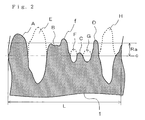
- center line average roughness means a value expressed in terms of ⁇ m obtained by folding the surface roughness curve f at the center line c and dividing an area between the surface roughness curve f and the center line c by the length L. This can be measured by using the aforementioned apparatus.
- the "center line average roughness” will be described in detail with reference to the figure. As shown in Fig.
- the center line average roughness on the surface of the base paper in a frequency region of a spatial frequency of 25 (1/mm) or less is a value showing the extent of roughness of the surface roughness curve f of the base paper 1 as shown in Fig. 1, i.e., an index value of coarse roughness on the surface of the base paper.
- the Ra1 is 3 ⁇ m or less, preferably 2.5 ⁇ m or less, more preferably 2.3 ⁇ m or less, further preferably 2.0 ⁇ m or less, still further preferably 1.8 ⁇ m or less, and particularly preferably 1.5 ⁇ m or less.
- the Ra1 exceeds 3 ⁇ m, it is not preferred since coating defects on the surface of the coated paper are increased upon coating a coating composition for paper having a high solids content by the high-speed curtain coating method.
- the lower limit of the Ra1 is not particularly limited and is generally 0.1 ⁇ m or more, preferably 0.3 ⁇ m or more, and more preferably 0.5 ⁇ m or more.
- the center line average roughness on the surface of the base paper in a frequency region of a spatial frequency of 25 (1/mm) or more is a value showing the extent of roughness of the finer curves (f1 in Fig. 1) constituting the surface roughness curve f of the base paper 1 as shown in Fig. 1, i.e., an index value of fine roughness on the surface of the base paper.
- the Ra2 is 0.2 ⁇ m or more, preferably 0.3 ⁇ m or more, more preferably 0.4 ⁇ m or more, further preferably 0.5 ⁇ m or more, and particularly preferably 0.6 ⁇ m or more.
- the Ra2 is less than 0.2 ⁇ m
- the affinity between the coating composition for paper and the base paper is deteriorated, whereby a puddling phenomenon (surface roughening due to poor wettability, TAPPI Coating Conference 2001, Proceeding, p. 251) occurs upon curtain coating, particularly high-speed coating, or the anchor effect of the coating composition for paper to the base paper is deteriorated, so as to lower the strength of the resulting coated paper.
- the upper limit of the Ra2 is not particularly limited and is generally 4.0 ⁇ m or less, preferably 3.0 ⁇ m or less, more preferably 2.5 ⁇ m or less, and further preferably 2.0 ⁇ m or less.
- the method of adjusting the Ra1 and the Ra2 is not particularly limited, and they can be adjusted to appropriate ranges by adjusting the smoothness by the known treatment.
- the base paper may be subjected to a calender treatment, such as a super calender, a machine calender and a soft nip calender, to control the smoothness, whereby the Ra1 and the Ra2 can be adjusted to the desired ranges.
- the base paper may be subjected to a pigment coating by using a size press, a gate roll coater, a metered size press, a blade coater, a rod blade coater or the like, to control the smoothness, whereby the Ra1 and the Ra2 can be adjusted to the desired ranges.
- the Ra1 and the Ra2 can be obtained by fast Fourier transformation, for example, by using a three-dimensional surface roughness meter and an analysis software "MetroPro ver. 7.6.1".
- the coating composition for paper that is preferred in the second process for producing coated paper of the present invention is a composition that is coated on the surface of the base paper by a non-contact coating method, preferably a curtain coating method.
- the coating composition for paper generally contains a pigment, and depending on necessity, may contain such components as a copolymer latex and a wetting agent.
- the aforementioned non-contact coating composition for paper may also be preferably used.
- the pigment is a main component for covering the base paper, and the kind thereof is not limited as far as it can cover the base paper.
- the pigments exemplified for the aforementioned non-contact coating composition for paper can be used, and as the pigment for the coating composition for paper, a combination of the fine particle clay (pc1), the high aspect clay (pc2) and other pigment is preferably used.
- the fine particle clay (pc1) and the high aspect clay (pc2) those exemplified for the aforementioned non-contact coating composition for paper can be used.
- the other pigment the inorganic pigments and/or the organic pigments exemplified above can be used.
- the amounts of the pigments to be used are not particularly limited, and it is preferred that they are mixed to provide a ratio fine particle clay (pc1)/high aspect clay (pc2) of from 1/3 to 5/1 by mass. In the case where the ratio is 1/3 or more, the high-speed flowability of the coating composition is improved to suppress coating defects from occurring. In the case where the ratio is 5/1 or less, the covering property of the coated layer can be suppressed from being deteriorated.
- the amount of the other pigment to be used is preferably 60% by mass or less (which may be 0% by mass), and particularly preferably 40% by mass or less based on 100% by mass of the total amount of the pigment.
- the mixing ratio of the fine particle clay (pc1) and the high aspect clay (pc2) can be in an appropriate range, whereby such pigment-coated paper can be obtained that is excellent in balance between the suppression of coating defects and improvement in covering property.
- the coating composition for paper may further contain a copolymer latex, in addition to the pigment.
- a copolymer latex By adding the copolymer latex, the pigments can be adhered to each other, and the pigments can be adhered to the base paper, whereby contamination of the plate due to picking and piling upon printing can be prevented, and blanket contamination can be prevented.
- the physical property of the copolymer latex is not particularly limited.
- the average particle diameter of the copolymer particles contained in the copolymer latex is preferably from 50 to 150 nm, and more preferably from 60 to 130 nm. In the case where the average particle diameter is 50 nm or more, the particles are stabilized to suppress aggregation, and in the case where it is 150 nm or less, the coated film is improved in strength.
- the toluene insoluble content of the copolymer is preferably from 60 to 99% by mass, and more preferably from 75 to 98% by mass.
- the coated film is improved in strength, and in the case where it is 99% by mass or less, the film forming property is improved, whereby the adhesion strength between the base paper and the coated film is improved.
- the constitution of the copolymer latex is not particularly limited, and it is preferably obtained by copolymerization of various kinds of polymerizable monomers selected.
- the copolymer latex is preferably a copolymer latex obtained by emulsion polymerization of a monomer containing (a) an aliphatic conjugated diene monomer, (b) an ethylenic unsaturated carboxylic acid monomer and (d) other monomer capable of being copolymerized with the monomer (a) and the monomer (b).
- aliphatic conjugated diene monomer (a) and the ethylenic unsaturated carboxylic acid monomer (b) those exemplified for the first copolymer latex for non-contact coating can be used.
- monomer (d) an aromatic vinyl compound, a vinyl cyanide compound, an alkyl (meth)acrylate, an acrylamide compound, N-methylolacrylamide, vinyl acetate and the like exemplified for the first copolymer latex for non-contact coating can be used.
- the amounts of these monomers to be used are not particularly limited, and it is preferred that the monomer (a) to be used is from 30 to 60% by mass, the monomer (b) is from 0.1 to 7% by mass, and the monomer (d) is from 33 to 69.9% by mass based on 100% by mass of the total amount of the monomer (a), the monomer (b) and the monomer (d). It is more preferred that the monomer (a) is from 35 to 55% by mass, the monomer (b) is from 0.5 to 5% by mass, and the monomer (d) is from 40 to 64.5% by mass.
- the proportion of the monomer (a) is in the range
- the color viscosity can be easily maintained in the favorable range, and the coated film can be sufficiently improved in strength.
- the proportion of the monomer (b) is in the range
- the particles constituting the copolymer latex can be effectively suppressed from being aggregated, and the latex viscosity and the color viscosity can be easily maintained in the favorable ranges.
- the proportion of the monomer (b3) is in the range, it is preferred since the proportions of the monomer (b1) and the monomer (b2) can be in the aforementioned ranges.
- the method of emulsion polymerization of the monomers may be the method described above.
- the content of the copolymer latex in the coating composition for paper (the content of the solid components constituting the copolymer latex, hereinafter the same) is not particularly limited, and may be in various ranges depending on demanded properties. It is generally from 5 to 30 parts by mass, preferably from 7 to 30 parts by mass, and more preferably from 7 to 20 parts by mass based on 100 parts by mass of the pigment. In the case where the content of the copolymer latex is 5 parts by mass or more, the pigment can be sufficiently adhered to the base paper, and in the case where it is 30 parts by mass or less, the opacity, the brightness, the paper gloss and the like can be effectively improved.
- the coating composition for paper may further contain a wetting agent.
- a wetting agent By adding the wetting agent, the wettability of the coating composition for paper to the surface of the base paper is improved to provide a favorable coated state.
- the wetting agent those exemplified for the aforementioned non-contact coating composition for paper can be used.
- the content of the wetting agent in the coating composition is not particularly limited and may be in any range depending demanded properties. It is generally from 0.01 to 2 parts by mass, preferably from 0.02 to 1 part by mass based on 100 parts by mass of the total of the pigment described later. In the case where the content of the wetting agent is 0.01 part by mass or more, the affinity between the pigment and the base paper is improved to suppress the generation of the puddling phenomenon. In the case where the content of the wetting agent is 2 parts by mass or less, the coating composition for paper is prevented from being subducted into the base paper upon coating the composition on the base paper, so as to maintain the favorable coated state, whereby the resulting coated paper can be improved in strength.
- the coating composition for paper may contain the components exemplified for the aforementioned non-contact coating composition for paper, in addition to the pigment, the copolymer latex and the wetting agent. The contents thereof may be the same as described in the foregoing.
- the solid concentration of the coating composition for paper is not particularly limited and can be various ranges depending on the constitutional components, the kinds and the properties of the coating composition for paper. It is preferably 50% by mass or more, more preferably 55% by mass or more, and further preferably 60% by mass or more. In the case where the solid concentration is 50% by mass or more, the covering property of the coated layer can be improved to produce effectively pigment-coated paper having excellent surface property.
- the upper limit of the solid concentration is preferably 70% by mass or less, and preferably 67% by mass or less. By using the range, the color viscosity is suppressed from being increased to stabilize the resulting curtain film.
- the coating composition for paper is coated on the surface of the base paper by the non-contact coating method, preferably the curtain coating method.
- the coating operation may be effected on only one surface of the base paper or on both surfaces thereof.
- the coating composition may be generally coated directly on the base paper by the curtain coating method without an under layer provided before the coating operation, and depending on necessity, another pretreatment may be effected.
- the apparatus for carrying out the curtain coating method is not particularly limited, and a known curtain coating apparatus may be used.
- the conditions for the curtain coating method are also not particularly limited, and the coating operation may be carried out by setting various conditions depending on necessity.
- the coating speed of the curtain coating method is generally from 600 to 3,000 m/min, preferably from 600 to 2,800 m/min, more preferably from 800 to 2,500 m/min, further preferably from 1,000 to 2,500 m/min, and particularly preferably from 1,100 to 2,300 m/min.
- the coating speed is 600 m/min or more, breakage of the curtain film can be prevented since the curtain flow amount reaches an appropriate value, and in the case where it is 2,800 m/min or less, a puddling phenomenon can be prevented from being frequently occurring.
- the coated weight may be appropriately adjusted depending on the property of the resulting pigment-coated paper, the property of the coating composition for paper, and the like.
- the coated weight (based on dry mass) per one surface of the base paper is generally from 0.1 to 50 g/m 2 , preferably from 1 to 30 g/m 2 , and more preferably from 3 to 25 g/m 2 .
- the coated paper can be obtained by drying after coating.
- the resulting pigment-coated paper may be further subjected to a calender treatment, such as super calender, machine calender and soft nip calender, to control the smoothness.
- the coated paper (pigment-coated paper) of the present invention can be obtained by the aforementioned process for producing coated paper.
- the coated paper of the present invention may have a coated layer only on one surface or may have coated layers on both surfaces. Owing to the aforementioned constitution, the coated paper of the present invention is substantially free of unevenness in blank surface property and printing, and is excellent in paper gloss and printing gloss.
- the paper gloss which is evaluated by the method described for the example shown later, can be 60 or more, and preferably 63 or more.
- the printing gloss, which is evaluated by the method described for the example shown later can be 75 or more, and preferably 77 or more.
- the opacity, which is evaluated by the method described for the example shown later can be 87 or more, and preferably 90 or more.
- the brightness which is evaluated by the method described for the example shown later, can be 80 or more, and preferably 82 or more.
- the dry pick strength and the wet pick strength which is evaluated by the method described for the example shown later, can be 3.5 or more, preferably 3.9 or more, and more preferably 4.2 or more.
- the average particle diameter of the polymer particles was obtained by the ordinary manner using a submicron analyzer "Model N4", produced by Beckman Coulter, Inc.
- the copolymer latex was adjusted to pH 8.0 with sodium hydroxide and then aggregated with isopropanol, and the aggregated product was washed with distilled water, followed by drying. Thereafter, a prescribed amount (about 0.03 g) of the sample was immersed in a prescribed amount (100 mL) of toluene at 25°C for 20 hours. The solution was filtered through a metallic sieve of 120 mesh, and the resulting solid residue was measured for mass, whereby the proportion (%) thereof with respect to the total solids content upon charging (before the treatment) was obtained.
- the resulting copolymer latex was vacuum-dried for 20 hours by heating to 100°C to form a film.
- the dried film was used as a measuring sample, and the measurement is effected according to the ASTM method by using a differential scanning calorimeter (DSC), produced by Du Pont, Inc.
- DSC differential scanning calorimeter
- the resulting copolymer latex was measured for a relationship curve between the rotation number and the torque by using a Hercules viscometer under conditions of 6,600 rpm with bob F. An apparent viscosity (mPa ⁇ s) at 6,600 rpm was obtained from the curve for comparison.
- Coating compositions for paper for offset printing paper CP-1 to CP-15 for curtain coating were prepared in the formulation shown in Table 5 with the copolymer latices L-1 to L-15 produced in Examples 1-1 to 1-10 and Comparative Examples 1-1 to 1-5 and the following components (1) to (5).
- a coating operation was carried out by using the coating compositions for paper CP-1 to CP-15 obtained in the foregoing with a curtain coater and a spray, and various evaluation were effected.
- the coating composition for paper CP-1 was coated on base paper (64 g/m 2 ) to a coated weight of 10.0 ⁇ 0.5 g/m 2 per one surface with a laboratory curtain coater, produced by SMT, Inc., at a coating speed of 30 m/min, and then dried with a hot air drier at 150°C for 20 seconds, so as to obtain coated paper (A1). Thereafter, the coated paper (A1) was allowed to stand in a constant temperature and humidity bath at a temperature of 28°C and a humidity of 50% over one day. The coated paper (A1) was subjected four times to a super calender treatment under conditions of a linear pressure of 100 kg/cm and a roll temperature of 50°C to obtain coated offset printing paper. The resulting coated offset printing paper was evaluated for the dry pick strength, the wet pick strength, the printing gloss, the color fading property of the coated paper, and the runnability upon production in the following manner.
- the extent of picking upon printing with an RI printer was determined by the naked eye and evaluated by five grades. A sample suffering less picking was given with a high score. The measurement value was an average value of measurements in six times.
- the surface of the coated paper was wetted with a water pickup roll by using the aforementioned RI printer, and then the extent of picking upon printing with the RI printer was determined by the naked eye and evaluated by five grades. A sample suffering less picking was given with a high score. The measurement value was an average value of measurements in six times.
- the coated paper was subjected to color fading according to JAPAN TAPPI No. 21 by using a Gear aging tester, and the color fading property was evaluated with a difference ( ⁇ YI) between the YI value before the test and the YI value after the test of the coated paper measured with SM Color Computer, produced by Suga Test Instruments Co., Ltd.
- the coating composition for paper was circulated through a head of a laboratory curtain coater for 1 hour.
- a sample that clogged the slit during the circulation was designated as grade " ⁇ ”
- a sample that did not clogged but disturbed the flow from the slit, i.e., the curtain film of the coating composition was designated as grade " ⁇ ”
- a sample that caused no problem was designated as grade " ⁇ ”.
- the coating composition for paper CP-1 was diluted to have a viscosity of 100 mPa ⁇ s and spray-coated on the base paper to a coated weight of 10.0 ⁇ 0.5 g/m 2 per one surface. Thereafter, the coated layer was dried with a hot air drier at 150°C for 20 seconds, as similarly to the case of the curtain coater, to obtain coated paper (A2). Thereafter, the coated paper (A2) was allowed to stand in a constant temperature and humidity bath at a temperature of 23°C and a humidity of 50% over one day and night, and then subjected four times to a super calender treatment under conditions of a linear pressure of 100 kg/cm and a roll temperature of 50°C to obtain coated offset printing paper. The resulting coated offset printing paper was evaluated in the same manner as in the foregoing. The results obtained are shown in Table 6.
- Offset printing paper was obtained in the same manner as in Example 1-11 by using the coating compositions for paper CP-2 to CP-15 and then evaluated. The results obtained are shown in Tables 6 and 7.
- the copolymer latex L-11 produced in Comparative Example 1 was in the case where the amount of the used vinyl cyanide compound was less than 5 parts, and when the coating composition for paper CP-11 obtained by using L-11 was coated, excessive ink absorption to the coated layer of the coated paper occurred. As a result, it was apparent that the printing gloss was unfavorably low (see Table 7).
- copolymer latices L-12 and L-13 produced in Comparative Examples 1-2 and 1-3 were in the case where the amount of the used vinyl cyanide compound was 40 parts or more, and when the coating compositions for paper CP-12 and CP-13 obtained by using L-12 and L-13 were coated, it was not preferred since the coated paper suffered extreme decrease in water resistant strength, and the brightness was considerably decreased to result in deteriorated color fading property.
- copolymer latices produced in Comparative Examples 1-4 and 1-5 were in the case where the average particle diameter exceeded 150 nm, and good runnability could not be obtained due to poor high-speed flowability.
- the printing gloss was not good due to excessive ink absorption to the coated layer of the coated paper.
- the copolymer latices L-1 to L-10 produced in Examples 1-1 to 1-10 shown in Tables 1 to 3 sufficiently exerted the objects of the present invention. That is, because these were latices excellent in high-speed flowability, Tables 6 to 7 showed that the runnability using the coating compositions for paper CP-1 to CP-10 produced by using the latices, respectively, was good, and coated paper excellent in dry pick strength, wet pick strength and printing gloss was obtained.
- the components for the second step (the monomer components for forming the copolymer part (P2)) shown in Table 8 were continuously added, during which the polymerization was continued at 60°C for 7 hours.
- the reaction was further effected (the second step polymerization) at 60°C for 7 hours to obtain a copolymer latex L-16 containing particles formed of a copolymer.
- the final polymerization conversion was 99%.
- the resulting copolymer latex L-16 was measured for the average particle diameter, the glass transition point and the toluene insoluble content of the polymer particles, and the weight average molecular weight and the cohesiveness of the copolymer part (P1) in the following manner. The results obtained are shown in Table 8.
- the average particle diameter of the polymer particles was obtained by the ordinary manner using a submicron analyzer "Model N4", produced by Beckman Coulter, Inc.
- the polymerization of the copolymer part (P1) using the first step components was started in the same manner as in the aforementioned example, and at a time when the polymerization conversion reached 70%, 0.1 part of N,N-diethylhydroxylamine was added to terminate the polymerization. Thereafter, the unreacted monomers were removed by steam stripping. The reaction mixture was cooled to ordinary temperature, and the solids content thereof was adjusted to 25% by using distilled water. Thereafter, the copolymer part (P1) thus formed was aggregated with isopropanol. The aggregated product was washed and dried, and 0.3 g thereof was dissolved in 50 mL of tetrahydrofuran (THF). The solution was filtered with a membrane filter, and the filtrate was measured for the polystyrene conversion molecular weight with gel permeation chromatography (GPC).
- GPC gel permeation chromatography
- the copolymer latex was coated on a polyethylene terephthalate film with a No. 18 rod and dried at 120°C for 30 seconds to form a film of 10 g/m 2 . Thereafter, the film was superimposed on black woolen cloth, and pressed with bench super calender under conditions of a linear pressure of 200 kg/m and a temperature of 70°C. They were peeled off from each other, and the extent of transfer of the polymer film to the black woolen cloth was visually evaluated by five grades. A sample suffering less transfer was given with a high score. The measurement value was an average value of measurements in six times.
- Coating compositions for paper for offset printing paper CP-16 to CP-24 for curtain coating were prepared in the formulation shown in Table 5 with the copolymer latices L-16 to L-24 produced in Examples 2-1 to 2-5 and Comparative Examples 2-1 to 2-4 and the kaolin clay, the calcium carbonate, the dispersing agent, the sodium hydroxide and the starch, which were used in Example [I].
- a coating operation was carried out by using the coating compositions for paper CP-16 to CP-24 obtained in the foregoing with a curtain coater, a spray and a blade coater, and various evaluation were effected.
- the coating composition for paper CP-16 was coated on the base paper described in Example [I] to a coated weight of 10.0 ⁇ 0.5 g/m 2 per one surface with a laboratory curtain coater, and then dried with a hot air drier at 150°C for 20 seconds, so as to obtain coated paper (B1). Thereafter, the coated paper (B1) was allowed to stand in a constant temperature and humidity bath at a temperature of 23°C and a humidity of 50% over one day and night. The coated paper (B1) was subjected four times to a super calender treatment under conditions of a linear pressure of 100 kg/cm and a roll temperature of 50°C to obtain coated offset printing paper. The resulting coated offset printing paper was evaluated for the dry pick strength, the wet pick strength, the printing gloss, and the runnability upon production in the same manner as in Example [I]. The results obtained are shown in Tale 10.
- coated paper (B2) was obtained in the same manner as in Example [I].
- the coated paper (B2) was then processed in the same manner as in the case using a curtain coater to obtain coated offset printing paper.
- the resulting coated offset printing paper was evaluated in the same manner as in the foregoing.
- the runnability was evaluated by observing as to whether or not the nozzle was clogged upon spraying, and as to whether or not the spraying operation could be normally effected.
- the results obtained are shown in Table 10.
- Coated paper was obtained in the same manner as in Example 2-6 except that the coating compositions for paper CP-17 to CP-24 were used, and then evaluated in the same manner as in the foregoing. Evaluation by blade coating was also effected for Examples 2-7 and 2-9 and Comparative Examples 2-1 and 2-3. The blade coating was effected by using a laboratory sheet coating machine at a coating speed of 30 m/min. The drying operation and the subsequent operations were the same as in the case of curtain coating. The runnability was evaluated by contamination of the backing roll. The evaluation of the contamination of the backing roll was carried out by comparing in terms of the evaluation of cohesiveness with the latex that had caused contamination on blade coating and the latex that had not caused contamination thereon. A sample that was expected to cause contamination was designated as grade " ⁇ ", a sample that was expected to cause no contamination was designated as grade " ⁇ ”, and a sample showing an intermediate result was designated as grade " ⁇ ". The results obtained are shown in Table 10.
- the coated offset printing paper obtained with the curtain coater and the blade coater was also evaluated for covering property by the burnout method.
- the evaluation method was as follows. Ammonium chloride was dissolved in a medium obtained by mixing isopropyl alcohol and water as 1/1 to prepare an aqueous solution having a concentration of 2.5%. The aqueous solution was sprayed on the surface of the coated paper, which was then placed in a Gear oven and allowed to stand at 200°C for 10 minutes, and the brightness thereof was measured. A sample exhibiting high brightness and good covering property was designated as grade " ⁇ ", a sample exhibiting low brightness and poor covering property was designated as grade " ⁇ ”, and a sample showing an intermediate result was designated as grade " ⁇ ".
- coated paper having high covering property was obtained through production by the curtain coating method and the spray coating method by using the coating compositions for paper CP-16 to CP-20 containing the copolymer latices L-16 to L-20 produced in Examples 2-1 to 2-5, and thus coated paper having large dry pick strength and wet pick strength, good printing gloss, and low cohesiveness of the latex was obtained. The runnability upon production was good. In the production by the blade coating method, the covering property was not sufficient even when the aforementioned coating compositions for paper were used, as apparent from Example 2-7 and 2-9.
- Comparative Examples 2-5 to 2-8 resulted in poor results for one of or plural items of the dry pick strength, the wet pick strength, the printing gloss and the runnability regardless of coating method.
- the resulting copolymer latex L-25 was measured for the average particle diameter of the polymer particles, the glass transition point and the toluene insoluble content. The results obtained are shown in Table 11.
- the average particle diameter was obtained by the ordinary manner using a laser light scattering particle diameter measuring apparatus "LPA-3100 PAR-3", produced by Otsuka Electronics Co., Ltd.
- the glass transition point was obtained by the ordinary manner using a differential scanning thermal analyzer (DSC) "EXTAR6000", produced by Seiko Instruments, Inc.
- the toluene insoluble content was measured in the same manner as shown in Example [I].
- Coating composition for paper CP-25 was prepared in the formulation shown in Table 13 with the copolymer latex L-25 produced in Example 3-1 and the following components (1) to (6) by adding the pigment, the latex, the viscosity adjusting agent (thickener) and the wetting agent in this order, followed by mixing.
- Fine particle clay (pc1) Fine particle clay (pc1)
- Amazon SD a trade name, produced by Cadam Caulim Da Amazonia, Brazil, containing a component having a particle diameter of less than 2 ⁇ m in an amount of about 90% or more
- Carbital 90 a trade name, produced by Shiroishi Calcium Kaisha Ltd.
- AE851 a trade name, produced by JSR Corp., a latex containing hollow polymer particles, the mixing amounts thereof shown in Tables 13 and 14 being in terms of solids content
- the coating composition for paper CP-25 was measured for the viscosity, the dynamic surface tension and the static surface tension in the following manner. The results obtained are shown in Table 13.
- the coating composition for paper was controlled for 2 hours in a water bath adjusted to 25°C, and after confirming that the temperature was sufficiently constant, the apparent viscosity was measured with a viscometer ("Digital Viscometer DV Model M-BII", a trade name), produced by Tokimec, Inc., at 60 rotations after 1 minute from the start of measurement.
- a viscometer Digital Viscometer DV Model M-BII, a trade name
- the coating composition for paper was measured with a dynamic surface tensitometer (Model "BP-2"), produced by Kruss GmBH with an interval of 10 points per decade within a surface lifetime range from 30 to 1,000 ms, and the data for 15 to 20 points were expressed by a graph.
- the dynamic surface tension at a surface lifetime of 10 ms was obtained by extrapolation of the graph by the least square method.
- the static surface tension was measured by using a Dunuey surface tensitometer at 20°C.
- Coating compositions for paper CP-26 to CP-34 were prepared in the formulations shown in Tables 13 and 14 with the copolymer latices L-26 to L-29 produced in Production Examples 3-2 to 3-5 and the aforementioned components (1) to (6) in the same manner as in Example 3-1.
- the compositions were evaluated for physical properties in the same manner as in the foregoing. The results obtained are shown in Tables 13 and 14.
- the coating compositions for paper CP-25 to CP-34 (Examples 3-1 to 3-5 and Comparative Examples 3-1 to 3-5) were adjusted to have the solid concentrations shown in Tables 13 and 14 and coated on base paper ("GraphoSet", a trade name, produced by Mitsubishi Paper Sales Co., Ltd.) to a coated weight of 8.0 ⁇ 0.5 g/m 2 by using a pilot curtain coater, produced by IHI, Ltd., to obtain coated paper (C).
- the coating speed was gradually increased at an interval of 200 m/min, and the maximum speed, at which puddling did not occur, was measured.
- the maximum coating speeds thus measured and the coated weights per one surface are shown in Tables 13 and 14.
- the coated paper (C) was allowed to stand in a constant temperature and humidity bath at a temperature of 23°C and a humidity of 50% over one day and night.
- the coated paper (C) was subjected four times to a super calender treatment under conditions of a linear pressure of 100 kg/cm and a roll temperature of 50°C to obtain coated paper.
- the resulting coated paper was evaluated for the following coating defects, the dry pick strength, the wet pick strength, the paper gloss and the printing gloss. The results obtained are shown in Tables 13 and 14.
- the coated paper was immersed in a mixed solution obtained by mixing a 5% ammonium chloride aqueous solution and isopropanol at a ratio of 50/50 and heated to 200°C for 3 minutes to color the fibers.
- a mixed solution obtained by mixing a 5% ammonium chloride aqueous solution and isopropanol at a ratio of 50/50 and heated to 200°C for 3 minutes to color the fibers.
- One arbitrary site on the surface of the coated paper thus colored was selected, and the site was observed with an optical microscope at a magnification of 50.
- the coating defects detected in each of the view fields were evaluated by the following grades " ⁇ ", " ⁇ " and " ⁇ ".
- a picking test ink was printed by using a printer RI-II, produced by Akira Seisakusho Co., Ltd., and the extent of picking (such a phenomenon that the surface of the coated paper was partly peeled off due to tacking of the ink) upon printing was evaluated by the naked eye to the following five-grade standard (with intermediate values thereof). The measurement was carried out in six times for each of the coated paper, and the average value of the evaluated values was calculated for the respective printing operations.
- the surface of the coated paper was wetted with a first stage roll having water-wetted cloth wound thereon (Moulton roll), and then printed with a second stage roll attached with a picking test ink under the same conditions as in the aforementioned (e). Thereafter, the extent of picking was evaluated in the same standard as in the aforementioned (e). The measurement was carried out in six times for each of the coated paper, and the average value of the evaluated values was calculated for the respective printing operations.
- the surface of the non-printed coated paper was measured for glossiness with a Murakami gloss meter at an incident angle of 75° and a reflection angle of 75°. The measurement was carried out in six times, and the average value was calculated from the resulting glossiness values. The larger the glossiness value is, the better the result is.
- An offset ink was printed solidly on the surface of the coated paper by using the aforementioned printer RI-I.
- the glossiness on the surface of the resulting printed paper was measured in the same manner as in the aforementioned (g) except that the incident angle was 60° and the reflection angle was 60°. The measurement was carried out in six times, and the average value was calculated from the resulting glossiness values. The larger the glossiness value is, the better the result is.
- the coating compositions for paper of Comparative Examples 3-1 and 3-2 were the same as Example 3-1 in the mixed components and the mixed amounts except that the mixed amount of the viscosity adjusting agent (D) added for increasing the viscosity was larger than that in Example 3-1.
- the viscosity of the coating composition for paper of Comparative Example 3-1 was 2,200 mPa ⁇ s
- the viscosity of the coating composition for paper of Comparative Example 3-2 was 1,600 mPa ⁇ s, which exceeded 1,500 mPa ⁇ s. Accordingly, puddling occurred in Comparative Example 3-1 when the coating speed exceeded 200 m/min, and puddling occurred in Comparative Example 3-2 when the coating speed exceeded 1,400 m/min.
- the coating composition for paper of Comparative Example 3-3 was the same as Example 3-1 in the mixed components and the mixed amounts except that the viscosity adjusting agent (D) was not added for decreasing the viscosity.
- the viscosity of the coating composition for paper of Comparative Example 3-3 was 40 mPa ⁇ s, which was less than 50 mPa ⁇ s, and accordingly, puddling occurred when the coating speed exceeded 300 m/min. No coating defect was found in the coated paper obtained at the maximum coating speed, and the wet pick strength was relatively good, but the dry pick strength was inferior as 22% of that of Example 3-1. It was understood that the paper gloss was inferior as 74% of that of Example 3-1, and the printing gloss was inferior as 86% of that of Example 3-1.
- the coating composition for paper of Comparative Example 3-4 was the same as Example 3-1 in the mixed components and the mixed amounts except that the wetting agent (C) was not added for increasing the dynamic surface tension.
- the dynamic surface tension of the coating composition for paper of Comparative Example 3-4 was 68 mN/m, which exceeded 65 mN/m, and accordingly, puddling occurred when the coating speed exceeded 800 m/min.
- the coated paper obtained at the maximum coating speed was good in the strengths and was good in printing gloss, but was inferior in paper gloss as 80% of that of Example 3-1. Furthermore, coating defects were found.
- the coating composition for paper of Comparative Example 3-5 was the same as Example 3-1 in the mixed components and the mixed amounts except that an excessive amount of the wetting agent (C) was added for decreasing the dynamic surface tension.
- the dynamic surface tension of the coating composition for paper of Comparative Example 3-5 was 20 mN/m, which was less than 25 mN/m, and accordingly, puddling occurred when the coating speed exceeded 400 m/min.
- the coated paper obtained at the maximum coating speed was good in the dry pick strength but was inferior in the wet pick strength as 70%.
- the paper gloss was inferior as 80% of that of Example 3-1, and the printing gloss was inferior as 89% of that of Example 3-1. Furthermore, coating defects were found.
- the coating composition for paper of Example 3-1 had a viscosity and a dynamic surface tension within the scope of the present invention, whereby the coating operation could be effected without occurrence of puddling at a high speed of 2,100 m/min even with a high solid concentration of 60%. No coating defect was found in the coated paper obtained at the maximum coating speed, and excellent values were obtained as 4.6 for the dry pick strength, 4.3 for the wet pick strength, 63 for the paper gloss, and 77.6 for the printing gloss.
- Example 3-2 a high-speed printing operation could be effected at 1,800 m/min, no coating defect was found in the coated paper obtained at the maximum coating speed, and excellent values were obtained as 4.4 for the dry pick strength, 3.9 for the wet pick strength, 68.5 for the paper gloss, and 76.5 for the printing gloss.
- Example 3-3 a high-speed printing operation could be effected at 2,000 m/min, no coating defect was found in the coated paper obtained at the maximum coating speed, and excellent values were obtained as 4.0 for the dry pick strength, 4.8 for the wet pick strength, 62.8 for the paper gloss, and 79.2 for the printing gloss.
- Example 3-4 a high-speed printing operation could be effected at 1,800 m/min, no coating defect was found in the coated paper obtained at the maximum coating speed, and excellent values were obtained as 4.5 for the dry pick strength, 4.0 for the wet pick strength, 64.5 for the paper gloss, and 80.4 for the printing gloss.
- Example 3-5 a high-speed printing operation could be effected at 2,100 m/min, no coating defect was found in the coated paper obtained at the maximum coating speed, and excellent values were obtained as 3.9 for the dry pick strength, 4.1 for the wet pick strength, 71.2 for the paper gloss, and 83.3 for the printing gloss.
- Examples 3-1 to 3-5 having physical properties within the scope of the present invention, a high-speed printing operation could be effected at from 1,800 to 2,100 m/min, and no coating defect occurred even in the high-speed printing operation, whereby it was understood that coated paper having various characteristics in a well balanced manner could be produced.
- Copolymer Latices L-31 to L-34 were produced in the same manner as in Production Example 4-1 except that the raw materials shown in Tables 15 to 16 were used, and evaluated in the same manner as in the foregoing. The results obtained are shown in Tables 15 to 16.
- Coating compositions for paper CP-35 to CP-44 for curtain coating were prepared in the formulation shown in Table 17 with the copolymer latices L-30 to L-34 produced in Production Examples 4-1 to 4-5, and the fine particle clay, the high aspect clay, the calcium carbonate, the hollow polymer particles, the thickener and the wetting agent, which were used in Example [III].
- a coating operation was carried out by using the coating compositions for paper CP-35 to CP-44 obtained in the foregoing with a pilot curtain coater on 10 kinds of base paper, and various evaluation were effected.
- base paper base paper Nos. 1 to 5, which were commercially available non-coated paper, and base paper Nos. 6 to 10, which were commercially available coated paper, were prepared.
- the base paper Nos. 1 to 10 were measured for surface smoothness by using an optical interference non-contact three-dimensional surface roughness meter "NewView 200", produced by Zygo Corp., and the center line average roughness Ra1 in a frequency region of a spatial frequency of 25 (1/mm) or less and the center line average roughness Ra2 in a frequency region of a spatial frequency of 25 (1/mm) or more were obtained.
- the measurement conditions were an objective lens of magnification of 2.5, irradiation lens of magnification of 2, a measuring area of 1.45 mm x 1.08 mm, and an accumulation number of 3.
- the analysis was carried out by fast Fourier transformation by using the analysis software "MetroPro ver. 7.6.1", which was supplied with the aforementioned apparatus to obtain Ra1 and Ra2. Separate 10 sites were measured and analyzed for each of the base paper, and Ra1 and Ra2 were calculated as average values, respectively. The results obtained are shown in Table 18.
- the coating compositions for paper CP-35 to CP-44 were adjusted to have the solid concentrations shown in Table 18 and coated on base paper Nos. 1 to 10 with a pilot curtain coater to obtain pigment-coated paper (D). At this time, the coating speed was gradually increased at an interval of 200 m/min, and the maximum speed, at which puddling did not occur, was designated as the "coating-enabling maximum speed (m/min)". The results obtained are shown in Table 18.
- the pigment-coated paper (D) obtained at the coating-enabling maximum speed was allowed to stand in a constant temperature and humidity bath at a temperature of 23°C and a humidity of 50% over one day and night.
- the coated paper (D) was subjected four times to a super calender treatment under conditions of a linear pressure of 100 kg/cm and a roll temperature of 50°C.
- the resulting pigment-coated paper was evaluated for the capabilities including the following coating defects, the dry pick strength, the wet pick strength, the paper gloss, the printing gloss, the opacity and the brightness. The results obtained are shown in Table 18.
- the pigment-coated paper was immersed in a 2% ammonium chloride aqueous solution and heated to 200°C for 3 minutes to color the fibers, and the coated paper having fibers thus colored was observed with an optical microscope at a magnification of 50 to observe the state of coating defects.
- the symbol "A” meant that no coating defect occurred
- the symbol “C” meant that coating defects occurred.
- the opacity was evaluated by the Hunter colorimetry, in which the measurement was effected with a green filter using a brightness meter. The larger the value is, the better the result is.
- the brightness was evaluated by the Hunter colorimetry, in which the measurement was effected with a blue filter using a brightness meter. The larger the value is, the better the result is.
- Comparative Examples 4-1 and 4-2 where the Ra1 was outside the scope of the present invention a puddling phenomenon did not occur until the coating speed reached 2,000 m/min, but the resulting coated paper had considerably large amounts of coating defects. Therefore, it was inferior in comparison to the coated paper of Examples 4-1 to 4-6 since the paper gloss and the printing gloss could not be exerted.
- Comparative Examples 4-3 and 4-4 where the Ra2 was outside the scope of the present invention were considerably low in coating-enabling maximum coating speed in comparison to Examples 4-1 to 4-6, and thus it was understood that the coating operation could not be effected due to occurrence of a puddling phenomenon when the coating speed was high. Furthermore, an anchor effect to the base paper could not be exerted, and thus it was understood that the dry pick strength was weak and inferior in comparison to the pigment-coated paper obtained in Examples 4-1 to 4-6.
- Examples 4-1 to 4-6 where both the Ra1 and the Ra2 were within the scope of the present invention caused no puddling phenomenon upon coating even when the coating speed was high, and the coating composition had a high solid concentration.
- the pigment-coated paper obtained in Examples 4-1 to 4-6 was free of coating defects and good in the dry pick strength, the wet pick strength, the paper gloss, the printing gloss, the opacity and the brightness in a well balanced manner, and thus it was excellent in comparison to the pigment-coated paper obtained in Comparative Examples 4-1 to 4-4.
- the copolymer latex of the present invention is suitable for a non-contact coating method, such as a curtain coater and a spray, upon using as a coating composition for paper, and thus can be widely used in paper industry, printing industry and the like. Therefore, the coated paper thus obtained can be used as an offset printing paper, such as high-speed offset printing paper, a gravure printing paper, a letterpress paper, an ink-jet paper, an electrophotographic paper, a fine art paper, a magazine cover paper, a frontispieces paper, a poster paper, a catalog paper, a calendar paper, a brochure paper, a magazine paper, a magazine color page paper, a leaflet paper, a picture postcard paper, a card paper and the like.
- an offset printing paper such as high-speed offset printing paper, a gravure printing paper, a letterpress paper, an ink-jet paper, an electrophotographic paper, a fine art paper, a magazine cover paper, a frontispieces paper, a poster paper, a catalog paper,
Landscapes
- Chemical & Material Sciences (AREA)
- Chemical Kinetics & Catalysis (AREA)
- Health & Medical Sciences (AREA)
- Medicinal Chemistry (AREA)
- Polymers & Plastics (AREA)
- Organic Chemistry (AREA)
- Paper (AREA)
Abstract
The copolymer latex for non-contact coating of the
present invention is obtained by emulsion polymerization of a
monomer containing from 23 to 58% by mass of an aliphatic
conjugated diene monomer, from 0.1 to 7% by mass of an
ethylenic unsaturated carboxylic acid monomer, from 5 to 40% by
mass of a vinyl cyanide compound, and from 0 to 71.9% by mass
of other monomer capable of being copolymerized with the other
monomers (provided that the total amount of the monomers is
100% by mass), and polymer particles contained in the latex
have an average particle diameter of from 50 to 150 nm. A
coating composition for paper containing the latex, a pigment
and the like is suitable for a non-contact coating method, such
as a curtain coater and a spray, to obtain coated paper
excellent in surface strength, printing gloss and the like with
good runnability.
Description
The present invention relates to a copolymer latex for
non-contact coating, a composition containing the same, a
coated paper and a process for producing the same. More
specifically, it relates to a copolymer latex that is suitable
for a non-contact coating method, such as curtain coating and
spray coating, and is capable of forming a coated paper
excellent in surface strength, water-resistant strength and
printing gloss, a composition containing the same, a coated
paper that can be obtained by using the composition with good
runnability, and a process for producing the same.
The coated paper of the present invention can be widely
used in paper industry, printing industry and the like. The
present invention can also be used in an offset printing paper
(such as high-speed offset printing paper), a gravure printing
paper, a letterpress paper, an ink-jet paper, an
electrophotographic paper, a fine art paper, a magazine cover
paper, a frontispieces paper, a poster paper, a catalog paper,
a calendar paper, a brochure paper, a magazine paper, a
magazine color page paper, a leaflet paper, a picture postcard
paper, a card paper and the like.
In order to improve appearance and printability of paper,
in general, coated paper having coated thereon a coating liquid
(coating composition for paper) mainly containing a white
pigment, such as kaolin and calcium carbonate, and an aqueous
binder is produced. According to the visualization of
magazines and increase in amounts of inserted advertisements
and leaflets in recent year, the production volume of coated
paper is greatly increased. The coated paper is currently
produced by coating mainly with a blade coater, a gate roll
coater and a metering size press.
It is a major issue in production of coated paper how to
coat base paper favorably by a small coated weight from the
standpoint of cost. In order to improve the coating property,
it is important to reduce the penetration amount into the base
paper and to increase the bulk of the coated layer. In the
case where the coated paper is produced with the aforementioned
coating machines, however, there is such a problem that the
coating liquid is significantly penetrated into the base paper
due to the mechanism thereof, and the bulk of the coated paper
is difficultly increased.
In the case of the so-called non-contact coating method,
such as curtain coating and spray coating, on the other hand,
it has been known that the coating liquid is not penetrated
into the base paper, and the coated layer becomes bulky. In
the curtain coating, the spray coating and the like, which are
non-contact coating methods, paper suffers no stress and is
prevented from being broken even upon high-speed coating, and
thus thin base paper having a small basis weight and base paper
having a small strength due to a large amount of filler can be
coated. Under the circumstances, it has been considered that
coated paper is produced by the non-contact coating method,
such as curtain coating. However, the curtain coating and the
spray coating have not yet been generally used for producing
coated paper. This is mainly because of the following reasons.
In the aforementioned non-contact coating, a bulky coated
paper can be obtained, but such a problem occurs that an ink is
excessively absorbed to fail to obtain sufficient printing
gloss because (1) the coated layer has a small strength, and
(2) the coated layer has a porous structure. The amount of the
binder used may be increased to prevent the problem, but it is
not preferred since the cost is significantly increased.
It is primarily considered that an SBR latex having a low
glass transition point (Tg) is used to improve the strength of
the coated layer, but the use of the latex having the nature
brings about such problems that the water resistant strength,
which is necessary for offset printing, is lowered, the
expression property of printing gloss is lowered, and the
runnability on coating is deteriorated. Furthermore, in the
case where the latex is coated with a curtain coater, if the
lip, which is an ejection outlet of the coating liquid, is
clogged, the coated weight at the clogged part is decreased to
cause coating defect. Moreover, there are some cases where a
non-coated part is produced due to breakage of the curtain.
Therefore, there is increased risk of these problems by using a
latex having a low Tg and a high cohesiveness, and in order to
avoid the problems, for example, JP-A-7-119088 discloses a
technique using a latex having a Tg of -10°C or more. In the
technique, no sufficient adhesion strength to base paper can be
obtained, and the coated layer has a lowered strength, which
bring about deteriorated printability, such as picking. Upon
using the latex, the same problems as in the curtain coating
arise in the spray coating from the standpoint of clogging of
nozzles.
The next reason is that high-speed coating is difficult.
For example, in the case where the curtain coating is carried
out at a coating speed equivalent to the ordinary blade coating,
the curtain film is elongated under severe shearing stress due
to the high coating speed. In the case where the coating
liquid has poor high-speed flowability at this time, the
coating liquid cannot be sufficiently spread to fail to form a
continuous coated layer.
Another reason why the high-speed coating is difficult is
defective coating due to puddling. The puddling means
generation of isolation of the coating liquid (various sizes of
droplets) in the vicinity of the contact point of the falling
coating liquid with the base paper. The puddling causes
wave-like defective coating to cause waste paper thereon, which
brings about severe damages. It is also liable to cause
breakage and contamination of the paper, which brings about
large damages on productivity and workability. The puddling is
liable to occur when the coating liquid has a lower viscosity,
and the coating speed is larger. In the case where the
viscosity of the coating liquid increased, the puddling can be
suppressed, but a favorable curtain film is difficultly formed,
and even if it can be formed, sufficient elongation and spread
thereof on the base paper cannot be obtained. Therefore, the
increase of the viscosity facilitates the aforementioned
coating failure (such as coating defects and defective coating)
to lower the product quality. The problems can be suppressed
by lowering the coating speed, but it simultaneously lowers the
productivity. JP-A-5-154435 proposes a coating liquid having a
Reynolds number in a prescribed range to avoid the problems.
However, higher productivity and product quality are being
demanded.
In the curtain coating, the coating liquid is less
penetrated into the base paper, and therefore, the surface of
the base paper cannot be rapidly and sufficiently wetted
therewith unless the coating liquid has a sufficiently low
surface tension and good flowability. In the case where the
surface of the base paper is not sufficiently wetted, coating
defects (minute pores where a pigment is not coated on the
surface of the coated paper) occur on the surface of the coated
paper due to the influence of the surface shape. In the case
where the resulting coated paper has coating defects, it is not
preferred since unevenness occurs on blank surface property and
printing. The coating defects can be suppressed by lowering
the coating speed, but it is not preferred since the
productivity is impaired. The coating defects can also be
suppressed by lowering the solids content of the coating liquid,
but it is not preferred since the drying load is increased to
build up the investment on the drying equipment. It is also
considered to avoid the coating defects by using various kinds
of wetting agents, but no agent providing sufficient
wettability has been found.
In the case of the spray coating, furthermore, the
coating liquid is sprayed as fine mist from a nozzle under high
pressure due to the coating principal thereof. In the case
where the coating liquid has poor high-speed flowability at
this time, it cannot be favorably sprayed from the tip of the
nozzle to impair favorable coating.
Accordingly, such a novel latex, a novel coating liquid
(coating composition for paper) formulation, and a novel
production process of coated paper have been demanded that
provide good printability at a high coating speed equivalent to
the blade coating, and provide good runnability.
An object of the present invention is to provide such a
coating composition for paper and a copolymer latex used
therefor that solve the problem of increase of an amount of a
binder to be used and reduction of a printing gloss upon
producing coated paper by a non-contact coating method, such as
curtain coating and spray coating, and are improved in
runnability and workability.
In particular, an object of the present invention is to
provide such a coating composition for paper that can attain
curtain coating with good productivity (high-speed coating
property and high solids content) to provide coated paper with
high quality (small coating defects, good coating property and
good paper surface property). Another object thereof is to
provide coated paper having good quality by coating the coating
composition for paper. A further object thereof is to provide
such a production process that can provide coated paper having
good quality by curtain coating with good productivity by using
the coating composition for paper.
A still further object thereof is to provide such a
process for producing pigment-coated paper that is excellent in
productivity upon producing the coated paper by a curtain
coater with less coating defects, and is excellent in various
properties, such as expression property of paper gloss and
expression property of printing gloss, and to provide such
pigment-coated paper that has these excellent properties in a
balanced manner.
Under the circumstances, the inventors have made earnest
investigations, and as a result, the present invention has been
completed.
The present invention is to attain the aforementioned
objects and is described below.
The present invention will be described for the copolymer
latex for non-contact coating, the non-contact coating
composition for paper and the process for producing coated
paper in this order below.
The first copolymer latex for non-contact coating of the
present invention is a copolymer latex obtained by emulsion
polymerization of a monomer consisting of an aliphatic
conjugated diene monomer (a) in an mount from 23 to 58% by mass,
an ethylenic unsaturated carboxylic acid monomer (b) in an
amount from 0.1 to 7% by mass, a vinyl cyanide compound (c) in
an amount from 5 to 40% by mass, and other monomer (d) capable
of being copolymerized with the monomers (a), (b) and (c) in an
amount from 0 to 71.9% by mass (provided that the total amount
of the monomers (a), (b), (c) and (d) is 100% by mass),
characterized in that polymer particles contained in the latex
have an average particle diameter of from 50 to 150 nm.
Examples of the aliphatic conjugated diene monomer (a)
include 1,3-butadiene, isoprene, 2-chloro-1,3-butadiene,
chloroprene and the like. Among these, 1,3-butadiene is
preferred. These compounds may be used solely or in
combination of two or more kinds thereof. The use of the
aliphatic conjugated diene monomer (a) imparts appropriate
flexibility and elongation to the resulting copolymer, so as to
provide coated paper having impact resistance.
The amount of the aliphatic conjugated diene monomer (a)
to be used is from 23 to 58% by mass, preferably from 30 to 50%
by mass, and more preferably from 38 to 48% by mass, based on
the total monomer. In the case where the amount of the
aliphatic conjugated diene monomer (a) to be used is less than
23% by mass, the copolymer becomes too stiff to provide such a
tendency that the adhesion strength is difficultly exhibited.
In the case of the non-contact coating method, such as the
curtain coating method and the spray coating method, in
particular, the coating composition for paper is not penetrated
into the base paper to reduce the anchor effect, whereby the
strength of the resulting coated paper is significantly reduced
in the case where the copolymer does not have sufficient
adhesion strength.
On the other hand, in the case where the amount of the
aliphatic conjugated diene monomer (a) to be used exceeds 58%
by mass, the cohesiveness becomes too high to provide sometimes
deterioration in runnability, such as formation of
contamination. Furthermore, the water resistant strength and
the printing gloss of coated paper obtained with a composition
containing the copolymer latex are also lowered.
Examples of the ethylenic unsaturated carboxylic acid
monomer (b) include a monocarboxylic acid, a dicarboxylic acid,
a half ester of a dicarboxylic acid and the like. The
carboxylic acids preferably have a carbon number in a range
from 4 to 7.
Examples of the monocarboxylic acid include acrylic acid,
methacrylic acid, crotonic acid and the like. Examples of the
dicarboxylic acid include fumaric acid, maleic acid, itaconic
acid and the like. Examples of the half ester of a
dicarboxylic acid include methyl fumarate, ethyl maleate, ethyl
itaconate and the like. A carboxylic anhydride forming a
dicarboxylic acid in an aqueous medium may also be used.
The carboxylic acids may be used solely or in combination
of two or more kinds thereof.
The amount of the ethylenic unsaturated carboxylic acid
monomer (b) to be used is from 0.1 to 7% by mass, preferably
from 0.3 to 5% by mass, and more preferably from 0.5 to 3.5% by
mass, based on the total monomer. In the case where the amount
of the ethylenic unsaturated carboxylic acid monomer (b) to be
used is less than 0.1% by mass, the latex is poor in stability
upon polymerization to provide sometimes generation of a large
amount of coagulated products. On the other hand, in the case
where the amount of the ethylenic unsaturated carboxylic acid
monomer (b) to be used exceeds 7% by mass, there are some cases
where the viscosity of the coating composition becomes too high
to impair the coating operation.
Examples of the vinyl cyanide compound (c) include
acrylonitrile, methacrylonitrile and the like. These may be
used solely or in combination of two or more kinds thereof.
The amount of the vinyl cyanide compound (c) to be used
is from 5 to 40% by mass, preferably from 10 to 35% by mass,
and more preferably from 10 to 30% by mass, based on the total
monomer. In the case where the amount of the vinyl cyanide
compound (c) to be used is less than 5% by mass, absorption of
an ink solvent to the copolymer cannot be sufficiently
suppressed to fail to suppress excessive absorption of the ink
to the coated layer having a porous structure, which is a
characteristic feature of a coated layer obtained by a
non-contact coating method, whereby sufficient printing gloss
cannot be obtained. On the other hand, in the case where the
amount of the vinyl cyanide compound (c) to be used exceeds 40%
by mass, the resulting coated paper suffers extreme
deterioration in water resistant strength, and color
degradation of the coated paper (yellowing due to lapse of
time) is accelerated.
The monomer (d) is not particularly limited as far as it
is capable of being copolymerized with the monomers (a), (b)
and (c), and examples thereof include an aromatic vinyl
compound, an alkyl (meth)acrylate, an acrylamide compound,
N-methylolacrylamide, vinyl acetate and the like. A copolymer
having a glass transition temperature suitable for the intended
purpose can be obtained by changing the using proportions of
the monomers (a), (b), (c) and (d).
Examples of the aromatic vinyl compound, include styrene,
α-methylstyrene, p-methylstyrene, vinyltoluene, chlorostyrene
and the like. Among these, styrene is particularly preferred.
Examples of the alkyl (meth)acrylate include methyl
(meth)acrylate, ethyl (meth)acrylate, propyl (meth)acrylate,
butyl (meth)acrylate, 2-ethylhexyl (meth)acrylate, octyl
(meth)acrylate, benzyl (meth)acrylate, lauryl (meth)acrylate,
stearyl (meth)acrylate, isobornyl (meth)acrylate, 2-cyanoethyl
(meth)acrylate and the like. Among these, methyl methacrylate
is particularly preferred.
Examples of the acrylamide compound include acrylamide,
methacrylamide, N,N-dimethylacrylamide, N,N-dimethylaminopropyl
(meth)acrylamide and the like.
These monomers may be used solely or in combination of
two or more kinds thereof. The amount of the monomer (d) to be
used is from 0 to 71.9% by mass, preferably from 10 to 60% by
mass, and more preferably from 20 to 50% by mass, based on the
total monomer.
The emulsion polymerization of the monomers may be
effected generally in an aqueous medium using an emulsifying
agent, a polymerization initiator, a molecular weight adjusting
agent and the like.
Examples of the emulsifying agent include an anionic
surfactant, a nonionic surfactant, an amphoteric surfactant and
the like. These may be used solely or in combination of two or
more kinds thereof.
Examples of the anionic surfactant include a sulfate
ester of a higher alcohol, an alkylbenzene sulfonate salt, an
aliphatic sulfonate salt, a sulfate ester of polyethylene
glycol alkyl ether and the like.
Examples of the nonionic surfactant include an alkylester
type, an alkylether type, an alkylphenylether type of
polyethylene glycol and the like.
Examples of the amphoteric surfactant include those
having a carboxylate salt, a sulfate salt, a sulfonate salt or
a phosphate ester salt as an anionic part, an amine salt or a
quaternary ammonium salt as a cationic part and the like, and
specific examples thereof include a betaine compound, such as
laurylbetaine and stearylbetaine, and an amino acid type
compound, such as lauryl-β-alanine, stearyl-β-alanine,
lauryldi(aminoethyl)glycine and octyldi(aminoethyl)glycine.
Examples of the polymerization initiator include a water
soluble polymerization initiator, an oil soluble polymerization
initiator, a redox system polymerization initiator having a
combination of these initiators with a reducing agent and the
like. Examples of the water soluble polymerization initiator
include sodium persulfate, potassium persulfate, ammonium
persulfate and the like. Examples of the oil soluble
polymerization initiator include benzoyl peroxide, lauryl
peroxide, 2,2'-azobisisobutyronitrle and the like. The water
soluble polymerization initiators and the oil soluble
polymerization initiators may be used solely or in combination
of two or more kinds thereof.
Examples of the reducing agent used in the redox system
polymerization initiator include erythorbic acid (including a
salt thereof), ascorbic acid (including a salt thereof), a
saccharide, a bisulfite salt, a thiosulfite salt, mercaptan and
the like. These may be used solely or in combination of two or
more kinds thereof.
Examples of the molecular weight adjusting agent include
those capable of being used in the ordinary emulsion
polymerization, for example, a carbon halogenide compound, such
as chloroform and carbon tetrabromide, a mercaptan compound,
such as n-hexylmercaptan, n-octylmercaptan, n-dodecylmercaptan,
t-dodecylmercaptan and thioglycolic acid, a xanthogen compound,
such as dimethylxanthogen disulfide and diisopropylxanthogen
disulfide, terpinolene, α-methylstyrene dimer, and
1,1-diphenylethylene.
In addition to the above, a chelating agent, an inorganic
electrolyte and the like may be used in the emulsion
polymerization, and the known compounds may be used therefor.
The average particle diameter of the polymer particles
contained in the copolymer latex of the present invention is
from 50 to 150 nm, preferably from 55 to 130 nm, more
preferably from 60 to 110 nm, and further preferably from 70 to
100 nm. In the case where a copolymer latex containing polymer
particles having an average particle diameter exceeding 150 nm
is used, the coating composition for paper is lowered in high-speed
flowability, and in the case where the curtain coating
method is effected at a high coating speed equivalent to the
ordinary blade coating, the curtain film is elongated under
severe shearing stress, whereby the coating composition
(coating composition for paper) cannot be sufficiently
elongated and spread to fail to form a continuos coated layer.
In the case where the average particle diameter of the polymer
particles is less than 50 nm, the flowability of the coating
composition is not improved, and the paper gloss and the ink
receptivity of the resulting coated paper are considerably
lowered. The flowability of the coating composition is not
improved if the average particle diameter is reduced to less
than 50 nm.
In order to obtain the average particle diameter of the
polymer particles contained in the copolymer latex within the
aforementioned range, it can be adjusted by the kind and the
amount of the emulsifying agent to be used, the kind and the
amount of the polymerization initiator to be used, the kind and
the amount of a monomer having a polar group to be used, the
monomer concentration, the polymerization temperature and the
like. Examples of the preferred adjusting method include
increase of the amount of the emulsifying agent to be used.
Examples of the polymerization method in the emulsion
polymerization include a method, in which a part of the monomer
is polymerized, and the balance thereof is continuously or
intermittently added, and a method, in which the monomer is
continuously added from the initial stage of the polymerization.
The polymerization temperature is generally from 20 to
85°C, and preferably from 25 to 80°C. The polymerization time
is generally from 10 to 30 hours.
The first copolymer latex for non-contact coating of the
present invention is obtained by emulsion polymerization of the
monomers (a), (b), (c) and (d), and the preferred combinations
of the polymerization ratios of the monomers are as follows.
Assuming that the total amount of the monomers is 100% by mass,
the ratio (a)/(b)/(c)/(d) is preferably from 30 to 50% by
mass/from 0.3 to 5% by mass/from 10 to 35% by mass/ from 10 to
59.7% by mass, and more preferably from 38 to 48% by mass/from
0.5 to 3.5% by mass/from 10 to 35% by mass/from 13.5 to 51.5%
by mass. In the case where the amount of the monomer (c) to be
used is from 10 to 35% by mass, and the average particle
diameter of the resulting polymer particles is from 50 to 150
nm, preferably from 55 to 110 nm, such coated paper that is
particularly excellent in dry pick strength and wet pick
strength can be obtained with a coating composition for paper
containing the latex.
The second copolymer latex for non-contact coating of the
present invention is obtained by copolymerization of a monomer
consisting of an aliphatic conjugated diene monomer (a) in an
amount from 20 to 80% by mass, an ethylenic unsaturated
carboxylic acid monomer (b) in an amount from 0.5 to 10% by
mass, and other monomer (d) capable of being copolymerized with
the monomers in an amount from 20 to 79.5% by mass (provided
that the total amount of the monomers (a), (b) and (d) is 100%
by mass), characterized in that the copolymer has at least two
glass transition points in a range from -100 to 50°C and has a
differential calorie curve obtained with a differential
scanning calorimeter, in which a difference ΔT between the
lowest temperature T1 and the highest temperature T2 in a
transition region is 5°C or more.
Examples of the aliphatic conjugated diene monomer (a)
and the ethylenic unsaturated carboxylic acid monomer (b)
include those described for the first copolymer latex for
non-contact coating.
The amount of the aliphatic conjugated diene monomer (a)
to be used is from 20 to 80% by mass, preferably from 25 to 75%
by mass, and more preferably from 35 to 60% by mass, based on
the total monomer. In the case where the amount of the
aliphatic conjugated diene monomer (a) to be used is less than
20% by mass, the copolymer becomes too stiff to lower sometimes
the adhesion strength. In the case where the amount of the
aliphatic conjugated diene monomer (a) to be used exceeds 80%
by mass, on the other hand, the cohesiveness becomes too high
to provide deterioration in runnability. Furthermore, the
water resistant strength and the printing gloss of coated paper
obtained with a composition containing the copolymer latex are
also lowered.
The amount of the ethylenic unsaturated carboxylic acid
monomer (b) to be used is from 0.5 to 10% by mass, preferably
from 0.8 to 8% by mass, and more preferably from 1 to 5% by
mass, based on the total monomer. In the case where the amount
of the ethylenic unsaturated carboxylic acid monomer (b) to be
used is less than 0.5% by mass, the latex is poor in stability
upon polymerization to provide sometimes generation of a large
amount of coagulated products. In the case where the amount of
the ethylenic unsaturated carboxylic acid monomer (b) to be
used exceeds 10% by mass, on the other hand, there are some
cases where the viscosity of the coating composition becomes
too high to impair the coating operation.
The monomer (d) is not particularly limited as far as it
is capable of being copolymerized with the monomers (a) and (b),
and examples thereof include an aromatic vinyl compound, those
exemplified for the first copolymer latex for non-contact
coating, such as an alkyl (meth)acrylate, an acrylamide
compound, N-methylolacrylamide and vinyl acetate. A copolymer
having a glass transition temperature suitable for the intended
purpose can be obtained by changing the using proportions of
the monomers (a), (b), (c) and (d).
The amount of the monomer (d) to be used is from 20 to
79.5% by mass, preferably from 25 to 74.2% by mass, and more
preferably from 30 to 60% by mass, based on the total monomer.
In the case where the amount of the monomer (d) to be used is
less than 20% by mass, the cohesiveness becomes too high to
provide sometimes deterioration in runnability. In the case
where the amount of the monomer (d) to be used exceeds 79.5% by
mass, on the other hand, the copolymer becomes too stiff to
lower sometimes the adhesion strength.
The second copolymer latex for non-contact coating of the
present invention is preferably obtained by emulsion
polymerization of the monomers (a), (b) and (d), and the
preferred combinations of the polymerization ratios of the
monomers are as follows. Assuming that the total amount of the
monomers is 100% by mass, the ratio (a)/(b)/(d) is preferably
from 33 to 60% by mass/from 0.8 to 8% by mass/from 32 to 66% by
mass, and more preferably from 38 to 55% by mass/from 1 to 5%
by mass/from 40 to 61% by mass.
The method for the emulsion polymerization may be the
same as those described for the first copolymer latex for
non-contact coating.
The second copolymer latex of the present invention may
have at least two glass transition points in a range from -100
to 50°C. It may have three or more thereof. The copolymer has
a differential calorie curve, in which a difference ΔT between
the lowest temperature T1 and the highest temperature T2 in the
transition region is 5°C or more, preferably 8°C or more, and
more preferably 15°C or more.
In the case where the difference ΔT is less than 5°C, the
printability cannot be maintained at a high level over a wide
range of printing speed. Simultaneously, the coated paper is
reduced in surface strength and impact resistance to fail to
withstand impact deformation caused by a significantly large
deformation speed received upon high-speed printing.
It is preferred that the lowest temperature T1 is in a
range from -100 to 0°C, and the highest temperature T2 is in a
range from -20 to 50°C, and it is particularly preferred that
T1 is in a range from -70 to -5°C, and T2 is in a range
from -15 to 45°C.
In the case where the glass transition point exceeds 50°C,
the adhesion strength is deteriorated, and it is less
than -100°C, the cohesiveness is increased to deteriorate the
runnability. Furthermore, the water resistant strength and the
printing gloss of coated paper are also greatly deteriorated.
It is preferred that the latex containing a copolymer
having two or more glass transition points forms a hetero-phase
structure with the copolymer part (P1) and the copolymer part
(P2) shown below present in the same particle.
That is, the copolymer part (P1) is obtained by
polymerization of a monomer (m1) consisting of an aliphatic
conjugated diene monomer (a1) in an amount from 25 to 100% by
mass, an ethylenic unsaturated carboxylic acid monomer (b1) in
an amount from 0 to 10% by mass, and other monomer (d1) capable
of being copolymerized with the monomers (a1) and (b1) in an
amount from 0 to 75% by mass (provided that the total amount of
the monomers (a1), (b1) and (d1) is 100% by mass) and has a
glass transition point of from -100 to 0°C, and the copolymer
part (P2) is obtained by polymerization of a monomer (m2)
consisting of an aliphatic conjugated diene monomer (a2) in an
amount from 10 to 60% by mass, an ethylenic unsaturated
carboxylic acid monomer (b2) in an amount from 0.5 to 30% by
mass, and other monomer (d2) capable of being copolymerized
with the monomers (a2) and (b2) in an amount from 10 to 89.5%
by mass (provided that the total amount of the monomers (a2),
(b2) and (d2) is 100% by mass) and has a glass transition point
of from -20 to 50°C.
As the aliphatic conjugated diene monomer (a1) used for
forming the copolymer part (P1), the monomers having been
described hereinabove may be used. The amount of the aliphatic
conjugated diene monomer (a1) to be used is from 25 to 100% by
mass, preferably from 35 to 90% by mass, and more preferably
from 40 to 80% by mass. In the case where the amount of the
aliphatic conjugated diene monomer (a1) to be used is less than
25% by mass, the copolymer becomes too stiff to lower the
adhesion strength.
As the ethylenic unsaturated carboxylic acid monomer (b1)
used for forming the copolymer part (P1), the monomers having
been described hereinabove may be used. The amount of the
ethylenic unsaturated carboxylic acid monomer (b1) to be used
is from 0 to 10% by mass, preferably from 0 to 7% by mass, and
more preferably from 0 to 3% by mass. In the case where the
amount of the ethylenic unsaturated carboxylic acid monomer
(b1) to be used exceeds 10% by mass, the viscosity of the
coating composition becomes too high to impair sometimes the
coating operation.
As the other monomer (d1) used for forming the copolymer
part (P1), the monomers exemplified for the other monomer (d)
capable of being copolymerized may be used. The amount of the
other monomer (d1) to be used is from 0 to 75% by mass,
preferably from 10 to 65% by mass, and more preferably from 20
to 55% by mass. In the case where the amount of the other
monomer (d1) to be used exceeds 75% by mass, the copolymer
becomes too stiff to lower the adhesion strength.
The copolymer part (P1) is preferably obtained by
emulsion polymerization of the monomer (m1) consisting of the
monomers (a1), (b1) and (d1), and the preferred combinations of
the polymerization ratios of the monomers are as follows. The
ratio (a1)/(b1)/(d1) is preferably from 35 to 90% by mass/from
0 to 7% by mass/from 3 to 65% by mass, and more preferably from
40 to 80% by mass/from 0 to 3% by mass/from 17 to 60% by mass
based on 100% by mass of the total amount of the monomers.
The glass transition point of the copolymer part (P1) is
from -100 to 0°C, preferably from -80 to -5°C, and more
preferably from -70 to -5°C. In the case where the glass
transition point exceeds 0°C, the adhesion strength is
deteriorated.
As the aliphatic conjugated diene monomer (a2) used for
forming the copolymer part (P2), the monomers having been
described hereinabove may be used. The amount of the aliphatic
conjugated diene monomer (a2) to be used is from 10 to 60% by
mass, preferably from 10 to 55% by mass, and more preferably
from 20 to 45% by mass. In the case where the amount of the
aliphatic conjugated diene monomer (a2) to be used is less than
10% by mass, the copolymer becomes too stiff to lower the
adhesion strength. In the case where the amount of the
aliphatic conjugated diene monomer (a2) to be used exceeds 60%
by mass, on the other hand, the cohesiveness is increased to
deteriorate the runnability. Furthermore, the water resistant
strength and the printing gloss of coated paper are also
greatly deteriorated.
As the ethylenic unsaturated carboxylic acid monomer (b2)
used for forming the copolymer part (P2), the monomers having
been described hereinabove may be used. The amount of the
ethylenic unsaturated carboxylic acid monomer (b2) to be used
is from 0.5 to 30% by mass, preferably from 1 to 25% by mass,
and more preferably from 2 to 20% by mass. In the case where
the amount of the ethylenic unsaturated carboxylic acid monomer
(b2) to be used is less than 0.5% by mass, the latex is poor in
stability upon polymerization to provide sometimes generation
of a large amount of coagulated products. In the case where
the amount of the ethylenic unsaturated carboxylic acid monomer
(b2) to be used exceeds 30% by mass, there are some cases where
the viscosity of the coating composition becomes too high to
impair the coating operation.
As the other monomer (d2) used for forming the copolymer
part (P2), the monomers exemplified for the other monomer (d)
capable of being copolymerized may be used. The amount of the
other monomer (d2) to be used is from 10 to 89.5% by mass,
preferably from 20 to 89% by mass, and more preferably from 30
to 70% by mass. In the case where the amount of the other
monomer (d2) to be used is less than 10% by mass, the
cohesiveness becomes too high to provide deterioration in
runnability. In the case where the amount of the monomer (d2)
to be used exceeds 89.5% by mass, on the other hand, the
copolymer becomes too stiff to deteriorate the adhesion
strength.
The copolymer part (P2) is preferably obtained by
emulsion polymerization of the monomer (m2) consisting of the
monomers (a2), (b2) and (d2), and the preferred combinations of
the polymerization ratios of the monomers are as follows. The
ratio (a2)/(b2)/(d2) is preferably from 10 to 55% by mass/from
0.5 to 20% by mass/from 25 to 89.5% by mass, and more
preferably from 20 to 45% by mass/from 1 to 15% by mass/from 40
to 79% by mass based on 100% by mass of the total amount of the
monomers.
The glass transition point of the copolymer part (P2) is
from -20 to 50°C, preferably from -15 to 45°C, and more
preferably from -10 to 40°C. In the case where the glass
transition point is less than -20°C, the cohesiveness becomes
too high to provide deterioration in runnability, and in the
case where it exceeds 50°C, the copolymer becomes too stiff to
lower the adhesion strength.
As for the constitutional ratio of the copolymer part
(P1) and the copolymer part (P2), the copolymer part (P1) is
preferably from 5 to 95 parts by mass, more preferably from 10
to 90 parts by mass, and more preferably from 15 to 80 parts by
mass based on 100 parts by mass of the total amount of the
copolymers. In the case where the constitutional ratio of the
copolymer part (P1) is less than 5 parts by mass, there are
some cases where the adhesion strength is insufficient, and in
the case where it exceeds 95 parts by mass, the runnability is
deteriorated.
As having been described, the second copolymer latex of
the present invention has the copolymer part having a low glass
transition point and the copolymer part having a high glass
transition point in the same copolymer particle, and therefore,
in the case where the second copolymer latex of the present
invention is used in the non-contact coating method, such as
the curtain coating method and the spray coating method, it
exhibits excellent runnability, and resulting coated paper
maintains the adhesion strength at a high level and maintains
the printability at a high level without occurrence of picking
or the like over a wide range of printing speed.
The particle diameter of the polymer particles contained
in the copolymer latex having the aforementioned constitution
is generally from 50 to 350 nm, preferably from 60 to 350 nm,
and more preferably from 60 to 250 nm. The minimum film
forming temperature of the polymer contained in the copolymer
latex of the present invention is preferably less than 60°C,
more preferably less than 50°C, and more preferably less than
40°C. In the case where the minimum film forming temperature
exceeds 60°C, the adhesion strength is deteriorated.
In the case where the copolymer latex having the
aforementioned constitution is produced by emulsion
polymerization, as being similar to the case of the first
copolymer latex for non-contact coating, it is preferred to
employ, as similar to the seed polymerization, a method, in
which the copolymer part (P1) is previously polymerized in a
separate polymerization vessel, and after adding a prescribed
amount thereof to a polymerization vessel, the copolymer part
(P2) is then polymerized, a method, in which the copolymer part
(P1) and the copolymer part (P2) are polymerized in the same
polymerization vessel by multiple steps of two or more steps,
and the like.
The polymerization temperature is preferably from 5 to
50°C, and more preferably from 10 to 50°C, for polymerizing the
copolymer part (P1), and is preferably from 10 to 80°C, and
more preferably from 15 to 75°C, for polymerizing the copolymer
part (P2). The polymerization time is generally from 10 to 30
hours.
The copolymer part (P1) preferably has a polystyrene
conversion weight average molecular weight of 100,000 or more,
and more preferably 150,000 or more. In the case where the
polystyrene conversion weight average molecular weight of the
copolymer part (P1) is less than 100,000, sufficient adhesion
strength cannot be obtained to weaken the strength of the
coated layer, which results in deterioration in printability,
such as picking.
The first and second copolymer latices for non-contact
coating can constitute a non-contact coating composition for
paper along with other agents, such as a pigment.
Examples of the pigment include an inorganic pigment and
an organic pigment.
Examples of the inorganic pigment include clay, such as
kaolin, barium sulfate, titanium oxide, calcium carbonate,
satin white, talc, aluminum hydroxide, zinc oxide and the like.
Examples of the organic pigment include polymer particles, such
as hollow particles formed of polystyrene or the like, a urea
formalin resin and the like. These may be used solely or in
combination of two or more kinds thereof.
In the non-contact coating composition for paper, the
aforementioned copolymer latex for non-contact coating is
suitable as a binder. Therefore, the content ratio of the
copolymer latex for non-contact coating and the pigment in the
non-contact coating composition for paper is as follows. That
is, the solids content of the copolymer latex is preferably
from 5 to 30 parts by mass, and more preferably from 5 to 25
parts by mass based on 100 parts by mass of the pigment. In
the case where the solids content of the copolymer latex is
less than 5 parts by mass, the adhesion strength is
significantly lowered, and in the case where it exceeds 30
parts by mass, on the other hand, the ink drying property is
significantly lowered.
Examples of other binder component than the copolymer
latex for non-contact coating include a water soluble substance,
such as casein, a modified product of casein, starch, a
modified product of starch, polyvinyl alcohol and carboxymethyl
cellulose. In the case where these components are used in
combination, the amount thereof to be used is preferably from 0
to 100 parts by mass, and more preferably from 20 to 60 parts
by mass based on 100 parts by mass of the copolymer latex.
The non-contact coating composition for paper may
arbitrarily contain various kinds of agents that have been
ordinarily used, such as a viscosity adjusting agent, a
pigment-dispersing agent, a water resistance improving agent, a
defoaming agent, a pH adjusting agent, a coloring pigment and a
fluorescent dye.
As the viscosity adjusting agent, a water soluble
compound is generally used. Examples of the viscosity
adjusting agent include, in addition to casein, a modified
product of casein, starch, a modified product of starch,
polyvinyl alcohol and carboxymethyl cellulose, which are
exemplified for the binder component, a polycarboxylic acid
series, a polyether series, a modified polycarboxylic acid
series, a urethane-modified polyether series, a modified
polyacrylic series, an associative polyacrylic series and the
like. These may be used solely or in combination of two or
more kinds thereof.
Examples of the pigment-dispersing agent include a
polycarboxylic acid series, a polyphosphate salt series, a
pyrophosphoric acid series, a hexametaphosphate salt series, a
polyisoprenesulfonic acid series, a condensed
naphthalenesulfonate salt series and the like. These may be
used solely or in combination of two or more kinds thereof.
Examples of the water resistance improving agent include
a zirconium compound series, a polyamide resin series, a
polyamine resin series, a melamine resin series, a
polyamidepolyurea resin series, a polyaminepolyurea resin
series and the like. These may be used solely or in
combination of two or more kinds thereof.
Examples of the defoaming agent include a silicone series,
a silicone compound series, a hydrophobic silica series, a
metallic soap series, a wax series, an emulsion wax series, a
polyether series, an acetylene compound series and the like.
These may be used solely or in combination of two or more kinds
thereof.
The pH adjusting agent includes sodium hydroxide,
potassium hydroxide, an ammonia aqueous solution and the like.
These are preferably in a dissociated state in the coating
composition for paper. These may be used solely or in
combination of two or more kinds thereof.
Coated paper excellent in printing gloss and the like can
be obtained by coating the non-contact coating composition for
paper by the non-contact coating method, such as the curtain
coating method and the spray coating method, and can be
preferably used as paper for sheet offset printing, paper for
web offset printing and the like. The coating composition can
also be used as a coating agent for various kinds of printing
paper, such as letterpress and gravure printing.
The non-contact coating composition for paper of the
present invention is characterized by having a viscosity of
from 50 to 1,500 mPa·s and a dynamic surface tension of from 25
to 65 mN/m at a surface lifetime of 10 ms.
The aforementioned "viscosity" is from 50 to 1,500 mPa·s,
preferably from 50 to 1,200 mPa·s, and more preferably from 50
to 1,000 mPa·s. In the case where the viscosity of the
non-contact coating composition paper is less than 50 mPa·s,
puddling is liable to occur upon high-speed coating, and the
coating composition for paper is excessively penetrated in to
base paper, whereby it is difficult to obtain a favorable
coating. In the case where it exceeds 1,500 mPa·s, on the
other hand, it is not preferred since coating defects are
liable to occur upon high-speed coating and with a high solids
content.
The aforementioned "dynamic surface tension" is from 25
to 65 mN/m, preferably from 25 to 60 mN/m, and more preferably
from 25 to 55 mN/m, at a surface lifetime of 10 ms. In the
case where the dynamic surface tension of the non-contact
coating composition paper is less than 25 mN/m, the coating
composition for paper is excessively penetrated in to base
paper, defective coating, such as coating defects and defective
coating. In the case where it exceeds 65 mN/m, on the other
hand, it is liable that sufficient wettability to base paper
cannot be obtained upon high-speed coating to cause coating
failure, and also puddling is liable to occur. The dynamic
surface tension is a value measure by the maximum foam pressure
method, and the "surface lifetime" is the elapsed time from the
formation of the foam surface in the measurement. Therefore,
when the measurement is effected with a shorter surface
lifetime, the extreme initial stage close to the fluidized
state in the way of the coating composition for paper
transferring from the fluidized state to the static state is
measured, i.e., the dynamic surface tension characteristics are
measured. The dynamic surface tension can be measured, for
example, with a dynamic surface tensitometer produced by Kruss
GmBH (Model BP-2).
The preferred range of the viscosity and the preferred
range of the dynamic surface tension may be various
combinations. For example, it is preferred that the viscosity
is from 50 to 1,200 mPa·s, and dynamic surface tension is from
25 to 60 mN/m at a surface lifetime of 10 ms. It is more
preferred that the viscosity is from 50 to 1,000 mPa·s, and
dynamic surface tension is from 25 to 55 mN/m at a surface
lifetime of 10 ms.
In the case where the viscosity and the dynamic surface
tension within the aforementioned ranges, the coating
composition for paper of the present invention can be coated
with substantially no defective coating at a high coating speed
of preferably from 600 to 2,800 m/min, more preferably from 800
to 2,500 m/min, further preferably from 1,000 to 2,500 m/min,
and particularly preferably from 1,100 to 2,300 m/min.
The aforementioned "solid concentration" is a proportion
(content) of the solids content contained in the non-contact
coating composition for paper of the present invention. The
solid concentration may be appropriately selected depending on
the components constituting the coating composition for paper
of the present invention and the formulation thereof, and is
preferably 50% by mass or more, more preferably 55% by mass or
more, and further preferably 60% by mass or more. In the case
where the solid concentration is 50% by mass or more, a
favorable coating can be obtained by high-speed coating, and
thus coated paper having excellent surface property can be
efficiently obtained. The solid concentration is preferably
70% by mass or less, and more preferably 67% by mass or less.
In the case where the solid concentration is 70% by mass or
less, the color viscosity is suppressed from being increased to
obtain a stable curtain film. The upper limit and the lower
limit of the solid concentration may be various combinations.
For example, it is preferably from 50 to 70% by mass, more
preferably from 55 to 70% by mass, further preferably from 55
to 67% by mass, and particularly preferably from 60 to 67% by
mass. The coating composition for paper can be coated at a
high speed even with a high solid concentration owing to the
aforementioned prescribed dynamic surface tension. The solid
concentration herein means the evaporation residue by heating.
The non-contact coating composition for paper of the
present invention may have a viscosity of from 50 to 1,500
mPa·s and a dynamic surface tension of from 25 to 65 mN/m at a
surface lifetime of 10 ms, and the components constituting the
composition are not particularly limited but generally contain
a wetting agent, a pigment and a copolymer latex.
The aforementioned "wetting agent" is such a component
that mainly exhibits the dynamic surface tension
characteristics for the coating composition for paper of the
present invention. The wetting agent is not particularly
limited as far as it exhibits the characteristics, and may be
used solely or in combination of two or more kinds thereof. An
anionic surfactant is preferred therefor. The carbon number of
the linear part (oleophilic group) in the molecule of the
anionic surfactant is preferably 18 or less, more preferably
from 10 to 15, and further preferably 12 or 13. In the case
where the anionic surfactant has an aromatic ring, the carbon
number of the linear part is preferably 18 or less, more
preferably from 10 to 15, and further preferably 12 or 13, and
the total carbon number is preferably 50 or less with the lower
limit thereof being generally 16 or more. This is because the
anionic surfactant has a large migration rate in the coating
composition for paper. Examples of the anionic surfactant
functioning as the wetting agent include a sulfonic acid
surfactant, a sulfate ester surfactant, a carboxylic acid
surfactant, and the like. These may be used solely or in
combination of two or more kinds thereof.
Examples of the sulfonic acid surfactant include
alkylsulfonic acid, sulfosuccinic acid, alkylallylsulfonic acid,
estersulfonic acid, alkylnaphthalenesulfonic acid,
N-acylsulfonic acid (including salts of all of them), and the
like.
Examples of the sulfate ester surfactant include
alkylallylethereal sulfate, ethereal sulfate, sulfated oil,
ester sulfuric acid, alkyl sulfuric acid, amide sulfuric acid
(including salts of all of them) and the like.
Examples of the carboxylic acid surfactant include an
aliphatic acid and a salt thereof (aliphatic acid soap), rosin
acid and a salt thereof (rosin acid soap), N-acylcarboxylic
acid and a salt thereof ether carboxylic acid and a salt
thereof, and the like.
Among these, a sulfonic acid surfactant and a sulfate
ester surfactant are preferred. Furthermore, at least any of
alkylsulfonic acid, alkylallysulfonic acid and ester sulfonic
acid is preferred among the sulfonic acid surfactants, and at
least either of an alkylallyletherial sulfate and etherial
sulfate is preferred among the sulfate ester surfactant.
The content of the wetting agent in the coating
composition for paper of the present invention is not
particularly limited and is generally from 0.01 to 2 parts by
mass, preferably from 0.01 to 1.5 parts by mass, and more
preferably from 0.02 to 1 part by mass based on 100 parts by
mass of the total of the pigment described later. In the case
where the content of the wetting agent is 0.01 part by mass or
more, the dynamic surface tension can be effectively lowered to
exhibit sufficiently the aforementioned dynamic surface tension
characteristics. Furthermore, the affinity between the pigment
and the base paper is improved to suppress effectively the
generation of the puddling phenomenon. In the case where the
content of the wetting agent is 2 parts by mass or less, the
coating composition for paper is prevented from being subducted
into the base paper upon coating the composition on the base
paper, so as to maintain the favorable coated state.
Furthermore, the coating composition for paper is effectively
prevented from causing bubbles therein to prevent coating
failure.
The aforementioned "pigment" is not particularly limited,
and the pigment having been exemplified can be used. The
pigment used in the non-contact coating composition for paper
preferably contains a fine particle clay (hereinafter,
sometimes referred to as "fine particle clay (pc1)") and/or a
high aspect clay (hereinafter, sometimes referred to as "high
aspect clay (pc2)"). These kinds of clay can be used in
combination with the inorganic pigment and/or the organic
pigment as described above.
The aforementioned "fine particle clay (pc1)" is a
pigment containing a component having a particle diameter of
less than 2 µm in an amount from 95 to 99% by mass. The
particle diameter distribution is in accordance with "TAPPI
TEST METHODS T649 cm-90".
Examples of the fine particle clay (pc1) include
Hydragloss, Hydragloss 90, Hydragloss 92, Hydralux 91,
Hubergloss, Hubergloss 2000, Japangloss and Hydraglaze (all
produced by J.M. Huber Corp.), Mirrorgloss, Mirrorgloss 91,
Mirrorgloss J and Ultragloss 90 (all produced by Engelhard
Corp.), Alphafine and DB Glaze (all produced by Imerys Minerals
Inc.), Kaofine and Kaofine 90 (all produced by Thiele Kaolin
Company), and Amazon SD and Amazon Premium (all produced by
Cadam Caulim Da Amazonia, Brazil). Among these, Amazon SD and
Amazon Premium are preferred. These may be used solely or in
combination of two or more kinds thereof.
The aforementioned "high aspect clay (pc2)" is a pigment
containing a component having a particle diameter of less than
2 µm in an amount from 80 to 89% by mass. The particle diameter
distribution is in accordance with "TAPPI TEST METHODS T649
cm-90".
Examples of the high aspect clay (pc2) include Covergloss
and Hydraplate (all produced by J.M. Huber Corp.), Nuclay,
Miraclipse PG and Eclipse 650 (all produced by Engelhard Corp.),
DB Plate (produced by Imerys Minerals Inc.), Kaowhite (produced
by Thiele Kaolin Company), and Capim NP and Capim DG (all
produced by Rio Capim Calcium, Brazil), and Century HC
(produced by Para Pigment Company, Brazil). Among these, Capim
NP, Capim DG and Century HC are preferred. These may be used
solely or in combination of two or more kinds thereof.
As is described above, the fine particle clay (pc1) and
the high aspect clay (pc2) each may be used solely, and may be
used as a mixture. It is preferred in the present invention
that the fine particle clay (pc1) and the high aspect clay
(pc2) are used as a mixture. Upon using as a mixture, (1) only
the fine particle clay (pc1) and the high aspect clay (pc2) may
be used as a mixture, or (2) the fine particle clay (pc1) and
the high aspect clay (pc2) are used as a mixture with other
pigment.
In the aforementioned cases (1) and (2), the amounts of
the fine particle clay (pc1) and the high aspect clay (pc2) to
be used are not particularly limited, and it is preferred that
the ratio fine particle clay (pc1)/high aspect clay (pc2) is
from 1/3 to 5/1 by mass. In the case where the ratio is 1/3 or
more, the high-speed flowability of the coating composition for
paper is improved to suppress effectively coating defects from
occurring. In the case where the ratio is 5/1 or less, the
coating property of the coated layer is particularly improved.
In the aforementioned case (2), the total amount of the
fine particle clay (pc1) and the high aspect clay (pc2) is
preferably 40% by mass, and more preferably 60% by mass based
on 100% by mass of the total amount of the pigment. In the
case where the ratio is in the aforementioned range, the
covering property can be sufficiently improved to suppress
coating defects from occurring, whereby the coating composition
for paper with excellent balance can be obtained.
The aforementioned "copolymer latex" is added to adhere
the pigments each other and to adhere the pigments to the base
paper. Accordingly, contamination of the plate due to picking
and piling upon printing can be prevented, and blanket
contamination can be prevented.
The physical property of the copolymer latex is not
particularly limited. The average particle diameter of the
copolymer particles contained in the copolymer latex is
preferably from 50 to 150 nm, and more preferably from 60 to
130 nm. In the case where the average particle diameter is 50
nm or more, the particles are stabilized to suppress
aggregation, and in the case where it is 150 nm or less, the
coated film is improved in strength.
The toluene insoluble content of the copolymer is
preferably from 60 to 99% by mass, and more preferably from 75
to 98% by mass. In the case where the toluene insoluble
content is 60% by mass or more, the coated film is improved in
strength, and in the case where it is 99% by mass or less, the
film forming property is improved, whereby the adhesion
strength between the base paper and the coated film is improved.
Furthermore, the solids content of the copolymer latex is
generally from 5 to 30% by mass.
The constitution of the copolymer latex is not
particularly limited, and it may be one obtained by
copolymerization of monomers selected from a variety of
polymerizable monomers. The preferable copolymer latex is one
by copolymerization of a monomer consisting of an aliphatic
conjugated diene monomer (a), an ethylenic unsaturated
carboxylic acid monomer (c) and other monomer (d) capable of
being copolymerized with the monomer (a) and the monomer (b).
The use of the copolymer latex obtained by copolymerization of
the monomer (a), the monomer (b) and the monomer (d) provides
the surface strength, the water resistance, the rigidity, the
ink drying property, the printing gloss and the tackiness
preventing property in high levels in a well balanced manner,
and the surface strength can be improved only with a small
amount thereof.
As the aliphatic conjugated diene monomer (a) and the
ethylenic unsaturated carboxylic acid monomer (b), those
exemplified for the first copolymer latex for non-contact
coating can be used. As the monomer (d), an aromatic vinyl
compound, a vinyl cyanide compound, an alkyl (meth)acrylate, an
acrylamide compound, N-methylolacrylamide, vinyl acetate and
the like exemplified for the first copolymer latex for
non-contact coating can be used.
The amounts of the monomers to be used are not
particularly limited, it is preferred that the monomer (a) to
be used is from 30 to 60% by mass, the monomer (b) is from 0.1
to 7% by mass, and the monomer (d) is from 33 to 69.9% by mass
based on 100% by mass of the total amount of the monomer (a),
the monomer (b) and the monomer (d). It is more preferred that
the monomer (a) is from 35 to 55% by mass, the monomer (b) is
from 0.5 to 5% by mass, and the monomer (d) is from 40 to 64.5%
by mass.
In the case where the proportion of the monomer (a) is in
the range, the color viscosity can be easily maintained in the
favorable range, and the coated film can be sufficiently
improved in strength. In the case where the proportion of the
monomer (b) is in the range, the particles constituting the
copolymer latex can be effectively suppressed from being
aggregated, and the latex viscosity and the color viscosity can
be easily maintained in the favorable ranges. In the case
where the proportion of the monomer (d) is in the range, it is
preferred since the proportions of the monomer (a) and the
monomer (b) can be in the aforementioned ranges.
The method of polymerizing the monomers is not
particularly limited, and emulsion polymerization is preferably
employed since the latex can be directly obtained through
polymerization. The specific method of emulsion polymerization
may be as having been described hereinabove.
The content of the copolymer latex in the coating
composition for paper (the content of the solid components
constituting the copolymer latex, hereinafter the same) is not
particularly limited, and is generally from 5 to 30 parts by
mass, preferably from 7 to 30 parts by mass, and more
preferably from 7 to 20 parts by mass based on 100 parts by
mass of the pigment. In the case where the content of the
copolymer latex is 5 parts by mass or more, the pigment can be
sufficiently adhered to the base paper, and in the case where
it is 30 parts by mass or less, the opacity, the brightness,
the paper gloss and the like can be effectively improved.
The coating composition for paper may contain other
components than the pigment, the copolymer latex and the
wetting agent. Examples of the other components include the
viscosity adjusting agent, the defoaming agent, the water
resistance improving agent, the pigment-dispersing agent, the
pH adjusting agent, the coloring pigment, the fluorescent dye
and the like, which have been described hereinabove. Among
these, a surfactant may be used as the defoaming agent and the
pigment-dispersing agent, and the surfactant used therefor is
different from the surfactant used as the wetting agent in such
a point that the surfactant herein is considerably small in
effect of decreasing the dynamic surface tension.
The content of the viscosity adjusting agent in the
coating composition for paper is not particularly limited, and
is generally from 0.01 to 4 parts by mass, preferably from 0.01
to 3 parts by mass, and more preferably from 0.01 to 2 parts by
mass based on 100 parts by mass of the pigment. In the case
where the content of the viscosity adjusting agent is 0.01 part
by mass or more, the viscosity adjusting effect is sufficiently
exhibited, whereby puddling hardly occurs upon coating at a
high speed, and excessive penetration into the base paper can
be prevented, whereby excellent coating property can be easily
obtained. In the case where it is 4 parts by mass or less, on
the other hand, there are less cases where the viscosity
adjusting effect becomes excessive, whereby a stable curtain
can be easily obtained upon curtain coating, and coating
defects can be easily prevented from occurring.
The content of the defoaming agent in the coating
composition for paper is not particularly limited, and is
generally from 0.01 to 2 parts by mass, and preferably from
0.05 to 0.5 part by mass based on 100 parts by mass of the
total of the pigment.
The content of the pigment-dispersing agent in the
coating composition for paper is not particularly limited, and
is generally from 0.01 to 3 parts by mass, and preferably from
0.05 to 1 part by mass based on 100 parts by mass of the total
of the pigment.
The content of the water resistance improving agent in
the coating composition for paper is not particularly limited,
and is generally from 0.01 to 3 parts by mass, preferably from
0.05 to 1 part by mass based on 100 parts by mass of the total
of the pigment.
The content of the pH adjusting agent in the coating
composition for paper is not particularly limited, and is
generally from 0.01 to 2 parts by mass, preferably from 0.05 to
1 part by mass based on 100 parts by mass of the total of the
pigment.
The contents of the pigments, the copolymer latex and the
wetting agent constituting the coating composition for paper
may be various combinations. It is preferred that the
copolymer latex is from 5 to 30 parts by mass, and the wetting
agent is from 0.01 to 2 parts by mass based on 100 parts by
mass of the pigment. It is more preferred that the copolymer
latex is from 5 to 25 parts by mass, and the wetting agent is
from 0.01 to 1.5 parts by mass. It is particularly preferred
that the copolymer latex is from 5 to 20 parts by mass, and the
wetting agent is from 0.02 to 1 part by mass.
In the case where the viscosity adjusting agent is
contained, it is preferred that the copolymer latex is from 5
to 30 parts by mass, the wetting agent is from 0.01 to 2 parts
by mass, and the viscosity adjusting agent is from 0.01 to 4
parts by mass based on 100 parts by mass of the pigment. It is
more preferred that the copolymer latex is from 5 to 25 parts
by mass, the wetting agent is from 0.01 to 1.5 parts by mass,
and the viscosity adjusting agent is from 0.01 to 3.5 parts by
mass. It is particularly preferred that the copolymer latex is
from 5 to 20 parts by mass, the wetting agent is from 0.02 to 1
parts by mass, and the viscosity adjusting agent is from 0.01
to 3 parts by mass.
The total amount of the pigment, the copolymer latex and
the wetting agent is generally 95.5% by mass or more based on
100% by mass of the total amount of all the components of the
coating composition for paper. In other words, the total
amount of the other components (such as the viscosity adjusting
agent and the medium contained in the copolymer latex) than the
pigment, the copolymer latex and the wetting agent is
preferably 4.5% by mass or less.
Coated paper can be produced by coating a non-contact
coating composition for paper containing the first or second
copolymer latex for non-contact coating or the non-contact
coating composition for paper by the non-contact coating method.
Coated paper can be produced by using the non-contact
coating composition for paper irrespective to the coating speed,
and in the case where the non-contact coating composition for
paper is used, in particular, the first process for producing
coated paper of the present invention is characterized by
containing a coating step of coating on a surface of base paper
at a coating speed of from 600 to 2,800 m/min, and a drying
step of drying the coated film.
The kind of pulp for forming the base paper is not
particularly limited, and for example, mechanical pulp,
chemical pulp, recycled pulp (DIP) and the like can be used.
The base paper may contain, as a filler and an internal
additive, a pigment, such as calcium carbonate, clay and talc,
a sizing agent, such as an alkylketene dimer, rosin acid soap
and aluminum sulfate, a paper durability improving agent, such
as cationic starch and polyacrylamide, a bulk agent and the
like. Furthermore, the surface of the base paper may be coated
with a surface sizing agent, such as starch, acrylamide and an
acrylate-styrene polymer, by using a size press, a gate roll
coater, a metered size press and the like.
The aforementioned "coating step" is preferably a step
carried out by using a curtain coating method. The coating
conditions for the curtain coating method is not particularly
limited, but the coating speed is from 600 to 2,800 m/min.
The aforementioned "coating speed" means the speed where
the coating surface is conveyed upon coating the coating
composition for paper onto the coating surface (which is
generally the base paper). The coating speed is not
particularly limited as far as the coating operation can be
effected without causing defective coating, and it is preferred
that the coating speed is as large as possible since the
productivity is improved. In the production process of the
present invention, the coating speed is from 600 to 2,800 m/min
by using the non-contact coating composition for paper having a
viscosity and a dynamic surface tension within the prescribed
ranges, and the coating speed can be preferably from 800 to
2,500 m/min, more preferably from 1,000 to 2,500 m/min, and
particularly preferably from 1,100 to 2,300 m/min. In the case
where the coating speed is 600 m/min or more, a particularly
favorable curtain film is produced to obtain coated paper
having excellent quality. In the case where the coating speed
is 2,800 m/min or less, on the other hand, the coating
operation can be effected without occurrence of puddling. The
aforementioned coating speed can be realized even in the case
where the solid concentration of the coating liquid is in a
high range from 50 to 70% by mass.
The aforementioned "drying step" may be carried out any
manner, and the method and the conditions having been known in
the art may be used.
The first process for producing coated paper of the
present invention may have other steps than the coating step
and the drying step. Examples of the other steps include a
calender treating step for carrying out a calender treatment
for adjusting the surface smoothness, a pigment coating step
for similarly adjusting the surface smoothness, and a surface
sizing step for adjusting the surface strength and the water
absorbing property.
The calender treating step may be effected on the base
paper, or the paper after the coating step and the drying step,
and may be effected on both the base paper and the paper after
the coating step and the drying step. Examples of a machine
used in the calender treatment include a super calender, a
machine calender and a soft nip calender. These may be used
solely or in combination of two or more kinds thereof.
The pigment coating step may be effected on the base
paper. Examples of the apparatus used in the pigment coating
step include a size press, a gate roll coater, a metered size
press, a blade coater and a rod blade coater. The surface
sizing step may be effected on the base paper. Examples of the
apparatus used in the surface sizing step include a gate roll
coater, a size press and a metered size press coater.
The coated paper obtained by the production process has
base paper and a coated layer, and the coated layer is formed
on at least one surface of the base paper and is formed by
using the non-contact coating composition for paper.
The coated layer is a layer obtained by drying a coated
film formed on the surface of the base paper. The thickness of
the layer is not particularly limited and is generally from 2
to 30 µm.
The coated paper may be subjected to a calender treatment
for exploiting the characteristics of the coated layer. The
smoothness and the glossiness can be sufficiently exerted by
subjecting to the calender treatment. Examples of the
apparatus used in the calender treatment include a super
calender, a machine calender and a soft nip calender. These
may be used solely or in combination of two or more kinds
thereof.
The coated paper obtained by the production process has
no coating failure and is excellent in coating property and
surface property. Specifically, the dry pick strength and the
wet pick strength, evaluated by the method for the example
which will be described later, can be 3.5 or more, preferably
3.7 or more, and more preferably 3.9 or more.
The second process for producing coated paper of the
present invention contains a step of coating a non-contact
coating composition for paper containing a pigment on a surface
of base paper by a non-contact coating method, characterized in
that the base paper has a center line average roughness of 3 µm
or less in a frequency region of a spatial frequency of 25
(1/mm) or less and a center line average roughness of 0.2 µm or
more in a frequency region of a spatial frequency of 25 (1/mm)
or more.
As described above, the base paper in the present
invention necessarily has a center line average roughness in a
frequency region of a spatial frequency of 25 (1/mm) or less
and a center line average roughness in a frequency region of a
spatial frequency of 25 (1/mm) or more in the specific ranges.
Fig. 1 shows an enlarged schematic cross sectional view
of the base paper.
The aforementioned "spatial frequency" is a repetition
number of a periodic pattern of the curve f (hereinafter,
referred to as a "surface roughness curve f") constituting the
surface of base paper 1 within a unit length (1 mm) as viewed
from the cross sectional direction of the base paper 1. The
spatial frequency can be measured, for example, by using
"NewView 200, Optical Interference Non-contact Three-dimensional
Surface Roughness Meter", produced by Zygo Corp.
The surface roughness curve f is constituted by
overlapping curves of arbitrary spatial frequencies. The
summary thereof is described with reference to Fig. 1. Finer
curves (for example, f1 in Fig. 1) constituting the surface
roughness curve f of the base paper 1 are present as the curves
having arbitrary spatial frequencies, and the plural curves are
overlapped to constitute the surface roughness curve f of the
base paper 1. The aforementioned "frequency region of a
spatial frequency of 25 (1/mm) or less" means a frequency
region, in which the spatial frequency is 25 (1/mm) or less
upon resolving the surface roughness curve f by each of spatial
frequencies, and the aforementioned "frequency region of a
spatial frequency of 25 (1/mm) or more" means a frequency
region, in which the spatial frequency is 25 (1/mm) or more
upon resolving the surface roughness curve f by each of spatial
frequencies. The surface roughness curve can be resolved by
fast Fourier transformation, for example, by using the analysis
software "MetroPro ver. 7.6.1", which is supplied with the
aforementioned three-dimensional surface roughness meter.
The aforementioned "center line average roughness" means
a value expressed in terms of µm obtained by folding the
surface roughness curve f at the center line c and dividing an
area between the surface roughness curve f and the center line
c by the length L. This can be measured by using the
aforementioned apparatus. The "center line average roughness"
will be described in detail with reference to the figure. As
shown in Fig. 2, the total of the area of the plane (A, B, C
and D) surrounded by the center line c and the surface
roughness curve f and an area of the plane (E, F, G and H)
surrounded by the center line c and the curve (expressed by the
dotted line) obtained by folding the surface roughness curve f
at the center line c is divided by the length L, and the
resulting value is expressed in terms of µm.
The center line average roughness on the surface of the
base paper in a frequency region of a spatial frequency of 25
(1/mm) or less (hereinafter, referred to as "Ra1") is a value
showing the extent of roughness of the surface roughness curve
f of the base paper 1 as shown in Fig. 1, i.e., an index value
of coarse roughness on the surface of the base paper. In the
process for producing pigment-coated paper of the present
invention, the Ra1 is 3 µm or less, preferably 2.5 µm or less,
more preferably 2.3 µm or less, further preferably 2.0 µm or
less, still further preferably 1.8 µm or less, and particularly
preferably 1.5 µm or less. In the case where the Ra1 exceeds 3
µm, it is not preferred since coating defects on the surface of
the coated paper are increased upon coating a coating
composition for paper having a high solids content by the high-speed
curtain coating method. The lower limit of the Ra1 is
not particularly limited and is generally 0.1 µm or more,
preferably 0.3 µm or more, and more preferably 0.5 µm or more.
The center line average roughness on the surface of the
base paper in a frequency region of a spatial frequency of 25
(1/mm) or more (hereinafter, referred to as "Ra2") is a value
showing the extent of roughness of the finer curves (f1 in Fig.
1) constituting the surface roughness curve f of the base paper
1 as shown in Fig. 1, i.e., an index value of fine roughness on
the surface of the base paper. In the process for producing
pigment-coated paper of the present invention, the Ra2 is 0.2
µm or more, preferably 0.3 µm or more, more preferably 0.4 µm
or more, further preferably 0.5 µm or more, and particularly
preferably 0.6 µm or more. In the case where the Ra2 is less
than 0.2 µm, there are some cases where the affinity between
the coating composition for paper and the base paper is
deteriorated, whereby a puddling phenomenon (surface roughening
due to poor wettability, TAPPI Coating Conference 2001,
Proceeding, p. 251) occurs upon curtain coating, particularly
high-speed coating, or the anchor effect of the coating
composition for paper to the base paper is deteriorated, so as
to lower the strength of the resulting coated paper. The upper
limit of the Ra2 is not particularly limited and is generally
4.0 µm or less, preferably 3.0 µm or less, more preferably 2.5
µm or less, and further preferably 2.0 µm or less.
The method of adjusting the Ra1 and the Ra2 is not
particularly limited, and they can be adjusted to appropriate
ranges by adjusting the smoothness by the known treatment. For
example, the base paper may be subjected to a calender
treatment, such as a super calender, a machine calender and a
soft nip calender, to control the smoothness, whereby the Ra1
and the Ra2 can be adjusted to the desired ranges. Furthermore,
the base paper may be subjected to a pigment coating by using a
size press, a gate roll coater, a metered size press, a blade
coater, a rod blade coater or the like, to control the
smoothness, whereby the Ra1 and the Ra2 can be adjusted to the
desired ranges.
The Ra1 and the Ra2 can be obtained by fast Fourier
transformation, for example, by using a three-dimensional
surface roughness meter and an analysis software "MetroPro ver.
7.6.1".
The coating composition for paper that is preferred in
the second process for producing coated paper of the present
invention is a composition that is coated on the surface of the
base paper by a non-contact coating method, preferably a
curtain coating method. The coating composition for paper
generally contains a pigment, and depending on necessity, may
contain such components as a copolymer latex and a wetting
agent. The aforementioned non-contact coating composition for
paper may also be preferably used.
The pigment is a main component for covering the base
paper, and the kind thereof is not limited as far as it can
cover the base paper. As the pigment, the pigments exemplified
for the aforementioned non-contact coating composition for
paper can be used, and as the pigment for the coating
composition for paper, a combination of the fine particle clay
(pc1), the high aspect clay (pc2) and other pigment is
preferably used. As the fine particle clay (pc1) and the high
aspect clay (pc2), those exemplified for the aforementioned
non-contact coating composition for paper can be used. As the
other pigment, the inorganic pigments and/or the organic
pigments exemplified above can be used.
The amounts of the pigments to be used are not
particularly limited, and it is preferred that they are mixed
to provide a ratio fine particle clay (pc1)/high aspect clay
(pc2) of from 1/3 to 5/1 by mass. In the case where the ratio
is 1/3 or more, the high-speed flowability of the coating
composition is improved to suppress coating defects from
occurring. In the case where the ratio is 5/1 or less, the
covering property of the coated layer can be suppressed from
being deteriorated. The amount of the other pigment to be used
is preferably 60% by mass or less (which may be 0% by mass),
and particularly preferably 40% by mass or less based on 100%
by mass of the total amount of the pigment. In the case where
the amount of the other pigment to be used is in the range, the
mixing ratio of the fine particle clay (pc1) and the high
aspect clay (pc2) can be in an appropriate range, whereby such
pigment-coated paper can be obtained that is excellent in
balance between the suppression of coating defects and
improvement in covering property.
The coating composition for paper may further contain a
copolymer latex, in addition to the pigment. By adding the
copolymer latex, the pigments can be adhered to each other, and
the pigments can be adhered to the base paper, whereby
contamination of the plate due to picking and piling upon
printing can be prevented, and blanket contamination can be
prevented.
The physical property of the copolymer latex is not
particularly limited. The average particle diameter of the
copolymer particles contained in the copolymer latex is
preferably from 50 to 150 nm, and more preferably from 60 to
130 nm. In the case where the average particle diameter is 50
nm or more, the particles are stabilized to suppress
aggregation, and in the case where it is 150 nm or less, the
coated film is improved in strength.
The toluene insoluble content of the copolymer is
preferably from 60 to 99% by mass, and more preferably from 75
to 98% by mass. In the case where the toluene insoluble
content is 60% by mass or more, the coated film is improved in
strength, and in the case where it is 99% by mass or less, the
film forming property is improved, whereby the adhesion
strength between the base paper and the coated film is improved.
The constitution of the copolymer latex is not
particularly limited, and it is preferably obtained by
copolymerization of various kinds of polymerizable monomers
selected. The copolymer latex is preferably a copolymer latex
obtained by emulsion polymerization of a monomer containing (a)
an aliphatic conjugated diene monomer, (b) an ethylenic
unsaturated carboxylic acid monomer and (d) other monomer
capable of being copolymerized with the monomer (a) and the
monomer (b).
As the aliphatic conjugated diene monomer (a) and the
ethylenic unsaturated carboxylic acid monomer (b), those
exemplified for the first copolymer latex for non-contact
coating can be used. As the monomer (d), an aromatic vinyl
compound, a vinyl cyanide compound, an alkyl (meth)acrylate, an
acrylamide compound, N-methylolacrylamide, vinyl acetate and
the like exemplified for the first copolymer latex for
non-contact coating can be used.
The amounts of these monomers to be used are not
particularly limited, and it is preferred that the monomer (a)
to be used is from 30 to 60% by mass, the monomer (b) is from
0.1 to 7% by mass, and the monomer (d) is from 33 to 69.9% by
mass based on 100% by mass of the total amount of the monomer
(a), the monomer (b) and the monomer (d). It is more preferred
that the monomer (a) is from 35 to 55% by mass, the monomer (b)
is from 0.5 to 5% by mass, and the monomer (d) is from 40 to
64.5% by mass. In the case where the proportion of the monomer
(a) is in the range, the color viscosity can be easily
maintained in the favorable range, and the coated film can be
sufficiently improved in strength. In the case where the
proportion of the monomer (b) is in the range, the particles
constituting the copolymer latex can be effectively suppressed
from being aggregated, and the latex viscosity and the color
viscosity can be easily maintained in the favorable ranges. In
the case where the proportion of the monomer (b3) is in the
range, it is preferred since the proportions of the monomer
(b1) and the monomer (b2) can be in the aforementioned ranges.
The method of emulsion polymerization of the monomers may
be the method described above.
The content of the copolymer latex in the coating
composition for paper (the content of the solid components
constituting the copolymer latex, hereinafter the same) is not
particularly limited, and may be in various ranges depending on
demanded properties. It is generally from 5 to 30 parts by
mass, preferably from 7 to 30 parts by mass, and more
preferably from 7 to 20 parts by mass based on 100 parts by
mass of the pigment. In the case where the content of the
copolymer latex is 5 parts by mass or more, the pigment can be
sufficiently adhered to the base paper, and in the case where
it is 30 parts by mass or less, the opacity, the brightness,
the paper gloss and the like can be effectively improved.
The coating composition for paper may further contain a
wetting agent. By adding the wetting agent, the wettability of
the coating composition for paper to the surface of the base
paper is improved to provide a favorable coated state. As the
wetting agent, those exemplified for the aforementioned
non-contact coating composition for paper can be used.
The content of the wetting agent in the coating
composition is not particularly limited and may be in any range
depending demanded properties. It is generally from 0.01 to 2
parts by mass, preferably from 0.02 to 1 part by mass based on
100 parts by mass of the total of the pigment described later.
In the case where the content of the wetting agent is 0.01 part
by mass or more, the affinity between the pigment and the base
paper is improved to suppress the generation of the puddling
phenomenon. In the case where the content of the wetting agent
is 2 parts by mass or less, the coating composition for paper
is prevented from being subducted into the base paper upon
coating the composition on the base paper, so as to maintain
the favorable coated state, whereby the resulting coated paper
can be improved in strength.
The coating composition for paper may contain the
components exemplified for the aforementioned non-contact
coating composition for paper, in addition to the pigment, the
copolymer latex and the wetting agent. The contents thereof
may be the same as described in the foregoing.
The solid concentration of the coating composition for
paper is not particularly limited and can be various ranges
depending on the constitutional components, the kinds and the
properties of the coating composition for paper. It is
preferably 50% by mass or more, more preferably 55% by mass or
more, and further preferably 60% by mass or more. In the case
where the solid concentration is 50% by mass or more, the
covering property of the coated layer can be improved to
produce effectively pigment-coated paper having excellent
surface property. The upper limit of the solid concentration
is preferably 70% by mass or less, and preferably 67% by mass
or less. By using the range, the color viscosity is suppressed
from being increased to stabilize the resulting curtain film.
In the second process for producing coated paper of the
present invention, the coating composition for paper is coated
on the surface of the base paper by the non-contact coating
method, preferably the curtain coating method. The coating
operation may be effected on only one surface of the base paper
or on both surfaces thereof. In the present invention, the
coating composition may be generally coated directly on the
base paper by the curtain coating method without an under layer
provided before the coating operation, and depending on
necessity, another pretreatment may be effected. The apparatus
for carrying out the curtain coating method is not particularly
limited, and a known curtain coating apparatus may be used.
The conditions for the curtain coating method are also
not particularly limited, and the coating operation may be
carried out by setting various conditions depending on
necessity. For example, the coating speed of the curtain
coating method is generally from 600 to 3,000 m/min, preferably
from 600 to 2,800 m/min, more preferably from 800 to 2,500
m/min, further preferably from 1,000 to 2,500 m/min, and
particularly preferably from 1,100 to 2,300 m/min. In the case
where the coating speed is 600 m/min or more, breakage of the
curtain film can be prevented since the curtain flow amount
reaches an appropriate value, and in the case where it is 2,800
m/min or less, a puddling phenomenon can be prevented from
being frequently occurring.
The coated weight may be appropriately adjusted depending
on the property of the resulting pigment-coated paper, the
property of the coating composition for paper, and the like.
The coated weight (based on dry mass) per one surface of the
base paper is generally from 0.1 to 50 g/m2, preferably from 1
to 30 g/m2, and more preferably from 3 to 25 g/m2.
The coated paper can be obtained by drying after coating.
The resulting pigment-coated paper may be further subjected to
a calender treatment, such as super calender, machine calender
and soft nip calender, to control the smoothness.
The coated paper (pigment-coated paper) of the present
invention can be obtained by the aforementioned process for
producing coated paper. The coated paper of the present
invention may have a coated layer only on one surface or may
have coated layers on both surfaces. Owing to the
aforementioned constitution, the coated paper of the present
invention is substantially free of unevenness in blank surface
property and printing, and is excellent in paper gloss and
printing gloss. Specifically, the paper gloss, which is
evaluated by the method described for the example shown later,
can be 60 or more, and preferably 63 or more. The printing
gloss, which is evaluated by the method described for the
example shown later, can be 75 or more, and preferably 77 or
more. The opacity, which is evaluated by the method described
for the example shown later, can be 87 or more, and preferably
90 or more. The brightness, which is evaluated by the method
described for the example shown later, can be 80 or more, and
preferably 82 or more. The dry pick strength and the wet pick
strength, which is evaluated by the method described for the
example shown later, can be 3.5 or more, preferably 3.9 or more,
and more preferably 4.2 or more.
The present invention will be described in more detail
with reference to the following examples, but the present
invention is not limited to the examples unless deviating from
the substance thereof. In the examples and the comparative
examples, all the parts and percents are by mass unless
otherwise indicated.
200 parts of water, 0.5 part of sodium
dodecylbenzenesulfonate and 1 part of sodium persulfate were
charged in an autoclave having a stirrer equipped, the
temperature of which could be controlled, and the components
for the first step shown in Table 1 were charged at a time and
reacted at 60°C for 1 hour. Thereafter, the components for the
second and third steps shown in Table 1 were continuously added
in the order at a rate of 10 parts/hour to continue the
polymerization. After completing the addition, the reaction
was further effected at 70°C for 6 hours to obtain a copolymer
latex L-1 containing particles formed of a copolymer. The
final polymerization conversion was 98%. The resulting
copolymer latex L-1 was measured for the average particle
diameter, the toluene insoluble content and the glass
transition point of the polymer particles in the following
manner. The results obtained are shown in Table 1.
The average particle diameter of the polymer particles
was obtained by the ordinary manner using a submicron analyzer
"Model N4", produced by Beckman Coulter, Inc.
The copolymer latex was adjusted to pH 8.0 with sodium
hydroxide and then aggregated with isopropanol, and the
aggregated product was washed with distilled water, followed by
drying. Thereafter, a prescribed amount (about 0.03 g) of the
sample was immersed in a prescribed amount (100 mL) of toluene
at 25°C for 20 hours. The solution was filtered through a
metallic sieve of 120 mesh, and the resulting solid residue was
measured for mass, whereby the proportion (%) thereof with
respect to the total solids content upon charging (before the
treatment) was obtained.
The resulting copolymer latex was vacuum-dried for 20
hours by heating to 100°C to form a film. The dried film was
used as a measuring sample, and the measurement is effected
according to the ASTM method by using a differential scanning
calorimeter (DSC), produced by Du Pont, Inc.
The resulting copolymer latex was measured for a
relationship curve between the rotation number and the torque
by using a Hercules viscometer under conditions of 6,600 rpm
with bob F. An apparent viscosity (mPa·s) at 6,600 rpm was
obtained from the curve for comparison.
Copolymer Latices L-2 to L-10 were produced in the same
manner as in Example 1-1 except that the raw materials shown in
Tables 1 to 3 were used. The final polymerization conversion
was from 98 to 99%. The resulting latices were evaluated in
the aforementioned manners. The results obtained are shown in
Tables 1 to 3.
200 parts of water, 0.5 part of sodium
dodecylbenzenesulfonate and 1 part of sodium persulfate were
charged in an autoclave having a stirrer equipped, the
temperature of which could be controlled, and the components
for the first step shown in Table 3 were charged at a time and
reacted at 60°C for 1 hour. Thereafter, the components for the
second step shown in Table 3 were continuously added at a rate
of 10 parts/hour to continue the polymerization. After
completing the addition, the reaction was further effected at
70°C for 6 hours to obtain a copolymer latex L-11 containing
particles formed of a copolymer. The final polymerization
conversion was 98%. The resulting copolymer latex L-11 was
evaluated in the aforementioned manners. The results obtained
are shown in Table 3.
Copolymer Latices L-12 to L-15 were produced in the same
manner as in Comparative Example 1-1 except that the raw
materials shown in Tables 3 to 4 were used. The final
polymerization conversion was from 98 to 99%. The resulting
latices were evaluated in the aforementioned manners. The
results obtained are shown in Tables 3 to 4.


Coating compositions for paper for offset printing paper
CP-1 to CP-15 for curtain coating were prepared in the
formulation shown in Table 5 with the copolymer latices L-1 to
L-15 produced in Examples 1-1 to 1-10 and Comparative Examples
1-1 to 1-5 and the following components (1) to (5).
"Ultrawhite 90", a trade name, produced by Engelhard Corp.
"Fimatec 90", a trade name, produced by Fimatec Ltd.
Polyacrylic acid-based dispersing agent, "Aron T-40", a trade name, produced by Toagosei Co., Ltd.
"Sodium Hydroxide, high grade", a trade name, produced by Wako Pure Chemical Industries, Ltd.
"MS4600", a trade name, produced by Nisshoku Co.
| Constituent of coating composition for paper | |
| Kaolin Clay | 70.0 parts |
| Calcium carbonate | 30.0 |
| Dispersing agent | 0.2 |
| Sodium hydroxide | 0.1 |
| Starch | 4.0 |
| Copolymer latex (solids content) | 13.0 |
| Total solids content | 45% |
A coating operation was carried out by using the coating
compositions for paper CP-1 to CP-15 obtained in the foregoing
with a curtain coater and a spray, and various evaluation were
effected.
The coating composition for paper CP-1 was coated on base
paper (64 g/m2) to a coated weight of 10.0 ±0.5 g/m2 per one
surface with a laboratory curtain coater, produced by SMT, Inc.,
at a coating speed of 30 m/min, and then dried with a hot air
drier at 150°C for 20 seconds, so as to obtain coated paper
(A1). Thereafter, the coated paper (A1) was allowed to stand
in a constant temperature and humidity bath at a temperature of
28°C and a humidity of 50% over one day. The coated paper (A1)
was subjected four times to a super calender treatment under
conditions of a linear pressure of 100 kg/cm and a roll
temperature of 50°C to obtain coated offset printing paper. The
resulting coated offset printing paper was evaluated for the
dry pick strength, the wet pick strength, the printing gloss,
the color fading property of the coated paper, and the
runnability upon production in the following manner.
The extent of picking upon printing with an RI printer
(produced by Akira Seisakusho Co., Ltd.) was determined by the
naked eye and evaluated by five grades. A sample suffering
less picking was given with a high score. The measurement
value was an average value of measurements in six times.
The surface of the coated paper was wetted with a water
pickup roll by using the aforementioned RI printer, and then
the extent of picking upon printing with the RI printer was
determined by the naked eye and evaluated by five grades. A
sample suffering less picking was given with a high score. The
measurement value was an average value of measurements in six
times.
An offset ink was printed on the coated paper solidly by
using the RI printer, and then the glossiness was measured with
a Murakami gloss meter at an angle of 60°.
The coated paper was subjected to color fading according
to JAPAN TAPPI No. 21 by using a Gear aging tester, and the
color fading property was evaluated with a difference (ΔYI)
between the YI value before the test and the YI value after the
test of the coated paper measured with SM Color Computer,
produced by Suga Test Instruments Co., Ltd.
The coating composition for paper was circulated through
a head of a laboratory curtain coater for 1 hour. A sample
that clogged the slit during the circulation was designated as
grade "×", a sample that did not clogged but disturbed the
flow from the slit, i.e., the curtain film of the coating
composition was designated as grade "Δ", and a sample that
caused no problem was designated as grade "○".
The coating composition for paper CP-1 was diluted to
have a viscosity of 100 mPa·s and spray-coated on the base
paper to a coated weight of 10.0 ±0.5 g/m2 per one surface.
Thereafter, the coated layer was dried with a hot air drier at
150°C for 20 seconds, as similarly to the case of the curtain
coater, to obtain coated paper (A2). Thereafter, the coated
paper (A2) was allowed to stand in a constant temperature and
humidity bath at a temperature of 23°C and a humidity of 50%
over one day and night, and then subjected four times to a
super calender treatment under conditions of a linear pressure
of 100 kg/cm and a roll temperature of 50°C to obtain coated
offset printing paper. The resulting coated offset printing
paper was evaluated in the same manner as in the foregoing.
The results obtained are shown in Table 6.
Offset printing paper was obtained in the same manner as
in Example 1-11 by using the coating compositions for paper
CP-2 to CP-15 and then evaluated. The results obtained are
shown in Tables 6 and 7.
The copolymer latex L-11 produced in Comparative Example
1 was in the case where the amount of the used vinyl cyanide
compound was less than 5 parts, and when the coating
composition for paper CP-11 obtained by using L-11 was coated,
excessive ink absorption to the coated layer of the coated
paper occurred. As a result, it was apparent that the printing
gloss was unfavorably low (see Table 7). The copolymer latices
L-12 and L-13 produced in Comparative Examples 1-2 and 1-3 were
in the case where the amount of the used vinyl cyanide compound
was 40 parts or more, and when the coating compositions for
paper CP-12 and CP-13 obtained by using L-12 and L-13 were
coated, it was not preferred since the coated paper suffered
extreme decrease in water resistant strength, and the
brightness was considerably decreased to result in deteriorated
color fading property.
The copolymer latices produced in Comparative Examples
1-4 and 1-5 were in the case where the average particle
diameter exceeded 150 nm, and good runnability could not be
obtained due to poor high-speed flowability. The printing
gloss was not good due to excessive ink absorption to the
coated layer of the coated paper.
On the other hand, the copolymer latices L-1 to L-10
produced in Examples 1-1 to 1-10 shown in Tables 1 to 3
sufficiently exerted the objects of the present invention.
That is, because these were latices excellent in high-speed
flowability, Tables 6 to 7 showed that the runnability using
the coating compositions for paper CP-1 to CP-10 produced by
using the latices, respectively, was good, and coated paper
excellent in dry pick strength, wet pick strength and printing
gloss was obtained.


200 parts of water, 0.5 part of sodium
dodecylbenzenesulfonate, 1.0 part of potassium persulfate and
0.5 part of sodium bisulfite and the components for the first
step (the monomer components for forming the copolymer part
(P1)) shown in Table 8, i.e., 25 parts of 1,3-butadiene, 5
parts of styrene and 0.2 part of t-dodecylmercaptan, were
charged at a time in an autoclave having a stirrer equipped,
the temperature of which could be controlled, and reacted at
45°C for 6 hours. It was confirmed that the polymerization
conversion was 70% or more (the first step polymerization).
Thereafter, the components for the second step (the monomer
components for forming the copolymer part (P2)) shown in Table
8 were continuously added, during which the polymerization was
continued at 60°C for 7 hours. After completing the continuous
addition, the reaction was further effected (the second step
polymerization) at 60°C for 7 hours to obtain a copolymer latex
L-16 containing particles formed of a copolymer. The final
polymerization conversion was 99%. The resulting copolymer
latex L-16 was measured for the average particle diameter, the
glass transition point and the toluene insoluble content of the
polymer particles, and the weight average molecular weight and
the cohesiveness of the copolymer part (P1) in the following
manner. The results obtained are shown in Table 8.
The average particle diameter of the polymer particles
was obtained by the ordinary manner using a submicron analyzer
"Model N4", produced by Beckman Coulter, Inc.
It was measured in the manner shown in Example [I].
It was measured in the manner shown in Example [I].
The polymerization of the copolymer part (P1) using the
first step components was started in the same manner as in the
aforementioned example, and at a time when the polymerization
conversion reached 70%, 0.1 part of N,N-diethylhydroxylamine
was added to terminate the polymerization. Thereafter, the
unreacted monomers were removed by steam stripping. The
reaction mixture was cooled to ordinary temperature, and the
solids content thereof was adjusted to 25% by using distilled
water. Thereafter, the copolymer part (P1) thus formed was
aggregated with isopropanol. The aggregated product was washed
and dried, and 0.3 g thereof was dissolved in 50 mL of
tetrahydrofuran (THF). The solution was filtered with a
membrane filter, and the filtrate was measured for the
polystyrene conversion molecular weight with gel permeation
chromatography (GPC).
The copolymer latex was coated on a polyethylene
terephthalate film with a No. 18 rod and dried at 120°C for 30
seconds to form a film of 10 g/m2. Thereafter, the film was
superimposed on black woolen cloth, and pressed with bench
super calender under conditions of a linear pressure of 200
kg/m and a temperature of 70°C. They were peeled off from each
other, and the extent of transfer of the polymer film to the
black woolen cloth was visually evaluated by five grades. A
sample suffering less transfer was given with a high score.
The measurement value was an average value of measurements in
six times.
Copolymer Latices L-17 to L-20 were produced in the same
manner as in Example 2-1 except that the raw materials shown in
Table 8 were used, and were evaluated in the same manner as in
the foregoing. The final polymerization conversion was from 98
to 99.5%. The results obtained are shown in Table 8.
Copolymer Latices L-21 to L-24 were produced in the same
manner as in Example 2-1 except that the raw materials shown in
Table 9 were used, and were evaluated in the same manner as in
the foregoing. The final polymerization conversion was from 98
to 99%. The results obtained are shown in Table 9.
Coating compositions for paper for offset printing paper
CP-16 to CP-24 for curtain coating were prepared in the
formulation shown in Table 5 with the copolymer latices L-16 to
L-24 produced in Examples 2-1 to 2-5 and Comparative Examples
2-1 to 2-4 and the kaolin clay, the calcium carbonate, the
dispersing agent, the sodium hydroxide and the starch, which
were used in Example [I].


A coating operation was carried out by using the coating
compositions for paper CP-16 to CP-24 obtained in the foregoing
with a curtain coater, a spray and a blade coater, and various
evaluation were effected.
The coating composition for paper CP-16 was coated on the
base paper described in Example [I] to a coated weight of 10.0
±0.5 g/m2 per one surface with a laboratory curtain coater, and
then dried with a hot air drier at 150°C for 20 seconds, so as
to obtain coated paper (B1). Thereafter, the coated paper (B1)
was allowed to stand in a constant temperature and humidity
bath at a temperature of 23°C and a humidity of 50% over one
day and night. The coated paper (B1) was subjected four times
to a super calender treatment under conditions of a linear
pressure of 100 kg/cm and a roll temperature of 50°C to obtain
coated offset printing paper. The resulting coated offset
printing paper was evaluated for the dry pick strength, the wet
pick strength, the printing gloss, and the runnability upon
production in the same manner as in Example [I]. The results
obtained are shown in Tale 10.
The coating composition for paper CP-16 was diluted to
have a viscosity of 100 mPa·s and spray-coated on the base
paper to a coated weight of 10.0 ±0.5 g/m2 per one surface.
Thereafter, coated paper (B2) was obtained in the same manner
as in Example [I]. The coated paper (B2) was then processed in
the same manner as in the case using a curtain coater to obtain
coated offset printing paper.
The resulting coated offset printing paper was evaluated
in the same manner as in the foregoing. The runnability was
evaluated by observing as to whether or not the nozzle was
clogged upon spraying, and as to whether or not the spraying
operation could be normally effected. The results obtained are
shown in Table 10.
Coated paper was obtained in the same manner as in
Example 2-6 except that the coating compositions for paper
CP-17 to CP-24 were used, and then evaluated in the same manner
as in the foregoing. Evaluation by blade coating was also
effected for Examples 2-7 and 2-9 and Comparative Examples 2-1
and 2-3. The blade coating was effected by using a laboratory
sheet coating machine at a coating speed of 30 m/min. The
drying operation and the subsequent operations were the same as
in the case of curtain coating. The runnability was evaluated
by contamination of the backing roll. The evaluation of the
contamination of the backing roll was carried out by comparing
in terms of the evaluation of cohesiveness with the latex that
had caused contamination on blade coating and the latex that
had not caused contamination thereon. A sample that was
expected to cause contamination was designated as grade "×", a
sample that was expected to cause no contamination was
designated as grade "○", and a sample showing an intermediate
result was designated as grade "Δ". The results obtained are
shown in Table 10.
The coated offset printing paper obtained with the
curtain coater and the blade coater was also evaluated for
covering property by the burnout method. The evaluation method
was as follows. Ammonium chloride was dissolved in a medium
obtained by mixing isopropyl alcohol and water as 1/1 to
prepare an aqueous solution having a concentration of 2.5%.
The aqueous solution was sprayed on the surface of the coated
paper, which was then placed in a Gear oven and allowed to
stand at 200°C for 10 minutes, and the brightness thereof was
measured. A sample exhibiting high brightness and good
covering property was designated as grade "○", a sample
exhibiting low brightness and poor covering property was
designated as grade "×", and a sample showing an intermediate
result was designated as grade "Δ".
It was understood from Table 10 that in Examples 2-6 to
2-10, coated paper having high covering property was obtained
through production by the curtain coating method and the spray
coating method by using the coating compositions for paper
CP-16 to CP-20 containing the copolymer latices L-16 to L-20
produced in Examples 2-1 to 2-5, and thus coated paper having
large dry pick strength and wet pick strength, good printing
gloss, and low cohesiveness of the latex was obtained. The
runnability upon production was good. In the production by the
blade coating method, the covering property was not sufficient
even when the aforementioned coating compositions for paper
were used, as apparent from Example 2-7 and 2-9.
On the other hand, Comparative Examples 2-5 to 2-8
resulted in poor results for one of or plural items of the dry
pick strength, the wet pick strength, the printing gloss and
the runnability regardless of coating method.

200 parts of water and 1 part of potassium persulfate
were charged in an autoclave having a stirrer equipped, the
temperature of which could be controlled, and then the
components for the first step shown in Table 11 were charged at
a time and reacted at 60°C for 1 hour. Thereafter, the
components for the second step shown in Table 11 were
continuously added at a rate of 10 parts/hour to continue the
polymerization. The components for the third step shown in
Table 11 were then continuously added at a rate of 10
parts/hour to continue further the polymerization. After
completing the addition of the components for the third step,
the reaction was further effected at 70°C for 6 hours to obtain
a copolymer latex L-25. The resulting copolymer latex L-25 was
measured for the average particle diameter of the polymer
particles, the glass transition point and the toluene insoluble
content. The results obtained are shown in Table 11.
The average particle diameter was obtained by the ordinary
manner using a laser light scattering particle diameter
measuring apparatus "LPA-3100 PAR-3", produced by Otsuka
Electronics Co., Ltd. The glass transition point was obtained
by the ordinary manner using a differential scanning thermal
analyzer (DSC) "EXTAR6000", produced by Seiko Instruments, Inc.
The toluene insoluble content was measured in the same
manner as shown in Example [I].
Copolymer Latices L-26 to L-29 were produced in the same
manner as in Production Example 3-1 except that the raw
materials shown in Tables 11 to 12 were used. The final
polymerization conversions of the latices were from 98%. The
latices were evaluated in the same manner as in the foregoing.
The results obtained are shown in Tables 11 and 12.
Coating composition for paper CP-25 was prepared in the
formulation shown in Table 13 with the copolymer latex L-25
produced in Example 3-1 and the following components (1) to (6)
by adding the pigment, the latex, the viscosity adjusting agent
(thickener) and the wetting agent in this order, followed by
mixing.
"Amazon SD", a trade name, produced by Cadam Caulim Da
Amazonia, Brazil, containing a component having a particle
diameter of less than 2 µm in an amount of about 90% or more
"Century HC", a trade name, produced by Para Pigment
Company, Brazil, containing a component having a particle
diameter of less than 2 µm in an amount of about 90%
"Carbital 90", a trade name, produced by Shiroishi
Calcium Kaisha Ltd.
"AE851", a trade name, produced by JSR Corp., a latex
containing hollow polymer particles, the mixing amounts thereof
shown in Tables 13 and 14 being in terms of solids content
"SN929S", a trade name, produced by San Nopco Ltd.
"SN980", a trade name, produced by San Nopco Ltd.
The coating composition for paper CP-25 was measured for
the viscosity, the dynamic surface tension and the static
surface tension in the following manner. The results obtained
are shown in Table 13.
The coating composition for paper was controlled for 2
hours in a water bath adjusted to 25°C, and after confirming
that the temperature was sufficiently constant, the apparent
viscosity was measured with a viscometer ("Digital Viscometer
DV Model M-BII", a trade name), produced by Tokimec, Inc., at
60 rotations after 1 minute from the start of measurement.
The coating composition for paper was measured with a
dynamic surface tensitometer (Model "BP-2"), produced by Kruss
GmBH with an interval of 10 points per decade within a surface
lifetime range from 30 to 1,000 ms, and the data for 15 to 20
points were expressed by a graph. The dynamic surface tension
at a surface lifetime of 10 ms was obtained by extrapolation of
the graph by the least square method.
The static surface tension was measured by using a Dunuey
surface tensitometer at 20°C.
Coating compositions for paper CP-26 to CP-34 were
prepared in the formulations shown in Tables 13 and 14 with the
copolymer latices L-26 to L-29 produced in Production Examples
3-2 to 3-5 and the aforementioned components (1) to (6) in the
same manner as in Example 3-1. The compositions were evaluated
for physical properties in the same manner as in the foregoing.
The results obtained are shown in Tables 13 and 14.


The coating compositions for paper CP-25 to CP-34
(Examples 3-1 to 3-5 and Comparative Examples 3-1 to 3-5) were
adjusted to have the solid concentrations shown in Tables 13
and 14 and coated on base paper ("GraphoSet", a trade name,
produced by Mitsubishi Paper Sales Co., Ltd.) to a coated
weight of 8.0 ±0.5 g/m2 by using a pilot curtain coater,
produced by IHI, Ltd., to obtain coated paper (C). At this
time, the coating speed was gradually increased at an interval
of 200 m/min, and the maximum speed, at which puddling did not
occur, was measured. The maximum coating speeds thus measured
and the coated weights per one surface are shown in Tables 13
and 14.
Thereafter, the coated paper (C) was allowed to stand in
a constant temperature and humidity bath at a temperature of
23°C and a humidity of 50% over one day and night. The coated
paper (C) was subjected four times to a super calender
treatment under conditions of a linear pressure of 100 kg/cm
and a roll temperature of 50°C to obtain coated paper. The
resulting coated paper was evaluated for the following coating
defects, the dry pick strength, the wet pick strength, the
paper gloss and the printing gloss. The results obtained are
shown in Tables 13 and 14.
The coated paper was immersed in a mixed solution
obtained by mixing a 5% ammonium chloride aqueous solution and
isopropanol at a ratio of 50/50 and heated to 200°C for 3
minutes to color the fibers. One arbitrary site on the surface
of the coated paper thus colored was selected, and the site was
observed with an optical microscope at a magnification of 50.
The coating defects detected in each of the view fields were
evaluated by the following grades "○", "Δ" and "×".
A picking test ink was printed by using a printer RI-II,
produced by Akira Seisakusho Co., Ltd., and the extent of
picking (such a phenomenon that the surface of the coated paper
was partly peeled off due to tacking of the ink) upon printing
was evaluated by the naked eye to the following five-grade
standard (with intermediate values thereof). The measurement
was carried out in six times for each of the coated paper, and
the average value of the evaluated values was calculated for
the respective printing operations.
By using a printer RI-I, produced by Akira Seisakusho Co.,
Ltd., the surface of the coated paper was wetted with a first
stage roll having water-wetted cloth wound thereon (Moulton
roll), and then printed with a second stage roll attached with
a picking test ink under the same conditions as in the
aforementioned (e). Thereafter, the extent of picking was
evaluated in the same standard as in the aforementioned (e).
The measurement was carried out in six times for each of the
coated paper, and the average value of the evaluated values was
calculated for the respective printing operations.
The surface of the non-printed coated paper was measured
for glossiness with a Murakami gloss meter at an incident angle
of 75° and a reflection angle of 75°. The measurement was
carried out in six times, and the average value was calculated
from the resulting glossiness values. The larger the
glossiness value is, the better the result is.
An offset ink was printed solidly on the surface of the
coated paper by using the aforementioned printer RI-I. The
glossiness on the surface of the resulting printed paper was
measured in the same manner as in the aforementioned (g) except
that the incident angle was 60° and the reflection angle was 60°.
The measurement was carried out in six times, and the average
value was calculated from the resulting glossiness values. The
larger the glossiness value is, the better the result is.
It was understood from the results shown in Tables 13 and
14 that the coating compositions for paper of Comparative
Examples 3-1 and 3-2 were the same as Example 3-1 in the mixed
components and the mixed amounts except that the mixed amount
of the viscosity adjusting agent (D) added for increasing the
viscosity was larger than that in Example 3-1. However, the
viscosity of the coating composition for paper of Comparative
Example 3-1 was 2,200 mPa·s, and the viscosity of the coating
composition for paper of Comparative Example 3-2 was 1,600
mPa·s, which exceeded 1,500 mPa·s. Accordingly, puddling
occurred in Comparative Example 3-1 when the coating speed
exceeded 200 m/min, and puddling occurred in Comparative
Example 3-2 when the coating speed exceeded 1,400 m/min.
Coating defects were confirmed in the coated paper obtained at
the maximum coating speed, and it was understood that the dry
pick strength was inferior as from 33 to 76% of that of Example
3-1, and the wet pick strength was inferior as from 58 to 77%
of that of Example 3-1. It was understood that the paper gloss
was inferior as 79% of that of Example 3-1 while the printing
gloss was relatively good.
The coating composition for paper of Comparative Example
3-3 was the same as Example 3-1 in the mixed components and the
mixed amounts except that the viscosity adjusting agent (D) was
not added for decreasing the viscosity. However, the viscosity
of the coating composition for paper of Comparative Example 3-3
was 40 mPa·s, which was less than 50 mPa·s, and accordingly,
puddling occurred when the coating speed exceeded 300 m/min.
No coating defect was found in the coated paper obtained at the
maximum coating speed, and the wet pick strength was relatively
good, but the dry pick strength was inferior as 22% of that of
Example 3-1. It was understood that the paper gloss was
inferior as 74% of that of Example 3-1, and the printing gloss
was inferior as 86% of that of Example 3-1.
The coating composition for paper of Comparative Example
3-4 was the same as Example 3-1 in the mixed components and the
mixed amounts except that the wetting agent (C) was not added
for increasing the dynamic surface tension. However, the
dynamic surface tension of the coating composition for paper of
Comparative Example 3-4 was 68 mN/m, which exceeded 65 mN/m,
and accordingly, puddling occurred when the coating speed
exceeded 800 m/min. The coated paper obtained at the maximum
coating speed was good in the strengths and was good in
printing gloss, but was inferior in paper gloss as 80% of that
of Example 3-1. Furthermore, coating defects were found.
The coating composition for paper of Comparative Example
3-5 was the same as Example 3-1 in the mixed components and the
mixed amounts except that an excessive amount of the wetting
agent (C) was added for decreasing the dynamic surface tension.
However, the dynamic surface tension of the coating composition
for paper of Comparative Example 3-5 was 20 mN/m, which was
less than 25 mN/m, and accordingly, puddling occurred when the
coating speed exceeded 400 m/min. The coated paper obtained at
the maximum coating speed was good in the dry pick strength but
was inferior in the wet pick strength as 70%. The paper gloss
was inferior as 80% of that of Example 3-1, and the printing
gloss was inferior as 89% of that of Example 3-1. Furthermore,
coating defects were found.
In comparison to Comparative Examples 3-1 to 3-5, the
coating composition for paper of Example 3-1 had a viscosity
and a dynamic surface tension within the scope of the present
invention, whereby the coating operation could be effected
without occurrence of puddling at a high speed of 2,100 m/min
even with a high solid concentration of 60%. No coating defect
was found in the coated paper obtained at the maximum coating
speed, and excellent values were obtained as 4.6 for the dry
pick strength, 4.3 for the wet pick strength, 63 for the paper
gloss, and 77.6 for the printing gloss.
In Example 3-2, a high-speed printing operation could be
effected at 1,800 m/min, no coating defect was found in the
coated paper obtained at the maximum coating speed, and
excellent values were obtained as 4.4 for the dry pick strength,
3.9 for the wet pick strength, 68.5 for the paper gloss, and
76.5 for the printing gloss.
In Example 3-3, a high-speed printing operation could be
effected at 2,000 m/min, no coating defect was found in the
coated paper obtained at the maximum coating speed, and
excellent values were obtained as 4.0 for the dry pick strength,
4.8 for the wet pick strength, 62.8 for the paper gloss, and
79.2 for the printing gloss.
In Example 3-4, a high-speed printing operation could be
effected at 1,800 m/min, no coating defect was found in the
coated paper obtained at the maximum coating speed, and
excellent values were obtained as 4.5 for the dry pick strength,
4.0 for the wet pick strength, 64.5 for the paper gloss, and
80.4 for the printing gloss.
In Example 3-5, a high-speed printing operation could be
effected at 2,100 m/min, no coating defect was found in the
coated paper obtained at the maximum coating speed, and
excellent values were obtained as 3.9 for the dry pick strength,
4.1 for the wet pick strength, 71.2 for the paper gloss, and
83.3 for the printing gloss.
Accordingly, in Examples 3-1 to 3-5 having physical
properties within the scope of the present invention, a high-speed
printing operation could be effected at from 1,800 to
2,100 m/min, and no coating defect occurred even in the
high-speed printing operation, whereby it was understood that
coated paper having various characteristics in a well balanced
manner could be produced.


200 parts of water and 1 part of potassium persulfate
were charged in an autoclave having a stirrer equipped, the
temperature of which could be controlled, and then the
components for the first step shown in Table 15 were charged at
a time and reacted at 60°C for 1 hour. Thereafter, the
components for the second step shown in Table 15 were
continuously added at a rate of 10 parts/hour, and the
components for the third step shown in Table 15 were
continuously added at the rate, to continue the polymerization.
After completing the continuous addition, the reaction was
further effected at 70°C for 6 hours to obtain a copolymer
latex L-30. The final polymerization conversion was 98%. The
resulting copolymer latex L-30 was measured for the average
particle diameter of the polymer particles, the toluene
insoluble content and the glass transition point, in the same
manner as in Example [III]. The results obtained are shown in
Table 15.
Copolymer Latices L-31 to L-34 were produced in the same
manner as in Production Example 4-1 except that the raw
materials shown in Tables 15 to 16 were used, and evaluated in
the same manner as in the foregoing. The results obtained are
shown in Tables 15 to 16.


Coating compositions for paper CP-35 to CP-44 for curtain
coating were prepared in the formulation shown in Table 17 with
the copolymer latices L-30 to L-34 produced in Production
Examples 4-1 to 4-5, and the fine particle clay, the high
aspect clay, the calcium carbonate, the hollow polymer
particles, the thickener and the wetting agent, which were used
in Example [III].

A coating operation was carried out by using the coating
compositions for paper CP-35 to CP-44 obtained in the foregoing
with a pilot curtain coater on 10 kinds of base paper, and
various evaluation were effected. As the base paper, base
paper Nos. 1 to 5, which were commercially available non-coated
paper, and base paper Nos. 6 to 10, which were commercially
available coated paper, were prepared.
The base paper Nos. 1 to 10 were measured for surface
smoothness by using an optical interference non-contact three-dimensional
surface roughness meter "NewView 200", produced by
Zygo Corp., and the center line average roughness Ra1 in a
frequency region of a spatial frequency of 25 (1/mm) or less
and the center line average roughness Ra2 in a frequency region
of a spatial frequency of 25 (1/mm) or more were obtained. The
measurement conditions were an objective lens of magnification
of 2.5, irradiation lens of magnification of 2, a measuring
area of 1.45 mm x 1.08 mm, and an accumulation number of 3.
The analysis was carried out by fast Fourier transformation by
using the analysis software "MetroPro ver. 7.6.1", which was
supplied with the aforementioned apparatus to obtain Ra1 and
Ra2. Separate 10 sites were measured and analyzed for each of
the base paper, and Ra1 and Ra2 were calculated as average
values, respectively. The results obtained are shown in Table
18.
The coating compositions for paper CP-35 to CP-44 were
adjusted to have the solid concentrations shown in Table 18 and
coated on base paper Nos. 1 to 10 with a pilot curtain coater
to obtain pigment-coated paper (D). At this time, the coating
speed was gradually increased at an interval of 200 m/min, and
the maximum speed, at which puddling did not occur, was
designated as the "coating-enabling maximum speed (m/min)".
The results obtained are shown in Table 18.
Thereafter, the pigment-coated paper (D) obtained at the
coating-enabling maximum speed was allowed to stand in a
constant temperature and humidity bath at a temperature of 23°C
and a humidity of 50% over one day and night. The coated paper
(D) was subjected four times to a super calender treatment
under conditions of a linear pressure of 100 kg/cm and a roll
temperature of 50°C. The resulting pigment-coated paper was
evaluated for the capabilities including the following coating
defects, the dry pick strength, the wet pick strength, the
paper gloss, the printing gloss, the opacity and the brightness.
The results obtained are shown in Table 18.
By the burnout method, the pigment-coated paper was
immersed in a 2% ammonium chloride aqueous solution and heated
to 200°C for 3 minutes to color the fibers, and the coated
paper having fibers thus colored was observed with an optical
microscope at a magnification of 50 to observe the state of
coating defects. In Table 18, the symbol "A" meant that no
coating defect occurred, and the symbol "C" meant that coating
defects occurred.
The opacity was evaluated by the Hunter colorimetry, in
which the measurement was effected with a green filter using a
brightness meter. The larger the value is, the better the
result is.
The brightness was evaluated by the Hunter colorimetry,
in which the measurement was effected with a blue filter using
a brightness meter. The larger the value is, the better the
result is.
The evaluation methods for the dry pick strength, the wet
pick strength, the paper gloss and the printing gloss were the
same as in Example [III].
As shown in Table 18, in Comparative Examples 4-1 and 4-2
where the Ra1 was outside the scope of the present invention, a
puddling phenomenon did not occur until the coating speed
reached 2,000 m/min, but the resulting coated paper had
considerably large amounts of coating defects. Therefore, it
was inferior in comparison to the coated paper of Examples 4-1
to 4-6 since the paper gloss and the printing gloss could not
be exerted. Comparative Examples 4-3 and 4-4 where the Ra2 was
outside the scope of the present invention were considerably
low in coating-enabling maximum coating speed in comparison to
Examples 4-1 to 4-6, and thus it was understood that the
coating operation could not be effected due to occurrence of a
puddling phenomenon when the coating speed was high.
Furthermore, an anchor effect to the base paper could not be
exerted, and thus it was understood that the dry pick strength
was weak and inferior in comparison to the pigment-coated paper
obtained in Examples 4-1 to 4-6.
On the other hand, it was understood that Examples 4-1 to
4-6 where both the Ra1 and the Ra2 were within the scope of the
present invention caused no puddling phenomenon upon coating
even when the coating speed was high, and the coating
composition had a high solid concentration. The pigment-coated
paper obtained in Examples 4-1 to 4-6 was free of coating
defects and good in the dry pick strength, the wet pick
strength, the paper gloss, the printing gloss, the opacity and
the brightness in a well balanced manner, and thus it was
excellent in comparison to the pigment-coated paper obtained in
Comparative Examples 4-1 to 4-4.

The copolymer latex of the present invention is suitable
for a non-contact coating method, such as a curtain coater and
a spray, upon using as a coating composition for paper, and
thus can be widely used in paper industry, printing industry
and the like. Therefore, the coated paper thus obtained can be
used as an offset printing paper, such as high-speed offset
printing paper, a gravure printing paper, a letterpress paper,
an ink-jet paper, an electrophotographic paper, a fine art
paper, a magazine cover paper, a frontispieces paper, a poster
paper, a catalog paper, a calendar paper, a brochure paper, a
magazine paper, a magazine color page paper, a leaflet paper, a
picture postcard paper, a card paper and the like.
Claims (13)
- A copolymer latex for non-contact coating obtained by emulsion polymerization of a monomer consisting of an aliphatic conjugated diene monomer (a) in an amount from 23 to 58% by mass, an ethylenic unsaturated carboxylic acid monomer (b) in an amount from 0.1 to 7% by mass, a vinyl cyanide compound (c) in an amount from 5 to 40% by mass, and other monomer (d) capable of being copolymerized with said monomers (a), (b) and (c) in an amount from 0 to 71.9% by mass (provided that the total amount of said monomers (a), (b), (c) and (d) is 100% by mass), characterized in that polymer particles contained in said latex have an average particle diameter of from 50 to 150 nm.
- A copolymer latex for non-contact coating obtained by copolymerization of a monomer consisting of an aliphatic conjugated diene monomer (a) in an amount from 20 to 80% by mass, an ethylenic unsaturated carboxylic acid monomer (b) in an amount from 0.5 to 10% by mass, and other monomer (d) capable of being copolymerized with said monomers in an amount from 20 to 79.5% by mass (provided that the total amount of said monomers (a), (b) and (d) is 100% by mass), characterized in that said copolymer has at least two glass transition points in a range from -100 to 50°C and has a differential calorie curve obtained with a differential scanning calorimeter, in which a difference ΔT between the lowest temperature T1 and the highest temperature T2 in a transition region is 5°C or more.
- The copolymer latex for non-contact coating according to Claim 2, wherein said copolymer consists of (P1) a copolymer part obtained by polymerization of a monomer (m1) consisting of an aliphatic conjugated diene monomer (a1) in an amount from 25 to 100% by mass, an ethylenic unsaturated carboxylic acid monomer (b1) in an amount from 0 to 10% by mass, and other monomer (d1) capable of being copolymerized with said monomers (a1) and (b1) in an amount from 0 to 75% by mass (provided that the total amount of said monomers (a1), (b1) and (d1) is 100% by mass) and having a glass transition point of from -100 to 0°C, and (P2) a copolymer part obtained by polymerization of a monomer (m2) consisting of an aliphatic conjugated diene monomer (a2) in an amount from 10 to 60% by mass, an ethylenic unsaturated carboxylic acid monomer (b2) in an amount from 0.5 to 30% by mass, and other monomer (d2) capable of being copolymerized with said monomers (a2) and (b2) in an amount from 10 to 89.5% by mass (provided that the total amount of said monomers (a2), (b2) and (d2) is 100% by mass) and having a glass transition point of from -20 to 50°C.
- A non-contact coating composition for paper having a viscosity of from 50 to 1,500 mPa·s and a dynamic surface tension of from 25 to 65 mN/m at a surface lifetime of 10 ms.
- The non-contact coating composition for paper according to Claim 4, wherein said composition further comprises a fine particle clay containing a component having a particle diameter of less than 2 µm in an amount from 95 to 99% by mass and a high aspect clay containing a component having a particle diameter of less than 2 µm in an amount from 80 to 89% by mass; said composition comprises a pigment containing 40% by mass or more of said fine particle clay and said high aspect clay based on 100% by mass of the total of said pigment, a copolymer latex and a wetting agent; and a solids content of said copolymer latex is from 5 to 30 parts by mass and the content of said wetting agent is from 0.01 to 2 parts by mass based on 100 parts by mass of the total of said pigment.
- The non-contact coating composition for paper according to Claim 5, wherein said copolymer latex is obtained by copolymerization of an aliphatic conjugated diene monomer (a) in an amount from 30 to 60% by mass, an ethylenic unsaturated carboxylic acid monomer (b) in an amount from 0.1 to 7% by mass, and other monomer (d) capable of being copolymerized with said monomers in an amount from 33 to 69.9% by mass (provided that the total amount of said monomers (a), (b) and (d) is 100% by mass).
- A process for producing coated paper comprising a coating step of coating a non-contact coating composition for paper comprising said copolymer latex for non-contact coating as defined in one of Claims 1 to 3 or said non-contact coating composition for paper as defined in one of Claims 4 to 6 on a surface of base paper at a coating speed of 600 to 2,800 m/min by a non-contact coating method; and a drying step of drying a coated film.
- A process for producing coated paper comprising a step of coating a non-contact coating composition for paper comprising a pigment on a surface of base paper by a non-contact coating method, characterized in that said base paper has a center line average roughness of 3 µm or less in a frequency region of a spatial frequency of 25 (1/mm) or less and a center line average roughness of 0.2 µm or more in a frequency region of a spatial frequency of 25 (1/mm) or more.
- The process for producing coated paper according to Claim 8, wherein a coating speed is from 600 to 2,800 m/min.
- The process for producing coated paper according to Claim 8 or 9, wherein said non-contact coating composition for paper further comprises a copolymer latex and a wetting agent, and a solids content of said copolymer latex is from 5 to 30 parts by mass and a content of said wetting agent is from 0.01 to 2 parts by mass based on 100 parts by mass of the total of said pigment.
- The process for producing coated paper according to Claims 8 to 10, wherein said pigment consist of a fine particle clay containing a component having a particle diameter of less than 2 µm in an amount from 95 to 99% by mass, a high aspect clay containing a component having a particle diameter of less than 2 µm in an amount from 80 to 89% by mass, and other pigment, and a content ratio of said fine particle clay and said high aspect clay is from 1/3 to 5/1, and a content of said other pigment is 60% by mass or less based on 100% by mass of the total of said pigment.
- The process for producing coated paper according to Claims 7 to 11, wherein said non-contact coating method is a method selected from a curtain coating method and a spray coating method.
- A coated paper characterized in that it is obtained by said process as defined in Claims 7 to 12.
Applications Claiming Priority (9)
| Application Number | Priority Date | Filing Date | Title |
|---|---|---|---|
| JP2002374767 | 2002-12-25 | ||
| JP2002374767A JP4228689B2 (en) | 2002-12-25 | 2002-12-25 | Manufacturing method of coated paper |
| JP2002377666A JP3791494B2 (en) | 2002-12-26 | 2002-12-26 | Method for producing pigment-coated paper and pigment-coated paper |
| JP2002377666 | 2002-12-26 | ||
| JP2003104039A JP2004307667A (en) | 2003-04-08 | 2003-04-08 | Copolymer latex for curtain coating or spray coating and paper coating composition containing the same |
| JP2003104039 | 2003-04-08 | ||
| JP2003107074A JP4120448B2 (en) | 2003-04-10 | 2003-04-10 | Manufacturing method of coated paper |
| JP2003107074 | 2003-04-10 | ||
| PCT/JP2003/016447 WO2004061229A1 (en) | 2002-12-25 | 2003-12-22 | Copolymer latex for noncontact coating and composition comprising the same, and coated paper and method for production thereof |
Publications (2)
| Publication Number | Publication Date |
|---|---|
| EP1577438A1 true EP1577438A1 (en) | 2005-09-21 |
| EP1577438A4 EP1577438A4 (en) | 2006-09-27 |
Family
ID=32719348
Family Applications (1)
| Application Number | Title | Priority Date | Filing Date |
|---|---|---|---|
| EP03782871A Withdrawn EP1577438A4 (en) | 2002-12-25 | 2003-12-22 | Copolymer latex for noncontact coating and composition comprising the same, and coated paper and method for production thereof |
Country Status (5)
| Country | Link |
|---|---|
| US (1) | US20060251819A1 (en) |
| EP (1) | EP1577438A4 (en) |
| KR (1) | KR100990793B1 (en) |
| AU (1) | AU2003292605A1 (en) |
| WO (1) | WO2004061229A1 (en) |
Cited By (5)
| Publication number | Priority date | Publication date | Assignee | Title |
|---|---|---|---|---|
| FR2911884A1 (en) * | 2007-01-31 | 2008-08-01 | Arjowiggins Licensing Soc Par | White coated sheet material useful for offset printing has a coating comprising a white pigment, a binder, an optical brightener and a support for the optical brightener |
| WO2009127598A1 (en) * | 2008-04-15 | 2009-10-22 | Sappi Netherlands Services B.V. | Coating formulation for an offset paper and paper coated therewith |
| WO2010009304A3 (en) * | 2008-07-18 | 2010-04-15 | United States Gypsum Company | Finishing glaze for decorative texturing medium |
| EP2554743A4 (en) * | 2010-03-30 | 2014-08-27 | Jujo Paper Co Ltd | Process for production of coated paper for printing purposes |
| EP2930266A1 (en) * | 2014-04-09 | 2015-10-14 | Coatex | Paper coating composition comprising void latex particles and calcium carbonate |
Families Citing this family (10)
| Publication number | Priority date | Publication date | Assignee | Title |
|---|---|---|---|---|
| FR2879225B1 (en) * | 2004-12-15 | 2007-02-16 | Honnorat Rech S & Services Sar | GLOSSY PAPER |
| FI117344B (en) * | 2004-12-31 | 2006-09-15 | M Real Oyj | Coated paper product and method and apparatus for making it |
| FI123126B (en) * | 2007-04-25 | 2012-11-15 | Upm Kymmene Oyj | Paper and process for making paper |
| KR101455187B1 (en) | 2011-03-29 | 2014-10-27 | 니뽄 세이시 가부시끼가이샤 | Coated printing papers and processes for preparing them |
| US20120309246A1 (en) * | 2011-06-03 | 2012-12-06 | Alexander Tseitlin | Curable biopolymer nanoparticle latex binder for mineral, natural organic, or synthetic fiber products and non-woven mats |
| KR20140092367A (en) * | 2011-10-27 | 2014-07-23 | 바스프 에스이 | Paper coating compositions comprising a polymer dispersion from room temperature liquid and gaseous monomers |
| KR101577501B1 (en) * | 2013-03-15 | 2015-12-28 | 주식회사 엘지화학 | Latex composition for dip-forming and the product thereof |
| CN105452301B (en) * | 2013-07-24 | 2018-01-30 | 日本A&L株式会社 | Copolymer latex |
| US9822276B2 (en) * | 2013-08-14 | 2017-11-21 | Hewlett-Packard Development Company, L.P. | Inkjet ink set |
| JP2016539235A (en) | 2013-12-05 | 2016-12-15 | エコシンセティックス リミテッド | Formaldehyde-free binder and multicomponent nanoparticles |
Family Cites Families (12)
| Publication number | Priority date | Publication date | Assignee | Title |
|---|---|---|---|---|
| US4778711A (en) * | 1986-02-26 | 1988-10-18 | Fuji Xerox Co., Ltd. | Paper for receiving toner images in electrophotography |
| JP2690783B2 (en) * | 1989-06-19 | 1997-12-17 | 王子製紙株式会社 | Method of manufacturing coated paper for printing |
| JP3172883B2 (en) * | 1991-12-27 | 2001-06-04 | 日本エイアンドエル株式会社 | Latex for sheet-fed offset printing paper coating. |
| KR100278934B1 (en) * | 1992-01-10 | 2001-01-15 | 고마쓰바라 히로유끼 | Copolymer latex production method and its use |
| JPH07119088A (en) * | 1993-10-21 | 1995-05-09 | Mitsubishi Paper Mills Ltd | Pigment coated paper for printing |
| JP3452099B2 (en) * | 1995-03-28 | 2003-09-29 | 日本ゼオン株式会社 | Latex composition for paper coating and composition for paper coating |
| JP2000281732A (en) * | 1999-03-30 | 2000-10-10 | Nippon Zeon Co Ltd | Polymer latex for moisture-proof paper, composition for moisture-proof paper, and moisture-proof paper coated with the same |
| JP4130985B2 (en) * | 1999-05-28 | 2008-08-13 | 日本ゼオン株式会社 | Copolymer latex for moisture-proof paper coating, moisture-proof paper coating composition, and moisture-proof coated paper coated with the same |
| JP2001064444A (en) * | 1999-08-25 | 2001-03-13 | Nippon Zeon Co Ltd | Copolymer latex for moisture-proof paper coating |
| US6572951B2 (en) * | 2000-03-31 | 2003-06-03 | Nippon Paper Industries Co., Ltd. | Printing sheet |
| EP1249533A1 (en) * | 2001-04-14 | 2002-10-16 | The Dow Chemical Company | Process for making multilayer coated paper or paperboard |
| US7473333B2 (en) * | 2002-04-12 | 2009-01-06 | Dow Global Technologies Inc. | Process for making coated paper or paperboard |
-
2003
- 2003-12-22 EP EP03782871A patent/EP1577438A4/en not_active Withdrawn
- 2003-12-22 KR KR1020057012043A patent/KR100990793B1/en not_active Expired - Fee Related
- 2003-12-22 AU AU2003292605A patent/AU2003292605A1/en not_active Abandoned
- 2003-12-22 US US10/540,543 patent/US20060251819A1/en not_active Abandoned
- 2003-12-22 WO PCT/JP2003/016447 patent/WO2004061229A1/en not_active Ceased
Cited By (10)
| Publication number | Priority date | Publication date | Assignee | Title |
|---|---|---|---|---|
| FR2911884A1 (en) * | 2007-01-31 | 2008-08-01 | Arjowiggins Licensing Soc Par | White coated sheet material useful for offset printing has a coating comprising a white pigment, a binder, an optical brightener and a support for the optical brightener |
| WO2008107617A2 (en) | 2007-01-31 | 2008-09-12 | Arjo Wiggins Fine Papers Limited | Offset-printable coated white paper having a high fluorescence intensity and method for producing same |
| WO2008107617A3 (en) * | 2007-01-31 | 2008-10-30 | Arjowiggins Licensing Sas | Offset-printable coated white paper having a high fluorescence intensity and method for producing same |
| CN101646823B (en) * | 2007-01-31 | 2012-07-04 | 阿乔·韦京斯精细纸业有限公司 | Offset-printable coated whiteboard with high fluorescence intensity and method for making same |
| US8808842B2 (en) | 2007-01-31 | 2014-08-19 | Arjo Wiggins Fine Papers Limited | Offset-printable coated white paper having a high fluorescent intensity and method for producing same |
| WO2009127598A1 (en) * | 2008-04-15 | 2009-10-22 | Sappi Netherlands Services B.V. | Coating formulation for an offset paper and paper coated therewith |
| WO2010009304A3 (en) * | 2008-07-18 | 2010-04-15 | United States Gypsum Company | Finishing glaze for decorative texturing medium |
| US8835546B2 (en) | 2008-07-18 | 2014-09-16 | United States Gypsum Company | Finishing glaze for decorative texturing medium |
| EP2554743A4 (en) * | 2010-03-30 | 2014-08-27 | Jujo Paper Co Ltd | Process for production of coated paper for printing purposes |
| EP2930266A1 (en) * | 2014-04-09 | 2015-10-14 | Coatex | Paper coating composition comprising void latex particles and calcium carbonate |
Also Published As
| Publication number | Publication date |
|---|---|
| KR100990793B1 (en) | 2010-10-29 |
| AU2003292605A1 (en) | 2004-07-29 |
| WO2004061229A1 (en) | 2004-07-22 |
| EP1577438A4 (en) | 2006-09-27 |
| KR20050088337A (en) | 2005-09-05 |
| US20060251819A1 (en) | 2006-11-09 |
Similar Documents
| Publication | Publication Date | Title |
|---|---|---|
| US20060251819A1 (en) | Copolymer latex for non-contact coating, composition containing the same, coated paper and process for producing the same | |
| EP1249533A1 (en) | Process for making multilayer coated paper or paperboard | |
| EP1416088B1 (en) | Process for making coated paper or paperboard | |
| WO2004035929A1 (en) | Method of producing a multilayer coated substrate having improved barrier properties | |
| US7473333B2 (en) | Process for making coated paper or paperboard | |
| JP4100740B2 (en) | Copolymer latex composition and composition for paper coating containing the copolymer latex composition | |
| JP3791494B2 (en) | Method for producing pigment-coated paper and pigment-coated paper | |
| JP2009529076A (en) | Method for producing a substrate coated once and / or several times | |
| JP2008513617A (en) | Method for producing a substrate coated in one or more layers with a coating liquid composition containing a binder for adhesion | |
| CN100392181C (en) | Copolymer latex for non-contact coating, composition containing the same, coated paper and method for producing the same | |
| JP4120448B2 (en) | Manufacturing method of coated paper | |
| CN102167781A (en) | Copolymer latex, method for producing same, and composition for paper coating | |
| JP3605982B2 (en) | Copolymer latex and paper coating composition | |
| JP2005264398A (en) | Method for producing coated paper and coated paper | |
| JP2008231587A (en) | Paper coating composition and coated paper | |
| JP2745634B2 (en) | Copolymer latex for paper coating and composition for paper coating | |
| JPH10298208A (en) | Production of copolymer latex and paper coating composition containing the copolymer latex | |
| JP2005314834A (en) | Coated paper manufacturing method and coating composition | |
| JPS60224895A (en) | Coating composition for gravure printing paper | |
| JP4806931B2 (en) | Copolymer latex, method for producing the same, and composition for paper coating | |
| JPH06158597A (en) | Double coated paper manufacturing method | |
| JPS6312647A (en) | Composition for coating paper | |
| JP2628305B2 (en) | Composition for coated paperboard | |
| JP2004124312A (en) | Copolymer latex for paper coating and composition for paper coating | |
| JPS638439A (en) | Composition for paper-coating |
Legal Events
| Date | Code | Title | Description |
|---|---|---|---|
| PUAI | Public reference made under article 153(3) epc to a published international application that has entered the european phase |
Free format text: ORIGINAL CODE: 0009012 |
|
| 17P | Request for examination filed |
Effective date: 20050531 |
|
| AK | Designated contracting states |
Kind code of ref document: A1 Designated state(s): AT BE BG CH CY CZ DE DK EE ES FI FR GB GR HU IE IT LI LU MC NL PT RO SE SI SK TR |
|
| AX | Request for extension of the european patent |
Extension state: AL LT LV MK |
|
| DAX | Request for extension of the european patent (deleted) | ||
| RBV | Designated contracting states (corrected) |
Designated state(s): DE FI FR SE |
|
| A4 | Supplementary search report drawn up and despatched |
Effective date: 20060824 |
|
| STAA | Information on the status of an ep patent application or granted ep patent |
Free format text: STATUS: THE APPLICATION IS DEEMED TO BE WITHDRAWN |
|
| 18D | Application deemed to be withdrawn |
Effective date: 20061123 |