EP1577348B1 - Polyimide precursor liquid composition and polyimide coating film - Google Patents
Polyimide precursor liquid composition and polyimide coating film Download PDFInfo
- Publication number
- EP1577348B1 EP1577348B1 EP03768213A EP03768213A EP1577348B1 EP 1577348 B1 EP1577348 B1 EP 1577348B1 EP 03768213 A EP03768213 A EP 03768213A EP 03768213 A EP03768213 A EP 03768213A EP 1577348 B1 EP1577348 B1 EP 1577348B1
- Authority
- EP
- European Patent Office
- Prior art keywords
- polyimide
- coating film
- precursor liquid
- polyimide precursor
- liquid composition
- Prior art date
- Legal status (The legal status is an assumption and is not a legal conclusion. Google has not performed a legal analysis and makes no representation as to the accuracy of the status listed.)
- Expired - Lifetime
Links
- 229920001721 polyimide Polymers 0.000 title claims description 118
- 239000004642 Polyimide Substances 0.000 title claims description 94
- 239000002243 precursor Substances 0.000 title claims description 47
- 238000000576 coating method Methods 0.000 title claims description 44
- 239000011248 coating agent Substances 0.000 title claims description 39
- 239000007788 liquid Substances 0.000 title claims description 35
- 239000000203 mixture Substances 0.000 title claims description 19
- YEJRWHAVMIAJKC-UHFFFAOYSA-N 4-Butyrolactone Chemical compound O=C1CCCO1 YEJRWHAVMIAJKC-UHFFFAOYSA-N 0.000 claims description 49
- GTDPSWPPOUPBNX-UHFFFAOYSA-N ac1mqpva Chemical compound CC12C(=O)OC(=O)C1(C)C1(C)C2(C)C(=O)OC1=O GTDPSWPPOUPBNX-UHFFFAOYSA-N 0.000 claims description 29
- 150000004985 diamines Chemical class 0.000 claims description 25
- 239000002904 solvent Substances 0.000 claims description 24
- 238000006116 polymerization reaction Methods 0.000 claims description 22
- 239000000126 substance Substances 0.000 claims description 22
- 238000002834 transmittance Methods 0.000 claims description 21
- 150000001923 cyclic compounds Chemical class 0.000 claims description 19
- 150000001875 compounds Chemical class 0.000 claims description 17
- 125000006158 tetracarboxylic acid group Chemical group 0.000 claims description 17
- 239000007787 solid Substances 0.000 claims description 14
- XLYOFNOQVPJJNP-UHFFFAOYSA-N water Substances O XLYOFNOQVPJJNP-UHFFFAOYSA-N 0.000 claims description 14
- 150000003949 imides Chemical class 0.000 claims description 13
- IJGRMHOSHXDMSA-UHFFFAOYSA-N Atomic nitrogen Chemical compound N#N IJGRMHOSHXDMSA-UHFFFAOYSA-N 0.000 claims description 12
- 238000010521 absorption reaction Methods 0.000 claims description 12
- 230000009477 glass transition Effects 0.000 claims description 11
- 238000009835 boiling Methods 0.000 claims description 8
- RUOJZAUFBMNUDX-UHFFFAOYSA-N propylene carbonate Chemical compound CC1COC(=O)O1 RUOJZAUFBMNUDX-UHFFFAOYSA-N 0.000 claims description 7
- KMTRUDSVKNLOMY-UHFFFAOYSA-N Ethylene carbonate Chemical compound O=C1OCCO1 KMTRUDSVKNLOMY-UHFFFAOYSA-N 0.000 claims description 6
- OKTJSMMVPCPJKN-UHFFFAOYSA-N Carbon Chemical compound [C] OKTJSMMVPCPJKN-UHFFFAOYSA-N 0.000 claims description 5
- 229910052799 carbon Inorganic materials 0.000 claims description 5
- UFHFLCQGNIYNRP-UHFFFAOYSA-N Hydrogen Chemical compound [H][H] UFHFLCQGNIYNRP-UHFFFAOYSA-N 0.000 claims description 4
- NINIDFKCEFEMDL-UHFFFAOYSA-N Sulfur Chemical compound [S] NINIDFKCEFEMDL-UHFFFAOYSA-N 0.000 claims description 4
- 239000001257 hydrogen Substances 0.000 claims description 4
- 229910052739 hydrogen Inorganic materials 0.000 claims description 4
- 229910052757 nitrogen Inorganic materials 0.000 claims description 4
- 125000004430 oxygen atom Chemical group O* 0.000 claims description 4
- 229910052717 sulfur Inorganic materials 0.000 claims description 4
- 239000011593 sulfur Substances 0.000 claims description 4
- 125000005842 heteroatom Chemical group 0.000 claims description 3
- BHEPBYXIRTUNPN-UHFFFAOYSA-N hydridophosphorus(.) (triplet) Chemical compound [PH] BHEPBYXIRTUNPN-UHFFFAOYSA-N 0.000 claims description 3
- 239000002356 single layer Substances 0.000 claims description 3
- ZZXUZKXVROWEIF-UHFFFAOYSA-N 1,2-butylene carbonate Chemical compound CCC1COC(=O)O1 ZZXUZKXVROWEIF-UHFFFAOYSA-N 0.000 claims description 2
- 125000002915 carbonyl group Chemical group [*:2]C([*:1])=O 0.000 claims description 2
- 239000010408 film Substances 0.000 description 82
- 230000000052 comparative effect Effects 0.000 description 45
- 229920005575 poly(amic acid) Polymers 0.000 description 35
- 239000000243 solution Substances 0.000 description 25
- -1 amino compound Chemical class 0.000 description 20
- 239000010409 thin film Substances 0.000 description 15
- POAOYUHQDCAZBD-UHFFFAOYSA-N 2-butoxyethanol Chemical compound CCCCOCCO POAOYUHQDCAZBD-UHFFFAOYSA-N 0.000 description 14
- 150000008065 acid anhydrides Chemical class 0.000 description 13
- 239000000654 additive Substances 0.000 description 13
- 230000001588 bifunctional effect Effects 0.000 description 12
- 239000000178 monomer Substances 0.000 description 12
- ZMXDDKWLCZADIW-UHFFFAOYSA-N N,N-Dimethylformamide Chemical compound CN(C)C=O ZMXDDKWLCZADIW-UHFFFAOYSA-N 0.000 description 11
- SECXISVLQFMRJM-UHFFFAOYSA-N N-Methylpyrrolidone Chemical compound CN1CCCC1=O SECXISVLQFMRJM-UHFFFAOYSA-N 0.000 description 11
- 238000004833 X-ray photoelectron spectroscopy Methods 0.000 description 11
- 150000004984 aromatic diamines Chemical class 0.000 description 11
- MHABMANUFPZXEB-UHFFFAOYSA-N O-demethyl-aloesaponarin I Natural products O=C1C2=CC=CC(O)=C2C(=O)C2=C1C=C(O)C(C(O)=O)=C2C MHABMANUFPZXEB-UHFFFAOYSA-N 0.000 description 10
- 238000006243 chemical reaction Methods 0.000 description 10
- 238000004519 manufacturing process Methods 0.000 description 10
- 239000003495 polar organic solvent Substances 0.000 description 10
- IAZDPXIOMUYVGZ-UHFFFAOYSA-N Dimethylsulphoxide Chemical compound CS(C)=O IAZDPXIOMUYVGZ-UHFFFAOYSA-N 0.000 description 9
- 238000002845 discoloration Methods 0.000 description 9
- 230000002349 favourable effect Effects 0.000 description 9
- 239000011521 glass Substances 0.000 description 9
- WYURNTSHIVDZCO-UHFFFAOYSA-N Tetrahydrofuran Chemical compound C1CCOC1 WYURNTSHIVDZCO-UHFFFAOYSA-N 0.000 description 8
- 125000003118 aryl group Chemical group 0.000 description 8
- 239000007789 gas Substances 0.000 description 8
- 238000000034 method Methods 0.000 description 8
- JVERADGGGBYHNP-UHFFFAOYSA-N 5-phenylbenzene-1,2,3,4-tetracarboxylic acid Chemical compound OC(=O)C1=C(C(O)=O)C(C(=O)O)=CC(C=2C=CC=CC=2)=C1C(O)=O JVERADGGGBYHNP-UHFFFAOYSA-N 0.000 description 7
- 239000000835 fiber Substances 0.000 description 7
- FXHOOIRPVKKKFG-UHFFFAOYSA-N N,N-Dimethylacetamide Chemical compound CN(C)C(C)=O FXHOOIRPVKKKFG-UHFFFAOYSA-N 0.000 description 6
- YXFVVABEGXRONW-UHFFFAOYSA-N Toluene Chemical compound CC1=CC=CC=C1 YXFVVABEGXRONW-UHFFFAOYSA-N 0.000 description 6
- 239000004973 liquid crystal related substance Substances 0.000 description 6
- 238000004544 sputter deposition Methods 0.000 description 6
- 238000012360 testing method Methods 0.000 description 6
- 238000004458 analytical method Methods 0.000 description 5
- 238000005401 electroluminescence Methods 0.000 description 5
- 238000011160 research Methods 0.000 description 5
- 229910052814 silicon oxide Inorganic materials 0.000 description 5
- 239000000758 substrate Substances 0.000 description 5
- XKRFYHLGVUSROY-UHFFFAOYSA-N Argon Chemical compound [Ar] XKRFYHLGVUSROY-UHFFFAOYSA-N 0.000 description 4
- MQJKPEGWNLWLTK-UHFFFAOYSA-N Dapsone Chemical compound C1=CC(N)=CC=C1S(=O)(=O)C1=CC=C(N)C=C1 MQJKPEGWNLWLTK-UHFFFAOYSA-N 0.000 description 4
- GWEVSGVZZGPLCZ-UHFFFAOYSA-N Titan oxide Chemical compound O=[Ti]=O GWEVSGVZZGPLCZ-UHFFFAOYSA-N 0.000 description 4
- 230000000996 additive effect Effects 0.000 description 4
- 239000003054 catalyst Substances 0.000 description 4
- 229910001873 dinitrogen Inorganic materials 0.000 description 4
- HJOVHMDZYOCNQW-UHFFFAOYSA-N isophorone Chemical compound CC1=CC(=O)CC(C)(C)C1 HJOVHMDZYOCNQW-UHFFFAOYSA-N 0.000 description 4
- 238000002844 melting Methods 0.000 description 4
- 230000008018 melting Effects 0.000 description 4
- YLQBMQCUIZJEEH-UHFFFAOYSA-N tetrahydrofuran Natural products C=1C=COC=1 YLQBMQCUIZJEEH-UHFFFAOYSA-N 0.000 description 4
- UTDAGHZGKXPRQI-UHFFFAOYSA-N 4-[4-[4-(4-aminophenoxy)phenyl]sulfonylphenoxy]aniline Chemical compound C1=CC(N)=CC=C1OC1=CC=C(S(=O)(=O)C=2C=CC(OC=3C=CC(N)=CC=3)=CC=2)C=C1 UTDAGHZGKXPRQI-UHFFFAOYSA-N 0.000 description 3
- WFDIJRYMOXRFFG-UHFFFAOYSA-N Acetic anhydride Chemical compound CC(=O)OC(C)=O WFDIJRYMOXRFFG-UHFFFAOYSA-N 0.000 description 3
- PNEYBMLMFCGWSK-UHFFFAOYSA-N Alumina Chemical compound [O-2].[O-2].[O-2].[Al+3].[Al+3] PNEYBMLMFCGWSK-UHFFFAOYSA-N 0.000 description 3
- 0 CCC=*[C@]1C(CC2)C[C@@]2C1 Chemical compound CCC=*[C@]1C(CC2)C[C@@]2C1 0.000 description 3
- WSFSSNUMVMOOMR-UHFFFAOYSA-N Formaldehyde Chemical compound O=C WSFSSNUMVMOOMR-UHFFFAOYSA-N 0.000 description 3
- 238000002441 X-ray diffraction Methods 0.000 description 3
- 239000000853 adhesive Substances 0.000 description 3
- 230000001070 adhesive effect Effects 0.000 description 3
- 238000000137 annealing Methods 0.000 description 3
- 239000012298 atmosphere Substances 0.000 description 3
- 230000015572 biosynthetic process Effects 0.000 description 3
- SBZXBUIDTXKZTM-UHFFFAOYSA-N diglyme Chemical compound COCCOCCOC SBZXBUIDTXKZTM-UHFFFAOYSA-N 0.000 description 3
- 238000005516 engineering process Methods 0.000 description 3
- 150000002148 esters Chemical class 0.000 description 3
- 238000005259 measurement Methods 0.000 description 3
- 239000002798 polar solvent Substances 0.000 description 3
- 230000000379 polymerizing effect Effects 0.000 description 3
- 229920001343 polytetrafluoroethylene Polymers 0.000 description 3
- 239000004810 polytetrafluoroethylene Substances 0.000 description 3
- DHKHKXVYLBGOIT-UHFFFAOYSA-N 1,1-Diethoxyethane Chemical compound CCOC(C)OCC DHKHKXVYLBGOIT-UHFFFAOYSA-N 0.000 description 2
- XUSNPFGLKGCWGN-UHFFFAOYSA-N 3-[4-(3-aminopropyl)piperazin-1-yl]propan-1-amine Chemical compound NCCCN1CCN(CCCN)CC1 XUSNPFGLKGCWGN-UHFFFAOYSA-N 0.000 description 2
- XTHFKEDIFFGKHM-UHFFFAOYSA-N Dimethoxyethane Chemical compound COCCOC XTHFKEDIFFGKHM-UHFFFAOYSA-N 0.000 description 2
- AFVFQIVMOAPDHO-UHFFFAOYSA-N Methanesulfonic acid Chemical compound CS(O)(=O)=O AFVFQIVMOAPDHO-UHFFFAOYSA-N 0.000 description 2
- QQONPFPTGQHPMA-UHFFFAOYSA-N Propene Chemical group CC=C QQONPFPTGQHPMA-UHFFFAOYSA-N 0.000 description 2
- MWPLVEDNUUSJAV-UHFFFAOYSA-N anthracene Chemical compound C1=CC=CC2=CC3=CC=CC=C3C=C21 MWPLVEDNUUSJAV-UHFFFAOYSA-N 0.000 description 2
- 229910052786 argon Inorganic materials 0.000 description 2
- XMSVKICKONKVNM-UHFFFAOYSA-N bicyclo[2.2.1]heptane-3,4-diamine Chemical compound C1CC2(N)C(N)CC1C2 XMSVKICKONKVNM-UHFFFAOYSA-N 0.000 description 2
- 239000013078 crystal Substances 0.000 description 2
- BGTOWKSIORTVQH-UHFFFAOYSA-N cyclopentanone Chemical compound O=C1CCCC1 BGTOWKSIORTVQH-UHFFFAOYSA-N 0.000 description 2
- 230000032798 delamination Effects 0.000 description 2
- 230000001627 detrimental effect Effects 0.000 description 2
- 238000011161 development Methods 0.000 description 2
- 238000009792 diffusion process Methods 0.000 description 2
- 238000007865 diluting Methods 0.000 description 2
- 229960001760 dimethyl sulfoxide Drugs 0.000 description 2
- KZTYYGOKRVBIMI-UHFFFAOYSA-N diphenyl sulfone Chemical compound C=1C=CC=CC=1S(=O)(=O)C1=CC=CC=C1 KZTYYGOKRVBIMI-UHFFFAOYSA-N 0.000 description 2
- 239000003822 epoxy resin Substances 0.000 description 2
- LZCLXQDLBQLTDK-UHFFFAOYSA-N ethyl 2-hydroxypropanoate Chemical compound CCOC(=O)C(C)O LZCLXQDLBQLTDK-UHFFFAOYSA-N 0.000 description 2
- 210000004905 finger nail Anatomy 0.000 description 2
- 238000010304 firing Methods 0.000 description 2
- 229910052731 fluorine Inorganic materials 0.000 description 2
- 239000011737 fluorine Substances 0.000 description 2
- AMGQUBHHOARCQH-UHFFFAOYSA-N indium;oxotin Chemical compound [In].[Sn]=O AMGQUBHHOARCQH-UHFFFAOYSA-N 0.000 description 2
- 238000003780 insertion Methods 0.000 description 2
- 230000037431 insertion Effects 0.000 description 2
- 238000007733 ion plating Methods 0.000 description 2
- 239000010410 layer Substances 0.000 description 2
- 238000001755 magnetron sputter deposition Methods 0.000 description 2
- 238000002156 mixing Methods 0.000 description 2
- 239000012299 nitrogen atmosphere Substances 0.000 description 2
- 239000003921 oil Substances 0.000 description 2
- 239000003960 organic solvent Substances 0.000 description 2
- 238000005268 plasma chemical vapour deposition Methods 0.000 description 2
- 229920000647 polyepoxide Polymers 0.000 description 2
- 230000001681 protective effect Effects 0.000 description 2
- HXJUTPCZVOIRIF-UHFFFAOYSA-N sulfolane Chemical compound O=S1(=O)CCCC1 HXJUTPCZVOIRIF-UHFFFAOYSA-N 0.000 description 2
- 150000003457 sulfones Chemical class 0.000 description 2
- 238000003786 synthesis reaction Methods 0.000 description 2
- 229920003002 synthetic resin Polymers 0.000 description 2
- 239000000057 synthetic resin Substances 0.000 description 2
- 150000000000 tetracarboxylic acids Chemical class 0.000 description 2
- 238000007740 vapor deposition Methods 0.000 description 2
- 239000002966 varnish Substances 0.000 description 2
- CYSGHNMQYZDMIA-UHFFFAOYSA-N 1,3-Dimethyl-2-imidazolidinon Chemical compound CN1CCN(C)C1=O CYSGHNMQYZDMIA-UHFFFAOYSA-N 0.000 description 1
- MSVJBRGARSNVOI-UHFFFAOYSA-N 1,3-dioxolan-2-one;oxolan-2-one Chemical compound O=C1CCCO1.O=C1OCCO1 MSVJBRGARSNVOI-UHFFFAOYSA-N 0.000 description 1
- RYHBNJHYFVUHQT-UHFFFAOYSA-N 1,4-Dioxane Chemical compound C1COCCO1 RYHBNJHYFVUHQT-UHFFFAOYSA-N 0.000 description 1
- ZBMISJGHVWNWTE-UHFFFAOYSA-N 3-(4-aminophenoxy)aniline Chemical compound C1=CC(N)=CC=C1OC1=CC=CC(N)=C1 ZBMISJGHVWNWTE-UHFFFAOYSA-N 0.000 description 1
- RNLHGQLZWXBQNY-UHFFFAOYSA-N 3-(aminomethyl)-3,5,5-trimethylcyclohexan-1-amine Chemical compound CC1(C)CC(N)CC(C)(CN)C1 RNLHGQLZWXBQNY-UHFFFAOYSA-N 0.000 description 1
- DKKYOQYISDAQER-UHFFFAOYSA-N 3-[3-(3-aminophenoxy)phenoxy]aniline Chemical compound NC1=CC=CC(OC=2C=C(OC=3C=C(N)C=CC=3)C=CC=2)=C1 DKKYOQYISDAQER-UHFFFAOYSA-N 0.000 description 1
- XZWYIEAOALEANP-UHFFFAOYSA-N 3-[4-[2-[4-(2,3-dicarboxyphenoxy)phenyl]propan-2-yl]phenoxy]phthalic acid Chemical compound C=1C=C(OC=2C(=C(C(O)=O)C=CC=2)C(O)=O)C=CC=1C(C)(C)C(C=C1)=CC=C1OC1=CC=CC(C(O)=O)=C1C(O)=O XZWYIEAOALEANP-UHFFFAOYSA-N 0.000 description 1
- WCXGOVYROJJXHA-UHFFFAOYSA-N 3-[4-[4-(3-aminophenoxy)phenyl]sulfonylphenoxy]aniline Chemical compound NC1=CC=CC(OC=2C=CC(=CC=2)S(=O)(=O)C=2C=CC(OC=3C=C(N)C=CC=3)=CC=2)=C1 WCXGOVYROJJXHA-UHFFFAOYSA-N 0.000 description 1
- ICNFHJVPAJKPHW-UHFFFAOYSA-N 4,4'-Thiodianiline Chemical compound C1=CC(N)=CC=C1SC1=CC=C(N)C=C1 ICNFHJVPAJKPHW-UHFFFAOYSA-N 0.000 description 1
- YBRVSVVVWCFQMG-UHFFFAOYSA-N 4,4'-diaminodiphenylmethane Chemical compound C1=CC(N)=CC=C1CC1=CC=C(N)C=C1 YBRVSVVVWCFQMG-UHFFFAOYSA-N 0.000 description 1
- MITHMOYLTXMLRB-UHFFFAOYSA-N 4-(4-aminophenyl)sulfinylaniline Chemical compound C1=CC(N)=CC=C1S(=O)C1=CC=C(N)C=C1 MITHMOYLTXMLRB-UHFFFAOYSA-N 0.000 description 1
- HLBLWEWZXPIGSM-UHFFFAOYSA-N 4-Aminophenyl ether Chemical compound C1=CC(N)=CC=C1OC1=CC=C(N)C=C1 HLBLWEWZXPIGSM-UHFFFAOYSA-N 0.000 description 1
- APXJLYIVOFARRM-UHFFFAOYSA-N 4-[2-(3,4-dicarboxyphenyl)-1,1,1,3,3,3-hexafluoropropan-2-yl]phthalic acid Chemical compound C1=C(C(O)=O)C(C(=O)O)=CC=C1C(C(F)(F)F)(C(F)(F)F)C1=CC=C(C(O)=O)C(C(O)=O)=C1 APXJLYIVOFARRM-UHFFFAOYSA-N 0.000 description 1
- GEYAGBVEAJGCFB-UHFFFAOYSA-N 4-[2-(3,4-dicarboxyphenyl)propan-2-yl]phthalic acid Chemical compound C=1C=C(C(O)=O)C(C(O)=O)=CC=1C(C)(C)C1=CC=C(C(O)=O)C(C(O)=O)=C1 GEYAGBVEAJGCFB-UHFFFAOYSA-N 0.000 description 1
- KMKWGXGSGPYISJ-UHFFFAOYSA-N 4-[4-[2-[4-(4-aminophenoxy)phenyl]propan-2-yl]phenoxy]aniline Chemical compound C=1C=C(OC=2C=CC(N)=CC=2)C=CC=1C(C)(C)C(C=C1)=CC=C1OC1=CC=C(N)C=C1 KMKWGXGSGPYISJ-UHFFFAOYSA-N 0.000 description 1
- OIFBSDVPJOWBCH-UHFFFAOYSA-N Diethyl carbonate Chemical compound CCOC(=O)OCC OIFBSDVPJOWBCH-UHFFFAOYSA-N 0.000 description 1
- MYMOFIZGZYHOMD-UHFFFAOYSA-N Dioxygen Chemical compound O=O MYMOFIZGZYHOMD-UHFFFAOYSA-N 0.000 description 1
- JJHHIJFTHRNPIK-UHFFFAOYSA-N Diphenyl sulfoxide Chemical compound C=1C=CC=CC=1S(=O)C1=CC=CC=C1 JJHHIJFTHRNPIK-UHFFFAOYSA-N 0.000 description 1
- XXRCUYVCPSWGCC-UHFFFAOYSA-N Ethyl pyruvate Chemical compound CCOC(=O)C(C)=O XXRCUYVCPSWGCC-UHFFFAOYSA-N 0.000 description 1
- PXGOKWXKJXAPGV-UHFFFAOYSA-N Fluorine Chemical compound FF PXGOKWXKJXAPGV-UHFFFAOYSA-N 0.000 description 1
- SUAKHGWARZSWIH-UHFFFAOYSA-N N,N‐diethylformamide Chemical compound CCN(CC)C=O SUAKHGWARZSWIH-UHFFFAOYSA-N 0.000 description 1
- 239000006057 Non-nutritive feed additive Substances 0.000 description 1
- CTQNGGLPUBDAKN-UHFFFAOYSA-N O-Xylene Chemical compound CC1=CC=CC=C1C CTQNGGLPUBDAKN-UHFFFAOYSA-N 0.000 description 1
- 229910052581 Si3N4 Inorganic materials 0.000 description 1
- VYPSYNLAJGMNEJ-UHFFFAOYSA-N Silicium dioxide Chemical compound O=[Si]=O VYPSYNLAJGMNEJ-UHFFFAOYSA-N 0.000 description 1
- XUIMIQQOPSSXEZ-UHFFFAOYSA-N Silicon Chemical compound [Si] XUIMIQQOPSSXEZ-UHFFFAOYSA-N 0.000 description 1
- ATJFFYVFTNAWJD-UHFFFAOYSA-N Tin Chemical compound [Sn] ATJFFYVFTNAWJD-UHFFFAOYSA-N 0.000 description 1
- 239000002253 acid Substances 0.000 description 1
- 150000007513 acids Chemical class 0.000 description 1
- 125000001931 aliphatic group Chemical group 0.000 description 1
- 239000000956 alloy Substances 0.000 description 1
- 229910045601 alloy Inorganic materials 0.000 description 1
- 229910052782 aluminium Inorganic materials 0.000 description 1
- XAGFODPZIPBFFR-UHFFFAOYSA-N aluminium Chemical compound [Al] XAGFODPZIPBFFR-UHFFFAOYSA-N 0.000 description 1
- 150000001412 amines Chemical class 0.000 description 1
- 125000003277 amino group Chemical group 0.000 description 1
- 239000003963 antioxidant agent Substances 0.000 description 1
- 235000006708 antioxidants Nutrition 0.000 description 1
- 150000004945 aromatic hydrocarbons Chemical class 0.000 description 1
- 125000004429 atom Chemical group 0.000 description 1
- QVGXLLKOCUKJST-UHFFFAOYSA-N atomic oxygen Chemical compound [O] QVGXLLKOCUKJST-UHFFFAOYSA-N 0.000 description 1
- HFACYLZERDEVSX-UHFFFAOYSA-N benzidine Chemical compound C1=CC(N)=CC=C1C1=CC=C(N)C=C1 HFACYLZERDEVSX-UHFFFAOYSA-N 0.000 description 1
- 239000012965 benzophenone Substances 0.000 description 1
- 150000007942 carboxylates Chemical class 0.000 description 1
- 150000001732 carboxylic acid derivatives Chemical class 0.000 description 1
- 238000005266 casting Methods 0.000 description 1
- 239000000919 ceramic Substances 0.000 description 1
- 229920001577 copolymer Polymers 0.000 description 1
- 239000006184 cosolvent Substances 0.000 description 1
- PQRHREUWMOAJOW-UHFFFAOYSA-N ctk1a6096 Chemical class N[SiH](N)[SiH3] PQRHREUWMOAJOW-UHFFFAOYSA-N 0.000 description 1
- YMHQVDAATAEZLO-UHFFFAOYSA-N cyclohexane-1,1-diamine Chemical compound NC1(N)CCCCC1 YMHQVDAATAEZLO-UHFFFAOYSA-N 0.000 description 1
- 230000001419 dependent effect Effects 0.000 description 1
- 125000005442 diisocyanate group Chemical group 0.000 description 1
- 239000012895 dilution Substances 0.000 description 1
- 238000010790 dilution Methods 0.000 description 1
- IEJIGPNLZYLLBP-UHFFFAOYSA-N dimethyl carbonate Chemical compound COC(=O)OC IEJIGPNLZYLLBP-UHFFFAOYSA-N 0.000 description 1
- 229910001882 dioxygen Inorganic materials 0.000 description 1
- LTYMSROWYAPPGB-UHFFFAOYSA-N diphenyl sulfide Chemical compound C=1C=CC=CC=1SC1=CC=CC=C1 LTYMSROWYAPPGB-UHFFFAOYSA-N 0.000 description 1
- 239000000975 dye Substances 0.000 description 1
- 230000000694 effects Effects 0.000 description 1
- 229940116333 ethyl lactate Drugs 0.000 description 1
- 229940117360 ethyl pyruvate Drugs 0.000 description 1
- 239000000945 filler Substances 0.000 description 1
- 239000007888 film coating Substances 0.000 description 1
- 238000009501 film coating Methods 0.000 description 1
- 125000001153 fluoro group Chemical group F* 0.000 description 1
- 125000000524 functional group Chemical group 0.000 description 1
- 238000010438 heat treatment Methods 0.000 description 1
- GNOIPBMMFNIUFM-UHFFFAOYSA-N hexamethylphosphoric triamide Chemical compound CN(C)P(=O)(N(C)C)N(C)C GNOIPBMMFNIUFM-UHFFFAOYSA-N 0.000 description 1
- 238000003384 imaging method Methods 0.000 description 1
- 238000006358 imidation reaction Methods 0.000 description 1
- 239000012535 impurity Substances 0.000 description 1
- 229910003437 indium oxide Inorganic materials 0.000 description 1
- PJXISJQVUVHSOJ-UHFFFAOYSA-N indium(iii) oxide Chemical compound [O-2].[O-2].[O-2].[In+3].[In+3] PJXISJQVUVHSOJ-UHFFFAOYSA-N 0.000 description 1
- 239000001023 inorganic pigment Substances 0.000 description 1
- 229940098779 methanesulfonic acid Drugs 0.000 description 1
- AJFDBNQQDYLMJN-UHFFFAOYSA-N n,n-diethylacetamide Chemical compound CCN(CC)C(C)=O AJFDBNQQDYLMJN-UHFFFAOYSA-N 0.000 description 1
- 239000001301 oxygen Substances 0.000 description 1
- 229910052760 oxygen Inorganic materials 0.000 description 1
- BPUBBGLMJRNUCC-UHFFFAOYSA-N oxygen(2-);tantalum(5+) Chemical compound [O-2].[O-2].[O-2].[O-2].[O-2].[Ta+5].[Ta+5] BPUBBGLMJRNUCC-UHFFFAOYSA-N 0.000 description 1
- 239000000049 pigment Substances 0.000 description 1
- 229940032159 propylene carbonate Drugs 0.000 description 1
- LLHKCFNBLRBOGN-UHFFFAOYSA-N propylene glycol methyl ether acetate Chemical compound COCC(C)OC(C)=O LLHKCFNBLRBOGN-UHFFFAOYSA-N 0.000 description 1
- 239000011253 protective coating Substances 0.000 description 1
- 239000002994 raw material Substances 0.000 description 1
- 239000011541 reaction mixture Substances 0.000 description 1
- 230000035484 reaction time Effects 0.000 description 1
- 239000000523 sample Substances 0.000 description 1
- 229910052710 silicon Inorganic materials 0.000 description 1
- 239000010703 silicon Substances 0.000 description 1
- HQVNEWCFYHHQES-UHFFFAOYSA-N silicon nitride Chemical compound N12[Si]34N5[Si]62N3[Si]51N64 HQVNEWCFYHHQES-UHFFFAOYSA-N 0.000 description 1
- 239000012453 solvate Substances 0.000 description 1
- 238000001228 spectrum Methods 0.000 description 1
- 239000010935 stainless steel Substances 0.000 description 1
- 229910001220 stainless steel Inorganic materials 0.000 description 1
- 239000007858 starting material Substances 0.000 description 1
- 238000003756 stirring Methods 0.000 description 1
- 230000002194 synthesizing effect Effects 0.000 description 1
- 229910001936 tantalum oxide Inorganic materials 0.000 description 1
- 150000003512 tertiary amines Chemical class 0.000 description 1
- 238000002076 thermal analysis method Methods 0.000 description 1
- 238000002233 thin-film X-ray diffraction Methods 0.000 description 1
- 239000004408 titanium dioxide Substances 0.000 description 1
- YFNKIDBQEZZDLK-UHFFFAOYSA-N triglyme Chemical compound COCCOCCOCCOC YFNKIDBQEZZDLK-UHFFFAOYSA-N 0.000 description 1
- 239000008096 xylene Substances 0.000 description 1
Images


Classifications
-
- C—CHEMISTRY; METALLURGY
- C08—ORGANIC MACROMOLECULAR COMPOUNDS; THEIR PREPARATION OR CHEMICAL WORKING-UP; COMPOSITIONS BASED THEREON
- C08L—COMPOSITIONS OF MACROMOLECULAR COMPOUNDS
- C08L79/00—Compositions of macromolecular compounds obtained by reactions forming in the main chain of the macromolecule a linkage containing nitrogen with or without oxygen or carbon only, not provided for in groups C08L61/00 - C08L77/00
- C08L79/04—Polycondensates having nitrogen-containing heterocyclic rings in the main chain; Polyhydrazides; Polyamide acids or similar polyimide precursors
- C08L79/08—Polyimides; Polyester-imides; Polyamide-imides; Polyamide acids or similar polyimide precursors
-
- C—CHEMISTRY; METALLURGY
- C08—ORGANIC MACROMOLECULAR COMPOUNDS; THEIR PREPARATION OR CHEMICAL WORKING-UP; COMPOSITIONS BASED THEREON
- C08G—MACROMOLECULAR COMPOUNDS OBTAINED OTHERWISE THAN BY REACTIONS ONLY INVOLVING UNSATURATED CARBON-TO-CARBON BONDS
- C08G73/00—Macromolecular compounds obtained by reactions forming a linkage containing nitrogen with or without oxygen or carbon in the main chain of the macromolecule, not provided for in groups C08G12/00 - C08G71/00
- C08G73/06—Polycondensates having nitrogen-containing heterocyclic rings in the main chain of the macromolecule
- C08G73/10—Polyimides; Polyester-imides; Polyamide-imides; Polyamide acids or similar polyimide precursors
- C08G73/1067—Wholly aromatic polyimides, i.e. having both tetracarboxylic and diamino moieties aromatically bound
- C08G73/1071—Wholly aromatic polyimides containing oxygen in the form of ether bonds in the main chain
-
- C—CHEMISTRY; METALLURGY
- C08—ORGANIC MACROMOLECULAR COMPOUNDS; THEIR PREPARATION OR CHEMICAL WORKING-UP; COMPOSITIONS BASED THEREON
- C08G—MACROMOLECULAR COMPOUNDS OBTAINED OTHERWISE THAN BY REACTIONS ONLY INVOLVING UNSATURATED CARBON-TO-CARBON BONDS
- C08G73/00—Macromolecular compounds obtained by reactions forming a linkage containing nitrogen with or without oxygen or carbon in the main chain of the macromolecule, not provided for in groups C08G12/00 - C08G71/00
- C08G73/06—Polycondensates having nitrogen-containing heterocyclic rings in the main chain of the macromolecule
- C08G73/10—Polyimides; Polyester-imides; Polyamide-imides; Polyamide acids or similar polyimide precursors
-
- C—CHEMISTRY; METALLURGY
- C08—ORGANIC MACROMOLECULAR COMPOUNDS; THEIR PREPARATION OR CHEMICAL WORKING-UP; COMPOSITIONS BASED THEREON
- C08G—MACROMOLECULAR COMPOUNDS OBTAINED OTHERWISE THAN BY REACTIONS ONLY INVOLVING UNSATURATED CARBON-TO-CARBON BONDS
- C08G73/00—Macromolecular compounds obtained by reactions forming a linkage containing nitrogen with or without oxygen or carbon in the main chain of the macromolecule, not provided for in groups C08G12/00 - C08G71/00
- C08G73/06—Polycondensates having nitrogen-containing heterocyclic rings in the main chain of the macromolecule
- C08G73/10—Polyimides; Polyester-imides; Polyamide-imides; Polyamide acids or similar polyimide precursors
- C08G73/1003—Preparatory processes
- C08G73/1007—Preparatory processes from tetracarboxylic acids or derivatives and diamines
-
- C—CHEMISTRY; METALLURGY
- C08—ORGANIC MACROMOLECULAR COMPOUNDS; THEIR PREPARATION OR CHEMICAL WORKING-UP; COMPOSITIONS BASED THEREON
- C08G—MACROMOLECULAR COMPOUNDS OBTAINED OTHERWISE THAN BY REACTIONS ONLY INVOLVING UNSATURATED CARBON-TO-CARBON BONDS
- C08G73/00—Macromolecular compounds obtained by reactions forming a linkage containing nitrogen with or without oxygen or carbon in the main chain of the macromolecule, not provided for in groups C08G12/00 - C08G71/00
- C08G73/06—Polycondensates having nitrogen-containing heterocyclic rings in the main chain of the macromolecule
- C08G73/10—Polyimides; Polyester-imides; Polyamide-imides; Polyamide acids or similar polyimide precursors
- C08G73/1039—Polyimides; Polyester-imides; Polyamide-imides; Polyamide acids or similar polyimide precursors comprising halogen-containing substituents
-
- C—CHEMISTRY; METALLURGY
- C08—ORGANIC MACROMOLECULAR COMPOUNDS; THEIR PREPARATION OR CHEMICAL WORKING-UP; COMPOSITIONS BASED THEREON
- C08G—MACROMOLECULAR COMPOUNDS OBTAINED OTHERWISE THAN BY REACTIONS ONLY INVOLVING UNSATURATED CARBON-TO-CARBON BONDS
- C08G73/00—Macromolecular compounds obtained by reactions forming a linkage containing nitrogen with or without oxygen or carbon in the main chain of the macromolecule, not provided for in groups C08G12/00 - C08G71/00
- C08G73/06—Polycondensates having nitrogen-containing heterocyclic rings in the main chain of the macromolecule
- C08G73/10—Polyimides; Polyester-imides; Polyamide-imides; Polyamide acids or similar polyimide precursors
- C08G73/1046—Polyimides containing oxygen in the form of ether bonds in the main chain
-
- C—CHEMISTRY; METALLURGY
- C08—ORGANIC MACROMOLECULAR COMPOUNDS; THEIR PREPARATION OR CHEMICAL WORKING-UP; COMPOSITIONS BASED THEREON
- C08G—MACROMOLECULAR COMPOUNDS OBTAINED OTHERWISE THAN BY REACTIONS ONLY INVOLVING UNSATURATED CARBON-TO-CARBON BONDS
- C08G73/00—Macromolecular compounds obtained by reactions forming a linkage containing nitrogen with or without oxygen or carbon in the main chain of the macromolecule, not provided for in groups C08G12/00 - C08G71/00
- C08G73/06—Polycondensates having nitrogen-containing heterocyclic rings in the main chain of the macromolecule
- C08G73/10—Polyimides; Polyester-imides; Polyamide-imides; Polyamide acids or similar polyimide precursors
- C08G73/1046—Polyimides containing oxygen in the form of ether bonds in the main chain
- C08G73/105—Polyimides containing oxygen in the form of ether bonds in the main chain with oxygen only in the diamino moiety
-
- C—CHEMISTRY; METALLURGY
- C08—ORGANIC MACROMOLECULAR COMPOUNDS; THEIR PREPARATION OR CHEMICAL WORKING-UP; COMPOSITIONS BASED THEREON
- C08G—MACROMOLECULAR COMPOUNDS OBTAINED OTHERWISE THAN BY REACTIONS ONLY INVOLVING UNSATURATED CARBON-TO-CARBON BONDS
- C08G73/00—Macromolecular compounds obtained by reactions forming a linkage containing nitrogen with or without oxygen or carbon in the main chain of the macromolecule, not provided for in groups C08G12/00 - C08G71/00
- C08G73/06—Polycondensates having nitrogen-containing heterocyclic rings in the main chain of the macromolecule
- C08G73/10—Polyimides; Polyester-imides; Polyamide-imides; Polyamide acids or similar polyimide precursors
- C08G73/1046—Polyimides containing oxygen in the form of ether bonds in the main chain
- C08G73/1053—Polyimides containing oxygen in the form of ether bonds in the main chain with oxygen only in the tetracarboxylic moiety
-
- C—CHEMISTRY; METALLURGY
- C08—ORGANIC MACROMOLECULAR COMPOUNDS; THEIR PREPARATION OR CHEMICAL WORKING-UP; COMPOSITIONS BASED THEREON
- C08G—MACROMOLECULAR COMPOUNDS OBTAINED OTHERWISE THAN BY REACTIONS ONLY INVOLVING UNSATURATED CARBON-TO-CARBON BONDS
- C08G73/00—Macromolecular compounds obtained by reactions forming a linkage containing nitrogen with or without oxygen or carbon in the main chain of the macromolecule, not provided for in groups C08G12/00 - C08G71/00
- C08G73/06—Polycondensates having nitrogen-containing heterocyclic rings in the main chain of the macromolecule
- C08G73/10—Polyimides; Polyester-imides; Polyamide-imides; Polyamide acids or similar polyimide precursors
- C08G73/1057—Polyimides containing other atoms than carbon, hydrogen, nitrogen or oxygen in the main chain
- C08G73/1064—Polyimides containing other atoms than carbon, hydrogen, nitrogen or oxygen in the main chain containing sulfur
-
- C—CHEMISTRY; METALLURGY
- C09—DYES; PAINTS; POLISHES; NATURAL RESINS; ADHESIVES; COMPOSITIONS NOT OTHERWISE PROVIDED FOR; APPLICATIONS OF MATERIALS NOT OTHERWISE PROVIDED FOR
- C09D—COATING COMPOSITIONS, e.g. PAINTS, VARNISHES OR LACQUERS; FILLING PASTES; CHEMICAL PAINT OR INK REMOVERS; INKS; CORRECTING FLUIDS; WOODSTAINS; PASTES OR SOLIDS FOR COLOURING OR PRINTING; USE OF MATERIALS THEREFOR
- C09D179/00—Coating compositions based on macromolecular compounds obtained by reactions forming in the main chain of the macromolecule a linkage containing nitrogen, with or without oxygen, or carbon only, not provided for in groups C09D161/00 - C09D177/00
- C09D179/04—Polycondensates having nitrogen-containing heterocyclic rings in the main chain; Polyhydrazides; Polyamide acids or similar polyimide precursors
- C09D179/08—Polyimides; Polyester-imides; Polyamide-imides; Polyamide acids or similar polyimide precursors
Definitions
- the present invention relates to polyimide precursors that are essentially colorless and transparent, and to polyimide coating films (including films, sheets and tubes). More specifically, the present invention relates to polyimide coating films that are essentially colorless and transparent, which are useful in optic fibers, substrates for liquid crystal display faces, electroluminescence substrates and protective sheets, for example, and to polyimide films and the like that are substantially colorless and transparent and that are useful as heat resistant coating films.
- Polyimide coatings and films are used widely in many various product applications where thermal stability and favorable electrical and mechanical properties are necessary and considered to be desirable.
- polyimide coatings and films that have favorable transparent properties have been used over a wide range of uses as films in liquid crystal display devices, electroluminescence substrates, fiber-optic cable covering films, wave guiding tubes and protective covering films for solar cells, for example.
- polyimide coverings and films have favorable transparency, it is common that they discolor to yellow or brown as a result of undergoing the extreme thermal conditions experienced during film formation. There have been problems with this discoloration in applications such as liquid crystal films in which the discoloration darkens the field of view and the functionality of liquid crystal display apparatuses is lost.
- aromatic diamine containing an amino group in the meta position is particularly effective as an amino compound
- this research has proposed that a mixture of this diamine compound and biphenyl tetracarboxylic dianhydride can lead to the creation of a colorless transparent polyimide (Patent Reference 1 below).
- Patent Reference 1 The development of coatings and films with such pre-existing technology has been guided by the well known principal that a higher generation temperature or polymerization temperature leads to detrimental effects regarding the degree of discoloration of the obtained polyimide.
- Polyimide actually is manufactured in these pre-existing technologies using a method in which aromatic tetracarboxylic dianhydride and a diamino compound are polymerized at a temperature of 80°C or less to create a polyamic acid solution, after which the polyamic acid is converted to an imide by thermal or chemical means.
- Patent Reference 1 because the polyamic acid is polymerized at a temperature of 80°C or less, there have been problems in that the polymerization speed is low and the production cost is high.
- Patent Reference 2 Deets has proposed a polyimide whose production cost is low.
- Patent Reference 1 US Patent No 4,876,330 , column 1 line 64 to column 2 line 6 and column 8 lines 25 to 39.
- Patent Reference 2 JP 2000-313804A .
- JP6207014 describes a method for producing a polyimide or its film by imidating a polyamic acid wherein a specified compound having a boiling point higher than that of the tertiary amine used as the imidation catalyst and that of the solvent for the polymerization of the polyamic acid, e.g. anthracene, is incorporated into the polyamic acid, to produce a polyimide and its film having high visible light transmittance and excellent toughness and giving good accuracy in registering by transmitted light.
- a specified compound having a boiling point higher than that of the tertiary amine used as the imidation catalyst and that of the solvent for the polymerization of the polyamic acid, e.g. anthracene is incorporated into the polyamic acid, to produce a polyimide and its film having high visible light transmittance and excellent toughness and giving good accuracy in registering by transmitted light.
- JP2000305280 describes a developer consisting of 60-80 wt.% bipolar aprotic polar solvent, 10-30 wt.% ester and 10-30 wt.% water.
- the bipolar aprotic polar solvent is, e.g. N-methylpyrrolidone, N,N-dimethylacetamide, N,N-dimethyl-formamide or N,N-diethylformamide.
- the ester is e.g. ethylene carbonate, propylene carbonate, ethyl lactate, ethyl pyruvate or propylene glycol monomethyl ether acetate.
- a black paste having low viscosity in spite of high solid in a polyimide precursor varnish comprises a specific diamine and a carboxylic acid dissolved in an organic solvent and a black pigment.
- the polyimide precursor varnish is obtained by dissolving the polyimide precursor comprising a diamine and a tetracarboxylic acid its ester, in the organic solvent.
- the present invention improves on the conventional art, and provides a polyimide coating film that has even higher transparency, and a polyimide precursor liquid that is used in the polyimide coating film thereof.
- a polyimide precursor liquid composition of the present invention includes at least one type of tetracarboxylic dianhydride or derivative thereof, at least one type of diamine or derivative thereof, and a polar polymerization solvent, wherein the polyimide precursor liquid composition further includes a cyclic compound, and wherein the cyclic compound has a boiling point of 200°C or more and includes carbon, hydrogen and oxygen atoms.
- the polyimide coating film of the present invention is obtained by converting the polyimide precursor liquid composition to an imide.
- the present invention can provide a polyimide coating film that has even higher transparency than one made by the conventional art by providing a polyimide precursor liquid composition that includes at least one type of tetracarboxylic dianhydride or derivative thereof, at least one type of diamine or derivative thereof, and a polar polymerization solvent, wherein the polyimide precursor liquid composition further includes a cyclic compound, that has a boiling point of 200°C or more, and includes carbon, hydrogen and oxygen atoms.
- Preferable raw material compositions that can be used in the present invention include: at least one type of aromatic tetracarboxylic dianhydride or derivative thereof selected from the group consisting of the following chemical formulae A and B (where X represents - O-, -S -, - SO -, - SO 2 -, - CH 2 -, - CF 2 -, - C(CH 3 ) 2 -, - C(CF 3 ) 2 - or a direct bond); at least one type of aromatic diamine or derivative thereof selected from the group consisting of the following chemical formulae I and II (where Y represents - O -, - S -, - SO -, - SO 2 -, - CH 2 -, - CF 2 -, - C(CH 3 ) 2 -, - C(CF 3 ) 2 -, - CO - or a direct bond); a polar polymerization solvent; and a cyclic compound wherein the cyclic
- N nitrogen
- S sulfur
- the inventors of the present invention have thoroughly investigated the theory that if a compound that does not include hetero atoms such as nitrogen, phosphorous and sulfur, and that has a boiling point that is higher than a polar organic solvent used as a polymerization solvent, is added to the polar organic solvent as a polyimide precursor, then the compound is substituted with the polar organic solvent, which is a polymerization solvent that has a lower boiling point, and that it may be possible to prevent discoloring when firing at a high temperature. They have found that when a cyclic compound that does not include hetero atoms such as nitrogen, phosphorous and sulfur and that has a high boiling point is used, it is effective in preventing discoloration.
- the dielectric constant of the compound is 30 or more, and is preferably 40 or more.
- the dipole moment of the compound is 3 debye or more, and is preferably 4 debye or more.
- the compound used in the present invention is at least one selected from the group consisting of ethylene carbonate, propylene carbonate, butylene carbonate and ⁇ -butyrolactone.
- the polar polymerization solvent is in the range of 150 to 900 mass parts
- the cyclic compound is in the range of 15 to 750 mass parts.
- the polyimide precursor is polymerized in the polar polymerization solvent, after which the cyclic compound is added.
- the polyimide coating film of the present invention is a film or coating film that has a thickness of 50 ⁇ 10 micrometers ( ⁇ m) and when irradiated with light of 420 nanometers (nm), the polyimide coating film shows a transmittance of 50% or more. It is more preferable that it shows a transmittance of 60% or more, and it is particularly preferable that it shows a transmittance of 70% or more.
- 2,2-bis(3,4-dicarboxyphenyl)hexafluoropropane dianhydride, diphenylsulfone tetracarboxylic dianhydride, 2,2-bis(3,4-dicarboxy phenyl)propane dianhydride, diphenylsulfide tetracarboxylic dianhydride, diphenylsulfoxide tetracarboxylic dianhydride, oxydiphthalic dianhydride, biphenyl tetracarboxylic dianhydride and benzophenone tetracarboxylic dianhidride are examples of aromatic tetracarboxylic dianhydride.
- X is a fluorine substituted aliphatic hydrocarbon group.
- the aromatic tetracarboxylic dianhydride monomer compound of the present invention is BPADA of Formula 1 below.
- X is a direct bond
- the aromatic tetracarboxylic dianhydride monomer component is biphenyl tetracarboxylic dianhydride of Formula 2 below, that is to say, BPDA.
- Tetracarboxylic acid, carboxylate, and tetracarboxylic dianhydride are examples of tetracarboxylic dianhydride or derivatives thereof, however tetracarboxylic dianhydride is preferable.
- the aromatic diamine of the present invention is a substitute aromatic diamine represented by either of the general Formula I or general Formula II.
- Y is a sulfone
- the aromatic diamine is bis[substituted-aminophenyl]sulfone(substituted -DDS).
- this may be either the meta-form or the para-form, however it is preferably the para-form.
- Benzidine 4,4'-oxydianiline, 4,4'-diamino diphenylsulfone, 4,4'-diaminodiphenyl sulfide, 4,4'-diaminodiphenyl sulfoxide, 4,4'-methylenedianiline, 4,4'-di-aminodiphenyldifluoromethane, 2,2-bis[4-(4-aminophenoxy)phenyl] propane (BAPP) and bis[4-(4-amino phenoxy)phenyl]sulphone (BAPS) are examples of para-substituted aromatic diamines.
- Diamine, diisocyanate, and diaminodisilanes are examples of diamines or derivatives thereof, however diamine is preferable.
- a diamine that includes SO 2 functional groups (for example 4,4-DDS) and/or aromatic - O - aromatic ether bonds (such as BAPP or BAPS) when manufacturing the polyamic acid solution of the present invention, then it is preferable to use these with a second diamine monomer for the purpose of diluting the color of the obtained polyimide and/or improving the toughness.
- the second diamine monomer may be either a para- or meta- substituted aromatic diamine, or alicyclic diamine.
- BAPSM Bis[4-(3-aminophenoxy)phenyl]sulfone
- MPDA 1,3-metaphenylenediamine
- m-ABP 1,3-bis(3-aminophenoxy) benzene
- 3,4'-oxydianiline 3,4'-ODA
- Cyclohexane diamine, isophorone diamine and norbornane diamine are examples of alicyclic diamines.
- BPADA which is the compound in which the X indicated in the chemical formula B is -(CH 3 ) 2 -, has a melting point endothermic peak temperature as measured by a differential scanning calorimeter (DSC) of 187°C or more, and is substantially neither endothermic nor exothermic at less than the melting onset endothermic temperature.
- DSC differential scanning calorimeter
- the compound shown in chemical formula A is biphenyl tetracarboxylic dianhydride (BPDA, chemical formula 1)
- BPDA biphenyl tetracarboxylic dianhydride
- the polyamic acid or the coating film solution of the present invention is manufactured by reacting or polymerizing the above noted aromatic tetracarboxylic anhydride (also known as a bifunctional acid anhydride) component and the aromatic diamine monomer component in a polar organic solvent at a temperature of less than 90°C in an inert atmosphere.
- the reaction time is six hours or greater.
- the polyamic acid or the coating film solution When manufacturing the polyamic acid or the coating film solution, as much as possible, it is preferable to react the bifunctional acid anhydride component and the diamine monomer component at an equimolar ratio to increase the degree of polymerization. Therefore, it is preferable to maintain the molar ratio of bifunctional acid anhydride / diamine in a range of 0.9 to 1.1 / 1.0, and 1.00 to 1.04 / 1.0 is further preferable.
- the molecular weight of the polyamic acid in the polyamic acid solution of the present invention preferably is 5,000 to 500,000, and more preferably is 15,000 to 100,000.
- Examples of the polar organic solvent useful in the present invention include N,N-dimethylformamide, N,N-dimethylacetamide, N,N-diethylacetamide, N-methyl-2-pyrrolidone, 1,3-dimethyl-2-imidazolidinone, N-methylcaprolactum, hexamethylphosphoric triamide, 1,2-dimethoxyethane, diglyme, triglyme, tetrahydrofuran, 1,4-dioxane, ⁇ -butyrolactone, dimethyl carbonate, diethyl carbonate, ethylene carbonate, propylene carbonate, diethoxyethane, dimethysulfoxide and sulfolane.
- a preferable solvent is N,N-dimethylacetamide (DMAC).
- DMAC N,N-dimethylacetamide
- These solvents may be used independently or in a mixture, or mixed with alternative solvents such as toluene and xylene, that is
- the reaction mixture may contain additives such as processing aids or flow aids (such as Modaflow (registered trademark) flow aid), anti-oxidants, dyes, inorganic pigments (for example, titanium dioxide TiO 2 ) and fillers (such as polytetrafluoroethylene and fluorinated ethylene / propylene co-polymer) that does not detrimentally affect the transparency and the yellowness index characteristics of the polyimide coating or film.
- processing aids or flow aids such as Modaflow (registered trademark) flow aid
- anti-oxidants such as sodium bifunctional acid anhydride component
- dyes for example, titanium dioxide TiO 2
- fillers such as polytetrafluoroethylene and fluorinated ethylene / propylene co-polymer
- the concentration of the polyamic acid in the solution is in the range of 10 to 30 wt %, and is preferably 20 to 25 wt%, and the viscosity of the solution is preferably in the range of about 1 to 5000 poise.
- Liquid crystal displays, electroluminescence, fiber optic cables, wave guide tubes, solar cells, and transparent fixing films that allow a part of light of the absorption wavelength of the toner of an electronic photographing device, which is disclosed in JP 2003-5548A , to pass, or transparent ring supporting members of a photosensitive body that is used in a method for recording images of an electronic photographing device disclosed in JP S58-153957A , are examples of optically useful items that that may be considered for use with the present invention, however the present invention is not limited to these.
- the polar organic solvent is removed from the polyamic acid solution, and the polyamic acid is chemically or thermally converted to make polyimide.
- 20 to 25 wt% polyamic acid solution that has a viscosity in a range of about 5 to 2500 poise is cast to a specified thickness onto a glass plate or a stainless steel plate or the like. Removal of the polar solvent and conversion of the polyamic acid to imide is then performed sequentially or simultaneously.
- the polyamic acid solution is cast on the surface of the object to be coated, and dried at a temperature of 80 to 120°C for 30 to 120 min to form a film. Next, the temperature is raised to 200°C, and maintained at this temperature for 10 to 180 min. The temperature is then raised to 250 to 300°C, and maintained at this temperature for 30 to 120 min to convert the film to imide to form a polyimide film.
- the imide may be cyclized by a method for chemically converting imides.
- acetic anhydride and a third amine are used as a cyclizing catalyst.
- strong acids such as methane sulfonic acid are used as a catalyst, and the azeotropic water is removed by a cosolvent such as toluene.
- the polyamic acid solution of the present invention is spread as a coating onto optic fibers.
- optic fibers are passed through a coating device, and 20 to 25 wt% polyamic acid solution having a viscosity in a range of about 5 to 25 poise is coated over the length of the fibers.
- removal of the polar catalyst and imide conversion of the polyamic acid is performed preferably by passing the coated optic fibers through the 120°C to 300°C zone of an oven at a speed of 0.3 meters / min (m/min) to 9.3 to 12.4 m/min.
- the imide film or coating film that is obtained is essentially colorless and transparent.
- the film or coating film when the film or coating film has a thickness of 50 ⁇ 10 micrometers ( ⁇ m) and is irradiated with light of 420 nanometers (nm), the film or coating film shows a transmittance of at least 50%.
- the glass transition temperature (Tg) of a favorable polyimide coating film of the present invention is 200°C or more, and more preferably, is 250°C or more.
- the water absorption of a favorable polyimide coating film of the present invention is 2.0% or less.
- At least one layer of a transparent film may be further formed on at least one side of the polyimide coating film. This is in order to increase adhesion with a transparent, electrically conductive film described below, without loss of transparency.
- Transparent thin films such as aluminium oxide, silicon oxide, silicon nitride, silicon oxide nitride, tantalum oxide and diamond-like carbon are examples of the transparent film.
- the transparent films may be used in a mono-layer or a multilayer. It is preferable that the film thickness is in a range of 50 nm to 5 ⁇ m. These transparent films can be formed by, for example, vacuum vapor deposition, sputtering, ion plating or plasma CVD.
- At least one layer of a transparent, electrically conductive film may be formed on at least one side of the polyimide coating film, or the transparent film.
- the electric resistance of the transparent, electrically conductive film preferably is 1 ⁇ 10 -2 ⁇ cm or less.
- An alloy of indium-tin oxide or the like is an example of a transparent, electrically conductive film, and it is preferable that the film thickness has a range of 50 nm to 1 ⁇ m.
- the electrically conductive film may be formed by, for example, vacuum vapor deposition, sputtering, ion plating or plasma CVD.
- the transparency, heat resistivity and conductivity may be increased by heating (annealing) the film for a relatively short time at a high temperature of not less than 170°C. Annealing is possible since the polyimide coating film of the present invention has a high Tg.
- the transmittance of 420 nm light was measured using a spectrophotometer UV-2550 manufactured by Shimadzu Corporation.
- the polyimide surfaces were XPS analyzed using an X-ray photoelectron spectroscopic analyzer XPS-700 manufactured by Rigaku. Assuming that bonding peaks are Gaussian, the fundamental spectrum of the 1s orbital (O1s) of the oxygen as obtained by XPS analysis was wave form separated and the degree of conversion to imide assessed.
- the glass transition temperatures were measured using a dynamic visco-elastic apparatus DM 6100 manufactured by Seiko Instruments to apply a sinusoidal load having an amplitude of 98 mN and a frequency of 1.0 Hz to a polyimide film of a height of 8 mm and a width of 30 mm, in order to determine the stored elasticity and loss energy in a process in which the temperature is increased at 2°C/min.
- the film thickness was measured using a crystal vibrating film controller CRTM-6000 manufactured by Nippon Vacuum Technology Co.
- Electrical resistivity was measured by a 4 probe method in compliance with JIS K 7194.
- the adhesion was measured using an aluminum stud pin with epoxy resin adhesive, and a ceramic backing plate with epoxy resin adhesive.
- XPS X-ray photoelectron spectroscopy
- the surfaces of the transparent electrically conductive thin film formed on the polyimide surfaces were XPS analyzed using an X-ray photoelectron spectroscopic analyzer XPS-700 manufactured by Rigaku.
- the surfaces of the transparent electrically conductive thin films formed on the polyimide surfaces were XRD analyzed using a thin film X-ray diffractor manufactured by Rigaku.
- the film thickness of the transparent, electrically conductive thin films was determined using a crystal vibrating film controller CRTM-6000 manufactured by Nippon Vacuum Technology Co.
- a viscous polyimide precursor liquid having a viscosity of 205 poise was obtained.
- 36.0 g of propylene carbonate made by Huntsman LLC was dosed such that when the solids percentage of the polyimide precursor liquid was 100 mass parts, cyclic compounds made up 43 mass parts.
- the "BPADA” has a melting point endothermic peak temperature at 189.96°C as measured by a differential scanning calorimeter (DSC), and is substantially neither endothermic nor exothermic below the melting point onset endothermic temperature (187.26°C). This means that impurities that have a detrimental effect on transparency in the low temperature region are exceedingly scarce or are non-existent.
- the polyimide precursor liquid was placed in a desiccator and held at a pressure of 1.33 ⁇ 10 3 Pa (10 mmHg) for 1 hour to remove gas from the solution.
- the solution from which the gas was removed was then cast onto a glass plate that had been coated with a delaminating film, and the thickness of the cast film in the width direction made uniform via a falling bar that has an adjustment gap.
- the glass plate that was cast was placed in an oven at 80°C for 45 min, then at 120°C for 30 min, then 150°C for 30 min and after that at 300°C for 30 min to bring about the imide conversion reaction and to cure the film.
- the glass plate was then removed from the oven, cooled to room temperature, and the film was separated from the glass plate.
- the light transmittance and water absorption ratio of the polyimide film then were measured.
- the glass transition temperature was found to be 304°C.
- the polyimide precursor liquids and the polyimide films were fabricated in the same way as in Working Example 1, and the light transmittance and water absorption of the polyimide films were measured.
- the glass transition temperature of all the polyimide films was found to be 304°C.
- the polyimide precursor liquids and the polyimide films were fabricated in the same way as in Working Example 1, and the light transmittance and water absorption ratio of the polyimide films were measured.
- Table 1 shows the structure of the additives in Working Examples 1 to 6 of the present invention
- Table 4 shows the structure of the additives in Comparative Examples 1 to 8.
- Table 1 Additive Additive (mass parts) BP (°C) SG Working Example 1 Propylene Carbonate 43 242 1.21 Working Example 2 Propylene Carbonate 214 242 1.21 Working Example 3 Ethylene Carbonate 43 238 1.32
- Working Example 4 Ethylene Carbonate 214 238 1.32
- Working Example 5 ⁇ -butyrolactone 43 204 1.13
- Comparative Example 1 DMAC (polymerization solvent) 43 164 0.94 Comparative Example 2 NMP 43 202 1.03 Comparative Example 3 DMSO 43 189 1.10 Comparative Example 4 diglyme 43 162 0.95 Comparative Example 5 butyl cellosolve 43 171 0.90 Comparative Example 6 tetrahydrofuran 43 66 0.89 Comparative Example 7 cycl
- NBDA norbornanediamine, sold under the trade name "NBDA” by Mitsui Chemicals Inc. was used as the alicyclic diamine.
- BPDA biphenyl tetracarboxylic dianhydride monomer, sold under the trade name "BPDA” by Mitsubishi Chemical Corporation, and 2,2-bis[4-(dicarboxyphenoxy)phenyllpropane dianhydride (BPADA), of the above-noted Chemical Formula B: sold under the trade name "BPADA” by the Shanghai City Synthetic Resin Research Institute were used as bifunctional acid anhydrides.
- BPDA biphenyl tetracarboxylic dianhydride monomer
- BPADA 2,2-bis[4-(dicarboxyphenoxy)phenyllpropane dianhydride
- DMAC N,N-dimethylacetamide, sold by Mitsubishi Gas Chemical Corporation was used as the polar organic solvent.
- a fixed amount of diamine monomer and DMAC solvent were added to a reaction vessel, stirred under a nitrogen gas atmosphere until the diamine monomer was completely dissolved in the DMAC solvent, and refluxed at 40°C.
- a fixed amount of bifunctional acid anhydride was then added to the reaction vessel to generate a polyamic acid solution.
- the mixing ratio of solvent to polyamic acid solids was set such that the solids portion was 28 mass%.
- a predetermined amount of ⁇ -butyrolactone was added after the polymerization reaction was complete. Where the solid portion of the polyimide precursor liquid was 100 mass parts, the polar polymerization solvent was added up to 257 mass parts, and the additives such as ⁇ -butyrolactone were added as noted in Tables 5 and 6.
- the polyamic acid solution was placed in a dessicator and held at a pressure of 10 mmHg for 1 hour to remove gas from the solution.
- the solution from which the gas was removed was then cast onto a glass plate that was coated with a delaminating film, and the thickness of the cast film in the width direction made uniform via a falling bar that has an adjustment gap.
- the glass plate that was cast was placed in an oven at 80°C for 45 min, then at 120°C for 30 min, then 150°C for 30 min and after that at 300°C for 30 min to bring on the imide conversion reaction and to cure the film.
- the glass plate was removed from the oven, cooled to room temperature and the film separated from the glass plate.
- the light transmittance and water absorption ratio of the polyimide film then were measured. These results are shown in Table 5 and 6.
- the reaction solution had turned to a yoghurt-type consistency.
- the reaction temperature then rose rapidly to about 60°C, and the solution changed from a yoghurt-type consistency to a viscous liquid.
- the precursor liquid was obtained by further reacting for 12 hours at 40°C.
- 36.0 g of ⁇ -butyrolactone was added such that when the solids portion of the polyimide precursor liquid was set to 100 mass parts, the cyclic compound was 43 mass parts.
- the polyimide film was fabricated in the same way as Working Example 7, and the light transmittance, toughness and glass transition temperature of the polyimide film were measured. The results are shown in Tables 5 and 6.
- Indium oxide that had been doped to 5 mass% with tin was provided on the sputtering electrode of a high frequency (RF) magnetron sputtering device, and a polyimide film having a thickness of 75 ⁇ m that was fabricated from the polyimide precursor liquid of Working Example 1 was set on the substrate side at a position 100 mm from the target.
- An oil-sealed rotary vacuum pump was used to roughly lower the pressure, and an oil diffusion pump was used further to bring the vacuum to 2.0 ⁇ 10 -4 Torr.
- Argon gas was allowed to flow in at 97 sccm, and oxygen gas was allowed to flow in at 3 sccm to maintain a vacuum of 1.0 ⁇ 10 -2 Torr.
- a transparent, electrically conductive thin film made from indium tin oxide (ITO) was formed to a thickness of 300 nm by sputtering for about 30 min at an RF traveling wave of 250 W, and an RF reflective wave of 0W, and a transparent, electrically conductive film was obtained by annealing in atmosphere at 200°C.
- ITO indium tin oxide
- the transmittance of light of 380 nm to 780 nm through this transparent electrically conductive thin film was 80% or greater. Furthermore, no delamination of the thin film was observed in a test of the adhesion of the transparent, electrically conductive thin film.
- the electric resistance of the transparent, electrically conductive film was 1.7 ⁇ 10 -4 ⁇ cm.
- a silicon target was provided on the sputtering electrode of a high frequency (RF) magnetron sputtering device, and a polyimide film having a thickness of 50 ⁇ m that was fabricated from the polyimide precursor liquid of Working Example 1 was set on the substrate side in a position 100 mm from the target.
- An oil-sealed rotary vacuum pump was used to roughly lower the pressure, and an oil diffusion pump was used further to bring the vacuum to 2.0 ⁇ 10 -4 Torr.
- Nitrogen gas was allowed to flow in at 40 sccm and argon gas was allowed to flow in at 60 sccm to maintain a vacuum of 1.0 ⁇ 10 -2 Torr.
- a transparent film made of silicon oxide nitride (SiO 0.90 N 0.58 ) was formed on the polyimide film to a thickness of 110 nm by sputtering for about 30 min at an RF traveling wave of 400 W, and an RF reflective wave of 0W.
- the SiO 0.90 N 0.58 was confirmed by XPS and XRD analysis. Even with forming the transparent film of silicon oxide nitride, the transmittance was 76.9% and was not substantially different from Working Example 1.
- the transmittance of light of 380 nm to 780 nm through this transparent electrically conductive thin film was 80% or greater. Furthermore, no delamination of the thin film was observed in a test of the adhesion of the transparent, electrically conductive thin film.
- the electric resistance of the transparent, electrically conductive film was 1.7 ⁇ 10 -4 ⁇ cm.
Landscapes
- Chemical & Material Sciences (AREA)
- Chemical Kinetics & Catalysis (AREA)
- Organic Chemistry (AREA)
- Health & Medical Sciences (AREA)
- Medicinal Chemistry (AREA)
- Polymers & Plastics (AREA)
- Life Sciences & Earth Sciences (AREA)
- Engineering & Computer Science (AREA)
- Materials Engineering (AREA)
- Wood Science & Technology (AREA)
- Macromolecular Compounds Obtained By Forming Nitrogen-Containing Linkages In General (AREA)
Description
- The present invention relates to polyimide precursors that are essentially colorless and transparent, and to polyimide coating films (including films, sheets and tubes). More specifically, the present invention relates to polyimide coating films that are essentially colorless and transparent, which are useful in optic fibers, substrates for liquid crystal display faces, electroluminescence substrates and protective sheets, for example, and to polyimide films and the like that are substantially colorless and transparent and that are useful as heat resistant coating films.
- Polyimide coatings and films are used widely in many various product applications where thermal stability and favorable electrical and mechanical properties are necessary and considered to be desirable. In addition, polyimide coatings and films that have favorable transparent properties have been used over a wide range of uses as films in liquid crystal display devices, electroluminescence substrates, fiber-optic cable covering films, wave guiding tubes and protective covering films for solar cells, for example. Although such polyimide coverings and films have favorable transparency, it is common that they discolor to yellow or brown as a result of undergoing the extreme thermal conditions experienced during film formation. There have been problems with this discoloration in applications such as liquid crystal films in which the discoloration darkens the field of view and the functionality of liquid crystal display apparatuses is lost.
- In response to the aforementioned problems, various polyimide coatings and films that show a low degree of discoloration and high transparency have been developed. The development of coatings and films with such pre-existing technology has been guided by one train of research focusing on factors involved in the discoloration of transparent polyimide films. This research has reported that discoloration of polyimides is very dependent on the type of aromatic tetracarboxylic dianhydride and diamino compound that are selected for use as the polyimide starting material. In particular, aromatic diamine containing an amino group in the meta position is particularly effective as an amino compound, and this research has proposed that a mixture of this diamine compound and biphenyl tetracarboxylic dianhydride can lead to the creation of a colorless transparent polyimide (
Patent Reference 1 below). The development of coatings and films with such pre-existing technology has been guided by the well known principal that a higher generation temperature or polymerization temperature leads to detrimental effects regarding the degree of discoloration of the obtained polyimide. Polyimide actually is manufactured in these pre-existing technologies using a method in which aromatic tetracarboxylic dianhydride and a diamino compound are polymerized at a temperature of 80°C or less to create a polyamic acid solution, after which the polyamic acid is converted to an imide by thermal or chemical means. - However, in
Patent Reference 1, because the polyamic acid is polymerized at a temperature of 80°C or less, there have been problems in that the polymerization speed is low and the production cost is high. In order to solve this problem, in Patent Reference 2 below, Deets has proposed a polyimide whose production cost is low. - Patent Reference 1:
US Patent No 4,876,330 ,column 1 line 64 to column 2 line 6 and column 8 lines 25 to 39. - Patent Reference 2:
JP 2000-313804A - However, in recent years, polyimides having even greater transparency have been demanded, in imaging devices using liquid crystal elements or electroluminescence (EL), for example, in optic fibers, optic wave guides, and electrical components such as protective coating films for solar cells and printed boards.
-
JP6207014 -
JP2000305280 - According to
JP2000226517 - The present invention improves on the conventional art, and provides a polyimide coating film that has even higher transparency, and a polyimide precursor liquid that is used in the polyimide coating film thereof.
- A polyimide precursor liquid composition of the present invention includes at least one type of tetracarboxylic dianhydride or derivative thereof, at least one type of diamine or derivative thereof, and a polar polymerization solvent, wherein the polyimide precursor liquid composition further includes a cyclic compound, and wherein the cyclic compound has a boiling point of 200°C or more and includes carbon, hydrogen and oxygen atoms.
- The polyimide coating film of the present invention is obtained by converting the polyimide precursor liquid composition to an imide.
-
-
FIG. 1 is the thermal analysis data of BPADA used in Working Examples 1 to 7 of the present invention, as measured by a differential scanning calorimeter (DSC). -
FIG. 2 is an O1s spectrograph obtained by XPS analysis of a polyimide obtained in Working Example 1 of the present invention. -
FIG. 3 is an O1s spectrograph obtained by XPS analysis of a polyimide obtained in Comparative Example 1. - The present invention can provide a polyimide coating film that has even higher transparency than one made by the conventional art by providing a polyimide precursor liquid composition that includes at least one type of tetracarboxylic dianhydride or derivative thereof, at least one type of diamine or derivative thereof, and a polar polymerization solvent, wherein the polyimide precursor liquid composition further includes a cyclic compound, that has a boiling point of 200°C or more, and includes carbon, hydrogen and oxygen atoms.
- Preferable raw material compositions that can be used in the present invention include: at least one type of aromatic tetracarboxylic dianhydride or derivative thereof selected from the group consisting of the following chemical formulae A and B (where X represents - O-, -S -, - SO -, - SO2 -, - CH2 -, - CF2 -, - C(CH3)2 -, - C(CF3)2 - or a direct bond); at least one type of aromatic diamine or derivative thereof selected from the group consisting of the following chemical formulae I and II (where Y represents - O -, - S -, - SO -, - SO2 -, - CH2 -, - CF2 -, - C(CH3)2 -, - C(CF3)2 -, - CO - or a direct bond); a polar polymerization solvent; and a cyclic compound wherein the cyclic compound has a boiling point of 200°C or more and includes carbon, hydrogen and oxygen atoms.


- Compounds such as N,N-dimethylformamide (DMF), N,N-dimethylacetamide (DMAC), N-methyl-2-pyrrolidone (NMP) and dimethylsulfoxide (DMSO), which are polar polymerization solvents that generally can be used for polymerizing polyamic acid, which is a polyimide precursor, are strongly solvated or form complexes with polyamic acid, which is a polyimide precursor, to attach to the polyamic acid, and they may thermally decompose when fired at 300°C or above. When these solvents thermally decompose, they may be a factor in discoloration because they include, for example, nitrogen (N) and sulfur (S) atoms.
- The inventors of the present invention have thoroughly investigated the theory that if a compound that does not include hetero atoms such as nitrogen, phosphorous and sulfur, and that has a boiling point that is higher than a polar organic solvent used as a polymerization solvent, is added to the polar organic solvent as a polyimide precursor, then the compound is substituted with the polar organic solvent, which is a polymerization solvent that has a lower boiling point, and that it may be possible to prevent discoloring when firing at a high temperature. They have found that when a cyclic compound that does not include hetero atoms such as nitrogen, phosphorous and sulfur and that has a high boiling point is used, it is effective in preventing discoloration. In particular, they have found that since compounds that have a five member ring-structure that includes a carbonyl group (C = O bond) have a larger dipole moment and dielectric constant than polar organic solvents that generally are used for polymerizing polyamic acid, and that these compounds strongly solvate with polyamic acid due to the planar structure derived from the five-member ring, these compounds are substituted for the polar organic solvent when they are used, and there is an effect of preventing discoloration when firing at high temperatures.
- The dielectric constant of the compound is 30 or more, and is preferably 40 or more. The dipole moment of the compound is 3 debye or more, and is preferably 4 debye or more.
- It is preferable that the compound used in the present invention is at least one selected from the group consisting of ethylene carbonate, propylene carbonate, butylene carbonate and γ-butyrolactone.
- It is preferable that when the solids portion of the polyimide precursor liquid is 100 mass parts, the polar polymerization solvent is in the range of 150 to 900 mass parts, and the cyclic compound is in the range of 15 to 750 mass parts.
- It is preferable that the polyimide precursor is polymerized in the polar polymerization solvent, after which the cyclic compound is added.
- It is preferable that when the polyimide coating film of the present invention is a film or coating film that has a thickness of 50 ± 10 micrometers (µm) and when irradiated with light of 420 nanometers (nm), the polyimide coating film shows a transmittance of 50% or more. It is more preferable that it shows a transmittance of 60% or more, and it is particularly preferable that it shows a transmittance of 70% or more.
- 2,2-bis(3,4-dicarboxyphenyl)hexafluoropropane dianhydride, diphenylsulfone tetracarboxylic dianhydride, 2,2-bis(3,4-dicarboxy phenyl)propane dianhydride, diphenylsulfide tetracarboxylic dianhydride, diphenylsulfoxide tetracarboxylic dianhydride, oxydiphthalic dianhydride, biphenyl tetracarboxylic dianhydride and benzophenone tetracarboxylic dianhidride are examples of aromatic tetracarboxylic dianhydride. In a favorable embodiment, X is a fluorine substituted aliphatic hydrocarbon group. In a more favorable embodiment, the aromatic tetracarboxylic dianhydride monomer compound of the present invention is BPADA of Formula 1 below.

- In another more favorable embodiment, X is a direct bond, and the aromatic tetracarboxylic dianhydride monomer component is biphenyl tetracarboxylic dianhydride of Formula 2 below, that is to say, BPDA.

- Tetracarboxylic acid, carboxylate, and tetracarboxylic dianhydride are examples of tetracarboxylic dianhydride or derivatives thereof, however tetracarboxylic dianhydride is preferable.
- The aromatic diamine of the present invention is a substitute aromatic diamine represented by either of the general Formula I or general Formula II. In a preferable embodiment, Y is a sulfone, and the aromatic diamine is bis[substituted-aminophenyl]sulfone(substituted -DDS). In Formula 3 below, this may be either the meta-form or the para-form, however it is preferably the para-form. Benzidine, 4,4'-oxydianiline, 4,4'-diamino diphenylsulfone, 4,4'-diaminodiphenyl sulfide, 4,4'-diaminodiphenyl sulfoxide, 4,4'-methylenedianiline, 4,4'-di-aminodiphenyldifluoromethane, 2,2-bis[4-(4-aminophenoxy)phenyl] propane (BAPP) and bis[4-(4-amino phenoxy)phenyl]sulphone (BAPS) are examples of para-substituted aromatic diamines.

- Diamine, diisocyanate, and diaminodisilanes are examples of diamines or derivatives thereof, however diamine is preferable.
- If using a diamine that includes SO2 functional groups (for example 4,4-DDS) and/or aromatic - O - aromatic ether bonds (such as BAPP or BAPS) when manufacturing the polyamic acid solution of the present invention, then it is preferable to use these with a second diamine monomer for the purpose of diluting the color of the obtained polyimide and/or improving the toughness. It is possible that the second diamine monomer may be either a para- or meta- substituted aromatic diamine, or alicyclic diamine. Bis[4-(3-aminophenoxy)phenyl]sulfone (BAPSM), 1,3-metaphenylenediamine (MPDA), 1,3-bis(3-aminophenoxy) benzene (m-ABP) and 3,4'-oxydianiline (3,4'-ODA) are examples of meta-substituted aromatic diamines. Cyclohexane diamine, isophorone diamine and norbornane diamine are examples of alicyclic diamines.
- In the present invention, it is preferable that BPADA, which is the compound in which the X indicated in the chemical formula B is -(CH3)2 -, has a melting point endothermic peak temperature as measured by a differential scanning calorimeter (DSC) of 187°C or more, and is substantially neither endothermic nor exothermic at less than the melting onset endothermic temperature. When such a BPADA is used, it is possible to maintain an even higher transparency.
- Furthermore, if the compound shown in chemical formula A is biphenyl tetracarboxylic dianhydride (BPDA, chemical formula 1), then it is preferable that the mixing ratio of BPADA (chemical formula 2) shown in chemical formula B is in the range of BPDA: BPDA = 9:1 to 5:5. If in this range, then it is possible to increase the toughness while maintaining high transparency.
- There is a tendency towards increasing costs when alternate functional groups are inserted onto the aromatic tetracarboxylic dianhydride. In particular, when fluorine is inserted, the manufacturing cost increases significantly. For this reason, the biphenyl tetracarboxylic dianhydride (BPDA) shown in chemical formula 2 is preferred.
- In a preferable embodiment, the polyamic acid or the coating film solution of the present invention is manufactured by reacting or polymerizing the above noted aromatic tetracarboxylic anhydride (also known as a bifunctional acid anhydride) component and the aromatic diamine monomer component in a polar organic solvent at a temperature of less than 90°C in an inert atmosphere. The reaction time is six hours or greater.
- When manufacturing the polyamic acid or the coating film solution, as much as possible, it is preferable to react the bifunctional acid anhydride component and the diamine monomer component at an equimolar ratio to increase the degree of polymerization. Therefore, it is preferable to maintain the molar ratio of bifunctional acid anhydride / diamine in a range of 0.9 to 1.1 / 1.0, and 1.00 to 1.04 / 1.0 is further preferable. The molecular weight of the polyamic acid in the polyamic acid solution of the present invention preferably is 5,000 to 500,000, and more preferably is 15,000 to 100,000.
- Examples of the polar organic solvent useful in the present invention include N,N-dimethylformamide, N,N-dimethylacetamide, N,N-diethylacetamide, N-methyl-2-pyrrolidone, 1,3-dimethyl-2-imidazolidinone, N-methylcaprolactum, hexamethylphosphoric triamide, 1,2-dimethoxyethane, diglyme, triglyme, tetrahydrofuran, 1,4-dioxane, γ-butyrolactone, dimethyl carbonate, diethyl carbonate, ethylene carbonate, propylene carbonate, diethoxyethane, dimethysulfoxide and sulfolane. A preferable solvent is N,N-dimethylacetamide (DMAC). These solvents may be used independently or in a mixture, or mixed with alternative solvents such as toluene and xylene, that is to say, other aromatic hydrocarbons.
- In addition to the bifunctional acid anhydride component and the diamine monomer component, it is also possible that the reaction mixture may contain additives such as processing aids or flow aids (such as Modaflow (registered trademark) flow aid), anti-oxidants, dyes, inorganic pigments (for example, titanium dioxide TiO2) and fillers (such as polytetrafluoroethylene and fluorinated ethylene / propylene co-polymer) that does not detrimentally affect the transparency and the yellowness index characteristics of the polyimide coating or film.
- In order to facilitate the handling of the polyamic acid solution, the concentration of the polyamic acid in the solution is in the range of 10 to 30 wt %, and is preferably 20 to 25 wt%, and the viscosity of the solution is preferably in the range of about 1 to 5000 poise.
- It is possible to cast or coat the polyamic acid solution onto optically useful items when the polyamic acid solution is manufactured. Liquid crystal displays, electroluminescence, fiber optic cables, wave guide tubes, solar cells, and transparent fixing films that allow a part of light of the absorption wavelength of the toner of an electronic photographing device, which is disclosed in
JP 2003-5548A JP S58-153957A - When the casting or film coating process is complete, the polar organic solvent is removed from the polyamic acid solution, and the polyamic acid is chemically or thermally converted to make polyimide.
- In a preferable embodiment, 20 to 25 wt% polyamic acid solution that has a viscosity in a range of about 5 to 2500 poise is cast to a specified thickness onto a glass plate or a stainless steel plate or the like. Removal of the polar solvent and conversion of the polyamic acid to imide is then performed sequentially or simultaneously. In a more preferable embodiment, the polyamic acid solution is cast on the surface of the object to be coated, and dried at a temperature of 80 to 120°C for 30 to 120 min to form a film. Next, the temperature is raised to 200°C, and maintained at this temperature for 10 to 180 min. The temperature is then raised to 250 to 300°C, and maintained at this temperature for 30 to 120 min to convert the film to imide to form a polyimide film.
- Alternatively, the imide may be cyclized by a method for chemically converting imides. In a preferable embodiment, acetic anhydride and a third amine are used as a cyclizing catalyst. In a more preferable embodiment, strong acids such as methane sulfonic acid are used as a catalyst, and the azeotropic water is removed by a cosolvent such as toluene.
- In one more favorable embodiment, the polyamic acid solution of the present invention is spread as a coating onto optic fibers. Particularly, optic fibers are passed through a coating device, and 20 to 25 wt% polyamic acid solution having a viscosity in a range of about 5 to 25 poise is coated over the length of the fibers. After this, removal of the polar catalyst and imide conversion of the polyamic acid is performed preferably by passing the coated optic fibers through the 120°C to 300°C zone of an oven at a speed of 0.3 meters / min (m/min) to 9.3 to 12.4 m/min.
- The imide film or coating film that is obtained is essentially colorless and transparent. In a preferable embodiment, when the film or coating film has a thickness of 50 ± 10 micrometers (µm) and is irradiated with light of 420 nanometers (nm), the film or coating film shows a transmittance of at least 50%.
- Furthermore, the glass transition temperature (Tg) of a favorable polyimide coating film of the present invention is 200°C or more, and more preferably, is 250°C or more.
- The water absorption of a favorable polyimide coating film of the present invention is 2.0% or less.
- At least one layer of a transparent film may be further formed on at least one side of the polyimide coating film. This is in order to increase adhesion with a transparent, electrically conductive film described below, without loss of transparency. Transparent thin films such as aluminium oxide, silicon oxide, silicon nitride, silicon oxide nitride, tantalum oxide and diamond-like carbon are examples of the transparent film. The transparent films may be used in a mono-layer or a multilayer. It is preferable that the film thickness is in a range of 50 nm to 5 µm. These transparent films can be formed by, for example, vacuum vapor deposition, sputtering, ion plating or plasma CVD.
- At least one layer of a transparent, electrically conductive film may be formed on at least one side of the polyimide coating film, or the transparent film. The electric resistance of the transparent, electrically conductive film preferably is 1 × 10⁻² Ω·cm or less. An alloy of indium-tin oxide or the like is an example of a transparent, electrically conductive film, and it is preferable that the film thickness has a range of 50 nm to 1 µm. The electrically conductive film may be formed by, for example, vacuum vapor deposition, sputtering, ion plating or plasma CVD. The transparency, heat resistivity and conductivity may be increased by heating (annealing) the film for a relatively short time at a high temperature of not less than 170°C. Annealing is possible since the polyimide coating film of the present invention has a high Tg.
- The various properties of polyimide films fabricated in the working examples and comparative examples were measured by the measuring methods described below.
- The transmittance of 420 nm light was measured using a spectrophotometer UV-2550 manufactured by Shimadzu Corporation.
- The polyimide films were heated to 150°C and dried for 30 min in accordance with ASTM D570. Their weight (A) was measured, after which they were soaked for 24 hours in pure water, removed, weighed again (B), and their water absorption determined by the following formula.

- The polyimide surfaces were XPS analyzed using an X-ray photoelectron spectroscopic analyzer XPS-700 manufactured by Rigaku. Assuming that bonding peaks are Gaussian, the fundamental spectrum of the 1s orbital (O1s) of the oxygen as obtained by XPS analysis was wave form separated and the degree of conversion to imide assessed.
- The glass transition temperatures were measured using a dynamic visco-elastic apparatus DM 6100 manufactured by Seiko Instruments to apply a sinusoidal load having an amplitude of 98 mN and a frequency of 1.0 Hz to a polyimide film of a height of 8 mm and a width of 30 mm, in order to determine the stored elasticity and loss energy in a process in which the temperature is increased at 2°C/min.
- The film thickness was measured using a crystal vibrating film controller CRTM-6000 manufactured by Nippon Vacuum Technology Co.
- Electrical resistivity was measured by a 4 probe method in compliance with JIS K 7194.
- Using a Sebastian V tester manufactured by Quad Group, the adhesion was measured using an aluminum stud pin with epoxy resin adhesive, and a ceramic backing plate with epoxy resin adhesive.
- A test whereby the film was folded by hand and a fingernail run along the fold to make a firm crease, after which the film was opened up and made flat, and then again folded and firmly creased with a fingernail, was repeated 10 times. Films in which cracks formed, or in which the films were broken in this test were designate failures (F), and ones in which these did not occur, passed (P).
- The surfaces of the transparent electrically conductive thin film formed on the polyimide surfaces were XPS analyzed using an X-ray photoelectron spectroscopic analyzer XPS-700 manufactured by Rigaku.
- The surfaces of the transparent electrically conductive thin films formed on the polyimide surfaces were XRD analyzed using a thin film X-ray diffractor manufactured by Rigaku.
- The film thickness of the transparent, electrically conductive thin films was determined using a crystal vibrating film controller CRTM-6000 manufactured by Nippon Vacuum Technology Co.
- An agitator on which a polytetrafluoroethylene agitating impeller is attached, and a nitrogen gas insertion pipe were attached to a 500 ml three-necked flask to make a polymerization vessel, and all reactions were performed under a nitrogen atmosphere. 33.565 g (0.135 mol) of 4,4'-diaminodiphenylsulfone (44DDS) that is sold by Wakayama Seika Kogyo Co. Ltd. under the trade name "Seika Cure S" was dosed as a diamine component with 216.0 g of N,N-dimethylacetamide (DMAC) that is sold by Mitsubishi Gas Chemical Corporation as a polymerization solvent, such that the solids portion in the polyimide precursor liquid was 28%. After the 44DDS was completely dissolved in the DMAC, 28.69 g (0.0976 mol) of biphenyl tetracarboxylic dianhydride (BPDA) that is sold by Mitsubishi Chemical Corporation under the trade name "BPDA), and 21.747 g (0.0418 mol) of 2,2-bis[4-(dicarboxyphenoxy) phenyl]propane dianhydride (BPADA) that is sold under the trade name "BPADA" by the Shanghai City Synthetic Resin Research Institute were dosed as is as a solid over 5 minutes as bifunctional acid anhydrides at a molar ratio that is 1.03 times the diamine component. After reacting for 1 hour at room temperature and reacting for 12 hours at 40°C, a viscous polyimide precursor liquid having a viscosity of 205 poise was obtained. Next, 36.0 g of propylene carbonate made by Huntsman LLC was dosed such that when the solids percentage of the polyimide precursor liquid was 100 mass parts, cyclic compounds made up 43 mass parts. As shown in
FIG. 1 , the "BPADA" has a melting point endothermic peak temperature at 189.96°C as measured by a differential scanning calorimeter (DSC), and is substantially neither endothermic nor exothermic below the melting point onset endothermic temperature (187.26°C). This means that impurities that have a detrimental effect on transparency in the low temperature region are exceedingly scarce or are non-existent. - The polyimide precursor liquid was placed in a desiccator and held at a pressure of 1.33 × 10³ Pa (10 mmHg) for 1 hour to remove gas from the solution. The solution from which the gas was removed was then cast onto a glass plate that had been coated with a delaminating film, and the thickness of the cast film in the width direction made uniform via a falling bar that has an adjustment gap. After this, the glass plate that was cast was placed in an oven at 80°C for 45 min, then at 120°C for 30 min, then 150°C for 30 min and after that at 300°C for 30 min to bring about the imide conversion reaction and to cure the film. The glass plate was then removed from the oven, cooled to room temperature, and the film was separated from the glass plate. The light transmittance and water absorption ratio of the polyimide film then were measured. The glass transition temperature was found to be 304°C.
- Apart from dosing the cyclic compounds noted in Table 3 at the mass parts noted in Table 1, the polyimide precursor liquids and the polyimide films were fabricated in the same way as in Working Example 1, and the light transmittance and water absorption of the polyimide films were measured. The glass transition temperature of all the polyimide films was found to be 304°C.
- Apart from dosing the cyclic compounds noted in Table 4 at the mass parts noted in Table 1, the polyimide precursor liquids and the polyimide films were fabricated in the same way as in Working Example 1, and the light transmittance and water absorption ratio of the polyimide films were measured.
- The above-noted conditions and results are summarized in Table 1 and 2. Table 3 shows the structure of the additives in Working Examples 1 to 6 of the present invention, and Table 4 shows the structure of the additives in Comparative Examples 1 to 8.
Table 1 Additive Additive (mass parts) BP (°C) SG Working Example 1 Propylene Carbonate 43 242 1.21 Working Example 2 Propylene Carbonate 214 242 1.21 Working Example 3 Ethylene Carbonate 43 238 1.32 Working Example 4 Ethylene Carbonate 214 238 1.32 Working Example 5 γ-butyrolactone 43 204 1.13 Working Example 6 γ-butyrolactone 214 204 1.13 Comparative Example 1 DMAC (polymerization solvent) 43 164 0.94 Comparative Example 2 NMP 43 202 1.03 Comparative Example 3 DMSO 43 189 1.10 Comparative Example 4 diglyme 43 162 0.95 Comparative Example 5 butyl cellosolve 43 171 0.90 Comparative Example 6 tetrahydrofuran 43 66 0.89 Comparative Example 7 cyclopentanone 43 131 0.95 Comparative Example 8 sulfolane 43 285 1.26 Table 2 Dielectric constant Dipole moment (debye) Film thickness (µm) Light transmittance (%) Water Absorption (%) Working Example 1 66.1 4.9 52 76.9 1.9 Working Example 2 66.1 4.9 52 76.6 1.9 Working Example 3 89.8 4.9 51 73.5 1.8 Working Example 4 89.8 4.9 49 74.3 1.8 Working Example 5 39.0 4.3 48 72.8 1.7 Working Example 6 39.0 4.3 54 75.2 1.8 Comparative Example 1 38.9 3.7 53 67.0 2.4 Comparative Example 2 32.6 4.1 51 58.8 2.3 Comparative Example 3 46.7 3.9 51 48.7 2.5 Comparative Example 4 7.2 2.0 49 67.9 2.3 Comparative Example 5 9.4 2.1 52 62.5 2.2 Comparative Example 6 7.5 1.8 55 66.3 2.4 Comparative Example 7 14.0 3.3 46 55.9 2.3 Comparative Example 8 43.3 4.8 48 57.0 1.8 Remarks: The value of the mass parts of the additives indicates the mass parts of the additives when the polyimide precursor (solid portion) is 100 mass parts. Table 3 Structural formulae of the additives of Working Examples 1 to 6 Propylene carbonate 
γ-butyrolactone 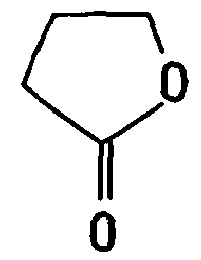
Ethylene carbonate 
Table 4 Structural formalae of the additives of Comparative Examples 1 to 8 DMAC 
Diglyme 
NMP 
Butyl cellosolve 
DMSO 
Tetrahydrofuran 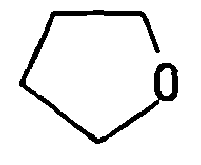
Sulfolane 
Cyclopentanone 
- As has been made clear by the results above, for the Working Examples 1 to 6 of the present invention, it is not just the glass transition temperature that is high, but the light transmittance and transparency is higher, and from the results of XPS analysis, the degree to which conversion to imide has proceeded is greater than in Comparative Examples (conventional art) 1 to 8, and thus it is possible to make a polyimide coating film having low water absorption.
- 4-4 DDS that is the para-form of the above-noted Chemical Formula 1: 4,4'-diaminodiphenyl sulfone, sold under the trade name "Seika cure S" by Wakayama Seika Kogyo Co. Ltd., was used as the aromatic diamine.
- NBDA: norbornanediamine, sold under the trade name "NBDA" by Mitsui Chemicals Inc. was used as the alicyclic diamine.
- BPDA of the above-noted Chemical Formula A: biphenyl tetracarboxylic dianhydride monomer, sold under the trade name "BPDA" by Mitsubishi Chemical Corporation, and 2,2-bis[4-(dicarboxyphenoxy)phenyllpropane dianhydride (BPADA), of the above-noted Chemical Formula B: sold under the trade name "BPADA" by the Shanghai City Synthetic Resin Research Institute were used as bifunctional acid anhydrides.
- DMAC: N,N-dimethylacetamide, sold by Mitsubishi Gas Chemical Corporation was used as the polar organic solvent.
- γ-butyrolactone made by Mitsubishi Chemical Corporation was used as the lactone compound.
- Tetrahydrofuran and butyl cellosolve made by Wako Pure Chemical Industries, Ltd, and isophorone made by Daicel Chemical Industries, Ltd were used.
- A fixed amount of diamine monomer and DMAC solvent were added to a reaction vessel, stirred under a nitrogen gas atmosphere until the diamine monomer was completely dissolved in the DMAC solvent, and refluxed at 40°C. A fixed amount of bifunctional acid anhydride was then added to the reaction vessel to generate a polyamic acid solution. The molar ratio of the bifunctional acid anhydride component to the diamine monomer component, both of which were used to manufacture the polyamic acid solution, was 1.03 / 1.0. The mixing ratio of solvent to polyamic acid solids was set such that the solids portion was 28 mass%. A predetermined amount of γ-butyrolactone was added after the polymerization reaction was complete. Where the solid portion of the polyimide precursor liquid was 100 mass parts, the polar polymerization solvent was added up to 257 mass parts, and the additives such as γ-butyrolactone were added as noted in Tables 5 and 6.
- The polyamic acid solution was placed in a dessicator and held at a pressure of 10 mmHg for 1 hour to remove gas from the solution. The solution from which the gas was removed was then cast onto a glass plate that was coated with a delaminating film, and the thickness of the cast film in the width direction made uniform via a falling bar that has an adjustment gap. After this, the glass plate that was cast was placed in an oven at 80°C for 45 min, then at 120°C for 30 min, then 150°C for 30 min and after that at 300°C for 30 min to bring on the imide conversion reaction and to cure the film. Then, the glass plate was removed from the oven, cooled to room temperature and the film separated from the glass plate. The light transmittance and water absorption ratio of the polyimide film then were measured. These results are shown in Table 5 and 6.
- Apart from changing the molar ratio of the diamine or the bifunctional acid anhydride as noted in Tables 5 and 6, the polyimide precursor liquids and polyimide films were fabricated in the same way as in Working Example 7, and the light transmittance, toughness and glass transition temperature of the polyimide films were measured. Those results are noted in Tables 5 and 6.
- Apart from changing the diamine to 4,4-DDA / NBDA at the mole ratios noted in Tables 5 and 6, and changing the bifunctional acid anhydride to BPDA only, the polyimide precursor liquid and the polyimide film were fabricated in the same way as in Working Example 7, and the light transmittance, toughness and glass transition temperatures were measured. These results are noted in Tables 5 and 6.
- An agitator on which a polytetrafluoroethylene agitating impeller is attached, and a nitrogen gas insertion pipe were attached to a 500 ml three-necked flask to make a polymerization vessel, and all reactions were performed under a nitrogen atmosphere. 28.317 g (0.184 mol) of NBDA was added as the diamine component, and 216.0 g of DMAC was added as the polymerization solvent, such that the solids composition of the polyimide precursor liquid was 28 mass%. After stirring thoroughly, 55.683 g (0.189 mol) of BPDA was dosed as is in solid form over 5 min as the bifunctional acid anhydride at 1.03 times the molar ratio with respect to the diamine. 15 minutes later, the reaction solution had turned to a yoghurt-type consistency. The reaction temperature then rose rapidly to about 60°C, and the solution changed from a yoghurt-type consistency to a viscous liquid. The precursor liquid was obtained by further reacting for 12 hours at 40°C. Next, 36.0 g of γ-butyrolactone was added such that when the solids portion of the polyimide precursor liquid was set to 100 mass parts, the cyclic compound was 43 mass parts. The polyimide film was fabricated in the same way as Working Example 7, and the light transmittance, toughness and glass transition temperature of the polyimide film were measured. The results are shown in Tables 5 and 6.
Table 5 Monomer Additive (mass parts) Acid anhydride component (molar ratio) Diamine component (molar ratio) Working Example 7 4,4-DDS(100) BPDA/BPADA(90/10) γ-butyrolactone (214) Working Example 8 4,4-DDS(100) BPDA/BPADA(80/20) γ-butyrolactone (214) Working Example 9 4,4-DDS(100) BPDA7BPADA(70/30) γ-butyrolactone (214) Working Example 10 4,4-DDS(100) BPDA/BPADA(60/40) γ-butyrolactone (214) Working Example 11 4,4-DDS(100) BPDA/BPADA(50/50) γ-butyrolactone (214) Working Example 12 4,4-DDS(100) BPDA/BPADA(70/30) γ-butyrolactone (43) Working Example 13 4,4-DDS(100) BPDA/BPADA(70/30) γ-butyrolactone (143) Working Example 14 4,4-DDS(100) BPDA/BPADA(70/30) γ-butyrolactone (214) Working Example 15 3,3-DDS(100) BPDA/BPADA(75/25) γ-butyrolactone (42) Working Example 16 4,4-DDS/NBDA (70/30) BPDA(100) γ-butyrolactone (43) Working Example 17 NBDA(100) BPDA(100) γ-butyrolactone (43) Comparative Example 9 4,4-DDS(100) BPDA/BPADA(90/10) - Comparative Example 10 4,4-DDS(100) BPDA/BPADA(80/20) - Comparative Example 11 4,4-DDS(100) BPDA/BPADA(70/30) - Comparative Example 12 4,4-DDS(100) BPDA/BPADA(60/40) - Comparative Example 13 4,4-DDS(100) BPDA/BPADA(50/50) - Comparative Example 14 4,4-DDS(100) BPDA/BPADA(70/30) Tetrahydrofuran (214) Comparative Example 15 4,4-DDS(100) BPDA/BPADA(70/30) Butyl cellosolve (214) Comparative Example 16 4,4-DDS(100) BPDA/BPADA(70/30) Isophorone (214) Comparative Example 17 3,3-DDS(100) BPDA/BPADA(75/25) - Comparative Example 18 4,4-DDS/NBDA (70/30) BPDA(100) - Comparative Example 19 NBDA(100) BPDA(100) - Remarks: The values within the brackets in the Additives column indicate the number of mass parts of the additive when the polyimide precursor (solids portion) is 100 mass parts. Table 6 Film Thickness (µm) Light transmittance (%) Toughness Glass transition temperature (°C) Working Example 7 52 73.2 P 338 Working Example 8 49 72.4 P 316 Working Example 9 53 76.3 P 304 Working Example 10 51 74.7 P 287 Working Example 11 48 73.5 P 270 Working Example 12 48 72.8 P 304 Working Example 13 54 75.2 P 304 Working Example 14 56 71.9 P 304 Working Example 15 49 76.7 P 250 Working Example 16 51 68.7 P 315 Working Example 17 52 66.4 P 239 Comparative Example 9 52 67.8 P 338 Comparative Example 10 49 68.7 P 316 Comparative Example 11 53 67.0 P 304 Comparative Example 12 51 66.1 P 287 Comparative Example 13 48 69.8 P 270 Comparative Example 14 57 65.8 P 304 Comparative Example 15 53 62.7 P 304 Comparative Example 16 57 0.2 F - Comparative Example 17 50 72.5 P 250 Comparative Example 18 48 67.7 P 315 Comparative Example 19 52 65.8 P 239 - In Tables 5 and 6, the results of Working Examples 1 to 8 are within the range of the present invention, and thus transparency and toughness were high. In comparison, since lactone compounds were not added to comparative examples 9 to 19, their transparency was lower than that of the products of the working examples
- Indium oxide that had been doped to 5 mass% with tin was provided on the sputtering electrode of a high frequency (RF) magnetron sputtering device, and a polyimide film having a thickness of 75 µm that was fabricated from the polyimide precursor liquid of Working Example 1 was set on the substrate side at a position 100 mm from the target. An oil-sealed rotary vacuum pump was used to roughly lower the pressure, and an oil diffusion pump was used further to bring the vacuum to 2.0 × 10⁻⁴ Torr. Argon gas was allowed to flow in at 97 sccm, and oxygen gas was allowed to flow in at 3 sccm to maintain a vacuum of 1.0 × 10⁻² Torr. Next, a transparent, electrically conductive thin film made from indium tin oxide (ITO) was formed to a thickness of 300 nm by sputtering for about 30 min at an RF traveling wave of 250 W, and an RF reflective wave of 0W, and a transparent, electrically conductive film was obtained by annealing in atmosphere at 200°C.
- The transmittance of light of 380 nm to 780 nm through this transparent electrically conductive thin film was 80% or greater. Furthermore, no delamination of the thin film was observed in a test of the adhesion of the transparent, electrically conductive thin film. The electric resistance of the transparent, electrically conductive film was 1.7 × 10⁻⁴ Ω·cm.
- A silicon target was provided on the sputtering electrode of a high frequency (RF) magnetron sputtering device, and a polyimide film having a thickness of 50 µm that was fabricated from the polyimide precursor liquid of Working Example 1 was set on the substrate side in a position 100 mm from the target. An oil-sealed rotary vacuum pump was used to roughly lower the pressure, and an oil diffusion pump was used further to bring the vacuum to 2.0 × 10⁻⁴ Torr. Nitrogen gas was allowed to flow in at 40 sccm and argon gas was allowed to flow in at 60 sccm to maintain a vacuum of 1.0 × 10⁻² Torr. Next, a transparent film made of silicon oxide nitride (SiO0.90N0.58) was formed on the polyimide film to a thickness of 110 nm by sputtering for about 30 min at an RF traveling wave of 400 W, and an RF reflective wave of 0W. The SiO0.90N0.58 was confirmed by XPS and XRD analysis. Even with forming the transparent film of silicon oxide nitride, the transmittance was 76.9% and was not substantially different from Working Example 1.
- Next, a transparent, electrically conductive thin film was formed on the transparent silicon oxide nitride film in the same manner as in Working Example 18.
- The transmittance of light of 380 nm to 780 nm through this transparent electrically conductive thin film was 80% or greater. Furthermore, no delamination of the thin film was observed in a test of the adhesion of the transparent, electrically conductive thin film. The electric resistance of the transparent, electrically conductive film was 1.7 × 10⁻⁴ Ω·cm.
Claims (14)
- A polyimide precursor liquid composition, comprising:at least one type of tetracarboxylic dianhydride or derivative thereof;at least one type of diamine or derivative thereof; anda polar polymerization solvent;wherein the polyimide precursor liquid composition further includes a cyclic compound having a 5 member ring structure that includes a carbonyl group (C=O bond);
wherein the cyclic compound has a boiling point of 200°C or more and comprises carbon, hydrogen and oxygen atoms and does not include hetero atoms of nitrogen, phosphorous and sulfur; and
wherein the tetracarboxylic dianhydride or derivative thereof is at least one type of compound selected from the group consisting of the following chemical formulae A and B (where X represents - O -, - S -, - SO -, - SO2 -, - CH2 -, - CF2 -, - C(CH3)2 -, - C(CF3)2 - or a direct bond);
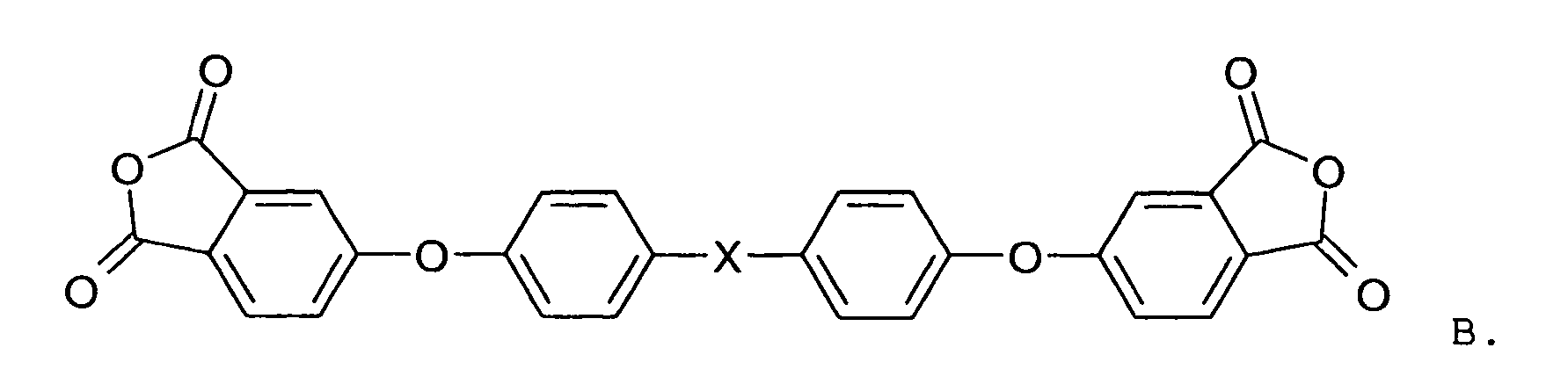
- The polyimide precursor liquid composition according to claim 1,
wherein the diamine or derivative thereof is at least one type of compound selected from the group consisting of the following chemical formulae I and II (where Y represents - O -, - S -, - SO -, - SO2 -, - CH2 -, - CF2 -, - C(CH3)2 -, - C(CF3)2 -, - CO - or a direct bond);

- The polyimide precursor liquid composition according to claim 1,
wherein the dielectric constant of the cyclic compound is not less than 30. - The polyimide precursor liquid composition according to claim 1 or 3,
wherein the dipole moment of the cyclic compound is not less than 3 debye. - The polyimide precursor liquid composition according to claim 1,
wherein the cyclic compound is at least one selected from the group consisting of ethylene carbonate, propylene carbonate, butylene carbonate, and γ-butyrolactone. - The polyimide precursor liquid composition according to claim 1,
wherein when the solids portion of the polyimide precursor liquid is 100 mass parts, the polar polymerization solvent is in the range of 150 to 900 mass parts, and the cyclic compound is in the range of 15 to 750 mass parts. - The polyimide precursor liquid composition according to any one of claim 1 to 6,
wherein the polyimide precursor is polymerized in the polar polymerization solvent, after which the cyclic compound is added. - A polyimide coating film that is obtained by converting the polyimide precursor liquid composition according to any one of claims 1 to 7 into an imide.
- The polyimide coating film according to claim 8,
wherein when the polyimide coating film is a coating film that has a thickness of 50 ± 10 micrometers (µm) and is irradiated with light of 420 nanometers (nm), the polyimide coating film shows a transmittance of 50% or more. - The polyimide coating film according to claim 8,
wherein the glass transition temperature (Tg) of the polyimide coating film is 200°C or more. - The polyimide coating film according to claim 8,
wherein the water absorption of the polyimide coating film is 2.0% or less. - The polyimide coating film according to claim 8,
wherein at least a single layer of a transparent film further is formed on at least one side of the polyimide coating film. - The polyimide coating film according to claim 8 or 12,
wherein at least a single layer of a transparent, electrically conductive film is further formed on at least one side of the polyimide coating film or the transparent film. - The polyimide coating film according to claim 13,
wherein the electric resistance of the transparent, electrically conductive film is 1 × 10⁻² Ω.cm or less.
Applications Claiming Priority (5)
| Application Number | Priority Date | Filing Date | Title |
|---|---|---|---|
| JP2002381995 | 2002-12-27 | ||
| JP2002381995 | 2002-12-27 | ||
| JP2003137591 | 2003-05-15 | ||
| JP2003137591 | 2003-05-15 | ||
| PCT/JP2003/016678 WO2004061001A1 (en) | 2002-12-27 | 2003-12-25 | Polyimide precursor liquid composition and polyimide coating film |
Publications (3)
| Publication Number | Publication Date |
|---|---|
| EP1577348A1 EP1577348A1 (en) | 2005-09-21 |
| EP1577348A4 EP1577348A4 (en) | 2007-03-07 |
| EP1577348B1 true EP1577348B1 (en) | 2009-12-23 |
Family
ID=32716341
Family Applications (1)
| Application Number | Title | Priority Date | Filing Date |
|---|---|---|---|
| EP03768213A Expired - Lifetime EP1577348B1 (en) | 2002-12-27 | 2003-12-25 | Polyimide precursor liquid composition and polyimide coating film |
Country Status (6)
| Country | Link |
|---|---|
| US (2) | US20060063908A1 (en) |
| EP (1) | EP1577348B1 (en) |
| KR (1) | KR100969415B1 (en) |
| AU (1) | AU2003292790A1 (en) |
| DE (1) | DE60330709D1 (en) |
| WO (1) | WO2004061001A1 (en) |
Families Citing this family (11)
| Publication number | Priority date | Publication date | Assignee | Title |
|---|---|---|---|---|
| US20080088601A1 (en) * | 2004-05-19 | 2008-04-17 | Tpk Touch Solutions Inc. | Circuit layout on a touch panel |
| JP5506017B2 (en) * | 2006-12-26 | 2014-05-28 | 株式会社カネカ | Novel polyimide precursor compositions, their use and methods for their production |
| TWI362398B (en) | 2009-12-31 | 2012-04-21 | Ind Tech Res Inst | Polyimide polymers for flexible electrical device substrate material and flexible electrical devices comprising the same |
| JP5928129B2 (en) * | 2012-04-25 | 2016-06-01 | Jnc株式会社 | Inkjet ink |
| CN103897583B (en) * | 2012-12-31 | 2016-12-28 | 中原工学院 | Thin-film solar cells fluorinated polyimide coating and preparation method thereof |
| CN103897582B (en) * | 2012-12-31 | 2016-12-28 | 中原工学院 | Thin-film solar cells polyimide paint and preparation method thereof |
| TWI535768B (en) * | 2014-07-18 | 2016-06-01 | 長興材料工業股份有限公司 | Solvent-containing dry film and the use thereof |
| JP2017052877A (en) * | 2015-09-09 | 2017-03-16 | 富士ゼロックス株式会社 | Polyimide precursor composition, manufacturing method of polyimide precursor composition and manufacturing method of polyimide molded body |
| KR101898455B1 (en) | 2016-03-31 | 2018-09-13 | 가부시키가이샤 아이.에스.티 | Polyimide fibre and method for producing polyimide fibre |
| TWI625226B (en) * | 2016-04-01 | 2018-06-01 | 律勝科技股份有限公司 | Flexible and transparent polyimide laminate and manufacturing method thereof |
| KR20180060259A (en) * | 2016-11-28 | 2018-06-07 | 한국생산기술연구원 | Scratch self-healing clear coat composition for vehicle using charge transfer complex, clear coat involving the same and method for manufacturing of clear coat using the same |
Family Cites Families (24)
| Publication number | Priority date | Publication date | Assignee | Title |
|---|---|---|---|---|
| WO1986002881A1 (en) * | 1984-11-09 | 1986-05-22 | Konishiroku Photo Industry Co., Ltd. | Conductive laminate |
| GB2174399B (en) * | 1985-03-10 | 1988-05-18 | Nitto Electric Ind Co | Colorless transparent polyimide shaped articles and their production |
| US4670342A (en) * | 1985-04-08 | 1987-06-02 | General Electric Company | Method of making electrical inductive devices for use in hermetic refrigerant atmospheres |
| US4965337A (en) * | 1987-12-31 | 1990-10-23 | General Electric Company | Very high heat thermoplastic polyetherimides containing aromatic structure |
| JP3386502B2 (en) * | 1993-01-07 | 2003-03-17 | 鐘淵化学工業株式会社 | Method for producing polyimide and polyimide film |
| US5554684A (en) * | 1993-10-12 | 1996-09-10 | Occidental Chemical Corporation | Forming polyimide coating by screen printing |
| JPH09302225A (en) * | 1996-03-14 | 1997-11-25 | Toshiba Corp | Polyimide precursor composition, method for forming polyimide film, electronic component and liquid crystal element |
| DE69731624T2 (en) * | 1996-12-27 | 2005-12-01 | Maruzen Petrochemical Co., Ltd. | SOLUBLE POLYIMIDE RESIN, METHOD FOR ITS MANUFACTURE AND COMPOSITION OF A POLYIMIDE RESIN SOLUTION |
| US6232428B1 (en) * | 1999-01-19 | 2001-05-15 | I.S.T. Corporation | Essentially colorless, transparent polyimide coatings and films |
| JP2000226517A (en) * | 1999-02-08 | 2000-08-15 | Unitika Ltd | Black paste and shading film obtained from the same |
| JP2000305280A (en) * | 1999-04-19 | 2000-11-02 | Toray Ind Inc | Developer for photosensitive polyimide precursor and method for recovering same |
| JP3345638B2 (en) * | 1999-11-11 | 2002-11-18 | 独立行政法人産業技術総合研究所 | Transparent conductive film and method for producing the same |
| CN1164652C (en) * | 2000-03-13 | 2004-09-01 | 三井化学株式会社 | The preparation method of polyimide |
| US6379865B1 (en) * | 2000-04-11 | 2002-04-30 | 3M Innovative Properties Company | Photoimageable, aqueous acid soluble polyimide polymers |
| US6686106B2 (en) * | 2000-06-26 | 2004-02-03 | Ube Industries, Ltd. | Photosensitive resin compositions, insulating films, and processes for formation of the films |
| JP2002055346A (en) * | 2000-08-11 | 2002-02-20 | Sony Corp | Method for forming liquid crystal alignment film and method for manufacturing liquid crystal display device |
| US6962756B2 (en) * | 2001-11-02 | 2005-11-08 | Mitsubishi Gas Chemical Company, Inc. | Transparent electrically-conductive film and its use |
| US20040161619A1 (en) * | 2002-12-12 | 2004-08-19 | Arch Specialty Chemicals, Inc. | Process for producing a heat resistant relief structure |
| US7018776B2 (en) * | 2002-12-12 | 2006-03-28 | Arch Specialty Chemicals, Inc. | Stable non-photosensitive polyimide precursor compositions for use in bilayer imaging systems |
| US7521511B2 (en) * | 2003-04-18 | 2009-04-21 | Kaneka Corporation | Thermosetting resin composition, multilayer body using same, and circuit board |
| JP4769455B2 (en) * | 2003-12-30 | 2011-09-07 | ローム・アンド・ハース・エレクトロニック・マテリアルズ,エル.エル.シー. | Coating composition |
| JP4584014B2 (en) * | 2005-04-25 | 2010-11-17 | 日立マグネットワイヤ株式会社 | Partially discharge-resistant insulating paint, insulated wire, and method for producing the same |
| JP4542463B2 (en) * | 2005-04-25 | 2010-09-15 | 日立マグネットワイヤ株式会社 | Partially discharge-resistant insulating paint, insulated wire, and method for producing the same |
| US20070290379A1 (en) * | 2006-06-15 | 2007-12-20 | Dueber Thomas E | Hydrophobic compositions for electronic applications |
-
2003
- 2003-12-25 KR KR1020057012164A patent/KR100969415B1/en not_active Expired - Lifetime
- 2003-12-25 DE DE60330709T patent/DE60330709D1/en not_active Expired - Lifetime
- 2003-12-25 US US10/540,659 patent/US20060063908A1/en not_active Abandoned
- 2003-12-25 EP EP03768213A patent/EP1577348B1/en not_active Expired - Lifetime
- 2003-12-25 AU AU2003292790A patent/AU2003292790A1/en not_active Abandoned
- 2003-12-25 WO PCT/JP2003/016678 patent/WO2004061001A1/en not_active Ceased
-
2010
- 2010-02-10 US US12/703,368 patent/US20100140557A1/en not_active Abandoned
Also Published As
| Publication number | Publication date |
|---|---|
| KR100969415B1 (en) | 2010-07-14 |
| WO2004061001A1 (en) | 2004-07-22 |
| US20100140557A1 (en) | 2010-06-10 |
| AU2003292790A1 (en) | 2004-07-29 |
| EP1577348A1 (en) | 2005-09-21 |
| EP1577348A4 (en) | 2007-03-07 |
| KR20050085919A (en) | 2005-08-29 |
| US20060063908A1 (en) | 2006-03-23 |
| DE60330709D1 (en) | 2010-02-04 |
Similar Documents
| Publication | Publication Date | Title |
|---|---|---|
| US20100140557A1 (en) | Polyimide precursor liquid composition and polyimide coating film | |
| JP6721070B2 (en) | Polyimide precursor composition, method for producing polyimide, polyimide, polyimide film, and substrate | |
| JP3534151B2 (en) | Polyimide precursor composition and polyimide film | |
| JP6794611B2 (en) | Polyimide copolymer and polyimide film using it | |
| KR102430152B1 (en) | Polyamic acid solution, transparent polyimide film and transparent substrate using the same | |
| KR101464009B1 (en) | Process for producing polyamic acid solution and polyamic acid solution | |
| KR20180018392A (en) | Polyimide precursor, polyimide and manufacturing method of transparent polyimide film | |
| WO2010113412A1 (en) | Low-thermal-expansion block polyimide, precursor thereof, and use thereof | |
| JP7047852B2 (en) | Polyimide precursors, polyimides, polyimide films, varnishes, and substrates | |
| JP7069478B2 (en) | Polyimide, polyimide solution composition, polyimide film, and substrate | |
| TWI435892B (en) | Heat resistant resin paste | |
| US6040418A (en) | Fluorinated polyimides, laminated substrates and polyamic acid solutions | |
| JP3940119B2 (en) | Polyimide precursor liquid composition and polyimide coating | |
| TWI862552B (en) | Polyimide films and electronic devices | |
| US20250043077A1 (en) | Polyimide film, high-frequency circuit substrate, and flexible electronic device substrate | |
| JP7589156B2 (en) | Metal-clad laminate for flexible electronic devices and flexible electronic devices using same | |
| CN100363426C (en) | Polyimide precursor body fluid composition and polyimide coating film | |
| JP6846148B2 (en) | Polyimide precursor solution and its production method, polyimide film production method and laminate production method | |
| KR102781779B1 (en) | Polyimide precursor composition and polyimide film/substrate laminate | |
| JP2024113638A (en) | Polyamic acid, polyamic acid solution, polyimide, polyimide substrate, electronic device, and method for producing polyimide substrate | |
| JPH07109438A (en) | Polyimide varnish | |
| JP2022133200A (en) | Polyamideimide and its precursor, and polyamideimide film | |
| WO2015080156A1 (en) | Polyimide precursor composition, polyimide manufacturing process, polyimide, polyimide film, and base material | |
| TWI921459B (en) | Polyimide precursor varnish and its manufacturing method, polyimide and its manufacturing method, laminate for flexible devices and wiring substrates | |
| KR102251279B1 (en) | Polyimide precursor composition and polyimide film manufactured by using same |
Legal Events
| Date | Code | Title | Description |
|---|---|---|---|
| PUAI | Public reference made under article 153(3) epc to a published international application that has entered the european phase |
Free format text: ORIGINAL CODE: 0009012 |
|
| 17P | Request for examination filed |
Effective date: 20050704 |
|
| AK | Designated contracting states |
Kind code of ref document: A1 Designated state(s): AT BE BG CH CY CZ DE DK EE ES FI FR GB GR HU IE IT LI LU MC NL PT RO SE SI SK TR |
|
| AX | Request for extension of the european patent |
Extension state: AL LT LV MK |
|
| DAX | Request for extension of the european patent (deleted) | ||
| RBV | Designated contracting states (corrected) |
Designated state(s): DE FR GB IT NL |
|
| A4 | Supplementary search report drawn up and despatched |
Effective date: 20070202 |
|
| RIC1 | Information provided on ipc code assigned before grant |
Ipc: C09D 179/08 20060101ALI20040728BHEP Ipc: C08G 73/10 20060101AFI20070129BHEP |
|
| 17Q | First examination report despatched |
Effective date: 20070726 |
|
| GRAP | Despatch of communication of intention to grant a patent |
Free format text: ORIGINAL CODE: EPIDOSNIGR1 |
|
| GRAS | Grant fee paid |
Free format text: ORIGINAL CODE: EPIDOSNIGR3 |
|
| RIN1 | Information on inventor provided before grant (corrected) |
Inventor name: KIKUCHI, MASAHIKO Inventor name: YONEMUSHI, HARUMI Inventor name: MORIUCHI, KOJI C/O I.S.T CORPORATION Inventor name: UWABA, SATOMI |
|
| GRAA | (expected) grant |
Free format text: ORIGINAL CODE: 0009210 |
|
| RAP1 | Party data changed (applicant data changed or rights of an application transferred) |
Owner name: I.S.T CORPORATION |
|
| AK | Designated contracting states |
Kind code of ref document: B1 Designated state(s): DE FR GB IT NL |
|
| REG | Reference to a national code |
Ref country code: GB Ref legal event code: FG4D |
|
| REF | Corresponds to: |
Ref document number: 60330709 Country of ref document: DE Date of ref document: 20100204 Kind code of ref document: P |
|
| REG | Reference to a national code |
Ref country code: NL Ref legal event code: T3 |
|
| PLBE | No opposition filed within time limit |
Free format text: ORIGINAL CODE: 0009261 |
|
| STAA | Information on the status of an ep patent application or granted ep patent |
Free format text: STATUS: NO OPPOSITION FILED WITHIN TIME LIMIT |
|
| 26N | No opposition filed |
Effective date: 20100924 |
|
| REG | Reference to a national code |
Ref country code: FR Ref legal event code: PLFP Year of fee payment: 13 |
|
| REG | Reference to a national code |
Ref country code: FR Ref legal event code: PLFP Year of fee payment: 14 |
|
| REG | Reference to a national code |
Ref country code: FR Ref legal event code: PLFP Year of fee payment: 15 |
|
| REG | Reference to a national code |
Ref country code: FR Ref legal event code: PLFP Year of fee payment: 16 |
|
| PGFP | Annual fee paid to national office [announced via postgrant information from national office to epo] |
Ref country code: NL Payment date: 20221021 Year of fee payment: 20 Ref country code: FR Payment date: 20221020 Year of fee payment: 20 |
|
| PGFP | Annual fee paid to national office [announced via postgrant information from national office to epo] |
Ref country code: IT Payment date: 20221021 Year of fee payment: 20 Ref country code: GB Payment date: 20221020 Year of fee payment: 20 Ref country code: DE Payment date: 20221020 Year of fee payment: 20 |
|
| REG | Reference to a national code |
Ref country code: DE Ref legal event code: R071 Ref document number: 60330709 Country of ref document: DE |
|
| REG | Reference to a national code |
Ref country code: NL Ref legal event code: MK Effective date: 20231224 |
|
| REG | Reference to a national code |
Ref country code: GB Ref legal event code: PE20 Expiry date: 20231224 |
|
| PG25 | Lapsed in a contracting state [announced via postgrant information from national office to epo] |
Ref country code: GB Free format text: LAPSE BECAUSE OF EXPIRATION OF PROTECTION Effective date: 20231224 |
|
| PG25 | Lapsed in a contracting state [announced via postgrant information from national office to epo] |
Ref country code: GB Free format text: LAPSE BECAUSE OF EXPIRATION OF PROTECTION Effective date: 20231224 |