EP1577290A1 - Amide compound and method of controlling plant disease with the same - Google Patents
Amide compound and method of controlling plant disease with the same Download PDFInfo
- Publication number
- EP1577290A1 EP1577290A1 EP03780917A EP03780917A EP1577290A1 EP 1577290 A1 EP1577290 A1 EP 1577290A1 EP 03780917 A EP03780917 A EP 03780917A EP 03780917 A EP03780917 A EP 03780917A EP 1577290 A1 EP1577290 A1 EP 1577290A1
- Authority
- EP
- European Patent Office
- Prior art keywords
- group
- hydrogen atom
- amide compound
- alkyl group
- formula
- Prior art date
- Legal status (The legal status is an assumption and is not a legal conclusion. Google has not performed a legal analysis and makes no representation as to the accuracy of the status listed.)
- Withdrawn
Links
- 0 C*CC1*CCC1 Chemical compound C*CC1*CCC1 0.000 description 22
- JDBLQHNHHFDLME-BPCQOVAHSA-N CC(CC1=C=CC1C)[C@H](C)C1CCCC1 Chemical compound CC(CC1=C=CC1C)[C@H](C)C1CCCC1 JDBLQHNHHFDLME-BPCQOVAHSA-N 0.000 description 1
- ZZAIKACKOJSLBZ-UHFFFAOYSA-N CC(c1ccc(CCCC2)c2c1)O Chemical compound CC(c1ccc(CCCC2)c2c1)O ZZAIKACKOJSLBZ-UHFFFAOYSA-N 0.000 description 1
- CTSZPNIMMLSKDV-UHFFFAOYSA-N CC1=NCCC1 Chemical compound CC1=NCCC1 CTSZPNIMMLSKDV-UHFFFAOYSA-N 0.000 description 1
- ZVSOGTDDFXWBHE-UHFFFAOYSA-N COc1cc(CCC(NCCc(cc2)ccc2C#N)=O)ccc1C=O Chemical compound COc1cc(CCC(NCCc(cc2)ccc2C#N)=O)ccc1C=O ZVSOGTDDFXWBHE-UHFFFAOYSA-N 0.000 description 1
Classifications
-
- C—CHEMISTRY; METALLURGY
- C07—ORGANIC CHEMISTRY
- C07C—ACYCLIC OR CARBOCYCLIC COMPOUNDS
- C07C59/00—Compounds having carboxyl groups bound to acyclic carbon atoms and containing any of the groups OH, O—metal, —CHO, keto, ether, groups, groups, or groups
- C07C59/40—Unsaturated compounds
- C07C59/58—Unsaturated compounds containing ether groups, groups, groups, or groups
- C07C59/64—Unsaturated compounds containing ether groups, groups, groups, or groups containing six-membered aromatic rings
-
- A—HUMAN NECESSITIES
- A01—AGRICULTURE; FORESTRY; ANIMAL HUSBANDRY; HUNTING; TRAPPING; FISHING
- A01N—PRESERVATION OF BODIES OF HUMANS OR ANIMALS OR PLANTS OR PARTS THEREOF; BIOCIDES, e.g. AS DISINFECTANTS, AS PESTICIDES OR AS HERBICIDES; PEST REPELLANTS OR ATTRACTANTS; PLANT GROWTH REGULATORS
- A01N37/00—Biocides, pest repellants or attractants, or plant growth regulators containing organic compounds containing a carbon atom having three bonds to hetero atoms with at the most two bonds to halogen, e.g. carboxylic acids
- A01N37/36—Biocides, pest repellants or attractants, or plant growth regulators containing organic compounds containing a carbon atom having three bonds to hetero atoms with at the most two bonds to halogen, e.g. carboxylic acids containing at least one carboxylic group or a thio analogue, or a derivative thereof, and a singly bound oxygen or sulfur atom attached to the same carbon skeleton, this oxygen or sulfur atom not being a member of a carboxylic group or of a thio analogue, or of a derivative thereof, e.g. hydroxy-carboxylic acids
- A01N37/38—Biocides, pest repellants or attractants, or plant growth regulators containing organic compounds containing a carbon atom having three bonds to hetero atoms with at the most two bonds to halogen, e.g. carboxylic acids containing at least one carboxylic group or a thio analogue, or a derivative thereof, and a singly bound oxygen or sulfur atom attached to the same carbon skeleton, this oxygen or sulfur atom not being a member of a carboxylic group or of a thio analogue, or of a derivative thereof, e.g. hydroxy-carboxylic acids having at least one oxygen or sulfur atom attached to an aromatic ring system
-
- C—CHEMISTRY; METALLURGY
- C07—ORGANIC CHEMISTRY
- C07C—ACYCLIC OR CARBOCYCLIC COMPOUNDS
- C07C235/00—Carboxylic acid amides, the carbon skeleton of the acid part being further substituted by oxygen atoms
- C07C235/02—Carboxylic acid amides, the carbon skeleton of the acid part being further substituted by oxygen atoms having carbon atoms of carboxamide groups bound to acyclic carbon atoms and singly-bound oxygen atoms bound to the same carbon skeleton
- C07C235/32—Carboxylic acid amides, the carbon skeleton of the acid part being further substituted by oxygen atoms having carbon atoms of carboxamide groups bound to acyclic carbon atoms and singly-bound oxygen atoms bound to the same carbon skeleton the carbon skeleton containing six-membered aromatic rings
- C07C235/34—Carboxylic acid amides, the carbon skeleton of the acid part being further substituted by oxygen atoms having carbon atoms of carboxamide groups bound to acyclic carbon atoms and singly-bound oxygen atoms bound to the same carbon skeleton the carbon skeleton containing six-membered aromatic rings having the nitrogen atoms of the carboxamide groups bound to hydrogen atoms or to acyclic carbon atoms
-
- C—CHEMISTRY; METALLURGY
- C07—ORGANIC CHEMISTRY
- C07C—ACYCLIC OR CARBOCYCLIC COMPOUNDS
- C07C251/00—Compounds containing nitrogen atoms doubly-bound to a carbon skeleton
- C07C251/32—Oximes
- C07C251/34—Oximes with oxygen atoms of oxyimino groups bound to hydrogen atoms or to carbon atoms of unsubstituted hydrocarbon radicals
- C07C251/48—Oximes with oxygen atoms of oxyimino groups bound to hydrogen atoms or to carbon atoms of unsubstituted hydrocarbon radicals with the carbon atom of at least one of the oxyimino groups bound to a carbon atom of a six-membered aromatic ring
-
- C—CHEMISTRY; METALLURGY
- C07—ORGANIC CHEMISTRY
- C07C—ACYCLIC OR CARBOCYCLIC COMPOUNDS
- C07C251/00—Compounds containing nitrogen atoms doubly-bound to a carbon skeleton
- C07C251/32—Oximes
- C07C251/62—Oximes having oxygen atoms of oxyimino groups esterified
- C07C251/64—Oximes having oxygen atoms of oxyimino groups esterified by carboxylic acids
- C07C251/68—Oximes having oxygen atoms of oxyimino groups esterified by carboxylic acids with at least one of the esterifying carboxyl groups bound to a carbon atom of a six-membered aromatic ring
-
- C—CHEMISTRY; METALLURGY
- C07—ORGANIC CHEMISTRY
- C07C—ACYCLIC OR CARBOCYCLIC COMPOUNDS
- C07C255/00—Carboxylic acid nitriles
- C07C255/01—Carboxylic acid nitriles having cyano groups bound to acyclic carbon atoms
- C07C255/16—Carboxylic acid nitriles having cyano groups bound to acyclic carbon atoms containing cyano groups and singly-bound oxygen atoms bound to the same carbon atom of an acyclic carbon skeleton
-
- C—CHEMISTRY; METALLURGY
- C07—ORGANIC CHEMISTRY
- C07C—ACYCLIC OR CARBOCYCLIC COMPOUNDS
- C07C255/00—Carboxylic acid nitriles
- C07C255/49—Carboxylic acid nitriles having cyano groups bound to carbon atoms of six-membered aromatic rings of a carbon skeleton
- C07C255/58—Carboxylic acid nitriles having cyano groups bound to carbon atoms of six-membered aromatic rings of a carbon skeleton containing cyano groups and singly-bound nitrogen atoms, not being further bound to other hetero atoms, bound to the carbon skeleton
- C07C255/60—Carboxylic acid nitriles having cyano groups bound to carbon atoms of six-membered aromatic rings of a carbon skeleton containing cyano groups and singly-bound nitrogen atoms, not being further bound to other hetero atoms, bound to the carbon skeleton at least one of the singly-bound nitrogen atoms being acylated
-
- C—CHEMISTRY; METALLURGY
- C07—ORGANIC CHEMISTRY
- C07C—ACYCLIC OR CARBOCYCLIC COMPOUNDS
- C07C309/00—Sulfonic acids; Halides, esters, or anhydrides thereof
- C07C309/63—Esters of sulfonic acids
- C07C309/64—Esters of sulfonic acids having sulfur atoms of esterified sulfo groups bound to acyclic carbon atoms
- C07C309/65—Esters of sulfonic acids having sulfur atoms of esterified sulfo groups bound to acyclic carbon atoms of a saturated carbon skeleton
- C07C309/66—Methanesulfonates
-
- C—CHEMISTRY; METALLURGY
- C07—ORGANIC CHEMISTRY
- C07C—ACYCLIC OR CARBOCYCLIC COMPOUNDS
- C07C323/00—Thiols, sulfides, hydropolysulfides or polysulfides substituted by halogen, oxygen or nitrogen atoms, or by sulfur atoms not being part of thio groups
- C07C323/23—Thiols, sulfides, hydropolysulfides or polysulfides substituted by halogen, oxygen or nitrogen atoms, or by sulfur atoms not being part of thio groups containing thio groups and nitrogen atoms, not being part of nitro or nitroso groups, bound to the same carbon skeleton
- C07C323/39—Thiols, sulfides, hydropolysulfides or polysulfides substituted by halogen, oxygen or nitrogen atoms, or by sulfur atoms not being part of thio groups containing thio groups and nitrogen atoms, not being part of nitro or nitroso groups, bound to the same carbon skeleton at least one of the nitrogen atoms being part of any of the groups, X being a hetero atom, Y being any atom
- C07C323/40—Y being a hydrogen or a carbon atom
- C07C323/41—Y being a hydrogen or an acyclic carbon atom
-
- C—CHEMISTRY; METALLURGY
- C07—ORGANIC CHEMISTRY
- C07C—ACYCLIC OR CARBOCYCLIC COMPOUNDS
- C07C327/00—Thiocarboxylic acids
- C07C327/38—Amides of thiocarboxylic acids
- C07C327/40—Amides of thiocarboxylic acids having carbon atoms of thiocarboxamide groups bound to hydrogen atoms or to acyclic carbon atoms
- C07C327/44—Amides of thiocarboxylic acids having carbon atoms of thiocarboxamide groups bound to hydrogen atoms or to acyclic carbon atoms to carbon atoms of an unsaturated carbon skeleton
-
- C—CHEMISTRY; METALLURGY
- C07—ORGANIC CHEMISTRY
- C07C—ACYCLIC OR CARBOCYCLIC COMPOUNDS
- C07C69/00—Esters of carboxylic acids; Esters of carbonic or haloformic acids
- C07C69/66—Esters of carboxylic acids having esterified carboxylic groups bound to acyclic carbon atoms and having any of the groups OH, O—metal, —CHO, keto, ether, acyloxy, groups, groups, or in the acid moiety
- C07C69/73—Esters of carboxylic acids having esterified carboxylic groups bound to acyclic carbon atoms and having any of the groups OH, O—metal, —CHO, keto, ether, acyloxy, groups, groups, or in the acid moiety of unsaturated acids
- C07C69/734—Ethers
-
- C—CHEMISTRY; METALLURGY
- C07—ORGANIC CHEMISTRY
- C07C—ACYCLIC OR CARBOCYCLIC COMPOUNDS
- C07C2601/00—Systems containing only non-condensed rings
- C07C2601/02—Systems containing only non-condensed rings with a three-membered ring
-
- C—CHEMISTRY; METALLURGY
- C07—ORGANIC CHEMISTRY
- C07C—ACYCLIC OR CARBOCYCLIC COMPOUNDS
- C07C2602/00—Systems containing two condensed rings
- C07C2602/02—Systems containing two condensed rings the rings having only two atoms in common
- C07C2602/04—One of the condensed rings being a six-membered aromatic ring
- C07C2602/08—One of the condensed rings being a six-membered aromatic ring the other ring being five-membered, e.g. indane
-
- C—CHEMISTRY; METALLURGY
- C07—ORGANIC CHEMISTRY
- C07C—ACYCLIC OR CARBOCYCLIC COMPOUNDS
- C07C2602/00—Systems containing two condensed rings
- C07C2602/02—Systems containing two condensed rings the rings having only two atoms in common
- C07C2602/04—One of the condensed rings being a six-membered aromatic ring
- C07C2602/10—One of the condensed rings being a six-membered aromatic ring the other ring being six-membered, e.g. tetraline
-
- C—CHEMISTRY; METALLURGY
- C07—ORGANIC CHEMISTRY
- C07C—ACYCLIC OR CARBOCYCLIC COMPOUNDS
- C07C2602/00—Systems containing two condensed rings
- C07C2602/02—Systems containing two condensed rings the rings having only two atoms in common
- C07C2602/04—One of the condensed rings being a six-membered aromatic ring
- C07C2602/12—One of the condensed rings being a six-membered aromatic ring the other ring being at least seven-membered
Definitions
- the present invention relates amide compounds and a method for controlling plant diseases applying the same for plants or soils growing the plant.
- an amide compound shown by the following formula (1) has an excellent controlling activity against plant diseases and accomplished the present invention.
- the present invention provides an amide compound
- the halogen atom includes a fluorine atom, a chlorine atom, a bromine atom, an iodine atom
- the C1-C6 alkyl group includes a C1-C4 alkyl group such as a methyl group, an ethyl group, a propyl group, an isopropyl group, a butyl group, an isobutyl group, a sec-butyl group, a tert-butyl group; a C5-C6 alkyl group such as a pentyl group, a 2-methylpentyl group, a 3-methylpentyl group, a 4-methylpentyl group, a hexyl group and the like;
- the C3-C6 cycloalkyl group includes a cyclopropyl group, a cyclobutyl group, a cyclopentyl group and a cyclohexyl group; the C1-
- the halogen atom includes a fluorine atom, a chlorine atom, a bromine atom, an iodine atom
- the C1-C6 alkyl group includes a C1-C4 alkyl group such as a methyl group, an ethyl group, a propyl group, an isopropyl group, a butyl group, an isobutyl group, sec-butyl group, tert-butyl group; a C5-C6 alkyl group such as a pentyl group, a 2-methylpentyl group, a 3-methylpentyl group, a 4-methylpentyl group, a hexyl group and the like;
- the C1-C6 haloalkyl group includes, for example, a fluoromethyl group, a difluoromethyl group, a trifluoromethyl group;
- the C2-C6 alkenyl group includes, for example, a C1
- the halogen atom includes a fluorine atom, a chlorine atom, a bromine atom, an iodine atom
- the C1-C3 alkyl group includes a methyl group, an ethyl group, a propyl group, an isopropyl group
- the C1-C3 haloalkyl group includes, for example, a trifluoromethyl group.
- the C1-C4 alkyl group includes a methyl group, an ethyl group, a propyl group, an isopropyl group, a butyl group, an isobutyl group, a sec-butyl group, a tert-butyl group;
- the C2-C4 alkenyl group includes, for example, a vinyl group, a 1-methylvinyl group, a 1-propenyl group, a 2-propenyl group, a 1-methyl-2-propenyl group, a 2-methyl-2-propenyl group, a 2-butenyl group, a 3-butenyl group and the like;
- the C2-C4 alkynyl group includes, for example, an ethynyl group, a 1-propynyl group, a 2-propynyl group, a 1-methyl-2-propynyl group, a 2-butynyl group, a 3-butynyl group and the
- the C1-C4 alkyl group for example, includes a methyl group, an ethyl group, a propyl group, a butyl group;
- the C3-C4 alkenyl group includes, for example, a 2-propenyl group, a 1-methyl-2-propenyl group, a 2-methyl-2-propenyl group, a 2-butenyl group, a 3-butenyl group and the like;
- the C3-C4 alkynyl group includes a 2-propynyl group, 1-methyl-2-propynyl group, a 2-butynyl group, a 3-butynyl group and the like.
- the halogen atom includes a fluorine atom, a chlorine atom, a bromine atom;
- the C1-C3 alkyl group includes a methyl group, an ethyl group, a propyl group, an isopropyl group.
- the C1-C4 alkyl group includes a C1-C2 alkyl group such as a methyl group, an ethyl group; a propyl group, an isopropyl group, a butyl group, an isobutyl group, a sec-butyl group, a tert-butyl group;
- the C1-C4 haloalkyl group includes, for example, a fluoromethyl group, a difluoromethyl group, a trifluoromethyl group, a 2,2,2-trifluoroethyl group, a 1,1,2,2-tetrafluoroethyl group, a 2-fluoroethyl group;
- the C3-C4 alkenyl group includes, for example, a 2-propenyl group, a 1-methyl-2-propenyl group, a 2-methyl-2-propenyl group, a 2-butenyl group, 3-butenyl group; the C3-C2 alky
- the C1-C4 alkyl group includes a methyl group, an ethyl group, a propyl group, an isopropyl group, a butyl group, an isobutyl group, a sec-butyl group, a tert-butyl group;
- the C1-C4 haloalkyl group includes, for example, a fluoromethyl group, a difluoromethyl group, a trifluoromethyl group, a 2,2,2-trifluoroethyl group, a 1,1,2,2-tetrafluoroethyl group, a 2-fluoroethyl group;
- the C3-C4 alkenyl group includes, for example, a 2-propenyl group, a 1-methyl-2-propenyl group, a 2-methyl-2-propenyl group, a 2-butenyl group, a 3-butenyl group;
- the C3-C6 alkynyl group includes, for example,
- the halogen atom includes a fluorine atom, a chlorine atom, a bromine atom, an iodine atom;
- the C1-C2 alkyl group includes a methyl group and an ethyl group.
- the halogen atom includes a fluorine atom, a chlorine atom, a bromine atom, an iodine atom
- the C1-C3 alkyl group includes a methyl group, an ethyl group, a propyl group, an isopropyl group
- the C1-C3 alkoxy group includes a methoxy group, an ethoxy group, a propyloxy group, an isopropyloxy group
- the C1-C3 haloalkyl group includes, for example, a trifluoromethyl group.
- the halogen atom includes a fluorine atom, a chlorine atom, a bromine atom;
- the C1-C3 alkyl group includes a methyl group, an ethyl group, a propyl group, an isopropyl group.
- the C1-C4 alkyl group includes a C1-C2 alkyl group such as a methyl group, an ethyl group; a propyl group, an isopropyl group, a butyl group, an isobutyl group, a sec-butyl group, a tert-butyl group.
- the C3-C6 alkynyl group includes, for example, a C3-C4 alkynyl group such as a 2-propynyl group, a 1-methyl-2-propynyl group, a 2-butynyl group, a 3-butynyl group; a C5-C6 alkynyl group such as a 1, 1-dimethyl-2-propynyl group, a I-methyl-2-butynyl group, a 2-pentynyl group, a 1-methyl-2-pentynyl group, a 4-methyl-2-pentynyl group, a 3-pentynyl group, a 4-pentynyl group, a 2-hexynyl group, 3-hexynyl group.
- a C3-C4 alkynyl group such as a 2-propynyl group, a 1-methyl-2-propynyl group, a 2-butynyl group, a 3-
- the halogen atom includes a fluorine atom, a chlorine atom, a bromine atom, an iodine atom;
- the C1-C2 alkyl group includes a methyl group, an ethyl group.
- the halogen atom includes a fluorine atom, a chlorine atom, a bromine atom, an iodine atom
- the C1-C4 alkyl group includes a methyl group, an ethyl group, a propyl group, an isopropyl group, a butyl group, an isobutyl group, a sec-butyl group, a tert-butyl group
- the C1-C4 haloalkyl group includes, for example, a fluoromethyl group, a difluoromethyl group, a trifluoromethyl group
- the C1-C4 alkoxy group includes, for example, a methoxy group, an ethoxy group, a propoxy group, an isopropoxy group, a butoxy group, an isobutoxy group, a sec-butoxy group, a tert-butoxy group
- the C1-C4 haloalkoxy group includes, for example
- the halogen atom includes a fluorine atom, a chlorine atom, a bromine atom, an iodine atom
- the C1-C4 alkyl group includes, for example, a methyl group, an ethyl group, a propyl group, an isopropyl group, a butyl group, an isobutyl group, a sec-butyl group, a tert-butyl group
- the C1-C6 haloalkyl group includes, for example, a fluoromethyl group, a difluoromethyl group, a trifluoromethyl group
- the C3-C5 alkylene group represented by R 201 and R 202 are combined together, for example, a trimethylene group, a tetraethylene group and a pentaethylene group.
- the halogen atom includes a fluorine atom, a chlorine atom, a bromine atom;
- the C1-C3 alkyl group includes a methyl group, an ethyl group, a propyl group and an isopropyl group.
- the C1-C4 alkyl group includes a C1-C2 alkyl group such as a methyl group, an ethyl group; a propyl group, an isopropyl group, a butyl group, an isobutyl group, a sec-butyl group, a tert-butyl group.
- the halogen atom includes a fluorine atom, a chlorine atom, a bromine atom, an iodine atom;
- the C1-C2 alkyl group includes a methyl group and an ethyl group.
- the embodiment of the compound of the present invention includes, for example, the following compounds:
- the compounds of the present invention can be produced, for example, according to the following (Production Method A), (Production Method B), (Production Method C) or (Production Method D).
- the compound (1-1) among the compound of the present invention wherein R 57 is a hydrogen atom and X is an oxygen atom can be produced by making the compound (5) react with the compound (6).
- R 51 , R 52 , R 53 , R 56 , R 58 , R 59 , R 60 , R 65 , R 62 , R 63 and R 64 represent same meaning as described above.
- the reaction is carried out usually in the presence of a solvent and usually in the presence of a base.
- the solvent used for the reaction includes, for example, ethers such as 1,4-dioxane, tetrahydrofuran, ethylene glycol dimethyl ether, tert-butyl methyl ether and the like, aliphatic hydrocarbons such as hexane, heptane, octane and the like, aromatic hydrocarbons such as toluene, xylene and the like, halogenated hydrocarbons such as chlorobenzene, esters such as ethyl acetate, butyl acetate and the like, nitriles such as acetonitrile, butyronitrile and the like, acid amides such as N,N-dimethylformamide, sulfoxides such as dimethyl sulfoxide and the mixture thereof.
- ethers such as 1,4-dioxane, tetrahydrofuran, ethylene glycol dimethyl ether, tert-butyl methyl ether and the
- the base used for the reaction includes, for example, carbonates such as sodium carbonate, potassium carbonate and the like, tertiary amines such as triethylamine, diisopropylethylamine, 1,8-diazabicyclo[5.4.0]undec-7-ene, 1,5-diazabicyclo[4.3.0]non-5-ene and the like, nitrogen-contained aromatic compounds such as pyridine, 4-dimethylaminopyridine.
- carbonates such as sodium carbonate, potassium carbonate and the like
- tertiary amines such as triethylamine, diisopropylethylamine, 1,8-diazabicyclo[5.4.0]undec-7-ene, 1,5-diazabicyclo[4.3.0]non-5-ene and the like
- nitrogen-contained aromatic compounds such as pyridine, 4-dimethylaminopyridine.
- the molar ratio applied to the base is usually from 1 to 10 moles per 1 mole of the compound (6) and that to the compound (5) is usually from 1 to 5 moles.
- the reaction temperature is usually in the range of from -20 to 100 °C, and the reaction time is usually in the range of from 0.1 to 24 hours.
- the compound (1-1) can be isolated by subjecting to post-treatment such as (i) the reaction mixture is poured into water, extracted with organic solvent; the organic layer is washed with acidic water (diluted hydrochloric acid and the like), basic water (aqueous solution of sodium bicarbonate and the like), if necessary; then the organic layer is dried and concentrated, or (ii) to the reaction mixture small amount of water is added , and concentrated under reduced pressure, then the obtained solid is collected by filtration.
- the isolated compound (1-1) can be purified by a technique such as chromatography, recrystallization and the like.
- the compound (1-1) among the compound of the present invention wherein R 57 is a hydrogen atom and X is an oxygen atom can be also produced by making the compound (7) react with the compound (8).
- L 1 represents a halogen atom, a methansulfonyloxy group, a trifluoromethanesulfonyloxy group or a p-toluenesulfonyloxy group
- R 51 , R 52 R 53 , R 56 , R 58 R 59 , R 60 , R 61 , R 62 , R 63 and R 64 represent same meaning as described above.
- the reaction is carried out usually in the presence of a solvent and usually in the presence of a base.
- the solvent used for the reaction includes, for example, ethers such as 1,4-dioxane, tetrahydrofuran, ethylene glycol dimethyl ether, tert-butyl methyl ether and the like, aliphatic hydrocarbons such as hexane, heptane, octane and the like, aromatic hydrocarbons such as toluene, xylene and the like, halogenated hydrocarbons such as chlorobenzene, esters such as ethyl acetate, butyl acetate and the like, nitriles such as acetonitrile, butyronitrile and the like, acid amides such as N,N-dimethylformamide, sulfoxides such as dimethyl sulfoxide and the mixture thereof.
- ethers such as 1,4-dioxane, tetrahydrofuran, ethylene glycol dimethyl ether, tert-butyl methyl ether and the
- the base used for the reaction includes, for example, carbonates such as sodium carbonate, potassium carbonate and the like, alkali metal hydrides such as sodium hydride, potassium hydride and the like, tertiary amines such as triethylamine, diisopropylethylamine, 1,8-diazabicyclo [5.4.0] undec-7-ene, 1,5-diazabicyclo[4.3.0]non-5-ene and the like, nitrogen-contained aromatic compounds such as pyridine, 4-dimethylaminopyridine.
- the molar ratio applied to the base is usually from 1 to 10 moles per 1 mole of the compound (7) and that to the compound (8) is usually from 1 to 5 moles.
- the reaction temperature is usually in the range of from -20 to 100 °C, and the reaction time is usually in the range of from 0.1 to 24 hours.
- the compound (1-1) can be isolated by subjecting to post-treatment such as the reaction mixture is poured into water, extracted with organic solvent; the organic layer is washed with acidic water (diluted hydrochloric acid and the like), basic water (aqueous solution of sodium bicarbonate and the like), if necessary; then the organic layer is dried and concentrated.
- the isolated compound (1-1) can be purified by a technique such as chromatography, recrystallization and the like.
- the compound (1-1) can be also produced by making the compound (7') react with the compound (11).
- L 3 represents a halogen atom, a methansulfonyloxy group, a trifluoromethanesulfonyloxy group or a p-toluenesulfonyloxy group
- R 51 , R 52 , R 53 R 56 , R 58 , R 59 , R 60 , R 61 , R 62 , R 63 and R 64 represent same meaning as described above.
- the reaction is carried out in a similar condition as the above mentioned reaction.
- the compound (1-2) among the compound of the present invention wherein R 57 is a C1-C4 alkyl group, a C3-C4 alkenyl group or a C3-C4 alkynyl group and X is an oxygen atom can be produced by making the compound (1-1) react with the compound (9) .
- L 2 represents a halogen atom, a methansulfonyloxy group, a trifluoromethanesulfonyloxy group or a p-toluenesulfonyloxy group
- R 57-1 represents a C1-C4 alkyl group, a C3-C4 alkenyl group or a C3-C4 alkynyl group
- R 51 , R 52 , R 53 , R 56 , R 58 , R 59 , R 60 , R 61 , R 62 , R 63 and R 64 represent same meaning as described above.
- the reaction is carried out usually in the presence of a solvent and usually in the presence of a base.
- the solvent used for the reaction includes, for example, ethers such as 1,4-dioxane, tetrahydrofuran, ethylene glycol dimethyl ether, tert-butyl methyl ether and the like, aliphatic hydrocarbons such as hexane, heptane, octane and the like, aromatic hydrocarbons such as toluene, xylene and the like, halogenated hydrocarbons such as chlorobenzene, esters such as ethyl acetate, butyl acetate and the like, nitriles such as acetonitrile, butyronitrile and the like, acid amides such as N,N-dimethylformamide, sulfoxides such as dimethyl sulfoxide and the mixture thereof.
- ethers such as 1,4-dioxane, tetrahydrofuran, ethylene glycol dimethyl ether, tert-butyl methyl ether and the
- the base used for the reaction includes, for example, carbonates such as sodium carbonate, potassium carbonate and the like, alkali metal hydrides such as sodium hydride potassium hydride and the like, tertiary amines such as triethylamine, diisopropylethylamine, 1,8-diazabicyclo[5.4.0]undec-7-ene, 1,5-diazabicyclo[4.3.0]non-5-ene and the like, nitrogen-contained aromatic compounds such as pyridine, 4-dimethylaminopyridine.
- the molar ratio applied to the base is usually from 1 to 10 moles per 1 mole of the compound (1-1) and that to the compound (9) is usually from 1 to 5 moles.
- the reaction temperature is usually in the range of from 0 to 100°C, and the reaction time is usually in the range of from 0.1 to 24 hours.
- the compound (1-2) can be isolated by subjecting to post-treatment such as the reaction mixture is poured into water, extracted with organic solvent, then the organic layer is dried and concentrated.
- the isolated compound (1-2) can be purified by a technique such as chromatography, recrystallization and the like.
- the compound (1-4) among the compound of the present invention wherein X is a sulfur atom can be produced by making the compound (1-3), which X is an oxygen atom among the compound of the present invention, react with 2,4-bis(4-methoxyphenyl)-1,3-dithia-2,4-diphosphetane-2,4-d isulfide (which is generally known as "Lawesson's Reagent").
- ethylene glycol dimethyl ether, tert-butyl methyl ether and the like aliphatic hydrocarbons such as hexane, heptane, octane and the like, aromatic hydrocarbons such as toluene, xylene and the like, halogenated hydrocarbons such as chlorobenzene, nitriles such as acetonitrile, butyronitrile and the like, sulfoxides such as dimethyl sulfoxide and the mixture thereof.
- the molar ratio applied to the Lawesson's Reagent is usually from 1 to 10 moles per 1 mole of the compound (1-3).
- the reaction temperature is usually in the range of from 50 to 150 °C, and the reaction time is usually in the range of from 0.5 to 24 hours.
- the compound (1-4) can be isolated by subjecting to post-treatment such as the reaction mixture is poured into water, extracted with organic solvent, then the organic layer is dried and concentrated.
- the isolated compound (1-4) can be purified by a technique such as chromatography, recrystallization and the like.
- the compound (6) can be produced, for example, according to following scheme. wherein, in the formula, R 6 represents a C1-C6 alkyl group, R 7 represents a benzyl group or a methoxymethyl group, R 58 , R 59 , R 60 , R 61 , R 62 , R 63 , R 64 , L 1 and L 3 represent same meaning as described above.
- the compound (12) can be produced by making the compound (10) react with the compound (11).
- the reaction is carried out in the presence of a solvent or absence of a solvent, and usually in the presence of a base.
- the solvent used for the reaction includes, for example, ethers such as 1,4-dioxane, tetrahydrofuran, ethylene glycol dimethyl ether, tert-butyl methyl ether and the like, aliphatic hydrocarbons such as hexane, heptane, octane and the like, aromatic hydrocarbons such as toluene, xylene and the like, halogenated hydrocarbons such as chlorobenzene, esters such as ethyl acetate, butyl acetate and the like, nitriles such as acetonitrile, butyronitrile and the like, acid amides such as N,N-dimethylformamide, sulfoxides such as dimethyl sulfoxide and the mixture thereof.
- ethers such as 1,4-dioxane, tetrahydrofuran, ethylene glycol dimethyl ether, tert-butyl methyl ether and the
- the base used for the reaction includes, for example, carbonates such as sodium carbonate, potassium carbonate and the like, alkali metal hydrides such as sodium hydride potassium hydride and the like, tertiary amines such as triethylamine, diisopropylethylamine, 1,8-diazabicyclo[5.4.0]undec-7-ene, 1,5-diazabicyclo[4.3.0]non-5-ene and the like, nitrogen-contained aromatic compounds such as pyridine, 4-dimethylaminopyridine.
- the molar ratio applied to the base is usually from 1 to 50 moles per 1 mole of the compound (10) and that to the compound (11) is usually from 1 to 5 moles.
- the reaction temperature is usually in the range of from 0 to 100 °C, and the reaction time is usually in the range of from 0.1 to 24 hours.
- the compound (12) can be isolated by subjecting to post-treatment such as the reaction mixture is poured into water, extracted with organic solvent, then the organic layer is dried and concentrated.
- the isolated compound (12) can be purified by a technique such as chromatography, recrystallization and the like.
- the compound (10) is, for example, the compound described in Tetrahedron Letters, vol.36, No.51, pp.9369-9372, 1995 or can be produced according to similar methods described in that literature.
- the compound (13) can be produced by making the compound (12) react with hydrogen in the presence of a hydrogenation catalyst and an acid.
- the reaction is carried out usually under hydrogen atmosphere and usually in the presence of a solvent.
- the solvent used for the reaction includes, for example, alcohols such as methanol, ethanol, propanol and the like, esters such as ethyl acetate, butyl acetate and the like, ethers such as tetrahydrofuran, 1,4-dioxane and the like and the mixture thereof.
- the hydrogenation catalyst used for the reaction includes, for example, transition metal compounds such as palladium charcoal, palladium hydroxide, Raney nickel, platinum oxide and the like.
- the acid used for the reaction includes, for example, hydrochloric acid.
- the molar ratio applied to hydrogen is 1 mole per 1 mole of the compound (13) and that to the hydrogenation catalyst is usually from 0.001 to 0.5 moles.
- the reaction is usually carried out under hydrogen atmosphere of from 1 to 100 atoms.
- the reaction temperature is usually in the range of from -20 to 100 °C, and the reaction time is usually in the range of from 0.1 to 24 hours.
- the compound (13) can be isolated by subjecting to post-treatment such as the reaction mixture is filtered, and the filtrate is extracted with organic solvent, then the obtained organic layer is dried and concentrated.
- the isolated compound (13) can be purified by a technique such as chromatography, recrystallization and the like.
- the compound (11) can be produced by subjecting the compound (12) to hydrolysis reaction in the presence of an acid.
- the reaction is usually carried out in the presence of water and an organic solvent.
- the organic solvent used for the reaction includes, for example, ethers such as 1, 4-dioxane, tetrahydrofuran, ethylene glycol dimethyl ether, tert-butyl methyl ether and the like, aliphatic hydrocarbons such as hexane, heptane, octane and the like, aromatic hydrocarbons such as toluene, xylene and the like, halogenated hydrocarbons such as chlorobenzene, esters such as ethyl acetate, butyl acetate and the like, nitriles such as acetonitrile, butyronitrile and the like, acid amides such as N,N-dimethylformamide, sulfoxides such as dimethyl sulfoxide, alcohols such as methanol, ethanol, propanol and the like and the mixture thereof.
- ethers such as 1, 4-dioxane, tetrahydrofuran, ethylene glycol
- the acid used for the reaction includes, for example, inorganic acids such as hydrochloric acid, sulfuric acid and the like, organic acids such as p-toluenesulfonic acid, methansulfonic acid and the like.
- the molar ratio applied to the acid is usually from 1 to 10 moles per 1 mole of the compound (12).
- the reaction temperature is usually in the range of from 0 to 100 °C, and the reaction time is usually in the range of from 0.1 to 24 hours.
- the compound (13) can be isolated by subjecting to post-treatment such as the reaction mixture is extracted with organic solvent, then the organic layer is dried and concentrated.
- the isolated compound (13) can be purified by a technique such as chromatography, recrystallization and the like.
- the compound (14) can be produced by making the compound (13) react with the compound (8).
- the reaction is carried out in the presence of a solvent or absence of a solvent, and usually in the presence of a base.
- the solvent used for the reaction includes, for example, ethers such as 1,4-dioxane, tetrahydrofuran, ethylene glycol dimethyl ether, tert-butyl methyl ether and the like, aliphatic hydrocarbons such as hexane, heptane, octane and the like, aromatic hydrocarbons such as toluene, xylene and the like, halogenated hydrocarbons such as chlorobenzene, esters such as ethyl acetate, butyl acetate and the like, nitriles such as acetonitrile, butyronitrile and the like, acid amides such as N,N-dimethylformamide, sulfoxides such as dimethyl sulfoxide and the mixture thereof.
- ethers such as 1,4-dioxane, tetrahydrofuran, ethylene glycol dimethyl ether, tert-butyl methyl ether and the
- the base used for the reaction includes, for example, carbonates such as sodium carbonate, potassium carbonate and the like, tertiary amines such as triethylamine, diisopropylethylamine, 1,8-diazabicyclo[5.4.0]undec-7-ene, 1,5-diazabicyclo[4.3.0]non-5-ene and the like, nitrogen-contained aromatic compounds such as pyridine, 4-dimethylaminopyridine.
- carbonates such as sodium carbonate, potassium carbonate and the like
- tertiary amines such as triethylamine, diisopropylethylamine, 1,8-diazabicyclo[5.4.0]undec-7-ene, 1,5-diazabicyclo[4.3.0]non-5-ene and the like
- nitrogen-contained aromatic compounds such as pyridine, 4-dimethylaminopyridine.
- the molar ratio applied to the base is usually from 1 to 50 moles per 1 mole of the compound (13) and that to the compound (8) is usually from 1 to 5 moles.
- the reaction temperature is usually in the range of from 0 to 100°C, and the reaction time is usually in the range of from 0.1 to 24 hours.
- the compound (14) can be isolated by subjecting to post-treatment such as following: after adding an organic solvent to the reaction mixture if necessary, the reaction mixture is filterd and the filtrate is concentrated.
- the isolated compound (14) can be purified by a technique such as distillation, chromatography, recrystallization and the like.
- the compound (15) can be produced by subjecting the compound (14) to hydrolysis reaction in the presence of a base.
- the reaction is usually carried out in the presence of water and an organic solvent.
- the organic solvent used for the reaction includes, for example, ethers such as 1,4-dioxane, tetrahydrofuran, ethylene glycol dimethyl ether, tert-butyl methyl ether and the like, aromatic hydrocarbons such as toluene, xylene and the like, halogenated hydrocarbons such as chlorobenzene, nitriles such as acetonitrile, butyronitrile and the like, alcohols such as methanol, ethanol, propanol and the like and the mixture thereof.
- ethers such as 1,4-dioxane, tetrahydrofuran, ethylene glycol dimethyl ether, tert-butyl methyl ether and the like
- aromatic hydrocarbons such as toluene, xylene and the like
- halogenated hydrocarbons such as chlorobenzene
- nitriles such as acetonitrile, butyronitrile and the like
- the base used for the reaction includes, for example, alkali metal hydroxides such as lithium hydroxide, sodium hydroxide, potassium hydroxide and the like.
- the molar ratio applied to the base is usually from 1 to 10 moles per 1 mole of the compound (14).
- the reaction temperature is usually in the range of from 0 to 150 °C, and the reaction time is usually in the range of from 0.1 to 24 hours.
- the compound (15) can be isolated by subjecting to post-treatment such as acidic water (hydrochloric acid and the like) is added to the reaction mixture, and the mixture is extracted with organic solvent, then the organic layer is dried and concentrated.
- post-treatment such as acidic water (hydrochloric acid and the like) is added to the reaction mixture, and the mixture is extracted with organic solvent, then the organic layer is dried and concentrated.
- the isolated compound (15) can be purified by a technique such as distillation, chromatography, recrystallization and the like.
- the compound (6) can be produced by making the compound (15) react with a chlorinating agent.
- the reaction is carried out in the presence of a solvent or absence of a solvent.
- the solvent used for the reaction includes, for example, ethers such as 1,4-dioxane, tetrahydrofuran, ethylene glycol dimethyl ether, tert-butyl methyl ether and the like, aliphatic hydrocarbons such as hexane, heptane and the like, aromatic hydrocarbons such as toluene, xylene and the like, halogenated hydrocarbons such as chlorobenzene and the mixture thereof.
- ethers such as 1,4-dioxane, tetrahydrofuran, ethylene glycol dimethyl ether, tert-butyl methyl ether and the like
- aliphatic hydrocarbons such as hexane, heptane and the like
- aromatic hydrocarbons such as toluene, xylene and the like
- halogenated hydrocarbons such as chlorobenzene and the mixture thereof.
- the chlorinating agent used for the reaction includes, for example, thionyl chloride, oxalyl chloride, phosphorus oxychloride.
- the molar ratio applied to the chlorinating agent is usually from 1 to 100 moles per 1 mole of the compound (15).
- the reaction temperature is usually in the range of from 30 to 150 °C, and the reaction time is usually in the range of from 0.1 to 24 hours.
- the compound (6) After completion of the reaction, the compound (6) can be isolated by subjecting to post-treatment such as the reaction mixture is concentrated. The isolated compound (6) usually can be used to the reaction of next step without further purification.
- the compound (13) can also be produced by according to following scheme. wherein, in the formula, R 6 represents a C1-C6 alkyl group, R 7 represents a benzyl group or a methoxymethyl group, R 58 , R 59 , R 60 , R 62 , R 63 , R 64 , L 1 and L 3 represent same meaning as described above.
- the compound (21) can be produced by making the compound (20) react with the compound (22) described below and a base.
- the reaction is carried out in the presence of a solvent .
- the solvent used for the reaction includes, for example, tetrahydrofuran.
- the base used to the reaction includes carbonates such as potassium carbonate and the like, alkali metal hydrides such as sodium hydride and the like.
- the molar ratio applied to the compound (22) is usually from 1 to 2 moles per 1 mole of the compound (20) and that to the base is usually from 1 to 2 moles.
- the reaction temperature is usually in the range of from 0 to 80 °C, and the reaction time is usually in the range of from 0.1 to 24 hours.
- the compound (20) can be isolated by subjecting to post-treatment such as the reaction mixture is poured into water, and extracted with organic solvent, then the organic layer is dried and concentrated.
- the isolated compound (20) can be purified by a technique such as chromatography, recrystallization and the like.
- the compound (20) is commercially available or can be produced in the similar manner as well known methods.
- the compound (13) can be produced by making the compound (20) react with hydrogen in the presence of a hydrogenation catalyst and an acid.
- the solvent used for the reaction includes, for example, alcohols such as methanol, ethanol, propanol and the like, esters such as ethyl acetate, butyl acetate and the like, ethers such as tetrahydrofuran, 1,4-dioxane and the like and the mixture thereof.
- the hydrogenation catalyst used for the reaction includes, for example, transition metal compounds such as palladium charcoal, palladium hydroxide, Raney nickel, platinum oxide and the like.
- the acid used for the reaction includes, for example, hydrochloric acid.
- the molar ratio applied to hydrogen is usually 2 moles per 1 mole of the compound (13) and that to the hydrogenation catalyst is usually from 0.01 to 0.5 moles.
- the reaction is usually carried out under hydrogen atmosphere of from 1 to 100 atoms.
- the reaction temperature is usually in the range of from -20 to 100 °C, and the reaction time is usually in the range of from 0.1 to 24 hours.
- the compound (13) can be isolated by subjecting to post-treatment such as the reaction mixture is filtered, and the filtrate is extracted with organic solvent, then the obtained organic layer is dried and concentrated.
- the isolated compound (13) can be purified by a technique such as chromatography, recrystallization and the like.
- the compound (14) can also be produced by according to following scheme. wherein, in the formula, R 6 represents a C1-C6 alkyl group, R 7 represents a benzyl group or a methoxymethyl group, R 58 , R 59 , R 60 , R 61 , R 62 , R 63 , R 64 , L 1 and L 3 represent same meaning as described above.
- Step(I'-1) can be carried out in a similar manner as Step(I-3) described above.
- Step(I'-2) can be carried out in a similar manner as Step(I-2) described above.
- Step(I'-3) is similar condition as Step(I-1).
- the compound (10') is, for example, the compound described in Tetrahedron Letters, vol.36, No.51, pp.9369-9372, 1995 or can be produced according to similar methods described in that literature.
- the compound (13') can also be produced by according to following scheme. wherein, in the formula, R & represents a C1-C6 alkyl group, R 7 represents a benzyl group or a methoxymethyl group, R 58 , R 59 , R 61 , R 62 , R 63 , R 64 , L 1 and L 3 represent same meaning as described above.
- Step (I'-6) can be carried out in a similar manner as Step (I-6) describedabove.
- Step (I' -7) can be carried in a similar manner as Step (I-7) described above.
- the compound (20') is commercially available or can be produced by in a similar manner as well known methods.
- the compound (7) can be produced, for example, by according to following scheme. wherein, in the formula, R 51 , R 52 , R 53 , R 56 , R 58 , R 59 , R 60 , R 61 , R 62 , R 63 , R 64 represent same meaning as described above.
- the compound (17) can be produced by makeing the compound (16) react with a chlorinating agent.
- the reaction is carried out in the presence of a solvent or absence of a solvent.
- the solvent used for the reaction includes, for example, ethers such as 1,4-dioxane, tetrahydrofuran, ethylene glycol dimethyl ether, tert-butyl methyl ether and the like, aliphatic hydrocarbons such as hexane, heptane and the like, aromatic hydrocarbons such as toluene, xylene and the like, halogenated hydrocarbons such as chlorobenzene and the mixture thereof.
- ethers such as 1,4-dioxane, tetrahydrofuran, ethylene glycol dimethyl ether, tert-butyl methyl ether and the like
- aliphatic hydrocarbons such as hexane, heptane and the like
- aromatic hydrocarbons such as toluene, xylene and the like
- halogenated hydrocarbons such as chlorobenzene and the mixture thereof.
- the chlorinating agent used for the reaction includes, for example, thionyl chloride, oxalyl chloride and phosphorus oxychloride.
- the molar ratio applied to the chlorinating agent is usually from 1 to 100 moles per 1 mole of the compound (16).
- the reaction temperature is usually in the range of from 30 to 150 °C, and the reaction time is usually in the range of from 0.1 to 24 hours.
- the compound (17) can be isolated by subjecting to post-treatment such as the reaction mixture is concentrated.
- the isolated compound (17) usually can be used to the reaction of next step without further purification.
- the compound (16) is, for example, the compound described in Synthetic Communications, 29(4), pp. 573-581 (1999) or can be produced according to similar methods described in that literature.
- the compound (18) can be produced by making the compound (17) react with the compound (5).
- the reaction is carried out usually in the presence of a solvent and usually in the presence of a base.
- the solvent used for the reaction includes, for example, ethers such as 1,4-dioxane, tetrahydrofuran, ethylene glycol dimethyl ether, tert-butyl methyl ether and the like, aliphatic hydrocarbons such as hexane, heptane, octane and the like, aromatic hydrocarbons such as toluene, xylene and the like, halogenated hydrocarbons such as chlorobenzene, esters such as ethyl acetate, butyl acetate and the like, nitriles such as acetonitrile, butyronitrile and the like, acid amides such as N,N-dimethylformamide, sulfoxides such as dimethyl sulfoxide and the mixture thereof.
- ethers such as 1,4-dioxane, tetrahydrofuran, ethylene glycol dimethyl ether, tert-butyl methyl ether and the
- the base used for the reaction includes, for example, carbonates such as sodium carbonate, potassium carbonate and the like, tertiary amines such as triethylamine, diisopropylethylamine, 1,8-diazabicyclo[5.4.0]undec-7-ene, 1,5-diazabicyclo[4.3.0]non-5-ene and the like, nitrogen-contained aromatic compounds such as pyridine, 4-dimethylaminopyridine.
- carbonates such as sodium carbonate, potassium carbonate and the like
- tertiary amines such as triethylamine, diisopropylethylamine, 1,8-diazabicyclo[5.4.0]undec-7-ene, 1,5-diazabicyclo[4.3.0]non-5-ene and the like
- nitrogen-contained aromatic compounds such as pyridine, 4-dimethylaminopyridine.
- the molar ratio applied to the base is usually from 1 to 10 moles per 1 mole of the compound (17) and that to the compound (5) is usually from 1 to 5 moles.
- the reaction temperature is usually in the range of from -20 to 100°C, and the reaction time is usually in the range of from 0.1 to 24 hours.
- the compound (18) can be isolated by subjecting to post-treatment such as (i) the reaction mixture is poured into water, extracted with organic solvent; the organic layer is washed with acidic water (diluted hydrochloric acid and the like), basic water (aqueous solution of sodium bicarbonate and the like), if necessary; then the organic layer is dried and concentrated, or (ii) to the reaction mixture small amount of water is added , and concentrated under reduced pressure, then the obtained solid is collected by filtration.
- the isolated compound (18) can be purified by a technique such as chromatography, recrystallization and the like.
- the compound (7) can be produced by making the compound (18) react with hydrogen in the presence of a hydrogenation catalyst and an acid.
- the reaction is carried out usually under hydrogen atmosphere and usually in the presence of a solvent.
- the solvent used for the reaction includes, for example, alcohols such as methanol, ethanol, propanol and the like, esters such as ethyl acetate, butyl acetate and the like, ethers such as tetrahydrofuran, 1,4-dioxane and the like and the mixture thereof.
- the hydrogenation catalyst used for the reaction includes, for example, transition metal compounds such as palladium charcoal, palladium hydroxide, Raney nickel, platinum oxide and the like.
- the acid used for the reaction includes, for example, such as hydrochloric acid.
- the molar ratio applied to hydrogen is usually 2 moles per 1 mole of the compound (18) and that to the hydrogenation catalyst is usually from 0.001 to 0.5 moles.
- the reaction is usually carried out under hydrogen atmosphere of from 1 to 100 atoms.
- the reaction temperature is usually in the range of from -20 to 100 °C, and the reaction time is usually in the range of from 0.1 to 24 hours.
- the compound (7) can be isolated by subjecting to post-treatment such as the reaction mixture is filtered, and the filtrate is extracted with organic solvent, then the obtained organic layer is dried and concentrated.
- the isolated compound (7) can be purified by a technique such as chromatography, recrystallization and the like.
- R 51 is a halogen atom, a C1-C4 alkyl group, a C1-C4 haloalkyl group, a C1-C4 alkoxy group, a C1-C4 haloalkoxy group, a di(C1-C4 alkyl) amino group or a cyano group
- R 53 is a hydrogen atom
- R 56 is a hydrogen atom
- R 60 is a C1-C4 alkyl group, is the intermediate 2 of the present invention.
- the compound (7') can be produced, for example, by according to following scheme. wherein, in the formula, R 51 , R 52 , R 53 , R 56 , R 58 , R 59 , R 60 , R 61 , R 62 , R 63 , R 64 represent same meaning as described above.
- Step(II'-1) can be carried out in a similar manner as Step (II-1) described above.
- Step(II'-2) can be carried out in a similar manner as Step (II-2) described above.
- Step (II'-3) can be carried out in a similar manner as Step (II-3) described above.
- the compound (16') is, for example, the compound described in Synthetic Communications, 29(4), pp.573-581 (1999) or can be produced according to similar methods described in that literature.
- the compound (5-1) among the compound (5) wherein R 56 is a hydrogen atom can be produced, for example, by subjecting the compound (19) to reduction reaction.
- R 51 , R 52 and R 53 represent same meaning as described above.
- the reaction is usually carried out in the presence of a solvent.
- the solvent used for the reaction includes, for example, ethers such as 1,4-dioxane, tetrahydrofuran, ethylene glycol dimethyl ether, tert-butyl methyl ether and the like, aliphatic hydrocarbons such as hexane, heptane, octane and the like, aromatic hydrocarbons such as toluene, xylene and the like and the mixture thereof.
- ethers such as 1,4-dioxane, tetrahydrofuran, ethylene glycol dimethyl ether, tert-butyl methyl ether and the like
- aliphatic hydrocarbons such as hexane, heptane, octane and the like
- aromatic hydrocarbons such as toluene, xylene and the like and the mixture thereof.
- the reducing agent used for the reaction includes, for example, metal hydrides such as lithium aluminium hydride, diisobutyl aluminium hydride.
- the molar ratio applied to the reducing agent is usually from 0.5 to 5 moles per 1 mole of the compound (19), but it is changeable depend on the kind of reducing agent .
- the compound (5) can be isolated by subjecting to post-treatment such as the reaction mixture is poured into water, extracted with organic solvent; the organic layer washed with basic water (aqueous solution of sodium hydroxide and the like) if necessary, then dried and concentrated.
- the isolated compound (5) can be purified by a technique such as distillation, chromatography and the like.
- the compound (5) can be produced by according to following scheme. wherein, in the formula, R 51 , R 52 , R 53 and R 56 represent same meaning as described above, L 4 represents a chlorine atom or a bromine atom.
- the compound (21) can be produced by making the compound (20) react with potassium phthalimide.
- the reaction is usually carried out in the presence of a solvent.
- the solvent used for the reaction includes ethers such as 1, 4-dioxane, tetrahydrofuran, ethylene glycol dimethyl ether, tert-butyl methyl ether and the like, aliphatic hydrocarbons such as hexane, heptane, octane and the like, aromatic hydrocarbons such as toluene, xylene and the like, halogenated hydrocarbons such as chlorobenzene, esters such as ethyl acetate, butyl acetate and the like, nitriles such as acetonitrile, butyronitrile and the like, acid amides such as N,N-dimethylformamide, sulfoxides such as dimethyl sulfoxide, water and the mixture thereof.
- ethers such as 1, 4-dioxane, tetrahydrofuran, ethylene glycol dimethyl ether, tert-butyl methyl ether and the like
- the molarration applied to potassium phthalimide is usually from 1 to 3 moles per 1 mole of the compound (20).
- the reaction temperature is usually in the range of from -20 to 100 °C, and the reaction time is usually in the range of from 0.1 to 24 hours.
- the compound (21) can be isolated by subjecting to post-treatment such as the reaction mixture is poured into water and extracted with organic solvent; the organic layer is dried and concentrated.
- the isolated compound (21) can be purified by a technique such as chromatography, recrystallization and the like.
- the compound (5) can be produced by making the compound (21) react with hydrazine.
- the reaction is usually carried out in the presence of a solvent.
- the solvent used for the reaction includes alcohols such as methanol, ethanol, propanol and the like, water and the mixture thereof.
- Hydrazine used for the reaction may be its hydrate.
- the molar ratio applied to hydrazine is usually from 1 to 10 moles per 1 mole of the compound (21).
- the reaction temperature is usually in the range of from 0 to 150 °C, and the reaction time is usually in the range of from 0.1 to 24 hours.
- the compound (5) can be isolated by subjecting to post-treatment such as the reaction mixture is filtered, water is added to the filtrate, and extracted with organic solvent; then the organic layer is dried and concentrated.
- the isolated compound (5) can be purified by a technique such as distillation, chromatography and the like.
- the compound (5) can be produced, for example, by subjecting the compound (22) to Leuckart Reaction. wherein, in the formula, R 51 , R 52 , R 53 , and R 56 represent same meaning as described above.
- reaction is carried out in the presence of a solvent or absence of solvent, in the presence of formamide and formic acid.
- the solvent used for the reaction includes, for example, ethers such as 1,4-dioxane, tetrahydrofuran, ethylene glycol dimethyl ether, tert-butyl methyl ether and the like, aliphatic hydrocarbons such as hexane, heptane, octane and the like, aromatic hydrocarbons such as toluene, xylene and the like and the mixture thereof.
- ethers such as 1,4-dioxane, tetrahydrofuran, ethylene glycol dimethyl ether, tert-butyl methyl ether and the like
- aliphatic hydrocarbons such as hexane, heptane, octane and the like
- aromatic hydrocarbons such as toluene, xylene and the like and the mixture thereof.
- the molar ratio applied to formamide is usually from 1 to 15 moles per 1 mole of the compound (22), and that to formic acid is usually from 0.1 to 2 moles.
- the compound (5) can be isolated by subjecting to post-treatment such as the reaction mixture is poured into water, extracted with organic solvent; if necessary, the organic layer washed with basic water (aqueous solution of sodium hydroxide and the like); then dried and concentrated.
- the isolated compound (5) can be purified by a technique such as distillation, chromatography and the like.
- the compound (5) can be produced by according to following scheme. wherein, in the formula, R 51 , R 52 , R 53 , and R 56 represent same meaning as described above.
- the compound (23) can be produced by making the compound (22) react with hydroxyl amine.
- the reaction is usually carried out in the presence of a solvent.
- the solvent used for the reaction includes ethers such as 1, 4-dioxane, tetrahydrofuran, ethylene glycol dimethyl ether, tert-butyl methyl ether and the like, aliphatic hydrocarbons such as hexane, heptane, octane and the like, aromatic hydrocarbons such as toluene, xylene and the like, halogenated hydrocarbons such as chlorobenzene, esters such as ethyl acetate, butyl acetate and the like, nitriles such as acetonitrile, butyronitrile and the like, acid amides such as N,N-dimethylformamide, sulfoxides such as dimethyl sulfoxide, alcohols such as methanol, ethanol, propanol, isopropanol and the like, water and the mixture thereof.
- ethers such as 1, 4-dioxane, tetrahydrofuran,
- the molar ratio applied to hydroxyl amine is usually from 1 to 5 moles per 1 mole of the compound (22).
- the reaction temperature is usually in the range of from 0 to 150 °C, and the reaction time is usually in the range of from 0.1 to 24 hours.
- the compound (23) can be isolated by subjecting to post-treatment such as the reaction mixture is poured into water, and extracted with organic solvent, then the organic layer is dried and concentrated.
- the isolated compound (23) can be purified by a technique such as chromatography, recrystallization and the like.
- the compound (5) can be produced by making the compound (23) react with hydrogen in the presence of a hydrogenation catalyst.
- the reaction is usually carried out under hydrogen atmosphere, and usually in the presence of a solvent.
- the solvent used for the reaction includes, for example, alcohols such as methanol, ethanol, propanol and the like, esters such as ethyl acetate, butyl acetate and the like, ethers such as tetrahydrofuran, 1,4-dioxane and the like and the mixture thereof.
- the hydrogenation catalyst used for the reaction includes, for example, transition metal compounds such as palladium charcoal, palladium hydroxide, Raney nickel, platinum oxide and the like.
- the molar ratio applied to hydrogen is usually 2 moles per 1 mole of the compound (23) and that to the hydrogenation catalyst is usually from 0.001 to 0.5 moles.
- the reaction is usually carried out under hydrogen atmosphere of from 1 to 100 atoms.
- the reaction can be carried out by added an acid (hydrochloric acid and the like), ifnecessary.
- the reaction temperature is usually in the range of from -20 to 100°C, and the reaction time is usually in the range of from 0.1 to 24 hours.
- the compound (5) can be isolated by subjecting to post-treatment such as the reaction mixture is filtered, and the filtrate is extracted with organic solvent, then the obtained organic layer is dried and concentrated.
- the isolated compound (5) can be purified by a technique such as chromatography, recrystallization and the like.
- Plant diseases against which the compound of the present invention has controlling activity include, for example, a disease due to Phycomycetes, specifically following diseases are illustrated: Peronospora brassicae of vegetables and radishes; Peronospora spinaciae of spinach; Peronospora tabacina of tobacco; Pseudoperonospora cubensis of gourds; Plasmopara viticola of grapes; Phytophthora cactorum of apple, strawberry and ginseng; Phytophora capsici of tomato and cucumber; Phytophthora cinnamomi of pineapple; Phytophthora infestans of potato and tomato; Phytophthora nicotianae var.
- diseases due to Phycomycetes specifically following diseases are illustrated: Peronospora brassicae of vegetables and radishes; Peronospora spinaciae of spinach; Peronospora tabacina of tobacco; Pseudoperonospora cu
- nicotianae of tobacco, broad bean and leek Pythium sp. of spinach; Pythium aphanidermatum of cucumber; Pythium sp. of wheat; Pythium debaryanum of tobaco; and Pythium rot of soybean ( Pythium aphanidermatum, P. debaryanum, P. irregulare, P. myriotylum , P. ultimum ).
- the compound of the present invention can control plant diseases by applying for plants or soils growing the plant as it is. But usually it is used a composition which contains the compound of the present invention and a carrier, namely it is a form of plant diseases controlling composition which the compound of the present invention is held by proper carrier.
- the plant diseases controlling composition of the present invention is a formulation such as emulsifiable concentrate, wettable powder, dry flowable, flowable, dust, granule and the like; obtained by mixing the compound of the present invention, and solid carrier, a liquid carrier, surfactant and other adjuvant for formulation. These formulations usually contain 0.1 to 90 % by weight of the compound of the present invention.
- Solid carriers used for formulation include, for example, fine powders or granules of minerals such as kaolin clay, attapulgite clay, bentonite, montmorillonite, terra alba, pyrophyllite, talc, diatomaceous earth, calcite and the like; natural organic substancss such as corncob powder, walnut shell powder and the like; synthetic organic substances such as urea and the like; salts such as calcium carbonate, ammonium sulfate and the like; synthetic inorganic substances such as synthetic hydrous silicon oxide and the like.
- minerals such as kaolin clay, attapulgite clay, bentonite, montmorillonite, terra alba, pyrophyllite, talc, diatomaceous earth, calcite and the like
- natural organic substancss such as corncob powder, walnut shell powder and the like
- synthetic organic substances such as urea and the like
- salts such as calcium carbonate, ammonium sulfate and
- Liquid carriers include, for example, aromatic hydrocarbons such as xylene, alkylbenzene, methylnaphthalene and the like; alcohols such as 2-propanol, ethylene glycol, propylene glycol, cellosolve and the like; ketones such as acetone, cyclohexanone, isophorone and the like; vegetable oils such as soybean oil, cottonseed oil and the like; aliphatic hydrocarbons, esters, dimethylsulfoxide, acetonitrile and water.
- aromatic hydrocarbons such as xylene, alkylbenzene, methylnaphthalene and the like
- alcohols such as 2-propanol, ethylene glycol, propylene glycol, cellosolve and the like
- ketones such as acetone, cyclohexanone, isophorone and the like
- vegetable oils such as soybean oil, cottonseed oil and the like
- Surfactants include, for example, anionic surfactants such as alkylsulfuric acid ester salt, alkylarylsulfonic acid salt, dialkylsulfosuccinic acid salt, polyoxyethylenealkylaryletherphosphoric acid ester salt, lignin sulfonic acid salt, polycondensed naphthalenesulfonateformaldehyde and the like; and nonionic surfactants such as polyoxyethylenealkylarylether, polyoxyethylenealkylpolyoxypropylene block copolymer, sorbitan fatty acid ester and the like.
- anionic surfactants such as alkylsulfuric acid ester salt, alkylarylsulfonic acid salt, dialkylsulfosuccinic acid salt, polyoxyethylenealkylaryletherphosphoric acid ester salt, lignin sulfonic acid salt, polycondensed naphthalenesulfonateformaldehyde and the like
- Another adjuvant for formulation includes, for example, water-soluble polymers such as polyvinylalcohol, polyvinylpyrrolidone and the like; Arabian gum; alginic acid and its salt thereof; polysaccharides such as CMC (carboxymethylcellulose), xanthan gum and the like; inorganic substances such as alminum magnesium silicate, alumina sol and the like; and preservatives, colorants, PAP(isopropyl acidic phosphate), stabilizing agents such as BHT and the like.
- water-soluble polymers such as polyvinylalcohol, polyvinylpyrrolidone and the like
- Arabian gum alginic acid and its salt thereof
- polysaccharides such as CMC (carboxymethylcellulose), xanthan gum and the like
- inorganic substances such as alminum magnesium silicate, alumina sol and the like
- preservatives, colorants, PAP(isopropyl acidic phosphate), stabilizing agents such as B
- plant diseases controlling composition of the present invention By applying the plant diseases controlling composition of the present invention to treatment for foliage of plants, said plants can be protected from plant diseases; and by applying the plant diseases controlling composition of the present invention to treatment for soils, the plants grown on said soils can be protected from plant diseases.
- the application amount thereof which may be varied with a kind of control-object plants, a kind of control-object disases, an infestation level of control-object diseases, formulation types, application timings, weather conditions and the like, is usually 1 to 5000 g, preferably 5 to 1000 g, of the compound of the present invention per 10,000 m 2 .
- Emulsifiable concentrate, wettable powder, flowable and the like are usually sprayed after diluted with water.
- concentration of the compound of the present invention is usually in the range of from 0.0001 to 3 % by weight, preferably from 0.0005 to 1 % by weight. Dust, granule and the like are usually directly applied without dilution.
- the plant diseases controlling composition of the present invention can be also applied in treatment methods such as seed disinfection and the like.
- the methods include, for example, a method to soak seeds of a plant in the plant diseases controlling composition of the present invention which prepared in 1 to 1,000 ppm in terms of concentration of the compound of the present invention, a method to spray or coat seeds of a plant with the liquid plant diseases controlling composition of the present invention which prepared in 1 to 1,000 ppm in terms of concentration of the compound of the present invention, and a method to coat seeds of a plant with the plant diseases controlling composition of the present invention which is formulated to dust.
- the method for controlling plant diseases of the present invention is usually performed by applying effective amount of the composition of the present invention to a plant or a soil growing the plant in which infection is predictable and/or to a plant or a soil growing the plant in which infection is confirmed.
- the plant diseases controlling composition of the present invention is usually used as an agent controlling plant diseases for agriculture or gardening, that is, as an agent controlling plant diseases to control plant diseases on plowed fields, paddy fields, orchards, tea fields, pastures, lawn and the like.
- the plant diseases controlling composition of the present invention may be used together with other plant disease controlling compositions, pesticides, acaricides, nematicides, herbicides, plant growth regulators and/or fertilizers.
- Examples of the active ingredient of such other plant diseases controlling composition include: chlorothalonil; fluazinam; dichlofluanid; fosetyl-Al; cyclic imide derivatives such as captan, captafol, folpet and the like; dithiocarbamate derivatives such as maneb, mancozeb, thiuram, ziram, zineb, propineb and the like; inorganic or organic copper derivatives such as basic copper sulfate, basic copper chloride, copper hydroxide, copper-oxinate and the like; acylalanine derivatives such as metalaxyl, furalaxyl, ofurace, cyprofuram, benalaxyl, oxadixyl and the like; strobilurine like compound such as kresoxim-methyl, azoxystrobin, trifloxystrobin, picoxystrobin, pyraclostrobin, dimoxystrobin and the like; anilinopyrim
- Z represents any one of group below: 4-fluorophenylgroup,4-chlorophenyl group, 4-bromophenyl group, 4-iodophenyl group, 4-methylphenyl group, 4-ethylphenyl group, 4-propylphenyl group, 4-isopropylphenyl group, 4-butylphenyl group, 4-(sec-butyl)phenyl group, 4-isobutylphenyl group, 4-(tert-butyl)phenyl group, 4-vinylphenyl group, 4-(1-methylvinyl)phenyl group, 4-(1-propenyl)phenyl group, 4-(2-methyl-1-propenyl) phenyl group, 4-(1-butenyl) phenyl group, 4-ethynylphenyl group, 4-(1-propynyl)phenyl group, 4-(1-butynyl)phenyl group, 4-(1-butynyl)phenyl
- the organic layer was washed successively with 3 % of aqueous solution of sodium hydroxide, 5 % hydrochloric acid, saturated aqueous solution of sodium bicarbonate and saturated aqueous solution of sodium chloride, dried by magnesium sulfate, and concentrated under reduced pressure.
- the residue was purified by silica gel column to obtain 0.59 g of N-(4-chlorobenzyl)-3- ⁇ 3-methoxy-4-(2-propynyloxy)phenyl ⁇ pro panthioamide (referred as the compound of the present invention 30 hereinafter).
- N-(4-phenylbenzyl)-3- ⁇ 3-methoxy-4-(2-propynyloxy)phenyl ⁇ pro panthioamide (referred as the compound of the present invention 45 hereinafter) was obtained from 500 mg of N-(4-phenylbenzyl)-3- ⁇ 3-methoxy-4-(2-propynyloxy)phenyl ⁇ pro panamide and 571 mg of Lawesson's Reagent.
- N-(3-chloro-4-methylbenzyl)-3- ⁇ 3-methoxy-4-(2-propynyloxy)p henyl ⁇ propanthioamide (referred as the compound of the present invention 48 hereinafter) was obtained from 560 mg of N-(3-chloro-4-methylbenzyl)-3- ⁇ 3-methoxy-4-(2-propynyloxy)p henyl ⁇ propanamide and 683 mg of Lawesson's Reagent.
- N-(3-chloro-4-fluorobenzyl)-3- ⁇ 3-methoxy-4-(2-propynyloxy)p henyl ⁇ propanthioamide (referred as the compound of the present invention 49 hereinafter) was obtained from 500 mg of N- (3-chloro-4-fluorobenzyl) -3-(3-methoxy-4-(2-propynyloxy)p henyl ⁇ propanamide and 384 mg of Lawesson's Reagent.
- N-(4-difluoromethoxybenzyl)-3- ⁇ 3-methoxy-4-(2-propynyloxy)p henyl ⁇ propanthioamide (referred as the compound of the present invention 50 hereinafter) was obtained from 550 mg of N-(4-difluoromethoxybenzyl)-3- ⁇ 3-methoxy-4-(2-propynyloxy)p henyl ⁇ propanamide and 408 mg of Lawesson's Reagent.
- N-(4-methylbenzyl)-3- ⁇ 3-ethoxy-4-(2-propynyloxy)phenyl ⁇ prop anthioamide (referred as the compound of the present invention 52 hereinafter) was obtained from 0.53 g of N-(4-methylbenzyl)-3-(3-ethoxy-4-(2-propynyloxy)phenyl)prop anamide and 0.44 g of Lawesson's Reagent.
- N-(4-bromobenzyl)-3- ⁇ 3-methoxy-4-(2-propynyloxy)phenyl ⁇ prop anthioamide (referred as the compound of the present invention 53 hereinafter) was obtained from 660 mg of N-(4-bromobenzyl)-3- ⁇ 3-methoxy-4-(2-propynyloxy)phenyl ⁇ prop anamide and 435 mg of Lawesson's Reagent.
- N-(4-iodobenzyl)-3- ⁇ 3-methoxy-4-(2-propynyloxy)phenyl ⁇ propa nthioamide referred as the compound of the present invention 54 hereinafter
- N-(4-methylthiobenzyl)-3- ⁇ 3-methoxy-4-(2-propynyloxy)phenyl ⁇ propanthioamide (referred as the compound of the present invention 58 hereinafter) was obtained from 0.52 g of N-(4-methylthiobenzyl)-3- ⁇ 3-methoxy-4-(2-propynyloxy)phenyl ⁇ propanamide and 0.41 g of Lawesson's Reagent.
- N-(3,4-dimethylbenzyl)-3- ⁇ 3-methoxy-4-(2-propynyloxy)phenyl ⁇ propanthioamide) (referred as the compound of the present invention 59 hereinafter) was obtained from 0.43 g of N-(3,4-dimethylbenzyl)-3- ⁇ 3-methoxy-4-(2-propynyloxy)phenyl ⁇ propanamide and 0.36 g of Lawesson's Reagent.
- N-(4-cyanobenzyl)-3- ⁇ 3-methoxy-4-(2-propynyloxy)phenyl ⁇ prop anthioamide (referred as the compound of the present invention 61 hereinafter) was obtained from 532 mg of N-(4-cyanobenzyl)-3- ⁇ 3-methoxy-4-(2-propynyloxy)phenyl ⁇ prop anamide and 435 mg of Lawesson's Reagent.
- N-(4-methoxy-3-methylbenzyl)-3- ⁇ 3-methoxy-4-(2-propynyloxy) phenyl ⁇ propanthioamide (referred as the compound of the present invention 62 hereinafter) was obtained from 0.55 g of N-(4-methoxy-3-methylbenzyl)-3- ⁇ 3-methoxy-4-(2-propynyloxy) phenyl ⁇ propanamide and 0.44 g of Lawesson's Reagent.
- the compound of the present invention 62 1 H-NMR (CDCl 3 , TMS) ⁇ (ppm): 6.89 (1H, br.s) .
- the organic layer was washed successively with 5 % hydrochloric acid, saturated aqueous solution of sodium bicarbonate and saturated aqueous solution of sodium chloride, dried by magnesium sulfate, and concentrated under reduced pressure.
- the residue was purified by silica gel column to obtain 312 mg of N-(4-chlorobenzyl)-N-methyl-3- ⁇ 3-methoxy-4-(2-propynyloxy)p henyl ⁇ propanamide (referred as the compound of the present invention 63 hereinafter).
- N-(4-chlorobenzyl)-2-methyl-3- ⁇ 3-methoxy-4-(2-propynyloxy)p henyl ⁇ propanthioamide (referred as the compound of the present invention 69 hereinafter) was obtained from 420 mg of N-(4-chlorobenzyl)-2-methyl-3- ⁇ 3-methoxy-4-(2-propynyloxy)p henyl ⁇ propanamide and 328 mg of Lawesson's Reagent.
- N-(4-methylbenzyl)-2-methyl-3- ⁇ 3-methoxy-4-(2-propynyloxy)p henyl ⁇ propanthioamide (referred as the compound of the present invention 74 hereinafter) was obtained from 420 mg of N-(4-methylbenzyl)-2-methyl-3- ⁇ 3-methoxy-4-(2-propynyloxy)p henyl ⁇ propanamide and 348 mg of Lawesson's Reagent.
- N-(4-methyl-benzyl)-3- ⁇ 3-methoxy-4-(2-propynyloxy)phenyl ⁇ bu tanethioamide (referred as the compound of the present invention 77 hereinafter) was obtained from 500 mg of N-(4-methylbenzyl)-3- ⁇ 3-methoxy-4-(2-propynyloxy)phenyl ⁇ but ylamide and 412 mg of Lawesson's Reagent.
- N-(3,4-dichlorobenzyl)-3- ⁇ 3-methoxy-4-(2-propynyloxy)phenyl ⁇ butanethioamide (referred as the compound of the present invention 78 hereinafter) was obtained from 500 mg of N-(3,4-dichlorobenzyl)-3-(3-znethoxy-4-(2-propynyloxy)phenyl ⁇ butaneamide and 343 mg of Lawesson's Reagent.
- N- ⁇ (naphthalene-2-yl)methyl ⁇ -3- ⁇ 3-methoxy-4-(2-propynyloxy) phenyl ⁇ butanethioamide (referred as the compound of the present invention 79 hereinafter) was obtained from 500 mg of N- ⁇ (naphthalene-2-yl)methyl ⁇ -3- ⁇ 3-methoxy-4-(2-propynyloxy) phenyl ⁇ butaneamide and 388 mg of Lawesson's Reagent.
- the residue was purified by silica gel column to obtain 847 mg of N-(4-chlorobenzyl)-3- ⁇ 4-methoxy-3-(2-propynyloxy)phenyl ⁇ pro panamide (referred as the compound of the present invention 80 hereinafter).
- the organic layer was washed successively with 5 % hydrochloric acid, saturated aqueous solution of sodium bicarbonate and saturated aqueous solution of sodium chloride, dried by magnesium sulfate, and concentrated under reduced pressure.
- the residue was purified by silica gel column to obtain 105 mg of N-(4-chlorobenzyl)-N-propynyl-3- ⁇ 4-methoxy-3-(2-propynyloxy )phenyl ⁇ propanamide (referred as the compound of the present invention 82 hereinafter).
- N-(7-methylnaphthalene-2-yl)-3- ⁇ 3-methoxy-4-(2-propynyloxy) phenyl ⁇ propanthioamide (referred as the compound of the present invention 91 hereinafter) was obtained from 420 mg of N-(7-methylnaphthalene-2-yl)-3- ⁇ 3-methoxy-4-(2-propynyloxy) phenyl ⁇ propanamide and 310 mg of Lawesson's Reagent.
- the residue was purified by silica gel column to obtain 0.2 g of N-(4-(2,2-dibromovinyl)benzyl)-3- ⁇ 3-methoxy-4-(2-propynylox y)phenyl ⁇ propanamide (referred as the compound of the present invention 110 hereinafter).
- the obtained residue was purified by silica gel column twice to obtain 0.15 g of N-(4-(2,2-dichlorovinyl)benzyl)-3- ⁇ 3-methoxy-4-(2-propynylo xy)phenyl ⁇ propanamide (referred as the compound of the present invention 120 hereinafter).
- Tetrahydrofuran solution of 15.3 g of 2-naphthonitrile was dropped slowly to the mixture of 7.58 g of lithium aluminum hydride and 100 ml of tetrahydrofuran, and it was stirred at room temperature for 3 hours. Then the reaction mixture was cooled to 0 to 5 °C, and aqueous caustic soda was dropped slowly to it. After dropping, the mixture was filtered and filtrate was concentrated under reduced pressure. Ethyl acetate and water were added to the residue, and separated into two layer. The organic layer was dried by magnesium sulfate, and concentrated under reduced pressure. The residue was washed by hexane to obtain 12.5 g of C-naphethalene-2-yl-methylamine.
- the oil layer was washed successively with 5 % hydrochloric acid, saturated aqueous solution of sodium bicarbonate and saturated aqueous solution of sodium chloride, dried by magnesium sulfate, and concentrated under reduced pressure.
- the obtained residue was was purified by silica gel column to obtain 13 g of ethyl 2-(4-chlorophenyl)-4-pentynic acid.
- 13 g of ethyl 2-(4-chlorophenyl)-4-pentynic acid, 27 ml of 20 % aqueous solution of caustic soda and about 60 ml of ethanol were mixed at 0 °C, and stirred at 70 °C for 1 hour.
- the oil layer was separated, washed with 5 % hydrochloric acid, saturated aqueous solution of sodium bicarbonete and saturated aqueous solution of sodium cloride, dried by magnesium sulfate, and concentrated under reduced pressure.
- the residue was purified by silica gel column chromathography to obtain 0.55 g of tert butyl ⁇ (4-trimethylsilyletynyl)benzyl ⁇ carbamate.
- Parts represent parts by weight.
- control effect was evaluated by visually observing the area of a lesion on a sample plant in investigation and comparing the area of a lesion on a non-treatment plant and the area of a lesion on a treated plant with the compound of the present invention.
- the liquid on the stem was air-dried, and a suspension of zoosporangia of Phytophthora infestans (about 10,000 zoosporangia were contained in 1ml of the suspension) was inoculated by spraying (the amount of the sprayed suspension was about 2 ml for one plant).
- the plant was first grown for one day at 23°C under 90 % or more humidity, then further grown for 4 days in the green house, which was 24°C in daytime and 20°C in night-time. Then, the areas of a lesion of the plants were observed.
- the lesion areas on the plants treated with the compounds of the present invention 1 to 27, 29 to 35, 37 to 79, 82 to 93, 95, 96, 98 to 112 and 115 to 118 and 120 to 123 were not more than 10% of the lesion area on a non-treatment plant.
- the lesion areas on the plant treated with the compound (A) was 76 to 100 % of the lesion area on a non-treatment plant.
- the liquid on the stem was air-dried, and a suspension of zoosporangia of Phytophthora infestans (about 10,000 zoosporangia were contained in 1ml of the suspension) was inoculated by spraying (the amount of the sprayed suspension was about 2 ml for one plant) .
- the plant was first grown for one day at 23°C under 90 % or more humidity, then further grown for 4 days in the green house, which was 24°C in daytime and 20°C in night-time. Then, the areas of a lesion of the plants were observed.
- the lesion areas on the plants treated with the compounds of the present invention 94, 113, 119 and 125 to 129 were not more than 10% of the lesion area on a non-treatment plant.
- Sand loam was compacted in a plastic pot, and a grape (variety: Berry A) was seeded and grown in a green house for 40 days.
- a grape variety: Berry A
- Each of the compounds of the present invention 1 to 4, 9 to 11, 16 to 19, 21, 23, 34 to 36, 40, 41, 45, 46, 49, 50, 55, 61, 63, 68, 70 to 73, 77 to 79, 81, 83, 84, 86 to 92, 95 to 97, 102, 103, 105 to 112, 116 and 120 to 129 was formulated according to Formulation Example 6, then, diluted with water to provide prescribed concentration (200ppm), and these diluted solutions were sprayed onto stems and leaves so as to give sufficient adhesion on the surface of grape leaves.
- the liquid on the stem was air-dried, and a suspension of zoosporangia of Plasmopara viticola (about 10,000 zoosporangia were contained in 1ml of the suspension) was inoculated by spraying(the amount of the sprayed suspension was about 2 ml for one plant).
- the plant was first grown for one day at 23°C under 90 % or more humidity, then further grown for 6 days in the green house, which was 24°C in daytime and 20°C in night-time. Then, the areas of a lesion of the plants were obserbed.
- the lesion areas on the plants treated with the compounds of the present invention 1 to 4, 9 to 11, 16 to 19, 21, 23, 34 to 36, 40, 41, 45, 46, 49, 50, 55, 61, 63, 68, 70 to 73, 77 to 79, 81, 83, 84, 86 to 92, 95 to 97, 102, 103, 105 to 112, 116 and 120 to 129 were not more than 10% of the lesion area on a non-treatment plant.
- Sand loam was compacted in a plastic pot, and a grape (variety: Berry A) was seeded and grown in a green house for 40 days.
- a grape variety: Berry A
- Each of the compounds of the present invention 6, 13 to 15, 20, 27 to 33, 37 to 39, 48, 53, 54, 62, 64, 66, 67, 69, 74 to 76, 93, 98 to 100, 115 and 118 was formulated according to Formulation Example 6, then, diluted with water to provide prescribed concentration(50ppm), and these diluted solutions were sprayed onto stems and leaves so as to give sufficient adhesion on the surface of grape leaves.
- the liquid on the stem was air-dried, and a suspension of zoosporangia of Plasmopara viticola (about 10,000 zoosporangia were contained in 1ml of the suspension) was inoculated by spraying (the amount of the sprayed suspension was about 2 ml for one plant).
- the plant was first grown for one day at 23°C under 90 % or more humidity, then further grown for 6 days in the green house, which was 24°C in daytime and 20°C in night-time. Then, the areas of a lesion of the plants were obserbed.
- the lesion areas on the plants treated with the compounds of the present invention 6, 13 to 15, 20, 27 to 33, 37 to 39, 48, 53, 54, 62, 64, 66, 67, 69, 74 to 76, 93, 98 to 100, 115 and 118 were not more than 10% of the lesion area on a non-treatment plant.
- the liquid on the stem was air-dried, and a suspension of zoosporangia of Plasmopara viticola (about 10,000 zoosporangia were contained in 1ml of the suspension) was inoculated by spraying(the amount of the sprayed suspension was about 2 ml for one plant).
- the plant was first grown for one day at 23°C under 90 % or more humidity, then further grown for 6 days in the green house, which was 24°C in daytime and 20°C in night-time. Then, the areas of a lesion of the plants were obserbed.
- the lesion areas on the plants treated with the compounds of the present invention 5, 7, 8, 12, 44, 56, 59 and 85 were not more than 10% of the lesion area on a non-treatment plant.
- Plant diseases can be controlled by using the compound of the present compounds.
Landscapes
- Chemical & Material Sciences (AREA)
- Organic Chemistry (AREA)
- Life Sciences & Earth Sciences (AREA)
- Dentistry (AREA)
- Pest Control & Pesticides (AREA)
- Plant Pathology (AREA)
- Health & Medical Sciences (AREA)
- Engineering & Computer Science (AREA)
- Agronomy & Crop Science (AREA)
- General Health & Medical Sciences (AREA)
- Wood Science & Technology (AREA)
- Zoology (AREA)
- Environmental Sciences (AREA)
- Agricultural Chemicals And Associated Chemicals (AREA)
- Organic Low-Molecular-Weight Compounds And Preparation Thereof (AREA)
- Heterocyclic Carbon Compounds Containing A Hetero Ring Having Nitrogen And Oxygen As The Only Ring Hetero Atoms (AREA)
Abstract
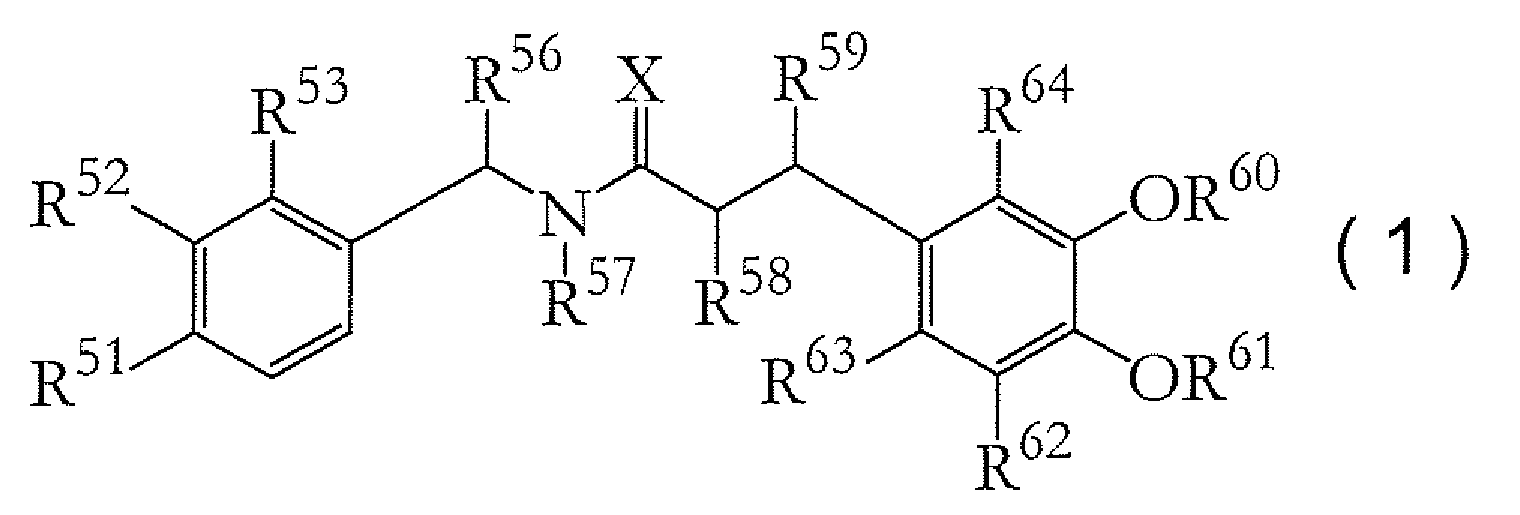
R51 represents a halogen atom, a C1-C6 alkyl group and the like;
R52 represents a hydrogen atom, a halogen atom, a C1-C6 alkyl group and the like; R53 represents a halogen atom and the like;
R56 represents a halogen atom and the like; R57 represents a hydrogen atom and the like; R58 and R59 independently represent a hydrogen atom, a C1-C3 alkyl group and the like; R60 represents a C1-C4 alkyl group, a C1-C4 haloalkyl group, a C3-C4 alkenyl group, or a C3-C6 alkynyl group; R61 represents a C1-C4 alkyl group, a C1-C4 haloalkyl group, a C3-C4 alkenyl group or a C3-C6 alkynyl group or a C2-C4 cyanoalkyl group; R62, R63 and R64 represent a hydrogen atom, a halogen atom and the like; X represents a oxygen atom or a sulfur atom;
has an excellent activity against plant diseases.
Description
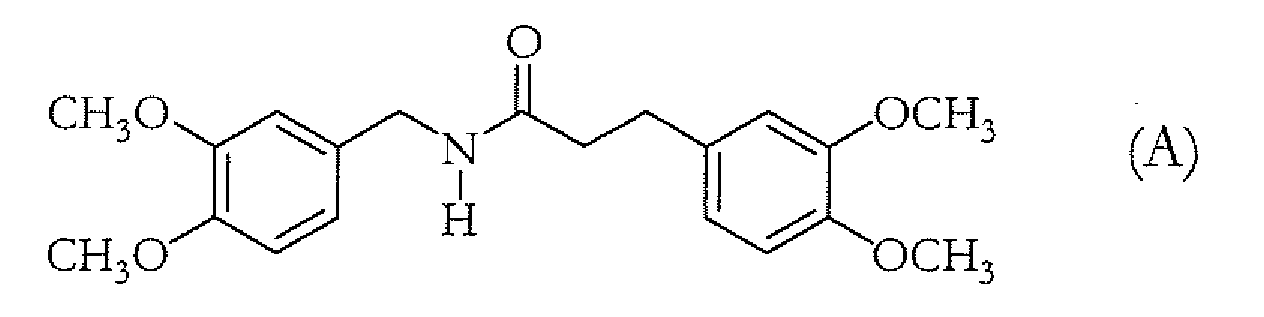

R51 represents a halogen atom, a C1-C6 alkyl group, a C3-C6 cycloalkyl group, a C1-C6 haloalkyl group, a C2-C6 alkenyl group, a C2-C6 haloalkenyl group, a C2-C6 alkynyl group, a C2-C6 haloalkynyl group, a C1-C6 alkoxy group, a C3-C6 alkenyloxy group, a C3-C6 alkynyloxy group, a C1-C6 haloalkoxy group, a (C1-C6 alkoxy) C1-C6 alkyl group, a phenoxy C1-C6 alkyl group, a hydroxy C1-C6 alkyl group, a (C1-C6 alkyl sulfonyloxy) C1-C6 alkyl group, a C1-C6 alkylthio group, a C1-C6 haloalkylthio group, a C1-C6 alkylamino group, a di(C1-C6alkyl) amino group, a formyl group, a (C1-C6 alkyl) carbonyl group, a (C1-C6 alkoxy) carbonyl group, a (C1-C6 alkoxy) imino C1-C6 alkyl group, benzyloxyimino C1-C6 alkyl group, a di (C1-C6 alkylamino) imino C1-C6 alkyl group, a tri (C1-C6 alkyl) silyl group, a phenyl group, a phenoxy group, a cyano group or a nitro group; R52 represents a hydrogen atom, a halogen atom, a C1-C6 alkyl group, a C1-C6 haloalkyl group, a C2-C6 alkenyl group, a C2-C6 alkynyl group, a cyano group or a nitro group; or both of R51 and R52 are combined together to represent a C3-C6 alkylene group or a group of -CR65=CR66-CR67=CR68-R65, R66, R67 and R68 independently represent a hydrogen atom, a halogen atom, a C1-C3 alkyl group, a C1-C3 alkoxy group or a C1-C3 haloalkyl group);
R53 represents a hydrogen atom, a halogen atom, a C1-C3 alkyl group or a C1-C3 haloalkyl group;
R56 represents a hydrogen atom, a C1-C4 alkyl group, a C2-C4 alkenyl group or a C2-C4 alkynyl group;
R57 represents a hydrogen atom, a C1-C4 alkyl group, a C2-C4 alkenyl group or a C2-C4 alkynyl group;
R58 and R59 independently represent a hydrogen atom, a halogen atom or a C1-C3 alkyl group;
R60 represents a C1-C4 alkyl group, a C1-C4 haloalkyl group, a C3-C4 alkenyl group or a C3-C6 alkynyl group;
R61 represents a C1-C4 alkyl group, a C1-C4 haloalkyl group, a C3-C4 alkenyl group or a C3-C6 alkynyl group or a C2-C4 cyanoalkyl group;
each of R62, R63 and R64 represents a hydrogen atom, a halogen atom or a C1-C2 alkyl group;
X represents an oxygen atom or a sulfur atom;
a plant diseases controlling composition comprising the compound of the present invention as an active ingredient; and
a method for controlling plant diseases comprising a step applying an effective amount of the compound of the present invention to plants or soils growing the plant. The present invention also provides the compound (3) represented below (referred as "the intermediate 1 of the present invention" hereinafter.):
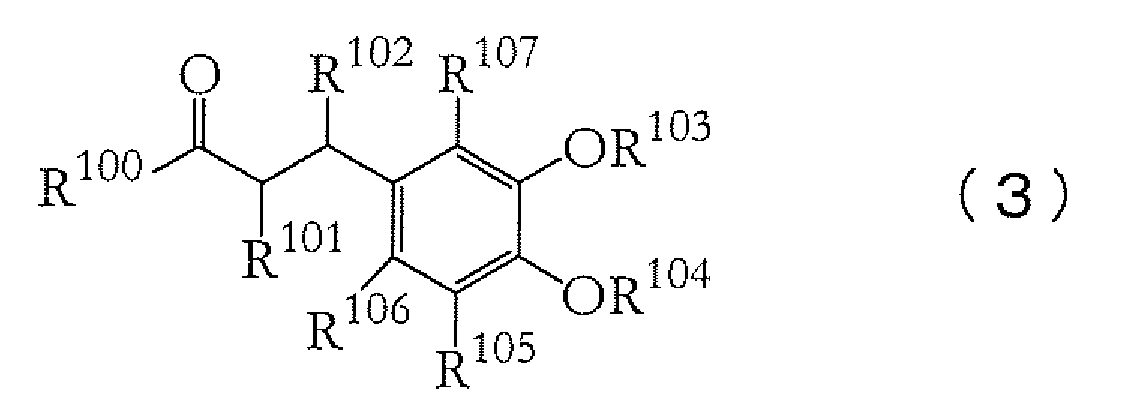
R100 represents a methoxy group, an ethoxy group, a propoxy group, an isopropoxy group, a butyloxy group, an isopropyloxy group, a tert-buthyloxy group, an OH group or a chlorine atom; R101 and
R102 independently represent a hydrogen atom, a halogen atom or a C1-C3 alkyl group; R103 represents a C1-C4 alkyl group; R104 represents a C3-C6 alkynyl group; R105, R106 and R107 independently represent a hydrogen atom, a halogen atom or a C1-C2 alkyl group; and the amide compound (4) represented below (referred as "the intermediate 2 of the present invention" hereinafter.):
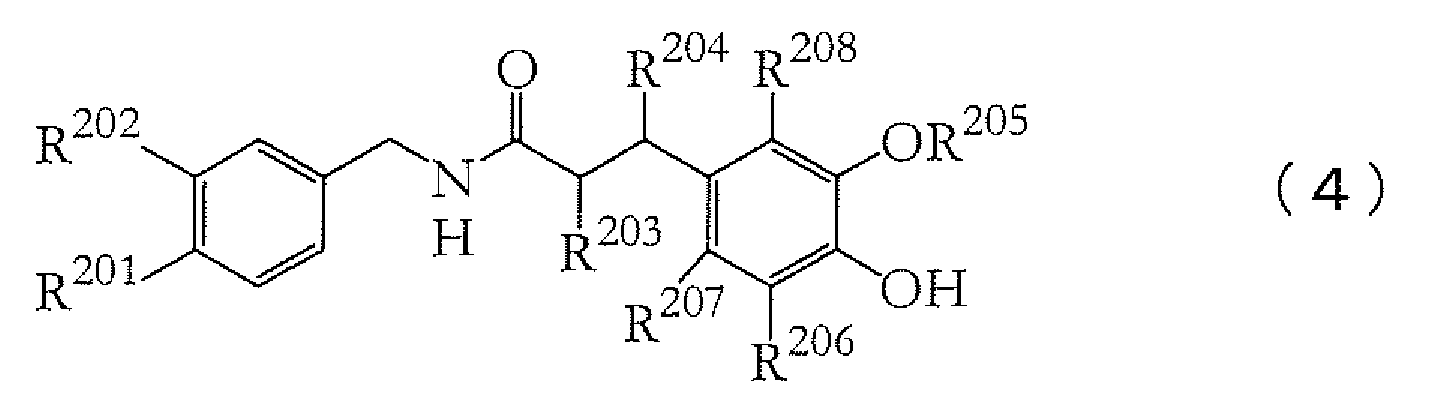
R201 represents a halogen atom, a C1-C4 alkyl group, a C1-C4 haloalkyl group, a C1-C4 alkoxy group, a C1-C4 haloalkoxy group, a di(C1-C4alkyl)amino group or a cyano group; R202 represents a hydrogen atom, a halogen atom, a C1-C4 alkyl group or a C1-C4 haloalkyl group; or both of R201 and R202 are combined together to represent a C3-C5 alkylene group or a group of -CH=CH-CH=CH-; R203 and R204 independently represent a hydrogen atom, a halogen atom or a C1-C3 alkyl group; R205 represents a C1-C4 alkyl group, R206, R207 and R208 independently represent a hydrogen atom, a halogen atom or a C1-C2 alkyl group;
which are important intermediates in production of the compound of the present invention.
the halogen atom includes a fluorine atom, a chlorine atom, a bromine atom, an iodine atom;
the C1-C6 alkyl group includes a C1-C4 alkyl group such as a methyl group, an ethyl group, a propyl group, an isopropyl group, a butyl group, an isobutyl group, a sec-butyl group, a tert-butyl group; a C5-C6 alkyl group such as a pentyl group, a 2-methylpentyl group, a 3-methylpentyl group, a 4-methylpentyl group, a hexyl group and the like;
the C3-C6 cycloalkyl group includes a cyclopropyl group, a cyclobutyl group, a cyclopentyl group and a cyclohexyl group; the C1-C6 haloalkyl group includes, for example, a C1-C4 haloalkyl group such as a fluoromethyl group, a difluoromethyl group, a trifluoromethyl group;
the C2-C6 alkenyl group includes, for example, a C2-C4 alkenyl group such as a vinyl group, a 1-methylvinyl group, a 1-propenyl group, a 2-propenyl group, a 1-methyl-2-propenyl group, a 2-methyl-2-propenyl group, a 2-butenyl group, a 3-butenyl group and the like; a C5-C6 alkenyl group such as a 1-pentenyl group, a 4-pentenyl group, a 1-hexenyl group, a 5-hexenyl group and the like;
the C2-C6 haloalkenyl group includes, for example, a 2-fluorovinyl group, a 2-chlorovinyl group, a 2-bromovinyl group, a 2,2-difluorovinyl group, a 2,2-dichlorovinyl group, a 2, 2-dibromovinyl group, a 1-methyl-2,2-dichlorovinyl group, a 1-methyl-2,2-dibromovinyl group; the C2-C6 alkynyl group includes, for example, a C2-C4 alkynyl group such as an ethynyl group, a 1-propynyl group, a 2-propynyl group, 1-methyl-2-propynyl group, a 1-butynyl group, a 2-butynyl group, a 3-butynyl group and the like; a C5-C6 alkenyl group such as a 3,3-dimethyl-1-butynyl group, a 1-pentynyl group, a 4-pentynyl group, a 1-hexynyl group, a 5-hexynyl group and the like;
the C2-C6 haloalkynyl group includes, for example, a chloroethynyl group, a bromoethynyl group, a iodoethynyl group; the C1-C6 alkoxy group includes, for example, a C1-C4 alkoxy group such as a methoxy group, an ethoxy group, a propoxy group, an isopropoxy group, a butoxy group, an isobutoxy group, a sec-butoxy group, a tert-butoxy group; a C5-C6 alkoxy group such as a pentyloxy group, a hexyloxy and the like;
the C3-C6 alkenyloxy group includes, for example, a 2-propenyloxy group, a 1-methyl-2-propenyloxy group, a2-methyl-2-propenyloxy group, a 2-butenyloxy group, a 3-butenyloxy group, a 4-pentenyloxy group, a 5-hexenyloxy group;
the C3-C6 alkynyloxy group includes, for example, a 2-propynyloxy group, a 1-methyl-2-propynyloxy group, a 2-butynyloxy group, a 3-butynyloxy group, a 3-pentynyloxy group, a 4-pentynyloxy group, a 5-hexynyloxy group;
the C1-C6 haloalkoxy group includes, for example, a C1-C4 haloalkoxy group such as a fluoromethoxy group, a difluoromethoxy group, a trifluoromethoxy group, a chloromethyl group, a dichloromethyl group, a trichloromethyl group, a 2,2,2-trifluoroethoxy group, a 1,1,2,2,-tetrafluoroethoxy group, a 2-fluoroethoxy group and the like;
the (C1-C6 alkoxy) C1-C6 alkyl group includes a methoxymethyl group, an ethoxymethyl group, a propyloxymethyl group, a 1-methoxyethyl group, a 2-methoxyethyl group, a 2-methoxypropyl group, a 2-methoxyisoprppyl group;
the phenoxy C1-C6 alkyl group includes a phenoxy methyl group, a1-phenoxyethyl group, a2 -phenoxyethyl group, a1 -phenoxypropyl group, a 3-phenoxypropyl group, a 4-phenoxybuthyl group; hydroxy C1-C6 alkyl group includes a hydroxymethyl group, a 1-hydroxyethyl group, a 2-hydroxyethyl group, a 1-hydroxypropyl group, a 1-hydroxybutyl group;
the (C1-C6 alkylslfonyloxy) C1-C6 alkyl group includes a methylsulfonyloxymethyl group, a ethylsulfonyloxymethyl group, a 1-methylsulfonyloxyethyl group, a 2-sulfonyloxyethyl group, a 1-methylsulfonyloxypropyl group;
the C1-C6 alkylthio group includes, for example, a methylthio group, a ethylthio group, a propylthio group, a isopropylthio group, a butylthio group, a isobutylthio group, a sec-butylthio group, a tert-butylthio group, a pentylthio group, a hexylthio group;
the C1-C6 haloalkylthio group includes, for example, a fluoromethylthio group, a difluoromethylthio group, a trifluoromethylthio group;
the C1-C6 alkylamino group includes, for example, a C1-C4 alkylamino group such as a methylamino group, an ethylamino group, a propylamino group, an isopropylamino group; a pentylamino group, a hexylamino;
the di(C1-C6 alkyl)amino group includes, for example, a C1-C4 dialkylamino group such as a dimethylamino group, a diethylamino group, a dipropylamino group; a dipentylamino group, a dihexylamino group;
the (C1-C6 alkyl) carbonyl group includes a methylcarbonyl group, an ethylcarbonyl group, a propylcarbonyl group, an isopropylcarbonyl group;
the (C1-C6 alkoxy) carbonyl group includes a methoxycarbonyl group, a ethoxycarbonyl group, a propoxycarbonyl group, a isopropoxycarbonyl group;
the (C1-C6 alkoxyimino) C1-C6 alkyl group includes a methoxyiminomethyl group, a 1-methoxyiminoethyl group, a 1-methoxyiminopropyl group, a 1-methoxyiminobutyl group, an ethoxyiminomethyl group, a 1-ethoxyiminoethyl group, a propoxyiminomethyl group, a 1-isopropoxyiminoethyl group, a butoxyiminomethyl group, a pentyloxyiminomethyl group, a 1-hexyloxyiminoethyl group;
the benzyloxyimino C1-C6 alkyl group includes a benzyloxyiminomethyl group, a 1-(benzyloxyimino)ethyl group, a 2-(benzyloxyimino)ethyl group, a 1-(benzyloxyimino)propyl group, a 1-(benzyloxyimino)butyl group;
the di(C1-C6 alkyl)aminoimino C1-C6 alkyl group includes a dimethylaminoiminomethyl group, a 1-(dimethylaminoimino) ethyl group, a diethylaminoiminomethyl group, a 1-(diethylaminoimino)ethyl group;
the tri (C1-C6 alkyl) silyl group includes a trimethyl silyl group, a triethyl silyl group, a tert-butyldimethyl silyl group;
the halogen atom includes a fluorine atom, a chlorine atom, a bromine atom, an iodine atom;
the C1-C6 alkyl group includes a C1-C4 alkyl group such as a methyl group, an ethyl group, a propyl group, an isopropyl group, a butyl group, an isobutyl group, sec-butyl group, tert-butyl group; a C5-C6 alkyl group such as a pentyl group, a 2-methylpentyl group, a 3-methylpentyl group, a 4-methylpentyl group, a hexyl group and the like;
the C1-C6 haloalkyl group includes, for example, a fluoromethyl group, a difluoromethyl group, a trifluoromethyl group;
the C2-C6 alkenyl group includes, for example, a C1-C4 alkenyl group such as a vinyl group, a 1-methylvinyl group, a 1-propenyl group, a 2-propenyl group, a 1-methyl-2-propenyl group, a 2-methyl-2-propenyl group, a 2-butenyl group, a 3-butenyl group and the like; a C5-C6 alkyl group such as a 1-pentenyl group, a 4-pentenyl group, a 1-hexenyl group, a 5-hexenyl group and the like;
the C2-C6 alkynyl group includes, for example, a C2-C4 alkynyl group such as an ethynyl group, a 1-propynyl group, a 2-propynyl group, a 1-methyl-2-propynyl group, a 1-butynyl group, a 2-butynyl group, a 3-butynyl group and the like; a C5-C6 alkynyl group such as a 1-pentynyl group, a 4-pentynyl group, a 1-hexynyl group, a 5-hexynyl group and the like;
the C3-C6 alkylene group represented by R51 and R52 are combined together includes, for example, a trimethylene group, a tetraethylene group, a pentamethylene group and hexamethylene group.
the halogen atom includes a fluorine atom, a chlorine atom, a bromine atom, an iodine atom;
the C1-C3 alkyl group includes a methyl group, an ethyl group, a propyl group, an isopropyl group;
the C1-C3 haloalkyl group includes, for example, a trifluoromethyl group.
the C1-C4 alkyl group includes a methyl group, an ethyl group, a propyl group, an isopropyl group, a butyl group, an isobutyl group, a sec-butyl group, a tert-butyl group;
the C2-C4 alkenyl group includes, for example, a vinyl group, a 1-methylvinyl group, a 1-propenyl group, a 2-propenyl group, a 1-methyl-2-propenyl group, a 2-methyl-2-propenyl group, a 2-butenyl group, a 3-butenyl group and the like;
the C2-C4 alkynyl group includes, for example, an ethynyl group, a 1-propynyl group, a 2-propynyl group, a 1-methyl-2-propynyl group, a 2-butynyl group, a 3-butynyl group and the like.
the C1-C4 alkyl group, for example, includes a methyl group, an ethyl group, a propyl group, a butyl group;
the C3-C4 alkenyl group includes, for example, a 2-propenyl group, a 1-methyl-2-propenyl group, a 2-methyl-2-propenyl group, a 2-butenyl group, a 3-butenyl group and the like;
the C3-C4 alkynyl group includes a 2-propynyl group, 1-methyl-2-propynyl group, a 2-butynyl group, a 3-butynyl group and the like.
the halogen atom includes a fluorine atom, a chlorine atom, a bromine atom;
the C1-C3 alkyl group includes a methyl group, an ethyl group, a propyl group, an isopropyl group.
the C1-C4 alkyl group includes a C1-C2 alkyl group such as a methyl group, an ethyl group; a propyl group, an isopropyl group, a butyl group, an isobutyl group, a sec-butyl group, a tert-butyl group;
the C1-C4 haloalkyl group includes, for example, a fluoromethyl group, a difluoromethyl group, a trifluoromethyl group, a 2,2,2-trifluoroethyl group, a 1,1,2,2-tetrafluoroethyl group, a 2-fluoroethyl group;
the C3-C4 alkenyl group includes, for example, a 2-propenyl group, a 1-methyl-2-propenyl group, a 2-methyl-2-propenyl group, a 2-butenyl group, 3-butenyl group;
the C3-C6 alkynyl group includes, for example, a C3-C4 alkynyl group such as 2-propynyl group, a 1-methyl-2-propynyl group, a 2-butynyl group, a 3-butynyl group and the like; a C5-C6 alkynyl group such as a 1,1-dimethyl-2-propynyl group, a 1-methyl-2-butynyl group, a 2-pentynyl group, a 1-methyl-2-pentynyl group, a 4-methyl-2-pentynyl group, a 3-pentynyl group, a 4-pentynyl group, a 2-hexynyl group, a 3-hexynyl group and the like;
the C1-C4 alkyl group includes a methyl group, an ethyl group, a propyl group, an isopropyl group, a butyl group, an isobutyl group, a sec-butyl group, a tert-butyl group;
the C1-C4 haloalkyl group includes, for example, a fluoromethyl group, a difluoromethyl group, a trifluoromethyl group, a 2,2,2-trifluoroethyl group, a 1,1,2,2-tetrafluoroethyl group, a 2-fluoroethyl group;
the C3-C4 alkenyl group includes, for example, a 2-propenyl group, a 1-methyl-2-propenyl group, a 2-methyl-2-propenyl group, a 2-butenyl group, a 3-butenyl group;
the C3-C6 alkynyl group includes, for example, a C3-C4 alkynyl group such as a 2-propynyl group, a 1-methyl-2-propynyl group, a 2-butynyl group, a 3-butynyl group; a C5-C6 alkynyl group such as a 1, 1-dimethyl-2-propynyl group, a 1-methyl-2-butynyl group, a 2-pentynyl group, a 1-methyl-2-pentynyl group, a 4-methyl-2-pentynyl group, a 3-pentynyl group, a 4-pentynyl group, a 2-hexynyl group, a 3-hexynyl group and the like;
the C2-C4 cyanoalkyl group includes, for example, a cyanomethyl group, a cyanoethyl group, a cyanopropyl group, a 1-methylcyanomethyl group, a 1,1-dimethylcyanomethyl group.
the halogen atom includes a fluorine atom, a chlorine atom, a bromine atom, an iodine atom;
the C1-C2 alkyl group includes a methyl group and an ethyl group.
the halogen atom includes a fluorine atom, a chlorine atom, a bromine atom, an iodine atom;
the C1-C3 alkyl group includes a methyl group, an ethyl group, a propyl group, an isopropyl group;
the C1-C3 alkoxy group includes a methoxy group, an ethoxy group, a propyloxy group, an isopropyloxy group;
the C1-C3 haloalkyl group includes, for example, a trifluoromethyl group.
the halogen atom includes a fluorine atom, a chlorine atom, a bromine atom;
the C1-C3 alkyl group includes a methyl group, an ethyl group, a propyl group, an isopropyl group.
the C1-C4 alkyl group includes a C1-C2 alkyl group such as a methyl group, an ethyl group; a propyl group, an isopropyl group, a butyl group, an isobutyl group, a sec-butyl group, a tert-butyl group.
the C3-C6 alkynyl group includes, for example, a C3-C4 alkynyl group such as a 2-propynyl group, a 1-methyl-2-propynyl group, a 2-butynyl group, a 3-butynyl group; a C5-C6 alkynyl group such as a 1, 1-dimethyl-2-propynyl group, a I-methyl-2-butynyl group, a 2-pentynyl group, a 1-methyl-2-pentynyl group, a 4-methyl-2-pentynyl group, a 3-pentynyl group, a 4-pentynyl group, a 2-hexynyl group, 3-hexynyl group.
the halogen atom includes a fluorine atom, a chlorine atom, a bromine atom, an iodine atom;
the C1-C2 alkyl group includes a methyl group, an ethyl group.
the halogen atom includes a fluorine atom, a chlorine atom, a bromine atom, an iodine atom;
the C1-C4 alkyl group includes a methyl group, an ethyl group, a propyl group, an isopropyl group, a butyl group, an isobutyl group, a sec-butyl group, a tert-butyl group;
the C1-C4 haloalkyl group includes, for example, a fluoromethyl group, a difluoromethyl group, a trifluoromethyl group;
the C1-C4 alkoxy group includes, for example, a methoxy group, an ethoxy group, a propoxy group, an isopropoxy group, a butoxy group, an isobutoxy group, a sec-butoxy group, a tert-butoxy group;
the C1-C4 haloalkoxy group includes, for example, a fluoromethoxy group, a difluoromethoxy group, a trifluoromethoxy group, a chloromethyl group, a dichloromethyl group, a trichloromethyl group, a 2,2,2-trifluoroethoxy group, a 1,1,2,2-tetrafluoroethoxy group, a 2-fluoroethoxy group;
the di(C1-C4alkyl)amino group includes, for example, a dimethylamino group, a diethylamino group, a dipropylamino group;
the halogen atom includes a fluorine atom, a chlorine atom, a bromine atom, an iodine atom;
the C1-C4 alkyl group includes, for example, a methyl group, an ethyl group, a propyl group, an isopropyl group, a butyl group, an isobutyl group, a sec-butyl group, a tert-butyl group;
the C1-C6 haloalkyl group includes, for example, a fluoromethyl group, a difluoromethyl group, a trifluoromethyl group;
the C3-C5 alkylene group represented by R201 and R202 are combined together, for example, a trimethylene group, a tetraethylene group and a pentaethylene group.
the halogen atom includes a fluorine atom, a chlorine atom, a bromine atom;
the C1-C3 alkyl group includes a methyl group, an ethyl group, a propyl group and an isopropyl group.
the C1-C4 alkyl group includes a C1-C2 alkyl group such as a methyl group, an ethyl group; a propyl group, an isopropyl group, a butyl group, an isobutyl group, a sec-butyl group, a tert-butyl group.
the halogen atom includes a fluorine atom, a chlorine atom, a bromine atom, an iodine atom;
the C1-C2 alkyl group includes a methyl group and an ethyl group.
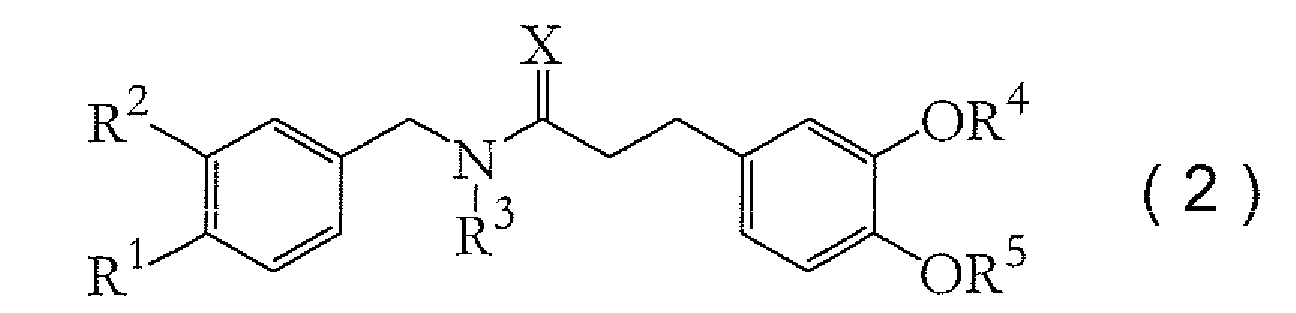
R1 represents a halogen atom, a C1-C4 alkyl group, a C1-C4 haloalkyl group, a C2-C4 alkenyl group, a C2-C4 alkynyl group, a C1-C4 alkoxy group, a C1-C4 haloalkoxy group, a C1-C4 alkylamino group, a di(C1-C4alkyl)amino group or a cyano group; R2 represents a hydrogen atom, a halogen atom, a C1-C4 alkyl group, a C1-C4 haloalkyl group, a C2-C4 alkenyl group or a C2-C4 alkynyl group; or both of R1 and R2 are combined together to represent a C3-C5 alkylene group or a group of -CH=CH-CH=CH-;
R3 represents a hydrogen atom or a C1-C3 alkyl group;
R4 represents a C1-C4 alkyl group, a C1-C4 haloalkyl group, a C3-C4 alkenyl group or a C3-C4 alkynyl group;
R5 represents a C1-C4 alkyl group, a C1-C4 haloalkyl group, a C3-C4 alkenyl group or a C3-C4 alkynyl group;
X represents an oxygen atom or a sulfur atom.
an amide compound represented by formula (2) wherein R1 is a halogen atom;
an amide compound represented by formula (2) wherein R1 is a C1-C4 alkyl group;
an amide compound represented by formula (2) wherein R1 is a C1-C4 haloalkyl group;
an amide compound represented by formula (2) wherein R1 is a C1-C4 alkylamino group;
an amide compound represented by formula (2) wherein R1 is a di(C1-C4 alkyl)amino group;
an amide compound represented by formula (2) wherein R1 is a chlorine atom;
an amide compound represented by formula (2) wherein R1 is a methyl group;
an amide compound represented by formula (2) wherein R1 is a trifluoromethyl group;
an amide compound represented by formula (2) wherein R2 is a hydrogen atom;
an amide compound represented by formula (2) wherein R2 is a halogen atom;
an amide compound represented by formula (2) wherein R2 is a C1-C4 haloalkyl group;
an amide compound represented by formula (2) wherein R3 is a hydrogen atom;
an amide compound represented by formula (2) wherein R4 is a C1-C4 alkyl group;
an amide compound represented by formula (2) wherein R4 is a C1-C2 alkyl group;
an amide compound represented by formula (2) wherein R5 is a C1-C4 alkyl group;
an amide compound represented by formula (2) wherein R5 is a C3-C4 alkynyl group;
an amide compound represented by formula (2) wherein R5 is a C1-C2 alkyl group;
an amide compound represented by formula (2) wherein R5 is a 2-propynyl group;
an amide compound represented by formula (2) wherein X is an oxygen atom;
an amide compound represented by formula (2) wherein R1 is a halogen atom, R2 is a hydrogen atom;
an amide compound represented by formula (2) wherein R1 is a halogen atom, R2 is a halogen atom;
an amide compound represented by formula (2) wherein R1 is a halogen atom, R2 is a C1-C4 haloalkyl group;
an amide compound represented by formula (2) wherein R1 is a halogen atom, R3 is a hydrogen atom;
an amide compound represented by formula (2) wherein R1 is a halogen atom, R4 is a C1-C4 alkyl group;
an amide compound represented by formula (2) wherein R1 is a halogen atom, R4 is a C1-C2 alkyl group;
an amide compound represented by formula (2) wherein R1 is a halogen atom, R5 is a C1-C4 alkyl group;
an amide compound represented by formula (2) wherein R1 is a halogen atom, R5 is a C3-C4 alkynyl group;
an amide compound represented by formula (2) wherein R1 is a halogen atom, R5 is a C1-C2 alkyl group;
an amide compound represented by formula (2) wherein R1 is a halogen atom, R5 is a 2-propynyl group;
an amide compound represented by formula (2) wherein R1 is a C1-C4 alkyl group, R2 is a hydrogen atom;
an amide compound represented by formula (2) wherein R1 is a C1-C4 alkyl group, R2 is a halogen atom;
an amide compound represented by formula (2) wherein R1 is a C1-C4 alkyl group, R2 is a C1-C4 haloalkyl group;
an amide compound represented by formula (2) wherein R1 is a C1-C4 alkyl group, R3 is a hydrogen atom;
an amide compound represented by formula (2) wherein R1 is a C1-C4 alkyl group, R4 is a C1-C4 alkyl group;
an amide compound represented by formula (2) wherein R1 is a C2-C4 alkyl group, R4 is a C1-C2 alkyl group;
an amide compound represented by formula (2) wherein R1 is a C1-C4 alkyl group, R5 is a C1-C4 alkyl group;
an amide compound represented by formula (2) wherein R1 is a C1-C4 alkyl group, R5 is a C3-C4 alkynyl group;
an amide compound represented by formula (2) wherein R1 is a C1-C4 alkyl group, R5 is a C1-C2 alkyl group;
an amide compound represented by formula (2) wherein R1 is a C1-C4 alkyl group, R5 is a 2-propynyl group;
an amide compound represented by formula (2) wherein R1 is a C1-C4 haloalkyl group, R2 is a hydrogen atom;
an amide compound represented by formula (2) wherein R1 is a C1-C4 haloalkyl group, R2 is a halogen atom;
an amide compound represented by formula (2) wherein R1 is a C1-C4 haloalkyl group, R2 is a C1-C4 haloalkyl group;
an amide compound represented by formula (2) wherein R1 is a C1-C4 haloalkyl group, R3 is a hydrogen atom;
an amide compound represented by formula (2) wherein R1 is a C1-C4 haloalkyl group, R4 is a C1-C4 alkyl group;
an amide compound represented by formula (2) wherein R1 is a C1-C4 haloalkyl group, R4 is a C1-C2 alkyl group;
an amide compound represented by formula (2) wherein R1 is a C1-C4 haloalkyl group, R5 is a C1-C4 alkyl group;
an amide compound represented by formula (2) wherein R1 is a C1-C4 haloalkyl group, R5 is a C3-C4 alkynyl group;
an amide compound represented by formula (2) wherein R1 is a C1-C4 haloalkyl group, R5 is a C1-C2 alkyl group;
an amide compound represented by formula (2) wherein R1 is a C1-C4 haloalkyl group, R5 is a 2-propynyl group;
an amide compound represented by formula (2) wherein R1 is a chlorine atom, R2 is a hydrogen atom;
an amide compound represented by formula (2) wherein R1 is a chlorine atom, R2 is a halogen atom;
an amide compound represented by formula (2) wherein R1 is a chlorine atom, R2 is a C1-C4 haloalkyl group;
an amide compound represented by formula (2) wherein R1 is a chlorine atom, R3 is a hydrogen atom;
an amide compound represented by formula (2) wherein R1 is a chlorine atom, R4 is a C1-C4 alkyl group;
an amide compound represented by formula (2) wherein R1 is a chlorine atom, R4 is a C1-C2 alkyl group;
an amide compound represented by formula (2) wherein R1 is a chlorine atom, R5 is a C1-C4 alkyl group;
an amide compound represented by formula (2) wherein R1 is a chlorine atom, R5 is a C3-C4 alkynyl group;
an amide compound represented by formula (2) wherein R1 is a chlorine atom, R5 is a C1-C2 alkyl group;
an amide compound represented by formula (2) wherein R1 is a chlorine atom, R5 is a 2-propynyl group;
an amide compound represented by formula (2) wherein R1 is a methyl group, R2 is a hydrogen atom;
an amide compound represented by formula (2) wherein R1 is a methyl group, R2 is a halogen atom;
an amide compound represented by formula (2) wherein R1 is a methyl group, R2 is a C1-C4 haloalkyl group;
an amide compound represented by formula (2) wherein R1 is a methyl group, R3 is a hydrogen atom;
an amide compound represented by formula (2) wherein R1 is a methyl group, R4 is a C1-C4 alkyl group;
an amide compound represented by formula (2) wherein R1 is a methyl group, R4 is a C1-C2 alkyl group;
an amide compound represented by formula (2) wherein R1 is a methyl group, R5 is a C1-C4 alkyl group;
an amide compound represented by formula (2) wherein R1 is a methyl group, R5 is a C3-C4 alkynyl group;
an amide compound represented by formula (2) wherein R1 is a methyl group, R5 is a C1-C2 alkyl group;
an amide compound represented by formula (2) wherein R1 is a methyl group, R5 is a 2-propynyl group;
an amide compound represented by formula (2) wherein R1 is a trifluoromethyl group, R2 is a hydrogen atom;
an amide compound represented by formula (2) wherein R1 is a trifluoromethyl group, R2 is a halogen atom;
an amide compound represented by formula (2) wherein R1 is a trifluoromethyl group, R2 is a C1-C4 haloalkyl group;
an amide compound represented by formula (2) wherein R1 is a trifluoromethyl group, R3 is a hydrogen atom;
an amide compound represented by formula (2) wherein R1 is a trifluoromethyl group, R4 is a C1-C4 alkyl group;
an amide compound represented by formula (2) wherein R1 is a trifluoromethyl group, R4 is a C1-C2 alkyl group;
an amide compound represented by formula (2) wherein R1 is a trifluoromethyl group, R5 is a C1-C4 alkyl group;
an amide compound represented by formula (2) wherein R1 is a trifluoromethyl group, R5 is a C3-C4 alkynyl group;
an amide compound represented by formula (2) wherein R1 is a trifluoromethyl group, R5 is a C1-C2 alkyl group;
an amide compound represented by formula (2) wherein R1 is a trifluoromethyl group, R5 is a 2-propynyl group;
an amide compound represented by formula (2) wherein R1 is a di(C1-C4alkyl)amino group, R2 is a hydrogen atom;
an amide compound represented by formula (2) wherein R1 is a di(C1-C4alkyl)amino group, R2 is a halogen atom;
an amide compound represented by formula (2) wherein R1 is a di(C1-C4alkyl)amino group, R2 is a C1-C4 haloalkyl group;
an amide compound represented by formula (2) wherein R1 is a di(C1-C4alkyl)amino group, R3 is a hydrogen atom;
an amide compound represented by formula (2) wherein R1 is a di(C1-C4alkyl)amino group, R4 is a C1-C4 alkyl group;
an amide compound represented by formula (2) wherein R1 is a di(C1-C4alkyl)amino group, R4 is a C1-C2 alkyl group;
an amide compound represented by formula (2) wherein R1 is a di(C1-C4alkyl)amino group, R5 is a C1-C4 alkyl group;
an amide compound represented by formula (2) wherein R1 is a di(C1-C4alkyl)amino group, R5 is a C3-C4 alkynyl group;
an amide compound represented by formula (2) wherein R1 is a di(C1-C4alkyl)amino group, R5 is a C1-C2 alkyl group;
an amide compound represented by formula (2) wherein R1 is a di(C1-C4alkyl)amino group, R5 is a 2-propynyl group;
an amide compound representedby formula (2) wherein R1 is a halogen atom, R2 is a hydrogen atom, R3 is a hydrogen atom;
an amide compound represented by formula (2) wherein R1 is a halogen atom, R2 is a hydrogen atom, R4 is a C1-C4 alkyl group;
an amide compound represented by formula (2) wherein R1 is a halogen atom, R2 is a hydrogen atom, R4 is a C1-C2 alkyl group;
an amide compound represented by formula (2) wherein R1 is a halogen atom, R2 is a hydrogen atom, R5 is a C1-C4 alkyl group;
an amide compound represented by formula (2) wherein R1 is a halogen atom, R2 is a hydrogen atom, R5 is a C3-C4 alkynyl group;
an amide compound represented by formula (2) wherein R1 is a halogen atom, R2 is a hydrogen atom, R5 is a C1-C2 alkyl group;
an amide compound represented by formula (2) wherein R1 is a halogen atom, R2 is a hydrogen atom, R5 is a 2-propynyl group;
an amide compound represented by formula (2) wherein R1 is a C1-C4 alkyl group, R2 is a hydrogen atom, R3 is a hydrogen atom;
an amide compound represented by formula (2) wherein R1 is a C1-C4 alkyl group, R2 is a hydrogen atom, R4 is a C1-C4 alkyl group; an amide compound represented by formula (2) wherein R1 is a C1-C4 alkyl group, R2 is a hydrogen atom, R4 is a C1-C2 alkyl group; an amide compound represented by formula (2) wherein R1 is a C1-C4 alkyl group, R2 is a hydrogen atom, R5 is a C1-C4 alkyl group; an amide compound represented by formula (2) wherein R1 is a C1-C4 alkyl group, R2 is a hydrogen atom, R5 is a C3-C4 alkynyl group; an amide compound represented by formula (2) wherein R1 is a C1-C4 alkyl group, R2 is a hydrogen atom, R5 is a C1-C2 alkyl group; an amide compound represented by formula (2) wherein R1 is a C1-C4 alkyl group, R2 is a hydrogen atom, R5 is a 2-propynyl group; an amide compound represented by formula (2) wherein R1 is a C1-C4 haloalkyl group, R2 is a hydrogen atom, R3 is a hydrogen atom; an amide compound represented by formula (2) wherein R1 is a C1-C4 haloalkyl group, R2 is a hydrogen atom, R4 is a C1-C4 alkyl group; an amide compound represented by formula (2) wherein R1 is a C1-C4 haloalkyl group, R2 is a hydrogen atom, R4 is a C1-C2 alkyl group; an amide compound represented by formula (2) wherein R1 is a C1-C4 haloalkyl group, R2 is a hydrogen atom, R5 is a C1-C4 alkyl group; an amide compound represented by formula (2) wherein R1 is a C1-C4 haloalkyl group, R2 is a hydrogen atom, R5 is a C3-C4 alkynyl group;
an amide compound represented by formula (2) wherein R1 is a C1-C4 haloalkyl group, R2 is a hydrogen atom, R5 is a C1-C2 alkyl group; an amide compound represented by formula (2) wherein R1 is a C1-C4 haloalkyl group, R2 is a hydrogen atom, R5 is a 2-propynyl group; an amide compound represented by formula (2) wherein R1 is a chlorine atom, R2 is a hydrogen atom, R3 is a hydrogen atom; an amide compound represented by formula (2) wherein R1 is a chlorine atom, R2 is a hydrogen atom, R4 is a C1-C4 alkyl group; an amide compound represented by formula (2) wherein R1 is a chlorine atom, R2 is a hydrogen atom, R4 is a C1-C2 alkyl group; an amide compound represented by formula (2) wherein R1 is a chlorine atom, R2 is a hydrogen atom, R5 is a C1-C4 alkyl group; an amide compound represented by formula (2) wherein R1 is a chlorine atom, R2 is a hydrogen atom, R5 is a C3-C4 alkynyl group; an amide compound represented by formula (2) wherein R1 is a chlorine atom, R2 is a hydrogen atom, R5 is a C1-C2 alkyl group; an amide compound represented by formula (2) wherein R1 is a chlorine atom, R2 is a hydrogen atom, R5 is a 2-propynyl group; an amide compound represented by formula (2) wherein R1 is a methyl group, R2 is a hydrogen atom, R3 is a hydrogen atom;
an amide compound represented by formula (2) wherein R1 is a methyl group, R2 is a hydrogen atom, R4 is a C1-C4 alkyl group;
an amide compound represented by formula (2) wherein R1 is a methyl group, R2 is a hydrogen atom, R4 is a C1-C2 alkyl group;
an amide compound represented by formula (2) wherein R1 is a methyl group, R2 is a hydrogen atom, R5 is a C1-C4 alkyl group;
an amide compound represented by formula (2) wherein R1 is a methyl group, R2 is a hydrogen atom, R5 is a C3-C4 alkynyl group;
an amide compound represented by formula (2) wherein R1 is a methyl group, R2 is a hydrogen atom, R5 is a C1-C2 alkyl group;
an amide compound represented by formula (2) wherein R1 is a methyl group, R2 is a hydrogen atom, R5 is a 2-propynyl group; an amide compound represented by formula (2) wherein R1 is a trifluoromethyl group, R2 is a hydrogen atom, R3 is a hydrogen atom;
an amide compound represented by formula (2) wherein R1 is a trifluoromethyl group, R2 is a hydrogen atom, R4 is a C1-C4 alkyl group;
an amide compound represented by formula (2) wherein R1 is a trifluoromethyl group, R2 is a hydrogen atom, R4 is a C1-C2 alkyl group;
an amide compound represented by formula (2) wherein R1 is a trifluoromethyl group, R2 is a hydrogen atom, R5 is a C1-C4 alkyl group;
an amide compound represented by formula (2) wherein R1 is a trifluoromethyl group, R2 is a hydrogen atom, R5 is a C3-C4 alkynyl group;
an amide compound represented by formula (2) wherein R1 is a trifluoromethyl group, R2 is a hydrogen atom, R5 is a C1-C2 alkyl group;
an amide compound represented by formula (2) wherein R1 is a trifluoromethyl group, R2 is a hydrogen atom, R5 is a 2-propynyl group;
an amide compound represented by formula (2) wherein R1 is a halogen atom, R2 is a hydrogen atom, R3 is a hydrogen atom, R4 is a C1-C4 alkyl group;
an amide compound represented by formula (2) wherein R1 is a halogen atom, R2 is a hydrogen atom, R3 is a hydrogen atom, R4 is a C1-C2 alkyl group;
an amide compound represented by formula (2) wherein R1 is a halogen atom, R2 is a hydrogen atom, R3 is a hydrogen atom, R5 is a C1-C4 alkyl group;
an amide compound represented by formula (2) wherein R1 is a halogen atom, R2 is a hydrogen atom, R3 is a hydrogen atom, R5 is a C3-C4 alkynyl group;
an amide compound represented by formula (2) wherein R1 is a halogen atom, R2 is a hydrogen atom, R3 is a hydrogen atom, R5 is a C1-C2 alkyl group;
an amide compound represented by formula (2) wherein R1 is a halogen atom, R2 is a hydrogen atom, R3 is a hydrogen atom, R5 is a 2-propynyl group;
an amide compound represented by formula (2) wherein R1 is a C1-C4 alkyl group, R2 is a hydrogen atom, R3 is a hydrogen atom, R4 is a C1-C4 alkyl group;
an amide compound represented by formula (2) wherein R1 is a C1-C4 alkyl group, R2 is a hydrogen atom, R3 is a hydrogen atom, R4 is a C1-C2 alkyl group;
an amide compound represented by formula (2) wherein R1 is a C1-C4 alkyl group, R2 is a hydrogen atom, R3 is a hydrogen atom, R5 is a C1-C4 alkyl group;
an amide compound represented by formula (2) wherein R1 is a C1-C4 alkyl group, R2 is a hydrogen atom, R3 is a hydrogen atom, R5 is a C3-C4 alkynyl group;
an amide compound represented by formula (2) wherein R1 is a C1-C4 alkyl group, R2 is a hydrogen atom, R3 is a hydrogen atom, R5 is a C1-C2 alkyl group;
an amide compound represented by formula (2) wherein R1 is a C1-C4 alkyl group, R2 is a hydrogen atom, R3 is a hydrogen atom, R5 is a 2-propynyl group;
an amide compound represented by formula (2) wherein R1 is a C1-C4 haloalkyl group, R2 is a hydrogen atom, R3 is a hydrogen atom, R4 is a C1-C4 alkyl group;
an amide compound represented by formula (2) wherein R1 is a C1-C4 haloalkyl group, R2 is a hydrogen atom, R3 is a hydrogen atom, R4 is a C1-C2 alkyl group;
an amide compound represented by formula (2) wherein R1 is a C1-C4 haloalkyl group, R2 is a hydrogen atom, R3 is a hydrogen atom, R5 is a C1-C4 alkyl group;
an amide compound represented by formula (2) wherein R1 is a C1-C4 haloalkyl group, R2 is a hydrogen atom, R3 is a hydrogen atom, R5 is a C3-C4 alkynyl group;
an amide compound represented by formula (2) wherein R1 is a C1-C4 haloalkyl group, R2 is a hydrogen atom, R3 is a hydrogen atom, R5 is a C1-C2 alkyl group;
an amide compound represented by formula (2) wherein R1 is a C1-C4 haloalkyl group, R2 is a hydrogen atom, R3 is a hydrogen atom, R5 is a 2-propynyl group;
an amide compound represented by formula (2) wherein R1 is a chlorine atom, R2 is a hydrogen atom, R3 is a hydrogen atom, R4 is a C1-C4 alkyl group;
an amide compound represented by formula (2) wherein R1 is a chlorine atom, R2 is a hydrogen atom, R3 is a hydrogen atom, R4 is a C1-C2 alkyl group;
an amide compound represented by formula (2) wherein R1 is a chlorine atom, R2 is a hydrogen atom, R3 is a hydrogen atom, R5 is a C1-C4 alkyl group;
an amide compound represented by formula (2) wherein R1 is a chlorine atom, R2 is a hydrogen atom, R3 is a hydrogen atom, R5 is a C3-C4 alkynyl group;
an amide compound represented by formula (2) wherein R1 is a chlorine atom, R2 is a hydrogen atom, R3 is a hydrogen atom, R5 is a C1-C2 alkyl group;
an amide compound represented by formula (2) wherein R1 is a chlorine atom, R2 is a hydrogen atom, R3 is a hydrogen atom, R5 is a 2-propynyl group;
an amide compound represented by formula (2) wherein R1 is a methyl group, R2 is a hydrogen atom, R3 is a hydrogen atom, R4 is a C1-C4 alkyl group;
an amide compound represented by formula (2) wherein R1 is a methyl group, R2 is a hydrogen atom, R3 is a hydrogen atom, R4 is a C1-C2 alkyl group;
an amide compound represented by formula (2) wherein R1 is a methyl group, R2 is a hydrogen atom, R3 is a hydrogen atom, R5 is a C1-C4 alkyl group;
an amide compound represented by formula (2) wherein R1 is a methyl group, R2 is a hydrogen atom, R3 is a hydrogen atom, R5 is a C3-C4 alkynyl group;
an amide compound represented by formula (2) wherein R1 is a methyl group, R2 is a hydrogen atom, R3 is a hydrogen atom, R5 is a C1-C2 alkyl group;
an amide compound represented by formula (2) wherein R1 is a methyl group, R2 is a hydrogen atom, R3 is a hydrogen atom, R5 is a 2-propynyl group;
an amide compound represented by formula (2) wherein R1 is a trifluoromethyl group, R2 is a hydrogen atom, R3 is a hydrogen atom, R4 is a C1-C4 alkyl group;
an amide compound represented by formula (2) wherein R1 is a trifluoromethyl group, R2 is a hydrogen atom, R3 is a hydrogen atom, R4 is a C1-C2 alkyl group;
an amide compound represented by formula (2) wherein R1 is a trifluoromethyl group, R2 is a hydrogen atom, R3 is a hydrogen atom, R5 is a C1-C4 alkyl group;
an amide compound represented by formula (2) wherein R1 is a trifluoromethyl group, R2 is a hydrogen atom, R3 is a hydrogen atom, R5 is a C3-C4 alkynyl group;
an amide compound represented by formula (2) wherein R1 is a trifluoromethyl group, R2 is a hydrogen atom, R3 is a hydrogen atom, R5 is a C1-C2 alkyl group;
an amide compound represented by formula (2) wherein R1 is a trifluoromethyl group, R2 is a hydrogen atom, R3 is a hydrogen atom, R5 is a 2-propynyl group;
an amide compound represented by formula (2) wherein R1 is a halogen atom, R2 is a hydrogen atom, R3 is a hydrogen atom, R4 is a C1-C4 alkyl group, R5 is a C1-C4 alkyl group;
an amide compound represented by formula (2) wherein R1 is a halogen atom, R2 is a hydrogen atom, R3 is a hydrogen atom, R4 is a C1-C4 alkyl group, R5 is a C1-C2 alkyl group;
an amide compound represented by formula (2) wherein R1 is a halogen atom, R2 is a hydrogen atom, R3 is a hydrogen atom, R4 is a C1-C4 alkyl group, R5 is a C1-C4 alkyl group;
an amide compound represented by formula (2) wherein R1 is a halogen atom, R2 is a hydrogen atom, R3 is a hydrogen atom, R4 is a C1-C4 alkyl group, R5 is a C3-C4 alkynyl group;
an amide compound represented by formula (2) wherein R1 is a halogen atom, R2 is a hydrogen atom, R3 is a hydrogen atom, R4 is a C1-C4 alkyl group, R5 is a C1-C2 alkyl group;
an amide compound represented by formula (2) wherein R1 is a halogen atom, R2 is a hydrogen atom, R3 is a hydrogen atom, R4 is a C1-C4 alkyl group, R5 is a 2-propynyl group;
an amide compound represented by formula (2) wherein R1 is a C1-C4 alkyl group, R2 is a hydrogen atom, R3 is a hydrogen atom, R4 is a C1-C4 alkyl group, R5 is a C1-C2 alkyl group;
an amide compound represented by formula (2) wherein R1 is a C1-C4 alkyl group, R2 is a hydrogen atom, R3 is a hydrogen atom, R4 is a C1-C4 alkyl group, R5 is a C1-C2 alkyl group;
an amide compound represented by formula (2) wherein R1 is a C1 -C4 alkyl group, R2 is a hydrogen atom, R3 is a hydrogen atom, R4 is a C1-C4 alkyl group, R3 is a C1-C4 alkyl group;
an amide compound represented by formula (2) wherein R1 is a C1-C4 alkyl group, R2 is a hydrogen atom, R3 is a hydrogen atom, R4 is a C1-C4 alkyl group, R5 is a C3-C4 alkynyl group;
an amide compound represented by formula (2) wherein R1 is a C1-C4 alkyl group, R2 is a hydrogen atom, R3 is a hydrogen atom, R4 is a C1-C4 alkyl group, R5 is a C1-C2 alkyl group;
an amide compound represented by formula (2) wherein R1 is a C1-C4 alkyl group, R2 is a hydrogen atom, R3 is a hydrogen atom, R4 is a C1-C4 alkyl group, R5 is a 2-propynyl group;
an amide compound represented by formula (2) wherein R1 is a C1-C4 haloalkyl group, R2 is a hydrogen atom, R3 is a hydrogen atom, R4 is a C1-C4 alkyl group, R5 is a C1-C4 alkyl group;
an amide compound represented by formula (2) wherein R1 is a C1-C4 haloalkyl group, R2 is a hydrogen atom, R3 is a hydrogen atom, R4 is a C1-C4 alkyl group, R5 is a C1-C2 alkyl group;
an amide compound represented by formula (2) wherein R1 is a C1-C4 haloalkyl group, R2 is a hydrogen atom, R3 is a hydrogen atom, R4 is a C1-C4 alkyl group, R5 is a C1-C4 alkyl group;
an amide compound represented by formula (2) wherein R1 is a C1-C4 haloalkyl group, R2 is a hydrogen atom, R3 is a hydrogen atom, R4 is a C1-C4 alkyl group, R5 is a C3-C4 alkynyl group;
an amide compound represented by formula (2) wherein R1 is a C1-C4 haloalkyl group, R2 is a hydrogen atom, R3 is a hydrogen atom, R4 is a C1-C4 alkyl group, R5 is a C1-C2 alkyl group;
an amide compound represented by formula (2) wherein R1 is a C1-C4 haloalkyl group, R2 is a hydrogen atom, R3 is a hydrogen atom, R4 is a C1-C4 alkyl group, R5 is a 2-propynyl group;
an amide compound represented by formula (2) wherein R1 is a chlorine atom, R2 is a hydrogen atom, R3 is a hydrogen atom, R4 is a C1-C4 alkyl group, R5 is a C1-C4 alkyl group;
an amide compound represented by formula (2) wherein R1 is a chlorine atom, R2 is a hydrogen atom, R3 is a hydrogen atom, R4 is a C1-C4 alkyl group, R5 is a C1-C2 alkyl group;
an amide compound represented by formula (2) wherein R1 is a chlorine atom, R2 is a hydrogen atom, R3 is a hydrogen atom, R4 is a C1-C4 alkyl group, R3 is a C1-C4 alkyl group;
an amide compound represented by formula (2) wherein R1 is a chlorine atom, R2 is a hydrogen atom, R3 is a hydrogen atom, R4 is a C1-C4 alkyl group, R5 is a C3-C4 alkynyl group;
an amide compound represented by formula (2) wherein R1 is a chlorine atom, R2 is a hydrogen atom, R5 is a hydrogen atom, R4 is a C1-C4 alkyl group, R5 is a C1-C2 alkyl group;
an amide compound represented by formula (2) wherein R1 is a chlorine atom, R2 is a hydrogen atom, R3 is a hydrogen atom, R4 is a C1-C4 alkyl group, R5 is a 2-propynyl group;
an amide compound represented by formula (2) wherein R1 is a methyl group, R2 is a hydrogen atom, R3 is a hydrogen atom, R4 is a C1-C4 alkyl group, R5 is a C1-C4 alkyl group;
an amide compound represented by formula (2) wherein R1 is a methyl group, R2 is a hydrogen atom, R3 is a hydrogen atom, R4 is a C1-C4 alkyl group, R5 is a C1-C2 alkyl group;
an amide compound represented by formula (2) wherein R1 is a methyl group, R2 is a hydrogen atom, R3 is a hydrogen atom, R4 is a C1-C4 alkyl group, R5 is a C1-C4 alkyl group;
an amide compound represented by formula (2) wherein R1 is a methyl group, R2 is a hydrogen atom, R3 is a hydrogen atom, R4 is a C1-C4 alkyl group, R5 is a C3-C4 alkynyl group;
an amide compound represented by formula (2) wherein R1 is a methyl group, R2 is a hydrogen atom, R3 is a hydrogen atom, R4 is a C1-C4 alkyl group, R5 is a C1-C2 alkyl group;
an amide compound represented by formula (2) wherein R1 is a methyl group, R2 is a hydrogen atom, R3 is a hydrogen atom, R9 is a C1-C4 alkyl group, R5 is a 2-propynyl group;
an amide compound represented by formula (2) wherein R1 is a trifluoromethyl group, R2 is a hydrogen atom, R3 is a hydrogen atom, R4 is a C1-C4 alkyl group, R5 is a C1-C4 alkyl group;
an amide compound represented by formula (2) wherein R1 is a trifluoromethyl group, R2 is a hydrogen atom, R3 is a hydrogen atom, R4 is a C1-C4 alkyl group, R5 is a C1-C2 alkyl group;
an amide compound represented by formula (2) wherein R1 is a trifluoromethyl group, R2 is a hydrogen atom, R3 is a hydrogen atom, R4 is a C1-C4 alkyl group, R5 is a C1-C4 alkyl group;
an amide compound represented by formula (2) wherein R1 is a trifluoromethyl group, R2 is a hydrogen atom, R3 is a hydrogen atom, R4 is a C1-C4 alkyl group, R5 is a C3-C4 alkynyl group; an amide compound represented by formula (2) wherein R1 is a trifluoromethyl group, R2 is a hydrogen atom, R3 is a hydrogen atom, R4 is a C1-C4 alkyl group, R5 is a C1-C2 alkyl group;
an amide compound represented by formula (2) wherein R1 is a trifluoromethyl group, R2 is a hydrogen atom, R3 is a hydrogen atom, R4 is a C1-C4 alkyl group, R5 is a 2-propynyl group;
an amide compound represented by formula (2) wherein R2 is a hydrogen atom, R3 is a hydrogen atom;
an amide compound represented by formula (2) wherein R2 is a hydrogen atom, R4 is a C1-C4 alkyl group;
an amide compound represented by formula (2) wherein R2 is a hydrogen atom, R9 is a C1-C2 alkyl group;
an amide compound represented by formula (2) wherein R2 is a hydrogen atom, R5 is a C1-C4 alkyl group;
an amide compound represented by formula (2) wherein R2 is a hydrogen atom, R5 is a C3-C4 alkynyl group;
an amide compound represented by formula (2) wherein R2 is a hydrogen atom, R5 is a C1-C2 alkyl group;
an amide compound represented by formula (2) wherein R2 is a hydrogen atom, R5 is a 2-propynyl group;
an amide compound represented by formula (2) wherein R3 is a hydrogen atom, R4 is a C1-C4 alkyl group;
an amide compound represented by formula (2) wherein R3 is a hydrogen atom, R9 is a C1-C2 alkyl group;
an amide compound represented by formula (2) wherein R3 is a hydrogen atom, R5 is a C1-C4 alkyl group;
an amide compound represented by formula (2) wherein R3 is a hydrogen atom, R5 is a C3-C4 alkynyl group;
an amide compound represented by formula (2) wherein R3 is a hydrogen atom, R5 is a C1-C2 alkyl group;
an amide compound represented by formula (2) wherein R3 is a hydrogen atom, R5 is a 2-propynyl group;
an amide compound represented by formula (2) wherein R4 is a C1-C4 alkyl group, R5 is a C1-C4 alkyl group;
an amide compound represented by formula (2) wherein R4 is a C1-C4 alkyl group, R5 is a C3-C4 alkynyl group;
an amide compound represented by formula (2) wherein R4 is a C1-C4 alkyl group, R5 is a C1-C2 alkyl group;
an amide compound represented by formula (2) wherein R4 is a C1-C4 alkyl group, R5 is a 2-propynyl group;
an amide compound represented by formula (2) wherein R4 is a C1-C2 alkyl group, R5 is a C1-C4 alkyl group;
an amide compound represented by formula (2) wherein R4 is a C1-C2 alkyl group, R5 is a C3-C4 alkynyl group;
an amide compound represented by formula (2) wherein R4 is a C1-C2 alkyl group, R5 is a C1-C2 alkyl group;
an amide compound represented by formula (2) wherein R4 is a C1-C2 alkyl group, R5 is a 2-propynyl group;
an amide compound represented by formula (2) wherein R2 is a hydrogen atom, R4 is a C1-C2 alkyl group, R4 is a C1-C4 alkyl group;
an amide compound represented by formula (2) wherein R2 is a hydrogen atom, R4 is a C1-C2 alkyl group, R4 is a C3-C4 alkynyl group;
an amide compound represented by formula (2) wherein R2 is a hydrogen atom, R4 is a C1-C2 alkyl group, R4 is a C1-C2 alkyl group;
an amide compound represented by formula (2) wherein R2 is a hydrogen atom, R4 is a C1-C2 alkyl group, R4 is a 2-propynyl group; an amide compound represented by formula (2) wherein R2 is a hydrogen atom, R4 is a C1-C4 alkyl group, R4 is a C1-C4 alkyl group;
an amide compound represented by formula (2) wherein R2 is a hydrogen atom, R4 is a C1-C4 alkyl group, R4 is a C3-C4 alkynyl group;
an amide compound represented by formula (2) wherein R2 is a hydrogen atom, R4 is a C1-C4 alkyl group, R4 is a C1-C2 alkyl group;
an amide compound represented by formula (2) wherein R2 is a hydrogen atom, R4 is a C1-C4 alkyl group, R4 is a 2-propynyl group; an amide compound represented by formula (2) wherein R1 is a halogen atom, X is an oxygen atom;
an amide compound represented by formula (2) wherein R1 is a C1-C4 alkyl group, X is an oxygen atom;
an amide compound represented by formula (2) wherein R1 is a C1-C4 haloalkyl group, X is an oxygen atom;
an amide compound represented by formula (2) wherein R1 is a di(C1-C4 alkyl)amino group, X is an oxygen atom;
an amide compound represented by formula (2) wherein R1 is a chlorine atom, X is an oxygen atom;
an amide compound represented by formula (2) wherein R1 is a methyl group, X is an oxygen atom;
an amide compound represented by formula (2) wherein R1 is a trifluoromethyl group, X is an oxygen atom;
an amide compound represented by formula (2) wherein R2 is a hydrogen atom, X is an oxygen atom;
an amide compound represented by formula (2) wherein R2 is a halogen atom, X is an oxygen atom;
an amide compound represented by formula (2) wherein R2 is a C1-C4 haloalkyl group, X is an oxygen atom;
an amide compound represented by formula (2) wherein R3 is a hydrogen atom, X is an oxygen atom;
an amide compound represented by formula (2) wherein R4 is a C1-C4 alkyl group, X is an oxygen atom;
an amide compound represented by formula (2) wherein R4 is a C1-C2 alkyl group, X is an oxygen atom;
an amide compound represented by formula (2) wherein R5 is a C1-C4 alkyl group, X is an oxygen atom;
an amide compound represented by formula (2) wherein R5 is a C3-C4 alkynyl group, X is an oxygen atom;
an amide compound represented by formula (2) wherein R5 is a C1-C2 alkyl group, X is an oxygen atom;
an amide compound represented by formula (2) wherein R5 is a 2-propynyl group, X is an oxygen atom;
an amide compound representedby formula (2) wherein R1 is a halogen atom, R2 is a hydrogen atom, X is an oxygen atom;
an amide compound representedby formula (2) wherein R1 is a halogen atom, R2 is a halogen group, X is an oxygen atom;
an amide compound represented by formula (2) wherein R1 is a halogen atom, R2 is a C1-C4 haloalkyl group, X is an oxygen atom;
an amide compound represented by formula (2) wherein R1 is a halogen atom, R3 is a hydrogen atom, X is an oxygen atom;
an amide compound represented by formula (2) wherein R1 is a halogen atom, R4 is a C1-C4 alkyl group, X is an oxygen atom;
an amide compound represented by formula (2) wherein R1 is a halogen atom, R4 is a C1-C2 alkyl group, X is an oxygen atom;
an amide compound represented by formula (2) wherein R1 is a halogen atom, R5 is a C1-C4 alkyl group, X is an oxygen atom;
an amide compound represented by formula (2) wherein R1 is a halogen atom, R5 is a C3-C4 alkynyl group, X is an oxygen atom;
an amide compound represented by formula (2) wherein R1 is a halogen atom, R5 is a C1-C2 alkyl group, X is an oxygen atom;
an amide compound represented by formula (2) wherein R1 is a halogen atom, R5 is a 2-propynyl group, X is an oxygen atom;
an amide compound represented by formula (2) wherein R1 is a C1-C4 alkyl group, R2 is a hydrogen atom, X is an oxygen atom;
an amide compound represented by formula (2) wherein R1 is a C1-C4 alkyl group, R2 is a halogen group, X is an oxygen atom;
an amide compound represented by formula (2) wherein R1 is a C1-C4 alkyl group, R2 is a C1-C4 haloalkyl group, X is an oxygen atom; an amide compound represented by formula (2) wherein R1 is a C1-C4 alkyl group, R3 is a hydrogen atom, X is an oxygen atom;
an amide compound represented by formula (2) wherein R1 is a C1-C4 alkyl group, R4 is a C1-C4 alkyl group, X is an oxygen atom; an amide compound represented by formula (2) wherein R1 is a C1-C4 alkyl group, R4 is a C1-C2 alkyl group, X is an oxygen atom; an amide compound represented by formula (2) wherein R1 is a C1-C4 alkyl group, R5 is a C1-C4 alkyl group, X is an oxygen atom; an amide compound represented by formula (2) wherein R1 is a C1-C4 alkyl group, R5 is a C3-C4 alkynyl group, X is an oxygen atom; an amide compound represented by formula (2) wherein R1 is a C1-C4 alkyl group, R5 is a C1-C2 alkyl group, X is an oxygen atom; an amide compound represented by formula (2) wherein R1 is a C1-C4 alkyl group, R5 is a 2-propynyl group, X is an oxygen atom;
an amide compound represented by formula (2) wherein R1 is a C1-C4 haloalkyl group, R2 is a hydrogen atom, X is an oxygen atom; an amide compound represented by formula (2) wherein R1 is a C1-C4 haloalkyl group, R2 is a halogen group, X is an oxygen atom; an amide compound represented by formula (2) wherein R1 is a C1-C4 haloalkyl group, R2 is a C1-C4 haloalkyl group, X is an oxygen atom;
an amide compound represented by formula (2) wherein R1 is a C1-C4 haloalkyl group, R3 is a hydrogen atom, X is an oxygen atom; an amide compound represented by formula (2) wherein R1 is a C1-C4 haloalkyl group, R4 is a C1-C4 alkyl group, X is an oxygen atom; an amide compound represented by formula (2) wherein R1 is a C1-C4 haloalkyl group, R4 is a C1-C2 alkyl group, X is an oxygen atom; an amide compound represented by formula (2) wherein R1 is a C1-C4 haloalkyl group, R5 is a C1-C4 alkyl group, X as an oxygen atom; an amide compound represented by formula (2) wherein R1 is a C1-C4 haloalkyl group, R5 is a C3-C4 alkynyl group, X is an oxygen atom; an amide compound represented by formula (2) wherein R1 is a C1-C4 haloalkyl group, R5 is a C1-C2 alkyl group, X is an oxygen atom; an amide compound represented by formula (2) wherein R1 is a C1-C4 haloalkyl group, R5 is a 2-propynyl group, X is an oxygen atom; an amide compound represented by formula (2) wherein R1 is a chlorine atom, R2 is a hydrogen atom, X is an oxygen atom;
an amide compound represented by formula (2) wherein R1 is a chlorine atom, R2 is a halogen group, X is an oxygen atom;
an amide compound represented by formula (2) wherein R1 is a chlorine atom, R2 is a C1-C4 haloalkyl group, X is an oxygen atom; an amide compound represented by formula (2) wherein R1 is a chlorine atom, R3 is a hydrogen atom, X is an oxygen atom;
an amide compound represented by formula (2) wherein R1 is a chlorine atom, R4 is a C1-C4 alkyl group, X is an oxygen atom; an amide compound represented by formula (2) wherein R1 is a chlorine atom, R4 is a C1-C2 alkyl group, X is an oxygen atom; an amide compound represented by formula (2) wherein R1 is a chlorine atom, R5 is a C1-C4 alkyl group, X is an oxygen atom; an amide compound represented by formula (2) wherein R1 is a chlorine atom, R5 is a C3-C4 alkynyl group, X is an oxygen atom; an amide compound represented by formula (2) wherein R1 is a chlorine atom, R5 is a C1-C2 alkyl group, X is an oxygen atom; an amide compound represented by formula (2) wherein R1 is a chlorine atom, R5 is a 2-propynyl group, X is an oxygen atom; an amide compound represented by formula (2) wherein R1 is a methyl group, R2 is a hydrogen atom, X is an oxygen atom;
an amide compound represented by formula (2) wherein R1 is a methyl group, R2 is a halogen group, X is an oxygen atom;
an amide compound represented by formula (2) wherein R1 is a methyl group, R2 is a C1-C4 haloalkyl group, X is an oxygen atom; an amide compound represented by formula (2) wherein R1 is a methyl group, R3 is a hydrogen atom, X is an oxygen atom;
an amide compound represented by formula (2) wherein R1 is a methyl group, R4 is a C1-C4 alkyl group, X is an oxygen atom; an amide compound represented by formula (2) wherein R1 is a methyl group, R4 is a C1-C2 alkyl group, X is an oxygen atom; an amide compound represented by formula (2) wherein R1 is a methyl group, R5 is a C1-C4 alkyl group, X is an oxygen atom; an amide compound represented by formula (2) wherein R1 is a methyl group, R5 is a C3-C4 alkynyl group, X is an oxygen atom; an amide compound represented by formula (2) wherein R1 is a methyl group, R5 is a C1-C2 alkyl group, X is an oxygen atom; an amide compound represented by formula (2) wherein R1 is a methyl group, R5 is a 2-propynyl group, X is an oxygen atom;
an amide compound represented by formula (2) wherein R1 is a trifluoromethyl group, R2 is a hydrogen atom, X is an oxygen atom; an amide compound represented by formula (2) wherein R1 is a trifluoromethyl group, R2 is a halogen group, X is an oxygen atom; an amide compound represented by formula (2) wherein R1 is a trifluoromethyl group, R2 is a C1-C4 haloalkyl group, X is an oxygen atom; an amide compound represented by formula (2) wherein R1 is a trifluoromethyl group, R3 is a hydrogen atom, X is an oxygen atom; an amide compound represented by formula (2) wherein R1 is a trifluoromethyl group, R4 is a C1-C4 alkyl group, X is an oxygen atom;
an amide compound represented by formula (2) wherein R1 is a trifluoromethyl group, R4 is a C1-C2 alkyl group, X is an oxygen atom;
an amide compound represented by formula (2) wherein R1 is a trifluoromethyl group, R5 is a C1-C4 alkyl group, X is an oxygen atom;
an amide compound represented by formula (2) wherein R1 is a trifluoromethyl group, R5 is a C3-C4 alkynyl group, X is an oxygen atom;
an amide compound represented by formula (2) wherein R1 is a trifluoromethyl group, R5 is a C1-C2 alkyl group, X is an oxygen atom;
an amide compound represented by formula (2) wherein R1 is a trifluoromethyl group, R5 is a 2-propynyl group, X is an oxygen atom;
an amide compound represented by formula (2) wherein R1 is a di (C1-C4 alkyl) amino group, R2 is a hydrogen atom, X is an oxygen atom;
an amide compound represented by formula (2) wherein R1 is a di (C1-C4 alkyl) amino group, R2 is a halogen group, X is an oxygen atom;
an amide compound represented by formula (2) wherein R1 is a di(C1-C4 alkyl) amino group, R2 is a C1-C4 haloalkyl group, X is an oxygen atom; an amide compound represented by formula (2) wherein R1 is a di (C1-C4 alkyl) amino group, R3 is a hydrogen atom, X is an oxygen atom;
an amide compound represented by formula (2) wherein R1 is a di(C1-C4 alkyl)amino group, R4 is a C1-C4 alkyl group, X is an oxygen atom;
an amide compound represented by formula (2) wherein R1 is a di(C1-C4 alkyl)amino group, R4 is a C1-C2 alkyl group, X is an oxygen atom;
an amide compound represented by formula (2) wherein R1 is a di(C1-C4 alkyl)amino group, R5 is a C1-C4 alkyl group, X is an oxygen atom;
an amide compound represented by formula (2) wherein R1 is a di(C1-C4 alkyl)amino group, R5 is a C3-C4 alkynyl group, X is an oxygen atom;
an amide compound represented by formula (2) wherein R1 is a di (C1-C4 alkyl) amino group, R5 is a C1-C2 alkyl group, X is an oxygen atom;
an amide compound represented by formula (2) wherein R1 is a di(C1-C4 alkyl)amino group, R5 is a 2-propynyl group, X is an oxygen atom; an amide compound represented by formula (2) wherein R1 is a halogen atom, R2 is a hydrogen atom, R3 is a hydrogen atom, X is an oxygen atom;
an amide compound represented by formula (2) wherein R1 is a halogen atom, R2 is a hydrogen atom, R4 is a C1-C4 alkyl group, X is an oxygen atom;
an amide compound represented by formula (2) wherein R1 is a halogen atom, R2 is a hydrogen atom, R4 is a C1-C2 alkyl group, X is an oxygen atom;
an amide compound representedby formula (2) wherein R1 is a halogen atom, R2 is a hydrogen atom, R5 is a C1-C4 alkyl group, X is an oxygen atom;
an amide compound represented by formula (2) wherein R1 is a halogen atom, R2 is a hydrogen atom, R5 is a C3-C4 alkynyl group, X is an oxygen atom;
an amide compound represented by formula (2) wherein R1 is a halogen atom, R2 is a hydrogen atom, R5 is a C1-C2 alkyl group, X is an oxygen atom;
an amide compound representedby formula (2) wherein R1 is a halogen atom, R2 is a hydrogen atom, R5 is a 2-propynyl group, X is an oxygen atom;
an amide compound represented by formula (2) wherein R1 is a C1-C4 alkyl group, R2 is a hydrogen atom, R3 is a hydrogen atom, X is an oxygen atom;
an amide compound represented by formula (2) wherein R1 is a C1-C4 alkyl group, R2 is a hydrogen atom, R4 is a C1-C4 alkyl group, X is an oxygen atom;
an amide compound represented by formula (2) wherein R1 is a C1-C4 alkyl group, R2 is a hydrogen atom, R4 is a C1-C2 alkyl group, X is an oxygen atom;
an amide compound represented by formula (2) wherein R1 is a C1-C4 alkyl group, R2 is a hydrogen atom, R5 is a C1-C4 alkyl group, X is an oxygen atom;
an amide compound represented by formula (2) wherein R1 is a C1 -C4 alkyl group, R2 is a hydrogen atom, R5 is a C3-C4 alkynyl group, X is an oxygen atom;
an amide compound represented by formula (2) wherein R1 is a C1-C4 alkyl group, R2 is a hydrogen atom, R5 is a C1-C2 alkyl group, X is an oxygen atom;
an amide compound represented by formula (2) wherein R1 is a C1-C4 alkyl group, R2 is a hydrogen atom, R5 is a 2-propynyl group, X is an oxygen atom;
an amide compound represented by formula (2) wherein R1 is a C1-C4 haloalkyl group, R2 is a hydrogen atom, R3 is a hydrogen atom, X is an oxygen atom;
an amide compound represented by formula (2) wherein R1 is a C1-C4 haloalkyl group, R2 is a hydrogen atom, R4 is a C1-C4 alkyl group, X is an oxygen atom;
an amide compound represented by formula (2) wherein R1 is a C1-C4 haloalkyl group, R2 is a hydrogen atom, R4 is a C1-C2 alkyl group, X is an oxygen atom;
an amide compound represented by formula (2) wherein R1 is a C1-C4 haloalkyl group, R2 is a hydrogen atom, R5 is a C1-C4 alkyl group, X is an oxygen atom;
an amide compound represented by formula (2) wherein R1 is a C1-C4 haloalkyl group, R2 is a hydrogen atom, R5 is a C3-C4 alkynyl group, X is an oxygen atom;
an amide compound represented by formula (2) wherein R1 is a C1-C4 haloalkyl group, R2 is a hydrogen atom, R5 is a C1-C2 alkyl group, X is an oxygen atom;
an amide compound represented by formula (2) wherein R1 is a C1-C4 haloalkyl group, R2 is a hydrogen atom, R5 is a 2-propynyl group, X is an oxygen atom;
an amide compound represented by formula (2) wherein R1 is a chlorine atom, R2 is a hydrogen atom, R3 is a hydrogen atom, X is an oxygen atom;
an amide compound represented by formula (2) wherein R1 is a chlorine atom, R2 is a hydrogen atom, R4 is a C1-C4 alkyl group, X is an oxygen atom;
an amide compound represented by formula (2) wherein R1 is a chlorine atom, R2 is a hydrogen atom, R4 is a C1-C2 alkyl group, X is an oxygen atom;
an amide compound represented by formula (2) wherein R1 is a chlorine atom, R2 is a hydrogen atom, R5 is a C1-C4 alkyl group, X is an oxygen atom;
an amide compound represented by formula (2) wherein R1 is a chlorine atom, R2 is a hydrogen atom, R5 is a C3-C4 alkynyl group, X is an oxygen atom;
an amide compound represented by formula (2) wherein R1 is a chlorine atom, R2 is a hydrogen atom, R5 is a C1-C2 alkyl group, X is an oxygen atom;
an amide compound represented by formula (2) wherein R1 is a chlorine atom, R2 is a hydrogen atom, R5 is a 2-propynyl group, X is an oxygen atom; an amide compound represented by formula (2) wherein R1 is a methyl group, R2 is a hydrogen atom, R3 is a hydrogen atom, X is an oxygen atom;
an amide compound represented by formula (2) wherein R1 is a methyl group, R2 is a hydrogen atom, R4 is a C1-C4 alkyl group, X is an oxygen atom;
an amide compound represented by formula (2) wherein R1 is a methyl group, R2 is a hydrogen atom, R4 is a C1-C2 alkyl group, X is an oxygen atom;
an amide compound represented by formula (2) wherein R1 is a methyl group, R2 is a hydrogen atom, R5 is a C1-C4 alkyl group, X is an oxygen atom;
an amide compound represented by formula (2) wherein R1 is a methyl group, R2 is a hydrogen atom, R5 is a C3-C4 alkynyl group, X is an oxygen atom;
an amide compound represented by formula (2) wherein R1 is a methyl group, R2 is a hydrogen atom, R5 is a C1-C2 alkyl group, X is an oxygen atom;
an amide compound represented by formula (2) wherein R1 is a methyl group, R2 is a hydrogen atom, R5 is a 2-propynyl group, X is an oxygen atom;
an amide compound represented by formula (2) wherein R1 is a trifluoromethyl group, R2 is a hydrogen atom, R3 is a hydrogen atom, X is an oxygen atom;
an amide compound represented by formula (2) wherein R1 is a trifluoromethyl group, R2 is a hydrogen atom, R4 is a C1-C4 alkyl group, X is an oxygen atom;
an amide compound represented by formula (2) wherein R1 is a trifluoromethyl group, R2 is a hydrogen atom, R4 is a C1-C2 alkyl group, X is an oxygen atom;
an amide compound represented by formula (2) wherein R1 is a trifluoromethyl group, R2 is a hydrogen atom, R5 is a C1-C4 alkyl group, X is an oxygen atom;
an amide compound represented by formula (2) wherein R1 is a trifluoromethyl group, R2 is a hydrogen atom, R5 is a C3-C4 alkynyl group, X is an oxygen atom;
an amide compound represented by formula (2) wherein R1 is a trifluoromethyl group, R2 is a hydrogen atom, R5 is a C1-C2 alkyl group, X is an oxygen atom;
an amide compound represented by formula (2) wherein R1 is a trifluoromethyl group, R2 is a hydrogen atom, R5 is a 2-propynyl group, X is an oxygen atom;
an amide compound represented by formula (2) wherein R1 is a halogen atom, R2 is a hydrogen atom, R3 is a hydrogen atom, R4 is a C1-C4 alkyl group, X is an oxygen atom;
an amide compound represented by formula (2) wherein R1 is a halogen atom, R2 is a hydrogen atom, R3 is a hydrogen atom, R4 is a C1-C2 alkyl group, X is an oxygen atom;
an amide compound represented by formula (2) wherein R1 is a halogen atom, R2 is a hydrogen atom, R3 is a hydrogen atom, R5 is a C1-C4 alkyl group, X is an oxygen atom;
an amide compound represented by formula (2) wherein R1 is a halogen atom, R2 is a hydrogen atom, R3 is a hydrogen atom, R5 is a C3-C4 alkynyl group, X is an oxygen atom;
an amide compound represented by formula (2) wherein R1 is a halogen atom, R2 is a hydrogen atom, R3 is a hydrogen atom, R5 is a C1-C2 alkyl group, X is an oxygen atom;
an amide compound represented by formula (2) wherein R1 is a halogen atom, R2 is a hydrogen atom, R3 is a hydrogen atom, R5 is a 2-propynyl group, X is an oxygen atom;
an amide compound represented by formula (2) wherein R1 is a C1-C4 alkyl group, R2 is a hydrogen atom, R3 is a hydrogen atom, R4 is a C1-C4 alkyl group, X is an oxygen atom;
an amide compound represented by formula (2) wherein R1 is a C1-C4 alkyl group, R2 is a hydrogen atom, R3 is a hydrogen atom, R4 is a C1-C2 alkyl group, X is an oxygen atom;
an amide compound represented by formula (2) wherein R1 is a C1-C4 alkyl group, R2 is a hydrogen atom, R3 is a hydrogen atom, R5 is a C1-C4 alkyl group, X is an oxygen atom;
an amide compound represented by formula (2) wherein R1 is a C1-C4 alkyl group, R2 is a hydrogen atom, R3 is a hydrogen atom, R5 is a C3-C4 alkynyl group, X is an oxygen atom;
an amide compound represented by formula (2) wherein R1 is a C1-C4 alkyl group, R2 is a hydrogen atom, R3 is a hydrogen atom, R5 is a C1-C2 alkyl group, X is an oxygen atom;
an amide compound represented by formula (2) wherein R1 is a C1-C4 alkyl group, R2 is a hydrogen atom, R3 is a hydrogen atom, R5 is a 2-propynyl group, X is an oxygen atom;
an amide compound represented by formula (2) wherein R1 is a C1-C4 haloalkyl group, R2 is a hydrogen atom, R3 is a hydrogen atom, R4 is a C1-C4 alkyl group, X is an oxygen atom;
an amide compound represented by formula (2) wherein R1 is a C1-C4 haloalkyl group, R2 is a hydrogen atom, R3 is a hydrogen atom, R4 is a C1-C2 alkyl group, X is an oxygen atom;
an amide compound represented by formula (2) wherein R1 is a C1-C4 haloalkyl group, R2 is a hydrogen atom, R3 is a hydrogen atom, R5 is a C1-C4 alkyl group, X is an oxygen atom;
an amide compound represented by formula (2) wherein R1 is a C1-C4 haloalkyl group, R2 is a hydrogen atom, R3 is a hydrogen atom, R5 is a C3-C4 alkynyl group, X is an oxygen atom;
an amide compound represented by formula (2) wherein R1 is a C1-C4 haloalkyl group, R2 is a hydrogen atom, R3 is a hydrogen atom, R5 is a C1-C2 alkyl group, X is an oxygen atom;
an amide compound represented by formula (2) wherein R1 is a C1-C4 haloalkyl group, R2 is a hydrogen atom, R3 is a hydrogen atom, R5 is a 2-propynyl group, X is an oxygen atom;
an amide compound represented by formula (2) wherein R1 is a chlorine atom, R2 is a hydrogen atom, R3 is a hydrogen atom, R4 is a C1-C4 alkyl group, X is an oxygen atom;
an amide compound represented by formula (2) wherein R1 is a chlorine atom, R2 is a hydrogen atom, R3 is a hydrogen atom, R4 is a C1-C2 alkyl group, X is an oxygen atom;
an amide compound represented by formula (2) wherein R1 is a chlorine atom, R2 is a hydrogen atom, R3 is a hydrogen atom, R5 is a C1-C4 alkyl group, X is an oxygen atom;
an amide compound represented by formula (2) wherein R1 is a chlorine atom, R2 is a hydrogen atom, R3 is a hydrogen atom, R5 is a C3-C4 alkynyl group, X is an oxygen atom;
an amide compound represented by formula (2) wherein R1 is a chlorine atom, R2 is a hydrogen atom, R3 is a hydrogen atom, R5 is a C1-C2 alkyl group, X is an oxygen atom;
an amide compound represented by formula (2) wherein R1 is a chlorine atom, R2 is a hydrogen atom, R3 is a hydrogen atom, R5 is a 2-propynyl group, X is an oxygen atom;
an amide compound represented by formula (2) wherein R1 is a methyl group, R2 is a hydrogen atom, R3 is a hydrogen atom, R4 is a C1-C4 alkyl group, X is an oxygen atom;
an amide compound represented by formula (2) wherein R1 is a methyl group, R2 is a hydrogen atom, R3 is a hydrogen atom, R4 is a C1-C2 alkyl group, X is an oxygen atom;
an amide compound represented by formula (2) wherein R1 is a methyl group, R2 is a hydrogen atom, R3 is a hydrogen atom, R5 is a C1-C4 alkyl group, X is an oxygen atom;
an amide compound represented by formula (2) wherein R1 is a methyl group, R2 is a hydrogen atom, R3 is a hydrogen atom, R5 is a C3-C4 alkynyl group, X is an oxygen atom;
an amide compound represented by formula (2) wherein R1 is a methyl group, R2 is a hydrogen atom, R3 is a hydrogen atom, R5 is a C1-C2 alkyl group, X is an oxygen atom;
an amide compound represented by formula (2) wherein R1 is a methyl group, R2 is a hydrogen atom, R3 is a hydrogen atom, R5 is a 2-propynyl group, X is an oxygen atom;
an amide compound represented by formula (2) wherein R1 is a trifluoromethyl group, R2 is a hydrogen atom, R3 is a hydrogen atom, R4 is a C1-C4 alkyl group, X is an oxygen atom;
an amide compound represented by formula (2) wherein R1 is a trifluoromethyl group, R2 is a hydrogen atom, R3 is a hydrogen atom, R4 is a C1-C2 alkyl group, X is an oxygen atom;
an amide compound represented by formula (2) wherein R1 is a trifluoromethyl group, R2 is a hydrogen atom, R3 is a hydrogen atom, R5 is a C1-C4 alkyl group, X is an oxygen atom;
an amide compound represented by formula (2) wherein R1 is a trifluoromethyl group, R2 is a hydrogen atom, R3 is a hydrogen atom, R5 is a C3-C4 alkynyl group, X is an oxygen atom;
an amide compound represented by formula (2) wherein R1 is a trifluoromethyl group, R2 is a hydrogen atom, R3 is a hydrogen atom, R5 is a C1-C2 alkyl group, X is an oxygen atom;
an amide compound represented by formula (2) wherein R1 is a trifluoromethyl group, R2 is a hydrogen atom, R3 is a hydrogen atom, R5 is a 2-propynyl group, X is an oxygen atom;
an amide compound represented by formula (2) wherein R1 is a halogen atom, R2 is a hydrogen atom, R3 is a hydrogen atom, R4 is a C1-C4 alkyl group, R5 is a C1-C4 alkyl group, X is an oxygen atom; an amide compound represented by formula (2) wherein R1 is a halogen atom, R2 is a hydrogen atom, R3 is a hydrogen atom, R4 is a C1-C4 alkyl group, R5 is a C1-C2 alkyl group, X is an oxygen atom; an amide compound represented by formula (2) wherein R1 is a halogen atom, R2 is a hydrogen atom, R3 is a hydrogen atom, R4 is a C1-C4 alkyl group, R5 is a C1-C4 alkyl group, X is an oxygen atom; an amide compound represented by formula (2) wherein R1 is a halogen atom, R2 is a hydrogen atom, R3 is a hydrogen atom, R4 is a C1-C4 alkyl group, R5 is a C3-C4 alkynyl group, X is an oxygen atom; an amide compound represented by formula (2) wherein R1 is a halogen atom, R2 is a hydrogen atom, R3 is a hydrogen atom, R4 is a C1-C4 alkyl group, R5 is a C1-C2 alkyl group, X is an oxygen atom; an amide compound represented by formula (2) wherein R1 is a halogen atom, R2 is a hydrogen atom, R3 is a hydrogen atom, R4 is a C1-C4 alkyl group, R5 is a 2-propynyl group, X is an oxygen atom;
an amide compound represented by formula (2) wherein R1 is a C1-C4 alkyl group, R2 is a hydrogen atom, R3 is a hydrogen atom, R4 is a C1-C4 alkyl group, R5 is a C1-C2 alkyl group, X is an oxygen atom;
an amide compound represented by formula (2) wherein R1 is a C1-C4 alkyl group, R2 is a hydrogen atom, R3 is a hydrogen atom, R4 is a C1-C4 alkyl group, R5 is a C1-C2 alkyl group, X is an oxygen atom;
an amide compound represented by formula (2) wherein R1 is a C1-C4 alkyl group, R2 is a hydrogen atom, R3 is a hydrogen atom, R4 is a C1-C4 alkyl group, R5 is a C1-C4 alkyl group, X is an oxygen atom;
an amide compound represented by formula (2) wherein R1 is a C1-C4 alkyl group, R2 is a hydrogen atom, R3 is a hydrogen atom, R4 is a C1-C4 alkyl group, R5 is a C3-C4 alkynyl group, X is an oxygen atom;
an amide compound represented by formula (2) wherein R1 is a C1-C4 alkyl group, R2 is a hydrogen atom, R3 is a hydrogen atom, R4 is a C1-C4 alkyl group, R3 is a C1-C2 alkyl group, X is an oxygen atom;
an amide compound represented by formula (2) wherein R1 is a C1-C4 alkyl group, R2 is a hydrogen atom, R3 is a hydrogen atom, R4 is a C1-C4 alkyl group, R5 is a 2-propynyl group, X is an oxygen atom;
an amide compound represented by formula (2) wherein R1 is a C1-C4 haloalkyl group, R2 is a hydrogen atom, R3 is a hydrogen atom, R4 is a C1-C4 alkyl group, R5 is a C1-C4 alkyl group, X is an oxygen atom;
an amide compound represented by formula (2) wherein R1 is a C1-C4 haloalkyl group, R2 is a hydrogen atom, R3 is a hydrogen atom, R4 is a C1-C4 alkyl group, R5 is a C1-C2 alkyl group, X is an oxygen atom;
an amide compound represented by formula (2) wherein R1 is a C1-C4 haloalkyl group, R2 is a hydrogen atom, R3 is a hydrogen atom, R4 is a C1-C4 alkyl group, R5 is a C1-C4 alkyl group, X is an oxygen atom;
an amide compound represented by formula (2) wherein R1 is a C1-C4 haloalkyl group, R2 is a hydrogen atom, R3 is a hydrogen atom, R4 is a C1-C4 alkyl group, R5 is a C3-C4 alkynyl group, X is an oxygen atom;
an amide compound represented by formula (2) wherein R1 is a C1-C4 haloalkyl group, R2 is a hydrogen atom, R3 is a hydrogen atom, R4 is a C1-C4 alkyl group, R5 is a C1-C2 alkyl group, X is an oxygen atom;
an amide compound represented by formula (2) wherein R1 is a C1-C4 haloalkyl group, R2 is a hydrogen atom, R3 is a hydrogen atom, R4 is a C1-C4 alkyl group, R5 is a 2-propynyl group, X is an oxygen atom;
an amide compound represented by formula (2) wherein R1 is a chlorine atom, R2 is a hydrogen atom, R3 is a hydrogen atom, R4 is a C1-C4 alkyl group, R5 is a C1-C4 alkyl group, X is an oxygen atom;
an amide compound represented by formula (2) wherein R1 is a chlorine atom, R2 is a hydrogen atom, R3 is a hydrogen atom, R4 is a C1-C4 alkyl group, R5 is a C1-C2 alkyl group, X is an oxygen atom;
an amide compound represented by formula (2) wherein R1 is a chlorine atom, R2 is a hydrogen atom, R3 is a hydrogen atom, R4 is a C1-C4 alkyl group, R5 is a C1-C4 alkyl group, X is an oxygen atom;
an amide compound represented by formula (2) wherein R1 is a chlorine atom, R2 is a hydrogen atom, R3 is a hydrogen atom, R4 is a C1-C4 alkyl group, R5 is a C3-C4 alkynyl group, X is an oxygen atom;
an amide compound represented by formula (2) wherein R1 is a chlorine atom, R2 is a hydrogen atom, R3 is a hydrogen atom, R4 is a C1-C4 alkyl group, R5 is a C1-C2 alkyl group, X is an oxygen atom;
an amide compound represented by formula (2) wherein R1 is a chlorine atom, R2 is a hydrogen atom, R3 is a hydrogen atom, R4 is a C1-C4 alkyl group, R5 is a 2-propynyl group, X is an oxygen atom;
an amide compound represented by formula (2) wherein R1 is a methyl group, R2 is a hydrogen atom, R3 is a hydrogen atom, R4 is a C1-C4 alkyl group, R5 is a C1-C4 alkyl group, X is an oxygen atom; an amide compound represented by formula (2) wherein R1 is a methyl group, R2 is a hydrogen atom, R3 is a hydrogen atom, R4 is a C1-C4 alkyl group, R5 is a C1-C2 alkyl group, X is an oxygen atom; an amide compound represented by formula (2) wherein R1 is a methyl group, R2 is a hydrogen atom, R3 is a hydrogen atom, R4 is a C1-C4 alkyl group, R5 is a C1-C4 alkyl group, X is an oxygen atom; an amide compound represented by formula (2) wherein R1 is a methyl group, R2 is a hydrogen atom, R3 is a hydrogen atom, R4 is a C1-C4 alkyl group, R5 is a C3-C4 alkynyl group, X is an oxygen atom; an amide compound represented by formula (2) wherein R1 is a methyl group, R2 is a hydrogen atom, R3 is a hydrogen atom, R4 is a C1-C4 alkyl group, R5 is a C1-C2 alkyl group, X is an oxygen atom; an amide compound represented by formula (2) wherein R1 is a methyl group, R2 is a hydrogen atom, R3 is a hydrogen atom, R4 is a C1-C4 alkyl group, R5 is a 2-propynyl group, X is an oxygen atom;
an amide compound represented by formula (2) wherein R1 is a trifluoromethyl group, R2 is a hydrogen atom, R3 is a hydrogen atom, R4 is a C1-C4 alkyl group, R5 is a C1-C4 alkyl group, X is an oxygen atom;
an amide compound represented by formula (2) wherein R1 is a trifluoromethyl group, R2 is a hydrogen atom, R3 is a hydrogen atom, R4 is a C1-C4 alkyl group, R5 is a C1-C2 alkyl group, X is an oxygen atom;
an amide compound represented by formula (2) wherein R1 is a trifluoromethyl group, R2 is a hydrogen atom, R3 is a hydrogen atom, R4 is a C1-C4 alkyl group, R5 is a C1-C4 alkyl group, X is an oxygen atom;
an amide compound represented by formula (2) wherein R1 is a trifluoromethyl group, R2 is a hydrogen atom, R3 is a hydrogen atom, R4 is a C1-C4 alkyl group, R5 is a C3-C4 alkynyl group, X is an oxygen atom;
an amide compound represented by formula (2) wherein R1 is a trifluoromethyl group, R2 is a hydrogen atom, R3 is a hydrogen atom, R4 is a C1-C4 alkyl group, R5 is a C1-C2 alkyl group, X is an oxygen atom;
an amide compound represented by formula (2) wherein R1 is a trifluoromethyl group, R2 is a hydrogen atom, R3 is a hydrogen atom, R4 is a C1-C4 alkyl group, R5 is a 2-propynyl group, X is an oxygen atom;
an amide compound represented by formula (2) wherein R2 is a hydrogen atom, R3 is a hydrogen atom, X is an oxygen atom;
an amide compound represented by formula (2) wherein R2 is a hydrogen atom, R4 is a C1-C4 alkyl group, X is an oxygen atom; an amide compound represented by formula (2) wherein R2 is a hydrogen atom, R9 is a C1-C2 alkyl group, X is an oxygen atom; an amide compound represented by formula (2) wherein R2 is a hydrogen atom, R5 is a C1-C4 alkyl group, X is an oxygen atom; an amide compound represented by formula (2) wherein R2 is a hydrogen atom, R5 is a C3-C4 alkynyl group, X is an oxygen atom; an amide compound represented by formula (2) wherein R2 is a hydrogen atom, R5 is a C1-C2 alkyl group, X is an oxygen atom; an amide compound represented by formula (2) wherein R2 is a hydrogen atom, R5 is a 2-propynyl, X is an oxygen atom;
an amide compound represented by formula (2) wherein R3 is a hydrogen atom, R4 is a C1-C4 alkyl group, X is an oxygen atom; an amide compound represented by formula (2) wherein R3 is a hydrogen atom, R4 is a C1-C2 alkyl group, X is an oxygen atom; an amide compound represented by formula (2) wherein R3 is a hydrogen atom, R5 is a C1-C4 alkyl group, X is an oxygen atom; an amide compound represented by formula (2) wherein R3 is a hydrogen atom, R5 is a C3-C4 alkynyl group, X is an oxygen atom; an amide compound represented by formula (2) wherein R3 is a hydrogen atom, R5 is a C1-C2 alkyl group, X is an oxygen atom; an amide compound represented by formula (2) wherein R3 is a hydrogen atom, R5 is a 2-propynyl group, X is an oxygen atom; an amide compound represented by formula (2) wherein R4 is a C1-C4 alkyl group, R5 is a C1-C4 alkyl group, X is an oxygen atom; an amide compound represented by formula (2) wherein R4 is a C1-C4 alkyl group, R5 is a C3-C4 alkynyl group, X is an oxygen atom; an amide compound represented by formula (2) wherein R4 is a C1-C4 alkyl group, R5 is a C1-C2 alkyl group, X is an oxygen atom; an amide compound represented by formula (2) wherein R4 is a C1-C4 alkyl group, R5 is a 2-propynyl group, X is an oxygen atom;
an amide compound represented by formula (2) wherein R4 is a C1-C2 alkyl group, R5 is a C1-C4 alkyl group, X is an oxygen atom; an amide compound represented by formula (2) wherein R4 is a C1-C2 alkyl group, R5 is a C3-C4 alkynyl group, X is an oxygen atom; an amide compound represented by formula (2) wherein R4 is a C1-C2 alkyl group, R5 is a C1-C2 alkyl group, X is an oxygen atom; an amide compound represented by formula (2) wherein R4 is a C1-C2 alkyl group, R5 is a 2-propynyl group, X is an oxygen atom;
an amide compound represented by formula (2) wherein R2 is a hydrogen atom, R4 is a C1-C2 alkyl group, R4 is a C1-C4 alkyl group, X is an oxygen atom;
an amide compound represented by formula (2) wherein R2 is a hydrogen atom, R9 is a C1-C2 alkyl group, R4 is a C3-C4 alkynyl group, X is an oxygen atom;
an amide compound represented by formula (2) wherein R2 is a hydrogen atom, R4 is a C1-C2 alkyl group, R4 is a C1-C4 alkyl group, X is an oxygen atom;
an amide compound represented by formula (2) wherein R2 is a hydrogen atom, R4 is a C1-C2 alkyl group, R4 is a 2-propynyl group, X is an oxygen atom;
an amide compound represented by formula (2) wherein R2 is a hydrogen atom, R4 is a C1-C4 alkyl group, R4 is a C1-C4 alkyl group, X is an oxygen atom;
an amide compound represented by formula (2) wherein R2 is a hydrogen atom, R4 is a C1-C4 alkyl group, R4 is a C3-C4 alkynyl group, X is an oxygen atom;
an amide compound represented by formula (2) wherein R2 is a hydrogen atom, R4 is a C1-C4 alkyl group, R4 is a C1-C4 alkyl group, X is an oxygen atom;
an amide compound represented by formula (2) wherein R2 is a hydrogen atom, R4 is a C1-C4 alkyl group, R4 is a 2-propynyl group, X is an oxygen atom.
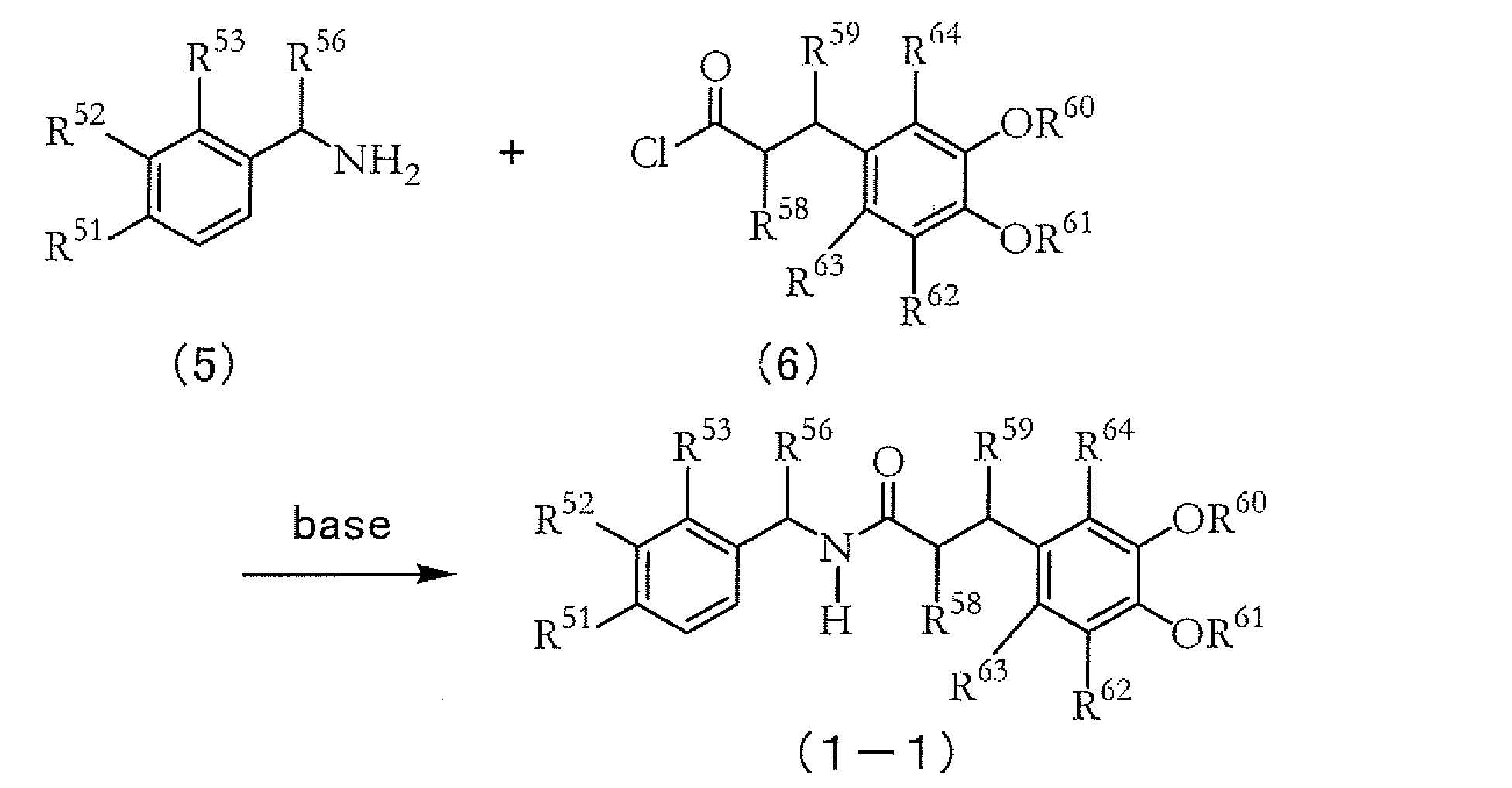
R51, R52, R53, R56, R58, R59, R60, R65 , R62, R63 and R64 represent same meaning as described above.
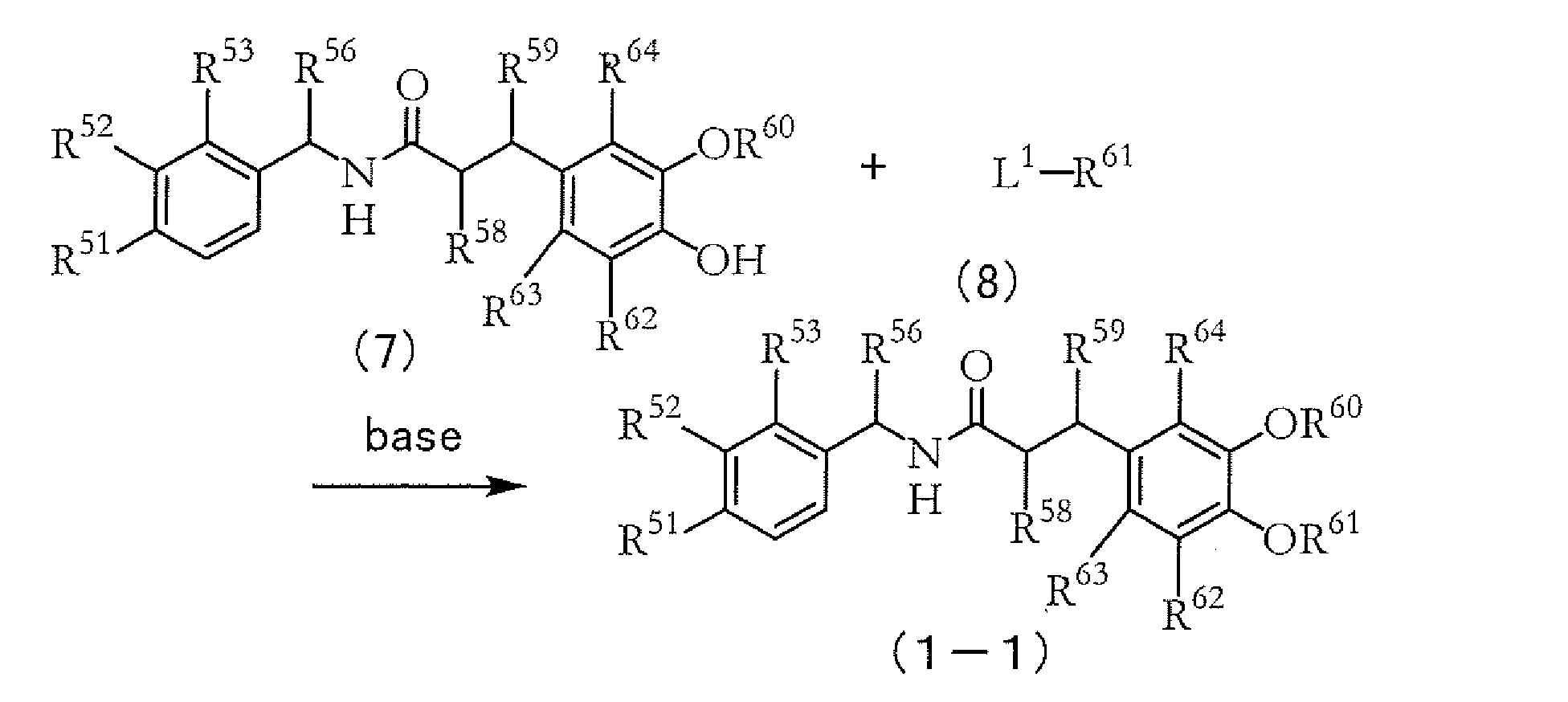
L1 represents a halogen atom, a methansulfonyloxy group, a trifluoromethanesulfonyloxy group or a p-toluenesulfonyloxy group, R51, R52 R53, R56, R58 R59, R60, R61, R62, R63 and R64 represent
same meaning as described above.
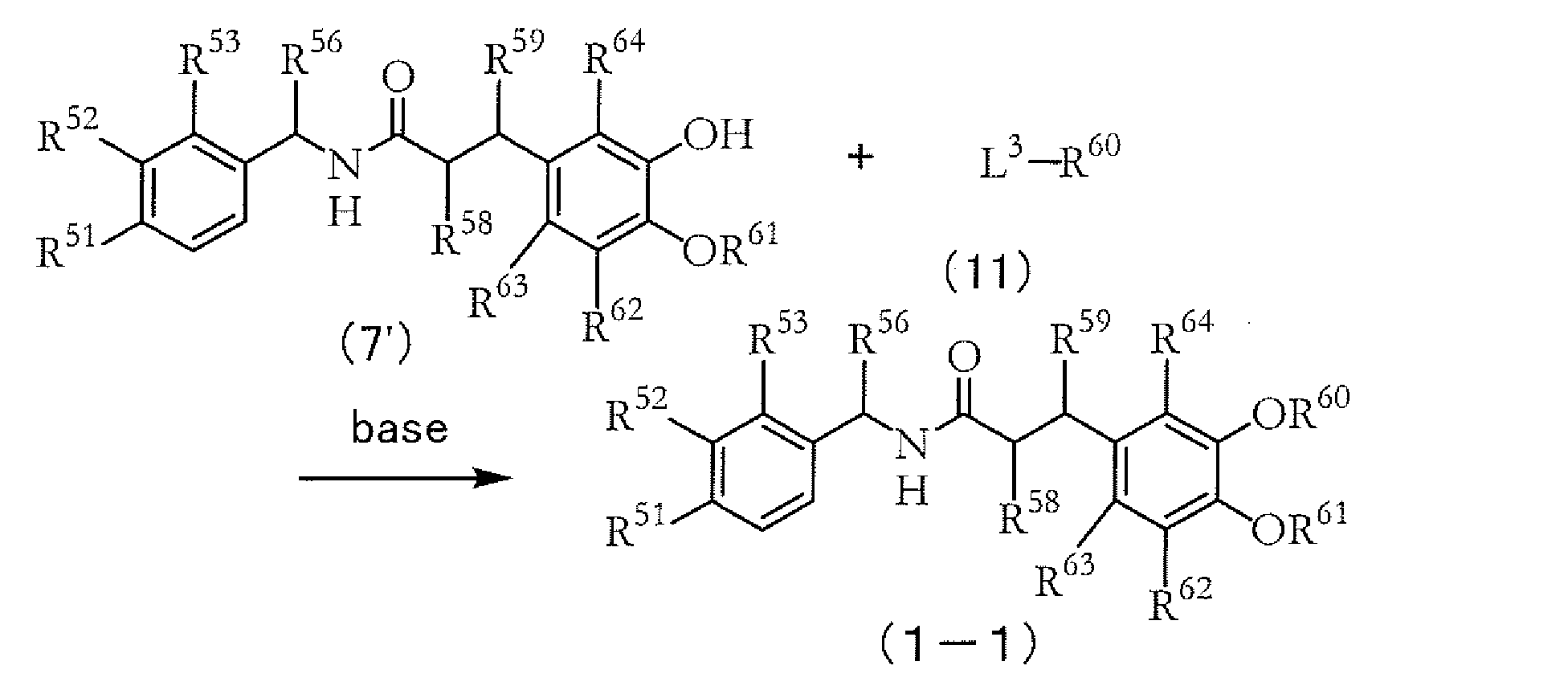
L3 represents a halogen atom, a methansulfonyloxy group, a trifluoromethanesulfonyloxy group or a p-toluenesulfonyloxy group, R51, R52, R53 R56, R58, R59, R60, R61, R62, R63 and R64 represent same meaning as described above.

L2 represents a halogen atom, a methansulfonyloxy group, a trifluoromethanesulfonyloxy group or a p-toluenesulfonyloxy group, R57-1 represents a C1-C4 alkyl group, a C3-C4 alkenyl group or a C3-C4 alkynyl group, R51, R52, R53, R56, R58, R59, R60, R61, R62, R63 and R64 represent same meaning as described above.

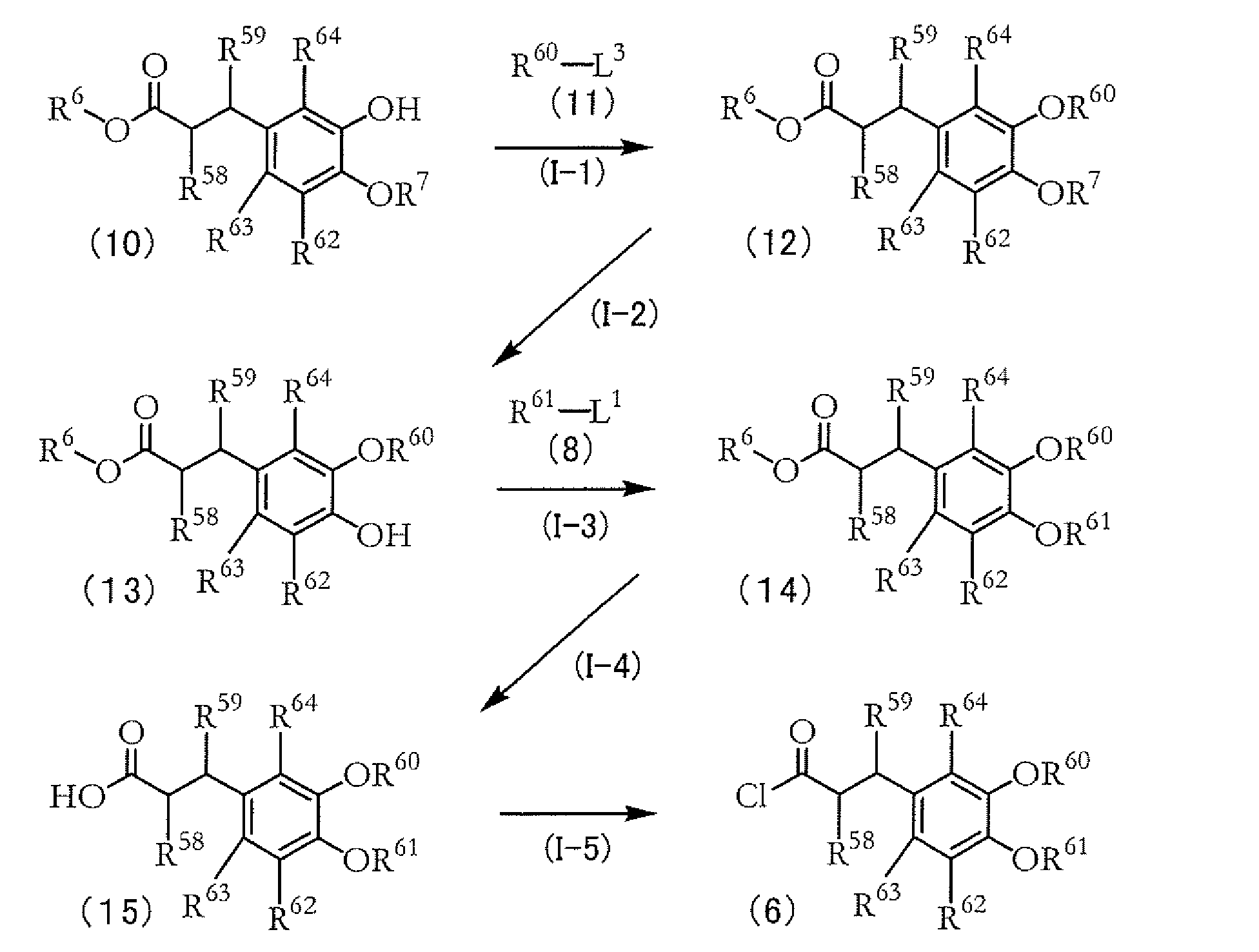
R6 represents a C1-C6 alkyl group, R7 represents a benzyl group or a methoxymethyl group, R58, R59, R60, R61, R62, R63, R64, L1 and L3 represent same meaning as described above.

R6 represents a C1-C6 alkyl group, R7 represents a benzyl group or a methoxymethyl group, R58, R59, R60, R62, R63, R64, L1 and L3 represent same meaning as described above.
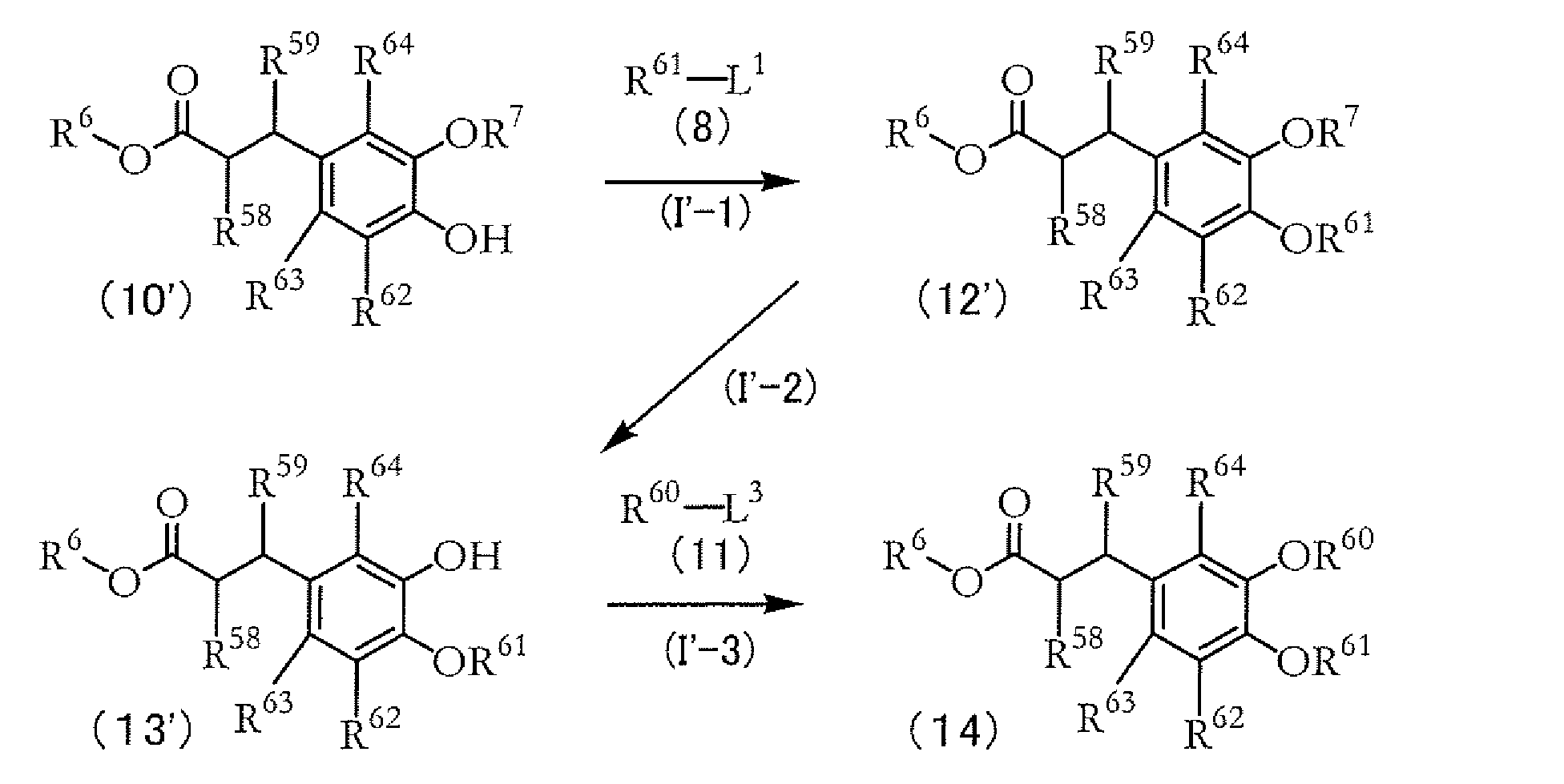
R6 represents a C1-C6 alkyl group, R7 represents a benzyl group or a methoxymethyl group, R58, R59, R60, R61, R62, R63, R64, L1 and L3 represent same meaning as described above.

R& represents a C1-C6 alkyl group, R7 represents a benzyl group or a methoxymethyl group, R58, R59, R61, R62, R63, R64, L1 and L3 represent same meaning as described above.
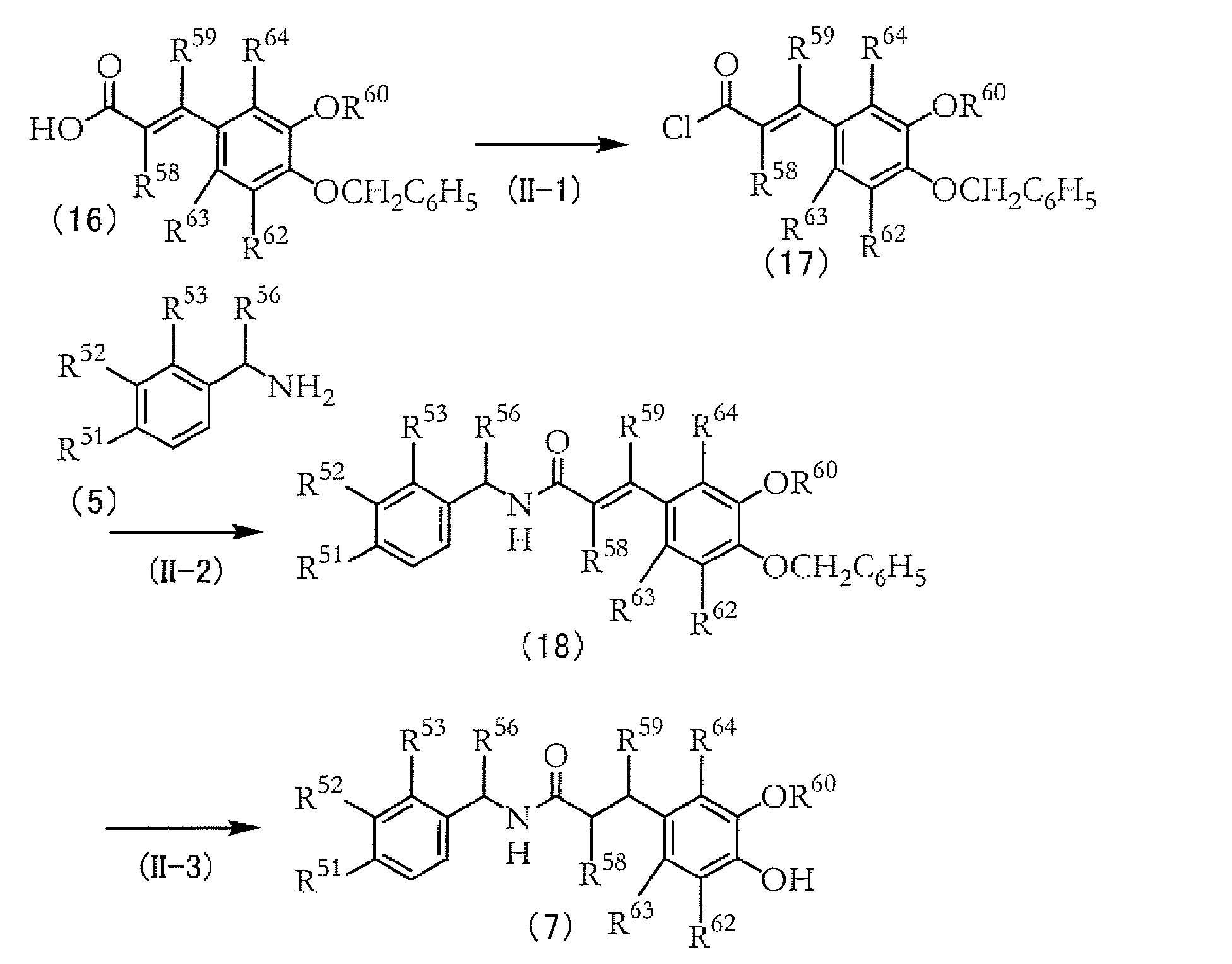
R51, R52, R53, R56, R58, R59, R60, R61, R62, R63, R64 represent same meaning as described above.
The hydrogenation catalyst used for the reaction includes, for example, transition metal compounds such as palladium charcoal, palladium hydroxide, Raney nickel, platinum oxide and the like. The acid used for the reaction includes, for example, such as hydrochloric acid.

R51, R52, R53, R56, R58, R59, R60, R61, R62, R63, R64 represent same meaning as described above.

R51, R52 and R53 represent same meaning as described above.
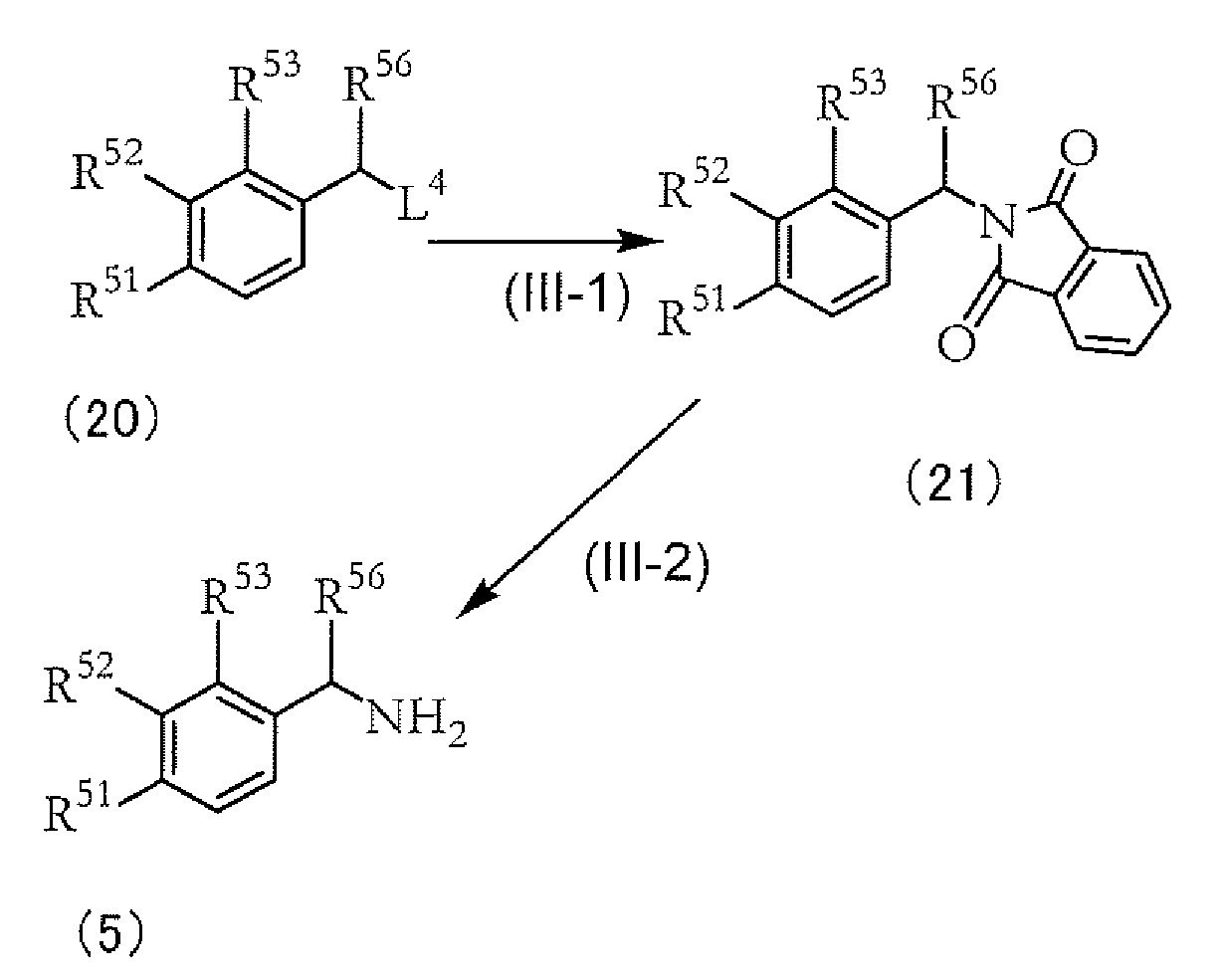
R51, R52 , R53 and R56 represent same meaning as described above, L4 represents a chlorine atom or a bromine atom.

R51, R52, R53, and R56 represent same meaning as described above.
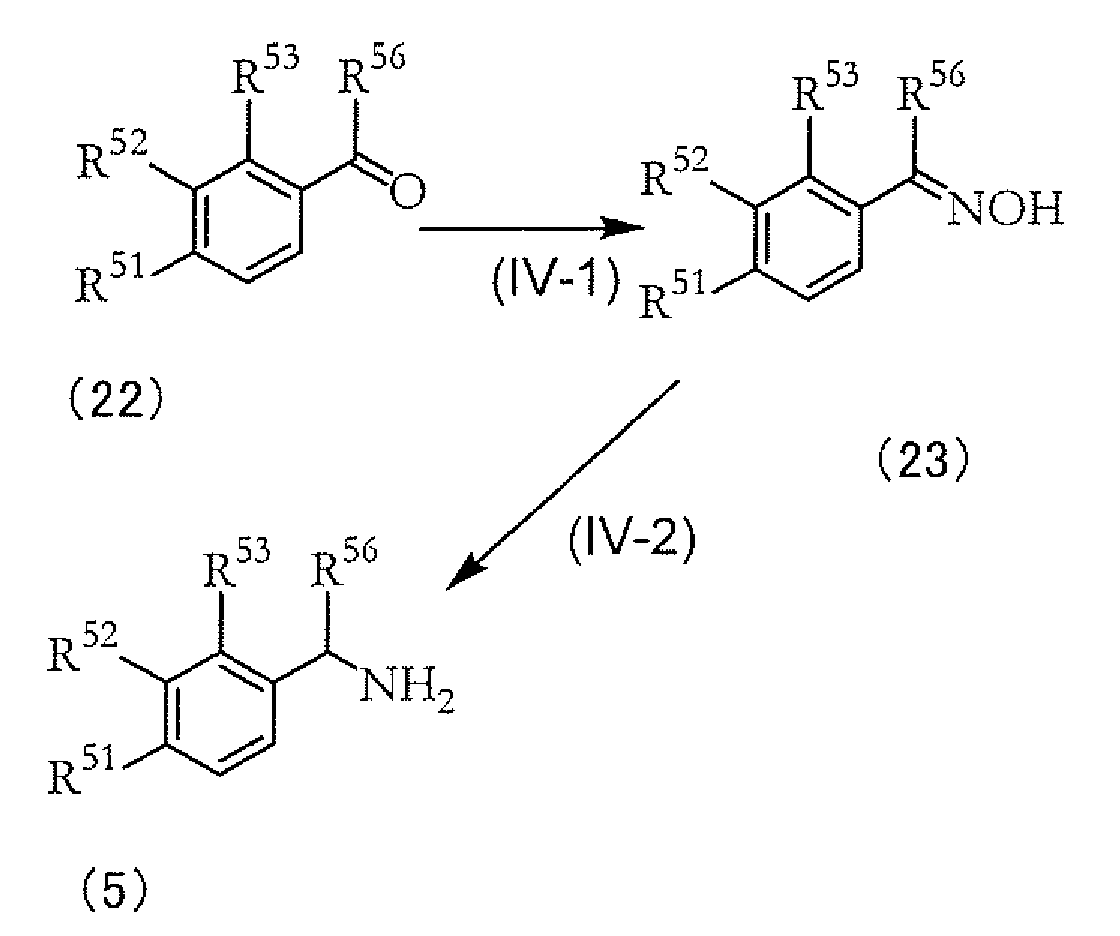
R51, R52, R53, and R56 represent same meaning as described above.
Peronospora brassicae of vegetables and radishes; Peronospora spinaciae of spinach; Peronospora tabacina of tobacco; Pseudoperonospora cubensis of gourds; Plasmopara viticola of grapes; Phytophthora cactorum of apple, strawberry and ginseng; Phytophora capsici of tomato and cucumber; Phytophthora cinnamomi of pineapple; Phytophthora infestans of potato and tomato; Phytophthora nicotianae var. nicotianae of tobacco, broad bean and leek; Pythium sp. of spinach; Pythium aphanidermatum of cucumber; Pythium sp. of wheat; Pythium debaryanum of tobaco; and Pythium rot of soybean (Pythium aphanidermatum, P. debaryanum, P. irregulare, P. myriotylum, P. ultimum).
chlorothalonil; fluazinam; dichlofluanid; fosetyl-Al; cyclic imide derivatives such as captan, captafol, folpet and the like; dithiocarbamate derivatives such as maneb, mancozeb, thiuram, ziram, zineb, propineb and the like; inorganic or organic copper derivatives such as basic copper sulfate, basic copper chloride, copper hydroxide, copper-oxinate and the like; acylalanine derivatives such as metalaxyl, furalaxyl, ofurace, cyprofuram, benalaxyl, oxadixyl and the like; strobilurine like compound such as kresoxim-methyl, azoxystrobin, trifloxystrobin, picoxystrobin, pyraclostrobin, dimoxystrobin and the like; anilinopyrimidine derivatives such as cyprodinil, pyrimethanil, mepanipyrim and the like; phenyl pyrrole derivatives such as fenpiclonil, fludioxonil and the like; imide derivatives such as procymidone, iprodione, vinclozolin and the like; benzimidazole derivatives such as carbendazim, benomyl, thiabendazole, thiophanate methyl and the like; aminederivatives such as fenpropimorph, tridemorph, fenpropidin, spiroxamine and the like; azole derivatives such as propiconazole, triadimenol, prochloraz, penconazole, tebuconazole, flusilazole, diniconazole, bromuconazole, epoxiconazole, difenoconazole, cyproconazole, metconazole, triflumizole, tetraconazole, myclobutanil, fenbuconazole, hexaconazole, fluquinconazole, triticonazole, bitertanol, imazalil, flutriafol and the like; cymoxanil; dimethomorph; famoxyadone, fenamidone; iprovalicarb; benthiavalicarb; cyazofamid, zoxamide, ethaboxam; nicobifen; fenhexamid; quinoxyfen; diethof encarb and acibenzolar S-methyl.
amide compounds shown by formula(i) to (xxxxxv)







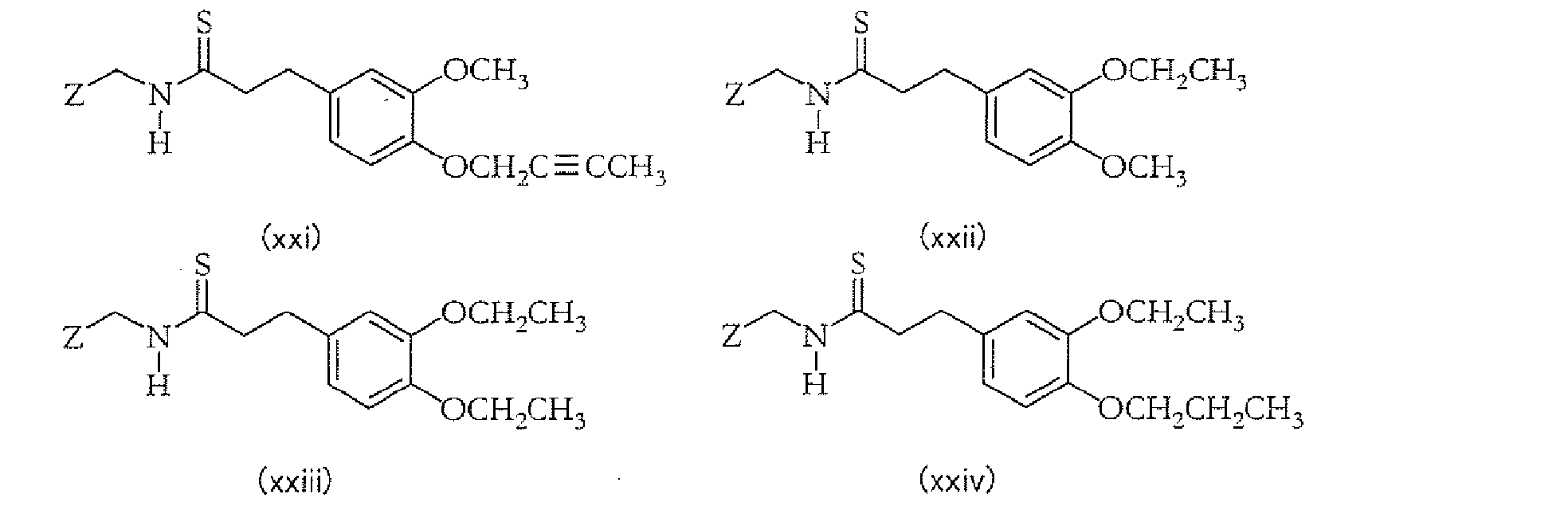






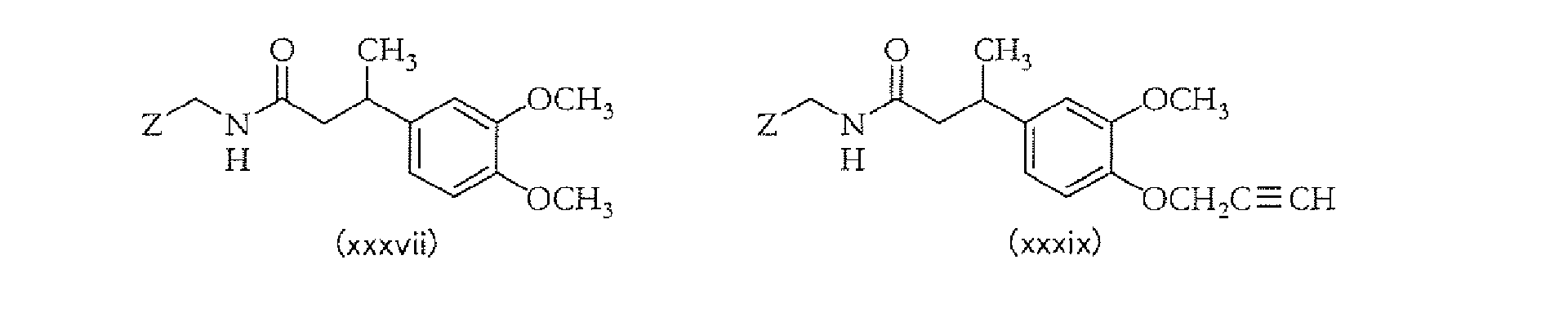







4-fluorophenylgroup,4-chlorophenyl group, 4-bromophenyl group, 4-iodophenyl group, 4-methylphenyl group, 4-ethylphenyl group, 4-propylphenyl group, 4-isopropylphenyl group, 4-butylphenyl group, 4-(sec-butyl)phenyl group, 4-isobutylphenyl group, 4-(tert-butyl)phenyl group, 4-vinylphenyl group, 4-(1-methylvinyl)phenyl group, 4-(1-propenyl)phenyl group, 4-(2-methyl-1-propenyl) phenyl group, 4-(1-butenyl) phenyl group, 4-ethynylphenyl group, 4-(1-propynyl)phenyl group, 4-(1-butynyl)phenyl group, 4-(1-pentanyl)phenyl group, 4-(3-methyl-1-butynyl)phenyl group, 4- (3, 3-dimethyl-1-butynyl)phenyl group, 4- (fluoromethyl) phenyl group, 4-(difluoromethyl) phenyl group, 4-(trifluoromethyl)phenyl group, 4-methoxyphenyl group, 4-ethoxyphenyl group, 4-(fluoromethoxy)phenyl group, 4-(difluoromethoxy)phenyl group, 4-(trifluoromethoxy)phenyl group, 4-cyanophenyl group, 4-(N,N-dimethylamino)phenyl group, 4- (N, N-diethylamino)phenyl group, 4-(N,N-dipropylamino)phenyl group, 3,4-difluorophenylgroup, 4-chloro-3-fluorophenyl group, 4-bromo-3-fluorophenyl group, 3-fluoro-4-methylphenyl group, 4-ethyl-3-fluorophenyl group, 3-fluoro-4-(trifluoromethyl)phenyl group, 3-fluoro-4-methoxyphenyl group, 4-cyano-3-fluorophenyl group, 4-fluoro-3-chlorophenyl group, 3,4-dichlorophenyl group, 4-bromo-3-chlorophenyl group, 3-chloro-4-methylphenyl group, 3-chloro-4-ethylphenyl group, 3-chloro-4-(trifluoromethyl)phenyl group, 3-chloro-4-methoxyphenyl group, 4-cyano-3-chlorophenyl group, 3-bromo-4-fluorophenyl group, 3-bromo-4-chlorophenyl group, 3,4-dibromophenyl group, 3-bromo-4-methylphenyl group, 3-bromo-4-ethylphenyl group, 3-bromo-4-(trifluoromethyl)phenyl group, 3-bromo-4-methoxyphenyl group, 3-bromo-4-cyanophenyl group, 4-fluoro-3-methylphenyl group, 4-chloro-3-methylphenyl group, 4-chloro-3-methylphenyl group, 3,4-dimethylphenyl group, 4-ethyl-3-methylphenyl group, 3-methyl-4-(trifluoromethyl)phenyl group, 4-methoxy-3-methylphenyl group, 4-cyano-3-methylphenyl group, 3-ethyl-4-fluoromethyl group, 4-chloro-3-ethylphenyl group, 4-bromo-3-ethylphenyl group, 3-ethyl-4-methylphenyl group, 3,4-diethylphenyl group, 3-ethyl-4-(trifluoromethyl)phenyl group, 3-ethyl-4-methoxyphenyl group, 4-cyano-3-ethylphenyl group, 4-fluoro-3-(trifluoromethyl)phenyl group, 4-chloro-3-(trifluoromethyl)phenyl group, 4-bromo-3-(trifluoromethyl)phenyl group, 4-methyl-3-(trifluoromethyl)phenyl group, 4-ethyl-3-(trifluoromethyl)phenyl group, 3,4-di-(trifluoromethyl)phenyl group, 4-methoxy-3-(trifluoromethyl)phenyl group, 4-cyano-3-(trifluoromethyl)phenyl group, 4-methoxycarbonylphenyl group, 4-ethoxycarbonylphenyl group, 4-phenylphenyl group, 3-fluoro-4-phenylphenyl group, 3-chloro-4-phenylphenyl group, 3-bromo-4-phenylphenyl group, 3-methyl-4-phenylphenyl group, 3-ethyl-4-phenylphenyl group, 4-phenoxyphenyl group, 3-fluoro-4-phenoxyphenyl group, 3-chloro-4-phenoxyphenyl group, 3-bromo-4-phenoxyphenyl group, 3-methyl-4-phenoxyphenyl group, 3-ethyl-4-phenoxyphenyl group, 4-nitrophenyl group, 3-fluoro-4-nitrophenyl group, 3-chloro-4-nitrophenyl group, 3-bromo-4-nitrophenyl group, 3-methyl-4-nitrophenyl group, 3-ethyl-4-nitrophenyl group, 4-methylthiophenyl group, 3-fluoro-4-methylthiophenyl group, 3-chloro-4-methylthiophenylgroup, 3-bromo-4-methylthiophenyl group, 3-methyl-4-methylthiophenyl group, 3-ethyl-4-methylthiophenyl group,
Indan-5-yl group, 5,6,7,8-tetrahydronaphthalene-2-yl group, 6,7,8,9-tetrahydro-5H-benzocycloheptene-2-yl group, 5,6,7,8,9,10-hexahydro-benzocyclooctene-2-yl group, 2-naphthyl group, 4-fluoronaphthalene-2-yl group, 5-fluoronaphthalene-2-yl group, 6-fluoronaphthalene-2-yl group, 7-fluoronaphthalene-2-yl group,4-chloronaphthalene-2-yl group, 5-chloronaphthalene-2-yl group, 6-chloronaphthalene-2-yl group, 7-chloronaphthalene-2-yl group, 4-bromonaphthalene-2-yl group, 5-bromonaphthalene-2-yl group, 6-bromonaphthalene-2-yl group, 7-bromonaphthalene-2-yl group, 4-methylnaphthalene-2-yl group, 5-methylnaphthalene-2-yl group, 6-methylnaphthalene-2-yl group, 7-methylnaphthalene-2-yl group, 4-methoxynaphthalene-2-yl group, 5-methoxynaphthalene-2-yl group, 6-methoxynaphthalene-2-yl group, 7-methoxynaphthalene-2-yl group, 4-trifluoromethylnaphthalene-2-yl group, 5-trifluoromethylnaphthalene-2-yl group, 6-trifluoromethylnaphthalene-2-yl group, 7-trifluoromethylnaphthalene-2-yl group, 5,6-difluoronaphthalene-2-yl group, 5,6-dichloronaphthalene-2-yl group, 5,6-dimethylnaphthalene-2-yl group, 5-fluoro-6-methylnaphthalene-2-yl group, 6-fluoro-5-methylnaphthalene-2-yl group, 5-chloro-6-methylnaphthalene-2-yl group, 6-chloro-5-methylnaphthalene-2-yl group, 6-chloro-5-fluoronaphthalene-2-yl group, 5-chloro-6-fluoronaphthalene-2-yl group, 4-(2-fluorovinyl)phenyl group, 4- (2-chlorovinyl) phenyl group, 4-(2-bromovinyl)phenyl group, 4-(2,2-difluorovinyl)phenyl group, 4-(2,2-dichlorovinyl)phenyl group, 4-(2,2-dibromovinyl)phenyl group, 4-(1-methyl-2,2-dichlorovinyl)phenyl group, 4-(1-methyl-2,2-dibromovinyl)phenyl group, 4-chloroethynylphenyl group, 4-bromoethynylphenyl group, 4-iodoethynylphenyl group, 4-methoxymethylphenyl group, 4-ethoxymethylphenyl group, 4-propyloxymethylphenyl group, 4-(1-methoxyethyl)phenyl group, 4-(2-methoxyethyl) phenyl group, 4-(2-methoxypropyl) phenyl group, 4-(2-methoxyisopropyl) phenyl group, 4-phenoxymethylphenyl group, 4-(1-phenoxyethyl)phenyl group, 4-(2-phenoxyethyl)phenyl group, 4-(1-phenoxypropyl)phenyl group, 4-(3-phenoxypropyl)phenyl group, 4- (4-phenoxybutyl) phenylgroup, 4- (hydroxymethyl) phenyl group, 4-(1-hydroxyethyl)phenyl group, 4-(2-hydroxyethyl)phenyl group, 4-(1-hydroxypropyl)phenyl group, 4-(1-hydroxybutyl)phenyl group, 4-methylsulfonyloxymethyl)phenyl group, 4-ethylsultonyloxymethyl)phenyl group, 4-(1-methylsulfonyloxyethyl)phenyl group, 4-(2-sulfonyloxyethyl)phenyl group, 4-(1-methylsulfonyloxypropyl)phenyl group, 4-carbonylphenyl group, 4-methylcarbonylphenyl group, 4-ethylcarbonylphenyl group, 4-propylcarbonylphenylgroup, 4-isopropylcarbonylphenyl group, 4-methoxyiminomethylphenyl group, 4-(1-methoxyiminoethyl)phenyl group, 4-(1-methoxyiminopropyl)phenyl group, 4-(1-methoxyiminobutyl)phenyl group, 4-ethoxyiminomethylphenylgroup, 4-(1-ethoxyiminoethyl)phenyl group, 4-propoxyiminomethylphenyl group, 4-(1-isopropoxyiminoethyl)phenyl group, 4-(butoxyiminomethyl)phenyl group, 4-pentyloxyiminomethylphenyl group, 4-(1-hexyloxyiminoethyl)phenyl group, 4-benzyloxyiminomethylphenyl group, 4-(1-benzyloxyiminoethyl)phenyl group, 4-(1-benzyloxyiminopropyl)phenyl group, 4-(1-benzyloxyiminobutyl)phenyl group, 4-dimethylaminoiminomethylphenyl group, 4-(1-dimethylaminoiminoethyl)phenyl group, 4-diethylaminoiminomethylphenyl group, 4-(1-diethylaminoiminoethyl)phenyl group, 4-trimethylsilylphenyl group, 4-triethylsilylphenyl group, 4-tert-butyldimethylsilylphenyl group.
the compound of the present invention 1

the compound of the present invention 2

the compound of the present invention 3

the compound of the present invention 4

the compound of the present invention 5

the compound of the present invention 6

the compound of the present invention 7

the compound of the present invention 8

the compound of the present invention 9

the compound of the present invention 10

the compound of the present invention 11

the compound of the present invention 12

the compound of the present invention 13

the compound of the present invention 14

the compound of the present invention 15

the compound of the present invention 16

the compound of the present invention 17

the compound of the present invention 18

the compound of the present invention 19

the compound of the present invention 20

the compound of the present invention 21

the compound of the present invention 22

the compound of the present invention 23

the compound of the present invention 24

the compound of the present invention 25

the compound of the present invention 26

the compound of the present invention 27

the compound of the present invention 28

the compound of the present invention 29

the compound of the present invention 30

the compound of the present invention 31

the compound of the present invention 32

the compound of the present invention 33

the compound of the present invention 34

the compound of the present invention 35

the compound of the present invention 36

the compound of the present invention 37

the compound of the present invention 38

the compound of the present invention 39

the compound of the present invention 40

the compound of the present invention 41

the compound of the present invention 42

the compound of the present invention 43

the compound of the present invention 44

the compound of the present invention 45

the compound of the present invention 46

the compound of the present invention 47

the compound of the present invention 48

the compound of the present invention 49

the compound of the present invention 50

the compound of the present invention 51

the compound of the present invention 52

the compound of the present invention 53

the compound of the present invention 54

the compound of the present invention 55

the compound of the present invention 56

the compound of the present invention 57

the compound of the present invention 58

the compound of the present invention 59

the compound of the present invention 60

the compound of the present invention 61

the compound of the present invention 62

the compound of the present invention 63

the compound of the present invention 64

the compound of the present invention 65

the compound of the present invention 66

the compound of the present invention 67

the compound of the present invention 68

the compound of the present invention 69

the compound of the present invention 70

the compound of the present invention 71

the compound of the present invention 72

the compound of the present invention 73

the compound of the present invention 74

the compound of the present invention 75


the compound of the present invention 77

the compound of the present invention 78

the compound of the present invention 79

the compound of the present invention 80

the compound of the present invention 81

the compound of the present invention 82

the compound of the present invention 83

the compound of the present invention 84

the compound of the present invention 85

the compound of the present invention 86

the compound of the present invention 87

the compound of the present invention 88

the compound of the present invention 89

the compound of the present invention 90

the compound of the present invention 91

the compound of the present invention 92

the present invention 93

the compound of the present invention 94

the present invention 95

the present invention 96

the compound of the present invention 97

the compound of the present invention 98

the compound of the present invention 99

the compound of the present invention 100

the compound of the present invention 101



the compound of the present invention 104

the compound of the present invention 105

the compound of the present invention 106

the compound of the present invention 107

the compound of the present invention 108

the compound of the present invention 109

the compound of the present invention 110

the compound of the present invention 111

the compound of the present invention 112

the compound of the present invention 113

the compound of the present invention 114

the compound of the present invention 115

the compound of the present invention 116

the compound of the present invention 117

the compound of the present invention 118

the compound of the present invention 119

the compound of the present invention 120

the compound of the present invention 121

the compound of the present invention 122

the compound of the present invention 123

the compound of the present invention 124

the compound of the present invention 125

the compound of the present invention 126

the compound of the present invention 127

the compound of the present invention 128

the compound of the present invention 129





















1H-NMR (CDCl3, TMS) δ (ppm): 9.82 (1H, s), 7.28-7.44 (7H, m), 6.98 (1H, d, J=8.2 Hz), 5.24 (2H, s), 4.18 (2H, q, J=7.0 Hz), 1.49 (3H, t, J=7.0 Hz)


1H-NMR (CDCl3, TMS) δ (ppm): 7.28-7.57 (7H, m), 6.89 (1H, d, J=8.3 Hz), 5.23 (2H, s), 3.94 (3H, s), 2.54 (3H, s)




1H-NMR (CDCl3, TMS) δ (ppm): 9.80 (1H, s), 7.30-7.48 (7H, m), 6.98 (1H, d, J=8.7 Hz), 5.118 (2H, s), 3.95 (3H, s)











1H-NMR (CDCl3, TMS) δ (ppm): 7.80-7.83 (3H, m), 7.74 (1H, s), 7.41-7.49 (3H, m), 4.03 (2H, s), 1.62 (2H, br.s)










1H-NMR (CDCl3, TMS) δ (ppm) : 8.06 (1H, s), 7.81 (1H, br.s), 7.39 (1H, d, J=1.0 Hz), 7.34 (1H, dd, J=8.4 Hz, 2.0 Hz), 6.81 (1H, d, J=8.4 Hz), 3.84 (3H, s), 2.22 (3H, s)
1H-NMR (DMSO-d6, TMS) δ (ppm) : 8.26 (3H, br.s), 7.23-7.28 (2H, m), 6.94 (1H d, J=8.2 Hz), 3.88 (2H, s), 3.77 (3H, s), 2.13 (3H, s)
1H-NMR (CDCl3, TMS) δ (ppm): 8.11 (1H, s), 7.54 (2H, d, J=8.7 Hz), 7.32-7.40 (3H, m), 7.15 (1H, t, J=7.4 Hz), 7.04 (2H, d, J=7.7 Hz), 6.99 (2H, d, J=8.7 Hz)
1H-NMR (DMSO-d6, TMS) δ (ppm) : 8.32 (3H, br.s), 7.48 (2H, d, J=8.7 Hz), 7.36-7.43 (2H, m), 7.15 (1H, t, J=7.4 Hz), 6.95-7.04 (4H, m), 3.97 (2H, s)

1H-NMR (CDCl3, TMS) δ (ppm): 7.61 (2H, d, J=8.2 Hz), 7. 44 (2H, d, J=7.9 Hz), 3.95 (2H, s), 1.55 (2H, br.s)
1H-NMR (CDCl3, TMS) δ (ppm): 8.08 (1H, s), 7.50 (2H, d, J=8.8 Hz), 7.30-7.47 (5H, m), 6.98 (2H, d, J=8.7 Hz), 5.09 (2H, s)
1H-NMR (DMSO-d6, TMS) δ (ppm) : 9.68 (1H, br.s), 8.31 (3H, br.s), 7.28 (2H, d, J=7.6Hz) 6.79 (2H, d, J=7.6Hz), 3.84-3.88 (2H, m)
1H-NMR (CDCl3, TMS) δ (ppm) : 10.1 (1H, s), 8.29 (1H, s), 7.80-7.95 (3H, m), 7 . 68 (1H, s), 7.42 (1H, dd, J=8.4 Hz, 1.6 Hz), 2.56 (3H, s)
1H-NMR (CDCl3, TMS) δ (ppm): 8.27 (1H, s), 7.83 (1H, s), 7. 71-7, 81 (3H, m), 7.60 (1H, s), 7.41 (1H, s), 7.34 (1H, dd, J=8.5 Hz, 1.7 Hz), 2.51 (3H, s)
1H-NMR (DMSO-d6, TMS) δ (ppm): 8.64 (3H, br.s), 7.96 (1H, s), 7.86 (1H, d, J=8.7 Hz), 7.80 (1H, d, J=8.3 Hz), 7.71 (1H, s), 7.60-7.64 (1H, m), 7.37-7.43 (1H, m), 4. 10-4.20 (2H, m), 2.48 (3H, s)
1H-NMR (CDCl3, TMS) δ (ppm): 10.1 (1H, s), 8.25 (1H, s), 7.89 (2H, d, J=0.8 Hz), 7.81 (1H, d, J=8.3 Hz), 7.77 (1H, s), 7.48 (1H, dd, J=8.7 Hz, 1.5 Hz), 2.55 (3H, s)
1H-NMR (CDCl3, TMS) δ (ppm): 8.27 (1H, s), 7.70-7, 82 (4H, m), 7.61 (1H, s), 7.50 (1H, br.s), 7.34 (1H, dd, J=8.3 Hz, 1.7 Hz), 2.51 (3H, s)
1H-NMR (DMSO-d6, TMS) δ (ppm): 8.54 (3H, br.s), 7.89-7.93 (2H, m), 7.84 (1H, d, J=8.3 Hz), 7.66 (1H, s), 7.56 (1H, dd, J=8.5 Hz, 1.6 Hz), 7.39 (1H dd, J=8.5 Hz, 1.6 Hz), 4.16 (2H, s), 2.48 (3H, s)
1H-NMR (CDCl3, TMS) δ (ppm): 7.20-7.35 (4H, m), 3.80 (1H, t, J=7.6 Hz), 2.90 (1H, ddd, J=17 Hz, 7.6 Hz, 2.7 Hz), 2.64 (1H, ddd, J=17 Hz, 7.6 Hz, 2.7 Hz), 1.97 (1H, t, J=2.7 Hz)

1H-NMR (CDCl3, TMS) δ (ppm): 7.27-7.30 (4H, m), 4. 10 (1H, q, J=6.5 Hz), 1.56 (2H, br.s), 1.36 (3H, d, J=6.5 Hz)
1H-NMR (CDCl3, TMS) δ (ppm): 7.76-7.84 (4H, m), 7.41-7.54 (3H, m), 4.28 (1H, q, J=6.6 Hz), 1.59 (2H, br.s), 1.46 (3H, d, J=6.5 Hz)
1H-NMR (CD3SOCD3, TMS) δ (ppm): 8.51 (3H, br.s), 7.19-7.22 (2H, m), 7.08 (1H, d, J=8.0 Hz), 4.23-4.29 (1H, m), 2.70-2.71 (4H, m), 1.72-1.74 (4H, m), 1.48 (3H, d, J=6.8 Hz)
1H-NMR (CDCl3, TMS) δ (ppm): 7.37 (1H, t, J=8.0 Hz), 7.12-7.17 (1H, m), 7.08 (1H, dd, J=9.7 Hz, 1.9 Hz), 4.73 (2H, s), 2.04 (1H, br.s)
1H-NMR (CDCl3, TMS) δ (ppm): 7.37-7.43 (1H, m), 7.14-7.22 (2H, m), 5.25 (2H, s), 3.01 (3H, s)

1H-NMR (CD3SOCD3, TMS) δ (ppm) : 8.36 (3H, br. s), 7.51-7.68 (2H, m), 7.40 (1H, d, J=8.4 Hz), 4.04 (2H, s)
1H-NMR (CDCl3, TMS) δ (ppm): 7.33-7.39 (1H, m), 7.15-7.20 (1H, m), 7.05-7.09 (1H, m), 4.67 (2H, s), 1.83 (1H, br.s)
1H-NMR (CDCl3, TMS) δ (ppm): 7.42-7.46 (1H, m), 7.20-7.24 (1H, m), 7.12-7.17 (1H, m), 5.19 (2H, s), 3.00 (3H, s)

1H-NMR (CD3SOCD3, TMS) δ (ppm): 8.35 (3H, br.s), 7.56-7.70 (2H, m), 7.33-7.49 (1H, m), 4.05 (2H, s)
1H-NMR (CDCl3, TMS) δ (ppm) : 10.1 (1H, s), 8.33 (1H, s), 7.95-8.05 (2H, m), 7.88 (1H, d, J=8.4 Hz), 7.52 (1H, dd, J=9.4 Hz, 2.4 Hz), 7.37 (1H, dt, J=8.6 Hz, 2.4 Hz)
1H-NMR (CDCl3, TMS) δ (ppm) : 8.26 (1H, s), 7.75-7.90 (4H, m), 7.42-7.47 (2H, m), 7.28 (1H, dt, J=8.8 Hz, 2.6 Hz)












1H-NMR (CDCl3, TMS) δ (ppm): 7.48-7.51 (2H, m), 7.31 (2H, d, J=8.0 Hz), 3.86 (2H, s), 1.43 (2H, br.s), 0.25 (9H, s)







Claims (38)
- An amide compound represented by the formula (1):wherein, in the formula,

R51 represents a halogen atom, a C1-C6 alkyl group, a C3-C6 cycloalkyl group, a C1-C6 haloalkyl group, a C2-C6 alkenyl group, a C2-C6 haloalkenyl group, a C2-C6 alkynyl group, a C2-C6 haloalkynyl group, a C1-C6 alkoxy group, a C3-C6 alkenyloxy group, a C3-C6 alkynyloxy group, a C1-C6 haloalkoxy group, a (C1-C6 alkoxy)C1-C6 alkyl group, a phenoxy C1-C6 alkyl group, a C1-C6 hydroxyalkyl group, a (C1-C6alkyl) sulfonyloxy C1-C6 alkyl group, a C1-C6 alkylthio group, a C1-C6 haloalkylthio group, a C1-C6 alkylamino group, a di (C1-C6alkyl) amino group, a formyl group, a (C1-C6 alkyl) carbonyl group, a (C1-C6 alkoxy) carbonyl group, a (C1-C6 alkoxy) imino C1-C6 alkyl group, benzyloxyimino C1-C6 alkyl group, a di(C1-C6 alkylamino) imino C1-C6 alkyl group, a tri(C1-C6 alkyl) silyl group, a phenyl group, a phenoxy group, a cyano group or a nitro group; R52 represents a hydrogen atom, a halogen atom, a C1-C6 alkyl group, a C1-C6 haloalkyl group, a C2-C6 alkenyl group, a C2-C6 alkynyl group, a cyano group or a nitro group; or both of R51 and R52 are combined together to represent a C3-C6 alkylene group or a group of -CR65=CR66-CR67=CR68-(R65, R66, R67 and R68 independently represent a hydrogen atom, a halogen atom, a C1-C3 alkyl group, a C1-C3 alkoxy group or a C1-C3 haloalkyl group);
R53 represents a hydrogen atom, a halogen atom, a C1-C3 alkyl group or a C1-C3 haloalkyl group;
R56 represents a hydrogen atom, a C1-C4 alkyl group, a C2-C4 alkenyl group or a C2-C4 alkynyl group;
R57 represents a hydrogen atom, a C1-C4 alkyl group, a C2-C4 alkenyl group or a C2-C4 alkynyl group;
R 58 and R59 independently represent a hydrogen atom, a halogen atom or a C1-C3 alkyl group;
R60 represents a C1-C4 alkyl group, a C1-C4 haloalkyl group, a C3-C4 alkenyl group or a C3-C6 alkynyl group;
R61 represents a C1-C4 alkyl group, a C1-C4 haloalkyl group, a C3-C4 alkenyl group or a C3-C6 alkynyl group or a C2-C4 cyanoalkyl group;
each of R62, R63 and R64 represents a hydrogen atom, a halogen atom or a C1-C2 alkyl group;
X represents an oxygen atom or a sulfur atom. - The amide compound according to claim 1, wherein R51 is a halogen atom, a C1-C6 alkyl group, a C3-C6 cycloalkyl group, a C1-C6 haloalkyl group, aC2-C6alkenyl group, a C2-C6 haloalkenyl group, a C2-C6 alkynyl group, a C2-C6 haloalkynyl group, a C1-C6 alkoxy group, a C3-C6 alkenyloxy group, a C3-C6 alkynyloxy group, a C1-C6 haloalkoxy group, a (C1-C6alkoxy) C1-C6 alkyl group, a phenoxy C1-C6 alkyl group, a C1-C6 hydroxyalkyl group, a (C1-C6 alkyl) sulfonyloxy C1-C6 alkyl group, a C1-C6 alkylthio group, a C1-C6 haloalkylthio group, a C1-C6 alkylamino group, a di (C1-C6 alkyl) amino group, a formyl group, a (C1-C6 alkyl) carbonyl group, a (C1-C6 alkoxy) carbonyl group, a (C1-C6 alkoxy) imino C1-C6 alkyl group, a benzyloxyimino C1-C6 alkyl group, a di (C1-C6 alkylamino) imino C1-C6 alkyl group, tri (C1-C6 alkyl) silyl group, a phenyl group, a phenoxy group, a cyano group or a nitro group; R52 is a hydrogen atom, a halogen atom, a C1-C6 alkyl group, a C1-C6 haloalkyl group, a C2-C6 alkenyl group, a C2-C6 alkynyl group, a cyano group or a nitro group.
- The amide compound according to claim 1, wherein the group which R51 and R52 are combined together is a group of -CR65=CR66-CR67=CR68- (R65, R66, R67 and R68 is independently a hydrogen atom, a halogen atom, a C1-C3 alkyl group, a C1-C3 alkoxy group or a C1-C3 haloalkyl group).
- The amide compound according to any one of claim 1 to 3, wherein R53 is a hydrogen atom.
- The amide compound according to any one of claim 1 to 4, wherein R62, R63 and R64 are hydrogen atoms.
- The amide compound according to anyone of claim 1 to 5, wherein R58 and R59 is independently a hydrogen atom, a fluorine atom or a methyl group.
- The amide compound according to any one of claim 1 to 5, wherein R58 and R59 are hydrogen atoms.
- The amide compound according to any one of claim 1 to 7, wherein R56 is a hydrogen atom.
- The amide compound according to claim 1, wherein R51 is a halogen atom, a C1-C4 alkyl group, a C1-C4 haloalkyl group, a C2-C4 alkenyl group, a C2-C4 alkynyl group, a C1-C4 alkoxy group, a C1-C4 haloalkoxy group, a C1-C4 alkylamino group, a di (C1-C4alkyl) amino group or a cyano group; R52 is a hydrogen atom, a halogen atom, a C1-C4 alkyl group, a C1-C4 haloalkyl group, a C2-C4 alkenyl group or a C2-C4 alkynyl group; or both of R51 and R52 are combined together to be a C3-C5 alkylene group or a group of -CH=CH-CH=CH-;
R57 is a hydrogen atom or a C1-C3 alkyl group;
R60 is a C1-C4 alkyl group, a C1-C4 haloalkyl group, a C3-C4 alkenyl group or a C3-C4 alkynyl group;
R61 is a C1-C4 alkyl group, a C1-C4 haloalkyl group, a C3-C4 alkenyl group or a C3-C4 alkynyl group. - The amide compound according to claim 9, wherein R51 is a halogen atom, a C1-C4 alkyl group, a C1-C4 haloalkyl group, a C2-C4 alkenyl group, a C2-C4 alkynyl group, a C1-C4 alkoxy group, a C1-C4 haloalkoxy group, a C1-C4 alkylamino group, a di(C1-C4 alkyl) amino group or a cyano group; R52 is a hydrogen atom, a halogen atom, a C1-C4 alkyl group, a C1-C4 haloalkyl group, a C2-C4 alkenyl group or a C2-C4 alkynyl group.
- The amide compound according to claim 9, wherein the group which R51 and R52 are combined together is a C3-C5 alkylene group or a group of -CH=CH-CH=CH-.
- The amide compound according to any one of claim 9 to 11, wherein R53 is a hydrogen atom.
- The amide compound according to any one of claim 9 to 12, wherein R62, R63 and R64 are hydrogen atoms.
- The amide compound according to any one of claim 9 to 13, wherein R58 and R59 are hydrogen atoms.
- The amide compound according to any one of claim 9 to 14, wherein R56 is a hydrogen atom.
- The amide compound according to any one of claim 1 to 15, wherein R57 is a hydrogen atom.
- The amide compound according to any one of claim 1 to 16, wherein X is an oxygen atom.
- The amide compound according to any one of claim 1 to 16, wherein X is a sulfur atom.
- The amide compound according to any one of claim 1 to 18, wherein R51 is a halogen atom, a C1-C4 alkyl group, a C1-C4 haloalkyl group, a C2-C4 alkenyl group, a C2-C4 alkynyl group, a C1-C4 alkoxy group, a C1-C4 haloalkoxy group or a cyano group; R52 is a hydrogen atom, a halogen atom, a C1-C4 alkyl group, a C1-C4 haloalkyl group, a C2-C4 alkenyl group or a C2-C4 alkynyl group; or both of R51 and R52 are combined together to be a C3-C5 alkylene group or a group of -CH=CH-CH=CH-.
- The amide compound according to any one of claim 1 to 18, wherein R52 is a hydrogen atom, a halogen atom, a C1-C4 alkyl group or a C1-C4 haloalkyl group.
- The amide compound according to any one of claim 1 to 20, wherein R51 is a halogen atom, a C1-C4 alkyl group or a C1-C4 haloalkyl group.
- The amide compound according to any one of claim 1 to 20, wherein R52 is a hydrogen atom.
- The amide compound according to any one of claim 1 to 18, wherein both of R51 and R52 may be combined together to be a C3-C6 alkylene group or a group of -CH=CH-CH=CH-.
- The amide compound according to any one of claim 1 to 23, wherein R60 is a C1-C4 alkyl group.
- The amide compound according to any one of claim 1 to 23, wherein R60 is a C1-C2 alkyl group.
- The amide compound according to any one of claim 1 to 25, wherein R61 is a C3-C4 alkynyl group.
- A plant diseases controlling composition comprising the amide compound according to any one of claim 1 to 26 as an active ingredient.
- A method for controlling plant diseases comprising a step applying an effective amount of the amide compound according to any one of claim 1 to 26 to plants or soils growing the plant.
- A use of the amide compound according to any one of claim 1 to 26 as an active ingredient of a plant disease controlling composition.
- A compound represented by the formula (3):wherein, in the formula,
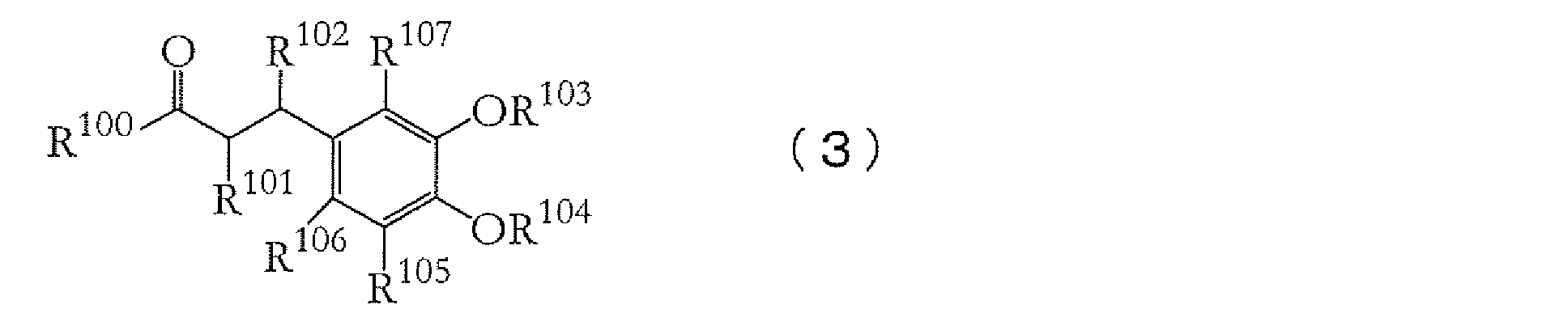
R100 represents a methoxy group, an ethoxy group, a propoxy group, an isopropoxy group, a butyloxy group, an isopropyloxy group, a tert-buthyloxy group, an OH group or a chlorine atom; R101 and R102 independently represent a hydrogen atom, a halogen atom or a C1-C3 alkyl group; R103 represents a C1-C4 alkyl group; R104 represents a C3-C6 alkynyl group; R105, R106 and R107 independently represent a hydrogen atom, a halogen atom or a C1-C2 alkyl group. - The compound according to claim 30, wherein each of R101 and R102 is a hydrogen atom, a fluorine atom or a methyl group; R105, R106 and R107 are hydrogen atoms.
- The compound according to claim 30, wherein R101, R102, R105, R106 and R107 are hydrogen atoms.
- The compound according to any one of claim 30 to 32, wherein R103 is a methyl group or an ethyl group.
- The compound according to any one of claim 30 to 33, wherein R104 is a 2-propynyl group.
- An amide compound represented by the formula (4):wherein, in the formula,
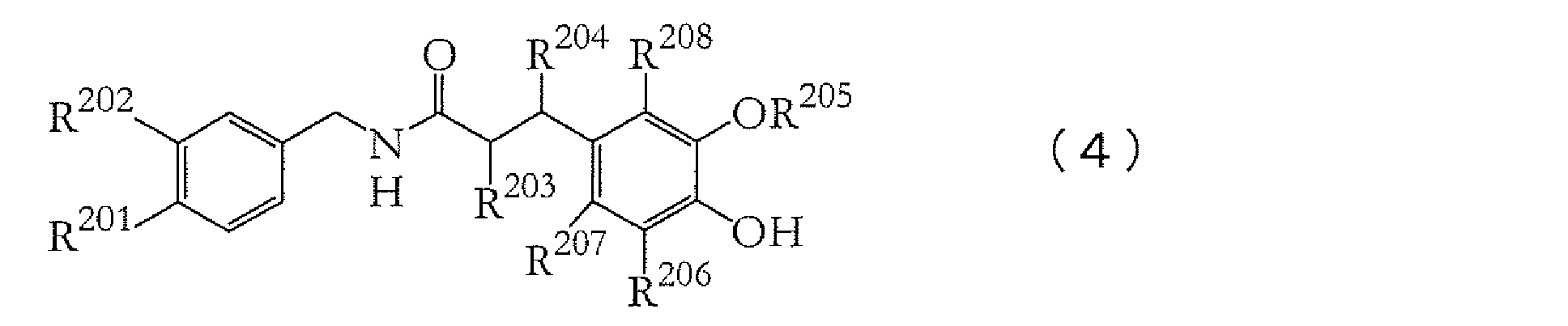
R201 represents a halogen atom, a C1-C4 alkyl group, a C1-C4 haloalkyl group, a C1-C4 alkoxy group, a C1-C4 haloalkoxy group, a di(C1-C4alkyl)amino group or a cyano group; R202 represents a hydrogen atom, a halogen atom, a C1-C4 alkyl group or a C1-C4 haloalkyl group; or both of R201 and R202 are combined together to represent a C3-C5 alkylene group or a group or -CH=CH-CH=CH-; R203 and R204 independently represent a hydrogen atom, a halogen atom or a C1-C3 alkyl group; R205 represents a C1-C4 alkyl group, R206, R207 and R208 independently represent a hydrogen atom, a halogen atom or a C1-C2 alkyl group. - The amide compound according to claim 35, wherein each of R203 and R204 is a hydrogen atom, a fluorine atom or a methyl group; R206, R207 and R208 are hydrogen atoms.
- The amide compound according to claim 35, wherein R203, R204, R206, R207 and R208 are hydrogen atoms.
- The compound according to any one of claim 35 to 37, wherein R205 is a methyl group or an ethyl group.
Applications Claiming Priority (5)
| Application Number | Priority Date | Filing Date | Title |
|---|---|---|---|
| JP2002371737 | 2002-12-24 | ||
| JP2002371737 | 2002-12-24 | ||
| JP2003056810 | 2003-03-04 | ||
| JP2003056810 | 2003-03-04 | ||
| PCT/JP2003/016294 WO2004058685A1 (en) | 2002-12-24 | 2003-12-19 | Amide compound and method of controlling plant disease with the same |
Publications (2)
| Publication Number | Publication Date |
|---|---|
| EP1577290A1 true EP1577290A1 (en) | 2005-09-21 |
| EP1577290A4 EP1577290A4 (en) | 2007-03-28 |
Family
ID=32684210
Family Applications (1)
| Application Number | Title | Priority Date | Filing Date |
|---|---|---|---|
| EP03780917A Withdrawn EP1577290A4 (en) | 2002-12-24 | 2003-12-19 | AMIDE AND METHOD FOR CONTROLLING PLANT DISEASES USING THE SAME |
Country Status (8)
| Country | Link |
|---|---|
| US (1) | US20060122065A1 (en) |
| EP (1) | EP1577290A4 (en) |
| KR (1) | KR20050096100A (en) |
| AU (1) | AU2003289438A1 (en) |
| BR (1) | BR0317769A (en) |
| CO (1) | CO5560604A2 (en) |
| MX (1) | MXPA05006855A (en) |
| WO (1) | WO2004058685A1 (en) |
Cited By (1)
| Publication number | Priority date | Publication date | Assignee | Title |
|---|---|---|---|---|
| WO2013041621A1 (en) | 2011-09-20 | 2013-03-28 | Basf Se | Low molecular weight modulators of the cold-menthol receptor trpm8 and use thereof |
Families Citing this family (7)
| Publication number | Priority date | Publication date | Assignee | Title |
|---|---|---|---|---|
| WO2005122762A1 (en) * | 2004-06-17 | 2005-12-29 | Sumitomo Chemical Company, Limited | Bactericidal composition |
| WO2005122761A1 (en) * | 2004-06-17 | 2005-12-29 | Sumitomo Chemical Company, Limited | Bactericidal composition |
| WO2005122765A1 (en) * | 2004-06-17 | 2005-12-29 | Sumitomo Chemical Company, Limited | Bactericidal composition |
| WO2005122760A1 (en) * | 2004-06-17 | 2005-12-29 | Sumitomo Chemical Company, Limited | Bactericidal composition |
| EP1609360A1 (en) * | 2004-06-17 | 2005-12-28 | Sumitomo Chemical Company, Limited | Fungicidal Composition |
| WO2005122763A1 (en) * | 2004-06-17 | 2005-12-29 | Sumitomo Chemical Company, Limited | Bactericidal composition |
| WO2005122764A1 (en) * | 2004-06-17 | 2005-12-29 | Sumitomo Chemical Company, Limited | Bactericidal composition |
Family Cites Families (6)
| Publication number | Priority date | Publication date | Assignee | Title |
|---|---|---|---|---|
| JPH03240704A (en) * | 1990-02-14 | 1991-10-28 | Sagami Chem Res Center | Herbicide containing phenylpyruvic acid amide derivative as active ingredient |
| JPH04210949A (en) * | 1990-02-14 | 1992-08-03 | Sagami Chem Res Center | Phenylpyruvic acid amide derivative and its production |
| DE19922934A1 (en) * | 1999-05-19 | 2000-11-23 | Bayer Ag | New 5,5-dihalo- or 4,5,5-trihalo-4-pentenoic acid derivatives, useful as bactericides, fungicides, insecticides, acaricides and nematocides, especially plant fungicides |
| GB0011944D0 (en) * | 2000-05-17 | 2000-07-05 | Novartis Ag | Organic compounds |
| EP1295868A4 (en) * | 2000-06-29 | 2004-03-17 | Sumitomo Chemical Co | AMIDE COMPOUNDS AND ASSOCIATED USE |
| WO2002008196A1 (en) * | 2000-07-25 | 2002-01-31 | Sankyo Company, Limited | 5-(m-CYANOBENZYLAMINO)PYRAZOLE DERIVATIVES |
-
2003
- 2003-12-19 EP EP03780917A patent/EP1577290A4/en not_active Withdrawn
- 2003-12-19 US US10/540,502 patent/US20060122065A1/en not_active Abandoned
- 2003-12-19 MX MXPA05006855A patent/MXPA05006855A/en unknown
- 2003-12-19 KR KR1020057011894A patent/KR20050096100A/en not_active Withdrawn
- 2003-12-19 AU AU2003289438A patent/AU2003289438A1/en not_active Abandoned
- 2003-12-19 BR BR0317769-6A patent/BR0317769A/en not_active IP Right Cessation
- 2003-12-19 WO PCT/JP2003/016294 patent/WO2004058685A1/en not_active Ceased
-
2005
- 2005-06-22 CO CO05061118A patent/CO5560604A2/en not_active Application Discontinuation
Cited By (1)
| Publication number | Priority date | Publication date | Assignee | Title |
|---|---|---|---|---|
| WO2013041621A1 (en) | 2011-09-20 | 2013-03-28 | Basf Se | Low molecular weight modulators of the cold-menthol receptor trpm8 and use thereof |
Also Published As
| Publication number | Publication date |
|---|---|
| CO5560604A2 (en) | 2005-09-30 |
| KR20050096100A (en) | 2005-10-05 |
| AU2003289438A1 (en) | 2004-07-22 |
| MXPA05006855A (en) | 2005-08-16 |
| WO2004058685A1 (en) | 2004-07-15 |
| EP1577290A4 (en) | 2007-03-28 |
| US20060122065A1 (en) | 2006-06-08 |
| BR0317769A (en) | 2005-11-22 |
Similar Documents
| Publication | Publication Date | Title |
|---|---|---|
| AU2001260301B2 (en) | Novel phenyl-propargylether derivatives | |
| RU2128186C1 (en) | Amino acid amide derivatives, method of preparing fungicidal composition for agriculture or horticulture | |
| CA2356121C (en) | Novel propargylether derivatives | |
| US20060122065A1 (en) | Amide compound and method of controlling plant disease with the same | |
| US6762321B2 (en) | Amide compounds and use thereof | |
| JP2004285051A (en) | Amide compound and method for controlling plant diseases using the same | |
| US20060122064A1 (en) | Amides and method for plant diseases control with the same | |
| EP1541557A1 (en) | Phenylpyridine compound and bactericidal composition containing the same | |
| JP2005314352A (en) | Amide compound and use of the same | |
| JP2004292432A (en) | Phenylpyrazine compounds and uses thereof | |
| WO2005068416A1 (en) | Amide compound and method for controlling plant disease using same | |
| JP2004137254A (en) | Phenylpyridine compound and method for controlling plant diseases using the same | |
| JP2006001891A (en) | α- (N-amide) -substituted nitrile compounds and their use for controlling plant diseases | |
| JP2006169117A (en) | Amide compounds and uses thereof | |
| JP2006111608A (en) | Amide compounds and uses thereof | |
| WO2005122764A1 (en) | Bactericidal composition | |
| JP2006160671A (en) | Amide compounds and uses thereof | |
| JP2004307474A (en) | Phenylpyrazole compounds and their uses | |
| JP2004300140A (en) | Phenylisoxazole compound and use thereof | |
| WO2005122762A1 (en) | Bactericidal composition | |
| WO2005122761A1 (en) | Bactericidal composition | |
| WO2005122760A1 (en) | Bactericidal composition | |
| JP2005104954A (en) | Phenylpyrazole compounds and their use for controlling plant diseases | |
| JP2006008521A (en) | Amide compounds and uses thereof | |
| JP2006028166A (en) | Bactericidal composition |
Legal Events
| Date | Code | Title | Description |
|---|---|---|---|
| PUAI | Public reference made under article 153(3) epc to a published international application that has entered the european phase |
Free format text: ORIGINAL CODE: 0009012 |
|
| 17P | Request for examination filed |
Effective date: 20050621 |
|
| AK | Designated contracting states |
Kind code of ref document: A1 Designated state(s): AT BE BG CH CY CZ DE DK EE ES FI FR GB GR HU IE IT LI LU MC NL PT RO SE SI SK TR |
|
| AX | Request for extension of the european patent |
Extension state: AL LT LV MK |
|
| DAX | Request for extension of the european patent (deleted) | ||
| A4 | Supplementary search report drawn up and despatched |
Effective date: 20070228 |
|
| RIC1 | Information provided on ipc code assigned before grant |
Ipc: A01N 37/38 20060101ALI20070219BHEP Ipc: C07C 235/34 20060101ALI20070219BHEP Ipc: C07C 69/734 20060101AFI20070219BHEP |
|
| STAA | Information on the status of an ep patent application or granted ep patent |
Free format text: STATUS: THE APPLICATION IS DEEMED TO BE WITHDRAWN |
|
| 18D | Application deemed to be withdrawn |
Effective date: 20070530 |