EP1576897A1 - Apparatus and method for scanning and sorting tobacco leaves - Google Patents
Apparatus and method for scanning and sorting tobacco leaves Download PDFInfo
- Publication number
- EP1576897A1 EP1576897A1 EP05251529A EP05251529A EP1576897A1 EP 1576897 A1 EP1576897 A1 EP 1576897A1 EP 05251529 A EP05251529 A EP 05251529A EP 05251529 A EP05251529 A EP 05251529A EP 1576897 A1 EP1576897 A1 EP 1576897A1
- Authority
- EP
- European Patent Office
- Prior art keywords
- tobacco leaves
- flow
- particles
- leaves
- unacceptable
- Prior art date
- Legal status (The legal status is an assumption and is not a legal conclusion. Google has not performed a legal analysis and makes no representation as to the accuracy of the status listed.)
- Granted
Links
Images


Classifications
-
- A—HUMAN NECESSITIES
- A24—TOBACCO; CIGARS; CIGARETTES; SIMULATED SMOKING DEVICES; SMOKERS' REQUISITES
- A24B—MANUFACTURE OR PREPARATION OF TOBACCO FOR SMOKING OR CHEWING; TOBACCO; SNUFF
- A24B1/00—Preparation of tobacco on the plantation
- A24B1/04—Sifting, sorting, cleaning or removing impurities from tobacco
-
- Y—GENERAL TAGGING OF NEW TECHNOLOGICAL DEVELOPMENTS; GENERAL TAGGING OF CROSS-SECTIONAL TECHNOLOGIES SPANNING OVER SEVERAL SECTIONS OF THE IPC; TECHNICAL SUBJECTS COVERED BY FORMER USPC CROSS-REFERENCE ART COLLECTIONS [XRACs] AND DIGESTS
- Y10—TECHNICAL SUBJECTS COVERED BY FORMER USPC
- Y10S—TECHNICAL SUBJECTS COVERED BY FORMER USPC CROSS-REFERENCE ART COLLECTIONS [XRACs] AND DIGESTS
- Y10S131/00—Tobacco
- Y10S131/905—Radiation source for sensing condition or characteristic
Definitions
- the present invention relates to apparatus and methods for scanning and sorting tobacco leaves. More particularly, the present invention relates to apparatus and methods for processing tobacco leaves by scanning the leaves and removing unacceptable leaves and other contaminants that are detected.
- Tobacco leaves obtained from farmers include discolored or damaged leaves and other contaminants which must be removed during the initial processing of the tobacco.
- Initial processing of tobacco leaves includes dividing the flow of tobacco over many slow moving conveyors. One or more inspectors were stationed at each conveyor to visually inspect each leaf and manually remove undesirable leaves and other contaminants, such as stems, stone, or portions of latex gloves used by tobacco leaf harvesters. This system of initial processing was costly as it required a lot of space, equipment and manpower. The system was also inefficient and inconsistent because the inspectors are unable to give full attention to every leaf and particle, despite the generally slow moving conveyors. The system also relied on the subjective judgment of the inspectors to identify and remove discolored or damaged leaves and other contaminants.
- Machines were developed in the early 1970's to scan the flow of tobacco leaves on the multiple conveyors.
- the machines scanned the flow using light at different wavelengths.
- the machines were able to detect and reject different colors, as selected by the operators. Although the machines performed adequately, they were subject to changes in the light source, effects of ambient lighting, shadows and drift of the calibration parameters, which resulted in inconsistent performance.
- the machines were largely abandoned in the 1980's and human inspectors returned at a reduced level.
- To divide the product over multiple conveyors in order to thin the flow enough so that each leaf can be viewed individually would require 50 - 100 machines per plant.
- the conveyor speed would also be limited because beyond a certain speed the leaves become airborne and cease to be conveyed. The cost of this many machines, the slow processing speed, and the space required would make plant construction and operation prohibitively expensive.
- an apparatus for scanning and sorting tobacco leaves comprising: a conveyor configured to convey a flow of tobacco leaves, the flow of tobacco leaves including acceptable tobacco leaves, unacceptable tobacco leaves and undesirable particles; an air flow source configured to lift and accelerate the flow of tobacco leaves to a speed at which the tobacco leaves and particles are separated; a duct configured to contain the lifted and accelerated flow of tobacco leaves and particles; a scanning device configured to scan the flow of tobacco leaves in the duct and generate a signal upon detection of at least one of an unacceptable tobacco leaf and an undesirable particle; and a rejection device responsive to the signal and configured to force unacceptable tobacco leaves and undesirable particles from the duct.
- a method of scanning and sorting tobacco leaves comprising: conveying a flow of tobacco leaves, the flow of tobacco leaves including acceptable tobacco leaves, unacceptable tobacco leaves and undesirable particles; lifting and accelerating the flow of tobacco leaves and particles to a speed at which the tobacco leaves are separated; scanning the separated tobacco leaves and particles to detect unacceptable tobacco leaves and undesirable particles; and forcing the unacceptable tobacco leaves and undesirable particles from the accelerated flow of tobacco leaves and particles.
- One aspect of the present invention is an apparatus for scanning and sorting tobacco leaves including a conveyor configured to convey a flow of tobacco leaves.
- the flow of tobacco leaves includes acceptable leaves, unacceptable leaves, and undesirable particles or contaminants.
- An air flow source is configured to lift and accelerate the flow of leaves and particles or contaminants to a speed at which the leaves and the particles are separated.
- a duct is configured to contain the lifted and accelerated flow of leaves and particles and a scanning device is configured to scan the flow of leaves and particles in the duct and generate a signal upon detection of an unacceptable leaf and/or an undesirable particle.
- a rejection device is responsive to the signal and configured to force unacceptable leaves and/or undesirable particles from the duct.
- the rejection device includes at least one solenoid valve configured to receive the signal and release compressed air from a compressed air source upon receipt of the signal to force the unacceptable tobacco leaves and the undesirable particles from the duct.
- the rejection device includes a flap configured to be selectively insertable into the flow to direct unacceptable leaves and/or undesirable particles from the duct.
- leaves forced from the duct are scanned by a second scanning device and unacceptable leaves are removed and acceptable leaves passing the second scanning device are conveyed and combined with leaves passing the compressed air source.
- the tobacco leaves are accelerated to a speed of approximately 4,000 - 6,000 ft/min in order to separate the leaves from each other and any undesirable particles.
- the scanning devices are optical or lasing scanning devices.
- the scanning device scans the leaves and particles in the duct between 2,000 - 12,000 times per second.
- a method of scanning and sorting tobacco leaves includes conveying a flow of tobacco leaves, the flow of leaves including acceptable leaves, unacceptable leaves and undesirable particles, lifting and accelerating the flow of leaves and particles to a speed at which the leaves and particles are separated, scanning the separated leaves and particles to detect unacceptable leaves and undesirable particles, and forcing unacceptable leaves and undesirable particles from the accelerated flow of leaves and particles.
- an example of the apparatus of an embodiment of the present invention includes a conveyor 1.
- Tobacco leaves are supplied to the conveyor 1 from blending silos or other device after an initial conditioning process.
- the tobacco is divided into flows of 10,000 - 15,000 lb/hour (approximately 4500 - 7000 kg/hr) by known apparatus and methods. Each flow includes tobacco leaves and other particles and/or contaminants.
- the flow is directed to the conveyor 1, which may be for example, an endless belt-type conveyor. It should be appreciated that other types of conveyors may be used.
- the conveyor 1 is 72 inches (approximately 1.8 m) wide and travels approximately 250 ft/min (approximately 85 m/min) to provide a "carpet" of tobacco leaves about 1 - 2 inches (approximately 21 ⁇ 2 to 5 cm) deep.
- the flow is delivered by the conveyor 1 to an air flow source 2.
- an upward current of air lifts the flow of tobacco leaves.
- Some undesirable particles or contaminants heavier than tobacco leaves, such as metal or rocks, are not lifted by the current and drop out of the flow.
- Other undesirable particles and/or contaminants may be lifted with the upward current of air and be conveyed with leaves.
- the flow of tobacco leaves is accelerated to a speed sufficient to separate the individual leaves from each other and from any undesirable particles.
- the flow of tobacco leaves is accelerated to a speed of approximately 4,000 - 6,000 ft/min (approximately 1300 - 2000 metres/minute). Accelerating the flow of tobacco to this speed permits a loading and processing of approximately 2,000 - 3,000 lb/hr (approximately 1000 - 1500 kg/hr) per foot width of the apparatus.
- the duct 20 is shown extending vertically from the air source 2, it should be appreciated that the duct 20 may be at angle to the air source 2, and may even extend horizontally from the air source 2. It should also be appreciated that the duct 20 may have any cross-sectional shape and have a length sufficient for the acceleration of the flow to a speed at which the individual tobacco leaves are separated.
- the individual, separated tobacco leaves and undesirable particles are scanned by a laser or optical scanning device 3. It should be appreciated that more than one scanning device 3 may be provided.
- the duct 20 may be formed of a transparent plastic or glass material so that the scanning device 3 can detect the tobacco leaves and particles through the duct 20.
- the duct 20 may also be formed of non-transparent material, such as metal, and have transparent portions 30 provided at the position of the scanning device 3 so that the tobacco leaves may be detected by the scanning device 3.
- the transparent portions 30 may be provided on opposite sides of the duct or may be provided around the entire circumference of the duct 20.
- any unacceptable, e.g., discolored or damaged, leaves or other particles which do not meet the acceptance criteria are detected by the scanning device 3 and signals are sent to solenoid valves 4.
- the solenoid valves 4 open, they direct a blast of compressed air from a compressed air source 40 at the unacceptable leaf or particle.
- the solenoid valves 4 are provided across the width of the duct 20.
- solenoid valves 4 and compressed air source 40 are shown at a generally horizontal portion of the duct, it should be appreciated that the scanning device 3, solenoid valves 4 and compressed air source 40 may be provided along a generally vertical portion of the duct 20.
- the solenoid valves 4 are controlled by a programmable control device 50 that receives the signals from the scanning device 3 and controls the actuation (i.e., energization) of the solenoid valves 4.
- the programmable control device 50 comprises software and is programmed to take into account the velocity of the tobacco leaves in the duct 20 and the time at which the solenoid valves 4 are opened and also controls the duration of the valve opening when the solenoid valves 4 direct a burst of compressed air at an unacceptable leaf and/or object.
- the compressed air forces the unacceptable leaf or particle out of the duct 20 and into a chute 21 that leads to an airlock 5.
- the unacceptable leaf and/or particle is discharged onto a second conveyor 6.
- the juncture is provided with a roller 7.
- the roller 7 is rotated so that it moves trapped, rejected leaves and/or particles into the chute 21.
- the roller 7 may be a rotatable vane or plate. It should be appreciated that plural sets of solenoid valves, chutes, and rollers/vanes/plates may be provided.
- the rejected leaves and/or particles are combined and delivered by the second conveyor 6 to a second scanning device 11, which may be a standard commercially available scanning device arranged and configured to scan the leaves on the second conveyor.
- the rejected leaves and/or particles undergo a second sorting to remove the unacceptable leaves and/or particles from the acceptable leaves.
- the unacceptable leaves and/or particles are removed from a third conveyor 14, for example by hand, and any remaining leaves are sent back to the second conveyor 6 by fourth and fifth conveyors 15 and 16 and through the second scanning device 11.
- the acceptable leaves detected by the second scanning device 11 are sent back to the flow of tobacco leaves by sixth and seventh conveyors 12 and 13.
- the acceptable leaves are sent back to the flow of tobacco leaves at a point after the chute 21.
- the tobacco leaves in the flow in the duct 20 that pass the scanning device 3 are unloaded by a cyclonic device 8 via an airlock 22 and fall onto a fifth conveyor 9.
- the tobacco leaves are recombined with the acceptable tobacco leaves from the fourth conveyor 12 and proceed to further processing.
- the cyclonic device 8 is aspirated by a centrifugal fan 10 and the exhaust air is cleaned, for example by a bag filter unit, before being discharged to the atmosphere.
- Laser scan speeds are in the range of 2,000-12,000 scans/sec. At 6,000 ft/min (approximately 2000 m/min), and 2,000 scans/sec, a scan will cross the flow every 0.6 inches (approximately 1.5 cm), which provides acceptable results. At 6,000 ft/min and 12,000 scans/sec, a scan will cross the flow every 0.1 inches (approximately 2.5 mm), which provides even more acceptable results. It should be appreciated that other combinations of flow velocities and scan speeds are possible.
- an apparatus includes a flap 60 pivotably attached to the duct 20 by, for example, a spring biased hinge 61, at a position proximate the chute 21.
- a signal is sent from the scanning device 3 to the control device 50.
- the control device 50 actuates a solenoid (or solenoids) 4 to cause the plunger of the solenoid 4 to extend and pivot the flap 60 against the bias of the hinge 61 from the position shown in solid line to the position shown in dashed line.
- the flap 60 directs unacceptable leaves and/or particles into the chute 21.
- the flap 60 is shown in a horizontal portion of the duct 20, it may be provided at an angled portion or a vertical portion of the duct. It should also be appreciated that the flap need not be pivoted, and may be linearly actuated into a position to direct unacceptable leaves and/or particles into the chute 21, or the flap may be provided as a vane in the duct in a manner similar to a throttle valve so as to direct leaves and/or particles out of the duct. It should further be appreciated that actuation devices other than a solenoid or solenoids may be used to actuate the flap into a position to direct unacceptable leaves and/or particles into the chute 21. For example, a compressed air source may be used to actuate the flap into position.
Landscapes
- Life Sciences & Earth Sciences (AREA)
- Agronomy & Crop Science (AREA)
- Manufacturing Of Cigar And Cigarette Tobacco (AREA)
- Manufacture Of Tobacco Products (AREA)
- Sorting Of Articles (AREA)
Abstract
Description
- The present invention relates to apparatus and methods for scanning and sorting tobacco leaves. More particularly, the present invention relates to apparatus and methods for processing tobacco leaves by scanning the leaves and removing unacceptable leaves and other contaminants that are detected.
- Tobacco leaves obtained from farmers include discolored or damaged leaves and other contaminants which must be removed during the initial processing of the tobacco. Initial processing of tobacco leaves includes dividing the flow of tobacco over many slow moving conveyors. One or more inspectors were stationed at each conveyor to visually inspect each leaf and manually remove undesirable leaves and other contaminants, such as stems, stone, or portions of latex gloves used by tobacco leaf harvesters. This system of initial processing was costly as it required a lot of space, equipment and manpower. The system was also inefficient and inconsistent because the inspectors are unable to give full attention to every leaf and particle, despite the generally slow moving conveyors. The system also relied on the subjective judgment of the inspectors to identify and remove discolored or damaged leaves and other contaminants.
- Machines were developed in the early 1970's to scan the flow of tobacco leaves on the multiple conveyors. The machines scanned the flow using light at different wavelengths. The machines were able to detect and reject different colors, as selected by the operators. Although the machines performed adequately, they were subject to changes in the light source, effects of ambient lighting, shadows and drift of the calibration parameters, which resulted in inconsistent performance. The machines were largely abandoned in the 1980's and human inspectors returned at a reduced level.
- Technology improved in the 1990's and more efficient and consistent scanning devices were developed. These scanning devices used traditional optics with independent light sources and lasers. The scanning devices are used in many industries, and proved successful in scanning strip-tobacco and stems. However, each device is extremely expensive.
- A need exists for a machine for scanning tobacco leaves to reject unacceptable (e.g., discolored or damaged) leaves and/or other undesirable particles before they are threshed into multiple small pieces. To divide the product over multiple conveyors in order to thin the flow enough so that each leaf can be viewed individually would require 50 - 100 machines per plant. The conveyor speed would also be limited because beyond a certain speed the leaves become airborne and cease to be conveyed. The cost of this many machines, the slow processing speed, and the space required would make plant construction and operation prohibitively expensive.
- According to a first aspect of the present invention, there is provided an apparatus for scanning and sorting tobacco leaves, comprising: a conveyor configured to convey a flow of tobacco leaves, the flow of tobacco leaves including acceptable tobacco leaves, unacceptable tobacco leaves and undesirable particles; an air flow source configured to lift and accelerate the flow of tobacco leaves to a speed at which the tobacco leaves and particles are separated; a duct configured to contain the lifted and accelerated flow of tobacco leaves and particles; a scanning device configured to scan the flow of tobacco leaves in the duct and generate a signal upon detection of at least one of an unacceptable tobacco leaf and an undesirable particle; and a rejection device responsive to the signal and configured to force unacceptable tobacco leaves and undesirable particles from the duct.
- According to a second aspect of the present invention, there is provided a method of scanning and sorting tobacco leaves, the method comprising: conveying a flow of tobacco leaves, the flow of tobacco leaves including acceptable tobacco leaves, unacceptable tobacco leaves and undesirable particles; lifting and accelerating the flow of tobacco leaves and particles to a speed at which the tobacco leaves are separated; scanning the separated tobacco leaves and particles to detect unacceptable tobacco leaves and undesirable particles; and forcing the unacceptable tobacco leaves and undesirable particles from the accelerated flow of tobacco leaves and particles.
- One aspect of the present invention is an apparatus for scanning and sorting tobacco leaves including a conveyor configured to convey a flow of tobacco leaves. The flow of tobacco leaves includes acceptable leaves, unacceptable leaves, and undesirable particles or contaminants. An air flow source is configured to lift and accelerate the flow of leaves and particles or contaminants to a speed at which the leaves and the particles are separated. A duct is configured to contain the lifted and accelerated flow of leaves and particles and a scanning device is configured to scan the flow of leaves and particles in the duct and generate a signal upon detection of an unacceptable leaf and/or an undesirable particle. A rejection device is responsive to the signal and configured to force unacceptable leaves and/or undesirable particles from the duct. According to one exemplary embodiment of the present invention, the rejection device includes at least one solenoid valve configured to receive the signal and release compressed air from a compressed air source upon receipt of the signal to force the unacceptable tobacco leaves and the undesirable particles from the duct. According to another exemplary embodiment of the present invention, the rejection device includes a flap configured to be selectively insertable into the flow to direct unacceptable leaves and/or undesirable particles from the duct.
- In one embodiment, leaves forced from the duct are scanned by a second scanning device and unacceptable leaves are removed and acceptable leaves passing the second scanning device are conveyed and combined with leaves passing the compressed air source.
- In one embodiment, the tobacco leaves are accelerated to a speed of approximately 4,000 - 6,000 ft/min in order to separate the leaves from each other and any undesirable particles.
- In one embodiment, the scanning devices are optical or lasing scanning devices. The scanning device scans the leaves and particles in the duct between 2,000 - 12,000 times per second.
- According to yet another aspect of the present invention, a method of scanning and sorting tobacco leaves includes conveying a flow of tobacco leaves, the flow of leaves including acceptable leaves, unacceptable leaves and undesirable particles, lifting and accelerating the flow of leaves and particles to a speed at which the leaves and particles are separated, scanning the separated leaves and particles to detect unacceptable leaves and undesirable particles, and forcing unacceptable leaves and undesirable particles from the accelerated flow of leaves and particles.
- Examples of the present invention will now be described in detail with reference to the accompanying schematic drawings, in which:
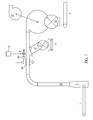
- Figure 1 is a side elevation view of an apparatus for scanning and sorting tobacco leaves according to an exemplary embodiment of the present invention;
- Figure 2 is a plan view of the apparatus of Figure 1; and
- Figure 3 is a side elevation view of an apparatus for scanning and sorting tobacco leaves according to another exemplary embodiment of the present invention.
-
- Referring to Figure 1, an example of the apparatus of an embodiment of the present invention includes a
conveyor 1. Tobacco leaves are supplied to theconveyor 1 from blending silos or other device after an initial conditioning process. The tobacco is divided into flows of 10,000 - 15,000 lb/hour (approximately 4500 - 7000 kg/hr) by known apparatus and methods. Each flow includes tobacco leaves and other particles and/or contaminants. The flow is directed to theconveyor 1, which may be for example, an endless belt-type conveyor. It should be appreciated that other types of conveyors may be used. - In a preferred embodiment, the
conveyor 1 is 72 inches (approximately 1.8 m) wide and travels approximately 250 ft/min (approximately 85 m/min) to provide a "carpet" of tobacco leaves about 1 - 2 inches (approximately 2½ to 5 cm) deep. - The flow is delivered by the
conveyor 1 to anair flow source 2. In theair flow source 2, an upward current of air lifts the flow of tobacco leaves. Some undesirable particles or contaminants heavier than tobacco leaves, such as metal or rocks, are not lifted by the current and drop out of the flow. Other undesirable particles and/or contaminants may be lifted with the upward current of air and be conveyed with leaves. In theduct 20 leading from theair flow source 2, the flow of tobacco leaves is accelerated to a speed sufficient to separate the individual leaves from each other and from any undesirable particles. In a preferred embodiment, the flow of tobacco leaves is accelerated to a speed of approximately 4,000 - 6,000 ft/min (approximately 1300 - 2000 metres/minute). Accelerating the flow of tobacco to this speed permits a loading and processing of approximately 2,000 - 3,000 lb/hr (approximately 1000 - 1500 kg/hr) per foot width of the apparatus. - Although the
duct 20 is shown extending vertically from theair source 2, it should be appreciated that theduct 20 may be at angle to theair source 2, and may even extend horizontally from theair source 2. It should also be appreciated that theduct 20 may have any cross-sectional shape and have a length sufficient for the acceleration of the flow to a speed at which the individual tobacco leaves are separated. - The individual, separated tobacco leaves and undesirable particles are scanned by a laser or
optical scanning device 3. It should be appreciated that more than onescanning device 3 may be provided. Theduct 20 may be formed of a transparent plastic or glass material so that thescanning device 3 can detect the tobacco leaves and particles through theduct 20. Theduct 20 may also be formed of non-transparent material, such as metal, and havetransparent portions 30 provided at the position of thescanning device 3 so that the tobacco leaves may be detected by thescanning device 3. Thetransparent portions 30 may be provided on opposite sides of the duct or may be provided around the entire circumference of theduct 20. - Any unacceptable, e.g., discolored or damaged, leaves or other particles which do not meet the acceptance criteria are detected by the
scanning device 3 and signals are sent to solenoid valves 4. As the solenoid valves 4 open, they direct a blast of compressed air from acompressed air source 40 at the unacceptable leaf or particle. The solenoid valves 4 are provided across the width of theduct 20. Although thescanning device 3, solenoid valves 4 andcompressed air source 40 are shown at a generally horizontal portion of the duct, it should be appreciated that thescanning device 3, solenoid valves 4 and compressedair source 40 may be provided along a generally vertical portion of theduct 20. - The solenoid valves 4 are controlled by a
programmable control device 50 that receives the signals from thescanning device 3 and controls the actuation (i.e., energization) of the solenoid valves 4. Theprogrammable control device 50 comprises software and is programmed to take into account the velocity of the tobacco leaves in theduct 20 and the time at which the solenoid valves 4 are opened and also controls the duration of the valve opening when the solenoid valves 4 direct a burst of compressed air at an unacceptable leaf and/or object. - The compressed air forces the unacceptable leaf or particle out of the
duct 20 and into achute 21 that leads to anairlock 5. From theairlock 5, the unacceptable leaf and/or particle is discharged onto asecond conveyor 6. In order to prevent unacceptable leaves and/or particles from being trapped at the juncture between theduct 20 and thechute 21, the juncture is provided with aroller 7. Theroller 7 is rotated so that it moves trapped, rejected leaves and/or particles into thechute 21. It should be appreciated that theroller 7 may be a rotatable vane or plate. It should be appreciated that plural sets of solenoid valves, chutes, and rollers/vanes/plates may be provided. - Some acceptable leaves are rejected with the unacceptable leaves and particles. Referring to Figure 2, the rejected leaves and/or particles are combined and delivered by the
second conveyor 6 to asecond scanning device 11, which may be a standard commercially available scanning device arranged and configured to scan the leaves on the second conveyor. The rejected leaves and/or particles undergo a second sorting to remove the unacceptable leaves and/or particles from the acceptable leaves. The unacceptable leaves and/or particles are removed from athird conveyor 14, for example by hand, and any remaining leaves are sent back to thesecond conveyor 6 by fourth andfifth conveyors second scanning device 11. The acceptable leaves detected by thesecond scanning device 11 are sent back to the flow of tobacco leaves by sixth andseventh conveyors 12 and 13. The acceptable leaves are sent back to the flow of tobacco leaves at a point after thechute 21. - The tobacco leaves in the flow in the
duct 20 that pass thescanning device 3 are unloaded by acyclonic device 8 via anairlock 22 and fall onto afifth conveyor 9. The tobacco leaves are recombined with the acceptable tobacco leaves from the fourth conveyor 12 and proceed to further processing. Thecyclonic device 8 is aspirated by acentrifugal fan 10 and the exhaust air is cleaned, for example by a bag filter unit, before being discharged to the atmosphere. - Currently available scanning devices are fed leaves at speeds between 600 and 1,000 ft/min (approximately 200 - 330 m/min). This would be impractical to scan whole leaves because of their size and volume. There would be many shadows and the number of acceptable leaves that would be rejected would be unacceptably high. By dispersing the leaves in a flow in the duct at a velocity of 4000 - 6000 ft/min (approximately 1300 - 2000 m/min), each leaf will be separated from those around it and can accepted or rejected separately. By scanning from opposing sides (e.g., the top and bottom) of the flow, any unacceptable leaf will be visible to the scanning device(s). As it is not necessary to reject very small particles at this stage of the tobacco leaf processing, the speed necessary to separate the individual leaves is acceptable even if very small particles are not detectable. Laser scan speeds are in the range of 2,000-12,000 scans/sec. At 6,000 ft/min (approximately 2000 m/min), and 2,000 scans/sec, a scan will cross the flow every 0.6 inches (approximately 1.5 cm), which provides acceptable results. At 6,000 ft/min and 12,000 scans/sec, a scan will cross the flow every 0.1 inches (approximately 2.5 mm), which provides even more acceptable results. It should be appreciated that other combinations of flow velocities and scan speeds are possible.
- Referring to Figure 3, an apparatus according to another exemplary embodiment includes a
flap 60 pivotably attached to theduct 20 by, for example, a springbiased hinge 61, at a position proximate thechute 21. Upon detection of an unacceptable leaf and/or particle by thescanning device 3, a signal is sent from thescanning device 3 to thecontrol device 50. Thecontrol device 50 actuates a solenoid (or solenoids) 4 to cause the plunger of the solenoid 4 to extend and pivot theflap 60 against the bias of thehinge 61 from the position shown in solid line to the position shown in dashed line. At the position shown in dashed line, theflap 60 directs unacceptable leaves and/or particles into thechute 21. - Although the
flap 60 is shown in a horizontal portion of theduct 20, it may be provided at an angled portion or a vertical portion of the duct. It should also be appreciated that the flap need not be pivoted, and may be linearly actuated into a position to direct unacceptable leaves and/or particles into thechute 21, or the flap may be provided as a vane in the duct in a manner similar to a throttle valve so as to direct leaves and/or particles out of the duct. It should further be appreciated that actuation devices other than a solenoid or solenoids may be used to actuate the flap into a position to direct unacceptable leaves and/or particles into thechute 21. For example, a compressed air source may be used to actuate the flap into position. - Embodiments of the present invention have been described with particular reference to the examples illustrated. However, it will be appreciated that variations and modifications may be made to the examples described within the scope of the present invention.
Claims (33)
- An apparatus for scanning and sorting tobacco leaves, the apparatus comprising:a conveyor (1) configured to convey a flow of tobacco leaves, the flow of tobacco leaves including acceptable tobacco leaves, unacceptable tobacco leaves and undesirable particles;an air flow source (2) configured to lift and accelerate the flow of tobacco leaves to a speed at which the tobacco leaves and particles are separated;a duct (20) configured to contain the lifted and accelerated flow of tobacco leaves and particles;a scanning device (3) configured to scan the flow of tobacco leaves in the duct (20) and generate a signal upon detection of at least one of an unacceptable tobacco leaf and an undesirable particle; anda rejection device (4, 40) responsive to the signal and configured to force unacceptable tobacco leaves and undesirable particles from the duct (20).
- An apparatus according to claim 1, wherein the duct (20) extends vertically with respect to the conveyor.
- An apparatus according to claim 1 or 2, wherein the duct (20) includes opposing transparent portions (30) and the scanning device is positioned to scan the flow at the transparent portions (30).
- An apparatus according to any of claims 1 to 3, wherein the rejection device comprises at least one solenoid valve (4) configured to receive the signal and release compressed air from a compressed air source (40) upon receipt of the signal to force the unacceptable tobacco leaves and the undesirable particles from the duct (20).
- An apparatus according to any of claims 1 to 4, further comprising a chute (21) connected to the duct (20) and configured to receive the unacceptable tobacco leaves and the undesirable particles forced from the flow.
- An apparatus according to claim 5, further comprising a roller (7) positioned at a juncture of the duct (20) and the chute (21) and rotatable to move the unacceptable tobacco leaves and the undesirable particles at the juncture into the chute.
- An apparatus according to claim 5 or 6, further comprising an airlock (5) configured to receive the unacceptable tobacco leaves and the undesirable particles forced from the chute.
- An apparatus according to claim 7, further comprising a second conveyor (6) configured to receive the unacceptable tobacco leaves and the undesirable particles from the airlock.
- An apparatus according to claim 8, further comprising a second scanning device (11) configured to scan the tobacco leaves and the particles conveyed by the second conveyor (6) to detect unacceptable tobacco leaves and undesirable particles.
- An apparatus according to claim 8 or 9, further comprising a third conveyor (14) configured to convey unacceptable tobacco leaves and undesirable particles detected by the second scanning device (11).
- An apparatus according to claim 10, further comprising a fourth conveyor configured to convey acceptable tobacco leaves passing the second scanning device.
- An apparatus according to any of claims 1 to 11, further comprising a cyclonic device configured to unload tobacco leaves from the duct that pass the rejection device.
- An apparatus according to claim 12, further comprising an airlock configured to receive tobacco leaves from the cyclonic device.
- An apparatus according to claim 12 or 13, further comprising a fan configured to aspirate the cyclonic device.
- An apparatus according to claim 13, further comprising a second conveyor configured to convey tobacco leaves from the airlock.
- An apparatus according to any of claims 1 to 15, wherein the flow of tobacco leaves conveyed by the conveyor to the air flow source is approximately one to two inches (approximately 2.5 - 5 cm) thick.
- An apparatus according to any of claims 1 to 16, wherein the air flow source accelerates the tobacco leaves to a speed of approximately 4,000 to 6,000 ft/min (approximately 1300 - 2000 m/min).
- An apparatus according to any of claims 1 to 17, wherein the scanning device (3) is a laser scanning device or an optical scanning device.
- An apparatus according to any of claims 1 to 18, wherein the scanning device (3) scans the flow of tobacco leaves approximately 2,000 - 12,000 times per second.
- An apparatus according to any of claims 1 to 19, wherein the scanning device (3) is configured to scan the flow from opposing sides.
- An apparatus according to any of claims 1 to 20, further comprising a control device (50) configured to control actuation of the rejection device.
- An apparatus according to claim 21, wherein the control device (50) is programmable and controls the actuation of the rejection device based on the speed of the leaves and an actuation time of the rejection device.
- An apparatus according to any of claims 1 to 22, wherein the rejection device comprises a flap (60) selectively insertable into the flow of leaves and particles in response to the signal from the scanning device to direct unacceptable leaves and undesirable particles from the duct.
- An apparatus according to claim 23, wherein the flap (60) is pivotably connected to the duct (20).
- An apparatus according to claim 24, wherein the rejection device further comprises a solenoid actuable in response to the signal from the scanning device to pivot the flap into the flow of leaves and particles.
- A method of scanning and sorting tobacco leaves, the method comprising:conveying a flow of tobacco leaves, the flow of tobacco leaves including acceptable tobacco leaves, unacceptable tobacco leaves and undesirable particles;lifting and accelerating the flow of tobacco leaves and particles to a speed at which the tobacco leaves are separated;scanning the separated tobacco leaves and particles to detect unacceptable tobacco leaves and undesirable particles; andforcing the unacceptable tobacco leaves and undesirable particles from the accelerated flow of tobacco leaves and particles.
- A method according to claim 26, wherein scanning includes scanning the flow from opposing sides.
- A method according to claim 26 or 27, wherein forcing the unacceptable tobacco leaves and undesirable particles from the flow includes directing compressed air at the unacceptable tobacco leaves and undesirable particles.
- A method according to any of claims 26 to 28, further comprising:conveying tobacco leaves and particles forced from the flow to a second scanning device; andscanning the tobacco leaves and particles forced from the flow to detect unacceptable tobacco leaves and undesirable particles.
- A method according to claim 29, further comprising removing unacceptable tobacco leaves and undesirable particles detected by the second scanning device from the tobacco leaves forced from the flow.
- A method according to claim 29 or 30, further comprising conveying acceptable tobacco leaves passing the second scanning device.
- A method according to any of claims 26 to 31, wherein the tobacco leaves and particles are accelerated to a speed of approximately 4,000 - 6,000 ft/min (approximately 1300 - 2000 m/min).
- A method according to any of claims 26 to 32, wherein the flow of tobacco leaves and particles is scanned approximately 2,000 - 12,000 times per second.
Applications Claiming Priority (4)
| Application Number | Priority Date | Filing Date | Title |
|---|---|---|---|
| US55274204P | 2004-03-15 | 2004-03-15 | |
| US552742P | 2004-03-15 | ||
| US56151904P | 2004-04-13 | 2004-04-13 | |
| US561519P | 2004-04-13 |
Publications (2)
| Publication Number | Publication Date |
|---|---|
| EP1576897A1 true EP1576897A1 (en) | 2005-09-21 |
| EP1576897B1 EP1576897B1 (en) | 2008-06-25 |
Family
ID=34841238
Family Applications (1)
| Application Number | Title | Priority Date | Filing Date |
|---|---|---|---|
| EP05251529A Expired - Lifetime EP1576897B1 (en) | 2004-03-15 | 2005-03-15 | Apparatus and method for scanning and sorting tobacco leaves |
Country Status (6)
| Country | Link |
|---|---|
| US (1) | US7383840B2 (en) |
| EP (1) | EP1576897B1 (en) |
| AT (1) | ATE398938T1 (en) |
| BR (1) | BRPI0501078B1 (en) |
| CA (1) | CA2499853C (en) |
| DE (1) | DE602005007643D1 (en) |
Cited By (4)
| Publication number | Priority date | Publication date | Assignee | Title |
|---|---|---|---|---|
| JP2005278647A (en) * | 2004-03-26 | 2005-10-13 | Hauni Primary Gmbh | Method and apparatus for separating foreign matter |
| JP2005312451A (en) * | 2004-04-27 | 2005-11-10 | Hauni Primary Gmbh | Method and apparatus for separating foreign matter from material flow |
| EP2451591A1 (en) | 2009-09-18 | 2012-05-16 | Key Technology, Inc. | Apparatus and method for post-threshing inspection and sorting of tobacco lamina |
| EP2521462A2 (en) | 2010-01-07 | 2012-11-14 | Hauni Maschinenbau AG | Method and device for separating foreign bodies from a flow of tobacco |
Families Citing this family (10)
| Publication number | Priority date | Publication date | Assignee | Title |
|---|---|---|---|---|
| WO2006048376A1 (en) * | 2004-11-01 | 2006-05-11 | Machinefabriek Van Hoek B.V. | Method and apparatus for sorting a gas-driven stream of generally flat and light-weight articles |
| ITBO20050355A1 (en) * | 2005-05-19 | 2005-08-18 | Gd Spa | TOBACCO UNIT AND METHOD OF FEEDING IN A SMOKE PACKAGING MACHINE |
| CN102008122B (en) * | 2010-12-02 | 2013-03-20 | 浙江中烟工业有限责任公司 | Method and equipment for manufacturing cigarettes by filamentization of tobaccos reconstituted by papermaking process |
| US9886631B2 (en) | 2012-11-19 | 2018-02-06 | Altria Client Services Llc | On-line oil and foreign matter detection stystem and method employing hyperspectral imaging |
| CN106179997B (en) * | 2016-08-08 | 2018-08-07 | 江西中烟工业有限责任公司 | A kind of laser sorting machine for tobacco edulcoration |
| US10197504B2 (en) | 2016-10-10 | 2019-02-05 | Altria Client Services Llc | Method and system of detecting foreign materials within an agricultural product stream |
| CN110394307B (en) * | 2019-07-18 | 2024-04-30 | 江苏恒森烟草机械有限公司 | Tobacco leaf automated inspection letter sorting system |
| CN111418878A (en) * | 2020-03-31 | 2020-07-17 | 红云红河烟草(集团)有限责任公司 | A system for achieving uniform size of tobacco slices after threshing |
| CN114504116A (en) * | 2021-12-29 | 2022-05-17 | 中国烟草总公司郑州烟草研究院 | Tobacco leaf classification device and method based on laser-induced breakdown spectroscopy |
| CN117244798B (en) * | 2023-10-18 | 2025-10-21 | 安徽华英新塘羽绒有限公司 | Down classification detection device and detection method |
Citations (7)
| Publication number | Priority date | Publication date | Assignee | Title |
|---|---|---|---|---|
| DE3428966A1 (en) * | 1984-08-06 | 1986-02-06 | Institut po Techničeska Kibernetika i Robotika, Sofia/Sofija | Method and apparatus for sorting tobacco leaves |
| WO1990006819A1 (en) * | 1988-12-14 | 1990-06-28 | Gbe International Plc | Optical grading apparatus |
| US5462176A (en) * | 1994-06-03 | 1995-10-31 | Brown & Williamson Tobacco Corporation | Latex detection system |
| US6332543B1 (en) * | 1999-02-13 | 2001-12-25 | Hauni Maschinenbau Ag | Apparatus for converting a continuously supplied material flow into a single layer |
| EP1188385A1 (en) * | 1999-06-08 | 2002-03-20 | Japan Tobacco Inc. | Apparatus for detecting foreign matter in raw material and method of detecting the same |
| US6542234B1 (en) * | 1999-10-08 | 2003-04-01 | British-American Tobacco (Germany) Gmbh | Method of detecting the particles of a tobacco particle stream |
| WO2003090569A1 (en) * | 2002-04-24 | 2003-11-06 | Comas-Costruzioni Macchine Speciali - S.P.A. | Separator for shredded tobacco |
Family Cites Families (55)
| Publication number | Priority date | Publication date | Assignee | Title |
|---|---|---|---|---|
| US2131095A (en) * | 1934-02-15 | 1938-09-27 | Electric Sorting Machine Compa | Means for sorting homogeneous articles |
| US2173087A (en) * | 1935-07-31 | 1939-09-19 | Muller J C & Co | Tobacco sorting and separating machine |
| US2267326A (en) * | 1938-03-31 | 1941-12-23 | J C Muller N V | Air separator for comminuted tobacco |
| US2645343A (en) * | 1949-04-27 | 1953-07-14 | Kelling Nut Co | Photoelectric inspecting and sorting apparatus |
| US3549008A (en) * | 1969-01-16 | 1970-12-22 | Ronald L Anderson | Photoelectric sizing and sorting apparatus |
| US3608716A (en) * | 1969-01-27 | 1971-09-28 | Imp Tobacco Co Ltd | Recirculating pneumatic separator |
| US3593851A (en) * | 1969-09-11 | 1971-07-20 | Amf Inc | Tobacco leaf classifier |
| US3685650A (en) * | 1969-09-15 | 1972-08-22 | B A T Cigaratten Fafriken Gmbh | Methods and apparatus for the selection of foreign bodies of smaller dimensions, from a main mass |
| US3750882A (en) * | 1971-05-20 | 1973-08-07 | Amf Inc | Automatic grader |
| CH542003A (en) * | 1971-06-16 | 1973-09-30 | Technical Development Corp | Method and apparatus for sorting sheet material, in particular tobacco leaves |
| US4018674A (en) * | 1972-02-24 | 1977-04-19 | Morris Bennie A | Apparatus for automatically grading leaf tobacco |
| US3968366A (en) * | 1972-03-16 | 1976-07-06 | Asfour Emil S | Apparatus for sorting tobacco leaves |
| US3917070A (en) * | 1972-03-16 | 1975-11-04 | Emil S Asfour | Method and system for grading articles according to color |
| US3939983A (en) * | 1972-03-16 | 1976-02-24 | Asfour Emil S | Apparatus for sorting tobacco leaves |
| US3782544A (en) * | 1972-08-03 | 1974-01-01 | Amf Inc | Automatic grader |
| US3854586A (en) * | 1973-05-15 | 1974-12-17 | Amf Inc | Automatic grader for sorting objects according to brightness and color tones |
| US3928183A (en) * | 1974-03-20 | 1975-12-23 | Emil S Asfour | Tobacco sorting apparatus |
| US4475562A (en) * | 1981-10-16 | 1984-10-09 | Philip Morris Incorporated | Method and apparatus for separating tobacco mixture into lighter and heavier fractions |
| US4465194A (en) * | 1982-12-23 | 1984-08-14 | Universal Leaf Tobacco Co. | Threshed tobacco lead separator |
| US4609108A (en) * | 1984-01-27 | 1986-09-02 | Institute Po Technicheska Kibernetika I Robotika | Tobacco sorting method and apparatus |
| US4657144A (en) * | 1985-02-25 | 1987-04-14 | Philip Morris Incorporated | Method and apparatus for detecting and removing foreign material from a stream of particulate matter |
| IT1187343B (en) * | 1985-03-22 | 1987-12-23 | Gd Spa | CIGARETTE PACKAGING MACHINE WITH TOBACCO PARTICLE SEPARATOR |
| US4701256A (en) * | 1985-12-13 | 1987-10-20 | The Cardwell Machine Company | Recirculating pneumatic separator |
| FR2608019B1 (en) * | 1986-12-11 | 1991-01-25 | Decoufle Sarl | AIR GUIDANCE SYSTEM FOR A MACHINE FOR MAKING CORD-LIKE ARTICLES FROM THE TOBACCO PROCESSING INDUSTRY |
| EP0301217B1 (en) * | 1987-07-29 | 1993-02-03 | B.A.T. Cigarettenfabriken GmbH | Device for separating tabacco particles for a gas/tobacco mixture |
| DE3725366A1 (en) * | 1987-07-31 | 1989-02-09 | Hauni Werke Koerber & Co Kg | DEVICE FOR MEASURING THE DENSITY OF A STRING OF TOBACCO |
| US4875495A (en) * | 1987-08-14 | 1989-10-24 | Philip Morris Incorporated | Separation of light particles from heavy particles in a stream of particulate matter |
| US5099863A (en) * | 1987-08-24 | 1992-03-31 | Universal Leaf Tobacco Co., Inc. | Apparatus for separating threshed leaf tobacco |
| US5325875A (en) * | 1987-08-24 | 1994-07-05 | Universal Leaf Tobacco Co., Inc. | Apparatus for separating threshed leaf tobacco |
| US4867179A (en) * | 1987-10-14 | 1989-09-19 | R. J. Reynolds Tobacco Company | System and method for reclaiming and utilizing tobacco in the manufacture of cigarettes |
| US4895174A (en) * | 1988-05-19 | 1990-01-23 | R. J. Reynolds Tobacco Company | Tobacco particle separator |
| GB8822723D0 (en) * | 1988-09-28 | 1988-11-02 | Rothmans Int Tobacco | Method & apparatus for separation of objectionable particles from tobacco material |
| US5199448A (en) * | 1988-09-28 | 1993-04-06 | Rothmans International Tobacco (Uk) Limited | Method and apparatus for separation of objectionable particles from tobacco material |
| NL8803112A (en) * | 1988-12-19 | 1990-07-16 | Elbicon Nv | METHOD AND APPARATUS FOR SORTING A FLOW OF ARTICLES DEPENDING ON OPTICAL PROPERTIES OF THE ARTICLES. |
| US5267578A (en) * | 1989-07-27 | 1993-12-07 | Rothmans, Benson & Hedges Inc. | Controlled opening of fibrous materials |
| US4971077A (en) * | 1989-08-02 | 1990-11-20 | R. J. Reynolds Tobacco Company | On-line tobacco evaluation system and method |
| US4991598A (en) * | 1989-08-18 | 1991-02-12 | R. J. Reyolds Tobacco Company | Method of and apparatus for automatically analyzing the degradation of processed leaf tobacco |
| GB9001234D0 (en) * | 1990-01-19 | 1990-03-21 | Morris Christopher P | Improvements relating to conveying and separation apparatus |
| US5476108A (en) * | 1990-04-05 | 1995-12-19 | R. J. Reynolds Tobacco Company | Method and apparatus for detecting foreign matter within a layer of tabacco |
| DE4027409C2 (en) * | 1990-08-30 | 2002-11-21 | Hauni Werke Koerber & Co Kg | Feeding device for tobacco, preferably for cut tobacco |
| EP0492925B1 (en) * | 1990-12-20 | 1995-11-29 | Rothmans International Services Limited | Method and apparatus for separation of heavy and light particles from particulate material |
| DE4206054C2 (en) * | 1991-03-06 | 2002-11-28 | Hauni Werke Koerber & Co Kg | Method and device for producing a tobacco rod |
| IT1245899B (en) * | 1991-04-29 | 1994-10-25 | Gd Spa | CYCLONE EXHAUST FOR WASTE MATERIALS WITH LOW WEIGHT / SURFACE RATIO |
| US5205415A (en) * | 1991-07-10 | 1993-04-27 | The Standard Commercial Tobacco Co., Inc. | Modular classifier |
| US5394893A (en) * | 1993-10-22 | 1995-03-07 | Universal Leaf Tobacco Co., Ltd. | Modular style multi-separator |
| US5538017A (en) * | 1994-09-28 | 1996-07-23 | Monk-Austin International, Inc. | Tobacco leaf separator |
| US5427248A (en) * | 1994-10-20 | 1995-06-27 | Mactavish Machine Manufacturing Co. | Apparatus for the separation of tobacco lamina from tobacco stem |
| JP3431716B2 (en) * | 1995-02-16 | 2003-07-28 | 日本たばこ産業株式会社 | Chopped tobacco feeder for cigarette making machine |
| GB9507074D0 (en) * | 1995-04-05 | 1995-05-31 | Gbe International Plc | Tobacco processing apparatus |
| US6003681A (en) * | 1996-06-03 | 1999-12-21 | Src Vision, Inc. | Off-belt stabilizing system for light-weight articles |
| DE19901087A1 (en) * | 1999-01-14 | 2000-07-20 | Hauni Maschinenbau Ag | Device for generating a spread fiber stream from tobacco fibers |
| US6435191B1 (en) * | 1999-02-26 | 2002-08-20 | Dimon Inc. | Tobacco separator |
| TW460336B (en) * | 1999-09-01 | 2001-10-21 | Japan Tobacco Inc | Foreign material removing device |
| DE10051031A1 (en) * | 2000-10-14 | 2002-04-18 | Hauni Maschinenbau Ag | Method and device for forming a tobacco rod |
| DE10100664A1 (en) * | 2001-01-09 | 2002-07-11 | Hauni Maschinenbau Ag | Procedure for testing a production material |
-
2005
- 2005-03-09 CA CA2499853A patent/CA2499853C/en not_active Expired - Lifetime
- 2005-03-14 US US11/078,724 patent/US7383840B2/en active Active
- 2005-03-15 DE DE602005007643T patent/DE602005007643D1/en not_active Expired - Lifetime
- 2005-03-15 AT AT05251529T patent/ATE398938T1/en not_active IP Right Cessation
- 2005-03-15 BR BRPI0501078A patent/BRPI0501078B1/en active IP Right Grant
- 2005-03-15 EP EP05251529A patent/EP1576897B1/en not_active Expired - Lifetime
Patent Citations (7)
| Publication number | Priority date | Publication date | Assignee | Title |
|---|---|---|---|---|
| DE3428966A1 (en) * | 1984-08-06 | 1986-02-06 | Institut po Techničeska Kibernetika i Robotika, Sofia/Sofija | Method and apparatus for sorting tobacco leaves |
| WO1990006819A1 (en) * | 1988-12-14 | 1990-06-28 | Gbe International Plc | Optical grading apparatus |
| US5462176A (en) * | 1994-06-03 | 1995-10-31 | Brown & Williamson Tobacco Corporation | Latex detection system |
| US6332543B1 (en) * | 1999-02-13 | 2001-12-25 | Hauni Maschinenbau Ag | Apparatus for converting a continuously supplied material flow into a single layer |
| EP1188385A1 (en) * | 1999-06-08 | 2002-03-20 | Japan Tobacco Inc. | Apparatus for detecting foreign matter in raw material and method of detecting the same |
| US6542234B1 (en) * | 1999-10-08 | 2003-04-01 | British-American Tobacco (Germany) Gmbh | Method of detecting the particles of a tobacco particle stream |
| WO2003090569A1 (en) * | 2002-04-24 | 2003-11-06 | Comas-Costruzioni Macchine Speciali - S.P.A. | Separator for shredded tobacco |
Cited By (9)
| Publication number | Priority date | Publication date | Assignee | Title |
|---|---|---|---|---|
| JP2005278647A (en) * | 2004-03-26 | 2005-10-13 | Hauni Primary Gmbh | Method and apparatus for separating foreign matter |
| EP1930090A1 (en) | 2004-03-26 | 2008-06-11 | Hauni Primary GmbH | Method and device for eliminating foreign bodies |
| US7448391B2 (en) | 2004-03-26 | 2008-11-11 | Hauni Primary Gmbh | Method and device for the separation of foreign bodies |
| EP1582272B1 (en) * | 2004-03-26 | 2010-09-22 | Hauni Primary GmbH | Method and device for eliminating foreign bodies |
| JP2005312451A (en) * | 2004-04-27 | 2005-11-10 | Hauni Primary Gmbh | Method and apparatus for separating foreign matter from material flow |
| EP2451591A1 (en) | 2009-09-18 | 2012-05-16 | Key Technology, Inc. | Apparatus and method for post-threshing inspection and sorting of tobacco lamina |
| US8281931B2 (en) | 2009-09-18 | 2012-10-09 | Key Technology, Inc. | Apparatus and method for post-threshing inspection and sorting of tobacco lamina |
| EP2521462A2 (en) | 2010-01-07 | 2012-11-14 | Hauni Maschinenbau AG | Method and device for separating foreign bodies from a flow of tobacco |
| US8893723B2 (en) | 2010-01-07 | 2014-11-25 | Hauni Maschinenbau Ag | Method and device for removing foreign particles from a tobacco stream |
Also Published As
| Publication number | Publication date |
|---|---|
| BRPI0501078B1 (en) | 2016-07-05 |
| DE602005007643D1 (en) | 2008-08-07 |
| CA2499853C (en) | 2012-11-13 |
| ATE398938T1 (en) | 2008-07-15 |
| EP1576897B1 (en) | 2008-06-25 |
| BRPI0501078A (en) | 2005-11-01 |
| CA2499853A1 (en) | 2005-09-15 |
| US20050199252A1 (en) | 2005-09-15 |
| US7383840B2 (en) | 2008-06-10 |
Similar Documents
| Publication | Publication Date | Title |
|---|---|---|
| EP1576897B1 (en) | Apparatus and method for scanning and sorting tobacco leaves | |
| JPH10508532A (en) | Sorting device | |
| US6734383B1 (en) | Method and device for sorting products according to emitted light | |
| US6646218B1 (en) | Multi-band spectral sorting system for light-weight articles | |
| CA2268109C (en) | High throughput sorting system | |
| JP3079932B2 (en) | Grain color sorter | |
| US6265683B1 (en) | Semiconductor material classification device | |
| US6891119B2 (en) | Acceleration conveyor | |
| EP0820819A2 (en) | Glass cullet separation apparatus | |
| US10328464B2 (en) | Method and apparatus for sorting heterogeneous material | |
| US20080289515A1 (en) | Pepper de-stemming | |
| CN102481599B (en) | Apparatus and method for post-threshing inspection and sorting of tobacco lamina | |
| EP0833701A1 (en) | Defective object inspection and separation system | |
| CA2088441A1 (en) | Stacking, counting and sorting device for flexible, planar food products | |
| JPH0839009A (en) | Bean color sorter | |
| JP2002205019A (en) | Automatic sorting device | |
| JP2006142236A (en) | Sorting device | |
| US20050211256A1 (en) | Method of and apparatus for segregating foreign particles from a tobacco flow | |
| CN100563473C (en) | Be used to scan apparatus and method with sorting tobacco leaves | |
| EP0396290A2 (en) | Method and apparatus for sorting discrete materials and manufactured products | |
| US6286655B1 (en) | Inclined conveyor | |
| GB2301787A (en) | Separating and sequencing apparatus | |
| AU605209B2 (en) | Improvements in material sorting | |
| WO2008131040A1 (en) | Pepper de-stemming | |
| EP1181227B1 (en) | Paper sorting system |
Legal Events
| Date | Code | Title | Description |
|---|---|---|---|
| PUAI | Public reference made under article 153(3) epc to a published international application that has entered the european phase |
Free format text: ORIGINAL CODE: 0009012 |
|
| AK | Designated contracting states |
Kind code of ref document: A1 Designated state(s): AT BE BG CH CY CZ DE DK EE ES FI FR GB GR HU IE IS IT LI LT LU MC NL PL PT RO SE SI SK TR |
|
| AX | Request for extension of the european patent |
Extension state: AL BA HR LV MK YU |
|
| 17P | Request for examination filed |
Effective date: 20060321 |
|
| AKX | Designation fees paid |
Designated state(s): AT BE BG CH CY CZ DE DK EE ES FI FR GB GR HU IE IS IT LI LT LU MC NL PL PT RO SE SI SK TR |
|
| GRAP | Despatch of communication of intention to grant a patent |
Free format text: ORIGINAL CODE: EPIDOSNIGR1 |
|
| RIN1 | Information on inventor provided before grant (corrected) |
Inventor name: COLEMAN, G.A. JOHNC/O UNIVERSAL LEAF TOBACCO COMPA |
|
| GRAS | Grant fee paid |
Free format text: ORIGINAL CODE: EPIDOSNIGR3 |
|
| GRAA | (expected) grant |
Free format text: ORIGINAL CODE: 0009210 |
|
| AK | Designated contracting states |
Kind code of ref document: B1 Designated state(s): AT BE BG CH CY CZ DE DK EE ES FI FR GB GR HU IE IS IT LI LT LU MC NL PL PT RO SE SI SK TR |
|
| REG | Reference to a national code |
Ref country code: GB Ref legal event code: FG4D |
|
| REG | Reference to a national code |
Ref country code: CH Ref legal event code: EP |
|
| REF | Corresponds to: |
Ref document number: 602005007643 Country of ref document: DE Date of ref document: 20080807 Kind code of ref document: P |
|
| REG | Reference to a national code |
Ref country code: IE Ref legal event code: FG4D |
|
| REG | Reference to a national code |
Ref country code: CH Ref legal event code: NV Representative=s name: R. A. EGLI & CO. PATENTANWAELTE |
|
| REG | Reference to a national code |
Ref country code: GR Ref legal event code: EP Ref document number: 20080402335 Country of ref document: GR |
|
| PG25 | Lapsed in a contracting state [announced via postgrant information from national office to epo] |
Ref country code: FI Free format text: LAPSE BECAUSE OF FAILURE TO SUBMIT A TRANSLATION OF THE DESCRIPTION OR TO PAY THE FEE WITHIN THE PRESCRIBED TIME-LIMIT Effective date: 20080625 Ref country code: SI Free format text: LAPSE BECAUSE OF FAILURE TO SUBMIT A TRANSLATION OF THE DESCRIPTION OR TO PAY THE FEE WITHIN THE PRESCRIBED TIME-LIMIT Effective date: 20080625 |
|
| PG25 | Lapsed in a contracting state [announced via postgrant information from national office to epo] |
Ref country code: PL Free format text: LAPSE BECAUSE OF FAILURE TO SUBMIT A TRANSLATION OF THE DESCRIPTION OR TO PAY THE FEE WITHIN THE PRESCRIBED TIME-LIMIT Effective date: 20080625 Ref country code: AT Free format text: LAPSE BECAUSE OF FAILURE TO SUBMIT A TRANSLATION OF THE DESCRIPTION OR TO PAY THE FEE WITHIN THE PRESCRIBED TIME-LIMIT Effective date: 20080625 Ref country code: NL Free format text: LAPSE BECAUSE OF FAILURE TO SUBMIT A TRANSLATION OF THE DESCRIPTION OR TO PAY THE FEE WITHIN THE PRESCRIBED TIME-LIMIT Effective date: 20080625 |
|
| NLV1 | Nl: lapsed or annulled due to failure to fulfill the requirements of art. 29p and 29m of the patents act | ||
| PG25 | Lapsed in a contracting state [announced via postgrant information from national office to epo] |
Ref country code: SE Free format text: LAPSE BECAUSE OF FAILURE TO SUBMIT A TRANSLATION OF THE DESCRIPTION OR TO PAY THE FEE WITHIN THE PRESCRIBED TIME-LIMIT Effective date: 20080925 Ref country code: LT Free format text: LAPSE BECAUSE OF FAILURE TO SUBMIT A TRANSLATION OF THE DESCRIPTION OR TO PAY THE FEE WITHIN THE PRESCRIBED TIME-LIMIT Effective date: 20080625 Ref country code: IS Free format text: LAPSE BECAUSE OF FAILURE TO SUBMIT A TRANSLATION OF THE DESCRIPTION OR TO PAY THE FEE WITHIN THE PRESCRIBED TIME-LIMIT Effective date: 20081025 Ref country code: CZ Free format text: LAPSE BECAUSE OF FAILURE TO SUBMIT A TRANSLATION OF THE DESCRIPTION OR TO PAY THE FEE WITHIN THE PRESCRIBED TIME-LIMIT Effective date: 20080625 |
|
| PG25 | Lapsed in a contracting state [announced via postgrant information from national office to epo] |
Ref country code: PT Free format text: LAPSE BECAUSE OF FAILURE TO SUBMIT A TRANSLATION OF THE DESCRIPTION OR TO PAY THE FEE WITHIN THE PRESCRIBED TIME-LIMIT Effective date: 20081125 Ref country code: ES Free format text: LAPSE BECAUSE OF FAILURE TO SUBMIT A TRANSLATION OF THE DESCRIPTION OR TO PAY THE FEE WITHIN THE PRESCRIBED TIME-LIMIT Effective date: 20081006 Ref country code: BE Free format text: LAPSE BECAUSE OF FAILURE TO SUBMIT A TRANSLATION OF THE DESCRIPTION OR TO PAY THE FEE WITHIN THE PRESCRIBED TIME-LIMIT Effective date: 20080625 Ref country code: RO Free format text: LAPSE BECAUSE OF FAILURE TO SUBMIT A TRANSLATION OF THE DESCRIPTION OR TO PAY THE FEE WITHIN THE PRESCRIBED TIME-LIMIT Effective date: 20080625 Ref country code: SK Free format text: LAPSE BECAUSE OF FAILURE TO SUBMIT A TRANSLATION OF THE DESCRIPTION OR TO PAY THE FEE WITHIN THE PRESCRIBED TIME-LIMIT Effective date: 20080625 |
|
| PG25 | Lapsed in a contracting state [announced via postgrant information from national office to epo] |
Ref country code: DK Free format text: LAPSE BECAUSE OF FAILURE TO SUBMIT A TRANSLATION OF THE DESCRIPTION OR TO PAY THE FEE WITHIN THE PRESCRIBED TIME-LIMIT Effective date: 20080625 Ref country code: EE Free format text: LAPSE BECAUSE OF FAILURE TO SUBMIT A TRANSLATION OF THE DESCRIPTION OR TO PAY THE FEE WITHIN THE PRESCRIBED TIME-LIMIT Effective date: 20080625 |
|
| PLBE | No opposition filed within time limit |
Free format text: ORIGINAL CODE: 0009261 |
|
| STAA | Information on the status of an ep patent application or granted ep patent |
Free format text: STATUS: NO OPPOSITION FILED WITHIN TIME LIMIT |
|
| 26N | No opposition filed |
Effective date: 20090326 |
|
| PG25 | Lapsed in a contracting state [announced via postgrant information from national office to epo] |
Ref country code: MC Free format text: LAPSE BECAUSE OF NON-PAYMENT OF DUE FEES Effective date: 20090331 |
|
| REG | Reference to a national code |
Ref country code: FR Ref legal event code: ST Effective date: 20091130 |
|
| REG | Reference to a national code |
Ref country code: IE Ref legal event code: MM4A |
|
| PG25 | Lapsed in a contracting state [announced via postgrant information from national office to epo] |
Ref country code: IE Free format text: LAPSE BECAUSE OF NON-PAYMENT OF DUE FEES Effective date: 20090315 |
|
| PG25 | Lapsed in a contracting state [announced via postgrant information from national office to epo] |
Ref country code: FR Free format text: LAPSE BECAUSE OF NON-PAYMENT OF DUE FEES Effective date: 20091123 |
|
| PG25 | Lapsed in a contracting state [announced via postgrant information from national office to epo] |
Ref country code: LU Free format text: LAPSE BECAUSE OF NON-PAYMENT OF DUE FEES Effective date: 20090315 |
|
| PG25 | Lapsed in a contracting state [announced via postgrant information from national office to epo] |
Ref country code: HU Free format text: LAPSE BECAUSE OF FAILURE TO SUBMIT A TRANSLATION OF THE DESCRIPTION OR TO PAY THE FEE WITHIN THE PRESCRIBED TIME-LIMIT Effective date: 20081226 |
|
| PG25 | Lapsed in a contracting state [announced via postgrant information from national office to epo] |
Ref country code: CY Free format text: LAPSE BECAUSE OF FAILURE TO SUBMIT A TRANSLATION OF THE DESCRIPTION OR TO PAY THE FEE WITHIN THE PRESCRIBED TIME-LIMIT Effective date: 20080625 |
|
| PGFP | Annual fee paid to national office [announced via postgrant information from national office to epo] |
Ref country code: GR Payment date: 20240213 Year of fee payment: 20 |
|
| PGFP | Annual fee paid to national office [announced via postgrant information from national office to epo] |
Ref country code: DE Payment date: 20231229 Year of fee payment: 20 Ref country code: BG Payment date: 20240125 Year of fee payment: 20 Ref country code: GB Payment date: 20240108 Year of fee payment: 20 |
|
| PGFP | Annual fee paid to national office [announced via postgrant information from national office to epo] |
Ref country code: TR Payment date: 20240219 Year of fee payment: 20 Ref country code: IT Payment date: 20240212 Year of fee payment: 20 |
|
| PGFP | Annual fee paid to national office [announced via postgrant information from national office to epo] |
Ref country code: CH Payment date: 20240401 Year of fee payment: 20 |
|
| REG | Reference to a national code |
Ref country code: DE Ref legal event code: R071 Ref document number: 602005007643 Country of ref document: DE |
|
| REG | Reference to a national code |
Ref country code: CH Ref legal event code: PL |
|
| REG | Reference to a national code |
Ref country code: GB Ref legal event code: PE20 Expiry date: 20250314 |
|
| PG25 | Lapsed in a contracting state [announced via postgrant information from national office to epo] |
Ref country code: GB Free format text: LAPSE BECAUSE OF EXPIRATION OF PROTECTION Effective date: 20250314 |