EP1576552B1 - Verfahren zur analyse eines stapels von flachen gegenständen - Google Patents
Verfahren zur analyse eines stapels von flachen gegenständen Download PDFInfo
- Publication number
- EP1576552B1 EP1576552B1 EP03786437A EP03786437A EP1576552B1 EP 1576552 B1 EP1576552 B1 EP 1576552B1 EP 03786437 A EP03786437 A EP 03786437A EP 03786437 A EP03786437 A EP 03786437A EP 1576552 B1 EP1576552 B1 EP 1576552B1
- Authority
- EP
- European Patent Office
- Prior art keywords
- banknotes
- bundle
- image
- pixels
- optical sensor
- Prior art date
- Legal status (The legal status is an assumption and is not a legal conclusion. Google has not performed a legal analysis and makes no representation as to the accuracy of the status listed.)
- Expired - Lifetime
Links
Images
Classifications
-
- G—PHYSICS
- G06—COMPUTING OR CALCULATING; COUNTING
- G06M—COUNTING MECHANISMS; COUNTING OF OBJECTS NOT OTHERWISE PROVIDED FOR
- G06M9/00—Counting of objects in a stack thereof
-
- G—PHYSICS
- G06—COMPUTING OR CALCULATING; COUNTING
- G06M—COUNTING MECHANISMS; COUNTING OF OBJECTS NOT OTHERWISE PROVIDED FOR
- G06M1/00—Design features of general application
- G06M1/08—Design features of general application for actuating the drive
- G06M1/10—Design features of general application for actuating the drive by electric or magnetic means
- G06M1/101—Design features of general application for actuating the drive by electric or magnetic means by electro-optical means
-
- G—PHYSICS
- G07—CHECKING-DEVICES
- G07D—HANDLING OF COINS OR VALUABLE PAPERS, e.g. TESTING, SORTING BY DENOMINATIONS, COUNTING, DISPENSING, CHANGING OR DEPOSITING
- G07D7/00—Testing specially adapted to determine the identity or genuineness of valuable papers or for segregating those which are unacceptable, e.g. banknotes that are alien to a currency
- G07D7/06—Testing specially adapted to determine the identity or genuineness of valuable papers or for segregating those which are unacceptable, e.g. banknotes that are alien to a currency using wave or particle radiation
- G07D7/12—Visible light, infrared or ultraviolet radiation
-
- G—PHYSICS
- G07—CHECKING-DEVICES
- G07D—HANDLING OF COINS OR VALUABLE PAPERS, e.g. TESTING, SORTING BY DENOMINATIONS, COUNTING, DISPENSING, CHANGING OR DEPOSITING
- G07D7/00—Testing specially adapted to determine the identity or genuineness of valuable papers or for segregating those which are unacceptable, e.g. banknotes that are alien to a currency
- G07D7/20—Testing patterns thereon
Definitions
- the present invention relates to a method of analysing a stack of flat objects as well as to a device for analysing a stack of flat objects.
- the present invention in particular pertains to a device and a method of analysing a bundle of banknotes, which method comprises the steps of providing a bundle of banknotes, which bundle comprises at least one surface defined by the edges of banknotes, illuminating the surface of said bundle, providing a two-dimensional image of the bundle by making use of an optical sensor, and providing an output signal that represents the result of the analysis.
- European patent application 0 743 616 relates to an apparatus for counting thin sheets of media including a light source for illuminating the edge of a plurality of sheets.
- a sensor array receives light reflected from the edge, and generates a signal representative of the reflected light corresponding to the sheets. The signal is then processed along one dimension of the edge to count the sheets in the plurality of sheets.
- the method referred to in the introduction is also known from US patent No. 5,534,690 (corresponding European patent No. 0 805 992 ).
- the method of counting stacked banknotes that is known therefrom requires the use of at least one optical sensor, which images at least two separate columns simultaneously along at least one surface of the bundle of banknotes, said columns extending in a direction perpendicular to the surface of the banknotes.
- a perception of the number of banknotes in the stack is obtained, for example by comparing the two images.
- One drawback of such a method is the fact that the bundle of banknotes must be subjected to so-called column imaging at two different positions. If the bundle contains folded, torn or strongly creased banknotes, this will render the result inaccurate.
- Banknotes include authenticity characteristics which may vary with each individual country, region or zone from a few authenticity characteristics in some banknotes to more than twenty authenticity characteristics in the Euro banknotes, for example. Such authenticity characteristics enable the user, the commercial financial institutions and the Central Banks to determine the authenticity of a banknote at different levels. Authenticity verification generally takes place upon acceptance of banknotes. At Central Banks, the verification of the authenticity characteristics of banknotes is carried out by means of so-called banknote sorting machines, with so-called “single note” sorting taking place. This means that all banknotes, which are usually supplied in bundles of 100, 500 or 1000 units, must first be "unbundled", which is a cost-intensive operation.
- the unbundled banknotes are mechanically verified one by one, irrespective of their value or their physical condition, by means of so-called sorting machines which carry the banknotes past a series of detectors and sensors.
- the verification comprises a number of authenticity checks, which can be carried out by means of a machine, as well as all kinds of measurements for determining the present condition or the fitness for use of the banknotes.
- Low-denomination banknotes constitute about 40% of the total volume of banknotes that is in circulation worldwide.
- the "single note" sorting process as described above does not provide a desirable solution for handling low-denomination banknotes, in view of the high sorting costs and the (frequently) poor condition of these banknotes.
- the efficiency of the sorting machine will strongly decrease if the physical condition of the banknotes to be processed is poor.
- the quality of low-denomination banknotes is generally inferior to that of high-denomination banknotes. This means that the handling costs of lower denomination banknotes are disproportionately high in relation to the value that such banknotes represent.
- low-denomination banknotes are rarely counterfeited, so that the high sorting costs will outweigh the security risk.
- the object of the present invention is thus to provide a method and a device for analysing banknotes, which method makes it possible to carry out the processing of banknotes at a high speed and with great precision.
- Another object of the present invention is to provide a method and a device for analysing banknotes, which make it possible to process low-denomination banknotes at low cost.
- the present invention as referred to in the introduction is characterized in that prior to said illuminating step one or more sides or edges of the bundle of banknotes is subjected to a mechanical operation, such that one or more clean surfaces are obtained, which clean surfaces are used in analysing the bundle of banknotes, and the provision of the two-dimensional image is carried out in such a manner that the image is enlarged in the y-direction, which y-direction is defined as the height of the bundle of banknotes.
- the image is reduced in the x-direction, which x-direction is to be considered as the width of the bundle of banknotes.
- a banknote can be considered to be a rectangular, flat object having an upper side and a lower side, bounded by four sides or edges, two long sides or edges and two short sides or edges.
- the anamorphous image may be produced both of the short side and of the long side.
- the term "height” is understood to mean the distance or length of the bundle of banknotes that depends on the number of banknotes contained in the bundle or stack. When the number of banknotes increases, the "height", or the length in the y-direction, will increase proportionally, whilst the width, or the length in the x-direction, remains the same, which width is to be considered the dimension of the short or long sides of a banknote.
- the bundle of banknotes can therefore be analysed either in a horizontal position (upper side and lower side parallel to the supporting surface) or in an upright position (upper side and lower side perpendicular to the supporting surface) on a supporting surface.
- the step of providing the two-dimensional image of the bundle and obtaining an output signal comprises the step of carrying out an image processing operation, using a pixel matrix, in particular the provision of a pixel matrix in which the number of pixels in the y-direction is larger than the number of pixels in the x-direction.
- the number of pixels in the y-direction is preferably at least 3 times, preferably 5 times, larger than the number of pixels in the x-direction, more particularly, the number of pixels in the y-direction is preferably at least 10 times larger than the number of pixels in the x-direction.
- the step of carrying out the image processing operation comprises the steps of awarding a value corresponding to the optical density to a pixel, determining a threshold value of the optical density, awarding a priority to a pixel having an optical density value higher than the threshold value while making use of the so-called second derivative of the density profile of the surrounding pixels, determining an average value of the density for a row of pixels in the y-direction, which row comprises one or more pixels having a priority, determining the spread and the standard deviation of the average value thus determined, and providing an output signal which is the summation of the number of average values higher than the threshold value.
- second derivative is understood to mean the determination of the change (the increase/decrease of the density value of a pixel and the surrounding pixels).
- first derivative is to be understood to mean the determination of the maximum/minimum.
- a so-called clean cut surface may be formed on the bundle of banknotes, for example by means of a cutting element, which clean cut surface is a cross-section of the bundle of banknotes. Subsequently, a number of characteristics of the bundle of banknotes and of the individual banknotes contained therein can be determined on the basis of said cross-section. If the dimension of the bundle of banknotes thus cut remains within the tolerances that apply, the cut banknotes are suitable for being put into circulation again.
- the analysis comprises the determination of one or more of the following parameters, viz. the authenticity, the number of banknotes, the value and the fitness of the bundle of banknotes.
- the determination of the authenticity of the bundle of banknotes may comprise the performing of a mechanical operation on one or more sides of the bundle of banknotes, so that one or more clean surfaces are obtained, wherein the cut surface is irradiated with UV light. Since banknotes generally contain cotton fibres or cotton fluff as a raw material, the absence of fluorescence under UV light will generally constitute an authenticity characteristic. In a special embodiment it is also possible, on the other hand, to apply a line of iodine to the cut surface of the bundle of banknotes, in which case a brown discolouration will indicate that the substrate to which the iodine has been applied is a starch-glued paper.
- a number of compounds may be used for colouring a cotton basic material, such as calcium nitrate, magnesium chloride and zinc chloride.
- Said authenticity determination may also take place by irradiating one side of the bundle of banknotes with infrared radiation, the side to be irradiated preferably being a cut surface obtained by a mechanical operation.
- a large number of banknotes is provided with a so-called security filament in the substrate.
- the security filament When a bundle of banknotes has been subjected to a mechanical operation, for example by forming a cut surface, the security filament will be centrally positioned in the substrate, seen in sectional view, and can thus the detected in sectional view but not in plan view. The presence of such a security filament is verified by inspecting the cut surface, using a so-called high-resolution or CCD-camera in combination with a recognition algorithm.
- a bundle of banknotes has undergone a mechanical operation, such as the forming of a cut surface
- a mechanical operation such as the forming of a cut surface
- a denomination determination may also take place by heating the security filament present in banknotes, using microwave radiation, and subsequently analysing the infrared spectrum.
- the banknote paper/air transitions which transitions are analysed and quantified via a recognition algorithm.
- Said recognition algorithm relates the fitness of the banknotes to the dimensions of the space and the transitions between the individual banknotes in the bundle.
- the determination of the number of banknotes in a bundle of banknotes may be carried out in such a manner that the bundle of banknotes remains mechanically intact, in which case the number of banknotes is determined by irradiating the bundle with far infrared (THz) light from various directions and subsequently registering the reflection of a short THz pulse as a function of time.
- THz far infrared
- the compressibility of a bundle of banknotes is measured for the purpose of determining the fitness of a bundle of banknotes.
- Said fitness in fact depends on the number of creases or folds in a banknote, and the present applicant has found that the height of a stack of dirty and creased banknotes is greater than the height of a stack of uncirculated, clean banknotes. Thus it is possible to determine the fitness of a bundle of banknotes by measuring the compressibility thereof.
- Said maximum value is an indication of the largest volume of air inclusions, which corresponds to banknotes having the highest number of creases and folds, therefore.
- a so-called ultra-sound wave is generated in a bundle of banknotes, with the velocity and attenuation of said wave being determined by the mechanical properties of the bundle of banknotes.
- a non-destructive examination of a bundle of banknotes can be made for the purpose of determining the fitness thereof.
- the present invention further relates to a device for analysing a bundle of banknotes, which bundle comprises at least one surface defined by the edges of the banknotes, said device comprising a light source for illuminating said surface, at least one optical sensor for providing a two-dimensional image, an image processing unit for processing a two-dimensional image, and providing an output signal that represents the result of the analysis, characterized in that the device furthermore comprises a cutting element, which removes an amount of material from a bundle of banknotes in a plane perpendicular to the z-direction, which cut surface is used as the surface in the illuminating step and the optical sensor provides a two-dimensional image which is enlarged in the y-direction, which y-direction is defined as the height of the bundle of banknotes.
- the two-dimensional image may be reduced in the x-direction, which x-direction is to be considered as the width of the bundle of banknotes.
- the present device may function in line with a sorting machine, a disintegrator or as a stand-alone machine.
- the optical sensor preferably comprises a number of individual optical sensors, which optical sensors each receive a segment of the illuminated bundle of banknotes, wherein use is made a mirror construction, which mirror construction is in particular made up of a number of submirrors, in particular a semi-transparent mirror.
- the sensors are preferably individually movable in the x-, y- and z-directions.
- the optical sensor may be a scanning camera, which scanning camera carries out a scanning of the bundle of banknotes in the x-direction.
- the device comprises a cutting element, which removes an amount of material from a bundle of banknotes in a plane perpendicular to the z-direction, which cut surface of the bundle of banknotes acts is used as the surface to be illuminated or irradiated in the illuminating step.
- the quality of the cut surface is related to the sharpness of the cutting element.
- An increasing gleam of the cut surface is an indication of a decreasing quality of the cutting element.
- anamorphous image In the case of an anamorphous image, the scale of the image is different in the x- and y-directions.
- the number, the authenticity, the fitness and the denomination is to be determined via the short side of a bundle of banknotes, it is of primary importance to examine the properties of the substrate and the transitions between the individual banknotes.
- the height of the banknotes is less important.
- An anamorphous image of the short side makes it possible to display the bundle on a larger scale in the y-direction (and thus to award a great deal more pixels to the thickness of the individual banknotes in the image) and on a smaller scale in the x-direction.
- the bundle to be examined (the banknotes are in a horizontal position), which has a height associated with 100, 500 or 1000 banknotes, is clamped down in a frame, and the optical sensor scans the short side of the bundle.
- Illuminating means provide diffuse illumination of said side.
- the lens construction that follows projects said side on a row of sensors.
- Empirical data indicate that about 25 pixels are required for displaying 0.1 mm - the thickness of the banknote.
- the short side of a bundle of 500 banknotes has a height of about 60 mm and a width of about 75 mm. In vertical direction, said 60 mm must comprise about 12,500 pixels (500x25), and in horizontal direction said 75 mm must be reduced to about 1000 pixels. Taking into account pixel dimensions in the order of 7x7 ⁇ m, this means an enlargement from 60 mm to 87.5 mm (factor 1.45) and a reduction from 75 mm to 7 mm (factor 0.09). The anamorphous image proportion is nearly 16 in that case.
- the short side is reduced in horizontal direction, for example by means of two cylinder lenses, enlarged in vertical direction and subsequently projected on a sensor. A division into a number of sensors (for example more than 12) of 1000 x 1000 pixels each is desirable.
- a submirror provides a division of the projected image on the sequentially arranged sensors.
- sequentially arranged is understood to mean that the upper 10 mm of the short side are for example projected on the left-hand top sensor, the second 10 mm on the right-hand top sensor, the third 10 mm on the middle sensor, etc.
- the sensors can be individually moved with great precision, and they are mechanically adjusted with respect to each other and with respect to the bundle. The movement may take place in the x-, y- and z-directions. Furthermore, the sensors can be rotated through a small angle so as to offset the slight curvature of the display surface.
- the anamorphous image thus comprises an image of the short side of the bundle.
- the bundle contains banknotes of such a poor quality that it is difficult to obtain a sharp or focussed image of the side, the bundle the may be cut and be provided with a clean cut surface.
- the snippets thus formed are blown or suctioned away by suction means disposed between the bundle and the illuminating element. Said cutting is done in steps of e.g. 0.25 mm each.
- the banknotes may be put into circulation again if the number of steps remains within the cutting tolerance of the banknotes.
- the quality of the cut surface is directly related to the sharpness of the cutting element, such as a knife.
- An increase in the gleam of the cut surface indicates a decreasing quality of the knife; in other words, a gleam indicator functions to monitor the quality of the knife.
- the bundle is scanned, with the height of the short side of the bundle being enlarged on a line sensor of 12,500 pixels. It is desirable to subsequently scan the bundle in horizontal direction in steps of about 75 ⁇ m. It is also possible to project a reduced bundle width on a line sensor of 1000 pixels and subsequently scan the bundle in vertical direction in steps of less than 5 ⁇ m. In view of this step size and the associated precision, scanning in horizontal direction is preferred.
- the short side or the long side of the bundle is converted into a raster in which the number of pixels in the y-direction is much larger than in the x-ray-direction.
- the individual pixels have a signal value that corresponds to the optical density, and the number of banknotes is determined as follows via image processing of this raster of density.
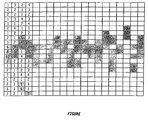
- the raster that is shown in the Figure serves to explain the algorithm.
- the Figure comprises a section measuring 0.08 mm in vertical direction and 1.5 mm in horizontal direction of a transition between two banknotes, in which 20 x 20 pixels having pixel densities of 1-10 are arranged.
- the section is an example of a density distribution obtained from the sensors.
- a threshold value of e.g. 5 is then set in this example. Other threshold values are also possible, of course. All densities ⁇ 5 are shaded grey. Following that, pixels having a density ⁇ 5 and the surrounding n x m pixels are regarded. Of said surrounding n x m pixels, the density development in the x- and y-directions, and subsequently the gradient of said development, viz. the second derivative, are determined. The pixels exhibiting the greatest gradient changes are interconnected.
- the horizontal line thus obtained indicates the division between two banknotes, and counting takes place by summing the number of horizontal lines.
- the maximum value for n in vertical direction is the number of pixels for each banknote thickness (a value of 25 pixels per banknote has been indicated before).
- the value for m (the horizontal number of pixels) is related to the number of dots of which the horizontal line is built up.
- the line may be subjected to a further analysis before it may be included, in which analysis the bandwidth within which said line must range, the angular boundaries of the lines between the two successive interconnected pixels etc may be taken into account.
- the software must also take the number of incomplete lines, or the number of interconnections between the lines, etc into account. The provides a possibility of saying something about the reliability of the count. The subsequent refinement is to make the software self-learning.
- Another method fo determining the number of banknotes contained in a bundle is to measure the reflection and the absorption of Terahertz radiation on individual banknotes in a bundle. Paper is relatively transparent to Terahertz radiation having a wavelength in the mm range.
- the contrast may be enhanced by bending the bundle and/or colouring the side surface.
Landscapes
- Physics & Mathematics (AREA)
- General Physics & Mathematics (AREA)
- Theoretical Computer Science (AREA)
- Toxicology (AREA)
- General Health & Medical Sciences (AREA)
- Engineering & Computer Science (AREA)
- Health & Medical Sciences (AREA)
- Inspection Of Paper Currency And Valuable Securities (AREA)
- Image Analysis (AREA)
- Folding Of Thin Sheet-Like Materials, Special Discharging Devices, And Others (AREA)
- Crystals, And After-Treatments Of Crystals (AREA)
- Packaging Of Special Articles (AREA)
- Pile Receivers (AREA)
- Investigating Or Analysing Materials By The Use Of Chemical Reactions (AREA)
Claims (22)
- Verfahren zum Analysieren eines Banknotenbündels mit den Schritten der Anordnung eines Banknotenbündels, das mindestens eine von den Rändern von Banknoten begrenzte Fläche aufweist, der Beleuchtung der Fläche des Bündels zur Herstellung eines zweidimensionalen Bildes des Bündels durch Benutzung eines optischen Sensors und der Erzeugung eines Ausgangssignals, das das Ergebnis der Analyse wiedergibt, dadurch gekennzeichnet, dass vor dem Beleuchtungsschritt eine oder mehrere Seiten oder Ränder des Banknotenbündels einer solchen mechanischen Operation unterzogen werden, dass eine oder mehrere saubere Flächen erhalten werden, welche bei der Analyse des Banknotenbündels verwendet werden, wobei die Herstellung des zweidimensionalen Bildes so durchgeführt wird, dass das Bild in y-Richtung vergrößert wird, wobei die y-Richtung als die Höhe des Banknotenbündels definiert ist.
- Verfahren nach Anspruch 1, dadurch gekennzeichnet, dass das Bild in x-Richtung verkleinert wird, wobei die x-Richtung als Breite des Banknotenbündels definiert ist.
- Verfahren nach einem oder mehreren der Ansprüche 1-2, dadurch gekennzeichnet, dass der Schritt der Herstellung des zweidimensionalen Bildes des Bündels und des Erhaltens eines Ausgangssignals den Schritt der Durchführung einer Bildverarbeitungsoperation unter Verwendung einer Bildpunktmatrix umfasst.
- Verfahren nach Anspruch 3, dadurch gekennzeichnet, dass der Schritt der Durchführung einer Bildverarbeitungsoperation die Erzeugung einer Bildpunktmatrix umfasst, in der die Anzahl der Bildpunkte in y-Richtung größer ist als die Anzahl der Bildpunkte in x-Richtung.
- Verfahren nach Anspruch 4, dadurch gekennzeichnet, dass die Anzahl der Bildpunkte in y-Richtung mindestens 3mal größer ist als die Anzahl der Bildpunkte in x-Richtung.
- Verfahren nach Anspruch 4, dadurch gekennzeichnet, dass die Anzahl der Bildpunkte in y-Richtung vorzugsweise mindestens 5mal größer ist als die Anzahl der Bildpunkte in x-Richtung.
- Verfahren nach einem oder mehreren der Ansprüche 3-6, dadurch gekennzeichnet, dass der Schritt der Durchführung der Bildverarbeitungsoperation die Schritte der Zuerkennung eines Wertes entsprechend der optischen Dichte zu einem Bildpunkt, der Bestimmung eines Schwellenwertes der optischen Dichte, der Zuerkennung einer Priorität zu einem Bildpunkt mit einem Wert der optischen Dichte, der höher ist als der Schwellenwert, während die sogenannte zweite Ableitung des Dichteprofils der umgebenden Bildpunkte ermittelt wird, des Bestimmens eines Durchschnittswertes der Dichte für eine Bildpunktreihe in y-Richtung, wobei diese Reihe einen oder mehrere Bildpunkte mit einer Priorität umfasst, des Bestimmens der Variationsbreite und der Standardabweichung des auf diese Weise ermittelten Durchschnittswertes und des Erzeugens eines Ausgangssignals, das der Summe der Anzahl der Durchschnittswerte, die höher sind als der Schwellenwert, entspricht, umfasst.
- Verfahren nach einem oder mehreren der vorangehenden Ansprüche, dadurch gekennzeichnet, dass die Analyse die Bestimmung von einem oder mehreren der folgenden Parameter umfasst: der Authentizität, der Anzahl der Banknoten, des Wertes und der Brauchbarkeit des Banknotenbündels.
- Verfahren nach einem oder mehreren der Ansprüche 1-8, dadurch gekennzeichnet, dass die Bestrahlung mit UV-Licht auf einer Seite des Banknotenbündels durchgeführt wird.
- Verfahren nach einem oder mehreren der Ansprüche 1-8, dadurch gekennzeichnet, dass die Bestrahlung mit Infrarotlicht auf einer Seite eines Banknotenbündels durchgeführt wird.
- Verfahren nach einem oder mehreren der vorhergehenden Ansprüche 8-10, dadurch gekennzeichnet, dass ein Bild von einer Seite des Banknotenbündels erhalten wird, indem eine Kamera mit hoher Auflösung als optischer Sensor verwendet wird, wobei dieses Bild unter Verwendung einer geeigneten Datenverarbeitungseinheit verarbeitet wird, um die Authentizität des Bündels zu ermitteln.
- Verfahren nach einem oder mehreren der vorhergehenden Ansprüche 8-10, dadurch gekennzeichnet, dass ein Bild von einer Seite des Banknotenbündels erhalten wird, indem eine Kamera mit hoher Auflösung als optischer Sensor verwendet wird, wobei dieses Bild unter Verwendung einer geeigneten Datenverarbeitungseinheit verarbeitet wird, um die Anzahl der Banknoten in einem Bündel zu ermitteln.
- Verfahren nach einem oder mehreren der vorhergehenden Ansprüche 8-10, dadurch gekennzeichnet, dass die Bestimmung der Anzahl der Banknoten in einem Banknotenbündel durchgeführt wird, indem eine Seite des Bündels mit entferntem Infrarotlicht bei einer Anzahl von Einfallwinkeln bestrahlt und eine Zeitmessung in Bezug auf die reflektierte Strahlung durchgeführt wird.
- Verfahren nach einem oder mehreren der vorhergehenden Ansprüche 8-10, dadurch gekennzeichnet, dass ein Bild von einer Seite des Banknotenbündels erhalten wird, indem von einer Kamera mit hoher Auflösung als optischer Sensor Gebrauch gemacht wird, wobei dieses Bild unter Verwendung einer geeigneten Datenverarbeitungseinheit verarbeitet wird, um den Ursprung und/oder den Wert des Banknotenbündels zu ermitteln.
- Verfahren nach Anspruch 8, dadurch gekennzeichnet, dass die Brauchbarkeit eines Banknotenbündels durch Messen der Kompressibilität eines Banknotenbündels ermittelt wird.
- Verfahren nach Anspruch 8, dadurch gekennzeichnet, dass die Brauchbarkeit eines Banknotenbündels durch Messen des akustischen Widerstandes eines Banknotenbündels ermittelt wird.
- Vorrichtung zum Analysieren eines Banknotenbündels, das mindestens eine von den Rändern der Banknoten begrenzte Fläche aufweist, wobei die Vorrichtung eine Lichtquelle zum Beleuchten dieser Fläche, mindestens einen optischen Sensor zum Erzeugen eines zweidimensionalen Bildes und eine Bildverarbeitungseinheit zum Verarbeiten eines zweidimensionalen Bildes und zum Erzeugen eines Ausgangssignals, das das Ergebnis der Analyse wiedergibt, umfasst, dadurch gekennzeichnet, dass die Vorrichtung des weiteren ein Schneidelement aufweist, das eine Materialmenge aus einem Banknotenbündel in einer Ebene senkrecht zur z-Richtung entfernt, wobei die Schnittfläche als die Fläche im Beleuchtungsschritt verwendet wird, und der optische Sensor ein zweidimensionales Bild erzeugt, das in y-Richtung vergrößert ist, wobei die y-Richtung als Höhe des Banknotenbündels definiert ist.
- Vorrichtung nach Anspruch 17, dadurch gekennzeichnet, dass der optische Sensor ein zweidimensionales Bild erzeugt, das in x-Richtung verkleinert ist, wobei die x-Richtung als Breite des Banknotenbündels definiert ist.
- Vorrichtung zum Analysieren eines Banknotenbündels nach einem oder mehreren der vorhergehenden Ansprüche 17-18, dadurch gekennzeichnet, dass der optische Sensor eine Anzahl von einzelnen optischen Sensoren aufweist, die jeweils ein Segment des beleuchteten Banknotenbündels empfangen, wobei von einer Spiegelkonstruktion Gebrauch gemacht wird.
- Vorrichtung zum Analysieren eines Banknotenbündels nach Anspruch 19, dadurch gekennzeichnet, dass die Spiegelkonstruktion aus einer Anzahl von Unterspiegeln, insbesondere einem halbtransparenten Spiegel, hergestellt ist.
- Vorrichtung zum Analysieren eines Banknotenbündels nach einem oder mehreren der Ansprüche 19-20, dadurch gekennzeichnet, dass die Sensoren in x-, y- und z-Richtung unabhängig bewegbar sind.
- Vorrichtung zum Analysieren eines Banknotenbündels nach Anspruch 17, dadurch gekennzeichnet, dass der optische Sensor eine Abtastkamera ist, die eine Abtastung des Banknotenbündels in x-Richtung durchführt.
Applications Claiming Priority (3)
| Application Number | Priority Date | Filing Date | Title |
|---|---|---|---|
| NL1022257 | 2002-12-24 | ||
| NL1022257A NL1022257C2 (nl) | 2002-12-24 | 2002-12-24 | Werkwijze voor het analyseren van bankbiljetten. |
| PCT/NL2003/000943 WO2004059585A1 (en) | 2002-12-24 | 2003-12-24 | Method of analysing a stack of flat objects |
Publications (2)
| Publication Number | Publication Date |
|---|---|
| EP1576552A1 EP1576552A1 (de) | 2005-09-21 |
| EP1576552B1 true EP1576552B1 (de) | 2008-02-27 |
Family
ID=32678032
Family Applications (1)
| Application Number | Title | Priority Date | Filing Date |
|---|---|---|---|
| EP03786437A Expired - Lifetime EP1576552B1 (de) | 2002-12-24 | 2003-12-24 | Verfahren zur analyse eines stapels von flachen gegenständen |
Country Status (10)
| Country | Link |
|---|---|
| US (1) | US7382910B2 (de) |
| EP (1) | EP1576552B1 (de) |
| JP (1) | JP4431832B2 (de) |
| CN (1) | CN100527173C (de) |
| AT (1) | ATE387686T1 (de) |
| AU (1) | AU2003296262A1 (de) |
| DE (1) | DE60319423T2 (de) |
| NL (1) | NL1022257C2 (de) |
| RU (1) | RU2332718C2 (de) |
| WO (1) | WO2004059585A1 (de) |
Cited By (2)
| Publication number | Priority date | Publication date | Assignee | Title |
|---|---|---|---|---|
| EP2577621A1 (de) * | 2010-06-03 | 2013-04-10 | Spectra Systems Corporation | Detektion von währungseignung und -abnutzung mittels temperaturmodulierter infrarotdetektion |
| DE102012017770A1 (de) | 2012-09-07 | 2014-04-03 | Giesecke & Devrient Gmbh | Vorrichtung und Verfahren zur Bearbeitung von Wertdokumenten |
Families Citing this family (18)
| Publication number | Priority date | Publication date | Assignee | Title |
|---|---|---|---|---|
| EP1624402A1 (de) * | 2004-08-03 | 2006-02-08 | Kba-Giori S.A. | Zählen von gestapelten Dokumenten |
| DE102005036569A1 (de) * | 2005-08-03 | 2007-02-15 | Giesecke & Devrient Gmbh | Verfahren und Vorrichtung zum Prüfen von Wertdokumenten |
| US8070574B2 (en) | 2007-06-06 | 2011-12-06 | Shuffle Master, Inc. | Apparatus, system, method, and computer-readable medium for casino card handling with multiple hand recall feature |
| EP1980393A1 (de) * | 2007-04-13 | 2008-10-15 | Kba-Giori S.A. | Verfahren und System zur Herstellung von Wertpapieren |
| US8920236B2 (en) | 2007-11-02 | 2014-12-30 | Bally Gaming, Inc. | Game related systems, methods, and articles that combine virtual and physical elements |
| US20090174679A1 (en) | 2008-01-04 | 2009-07-09 | Wayne Carl Westerman | Selective Rejection of Touch Contacts in an Edge Region of a Touch Surface |
| EP2282286A1 (de) | 2009-08-03 | 2011-02-09 | Kba-Giori S.A. | Verfahren und System zur Verarbeitung von Blätterstapeln zu Sicherheitsbündeln, insbesondere Banknotenbündeln |
| US8285034B2 (en) * | 2009-08-26 | 2012-10-09 | Bally Gaming, Inc. | Apparatus, method and article for evaluating a stack of objects in an image |
| EP2585983B1 (de) | 2010-06-25 | 2016-02-10 | Kba-Notasys Sa | Verfahren und system zur kontaktlosen zählung von gestapelten substraten, insbesondere gebündelten banknoten |
| US20140098360A1 (en) * | 2012-10-04 | 2014-04-10 | Kisan Electronics Co., Ltd. | Method of discriminating banknote using terahertz electromagnetic waves |
| US8961298B2 (en) | 2013-01-11 | 2015-02-24 | Bally Gaming, Inc. | Bet sensors, gaming tables with one or more bet sensors, and related methods |
| EP2805603B1 (de) * | 2013-05-22 | 2017-01-11 | CLAAS E-Systems KGaA mbH & Co KG | Vorrichtung und Verfahren zur Überwachung der Schneidenschärfe |
| US10504315B2 (en) * | 2013-08-05 | 2019-12-10 | Ncr Corporation | Clamping of media items |
| WO2017221246A1 (en) * | 2016-06-21 | 2017-12-28 | Soreq Nuclear Research Center | An xrf analyzer for identifying a plurality of solid objects, a sorting system and a sorting method thereof |
| DE102016010850A1 (de) * | 2016-09-07 | 2018-03-08 | Giesecke+Devrient Currency Technology Gmbh | Verfahren, Vorrichtung und System zum Bearbeiten eines Transportbehälters für Wertgegenstände |
| US10556758B1 (en) * | 2017-03-08 | 2020-02-11 | Maxco Supply, Inc. | Denester and method of denesting a stack of containers |
| EP3448010A1 (de) * | 2017-08-23 | 2019-02-27 | Fraunhofer-Gesellschaft zur Förderung der angewandten Forschung e.V. | System zur analyse eines dokuments und entsprechendes verfahren |
| CN113358072B (zh) * | 2021-06-03 | 2024-02-06 | 河南科技大学 | 一种板材层数的超声波测量设备及其测量方法 |
Family Cites Families (18)
| Publication number | Priority date | Publication date | Assignee | Title |
|---|---|---|---|---|
| DE3444709C2 (de) * | 1984-12-07 | 1996-05-30 | Gao Ges Automation Org | Vorrichtung zum Vernichten von Banknoten |
| US4694474A (en) * | 1986-06-18 | 1987-09-15 | Mechanical Technology Incorporated | High speed counter for thin objects |
| GB8724506D0 (en) * | 1987-10-20 | 1987-11-25 | Woodward W H | Stack counting instrument |
| JP2725123B2 (ja) * | 1991-11-22 | 1998-03-09 | ローレルバンクマシン株式会社 | シート計数機 |
| US5430664A (en) * | 1992-07-14 | 1995-07-04 | Technitrol, Inc. | Document counting and batching apparatus with counterfeit detection |
| RU2112279C1 (ru) * | 1993-08-02 | 1998-05-27 | Акционерное общество открытого типа НИИ точной механики | Машина для счета банковских билетов |
| US5534690A (en) * | 1995-01-19 | 1996-07-09 | Goldenberg; Lior | Methods and apparatus for counting thin stacked objects |
| EP0743616A3 (de) | 1995-05-15 | 1998-01-14 | Eastman Kodak Company | Vorrichtung und Verfahren zum Zählen von Blättern |
| DE19543634A1 (de) * | 1995-11-23 | 1997-05-28 | Giesecke & Devrient Gmbh | Vorrichtung und Verfahren zum Vereinzeln von Blattgut aus einem Stapel |
| US5922959A (en) * | 1996-10-15 | 1999-07-13 | Currency Systems International | Methods of measuring currency limpness |
| US6182961B1 (en) * | 1998-12-16 | 2001-02-06 | Xerox Corporation | Duplex document retard separation and feeding with reduced image smudging |
| AUPQ492999A0 (en) * | 1999-12-30 | 2000-02-03 | Note Printing Australia Ltd | Method of determining a characteristic of a security document, such as a bank note |
| EP1256082A2 (de) * | 2000-02-08 | 2002-11-13 | Cummins-Allison Corporation | Verfahren und vorrichtung zur erkennung zusammemhaengender noten in einem banknotenbearbeitungssystem |
| US6351552B1 (en) * | 2000-03-09 | 2002-02-26 | Recot, Inc. | Predestruction note image audit |
| SE522603C2 (sv) * | 2000-06-16 | 2004-02-24 | Nybohov Dev Ab | Sedelautomat för in- och utmatning av sedlar innefattande detektororgan för kontroll av sedlar samt en destrueringsenhet |
| DE10050486A1 (de) * | 2000-10-12 | 2002-04-18 | Giesecke & Devrient Gmbh | Vorrichtung und Verfahren zur Bearbeitung von Blattgut |
| CN2524300Y (zh) * | 2002-03-25 | 2002-12-04 | 鲍东山 | 复合高技术验钞机 |
| US20040213448A1 (en) * | 2003-04-28 | 2004-10-28 | Asn Technology Corp. | Apparatus for recognizing counterfeit currency and method thereof |
-
2002
- 2002-12-24 NL NL1022257A patent/NL1022257C2/nl not_active IP Right Cessation
-
2003
- 2003-12-24 CN CNB2003801005784A patent/CN100527173C/zh not_active Expired - Fee Related
- 2003-12-24 US US10/520,735 patent/US7382910B2/en not_active Expired - Fee Related
- 2003-12-24 WO PCT/NL2003/000943 patent/WO2004059585A1/en not_active Ceased
- 2003-12-24 AU AU2003296262A patent/AU2003296262A1/en not_active Abandoned
- 2003-12-24 EP EP03786437A patent/EP1576552B1/de not_active Expired - Lifetime
- 2003-12-24 DE DE60319423T patent/DE60319423T2/de not_active Expired - Lifetime
- 2003-12-24 JP JP2004563049A patent/JP4431832B2/ja not_active Expired - Fee Related
- 2003-12-24 RU RU2004139127/09A patent/RU2332718C2/ru not_active IP Right Cessation
- 2003-12-24 AT AT03786437T patent/ATE387686T1/de active
Cited By (3)
| Publication number | Priority date | Publication date | Assignee | Title |
|---|---|---|---|---|
| EP2577621A1 (de) * | 2010-06-03 | 2013-04-10 | Spectra Systems Corporation | Detektion von währungseignung und -abnutzung mittels temperaturmodulierter infrarotdetektion |
| DE102012017770A1 (de) | 2012-09-07 | 2014-04-03 | Giesecke & Devrient Gmbh | Vorrichtung und Verfahren zur Bearbeitung von Wertdokumenten |
| US9216869B2 (en) | 2012-09-07 | 2015-12-22 | Giesecke & Devrient Gmbh | Device and method for controlling the tracking of a value document stack |
Also Published As
| Publication number | Publication date |
|---|---|
| DE60319423D1 (de) | 2008-04-10 |
| ATE387686T1 (de) | 2008-03-15 |
| US20060067559A1 (en) | 2006-03-30 |
| CN100527173C (zh) | 2009-08-12 |
| US7382910B2 (en) | 2008-06-03 |
| RU2004139127A (ru) | 2005-10-27 |
| JP2006512646A (ja) | 2006-04-13 |
| EP1576552A1 (de) | 2005-09-21 |
| AU2003296262A1 (en) | 2004-07-22 |
| DE60319423T2 (de) | 2009-02-19 |
| WO2004059585A1 (en) | 2004-07-15 |
| JP4431832B2 (ja) | 2010-03-17 |
| CN1692379A (zh) | 2005-11-02 |
| RU2332718C2 (ru) | 2008-08-27 |
| NL1022257C2 (nl) | 2004-06-25 |
Similar Documents
| Publication | Publication Date | Title |
|---|---|---|
| US7382910B2 (en) | Method of analysing a stack of flat objects | |
| CN102224530B (zh) | 使用顺序照射确定文件的适合性 | |
| CN102224531B (zh) | 顺序照射 | |
| US5757001A (en) | Detection of counterfeit currency | |
| US8089045B2 (en) | Method and apparatus for raised material detection | |
| US8041107B2 (en) | OVD (optical variable device) inspection method and inspection apparatus | |
| CN1141682A (zh) | 对伪造例如伪钞的检验 | |
| JPS5938889A (ja) | 紙幣または同様な対象物の識別検査装置 | |
| EP1601599B1 (de) | Optische doppelzufuhrerfassung | |
| EP2380146B1 (de) | Verfahren und vorrichtung zum prüfen von wertdokumenten | |
| EP0381550B1 (de) | Vorrichtung und Verfahren zum schnellen Erkennen von Wasserzeichen mit elektromagnetischer Strahlung | |
| EP3588434B1 (de) | Systeme und verfahren zur analyse von stoffartikeln | |
| JP3490809B2 (ja) | 金属帯の表面疵検査方法および装置 | |
| JP4250736B2 (ja) | 封緘有価証券類、封緘有価証券類作製方法、および製品保証検査装置 | |
| TW530269B (en) | Method of determining a characteristic of a security document, such as a banknote | |
| JPH0989801A (ja) | 長尺材の表面検査方法および装置 | |
| JP7715661B2 (ja) | 紙葉類識別装置、紙葉類処理装置及び紙葉類識別方法 | |
| JP3987938B2 (ja) | 身分証真偽鑑別方法及びシステム | |
| TWM660872U (zh) | 鈔卷面積掃描機 | |
| CA2513798A1 (en) | Method for determining and/or verifying the contents of coin rolls |
Legal Events
| Date | Code | Title | Description |
|---|---|---|---|
| PUAI | Public reference made under article 153(3) epc to a published international application that has entered the european phase |
Free format text: ORIGINAL CODE: 0009012 |
|
| 17P | Request for examination filed |
Effective date: 20041231 |
|
| AK | Designated contracting states |
Kind code of ref document: A1 Designated state(s): AT BE BG CH CY CZ DE DK EE ES FI FR GB GR HU IE IT LI LU MC NL PT RO SE SI SK TR |
|
| AX | Request for extension of the european patent |
Extension state: AL LT LV MK |
|
| DAX | Request for extension of the european patent (deleted) | ||
| GRAP | Despatch of communication of intention to grant a patent |
Free format text: ORIGINAL CODE: EPIDOSNIGR1 |
|
| GRAS | Grant fee paid |
Free format text: ORIGINAL CODE: EPIDOSNIGR3 |
|
| GRAA | (expected) grant |
Free format text: ORIGINAL CODE: 0009210 |
|
| AK | Designated contracting states |
Kind code of ref document: B1 Designated state(s): AT BE BG CH CY CZ DE DK EE ES FI FR GB GR HU IE IT LI LU MC NL PT RO SE SI SK TR |
|
| REG | Reference to a national code |
Ref country code: GB Ref legal event code: FG4D |
|
| REG | Reference to a national code |
Ref country code: CH Ref legal event code: EP |
|
| REG | Reference to a national code |
Ref country code: IE Ref legal event code: FG4D |
|
| REF | Corresponds to: |
Ref document number: 60319423 Country of ref document: DE Date of ref document: 20080410 Kind code of ref document: P |
|
| REG | Reference to a national code |
Ref country code: CH Ref legal event code: NV Representative=s name: ROTTMANN, ZIMMERMANN + PARTNER AG |
|
| PG25 | Lapsed in a contracting state [announced via postgrant information from national office to epo] |
Ref country code: ES Free format text: LAPSE BECAUSE OF FAILURE TO SUBMIT A TRANSLATION OF THE DESCRIPTION OR TO PAY THE FEE WITHIN THE PRESCRIBED TIME-LIMIT Effective date: 20080607 Ref country code: FI Free format text: LAPSE BECAUSE OF FAILURE TO SUBMIT A TRANSLATION OF THE DESCRIPTION OR TO PAY THE FEE WITHIN THE PRESCRIBED TIME-LIMIT Effective date: 20080227 |
|
| PG25 | Lapsed in a contracting state [announced via postgrant information from national office to epo] |
Ref country code: BE Free format text: LAPSE BECAUSE OF FAILURE TO SUBMIT A TRANSLATION OF THE DESCRIPTION OR TO PAY THE FEE WITHIN THE PRESCRIBED TIME-LIMIT Effective date: 20080227 Ref country code: SI Free format text: LAPSE BECAUSE OF FAILURE TO SUBMIT A TRANSLATION OF THE DESCRIPTION OR TO PAY THE FEE WITHIN THE PRESCRIBED TIME-LIMIT Effective date: 20080227 |
|
| PG25 | Lapsed in a contracting state [announced via postgrant information from national office to epo] |
Ref country code: SE Free format text: LAPSE BECAUSE OF FAILURE TO SUBMIT A TRANSLATION OF THE DESCRIPTION OR TO PAY THE FEE WITHIN THE PRESCRIBED TIME-LIMIT Effective date: 20080527 Ref country code: PT Free format text: LAPSE BECAUSE OF FAILURE TO SUBMIT A TRANSLATION OF THE DESCRIPTION OR TO PAY THE FEE WITHIN THE PRESCRIBED TIME-LIMIT Effective date: 20080721 Ref country code: CZ Free format text: LAPSE BECAUSE OF FAILURE TO SUBMIT A TRANSLATION OF THE DESCRIPTION OR TO PAY THE FEE WITHIN THE PRESCRIBED TIME-LIMIT Effective date: 20080227 Ref country code: DK Free format text: LAPSE BECAUSE OF FAILURE TO SUBMIT A TRANSLATION OF THE DESCRIPTION OR TO PAY THE FEE WITHIN THE PRESCRIBED TIME-LIMIT Effective date: 20080227 Ref country code: SK Free format text: LAPSE BECAUSE OF FAILURE TO SUBMIT A TRANSLATION OF THE DESCRIPTION OR TO PAY THE FEE WITHIN THE PRESCRIBED TIME-LIMIT Effective date: 20080227 |
|
| PG25 | Lapsed in a contracting state [announced via postgrant information from national office to epo] |
Ref country code: RO Free format text: LAPSE BECAUSE OF FAILURE TO SUBMIT A TRANSLATION OF THE DESCRIPTION OR TO PAY THE FEE WITHIN THE PRESCRIBED TIME-LIMIT Effective date: 20080227 |
|
| EN | Fr: translation not filed | ||
| PLBE | No opposition filed within time limit |
Free format text: ORIGINAL CODE: 0009261 |
|
| STAA | Information on the status of an ep patent application or granted ep patent |
Free format text: STATUS: NO OPPOSITION FILED WITHIN TIME LIMIT |
|
| 26N | No opposition filed |
Effective date: 20081128 |
|
| PG25 | Lapsed in a contracting state [announced via postgrant information from national office to epo] |
Ref country code: EE Free format text: LAPSE BECAUSE OF FAILURE TO SUBMIT A TRANSLATION OF THE DESCRIPTION OR TO PAY THE FEE WITHIN THE PRESCRIBED TIME-LIMIT Effective date: 20080227 Ref country code: BG Free format text: LAPSE BECAUSE OF FAILURE TO SUBMIT A TRANSLATION OF THE DESCRIPTION OR TO PAY THE FEE WITHIN THE PRESCRIBED TIME-LIMIT Effective date: 20080527 Ref country code: FR Free format text: LAPSE BECAUSE OF FAILURE TO SUBMIT A TRANSLATION OF THE DESCRIPTION OR TO PAY THE FEE WITHIN THE PRESCRIBED TIME-LIMIT Effective date: 20081219 |
|
| PG25 | Lapsed in a contracting state [announced via postgrant information from national office to epo] |
Ref country code: CY Free format text: LAPSE BECAUSE OF FAILURE TO SUBMIT A TRANSLATION OF THE DESCRIPTION OR TO PAY THE FEE WITHIN THE PRESCRIBED TIME-LIMIT Effective date: 20080227 Ref country code: MC Free format text: LAPSE BECAUSE OF NON-PAYMENT OF DUE FEES Effective date: 20081231 |
|
| PG25 | Lapsed in a contracting state [announced via postgrant information from national office to epo] |
Ref country code: IT Free format text: LAPSE BECAUSE OF FAILURE TO SUBMIT A TRANSLATION OF THE DESCRIPTION OR TO PAY THE FEE WITHIN THE PRESCRIBED TIME-LIMIT Effective date: 20080227 |
|
| PG25 | Lapsed in a contracting state [announced via postgrant information from national office to epo] |
Ref country code: IE Free format text: LAPSE BECAUSE OF NON-PAYMENT OF DUE FEES Effective date: 20081224 |
|
| PG25 | Lapsed in a contracting state [announced via postgrant information from national office to epo] |
Ref country code: HU Free format text: LAPSE BECAUSE OF FAILURE TO SUBMIT A TRANSLATION OF THE DESCRIPTION OR TO PAY THE FEE WITHIN THE PRESCRIBED TIME-LIMIT Effective date: 20080828 Ref country code: LU Free format text: LAPSE BECAUSE OF NON-PAYMENT OF DUE FEES Effective date: 20081224 |
|
| PG25 | Lapsed in a contracting state [announced via postgrant information from national office to epo] |
Ref country code: TR Free format text: LAPSE BECAUSE OF FAILURE TO SUBMIT A TRANSLATION OF THE DESCRIPTION OR TO PAY THE FEE WITHIN THE PRESCRIBED TIME-LIMIT Effective date: 20080227 |
|
| PG25 | Lapsed in a contracting state [announced via postgrant information from national office to epo] |
Ref country code: GR Free format text: LAPSE BECAUSE OF FAILURE TO SUBMIT A TRANSLATION OF THE DESCRIPTION OR TO PAY THE FEE WITHIN THE PRESCRIBED TIME-LIMIT Effective date: 20080528 |
|
| REG | Reference to a national code |
Ref country code: CH Ref legal event code: PFA Owner name: SYNTECH HOLDINGS B.V. Free format text: SYNTECH HOLDINGS B.V.#L.J. COSTERSTRAAT 6#5916 PS VENLO (NL) -TRANSFER TO- SYNTECH HOLDINGS B.V.#L.J. COSTERSTRAAT 6#5916 PS VENLO (NL) |
|
| PGFP | Annual fee paid to national office [announced via postgrant information from national office to epo] |
Ref country code: GB Payment date: 20141219 Year of fee payment: 12 Ref country code: CH Payment date: 20141219 Year of fee payment: 12 Ref country code: DE Payment date: 20141211 Year of fee payment: 12 |
|
| PGFP | Annual fee paid to national office [announced via postgrant information from national office to epo] |
Ref country code: NL Payment date: 20141219 Year of fee payment: 12 Ref country code: AT Payment date: 20141222 Year of fee payment: 12 |
|
| REG | Reference to a national code |
Ref country code: DE Ref legal event code: R082 Ref document number: 60319423 Country of ref document: DE Representative=s name: HAUCK PATENTANWALTSPARTNERSCHAFT MBB, DE |
|
| REG | Reference to a national code |
Ref country code: DE Ref legal event code: R119 Ref document number: 60319423 Country of ref document: DE |
|
| REG | Reference to a national code |
Ref country code: CH Ref legal event code: PL |
|
| REG | Reference to a national code |
Ref country code: AT Ref legal event code: MM01 Ref document number: 387686 Country of ref document: AT Kind code of ref document: T Effective date: 20151224 |
|
| GBPC | Gb: european patent ceased through non-payment of renewal fee |
Effective date: 20151224 |
|
| REG | Reference to a national code |
Ref country code: NL Ref legal event code: MM Effective date: 20160101 |
|
| PG25 | Lapsed in a contracting state [announced via postgrant information from national office to epo] |
Ref country code: DE Free format text: LAPSE BECAUSE OF NON-PAYMENT OF DUE FEES Effective date: 20160701 Ref country code: LI Free format text: LAPSE BECAUSE OF NON-PAYMENT OF DUE FEES Effective date: 20151231 Ref country code: CH Free format text: LAPSE BECAUSE OF NON-PAYMENT OF DUE FEES Effective date: 20151231 Ref country code: GB Free format text: LAPSE BECAUSE OF NON-PAYMENT OF DUE FEES Effective date: 20151224 Ref country code: NL Free format text: LAPSE BECAUSE OF NON-PAYMENT OF DUE FEES Effective date: 20160101 |
|
| PG25 | Lapsed in a contracting state [announced via postgrant information from national office to epo] |
Ref country code: AT Free format text: LAPSE BECAUSE OF NON-PAYMENT OF DUE FEES Effective date: 20151224 |