EP1576211B1 - Poly(trimethylene terephthalate) bicomponent fiber process - Google Patents
Poly(trimethylene terephthalate) bicomponent fiber process Download PDFInfo
- Publication number
- EP1576211B1 EP1576211B1 EP03814567.8A EP03814567A EP1576211B1 EP 1576211 B1 EP1576211 B1 EP 1576211B1 EP 03814567 A EP03814567 A EP 03814567A EP 1576211 B1 EP1576211 B1 EP 1576211B1
- Authority
- EP
- European Patent Office
- Prior art keywords
- poly
- trimethylene terephthalate
- fiber
- bicomponent
- fibers
- Prior art date
- Legal status (The legal status is an assumption and is not a legal conclusion. Google has not performed a legal analysis and makes no representation as to the accuracy of the status listed.)
- Expired - Lifetime
Links
- -1 Poly(trimethylene terephthalate) Polymers 0.000 title claims description 263
- 239000000835 fiber Substances 0.000 title claims description 123
- 229920002215 polytrimethylene terephthalate Polymers 0.000 title claims description 118
- 238000000034 method Methods 0.000 title claims description 29
- 230000008569 process Effects 0.000 title claims description 26
- 229920000642 polymer Polymers 0.000 claims description 76
- 238000009987 spinning Methods 0.000 claims description 20
- 238000004519 manufacturing process Methods 0.000 claims description 19
- 239000000155 melt Substances 0.000 claims description 18
- 238000010791 quenching Methods 0.000 claims description 14
- XLYOFNOQVPJJNP-UHFFFAOYSA-N water Substances O XLYOFNOQVPJJNP-UHFFFAOYSA-N 0.000 claims description 8
- 238000004804 winding Methods 0.000 claims description 7
- 230000004075 alteration Effects 0.000 claims description 6
- 229920001577 copolymer Polymers 0.000 claims description 6
- 229920006240 drawn fiber Polymers 0.000 claims description 5
- 150000003335 secondary amines Chemical class 0.000 claims description 5
- 239000002253 acid Substances 0.000 claims description 4
- 238000005520 cutting process Methods 0.000 claims description 4
- 150000003512 tertiary amines Chemical class 0.000 claims description 2
- PPBRXRYQALVLMV-UHFFFAOYSA-N Styrene Chemical compound C=CC1=CC=CC=C1 PPBRXRYQALVLMV-UHFFFAOYSA-N 0.000 description 36
- 239000000203 mixture Substances 0.000 description 25
- 239000000306 component Substances 0.000 description 18
- 229920000728 polyester Polymers 0.000 description 13
- 239000004793 Polystyrene Substances 0.000 description 12
- 229920002223 polystyrene Polymers 0.000 description 12
- 239000007789 gas Substances 0.000 description 9
- 230000008602 contraction Effects 0.000 description 7
- 239000000654 additive Substances 0.000 description 6
- 238000002074 melt spinning Methods 0.000 description 6
- 229920000139 polyethylene terephthalate Polymers 0.000 description 6
- 239000005020 polyethylene terephthalate Substances 0.000 description 6
- 239000002861 polymer material Substances 0.000 description 6
- LYCAIKOWRPUZTN-UHFFFAOYSA-N Ethylene glycol Chemical compound OCCO LYCAIKOWRPUZTN-UHFFFAOYSA-N 0.000 description 5
- 239000008188 pellet Substances 0.000 description 5
- 229920001634 Copolyester Polymers 0.000 description 4
- 230000000996 additive effect Effects 0.000 description 4
- 125000004432 carbon atom Chemical group C* 0.000 description 4
- 238000002360 preparation method Methods 0.000 description 4
- YMWUJEATGCHHMB-UHFFFAOYSA-N Dichloromethane Chemical compound ClCCl YMWUJEATGCHHMB-UHFFFAOYSA-N 0.000 description 3
- 230000003247 decreasing effect Effects 0.000 description 3
- 239000004744 fabric Substances 0.000 description 3
- 238000010438 heat treatment Methods 0.000 description 3
- 239000002667 nucleating agent Substances 0.000 description 3
- 229920000874 polytetramethylene terephthalate Polymers 0.000 description 3
- 239000007858 starting material Substances 0.000 description 3
- 238000012360 testing method Methods 0.000 description 3
- 239000004753 textile Substances 0.000 description 3
- 238000012546 transfer Methods 0.000 description 3
- QPFMBZIOSGYJDE-UHFFFAOYSA-N 1,1,2,2-tetrachloroethane Chemical compound ClC(Cl)C(Cl)Cl QPFMBZIOSGYJDE-UHFFFAOYSA-N 0.000 description 2
- NMYFVWYGKGVPIW-UHFFFAOYSA-N 3,7-dioxabicyclo[7.2.2]trideca-1(11),9,12-triene-2,8-dione Chemical group O=C1OCCCOC(=O)C2=CC=C1C=C2 NMYFVWYGKGVPIW-UHFFFAOYSA-N 0.000 description 2
- IJGRMHOSHXDMSA-UHFFFAOYSA-N Atomic nitrogen Chemical compound N#N IJGRMHOSHXDMSA-UHFFFAOYSA-N 0.000 description 2
- 239000004952 Polyamide Substances 0.000 description 2
- KKEYFWRCBNTPAC-UHFFFAOYSA-N Terephthalic acid Chemical compound OC(=O)C1=CC=C(C(O)=O)C=C1 KKEYFWRCBNTPAC-UHFFFAOYSA-N 0.000 description 2
- GWEVSGVZZGPLCZ-UHFFFAOYSA-N Titan oxide Chemical compound O=[Ti]=O GWEVSGVZZGPLCZ-UHFFFAOYSA-N 0.000 description 2
- DTQVDTLACAAQTR-UHFFFAOYSA-N Trifluoroacetic acid Chemical compound OC(=O)C(F)(F)F DTQVDTLACAAQTR-UHFFFAOYSA-N 0.000 description 2
- WNLRTRBMVRJNCN-UHFFFAOYSA-N adipic acid Chemical compound OC(=O)CCCCC(O)=O WNLRTRBMVRJNCN-UHFFFAOYSA-N 0.000 description 2
- 238000000137 annealing Methods 0.000 description 2
- WERYXYBDKMZEQL-UHFFFAOYSA-N butane-1,4-diol Chemical compound OCCCCO WERYXYBDKMZEQL-UHFFFAOYSA-N 0.000 description 2
- 230000008859 change Effects 0.000 description 2
- 238000004581 coalescence Methods 0.000 description 2
- 230000001143 conditioned effect Effects 0.000 description 2
- 230000000875 corresponding effect Effects 0.000 description 2
- 125000004122 cyclic group Chemical group 0.000 description 2
- 238000009408 flooring Methods 0.000 description 2
- JFCQEDHGNNZCLN-UHFFFAOYSA-N glutaric acid Chemical compound OC(=O)CCCC(O)=O JFCQEDHGNNZCLN-UHFFFAOYSA-N 0.000 description 2
- 238000009998 heat setting Methods 0.000 description 2
- NAQMVNRVTILPCV-UHFFFAOYSA-N hexane-1,6-diamine Chemical compound NCCCCCCN NAQMVNRVTILPCV-UHFFFAOYSA-N 0.000 description 2
- 229920001519 homopolymer Polymers 0.000 description 2
- WGCNASOHLSPBMP-UHFFFAOYSA-N hydroxyacetaldehyde Natural products OCC=O WGCNASOHLSPBMP-UHFFFAOYSA-N 0.000 description 2
- 239000011261 inert gas Substances 0.000 description 2
- QQVIHTHCMHWDBS-UHFFFAOYSA-N isophthalic acid Chemical compound OC(=O)C1=CC=CC(C(O)=O)=C1 QQVIHTHCMHWDBS-UHFFFAOYSA-N 0.000 description 2
- 230000000704 physical effect Effects 0.000 description 2
- 239000000049 pigment Substances 0.000 description 2
- 229920002647 polyamide Polymers 0.000 description 2
- KDYFGRWQOYBRFD-UHFFFAOYSA-N succinic acid Chemical compound OC(=O)CCC(O)=O KDYFGRWQOYBRFD-UHFFFAOYSA-N 0.000 description 2
- ARCGXLSVLAOJQL-UHFFFAOYSA-N trimellitic acid Chemical compound OC(=O)C1=CC=C(C(O)=O)C(C(O)=O)=C1 ARCGXLSVLAOJQL-UHFFFAOYSA-N 0.000 description 2
- DNIAPMSPPWPWGF-VKHMYHEASA-N (+)-propylene glycol Chemical compound C[C@H](O)CO DNIAPMSPPWPWGF-VKHMYHEASA-N 0.000 description 1
- DNIAPMSPPWPWGF-GSVOUGTGSA-N (R)-(-)-Propylene glycol Chemical compound C[C@@H](O)CO DNIAPMSPPWPWGF-GSVOUGTGSA-N 0.000 description 1
- YPFDHNVEDLHUCE-UHFFFAOYSA-N 1,3-propanediol Substances OCCCO YPFDHNVEDLHUCE-UHFFFAOYSA-N 0.000 description 1
- RYHBNJHYFVUHQT-UHFFFAOYSA-N 1,4-Dioxane Chemical compound C1COCCO1 RYHBNJHYFVUHQT-UHFFFAOYSA-N 0.000 description 1
- PXGZQGDTEZPERC-UHFFFAOYSA-N 1,4-cyclohexanedicarboxylic acid Chemical compound OC(=O)C1CCC(C(O)=O)CC1 PXGZQGDTEZPERC-UHFFFAOYSA-N 0.000 description 1
- QFGCFKJIPBRJGM-UHFFFAOYSA-N 12-[(2-methylpropan-2-yl)oxy]-12-oxododecanoic acid Chemical compound CC(C)(C)OC(=O)CCCCCCCCCCC(O)=O QFGCFKJIPBRJGM-UHFFFAOYSA-N 0.000 description 1
- WTPYFJNYAMXZJG-UHFFFAOYSA-N 2-[4-(2-hydroxyethoxy)phenoxy]ethanol Chemical compound OCCOC1=CC=C(OCCO)C=C1 WTPYFJNYAMXZJG-UHFFFAOYSA-N 0.000 description 1
- QWGRWMMWNDWRQN-UHFFFAOYSA-N 2-methylpropane-1,3-diol Chemical compound OCC(C)CO QWGRWMMWNDWRQN-UHFFFAOYSA-N 0.000 description 1
- MFJDFPRQTMQVHI-UHFFFAOYSA-N 3,5-dioxabicyclo[5.2.2]undeca-1(9),7,10-triene-2,6-dione Chemical group O=C1OCOC(=O)C2=CC=C1C=C2 MFJDFPRQTMQVHI-UHFFFAOYSA-N 0.000 description 1
- SXFJDZNJHVPHPH-UHFFFAOYSA-N 3-methylpentane-1,5-diol Chemical compound OCCC(C)CCO SXFJDZNJHVPHPH-UHFFFAOYSA-N 0.000 description 1
- NIXOWILDQLNWCW-UHFFFAOYSA-M Acrylate Chemical compound [O-]C(=O)C=C NIXOWILDQLNWCW-UHFFFAOYSA-M 0.000 description 1
- 241001082241 Lythrum hyssopifolia Species 0.000 description 1
- OFOBLEOULBTSOW-UHFFFAOYSA-N Malonic acid Chemical compound OC(=O)CC(O)=O OFOBLEOULBTSOW-UHFFFAOYSA-N 0.000 description 1
- CERQOIWHTDAKMF-UHFFFAOYSA-M Methacrylate Chemical compound CC(=C)C([O-])=O CERQOIWHTDAKMF-UHFFFAOYSA-M 0.000 description 1
- 229920002292 Nylon 6 Polymers 0.000 description 1
- 229920002302 Nylon 6,6 Polymers 0.000 description 1
- ISWSIDIOOBJBQZ-UHFFFAOYSA-N Phenol Chemical compound OC1=CC=CC=C1 ISWSIDIOOBJBQZ-UHFFFAOYSA-N 0.000 description 1
- KEAYESYHFKHZAL-UHFFFAOYSA-N Sodium Chemical class [Na] KEAYESYHFKHZAL-UHFFFAOYSA-N 0.000 description 1
- 229920013627 Sorona Polymers 0.000 description 1
- 229960000250 adipic acid Drugs 0.000 description 1
- 235000011037 adipic acid Nutrition 0.000 description 1
- 230000002411 adverse Effects 0.000 description 1
- 125000001931 aliphatic group Chemical group 0.000 description 1
- 125000000217 alkyl group Chemical group 0.000 description 1
- 239000003963 antioxidant agent Substances 0.000 description 1
- 125000003118 aryl group Chemical group 0.000 description 1
- 230000015572 biosynthetic process Effects 0.000 description 1
- 239000003795 chemical substances by application Substances 0.000 description 1
- PMMYEEVYMWASQN-IMJSIDKUSA-N cis-4-Hydroxy-L-proline Chemical compound O[C@@H]1CN[C@H](C(O)=O)C1 PMMYEEVYMWASQN-IMJSIDKUSA-N 0.000 description 1
- 238000013329 compounding Methods 0.000 description 1
- 238000001816 cooling Methods 0.000 description 1
- 239000008358 core component Substances 0.000 description 1
- 230000002596 correlated effect Effects 0.000 description 1
- 238000002788 crimping Methods 0.000 description 1
- 230000001419 dependent effect Effects 0.000 description 1
- 230000006866 deterioration Effects 0.000 description 1
- 238000011161 development Methods 0.000 description 1
- 230000018109 developmental process Effects 0.000 description 1
- 150000002009 diols Chemical class 0.000 description 1
- 238000004043 dyeing Methods 0.000 description 1
- 230000000694 effects Effects 0.000 description 1
- 150000002148 esters Chemical class 0.000 description 1
- 238000001125 extrusion Methods 0.000 description 1
- 230000004927 fusion Effects 0.000 description 1
- 239000012760 heat stabilizer Substances 0.000 description 1
- 238000002844 melting Methods 0.000 description 1
- 230000008018 melting Effects 0.000 description 1
- 238000002156 mixing Methods 0.000 description 1
- 238000012986 modification Methods 0.000 description 1
- 230000004048 modification Effects 0.000 description 1
- 239000000178 monomer Substances 0.000 description 1
- DNIAPMSPPWPWGF-UHFFFAOYSA-N monopropylene glycol Natural products CC(O)CO DNIAPMSPPWPWGF-UHFFFAOYSA-N 0.000 description 1
- RXOHFPCZGPKIRD-UHFFFAOYSA-N naphthalene-2,6-dicarboxylic acid Chemical compound C1=C(C(O)=O)C=CC2=CC(C(=O)O)=CC=C21 RXOHFPCZGPKIRD-UHFFFAOYSA-N 0.000 description 1
- SLCVBVWXLSEKPL-UHFFFAOYSA-N neopentyl glycol Chemical compound OCC(C)(C)CO SLCVBVWXLSEKPL-UHFFFAOYSA-N 0.000 description 1
- 229910052757 nitrogen Inorganic materials 0.000 description 1
- 230000003287 optical effect Effects 0.000 description 1
- 238000004806 packaging method and process Methods 0.000 description 1
- 229920003229 poly(methyl methacrylate) Polymers 0.000 description 1
- 229920000120 polyethyl acrylate Polymers 0.000 description 1
- 229920002959 polymer blend Polymers 0.000 description 1
- 238000012667 polymer degradation Methods 0.000 description 1
- 239000004926 polymethyl methacrylate Substances 0.000 description 1
- 229920000166 polytrimethylene carbonate Polymers 0.000 description 1
- 238000012545 processing Methods 0.000 description 1
- 235000013772 propylene glycol Nutrition 0.000 description 1
- 238000010926 purge Methods 0.000 description 1
- 239000000376 reactant Substances 0.000 description 1
- 150000003839 salts Chemical class 0.000 description 1
- WQOMVNPUJAWPFR-UHFFFAOYSA-M sodium;2-carboxynaphthalene-1-carboxylate Chemical compound [Na+].C1=CC=CC2=C(C([O-])=O)C(C(=O)O)=CC=C21 WQOMVNPUJAWPFR-UHFFFAOYSA-M 0.000 description 1
- GJTNGKDEAATFNA-UHFFFAOYSA-M sodium;benzene-1,3-dicarboxylate;hydron Chemical compound [Na+].OC(=O)C1=CC=CC(C([O-])=O)=C1 GJTNGKDEAATFNA-UHFFFAOYSA-M 0.000 description 1
- DJYPJBAHKUBLSS-UHFFFAOYSA-M sodium;hydron;terephthalate Chemical compound [Na+].OC(=O)C1=CC=C(C([O-])=O)C=C1 DJYPJBAHKUBLSS-UHFFFAOYSA-M 0.000 description 1
- 239000007787 solid Substances 0.000 description 1
- 239000000126 substance Substances 0.000 description 1
- 239000000758 substrate Substances 0.000 description 1
- 229960005137 succinic acid Drugs 0.000 description 1
- 239000002344 surface layer Substances 0.000 description 1
- 238000003786 synthesis reaction Methods 0.000 description 1
- 125000003258 trimethylene group Chemical group [H]C([H])([*:2])C([H])([H])C([H])([H])[*:1] 0.000 description 1
Images
Classifications
-
- D—TEXTILES; PAPER
- D01—NATURAL OR MAN-MADE THREADS OR FIBRES; SPINNING
- D01D—MECHANICAL METHODS OR APPARATUS IN THE MANUFACTURE OF ARTIFICIAL FILAMENTS, THREADS, FIBRES, BRISTLES OR RIBBONS
- D01D1/00—Treatment of filament-forming or like material
- D01D1/04—Melting filament-forming substances
-
- D—TEXTILES; PAPER
- D02—YARNS; MECHANICAL FINISHING OF YARNS OR ROPES; WARPING OR BEAMING
- D02G—CRIMPING OR CURLING FIBRES, FILAMENTS, THREADS, OR YARNS; YARNS OR THREADS
- D02G1/00—Producing crimped or curled fibres, filaments, yarns, or threads, giving them latent characteristics
- D02G1/18—Producing crimped or curled fibres, filaments, yarns, or threads, giving them latent characteristics by combining fibres, filaments, or yarns, having different shrinkage characteristics
-
- D—TEXTILES; PAPER
- D01—NATURAL OR MAN-MADE THREADS OR FIBRES; SPINNING
- D01D—MECHANICAL METHODS OR APPARATUS IN THE MANUFACTURE OF ARTIFICIAL FILAMENTS, THREADS, FIBRES, BRISTLES OR RIBBONS
- D01D10/00—Physical treatment of artificial filaments or the like during manufacture, i.e. during a continuous production process before the filaments have been collected
- D01D10/02—Heat treatment
-
- D—TEXTILES; PAPER
- D01—NATURAL OR MAN-MADE THREADS OR FIBRES; SPINNING
- D01D—MECHANICAL METHODS OR APPARATUS IN THE MANUFACTURE OF ARTIFICIAL FILAMENTS, THREADS, FIBRES, BRISTLES OR RIBBONS
- D01D5/00—Formation of filaments, threads, or the like
- D01D5/08—Melt spinning methods
- D01D5/088—Cooling filaments, threads or the like, leaving the spinnerettes
-
- D—TEXTILES; PAPER
- D01—NATURAL OR MAN-MADE THREADS OR FIBRES; SPINNING
- D01D—MECHANICAL METHODS OR APPARATUS IN THE MANUFACTURE OF ARTIFICIAL FILAMENTS, THREADS, FIBRES, BRISTLES OR RIBBONS
- D01D5/00—Formation of filaments, threads, or the like
- D01D5/22—Formation of filaments, threads, or the like with a crimped or curled structure; with a special structure to simulate wool
-
- D—TEXTILES; PAPER
- D01—NATURAL OR MAN-MADE THREADS OR FIBRES; SPINNING
- D01D—MECHANICAL METHODS OR APPARATUS IN THE MANUFACTURE OF ARTIFICIAL FILAMENTS, THREADS, FIBRES, BRISTLES OR RIBBONS
- D01D5/00—Formation of filaments, threads, or the like
- D01D5/28—Formation of filaments, threads, or the like while mixing different spinning solutions or melts during the spinning operation; Spinnerette packs therefor
- D01D5/30—Conjugate filaments; Spinnerette packs therefor
-
- D—TEXTILES; PAPER
- D01—NATURAL OR MAN-MADE THREADS OR FIBRES; SPINNING
- D01F—CHEMICAL FEATURES IN THE MANUFACTURE OF ARTIFICIAL FILAMENTS, THREADS, FIBRES, BRISTLES OR RIBBONS; APPARATUS SPECIALLY ADAPTED FOR THE MANUFACTURE OF CARBON FILAMENTS
- D01F8/00—Conjugated, i.e. bi- or multicomponent, artificial filaments or the like; Manufacture thereof
- D01F8/04—Conjugated, i.e. bi- or multicomponent, artificial filaments or the like; Manufacture thereof from synthetic polymers
- D01F8/14—Conjugated, i.e. bi- or multicomponent, artificial filaments or the like; Manufacture thereof from synthetic polymers with at least one polyester as constituent
Definitions
- Filament group (I) is composed of polyester selected from the group poly(ethylene terephthalate), poly(trimethylene terephthalate) and poly(tetramethylene terephthalate), and/or a blend and/or copolymer comprising at least two members selected from these polyesters.
- the filaments be blended and then interlaced so as to intermingle them, and then subjected to drawing or draw-texturing.
- the Examples show preparation of filaments of type (II) from poly(ethylene terephthalate) and polymethylmethacrylate (Example 1) and polystyrene (Example 3), and poly(tetramethylene terephthalate) and polyethylacrylate (Example 4). Poly(trimethylene terephthalate) was not used in the examples. These disclosures of multifilament yarns do not include a disclosure of multicomponent fibers.
- Example 1 describes preparation of a fiber with a sheath of poly(trimethylene terephthalate) and a core of a blend of polystyrene and poly(trimethylene terephthalate), with a total of 4.5 % of polystyrene by weight of the fiber.
- JP 2002-56918A discloses sheath-core or side-by-side bicomponent fibers wherein one side (A) comprises at least 85 mole % poly(trimethylene terephthalate) and the other side comprises (B) at least 85 mole % poly(trimethylene terephthalate) copolymerized with 0.05-0.20 mole % of a trifunctional comonomer; or the other side comprises (C) at least 85 mole % poly(trimethylene terephthalate) not copolymerized with a trifunctional comonomer wherein the inherent viscosity of (C) is 0.15 to 0.30 less than that of (A). It is disclosed that the bicomponent fibers obtained were pressure dyed at 130°C.
- EP-A-0 201 114 discloses the manufacture of a multifilament polyester yarn which is suitable for use as an industrial yarn, particularly tyre yarn, and displays a specific breaking strength at high spinning speeds, the yarn is made in accordance with a process comprising the successive steps of spinning a molten polymer through a plurality of holes, cooling and drawing the resulting filaments, and finally collecting them, the polymer flow in each of the spinneret holes exhibits a core portion having a higher relative viscosity and a sheath portion having a lower relative viscosity, the difference between said relative viscosities amounting to less than 0,100, preferably 0,040-0,003.
- the viscosity of the poly(trimethylene terephthalate) in one of the remelt systems is decreased, preferably by at least about 0.03 dL/g.
- the viscosity of the poly(trimethylene terephthalate) in one of the remelt systems is increased, preferably by at least about 0.03 dL/g.
- the fibers made in accordance with the present invention can take various shapes.
- the fibers can be sheath-core in shape.
- the fibers are side-by-side or eccentric sheath core.
- the fibers are island-in-the-sea or pie-shaped.
- a process for preparing bicomponent self-crimping yarn comprising poly(trimethylene terephthalate) bicomponent filaments comprises:
- the process further comprises drawing, annealing and cutting the fibers into staple fibers.
- This invention is directed to a process for preparing a poly(trimethylene terephthalate) bicomponent fiber comprising:
- poly(trimethylene terephthalate) polymer material typically in the form of flake
- poly(trimethylene terephthalate) polymer material is fed to two extruders from one or more feed hoppers.
- the poly(trimethylene terephthalate) is heated and ultimately melted in the extruders, then fed through two separate metering pumps to a spinning block wherein the bicomponent fiber is formed.
- the process of the present invention is practiced in one or more locations from the feed hopper on through to the spinning die.
- the poly(trimethylene terephthalate) polymer material that is fed to each remelt system may be the same or different. That is, identical poly(trimethylene terephthalate) polymer material may be fed to each remelt system and the difference in IV in the poly(trimethylene terephthalate) components in the ultimately resulting bicomponent fiber results solely from the operation of the remelt systems.
- the initial difference in intrinsic viscosity of the two polymers could be less than (e.g. the same IV) or greater than 0.03 dL/g, as long as after altering the intrinsic viscosity of at least one of the polymers, the difference in IV is at least about 0.03 dL/g.
- variables (parameters) in the operation of the remelt/spinning systems that are varied in the practice of the process of the present invention include remelt temperature, residence time of the remelted polymer materials in the remelt system, and the moisture level (water content), or adjusted moisture level, of the remelted polymers.
- Residence time of the remelted polymer in the remelt systems prior to spinning is typically controlled by the physical setup of the remelt/spinning equipment.
- the equipment may be arranged to gain the desired residence times and any desired difference in residence times between the two remelt systems.
- metering pumps, optionally employed melt holdup tanks or recycle loops may be employed to furnish variable holdup times in the same equipment. Longer holdup times correlate with a lowered IV of the resulting polymer.
- holdup times ranging from about 1 to about 7 minutes were employed.
- holdup times of from about 10 to about 20 minutes are expected to be utilized.
- total holdup time from the time the poly(trimethylene terephthalate) polymer material is remelted, through any transfer lines and equipment, up until the time of fiber formation may be controlled.
- the practice of the present invention allows increased fiber quality in that the control parameters of the process allow greater uniformity of product.
- the poly(trimethylene terephthalate) can be blended with up to 30 mole percent of other polymers. Examples are polyesters prepared from other diols, such as those described above.
- the preferred poly(trimethylene terephthalate)s contain at least 85 mole %, more preferably at least 90 mole %, even more preferably at least 95 or at least 98 mole %, and most preferably about 100 mole %, poly(trimethylene terephthalate).
- Poly(trimethylene terephthalate)s can be prepared using a number of techniques. Preferably poly(trimethylene terephthalate) and the styrene polymer are melt blended and, then, extruded and cut into pellets. ("Pellets” is used generically in this regard, and is used regardless of shape so that it is used to include products sometimes called “chips", “flakes”, etc.) The pellets are then remelted and extruded into filaments. The term “mixture” is used when specifically referring to the pellets prior to remelting and the term “blend” is used when referring to the molten composition (e.g., after remelting).
- a blend can also be prepared by compounding poly(trimethylene terephthalate) pellets with polystyrene during remelting, or by otherwise feeding molten poly(trimethylene terephthalate) and mixing it with styrene polymer prior to spinning.
- styrene polymer means at least one styrene polymer, as two or more styrene polymers can be used, and the amount referred to is an indication of the total amount of styrene polymer(s) used in the polymer composition.
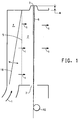
- Figure 1 illustrates a crossflow melt-spinning apparatus which is useful in the process of the invention.
- Quench gas 1 enters zone 2 below spinneret face 3 through plenum 4, past hinged baffle 18 and through screens 5, resulting in a substantially laminar gas flow across still-molten fibers 6 which have just been spun from capillaries (not shown) in the spinneret.
- Baffle 18 is hinged at the top, and its position can be adjusted to change the flow of quench gas across zone 2.
- Spinneret face 3 is recessed above the top of zone 2 by distance A, so that the quench gas does not contact the just-spun fibers until after a delay during which the fibers may be heated by the sides of the recess.
- an unheated quench delay space can be created by positioning a short cylinder (not shown) immediately below and coaxial with the spinneret face.
- the quench gas which can be heated if desired, continues on past the fibers and into the space surrounding the apparatus. Only a small amount of gas can be entrained by the moving fibers which leave zone 2 through fiber exit 7. Finish can be applied to the now-solid fibers by optional finish roll 10, and the fibers can then be passed to the rolls illustrated in Figure 2 .
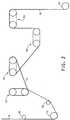
- fiber 6, which has just been spun for example from the apparatus shown in Figures 1 can be passed by (optional) finish roll 10, around driven roll 11, around idler roll 12, and then around heated feed rolls 13.
- the temperature of feed rolls 13 can be in the range of about 50°C to about 70°C.
- the fiber can then be drawn by heated draw rolls 14.
- the temperature of draw rolls 14 can be in the range of about 50 to about 170°C, preferably about 100 to about 120°C.
- the draw ratio (the ratio of wind-up speed to withdrawal or feed roll speed) is in the range of about 1.4 to about 4.5, preferably about 3.0 to about 4.0. No significant tension (beyond that necessary to keep the fiber on the rolls) need be applied between the pair of rolls 13 or between the pair of rolls 14.
- the heat-treating temperature is too low, crimp can be reduced under tension at elevated temperatures, and shrinkage can be increased. If the heat-treating temperature is too high, operability of the process becomes difficult because of frequent fiber breaks. It is preferred that the speeds of the heat-treating rolls and draw rolls be substantially equal in order to keep fiber tension substantially constant at this point in the process and thereby avoid loss of fiber crimp.
- a typical wind up speed in the manufacture of the products of the present invention is 3,200 meters per minute (mpm).
- the range of usable wind up speeds is about 2,000 mpm to 6,000 mpm.
- the intrinsic viscosity (IV) was determined using viscosity measured with a Viscotek Forced Flow Viscometer Y900 (Viscotek Corporation, Houston, TX) for the polymers dissolved in 50/50 weight % trifluoroacetic acid/methylene chloride at a 0.4 grams/dL concentration at 19°C following an automated method based on ASTM D 5225-92. The measured viscosity was then correlated with standard viscosities in 60/40 wt% phenol/1,1,2,2-tetrachloroethane as determined by ASTM D 4603-96 to arrive at the reported intrinsic values.
- IV of the polymers in the fiber was determined on actually spun bicomponent fiber or, alternatively, IV of the polymers in the fiber was measured by exposing polymer to the same process conditions as polymer actually spun into bicomponent fiber except that the test polymer was spun without a pack/spinneret such that the two polymers were not combined into a single fiber.
- the 500g weight was removed and the skein was then hung on a rack and heatset, with the 1.35 mg/dtex weight still in place, in an oven for 5 minutes at about 212°F (100°C), after which the rack and skein were removed from the oven and conditioned as above for two hours.
- This step is designed to simulate commercial dry heat-setting, which is one way to develop the final crimp in the bicomponent fiber.
- the length of the skein was measured as above, and its length was recorded as "Ca”.
- the 500-gram weight was again hung from the skein, and the skein length was measured as above and recorded as "La”.
- the fibers were wound up with a Barmag SW6 2s 600 winder (Barmag AG, Germany), having a maximum winding speed of 6000 mpm.
- the spinneret used was a post-coalescence bicomponent spinneret having thirty-four pairs of capillaries arranged in a circle, an internal angle between each pair of capillaries of 30°, a capillary diameter of 0.64 mm, and a capillary length of 4.24 mm. Unless otherwise noted, the weight ratio of the two polymers in the fiber was 50/50.
- the quench was carried out using apparatus similar to Figure 1 .
- the quench gas was air, supplied at room temperature of about 20°C.
- the fibers had a side-by-side cross-section.
Landscapes
- Engineering & Computer Science (AREA)
- Textile Engineering (AREA)
- Mechanical Engineering (AREA)
- Chemical & Material Sciences (AREA)
- Chemical Kinetics & Catalysis (AREA)
- General Chemical & Material Sciences (AREA)
- Physics & Mathematics (AREA)
- Thermal Sciences (AREA)
- Multicomponent Fibers (AREA)
- Spinning Methods And Devices For Manufacturing Artificial Fibers (AREA)
Description
- This invention relates to processes for the manufacture of bicomponent poly(trimethylene terephthalate) fibers.
- Poly(trimethylene terephthalate) (also referred to as "3GT" or "PTT") has recently received much attention as a polymer for use in textiles, flooring, packaging and other end uses. Textile and flooring fibers have excellent physical and chemical properties.
- It is known that bicomponent fibers wherein the two components have differing degrees of orientation, as indicated by differing intrinsic viscosities, possess desirable crimp contraction properties which lead to increased value in use for said fibers.
-
U. S. Patent Nos. 3,454,460 and3,671,379 disclose bicomponent polyester textile fibers. Neither reference discloses bicomponent fibers, such as sheath-core or side-by-side fibers, wherein each of the two components comprises the same polymer, e.g. poly(trimethylene terephthalate), differing in physical properties. -
WO 01/53573 A1 -
U.S. 4,454,196 and4,410,473 , describe a polyester multifilament yarn consisting essentially of filament groups (I) and (II). Filament group (I) is composed of polyester selected from the group poly(ethylene terephthalate), poly(trimethylene terephthalate) and poly(tetramethylene terephthalate), and/or a blend and/or copolymer comprising at least two members selected from these polyesters. Filament group (II) is composed of a substrate composed of (a) a polyester selected from the group poly(ethylene terephthalate), poly(trimethylene terephthalate) and poly(tetramethylene terephthalate), and/or a blend and/or copolymer comprising at least two members selected from these polyesters, and (b) 0.4 to 8 weight % of at least one polymer selected from the group consisting of styrene type polymers, methacrylate type polymers and acrylate type polymers. The filaments can be extruded from different spinnerets, but are preferably extruded from the same spinneret. It is preferred that the filaments be blended and then interlaced so as to intermingle them, and then subjected to drawing or draw-texturing. The Examples show preparation of filaments of type (II) from poly(ethylene terephthalate) and polymethylmethacrylate (Example 1) and polystyrene (Example 3), and poly(tetramethylene terephthalate) and polyethylacrylate (Example 4). Poly(trimethylene terephthalate) was not used in the examples. These disclosures of multifilament yarns do not include a disclosure of multicomponent fibers. -
JP 11-189925 JP 56-091013 -
JP 2002-56918A -
US 6,306,499 discloses a process for making a bi-component fiber starting from two grades of poly(trimethylene terephthalate) polymers (PTT) of different viscosities. -
EP-A-0 201 114 discloses the manufacture of a multifilament polyester yarn which is suitable for use as an industrial yarn, particularly tyre yarn, and displays a specific breaking strength at high spinning speeds, the yarn is made in accordance with a process comprising the successive steps of spinning a molten polymer through a plurality of holes, cooling and drawing the resulting filaments, and finally collecting them, the polymer flow in each of the spinneret holes exhibits a core portion having a higher relative viscosity and a sheath portion having a lower relative viscosity, the difference between said relative viscosities amounting to less than 0,100, preferably 0,040-0,003. - It is desired to prepare fibers which have excellent stretch, a soft hand and excellent dye uptake, and which can be spun at high-speeds and dyed under atmospheric pressure.
- It is also desired to increase productivity in the manufacture of side-by-side or eccentric sheath core poly(trimethylene terephtalate) bicomponent fibers by using higher speed spinning process, without deterioration of the filament and yarn properties.
- According to a first aspect in accordance with the present invention a process for preparing a poly(trimethylene terephthalate) bicomponent fiber comprising:
- (a) providing (i) one poly(trimethylene terephthalate) or (ii) two different poly(trimethylene terephthalates) having an intrinsic viscosity difference of less than 0.03 dL/g;
- (b) providing two different remelt systems;
- (c) remelting the (i) one poly(trimethylene terephthalate) in the two different remelt systems, or (ii) the two different poly(trimethylene terephthalates) each in one of the two different remelt systems, to produce two poly(trimethylene terephthalate) melts, wherein the intrinsic viscosity of the poly(trimethylene terephthalate) in at least one of the remelt systems is altered such that, after alteration, the poly(trimethylene terephthalates) in the two melts have intrinsic viscosities that differ by at least 0.03 dL/g;
- (d) providing the two poly(trimethylene terephthalate) melts to a spinneret; and
- (e) spinning bicomponent fiber from the poly(trimethylene terephthalate) melts.
- Preferably, the viscosity of the poly(trimethylene terephthalate) in one of the remelt systems is decreased, preferably by at least about 0.03 dL/g. Alternatively, the viscosity of the poly(trimethylene terephthalate) in one of the remelt systems is increased, preferably by at least about 0.03 dL/g.
- According to a further aspect in accordance with the present invention, at least one of the following is used to alter the intrinsic viscosity of a poly(trimethylene terephthalate) in one of the remelt systems:
- (a) poly(trimethylene terephthalate) water content;
- (b) melt temperature; and
- (c) melt residence time.
- Preferably, the intrinsic viscosities of the poly(trimethylene terephthalate) melts, after altering, differ by at least about 0.03 to about 0.5 dL/g.
- The fibers made in accordance with the present invention can take various shapes. The fibers can be sheath-core in shape. Preferably, the fibers are side-by-side or eccentric sheath core. Also preferably, the fibers are island-in-the-sea or pie-shaped.
- In accordance with another aspect in accordance with the present invention, the side-by-side or eccentric sheath-core bicomponent fibers are in the form of partially oriented multifilament yarn.
- In accordance with a further aspect in accordance with the present invention, a process for preparing bicomponent self-crimping yarn comprising poly(trimethylene terephthalate) bicomponent filaments comprises:
- (a) providing two poly(trimethylene terephthalate) melts,
- (b) altering the intrinsic viscosity of at least one of said polymers such that after alteration, said polymers have intrinsic viscosities that differ by at least about 0.03 dL/g;
- (c) providing the two poly(trimethylene terephthalate) melts to a spinnerette,
- (d) spinning bicomponent fiber from the poly(trimethylene terephthalate) melts, wherein the fibers are side-by-side or eccentric sheath-core fibers in the form of a partially oriented multifilament yarn,
- (e) winding the partially oriented yarn on a package,
- (f) unwinding the yarn from the package,
- (g) drawing the bicomponent filament yarn to form a drawn yarn,
- (h) annealing the drawn yarn, and
- (i) winding the yarn onto a package.
- In yet another aspect in accordance with the present invention, the process further comprises drawing, annealing and cutting the fibers into staple fibers.
- In yet a further aspect in accordance with the present invention, a process for preparing poly(trimethylene terephthalate) self-crimped bicomponent staple fiber comprises:
- (a) providing two poly(trimethylene terephthalate)s;
- (b) altering the intrinsic viscosity of at least one of said polymers such that after alteration, said polymers have intrinsic viscosities that differ by at least about 0.03 dL/g;
- (c) melt-spinning the poly(trimethylene terephthalate)s from a spinneret to form at least one bicomponent fiber having either a side-by-side or eccentric sheath-core cross-section;
- (d) passing the fiber through a quench zone below the spinneret;
- (e) drawing the fiber at a temperature of about 50 to about 170°C at a draw ratio of about 1.4 to about 4.5;
- (f) heat-treating the drawn fiber at about 110 to about 170°C;
- (g) optionally interlacing the filaments; and
- (h) winding-up the filaments.
- In yet a further aspect in accordance with the present invention a process for preparing poly(trimethylene terephthalate) self-crimped bicomponent staple fiber comprises:
- (a) providing two poly(trimethylene terephthalate)s;
- (b) altering the intrinsic viscosity of at least one of said polymers such that after alteration, said polymers have intrinsic viscosities that differ by at least about 0.03 dL/g;
- (c) melt-spinning the compositions through a spinneret to form at least one bicomponent fiber having either a side-by-side or eccentric sheath-core cross-section;
- (d) passing the fiber through a quench zone below the spinneret;
- (e) optionally winding the fibers or placing them in a can;
- (f) drawing the fiber;
- (g) heat-treating the drawn fiber; and
- (h) cutting the fibers into about 0.5 to about 6 inches staple fiber.
- Preferably each component comprises at least about 95 % of poly(trimethylene terephthalate), by weight of the polymer in the component.
- Preferably each of the poly(trimethylene terephthalate)s contains at least 95 mole % tri(methylene terephthalate) repeat units.
- In yet another embodiment in accordance with the present invention, a process for preparing poly(trimethylene terephthalate) self-crimped bicomponent staple fiber comprises:
- (b). providing two different poly(trimethylene terephthalate)s differing in intrinsic viscosity by about 0.03 to about 0.5 dl/g,
- (c). melt-spinning the compositions through a spinneret to form at least one bicomponent fiber having either a side-by-side or eccentric sheath-core cross-section;
- (d). passing the fiber through a quench zone below the spinneret;
- (e). optionally winding the fibers or placing them in a can;
- (f). drawing the fiber;
- (g). heat-treating the drawn fiber; and
- (h). cutting the fibers into about 0.5 to about 6 inches staple fiber, wherein the two different poly(trimethylene terephthalate)s are prepared by
- (i) providing two different remelt systems; and
- (ii) remelting a poly(trimethylene terephthalate) in each of the remelt systems, wherein at least one of the remelt systems is operated so as to provide the poly(trimethylene terephthalate) melts having intrinsic viscosities that differ by at least about 0.03 dL/g.
-
-
Figure 1 illustrates a cross-flow quench melt-spinning apparatus useful in the preparation of the products of the present invention. -
Figure 2 illustrates an example of a roll arrangement that can be used in conjunction with the melt-spinning apparatus ofFigure 1 . - This invention is directed to a process for preparing a poly(trimethylene terephthalate) bicomponent fiber comprising:
- (a) providing (i) one poly(trimethylene terephthalate) or (ii) two different poly(trimethylene terephthalates) having an intrinsic viscosity difference of less than 0.03 dL/g;
- (b) providing two different remelt systems;
- (c) remelting the (i) one poly(trimethylene terephthalate) in the two different remelt systems, or (ii) the two different poly(trimethylene terephthalates) each in one of the two different remelt systems, to produce two poly(trimethylene terephthalate) melts, wherein the intrinsic viscosity of the poly(trimethylene terephthalate) in at least one of the remelt systems is altered such that, after alteration, the poly(trimethylene terephthalates) in the two melts have intrinsic viscosities that differ by at least 0.03 dL/g;
- (d) providing the two poly(trimethylene terephthalate) melts to a spinneret; and
- (e) spinning bicomponent fiber from the poly(trimethylene terephthalate) melts.
- In a typical operation, poly(trimethylene terephthalate) polymer material, typically in the form of flake, is fed to two extruders from one or more feed hoppers. The poly(trimethylene terephthalate) is heated and ultimately melted in the extruders, then fed through two separate metering pumps to a spinning block wherein the bicomponent fiber is formed. The process of the present invention is practiced in one or more locations from the feed hopper on through to the spinning die.
- The poly(trimethylene terephthalate) polymer material that is fed to each remelt system may be the same or different. That is, identical poly(trimethylene terephthalate) polymer material may be fed to each remelt system and the difference in IV in the poly(trimethylene terephthalate) components in the ultimately resulting bicomponent fiber results solely from the operation of the remelt systems.
- Alternatively, two different poly(trimethylene terephthalate) polymer materials, already differing in IV, may be fed to the two remelt systems, and the operation of the remelt systems may be controlled to increase (or decrease) this preexisting IV difference in order to prepare the bicomponent fiber with the desired degree of difference in IV between the poly(trimethylene terephthalate) components.
- It is noted that the initial difference in intrinsic viscosity of the two polymers could be less than (e.g. the same IV) or greater than 0.03 dL/g, as long as after altering the intrinsic viscosity of at least one of the polymers, the difference in IV is at least about 0.03 dL/g. By way of non-limiting illustration, in the instance of a first polymer having an IV lower than the IV of a second polymer and the difference in IV is less than 0.03 dL/g, it would be within the scope of the present invention to achieve a difference in IV of at least about 0.03 dL/g by (1) decreasing the IV of the first polymer, (2) increasing the IV of the first polymer, (3) decreasing the IV of the second polymer, (4) increasing the IV of the second polymer or (4) altering the IV of both polymers.
- The variables (parameters) in the operation of the remelt/spinning systems that are varied in the practice of the process of the present invention include remelt temperature, residence time of the remelted polymer materials in the remelt system, and the moisture level (water content), or adjusted moisture level, of the remelted polymers.
- Poly(trimethylene terephthalate) of a given IV typically exhibits a lowering (decrease) of IV when remelted. The higher the remelt temperature to which the poly(trimethylene terephthalate) is exposed, the greater the decrease in IV. In the practice of the present invention, remelt temperatures in the range of about 235°C to about 295°C may be employed. Operation in the higher temperature ranges, 275°C to 295°C, must be closely monitored due to very rapid IV changes in that temperature range. A preferred temperature range is from about 235°C to 270 °C. Remelt temperatures are typically measured and controlled in the extruder. However, the temperature in any transfer line, feed pump, or melt holdup tank may be advantageously varied in the practice of the process of the present invention.
- Residence time of the remelted polymer in the remelt systems prior to spinning is typically controlled by the physical setup of the remelt/spinning equipment. The equipment may be arranged to gain the desired residence times and any desired difference in residence times between the two remelt systems. Alternatively, metering pumps, optionally employed melt holdup tanks or recycle loops may be employed to furnish variable holdup times in the same equipment. Longer holdup times correlate with a lowered IV of the resulting polymer. In practice, in laboratory equipment holdup times ranging from about 1 to about 7 minutes were employed. In production scale equipment, holdup times of from about 10 to about 20 minutes are expected to be utilized. In the practice of the present invention, total holdup time from the time the poly(trimethylene terephthalate) polymer material is remelted, through any transfer lines and equipment, up until the time of fiber formation may be controlled.
- Moisture content of the polymer to be remelted also affects IV, and changes in IV, during the remelt/spinning operation. The higher the moisture level of the starting polymer, the greater the decrease in IV observed through the remelt cycle. In addition to the moisture level (water content) of the starting polymer, moisture level may be changed by changing the operation of the system from the feed hopper through the extruder. In practice, the feed hopper-extruder system is purged/blanketed with an inert gas, typically nitrogen, in order to minimize polymer degradation. This inert gas blanket/purge may be controlled and varied with respect to gas volume, velocity, temperature and moisture content to yield a corresponding change in the moisture content of the polymer. Further, it may be desirable to introduce water, optionally in the form of water vapor, at the point where polymer flake is introduced to the extruder, or in the barrel of the extruder, to increase water content of the polymer.
- In the practice of this invention in a remelt/spinning system comprising two remelt systems it is customary to hold the operation of one remelt system constant and achieve differences in IV by varying the operation of the other. It is however within the scope of this invention to vary both of the two remelt systems independently.
- The practice of the process of the present invention allows the control of the difference in IV in the poly(trimethylene terephthalate) components in the ultimately resulting bicomponent fiber. In general, the greater the difference in IV between the two components, the greater the crimp contraction and, hence, the greater the value of the resulting bicomponent fiber.
- Further, the practice of the present invention allows increased fiber quality in that the control parameters of the process allow greater uniformity of product.
- Further, the practice of the process allows for increased efficiencies of operation through potentially reduced inventories of starting material. By the operation of the process of the present invention, a wide variety of bicomponent fibers, wherein the difference between the two poly(trimethylene terephthalate) components differs by varying amounts, may be manufactured using a minimum of differing IV starting materials. In the ultimate simplification, as indicated above, bicomponent fibers wherein the fiber components have different IV's may be made from a single poly(trimethylene terephthalate) starting material.
- As used herein, "bicomponent fiber" means a fiber comprising a pair of polymers intimately adhered to each other along the length of the fiber, so that the fiber cross-section is for example a side-by-side, eccentric sheath-core or other suitable cross-sections from which useful crimp can be developed.
- In the absence of an indication to the contrary, a reference to "poly(trimethylene terephthalate)" ("3GT" or "PTT"), is meant to encompass homopolymers and copolymers containing at least 70 mole % trimethylene terephthalate repeat units and polymer compositions containing at least 70 mole % of the homopolymers or copolyesters. The preferred poly(trimethylene terephthalate)s contain at least 85 mole %, more preferably at least 90 mole %, even more preferably at least 95 or at least 98 mole %, and most preferably about 100 mole %, trimethylene terephthalate repeat units.
- Examples of copolymers include copolyesters made using 3 or more reactants, each having two ester forming groups. For example, a copoly(trimethylene terephthalate) can be used in which the comonomer used to make the copolyester is selected from the group consisting of linear, cyclic, and branched aliphatic dicarboxylic acids having 4-12 carbon atoms (for example butanedioic acid, pentanedioic acid, hexanedioic acid, dodecanedioic acid, and 1,4-cyclo-hexanedicarboxylic acid); aromatic dicarboxylic acids other than terephthalic acid and having 8-12 carbon atoms (for example isophthalic acid and 2,6-naphthalenedicarboxylic acid); linear, cyclic, and branched aliphatic diols having 2-8 carbon atoms (other than 1,3-propanediol, for example, ethanediol , 1,2-propanediol, 1,4-butanediol, 3-methyl-1,5-pentanediol, 2,2-dimethyl-1,3-propanediol, 2-methyl-1,3-propanediol, and 1,4-cyclohexanediol); and aliphatic and aromatic ether glycols having 4-10 carbon atoms (for example, hydroquinone bis(2-hydroxyethyl) ether, or a poly(ethylene ether) glycol having a molecular weight below about 460, including diethyleneether glycol). The comonomer typically is present in the copolyester at a level in the range of about 0.5 to about 15 mole %, and can be present in amounts up to 30 mole %.
- The poly(trimethylene terephthalate) can contain minor amounts of other comonomers, and such comonomers are usually selected so that they do not have a significant adverse effect on properties. Such other comonomers include 5-sodium-sulfoisophthalate, for example, at a level in the range of about 0.2 to 5 mole %. Very small amounts of trifunctional comonomers, for example trimellitic acid, can be incorporated for viscosity control.
- The poly(trimethylene terephthalate) can be blended with up to 30 mole percent of other polymers. Examples are polyesters prepared from other diols, such as those described above. The preferred poly(trimethylene terephthalate)s contain at least 85 mole %, more preferably at least 90 mole %, even more preferably at least 95 or at least 98 mole %, and most preferably about 100 mole %, poly(trimethylene terephthalate).
- The intrinsic viscosity of the poly(trimethylene terephthalate) used in the invention ranges from about 0.60 dL/g up to about 2.0 dL/g, more preferably up to 1.5 dL/g, and most preferably up to about 1.2 dL/g. Preferably the poly(trimethylene terephthalates) have a difference in IV of at least about 0.03 more preferably at least about 0.10 dL/g, and preferably up to about 0.5 dL/g, more preferably up to about 0.3 dL/g.
- Poly(trimethylene terephthalate) and preferred manufacturing techniques for making poly(trimethylene terephthalate) are described in
U.S. Patent Nos. 5,015,789 ,5,276,201 ,5,284,979 ,5,334,778 ,5,364,984 ,5,364,987 ,5,391,263 ,5,434,239 ,5,510454 ,5,504,122 ,5,532,333 ,5,532.404 ,5,540,868 ,5,633,018 ,5,633,362 ,5,677,415 ,5,686,276 ,5,710,315 ,5,714,262 ,5,730,913 ,5,763,104 ,5,774,074 ,5,786,443 ,5,811,496 ,5,821,092 ,5,830,982 ,5,840,957 ,5,856,423 ,5,962,745 ,5,990,265 ,6,235,948 ,6,245,844 ,6,255,442 ,6,277,289 ,6,281,325 ,6,312,805 ,6,325,945 ,6,331,264 ,6,335,421 ,6,350,895 , and6,353,062 ,EP 998 440 WO 00/14041 98/57913, H. L. Traub U.S. Patent Application No. 10/057,497 . Poly(trimethylene terephthalate)s useful as the polyester of this invention are commercially available from E. I. du Pont de Nemours and Company, Wilmington, Delaware, under the trademark Sorona. - The poly(trimethylene terephthalate) can also be an acid-dyeable polyester composition as described in
U.S. Patent Application Nos. 09/708,209, filed November 8,2000 WO 01/34693 09/938,760, filed August 24, 2002 U.S. Patent Application No. 09/708,209 comprise a secondary amine or secondary amine salt in an amount effective to promote acid-dyeability of the acid dyeable and acid dyed polyester compositions. Preferably, the secondary amine unit is present in the composition in an amount of at least about 0.5 mole %, more preferably at least 1 mole %. The secondary amine unit is present in the polymer composition in an amount preferably of about 15 mole % or less, more preferably about 10 mole % or less, and most preferably 5 mole % or less, based on the weight of the composition. The acid-dyeable poly(trimethylene terephthalate) compositions ofU.S. Patent Application No. 09/938,760 comprise poly(trimethylene terephthalate) and a polymeric additive based on a tertiary amine. The polymeric additive is prepared from (i) triamine containing secondary amine or secondary amine salt unit(s) and (ii) one or more other monomer and/or polymer units. One preferred polymeric additive comprises polyamide selected from the group consisting of poly-imino-bisalkylene-terephthalamide, -isophthalamide and -1,6-naphthalamide, and salts thereof. The poly(trimethylene terephthalate) useful in this invention can also be cationically dyeable or dyed composition such as those described inU.S. Patent 6,312,805 , and dyed or dye-containing compositions. - Other polymeric additives can be added to the poly(trimethylene terephthalate), to improve strength, to facilitate post extrusion processing or provide other benefits. For example, hexamethylene diamine can be added in minor amounts of about 0.5 to about 5 mole % to add strength and processability to the acid dyeable polyester compositions of the invention. Polyamides such as
nylon 6 or nylon 6-6 can be added in minor amounts of about 0.5 to about 5 mole % to add strength and processability to the acid-dyeable polyester compositions of the invention. A nucleating agent, preferably 0.005 to 2 weight % of a mono-sodium salt of a dicarboxylic acid selected from the group consisting of monosodium terephthalate, mono sodium naphthalene dicarboxylate and mono sodium isophthalate, as a nucleating agent, can be added as described inU.S. 6,245,844 . - The poly(trimethylene terephthalate) polymer can, if desired, contain additives, e.g., delusterants, nucleating agents, heat stabilizers, viscosity boosters, optical brighteners, pigments, and antioxidants. TiO2 or other pigments can be added to the poly(trimethylene terephthalate), the compositions, or in fiber manufacture. (See, e.g.,
U.S. Patent Nos. 3,671,379 ,5,798,433 and5,340,909 ,EP 699 700 847 960 , andWO 00/26301 - In an alternative embodiment, the poly(trimethylene terephthalate) may contain as additive a styrene polymer. By "styrene polymer" is meant polystyrene and its derivatives. Preferably the styrene polymer is selected from the group consisting of polystyrene, alkyl or aryl substituted polystyrenes and styrene multicomponent polymers, more preferably polystyrenes. Most preferably, the styrene polymer is polystyrene.
- The styrene polymer, if present, is preferably present in a component in an amount of at least about 0.1 %, more preferably at least about 0.5, and preferably up to about 10 weight %, more preferably up to about 5 weight %, and most preferably up to about 2 weight %, by weight of the polymers in the component.
- Poly(trimethylene terephthalate)s can be prepared using a number of techniques. Preferably poly(trimethylene terephthalate) and the styrene polymer are melt blended and, then, extruded and cut into pellets. ("Pellets" is used generically in this regard, and is used regardless of shape so that it is used to include products sometimes called "chips", "flakes", etc.) The pellets are then remelted and extruded into filaments. The term "mixture" is used when specifically referring to the pellets prior to remelting and the term "blend" is used when referring to the molten composition (e.g., after remelting). A blend can also be prepared by compounding poly(trimethylene terephthalate) pellets with polystyrene during remelting, or by otherwise feeding molten poly(trimethylene terephthalate) and mixing it with styrene polymer prior to spinning.
- The poly(trimethylene terephthalate)s preferably comprise at least about 70%, more preferably at least about 80 %, even more preferably at least 85 %, more preferably at least about 90 %, most preferably at least about 95 %, and in some cases even more preferably at least 98 % of poly(trimethylene terephthalate), by weight of the polymers in the component. The poly(trimethylene terephthalate) preferably contains up to about 100 weight % of poly(trimethylene terephthalate), or 100 weight % minus the amount of styrene polymer present.
- The poly(trimethylene terephthalate) composition preferably comprises at least about 0.1 %, more preferably at least about 0.5 %, of styrene polymer, by weight of the polymer in a component. The composition preferably comprises up to about 10 %, more preferably up to about 5 %, even more preferably up to about 3 %, even more preferably up to 2 %, and most preferably up to about 1.5 %, of a styrene polymer, by weight of the polymer in the component. In many instances, preferred is about 0.8% to about 1% styrene polymer. Reference to styrene polymer means at least one styrene polymer, as two or more styrene polymers can be used, and the amount referred to is an indication of the total amount of styrene polymer(s) used in the polymer composition.
- With reference now to the drawings,
Figure 1 illustrates a crossflow melt-spinning apparatus which is useful in the process of the invention. Quench gas 1 enterszone 2 belowspinneret face 3 throughplenum 4, past hingedbaffle 18 and throughscreens 5, resulting in a substantially laminar gas flow across still-molten fibers 6 which have just been spun from capillaries (not shown) in the spinneret.Baffle 18 is hinged at the top, and its position can be adjusted to change the flow of quench gas acrosszone 2.Spinneret face 3 is recessed above the top ofzone 2 by distance A, so that the quench gas does not contact the just-spun fibers until after a delay during which the fibers may be heated by the sides of the recess. Alternatively, if the spinneret face is not recessed, an unheated quench delay space can be created by positioning a short cylinder (not shown) immediately below and coaxial with the spinneret face. The quench gas, which can be heated if desired, continues on past the fibers and into the space surrounding the apparatus. Only a small amount of gas can be entrained by the moving fibers which leavezone 2 through fiber exit 7. Finish can be applied to the now-solid fibers byoptional finish roll 10, and the fibers can then be passed to the rolls illustrated inFigure 2 . - In
Figure 2 ,fiber 6, which has just been spun for example from the apparatus shown inFigures 1 , can be passed by (optional)finish roll 10, around drivenroll 11, aroundidler roll 12, and then around heated feed rolls 13. The temperature of feed rolls 13 can be in the range of about 50°C to about 70°C. The fiber can then be drawn by heated draw rolls 14. The temperature of draw rolls 14 can be in the range of about 50 to about 170°C, preferably about 100 to about 120°C. The draw ratio (the ratio of wind-up speed to withdrawal or feed roll speed) is in the range of about 1.4 to about 4.5, preferably about 3.0 to about 4.0. No significant tension (beyond that necessary to keep the fiber on the rolls) need be applied between the pair ofrolls 13 or between the pair ofrolls 14. - After being drawn by
rolls 14, the fiber can be heat-treated byrolls 15, passed around optional unheated rolls 16 (which adjust the yarn tension for satisfactory winding), and then towindup 17. Heat treating can also be carried out with one or more other heated rolls, steam jets or a heating chamber such as a "hot chest". The heat-treatment can be carried out at substantially constant length, for example, byrolls 15 inFigure 2 , which heat the fiber to a temperature in the range of about 110°C to about 170°C, preferably about 120°C to about 160°C. The duration of the heat-treatment is dependent on yarn denier; what is important is that the fiber can reach substantially the same temperature as that of the rolls. If the heat-treating temperature is too low, crimp can be reduced under tension at elevated temperatures, and shrinkage can be increased. If the heat-treating temperature is too high, operability of the process becomes difficult because of frequent fiber breaks. It is preferred that the speeds of the heat-treating rolls and draw rolls be substantially equal in order to keep fiber tension substantially constant at this point in the process and thereby avoid loss of fiber crimp. - Alternatively, the feed rolls can be unheated, and drawing can be accomplished by a draw-jet and heated draw rolls which also heat-treat the fiber. An interlace jet optionally can be positioned between the draw/heat-treat rolls and windup.
- Finally, the fiber is wound up. A typical wind up speed in the manufacture of the products of the present invention is 3,200 meters per minute (mpm). The range of usable wind up speeds is about 2,000 mpm to 6,000 mpm.
- The following examples are presented for the purpose of illustrating the invention, and are not intended to be limiting. All parts, percentages, etc., are by weight unless otherwise indicated.
- The intrinsic viscosity (IV) was determined using viscosity measured with a Viscotek Forced Flow Viscometer Y900 (Viscotek Corporation, Houston, TX) for the polymers dissolved in 50/50 weight % trifluoroacetic acid/methylene chloride at a 0.4 grams/dL concentration at 19°C following an automated method based on ASTM D 5225-92. The measured viscosity was then correlated with standard viscosities in 60/40 wt% phenol/1,1,2,2-tetrachloroethane as determined by ASTM D 4603-96 to arrive at the reported intrinsic values. IV of the polymers in the fiber was determined on actually spun bicomponent fiber or, alternatively, IV of the polymers in the fiber was measured by exposing polymer to the same process conditions as polymer actually spun into bicomponent fiber except that the test polymer was spun without a pack/spinneret such that the two polymers were not combined into a single fiber.
- The physical properties of the poly(trimethylene terephthalate) yarns reported in the following examples were measured using an Instron Corp. tensile tester, model no. 1122. More specifically, elongation to break, Eb, and tenacity were measured according to ASTM D- 2256.
- Unless otherwise noted, the crimp contraction in the bicomponent fiber made as shown in the Examples was measured as follows. Each sample was formed into a skein of 5000 +/-5 total denier (5550 dtex) with a skein reel at a tension of about 0.1 gpd (0.09 dN/tex). The skein was conditioned at 70+/-°F (21+/-1°C) and 65+/-2% relative humidity for a minimum of 16 hours. The skein was hung substantially vertically from a stand, a 1.5 mg/den (1.35 mg/dtex) weight (e.g. 7.5 grams for 5550 dtex skein) was hung on the bottom of the skein, the weighted skein was allowed to come to an equilibrium length, and the length of the skein was measured to within 1 mm and recorded as "Cb". The 1.35 mg/dtex weight was left on the skein for the duration of the test. Next, a 500 mg weight (100 mg/d; 90mg/dtex) was hung from the bottom of the skein, and the length of the skein was measured within 1 mm and recorded as "Lb". Crimp contraction value (percent) (before heatsetting, as described below for this test), "CCb", was calculated according to the formula:

- The 500g weight was removed and the skein was then hung on a rack and heatset, with the 1.35 mg/dtex weight still in place, in an oven for 5 minutes at about 212°F (100°C), after which the rack and skein were removed from the oven and conditioned as above for two hours. This step is designed to simulate commercial dry heat-setting, which is one way to develop the final crimp in the bicomponent fiber. The length of the skein was measured as above, and its length was recorded as "Ca". The 500-gram weight was again hung from the skein, and the skein length was measured as above and recorded as "La". The after heat-set crimp contraction value (%), "CCa", was calculated according to the formula

- CCa is reported in the tables.
- Poly(trimethylene terephthalate), having intrinsic viscosities as shown in Table 1, were spun using the apparatus of
Figure 1 . The starting poly(trimethylene terephthalate)s were dried to less than 50 ppm water content. The spinneret temperature was maintained at less than 265°C. The (post-coalescence) spinneret was recessed into the top of the spinning column by 4 inches (10.2 cm) ("A" inFigure 1 ) so that the quench gas contacted the just-spun fibers only after a delay. - In spinning the bicomponent fibers in the examples, the polymer was melted with Werner & Pfleiderer co-rotating 28-mm extruders having 0.5-40 pound/hour (0.23-18.1 kg/hour) capacities. The highest melt temperatures attained in the poly(trimethylene terephthalate) (3GT) extruder was about 265-275°C. Pumps transferred the polymers to the spinning head.
- The fibers were wound up with a Barmag SW6 2s 600 winder (Barmag AG, Germany), having a maximum winding speed of 6000 mpm.
- The spinneret used was a post-coalescence bicomponent spinneret having thirty-four pairs of capillaries arranged in a circle, an internal angle between each pair of capillaries of 30°, a capillary diameter of 0.64 mm, and a capillary length of 4.24 mm. Unless otherwise noted, the weight ratio of the two polymers in the fiber was 50/50. The quench was carried out using apparatus similar to
Figure 1 . The quench gas was air, supplied at room temperature of about 20°C. The fibers had a side-by-side cross-section. - In the Examples, the draw ratio applied was about the maximum operable draw ratio in obtaining bicomponent fibers. Unless otherwise indicated, rolls 13 in
Figure 2 were operated at about 70°C, rolls 14 at about 90°C and 3200 mpm and rolls 15 at about 120°C to about 160°C. - Spinning was carried out as described above using the conditions described in Table I.
Table I Chip IV* Fiber IV* Delta IV* West East West XEast West-East Draw Ratio Rolls 15 °C Denier Tenacity (g/d) Elongation CCa(%) 1.01 0.86 0.96 0.70 0.26 2.4 160 95 3.2 21 43.7 1.01 0.86 0.96 0.74 0.22 2.5 160 98 3.1 22 35.6 1.01 0.86 0.98 0.80 0.18 2.5 160 104 3.3 22 18.5 1.01 0.86 0.96 0.83 0.13 2.6 160 103 3.5 25 7.3 *As measured, dL/g. - The data show that increased crimp contraction (CCa) can be attained as the difference in intrinsic viscosity (IV) is increased between West extruder and East extruder. Fiber IV of the West extruder was maintained constant while fiber IV of the East extruder was changed by changing the polymer melt temperatures and melt residence time as shown in Table 2.
Table 2 Chip IV Fiber IV Extruder zone transfer line spin pack Residence time East East temp °C temp °C temp °C min 0.86 0.70 270 267 255 8.4 0.86 0.74 270 262 250 8.4 0.86 0.80 260 252 250 4.8 0.86 0.83 250 247 255 2.9 - The foregoing disclosure of embodiments of the present invention has been presented for purposes of illustration and description. It is not intended to be exhaustive or to limit the invention to the precise forms disclosed. Many variations and modifications of the embodiments described herein will be obvious to one of ordinary skill in the art in light of the disclosure.
Claims (10)
- A process for preparing a poly(trimethylene terephthalate) bicomponent fiber comprising:(a) providing (i) one poly(trimethylene terephthalate) or (ii) two different poly(trimethylene terephthalates) having an intrinsic viscosity difference of less than 0.03 dL/g;(b) providing two different remelt systems;(c) remelting the (i) one poly(trimethylene terephthalate) in the two different remelt systems, or (ii) the two different poly(trimethylene terephthalates) each in one of the two different remelt systems, to produce two poly(trimethylene terephthalate) melts, wherein the intrinsic viscosity of the poly(trimethylene terephthalate) in at least one of the remelt systems is altered such that, after alteration, the poly(trimethylene terephthalates) in the two melts have intrinsic viscosities that differ by at least 0.03 dL/g;(d) providing the two poly(trimethylene terephthalate) melts to a spinneret, and(e) spinning bicomponent fiber from the poly(trimethylene terephthalate) melts.
- The process of claim 1, wherein at least one of the following is used to alter the intrinsic viscosity of a poly(trimethylene terephthalate):(a) poly(trimethylene terephthalate) water content;(b) melt temperature; and(c) melt residence time.
- The process of claim 1, wherein the intrinsic viscosities of the poly(trimethylene terephthalate) melts differ by at least 0.03 to 0.5 dL/g.
- The process of claim 1, wherein the fibers are side-by-side, eccentric sheath-core, sheath-core, island-in-the-sea or pie-shaped fibers.
- The process of claim 4, wherein the side-by-side or eccentric sheath-core bicomponent fibers are in the form of a partially oriented multifilament yarn.
- The process of claim 1, wherein the poly(trimethylene terephthalate) bicomponent fiber comprises a copolymer with up to 30 mole % comonomer.
- The process of claim 1, wherein a poly(trimethylene terephthalate) is blended with up to 30 mole % of other polymers.
- The process of claim 1, wherein the poly(trimethylene terephthalate) is acid-dyeable and comprises a secondary amine, secondary amine salt, or tertiary amine in an amount effective to promote acid dyeability of the bicomponent fiber.
- A process for preparing fully drawn yarn comprising crimped poly(trimethylene terephthalate) bicomponent fibers, comprising the steps of :(a) providing a poly(trimethylene terephthalate) bicomponent fiber according to the process of any of claims 1-8, wherein the bicomponent fiber has either a side-by-side or eccentric sheath-core cross-section;(b) passing the fiber through a quench zone below the spinneret;(c) drawing the fiber at temperature of 50 to 170°C at a draw ratio of 1.4 to 4.5;(d) heat-treating the drawn fiber at 110 to 170°C;(e) optionally interlacing the filaments; and(f) winding-up the filaments.
- A process for preparing poly(trimethylene terephthalate) self-crimped bicomponent staple fiber comprising:(a) providing a poly(trimethylene terephthalate) bicomponent fiber according to the process of any of claims 1-8, wherein the bicomponent fiber has either a side-by-side or eccentric sheath-core cross-section;(b) passing the fiber through a quench zone below the spinneret;(c) optionally winding the fibers or placing them in a can;(d) drawing the fiber;(e) heat-treating the drawn fiber; and(f) cutting the fibers into 0.5 to 6 inches staple fiber.
Applications Claiming Priority (3)
| Application Number | Priority Date | Filing Date | Title |
|---|---|---|---|
| US43608202P | 2002-12-23 | 2002-12-23 | |
| US436082P | 2002-12-23 | ||
| PCT/US2003/019914 WO2004061169A1 (en) | 2002-12-23 | 2003-06-23 | Poly(trimethylene terephthalate) bicomponent fiber process |
Publications (3)
| Publication Number | Publication Date |
|---|---|
| EP1576211A1 EP1576211A1 (en) | 2005-09-21 |
| EP1576211A4 EP1576211A4 (en) | 2006-06-07 |
| EP1576211B1 true EP1576211B1 (en) | 2016-05-25 |
Family
ID=32713053
Family Applications (1)
| Application Number | Title | Priority Date | Filing Date |
|---|---|---|---|
| EP03814567.8A Expired - Lifetime EP1576211B1 (en) | 2002-12-23 | 2003-06-23 | Poly(trimethylene terephthalate) bicomponent fiber process |
Country Status (9)
| Country | Link |
|---|---|
| US (1) | US7147815B2 (en) |
| EP (1) | EP1576211B1 (en) |
| JP (1) | JP2006511726A (en) |
| KR (1) | KR101084480B1 (en) |
| CN (1) | CN1662683B (en) |
| AU (1) | AU2003243763A1 (en) |
| MX (1) | MXPA04012278A (en) |
| TW (1) | TWI304448B (en) |
| WO (1) | WO2004061169A1 (en) |
Families Citing this family (13)
| Publication number | Priority date | Publication date | Assignee | Title |
|---|---|---|---|---|
| CN1656261A (en) * | 2002-05-27 | 2005-08-17 | 株式会社Huvis | Polytrimethylene terephtalate conjugate fiber and method of preparing the same |
| MXPA04012278A (en) * | 2002-12-23 | 2005-02-25 | Du Pont | Poly(trimethylene terephthalate) bicomponent fiber process. |
| JP4205500B2 (en) * | 2003-06-26 | 2009-01-07 | ソロテックス株式会社 | Hollow polytrimethylene terephthalate composite short fiber and method for producing the same |
| BRPI0508770A (en) * | 2004-03-23 | 2007-08-28 | Solutia Inc | multicomponent electroconductive fiber, method for preparing a stretched multicomponent electroconductive fiber a stretched two-component electroconductive fiber |
| US7357985B2 (en) | 2005-09-19 | 2008-04-15 | E.I. Du Pont De Nemours And Company | High crimp bicomponent fibers |
| WO2007046296A1 (en) * | 2005-10-21 | 2007-04-26 | Kuraray Co., Ltd. | Electrically conductive composite fiber and process for producing the same |
| PL3284854T3 (en) * | 2007-08-17 | 2024-03-25 | Fiberweb, Llc | A continuous bicomponent filament formed from a single polymer system |
| US20090197080A1 (en) * | 2008-01-31 | 2009-08-06 | Glew Charles A | Self-crimping fluoropolymer and perfluoropolymer filaments and fibers |
| CA2716700C (en) * | 2008-02-28 | 2016-08-23 | Mmt Textiles Limited | A material having moisture activatable elements |
| JP2015501887A (en) * | 2011-11-18 | 2015-01-19 | イー・アイ・デュポン・ドウ・ヌムール・アンド・カンパニーE.I.Du Pont De Nemours And Company | Method for producing composite fiber containing polytrimethylene terephthalate |
| US10058808B2 (en) | 2012-10-22 | 2018-08-28 | Cummins Filtration Ip, Inc. | Composite filter media utilizing bicomponent fibers |
| BR112022027094A2 (en) * | 2020-07-02 | 2023-01-31 | Dupont Ind Biosciences Usa Llc | METHOD FOR MAKING TWO-COMPONENT FIBERS, ARTICLE OF CLOTHING, FABRIC, FULLY DRAWN YARN, PARTIALLY ORIENTED YARN, SCALE FIBER, CARPET, NONWOVEN FIBER AND NONWOVEN FABRIC |
| CN116219579B (en) * | 2023-04-19 | 2024-01-30 | 上海华灏化学有限公司 | A kind of side-by-side composite bicomponent fiber |
Family Cites Families (65)
| Publication number | Priority date | Publication date | Assignee | Title |
|---|---|---|---|---|
| US3405098A (en) * | 1965-10-29 | 1968-10-08 | Du Pont | Process for preparing high viscosity linear condensation polyesters from partially polymerized glycol terephthalates |
| US3454460A (en) | 1966-09-12 | 1969-07-08 | Du Pont | Bicomponent polyester textile fiber |
| US3671379A (en) | 1971-03-09 | 1972-06-20 | Du Pont | Composite polyester textile fibers |
| JPS5761716A (en) | 1980-09-25 | 1982-04-14 | Teijin Ltd | Polyester multifilaments and their production |
| IN167096B (en) | 1985-04-04 | 1990-09-01 | Akzo Nv | |
| DE3926136A1 (en) | 1989-08-08 | 1991-02-14 | Degussa | METHOD FOR PRODUCING 1,3-PROPANDIOL |
| DE4132663C2 (en) | 1991-10-01 | 1993-10-14 | Degussa | Process for producing 1,3-propanediol by hydrogenating hydroxypropionaldehyde |
| DE4138982A1 (en) | 1991-11-27 | 1993-06-03 | Degussa | PROCESS FOR THE PREPARATION OF 3-HYDROXYAL CHANNELS |
| DE4138981A1 (en) | 1991-11-27 | 1993-06-03 | Degussa | METHOD FOR PRODUCING 3-HYDROXYAL CHANNELS |
| US5340909A (en) | 1991-12-18 | 1994-08-23 | Hoechst Celanese Corporation | Poly(1,3-propylene terephthalate) |
| DE4218282A1 (en) | 1992-06-03 | 1993-12-09 | Degussa | Process for the preparation of 1,3-propanediol |
| DE4222708A1 (en) | 1992-07-10 | 1994-01-13 | Degussa | Process for the preparation of 1,3-propanediol |
| US5434239A (en) | 1993-10-18 | 1995-07-18 | E. I. Du Pont De Nemours And Company | Continuous polyester process |
| US5391263A (en) | 1994-01-26 | 1995-02-21 | E. I. Du Pont De Nemours And Company | Process for the separation of glycols from dimethyl terephthalate |
| US5532404A (en) | 1994-05-27 | 1996-07-02 | E. I. Du Pont De Nemours And Company | Monomer recovery process for contaminated polymers |
| US5710315A (en) | 1994-05-27 | 1998-01-20 | E. I. Du Pont De Nemours And Company | Monomer recovery process for contaminated polymers |
| US5510454A (en) | 1995-01-20 | 1996-04-23 | E. I. Du Pont De Nemours And Company | Production of poly(ethylene terephthalate) |
| US5830982A (en) | 1995-01-20 | 1998-11-03 | E. I. Du Pont De Nemours And Company | Production of poly (ethylene terephthalate) |
| US5633018A (en) | 1995-01-20 | 1997-05-27 | E. I. Du Pont De Nemours And Company | Apparatus for forming crystalline polymer pellets |
| US5540868A (en) | 1995-01-20 | 1996-07-30 | E. I. Du Pont De Nemours And Company | Process for pellet formation from amorphous polyester |
| US5714262A (en) | 1995-12-22 | 1998-02-03 | E. I. Du Pont De Nemours And Company | Production of poly(ethylene terephthalate) |
| US5811496A (en) | 1995-12-21 | 1998-09-22 | E.I. Du Pont De Nemours And Company | Process for polymerization of polyester oligomers |
| US5504122A (en) | 1995-04-11 | 1996-04-02 | E. I. Du Pont De Nemours And Company | Recovery of dimethyl terephthalate from polymer mixtures |
| US5633362A (en) | 1995-05-12 | 1997-05-27 | E. I. Du Pont De Nemours And Company | Production of 1,3-propanediol from glycerol by recombinant bacteria expressing recombinant diol dehydratase |
| US5686276A (en) | 1995-05-12 | 1997-11-11 | E. I. Du Pont De Nemours And Company | Bioconversion of a fermentable carbon source to 1,3-propanediol by a single microorganism |
| KR100443389B1 (en) | 1995-12-14 | 2004-11-16 | 이.아이,듀우판드네모아앤드캄파니 | Process for producing polyester prepolymer |
| AR004241A1 (en) | 1995-12-22 | 1998-11-04 | Du Pont | COMPOSITION AND PARTICLES OF POLY (TRIMETHYLENE-TEREFTALATE) MODIFIED OR NOT MODIFIED AND PROCESSES TO CRYSTALLIZE SUCH COMPOSITION AND FOR SOLID STATE POLYMERIZATION OF THE SAME |
| US5856423A (en) | 1996-12-23 | 1999-01-05 | E. I. Du Pont De Nemours And Company | Apparatus and process for a polycondensation reaction |
| US5677415A (en) | 1996-03-28 | 1997-10-14 | E. I. Du Pont De Nemours And Company | Apparatus and process for a polycondensation reaction |
| TW462977B (en) | 1996-06-28 | 2001-11-11 | Toray Industries | Resin compositions, processes for producing thereby, and process for producing titanium oxide |
| US5774074A (en) | 1997-01-21 | 1998-06-30 | Hewlett-Packard Company | Multi-track position encoder system |
| DE19705249A1 (en) | 1997-02-12 | 1998-08-13 | Zimmer Ag | Process for the production of polypropylene terephthalate |
| US5962745A (en) | 1997-02-14 | 1999-10-05 | E. I. Du Pont De Nemours And Company | Process for preparing 3-hydroxyalkanals |
| JP3428425B2 (en) | 1997-03-31 | 2003-07-22 | 東レ株式会社 | Artificial leather |
| US5990265A (en) | 1997-06-23 | 1999-11-23 | E. I. Du Pont De Nemours And Company | Production of poly(trimethylene terephthalate) |
| KR20010021832A (en) | 1997-07-15 | 2001-03-15 | 아토피나 | Improved Vapor Phase Oxidation of Propylene to Acrolein |
| JPH11189925A (en) | 1997-12-22 | 1999-07-13 | Toray Ind Inc | Production of sheath-code conjugated fiber |
| JPH11222730A (en) | 1998-02-06 | 1999-08-17 | Toray Ind Inc | Polyester-based anti-electrostatic conjugate fiber |
| US5840957A (en) | 1998-03-16 | 1998-11-24 | E. I. Du Pont De Nemours And Company | Transesterification process using lanthanum compound catalyst |
| US6235948B1 (en) | 1998-08-18 | 2001-05-22 | E. I. Du Pont De Nemours And Company | Process for the purification of 1,3-propanediol |
| US6245844B1 (en) | 1998-09-18 | 2001-06-12 | E. I. Du Pont De Nemours And Company | Nucleating agent for polyesters |
| JP4115029B2 (en) | 1999-02-19 | 2008-07-09 | ユニチカ株式会社 | Polyester composite fiber for stretch woven and knitted fabric |
| US6350895B1 (en) | 1999-03-26 | 2002-02-26 | E. I. Du Pont De Nemours And Company | Transesterification process using yttrium and samarium compound catalystis |
| US6331264B1 (en) | 1999-03-31 | 2001-12-18 | E. I. Du Pont De Nemours And Company | Low emission polymer compositions |
| KR100629813B1 (en) * | 1999-06-08 | 2006-09-29 | 도레이 가부시끼가이샤 | Soft Stretch Yarns and Process for the Preparation Thereof |
| US6277289B1 (en) | 1999-07-01 | 2001-08-21 | E. I. Du Pont De Nemours And Company | Treatment of aqueous aldehyde waste streams |
| JP3593926B2 (en) | 1999-08-12 | 2004-11-24 | 東レ株式会社 | Dyeing method for polypropylene terephthalate-based fiber structure |
| JP2001064828A (en) | 1999-08-20 | 2001-03-13 | Unitika Ltd | Polyester-based conjugate fiber and nonwoven fabric |
| WO2001014450A1 (en) | 1999-08-25 | 2001-03-01 | E.I. Du Pont De Nemours And Company | Preparation of poly(trimethylene terephthalate) with low level of di(1,3-propylene glycol) |
| TW572927B (en) * | 1999-12-15 | 2004-01-21 | Asahi Chemical Corp | Trimethyleneterephthalate copolymer |
| CN1109782C (en) * | 2000-01-07 | 2003-05-28 | 帝人株式会社 | Crimped polyester fiber and fibrous structure comprising the same |
| US6255442B1 (en) | 2000-02-08 | 2001-07-03 | E. I. Du Pont De Nemours And Company | Esterification process |
| ES2219377T5 (en) | 2000-02-11 | 2010-10-14 | E.I. Du Pont De Nemours And Company | CONTINUOUS POLI PRODUCTION PROCEDURE (TRIMETHYLENE TEREFTALATE). |
| US6353062B1 (en) | 2000-02-11 | 2002-03-05 | E. I. Du Pont De Nemours And Company | Continuous process for producing poly(trimethylene terephthalate) |
| US6312805B1 (en) | 2000-02-11 | 2001-11-06 | E.I. Du Pont De Nemours And Company | Cationic dyeability modifier for use with polyester and polyamide |
| WO2001092612A1 (en) * | 2000-05-31 | 2001-12-06 | Hills, Inc. | Self-crimping multicomponent polymer fibers and corresponding methods of manufacture |
| JP2002061029A (en) | 2000-08-18 | 2002-02-28 | Teijin Ltd | Polyester-based composite fiber and method for producing the same |
| US6872352B2 (en) | 2000-09-12 | 2005-03-29 | E. I. Du Pont De Nemours And Company | Process of making web or fiberfill from polytrimethylene terephthalate staple fibers |
| ES2258614T3 (en) | 2001-02-02 | 2006-09-01 | Asahi Kasei Kabushiki Kaisha | COMPLEX FIBER WITH EXCELLENT CAPACITY OF BACK PROCESS AND MANUFACTURING METHOD OF THE SAME. |
| US6740400B2 (en) * | 2001-02-07 | 2004-05-25 | Asahi Kasei Kabushiki Kaisha | Poly (trimethylene terephthalate) and a process for producing the same |
| US6723799B2 (en) | 2001-08-24 | 2004-04-20 | E I. Du Pont De Nemours And Company | Acid-dyeable polymer compositions |
| US6923925B2 (en) | 2002-06-27 | 2005-08-02 | E. I. Du Pont De Nemours And Company | Process of making poly (trimethylene dicarboxylate) fibers |
| US20030111171A1 (en) * | 2002-09-09 | 2003-06-19 | Casey Paul Karol | Poly(trimethylene) terephthalate texile staple production |
| US6641916B1 (en) * | 2002-11-05 | 2003-11-04 | E. I. Du Pont De Nemours And Company | Poly(trimethylene terephthalate) bicomponent fibers |
| MXPA04012278A (en) * | 2002-12-23 | 2005-02-25 | Du Pont | Poly(trimethylene terephthalate) bicomponent fiber process. |
-
2003
- 2003-06-23 MX MXPA04012278A patent/MXPA04012278A/en active IP Right Grant
- 2003-06-23 KR KR1020047021032A patent/KR101084480B1/en not_active Expired - Fee Related
- 2003-06-23 WO PCT/US2003/019914 patent/WO2004061169A1/en not_active Ceased
- 2003-06-23 EP EP03814567.8A patent/EP1576211B1/en not_active Expired - Lifetime
- 2003-06-23 JP JP2004564669A patent/JP2006511726A/en active Pending
- 2003-06-23 CN CN038148234A patent/CN1662683B/en not_active Expired - Fee Related
- 2003-06-23 AU AU2003243763A patent/AU2003243763A1/en not_active Abandoned
- 2003-06-26 US US10/607,252 patent/US7147815B2/en not_active Expired - Lifetime
- 2003-06-27 TW TW092117691A patent/TWI304448B/en not_active IP Right Cessation
Also Published As
| Publication number | Publication date |
|---|---|
| WO2004061169A1 (en) | 2004-07-22 |
| EP1576211A4 (en) | 2006-06-07 |
| MXPA04012278A (en) | 2005-02-25 |
| US7147815B2 (en) | 2006-12-12 |
| EP1576211A1 (en) | 2005-09-21 |
| TW200411095A (en) | 2004-07-01 |
| KR20050084791A (en) | 2005-08-29 |
| CN1662683A (en) | 2005-08-31 |
| US20040222544A1 (en) | 2004-11-11 |
| JP2006511726A (en) | 2006-04-06 |
| CN1662683B (en) | 2012-11-07 |
| AU2003243763A1 (en) | 2004-07-29 |
| TWI304448B (en) | 2008-12-21 |
| KR101084480B1 (en) | 2011-11-21 |
Similar Documents
| Publication | Publication Date | Title |
|---|---|---|
| US7033530B2 (en) | Process for preparing poly(trimethylene terephthalate) bicomponent fibers | |
| US6740276B2 (en) | Process for preparing pigmented shaped articles comprising poly (trimethylene terephthalate) | |
| EP1552044B1 (en) | Process for making poly(trimethylene terephthalate) fibers | |
| EP1937878B1 (en) | High crimp bicomponent fibers | |
| EP1576211B1 (en) | Poly(trimethylene terephthalate) bicomponent fiber process | |
| EP1534492B1 (en) | Poly(trimethylene terephthalate) fibers and their manufacture | |
| US7094466B2 (en) | 3GT/4GT biocomponent fiber and preparation thereof | |
| EP1590511B1 (en) | Spin annealed poly(trimethylene terephthalate) yarn | |
| US20070035057A1 (en) | Poly(trimethylene terephthalate) bicomponent fiber process | |
| US6967057B2 (en) | Poly(trimethylene dicarboxylate) fibers, their manufacture and use | |
| CA2854899A1 (en) | Process for preparing bicomponent fibers comprising poly(trimethylene terephthalate) |
Legal Events
| Date | Code | Title | Description |
|---|---|---|---|
| PUAI | Public reference made under article 153(3) epc to a published international application that has entered the european phase |
Free format text: ORIGINAL CODE: 0009012 |
|
| 17P | Request for examination filed |
Effective date: 20041216 |
|
| AK | Designated contracting states |
Kind code of ref document: A1 Designated state(s): AT BE BG CH CY CZ DE DK EE ES FI FR GB GR HU IE IT LI LU MC NL PT RO SE SI SK TR |
|
| AX | Request for extension of the european patent |
Extension state: AL LT LV MK |
|
| DAX | Request for extension of the european patent (deleted) | ||
| A4 | Supplementary search report drawn up and despatched |
Effective date: 20060426 |
|
| RIC1 | Information provided on ipc code assigned before grant |
Ipc: D01F 8/14 20060101AFI20060420BHEP |
|
| 17Q | First examination report despatched |
Effective date: 20061221 |
|
| RIC1 | Information provided on ipc code assigned before grant |
Ipc: D02G 1/18 20060101AFI20160105BHEP |
|
| REG | Reference to a national code |
Ref country code: DE Ref legal event code: R079 Ref document number: 60348988 Country of ref document: DE Free format text: PREVIOUS MAIN CLASS: D01D0005088000 Ipc: D01F0008140000 |
|
| GRAP | Despatch of communication of intention to grant a patent |
Free format text: ORIGINAL CODE: EPIDOSNIGR1 |
|
| RIC1 | Information provided on ipc code assigned before grant |
Ipc: D01D 1/04 20060101ALI20160211BHEP Ipc: D01F 8/14 20060101AFI20160211BHEP |
|
| INTG | Intention to grant announced |
Effective date: 20160225 |
|
| INTG | Intention to grant announced |
Effective date: 20160308 |
|
| GRAS | Grant fee paid |
Free format text: ORIGINAL CODE: EPIDOSNIGR3 |
|
| GRAA | (expected) grant |
Free format text: ORIGINAL CODE: 0009210 |
|
| AK | Designated contracting states |
Kind code of ref document: B1 Designated state(s): AT BE BG CH CY CZ DE DK EE ES FI FR GB GR HU IE IT LI LU MC NL PT RO SE SI SK TR |
|
| REG | Reference to a national code |
Ref country code: GB Ref legal event code: FG4D |
|
| REG | Reference to a national code |
Ref country code: CH Ref legal event code: EP |
|
| REG | Reference to a national code |
Ref country code: FR Ref legal event code: PLFP Year of fee payment: 14 |
|
| REG | Reference to a national code |
Ref country code: IE Ref legal event code: FG4D Ref country code: AT Ref legal event code: REF Ref document number: 802401 Country of ref document: AT Kind code of ref document: T Effective date: 20160615 |
|
| REG | Reference to a national code |
Ref country code: DE Ref legal event code: R096 Ref document number: 60348988 Country of ref document: DE |
|
| REG | Reference to a national code |
Ref country code: NL Ref legal event code: MP Effective date: 20160525 |
|
| PG25 | Lapsed in a contracting state [announced via postgrant information from national office to epo] |
Ref country code: NL Free format text: LAPSE BECAUSE OF FAILURE TO SUBMIT A TRANSLATION OF THE DESCRIPTION OR TO PAY THE FEE WITHIN THE PRESCRIBED TIME-LIMIT Effective date: 20160525 Ref country code: FI Free format text: LAPSE BECAUSE OF FAILURE TO SUBMIT A TRANSLATION OF THE DESCRIPTION OR TO PAY THE FEE WITHIN THE PRESCRIBED TIME-LIMIT Effective date: 20160525 |
|
| REG | Reference to a national code |
Ref country code: AT Ref legal event code: MK05 Ref document number: 802401 Country of ref document: AT Kind code of ref document: T Effective date: 20160525 |
|
| PG25 | Lapsed in a contracting state [announced via postgrant information from national office to epo] |
Ref country code: SE Free format text: LAPSE BECAUSE OF FAILURE TO SUBMIT A TRANSLATION OF THE DESCRIPTION OR TO PAY THE FEE WITHIN THE PRESCRIBED TIME-LIMIT Effective date: 20160525 Ref country code: ES Free format text: LAPSE BECAUSE OF FAILURE TO SUBMIT A TRANSLATION OF THE DESCRIPTION OR TO PAY THE FEE WITHIN THE PRESCRIBED TIME-LIMIT Effective date: 20160525 Ref country code: PT Free format text: LAPSE BECAUSE OF FAILURE TO SUBMIT A TRANSLATION OF THE DESCRIPTION OR TO PAY THE FEE WITHIN THE PRESCRIBED TIME-LIMIT Effective date: 20160926 Ref country code: GR Free format text: LAPSE BECAUSE OF FAILURE TO SUBMIT A TRANSLATION OF THE DESCRIPTION OR TO PAY THE FEE WITHIN THE PRESCRIBED TIME-LIMIT Effective date: 20160826 |
|
| PG25 | Lapsed in a contracting state [announced via postgrant information from national office to epo] |
Ref country code: BE Free format text: LAPSE BECAUSE OF NON-PAYMENT OF DUE FEES Effective date: 20160630 |
|
| PG25 | Lapsed in a contracting state [announced via postgrant information from national office to epo] |
Ref country code: CZ Free format text: LAPSE BECAUSE OF FAILURE TO SUBMIT A TRANSLATION OF THE DESCRIPTION OR TO PAY THE FEE WITHIN THE PRESCRIBED TIME-LIMIT Effective date: 20160525 Ref country code: EE Free format text: LAPSE BECAUSE OF FAILURE TO SUBMIT A TRANSLATION OF THE DESCRIPTION OR TO PAY THE FEE WITHIN THE PRESCRIBED TIME-LIMIT Effective date: 20160525 Ref country code: RO Free format text: LAPSE BECAUSE OF FAILURE TO SUBMIT A TRANSLATION OF THE DESCRIPTION OR TO PAY THE FEE WITHIN THE PRESCRIBED TIME-LIMIT Effective date: 20160525 Ref country code: SK Free format text: LAPSE BECAUSE OF FAILURE TO SUBMIT A TRANSLATION OF THE DESCRIPTION OR TO PAY THE FEE WITHIN THE PRESCRIBED TIME-LIMIT Effective date: 20160525 Ref country code: DK Free format text: LAPSE BECAUSE OF FAILURE TO SUBMIT A TRANSLATION OF THE DESCRIPTION OR TO PAY THE FEE WITHIN THE PRESCRIBED TIME-LIMIT Effective date: 20160525 |
|
| REG | Reference to a national code |
Ref country code: CH Ref legal event code: PL |
|
| PG25 | Lapsed in a contracting state [announced via postgrant information from national office to epo] |
Ref country code: AT Free format text: LAPSE BECAUSE OF FAILURE TO SUBMIT A TRANSLATION OF THE DESCRIPTION OR TO PAY THE FEE WITHIN THE PRESCRIBED TIME-LIMIT Effective date: 20160525 Ref country code: BE Free format text: LAPSE BECAUSE OF FAILURE TO SUBMIT A TRANSLATION OF THE DESCRIPTION OR TO PAY THE FEE WITHIN THE PRESCRIBED TIME-LIMIT Effective date: 20160525 |
|
| REG | Reference to a national code |
Ref country code: DE Ref legal event code: R097 Ref document number: 60348988 Country of ref document: DE |
|
| REG | Reference to a national code |
Ref country code: IE Ref legal event code: MM4A |
|
| PG25 | Lapsed in a contracting state [announced via postgrant information from national office to epo] |
Ref country code: MC Free format text: LAPSE BECAUSE OF FAILURE TO SUBMIT A TRANSLATION OF THE DESCRIPTION OR TO PAY THE FEE WITHIN THE PRESCRIBED TIME-LIMIT Effective date: 20160525 |
|
| PLBE | No opposition filed within time limit |
Free format text: ORIGINAL CODE: 0009261 |
|
| STAA | Information on the status of an ep patent application or granted ep patent |
Free format text: STATUS: NO OPPOSITION FILED WITHIN TIME LIMIT |
|
| PG25 | Lapsed in a contracting state [announced via postgrant information from national office to epo] |
Ref country code: LI Free format text: LAPSE BECAUSE OF NON-PAYMENT OF DUE FEES Effective date: 20160630 Ref country code: CH Free format text: LAPSE BECAUSE OF NON-PAYMENT OF DUE FEES Effective date: 20160630 |
|
| 26N | No opposition filed |
Effective date: 20170228 |
|
| REG | Reference to a national code |
Ref country code: FR Ref legal event code: PLFP Year of fee payment: 15 |
|
| PG25 | Lapsed in a contracting state [announced via postgrant information from national office to epo] |
Ref country code: SI Free format text: LAPSE BECAUSE OF FAILURE TO SUBMIT A TRANSLATION OF THE DESCRIPTION OR TO PAY THE FEE WITHIN THE PRESCRIBED TIME-LIMIT Effective date: 20160525 Ref country code: IE Free format text: LAPSE BECAUSE OF NON-PAYMENT OF DUE FEES Effective date: 20160623 |
|
| REG | Reference to a national code |
Ref country code: FR Ref legal event code: PLFP Year of fee payment: 16 |
|
| PG25 | Lapsed in a contracting state [announced via postgrant information from national office to epo] |
Ref country code: HU Free format text: LAPSE BECAUSE OF FAILURE TO SUBMIT A TRANSLATION OF THE DESCRIPTION OR TO PAY THE FEE WITHIN THE PRESCRIBED TIME-LIMIT; INVALID AB INITIO Effective date: 20030623 Ref country code: CY Free format text: LAPSE BECAUSE OF FAILURE TO SUBMIT A TRANSLATION OF THE DESCRIPTION OR TO PAY THE FEE WITHIN THE PRESCRIBED TIME-LIMIT Effective date: 20160525 |
|
| PG25 | Lapsed in a contracting state [announced via postgrant information from national office to epo] |
Ref country code: LU Free format text: LAPSE BECAUSE OF NON-PAYMENT OF DUE FEES Effective date: 20160623 Ref country code: TR Free format text: LAPSE BECAUSE OF FAILURE TO SUBMIT A TRANSLATION OF THE DESCRIPTION OR TO PAY THE FEE WITHIN THE PRESCRIBED TIME-LIMIT Effective date: 20160525 |
|
| PG25 | Lapsed in a contracting state [announced via postgrant information from national office to epo] |
Ref country code: BG Free format text: LAPSE BECAUSE OF FAILURE TO SUBMIT A TRANSLATION OF THE DESCRIPTION OR TO PAY THE FEE WITHIN THE PRESCRIBED TIME-LIMIT Effective date: 20160525 |
|
| PGFP | Annual fee paid to national office [announced via postgrant information from national office to epo] |
Ref country code: DE Payment date: 20190612 Year of fee payment: 17 Ref country code: IT Payment date: 20190620 Year of fee payment: 17 |
|
| PGFP | Annual fee paid to national office [announced via postgrant information from national office to epo] |
Ref country code: FR Payment date: 20190510 Year of fee payment: 17 |
|
| PGFP | Annual fee paid to national office [announced via postgrant information from national office to epo] |
Ref country code: GB Payment date: 20190619 Year of fee payment: 17 |
|
| REG | Reference to a national code |
Ref country code: DE Ref legal event code: R119 Ref document number: 60348988 Country of ref document: DE |
|
| GBPC | Gb: european patent ceased through non-payment of renewal fee |
Effective date: 20200623 |
|
| PG25 | Lapsed in a contracting state [announced via postgrant information from national office to epo] |
Ref country code: FR Free format text: LAPSE BECAUSE OF NON-PAYMENT OF DUE FEES Effective date: 20200630 Ref country code: GB Free format text: LAPSE BECAUSE OF NON-PAYMENT OF DUE FEES Effective date: 20200623 |
|
| PG25 | Lapsed in a contracting state [announced via postgrant information from national office to epo] |
Ref country code: DE Free format text: LAPSE BECAUSE OF NON-PAYMENT OF DUE FEES Effective date: 20210101 |
|
| PG25 | Lapsed in a contracting state [announced via postgrant information from national office to epo] |
Ref country code: IT Free format text: LAPSE BECAUSE OF NON-PAYMENT OF DUE FEES Effective date: 20200623 |