EP1575301A2 - méthode et appareil de transcodage - Google Patents
méthode et appareil de transcodage Download PDFInfo
- Publication number
- EP1575301A2 EP1575301A2 EP05251474A EP05251474A EP1575301A2 EP 1575301 A2 EP1575301 A2 EP 1575301A2 EP 05251474 A EP05251474 A EP 05251474A EP 05251474 A EP05251474 A EP 05251474A EP 1575301 A2 EP1575301 A2 EP 1575301A2
- Authority
- EP
- European Patent Office
- Prior art keywords
- mode
- encoding
- block
- blocks
- decoded image
- Prior art date
- Legal status (The legal status is an assumption and is not a legal conclusion. Google has not performed a legal analysis and makes no representation as to the accuracy of the status listed.)
- Withdrawn
Links
Images




Classifications
-
- A—HUMAN NECESSITIES
- A61—MEDICAL OR VETERINARY SCIENCE; HYGIENE
- A61L—METHODS OR APPARATUS FOR STERILISING MATERIALS OR OBJECTS IN GENERAL; DISINFECTION, STERILISATION OR DEODORISATION OF AIR; CHEMICAL ASPECTS OF BANDAGES, DRESSINGS, ABSORBENT PADS OR SURGICAL ARTICLES; MATERIALS FOR BANDAGES, DRESSINGS, ABSORBENT PADS OR SURGICAL ARTICLES
- A61L9/00—Disinfection, sterilisation or deodorisation of air
- A61L9/16—Disinfection, sterilisation or deodorisation of air using physical phenomena
- A61L9/22—Ionisation
-
- H—ELECTRICITY
- H04—ELECTRIC COMMUNICATION TECHNIQUE
- H04N—PICTORIAL COMMUNICATION, e.g. TELEVISION
- H04N19/00—Methods or arrangements for coding, decoding, compressing or decompressing digital video signals
- H04N19/50—Methods or arrangements for coding, decoding, compressing or decompressing digital video signals using predictive coding
- H04N19/503—Methods or arrangements for coding, decoding, compressing or decompressing digital video signals using predictive coding involving temporal prediction
- H04N19/51—Motion estimation or motion compensation
- H04N19/583—Motion compensation with overlapping blocks
-
- H—ELECTRICITY
- H04—ELECTRIC COMMUNICATION TECHNIQUE
- H04N—PICTORIAL COMMUNICATION, e.g. TELEVISION
- H04N19/00—Methods or arrangements for coding, decoding, compressing or decompressing digital video signals
- H04N19/10—Methods or arrangements for coding, decoding, compressing or decompressing digital video signals using adaptive coding
- H04N19/102—Methods or arrangements for coding, decoding, compressing or decompressing digital video signals using adaptive coding characterised by the element, parameter or selection affected or controlled by the adaptive coding
- H04N19/103—Selection of coding mode or of prediction mode
- H04N19/109—Selection of coding mode or of prediction mode among a plurality of temporal predictive coding modes
-
- H—ELECTRICITY
- H04—ELECTRIC COMMUNICATION TECHNIQUE
- H04N—PICTORIAL COMMUNICATION, e.g. TELEVISION
- H04N19/00—Methods or arrangements for coding, decoding, compressing or decompressing digital video signals
- H04N19/10—Methods or arrangements for coding, decoding, compressing or decompressing digital video signals using adaptive coding
- H04N19/102—Methods or arrangements for coding, decoding, compressing or decompressing digital video signals using adaptive coding characterised by the element, parameter or selection affected or controlled by the adaptive coding
- H04N19/103—Selection of coding mode or of prediction mode
- H04N19/11—Selection of coding mode or of prediction mode among a plurality of spatial predictive coding modes
-
- H—ELECTRICITY
- H04—ELECTRIC COMMUNICATION TECHNIQUE
- H04N—PICTORIAL COMMUNICATION, e.g. TELEVISION
- H04N19/00—Methods or arrangements for coding, decoding, compressing or decompressing digital video signals
- H04N19/10—Methods or arrangements for coding, decoding, compressing or decompressing digital video signals using adaptive coding
- H04N19/102—Methods or arrangements for coding, decoding, compressing or decompressing digital video signals using adaptive coding characterised by the element, parameter or selection affected or controlled by the adaptive coding
- H04N19/124—Quantisation
-
- H—ELECTRICITY
- H04—ELECTRIC COMMUNICATION TECHNIQUE
- H04N—PICTORIAL COMMUNICATION, e.g. TELEVISION
- H04N19/00—Methods or arrangements for coding, decoding, compressing or decompressing digital video signals
- H04N19/10—Methods or arrangements for coding, decoding, compressing or decompressing digital video signals using adaptive coding
- H04N19/102—Methods or arrangements for coding, decoding, compressing or decompressing digital video signals using adaptive coding characterised by the element, parameter or selection affected or controlled by the adaptive coding
- H04N19/132—Sampling, masking or truncation of coding units, e.g. adaptive resampling, frame skipping, frame interpolation or high-frequency transform coefficient masking
-
- H—ELECTRICITY
- H04—ELECTRIC COMMUNICATION TECHNIQUE
- H04N—PICTORIAL COMMUNICATION, e.g. TELEVISION
- H04N19/00—Methods or arrangements for coding, decoding, compressing or decompressing digital video signals
- H04N19/10—Methods or arrangements for coding, decoding, compressing or decompressing digital video signals using adaptive coding
- H04N19/134—Methods or arrangements for coding, decoding, compressing or decompressing digital video signals using adaptive coding characterised by the element, parameter or criterion affecting or controlling the adaptive coding
- H04N19/136—Incoming video signal characteristics or properties
- H04N19/137—Motion inside a coding unit, e.g. average field, frame or block difference
- H04N19/139—Analysis of motion vectors, e.g. their magnitude, direction, variance or reliability
-
- H—ELECTRICITY
- H04—ELECTRIC COMMUNICATION TECHNIQUE
- H04N—PICTORIAL COMMUNICATION, e.g. TELEVISION
- H04N19/00—Methods or arrangements for coding, decoding, compressing or decompressing digital video signals
- H04N19/10—Methods or arrangements for coding, decoding, compressing or decompressing digital video signals using adaptive coding
- H04N19/134—Methods or arrangements for coding, decoding, compressing or decompressing digital video signals using adaptive coding characterised by the element, parameter or criterion affecting or controlling the adaptive coding
- H04N19/146—Data rate or code amount at the encoder output
- H04N19/147—Data rate or code amount at the encoder output according to rate distortion criteria
-
- H—ELECTRICITY
- H04—ELECTRIC COMMUNICATION TECHNIQUE
- H04N—PICTORIAL COMMUNICATION, e.g. TELEVISION
- H04N19/00—Methods or arrangements for coding, decoding, compressing or decompressing digital video signals
- H04N19/10—Methods or arrangements for coding, decoding, compressing or decompressing digital video signals using adaptive coding
- H04N19/134—Methods or arrangements for coding, decoding, compressing or decompressing digital video signals using adaptive coding characterised by the element, parameter or criterion affecting or controlling the adaptive coding
- H04N19/157—Assigned coding mode, i.e. the coding mode being predefined or preselected to be further used for selection of another element or parameter
- H04N19/159—Prediction type, e.g. intra-frame, inter-frame or bidirectional frame prediction
-
- H—ELECTRICITY
- H04—ELECTRIC COMMUNICATION TECHNIQUE
- H04N—PICTORIAL COMMUNICATION, e.g. TELEVISION
- H04N19/00—Methods or arrangements for coding, decoding, compressing or decompressing digital video signals
- H04N19/10—Methods or arrangements for coding, decoding, compressing or decompressing digital video signals using adaptive coding
- H04N19/169—Methods or arrangements for coding, decoding, compressing or decompressing digital video signals using adaptive coding characterised by the coding unit, i.e. the structural portion or semantic portion of the video signal being the object or the subject of the adaptive coding
- H04N19/17—Methods or arrangements for coding, decoding, compressing or decompressing digital video signals using adaptive coding characterised by the coding unit, i.e. the structural portion or semantic portion of the video signal being the object or the subject of the adaptive coding the unit being an image region, e.g. an object
- H04N19/172—Methods or arrangements for coding, decoding, compressing or decompressing digital video signals using adaptive coding characterised by the coding unit, i.e. the structural portion or semantic portion of the video signal being the object or the subject of the adaptive coding the unit being an image region, e.g. an object the region being a picture, frame or field
-
- H—ELECTRICITY
- H04—ELECTRIC COMMUNICATION TECHNIQUE
- H04N—PICTORIAL COMMUNICATION, e.g. TELEVISION
- H04N19/00—Methods or arrangements for coding, decoding, compressing or decompressing digital video signals
- H04N19/10—Methods or arrangements for coding, decoding, compressing or decompressing digital video signals using adaptive coding
- H04N19/169—Methods or arrangements for coding, decoding, compressing or decompressing digital video signals using adaptive coding characterised by the coding unit, i.e. the structural portion or semantic portion of the video signal being the object or the subject of the adaptive coding
- H04N19/17—Methods or arrangements for coding, decoding, compressing or decompressing digital video signals using adaptive coding characterised by the coding unit, i.e. the structural portion or semantic portion of the video signal being the object or the subject of the adaptive coding the unit being an image region, e.g. an object
- H04N19/176—Methods or arrangements for coding, decoding, compressing or decompressing digital video signals using adaptive coding characterised by the coding unit, i.e. the structural portion or semantic portion of the video signal being the object or the subject of the adaptive coding the unit being an image region, e.g. an object the region being a block, e.g. a macroblock
-
- H—ELECTRICITY
- H04—ELECTRIC COMMUNICATION TECHNIQUE
- H04N—PICTORIAL COMMUNICATION, e.g. TELEVISION
- H04N19/00—Methods or arrangements for coding, decoding, compressing or decompressing digital video signals
- H04N19/40—Methods or arrangements for coding, decoding, compressing or decompressing digital video signals using video transcoding, i.e. partial or full decoding of a coded input stream followed by re-encoding of the decoded output stream
-
- H—ELECTRICITY
- H04—ELECTRIC COMMUNICATION TECHNIQUE
- H04N—PICTORIAL COMMUNICATION, e.g. TELEVISION
- H04N19/00—Methods or arrangements for coding, decoding, compressing or decompressing digital video signals
- H04N19/46—Embedding additional information in the video signal during the compression process
-
- H—ELECTRICITY
- H04—ELECTRIC COMMUNICATION TECHNIQUE
- H04N—PICTORIAL COMMUNICATION, e.g. TELEVISION
- H04N19/00—Methods or arrangements for coding, decoding, compressing or decompressing digital video signals
- H04N19/50—Methods or arrangements for coding, decoding, compressing or decompressing digital video signals using predictive coding
- H04N19/503—Methods or arrangements for coding, decoding, compressing or decompressing digital video signals using predictive coding involving temporal prediction
- H04N19/51—Motion estimation or motion compensation
- H04N19/513—Processing of motion vectors
-
- H—ELECTRICITY
- H04—ELECTRIC COMMUNICATION TECHNIQUE
- H04N—PICTORIAL COMMUNICATION, e.g. TELEVISION
- H04N19/00—Methods or arrangements for coding, decoding, compressing or decompressing digital video signals
- H04N19/50—Methods or arrangements for coding, decoding, compressing or decompressing digital video signals using predictive coding
- H04N19/503—Methods or arrangements for coding, decoding, compressing or decompressing digital video signals using predictive coding involving temporal prediction
- H04N19/51—Motion estimation or motion compensation
- H04N19/523—Motion estimation or motion compensation with sub-pixel accuracy
-
- H—ELECTRICITY
- H04—ELECTRIC COMMUNICATION TECHNIQUE
- H04N—PICTORIAL COMMUNICATION, e.g. TELEVISION
- H04N19/00—Methods or arrangements for coding, decoding, compressing or decompressing digital video signals
- H04N19/50—Methods or arrangements for coding, decoding, compressing or decompressing digital video signals using predictive coding
- H04N19/503—Methods or arrangements for coding, decoding, compressing or decompressing digital video signals using predictive coding involving temporal prediction
- H04N19/51—Motion estimation or motion compensation
- H04N19/56—Motion estimation with initialisation of the vector search, e.g. estimating a good candidate to initiate a search
-
- H—ELECTRICITY
- H04—ELECTRIC COMMUNICATION TECHNIQUE
- H04N—PICTORIAL COMMUNICATION, e.g. TELEVISION
- H04N19/00—Methods or arrangements for coding, decoding, compressing or decompressing digital video signals
- H04N19/50—Methods or arrangements for coding, decoding, compressing or decompressing digital video signals using predictive coding
- H04N19/593—Methods or arrangements for coding, decoding, compressing or decompressing digital video signals using predictive coding involving spatial prediction techniques
-
- A—HUMAN NECESSITIES
- A61—MEDICAL OR VETERINARY SCIENCE; HYGIENE
- A61L—METHODS OR APPARATUS FOR STERILISING MATERIALS OR OBJECTS IN GENERAL; DISINFECTION, STERILISATION OR DEODORISATION OF AIR; CHEMICAL ASPECTS OF BANDAGES, DRESSINGS, ABSORBENT PADS OR SURGICAL ARTICLES; MATERIALS FOR BANDAGES, DRESSINGS, ABSORBENT PADS OR SURGICAL ARTICLES
- A61L2209/00—Aspects relating to disinfection, sterilisation or deodorisation of air
- A61L2209/10—Apparatus features
Definitions
- the present invention relates to transcoding of moving pictures, and more particularly, to a transcoding method and apparatus, which convert moving picture data from one encoding format to another encoding format, and a motion vector interpolation method therefor.
- a video transcoding method includes a pixel-domain transcoding method and a frequency-domain transcoding method, (e.g., a discrete cosine transform (DCT)-domain transcoding method).
- DCT discrete cosine transform
- the present invention provides a transcoding method and apparatus, which can efficiently transcode data by appropriately converting an encoding mode and a motion vector of each block used for motion prediction into an encoding mode and a motion vector of each block used in an encoding method in which the data is to be transcoded, and a motion vector interpolation method for the transcoding method and apparatus.
- the transcoding method includes (a) decoding an image coded in a first encoding method and then obtaining encoding mode information and motion vector information of each block of the image; (b) selecting at least one of available encoding modes of a second encoding method based on the encoding mode information of each block of the decoded image; and (c) performing a motion estimation process on each block of the decoded image in the at least one selected encoding mode and then determining an optimal encoding mode for each block of the decoded image based on the motion estimation result(s).
- the transcoding method further includes (d) performing the motion estimation process on each block of the decoded image in the optimal encoding mode and outputting data coded in the second encoding method for the decoded image.
- an encoding mode of each block of the decoded image is an inter 16x16 mode
- the inter 16x16 mode, an inter 16x8 mode, an inter 8x16 mode, and an intra 16x16 mode are selected as encoding modes for the second encoding method
- the encoding mode of each block of the decoded image is an inter 8x8 mode
- the inter 8x8 mode, an inter 8x4 mode, an inter 4x8 mode, and an intra 4x4 mode are selected as the encoding modes for the second encoding method.
- an encoding mode of each block of the decoded image is a skip mode
- the skip mode, an inter 16x16 mode, and an intra 16x16 mode are selected as encoding modes for the second encoding method
- the encoding mode of each block of the decoded image is an intra mode
- the intra 16x16 mode and an intra 8x8 mode are selected as the encoding modes for the second encoding method.
- a motion vector of a current block in a current frame of the decoded image is readjusted by performing the motion estimation process on the current block in the at least one selected encoding mode.
- the first encoding method is an MPEG-4 encoding method
- the second encoding method is an H.264 encoding method.
- the transcoding method includes (a) calculating a motion vector of a current block by using areas of a predetermined block in a previous frame, corresponding to the current block, overlapping blocks of the previous frame and encoding mode information of the blocks overlapped by the predetermined block.
- the motion vector of the current block is obtained by multiplying the areas of the predetermined block overlapping the blocks of the previous frame and the motion vectors of the blocks overlapped by the predetermined block and then averaging the multiplication results.
- the transcoding apparatus includes a decoder, which decodes an image coded in a first encoding method and outputs encoding mode information and motion vector information of each block of the image; and an encoder, which selects at least one of available encoding modes of a second encoding method based on the encoding mode information of each block of the decoded image, performs a motion estimation process on each block of the decoded image in the at least one selected encoding mode, determines an optimal encoding mode for each block of the decoded image based on the motion estimation result(s), performs the motion estimation process on each block of the decoded image in the optimal encoding mode, and outputs data coded in the second encoding method for the decoded image.
- the encoder selects an inter 16 ⁇ 16 mode, an inter 16 ⁇ 8 mode, an inter 8 ⁇ 16 mode, and an intra 16 ⁇ 16 mode as encoding modes for the second encoding method, if an encoding mode of each block of the decoded image is the inter 16 ⁇ 16 mode, are selected as encoding modes for the second encoding method, and selects an inter 8 ⁇ 8 mode, an inter 8 ⁇ 4 mode, an inter 4 ⁇ 8 mode, and an intra 4 ⁇ 4 mode as the encoding modes for the second encoding method if the encoding mode of each block of the decoded image is the inter 8 ⁇ 8 mode.
- the encoder selects a skip mode, an inter 16 ⁇ 16 mode, and an intra 16 ⁇ 16 mode as encoding modes for the second encoding method, if an encoding mode of each block of the decoded image is the skip mode, and selects the intra 16 ⁇ 16 mode and an intra 8 ⁇ 8 mode as the encoding modes for the second encoding method if the encoding mode of each block of the decoded image is an intra mode.
- the encoder calculates the motion vector of the current block in a current frame of the decoded image by using areas of the predetermined frame overlapping the blocks of the previous frame and the encoding mode information of the blocks overlapped by the predetermined block.
- a transcoding apparatus converts an MPEG-4 simple profile (SP)-encoded moving picture format into an H.264 baseline profile (BP)-encoded moving picture.
- SP MPEG-4 simple profile
- BP H.264 baseline profile
- H.264 is the moving picture compression standard that has been established without taking into consideration compatibility with existing moving picture compression standards, such as H.261, H.263, MPEG-2, and MPEG-4.
- H.264 is also known as Part 10 of the ISO/IEC MPEG-4 standard. Therefore, H.264 and MPEG-4 have many different features from each other. For example, MPEG-4 performs a DCT process on an 8 ⁇ 8 block-by-8 ⁇ 8 block basis, while H.264 performs an integer-DCT process on a 4 ⁇ 4 block-by-4 ⁇ 4 block basis.
- MPEG-4 performs a motion estimation process on a half pixel-by-half pixel basis, while H.264 performs the motion estimation process on a quarter pixel-by-quarter pixel basis in order to improve the accuracy of the motion estimation process.
- MPEG-4 performs an alternate current (AC)/direct current (DC) prediction process as an intra-prediction process, while H.264 performs the intra-prediction process in a spatial domain.
- MPEG-4 uses the Huffman table in a variable length encoding process, while H.264 uses a universal variable length code in the variable length encoding process.
- each frame of the moving picture data is divided into a plurality of macroblocks, and each of the macroblocks is encoded in all encoding modes available for inter- and intra- predictions. Thereafter, one of the encoding modes is selected as an optimal encoding mode for the moving picture data based on the number of bits used to encode each of the macroblocks of the moving picture data in each of the encoding modes and the degree to which macroblocks obtained by decoding the encoded macroblocks of the moving picture data are distorted from the original macroblocks of the moving picture data (i.e., a rate-distortion cost of each of the encoding modes). Thereafter, each of the macroblocks is encoded in the optimal encoding mode. This process is called rate-distortion optimization (RDO).
- RDO rate-distortion optimization
- a bit rate (R) indicates the number of bits used to encode a current macroblock
- distortion (D) indicates how much a restored macroblock obtained by encoding and then decoding the current macroblock is different from the current macroblock. Therefore, the distortion (D) can be only obtained after obtaining the restored current macroblock by using an inverse quantizer and an inverse transformer.
- Distortion can be expressed by Equation (2) below: where B( k, l ) and B'( k, l ) indicate values of pixels ( k , l ) of the current macroblock and the restored macroblock.
- An inter mode is an encoding mode for inter-prediction, in which motion vector information of at least one macroblock, selected from at least one reference frame that is referenced when a current macroblock of a current frame is coded, and differences between pixel values in the current macroblock of the current frame and pixel values in the selected macroblock(s) are coded.
- each frame may have up to 5 reference frames, and macroblocks of the reference frames are searched for in a frame memory, in which they are stored.
- the reference frames may be previous or subsequent ones to the current frame.
- An intra mode is an encoding mode for intra-prediction, in which, pixel values in the current macroblock of the current frame are predicted without referring to the reference frames by using pixel values in neighboring macroblocks. Then, differences between the predicted pixel values in the current macroblock and the pixel values in the neighboring macroblocks are coded so that the current macroblock of the current frame can be coded.
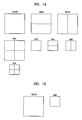
- Figure 1A illustrates blocks used in an H.264 motion estimation method.
- a 16 ⁇ 16 macroblock may have blocks of 7 variable sizes, and each of the blocks has a motion vector. More specifically, the 16 ⁇ 16 macroblock can be divided into a 16 ⁇ 16 block, 16 ⁇ 8 blocks, 8 ⁇ 16 blocks, or 8 ⁇ 8 blocks. Each of the 8 ⁇ 8 blocks can be subdivided into a 8 ⁇ 8 block, 8 ⁇ 4 blocks, 4 ⁇ 8 blocks, or 4 ⁇ 4 blocks.
- Figure 1B illustrates encoding modes used in an MPEG-4 motion estimation method.
- the MPEG-4 standard unlike the H.264 standard that provides seven encoding modes, provides only two encoding modes, i.e., a 16x16 block encoding mode and an 8x8 block encoding mode. Therefore, an encoding mode of each macroblock of MPEG-4 image data may have to be converted into an H.264-compatible encoding mode when converting the MPEG-4 image data into H.264 image data.
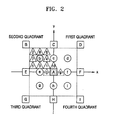
- Figure 2 illustrates a method of determining a motion vector by searching for quarter pixels according to the H.264 standard.
- a through I enclosed by rectangles indicate integer pixels
- b through i enclosed by circles indicate half pixels
- 0 through 10 enclosed by triangles indicate quarter pixels.
- One of the integer pixels A through I is determined as an optimal integer pixel by performing an integer pixel motion vector search on each of the integer pixels A through I in a predetermined 16 pixel search domain. Supposing that the integer pixel A is determined as the optimal integer pixel, one of eight half pixels adjacent to the optimal integer pixel A, i.e., one of the half pixels b through i, is determined as an optimal half pixel by performing a half pixel motion vector search on each of the half pixels b through i.
- one of eight quarter pixels adjacent to the half pixel b is determined as the optimal half pixel
- one of eight quarter pixels adjacent to the half pixel b is determined as an optimal quarter pixel by performing a quarter pixel motion vector search on each of the quarter pixels 2, 8, 6, 7, 4, 5, 3, and 1.
- One of the existing pixel-domain transcoding methods is a cascaded pixel-domain transcoding method.
- the cascaded pixel-domain transcoding method decodes image data of an MPEG-4 bitstream and then encodes the decoded image data according to the H.264 standard.
- a motion estimation process which has already been performed when encoding the image data into the MPEG-4 bitstream, should be re-executed on each macroblock of the decoded image data in order to encode the decoded image data into an H.264 bitstream. Therefore, the cascaded pixel-domain transcoding method is not suitable for real-time transmissions of moving pictures, because it requires considerable amounts of time and money to transcode the moving pictures.
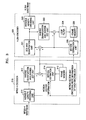
- FIG. 3 is a block diagram of a pixel-domain transcoding apparatus according to an exemplary embodiment of the present invention.
- the pixel-domain transcoding apparatus includes an MPEG-4 decoder 310 and an H.264 encoder 320.
- the pixel-domain transcoding apparatus can transmit moving picture data in real time by letting the H.264 encoder 320 use encoding mode information and motion vector information, which are obtained by using the MPEG-4 decoder 310 to decode an MPEG-4 bit stream.
- the pixel-domain transcoding apparatus decodes the MPEG-4 bitstream into pixel-domain data and then converts the pixel-domain data into an H.264 bitstream.
- a variable length decoding unit 311 receives an MPEG-4 bitstream, variable-length-decodes the MPEG-4 bitstream, and outputs frame type information, macroblock information, and motion vector information of the variable-length-decoded MPEG-4 bitstream.
- the frame type information specifies whether each frame of the variable-length-decoded MPEG-4 bitstream is an I frame or a predictive (P) frame
- the macroblock information specifies in which encoding mode a motion estimation process has been performed when encoding each macroblock of predetermined image data into the MPEG-4 bitstream.
- the motion vector information is transmitted not only to a motion estimation unit 314 of the MPEG-4 decoder 310 and but also to a motion estimation unit 326 of the H.264 encoder 320.
- the macroblock information is transmitted to the motion estimation unit 326 of the H.264 encoder 320.
- An inverse quantization and inverse discrete cosine transform (DCT) unit 312 inversely quantizes and inversely DCTs the variable-length-decoded MPEG-4 bitstream so that the variable-length-decoded MPEG-4 bitstream can be converted into pixel-domain data.
- the pixel-domain data is output to the H.264 encoder 320.
- the pixel-domain data is stored in a frame memory 313 and then input to the motion estimation unit 314 so that it can be used in a motion estimation process.
- the motion estimation unit 314 performs a motion estimation process by using the motion vector information received from the variable length decoding unit 311.
- the H.264 encoder 320 converts the pixel-domain data into an H.264 bitstream by H.264-encoding each frame of the pixel-domain data and then quantizing and DCTing the H.264-coded pixel-domain data using a DCT and quantization unit 321 and a variable length encoding unit 322.
- the motion estimation unit 326 of the H.264 encoder 320 performs motion estimation by using the motion vector information and the macroblock information received from the MPEG-4 decoder 310.
- the motion estimation unit 326 performs motion estimation by using frames, which are obtained by inversely quantizing and inversely DCTing a DCTed and quantized bitstream and then stored in a frame memory 325 via a loop filter 324.
- the H.264 encoder 320 can use an encoding mode and a motion vector of each block of each of the MPEG-4 frames, thereby omitting a time-consuming motion estimation process.
- H.264 performs motion estimation and motion compensation processes on a quarter pixel-by-quarter pixel basis and provides seven variable block sizes and eleven encoding modes
- the encoding mode of each block of each of the MPEG-4 frames should be converted into a more complicated H.264 encoding mode.
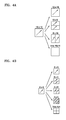
- FIGS 4A through 4D are diagrams illustrating a method of converting an MPEG-4 encoding mode into an H.264 encoding mode.
- An MPEG-4 encoding mode is converted into an H.264 encoding mode in order to make an H.264 encoder use encoding mode information obtained by decoding an MPEG-4 bitstream.
- the H.264 encoder performs a motion estimation process in all available encoding modes and then determines one of the encoding modes as an optimal encoding mode.
- the H.264 encoder can reduce the amount of computation necessary for converting the MPEG-4 bitstream into an H.264 bitstream by performing the motion estimation process in only some of the available encoding modes.
- an encoding mode of each block of the MPEG-4 frame is a 16 ⁇ 16 inter mode
- the H.264 performs a motion estimation process on each block of an MPEG-4 frame in a 16 ⁇ 16 inter mode, a 16 ⁇ 16 inter mode, a 8 ⁇ 16 inter mode, and a 16 ⁇ 16 intra mode.
- the H.264 encoder performs the motion estimation process on each block of the MPEG-4 frame in a 8 ⁇ 8 inter mode, a 8 ⁇ 4 inter mode, a 4 ⁇ 8 inter mode, a 4 ⁇ 4 inter mode, and a 4 ⁇ 4 intra mode.
- the H.264 encoder performs the motion estimation process on each block of each block of the MPEG-4 frame in a skip mode, a 16 ⁇ 16 intra mode, and a 16 ⁇ 16 inter mode.
- the skip mode encoding mode information of only some blocks to be encoded is transmitted or stored. Pixels in a block of a current frame corresponding to the background of an image are more likely to have the same values as their respective pixels in a corresponding block of a reference frame, in which case, only encoding mode information is transmitted or stored without the need to transmit or store coded data, such as residual error signals or motion vector information.
- the H.264 encoder performs the motion estimation on each block of the MPEG-4 bitstream in a 4x4 intra mode and a 16x16 intra mode.
- the H.264 encoder performs the motion estimation process on each block of the MPEG-4 frame in only a few encoding modes, it is possible to considerably reduce the amount of computation required for converting an MPEG-4 bitstream into an H.264 bitstream.
- a 4x4 intra-encoding mode and a 16 ⁇ 16 intra-encoding mode are selected, and eventually, one of them is bound to be determined as an optimal encoding mode, it may not be appropriate to use a rate-distortion optimization technique because the rate-distortion optimization technique makes the structure of an entire transcoding apparatus too complicated.
- one of the 4x4 intra-encoding mode and the 16 ⁇ 16 intra-encoding mode that provides a lowest rate-distortion cost is determined as an optimal encoding mode using a mean square error (MSE) technique, instead of the rate-distortion optimization technique.
- MSE mean square error
- bit rate may be adjusted to be compatible with a given network bandwidth by setting quantization parameters to higher values in a transcoding process.
- bit rate may be adjusted by cutting a current frame rate to a half using a motion vector interpolation method.
- a motion vector interpolation method When cutting a current frame rate to a half in order to transcode an MPEG-4 bitstream into an H.264 bitstream, it is necessary to interpolate a motion vector of a block of an H.264 frame by using motion vector information of a skipped MPEG-4 frame.
- Figure 5 is a diagram illustrating a method of interpolating a motion vector of a block of an H.264 frame by using a motion vector of a block of a skipped MPEG-4 frame.
- an n-th H.264 frame corresponds to an 2n-th MPEG-4 frame
- a (2n-1)-th MPEG-4 frame which is a skipped frame, corresponds to somewhere between n-th and (n-1)-th H.264 frames.
- a motion vector of a block of the (2n-1)-th MPEG-4 frame is obtained by referring to a (2n-1)-th MPEG-4 frame.
- a motion vector of a current block of the n-th H.264 frame which refers to the (n-1)-th H.264 frame, can be obtained by adding a motion vector of a corresponding block of the 2n-th MPEG-4 frame and a motion vector of a corresponding block of the (2n-1)-th MPEG-4 frame.
- a motion vector interpolation method which obtains a motion vector of a current block of an H.264 frame by using a motion vector of a corresponding block of a skipped MPEG-4 frame, will now be described.
- Figure 6A is a diagram illustrating a method of computing a motion vector through a binary interpolation method.
- the MPEG-4 standard provides two different encoding modes, i.e., a 16x16 block encoding mode and an 8x8 block encoding mode. Since a 16x16 block motion vector can be divided into four 8 ⁇ 8 block motion vectors, all MPEG-4 frames can be represented by 8 ⁇ 8 block motion vectors.
- a motion vector of a current block of an H.264 frame can be obtained by using 8x8 motion vector information of a skipped MPEG-4 frame.
- motion vectors of a 16 ⁇ 16, 16 ⁇ 8, 8 ⁇ 16, or 8x8 blocks of the H.264 frame can be obtained by using an encoding mode of each 8H8 block of the skipped MPEG-4 frame.
- Figure 6B is a diagram illustrating a method of computing a motion vector through a weighted binary interpolation method.
- MPEG-4 provides two encoding modes, i.e., a 16x16 encoding mode and a 8 ⁇ 8 encoding mode.
- An 16 ⁇ 16 MPEG-4 block contains four times as much pixel information as an 8x8 MPEG-4 block.
- the 16 ⁇ 16 MPEG-4 block is weighted four times greater than the 8x8 MPEG-4 block.
- motion vectors of the corresponding blocks are weighted regardless of the areas of the blocks of the skipped MPEG-4 frame overlapped by the current block of the H.264 frame.
- Figure 6C is a diagram illustrating a method of computing a motion vector through a constrained binary interpolation method.
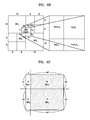
- the area of a current 8 ⁇ 8 block of an H.264 frame overlapping blocks of a skipped MPEG-4 frame varies depending on the location of the current 8 ⁇ 8 block on the skipped MPEG-4 frame. However, if at least one of the length or width of an i-th sub-block of the current 8 ⁇ 8 block of the H.264 frame, i.e., at least one of w i and h i , is set to 1, the influence of the i-th sub-block of the current 8x8 block of the H.264 frame on a motion vector of the entire current 8x8 block of the H.264 frame can be ignored.
- first and third sub-blocks A and C of the current 8x8 block of the H.264 frame are excluded from calculation of the motion vector of the current 8 ⁇ 8 block of the H.264 frame.
- Only second and fourth sub-blocks B and D of the 8H8 block are considered in the calculation of the current 8 ⁇ 8 block of the H.264 frame.
- the i-th sub-block of the current 8 ⁇ 8 block of the H.264 frame is excluded from the calculation of the motion vector of the current 8 ⁇ 8 block of the H.264 frame.
- the three motion vector interpolation methods according to the present invention enable an H.264 encoder to reuse integer pixel motion vectors obtained from MPEG-4 frames, thereby reducing a search range from ⁇ 16 to ⁇ 2. Accordingly, it is possible to reduce the amount of computation required for motion estimation while improving quality of pictures. In other words, it is possible to efficiently search for motion vectors without searching as wide a search area as a ⁇ 16 pixel domain.
- the above-described motion vector interpolation methods can be used independently of one another, or two of them can be used together.
- the weighted binary interpolation method and the constrained binary interpolation method can be used together.
- each of the above-described motion vector interpolation methods can be used together with one of the methods of converting an MPEG-4 encoding mode into an H.264 encoding mode of Figures 4A through 4D.
- FIG. 7 is a flowchart of a pixel-domain transcoding method according to an exemplary embodiment of the present invention.
- encoding mode information and motion vector information of each macroblock of an MPEG-4 frame are received in operation S710.
- operation S720 some of all available H.264 encoding modes are selected based on the encoding mode information of each macroblock of the MPEG-4 frame.
- a method of selecting some of the available H.264 encoding modes has already been described above with reference to Figures 4A through 4D.
- operation S730 if there is a need to cut a frame rate to a half, motion vectors are obtained using a motion vector interpolation method in operation S730.
- the motion vector interpolation method has already been described above with reference to Figures 6A through 6C.
- operation S740 one of the selected H.264 encoding modes is determined as an optimal encoding mode using a rate-distortion optimization technique.
- the performance of the present invention was evaluated by using a MoMuSys decoder, which can decode MPEG-4 SP images, and a Joint Model (JM) 53 encoder, which can encode H.264 BP images.
- JM Joint Model
- a Pentium IV 2.66 GHz processor, 4 image data with quarter common interface format (QCIF, 176 ⁇ 144 pixels) resolution, and 3 image data with common interface format (CIF, 352 ⁇ 288 pixels) resolution were used.
- each of the seven image data contains a total of 300 frames with a frame rate of 30 Hz.
- the JM 42 encoder performed motion estimation and compensation processes on blocks of 7 variable sizes, (16 ⁇ 16, 16 ⁇ 8, 8 ⁇ 16, 8 ⁇ 8, 8 ⁇ 4, 4 ⁇ 8, and 4 ⁇ 4), carried out an integer pixel motion vector search on a ⁇ 16 search range basis, performed quarter pixel motion estimation and compensation processes and a 4 ⁇ 4 integer DCT process, and adopted a rate-distortion optimization technique.
- a first frame of each of the seven image data was coded as an intra frame, and the rest of the frames of each of the seven image data were coded as predictive frames. 300 frames of each of the seven image data were evaluated by skipping every other frame of each of the seven image data so that the frame rate of each of the seven image data can be cut to a half, i.e., 15 Hz.
- a candidate vector was searched for among motion vectors of integer pixels in each frame of the MPEG-4 image data by using one of the motion vector interpolation methods described above, i.e., one of the binary interpolation method, the weighted binary interpolation method, and the constrained binary interpolation method, a half pixel motion vector was searched for in a ⁇ 2 search range of the candidate vector, and a quarter pixel motion vector was searched for among eight quarter pixels adjacent to the half pixel motion vector.
- the above-described motion vector interpolation methods can be used together with a block encoding mode conversion method or independently to cut a current frame rate.
- Figure 8 illustrates the variations of peak signal-to-noise ratios (PSNR) of various transcoding methods in accordance with the variation of bit rate.
- 'Cascade' denotes the cascaded pixel domain transcoding method
- 'BI' denotes the binary interpolation method
- 'WBI' denotes the weighted binary interpolation method
- 'CBI' denotes the constrained binary interpolation method
- 'WBI+CBI' denote a combination of the weighted binary interpolation method and the constrained binary interpolation method.
- results show that the various transcoding methods according to the present invention have a PSNR loss of about 0.2 dB at low bit rates and a PSNR loss of up to 0.7 dB at higher bit rates, compared to the cascaded pixel domain transcoding method.
- the present invention achieves a PSNR of about 33.1 dB at a bit rate of about 70 kbps, which demonstrates that the present invention is capable of providing high-quality pictures suitable for various mobile terminal application programs.
- the various transcoding methods according to the present invention almost achieve the same results, as shown in the lower half of FIG. 8.
- the various transcoding methods according to the present invention have a PSNR loss of about 0.2 dB at high bit rates and a PSNR loss of up to 0.9 dB at lower bit rates, compared to the cascaded pixel domain transcoding method.
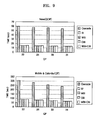
- Figure 9 illustrates how much time was taken to transcode news image data with QCIF resolution and the mobile and calendar image data with CIF resolution when using each of the cascaded pixel-domain transcoding method and the various transcoding methods according to the present invention.
- the various transcoding methods according to the present invention transcode the QCIF image data three and a fifth to four times faster than the cascaded pixel-domain transcoding method and transcode the CIF image data three and a third to four times faster than the cascaded pixel-domain transcoding method.
- the various transcoding methods according to the present invention spend almost the same amount of time transcoding either the QCIF image data or the CIF image data.
- vertical axes denote the amount of time taken to code 300 MPEG-4 frames into 150 H.264 frames
- horizontal axes QP denote H.264 quantization coefficients.
- the transcoding methods according to the present invention may be implemented as a computer program. Codes and code segments of the computer program may be implemented based on the description provided herein and stored in a computer-readable medium. When read and executed by a computer, the transcoding methods according to the present invention may be performed.
- the computer-readable medium may include a magnetic storage medium, an optical storage medium, and a carrier wave medium.
Landscapes
- Engineering & Computer Science (AREA)
- Multimedia (AREA)
- Signal Processing (AREA)
- Health & Medical Sciences (AREA)
- Epidemiology (AREA)
- Life Sciences & Earth Sciences (AREA)
- Animal Behavior & Ethology (AREA)
- General Health & Medical Sciences (AREA)
- Public Health (AREA)
- Veterinary Medicine (AREA)
- Compression Or Coding Systems Of Tv Signals (AREA)
Applications Claiming Priority (2)
| Application Number | Priority Date | Filing Date | Title |
|---|---|---|---|
| KR1020040016798A KR101196429B1 (ko) | 2004-03-12 | 2004-03-12 | 동영상 트랜스코딩 방법 및 그 장치, 이에 사용되는움직임 벡터 보간방법 |
| KR2004016798 | 2004-03-12 |
Publications (2)
| Publication Number | Publication Date |
|---|---|
| EP1575301A2 true EP1575301A2 (fr) | 2005-09-14 |
| EP1575301A3 EP1575301A3 (fr) | 2016-08-03 |
Family
ID=34825217
Family Applications (1)
| Application Number | Title | Priority Date | Filing Date |
|---|---|---|---|
| EP05251474.2A Withdrawn EP1575301A3 (fr) | 2004-03-12 | 2005-03-11 | méthode et appareil de transcodage |
Country Status (4)
| Country | Link |
|---|---|
| US (1) | US7620107B2 (fr) |
| EP (1) | EP1575301A3 (fr) |
| KR (1) | KR101196429B1 (fr) |
| CN (1) | CN100399829C (fr) |
Cited By (7)
| Publication number | Priority date | Publication date | Assignee | Title |
|---|---|---|---|---|
| CN100558169C (zh) * | 2007-03-23 | 2009-11-04 | 武汉大学 | 视频转码中帧间模式的快速选择方法 |
| CN101621687B (zh) * | 2008-08-18 | 2011-06-08 | 深圳市铁越电气有限公司 | H.264到avs视频码流转换方法及其装置 |
| US7966361B1 (en) | 2006-02-10 | 2011-06-21 | Nvidia Corporation | Single-cycle modulus operation |
| CN102123284A (zh) * | 2011-03-18 | 2011-07-13 | 河北师范大学 | 一种h.264编码运动估计中的快速搜索方法 |
| DE112007000359B4 (de) * | 2006-02-10 | 2013-04-11 | Nvidia Corp. | Verarbeitung von Videodaten |
| EP2693754A1 (fr) * | 2012-08-02 | 2014-02-05 | Intel Corporation | Codage de données vidéo |
| US9113162B2 (en) | 2003-11-25 | 2015-08-18 | Nvidia Corporation | Dynamic packet size control for MPEG-4 data partition mode |
Families Citing this family (35)
| Publication number | Priority date | Publication date | Assignee | Title |
|---|---|---|---|---|
| KR100718468B1 (ko) * | 2004-11-30 | 2007-05-16 | 주식회사 휴맥스 | 영상 축소 트랜스 코딩 방법 및 장치 |
| KR100718467B1 (ko) * | 2004-11-30 | 2007-05-16 | 주식회사 휴맥스 | 영상 축소 트랜스코딩 방법 및 장치 |
| KR100669897B1 (ko) * | 2005-01-21 | 2007-01-16 | 한양대학교 산학협력단 | H.264/avc에서의 고속 매크로블록 모드 선택 방법 |
| KR100733991B1 (ko) * | 2005-09-15 | 2007-06-29 | 한양대학교 산학협력단 | Mpeg2에서 h.264로의 트랜스코딩 방법 |
| KR100776645B1 (ko) * | 2005-12-08 | 2007-11-16 | 한국전자통신연구원 | 트랜스코딩 방법 |
| US8265151B1 (en) | 2005-12-14 | 2012-09-11 | Ambarella Taiwan Ltd. | Mode decision using approximate 1/2 pel interpolation |
| US7944965B2 (en) * | 2005-12-19 | 2011-05-17 | Seiko Epson Corporation | Transform domain based distortion cost estimation |
| US8085849B1 (en) * | 2006-11-03 | 2011-12-27 | Keystream Corporation | Automated method and apparatus for estimating motion of an image segment using motion vectors from overlapping macroblocks |
| KR100896978B1 (ko) * | 2006-11-27 | 2009-05-14 | 한양대학교 산학협력단 | Mpeg-2에서 h.264/avc로의 고속 트랜스코딩에서 움직임 벡터 예측 방법과 모드 예측 방법 및 기록매체 |
| CN101001371B (zh) * | 2007-01-19 | 2010-05-19 | 华为技术有限公司 | 视频转码的方法及其装置 |
| US8265157B2 (en) * | 2007-02-07 | 2012-09-11 | Lsi Corporation | Motion vector refinement for MPEG-2 to H.264 video transcoding |
| KR100973657B1 (ko) * | 2007-11-01 | 2010-08-02 | 경희대학교 산학협력단 | 디블록킹 필터링을 포함하는 코덱 사이의 트랜스코딩 방법 및 장치 |
| KR100929607B1 (ko) * | 2007-12-26 | 2009-12-03 | 한양대학교 산학협력단 | 엠펙-2 메인 프로파일에서 h.264/avc 베이스라인프로파일로의 트랜스코딩 방법 |
| KR100939917B1 (ko) | 2008-03-07 | 2010-02-03 | 에스케이 텔레콤주식회사 | 움직임 예측을 통한 부호화 시스템 및 움직임 예측을 통한부호화 방법 |
| US8831101B2 (en) * | 2008-08-02 | 2014-09-09 | Ecole De Technologie Superieure | Method and system for determining a metric for comparing image blocks in motion compensated video coding |
| US20100118948A1 (en) * | 2008-10-24 | 2010-05-13 | Chanchal Chatterjee | Method and apparatus for video processing using macroblock mode refinement |
| US20100104022A1 (en) * | 2008-10-24 | 2010-04-29 | Chanchal Chatterjee | Method and apparatus for video processing using macroblock mode refinement |
| US8687685B2 (en) * | 2009-04-14 | 2014-04-01 | Qualcomm Incorporated | Efficient transcoding of B-frames to P-frames |
| US9100656B2 (en) | 2009-05-21 | 2015-08-04 | Ecole De Technologie Superieure | Method and system for efficient video transcoding using coding modes, motion vectors and residual information |
| KR101623124B1 (ko) * | 2009-12-03 | 2016-05-24 | 에스케이 텔레콤주식회사 | 비디오 인코딩 장치 및 그 인코딩 방법, 비디오 디코딩 장치 및 그 디코딩 방법, 및 거기에 이용되는 방향적 인트라 예측방법 |
| US9020033B2 (en) * | 2010-11-04 | 2015-04-28 | Nice-Systems Ltd. | System and method for enhancing compression using skip macro block on a compressed video |
| US8755438B2 (en) * | 2010-11-29 | 2014-06-17 | Ecole De Technologie Superieure | Method and system for selectively performing multiple video transcoding operations |
| WO2012081895A1 (fr) | 2010-12-13 | 2012-06-21 | 한국전자통신연구원 | Procédé et appareil de prédiction intra |
| KR102086145B1 (ko) | 2010-12-13 | 2020-03-09 | 한국전자통신연구원 | 인트라 예측 방법 및 그 장치 |
| US20120170653A1 (en) * | 2010-12-30 | 2012-07-05 | General Instrument Corporation | Block based sampling coding systems |
| DE102011119177A1 (de) * | 2011-11-23 | 2013-05-23 | Siemens Aktiengesellschaft | Verfahren und Vorrichtung zum Verfahren zum Erstellen eines ersten Parametersatzes |
| CN102547296B (zh) * | 2012-02-27 | 2015-04-01 | 开曼群岛威睿电通股份有限公司 | 移动估计加速电路、移动估计方法及环路滤波加速电路 |
| US10230956B2 (en) | 2012-09-26 | 2019-03-12 | Integrated Device Technology, Inc. | Apparatuses and methods for optimizing rate-distortion of syntax elements |
| US10277907B2 (en) | 2012-10-25 | 2019-04-30 | Integrated Device Technology, Inc. | Rate-distortion optimizers and optimization techniques including joint optimization of multiple color components |
| US20140219331A1 (en) * | 2013-02-06 | 2014-08-07 | Magnum Semiconductor, Inc. | Apparatuses and methods for performing joint rate-distortion optimization of prediction mode |
| US9286653B2 (en) | 2014-08-06 | 2016-03-15 | Google Inc. | System and method for increasing the bit depth of images |
| KR102332782B1 (ko) * | 2014-12-15 | 2021-11-30 | 삼성전자주식회사 | 시각 특성을 고려한 영상 데이터 압축 |
| KR102006449B1 (ko) | 2017-11-29 | 2019-08-01 | 네이버 주식회사 | 분산 트랜스코딩 방법 및 분산 트랜스코딩 시스템 |
| KR20200000649A (ko) | 2018-06-25 | 2020-01-03 | 네이버 주식회사 | 오디오 병렬 트랜스코딩을 위한 방법 및 시스템 |
| US11089297B2 (en) | 2018-08-31 | 2021-08-10 | Hulu, LLC | Historical motion vector prediction with reset list |
Family Cites Families (23)
| Publication number | Priority date | Publication date | Assignee | Title |
|---|---|---|---|---|
| US5198901A (en) * | 1991-09-23 | 1993-03-30 | Matsushita Electric Corporation Of America | Derivation and use of motion vectors in a differential pulse code modulation system |
| US6058143A (en) * | 1998-02-20 | 2000-05-02 | Thomson Licensing S.A. | Motion vector extrapolation for transcoding video sequences |
| KR100296099B1 (ko) | 1999-03-31 | 2001-07-12 | 전주범 | 제어 그리드 보간방식에 따른 영상부호기에서 벡터양자화를 이용한 제어점의 움직임 벡터 산출 방법 및 그장치 |
| US6441754B1 (en) * | 1999-08-17 | 2002-08-27 | General Instrument Corporation | Apparatus and methods for transcoder-based adaptive quantization |
| US6574279B1 (en) * | 2000-02-02 | 2003-06-03 | Mitsubishi Electric Research Laboratories, Inc. | Video transcoding using syntactic and semantic clues |
| US6647061B1 (en) * | 2000-06-09 | 2003-11-11 | General Instrument Corporation | Video size conversion and transcoding from MPEG-2 to MPEG-4 |
| JP2002010267A (ja) | 2000-06-26 | 2002-01-11 | Sony Corp | 動きベクトル変換装置及び方法 |
| KR100433516B1 (ko) | 2000-12-08 | 2004-05-31 | 삼성전자주식회사 | 트랜스코딩 방법 |
| US7801215B2 (en) * | 2001-07-24 | 2010-09-21 | Sasken Communication Technologies Limited | Motion estimation technique for digital video encoding applications |
| KR100440953B1 (ko) | 2001-08-18 | 2004-07-21 | 삼성전자주식회사 | 영상 압축 비트 스트림의 트랜스코딩 방법 |
| EP3399747B1 (fr) * | 2001-09-14 | 2021-05-12 | Ntt Docomo, Inc. | Procédé de codage |
| JP4574090B2 (ja) * | 2001-09-21 | 2010-11-04 | 三菱電機株式会社 | 動画データ変換装置および動画データ変換プログラム |
| US7236529B2 (en) * | 2001-10-30 | 2007-06-26 | Industrial Technology Research Institute | Methods and systems for video transcoding in DCT domain with low complexity |
| KR20030039069A (ko) | 2001-11-09 | 2003-05-17 | 박상래 | 비 PC기반(stand-alone, 독립형) 방식으로 구성하고 음향채널을 포함한 디지털 영상 및 음향 저장 장치 |
| KR100460950B1 (ko) * | 2001-12-18 | 2004-12-09 | 삼성전자주식회사 | 트랜스코더 및 트랜스코딩 방법 |
| EP1827027A1 (fr) * | 2002-01-18 | 2007-08-29 | Kabushiki Kaisha Toshiba | Procédé et appareil de codage vidéo et procédé et appareil de décodage vidéo |
| JP3874179B2 (ja) * | 2002-03-14 | 2007-01-31 | Kddi株式会社 | 符号化動画像変換装置 |
| JP4193406B2 (ja) * | 2002-04-16 | 2008-12-10 | 三菱電機株式会社 | 映像データ変換装置および映像データ変換方法 |
| US7142601B2 (en) * | 2003-04-14 | 2006-11-28 | Mitsubishi Electric Research Laboratories, Inc. | Transcoding compressed videos to reducing resolution videos |
| US7280597B2 (en) * | 2003-06-24 | 2007-10-09 | Mitsubishi Electric Research Laboratories, Inc. | System and method for determining coding modes, DCT types and quantizers for video coding |
| US7324595B2 (en) * | 2003-09-22 | 2008-01-29 | Lsi Logic Corporation | Method and/or apparatus for reducing the complexity of non-reference frame encoding using selective reconstruction |
| KR20050061762A (ko) * | 2003-12-18 | 2005-06-23 | 학교법인 대양학원 | 부호화 모드 결정방법, 움직임 추정방법 및 부호화 장치 |
| JP4227067B2 (ja) * | 2004-04-28 | 2009-02-18 | 株式会社東芝 | 動画像符号化方法と装置及びプログラム |
-
2004
- 2004-03-12 KR KR1020040016798A patent/KR101196429B1/ko not_active Expired - Fee Related
-
2005
- 2005-03-08 US US11/074,078 patent/US7620107B2/en not_active Expired - Fee Related
- 2005-03-11 EP EP05251474.2A patent/EP1575301A3/fr not_active Withdrawn
- 2005-03-14 CN CNB2005100539249A patent/CN100399829C/zh not_active Expired - Fee Related
Cited By (8)
| Publication number | Priority date | Publication date | Assignee | Title |
|---|---|---|---|---|
| US9113162B2 (en) | 2003-11-25 | 2015-08-18 | Nvidia Corporation | Dynamic packet size control for MPEG-4 data partition mode |
| US7966361B1 (en) | 2006-02-10 | 2011-06-21 | Nvidia Corporation | Single-cycle modulus operation |
| DE112007000359B4 (de) * | 2006-02-10 | 2013-04-11 | Nvidia Corp. | Verarbeitung von Videodaten |
| US8705630B2 (en) | 2006-02-10 | 2014-04-22 | Nvidia Corporation | Adapting one type of encoder to another type of encoder |
| CN100558169C (zh) * | 2007-03-23 | 2009-11-04 | 武汉大学 | 视频转码中帧间模式的快速选择方法 |
| CN101621687B (zh) * | 2008-08-18 | 2011-06-08 | 深圳市铁越电气有限公司 | H.264到avs视频码流转换方法及其装置 |
| CN102123284A (zh) * | 2011-03-18 | 2011-07-13 | 河北师范大学 | 一种h.264编码运动估计中的快速搜索方法 |
| EP2693754A1 (fr) * | 2012-08-02 | 2014-02-05 | Intel Corporation | Codage de données vidéo |
Also Published As
| Publication number | Publication date |
|---|---|
| CN1691779A (zh) | 2005-11-02 |
| US7620107B2 (en) | 2009-11-17 |
| KR101196429B1 (ko) | 2012-11-01 |
| US20050201463A1 (en) | 2005-09-15 |
| EP1575301A3 (fr) | 2016-08-03 |
| KR20050091369A (ko) | 2005-09-15 |
| CN100399829C (zh) | 2008-07-02 |
Similar Documents
| Publication | Publication Date | Title |
|---|---|---|
| US7620107B2 (en) | Video transcoding method and apparatus and motion vector interpolation method | |
| US8897360B2 (en) | Method and apparatus for encoding and decoding images by adaptively using an interpolation filter | |
| US10334252B2 (en) | Video encoding apparatus, video decoding apparatus, and video decoding method for performing intra-prediction based on directionality of neighboring block | |
| CN102084655B (zh) | 通过过滤器选择进行的视频编码 | |
| KR100750136B1 (ko) | 영상의 부호화, 복호화 방법 및 장치 | |
| US8300696B2 (en) | Transcoding for systems operating under plural video coding specifications | |
| KR101044934B1 (ko) | 움직임 벡터 추정방법 및 부호화 모드 결정방법 | |
| US9503725B2 (en) | Method and apparatus for encoding/decoding image for performing intraprediction using pixel value filtered according to prediction mode | |
| JP2010515305A (ja) | 他のコーディングモードの情報を使用したコーディングモードの選択 | |
| KR20100079037A (ko) | 비디오 영상 부호화 방법 및 장치 | |
| KR101700410B1 (ko) | 인트라 모드를 이용한 쿼터 픽셀 해상도를 갖는 영상 보간 방법 및 장치 | |
| Yeh et al. | Coding unit complexity-based predictions of coding unit depth and prediction unit mode for efficient HEVC-to-SHVC transcoding with quality scalability | |
| KR101562343B1 (ko) | 인트라 모드를 이용한 쿼터 픽셀 해상도를 갖는 영상 보간 방법 및 장치 | |
| KR102020953B1 (ko) | 카메라 영상의 복호화 정보 기반 영상 재 부호화 방법 및 이를 이용한 영상 재부호화 시스템 | |
| KR100832872B1 (ko) | 기하학적 변환을 이용한 영상 부호화 효율 향상 방법 및장치 | |
| KR100718468B1 (ko) | 영상 축소 트랜스 코딩 방법 및 장치 | |
| KR101934840B1 (ko) | 인트라 모드를 이용한 쿼터 픽셀 해상도를 갖는 영상 보간 방법 및 장치 | |
| KR101810198B1 (ko) | 인트라 모드를 이용한 쿼터 픽셀 해상도를 갖는 영상 보간 방법 및 장치 | |
| KR101700411B1 (ko) | 인트라 모드를 이용한 쿼터 픽셀 해상도를 갖는 영상 보간 방법 및 장치 | |
| KR101200494B1 (ko) | H.264에서 mpep-2로의 트랜스코딩 방법 | |
| KR20150102874A (ko) | 적응적 부호화 방법을 이용한 영상의 부호화 방법 및 이를 이용한 인코딩 장치 | |
| KR20190004246A (ko) | 인트라 모드를 이용한 쿼터 픽셀 해상도를 갖는 영상 보간 방법 및 장치 | |
| KR20190004247A (ko) | 인트라 모드를 이용한 쿼터 픽셀 해상도를 갖는 영상 보간 방법 및 장치 | |
| KR20190084929A (ko) | 인트라 모드를 이용한 쿼터 픽셀 해상도를 갖는 영상 보간 방법 및 장치 | |
| Singh et al. | Optimization of standards for video compression tools over wireless networks |
Legal Events
| Date | Code | Title | Description |
|---|---|---|---|
| PUAI | Public reference made under article 153(3) epc to a published international application that has entered the european phase |
Free format text: ORIGINAL CODE: 0009012 |
|
| 17P | Request for examination filed |
Effective date: 20050404 |
|
| AK | Designated contracting states |
Kind code of ref document: A2 Designated state(s): AT BE BG CH CY CZ DE DK EE ES FI FR GB GR HU IE IS IT LI LT LU MC NL PL PT RO SE SI SK TR |
|
| AX | Request for extension of the european patent |
Extension state: AL BA HR LV MK YU |
|
| RTI1 | Title (correction) |
Free format text: VIDEO TRANSCODING METHOD AND APPARATUS |
|
| RAP1 | Party data changed (applicant data changed or rights of an application transferred) |
Owner name: SAMSUNG ELECTRONICS CO., LTD. Owner name: SEJONG INDUSTRY-ACADEMY COOPERATION FOUNDATION |
|
| RAP1 | Party data changed (applicant data changed or rights of an application transferred) |
Owner name: SEJONG INDUSTRY-ACADEMY COOPERATION FOUNDATION Owner name: SAMSUNG ELECTRONICS CO., LTD. |
|
| PUAL | Search report despatched |
Free format text: ORIGINAL CODE: 0009013 |
|
| AK | Designated contracting states |
Kind code of ref document: A3 Designated state(s): AT BE BG CH CY CZ DE DK EE ES FI FR GB GR HU IE IS IT LI LT LU MC NL PL PT RO SE SI SK TR |
|
| AX | Request for extension of the european patent |
Extension state: AL BA HR LV MK YU |
|
| RIC1 | Information provided on ipc code assigned before grant |
Ipc: H04N 7/26 00000000AFI20160624BHEP |
|
| STAA | Information on the status of an ep patent application or granted ep patent |
Free format text: STATUS: EXAMINATION IS IN PROGRESS |
|
| 17Q | First examination report despatched |
Effective date: 20161125 |
|
| STAA | Information on the status of an ep patent application or granted ep patent |
Free format text: STATUS: THE APPLICATION HAS BEEN WITHDRAWN |
|
| AKX | Designation fees paid |
Designated state(s): AT BE BG CH CY CZ DE DK EE ES FI FR GB GR HU IE IS IT LI LT LU MC NL PL PT RO SE SI SK TR |
|
| AXX | Extension fees paid |
Extension state: HR Extension state: MK Extension state: AL Extension state: YU Extension state: BA Extension state: LV |
|
| 18W | Application withdrawn |
Effective date: 20170323 |