EP1575147B1 - Insulator, armature and dynamo-electric machine - Google Patents
Insulator, armature and dynamo-electric machine Download PDFInfo
- Publication number
- EP1575147B1 EP1575147B1 EP03778754A EP03778754A EP1575147B1 EP 1575147 B1 EP1575147 B1 EP 1575147B1 EP 03778754 A EP03778754 A EP 03778754A EP 03778754 A EP03778754 A EP 03778754A EP 1575147 B1 EP1575147 B1 EP 1575147B1
- Authority
- EP
- European Patent Office
- Prior art keywords
- winding
- insulator
- windings
- armature
- aligning portion
- Prior art date
- Legal status (The legal status is an assumption and is not a legal conclusion. Google has not performed a legal analysis and makes no representation as to the accuracy of the status listed.)
- Expired - Lifetime
Links
- 239000012212 insulator Substances 0.000 title claims description 87
- 238000004804 winding Methods 0.000 claims description 211
- 238000009413 insulation Methods 0.000 description 18
- 238000010586 diagram Methods 0.000 description 8
- 238000000034 method Methods 0.000 description 2
- 238000011161 development Methods 0.000 description 1
- 230000018109 developmental process Effects 0.000 description 1
- 230000000694 effects Effects 0.000 description 1
- 239000011810 insulating material Substances 0.000 description 1
Images



Classifications
-
- H—ELECTRICITY
- H02—GENERATION; CONVERSION OR DISTRIBUTION OF ELECTRIC POWER
- H02K—DYNAMO-ELECTRIC MACHINES
- H02K1/00—Details of the magnetic circuit
- H02K1/06—Details of the magnetic circuit characterised by the shape, form or construction
- H02K1/22—Rotating parts of the magnetic circuit
- H02K1/24—Rotor cores with salient poles ; Variable reluctance rotors
-
- H—ELECTRICITY
- H02—GENERATION; CONVERSION OR DISTRIBUTION OF ELECTRIC POWER
- H02K—DYNAMO-ELECTRIC MACHINES
- H02K3/00—Details of windings
- H02K3/32—Windings characterised by the shape, form or construction of the insulation
- H02K3/34—Windings characterised by the shape, form or construction of the insulation between conductors or between conductor and core, e.g. slot insulation
- H02K3/345—Windings characterised by the shape, form or construction of the insulation between conductors or between conductor and core, e.g. slot insulation between conductor and core, e.g. slot insulation
Definitions
- the present invention relates to an insulator, an armature and a rotary electric machine, and especially relates to the insulator, the armature and the rotary electric machine suitable for a vehicular air blower.
- Conventional vehicular air blower incorporates a rotary electric machine to rotate a fan.
- the rotary electric machine has an armature including a stack-type armature core and windings wound on the armature core.
- the above-described armature is provided with an insulator on a surface of the armature core to insulate the armature core from the windings (refer to JP-2002-272045-A (Pgs. 4 through 6, FIG. 2) and JP-07-245896-A (Pgs. 4 through 6, FIG. 1) for example).
- FIG. 11 is an explanatory diagram showing the disadvantages of the conventional insulator, and depicts winding patterns of the winding wound on the conventional insulator in varied winding patterns.
- a reference numeral 320 denotes a conventional insulator disposed in an armature core having a plurality of radially-formed salient poles.
- the insulator 320 has slots 321 formed at regular intervals. Further, the slot 321 has an arc portion 322 at an inner portion in a radial direction of the insulator 320.
- Multi-layered windings 314 are wound in distributed winding method and disposed in the slot 321.
- a winding 314a on a first layer is wound to be in contact with an arc portion 322 on a center axis Lc' of the slot 321. Then, windings 314b-1, 314b-2 on a second layer are wound to be in tight contacts with inner walls 321a, 321 b of the slot 321 and the winding 314a on the first layer. In this case, windings 314c, 314d of a third layer and beyond are aligned regularly.
- the winding 314a on the first layer is wound to be in contact with the arc portion 322 on the center axis Lc' of the slot 321.
- the first winding 314b-1 on the second layer is wound to be in tight contacts with the inner wall 321b of the slot 321 and the winding 314a on the first layer.
- the second winding 314b-2 is wound to be in tight contacts with the winding 314a on the first layer and the first winding 314b-1 on the second layer.
- the second winding 314b-2 on the second layer and the inner wall 321 a of the slot 321 form a clearance C2 therebetween.
- a width of the clearance C2 is smaller than a diameter of a second winding 314c-2 on the third layer when it is deformed, so that the winding 314c-2 do not enter in the clearance C2.
- the winding 314a on the first layer is wound to be in contact with the arc portion 322 on the center axis Lc' of the slot 321. Then, one winding 314b on the second layer and one winding 314c on the third layer are wound. Further, a second winding 314d-2 on the fourth layer is wound to be in tight contact with the winding 314c on the third layer and the first winding 314d-1 on the fourth layer. In this case, the second winding 314d-2 on the fourth layer and the inner wall 321a of the slot 321 form a clearance C4 therebetween. However, the width of the clearance C4 is larger than a diameter of the second winding 314b-2 on the second layer in its natural state, so that the winding 314b-2 does not dig into the clearance C4.
- the winding 314a on the first layer is wound to be in contact with the arc portion 322 at a position diverted from the center axis Lc' of the slot 321.
- the second winding 314c-2 on the third layer is wound to be in tight contacts with the winding 314b-1 on the second layer and the first winding 314c-1 on the third layer.
- the second winding 314c-2 on the third layer and the inner wall 321a of the slot 321 form a clearance C3 therebetween.
- the width of the clearance C3 is larger than a diameter of the second winding 314b-2 on the second layer when it is deformed, so that the winding 314b-2 may dig into the clearance C3.
- the armature incorporating the insulator 320 having the above-described structure has a disadvantage that the windings 314 is not regularly wound in the slot 321 if the winding 314a on the first layer is wound in contact with the arc portion 322 at a position diverted from the center axis Lc'.
- the winding 314 may dig to be damaged as described above.
- the winding 314b-2 dug in the clearance C3 is pressed radially inward by other windings wound radially outer than the winding 314b-2. Then, the winding 314b-2 is strongly pressed into the clearance C3 and an insulation of the winding 314b-2 may be spoiled.
- the slots of the insulator in accordance with FR-A-2 778 283 are wedge shaped throughout.
- the slots of the insulator in accordance with the known structure of DE 44 03 820 A1 have rounded radially inner ends.
- the last mentioned publication of patent abstracts of Japan shows a shape of the slots of the insulator with a flattened or convexly rounded radial inner end of the slot profile.
- the present invention has as an object to provide an insulator, an armature and a rotary electric machine capable of preventing insufficient insulation of the windings.
- Another object of the present invention is to provide an insulator, an armature and a rotary electric machine capable of having at disposition enough slots of the insulator with a configuration capable of preventing insufficient insulation of the windings.
- Still another object of the present invention is to provide a rotary electric machine capable of improving its durability relative to conventional ones.
- Claim 6 is directed to an armature including the features of the invention.
- Claim 7 is directed to a rotary electric machine making use of the armature.
- an insulator according to the invention is an insulator disposed in an armature core formed such that a plurality of salient poles are radially disposed.
- the insulator is formed to position a winding on a first layer that is disposed at most inner side in a radial direction of the armature core among the windings wound on the salient poles approximately at a middle between the salient poles, wherein a center angle of the slot in the insulator is formed larger than the angle at which the two slant faces meet in the winding aligning portion in cases of a number of the slots of the insulator smaller than or equal to six, and said center angle is formed smaller than the angle at which the two slant faces meets in the winding aligning portion in cases the number of the slots of the insulator is larger than six, so that the angle at which the two slant faces meets in the winding aligning portion does not limit the number of the slots.
- the insulator By forming the insulator to position a winding on a first layer that is disposed at most inner side in a radial direction of the armature core among the windings wound on the salient poles approximately at a middle between the salient poles, it is possible to wind the windings on the second and subsequent layers to be in regularly aligned state. Thus, it is possible to prevent the windings from being bitten and from insufficient insulation.
- said insulator is formed to have an approximately V-shaped winding aligning portion that gets narrower from an outer side to an inner side in the radial direction of the armature core approximately at the middle between the salient poles.
- said winding aligning portion gets narrower from an outer side to an inner side in the radial direction of the armature core approximately at the middle between the salient poles.
- the approximately V-shaped winding aligning portion is formed so that two slant faces meet at an angle from approximately 45 degrees through approximately 75 degrees. Further, it is desirable that the winding aligning portion is formed to be able to align the windings on at least two layers at the most inner side in the radial direction of the armature core. Still further, it is desirable that the winding aligning portion is formed to be able to align the windings the diameters of which are approximately 0.9 mm.
- the two slant faces meet approximately at 60 degrees in the winding aligning portion.
- An armature according to the invention is provided with the above-described insulator, so that the armature can prevent the windings from insufficient insulation.
- a rotary electric machine according to the invention is provided with the armature just mentioned before, so that the machine can prevent the windings from insufficient insulation and has a improved durability relative to conventional ones.
- FIGS. 1 to 6 depict an embodiment of the present invention.
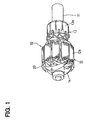
- FIG. 1 is a perspective view showing a structure of an armature incorporating an insulator.
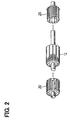
- FIG. 2 is an exploded perspective view of the armature incorporating the insulator.
- FIG. 3 is a front view of the insulator.
- FIG. 4 is an enlarged view of a principal portion of the insulator.
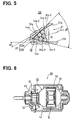
- FIG. 5 is an explanatory diagram showing an aligning state of the windings by a winding aligning portion.
- FIG. 6 is a cross-sectional and side view showing a structure of a rotary electric machine.
- the insulator 40 is shown to be seen from an opposite side to the communicator 13 in FIG. 1.
- the reference numeral 10 in FIG. 1 denotes the armature incorporating the insulator according to the embodiment of the present invention.
- the armature 10 is disposed in a DC rotary electric machine for a vehicular air blower, for example.
- the armature 10 is provided with a rotation shaft 11.
- the rotation shaft 11 is provided with a stack-type armature core 12 having a plurality of salient poles 12a and a commutator 13.
- Each segment 13a of the commutator 13 is connected to a winding 14, which is wound on a plurality of salient poles 12a respectively on a plurality of layers by distribution winding method.
- a diameter of the winding 14 is approximately 0.9 mm.
- the armature core 12 is provided with insulators 20 made of electrical insulating material to secure insulation between the windings 14 and the armature core 12. As shown in FIG. 2, the insulators 20 are formed in a shape approximately similar to the armature core 12 and slightly larger than an outer shape of the armature core 12. A pair of the insulators 20 are disposed on an axial direction of the armature core 12 to interpose the armature core 12 therebetween and are fixed to the armature core 12.
- the insulator 20 has a plurality of slots 21 between the salient poles 12a of the armature core 12 shown in FIG. 1. Many layers of the windings are inserted and disposed in the slot 21.
- the winding aligning portion 22 is formed in each the slot 21 at an inner portion in a radial direction of the insulator 20.
- the winding aligning portion 22 has an approximately V shape formed by two slant faces 22a, 22b connected at an inner portion in the radial direction of the insulator 20 so as to get narrower from an outer side to an inner side in the radial direction of the armature core 12.
- the approximately V-shaped winding aligning portion 22 is formed so that an axis L1 of symmetry thereof is disposed approximately at a middle between the salient poles 12a and that the two slant faces 22a, 22b forming the winding aligning portion 22 meet at 60 degrees. Further, as shown in FIG. 5, the winding aligning portion 22 according to the present embodiment is formed to be able to align the windings 14 of at least two layers at most inner position in the radial direction. Thus, by forming the winding aligning portion 22 configured as described above in the slot 21, the winding 14a on the first layer can be securely positioned in a midsection of the salient poles 12a just by inserting the winding 14a on the first layer in the winding aligning portion 22.
- winding aligning portion 22 it is possible to align the windings 14b-1, 14b-2, 14c-1, 14c-2 and 14c-3 on the second layer and further layer symmetrically with respect to the center axis Lc of the winding aligning portion 22. Thus, is possible to wind the windings 14 to be aligned.
- Winding state of the windings 14 in the slot 21 having the winding aligning portion 22 will be described in detail in the followings. That is, the winding 14a connected to the commutator 13 (refer to FIG. 1) is inserted in the slot 21 and positioned on a center axis Lc of the slot 21 as the winding on the first layer to be in line with the slant faces 22a, 22b of the winding aligning portion 22. Further, the winding 14b-1 inserted in the slot 21 as a first winding on the second layer is wound to be in tight contacts with the winding 14a on the first layer and with the slant face 22b. The winding 14b-2 inserted in the slot 21 as a second winding on the second layer is wound to be in tight contacts with the windings 14a, 14b-1 and the slant face 22a.
- the winding 14c-1 inserted in the slot 21 as a first winding on the third layer is wound to be in tight contact with the winding 14b-1 and the inner wall 21b of the slot 21.
- the winding 14c-2 inserted in the slot 21 as a second winding on the third layer is wound to be in tight contacts with the windings 14b-1, 14b-2, 14c-1 and positioned on the center axis Lc of the slot 21.
- the winding 14c-3 inserted in the slot 21 as a third winding on the third layer is wound to be in tight contacts with windings 14b-2, 14c-2 and the inner wall 21 a of the slot 21.
- the winding aligning portion 22 positions the winding 14a on the first layer on the center of the slot 21, so that the windings 14b-1, 14b-2, 14c-1, 14c-2, 14c-3 are wound to be regularly aligned in the slot 21.
- the insulator 20 As described above, by adopting the insulator 20 according to the present embodiment, it is possible to wind the windings 14 regularly in an aligned manner, thereby preventing dig-in and the like of the windings 14. Thus, the windings 14 are prevented from faulty insulation.
- the insulator 20 is formed so that an center angle ⁇ of the slot 21 (30 degrees in the present embodiment) is smaller than an angle ⁇ (referred to as center angle ⁇ in the following; 60 degrees in the present embodiment) at which the two slant faces 22a, 22b meet in the winding aligning portion 22.
- the center angle ⁇ of the winding aligning portion 22 does not limit the number of the slots 21. That is, in a case that the center angle ⁇ of the slot 21 is formed equal to the center angle ⁇ of the winding aligning portion 22, the number of the slots (that is, the number of the salient poles of the armature core) are excessively limited.
- FIG. 3 for example, in a case that the rotary electric machine should be provided with twelve slots, if the center angle of the slot 21 is set to 60 degrees equal to the center angle of the winding aligning portion 22, only six slots are formed as shown by additional lines L.
- the center angle ⁇ of the slot 21 is formed smaller than the center angle ⁇ of the winding aligning portion 22, so that the number of the slots does not excessively limited. Accordingly, the insulator 20 according to the present embodiment can secure enough number of the slots even if it has a structure to prevent the insufficient insulation in the windings 14.
- the center angle ⁇ of the slots 21 of the insulator 20 are formed smaller than the center angle ⁇ of the winding aligning portion 22.
- the center angle ⁇ of the slots 21 are formed larger than the center angle ⁇ of the winding aligning portion 22.
- the reference numeral 30 in FIG. 6 denotes a DC rotary electric machine used for a vehicular air blower for example.
- the rotary electric machine 30 is constituted to have the above-described armature 10, a brush 31 in slide contact with the armature 10 and a brush supporting apparatus 32 supporting the brush 31 and for supplying electric power from an outer electric power source to the brush 31.
- the armature 10 is enclosed in a yoke housing 33.
- Magnet 34 is disposed on an inner circumferential face of the yoke housing 33.
- the rotary electric machine 30 can prevent insufficient insulation in the windings 14 by being provided with the armature 10 including the insulator 20 as described above.
- the rotary electric machine 30 is improved in its durability relative to conventional ones. Further, by preventing insufficient insulation in the windings 14, it is possible to prevent a disadvantage such as a sudden halt of the armature 10 during rotating operation.
- the present invention has the following advantages.
- the insulator 20 is formed to be able to position the winding 14a on the first layer approximately at the middle between the salient poles 12a among the windings 14a wound on the salient poles 12a.
- the windings 14b-1, 14b-2, 14c-1, 14c-2, 14c-3 on the second layer and beyond in a regularly aligned state. Accordingly, it is possible to prevent the windings 14 from digging and hence to prevent insufficient insulation of the windings 14.
- the insulator 20 according to the present embodiment is formed to have approximately V-shaped winding aligning portion 22 getting narrower from the outer side to the inner side in the radial direction of the armature core 12 approximately at the middle between the salient poles 12a.
- the winding aligning portion 22 is formed such that the two slant faces 22a, 22b meet approximately at 60 degrees. Thus, it is possible to align the windings 14b-1, 14b-2, 14c-1, 14c-2, 14c-3 on the second layer and beyond symmetrically with respect to the center axis of the winding aligning portion 22 as the axis of symmetry.
- the center angle ⁇ (30 degrees in the present embodiment) of the slot 21 is formed smaller than the center angle ⁇ (60 degrees in the present embodiment) of the winding aligning portion.
- the number of the slots 21 is not limited by the center angle ⁇ of the winding aligning portion 22.
- the insulator 20 according to the present embodiment can secure enough number of the slots even if it has a structure capable of preventing insufficient insulation of the windings 14.
- the present embodiment may be modified as follows.
- the winding aligning portion according to the present invention can be formed so that the two slant faces forming the winding aligning portion meet approximately between 45 degrees through 75 degrees (desirably 60 degrees) regardless of the number of the slots.
- the insulator is disposed in the armature with a plurality of the radially-formed salient poles.
- the insulator is characterized in formed to be able to symmetrically align the windings at least on the second layer and beyond at the most inner side in the radial direction of the armature core among the windings wound on the salient poles with respect to the center axis of the slot as the axis of symmetry.
- the insulator by forming the insulator to be able to symmetrically align the windings at least on the second layer and beyond at the most inner side of the armature core among the windings wound on the salient poles with respect to the center axis of the slot as the axis of symmetry, it is possible to wind the windings on the second layer and beyond in a regularly aligned state. Accordingly, it is possible to prevent the windings from digging and hence from insufficient insulation.
Landscapes
- Engineering & Computer Science (AREA)
- Power Engineering (AREA)
- Insulation, Fastening Of Motor, Generator Windings (AREA)
Description
- The present invention relates to an insulator, an armature and a rotary electric machine, and especially relates to the insulator, the armature and the rotary electric machine suitable for a vehicular air blower.
- Conventional vehicular air blower incorporates a rotary electric machine to rotate a fan. The rotary electric machine has an armature including a stack-type armature core and windings wound on the armature core. The above-described armature is provided with an insulator on a surface of the armature core to insulate the armature core from the windings (refer to
JP-2002-272045-A JP-07-245896-A - However, the above-described conventional insulator has the following disadvantages. FIG. 11 is an explanatory diagram showing the disadvantages of the conventional insulator, and depicts winding patterns of the winding wound on the conventional insulator in varied winding patterns.
- In the respective winding patterns in FIG. 11, a
reference numeral 320 denotes a conventional insulator disposed in an armature core having a plurality of radially-formed salient poles. Theinsulator 320 hasslots 321 formed at regular intervals. Further, theslot 321 has anarc portion 322 at an inner portion in a radial direction of theinsulator 320.Multi-layered windings 314 are wound in distributed winding method and disposed in theslot 321. - In a
winding pattern 1, a winding 314a on a first layer is wound to be in contact with anarc portion 322 on a center axis Lc' of theslot 321. Then,windings 314b-1, 314b-2 on a second layer are wound to be in tight contacts withinner walls slot 321 and the winding 314a on the first layer. In this case,windings - In a
winding pattern 2, the winding 314a on the first layer is wound to be in contact with thearc portion 322 on the center axis Lc' of theslot 321. Then, the first winding 314b-1 on the second layer is wound to be in tight contacts with theinner wall 321b of theslot 321 and the winding 314a on the first layer. Further, the second winding 314b-2 is wound to be in tight contacts with the winding 314a on the first layer and the first winding 314b-1 on the second layer. In this case, the second winding 314b-2 on the second layer and theinner wall 321 a of theslot 321 form a clearance C2 therebetween. However, a width of the clearance C2 is smaller than a diameter of a second winding 314c-2 on the third layer when it is deformed, so that the winding 314c-2 do not enter in the clearance C2. - In a
winding pattern 4, the winding 314a on the first layer is wound to be in contact with thearc portion 322 on the center axis Lc' of theslot 321. Then, one winding 314b on the second layer and one winding 314c on the third layer are wound. Further, a second winding 314d-2 on the fourth layer is wound to be in tight contact with the winding 314c on the third layer and the first winding 314d-1 on the fourth layer. In this case, the second winding 314d-2 on the fourth layer and theinner wall 321a of theslot 321 form a clearance C4 therebetween. However, the width of the clearance C4 is larger than a diameter of the second winding 314b-2 on the second layer in its natural state, so that the winding 314b-2 does not dig into the clearance C4. - In a
winding pattern 3, the winding 314a on the first layer is wound to be in contact with thearc portion 322 at a position diverted from the center axis Lc' of theslot 321. Then, the second winding 314c-2 on the third layer is wound to be in tight contacts with the winding 314b-1 on the second layer and the first winding 314c-1 on the third layer. In this case, the second winding 314c-2 on the third layer and theinner wall 321a of theslot 321 form a clearance C3 therebetween. The width of the clearance C3 is larger than a diameter of the second winding 314b-2 on the second layer when it is deformed, so that the winding 314b-2 may dig into the clearance C3. - In short, the armature incorporating the
insulator 320 having the above-described structure has a disadvantage that thewindings 314 is not regularly wound in theslot 321 if the winding 314a on the first layer is wound in contact with thearc portion 322 at a position diverted from the center axis Lc'. - Thus, if the
winding 314 is not regularly wound in theslot 321, thewindings 314 may dig to be damaged as described above. Especially as in thewinding pattern 3, the winding 314b-2 dug in the clearance C3 is pressed radially inward by other windings wound radially outer than the winding 314b-2. Then, the winding 314b-2 is strongly pressed into the clearance C3 and an insulation of the winding 314b-2 may be spoiled. - From
FR-A-2 778 283 DE 44 03 820 A1 and also from patent abstracts of Japan, vol. 2002, no. 02, April 2002 &JP 2001286085 A - The slots of the insulator in accordance with
FR-A-2 778 283 DE 44 03 820 A1 have rounded radially inner ends. Finally, the last mentioned publication of patent abstracts of Japan shows a shape of the slots of the insulator with a flattened or convexly rounded radial inner end of the slot profile. - The present invention has as an object to provide an insulator, an armature and a rotary electric machine capable of preventing insufficient insulation of the windings.
- Another object of the present invention is to provide an insulator, an armature and a rotary electric machine capable of having at disposition enough slots of the insulator with a configuration capable of preventing insufficient insulation of the windings.
- Still another object of the present invention is to provide a rotary electric machine capable of improving its durability relative to conventional ones.
- These objects, in accordance with the present invention, are achieved by an insulator having the features of appended
claim 1. Advantageous embodiments and further developments are subject-matter ofclaims 2 to 5. Claim 6 is directed to an armature including the features of the invention. Claim 7 is directed to a rotary electric machine making use of the armature. - Thus, an insulator according to the invention is an insulator disposed in an armature core formed such that a plurality of salient poles are radially disposed. The insulator is formed to position a winding on a first layer that is disposed at most inner side in a radial direction of the armature core among the windings wound on the salient poles approximately at a middle between the salient poles, wherein a center angle of the slot in the insulator is formed larger than the angle at which the two slant faces meet in the winding aligning portion in cases of a number of the slots of the insulator smaller than or equal to six, and said center angle is formed smaller than the angle at which the two slant faces meets in the winding aligning portion in cases the number of the slots of the insulator is larger than six, so that the angle at which the two slant faces meets in the winding aligning portion does not limit the number of the slots. Thus, it is possible to provide a sufficient number of the slots when the insulator is formed, to prevent the winding from insufficient insulation.
- By forming the insulator to position a winding on a first layer that is disposed at most inner side in a radial direction of the armature core among the windings wound on the salient poles approximately at a middle between the salient poles, it is possible to wind the windings on the second and subsequent layers to be in regularly aligned state. Thus, it is possible to prevent the windings from being bitten and from insufficient insulation.
- More specifically, said insulator is formed to have an approximately V-shaped winding aligning portion that gets narrower from an outer side to an inner side in the radial direction of the armature core approximately at the middle between the salient poles. Thus, it is possible to position the winding on the first layer approximately at the middle between the salient poles just by putting the winding on the first layer in the winding aligning portion.
- It is desirable that the approximately V-shaped winding aligning portion is formed so that two slant faces meet at an angle from approximately 45 degrees through approximately 75 degrees. Further, it is desirable that the winding aligning portion is formed to be able to align the windings on at least two layers at the most inner side in the radial direction of the armature core. Still further, it is desirable that the winding aligning portion is formed to be able to align the windings the diameters of which are approximately 0.9 mm.
- In the insulator according to the invention, it is the most desirable that the two slant faces meet approximately at 60 degrees in the winding aligning portion. Thus, it is possible to align the windings on the second and subsequent layers symmetrically with respect to a center axis of the winding aligning portion.
- An armature according to the invention is provided with the above-described insulator, so that the armature can prevent the windings from insufficient insulation.
- A rotary electric machine according to the invention is provided with the armature just mentioned before, so that the machine can prevent the windings from insufficient insulation and has a improved durability relative to conventional ones.
-
- FIG. 1 is a perspective view showing a structure of an armature incorporating an insulator according to an embodiment of the present invention. FIG. 2 is an exploded perspective view of the armature incorporating the insulator according to the embodiment of the present invention. FIG. 3 is a front view of the insulator according to the embodiment of the present invention. FIG. 4 is an enlarged view of a principal portion of the insulator according to the embodiment of the present invention. FIG. 5 is an explanatory diagram showing an aligning state of windings by a winding aligning portion according to the embodiment of the present invention. FIG. 6 is a cross-sectional and side view showing a structure of a rotary electric machine according to the embodiment of the present invention. FIG. 7 is an explanatory diagram showing a winding aligning portion according to a first modified embodiment of the present invention. FIG. 8 is an explanatory diagram showing a winding aligning portion according to a second modified embodiment of the present invention. FIG. 9 is an explanatory diagram showing a winding aligning portion according to a third modified embodiment of the present invention. FIG. 10 is an explanatory diagram showing a winding aligning portion according to a fourth modified embodiment of the present invention. FIG. 11 is an explanatory diagram showing winding patterns in using a conventional insulator.
- In the following, an embodiment of the present embodiment will be described with reference to the drawings. In the following description, components, arrangements and so on do not limit a scope of the present invention, and they can be modified in accordance with the spirit of the present invention.
- FIGS. 1 to 6 depict an embodiment of the present invention. FIG. 1 is a perspective view showing a structure of an armature incorporating an insulator. FIG. 2 is an exploded perspective view of the armature incorporating the insulator. FIG. 3 is a front view of the insulator. FIG. 4 is an enlarged view of a principal portion of the insulator. FIG. 5 is an explanatory diagram showing an aligning state of the windings by a winding aligning portion. FIG. 6 is a cross-sectional and side view showing a structure of a rotary electric machine. In FIG. 4, the insulator 40 is shown to be seen from an opposite side to the
communicator 13 in FIG. 1. - The
reference numeral 10 in FIG. 1 denotes the armature incorporating the insulator according to the embodiment of the present invention. Thearmature 10 is disposed in a DC rotary electric machine for a vehicular air blower, for example. - The
armature 10 is provided with arotation shaft 11. Therotation shaft 11 is provided with a stack-type armature core 12 having a plurality ofsalient poles 12a and acommutator 13. Eachsegment 13a of thecommutator 13 is connected to a winding 14, which is wound on a plurality ofsalient poles 12a respectively on a plurality of layers by distribution winding method. Here, a diameter of the winding 14 is approximately 0.9 mm. - The
armature core 12 is provided withinsulators 20 made of electrical insulating material to secure insulation between thewindings 14 and thearmature core 12. As shown in FIG. 2, theinsulators 20 are formed in a shape approximately similar to thearmature core 12 and slightly larger than an outer shape of thearmature core 12. A pair of theinsulators 20 are disposed on an axial direction of thearmature core 12 to interpose thearmature core 12 therebetween and are fixed to thearmature core 12. - As shown in FIG. 3, the
insulator 20 has a plurality ofslots 21 between thesalient poles 12a of thearmature core 12 shown in FIG. 1. Many layers of the windings are inserted and disposed in theslot 21. The winding aligningportion 22 is formed in each theslot 21 at an inner portion in a radial direction of theinsulator 20. As shown in FIG. 4, the winding aligningportion 22 has an approximately V shape formed by two slant faces 22a, 22b connected at an inner portion in the radial direction of theinsulator 20 so as to get narrower from an outer side to an inner side in the radial direction of thearmature core 12. - The approximately V-shaped winding aligning
portion 22 is formed so that an axis L1 of symmetry thereof is disposed approximately at a middle between thesalient poles 12a and that the two slant faces 22a, 22b forming the winding aligningportion 22 meet at 60 degrees. Further, as shown in FIG. 5, the winding aligningportion 22 according to the present embodiment is formed to be able to align thewindings 14 of at least two layers at most inner position in the radial direction. Thus, by forming the winding aligningportion 22 configured as described above in theslot 21, the winding 14a on the first layer can be securely positioned in a midsection of thesalient poles 12a just by inserting the winding 14a on the first layer in the winding aligningportion 22. Further, by the winding aligningportion 22, it is possible to align thewindings 14b-1, 14b-2, 14c-1, 14c-2 and 14c-3 on the second layer and further layer symmetrically with respect to the center axis Lc of the winding aligningportion 22. Thus, is possible to wind thewindings 14 to be aligned. - Winding state of the
windings 14 in theslot 21 having the winding aligningportion 22 will be described in detail in the followings. That is, the winding 14a connected to the commutator 13 (refer to FIG. 1) is inserted in theslot 21 and positioned on a center axis Lc of theslot 21 as the winding on the first layer to be in line with the slant faces 22a, 22b of the winding aligningportion 22. Further, the winding 14b-1 inserted in theslot 21 as a first winding on the second layer is wound to be in tight contacts with the winding 14a on the first layer and with theslant face 22b. The winding 14b-2 inserted in theslot 21 as a second winding on the second layer is wound to be in tight contacts with thewindings slant face 22a. - Still further, the winding 14c-1 inserted in the
slot 21 as a first winding on the third layer is wound to be in tight contact with the winding 14b-1 and theinner wall 21b of theslot 21. The winding 14c-2 inserted in theslot 21 as a second winding on the third layer is wound to be in tight contacts with thewindings 14b-1, 14b-2, 14c-1 and positioned on the center axis Lc of theslot 21. The winding 14c-3 inserted in theslot 21 as a third winding on the third layer is wound to be in tight contacts withwindings 14b-2, 14c-2 and theinner wall 21 a of theslot 21. - Thus, the winding aligning
portion 22 positions the winding 14a on the first layer on the center of theslot 21, so that thewindings 14b-1, 14b-2, 14c-1, 14c-2, 14c-3 are wound to be regularly aligned in theslot 21. - As described above, by adopting the
insulator 20 according to the present embodiment, it is possible to wind thewindings 14 regularly in an aligned manner, thereby preventing dig-in and the like of thewindings 14. Thus, thewindings 14 are prevented from faulty insulation. - As shown in FIG. 5, the
insulator 20 according to the present embodiment is formed so that an center angle α of the slot 21 (30 degrees in the present embodiment) is smaller than an angle β (referred to as center angle β in the following; 60 degrees in the present embodiment) at which the two slant faces 22a, 22b meet in the winding aligningportion 22. By forming theinsulator 20 as described above, the center angle β of the winding aligningportion 22 does not limit the number of theslots 21. That is, in a case that the center angle α of theslot 21 is formed equal to the center angle β of the winding aligningportion 22, the number of the slots (that is, the number of the salient poles of the armature core) are excessively limited. As shown in FIG. 3 for example, in a case that the rotary electric machine should be provided with twelve slots, if the center angle of theslot 21 is set to 60 degrees equal to the center angle of the winding aligningportion 22, only six slots are formed as shown by additional lines L. - However, in the
insulator 20 according to the present embodiment, as shown in FIG. 5, the center angle α of theslot 21 is formed smaller than the center angle β of the winding aligningportion 22, so that the number of the slots does not excessively limited. Accordingly, theinsulator 20 according to the present embodiment can secure enough number of the slots even if it has a structure to prevent the insufficient insulation in thewindings 14. - As described above, in cases that the number of the
slots 21 in theinsulator 20 is larger than six, the center angle α of theslots 21 of theinsulator 20 are formed smaller than the center angle β of the winding aligningportion 22. In cases that the number of theslots 21 of theinsulator 20 is smaller than or equal to six, the center angle α of theslots 21 are formed larger than the center angle β of the winding aligningportion 22. By forming theinsulator 20 as described above, it is prevented for the center angle β of the winding aligningportion 22 from limiting the number of theslots 21. Thus, it is possible to secure enough number of theslots 21 even if theinsulator 20 has a structure to prevent the insufficient insulation in the winding 14. - Next, a rotary electric machine incorporating the above-described insulator will be described. The
reference numeral 30 in FIG. 6 denotes a DC rotary electric machine used for a vehicular air blower for example. - The rotary
electric machine 30 is constituted to have the above-describedarmature 10, abrush 31 in slide contact with thearmature 10 and abrush supporting apparatus 32 supporting thebrush 31 and for supplying electric power from an outer electric power source to thebrush 31. Thearmature 10 is enclosed in ayoke housing 33.Magnet 34 is disposed on an inner circumferential face of theyoke housing 33. The rotaryelectric machine 30 can prevent insufficient insulation in thewindings 14 by being provided with thearmature 10 including theinsulator 20 as described above. The rotaryelectric machine 30 is improved in its durability relative to conventional ones. Further, by preventing insufficient insulation in thewindings 14, it is possible to prevent a disadvantage such as a sudden halt of thearmature 10 during rotating operation. - As described above, the present invention has the following advantages.
- As shown in FIG. 5, the
insulator 20 according to the present embodiment is formed to be able to position the winding 14a on the first layer approximately at the middle between thesalient poles 12a among thewindings 14a wound on thesalient poles 12a. Thus, it is possible to wind thewindings 14b-1, 14b-2, 14c-1, 14c-2, 14c-3 on the second layer and beyond in a regularly aligned state. Accordingly, it is possible to prevent thewindings 14 from digging and hence to prevent insufficient insulation of thewindings 14. - The
insulator 20 according to the present embodiment is formed to have approximately V-shaped winding aligningportion 22 getting narrower from the outer side to the inner side in the radial direction of thearmature core 12 approximately at the middle between thesalient poles 12a. Thus, it is possible to securely position the winding 14a on the first layer approximately at the middle between thesalient poles 12a just by inserting the winding 14a on the first layer in the winding aligningportion 22. - Further, the winding aligning
portion 22 is formed such that the two slant faces 22a, 22b meet approximately at 60 degrees. Thus, it is possible to align thewindings 14b-1, 14b-2, 14c-1, 14c-2, 14c-3 on the second layer and beyond symmetrically with respect to the center axis of the winding aligningportion 22 as the axis of symmetry. - As shown in FIG. 5, in the
insulator 20 according to the present embodiment, the center angle α (30 degrees in the present embodiment) of theslot 21 is formed smaller than the center angle β (60 degrees in the present embodiment) of the winding aligning portion. By forming theinsulator 20 as described above, the number of theslots 21 is not limited by the center angle β of the winding aligningportion 22. Thus, theinsulator 20 according to the present embodiment can secure enough number of the slots even if it has a structure capable of preventing insufficient insulation of thewindings 14. - Still further, by preventing insufficient insulation in the
windings 14, it is possible to prevent a disadvantage such that the sudden halt of thearmature 10 during the rotational operation of the rotaryelectric machine 30. - The present embodiment may be modified as follows.
- (a) As shown in FIG. 5, in the above-described embodiment, the winding aligning
portion 22 of theinsulator 20 is described to be able to align thewindings 14 on at least two layers at the most inner side in the radial direction of the armature core. The present invention, however, is not limited to this structure. For example, as aninsulator 120 according to a first modified embodiment shown in FIG. 7, a winding aligningportion 122 may be formed to be able to align windings 144 of a plurality of layers at a most inner side in the radial direction of anarmature core 112. - (b) Further, as shown in FIG. 5, in the above-described embodiment, the winding aligning
portion 22 of theinsulator 20 is described such that the two slant faces 22,a 22b meet at most inner side of theinsulator 20 to form a corner. The present invention, however, is not limited to this structure. For example, as aninsulator 220 according to a second modified embodiment shown in FIG. 8, the winding aligningportion 222 may be formed such that two slant faces 222a, 222b meet at a radially inner portion of theinsulator 220 to form a rounded connection. Here, the insulator described in theClaim 2 includes in its scope of invention theinsulator 220 having a shape of the winding aligningportion 222 according to the second embodiment. - (c) Still further, as shown in FIG. 6, in the above-described embodiment, the brush type DC rotary
electric machine 30 and thearmature 10 incorporated in the rotaryelectric machine 30 are described. The rotary electric machine and the armature according to the present invention, however, are not limited to these. For example, the rotary electric machine and the armature according to the present invention may be respectively a brushless motor and an armature used for the brushless motor, and also may be an AC rotary electric machine having windings and a winding used for the AC rotary electric machine. - (d) Further, as shown in FIG. 3, in the above embodiment, the number of the
salient poles 12a in thearmature core 12 is twelve. The armature and the rotary electric machine according to the present invention, however, are not limited to these. It is of course that the number of the salient poles can be arbitrarily determined such as six and nine for example. - (e) In the above-described embodiment, as shown in FIG. 4, the two slant faces 22a, 22b forming the winding aligning portion22 meet at 60 degrees. The angle at which the two slant faces 22a, 22b meet is desirably 60 degrees, however, the present invention is not limited to this structure. For example, as an
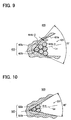
insulator 420 according to a third modified embodiment shown in FIG. 9, two slant faces 422a, 422b forming the winding aligningportion 422 may meet at 75 degrees. In the case that the two slant faces 422a, 422b forming the winding aligningportion 422 meet at 75 degrees, a second winding 414b-2 on the second layer and aninner wall 421 a of theslot 421 form a clearance C1 therebetween. However, the clearance C1 is narrower than a diameter of a third winding 414c-3 on the third layer when it is deformed so that the winding 414c-3 does not enter in the clearance C1. Thus, even in cases that the two slant faces 422a, 422b forming the winding aligningportion 422 meet at an angle larger than 60 degrees, the winding 414c-3 is prevented from entering in the clearance C1 formed between thewindings 414b-2 and theinner wall 421 a of theslot 421 if an angle in excess of 60 degrees corresponds to a dimension smaller than a diameter of the winding 414c-3 when it is deformed (for example, a half of the diameter of the winding in a natural state). Accordingly, if the two slant faces 422a, 422b forming the winding aligningportion 422 meet at an angle smaller than or equal to 75 degrees (60 degrees + an angle smaller than or equal to 15 degrees), thewindings 14 do not suffer insufficient insulation and the like. - (f) In the above-described embodiment, as shown in FIG. 4, the two slant faces 22a, 22b forming the winding aligning
portion 22 meet at 60 degrees. However, as aninsulator 520 according to a fourth modified embodiment shown in FIG. 10, two slant faces 522a, 522b may meet at 45 degrees. Here, in winding the winding 514 in theslot 521, the winding 514 is subjected to tensile force. If the winding 514 is subjected to tensile force, the winding 514 may be deformed. In the example shown in FIG. 10, the winding 514 is wound in theslot 521 in a deformed state by being subjected to tensile force. That is, in the fourth modified embodiment, the deformed state of the winding 514 is taken into consideration. By considering a degree of the deformation, an angle of 75% of the most desirable angle (60 degrees) is minimum. Accordingly, in this example, the angle is set to 45 degrees, which is 75% of the most desirable angle of 60 degrees in view of the deformed state of the winding 514. Thus, even in cases that the two slant faces 522a, 522b forming the winding aligningportion 522 meet at 45 degrees, it is possible to wind thewindings 514 to be regularly aligned. - As described above, the winding aligning portion according to the present invention can be formed so that the two slant faces forming the winding aligning portion meet approximately between 45 degrees through 75 degrees (desirably 60 degrees) regardless of the number of the slots.
- Technical thoughts conceived from the above-described embodiments and other than the claimed matter will be described in the following together with those effects.
- That is, the insulator is disposed in the armature with a plurality of the radially-formed salient poles. The insulator is characterized in formed to be able to symmetrically align the windings at least on the second layer and beyond at the most inner side in the radial direction of the armature core among the windings wound on the salient poles with respect to the center axis of the slot as the axis of symmetry.
- Thus, by forming the insulator to be able to symmetrically align the windings at least on the second layer and beyond at the most inner side of the armature core among the windings wound on the salient poles with respect to the center axis of the slot as the axis of symmetry, it is possible to wind the windings on the second layer and beyond in a regularly aligned state. Accordingly, it is possible to prevent the windings from digging and hence from insufficient insulation.
Claims (7)
- An insulator, which comprises a predetermined number of slots (21) and is to be disposed in an armature core having a plurality of radially-formed salient poles and which includes, in each slot (21) in an inner portion in radial direction thereof, an approximately V-shaped winding aligning portion (22) which gets narrower from an outer side to an inner side in the radial direction of the armature core approximately at the middle between the salient poles,
wherein a center angle (α) of the slot (21) in the insulator (20) is larger than an angle (β) at which two slant surfaces (22a, 22b) of the winding aligning portion (22) meet in cases that the predetermined number of slots of the insulator is smaller than or equal to six, and is smaller than the angle (β) at which the two slant surfaces (22a, 22b) of the winding aligning portion (22) meet in cases that the predetermined number of the slots of the insulator is larger than six;
said insulator (20) being formed to position a winding disposed on a first layer which is on the most inner side in a radial direction of the armature core approximately at the middle between the salient poles among the windings wound on the salient poles. - The insulator according to claim 1 characterized in that the winding aligning portion (22) is formed such that two slant surfaces (22a, 22b) thereof meet at an angle from approximately 45 degrees to approximately 75 degrees.
- The insulator according to claim 1 or 2, further characterized in that the winding aligning portion (22) is formed to be able to align the windings on at least two layers at the most inner side in the radial direction of the armature core.
- The insulator according to any one of claims 1 to 3, characterized in that it is formed to be able to align the windings of a diameter of approximately 0.9 mm.
- The insulator according to any one of claims 1 to 4, further characterized in that the winding aligning portion (22) is formed so that two slant surfaces (22a, 22b) meet approximately at 60 degrees.
- An armature characterized by incorporating the insulator according to any one of claims 1 to 5.
- A rotary electric machine characterized by incorporating the armature according to claim 6.
Applications Claiming Priority (3)
| Application Number | Priority Date | Filing Date | Title |
|---|---|---|---|
| JP2002359865 | 2002-12-11 | ||
| JP2002359865 | 2002-12-11 | ||
| PCT/JP2003/015752 WO2004054070A1 (en) | 2002-12-11 | 2003-12-09 | Insulator and armature and dynamo-electric machine |
Publications (3)
| Publication Number | Publication Date |
|---|---|
| EP1575147A1 EP1575147A1 (en) | 2005-09-14 |
| EP1575147A4 EP1575147A4 (en) | 2006-03-29 |
| EP1575147B1 true EP1575147B1 (en) | 2008-01-23 |
Family
ID=32500961
Family Applications (1)
| Application Number | Title | Priority Date | Filing Date |
|---|---|---|---|
| EP03778754A Expired - Lifetime EP1575147B1 (en) | 2002-12-11 | 2003-12-09 | Insulator, armature and dynamo-electric machine |
Country Status (5)
| Country | Link |
|---|---|
| US (1) | US7268457B2 (en) |
| EP (1) | EP1575147B1 (en) |
| CN (1) | CN100401618C (en) |
| DE (1) | DE60318897T2 (en) |
| WO (1) | WO2004054070A1 (en) |
Cited By (1)
| Publication number | Priority date | Publication date | Assignee | Title |
|---|---|---|---|---|
| US9438079B2 (en) | 2012-05-23 | 2016-09-06 | Black & Decker Inc. | Armature end insulator for a power tool motor |
Families Citing this family (7)
| Publication number | Priority date | Publication date | Assignee | Title |
|---|---|---|---|---|
| JP4649951B2 (en) * | 2004-10-28 | 2011-03-16 | 日本電産株式会社 | Motor and armature manufacturing method |
| JP5281822B2 (en) * | 2008-05-21 | 2013-09-04 | 山洋電気株式会社 | Stator for rotating electrical machine |
| DE102008059171B4 (en) * | 2008-11-24 | 2014-08-28 | Brose Fahrzeugteile GmbH & Co. Kommanditgesellschaft, Würzburg | Drive motor with integrated cooling |
| CN101764493A (en) * | 2010-03-10 | 2010-06-30 | 天津大学 | Switched reluctance motor |
| TWI504107B (en) * | 2010-09-10 | 2015-10-11 | Delta Electronics Inc | Silicon steel assembly and method for assembling thereof |
| GB2503500A (en) * | 2012-06-29 | 2014-01-01 | Nidec Motors & Actuators Gmbh Germany | An armature connecting wire arrangment for an electric motor |
| CN108258870A (en) * | 2016-12-29 | 2018-07-06 | 德昌电机(深圳)有限公司 | Motor and motor core |
Family Cites Families (16)
| Publication number | Priority date | Publication date | Assignee | Title |
|---|---|---|---|---|
| DE7440605U (en) * | 1974-12-06 | 1976-06-10 | Robert Bosch Gmbh, 7000 Stuttgart | ELECTRIC MACHINE |
| JPS5189102U (en) * | 1975-01-10 | 1976-07-16 | ||
| JPS5189102A (en) | 1975-02-03 | 1976-08-04 | ||
| JPS5512760U (en) * | 1978-07-13 | 1980-01-26 | ||
| JPS5512760A (en) | 1978-07-14 | 1980-01-29 | Fuji Electric Co Ltd | Mold electric appliance |
| JPS55166472A (en) | 1979-06-08 | 1980-12-25 | Hitachi Ltd | Armature for commutator rotary machine |
| GB2172444B (en) * | 1985-03-09 | 1988-08-17 | Asmo Co Ltd | Stator for an electric motor |
| DE4403820C2 (en) | 1993-10-11 | 2003-01-30 | Temic Auto Electr Motors Gmbh | commutator |
| JP2831264B2 (en) | 1994-03-07 | 1998-12-02 | アスモ株式会社 | Rotating electric machine |
| JP3700185B2 (en) | 1994-10-03 | 2005-09-28 | 株式会社日立製作所 | Armature |
| FR2778283A1 (en) | 1998-04-30 | 1999-11-05 | Valeo Systemes Dessuyage | Insulated end fitting for an automobile cooling fan motor. |
| JP2001078382A (en) * | 1999-06-30 | 2001-03-23 | Asmo Co Ltd | Brushless motor and air conditioner for vehicle |
| JP2001286085A (en) * | 2000-03-30 | 2001-10-12 | Asmo Co Ltd | Core insulator for motor rotor |
| US6580193B2 (en) * | 2000-03-31 | 2003-06-17 | Asmo Co., Ltd. | Rotary electric machine and manufacturing method therefor |
| JP2002272045A (en) | 2001-03-14 | 2002-09-20 | Moric Co Ltd | Stator structure of rotating magnetic field electric apparatus |
| JP4815061B2 (en) * | 2001-03-26 | 2011-11-16 | 株式会社ミツバ | Armature structure in electric motor |
-
2003
- 2003-12-09 EP EP03778754A patent/EP1575147B1/en not_active Expired - Lifetime
- 2003-12-09 US US10/538,179 patent/US7268457B2/en not_active Expired - Lifetime
- 2003-12-09 DE DE60318897T patent/DE60318897T2/en not_active Expired - Lifetime
- 2003-12-09 WO PCT/JP2003/015752 patent/WO2004054070A1/en not_active Ceased
- 2003-12-09 CN CNB2003801054969A patent/CN100401618C/en not_active Expired - Lifetime
Cited By (1)
| Publication number | Priority date | Publication date | Assignee | Title |
|---|---|---|---|---|
| US9438079B2 (en) | 2012-05-23 | 2016-09-06 | Black & Decker Inc. | Armature end insulator for a power tool motor |
Also Published As
| Publication number | Publication date |
|---|---|
| EP1575147A1 (en) | 2005-09-14 |
| CN1723597A (en) | 2006-01-18 |
| DE60318897T2 (en) | 2009-01-22 |
| WO2004054070A1 (en) | 2004-06-24 |
| US7268457B2 (en) | 2007-09-11 |
| EP1575147A4 (en) | 2006-03-29 |
| DE60318897D1 (en) | 2008-03-13 |
| CN100401618C (en) | 2008-07-09 |
| US20060138893A1 (en) | 2006-06-29 |
Similar Documents
| Publication | Publication Date | Title |
|---|---|---|
| KR100371159B1 (en) | Structure for reducing torque ripple of synchronous reluctance motor | |
| US6856055B2 (en) | Interconnecting ring and wire guide | |
| US10574106B2 (en) | Stator for rotating electric machine | |
| CN103404003B (en) | Stator for rotating electric machine | |
| US9941760B2 (en) | Rotary electric machine | |
| US10432053B2 (en) | Stator for rotating electrical machine | |
| RU2533163C1 (en) | Winding design, rotating electrical machine and method for manufacturing of rotating electrical machine | |
| US6900572B2 (en) | Stator of rotary electric machine | |
| WO2012137862A1 (en) | Stator for rotating electrical machine | |
| EP1575147B1 (en) | Insulator, armature and dynamo-electric machine | |
| KR20060118498A (en) | Generator stator and how to install a pre-winding coil on it | |
| US6930425B2 (en) | Rotary electric machine stator and method of manufacturing the same | |
| US20040201303A1 (en) | Armature of electric rotating machine, electric rotating machine using the same and manufacturing method for armature of electric rotating machine | |
| US6396187B1 (en) | Laminated magnetic core for electric machines | |
| JP2001314055A (en) | Motors for stators, motors and compressors | |
| CN114450871B (en) | Stator and motor | |
| US8914967B2 (en) | Method for producing a distributed lap winding for polyphase systems | |
| JP4625290B2 (en) | Stator for rotating electrical machine | |
| US4598222A (en) | Direct current machine | |
| US20020079774A1 (en) | Dynamo-electric machine | |
| JP4114282B2 (en) | Rotating electric machine and manufacturing method thereof | |
| JP2000125497A (en) | Dynamoelectric machine stator | |
| JP4354790B2 (en) | Insulator, armature and rotating electric machine | |
| JP2007312564A (en) | Stator of rotary electric machine | |
| CN115347691A (en) | Motor stator and motor |
Legal Events
| Date | Code | Title | Description |
|---|---|---|---|
| PUAI | Public reference made under article 153(3) epc to a published international application that has entered the european phase |
Free format text: ORIGINAL CODE: 0009012 |
|
| 17P | Request for examination filed |
Effective date: 20050610 |
|
| AK | Designated contracting states |
Kind code of ref document: A1 Designated state(s): AT BE BG CH CY CZ DE DK EE ES FI FR GB GR HU IE IT LI LU MC NL PT RO SE SI SK TR |
|
| RIN1 | Information on inventor provided before grant (corrected) |
Inventor name: KUBOTA, OSAMU,C/O ASMO CO., LTD. Inventor name: YOSHIKAWA, SHOUICHI,C/O ASMO CO., LTD. Inventor name: NATSUME, YOUSUKE,C/O ASMO CO., LTD. Inventor name: NODA, TAKEO,C/O ASMO CO., LTD. Inventor name: NISHIO, SHIGEO,C/O ASMO CO., LTD. |
|
| A4 | Supplementary search report drawn up and despatched |
Effective date: 20060213 |
|
| RIC1 | Information provided on ipc code assigned before grant |
Ipc: H02K 1/24 20060101ALI20060207BHEP Ipc: H02K 3/34 20060101AFI20040628BHEP |
|
| RBV | Designated contracting states (corrected) |
Designated state(s): DE FR |
|
| 17Q | First examination report despatched |
Effective date: 20060706 |
|
| RTI1 | Title (correction) |
Free format text: INSULATOR, ARMATURE AND DYNAMO-ELECTRIC MACHINE |
|
| GRAP | Despatch of communication of intention to grant a patent |
Free format text: ORIGINAL CODE: EPIDOSNIGR1 |
|
| GRAS | Grant fee paid |
Free format text: ORIGINAL CODE: EPIDOSNIGR3 |
|
| GRAA | (expected) grant |
Free format text: ORIGINAL CODE: 0009210 |
|
| AK | Designated contracting states |
Kind code of ref document: B1 Designated state(s): DE FR |
|
| REF | Corresponds to: |
Ref document number: 60318897 Country of ref document: DE Date of ref document: 20080313 Kind code of ref document: P |
|
| ET | Fr: translation filed | ||
| PLBE | No opposition filed within time limit |
Free format text: ORIGINAL CODE: 0009261 |
|
| STAA | Information on the status of an ep patent application or granted ep patent |
Free format text: STATUS: NO OPPOSITION FILED WITHIN TIME LIMIT |
|
| 26N | No opposition filed |
Effective date: 20081024 |
|
| PGFP | Annual fee paid to national office [announced via postgrant information from national office to epo] |
Ref country code: DE Payment date: 20121205 Year of fee payment: 10 |
|
| PGFP | Annual fee paid to national office [announced via postgrant information from national office to epo] |
Ref country code: FR Payment date: 20130107 Year of fee payment: 10 |
|
| REG | Reference to a national code |
Ref country code: DE Ref legal event code: R119 Ref document number: 60318897 Country of ref document: DE |
|
| REG | Reference to a national code |
Ref country code: DE Ref legal event code: R119 Ref document number: 60318897 Country of ref document: DE Effective date: 20140701 |
|
| REG | Reference to a national code |
Ref country code: FR Ref legal event code: ST Effective date: 20140829 |
|
| PG25 | Lapsed in a contracting state [announced via postgrant information from national office to epo] |
Ref country code: DE Free format text: LAPSE BECAUSE OF NON-PAYMENT OF DUE FEES Effective date: 20140701 |
|
| PG25 | Lapsed in a contracting state [announced via postgrant information from national office to epo] |
Ref country code: FR Free format text: LAPSE BECAUSE OF NON-PAYMENT OF DUE FEES Effective date: 20131231 |