EP1574488A2 - Stain resistant grout composition, dispenser therefore, and method of use - Google Patents
Stain resistant grout composition, dispenser therefore, and method of use Download PDFInfo
- Publication number
- EP1574488A2 EP1574488A2 EP05004929A EP05004929A EP1574488A2 EP 1574488 A2 EP1574488 A2 EP 1574488A2 EP 05004929 A EP05004929 A EP 05004929A EP 05004929 A EP05004929 A EP 05004929A EP 1574488 A2 EP1574488 A2 EP 1574488A2
- Authority
- EP
- European Patent Office
- Prior art keywords
- composition
- grout
- mineral filler
- container
- polymer
- Prior art date
- Legal status (The legal status is an assumption and is not a legal conclusion. Google has not performed a legal analysis and makes no representation as to the accuracy of the status listed.)
- Withdrawn
Links
- 239000011440 grout Substances 0.000 title claims abstract description 285
- 239000000203 mixture Substances 0.000 title claims abstract description 283
- 238000000034 method Methods 0.000 title claims description 11
- 239000012764 mineral filler Substances 0.000 claims abstract description 108
- 229920000642 polymer Polymers 0.000 claims abstract description 96
- 239000002245 particle Substances 0.000 claims abstract description 75
- 239000002952 polymeric resin Substances 0.000 claims abstract description 42
- 229920003002 synthetic resin Polymers 0.000 claims abstract description 42
- 229910052500 inorganic mineral Inorganic materials 0.000 claims abstract description 29
- 239000011707 mineral Substances 0.000 claims abstract description 29
- 239000002904 solvent Substances 0.000 claims description 62
- VTYYLEPIZMXCLO-UHFFFAOYSA-L Calcium carbonate Chemical group [Ca+2].[O-]C([O-])=O VTYYLEPIZMXCLO-UHFFFAOYSA-L 0.000 claims description 34
- 239000004615 ingredient Substances 0.000 claims description 24
- 239000003086 colorant Substances 0.000 claims description 19
- GWEVSGVZZGPLCZ-UHFFFAOYSA-N Titan oxide Chemical group O=[Ti]=O GWEVSGVZZGPLCZ-UHFFFAOYSA-N 0.000 claims description 18
- XLYOFNOQVPJJNP-UHFFFAOYSA-N water Substances O XLYOFNOQVPJJNP-UHFFFAOYSA-N 0.000 claims description 18
- NIXOWILDQLNWCW-UHFFFAOYSA-N acrylic acid group Chemical group C(C=C)(=O)O NIXOWILDQLNWCW-UHFFFAOYSA-N 0.000 claims description 17
- 229910000019 calcium carbonate Inorganic materials 0.000 claims description 17
- DNIAPMSPPWPWGF-UHFFFAOYSA-N Propylene glycol Chemical compound CC(O)CO DNIAPMSPPWPWGF-UHFFFAOYSA-N 0.000 claims description 15
- 238000001035 drying Methods 0.000 claims description 15
- 229920005989 resin Polymers 0.000 claims description 14
- 239000011347 resin Substances 0.000 claims description 14
- 229920001577 copolymer Polymers 0.000 claims description 13
- 239000007822 coupling agent Substances 0.000 claims description 12
- 239000012530 fluid Substances 0.000 claims description 12
- 239000003139 biocide Substances 0.000 claims description 11
- 239000002562 thickening agent Substances 0.000 claims description 11
- 239000002518 antifoaming agent Substances 0.000 claims description 9
- 239000004816 latex Substances 0.000 claims description 9
- 229920000126 latex Polymers 0.000 claims description 9
- 239000004408 titanium dioxide Substances 0.000 claims description 9
- 239000000080 wetting agent Substances 0.000 claims description 9
- NIXOWILDQLNWCW-UHFFFAOYSA-M Acrylate Chemical compound [O-]C(=O)C=C NIXOWILDQLNWCW-UHFFFAOYSA-M 0.000 claims description 6
- 230000003115 biocidal effect Effects 0.000 claims description 6
- 230000000855 fungicidal effect Effects 0.000 claims description 6
- 239000000417 fungicide Substances 0.000 claims description 6
- 229920001519 homopolymer Polymers 0.000 claims description 6
- PPBRXRYQALVLMV-UHFFFAOYSA-N Styrene Natural products C=CC1=CC=CC=C1 PPBRXRYQALVLMV-UHFFFAOYSA-N 0.000 claims description 5
- CQEYYJKEWSMYFG-UHFFFAOYSA-N butyl acrylate Chemical compound CCCCOC(=O)C=C CQEYYJKEWSMYFG-UHFFFAOYSA-N 0.000 claims description 5
- 238000004891 communication Methods 0.000 claims description 4
- PYSRRFNXTXNWCD-UHFFFAOYSA-N 3-(2-phenylethenyl)furan-2,5-dione Chemical compound O=C1OC(=O)C(C=CC=2C=CC=CC=2)=C1 PYSRRFNXTXNWCD-UHFFFAOYSA-N 0.000 claims description 2
- 229920000147 Styrene maleic anhydride Polymers 0.000 claims description 2
- 238000004519 manufacturing process Methods 0.000 claims description 2
- 238000004078 waterproofing Methods 0.000 claims description 2
- XTXRWKRVRITETP-UHFFFAOYSA-N Vinyl acetate Chemical compound CC(=O)OC=C XTXRWKRVRITETP-UHFFFAOYSA-N 0.000 claims 1
- 238000004806 packaging method and process Methods 0.000 abstract description 15
- VYPSYNLAJGMNEJ-UHFFFAOYSA-N Silicium dioxide Chemical compound O=[Si]=O VYPSYNLAJGMNEJ-UHFFFAOYSA-N 0.000 description 26
- 239000004576 sand Substances 0.000 description 16
- 239000000463 material Substances 0.000 description 14
- 238000002156 mixing Methods 0.000 description 11
- 239000000565 sealant Substances 0.000 description 10
- 239000006185 dispersion Substances 0.000 description 9
- 239000000975 dye Substances 0.000 description 8
- 230000000087 stabilizing effect Effects 0.000 description 8
- 239000000126 substance Substances 0.000 description 8
- 239000003795 chemical substances by application Substances 0.000 description 7
- 230000000694 effects Effects 0.000 description 7
- 239000000945 filler Substances 0.000 description 7
- 229920005789 ACRONAL® acrylic binder Polymers 0.000 description 6
- KWYUFKZDYYNOTN-UHFFFAOYSA-M Potassium hydroxide Chemical compound [OH-].[K+] KWYUFKZDYYNOTN-UHFFFAOYSA-M 0.000 description 6
- 229920002125 Sokalan® Polymers 0.000 description 6
- 239000000654 additive Substances 0.000 description 6
- 239000007787 solid Substances 0.000 description 6
- 235000015096 spirit Nutrition 0.000 description 6
- RUPBZQFQVRMKDG-UHFFFAOYSA-M Didecyldimethylammonium chloride Chemical compound [Cl-].CCCCCCCCCC[N+](C)(C)CCCCCCCCCC RUPBZQFQVRMKDG-UHFFFAOYSA-M 0.000 description 5
- 239000000853 adhesive Substances 0.000 description 5
- 230000001070 adhesive effect Effects 0.000 description 5
- 239000003599 detergent Substances 0.000 description 5
- 239000002270 dispersing agent Substances 0.000 description 5
- 238000007493 shaping process Methods 0.000 description 5
- 239000000377 silicon dioxide Substances 0.000 description 5
- -1 siloxanes Chemical class 0.000 description 5
- 239000000725 suspension Substances 0.000 description 5
- GPRLSGONYQIRFK-MNYXATJNSA-N triton Chemical compound [3H+] GPRLSGONYQIRFK-MNYXATJNSA-N 0.000 description 5
- 238000005299 abrasion Methods 0.000 description 4
- 230000000844 anti-bacterial effect Effects 0.000 description 4
- 230000003466 anti-cipated effect Effects 0.000 description 4
- 239000003899 bactericide agent Substances 0.000 description 4
- 239000004568 cement Substances 0.000 description 4
- 238000009826 distribution Methods 0.000 description 4
- 230000001747 exhibiting effect Effects 0.000 description 4
- 238000010348 incorporation Methods 0.000 description 4
- 239000007788 liquid Substances 0.000 description 4
- OVXRPXGVKBHGQO-UYWIDEMCSA-N methyl (1r,4ar,4br,10ar)-1,4a-dimethyl-7-propan-2-yl-2,3,4,4b,5,6,10,10a-octahydrophenanthrene-1-carboxylate Chemical class C1CC(C(C)C)=CC2=CC[C@H]3[C@@](C(=O)OC)(C)CCC[C@]3(C)[C@H]21 OVXRPXGVKBHGQO-UYWIDEMCSA-N 0.000 description 4
- 238000002360 preparation method Methods 0.000 description 4
- 238000012545 processing Methods 0.000 description 4
- 229910000831 Steel Inorganic materials 0.000 description 3
- 230000008901 benefit Effects 0.000 description 3
- 230000015572 biosynthetic process Effects 0.000 description 3
- 239000000919 ceramic Substances 0.000 description 3
- 239000004567 concrete Substances 0.000 description 3
- 238000005336 cracking Methods 0.000 description 3
- 239000000839 emulsion Substances 0.000 description 3
- 238000011049 filling Methods 0.000 description 3
- 239000000314 lubricant Substances 0.000 description 3
- 229920003023 plastic Polymers 0.000 description 3
- 239000004033 plastic Substances 0.000 description 3
- 239000004014 plasticizer Substances 0.000 description 3
- 238000000518 rheometry Methods 0.000 description 3
- 150000004756 silanes Chemical class 0.000 description 3
- 125000006850 spacer group Chemical group 0.000 description 3
- 239000003381 stabilizer Substances 0.000 description 3
- 239000010959 steel Substances 0.000 description 3
- CSCPPACGZOOCGX-UHFFFAOYSA-N Acetone Chemical compound CC(C)=O CSCPPACGZOOCGX-UHFFFAOYSA-N 0.000 description 2
- 229910021532 Calcite Inorganic materials 0.000 description 2
- 239000004593 Epoxy Substances 0.000 description 2
- LFQSCWFLJHTTHZ-UHFFFAOYSA-N Ethanol Chemical compound CCO LFQSCWFLJHTTHZ-UHFFFAOYSA-N 0.000 description 2
- KFZMGEQAYNKOFK-UHFFFAOYSA-N Isopropanol Chemical compound CC(C)O KFZMGEQAYNKOFK-UHFFFAOYSA-N 0.000 description 2
- 239000003570 air Substances 0.000 description 2
- 239000003125 aqueous solvent Substances 0.000 description 2
- 230000009286 beneficial effect Effects 0.000 description 2
- 239000004566 building material Substances 0.000 description 2
- 239000011248 coating agent Substances 0.000 description 2
- 238000000576 coating method Methods 0.000 description 2
- 239000000084 colloidal system Substances 0.000 description 2
- 150000001875 compounds Chemical class 0.000 description 2
- 230000008878 coupling Effects 0.000 description 2
- 238000010168 coupling process Methods 0.000 description 2
- 238000005859 coupling reaction Methods 0.000 description 2
- 230000006378 damage Effects 0.000 description 2
- 230000007423 decrease Effects 0.000 description 2
- 238000005538 encapsulation Methods 0.000 description 2
- 238000007667 floating Methods 0.000 description 2
- 239000006260 foam Substances 0.000 description 2
- 238000009434 installation Methods 0.000 description 2
- 239000004579 marble Substances 0.000 description 2
- 239000003960 organic solvent Substances 0.000 description 2
- 239000000049 pigment Substances 0.000 description 2
- 229920001709 polysilazane Polymers 0.000 description 2
- 229920001296 polysiloxane Polymers 0.000 description 2
- 230000008569 process Effects 0.000 description 2
- 229910000077 silane Inorganic materials 0.000 description 2
- 238000010186 staining Methods 0.000 description 2
- 239000004575 stone Substances 0.000 description 2
- 239000000758 substrate Substances 0.000 description 2
- LWIHDJKSTIGBAC-UHFFFAOYSA-K tripotassium phosphate Chemical compound [K+].[K+].[K+].[O-]P([O-])([O-])=O LWIHDJKSTIGBAC-UHFFFAOYSA-K 0.000 description 2
- 239000002023 wood Substances 0.000 description 2
- SLBOQBILGNEPEB-UHFFFAOYSA-N 1-chloroprop-2-enylbenzene Chemical compound C=CC(Cl)C1=CC=CC=C1 SLBOQBILGNEPEB-UHFFFAOYSA-N 0.000 description 1
- RSWGJHLUYNHPMX-UHFFFAOYSA-N Abietic-Saeure Natural products C12CCC(C(C)C)=CC2=CCC2C1(C)CCCC2(C)C(O)=O RSWGJHLUYNHPMX-UHFFFAOYSA-N 0.000 description 1
- VHUUQVKOLVNVRT-UHFFFAOYSA-N Ammonium hydroxide Chemical compound [NH4+].[OH-] VHUUQVKOLVNVRT-UHFFFAOYSA-N 0.000 description 1
- 241000196324 Embryophyta Species 0.000 description 1
- 235000002918 Fraxinus excelsior Nutrition 0.000 description 1
- 241000233866 Fungi Species 0.000 description 1
- 239000011398 Portland cement Substances 0.000 description 1
- KHPCPRHQVVSZAH-HUOMCSJISA-N Rosin Natural products O(C/C=C/c1ccccc1)[C@H]1[C@H](O)[C@@H](O)[C@@H](O)[C@@H](CO)O1 KHPCPRHQVVSZAH-HUOMCSJISA-N 0.000 description 1
- 239000006087 Silane Coupling Agent Substances 0.000 description 1
- 150000001252 acrylic acid derivatives Chemical class 0.000 description 1
- 229920006243 acrylic copolymer Polymers 0.000 description 1
- 230000009471 action Effects 0.000 description 1
- 239000012080 ambient air Substances 0.000 description 1
- 239000000908 ammonium hydroxide Substances 0.000 description 1
- PYKYMHQGRFAEBM-UHFFFAOYSA-N anthraquinone Natural products CCC(=O)c1c(O)c2C(=O)C3C(C=CC=C3O)C(=O)c2cc1CC(=O)OC PYKYMHQGRFAEBM-UHFFFAOYSA-N 0.000 description 1
- 239000001000 anthraquinone dye Substances 0.000 description 1
- 150000004056 anthraquinones Chemical class 0.000 description 1
- 239000002956 ash Substances 0.000 description 1
- 230000000712 assembly Effects 0.000 description 1
- 238000000429 assembly Methods 0.000 description 1
- 239000012298 atmosphere Substances 0.000 description 1
- 239000000987 azo dye Substances 0.000 description 1
- 239000011324 bead Substances 0.000 description 1
- 239000011230 binding agent Substances 0.000 description 1
- 230000002051 biphasic effect Effects 0.000 description 1
- 238000005282 brightening Methods 0.000 description 1
- 239000006229 carbon black Substances 0.000 description 1
- 238000012993 chemical processing Methods 0.000 description 1
- 238000006243 chemical reaction Methods 0.000 description 1
- 239000003245 coal Substances 0.000 description 1
- 238000004040 coloring Methods 0.000 description 1
- 239000002131 composite material Substances 0.000 description 1
- 239000000470 constituent Substances 0.000 description 1
- 239000004035 construction material Substances 0.000 description 1
- 239000006071 cream Substances 0.000 description 1
- 238000004132 cross linking Methods 0.000 description 1
- 239000013078 crystal Substances 0.000 description 1
- 230000003247 decreasing effect Effects 0.000 description 1
- 238000010586 diagram Methods 0.000 description 1
- 239000004205 dimethyl polysiloxane Substances 0.000 description 1
- 239000003822 epoxy resin Substances 0.000 description 1
- 150000002148 esters Chemical group 0.000 description 1
- 238000001704 evaporation Methods 0.000 description 1
- 230000008020 evaporation Effects 0.000 description 1
- 229920002313 fluoropolymer Polymers 0.000 description 1
- 239000004811 fluoropolymer Substances 0.000 description 1
- 239000010881 fly ash Substances 0.000 description 1
- 239000011521 glass Substances 0.000 description 1
- 230000005484 gravity Effects 0.000 description 1
- 230000002401 inhibitory effect Effects 0.000 description 1
- 238000003780 insertion Methods 0.000 description 1
- 230000037431 insertion Effects 0.000 description 1
- 230000007794 irritation Effects 0.000 description 1
- 210000003127 knee Anatomy 0.000 description 1
- 239000011159 matrix material Substances 0.000 description 1
- 244000005700 microbiome Species 0.000 description 1
- 239000004005 microsphere Substances 0.000 description 1
- 230000003278 mimic effect Effects 0.000 description 1
- 239000003607 modifier Substances 0.000 description 1
- 239000004570 mortar (masonry) Substances 0.000 description 1
- 231100000344 non-irritating Toxicity 0.000 description 1
- 231100000252 nontoxic Toxicity 0.000 description 1
- 230000003000 nontoxic effect Effects 0.000 description 1
- 239000003921 oil Substances 0.000 description 1
- 229920000620 organic polymer Polymers 0.000 description 1
- 239000005022 packaging material Substances 0.000 description 1
- 238000005191 phase separation Methods 0.000 description 1
- 230000000704 physical effect Effects 0.000 description 1
- 239000004597 plastic additive Substances 0.000 description 1
- 229920000435 poly(dimethylsiloxane) Polymers 0.000 description 1
- 229920000647 polyepoxide Polymers 0.000 description 1
- 239000004848 polyfunctional curative Substances 0.000 description 1
- 229920002959 polymer blend Polymers 0.000 description 1
- 229920001451 polypropylene glycol Polymers 0.000 description 1
- 239000002243 precursor Substances 0.000 description 1
- 230000002829 reductive effect Effects 0.000 description 1
- 238000005067 remediation Methods 0.000 description 1
- 230000008439 repair process Effects 0.000 description 1
- 230000000717 retained effect Effects 0.000 description 1
- 239000000243 solution Substances 0.000 description 1
- 239000007921 spray Substances 0.000 description 1
- 238000003860 storage Methods 0.000 description 1
- 150000005846 sugar alcohols Polymers 0.000 description 1
- 238000004381 surface treatment Methods 0.000 description 1
- 238000012360 testing method Methods 0.000 description 1
- 230000001988 toxicity Effects 0.000 description 1
- 231100000419 toxicity Toxicity 0.000 description 1
- KHPCPRHQVVSZAH-UHFFFAOYSA-N trans-cinnamyl beta-D-glucopyranoside Natural products OC1C(O)C(O)C(CO)OC1OCC=CC1=CC=CC=C1 KHPCPRHQVVSZAH-UHFFFAOYSA-N 0.000 description 1
- 229910000404 tripotassium phosphate Inorganic materials 0.000 description 1
- 235000019798 tripotassium phosphate Nutrition 0.000 description 1
- 150000003673 urethanes Chemical class 0.000 description 1
Images


Classifications
-
- C—CHEMISTRY; METALLURGY
- C04—CEMENTS; CONCRETE; ARTIFICIAL STONE; CERAMICS; REFRACTORIES
- C04B—LIME, MAGNESIA; SLAG; CEMENTS; COMPOSITIONS THEREOF, e.g. MORTARS, CONCRETE OR LIKE BUILDING MATERIALS; ARTIFICIAL STONE; CERAMICS; REFRACTORIES; TREATMENT OF NATURAL STONE
- C04B26/00—Compositions of mortars, concrete or artificial stone, containing only organic binders, e.g. polymer or resin concrete
- C04B26/02—Macromolecular compounds
- C04B26/04—Macromolecular compounds obtained by reactions only involving carbon-to-carbon unsaturated bonds
- C04B26/06—Acrylates
Definitions
- the invention relates generally to apparatus and compositions useful for grouting tiles, countertops, and other building materials having interstices therebetween.
- tile The placement of various flat or curved pieces of ceramic, stone, concrete, or other material, collectively referred to as "tile", onto floors, walls, counter tops, or other surfaces in a building is an ancient tradition. Tile is installed by adhering multiple tiles to the area to be covered and thereafter filling the spaces between the tiles with a grout.
- the craftsman applies an adhesive (e.g., thin set mortar) to the floor. Then, tiles are positioned on the adhesive while inserting spacers between the tile for proper spacing, and the adhesive is allowed to set (e.g., overnight). Once set, the tile spacers are removed and a grout is applied to fill the spaces around the tile that have been preserved by the tile spacers.
- an adhesive e.g., thin set mortar
- Grout compositions are used to fill interstices between other building materials (e.g., between bathtubs and walls and between wooden or composite wall panels) and interstices in furniture and the like.
- Grout often consists of a cementitious mixture of fine aggregates mixed into a cementing agent with a solvent (e.g., water), but made so thin as to flow almost like cream.
- the cementing agent may comprise a polymeric adhesive material (e.g., a resin-based grout, such as an epoxy) or simply Portland cement.
- the aggregates are typically sand and/or crushed stone.
- dyes and pigments to the cementitious materials has also enjoyed wide application in all of the above mentioned materials.
- Such grouts enjoy broad application in construction materials, tile setting, wall and pool plasters, stucco, self-leveling compounds, roofing tiles, and patches. Other grouts do not contain coarse particulates and have a smooth finish.
- Cementitious grouts are in common use.
- Polymeric resin-based grouts are also known.
- U.S. Patent No. 4,833,178 describes an epoxy resin-based grout composition that requires addition of a hardener thereto and mixing prior to use.
- U.S. Patents Nos. 3,854,267; 3,859,233; and 4,472,540 describe non-epoxy polymer resin-based grout compositions that either contain sand or have a smooth-textured finish that is undesirable in many applications.
- the present invention relates to a grout composition that is more stain-resistant than many prior grouts and which therefore reduces or eliminates the need for replacement of stained grout or remediation of stains.
- the invention relates to a fluid grout composition that comprises an air-dryable polymeric resin, a mineral filler, and a stain resistant polymer combined with (e.g., dissolved, suspended, or dispersed in) a solvent.
- the grout composition when dry, has a hard, abrasive finish analogous to traditional sanded grouts.
- the grout composition can include one or more other ingredients, such as additional polymer resins, additional stain resistant polymers, additional solvents, a dye, a colorant (e.g., titanium dioxide), an antifoam, a wetting agent, a coupling agent, a biocide, a thickening agent, a drying rate modulator, and the like.
- it may comprise a fungicide.
- the grout composition comprises both a first mineral filler and a second mineral filler.
- the first mineral filler may have an average particle size greater than 160 micrometers and/or a Mohs hardness less than about 6.5.
- the second mineral filler may have an average particle size less than 600 micrometers.
- the composition comprises the air-dryable polymeric resin in an amount sufficient to bind the first and second mineral fillers upon drying of the composition.
- this grout composition comprises 20% to 40%, by weight, of first mineral filler particles having an average particle size in the range from 160 to 700 micrometers and a Mohs hardness less than about 6.5; 20% to 40%, by weight, of second mineral filler particles having an average particle size in the range from 90 to 120 micrometers; and 20% to 35%, by weight, of an air-dryable polymeric resin.
- the first and second mineral fillers can be the same mineral (e.g., calcium carbonate) or different minerals.
- the overall mineral filler content of the grout composition i.e., the sum of the first and second mineral fillers and any other mineral fillers incorporated into the composition
- the proportions of first and second mineral fillers can vary.
- the first mineral filler can be present in an amount from 5% to 70% by weight, but is preferably present in an amount from 20% to 40% by weight.
- the second mineral filler can be present in an amount from 5% to 60% by weight, but is preferably present in an amount from 20% to 40% by weight.
- the grout composition described herein can be packaged in pressurized containers from which the composition can be dispensed.
- compositions packaged in pressurized containers do not comprise a particulate having an average particle size greater than 100 micrometers and a Mohs hardness greater than about 6.5. More preferably, they do not comprise a particulate having an average particle size greater than 20 micrometers and a Mohs hardness greater than about 6.5.
- the grout compositions can also be packaged in traditional tubs, tubes, cartridges, and the like.
- the polymeric resin in the grout composition can comprise a single polymer or a plurality of polymers, such as one or more acrylic latex polymers.
- suitable acrylic latex polymers include homopolymers of acrylate, homopolymers of alpha-methyl acrylate, and copolymers of acrylate and alpha-methyl acrylate.
- the grout composition can further comprise one or more additional solvents. Solvents can be added in an amount sufficient to improve the workability of the composition. For example, the viscosity of the grout composition can be adjusted such that it is not less than about 2400 poise (and preferably not more than about 8800 poise).
- the invention also relates to a sealed container containing the grout composition described herein.
- the container has a nozzle for dispensing the composition from the container under pressure.
- the container can have a valve in fluid communication with the nozzle.
- the composition is dispensed through the nozzle upon actuation of the valve.
- the container can also have a piston having a face that urges the composition through the nozzle upon application of force or pressure to the piston (e.g., pressure exerted upon the piston by a pressurized reservoir).
- the shape of the container can be adapted to fit a caulking gun or other conventional device for applying caulks or sealants.
- the invention further relates to a method of waterproofing a surface having tiles adhered thereto.
- the method comprises filling interstices between the tiles with a grout composition described herein.
- the invention relates to methods of making a grout composition described herein.
- the invention relates to grout compositions that exhibit enhanced stain resistance relative to traditional grouts.
- the grout compositions are air-dryable fluid compositions comprising a polymeric resin, a mineral filler, and a stain resistant polymer dispersed in a solvent. Following application, substantially all of the solvent evaporates, leaving a solidified mixture of polymer resin, stain resistant polymer, mineral filler, and any other non-volatile components.
- the invention relates to grout compositions that exhibit the appearance of traditional cementitious grouts and other sand-containing ("sanded") grouts without exhibiting the extremely abrasive properties of such grouts.
- the degree of hardness and the abrasiveness exhibited by traditional grouts are greater than the hardness and abrasiveness that are necessary for the particular application.
- the extreme hardness and abrasiveness of traditional grouts are largely vestiges of traditional methods of making grouts.
- the grout compositions described herein can be made less abrasive than prior art grouts, they can be used in ways (e.g., application using pressurized containers) that prior art grouts cannot.
- the grout compositions described herein retain the pleasing textured appearance and feel of sanded and cementitious grouts, while also exhibiting stain-resistant properties.
- the "average particle size" of a collection of particles means the weight-averaged particle size (as opposed to the number-averaged particle size). Half of the weight of the particles in the collection have a size larger than the average particle size, while 50% by weight have a smaller size.
- a “piston” is a solid, generally non-deformable body that has at least one face and that is movable within a container, cavity, tube, or other enclosure. Pressure or force applied to the body to move the piston is transmitted to the face, which can transmit the force to a material (e.g., a grout composition) that contacts the face within the enclosure.
- a material e.g., a grout composition
- a “polymeric resin” is a fluid form (e.g., a solution, suspension, or dispersion) of a polymer or a fluid precursor of a polymer that is polymerized to form the polymer.
- Grout workability refers to the consistency of grout compositions typically employed in tile grouting applications.
- the consistency of grout can differ based on the particular application. For example, grout applied to vertical surfaces (e.g., tiled walls) must be sufficiently viscous that it will not run or fall out from the vertical interstices between tiles, but must retain sufficient deformability that it can be packed or shaped as desired in order to obtain an aesthetically pleasing surface.
- Grout used in supported horizontal applications can be less viscous.
- stain resistant polymer is any polymer known in the art for its stain-resisting properties.
- stain resistant polymers include silicones, siloconates, silanes, siloxanes, fluorochemical polymers, and fluorochemical-derivatized polymers.
- the invention relates to a fluid grout composition
- a fluid grout composition comprising an air-dryable polymeric resin, a mineral filler, and a stain resistant polymer dispersed in a solvent.
- the stain resistant polymer is preferably soluble or miscible in one or both of the solvent and the polymer resin.
- the stain resistant polymer can alternatively be dispersed in the polymer resin and/or solvent in a discrete phase, such as in an emulsion.
- the grout composition can also include other components, for example to affect the workability of the grout or its finished appearance.
- the invention relates to grout compositions that exhibit the appearance of traditional cementitious grouts and other sanded grouts without exhibiting the extremely abrasive properties of such grouts. Because the grout compositions described herein can be made less abrasive than prior art grouts, they can be used in ways (e.g., pressurized application) that prior art grouts cannot. In addition to their flexibility with regard to use, the grout compositions described herein retain the pleasing textured appearance and feel of sanded and cementitious grouts and resist staining.
- the grout composition need include only four components, namely the polymeric resin, the stain resistant polymer, a mineral filler, and a solvent. Of course, other components can also be included.
- the textured grout composition contains both a first mineral filler and a second mineral filler.
- the first mineral filler has an average particle size greater than 100 micrometers and the mineral particles of the first mineral filler exhibit a Mohs hardness less than about 6.5.
- the second mineral filler has an average particle size less than 100 micrometers.
- the polymeric resin is air-dryable and is present in an amount sufficient to bind the first and second mineral fillers upon drying of the composition.
- the first mineral filler gives the dried grout composition the appearance, texture, and feel of a traditional sanded cementitious grout.
- the grout composition can also include one or more of a variety of other constituents.
- a variety of additives e.g., wetting agents, solvents, antifoams, thickening agents, and agents that modulate the rate at which the grout dries
- the grout composition can also include components that confer beneficial properties to the dried grout.
- the grout composition can include a dye or colorant to impart a desired color to the dried grout composition.
- a biocidal agent can also be incorporated into the grout composition, to inhibit growth of organisms in or on the finished grout. Incorporation of one or more water-repelling agents (e.g., a water-repellant polymer) into the grout composition can enhance the water resistance (and useful lifespan) of the grout composition.
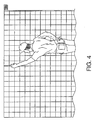
- the grout composition described herein can be manually applied using a trowel and float, as with traditional grouts. It can be packaged and sold in cartridges adapted to fit standard caulking guns and other applicators to facilitate application with caulking guns or other applicators. It can be packaged, sold, and applied in a manually-squeezable tube, such as the type of tube in which various adhesives, caulks, and sealants are presently sold.
- the grout composition having one or more mineral fillers of relatively low hardness, as described herein, is suitable for packaging into a pressurized container, such that the grout composition can be applied to the interstices of a tiled surface by actuating a valve that seals the container.
- Prior art sanded grouts are not suitably packaged in this manner, since the sand, cement, or other components of the grouts are highly abrasive and cause serious damage to machinery used to package pressurized containers.
- a grout composition in the form of a pressurized can-type container is a highly desirable application method, particularly in situations in which the person applying the grout is not an experienced mason, in which only a relatively small amount of grouting needs to be done, or in which the person applying the grout wishes to perform the work intermittently.
- the grout composition described herein is useful in each of these situations (in addition to traditional grouting applications).
- Another advantage of the grout compositions described herein is that they can be formulated to resist shrinking (relative to freshly-applied grout) and cracking of the dried grout. As the size of the crack or hole to be filled using the grout increases, the importance of the anti-shrinking and anti-cracking properties of the grout composition increases.
- the invention includes grout compositions, methods of using them, and apparatus for applying them. Further details of the components of the grout composition, certain apparatus useful for containing and applying the grout compositions, and methods of using the grout composition are described below.
- the grout composition described herein includes at least one polymeric resin.
- the resin comprises at least one polymer and at least one solvent.
- the resin can contain multiple polymers, multiple solvents, or both multiple polymers and multiple solvents.
- the polymer(s) and solvent(s) should be miscible with one another. Suitable polymers and solvents are known in the art, and include those used as binders in previously-known grouts, cements, and concretes. Polymers traditionally used in caulks and other sealants can also be incorporated into the grout composition described herein. However caulk/sealant polymers often have a glossy finish that is not normally associated with grouts, and incorporation of such polymers in the grout compositions described herein should be limited unless a glossy or high-sheen finish is desired. Grout compositions having a matte, dull, sandy or other textured finish are preferred.
- a preferred type polymer is the class of polymers known as acrylic latexes.
- acrylic latex resins, colloids, and suspensions are commercially available, each with its own characteristics.
- the particular acrylic latex and the corresponding resin that should be selected for a grout composition can be determined based on the intended end use of the grout composition. For example, in applications in which the appearance of the finished grouted surface is more important than the durability or impact resistance of the grout, the polymeric resin can be selected primarily on the basis of its color, workability, and non-shrinking character.
- the polymeric resin can be selected primarily on the basis of the water-repelling characteristics of the polymer, the ability of the polymeric resin to cure in the presence of water, the drying (curing) time of the resin, and the crack resistance of the cured resin. Further by way of example, in applications in which the durability and impact resistance of the finished grout are the paramount concerns, the polymeric resin can be selected to yield high durability and impact resistance.
- acrylic latex polymer that can be incorporated into a general purpose grout composition
- RHOPLEX Registered Trademark, "RTM”
- Other suitable acrylates include homopolymers of acrylate, homopolymers of alpha-methyl acrylate, and copolymers of acrylate and alpha-methyl acrylate.
- Suitable polymer resins include butyl acrylate / styrene copolymers, such sold as those sold in the form of dispersions under the trade name ACRONAL(RTM) NX 4787 (BASF, Mount Olive, NJ), and acrylic / vinyl acetate copolymers, such as those sold in the form of dispersions under the trade name ACRONAL(RTM) V275 (BASF, Mount Olive, NJ).
- Suitable polymers that can be incorporated into the grout composition in place of, or in addition to, acrylic latexes include polymeric silanes and polysilazanes.
- An example of a suitable coupling agent is the product designated AP-SILANE 33 (Trademark, "TM"), obtained from Advanced Polymer, Inc. (Carlstadt, NJ).
- TM Advanced Polymer, Inc.
- Other polymers can be used as well or instead, such as polymers used in known caulks and sealant products.
- the polymeric resin must be air-dryable, meaning that if the grout composition is dispensed into a crack and the surface of the grout is thereafter maintained in contact with ambient air, then substantially all of the solvent(s) in the grout composition will disappear (e.g., by evaporation) within days, weeks, or months following the application.
- the finished grout composition be substantially free of solvents (i.e., > 90% of solvents have disappeared) within 48 to 72 hours after application.
- Grout compositions from which a substantial fraction (e.g., >75%) of solvent evaporates or otherwise disappears within 24 hours after application are also preferable.
- the polymeric resin can include more than one solvent, wherein the volatility of at least one solvent is significantly greater than another solvent in the resin at the anticipated application or drying temperature. Such a resin can be used to cause the grout composition to set relatively quickly while completely drying more slowly (e.g., to facilitate enhanced polymer cross-linking or entanglement).
- non-toxic and non-irritating solvents are preferred, particularly in situations in which the grout composition is to be used or sold for use in occupied buildings.
- Many acceptable solvents are known. Water is a preferred solvent and exhibits no known toxicity or irritation. Regardless of the solvent used, it is recommended that any area enclosing the grouted surface be ventilated during and after application of the grouting composition described herein.
- the grout composition must contain enough of the polymeric resin that the polymer contained in the resin is present in an amount sufficient to bind the grout components into a common mass once the solvent(s) in the resin are no longer present.
- the necessary amount of the polymer (and the corresponding resin) depends on the properties of the particular polymer(s) and other components used, the presence of wetting agents, surface-modifying or coupling agents, the degree and energy of mixing, and other factors that are within the ken of the skilled artisan. This information can also be readily derived empirically simply by preparing a plurality of test compositions.
- Suitable grout compositions can include from 15% to 70%, by weight, polymeric resin; however, grout compositions having very high (e.g., >50%) polymeric resin content can fail to resemble sanded grouts.
- Preferred polymeric resin content values are 20% to 35% by weight (more preferably, 25% to 30%).
- the grout composition includes stain resistant polymer, such as a water-repelling polymer, an oil-repelling polymer, or a polymer that tends to repel both water and oils.
- stain resistant polymer such as a water-repelling polymer, an oil-repelling polymer, or a polymer that tends to repel both water and oils.
- stain resistant polymers are known in the art, and substantially any of them can be used in the grout composition described herein.
- Water-repelling polymers that can be used include substantially any polymer that is compatible with the other ingredients of the composition and that imparts hydrophobicity to the grout composition or the finished grout.
- suitable water-repelling polymers include fluorochemical polymers, fluorochemical-derivatized polymers, styrene maleic anhydride copolymers, and polyalkylsiloxanes such as polydimethylsiloxane.
- Suitable stain resistant polymers include those sold under the SCOTCH-GARD (RTM) trademark (3M Company, St. Paul, MN) such as product number 18961, those sold as the perfluoroalkylsulfonamide-modified urethane polymer product designated L-18961 Developmental Material (3M Company), those sold as the product designated SLR 2B (SLR, Inc., Scottsdale, AZ), those sold as the proprietary fluoropolymer product designated SLR-TP (TM) water base active (SLR, Inc.), those described in U.S. Patent number 6,037,429, those described in U.S. Patent number 4,648,904, those described in U.S. Patent number 4,517,375, those described in U.S.
- RTM SCOTCH-GARD
- Patent number 5,274,159 those described in U.S. Patent number 5,011,713, those described in U.S. Patent number 6,271,289, those described in U.S. Patent number 6,251,984, and those described in U.S. patent application publication number 2003/0129419 A1.
- the stain resistant polymer can be present in substantially any amount compatible with the other components of the grout composition and consistent with the integrity of the finished grout.
- the amount of the stain resistant polymer included in the composition can also be affected by the degree of stain resistance imparted to the grout by the stain resistant polymer.
- the stain resistant polymer will be present in the fluid grout composition in an amount from about 0.5% to 3.5% by weight, preferably 2% to 3.5%.
- the grout composition can include multiple stain resistant polymers.
- the grout composition comprises a volatile aqueous or organic solvent (or combination of aqueous and organic solvents) in an amount sufficient to render the composition sufficiently fluid that it can be used for its intended purpose.
- the solvent is present in an amount that gives the grout composition a consistency sufficient viscous (e.g., 2400-8800 poise) to hold the grout composition in place following application.
- the solvent is present in an amount sufficiently great that the composition can be dispensed or applied without the need for significant application of force to the composition.
- Suitable solvents include water, ethanol, isopropanol, acetone, mineral spirits, and similar solvents. Mixtures of solvents can be used, such mixtures preferably including only miscible solvents.
- the solvent is selected such that both the polymeric resin and the stain resistant polymer are soluble therein.
- one or both of the polymeric resin and the stain resistant polymer can be provided in the form of an emulsion suspended in the solvent.
- the grout composition includes one or more mineral fillers.
- the mineral fillers can have one or more roles, such as reducing the amount of polymer resin needed to fill the space to be grouted, increasing the hardness of the finished grout, providing a textured appearance and/or feel to the finished grout, and coloring the grout.
- suitable mineral fillers include titanium dioxide (e.g., for brightening or imparting whiteness to the finished grout), various sands (e.g., silica sand for imparting a sanded appearance and finish to the grout), and calcium carbonate (e.g., for relatively inexpensively filling out the grout and/or reducing the elasticity of the finished grout).
- the grout includes multiple mineral fillers, herein designated the first and second mineral fillers.
- the first mineral filler is a particulate that acts as a filler and imparts a highly textured appearance to the finished grout.
- the particles of the first mineral filler have an average particle size that is greater than at least 160 micrometers.
- particulate compositions having a larger average particle size e.g., 200, 300, 500, 700, 1000, 1500, or 2000 micrometers can be used as the first mineral filler.
- Sand used in traditional grout composition generally has grains that range in size from 160 to 700 micrometers. Fine-grained sands (e.g., particle sizes of about 185-245 micrometers) are desirable in many applications in which appearance, and tactile texture are important. Sand size distributions vary depending on the source of the sand and how it is sifted, cleaned, or otherwise processed. Substantially any sand particle size and size distribution can be replicated using first mineral filler particle sizes and size distributions. For example, desirable first mineral particle sizes include particles that range is size from 160 to 700 micrometers. First mineral fillers containing predominantly particles in the range 185-245 micrometers in size yield a grout composition having a fine-grained appearance.
- At least 80%, by weight, of first mineral filler particles in a grout composition described herein have a size in the range from 160 to 700 micrometers, and more preferably at least 80%, by weight, of those particles have a size in the range from 185 to 245 micrometers.
- the uniformity of sizes of the particles in the first mineral filler is not critical, and selection of a first mineral filler on the basis, for example, of a particle size uniformity coefficient (e.g., the mesh opening size through which 60% of particles pass divided by the mesh opening size through which 10% of particles pass) can be made to accommodate aesthetic considerations such as the effect of the filler on the texture or other appearance of the finished grout.
- a particle size uniformity coefficient e.g., the mesh opening size through which 60% of particles pass divided by the mesh opening size through which 10% of particles pass
- An important characteristic of the particles of the first mineral filler is that the particles should not exhibit a greater hardness than the hardness of the materials that the grout composition contacts during preparation, processing, or both, of the composition.
- Sand, cement, and other relatively hard mineral components of prior art grouts have made packaging those prior art grouts into pressurized containers impractical, owing to the abrasive properties of those hard minerals. It has been discovered that relatively large particles of less hard minerals can replicate the appearance of sanded and other textured cementitious grouts without exerting the abrasive effect on processing and packaging machinery that was observed with prior art grouts.
- Steel is a common component of chemical processing and packaging equipment.
- the hardness of a steel depends on a number of factors, including its composition and how it was treated during formation and subsequent fabrication. Generally, however, steels exhibit a hardness value of at least about 6.5 on the Mohs hardness scale. It has been discovered that if the relatively large mineral filler particles in a grout composition exhibit a hardness less than 6.5, then abrasion of processing and packaging materials can be reduced significantly.
- the Mohs hardness of the particles of the first mineral filler of the grout composition disclosed herein is not greater than 6, 5, 4, or 3.
- a preferable mineral filler is particulate calcium carbonate (also known as calcite), which exhibits a Mohs hardness of approximately 2.5.
- the Mohs hardness of the particles of the first mineral filler is lower (at least one Mohs scale units lower, and preferably at least two Mohs scale units lower) than the Mohs hardness of the materials from which the grout-contacting portions of a grout packaging machine are made, then the grout composition described herein will not exert excessive wear on the machine, thereby making packaging of the grout into pressurized containers practical.
- the relatively large particles of a grout appear to be the primary cause of the abrasive effects exerted by grouts on packaging machinery, smaller particles can also abrade and wear such machinery.
- the grout composition described herein it is preferable that no particulate component of the composition (in its fluid form) exhibit a Mohs hardness greater than that of a machine used to package it into a pressurized container.
- the grout composition can be formulated so that no particulate component exhibits a Mohs hardness greater than 6.5, 6, 5, 4, or 3.
- the hardest mineral particulate contained in the grout composition is calcite (i.e., calcium carbonate)
- the composition does not comprise a particulate component exhibiting a Mohs hardness greater than about 2.5.
- the first mineral filler should be selected so that the mineral particles thereof do not dissolve or degrade significantly over time in the grout composition.
- the first mineral filler is also desirably relatively inexpensive and easily obtained.
- Calcium carbonate is commercially available in a variety of forms, including in fractions separated by particle size, whiteness, surface treatment, and the like.
- first mineral filler can also be influenced by the anticipated end use of the grout. For grouts that will not be exposed to significant wear or abrasion after installation, appearance, availability, and cost concerns can outweigh wear resistance in selecting a first mineral filler. In such applications, first mineral fillers having relatively low hardness (e.g., Mohs hardness ⁇ 4, ⁇ 3, or ⁇ 2.5) can be suitably used. If significant wear or abrasion of installed grout is anticipated, a harder filler (e.g., 5 ⁇ Mohs hardness ⁇ 6.5) can be used so that the grout retains its "sanded" appearance and texture in spite of the wear or abrasion.
- first mineral fillers having relatively low hardness e.g., Mohs hardness ⁇ 4, ⁇ 3, or ⁇ 2.5
- a harder filler e.g., 5 ⁇ Mohs hardness ⁇ 6.5
- the appearance of the grout composition can be significantly affected by the color and the shape of the mineral particles in the first mineral filler.
- white mineral particles are preferred.
- cubical mineral particles will closely mimic the appearance of sand.
- Mineral particles having substantially any crystal shape can be used, although particles having an aspect ration (i.e., longest characteristic dimension divided by smallest characteristic dimension) less than about 5 or 10 are preferred.
- cubic e.g., longest characteristic dimension divided by smallest characteristic dimension ⁇ 1.5
- the first mineral filler is intended to have the appearance of a sanded grout.
- the second mineral filler is a particulate that has an average particle size less than 600 micrometers.
- the average particle size of the second mineral filler is significantly less than 600 micrometers (e.g., ⁇ 300 micrometers, ⁇ 120 micrometers, or ⁇ 85 micrometers).
- the average particle size of the second mineral filler is preferably not less than 50 micrometers and more preferably not less than 90 micrometers. Use of second mineral filler particles smaller than 50 micrometers is possible. However, the effect of such particles on viscosity of the resulting grout composition can be undesirable unless other viscosity-lowering ingredients are included.
- at least about 80%, by weight, of second mineral filler particles are in the size range 50-600 micrometers.
- at least about 80%, by weight, of the second mineral filler particles are in the size range 90-120 micrometers.
- the second mineral filler acts primarily as a simple filler, as such fillers are typically used in plastics.
- the hardness of mineral particles in the second mineral filler is not critical.
- the particles of the second mineral filler exhibit a Mohs hardness not greater than that of the parts of packaging machinery that contact the grout composition.
- the hardness of particles in the second mineral filler should be not greater than 6.5 (6, 5, 4, or 3).
- Suitable materials that can be used as the second mineral filler include sands, calcium carbonate, ashes (e.g., coal furnace fly ash), and glass beads and/or microspheres. Particles of minerals having a Mohs hardness from 2 to 4 are preferred.
- the color of the second mineral filler can significantly affect the color of the grout composition and the finished grout, the second mineral filler should be selected to conform with the desired grout color.
- a gray particulate can be used as the second mineral filler for gray grout compositions.
- White minerals are compatible with most, if not all, colors of grout, and white particulate minerals such as calcium carbonate are suitable in many applications.
- the mineral content of the first and second mineral fillers can be composed of the same or different minerals.
- the first and second mineral fillers can both be calcium carbonate particulates.
- a single mineral filler having a relatively broad or biphasic particle distribution can be used as both the first and second mineral fillers. It is immaterial whether separate mineral fillers having the properties recited herein for the first and second mineral fillers are combined or, alternatively, a single mineral filler comprising particles having sizes described for the first and second mineral fillers is used.
- first and second mineral fillers used in the grout described herein depends on the desired texture, feel, or appearance of the finished grout. A higher content of first mineral filler increases the 'sandiness' or coarse texture of the grout. A higher overall (i.e., first + second + any other) mineral filler content decreases the degree of shrinkage of the grout composition upon drying. Increasing the amount of the second mineral filler increases the viscosity of the grout composition.
- Suitable overall mineral filler content values for grout compositions described herein include 30% to 80%, more preferably 50% to 70%, and more preferably 55% to 65% (all percentages are percent, by weight, of the wet ⁇ i.e., non-dried ⁇ grout composition).
- the grout composition can include approximately equal (by weight) amounts of first and second mineral fillers.
- the grout composition can include up to a two-, three-, or four-fold excess of one of the first and second mineral fillers, relative to the other.
- the amount of first mineral filler in the grout composition can range from 5% to 70%, although amounts in the range from 20% to 40% will more nearly resemble traditional sanded grouts.
- the grout composition can include the second mineral filler in amounts from 5% to 60%, and preferably contains the second mineral filler in an amount from 20% to 40%.
- One preferred grout composition comprises about 25% (by wet weight) polymers, about 28.5% first mineral filler, and about 32.5% second mineral filler. Colorants, solvents, and various additives described herein make up the remainder of that composition.
- the grout composition can include a variety of other ingredients.
- ingredients include ingredients that are known by skilled artisans to be useful additives for grouts, cements, concretes, and filled plastics.
- suitable ingredients include polymer-soluble dyes, colorants, solvents, antifoams, wetting agents, biocides, sealants, thickening agents, drying rate modulators, coupling agents, stabilizers, plasticizers, flow modifiers, lubricants, and additional fillers. Selection of such additives and suitable amounts thereof is within the ken of the skilled artisan in this field, and can be made depending on the composition and properties of a particular grout and its desired use.
- One or more colorants can be incorporated into the grout composition in order to impart a desired color to the grout composition, to the finished grout, or both.
- the colorant can be a particulate (e.g., a mineral filler) or a compound that is soluble in one or more of the solvents in the grout composition.
- the colorant should be substantially uniformly dispersed or dissolved throughout the grout composition, in order to avoid color variations in the finished grout.
- Particulate colorants i.e., pigment particles
- polymer-soluble dyes can be used interchangeably or in combination, depending on the desired effect.
- particulate, polymer-insoluble colorants should be used when a finished grout having non-colored matrix containing colored particles is desired.
- suitable colorants include titanium dioxide (a white mineral particulate), carbon black (a black mineral particulate), and anthraquinone and azo dyes (polymer-soluble colorants).
- the grout composition will often contain a primary solvent that is present in significantly greater amount than other solvents in the composition.
- the primary solvent can be a mixture of multiple solvents present, for example, in approximately equal amounts.
- the grout composition can include one or more other solvents.
- the additional solvent(s) can be miscible with the primary solvent(s) of the polymeric resin, in order to avoid phase separation during processing, packaging, storage, or use.
- the additional solvents can be more or less volatile than the primary solvent(s), and can therefore affect the drying/curing rate of the grout composition.
- the additional solvents can include both relatively volatile solvents (e.g., mineral spirits) and less volatile solvents (e.g., water).
- additional solvents can aid in preparation of the composition, for example, by suspending or dissolving a component of the composition prior to its mixing with the other components of the grout composition.
- the grout composition can include one or more antifoaming agents in order to inhibit formation of foam during preparation of the composition. Inhibiting foam formation can decrease the amount of air suspended in the composition during mixing and ensure that ingredients added to the composition are mixed therewith.
- An example of a suitable antifoam is the FOAMASTER (RTM) III product available from Congis Corporation (Cincinnati, Ohio).
- One or more wetting agents can be included in the composition in order to enhance contact of particulates (e.g., mineral fillers or colorants) with the polymers and other ingredients of the grout composition. Binding of the polymers with the particulates and/or envelopment/encapsulation/coating of the particulates by the polymers enhances the uniformity of the grout composition and the unity of the dried/cured grout. This also inhibits shedding of particulates from the dried/cured grout, preserving the physical properties, texture, feel, and appearance of the grout.
- particulates e.g., mineral fillers or colorants
- wetting agents examples include detergents such as the TRITON (RTM) X-405 product available from Union Carbide Corporation (Danbury, CT) and dispersants such as the TAMOL (RTM) 850 product available from Rohm & Haas Company (Philadelphia, PA).
- detergents such as the TRITON (RTM) X-405 product available from Union Carbide Corporation (Danbury, CT) and dispersants such as the TAMOL (RTM) 850 product available from Rohm & Haas Company (Philadelphia, PA).
- One or more biocides can be added to the grout composition in order to inhibit growth of microorganisms, fungi, mold, and plants in the composition and in the finished grout.
- Numerous biocides are known in the art and available commercially.
- the selection of an appropriate biocide and the amount of the biocide included in the grout composition can depend on the geographical location and intended use of the grout composition.
- An example of a suitable biocide is the ACTICIDE (RTM) CT product available from Acti-Chem Specialties Products (Trumbull, CT).
- sealants can be incorporated into the grout composition.
- Numerous sealants are known in the art and available commercially. The selection of an appropriate sealant can depend on the intended use and anticipated environment of the grout composition, as well as on the nature of the chemicals expected in such use and environment.
- An example of a suitable sealant is an ester of wood rosin, such as the HERCOLYN (RTM) D hydrogenated methyl ester of wood rosin product available from Loos & Dilworth, Inc. (Bristol, PA).
- the grout composition can include one or more thickening agents (i.e., rheology modifying agents) to improve the consistency and/or workability of the grout composition.
- thickening agents i.e., rheology modifying agents
- Numerous thickening agents are known in the art and available commercially.
- An example of a suitable thickening agent is the ACRYSOL (RTM) 186B product available from Rohm & Haas Company (Philadelphia, PA).
- Another suitable thickening agent is the product designated ALCOGUM (TM) L-18 acrylic emulsion copolymer, which is available from Alco Chemical (Chattanooga, TN).
- Drying rate modulators such as polyhydric alcohols can be added to the grout composition in order to slow the rate of drying. Such modulators can be beneficial when the environment in which the grout is to be used exhibits a low humidity or high air flow.
- An example of a suitable drying rate modulator is polypropylene glycol.
- the grout composition can include one or more coupling agents for improving the binding or encapsulation of filler particles by the polymer(s) of the composition.
- Suitable coupling agents can effect covalent, ionic, or other non-covalent binding of the polymer and the particles.
- Many coupling agents are known in the art, and selection of an appropriate coupling agent depends on the chemical identity and form of the polymer(s) and particulate(s) present in the composition. Nonetheless, selection and addition of suitable coupling agents are within the ken of the skilled artisan in this field. Examples of suitable coupling agents include polymeric silanes and polysilazanes.
- stabilizers, plasticizers, and/or lubricants can be included in the grout composition in order to impart their characteristic properties to the finished grout.
- plastic additives A wide variety of plastic additives are known, and selection and incorporation of such additives depends on the chemical identity of the polymer(s) used in the grout composition and desired properties of the finished grout. Nonetheless, selection and incorporation of suitable stabilizers, plasticizers, and/or lubricants are within the ken of the skilled artisan in this field.
- the grout compositions described herein can be packaged in substantially any way currently known for packaging grout.
- the grout compositions described herein exhibit significantly lower abrasiveness than prior art grouts. This property permits packaging of the grout composition described herein in ways that cannot be practically done using prior grouts.
- the grout composition described herein can be stored in a fully prepared (i.e., wet) form for long periods, so long as the composition is stored in a sealed container or in a very humid atmosphere.
- the grout composition described herein can be packaged and sold in a 'ready-to-use' form. This form is particularly desirable for homeowners and non-professional masons who wish to install, repair, or replace grout in a tiled surface.
- the grout composition described herein can be packaged and sold in any sealed container or apparatus.
- the wet grout composition can be sold in bulk tubs, cans, buckets, or bags suitable for traditional manual grout installation (e.g., using a trowel and float).
- the wet grout composition is packaged and sold in a container that can be used as an applicator or as a replaceable part (e.g., a cartridge or reservoir) of an applicator.
- the wet grout composition can be packaged and sold in manually squeezable tubes having a nozzle that can be inserted between tiles or urged against a tiled surface.
- the wet grout composition can be packaged and sold in cartridges adapted to fit a standard caulking gun or another standard cartridge-fed applicator. Many prior art grouts can also be packaged and sold in these forms.
- the grout composition described herein is suitable for packaging and sale in pressurized and pressurizable containers.
- the grout composition can be packaged and sold in a container having a sealed outlet and a compressible portion. When the outlet is unsealed and the compressible portion is compressed, the grout composition is dispensed from the outlet.
- Examples of such containers include the squeezable tube and cartridge embodiments described above.
- Other examples include a container in which a bladder or pouch which communicates with the outlet contains the grout composition.
- Application of pressure to the exterior of the bladder or pouch e.g., by pressurization of the container or by the action of a pressurized second bladder on the grout-containing bladder) forces the grout composition to be dispensed from the outlet.
- the outlet can be sealed with a valve in order to regulate dispensing of the grout.
- the grout composition is contained within a pressurized container having a valved outlet in communication with the interior thereof.
- the valve When the valve is actuated, the grout composition is dispensed from the container by way of the outlet.
- the outlet can fluidly communicate with a nozzle to facilitate controlled or directed release of the grout composition.
- the pressurized container must include a pressure source.
- a pressure source suitable for use with a sealed container can be used. Examples of suitable pressure sources include compressed springs, compressed gas, and gas-generating chemical reactions. Compressed gas is a preferred pressure source.
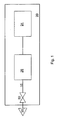
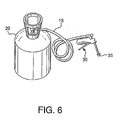
- FIG. 1 schematically illustrates one embodiment of the container.
- a pressurized portion 24 of the container 20 applies pressure to a second portion 26 of the container 20 that contains the grout composition.
- the second portion 26 has an outlet 15 that fluidly communicates with the interior thereof.
- the outlet 15 includes a valve 30 and is fluidly connected with a nozzle 35.
- the valve 30 When the valve 30 is in the closed position, the composition cannot move through the outlet 15.
- pressure from the pressurized portion 24 urges grout composition in the second portion 26 to pass through the outlet 15 and thence into and through the nozzle 35, which can be directed to apply the grout as desired.
- Compressed gas can directly contact the grout composition, in which instance the container should generally be used in an inverted position, so that gravity draws the grout composition to the bottom of the container, covering the outlet.
- this configuration requires careful manipulation of the container and can limit the containers use to only certain geometric orientations, decreasing ease of use.
- compressed gas can generate a path through the grout composition to the outlet, leaving a substantial portion of the grout in the container undeliverable. For this reason, it is preferred that compressed gas in the container either be retained behind a solid structure (e.g., a slidable piston) or contained within a closed compartment (e.g., a sealed, flexible bladder) within the container.
- the solid structure is a piston that separates a compressed gas from the grout composition.
- the piston can, for example, be a substantially planar disk or cup-shaped.
- An expandable bladder can be used in combination with a piston or other solid structure, if desired.
- FIG. 2 schematically illustrates a second embodiment of the container.
- the substantially cylindrical container 20 has a pressurized portion 24 and a second portion 26 that contains the grout composition.
- the two portions are separated by a slidable piston 28 that is urged axially along the container 20 toward the outlet 15 by pressure applied to the piston 28 by the pressurized portion 24 of the container 20.
- a slidable piston 28 that is urged axially along the container 20 toward the outlet 15 by pressure applied to the piston 28 by the pressurized portion 24 of the container 20.
- grout composition in the second portion 26 is urged to flow out of the container 20 through the nozzle 35 by way of the outlet 15.
- the container in Figure 2 is shown without a valve or nozzle. Any of a variety of known valve/nozzle assemblies can be used to seal the container shown in Figure 2.
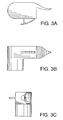
- a suitable nozzle has a portion adapted to fit the outlet of the container and a dispensing end for directing flow of the grout composition.
- the dispensing end can have a shape adapted to fit between ceramic tiles (i.e., partially or entirely within the gap between tiles). Alternatively, the dispensing end can be shaped simply to direct a stream or spray of the grout composition in a selected direction.
- the nozzle can have a shaping edge disposed thereon (e.g., adjacent the orifice), wherein the shaping edge has a shape designed to impart a particular shape (e.g., a concave rounded shape) to the surface of dispensed grout by sliding the shaping edge along the surface.
- a shaping edge disposed thereon (e.g., adjacent the orifice), wherein the shaping edge has a shape designed to impart a particular shape (e.g., a concave rounded shape) to the surface of dispensed grout by sliding the shaping edge along the surface.
- the nozzle can also have a stabilizing member formed or applied thereon.
- the stabilizing member is designed to contact the tiled surface in a manner such that when the stabilizing member is pressed or slid against the surface, the dispensing end of the nozzle directs dispensed grout into a crack between tiles.
- the shape of the stabilizing member is not critical. It will generally include a planar face for sliding against the tiled surface and can also (or instead) have a raised portion for insertion within an inter-tile crack, to direct sliding of the nozzle along the crack.
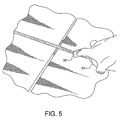
- the stabilizing member has the appearance of a short "ski” with a raised bump on the planar "bottom” of the ski.
- the bump is inserted into an inter-tile crack, and the nozzle is drawn along the length of the crack.
- the planar portion of the ski maintains the dispensing end of the nozzle in a position in which grout dispensed therefrom is directed into the crack.
- the stabilizing member can be a unitary part of the nozzle or, for example, a removable piece which can be clipped onto the nozzle to accommodate both left-handed and right-handed users.
- the grout composition described herein is made by combining the components thereof and mixing them, preferably very thoroughly. So long as the mixed composition is not permitted to dry, it can be stored indefinitely prior to application. Preferably, the grout composition is packaged into a sealed container, such as one of those described herein.
- the order of addition of the ingredients of the grout composition is not critical. However, the final wet grout composition can be significantly more viscous than its ingredients.
- the polymeric resin can first be combined with the ingredients to be incorporated at relatively low levels (e.g., antifoam, wetting agents, biocides, etc.) and other solvents as an initial step. Addition of any dye or colorant can be made to the liquid components of the composition while the liquids are at their least viscous stage, so that thorough mixing can occur and the color of the final grout composition can be as uniform as possible.
- relatively low levels e.g., antifoam, wetting agents, biocides, etc.
- additive of any dye or colorant can be made to the liquid components of the composition while the liquids are at their least viscous stage, so that thorough mixing can occur and the color of the final grout composition can be as uniform as possible.
- any dye or colorant can be mixed at an early stage with the polymeric resin (and with any other ingredient with which mixing of the dye or colorant can be most difficult), and addition of other components can be suspended until satisfactory mixing is achieved.
- Multiple particulate or powdered ingredients can be pre-mixed prior to combining them with liquid ingredients.
- a grout composition suitable for packaging in a pressurized container is made as follows. 557.49 Pounds of RHOPLEX (RTM) 2200 acrylic latex suspension are mixed with 168.23 pounds of RHOPLEX (RTM) A-920 acrylic latex suspension. As mixing continues, 0.98 pound of FOAMASTER (RTM) III antifoam, 6 pounds of TRITON (RTM) X-405 detergent, 1.56 pounds of ACTICIDE (RTM) CT bactericide/fungicide, 12.5 pounds of SLR-2B (TM) stain-resistant polymer, 25 pounds of the stain-resistant polymer designated L-18961 developmental material (3M Company, St. Paul, MN), and 8.06 pounds of TAMOL (RTM) 850 dispersant are added to the mixture.
- HERCOLYN (RTM) D hydrogenated methyl ester of wood rosin is combined with 14.67 pounds of mineral spirits, and that combination is added to the mixture. Thereafter, 28.36 pounds of titanium dioxide R706 (DuPont, Wilmington, DE) and 800 pounds of calcium carbonate having an average particle size smaller than 100 micrometers (calcium carbonate product G260, J.M. Huber Corp., Marble Hill, GA) are added to the batch, with mixing. Next, 112.48 pounds of water, 25.43 pounds of propylene glycol (99.8% pure; Interstate Chemical Corp., Hermitage, PA) and 21.64 pounds of ACRYSOL (RTM) 186B thickener are added to the mixture. Finally, 700 pounds of fine silica sand is added, and the mixture is thoroughly mixed.
- a second grout composition suitable for packaging in a pressurized container is made as follows. 795.00 Pounds of RHOPLEX (RTM) A-920 acrylic latex suspension is combined with 15.187 pounds of TRITON (RTM) X-405 detergent, 2.0 pounds of ACTICIDE (RTM) CT bactericide/fungicide, 18.917 pounds of propylene glycol (99.8% pure; Interstate Chemical Corp., Hermitage, PA), 4.0 pounds of TAMOL (RTM) 850 dispersant, 2.043 pounds of tripotassium phosphate, 15.542 pounds of mineral spirits, 1.776 pounds of AP-SILANE 33 (TM) (Advanced Polymer, Inc., Carlstadt NJ), 9.50 pounds of ACRYSOL (RTM) TT615 thickener, 12.5 pounds of SLR-2B (TM) stain-resistant polymer, 25 pounds of the stain-resistant polymer designated L-18961 developmental material (3M Company, St.
- this grout composition When applied and dried, this grout composition exhibits greater flexibility than does the grout composition of Example 1.
- This grout composition is useful in traditional grout applications and in applications in which grout flexibility is important.
- this grout is useful in 'floating floor' applications, in which discrete panels (e.g., panels having laminated wood or ceramic tiles thereon) are laid atop (but not adhered to) a solid substrate so that the panels interlock with one another.
- This grout composition can be used to fill interstices between the panels or tiles thereon.
- the flexibility of the grout composition accommodates minor movement, shifting, and settling that occurs in floating floor panels, without significantly splitting, cracking, or peeling away from the panels or tiles.
- This example describes a type of grout suitable for use in situations in which stain resistance is desirable.
- This grout composition includes the following ingredients, expressed as a percentage of the weight of the wet grout composition
- This example describes a type of grout suitable for use in situations in which stain resistance is desirable.
- This grout composition includes the ingredients in Table 1, expressed as a percentage of the weight of the wet grout composition.
- Ingredient Content BASF ACRONAL(RTM) NX 4787 butyl acrylate/styrene copolymer dispersion 18% - 30%
- ALCOGUM (TM) L-18 rheology modifying agent 2% - 3.5% Calcium carbonate, finely divided 20% - 55% Fine silica sand 0% - 50% Titanium dioxide 0% - 1.5% Water 1% - 5% Propylene glycol 0% - 2%
- This example describes a grout composition suitable for use in situations in which stain resistance is desirable.
- This grout composition includes the ingredients in Table 2, expressed as weight in pounds.
- Ingredient Weight (lb) BASF ACRONAL(RTM) NX 4787 butyl acrylate/styrene copolymer dispersion 615
- Stain-resistant polymer product designated L-18961 developmental material (3M Company) 25.0
- Mineral spirits 14.7 Potassium hydroxide 14.0 TRITON (RTM)
Landscapes
- Chemical & Material Sciences (AREA)
- Engineering & Computer Science (AREA)
- Ceramic Engineering (AREA)
- Chemical Kinetics & Catalysis (AREA)
- Materials Engineering (AREA)
- Structural Engineering (AREA)
- Organic Chemistry (AREA)
- Sealing Material Composition (AREA)
Abstract
The invention relates to stain resistant grout compositions comprising an air-dryable polymeric resin, a mineral filler, and a stain resistant polymer. In an embodiment of the grout suitable for packaging in pressurized containers, the compositions comprise a mineral filler that has average particle size greater than about 160 micrometers in which the mineral particles exhibit a Mohs hardness less than about 6.5. <IMAGE>
Description
The invention relates generally to apparatus and compositions useful for grouting tiles,
countertops, and other building materials having interstices therebetween.
The placement of various flat or curved pieces of ceramic, stone, concrete, or other
material, collectively referred to as "tile", onto floors, walls, counter tops, or other
surfaces in a building is an ancient tradition. Tile is installed by adhering multiple tiles to
the area to be covered and thereafter filling the spaces between the tiles with a grout.
In laying the tile on a floor, for example, the craftsman applies an adhesive (e.g., thin set
mortar) to the floor. Then, tiles are positioned on the adhesive while inserting spacers
between the tile for proper spacing, and the adhesive is allowed to set (e.g., overnight).
Once set, the tile spacers are removed and a grout is applied to fill the spaces around
the tile that have been preserved by the tile spacers.
Grout compositions are used to fill interstices between other building materials (e.g.,
between bathtubs and walls and between wooden or composite wall panels) and
interstices in furniture and the like.
Grout often consists of a cementitious mixture of fine aggregates mixed into a
cementing agent with a solvent (e.g., water), but made so thin as to flow almost like
cream. The cementing agent may comprise a polymeric adhesive material (e.g., a
resin-based grout, such as an epoxy) or simply Portland cement. The aggregates are
typically sand and/or crushed stone. The addition of dyes and pigments to the
cementitious materials has also enjoyed wide application in all of the above mentioned
materials. Such grouts enjoy broad application in construction materials, tile setting,
wall and pool plasters, stucco, self-leveling compounds, roofing tiles, and patches.
Other grouts do not contain coarse particulates and have a smooth finish.
Application of grout to a tile surface such as a tile floor or wall has traditionally and
conventionally been done almost entirely by hand in that the workman uses a hand
trowel working on hands and knees or squatting in small areas by pouring the grout
between the tiles and by hand troweling the excess grout to form the grouting joints
while removing the excess to leave a smooth grouting joint between adjacent tiles.
Cementitious grouts are typically prepared at the job site in an amount estimated to be
sufficient for the immediate job, since any unused grout will harden after a set time and
becomes unsuitable for later use.
Cementitious grouts are in common use. Polymeric resin-based grouts are also known.
By way of example, U.S. Patent No. 4,833,178 describes an epoxy resin-based grout
composition that requires addition of a hardener thereto and mixing prior to use. U.S.
Patents Nos. 3,854,267; 3,859,233; and 4,472,540 describe non-epoxy polymer resin-based
grout compositions that either contain sand or have a smooth-textured finish that
is undesirable in many applications.
Current cementitious grouts are very prone to staining. In order to offer some level of
stain protection, current cementitious grouts must be treated after curing with a coating
of silicone or a similar protectant. This process is costly, messy, and time-consuming.
Depending on the protectant used, it may be necessary to re-apply it on a regular basis.
Cementitious grout that is seriously stained may have to be "painted" with a grout
colorant, a very messy and time-consuming process. Alternatively, stained grout can be
removed and replaced. Removing and replacing stained cementitious grout is
expensive and difficult.
The present invention relates to a grout composition that is more stain-resistant than
many prior grouts and which therefore reduces or eliminates the need for replacement
of stained grout or remediation of stains.
The invention relates to a fluid grout composition that comprises an air-dryable
polymeric resin, a mineral filler, and a stain resistant polymer combined with (e.g.,
dissolved, suspended, or dispersed in) a solvent. Preferably, the grout composition,
when dry, has a hard, abrasive finish analogous to traditional sanded grouts. The grout
composition can include one or more other ingredients, such as additional polymer
resins, additional stain resistant polymers, additional solvents, a dye, a colorant (e.g.,
titanium dioxide), an antifoam, a wetting agent, a coupling agent, a biocide, a thickening
agent, a drying rate modulator, and the like. Instead or in addition, it may comprise a
fungicide.
In a specific embodiment, the grout composition comprises both a first mineral filler and
a second mineral filler. The first mineral filler may have an average particle size greater
than 160 micrometers and/or a Mohs hardness less than about 6.5. The second
mineral filler may have an average particle size less than 600 micrometers. The
composition comprises the air-dryable polymeric resin in an amount sufficient to bind
the first and second mineral fillers upon drying of the composition. One example of this
grout composition comprises 20% to 40%, by weight, of first mineral filler particles
having an average particle size in the range from 160 to 700 micrometers and a Mohs
hardness less than about 6.5; 20% to 40%, by weight, of second mineral filler particles
having an average particle size in the range from 90 to 120 micrometers; and 20% to
35%, by weight, of an air-dryable polymeric resin. The first and second mineral fillers
can be the same mineral (e.g., calcium carbonate) or different minerals. The overall
mineral filler content of the grout composition (i.e., the sum of the first and second
mineral fillers and any other mineral fillers incorporated into the composition) should be
in the range from 30% to 80% by weight, and is preferably 55% to 65% by weight. The
proportions of first and second mineral fillers can vary. The first mineral filler can be
present in an amount from 5% to 70% by weight, but is preferably present in an amount
from 20% to 40% by weight. The second mineral filler can be present in an amount
from 5% to 60% by weight, but is preferably present in an amount from 20% to 40% by
weight.
The grout composition described herein can be packaged in pressurized containers
from which the composition can be dispensed. Preferably, compositions packaged in
pressurized containers do not comprise a particulate having an average particle size
greater than 100 micrometers and a Mohs hardness greater than about 6.5. More
preferably, they do not comprise a particulate having an average particle size greater
than 20 micrometers and a Mohs hardness greater than about 6.5. Of course, the grout
compositions can also be packaged in traditional tubs, tubes, cartridges, and the like.
The polymeric resin in the grout composition can comprise a single polymer or a
plurality of polymers, such as one or more acrylic latex polymers. Examples of suitable
acrylic latex polymers include homopolymers of acrylate, homopolymers of alpha-methyl
acrylate, and copolymers of acrylate and alpha-methyl acrylate. In addition to the
primary solvent, the grout composition can further comprise one or more additional
solvents. Solvents can be added in an amount sufficient to improve the workability of
the composition. For example, the viscosity of the grout composition can be adjusted
such that it is not less than about 2400 poise (and preferably not more than about 8800
poise).
The invention also relates to a sealed container containing the grout composition
described herein. The container has a nozzle for dispensing the composition from the
container under pressure. The container can have a valve in fluid communication with
the nozzle. The composition is dispensed through the nozzle upon actuation of the
valve. The container can also have a piston having a face that urges the composition
through the nozzle upon application of force or pressure to the piston (e.g., pressure
exerted upon the piston by a pressurized reservoir). The shape of the container can be
adapted to fit a caulking gun or other conventional device for applying caulks or
sealants.
The invention further relates to a method of waterproofing a surface having tiles
adhered thereto. The method comprises filling interstices between the tiles with a grout
composition described herein.
In another aspect, the invention relates to methods of making a grout composition
described herein.
These and other features and advantages of the present invention will be more fully
evident in light of the following detailed description of the preferred embodiment of the
invention, which is to be considered together with the accompanying drawings wherein
like numbers refer to like parts and further wherein:
The invention relates to grout compositions that exhibit enhanced stain resistance
relative to traditional grouts. The grout compositions are air-dryable fluid compositions
comprising a polymeric resin, a mineral filler, and a stain resistant polymer dispersed in
a solvent. Following application, substantially all of the solvent evaporates, leaving a
solidified mixture of polymer resin, stain resistant polymer, mineral filler, and any other
non-volatile components.
In one embodiment, the invention relates to grout compositions that exhibit the
appearance of traditional cementitious grouts and other sand-containing ("sanded")
grouts without exhibiting the extremely abrasive properties of such grouts. In almost all
applications, the degree of hardness and the abrasiveness exhibited by traditional
grouts are greater than the hardness and abrasiveness that are necessary for the
particular application. The extreme hardness and abrasiveness of traditional grouts are
largely vestiges of traditional methods of making grouts. Because the grout
compositions described herein can be made less abrasive than prior art grouts, they
can be used in ways (e.g., application using pressurized containers) that prior art grouts
cannot. In addition to their flexibility with regard to use, the grout compositions
described herein retain the pleasing textured appearance and feel of sanded and
cementitious grouts, while also exhibiting stain-resistant properties.
As used herein, each of the following terms has the meaning associated with it in this
section.
The "average particle size" of a collection of particles means the weight-averaged
particle size (as opposed to the number-averaged particle size). Half of the weight of
the particles in the collection have a size larger than the average particle size, while
50% by weight have a smaller size.
A "piston" is a solid, generally non-deformable body that has at least one face and that
is movable within a container, cavity, tube, or other enclosure. Pressure or force
applied to the body to move the piston is transmitted to the face, which can transmit the
force to a material (e.g., a grout composition) that contacts the face within the
enclosure.
A "polymeric resin" is a fluid form (e.g., a solution, suspension, or dispersion) of a
polymer or a fluid precursor of a polymer that is polymerized to form the polymer.
"Grout workability" refers to the consistency of grout compositions typically employed in
tile grouting applications. The consistency of grout can differ based on the particular
application. For example, grout applied to vertical surfaces (e.g., tiled walls) must be
sufficiently viscous that it will not run or fall out from the vertical interstices between
tiles, but must retain sufficient deformability that it can be packed or shaped as desired
in order to obtain an aesthetically pleasing surface. Grout used in supported horizontal
applications (tile floors, for example) can be less viscous.
A "stain resistant polymer" is any polymer known in the art for its stain-resisting
properties. Non-limiting examples of stain resistant polymers include silicones,
siloconates, silanes, siloxanes, fluorochemical polymers, and fluorochemical-derivatized
polymers.
This,description of preferred embodiments is intended to be read in connection with the
accompanying drawings, which are to be considered part of the entire written
description of this invention. The drawing figures are not necessarily to scale and
certain features of the invention may be shown exaggerated in scale or in somewhat
schematic form in the interest of clarity and conciseness. In the description, relative
terms such as "horizontal," "vertical," "up," "down," "top" and "bottom" as well as
derivatives thereof (e.g., "horizontally," "downwardly," "upwardly," etc.) should be
construed to refer to the orientation as then described or as shown in the drawing figure
under discussion. These relative terms are for convenience of description and normally
are not intended to require a particular orientation during practice of the invention.
Terms including "inwardly" versus "outwardly," "longitudinal" versus "lateral" and the like
are to be interpreted relative to one another or relative to an axis of elongation, or an
axis or center of rotation, as appropriate. Terms concerning attachments, coupling, and
the like, such as "connected" and "interconnected," refer to a relationship wherein
structures are secured or attached to one another either directly or indirectly through
intervening structures, as well as both movable or rigid attachments or relationships,
unless expressly described otherwise. The term "operatively connected" is such an
attachment, coupling or connection that allows the pertinent structures to operate as
intended by virtue of that relationship. In the claims, means-plus-function clauses are
intended to cover the structures described, suggested, or rendered obvious by the
written description or drawings for performing the recited function, including not only
structural equivalents but also equivalent structures.
The invention relates to a fluid grout composition comprising an air-dryable polymeric
resin, a mineral filler, and a stain resistant polymer dispersed in a solvent. The stain
resistant polymer is preferably soluble or miscible in one or both of the solvent and the
polymer resin. However, the stain resistant polymer can alternatively be dispersed in
the polymer resin and/or solvent in a discrete phase, such as in an emulsion. The grout
composition can also include other components, for example to affect the workability of
the grout or its finished appearance.
In one embodiment, the invention relates to grout compositions that exhibit the
appearance of traditional cementitious grouts and other sanded grouts without
exhibiting the extremely abrasive properties of such grouts. Because the grout
compositions described herein can be made less abrasive than prior art grouts, they
can be used in ways (e.g., pressurized application) that prior art grouts cannot. In
addition to their flexibility with regard to use, the grout compositions described herein
retain the pleasing textured appearance and feel of sanded and cementitious grouts and
resist staining.
If a textured grout finish is desired, the grout composition need include only four
components, namely the polymeric resin, the stain resistant polymer, a mineral filler,
and a solvent. Of course, other components can also be included.
In one embodiment, the textured grout composition contains both a first mineral filler
and a second mineral filler. The first mineral filler has an average particle size greater
than 100 micrometers and the mineral particles of the first mineral filler exhibit a Mohs
hardness less than about 6.5. The second mineral filler has an average particle size
less than 100 micrometers. The polymeric resin is air-dryable and is present in an
amount sufficient to bind the first and second mineral fillers upon drying of the
composition. The first mineral filler gives the dried grout composition the appearance,
texture, and feel of a traditional sanded cementitious grout.
The grout composition can also include one or more of a variety of other constituents. A
variety of additives (e.g., wetting agents, solvents, antifoams, thickening agents, and
agents that modulate the rate at which the grout dries) are known in the art to be useful
components of grout compositions, and substantially any of those additives can be
included in the grout composition described herein. The grout composition can also
include components that confer beneficial properties to the dried grout. By way of
example, the grout composition can include a dye or colorant to impart a desired color
to the dried grout composition. A biocidal agent can also be incorporated into the grout
composition, to inhibit growth of organisms in or on the finished grout. Incorporation of
one or more water-repelling agents (e.g., a water-repellant polymer) into the grout
composition can enhance the water resistance (and useful lifespan) of the grout
composition.
An important advantage of the grout composition described herein is that it is suitable
for application to a tile surface in a variety of different ways. The grout composition
disclosed herein can be manually applied using a trowel and float, as with traditional
grouts. It can be packaged and sold in cartridges adapted to fit standard caulking guns
and other applicators to facilitate application with caulking guns or other applicators. It
can be packaged, sold, and applied in a manually-squeezable tube, such as the type of
tube in which various adhesives, caulks, and sealants are presently sold.
The grout composition having one or more mineral fillers of relatively low hardness, as
described herein, is suitable for packaging into a pressurized container, such that the
grout composition can be applied to the interstices of a tiled surface by actuating a valve
that seals the container. Prior art sanded grouts are not suitably packaged in this
manner, since the sand, cement, or other components of the grouts are highly abrasive
and cause serious damage to machinery used to package pressurized containers.
Application of a grout composition in the form of a pressurized can-type container is a
highly desirable application method, particularly in situations in which the person
applying the grout is not an experienced mason, in which only a relatively small amount
of grouting needs to be done, or in which the person applying the grout wishes to
perform the work intermittently. The grout composition described herein is useful in
each of these situations (in addition to traditional grouting applications).
Another advantage of the grout compositions described herein is that they can be
formulated to resist shrinking (relative to freshly-applied grout) and cracking of the dried
grout. As the size of the crack or hole to be filled using the grout increases, the
importance of the anti-shrinking and anti-cracking properties of the grout composition
increases.
The invention includes grout compositions, methods of using them, and apparatus for
applying them. Further details of the components of the grout composition, certain
apparatus useful for containing and applying the grout compositions, and methods of
using the grout composition are described below.
The grout composition described herein includes at least one polymeric resin. The resin
comprises at least one polymer and at least one solvent. The resin can contain multiple
polymers, multiple solvents, or both multiple polymers and multiple solvents. The
polymer(s) and solvent(s) should be miscible with one another. Suitable polymers and
solvents are known in the art, and include those used as binders in previously-known
grouts, cements, and concretes. Polymers traditionally used in caulks and other
sealants can also be incorporated into the grout composition described herein.
However caulk/sealant polymers often have a glossy finish that is not normally
associated with grouts, and incorporation of such polymers in the grout compositions
described herein should be limited unless a glossy or high-sheen finish is desired.
Grout compositions having a matte, dull, sandy or other textured finish are preferred.
A preferred type polymer is the class of polymers known as acrylic latexes. A wide
variety of acrylic latex resins, colloids, and suspensions are commercially available,
each with its own characteristics. The particular acrylic latex and the corresponding
resin that should be selected for a grout composition can be determined based on the
intended end use of the grout composition. For example, in applications in which the
appearance of the finished grouted surface is more important than the durability or
impact resistance of the grout, the polymeric resin can be selected primarily on the
basis of its color, workability, and non-shrinking character. As another example, in
applications in which the water-resistance of the finished grouted surface is a primary
consideration, the polymeric resin can be selected primarily on the basis of the water-repelling
characteristics of the polymer, the ability of the polymeric resin to cure in the
presence of water, the drying (curing) time of the resin, and the crack resistance of the
cured resin. Further by way of example, in applications in which the durability and
impact resistance of the finished grout are the paramount concerns, the polymeric resin
can be selected to yield high durability and impact resistance.
An example of a suitable acrylic latex polymer that can be incorporated into a general
purpose grout composition is the acrylic copolymer sold commercially as RHOPLEX
(Registered Trademark, "RTM") brand colloid (Rohm & Haas Company, Philadelphia,
PA). Other suitable acrylates include homopolymers of acrylate, homopolymers of
alpha-methyl acrylate, and copolymers of acrylate and alpha-methyl acrylate. Examples
of suitable polymer resins include butyl acrylate / styrene copolymers, such sold as
those sold in the form of dispersions under the trade name ACRONAL(RTM) NX 4787
(BASF, Mount Olive, NJ), and acrylic / vinyl acetate copolymers, such as those sold in
the form of dispersions under the trade name ACRONAL(RTM) V275 (BASF, Mount
Olive, NJ).
Other suitable polymers that can be incorporated into the grout composition in place of,
or in addition to, acrylic latexes include polymeric silanes and polysilazanes. Polymers
in which silane coupling agents (e.g., vinylbenzyl chloride products available from Dow
Chemical Company, Midland, Ml) are incorporated are also suitable, the coupling
agents being able to link organic polymer systems with inorganic substrates, such as
the first and/or second mineral fillers. An example of a suitable coupling agent is the
product designated AP-SILANE 33 (Trademark, "TM"), obtained from Advanced
Polymer, Inc. (Carlstadt, NJ). Other polymers can be used as well or instead, such as
polymers used in known caulks and sealant products.
The polymeric resin must be air-dryable, meaning that if the grout composition is
dispensed into a crack and the surface of the grout is thereafter maintained in contact
with ambient air, then substantially all of the solvent(s) in the grout composition will
disappear (e.g., by evaporation) within days, weeks, or months following the application.
Under normal, atmospheric conditions, it is preferable that the finished grout
composition be substantially free of solvents (i.e., > 90% of solvents have disappeared)
within 48 to 72 hours after application. Grout compositions from which a substantial
fraction (e.g., >75%) of solvent evaporates or otherwise disappears within 24 hours
after application are also preferable. The polymeric resin can include more than one
solvent, wherein the volatility of at least one solvent is significantly greater than another
solvent in the resin at the anticipated application or drying temperature. Such a resin
can be used to cause the grout composition to set relatively quickly while completely
drying more slowly (e.g., to facilitate enhanced polymer cross-linking or entanglement).
Because grouting is often performed in enclosed areas (e.g., in interior rooms of
houses, such as bathrooms and kitchens), non-toxic and non-irritating solvents are
preferred, particularly in situations in which the grout composition is to be used or sold
for use in occupied buildings. Many acceptable solvents are known. Water is a
preferred solvent and exhibits no known toxicity or irritation. Regardless of the solvent
used, it is recommended that any area enclosing the grouted surface be ventilated
during and after application of the grouting composition described herein.
The grout composition must contain enough of the polymeric resin that the polymer
contained in the resin is present in an amount sufficient to bind the grout components
into a common mass once the solvent(s) in the resin are no longer present. The
necessary amount of the polymer (and the corresponding resin) depends on the
properties of the particular polymer(s) and other components used, the presence of
wetting agents, surface-modifying or coupling agents, the degree and energy of mixing,
and other factors that are within the ken of the skilled artisan. This information can also
be readily derived empirically simply by preparing a plurality of test compositions.
Suitable grout compositions can include from 15% to 70%, by weight, polymeric resin;
however, grout compositions having very high (e.g., >50%) polymeric resin content can
fail to resemble sanded grouts. Preferred polymeric resin content values are 20% to
35% by weight (more preferably, 25% to 30%).
The grout composition includes stain resistant polymer, such as a water-repelling
polymer, an oil-repelling polymer, or a polymer that tends to repel both water and oils.
Many stain resistant polymers are known in the art, and substantially any of them can
be used in the grout composition described herein.
Water-repelling polymers that can be used include substantially any polymer that is
compatible with the other ingredients of the composition and that imparts hydrophobicity
to the grout composition or the finished grout. A wide variety of suitable water-repelling
polymers are known, including fluorochemical polymers, fluorochemical-derivatized
polymers, styrene maleic anhydride copolymers, and polyalkylsiloxanes such as
polydimethylsiloxane.
Suitable stain resistant polymers include those sold under the SCOTCH-GARD (RTM)
trademark (3M Company, St. Paul, MN) such as product number 18961, those sold as
the perfluoroalkylsulfonamide-modified urethane polymer product designated L-18961
Developmental Material (3M Company), those sold as the product designated SLR 2B
(SLR, Inc., Scottsdale, AZ), those sold as the proprietary fluoropolymer product
designated SLR-TP (TM) water base active (SLR, Inc.), those described in U.S. Patent
number 6,037,429, those described in U.S. Patent number 4,648,904, those described
in U.S. Patent number 4,517,375, those described in U.S. Patent number 5,274,159,
those described in U.S. Patent number 5,011,713, those described in U.S. Patent
number 6,271,289, those described in U.S. Patent number 6,251,984, and those
described in U.S. patent application publication number 2003/0129419 A1.
The stain resistant polymer can be present in substantially any amount compatible with
the other components of the grout composition and consistent with the integrity of the
finished grout. The amount of the stain resistant polymer included in the composition
can also be affected by the degree of stain resistance imparted to the grout by the stain
resistant polymer. Generally, the stain resistant polymer will be present in the fluid
grout composition in an amount from about 0.5% to 3.5% by weight, preferably 2% to
3.5%. The grout composition can include multiple stain resistant polymers.
The grout composition comprises a volatile aqueous or organic solvent (or combination
of aqueous and organic solvents) in an amount sufficient to render the composition
sufficiently fluid that it can be used for its intended purpose. Preferably, the solvent is
present in an amount that gives the grout composition a consistency sufficient viscous
(e.g., 2400-8800 poise) to hold the grout composition in place following application.
Also preferably, the solvent is present in an amount sufficiently great that the
composition can be dispensed or applied without the need for significant application of
force to the composition.
Suitable solvents include water, ethanol, isopropanol, acetone, mineral spirits, and
similar solvents. Mixtures of solvents can be used, such mixtures preferably including
only miscible solvents. Preferably, the solvent is selected such that both the polymeric
resin and the stain resistant polymer are soluble therein. Alternatively, one or both of
the polymeric resin and the stain resistant polymer can be provided in the form of an
emulsion suspended in the solvent.
The grout composition includes one or more mineral fillers. The mineral fillers can have
one or more roles, such as reducing the amount of polymer resin needed to fill the
space to be grouted, increasing the hardness of the finished grout, providing a textured
appearance and/or feel to the finished grout, and coloring the grout. Examples of
suitable mineral fillers include titanium dioxide (e.g., for brightening or imparting
whiteness to the finished grout), various sands (e.g., silica sand for imparting a sanded
appearance and finish to the grout), and calcium carbonate (e.g., for relatively
inexpensively filling out the grout and/or reducing the elasticity of the finished grout).
In one embodiment, the grout includes multiple mineral fillers, herein designated the first
and second mineral fillers.
The first mineral filler is a particulate that acts as a filler and imparts a highly textured
appearance to the finished grout. The particles of the first mineral filler have an average
particle size that is greater than at least 160 micrometers. Depending on the texture,
feel, and appearance desired, particulate compositions having a larger average particle
size (e.g., 200, 300, 500, 700, 1000, 1500, or 2000 micrometers) can be used as the
first mineral filler.
Sand used in traditional grout composition generally has grains that range in size from
160 to 700 micrometers. Fine-grained sands (e.g., particle sizes of about 185-245
micrometers) are desirable in many applications in which appearance, and tactile
texture are important. Sand size distributions vary depending on the source of the sand
and how it is sifted, cleaned, or otherwise processed. Substantially any sand particle
size and size distribution can be replicated using first mineral filler particle sizes and
size distributions. For example, desirable first mineral particle sizes include particles
that range is size from 160 to 700 micrometers. First mineral fillers containing
predominantly particles in the range 185-245 micrometers in size yield a grout
composition having a fine-grained appearance. In one preferred composition, at least
80%, by weight, of first mineral filler particles in a grout composition described herein
have a size in the range from 160 to 700 micrometers, and more preferably at least
80%, by weight, of those particles have a size in the range from 185 to 245
micrometers.
The uniformity of sizes of the particles in the first mineral filler is not critical, and
selection of a first mineral filler on the basis, for example, of a particle size uniformity
coefficient (e.g., the mesh opening size through which 60% of particles pass divided by
the mesh opening size through which 10% of particles pass) can be made to
accommodate aesthetic considerations such as the effect of the filler on the texture or
other appearance of the finished grout.
An important characteristic of the particles of the first mineral filler is that the particles
should not exhibit a greater hardness than the hardness of the materials that the grout
composition contacts during preparation, processing, or both, of the composition. Sand,
cement, and other relatively hard mineral components of prior art grouts have made
packaging those prior art grouts into pressurized containers impractical, owing to the
abrasive properties of those hard minerals. It has been discovered that relatively large
particles of less hard minerals can replicate the appearance of sanded and other
textured cementitious grouts without exerting the abrasive effect on processing and
packaging machinery that was observed with prior art grouts.
Steel is a common component of chemical processing and packaging equipment. The
hardness of a steel depends on a number of factors, including its composition and how
it was treated during formation and subsequent fabrication. Generally, however, steels
exhibit a hardness value of at least about 6.5 on the Mohs hardness scale. It has been
discovered that if the relatively large mineral filler particles in a grout composition exhibit
a hardness less than 6.5, then abrasion of processing and packaging materials can be
reduced significantly. Preferably, the Mohs hardness of the particles of the first mineral
filler of the grout composition disclosed herein is not greater than 6, 5, 4, or 3. A
preferable mineral filler is particulate calcium carbonate (also known as calcite), which
exhibits a Mohs hardness of approximately 2.5. Without wishing to be bound by any
particular theory of operation, it is believed that if the Mohs hardness of the particles of
the first mineral filler is lower (at least one Mohs scale units lower, and preferably at
least two Mohs scale units lower) than the Mohs hardness of the materials from which
the grout-contacting portions of a grout packaging machine are made, then the grout
composition described herein will not exert excessive wear on the machine, thereby
making packaging of the grout into pressurized containers practical.
Although the relatively large particles of a grout appear to be the primary cause of the
abrasive effects exerted by grouts on packaging machinery, smaller particles can also
abrade and wear such machinery. In the grout composition described herein, it is
preferable that no particulate component of the composition (in its fluid form) exhibit a
Mohs hardness greater than that of a machine used to package it into a pressurized
container. For example, the grout composition can be formulated so that no particulate
component exhibits a Mohs hardness greater than 6.5, 6, 5, 4, or 3. By way of
example, if the hardest mineral particulate contained in the grout composition is calcite
(i.e., calcium carbonate), then the composition does not comprise a particulate
component exhibiting a Mohs hardness greater than about 2.5.
The first mineral filler should be selected so that the mineral particles thereof do not
dissolve or degrade significantly over time in the grout composition. The first mineral
filler is also desirably relatively inexpensive and easily obtained. Calcium carbonate is
commercially available in a variety of forms, including in fractions separated by particle
size, whiteness, surface treatment, and the like.
Selection of an appropriate first mineral filler can also be influenced by the anticipated
end use of the grout. For grouts that will not be exposed to significant wear or abrasion
after installation, appearance, availability, and cost concerns can outweigh wear
resistance in selecting a first mineral filler. In such applications, first mineral fillers
having relatively low hardness (e.g., Mohs hardness < 4, < 3, or < 2.5) can be suitably
used. If significant wear or abrasion of installed grout is anticipated, a harder filler (e.g.,
5 < Mohs hardness < 6.5) can be used so that the grout retains its "sanded"
appearance and texture in spite of the wear or abrasion.
The appearance of the grout composition can be significantly affected by the color and
the shape of the mineral particles in the first mineral filler. In some embodiments, white
mineral particles are preferred. Generally cubical mineral particles will closely mimic the
appearance of sand. Mineral particles having substantially any crystal shape can be
used, although particles having an aspect ration (i.e., longest characteristic dimension
divided by smallest characteristic dimension) less than about 5 or 10 are preferred.
Generally cubic (e.g., longest characteristic dimension divided by smallest characteristic
dimension < 1.5) are preferred in applications in which the first mineral filler is intended
to have the appearance of a sanded grout.
The second mineral filler is a particulate that has an average particle size less than 600
micrometers. Preferably, the average particle size of the second mineral filler is
significantly less than 600 micrometers (e.g., < 300 micrometers, < 120 micrometers, or
< 85 micrometers). The average particle size of the second mineral filler is preferably
not less than 50 micrometers and more preferably not less than 90 micrometers. Use of
second mineral filler particles smaller than 50 micrometers is possible. However, the
effect of such particles on viscosity of the resulting grout composition can be
undesirable unless other viscosity-lowering ingredients are included. In one
embodiment, at least about 80%, by weight, of second mineral filler particles are in the
size range 50-600 micrometers. In a preferred embodiment, at least about 80%, by
weight, of the second mineral filler particles are in the size range 90-120 micrometers.
The second mineral filler acts primarily as a simple filler, as such fillers are typically
used in plastics.
The hardness of mineral particles in the second mineral filler is not critical. Preferably,
the particles of the second mineral filler exhibit a Mohs hardness not greater than that of
the parts of packaging machinery that contact the grout composition. For example, the
hardness of particles in the second mineral filler should be not greater than 6.5 (6, 5, 4,
or 3). Suitable materials that can be used as the second mineral filler include sands,
calcium carbonate, ashes (e.g., coal furnace fly ash), and glass beads and/or
microspheres. Particles of minerals having a Mohs hardness from 2 to 4 are preferred.
Because the color of the second mineral filler can significantly affect the color of the
grout composition and the finished grout, the second mineral filler should be selected to
conform with the desired grout color. For example, a gray particulate can be used as
the second mineral filler for gray grout compositions. White minerals are compatible
with most, if not all, colors of grout, and white particulate minerals such as calcium
carbonate are suitable in many applications.
The mineral content of the first and second mineral fillers can be composed of the same
or different minerals. By way of example, the first and second mineral fillers can both
be calcium carbonate particulates. In some embodiments, a single mineral filler having
a relatively broad or biphasic particle distribution can be used as both the first and
second mineral fillers. It is immaterial whether separate mineral fillers having the
properties recited herein for the first and second mineral fillers are combined or,
alternatively, a single mineral filler comprising particles having sizes described for the
first and second mineral fillers is used.
The absolute and relative amounts of the first and second mineral fillers used in the
grout described herein depends on the desired texture, feel, or appearance of the
finished grout. A higher content of first mineral filler increases the 'sandiness' or coarse
texture of the grout. A higher overall (i.e., first + second + any other) mineral filler
content decreases the degree of shrinkage of the grout composition upon drying.
Increasing the amount of the second mineral filler increases the viscosity of the grout
composition.
Suitable overall mineral filler content values for grout compositions described herein
include 30% to 80%, more preferably 50% to 70%, and more preferably 55% to 65% (all
percentages are percent, by weight, of the wet {i.e., non-dried} grout composition). The
grout composition can include approximately equal (by weight) amounts of first and
second mineral fillers. Alternatively, the grout composition can include up to a two-,
three-, or four-fold excess of one of the first and second mineral fillers, relative to the
other. On a percentage (of wet grout composition weight) basis, the amount of first
mineral filler in the grout composition can range from 5% to 70%, although amounts in
the range from 20% to 40% will more nearly resemble traditional sanded grouts. The
grout composition can include the second mineral filler in amounts from 5% to 60%, and
preferably contains the second mineral filler in an amount from 20% to 40%. One
preferred grout composition comprises about 25% (by wet weight) polymers, about
28.5% first mineral filler, and about 32.5% second mineral filler. Colorants, solvents,
and various additives described herein make up the remainder of that composition.
In addition to, or instead of, one or more mineral fillers, the grout composition can
include a variety of other ingredients. Such ingredients include ingredients that are
known by skilled artisans to be useful additives for grouts, cements, concretes, and
filled plastics. Examples of suitable ingredients include polymer-soluble dyes, colorants,
solvents, antifoams, wetting agents, biocides, sealants, thickening agents, drying rate
modulators, coupling agents, stabilizers, plasticizers, flow modifiers, lubricants, and
additional fillers. Selection of such additives and suitable amounts thereof is within the
ken of the skilled artisan in this field, and can be made depending on the composition
and properties of a particular grout and its desired use.
One or more colorants can be incorporated into the grout composition in order to impart
a desired color to the grout composition, to the finished grout, or both. The colorant can
be a particulate (e.g., a mineral filler) or a compound that is soluble in one or more of
the solvents in the grout composition. The colorant should be substantially uniformly
dispersed or dissolved throughout the grout composition, in order to avoid color
variations in the finished grout. Particulate colorants (i.e., pigment particles) and
polymer-soluble dyes can be used interchangeably or in combination, depending on the
desired effect. For example, particulate, polymer-insoluble colorants should be used
when a finished grout having non-colored matrix containing colored particles is desired.
Examples of suitable colorants include titanium dioxide (a white mineral particulate),
carbon black (a black mineral particulate), and anthraquinone and azo dyes (polymer-soluble
colorants).
The grout composition will often contain a primary solvent that is present in significantly
greater amount than other solvents in the composition. In some grout compositions, the
primary solvent can be a mixture of multiple solvents present, for example, in
approximately equal amounts. In addition to the primary solvent(s), the grout
composition can include one or more other solvents. The additional solvent(s) can be
miscible with the primary solvent(s) of the polymeric resin, in order to avoid phase
separation during processing, packaging, storage, or use. The additional solvents can
be more or less volatile than the primary solvent(s), and can therefore affect the
drying/curing rate of the grout composition. For example, the additional solvents can
include both relatively volatile solvents (e.g., mineral spirits) and less volatile solvents
(e.g., water). In addition to their effects on the grout composition, additional solvents
can aid in preparation of the composition, for example, by suspending or dissolving a
component of the composition prior to its mixing with the other components of the grout
composition.
The grout composition can include one or more antifoaming agents in order to inhibit
formation of foam during preparation of the composition. Inhibiting foam formation can
decrease the amount of air suspended in the composition during mixing and ensure that
ingredients added to the composition are mixed therewith. An example of a suitable
antifoam is the FOAMASTER (RTM) III product available from Congis Corporation
(Cincinnati, Ohio).
One or more wetting agents can be included in the composition in order to enhance
contact of particulates (e.g., mineral fillers or colorants) with the polymers and other
ingredients of the grout composition. Binding of the polymers with the particulates
and/or envelopment/encapsulation/coating of the particulates by the polymers enhances
the uniformity of the grout composition and the unity of the dried/cured grout. This also
inhibits shedding of particulates from the dried/cured grout, preserving the physical
properties, texture, feel, and appearance of the grout. Examples of suitable wetting
agents include detergents such as the TRITON (RTM) X-405 product available from
Union Carbide Corporation (Danbury, CT) and dispersants such as the TAMOL (RTM)
850 product available from Rohm & Haas Company (Philadelphia, PA).
One or more biocides can be added to the grout composition in order to inhibit growth of
microorganisms, fungi, mold, and plants in the composition and in the finished grout.
Numerous biocides are known in the art and available commercially. The selection of
an appropriate biocide and the amount of the biocide included in the grout composition
can depend on the geographical location and intended use of the grout composition. An
example of a suitable biocide is the ACTICIDE (RTM) CT product available from Acti-Chem
Specialties Products (Trumbull, CT).
When the environment in which the grout composition is to be used includes water or
other chemicals that can penetrate and harm the grout, for example, one or more
sealants can be incorporated into the grout composition. Numerous sealants are known
in the art and available commercially. The selection of an appropriate sealant can
depend on the intended use and anticipated environment of the grout composition, as
well as on the nature of the chemicals expected in such use and environment. An
example of a suitable sealant is an ester of wood rosin, such as the HERCOLYN (RTM)
D hydrogenated methyl ester of wood rosin product available from Loos & Dilworth, Inc.
(Bristol, PA).
The grout composition can include one or more thickening agents (i.e., rheology
modifying agents) to improve the consistency and/or workability of the grout
composition. Numerous thickening agents are known in the art and available
commercially. An example of a suitable thickening agent is the ACRYSOL (RTM) 186B
product available from Rohm & Haas Company (Philadelphia, PA). Another suitable
thickening agent is the product designated ALCOGUM (TM) L-18 acrylic emulsion
copolymer, which is available from Alco Chemical (Chattanooga, TN).
Drying rate modulators such as polyhydric alcohols can be added to the grout
composition in order to slow the rate of drying. Such modulators can be beneficial when
the environment in which the grout is to be used exhibits a low humidity or high air flow.
An example of a suitable drying rate modulator is polypropylene glycol.
The grout composition can include one or more coupling agents for improving the
binding or encapsulation of filler particles by the polymer(s) of the composition. Suitable
coupling agents can effect covalent, ionic, or other non-covalent binding of the polymer
and the particles. Many coupling agents are known in the art, and selection of an
appropriate coupling agent depends on the chemical identity and form of the polymer(s)
and particulate(s) present in the composition. Nonetheless, selection and addition of
suitable coupling agents are within the ken of the skilled artisan in this field. Examples
of suitable coupling agents include polymeric silanes and polysilazanes.
In applications in which it is desirable that the finished grout exhibit plastic properties
(e.g., deformability, resilience, and/or flexibility) rather than cementitious properties
alone, stabilizers, plasticizers, and/or lubricants can be included in the grout
composition in order to impart their characteristic properties to the finished grout. A
wide variety of plastic additives are known, and selection and incorporation of such
additives depends on the chemical identity of the polymer(s) used in the grout
composition and desired properties of the finished grout. Nonetheless, selection and
incorporation of suitable stabilizers, plasticizers, and/or lubricants are within the ken of
the skilled artisan in this field.
The grout compositions described herein can be packaged in substantially any way
currently known for packaging grout. The grout compositions described herein exhibit
significantly lower abrasiveness than prior art grouts. This property permits packaging
of the grout composition described herein in ways that cannot be practically done using
prior grouts.
The grout composition described herein can be stored in a fully prepared (i.e., wet) form
for long periods, so long as the composition is stored in a sealed container or in a very
humid atmosphere. Thus, the grout composition described herein can be packaged and
sold in a 'ready-to-use' form. This form is particularly desirable for homeowners and
non-professional masons who wish to install, repair, or replace grout in a tiled surface.
The grout composition described herein can be packaged and sold in any sealed
container or apparatus. For example, the wet grout composition can be sold in bulk
tubs, cans, buckets, or bags suitable for traditional manual grout installation (e.g., using
a trowel and float).
In a preferred embodiment, the wet grout composition is packaged and sold in a
container that can be used as an applicator or as a replaceable part (e.g., a cartridge or
reservoir) of an applicator. By way of example, the wet grout composition can be
packaged and sold in manually squeezable tubes having a nozzle that can be inserted
between tiles or urged against a tiled surface. As another example, the wet grout
composition can be packaged and sold in cartridges adapted to fit a standard caulking
gun or another standard cartridge-fed applicator. Many prior art grouts can also be
packaged and sold in these forms.
The grout composition described herein is suitable for packaging and sale in
pressurized and pressurizable containers. For example, the grout composition can be
packaged and sold in a container having a sealed outlet and a compressible portion.
When the outlet is unsealed and the compressible portion is compressed, the grout
composition is dispensed from the outlet. Examples of such containers include the
squeezable tube and cartridge embodiments described above. Other examples include
a container in which a bladder or pouch which communicates with the outlet contains
the grout composition. Application of pressure to the exterior of the bladder or pouch
(e.g., by pressurization of the container or by the action of a pressurized second bladder
on the grout-containing bladder) forces the grout composition to be dispensed from the
outlet. The outlet can be sealed with a valve in order to regulate dispensing of the
grout.
In a preferred embodiment, the grout composition is contained within a pressurized
container having a valved outlet in communication with the interior thereof. When the
valve is actuated, the grout composition is dispensed from the container by way of the
outlet. The outlet can fluidly communicate with a nozzle to facilitate controlled or
directed release of the grout composition.
Because the grout composition described herein is substantially incompressible (or, at
most, not very compressible), the pressurized container must include a pressure
source. Substantially any pressure source suitable for use with a sealed container can
be used. Examples of suitable pressure sources include compressed springs,
compressed gas, and gas-generating chemical reactions. Compressed gas is a
preferred pressure source.
Figure 1 schematically illustrates one embodiment of the container. In the embodiment
depicted in Figure 1, a pressurized portion 24 of the container 20 applies pressure to a
second portion 26 of the container 20 that contains the grout composition. The second
portion 26 has an outlet 15 that fluidly communicates with the interior thereof. The
outlet 15 includes a valve 30 and is fluidly connected with a nozzle 35. When the valve
30 is in the closed position, the composition cannot move through the outlet 15.
However, when the valve 30 is opened, pressure from the pressurized portion 24 urges
grout composition in the second portion 26 to pass through the outlet 15 and thence into
and through the nozzle 35, which can be directed to apply the grout as desired.
Compressed gas can directly contact the grout composition, in which instance the
container should generally be used in an inverted position, so that gravity draws the
grout composition to the bottom of the container, covering the outlet. However, this
configuration requires careful manipulation of the container and can limit the containers
use to only certain geometric orientations, decreasing ease of use. Furthermore,
compressed gas can generate a path through the grout composition to the outlet,
leaving a substantial portion of the grout in the container undeliverable. For this reason,
it is preferred that compressed gas in the container either be retained behind a solid
structure (e.g., a slidable piston) or contained within a closed compartment (e.g., a
sealed, flexible bladder) within the container. Pressure imparted by the compressed
gas upon the solid structure or compartment can be transmitted to the grout
composition if the structure or compartment also contacts the grout composition. In one
embodiment, the solid structure is a piston that separates a compressed gas from the
grout composition. The piston can, for example, be a substantially planar disk or cup-shaped.
An expandable bladder can be used in combination with a piston or other solid
structure, if desired.
Figure 2 schematically illustrates a second embodiment of the container. In the
embodiment depicted in Figure 2, the substantially cylindrical container 20 has a
pressurized portion 24 and a second portion 26 that contains the grout composition.
The two portions are separated by a slidable piston 28 that is urged axially along the
container 20 toward the outlet 15 by pressure applied to the piston 28 by the
pressurized portion 24 of the container 20. When the piston 28 moves toward the outlet
15, grout composition in the second portion 26 is urged to flow out of the container 20
through the nozzle 35 by way of the outlet 15. The container in Figure 2 is shown
without a valve or nozzle. Any of a variety of known valve/nozzle assemblies can be
used to seal the container shown in Figure 2.
A suitable nozzle has a portion adapted to fit the outlet of the container and a
dispensing end for directing flow of the grout composition. The dispensing end can
have a shape adapted to fit between ceramic tiles (i.e., partially or entirely within the
gap between tiles). Alternatively, the dispensing end can be shaped simply to direct a
stream or spray of the grout composition in a selected direction.
The nozzle can have a shaping edge disposed thereon (e.g., adjacent the orifice),
wherein the shaping edge has a shape designed to impart a particular shape (e.g., a
concave rounded shape) to the surface of dispensed grout by sliding the shaping edge
along the surface.
The nozzle can also have a stabilizing member formed or applied thereon. The
stabilizing member is designed to contact the tiled surface in a manner such that when
the stabilizing member is pressed or slid against the surface, the dispensing end of the
nozzle directs dispensed grout into a crack between tiles. The shape of the stabilizing
member is not critical. It will generally include a planar face for sliding against the tiled
surface and can also (or instead) have a raised portion for insertion within an inter-tile
crack, to direct sliding of the nozzle along the crack. In one embodiment, the stabilizing
member has the appearance of a short "ski" with a raised bump on the planar "bottom"
of the ski. In this embodiment, the bump is inserted into an inter-tile crack, and the
nozzle is drawn along the length of the crack. The planar portion of the ski maintains
the dispensing end of the nozzle in a position in which grout dispensed therefrom is
directed into the crack. The stabilizing member can be a unitary part of the nozzle or,
for example, a removable piece which can be clipped onto the nozzle to accommodate
both left-handed and right-handed users.
The grout composition described herein is made by combining the components thereof
and mixing them, preferably very thoroughly. So long as the mixed composition is not
permitted to dry, it can be stored indefinitely prior to application. Preferably, the grout
composition is packaged into a sealed container, such as one of those described
herein.
The order of addition of the ingredients of the grout composition is not critical. However,
the final wet grout composition can be significantly more viscous than its ingredients.
As a matter of convenience and processibility, it can be preferable to first mix some or
all liquid ingredients prior to addition of the particulate ingredients, such as the mineral
fillers. By way of example, the polymeric resin can first be combined with the
ingredients to be incorporated at relatively low levels (e.g., antifoam, wetting agents,
biocides, etc.) and other solvents as an initial step. Addition of any dye or colorant can
be made to the liquid components of the composition while the liquids are at their least
viscous stage, so that thorough mixing can occur and the color of the final grout
composition can be as uniform as possible. Alternatively, any dye or colorant can be
mixed at an early stage with the polymeric resin (and with any other ingredient with
which mixing of the dye or colorant can be most difficult), and addition of other
components can be suspended until satisfactory mixing is achieved. Multiple particulate
or powdered ingredients can be pre-mixed prior to combining them with liquid
ingredients.
The invention is now described with reference to the following Examples. These
Examples are provided for the purpose of illustration only, and the invention is not
limited to these Examples, but rather encompasses all variations which are evident as a
result of the teaching provided herein.
A grout composition suitable for packaging in a pressurized container is made as
follows. 557.49 Pounds of RHOPLEX (RTM) 2200 acrylic latex suspension are mixed
with 168.23 pounds of RHOPLEX (RTM) A-920 acrylic latex suspension. As mixing
continues, 0.98 pound of FOAMASTER (RTM) III antifoam, 6 pounds of TRITON (RTM)
X-405 detergent, 1.56 pounds of ACTICIDE (RTM) CT bactericide/fungicide, 12.5
pounds of SLR-2B (TM) stain-resistant polymer, 25 pounds of the stain-resistant
polymer designated L-18961 developmental material (3M Company, St. Paul, MN), and
8.06 pounds of TAMOL (RTM) 850 dispersant are added to the mixture. 14.18 Pounds
of HERCOLYN (RTM) D hydrogenated methyl ester of wood rosin is combined with
14.67 pounds of mineral spirits, and that combination is added to the mixture.
Thereafter, 28.36 pounds of titanium dioxide R706 (DuPont, Wilmington, DE) and 800
pounds of calcium carbonate having an average particle size smaller than 100
micrometers (calcium carbonate product G260, J.M. Huber Corp., Marble Hill, GA) are
added to the batch, with mixing. Next, 112.48 pounds of water, 25.43 pounds of
propylene glycol (99.8% pure; Interstate Chemical Corp., Hermitage, PA) and 21.64
pounds of ACRYSOL (RTM) 186B thickener are added to the mixture. Finally, 700
pounds of fine silica sand is added, and the mixture is thoroughly mixed.
A second grout composition suitable for packaging in a pressurized container is made
as follows. 795.00 Pounds of RHOPLEX (RTM) A-920 acrylic latex suspension is
combined with 15.187 pounds of TRITON (RTM) X-405 detergent, 2.0 pounds of
ACTICIDE (RTM) CT bactericide/fungicide, 18.917 pounds of propylene glycol (99.8%
pure; Interstate Chemical Corp., Hermitage, PA), 4.0 pounds of TAMOL (RTM) 850
dispersant, 2.043 pounds of tripotassium phosphate, 15.542 pounds of mineral spirits,
1.776 pounds of AP-SILANE 33 (TM) (Advanced Polymer, Inc., Carlstadt NJ), 9.50
pounds of ACRYSOL (RTM) TT615 thickener, 12.5 pounds of SLR-2B (TM) stain-resistant
polymer, 25 pounds of the stain-resistant polymer designated L-18961
developmental material (3M Company, St. Paul, MN), 87.22 pounds of water, 20.547
pounds of titanium dioxide R706 (DuPont, Wilmington, DE), 1100 pounds of calcium
carbonate having an average particle size smaller than 100 micrometers (calcium
carbonate product G260, J.M. Huber Corp., Marble Hill, GA), and 630 pounds of fine
silica sand are added, and the mixture is thoroughly mixed. Thereafter, the pH is
adjusted to 7.4-8.8 by addition of 4.0 pounds of ammonium hydroxide and further
thorough mixing under vacuum is performed.
When applied and dried, this grout composition exhibits greater flexibility than does the
grout composition of Example 1. This grout composition is useful in traditional grout
applications and in applications in which grout flexibility is important. By way of
example, this grout is useful in 'floating floor' applications, in which discrete panels (e.g.,
panels having laminated wood or ceramic tiles thereon) are laid atop (but not adhered
to) a solid substrate so that the panels interlock with one another. This grout
composition can be used to fill interstices between the panels or tiles thereon. The
flexibility of the grout composition accommodates minor movement, shifting, and settling
that occurs in floating floor panels, without significantly splitting, cracking, or peeling
away from the panels or tiles.
This example describes a type of grout suitable for use in situations in which stain
resistance is desirable. This grout composition includes the following ingredients,
expressed as a percentage of the weight of the wet grout composition
- about 20% - 35% of a polymer resin or mixture of polymer resins, such as a butyl acrylate and styrene copolymer dispersion and/or an acrylic/vinyl acetate copolymer dispersion;
- about 0.04% - 10% of a stain resistant polymer, such as the stain-resistant polymer product designated SLR-TP water base active (SLR, Inc.) and/or the stain-resistant polymer product designated L-18961 developmental material (3M Company);
- about 20% - 75% of one or more mineral fillers such as sand, calcium carbonate, and/or titanium dioxide; and
- about 1% - 5% of a solvent such as water.
This example describes a type of grout suitable for use in situations in which stain
resistance is desirable. This grout composition includes the ingredients in Table 1,
expressed as a percentage of the weight of the wet grout composition.
| Ingredient | Content |
| BASF ACRONAL(RTM) NX 4787 butyl acrylate/styrene copolymer dispersion | 18% - 30% |
| BASF ACRONAL(RTM) V 275 acrylic/vinyl acetate copolymer dispersion | 2% - 6% |
| Stain-resistant polymer product designated L-18961 developmental material (3M Company) | 0.06% - 6% |
| Stain-resistant polymer product designated SLR-TP water base active (SLR, Inc.) | 0.04% - 4% |
| ALCOGUM (TM) L-18 rheology modifying agent | 2% - 3.5% |
| Calcium carbonate, finely divided | 20% - 55% |
| Fine silica sand | 0% - 50% |
| Titanium dioxide | 0% - 1.5% |
| Water | 1% - 5% |
| Propylene glycol | 0% - 2% |
| HERCOLYN (RTM) D hydrogenated methyl ester of wood rosin | 0 - 1.5% |
| Mineral spirits | 0.5%-1% |
| Potassium hydroxide | 0.5% - 1% |
| TRITON (RTM) X-405 detergent | 0% - 0.75% |
| TAMOL (RTM) 850 dispersant | 0.04% - 0.4% |
| ACTICIDE (RTM) CT bactericide/fungicide | 0% - 0.2% |
| FOAMASTER (RTM) III antifoam | 0% - 0.1% |
This example describes a grout composition suitable for use in situations in which stain
resistance is desirable. This grout composition includes the ingredients in Table 2,
expressed as weight in pounds.
| Ingredient | Weight (lb) |
| BASF ACRONAL(RTM) NX 4787 butyl acrylate/styrene copolymer dispersion | 615 |
| BASF ACRONAL(RTM) V 275 acrylic/vinyl acetate copolymer dispersion | 111 |
| Stain-resistant polymer product designated L-18961 developmental material (3M Company) | 25.0 |
| Stain-resistant polymer product designated SLR-TP water base active (SLR, Inc.) | 12.5 |
| ALCOGUM (TM) L-18 rheology modifying agent | 70.0 |
| Calcium carbonate, finely divided | 800 |
| Fine silica sand | 700 |
| Titanium dioxide | 28.4 |
| Water | 112 |
| Propylene glycol | 25.4 |
| HERCOLYN (RTM) D hydrogenated methyl ester of wood rosin | 14.2 |
| Mineral spirits | 14.7 |
| Potassium hydroxide | 14.0 |
| TRITON (RTM) X-405 detergent | 6.00 |
| TAMOL (RTM) 850 dispersant | 8.06 |
| ACTICIDE (RTM) CT bactericide/fungicide | 1.56 |
| FOAMASTER (RTM) III antifoam | 0.98 |
The disclosure of every patent, patent application, and publication cited herein is hereby
incorporated herein by reference in its entirety.
While this invention has been disclosed with reference to specific embodiments, it is
apparent that other embodiments and variations of this invention can be devised by
others skilled in the art without departing from the true spirit and scope of the invention.
The appended claims include all such embodiments and equivalent variations.
- 10
- Apparatus for Dispensing Grout
- 15
- Outlet
- 20
- Container
- 22
- Compressible Portion
- 24
- Pressurized Portion
- 25
- Pressurized Reservoir
- 26
- Second Portion
- 28
- Piston
- 29
- Bladder
- 30
- Valve
- 35
- Nozzle
- 36
- Dispensing end
- 37
- Shaping Edge
- 39
- Stabilizing Member
- 40
- Pressure Source
Claims (29)
- A fluid grout composition comprising an air-dryable polymeric resin, a first mineral filler, and a stain resistant polymer combined in a solvent.
- The composition of claim 1, wherein the stain resistant polymer is suspended or dispensed in the solvent.
- The composition of claim 1 or claim 2, wherein the stain resistant polymer is selected from the group consisting of fluorochemical polymers, fluorochemical-derivatized polymers, styrene maleic anhydride copolymers, and polyalkylsiloxanes.
- The composition of any of claims 1 to 3, wherein the first mineral filler has an average particle size greater than 160 micrometers.
- The composition of any of the preceding claims, wherein the mineral filler has a Mohs hardness less than about 6.5.
- The composition of any of the preceding claims, wherein the composition does not comprise any particulate having a Mohs hardness greater than about 6.5.
- The composition of any of the preceding claims, wherein the first mineral filler is calcium carbonate.
- The composition of any of the preceding claims, further comprising a second mineral filler, the second mineral filler preferably having an average particle size less than 600 micrometers.
- The composition of any of the preceding claims, further comprising a coupling agent for covalently binding at least one of the first and second mineral fillers with a polymer of the polymeric resin.
- The composition of any of the preceding claims, comprising at least 0.04%, by weight, of the stain resistant polymer.
- The composition of claim 8, comprisinga) 20% to 40%, by weight, of the first mineral filler having an average particle size in the range from 160 to 700 micrometers and a Mohs hardness less than about 6.5; andb) 20% to 40%, by weight, of the second mineral filler having an average particle size in the range from 90 to 120 micrometers;c) 20% to 35%, by weight, of the air-dryable polymeric resin; andd) 0.04% to 10% of the stain resistant polymer.
- The composition of claim 11, wherein the solvent is water.
- The composition of claim 12, wherein the first mineral filler particles and the second mineral filler particles are particles of the same mineral, and are preferably calcium carbonate.
- The composition of any of the preceding claims, wherein the air-dryable polymeric resin and the stain resistant polymer are miscible.
- The composition of the preceding claims, wherein the resin comprises a plurality of polymers, preferably one or more acrylic latex polymer(s).
- The composition of any of the preceding claims, wherein the resin comprises a polymer selected from the group consisting of homopolymers of acrylate, homopolymers of alpha-methyl acrylate, and copolymers of acrylate and alpha-methyl acrylate, and preferably comprises a butyl acrylate / styrene copolymer and/or an acrylic / vinyl acetate.
- The composition of any of the preceding claims, further comprising a colorant, wherein the colorant is preferably titanium dioxide.
- The composition of any of the preceding claims, further comprising a polymer-soluble dye.
- The composition of any of the preceding claims, wherein the composition exhibits a viscosity not less than about 2400 poise, and preferably in the range from 2400 poise to 8800 poise.
- The composition of any of the preceding claims, further comprising an ingredient selected from the group consisting of an antifoam, a wetting agent, a biocide, a thickening agent, a drying rate modulator, and mixtures of these, and/or comprising a fungicide.
- The composition of any of the preceding claims, further comprising propylene glycol in an amount sufficient to modulate the rate of drying of the composition upon exposure to air.
- The composition of claim 20, further comprising an antifoam, a wetting agent, a biocide, a thickening agent, and a drying rate modulator.
- Use of the composition of any of the preceding claims, in a sealed container, wherein the container has a nozzle for dispensing the composition from the container under pressure.
- Use according to claim 23, wherein the container has a valved outlet in fluid communication with the interior of the container for dispensing the composition from the container under pressure upon actuation of the valve.
- Use according to claim 23 or 24, wherein the container has a sealed outlet and a compressible portion, whereby the composition is dispensable from the outlet when the outlet is unsealed and the compressible portion is compressed.
- Use of the composition of any of claims 1 to 22, for waterproofing a surface having tiles adhered thereto, wherein interstices between the tiles are filled with the said composition.
- Use according to claim 26, wherein the interstices are filled by applying the composition to the tiled surface, urging the composition into the interstices, and thereafter removing excess composition not contained within the interstices.
- Use according to claim 26, wherein the interstices are filled using an apparatus which comprises a container containing the composition, a pressure source, and a valve in fluid communication with the pressure source and the interior of the container for dispensing the composition from the container upon actuation of the valve.
- A method of making a stain resistant grout composition, the method comprising combining an air-dryable polymeric resin and a stain resistant polymer in a solvent.
Applications Claiming Priority (2)
| Application Number | Priority Date | Filing Date | Title |
|---|---|---|---|
| US795608 | 2001-02-28 | ||
| US10/795,608 US20050197437A1 (en) | 2004-03-08 | 2004-03-08 | Stain-resistant grout composition, dispenser therefor, and method of use |
Publications (1)
| Publication Number | Publication Date |
|---|---|
| EP1574488A2 true EP1574488A2 (en) | 2005-09-14 |
Family
ID=34827586
Family Applications (1)
| Application Number | Title | Priority Date | Filing Date |
|---|---|---|---|
| EP05004929A Withdrawn EP1574488A2 (en) | 2004-03-08 | 2005-03-07 | Stain resistant grout composition, dispenser therefore, and method of use |
Country Status (2)
| Country | Link |
|---|---|
| US (1) | US20050197437A1 (en) |
| EP (1) | EP1574488A2 (en) |
Families Citing this family (5)
| Publication number | Priority date | Publication date | Assignee | Title |
|---|---|---|---|---|
| US8349068B2 (en) | 2010-01-28 | 2013-01-08 | Custom Building Products, Inc. | Rapid curing water resistant composition for grouts, fillers and thick coatings |
| US8357238B2 (en) * | 2010-01-28 | 2013-01-22 | Custom Building Products, Inc. | Rapid curing water resistant composition for grouts, fillers and thick coatings |
| US8876966B2 (en) | 2010-01-28 | 2014-11-04 | Custom Building Products, Inc. | Rapid curing water resistant composition for grouts, fillers and thick coatings |
| WO2014194048A1 (en) | 2013-05-30 | 2014-12-04 | Laticrete International, Inc. | Premixed hybrid grout |
| US11958775B2 (en) | 2018-06-29 | 2024-04-16 | Laticrete International, Inc. | Dispersion-based ready-to-use (RTU) technology with performance of a reactive resin |
Family Cites Families (33)
| Publication number | Priority date | Publication date | Assignee | Title |
|---|---|---|---|---|
| US3705669A (en) * | 1970-06-08 | 1972-12-12 | Wham O Mfg Co | Foamable resinous composition |
| US3859233A (en) * | 1970-06-24 | 1975-01-07 | American Olean Tile Co Inc | Grout composition |
| US3854267A (en) * | 1971-03-15 | 1974-12-17 | Tile Council Of America | Grout compositions |
| US3706696A (en) * | 1971-01-08 | 1972-12-19 | Tile Council Of America | Grouting composition |
| US3940358A (en) * | 1972-09-15 | 1976-02-24 | Tile Council Of America, Inc. | Non-hydraulic grouting composition of a water resistant polymer emulsion and a mixture of a coarse and a fine filler |
| US4055529A (en) * | 1975-04-29 | 1977-10-25 | Tile Council Of America, Inc. | Adhesive joint dressing compositions containing an alkali thickenable polymer |
| US4230356A (en) * | 1978-10-23 | 1980-10-28 | Connor John D O | Tile-grout applicator |
| DE3037220A1 (en) * | 1980-10-02 | 1982-04-29 | Dynamit Nobel Ag, 5210 Troisdorf | STABLE AQUEOUS IMPREME SOLUTIONS MADE OF HYDROLLED ALKYLTRIAL COXISILANANE |
| US4415099A (en) * | 1981-06-11 | 1983-11-15 | Grow Group, Inc. | Apparatus for maintaining free movement of a mixing object in a pressurized container |
| US4519174A (en) * | 1981-08-11 | 1985-05-28 | Permagrain Products, Inc. | Stain-resistant earthen articles, grout and floor and wall surfaces composed thereof |
| US4381066A (en) * | 1982-05-10 | 1983-04-26 | Page Edward H | Polymeric foam caulking compositions |
| US4472540A (en) * | 1982-07-14 | 1984-09-18 | American Olean Tile Company | Wide joint latex grout composition |
| US4833178A (en) * | 1983-06-13 | 1989-05-23 | Tile Council Of America, Inc. | Composition and method for setting and grouting ceramic tile |
| US4849018A (en) * | 1985-02-19 | 1989-07-18 | Construction Products Research, Inc. | Utilization of latexes with aluminous cement and gypsum composition |
| US4648904A (en) * | 1986-02-14 | 1987-03-10 | Scm Corporation | Aqueous systems containing silanes for rendering masonry surfaces water repellant |
| JPH0678520B2 (en) * | 1986-04-08 | 1994-10-05 | 清水建設株式会社 | Water stop method for concrete structure |
| IT1218205B (en) * | 1988-04-08 | 1990-04-12 | Ausimont Spa | USE OF FLUOROPOLYETER DERIVATIVES IN THE FORM OF AQUEOUS MICROEMULSION FOR THE PROTECTION OF STONE MATERIALS FROM ATMOSPHERIC AGENTS |
| US5216057A (en) * | 1988-05-27 | 1993-06-01 | General Electric Company | Silicone modified acrylic latex sealant |
| US5274159A (en) * | 1993-02-18 | 1993-12-28 | Minnesota Mining And Manufacturing Company | Destructable fluorinated alkoxysilane surfactants and repellent coatings derived therefrom |
| US5505344A (en) * | 1993-02-19 | 1996-04-09 | Spraytex, Inc. | Acoustic ceiling patch spray |
| US6037429A (en) * | 1995-06-16 | 2000-03-14 | 3M Innovative Properties Company | Water-soluble fluorochemical polymers for use in water and oil repellent masonry treatments |
| US5866641A (en) * | 1996-06-22 | 1999-02-02 | Wood Composite Technologies Inc | Process for the production of lightweight cellular composites of wood waste and thermoplastic polymers |
| US6284077B1 (en) * | 1997-08-29 | 2001-09-04 | Dap Products Inc. | Stable, foamed caulk and sealant compounds and methods of use thereof |
| CA2266313C (en) * | 1996-09-19 | 2012-03-13 | Dap Products Inc. | Stable, foamed caulk and sealant compounds and methods of use thereof |
| US6291536B1 (en) * | 1998-02-07 | 2001-09-18 | Dap Products Inc. | Foamed caulk and sealant compounds |
| JP3807130B2 (en) * | 1998-11-13 | 2006-08-09 | 旭硝子株式会社 | Water-dispersed antifouling agent composition |
| US6309493B1 (en) * | 1999-02-11 | 2001-10-30 | Flexible Products Company | Method for filling cracks in a concrete structure with foamable polyurethane prepolymer |
| US6271289B1 (en) * | 1999-11-16 | 2001-08-07 | E. I. Du Pont De Nemours And Company | Stain resistant compositions |
| US6545068B1 (en) * | 2000-02-09 | 2003-04-08 | E. I. Du Pont De Nemours And Company | Grouting compositions |
| DE10122629C1 (en) * | 2001-05-10 | 2002-10-02 | Wacker Chemie Gmbh | Powder composition used as rheological additive in building material, e.g. mortar, filler or plaster, contains (meth)acrylic acid/(meth)acrylic ester copolymer, dispersant and re-dispersible polymer powder |
| US6596074B2 (en) * | 2001-07-20 | 2003-07-22 | Southern Grouts And Mortars, Inc. | Cementitious product with phosphorescense |
| US20030129419A1 (en) * | 2001-10-30 | 2003-07-10 | 3M Innovative Properties Company | Stain resistant treatment for porous substrates |
| US6862862B2 (en) * | 2002-10-07 | 2005-03-08 | Stanley P. Ward | Pressure injection of flexible polymer grout into slate roofs |
-
2004
- 2004-03-08 US US10/795,608 patent/US20050197437A1/en not_active Abandoned
-
2005
- 2005-03-07 EP EP05004929A patent/EP1574488A2/en not_active Withdrawn
Also Published As
| Publication number | Publication date |
|---|---|
| US20050197437A1 (en) | 2005-09-08 |
Similar Documents
| Publication | Publication Date | Title |
|---|---|---|
| US7241828B2 (en) | Textured grout composition, dispenser therefor, and method of use | |
| US7923487B2 (en) | Lightweight structural finish | |
| US20050197444A1 (en) | Stain-resistant grout composition, dispenser therefor, and method of use | |
| US11472965B2 (en) | Cement resin hybrid paint and coating | |
| DK2905268T3 (en) | Compound for the treatment of gypsum gypsum plastered or gypsum plastered areas and its use in the treatment of gypsum gypsum plastered or gypsum plastered areas | |
| US20050065240A1 (en) | Grout composition, dispenser therefor, and method of use | |
| CA2391269C (en) | Structural finish | |
| CN110628278A (en) | Texture colorful coating and preparation method thereof | |
| CN102066510A (en) | Decorative compositions and methods of use thereof | |
| KR20040021885A (en) | Resin mortar composition for construction and floor operating method using the same | |
| US20050197437A1 (en) | Stain-resistant grout composition, dispenser therefor, and method of use | |
| US20060178453A1 (en) | Lightweight base coating | |
| KR20090131789A (en) | Construction method of eco-friendly floor finishing materials using nonflammable materials | |
| EP1771397B1 (en) | Mixture for applying a coating | |
| JP5580509B2 (en) | Water-based coating material composition, construction method thereof, and wall structure thereby | |
| JPH03147972A (en) | Floor-finishing composition | |
| US8399552B2 (en) | Lightweight structural finish | |
| MX2012008566A (en) | Rapid curing water resistant composition for grouts, fillers and thick coatings. | |
| JP2000219823A (en) | Limy finish coating material composition | |
| GB2412377A (en) | Coating formulation comprising methacrylic ester-acrlyic ester copolymer binder | |
| KR20250127778A (en) | Construction method of high durability masonry using eco-friendly painting materials | |
| WO2007112836A2 (en) | Solid filler compositions | |
| AU1361702A (en) | Surface fill coating | |
| JP2004083630A (en) | Wall finishing material for brush coating | |
| PL145932B1 (en) | Method of obtaining a polymeric plastering mix |
Legal Events
| Date | Code | Title | Description |
|---|---|---|---|
| PUAI | Public reference made under article 153(3) epc to a published international application that has entered the european phase |
Free format text: ORIGINAL CODE: 0009012 |
|
| AK | Designated contracting states |
Kind code of ref document: A2 Designated state(s): AT BE BG CH CY CZ DE DK EE ES FI FR GB GR HU IE IS IT LI LT LU MC NL PL PT RO SE SI SK TR |
|
| AX | Request for extension of the european patent |
Extension state: AL BA HR LV MK YU |
|
| STAA | Information on the status of an ep patent application or granted ep patent |
Free format text: STATUS: THE APPLICATION IS DEEMED TO BE WITHDRAWN |
|
| 18D | Application deemed to be withdrawn |
Effective date: 20081001 |