EP1570678B1 - Verfahren zur erfassung von blockartefakten - Google Patents
Verfahren zur erfassung von blockartefakten Download PDFInfo
- Publication number
- EP1570678B1 EP1570678B1 EP03772544A EP03772544A EP1570678B1 EP 1570678 B1 EP1570678 B1 EP 1570678B1 EP 03772544 A EP03772544 A EP 03772544A EP 03772544 A EP03772544 A EP 03772544A EP 1570678 B1 EP1570678 B1 EP 1570678B1
- Authority
- EP
- European Patent Office
- Prior art keywords
- data blocks
- block
- supplying
- blocking
- blocks
- Prior art date
- Legal status (The legal status is an assumption and is not a legal conclusion. Google has not performed a legal analysis and makes no representation as to the accuracy of the status listed.)
- Expired - Lifetime
Links
- 230000000903 blocking effect Effects 0.000 title claims abstract description 113
- 238000000034 method Methods 0.000 title claims abstract description 88
- 238000013139 quantization Methods 0.000 claims description 22
- 230000000007 visual effect Effects 0.000 claims description 8
- 238000001914 filtration Methods 0.000 claims description 7
- 238000004590 computer program Methods 0.000 claims 1
- 230000006870 function Effects 0.000 description 10
- 230000006835 compression Effects 0.000 description 8
- 238000007906 compression Methods 0.000 description 8
- 238000001514 detection method Methods 0.000 description 4
- 230000000873 masking effect Effects 0.000 description 3
- 238000005259 measurement Methods 0.000 description 3
- 238000007792 addition Methods 0.000 description 2
- 238000013459 approach Methods 0.000 description 2
- 230000015556 catabolic process Effects 0.000 description 2
- 238000006731 degradation reaction Methods 0.000 description 2
- 230000000694 effects Effects 0.000 description 2
- 239000013598 vector Substances 0.000 description 2
- 230000003044 adaptive effect Effects 0.000 description 1
- 238000004891 communication Methods 0.000 description 1
- 238000012790 confirmation Methods 0.000 description 1
- 230000021615 conjugation Effects 0.000 description 1
- 230000006837 decompression Effects 0.000 description 1
- 230000006735 deficit Effects 0.000 description 1
- 230000002708 enhancing effect Effects 0.000 description 1
- 230000004807 localization Effects 0.000 description 1
- 238000012805 post-processing Methods 0.000 description 1
- 238000012545 processing Methods 0.000 description 1
Images


Classifications
-
- H—ELECTRICITY
- H04—ELECTRIC COMMUNICATION TECHNIQUE
- H04N—PICTORIAL COMMUNICATION, e.g. TELEVISION
- H04N19/00—Methods or arrangements for coding, decoding, compressing or decompressing digital video signals
- H04N19/90—Methods or arrangements for coding, decoding, compressing or decompressing digital video signals using coding techniques not provided for in groups H04N19/10-H04N19/85, e.g. fractals
-
- H—ELECTRICITY
- H04—ELECTRIC COMMUNICATION TECHNIQUE
- H04N—PICTORIAL COMMUNICATION, e.g. TELEVISION
- H04N19/00—Methods or arrangements for coding, decoding, compressing or decompressing digital video signals
- H04N19/85—Methods or arrangements for coding, decoding, compressing or decompressing digital video signals using pre-processing or post-processing specially adapted for video compression
- H04N19/86—Methods or arrangements for coding, decoding, compressing or decompressing digital video signals using pre-processing or post-processing specially adapted for video compression involving reduction of coding artifacts, e.g. of blockiness
-
- H—ELECTRICITY
- H04—ELECTRIC COMMUNICATION TECHNIQUE
- H04N—PICTORIAL COMMUNICATION, e.g. TELEVISION
- H04N1/00—Scanning, transmission or reproduction of documents or the like, e.g. facsimile transmission; Details thereof
- H04N1/41—Bandwidth or redundancy reduction
-
- H—ELECTRICITY
- H04—ELECTRIC COMMUNICATION TECHNIQUE
- H04N—PICTORIAL COMMUNICATION, e.g. TELEVISION
- H04N19/00—Methods or arrangements for coding, decoding, compressing or decompressing digital video signals
- H04N19/10—Methods or arrangements for coding, decoding, compressing or decompressing digital video signals using adaptive coding
- H04N19/102—Methods or arrangements for coding, decoding, compressing or decompressing digital video signals using adaptive coding characterised by the element, parameter or selection affected or controlled by the adaptive coding
- H04N19/117—Filters, e.g. for pre-processing or post-processing
-
- H—ELECTRICITY
- H04—ELECTRIC COMMUNICATION TECHNIQUE
- H04N—PICTORIAL COMMUNICATION, e.g. TELEVISION
- H04N19/00—Methods or arrangements for coding, decoding, compressing or decompressing digital video signals
- H04N19/10—Methods or arrangements for coding, decoding, compressing or decompressing digital video signals using adaptive coding
- H04N19/134—Methods or arrangements for coding, decoding, compressing or decompressing digital video signals using adaptive coding characterised by the element, parameter or criterion affecting or controlling the adaptive coding
- H04N19/136—Incoming video signal characteristics or properties
-
- H—ELECTRICITY
- H04—ELECTRIC COMMUNICATION TECHNIQUE
- H04N—PICTORIAL COMMUNICATION, e.g. TELEVISION
- H04N19/00—Methods or arrangements for coding, decoding, compressing or decompressing digital video signals
- H04N19/10—Methods or arrangements for coding, decoding, compressing or decompressing digital video signals using adaptive coding
- H04N19/169—Methods or arrangements for coding, decoding, compressing or decompressing digital video signals using adaptive coding characterised by the coding unit, i.e. the structural portion or semantic portion of the video signal being the object or the subject of the adaptive coding
- H04N19/17—Methods or arrangements for coding, decoding, compressing or decompressing digital video signals using adaptive coding characterised by the coding unit, i.e. the structural portion or semantic portion of the video signal being the object or the subject of the adaptive coding the unit being an image region, e.g. an object
- H04N19/176—Methods or arrangements for coding, decoding, compressing or decompressing digital video signals using adaptive coding characterised by the coding unit, i.e. the structural portion or semantic portion of the video signal being the object or the subject of the adaptive coding the unit being an image region, e.g. an object the region being a block, e.g. a macroblock
-
- H—ELECTRICITY
- H04—ELECTRIC COMMUNICATION TECHNIQUE
- H04N—PICTORIAL COMMUNICATION, e.g. TELEVISION
- H04N19/00—Methods or arrangements for coding, decoding, compressing or decompressing digital video signals
- H04N19/40—Methods or arrangements for coding, decoding, compressing or decompressing digital video signals using video transcoding, i.e. partial or full decoding of a coded input stream followed by re-encoding of the decoded output stream
-
- H—ELECTRICITY
- H04—ELECTRIC COMMUNICATION TECHNIQUE
- H04N—PICTORIAL COMMUNICATION, e.g. TELEVISION
- H04N19/00—Methods or arrangements for coding, decoding, compressing or decompressing digital video signals
- H04N19/50—Methods or arrangements for coding, decoding, compressing or decompressing digital video signals using predictive coding
- H04N19/503—Methods or arrangements for coding, decoding, compressing or decompressing digital video signals using predictive coding involving temporal prediction
- H04N19/51—Motion estimation or motion compensation
- H04N19/527—Global motion vector estimation
-
- H—ELECTRICITY
- H04—ELECTRIC COMMUNICATION TECHNIQUE
- H04N—PICTORIAL COMMUNICATION, e.g. TELEVISION
- H04N19/00—Methods or arrangements for coding, decoding, compressing or decompressing digital video signals
- H04N19/80—Details of filtering operations specially adapted for video compression, e.g. for pixel interpolation
Definitions
- the invention relates to a method of measuring blocking artefacts on the basis of video data encoded in accordance with a block-based encoding technique.
- the invention notably finds its application in video compression, the compression technique being based, for example, on the MPEG standard (Moving Pictures Expert Group), for correcting said blocking artefacts by virtue of, for example, a post-processing operation or an adaptive compression of video data.
- MPEG standard Moving Pictures Expert Group
- the video compression algorithms using block-based encoding techniques such as MPEG or H.26x are compression algorithms with loss of information, often leading to a degradation of the visual quality of the sequence of encoded and subsequently decoded images with respect to the sequence of original images.
- blocking artefact One of the visual artefacts which are most frequently observed with these encoding techniques is referred to as blocking artefact.
- This artefact is notably due to the quantization of blocks of coefficients resulting from the discrete cosine transform DCT, which quantization is rougher as the compression rate is higher.
- the degradation of the visual quality may range from an imperceptible level for a low compression rate to a level which is very annoying to the viewer for a high compression rate.
- EP 1 202 577 (PHF000106) describes a method of measuring blocking artefacts which is more precise than the method mentioned above. However, this method always necessitates a complete decoding of the encoded data stream comprising the digital images, as well as supplementary direct and inverse discrete cosine transforms, which renders its use also more costly in terms of computing resources than the above-mentioned method.
- the method of measuring blocking artefacts according to the invention is characterized in that it comprises the steps of:
- Such a method of measuring blocking artefacts is much more economical in terms of computing resources than the prior-art methods. Indeed, it performs only a partial decoding of the data, namely an inverse discrete transform of one part only, the first row, of a block of encoded video data. Moreover, as will be described in greater detail hereinafter, the measuring method is very efficient because it is based on a rigorous mathematical approach.
- the invention also relates to a method of decoding video data, including such a method of measuring blocking artefacts, as well as the corresponding device.
- the invention also relates to a method of encoding video data, including such a method of measuring blocking artefacts, as well as the corresponding device.
- the invention finally relates to a method of transcoding video data, including such a method of measuring blocking artefacts, as well as the corresponding device.
- the present invention relates to a method of measuring blocking artefacts. It is applied to any video signal comprising video data which have been encoded and then decoded in accordance with a block-based encoding technique.
- the encoding technique is the MPEG standard, but it may be any other block-based encoding technique such as, for example, the standards H.261, H.263 or H.264 of the International Telecommunication Union (ITU), or the JPEG standard.
- said blocks comprise 8 rows of 8 pixels.
- the invention is also applicable to blocks of a different size, such as blocks of 4 rows of 4 pixels used in, for example, the H.264 standard.
- the video data are preferably the luminance values of pixels constituting a digital image, but it will be evident to those skilled in the art that video data such as chrominance values may also be processed by the method of measuring blocking artefacts.
- the video data have been encoded by using a discrete cosine transform.
- the invention is applicable to any equivalent discrete transform, notably the discrete transforms of the Fourier type.
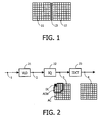
- Fig. 1 Let us consider two data blocks (11, 12) which are horizontally adjacent, as is shown in Fig. 1. These two blocks are separated by a block border (13).
- the present invention has for its object to determine the vertical blocking artefacts which could be present on this block border.
- the following demonstration is based on the detection of this vertical blocking artefact but it is not limited to this detection, because a horizontal blocking artefact may be detected in a similar manner, based on two vertically adjacent pixel blocks.
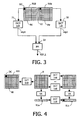
- Fig. 2 describes a conventional decoding method. Such a method is suitable for receiving a sequence of images encoded in the form of a series of blocks of encoded video data.
- the decoding method notably comprises the steps of:
- a complete decoding in accordance with this method thus necessitates the computation of an inverse discrete cosine transform IDCT for 64 DCT coefficients, which computation constitutes the most complex part of the decoding method.
- the present invention has for its object to allow detection of blocking artefacts without realizing such a complex computation.
- Fig. 3 describes the method of measuring blocking artefacts according to the invention. Such a method comprises the steps of:
- the invention is based on the mathematical approach illustrated in Fig. 4.
- the first horizontal row (R1,t) of a block (Bt) of DCT coefficients obtained on the basis of said bidimensional discrete cosine transform DCT8x8 of the corresponding block (B) of pixels is thus the average value (VA) in accordance with a vertical direction of the data emanating from the monodimensional discrete cosine transforms DCT1x8 of 8 horizontal rows of the pixel block (B).
- This first horizontal row (R1t) corresponds to the horizontal variations within said block.
- the first horizontal row (R1t) of a block of DCT coefficients (Bt) may be obtained either from an average value (VA) in accordance with a vertical direction of the pixels of the block (B) followed by a DCT1x8 transform of the horizontal row (R1a) of the average values thus obtained, or from DCT1x8 transforms of each row of the pixel block followed by an average value (VA) in accordance with a vertical direction of the transformed data thus obtained.
- the direct coefficient DC is the first coefficient of the first horizontal row (R1t) thus obtained.
- the value of the virtual border pixel (vep) is, for example, the value of the pixel on the left or on the right of the row (R1a) of average values, according to whether the border of the block is on the left or on the right.
- the present invention is based on the computation of this virtual border pixel.
- This virtual pixel is computed solely on the basis of 8 DCT coefficients in our example, instead of 64 DCT coefficients used for computing the real pixel.
- a virtual border pixel substantially corresponds to the average value of the pixels present along the block border, namely for the block situated on the left of the border, the average value of the pixels situated on its right edge and, for the block situated on the right of the border, the average value of the pixels situated on its left edge. Different methods are possible for computing the virtual border pixel.
- the virtual pixels are determined on the basis of the monodimensional inverse discrete transforms IDCT1x8 of the first row (R1tl) of the block situated on the left of the vertical border (13) and the first row (R1tr) of the block situated on the right of said border at points corresponding exactly to the pixels which are nearest to the border, namely, in our example, R1al(7) for the left block, and R1ar(0) for the right block.
- K and C (v) are constants.
- the virtual pixels are determined on the basis of the monodimensional inverse discrete cosine transform IDCT1x8 of a point corresponding exactly to the border between the first and second blocks.
- This embodiment which is more sophisticated than the embodiment described hereinbefore, allows local variations to be taken into account.
- An example of this second embodiment is illustrated in Fig. 5 and allows computation of the value of the virtual border pixel vep1, at position 7,5 with respect to the left row, on the basis of a linear interpolation of intermediate data R1al(6) and R1al(7).
- the present invention only requires the computation of a monodimensional inverse discrete cosine transform at a single point, namely 8 multiplications and 8 additions. Consequently, the invention is at least 64 times less complex than the known methods of measuring blocking artefacts, provided that the method of measuring blocking artefacts has access to streams of encoded video data.
- the method of measuring artefacts comprises a step of computing a blocking artefact level on the basis of the values of said virtual pixels.
- the blocking artefact level corresponds to the absolute value of the difference between the values of the first and second virtual pixels.
- a global level of blocking artefacts is computed for the images of the intra type, i.e. the images encoded without reference to any other image.
- this global blocking artefact level is considered to be representative of a set of blocking artefact levels for a group of pictures (GOP) comprising said intra image and at least one other image of a different type.
- the measurement of the global blocking artefact level is completed by measurements based on parameters relating to the other images of the group of pictures such as, for example the quantization steps used, the size of the motion vectors, or the number of bits which have been necessary to encode these images.
- the method of measuring blocking artefacts to blocks of the intra type or to blocks having a zero motion vector, said blocks belonging to an image of the inter type, i.e. an image encoded with reference to at least one other image.
- the coincidence of blocking artefacts between the images of the intra and inter types is considered, for example, as a confirmation of the presence of said blocking artefacts, in which a weighting coefficient of more than 1 is applied to the level of corresponding blocking artefacts.
- the method of measuring blocking artefacts may be improved in many ways, notably relating to considerations based on the human visual system.
- the method of measuring blocking artefacts takes the luminance masking effect into account, which causes the block effects to be less visible in the very bright zones and in the very dark zones of the image.
- the reference function which translates this property of the human visual system is shown diagrammatically in Fig. 6. This function (f) is described in detail in the article by H.R. Wu and M. Yuen, entitled "A generalized block-edge impairment metric for video coding” published in IEEE Signal Processing Letters, vol. 4, no. 11, pp. 317-320, November 1997.
- the blocking artefact level (VEP_L) determined for this pair of blocks remains unchanged; if not, it is set to zero.
- the blocking artefact level (VEP_L) determined for a pair of adjacent blocks is weighted as a function of the average luminance (AvgL) of the pair of blocks, the weighting being maximum for an average luminance value which is equal to about 70 and minimum for an average luminance value which is equal to 0 or 255 in our example.
- the method of measuring blocking artefacts takes the texture masking effect into account, which causes the block effects to be more visible in the uniform zones of the image than in the textured zones.
- the method of measuring blocking artefacts according to the invention comprises a step of computing the energy E of the frequency coefficients AC of the DCT coefficient blocks by taking into account the low-frequency coefficients ACbf such as those represented in Fig.
- fmax is the maximum frequency taken into account in the computation of the energy of a block. If the energy of a pair of adjacent blocks is less than a first threshold T1, the zone is quasi uniform and the blocking artefact level (VEP_L) associated with the border between the two adjacent blocks is weighted by a higher weighting coefficient c1, for example, higher than 1.
- VEP_L blocking artefact level
- the zone is less textured and the level of blocking artefacts associated with the border between the two adjacent blocks is weighted by a smaller weighting coefficient c2, for example, equal to 1.
- the zone is textured and the blocking artefact level associated with the border between the two adjacent blocks is weighted by an even smaller weighting coefficient c3, for example, less than 1, because the blocking artefacts are less visible in these zones.
- the method of measuring blocking artefacts takes the number of borders of neighboring blocks into account. For example, if a horizontal border of the block is adjacent to a vertical border of the block so that a corner is formed and if the blocking artefact levels associated with these borders are higher than a predetermined threshold Tmin1, said blocking artefact levels are weighted by a weighting coefficient c which is higher than 1. In accordance with another example, if other block borders are consecutive in accordance with a given direction and if each of them has a blocking artefact level which is higher than a predetermined threshold Tmin2, said blocking artefact levels are weighted by a weighting coefficient c' which is higher than 1.
- the method of measuring blocking artefacts comprises a step of detecting natural contours.
- the blocking artefact level of a border is compared with a predetermined threshold Tmax, equal to, for example, 30. If the blocking artefact level is higher than this predetermined threshold Tmax, the value of the blocking artefact level is set to zero because it is a natural contour which has been detected.
- the predetermined threshold Tmax is weighted as a function of the quantization steps associated with the blocks on both sides of the border.
- the method of measuring blocking artefacts may be used in, for example, an integrated circuit, by means of hardware or software or a combination of them.
- the device for measuring blocking artefacts comprises circuits each realizing a step of the method of measuring blocking artefacts as described hereinbefore, in which the circuits for computing the inverse discrete cosine transform IDCT are notably known to those skilled in the art.
- Said device comprises:
- a set of instructions in a programming memory may cause the circuit to perform the different steps of the method of measuring blocking artefacts as described hereinbefore.
- the set of instructions may also be loaded into the programming memory by reading a common data carrier, for example, a disc comprising the set of instructions. Reading may also be performed by means of a common communication network, for example, the Internet. In this case, a service provider supplies the set of instructions to those interested.
- the method of measuring blocking artefacts finds numerous applications, such as decoding or decompression of encoded video data, encoding or compressing video data, and transcoding encoded video data, such a transcoding allowing, for example, elastic storage of encoded video data on a disc.
- a method of decoding video data according to the invention is described with reference to Fig. 7. This method notably comprises the steps of:
- a light filter is used for a blocking artefact level which is lower than a first predetermined threshold TR1.
- a stronger filtering is applied for a blocking artefact level between the first predetermined threshold TR1 and the second predetermined threshold TR2.
- a filtering which is even stronger is used for a blocking artefact level which is higher than the second predetermined threshold TR2.
- Preferably only the pixels along a block border are filtered. It will be apparent to those skilled in the art that another division of the range of blocking artefact levels, as well as another choice of filters is possible.
- the decoding method also comprises a step of enhancing the contour, said step being deactivated if a blocking artefact level between a minimal boundary and a maximal boundary has been detected in the measuring step, such that a blocking artefact is not enhanced.
- the present invention also relates to the video decoder allowing use of said decoding method.
- a method of encoding video data according to the invention is also described in Fig. 8. It comprises a step of pre-encoding PASS 1 (80) pixel blocks (IS) corresponding to an image, said step being performed with a quantization step q which is constant for all the blocks of the image in accordance with a principle which is known to those skilled in the art and is described in, for example, European patent application no. 1 082 855.
- An intermediate stream of pre-encoded video data (PES) and pre-encoding parameters (p) such as, for example, the number of bits used for pre-encoding the blocks of the image results from this pre-encoding step.
- the encoding method also comprises the steps of:
- modified pre-encoding parameters are subsequently used during the step of encoding PASS2 (84) pixel blocks (IS), which supplies a final stream of encoded video data (ES) in accordance with a principle known to those skilled in the art.
- the pre-encoding parameter is the complexity X(i,j), equal to the product of the quantization step by the number of bits used for the encoding operation, and corresponding to a block at position (i,j) in the image.
- This complexity is modified as follows, resulting in a modified complexity X'(i,j):
- X ′ ( i , j ) C ( VEP_L ( i , j ) ) * X ( i , j )
- C is a coefficient which depends on the blocking artefact level VEP_L(i,j).
- Fig. 9 shows three examples of variations of the coefficient C as a function of the blocking artefact level (VEP_L), one linear variation (91) and two non-linear variations (92, 93) between two boundaries Cmin and Cmax equal to, for example, 1 and 2, respectively.
- VEP_L blocking artefact level
- 92, 93 non-linear variations
- the encoding of an image of the intra type is thus improved and the encoding of images which follow this intra image in a group of pictures GOP is also improved in cascade.
- the present invention also relates to the video encoder allowing use of said encoding method.
- a method of transcoding video data according to the invention is described with reference to Fig. 10. It notably comprises the steps of:
- the value of the second quantization step Q2 of a block during the process is a function of the space which is available on the disk, as well as of the value of a blocking artefact level associated with said block.
- the stream of encoded video data has a scalable structure, i.e. it comprises a base layer and enhancement layers.
- a scalable structure i.e. it comprises a base layer and enhancement layers.
- the present invention also relates to the video transcoder allowing use of said transcoding method.
Landscapes
- Engineering & Computer Science (AREA)
- Multimedia (AREA)
- Signal Processing (AREA)
- Compression Or Coding Systems Of Tv Signals (AREA)
- Compression Of Band Width Or Redundancy In Fax (AREA)
- Memory System Of A Hierarchy Structure (AREA)
- Compression, Expansion, Code Conversion, And Decoders (AREA)
- Testing, Inspecting, Measuring Of Stereoscopic Televisions And Televisions (AREA)
- Investigating Or Analyzing Non-Biological Materials By The Use Of Chemical Means (AREA)
- Investigating Or Analysing Materials By The Use Of Chemical Reactions (AREA)
Claims (12)
- Verfahren zum Messen von Blockartefakten auf Basis von Videodaten, die entsprechend einer Codierungstechnik auf Blockbasis codiert worden sind, wobei das Verfahren die nachfolgenden Verfahrensschritte umfasst:- das Berechnen einer eindimensionalen inversen diskreten Transformation (31) einer ersten Reihe eines erstes Blocks codierter Videodaten, geeignet zum Liefern eines Wertes eines ersten virtuellen Randpixels (vep1),- das Berechnen einer eindimensionalen inversen diskreten Transformation (32) einer ersten Reihe eines zweiten Blocks codierter Videodaten, wobei der zweite Block an den ersten Block grenzt, geeignet zum Liefern eines Wertes eines zweiten virtuellen Randpixels (vep2),- das Berechnen (33) eines Blockartefaktpegels (VEP_L) auf Basis eines Absolutwertes einer Differenz zwischen den Werten des ersten und des zweiten virtuellen Pixels.
- Verfahren zum Messen von Blockartefakten nach Anspruch 1, wobei die virtuellen Randpixel an einer Stelle ermittelt werden entsprechend einer Grenze zwischen dem ersten und dem zweiten Block.
- Verfahren zum messen von Blockartefakten nach Anspruch 1, wobei die virtuellen Randpixel an Stellen ermittelt werden, die dem nächsten Pixel an beiden Seiten einer Grenze zwischen dem ersten und dem zweiten Block entsprechen.
- Verfahren zum Messen von Blockartefakten nach Anspruch 1, wobei die Berechnung eines Blockartefaktpegels durch einen Gewichtungskoeffizienten gewichtet wird, der eine Funktion der Eigenschaften des menschlichen Sehsystems.
- Verfahren zum Codieren von Videodaten in Form von Blöcken, wobei das Verfahren die nachfolgenden Verfahrensschritte umfasst:- Vorcodierung (80) eines Satzes mit Videodatenblöcken (IS), geeignet zum Liefern eines Gebildes aus vorcodierten Datenblöcken (PES) und Vorcodierungsparametern (p),- eine teilweise Codierung (81, 82) des Satzes mit vorcodierten Datenblöcken, geeignet zum Liefern transformierter Datenblöcke,- Messung von Blockartefakten (30) nach Anspruch 1, geeignet zum Liefern von Blockartefaktpegeln (VEP_L) auf Basis transformierter Datenblöcke,- Modifikation (83) des Vorcodierungsparameters (p) eines Blocks entsprechend einem Blockartefaktpegel, der mit dem genannten Block assoziiert ist, geeignet zum Liefern eines modifizierten Vorcodierungsparameters (p'),- Codierung (84) des Gebildes aus Videodaten (IS) auf Basis modifizierter Vorcodierungsparameter (p').
- Verfahren zum Decodieren codierter Datenblöcke, wobei das Verfahren die nachfolgenden Verfahrensschritte umfasst:- teilweise Codierung (21, 22) der codierten Datenblöcke (1), geeignet zum Liefern transformierter Datenblöcke (3),- inverse diskrete Transformation (23), geeignet zum Umwandeln trabsformierter Datenblöcke (3) in invertiert transformierte Datenblöcke (4),- Messung von Blockartefakten (30) nach Anspruch 1, geeignet zum Liefern von Blockartefaktpegeln (VEP_L) auf Basis transformierter Datenblöcke (3),- Filterung (70) geeignet zum Anwenden eines Filters aus einem Satz von Filtern (71, 72, 73) für ein Gebilde invertiert transformierter Daten an beiden Seiten einer Grenz zwischen zwei Blöcken entsprechend dem Blockartefaktpegel (VEP_L), assoziiert mit der genannten Grenze.
- Verfahren zum Umcodieren codierter Datenblöcke, wobei das Verfahren die nachfolgenden Verfahrensschritte umfasst:- teilweise Decodierung (101, 102) codierter Datenblöcke, geeignet zum Liefern transformierter Datenblöcke, womit ein erster Quantisierungsschritt assoziiert ist,- Messung von Blockartefakten (30) nach Anspruch 1, geeignet zum Liefern von Blockartefaktpegeln (VEP_L) auf Basis transformierter Datenblöcke,- teilweise Codierung (103, 104) transformierter Datenblöcke, geeignet zum Liefern codierter Datenblöcke, womit ein zweiter Quantisierungsschritt assoziiert ist,- Speicherung (105) codierter Datenblöcke in einer Speichereinheit, wobei der Wert des zweiten Quantisierungsschrittes eines Blocks eine Funktion eines Raumes ist, der in der Speichereinheit verfügbar ist sowie eine Funktion eines Wertes eines Artefaktpegels des genannten Blocks.
- Anordnung zum Messen von Blockartefakten auf Basis codierter Videodaten entsprechend einer Blockcodierungstechnik, wobei diese Anordnung Folgendes umfasst:- Mittel zum Berechnen einer eindimensionalen inversen diskreten Transformation einer ersten Reihe eines ersten Blocks codierter Videodaten, geeignet zum Liefern eines Wertes eines ersten virtuellen Randpixels,- Mittel zum Berechnen einer eindimensionalen inversen diskreten Transformation einer ersten Reihe eines zweiten Blocks codierter Videodaten, wobei der zweite Block an den ersten Block grenzt, geeignet zum Liefern eines Wertes eines zweiten virtuellen Randpixels,- eine Recheneinheit, geeignet zum berechnen eines Blockartefaktpegels auf Basis eines Absolutwertes einer Differenz zwischen den Werten des ersten und des zweiten virtuellen Pixels.
- Videocodierer von Daten in Form von Blöcken, wobei der Videocodierer Folgendes umfasst:- Mittel zur Vorcodierung eines Satzes von Videodatenblöcken (IS), geeignet zum Liefern eines Gebildes aus vorcodierten Datenblöcken (PES) und Vorcodierungsparametern (p).- Mittel zur teilweisen Decodierung des Satzes vorcodierter Datenblöcke, geeignet zum Liefern transformierter Datenblöcke,- eine Anordnung zum messen von Blockartefakten nach Anspruch 8, geeignet zum Liefern von Blockartefaktpegeln (VEP_L) auf Basis transformierter Datenblöcke,- eine Einheit zum berechnen eines modifizierten Vorcodierungsparameters (p') auf Basis des Vorcodierungsparameters (p) eines Blocks und eines Blockartefaktpegels, der mit dem genannten Block assoziiert ist,- Mittel zum Codieren des Gebildes aus Videodaten (IS) auf Basis modifizierter Vorcodierungsparameter (p').
- Videodecoder für codierte Datenblöcke, der Folgendes umfasst:- Mittel zur teilweisen Decodierung codierter Datenblöcke (1), geeignet zum Liefern transformierter Datenblöcke (3),- Mittel zur inversen diskreten Transformation (23) zur Umwandlung transformierter Datenblöcke (3) in invertiert transformierte Datenblöcke (4),- eine Anordnung zur Messung von Blockartefakten nach Anspruch 8, geeignet zum Liefern von Blockartefaktpegeln (VEP_L) auf Basis transformierter Datenblöcke (3),- eine Filtereinheit, geeignet zum Anwenden eines Filters aus einem Satz von Filtern (71, 72, 73) für ein Gebilde aus invertiert transformierter Daten an beiden Seiten einer Grenze zwischen zwei Blöcken entsprechend dem Blockartefaktpegel (VEP_L), der mit dem genannten Rand assoziiert ist.
- Videotranscoder codierter Datenblöcke, der Folgendes umfasst:- Mittel zur teilweisen Decodierung codierter Datenblöcke, geeignet zum Liefern transformierter Datenblöcke, womit ein erster Quantisierungsschritt assoziiert ist,- Anordnung zur Messung von Blockartefakten nach Anspruch 8, geeignet zum Liefern von Blockartefaktpegeln (VEP_L) auf Basis transformierter Datenblöcke,- Mittel zur teilweisen Decodierung transformierter Datenblöcke, geeignet zum Liefern codierter Datenblöcke, womit ein zweiter Quantisierungsschritt assoziiert ist,- eine Einheit zur Speicherung codierter Datenblöcke,- eine Recheneinheit, geeignet zum Berechnen des Wertes des zweiten Quantisierungsschrittes eines Blocks auf Basis eines Raumes, der in der Speichereinheit verfügbar ist und eines Wertes eines Blockartefaktpegels, der mit dem genannten Block assoziiert ist.
- Computerprogramm, geeignet zum Durchführen des Verfahrens zur Messung von Blockartefakten nach Anspruch 1, wenn das genannte Programm von einem Prozessor durchgeführt wird.
Applications Claiming Priority (3)
| Application Number | Priority Date | Filing Date | Title |
|---|---|---|---|
| FR0215292 | 2002-12-04 | ||
| FR0215292A FR2848373A1 (fr) | 2002-12-04 | 2002-12-04 | Procede de mesure d'artefacts de bloc |
| PCT/IB2003/005420 WO2004052019A1 (en) | 2002-12-04 | 2003-11-24 | Method of measuring blocking artefacts |
Publications (2)
| Publication Number | Publication Date |
|---|---|
| EP1570678A1 EP1570678A1 (de) | 2005-09-07 |
| EP1570678B1 true EP1570678B1 (de) | 2006-09-27 |
Family
ID=32319979
Family Applications (1)
| Application Number | Title | Priority Date | Filing Date |
|---|---|---|---|
| EP03772544A Expired - Lifetime EP1570678B1 (de) | 2002-12-04 | 2003-11-24 | Verfahren zur erfassung von blockartefakten |
Country Status (10)
| Country | Link |
|---|---|
| US (1) | US7778330B2 (de) |
| EP (1) | EP1570678B1 (de) |
| JP (1) | JP2006509401A (de) |
| KR (1) | KR20050085368A (de) |
| CN (1) | CN100459714C (de) |
| AT (1) | ATE341160T1 (de) |
| AU (1) | AU2003280174A1 (de) |
| DE (1) | DE60308727T2 (de) |
| FR (1) | FR2848373A1 (de) |
| WO (1) | WO2004052019A1 (de) |
Families Citing this family (6)
| Publication number | Priority date | Publication date | Assignee | Title |
|---|---|---|---|---|
| KR100880538B1 (ko) * | 2006-11-08 | 2009-02-02 | 팅크웨어(주) | 경로 탐색 시스템 및 방법 |
| US20080298702A1 (en) * | 2007-06-04 | 2008-12-04 | Aricent Inc. | Fixed rate JPEG encoding |
| WO2009091530A1 (en) * | 2008-01-18 | 2009-07-23 | Thomson Licensing | Method for assessing perceptual quality |
| WO2010120338A2 (en) | 2009-04-14 | 2010-10-21 | Thomson Licensing | Methods and apparatus for filter parameter determination and selection responsive to variable transforms in sparsity-based de-artifact filtering |
| US9998750B2 (en) * | 2013-03-15 | 2018-06-12 | Cisco Technology, Inc. | Systems and methods for guided conversion of video from a first to a second compression format |
| CN116489396A (zh) * | 2016-10-14 | 2023-07-25 | 世宗大学校产学协力团 | 影像解码/编码方法、传送比特流的方法及记录介质 |
Family Cites Families (11)
| Publication number | Priority date | Publication date | Assignee | Title |
|---|---|---|---|---|
| US5590064A (en) * | 1994-10-26 | 1996-12-31 | Intel Corporation | Post-filtering for decoded video signals |
| DE69738787D1 (de) * | 1996-05-14 | 2008-07-31 | Daewoo Electronics Corp | Reduzierung von Blockeffekten in einem Bewegtbilddekoder |
| KR100243225B1 (ko) * | 1997-07-16 | 2000-02-01 | 윤종용 | 블록화효과 및 링잉잡음 감소를 위한 신호적응필터링방법 및신호적응필터 |
| WO2001020912A1 (en) | 1999-09-14 | 2001-03-22 | Koninklijke Philips Electronics N.V. | Method and device for identifying block artifacts in digital video pictures |
| US6643410B1 (en) * | 2000-06-29 | 2003-11-04 | Eastman Kodak Company | Method of determining the extent of blocking artifacts in a digital image |
| US6823089B1 (en) * | 2000-09-28 | 2004-11-23 | Eastman Kodak Company | Method of determining the extent of blocking and contouring artifacts in a digital image |
| EP1202577B1 (de) * | 2000-10-10 | 2006-05-17 | Koninklijke Philips Electronics N.V. | Verfahren zur Verarbeitung von Videodateien |
| US20030035586A1 (en) * | 2001-05-18 | 2003-02-20 | Jim Chou | Decoding compressed image data |
| US7027654B1 (en) * | 2001-08-16 | 2006-04-11 | On2 Technologies | Video compression system |
| CN101448162B (zh) * | 2001-12-17 | 2013-01-02 | 微软公司 | 处理视频图像的方法 |
| US7020207B1 (en) * | 2002-12-02 | 2006-03-28 | Hitachi, Ltd. | Video error concealment mechanism for block based video decompression |
-
2002
- 2002-12-04 FR FR0215292A patent/FR2848373A1/fr not_active Withdrawn
-
2003
- 2003-11-24 AU AU2003280174A patent/AU2003280174A1/en not_active Abandoned
- 2003-11-24 EP EP03772544A patent/EP1570678B1/de not_active Expired - Lifetime
- 2003-11-24 JP JP2004556640A patent/JP2006509401A/ja active Pending
- 2003-11-24 AT AT03772544T patent/ATE341160T1/de not_active IP Right Cessation
- 2003-11-24 CN CNB2003801051744A patent/CN100459714C/zh not_active Expired - Fee Related
- 2003-11-24 WO PCT/IB2003/005420 patent/WO2004052019A1/en not_active Ceased
- 2003-11-24 US US10/536,846 patent/US7778330B2/en not_active Expired - Fee Related
- 2003-11-24 DE DE60308727T patent/DE60308727T2/de not_active Expired - Lifetime
- 2003-11-24 KR KR1020057010161A patent/KR20050085368A/ko not_active Ceased
Also Published As
| Publication number | Publication date |
|---|---|
| DE60308727T2 (de) | 2007-08-09 |
| WO2004052019A1 (en) | 2004-06-17 |
| EP1570678A1 (de) | 2005-09-07 |
| US7778330B2 (en) | 2010-08-17 |
| JP2006509401A (ja) | 2006-03-16 |
| FR2848373A1 (fr) | 2004-06-11 |
| DE60308727D1 (de) | 2006-11-09 |
| CN1720746A (zh) | 2006-01-11 |
| US20060093227A1 (en) | 2006-05-04 |
| ATE341160T1 (de) | 2006-10-15 |
| AU2003280174A1 (en) | 2004-06-23 |
| CN100459714C (zh) | 2009-02-04 |
| KR20050085368A (ko) | 2005-08-29 |
Similar Documents
| Publication | Publication Date | Title |
|---|---|---|
| US6665346B1 (en) | Loop-filtering method for image data and apparatus therefor | |
| Yang et al. | Removal of compression artifacts using projections onto convex sets and line process modeling | |
| US6983079B2 (en) | Reducing blocking and ringing artifacts in low-bit-rate coding | |
| US5850294A (en) | Method and apparatus for post-processing images | |
| JP4004089B2 (ja) | ビデオ信号復号化システムおよびノイズ抑圧方法 | |
| US5479211A (en) | Image-signal decoding apparatus | |
| JP3095140B2 (ja) | ブロック化効果の低減のための一次元信号適応フィルター及びフィルタリング方法 | |
| US6539060B1 (en) | Image data post-processing method for reducing quantization effect, apparatus therefor | |
| JP2624087B2 (ja) | 映像信号復号化方法 | |
| JPH10327334A (ja) | リンギングノイズの減少のための信号適応フィルタリング方法及び信号適応フィルター | |
| JP2000232651A (ja) | ブロック変換符号化された画像表現から復号した電子的画像の中の歪を除去する方法 | |
| Shirani et al. | Reconstruction of baseline JPEG coded images in error prone environments | |
| KR100672592B1 (ko) | 디스플레이 장치의 영상 보상장치 및 보상방법 | |
| Nakajima et al. | A pel adaptive reduction of coding artifacts for MPEG video signals | |
| KR100331331B1 (ko) | 영상데이터 루프필터링 방법 | |
| JP2004215216A (ja) | 画像処理装置、画像処理方法および画像処理プログラム | |
| US7778330B2 (en) | Method of measuring blocking artefacts | |
| KR20000012878A (ko) | 영상데이터 루프필터링방법 및 장치 | |
| KR100628839B1 (ko) | 모서리 잡음 검출 및 보상방법 | |
| JPH05227518A (ja) | 画像信号復号化装置 | |
| JP2001346208A (ja) | 画像信号復号化装置および方法 | |
| KR20030078633A (ko) | 낮은 비트 레이트 애플리케이션들을 위한 디지털이미지들의 처리 방법 | |
| KR100230277B1 (ko) | 블럭화 효과 감소를 위한 일차원 신호 적응 필터 및 필터링 방법 | |
| JP2962815B2 (ja) | 画像処理方法 | |
| JPH06311499A (ja) | 画像信号復号化装置 |
Legal Events
| Date | Code | Title | Description |
|---|---|---|---|
| PUAI | Public reference made under article 153(3) epc to a published international application that has entered the european phase |
Free format text: ORIGINAL CODE: 0009012 |
|
| 17P | Request for examination filed |
Effective date: 20050704 |
|
| AK | Designated contracting states |
Kind code of ref document: A1 Designated state(s): AT BE BG CH CY CZ DE DK EE ES FI FR GB GR HU IE IT LI LU MC NL PT RO SE SI SK TR |
|
| AX | Request for extension of the european patent |
Extension state: AL LT LV MK |
|
| GRAP | Despatch of communication of intention to grant a patent |
Free format text: ORIGINAL CODE: EPIDOSNIGR1 |
|
| DAX | Request for extension of the european patent (deleted) | ||
| GRAS | Grant fee paid |
Free format text: ORIGINAL CODE: EPIDOSNIGR3 |
|
| GRAA | (expected) grant |
Free format text: ORIGINAL CODE: 0009210 |
|
| AK | Designated contracting states |
Kind code of ref document: B1 Designated state(s): AT BE BG CH CY CZ DE DK EE ES FI FR GB GR HU IE IT LI LU MC NL PT RO SE SI SK TR |
|
| PG25 | Lapsed in a contracting state [announced via postgrant information from national office to epo] |
Ref country code: IT Free format text: LAPSE BECAUSE OF FAILURE TO SUBMIT A TRANSLATION OF THE DESCRIPTION OR TO PAY THE FEE WITHIN THE PRESCRIBED TIME-LIMIT;WARNING: LAPSES OF ITALIAN PATENTS WITH EFFECTIVE DATE BEFORE 2007 MAY HAVE OCCURRED AT ANY TIME BEFORE 2007. THE CORRECT EFFECTIVE DATE MAY BE DIFFERENT FROM THE ONE RECORDED. Effective date: 20060927 Ref country code: SI Free format text: LAPSE BECAUSE OF FAILURE TO SUBMIT A TRANSLATION OF THE DESCRIPTION OR TO PAY THE FEE WITHIN THE PRESCRIBED TIME-LIMIT Effective date: 20060927 Ref country code: LI Free format text: LAPSE BECAUSE OF FAILURE TO SUBMIT A TRANSLATION OF THE DESCRIPTION OR TO PAY THE FEE WITHIN THE PRESCRIBED TIME-LIMIT Effective date: 20060927 Ref country code: SK Free format text: LAPSE BECAUSE OF FAILURE TO SUBMIT A TRANSLATION OF THE DESCRIPTION OR TO PAY THE FEE WITHIN THE PRESCRIBED TIME-LIMIT Effective date: 20060927 Ref country code: AT Free format text: LAPSE BECAUSE OF FAILURE TO SUBMIT A TRANSLATION OF THE DESCRIPTION OR TO PAY THE FEE WITHIN THE PRESCRIBED TIME-LIMIT Effective date: 20060927 Ref country code: BE Free format text: LAPSE BECAUSE OF FAILURE TO SUBMIT A TRANSLATION OF THE DESCRIPTION OR TO PAY THE FEE WITHIN THE PRESCRIBED TIME-LIMIT Effective date: 20060927 Ref country code: CZ Free format text: LAPSE BECAUSE OF FAILURE TO SUBMIT A TRANSLATION OF THE DESCRIPTION OR TO PAY THE FEE WITHIN THE PRESCRIBED TIME-LIMIT Effective date: 20060927 Ref country code: FI Free format text: LAPSE BECAUSE OF FAILURE TO SUBMIT A TRANSLATION OF THE DESCRIPTION OR TO PAY THE FEE WITHIN THE PRESCRIBED TIME-LIMIT Effective date: 20060927 Ref country code: RO Free format text: LAPSE BECAUSE OF FAILURE TO SUBMIT A TRANSLATION OF THE DESCRIPTION OR TO PAY THE FEE WITHIN THE PRESCRIBED TIME-LIMIT Effective date: 20060927 Ref country code: CH Free format text: LAPSE BECAUSE OF FAILURE TO SUBMIT A TRANSLATION OF THE DESCRIPTION OR TO PAY THE FEE WITHIN THE PRESCRIBED TIME-LIMIT Effective date: 20060927 Ref country code: NL Free format text: LAPSE BECAUSE OF FAILURE TO SUBMIT A TRANSLATION OF THE DESCRIPTION OR TO PAY THE FEE WITHIN THE PRESCRIBED TIME-LIMIT Effective date: 20060927 |
|
| REG | Reference to a national code |
Ref country code: GB Ref legal event code: FG4D |
|
| REG | Reference to a national code |
Ref country code: CH Ref legal event code: EP |
|
| REG | Reference to a national code |
Ref country code: IE Ref legal event code: FG4D |
|
| REF | Corresponds to: |
Ref document number: 60308727 Country of ref document: DE Date of ref document: 20061109 Kind code of ref document: P |
|
| PG25 | Lapsed in a contracting state [announced via postgrant information from national office to epo] |
Ref country code: IE Free format text: LAPSE BECAUSE OF NON-PAYMENT OF DUE FEES Effective date: 20061124 |
|
| PG25 | Lapsed in a contracting state [announced via postgrant information from national office to epo] |
Ref country code: MC Free format text: LAPSE BECAUSE OF NON-PAYMENT OF DUE FEES Effective date: 20061130 |
|
| PG25 | Lapsed in a contracting state [announced via postgrant information from national office to epo] |
Ref country code: DK Free format text: LAPSE BECAUSE OF FAILURE TO SUBMIT A TRANSLATION OF THE DESCRIPTION OR TO PAY THE FEE WITHIN THE PRESCRIBED TIME-LIMIT Effective date: 20061227 Ref country code: SE Free format text: LAPSE BECAUSE OF FAILURE TO SUBMIT A TRANSLATION OF THE DESCRIPTION OR TO PAY THE FEE WITHIN THE PRESCRIBED TIME-LIMIT Effective date: 20061227 Ref country code: BG Free format text: LAPSE BECAUSE OF FAILURE TO SUBMIT A TRANSLATION OF THE DESCRIPTION OR TO PAY THE FEE WITHIN THE PRESCRIBED TIME-LIMIT Effective date: 20061227 |
|
| PG25 | Lapsed in a contracting state [announced via postgrant information from national office to epo] |
Ref country code: ES Free format text: LAPSE BECAUSE OF FAILURE TO SUBMIT A TRANSLATION OF THE DESCRIPTION OR TO PAY THE FEE WITHIN THE PRESCRIBED TIME-LIMIT Effective date: 20070107 |
|
| NLV1 | Nl: lapsed or annulled due to failure to fulfill the requirements of art. 29p and 29m of the patents act | ||
| PG25 | Lapsed in a contracting state [announced via postgrant information from national office to epo] |
Ref country code: PT Free format text: LAPSE BECAUSE OF FAILURE TO SUBMIT A TRANSLATION OF THE DESCRIPTION OR TO PAY THE FEE WITHIN THE PRESCRIBED TIME-LIMIT Effective date: 20070313 |
|
| REG | Reference to a national code |
Ref country code: CH Ref legal event code: PL |
|
| ET | Fr: translation filed | ||
| PLBE | No opposition filed within time limit |
Free format text: ORIGINAL CODE: 0009261 |
|
| STAA | Information on the status of an ep patent application or granted ep patent |
Free format text: STATUS: NO OPPOSITION FILED WITHIN TIME LIMIT |
|
| 26N | No opposition filed |
Effective date: 20070628 |
|
| PG25 | Lapsed in a contracting state [announced via postgrant information from national office to epo] |
Ref country code: GR Free format text: LAPSE BECAUSE OF FAILURE TO SUBMIT A TRANSLATION OF THE DESCRIPTION OR TO PAY THE FEE WITHIN THE PRESCRIBED TIME-LIMIT Effective date: 20061228 |
|
| PG25 | Lapsed in a contracting state [announced via postgrant information from national office to epo] |
Ref country code: EE Free format text: LAPSE BECAUSE OF FAILURE TO SUBMIT A TRANSLATION OF THE DESCRIPTION OR TO PAY THE FEE WITHIN THE PRESCRIBED TIME-LIMIT Effective date: 20060927 |
|
| PG25 | Lapsed in a contracting state [announced via postgrant information from national office to epo] |
Ref country code: TR Free format text: LAPSE BECAUSE OF FAILURE TO SUBMIT A TRANSLATION OF THE DESCRIPTION OR TO PAY THE FEE WITHIN THE PRESCRIBED TIME-LIMIT Effective date: 20060927 Ref country code: HU Free format text: LAPSE BECAUSE OF FAILURE TO SUBMIT A TRANSLATION OF THE DESCRIPTION OR TO PAY THE FEE WITHIN THE PRESCRIBED TIME-LIMIT Effective date: 20070328 Ref country code: LU Free format text: LAPSE BECAUSE OF NON-PAYMENT OF DUE FEES Effective date: 20061124 |
|
| PG25 | Lapsed in a contracting state [announced via postgrant information from national office to epo] |
Ref country code: CY Free format text: LAPSE BECAUSE OF FAILURE TO SUBMIT A TRANSLATION OF THE DESCRIPTION OR TO PAY THE FEE WITHIN THE PRESCRIBED TIME-LIMIT Effective date: 20060927 |
|
| PGFP | Annual fee paid to national office [announced via postgrant information from national office to epo] |
Ref country code: FR Payment date: 20081125 Year of fee payment: 6 |
|
| PGFP | Annual fee paid to national office [announced via postgrant information from national office to epo] |
Ref country code: GB Payment date: 20091130 Year of fee payment: 7 |
|
| PGFP | Annual fee paid to national office [announced via postgrant information from national office to epo] |
Ref country code: DE Payment date: 20100129 Year of fee payment: 7 |
|
| REG | Reference to a national code |
Ref country code: FR Ref legal event code: ST Effective date: 20100730 |
|
| PG25 | Lapsed in a contracting state [announced via postgrant information from national office to epo] |
Ref country code: FR Free format text: LAPSE BECAUSE OF NON-PAYMENT OF DUE FEES Effective date: 20091130 |
|
| GBPC | Gb: european patent ceased through non-payment of renewal fee |
Effective date: 20101124 |
|
| REG | Reference to a national code |
Ref country code: DE Ref legal event code: R119 Ref document number: 60308727 Country of ref document: DE Effective date: 20110601 Ref country code: DE Ref legal event code: R119 Ref document number: 60308727 Country of ref document: DE Effective date: 20110531 |
|
| PG25 | Lapsed in a contracting state [announced via postgrant information from national office to epo] |
Ref country code: GB Free format text: LAPSE BECAUSE OF NON-PAYMENT OF DUE FEES Effective date: 20101124 |
|
| PG25 | Lapsed in a contracting state [announced via postgrant information from national office to epo] |
Ref country code: DE Free format text: LAPSE BECAUSE OF NON-PAYMENT OF DUE FEES Effective date: 20110531 |