EP1569719B1 - Systeme zum unterscheiden von polymorphen von monomorphen tachyarrhythmien - Google Patents
Systeme zum unterscheiden von polymorphen von monomorphen tachyarrhythmien Download PDFInfo
- Publication number
- EP1569719B1 EP1569719B1 EP03790256A EP03790256A EP1569719B1 EP 1569719 B1 EP1569719 B1 EP 1569719B1 EP 03790256 A EP03790256 A EP 03790256A EP 03790256 A EP03790256 A EP 03790256A EP 1569719 B1 EP1569719 B1 EP 1569719B1
- Authority
- EP
- European Patent Office
- Prior art keywords
- count
- tachyarrhythmia
- polymorphic
- event
- polymorphic tachyarrhythmia
- Prior art date
- Legal status (The legal status is an assumption and is not a legal conclusion. Google has not performed a legal analysis and makes no representation as to the accuracy of the status listed.)
- Expired - Lifetime
Links
Images




Classifications
-
- A—HUMAN NECESSITIES
- A61—MEDICAL OR VETERINARY SCIENCE; HYGIENE
- A61N—ELECTROTHERAPY; MAGNETOTHERAPY; RADIATION THERAPY; ULTRASOUND THERAPY
- A61N1/00—Electrotherapy; Circuits therefor
- A61N1/18—Applying electric currents by contact electrodes
- A61N1/32—Applying electric currents by contact electrodes alternating or intermittent currents
- A61N1/38—Applying electric currents by contact electrodes alternating or intermittent currents for producing shock effects
- A61N1/39—Heart defibrillators
- A61N1/3956—Implantable devices for applying electric shocks to the heart, e.g. for cardioversion
-
- A—HUMAN NECESSITIES
- A61—MEDICAL OR VETERINARY SCIENCE; HYGIENE
- A61B—DIAGNOSIS; SURGERY; IDENTIFICATION
- A61B5/00—Measuring for diagnostic purposes; Identification of persons
- A61B5/24—Detecting, measuring or recording bioelectric or biomagnetic signals of the body or parts thereof
- A61B5/316—Modalities, i.e. specific diagnostic methods
- A61B5/318—Heart-related electrical modalities, e.g. electrocardiography [ECG]
- A61B5/346—Analysis of electrocardiograms
- A61B5/349—Detecting specific parameters of the electrocardiograph cycle
- A61B5/361—Detecting fibrillation
-
- A—HUMAN NECESSITIES
- A61—MEDICAL OR VETERINARY SCIENCE; HYGIENE
- A61B—DIAGNOSIS; SURGERY; IDENTIFICATION
- A61B5/00—Measuring for diagnostic purposes; Identification of persons
- A61B5/24—Detecting, measuring or recording bioelectric or biomagnetic signals of the body or parts thereof
- A61B5/316—Modalities, i.e. specific diagnostic methods
- A61B5/318—Heart-related electrical modalities, e.g. electrocardiography [ECG]
- A61B5/346—Analysis of electrocardiograms
- A61B5/349—Detecting specific parameters of the electrocardiograph cycle
- A61B5/363—Detecting tachycardia or bradycardia
-
- A—HUMAN NECESSITIES
- A61—MEDICAL OR VETERINARY SCIENCE; HYGIENE
- A61B—DIAGNOSIS; SURGERY; IDENTIFICATION
- A61B5/00—Measuring for diagnostic purposes; Identification of persons
- A61B5/0002—Remote monitoring of patients using telemetry, e.g. transmission of vital signals via a communication network
- A61B5/0031—Implanted circuitry
Definitions
- This invention relates to implantable medical devices (IMDs), and more particularly to improved apparatus for discriminating among tachyarrhythmias in implantable heart monitors and cardiac stimulators, such as implantable cardioverter/defibrillators (ICDs).
- IMDs implantable medical devices
- cardiac stimulators such as implantable cardioverter/defibrillators (ICDs).
- the heart is said to be in normal sinus rhythm (NSR) when the atria and ventricles beat in synchrony at a heart rate lower than a defined tachycardia heart rate that provides sufficient cardiac output of oxygenated blood to the body at rest and during exercise or stress.
- bradycardia refers to an abnormal slow rate of one or more heart chamber that inappropriately provides insufficient cardiac output at rest or during stress or exercise.
- tachyarrhythmia refers to any abnormal fast rhythm of one or more heart chamber that reduces cardiac output and may be amenable of conversion to NSR by "cardioversion” or "defibrillation” or the application of certain anti-tachycardia pacing therapies to the heart chamber as described further herein.
- Atrial tachyarrhythmias include atrial tachycardia (AT) and atrial flutter or fibrillation (AF) originating from one or more ectopic sites in the right or left atria.
- Ventricular tachyarrhythmias include ventricular tachycardia (VT) and ventricular flutter or fibrillation (VF) originating from one or more ectopic sites in the ventricles.
- Supraventricular tachycardia can also result from high rate atrial tachyarrhythmias or junctional depolarizations conducted to the ventricles including AV re-entrant tachycardia, which usually conducts down the AV node and up through left postero-lateral bypass tract is considered an SVT.
- SVT sudden cardiac death
- AF and VF are characterized by chaotic electrical activity that exhibits highly variable depolarization wavefronts that are propagated in directions that differ from the directions of propagation during NSR and more rhythmic tachycardias.
- the depolarization waves traversing the atria during AF and the ventricles during VF do not follow normal conduction pathways and can vary in direction from beat to beat.
- the depolarization waveforms are irregular in amplitude and hence in appearance when viewed on an electrocardiogram strip or display and are characterized as "polymorphic".
- the atrial or ventricular EGM does not exhibit a characteristic baseline of little electrical activity separating P-waves or QRS complexes, respectively.
- the QRS complexes of rhythmic atrial and ventricular tachycardia episodes typically exhibit "monomorphic" P-waves or QRS waveforms that simply become narrower as heart rate increases from NSR and that are separated by a baseline interval.
- the QRS complexes during certain VT episodes can be polymorphic, particularly from one beat to the next.
- Such polymorphic VT episodes may be due to reentry conduction through diseased tissue, which results in QRS depolarization wavefronts that are also typically propagated in directions that differ from those prevalent during NSR or monomorphic VT or SVT episodes.
- the terms “cardioversion” and “cardioverter” and “defibrillation” and “defibrillator” generally refer to the processes of and devices for discharging relatively high energy electrical shocks into or across cardiac tissue to arrest a life threatening tachyarrhythmia.
- the conversion of AT or VT or low rate AF or VF to normal sinus rhythm by a relatively low amplitude cardioversion shock delivered in timed synchrony with a sensed atrial or ventricular cardiac depolarization (P-wave or R-wave) is typically referred to as "cardioversion”.
- defibrillation The conversion of malignant AF or VF by the same or higher energy shock delivered without requiring such synchronization is typically referred to as "defibrillation". Synchronization can be attempted, but therapy is delivered without synchronization if synchronization is not possible in a short time. Cardioversion shocks that may or may not be synchronized with a cardiac depolarization or rhythm and may be applied to arrest a VT with a lower range energy pulse of around 1-15 Joules or VF with a medium to high energy pulse of 7-40 Joules, nominally.
- cardioversion and defibrillation shocks or shock therapies are referred to herein as C/D shocks or shock therapies.
- Bradycardia cardiac pacing functions are also currently incorporated into ICDs to supplant some or all of an abnormal heart's natural pacing function by delivering appropriately timed pacing pulses to cause a chamber or chambers of the heart to contract or "beat", i.e., to "capture" the heart.
- Either single chamber (atrial or ventricular) pacing functions or dual chamber (atrial and ventricular) pacing pulses are applied to the atria and/or the ventricles in response to bradycardia or dissociation of the atrial and ventricular heart rates at a pacing rate to restore cardiac output that is appropriate to the physiologic requirements of the patient.
- synchronized right and left heart pacing particularly synchronized pacing of the right and left ventricles, has been incorporated into ICDs for heart failure patients who are also susceptible to tachyarrhythymias.
- anti-tachycardia pacing capabilities have been incorporated into ICDs for delivering bursts of pacing pulses or single overdrive pacing pulses to the atria and/or the ventricles to counter and convert certain slow AT or VT episodes to normal sinus rates.
- the number, frequency, pulse amplitude and width of burst pacing pulse therapies can be programmed by remote programming and telemetry equipment to meet physiologic needs of the particular patient and power conservation requirements.
- ICDs Among the most important functions of such ICDs are to detect tachyarrhythmias, to correctly identify the tachyarrhythmia, to supply an appropriate C/D shock or burst pacing therapy, and to determine whether or not the supplied therapy was effective.
- the detection criteria first proposed to trigger automatic delivery of a C/D shock to the ventricles constituted the presence of a high ventricular heart rate and/or lowered or absent blood pressure measured in the right ventricular chamber.
- chronic blood pressure sensors were not long-lived and reliable, and simple heart rate detection itself proved unreliable, resulting in failure to detect true VF episodes and false declarations of VF due a variety of causes.
- PDF probability density function
- VF could be detected by providing a mechanism for generating a PDF (or a portion thereof), or approximating one or more points on the function.
- the entire PDF need not always be developed; rather, it is sometimes sufficient to develop only particular values of the function at certain sampling points.
- Various circuits for developing and utilizing an entire PDF curve, or for developing the function, and sampling the same only at select points, or for approximating a PDF at a single point are set forth in the '493 and '340 patents.
- a VF detector is also disclosed in the '340 patent that senses the regularity of the R - R interval. It was observed that R-waves can still be identified during high rate VT episodes (on the order of 250 beats per minute) and that the R-R intervals are stable, whereas R-R intervals vary during VF episodes. Therefore, incorporation of a phase lock loop circuit to monitor the variability in the R - R interval is proposed in the '340 patent to serve as a second-stage detector along with the PDF detector. The phase lock loop locks onto the regular R-R intervals or non-malignant VT or SVT, but the phase lock loop cannot lock onto the irregular R-to-R intervals characteristic of VF.
- the typical VT and VF detection criteria that have been employed in commercially released ICDs employ rate/interval based timing criterion and duration or frequency criterion as a basic mechanism for detecting the presence of and distinguishing between tachyarrhythmias.
- the intrinsic heart rate is measured on a beat-to-beat basis by timing the R - R interval between successive ventricular sense (VSENSE) event signals output by an R-wave sense amplifier.
- the measured R - R intervals are compared to a fibrillation detection interval (FDI), a fast tachycardia detection interval (FTDI) and a slow tachycardia detection interval (TDI), and respective VF, fast VT or slow VT counts are accumulated depending on the result of the comparison.
- FDI fibrillation detection interval
- FDDI fast tachycardia detection interval
- TDI slow tachycardia detection interval
- VFNID fibrillation detection
- FVTNID fast VT detection
- VTNID slow VT detection
- the measured R - R intervals are compared to the FDI criterion, and the ventricular sensed event is declared a VF event or a non-VF event depending upon the results of the comparison.
- VF is provisionally declared when the count meets (i.e., equals or exceeds) the VFNID frequency criterion.
- the ventricular sensed event can be declared a fast VT or a slow VT depending on the results of the comparison to the FTDI and the TDI.
- Single chamber ICDs for distinguishing VF from VT or SVT and providing ventricular C/D shock therapies and/or burst pacing therapies do not have the capabilities of sensing P-waves to detect atrial sensed events and analyzing the relationship between atrial sensed events and ventricular sensed events based on detected R-waves. Therefore, many other proposals have been made to examine electrogram (EGM) waveform characteristics, particularly unique waveform characteristics of the QRS complex during NSR, VT, VF and SVT.
- EGM electrogram
- One method of discriminating between VF and NSR EGM waveforms as set forth in commonly assigned U.S. Patent No. 5,312,441, for example, is based on measurements and comparisons of the width of the QRS complex to VF width criterion.
- a normal QRS complex is generally narrower than the abnormal QRS complex during VF, and so QRS width can be employed to distinguish the normal QRS complex from the abnormal QRS complex during VF.
- QRS width can be employed to distinguish the normal QRS complex from the abnormal QRS complex during VF.
- QRS complex during certain SVT episodes can also be wide. In those cases, a more sensitive and selective method is needed to discriminate between different waveforms.
- QRS depolarization waves traversing the ventricles during VF do not follow normal conduction pathways and can vary in direction from beat to beat, whereas QRS depolarization waves during SVT that follow normal conduction pathways or during VT emanating from stable ectopic depolarization sites do not vary significantly in direction. Therefore, various proposals have been made to distinguish VF from a stable VT or SVT as a function of the QRS wave propagation direction on a beat-to-beat basis.
- the VT/VF discriminator disclosed in commonly assigned U.S. Patent No 5,193,535 employs two sense electrode pairs, e.g., a near field or bipolar electrode pair and a far field or unipolar electrode pair, that are coupled to detection circuitry for identifying the points in time when the sensed electrical signals resulting from the passage of a depolarization wavefront (QRS complex) meet certain predetermined criteria, hereafter referred to as the first and second "fiducial points", that may or may not be the same.
- QRS complex depolarization wavefront
- the cumulative variability of a series of true VF QRS complexes resulting in satisfaction of VF detection criteria is higher than the cumulative variability of a series of stable VT QRS complexes or SVT QRS complexes satisfying the VF detection criteria.
- the cumulative variability value or index is used to distinguish VF from high rate VT to trigger or withhold delivery of a C/D shock therapy. Similar techniques are disclosed in U.S. Patent No. 5,810,739.
- a further approach to the discrimination of normal heart beats from abnormal heart beats employing the morphology of the QRS complex is based on making a comparison of the waveform of the QRS complex during tachyarrhythmia with the waveform of a "template" recording of a QRS complex in NSR and optionally, other template recordings made during VF or VT.
- An ICD is disclosed in commonly assigned U.S. Patent No. 5,447,519 that discriminates between monomorphic ventricular tachyarrhythmias, particularly VT, from polymorphic ventricular tachyarrhythmias, particularly VF.
- a fiducial point of each successive QRS complex is detected (e.g., a VSENSE) prompting the storage of sampled and digitized waveform amplitude data within a timing window bridging the point in time of fiducial point detection.
- Stored sets of such sampled wave shape data are compared data point to data point resulting in a sampled morphology index value for each compared set.
- the magnitude of the sampled morphology index value or a series such index values are analyzed to determine the presence of a single or a progression of beat-to-beat waveform changes indicative of a polymorphic single transition or progression of QRS complexes from monomorphic to polymorphic waveforms indicative of an arrhythmia that should be treated with aggressive C/D shock therapies.
- the ICD is preferably provided with a closely spaced and widely spaced pairs of electrodes for sensing each QRS complex as in the above-referenced '535 patent.
- the closely spaced electrode pair is coupled to sense detect circuitry for identifying the fiducial point and to counting and comparison circuitry for developing rate and onset data.
- the widely spaced pair of electrodes is coupled to sense and digitizing circuitry for developing the sampled waveform amplitude data from which the morphology index values are derived.
- CWA Correlation Waveform Analysis
- AD Area of Difference
- a method and system for monitoring electrocardiographic signals and detecting a pathological cardiac arrhythmia is disclosed in U.S. Patent No. 5,000,189, wherein the zero crossings of the first derivative of a reference template (i.e. reference waveform) are utilized to separate or partition both the template and each subsequent electrocardiographic signal being monitored into first and second sets of identifiable partitions. Each zero crossing is a boundary between adjacent partitions.
- the reference template is generated by acquiring a first set of waveform data representing a known good electrocardiographic signal. Identifiable partitions of the first set of data are then matched with corresponding identifiable partitions of the second set of data to obtain a performance measure signal.
- the area beneath the derivative in each partition of the analyzed waveform is computed and compared (i.e. matched) to the corresponding area of the template.
- a plurality of electrocardiographic signals are analyzed by utilizing the template and a plurality of performance measure signals are obtained.
- a therapy signal is provided as a function of the plurality of performance measure signals in the event of a pathologic cardiac arrhythmia.
- AF episodes that conduct rapidly to the ventricle are of particular concern.
- the ventricular rate of such AF events is often similar to that of VF and very hard to discriminate from simultaneous AF and VT/VF on the basis of intervals alone.
- Wilkoff et al. identified rapidly conducted AF/AFL as one of the primary algorithmic causes for inappropriate VT/VF detection in dual-chamber ICDs.
- rapidly conducted AF/AFL that conducts at ventricular rates that overlap with the VF zone will also be a primary algorithmic cause for inappropriate detection. See, Wilkoff B.L. et. al., "Critical Analysis of Dual-Chamber Implantable Cardioverter-Defibrillator Arrhythmia Detection: Results and Technical Consideration", Circulation, 2001;103:381-386.
- the QRS morphology during rapidly conducted AF often differs from the QRS morphology during NSR rendering algorithms that rely on a finding of similarity between the current QRS complex morphology and an NSR QRS complex morphology to distinguish SVT from VF much less effective.
- the QRS morphology during AF episodes differs from NSR QRS morphology, there is often a characteristic QRS complex morphology during AF that is relatively stable over short periods of time.
- a need remains for a robust and computationally efficient VF detection capability of discriminating a true VF episode from high rate VT or SVT that is not life threatening particularly for use in prophylactic ICDs to avoid the unnecessary delivery of a C/D shock therapy.
- a VF detection capability would, of course, still be beneficial in more complex single chamber, dual chamber and multi-chamber ICDs.
- Such a robust VF detection capability may also find utility in an implantable heart monitors (IHM) having a sense electrode array (SEA) implanted subcutaneously for monitoring, processing, and storing data from the EGM sensed across one or more selected far field sense vector as described in commonly assigned U.S. Patent Nos. 5,331,966, for example.
- IHM implantable heart monitors
- SEA sense electrode array
- An implantable medical device that provisionally detects a polymorphic tachyarrhythmia of the heart of a patient as a function of measured time intervals between sensed events in a cardiac signal, comprising a system of improving the specificity of discriminating between a monomorphic tachyarrhythmia and a polymorphic tachyarrhythmia that examine frequency content and baseline information, of the EGM as discriminatory signatures.
- morphological stability is also examined.
- the present invention is preferably employed in a prophylactic single chamber ICD or in a more complex single chamber, dual chamber or multi-chamber ICD or in cardiac monitors.
- an apparatus for discriminating high rate polymorphic QRS complexes from high rate monomorphic QRS complexes to increase the specificity of detection of polymorphic VT and VF from other rapid ventricular contractions that can result from AF that is rapidly conducted to the ventricles resulting in R - R intervals that satisfy VT/VF rate detection criterion.
- an apparatus is provided that robustly distinguish polymorphic VT or VF originating in the ventricles from a monomorphic VT that may be due to rapidly conducted AF.
- the invention may also be applied to discriminate atrial tachyarrhythmias, particularly AF from AT, through examination of frequency content and baseline information (and morphological stability in one embodiment) of the atrial EGM.
- an apparatus of the present invention augments VF detection criteria by determining if a predetermined number of high rate QRS complexes resulting in detected ventricular sense events and satisfying the VF detection criteria are monomorphic or polymorphic.
- the delivery of the C/D shock that would be delivered based on satisfaction of the VF detection criteria is withheld, and an anti-tachycardia therapy may be delivered if the predetermined number of the QRS complexes are monomorphic.
- a sequence of high rate QRS complexes that satisfied the VF detection criteria are deemed to be more likely due to VT or SVT than due to VF if at least a number of the QRS complexes are determined to be monomorphic based on frequency content, baseline information, and morphologic stability (in one embodiment).
- delivery of the C/D shock is postponed by a withhold delay number (e.g., z) of subsequent ventricular sensed events each time that a QRS complex is examined and the predetermined number of QRS complexes are found to be monomorphic.
- Preferred embodiments of the present invention use a measure of the frequency content of a series of the QRS complexes as a supplementary VF discriminatory criterion to aid in discrimination of polymorphic VF and VT from monomorphic VT and SVT.
- the "frequency content" of the examined series y of QRS complexes is a function of the stability of the frequency content and baseline content information of the series of QRS complexes.
- Particular algorithms of the present invention that are employed to determine frequency content of the QRS complexes are titled the Slope Distribution Metric (SDM) algorithm and the Slope Distribution Composite (SDC) algorithm. Morphological stability is also examined in the SDC algorithm.
- the far field EGM is sampled, digitized and high pass filtered to provide a HPF data set for each of baseline windows between VSENSE events and VSENSE event windows embracing the QRS complex.
- the absolute value of the slope of the high pass filtered EGM signal is determined at each data point in each window.
- the value at each point of the high pass filtered EGM signal is analogous to the slope of the original unfiltered EGM signal.
- the value of the high pass filtered EGM signal corresponds to the slope determined at each data point in each window.
- the maximum absolute difference (KS event ) between the cumulative distributions of slopes within a VSENSE event window and a sigmoid reference function representing the idealized cumulative distribution of slopes during a NSR QRS complex is then determined upon each VSENSE event.
- the sigmoid reference function represents the cumulative distribution of a uniform probability density function with finite support and smoothness at the support edges. In this case it closely represent the idealized cumulative distribution of slopes exhibited during a NSR QRS complex.
- the KS event value is low if the QRS complex exhibits a NSR far field waveform as in case of SVT or a high frequency content far-field waveform as in case of monomorphic VT.
- the KS event value is high if the QRS complex exhibits a cumulative slope distribution that is very different than the reference distribution, as is characteristic of VF.
- the maximum absolute difference (KS baseline ) between the cumulative distributions of slopes within the VSENSE event window and a preceding or subsequent baseline window is determined.
- the KS baseline value is high if the QRS complex exhibits a typical NSR far field waveform differing significantly from the baseline window EGM even when the VSENSE event windows and baseline windows are closely spaced and is low if the EGM within the event window and the baseline window do not differ significantly, as is the case during VF.
- the SD metric value calculated for a given QRS complex as identified by a VSENSE event is therefore low during VF and high during NSR or VT or rapidly conducted AF.
- the SD metric value for the current QRS complex that reflects frequency content information and baseline information is then compared to a first match threshold value that may be derived empirically as a function of an NSR QRS complex.
- AN SD-CNT x of a running series comprising y QRS complexes can be incremented or remain unchanged when the SD metric value meets the SD metric threshold depending upon whether the yth SD metric value did not meet or did meet, respectively, the SD metric threshold.
- the SD-CNT x of y can be decremented or remain unchanged when the SD metric value does not meet the first match threshold depending upon whether the yth SD metric value did meet or did not meet, respectively, the first match threshold.
- the entire series of y QRS complexes can be considered together to compute the cumulative distribution and the KS baseline , KS event , and SD metric and then compared to a SD metric threshold without using the x of y SD-CNT.
- an SD match value is determined preferably in parallel with the determination of the SD metric value.
- the KS event value that is calculated as described above is saved for y events, whereby at least one KS previousevent is stored.
- a KS match value is calculated as the absolute difference between the cumulative distribution of slopes within the current VSENSE event window and the cumulative distribution of slopes within a selected one of the stored previous VSENSE event windows. In taking the maximum difference between the cumulative distributions, the method only considers the maximum of positive difference values for positive slopes and negative of the negative difference values for negative slopes.
- the SD match value is compared to an SD match threshold value that may be derived empirically as a function of an NSR QRS complex.
- the SD-CNT x among a series y of QRS complexes can therefore be changed as a result of the degree to which the SD match value meets the SD match threshold value.
- the SD-CNT x of a running series y of QRS complexes can be incremented or decremented or remain the same (depending on whether the yth SD match value met or did not meet, respectively, the SD match threshold) when the SD metric value meets or does not meet, respectively, the SD metric threshold.
- the SD-CNT x of y can also be incremented or remain unchanged when the SD match value meets the SD match threshold depending upon whether the yth SD match value did not meet or did meet, respectively, the SD match threshold.
- the SD-CNT x of y can be decremented or remain unchanged when the SD match value does not meet the SD match threshold depending upon whether the yth SD match value did meet or did not meet, respectively, the SD match threshold.
- the SD-CNT x of y is compared to a count threshold, and the QRS complexes are deemed to be more likely to signify monomorphic VT or SVT or rapidly conducted AF if the SD-CNT x meets the count threshold or to signify polymorphic VT or VF if the SD-CNT does not meet the count threshold.
- the SD match value and/or SD metric value is/are simple to compute upon each VSENSE event and to compare to the appropriate match threshold based on observed SD metric and SD match values derived during NSR.
- the discrimination of VF from VT and SVT is made more robust and specific.
- the frequency of false VF declarations and inappropriate deliveries of C/D shocks is lowered, particularly in prophylactic ICDs.
- the SDM and SDC algorithms may also be applied to discriminate atrial tachyarrhythmias, particularly AF from AT, through examination of frequency content, baseline information and morphologic stability of the atrial EGM.
- the preferred embodiment can advantageously be simplified to function as a prophylactic ICD without pacing capabilities that provides unsynchronized, high energy, C/D shocks upon detection of VF episodes in anticipation that the patient will thereby survive such VF episodes and be a candidate for implantation of a more complex ICD.
- the various embodiments and principles of the present invention may be employed and practiced in an IHM for simply monitoring the ventricular EGM, detecting VF, SVT, and VF, discriminating VF from VT and SVT, and storing data related to detected VF episodes for uplink telemetry transmission to external medical devices or practiced in more complex tiered therapy delivery, dual chamber or multi-chamber ICDs.
- FIG. 1 illustrates one embodiment of an ICD comprising an ICD implantable pulse generator (IPG) 10 in which the discrimination algorithms of the present invention can be advantageously incorporated and the associated ICD medical electrical leads 12 and 14 extending to a human heart 30.
- the ICD of FIG. 1 is also shown in relation to an external programmer 40 and external programmer telemetry antenna 42 providing uplink telemetry (UT) and downlink telemetry (DT) transmissions with an IPG antenna.
- IPG ICD implantable pulse generator
- the ICD IPG 10 is formed of a hermetically sealed enclosure 16 containing the electronic circuitry and components, including a battery, depicted in FIG. 2 and a connector block 18.
- the proximal ends of the illustrated ICD leads 12 and 14 are inserted into two connector ports of the connector block 18 to make electrical connections between lead conductors of the ICD leads 12 and 14 and the circuitry within the hermetically sealed enclosure 16 via feedthroughs extending through the enclosure wall in a manner well known in the art.
- the ICD IPG 10 is intended to be implanted subcutaneously remote from the heart, and at least an uninsulated portion of the hermetically sealed enclosure 16 may be employed as an indifferent pace/sense and/or C/D electrode 20.
- the ICD lead 14 and the ICD lead 12 are a coronary sinus (CS) lead and a right ventricular (RV) lead, respectively that are extended transvenously from the ICD IPG 10 into the heart chambers using conventional implantation techniques.
- CS coronary sinus
- RV right ventricular
- the CS lead 14 supports an elongated wire coil, C/D electrode 32 that is located in the coronary sinus and great vein region of the heart 30.
- the C/D electrode 32 is advanced through the coronary sinus ostium in the right atrium and around the heart, and is disposed in proximity with the left ventricular wall either in the great vein or in the coronary sinus.
- the RV lead 12 supports proximal and distal, elongated wire coil, C/D electrodes 22 and 28, a ring-shaped pace/sense electrode 24, and a helical pace/sense electrode 26 comprising an active fixation helix.
- the helical pace/sense electrode 26 is screwed into the tissue of the right ventricle at the right ventricular apex to fix the pace/sense electrodes 24 and 26 in the right ventricle.
- Other RV fixation mechanisms well known in the art, e.g., soft, pliant tines, may be substituted for the active fixation helix.
- the C/D electrodes 22 and 28 are disposed in the RV and superior vena cava (SVC) respectively to define one C/D vector between the base and apex of the heart 30.
- An RV - LV C/D vector is defined between the C/D electrodes 22 and 32.
- Other C/D vectors can be defined between the subcutaneous housing electrode 20 and any of the C/D electrodes 22, 28 and 32. Pairs of the C/D electrodes 22, 28 and 32 can be selectively coupled together to define further C/D vectors in a manner known in the art.
- the illustrated ICD leads and described electrodes are merely exemplary of possible lead systems and electrodes that can be paired together to detect R-waves, to process the EGM, to deliver C/D shocks in response to a confirmed VF detection, and to provide pacing, particularly to the RV.
- the illustrated ICD leads and electrodes provide a variety of sense electrodes that can be paired and coupled to a ventricular sense amplifier to detect R-waves, an EGM amplifier to sense the EGM, and to a C/D shock generator to deliver monophasic or biphasic C/D shocks to the heart to counter VF.
- ICD leads and pace/sense and C/D electrodes can be employed in the practice of the invention as long as the electrodes provide sense electrode pairs for detection of R-waves, for sensing the EGM, and for delivering the monophasic or biphasic C/D shocks to the heart to counter VF.
- the ICD leads may comprise a simpler RV lead supporting only the C/D electrode 22 and a single distal pace/sense electrode or a bipolar pair of distal pace/sense electrodes.
- a high energy C/D shock can be delivered between the C/D electrode 22 and the housing C/D electrode 20.
- the R-waves and the EGM can be sensed between the selected pace/sense electrode pairs.
- RV pacing during bradycardia may or may not be provided between a selected pace/sense electrode pair.
- ring electrode 24 and tip electrode 26 may be paired together and coupled to an R-wave sense amplifier to detect the occurrence of an R-wave, and ring electrode 24 and subcutaneous housing electrode 20 or one of the C/D electrodes 22, 28 and 32 may be paired together for sensing the EGM signal.
- pace/sense electrodes 24 and 26 may be used for both R-wave detection and EGM sensing.
- two of the C/D electrodes 32, 22 and 28 may be paired together for sensing the EGM signal.
- the ICD IPG 10 preferably comprises an ICD operating system as depicted in FIG. 2 that provides the operating modes and functions of the MEDTRONIC® GEM 7227 single chamber ICD IPG, for example, that is programmable in operating mode and parameter values and is interrogatable employing the MEDTRONIC® Model 9790C external programmer 40, for example.
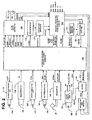
- FIG. 2 is a functional block diagram illustrating such a single chamber ICD operating system 100 that is merely exemplary of a variety of single chamber and dual chamber ICD systems having all or some of the capabilities described above in which the VT/VF discrimination functions of the present invention can be advantageously implemented.
- the present invention can be incorporated in an implantable monitor having selected components of the operating system of FIG. 2.
- the programming of ICD operating modes and parameters or the interrogation of data stored in the ICD IPG 10 or the initiation of UT transmission of the real time cardiac EGM is accomplished or initiated via programming or interrogation commands transmitted in a DT transmission by programmer 40 from the external telemetry antenna 42 to an ICD telemetry antenna 36 shown in FIG. 2.
- the ICD operating system stores VT/VF detection episode data and VF delivery data that can be UT transmitted to the external programmer 40 for review by a physician.
- the ICD IPG telemetry system decodes the commands in the DT transmission, retrieves and formats the responsive data or cardiac EGM and conveys it to the external programmer 40 as an UT transmission in any of the manners known in the art.
- the ICD system 100 includes one of more ICs typically mounted on one or more hybrid circuit, a PC board mounting a number of discrete components, and further large scale, discrete components.
- the heart of the ICD operating system is in hardware and software in the microcomputer based timing and control system IC 102 that is coupled with the other system blocks.
- the system IC 102 comprises the typical components of a microcomputer with operating algorithms maintained in memory or embedded in firmware and further operating system control circuitry that is conveniently located with it.
- Various depicted signal and control lines interconnecting these blocks, but not all are shown for simplicity of illustration and because they play no material role in the practice of the present invention.
- the large scale, discrete, off-board, components illustrated in FIG. 2 include one or more batteries 136, HV output capacitors 138, 140, and (optionally) housing mounted, patient alert sound transducers 129 and/or activity sensors 134.
- the discrete components mounted to the PC board include telemetry antenna 36, reed switch 130, crystal 132, a set of HV discrete components of the HV C/D output circuitry 108, and switching and protection circuit components of isolation, protection and electrode selection circuitry 114. These discrete components are coupled to system IC 102 through other ICs and hybrid circuits incorporating the functional blocks 104-128 and 176 described further below.
- a similar ICD operating system to that depicted in FIG.
- FIG. 2 in which the present invention can be implemented is disclosed, for example, in the above-referenced '316 and '535 patents.
- the depicted functional blocks and discrete components of FIG. 2 can be arranged as part of one or two LV hybrid circuits, a HV hybrid circuit and a discrete component PC board.
- a single hybrid circuit could be employed that incorporates and supports all of the system ICs.
- the exemplary ICD operating system 100 of FIG. 2 is powered by the battery 136 coupled to power supplies in power source block 106 for developing regulated high and low voltage power supplies Vhi and Vlo that are supplied to selected ones of the other functional blocks.
- battery 136 is a lithium silver vanadium battery that can be employed to provide HV capacitor charging current and that produces a voltage from about 3.2 volts when fresh to about 2.5 volts at specified end of service for a single chamber ICD and twice these values for a dual chamber ICD.
- Power supply 106 also includes a power-on-reset (POR) circuit that generates a POR signal initially when the battery 136 is connected with power supply 106 and any time that the voltage of battery 136 falls below a threshold voltage.
- POR power-on-reset
- the crystal oscillator circuit 120 is coupled to clock crystal 132 and provides one or more system XTAL clock that is applied to the microcomputer-based control and timing system IC and distributed to other blocks of FIG. 2 as appropriate.
- the telemetry I/O circuit 124 coupled with the IPG telemetry antenna 36 includes a UT transmitter that receives formatted UPLINK signals for uplink transmission and a DT receiver that receives and forwards DOWNLINK signals to telemetry I/O registers and control circuitry in system IC 102.
- the telemetry I/O circuit 124 is enabled to receive and decode DT interrogation and programming commands when the reed switch circuit provides the RS signal upon closure of reed switch 130 by an external programming head magnetic field.
- Downlink telemetry RF signals ring an L-C tank circuit including the IPG telemetry antenna 36.
- pacing functions are also affected when a magnetic field closes the reed switch 130 and the RS signal is generated in a manner well known in the art.
- the reed switch is not employed to receive DT transmissions and the telemetry antenna can be physically located outside the hermetically sealed enclosure.
- the components, operating modes and type of telemetry scheme employed in FIGs. 1 and 2 are not material to the present invention.
- a rate response circuit 122 is coupled to a physiologic activity sensor 134, which is preferably a transducer or accelerometer mounted to the IPG housing inner surface and provides activity correlated output signals to the rate response circuit 122 in a manner well known in the art.
- the rate response circuit 122 develops a rate control parameter (RCP) that is used to vary a pacing escape interval to pace the heart at a rate that provides adequate cardiac output.
- RCP rate control parameter
- the signal processing of the transducer output signal by the rate response circuit 122 can be programmed through rate response parameter commands to develop the RCP in a number of ways known in the art.
- the RCP associated with a detected VT/VF episode can also be stored in memory in the system IC 102 for UT transmission of the episode data to the external programmer 40 for analysis by the patient's attending physician.
- a patient alert driver circuit 166 is coupled to a sound emitting transducer 129, which is mounted adjacent to the interior surface of the IPG housing and is powered to emit audible warning signals in high urgency and low urgency tones to alert the patient of VF detection and imminent delivery of a C/D shock or of events or conditions of concern warranting physician intervention.
- the warnings that can be programmed into operation or programmed “off” include pace/sense and CV/DEFIB lead impedance out of range (too high or too low), low battery voltage, excessive charge time for charging the HV capacitors, all therapies in a programmed group of therapies exhausted for a given episode, and an indication of the number of shocks delivered in an episode".
- FIG. 2 depicts six input/output terminals labeled V+, V-, I, HVA, HVB, and COMMC that represent the connector terminals within the IPG connector block 104 that can be coupled to lead connector elements and lead conductors extending to the respective electrodes 24, 26, 30, 22, 32, and 28.
- V+, V-, I, HVA, HVB, and COMMC represent the connector terminals within the IPG connector block 104 that can be coupled to lead connector elements and lead conductors extending to the respective electrodes 24, 26, 30, 22, 32, and 28.
- the number of input/output terminals and associated electrodes can be reduced to the minimal number necessary to practice the present invention.
- Electrode selection switches in the isolation, protection and electrode selection circuitry 114 selectively couple pairs of the six input/output terminals labeled V+, V-, I, HVA, HVB, and COMMC to the R-wave sense amplifier 126, the ventricular EGM amplifier 128 and the V-PACE pulse generator 112 in response to a corresponding sense/pace electrode selection command from the microcomputer-based control and timing system IC 102.
- the sense/pace electrode selection command is programmable by the patient's attending physician through use of the external programmer 40 as described above.
- a ventricular pacing function operating in any of the ways that are well known in the art may or may not be included in a low cost, limited function prophylactic ICD as described above.
- the V-PACE generator 112 When the V-PACE generator 112 is included as depicted in FIG. 2, it provides V-PACE pulses through the selected pace/sense electrode pair having a pulse width and pulse amplitude set by the programmed PPW/PPA commands in a VVI of VVIR pacing mode.
- a timer in the microcomputer-based control and timing system 102 times out a programmed VVI pacing escape interval or a VVIR pacing escape interval that varies as a function of the RCP output by the rate response circuit 122.
- a V-TRIG signal is generated by microcomputer-based control and timing system 102 when the VVI or VVIR escape interval times out and applied to the analog rate limit circuit 110, which inhibits erroneous triggering of pacing at an unacceptably high rate in a manner well known in the art.
- the acceptable V-TRIG signals are passed through the analog rate limit 110 and trigger the delivery of the V-Pace pulse by the V-PACE pulse generator 112.
- the VVI or VVIR escape interval is restarted by a VSENSE generated by the ventricular sense amplifier 126 in response to an R-wave.
- the V-PACE pulse generator 112 can be coupled through the isolation, protection and electrode selection circuitry 114 to the V+, V- input/output terminals to be thereby coupled with the pace/sense electrodes 24 and 26 to provide bipolar RV pacing.
- the V-PACE pulse generator 112 can be coupled through the isolation, protection and electrode selection circuitry 114 to the V- terminal to be thereby coupled with the pace/sense electrode 26 and any of the I, HVA, HVB, and COMMC input/output terminals to be thereby coupled with the respective electrodes 20, 22, 32, and 28 to provide unipolar RV pacing.
- the ventricular sense amplifier 126 is coupled through the isolation, protection and electrode selection circuitry 114 to the V+, V- terminals to be thereby coupled with the pace/sense electrodes 24 and 26 to provide bipolar RV sensing of R-waves.
- the ventricular sense amplifier 126 comprises a programmable gain, bandpass amplifier, a threshold setting circuit, and a comparator for comparing the bandpass filtered ventricular cardiac signal amplitude to the threshold.
- the sensitivity/threshold of the ventricular sense amplifier 126 stored in sensitivity register 176 is programmable by the patient's attending physician through use of the external programmer 40 as described above.
- the ventricular sense amplifier 126 generates the VSENSE signal when it is not blanked and the amplitude of QRS complex exceeds the ventricular sense threshold, which is typically during the rise of the R-wave.
- the inputs to the ventricular sense amplifier 126 are disconnected from the V+, V- terminals by opening blanking switches in isolation, protection and electrode selection circuitry 114 in response to and for the duration of a VBLANK signal generated by a ventricular blanking circuit in microcomputer-based control and timing system IC 102 upon delivery of a V-PACE pulse or a C/D shock.
- the ventricular EGM (VEGM) amplifier 128 is coupled through electrode selection switch circuits in isolation, protection and electrode selection circuitry 114 to a pair of the input/output terminals selected from input/output terminals V+, V-, I, HVA, HVB, and COMMC in response to a programmable VEGM vector electrode selection command.
- the VEGM amplifier 128 filters and amplifies the cardiac signals and provides the VEGM signals to ADC/MUX 104.
- the VEGM is continually sampled at a sampling frequency of 256 Hz, and the sampled analog signal values are digitized and provided as VEGM DATA to RAM memory registers or buffers in system IC 102 for temporary storage on a FIFO basis.
- the temporarily stored VEGM DATA are shifted into memory registers within system IC 102 when a tachyarrhythmia episode at least partially satisfying the VF detection criteria occurs as described further herein.
- Such VEGM DATA can be stored for retrieval in an UT transmission in memory registers to provide programmable length VEGM strips preceding and following the detection of the arrhythmia and encompassing any delivery of a VF shock. Due to memory limitations, the stored VEGM DATA may be discarded and replaced each time a VT/VF episode is detected. However, historic episode logs can be compiled and incremented in RAM in system IC 102 that provide the date, time, type of episode, cycle length, duration, and identify the last stored EGM DATA.
- the depicted HV C/D output circuit 108 is of the type described in the above-incorporated '316 and '535 patents comprising a DC-DC converter and a HV output or discharge circuit for discharging the charge on the HV output capacitor bank 138 and 140 through selected ones of the C/D electrodes 22, 28, 32 and 20 of FIG. 1.
- the DC-DC converter comprises a HV charging circuit, a discrete HV step-up transformer, and the HV output capacitor bank 138 and 140 coupled to the secondary transformer coils.
- the charge on the HV output capacitor bank 138 and 140 is selectively discharged through combinations of the leads coupled with the C/D electrodes 26, 30 and 32 of FIG. 1 via HV switches in the isolation, protection and electrode selection circuitry 114.
- the depicted HV C/D output circuit 108 develops a high energy, monophasic or biphasic, C/D shock that is delivered through a selected pair of the C/D electrodes 26, 30 and 32 of FIG. 1 via the HV switches in the isolation, protection and electrode selection circuitry 114.
- the microprocessor within the microcomputer-based control and timing system 102 operates as an interrupt driven device, under control of software stored in ROM associated with microprocessor and responds to interrupts including the VSENSE output of the R-wave sense amplifier 126 and the time-out of the VVI or VVIR escape interval. Any necessary mathematical calculations to be performed by the microprocessor and any updating of the values or intervals controlled by pacer timing/control circuitry within the microcomputer-based control and timing system 102 take place following such interrupts. These calculations include those described in more detail below associated with the VF discrimination methods of the present invention.
- the typical VT and VF detection criteria that have been employed in commercially released ICDs of the type illustrated in FIGs. 1 and 2 employ a rate/interval based timing criterion and an NID frequency criterion as the tachyarrhythmia detection criteria for detecting the presence of and distinguishing between ventricular tachyarrhythmias.
- the intrinsic ventricular heart rate is measured on a beat-to-beat basis by timing the R - R interval between successive VSENSE signals output by the R-wave sense amplifier 126.
- the R - R interval is compared to the interval ranges or thresholds established, typically by programming, for each of VF, fast VT, and slow VT.
- the VF counter, fast VT counter, and slow VT counter function like FIFO shift registers having Y stages each set to "1" or "0” that can be implemented in hardware, firmware or software.
- a current R - R interval is shorter than an interval threshold, a "1", for example, is advanced into the first stage of the register, the contents of each stage is advanced to the next stage, and the "1" or "0" in the Yth stage is discarded.
- a "0" for example, is advanced into the first stage of the register, the contents of each stage is advanced to the next stage, and the "1" or "0” in the Yth stage is discarded.
- the count X of the corresponding VF counter, fast VT counter, or slow VT counter is "incremented” if a "1" is advanced into the initial stage of the register and a "0” is discarded from the Yth stage and “decremented” if a "0” is advanced into the initial stage of the register and a "1” is discarded from the Yth stage.
- the count X remains the same if the same bit value "1" or "0" is advanced into the initial stage of the register and is discarded from the Yth stage.
- the R - R interval is simultaneously compared to a programmed fibrillation detection interval (FDI), a programmed fast tachycardia interval (FTDI), and a programmed slow tachycardia detection interval (TDI).
- FDI programmed fibrillation detection interval
- FDDI fast tachycardia interval
- TDI programmed slow tachycardia detection interval
- the FDI count X VF is incremented if the R - R interval is shorter than the FDI and a "0" is discarded from the Yth stage or remains the same if a "0" is discarded from the Yth stage.
- a slow VT count X VT is incremented or remains the same in response to an R - R interval shorter than TDI but longer then the FTDI or the FDI
- a fast VT count X FVT is incremented or remains the same in response to an R - R interval longer than FDI but shorter than the FTDI.
- the counts X VF , X FVT , and X VT that accumulate in the respective VF counter, fast VT counter, and slow VT counter may be used to signal detection of an associated tachyarrhythmia (VF, fast VT, or slow VT) when the count X VF , X FVT , or X VT reaches a predetermined value referred to herein as the "number of intervals required for detection" (NID).
- NID number of intervals required for detection
- Each rate zone may have its own defined NID, for example "VFNID” for fibrillation detection, "FVTNID” for fast VT detection and "VTNID” for slow VT detection.
- This embodiment of the present invention is directed to increasing the specificity of detection of true VF episodes in instances when the VF detection criteria may be mistakenly met by fast VT, particularly SVT due to rapidly conducted AF.
- the present invention can be practiced in the context of the exemplary ventricular ICD embodiment of FIGs. 1 and 2 when conventional VF detection criteria are met or about to be met and a C/D is to be delivered to the RV to convert the apparent VF to NSR. It will be appreciated that the particular details of implementation of the VF detection criteria are not of primary importance. Moreover, it will be appreciated that the above-described fast VT and slow VT detection criteria can be eliminated or altered in the implementation of a simple prophylactic ICD intended to simply deliver a C/D shock therapy upon detection of a true VF episode.
- the SDM or SDC algorithm is preferably commenced when X VF is less than (VFNID - y).
- An SD match and/or SD metric value is compared to a corresponding threshold, and an SD-CNT x is incremented or decremented or remains unchanged.
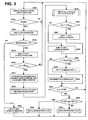
- FIG. 3 depicts the steps of declaring that the ventricular tachyarrhythmia satisfying the conventional VF detection criteria is either a VF episode (or a polymorphic VT episode) or a monomorphic VT (or SVT) and delivering the programmed therapy.
- an evidence counter is set to a number z when the SD-CNT x meets the SD count threshold (indicating that x of the y QRS complexes exhibit high frequency content with respect to preceding baseline segments). The evidence counter is decremented from z each time that the SD-CNT x does not meet the SD count threshold.
- evidence count indicating that x of the y QRS complexes exhibit high frequency content in the last z VSENSE events
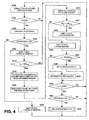
- the method of FIG. 3 is preferably modified in the manner depicted in FIG. 4 to more stringently increase the specificity that a ventricular tachyarrhythmia is a true VF when the ICD is only capable of delivering a C/D shock therapy to counter VF.
- the R - R intervals between ventricular sensed events and the morphologies of the further number VF WITHOLD-CNT of QRS complexes are examined whereby the FDI count X VF , the SD-CNT x, and the VF WITHOLD-CNT are updated on a beat-to-beat basis.
- the number z can be equal to or different than y .
- FIGs. 3 and 4 employ event and baseline slope signal processing according to the steps of one of the SDM algorithm of FIG. 8 or the SDC algorithm of FIG. 10 to distinguish polymorphic and monomorphic QRS complexes when VF detection criteria are satisfied.
- step S300 the EGM amplitude is continually sampled, digitized, and temporarily stored in a buffer on a FIFO basis employing the VEGM amplifier 128 and ADC/MUX 104 in a manner described in the above-referenced '519 patent, for example.
- a VSENSE event is declared in step S302 by the R-wave sense amplifier 126 or can be determined from the temporarily stored EGM amplitude data.
- the R - R interval is calculated in step S304 when each VSENSE is declared, and the R - R interval is compared to the FDI in step S306.
- step S310 a "1" is shifted into the first stage of the VF counter, the data bits of the remaining stages are shifted one position, and the data bit in the Yth stage is discarded when the R - R interval is shorter than the FDI as determined in step S306.
- step 5308 a "0" is shifted into the first stage of the VF counter, the data bits of the remaining stages are shifted one position, and the data bit in the Yth stage is discarded when the R - R interval is longer than the FDI as determined in step S306.
- the VF count X VF can only be incremented when a "1" is shifted into the first stage of the VF counter and a "0" is shifted out of the Yth stage in step 5310.
- VF counter stages there are 24 VF counter stages, and the VFNID is set to a lesser number, e.g., 18.
- the stages containing "1" bits are counted to derive the VF count X VF .
- the VF count X VF is compared to a morphology stability test threshold (MS THRS ) in step S310, wherein 0 ⁇ MS THRS ⁇ VFNID.
- MS THRS morphology stability test threshold
- the MS THRS can be set to 8 or to 10 (18 - 8), for example.
- HPF data sets commences in steps S314 and S316 when the VF count X VF meets the MS THRS as determined in step S312.
- Step S314 is repeated on each VSENSE event detected in step S302 and each time that the VF count X VF meets the MS THRS as determined in step S312.
- the current HPF data set calculated in step S314 is stored on a FIFO basis in the first stage of the HPF data register in step S316.
- one of the SDM algorithm or the SDC algorithm is performed in step S318.
- the SD metric value is determined following the steps of both the SDM algorithm and the SDC algorithm, and the SD match value is determined following the SDC algorithm.
- the resulting SD metric value and/or SD match value is characterized as an "SD M " value in the steps of FIGs. 3 and 4, for convenience of simplifying the figures.
- the SD M value is compared to an SD threshold (SD THRS ) in step S320.
- SD THRS SD threshold
- both the SD metric and the SD match values are compared to the SD metric and SD match thresholds, respectively, and either of them has to be satisfied.
- the SD metric and SD match thresholds are also characterized as an "SD THRS " value in the steps of FIGs. 3 and 4 for convenience of simplifying the figures.
- the SD-CNT x is maintained in a register having y stages each set to "1" or “0” that can be implemented in hardware, firmware or software.
- the SD-CNT x is the number of "1"s, for example, in the register stages.
- step S320 each time that the SD M value meets the SD THRS in step S320, a "0" is advanced into the first stage of the register, the contents of each stage is advanced to the next stage, and the "1" or “0” in the yth stage is discarded in step S324.
- the count x is "incremented” if a "1” is advanced into the initial stage of the register and a "0” is discarded from the yth stage and “decremented” if a "0” is advanced into the initial stage of the register and a "1” is discarded from the Yth stage.
- the SD-CNT x remains the same if the same bit value "1" or "0" is advanced into the initial stage of the register and is discarded from the yth stage.
- the SD-CNT x is compared to an SD-CNT threshold (SD-CNT THRS ) in step S326.
- SD-CNT THRS SD-CNT threshold
- the steps S310 - S326 can be repeated at least y times to derive a meaningful SD-CNT x .
- an evidence counter is set to a number z of QRS complexes when the SD-CNT x meets the SD-CNT THRS in step S326.
- the evidence counter is decremented from z in step S330 each time that the SD-CNT x does not meet the SD-CNT THRS in step S326.
- the ventricular tachyarrhythmia is finally declared to be a monomorphic fast VT.
- a fast VT therapy e.g., a burst pacing therapy, may be delivered in step S336. It should be noted that in this algorithm of FIG. 3, further conventional morphological processing is preferably conducted to discriminate SVT and VT so that such fast VT therapies are not delivered to the ventricles during an SVT episode.
- the ventricular tachyarrhythmia is declared to be VF and a C/D therapy is delivered in step S338 when the VF count X VF meets the VFNID as determined in step S332 and when the VT EVIDENCE-CNT is less than or equal to zero as determined in step S334.
- the FDI, the VFNID, and one or both of the SD THRS and the SD-CNT THRS can be varied by programming to optimize the specificity of discrimination of true VF episodes in a given patient.
- ventricular tachyarrhythmia termination algorithms are followed to determine whether a delivered therapy has terminated the episode.
- a C/D shock is typically delivered if the episode is not terminated by a delivered VT therapy.
- steps S400 - S426 are functionally equivalent to steps S300 - S326 of FIG. 3 as described above.
- a withhold delay corresponding to a VF withhold count (VF WITHOLD-CNT) of z VSENSE events is effectively turned on in step S428 when the SD-CNT x does meet the SD-CNT THRS as determined in step S426 before the VF count X VF meets the VFNID as determined in step S432.
- the SD-CNT x is compared to the SD-CNT THRS , and the VF WITHOLD-CNT is set to z in step S428 when the SD-CNT x meets the SD-CNT THRS .
- the C/D shock therapy cannot be delivered until the WITHOLD-CNT is decremented from z back to zero in step S430 and the VF count X VF still or again meets the VFNID as determined in step S432.
- the withhold delay z can additionally be programmed to optimize the specificity of discrimination of true VF episodes in a given patient.
- the VF WITHOLD-CNT is set to z in step S428, then on each subsequent repetition of steps S402 - S424, the VF WITHOLD-CNT is decremented each time that the SD-CNT x does not meet the SD-CNT THRS as determined in step S426 or the VF WITHOLD-CNT is reset back to z each time that the SD-CNT x does meet the SD-CNT THRS as determined in step S426.
- the VF count X VF can be incremented or decremented in steps S408 or S416.
- the ventricular tachyarrhythmia is declared to be VF and a C/D therapy is delivered in step S436 only when the VF count X VF meets the VFNID as determined in step S432 and when the VF WITHOLD-CNT is decremented to zero as determined in step S434.
- VF count X VF meets the VFNID as determined in step S432
- VF WITHOLD-CNT is decremented to zero as determined in step S434.
- the raw EGM is sampled at a sampling rate, e.g., 128 Hz (preferably 256 Hz), and digitized in steps S300 and S400.
- a sampling rate e.g. 128 Hz (preferably 256 Hz)
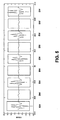
- the raw EGM samples are high pass filtered in steps S312 and S314, respectively, to derive high pass filtered (HPF) EGM samples as shown in the tracing of FIG. 5.
- the high pass filter function can be achieved using a 10 th order FIR high pass filter with a pole at 24 Hz.
- the approximate center frequency for the ventricular sense amplifier is 24 Hz with -3dB points at approximately 14 Hz and 41 Hz.
- the 24 Hz pole is approximately the center of this band and rejects the slowly varying components of the EGM samples during VF episodes.
- the high pass filter characteristics can be approximated by 2 nd order slopes ( x ( i+2 ) -2*x ( i+1 ) +x ( i )) in
- event windows are defined by a number of HPF samples or slope data points over a window duration, e.g., 11 HPF sample or slope data points (sampled at 128Hz) over 85 ms, commencing prior to and following declaration of a VSENSE event.
- a baseline window also comprising of 11 HPF samples or slope data points over 85 ms is centered around the midpoint between the present VSENSE and the previous VSENSE.
- the HPF baseline (slope) data points would exhibit little change from absolute baseline or otherwise exhibit relatively low amplitude.
- the determined HPF event and baseline data sets are temporarily stored in steps S314 and S414.
- the window sizes can additionally be programmed to optimize the specificity of discrimination of true VF episodes in a given patient.
- steps S318 and S418 are further illustrated in FIG. 6.
- the order of steps S600 - S604 and steps S606 - S608 can be reversed from that depicted in FIG. 6.
- the slope at each data sample of the HPF baseline data set is determined in step S602 when a new HPF baseline data set is derived in step S600.
- the slope at each data sample of the HPF sensed event data set is determined in step S608 when a new HPF event data set is derived in step S606.
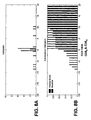
- the distributions of baseline and sensed event data set slope values can be depicted in histograms as shown in FIGs. 7A and 8A.
- the baseline slopes are clustered around 0 as shown in FIG. 8A and the event slopes are distributed more widely as shown in FIGs. 7A and 8A.
- a cumulative distribution of slopes operation is performed to derive a cumulative distribution of slopes within the baseline window (CDS B ) in step S604 and a cumulative distribution of slopes within the event window (CDS E ) in step S610.
- the cumulative distribution is the cumulative sum of the histogram bin values with respect to the bin values normalized by the total number of data points considered to compute the histogram.
- the cumulative summing operation to generate the cumulative histogram is performed from the lower bin value towards the larger bin values. For example, the value of each data point of the baseline and event windows illustrated in the histogram of FIG. 8A is summed, left to right in a cumulative fashion resulting in the CDS B and CDS E illustrated in FIG. 8B.
- the normalization by the total number of data points leads to a final value of one in the right-most bin in the cumulative histogram.
- the CDS E derived in step S610 is also shown in FIG. 7B.
- the maximum difference KS event between the CDS E values and a sigmoid reference function also shown in FIG. 7B representing the idealized cumulative distribution of slopes during a NSR QRS complex is then determined employing the Kolmogorov-Smirnoff method of comparing distributions.
- the Kolmogorov-Smirnoff method of comparing distributions computes the maximum absolute difference between the cumulative histograms of the two data sets being compared and use it as a statistic to ascertain the statistical power of the difference between the two distribution.
- the maximum absolute difference between two distributions is used to compute KS B in step 5614.
- the SDM algorithm also considers a modified version of the statistic, only the positive differences for positive slopes and negative of the negative differences for negative slopes are considered, and the maximum of these values is the KS metric as used for computation of KS E in step S610.
- the reference function is approximately the cumulative distribution of a uniform distribution with finite support with smoothing at the support edges.
- the sigmoid reference function represents the cumulative distribution of a uniform probability density function with finite support and smoothness at the support edges.
- the sigmoid reference function closely represents the idealized cumulative distribution of slopes during a NSR QRS complex.
- the sigmoid reference function can be replaced by the cumulative distribution of an NSR QRS complex, if available.
- the method In taking the maximum difference between the cumulative distributions, the method only considers the maximum of positive difference values for positive slopes and negative of the negative difference values for negative slopes.
- the KS event value is low if the QRS complex exhibits a NSR far field waveform as in case of SVT or a high frequency content far-field waveform as in case of monomorphic VT.
- the KS event value is high if the QRS complex exhibits a cumulative slope distribution, which is very different than the reference distribution as is characteristic of VF.
- the frequency content of the EGM is low, and hence the slope distribution will be concentrated around and close to zero and therefore very different from the reference distribution.
- the maximum absolute difference between the CDS E and a preceding or subsequent CDS B value as shown in FIG. 8B is then determined as KS baseline in step S614.
- the KS baseline value is high if the QRS complex exhibits a typical NSR far field waveform differing significantly from the baseline window EGM even when the VSENSE event windows and baseline windows are closely spaced and is low if the EGM within the event window and the baseline window do not differ significantly, as is the case during VF.
- the SD metric value calculated for a given QRS complex as identified by a VSENSE event is therefore low during VF and high during NSR or VT or rapidly conducted AF.
- the SD metric value for the current QRS complex that reflects frequency content information and baseline information is then used as the SD M value in step S320 of FIG. 3 or step S420 of FIG. 4.
- Steps S700 - S710 follow steps S600 - S610 of FIG. 6 as described above.
- step S712 the CDS E values computed in steps S706 - S710 are stored in a FIFO basis in a y stage register to provide y prior CDS E values (CDS PE ).
- the KS E value and the KS B value are determined in steps S714 and S718, respectively, following steps S612 and S614, respectively, as described above.
- step S716 the KS E values computed in step S714 are stored in a FIFO basis in a y stage register to provide y prior KS E values (KS PE ).
- the SD metric is then computed in step S720 as described above in reference to step S616.
- an SD match value is determined preferably in parallel with the determination of the SD metric value.
- the KS event value that is calculated as described above is saved for y events, whereby at least one KS previousevent (KS PE ) is stored in step S716.
- a KS match value is calculated as the maximum absolute difference between the cumulative distribution of slopes within the current VSENSE event window and the cumulative distribution of slopes within a selected one of the stored previous VSENSE event windows in step S722.
- the SD metric value (denoted SD M1 ) and the SD match value (denoted SD M2 ) are then used as the SD M value in step S320 of FIG. 3 or step S420 of FIG. 4.
- a "1" can be shifted into the y stage SD-CNT register in step S322 or S422 if either or both the SD match value and the SD metric value meet a SD THRS in step S320 or S420, respectively.
- a SD THRS1 is provided for the SD metric comparison and a SD THRS2 is provided for the SD match comparison in steps S320 and S420.
- the principles of the present invention may be applied to discrimination of atrial tachyarrhythmias.
- the far field atrial EGM and atrial sense events can be determined, polymorphic atrial detection criterion can be defined, and a polymorphic atrial tachyarrhythmia can be provisionally declared following the steps of FIG. 3 or FIG. 4.
- the algorithm of FIG. 6 can be employed to determine an SD M of the atrial EGM for use in the algorithms of FIG. 3 or FIG. 4.
- the near or far field atrial EGM and atrial sense events can be determined, AF detection criterion can be defined, and an AF episode or atrial tachyarrhythmia (AT) can be provisionally declared following the steps S300 - S312 of FIG. 3 or S400 - S412 of FIG. 4 or employing any other known AF detection criteria.
- the SDM algorithm of FIGs. 6 or the SDC algorithm of FIG. 9 can be employed to derive an SD M value of the atrial EGM for use in the algorithms of FIG. 3 or FIG. 4 for discrimination between AF and organized AT.
- ATP therapies will be delivered for organized atrial tachyarrhythmias only, and CD/shock therapy may or may not be applied for AF detection. So, FIG.4 applies to the case when only ATP therapies need to be delivered for organized AT and ATP therapy needs to be withheld for AF or disorganized AT.
- the step S420 comparison can be reversed to perform an ATP therapy withhold if evidence for AF or disorganized AT is found when SD M ⁇ SD THRS . Therefore, it will be understood that the present invention can be applied in discrimination of both atrial and ventricular tachyarrhythmias in the manner described herein.
- the present invention is adaptable and applicable to subcutaneous sensing and detection of arrhythmias.
- the present invention may be practiced in contexts that do not rely upon the provisional declaration of a polymorphic tachyarrhythmia, e.g., AF or VF, following steps S304 - S312 and step S332 of FIG. 3 or steps S404 - S412 and step S432 of FIG. 4.
- the SDM algorithm of FIGs. 6 or the SDC algorithm of FIG. 9 can be employed with the remaining steps of FIGs. 3 or 4 to make the determinations of steps S336 and S338 or step S436, respectively, based upon the results of step S334 or step S434, respectively.
- Such a simplified algorithm can be advantageously applied in discrimination of both atrial and ventricular tachyarrhythmias in the manner described herein.
Landscapes
- Health & Medical Sciences (AREA)
- Cardiology (AREA)
- Life Sciences & Earth Sciences (AREA)
- Public Health (AREA)
- Heart & Thoracic Surgery (AREA)
- Engineering & Computer Science (AREA)
- Biomedical Technology (AREA)
- Veterinary Medicine (AREA)
- Animal Behavior & Ethology (AREA)
- General Health & Medical Sciences (AREA)
- Medical Informatics (AREA)
- Physics & Mathematics (AREA)
- Biophysics (AREA)
- Pathology (AREA)
- Molecular Biology (AREA)
- Surgery (AREA)
- Radiology & Medical Imaging (AREA)
- Nuclear Medicine, Radiotherapy & Molecular Imaging (AREA)
- Electrotherapy Devices (AREA)
- Other Investigation Or Analysis Of Materials By Electrical Means (AREA)
- Analysing Materials By The Use Of Radiation (AREA)
- Management, Administration, Business Operations System, And Electronic Commerce (AREA)
Claims (11)
- System zum Verarbeiten eines kardialen Signals bzw. Herzsignals zum Erlangen bzw. Ableiten von erfassten Ereignissen und zum Unterscheiden zwischen einer monomorphen Tachyarrhythmie und einer polymorphen Tachyarrhythmie mit:Signalverarbeitungsmitteln zum aufeinanderfolgenden Abtasten, Verarbeiten und zeitweiligen Speichern des kardialen Signals, um eine Anzahl y von Datensätzen von Signalamplituden in Bezug auf y erfasste Ereignisse zu erlangen;Fensterdefinitionsmitteln zum Bestimmen eines Grundlinienfensters zwischen erfassten Ereignissen und eines Erfasstes-Ereignis-Fensters, das das erfasste Ereignis eines jeden der y Datensätze umfasst;Mitteln zum Bestimmen eines Satzes von Signalsteigungen des Grundlinienfensters und eines Satzes von Signalsteigungen des Erfasstes-Ereignis-Fensters;Mitteln zum Bestimmen einer kumulativen Verteilung der Grundlinienfenstersteigungen CDSB;Mitteln zum Bestimmen einer kumulativen Verteilung von Ereignis-Fenstersteigungen CDSE;Mitteln zum Berechnen einer maximalen absoluten Differenz KSEreignis zwischen der CDSE und einer sigmoidalen bzw. s-förmigen Referenzfunktion;Mitteln zum Berechnen einer maximalen absoluten Differenz KSGrundlinie zwischen der CDSE und einer CDSB;Mitteln zum Berechnen eines Steigungsverteilungsmetrik SDM -Werts durch
 Mitteln zum Vergleichen von SDM mit einem Steigungsverteilungsübereinstimmungsschwellwert;Zählmitteln zum Aufrechnen bzw. Akkumulieren einer Zahl x von SDM-Werten, die dem Steigungsverteilungsübereinstimmungsschwellwert über y Vergleiche von SDM mit einem Steigungsverteilungsübereinstimmungsschwellwert entsprechen;Zurückhaltemitteln zum Zurückhalten der letztendlichen bzw. abschließenden Erklärung einer polymorphen Tachyarrhythmie, wenn die Zahl x anzeigt, dass die korrespondierenden kardialen Signale einen Frequenzinhalt zeigen, der eine monomorphe Tachyarrhythmie nahelegt; undLetztendliche-Erklärung-Mitteln zum letztendlichen Erklären einer polymorphen Tachyarrhythmie, wenn die Zahl x anzeigt, dass die korrespondierenden kardialen Signale einen Frequenzinhalt zeigen, der eine polymorphe Tachyarrhythmie nahelegt.
 - Implantierbare medizinische Vorrichtung, die provisorisch eine polymorphe Tachyarrhythmie des Herzes eines Patienten als eine Funktion von gemessenen Zeitintervallen zwischen erfassten Ereignissen in einem kardialen Signal erkennt, mit dem System nach Anspruch 1 zum Unterscheiden zwischen einer monomorphen Tachyarrhythmie und einer polymorphen Tachyarrhythmie, wobei das System ferner aufweist:Provisorische-Erklärung-Mittel zum provisorischen Erklären einer polymorphen Tachyarrhythmie, wenn zumindest eine erste Anzahl von gemessenen Zeitintervallen den polymorphen Tachyarrhythmie-Erkennungskriterien genügt; und wobeidie Letztendliche-Erklärung-Mittel zum letztendlichen Erklären einer polymorphen Tachyarrhythmie, wenn die Zahl x anzeigt, dass die korrespondierenden kardialen Signale einen Frequenzinhalt zeigen, der eine polymorphe Tachyarrhythmie nahelegt, ausgebildet sind und die polymorphe Tachyarrhythmie provisorisch erklärt wird.
- Vorrichtung nach Anspruch 2, ferner mit Mitteln zum Vergleichen der Zahl x mit einem Frequenzinhaltsschwellwert; und
wobei die Letztendliche-Erklärung-Mittel ferner das letztendliche Erklären einer polymorphen Tachyarrhythmie, wenn die Zahl x nicht dem Frequenzinhaltszahlschwellwert genügt, umfassen und eine polymorphe Tachyarrhythmie provisorisch erklärt wird. - Vorrichtung nach Anspruch 3, bei der:die Zurückhaltemittel ferner aufweisen:Mittel zum Festlegen einer Zurückhaltezahl, die z gemessenen Zeitintervallen zwischen erfassten Ereignissen von aufeinanderfolgenden kardialen Signalen, wenn die Zahl x anzeigt, dass die korrespondierenden kardialen Signale einen Frequenzinhalt zeigen, entspricht; undMittel zum Verringern der Zurückhaltezahl zu jeder Zeit, zu der eine Zahl x anzeigt, dass die korrespondierenden kardialen Signale einen Frequenzinhalt zeigen, der eine polymorphe Tachyarrhythmie nahelegt; und
wobei die Letztendliche-Erklärung-Mittel ferner auf die Zurückhaltezahl reagierende Mittel zum Erklären einer polymorphen Tachyarrhythmie nur, wenn die Zurückhaltezahl auf eine Zurückhaltezahl kleiner als z vermindert wird, aufweisen. - System nach Anspruch 2, 3 oder 4, bei dem die implantierbare medizinische Vorrichtung ferner einen implantierbaren Kardioverter/Defibrillator mit der Fähigkeit zur Abgabe einer C/D-Schocktherapie umfasst und das ferner aufweist:Mittel zum Abgeben einer C/D-Schocktherapie, wenn eine polymorphe Tachyarrhythmie letztendlich erklärt wird.
- Vorrichtung nach Anspruch 5, bei der die implantierbare medizinische Vorrichtung ferner aufweist:Mittel zum Abgeben einer Anti-Tachykardie-Therapie, wenn die Zahl x anzeigt, dass die korrespondierenden kardialen Signale einen Frequenzinhalt zeigen, der eine monomorphe Tachyarrhythmie nahelegt, und eine polymorphe Tachyarrhythmie provisorisch erklärt wird.
- Implantierbare medizinische Vorrichtung, die eine polymorphe Tachyarrhythmie des Herzes eines Patienten als eine Funktion von gemessenen Zeitintervallen zwischen erfassten Ereignissen in einem kardialen Signal provisorisch erkennt, mit einem System zum Improvisieren bzw. Verbessern der Genauigkeit des Unterscheidens zwischen einer monomorphen Tachyarrhythmie und einer polymorphen Tachyarrhythmie, wobei das System aufweist:Provisorische-Erklärung-Mittel zum provisorischen Erklären einer polymorphen Tachyarrhythmie, wenn zumindest eine erste Anzahl der gemessenen Zeitintervalle den polymorphen Tachyarrhythmie-Erkennungskriterien genügen;Signalverarbeitungsmittel zum aufeinanderfolgenden Abtasten, Verarbeiten und zeitweiligen Speichern des kardialen Signals, um eine Anzahl von Datensätzen von Signalamplituden in Bezug auf y erfasste Ereignisse zu erlangen;Fensterdefinitionsmittel zum Bestimmen eines Grundlinienfensters zwischen erfassten Ereignissen und eines Erfasstes-Ereignis-Fensters, das das erfasste Ereignis eines jeden der y Datensätze umfasst;Mittel zum Bestimmen eines Satzes von Signalsteigungen des Grundlinienfensters und eines Satzes von Signalsteigungen des Erfasstes-Ereignis-Fensters;Mittel zum Bestimmen einer kumulativen Verteilung der Grundlinienfenstersteigungen CDSB;Mittel zum Bestimmen einer kumulativen Verteilung von Ereignis-Fenstersteigungen CDSE;Mittel zum Speichern der kumulativen Verteilung der Ereignis-Fenstersteigungen CDSE in einem Register, das ein oder mehrere vorherige kumulative Verteilungen von Ereignis-Fenstersteigungen CDSPE umfasst;Mittel zum Berechnen einer maximalen absoluten Differenz KSEreignis zwischen der CDSE und einer sigmoidalen bzw. s-förmigen Referenzfunktion;Mittel zum Berechnen einer maximalen absoluten Differenz KSGrundlinie zwischen der CDSE und einer CDSB;Mittel zum Speichern der maximalen absoluten Differenz KSEreignis in einem Register, das ein oder mehrere vorherige maximale absolute Differenzen KSvorheriges-Ereignis umfasst;Mittel zum Berechnen eines Steigungsverteilungsmetrik SDM -Werts durch
 Mittel zum Berechnen einer maximalen absoluten Differenz KSVorgabe zwischen der aktuellen CDSE und einer gespeicherten vorherigen CDSPE;Mittel zum Berechnen eines Steigungsverteilungsvorgabe SDVorgabe -Werts durch
 Mittel zum Vergleichen von SDMetrik und SDVorgabe mit einem Steigungsverteilungsvorgabeschwellwert;Zählmittel zum Aufrechnen bzw. Akkumulieren einer Zahl x der SDMetrik- oder SDVorgabe-Werte, die einem Steigungsverteilungsvorgabeschwellwert über y Vergleiche der SDMetrik und SDVorgabe mit einem Steigungsverteilungsvorgabeschwellwert genügen;Zurückhaltemittel zum Zurückhalten der letztendlichen Erklärung einer polymorphen Tachyarrhythmie, wenn die Zahl x anzeigt, dass die korrespondierenden kardialen Signale einen Frequenzinhalt zeigen, der eine monomorphe Tachyarrhythmie nahelegt; undLetztendliche-Erklärung-Mittel zum letztendlichen Erklären einer polymorphen Tachyarrhythmie, wenn die Zahl x anzeigt, dass die korrespondierenden kardialen Signale einen Frequenzinhalt zeigen, der eine polymorphe Tachyarrhythmie nahelegt, und die polymorphe Tachyarrythmie provisorisch erklärt wird.
 - Vorrichtung nach Anspruch 7, ferner mit Mitteln zum Vergleichen der Zahl x mit einem Frequenzinhaltsschwellwert; und
wobei die Letztendliche-Erklärung-Mittel ferner das letztendliche Erklären einer polymorphen Tachyarrhythmie, wenn die Zahl x nicht dem Frequenzinhaltszahlschwellwert genügt, umfassen und eine polymorphe Tachyarrhythmie provisorisch erklärt wird. - Vorrichtung nach Anspruch 7 oder 8, , bei der:die Zurückhaltemittel ferner aufweisen:Mittel zum Festlegen einer Zurückhaltezahl, die z gemessenen Zeitintervallen zwischen erfassten Ereignissen von aufeinanderfolgenden kardialen Signalen, wenn die Zahl x anzeigt, dass die korrespondierenden kardialen Signale einen Frequenzinhalt zeigen, entspricht; undMittel zum Verringern der Zurückhaltezahl zu jeder Zeit, zu der eine Zahl x anzeigt, dass die korrespondierenden kardialen Signale einen Frequenzinhalt zeigen, der eine polymorphe Tachyarrhythmie nahelegt; und
wobei die Letztendliche-Erklärung-Mittel ferner auf die Zurückhaltezahl reagierende Mittel zum Erklären einer polymorphen Tachyarrhythmie nur, wenn die Zurückhaltezahl auf eine Zurückhaltezahl kleiner als z vermindert wird, aufweisen. - Vorrichtung nach Anspruch 7, 8 oder 9, bei der die implantierbare medizinische Vorrichtung ferner einen implantierbaren Kardioverter/Defibrillator mit der Fähigkeit zur Abgabe einer C/D-Schocktherapie umfasst und die ferner aufweist:Mittel zum Abgeben einer C/D-Schocktherapie, wenn eine polymorphe Tachyarrhythmie letztendlich erklärt wird.
- Vorrichtung nach Anspruch 10, bei der die implantierbare medizinische Vorrichtung ferner aufweist:Mittel zum Abgeben einer Anti-Tachykardie-Therapie, wenn die Zahl x anzeigt, dass die korrespondierenden kardialen Signale einen Frequenzinhalt zeigen, der eine monomorphe Tachyarrhythmie nahelegt, und eine polymorphe Tachyarrhythmie provisorisch erklärt wird.
Applications Claiming Priority (5)
| Application Number | Priority Date | Filing Date | Title |
|---|---|---|---|
| US43092602P | 2002-12-04 | 2002-12-04 | |
| US430926P | 2002-12-04 | ||
| US10/652,695 US7076289B2 (en) | 2002-12-04 | 2003-08-29 | Methods and apparatus for discriminating polymorphic tachyarrhythmias from monomorphic tachyarrhythmias facilitating detection of fibrillation |
| US652695 | 2003-08-29 | ||
| PCT/US2003/038341 WO2004050184A2 (en) | 2002-12-04 | 2003-12-03 | Systems and methods for discriminating polymorphic from monomorphic tachyarrhythmias |
Publications (2)
| Publication Number | Publication Date |
|---|---|
| EP1569719A2 EP1569719A2 (de) | 2005-09-07 |
| EP1569719B1 true EP1569719B1 (de) | 2006-09-27 |
Family
ID=32474609
Family Applications (1)
| Application Number | Title | Priority Date | Filing Date |
|---|---|---|---|
| EP03790256A Expired - Lifetime EP1569719B1 (de) | 2002-12-04 | 2003-12-03 | Systeme zum unterscheiden von polymorphen von monomorphen tachyarrhythmien |
Country Status (4)
| Country | Link |
|---|---|
| US (1) | US7076289B2 (de) |
| EP (1) | EP1569719B1 (de) |
| DE (1) | DE60308725T2 (de) |
| WO (1) | WO2004050184A2 (de) |
Families Citing this family (61)
| Publication number | Priority date | Publication date | Assignee | Title |
|---|---|---|---|---|
| US6400986B1 (en) * | 2000-04-10 | 2002-06-04 | Cardiac Pacemakers, Inc. | Adaptive anti-tachycardia therapy apparatus and method |
| US7330757B2 (en) | 2001-11-21 | 2008-02-12 | Cameron Health, Inc. | Method for discriminating between ventricular and supraventricular arrhythmias |
| US6909916B2 (en) * | 2001-12-20 | 2005-06-21 | Cardiac Pacemakers, Inc. | Cardiac rhythm management system with arrhythmia classification and electrode selection |
| US7031764B2 (en) * | 2002-11-08 | 2006-04-18 | Cardiac Pacemakers, Inc. | Cardiac rhythm management systems and methods using multiple morphology templates for discriminating between rhythms |
| US7894893B2 (en) | 2004-09-30 | 2011-02-22 | Cardiac Pacemakers, Inc. | Arrhythmia classification and therapy selection |
| US7228173B2 (en) * | 2004-11-23 | 2007-06-05 | Cardiac Pacemakers, Inc. | Cardiac tachyarrhythmia therapy selection based on patient response information |
| US7933651B2 (en) * | 2004-11-23 | 2011-04-26 | Cardiac Pacemakers, Inc. | Cardiac template generation based on patient response information |
| US7277747B2 (en) * | 2004-11-23 | 2007-10-02 | Cardiac Pacemakers, Inc. | Arrhythmia memory for tachyarrhythmia discrimination |
| US7818056B2 (en) | 2005-03-24 | 2010-10-19 | Cardiac Pacemakers, Inc. | Blending cardiac rhythm detection processes |
| US7908001B2 (en) * | 2005-08-23 | 2011-03-15 | Cardiac Pacemakers, Inc. | Automatic multi-level therapy based on morphologic organization of an arrhythmia |
| US8532762B2 (en) * | 2005-12-20 | 2013-09-10 | Cardiac Pacemakers, Inc. | Discriminating polymorphic and monomorphic cardiac rhythms using template generation |
| US7653431B2 (en) * | 2005-12-20 | 2010-01-26 | Cardiac Pacemakers, Inc. | Arrhythmia discrimination based on determination of rate dependency |
| US20070173728A1 (en) * | 2006-01-25 | 2007-07-26 | Yachuan Pu | Cyclic variation of heart rate detection and treatment |
| US8150502B2 (en) * | 2006-02-06 | 2012-04-03 | The Board Of Trustees Of The Leland Stanford Junior University | Non-invasive cardiac monitor and methods of using continuously recorded cardiac data |
| EP2032027B1 (de) * | 2006-05-05 | 2011-10-26 | Medtronic, Inc. | Verfahren und gerät zum nachweis von leitungsausfall in einem medizinprodukt auf basis von wavelet-zerfallsanalyse |
| US7738950B2 (en) | 2006-09-13 | 2010-06-15 | Cardiac Pacemakers, Inc. | Method and apparatus for identifying potentially misclassified arrhythmic episodes |
| AU2007221772B2 (en) * | 2006-09-29 | 2009-07-09 | Aristocrat Technologies Australia Pty Limited | Gaming system and method with wager variability |
| US7738948B2 (en) * | 2006-10-31 | 2010-06-15 | Medtronic, Inc. | Form parameter forecaster for analyzing signals distorted by noise |
| WO2009092055A1 (en) | 2008-01-18 | 2009-07-23 | Cameron Health, Inc. | Data manipulation following delivery of a cardiac stimulus in an implantable cardiac stimulus device |
| ES2605653T3 (es) | 2008-03-07 | 2017-03-15 | Cameron Health, Inc. | Dispositivos para clasificar con precisión la actividad cardiaca |
| EP2268358B1 (de) | 2008-03-07 | 2013-05-22 | Cameron Health, Inc. | Akkurate erfassung von herzereignissen in einer implantierbaren herzstimulationsvorrichtung |
| US8706220B2 (en) * | 2008-04-09 | 2014-04-22 | Medtronic, Inc. | Method and apparatus for detecting and treating tachyarrhythmias incorporating diagnostic/therapeutic pacing techniques |
| EP2446926B1 (de) | 2008-05-07 | 2013-06-26 | Cameron Health, Inc. | Vorrichtungen zur genauen Klassifizierung der Herzaktivität |
| US20090326867A1 (en) * | 2008-06-30 | 2009-12-31 | Nellcor Puritan Bennett Ireland | Signal processing systems and methods for determining slopes of electronic signals |
| US20090324033A1 (en) * | 2008-06-30 | 2009-12-31 | Nellcor Puritan Bennett Ireland | Signal Processing Systems and Methods for Determining Slope Using an Origin Point |
| WO2010068933A1 (en) | 2008-12-12 | 2010-06-17 | Cameron Health, Inc. | Electrode spacing in a subcutaneous implantable cardiac stimulus device |
| US20100280841A1 (en) * | 2009-05-04 | 2010-11-04 | Cardiac Pacemakers, Inc. | Adjudication of Arrhythmia Episode Data Systems and Methods |
| WO2011008550A1 (en) | 2009-06-29 | 2011-01-20 | Cameron Health, Inc. | Adaptive confirmation of treatable arrhythmia in implantable cardiac stimulus devices |
| US20110028856A1 (en) * | 2009-07-29 | 2011-02-03 | Siemens Medical Solutions Usa, Inc. | System for Heart Performance Characterization and Abnormality Detection |
| US8483808B2 (en) | 2009-09-25 | 2013-07-09 | Yanting Dong | Methods and systems for characterizing cardiac signal morphology using K-fit analysis |
| US8744555B2 (en) | 2009-10-27 | 2014-06-03 | Cameron Health, Inc. | Adaptive waveform appraisal in an implantable cardiac system |
| US8265737B2 (en) | 2009-10-27 | 2012-09-11 | Cameron Health, Inc. | Methods and devices for identifying overdetection of cardiac signals |
| US8548573B2 (en) | 2010-01-18 | 2013-10-01 | Cameron Health, Inc. | Dynamically filtered beat detection in an implantable cardiac device |
| JP5559425B2 (ja) | 2010-05-12 | 2014-07-23 | イリズム・テクノロジーズ・インコーポレイテッド | 長期粘着用の装置機構及び構成要素 |
| US8594775B2 (en) | 2011-05-10 | 2013-11-26 | Medtronic, Inc. | Techniques for determining morphological stability of cardiac cycles |
| JP6198849B2 (ja) | 2013-01-24 | 2017-09-20 | アイリズム・テクノロジーズ・インコーポレイテッドiRhythm Technologies,Inc. | 生理学的信号をモニターする電子装置、及び該電子装置の部分を除去交換する方法 |
| EP2967404B1 (de) | 2013-03-11 | 2019-05-22 | Cameron Health, Inc. | Vorrichtung mit zwei kriterien zum nachweis von arrhythmie |
| US9002443B2 (en) | 2013-03-15 | 2015-04-07 | Medtronic, Inc. | System and method for avoiding undersensing of ventricular fibrillation |
| EP2983593B1 (de) | 2013-04-08 | 2021-11-10 | Irhythm Technologies, Inc. | Hautschleifer |
| US9775559B2 (en) | 2013-04-26 | 2017-10-03 | Medtronic, Inc. | Staged rhythm detection system and method |
| US10376705B2 (en) | 2014-04-01 | 2019-08-13 | Medtronic, Inc. | Method and apparatus for discriminating tachycardia events in a medical device |
| US9526908B2 (en) | 2014-04-01 | 2016-12-27 | Medtronic, Inc. | Method and apparatus for discriminating tachycardia events in a medical device |
| US9808640B2 (en) | 2014-04-10 | 2017-11-07 | Medtronic, Inc. | Method and apparatus for discriminating tachycardia events in a medical device using two sensing vectors |
| US9352165B2 (en) | 2014-04-17 | 2016-05-31 | Medtronic, Inc. | Method and apparatus for verifying discriminating of tachycardia events in a medical device having dual sensing vectors |
| US10244957B2 (en) | 2014-04-24 | 2019-04-02 | Medtronic, Inc. | Method and apparatus for selecting a sensing vector configuration in a medical device |
| US10252067B2 (en) | 2014-04-24 | 2019-04-09 | Medtronic, Inc. | Method and apparatus for adjusting a blanking period during transitioning between operating states in a medical device |
| US9795312B2 (en) | 2014-04-24 | 2017-10-24 | Medtronic, Inc. | Method and apparatus for adjusting a blanking period for selecting a sensing vector configuration in a medical device |
| US10278601B2 (en) | 2014-04-24 | 2019-05-07 | Medtronic, Inc. | Method and apparatus for selecting a sensing vector configuration in a medical device |
| US9610025B2 (en) | 2014-07-01 | 2017-04-04 | Medtronic, Inc. | Method and apparatus for verifying discriminating of tachycardia events in a medical device having dual sensing vectors |
| US9554714B2 (en) | 2014-08-14 | 2017-01-31 | Cameron Health Inc. | Use of detection profiles in an implantable medical device |
| EP3212061B1 (de) | 2014-10-31 | 2023-06-07 | Irhythm Technologies, Inc. | Physiologische systeme |
| US10555684B2 (en) | 2017-04-25 | 2020-02-11 | Medtronic, Inc. | Supraventricular tachyarrhythmia discrimination |
| US11116981B2 (en) | 2017-12-15 | 2021-09-14 | Medtronic, Inc. | Supraventricular tachyarrhythmia discrimination |
| WO2020028094A1 (en) * | 2018-08-03 | 2020-02-06 | Cardiac Pacemakers, Inc. | Systems and methods for presenting physiologic data |
| WO2020152619A1 (en) * | 2019-01-23 | 2020-07-30 | Impulse Dynamics Nv | Discrimination of supraventricular tachycardias in combined ccm-icd device |
| US11246524B2 (en) | 2020-02-12 | 2022-02-15 | Irhythm Technologies, Inc. | Non-invasive cardiac monitor and methods of using recorded cardiac data to infer a physiological characteristic of a patient |
| EP4192335A1 (de) | 2020-08-06 | 2023-06-14 | Irhythm Technologies, Inc. | Elektrische komponenten für physiologische überwachungsvorrichtung |
| WO2022032117A1 (en) | 2020-08-06 | 2022-02-10 | Irhythm Technologies, Inc. | Adhesive physiological monitoring device |
| EP4225144B1 (de) | 2020-10-08 | 2025-11-26 | Cardiac Pacemakers, Inc. | Herzschlagklassifizierung zur vermeidung der schockabgabe während ventrikulärer repolarisation |
| USD1063079S1 (en) | 2021-08-06 | 2025-02-18 | Irhythm Technologies, Inc. | Physiological monitoring device |
| US20260151634A1 (en) | 2022-10-26 | 2026-06-04 | Medtronic, Inc. | System and method for detecting hemodynamically unstable cardiac rhythms |
Family Cites Families (33)
| Publication number | Priority date | Publication date | Assignee | Title |
|---|---|---|---|---|
| US4184493A (en) * | 1975-09-30 | 1980-01-22 | Mieczyslaw Mirowski | Circuit for monitoring a heart and for effecting cardioversion of a needy heart |
| US4202340A (en) * | 1975-09-30 | 1980-05-13 | Mieczyslaw Mirowski | Method and apparatus for monitoring heart activity, detecting abnormalities, and cardioverting a malfunctioning heart |
| US4284493A (en) * | 1979-12-18 | 1981-08-18 | Elcoat Systems, Inc. | Electrocoating apparatus |
| US4475551A (en) * | 1980-08-05 | 1984-10-09 | Mieczyslaw Mirowski | Arrhythmia detection and defibrillation system and method |
| US5000189A (en) * | 1989-11-15 | 1991-03-19 | Regents Of The University Of Michigan | Method and system for monitoring electrocardiographic signals and detecting a pathological cardiac arrhythmia such as ventricular tachycardia |
| US5086772A (en) * | 1990-07-30 | 1992-02-11 | Telectronics Pacing Systems, Inc. | Arrhythmia control system employing arrhythmia recognition algorithm |
| US5240009A (en) * | 1991-03-25 | 1993-08-31 | Ventritex, Inc. | Medical device with morphology discrimination |
| DE69210395T2 (de) * | 1991-04-05 | 1997-01-09 | Medtronic Inc | Erfassungssystem mit subkutanen mehrfachelektroden |
| US5193535A (en) * | 1991-08-27 | 1993-03-16 | Medtronic, Inc. | Method and apparatus for discrimination of ventricular tachycardia from ventricular fibrillation and for treatment thereof |
| US5312441A (en) * | 1992-04-13 | 1994-05-17 | Medtronic, Inc. | Method and apparatus for discrimination of ventricular tachycardia from supraventricular tachycardia and for treatment thereof |
| US5342402A (en) * | 1993-01-29 | 1994-08-30 | Medtronic, Inc. | Method and apparatus for detection and treatment of tachycardia and fibrillation |
| US5330508A (en) * | 1993-03-02 | 1994-07-19 | Medtronic, Inc. | Apparatus for detection and treatment of tachycardia and fibrillation |
| US5379776A (en) * | 1993-04-01 | 1995-01-10 | Telectronics Pacing Systems, Inc. | Heart rhythm classification method, and implantable dual chamber cardioverter/defibrillator employing the same |
| US5439483A (en) * | 1993-10-21 | 1995-08-08 | Ventritex, Inc. | Method of quantifying cardiac fibrillation using wavelet transform |
| US5400795A (en) * | 1993-10-22 | 1995-03-28 | Telectronics Pacing Systems, Inc. | Method of classifying heart rhythms by analyzing several morphology defining metrics derived for a patient's QRS complex |
| US5447519A (en) * | 1994-03-19 | 1995-09-05 | Medtronic, Inc. | Method and apparatus for discrimination of monomorphic and polymorphic arrhythmias and for treatment thereof |
| US5545186A (en) * | 1995-03-30 | 1996-08-13 | Medtronic, Inc. | Prioritized rule based method and apparatus for diagnosis and treatment of arrhythmias |
| US5645070A (en) * | 1995-09-25 | 1997-07-08 | Ventritex, Inc. | Method and apparatus for determining the origins of cardiac arrhythmias morphology dynamics |
| US5782876A (en) * | 1996-04-15 | 1998-07-21 | Medtronic, Inc. | Method and apparatus using windows and an index value for identifying cardic arrhythmias |
| US5797399A (en) * | 1996-04-19 | 1998-08-25 | The Regents Of The University Of Michigan | Method and apparatus for identifying and correctly responding to abnormal heart activity |
| US5810739A (en) * | 1996-05-09 | 1998-09-22 | Pacesetter, Inc. | Methods and apparatus for classifying cardiac events with an implantable cardiac device |
| US5814079A (en) | 1996-10-04 | 1998-09-29 | Medtronic, Inc. | Cardiac arrhythmia management by application of adnodal stimulation for hyperpolarization of myocardial cells |
| US6266554B1 (en) | 1999-02-12 | 2001-07-24 | Cardiac Pacemakers, Inc. | System and method for classifying cardiac complexes |
| US6223078B1 (en) * | 1999-03-12 | 2001-04-24 | Cardiac Pacemakers, Inc. | Discrimination of supraventricular tachycardia and ventricular tachycardia events |
| WO2000069517A1 (en) | 1999-05-12 | 2000-11-23 | Medtronic, Inc. | Monitoring apparatus using wavelet transforms for the analysis of heart rhythms |
| FR2807851A1 (fr) | 2000-04-14 | 2001-10-19 | Novacor | Procede et dispositif de detection de la fibrillation auriculaire cardiaque par la methode des ondelettes |
| US6480734B1 (en) | 2000-06-30 | 2002-11-12 | Cardiac Science Inc. | Cardiac arrhythmia detector using ECG waveform-factor and its irregularity |
| AU2001293572A1 (en) * | 2000-09-20 | 2002-04-02 | Mcgill University | Method and system for detection of cardiac arrhythmia |
| US6490478B1 (en) | 2000-09-25 | 2002-12-03 | Cardiac Science Inc. | System and method for complexity analysis-based cardiac tachyarrhythmia detection |
| US6268554B1 (en) * | 2000-10-23 | 2001-07-31 | Wesley Scott Ashton | Music box comb structure for playing duets |
| US7062315B2 (en) * | 2000-11-28 | 2006-06-13 | Medtronic, Inc. | Automated template generation algorithm for implantable device |
| US6745068B2 (en) * | 2000-11-28 | 2004-06-01 | Medtronic, Inc. | Automated template generation algorithm for implantable device |
| US6980860B2 (en) * | 2002-10-31 | 2005-12-27 | Medtronic, Inc. | Detection of supraventricular tachycardia with 1:1 atrial to ventricular conduction |
-
2003
- 2003-08-29 US US10/652,695 patent/US7076289B2/en not_active Expired - Fee Related
- 2003-12-03 EP EP03790256A patent/EP1569719B1/de not_active Expired - Lifetime
- 2003-12-03 DE DE60308725T patent/DE60308725T2/de not_active Expired - Lifetime
- 2003-12-03 WO PCT/US2003/038341 patent/WO2004050184A2/en not_active Ceased
Also Published As
| Publication number | Publication date |
|---|---|
| WO2004050184A3 (en) | 2004-08-05 |
| US20040111119A1 (en) | 2004-06-10 |
| US7076289B2 (en) | 2006-07-11 |
| EP1569719A2 (de) | 2005-09-07 |
| DE60308725T2 (de) | 2007-08-23 |
| DE60308725D1 (de) | 2006-11-09 |
| WO2004050184A2 (en) | 2004-06-17 |
Similar Documents
| Publication | Publication Date | Title |
|---|---|---|
| US7076289B2 (en) | Methods and apparatus for discriminating polymorphic tachyarrhythmias from monomorphic tachyarrhythmias facilitating detection of fibrillation | |
| EP1569718B1 (de) | Systeme zum unterscheiden von polymorphen von monomorphen tachyarrhythmien | |
| EP1569720B1 (de) | Apparat zum unterscheiden von polymorphen von monomorphen tachyarrhythmien | |
| US8332022B2 (en) | Methods and apparatus for discriminating polymorphic tachyarrhythmias from monomorphic tachyarrhythmias facilitating detection of fibrillation | |
| US8942795B2 (en) | Implantable medical device with real time T-wave oversensing detection | |
| CN105324076B (zh) | 阶段式心律检测系统和方法 | |
| US8032217B2 (en) | Zoneless tachyarrhythmia detection with real-time rhythm monitoring | |
| US7392082B2 (en) | Inter-episode implementation of closed loop ATP | |
| US20160023013A1 (en) | Method and apparatus for accurate separation of supraventricular tachycardia from ventricular tachycardia during posture changes | |
| US8855763B2 (en) | Method and apparatus for selecting and timing anti-tachyarrhythmia pacing using cardiac signal morphology | |
| US12161474B2 (en) | Methods, devices and systems for identifying false R-R intervals and false arrhythmia detections due to R-wave undersensing or intermittent AV conduction block | |
| EP1737535A1 (de) | Automatische vorlagengeneration beim implantierbaren gerät | |
| US20040260350A1 (en) | Automatic EGM amplitude measurements during tachyarrhythmia episodes | |
| EP1763809B1 (de) | Automatisierter vorlagenerzeugungsalgorithmus für eine implantierbare einrichtung | |
| US20220104774A1 (en) | Methods, systems and devices for utilizing multiple af discriminators |
Legal Events
| Date | Code | Title | Description |
|---|---|---|---|
| PUAI | Public reference made under article 153(3) epc to a published international application that has entered the european phase |
Free format text: ORIGINAL CODE: 0009012 |
|
| 17P | Request for examination filed |
Effective date: 20050704 |
|
| AK | Designated contracting states |
Kind code of ref document: A2 Designated state(s): AT BE BG CH CY CZ DE DK EE ES FI FR GB GR HU IE IT LI LU MC NL PT RO SE SI SK TR |
|
| RBV | Designated contracting states (corrected) |
Designated state(s): CH DE FR LI NL SE |
|
| GRAP | Despatch of communication of intention to grant a patent |
Free format text: ORIGINAL CODE: EPIDOSNIGR1 |
|
| RTI1 | Title (correction) |
Free format text: SYSTEMS FOR DISCRIMINATING POLYMORPHIC FROM MONOMORPHIC TACHYARRHYTHMIAS |
|
| GRAS | Grant fee paid |
Free format text: ORIGINAL CODE: EPIDOSNIGR3 |
|
| GRAA | (expected) grant |
Free format text: ORIGINAL CODE: 0009210 |
|
| AK | Designated contracting states |
Kind code of ref document: B1 Designated state(s): CH DE FR LI NL SE |
|
| REG | Reference to a national code |
Ref country code: CH Ref legal event code: EP |
|
| REF | Corresponds to: |
Ref document number: 60308725 Country of ref document: DE Date of ref document: 20061109 Kind code of ref document: P |
|
| REG | Reference to a national code |
Ref country code: CH Ref legal event code: NV Representative=s name: A. BRAUN, BRAUN, HERITIER, ESCHMANN AG PATENTANWAE |
|
| REG | Reference to a national code |
Ref country code: SE Ref legal event code: TRGR |
|
| ET | Fr: translation filed | ||
| PLBE | No opposition filed within time limit |
Free format text: ORIGINAL CODE: 0009261 |
|
| STAA | Information on the status of an ep patent application or granted ep patent |
Free format text: STATUS: NO OPPOSITION FILED WITHIN TIME LIMIT |
|
| 26N | No opposition filed |
Effective date: 20070628 |
|
| PGFP | Annual fee paid to national office [announced via postgrant information from national office to epo] |
Ref country code: NL Payment date: 20071109 Year of fee payment: 5 |
|
| PGFP | Annual fee paid to national office [announced via postgrant information from national office to epo] |
Ref country code: SE Payment date: 20071205 Year of fee payment: 5 |
|
| REG | Reference to a national code |
Ref country code: CH Ref legal event code: PFA Owner name: MEDTRONIC, INC. Free format text: MEDTRONIC, INC.#710 MEDTRONIC PARKWAY LC340#MINNEAPOLIS, MN 55432 (US) -TRANSFER TO- MEDTRONIC, INC.#710 MEDTRONIC PARKWAY LC340#MINNEAPOLIS, MN 55432 (US) |
|
| REG | Reference to a national code |
Ref country code: CH Ref legal event code: PL |
|
| PG25 | Lapsed in a contracting state [announced via postgrant information from national office to epo] |
Ref country code: LI Free format text: LAPSE BECAUSE OF NON-PAYMENT OF DUE FEES Effective date: 20071231 Ref country code: CH Free format text: LAPSE BECAUSE OF NON-PAYMENT OF DUE FEES Effective date: 20071231 |
|
| EUG | Se: european patent has lapsed | ||
| NLV4 | Nl: lapsed or anulled due to non-payment of the annual fee |
Effective date: 20090701 |
|
| PG25 | Lapsed in a contracting state [announced via postgrant information from national office to epo] |
Ref country code: NL Free format text: LAPSE BECAUSE OF NON-PAYMENT OF DUE FEES Effective date: 20090701 |
|
| PG25 | Lapsed in a contracting state [announced via postgrant information from national office to epo] |
Ref country code: SE Free format text: LAPSE BECAUSE OF NON-PAYMENT OF DUE FEES Effective date: 20081204 |
|
| REG | Reference to a national code |
Ref country code: FR Ref legal event code: PLFP Year of fee payment: 13 |
|
| REG | Reference to a national code |
Ref country code: FR Ref legal event code: PLFP Year of fee payment: 14 |
|
| PGFP | Annual fee paid to national office [announced via postgrant information from national office to epo] |
Ref country code: FR Payment date: 20161227 Year of fee payment: 14 |
|
| PGFP | Annual fee paid to national office [announced via postgrant information from national office to epo] |
Ref country code: DE Payment date: 20161229 Year of fee payment: 14 |
|
| REG | Reference to a national code |
Ref country code: DE Ref legal event code: R119 Ref document number: 60308725 Country of ref document: DE |
|
| REG | Reference to a national code |
Ref country code: FR Ref legal event code: ST Effective date: 20180831 |
|
| PG25 | Lapsed in a contracting state [announced via postgrant information from national office to epo] |
Ref country code: DE Free format text: LAPSE BECAUSE OF NON-PAYMENT OF DUE FEES Effective date: 20180703 Ref country code: FR Free format text: LAPSE BECAUSE OF NON-PAYMENT OF DUE FEES Effective date: 20180102 |