EP1569389A1 - Kommunikationseinrichtung und bandsteuerverfahren - Google Patents
Kommunikationseinrichtung und bandsteuerverfahren Download PDFInfo
- Publication number
- EP1569389A1 EP1569389A1 EP02783756A EP02783756A EP1569389A1 EP 1569389 A1 EP1569389 A1 EP 1569389A1 EP 02783756 A EP02783756 A EP 02783756A EP 02783756 A EP02783756 A EP 02783756A EP 1569389 A1 EP1569389 A1 EP 1569389A1
- Authority
- EP
- European Patent Office
- Prior art keywords
- frame
- identification tag
- queue
- group
- tag
- Prior art date
- Legal status (The legal status is an assumption and is not a legal conclusion. Google has not performed a legal analysis and makes no representation as to the accuracy of the status listed.)
- Withdrawn
Links
Images





Classifications
-
- H—ELECTRICITY
- H04—ELECTRIC COMMUNICATION TECHNIQUE
- H04L—TRANSMISSION OF DIGITAL INFORMATION, e.g. TELEGRAPHIC COMMUNICATION
- H04L47/00—Traffic control in data switching networks
- H04L47/10—Flow control; Congestion control
-
- H—ELECTRICITY
- H04—ELECTRIC COMMUNICATION TECHNIQUE
- H04L—TRANSMISSION OF DIGITAL INFORMATION, e.g. TELEGRAPHIC COMMUNICATION
- H04L12/00—Data switching networks
- H04L12/28—Data switching networks characterised by path configuration, e.g. LAN [Local Area Networks] or WAN [Wide Area Networks]
- H04L12/46—Interconnection of networks
- H04L12/4604—LAN interconnection over a backbone network, e.g. Internet, Frame Relay
- H04L12/462—LAN interconnection over a bridge based backbone
- H04L12/4625—Single bridge functionality, e.g. connection of two networks over a single bridge
-
- H—ELECTRICITY
- H04—ELECTRIC COMMUNICATION TECHNIQUE
- H04L—TRANSMISSION OF DIGITAL INFORMATION, e.g. TELEGRAPHIC COMMUNICATION
- H04L12/00—Data switching networks
- H04L12/28—Data switching networks characterised by path configuration, e.g. LAN [Local Area Networks] or WAN [Wide Area Networks]
- H04L12/46—Interconnection of networks
- H04L12/4641—Virtual LANs, VLANs, e.g. virtual private networks [VPN]
- H04L12/4645—Details on frame tagging
-
- H—ELECTRICITY
- H04—ELECTRIC COMMUNICATION TECHNIQUE
- H04L—TRANSMISSION OF DIGITAL INFORMATION, e.g. TELEGRAPHIC COMMUNICATION
- H04L45/00—Routing or path finding of packets in data switching networks
- H04L45/02—Topology update or discovery
- H04L45/04—Interdomain routing, e.g. hierarchical routing
-
- H—ELECTRICITY
- H04—ELECTRIC COMMUNICATION TECHNIQUE
- H04L—TRANSMISSION OF DIGITAL INFORMATION, e.g. TELEGRAPHIC COMMUNICATION
- H04L45/00—Routing or path finding of packets in data switching networks
- H04L45/50—Routing or path finding of packets in data switching networks using label swapping, e.g. multi-protocol label switch [MPLS]
-
- H—ELECTRICITY
- H04—ELECTRIC COMMUNICATION TECHNIQUE
- H04L—TRANSMISSION OF DIGITAL INFORMATION, e.g. TELEGRAPHIC COMMUNICATION
- H04L45/00—Routing or path finding of packets in data switching networks
- H04L45/50—Routing or path finding of packets in data switching networks using label swapping, e.g. multi-protocol label switch [MPLS]
- H04L45/502—Frame based
-
- H—ELECTRICITY
- H04—ELECTRIC COMMUNICATION TECHNIQUE
- H04L—TRANSMISSION OF DIGITAL INFORMATION, e.g. TELEGRAPHIC COMMUNICATION
- H04L45/00—Routing or path finding of packets in data switching networks
- H04L45/50—Routing or path finding of packets in data switching networks using label swapping, e.g. multi-protocol label switch [MPLS]
- H04L45/507—Label distribution
-
- H—ELECTRICITY
- H04—ELECTRIC COMMUNICATION TECHNIQUE
- H04L—TRANSMISSION OF DIGITAL INFORMATION, e.g. TELEGRAPHIC COMMUNICATION
- H04L47/00—Traffic control in data switching networks
- H04L47/10—Flow control; Congestion control
- H04L47/13—Flow control; Congestion control in a LAN segment, e.g. ring or bus
-
- H—ELECTRICITY
- H04—ELECTRIC COMMUNICATION TECHNIQUE
- H04L—TRANSMISSION OF DIGITAL INFORMATION, e.g. TELEGRAPHIC COMMUNICATION
- H04L47/00—Traffic control in data switching networks
- H04L47/10—Flow control; Congestion control
- H04L47/15—Flow control; Congestion control in relation to multipoint traffic
-
- H—ELECTRICITY
- H04—ELECTRIC COMMUNICATION TECHNIQUE
- H04L—TRANSMISSION OF DIGITAL INFORMATION, e.g. TELEGRAPHIC COMMUNICATION
- H04L47/00—Traffic control in data switching networks
- H04L47/10—Flow control; Congestion control
- H04L47/20—Traffic policing
-
- H—ELECTRICITY
- H04—ELECTRIC COMMUNICATION TECHNIQUE
- H04L—TRANSMISSION OF DIGITAL INFORMATION, e.g. TELEGRAPHIC COMMUNICATION
- H04L47/00—Traffic control in data switching networks
- H04L47/10—Flow control; Congestion control
- H04L47/24—Traffic characterised by specific attributes, e.g. priority or QoS
- H04L47/2425—Traffic characterised by specific attributes, e.g. priority or QoS for supporting services specification, e.g. SLA
- H04L47/2433—Allocation of priorities to traffic types
-
- H—ELECTRICITY
- H04—ELECTRIC COMMUNICATION TECHNIQUE
- H04L—TRANSMISSION OF DIGITAL INFORMATION, e.g. TELEGRAPHIC COMMUNICATION
- H04L47/00—Traffic control in data switching networks
- H04L47/10—Flow control; Congestion control
- H04L47/24—Traffic characterised by specific attributes, e.g. priority or QoS
- H04L47/2441—Traffic characterised by specific attributes, e.g. priority or QoS relying on flow classification, e.g. using integrated services [IntServ]
-
- H—ELECTRICITY
- H04—ELECTRIC COMMUNICATION TECHNIQUE
- H04L—TRANSMISSION OF DIGITAL INFORMATION, e.g. TELEGRAPHIC COMMUNICATION
- H04L47/00—Traffic control in data switching networks
- H04L47/10—Flow control; Congestion control
- H04L47/30—Flow control; Congestion control in combination with information about buffer occupancy at either end or at transit nodes
-
- H—ELECTRICITY
- H04—ELECTRIC COMMUNICATION TECHNIQUE
- H04L—TRANSMISSION OF DIGITAL INFORMATION, e.g. TELEGRAPHIC COMMUNICATION
- H04L47/00—Traffic control in data switching networks
- H04L47/10—Flow control; Congestion control
- H04L47/31—Flow control; Congestion control by tagging of packets, e.g. using discard eligibility [DE] bits
-
- H—ELECTRICITY
- H04—ELECTRIC COMMUNICATION TECHNIQUE
- H04L—TRANSMISSION OF DIGITAL INFORMATION, e.g. TELEGRAPHIC COMMUNICATION
- H04L47/00—Traffic control in data switching networks
- H04L47/10—Flow control; Congestion control
- H04L47/32—Flow control; Congestion control by discarding or delaying data units, e.g. packets or frames
-
- H—ELECTRICITY
- H04—ELECTRIC COMMUNICATION TECHNIQUE
- H04L—TRANSMISSION OF DIGITAL INFORMATION, e.g. TELEGRAPHIC COMMUNICATION
- H04L47/00—Traffic control in data switching networks
- H04L47/10—Flow control; Congestion control
- H04L47/35—Flow control; Congestion control by embedding flow control information in regular packets, e.g. piggybacking
Definitions
- the present invention relates generally to a communication apparatus and a band control method, and particularly to a communication apparatus for constructing a virtual group formed by a portion of information appliances implemented over a network.
- VLAN virtual LAN
- VLAN technology In the VLAN technology, a physical network structure and a logical network structure are separated so that stations residing over physically separate segments may be grouped into one virtual segment.
- VLAN technology is defined by the IEEE 802.1Q standard, and presently, two types of VLAN technology exist, namely, the port VLAN and the tag VLAN.
- Port VLAN involves assigning LAN numbers to the ports of bridge apparatuses such as switching hubs, and arranging traffic flow such that each port only receives traffic designated for its corresponding group with its corresponding VLAN number.
- Port VLAN enables separation of traffic into physical ports, and may therefore be suitable for fields such as security and network management.
- Tag VLAN involves attaching two bytes of information called a 'VLAN tag' to a frame, and setting a VLAN number (VLAN ID) for identifying the group to which the frame belongs.
- VLAN ID VLAN number
- Tag VLAN enables plural groups to share one physical link.
- the VLAN tag is used as an identifier for identifying a corresponding group of a frame.
- Such a MAN may be constructed by an electronic communications company (carrier) to provide network service to a user.
- carrier electronic communications company
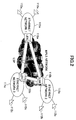
- FIG.1 illustrates an exemplary configuration of an Ethernet service scheme in a MAN.
- a virtual group (user A) is made up of stations 102a ⁇ 102c, which constitute a portion of a LAN constructed by the Ethernet (to be simply referred to as Ethernet network hereinafter).
- a VLAN tag is assigned to user A so that bridge apparatuses 100a ⁇ 100c and 101 within the Ethernet network may use the VLAN tag to realize frame transmission between the stations 102a ⁇ 102c.
- the VLAN tag is used as an identifier to identify a corresponding group of a user (i.e. subscriber), and in this way, band and other QoS (quality of service) may be provided to a given group according to its VLAN tag.
- EoMPLS Ethernet over MPLS
- MPLS Multiprotocol Label Switching
- EoMPLS involves attaching an identifier called a 'label' to a frame within an MPLS network, and conducting frame transmission based on this label.
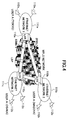
- FIG.2 shows an exemplary configuration of an EoMPLS network.
- a virtual group is made up of stations 112a ⁇ 112c corresponding to portions of Ethernet networks 111a ⁇ 111c, respectively.
- the Ethernet networks 111a ⁇ 111c are interconnected by an LSP (Label Switch Path) within the MPLS network.
- the Ethernet networks 111a ⁇ 111c are connected to the MPLS via LER (Label Edge Router) 110a ⁇ 110c, respectively.
- LSP Label Switch Path
- LER Label Edge Router
- an LSP may be established between the Ethernet networks 111a ⁇ 111c by using EoMPLS technology, and thereby, a desired band may be secured as a reserved band in each LSP to realize band control betweeen the Ethernet networks 111a ⁇ 111c.
- the VLAN tag is used as an identifier for identifying a corresponding group of a user, and consequently, problems such as those described below are created.
- the reserved band is equally distributed between these locations.
- the group corresponding to user A may be identified by the VLAN tag; however, the respective locations of the group may not be identified and thereby band usage may not be controlled with respect to the different locations.
- the bridge apparatuses 100a ⁇ 100c and 101 are merely capable of handling traffic as that designated for user A and are unable to recognize the different locations belonging to the group of user A.
- an LSP may be established between the Ethernet networks, and a desired band may be set as the reserved band for each LSP so that band usage between the respective locations (base) may be suitably controlled.
- band usage may be controlled so that 80 Mb/s is used between the Tokyo head quarters and the Osaka branch office, and 20 Mb/s is used between the Tokyo head quarters and the Nagoya branch office.
- the MPLS network requires complicated network designing. Also, in the EoMPLS technology, the frame being transmitted over the Ethernet network is encapsulated by the frame being transmitted over the MPLS network, thereby resulting in a large overhead.
- the present invention has been conceived in response to the one or more problems of the related art and its object is to provide a communication apparatus and a band control method for enabling band control of bases within a virtual group that is constructed by a portion of information appliances provided over a network.
- the present invention provides a communication apparatus that constructs a virtual group with a portion of information appliances provided over a network, the apparatus including:
- a group identification tag and a route identification tag are attached to a frame and band control may be realized according to the route identification tag.
- band control may be easily conducted for the respective bases of a virtual group formed by a portion of information appliances provided over a network.
- the communication apparatus of the present invention further includes:
- traffic flow of a frame to be stored in a queue may be controlled for each group identification tag and frames with the same route may be stored in the same queue so that the number of queues may be reduced.
- the traffic flow control unit is configured to control a maximum flow of the frame to be stored in the queue according to the group identification tag attached to the frame.
- the maximum flow of a frame to be stored in a queue may be controlled for each group identification tag so that band resources may be fairly distributed among differing groups of frames within a given queue.
- the traffic control unit is configured to control a maximum flow and a minimum flow of the frame to be stored in the queue according to the group identification tag attached to the frame.
- the minimum flow and the maximum flow of a frame to be stored in a queue may be controlled for each group identification tag.
- a minimum band may be secured for each corresponding group of a frame that is stored in a given queue, while an unused band that is secured for a group may be allotted to another group.
- the traffic flow control unit attaches to the frame an indicator for indicating that the frame is to be discarded with priority upon congestion of the queue.
- a frame with a traffic flow that is greater than or equal to a minimum flow and is less than or equal to a maximum flow may be discarded with priority upon congestion of a queue, and thereby, a frame of a group that is assigned a band having a traffic flow below the minimum flow rate may be read with priority.
- the route identification tag is attached to a position corresponding to a position in the frame to which the group identification tag is attached prior to the attachment of the route identification tag.
- a route identification tag is attached to a frame at a position corresponding to where a group identification tag is previously positioned, and thereby, a function of the communication apparatus of transferring a frame according to its group identification tag may be used to transmit a frame to another communication apparatus according to the route identification tag attached to the frame.
- the present invention provides a communication apparatus that constructs a virtual group with a portion of information appliances provided over a network, the apparatus comprising:
- a route identification tag is removed from a frame having a group identification tag and a route identification tag attached thereto, and thereby, a frame that is converted back to its original state may be output to an output port.
- the present invention provides a band control method for controlling a communication apparatus that constructs a virtual group with a portion of information appliances provided over a network, the method comprising:
- a group identification tag and a route identification tag are attached to a received frame to realize band control based on the route identification tag of a frame.
- band control may be easily realized for the respective bases of a virtual group formed by a portion of information appliances provided over a network.
- the present invention provides a band control method for controlling a communication apparatus that constructs a virtual group with a portion of information appliances provided over a network, the method comprising:
- a route identification tag is removed from a frame having a group identification tag and a route identification tag attached thereto, and thereby, a frame that is converted back to its original state may be output to an output port.
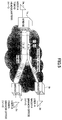
- FIG.5 shows an exemplary configuration of a network using communication apparatuses according to an embodiment of the present invention; more specifically, FIG.5 shows an exemplary Ethernet network using bridge apparatuses.
- a user A having base points at Tokyo headquarters, Nagoya branch office, and Osaka branch office establishes connection by assigning 20 Mb/s between the Tokyo headquarters and the Nagoya branch office and 80 Mb/s between the Tokyo headquarters and the Osaka branch office.
- station 3a at the Tokyo headquarters, station 3b at the Nagoya branch office, and station 3c at the Osaka branch office form a virtual group.
- station 3a is connected to a bridge apparatus 1a; station 3b is connected to a bridge apparatus 1b, and station 3c is connected to a bridge apparatus 1c.
- the bridge apparatuses 1a ⁇ 1c are interconnected via a bridge apparatus 2.
- a first VLAN tag V1 for identifying a user group and a second VLAN tag V2 for identifying a frame route are assigned to a frame being transmitted between two of the bridge apparatuses 1a ⁇ 1c.
- frames being transmitted between two of the bridge apparatuses 1a ⁇ 1c are only represented by their VLAN tags V1 and V2, and other components of these frames are omitted from the drawing for the sake of simplicity.
- a frame transmitted from station 3a of the Tokyo headquarters may be supplied to the bridge apparatus 1a.
- the bridge apparatus 1a may attach to this frame a VLAN number 1 that is assigned to the port receiving the frame as a VLAN tag V1.
- a frame transmitted from the station 3a at the Tokyo headquarters is supplied to the bridge apparatus 1a after a VLAN tag V1 is attached to the frame at a prior stage apparatus.
- the bridge apparatus 1a attaches a VLAN tag V2 to the frame according to the route of the received frame having a VLAN tag V1 attached thereto.
- the bridge apparatus 1a stores (buffers) the frame with the VLAN tags V1 and V2 attached thereto in a queue according to the VLAN tags V1 and V2.
- the VLAN tag V1 and V2 are attached to a frame within the bridge apparatus 1a; however, other embodiments are possible in which plural bridge apparatuses are used to attach the VLAN tags V1 and V2 to a frame, for example.
- WRR Weighted Round Robin
- a frame transmitted from the bridge apparatus 1a is received at a tag VLAN port of the bridge apparatus 2.
- the bridge apparatus 2 is arranged to identify the route of a received frame by referring to its outermost VLAN tag, namely, its VLAN tag V2. It is noted that the bridge apparatus is arranged to identify a domain of a frame by simply referring to the outermost VLAN tag of a frame, and the present embodiment uses such feature of the bridge apparatus to identify the route of a frame.
- the bridge apparatus 2 may identify the route of a frame by simply referring to the outer most VLAN tag V2 of a received frame without recognizing the existence of two stacks of tag information.
- the bridge apparatus 1b or 1c is arranged to receive a frame from the bridge apparatus 2 and remove the second VLAN tag V2 from the received frame.
- the bridge apparatus 1b or 1c removes the VLAN tag V2 and then the VLAN tag V1 from the frame, and transmits the resulting frame to the corresponding station 3b or 3c.
- the bridge apparatus 1b or 1c removes the VLAN tag V2 after which it transmits the frame to a subsequent apparatus where the VLAN tag V1 may be removed. Then, the resulting frame is transmitted to the corresponding station 3b or 3c.
- FIG.6 shows an exemplary configuration of the bridge apparatus 1a.
- the bridge apparatus 1a includes a VLAN tag V1 attaching unit 10, a MAC search unit 11, a queue control unit 12, at least one queue 13, a write control unit 14, a read control unit 15, and a MAC table 16.
- VLAN tag V1 attaching unit 10 a VLAN tag V1 attaching unit 10
- MAC search unit 11 a queue control unit 12
- queue control unit 12 at least one queue 13
- a write control unit 14 a read control unit
- MAC table 16 MAC table
- the VLAN tag V1 attaching unit 10 attaches a VLAN tag V1 to a frame received from the station 3a and transmits the frame with the VLAN tag V1 to the MAC search unit 11.
- the MAC search unit 11 is arranged to read the DA and the VLAN tag V1 of a received frame, and access a MAC table 16 to search for a corresponding VLAN tag V2 and a port to which the frame is to be output using the DA and the VLAN tag V1 as key information.
- the MAC table 16 indicates the correspondence between a DA, a VLAN tag V1, a port, and a VLAN tag V2.
- the MAC search unit 11 attaches the corresponding VLAN tag V2 to the received frame and transmits this frame to the queue control unit 12.
- the write control unit 14 included in the queue control unit 12 reads the VLAN tags V1 and V2 from the received frame, and searches for a queue 13 to which the frame is to be stored based on the VLAN tags V1 and V2 as is described in detail below. Then, the queue control unit 12 stores the frame in the corresponding queue 13.
- the read control unit 15 included in the queue control unit 12 searches for a corresponding read rate for reading the frame. It is noted that a predetermined read rate may be set for each queue, so that a frame may be read from its corresponding queue 13 at a corresponding read rate. In this way, the queue control unit 12 is able to control a frame read rate for each queue.
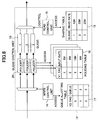
- FIG.7 is a diagram showing a configuration of a queue control unit 12 according to a first embodiment of the present invention.
- the queue control unit 12 includes at least one queue 13, a write control unit 14, a read control unit 15, a queue allotting table 17, and a shaping table 18.
- the write control unit 14 of the queue control unit 12 is arranged to read the VLAN tags V1 and V2 of a received frame, and access the queue allotting table 17 to search for a corresponding queue 13 using the VLAN tags V1 and V2 as key information.
- the queue allotting table 17 indicates a correspondence between VLAN tags V1 and V2 and a queue. After determining the corresponding queue 13 based on the VLAN tags V1 and V2, the write control unit 14 stores the received frame in the corresponding queue 13.
- the queue control unit 12 allots a received frame according to its VLAN tags V1 and V2.
- the read control unit 15 of the queue control unit 12 is arranged to search for a corresponding read rate for a queue 13 from the shaping table 18 and read a frame from the queue 13 at the corresponding read rate. In this way, the queue control unit 12 may be able to control a frame read rate for each queue 13.
- FIG.8 is a diagram showing a configuration of a queue control unit 12 according to a second embodiment of the present invention.
- the queue control unit 12 of FIG.8 includes at least one queue 13, a write control unit 14, a read control unit 15, a queue allotting table 17, a shaping table 18, a policing table 19, and at least one policer 20.
- the write control unit 14 of the queue control unit 12 is arranged to read the VLAN tag V2 of a received frame and access the queue allotting table 17 to search for a corresponding queue for the frame using the VLAN tag V2 as key information.
- the queue allotting table 17 indicates a correspondence between a VLAN tag V2 and a queue 13.
- the queue control unit 12 allots a received frame to a corresponding queue 13 according to its VLAN tag V2; namely, its route.
- policing of traffic flow is conducted with respect to each VLAN tag V1; namely, for each group, so that a particular group may be prevented from dominating the read band.
- the queue control unit 12 of FIG.8 includes a policer 20 before each queue 13 to conduct policing of a frame being stored in each queue 13 to thereby control the traffic flow of a frame according to its VLAN tag V1.
- the policer 20 is arranged to read the VLAN tag V1 of a received frame and access the policing table 19, which indicates a correspondence between a VLAN tag V1 and an input rate, to determine a corresponding input rate for the received frame using the read VLAN tag V1 as key information. It is noted that the policing table 19 may be individually set for each policer 20. In this way, the queue control unit 12 may allot a received frame according to its VLAN tag V2 and control the traffic flow of the allotted frame according to its VLAN tag V1.
- a frame that is allotted according to its VLAN tag V2 may be stored in its corresponding queue 13. It is noted that in the example of FIG.8, different queues 13 are provided with respect to different VLAN tags V2, and thereby, the number of queues to be provided in the queue control unit 12 may be reduced compared to the example of FIG.7.
- the read control unit 15 of the queue control unit 12 is arranged to access the shaping table 18 to search for a corresponding read rate for a frame from the respective read rates set to the queues 13 in the shaping table 18, and read the frame from its corresponding queue 13 at the corresponding read rate. In this way, the queue control unit 12 is able to control a frame read rate for each queue 13.
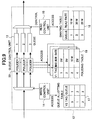
- FIG.9 is a diagram showing a configuration of a queue control unit 12 according to a third embodiment of the present invention.
- the shaping table 18 and the policing table 19 are set differently from the example of FIG.8.
- the policing table 19 indicates a maximum rate for each VLAN tag or each group. Accordingly, the policer 20 conducts policing of a frame to be stored in a queue 13 according to a maximum rate set for the corresponding group of the frame referring to the policing table 19. In the shaping table 18 of the present example, the sum of the maximum rates for the corresponding groups of frames stored in a queue 13 is set as the read rate of the queue 13.
- the read rate of the corresponding queue 13 is set to 130 Mb/s in the shaping table 18.
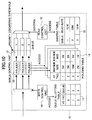
- FIG.10 is a diagram showing a configuration of a queue control unit 12 according to a fourth embodiment of the present invention.
- the shaping table 18 and the policing table 19 are set differently with respect to the examples of FIGS.8 and 9.
- the policing table 19 sets a minimum rate and a maximum rate for each VLAN tag V1; namely, for each group.
- the policer 20 is arranged to conduct policing of a frame to be stored in a queue 13 according to the minimum rate and the maximum rate for the corresponding group of the frame set in the policing table 19.
- traffic with flow rate that is within the range between the minimum rate and the maximum rate has a priority discarding bit set thereto so as to be discarded with priority in its corresponding queue 13.
- a priority discarding threshold value is set, and when traffic in a queue 13 exceeds the priority discarding threshold value, a frame with the priority discarding bit may be discarded with priority.
- traffic below the minimum rate may be read with priority when traffic in a queue 13 exceeds the priority discarding threshold value.
- the read rate for the queue 13 is set to 30 ⁇ 130 Mb/s in the shaping table 18. It is noted that a high read rate set in the shaping table 18 enables efficient passage of the best effort traffic while a low read rate tends to degrade the passage of the best effort traffic.
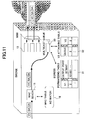
- FIG.11 is a diagram illustrating an exemplary operation of the bridge apparatus 1a in response to receiving a non-learned frame. It is noted that basic operation steps conducted in the present example are identical to those described in relation to the example of FIG.6, and their descriptions are omitted accordingly.
- the MAC search unit 11 reads the DA and the VLAN tag V1 of a received frame and accesses the MAC table 16 to search for a corresponding VLAN tag V2 and a port to which the frame is to be output using the read DA and the VLAN tag V1 as key information.
- the received frame corresponds to a non-learned frame, and thereby, the MAC search unit 11 is unable to find the corresponding VLAN tag V2 and the port to which the frame is to be output from the MAC table 16.
- the MAC search unit accesses a forwarding table 31 using the VLAN tag V1 of the received frame as key information to acquire a bit map of the physical and logical ports belonging to the VLAN tag V1 so that it may multicast the frame to the VLAN tag V1 domain.
- the frame may be accumulated in a multicast queue 30 to wait for a readout opportunity to each port.
- a read control unit may be able to transmit a frame with a VLAN tag V2 attached thereto even when the frame is received as a non-learned frame.
- FIG.12 is a diagram showing an exemplary configuration of the bridge apparatuses 1b and 1c.
- the bridge apparatuses 1b and 1c each include a MAC learning unit 40, a VLAN tag V2 removing unit 41, a MAC search unit 42, a VLAN tag V1 removing unit 43, and a MAC table 44.
- V1 the VLAN tag
- MAC table 44 a MAC table 44.
- the MAC search unit 40 of the bridge apparatus 1b or 1c is arranged to read the VLAN tag V1, the VLAN tag V2, and the SA of the received frame, learn the correspondence between the SA, the VLAN tag V1, the port receiving the frame, and the VLAN tag V2, and store the learned information in the MAC table 44.
- the MAC table 44 associates a set of the SA and the VLAN tag V1 with a set of the corresponding output port and the VLAN tag V2.
- the MAC leaning unit 40 transmits the learned frame to the VLAN tag V2 removing unit 41.
- the VLAN tag V2 removing unit removes the VLAN tag V2 from the received frame and transmits the resulting frame to the MAC search unit 42.
- the MAC search unit 42 is arranged to read the VLAN tag of a received frame, and access the MAC table 44 to determine a corresponding port to which the frame is to be output using the VLAN tag V1 as key information.
- the VLAN tag V1 removing unit 43 receives the frame from the MAC search unit 42, removes the VLAN tag V1 from the received frame, and transmits the resulting frame to the corresponding station 3b or 3c.
- the MAC search unit 42 of the bridge apparatus 1b or 1c transmits the frame with the VLAN tag V2 removed therefrom to a subsequent apparatus where the VLAN tag V1 may be removed. Then, the resulting frame is transmitted to the corresponding station 3b or 3c.
Landscapes
- Engineering & Computer Science (AREA)
- Computer Networks & Wireless Communication (AREA)
- Signal Processing (AREA)
- Computer Security & Cryptography (AREA)
- Data Exchanges In Wide-Area Networks (AREA)
- Small-Scale Networks (AREA)
Applications Claiming Priority (1)
| Application Number | Priority Date | Filing Date | Title |
|---|---|---|---|
| PCT/JP2002/012677 WO2004051942A1 (ja) | 2002-12-03 | 2002-12-03 | 通信装置および帯域管理方法 |
Publications (2)
| Publication Number | Publication Date |
|---|---|
| EP1569389A1 true EP1569389A1 (de) | 2005-08-31 |
| EP1569389A4 EP1569389A4 (de) | 2006-01-18 |
Family
ID=32448993
Family Applications (1)
| Application Number | Title | Priority Date | Filing Date |
|---|---|---|---|
| EP02783756A Withdrawn EP1569389A4 (de) | 2002-12-03 | 2002-12-03 | Kommunikationseinrichtung und bandsteuerverfahren |
Country Status (5)
| Country | Link |
|---|---|
| US (1) | US20050175022A1 (de) |
| EP (1) | EP1569389A4 (de) |
| JP (1) | JPWO2004051942A1 (de) |
| CN (1) | CN1640071A (de) |
| WO (1) | WO2004051942A1 (de) |
Cited By (4)
| Publication number | Priority date | Publication date | Assignee | Title |
|---|---|---|---|---|
| WO2006123287A3 (en) * | 2005-05-18 | 2007-02-08 | Koninkl Philips Electronics Nv | Integrated circuit and method of arbitration in a network on an integrated circuit |
| EP1833205A1 (de) * | 2006-03-06 | 2007-09-12 | Fujitsu Ltd. | Bandsteuerprogramm, Bandsteuervorrichtung und Bandsteuerverfahren |
| WO2008118797A1 (en) | 2007-03-27 | 2008-10-02 | Amazon Technologies, Inc. | Configuring intercommunications between computing nodes |
| EP2001172A4 (de) * | 2006-06-16 | 2009-04-01 | Huawei Tech Co Ltd | Verfahren, system und einrichtung für ethernet-technik-austausch und -weiterleitung |
Families Citing this family (28)
| Publication number | Priority date | Publication date | Assignee | Title |
|---|---|---|---|---|
| US7715310B1 (en) | 2004-05-28 | 2010-05-11 | Cisco Technology, Inc. | L2VPN redundancy with ethernet access domain |
| US7643409B2 (en) * | 2004-08-25 | 2010-01-05 | Cisco Technology, Inc. | Computer network with point-to-point pseudowire redundancy |
| JP4654650B2 (ja) * | 2004-10-13 | 2011-03-23 | 日本電気株式会社 | 無線伝送システム、無線伝送装置及びそれに用いる無線伝送方法 |
| JP2006211113A (ja) * | 2005-01-26 | 2006-08-10 | Mitsubishi Electric Corp | 情報収集システム及びこれに用いられる基地局 |
| FR2882939B1 (fr) * | 2005-03-11 | 2007-06-08 | Centre Nat Rech Scient | Dispositif de separation fluidique |
| US8213435B2 (en) * | 2005-04-28 | 2012-07-03 | Cisco Technology, Inc. | Comprehensive model for VPLS |
| US8194656B2 (en) | 2005-04-28 | 2012-06-05 | Cisco Technology, Inc. | Metro ethernet network with scaled broadcast and service instance domains |
| US9088669B2 (en) * | 2005-04-28 | 2015-07-21 | Cisco Technology, Inc. | Scalable system and method for DSL subscriber traffic over an Ethernet network |
| US7835370B2 (en) * | 2005-04-28 | 2010-11-16 | Cisco Technology, Inc. | System and method for DSL subscriber identification over ethernet network |
| US8094663B2 (en) * | 2005-05-31 | 2012-01-10 | Cisco Technology, Inc. | System and method for authentication of SP ethernet aggregation networks |
| US8175078B2 (en) * | 2005-07-11 | 2012-05-08 | Cisco Technology, Inc. | Redundant pseudowires between Ethernet access domains |
| US7889754B2 (en) * | 2005-07-12 | 2011-02-15 | Cisco Technology, Inc. | Address resolution mechanism for ethernet maintenance endpoints |
| US7855950B2 (en) * | 2005-08-01 | 2010-12-21 | Cisco Technology, Inc. | Congruent forwarding paths for unicast and multicast traffic |
| US8169924B2 (en) * | 2005-08-01 | 2012-05-01 | Cisco Technology, Inc. | Optimal bridging over MPLS/IP through alignment of multicast and unicast paths |
| US9088619B2 (en) * | 2005-09-14 | 2015-07-21 | Cisco Technology, Inc. | Quality of service based on logical port identifier for broadband aggregation networks |
| US8085790B2 (en) * | 2006-07-14 | 2011-12-27 | Cisco Technology, Inc. | Ethernet layer 2 protocol packet switching |
| US7961612B2 (en) * | 2006-12-04 | 2011-06-14 | International Business Machines Corporation | Limiting transmission rate of data |
| US8804534B2 (en) * | 2007-05-19 | 2014-08-12 | Cisco Technology, Inc. | Interworking between MPLS/IP and Ethernet OAM mechanisms |
| US8531941B2 (en) * | 2007-07-13 | 2013-09-10 | Cisco Technology, Inc. | Intra-domain and inter-domain bridging over MPLS using MAC distribution via border gateway protocol |
| US8077709B2 (en) | 2007-09-19 | 2011-12-13 | Cisco Technology, Inc. | Redundancy at a virtual provider edge node that faces a tunneling protocol core network for virtual private local area network (LAN) service (VPLS) |
| US9014184B2 (en) | 2009-09-24 | 2015-04-21 | Nec Corporation | System and method for identifying communication between virtual servers |
| US8798059B1 (en) | 2010-12-03 | 2014-08-05 | Juniper Networks, Inc. | Optimizing private virtual local area networks (VLANs) |
| US8650285B1 (en) | 2011-03-22 | 2014-02-11 | Cisco Technology, Inc. | Prevention of looping and duplicate frame delivery in a network environment |
| US20120250694A1 (en) * | 2011-03-28 | 2012-10-04 | Tttech Computertechnik Ag | Centralized traffic shaping for data networks |
| US9473420B2 (en) | 2013-03-13 | 2016-10-18 | International Business Machines Corporation | Metrics and forwarding actions on logical switch partitions in a distributed network switch |
| US9282056B2 (en) * | 2013-03-13 | 2016-03-08 | International Business Machines Corporation | Metrics and forwarding actions on logical switch partitions in a distributed network switch |
| US9313044B2 (en) * | 2014-07-17 | 2016-04-12 | Cisco Technology, Inc. | Multiple mobility domains with VLAN translation in a multi-tenant network environment |
| US11211999B2 (en) * | 2017-12-28 | 2021-12-28 | Hughes Network Systems, Llc | Satellite network virtual LAN usage |
Family Cites Families (12)
| Publication number | Priority date | Publication date | Assignee | Title |
|---|---|---|---|---|
| US5963556A (en) * | 1993-06-23 | 1999-10-05 | Digital Equipment Corporation | Device for partitioning ports of a bridge into groups of different virtual local area networks |
| US6157623A (en) * | 1997-02-14 | 2000-12-05 | Advanced Micro Devices, Inc. | Apparatus and method for selectively outputting data using a MAC layer interface or a PCI bus interface |
| US5978378A (en) * | 1997-09-11 | 1999-11-02 | 3Com Corporation | Method and apparatus for VLAN support |
| US6724767B1 (en) * | 1998-06-27 | 2004-04-20 | Intel Corporation | Two-dimensional queuing/de-queuing methods and systems for implementing the same |
| JP2000341295A (ja) * | 1999-05-31 | 2000-12-08 | Fujitsu Ltd | Atm装置 |
| JP4168574B2 (ja) * | 2000-06-02 | 2008-10-22 | 株式会社日立製作所 | パケット転送装置、パケット転送制御方法、及びパケット転送装置の設定方法 |
| US7088714B2 (en) * | 2000-08-24 | 2006-08-08 | Tasman Networks, Inc | System and method for connecting geographically distributed virtual local area networks |
| JP2002101126A (ja) * | 2000-09-25 | 2002-04-05 | Hitachi Ltd | 通信方法 |
| JP4183379B2 (ja) * | 2000-11-27 | 2008-11-19 | 富士通株式会社 | ネットワーク及びエッジルータ |
| US6618388B2 (en) * | 2001-01-05 | 2003-09-09 | Extreme Networks | Method and system for VMAN protocol |
| WO2002061599A1 (en) * | 2001-01-25 | 2002-08-08 | Crescent Networks, Inc. | Extension of address resolution protocol (arp) for internet protocol (ip) virtual networks |
| US7292581B2 (en) * | 2002-10-24 | 2007-11-06 | Cisco Technology, Inc. | Large-scale layer 2 metropolitan area network |
-
2002
- 2002-12-03 EP EP02783756A patent/EP1569389A4/de not_active Withdrawn
- 2002-12-03 JP JP2004556798A patent/JPWO2004051942A1/ja active Pending
- 2002-12-03 WO PCT/JP2002/012677 patent/WO2004051942A1/ja not_active Ceased
- 2002-12-03 CN CN02829381.9A patent/CN1640071A/zh active Pending
-
2005
- 2005-01-05 US US11/029,010 patent/US20050175022A1/en not_active Abandoned
Cited By (8)
| Publication number | Priority date | Publication date | Assignee | Title |
|---|---|---|---|---|
| WO2006123287A3 (en) * | 2005-05-18 | 2007-02-08 | Koninkl Philips Electronics Nv | Integrated circuit and method of arbitration in a network on an integrated circuit |
| EP1833205A1 (de) * | 2006-03-06 | 2007-09-12 | Fujitsu Ltd. | Bandsteuerprogramm, Bandsteuervorrichtung und Bandsteuerverfahren |
| EP2001172A4 (de) * | 2006-06-16 | 2009-04-01 | Huawei Tech Co Ltd | Verfahren, system und einrichtung für ethernet-technik-austausch und -weiterleitung |
| EP2383944A1 (de) * | 2006-06-16 | 2011-11-02 | Huawei Technologies Co., Ltd. | Ethernet-Schalt- und Weiterleitungsverfahren, System und Vorrichtung |
| US8072984B2 (en) | 2006-06-16 | 2011-12-06 | Huawei Technologies Co., Ltd. | Ethernet switching and forwarding method, system and apparatus |
| WO2008118797A1 (en) | 2007-03-27 | 2008-10-02 | Amazon Technologies, Inc. | Configuring intercommunications between computing nodes |
| EP2132647A4 (de) * | 2007-03-27 | 2014-10-29 | Amazon Tech Inc | Konfiguration von kommunikation zwischen rechenknoten |
| EP3208724A1 (de) * | 2007-03-27 | 2017-08-23 | Amazon Technologies, Inc. | Konfiguration von kommunikation zwischen rechenknoten |
Also Published As
| Publication number | Publication date |
|---|---|
| CN1640071A (zh) | 2005-07-13 |
| WO2004051942A1 (ja) | 2004-06-17 |
| JPWO2004051942A1 (ja) | 2006-04-06 |
| US20050175022A1 (en) | 2005-08-11 |
| EP1569389A4 (de) | 2006-01-18 |
Similar Documents
| Publication | Publication Date | Title |
|---|---|---|
| EP1569389A1 (de) | Kommunikationseinrichtung und bandsteuerverfahren | |
| US6674760B1 (en) | Method and system for implementing end-to-end QoS in packet-switched networks | |
| CN100490422C (zh) | 在异构网络中分类和重定向数据分组的方法和设备 | |
| US6865153B1 (en) | Stage-implemented QoS shaping for data communication switch | |
| US6788682B1 (en) | Mapping of packets between links of trunk groups using Mux/Demux devices | |
| US6990106B2 (en) | Classification and tagging rules for switching nodes | |
| EP1670187B1 (de) | Regeln zur Kennzeichnung von Hybrid-Ports | |
| CA2352697C (en) | Router device and priority control method for use in the same | |
| JP3788803B2 (ja) | L2スイッチ | |
| US8527674B2 (en) | Data packet switching | |
| US20040267948A1 (en) | Method and system for a network node for attachment to switch fabrics | |
| US20110019572A1 (en) | Method and apparatus for shared shaping | |
| US7502366B1 (en) | Arrangement in a network switch for prioritizing data frames based on user-defined frame attributes | |
| JP2001285333A (ja) | データ通信スイッチのための選択可能な優先順位付け | |
| US8081633B2 (en) | Network node unit and method for forwarding data packets | |
| US20090292575A1 (en) | Coalescence of Disparate Quality of Service Matrics Via Programmable Mechanism | |
| US6976096B1 (en) | Method and apparatus for controlling the admission of data into a network element | |
| US20120275325A1 (en) | Communication apparatus and method | |
| US9137030B1 (en) | Multicast queueing in a network switch | |
| KR100572696B1 (ko) | 광대역 가입자 집선-스위치 장치 | |
| US7061919B1 (en) | System and method for providing multiple classes of service in a packet switched network | |
| RU2354058C2 (ru) | Система переключения и способ переключения на основе переключения класса услуг | |
| EP2540040B1 (de) | Source-basierender selektionsmechanismus in der routing-umgebung | |
| US8953449B2 (en) | Virtual subport data traffic management | |
| US20070133584A1 (en) | Ethernet line card and method of providing various services using the same |
Legal Events
| Date | Code | Title | Description |
|---|---|---|---|
| PUAI | Public reference made under article 153(3) epc to a published international application that has entered the european phase |
Free format text: ORIGINAL CODE: 0009012 |
|
| 17P | Request for examination filed |
Effective date: 20050202 |
|
| AK | Designated contracting states |
Kind code of ref document: A1 Designated state(s): AT BE BG CH CY CZ DE DK EE ES FI FR GB GR IE IT LI LU MC NL PT SE SI SK TR |
|
| A4 | Supplementary search report drawn up and despatched |
Effective date: 20051206 |
|
| RBV | Designated contracting states (corrected) |
Designated state(s): DE FR GB |
|
| STAA | Information on the status of an ep patent application or granted ep patent |
Free format text: STATUS: THE APPLICATION IS DEEMED TO BE WITHDRAWN |
|
| 18D | Application deemed to be withdrawn |
Effective date: 20080702 |